AEE Technology AEEAP11A001 Aerial Photography Equipment User Manual

Shenzhen AEE Technology CO., LTD. Aerial Photography Equipment

User Manual

aee.com2  Quadcopter User ManualV1�0 2015�8 Please read this "User Manual "carefully before using Quadcopter.ConventionsExcept when specically stated, all Quadcopter features described in this manual are for Quadcopter Operating Modes.Warning : (1) When installing the propellers, rotate the propellers strictly in the lock direction specied by the mark, and DO NOT apply too much force in order to avoid possible damage�  (2) When removing the propellers, rotate the propellers strictly in the unlock direction specied by the mark, in order to avoid possible damage.
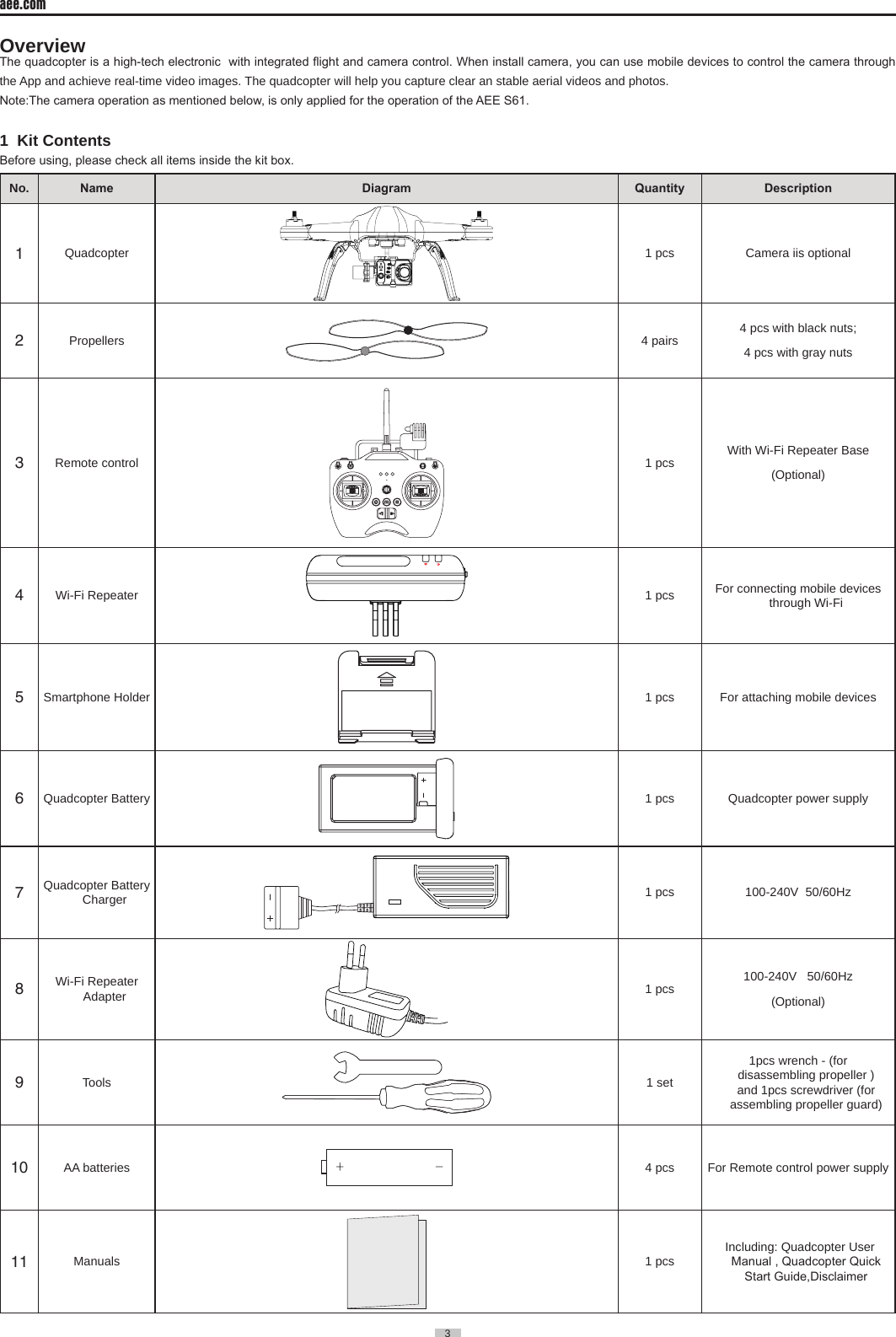
3  aee.com3  Overview The quadcopter is a high-tech electronic  with integrated ight and camera control. When install camera, you can use mobile devices to control the camera through the App and achieve real-time video images� The quadcopter will help you capture clear an stable aerial videos and photos�Note:The camera operation as mentioned below, is only applied for the operation of the AEE S61.1  Kit ContentsBefore using, please check all items inside the kit box.No� Name Diagram Quantity Description1Quadcopter 1 pcs Camera iis optional2Propellers 4 pairs 4 pcs with black nuts; 4 pcs with gray nuts  3Remote control 1 pcs With Wi-Fi Repeater Base(Optional)4Wi-Fi Repeater 1 pcs For connecting mobile devices through Wi-Fi5Smartphone Holder 1 pcs For attaching mobile devices6Quadcopter Battery 1 pcs Quadcopter  power  supply                                 7Quadcopter Battery Charger 1 pcs 100-240V  50/60Hz8Wi-Fi Repeater Adapter 1 pcs 100-240V   50/60Hz(Optional)9Tools 1 set1pcs wrench - (for                  disassembling propeller ) and 1pcs screwdriver (for assembling propeller guard)10 AA batteries 4 pcs For Remote control power supply 11 Manuals 1 pcs  Including: Quadcopter User Manual , Quadcopter Quick Start Guide,Disclaimer
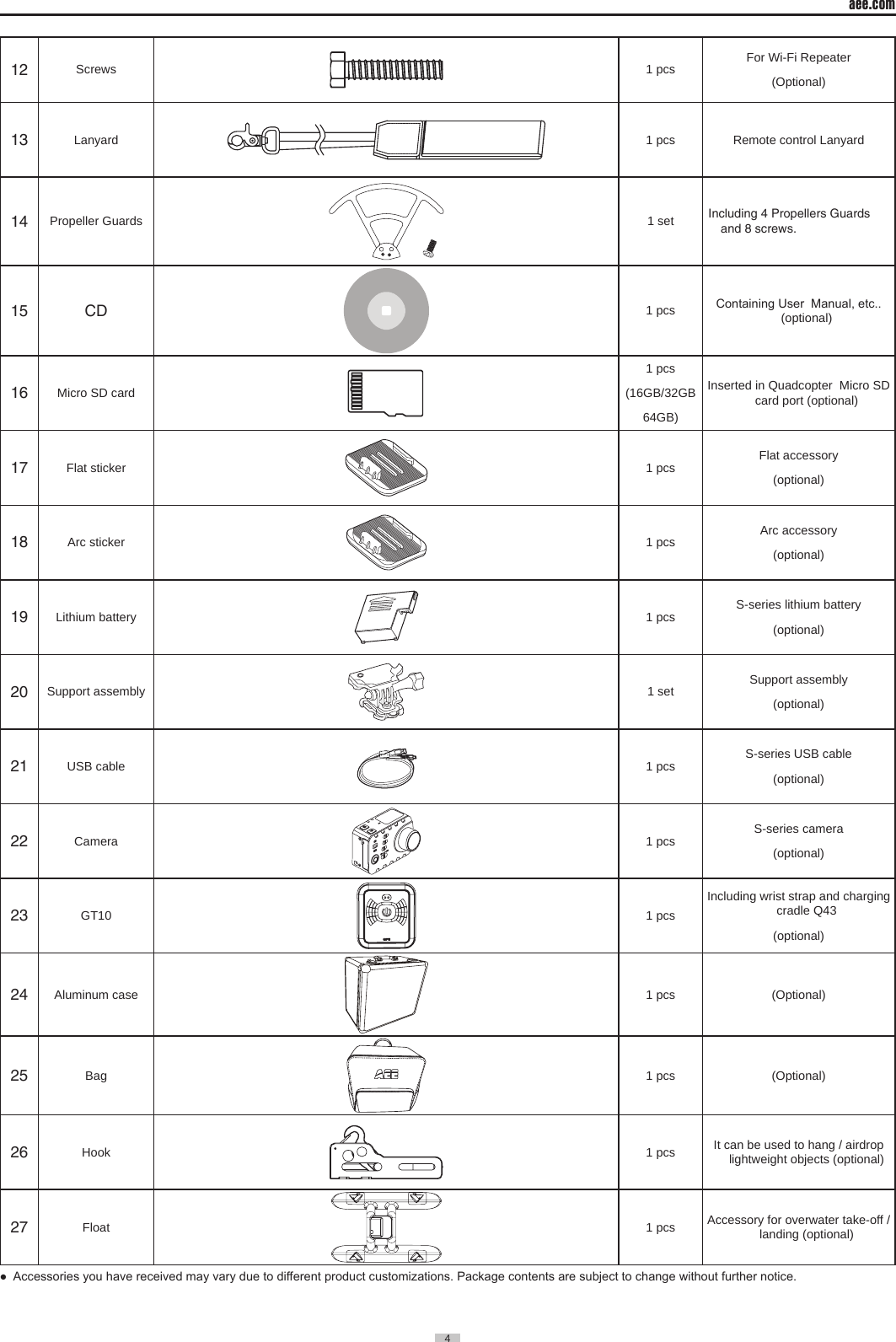
aee.com4  12 Screws 1 pcs For Wi-Fi Repeater(Optional)13 Lanyard 1 pcs Remote control Lanyard14 Propeller Guards 1 set  Including 4 Propellers Guards and 8 screws.15 CD 1 pcs Containing User  Manual, etc..                   (optional)16 Micro SD card1 pcs(16GB/32GB64GB)Inserted in Quadcopter  Micro SD card port (optional)17 Flat sticker 1 pcs Flat accessory(optional)18 Arc sticker 1 pcs Arc accessory(optional)19 Lithium battery 1 pcs S-series lithium battery(optional)20 Support assembly 1 set Support assembly(optional)21 USB cable 1 pcs S-series USB cable(optional)22 Camera 1 pcs S-series camera (optional)23 GT10 1 pcsIncluding wrist strap and charging cradle Q43(optional)24 Aluminum case 1 pcs (Optional)25 Bag 1 pcs (Optional)26 Hook 1 pcs It can be used to hang / airdrop lightweight objects (optional) 27 Float 1 pcs Accessory for overwater take-off / landing (optional)●  Accessories you have received may vary due to different product customizations. Package contents are subject to change without further notice.
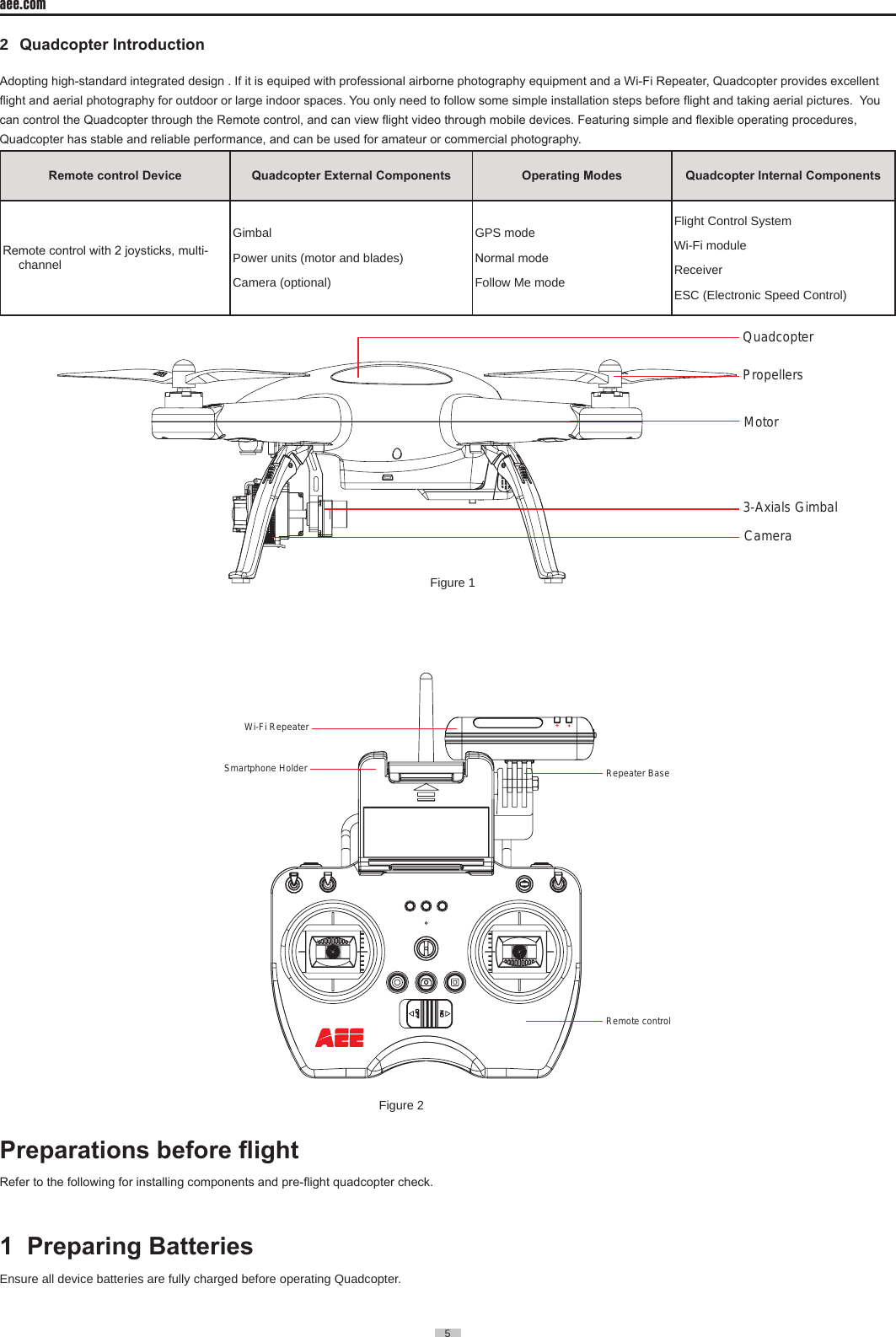
5  aee.com5  2   Quadcopter Introduction                                                             Adopting high-standard integrated design . If it is equiped with professional airborne photography equipment and a Wi-Fi Repeater, Quadcopter provides excellent ight and aerial photography for outdoor or large indoor spaces. You only need to follow some simple installation steps before ight and taking aerial pictures.  You can control the Quadcopter through the Remote control, and can view ight video through mobile devices. Featuring simple and exible operating procedures, Quadcopter has stable and reliable performance, and can be used for amateur or commercial photography.Remote control Device Quadcopter External Components Operating Modes Quadcopter Internal ComponentsRemote control with 2 joysticks, multi-channelGimbalPower units (motor and blades)Camera (optional) GPS mode Normal mode Follow Me modeFlight Control System Wi-Fi module Receiver ESC (Electronic Speed Control)Quadcopter Propellers Motor 3-Axials GimbalCamera   Figure 1Repeater BaseRemote controlWi-Fi RepeaterSmartphone Holder                                                                                                                    Figure 2   Preparations before ightRefer to the following for installing components and pre-ight quadcopter check.1  Preparing Batteries                                                                Ensure all device batteries are fully charged before operating Quadcopter�
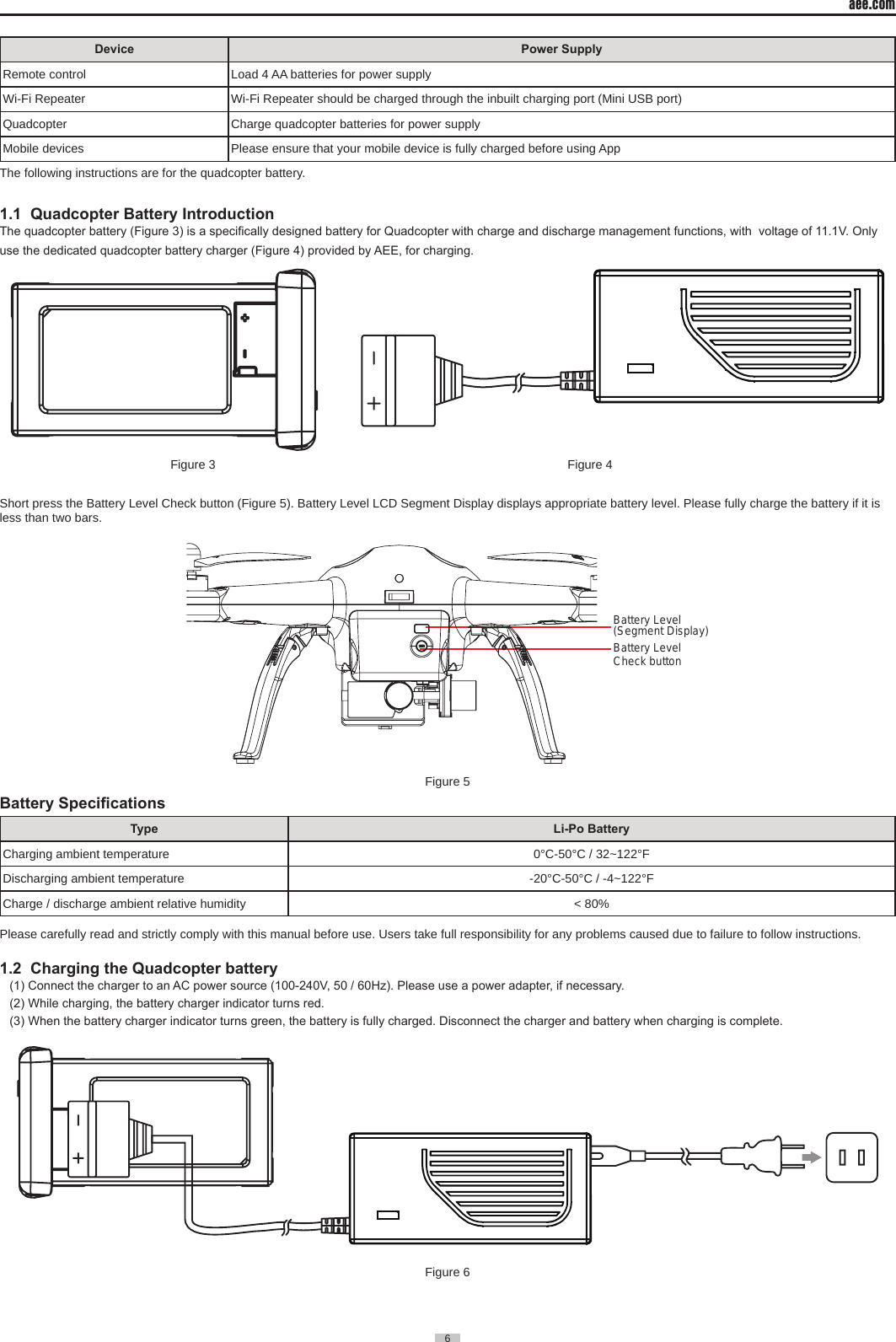
aee.com6  Device Power SupplyRemote control Load 4 AA batteries for power supplyWi-Fi Repeater Wi-Fi Repeater should be charged through the inbuilt charging port (Mini USB port)Quadcopter Charge quadcopter batteries for power supplyMobile devices Please ensure that your mobile device is fully charged before using AppThe following instructions are for the quadcopter battery�1.1  Quadcopter Battery IntroductionThe quadcopter battery (Figure 3) is a specically designed battery for Quadcopter with charge and discharge management functions, with  voltage of 11.1V. Only use the dedicated quadcopter battery charger (Figure 4) provided by AEE, for charging.                                                  Figure 3                                                                                                       Figure 4Short press the Battery Level Check button (Figure 5)� Battery Level LCD Segment Display displays appropriate battery level� Please fully charge the battery if it is less than two bars�Battery Level Check buttonBattery Level(Segment Display)Figure 5Battery SpecicationsType Li-Po BatteryCharging ambient temperature 0°C-50°C / 32~122°FDischarging ambient temperature -20°C-50°C / -4~122°FCharge / discharge ambient relative humidity < 80%Please carefully read and strictly comply with this manual before use� Users take full responsibility for any problems caused due to failure to follow instructions�1.2  Charging the Quadcopter battery(1) Connect the charger to an AC power source (100-240V, 50 / 60Hz). Please use a power adapter, if necessary. (2) While charging, the battery charger indicator turns red. (3) When the battery charger indicator turns green, the battery is fully charged. Disconnect the charger and battery when charging is complete.Figure 6
7  aee.com7  1.3  Quadcopter Battery InstallationPush the battery into the battery compartment in the correct direction (Figure 7). After the battery is properly installed, a “click” sound will be heard, indicating that the battery has been fastened�                                                                                                                                                                      Figure 71.4  Caution(1) Do not directly pull out the battery when the Quadcopter is switched on as it may damage the power supply connector�(2) For long term storage, discharge the battery to 40%-50% power, and store in a specied battery box. Discharge/charge the battery once every three months to maintain battery life�(3) Replace the battery after it has been discharged over 300 times� Completely discharge a battery prior to disposal� (4) Replace the battery if your current battery swells up or is damaged in any way, to avoid re and explosion.(5) Do not charge expanded or damaged batteries�(6) Please pay attention to the battery charging process in order to avoid accidents, and make sure there are no ammable or combustible materials around the battery and the charger� (7) Battery safety is extremely important� Please refer to Disclaimer for more precautions�2  Preparing the Quadcopter                                                              The Quadcopter consists mainly of the ight control system, gimbal, camera (optional) and power unit.2.1  Introduction     [ 1 ][ 2 ][ 3 ][ 4 ][ 7 ][ 5 ][ 6 ][ 8 ][ 9 ][11][10][12]Figure 8      [ 1 ] Propeller    [ 2 ] Motor      [ 3 ] Front Indicator    [ 4 ] Landing Gear      [ 5 ] Camera    [ 6 ] 3-Axials Gimbal    [ 7 ] Quadcopter Battery  [ 8 ] Tail Indicator[ 9 ] Power Switch          [ 10 ] Rear Indicator    [ 11 ] Battery Level LCD Segment Display   [ 12 ] Battery Level Check ButtonAn incorrectly installed battery may cause●  Bad contact● Affect ight safety● Inability to take off.
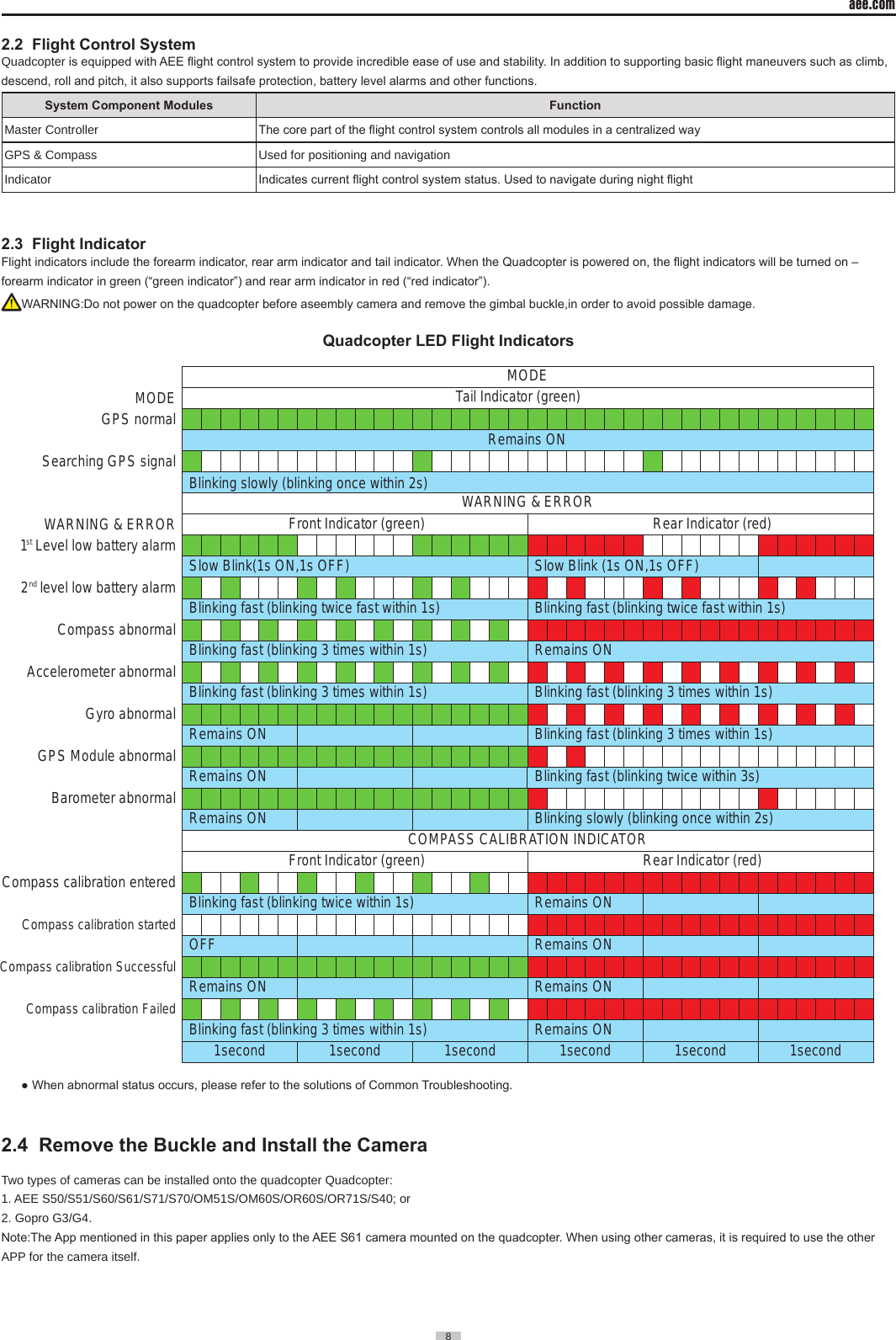
aee.com8  2.2  Flight Control System Quadcopter is equipped with AEE ight control system to provide incredible ease of use and stability. In addition to supporting basic ight maneuvers such as climb, descend, roll and pitch, it also supports failsafe protection, battery level alarms and other functions.System Component Modules FunctionMaster Controller The core part of the ight control system controls all modules in a centralized wayGPS & Compass Used for positioning and navigationIndicator Indicates current ight control system status. Used to navigate during night ight2.3  Flight IndicatorFlight indicators include the forearm indicator, rear arm indicator and tail indicator. When the Quadcopter is powered on, the ight indicators will be turned on – forearm indicator in green (“green indicator”) and rear arm indicator in red (“red indicator”).WARNING:Do not power on the quadcopter before aseembly camera and remove the gimbal buckle,in order to avoid possible damage.Quadcopter LED Flight IndicatorsMODETail Indicator (green)WARNING & ERRORMODEGPS normalSearching GPS signalWARNING & ERROR1  Level low battery alarm2   level low battery alarmCompass abnormalAccelerometer abnormalGyro abnormalGPS Module abnormalBarometer abnormalCompass calibration enteredCompass calibration startedCompass calibration SuccessfulCompass calibration Failedst ndCOMPASS CALIBRATION INDICATORFront Indicator (green)ON-Blinking-ON-BlinkingBlinking fast (blinking 3 times within 1s) Blinking fast (blinking 3 times within 1s) Remains ONSlow Blink(1s ON,1s OFF)Blinking fast (blinking twice fast within 1s)  Blinking fast (blinking twice fast within 1s) Slow Blink (1s ON,1s OFF)Rear Indicator (red)Front Indicator (green) Rear Indicator (red)Remains ONRemains ONRemains ONRemains ON1second1second 1second 1second 1second 1secondRemains ONRemains ONRemains ONBlinking fast (blinking 3 times within 1s)Blinking fast (blinking 3 times within 1s)Blinking fast (blinking twice within 3s)Blinking slowly (blinking once within 2s) Blinking slowly (blinking once within 2s) Blinking fast (blinking twice within 1s) Blinking fast (blinking 3 times within 1s)OFFRemains ONRemains ON● When abnormal status occurs, please refer to the solutions of Common Troubleshooting.2.4  Remove the Buckle and Install the CameraTwo types of cameras can be installed onto the quadcopter Quadcopter:1� AEE S50/S51/S60/S61/S71/S70/OM51S/OM60S/OR60S/OR71S/S40; or2� Gopro G3/G4�Note:The App mentioned in this paper applies only to the AEE S61 camera mounted on the quadcopter. When using other cameras, it is required to use the other APP for the camera itself�
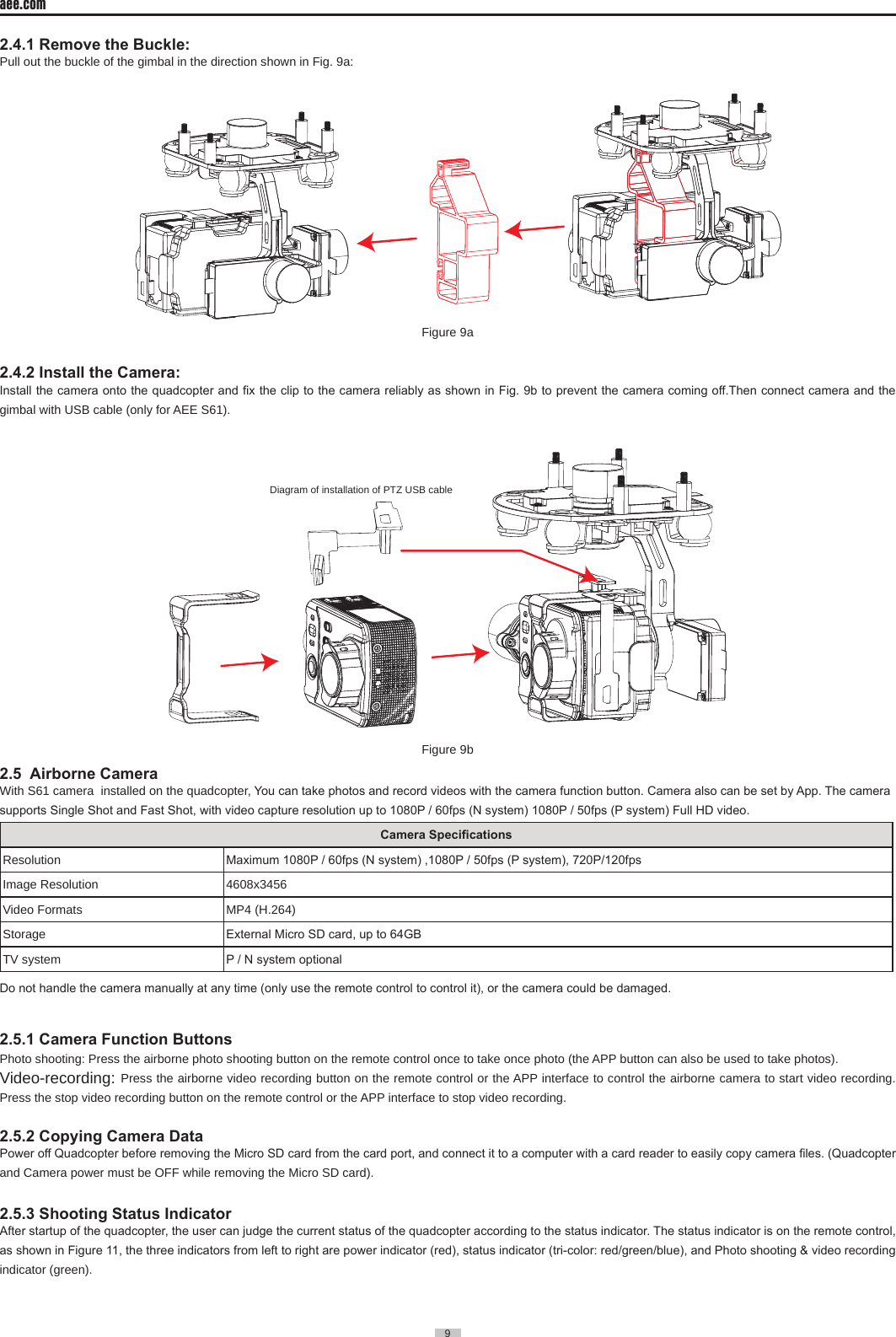
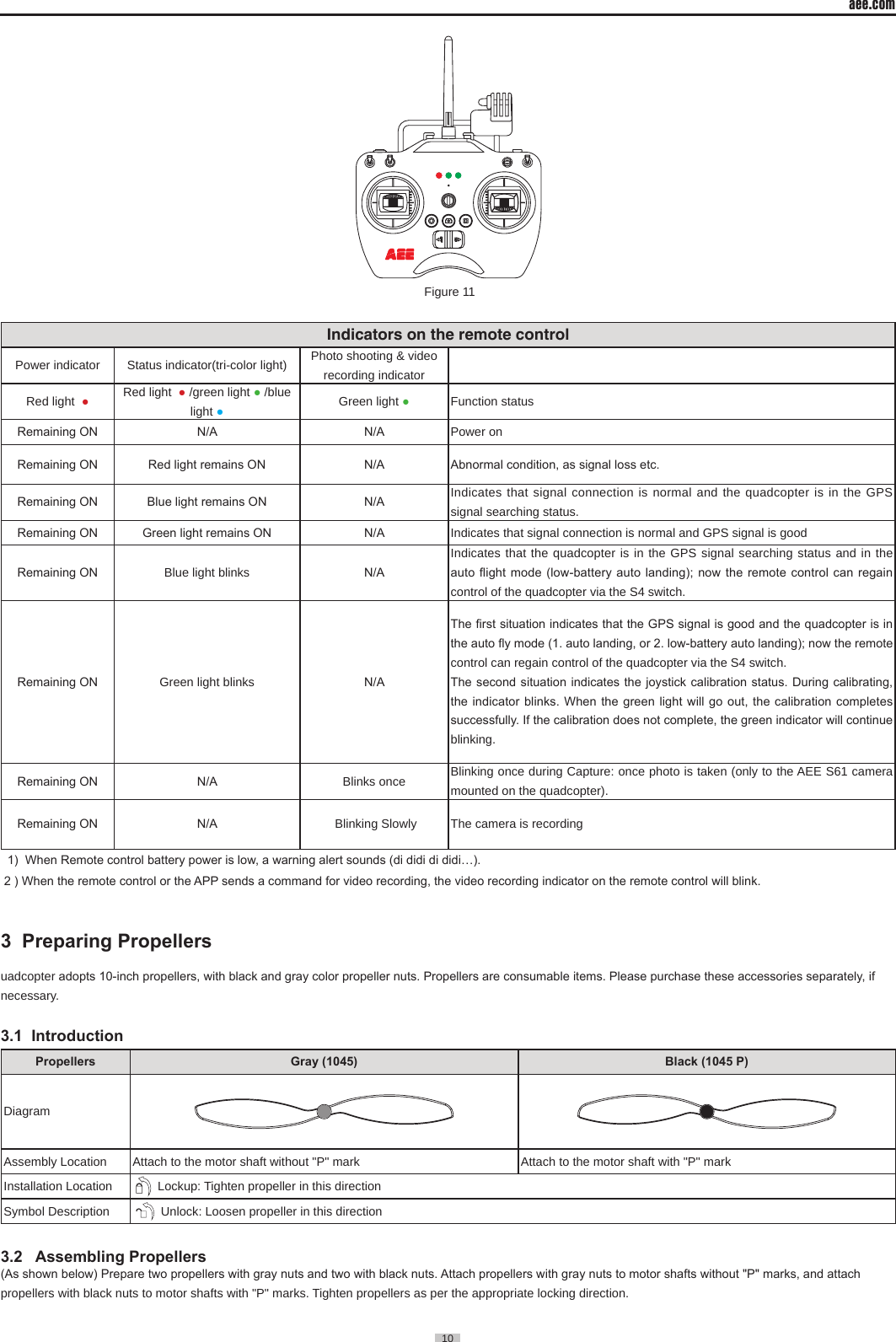
9  aee.com9  2.4.1 Remove the Buckle:Pull out the buckle of the gimbal in the direction shown in Fig� 9a:Figure 9a2.4.2 Install the Camera:Install the camera onto the quadcopter and x the clip to the camera reliably as shown in Fig. 9b to prevent the camera coming off.Then connect camera and the gimbal with USB cable (only for AEE S61)� Diagram of installation of PTZ USB cableFigure 9b      2.5  Airborne CameraWith S61 camera  installed on the quadcopter, You can take photos and record videos with the camera function button. Camera also can be set by App. The camera supports Single Shot and Fast Shot, with video capture resolution up to 1080P / 60fps (N system) 1080P / 50fps (P system) Full HD video.Camera SpecicationsResolution Maximum 1080P / 60fps (N system) ,1080P / 50fps (P system), 720P/120fps Image Resolution 4608x3456Video Formats  MP4 (H�264)Storage External Micro SD card, up to 64GBTV system P / N system optionalDo not handle the camera manually at any time (only use the remote control to control it), or the camera could be damaged.2.5.1 Camera Function ButtonsPhoto shooting: Press the airborne photo shooting button on the remote control once to take once photo (the APP button can also be used to take photos)�Video-recording: Press the airborne video recording button on the remote control or the APP interface to control the airborne camera to start video recording� Press the stop video recording button on the remote control or the APP interface to stop video recording�2.5.2 Copying Camera DataPower off Quadcopter before removing the Micro SD card from the card port, and connect it to a computer with a card reader to easily copy camera les. (Quadcopter and Camera power must be OFF while removing the Micro SD card)�2.5.3 Shooting Status Indicator After startup of the quadcopter, the user can judge the current status of the quadcopter according to the status indicator. The status indicator is on the remote control, as shown in Figure 11, the three indicators from left to right are power indicator (red), status indicator (tri-color: red/green/blue), and Photo shooting & video recording indicator (green)�
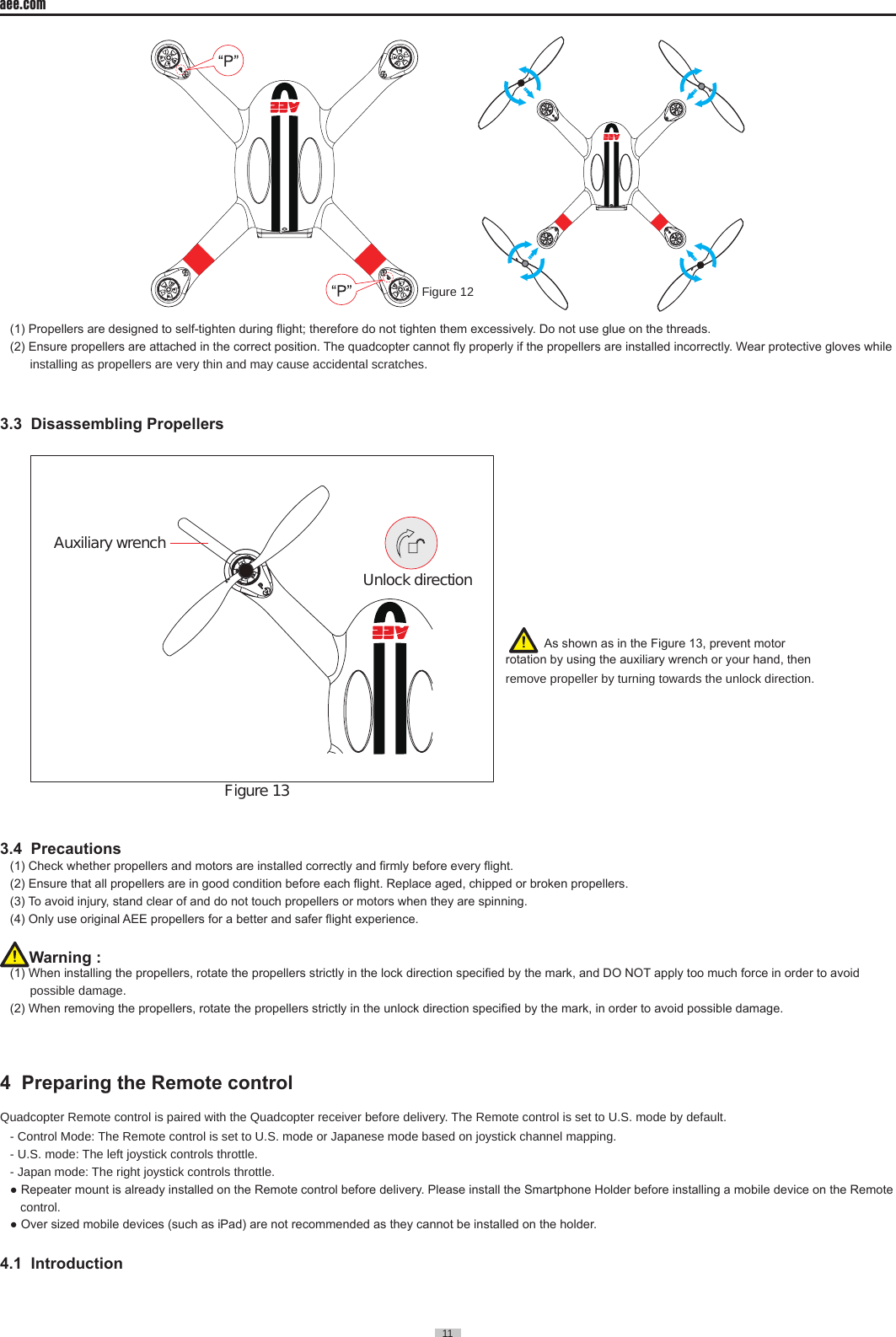
aee.com10                                                                                                                              Figure 11     Indicators on the remote controlPower indicator Status indicator(tri-color light) Photo shooting & video recording indicatorRed light  ●Red light  ● /green light ● /blue light ●Green light ●Function status Remaining ON N/A N/A Power onRemaining ON Red light remains ON N/A Abnormal condition, as signal loss etc.Remaining ON Blue light remains ON N/A Indicates that signal connection is normal and the quadcopter is in the GPS signal searching status�Remaining ON Green light remains ON N/A Indicates that signal connection is normal and GPS signal is goodRemaining ON Blue light blinks  N/AIndicates that the quadcopter is in the GPS signal searching status and in the auto ight mode (low-battery auto landing);  now  the remote control can regain control of the quadcopter via the S4 switch� Remaining ON Green light blinks  N/AThe rst situation indicates that the GPS signal is good and the quadcopter is in the auto y mode (1. auto landing, or 2. low-battery auto landing); now the remote control can regain control of the quadcopter via the S4 switch�The second situation indicates the joystick calibration status.  During calibrating, the indicator blinks. When the  green light will go out, the  calibration  completes successfully. If the calibration does not complete, the green indicator will continue blinking�Remaining ON N/A Blinks once Blinking once during Capture: once photo is taken (only to the AEE S61 camera mounted on the quadcopter)�Remaining ON N/A  Blinking Slowly The camera is recording  1)  When Remote control battery power is low, a warning alert sounds (di didi di didi…). 2 ) When the remote control or the APP sends a command for video recording, the video recording indicator on the remote control will blink.3  Preparing Propellers                                                                   uadcopter adopts 10-inch propellers, with black and gray color propeller nuts. Propellers are consumable items. Please purchase these accessories separately, if necessary� 3.1  IntroductionPropellers Gray (1045)  Black (1045 P)DiagramAssembly Location Attach to the motor shaft without "P" mark Attach to the motor shaft with "P" markInstallation Location     Lockup: Tighten propeller in this directionSymbol Description     Unlock: Loosen propeller in this direction3.2   Assembling Propellers(As shown below) Prepare two propellers with gray nuts and two with black nuts. Attach propellers with gray nuts to motor shafts without "P" marks, and attach propellers with black nuts to motor shafts with "P" marks� Tighten propellers as per the appropriate locking direction�
11  aee.com11    Figure 12      (1) Propellers are designed to self-tighten during ight; therefore do not tighten them excessively. Do not use glue on the threads.(2) Ensure propellers are attached in the correct position. The quadcopter cannot y properly if the propellers are installed incorrectly. Wear protective gloves while installing as propellers are very thin and may cause accidental scratches�3.3  Disassembling Propellers    Auxiliary wrenchFigure 13      Unlock direction                                                           3.4  Precautions (1) Check whether propellers and motors are installed correctly and rmly before every ight.(2) Ensure that all propellers are in good condition before each ight. Replace aged, chipped or broken propellers.(3) To avoid injury, stand clear of and do not touch propellers or motors when they are spinning.(4) Only use original AEE propellers for a better and safer ight experience.Warning : (1) When installing the propellers, rotate the propellers strictly in the lock direction specied by the mark, and DO NOT apply too much force in order to avoid possible damage�  (2) When removing the propellers, rotate the propellers strictly in the unlock direction specied by the mark, in order to avoid possible damage.4  Preparing the Remote control     Quadcopter Remote control is paired with the Quadcopter receiver before delivery� The Remote control is set to U�S� mode by default�- Control Mode: The Remote control is set to U�S� mode or Japanese mode based on joystick channel mapping�- U�S� mode: The left joystick controls throttle�- Japan mode: The right joystick controls throttle�● Repeater mount is already installed on the Remote control before delivery. Please install the Smartphone Holder before installing a mobile device on the Remote   control�● Over sized mobile devices (such as iPad) are not recommended as they cannot be installed on the holder.4.1  Introduction   As shown as in the Figure 13, prevent motor rotation by using the auxiliary wrench or your hand, then remove propeller by turning towards the unlock direction�
aee.com12  GPSNRMS1 S2 S3 S4GPSNRMDF  MSENULL[ 22 ][ 21 ][ 20 ][ 17 ][ 13 ][ 10 ][ 9 ][ 6 ][ 2 ][ 5 ][ 15 ][ 1 ][ 3 ][ 8 ][ 7 ][ 4 ][ 11 ][ 12 ][ 14 ][ 16 ][ 18 ][ 19 ]                                                                                      Figure 14  No. Description Specification Definition 1 Antenna  Remote control signal transmission 2 Repeater  For extending Wi-Fi signal reception range3 Mobile device holder For attaching mobile devices4 Hook open/close button  Short press it once to open the hook on the quadcopter; press it again to close the hook (Remark: The hook is an optional accessory) 5 Repeater base It is used to fix the repeater6 Return button  Long press it for 3s to send a go-home command to the quadcopter7 Speed  switch S1 There are three speed modes; the speed decreases from up to down: 1. Sport mode S;  2. Drive mode  ;3. Economic mode   ;8Calibration switch S2   It is a 3-channel switch. 1.  (joystick calibration is OK);  2. NULL(Reserved function);    3.  (start the joystick calibration procedure)9 Gimbal control switch S3    Diagram of PTZ motion control switch positions  Lens turns upward (upper position)Lens stops (middle position) Lens turns downward (lower position) When it is turned upward/downward, the lens direction changes slowly till the allowable maximum angle is reached10 Flight mode switch S4 It is a 3-channel switch. 1. GPS: GPS mode; 2. NRM: NRM mode (normal mode); 3 F  M : Following mode Remark: When the quadcopter is in the auto fly mode (auto return, low-battery auto landing), at the time when the remote control signal is restored, switch between the GPS and NRM modes twice to end the auto fly mode and now the remote control can regain control of the quadcopter 11 Remote control power indicator  Red, indicating the remote control power ON/OFF status (red light remains on when the power is turned on, and blinks slowly in low-battery status)12 Status indicatorTri-color indicatorIt can indicate the GPS signal status and flight mode of the quadcopter, and also the joystick calibration status.Remark: For the sake of safety, the quadcopter should be turned off before joystick calibration13 Photo shooting & video recording indicator Green light blinks slowly:Video recording. Blinks once:When one photo is taken (single shot by Remote Control).Green light remaining on: Indicates Remote Control starting up successfully. 14 Buzzer hole Warning tone15 Strap hole Used to hang the remote control 16 Left joystick  2 channels;"up-down" channel controls gas, "left-right" channel controls yaw.17 Right joystick 2 channels;"up-down" channel controls roll, "left-right" channel controls pitch18 Airborne video recording button Short press it to send command to the quadcopter to start video recording(only to the AEE S61 camera mounted on the quadcopter)19 Airborne photo shooting button Short press it to send command to the quadcopter to take a photo(only to the AEE S61 camera mounted on the quadcopter)20 Video recording stop button  Short press it to send command to the quadcopter to stop video recording(only to the AEE S61 camera mounted on the quadcopter)21 Remote control power switch Slide it to the left position to power OFF the remote control; slide it to the right position to power  ON the remote control22 Battery compartment  It is where the battery is installed
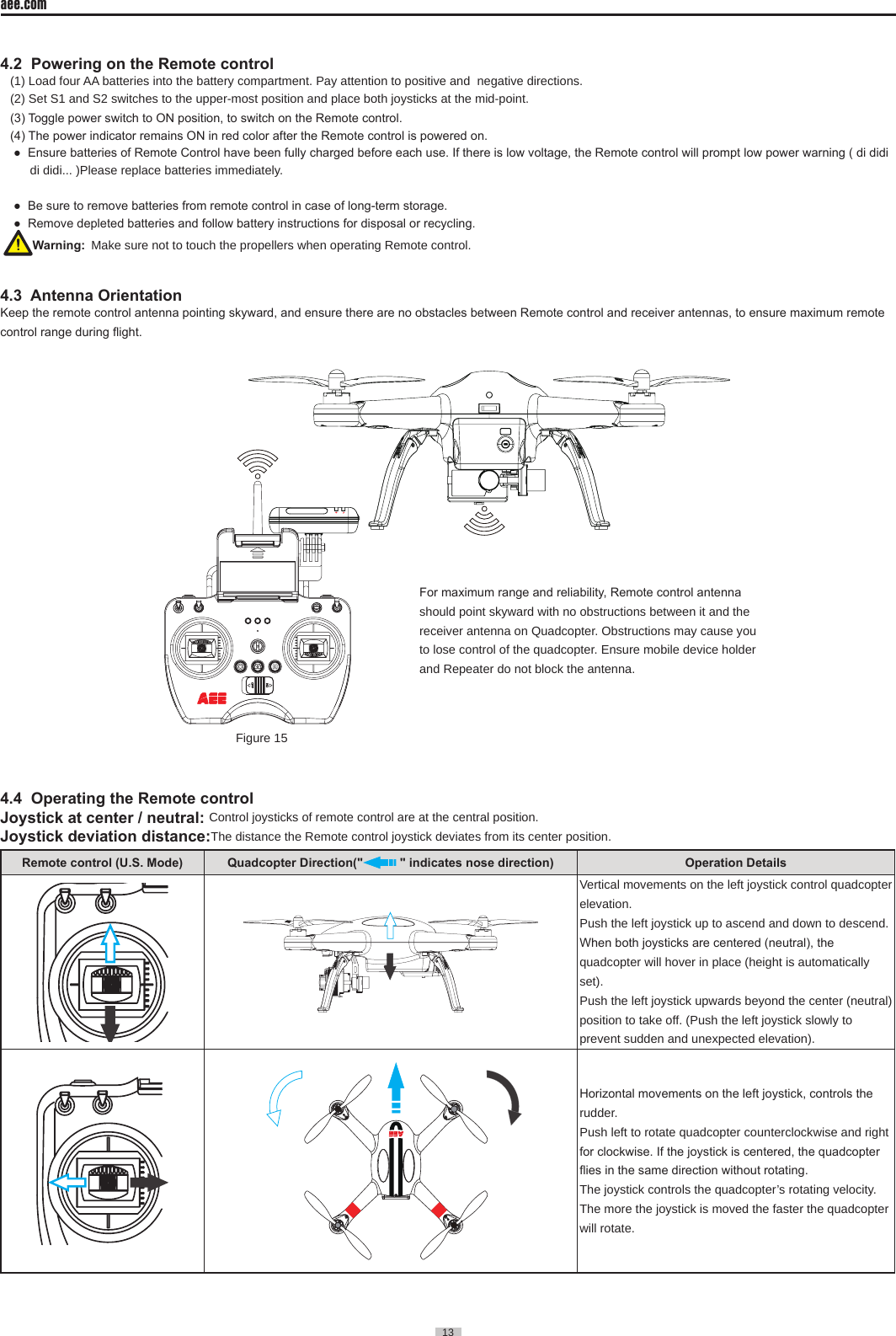
13  aee.com13  4.2  Powering on the Remote control(1) Load four AA batteries into the battery compartment� Pay attention to positive and  negative directions�(2) Set S1 and S2 switches to the upper-most position and place both joysticks at the mid-point�(3) Toggle power switch to ON position, to switch on the Remote control. (4) The power indicator remains ON in red color after the Remote control is powered on. ●  Ensure batteries of Remote Control have been fully charged before each use. If there is low voltage, the Remote control will prompt low power warning ( di didi di didi��� )Please replace batteries immediately� ●  Be sure to remove batteries from remote control in case of long-term storage. ●  Remove depleted batteries and follow battery instructions for disposal or recycling. Warning: Make sure not to touch the propellers when operating Remote control�4.3  Antenna OrientationKeep the remote control antenna pointing skyward, and ensure there are no obstacles between Remote control and receiver antennas, to ensure maximum remote control range during ight.                                                                         Figure 15  4.4  Operating the Remote controlJoystick at center / neutral: Control joysticks of remote control are at the central position�Joystick deviation distance:The distance the Remote control joystick deviates from its center position�Remote control (U.S. Mode) Quadcopter Direction("  " indicates nose direction) Operation DetailsVertical movements on the left joystick control quadcopter elevation�Push the left joystick up to ascend and down to descend�When both joysticks are centered (neutral), the quadcopter will hover in place (height is automatically set)� Push the left joystick upwards beyond the center (neutral) position to take off� (Push the left joystick slowly to prevent sudden and unexpected elevation)�    Horizontal movements on the left joystick, controls the rudder�Push left to rotate quadcopter counterclockwise and right for clockwise. If the joystick is centered, the quadcopter ies in the same direction without rotating.The joystick controls the quadcopter’s rotating velocity� The more the joystick is moved the faster the quadcopter will rotate�For maximum range and reliability, Remote control antenna should point skyward with no obstructions between it and the receiver antenna on Quadcopter� Obstructions may cause you to lose control of the quadcopter� Ensure mobile device holder and Repeater do not block the antenna�
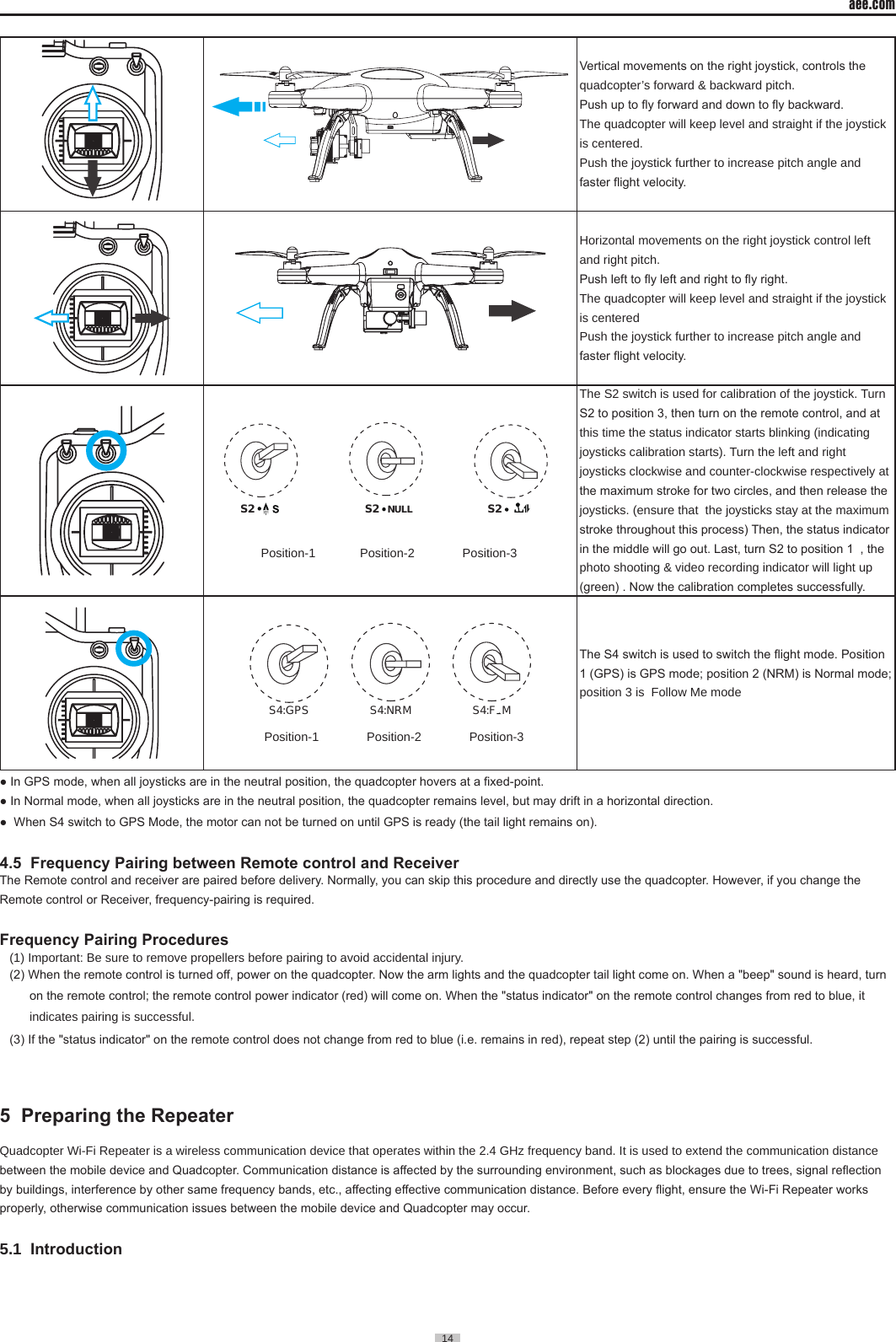
aee.com14  Vertical movements on the right joystick, controls the quadcopter’s forward & backward pitch� Push up to y forward and down to y backward.The quadcopter will keep level and straight if the joystick is centered� Push the joystick further to increase pitch angle and faster ight velocity.Horizontal movements on the right joystick control left and right pitch� Push left to y left and right to y right. The quadcopter will keep level and straight if the joystick is centeredPush the joystick further to increase pitch angle and faster ight velocity.S2 S2S2 NULL                          Position-1             Position-2              Position-3 The S2 switch is used for calibration of the joystick� Turn S2 to position 3, then turn on the remote control, and at this time the status indicator starts blinking (indicating joysticks calibration starts)� Turn the left and right joysticks clockwise and counter-clockwise respectively at the maximum stroke for two circles, and then release the joysticks� (ensure that  the joysticks stay at the maximum stroke throughout this process) Then, the status indicator in the middle will go out. Last, turn S2 to position 1  , the photo shooting & video recording indicator will light up (green) . Now the calibration completes successfully.         S4:GPS S4:NRM S4:F  M                              Position-1              Position-2              Position-3The S4 switch is used to switch the ight mode. Position 1 (GPS) is GPS mode; position 2 (NRM) is Normal mode; position 3 is  Follow Me mode● In GPS mode, when all joysticks are in the neutral position, the quadcopter hovers at a xed-point.● In Normal mode, when all joysticks are in the neutral position, the quadcopter remains level, but may drift in a horizontal direction.●  When S4 switch to GPS Mode, the motor can not be turned on until GPS is ready (the tail light remains on).4.5  Frequency Pairing between Remote control and ReceiverThe Remote control and receiver are paired before delivery. Normally, you can skip this procedure and directly use the quadcopter. However, if you change the Remote control or Receiver, frequency-pairing is required.Frequency Pairing Procedures(1) Important: Be sure to remove propellers before pairing to avoid accidental injury�(2) When the remote control is turned off, power on the quadcopter. Now the arm lights and the quadcopter tail light come on. When a "beep" sound is heard, turn on the remote control; the remote control power indicator (red) will come on. When the "status indicator" on the remote control changes from red to blue, it indicates pairing is successful� (3) If the "status indicator" on the remote control does not change from red to blue (i.e. remains in red), repeat step (2) until the pairing is successful.5  Preparing the Repeater                                                              Quadcopter Wi-Fi Repeater is a wireless communication device that operates within the 2�4 GHz frequency band� It is used to extend the communication distance between the mobile device and Quadcopter. Communication distance is affected by the surrounding environment, such as blockages due to trees, signal reection by buildings, interference by other same frequency bands, etc., affecting effective communication distance. Before every ight, ensure the Wi-Fi Repeater works properly, otherwise communication issues between the mobile device and Quadcopter may occur.5�1  Introduction
15  aee.com15  [ 1 ][ 2 ][ 3 ][ 4 ][ 5 ][ 6 ][ 7 ]Figure 16        [ 1 ] Power Indicator                   [ 2 ] Wi-Fi Indicator      [ 3 ] Lock screw     [ 4 ] Power Switch       [ 5 ]  Charging Port (Mini USB port)                           [ 6 ] Pairing Button       [ 7 ] Repeater Base 5.1.1 Wi-Fi IndicatorIndicates Repeater’s Wi-Fi statusWi-Fi Indicator  Description Blue light is ON Wi-Fi Repeater is working properlyBlue light blinks fast (1.5s OFF, 0.3s ON) Wi-Fi Repeater is pairing with airborne CameraBlue light blinks slowly (3s OFF,0.3 ON) Wi-Fi Repeater is successfully paired5.1.2 Power Indicator Indicates Repeater’s power supply status�Power Indicator DescriptionRed light is ON Repeater power supply is normal or charging completesRed light blinks  Repeater is charging, or Repeater power is running out, please charge as soon as possible5.1.3 Pairing Button When the repeater is on, press and hold the Pairing Button for 3 seconds, the repeater will automatically restart for code re-pairing.  Press and release the Pairing button to check repeater's power level�Press Pairing buttonPress Pairing button once: If Power Indicator blinks once, indicates that repeater has over 80% charge availableIf Power Indicator blinks twice, indicates that repeater has over 50% charge availableIf Power Indicator blinks three times, indicates that repeater is running out of PowerLong press Pairing button (3 seconds) Repeater restarts and you can re-pair codes5.1.4 Code Pairing If the Wi-Fi indicator fast blinks blue (1.5 seconds OFF, 0.3 seconds ON), or keeps ON, it is necessary to carry out pairing please re-pair with following steps:(1)Switch on the power switch and Wi-Fi switch of came,then switch on the power switch of repeater.(2)After the Wi-Fi indicator of camera blinks, and Wi-Fi indicator of repeater is on, press Paring Button of repeater until Wi-Fi indicator(blue) of repeater blinks fast(0.3s on,1.5s off). Then press the "video recording stop button"of camera immediately (1 time per second).When the repeater blue light indicator slow blinks(0.3s on,3s off), this indicates the paring completes.(3)If pairing fails, please repeat step 1 and step 2.5.2  How to useCharging the Repeater Connect the repeater to the repeater Adapter through the Mini USB port� It takes about 2 hours to fully charge the battery�●  Ensure the repeater has sufcient charge before each ight.Switching on the Repeater (1) Toggle Repeater  power switch to ON.(2) Wait until the Wi-Fi indicator blinks blue, indicating the Repeater is communicating properly. (3) While using, ensure the Repeater’s LED side faces you, and ensure that visibility between the Repeater and quadcopter is unobstructed, to obtain maximum communication distance�●  After the ight, in addition to switching off the quadcopter and remote control, remember to switch off the Reapeater, or else the Repeater’s battery will be depleted�6. Use the Tracker GT106.1 Keys and Indicators:
aee.com16  Charging contactsPower indicatorStatu indicatorPower / function key6.2 Description of Keys and Indicators:No. Name Description[ 1 ] Power/function keyIn power-off state, long press it for 3s to power on the tracker. Press and hold the Power button until the red indicator is lit. After 3 seconds, the green indicator starts blinking, indicating the startup is completed. In power-on state, long press it for 3s to power off the tracker. Press and hold the Power button until the green indicator goes out. After 3 seconds, the red indicator goes out, indicating the shutdown is completed. Initial code pairing: press it for 3 times at an interval of 2s to trigger the code pairing function�[ 2 ] Power indicator Power indicator is red[ 3 ] Statu indicator Status indicator is green[ 4 ] Contacts Charging contacts�※Note:1. Code pairing process: turn on the tracker and trigger its code pairing function; turn on the quadcopter, and its built-in 5.8GHz module will auto proceed with the code pairing process. In the code pairing process, the distance between the tracker and quadcopter should be less than 10m.2. After the code pairing function is triggered, the tracker will auto exit the code pairing state if the code pairing process is nished successfully within 30s. If no code pairing device is found or the code pairing process fails within 30s, the tracker will also auto exit the code pairing function.6.3 Indicators on the trackerSN Status Red indicator  Green indicator  Notes1 During startup process ON Green indicator blinks after 3 seconds Press and hold the Power button until the red indicator is lit. After 3 seconds, the green indicator starts blinking, indicating the startup is completed� 2During shutdown processRed indicator goes out after 3 seconds  OFFPress and hold the Power button until the green indicator goes out. After 3 seconds, the red indicator goes out, indicating the shutdown is completed�3No device to pair with  / Blinking fast Blinking 10 times per second4 During code-pairing / Blinking fast Blinking 5 times per second5 Searching GPS signal / Indicator’s blinking sequence 1 Remaining on → blinking fast for 3 times 6 GPS signals are OK / Green indicator remains on 7 Abnormal system / Green indicator goes out  Restarting is required8 Charging battery Blinking slowly / Blinking 1 times per second9 Battery charged fully Remaining on /10 Low battery power Blinking fast / Blinking 10 times per second6.4 Operating Instructions6.4.1 Operating Steps:Component Startup TimeTurn on the quad-copterStart the APP on the mobile devicePerform the takeoff operation of the quadcopterTurn the mode switch of the remote control to “F-M”The quadcopter will enter the follow-me video recording mode.Camera 20sRepeater 22sRemote control 10sTracker 10s
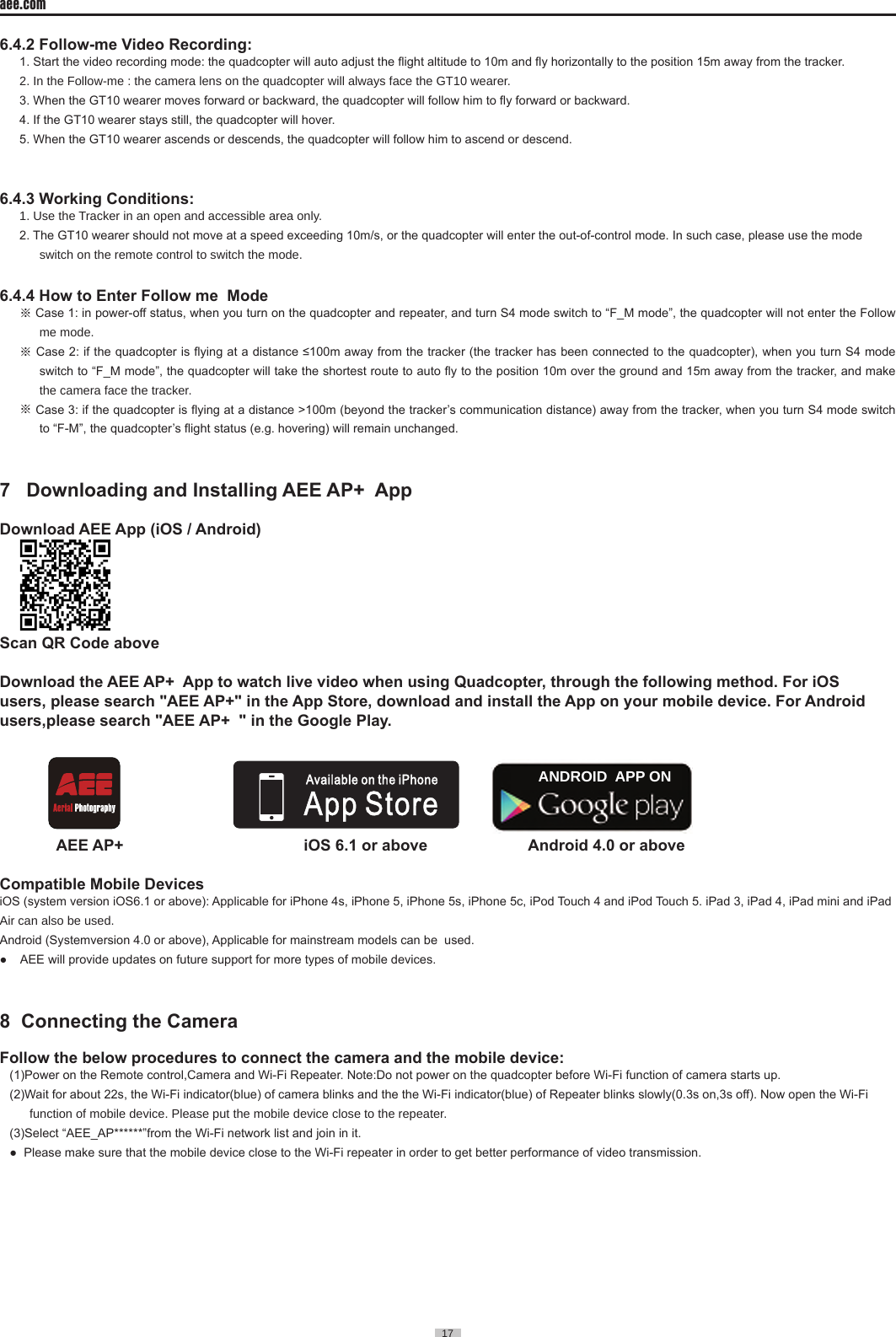
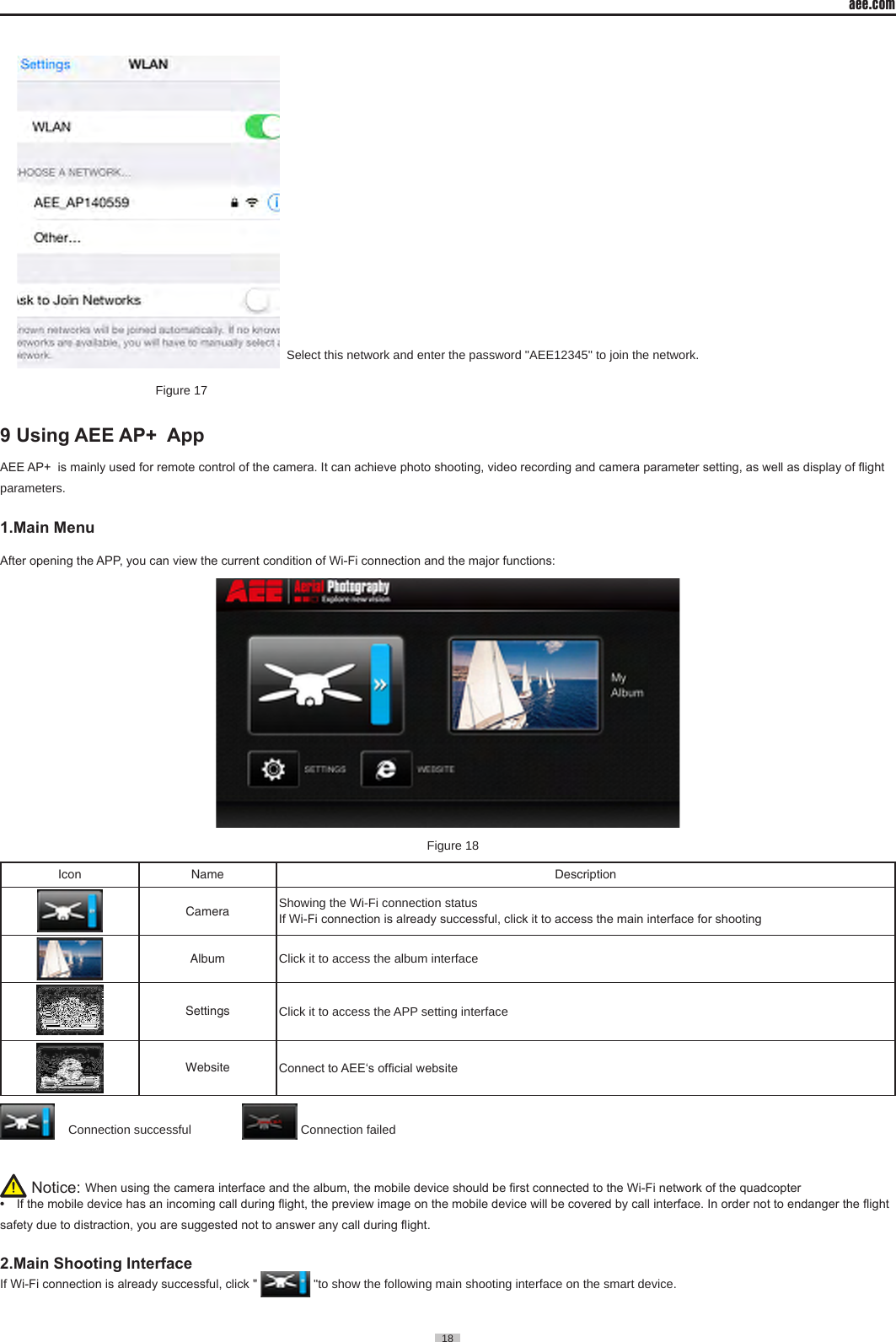
17  aee.com17  6.4.2 Follow-me Video Recording:1. Start the video recording mode: the quadcopter will auto adjust the ight altitude to 10m and y horizontally to the position 15m away from the tracker. 2� In the Follow-me : the camera lens on the quadcopter will always face the GT10 wearer� 3. When the GT10 wearer moves forward or backward, the quadcopter will follow him to y forward or backward.4. If the GT10 wearer stays still, the quadcopter will hover. 5. When the GT10 wearer ascends or descends, the quadcopter will follow him to ascend or descend. 6.4.3 Working Conditions:1� Use the Tracker in an open and accessible area only� 2. The GT10 wearer should not move at a speed exceeding 10m/s, or the quadcopter will enter the out-of-control mode. In such case, please use the mode switch on the remote control to switch the mode�6.4.4 How to Enter Follow me  Mode※ Case 1: in power-off status, when you turn on the quadcopter and repeater, and turn S4 mode switch to “F_M mode”, the quadcopter will not enter the Follow me mode� ※ Case 2: if the quadcopter is ying at a distance ≤100m away from the tracker (the tracker has been connected to the quadcopter), when you turn S4 mode switch to “F_M mode”, the quadcopter will take the shortest route to auto y to the position 10m over the ground and 15m away from the tracker, and make the camera face the tracker� ※ Case 3: if the quadcopter is ying at a distance >100m (beyond the tracker’s communication distance) away from the tracker, when you turn S4 mode switch to “F-M”, the quadcopter’s ight status (e.g. hovering) will remain unchanged.7   Downloading and Installing AEE AP+  AppDownload AEE App (iOS / Android)      Scan QR Code aboveDownload the AEE AP+  App to watch live video when using Quadcopter, through the following method. For iOS users, please search "AEE AP+" in the App Store, download and install the App on your mobile device. For Android users,please search "AEE AP+  " in the Google Play.                                                                                                                                                                                                                     ANDROID  APP ON             AEE AP+                                         iOS 6.1 or above                       Android 4.0 or above      Compatible Mobile DevicesiOS (system version iOS6.1 or above): Applicable for iPhone 4s, iPhone 5, iPhone 5s, iPhone 5c, iPod Touch 4 and iPod Touch 5. iPad 3, iPad 4, iPad mini and iPad Air can also be used�Android (Systemversion 4.0 or above), Applicable for mainstream models can be  used.●    AEE will provide updates on future support for more types of mobile devices.8  Connecting the Camera                                                          Follow the below procedures to connect the camera and the mobile device:(1)Power on the Remote control,Camera and Wi-Fi Repeater. Note:Do not power on the quadcopter before Wi-Fi function of camera starts up.(2)Wait for about 22s, the Wi-Fi indicator(blue) of camera blinks and the the Wi-Fi indicator(blue) of Repeater blinks slowly(0.3s on,3s off). Now open the Wi-Fi function of mobile device� Please put the mobile device close to the repeater�(3)Select “AEE_AP******”from the Wi-Fi network list and join in it.●  Please make sure that the mobile device close to the Wi-Fi repeater in order to get better performance of video transmission.
aee.com18               Select this network and enter the password "AEE12345" to join the network�                             Figure 17  9 Using AEE AP+  App AEE AP+  is mainly used for remote control of the camera. It can achieve photo shooting, video recording and camera parameter setting, as well as display of ight parameters�1.Main MenuAfter opening the APP, you can view the current condition of Wi-Fi connection and the major functions:                                              Figure 18   Icon Name DescriptionCamera  Showing the Wi-Fi connection statusIf Wi-Fi connection is already successful, click it to access the main interface for shootingAlbum  Click it to access the album interface Settings Click it to access the APP setting interface Website Connect to AEE‘s ofcial website      Connection successful                 Connection failed Notice: When using the camera interface and the album, the mobile device should be rst connected to the Wi-Fi network of the quadcopter•If the mobile device has an incoming call during ight, the preview image on the mobile device will be covered by call interface. In order not to endanger the ight safety due to distraction, you are suggested not to answer any call during ight.2.Main Shooting Interface If Wi-Fi connection is already successful, click "   "to show the following main shooting interface on the smart device�
19  aee.com19  [2][1] [13][14][15][16][17][18][3][4][5][6][7][8][9][10][11][12]      Figure 19No� Function  Description[ 1 ] Number of GPS satellites searched    Indicates that currently the positioning signals of 6 satellites have been received[ 2 ] Quadcopter battery levelThere are totally four bars used to indicate in a real-time manner the remaining battery level of the quadcopter; 1 bar indicates 25% of the battery life is left; 2 bars indicate 50% left; 3 bars indicate 75% left; 4 bars indicate battery is full.The level status changes with the flight.[ 3 ] Wi-Fi signal intensity  Shows in a real-time manner the intensity of Wi-Fi signal of mobile device. more bars indicate stronger Wi-Fi signal[ 4 ] Flight parameter icon After clicking it, the interface will display the flight parameters: distance, altitude and speed, as shown in the figure below; after clicking it again, the flight info bar will be closed[ 5 ] Distance between quadcopter and home point  Shows the horizontal distance between the quadcopter and the home point [ 6 ] Flight height of quadcopter Shows the vertical distance between the quadcopter and the home point [ 7 ] Zoom in button  Click it once to zoom in once; maximum 4x zooming is supported[  8  ]             View angle indication W indicates wide (W) view angle is adopted[ 9 ] Video recording resolutionIn video recording mode: Indicates the video recording resolution is 1080/30fpsClick the triangle drop-down button to expand the available resolution optionsIn photo shooting mode: Indicates the photo shooting resolution is 12M pixelsClick the triangle drop-down button to expand the available resolution options[ 10 ] Remaining video recording time In video recording mode, this number indicates  that the Micro-SD card allows another 2.5h of recording under the current camera settingsIn photo shooting mode, this number indicates that the Micro-SD card allows another quantity of photos to be taken under the current resolution setting[ 11 ] Number of video files / photo files savedNumber of video files saved: The number of files shown varies with different modes (video recording, photo shooting)In recording mode:   indicates that 55 video files have been recorded by the cameraIn photo shooting mode: this number indicates 55 photos have been taken by the camera.[ 12 ] Playback button  Click it to access the album interface [ 13 ] Current flight speed of quadcopter Shows in a real-time manner the current horizontal flight speed of the quadcopter[ 14 ] Return button  Return to the previous level [ 15 ] Zoom out button Click it once to zoom out once; maximum 4x zooming is supported[ 16 ] Camera setting button  Click it to access the camera setting interface; see the “Camera Settings” section for details[ 17 ] Camera function selection button Click the icon to expand the camera function options [ 18 ] Camera function operation button This button can be operated to achieve different functions in different shooting modes
aee.com20  FlightAfter installation, please conduct ight training (for example: Flight simulator training or professional training). Ensure that all ights are carried out in a suitable environment�Flight Environment Requirements(1) Do not use the quadcopter in severe weather conditions, such as strong winds (category 4 and above), snow, rain and fog. (2) Fly in an open area without tall buildings� Presence of large number of steel buildings in the area will affect the onboard compass�(3) Keep Quadcopter away from obstacles, people, power lines, trees, shelters, surface of the water, etc., during ight.(4) Reduce the chance of electromagnetic interference by not ying in areas with high levels of electromagnetism (such as near mobile phone base stations or towers)�(5) This product cannot be used in The Antarctic Circle and The Arctic Circle�(6) Do not y the quadcopter within restricted or no-y zones, and abide by local laws or regulations.Pre-ight Check:(1) Ensure Remote control, Quadcopter, Wi-Fi Repeater and mobile device are fully charged.(2) Ensure propellers are correctly assembled�(3) Ensure the Micro SD card is properly loaded before photo capture and video recording�(4) Ensure the Quadcopter, Remote control and other equipment are working properly after powering on.(5) Check if motors start properly after the quadcopter is switched on. At this time, disassembling propellers is recommended for safety.(6) Check if the AEE AP+  App is properly connected to the camera�1  Compass Calibration                                                                     Compass calibration is required before rst time use otherwise the system may not work properly, affecting ight safety. The compass is sensitive to electromagnetic interference from other electronic devices, which can cause abnormal compass data leading to poor ight performance or even ight failure. Regular calibration is required for optimum performance�●  Do not calibrate the compass in a strong magnetic eld. ●  Do not carry ferromagnetic material, such as keys, cell phones, etc., while calibrating the compass.1.1  Calibration Procedures Choose an open space to conduct calibration� Start the Remote control and quadcopter and ensure they work properly� Follow the below procedures to calibrate the compass:1 2 3 4 5S4GPSNRMF  MAfter the quadcopter powers on(about 20 seconds). Swich S4 for more than 5 times between GPS and Follow Me mode. The quadcopter will enter calibraion standby mode(the tail light blinks fast).Toggle the joysticks to the position as in the follow figure. Front indicator (green) starts blinking ,Then release the joysticks.Compass calibration command has been sent successfully.Rotate Quadcopter 360° horizontally (2 turns)Rotate Quadcopter 360° vertically2 turns (Nose down )Rotate Quadcopter vertically (Nose leftward)until green lights off, Put Quadcopter on the ground. Green lights up normally after light off→ calibration successful; Green lights blink fast after light off→calibration failed →Recalibrate        Warning  Be sure to remove propellers before calibration, to avoid accidental injury or loss.1.2  When to Recalibrate(1) When compass data is abnormal, front indicator (green) blinks fast.(2) The ight location is far from the place where last compass calibration was conducted. (3) There are changes in quadcopter’s physical structure�(4) The quadcopter drifts a lot while ying , such as it ies along a circle when hovering.2  Starting / Stopping the Motor                                                          2.1  Starting the motor Toggle the joysticks as shown in the illustration (Combination joystick Command [CSC]) to start the motor� Release the joysticks simultaneously after the motors start, then the camera will start to record video automatically.
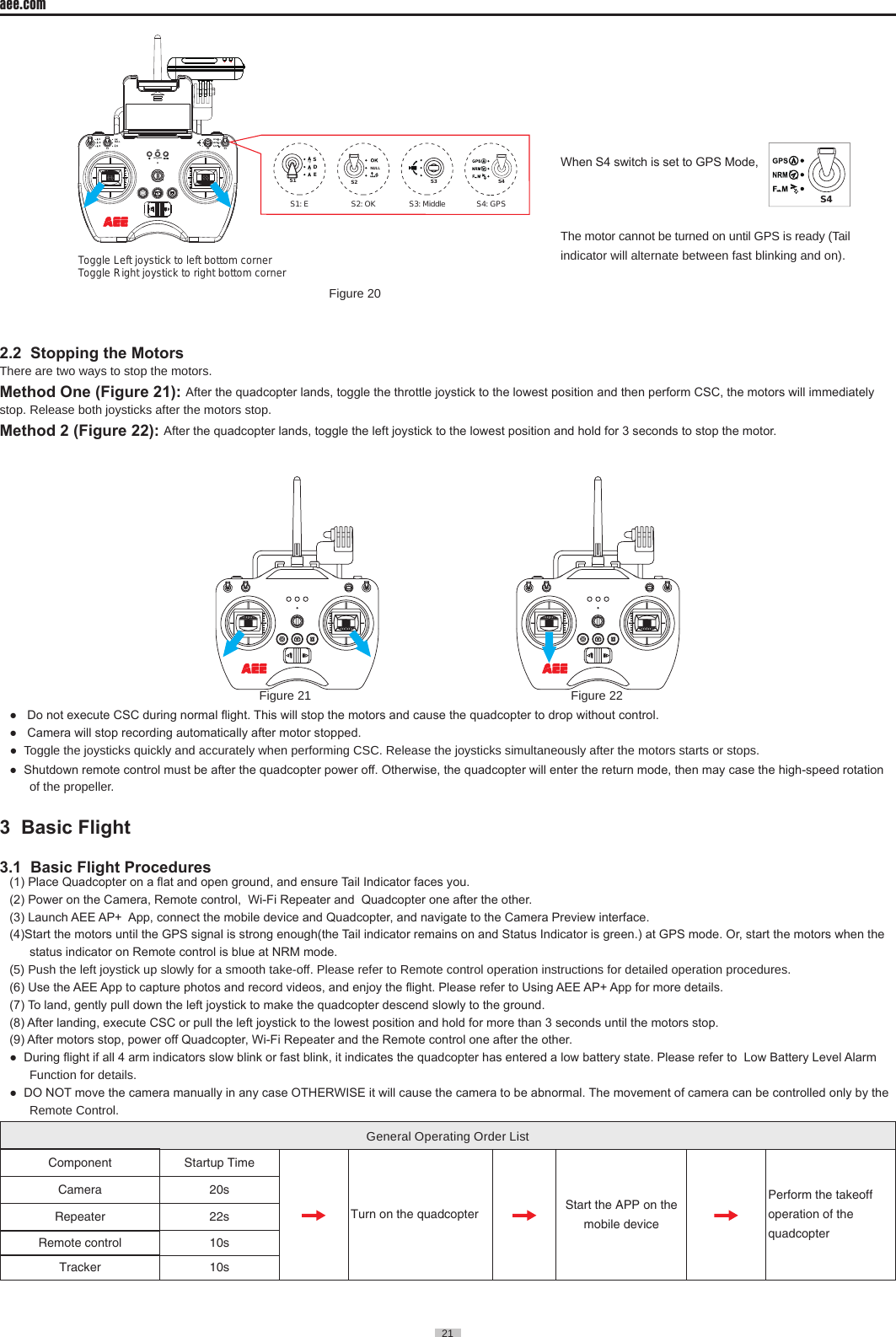
21  aee.com21                                             Toggle Left joystick to left bottom cornerToggle Right joystick to right bottom corner GPSNRMS1 S2 S3 S4GPSNRMDF  MSES1DSES1: E S2: OK S3: Middle S4: GPSS2 S3 S4NULLNULL         When S4 switch is set to GPS Mode,   S4     The motor cannot be turned on until GPS is ready (Tail indicator will alternate between fast blinking and on)�                                                                  Figure 202.2  Stopping the MotorsThere are two ways to stop the motors�Method One (Figure 21): After the quadcopter lands, toggle the throttle joystick to the lowest position and then perform CSC, the motors will immediately stop� Release both joysticks after the motors stop�Method 2 (Figure 22): After the quadcopter lands, toggle the left joystick to the lowest position and hold for 3 seconds to stop the motor.                                                                                                                                                       Figure 21                                                                            Figure 22 ●   Do not execute CSC during normal ight. This will stop the motors and cause the quadcopter to drop without control.●   Camera will stop recording automatically after motor stopped.   ●  Toggle the joysticks quickly and accurately when performing CSC� Release the joysticks simultaneously after the motors starts or stops�●  Shutdown remote control must be after the quadcopter power off. Otherwise, the quadcopter will enter the return mode, then may case the high-speed rotation of the propeller�3  Basic Flight                                                                            3.1  Basic Flight Procedures(1) Place Quadcopter on a at and open ground, and ensure Tail Indicator faces you.(2) Power on the Camera, Remote control,  Wi-Fi Repeater and  Quadcopter one after the other.(3) Launch AEE AP+  App, connect the mobile device and Quadcopter, and navigate to the Camera Preview interface.(4)Start the motors until the GPS signal is strong enough(the Tail indicator remains on and Status Indicator is green.) at GPS mode. Or, start the motors when the status indicator on Remote control is blue at NRM mode.(5) Push the left joystick up slowly for a smooth take-off� Please refer to Remote control operation instructions for detailed operation procedures�(6) Use the AEE App to capture photos and record videos, and enjoy the ight. Please refer to Using AEE AP+ App for more details.(7) To land, gently pull down the left joystick to make the quadcopter descend slowly to the ground.(8) After landing, execute CSC or pull the left joystick to the lowest position and hold for more than 3 seconds until the motors stop.(9) After motors stop, power off Quadcopter, Wi-Fi Repeater and the Remote control one after the other. ●  During ight if all 4 arm indicators slow blink or fast blink, it indicates the quadcopter has entered a low battery state. Please refer to  Low Battery Level Alarm Function for details�●  DO NOT move the camera manually in any case OTHERWISE it will cause the camera to be abnormal. The movement of camera can be controlled only by the Remote Control�General Operating Order ListComponent Startup TimeTurn on the quadcopter Start the APP on the mobile devicePerform the takeoff operation of the quadcopterCamera 20sRepeater 22sRemote control 10sTracker 10s
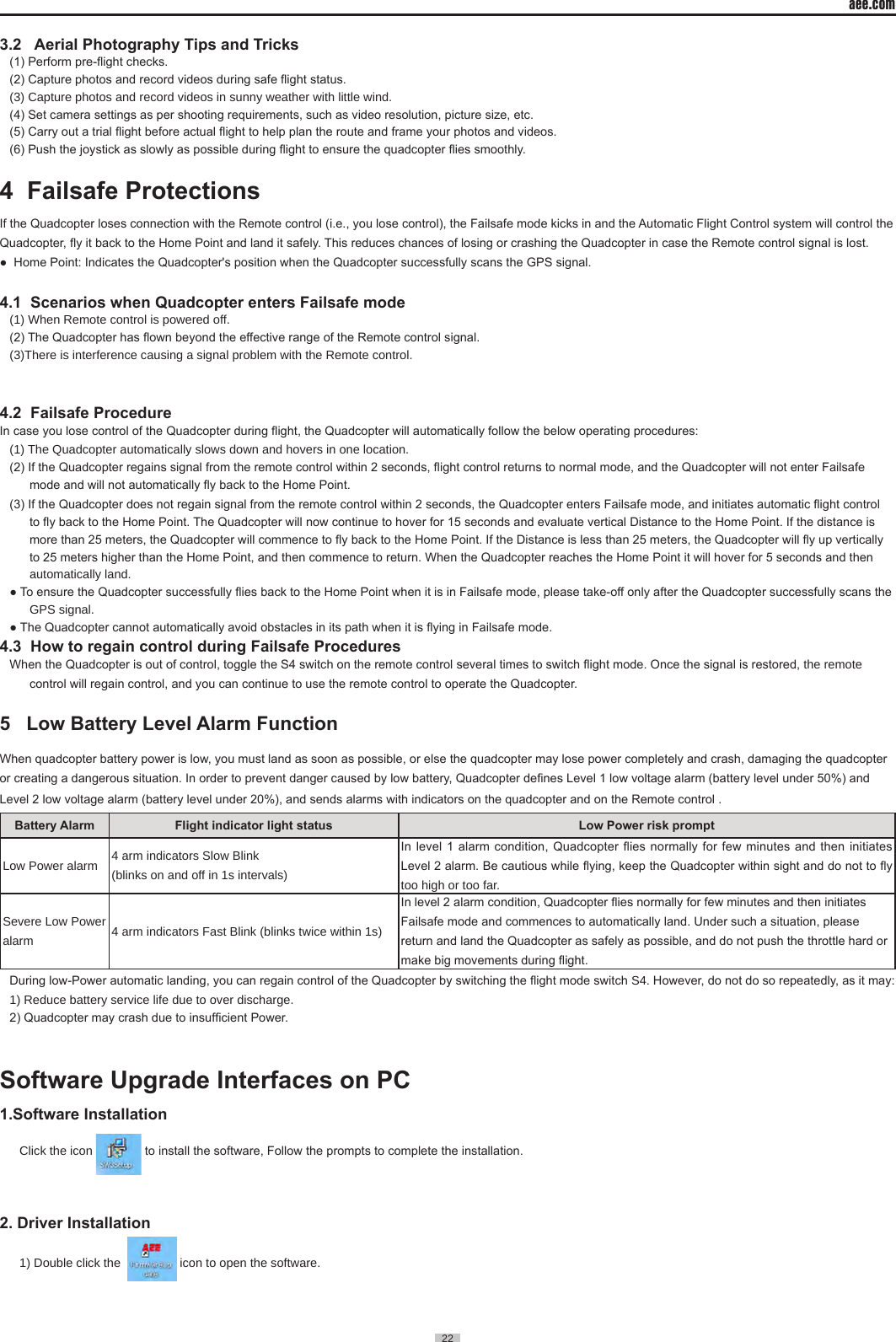
aee.com22  3.2   Aerial Photography Tips and Tricks (1) Perform pre-ight checks. (2) Capture photos and record videos during safe ight status.(3) Capture photos and record videos in sunny weather with little wind�(4) Set camera settings as per shooting requirements, such as video resolution, picture size, etc. (5) Carry out a trial ight before actual ight to help plan the route and frame your photos and videos.(6) Push the joystick as slowly as possible during ight to ensure the quadcopter ies smoothly.4  Failsafe Protections                                                                    If the Quadcopter loses connection with the Remote control (i.e., you lose control), the Failsafe mode kicks in and the Automatic Flight Control system will control the Quadcopter, y it back to the Home Point and land it safely. This reduces chances of losing or crashing the Quadcopter in case the Remote control signal is lost.●  Home Point: Indicates the Quadcopter's position when the Quadcopter successfully scans the GPS signal.4.1  Scenarios when Quadcopter enters Failsafe mode(1) When Remote control is powered off�(2) The Quadcopter has own beyond the effective range of the Remote control signal.(3)There is interference causing a signal problem with the Remote control� 4.2  Failsafe ProcedureIn case you lose control of the Quadcopter during ight, the Quadcopter will automatically follow the below operating procedures:(1) The Quadcopter automatically slows down and hovers in one location�(2) If the Quadcopter regains signal from the remote control within 2 seconds, ight control returns to normal mode, and the Quadcopter will not enter Failsafe mode and will not automatically y back to the Home Point.(3) If the Quadcopter does not regain signal from the remote control within 2 seconds, the Quadcopter enters Failsafe mode, and initiates automatic ight control to y back to the Home Point. The Quadcopter will now continue to hover for 15 seconds and evaluate vertical Distance to the Home Point. If the distance is more than 25 meters, the Quadcopter will commence to y back to the Home Point. If the Distance is less than 25 meters, the Quadcopter will y up vertically to 25 meters higher than the Home Point, and then commence to return. When the Quadcopter reaches the Home Point it will hover for 5 seconds and then automatically land�● To ensure the Quadcopter successfully ies back to the Home Point when it is in Failsafe mode, please take-off only after the Quadcopter successfully scans the GPS signal� ● The Quadcopter cannot automatically avoid obstacles in its path when it is ying in Failsafe mode.4.3  How to regain control during Failsafe ProceduresWhen the Quadcopter is out of control, toggle the S4 switch on the remote control several times to switch ight mode. Once the signal is restored, the remote control will regain control, and you can continue to use the remote control to operate the Quadcopter.5   Low Battery Level Alarm Function                                                          When quadcopter battery power is low, you must land as soon as possible, or else the quadcopter may lose power completely and crash, damaging the quadcopter or creating a dangerous situation. In order to prevent danger caused by low battery, Quadcopter denes Level 1 low voltage alarm (battery level under 50%) and Level 2 low voltage alarm (battery level under 20%), and sends alarms with indicators on the quadcopter and on the Remote control .                               Battery Alarm Flight indicator light status Low Power risk prompt Low Power alarm 4 arm indicators Slow Blink(blinks on and off in 1s intervals)In level 1 alarm condition, Quadcopter ies normally  for  few  minutes  and then initiates Level 2 alarm. Be cautious while ying, keep the Quadcopter within sight and do not to y too high or too far� Severe Low Power alarm 4 arm indicators Fast Blink (blinks twice within 1s)In level 2 alarm condition, Quadcopter ies normally for few minutes and then initiates Failsafe mode and commences to automatically land. Under such a situation, please return and land the Quadcopter as safely as possible, and do not push the throttle hard or make big movements during ight.During low-Power automatic landing, you can regain control of the Quadcopter by switching the ight mode switch S4. However, do not do so repeatedly, as it may: 1) Reduce battery service life due to over discharge�2) Quadcopter may crash due to insufcient Power. Software Upgrade Interfaces on PC1.Software InstallationClick the icon   to install the software, Follow the prompts to complete the installation.2. Driver Installation 1) Double click the    icon to open the software�
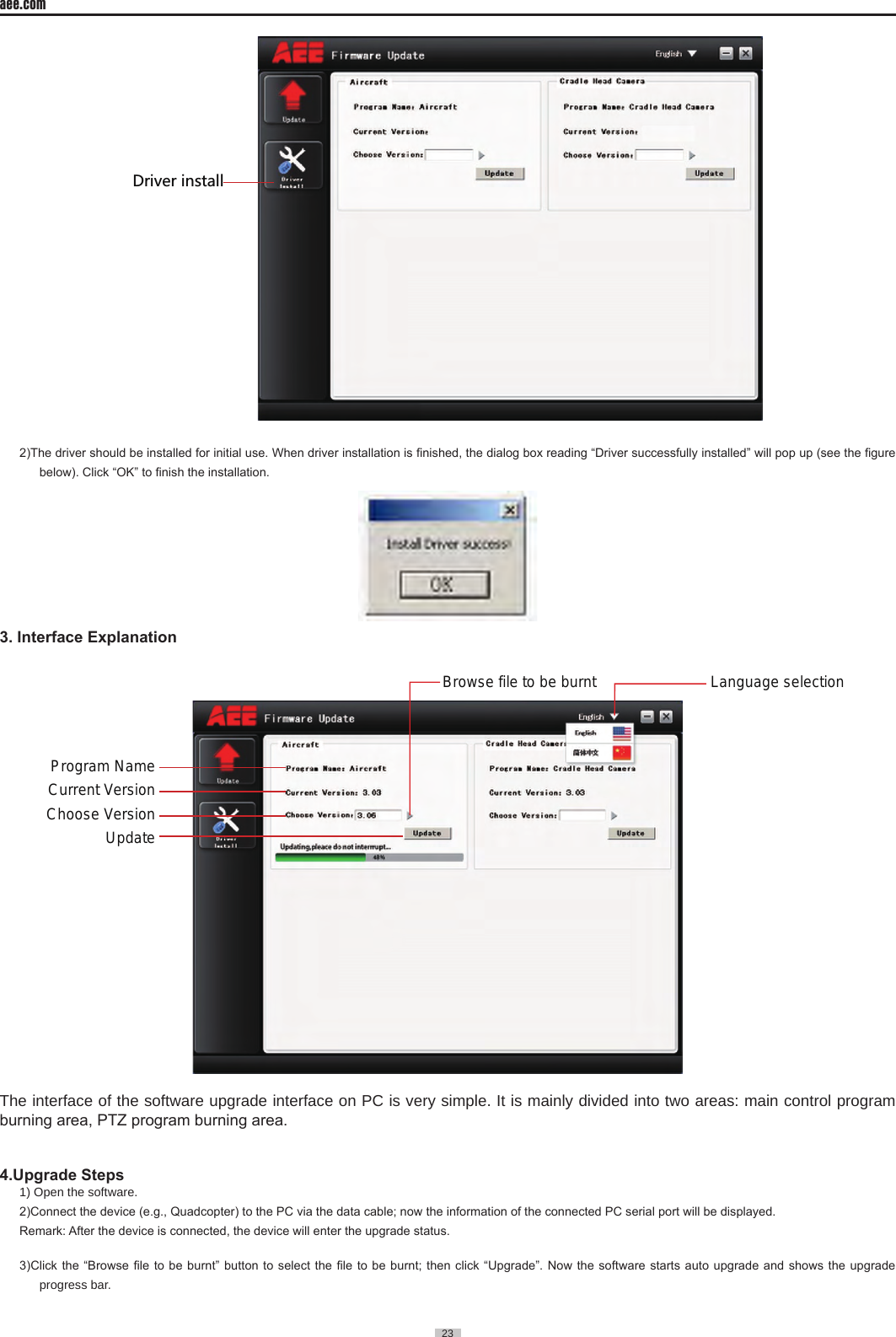
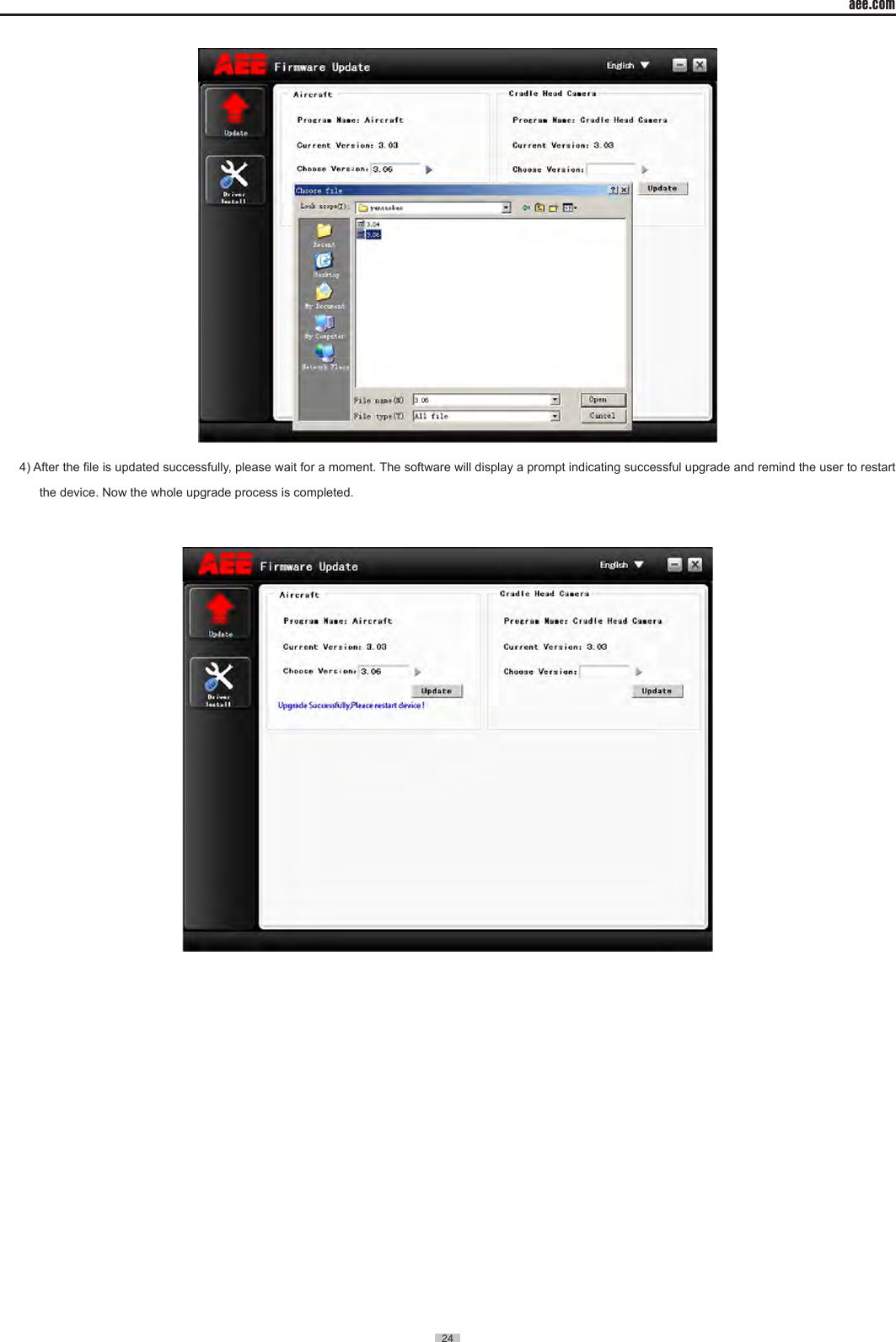
23  aee.com23  *XO\KXOTYZGRR2)The driver should be installed for initial use. When driver installation is nished, the dialog box reading “Driver successfully installed” will pop up (see the gure below). Click “OK” to nish the installation. 3. Interface ExplanationUpdateProgram NameLanguage selection Browse file to be burnt Current VersionChoose VersionThe interface of the software upgrade interface on PC is very simple� It is mainly divided into two areas: main control program burning area, PTZ program burning area.4.Upgrade Steps 1) Open the software� 2)Connect the device (e.g., Quadcopter) to the PC via the data cable; now the information of the connected PC serial port will be displayed.Remark: After the device is connected, the device will enter the upgrade status. 3)Click the “Browse le  to be burnt” button to select  the le to be burnt;  then click “Upgrade”. Now the software  starts auto upgrade and shows  the upgrade progress bar�
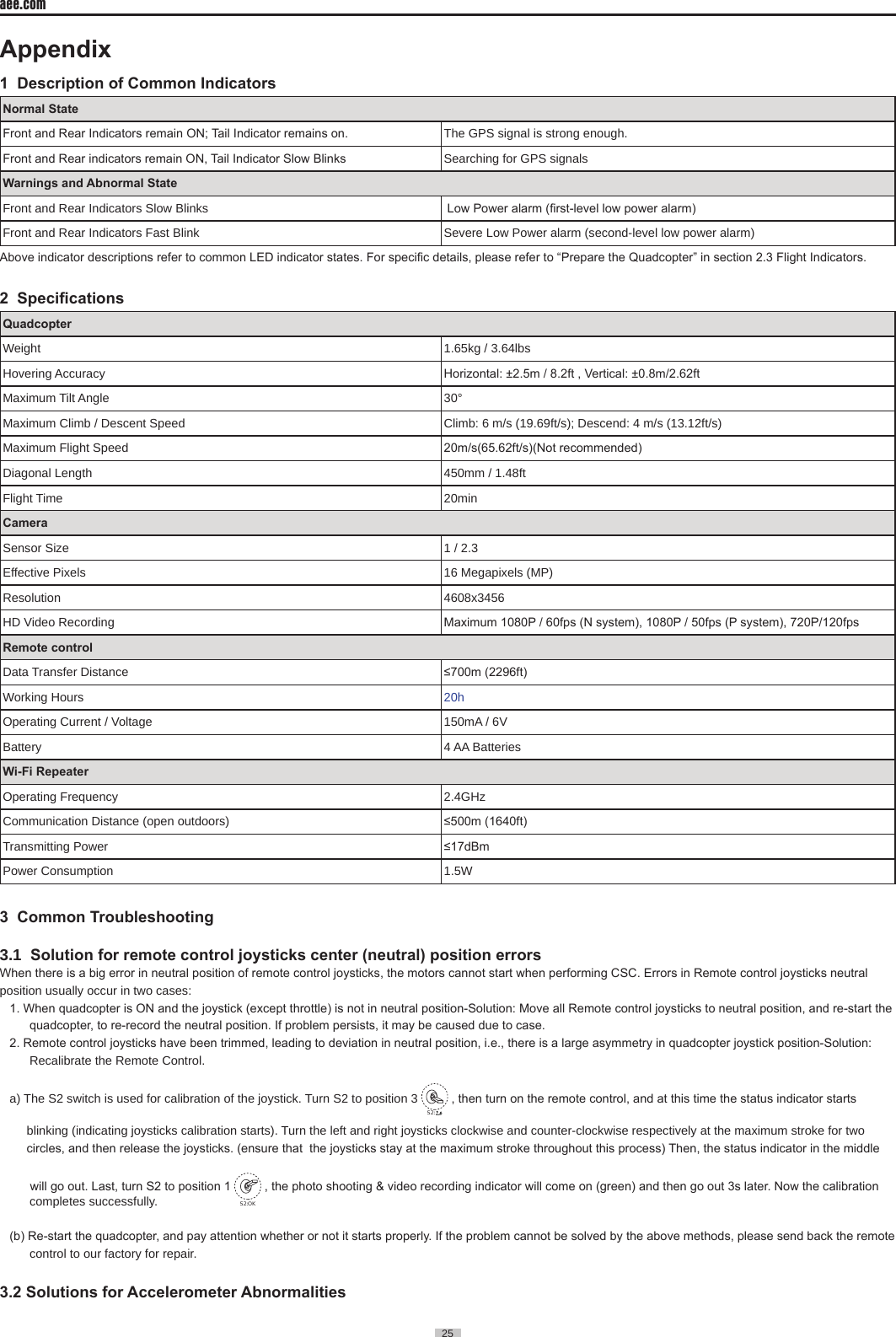
aee.com24  4) After the le is updated successfully, please wait for a moment. The software will display a prompt indicating successful upgrade and remind the user to restart the device. Now the whole upgrade process is completed.
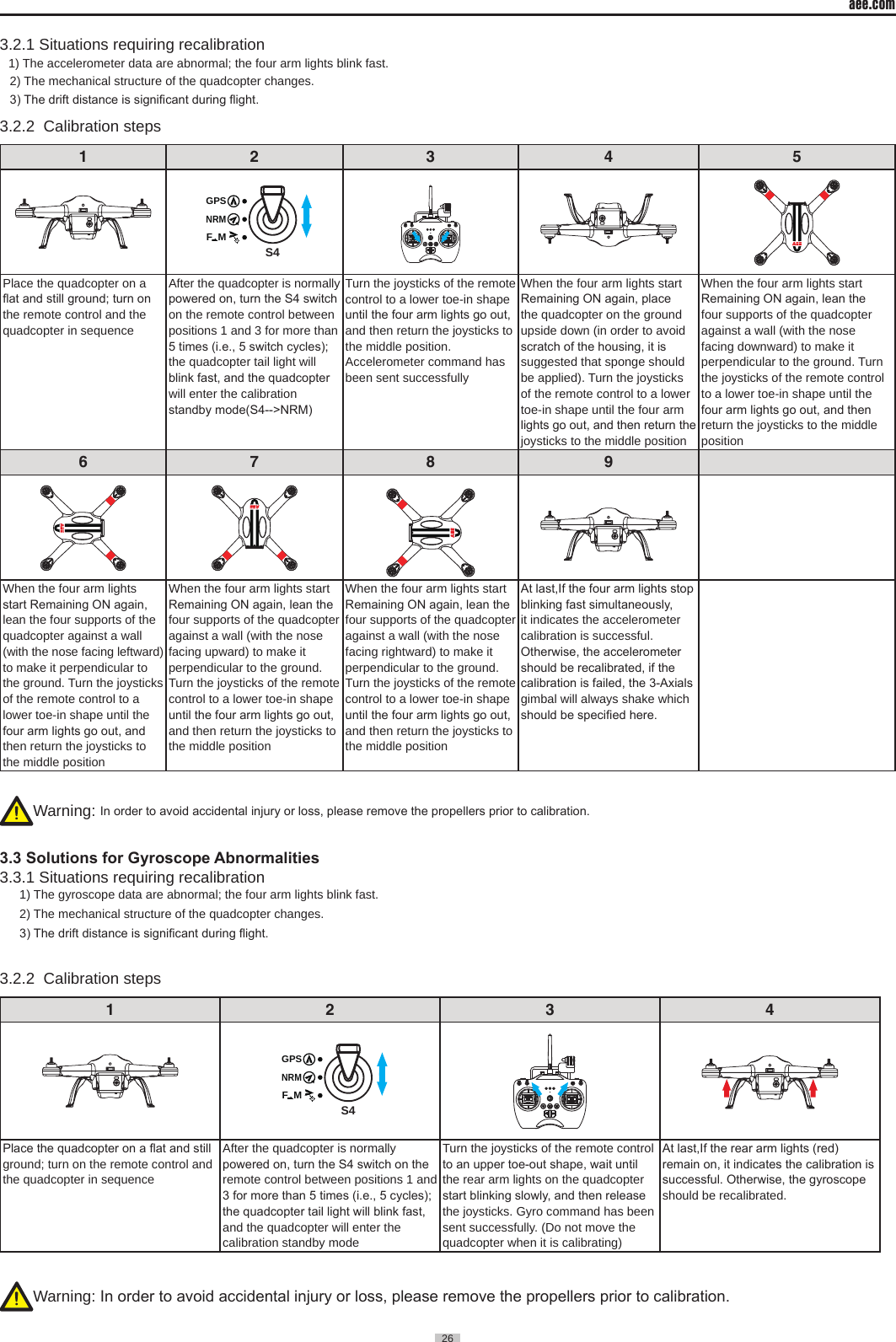
25  aee.com25  Appendix1  Description of Common Indicators Normal StateFront and Rear Indicators remain ON; Tail Indicator remains on. The GPS signal is strong enough�Front and Rear indicators remain ON, Tail Indicator Slow Blinks Searching for GPS signalsWarnings and Abnormal StateFront and Rear Indicators Slow Blinks  Low Power alarm (rst-level low power alarm)  Front and Rear Indicators Fast Blink Severe Low Power alarm (second-level low power alarm)Above indicator descriptions refer to common LED indicator states. For specic details, please refer to “Prepare the Quadcopter” in section 2.3 Flight Indicators.                                                                2  Specications QuadcopterWeight 1�65kg / 3�64lbsHovering Accuracy Horizontal: ±2.5m / 8.2ft , Vertical: ±0.8m/2.62ftMaximum Tilt Angle 30° Maximum Climb / Descent Speed Climb: 6 m/s (19�69ft/s); Descend: 4 m/s (13�12ft/s)Maximum Flight Speed 20m/s(65.62ft/s)(Not recommended)Diagonal Length 450mm / 1�48ftFlight Time 20minCameraSensor Size 1 / 2�3Effective Pixels 16 Megapixels (MP)Resolution 4608x3456HD Video Recording Maximum 1080P / 60fps (N system), 1080P / 50fps (P system), 720P/120fpsRemote controlData Transfer Distance ≤700m (2296ft)Working Hours 20hOperating Current / Voltage  150mA / 6VBattery 4 AA BatteriesWi-Fi RepeaterOperating Frequency 2�4GHzCommunication Distance (open outdoors) ≤500m (1640ft)Transmitting Power ≤17dBmPower Consumption 1�5W                  3  Common Troubleshooting                                                             3�1  Solution for remote control joysticks center (neutral) position errorsWhen there is a big error in neutral position of remote control joysticks, the motors cannot start when performing CSC. Errors in Remote control joysticks neutral position usually occur in two cases:1. When quadcopter is ON and the joystick (except throttle) is not in neutral position-Solution: Move all Remote control joysticks to neutral position, and re-start the quadcopter, to re-record the neutral position. If problem persists, it may be caused due to case. 2. Remote control joysticks have been trimmed, leading to deviation in neutral position, i.e., there is a large asymmetry in quadcopter joystick position-Solution: Recalibrate the Remote Control�a) The S2 switch is used for calibration of the joystick� Turn S2 to position 3 S2: , then turn on the remote control, and at this time the status indicator starts      blinking (indicating joysticks calibration starts)� Turn the left and right joysticks clockwise and counter-clockwise respectively at the maximum stroke for two     circles, and then release the joysticks. (ensure that  the joysticks stay at the maximum stroke throughout this process) Then, the status indicator in the middle            will go out. Last, turn S2 to position 1 S2:OK , the photo shooting & video recording indicator will come on (green) and then go out 3s later. Now the calibration completes successfully�(b) Re-start the quadcopter, and pay attention whether or not it starts properly. If the problem cannot be solved by the above methods, please send back the remote control to our factory for repair�3.2 Solutions for Accelerometer Abnormalities
aee.com26  3�2�1 Situations requiring recalibration   1) The accelerometer data are abnormal; the four arm lights blink fast�   2) The mechanical structure of the quadcopter changes�   3) The drift distance is signicant during ight.3�2�2  Calibration steps 1 2 3 4 5S4GPSNRMF  MPlace the quadcopter on a at and still ground; turn on the remote control and the quadcopter in sequenceAfter the quadcopter is normally powered on, turn the S4 switch on the remote control between positions 1 and 3 for more than 5 times (i.e., 5 switch cycles); the quadcopter tail light will blink fast, and the quadcopter will enter the calibration standby mode(S4-->NRM)Turn the joysticks of the remote control to a lower toe-in shape until the four arm lights go out, and then return the joysticks to the middle position�Accelerometer command has been sent successfullyWhen the four arm lights start Remaining ON again, place the quadcopter on the ground upside down (in order to avoid scratch of the housing, it is suggested that sponge should be applied)� Turn the joysticks of the remote control to a lower toe-in shape until the four arm lights go out, and then return the joysticks to the middle positionWhen the four arm lights start Remaining ON again, lean the four supports of the quadcopter against a wall (with the nose facing downward) to make it perpendicular to the ground� Turn the joysticks of the remote control to a lower toe-in shape until the four arm lights go out, and then return the joysticks to the middle position6 7 8 9When the four arm lights start Remaining ON again, lean the four supports of the quadcopter against a wall (with the nose facing leftward) to make it perpendicular to the ground� Turn the joysticks of the remote control to a lower toe-in shape until the four arm lights go out, and then return the joysticks to the middle positionWhen the four arm lights start Remaining ON again, lean the four supports of the quadcopter against a wall (with the nose facing upward) to make it perpendicular to the ground� Turn the joysticks of the remote control to a lower toe-in shape until the four arm lights go out, and then return the joysticks to the middle positionWhen the four arm lights start Remaining ON again, lean the four supports of the quadcopter against a wall (with the nose facing rightward) to make it perpendicular to the ground� Turn the joysticks of the remote control to a lower toe-in shape until the four arm lights go out, and then return the joysticks to the middle positionAt last,If the four arm lights stop blinking fast simultaneously, it indicates the accelerometer calibration is successful� Otherwise, the accelerometer should be recalibrated, if the calibration is failed, the 3-Axials gimbal will always shake which should be specied here.Warning: In order to avoid accidental injury or loss, please remove the propellers prior to calibration.3.3 Solutions for Gyroscope Abnormalities3�3�1 Situations requiring recalibration 1) The gyroscope data are abnormal; the four arm lights blink fast�2) The mechanical structure of the quadcopter changes�3) The drift distance is signicant during ight.3�2�2  Calibration steps 1234S4GPSNRMF  MPlace the quadcopter on a at and still ground; turn on the remote control and the quadcopter in sequenceAfter the quadcopter is normally powered on, turn the S4 switch on the remote control between positions 1 and 3 for more than 5 times (i.e., 5 cycles); the quadcopter tail light will blink fast, and the quadcopter will enter the calibration standby modeTurn the joysticks of the remote control to an upper toe-out shape, wait until the rear arm lights on the quadcopter start blinking slowly, and then release the joysticks� Gyro command has been sent successfully� (Do not move the quadcopter when it is calibrating)At last,If the rear arm lights (red) remain on, it indicates the calibration is successful. Otherwise, the gyroscope should be recalibrated�Warning: In order to avoid accidental injury or loss, please remove the propellers prior to calibration.
27  aee.com27  3.4  Quadcopter is out of sight and the Wi-Fi is disconnectedTurn off the remote control and let the quadcopter automatically return. Ensure there are no obstructions on the quadcopter’s return path, and ensure you are familiar with the procedures on how to regain control of the quadcopter�Turn off the Remote control to trigger the Failsafe mode and the quadcopter will start to y back, descend, and land at the Home Point. Ensure there are no obstacles between the Quadcopter and the Home Point and that you are familiar with the procedure for regaining control�3.5 Wi-Fi could not be re-connectedThis is because after the mobile device disconnects from Quadcopter Wi-Fi connection, the mobile device automatically connects to other Wi-Fi networks. Please check your mobile device is connected to the Quadcopter Wi-Fi network�3.6 Precautions while using App on multiple mobile devicesDuring ight if the App is used on one mobile device and then launched on another mobile device, please make sure you completely log out from the App in the original mobile device, so that the App can be normally used on the other mobile device.3.7  How can quadcopter land smoothly?Before performing CSC, pull down the left joystick to less than5% ofthe joystick level, and then execute CSC. This way you can land the quadcopter smoothly.Limited WarrantyAEE products are guaranteed against manufacturing defects, AEE's sole obligation in the event of such defects during this period is to repair or replace the defective part or product with a comparable part or product at AEE's sole discretion. Except for such repair or replacement, the sale, processing or other handling of this product is without warranty, condition or other liability even though the defect or loss is caused by negligence or other fault. Damage resulting from use, accident, or normal wear and tear is not covered by this or any warranty. AEE assumes no liability for any accident, injury, death, loss, or other claim related to or resulting from the use of this product� In no event shall AEE be liable for incidental or consequential damages relating to or resulting from the use of this product or any of its parts� Because of possible user resealing error, this product is not warranted against leakage in waterproof housing or any resulting damage. Returns or replacements of parts and/or products may be subject to shipping, handling, replacement and/or restocking fees.If you are experiencing a problem with an AEE purchase, please contact our Customer Support Team by visiting our website www.aee.com .For product warranty period and conditions, please refer to www.aee.com for details. Tip: If you bought this product from an AEE authorized dealer, we would recommend that you rst contact them for technical support issuesThis User Manual is subject to change without prior notice�You can check the ofcial AEE website for the latest updated version.
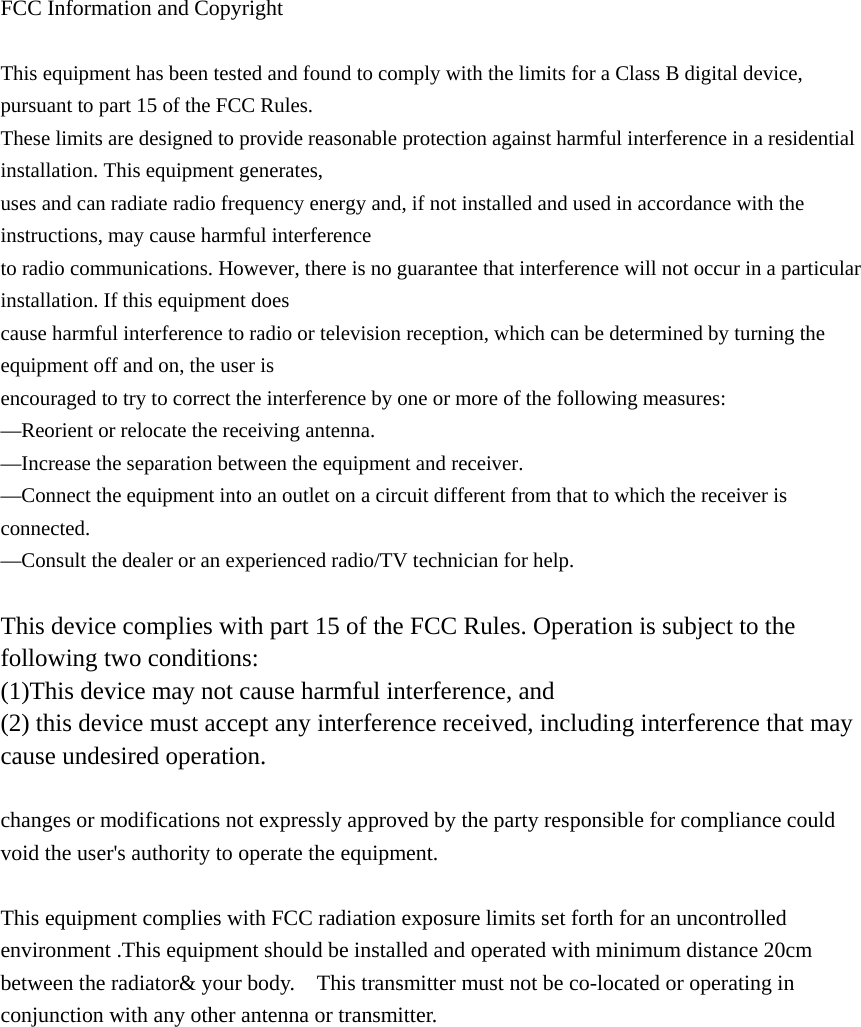
 FCC Information and Copyright  This equipment has been tested and found to comply with the limits for a Class B digital device, pursuant to part 15 of the FCC Rules. These limits are designed to provide reasonable protection against harmful interference in a residential installation. This equipment generates, uses and can radiate radio frequency energy and, if not installed and used in accordance with the instructions, may cause harmful interference to radio communications. However, there is no guarantee that interference will not occur in a particular installation. If this equipment does cause harmful interference to radio or television reception, which can be determined by turning the equipment off and on, the user is encouraged to try to correct the interference by one or more of the following measures: —Reorient or relocate the receiving antenna. —Increase the separation between the equipment and receiver. —Connect the equipment into an outlet on a circuit different from that to which the receiver is connected. —Consult the dealer or an experienced radio/TV technician for help.  This device complies with part 15 of the FCC Rules. Operation is subject to the following two conditions: (1)This device may not cause harmful interference, and   (2) this device must accept any interference received, including interference that may cause undesired operation.  changes or modifications not expressly approved by the party responsible for compliance could void the user's authority to operate the equipment.  This equipment complies with FCC radiation exposure limits set forth for an uncontrolled environment .This equipment should be installed and operated with minimum distance 20cm between the radiator& your body.    This transmitter must not be co-located or operating in conjunction with any other antenna or transmitter.

Navigation menu