Acrodyne NW8201E DIGITAL TELEVISION BROADCAST TRANSMITTER User Manual 32 NV8202 26 04 06 01 00

Acrodyne Industries, Inc. DIGITAL TELEVISION BROADCAST TRANSMITTER 32 NV8202 26 04 06 01 00

Users Manual Part 1

Broadcasting Division2099.9595.72 -01 - 0.1 -System ManualNW8202E/V DTV TransmitterTransmitter Series Nx8000Only skilled personnel may perform the operations of the described instrument thatare necessary for installing and putting it into operation as well as maintaining, trou-bleshooting and servicing it.Printed in Germany
System ManualTransmitter Series Nx8000Edition: Oktober 2007Version: E 01.002099.9595.72 -01 - 0.2 -This document may be duplicated or otherwise used or its contents made known to third parties only withpermission of the originator or other authorized persons.Infringements constitute an offence and are subject to claim for damages (UrhG, UWG, BGB).All rights reserved for patenting or utility model registration.ROHDE & SCHWARZ GmbH & Co.KGD-81671 München - Mühldorfstraße 15Telefon: (089) 4129-0 ^ Int. +49894129-0Telefax: (089) 4129-12164Internet: www.rohde-schwarz.comPrinted in Federal Republic of Germany ^ Subject to change ^ Data without tolerances: typical values
2090.6870.54 - EU - D/E-2Für Betrieb im Europäischen Wirtschaftsraum (EWR)und zivilem Einsatz.Hinweis gemäß dem Gesetz über "Funkanlagen und Telekommunikationsend-einrichtungen" (FTEG) und der Europäischen Richtlinie 1999/5/EG:Dieses Produkt darf innerhalb des EWR nicht uneingeschränkt betrieben werden, dader verwendete Frequenzbereich auf nicht harmonisierten Bändern erfolgt. NationaleVorschriften / Genehmigungen sind zu beachten.Das Gerät ist 4 Wochen vor Inverkehrbringen bei der jeweils zuständigen nationalenBehörde für die Frequenzhoheit zu notifizieren. Informationen hierzu im Internet unterfolgender Adresse: http://europa.eu.int/comm/enterprise/rtte/spectr.htmFor operation in the European Economic Area (EEA)and civil use.Note pursuant to the German Radio and Telecommunications Terminal Equip-ment Directive (FTEG) and the European R&TTE Directive 1999/5/EC:Operation of this product within the EEA is subject to restrictions since the frequencybands used are not harmonised. National provisions / authorizations shall be com-plied with.The product shall be notified to the competent national frequency managementauthority four weeks before the product is put on the market.For more information refer to: http://europa.eu.int/comm/enterprise/rtte/spectr.htmPrinted in Germany
2099.9595.72 - 0.3 - E-1NW8202E/V CONTENTSSAFETY INSTRUCTIONS 1DESIGN AND CHARACTERISTICS 2INSTALLATION 3COMMISSIONING 4OPERATING 5MAINTENANCE 6TROUBLESHOOTING 7SERVICE 8ANNEX 9
Broadcasting Division2095.7346.32 - 1.0 - E-1CHAPTER 1SAFETY INSTRUCTIONSPrinted in Germany
Chapter 1 Safety Instructions2098.1190.72 - 1.01 - E-2CONTENTS1 About this Manual ............................................................................ 12 Safety Instructions for Transmitter Systems and Instruments ... 23 General Safety Instructions ............................................................ 34 Special Danger Warnings ............................................................... 44.1 Hazards due to AC Supply Voltage ...............................................................44.1.1 AC Power Supply  .........................................................................................44.1.2 Replacing Fuses ...........................................................................................54.1.3 Emergency-Off Equipment  ...........................................................................54.1.4 Opening the Transmitter ...............................................................................54.2 Hazards due to High-Energy Circuits  ...........................................................64.3 RF Hazards ......................................................................................................64.3.1 Mandatory Training  ......................................................................................64.3.2 RF Shielding .................................................................................................74.3.3 Rules for Operating the Transmitter  .............................................................74.3.4 Rules for Working with an Open Transmitter  ...............................................74.4 Fire Hazards  ....................................................................................................8
Chapter 1 Safety Instructions2098.1190.72 - 1.1 - E-21 About this ManualThis manual is part of the documentation for the NX8000 family of transmitters from Rohde& Schwarz. Each transmitter and each transmitter component is described in a separatemanual. The individual manuals of the family of transmitters are modular in structure andcomplement each other. StructureEach transmitter component is described in a separate manual and can thus be used as anindividual component (where practical). The transmitter manual is the main document forthe entire set of documentation. It describes all steps that are necessary to install a trans-mitter, put it into operation, operate and maintain it. Where applicable, the transmitter man-ual refers to the individual manuals for the various components. The component manuals,in turn, also refer to the transmitter manual whenever the component is to be used as atransmitter module.ContentsThe manuals for the family of transmitters describe all steps required to install the transmit-ter or one of its components, put them into operation, operate and maintain them, trouble-shoot and service them. The Annex includes interface descriptions plus technicaldocuments. For convenience, all manuals are structured identically. Sections that are not relevant to themanual at hand are also included but are left blank. SafetyAll skilled personnel working with a transmitter or its components must read all relevantmanuals and comply with the safety measures that are detailed in the chapter about safetyand in the applicable sections in the manual. The transmitter and the individual transmittercomponents must be used only for their intended purpose. All operations involving thetransmitter or individual transmitter components must be performed by skilled personnel.The manual will point out specifically if additional qualifications are required. Symbols and LayoutThe triangular warning symbol indicates danger. In addition to the triangular warning sym-bol, different key words indicate the level of potential danger.Instructions are given in numbered steps or indicated by an "index finger" symbol to the leftof the instruction text. The results of the performed instructions are indented.The key word "Note" precedes notes. Notes contain additional information and tips to helpfacilitate the work at hand. All other formatting options add structure to the text and are self-explanatory.
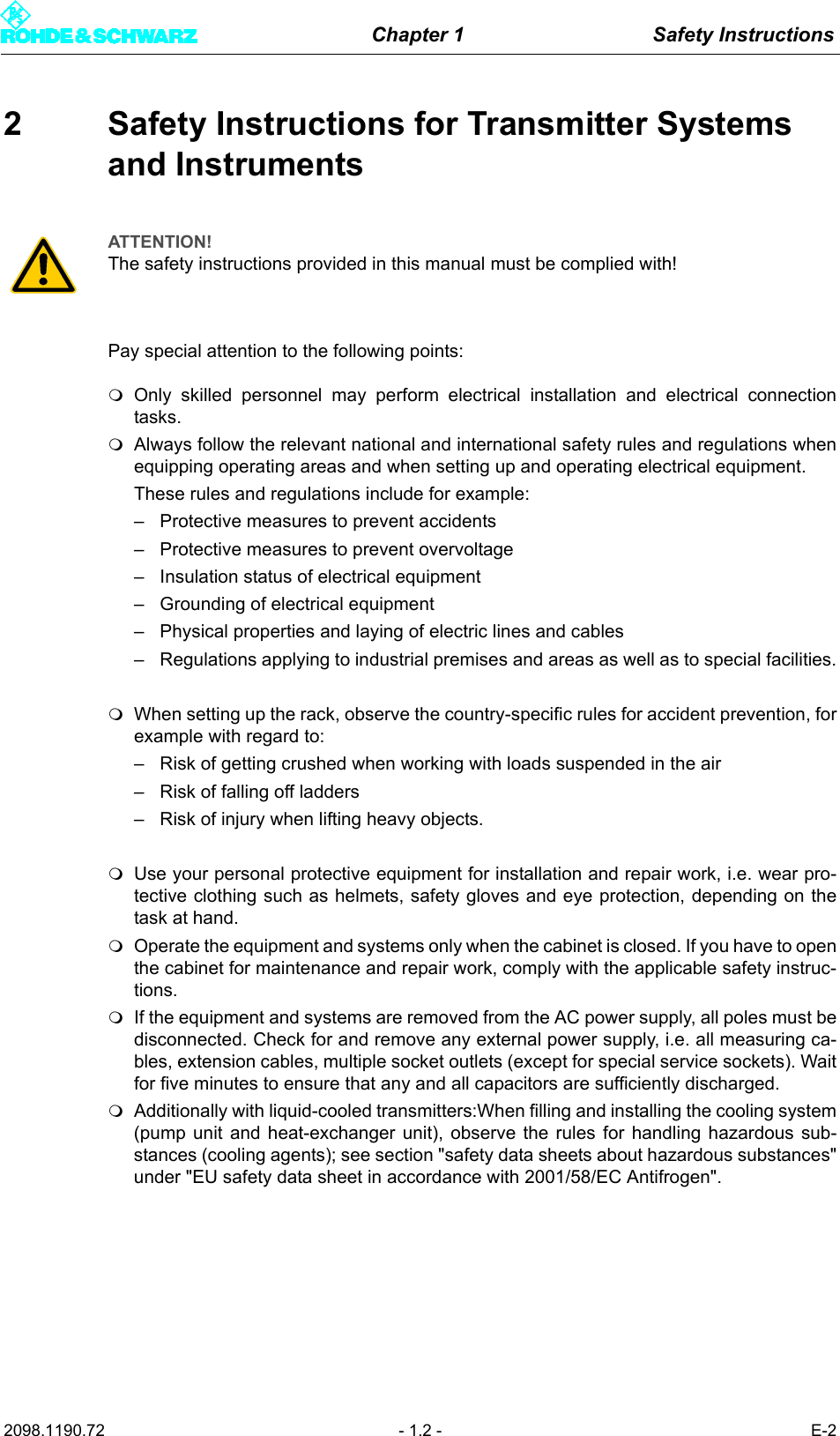
Chapter 1 Safety Instructions2098.1190.72 - 1.2 - E-22 Safety Instructions for Transmitter Systems and InstrumentsPay special attention to the following points:Only skilled personnel may perform electrical installation and electrical connectiontasks.Always follow the relevant national and international safety rules and regulations whenequipping operating areas and when setting up and operating electrical equipment.These rules and regulations include for example:– Protective measures to prevent accidents– Protective measures to prevent overvoltage– Insulation status of electrical equipment– Grounding of electrical equipment– Physical properties and laying of electric lines and cables– Regulations applying to industrial premises and areas as well as to special facilities.When setting up the rack, observe the country-specific rules for accident prevention, forexample with regard to:– Risk of getting crushed when working with loads suspended in the air– Risk of falling off ladders– Risk of injury when lifting heavy objects.Use your personal protective equipment for installation and repair work, i.e. wear pro-tective clothing such as helmets, safety gloves and eye protection, depending on thetask at hand.Operate the equipment and systems only when the cabinet is closed. If you have to openthe cabinet for maintenance and repair work, comply with the applicable safety instruc-tions.If the equipment and systems are removed from the AC power supply, all poles must bedisconnected. Check for and remove any external power supply, i.e. all measuring ca-bles, extension cables, multiple socket outlets (except for special service sockets). Waitfor five minutes to ensure that any and all capacitors are sufficiently discharged.Additionally with liquid-cooled transmitters:When filling and installing the cooling system(pump unit and heat-exchanger unit), observe the rules for handling hazardous sub-stances (cooling agents); see section "safety data sheets about hazardous substances"under "EU safety data sheet in accordance with 2001/58/EC Antifrogen".ATTENTION!The safety instructions provided in this manual must be complied with!
Chapter 1 Safety Instructions2098.1190.72 - 1.3 - E-23 General Safety InstructionsThis section contains general safety instructions that apply to all products manufactured ordistributed by Rohde & Schwarz.In accordance with IEC 215 and EN 60215, transmitters and their auxiliary equipment mustbe operated only under the responsibility of skilled personnel. The EN 60215 standard("Safety requirements for radio transmitting equipment") defines the minimum requirementsfor skilled electrical personnel.Complying with all statutory provisions is a precondition for operating radiocommunicationssystems and equipment. The operator or the operator's authorized representative is re-sponsible for ensuring compliance with these guidelines. They must also ensure that theoperating personnel meets the applicable country-specific training requirements. These re-quirements also include any periodic training that is necessary.
Chapter 1 Safety Instructions2098.1190.72 - 1.4 - E-24 Special Danger Warnings4.1 Hazards due to AC Supply VoltageThere is a risk of electric shock with any Vrms > 30 V AC or V > 60 V DC voltage. Appropri-ate measures must be taken to prevent exposure to any danger when working with voltagesthat bear the risk of electric shock. Never work on live parts unless specifically required andonly if the special safety precautions are complied with.4.1.1 AC Power SupplyBefore connecting the equipment to the AC power supply, make sure that the AC supplydata specified on the system or equipment matches the rated data of the local AC sup-ply. The supply circuit must be protected by fuses against overloading and short circuitsat all times.It is possible that a transmitter has completely separate circuits. For each of these circuits,the following requirements apply:When connecting all circuits of the transmitter to the AC power supply make sure thatthe following requirements are met:– The transmitter can be disconnected at any time.– The transmitter can be secured against reactivation.– The transmitter is terminated with a power line that is correctly fused and also suit-able for power consumption.1– Apply the rotating field as intended (rotating direction of the fans!).Service socketsTo allow measuring equipment or a soldering iron to be operated, it is customary to equiptransmitters with a service socket that carries voltage even when the transmitter is switchedoff. Such service sockets are identified as such, for example with an LED, and may only beused for the above mentioned purposes. Since the socket is intended solely for service purposes, it has only a limited power output.Never use the socket to operate heating appliances or large test systems.The transmitter operator is responsible for the correct fusing (the socket is labeled withthe maximum value).With accessories that are not controlled with the entire transmitter, the transmitter oper-ator is responsible for taking the appropriate measures to ensure safety in each circuitstate.1 Apply the specifications of this documentation and observe also the limited deactivation capabilities of the fu-ses and circuit breakers in the transmitter.
Chapter 1 Safety Instructions2098.1190.72 - 1.5 - E-24.1.2 Replacing FusesReplace the safety fuses accessible in the operator area only if no voltage is being ap-plied to the instruments. The safety fuses may be replaced only by fuses with identicalelectric data, identical switching characteristics and identical switch-off capacity.Motor and line circuit breakers accessible in the transmitter's operator area may be op-erated. If their response range is selectable, do not change the settings made by themanufacturer. If the settings are accidentally changed, reset them by using the correctvalues specified in this documentation.4.1.3 Emergency-Off EquipmentIf the customer requests, the transmitters are equipped with emergency keys. When thetransmitters are supplied, these keys have basically no function. The transmitter opera-tor is responsible for ensuring that these emergency keys function safely and to inte-grate them into the emergency-off system of the operator area in accordance with theregulations. If you subsequently decide not to use the emergency keys as an emergen-cy-off system, you must remove them. Extremely important! A transmitter normally has several AC supply circuits that areindependent from each other, such as main AC supply circuit, AC current supply for ac-cessory equipment (main control unit, antenna switch, etc) or AC current supply for adisabled socket. The transmitter operator is responsible for making sure that all these circuits are inte-grated correctly into the emergency-off system. Circuits not integrated have to be la-beled accordingly.Never set up a transmitter that is equipped with disabled emergency-off equipment.4.1.4 Opening the TransmitterWhen you open the transmitter to carry out mechanical/electrical tasks (e.g. cleaning,repair, etc) always follow the five basic rules for working with electrical systems:– Disconnect the transmitter from the power supply– Secure it against inadvertent switch-on– Verify safe isolation from any power– Ground or short-circuit it2– Cover adjacent active circuits.Extremely important! A transmitter normally has several AC supply circuits that are in-dependent from each other, such as main AC supply circuit, AC current supply for ac-cessory equipment (main control unit, antenna switch, etc) or AC current supply for adisabled socket. Prior to performing any work, check the current status of the circuits. Also disconnectadjacent circuits to prevent inadvertent contact.2 Not all transmitter types can be grounded or short-circuited by using a grounding or short-circuit switch. If asuitable device for grounding or short-circuiting is not available, the skilled personnel must take appropriatemeasures as deemed necessary.
Chapter 1 Safety Instructions2098.1190.72 - 1.6 - E-2If you have to perform any work on the RF circuit, isolate the antenna connector as well. Caution! If other transmitters, etc, are in operation that are coupled to the same antennavia RF filters, energy from them can be fed back via the antenna cable.Never open a disconnected transmitter without taking protective measures againsttouching voltage-carrying parts.Due to the risk of electric shock from the AC supply voltage, never perform any electricaloperations when doors are open, front panels are unscrewed, plug-ins are withdrawn,etc. When electrical operations of the transmitter are performed for the purpose of internalmeasurements or repair, label the workplace accordingly and provide warning about thepotential hazards in accordance with the basic rules of electrical engineering. Appropriate measures have to be taken to prevent unauthorized persons from access-ing this area. After completing your work, close the transmitter and restore all safety measures for pre-venting electric shock that have been provided by the manufacturer. Immediately makesure that protective equipment (e.g. locks) is effective.4.2 Hazards due to High-Energy CircuitsThe instruments include low-voltage circuits which can be fed from an extremely low-imped-ance voltage source(e.g. amplifier operating voltage). These circuits conduct dangerouslylarge amounts of energy. We handle these circuits in the same manner as circuits with volt-ages that bear the risk of electric shock. They are usually covered and thus protectedagainst accidental contact. The cover comes with a warning label.If you remove the cover of a transmitter that is in operation, there is the risk of both voltagepoles being short-circuited. Short circuits create an electric arc and thus can cause burns,damage to the eyes as well as further injuries due to the state of shock response.Practical experience has repeatedly shown that a short circuit caused by metal tools cancause severe burns. For safety reasons, high-energy circuits are protected by covers andare thus not accessible within the operator area of the instruments.If you need to measure low-impedance voltages, during repair work or to optimize thepower consumption of the transmitter for example, exercise the same caution as whenmeasuring operating voltages that bear the risk of electric shock.Wear protective clothing if necessary.Before you open an instrument or remove its cover, switch off the operating voltage andwait for five minutes to ensure that any and all capacitors are sufficiently discharged.Do not short-ciruit capacitors to discharge them.4.3 RF Hazards4.3.1 Mandatory TrainingOperators must instruct their personnel on how to use this transmitter or instrument inaccordance with EN 60215 and IEC 215. This periodic training must cover the radio-fre-
Chapter 1 Safety Instructions2098.1190.72 - 1.7 - E-2quency hazards of the individual transmitter or instrument. Only after such training hasbeen provided and documented may the operating personnel handle switching and op-erating tasks.High-energy RF circuits within the transmitter or the instrument are routed via conventionaldetachable RF connectors (e.g. N). Depending on the output power, the transmitter or in-strument outputs come with screw-in or pluggable RF lines or ducts.If RF lines or modules conduct high power, the connection point or the entire module ismarked with the standard warning symbol (yellow triangle with black exclamation mark).4.3.2 RF ShieldingTransmitters and instruments from Rohde & Schwarz are shielded in such a manner thatRF radiation does not pose any danger even in the immediate vicinity if all RF lines areclosed. This statement is based on the ordinance for electromagnetic fields as defined inGerman law: The 26th ordinance for the Federal Emission Protection Law dated December 16, 1996 de-fines limit values for radio-frequency equipment for electric and magnetic field strengths. 4.3.3 Rules for Operating the TransmitterOpening RF lines during operation may cause electric arcs. This can cause burns and eyeinjuries.Operate the transmitter system only if an antenna or dummy antenna is connected.Never undo RF lines during transmitter operation.Never open modules during transmitter operation.Never put transmitters into operation if RF lines are open. 3When disconnecting a transmitter, always disconnect the antenna connector as well. Ifother transmitters, etc, are in operation that are coupled to the same antenna via RF fil-ters, energy from them can be fed back via the antenna cable.4.3.4 Rules for Working with an Open TransmitterIf you switch on an open transmitter and remove covers and shielding that carry the generalwarning symbol of RF modules, dangerous RF levels will be radiated .The transmitter operator is responsible for strict compliance with the necessary safety pre-cautions when someone is working with or located near an open transmitter that is switchedon. Necessary safety regulations include:3 If you try to put the transmitter into operation, RF power is transmitted. If RF lines are open, the transmitterswitches off the RF again. This attempt to transmit RF can lead to the above mentioned risks of injury even if- as is the case with Rohde & Schwarz transmitters - the RF flow is limited and transient due to technical mea-sures.
Chapter 1 Safety Instructions2098.1190.72 - 1.8 - E-2Labeling the workplace as subject to RF hazards Wearing RF protective clothTaking special safety precautions for persons with implants such as metal parts, pace-makers, etc,  since they are particularly susceptible to injury.4.4 Fire Hazards Every electric circuit containing sufficient energy and to which voltage is applied poses firehazards. This also applies to radio transmitters. For transmitter radio systems, it is thereforenecessary to create a safety plan for the event of fire. Operating personnel must be trained on how to proceed in the case of fire in areas contain-ing electrical systems; training must be repeated at regular intervals. Personnel should betrained on the basis of the VDE 0132 standard and in agreement with the local fire depart-ment. The following statement applies in Germany. Preventive measures at the site in questioncan largely eliminate the risk of fire or prevent its spread as far as possible.Prevention and fire-fightingWhen setting up the transmitter, the operator must ensure that no inflammable materialsare located below or above the cable entry nor attached to it. Make sure that openings to adjacent spaces are closed in a flame-retardant manner.Fire-fighting is only allowed with special equipment even if the flames are insignificantor have no effect at all (e.g. breathing mask with air bottle).For fire-fighting, only suitable fire extinguishers (e.g. CO2 extinguishers) may be used.One reason for requiring special equipment is the fact that extremely poisonous and imper-ceptible carbon monoxide is released during every fire. Another reason is that the materialscontained in the instruments and systems emit poisonous vapors, gases and dust such assulfuric acid and hydrogen sulfide, hydrochloric acid, dioxin, hydrofluoric acid and berylliumoxide dust when they are exposed to external flame and heat. The following materials can be affected:– Rubber in cables, cable bushings, vibration absorbers and instrument feet– PVC in cables and lines– PUR (foam) in insulators, molded parts, sealing mats and insulating strips– Teflon in cables, lines, insulation material and printed boards – Beryllium oxide ceramics in power transistors

Navigation menu