AirVast Technology WN150G 802.11b/g WLAN Cardbus Adapter User Manual 802 11g WLAN Cardbus certificaiton

AirVast Technology Inc. 802.11b/g WLAN Cardbus Adapter 802 11g WLAN Cardbus certificaiton

User Manual

 M060603V10                 880022..1111bb//gg  WWLLAANN  CCaarrddbbuuss  AAddaapptteerr        User Manual                     Version 1.0
 M060603V10 No part of this documentation may be reproduced in any form or by any means or used to make any derivative work (such as translation, transformation, or adaptation) without written permission from the copyright owner. All the other trademarks and registered trademarks are the property of their respective owners. Statement of Conditions We may make improvements or changes in the product described in this documentation at any  time. The information regarding to the product in this manual are subject to change without notice.  We assume no responsibility for errors contained herein or for direct, indirect, special, incidental, or consequential damages with the furnishing, performance, or use of this manual or equipment supplied with it, even if the suppliers have been advised of the possibility of such damages. Electronic Emission Notices This device complies with Part 15 of the FCC Rules. Operation is subject to the following two conditions: (1) This device may not cause harmful interference. (2) This device must accept any interference received, including interference that may cause undesired operation. FCC INFORMATION The Federal Communication Commission Radio Frequency Interference Statement includes the following paragraph: The equipment has been tested and found to comply with the limits for a Class B Digital Device, pursuant to part 15 of the FCC Rules. These limits are designed to provide reasonable protection against harmful interference in a residential installation. This equipment generates, uses and can radiate radio frequency energy and, if not installed and used in accordance with the instruction, may cause harmful interference to radio communication. However, there is no guarantee that interference will not occur in a particular installation. If this equipment does cause harmful interference to radio or television reception, which can be determined by turning the equipment off and on, the user is encouraged to try to overcome the interference by one or more of the following measures: --Reorient or relocate the receiving antenna.  --Increase the separation between the equipment and receiver. --Connect the equipment into an outlet on a circuit different from that to which the receiver is connected.  --Consult the dealer or an experienced radio/TV technician for help. The equipment is for home or office use. R&TTE Compliance Statement This equipment complies with all the requirements of the Directive 1999/5/EC  of the European parliament and the council of 9 March 1999 on radio equipment and telecommunication terminal Equipment and the mutual recognition of their conformity(R&TTE). The R&TTE Directive repeals and replaces in the directive 98/13/EEC. As of April 8, 2000. IMPORTANT NOTE FCC RF Radiation Exposure Statement: This equipment complies with FCC RF radiation exposure limits set forth for an uncontrolled environment. This device has been tested for compliance with FCC RF Exposure (SAR) limits in typical laptop configurations and  This Transmitter must not be co-located or operating in conjunction with any other antenna or transmitter.  Caution: Changes or modifications not expressly approved by the party responsible for compliance could void the user's authority to operate the equipment.
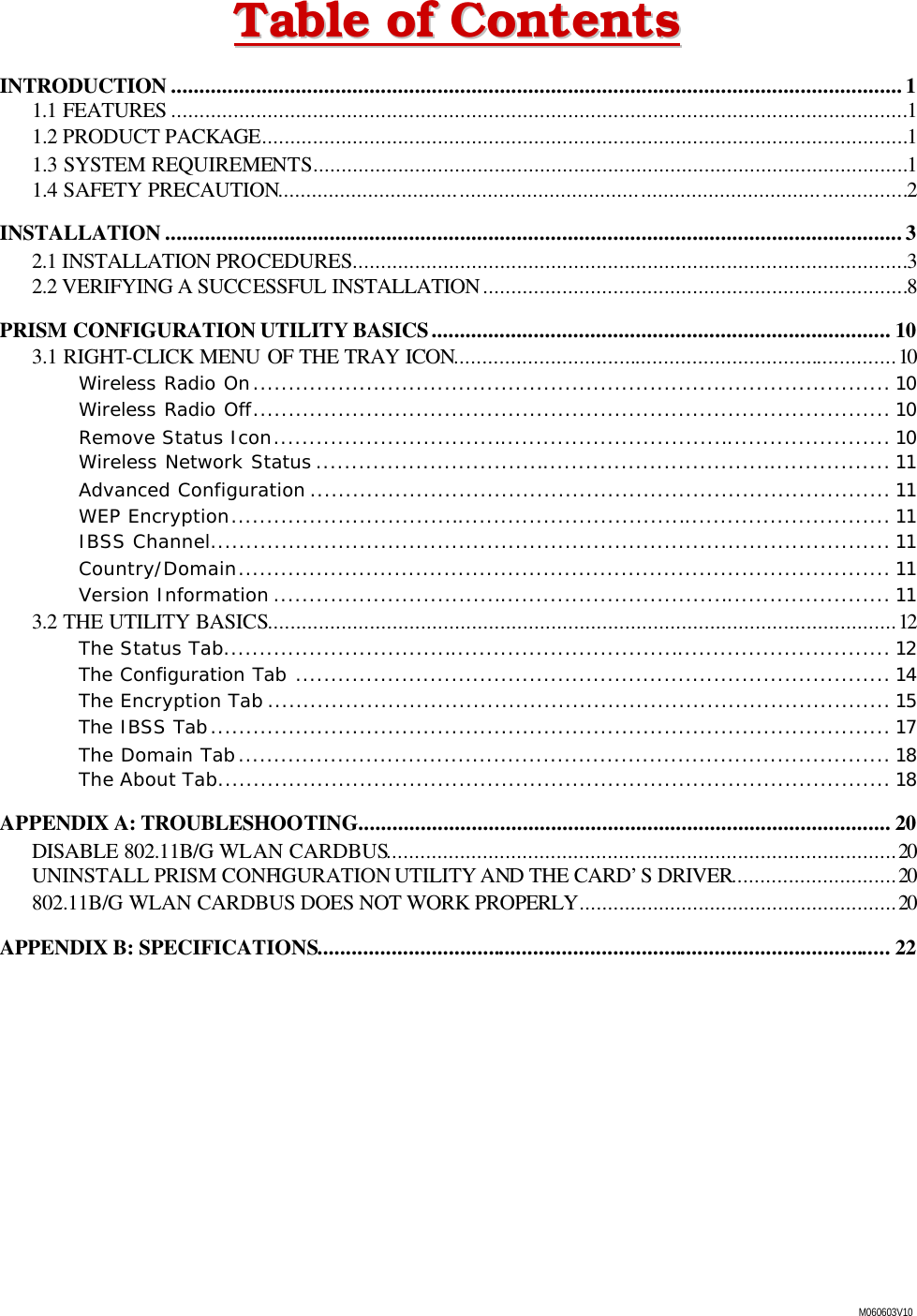
 M060603V10 TTaabbllee  ooff  CCoonntteennttss  INTRODUCTION .................................................................................................................................1 1.1 FEATURES ..................................................................................................................................1 1.2 PRODUCT PACKAGE..................................................................................................................1 1.3 SYSTEM REQUIREMENTS.........................................................................................................1 1.4 SAFETY PRECAUTION...............................................................................................................2 INSTALLATION ..................................................................................................................................3 2.1 INSTALLATION PROCEDURES..................................................................................................3 2.2 VERIFYING A SUCCESSFUL INSTALLATION...........................................................................8 PRISM CONFIGURATION UTILITY BASICS................................................................................. 10 3.1 RIGHT-CLICK MENU OF THE TRAY ICON..............................................................................10 Wireless Radio On.......................................................................................... 10 Wireless Radio Off.......................................................................................... 10 Remove Status Icon....................................................................................... 10 Wireless Network Status ................................................................................. 11 Advanced Configuration .................................................................................. 11 WEP Encryption............................................................................................. 11 IBSS Channel................................................................................................ 11 Country/Domain............................................................................................ 11 Version Information ....................................................................................... 11 3.2 THE UTILITY BASICS...............................................................................................................12 The Status Tab.............................................................................................. 12 The Configuration Tab .................................................................................... 14 The Encryption Tab ........................................................................................ 15 The IBSS Tab................................................................................................ 17 The Domain Tab............................................................................................ 18 The About Tab............................................................................................... 18 APPENDIX A: TROUBLESHOOTING.............................................................................................. 20 DISABLE 802.11B/G WLAN CARDBUS..........................................................................................20 UNINSTALL PRISM CONFIGURATION UTILITY AND THE CARD’S DRIVER.............................20 802.11B/G WLAN CARDBUS DOES NOT WORK PROPERLY........................................................20 APPENDIX B: SPECIFICATIONS..................................................................................................... 22
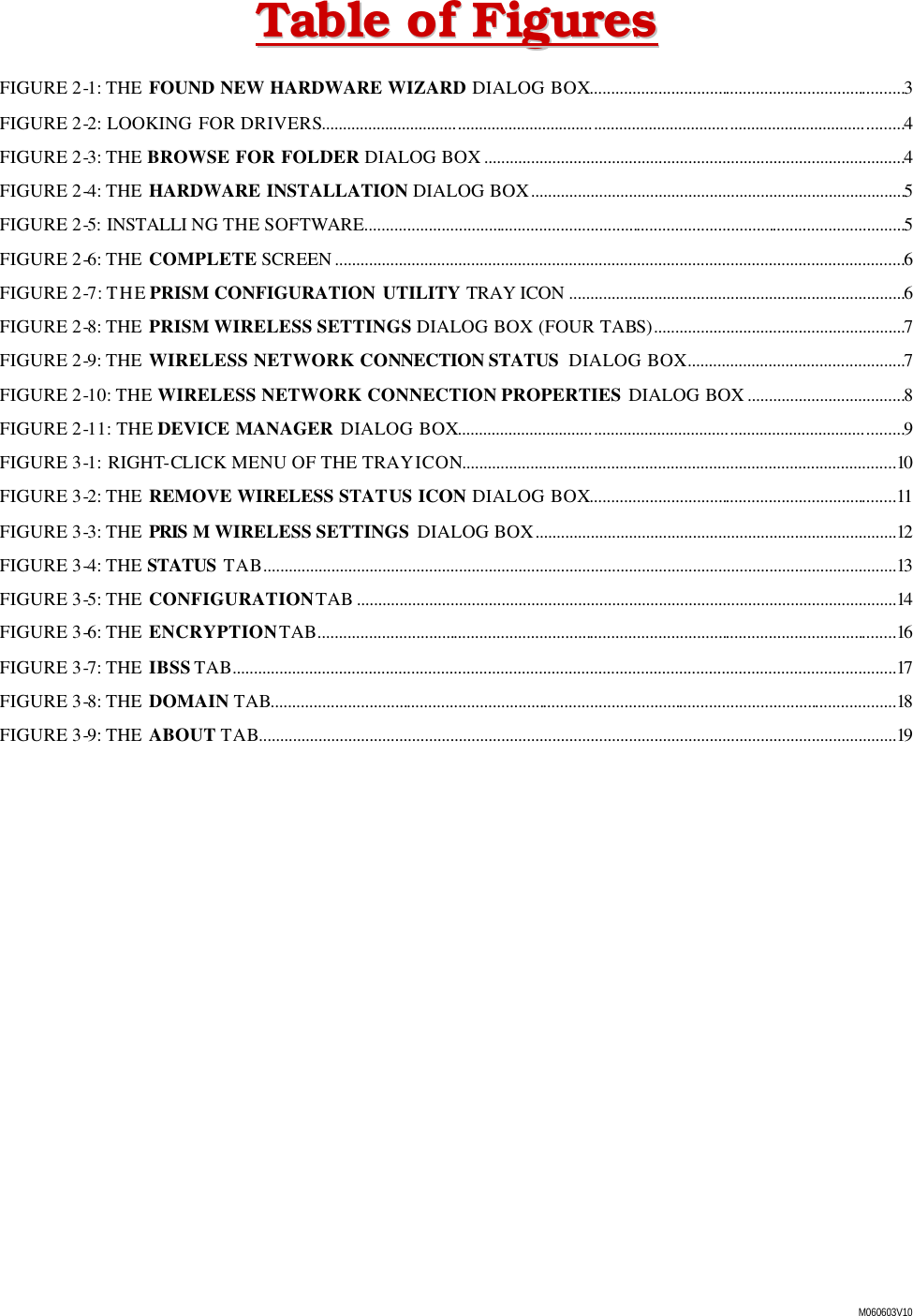
 M060603V10 TTaabbllee  ooff  FFiigguurreess  FIGURE 2-1: THE  FOUND NEW HARDWARE WIZARD DIALOG BOX..........................................................................3 FIGURE 2-2: LOOKING FOR DRIVERS.........................................................................................................................................4 FIGURE 2-3: THE BROWSE FOR FOLDER DIALOG BOX ...................................................................................................4 FIGURE 2-4: THE  HARDWARE INSTALLATION DIALOG BOX........................................................................................5 FIGURE 2-5: INSTALLI NG THE SOFTWARE...............................................................................................................................5 FIGURE 2-6: THE  COMPLETE SCREEN ......................................................................................................................................6 FIGURE 2-7: THE PRISM CONFIGURATION UTILITY TRAY ICON ...............................................................................6 FIGURE 2-8: THE  PRISM WIRELESS SETTINGS DIALOG BOX (FOUR TABS)...........................................................7 FIGURE 2-9: THE  WIRELESS NETWORK CONNECTION STATUS  DIALOG BOX...................................................7 FIGURE 2-10: THE WIRELESS NETWORK CONNECTION PROPERTIES DIALOG BOX .....................................8 FIGURE 2-11: THE DEVICE MANAGER DIALOG BOX.........................................................................................................9 FIGURE 3-1: RIGHT-CLICK MENU OF THE TRAY ICON......................................................................................................10 FIGURE 3-2: THE  REMOVE WIRELESS STATUS ICON DIALOG BOX........................................................................11 FIGURE 3-3: THE  PRIS M WIRELESS SETTINGS DIALOG BOX.....................................................................................12 FIGURE 3-4: THE STATUS TAB.....................................................................................................................................................13 FIGURE 3-5: THE  CONFIGURATION TAB ...............................................................................................................................14 FIGURE 3-6: THE  ENCRYPTION TAB........................................................................................................................................16 FIGURE 3-7: THE  IBSS TAB............................................................................................................................................................17 FIGURE 3-8: THE  DOMAIN TAB...................................................................................................................................................18 FIGURE 3-9: THE  ABOUT TAB......................................................................................................................................................19
  1 IINNTTRROODDUUCCTTIIOONN                                                                                                        Being five times faster than the speed of 802.11b network standard devices, the innovative 802.11g standard lets the wireless network become incredibly easier and faster (up to 54Mbps) than ever. Your 802.11b/g WLAN Cardbus surely will bring you into such a high-speed network sphere. This document describes how to install your 802.11b/g WLAN Cardbus, which aims to let your computer quickly and seamlessly communicate with 802.11 networks. Wireless LAN is local area networking without wires, which uses radio frequencies to transmit and receive data between PCs or other network devices. Additionally, wireless LAN is able to configure either independent networks, which is also known as peer-to-peer or ad-hoc network, or infrastructure networks. The former is suitable for small or temporary peer-to-peer configurations, and the later is offering fully distributed data connectivity via micro cells and roaming.    To obtain most benefits your 802.11b/g WLAN Cardbus brings, please read this manual carefully before using it. 1.1 Features With 802.11b/g WLAN Cardbus, you can: ¨ establish a wireless connection without the hassles and cost of cabling ¨ operate Ad-Hoc or Infrastructure mode ¨ utilize up to 128-bit WEP encryption ¨ enjoy high-speed data transfer rate up to 54 Mbps ¨ employ automatic data rate switching which offers maximum reliability, throughput and connectivity ¨ possess the network’s range up to 100 meters indoor and 400 meters outdoor  ¨ monitor and configure the network via the supplied friendly-interfaced application – PRISM Configuration Utility 1.2 Product Package Before starting the installation, please make sure the package you purchased includes the following items: ¨ One 802.11b/g WLAN Cardbus. ¨ One Quick Installation Guide ¨ One User Manual If any of the items above is missing or damaged, please contact your distributor. 1.3 System Requirements To properly operate your Card, your computer should meet the following minimum requirements: ¨ Microsoft Windows 98/98 Second Edition/Me/2000 or Windows XP
  2 ¨ Minimum 5 Mbytes free disk space for installing the driver and the utility program ¨ 32 MB RAM or above ¨ A CD-ROM drive ¨ 300 MHz processor or higher ¨ Cardbus interface 1.4 Safety Precaution In order to let the device function properly, please use only the accessories attached with the device package. If you miss or damage the accessories, please contact your distributor.
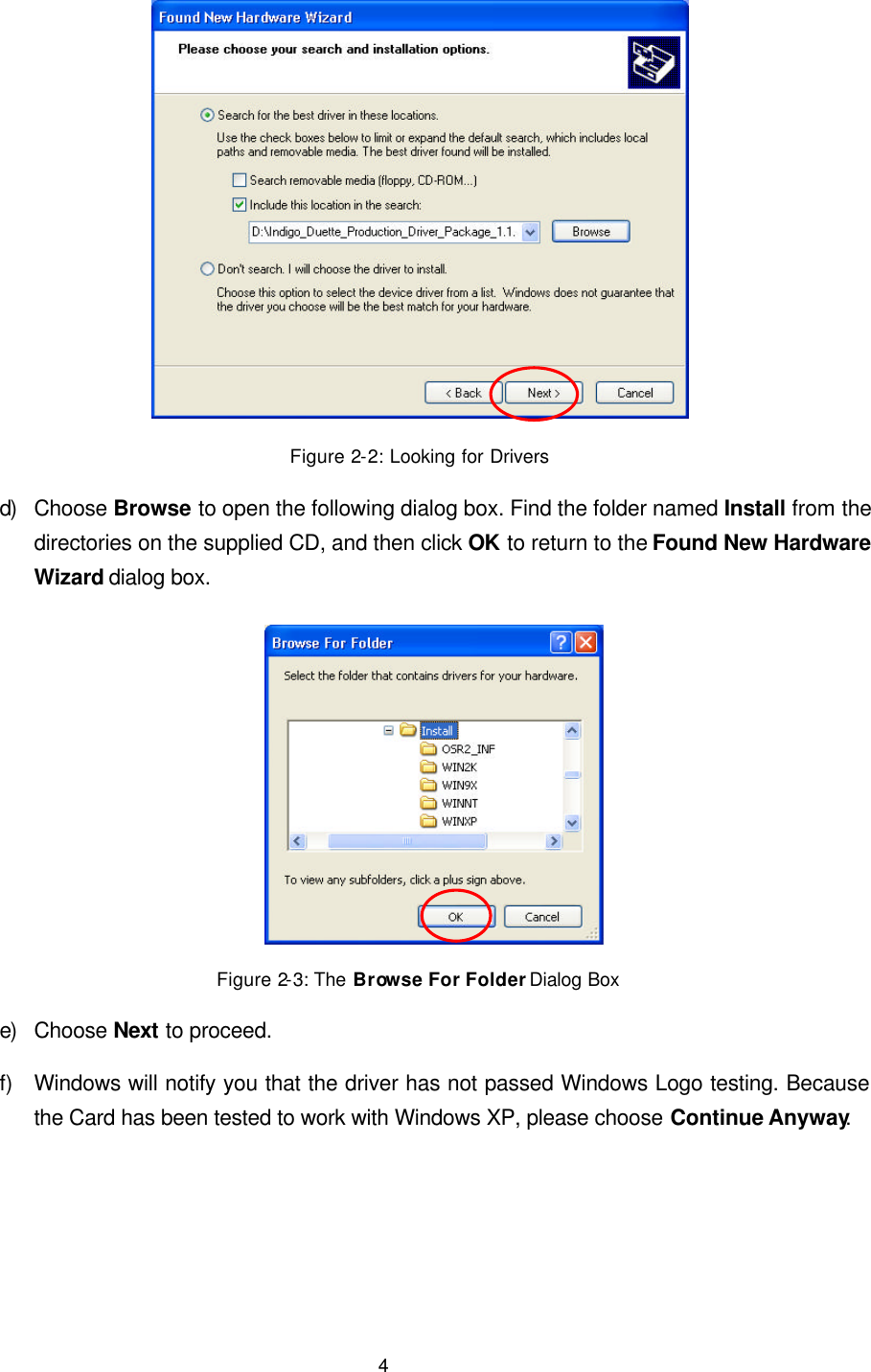
  3 IINNSSTTAALLLLAATTIIOONN                                                                                                        It’s free and easy for you to install your 802.11b/g WLAN Cardbus and the attached software - PRISM Configuration Utility. Simply with a few clicks of the mouse, you will succeed the completion of installation. To have the 802.11b/g WLAN Cardbus operated appropriately, please read and go along with the instructions below carefully. Here, we will illustrate the installation instructions based on Windows XP operating system. 2.1 Installation Procedures a) Insert the 802.11b/g WLAN Cardbus into your PC’s Cardbus slot. The  Found New Hardware Wizard dialog box will appear because the system has detected the insertion of the Card.  b) In the Found New Hardware Wizard dialog box, choose Install from a list or specific location [Advanced] and then click Next.  Figure 2-1: The Found New Hardware Wizard Dialog Box  c) When you see the following dialog box shown, choose Includes this location in the search under Search for the best driver in these locations.
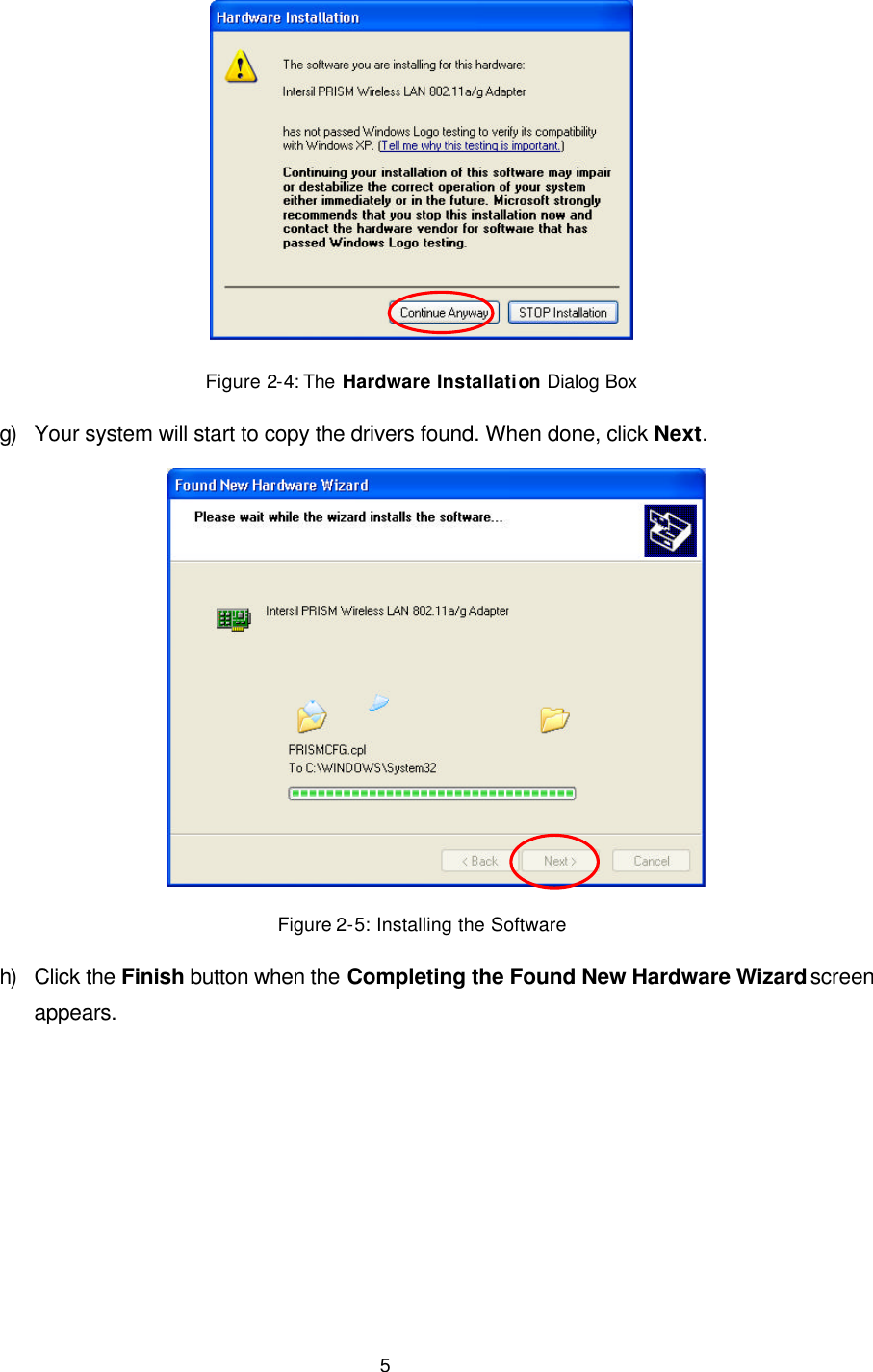
  4  Figure 2-2: Looking for Drivers d) Choose Browse to open the following dialog box. Find the folder named Install from the directories on the supplied CD, and then click OK to return to the Found New Hardware Wizard dialog box.  Figure 2-3: The Browse For Folder Dialog Box  e) Choose Next to proceed. f) Windows will notify you that the driver has not passed Windows Logo testing. Because the Card has been tested to work with Windows XP, please choose Continue Anyway.
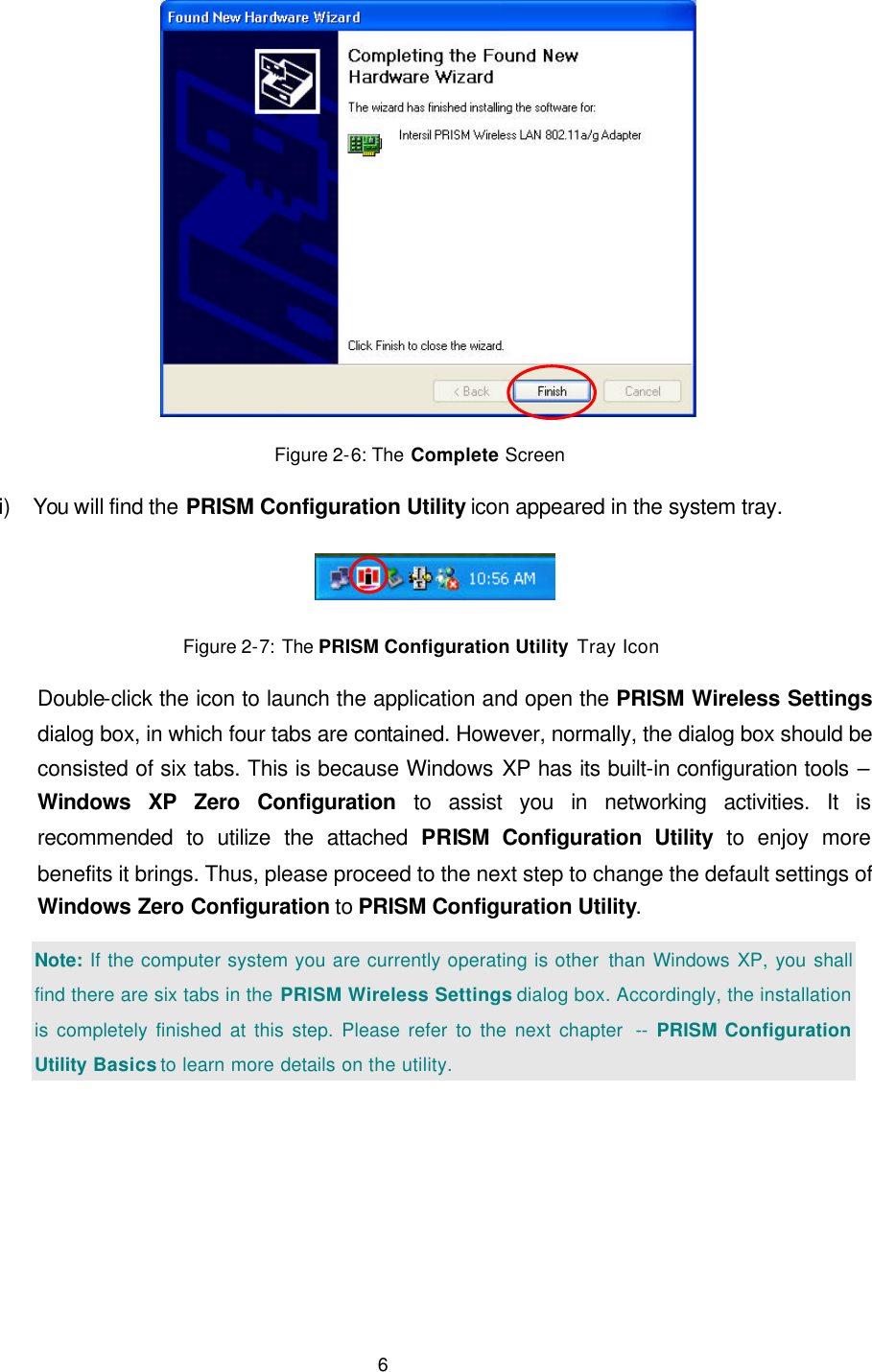
  5  Figure 2-4: The  Hardware Installation Dialog Box g) Your system will start to copy the drivers found. When done, click Next.  Figure 2-5: Installing the Software h) Click the Finish button when the Completing the Found New Hardware Wizard screen appears.
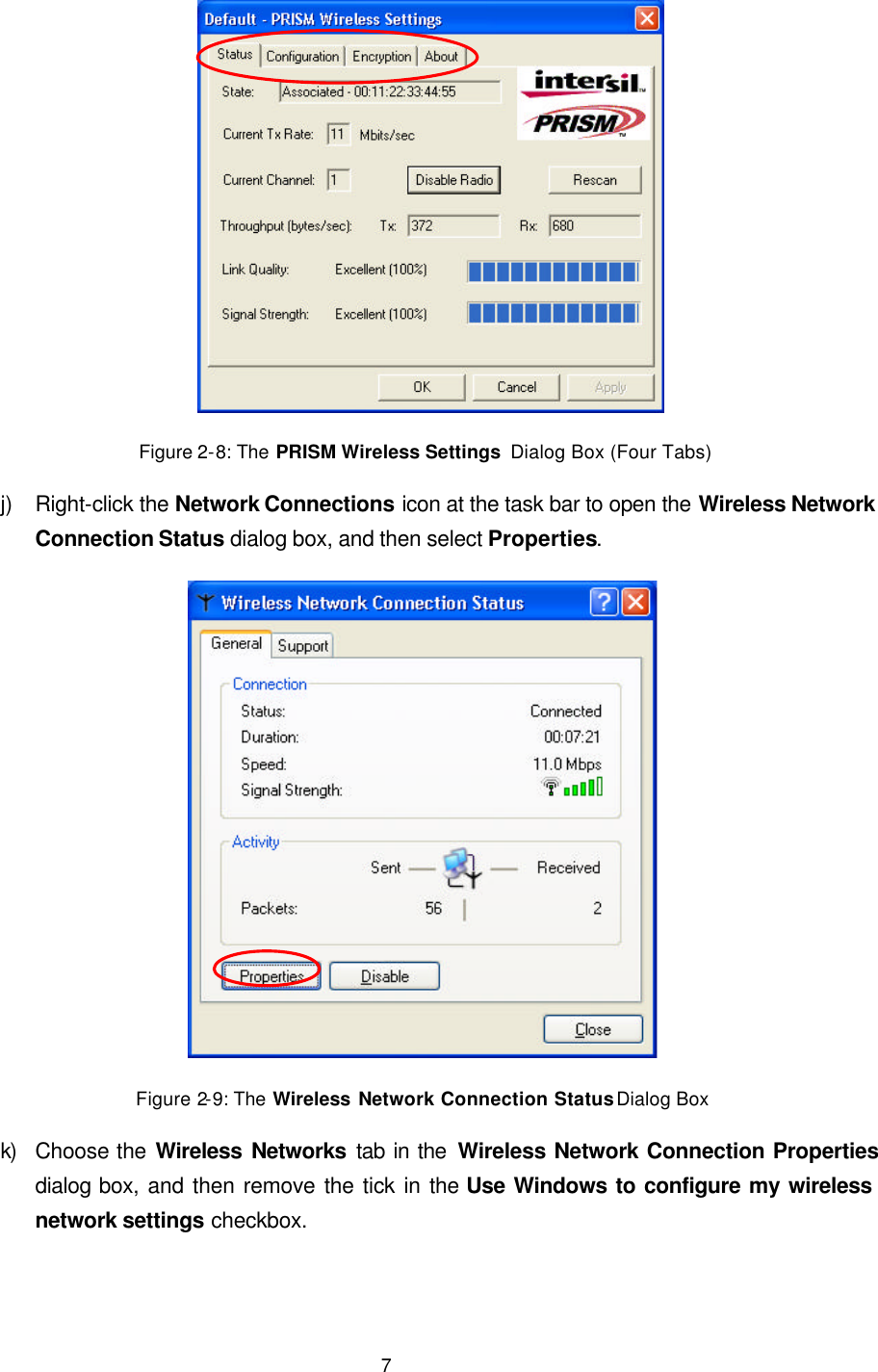
  6  Figure 2-6: The Complete Screen i) You will find the PRISM Configuration Utility icon appeared in the system tray.     Figure 2-7: The PRISM Configuration Utility Tray Icon Double-click the icon to launch the application and open the PRISM Wireless Settings dialog box, in which four tabs are contained. However, normally, the dialog box should be consisted of six tabs. This is because Windows XP has its built-in configuration tools – Windows XP Zero Configuration to assist you in networking activities. It is recommended to utilize the attached PRISM Configuration Utility to enjoy more benefits it brings. Thus, please proceed to the next step to change the default settings of Windows Zero Configuration to PRISM Configuration Utility. Note: If the computer system you are currently operating is other  than Windows XP, you shall find there are six tabs in the PRISM Wireless Settings dialog box. Accordingly, the installation is completely finished at this step. Please refer to the next chapter  -- PRISM Configuration Utility Basics to learn more details on the utility.
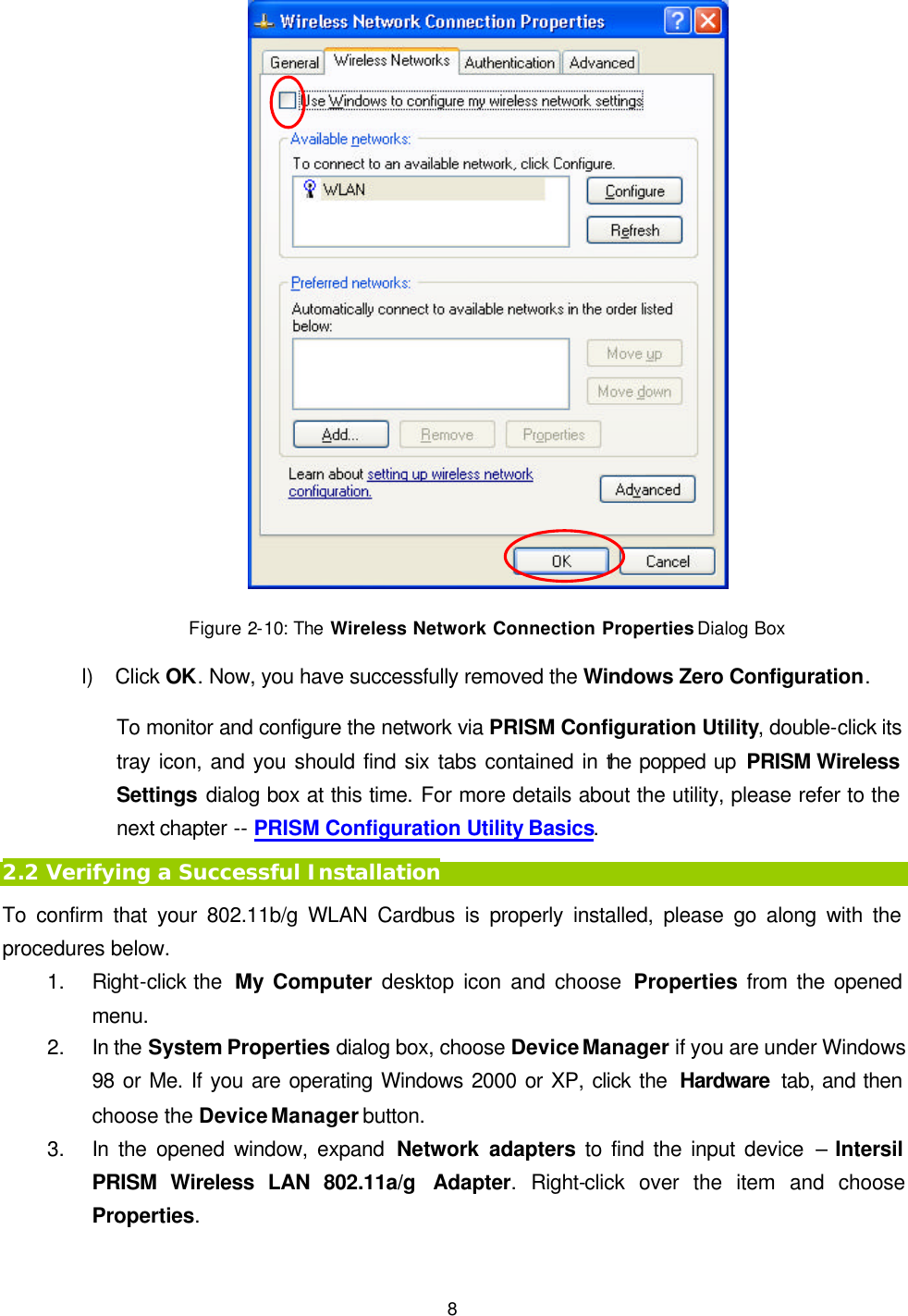
  7  Figure 2-8: The PRISM Wireless Settings  Dialog Box (Four Tabs) j) Right-click the Network Connections icon at the task bar to open the Wireless Network Connection Status dialog box, and then select Properties.  Figure 2-9: The Wireless Network Connection Status Dialog Box k) Choose the Wireless Networks tab in the Wireless Network Connection Properties dialog box, and then remove the tick in the Use Windows to configure my wireless network settings checkbox.
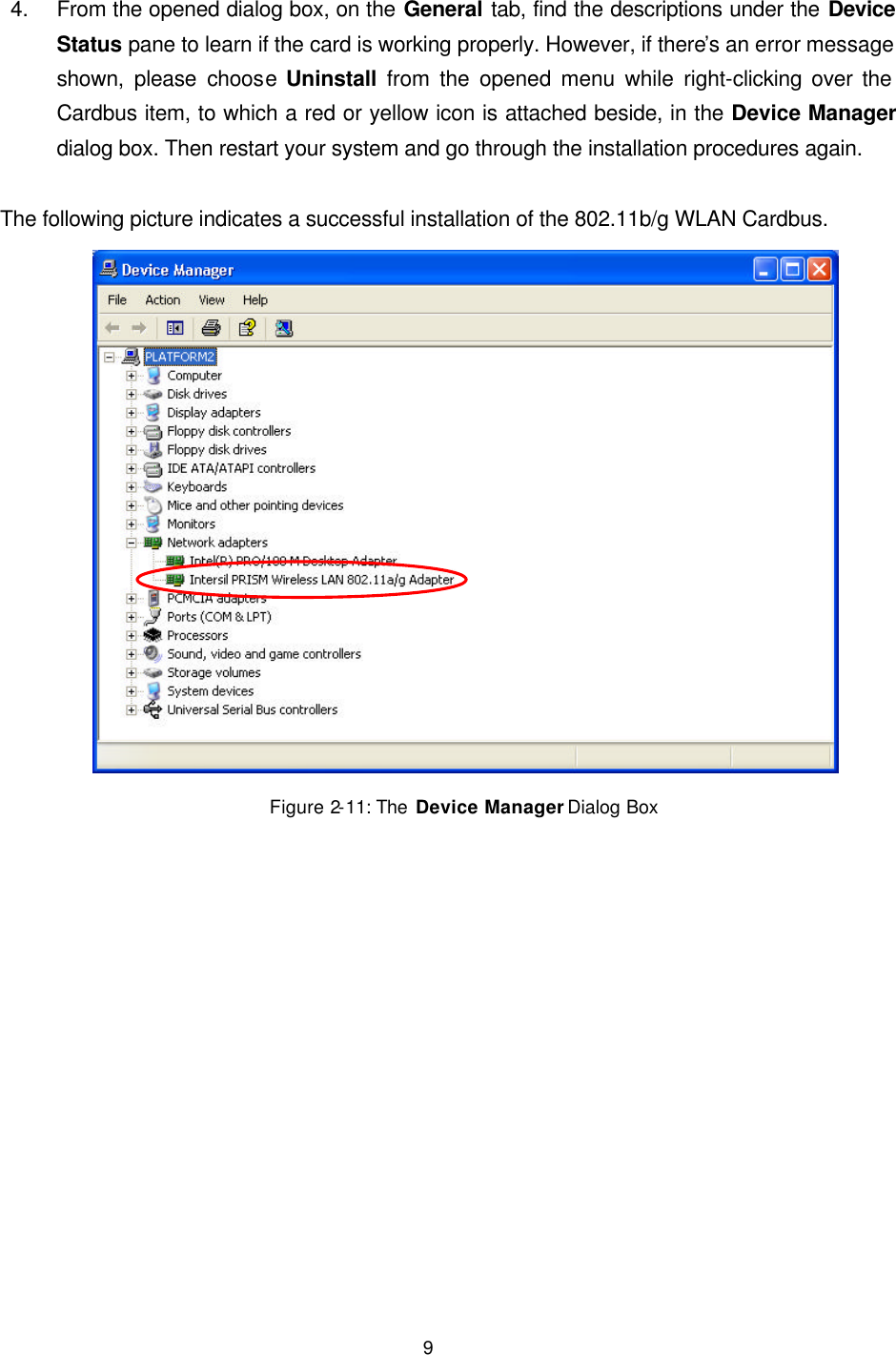
  8  Figure 2-10: The Wireless Network Connection Properties Dialog Box l) Click OK. Now, you have successfully removed the Windows Zero Configuration.   To monitor and configure the network via PRISM Configuration Utility, double-click its tray icon, and you should find six tabs contained in the popped up PRISM Wireless Settings dialog box at this time. For more details about the utility, please refer to the next chapter -- PRISM Configuration Utility Basics. 2.2 Verifying a Successful Installation To confirm that your 802.11b/g WLAN Cardbus is properly installed, please go along with the procedures below. 1. Right-click the  My Computer desktop icon and choose Properties from the opened menu. 2. In the System Properties dialog box, choose Device Manager if you are under Windows 98 or Me. If you are operating Windows 2000 or XP, click the  Hardware  tab, and then choose the Device Manager button.   3. In the opened window, expand Network adapters to find the input device – Intersil PRISM Wireless LAN 802.11a/g Adapter. Right-click over the item and choose Properties.
  9 4. From the opened dialog box, on the General tab, find the descriptions under the Device Status pane to learn if the card is working properly. However, if there’s an error message shown, please choose Uninstall from the opened menu while right-clicking over the Cardbus item, to which a red or yellow icon is attached beside, in the Device Manager dialog box. Then restart your system and go through the installation procedures again.  The following picture indicates a successful installation of the 802.11b/g WLAN Cardbus.  Figure 2-11: The  Device Manager Dialog Box
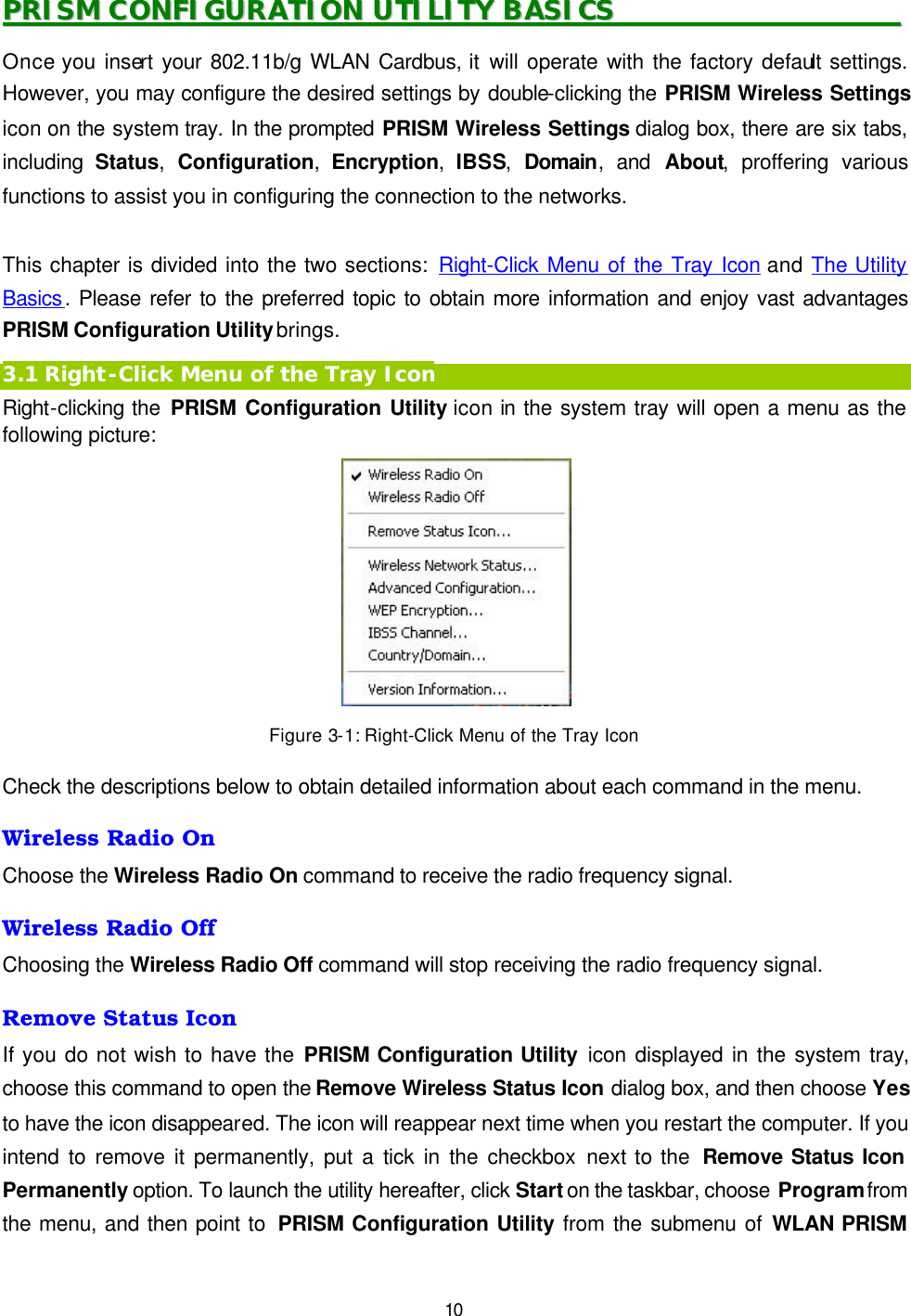
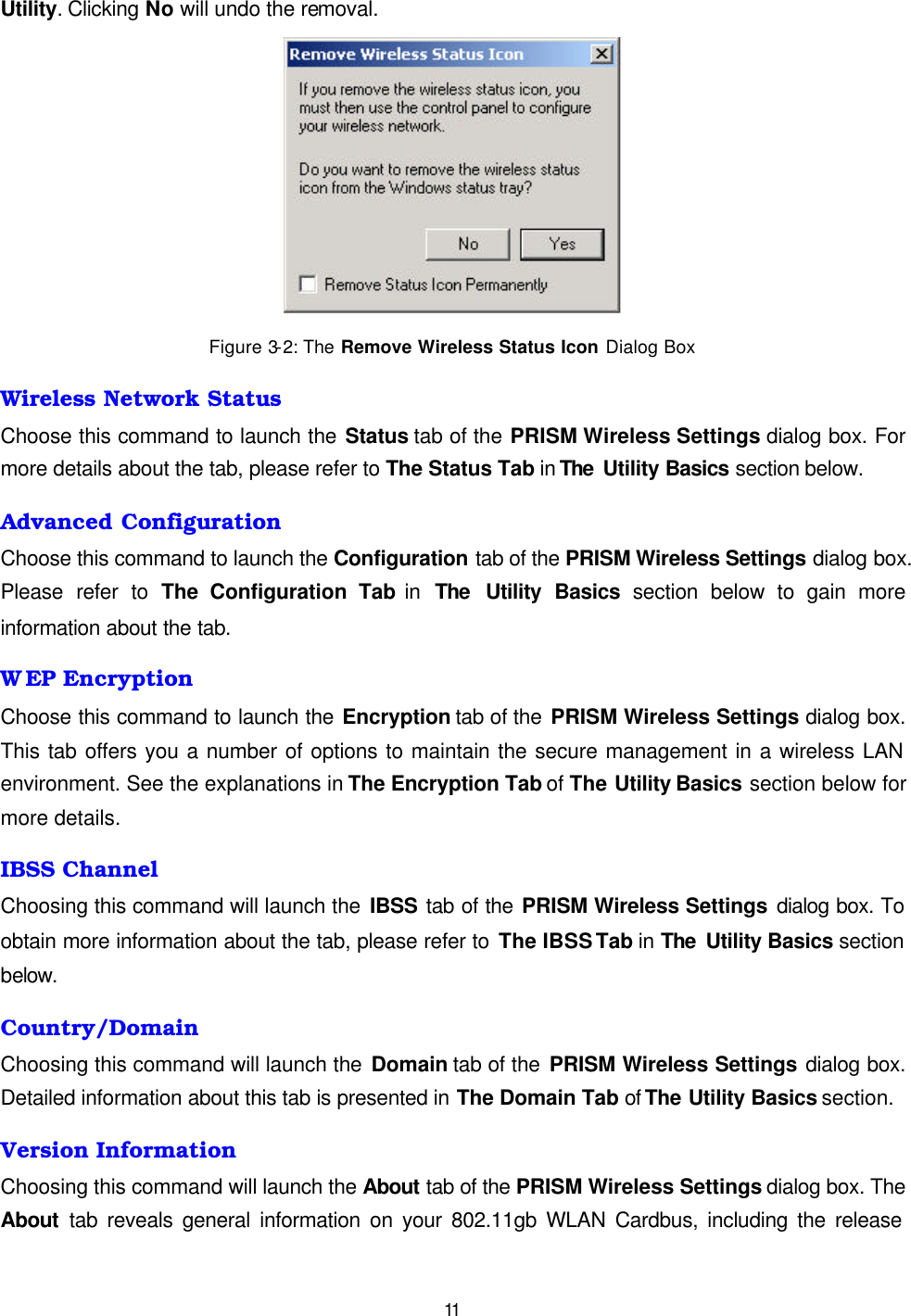
  10 PPRRIISSMM  CCOONNFFIIGGUURRAATTIIOONN  UUTTIILLIITTYY  BBAASSIICCSS                                              Once you insert your 802.11b/g WLAN Cardbus, it will operate with the factory default settings. However, you may configure the desired settings by double-clicking the PRISM Wireless Settings icon on the system tray. In the prompted PRISM Wireless Settings dialog box, there are six tabs, including  Status,  Configuration,  Encryption,  IBSS,  Domain, and About, proffering various functions to assist you in configuring the connection to the networks.  This chapter is divided into the two sections: Right-Click Menu of the Tray Icon and The Utility Basics. Please refer to the preferred topic to obtain more information and enjoy vast advantages PRISM Configuration Utility brings. 3.1 Right-Click Menu of the Tray Icon Right-clicking the PRISM Configuration Utility icon in the system tray will open a menu as the following picture:  Figure 3-1: Right-Click Menu of the Tray Icon Check the descriptions below to obtain detailed information about each command in the menu. Wireless Radio On Choose the Wireless Radio On command to receive the radio frequency signal. Wireless Radio Off Choosing the Wireless Radio Off command will stop receiving the radio frequency signal. Remove Status Icon If you do not wish to have the PRISM Configuration Utility icon displayed in the system tray, choose this command to open the Remove Wireless Status Icon dialog box, and then choose Yes to have the icon disappeared. The icon will reappear next time when you restart the computer. If you intend to remove it permanently, put a tick in the checkbox next to the  Remove Status Icon Permanently option. To launch the utility hereafter, click Start on the taskbar, choose Program from the menu, and then point to  PRISM Configuration Utility from the submenu of WLAN PRISM
  11 Utility. Clicking No will undo the removal.     Figure 3-2: The Remove Wireless Status Icon Dialog Box Wireless Network Status Choose this command to launch the Status tab of the PRISM Wireless Settings dialog box. For more details about the tab, please refer to The Status Tab in The  Utility Basics section below. Advanced Configuration Choose this command to launch the Configuration tab of the PRISM Wireless Settings dialog box. Please refer to The Configuration Tab in  The Utility Basics section below to gain more information about the tab. WEP Encryption Choose this command to launch the Encryption tab of the PRISM Wireless Settings dialog box. This tab offers you a number of options to maintain the secure management in a wireless LAN environment. See the explanations in The Encryption Tab of The Utility Basics section below for more details. IBSS Channel Choosing this command will launch the IBSS tab of the PRISM Wireless Settings dialog box. To obtain more information about the tab, please refer to The IBSS Tab in The Utility Basics section below. Country/Domain Choosing this command will launch the Domain tab of the PRISM Wireless Settings dialog box. Detailed information about this tab is presented in The Domain Tab of The Utility Basics section. Version Information Choosing this command will launch the About tab of the PRISM Wireless Settings dialog box. The About tab reveals general information on your 802.11gb WLAN Cardbus, including the release
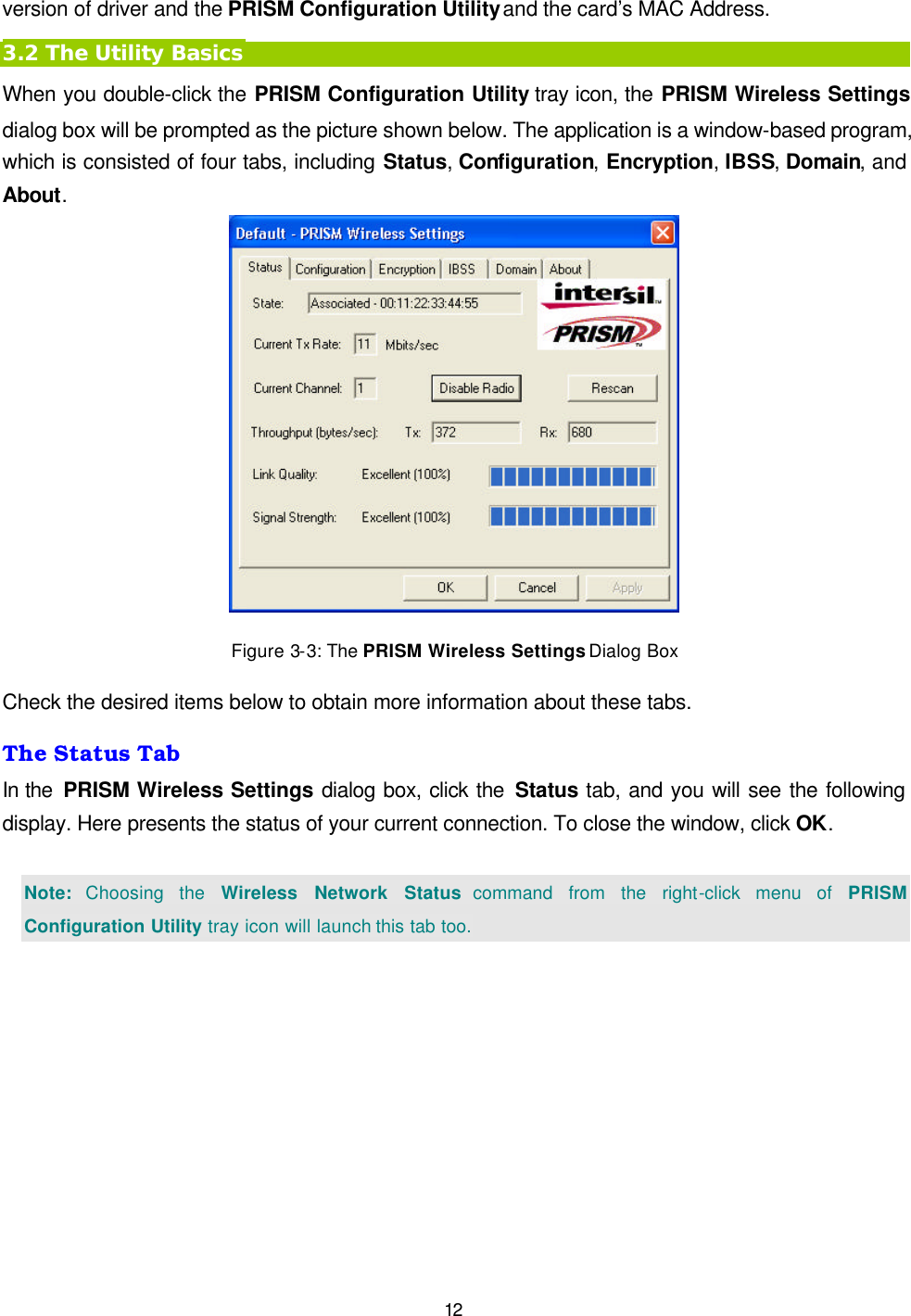
  12 version of driver and the PRISM Configuration Utility and the card’s MAC Address. 3.2 The Utility Basics When you double-click the PRISM Configuration Utility tray icon, the PRISM Wireless Settings dialog box will be prompted as the picture shown below. The application is a window-based program, which is consisted of four tabs, including Status, Configuration, Encryption, IBSS, Domain, and About.    Figure 3-3: The PRISM Wireless Settings Dialog Box Check the desired items below to obtain more information about these tabs. The Status Tab In the  PRISM Wireless Settings dialog box, click the Status tab, and you will see the following display. Here presents the status of your current connection. To close the window, click OK.  Note: Choosing the Wireless Network Status command from the right-click menu of PRISM Configuration Utility tray icon will launch this tab too.
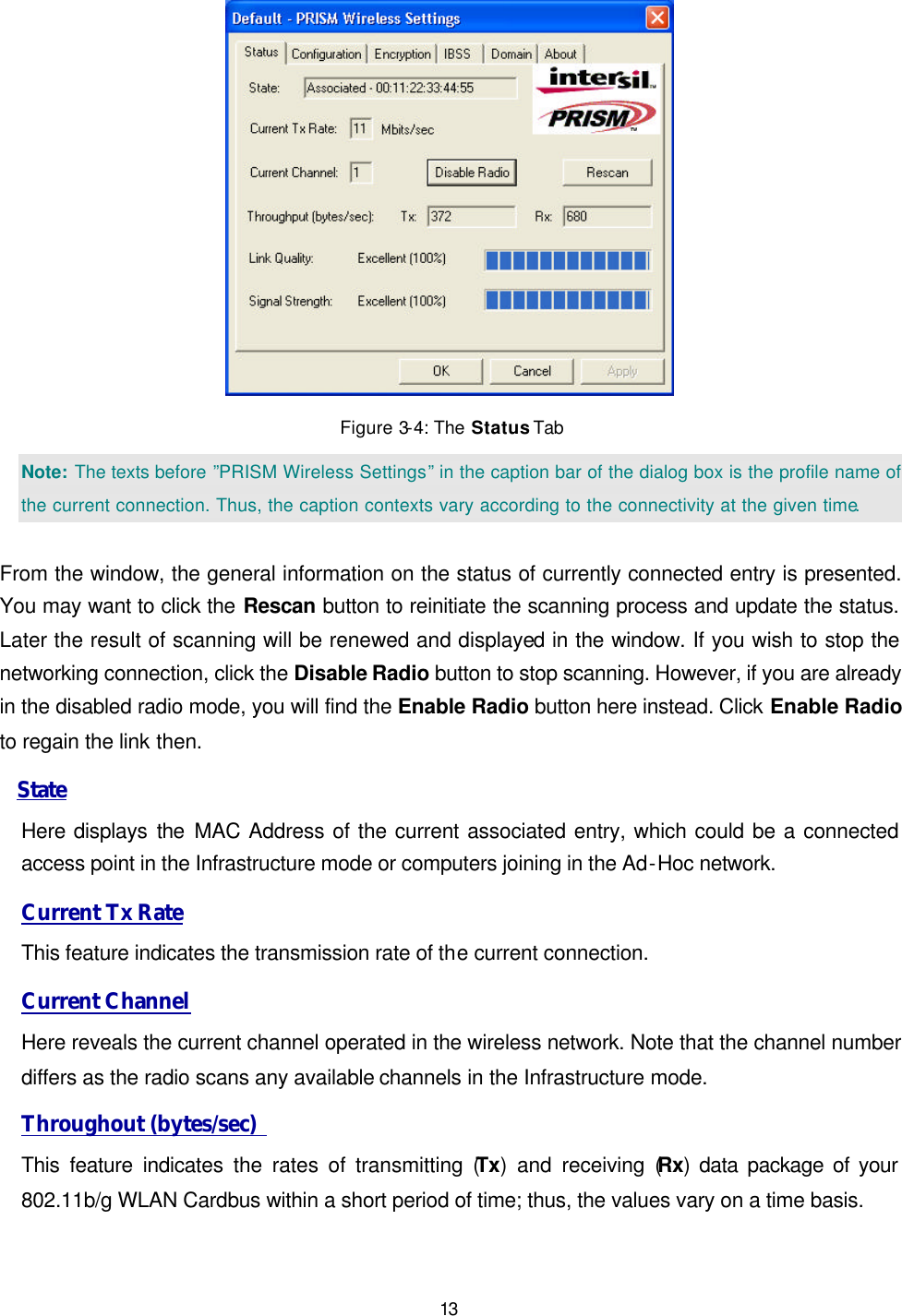
  13  Figure 3-4: The Status Tab Note: The texts before ”PRISM Wireless Settings” in the caption bar of the dialog box is the profile name of the current connection. Thus, the caption contexts vary according to the connectivity at the given time.  From the window, the general information on the status of currently connected entry is presented. You may want to click the Rescan button to reinitiate the scanning process and update the status. Later the result of scanning will be renewed and displayed in the window. If you wish to stop the networking connection, click the Disable Radio button to stop scanning. However, if you are already in the disabled radio mode, you will find the Enable Radio button here instead. Click Enable Radio to regain the link then.  State Here displays the  MAC Address of the current associated entry, which could be a connected access point in the Infrastructure mode or computers joining in the Ad-Hoc network. Current Tx Rate This feature indicates the transmission rate of the current connection. Current Channel Here reveals the current channel operated in the wireless network. Note that the channel number differs as the radio scans any available channels in the Infrastructure mode.  Throughout (bytes/sec)  This feature indicates the rates of transmitting (Tx) and receiving (Rx) data package of your 802.11b/g WLAN Cardbus within a short period of time; thus, the values vary on a time basis.
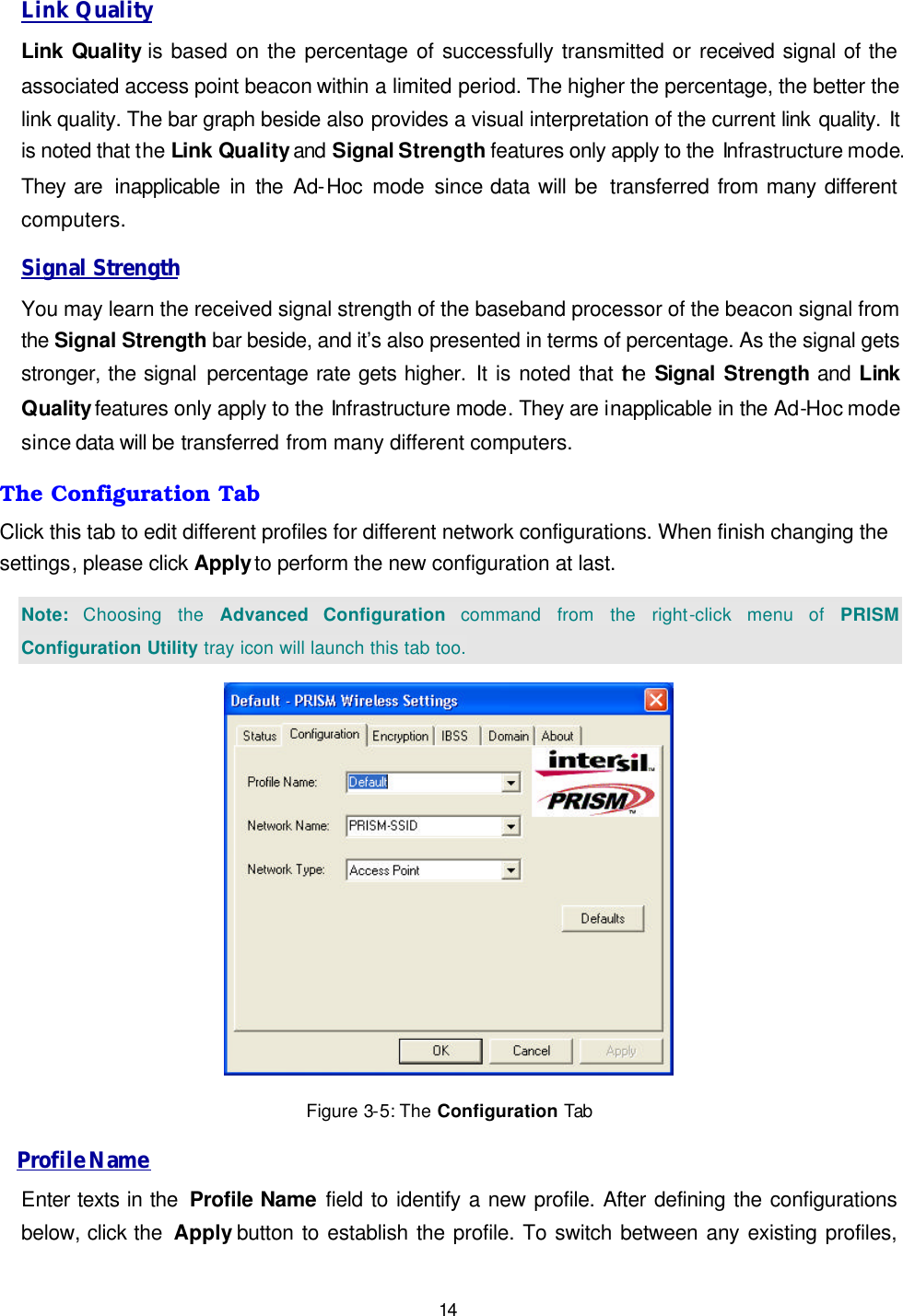
  14 Link Quality Link Quality is based on the percentage of successfully transmitted or received signal of the associated access point beacon within a limited period. The higher the percentage, the better the link quality. The bar graph beside also provides a visual interpretation of the current link quality. It is noted that the Link Quality and Signal Strength features only apply to the Infrastructure mode. They are  inapplicable in the Ad-Hoc  mode since data will be  transferred from many different computers. Signal Strength You may learn the received signal strength of the baseband processor of the beacon signal from the Signal Strength bar beside, and it’s also presented in terms of percentage. As the signal gets stronger, the signal percentage rate gets higher. It is noted that the Signal  Strength and  Link Quality features only apply to the Infrastructure mode. They are inapplicable in the Ad-Hoc mode since data will be transferred from many different computers. The Configuration Tab Click this tab to edit different profiles for different network configurations. When finish changing the settings, please click Apply to perform the new configuration at last. Note: Choosing the Advanced Configuration command from the right-click menu of PRISM Configuration Utility tray icon will launch this tab too.  Figure 3-5: The Configuration Tab Profile Name Enter texts in the  Profile Name field to identify a new profile. After defining the configurations below, click the  Apply button to establish the profile. To switch between any existing profiles,
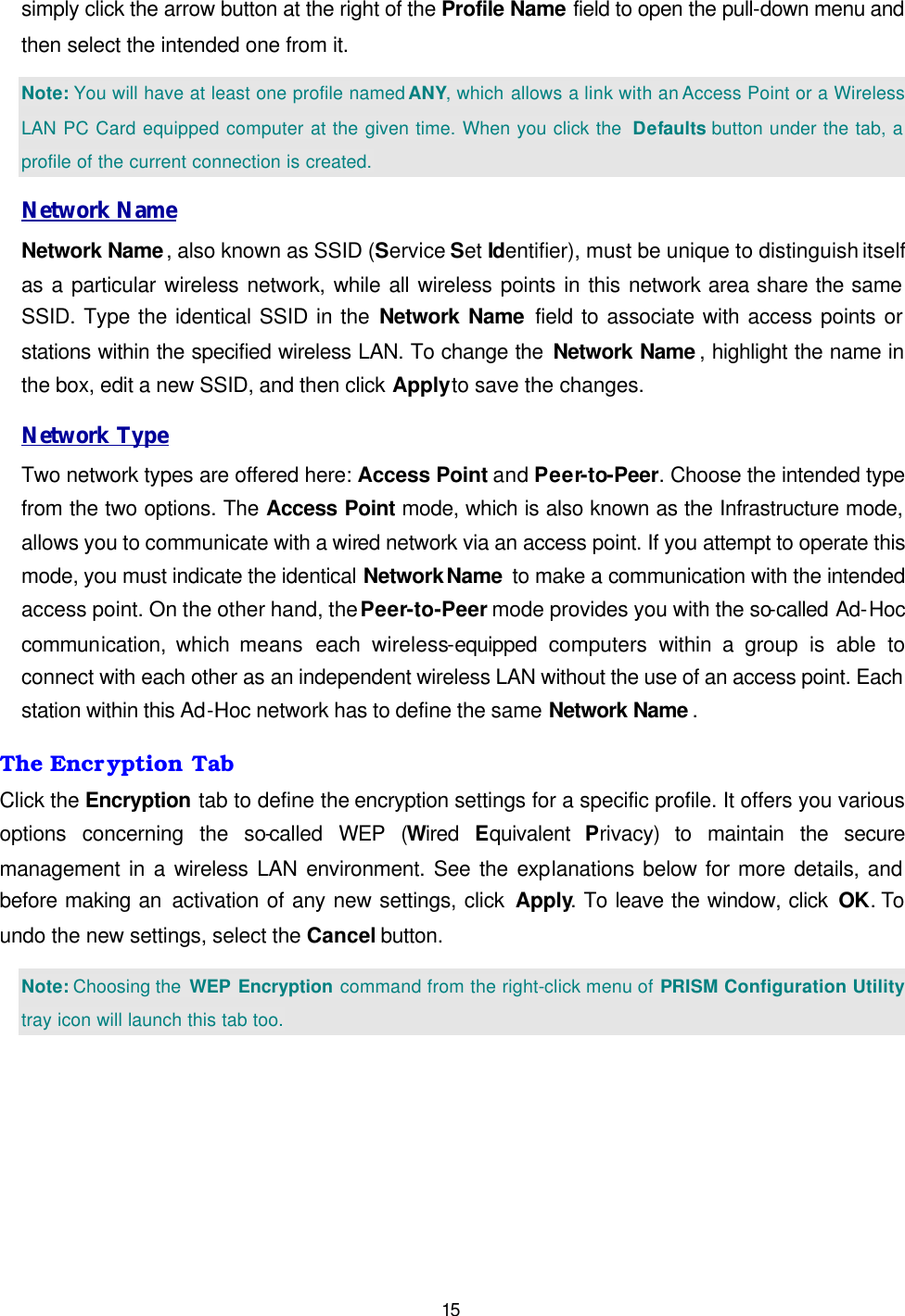
  15 simply click the arrow button at the right of the Profile Name field to open the pull-down menu and then select the intended one from it.  Note: You will have at least one profile named ANY, which allows a link with an Access Point or a Wireless LAN PC Card equipped computer at the given time. When you click the  Defaults button under the tab, a profile of the current connection is created. Network Name Network Name, also known as SSID (Service Set Identifier), must be unique to distinguish itself as a particular wireless network, while all wireless points in this network area share the same SSID. Type the identical SSID in the Network Name field to associate with access points or stations within the specified wireless LAN. To change the Network Name , highlight the name in the box, edit a new SSID, and then click Apply to save the changes. Network Type Two network types are offered here: Access Point and Peer-to-Peer. Choose the intended type from the two options. The Access Point mode, which is also known as the Infrastructure mode, allows you to communicate with a wired network via an access point. If you attempt to operate this mode, you must indicate the identical Network Name  to make a communication with the intended access point. On the other hand, the Peer-to-Peer mode provides you with the so-called Ad-Hoc communication, which means each  wireless-equipped  computers  within a group is able to connect with each other as an independent wireless LAN without the use of an access point. Each station within this Ad-Hoc network has to define the same Network Name . The Encryption Tab Click the Encryption tab to define the encryption settings for a specific profile. It offers you various options concerning the so-called  WEP  (Wired  Equivalent  Privacy) to maintain the secure management in a wireless LAN environment. See the explanations below for more details, and before making an activation of any new settings, click Apply. To leave the window, click OK. To undo the new settings, select the Cancel button.  Note: Choosing the  WEP Encryption command from the right-click menu of PRISM Configuration Utility tray icon will launch this tab too.
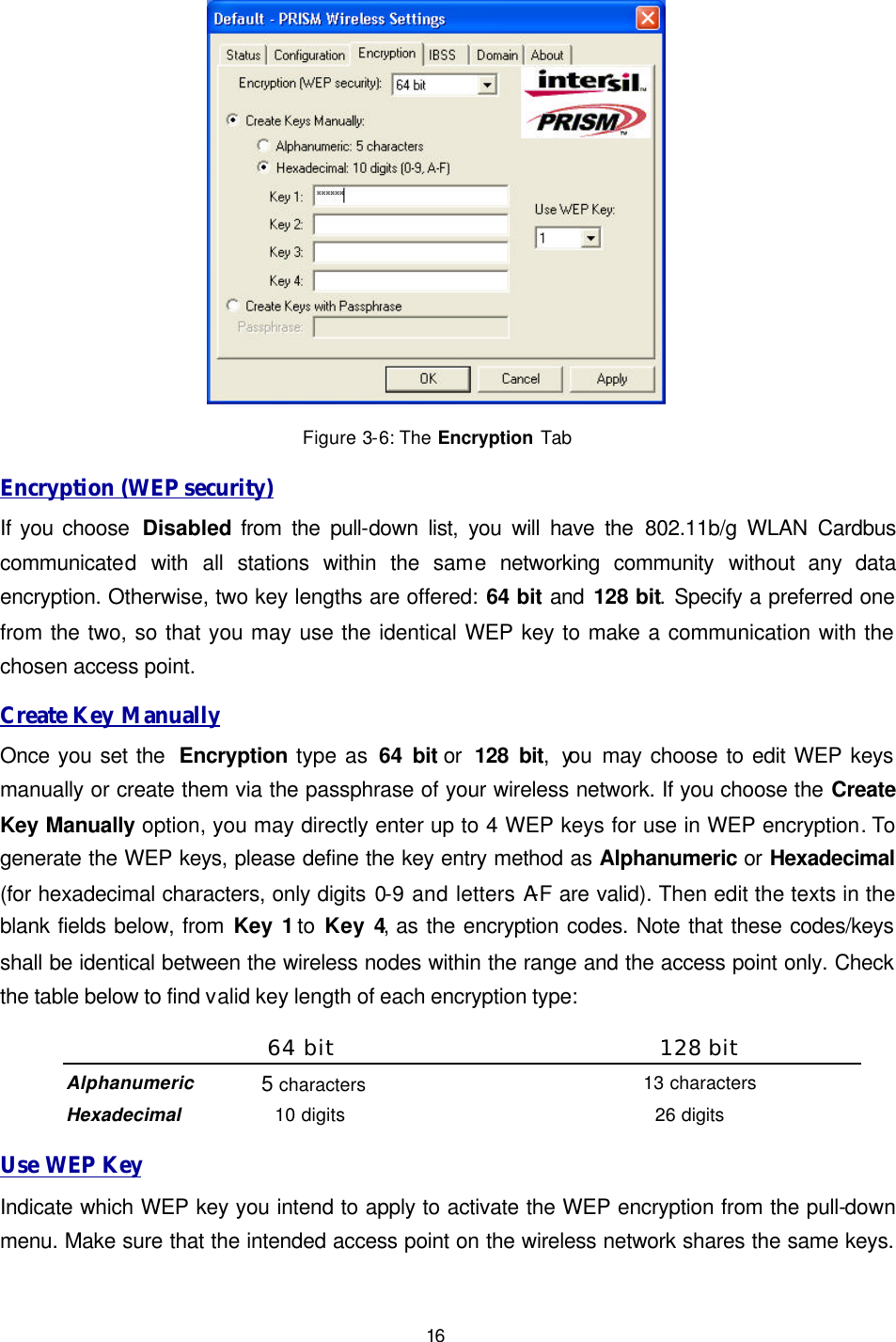
  16  Figure 3-6: The Encryption Tab Encryption (WEP security) If you choose  Disabled from the pull-down list, you will have the 802.11b/g WLAN Cardbus communicated with all stations within the same networking community without any data encryption. Otherwise, two key lengths are offered: 64 bit and 128 bit. Specify a preferred one from the two, so that you may use the identical WEP key to make a communication with the chosen access point.  Create Key Manually Once you set the  Encryption type as 64 bit or  128 bit, you  may choose to edit WEP keys manually or create them via the passphrase of your wireless network. If you choose the Create Key Manually option, you may directly enter up to 4 WEP keys for use in WEP encryption. To generate the WEP keys, please define the key entry method as Alphanumeric or Hexadecimal (for hexadecimal characters, only digits 0-9 and letters A-F are valid). Then edit the texts in the blank fields below, from Key 1 to Key 4, as the encryption codes. Note that these codes/keys shall be identical between the wireless nodes within the range and the access point only. Check the table below to find valid key length of each encryption type: 64 bit 128 bit Alphanumeric 5 characters 13 characters Hexadecimal 10 digits 26 digits Use WEP Key Indicate which WEP key you intend to apply to activate the WEP encryption from the pull-down menu. Make sure that the intended access point on the wireless network shares the same keys.
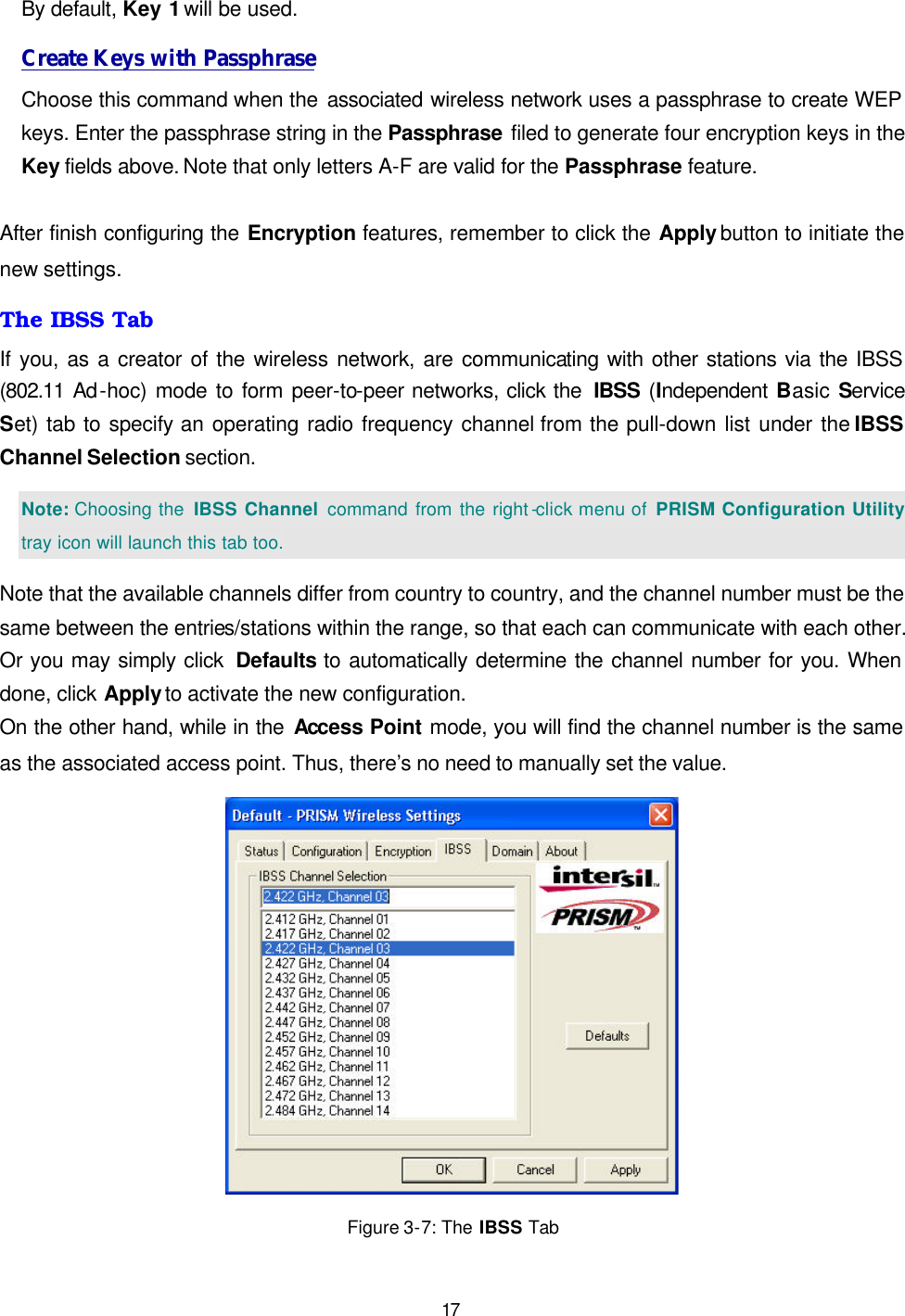
  17 By default, Key 1 will be used.   Create Keys with Passphrase Choose this command when the associated wireless network uses a passphrase to create WEP keys. Enter the passphrase string in the Passphrase filed to generate four encryption keys in the Key fields above. Note that only letters A-F are valid for the Passphrase feature.   After finish configuring the Encryption features, remember to click the Apply button to initiate the new settings.   The IBSS Tab If you, as a creator of the wireless network, are communicating with other stations via the IBSS (802.11 Ad-hoc) mode to form peer-to-peer networks, click the  IBSS (Independent Basic Service Set) tab to specify an operating radio frequency channel from the pull-down list under the IBSS Channel Selection section.   Note: Choosing the  IBSS Channel command from the right -click menu of  PRISM Configuration Utility tray icon will launch this tab too. Note that the available channels differ from country to country, and the channel number must be the same between the entries/stations within the range, so that each can communicate with each other. Or you may simply click  Defaults to automatically determine the channel number for you. When done, click Apply to activate the new configuration. On the other hand, while in the Access Point mode, you will find the channel number is the same as the associated access point. Thus, there’s no need to manually set the value.  Figure 3-7: The IBSS Tab
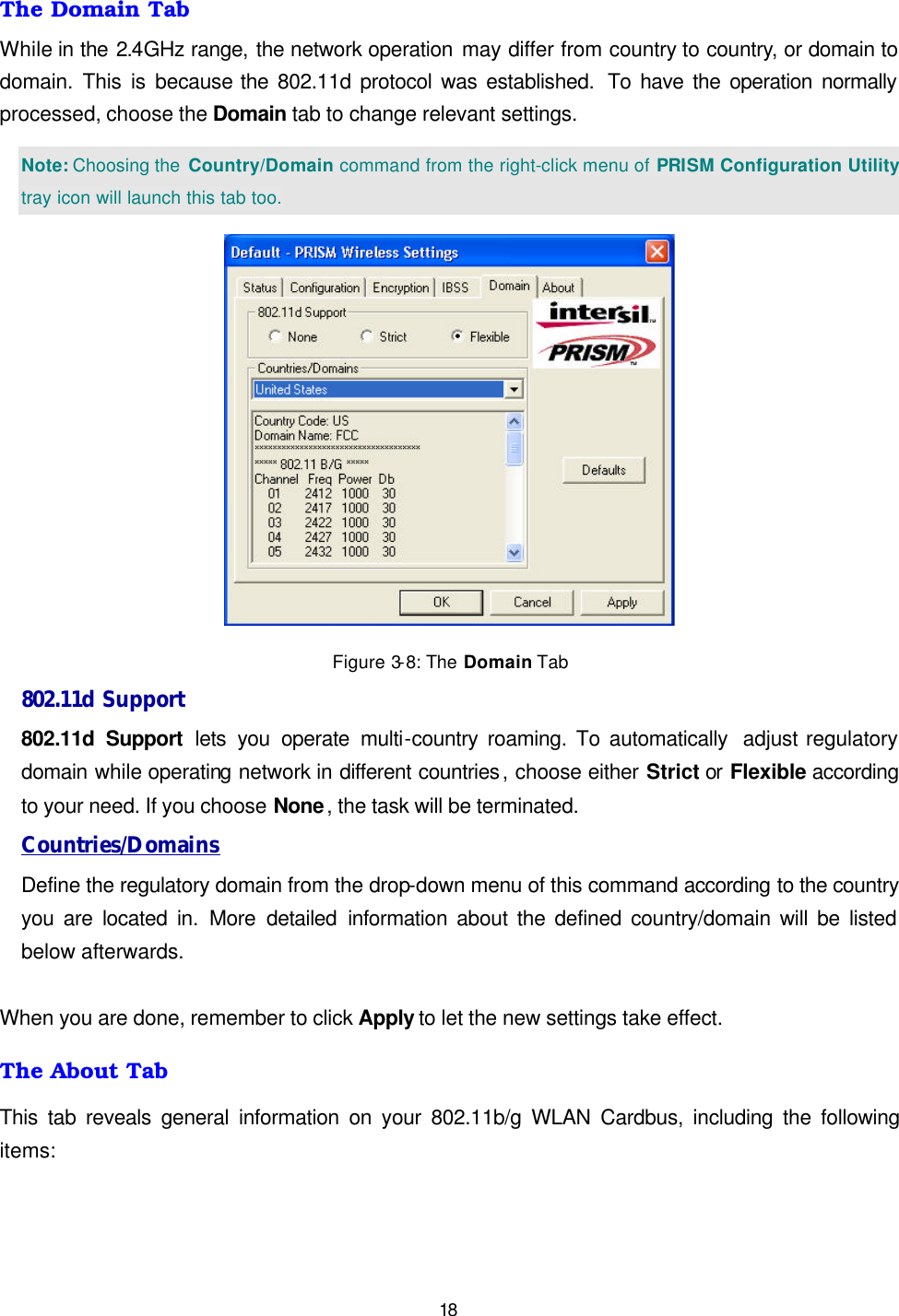
  18 The Domain Tab While in the 2.4GHz range, the network operation may differ from country to country, or domain to domain. This is because the 802.11d protocol was established.  To have the operation normally processed, choose the Domain tab to change relevant settings.  Note: Choosing the  Country/Domain command from the right-click menu of PRISM Configuration Utility tray icon will launch this tab too.  Figure 3-8: The Domain Tab 802.11d Support 802.11d Support lets you operate multi-country roaming. To automatically  adjust regulatory domain while operating network in different countries, choose either Strict or Flexible according to your need. If you choose None, the task will be terminated. Countries/Domains Define the regulatory domain from the drop-down menu of this command according to the country you are located in. More detailed information about the defined country/domain will be listed below afterwards.  When you are done, remember to click Apply to let the new settings take effect. The About Tab This tab reveals general information on your 802.11b/g WLAN Cardbus, including the following items:
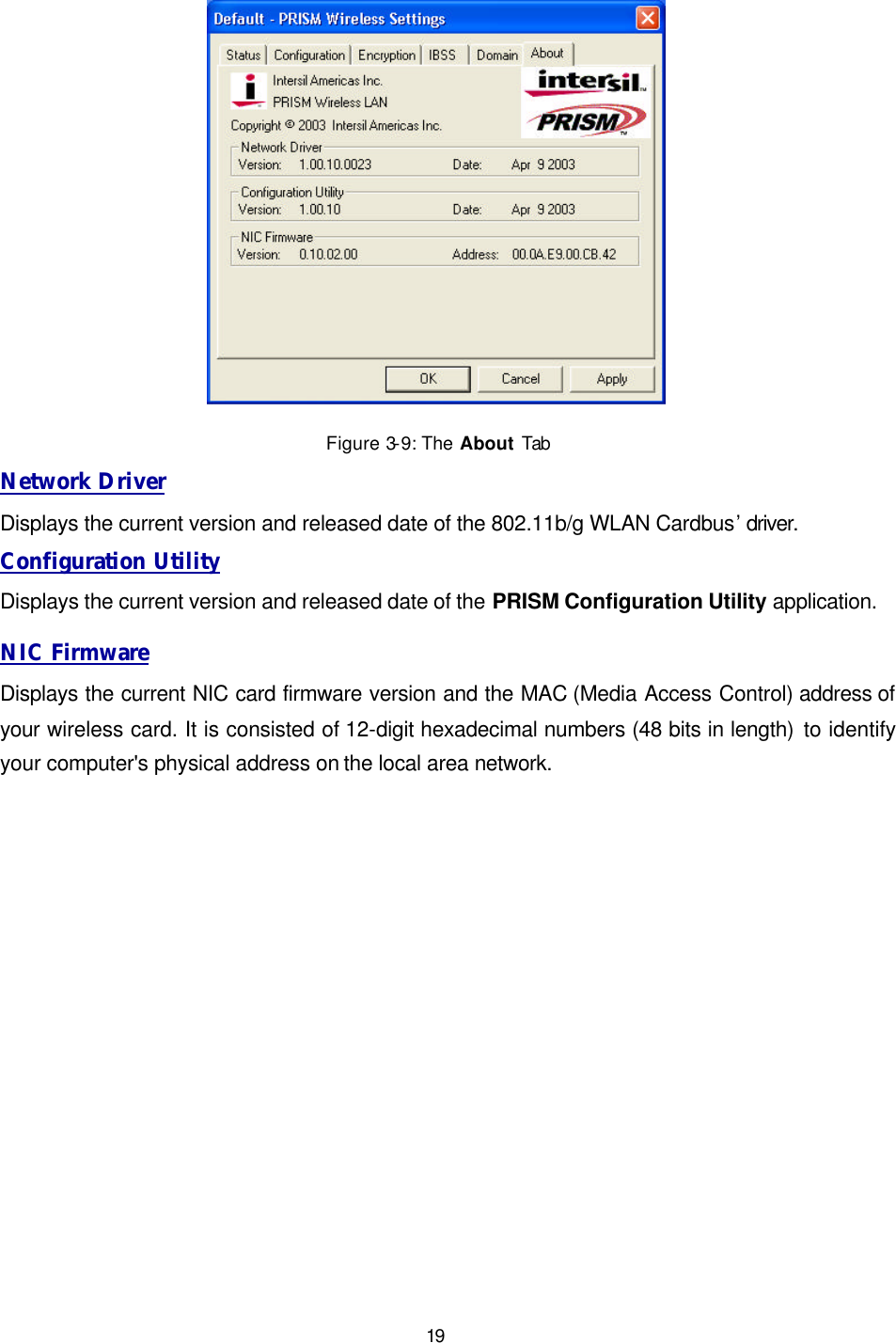
  19  Figure 3-9: The About Tab Network Driver Displays the current version and released date of the 802.11b/g WLAN Cardbus’ driver. Configuration Utility Displays the current version and released date of the PRISM Configuration Utility application. NIC Firmware Displays the current NIC card firmware version and the MAC (Media Access Control) address of your wireless card. It is consisted of 12-digit hexadecimal numbers (48 bits in length) to identify your computer's physical address on the local area network.
  20 AAPPPPEENNDDIIXX  AA::  TTRROOUUBBLLEESSHHOOOOTTIINNGG                                                                This section provides solutions to problems that you might encounter during the installation and operation of your 802.11b/g WLAN Cardbus. Please refer to the desired topics below and read the description to solve your problems. Disable 802.11b/g WLAN Cardbus Supposed you do not need the 802.11gb WLAN Cardbus to establish the wireless connectivity for any reason, you can directly unplug and remove your 802.11b/g WLAN Cardbus from the Cardbus slot on your computer, or click Disable Radio on the Status tab of the PRISM Wireless Settings dialog box. Once the device is removed, the connection to the network stops. Thus, be sure that you have closed all the network applications before processing the removal. Uninstall PRISM Configuration Utility and the Card’s Driver Prior to starting uninstalling, please make sure that the utility is closed, and then go along with the procedures below to entirely uninstall RRISM Configuration Utility and the card driver. 1. Right-click the  My Computer desktop icon and choose Properties from the opened menu. 2. In the System Properties dialog box, choose Device Manager if you are under Windows 98 or Me. If you are operating Windows 2000 or XP, click the  Hardware  tab, and then choose the Device Manager button.   3. In the opened window, expand Network adapters to find the input device – Intersil PRISM Wireless LAN 802.11a/g Adapter. Right-click over the item and choose Uninstall. 4. Then follow the on-screen instructions to completely remove the drivers. 802.11b/g WLAN Cardbus Does Not Work Properly If this happens, follow the guidelines below.   ¨ Unplug and replug the 802.11b/g WLAN Cardbus into your PC’s Cardbus slot. ¨ Right-click the My Computer desktop icon and choose Properties to open the System Properties dialog box. If you are under Windows 98 or Me, choose the Device Manager tab, or if your system is Windows 2000 or XP, click the Hardware tab, and then choose the Device Manager button. In the opened window, find your Cardbus to see if the installation is successful. If you see a yellow exclamation mark beside the item, please go along with the steps below to reinstall the drivers:  1. Uninstall the software and hardware drivers from your PC. (Please refer to the previous topic for details)
  21 2. Restart your computer and repeat the installation procedures as indicated in Chapter 2: Installation. 3. When finished, open the Device Manager window again to verify if the installation is approved. The yellow exclamation mark shall be removed for this time.
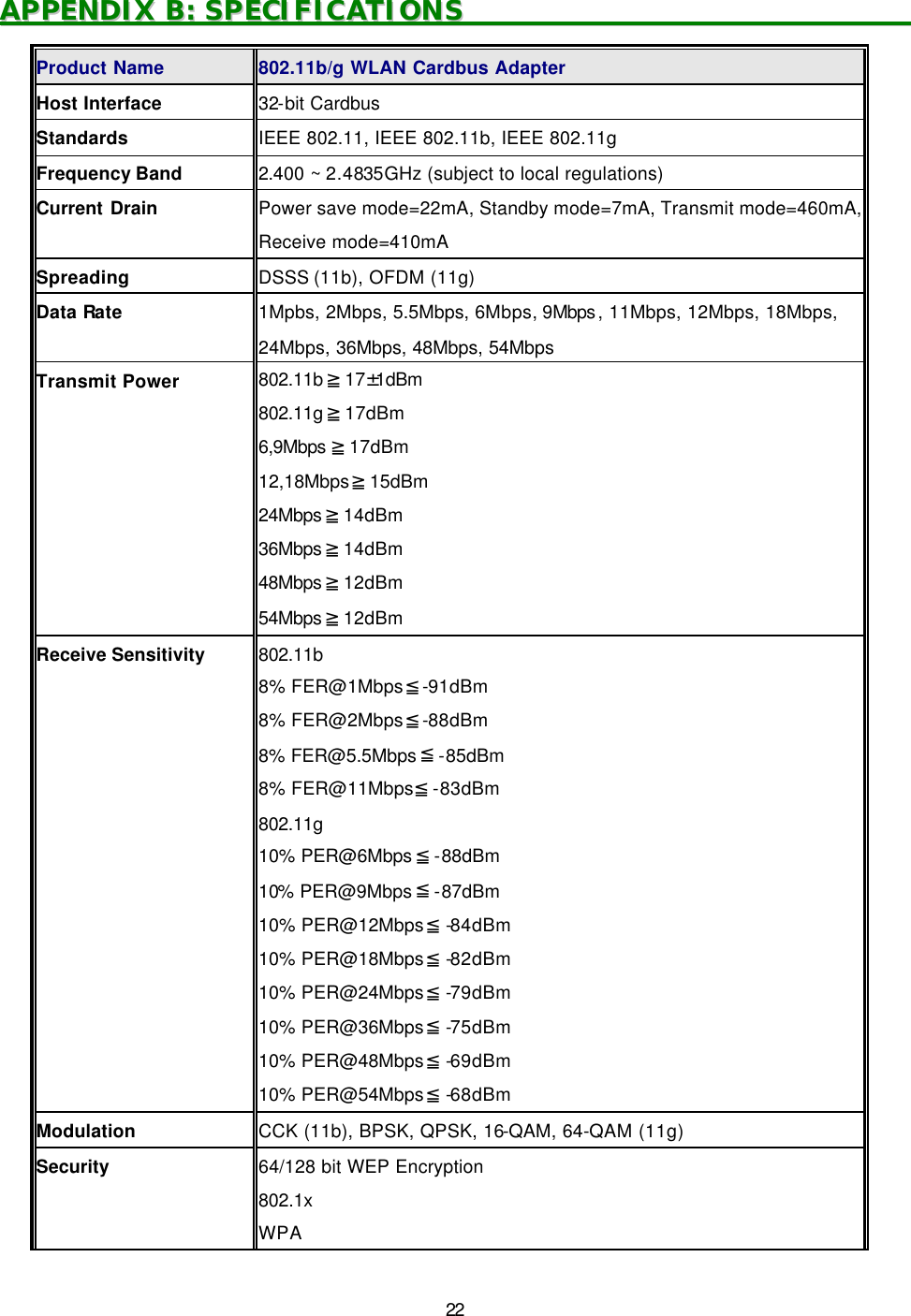
  22 AAPPPPEENNDDIIXX  BB::  SSPPEECCIIFFIICCAATTIIOONNSS                                                                      Product Name   802.11b/g WLAN Cardbus Adapter Host Interface   32-bit Cardbus Standards IEEE 802.11, IEEE 802.11b, IEEE 802.11g Frequency Band   2.400 ~ 2.4835GHz (subject to local regulations) Current Drain Power save mode=22mA, Standby mode=7mA, Transmit mode=460mA, Receive mode=410mA Spreading DSSS (11b), OFDM (11g) Data Rate 1Mpbs, 2Mbps, 5.5Mbps, 6Mbps, 9Mbps , 11Mbps, 12Mbps, 18Mbps, 24Mbps, 36Mbps, 48Mbps, 54Mbps  Transmit Power 802.11b ≧17±1dBm 802.11g ≧17dBm 6,9Mbps ≧17dBm 12,18Mbps≧15dBm 24Mbps ≧14dBm 36Mbps ≧14dBm 48Mbps ≧12dBm 54Mbps ≧12dBm Receive Sensitivity   802.11b 8% FER@1Mbps≦-91dBm 8% FER@2Mbps≦-88dBm 8% FER@5.5Mbps ≦-85dBm 8% FER@11Mbps≦-83dBm 802.11g 10% PER@6Mbps ≦-88dBm 10% PER@9Mbps ≦-87dBm 10% PER@12Mbps≦-84dBm 10% PER@18Mbps≦-82dBm 10% PER@24Mbps≦-79dBm 10% PER@36Mbps≦-75dBm 10% PER@48Mbps≦-69dBm 10% PER@54Mbps≦-68dBm Modulation   CCK (11b), BPSK, QPSK, 16-QAM, 64-QAM (11g) Security   64/128 bit WEP Encryption 802.1x WPA
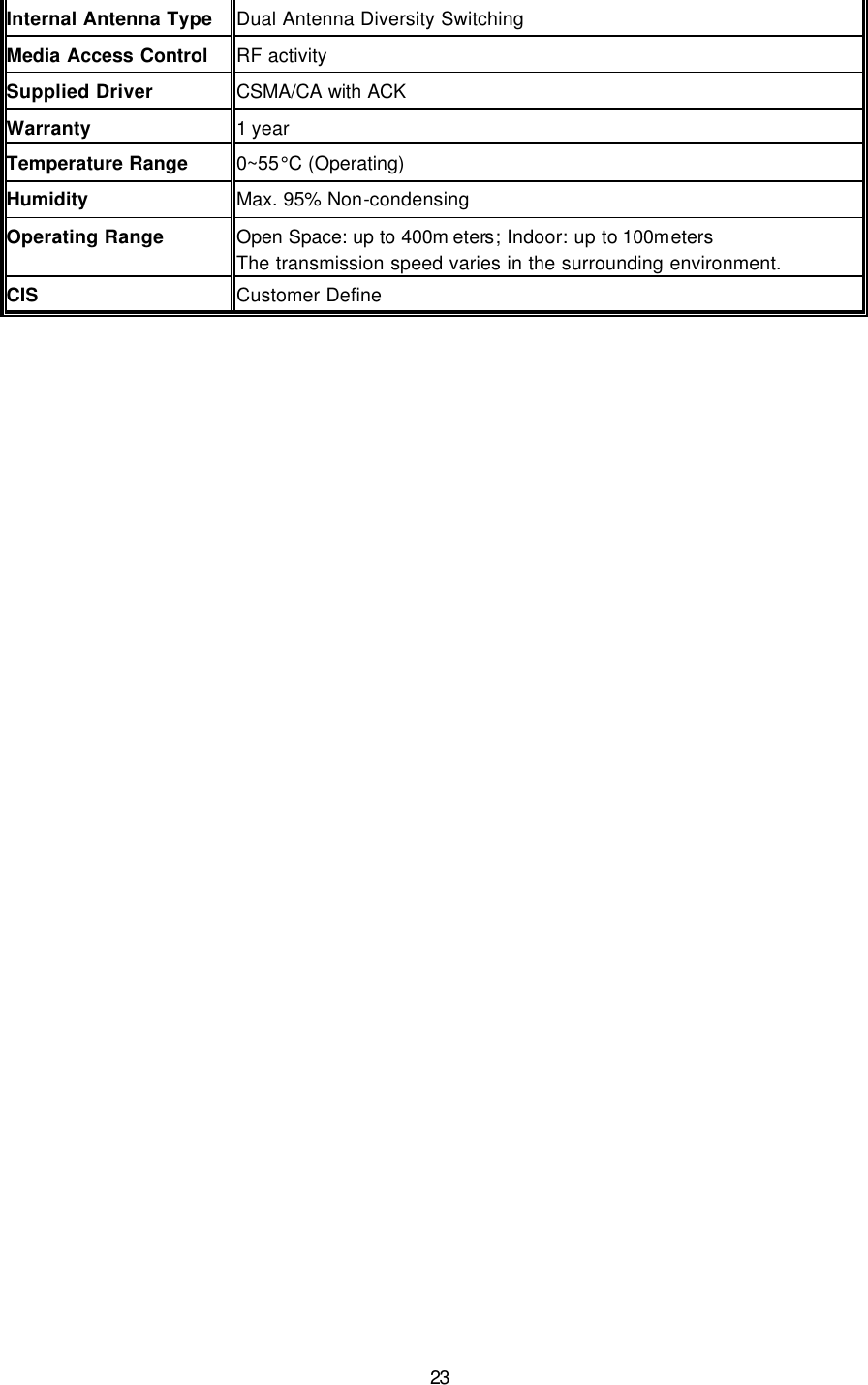
  23 Internal Antenna Type Dual Antenna Diversity Switching Media Access Control RF activity Supplied Driver CSMA/CA with ACK  Warranty 1 year Temperature Range 0~55°C (Operating) Humidity Max. 95% Non-condensing Operating Range Open Space: up to 400m eters; Indoor: up to 100meters The transmission speed varies in the surrounding environment. CIS Customer Define

Navigation menu