Airo Wireless A25TVVJ A25 Rugged Digital Assistant User Manual SP320 Book

Airo Wireless LLC A25 Rugged Digital Assistant SP320 Book

Users Manual Version 3

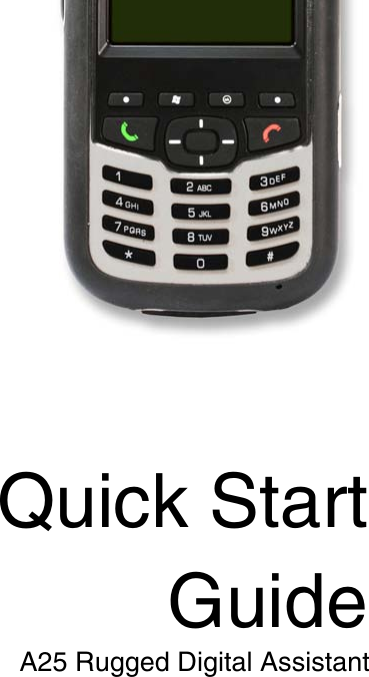
Quick StartGuideA25 Rugged Digital Assistant
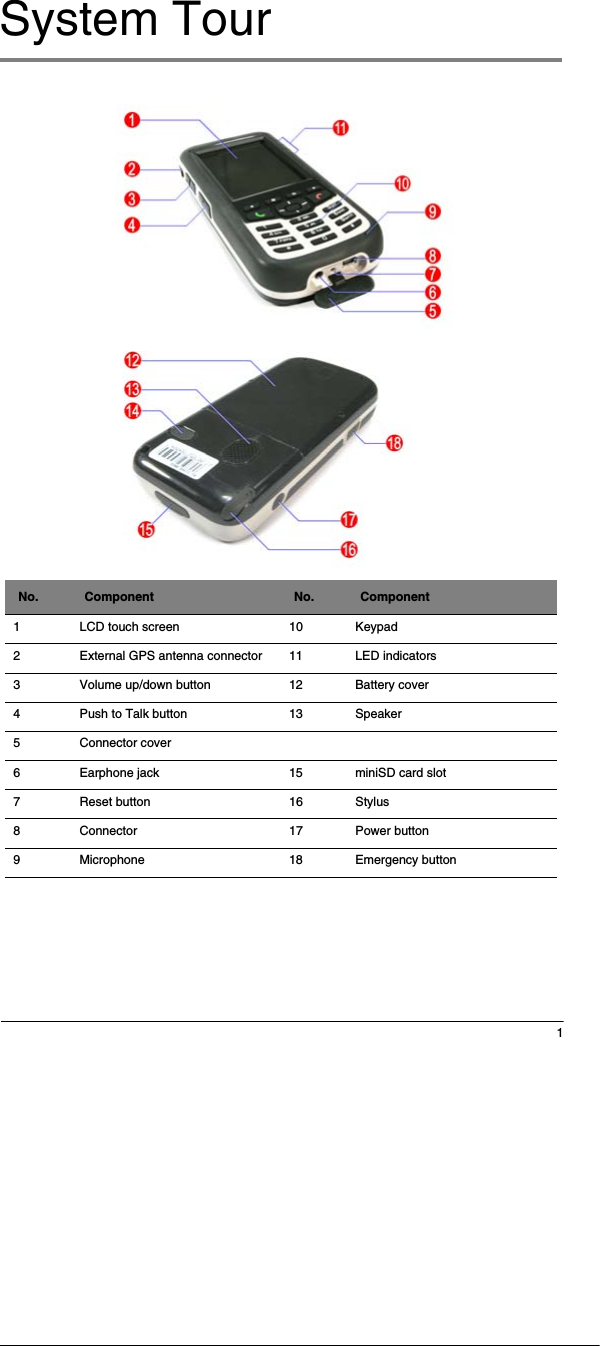
1System Tour No. Component No. Component1 LCD touch screen 10 Keypad2 External GPS antenna connector 11 LED indicators3 Volume up/down button  12 Battery cover4 Push to Talk button 13 Speaker5 Connector cover6 Earphone jack 15 miniSD card slot 7 Reset button  16 Stylus8 Connector 17 Power button9 Microphone 18 Emergency button
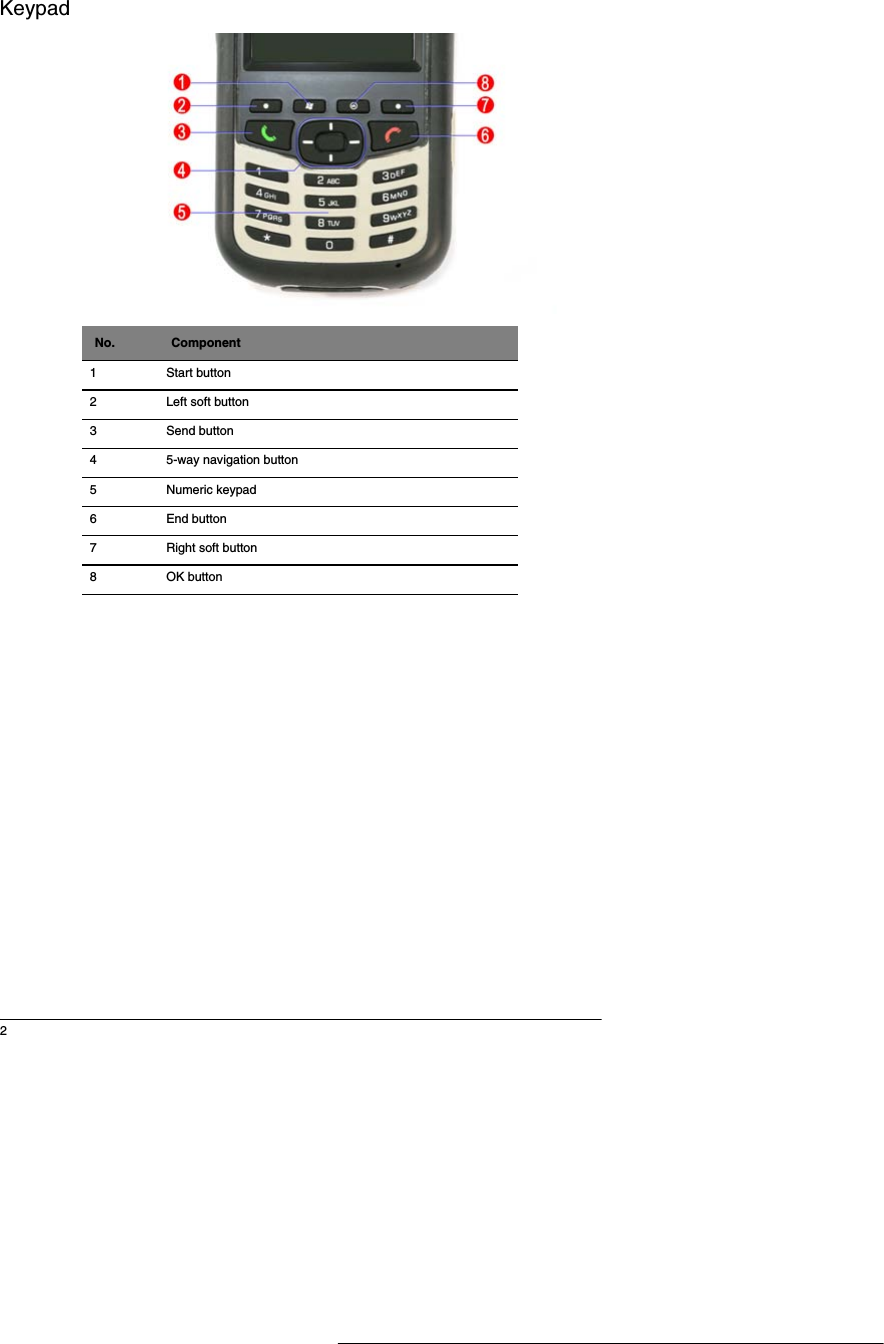
2KeypadNo. Component1 Start button2 Left soft button3 Send button4 5-way navigation button5 Numeric keypad6 End button7 Right soft button8 OK button
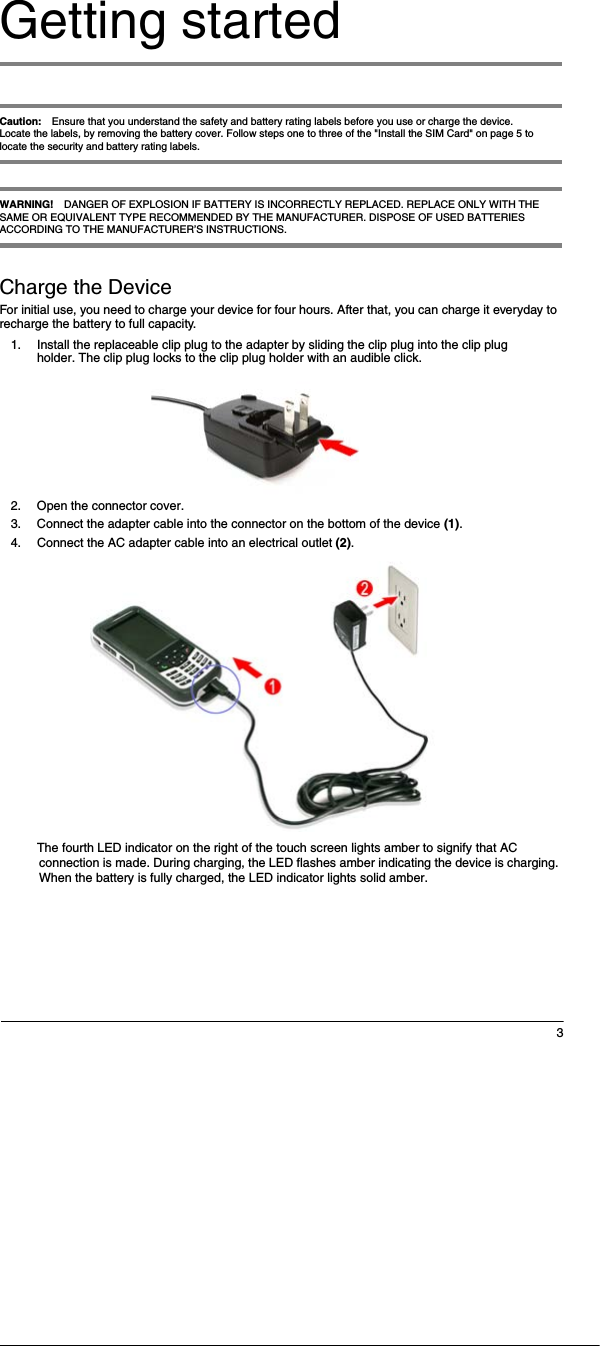
3Getting startedCaution: Ensure that you understand the safety and battery rating labels before you use or charge the device. Locate the labels, by removing the battery cover. Follow steps one to three of the "Install the SIM Card" on page 5 to locate the security and battery rating labels.WARNING! DANGER OF EXPLOSION IF BATTERY IS INCORRECTLY REPLACED. REPLACE ONLY WITH THE SAME OR EQUIVALENT TYPE RECOMMENDED BY THE MANUFACTURER. DISPOSE OF USED BATTERIES ACCORDING TO THE MANUFACTURER’S INSTRUCTIONS. Charge the DeviceFor initial use, you need to charge your device for four hours. After that, you can charge it everyday to recharge the battery to full capacity. 1. Install the replaceable clip plug to the adapter by sliding the clip plug into the clip plug holder. The clip plug locks to the clip plug holder with an audible click.2. Open the connector cover.3. Connect the adapter cable into the connector on the bottom of the device (1). 4. Connect the AC adapter cable into an electrical outlet (2).The fourth LED indicator on the right of the touch screen lights amber to signify that AC connection is made. During charging, the LED flashes amber indicating the device is charging. When the battery is fully charged, the LED indicator lights solid amber.
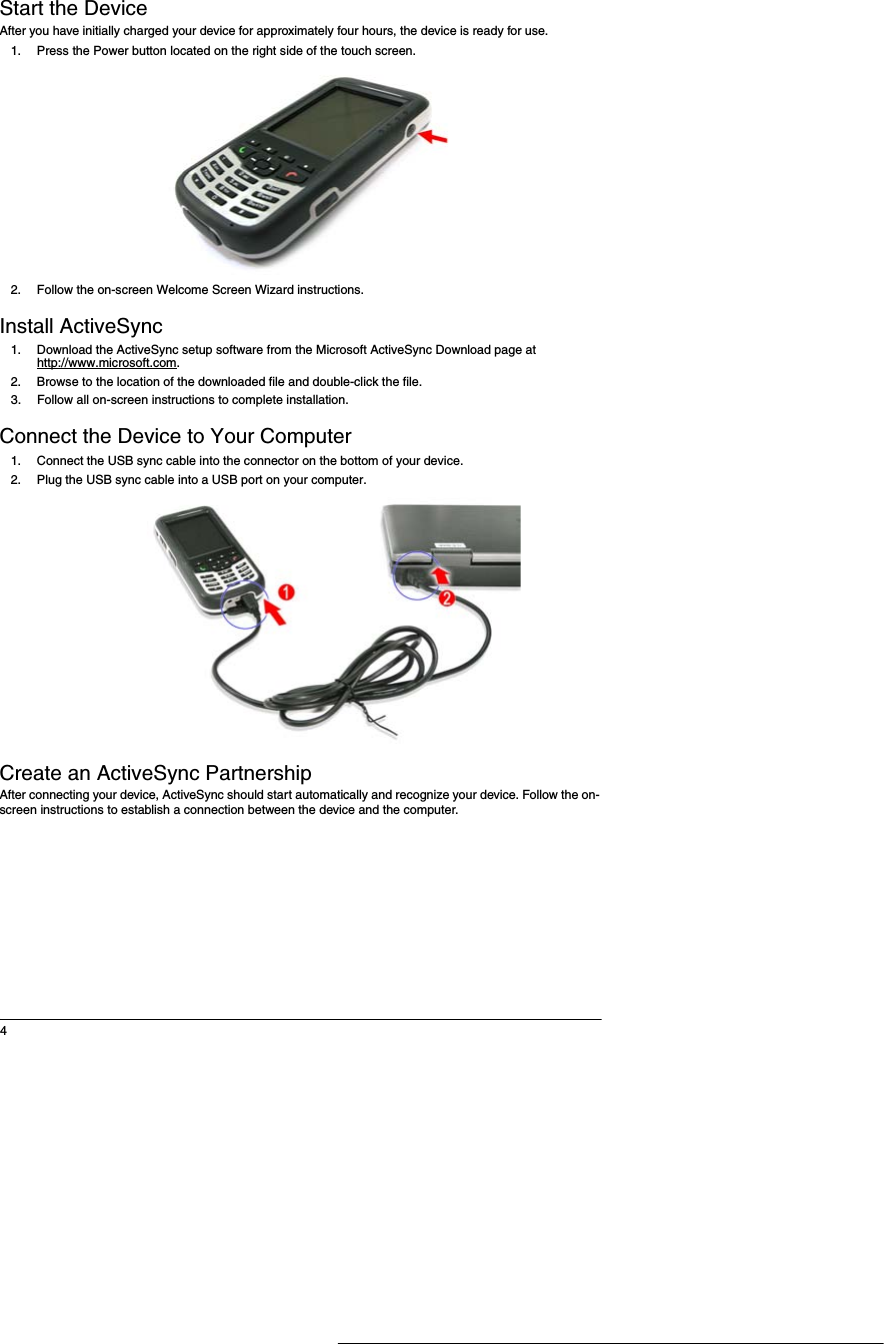
4Start the DeviceAfter you have initially charged your device for approximately four hours, the device is ready for use. 1. Press the Power button located on the right side of the touch screen. 2. Follow the on-screen Welcome Screen Wizard instructions. Install ActiveSync1. Download the ActiveSync setup software from the Microsoft ActiveSync Download page at http://www.microsoft.com.2. Browse to the location of the downloaded file and double-click the file.3. Follow all on-screen instructions to complete installation. Connect the Device to Your Computer1. Connect the USB sync cable into the connector on the bottom of your device.2. Plug the USB sync cable into a USB port on your computer. Create an ActiveSync PartnershipAfter connecting your device, ActiveSync should start automatically and recognize your device. Follow the on-screen instructions to establish a connection between the device and the computer.
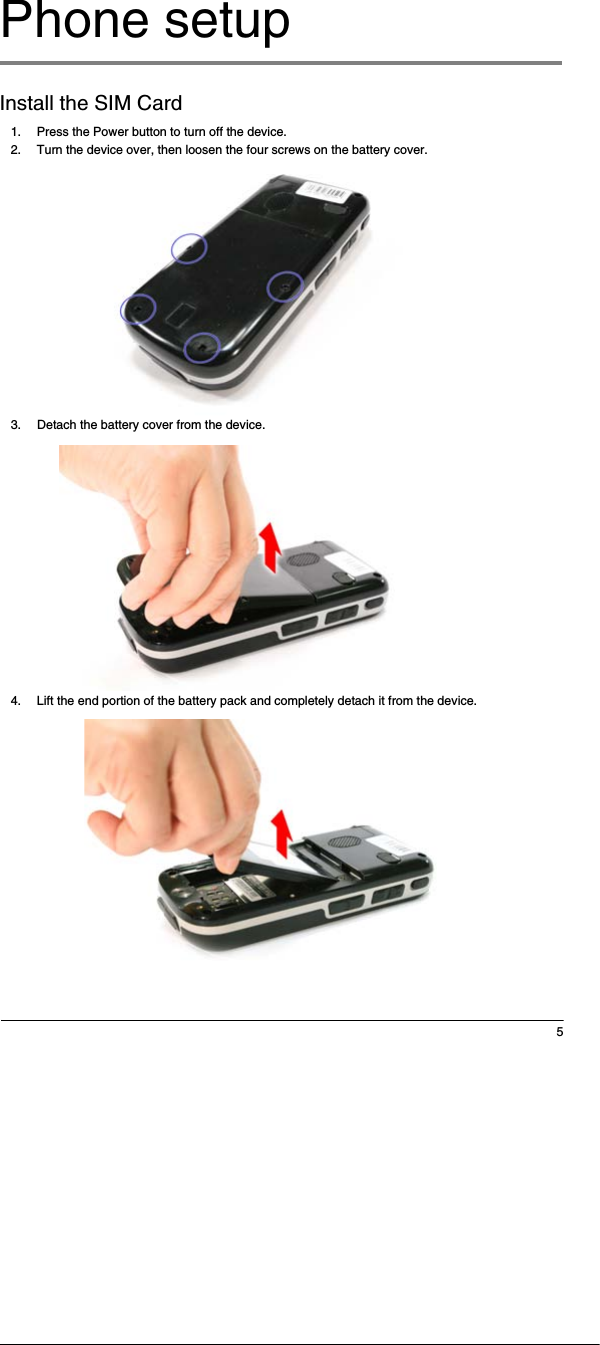
5Phone setupInstall the SIM Card1. Press the Power button to turn off the device. 2. Turn the device over, then loosen the four screws on the battery cover.3. Detach the battery cover from the device.4. Lift the end portion of the battery pack and completely detach it from the device.
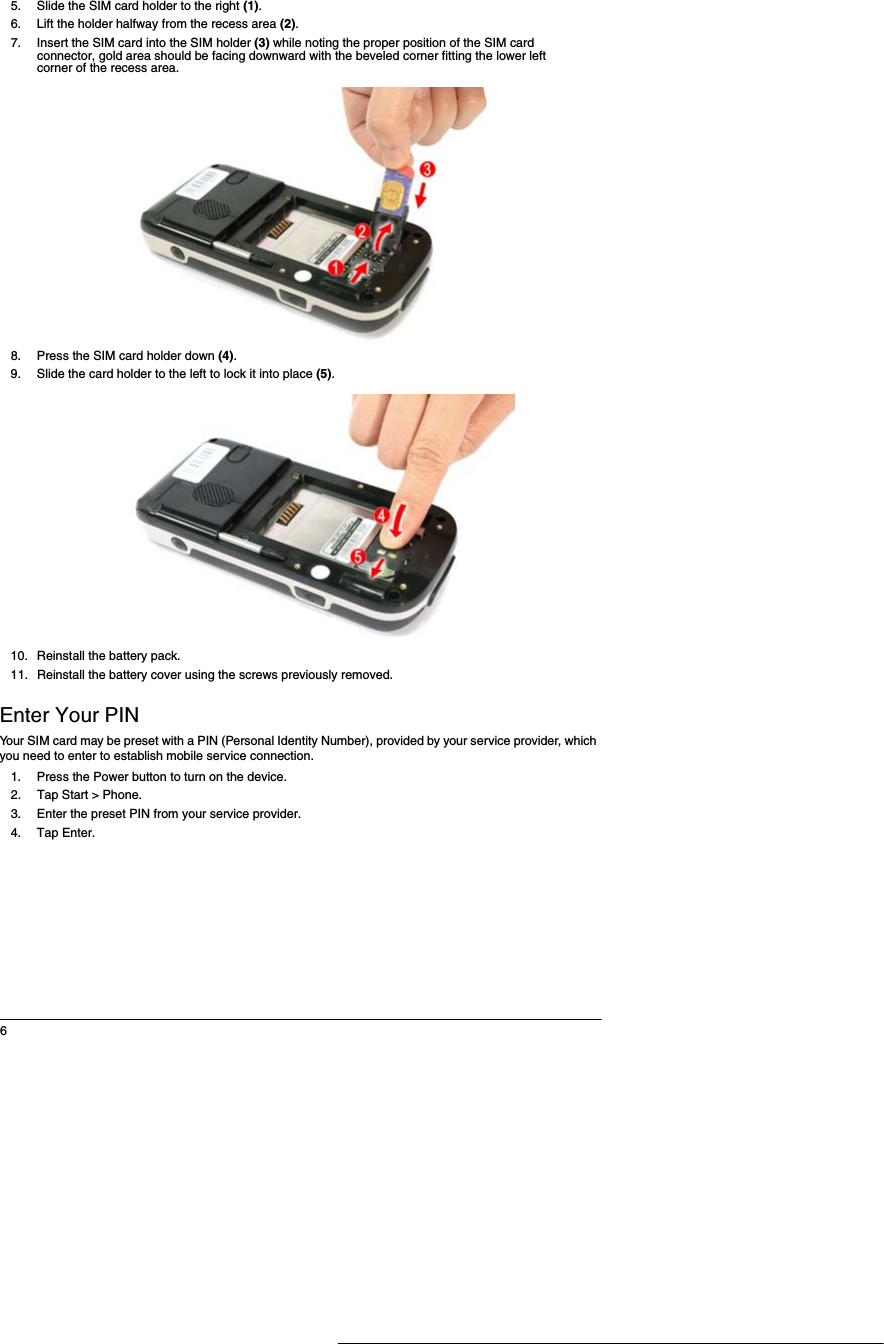
65. Slide the SIM card holder to the right (1).6. Lift the holder halfway from the recess area (2). 7. Insert the SIM card into the SIM holder (3) while noting the proper position of the SIM card connector, gold area should be facing downward with the beveled corner fitting the lower left corner of the recess area.8. Press the SIM card holder down (4).9. Slide the card holder to the left to lock it into place (5). 10. Reinstall the battery pack. 11. Reinstall the battery cover using the screws previously removed.Enter Your PINYour SIM card may be preset with a PIN (Personal Identity Number), provided by your service provider, which you need to enter to establish mobile service connection.1. Press the Power button to turn on the device. 2. Tap Start > Phone. 3. Enter the preset PIN from your service provider.4. Tap Enter.
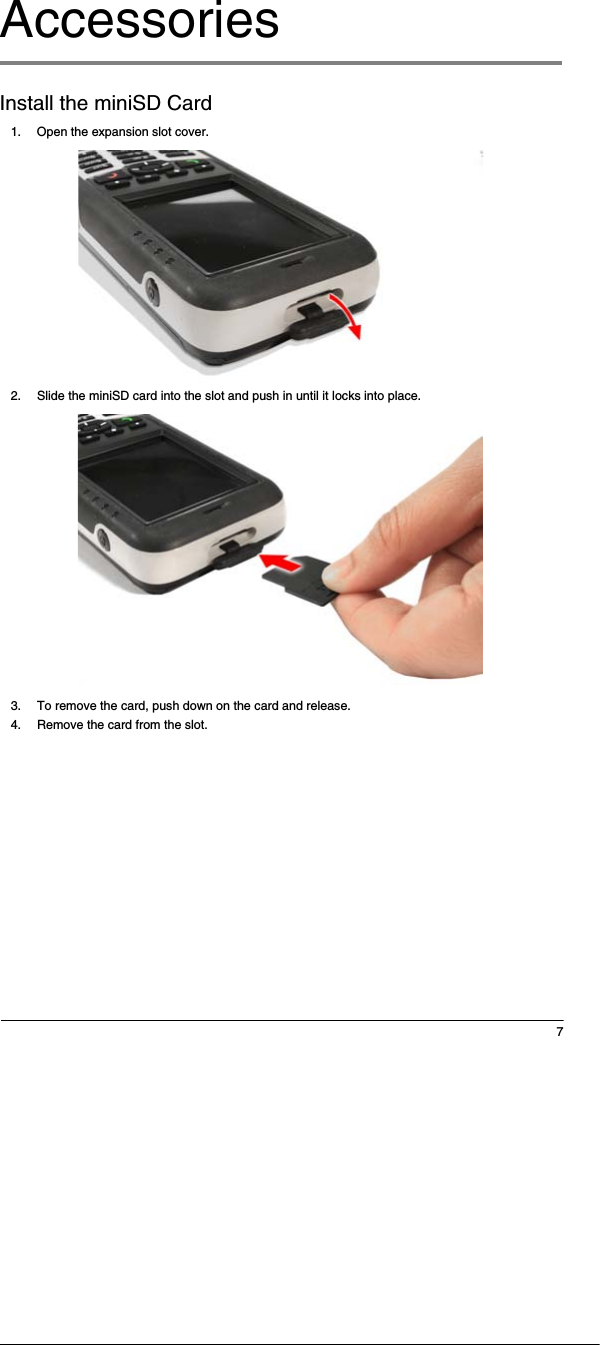
7AccessoriesInstall the miniSD Card1. Open the expansion slot cover. 2. Slide the miniSD card into the slot and push in until it locks into place. 3. To remove the card, push down on the card and release.4. Remove the card from the slot.
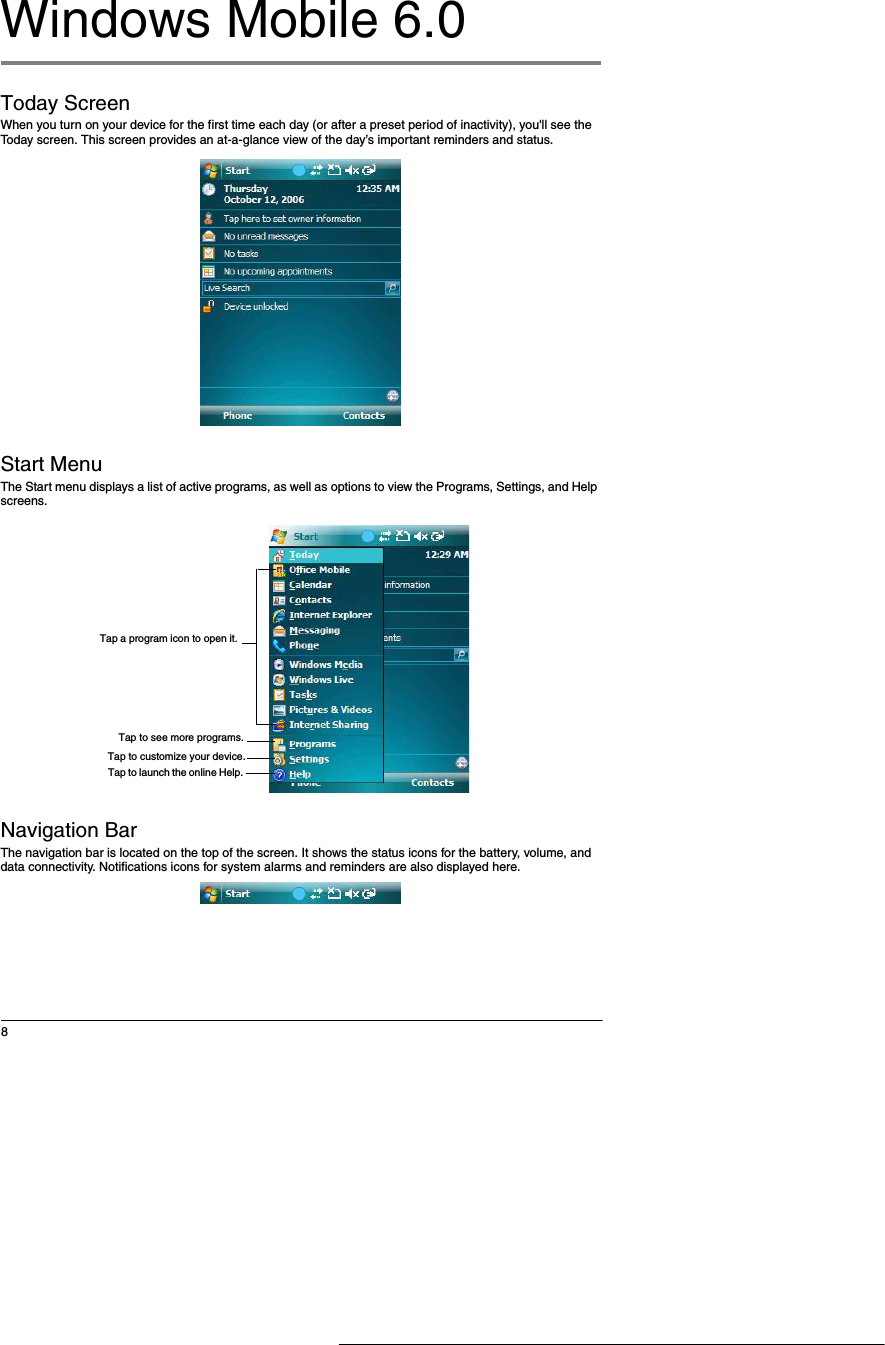
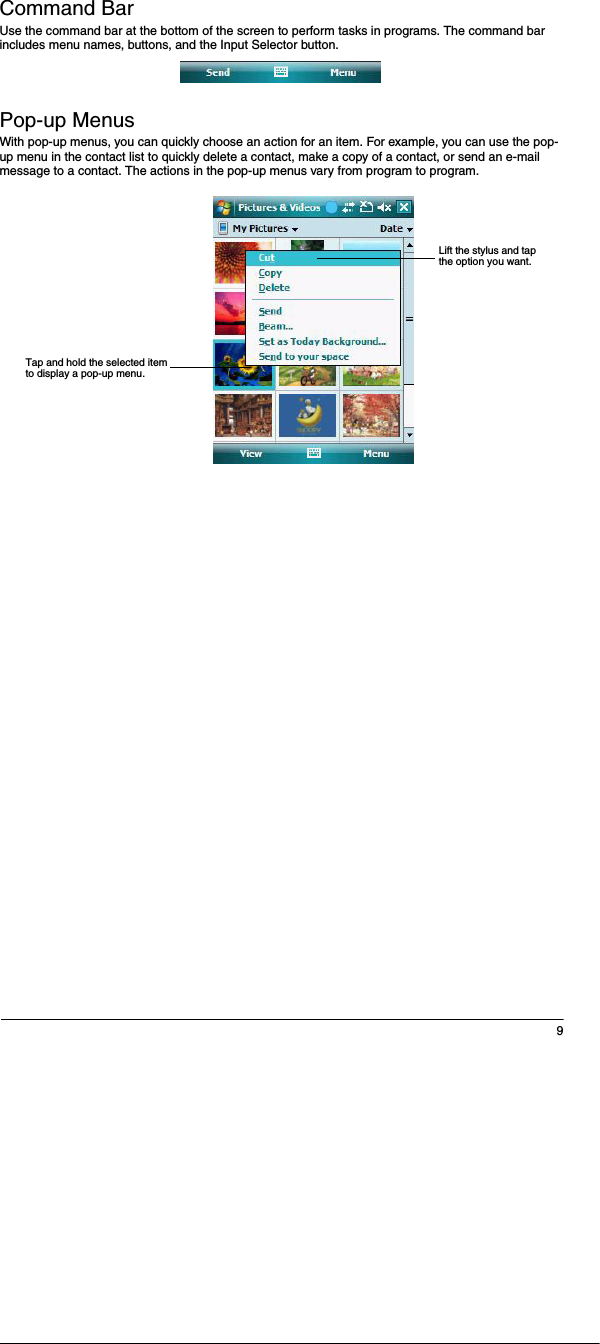
8Windows Mobile 6.0 Today ScreenWhen you turn on your device for the first time each day (or after a preset period of inactivity), you'll see the Today screen. This screen provides an at-a-glance view of the day’s important reminders and status. Start Menu The Start menu displays a list of active programs, as well as options to view the Programs, Settings, and Help screens.Navigation BarThe navigation bar is located on the top of the screen. It shows the status icons for the battery, volume, and data connectivity. Notifications icons for system alarms and reminders are also displayed here. Tap a program icon to open it.Tap to see more programs.Tap to customize your device.Tap to launch the online Help.
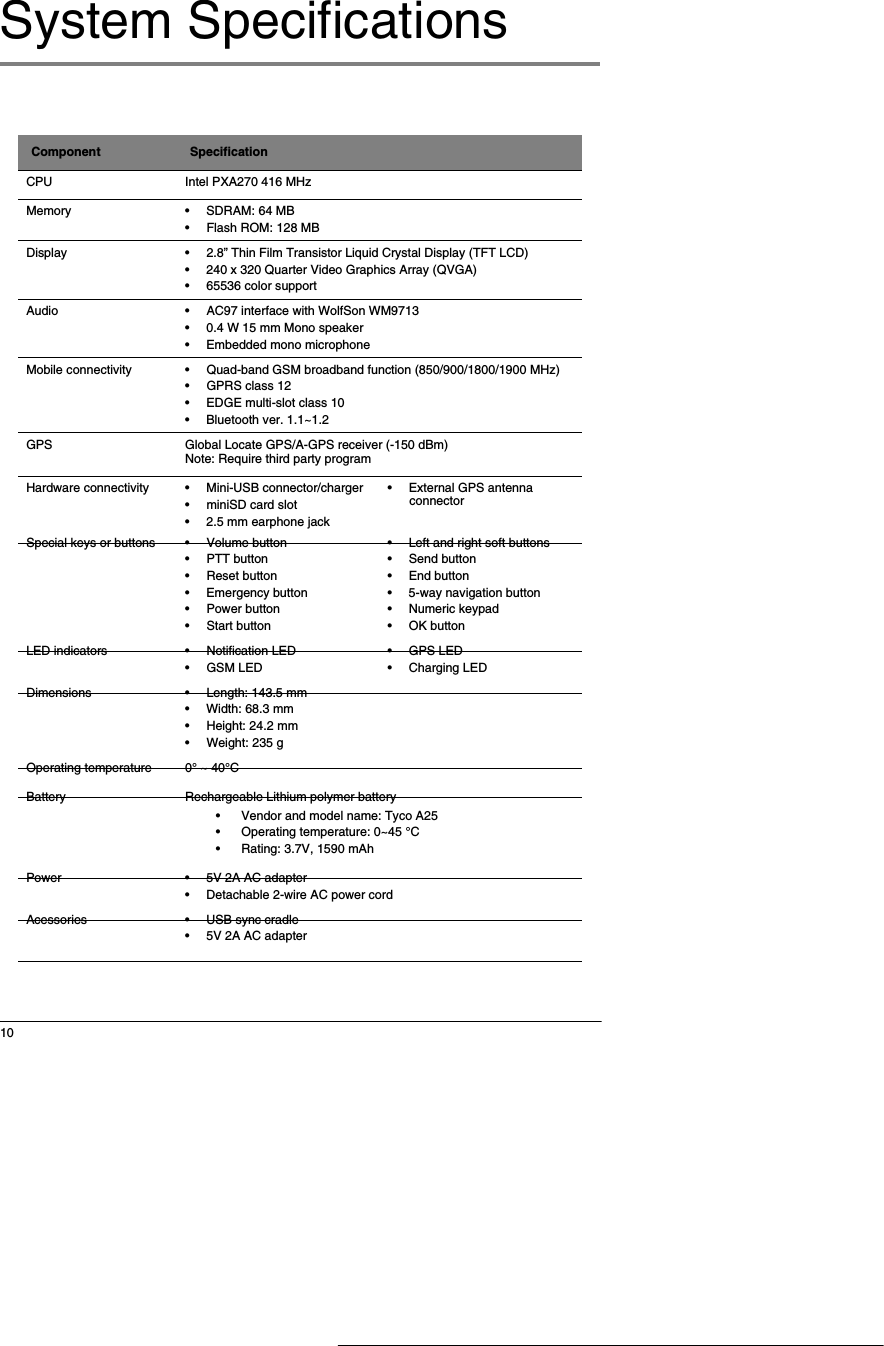
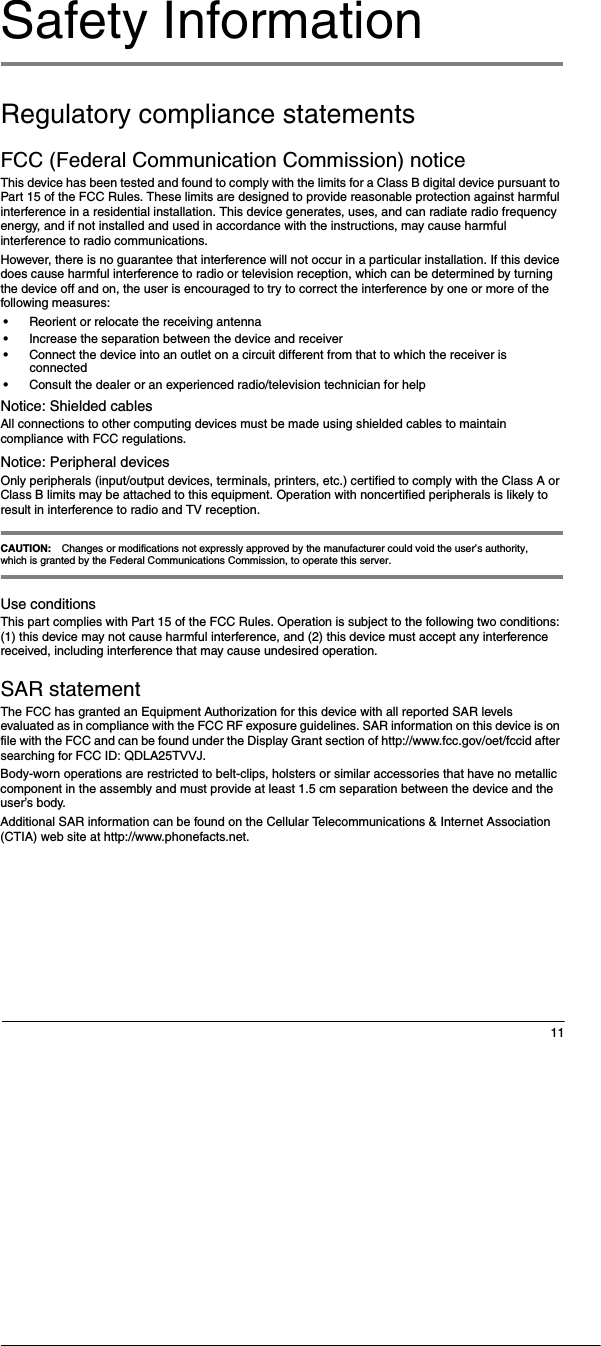
9Command BarUse the command bar at the bottom of the screen to perform tasks in programs. The command bar includes menu names, buttons, and the Input Selector button. Pop-up MenusWith pop-up menus, you can quickly choose an action for an item. For example, you can use the pop-up menu in the contact list to quickly delete a contact, make a copy of a contact, or send an e-mail message to a contact. The actions in the pop-up menus vary from program to program. Lift the stylus and tap the option you want.Tap and hold the selected item to display a pop-up menu.
10System SpecificationsComponent  SpecificationCPU Intel PXA270 416 MHzMemory • SDRAM: 64 MB• Flash ROM: 128 MB Display • 2.8” Thin Film Transistor Liquid Crystal Display (TFT LCD) • 240 x 320 Quarter Video Graphics Array (QVGA)• 65536 color supportAudio • AC97 interface with WolfSon WM9713• 0.4 W 15 mm Mono speaker• Embedded mono microphoneMobile connectivity • Quad-band GSM broadband function (850/900/1800/1900 MHz)• GPRS class 12 • EDGE multi-slot class 10• Bluetooth ver. 1.1~1.2GPS  Global Locate GPS/A-GPS receiver (-150 dBm)Note: Require third party programHardware connectivity • Mini-USB connector/charger• miniSD card slot• 2.5 mm earphone jack• External GPS antenna connector Special keys or buttons • Volume button• PTT button • Reset button • Emergency button• Power button• Start button• Left and right soft buttons• Send button• End button• 5-way navigation button• Numeric keypad•OK buttonLED indicators • Notification LED•GSM LED•GPS LED• Charging LEDDimensions • Length: 143.5 mm• Width: 68.3 mm• Height: 24.2 mm• Weight: 235 gOperating temperature 0° ~ 40°C Battery Rechargeable Lithium polymer battery• Vendor and model name: Tyco A25• Operating temperature: 0~45 °C • Rating: 3.7V, 1590 mAh Power • 5V 2A AC adapter• Detachable 2-wire AC power cordAcessories • USB sync cradle• 5V 2A AC adapter
11Safety InformationRegulatory compliance statementsFCC (Federal Communication Commission) notice This device has been tested and found to comply with the limits for a Class B digital device pursuant to Part 15 of the FCC Rules. These limits are designed to provide reasonable protection against harmful interference in a residential installation. This device generates, uses, and can radiate radio frequency energy, and if not installed and used in accordance with the instructions, may cause harmful interference to radio communications. However, there is no guarantee that interference will not occur in a particular installation. If this device does cause harmful interference to radio or television reception, which can be determined by turning the device off and on, the user is encouraged to try to correct the interference by one or more of the following measures:•Reorient or relocate the receiving antenna•Increase the separation between the device and receiver•Connect the device into an outlet on a circuit different from that to which the receiver is connected•Consult the dealer or an experienced radio/television technician for helpNotice: Shielded cablesAll connections to other computing devices must be made using shielded cables to maintain compliance with FCC regulations.Notice: Peripheral devicesOnly peripherals (input/output devices, terminals, printers, etc.) certified to comply with the Class A or Class B limits may be attached to this equipment. Operation with noncertified peripherals is likely to result in interference to radio and TV reception.CAUTION: Changes or modifications not expressly approved by the manufacturer could void the user’s authority, which is granted by the Federal Communications Commission, to operate this server.Use conditionsThis part complies with Part 15 of the FCC Rules. Operation is subject to the following two conditions: (1) this device may not cause harmful interference, and (2) this device must accept any interference received, including interference that may cause undesired operation.SAR statementThe FCC has granted an Equipment Authorization for this device with all reported SAR levels evaluated as in compliance with the FCC RF exposure guidelines. SAR information on this device is on file with the FCC and can be found under the Display Grant section of http://www.fcc.gov/oet/fccid after searching for FCC ID: QDLA25TVVJ.Body-worn operations are restricted to belt-clips, holsters or similar accessories that have no metallic component in the assembly and must provide at least 1.5 cm separation between the device and the user’s body.Additional SAR information can be found on the Cellular Telecommunications & Internet Association (CTIA) web site at http://www.phonefacts.net.
12NCC statementWarning! Use device properly to reduce electromagnetic interferences. Taiwan NCC statementSafety informationRadiofrequency (RF) Energy EmissionYour device is a low power radio transmitter and receiver. When it is ON, it receives and sends out RF signals.In August 1996, the Federal Communications Commissions (FCC) adopted RF exposure guidelines with safety levels for handheld wireless phones. Those guidelines are consistent with the safety standards previously set by both U.S. and international standards bodies:•ANSI C95.1 (1992)•NCRP Report 86 (1986)•ICNIRP (1996)Those standards were based on comprehensive and periodic evaluations of the relevant scientific literature. For example, over 120 scientists, engineers, and physicians from universities, government health agencies, and industry reviewed the available body of research to develop the ANSI Standard (C951).Your device has been equipped with internal shielding to minimize stray emissions of RF energy. However, using your device can still be limited in the some instances. When boarding aircraft•Most airline regulations prohibit the on-board use of portable PCs (and all other portable electronic devices that could potentially emit stray RF energy), particularly during take-offs and landings, to prevent any possible interference with the reception of signals by airborne electronic navigational devices.•FCC regulations prohibit using your device while in the air. Turn your device OFF before boarding an aircraft.•Always request and obtain prior consent and approval of an authorized airline representative before using your device aboard an aircraft.•Always follow the instructions of the airline representative whenever using your device aboard an aircraft, to prevent any possible interference with airborne electronic equipment.When inside hospitals and other health care facilities•Turn your device OFF in health care facilities when any regulations posted in these areas instruct you to do so. Hospitals or health care facilities may be using equipment that could be sensitive to external RF energy. “device OFF” means to turn the radio stand by switch “OFF”, then turn the power off by pressing the Power button.•Always comply with posted prohibitions of the use of RF-emitting devices in hospitals and other medical facilities. Failure to follow such directives could result in the interference with medical equipment and/or devices.Posted facilitiesTurn your device OFF in any facility where posted notices require so.Blasting areasTo avoid interfering with blasting operations, turn your device OFF when in a “blasting area” or in areas posted “Turn off two-way radio”. Obey all signs and instructions.Within certain radius from some electronic equipmentMost modern electronic equipment is shielded from RF signals. However, certain electronic equipment may not be shielded against the RF signals from your device including:•PacemakersThe Health Industry Manufacturers Association recommends that a minimum separation of six (6") inches must be maintained between your device and a pacemaker to avoid potential
13interference with the pacemaker. These recommendations are consistent with the independent research and recommendations of Wireless Technology Research.Never come closer than six (6) inches to a person with a heart pacemaker implant when using this device. Failure to do so could result in interference with the function of the pacemaker.Persons with pacemakers•You should ALWAYS keep the device more than six inches from their pacemaker when the device is turned ON.•You should not carry the device in a breast pocket.•If you have any reason to suspect that interference is taking place, turn your device OFF immediately.•Hearing aidsSome digital wireless phones may interfere with some hearing aids. In the event of such interference, you may want to consult your service provider (or call the customer service line to discuss alternatives).•Other medical devicesIf you use any other personal medical device, consult the manufacturer of your device to determine if they are adequately shielded from external RF energy.Your physician may be able to assist you in obtaining this information.•Motor vehiclesRF signals may affect improperly installed or inadequately shielded electronic systems in motor vehicles. Check with the manufacturer or its representative regarding your vehicle.You should also consult the manufacturer of any equipment that has been added to your vehicle.Usage precautionsFailure to follow the directions below could result in death or catastrophic bodily injury.•Never use your device while driving an automobile or any other moving vehicle. Always pull out of traffic and come to a stop in a legally permissible and safe location before using your device. Failure to do so could result in serious bodily injury in a traffic accident.Driving safetyWhen driving:•Never place your device on the passenger seat or any place else in the car where it can become a projectile during a collision or stop.•An air bag inflates with great force. DO NOT place objects, including both installed or portable wireless equipment, in the area over the air bag or in the air bag deployment area. If in-vehicle wireless equipment is improperly installed and the air bag inflates, serious injury could result.Talking on your Pocket PC phone while driving is extremely dangerous and is illegal in some states. Remember, safety comes first. Check the laws and regulations on the use of phones in the areas where you drive. Always obey them. If you must use the phone function while driving, please:•Give full attention to driving. Driving safely is your first responsibility.•Use hands-free features by attaching the single earbud headset and enabling the speed dial and auto-pick up functions.•Pull off the road and park before making answering a call, if driving conditions so require.•Never use your device while walking. Usage while walking could result in bodily injury caused by inattention to automobile traffic or other pedestrian hazards.•Never use your device in any area with a potentially explosive atmosphere and obey all signs and instructions. Sparks in such areas could cause an explosion or fire resulting in bodily injury or even death.Usage instructions•Always use AIRO authorized accessories and optional devices when operating this device, as the use of incompatible auxiliary equipment could result in fire, electric shock or other bodily injury. The use of unauthorized accessories will also void your warranty.•Never attempt to disassemble, repair or make any modification to your device. Disassembly, modification or any attempt at repair could cause bodily injury or property damage, as well as damage to the device itself.
14•Your device is not a toy. Never allow children to play with your device. Misuse, rough or improper handling of your device by children could result in serious bodily injury related to any of the enumerated safety warnings in this User’s Guide. In addition, always keep all accessories and components out of the reach of small children as small parts might present a choking hazard. Seek immediate medical attention if choking occurs or if any small part has been swallowed.•Never raise the sound volume level too high when using your device with earphones. An excessive sound volume level could cause damage to your hearing.•Never touch the liquid that might leak from a broken liquid crystal display. Contact with this liquid could cause a skin rash. If the crystal display liquid should come into contact with the skin or clothing, wash it immediately with clean water.Battery pack informationCaution: DANGER OF EXPLOSION IF BATTERY IS INCORRECTLY REPLACED. REPLACE ONLY WITH THE SAME OR EQUIVALENT TYPE RECOMMENDED BY THE MANUFACTURER. DISPOSE OF USED BATTERIES ACCORDING TO THE MANUFACTURER’S INSTRUCTIONS. This device is equipped with a removable and rechargeable Lithium polymer battery. When a replacement is needed, please request the dealer from whom your device was purchased to assist you. Use only manufacturer approved batteries.Battery pack reminders•Use the battery only for its intended purpose.•Replace only with equivalent type battery (Tyco battery model A25). Use of another battery may present a risk of EXPLOSION, FIRE or high temperatures. •Never expose the battery terminals to any other metal object. This can short circuit the battery.•When not in use, store the battery uncharged in a cool, dark, dry place.•The battery is a self-contained unit. Do not attempt to open its case.•Battery operating time gradually decreases. You may need to buy a new battery.•Never dispose of the battery with ordinary waste.•Never dispose of a battery in a fire!•Dispose of used batteries in accordance with local regulations.•Recycle! Lithium polymer batteries are recyclable. When you replace your built-in battery, please request the repair center to recycle the battery in accordance with RBRC standards. AC adapter precautions•Never attempt to disassemble or repair an AC adapter, and never alter the power cables or plugs as exposure to electric shock hazards may result.•Always contact an authorized AIRO service center, if repair or replacement is required.•If the plug will not fit into the available outlet, have a proper outlet installed by a qualified electrician. Improper connection can result in the risk of electric shock.•Never allow the AC adapter to come into contact with water or any other liquid. Water or any other liquid in contact with the AC adapter can create a risk of fire or electric shock.•Always use an authorized AIRO AC adapter to avoid any risk of fire or damage to your device or battery.•Bodily injury or property damage may occur as a result of the use of an unauthorized and incompatible AC adapter.•Never use an AC adapter if it has a damaged or worn power cord or plug. The use of damaged or worn power cords or plugs could result in electric shock, burns or fire. Contact an authorized AIRO service center immediately to obtain a suitable replacement.•Never attempt to connect or disconnect the power plug with damp or wet hands. Connecting or disconnecting the power plug with damp or wet hands could result in an electric shock.•Always unplug the AC adapter from the power source before attempting any cleaning in order to avoid the risk of electric shock. Always use a soft dry cloth to clean the equipment, after it has been unplugged.•Never attempt to use an unauthorized AC adapter with your device in order to avoid any risk of bodily injury or property damage. Since unauthorized accessories have different specifications, they may be incompatible with your device.•Always locate the power supply cable in an area where it will not be stepped on, tripped over, or otherwise subjected to damage or stress.•Never place heavy objects on the power supply cable, as this could result in damage to the cable.
15•Never bend or twist a power supply cable, and never pull it in an attempt to remove the AC adapter or accessory plug from a socket. Always grasp the AC adapter or the accessory plug directly when unplugging the power supply cable in order to avoid damaging the cable.•Always ensure the power plug pins are clean and free of dust or other foreign material by wiping the pins with a clean dry cloth. Dust or other foreign material accumulation on the power plug pins could cause fire.•Be certain to insert the power plug deeply into a socket. Failure to do so could cause a fire and an electric shock.•Always disconnect the AC adapter from the power source when it is not in use.•Never place an AC adapter on a wooden surface (or any other surface that could be marred by exposure to heat) while it is in use. Since the surface temperature of the AC adapter increases during normal use, always rest it on a suitable heat-insulating material.•Never cover the AC adapter with any object while it is in use, and never place it adjacent to a heat source. An excessive temperature increase could detrimentally affect its performance.•Never place the power supply cable near a heat source, as damage to the cord or to its insulation could result.•Always use a surge protector when utilizing the AC adapter during an electrical storm. Otherwise, a power surge could result in the loss of stored data.•Always use a surge protector when utilizing the AC adapter near an electrical noise source such as high voltage line or power source. Otherwise, a power surge could result in loss of stored data.•In order to avoid any possibility of a fire, always insert the power plug into household electric outlet supplying 120V AC.•When traveling abroad, never plug the AC adapter into a power source that does not correspond to both the voltage and the frequency specified on the rating plate of the AC adapter, as equipment damage and fire will result.When you connect to a power supply of more than 125V AC, change the power supply cable with one that corresponds to the power supply specification. Failure to do so could cause a fire.•Never drop the AC adapter or subject it to severe shock. This may cause ignition or electric shock, as well as damage to the adapter.Phone operationWhen speaking into the device microphone or the headset microphone, a minimum separation distance of 1 inch (2.5 cm) must be maintained between the user's face and the device, including its antenna, to comply with the FCC exposure limits.NOTE: Do not touch the antenna unnecessarily when using the phone function. Contact with the antenna affects call quality and may cause the device to operate at a higher power level than otherwise needed.Phone usage regulationsNever violate any of the following FCC Rules and Regulations when using your device. The following offenses are punishable by fine, imprisonment, or both:•Using obscene, indecent, or profane language.•Using the unit to give off false distress calls.•Wiretapping or otherwise intercepting a telephone call, unless that person has first obtained the consent of the parties participating in the call.•Making anonymous calls to annoy, harass, or molest other people.•Charging to an account without authorization to avoid payment for service.•Refusing to yield a party line when informed that it is needed for an emergency call (It is also unlawful to take over a party line by stating falsely that it is needed for an emergency).

Navigation menu