Andrew Base Station Subsystems Group OBEMICRO3 OneBase Cell Extender Micro-3 Cabinet User Manual

Andrew Corporation, Base Station Subsystems Group OneBase Cell Extender Micro-3 Cabinet Users Manual

Users Manual

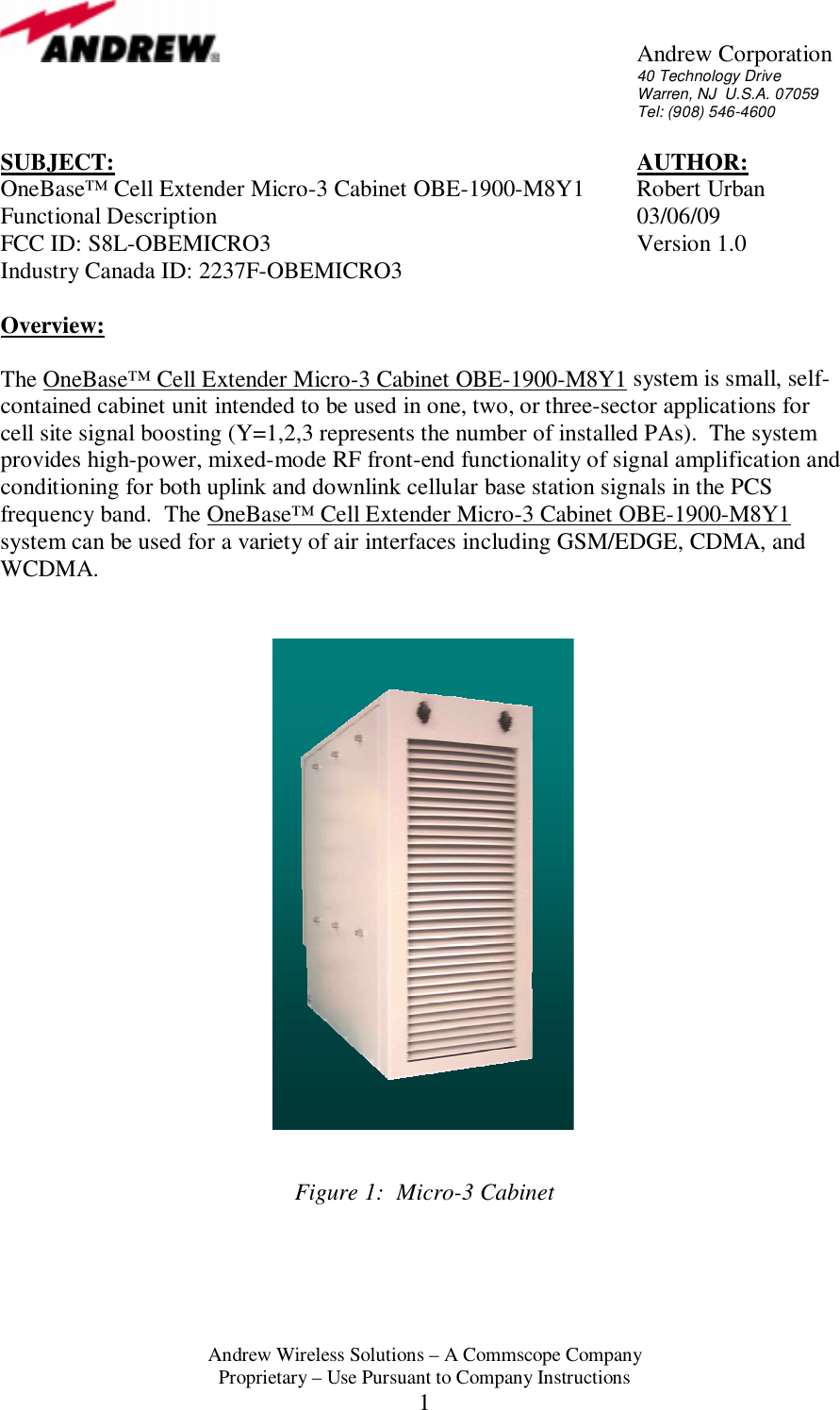
      Andrew Corporation 40 Technology Drive Warren, NJ  U.S.A. 07059 Tel: (908) 546-4600  Andrew Wireless Solutions – A Commscope Company Proprietary – Use Pursuant to Company Instructions 1 SUBJECT:        AUTHOR: OneBase™ Cell Extender Micro-3 Cabinet OBE-1900-M8Y1  Robert Urban Functional Description      03/06/09 FCC ID: S8L-OBEMICRO3      Version 1.0 Industry Canada ID: 2237F-OBEMICRO3  Overview:  The OneBase™ Cell Extender Micro-3 Cabinet OBE-1900-M8Y1 system is small, self-contained cabinet unit intended to be used in one, two, or three-sector applications for cell site signal boosting (Y=1,2,3 represents the number of installed PAs).  The system provides high-power, mixed-mode RF front-end functionality of signal amplification and conditioning for both uplink and downlink cellular base station signals in the PCS frequency band.  The OneBase™ Cell Extender Micro-3 Cabinet OBE-1900-M8Y1 system can be used for a variety of air interfaces including GSM/EDGE, CDMA, and WCDMA.                             Figure 1:  Micro-3 Cabinet
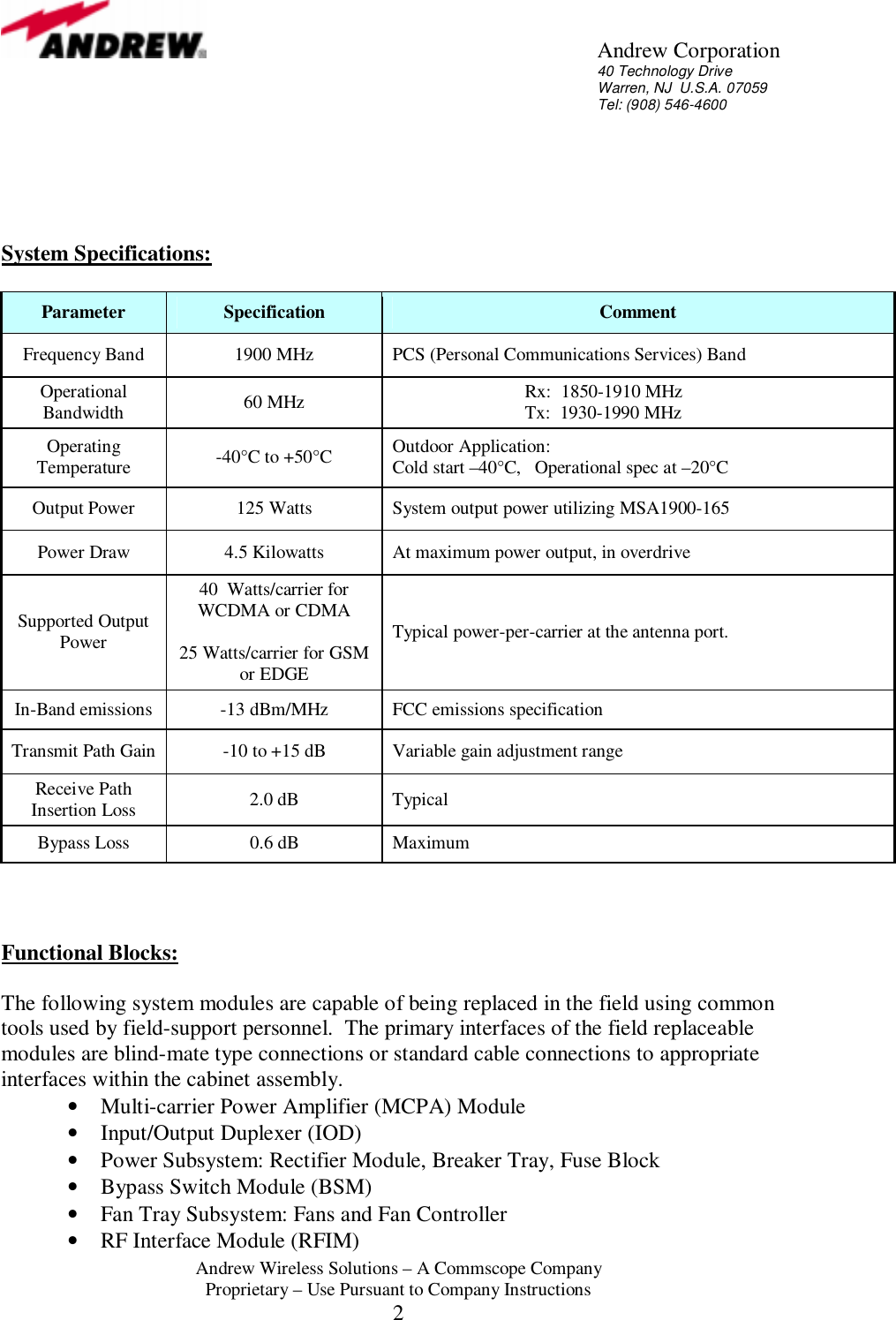
      Andrew Corporation 40 Technology Drive Warren, NJ  U.S.A. 07059 Tel: (908) 546-4600  Andrew Wireless Solutions – A Commscope Company Proprietary – Use Pursuant to Company Instructions 2     System Specifications:  Parameter  Specification  Comment Frequency Band  1900 MHz  PCS (Personal Communications Services) Band Operational Bandwidth  60 MHz  Rx:  1850-1910 MHz Tx:  1930-1990 MHz Operating Temperature  -40°C to +50°C  Outdoor Application:  Cold start –40°C,   Operational spec at –20°C Output Power  125 Watts  System output power utilizing MSA1900-165 Power Draw  4.5 Kilowatts  At maximum power output, in overdrive Supported Output Power 40  Watts/carrier for WCDMA or CDMA  25 Watts/carrier for GSM or EDGE Typical power-per-carrier at the antenna port. In-Band emissions  -13 dBm/MHz  FCC emissions specification Transmit Path Gain  -10 to +15 dB  Variable gain adjustment range Receive Path Insertion Loss  2.0 dB  Typical Bypass Loss  0.6 dB  Maximum    Functional Blocks:  The following system modules are capable of being replaced in the field using common tools used by field-support personnel.  The primary interfaces of the field replaceable modules are blind-mate type connections or standard cable connections to appropriate interfaces within the cabinet assembly. • Multi-carrier Power Amplifier (MCPA) Module • Input/Output Duplexer (IOD) • Power Subsystem: Rectifier Module, Breaker Tray, Fuse Block • Bypass Switch Module (BSM) • Fan Tray Subsystem: Fans and Fan Controller • RF Interface Module (RFIM)
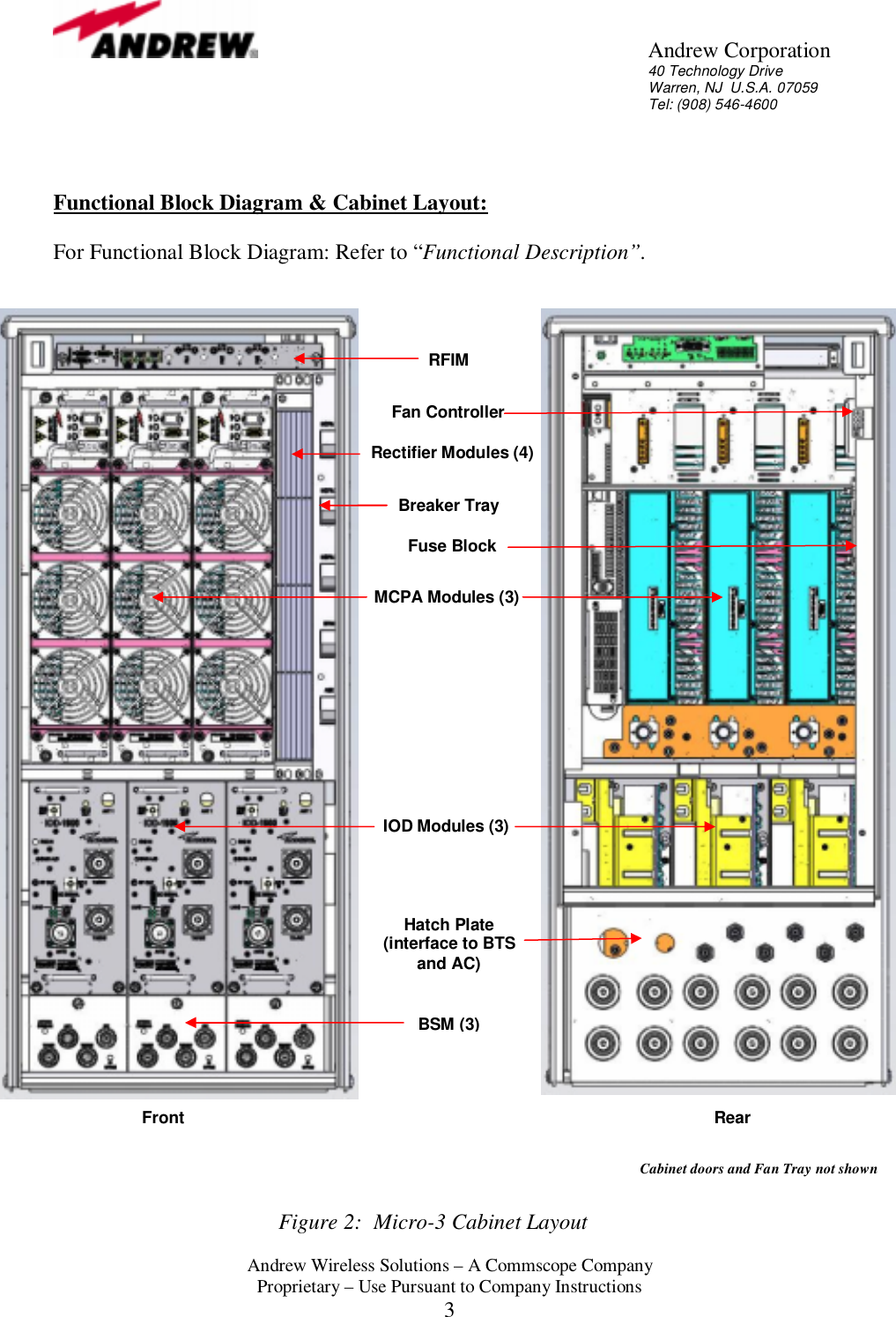
      Andrew Corporation 40 Technology Drive Warren, NJ  U.S.A. 07059 Tel: (908) 546-4600  Andrew Wireless Solutions – A Commscope Company Proprietary – Use Pursuant to Company Instructions 3   Functional Block Diagram & Cabinet Layout:  For Functional Block Diagram: Refer to “Functional Description”.    MCPA Modules (3) IOD Modules (3) BSM (3) Rectifier Modules (4) RFIM Breaker Tray Fan Controller Front Rear Hatch Plate (interface to BTS and AC) Fuse Block Cabinet doors and Fan Tray not shown Figure 2:  Micro-3 Cabinet Layout
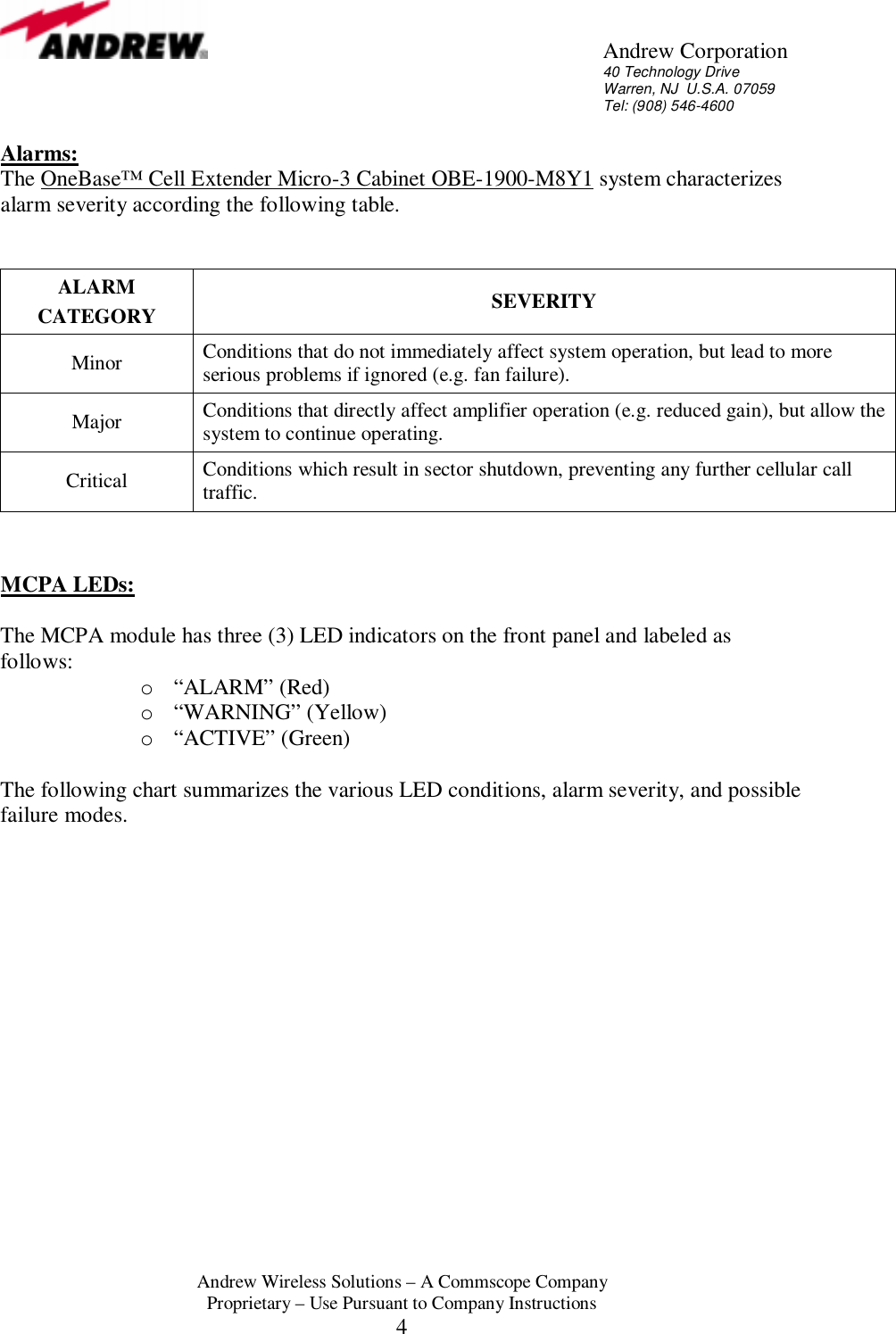
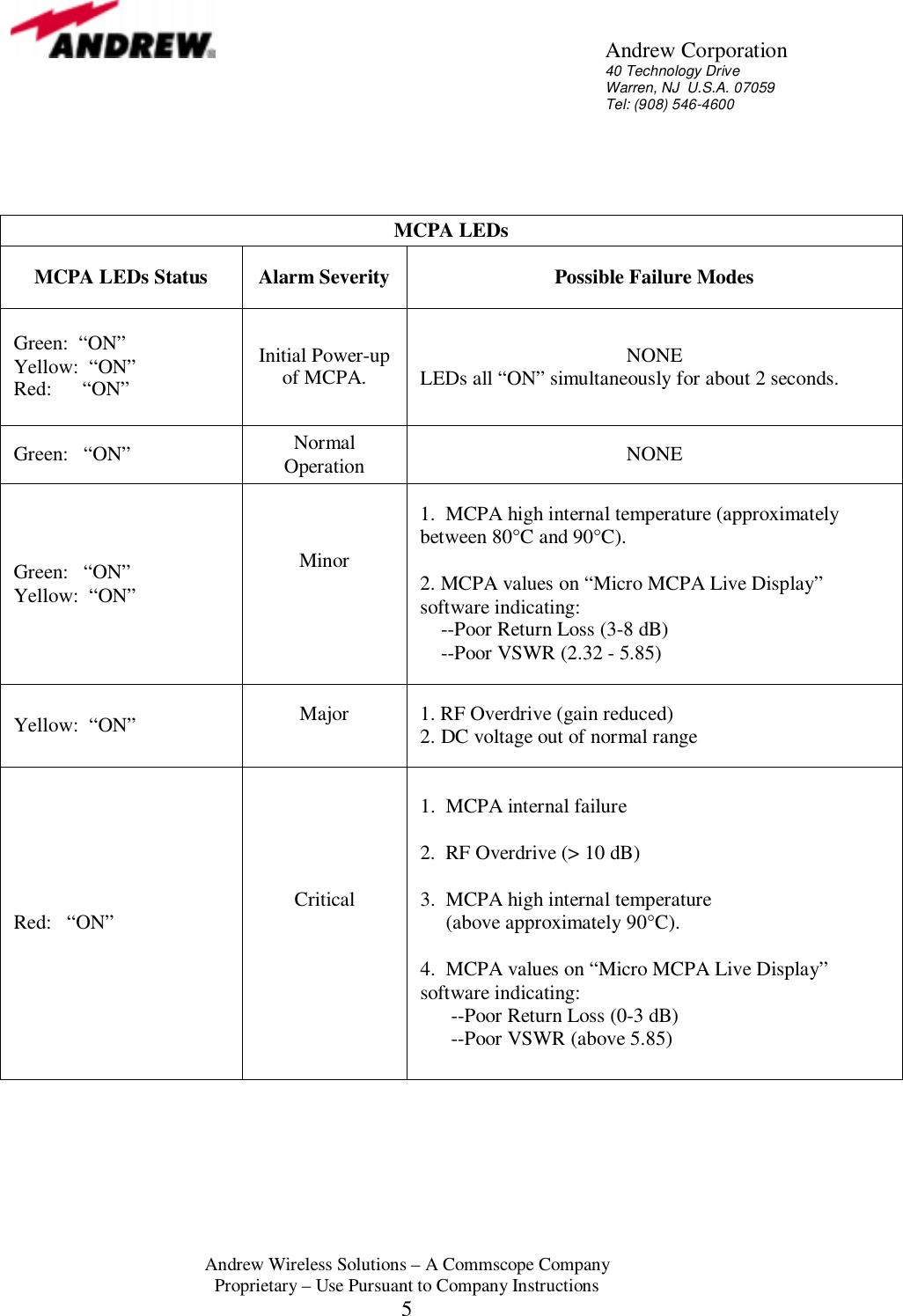
      Andrew Corporation 40 Technology Drive Warren, NJ  U.S.A. 07059 Tel: (908) 546-4600  Andrew Wireless Solutions – A Commscope Company Proprietary – Use Pursuant to Company Instructions 4 Alarms: The OneBase™ Cell Extender Micro-3 Cabinet OBE-1900-M8Y1 system characterizes alarm severity according the following table.       ALARM CATEGORY  SEVERITY Minor  Conditions that do not immediately affect system operation, but lead to more serious problems if ignored (e.g. fan failure).   Major  Conditions that directly affect amplifier operation (e.g. reduced gain), but allow the system to continue operating.  Critical  Conditions which result in sector shutdown, preventing any further cellular call traffic.   MCPA LEDs:  The MCPA module has three (3) LED indicators on the front panel and labeled as follows:  o “ALARM” (Red)  o “WARNING” (Yellow)  o “ACTIVE” (Green)    The following chart summarizes the various LED conditions, alarm severity, and possible failure modes.
      Andrew Corporation 40 Technology Drive Warren, NJ  U.S.A. 07059 Tel: (908) 546-4600  Andrew Wireless Solutions – A Commscope Company Proprietary – Use Pursuant to Company Instructions 5    MCPA LEDs MCPA LEDs Status  Alarm Severity  Possible Failure Modes Green:  “ON”              Yellow:  “ON” Red:      “ON”  Initial Power-up of MCPA.  NONE  LEDs all “ON” simultaneously for about 2 seconds. Green:   “ON”  Normal Operation  NONE Green:   “ON” Yellow:  “ON” Minor   1.  MCPA high internal temperature (approximately between 80°C and 90°C).  2. MCPA values on “Micro MCPA Live Display” software indicating:     --Poor Return Loss (3-8 dB)     --Poor VSWR (2.32 - 5.85) Yellow:  “ON”  Major  1. RF Overdrive (gain reduced) 2. DC voltage out of normal range Red:   “ON”  Critical    1.  MCPA internal failure  2.  RF Overdrive (> 10 dB)  3.  MCPA high internal temperature      (above approximately 90°C).  4.  MCPA values on “Micro MCPA Live Display” software indicating:       --Poor Return Loss (0-3 dB)       --Poor VSWR (above 5.85)
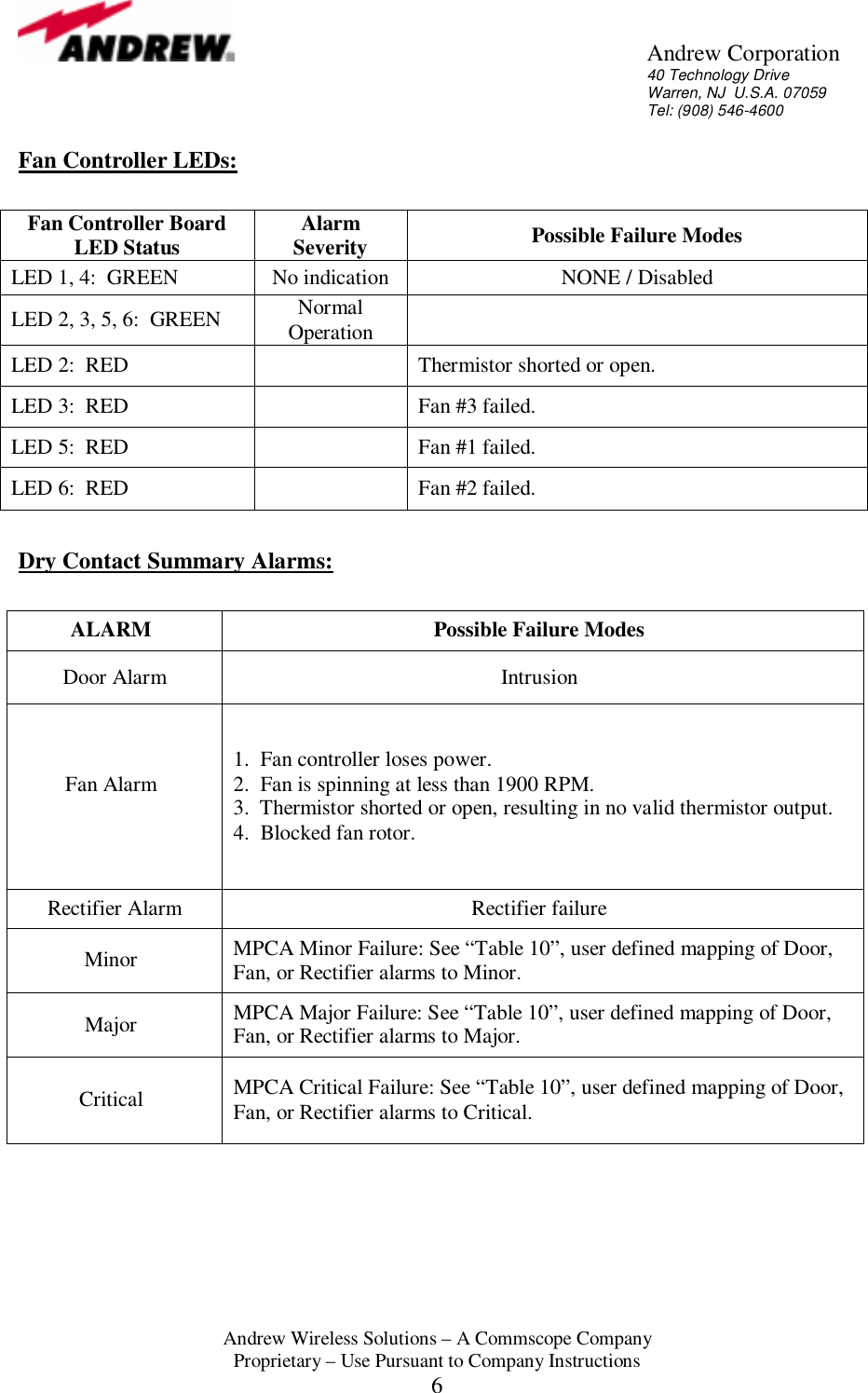
      Andrew Corporation 40 Technology Drive Warren, NJ  U.S.A. 07059 Tel: (908) 546-4600  Andrew Wireless Solutions – A Commscope Company Proprietary – Use Pursuant to Company Instructions 6 Fan Controller LEDs:  Fan Controller Board LED Status Alarm Severity  Possible Failure Modes LED 1, 4:  GREEN  No indication  NONE / Disabled LED 2, 3, 5, 6:  GREEN   Normal  Operation   LED 2:  RED   Thermistor shorted or open. LED 3:  RED   Fan #3 failed.     LED 5:  RED   Fan #1 failed.     LED 6:  RED   Fan #2 failed.      Dry Contact Summary Alarms:  ALARM  Possible Failure Modes Door Alarm  Intrusion  Fan Alarm   1.  Fan controller loses power. 2.  Fan is spinning at less than 1900 RPM. 3.  Thermistor shorted or open, resulting in no valid thermistor output. 4.  Blocked fan rotor. Rectifier Alarm  Rectifier failure Minor  MPCA Minor Failure: See “Table 10”, user defined mapping of Door, Fan, or Rectifier alarms to Minor.  Major  MPCA Major Failure: See “Table 10”, user defined mapping of Door, Fan, or Rectifier alarms to Major. Critical  MPCA Critical Failure: See “Table 10”, user defined mapping of Door, Fan, or Rectifier alarms to Critical.
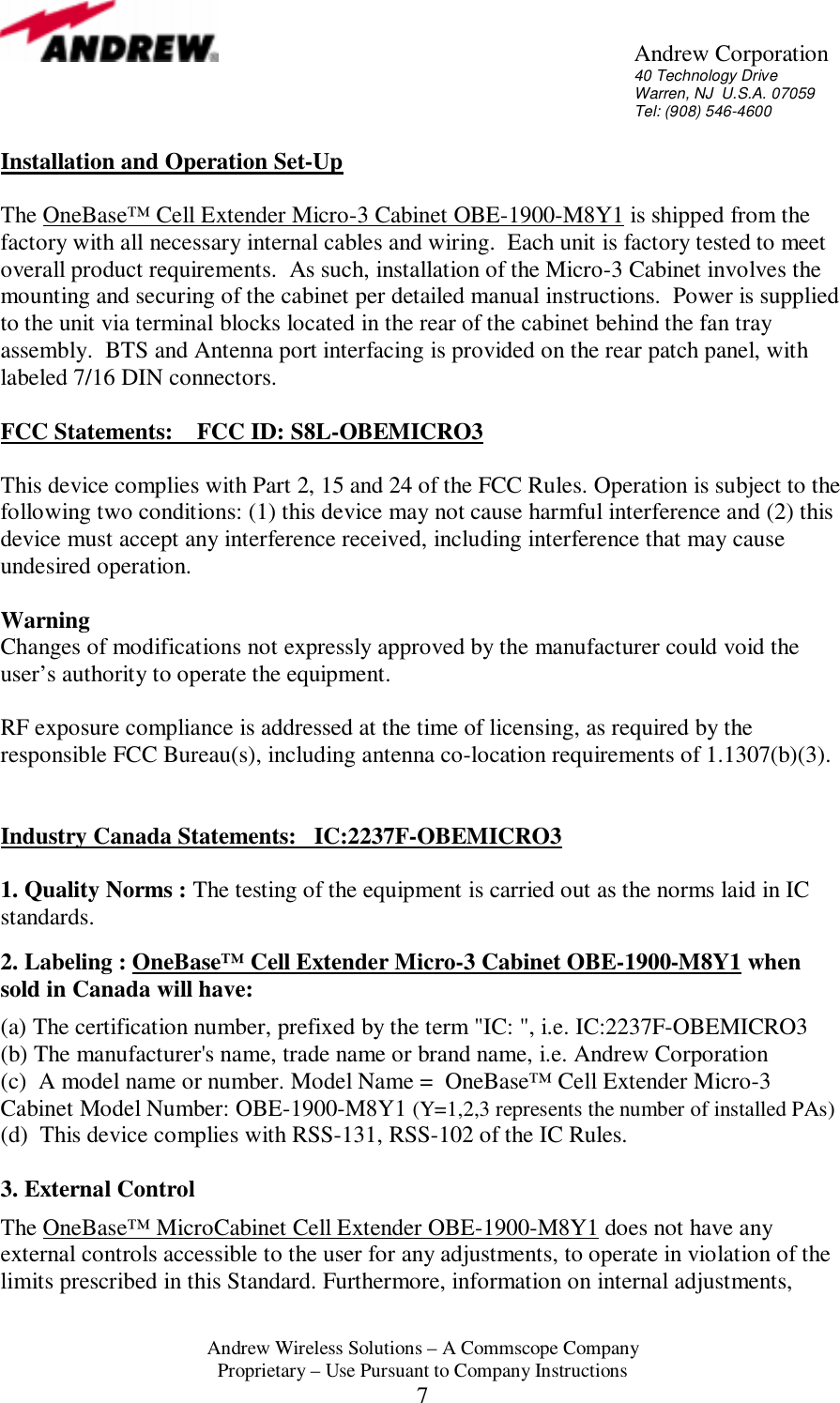
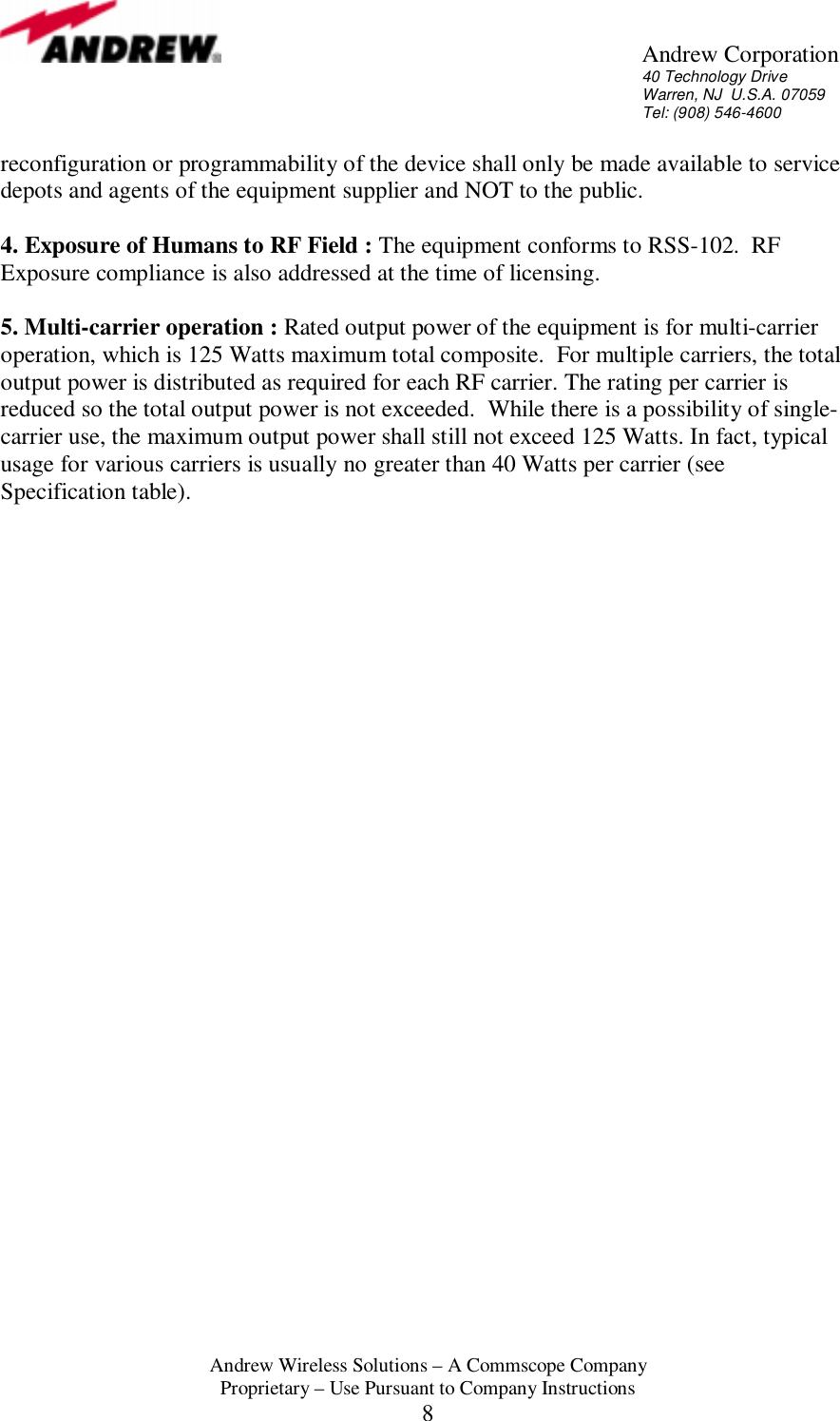
      Andrew Corporation 40 Technology Drive Warren, NJ  U.S.A. 07059 Tel: (908) 546-4600  Andrew Wireless Solutions – A Commscope Company Proprietary – Use Pursuant to Company Instructions 7 Installation and Operation Set-Up  The OneBase™ Cell Extender Micro-3 Cabinet OBE-1900-M8Y1 is shipped from the factory with all necessary internal cables and wiring.  Each unit is factory tested to meet overall product requirements.  As such, installation of the Micro-3 Cabinet involves the mounting and securing of the cabinet per detailed manual instructions.  Power is supplied to the unit via terminal blocks located in the rear of the cabinet behind the fan tray assembly.  BTS and Antenna port interfacing is provided on the rear patch panel, with labeled 7/16 DIN connectors.  FCC Statements:    FCC ID: S8L-OBEMICRO3  This device complies with Part 2, 15 and 24 of the FCC Rules. Operation is subject to the following two conditions: (1) this device may not cause harmful interference and (2) this device must accept any interference received, including interference that may cause undesired operation.  Warning  Changes of modifications not expressly approved by the manufacturer could void the user’s authority to operate the equipment.  RF exposure compliance is addressed at the time of licensing, as required by the responsible FCC Bureau(s), including antenna co-location requirements of 1.1307(b)(3).   Industry Canada Statements:   IC:2237F-OBEMICRO3  1. Quality Norms : The testing of the equipment is carried out as the norms laid in IC standards.   2. Labeling : OneBase™ Cell Extender Micro-3 Cabinet OBE-1900-M8Y1 when sold in Canada will have:  (a) The certification number, prefixed by the term "IC: ", i.e. IC:2237F-OBEMICRO3  (b) The manufacturer's name, trade name or brand name, i.e. Andrew Corporation (c)  A model name or number. Model Name =  OneBase™ Cell Extender Micro-3 Cabinet Model Number: OBE-1900-M8Y1 (Y=1,2,3 represents the number of installed PAs) (d)  This device complies with RSS-131, RSS-102 of the IC Rules.  3. External Control  The OneBase™ MicroCabinet Cell Extender OBE-1900-M8Y1 does not have any external controls accessible to the user for any adjustments, to operate in violation of the limits prescribed in this Standard. Furthermore, information on internal adjustments,
      Andrew Corporation 40 Technology Drive Warren, NJ  U.S.A. 07059 Tel: (908) 546-4600  Andrew Wireless Solutions – A Commscope Company Proprietary – Use Pursuant to Company Instructions 8 reconfiguration or programmability of the device shall only be made available to service depots and agents of the equipment supplier and NOT to the public.  4. Exposure of Humans to RF Field : The equipment conforms to RSS-102.  RF Exposure compliance is also addressed at the time of licensing.  5. Multi-carrier operation : Rated output power of the equipment is for multi-carrier operation, which is 125 Watts maximum total composite.  For multiple carriers, the total output power is distributed as required for each RF carrier. The rating per carrier is reduced so the total output power is not exceeded.  While there is a possibility of single-carrier use, the maximum output power shall still not exceed 125 Watts. In fact, typical usage for various carriers is usually no greater than 40 Watts per carrier (see Specification table).

Navigation menu