Ascalade Technologies DT19R42H 1.9 GHZ DECT CORDLESS PHONE-HANDSET User Manual DECT200UG10

Ascalade Technologies, Inc. 1.9 GHZ DECT CORDLESS PHONE-HANDSET DECT200UG10

Contents

USERS MANUAL 2

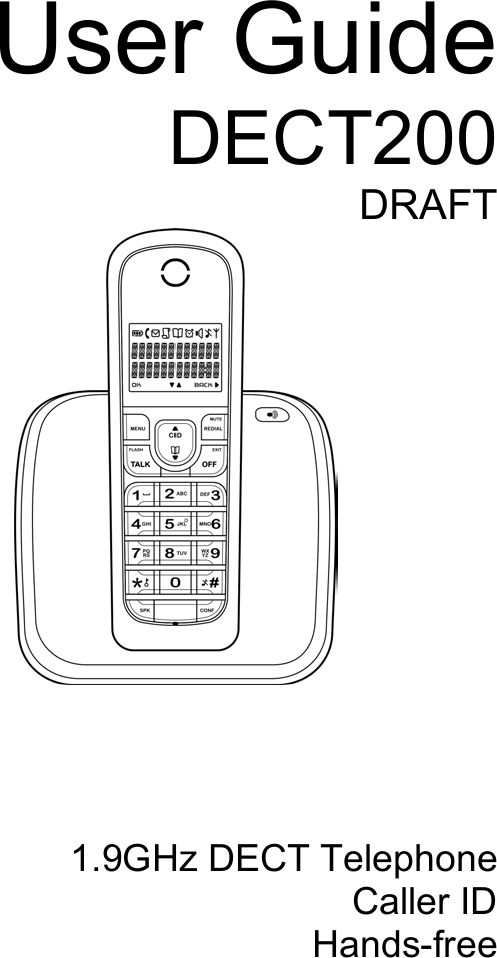
 User Guide DECT200 DRAFT        1.9GHz DECT Telephone Caller ID Hands-free
- i - Table of Contents 1  Environment and Safety ....................................................... 2 2  What’s in the Box? ..............................................................4 3 Welcome ..........................................................................5 How to use this user guide? ................................................. 5 Need more help? .............................................................. 5 4  About your phone ...............................................................6 The handset.................................................................... 6 The base........................................................................ 7 The icons ....................................................................... 7 The menus ..................................................................... 8 5 Getting Started .................................................................. 9 Connecting your phone....................................................... 9 Connecting your charger ..................................................... 9 Charging your handset ....................................................... 9 Checking the battery level .................................................10 What is standby mode?......................................................10 Registering your handset ...................................................11 Setting the clock .............................................................11 6 Call ............................................................................... 12 Making a call ..................................................................12 Ending a call ..................................................................13 Answering a call..............................................................13 During a call ..................................................................14 7  Intercom and Conference Calls............................................. 15 Calling another handset.....................................................15 Transferring a call ...........................................................15 Making a conference call ...................................................15 8  Text and Numbers............................................................. 17 Entering text and numbers .................................................17 9 Phonebook ...................................................................... 18 Viewing the phonebook .....................................................18 Calling from the phonebook................................................18 Adding a record ..............................................................19 Editing a record ..............................................................19 Deleting a record.............................................................19 Deleting all records..........................................................19 10 Call Log .......................................................................... 21 Viewing the call records ....................................................21 Making a call ..................................................................21 Saving a call record to your phonebook ..................................21 Deleting a call record .......................................................21 Deleting all records..........................................................21 11 Custom Options ................................................................ 23 Personalizing your phone’s display........................................23 Personalizing your handset’s sounds ......................................23 12 Calling Features ............................................................... 25
Table of Contents - ii - Auto answer...................................................................25 Dial mode .....................................................................25 Recall selection ..............................................................25 Area code removal...........................................................26 CID Prefix......................................................................26 13 Extra Features ................................................................. 27 The alarm clock ..............................................................27 Baby call.......................................................................27 Keypad lock ...................................................................28 Missing handset(s)............................................................28 Voicemail indication.........................................................28 14 The System ..................................................................... 29 Registering your handset with additional base..........................29 Selecting a base unit ........................................................29 Deleting a handset...........................................................30 Changing the system PIN....................................................30 Resetting to default settings ...............................................30 15 Appendix ........................................................................ 31 Default settings ..............................................................31 Troubleshooting ..............................................................32 PHONE Specifications........................................................33 16 Compliance Statement ....................................................... 34 17 Service Centers ................................................................ 37
- 1 -   BEFORE USING YOUR TELEPHONE EQUIPMENT, BASIC SAFETY PRECAUTIONS SHOUD ALWAYS BE FOLLOWED TO REDUCE THE RISK OF FIRE, ELECTRIC SHOCK AND INJURY, INCLUDING THE FOLLOWING. •  Read and follow all warnings and instructions marked on the product. •  Do not use this product near water, laundry tub, in a wet basement, or near a swimming pool. •  Do not place this product on an unstable table. The product may fall and be damaged. •  This product should never be placed near or over a radiator or heat register.   •  This product should be operated only from the type of power source indicated on the label.   •  Do not allow anything to rest on the power cord.  Do not locate this product where the cord will be abused by persons walking on it. •  Do not overload wall outlets and extension cords as this can result in the risk of fire or electric shock. •  Avoid using a telephone during an electrical storm.  There may be a remote risk of electric shock from lightning. •  Do not use this product to report a gas leak in the vicinity of the leak. •  Do not use this product near intensive care medical equipment or by persons with pacemakers. •  Due to the radio signals between base station and handset, wearers of hearing aids may experience interference in the form of a humming noise. •  Do not allow the handset to come into contact with liquids or moisture. •  Do not open the handset, base unit or charger. This could expose you to high voltages. •  Do not allow the charging contacts or the battery to come into contact with conductive materials. •  There is a slight chance that your product could be damaged by an electrical storm. We recommend that you unplug the product from the power supply and telephone socket during a storm. •  Do not use the handset in an explosive hazard area such as where there is gas leaking. •  It is recommended that this product is not used near intensive care medical equipments or by persons with pacemakers. •  This product can interfere with electrical equipment such as answering machine, television, radio, and computers if placed too close. We recommend that you position the base unit at least one meter from such appliances. •  This product is not designed for making emergency telephone calls when the power fails. Alternative arrangements should be made for access to emergency services.  BATTERIES •  Use only the battery type listed in the instruction manual.  Do not use lithium batteries. •  Do not dispose of the battery in a fire, as they can explode.   •  Do not open or mutilate the battery.  Released electrolyte is corrosive and can cause damage to the eyes or skin.  It can be toxic if swallowed. •  Avoid contact with metal objects when handling the battery.  These objects could short out the batteries or cause the conductor to overheat resulting in burns. •  Do not attempt to recharge the battery cell by heating it.  Sudden release of battery electrolyte can cause burns or irritation to the eyes or skin. •  Observe the proper polarity, or direction, of any battery.  Reverse insertion of the battery cell can result in leakage or explosion. •  Remove the battery cells if you do not plan to use the product for several months at a time.   •  Discard any “dead” batteries because they are likely to leak into the product. •  Do not store this product or the battery in a high temperature area.  Battery stored in a freezer or refrigerator should be protected from condensation during storage and defrosting.  Battery should be stabilized at room temperature before using. •  Your battery is rechargeable and can be recycled once it outlives its usefulness.  Depending upon your local and state law, it might be illegal to dispose of this battery into a municipal waste system.  Check with your local solid waste company for more information on your recycling options for the battery cells.  SAVE THESE INSTRUCTIONS Important Safety Instructions
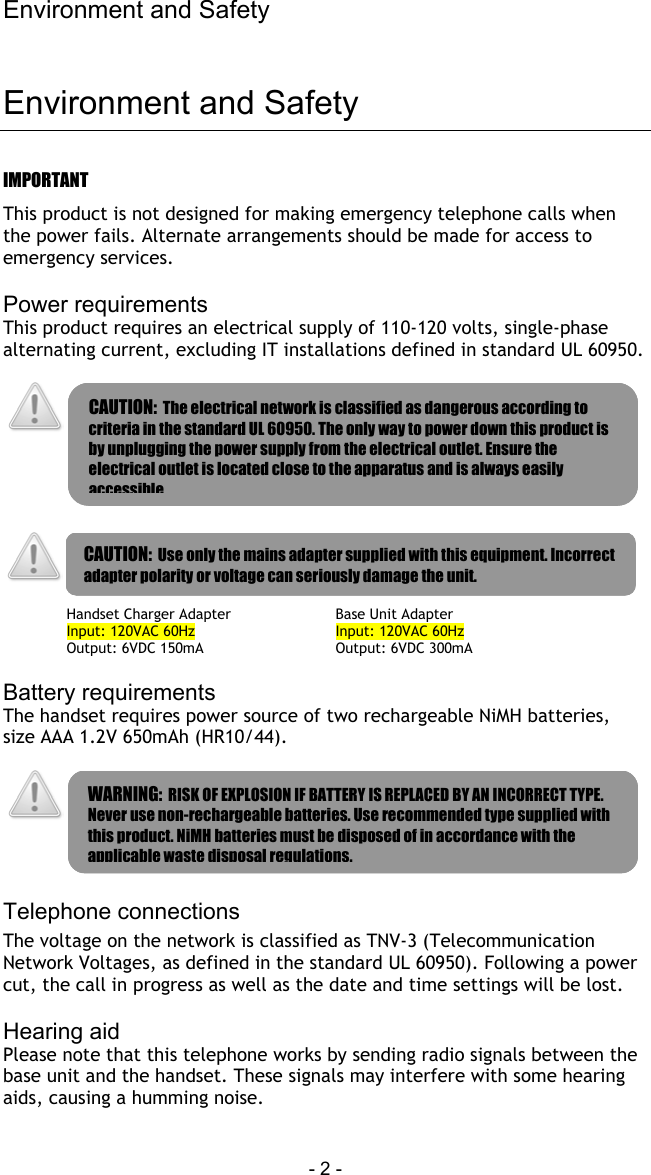
Environment and Safety - 2 -   Environment and Safety IMPORTANT This product is not designed for making emergency telephone calls when the power fails. Alternate arrangements should be made for access to emergency services.  Power requirements This product requires an electrical supply of 110-120 volts, single-phase alternating current, excluding IT installations defined in standard UL 60950.         Handset Charger Adapter Input: 120VAC 60Hz Output: 6VDC 150mA Base Unit Adapter Input: 120VAC 60Hz Output: 6VDC 300mA  Battery requirements The handset requires power source of two rechargeable NiMH batteries, size AAA 1.2V 650mAh (HR10/44).     Telephone connections The voltage on the network is classified as TNV-3 (Telecommunication Network Voltages, as defined in the standard UL 60950). Following a power cut, the call in progress as well as the date and time settings will be lost.  Hearing aid Please note that this telephone works by sending radio signals between the base unit and the handset. These signals may interfere with some hearing aids, causing a humming noise.  CAUTION:  Use only the mains adapter supplied with this equipment. Incorrect adapter polarity or voltage can seriously damage the unit. CAUTION:  The electrical network is classified as dangerous according to criteria in the standard UL 60950. The only way to power down this product is by unplugging the power supply from the electrical outlet. Ensure the electrical outlet is located close to the apparatus and is always easily accessible WARNING:  RISK OF EXPLOSION IF BATTERY IS REPLACED BY AN INCORRECT TYPE. Never use non-rechargeable batteries. Use recommended type supplied with this product. NiMH batteries must be disposed of in accordance with the applicable waste disposal regulations.
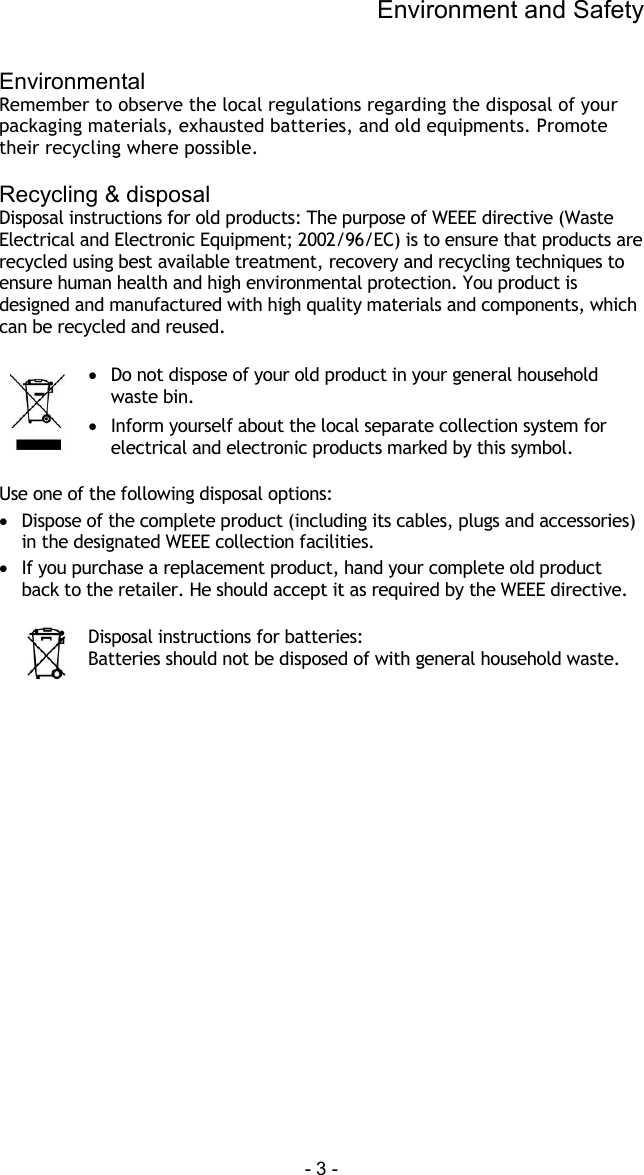
Environment and Safety - 3 -  Environmental Remember to observe the local regulations regarding the disposal of your packaging materials, exhausted batteries, and old equipments. Promote their recycling where possible.  Recycling & disposal Disposal instructions for old products: The purpose of WEEE directive (Waste Electrical and Electronic Equipment; 2002/96/EC) is to ensure that products are recycled using best available treatment, recovery and recycling techniques to ensure human health and high environmental protection. You product is designed and manufactured with high quality materials and components, which can be recycled and reused.   •  Do not dispose of your old product in your general household waste bin.  •  Inform yourself about the local separate collection system for electrical and electronic products marked by this symbol.  Use one of the following disposal options: •  Dispose of the complete product (including its cables, plugs and accessories) in the designated WEEE collection facilities. •  If you purchase a replacement product, hand your complete old product back to the retailer. He should accept it as required by the WEEE directive.   Disposal instructions for batteries: Batteries should not be disposed of with general household waste.
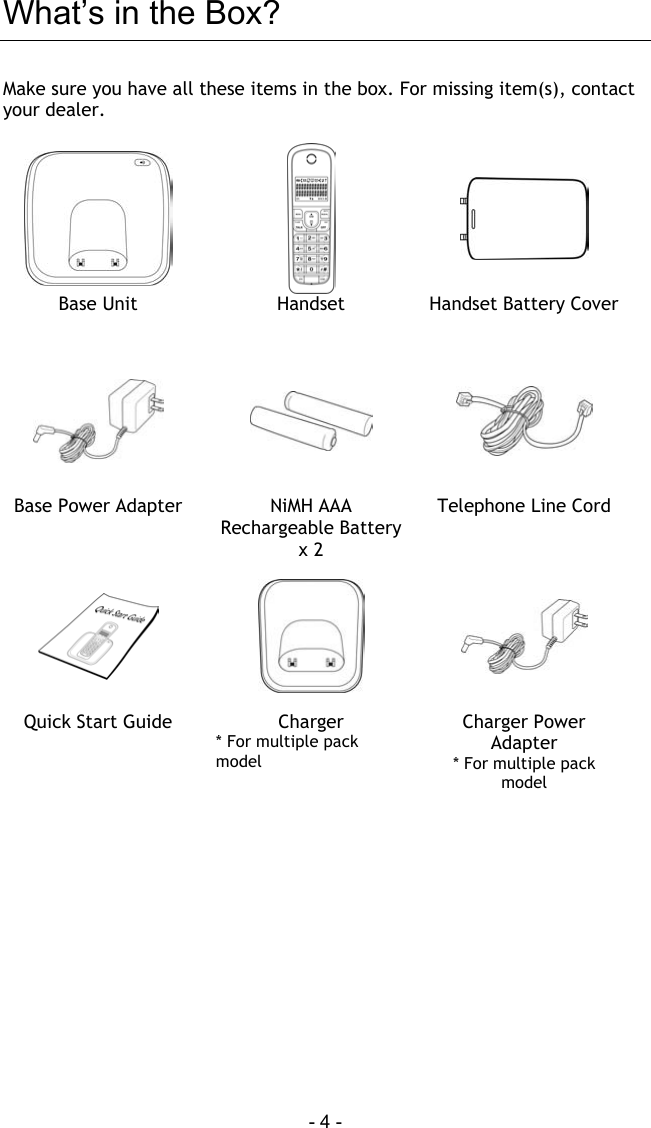
 - 4 - What’s in the Box? Make sure you have all these items in the box. For missing item(s), contact your dealer.     Base Unit  Handset  Handset Battery Cover     Base Power Adapter  NiMH AAA Rechargeable Battery  x 2 Telephone Line Cord      Quick Start Guide   Charger  * For multiple pack model Charger Power Adapter * For multiple pack model
 - 5 - Welcome This user guide provides you with information and instruction you need to get the most from your phone.  HOW TO USE THIS USER GUIDE? The following symbols are used to alert you on important information.   This symbol has two meanings: •  Warning: Critical information for preventing personal injury. •  Caution: Critical information for preventing damage on the product.  •  Tip: Information for easier operation.   •  Note: Explanatory or critical information for carrying out an operation correctly.  NEED MORE HELP? •  See the Troubleshooting section in this user guide on page 32. •  Call the Helpline at … •  Visit our online help xxx.com
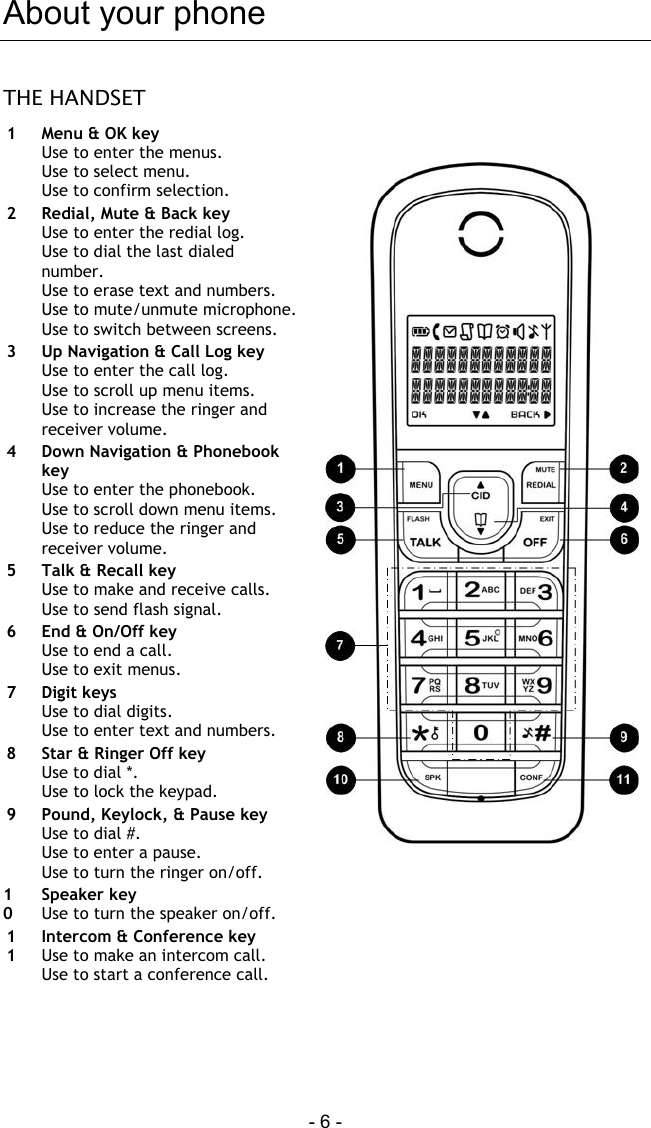
 - 6 - About your phone THE HANDSET 1  M e n u  &  O K  k e y  Use to enter the menus. Use to select menu. Use to confirm selection. 2  Re d i a l ,  M u t e  &  B a c k  k e y  Use to enter the redial log. Use to dial the last dialed number. Use to erase text and numbers. Use to mute/unmute microphone. Use to switch between screens. 3   Up Navigation & Call Log key Use to enter the call log. Use to scroll up menu items. Use to increase the ringer and receiver volume. 4  Down Navigation & Phonebook key Use to enter the phonebook. Use to scroll down menu items. Use to reduce the ringer and receiver volume. 5  Talk & Recall key Use to make and receive calls. Use to send flash signal. 6  End & On/Off key Use to end a call. Use to exit menus. 7 D i g i t  k e y s  Use to dial digits. Use to enter text and numbers. 8  S t ar  &  Ri n g e r  O f f  k e y  Use to dial *. Use to lock the keypad. 9  Pound, Keylock, & Pause key Use to dial #. Use to enter a pause. Use to turn the ringer on/off.  10 Speaker key Use to turn the speaker on/off.   11 Intercom & Conference key Use to make an intercom call. Use to start a conference call.
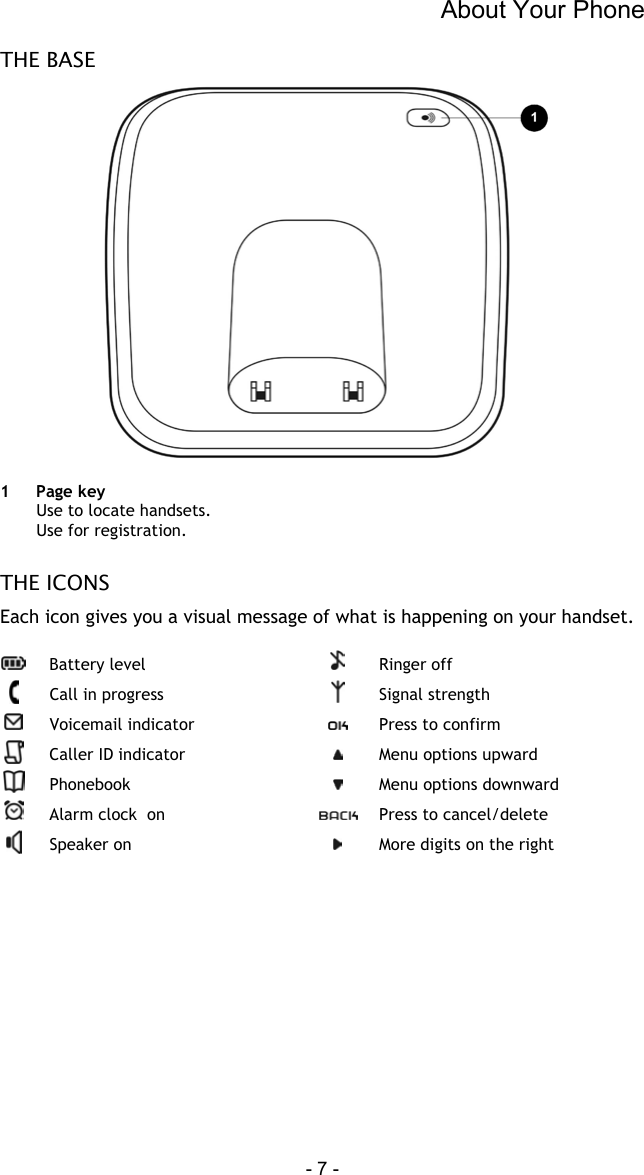
About Your Phone - 7 - THE BASE    1 Page key Use to locate handsets. Use for registration.    THE ICONS Each icon gives you a visual message of what is happening on your handset.   Battery level   Ringer off  Call in progress   Signal strength  Voicemail indicator   Press to confirm  Caller ID indicator   Menu options upward  Phonebook   Menu options downward  Alarm clock  on   Press to cancel/delete  Speaker on   More digits on the right
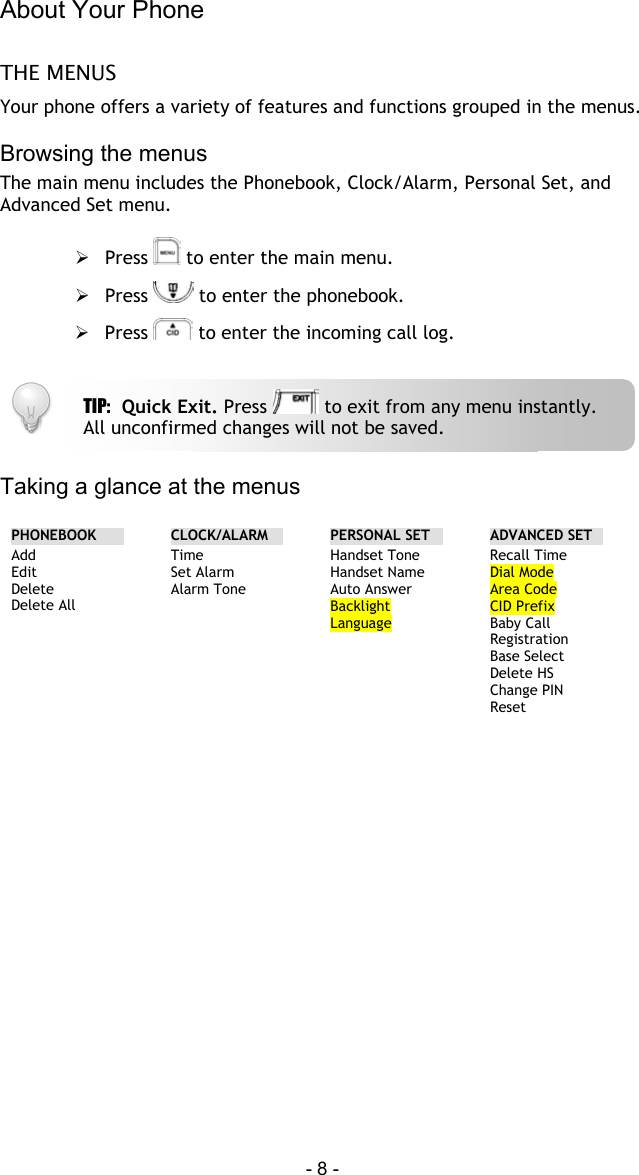
About Your Phone  - 8 - THE MENUS Your phone offers a variety of features and functions grouped in the menus.   Browsing the menus The main menu includes the Phonebook, Clock/Alarm, Personal Set, and Advanced Set menu.   Press   to enter the main menu.  Press   to enter the phonebook.  Press   to enter the incoming call log.    Taking a glance at the menus  PHONEBOOK  CLOCK/ALARM  PERSONAL SET    ADVANCED SET Add Edit Delete Delete All  Time Set Alarm Alarm Tone  Handset Tone Handset Name Auto Answer Backlight Language  Recall Time Dial Mode Area Code CID Prefix Baby Call Registration Base Select Delete HS Change PIN Reset  TIP:  Quick Exit. Press   to exit from any menu instantly. All unconfirmed changes will not be saved.
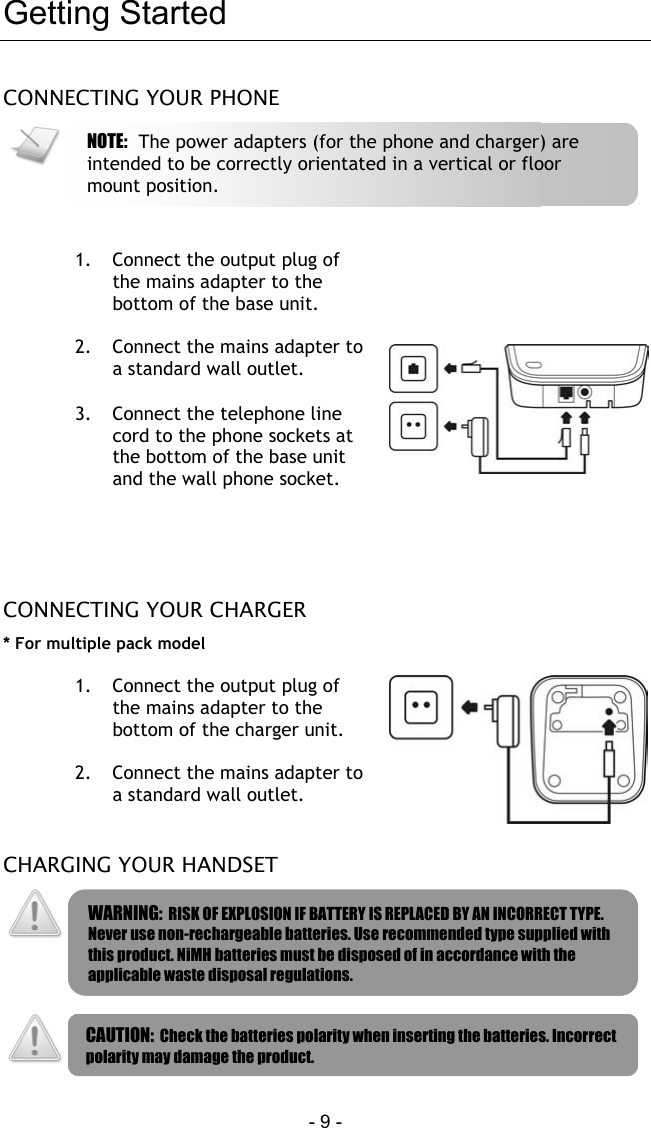
 - 9 - Getting Started CONNECTING YOUR PHONE    1.  Connect the output plug of the mains adapter to the bottom of the base unit.  2.  Connect the mains adapter to a standard wall outlet.  3.  Connect the telephone line cord to the phone sockets at the bottom of the base unit and the wall phone socket.    CONNECTING YOUR CHARGER * For multiple pack model  1.  Connect the output plug of the mains adapter to the bottom of the charger unit.  2.  Connect the mains adapter to a standard wall outlet.   CHARGING YOUR HANDSET      WARNING:  RISK OF EXPLOSION IF BATTERY IS REPLACED BY AN INCORRECT TYPE. Never use non-rechargeable batteries. Use recommended type supplied with this product. NiMH batteries must be disposed of in accordance with the applicable waste disposal regulations. CAUTION:  Check the batteries polarity when inserting the batteries. Incorrect polarity may damage the product. NOTE:  The power adapters (for the phone and charger) are intended to be correctly orientated in a vertical or floor mount position.
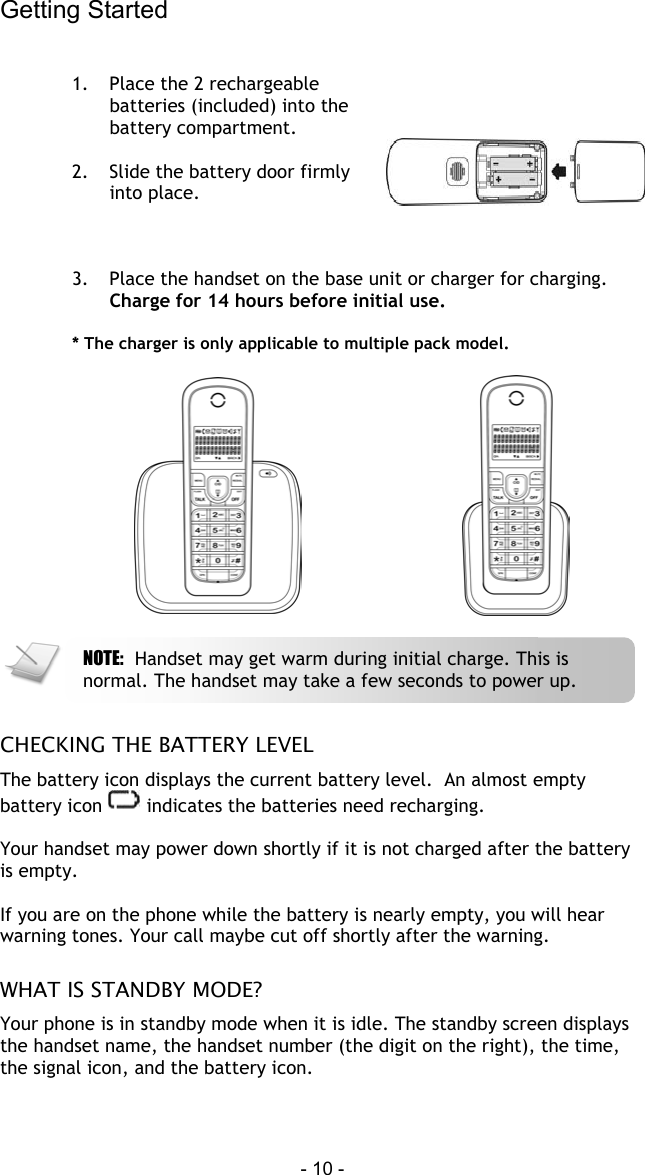
Getting Started  - 10 -  1.  Place the 2 rechargeable batteries (included) into the battery compartment.  2.  Slide the battery door firmly into place.   3.  Place the handset on the base unit or charger for charging. Charge for 14 hours before initial use.  * The charger is only applicable to multiple pack model.       CHECKING THE BATTERY LEVEL The battery icon displays the current battery level.  An almost empty battery icon   indicates the batteries need recharging.  Your handset may power down shortly if it is not charged after the battery is empty.  If you are on the phone while the battery is nearly empty, you will hear warning tones. Your call maybe cut off shortly after the warning.  WHAT IS STANDBY MODE? Your phone is in standby mode when it is idle. The standby screen displays the handset name, the handset number (the digit on the right), the time, the signal icon, and the battery icon.   NOTE:  Handset may get warm during initial charge. This is normal. The handset may take a few seconds to power up.
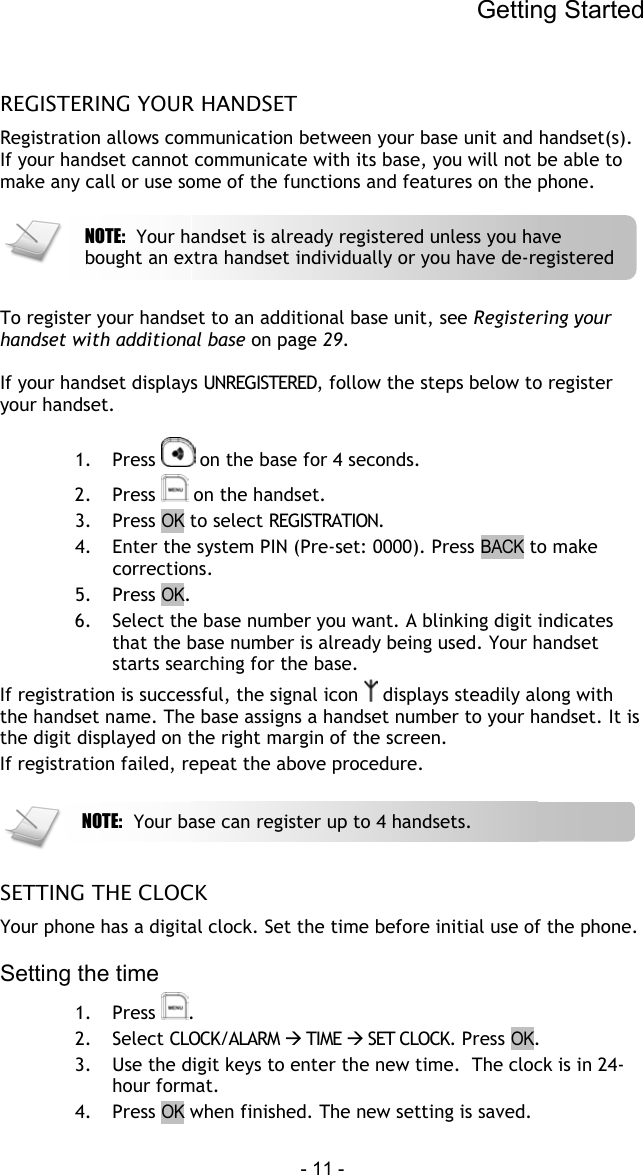
Getting Started - 11 -   REGISTERING YOUR HANDSET Registration allows communication between your base unit and handset(s). If your handset cannot communicate with its base, you will not be able to make any call or use some of the functions and features on the phone.      To register your handset to an additional base unit, see Registering your handset with additional base on page 29.  If your handset displays UNREGISTERED, follow the steps below to register your handset.  1. Press   on the base for 4 seconds.  2. Press   on the handset. 3. Press OK to select REGISTRATION. 4.  Enter the system PIN (Pre-set: 0000). Press BACK to make corrections. 5. Press OK. 6.  Select the base number you want. A blinking digit indicates that the base number is already being used. Your handset starts searching for the base. If registration is successful, the signal icon   displays steadily along with the handset name. The base assigns a handset number to your handset. It is the digit displayed on the right margin of the screen. If registration failed, repeat the above procedure.    SETTING THE CLOCK Your phone has a digital clock. Set the time before initial use of the phone.  Setting the time 1. Press  . 2. Select CLOCK/ALARM  TIME  SET CLOCK. Press OK. 3.  Use the digit keys to enter the new time.  The clock is in 24-hour format. 4. Press OK when finished. The new setting is saved. NOTE:  Your base can register up to 4 handsets.  NOTE:  Your handset is already registered unless you have bought an extra handset individually or you have de-registered
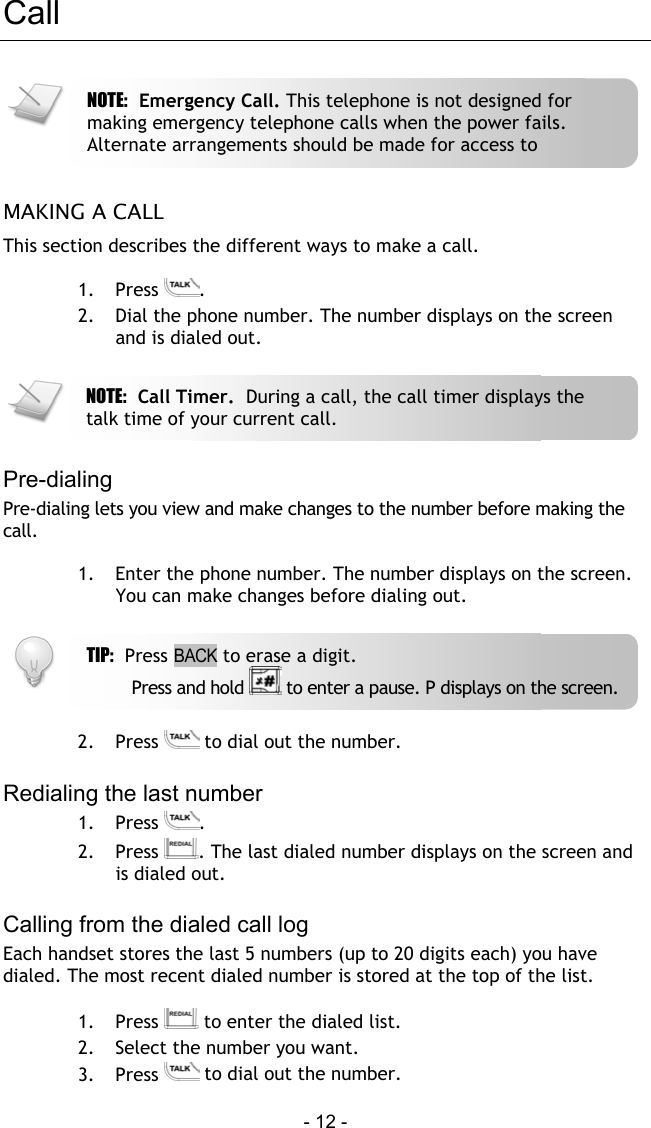
 - 12 - Call   MAKING A CALL This section describes the different ways to make a call.  1. Press  . 2.  Dial the phone number. The number displays on the screen and is dialed out.    Pre-dialing Pre-dialing lets you view and make changes to the number before making the call.  1.  Enter the phone number. The number displays on the screen. You can make changes before dialing out.    2. Press   to dial out the number.  Redialing the last number 1. Press  . 2. Press  . The last dialed number displays on the screen and is dialed out.  Calling from the dialed call log Each handset stores the last 5 numbers (up to 20 digits each) you have dialed. The most recent dialed number is stored at the top of the list.   1. Press   to enter the dialed list. 2.  Select the number you want. 3. Press   to dial out the number. TIP:  Press BACK to erase a digit.         Press and hold   to enter a pause. P displays on the screen.NOTE:  Emergency Call. This telephone is not designed for making emergency telephone calls when the power fails. Alternate arrangements should be made for access to NOTE:  Call Timer.  During a call, the call timer displays the talk time of your current call.
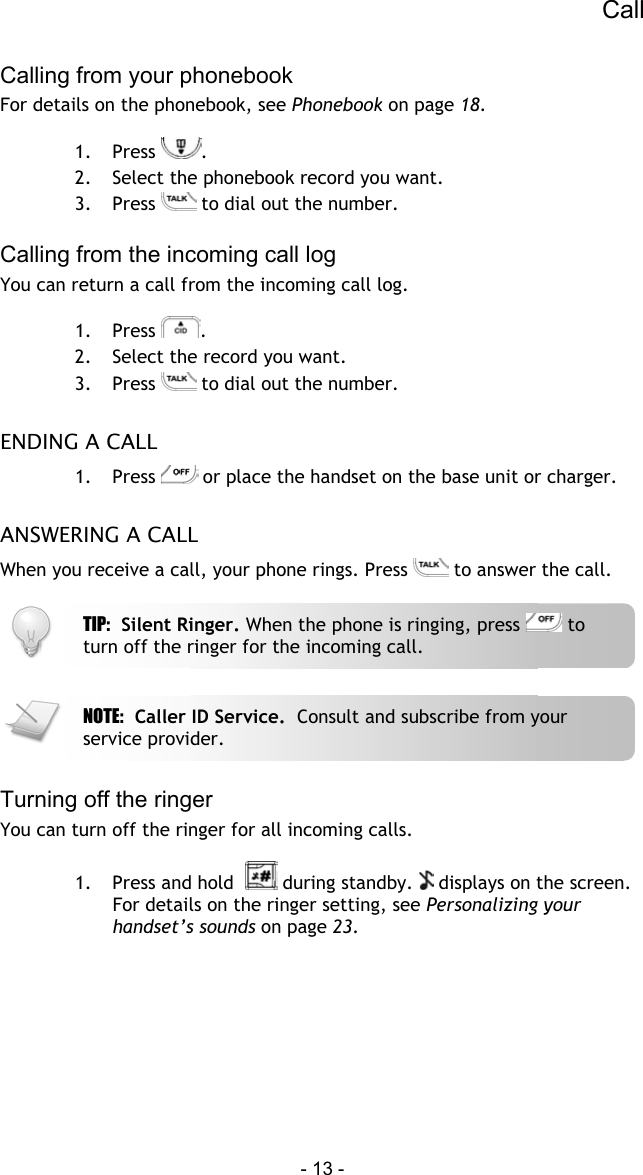
Call - 13 -  Calling from your phonebook For details on the phonebook, see Phonebook on page 18.  1. Press  . 2.  Select the phonebook record you want. 3. Press   to dial out the number.  Calling from the incoming call log You can return a call from the incoming call log.   1. Press  . 2.  Select the record you want. 3. Press   to dial out the number.  ENDING A CALL 1. Press   or place the handset on the base unit or charger.  ANSWERING A CALL When you receive a call, your phone rings. Press   to answer the call.      Turning off the ringer You can turn off the ringer for all incoming calls.  1.  Press and hold    during standby.   displays on the screen. For details on the ringer setting, see Personalizing your handset’s sounds on page 23.  NOTE:  Caller ID Service.  Consult and subscribe from your service provider. TIP:  Silent Ringer. When the phone is ringing, press   to turn off the ringer for the incoming call.
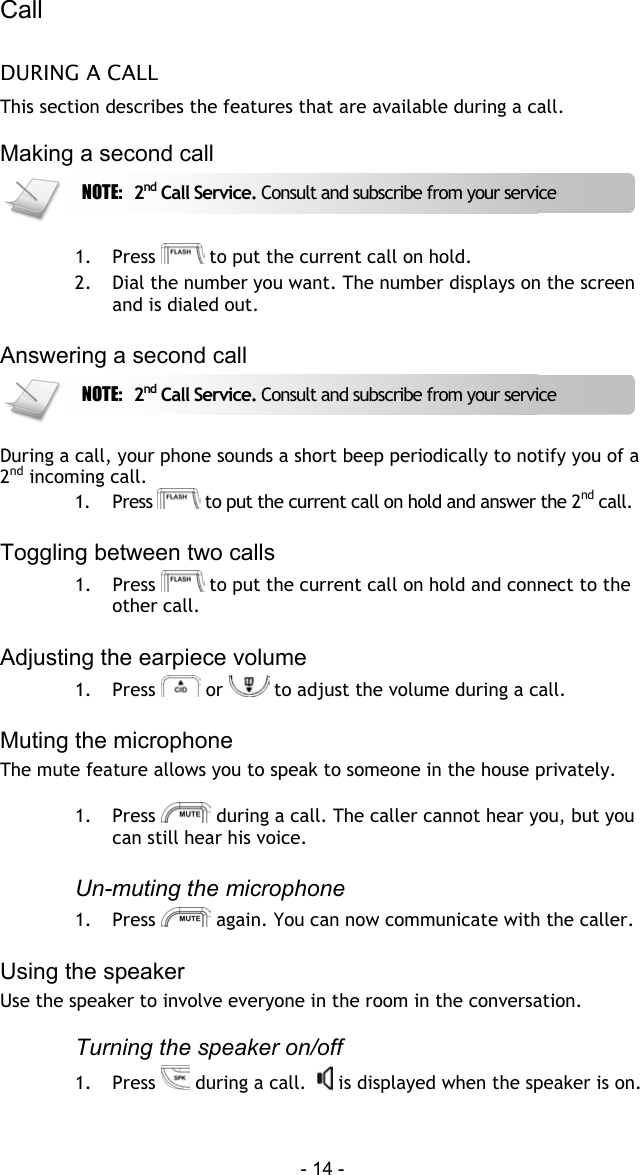
Call  - 14 - DURING A CALL This section describes the features that are available during a call.  Making a second call   1. Press   to put the current call on hold.  2.  Dial the number you want. The number displays on the screen and is dialed out.  Answering a second call   During a call, your phone sounds a short beep periodically to notify you of a 2nd incoming call. 1. Press   to put the current call on hold and answer the 2nd call.   Toggling between two calls 1. Press   to put the current call on hold and connect to the other call.  Adjusting the earpiece volume 1. Press   or   to adjust the volume during a call.   Muting the microphone The mute feature allows you to speak to someone in the house privately.  1. Press   during a call. The caller cannot hear you, but you can still hear his voice.  Un-muting the microphone 1. Press   again. You can now communicate with the caller.  Using the speaker Use the speaker to involve everyone in the room in the conversation.   Turning the speaker on/off 1. Press   during a call.    is displayed when the speaker is on.NOTE:  2nd Call Service. Consult and subscribe from your service NOTE:  2nd Call Service. Consult and subscribe from your service
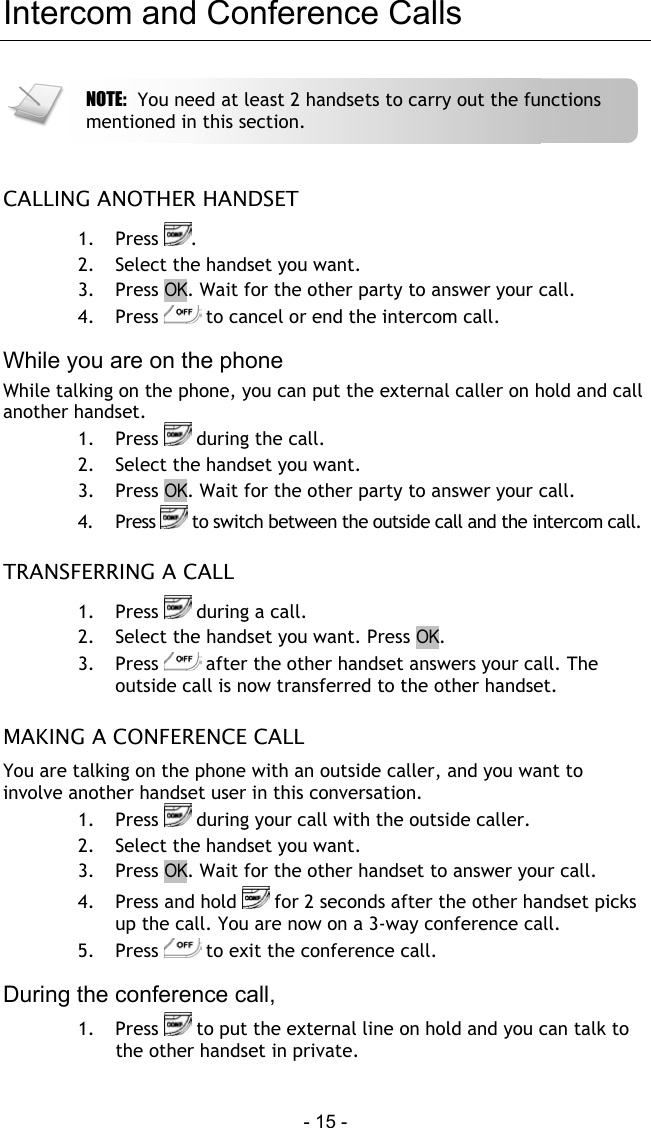
 - 15 - Intercom and Conference Calls   CALLING ANOTHER HANDSET 1. Press  . 2.  Select the handset you want. 3. Press OK. Wait for the other party to answer your call. 4. Press   to cancel or end the intercom call.  While you are on the phone While talking on the phone, you can put the external caller on hold and call another handset. 1. Press   during the call. 2.  Select the handset you want. 3. Press OK. Wait for the other party to answer your call. 4. Press   to switch between the outside call and the intercom call.   TRANSFERRING A CALL 1. Press   during a call. 2.  Select the handset you want. Press OK. 3. Press   after the other handset answers your call. The outside call is now transferred to the other handset.  MAKING A CONFERENCE CALL You are talking on the phone with an outside caller, and you want to involve another handset user in this conversation. 1. Press   during your call with the outside caller. 2.  Select the handset you want. 3. Press OK. Wait for the other handset to answer your call. 4.  Press and hold   for 2 seconds after the other handset picks up the call. You are now on a 3-way conference call. 5. Press   to exit the conference call.  During the conference call, 1. Press   to put the external line on hold and you can talk to the other handset in private.  NOTE:  You need at least 2 handsets to carry out the functions mentioned in this section.
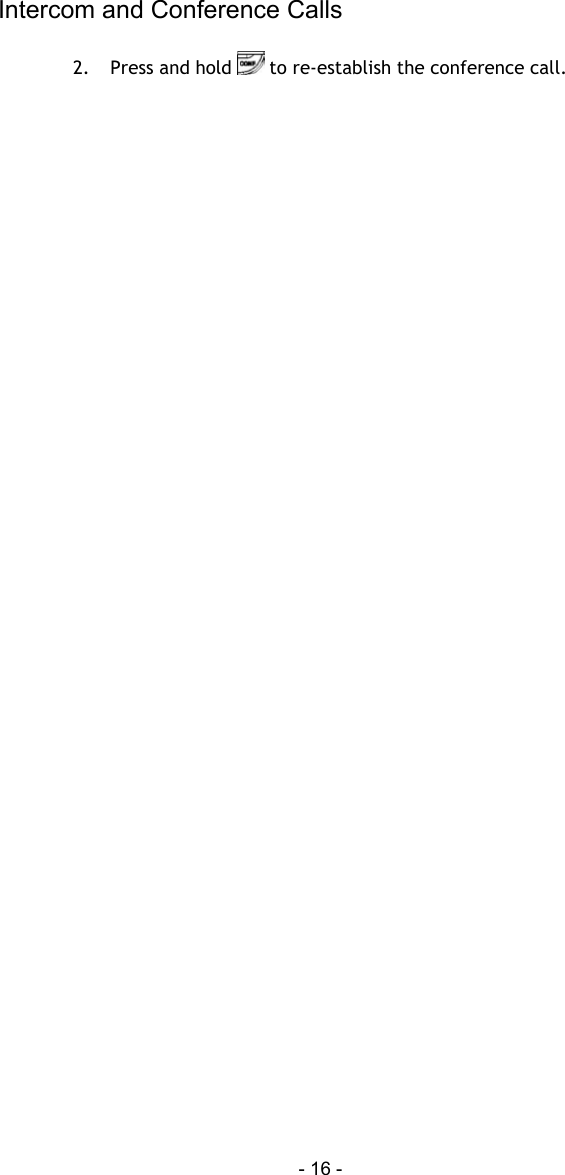
Intercom and Conference Calls  - 16 - 2.  Press and hold   to re-establish the conference call.
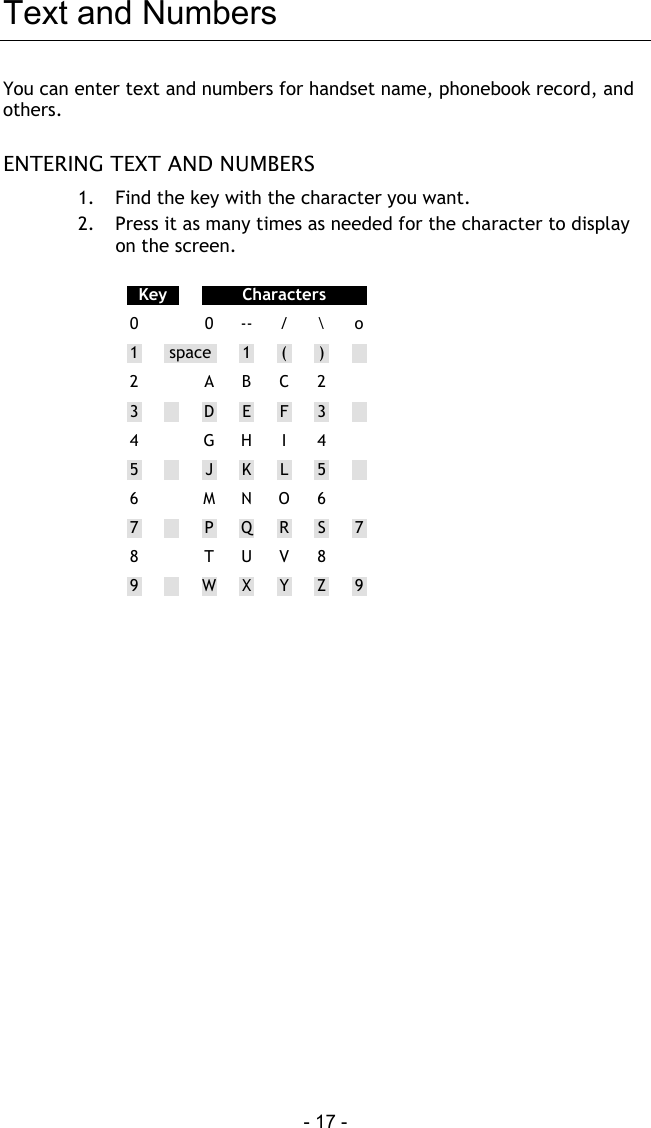
 - 17 - Text and Numbers You can enter text and numbers for handset name, phonebook record, and others.  ENTERING TEXT AND NUMBERS 1.  Find the key with the character you want. 2.  Press it as many times as needed for the character to display on the screen.  Key  Characters 0  0 -- / \ o 1  space  1  (  )   2    A B C 2   3   D  E  F  3   4  G H I 4  5   J  K  L  5   6  M N O 6  7   P  Q  R  S  7 8  T U V 8  9   W  X  Y  Z  9
 - 18 - Phonebook Each handset has a phonebook that can store up to 50 records. Each phonebook record can have a name of up to 12 characters long and a number of up to 20 digits long.  VIEWING THE PHONEBOOK 1. Press  . 2.  Select the record you want.   Searching a record You can search the phonebook by scrolling or by searching the first character.  Searching by scrolling 1.  While at the phonebook, press   or   to scroll.  Searching by the first character 1.  While at the phonebook, press the digit key that contains the character that you want to search.  During a call You can access the phonebook during a call.  1.  Press and hold   during a call. 2.  Select the record you want. 3.  Press and hold   again to exit phonebook.  CALLING FROM THE PHONEBOOK You can make a call directly from the phonebook while you are viewing it.   Calling directly from the phonebook See Calling from your phonebook on page 13.  During a call You can send a number from the phonebook during a call.  1.  Press and hold   during a call. 2.  Select the record you want.
Phonebook - 19 - 3. Press OK to send the phonebook number or press and hold again to exit phonebook. ADDING A RECORD   1. Press  . 2. Select PHONEBOOK  ADD. Press OK. 3.  Enter the name. Press OK.    4.  Enter the number.     5. Press OK. Your new record is saved.  EDITING A RECORD 1. Press  . 2. Select PHONEBOOK  EDIT. Press OK. 3.  Select the record you want to edit. Press OK. 4.  Edit the name if necessary. Press OK. 5.  Edit the number if necessary. Press OK. Your record is edited.  DELETING A RECORD 1. Press  . 2. Select PHONEBOOK  DELETE. Press OK. 3.  Select the record you want to delete. Press OK.  4. Press OK to delete the record.  The handset displays a confirmation request. 5. Press OK to confirm. The record is deleted.  DELETING ALL RECORDS 1. Press  . 2. Select PHONEBOOK  DELETE ALL. Press OK. The handset displays a confirmation request. TIP:  Pause. Press and hold   to insert a pause. NOTE:  Memory Full. If your phonebook is full, a notification displays. Delete unnecessary records before adding new ones. NOTE:  Duplicate Name. Phonebook records with identical names cannot be saved.
Phonebook - 20 - 3. Press OK to confirm. All records are deleted.
 - 21 - Call Log The call log stores the call history of the last 20 incoming and the last 5 dialed calls.  VIEWING THE CALL RECORDS 1. Press   to view the incoming call log, or Press   to view the dialed call log. 2.  Select the record you want.  3. Press     to see details.  MAKING A CALL Returning a call To return a call from the incoming call log, see Calling from the incoming call log on page 13.  Redialing a call To make a call that you have made previously, see Calling from the dialed call log on page 12.  SAVING A CALL RECORD TO YOUR PHONEBOOK 1. Press   after selecting a call record. 2.  Select SAVE. Press OK. 3.  Edit the name if necessary. Press OK. 4.  Edit the number if necessary. Press OK. Your record is saved.  DELETING A CALL RECORD 1. Press  after selecting a call record. 2.  Select DELETE. Press OK. The handset displays a confirmation request. 3. Press OK to confirm. The record is deleted.  DELETING ALL RECORDS 1. Press   after selecting a call record. 2.  Select DELETE ALL. Press OK.  The handset displays a confirmation request. 3. Press OK to confirm. All records are deleted.
Call Log - 22 -
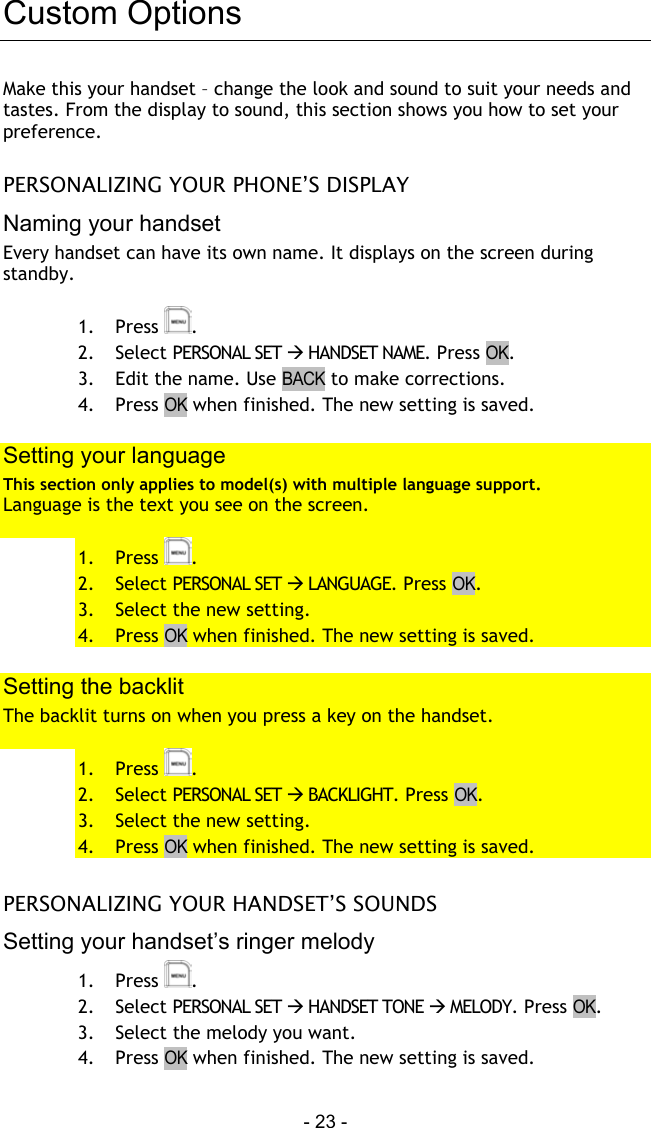
 - 23 - Custom Options Make this your handset – change the look and sound to suit your needs and tastes. From the display to sound, this section shows you how to set your preference.  PERSONALIZING YOUR PHONE’S DISPLAY Naming your handset Every handset can have its own name. It displays on the screen during standby.  1. Press  . 2. Select PERSONAL SET  HANDSET NAME. Press OK. 3.  Edit the name. Use BACK to make corrections. 4. Press OK when finished. The new setting is saved.  Setting your language This section only applies to model(s) with multiple language support. Language is the text you see on the screen.  1. Press  . 2. Select PERSONAL SET  LANGUAGE. Press OK. 3.  Select the new setting. 4. Press OK when finished. The new setting is saved.  Setting the backlit The backlit turns on when you press a key on the handset.  1. Press  . 2. Select PERSONAL SET  BACKLIGHT. Press OK. 3.  Select the new setting. 4. Press OK when finished. The new setting is saved.   PERSONALIZING YOUR HANDSET’S SOUNDS Setting your handset’s ringer melody 1. Press  . 2. Select PERSONAL SET  HANDSET TONE  MELODY. Press OK. 3.  Select the melody you want.  4. Press OK when finished. The new setting is saved.
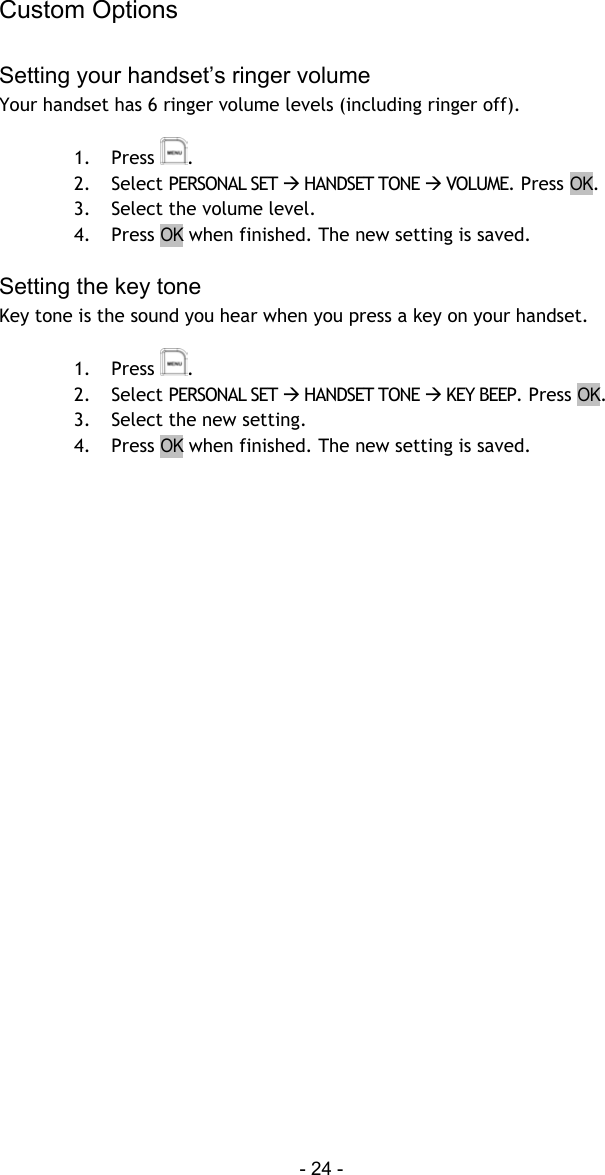
Custom Options - 24 -  Setting your handset’s ringer volume Your handset has 6 ringer volume levels (including ringer off).   1. Press  . 2. Select PERSONAL SET  HANDSET TONE  VOLUME. Press OK. 3.  Select the volume level. 4. Press OK when finished. The new setting is saved.  Setting the key tone Key tone is the sound you hear when you press a key on your handset.  1. Press  . 2. Select PERSONAL SET  HANDSET TONE  KEY BEEP. Press OK. 3.  Select the new setting. 4. Press OK when finished. The new setting is saved.
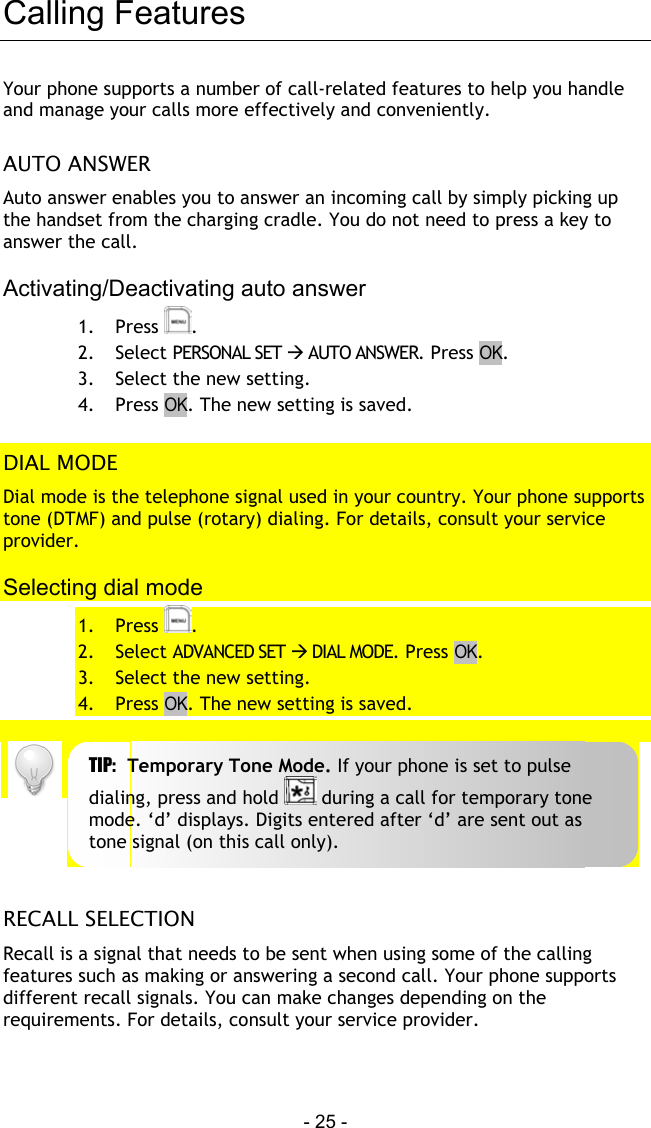
 - 25 - Calling Features Your phone supports a number of call-related features to help you handle and manage your calls more effectively and conveniently.  AUTO ANSWER Auto answer enables you to answer an incoming call by simply picking up the handset from the charging cradle. You do not need to press a key to answer the call.  Activating/Deactivating auto answer 1. Press  . 2. Select PERSONAL SET  AUTO ANSWER. Press OK. 3.  Select the new setting. 4. Press OK. The new setting is saved.  DIAL MODE Dial mode is the telephone signal used in your country. Your phone supports tone (DTMF) and pulse (rotary) dialing. For details, consult your service provider.  Selecting dial mode 1. Press  . 2. Select ADVANCED SET  DIAL MODE. Press OK. 3.  Select the new setting. 4. Press OK. The new setting is saved.    RECALL SELECTION Recall is a signal that needs to be sent when using some of the calling features such as making or answering a second call. Your phone supports different recall signals. You can make changes depending on the requirements. For details, consult your service provider.  TIP:  Temporary Tone Mode. If your phone is set to pulse dialing, press and hold   during a call for temporary tone mode. ‘d’ displays. Digits entered after ‘d’ are sent out as tone signal (on this call only).
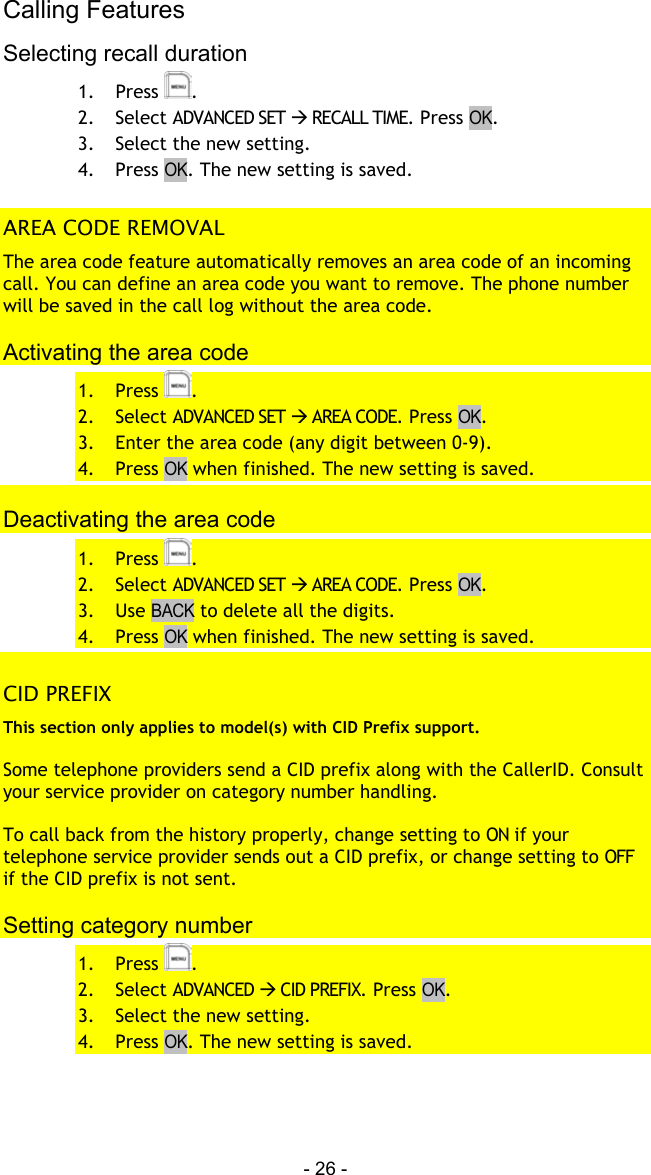
Calling Features - 26 - Selecting recall duration 1. Press  . 2. Select ADVANCED SET  RECALL TIME. Press OK. 3.  Select the new setting. 4. Press OK. The new setting is saved.  AREA CODE REMOVAL The area code feature automatically removes an area code of an incoming call. You can define an area code you want to remove. The phone number will be saved in the call log without the area code.  Activating the area code 1. Press  . 2. Select ADVANCED SET  AREA CODE. Press OK. 3.  Enter the area code (any digit between 0-9). 4. Press OK when finished. The new setting is saved.  Deactivating the area code 1. Press  . 2. Select ADVANCED SET  AREA CODE. Press OK. 3. Use BACK to delete all the digits. 4. Press OK when finished. The new setting is saved.  CID PREFIX This section only applies to model(s) with CID Prefix support.  Some telephone providers send a CID prefix along with the CallerID. Consult your service provider on category number handling.  To call back from the history properly, change setting to ON if your telephone service provider sends out a CID prefix, or change setting to OFF if the CID prefix is not sent.  Setting category number 1. Press  . 2. Select ADVANCED  CID PREFIX. Press OK. 3.  Select the new setting. 4. Press OK. The new setting is saved.
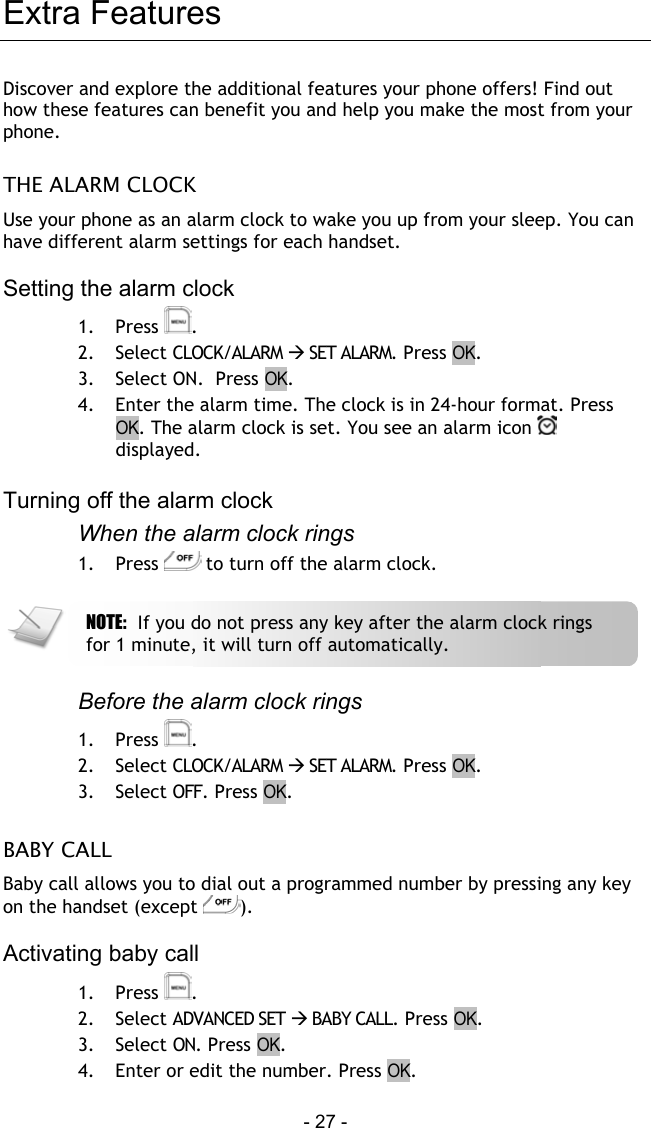
 - 27 - Extra Features Discover and explore the additional features your phone offers! Find out how these features can benefit you and help you make the most from your phone.  THE ALARM CLOCK Use your phone as an alarm clock to wake you up from your sleep. You can have different alarm settings for each handset.  Setting the alarm clock 1. Press  . 2. Select CLOCK/ALARM  SET ALARM. Press OK. 3.  Select ON.  Press OK. 4.  Enter the alarm time. The clock is in 24-hour format. Press OK. The alarm clock is set. You see an alarm icon   displayed.  Turning off the alarm clock When the alarm clock rings 1. Press   to turn off the alarm clock.    Before the alarm clock rings 1. Press  . 2. Select CLOCK/ALARM  SET ALARM. Press OK. 3.  Select OFF. Press OK.  BABY CALL Baby call allows you to dial out a programmed number by pressing any key on the handset (except  ).   Activating baby call 1. Press  . 2. Select ADVANCED SET  BABY CALL. Press OK. 3.  Select ON. Press OK. 4.  Enter or edit the number. Press OK.   NOTE:  If you do not press any key after the alarm clock rings for 1 minute, it will turn off automatically.
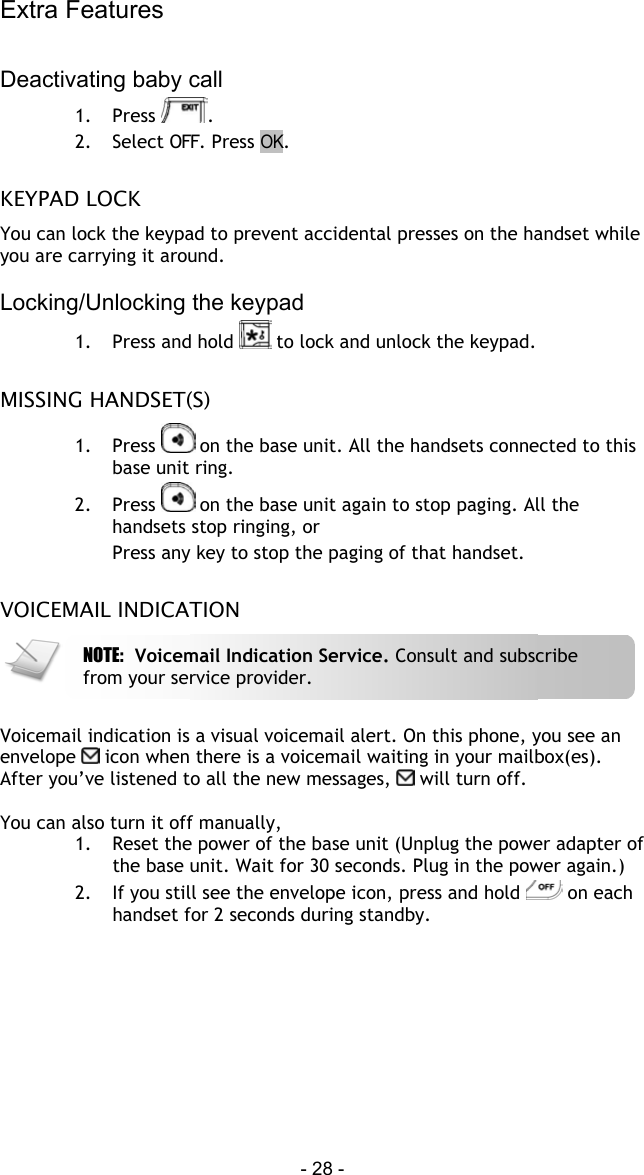
Extra Features - 28 -  Deactivating baby call 1. Press  . 2.  Select OFF. Press OK.  KEYPAD LOCK You can lock the keypad to prevent accidental presses on the handset while you are carrying it around.  Locking/Unlocking the keypad 1.  Press and hold   to lock and unlock the keypad.  MISSING HANDSET(S) 1. Press   on the base unit. All the handsets connected to this base unit ring. 2. Press   on the base unit again to stop paging. All the handsets stop ringing, or Press any key to stop the paging of that handset.  VOICEMAIL INDICATION   Voicemail indication is a visual voicemail alert. On this phone, you see an envelope   icon when there is a voicemail waiting in your mailbox(es).  After you’ve listened to all the new messages,   will turn off.  You can also turn it off manually, 1.  Reset the power of the base unit (Unplug the power adapter of the base unit. Wait for 30 seconds. Plug in the power again.) 2.  If you still see the envelope icon, press and hold   on each handset for 2 seconds during standby. NOTE:  Voicemail Indication Service. Consult and subscribe from your service provider.
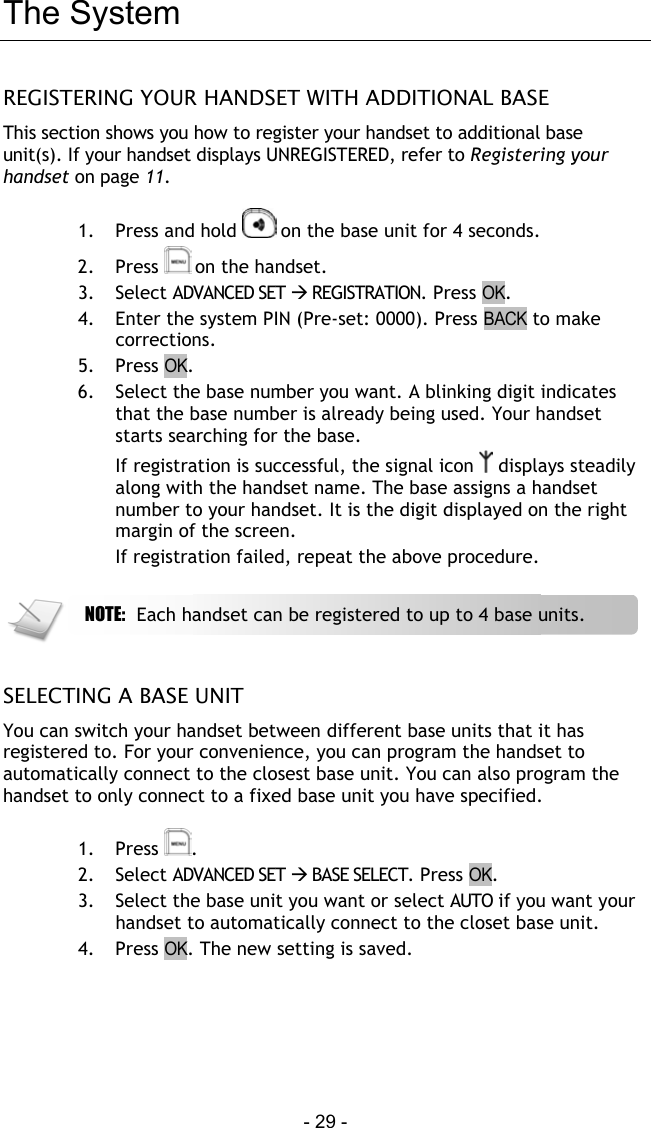
 - 29 - The System REGISTERING YOUR HANDSET WITH ADDITIONAL BASE This section shows you how to register your handset to additional base unit(s). If your handset displays UNREGISTERED, refer to Registering your handset on page 11.  1.  Press and hold   on the base unit for 4 seconds.  2. Press  on the handset. 3. Select ADVANCED SET  REGISTRATION. Press OK. 4.  Enter the system PIN (Pre-set: 0000). Press BACK to make corrections. 5. Press OK. 6.  Select the base number you want. A blinking digit indicates that the base number is already being used. Your handset starts searching for the base. If registration is successful, the signal icon   displays steadily along with the handset name. The base assigns a handset number to your handset. It is the digit displayed on the right margin of the screen. If registration failed, repeat the above procedure.    SELECTING A BASE UNIT You can switch your handset between different base units that it has registered to. For your convenience, you can program the handset to automatically connect to the closest base unit. You can also program the handset to only connect to a fixed base unit you have specified.  1. Press  . 2. Select ADVANCED SET  BASE SELECT. Press OK. 3.  Select the base unit you want or select AUTO if you want your handset to automatically connect to the closet base unit.  4. Press OK. The new setting is saved.      NOTE:  Each handset can be registered to up to 4 base units.
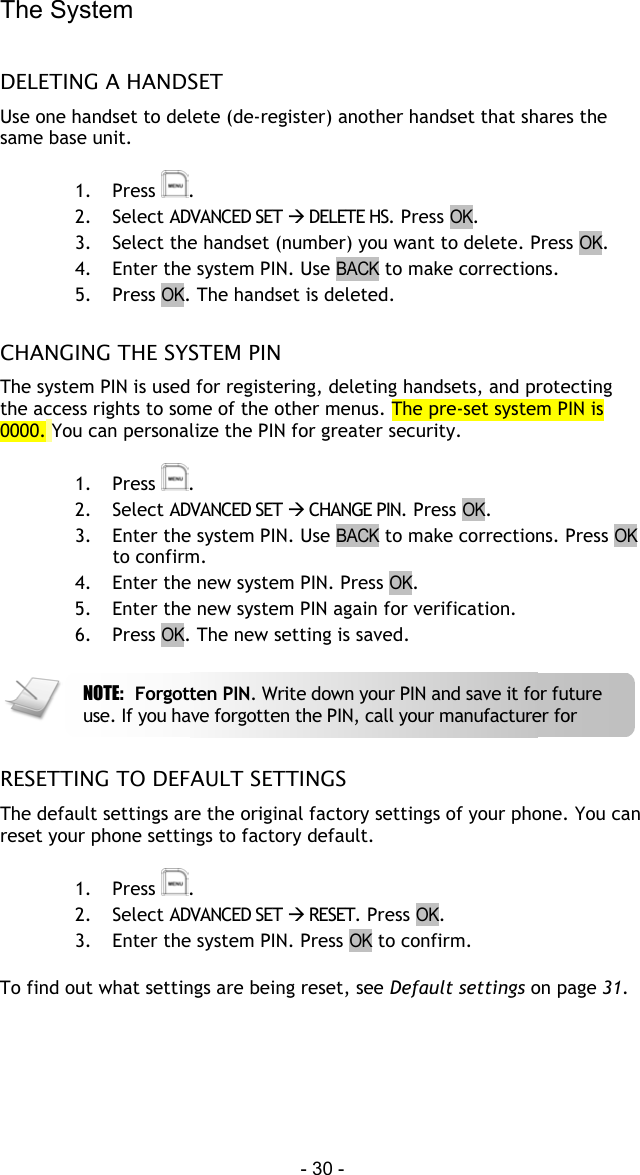
The System - 30 -  DELETING A HANDSET Use one handset to delete (de-register) another handset that shares the same base unit.  1. Press  . 2. Select ADVANCED SET  DELETE HS. Press OK. 3.  Select the handset (number) you want to delete. Press OK. 4.  Enter the system PIN. Use BACK to make corrections. 5. Press OK. The handset is deleted.  CHANGING THE SYSTEM PIN The system PIN is used for registering, deleting handsets, and protecting the access rights to some of the other menus. The pre-set system PIN is 0000. You can personalize the PIN for greater security.  1. Press  . 2. Select ADVANCED SET  CHANGE PIN. Press OK. 3.  Enter the system PIN. Use BACK to make corrections. Press OK to confirm. 4.  Enter the new system PIN. Press OK. 5.  Enter the new system PIN again for verification. 6. Press OK. The new setting is saved.    RESETTING TO DEFAULT SETTINGS The default settings are the original factory settings of your phone. You can reset your phone settings to factory default.  1. Press  . 2. Select ADVANCED SET  RESET. Press OK. 3.  Enter the system PIN. Press OK to confirm.   To find out what settings are being reset, see Default settings on page 31.   NOTE:  Forgotten PIN. Write down your PIN and save it for future use. If you have forgotten the PIN, call your manufacturer for
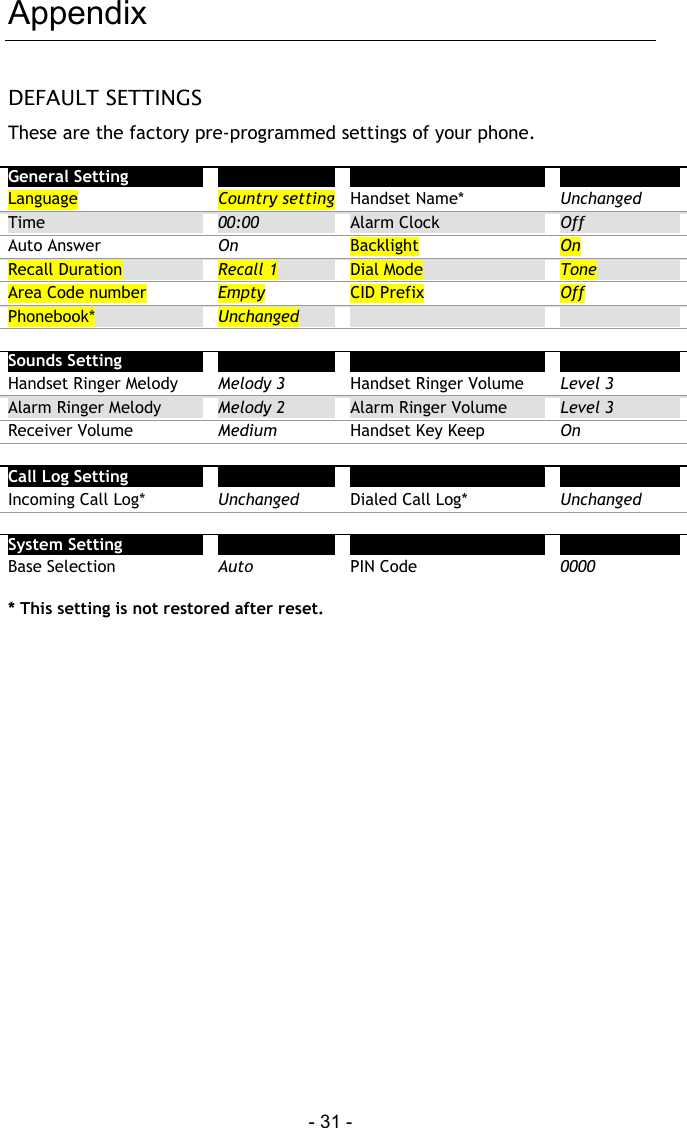
 - 31 - Appendix DEFAULT SETTINGS These are the factory pre-programmed settings of your phone.  General Setting       Language  Country setting  Handset Name*  Unchanged Time  00:00  Alarm Clock  Off Auto Answer  On  Backlight  On Recall Duration  Recall 1  Dial Mode  Tone Area Code number  Empty  CID Prefix  Off Phonebook*  Unchanged     Sounds Setting       Handset Ringer Melody  Melody 3  Handset Ringer Volume  Level 3 Alarm Ringer Melody  Melody 2  Alarm Ringer Volume  Level 3 Receiver Volume  Medium  Handset Key Keep  On  Call Log Setting       Incoming Call Log*  Unchanged  Dialed Call Log*  Unchanged  System Setting       Base Selection  Auto  PIN Code  0000  * This setting is not restored after reset.
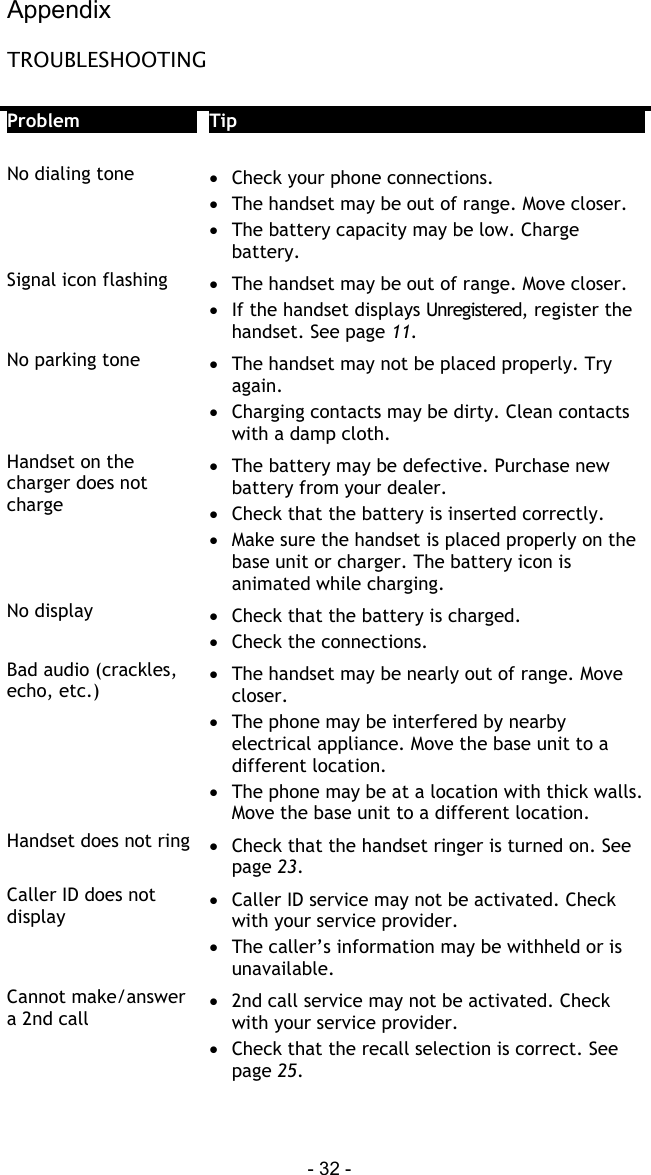
Appendix - 32 - TROUBLESHOOTING  Problem  Tip   No dialing tone  •  Check your phone connections. •  The handset may be out of range. Move closer. •  The battery capacity may be low. Charge battery. Signal icon flashing  •  The handset may be out of range. Move closer. •  If the handset displays Unregistered, register the handset. See page 11. No parking tone  •  The handset may not be placed properly. Try again. •  Charging contacts may be dirty. Clean contacts with a damp cloth. Handset on the charger does not charge •  The battery may be defective. Purchase new battery from your dealer. •  Check that the battery is inserted correctly. •  Make sure the handset is placed properly on the base unit or charger. The battery icon is animated while charging. No display  •  Check that the battery is charged. •  Check the connections. Bad audio (crackles, echo, etc.) •  The handset may be nearly out of range. Move closer. •  The phone may be interfered by nearby electrical appliance. Move the base unit to a different location. •  The phone may be at a location with thick walls. Move the base unit to a different location. Handset does not ring  •  Check that the handset ringer is turned on. See page 23. Caller ID does not display •  Caller ID service may not be activated. Check with your service provider. •  The caller’s information may be withheld or is unavailable. Cannot make/answer a 2nd call •  2nd call service may not be activated. Check with your service provider. •  Check that the recall selection is correct. See page 25.
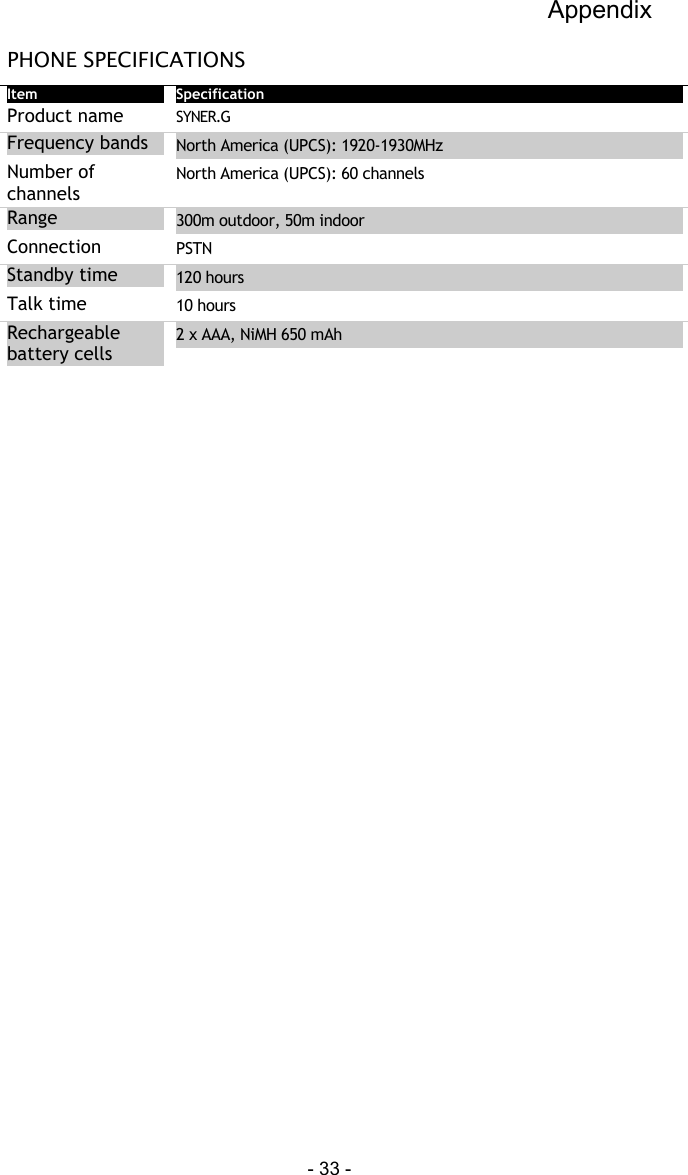
Appendix - 33 - PHONE SPECIFICATIONS  Item  Specification Product name  SYNER.G Frequency bands  North America (UPCS): 1920-1930MHz Number of channels North America (UPCS): 60 channels Range  300m outdoor, 50m indoor Connection  PSTN Standby time  120 hours Talk time  10 hours Rechargeable battery cells 2 x AAA, NiMH 650 mAh
Appendix - 34 -  Compliance Statement Equipment Approval Information  Your telephone equipment is approved for connection to the Public Switched Telephone Network and is in compliance with parts 15 and 68, FCC Rules and Regulations and the Technical Requirements for Telephone Terminal Equipment Published by ACTA.  Notification to the local telephone company  On the bottom of this equipment is a label indicating, among other information, the US number and Ringer Equivalence Number (REN) for the equipment.  You must, upon request, provide this information to your telephone company.  The REN is useful in determining the number of devices you may connect to your telephone line and still have all of these devices ring when your telephone number is called.  In most (but not all) areas, the sum of the RENs of all devices connected to one line should not exceed 5.  To be certain of the number of devices you may connect to your line as determined by the REN, you should contact your local telephone company.    A plug and jack used to connect this equipment to the premises wiring and telephone network must comply with the applicable FCC Part 68 rules and requirements adopted by the ACTA.  A compliant telephone cord and modular plug is provided with this product.  It is designed to be connected to a compatible modular jack that is also compliant.  See installation instructions for details.  Notes  •  This equipment may not be used on coin service provided by the telephone company. •  Party lines are subject to state tariffs, and therefore, you may not able to use your own telephone equipment if you are on a party line.  Check with your local telephone company. •  Notice must be given to the telephone company upon permanent disconnection of your telephone from your line. •  If your home has specially wired alarm equipment connected to the telephone line, ensure the installation of this product does not disable your alarm equipment.  If you have questions about what will disable alarm equipment, consult your telephone company or a qualified installer.  Rights of the Phone Company  Should your equipment cause trouble on your line which may harm the telephone network, the telephone company shall, where practicable, notify you that temporary discontinuance of service may be required.  Where prior notice is not practicable and the circumstances warrant such action, the telephone company may temporarily discontinue service immediately.  In case of such temporary discontinuance, the telephone company must: I.  promptly notify you of such temporary discontinuance ; II.  afford you the opportunity to correct the situation ; and  III.  inform you of your right to bring a complaint to the Commission pursuant to procedures set forth in Subpart E of Part 68, FCC Rules and Regulations.  The telephone company may make changes in its communications facilities, equipment, operations or procedures where such action is required in the operation of its business and not inconsistent with FCC Rules and Regulations.  If these changes are expected to affect the use or performance of your telephone equipment, the telephone company must give you adequate notice, in writing, to allow you to maintain uninterrupted service.  Interference Information  This device complies with Part 15 of the FCC Rules.  Operation is subject to the following two conditions : (1) This device may not cause harmful interference ; and (2) This device must accept and interference received, including interference that may cause undesired operation.  This equipment has been tested and found to comply with the limits for a Class B digital device, pursuant to Part 15 o the FCC Rules.  These limits are designed to provide reasonable protection against harmful interference in a residential installation.
Appendix - 35 - This equipment generates, uses, and can radiate radio frequency energy and, if not installed and used in accordance with the instructions, may cause harmful interference to radio communications.  However, there is no guarantee that interference with not occur in a particular installation.  If this equipment does cause harmful interference to radio or television reception, which can be determined by turning the equipment off and on, the user is encouraged to try to correct the interference by one or more of the following measures :  •  Reorient or relocate the receiving antenna ( that is, the antenna for radio or television that is « receiving «  the interference). •  Reorient or relocate and increase the separation between the telecommunications equipment and receiving antenna. •  Connect the telecommunications equipment into an outlet on a circuit different from that to which the receiving antenna is connected.  If these measures do not eliminate the interference, please consult your dealer or an experienced radio/television technician for additional suggestions.  Also, the Federal Communications Commission has prepared a helpful booklet, « How To Identify and Resolve Radio/TV Interference Problems. »  This booklet is available from the U.S. Government Printing Office, Washington, D.C. 20402.  Please specify stock number 004-000-00345-4 when ordering copies.  Noise  Electrical pulse noise is present at one time or another.  This is most intense during electrical storms.  Certain kinds of electrical equipment, such as light dimmers, fluorescent bulbs, motors, fans, etc., also generate pulse noise.  Because radio frequencies are susceptible to this, you may on occasion hear pulse noise through the receiver.  This is usually only a minor annoyance and should not be interpreted as a defect of the unit.  FCC RF Radiation Exposure Statement  This equipment complies with FCC RF radiation exposure limits set forth for an uncontrolled environment.  This equipment should be installed and operated with a minimum distance of 20 centimeters between the radiator and your body.  This transmitter must not be co-located or operating in conjunction with any other antenna or transmitter.  For hand held operation, this phone has been tested and meets the FCC RF exposure guidelines.  Use of other accessories may not ensure compliance with FCC RF exposure guidelines.  Hearing Aid Compatibility (HAC)  This telephone system meets FCC and industry Canada standards for Hearing Aid Compatibility.  Privacy  Privacy of communications may not be ensured when using this telephone.  Additional Information  I.C. Notice  Terminal Equipment  NOTICE : This equipment meets the applicable Industry Canada Terminal Equipment Technical Specifications.  This is confirmed by the registration number : the abbreviation, IC, before the registration number signifies that registration was performed based on a Declaration of Conformity indicating that Industry Canada technical specifications were met.  It does not imply that Industry Canada approved the equipment.  NOTICE : The Ringer Equivalence Number (REN) for this terminal equipment is marked on the equipment itself.  The REN assigned to each terminal equipment provides an indication of the maximum number of terminals allowed to be connected to a telephone interface.  The termination on an interface may consist of any combination of devices subject only to the requirement that the sum of the Ringer Equivalence Numbers of all the devices does not exceed five.  Radio Equipment
Appendix - 36 - The term « IC : » before the radio certification number only signifies that Industry Canada technical specifications were met.  Operation is subject to the following two conditions: (1) this device may not cause interference, and (2) this device must accept any interference, including interference that may cause undesired operation of the device.  Do not attempt to repair or modify this equipment   Repairs to certified equipment should be made by an authorized maintenance facility designated by the supplier.  Any repairs or alterations made by the user to the equipment may render the equipment void in product warranty and compliance.  This could also void the user’s authority to operate the equipment.
Appendix - 37 - Service Centers USA Location : Ascalade Communications 5077 W. Sunset Drive,  Lake Oswego, OR 97035  Canada Location : 12051 Riverside Way,  Richmond, BC Canada, V6W 1K7

Navigation menu