Basys Technology RAT2 User Manual Description and Manual

Basys Technology Ltd Description and Manual

Contents

Description and Manual

© BASYS TECHNOLOGY LIMITED 1998 41231.DOC Page 1 of 11The copyright in this document is vested in Basys Technology Limited. This document is issuedonly for the purpose for which it is supplied. And on the express terms that it is to be treated ascommercially confidential and that it may not be reproduced in whole or in part, or used ordisclosed to others for any purpose except as authorised in writing by this company.REFERENCE: Project number 362020Document number 00-8006TITLE: FCC TAG Set Description of OperationIntelitag Asset and Personnel RF Tagging SystemISSUE:  b                                          DATE:7th March 1998AUTHOR: Stephen GrantElectronic Design EngineerAPPROVED BY:POSITION: Mark MitchelmoreEngineering ManagerAUTHORISED BY:POSITION: Richard PapanicolaouQuality Director
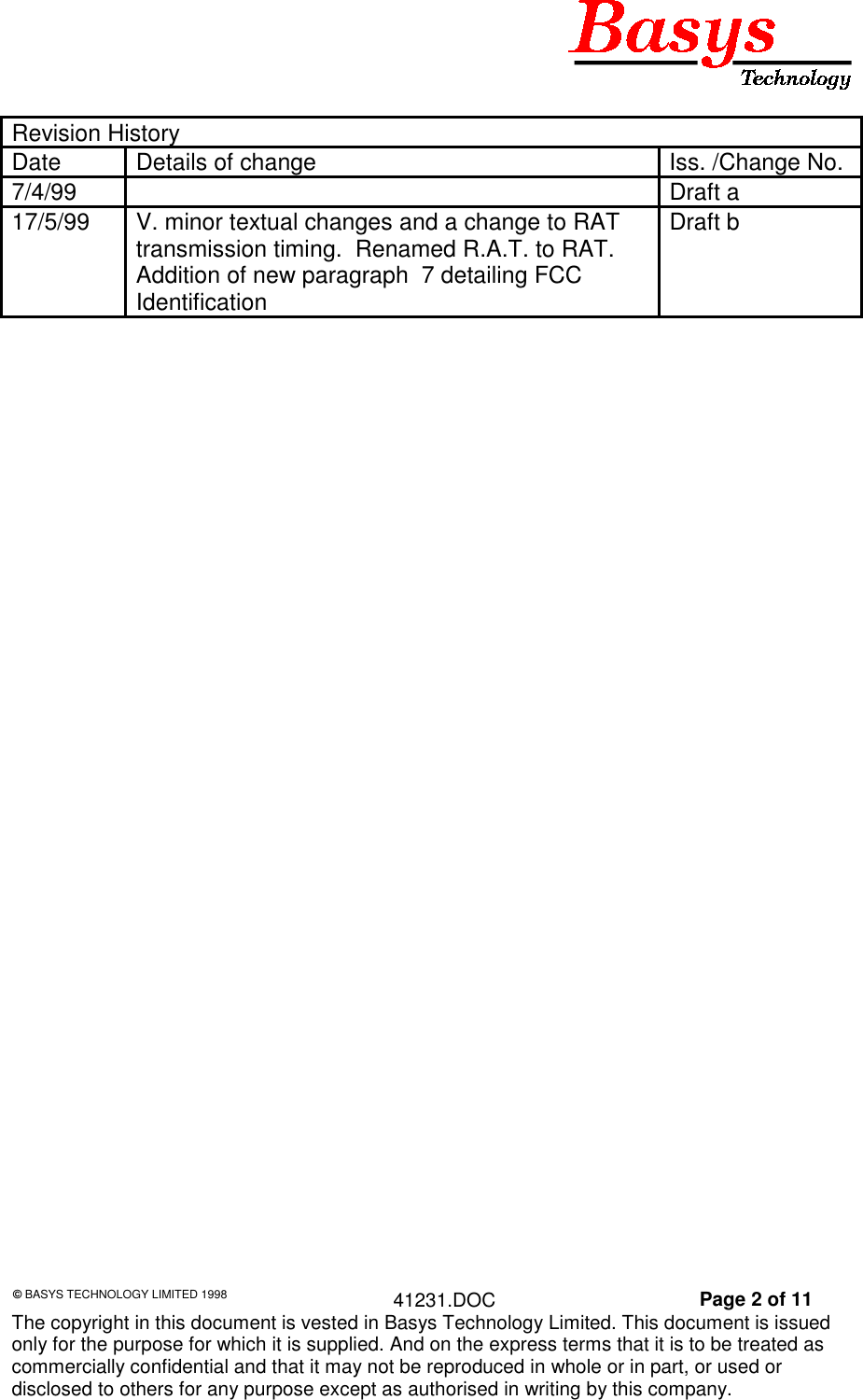
© BASYS TECHNOLOGY LIMITED 1998 41231.DOC Page 2 of 11The copyright in this document is vested in Basys Technology Limited. This document is issuedonly for the purpose for which it is supplied. And on the express terms that it is to be treated ascommercially confidential and that it may not be reproduced in whole or in part, or used ordisclosed to others for any purpose except as authorised in writing by this company.Revision HistoryDate Details of change Iss. /Change No.7/4/99 Draft a17/5/99 V. minor textual changes and a change to RATtransmission timing.  Renamed R.A.T. to RAT.Addition of new paragraph  7 detailing FCCIdentificationDraft b
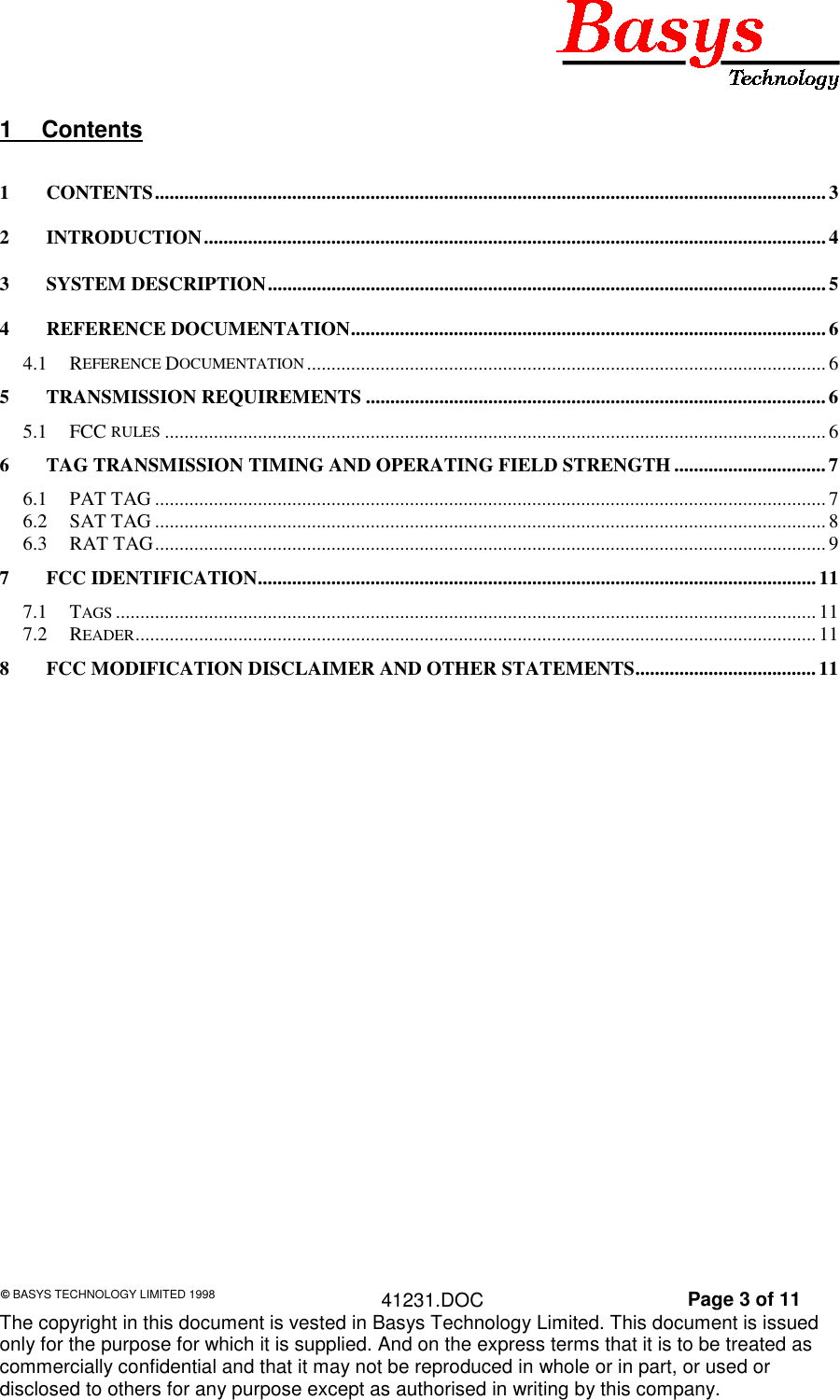
© BASYS TECHNOLOGY LIMITED 1998 41231.DOC Page 3 of 11The copyright in this document is vested in Basys Technology Limited. This document is issuedonly for the purpose for which it is supplied. And on the express terms that it is to be treated ascommercially confidential and that it may not be reproduced in whole or in part, or used ordisclosed to others for any purpose except as authorised in writing by this company.1 Contents1 CONTENTS.........................................................................................................................................32 INTRODUCTION............................................................................................................................... 43 SYSTEM DESCRIPTION..................................................................................................................54 REFERENCE DOCUMENTATION.................................................................................................64.1 REFERENCE DOCUMENTATION..........................................................................................................65 TRANSMISSION REQUIREMENTS ..............................................................................................65.1 FCC RULES .......................................................................................................................................66 TAG TRANSMISSION TIMING AND OPERATING FIELD STRENGTH ...............................76.1 PAT TAG ......................................................................................................................................... 76.2 SAT TAG ......................................................................................................................................... 86.3 RAT TAG......................................................................................................................................... 97 FCC IDENTIFICATION..................................................................................................................117.1 TAGS ............................................................................................................................................... 117.2 READER........................................................................................................................................... 118 FCC MODIFICATION DISCLAIMER AND OTHER STATEMENTS.....................................11
© BASYS TECHNOLOGY LIMITED 1998 41231.DOC Page 4 of 11The copyright in this document is vested in Basys Technology Limited. This document is issuedonly for the purpose for which it is supplied. And on the express terms that it is to be treated ascommercially confidential and that it may not be reproduced in whole or in part, or used ordisclosed to others for any purpose except as authorised in writing by this company.2 IntroductionThis document describes the transmission timing and power levels of the IntelitagTag transmitters for conformance to FCC Part 15 Subpart C for intentionaltransmitters.
© BASYS TECHNOLOGY LIMITED 1998 41231.DOC Page 5 of 11The copyright in this document is vested in Basys Technology Limited. This document is issuedonly for the purpose for which it is supplied. And on the express terms that it is to be treated ascommercially confidential and that it may not be reproduced in whole or in part, or used ordisclosed to others for any purpose except as authorised in writing by this company.3 System DescriptionThe  Intelitag™ electronic tagging system, also distributed under the ParSectrade name, is a radio based short to long range tagging system for theprotection and monitoring of assets.  The system operates at a nominalfrequency of 418MHz as a Low-Power, Non-Licensed Transmitter in accordancewith FCC Part 15 Subpart C for intentional Radiators (TAGs) and Subpart B forunintentional radiators (Reader).   The system is also type approved to MPT-1340 licence exempt frequency band by the UK Radiocommunications Agency.Approval number 13422 refers.The basic system comprises a range of tags - compact radio frequencytransmitters which communicate with a universal reader. The reader interpretsthe data packet received from a tag transmitting within its field of reception and,in turn, passes this data on to a controller or computer.Using a combination of two power levels and differing data patterns, the universalreader is able to distinguish between ‘long range’ and ‘short range’ Intelitags.Long range tags are read at a nominal distance of up to 75m in free space,depending on the characteristics of the ambient RF environment.  Short rangetags are only detected by the reader when they enter its short range zone, whichis adjustable from a few cm to 25m in free space. It is the combination of shortand long range detection within a single reader which, in conjunction with theproperties of the different tag types described below, which gives the Intelitagsystem its unique performance characteristics.Every tag has a unique identity which it transmits in conjunction with additionaldata relating to its operational status which includes battery status.  The datapacket contains 60 bits and is transmitted at 2.731 Kbaud.  Thus an asset orindividual equipped with a tag can be uniquely identified by the system. TheIntelitag system has been designed primarily for security applications although itsuse can also be extended to a wide range of asset tracking and managementtasks.A regular ‘reporting’ transmission from asset Intelitags provides both a securityconfidence check and an additional asset management (inventory) facility. AssetIntelitags incorporate anti-tamper switches which are detected at long range.
© BASYS TECHNOLOGY LIMITED 1998 41231.DOC Page 6 of 11The copyright in this document is vested in Basys Technology Limited. This document is issuedonly for the purpose for which it is supplied. And on the express terms that it is to be treated ascommercially confidential and that it may not be reproduced in whole or in part, or used ordisclosed to others for any purpose except as authorised in writing by this company.4 Reference Documentation4.1 Reference Documentation4.1.1  FCC Part 15 Subpart C for intentional transmitters5 Transmission Requirements5.1 FCC rules5.1.1  Transmission Categories and Levels5.1.1.1  The PAT, SAT and RAT tag transmissions fall into three categories.These are,  a) Automatic,  b) Periodic and c) control signals.5.1.1.2  The maximum Field Strength levels that apply for each category are asfollows:5.1.1.2.1  Automatic    10333uV/M   (80.28dBuV/M)5.1.1.2.2  Periodic           4410 uV/M   (72.89dBuV/M)5.1.1.2.3  Control   10333uV/M   (80.28dBuV/M)5.1.2 Timing Requirements5.1.2.1 Automatic Transmissions5.1.2.1.1  The covering FCC category is Part 15.231 (a), which states that atransmission activated automatically shall cease within 5 seconds.  Atriggering event occurring at any time after this 5 second period shall allow afurther 5 second period of transmissions and so on.5.1.2.2 Periodic Transmissions5.1.2.2.1  The covering FCC category is Part 15.231 (e), which states that the durationof each transmission shall not be greater than one second and the silentperiod between transmissions shall be at least thirty times the duration of thetransmission but in no case less than 10 seconds.5.1.2.3 Control Signal Transmissions5.1.2.3.1  The covering FCC category is Part 15.231 (a), which states that a manuallyoperated transmitter shall employ a switch that will automatically deactivatethe transmitter within not more than 5 seconds of being released.
© BASYS TECHNOLOGY LIMITED 1998 41231.DOC Page 7 of 11The copyright in this document is vested in Basys Technology Limited. This document is issuedonly for the purpose for which it is supplied. And on the express terms that it is to be treated ascommercially confidential and that it may not be reproduced in whole or in part, or used ordisclosed to others for any purpose except as authorised in writing by this company.6  TAG Transmission Timing and Operating Field Strength6.1 PAT TAG6.1.1 Operating Description6.1.1.1 The Portable Intelitag (PAT) has been designed to allow the movementof mobile assets within a controlled area or building, whilst denying ormonitoring the removal from, and re-entry of the assets into the area.The PAT is normally detected when it enters the short-range zone of auniversal Reader; however it’s other transmissions, including tamper, willbe detected by a reader at long range.6.1.1.2  The PAT Tag contains a shock sensor and miniature push button switch.The shock sensor is used to detect movement and the switch is used todetect removal (Tamper) of the TAG from an item it is adhered to.  Bymonitoring the sensor and the switch the TAG can determine what sort oftransmission should be transmitted.6.1.2 Transmission Characteristics6.1.2.1  Shock Triggered Transmission (automatic)6.1.2.1.1  The transmission consists of 7 discrete frames of data at a repetition rate ofapproximately 0.576s at an output field strength level conforming to paragraph5.1.1.2.1 above.  The total transmission time is approximately 4 seconds.  Thetransmissions will begin when the shock sensor is disturbed.  After thetransmission has stopped the shock sensor will then be interrogated for newshock events.6.1.2.2  Tamper Triggered Transmission (automatic)6.1.2.2.1  The transmission shall consist of 7 discrete frames of data at a repetition rateof approximately 0.576s at an output field strength level described inparagraph 5.1.1.2.1 above.  The total transmission time is approximately fourseconds.  This transmission will begin when the tamper switch is released.When the tamper switch is re-closed the tamper transmission may be startedagain on its release.6.1.2.3  Routine report (periodic)6.1.2.3.1  The transmission shall consist of 7 discrete frames of data at a repetition rateof approximately 0.072s at an output field strength level described inparagraph 5.1.1.2.2 above.  The total transmission time will be 0.9s.  Thistransmission is repeated every 1 hour (± 10 minutes).6.1.2.3.2  The routine report facility may be disabled by placing switch 4 in the ONposition before the Tag is switched on.
© BASYS TECHNOLOGY LIMITED 1998 41231.DOC Page 8 of 11The copyright in this document is vested in Basys Technology Limited. This document is issuedonly for the purpose for which it is supplied. And on the express terms that it is to be treated ascommercially confidential and that it may not be reproduced in whole or in part, or used ordisclosed to others for any purpose except as authorised in writing by this company.6.2 SAT TAG6.2.1 Operating Description6.2.1.1 The Static Intelitag (SAT) has been designed primarily to protectequipment such as computers and their internal components, and allother types of static office equipment. However, the SAT is highlyversatile and can be used to protect any static article including hospitaland laboratory equipment, works of art and any item of significant value.The SAT can be detected at a range of up to 75m in clear space6.2.1.2  The SAT Tag contains a shock sensor and miniature push button switch.The shock sensor is used to detect movement and the switch is used todetect removal (Tamper) of the TAG from an item it is adhered to.  Bymonitoring the sensor and the switch the TAG can determine what sort oftransmission should be transmitted.6.2.2 Transmission Characteristics6.2.2.1  Shock Triggered Transmission (automatic)6.2.2.1.1  The transmission consists of 7 discrete frames of data at a repetition rate ofapproximately 0.576s at an output field strength level conforming to paragraph5.1.1.2.1 above.  The total transmission time is approximately 4 seconds.  Thetransmissions will begin when the shock sensor is disturbed.  After thetransmission has stopped the shock sensor will then be interrogated for newshock events.6.2.2.2  Tamper Triggered Transmission (event driven)6.2.2.2.1  The transmission shall consist of 7 discrete frames of data at a repetition rateof approximately 0.576s at an output field strength level described inparagraph 5.1.1.2.1 above.  The total transmission time is approximately fourseconds.  The transmission will begin when the tamper switch is released.When the tamper switch is re-closed the tamper transmission may be startedagain on its release.6.2.2.3  Routine report (periodic)6.2.2.3.1  The transmission shall consist of 7 discrete frames of data at a repetition rateof approximately 0.072s at an output field strength level described inparagraph 5.1.1.2.2 above.  The total transmission time is approximately 0.9s.The transmission repetition rate shall be approximately 1 hour (± 10 minutes).6.2.2.3.2  The routine report facility may be disabled by placing switch 4 in the ONposition before the Tag is switched on.
© BASYS TECHNOLOGY LIMITED 1998 41231.DOC Page 9 of 11The copyright in this document is vested in Basys Technology Limited. This document is issuedonly for the purpose for which it is supplied. And on the express terms that it is to be treated ascommercially confidential and that it may not be reproduced in whole or in part, or used ordisclosed to others for any purpose except as authorised in writing by this company.6.3 RAT TAG6.3.1 Description6.3.1.1 The Range Adjustment TAG (RAT) is used to remotely turn on and offthe Reader’s short-range reception field at a required distance.  Thisvaries the range at which the PAT tag’s shock activated transmission’scan be received.6.3.1.2  The R.A.T. comprises two PCB assemblies connected by a screened 6core cable (approximately 6cms long) enclosed in an ABS enclosure withexternal buttons.  The main PCB is identical to the PCB in the SAT andPAT. The second PCB within the RAT is used to mount miniatureswitches beneath the external buttons.   This PCB contains no othercomponents.6.3.1.3  The RAT is used generally once after installation of a system.6.3.1.4  The reader will respond with a buzzer when it receives certaintransmissions from the RAT (FIND and SEE).   But the reader will alwaysflash an LED every time it receives a complete packet of data.6.3.2 Transmission Characteristics6.3.2.1  While one of the four buttons is depressed the RAT transmits a controlsignal data packet of data at approximately 0.4s intervals at an outputfield strength level described in paragraph 5.1.1.2.1 above. Theoperation function of each button (FIND, SEE, + and -) is describedbelow.6.3.2.1.1  The FIND button is used to set the edge of Receiver’s ON range.  The usersets the reader into a preset mode and stands to where the edge of range isdesired.  The FIND button is then depressed.  The received analogue signal iscompared to a variable voltage from a digital comparator which is modifieduntil the signal is ‘lost’.  The voltage on the comparator is then incrementedonce.  After 5-10 seconds of the key press the reader will respond with abuzzer sound indicating that the range has been set.  The button can then bereleased and the Reader mode returned to normal operation.  Thus thereceiver will be ‘off’ for any low power transmissions outside of this range and‘on’ for any inside.6.3.2.1.2  The SEE button is used to determine the range of a reader previously set.With the SEE button depressed the reader will respond with a buzzer whenthe RAT is within the range.
© BASYS TECHNOLOGY LIMITED 1998 41231.DOC Page 10 of 11The copyright in this document is vested in Basys Technology Limited. This document is issuedonly for the purpose for which it is supplied. And on the express terms that it is to be treated ascommercially confidential and that it may not be reproduced in whole or in part, or used ordisclosed to others for any purpose except as authorised in writing by this company.6.3.2.1.3  The Plus and Minus range buttons are used to increment the range of theReader either out or in respectively to the users desired position.6.3.2.2  The characteristics of the RAT remain unaltered throughout its operation.
© BASYS TECHNOLOGY LIMITED 1998 41231.DOC Page 11 of 11The copyright in this document is vested in Basys Technology Limited. This document is issuedonly for the purpose for which it is supplied. And on the express terms that it is to be treated ascommercially confidential and that it may not be reproduced in whole or in part, or used ordisclosed to others for any purpose except as authorised in writing by this company.7 FCC Identification7.1 Tags7.1.1  Portable Asset TAG (PAT) – N4GPAT27.1.2  Static Asset TAG (SAT) – N4GSAT27.1.3  Range Adjustment TAG (RAT) – N4GRAT27.2 Reader7.2.1 N4GREADER8  FCC Modification Disclaimer and other Statements8.1  These devices comply with part 15 of the FCC rules. Operation issubject to the following two conditions:8.2  (1) These devices may not cause harmful interference, and8.3  (2) these devices must accept interference received, includinginterference that may cause undesired operation.8.4  The user is cautioned that modifications or changes to an intentionalor unintentional radiator not expressly approved by the partyresponsible for compliance could void the user's authority to operatethe equipment.8.5  The tags are powered are by standard Lithium coin cells and as suchthe following warning shall be noted:8.5.1  CAUTION Danger of explosion if batteries are incorrectly replaced.Replace only with the same or equivalent type recommended by themanufacturer. Dispose of used batteries according to the manufacturer’sinstructions.

Navigation menu