Beijing Choice Electronic Technology MD300C208 Fingertip Pulse Oximeter User Manual

Beijing Choice Electronic Technology Co., Ltd. Fingertip Pulse Oximeter Users Manual

User Manual

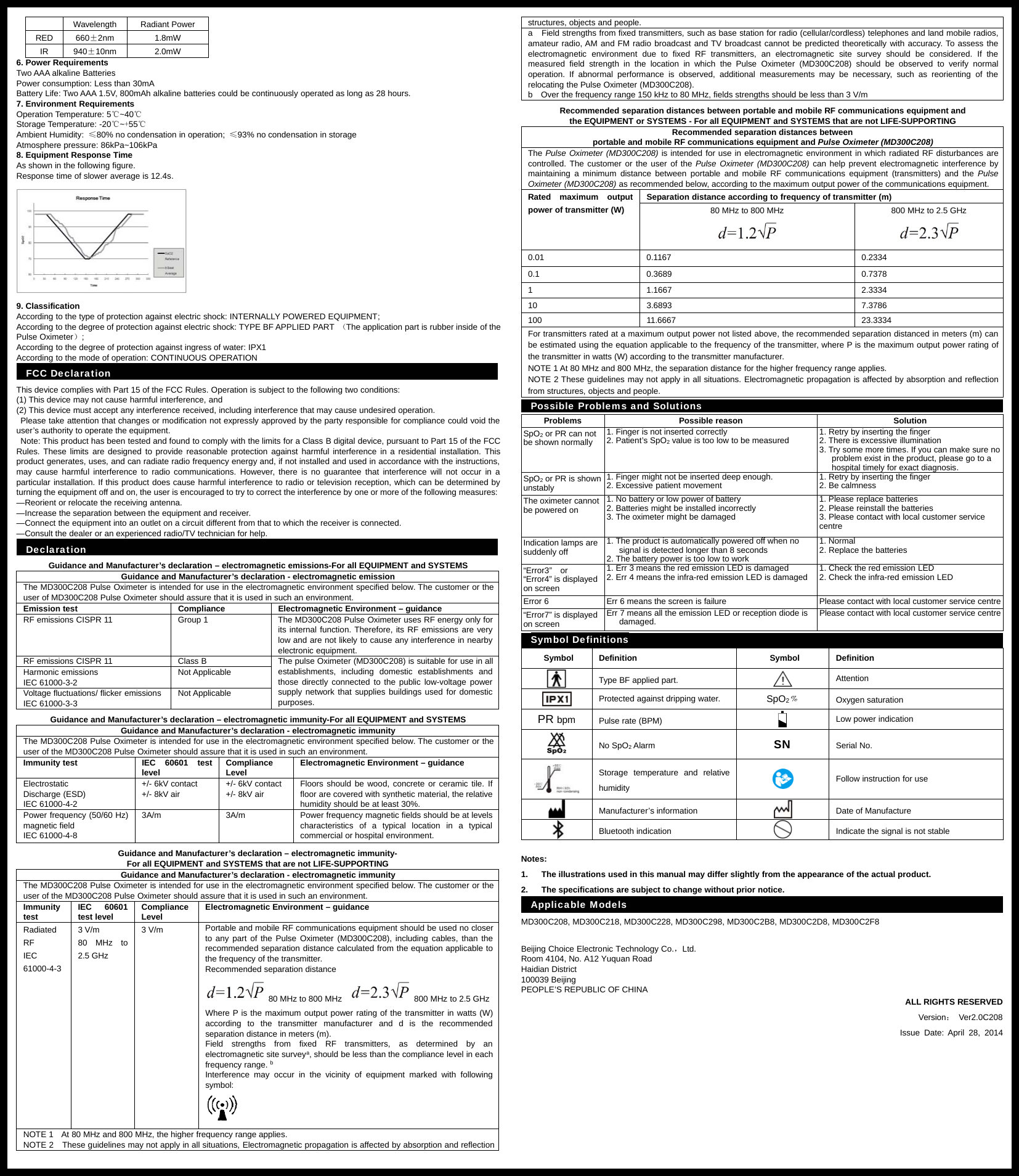
FingertipPulse OximeterUSER MANUALVer2.0C208General DescriptionOxygen Saturation is a percentage of Oxyhemoglobin (HbO2) capacity, compounded with oxygen, by all combinative hemoglobin(Hb) capacity in blood. In other words, it is consistency of Oxyhemoglobin in blood. It is a very important parameter for theRespiratory Circulation System. Many respiratory diseases can result in oxygen saturation being lowered in human blood.Additionally, the following factors can reduce oxygen saturation: Automatic regulation of organ dysfunction caused by Anesthesia,Intensive Postoperative Trauma, injuries caused by some medical examinations. That situation might result in light-headedness,asthenia, and vomiting. Therefore, it is very important to know the oxygen saturation of a patient so that doctors can find problemsin a timely manner.The fingertip pulse oximeter features low power consumption, convenient operation and portability. Place one fingertip into thephotoelectric sensor for diagnosis and the pulse rate and oxygen saturation will appear on the display. It has been proven in clinicalexperiments that it also features high precision and repeatability.Measurement PrinciplePrinciple of the oximeter is as follows: A mathematical formula is established making use of Lambert Beer Law according toSpectrum Absorption Characteristics of Reductive hemoglobin (RHb) and Oxyhemoglobin (HbO2) in red and near-infrared zones.Operation principle of the instrument: Photoelectric Oxyhemoglobin Inspection Technology is adopted in accordance with CapacityPulse Scanning and Recording Technology, so that two beams of different wavelength of lights (660nm red and 940nm nearinfrared light) can be focused onto a human nail tip through a clamping finger-type sensor. A measured signal obtained by aphotosensitive element, will be shown on the oximeter’s display through process in electronic circuits and microprocessor shown onthe oximeter’s display through electronic circuits and a microprocessor.Diagram of Operation Principle1. Red and Infrared-ray Emission Tube2. Red and Infrared-ray Receipt TubePrecautions For Use1.Before use, carefully read the manual.2.Operation of the fingertip pulse oximeter may be affected by the use of an electrosurgical unit (ESU).3.Pulse Oximeters require sufficient blood flow to obtain proper readings. Poor blood circulation can result in inaccuratereadings. If your hands are cold or you have poor circulation, warm your hands by rubbing them together or use anothermethod before attempting to obtain a reading. A tourniquet, blood pressure cuff or other blood flow hindrances may alsoresult in inaccurate readings.4.Do not use the fingertip pulse oximeter in an MRI or CT environment.5.Do not use the fingertip pulse oximeter in situations where alarms are required. The device has no alarms. It is not forcontinuous monitoring.6.Do not use the fingertip pulse oximeter in an explosive atmosphere.7.The fingertip pulse oximeter is intended only as an adjunct in patient assessment. It must be used in conjunction with othermethods of assessing clinical signs and symptoms.8.In order to ensure correct sensor alignment and skin integrity, the maximum application time at a single site for our deviceshould be less than half an hour.9.Do not sterilize the device using autoclaving, ethylene oxide sterilizing, or immersing the device in liquid. The device is notintended for sterilization.10.Follow local ordinances and recycling instructions regarding disposal or recycling of the device and device components,including batteries.11.This equipment complies with IEC 60601-1-2:2007 for electromagnetic compatibility for medical electrical equipment and/orsystems. However, because of the proliferation of radio-frequency transmitting equipment and other sources of electricalnoise in healthcare and other environments, it is possible that high levels of such interference due to close proximity orstrength of a source might disrupt the performance of this device.12.Portable and mobile RF communications equipment can affect medical electrical equipment.13.This equipment is not intended for use during patient transport outside the healthcare facility14.This equipment should not be used adjacent to or stacked with other equipment.15.It may be unsafe to:—use accessories、detachable parts and materials not described in the instructions for use.—interconnect this equipment with other equipment not described in the instructions for use.—disassemble, repair or modify the equipment.16.These materials that contact with the patient’s skin contain medical silicone and ABS plastic enclosure are all pass theISO10993-5 Tests for invitro cytotoxicity and ISO10993-10 Tests for irritation and delayed-type hypersensitivity.17.When the signal is not stable, the reading may inaccurate. Please do not reference.Rx only: “Caution: Federal law (USA) restricts this device to sale by or on the order of a licensed practitioner.”ContraindicationIt is not for continuous monitoring.Inaccurate measurements may be caused by1. Significant levels of dysfunctional hemoglobin (such as carbonyl - hemoglobin or methemoglobin).2. Intravascular dyes such as indocyanine green or methylene blue.3. High ambient light. Shield the sensor area if necessary.4. Excessive patient movement.5. High-frequency electrosurgical interference and defibrillators.6. Venous pulsations.7. Placement of a sensor on an extremity with a blood pressure cuff, arterial catheter, or intravascular line.8. The patient has hypotension, severe vasoconstriction, severe anemia, or hypothermia.9. The patient is in cardiac arrest or is in shock.10. Fingernail polish or false fingernails.11. Weak pulse quality (low perfusion).12. Low hemoglobin.Product Features1 Simple to operate and convenient to carry.2 Small volume, light weight and low power consumption.3 Dual color OLED displays SpO2, PR, PI, Pulse bar, and waveform.4 2 display direction.5 2pcs AAA-size alkaline batteries; battery-low indicator.6 Wireless Bluetooth for data transmission.7 When no or low signal is detected, the pulse oximeter will power off automatically in 8 seconds8 Compatible with iChoicelife App.Intended UseFingertip pulse oximeter is a handheld non-invasive device intended for spot-checking of oxygen saturation of arterial hemoglobin(SpO2) and pulse rate of adult and pediatric patients in hospitals, hospital-type facilities.Operation Instructions1 Install two AAA batteries according to the Battery Installation instructions.2 Place one of your fingers into the rubber opening of the pulse oximeter.3 Press the switch button one time on front panel to turn the pulse oximeter on.4 Keep your hands still for the reading. Do not shake your finger during the test. It is recommended that you do not move yourbody while taking a reading.5 Read the data from the display screenAfter turning on the Oximeter, each time you press the power switch, the Oximeter will switch to another display mode.There are 2 display directions and 2 displayed parameters shown as follows:Notes:1. Short press the power button to switch the screen display orientation.2. Long press the power button to switch the displayed parameters (SpO2&PR, SpO2&PI).Data Transmission1. Turn on the device, the Bluetooth icon is flashing. After sync successfully, the Bluetooth icon is light on. Or else the Bluetoothicon still in the flashing status. When you turn off the device, the Bluetooth will break automatically.2. The current measurement will transmit to the App automatically. After data transmission successfully, the measurementflashing for 8s, then the device will power off automatically power off. If there is no Bluetooth connection over 1min, thedevice will power off automatically and the data will not be stored.3. If there is no digit appear, the device will power off automatically.Notes:1. With the Bluetooth 4.0 to transmit the data to App.2. The transmission distance is 10m at most.Battery Installation1. Install two AAA batteries into the battery compartment. Match the plus (+) and minus (-) signsin the compartment. If the polarities are not matched, damage may be caused to theoximeter.2. Slide the battery door cover horizontally along the arrow shown as the picture.Notes:Please remove the batteries if the pulse oximeter will not be used for long periods of time.Please replace the battery when the power indicator starting flickering.Using the Lanyard1. Thread thinner end of the lanyard through the hanging hole.2. Thread thicker end of the lanyard through the threaded end before pulling ittightly.Warnings!Keep the oximeter away from young children. Small items such as the batterydoor, battery, and lanyard are choking hazards.Do not hang the lanyard from the device’s electrical wire.Please notice that the lanyard which is tied to the oximeter may causestrangulation due to excessive length.Maintenance and Storage1. Replace the batteries in a timely manner when low voltage lamp is lighted.2. Clean surface of the fingertip oximeter before it is used in diagnosis for patients.3. Remove the batteries if the oximeter is not operated for a long time.4. It is best to store the product in -20℃~+55℃and ≤93% humidity.5. Keep in a dry place. Extreme moisture may affect oximeter lifetime and may cause damage.6. Dispose of battery properly; follow any applicable local battery disposal laws.Cleaning the fingertip pulse oximeterPlease use medical alcohol to clean the silicone touching the finger inside of oximeter with a soft cloth dampened with 70%isopropyl alcohol. Also clean the being tested finger using alcohol before and after each test.Do not pour or spray liquids onto the oximeter, and do not allow any liquid to enter any openings in the device. Allow the oximeter todry thoroughly before reuse.The fingertip pulse oximeter requires no routine calibration or maintenance other than replacement of batteries.The use life of the device is five years when it is used for 15 measurements every day and 10 minutes per onemeasurement. Stop using and contact local service center if one of the following cases occurs:An error in the Possible Problems and solutions is displayed on screen.The oximeter cannot be powered on in any case and not the reasons of battery.There is a crack on the oximeter or damage on the display resulting readings cannot be identified; the spring is invalid; or thekey is unresponsive or unavailable.A functional tester cannot be used to assess the accuracy of a pulse oximeter monitor or sensor. Clinical testing is used to establishthe SpO2accuracy. The measured arterial hemoglobin saturation value (SpO2) of the sensors is compared to arterial hemoglobinoxygen (SaO2) value, determined from blood samples with a laboratory CO-oximeter. The accuracy of the sensors in comparison tothe CO-oximeter samples measured over the SpO2range of 70%~100%. Accuracy data is calculated using the root-mean-squared(Arms value) for all subjects, per ISO 9919:2005, Medical Electrical Equipment–Particular requirements for the basic safety andessential performance of pulse oximeter equipment for medical use.A functional tester is used to measure how accurately Fingertip Pulse Oximeter is reproducing the specified calibration curve andthe PR accuracy.The model of functional tester is Index2 FLUKE simulator and the version is 2.1.3.Specifications1. Display TypeOLED display2. SpO2Measurement range: 70%~100%Accuracy: 70%~100%: ±2%; 0%~69% no definitionResolution: 1%ARMS Value AnalysisItem 70--100 90--100 80--<90 70--<80#pts 231 82 89 60Bias 0.03 -0.06 0.07 0.12ARMS 1.07 0.92 1.13 1.18Bland-Altman plot analysis of sampled data points on all subjects as below3. Pulse RateMeasure range: 30bpm~250bpmAccuracy: 30bpm~99bpm, ±2bpm; 100~235bpm, ±2%Resolution: 1bpm4. PIMeasure range: 0.2%~20.0%Accuracy: 0.2%~1.0%, ±0.2digits; 1.1%~20.0%, ±20%Resolution: 0.1%5. Probe LED SpecificationsMD300C208
Wavelength Radiant PowerRED 660±2nm 1.8mWIR 940±10nm 2.0mW6. Power RequirementsTwo AAA alkaline BatteriesPower consumption: Less than 30mABattery Life: Two AAA 1.5V, 800mAh alkaline batteries could be continuously operated as long as 28 hours.7. Environment RequirementsOperation Temperature: 5℃~40℃Storage Temperature: -20℃~+55℃Ambient Humidity: ≤80% no condensation in operation; ≤93% no condensation in storageAtmosphere pressure: 86kPa~106kPa8. Equipment Response TimeAs shown in the following figure.Response time of slower average is 12.4s.9. ClassificationAccording to the type of protection against electric shock: INTERNALLY POWERED EQUIPMENT;According to the degree of protection against electric shock: TYPE BF APPLIED PART (The application part is rubber inside of thePulse Oximeter);According to the degree of protection against ingress of water: IPX1According to the mode of operation: CONTINUOUS OPERATIONFCC DeclarationThis device complies with Part 15 of the FCC Rules. Operation is subject to the following two conditions:(1) This device may not cause harmful interference, and(2) This device must accept any interference received, including interference that may cause undesired operation.Please take attention that changes or modification not expressly approved by the party responsible for compliance could void theuser’s authority to operate the equipment.Note: This product has been tested and found to comply with the limits for a Class B digital device, pursuant to Part 15 of the FCCRules. These limits are designed to provide reasonable protection against harmful interference in a residential installation. Thisproduct generates, uses, and can radiate radio frequency energy and, if not installed and used in accordance with the instructions,may cause harmful interference to radio communications. However, there is no guarantee that interference will not occur in aparticular installation. If this product does cause harmful interference to radio or television reception, which can be determined byturning the equipment off and on, the user is encouraged to try to correct the interference by one or more of the following measures:—Reorient or relocate the receiving antenna.—Increase the separation between the equipment and receiver.—Connect the equipment into an outlet on a circuit different from that to which the receiver is connected.—Consult the dealer or an experienced radio/TV technician for help.DeclarationGuidance and Manufacturer’s declaration – electromagnetic emissions-For all EQUIPMENT and SYSTEMSGuidance and Manufacturer’s declaration - electromagnetic emissionThe MD300C208 Pulse Oximeter is intended for use in the electromagnetic environment specified below. The customer or theuser of MD300C208 Pulse Oximeter should assure that it is used in such an environment.Emission test Compliance Electromagnetic Environment – guidanceRF emissions CISPR 11 Group 1 The MD300C208 Pulse Oximeter uses RF energy only forits internal function. Therefore, its RF emissions are verylow and are not likely to cause any interference in nearbyelectronic equipment.RF emissions CISPR 11 Class B The pulse Oximeter (MD300C208) is suitable for use in allestablishments, including domestic establishments andthose directly connected to the public low-voltage powersupply network that supplies buildings used for domesticpurposes.Harmonic emissionsIEC 61000-3-2Not ApplicableVoltage fluctuations/ flicker emissionsIEC 61000-3-3Not ApplicableGuidance and Manufacturer’s declaration – electromagnetic immunity-For all EQUIPMENT and SYSTEMSGuidance and Manufacturer’s declaration - electromagnetic immunityThe MD300C208 Pulse Oximeter is intended for use in the electromagnetic environment specified below. The customer or theuser of the MD300C208 Pulse Oximeter should assure that it is used in such an environment.Immunity test IEC 60601 testlevel ComplianceLevel Electromagnetic Environment – guidanceElectrostaticDischarge (ESD)IEC 61000-4-2+/- 6kV contact+/- 8kV air+/- 6kV contact+/- 8kV airFloors should be wood, concrete or ceramic tile. Iffloor are covered with synthetic material, the relativehumidity should be at least 30%.Power frequency (50/60 Hz)magnetic fieldIEC 61000-4-83A/m 3A/m Power frequency magnetic fields should be at levelscharacteristics of a typical location in a typicalcommercial or hospital environment.Guidance and Manufacturer’s declaration – electromagnetic immunity-For all EQUIPMENT and SYSTEMS that are not LIFE-SUPPORTINGGuidance and Manufacturer’s declaration - electromagnetic immunityThe MD300C208 Pulse Oximeter is intended for use in the electromagnetic environment specified below. The customer or theuser of the MD300C208 Pulse Oximeter should assure that it is used in such an environment.Immunitytest IEC 60601test level ComplianceLevel Electromagnetic Environment – guidanceRadiatedRFIEC61000-4-33V/m80 MHz to2.5 GHz3V/m Portable and mobile RF communications equipment should be used no closerto any part of the Pulse Oximeter (MD300C208), including cables, than therecommended separation distance calculated from the equation applicable tothe frequency of the transmitter.Recommended separation distance80 MHz to 800 MHz 800 MHz to 2.5 GHzWhere P is the maximum output power rating of the transmitter in watts (W)according to the transmitter manufacturer and d is the recommendedseparation distance in meters (m).Field strengths from fixed RF transmitters, as determined by anelectromagnetic site surveya, should be less than the compliance level in eachfrequency range. bInterference may occur in the vicinity of equipment marked with followingsymbol:NOTE 1 At 80 MHz and 800 MHz, the higher frequency range applies.NOTE 2 These guidelines may not apply in all situations, Electromagnetic propagation is affected by absorption and reflectionstructures, objects and people.a Field strengths from fixed transmitters, such as base station for radio (cellular/cordless) telephones and land mobile radios,amateur radio, AM and FM radio broadcast and TV broadcast cannot be predicted theoretically with accuracy. To assess theelectromagnetic environment due to fixed RF transmitters, an electromagnetic site survey should be considered. If themeasured field strength in the location in which the Pulse Oximeter (MD300C208) should be observed to verify normaloperation. If abnormal performance is observed, additional measurements may be necessary, such as reorienting of therelocating the Pulse Oximeter (MD300C208).b Over the frequency range 150 kHz to 80 MHz, fields strengths should be less than 3 V/mRecommended separation distances between portable and mobile RF communications equipment andthe EQUIPMENT or SYSTEMS - For all EQUIPMENT and SYSTEMS that are not LIFE-SUPPORTINGRecommended separation distances betweenportable and mobile RF communications equipment and Pulse Oximeter (MD300C208)The Pulse Oximeter (MD300C208) is intended for use in electromagnetic environment in which radiated RF disturbances arecontrolled. The customer or the user of the Pulse Oximeter (MD300C208) can help prevent electromagnetic interference bymaintaining a minimum distance between portable and mobile RF communications equipment (transmitters) and the PulseOximeter (MD300C208) as recommended below, according to the maximum output power of the communications equipment.Rated maximum outputpower of transmitter (W)Separation distance according to frequency of transmitter (m)80 MHz to 800 MHz 800 MHz to 2.5 GHz0.01 0.1167 0.23340.1 0.3689 0.73781 1.1667 2.333410 3.6893 7.3786100 11.6667 23.3334For transmitters rated at a maximum output power not listed above, the recommended separation distanced in meters (m) canbe estimated using the equation applicable to the frequency of the transmitter, where P is the maximum output power rating ofthe transmitter in watts (W) according to the transmitter manufacturer.NOTE 1 At 80 MHz and 800 MHz, the separation distance for the higher frequency range applies.NOTE 2 These guidelines may not apply in all situations. Electromagnetic propagation is affected by absorption and reflectionfrom structures, objects and people.Possible Problems and SolutionsProblems Possible reason SolutionSpO2or PR can notbe shown normally1. Finger is not inserted correctly2. Patient’s SpO2value is too low to be measured 1. Retry by inserting the finger2. There is excessive illumination3. Try some more times. If you can make sure noproblem exist in the product, please go to ahospital timelyforexact diagnosis.SpO2or PR is shownunstably1. Finger might not be inserted deep enough.2. Excessive patient movement 1. Retry by inserting the finger2. Be calmnessThe oximeter cannotbe powered on1. No battery orlow power of battery2. Batteries might be installed incorrectly3. The oximeter might be damaged1. Please replace batteries2. Please reinstall the batteries3. Please contact with local customer servicecentreIndication lamps aresuddenly off1. The product is automatically powered off when nosignal is detected longer than 8 seconds2. The battery power is too low to work1. Normal2. Replace the batteries“Error3” or“Error4” is displayedon screen1. Err 3 means the red emission LED is damaged2. Err 4 means the infra-red emission LED is damaged 1. Check the red emission LED2. Check the infra-red emission LEDError 6 Err 6 means the screen is failure Please contact with local customer service centre“Error7” is displayedon screenErr 7 means all the emission LED orreception diode isdamaged. Please contact with local customer service centreSymbol DefinitionsSymbol Definition Symbol DefinitionType BF applied part. AttentionProtected against dripping water. SpO2﹪Oxygen saturationPR bpm Pulse rate (BPM) Low power indicationNo SpO2Alarm SN Serial No.Storage temperature and relativehumidity Follow instruction for useManufacturer’s information Date of ManufactureBluetooth indication Indicate the signal is not stableNotes:1. The illustrations used in this manual may differ slightly from the appearance of the actual product.2. The specifications are subject to change without prior notice.Applicable ModelsMD300C208, MD300C218, MD300C228, MD300C298, MD300C2B8, MD300C2D8, MD300C2F8Beijing Choice Electronic Technology Co.,Ltd.Room 4104, No. A12 Yuquan RoadHaidian District100039 BeijingPEOPLE’S REPUBLIC OF CHINAALL RIGHTS RESERVEDVersion:Ver2.0C208Issue Date: April 28, 2014

Navigation menu