Best Lock HC63384 B.A.S.I.S.(tm)V User Manual Exhibit D Users Manual per 2 1033 b3

Best Lock Corporation B.A.S.I.S.(tm)V Exhibit D Users Manual per 2 1033 b3

Exhibit D Users Manual per 2 1033 b3

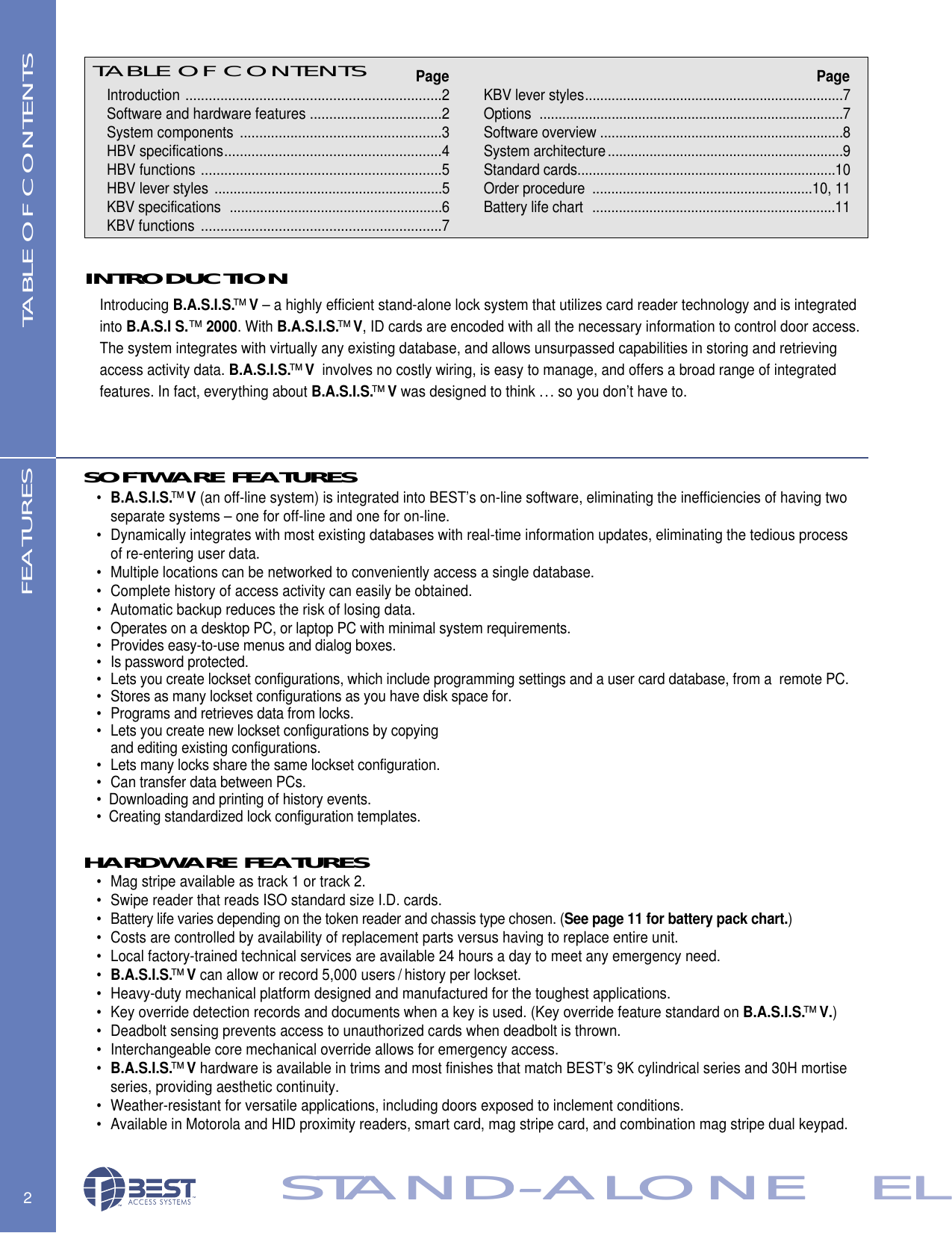
KBV lever styles....................................................................7Options ................................................................................7Software overview ................................................................8System architecture..............................................................9Standard cards....................................................................10Order procedure ..........................................................10, 11Battery life chart  ................................................................11TABLE OF CONTENTSIntroduction ..................................................................2Software and hardware features ..................................2System components ....................................................3HBV specifications........................................................4HBV functions ..............................................................5HBV lever styles ............................................................5KBV specifications  ........................................................6KBV functions ..............................................................7PagePage2STAND-ALONE   ELTABLE OF CONTENTS FEATURESINTRODUCTIONSTAND-ALONE   ELIntroducing B.A.S.I.S.™V– a highly efficient stand-alone lock system that utilizes card reader technology and is integrated into B.A.S.I S.™2000. With B.A.S.I.S.™V, ID cards are encoded with all the necessary information to control door access. The system integrates with virtually any existing database, and allows unsurpassed capabilities in storing and retrieving access activity data. B.A.S.I.S.™Vinvolves no costly wiring, is easy to manage, and offers a broad range of integrated features. In fact, everything about B.A.S.I.S.™Vwas designed to think ... so you don’t have to. SOFTWARE FEATURES•B.A.S.I.S.™V(an off-line system) is integrated into BEST’s on-line software, eliminating the inefficiencies of having two separate systems – one for off-line and one for on-line.• Dynamically integrates with most existing databases with real-time information updates, eliminating the tedious process of re-entering user data.• Multiple locations can be networked to conveniently access a single database.• Complete history of access activity can easily be obtained.• Automatic backup reduces the risk of losing data.• Operates on a desktop PC, or laptop PC with minimal system requirements.• Provides easy-to-use menus and dialog boxes.• Is password protected.• Lets you create lockset configurations, which include programming settings and a user card database, from a  remote PC.• Stores as many lockset configurations as you have disk space for.• Programs and retrieves data from locks.• Lets you create new lockset configurations by copying and editing existing configurations.• Lets many locks share the same lockset configuration.• Can transfer data between PCs.•  Downloading and printing of history events.•  Creating standardized lock configuration templates.HARDWARE FEATURES • Mag stripe available as track 1 or track 2.• Swipe reader that reads ISO standard size I.D. cards.• Battery life varies depending on the token reader and chassis type chosen. (See page 11 for battery pack chart.)• Costs are controlled by availability of replacement parts versus having to replace entire unit.• Local factory-trained technical services are available 24 hours a day to meet any emergency need.•B.A.S.I.S.™Vcan allow or record 5,000 users / history per lockset.• Heavy-duty mechanical platform designed and manufactured for the toughest applications.• Key override detection records and documents when a key is used. (Key override feature standard on B.A.S.I.S.™V.)• Deadbolt sensing prevents access to unauthorized cards when deadbolt is thrown.• Interchangeable core mechanical override allows for emergency access.•B.A.S.I.S.™Vhardware is available in trims and most finishes that match BEST’s 9K cylindrical series and 30H mortise series, providing aesthetic continuity. • Weather-resistant for versatile applications, including doors exposed to inclement conditions.• Available in Motorola and HID proximity readers, smart card, mag stripe card, and combination mag stripe dual keypad.
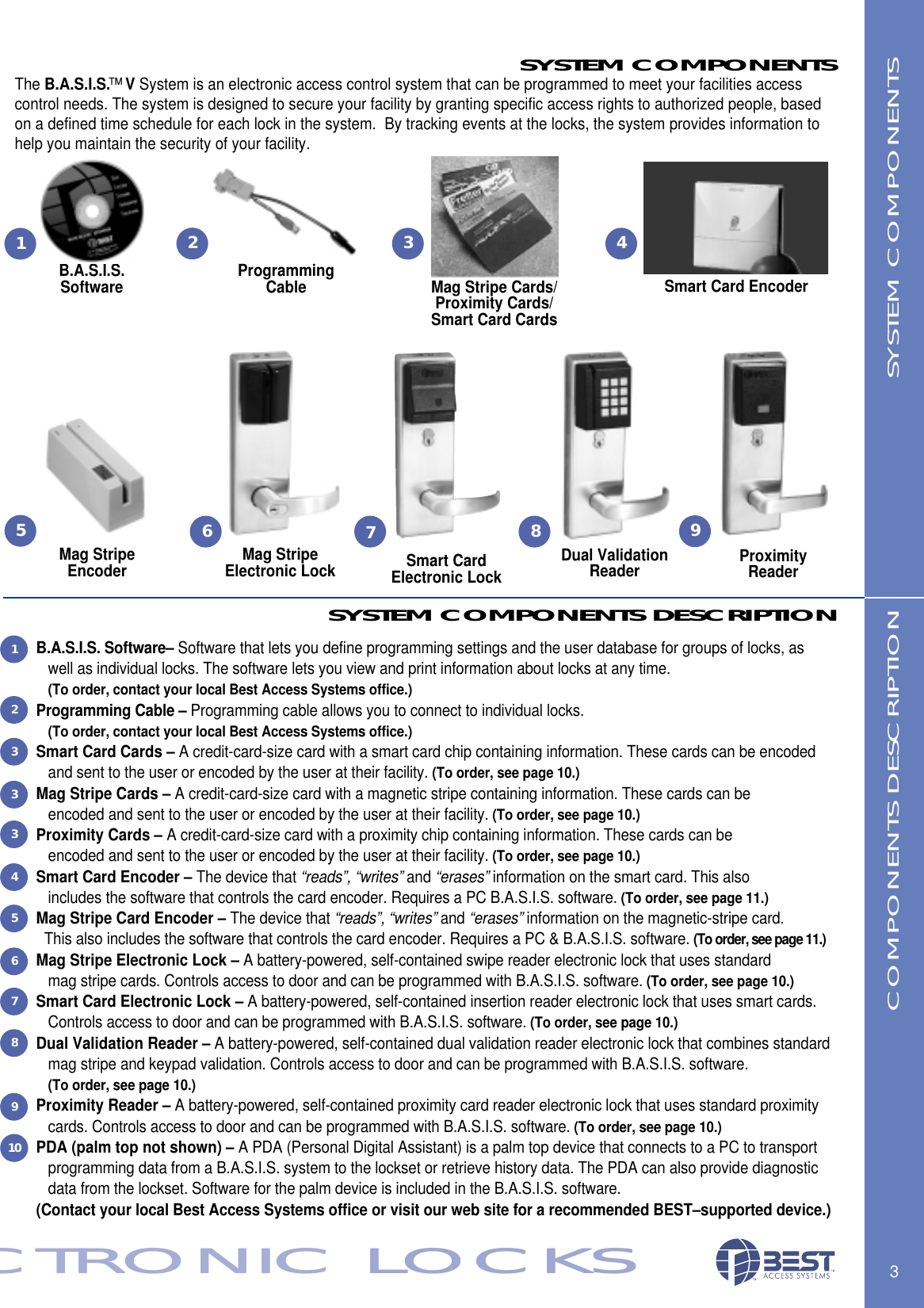
SYSTEM COMPONENTS DESCRIPTIONB.A.S.I.S. Software– Software that lets you define programming settings and the user database for groups of locks, as well as individual locks. The software lets you view and print information about locks at any time. (To order, contact your local Best Access Systems office.)Programming Cable – Programming cable allows you to connect to individual locks. (To order, contact your local Best Access Systems office.)Smart Card Cards – A credit-card-size card with a smart card chip containing information. These cards can be encoded and sent to the user or encoded by the user at their facility. (To order, see page 10.)Mag Stripe Cards – A credit-card-size card with a magnetic stripe containing information. These cards can be encoded and sent to the user or encoded by the user at their facility. (To order, see page 10.)Proximity Cards – A credit-card-size card with a proximity chip containing information. These cards can be encoded and sent to the user or encoded by the user at their facility. (To order, see page 10.)Smart Card Encoder – The device that “reads”, “writes” and “erases” information on the smart card. This also includes the software that controls the card encoder. Requires a PC B.A.S.I.S. software. (To order, see page 11.)Mag Stripe Card Encoder – The device that “reads”, “writes” and “erases” information on the magnetic-stripe card. This also includes the software that controls the card encoder. Requires a PC & B.A.S.I.S. software. (To order, see page 11.)Mag Stripe Electronic Lock – A battery-powered, self-contained swipe reader electronic lock that uses standard mag stripe cards. Controls access to door and can be programmed with B.A.S.I.S. software. (To order, see page 10.)Smart Card Electronic Lock – A battery-powered, self-contained insertion reader electronic lock that uses smart cards. Controls access to door and can be programmed with B.A.S.I.S. software. (To order, see page 10.)Dual Validation Reader – A battery-powered, self-contained dual validation reader electronic lock that combines standard mag stripe and keypad validation. Controls access to door and can be programmed with B.A.S.I.S. software. (To order, see page 10.)Proximity Reader – A battery-powered, self-contained proximity card reader electronic lock that uses standard proximity cards. Controls access to door and can be programmed with B.A.S.I.S. software. (To order, see page 10.)PDA (palm top not shown) – A PDA (Personal Digital Assistant) is a palm top device that connects to a PC to transport programming data from a B.A.S.I.S. system to the lockset or retrieve history data. The PDA can also provide diagnostic data from the lockset. Software for the palm device is included in the B.A.S.I.S. software. (Contact your local Best Access Systems office or visit our web site for a recommended BEST–supported device.)3ECTRONIC LOCKSECTRONIC LOCKSSYSTEM COMPONENTSSYSTEM COMPONENTSThe B.A.S.I.S.™VSystem is an electronic access control system that can be programmed to meet your facilities access control needs. The system is designed to secure your facility by granting specific access rights to authorized people, based on a defined time schedule for each lock in the system.  By tracking events at the locks, the system provides information to help you maintain the security of your facility.Mag StripeEncoderB.A.S.I.S. SoftwareMag Stripe Electronic Lock Smart Card Electronic LockSmart Card EncoderMag Stripe Cards/Proximity Cards/Smart Card CardsCOMPONENTS DESCRIPTION1Programming Cable267Dual Validation Reader ProximityReader895431233345678910
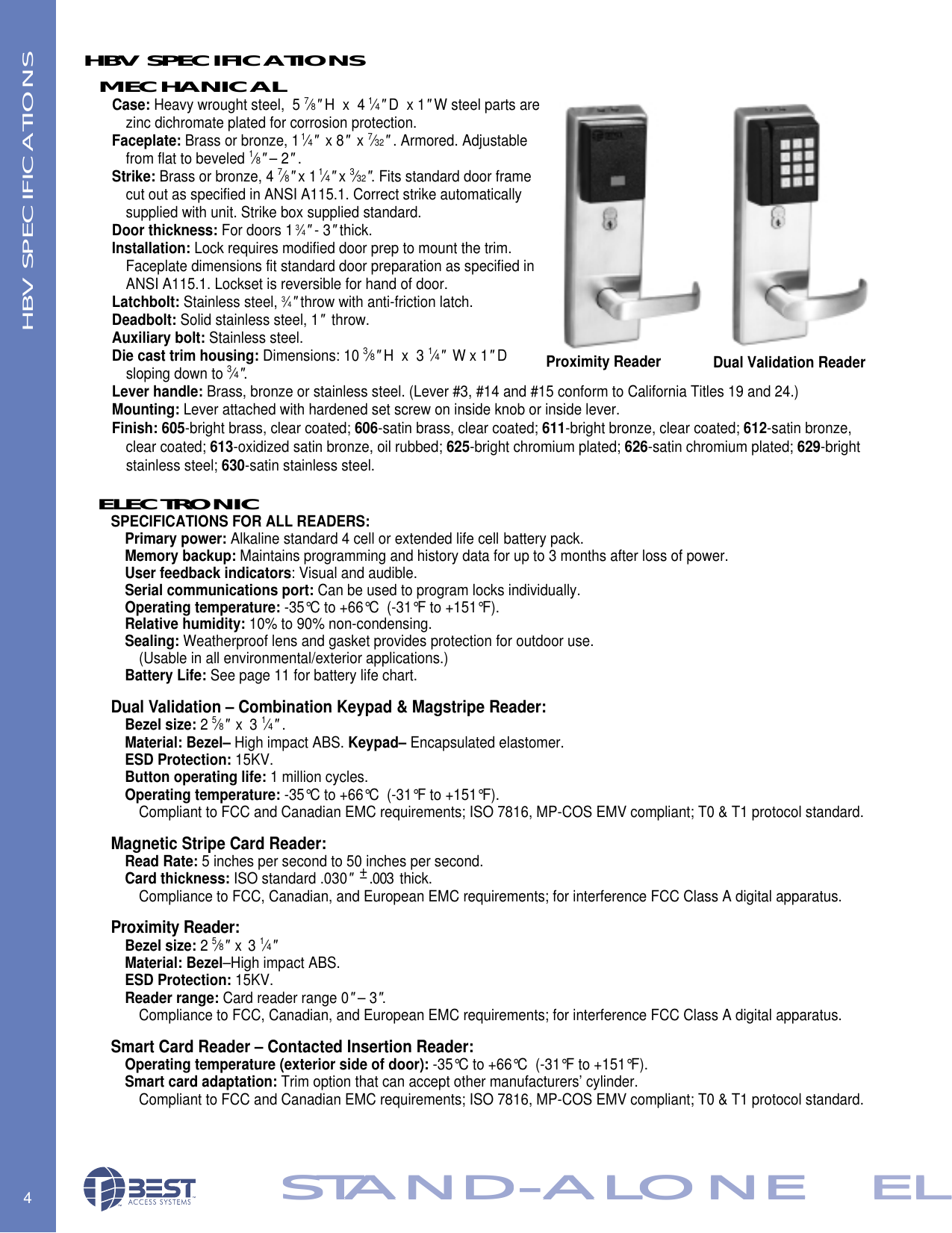
MECHANICALCase: Heavy wrought steel,  5 7⁄8"H  x  4 1⁄4"D  x 1"W steel parts are zinc dichromate plated for corrosion protection.Faceplate: Brass or bronze, 11⁄4"x 8"x 7⁄32". Armored. Adjustable from flat to beveled 1⁄8"– 2".Strike: Brass or bronze, 4 7⁄8"x 11⁄4"x 3⁄32". Fits standard door frame cut out as specified in ANSI A115.1. Correct strike automatically supplied with unit. Strike box supplied standard.Door thickness: For doors 1 3⁄4"- 3"thick. Installation: Lock requires modified door prep to mount the trim. Faceplate dimensions fit standard door preparation as specified in ANSI A115.1. Lockset is reversible for hand of door.Latchbolt: Stainless steel, 3⁄4"throw with anti-friction latch. Deadbolt: Solid stainless steel, 1"throw.Auxiliary bolt: Stainless steel.Die cast trim housing: Dimensions: 10 3⁄8"H  x  3 1⁄4"W x 1"D sloping down to 3⁄4".Lever handle: Brass, bronze or stainless steel. (Lever #3, #14 and #15 conform to California Titles 19 and 24.)Mounting: Lever attached with hardened set screw on inside knob or inside lever.Finish: 605-bright brass, clear coated; 606-satin brass, clear coated; 611-bright bronze, clear coated; 612-satin bronze, clear coated; 613-oxidized satin bronze, oil rubbed; 625-bright chromium plated; 626-satin chromium plated; 629-bright stainless steel; 630-satin stainless steel.4STAND-ALONE   ELHBV SPECIFICATIONSELECTRONICSPECIFICATIONS FOR ALL READERS:Primary power: Alkaline standard 4 cell or extended life cell battery pack. Memory backup: Maintains programming and history data for up to 3 months after loss of power.User feedback indicators: Visual and audible.Serial communications port: Can be used to program locks individually.Operating temperature: -35°C to +66°C  (-31°F to +151°F).Relative humidity: 10% to 90% non-condensing. Sealing: Weatherproof lens and gasket provides protection for outdoor use.  (Usable in all environmental/exterior applications.)Battery Life: See page 11 for battery life chart.Dual Validation – Combination Keypad & Magstripe Reader:Bezel size: 2 5⁄8"x 3 1⁄4".Material: Bezel– High impact ABS. Keypad– Encapsulated elastomer.ESD Protection: 15KV.Button operating life: 1 million cycles.Operating temperature: -35°C to +66°C  (-31°F to +151°F).Compliant to FCC and Canadian EMC requirements; ISO 7816, MP-COS EMV compliant; T0 & T1 protocol standard.Magnetic Stripe Card Reader: Read Rate: 5 inches per second to 50 inches per second.Card thickness: ISO standard .030"±.003  thick.Compliance to FCC, Canadian, and European EMC requirements; for interference FCC Class A digital apparatus.Proximity Reader:Bezel size: 2 5⁄8"x 3 1⁄4"Material: Bezel–High impact ABS.ESD Protection: 15KV.Reader range: Card reader range 0"– 3".Compliance to FCC, Canadian, and European EMC requirements; for interference FCC Class A digital apparatus.Smart Card Reader – Contacted Insertion Reader:Operating temperature (exterior side of door): -35°C to +66°C  (-31°F to +151°F).Smart card adaptation: Trim option that can accept other manufacturers’ cylinder.Compliant to FCC and Canadian EMC requirements; ISO 7816, MP-COS EMV compliant; T0 & T1 protocol standard.HBV SPECIFICATIONSSTAND-ALONE   ELProximity Reader Dual Validation Reader
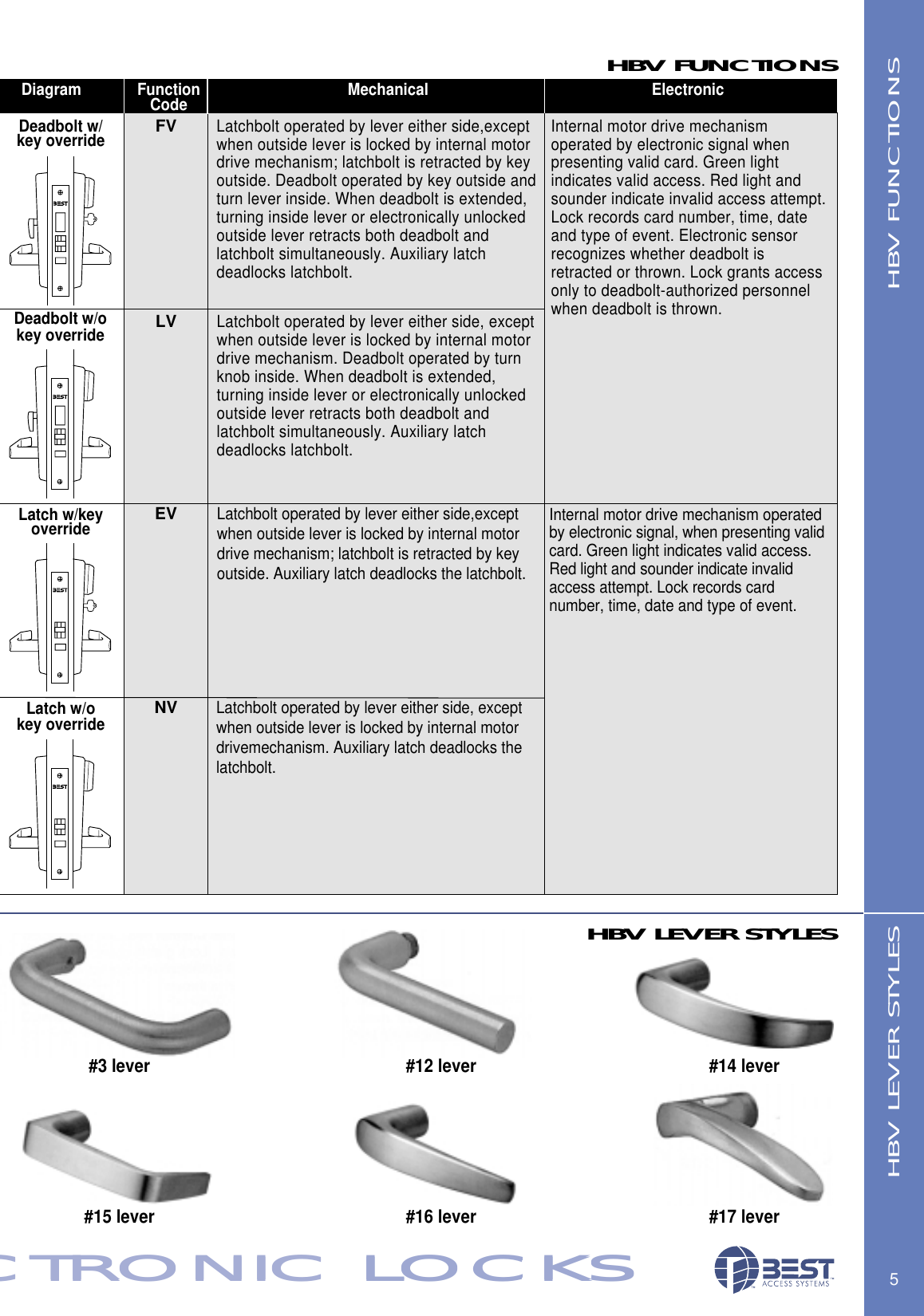
5ECTRONIC LOCKSHBV FUNCTIONSECTRONIC LOCKSLatch w/o key overrideDeadbolt w/o key overrideDeadbolt w/ key overrideLatch w/keyoverride Internal motor drive mechanism operatedby electronic signal, when presenting validcard. Green light indicates valid access.Red light and sounder indicate invalidaccess attempt. Lock records cardnumber, time, date and type of event.HBV FUNCTIONSLatchbolt operated by lever either side,exceptwhen outside lever is locked by internal motordrive mechanism; latchbolt is retracted by keyoutside. Deadbolt operated by key outside andturn lever inside. When deadbolt is extended,turning inside lever or electronically unlockedoutside lever retracts both deadbolt and latchbolt simultaneously. Auxiliary latch deadlocks latchbolt.Internal motor drive mechanism operated by electronic signal when   presenting valid card. Green light     indicates valid access. Red light andsounder indicate invalid access attempt.Lock records card number, time, dateand type of event. Electronic sensor recognizes whether deadbolt isretracted or thrown. Lock grants accessonly to deadbolt-authorized personnelwhen deadbolt is thrown.Latchbolt operated by lever either side, exceptwhen outside lever is locked by internal motordrive mechanism. Deadbolt operated by turnknob inside. When deadbolt is extended, turning inside lever or electronically unlockedoutside lever retracts both deadbolt and latchbolt simultaneously. Auxiliary latch deadlocks latchbolt.FVLVLatchbolt operated by lever either side, exceptwhen outside lever is locked by internal motordrivemechanism. Auxiliary latch deadlocks thelatchbolt.NVEVLatchbolt operated by lever either side,exceptwhen outside lever is locked by internal motordrive mechanism; latchbolt is retracted by keyoutside. Auxiliary latch deadlocks the latchbolt.Diagram Function Mechanical ElectronicCodeHBV LEVER STYLES#15 lever #16 lever #17 lever#3 lever #12 lever #14 leverHBV LEVER STYLES
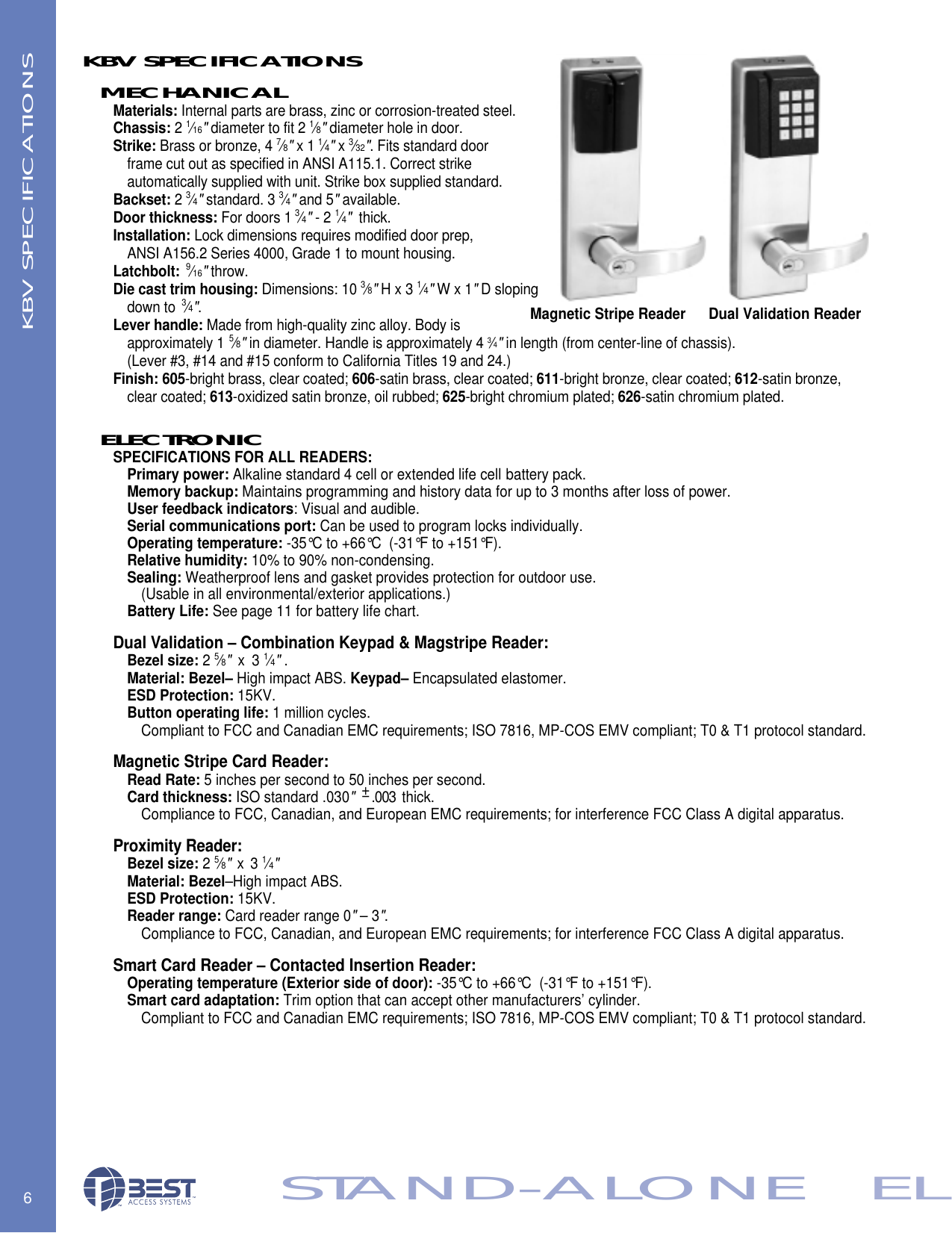
6STAND-ALONE   ELMECHANICALMaterials: Internal parts are brass, zinc or corrosion-treated steel.Chassis: 2 1⁄16"diameter to fit 2 1⁄8"diameter hole in door.Strike: Brass or bronze, 4 7⁄8"x 1 1⁄4"x 3⁄32". Fits standard door frame cut out as specified in ANSI A115.1. Correct strike automatically supplied with unit. Strike box supplied standard.Backset: 2 3⁄4"standard. 3 3⁄4"and 5"available.Door thickness: For doors 1 3⁄4"- 2 1⁄4"thick. Installation: Lock dimensions requires modified door prep, ANSI A156.2 Series 4000, Grade 1 to mount housing. Latchbolt: 9⁄16"throw.Die cast trim housing: Dimensions: 10 3⁄8"H x 3 1⁄4"W x 1"D sloping down to  3⁄4".Lever handle: Made from high-quality zinc alloy. Body is approximately 1 5⁄8"in diameter. Handle is approximately 4 3⁄4"in length (from center-line of chassis). (Lever #3, #14 and #15 conform to California Titles 19 and 24.)Finish: 605-bright brass, clear coated; 606-satin brass, clear coated; 611-bright bronze, clear coated; 612-satin bronze, clear coated; 613-oxidized satin bronze, oil rubbed; 625-bright chromium plated; 626-satin chromium plated.ELECTRONICSPECIFICATIONS FOR ALL READERS:Primary power: Alkaline standard 4 cell or extended life cell battery pack. Memory backup: Maintains programming and history data for up to 3 months after loss of power.User feedback indicators: Visual and audible.Serial communications port: Can be used to program locks individually.Operating temperature: -35°C to +66°C  (-31°F to +151°F).Relative humidity: 10% to 90% non-condensing. Sealing: Weatherproof lens and gasket provides protection for outdoor use.  (Usable in all environmental/exterior applications.)Battery Life: See page 11 for battery life chart.Dual Validation – Combination Keypad & Magstripe Reader:Bezel size: 2 5⁄8"x 3 1⁄4".Material: Bezel– High impact ABS. Keypad– Encapsulated elastomer.ESD Protection: 15KV.Button operating life: 1 million cycles.Compliant to FCC and Canadian EMC requirements; ISO 7816, MP-COS EMV compliant; T0 & T1 protocol standard.Magnetic Stripe Card Reader: Read Rate: 5 inches per second to 50 inches per second.Card thickness: ISO standard .030"±.003  thick.Compliance to FCC, Canadian, and European EMC requirements; for interference FCC Class A digital apparatus.Proximity Reader:Bezel size: 2 5⁄8"x 3 1⁄4"Material: Bezel–High impact ABS.ESD Protection: 15KV.Reader range: Card reader range 0"– 3".Compliance to FCC, Canadian, and European EMC requirements; for interference FCC Class A digital apparatus.Smart Card Reader – Contacted Insertion Reader:Operating temperature (Exterior side of door): -35°C to +66°C  (-31°F to +151°F).Smart card adaptation: Trim option that can accept other manufacturers’ cylinder.Compliant to FCC and Canadian EMC requirements; ISO 7816, MP-COS EMV compliant; T0 & T1 protocol standard.Magnetic Stripe ReaderKBV SPECIFICATIONSKBV SPECIFICATIONSDual Validation Reader
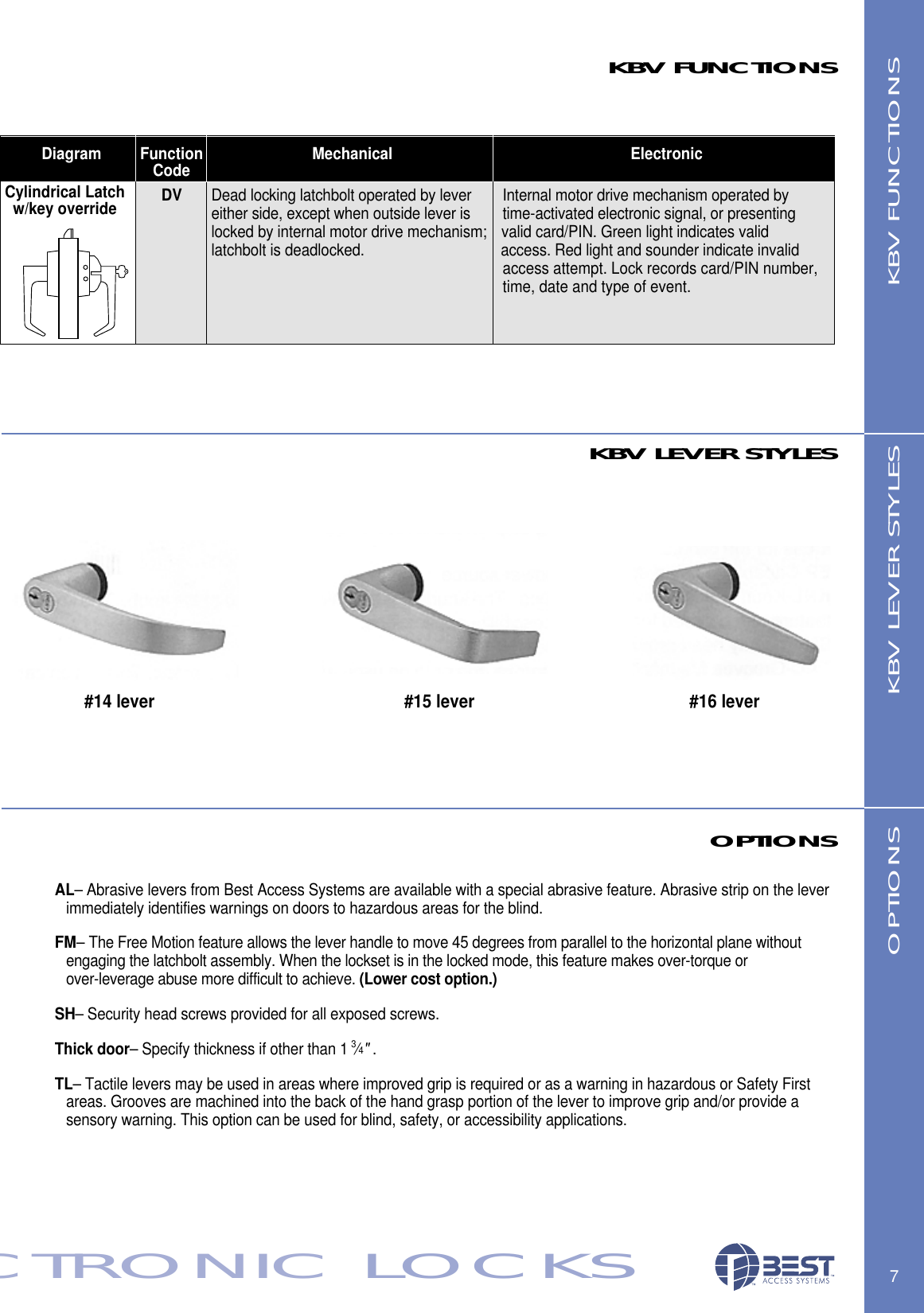
Diagram Function Mechanical ElectronicCode7ECTRONIC LOCKSKBV FUNCTIONSKBV FUNCTIONSOPTIONSAL– Abrasive levers from Best Access Systems are available with a special abrasive feature. Abrasive strip on the lever immediately identifies warnings on doors to hazardous areas for the blind.FM– The Free Motion feature allows the lever handle to move 45 degrees from parallel to the horizontal plane without engaging the latchbolt assembly. When the lockset is in the locked mode, this feature makes over-torque or over-leverage abuse more difficult to achieve. (Lower cost option.)SH– Security head screws provided for all exposed screws.Thick door– Specify thickness if other than 1 3⁄4".TL– Tactile levers may be used in areas where improved grip is required or as a warning in hazardous or Safety First areas. Grooves are machined into the back of the hand grasp portion of the lever to improve grip and/or provide a  sensory warning. This option can be used for blind, safety, or accessibility applications.OPTIONS#14 lever #15 lever #16 lever KBV LEVER STYLESKBV LEVER STYLESCylindrical Latchw/key override DV Dead locking latchbolt operated by lever  Internal motor drive mechanism operated by  either side, except when outside lever is time-activated electronic signal, or presenting  locked by internal motor drive mechanism; valid card/PIN. Green light indicates validlatchbolt is deadlocked. access. Red light and sounder indicate invalidaccess attempt. Lock records card/PIN number,time, date and type of event.
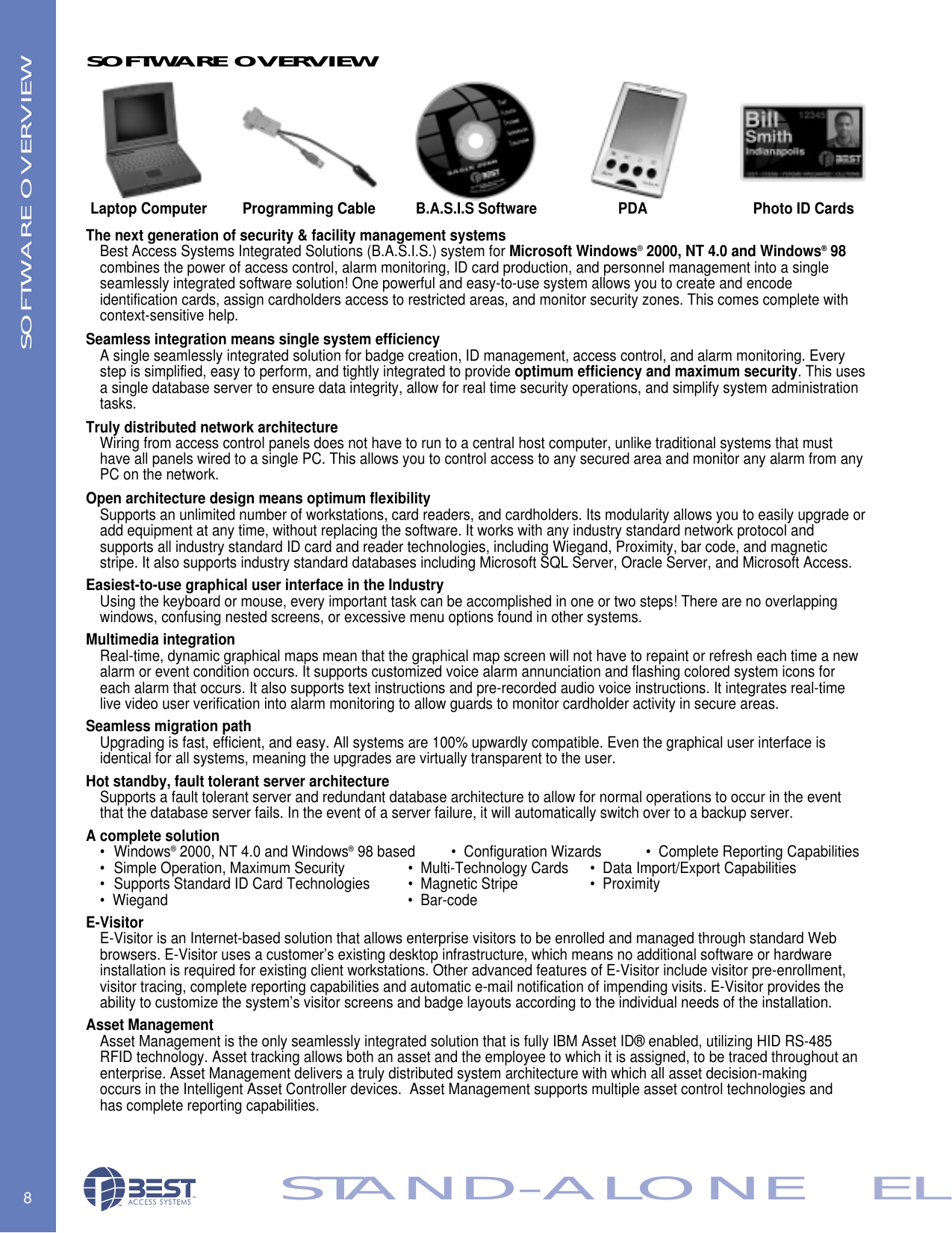
The next generation of security & facility management systemsBest Access Systems Integrated Solutions (B.A.S.I.S.) system for Microsoft Windows®2000, NT 4.0 and Windows®98 combines the power of access control, alarm monitoring, ID card production, and personnel management into a single seamlessly integrated software solution! One powerful and easy-to-use system allows you to create and encode identification cards, assign cardholders access to restricted areas, and monitor security zones. This comes complete with context-sensitive help.Seamless integration means single system efficiencyA single seamlessly integrated solution for badge creation, ID management, access control, and alarm monitoring. Every step is simplified, easy to perform, and tightly integrated to provide optimum efficiency and maximum security. This usesa single database server to ensure data integrity, allow for real time security operations, and simplify system administration tasks.Truly distributed network architectureWiring from access control panels does not have to run to a central host computer, unlike traditional systems that must have all panels wired to a single PC. This allows you to control access to any secured area and monitor any alarm from anyPC on the network.Open architecture design means optimum flexibilitySupports an unlimited number of workstations, card readers, and cardholders. Its modularity allows you to easily upgrade oradd equipment at any time, without replacing the software. It works with any industry standard network protocol and supports all industry standard ID card and reader technologies, including Wiegand, Proximity, bar code, and magnetic stripe. It also supports industry standard databases including Microsoft SQL Server, Oracle Server, and Microsoft Access.Easiest-to-use graphical user interface in the IndustryUsing the keyboard or mouse, every important task can be accomplished in one or two steps! There are no overlapping windows, confusing nested screens, or excessive menu options found in other systems.Multimedia integrationReal-time, dynamic graphical maps mean that the graphical map screen will not have to repaint or refresh each time a new alarm or event condition occurs. It supports customized voice alarm annunciation and flashing colored system icons for each alarm that occurs. It also supports text instructions and pre-recorded audio voice instructions. It integrates real-time live video user verification into alarm monitoring to allow guards to monitor cardholder activity in secure areas.Seamless migration pathUpgrading is fast, efficient, and easy. All systems are 100% upwardly compatible. Even the graphical user interface is identical for all systems, meaning the upgrades are virtually transparent to the user.Hot standby, fault tolerant server architectureSupports a fault tolerant server and redundant database architecture to allow for normal operations to occur in the event that the database server fails. In the event of a server failure, it will automatically switch over to a backup server.A complete solution• Windows®2000, NT 4.0 and Windows®98 based •  Configuration Wizards •  Complete Reporting Capabilities• Simple Operation, Maximum Security        •  Multi-Technology Cards •  Data Import/Export Capabilities• Supports Standard ID Card Technologies •  Magnetic Stripe •  Proximity•  Wiegand       •  Bar-codeE-VisitorE-Visitor is an Internet-based solution that allows enterprise visitors to be enrolled and managed through standard Web browsers. E-Visitor uses a customer’s existing desktop infrastructure, which means no additional software or hardware installation is required for existing client workstations. Other advanced features of E-Visitor include visitor pre-enrollment, visitor tracing, complete reporting capabilities and automatic e-mail notification of impending visits. E-Visitor provides the ability to customize the system’s visitor screens and badge layouts according to the individual needs of the installation.Asset ManagementAsset Management is the only seamlessly integrated solution that is fully IBM Asset ID® enabled, utilizing HID RS-485 RFID technology. Asset tracking allows both an asset and the employee to which it is assigned, to be traced throughout an enterprise. Asset Management delivers a truly distributed system architecture with which all asset decision-making occurs in the Intelligent Asset Controller devices.  Asset Management supports multiple asset control technologies and has complete reporting capabilities.8STAND-ALONE   ELLaptop ComputerSOFTWARE OVERVIEWSOFTWARE OVERVIEWProgramming Cable B.A.S.I.S Software PDA Photo ID Cards
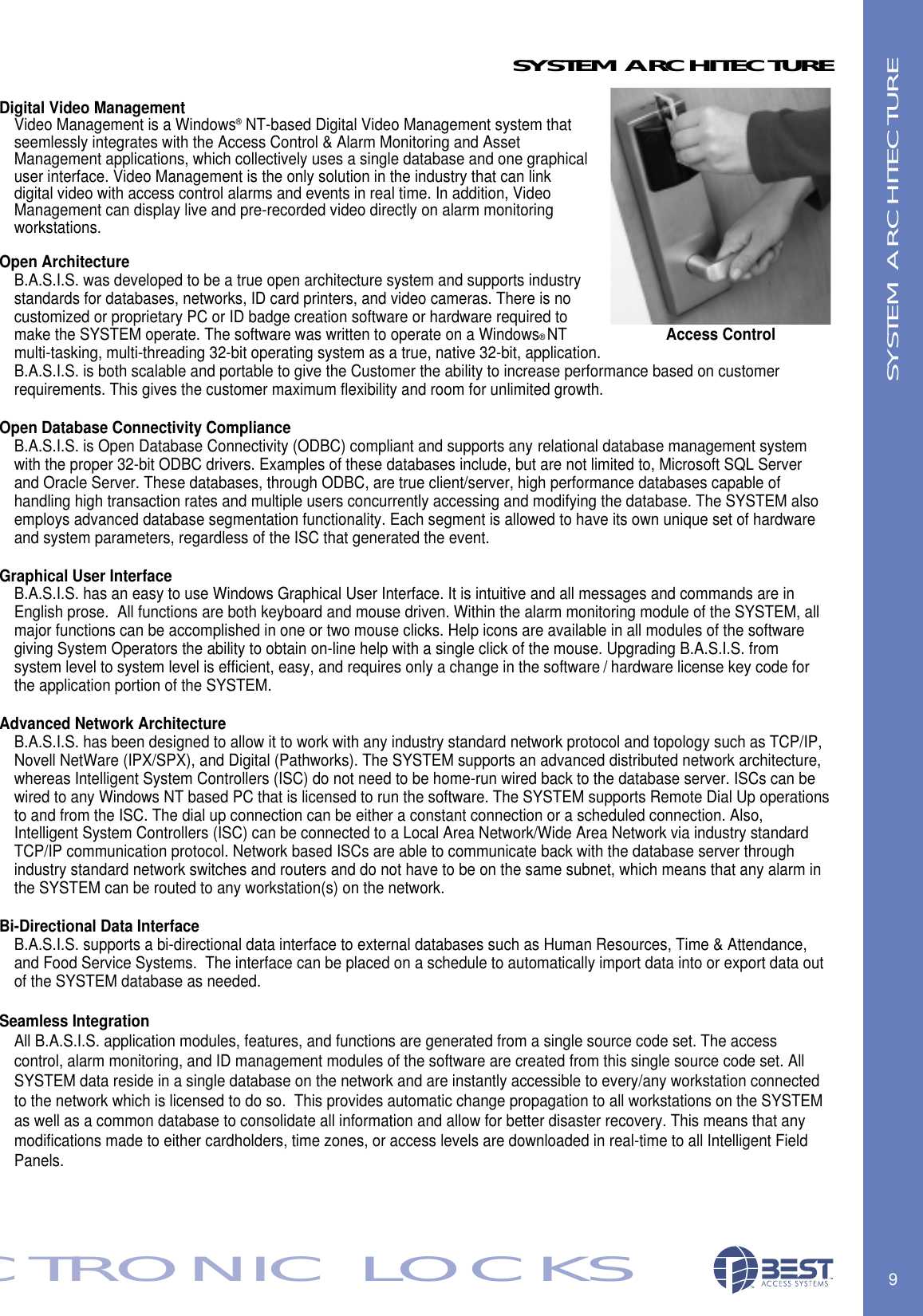
Digital Video ManagementVideo Management is a Windows®NT-based Digital Video Management system that seemlessly integrates with the Access Control & Alarm Monitoring and AssetManagement applications, which collectively uses a single database and one graphical user interface. Video Management is the only solution in the industry that can link digital video with access control alarms and events in real time. In addition, Video Management can display live and pre-recorded video directly on alarm monitoring workstations.Open ArchitectureB.A.S.I.S. was developed to be a true open architecture system and supports industry standards for databases, networks, ID card printers, and video cameras. There is no customized or proprietary PC or ID badge creation software or hardware required to make the SYSTEM operate. The software was written to operate on a Windows®NT multi-tasking, multi-threading 32-bit operating system as a true, native 32-bit, application. B.A.S.I.S. is both scalable and portable to give the Customer the ability to increase performance based on customer requirements. This gives the customer maximum flexibility and room for unlimited growth.Open Database Connectivity ComplianceB.A.S.I.S. is Open Database Connectivity (ODBC) compliant and supports any relational database management system with the proper 32-bit ODBC drivers. Examples of these databases include, but are not limited to, Microsoft SQL Server and Oracle Server. These databases, through ODBC, are true client/server, high performance databases capable of handling high transaction rates and multiple users concurrently accessing and modifying the database. The SYSTEM also employs advanced database segmentation functionality. Each segment is allowed to have its own unique set of hardware and system parameters, regardless of the ISC that generated the event.Graphical User InterfaceB.A.S.I.S. has an easy to use Windows Graphical User Interface. It is intuitive and all messages and commands are in English prose.  All functions are both keyboard and mouse driven. Within the alarm monitoring module of the SYSTEM, all major functions can be accomplished in one or two mouse clicks. Help icons are available in all modules of the software giving System Operators the ability to obtain on-line help with a single click of the mouse. Upgrading B.A.S.I.S. from system level to system level is efficient, easy, and requires only a change in the software / hardware license key code for the application portion of the SYSTEM.Advanced Network ArchitectureB.A.S.I.S. has been designed to allow it to work with any industry standard network protocol and topology such as TCP/IP, Novell NetWare (IPX/SPX), and Digital (Pathworks). The SYSTEM supports an advanced distributed network architecture, whereas Intelligent System Controllers (ISC) do not need to be home-run wired back to the database server. ISCs can be wired to any Windows NT based PC that is licensed to run the software. The SYSTEM supports Remote Dial Up operationsto and from the ISC. The dial up connection can be either a constant connection or a scheduled connection. Also, Intelligent System Controllers (ISC) can be connected to a Local Area Network/Wide Area Network via industry standardTCP/IP communication protocol. Network based ISCs are able to communicate back with the database server through industry standard network switches and routers and do not have to be on the same subnet, which means that any alarm in the SYSTEM can be routed to any workstation(s) on the network. Bi-Directional Data InterfaceB.A.S.I.S. supports a bi-directional data interface to external databases such as Human Resources, Time & Attendance, and Food Service Systems.  The interface can be placed on a schedule to automatically import data into or export data out of the SYSTEM database as needed.Seamless IntegrationAll B.A.S.I.S. application modules, features, and functions are generated from a single source code set. The access control, alarm monitoring, and ID management modules of the software are created from this single source code set. All SYSTEM data reside in a single database on the network and are instantly accessible to every/any workstation connected to the network which is licensed to do so.  This provides automatic change propagation to all workstations on the SYSTEM as well as a common database to consolidate all information and allow for better disaster recovery. This means that any modifications made to either cardholders, time zones, or access levels are downloaded in real-time to all Intelligent Field Panels.9ECTRONIC LOCKSSYSTEM ARCHITECTURESYSTEM ARCHITECTUREAccess Control
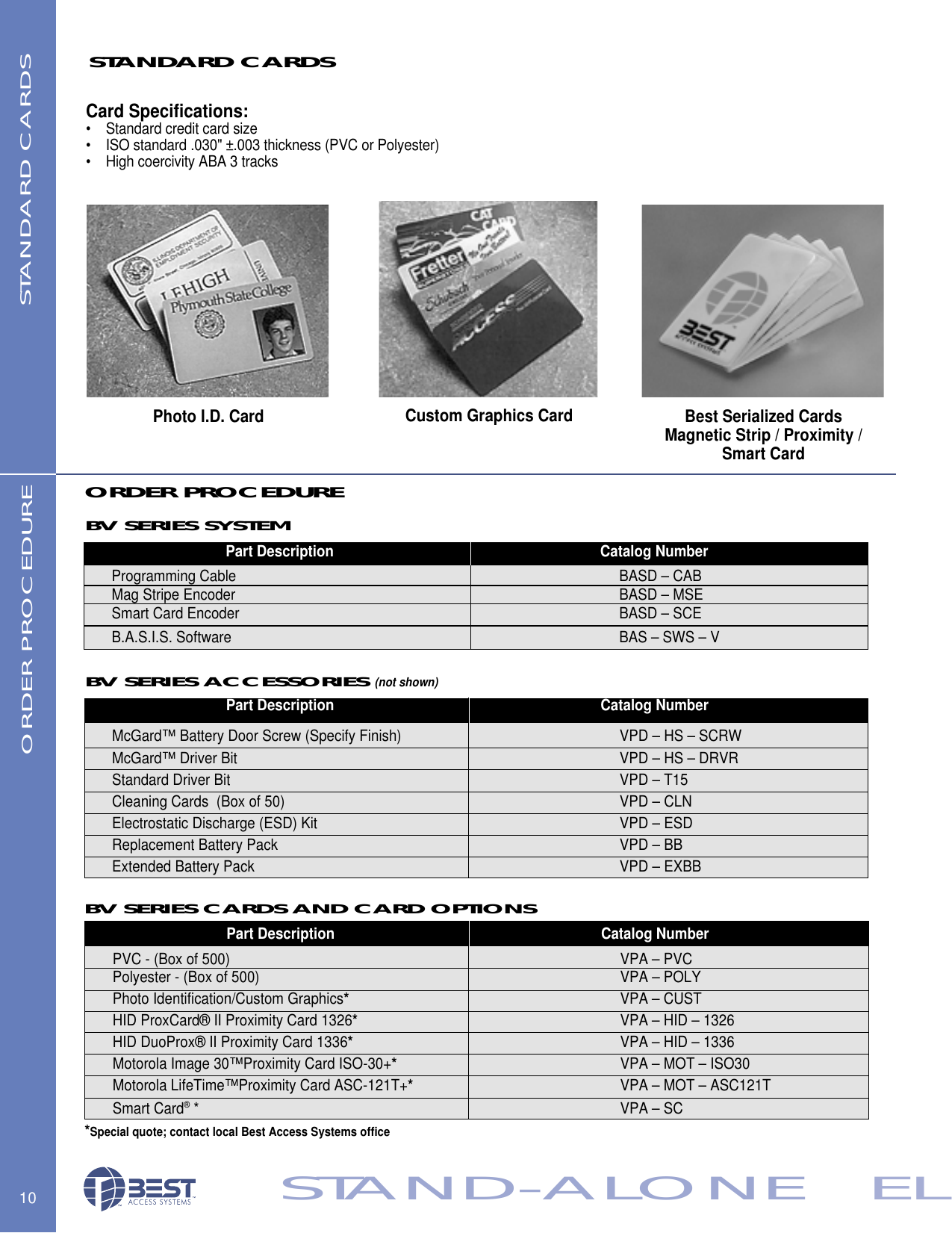
10STAND-ALONE   ELBV SERIES CARDS AND CARD OPTIONSBV SERIES SYSTEMBV SERIES ACCESSORIES (not shown)ORDER PROCEDUREORDER PROCEDURECustom Graphics Card Best Serialized CardsMagnetic Strip / Proximity /Smart CardCard Specifications:•    Standard credit card size  •    ISO standard .030" ±.003 thickness (PVC or Polyester)•    High coercivity ABA 3 tracksSTANDARD CARDS STANDARD CARDSPhoto I.D. CardPart Description Catalog NumberPVC - (Box of 500) VPA – PVC                 Polyester - (Box of 500)   VPA – POLYPhoto Identification/Custom Graphics*VPA – CUSTHID ProxCard® II Proximity Card 1326*VPA – HID – 1326HID DuoProx® II Proximity Card 1336*VPA – HID – 1336Motorola Image 30™Proximity Card ISO-30+*VPA – MOT – ISO30Motorola LifeTime™Proximity Card ASC-121T+*VPA – MOT – ASC121TSmart Card®* VPA – SC *Special quote; contact local Best Access Systems officePart Description Catalog NumberMcGard™ Battery Door Screw (Specify Finish) VPD – HS – SCRWMcGard™ Driver Bit VPD – HS – DRVRStandard Driver Bit  VPD – T15Cleaning Cards  (Box of 50)  VPD – CLN                 Electrostatic Discharge (ESD) Kit VPD – ESDReplacement Battery Pack VPD – BBExtended Battery Pack VPD – EXBBPart Description Catalog NumberProgramming Cable BASD – CABMag Stripe Encoder BASD – MSESmart Card Encoder BASD – SCEB.A.S.I.S. Software BAS – SWS – V
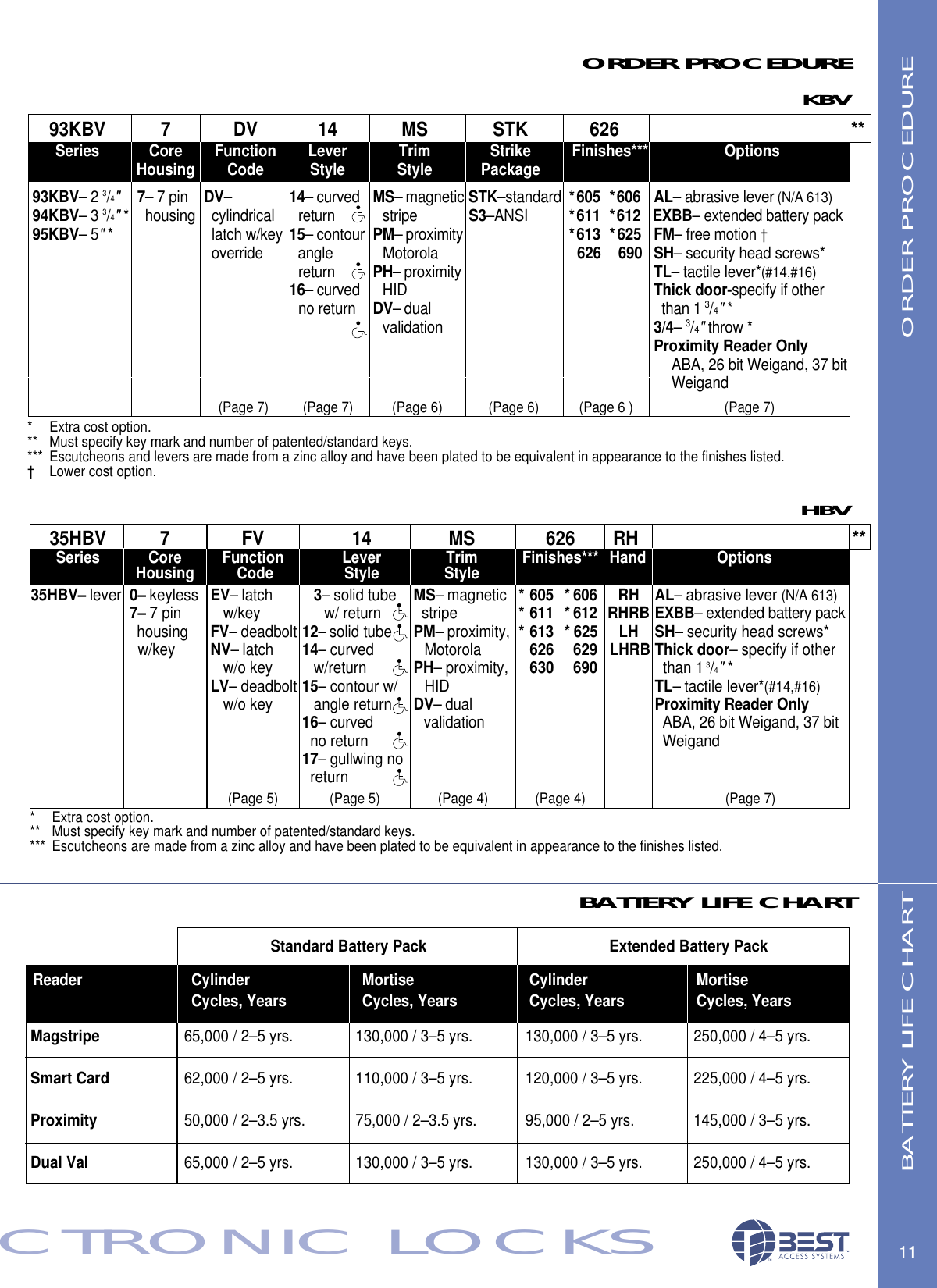
11ECTRONIC LOCKSORDER PROCEDUREBATTERY LIFE CHARTORDER PROCEDUREMagstripeSmart CardProximityDual Val65,000 / 2–5 yrs.62,000 / 2–5 yrs.50,000 / 2–3.5 yrs.65,000 / 2–5 yrs.130,000 / 3–5 yrs.110,000 / 3–5 yrs.75,000 / 2–3.5 yrs.130,000 / 3–5 yrs.130,000 / 3–5 yrs.120,000 / 3–5 yrs.95,000 / 2–5 yrs.130,000 / 3–5 yrs.250,000 / 4–5 yrs.225,000 / 4–5 yrs.145,000 / 3–5 yrs.250,000 / 4–5 yrs.Reader Cylinder Mortise Cylinder MortiseCycles, Years Cycles, Years Cycles, Years Cycles, YearsBATTERY LIFE CHARTStandard Battery Pack Extended Battery Pack(Page 7) (Page 7) (Page 7)(Page 5) (Page 5) (Page 4) (Page 4) (Page 7)HBV35HBV 7 FV 14 MS 626 RH **Series Core Function Lever Trim Finishes*** Hand OptionsHousing Code Style Style35HBV– lever 0– keyless EV– latch 3– solid tube  MS– magnetic * 605 * 606 RH AL– abrasive lever (N/A 613)7– 7 pin w/key w/ return stripe * 611 * 612 RHRB EXBB– extended battery packhousing FV– deadbolt 12– solid tube  PM– proximity,  * 613 * 625 LH SH– security head screws*w/key NV– latch 14– curved Motorola 626   629 LHRB Thick door– specify if other   w/o key w/return PH– proximity,    630 690 than 1 3/4" *LV– deadbolt 15– contour w/ HID TL– tactile lever*(#14,#16)w/o key angle return  DV– dual Proximity Reader Only16– curved       validation ABA, 26 bit Weigand, 37 bitno return  Weigand17– gullwing noreturn* Extra cost option.** Must specify key mark and number of patented/standard keys.*** Escutcheons are made from a zinc alloy and have been plated to be equivalent in appearance to the finishes listed.KBV93KBV 7 DV 14 MS STK 626 **Series Core Function Lever Trim Strike Finishes*** OptionsHousing Code Style Style Package93KBV–2 3/4"7– 7 pin DV–14– curved  MS– magnetic STK–standard *605 *606 AL– abrasive lever (N/A 613)94KBV–3 3/4" * housing cylindrical return stripe S3–ANSI *611 *612 EXBB– extended battery pack95KBV–5" * latch w/key 15– contour  PM– proximity  *613 * 625 FM– free motion †override angle Motorola 626 690 SH– security head screws*return PH– proximity TL– tactile lever*(#14,#16)16– curved HID Thick door-specify if other  no return DV– dual than 1 3/4" *validation 3/4–3/4"throw *Proximity Reader OnlyABA, 26 bit Weigand, 37 bitWeigand * Extra cost option.** Must specify key mark and number of patented/standard keys.*** Escutcheons and levers are made from a zinc alloy and have been plated to be equivalent in appearance to the finishes listed.† Lower cost option.(Page 6) (Page 6 )(Page 6)
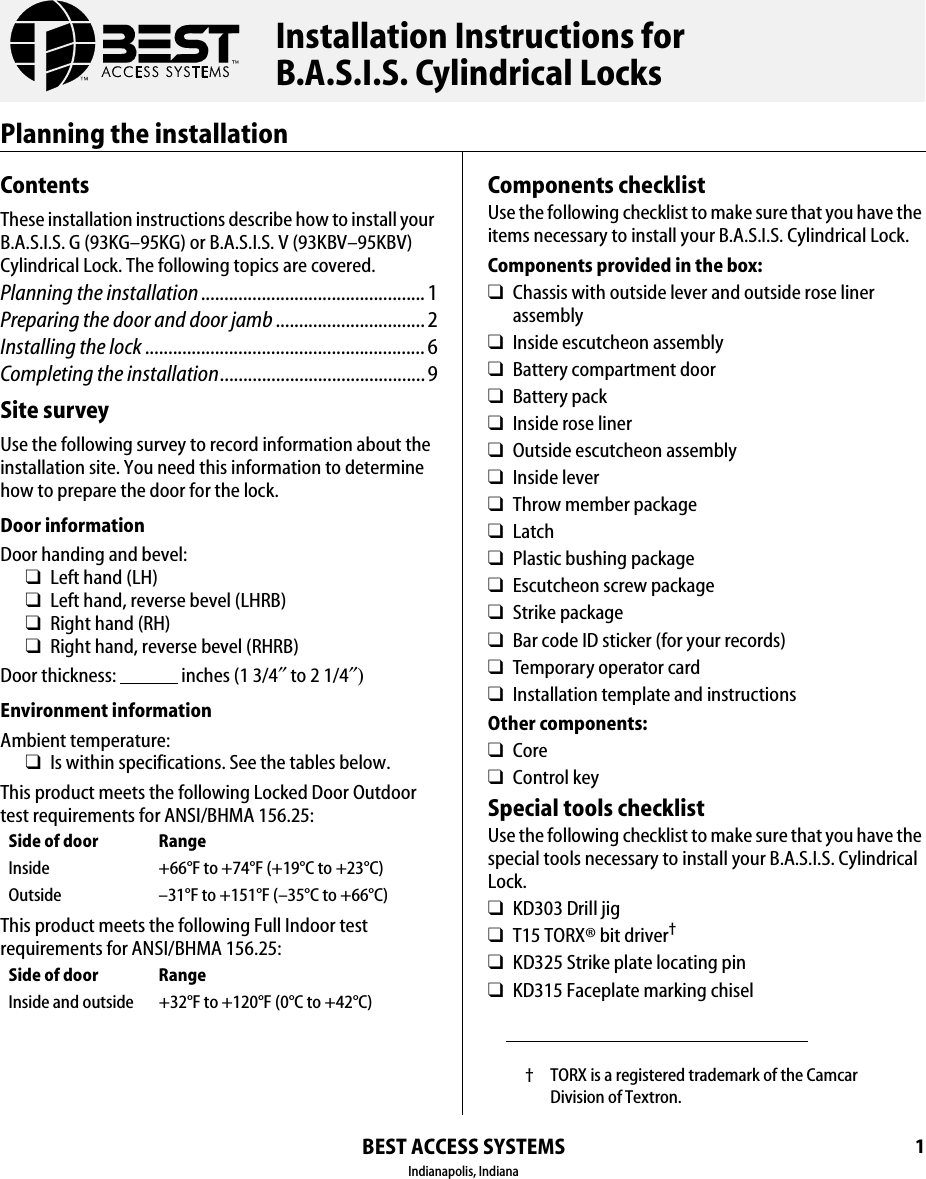
BEST ACCESS SYSTEMSIndianapolis, Indiana1Planning the installationContentsThese installation instructions describe how to install your B.A.S.I.S. G (93KG–95KG) or B.A.S.I.S. V (93KBV–95KBV) Cylindrical Lock. The following topics are covered.Planning the installation................................................ 1Preparing the door and door jamb ................................ 2Installing the lock............................................................ 6Completing the installation............................................9Site surveyUse the following survey to record information about the installation site. You need this information to determine how to prepare the door for the lock.Door informationDoor handing and bevel:❑Left hand (LH)❑Left hand, reverse bevel (LHRB)❑Right hand (RH)❑Right hand, reverse bevel (RHRB)Door thickness:                 inches (1 3/4″ to 2 1/4″)Environment informationAmbient temperature:❑Is within specifications. See the tables below.This product meets the following Locked Door Outdoor test requirements for ANSI/BHMA 156.25:This product meets the following Full Indoor test requirements for ANSI/BHMA 156.25:Side of door RangeInside +66°F to +74°F (+19°C to +23°C)Outside –31°F to +151°F (–35°C to +66°C)Side of door RangeInside and outside +32°F to +120°F (0°C to +42°C)Components checklistUse the following checklist to make sure that you have the items necessary to install your B.A.S.I.S. Cylindrical Lock.Components provided in the box:❑Chassis with outside lever and outside rose liner assembly❑Inside escutcheon assembly❑Battery compartment door❑Battery pack❑Inside rose liner❑Outside escutcheon assembly❑Inside lever❑Throw member package❑Latch❑Plastic bushing package❑Escutcheon screw package❑Strike package❑Bar code ID sticker (for your records)❑Temporary operator card❑Installation template and instructionsOther components:❑Core❑Control keySpecial tools checklistUse the following checklist to make sure that you have the special tools necessary to install your B.A.S.I.S. Cylindrical Lock.❑KD303 Drill jig❑T15 TORX® bit driver†❑KD325 Strike plate locating pin❑KD315 Faceplate marking chisel† TORX is a registered trademark of the Camcar Division of Textron.Installation Instructions forB.A.S.I.S. Cylindrical Locks
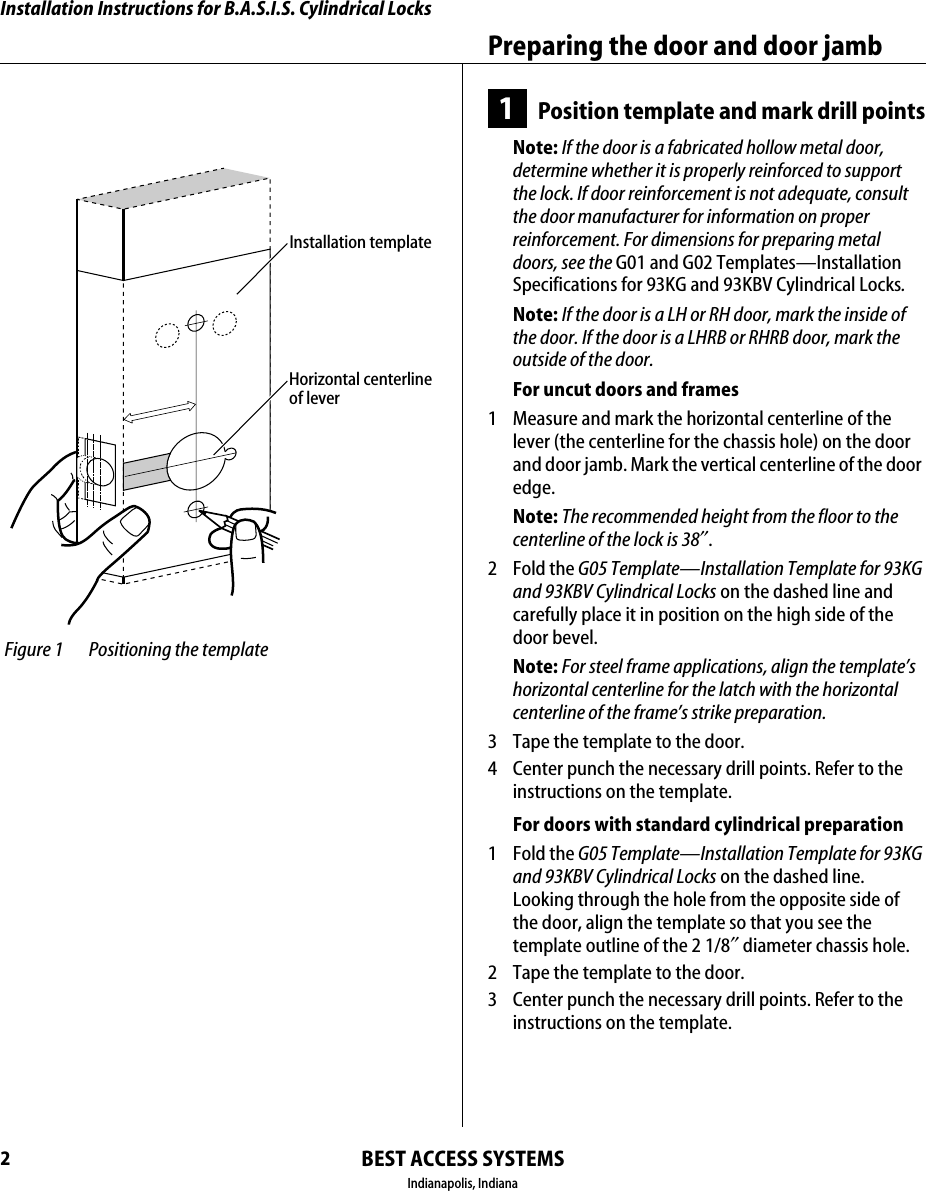
Installation Instructions for B.A.S.I.S. Cylindrical LocksBEST ACCESS SYSTEMSIndianapolis, IndianaPreparing the door and door jamb21Position template and mark drill pointsNote: If the door is a fabricated hollow metal door, determine whether it is properly reinforced to support the lock. If door reinforcement is not adequate, consult the door manufacturer for information on proper reinforcement. For dimensions for preparing metal doors, see the G01 and G02 Templates—Installation Specifications for 93KG and 93KBV Cylindrical Locks.Note: If the door is a LH or RH door, mark the inside of the door. If the door is a LHRB or RHRB door, mark the outside of the door.For uncut doors and frames1  Measure and mark the horizontal centerline of the lever (the centerline for the chassis hole) on the door and door jamb. Mark the vertical centerline of the door edge.Note: The recommended height from the floor to the centerline of the lock is 38″.2 Fold the G05 Template—Installation Template for 93KG and 93KBV Cylindrical Locks on the dashed line and carefully place it in position on the high side of the door bevel.Note: For steel frame applications, align the template’s horizontal centerline for the latch with the horizontal centerline of the frame’s strike preparation.3  Tape the template to the door.4  Center punch the necessary drill points. Refer to the instructions on the template.For doors with standard cylindrical preparation1 Fold the G05 Template—Installation Template for 93KG and 93KBV Cylindrical Locks on the dashed line. Looking through the hole from the opposite side of the door, align the template so that you see the template outline of the 2 1/8″diameter chassis hole.2  Tape the template to the door.3  Center punch the necessary drill points. Refer to the instructions on the template. Figure 1 Positioning the templateHorizontal centerlineof leverInstallation template
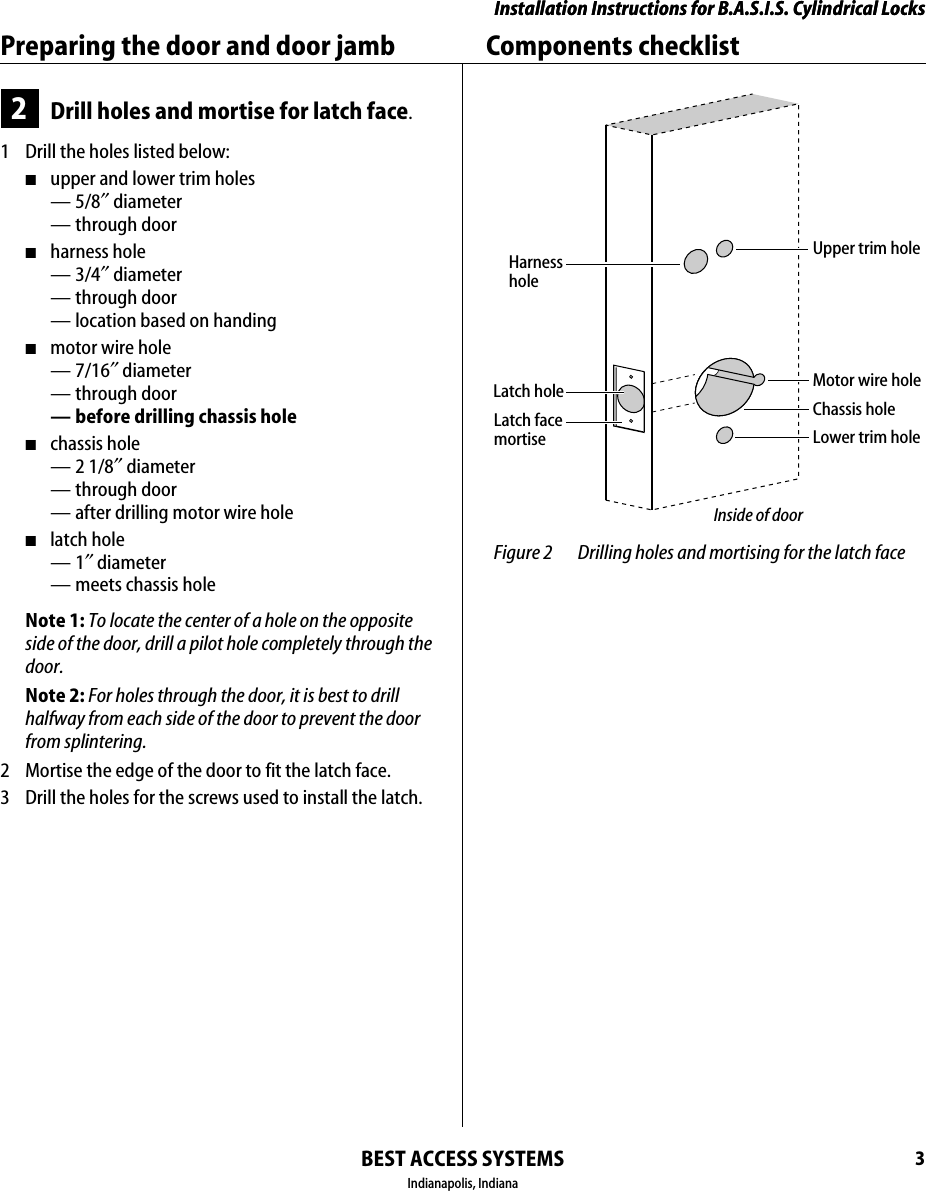
Installation Instructions for B.A.S.I.S. Cylindrical LocksBEST ACCESS SYSTEMSIndianapolis, Indiana3Installation Instructions for B.A.S.I.S. Cylindrical LocksPreparing the door and door jamb Components checklist2Drill holes and mortise for latch face.1  Drill the holes listed below:■upper and lower trim holes—5/8″ diameter— through door■harness hole—3/4″ diameter— through door— location based on handing■motor wire hole—7/16″ diameter— through door— before drilling chassis hole■chassis hole —2 1/8″ diameter— through door— after drilling motor wire hole■latch hole—1″ diameter— meets chassis holeNote 1: To locate the center of a hole on the opposite side of the door, drill a pilot hole completely through the door.Note 2: For holes through the door, it is best to drill halfway from each side of the door to prevent the door from splintering.2  Mortise the edge of the door to fit the latch face.3  Drill the holes for the screws used to install the latch. Figure 2 Drilling holes and mortising for the latch faceLatch holeUpper trim holeHarnessholeMotor wire holeChassis holeLower trim holeLatch facemortiseInside of door
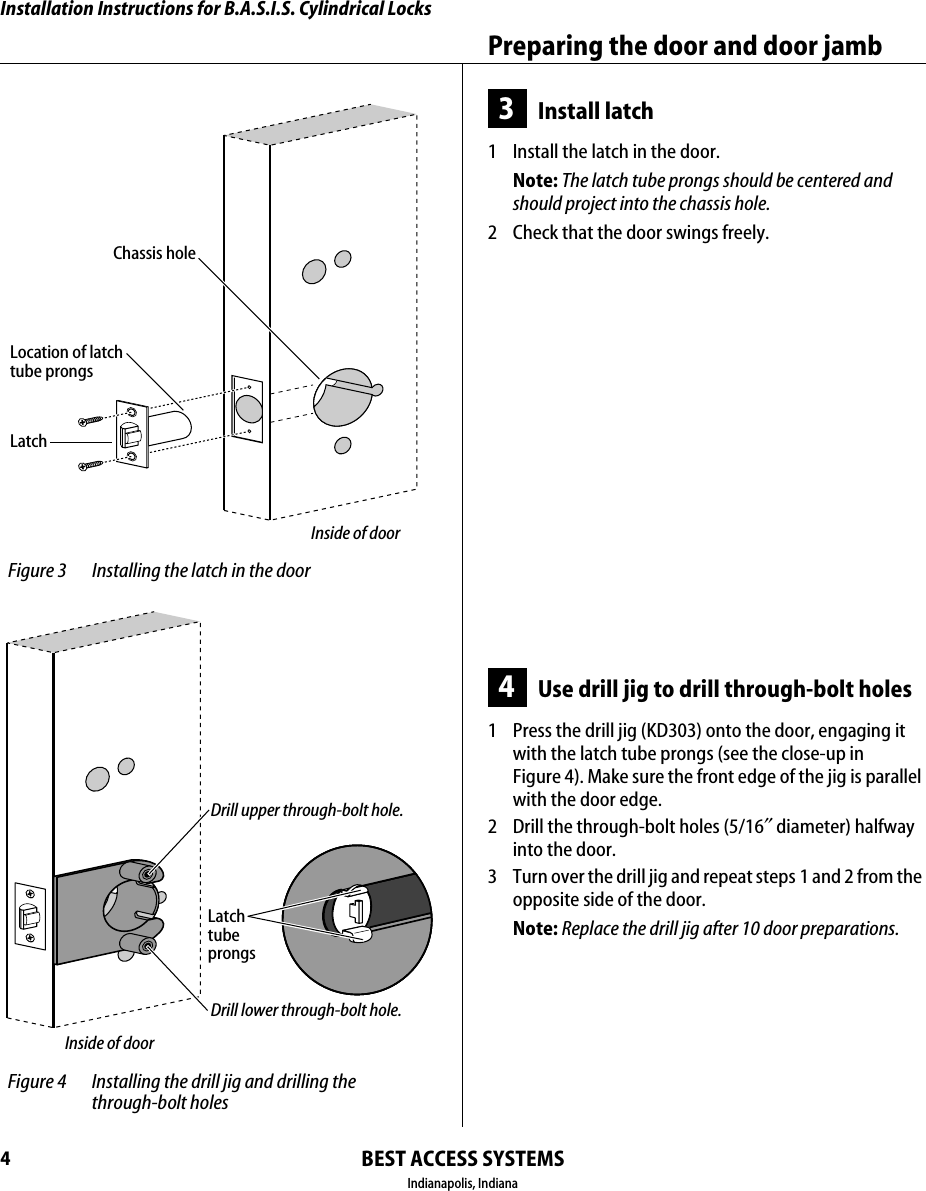
Installation Instructions for B.A.S.I.S. Cylindrical LocksBEST ACCESS SYSTEMSIndianapolis, IndianaPreparing the door and door jamb43Install latch1  Install the latch in the door.Note: The latch tube prongs should be centered and should project into the chassis hole.2  Check that the door swings freely.4Use drill jig to drill through-bolt holes1  Press the drill jig (KD303) onto the door, engaging it with the latch tube prongs (see the close-up in Figure 4). Make sure the front edge of the jig is parallel with the door edge.2  Drill the through-bolt holes (5/16″diameter) halfway into the door.3  Turn over the drill jig and repeat steps 1 and 2 from the opposite side of the door.Note: Replace the drill jig after 10 door preparations. Figure 3 Installing the latch in the doorLatchLocation of latchtube prongsChassis holeInside of door Figure 4 Installing the drill jig and drilling the through-bolt holesLatchtubeprongsDrill upper through-bolt hole.Drill lower through-bolt hole.Inside of door
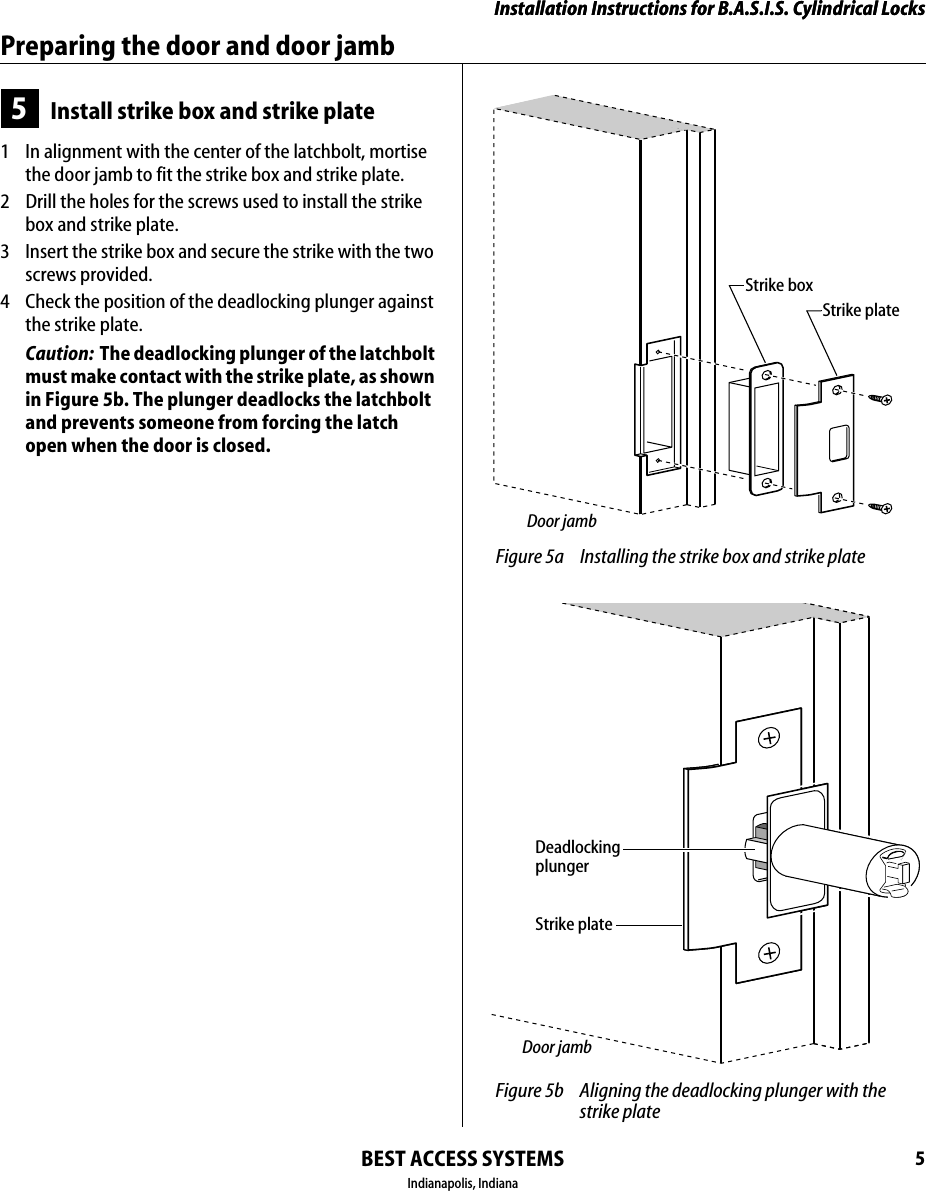
Installation Instructions for B.A.S.I.S. Cylindrical LocksBEST ACCESS SYSTEMSIndianapolis, Indiana5Installation Instructions for B.A.S.I.S. Cylindrical LocksPreparing the door and door jamb5Install strike box and strike plate1  In alignment with the center of the latchbolt, mortise the door jamb to fit the strike box and strike plate.2  Drill the holes for the screws used to install the strike box and strike plate.3  Insert the strike box and secure the strike with the two screws provided.4  Check the position of the deadlocking plunger against the strike plate.Caution:  The deadlocking plunger of the latchbolt must make contact with the strike plate, as shown in Figure 5b. The plunger deadlocks the latchbolt and prevents someone from forcing the latch open when the door is closed. Figure 5a Installing the strike box and strike plateStrike boxStrike plateDoor jamb Figure 5b Aligning the deadlocking plunger with the strike plateStrike plateDeadlocking plungerDoor jamb
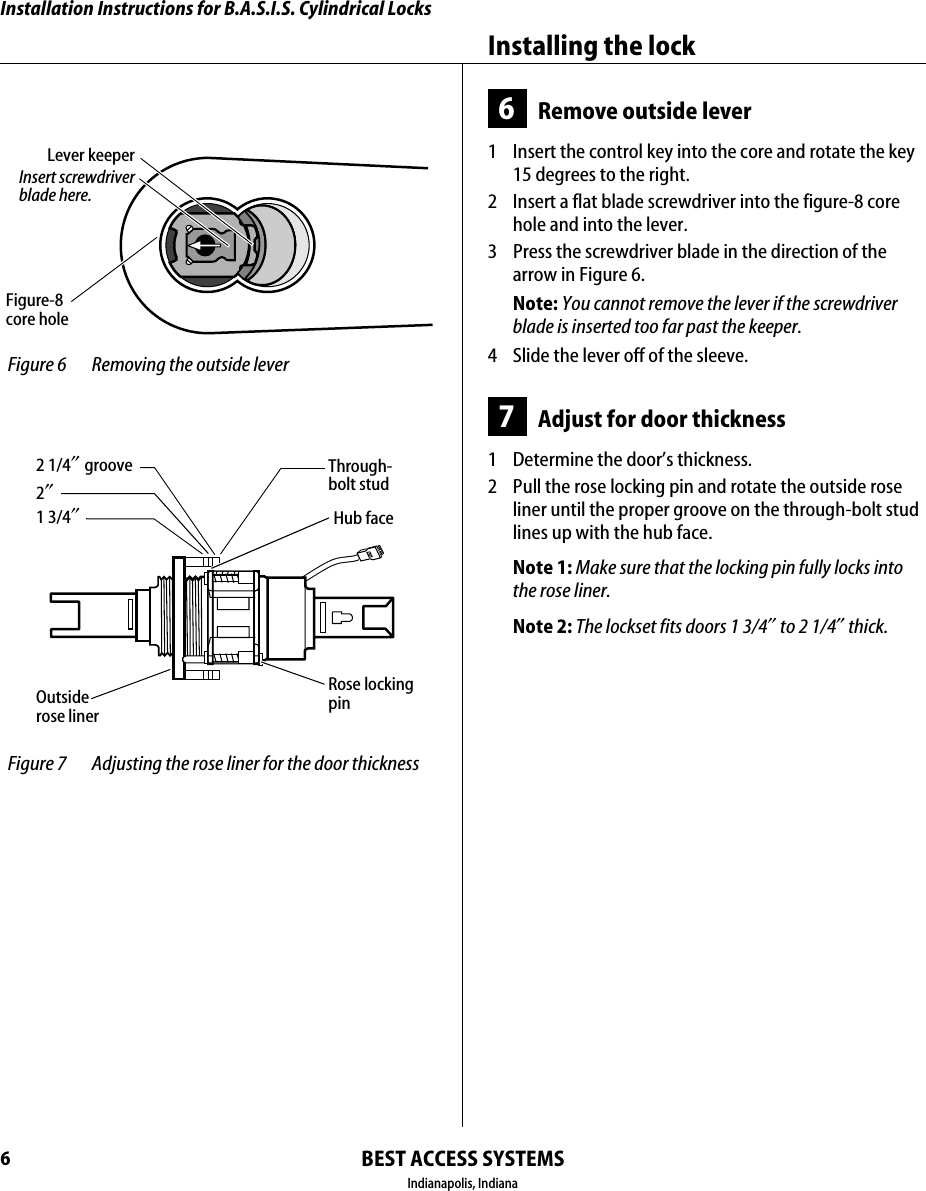
Installation Instructions for B.A.S.I.S. Cylindrical LocksBEST ACCESS SYSTEMSIndianapolis, IndianaInstalling the lock66Remove outside lever1  Insert the control key into the core and rotate the key 15 degrees to the right.2  Insert a flat blade screwdriver into the figure-8 core hole and into the lever.3  Press the screwdriver blade in the direction of the arrow in Figure 6.Note: You cannot remove the lever if the screwdriver blade is inserted too far past the keeper.4  Slide the lever off of the sleeve.7Adjust for door thickness1  Determine the door’s thickness.2  Pull the rose locking pin and rotate the outside rose liner until the proper groove on the through-bolt stud lines up with the hub face.Note 1: Make sure that the locking pin fully locks into the rose liner.Note 2: The lockset fits doors 1 3/4″ to 2 1/4″ thick. Figure-8core hole Figure 6 Removing the outside leverInsert screwdriverblade here.Lever keeper Figure 7 Adjusting the rose liner for the door thickness1 3/4″2″2 1/4″ groove Through-bolt studHub faceOutside rose linerRose locking pin
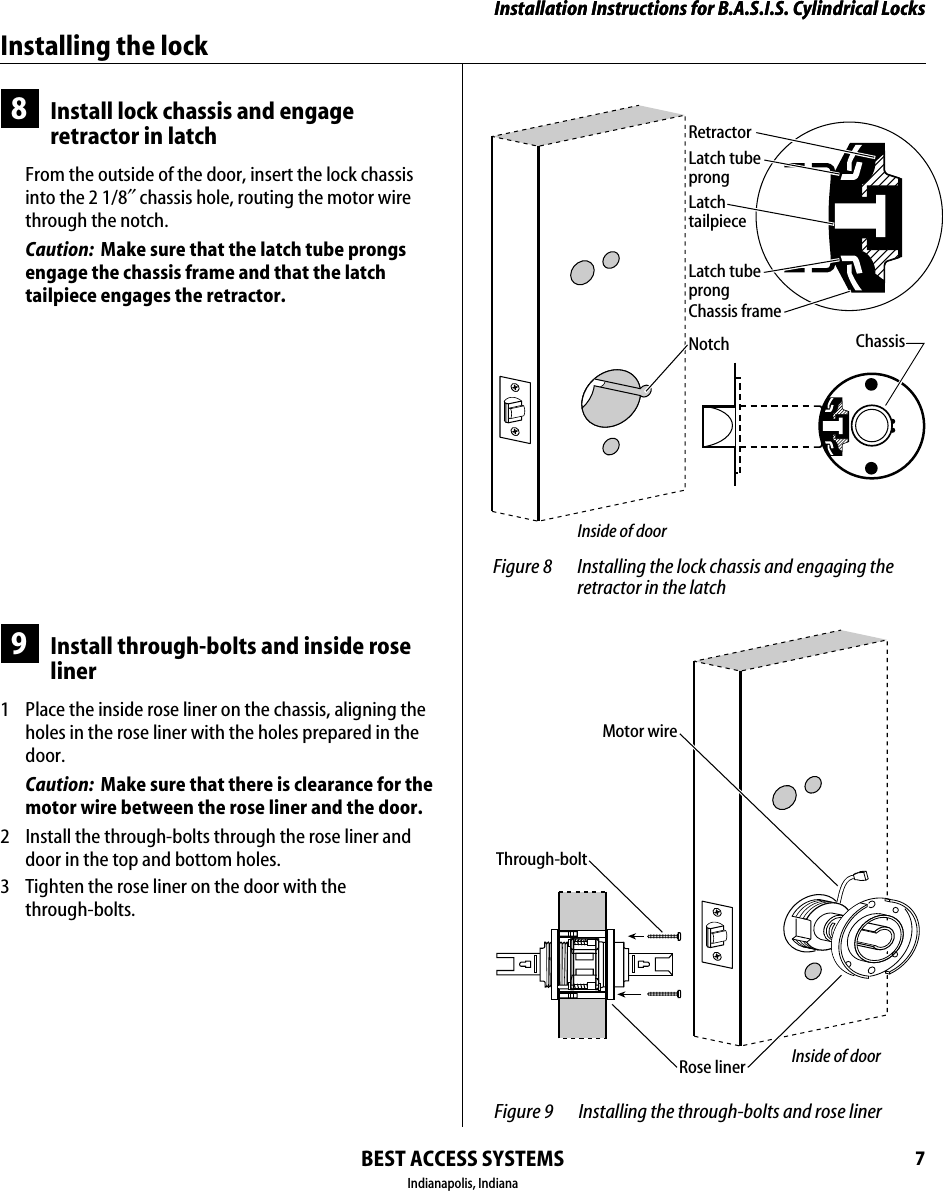
Installation Instructions for B.A.S.I.S. Cylindrical LocksBEST ACCESS SYSTEMSIndianapolis, Indiana7Installation Instructions for B.A.S.I.S. Cylindrical LocksInstalling the lock8Install lock chassis and engage retractor in latchFrom the outside of the door, insert the lock chassis into the 2 1/8″ chassis hole, routing the motor wire through the notch.Caution:  Make sure that the latch tube prongs engage the chassis frame and that the latch tailpiece engages the retractor.9Install through-bolts and inside rose liner1  Place the inside rose liner on the chassis, aligning the holes in the rose liner with the holes prepared in the door.Caution:  Make sure that there is clearance for the motor wire between the rose liner and the door.2  Install the through-bolts through the rose liner and door in the top and bottom holes.3  Tighten the rose liner on the door with the through-bolts. Figure 8 Installing the lock chassis and engaging the retractor in the latchLatch tubeprongRetractorLatch tailpieceChassisChassis frameLatch tubeprongNotchInside of door Figure 9 Installing the through-bolts and rose linerThrough-boltMotor wireInside of doorRose liner
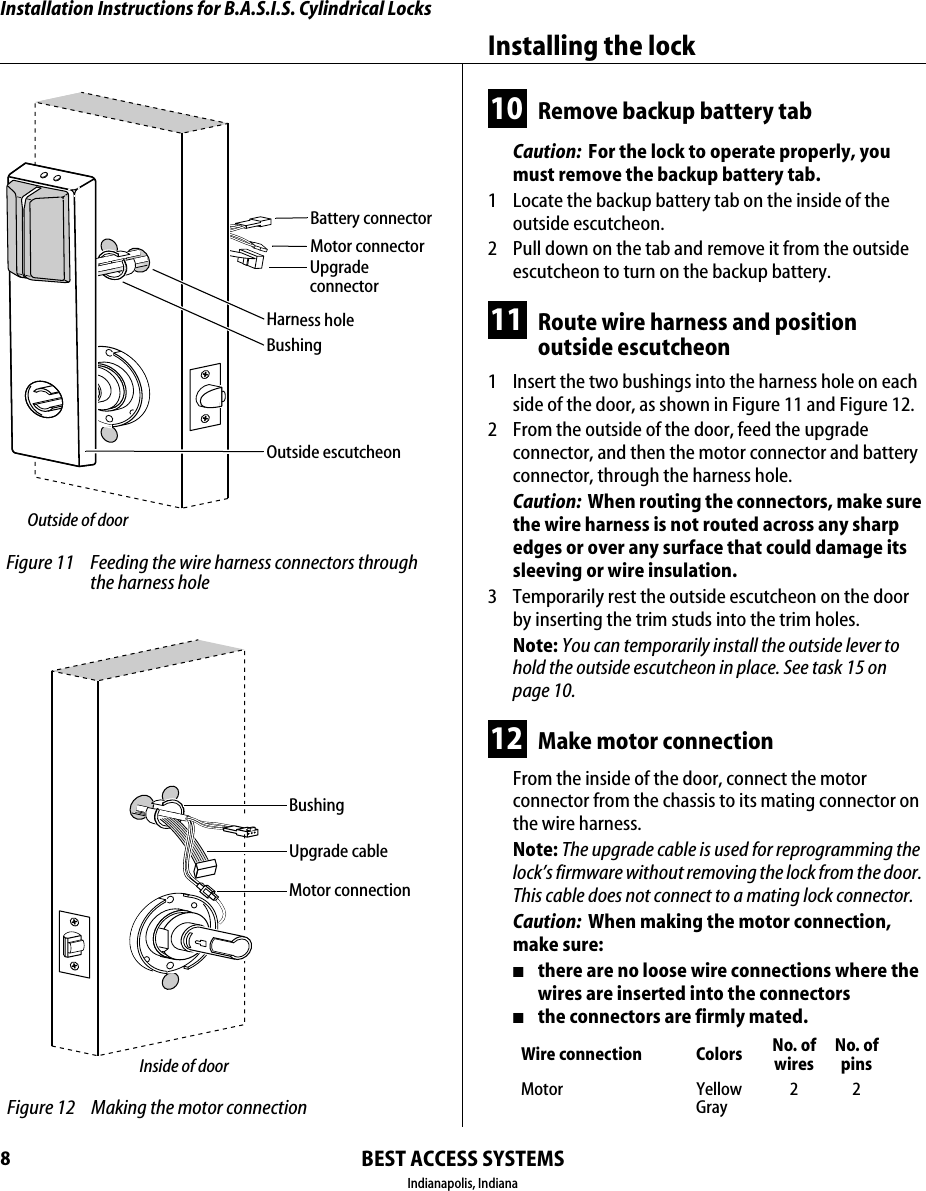
Installation Instructions for B.A.S.I.S. Cylindrical LocksBEST ACCESS SYSTEMSIndianapolis, IndianaInstalling the lock810 Remove backup battery tabCaution:  For the lock to operate properly, you must remove the backup battery tab.1  Locate the backup battery tab on the inside of the outside escutcheon.2  Pull down on the tab and remove it from the outside escutcheon to turn on the backup battery.11 Route wire harness and position outside escutcheon1  Insert the two bushings into the harness hole on each side of the door, as shown in Figure 11 and Figure 12.2  From the outside of the door, feed the upgrade connector, and then the motor connector and battery connector, through the harness hole.Caution:  When routing the connectors, make sure the wire harness is not routed across any sharp edges or over any surface that could damage its sleeving or wire insulation.3  Temporarily rest the outside escutcheon on the door by inserting the trim studs into the trim holes.Note: You can temporarily install the outside lever to hold the outside escutcheon in place. See task 15 on page 10.12 Make motor connectionFrom the inside of the door, connect the motor connector from the chassis to its mating connector on the wire harness.Note: The upgrade cable is used for reprogramming the lock’s firmware without removing the lock from the door. This cable does not connect to a mating lock connector.Caution:  When making the motor connection, make sure:■there are no loose wire connections where the wires are inserted into the connectors■the connectors are firmly mated.Wire connection Colors No. ofwiresNo. ofpinsMotor YellowGray22 Figure 11 Feeding the wire harness connectors through the harness holeMotor connectorOutside escutcheonOutside of doorHarness holeBattery connectorBushingUpgrade connector Figure 12 Making the motor connectionInside of doorMotor connectionBushingUpgrade cable
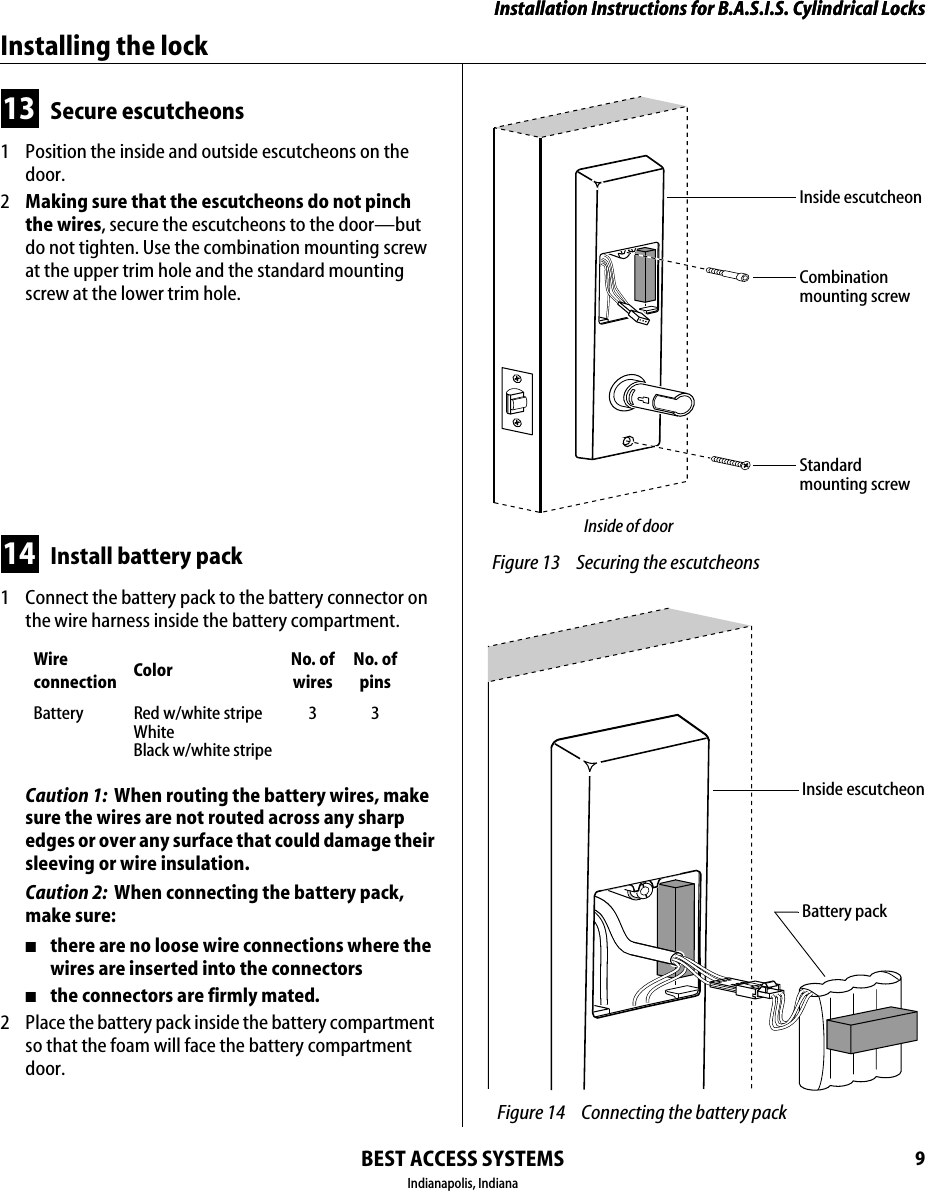
Installation Instructions for B.A.S.I.S. Cylindrical LocksBEST ACCESS SYSTEMSIndianapolis, Indiana9Installation Instructions for B.A.S.I.S. Cylindrical LocksInstalling the lock13 Secure escutcheons1  Position the inside and outside escutcheons on the door.2  Making sure that the escutcheons do not pinch the wires, secure the escutcheons to the door—but do not tighten. Use the combination mounting screw at the upper trim hole and the standard mounting screw at the lower trim hole.14 Install battery pack1  Connect the battery pack to the battery connector on the wire harness inside the battery compartment.Caution 1:  When routing the battery wires, make sure the wires are not routed across any sharp edges or over any surface that could damage their sleeving or wire insulation.Caution 2:  When connecting the battery pack, make sure:■there are no loose wire connections where the wires are inserted into the connectors■the connectors are firmly mated.2  Place the battery pack inside the battery compartment so that the foam will face the battery compartment door.Wire connection Color No. ofwiresNo. ofpinsBattery Red w/white stripeWhiteBlack w/white stripe33 Figure 13 Securing the escutcheonsCombinationmounting screwStandardmounting screwInside of doorInside escutcheon Figure 14 Connecting the battery packBattery packInside escutcheon
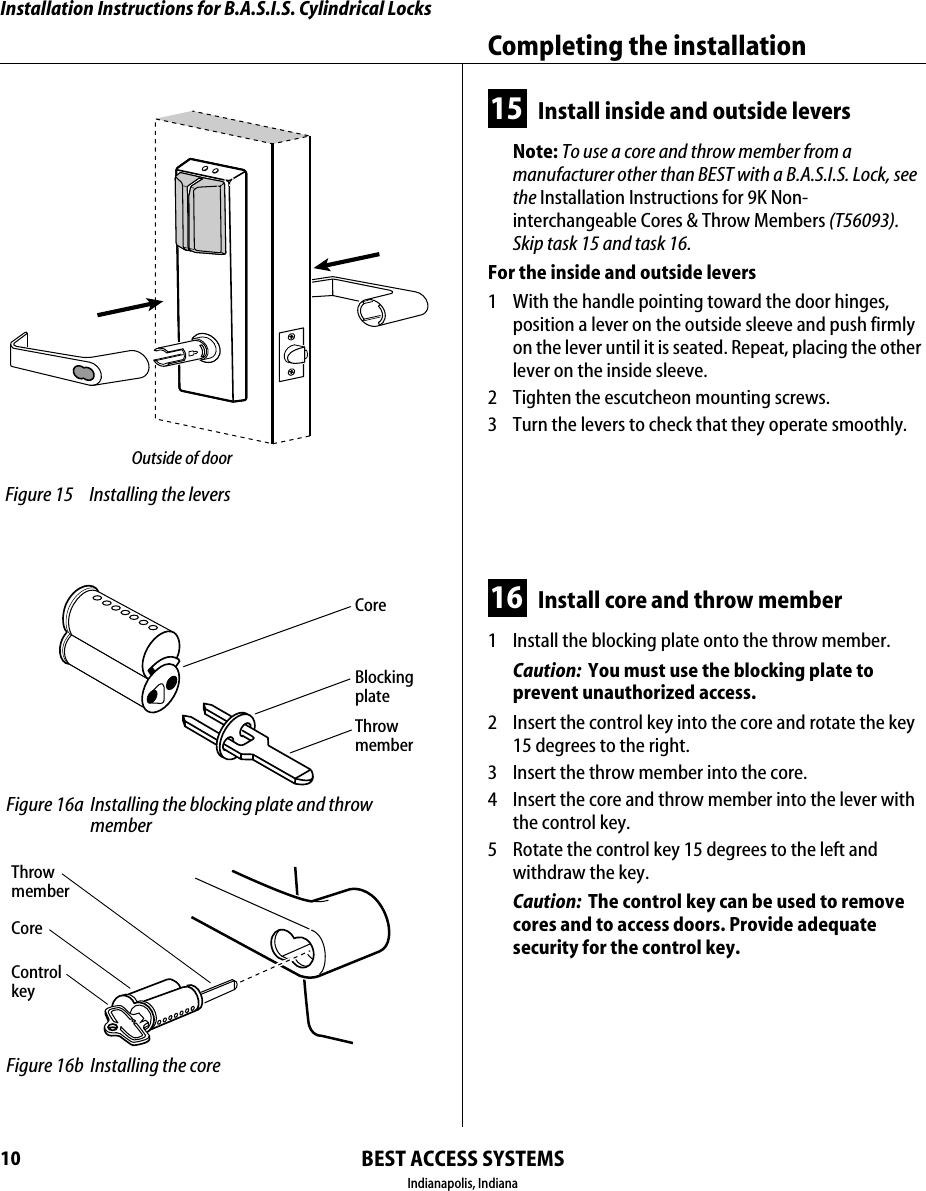
Installation Instructions for B.A.S.I.S. Cylindrical LocksBEST ACCESS SYSTEMSIndianapolis, IndianaCompleting the installation1015 Install inside and outside leversNote: To use a core and throw member from a manufacturer other than BEST with a B.A.S.I.S. Lock, see the Installation Instructions for 9K Non-interchangeable Cores & Throw Members (T56093). Skip task 15 and task 16.For the inside and outside levers1  With the handle pointing toward the door hinges, position a lever on the outside sleeve and push firmly on the lever until it is seated. Repeat, placing the other lever on the inside sleeve.2  Tighten the escutcheon mounting screws.3  Turn the levers to check that they operate smoothly.16 Install core and throw member1  Install the blocking plate onto the throw member.Caution:  You must use the blocking plate to prevent unauthorized access.2  Insert the control key into the core and rotate the key 15 degrees to the right.3  Insert the throw member into the core.4  Insert the core and throw member into the lever with the control key.5  Rotate the control key 15 degrees to the left and withdraw the key.Caution:  The control key can be used to remove cores and to access doors. Provide adequate security for the control key.  Figure 15 Installing the leversOutside of door Figure 16a Installing the blocking plate and throw memberCoreBlocking plateThrow member Figure 16b Installing the coreCoreControl keyThrow member
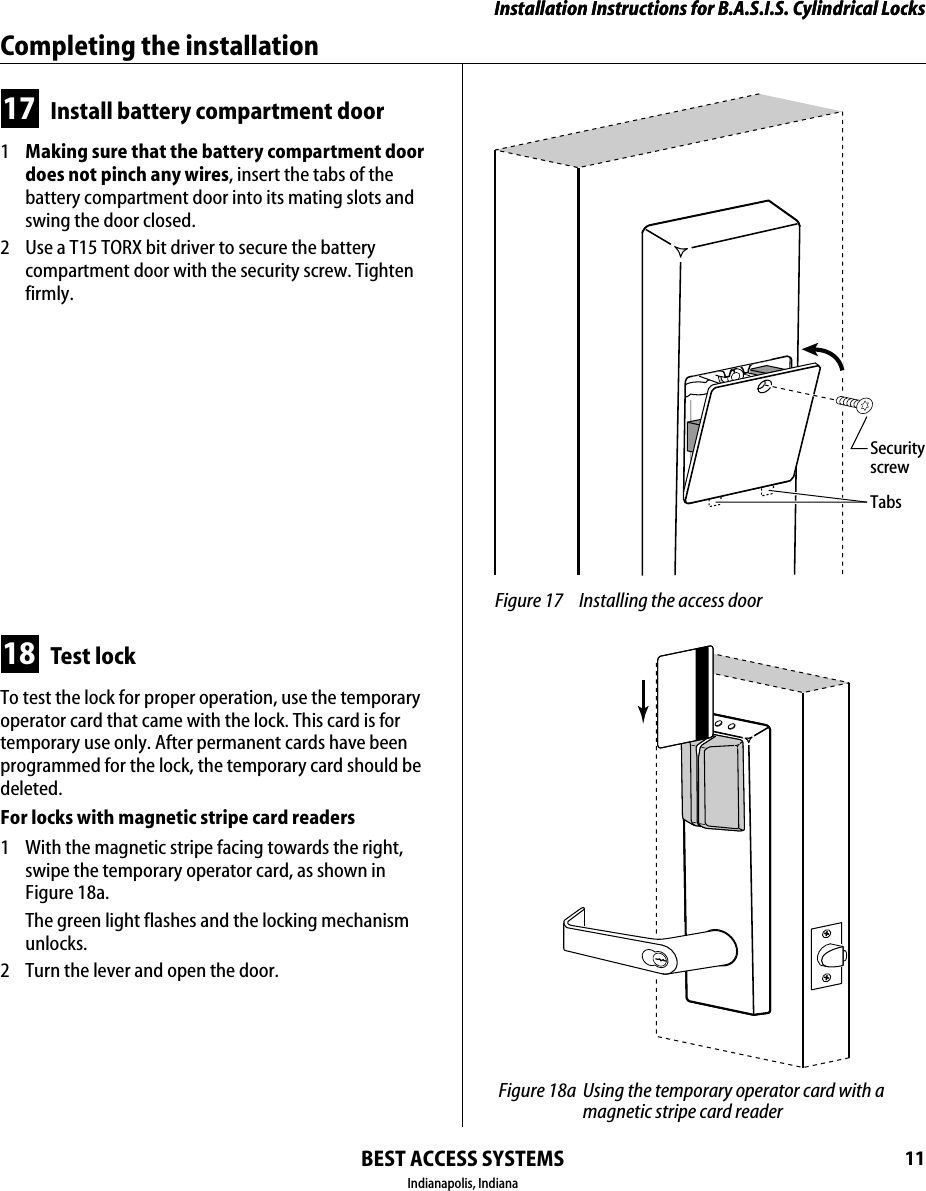
Installation Instructions for B.A.S.I.S. Cylindrical LocksBEST ACCESS SYSTEMSIndianapolis, Indiana11Installation Instructions for B.A.S.I.S. Cylindrical LocksCompleting the installation17 Install battery compartment door1  Making sure that the battery compartment door does not pinch any wires, insert the tabs of the battery compartment door into its mating slots and swing the door closed.2  Use a T15 TORX bit driver to secure the battery compartment door with the security screw. Tighten firmly.18 Test lockTo test the lock for proper operation, use the temporary operator card that came with the lock. This card is for temporary use only. After permanent cards have been programmed for the lock, the temporary card should be deleted.For locks with magnetic stripe card readers1  With the magnetic stripe facing towards the right, swipe the temporary operator card, as shown in Figure 18a.The green light flashes and the locking mechanism unlocks.2  Turn the lever and open the door. Figure 17 Installing the access doorTabsSecurityscrew Figure 18a Using the temporary operator card with a magnetic stripe card reader
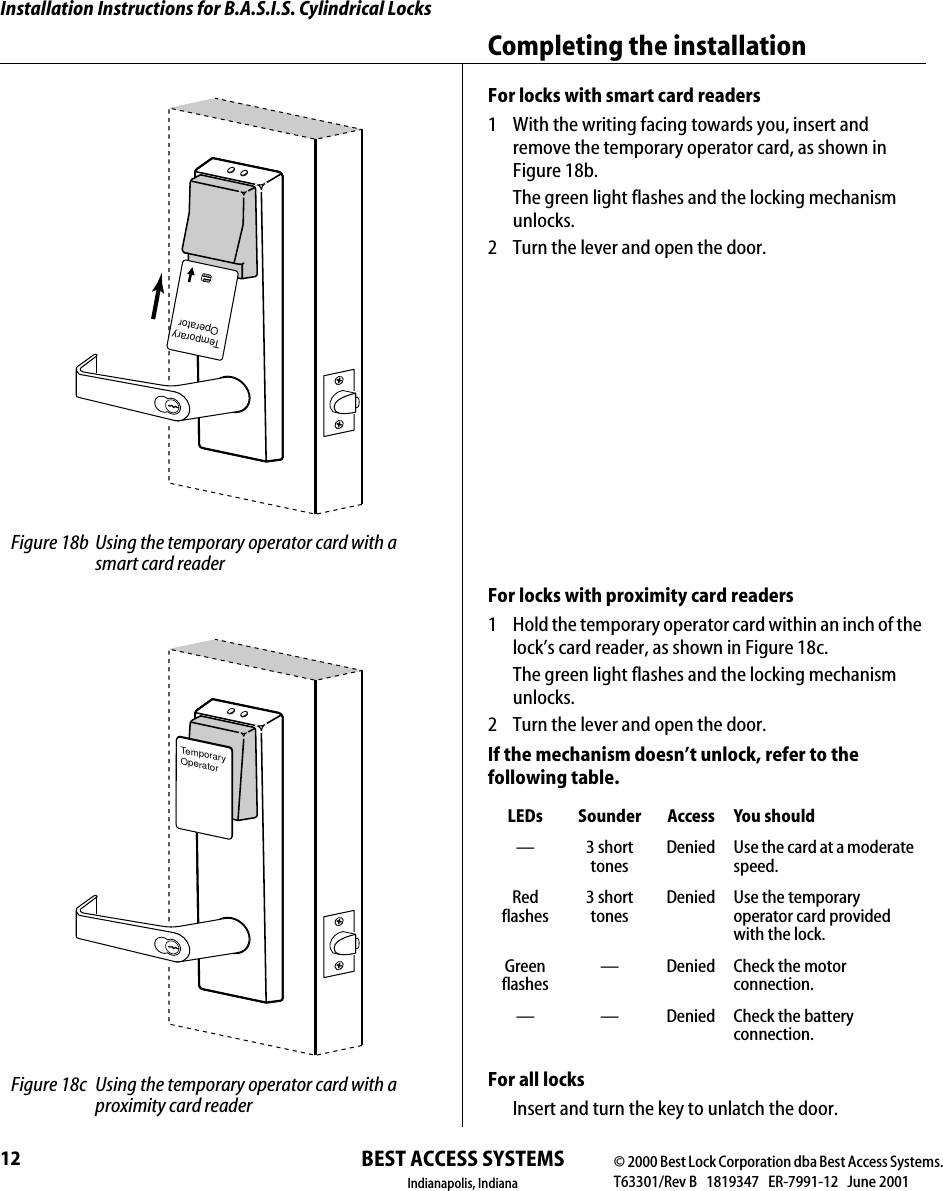
Installation Instructions for B.A.S.I.S. Cylindrical LocksBEST ACCESS SYSTEMSIndianapolis, IndianaCompleting the installation12For locks with smart card readers1  With the writing facing towards you, insert and remove the temporary operator card, as shown in Figure 18b.The green light flashes and the locking mechanism unlocks.2  Turn the lever and open the door.For locks with proximity card readers1  Hold the temporary operator card within an inch of the lock’s card reader, as shown in Figure 18c.The green light flashes and the locking mechanism unlocks.2  Turn the lever and open the door.If the mechanism doesn’t unlock, refer to the following table.For all locksInsert and turn the key to unlatch the door.LEDs Sounder Access You should—3 short tonesDenied Use the card at a moderate speed.Red flashes3 short tonesDenied Use the temporary operator card provided with the lock.Green flashes— Denied Check the motor connection.— — Denied Check the battery connection.TemporaryOperator Figure 18b Using the temporary operator card with a smart card readerTemporaryOperator Figure 18c Using the temporary operator card with a proximity card reader© 2000 Best Lock Corporation dba Best Access Systems.T63301/Rev B   1819347   ER-7991-12   June 2001
BEST ACCESS SYSTEMSIndianapolis, Indiana1Planning the installationContentsThese installation instructions describe how to install your B.A.S.I.S. G (35HG) or B.A.S.I.S. V (35HBV) Mortise Lock. The following topics are covered.Planning the installation................................................ 1Preparing the door and door jamb ................................ 2Installing the lock............................................................ 5Completing the installation..........................................10Site surveyUse the following survey to record information about the installation site.Lock informationLock function:❑EV–Latch with key override❑With key override sensing†❑FV–Deadbolt with key override❑With key override sensing†❑LV–Deadbolt without key override❑NV–Latch without key overrideDoor informationDoor handing and bevel:❑Left hand (LH)❑Left hand, reverse bevel (LHRB)❑Right hand (RH)❑Right hand, reverse bevel (RHRB)Door thickness:                 inches (1 3/4″ to 3″)Environment informationAmbient temperature:❑Is within specifications. See the tables below.This product meets the following Locked Door Outdoor test requirements for ANSI/BHMA 156.25:† Key override sensing is optional for 35HG and standard for 35HBV.Side of door RangeInside +66°F to +74°F (+19°C to +23°C)Outside –31°F to +151°F (–35°C to +66°C)This product meets the following Full Indoor test requirements for ANSI/BHMA 156.25:Components checklistUse the following checklist to make sure that you have the items necessary to install your B.A.S.I.S. Mortise Lock.Components provided in the box:❑Mortise case assembly❑Mortise case faceplate❑Inside escutcheon assembly❑Battery compartment door❑Battery pack❑Outside escutcheon assembly❑Inside and outside mounting plates❑Inside lever❑Outside lever & spindle assembly❑Cylinder assembly (for EV and FV functions only)❑Screw package❑Plastic bushing package❑Escutcheon screw package❑Strike❑Strike box❑Bar code ID sticker (for your records)❑Temporary operator card❑Installation template and instructionsOther components:❑Core (for EV and FV functions only)❑Control key (for EV and FV functions only)Special tools checklistUse the following checklist to make sure that you have the special tools necessary to install your B.A.S.I.S. Mortise Lock.❑T15 TORX® bit driver‡❑ED211 cylinder wrench (for EV and FV functions only)Side of door RangeInside and outside +32°F to +120°F (0°C to +42°C)‡ TORX is a registered trademark of the Camcar Division of Textron.Installation Instructions forB.A.S.I.S. Mortise Locks
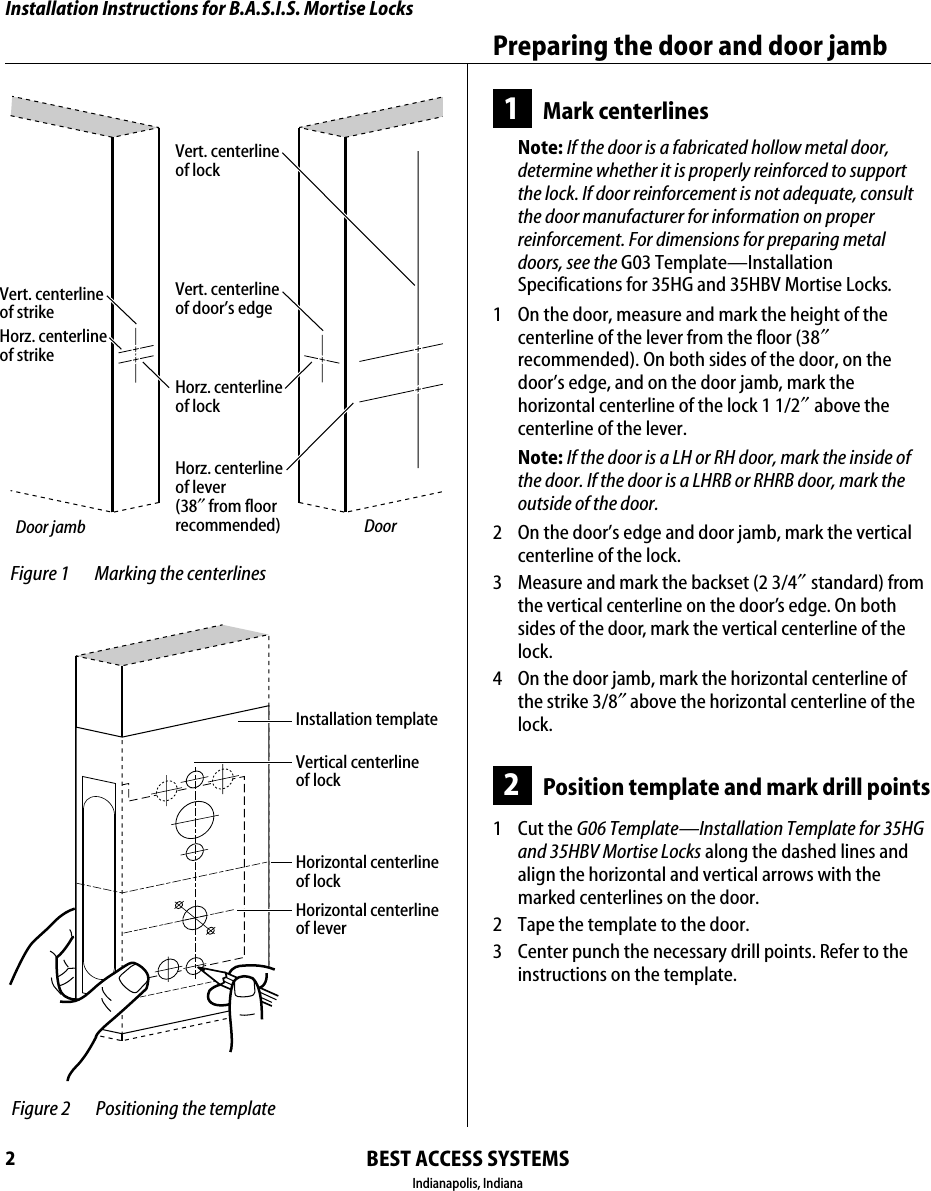
Installation Instructions for B.A.S.I.S. Mortise LocksBEST ACCESS SYSTEMSIndianapolis, IndianaPreparing the door and door jamb21Mark centerlinesNote: If the door is a fabricated hollow metal door, determine whether it is properly reinforced to support the lock. If door reinforcement is not adequate, consult the door manufacturer for information on proper reinforcement. For dimensions for preparing metal doors, see the G03 Template—Installation Specifications for 35HG and 35HBV Mortise Locks.1  On the door, measure and mark the height of the centerline of the lever from the floor (38″ recommended). On both sides of the door, on the door’s edge, and on the door jamb, mark the horizontal centerline of the lock 1 1/2″ above the centerline of the lever.Note: If the door is a LH or RH door, mark the inside of the door. If the door is a LHRB or RHRB door, mark the outside of the door.2  On the door’s edge and door jamb, mark the vertical centerline of the lock.3  Measure and mark the backset (2 3/4″ standard) from the vertical centerline on the door’s edge. On both sides of the door, mark the vertical centerline of the lock.4  On the door jamb, mark the horizontal centerline of the strike 3/8″ above the horizontal centerline of the lock.2Position template and mark drill points1 Cut the G06 Template—Installation Template for 35HG and 35HBV Mortise Locks along the dashed lines and align the horizontal and vertical arrows with the marked centerlines on the door.2  Tape the template to the door.3  Center punch the necessary drill points. Refer to the instructions on the template. Figure 1 Marking the centerlinesDoor jamb DoorVert. centerline of lockHorz. centerline of lockHorz. centerline of lever (38″ from floor recommended)Vert. centerline of door’s edgeHorz. centerline of strike Vert. centerline of strike Figure 2 Positioning the templateInstallation templateHorizontal centerlineof lockHorizontal centerlineof leverVertical centerlineof lock
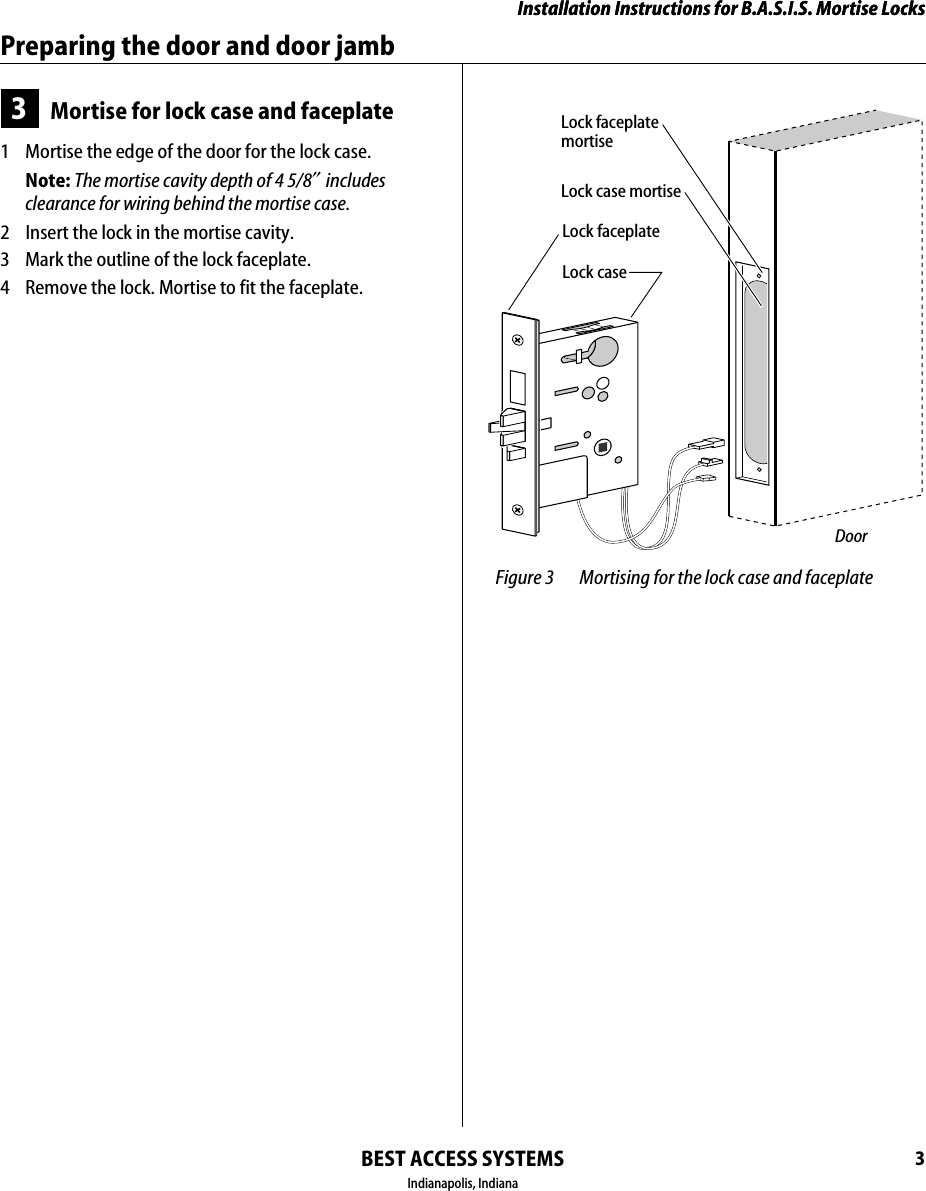
Installation Instructions for B.A.S.I.S. Mortise LocksBEST ACCESS SYSTEMSIndianapolis, Indiana3Installation Instructions for B.A.S.I.S. Mortise LocksPreparing the door and door jamb3Mortise for lock case and faceplate1  Mortise the edge of the door for the lock case.Note: The mortise cavity depth of 4 5/8″ includes clearance for wiring behind the mortise case.2  Insert the lock in the mortise cavity.3  Mark the outline of the lock faceplate.4  Remove the lock. Mortise to fit the faceplate. Figure 3 Mortising for the lock case and faceplateDoorLock faceplate mortiseLock case mortiseLock faceplateLock case
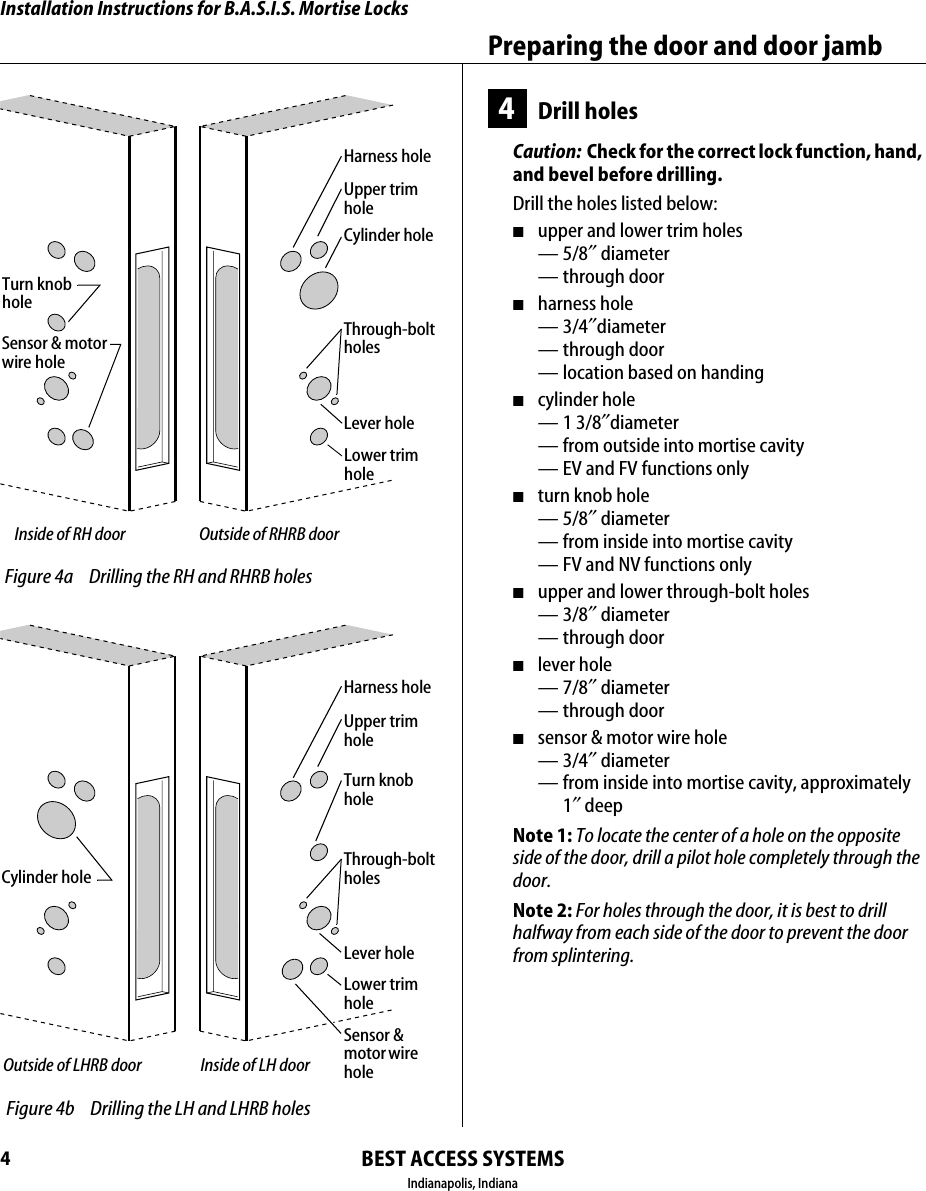
Installation Instructions for B.A.S.I.S. Mortise LocksBEST ACCESS SYSTEMSIndianapolis, IndianaPreparing the door and door jamb44Drill holesCaution:  Check for the correct lock function, hand, and bevel before drilling.Drill the holes listed below:■upper and lower trim holes—5/8″ diameter— through door■harness hole—3/4″diameter— through door— location based on handing■cylinder hole—1 3/8″diameter— from outside into mortise cavity— EV and FV functions only■turn knob hole—5/8″ diameter— from inside into mortise cavity— FV and NV functions only■upper and lower through-bolt holes—3/8″ diameter— through door■lever hole—7/8″ diameter— through door■sensor & motor wire hole—3/4″ diameter— from inside into mortise cavity, approximately 1″ deepNote 1: To locate the center of a hole on the opposite side of the door, drill a pilot hole completely through the door.Note 2: For holes through the door, it is best to drill halfway from each side of the door to prevent the door from splintering..125 Figure 4a Drilling the RH and RHRB holesOutside of RHRB doorInside of RH doorUpper trimholeHarness holeCylinder holeThrough-bolt holesLever holeLower trimholeTurn knobholeSensor & motor wire hole.125 Figure 4b Drilling the LH and LHRB holesInside of LH doorOutside of LHRB doorUpper trimholeHarness holeThrough-bolt holesLever holeSensor & motor wire holeLower trimholeTurn knobholeCylinder hole
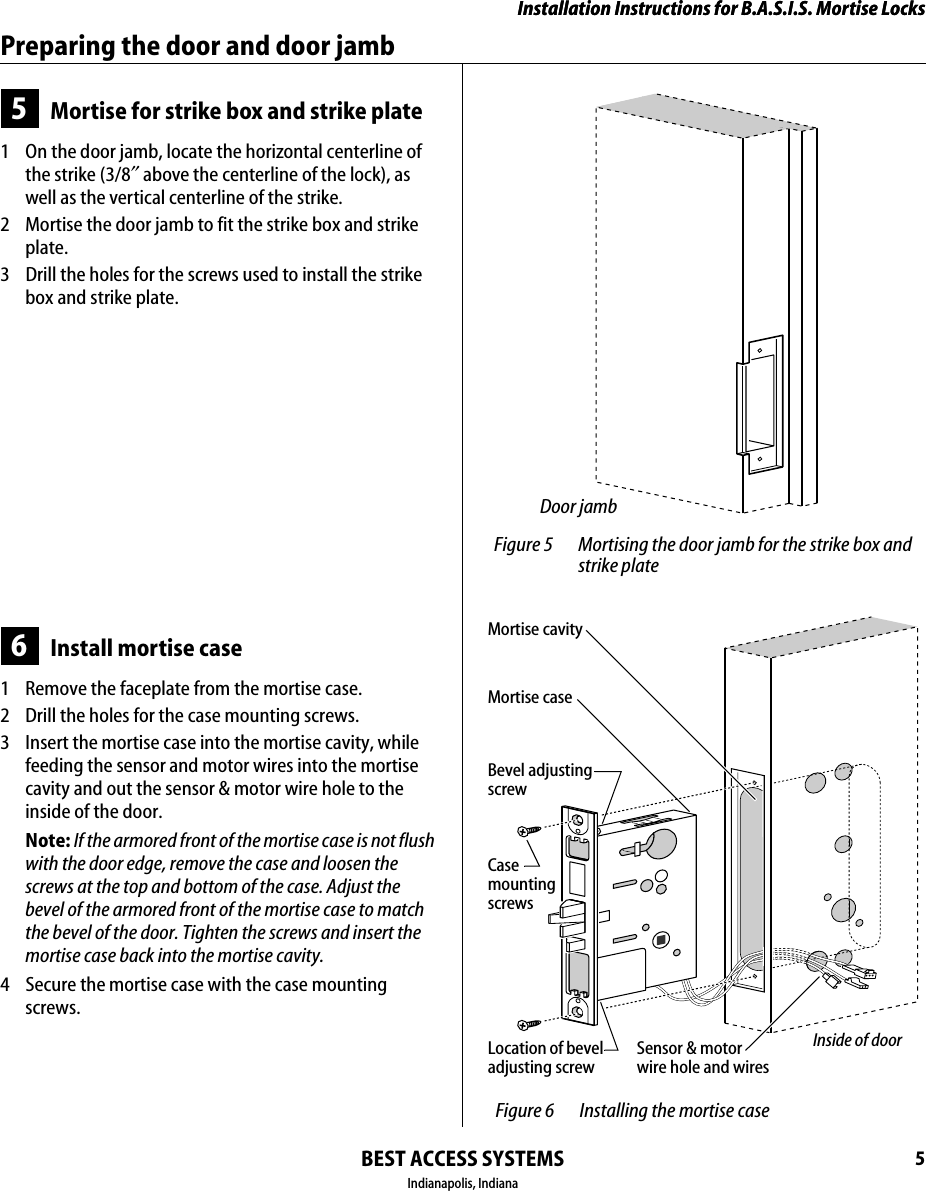
Installation Instructions for B.A.S.I.S. Mortise LocksBEST ACCESS SYSTEMSIndianapolis, Indiana5Installation Instructions for B.A.S.I.S. Mortise LocksPreparing the door and door jamb5Mortise for strike box and strike plate1  On the door jamb, locate the horizontal centerline of the strike (3/8″ above the centerline of the lock), as well as the vertical centerline of the strike.2  Mortise the door jamb to fit the strike box and strike plate.3  Drill the holes for the screws used to install the strike box and strike plate.6Install mortise case1  Remove the faceplate from the mortise case.2  Drill the holes for the case mounting screws.3  Insert the mortise case into the mortise cavity, while feeding the sensor and motor wires into the mortise cavity and out the sensor & motor wire hole to the inside of the door.Note: If the armored front of the mortise case is not flush with the door edge, remove the case and loosen the screws at the top and bottom of the case. Adjust the bevel of the armored front of the mortise case to match the bevel of the door. Tighten the screws and insert the mortise case back into the mortise cavity.4  Secure the mortise case with the case mounting screws. Figure 5 Mortising the door jamb for the strike box and strike plateDoor jamb Figure 6 Installing the mortise caseInside of doorSensor & motor wire hole and wiresMortise caseMortise cavityLocation of bevel adjusting screwBevel adjustingscrewCasemounting screws
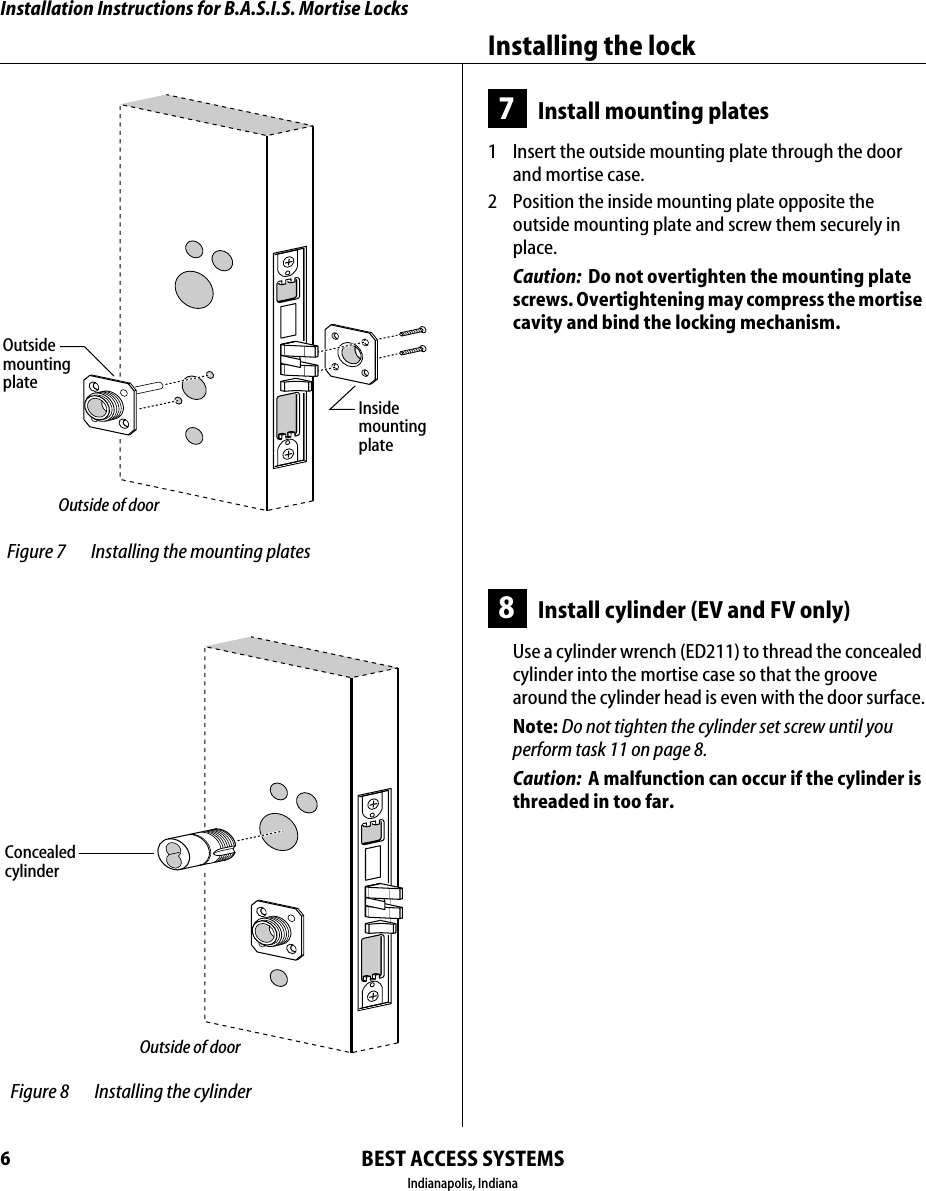
Installation Instructions for B.A.S.I.S. Mortise LocksBEST ACCESS SYSTEMSIndianapolis, IndianaInstalling the lock67Install mounting plates1  Insert the outside mounting plate through the door and mortise case.2  Position the inside mounting plate opposite the outside mounting plate and screw them securely in place.Caution:  Do not overtighten the mounting plate screws. Overtightening may compress the mortise cavity and bind the locking mechanism.8Install cylinder (EV and FV only)Use a cylinder wrench (ED211) to thread the concealed cylinder into the mortise case so that the groove around the cylinder head is even with the door surface.Note: Do not tighten the cylinder set screw until you perform task 11 on page 8.Caution:  A malfunction can occur if the cylinder is threaded in too far. Figure 7 Installing the mounting platesOutside of doorOutsidemountingplateInsidemounting plate Figure 8 Installing the cylinderOutside of doorConcealedcylinder
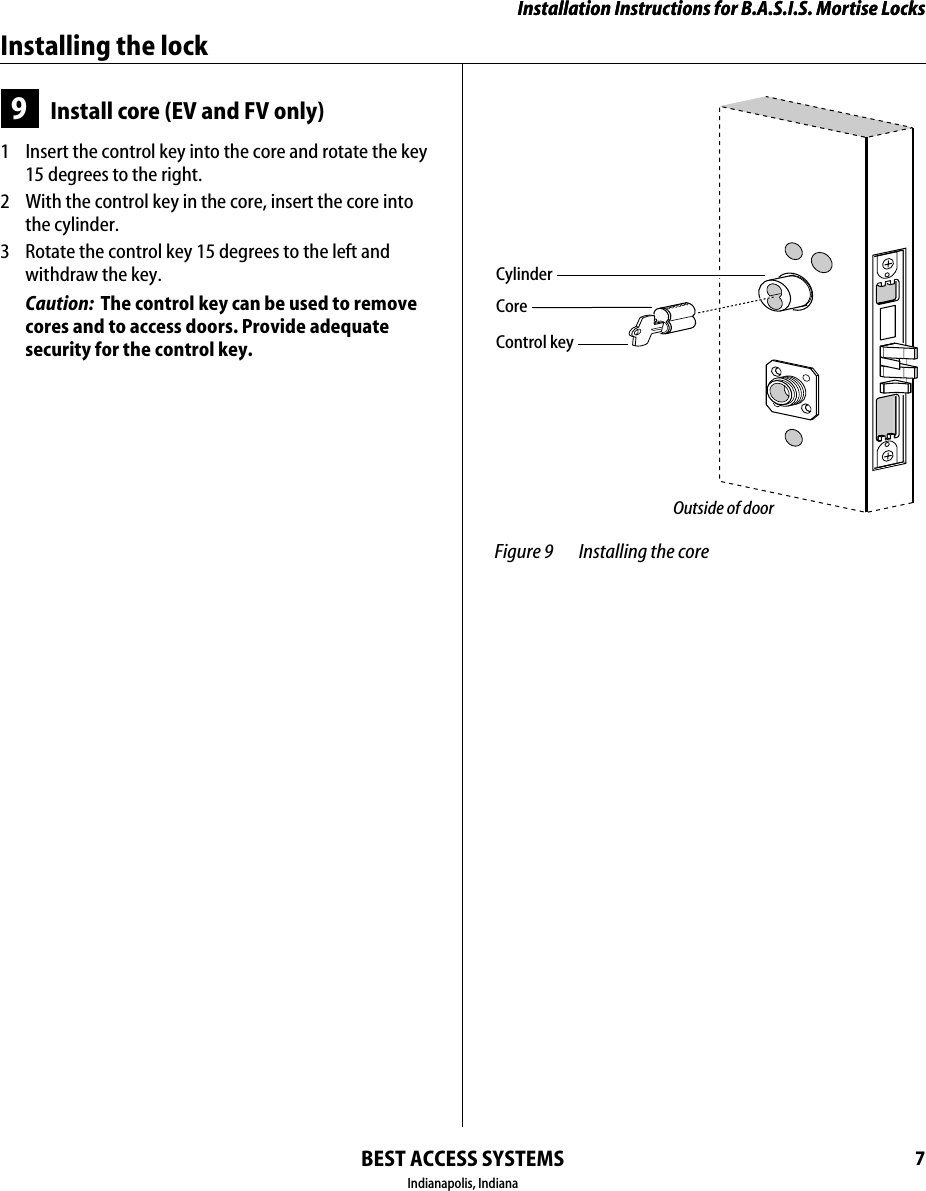
Installation Instructions for B.A.S.I.S. Mortise LocksBEST ACCESS SYSTEMSIndianapolis, Indiana7Installation Instructions for B.A.S.I.S. Mortise LocksInstalling the lock9Install core (EV and FV only)1  Insert the control key into the core and rotate the key 15 degrees to the right.2  With the control key in the core, insert the core into the cylinder.3  Rotate the control key 15 degrees to the left and withdraw the key.Caution:  The control key can be used to remove cores and to access doors. Provide adequate security for the control key. Figure 9 Installing the coreControl keyCoreOutside of doorCylinder
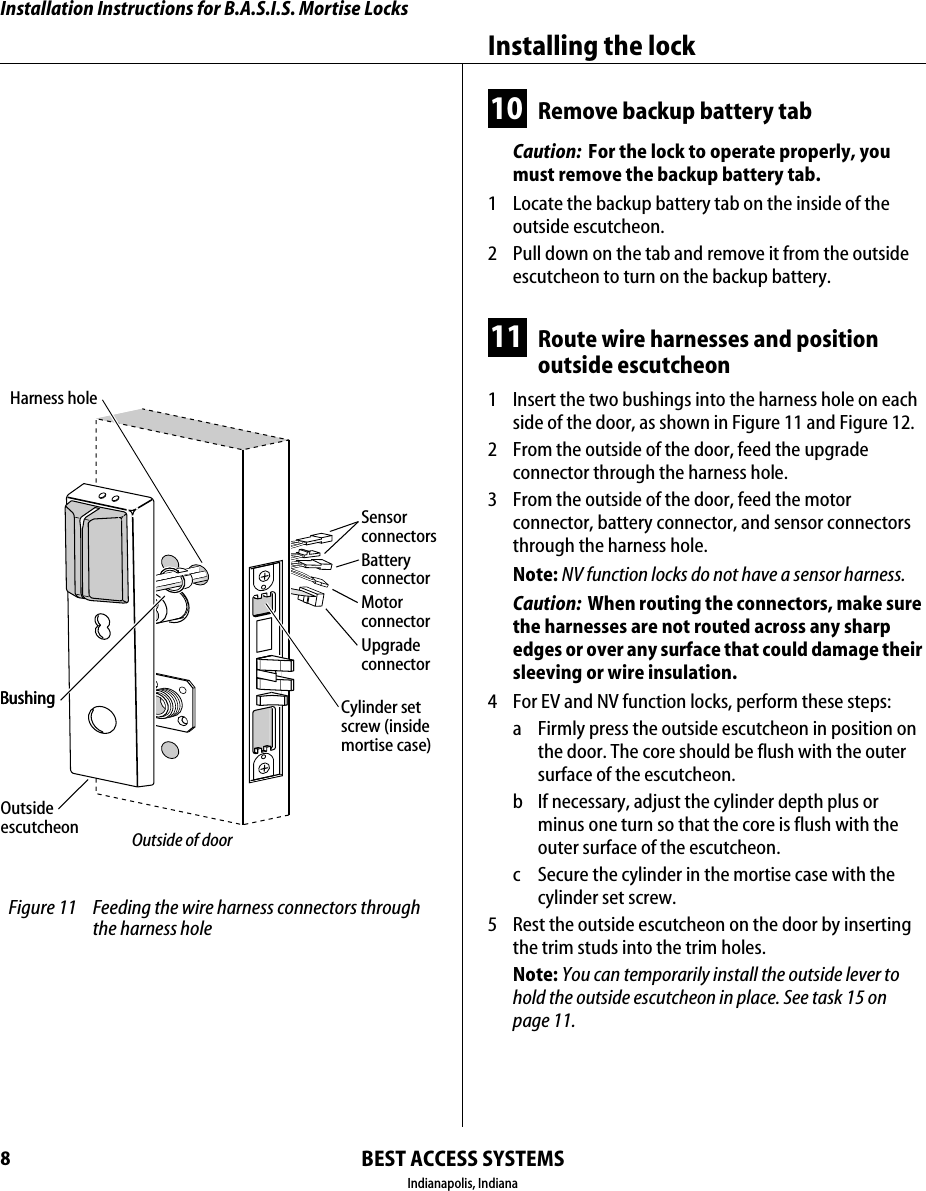
Installation Instructions for B.A.S.I.S. Mortise LocksBEST ACCESS SYSTEMSIndianapolis, IndianaInstalling the lock810 Remove backup battery tabCaution:  For the lock to operate properly, you must remove the backup battery tab.1  Locate the backup battery tab on the inside of the outside escutcheon.2  Pull down on the tab and remove it from the outside escutcheon to turn on the backup battery.11 Route wire harnesses and position outside escutcheon1  Insert the two bushings into the harness hole on each side of the door, as shown in Figure 11 and Figure 12.2  From the outside of the door, feed the upgrade connector through the harness hole.3  From the outside of the door, feed the motor connector, battery connector, and sensor connectors through the harness hole.Note: NV function locks do not have a sensor harness.Caution:  When routing the connectors, make sure the harnesses are not routed across any sharp edges or over any surface that could damage their sleeving or wire insulation.4  For EV and NV function locks, perform these steps:a Firmly press the outside escutcheon in position on the door. The core should be flush with the outer surface of the escutcheon.b If necessary, adjust the cylinder depth plus or minus one turn so that the core is flush with the outer surface of the escutcheon.c Secure the cylinder in the mortise case with the cylinder set screw.5  Rest the outside escutcheon on the door by inserting the trim studs into the trim holes.Note: You can temporarily install the outside lever to hold the outside escutcheon in place. See task 15 on page 11. Figure 11 Feeding the wire harness connectors through the harness holeMotorconnectorHarness holeBushingOutside escutcheon Outside of doorSensorconnectorsBatteryconnectorCylinder setscrew (insidemortise case)BushingUpgradeconnector
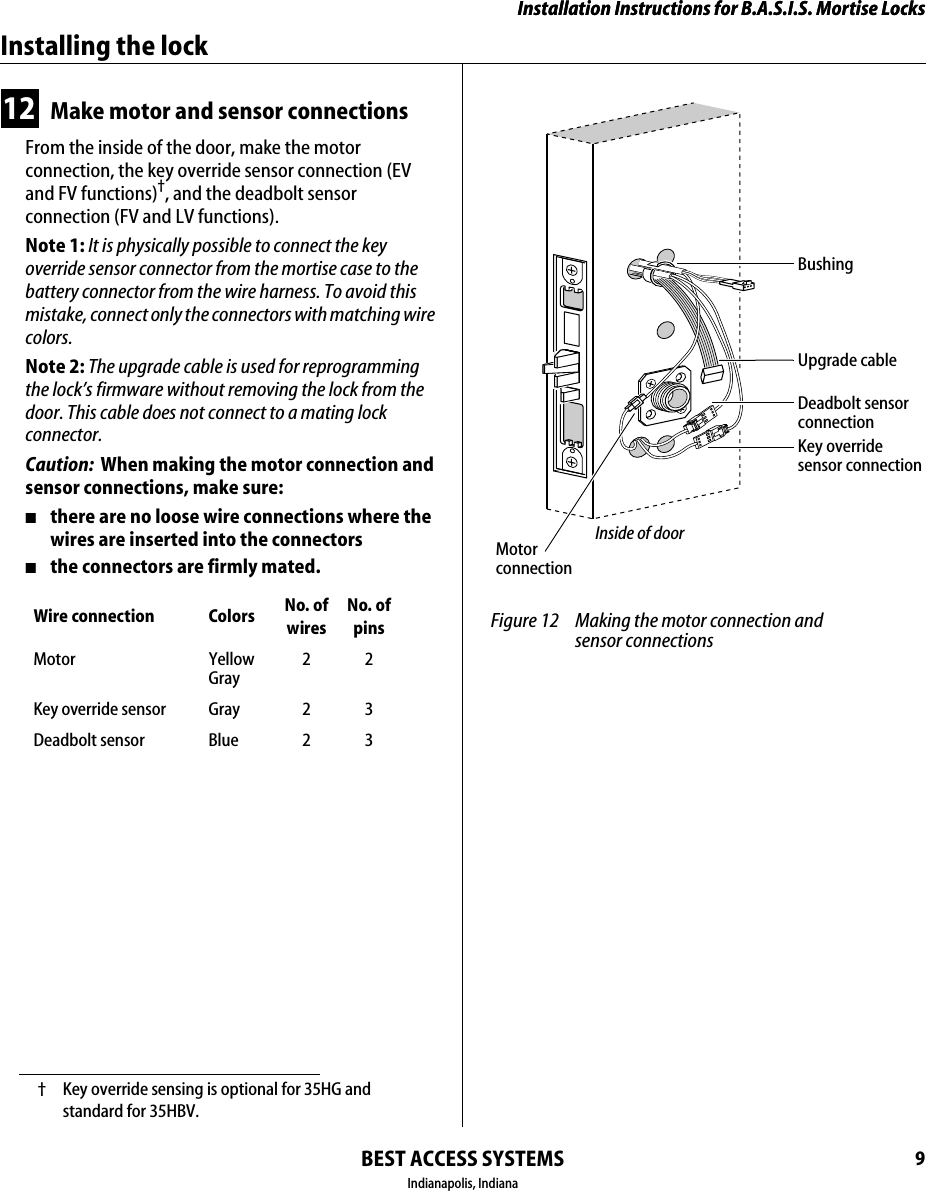
Installation Instructions for B.A.S.I.S. Mortise LocksBEST ACCESS SYSTEMSIndianapolis, Indiana9Installation Instructions for B.A.S.I.S. Mortise LocksInstalling the lock12 Make motor and sensor connectionsFrom the inside of the door, make the motor connection, the key override sensor connection (EV and FV functions)†, and the deadbolt sensor connection (FV and LV functions).Note 1: It is physically possible to connect the key override sensor connector from the mortise case to the battery connector from the wire harness. To avoid this mistake, connect only the connectors with matching wire colors.Note 2: The upgrade cable is used for reprogramming the lock’s firmware without removing the lock from the door. This cable does not connect to a mating lock connector.Caution:  When making the motor connection and sensor connections, make sure:■there are no loose wire connections where the wires are inserted into the connectors■the connectors are firmly mated.† Key override sensing is optional for 35HG and standard for 35HBV.Wire connection Colors No. ofwiresNo. ofpinsMotor YellowGray22Key override sensor Gray 2 3Deadbolt sensor Blue 2 3Figure 12 Making the motor connection and sensor connectionsMotorconnectionKey override sensor connectionBushingInside of doorDeadbolt sensor connectionUpgrade cable
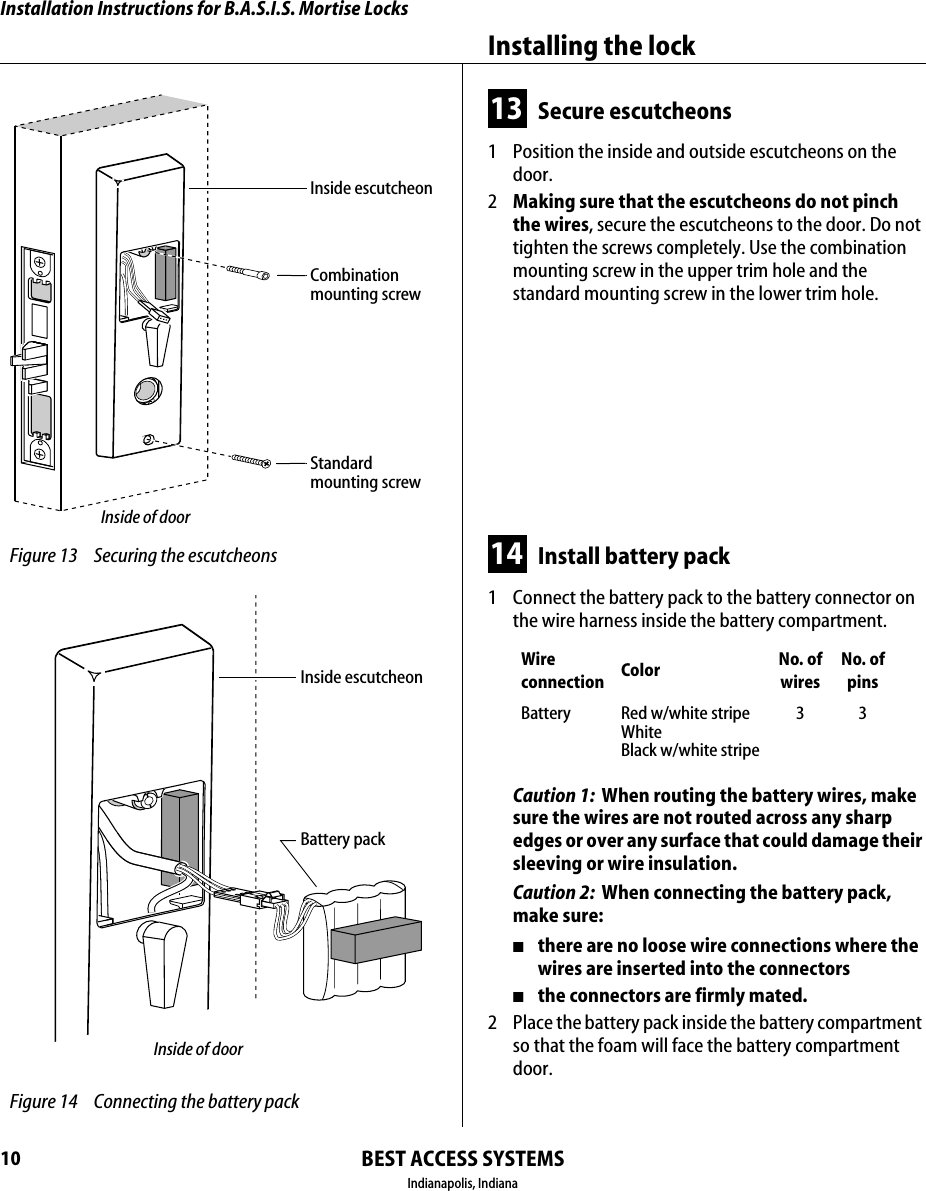
Installation Instructions for B.A.S.I.S. Mortise LocksBEST ACCESS SYSTEMSIndianapolis, IndianaInstalling the lock1013 Secure escutcheons1  Position the inside and outside escutcheons on the door.2  Making sure that the escutcheons do not pinch the wires, secure the escutcheons to the door. Do not tighten the screws completely. Use the combination mounting screw in the upper trim hole and the standard mounting screw in the lower trim hole.14 Install battery pack1  Connect the battery pack to the battery connector on the wire harness inside the battery compartment.Caution 1:  When routing the battery wires, make sure the wires are not routed across any sharp edges or over any surface that could damage their sleeving or wire insulation.Caution 2:  When connecting the battery pack, make sure:■there are no loose wire connections where the wires are inserted into the connectors■the connectors are firmly mated.2  Place the battery pack inside the battery compartment so that the foam will face the battery compartment door.Wire connection Color No. ofwiresNo. ofpinsBattery Red w/white stripeWhiteBlack w/white stripe33 Figure 13 Securing the escutcheonsCombinationmounting screwStandardmounting screwInside of doorInside escutcheon Figure 14 Connecting the battery packBattery packInside of doorInside escutcheon
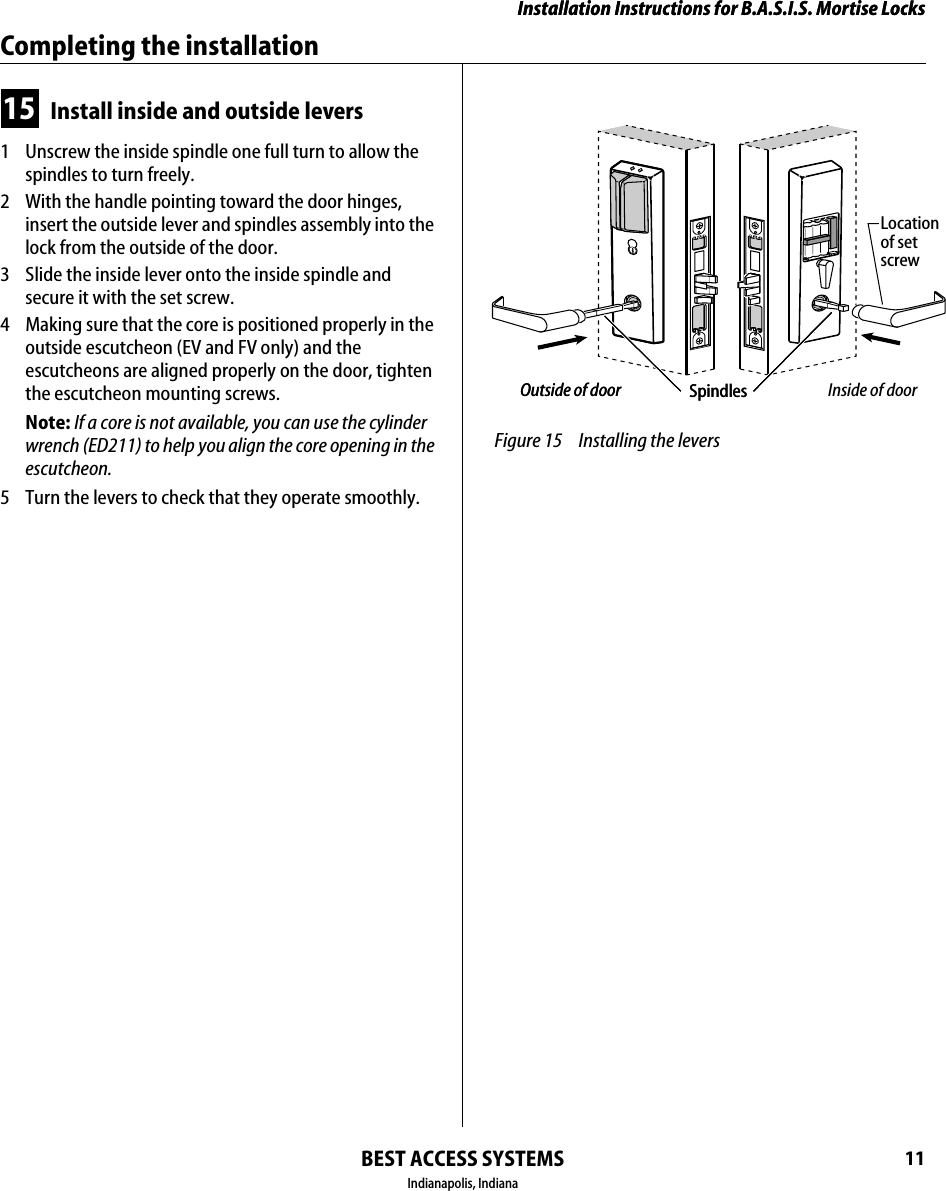
Installation Instructions for B.A.S.I.S. Mortise LocksBEST ACCESS SYSTEMSIndianapolis, Indiana11Installation Instructions for B.A.S.I.S. Mortise LocksCompleting the installation15 Install inside and outside levers1  Unscrew the inside spindle one full turn to allow the spindles to turn freely.2  With the handle pointing toward the door hinges, insert the outside lever and spindles assembly into the lock from the outside of the door.3  Slide the inside lever onto the inside spindle and secure it with the set screw.4  Making sure that the core is positioned properly in the outside escutcheon (EV and FV only) and the escutcheons are aligned properly on the door, tighten the escutcheon mounting screws.Note: If a core is not available, you can use the cylinder wrench (ED211) to help you align the core opening in the escutcheon.5  Turn the levers to check that they operate smoothly. Figure 15 Installing the leversSpindlesLocationof setscrewOutside of door Inside of doorSpindlesOutside of door
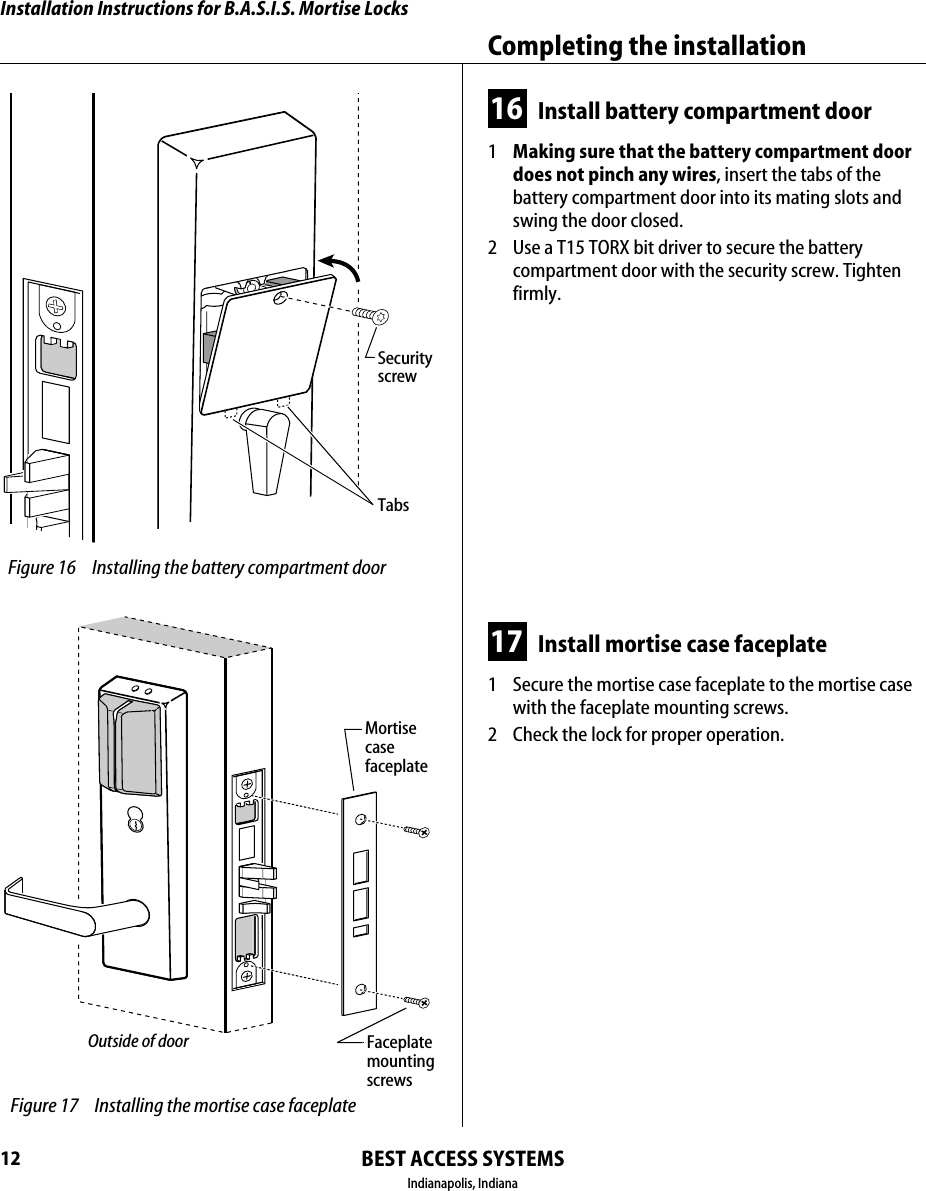
Installation Instructions for B.A.S.I.S. Mortise LocksBEST ACCESS SYSTEMSIndianapolis, IndianaCompleting the installation1216 Install battery compartment door1  Making sure that the battery compartment door does not pinch any wires, insert the tabs of the battery compartment door into its mating slots and swing the door closed.2  Use a T15 TORX bit driver to secure the battery compartment door with the security screw. Tighten firmly.17 Install mortise case faceplate1  Secure the mortise case faceplate to the mortise case with the faceplate mounting screws.2  Check the lock for proper operation. Figure 16 Installing the battery compartment doorSecurityscrewTabs Figure 17 Installing the mortise case faceplateOutside of doorMortisecasefaceplateFaceplatemounting screws
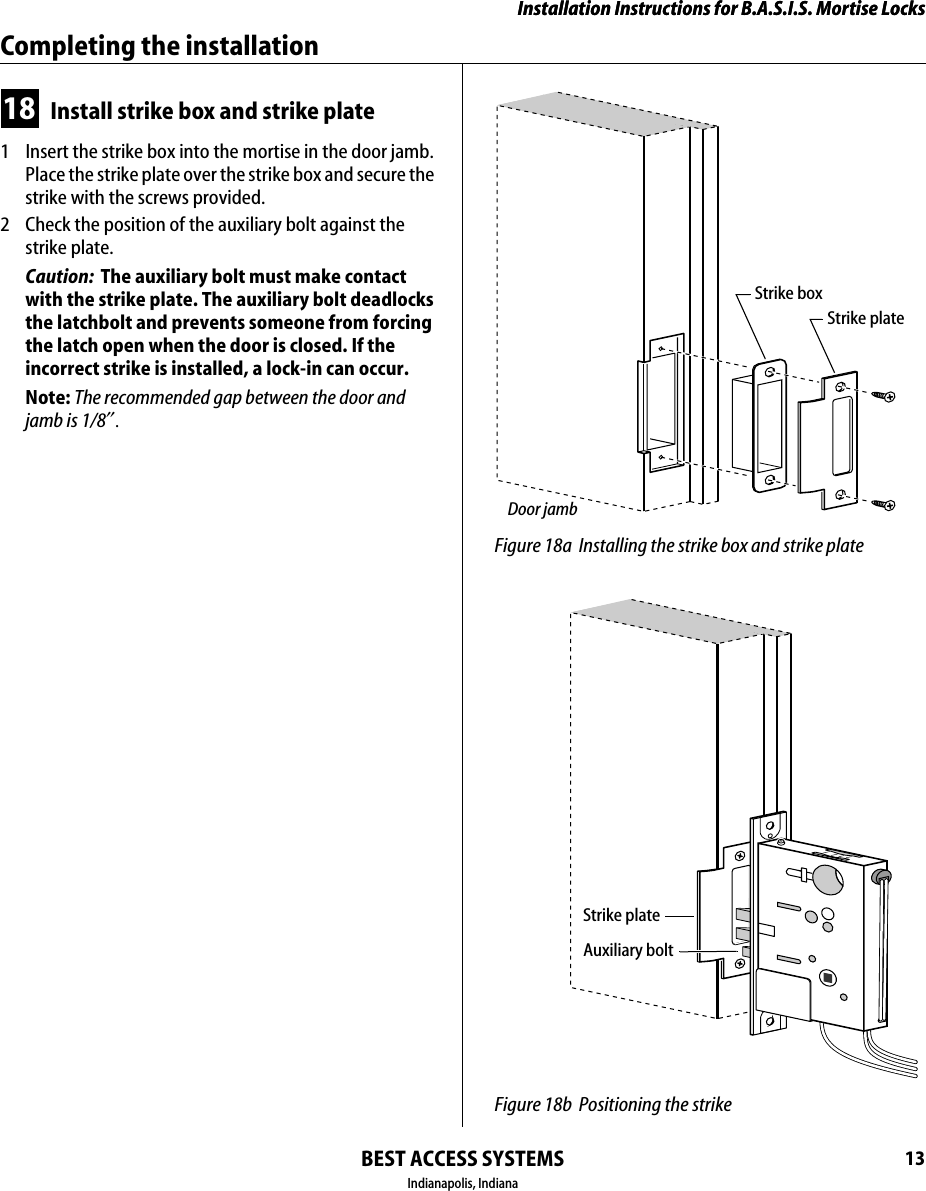
Installation Instructions for B.A.S.I.S. Mortise LocksBEST ACCESS SYSTEMSIndianapolis, Indiana13Installation Instructions for B.A.S.I.S. Mortise LocksCompleting the installation18 Install strike box and strike plate1  Insert the strike box into the mortise in the door jamb. Place the strike plate over the strike box and secure the strike with the screws provided.2  Check the position of the auxiliary bolt against the strike plate.Caution:  The auxiliary bolt must make contact with the strike plate. The auxiliary bolt deadlocks the latchbolt and prevents someone from forcing the latch open when the door is closed. If the incorrect strike is installed, a lock-in can occur.Note: The recommended gap between the door and jamb is 1/8″. Figure 18a Installing the strike box and strike plateStrike boxStrike plateDoor jamb Figure 18b Positioning the strikeAuxiliary boltStrike plate
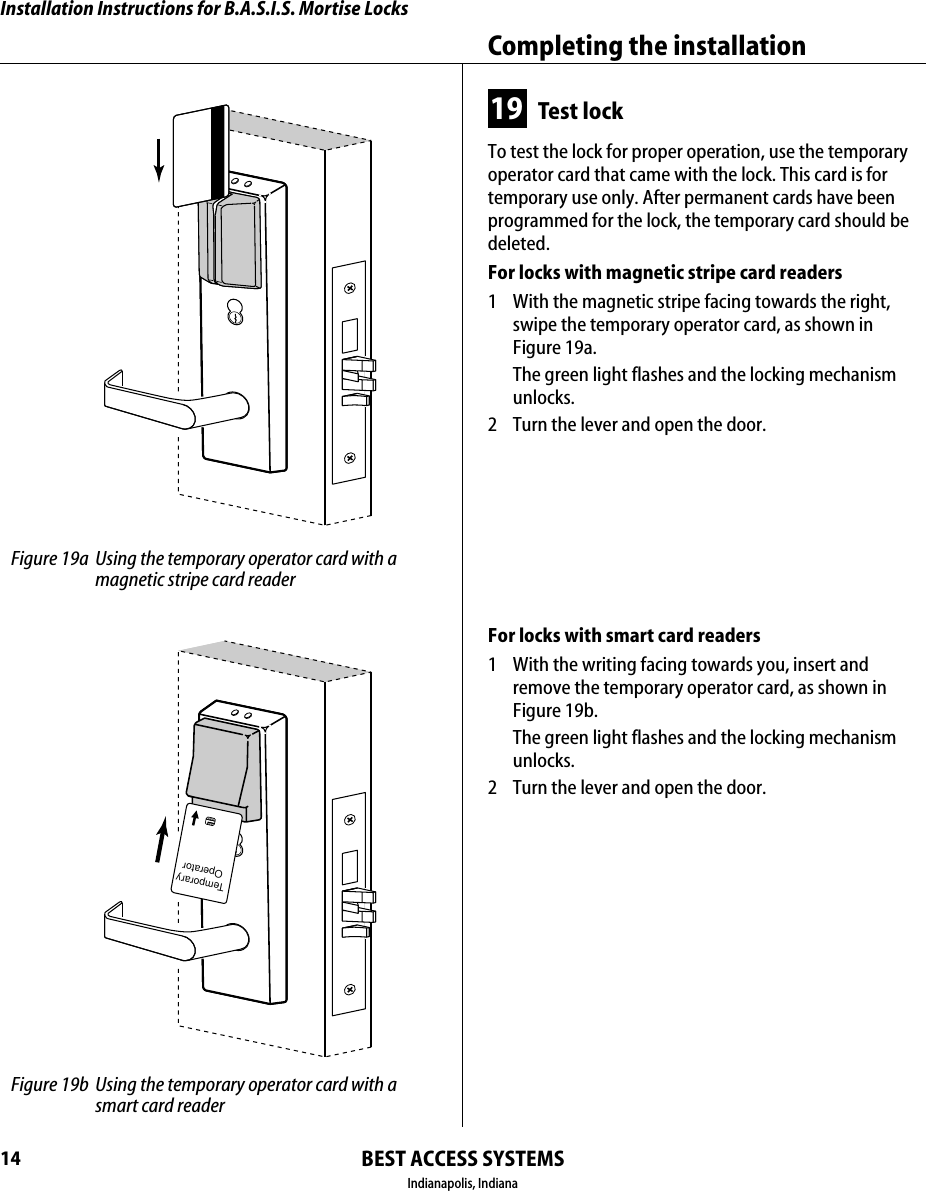
Installation Instructions for B.A.S.I.S. Mortise LocksBEST ACCESS SYSTEMSIndianapolis, IndianaCompleting the installation1419 Test lockTo test the lock for proper operation, use the temporary operator card that came with the lock. This card is for temporary use only. After permanent cards have been programmed for the lock, the temporary card should be deleted.For locks with magnetic stripe card readers1  With the magnetic stripe facing towards the right, swipe the temporary operator card, as shown in Figure 19a.The green light flashes and the locking mechanism unlocks.2  Turn the lever and open the door.For locks with smart card readers1  With the writing facing towards you, insert and remove the temporary operator card, as shown in Figure 19b.The green light flashes and the locking mechanism unlocks.2  Turn the lever and open the door. Figure 19a Using the temporary operator card with a magnetic stripe card readerTemporaryOperator Figure 19b Using the temporary operator card with a smart card reader
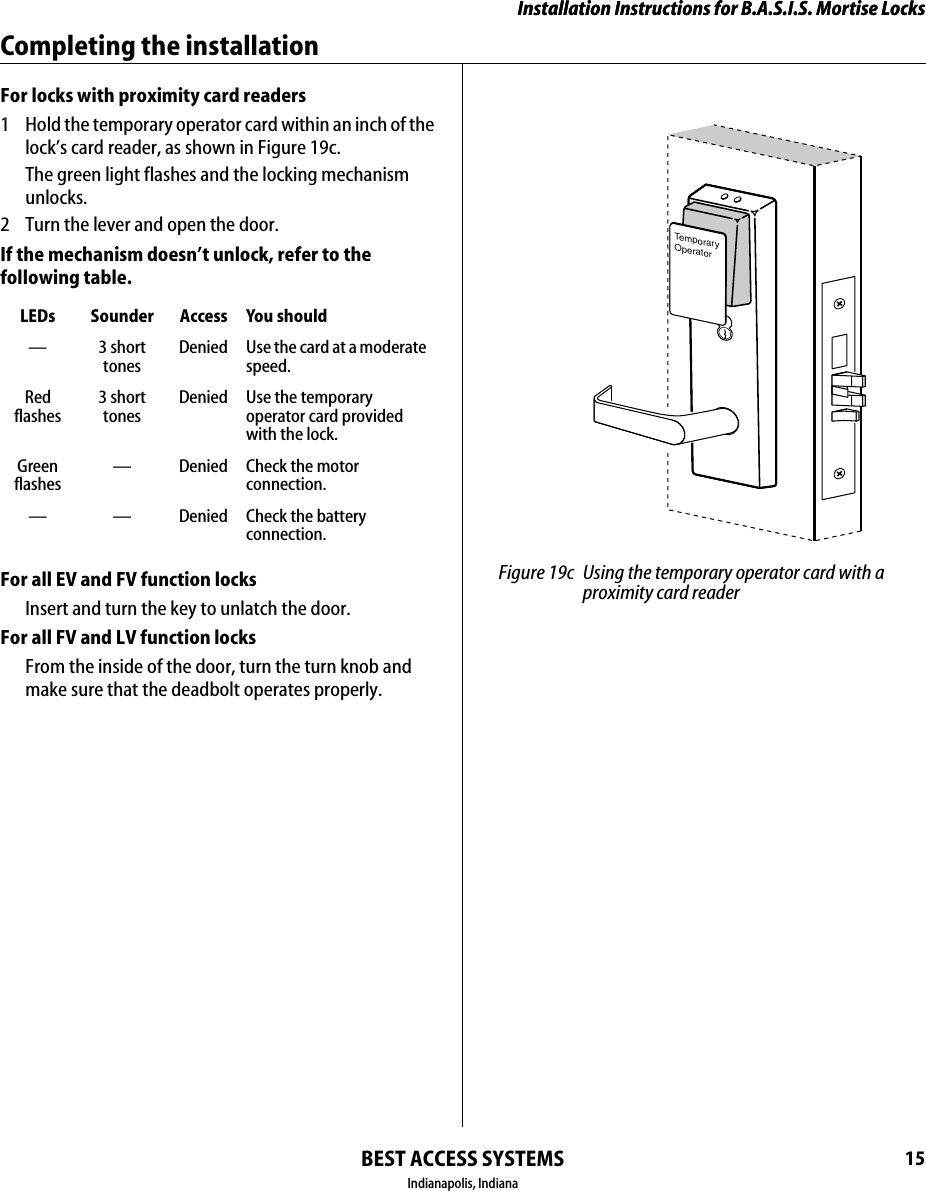
Installation Instructions for B.A.S.I.S. Mortise LocksBEST ACCESS SYSTEMSIndianapolis, Indiana15Installation Instructions for B.A.S.I.S. Mortise LocksCompleting the installationFor locks with proximity card readers1  Hold the temporary operator card within an inch of the lock’s card reader, as shown in Figure 19c.The green light flashes and the locking mechanism unlocks.2  Turn the lever and open the door.If the mechanism doesn’t unlock, refer to the following table.For all EV and FV function locksInsert and turn the key to unlatch the door.For all FV and LV function locksFrom the inside of the door, turn the turn knob and make sure that the deadbolt operates properly.LEDs Sounder Access You should—3 short tonesDenied Use the card at a moderate speed.Red flashes3 short tonesDenied Use the temporary operator card provided with the lock.Green flashes— Denied Check the motor connection.— — Denied Check the battery connection.TemporaryOperator Figure 19c Using the temporary operator card with a proximity card reader
Installation Instructions for B.A.S.I.S. Mortise LocksBEST ACCESS SYSTEMSIndianapolis, Indiana16 © 2000 Best Lock Corporation dba Best Access Systems.T63302/Rev B   1817313   ER-7991-12   June 2001

Navigation menu