CIMCON Lighting CIM35X1 CIMX1PRO RF MODULE User Manual

CIMCON Lighting, Inc. CIMX1PRO RF MODULE

User Manual

                                                                                                                                                                                                   RF Module  Model: CIMX1PRO  Product Manual    CIMCON Lighting, Inc. 234 Littleton Road Westford, MA 01886. www.cimconlighting.com    Document No. RFM-PM-100-010-A   Confidential
                                                                                   Product Manual  RF Module  This information is confidential and proprietary to CSI and is to be used only for the purpose for which it is provided. Reproduction by any means, electronic or mechanical, and distribution to third parties without express written permission from CSI is not permitted.              No part of this document may be reproduced or transmitted in any form or by any means, electronic or mechanical, for any purpose, without the express written permission of CIMCON Lighting, Inc. Information in this document is subject to change without notice.  CIMCON Lighting, Inc. may have patents or pending patent applications, trademarks, copyrights, or other intellectual property rights covering subject matter in this document. The furnishing of this document does not give you license to these patents, trademarks, copyrights, or other intellectual property except as expressly provided in any written license agreement from CIMCON Lighting, Inc.  © 2013 CIMCON Lighting, Inc.   All rights reserved.
                                                                                   Product Manual  RF Module  i This information is confidential and proprietary to CSI and is to be used only for the purpose for which it is provided. Reproduction by any means, electronic or mechanical, and distribution to third parties without express written permission from CSI is not permitted.    TTaabbllee  ooff  CCoonntteennttss  1 GETTING STARTED ......................................................................................... 1-1 1.1. OVERVIEW ................................................................................................................................... 1-1 1.2. KEY FEATURES ............................................................................................................................. 1-1 1.3. FCC APPROVALS ......................................................................................................................... 1-2 1.4. FCC LABELING REQUIREMENTS .................................................................................................. 1-2 2 SMT MODULE PIN-OUT.................................................................................. 2-1 3 THROUGH HOLE MODULE PIN-OUT ............................................................. 3-4 4 CONFIGURATION INFORMATION ................................................................. 4-1 4.1. ABSOLUTE MAXIMUM RATINGS OF RF MODULE........................................................................... 4-1 4.2. RECOMMENDED OPERATING CONDITIONS ................................................................................... 4-1 4.3. DC ELECTRICAL CHARACTERISTICS.............................................................................................. 4-1 4.4. POWER SETTINGS FOR REGULATORY COMPLIANCE ....................................................................... 4-2 5 BOARD LAYOUT .............................................................................................. 5-1 6 SOLDERING TEMPERATURE PROFILE ..........................................................  6-1 6.1. LEADED PROCESS ........................................................................................................................  6-1 6.2. LEAD FREE PROCESS ................................................................................................................... 6-1 7 MECHANICAL DIMENSIONS OF THE SMT MODULES .................................... 7-1 8 MECHANICAL DIMENSIONS FOR THROUGH HOLE MODULE ......................  8-1
                                                                                   Product Manual  RF Module  1-1 This information is confidential and proprietary to CSI and is to be used only for the purpose for which it is provided. Reproduction by any means, electronic or mechanical, and distribution to third parties without express written permission from CSI is not permitted.    11  GGEETTTTIINNGG  SSTTAARRTTEEDD  1.1. Overview This manual describes the key features, pin out, recommended operating conditions, working of RF module and operating instructions to test the module for FCC.  CIMCON RF modules are designed to operate within the ZigBee protocol and support the unique needs of low-cost, low-power wireless sensor networks. The modules require minimal power and provide reliable delivery of data between remote devices. The modules operate within the ISM 2.4 GHz frequency band work on ZigBee protocol. 1.2. Key Features The key features of RF modules are as follows:  • Operates from wide 2.1VDC to 3.6VDC • Maximum transmit current is 150mA (Typical at 3.0V) • Maximum Receive current is 38mA • Maximum transmit power is +22dBm • Receiver Sensitivity of -104dBm • Various serial interfaces like UART, SPI (master/ slave), and TWI • Six external ADC sources with 14-bit resolution • Urban range of ~85m • Line of sight range of ~1750m
                                                                                   Product Manual  RF Module  1-2 This information is confidential and proprietary to CSI and is to be used only for the purpose for which it is provided. Reproduction by any means, electronic or mechanical, and distribution to third parties without express written permission from CSI is not permitted.    1.3. FCC Approvals The  CIMCON SMT module and through hole module with the integrated wire whip Antenna  as  well  as  the SMT module and through hole including the 2.1dBi external antenna complies with FCC CFR Part 15 (USA). The devices meet the requirements for modular transmitter approval.  External Antennas:         Dipole Antenna (P/N: A24-HASM-525; Maximum Antenna Gain: 2.1dBi) Dipole Antenna (P/N: A24-HASM-450; Maximum Antenna Gain: 2.1dBi)   This device complies with Part 15 of the FCC rules. Operation is subject to the following two conditions:  1) This device may not cause harmful interference.  2) This device must accept any interference received, including interference that may cause undesired operation.   Changes and Modifications not expressly approved by CIMCON can void your authority to operate this equipment under Federal Communications Commission’s rules. The following statement must be included as a CAUTION statement in manuals for OEM products to alert users on FCC RF exposure compliance:  “WARNING:  To satisfy FCC RF exposure requirements for mobile transmitting devices, a separation distance of 20 CM or more should be maintained between the antenna of this device and persons during operation. To ensure compliance, operations at closer  distances than this are not recommended.” 1.4. FCC Labeling Requirements When integrating the CIMCON’s SMT module or TH module into a product it must be ensured that the FCC labeling requirements are met. This includes a clearly visible label on the outside of the finished product specifying the CIMCON’s FCC identifier (FCC ID: S3Z-CIM35X1) as well as the notice above. This exterior label can use wording such as “Contains Transmitter Module FCC ID:  S3Z-CIM35X1” or “Contains FCC ID: S3Z-CIM35X1” although any similar wording that expresses the same meaning may be used.
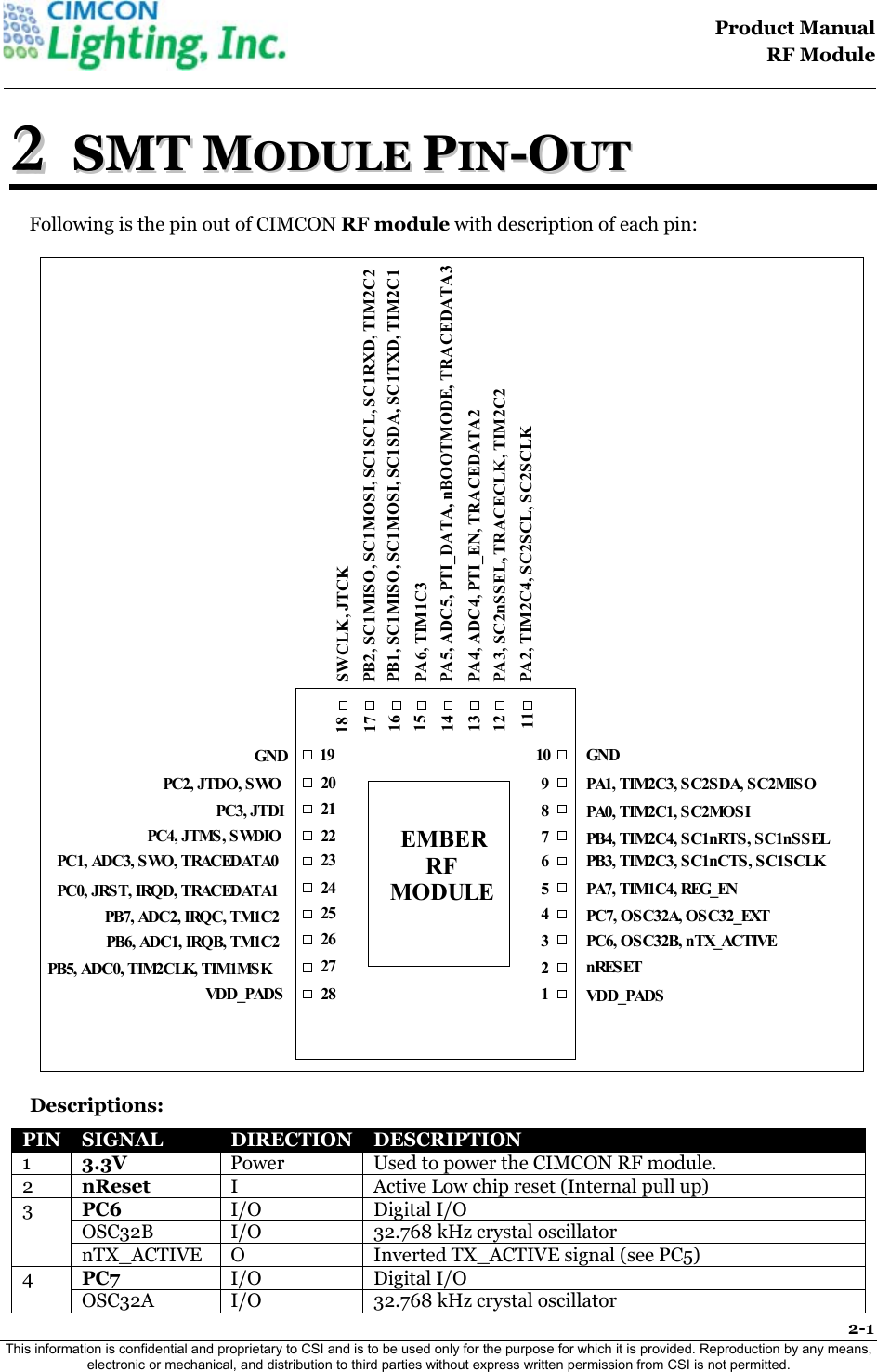
                                                                                   Product Manual  RF Module  2-1 This information is confidential and proprietary to CSI and is to be used only for the purpose for which it is provided. Reproduction by any means, electronic or mechanical, and distribution to third parties without express written permission from CSI is not permitted.    22  SSMMTT  MMOODDUULLEE  PPIINN--OOUUTT  Following is the pin out of CIMCON RF module with description of each pin:  12345678910111213141516171828272625242322212019VDD_PADSnRES ETPC6, OS C32B, nTX_ACTIVEPC7, OSC32A, OSC32_EXTPA7, TIM1C4, REG_ENPB3, TIM2C3, S C1nCTS, S C1SCLKPB4, TIM2C4, SC1nRTS, SC1nSSELPA0, TIM2C1, S C2MOS IPA1, TIM2C3, SC2SDA, S C2MISOGNDPA2, TIM2C4, SC2SCL, SC2SCLKPA3, SC2nSSEL, TRACECLK, TIM2C2PA4, ADC4, PTI_EN, TRACEDATA2PA5, ADC5, PTI_DATA, nBOOTMODE, TRACEDATA3PA6, TIM1C3PB1, SC1MISO, SC1MOSI, SC1SDA, SC1TXD, TIM2C1PB2, SC1MISO, SC1MOSI, SC1SCL, SC1RXD, TIM2C2SWCLK, JTCKGNDPC2, JTDO, SWOPC3, JTDIPC4, JTMS, SWDIOPC1,  ADC3,  S WO,  TRACEDATA0PC0, JRST, IRQD, TRACEDATA1PB7, ADC2, IRQC, TM1C2PB6, ADC1, IRQB, TM1C2PB5,  ADC0, TIM2CLK,  TIM1MS KVDD_PADSEMBERRFMODULE Descriptions: PIN  SIGNAL  DIRECTION  DESCRIPTION 1  3.3V Power  Used to power the CIMCON RF module. 2  nReset  I Active Low chip reset (Internal pull up) 3  PC6  I/O Digital I/O OSC32B  I/O  32.768 kHz crystal oscillator  nTX_ACTIVE   O  Inverted TX_ACTIVE signal (see PC5)  4  PC7  I/O Digital I/O OSC32A  I/O  32.768 kHz crystal oscillator
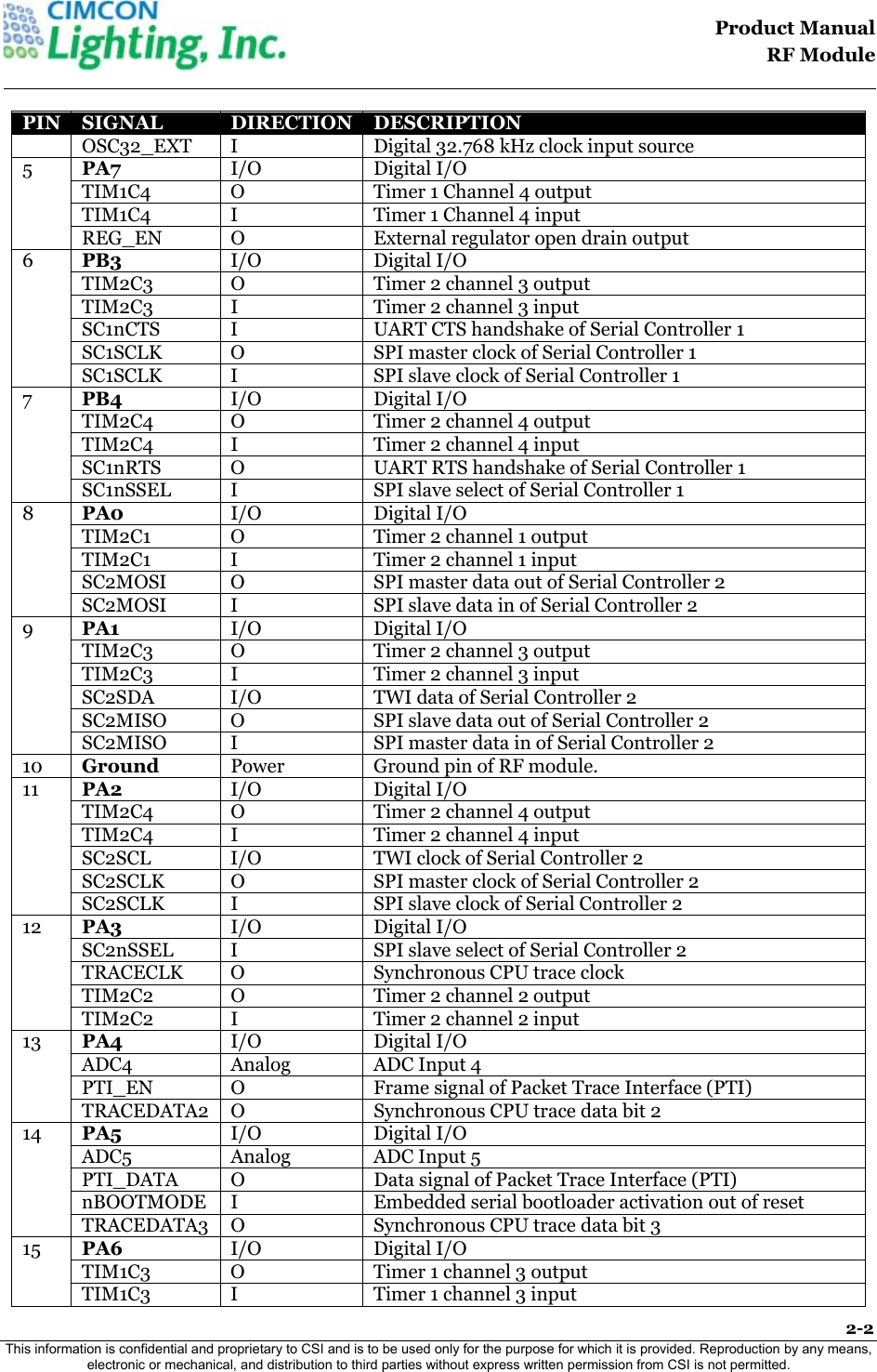
                                                                                   Product Manual  RF Module  2-2 This information is confidential and proprietary to CSI and is to be used only for the purpose for which it is provided. Reproduction by any means, electronic or mechanical, and distribution to third parties without express written permission from CSI is not permitted.    PIN  SIGNAL  DIRECTION  DESCRIPTION OSC32_EXT   I  Digital 32.768 kHz clock input source  5  PA7  I/O Digital I/O TIM1C4   O  Timer 1 Channel 4 output   TIM1C4  I  Timer 1 Channel 4 input  REG_EN   O  External regulator open drain output  6  PB3  I/O Digital I/O TIM2C3   O  Timer 2 channel 3 output   TIM2C3   I  Timer 2 channel 3 input  SC1nCTS   I  UART CTS handshake of Serial Controller 1   SC1SCLK   O  SPI master clock of Serial Controller 1   SC1SCLK   I  SPI slave clock of Serial Controller 1   7  PB4  I/O Digital I/O TIM2C4   O  Timer 2 channel 4 output   TIM2C4   I  Timer 2 channel 4 input  SC1nRTS   O  UART RTS handshake of Serial Controller 1   SC1nSSEL   I  SPI slave select of Serial Controller 1   8  PA0  I/O Digital I/O TIM2C1   O  Timer 2 channel 1 output   TIM2C1   I  Timer 2 channel 1 input  SC2MOSI   O  SPI master data out of Serial Controller 2   SC2MOSI   I  SPI slave data in of Serial Controller 2   9  PA1  I/O Digital I/O TIM2C3   O  Timer 2 channel 3 output  TIM2C3   I  Timer 2 channel 3 input  SC2SDA   I/O  TWI data of Serial Controller 2   SC2MISO   O  SPI slave data out of Serial Controller 2   SC2MISO   I  SPI master data in of Serial Controller 2   10   Ground  Power  Ground pin of RF module. 11  PA2  I/O Digital I/O TIM2C4   O  Timer 2 channel 4 output   TIM2C4   I  Timer 2 channel 4 input  SC2SCL   I/O  TWI clock of Serial Controller 2   SC2SCLK   O  SPI master clock of Serial Controller 2   SC2SCLK   I  SPI slave clock of Serial Controller 2   12  PA3  I/O Digital I/O SC2nSSEL   I  SPI slave select of Serial Controller 2   TRACECLK   O  Synchronous CPU trace clock   TIM2C2   O  Timer 2 channel 2 output  TIM2C2   I  Timer 2 channel 2 input  13  PA4  I/O Digital I/O ADC4  Analog ADC Input 4  PTI_EN   O  Frame signal of Packet Trace Interface (PTI)   TRACEDATA2   O  Synchronous CPU trace data bit 2   14  PA5  I/O Digital I/O ADC5  Analog ADC Input 5  PTI_DATA   O  Data signal of Packet Trace Interface (PTI)   nBOOTMODE  I  Embedded serial bootloader activation out of reset  TRACEDATA3   O  Synchronous CPU trace data bit 3   15  PA6  I/O Digital I/O TIM1C3   O  Timer 1 channel 3 output   TIM1C3   I  Timer 1 channel 3 input
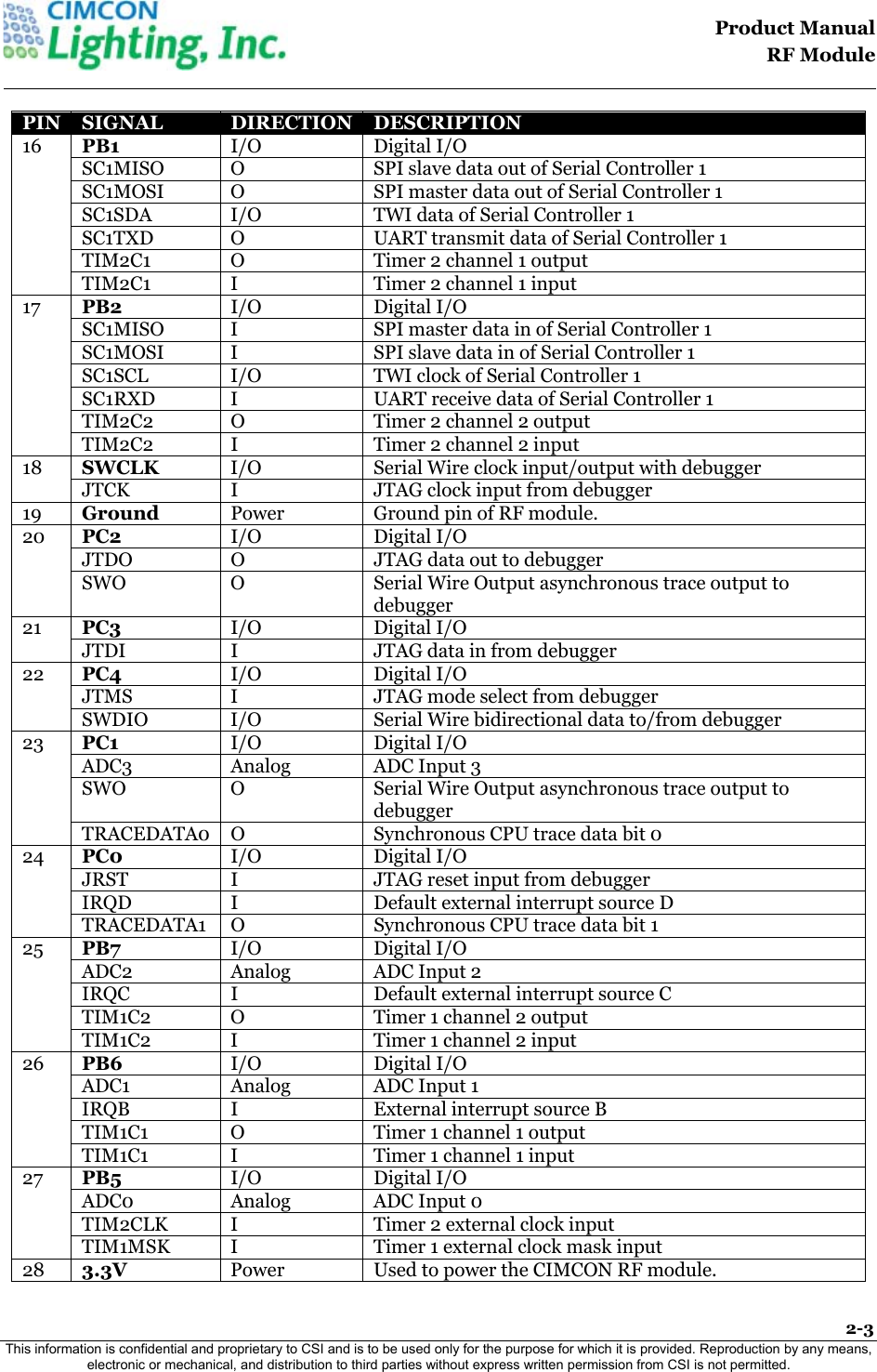
                                                                                   Product Manual  RF Module  2-3 This information is confidential and proprietary to CSI and is to be used only for the purpose for which it is provided. Reproduction by any means, electronic or mechanical, and distribution to third parties without express written permission from CSI is not permitted.    PIN  SIGNAL  DIRECTION  DESCRIPTION 16  PB1  I/O Digital I/O SC1MISO   O  SPI slave data out of Serial Controller 1   SC1MOSI   O  SPI master data out of Serial Controller 1  SC1SDA   I/O  TWI data of Serial Controller 1   SC1TXD   O  UART transmit data of Serial Controller 1   TIM2C1   O  Timer 2 channel 1 output   TIM2C1   I  Timer 2 channel 1 input  17  PB2  I/O Digital I/O SC1MISO   I  SPI master data in of Serial Controller 1   SC1MOSI   I  SPI slave data in of Serial Controller 1  SC1SCL   I/O  TWI clock of Serial Controller 1  SC1RXD   I   UART receive data of Serial Controller 1  TIM2C2   O  Timer 2 channel 2 output  TIM2C2   I  Timer 2 channel 2 input  18  SWCLK  I/O  Serial Wire clock input/output with debugger  JTCK   I  JTAG clock input from debugger  19  Ground  Power   Ground pin of RF module. 20  PC2  I/O Digital I/O JTDO   O  JTAG data out to debugger  SWO   O  Serial Wire Output asynchronous trace output to debugger 21  PC3  I/O Digital I/O JTDI   I  JTAG data in from debugger  22  PC4  I/O Digital I/O JTMS   I  JTAG mode select from debugger  SWDIO   I/O  Serial Wire bidirectional data to/from debugger 23  PC1  I/O Digital I/O ADC3  Analog ADC Input 3  SWO   O  Serial Wire Output asynchronous trace output to debugger  TRACEDATA0   O  Synchronous CPU trace data bit 0  24  PC0  I/O Digital I/O JRST   I  JTAG reset input from debugger  IRQD  I  Default external interrupt source D  TRACEDATA1   O  Synchronous CPU trace data bit 1  25  PB7  I/O Digital I/O ADC2  Analog ADC Input 2  IRQC  I  Default external interrupt source C  TIM1C2   O  Timer 1 channel 2 output  TIM1C2   I  Timer 1 channel 2 input 26  PB6  I/O Digital I/O ADC1  Analog ADC Input 1  IRQB   I  External interrupt source B  TIM1C1   O  Timer 1 channel 1 output  TIM1C1   I  Timer 1 channel 1 input  27  PB5  I/O Digital I/O ADC0  Analog ADC Input 0  TIM2CLK   I  Timer 2 external clock input  TIM1MSK   I  Timer 1 external clock mask input  28  3.3V Power  Used to power the CIMCON RF module.
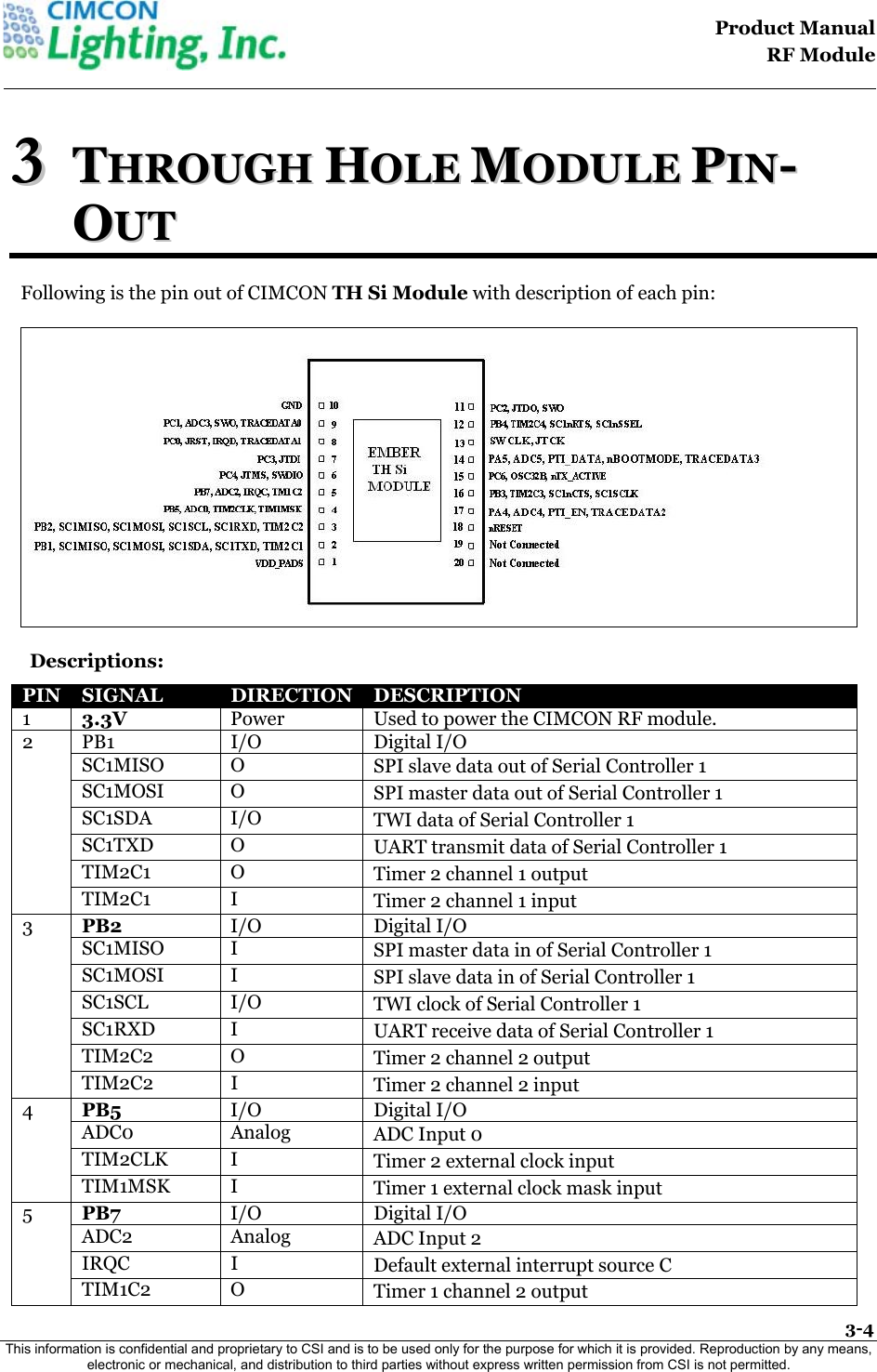
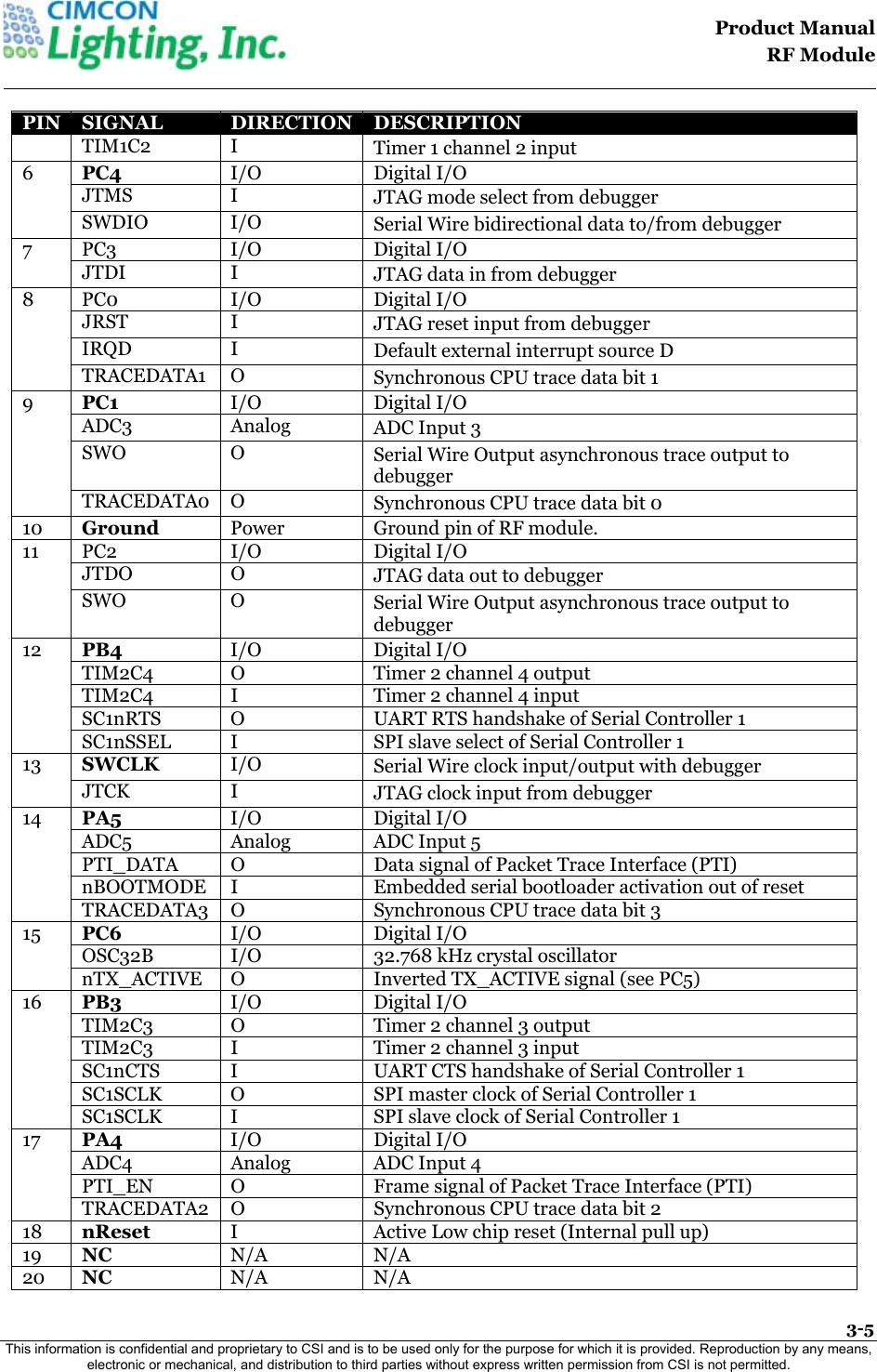
                                                                                   Product Manual  RF Module  3-4 This information is confidential and proprietary to CSI and is to be used only for the purpose for which it is provided. Reproduction by any means, electronic or mechanical, and distribution to third parties without express written permission from CSI is not permitted.    33  TTHHRROOUUGGHH  HHOOLLEE  MMOODDUULLEE  PPIINN--OOUUTT  Following is the pin out of CIMCON TH Si Module with description of each pin:  Descriptions: PIN  SIGNAL  DIRECTION  DESCRIPTION 1  3.3V Power  Used to power the CIMCON RF module. 2 PB1  I/O  Digital I/O SC1MISO  O  SPI slave data out of Serial Controller 1   SC1MOSI  O  SPI master data out of Serial Controller 1  SC1SDA  I/O  TWI data of Serial Controller 1   SC1TXD   O  UART transmit data of Serial Controller 1   TIM2C1  O  Timer 2 channel 1 output   TIM2C1  I  Timer 2 channel 1 input  3  PB2 I/O  Digital I/O SC1MISO  I  SPI master data in of Serial Controller 1   SC1MOSI  I  SPI slave data in of Serial Controller 1  SC1SCL  I/O  TWI clock of Serial Controller 1  SC1RXD  I   UART receive data of Serial Controller 1  TIM2C2   O  Timer 2 channel 2 output  TIM2C2   I  Timer 2 channel 2 input  4  PB5 I/O  Digital I/O ADC0  Analog  ADC Input 0  TIM2CLK  I  Timer 2 external clock input  TIM1MSK  I  Timer 1 external clock mask input  5  PB7 I/O Digital I/O ADC2  Analog  ADC Input 2  IRQC I  Default external interrupt source C  TIM1C2  O  Timer 1 channel 2 output
                                                                                   Product Manual  RF Module  3-5 This information is confidential and proprietary to CSI and is to be used only for the purpose for which it is provided. Reproduction by any means, electronic or mechanical, and distribution to third parties without express written permission from CSI is not permitted.    PIN  SIGNAL  DIRECTION  DESCRIPTION TIM1C2  I  Timer 1 channel 2 input 6  PC4 I/O  Digital I/O JTMS   I  JTAG mode select from debugger  SWDIO  I/O  Serial Wire bidirectional data to/from debugger 7 PC3  I/O  Digital I/O JTDI   I  JTAG data in from debugger  8 PC0  I/O  Digital I/O JRST   I  JTAG reset input from debugger  IRQD I  Default external interrupt source D  TRACEDATA1   O  Synchronous CPU trace data bit 1  9  PC1 I/O Digital I/O ADC3  Analog  ADC Input 3  SWO  O  Serial Wire Output asynchronous trace output to debugger  TRACEDATA0   O  Synchronous CPU trace data bit 0  10  Ground Power  Ground pin of RF module. 11 PC2  I/O  Digital I/O JTDO   O  JTAG data out to debugger  SWO  O  Serial Wire Output asynchronous trace output to debugger 12  PB4 I/O  Digital I/O TIM2C4   O  Timer 2 channel 4 output   TIM2C4   I  Timer 2 channel 4 input  SC1nRTS   O  UART RTS handshake of Serial Controller 1   SC1nSSEL   I  SPI slave select of Serial Controller 1   13  SWCLK   I/O  Serial Wire clock input/output with debugger  JTCK   I  JTAG clock input from debugger  14  PA5 I/O  Digital I/O ADC5  Analog ADC Input 5  PTI_DATA   O  Data signal of Packet Trace Interface (PTI)   nBOOTMODE  I  Embedded serial bootloader activation out of reset  TRACEDATA3   O  Synchronous CPU trace data bit 3   15  PC6  I/O Digital I/O OSC32B  I/O  32.768 kHz crystal oscillator  nTX_ACTIVE   O  Inverted TX_ACTIVE signal (see PC5)  16  PB3 I/O  Digital I/O TIM2C3   O  Timer 2 channel 3 output   TIM2C3   I  Timer 2 channel 3 input  SC1nCTS   I  UART CTS handshake of Serial Controller 1   SC1SCLK   O  SPI master clock of Serial Controller 1   SC1SCLK   I  SPI slave clock of Serial Controller 1   17  PA4 I/O  Digital I/O ADC4  Analog ADC Input 4  PTI_EN   O  Frame signal of Packet Trace Interface (PTI)   TRACEDATA2   O  Synchronous CPU trace data bit 2   18  nReset I Active Low chip reset (Internal pull up) 19  NC N/A N/A 20  NC N/A N/A
                                                                                   Product Manual  RF Module  4-1 This information is confidential and proprietary to CSI and is to be used only for the purpose for which it is provided. Reproduction by any means, electronic or mechanical, and distribution to third parties without express written permission from CSI is not permitted.    44  CCOONNFFIIGGUURRAATTIIOONN  IINNFFOORRMMAATTIIOONN    4.1. Absolute Maximum Ratings of RF Module The following table provides maximum ratings of RF Module:   Sr. No.  Parameter  Symbol  Absolute Maximum ratings Unit 1 Supply Voltage Vcc  -0.3 to +3.6 VDC 2 Voltage on any GPIO including nReset and JCLK VIN  -0.3 to Vcc+0.3 VDC 3 Voltage on any GPIO [PA4, PA5, PB5, PB6, PB7, PC1] when used as input to ADC VIN  -0.3 to +2.0 VDC 4  Storage Temperature Range  Tstg  -40 to +105  ‘C 5  Operating Temperature Range  Top  -40 to +85  ‘C 6  ESD on any pin (HBM) Vhbm +/-2  KV 7  ESD on RF port (CDM) Vcdm +/-225 V 8  Moisture Sensitivity Level (MSL)    MSL3   9 Reflow Temperature  Treflow  Refer in next pages   4.2. Recommended Operating Conditions Sr. No  Parameter  Symbol  Recommended Operating Conditions Unit 1 Supply Voltage Vcc  2.1 to 3.6 VDC 2 Operating frequency  Fin  2405 to 24  MHz 3  Operating Temperature  Top  -40 to +85’C  ‘C 4.3. DC Electrical Characteristics Parameter  Test Conditions  Min.  Typical  Max  Unit Voltage supply   2.1  3.6 VDC Low Schmitt switching threshold VSWIL  Schmitt input threshold going from high to low  0.42 x VDD_PADS    0.50 x VDD_PADS    High Schmitt switching threshold   VSWIH  Schmitt input threshold going from low to high  0.62 x VDD_PADS    0.80 x VDD_PADS   V Input current for logic 0   IIL     -0.5   uA Input current for logic 1   IIH     +0.5   uA Input pull-up resistor value   RIPU   24 29 34 kΩ
                                                                                   Product Manual  RF Module  4-2 This information is confidential and proprietary to CSI and is to be used only for the purpose for which it is provided. Reproduction by any means, electronic or mechanical, and distribution to third parties without express written permission from CSI is not permitted.    Parameter  Test Conditions  Min.  Typical  Max  Unit Input pull-down resistor value   RIPD   24   29 34  kΩ Output voltage for logic 0   VOL  (IOL = 4 mA for standard pads, 8 mA for high current pads)  0  0.18 x VDD_PADS   V Output voltage for logic 1   VOH  (IOH = 4 mA for standard pads, 8 mA for high current pads)  0.82 x VDD_PADS    VDD_PADS   V Output source current (standard current pad)   IOHS     4   mA Output sink current (standard current pad)   IOLS     4 mA Output source current high current pad: PA6, PA7, PB6, PB7, PC0   IOHH     8 mA Output sink current high current pad: PA6, PA7, PB6, PB7, PC0   IOLH     8 mA Total output current (for I/O Pads)   IOH + IOL     40 mA 4.4. Power Settings for Regulatory Compliance  Because of the high gain of the frontend module output power of up to 24dBm can be achieved When the antenna gain is included then the output power of the EM357 transceivers needs to be  reduced for regulatory compliance. The following tables list the maximum permitted power setting for the different antenna types listed. This is the power out of the EM357 chip, and the power delivered to the antenna will be higher by the gain of the PA.                    settxpower P (set the channel power)  UFL Antenna Unit  • Channel 11: P = -5 [dBm] • Channel 18: P = -5 [dBm] • Channel 25: P = -7 [dBm]  Fixed Antenna Unit • Channel 11: P = -3 [dBm] • Channel 18: P = -3 [dBm] • Channel 25: P = -3 [dBm]
                                                                                   Product Manual  RF Module  5-1 This information is confidential and proprietary to CSI and is to be used only for the purpose for which it is provided. Reproduction by any means, electronic or mechanical, and distribution to third parties without express written permission from CSI is not permitted.    55  BBOOAARRDD  LLAAYYOOUUTT  CIMCON RF modules do not have any specific sensitivity to nearby processors, crystals or other PCB components. Other than mechanical considerations, no special PCB placement is required for integrating CIMCON RF radios. In general, Power and GND traces should be thicker than signal traces and be able to comfortably support the maximum currents. The radios are also designed to be self-sufficient and work with wire whip and external antennas without the need for additional ground planes on the host PCB. However, considerations should be taken on the choice of antenna and antenna location. Metal objects that are near an antenna cause reflections and may reduce the ability for an antenna to efficiently radiate. Using an integral antenna (like a wire whip antenna) in an enclosed metal box will greatly reduce the range of a radio. For this type of application an external antenna would be a better choice. External antennas should be positioned away from metal objects as much as possible. Metal objects next to the antenna or between transmitting and receiving antennas can often block or reduce the transmission distance. Some objects that are often overlooked are metal poles, metal studs or beams in structures, concrete (it is usually reinforced with metal rods), metal enclosures, vehicles, elevators, ventilation ducts, refrigerators and microwave ovens.  The Wire Whip Antenna should be straight and perpendicular to the ground plane and/or chassis. It should reside above or away from any metal objects like batteries, tall electrolytic capacitors or metal enclosures. If the antenna is bent to fit into a tight space, it should be bent so that as much of the antenna as possible is away from metal. Caution should be used when bending the antenna, since this will weaken the solder joint where the antenna connects to the module. Antenna elements radiate perpendicular to the direction they point. Thus a vertical antenna emits across the horizon
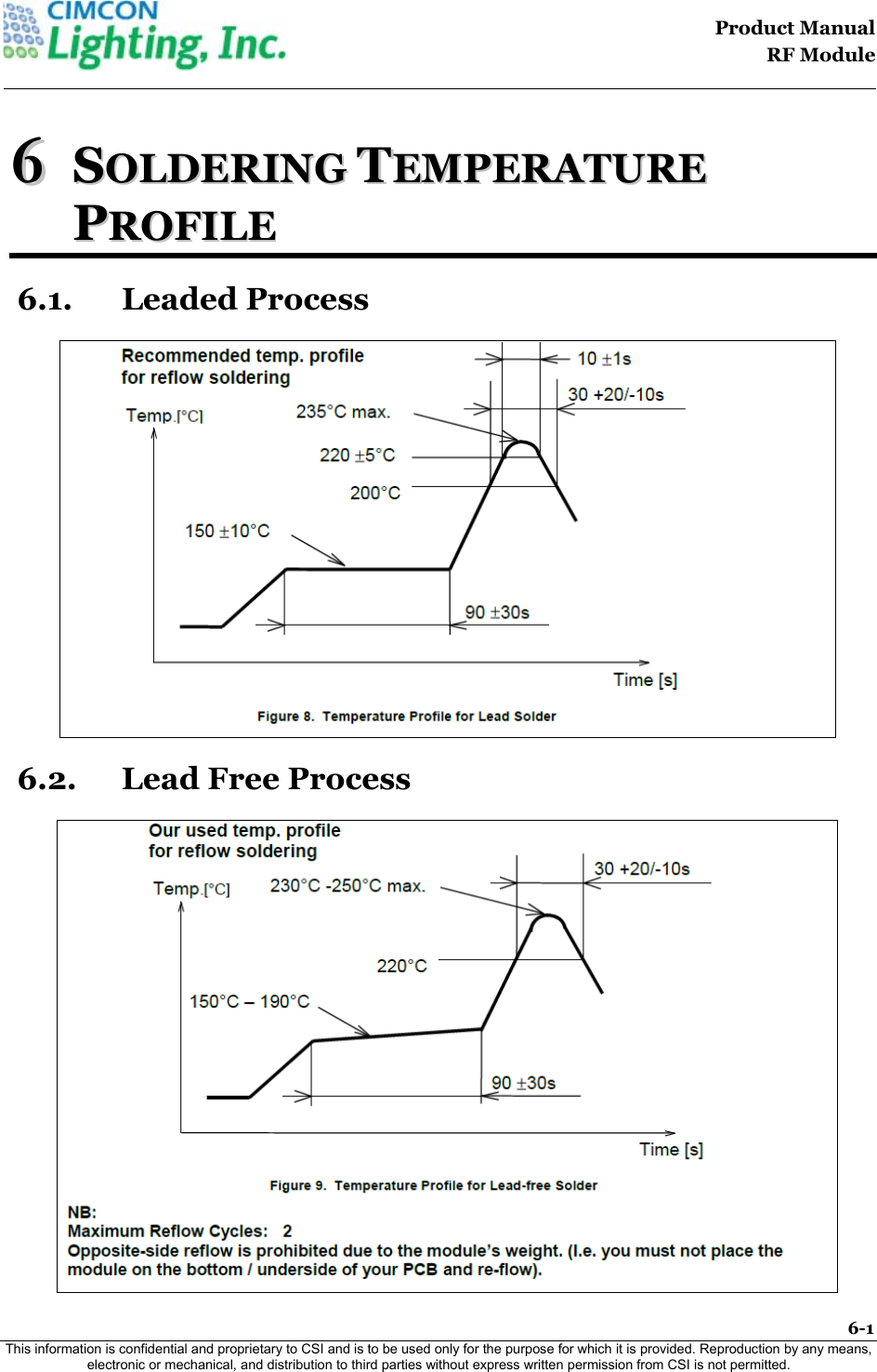
                                                                                   Product Manual  RF Module  6-1 This information is confidential and proprietary to CSI and is to be used only for the purpose for which it is provided. Reproduction by any means, electronic or mechanical, and distribution to third parties without express written permission from CSI is not permitted.    66  SSOOLLDDEERRIINNGG  TTEEMMPPEERRAATTUURREE  PPRROOFFIILLEE  6.1. Leaded Process  6.2. Lead Free Process
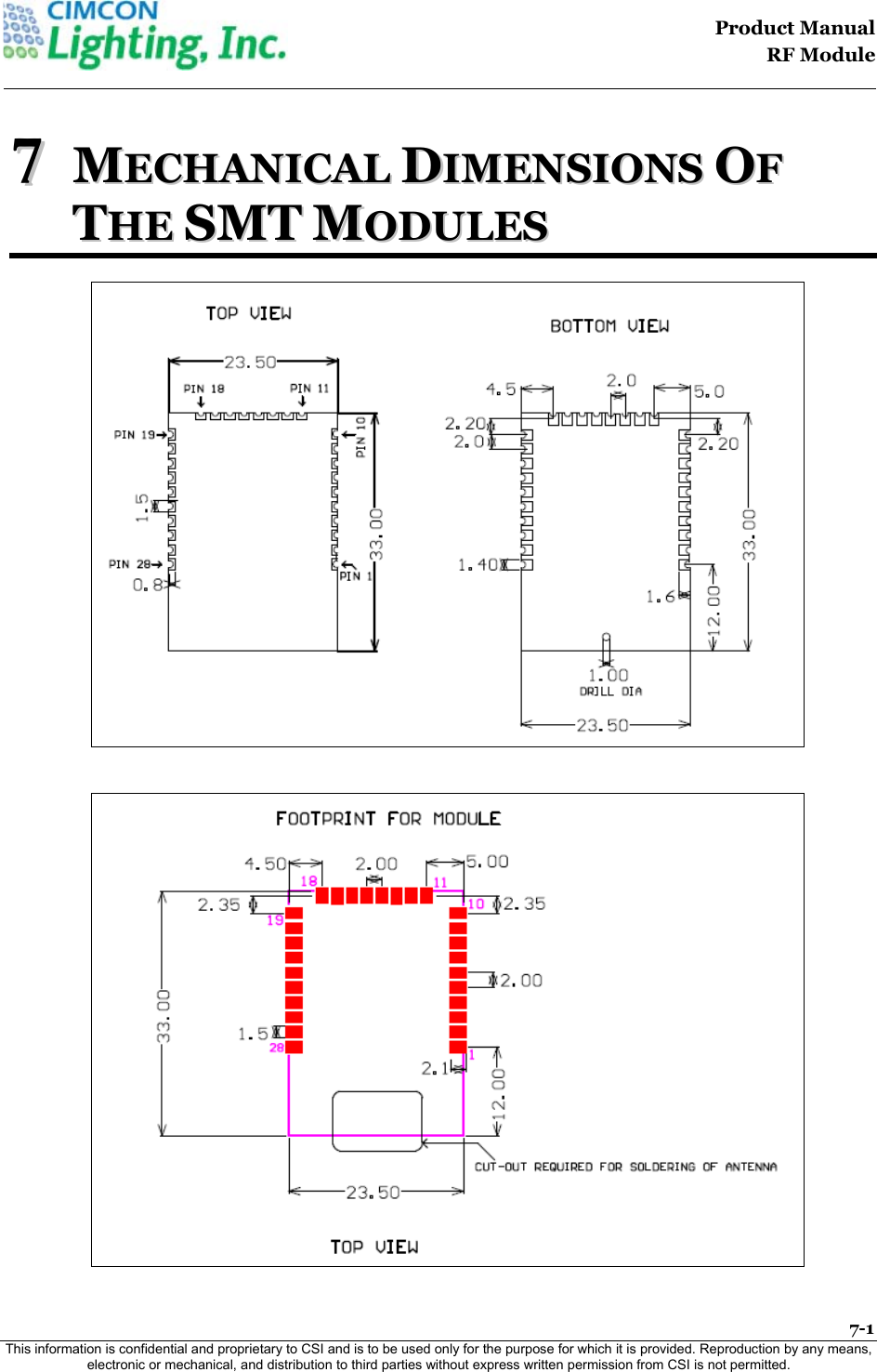
                                                                                   Product Manual  RF Module  7-1 This information is confidential and proprietary to CSI and is to be used only for the purpose for which it is provided. Reproduction by any means, electronic or mechanical, and distribution to third parties without express written permission from CSI is not permitted.    77  MMEECCHHAANNIICCAALL  DDIIMMEENNSSIIOONNSS  OOFF  TTHHEE  SSMMTT  MMOODDUULLEESS
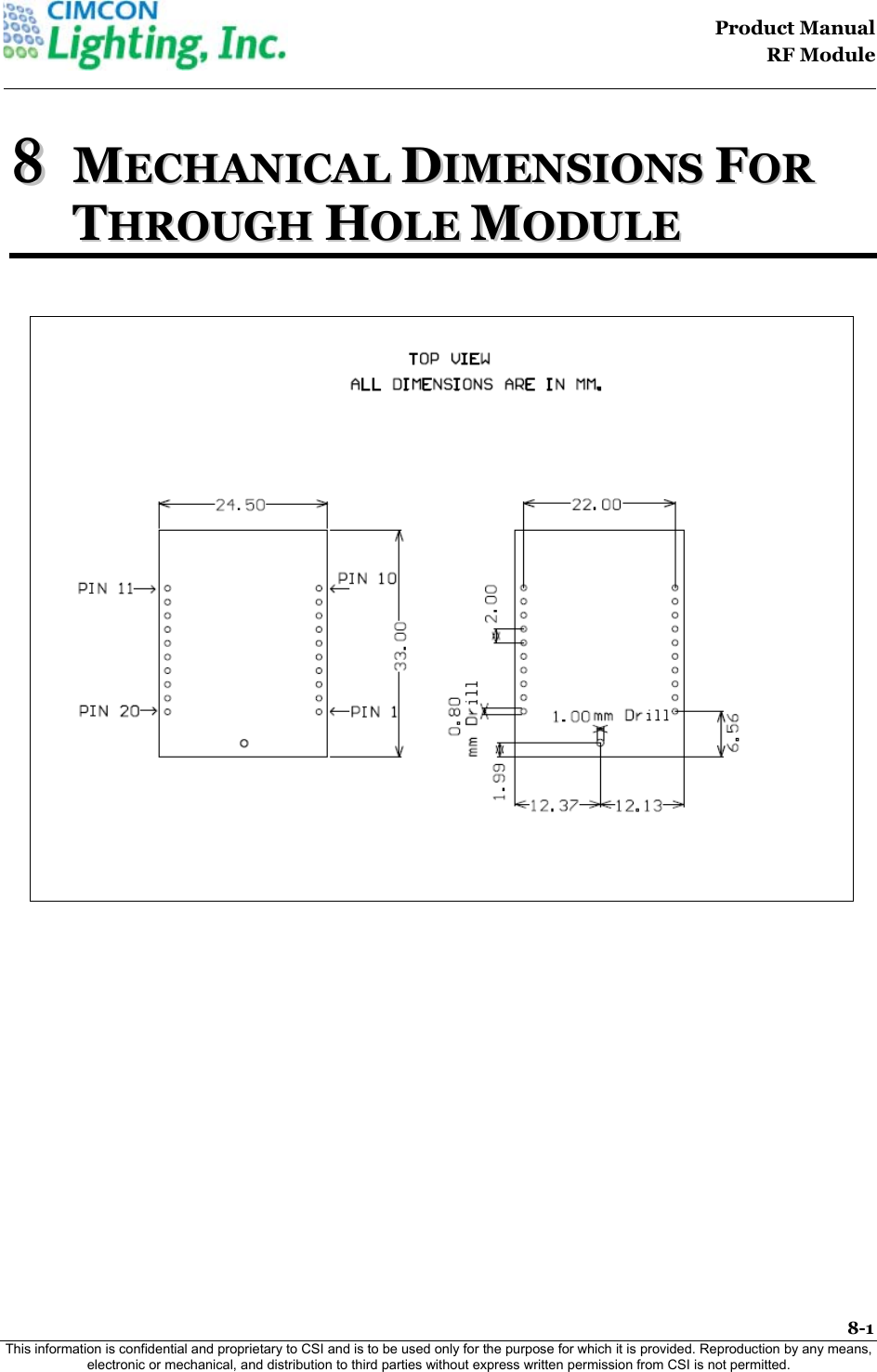
                                                                                   Product Manual  RF Module  8-1 This information is confidential and proprietary to CSI and is to be used only for the purpose for which it is provided. Reproduction by any means, electronic or mechanical, and distribution to third parties without express written permission from CSI is not permitted.    88  MMEECCHHAANNIICCAALL  DDIIMMEENNSSIIOONNSS  FFOORR  TTHHRROOUUGGHH  HHOOLLEE  MMOODDUULLEE

Navigation menu