CPAC Systems BTGW Bluetooth Interface User Manual

CPAC Systems AB Bluetooth Interface

User manual

CPAC  SYSTEMS  AB Box 217, SE-401 23 Göteborg, Sweden Visitors: Bergskroken 3, Mölndal Phone: +46 (0)31 352 16 00 www.cpacsystems.se         VAT#: SE556566281001             CPAC-BTGW: General Guidelines - Installation and Operation       Description General installation and operational guidelines for the CPAC-BTGW unit Issued by Peter Raimer Classification Open within project Approved by  Date 2017-07-09 Project Easy Connect Revision PA1 Reg. No.  Page 1 (11) File BTGW_Installation-operational guidelines.docx
BB2    Title: Revision: Classification: Page: CPAC-BTGW: General Guidelines - Installation and Operation PA1 Open within project 2(13)   Innehåll 1. Document Information __________________________________________________________ 3 1.1 Purpose ........................................................................................................................................ 3 1.2 Revision History .......................................................................................................................... 3 1.3 Confidentiality ............................................................................................................................. 3 1.4 References ................................................................................................................................... 3 1.5 Terminology ................................................................................................................................ 3 2. Overview  _____________________________________________________________________ 4 3. Installation ____________________________________________________________________ 5 3.1 CPAC-BTGW unit ...................................................................................................................... 5 3.2 Mounting requirements - unit ...................................................................................................... 5 3.3 Mounting requirements - cables .................................................................................................. 5 3.4 Connecting requirements – cables for EVC system .................................................................... 6 3.5 Connecting requirements – cables for non EVC system ............................................................. 6 3.6 Connecting – Mobile device app ................................................................................................. 7 3.7 Troubleshoot installation ............................................................................................................. 7 4. Modes of Operation _____________________________________________________________ 8 4.1 Modes of BTGW unit .................................................................................................................. 8 4.2 Modes of app ............................................................................................................................... 8 5. Additional technical data ________________________________________________________ 9 5.1 Overview of Connectors .............................................................................................................. 9 5.2 RF/Physical Layer ....................................................................................................................... 9 5.3 Power ........................................................................................................................................... 9 5.4 Environment ................................................................................................................................ 9 5.5 Bluetooth antenna ........................................................................................................................ 9 5.6 Physical Specification ............................................................................................................... 10 6. Additional Type approval information – Legal statement and Safety precautions/ Warnings! ________________________________________________________________________ 11 6.1 USA ........................................................................................................................................... 11 6.2 Canada ....................................................................................................................................... 11 6.3 Japan .......................................................................................................................................... 12 6.4 Brazil ......................................................................................................................................... 13
BB2    Title: Revision: Classification: Page: CPAC-BTGW: General Guidelines - Installation and Operation PA1 Open within project 3(13)   1. Document Information 1.1  Purpose The purpose of this document is solely to give general guidelines for the installation of Easy Connect gateway (CPAC-BTGW) in boats, supplied by Volvo Penta.  It does not replace the specific instructions included in the gateway kit box but gateway is very easy to install. There are only two harness to connect and then use tie wraps to fasten the gateway.  1.2  Revision History Rev Date Name Description PA1 2017-07-09 Peter Raimer Created PA2 2017-12-04 Nethaji Karuppasami Updated regulatory and user safety information  PA3 2018-01-23 Nethaji Karuppasami Updated EMC exposure info for FCC and IC 1.3  Confidentiality This document is solely to be used by CPAC and Volvo Penta, or companies specifically appointed by Volvo Penta for integrating the CPAC-BTGW unit into VP supplied systems.  The document is neither intended for the end users of the boats, nor for the general public.  1.4  References Ref Title Registration number    1.5  Terminology Term Explanation BTGW  Bluetooth gateway. Product name designation used by CPAC Systems AB EVC Electronic Vessel Control TBD To Be Defined VP Volvo Penta
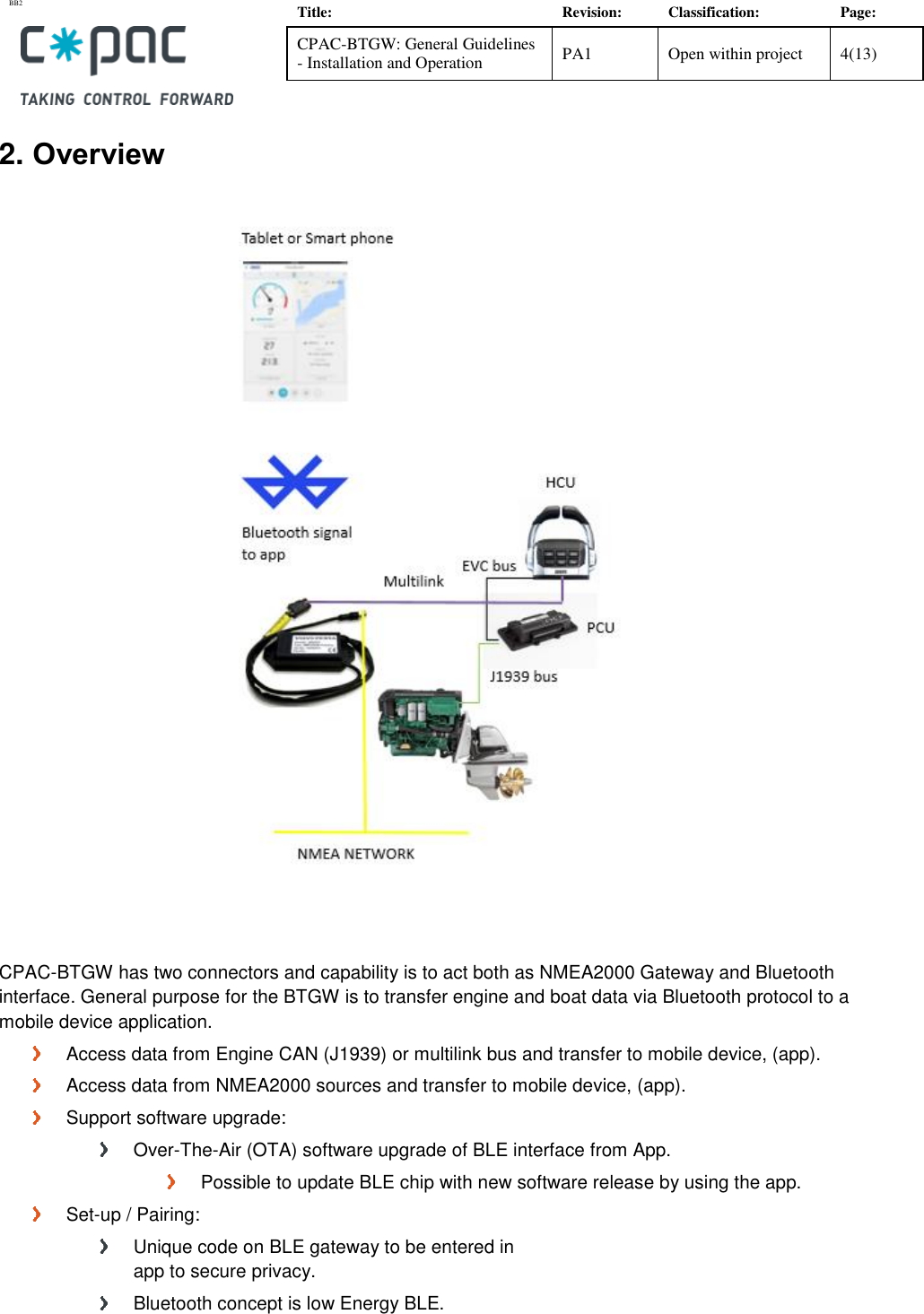
BB2    Title: Revision: Classification: Page: CPAC-BTGW: General Guidelines - Installation and Operation PA1 Open within project 4(13)   2. Overview     CPAC-BTGW has two connectors and capability is to act both as NMEA2000 Gateway and Bluetooth interface. General purpose for the BTGW is to transfer engine and boat data via Bluetooth protocol to a mobile device application.   Access data from Engine CAN (J1939) or multilink bus and transfer to mobile device, (app).   Access data from NMEA2000 sources and transfer to mobile device, (app).   Support software upgrade:   Over-The-Air (OTA) software upgrade of BLE interface from App.   Possible to update BLE chip with new software release by using the app.   Set-up / Pairing:   Unique code on BLE gateway to be entered in  app to secure privacy.   Bluetooth concept is low Energy BLE.
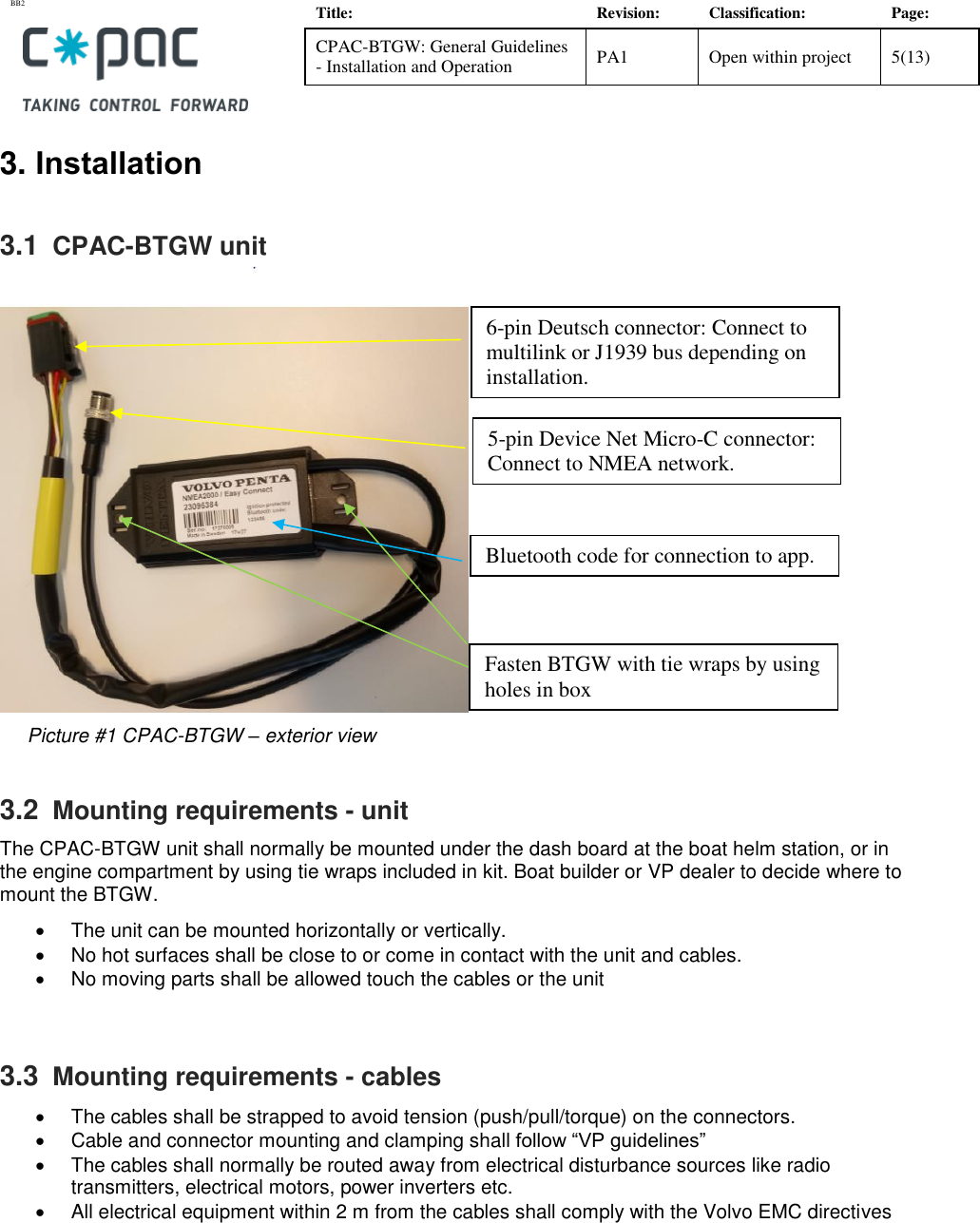
BB2    Title: Revision: Classification: Page: CPAC-BTGW: General Guidelines - Installation and Operation PA1 Open within project 5(13)   3. Installation 3.1  CPAC-BTGW unit       Picture #1 CPAC-BTGW – exterior view            3.2  Mounting requirements - unit The CPAC-BTGW unit shall normally be mounted under the dash board at the boat helm station, or in the engine compartment by using tie wraps included in kit. Boat builder or VP dealer to decide where to mount the BTGW.    The unit can be mounted horizontally or vertically.   No hot surfaces shall be close to or come in contact with the unit and cables.    No moving parts shall be allowed touch the cables or the unit  3.3  Mounting requirements - cables   The cables shall be strapped to avoid tension (push/pull/torque) on the connectors.   Cable and connector mounting and clamping shall follow “VP guidelines”   The cables shall normally be routed away from electrical disturbance sources like radio transmitters, electrical motors, power inverters etc.   All electrical equipment within 2 m from the cables shall comply with the Volvo EMC directives         6-pin Deutsch connector: Connect to multilink or J1939 bus depending on installation. 5-pin Device Net Micro-C connector: Connect to NMEA network. Fasten BTGW with tie wraps by using holes in box Bluetooth code for connection to app.
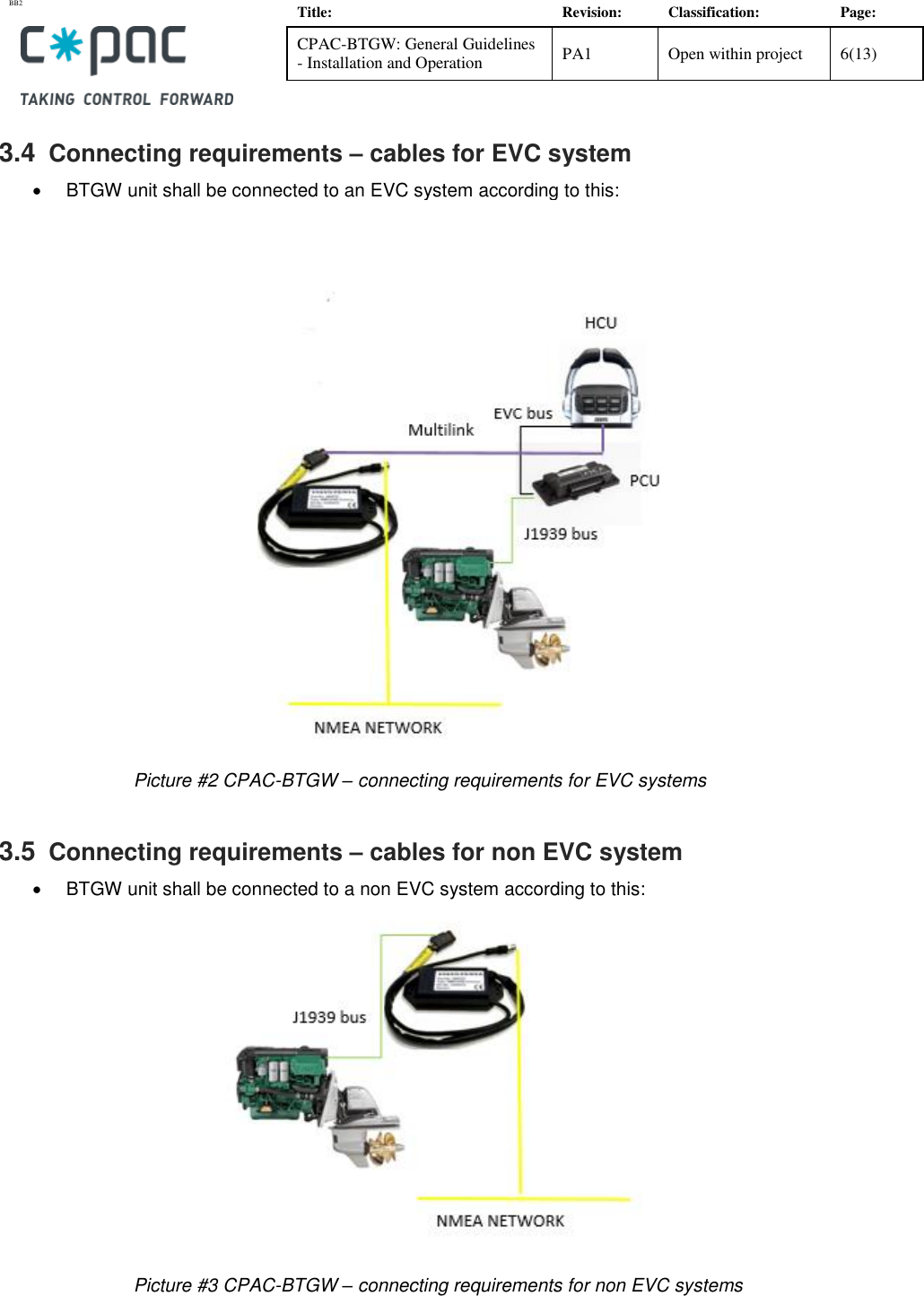
BB2    Title: Revision: Classification: Page: CPAC-BTGW: General Guidelines - Installation and Operation PA1 Open within project 6(13)   3.4  Connecting requirements – cables for EVC system   BTGW unit shall be connected to an EVC system according to this:  Picture #2 CPAC-BTGW – connecting requirements for EVC systems 3.5  Connecting requirements – cables for non EVC system   BTGW unit shall be connected to a non EVC system according to this:   Picture #3 CPAC-BTGW – connecting requirements for non EVC systems
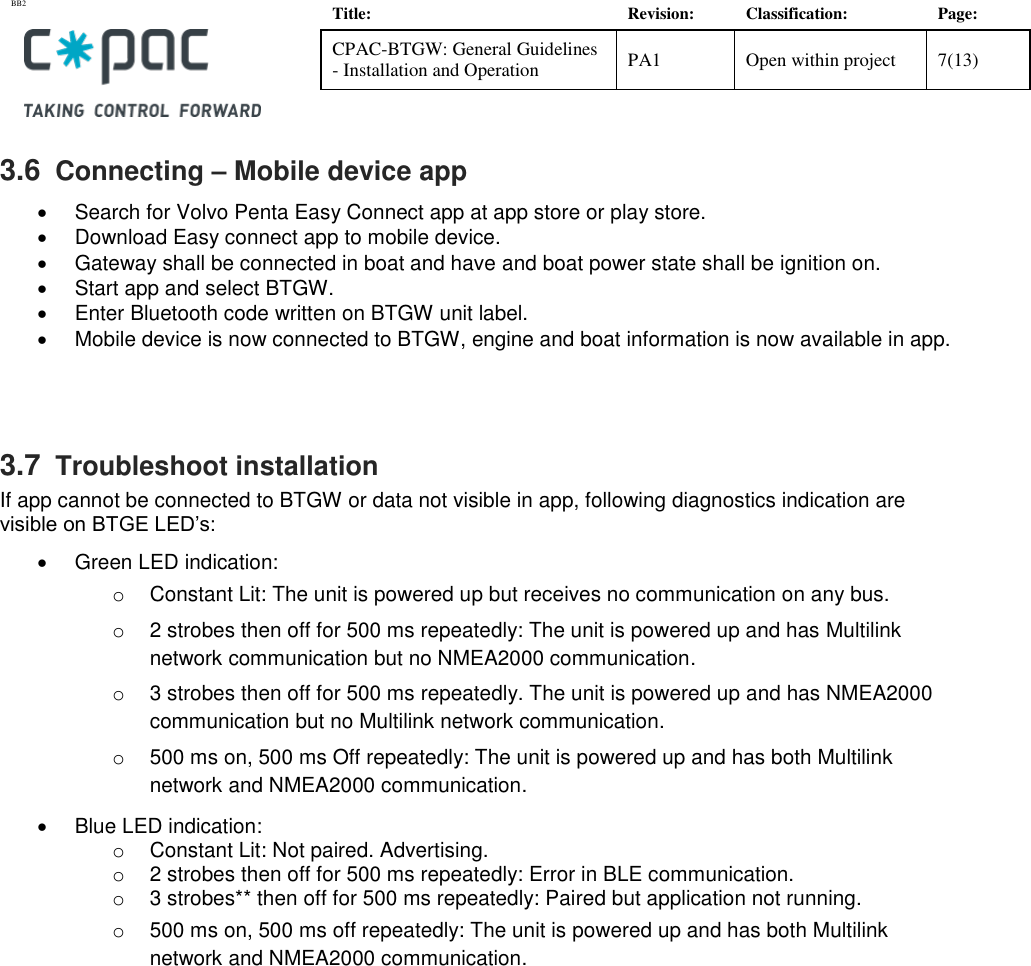
BB2    Title: Revision: Classification: Page: CPAC-BTGW: General Guidelines - Installation and Operation PA1 Open within project 7(13)   3.6  Connecting – Mobile device app   Search for Volvo Penta Easy Connect app at app store or play store.    Download Easy connect app to mobile device.   Gateway shall be connected in boat and have and boat power state shall be ignition on.   Start app and select BTGW.   Enter Bluetooth code written on BTGW unit label.   Mobile device is now connected to BTGW, engine and boat information is now available in app.    3.7  Troubleshoot installation If app cannot be connected to BTGW or data not visible in app, following diagnostics indication are visible on BTGE LED’s:   Green LED indication:  o  Constant Lit: The unit is powered up but receives no communication on any bus. o  2 strobes then off for 500 ms repeatedly: The unit is powered up and has Multilink network communication but no NMEA2000 communication. o  3 strobes then off for 500 ms repeatedly. The unit is powered up and has NMEA2000 communication but no Multilink network communication. o  500 ms on, 500 ms Off repeatedly: The unit is powered up and has both Multilink network and NMEA2000 communication.   Blue LED indication: o  Constant Lit: Not paired. Advertising. o  2 strobes then off for 500 ms repeatedly: Error in BLE communication. o  3 strobes** then off for 500 ms repeatedly: Paired but application not running. o  500 ms on, 500 ms off repeatedly: The unit is powered up and has both Multilink network and NMEA2000 communication.
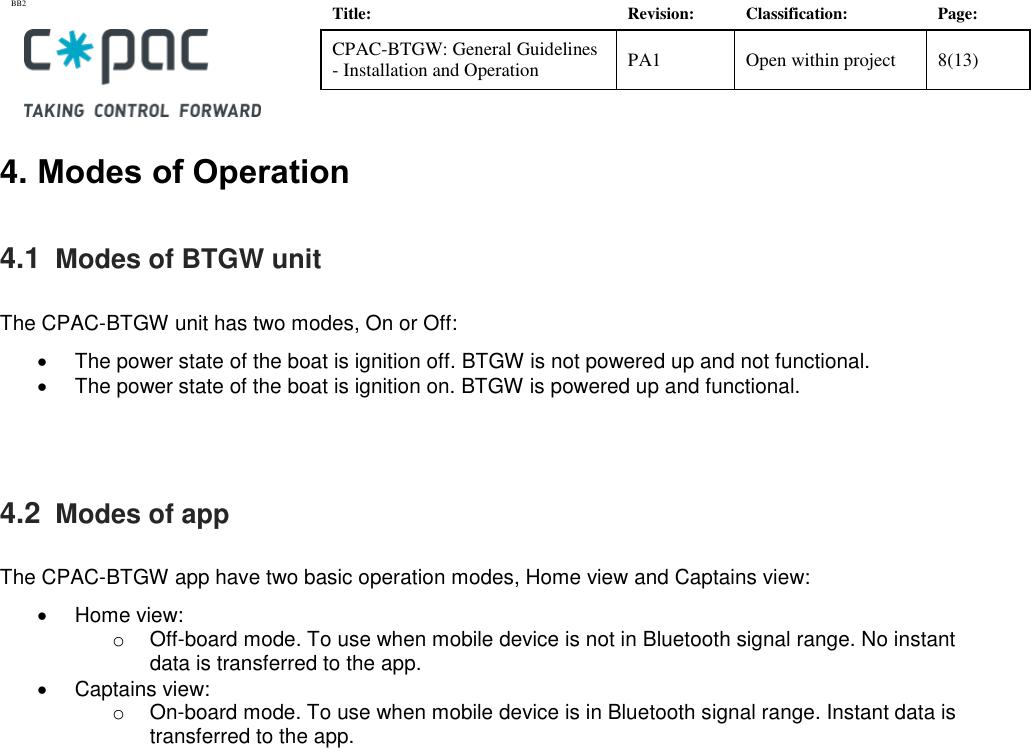
BB2    Title: Revision: Classification: Page: CPAC-BTGW: General Guidelines - Installation and Operation PA1 Open within project 8(13)   4. Modes of Operation 4.1  Modes of BTGW unit  The CPAC-BTGW unit has two modes, On or Off:    The power state of the boat is ignition off. BTGW is not powered up and not functional.     The power state of the boat is ignition on. BTGW is powered up and functional.     4.2  Modes of app  The CPAC-BTGW app have two basic operation modes, Home view and Captains view:    Home view: o  Off-board mode. To use when mobile device is not in Bluetooth signal range. No instant data is transferred to the app.    Captains view: o On-board mode. To use when mobile device is in Bluetooth signal range. Instant data is transferred to the app.
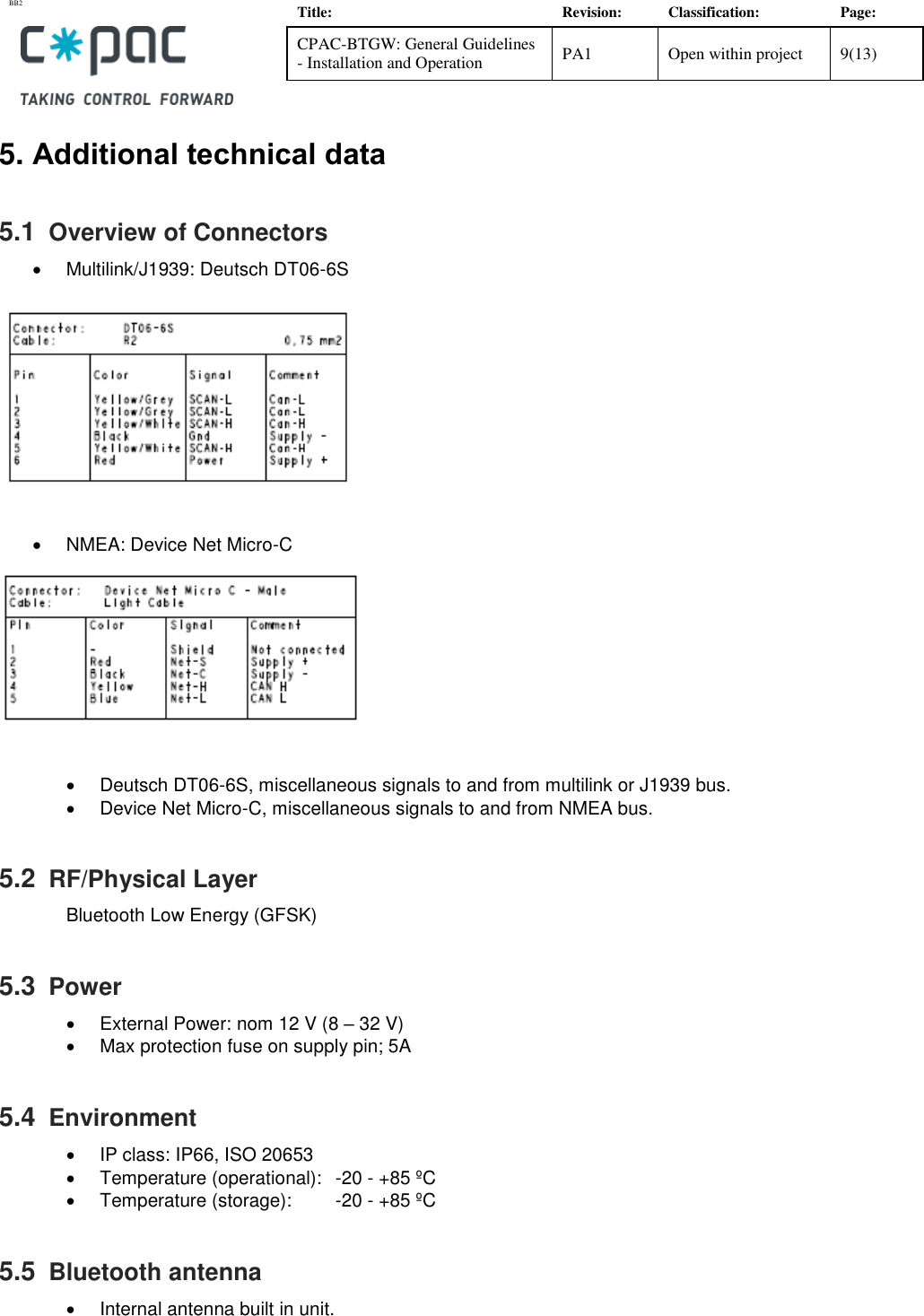
BB2    Title: Revision: Classification: Page: CPAC-BTGW: General Guidelines - Installation and Operation PA1 Open within project 9(13)   5. Additional technical data 5.1  Overview of Connectors   Multilink/J1939: Deutsch DT06-6S      NMEA: Device Net Micro-C     Deutsch DT06-6S, miscellaneous signals to and from multilink or J1939 bus.   Device Net Micro-C, miscellaneous signals to and from NMEA bus. 5.2  RF/Physical Layer Bluetooth Low Energy (GFSK) 5.3  Power   External Power: nom 12 V (8 – 32 V)   Max protection fuse on supply pin; 5A 5.4  Environment   IP class: IP66, ISO 20653   Temperature (operational):   -20 - +85 ºC   Temperature (storage):   -20 - +85 ºC 5.5  Bluetooth antenna    Internal antenna built in unit.
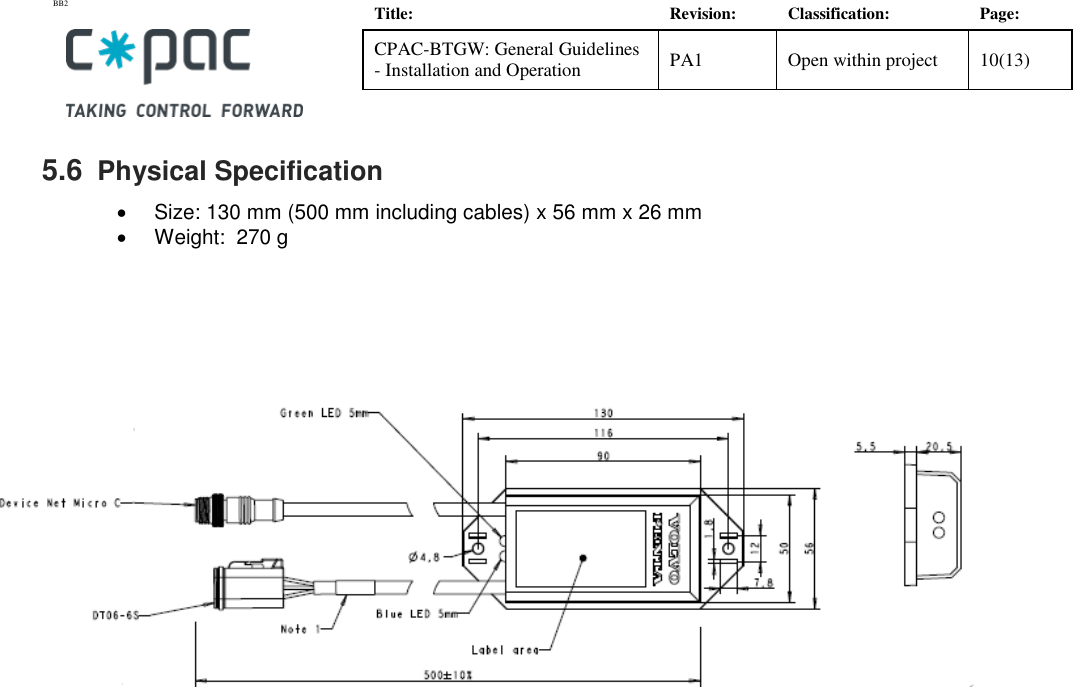
BB2    Title: Revision: Classification: Page: CPAC-BTGW: General Guidelines - Installation and Operation PA1 Open within project 10(13)   5.6  Physical Specification    Size: 130 mm (500 mm including cables) x 56 mm x 26 mm   Weight:  270 g
BB2    Title: Revision: Classification: Page: CPAC-BTGW: General Guidelines - Installation and Operation PA1 Open within project 11(13)   6. Additional Type approval information – Legal statement and Safety precautions/ Warnings! 6.1  USA This device complies with Part 15 of the FCC Rules and with Industry Canada license-exempt RSS standard(s). Operation is subject to the following two conditions.  (1) this device may not cause harmful interference, and  (2) this device must accept any interference received, including interference that may cause undesired operation.   NOTE: This equipment has been tested and found to comply with the limits for a Class B digital device, pursuant to Part 15 of the FCC Rules.  These limits are designed to provide reasonable protection against harmful interference in a residential installation.  This equipment generates, uses and can radiate radio frequency energy and, if not installed and used in accordance with the instructions, may cause harmful interference to radio communications.  However, there is no guarantee that interference will not occur in a particular installation.  If this equipment does cause harmful interference to radio or television reception, which can be determined by turning the equipment off and on, the user is encouraged to try to correct the interference by one or more of the following measures: ·         Reorient or relocate the receiving antenna. ·         Increase the separation between the equipment and receiver. ·         Connect the equipment into an outlet on a circuit different from that to which the receiver is connected. ·         Consult the dealer or an experienced radio/TV technician for help.  NOTICE: Changes or modifications made to this equipment not expressly approved by CPAC Systems AB may void the FCC authorization to operate this equipment.  Radio frequency radiation exposure Information: This equipment complies with FCC radiation exposure limits set forth for an uncontrolled environment. This equipment should be installed and operated with minimum distance of 20 cm between the radiator and your body. This transmitter must not be co-located or operating in conjunction with any other antenna or transmitter. 6.2  Canada  This device complies with Part 15 of the FCC Rules and with Industry Canada license-exempt RSS standard(s). Operation is subject to the following two conditions.  (1) this device may not cause harmful interference, and (2) this device must accept any interference received, including interference that may cause undesired operation.   Le présent appareil est conforme aux CNR d'Industrie Canada applicables aux appareils radio
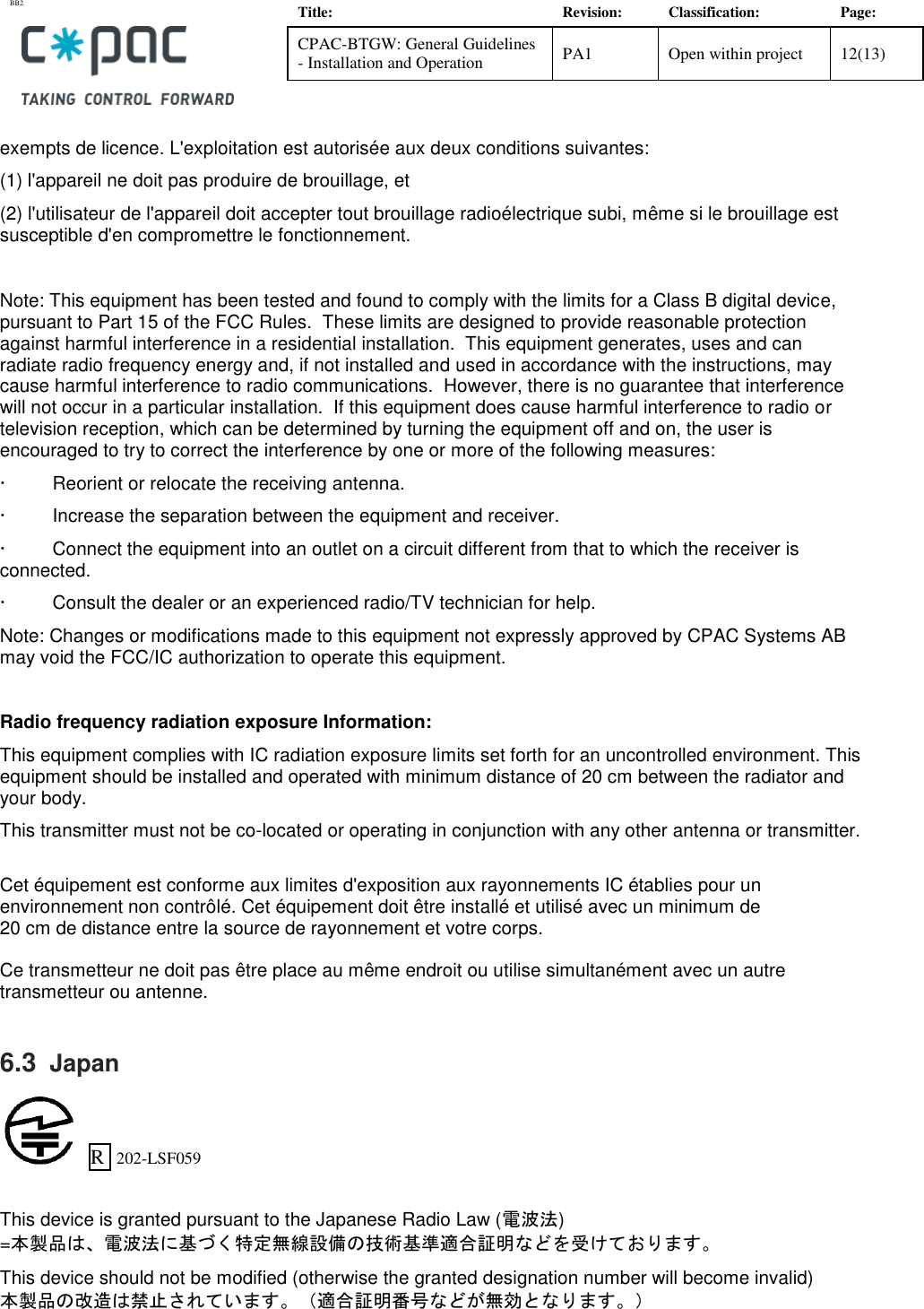
BB2    Title: Revision: Classification: Page: CPAC-BTGW: General Guidelines - Installation and Operation PA1 Open within project 12(13)   exempts de licence. L'exploitation est autorisée aux deux conditions suivantes: (1) l'appareil ne doit pas produire de brouillage, et  (2) l'utilisateur de l'appareil doit accepter tout brouillage radioélectrique subi, même si le brouillage est susceptible d'en compromettre le fonctionnement.  Note: This equipment has been tested and found to comply with the limits for a Class B digital device, pursuant to Part 15 of the FCC Rules.  These limits are designed to provide reasonable protection against harmful interference in a residential installation.  This equipment generates, uses and can radiate radio frequency energy and, if not installed and used in accordance with the instructions, may cause harmful interference to radio communications.  However, there is no guarantee that interference will not occur in a particular installation.  If this equipment does cause harmful interference to radio or television reception, which can be determined by turning the equipment off and on, the user is encouraged to try to correct the interference by one or more of the following measures: ·         Reorient or relocate the receiving antenna. ·         Increase the separation between the equipment and receiver. ·         Connect the equipment into an outlet on a circuit different from that to which the receiver is connected. ·         Consult the dealer or an experienced radio/TV technician for help. Note: Changes or modifications made to this equipment not expressly approved by CPAC Systems AB may void the FCC/IC authorization to operate this equipment.  Radio frequency radiation exposure Information: This equipment complies with IC radiation exposure limits set forth for an uncontrolled environment. This equipment should be installed and operated with minimum distance of 20 cm between the radiator and your body. This transmitter must not be co-located or operating in conjunction with any other antenna or transmitter.  Cet équipement est conforme aux limites d'exposition aux rayonnements IC établies pour un  environnement non contrôlé. Cet équipement doit être installé et utilisé avec un minimum de  20 cm de distance entre la source de rayonnement et votre corps.  Ce transmetteur ne doit pas être place au même endroit ou utilise simultanément avec un autre transmetteur ou antenne.  6.3  Japan     R  202-LSF059   This device is granted pursuant to the Japanese Radio Law (電波法) =本製品は、電波法に基づく特定無線設備の技術基準適合証明などを受けております。 This device should not be modified (otherwise the granted designation number will become invalid) 本製品の改造は禁止されています。(適合証明番号などが無効となります。)
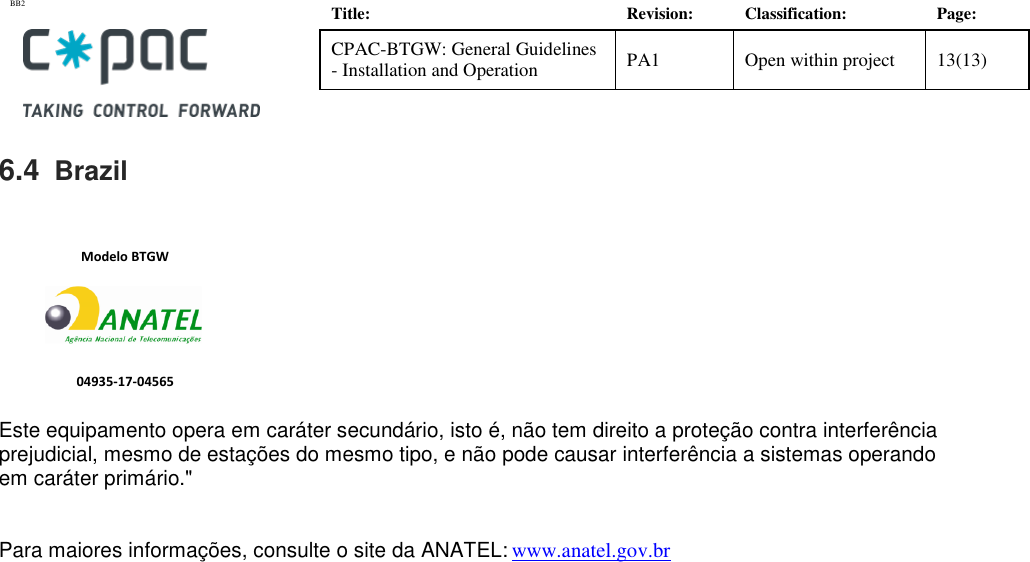
BB2    Title: Revision: Classification: Page: CPAC-BTGW: General Guidelines - Installation and Operation PA1 Open within project 13(13)   6.4  Brazil               Este equipamento opera em caráter secundário, isto é, não tem direito a proteção contra interferência prejudicial, mesmo de estações do mesmo tipo, e não pode causar interferência a sistemas operando em caráter primário."  Para maiores informações, consulte o site da ANATEL: www.anatel.gov.br  04935-17-04565 Modelo BTGW

Navigation menu