Cohda Wireless MK5OBU MK5 DSRC RADIO ROADSIDE UNIT User Manual

Cohda Wireless Pty Ltd. MK5 DSRC RADIO ROADSIDE UNIT

User Manual

     CohdaMobility MK5 Module Datasheet   Date: May 2015  Version: V1.2.0  Reference: CWD-P0052-HWM-DATA-WW01-061  Prepared for:   Prepared by: David de Haaij Mike Sloman   Authorised By: Fabien CURE  (Chief Engineer)  Distribution:   This document is offered in confidence and may not be used  for any purpose other than that for which it is supplied. © Copyright Cohda Wireless Pty Ltd ABN 84 107 936 309  COMMERCIAL-IN-CONFIDENCE
  CohdaMobility MK5 Module – Datasheet    Page 2/27   Cohda Wireless Pty Ltd Confidential Information  Cohda Wireless Pty Ltd 82-84 Melbourne Street North Adelaide, SA 5006 Australia  P +61 8 8364 4719 F +61 8 8364 4597
  CohdaMobility MK5 Module – Datasheet    Page 3/27   Cohda Wireless Pty Ltd Confidential Information Change Log  Version Date Comments 0.1 27/10/2014 Initial Version for Review 0.2 12/11/2014 Update following review feedback 0.9 5/12/2014 Issue for technical release 1.0 10/12/2014 Issue for release 1.1 01/04/2015 Review of nACR and ACR data 1.2 07/05/2015 Update LO Leakage and Block Diagram
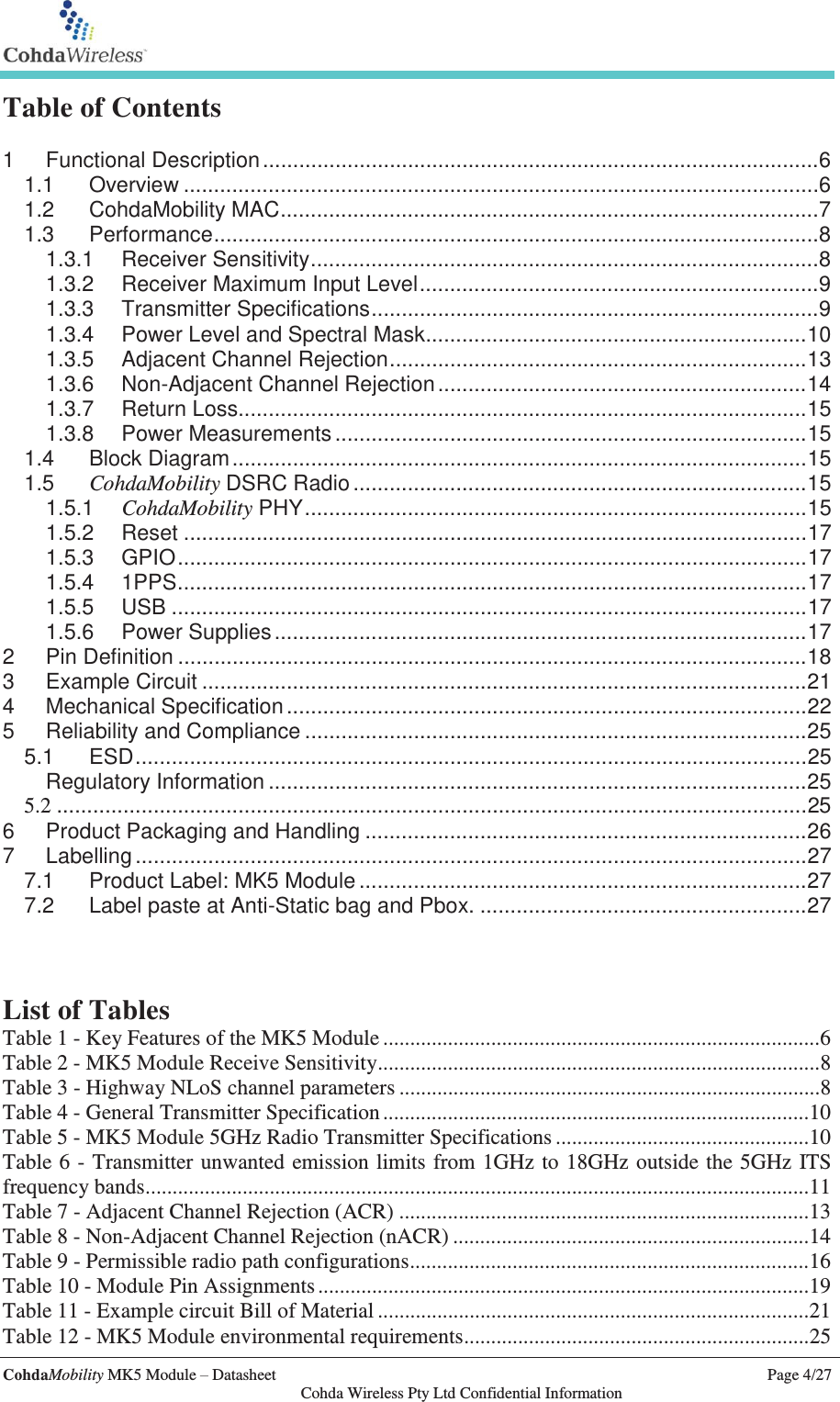
  CohdaMobility MK5 Module – Datasheet    Page 4/27   Cohda Wireless Pty Ltd Confidential Information Table of Contents  1 Functional Description ............................................................................................ 6 1.1 Overview ......................................................................................................... 6 1.2 CohdaMobility MAC ......................................................................................... 7 1.3 Performance .................................................................................................... 8 1.3.1 Receiver Sensitivity .................................................................................... 8 1.3.2 Receiver Maximum Input Level .................................................................. 9 1.3.3 Transmitter Specifications .......................................................................... 9 1.3.4 Power Level and Spectral Mask............................................................... 10 1.3.5 Adjacent Channel Rejection ..................................................................... 13 1.3.6 Non-Adjacent Channel Rejection ............................................................. 14 1.3.7 Return Loss.............................................................................................. 15 1.3.8 Power Measurements .............................................................................. 15 1.4 Block Diagram ............................................................................................... 15 1.5 CohdaMobility DSRC Radio ........................................................................... 15 1.5.1 CohdaMobility PHY ................................................................................... 15 1.5.2 Reset ....................................................................................................... 17 1.5.3 GPIO ........................................................................................................ 17 1.5.4 1PPS ........................................................................................................ 17 1.5.5 USB ......................................................................................................... 17 1.5.6 Power Supplies ........................................................................................ 17 2 Pin Definition ........................................................................................................ 18 3 Example Circuit .................................................................................................... 21 4 Mechanical Specification ...................................................................................... 22 5 Reliability and Compliance ................................................................................... 25 5.1 ESD ............................................................................................................... 25  Regulatory Information ......................................................................................... 25 5.2 ............................................................................................................................ 25 6 Product Packaging and Handling ......................................................................... 26 7 Labelling ............................................................................................................... 27 7.1 Product Label: MK5 Module .......................................................................... 27 7.2 Label paste at Anti-Static bag and Pbox. ...................................................... 27    List of Tables Table 1 - Key Features of the MK5 Module ................................................................................. 6 Table 2 - MK5 Module Receive Sensitivity .................................................................................. 8 Table 3 - Highway NLoS channel parameters .............................................................................. 8 Table 4 - General Transmitter Specification ............................................................................... 10 Table 5 - MK5 Module 5GHz Radio Transmitter Specifications ............................................... 10 Table 6 - Transmitter unwanted emission limits from 1GHz to 18GHz outside the 5GHz ITS frequency bands ........................................................................................................................... 11 Table 7 - Adjacent Channel Rejection (ACR) ............................................................................ 13 Table 8 - Non-Adjacent Channel Rejection (nACR) .................................................................. 14 Table 9 - Permissible radio path configurations .......................................................................... 16 Table 10 - Module Pin Assignments ........................................................................................... 19 Table 11 - Example circuit Bill of Material ................................................................................ 21 Table 12 - MK5 Module environmental requirements ................................................................ 25
  CohdaMobility MK5 Module – Datasheet    Page 5/27   Cohda Wireless Pty Ltd Confidential Information
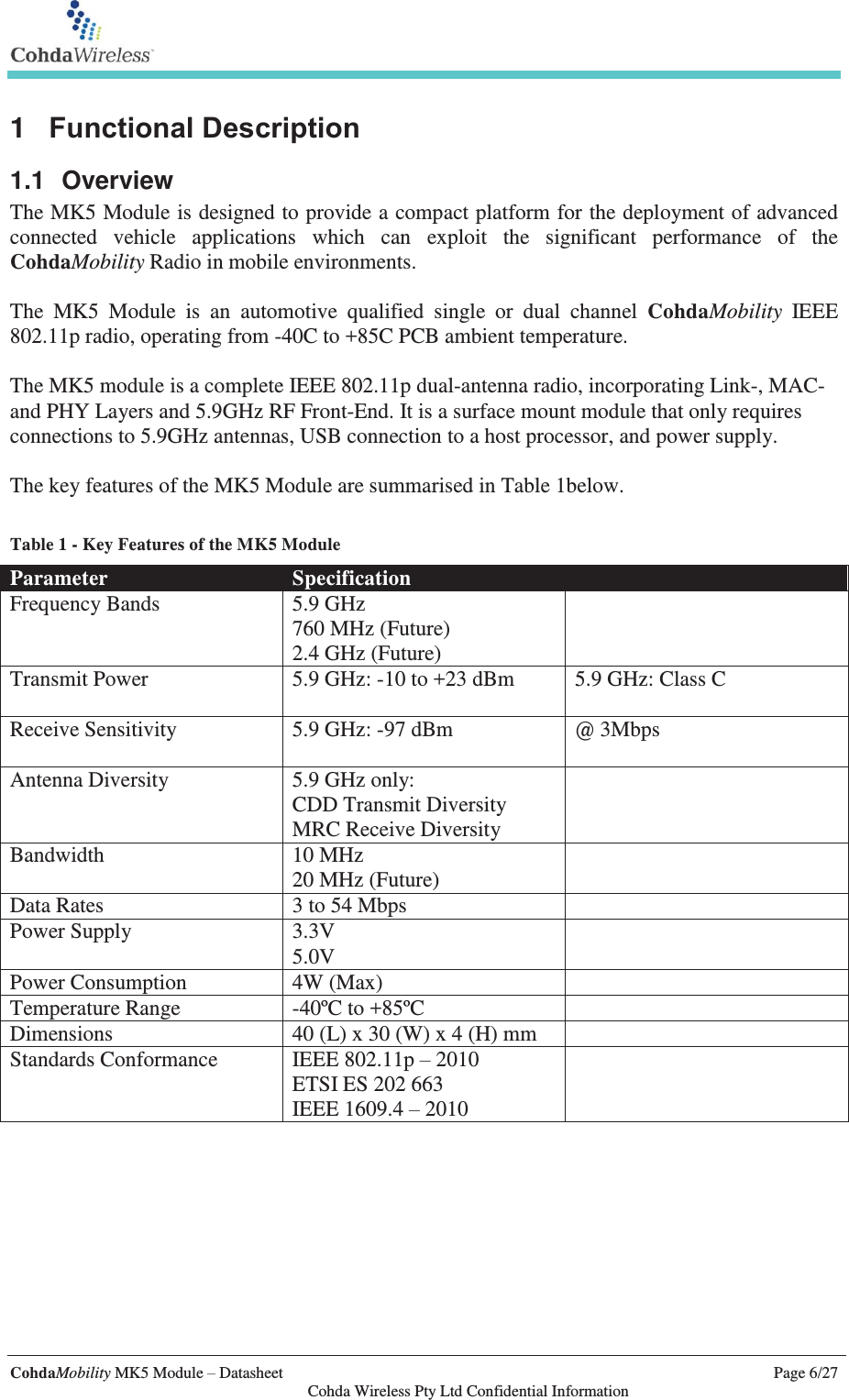
  CohdaMobility MK5 Module – Datasheet    Page 6/27   Cohda Wireless Pty Ltd Confidential Information 1  Functional Description 1.1 Overview The MK5 Module is designed to provide a compact platform for the deployment of advanced connected vehicle applications which can exploit the significant performance of the CohdaMobility Radio in mobile environments.   The MK5 Module is an automotive qualified single or dual channel CohdaMobility IEEE 802.11p radio, operating from -40C to +85C PCB ambient temperature.  The MK5 module is a complete IEEE 802.11p dual-antenna radio, incorporating Link-, MAC- and PHY Layers and 5.9GHz RF Front-End. It is a surface mount module that only requires connections to 5.9GHz antennas, USB connection to a host processor, and power supply.  The key features of the MK5 Module are summarised in Table 1below.   Table 1 - Key Features of the MK5 Module Parameter Specification  Frequency Bands 5.9 GHz 760 MHz (Future) 2.4 GHz (Future)  Transmit Power 5.9 GHz: -10 to +23 dBm  5.9 GHz: Class C  Receive Sensitivity 5.9 GHz: -97 dBm  @ 3Mbps Antenna Diversity 5.9 GHz only: CDD Transmit Diversity MRC Receive Diversity  Bandwidth 10 MHz 20 MHz (Future)  Data Rates 3 to 54 Mbps  Power Supply 3.3V 5.0V  Power Consumption 4W (Max)  Temperature Range -40ºC to +85ºC  Dimensions 40 (L) x 30 (W) x 4 (H) mm  Standards Conformance IEEE 802.11p – 2010 ETSI ES 202 663 IEEE 1609.4 – 2010
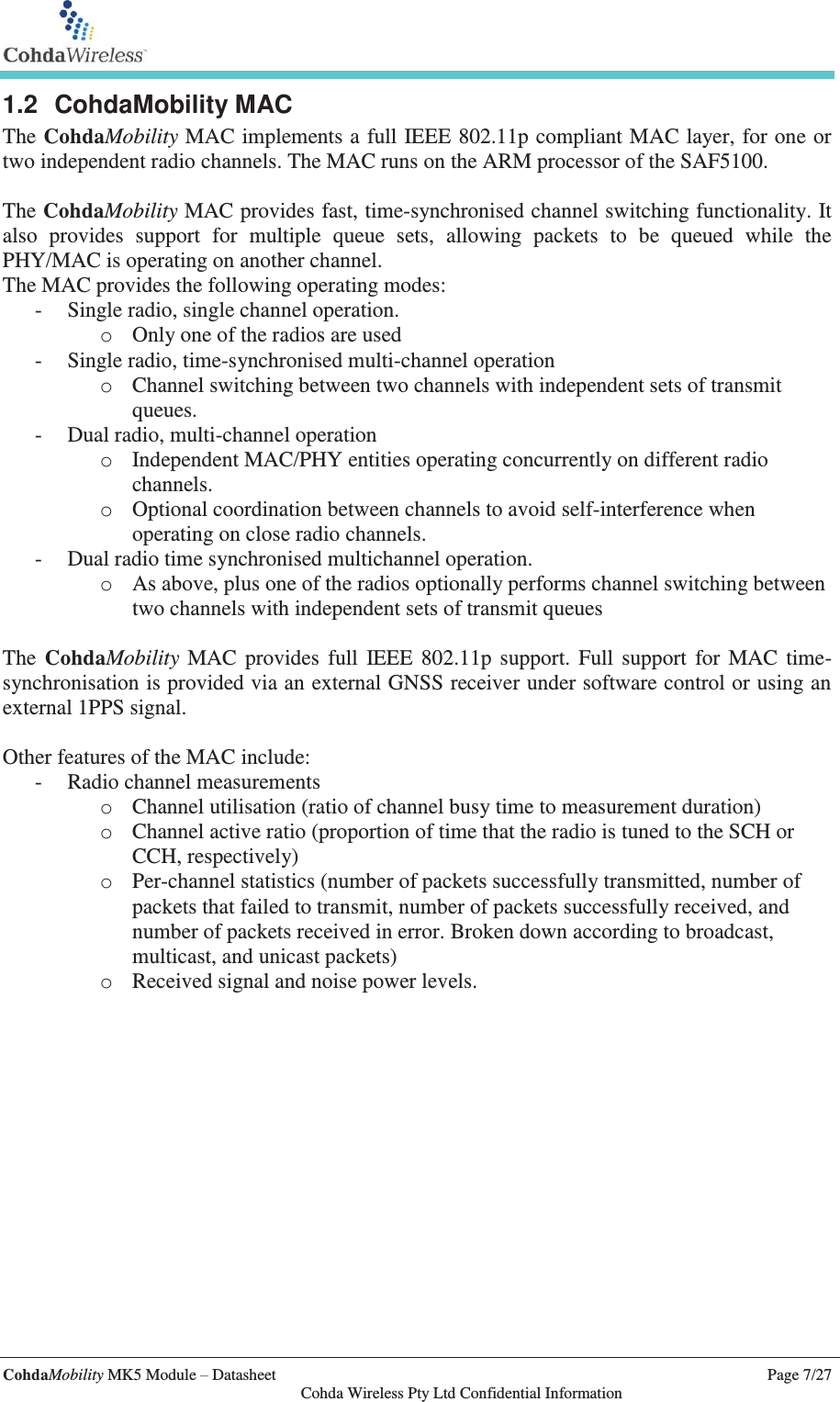
  CohdaMobility MK5 Module – Datasheet    Page 7/27   Cohda Wireless Pty Ltd Confidential Information 1.2 CohdaMobility MAC The CohdaMobility MAC implements a full IEEE 802.11p compliant MAC layer, for one or two independent radio channels. The MAC runs on the ARM processor of the SAF5100.  The CohdaMobility MAC provides fast, time-synchronised channel switching functionality. It also provides support for multiple queue sets, allowing packets to be queued while the PHY/MAC is operating on another channel. The MAC provides the following operating modes: - Single radio, single channel operation. o Only one of the radios are used - Single radio, time-synchronised multi-channel operation o Channel switching between two channels with independent sets of transmit queues. - Dual radio, multi-channel operation o Independent MAC/PHY entities operating concurrently on different radio channels. o Optional coordination between channels to avoid self-interference when operating on close radio channels. - Dual radio time synchronised multichannel operation. o As above, plus one of the radios optionally performs channel switching between two channels with independent sets of transmit queues  The CohdaMobility MAC provides full IEEE 802.11p support. Full support for MAC time-synchronisation is provided via an external GNSS receiver under software control or using an external 1PPS signal.   Other features of the MAC include: - Radio channel measurements o Channel utilisation (ratio of channel busy time to measurement duration) o Channel active ratio (proportion of time that the radio is tuned to the SCH or CCH, respectively) o Per-channel statistics (number of packets successfully transmitted, number of packets that failed to transmit, number of packets successfully received, and number of packets received in error. Broken down according to broadcast, multicast, and unicast packets) o Received signal and noise power levels.
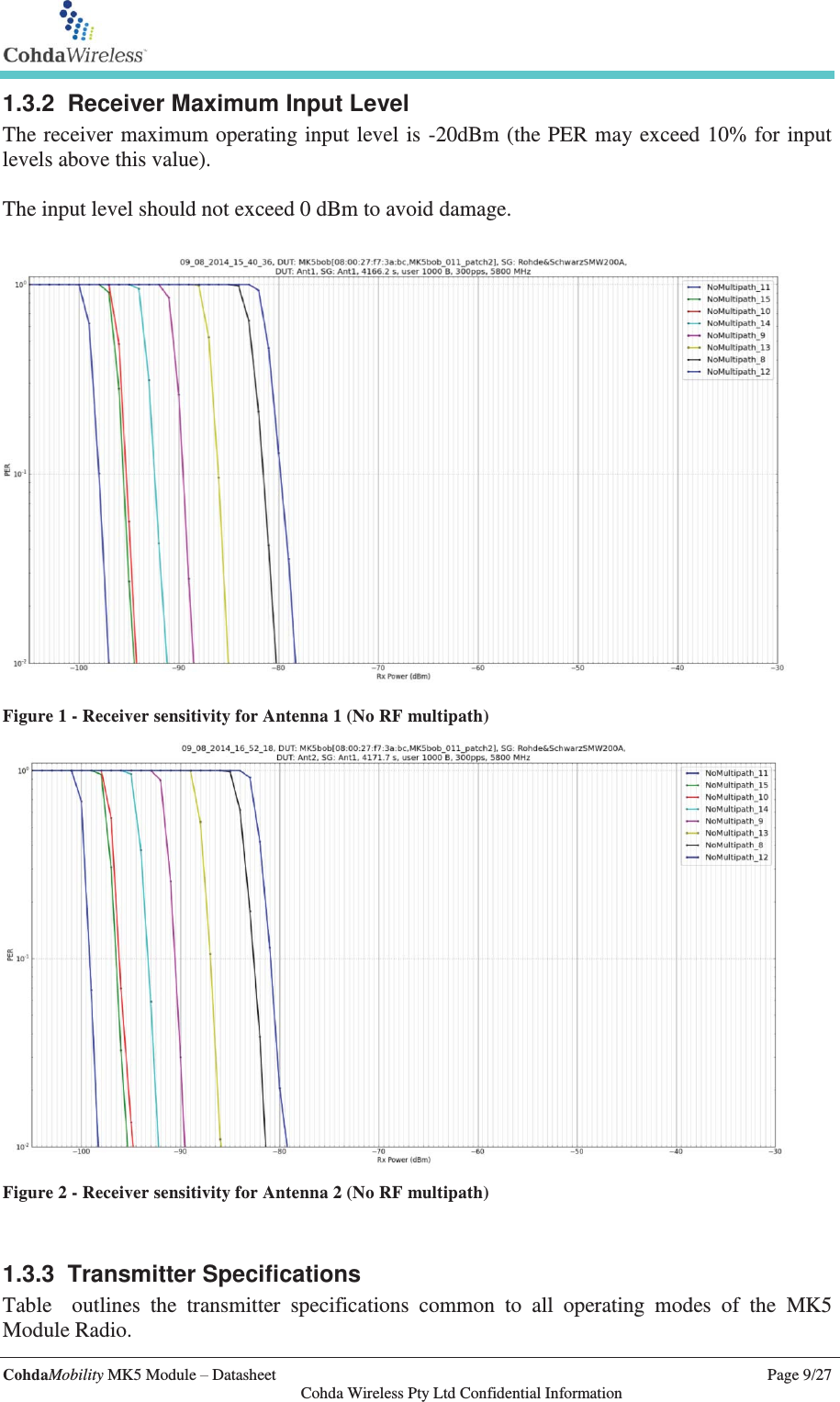
  CohdaMobility MK5 Module – Datasheet    Page 8/27   Cohda Wireless Pty Ltd Confidential Information 1.3 Performance 1.3.1 Receiver Sensitivity The receive sensitivity of the MK5 Radio is presented in Table 2 for single and dual receive antennas, operating at 5.9GHz in DSRC 10MHz bandwidth mode. The packet error rate (PER) is less than 10% at a PSDU length of 1,000 octets for these input levels. The receive sensitivity is measured with a signal input directly to the antenna ports. Example plots are presented in Figure 1 and Figure 2 overleaf.   Table 2 - MK5 Module Receive Sensitivity Channel No Multipath [dBm] Highway NLoS [dBm] Number of  Antennas 1 Typical (Min) 2 Typical (Min) 1 Typical (Min) 2 Typical (Min) Rate ID MCS 11 1/2  BPSK -98 (-95) -99 (-97) -95 (-92) -97 (-95) 15 3/4  BPSK -96 (-93) -98 (-96) -92 (-89) -95 (-93) 10 1/2  QPSK -95 (-92) -97 (-95) -88 (-85) -92 (-90) 14 3/4  QPSK -93 (-90) -95 (-93) -86 (-83) -89 (-87) 9 1/2  16QAM -90 (-87) -92 (-90) -85 (-82) -88 (-86) 13 3/4  16QAM -86 (-83) -88 (-86) -82 (-79) -85 (-86) 8 2/3  64QAM -82 (-79) -84 (-82) na na 12 3/4  64QAM -80 (-77) -83 (-81) na na  The Highway NLoS (Non Line of Sight) channel parameters used to obtain the values in Table 2 are captured in Table 3 below.   Table 3 - Highway NLoS channel parameters Tap # Relative Power [dB] Delay [ns] Doppler Frequency [Hz] 0 0 0 0 1 -2 200 689 2 -5 433 -492 3 -7 700 886  This channel was used in the RF testing at the third ETSI Plugtest (CMS3).  Each tap is faded using Pure Doppler, but the second antenna has a Doppler increased by 11Hz, which prevents phase synchronization of the channels. The Rx Power listed in Table 2 refers to the power of Tap 0.   The values presented are typical values, measured at +25°C. The sensitivity may be reduced by approximately 1dB when operating at +85°C or -40°C.
  CohdaMobility MK5 Module – Datasheet    Page 9/27   Cohda Wireless Pty Ltd Confidential Information 1.3.2 Receiver Maximum Input Level The receiver maximum operating input level is -20dBm (the PER may exceed 10% for input levels above this value).  The input level should not exceed 0 dBm to avoid damage.   Figure 1 - Receiver sensitivity for Antenna 1 (No RF multipath)  Figure 2 - Receiver sensitivity for Antenna 2 (No RF multipath)  1.3.3 Transmitter Specifications Table  outlines the transmitter specifications common to all operating modes of the MK5 Module Radio.
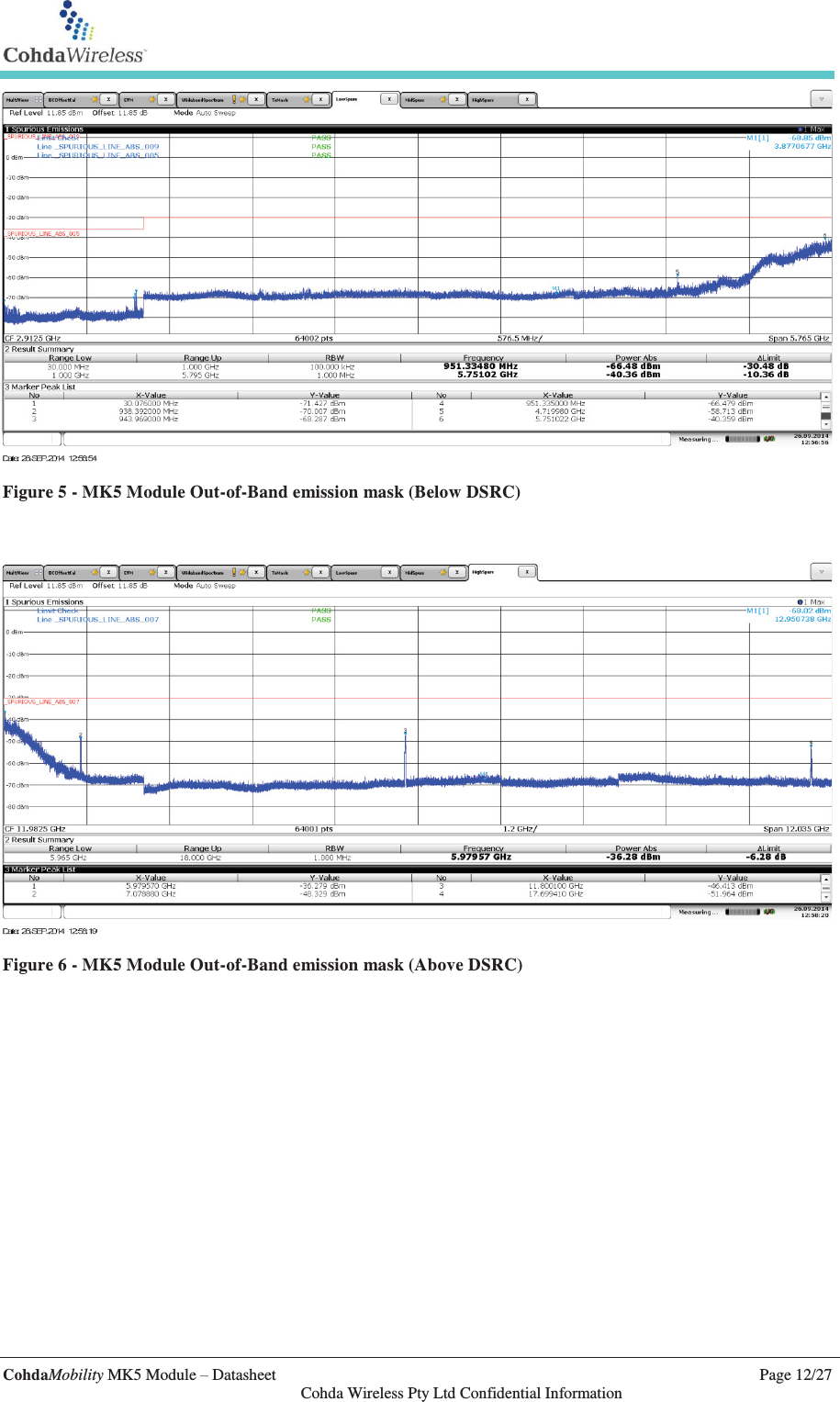
  CohdaMobility MK5 Module – Datasheet    Page 10/27   Cohda Wireless Pty Ltd Confidential Information  Table 4 - General Transmitter Specification Specification Performance Output centre frequency and symbol clock tolerance. ±10ppm Transmitter spectral flatness < ±2 dB in all bandwidth and modulation modes Transmitter centre frequency leakage > 15 dB below average sub-carrier power in all bandwidth and modulation modes Transmit power control step-size. 0.5 dB Transmit power control accuracy ±2 dB over temperature  1.3.4  Power Level and Spectral Mask The MK5 Module Radio maximum output power and spectral mask characteristics are outlined in Table 5. This specification applies to each of the two 5GHz antenna ports available (Ant1 and Ant2) and targets the entire temperature range. Measured results for the MK5 Module are presented in  and . Figure 5 and Figure 6 presents typical Out-of-Band unwanted emission results for the MK5 Module.   Table 5 - MK5 Module 5GHz Radio Transmitter Specifications Specification Performance Maximum Transmit Power +23dBm per antenna port (+26dBm effective transmit power in 2-antenna transmit mode) Minimum Transmit Power -10 dBm Transmit power control 0.5dB steps monotonically increasing/decreasing EVM per IEEE802.11-2007 (clause 17.3.9.6.3) Spectral Mask Targets DSRC class C, x 5.0 MHz, -26 dBc x 5.5 MHz, -32 dBc x 10 MHz, -40 dBc  x 15 MHz, -50 dBc Out of Band Emissions Target ETSI emission mask [EN 302 571] as per Table 6 Supported channels 5GHz: 168-184
  CohdaMobility MK5 Module – Datasheet    Page 11/27   Cohda Wireless Pty Ltd Confidential Information Table 6 - Transmitter unwanted emission limits from 1GHz to 18GHz outside the 5GHz ITS frequency bands Frequency Range Res BW [MHz] Maximum Power (EIRP) [dBm] 1 GHz < f < 5,795 GHz 1 -30 5,795 GHz < f < 5,815 GHz 1 -40 5,815 GHz < f < 5,850 GHz 1 -40 5,850 GHz < f < 5,855 GHz 1 -30 5,925 GHz < f < 5,965 GHz 1 -40 5,965 GHz < f < 18 GHz 1 -30   Figure 3 - MK5 Module Class-C Transmission Mask    Figure 4 - MK5 Module EVM and Transmit Power
  CohdaMobility MK5 Module – Datasheet    Page 12/27   Cohda Wireless Pty Ltd Confidential Information  Figure 5 - MK5 Module Out-of-Band emission mask (Below DSRC)    Figure 6 - MK5 Module Out-of-Band emission mask (Above DSRC)
  CohdaMobility MK5 Module – Datasheet    Page 13/27   Cohda Wireless Pty Ltd Confidential Information 1.3.5  Adjacent Channel Rejection The adjacent channel rejection of a MK5 Module is measured by setting the desired signal strength 3 dB above the receive sensitivity specified in Table 18-14 of the IEEE802.11-2012 standardTable 2 and raising the power of the interfering signal until 10% PER is caused for a PSDU length of 1000 octets. The power difference between the interfering and the desired channel is the corresponding adjacent channel rejection. The interfering signal in the adjacent channel is a conformant OFDM signal, meeting the DSRC Class C mask, unsynchronized with the signal in the channel under test. The receive sensitivity values are measured with a signal input directly to the Antenna Ports.  Measured results for the MK5 Module adjacent channel rejection, together with the target nACR values obtained from the IEEE802.11-2012 standard, are provided in Table 7  Table 7 - Adjacent Channel Rejection (ACR) Modulation Target ACR [dB] Target opt. enh. ACR [dB] MK5 Typical ACR [dB] ½ BPSK 16 28 37 ¾ BPSK 15 27 33 ½ QPSK 13 25 35 ¾ QPSK 11 23 29 ½ 16QAM 8 20 29 ¾ 16QAM 4 16 25 ⅔ 64QAM 0 12 22 ¾ 64QAM -1 11 20
  CohdaMobility MK5 Module – Datasheet    Page 14/27   Cohda Wireless Pty Ltd Confidential Information 1.3.6 Non-Adjacent Channel Rejection The non-adjacent channel rejection of a MK5 Module Radio is measured by setting the desired signal’s strength 3 dB above the rate-dependent sensitivity specified in Table 18-14 of the IEEE802.11-2012, and raising the power of the interfering signal until a 10% PER occurs for a PSDU length of 1000 octets. The power difference between the interfering and the desired channel is the corresponding nonadjacent channel rejection. The interfering signal in the non-adjacent channel is a conformant OFDM signal, targeting the DSRC Class C mask, unsynchronized with the signal in the channel under test. The receive sensitivity values are measured with a signal input directly to the Antenna Ports.  Measured results for the MK5 Module non-adjacent channel rejection, together with the target nACR values obtained from the IEEE802.11-2012 standard, are provided in Table 8.  Table 8 - Non-Adjacent Channel Rejection (nACR) Modulation Target nACR [dB] Target opt. enh. nACR [dB] Typical nACR [dB] ½ BPSK 32 42 51 ¾ BPSK 31 41 48 ½ QPSK 29 39 48 ¾ QPSK 27 37 45 ½ 16QAM 24 34 42 ¾ 16QAM 20 30 38 ⅔ 64QAM 16 26 34 ¾ 64QAM 15 25 32
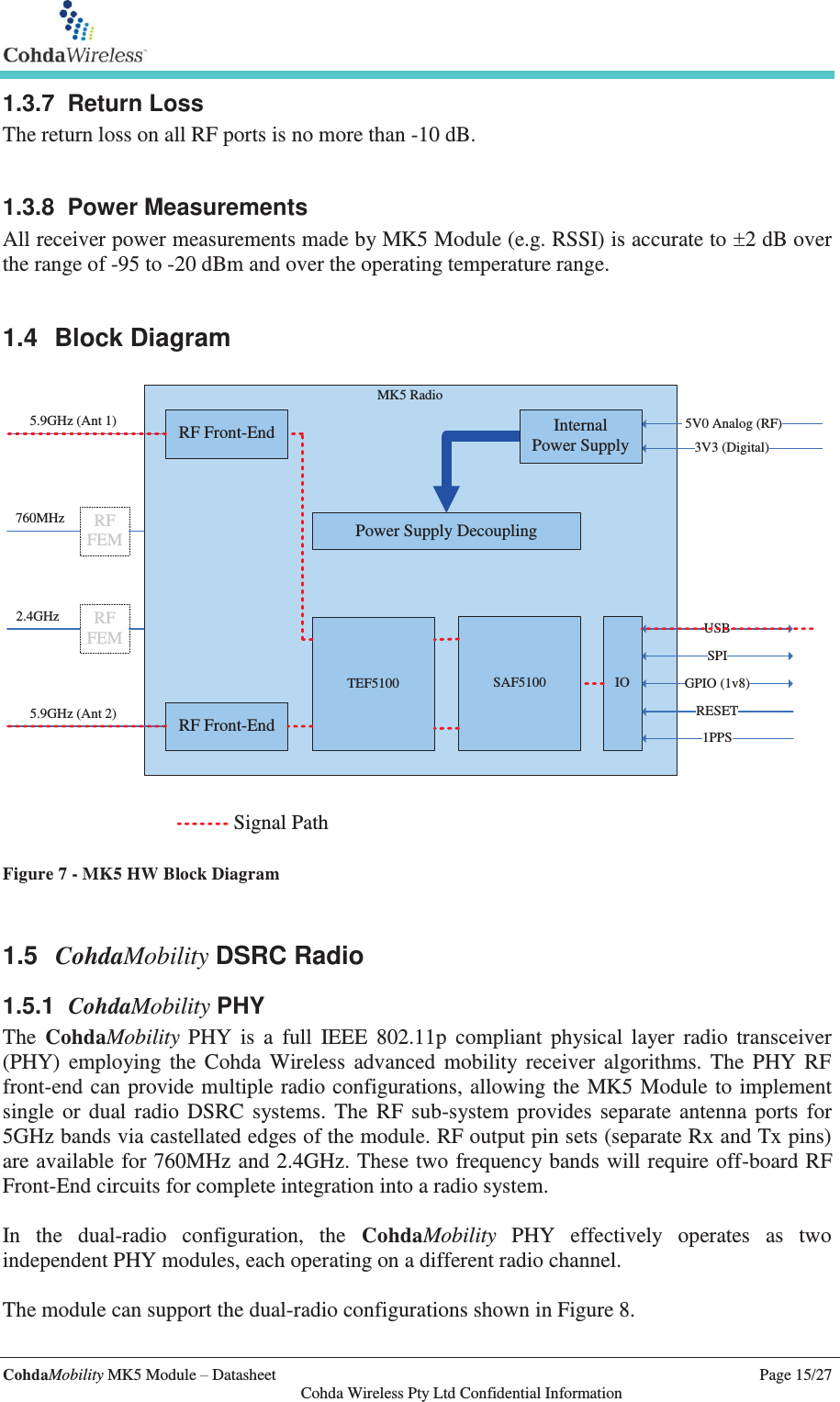
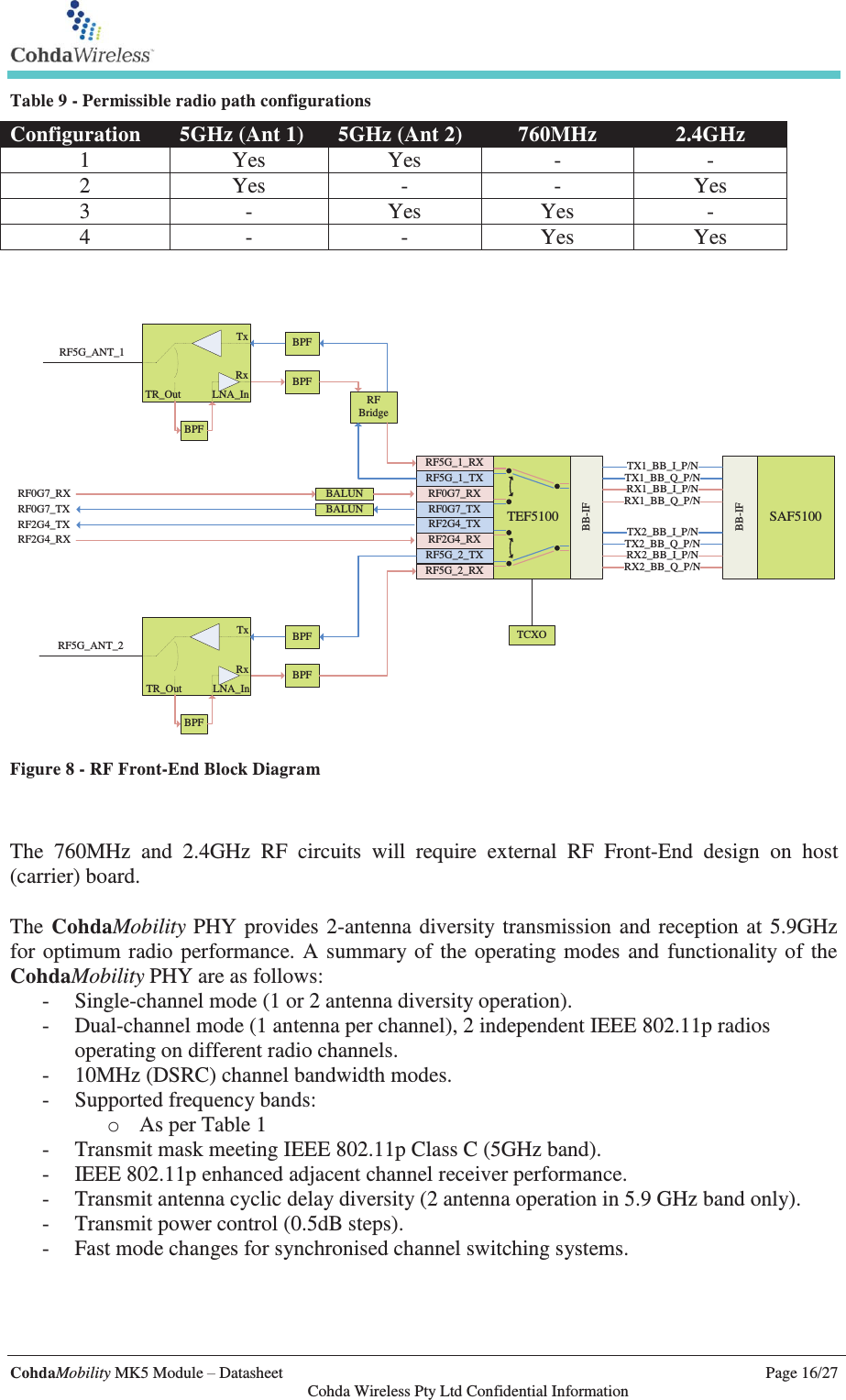
  CohdaMobility MK5 Module – Datasheet    Page 15/27   Cohda Wireless Pty Ltd Confidential Information 1.3.7 Return Loss The return loss on all RF ports is no more than -10 dB.   1.3.8 Power Measurements All receiver power measurements made by MK5 Module (e.g. RSSI) is accurate to r2 dB over the range of -95 to -20 dBm and over the operating temperature range.  1.4 Block Diagram  MK5 RadioRF Front-EndRF Front-EndTEF5100 SAF51005.9GHz (Ant 1)IOUSBSPIRESET1PPS5V0 Analog (RF)3V3 (Digital)5.9GHz (Ant 2)760MHz2.4GHzRFFEMRFFEMPower Supply DecouplingGPIO (1v8)InternalPower SupplySignal Path Figure 7 - MK5 HW Block Diagram  1.5  CohdaMobility DSRC Radio 1.5.1  CohdaMobility PHY The  CohdaMobility PHY is a full IEEE 802.11p compliant physical layer radio transceiver (PHY) employing the Cohda Wireless advanced mobility receiver algorithms. The PHY RF front-end can provide multiple radio configurations, allowing the MK5 Module to implement single or dual radio DSRC systems. The RF sub-system provides separate antenna ports for 5GHz bands via castellated edges of the module. RF output pin sets (separate Rx and Tx pins) are available for 760MHz and 2.4GHz. These two frequency bands will require off-board RF Front-End circuits for complete integration into a radio system.   In the dual-radio configuration, the CohdaMobility PHY effectively operates as two independent PHY modules, each operating on a different radio channel.  The module can support the dual-radio configurations shown in Figure 8.
  CohdaMobility MK5 Module – Datasheet    Page 16/27   Cohda Wireless Pty Ltd Confidential Information Table 9 - Permissible radio path configurations Configuration 5GHz (Ant 1) 5GHz (Ant 2) 760MHz 2.4GHz 1 Yes Yes - - 2 Yes - - Yes 3 - Yes Yes - 4 - - Yes Yes   BPFBPFTEF5100RF5G_1_TXRF5G_1_RXRF5G_2_TXRF5G_2_RXBB-IFBPFBPFSAF5100BB-IFRX1_BB_I_P/NRX1_BB_Q_P/NTX1_BB_I_P/NTR_Out LNA_InBPFRxTx TCXORF0G7_RXRF0G7_TXRF2G4_RXRF2G4_TXRFBridgeRF5G_ANT_2RF0G7_TXRF0G7_RXRF2G4_RXTX1_BB_Q_P/NRX2_BB_I_P/NRX2_BB_Q_P/NTX2_BB_I_P/NTX2_BB_Q_P/NRF2G4_TXBALUNBALUNTR_Out LNA_InBPFRxTxRF5G_ANT_1 Figure 8 - RF Front-End Block Diagram   The 760MHz and 2.4GHz RF circuits will require external RF Front-End design on host (carrier) board.   The CohdaMobility PHY provides 2-antenna diversity transmission and reception at 5.9GHz for optimum radio performance. A summary of the operating modes and functionality of the CohdaMobility PHY are as follows: - Single-channel mode (1 or 2 antenna diversity operation). - Dual-channel mode (1 antenna per channel), 2 independent IEEE 802.11p radios operating on different radio channels. - 10MHz (DSRC) channel bandwidth modes. - Supported frequency bands: o As per Table 1 - Transmit mask meeting IEEE 802.11p Class C (5GHz band). - IEEE 802.11p enhanced adjacent channel receiver performance. - Transmit antenna cyclic delay diversity (2 antenna operation in 5.9 GHz band only). - Transmit power control (0.5dB steps). - Fast mode changes for synchronised channel switching systems.
  CohdaMobility MK5 Module – Datasheet    Page 17/27   Cohda Wireless Pty Ltd Confidential Information 1.5.2 Reset The reset line will keep the SAF5100 and TEF5100 IC’s on the MK5 module in reset. Contact Cohda Wireless for specific information on the implementation of this pin.  1.5.3 GPIO Refer Table 10.  1.5.4 1PPS The 1PPS input is required by the radio to align transmissions when channel switching and for timekeeping. The MK5 accepts pulses with standard CMOS 1V8 levels. The signal should have the rising edge on the UTC second. Pulse width should be 1ms nominally. Pulse widths up to 250ms should be tolerable. As with all MK5 input this signal must NEVER be driven into the MK5 when the internal MK5 supplies are off. Contact Cohda Wireless for specific information on the implementation of this pin.  1.5.5 USB Refer Table 10. 1.5.6 Power Supplies The MK5 module 5.0v supplies are designed to support up to 400mA current draw for each radio (producing a continuous sinus wave at maximum transmit power). The 3.3v power supply is designed to support up to 1A, assuming maximum load on all the DSP and RF transceiver functions. The total power consumption of the MK5 module will not exceed 4W in normal operation, and typically consumes only 2.1W.
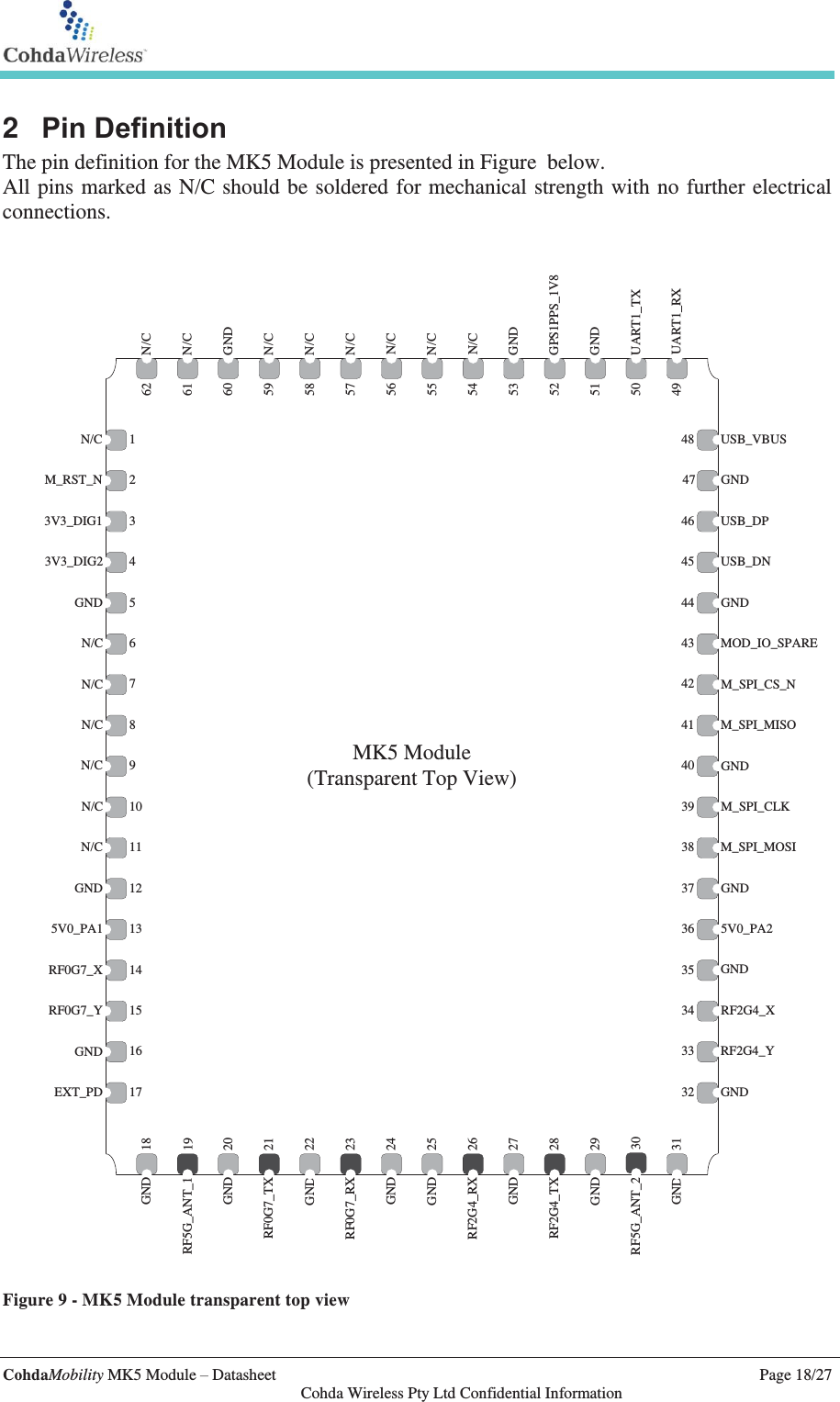
  CohdaMobility MK5 Module – Datasheet    Page 18/27   Cohda Wireless Pty Ltd Confidential Information 2  Pin Definition The pin definition for the MK5 Module is presented in Figure  below.  All pins marked as N/C should be soldered for mechanical strength with no further electrical connections.  MK5 Module(Transparent Top View)1234567891011121314151617 32333435363738394041424344454649505152535455565758292827262524232221201918GNDGNDGNDGNDGNDGNDRF5G_ANT_1GND31RF5G_ANT_2RF2G4_TXRF2G4_RXRF0G7_TXRF0G7_RX47596030GND486162N/C3V3_DIG13V3_DIG2GNDGNDGNDGNDGNDGNDGNDGNDGNDM_RST_NN/CN/CN/CN/CN/CN/CN/CN/CUART1_TXN/CGNDN/CN/CN/CN/CN/CEXT_PDRF0G7_XRF0G7_Y5V0_PA1 5V0_PA2RF2G4_YRF2G4_XM_SPI_CS_NM_SPI_MOSIM_SPI_MISOM_SPI_CLKMOD_IO_SPAREGPS1PPS_1V8USB_VBUSUSB_DNUSB_DPGNDGNDUART1_RX Figure 9 - MK5 Module transparent top view
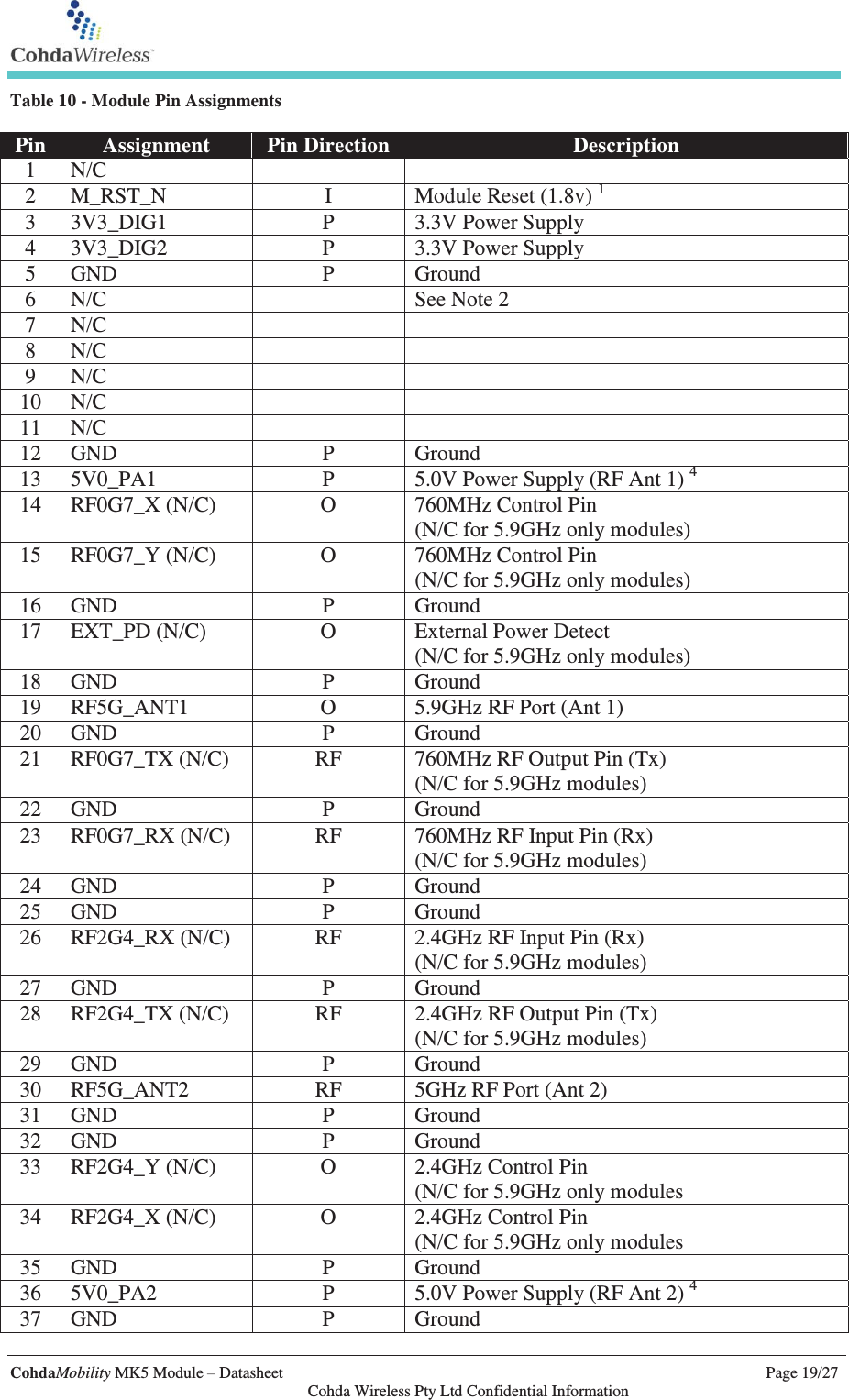
  CohdaMobility MK5 Module – Datasheet    Page 19/27   Cohda Wireless Pty Ltd Confidential Information Table 10 - Module Pin Assignments Pin Assignment Pin Direction Description 1 N/C   2 M_RST_N I Module Reset (1.8v) 1 3 3V3_DIG1 P 3.3V Power Supply 4 3V3_DIG2 P 3.3V Power Supply 5 GND P Ground 6 N/C  See Note 2 7 N/C   8 N/C   9 N/C   10 N/C   11 N/C   12 GND P Ground 13 5V0_PA1 P 5.0V Power Supply (RF Ant 1) 4 14 RF0G7_X (N/C) O 760MHz Control Pin  (N/C for 5.9GHz only modules) 15 RF0G7_Y (N/C) O 760MHz Control Pin  (N/C for 5.9GHz only modules) 16 GND P Ground 17 EXT_PD (N/C) O External Power Detect  (N/C for 5.9GHz only modules) 18 GND P Ground 19 RF5G_ANT1 O 5.9GHz RF Port (Ant 1) 20 GND P Ground 21 RF0G7_TX (N/C) RF 760MHz RF Output Pin (Tx)  (N/C for 5.9GHz modules)  22 GND P Ground 23 RF0G7_RX (N/C) RF 760MHz RF Input Pin (Rx)  (N/C for 5.9GHz modules) 24 GND P Ground 25 GND P Ground 26 RF2G4_RX (N/C) RF 2.4GHz RF Input Pin (Rx)  (N/C for 5.9GHz modules)  27 GND P Ground 28 RF2G4_TX (N/C) RF 2.4GHz RF Output Pin (Tx)  (N/C for 5.9GHz modules) 29 GND P Ground 30 RF5G_ANT2  RF 5GHz RF Port (Ant 2) 31 GND P Ground 32 GND P Ground 33 RF2G4_Y (N/C) O 2.4GHz Control Pin  (N/C for 5.9GHz only modules  34 RF2G4_X (N/C) O 2.4GHz Control Pin  (N/C for 5.9GHz only modules  35 GND P Ground 36 5V0_PA2 P 5.0V Power Supply (RF Ant 2) 4 37 GND P Ground
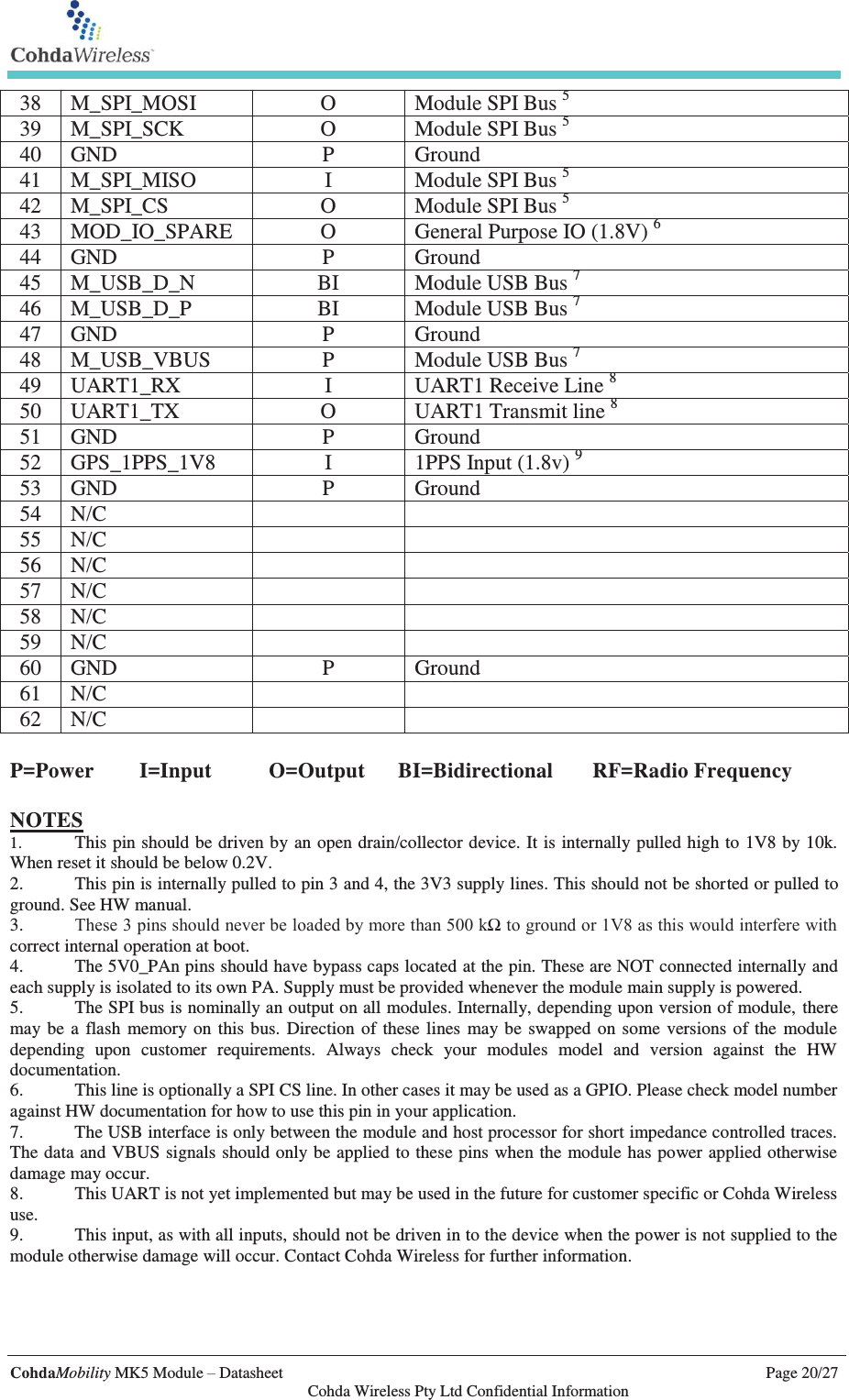
  CohdaMobility MK5 Module – Datasheet    Page 20/27   Cohda Wireless Pty Ltd Confidential Information  P=Power I=Input  O=Output BI=Bidirectional RF=Radio Frequency  NOTES 1.  This pin should be driven by an open drain/collector device. It is internally pulled high to 1V8 by 10k. When reset it should be below 0.2V.  2.  This pin is internally pulled to pin 3 and 4, the 3V3 supply lines. This should not be shorted or pulled to ground. See HW manual.  3.  These 3 pins should never be loaded by more than 500 kΩ to ground or 1V8 as this would interfere with correct internal operation at boot.  4.  The 5V0_PAn pins should have bypass caps located at the pin. These are NOT connected internally and each supply is isolated to its own PA. Supply must be provided whenever the module main supply is powered. 5.  The SPI bus is nominally an output on all modules. Internally, depending upon version of module, there may be a flash memory on this bus. Direction of these lines may be swapped on some versions of the module depending upon customer requirements. Always check your modules model and version against the HW documentation. 6.  This line is optionally a SPI CS line. In other cases it may be used as a GPIO. Please check model number against HW documentation for how to use this pin in your application. 7.  The USB interface is only between the module and host processor for short impedance controlled traces. The data and VBUS signals should only be applied to these pins when the module has power applied otherwise damage may occur. 8.  This UART is not yet implemented but may be used in the future for customer specific or Cohda Wireless use. 9.  This input, as with all inputs, should not be driven in to the device when the power is not supplied to the module otherwise damage will occur. Contact Cohda Wireless for further information.  38 M_SPI_MOSI O Module SPI Bus 5 39 M_SPI_SCK O Module SPI Bus 5 40 GND P Ground 41 M_SPI_MISO I Module SPI Bus 5 42 M_SPI_CS O Module SPI Bus 5 43 MOD_IO_SPARE O General Purpose IO (1.8V) 6 44 GND P Ground 45 M_USB_D_N BI Module USB Bus 7 46 M_USB_D_P BI Module USB Bus 7 47 GND P Ground 48 M_USB_VBUS P Module USB Bus 7 49 UART1_RX I UART1 Receive Line 8 50 UART1_TX O UART1 Transmit line 8 51 GND P Ground 52 GPS_1PPS_1V8 I 1PPS Input (1.8v) 9 53 GND P Ground 54 N/C   55 N/C   56 N/C   57 N/C   58 N/C   59 N/C   60 GND P Ground 61 N/C   62 N/C
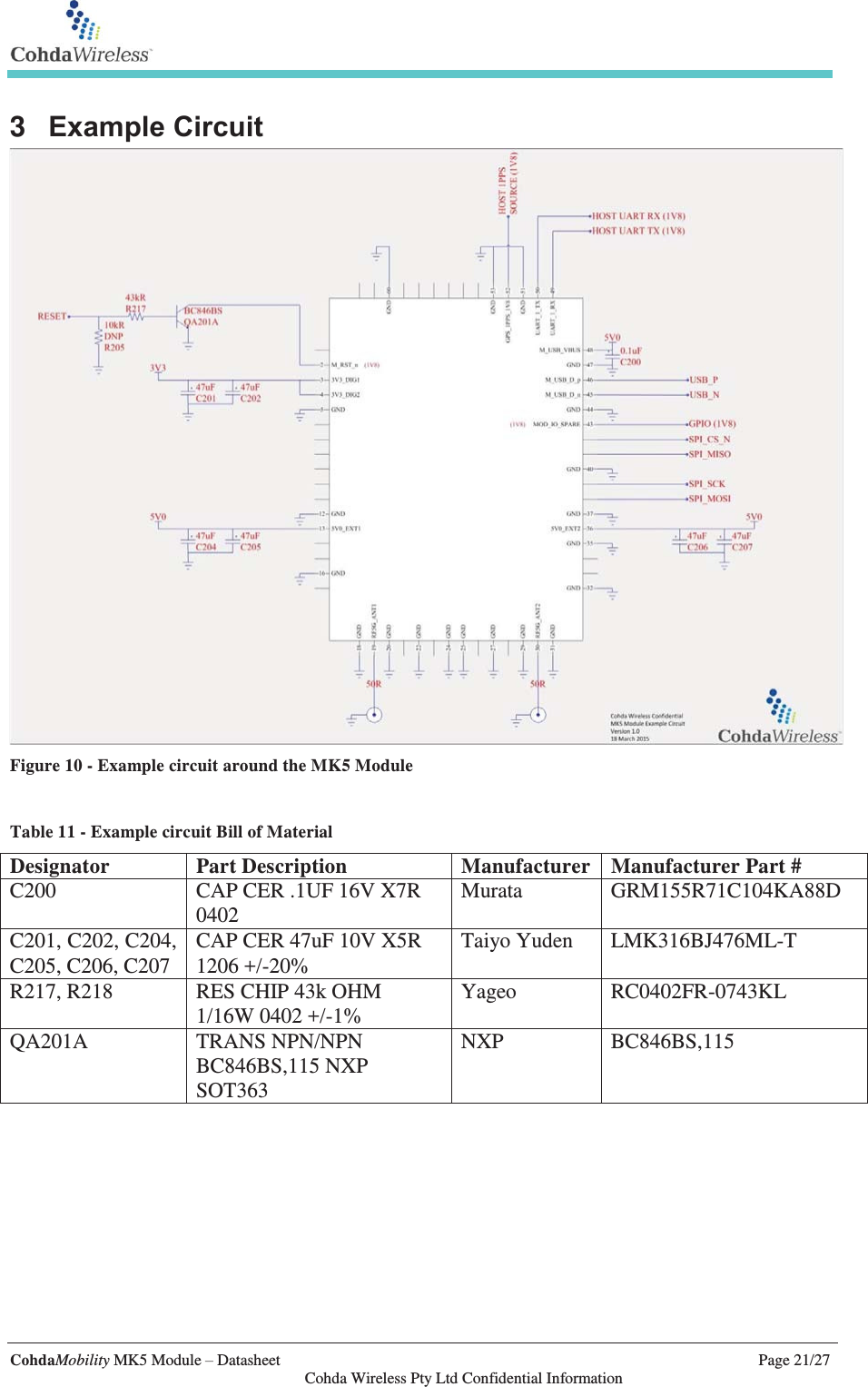
  CohdaMobility MK5 Module – Datasheet    Page 21/27   Cohda Wireless Pty Ltd Confidential Information 3  Example Circuit   Figure 10 - Example circuit around the MK5 Module  Table 11 - Example circuit Bill of Material Designator Part Description Manufacturer Manufacturer Part # C200 CAP CER .1UF 16V X7R 0402 Murata GRM155R71C104KA88D C201, C202, C204, C205, C206, C207 CAP CER 47uF 10V X5R 1206 +/-20% Taiyo Yuden LMK316BJ476ML-T R217, R218 RES CHIP 43k OHM 1/16W 0402 +/-1% Yageo RC0402FR-0743KL QA201A TRANS NPN/NPN BC846BS,115 NXP SOT363 NXP BC846BS,115
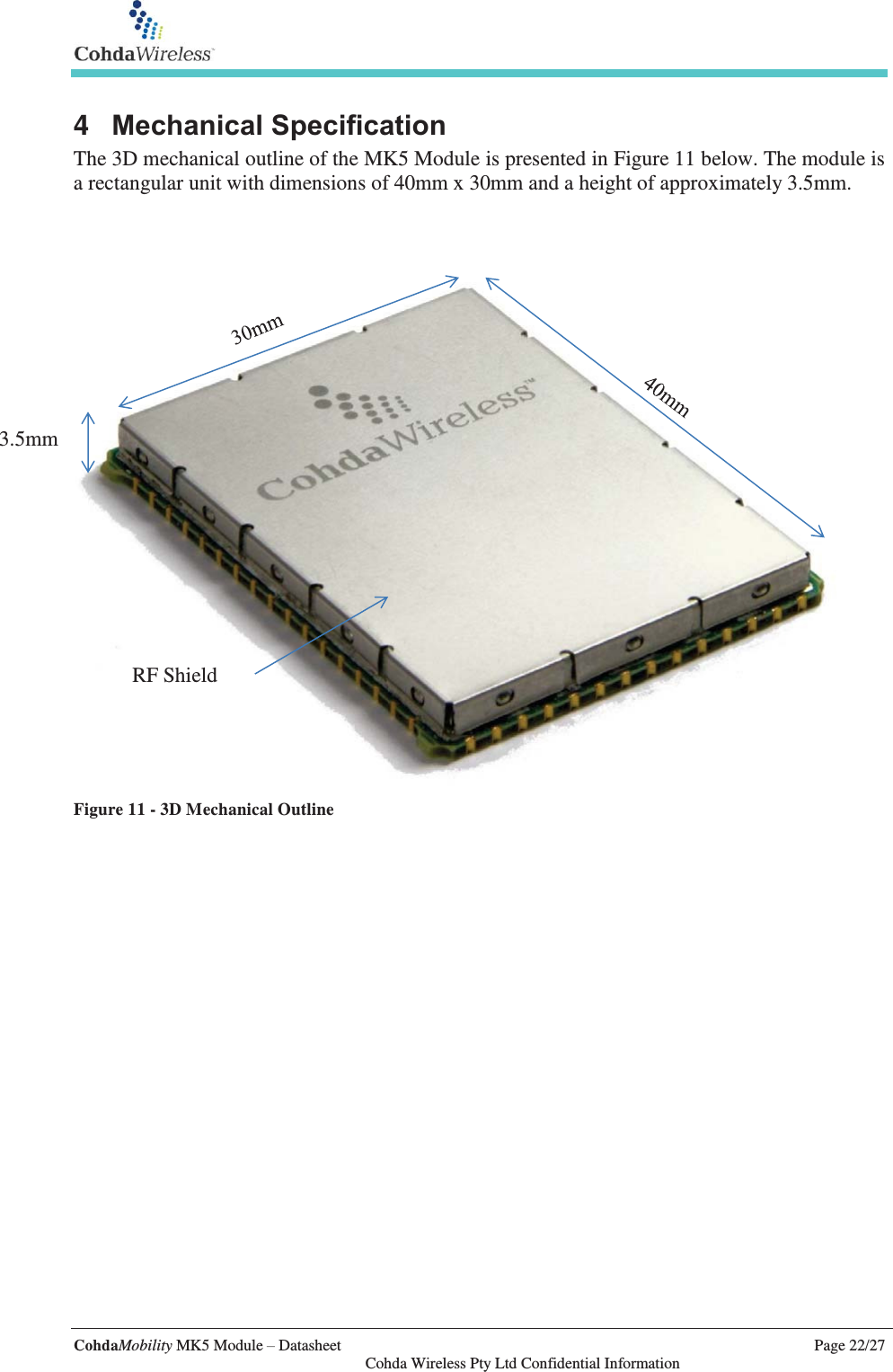
  CohdaMobility MK5 Module – Datasheet    Page 22/27   Cohda Wireless Pty Ltd Confidential Information 4  Mechanical Specification The 3D mechanical outline of the MK5 Module is presented in Figure 11 below. The module is a rectangular unit with dimensions of 40mm x 30mm and a height of approximately 3.5mm.     Figure 11 - 3D Mechanical Outline  3.5mm RF Shield
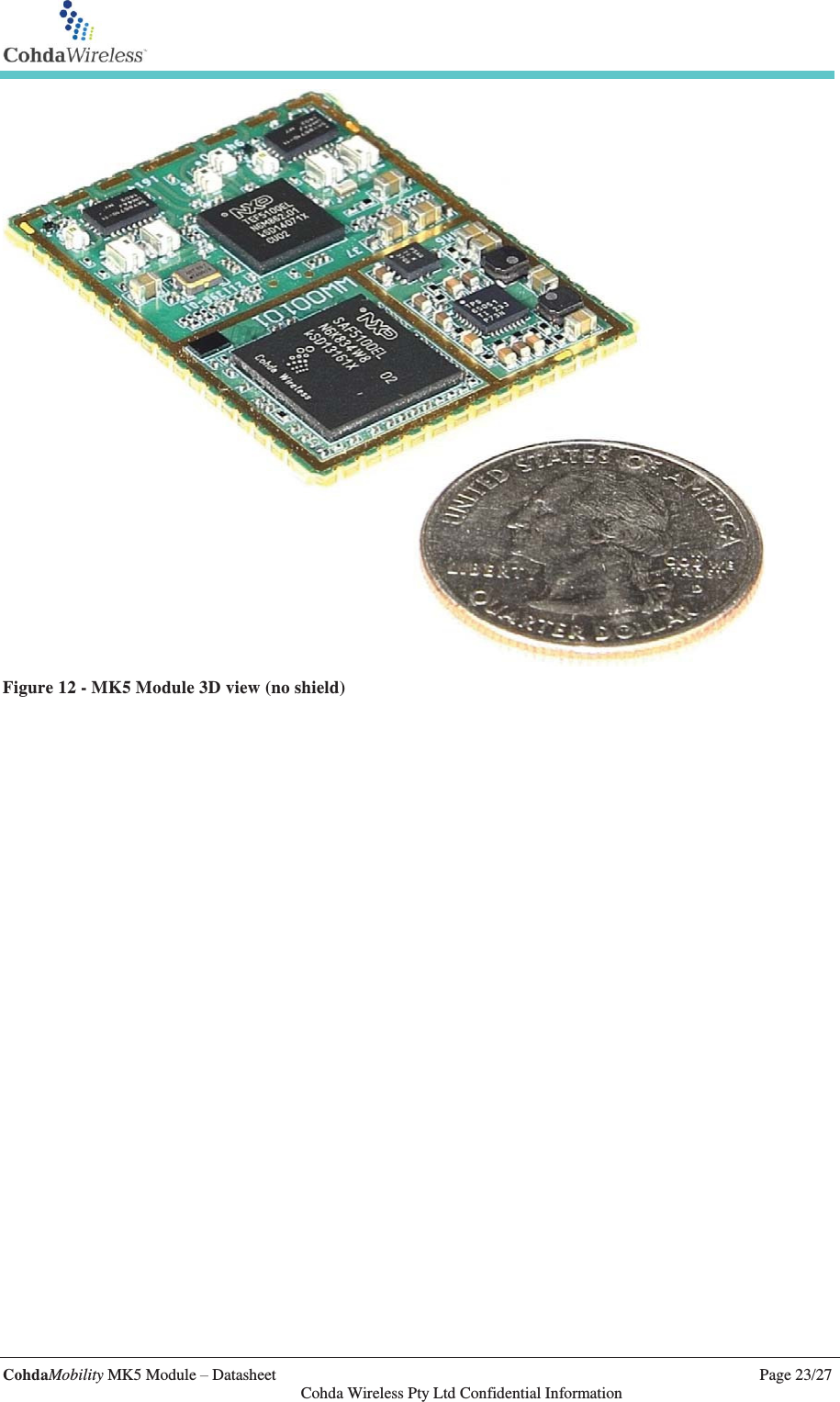
  CohdaMobility MK5 Module – Datasheet    Page 23/27   Cohda Wireless Pty Ltd Confidential Information  Figure 12 - MK5 Module 3D view (no shield)
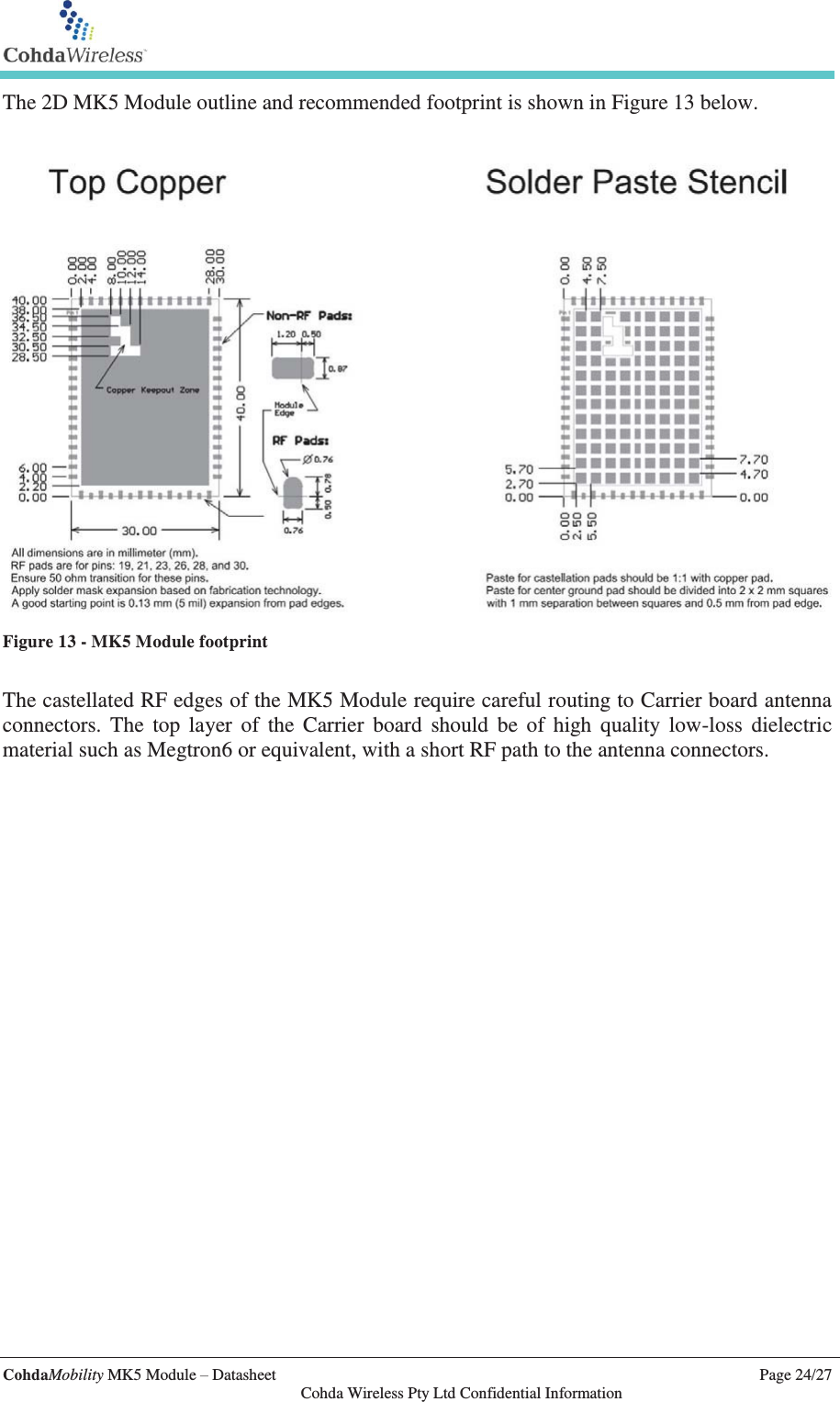
  CohdaMobility MK5 Module – Datasheet    Page 24/27   Cohda Wireless Pty Ltd Confidential Information The 2D MK5 Module outline and recommended footprint is shown in Figure 13 below.    Figure 13 - MK5 Module footprint  The castellated RF edges of the MK5 Module require careful routing to Carrier board antenna connectors. The top layer of the Carrier board should be of high quality low-loss dielectric material such as Megtron6 or equivalent, with a short RF path to the antenna connectors.
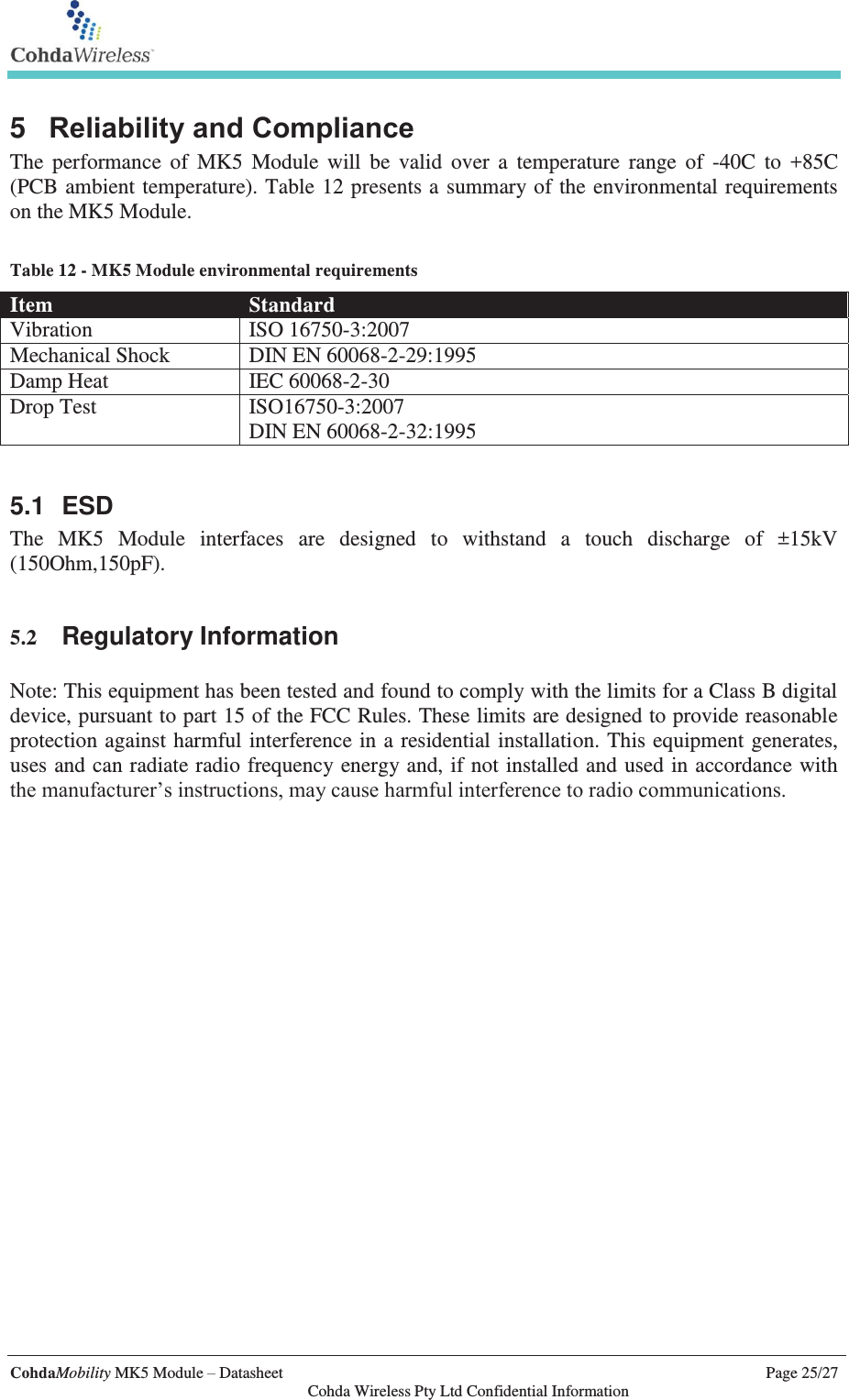
  CohdaMobility MK5 Module – Datasheet    Page 25/27   Cohda Wireless Pty Ltd Confidential Information 5  Reliability and Compliance The performance of MK5 Module will be valid over a temperature range of -40C to +85C (PCB ambient temperature). Table 12 presents a summary of the environmental requirements on the MK5 Module.   Table 12 - MK5 Module environmental requirements Item  Standard Vibration  ISO 16750-3:2007 Mechanical Shock  DIN EN 60068-2-29:1995 Damp Heat  IEC 60068-2-30 Drop Test  ISO16750-3:2007 DIN EN 60068-2-32:1995  5.1 ESD The MK5 Module interfaces are designed to withstand a touch discharge of ±15kV (150Ohm,150pF).   5.2 Regulatory Information  Note: This equipment has been tested and found to comply with the limits for a Class B digital device, pursuant to part 15 of the FCC Rules. These limits are designed to provide reasonable protection against harmful interference in a residential installation. This equipment generates, uses and can radiate radio frequency energy and, if not installed and used in accordance with the manufacturer’s instructions, may cause harmful interference to radio communications.
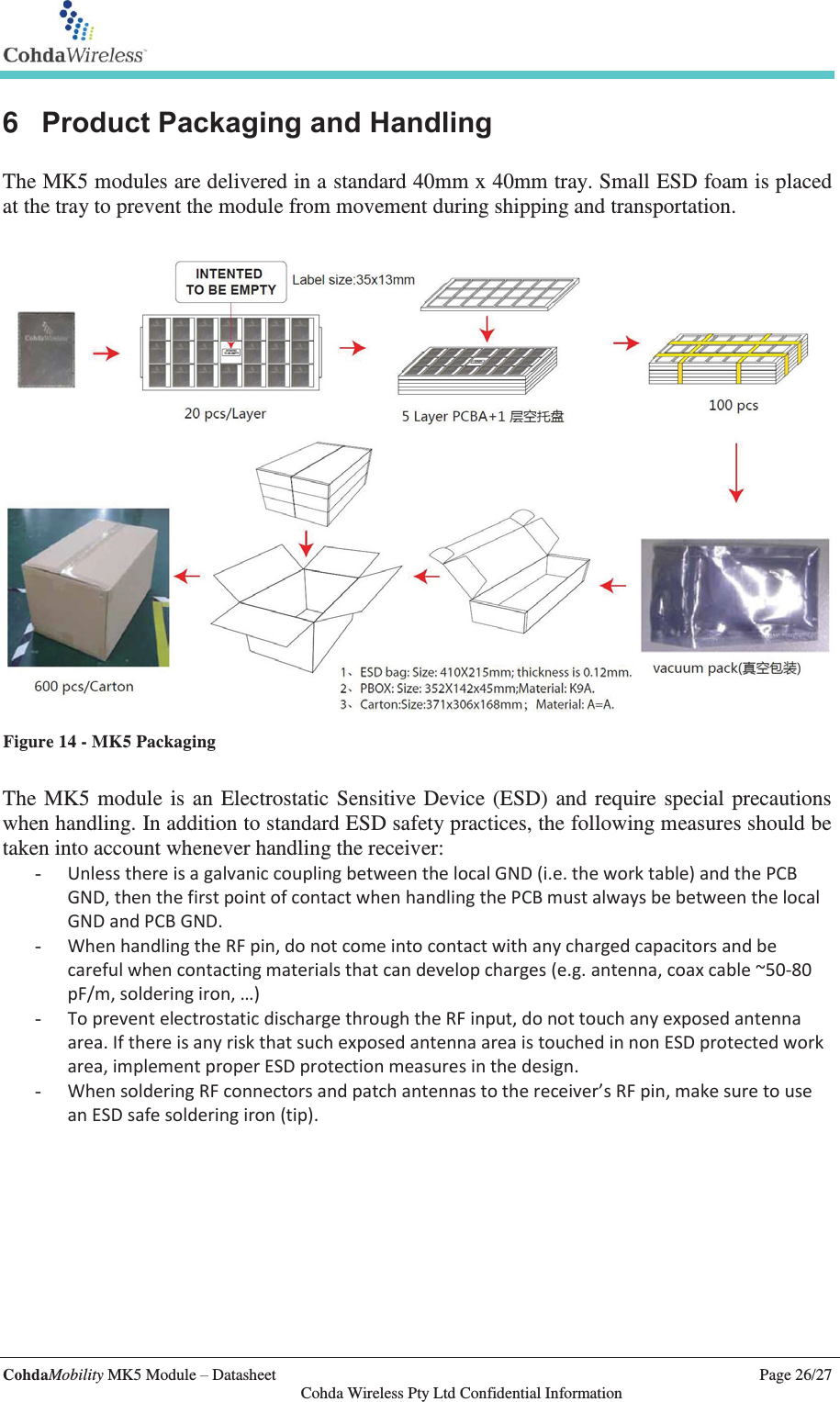
  CohdaMobility MK5 Module – Datasheet    Page 26/27   Cohda Wireless Pty Ltd Confidential Information 6  Product Packaging and Handling  The MK5 modules are delivered in a standard 40mm x 40mm tray. Small ESD foam is placed at the tray to prevent the module from movement during shipping and transportation.      The MK5 module is an Electrostatic Sensitive Device (ESD) and require special precautions when handling. In addition to standard ESD safety practices, the following measures should be taken into account whenever handling the receiver: - Unless there is a galvanic coupling between the local GND (i.e. the work table) and the PCB GND, then the first point of contact when handling the PCB must always be between the local GND and PCB GND. - When handling the RF pin, do not come into contact with any charged capacitors and be careful when contacting materials that can develop charges (e.g. antenna, coax cable ~50-80 pF/m, soldering iron, …) - To prevent electrostatic discharge through the RF input, do not touch any exposed antenna area. If there is any risk that such exposed antenna area is touched in non ESD protected work area, implement proper ESD protection measures in the design. - When soldering RF connectors and patch antennas to the receiver’s RF pin, make sure to use an ESD safe soldering iron (tip).  Figure 14 - MK5 Packaging
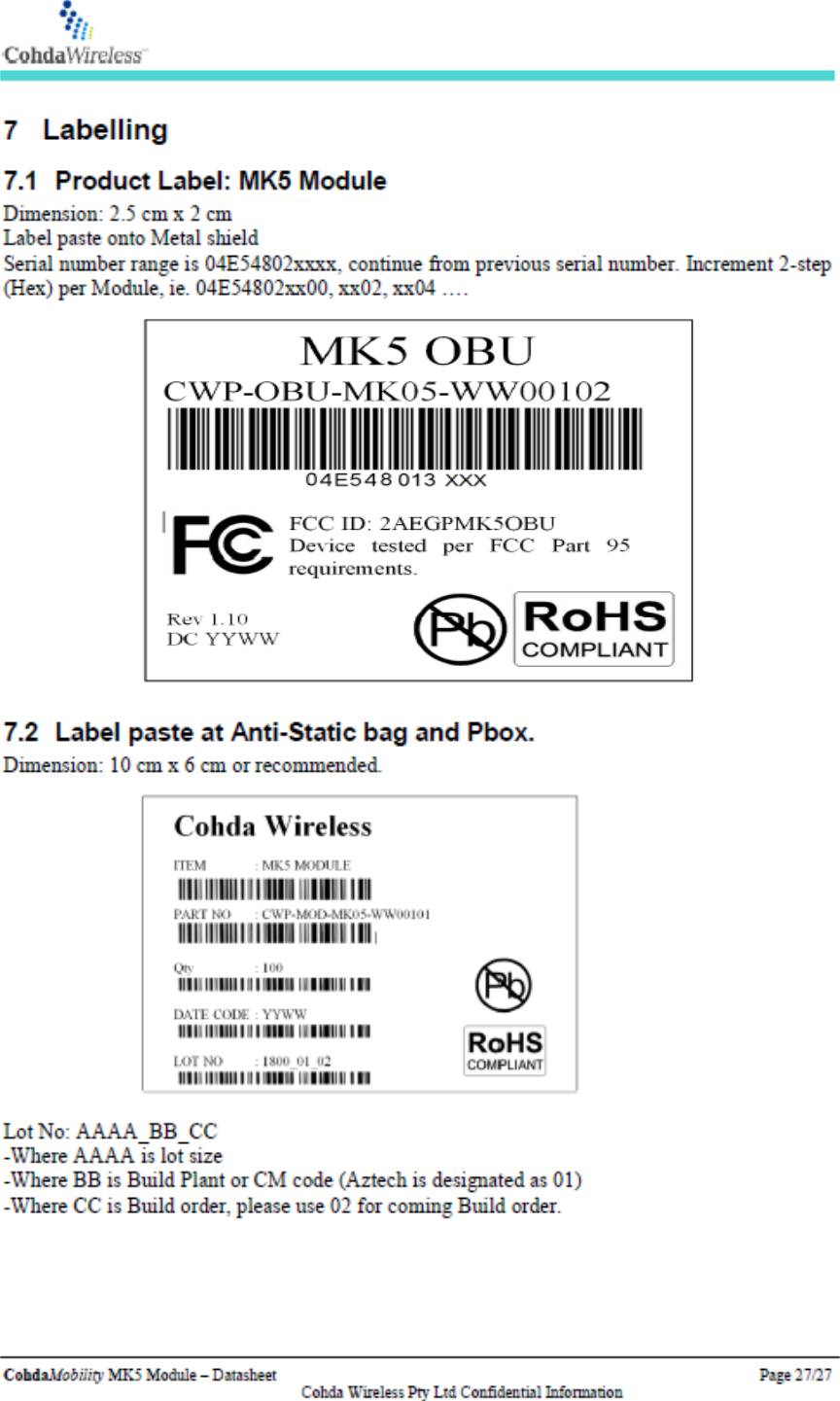

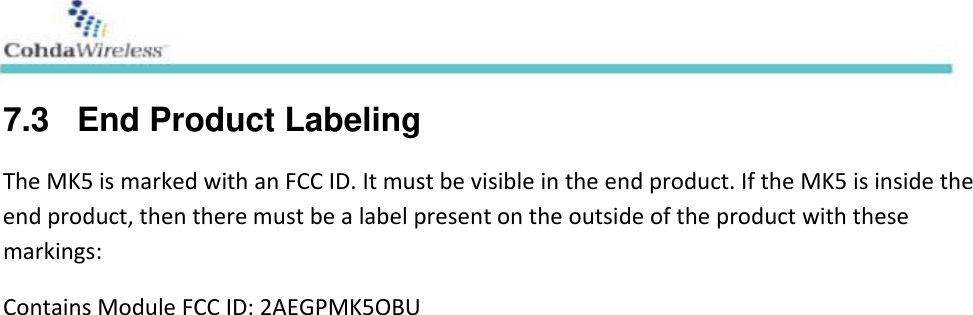
 7.3   End Product LabelingTheMK5ismarkedwithanFCCID.Itmustbevisibleintheendproduct.IftheMK5isinsidetheendproduct,thentheremustbealabelpresentontheoutsideoftheproductwiththesemarkings:ContainsModuleFCCID:2AEGPMK5OBU

Navigation menu