Digianswer A S 13192-EVB WPAN Transceiver User Manual Manual

Digianswer A/S WPAN Transceiver Manual

Contents

Manual

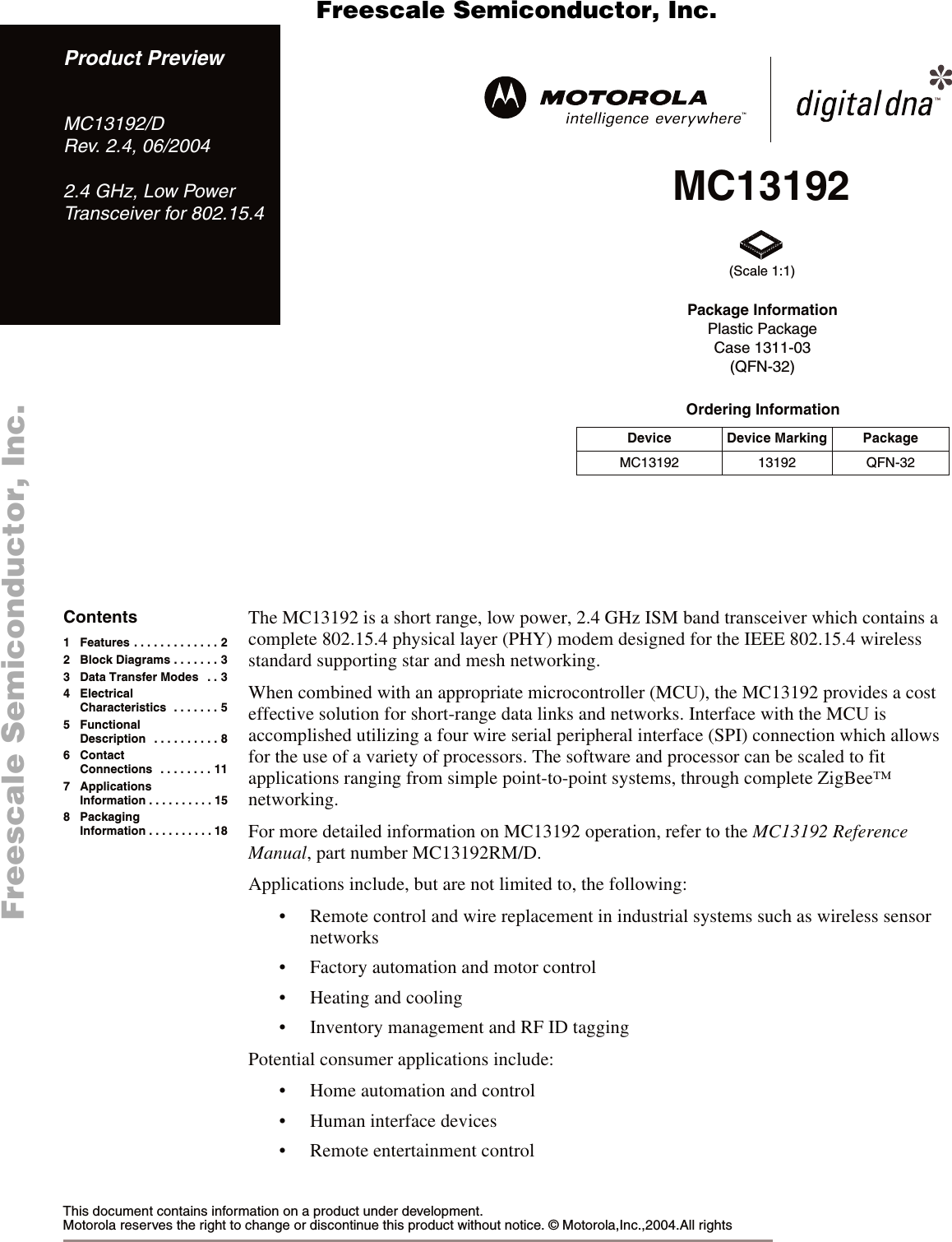
MC13192Ordering InformationDevice Device Marking PackageMC13192 13192 QFN-32Package InformationPlastic PackageCase 1311-03(QFN-32)(Scale 1:1)This document contains information on a product under development. Motorola reserves the right to change or discontinue this product without notice. © Motorola,Inc.,2004.All rights The MC13192 is a short range, low power, 2.4 GHz ISM band transceiver which contains a complete 802.15.4 physical layer (PHY) modem designed for the IEEE 802.15.4 wireless standard supporting star and mesh networking.When combined with an appropriate microcontroller (MCU), the MC13192 provides a cost effective solution for short-range data links and networks. Interface with the MCU is accomplished utilizing a four wire serial peripheral interface (SPI) connection which allows for the use of a variety of processors. The software and processor can be scaled to fit applications ranging from simple point-to-point systems, through complete ZigBee™ networking.For more detailed information on MC13192 operation, refer to the MC13192 Reference Manual, part number MC13192RM/D.Applications include, but are not limited to, the following:• Remote control and wire replacement in industrial systems such as wireless sensor networks• Factory automation and motor control• Heating and cooling• Inventory management and RF ID taggingPotential consumer applications include:• Home automation and control• Human interface devices• Remote entertainment controlProduct PreviewMC13192/DRev. 2.4, 06/20042.4 GHz, Low PowerTransceiver for 802.15.4Contents1 Features . . . . . . . . . . . . . 22 Block Diagrams . . . . . . . 33 Data Transfer Modes   . . 34ElectricalCharacteristics  . . . . . . . 55FunctionalDescription  . . . . . . . . . . 86 Contact Connections  . . . . . . . . 117 ApplicationsInformation . . . . . . . . . . 158 PackagingInformation . . . . . . . . . . 18      Freescale Semiconductor, I                                               Freescale Semiconductor, Inc.  nc...
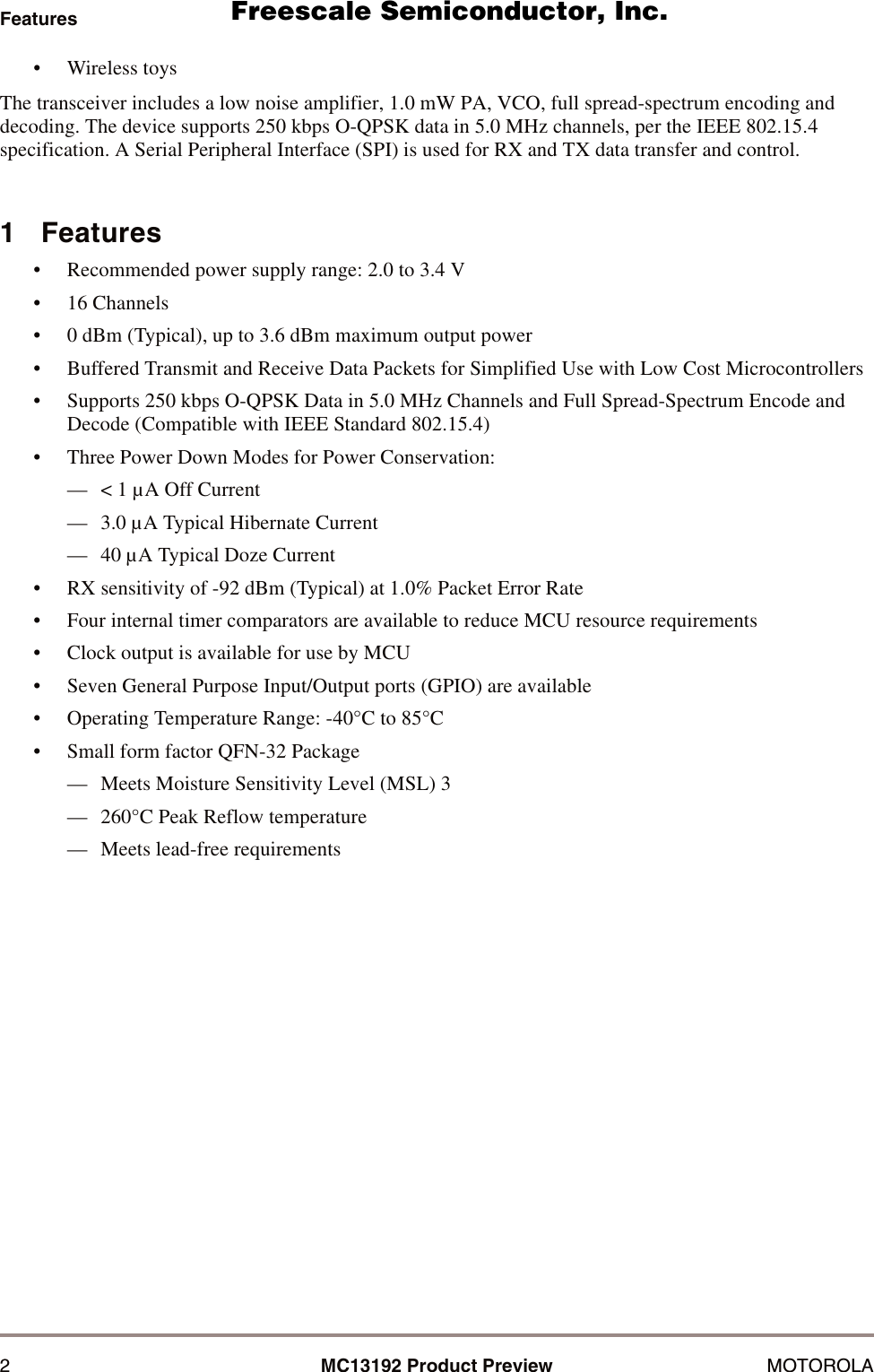
2MC13192 Product Preview MOTOROLAFeatures• Wireless toysThe transceiver includes a low noise amplifier, 1.0 mW PA, VCO, full spread-spectrum encoding and decoding. The device supports 250 kbps O-QPSK data in 5.0 MHz channels, per the IEEE 802.15.4 specification. A Serial Peripheral Interface (SPI) is used for RX and TX data transfer and control.1   Features• Recommended power supply range: 2.0 to 3.4 V• 16 Channels• 0 dBm (Typical), up to 3.6 dBm maximum output power• Buffered Transmit and Receive Data Packets for Simplified Use with Low Cost Microcontrollers• Supports 250 kbps O-QPSK Data in 5.0 MHz Channels and Full Spread-Spectrum Encode and Decode (Compatible with IEEE Standard 802.15.4)• Three Power Down Modes for Power Conservation:— < 1 µA Off Current— 3.0 µA Typical Hibernate Current— 40 µA Typical Doze Current• RX sensitivity of -92 dBm (Typical) at 1.0% Packet Error Rate• Four internal timer comparators are available to reduce MCU resource requirements• Clock output is available for use by MCU• Seven General Purpose Input/Output ports (GPIO) are available• Operating Temperature Range: -40°C to 85°C• Small form factor QFN-32 Package— Meets Moisture Sensitivity Level (MSL) 3— 260°C Peak Reflow temperature— Meets lead-free requirements      Freescale Semiconductor, I                                               Freescale Semiconductor, Inc.  nc...
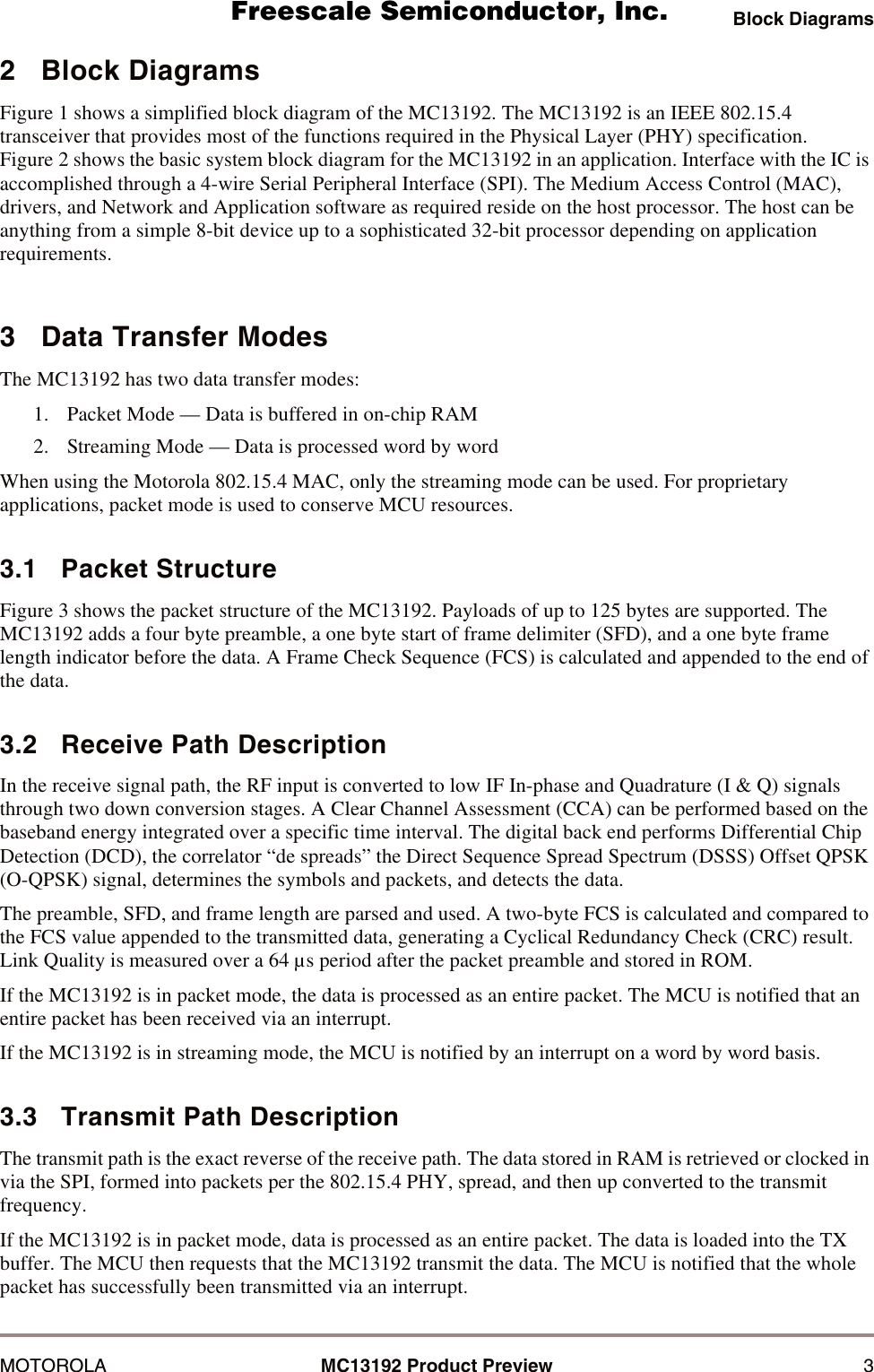
Block DiagramsMOTOROLA MC13192 Product Preview 32   Block DiagramsFigure 1 shows a simplified block diagram of the MC13192. The MC13192 is an IEEE 802.15.4 transceiver that provides most of the functions required in the Physical Layer (PHY) specification. Figure 2 shows the basic system block diagram for the MC13192 in an application. Interface with the IC is accomplished through a 4-wire Serial Peripheral Interface (SPI). The Medium Access Control (MAC), drivers, and Network and Application software as required reside on the host processor. The host can be anything from a simple 8-bit device up to a sophisticated 32-bit processor depending on application requirements.3   Data Transfer ModesThe MC13192 has two data transfer modes:1. Packet Mode — Data is buffered in on-chip RAM2. Streaming Mode — Data is processed word by wordWhen using the Motorola 802.15.4 MAC, only the streaming mode can be used. For proprietary applications, packet mode is used to conserve MCU resources.3.1   Packet StructureFigure 3 shows the packet structure of the MC13192. Payloads of up to 125 bytes are supported. The MC13192 adds a four byte preamble, a one byte start of frame delimiter (SFD), and a one byte frame length indicator before the data. A Frame Check Sequence (FCS) is calculated and appended to the end of the data. 3.2   Receive Path DescriptionIn the receive signal path, the RF input is converted to low IF In-phase and Quadrature (I & Q) signals through two down conversion stages. A Clear Channel Assessment (CCA) can be performed based on the baseband energy integrated over a specific time interval. The digital back end performs Differential Chip Detection (DCD), the correlator “de spreads” the Direct Sequence Spread Spectrum (DSSS) Offset QPSK (O-QPSK) signal, determines the symbols and packets, and detects the data. The preamble, SFD, and frame length are parsed and used. A two-byte FCS is calculated and compared to the FCS value appended to the transmitted data, generating a Cyclical Redundancy Check (CRC) result. Link Quality is measured over a 64 µs period after the packet preamble and stored in ROM.If the MC13192 is in packet mode, the data is processed as an entire packet. The MCU is notified that an entire packet has been received via an interrupt. If the MC13192 is in streaming mode, the MCU is notified by an interrupt on a word by word basis.3.3   Transmit Path DescriptionThe transmit path is the exact reverse of the receive path. The data stored in RAM is retrieved or clocked in via the SPI, formed into packets per the 802.15.4 PHY, spread, and then up converted to the transmit frequency. If the MC13192 is in packet mode, data is processed as an entire packet. The data is loaded into the TX buffer. The MCU then requests that the MC13192 transmit the data. The MCU is notified that the whole packet has successfully been transmitted via an interrupt.       Freescale Semiconductor, I                                               Freescale Semiconductor, Inc.  nc...
4MC13192 Product Preview MOTOROLAData Transfer ModesIn streaming mode, the data is fed to the MC13192 on a word by word basis with an interrupt serving as a notification that the MC13192 is ready for more data. This continues until the whole packet is transmitted.Figure 1.   MC13192 Simplified Block DiagramFigure 2.   System Level Block DiagramPhase Shift ModulatorRSTGPIO1GPIO2GPIO3GPIO4Crystal2Crystal1RFIN-RFIN+PAO+PAO-MOSIMISOSPICLKRXTXENCEATTNGPIO5GPIO6GPIO7ReceivePacket RAMTransmitPacket RAM 1Transmit RAMArbiterReceive RAMArbiterPAVCOCrystalOscillatorSymbolGenerationFCSGeneration HeaderGenerationMUXSequenceManager(Control Logic)VDDLO2 ÷4256MHz2.45GHzLNA 1st IF MixerIF = 65 MHz2nd IF MixerIF = 1 MHz PMA DecimationFilter MatchedFilterBasebandMixerDCDCorrelatorSymbolSynch & DetCCA PacketProcessorIRQArbiter24 Bit Event TimerIRQ16MHzAGCAnalogRegulator VBATTDigitalRegulator LDigitalRegulator HPower-UpControlLogicCrystalRegulatorVCORegulatorVDDINTProgrammablePrescalerCLKO4 ProgrammableTimer ComparatorsSynthesizerVDDDVDDVCOSERIALPERIPHERALINTERFACE(SPI)VDDAVDDLO1TransmitPacket RAM 2Analog ReceiverMC13192FrequencyGenerationAnalogTransmitterVoltageRegulators Power UpManagementControlLogicBuffer RAMDigital TransceiverSPIand GPIOMicrocontrollerSPI Rom (Flash)RAMCPU A/DTimerApplicationIRQ ArbiterRAM ArbiterTimerNetworkMACPHY Driver      Freescale Semiconductor, I                                               Freescale Semiconductor, Inc.  nc...
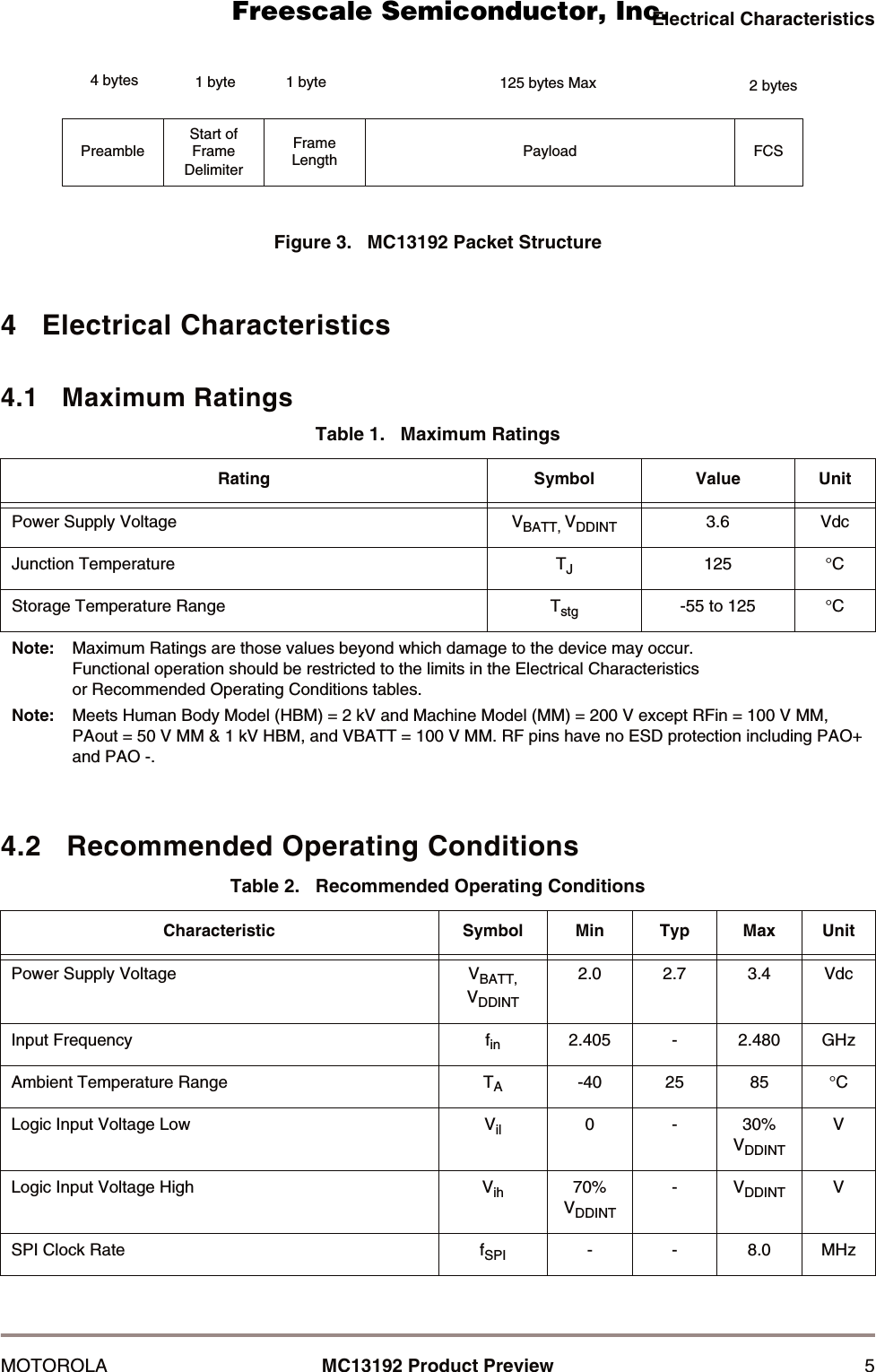
Electrical CharacteristicsMOTOROLA MC13192 Product Preview 5Figure 3.   MC13192 Packet Structure4   Electrical Characteristics4.1   Maximum Ratings4.2   Recommended Operating ConditionsTable 1.   Maximum RatingsRating Symbol Value UnitPower Supply Voltage VBATT, VDDINT 3.6 VdcJunction Temperature  TJ125 °CStorage Temperature Range Tstg -55 to 125 °CNote: Maximum Ratings are those values beyond which damage to the device may occur. Functional operation should be restricted to the limits in the Electrical Characteristics or Recommended Operating Conditions tables.Note: Meets Human Body Model (HBM) = 2 kV and Machine Model (MM) = 200 V except RFin = 100 V MM,PAout = 50 V MM & 1 kV HBM, and VBATT = 100 V MM. RF pins have no ESD protection including PAO+and PAO -.Table 2.   Recommended Operating ConditionsCharacteristic Symbol Min Typ Max UnitPower Supply Voltage VBATT, VDDINT2.0 2.7 3.4 VdcInput Frequency fin 2.405 - 2.480 GHzAmbient Temperature Range TA-40 25 85 °CLogic Input Voltage Low Vil 0-30% VDDINTVLogic Input Voltage High Vih 70% VDDINT-VDDINT VSPI Clock Rate fSPI --8.0MHzPreambleStart ofFrameDelimiterFrameLength Payload FCS4 bytes 1 byte 1 byte 125 bytes Max 2 bytes      Freescale Semiconductor, I                                               Freescale Semiconductor, Inc.  nc...
6MC13192 Product Preview MOTOROLAElectrical Characteristics4.3   DC Electrical CharacteristicsRF Input Power Pmax --200dBmCrystal Reference Oscillator Frequency (±40 ppm over everything to meet the 802.15.4 standard.)fref 16 MHz OnlyTable 3.   DC Electrical Characteristics  (VCC = 2.7 V, TA = 25°C, unless otherwise noted)Characteristic Symbol Min Typ Max UnitPower Supply Current (VBATT + VDDINT)Off Hibernate Doze (No CLKO)Idle Transmit Mode Receive ModeIleakageICCHICCDICCIICCTICCR------<1.03.0405003437------µAµAµAµAmAmAInput Current Low (Vin = 0V) Iil - -1.0 - µAInput Current High (Vin = VDDINT)Iih -1.0-µAOutput High Voltage Voh 80% VDDINT-VDDINT VOutput Low Voltage Vol 0-20% VDDINTVTable 2.   Recommended Operating Conditions (Continued)Characteristic Symbol Min Typ Max Unit      Freescale Semiconductor, I                                               Freescale Semiconductor, Inc.  nc...
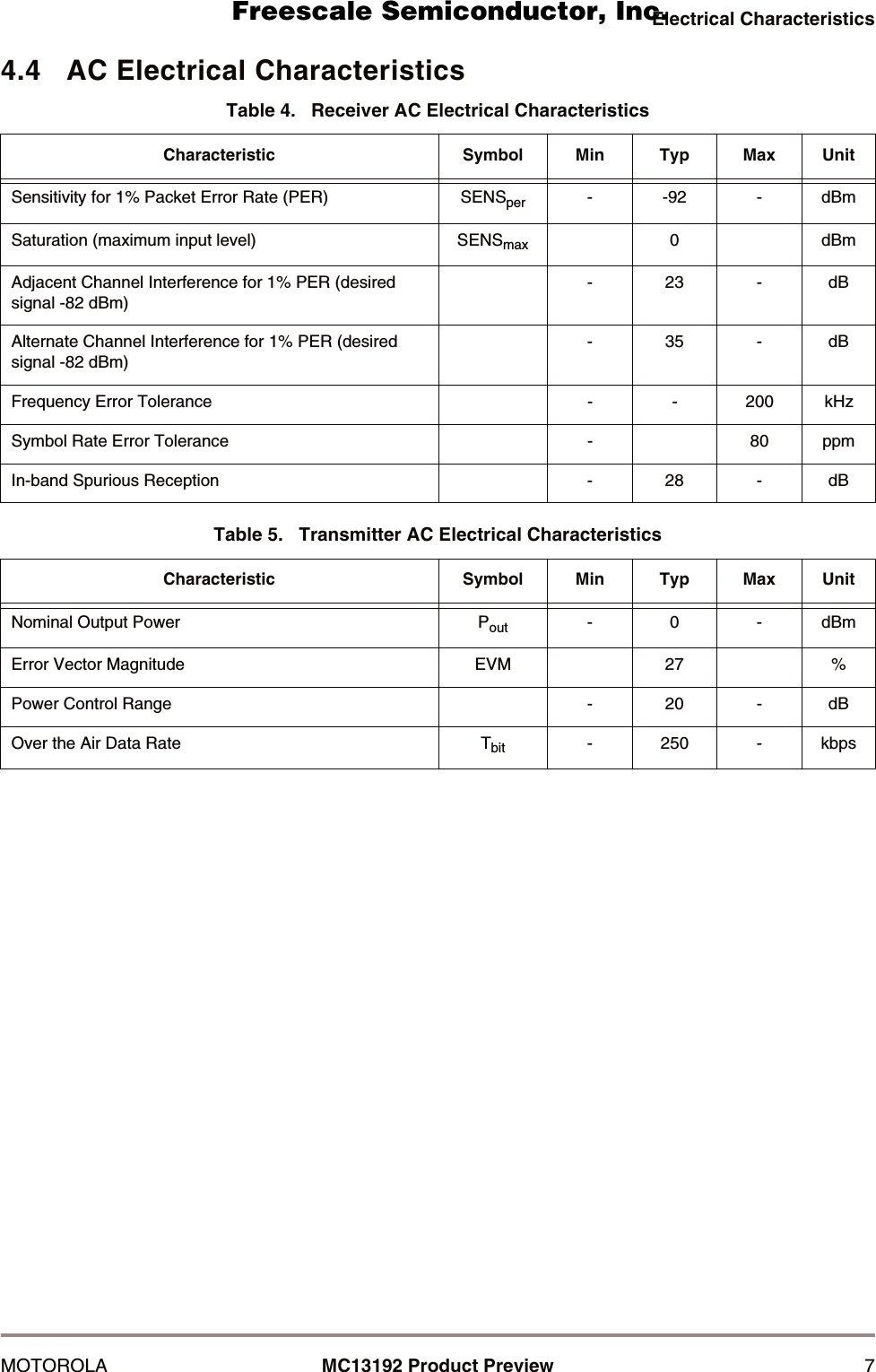
Electrical CharacteristicsMOTOROLA MC13192 Product Preview 74.4   AC Electrical CharacteristicsTable 4.   Receiver AC Electrical CharacteristicsCharacteristic Symbol Min Typ Max UnitSensitivity for 1% Packet Error Rate (PER) SENSper --92-dBmSaturation (maximum input level) SENSmax 0dBmAdjacent Channel Interference for 1% PER (desired signal -82 dBm)-23-dBAlternate Channel Interference for 1% PER (desired signal -82 dBm)-35-dBFrequency Error Tolerance - - 200 kHzSymbol Rate Error Tolerance - 80 ppmIn-band Spurious Reception - 28 - dBTable 5.   Transmitter AC Electrical CharacteristicsCharacteristic Symbol Min Typ Max UnitNominal Output Power Pout -0-dBmError Vector Magnitude EVM 27 %Power Control Range - 20 - dBOver the Air Data Rate Tbit - 250 - kbps      Freescale Semiconductor, I                                               Freescale Semiconductor, Inc.  nc...
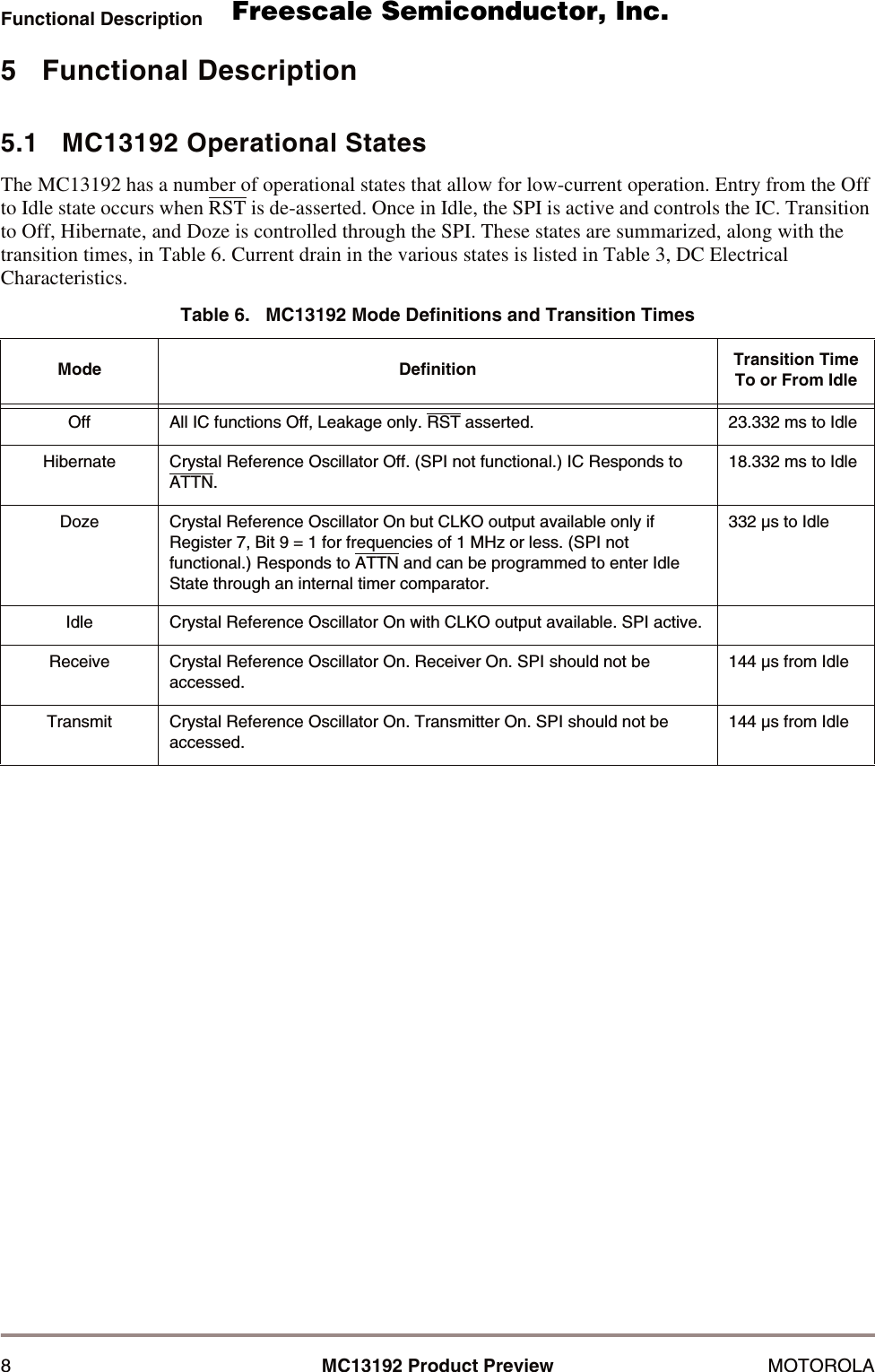
8MC13192 Product Preview MOTOROLAFunctional Description5   Functional Description5.1   MC13192 Operational StatesThe MC13192 has a number of operational states that allow for low-current operation. Entry from the Off to Idle state occurs when RST is de-asserted. Once in Idle, the SPI is active and controls the IC. Transition to Off, Hibernate, and Doze is controlled through the SPI. These states are summarized, along with the transition times, in Table 6. Current drain in the various states is listed in Table 3, DC Electrical Characteristics.Table 6.   MC13192 Mode Definitions and Transition TimesMode Definition Transition TimeTo or From IdleOff All IC functions Off, Leakage only. RST asserted. 23.332 ms to IdleHibernate Crystal Reference Oscillator Off. (SPI not functional.) IC Responds to ATTN.18.332 ms to IdleDoze Crystal Reference Oscillator On but CLKO output available only if Register 7, Bit 9 = 1 for frequencies of 1 MHz or less. (SPI not functional.) Responds to ATTN and can be programmed to enter Idle State through an internal timer comparator. 332 µs to IdleIdle Crystal Reference Oscillator On with CLKO output available. SPI active.Receive Crystal Reference Oscillator On. Receiver On. SPI should not be accessed.144 µs from IdleTransmit Crystal Reference Oscillator On. Transmitter On. SPI should not be accessed.144 µs from Idle      Freescale Semiconductor, I                                               Freescale Semiconductor, Inc.  nc...
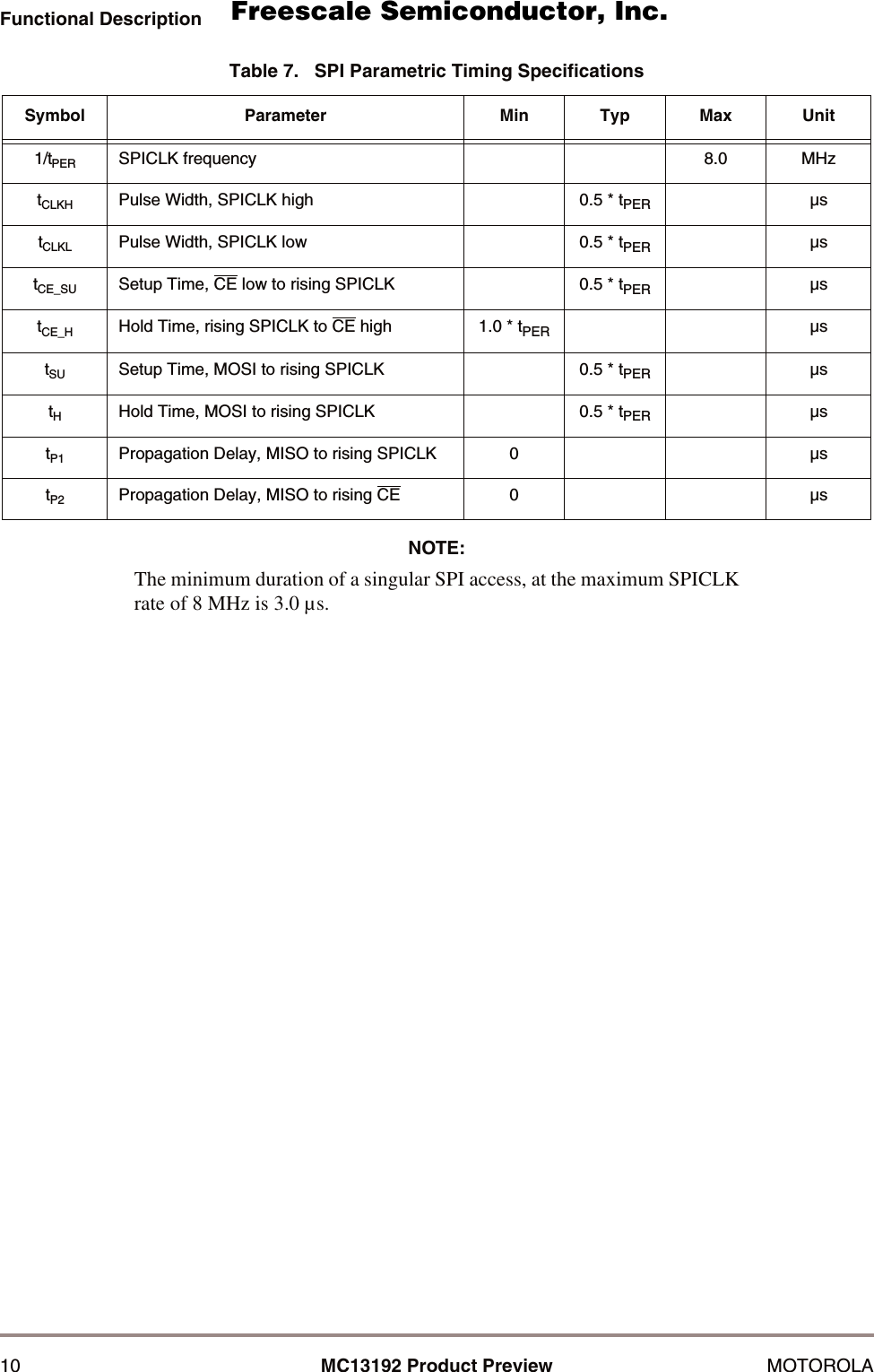
Functional DescriptionMOTOROLA MC13192 Product Preview 95.2   Serial Peripheral Interface (SPI)Control of the MC13192 and data transfers are accomplished by means of a 4-wire Serial Peripheral Interface (SPI). This section details the operation of the SPI.5.2.1   GeneralThe MC13192 operates as a slave device only. Data to be written into the IC is presented on the Master Out/Slave In (MOSI) pin of the device, while data read from the device is presented to the master device on the Master In/Slave Out (MISO) pin. Synchronization of the data is accomplished by the return-to-zero Serial Clock (SPICLK) input and is framed by the Chip Enable (CE) pin. Data on MOSI is always clocked into the IC on the leading edge of SPICLK and data is clocked out of the IC at MISO on the falling edge of SPICLK. The master device should transfer MISO data to its internal registers on the trailing edge of SPICLK. A typical interconnection to a microprocessor is shown in Figure 4.Figure 4.   SPI InterfaceMISO is an active output and as such, does not enter a high impedance state at any time regardless of the state of CE.Although the SPI is fully static, internal memory, timer and interrupt arbiters require an internal clock, CLKcore, derived from the crystal reference oscillator, to communicate from the SPI registers to internal registers and memory. Figure 5 and Table 7 show the SPI timing diagram and timing specifications.Figure 5.   SPI Parametric Timing Diagram.Shift RegisterBaud RateGeneratorShift RegisterChip Enable (CE)RxD MISOTxD MOSISclk SPICLKMCU MC13192CEMISOSPICLKCEtPERtCLKH tCLKLtCE_SUMOSI Addr 1R/WRead 0tSU tHtSU tHtP1 tP1Write 0Read 1tCE_HtSU tH      Freescale Semiconductor, I                                               Freescale Semiconductor, Inc.  nc...
10 MC13192 Product Preview MOTOROLAFunctional DescriptionNOTE:The minimum duration of a singular SPI access, at the maximum SPICLKrate of 8 MHz is 3.0 µs.Table 7.   SPI Parametric Timing SpecificationsSymbol Parameter Min Typ Max Unit1/tPER SPICLK frequency 8.0 MHztCLKH Pulse Width, SPICLK high 0.5 * tPER µstCLKL Pulse Width, SPICLK low 0.5 * tPER µstCE_SU Setup Time, CE low to rising SPICLK 0.5 * tPER µstCE_H Hold Time, rising SPICLK to CE high 1.0 * tPER µstSU Setup Time, MOSI to rising SPICLK 0.5 * tPER µstHHold Time, MOSI to rising SPICLK 0.5 * tPER µstP1 Propagation Delay, MISO to rising SPICLK 0µstP2 Propagation Delay, MISO to rising CE 0µs      Freescale Semiconductor, I                                               Freescale Semiconductor, Inc.  nc...
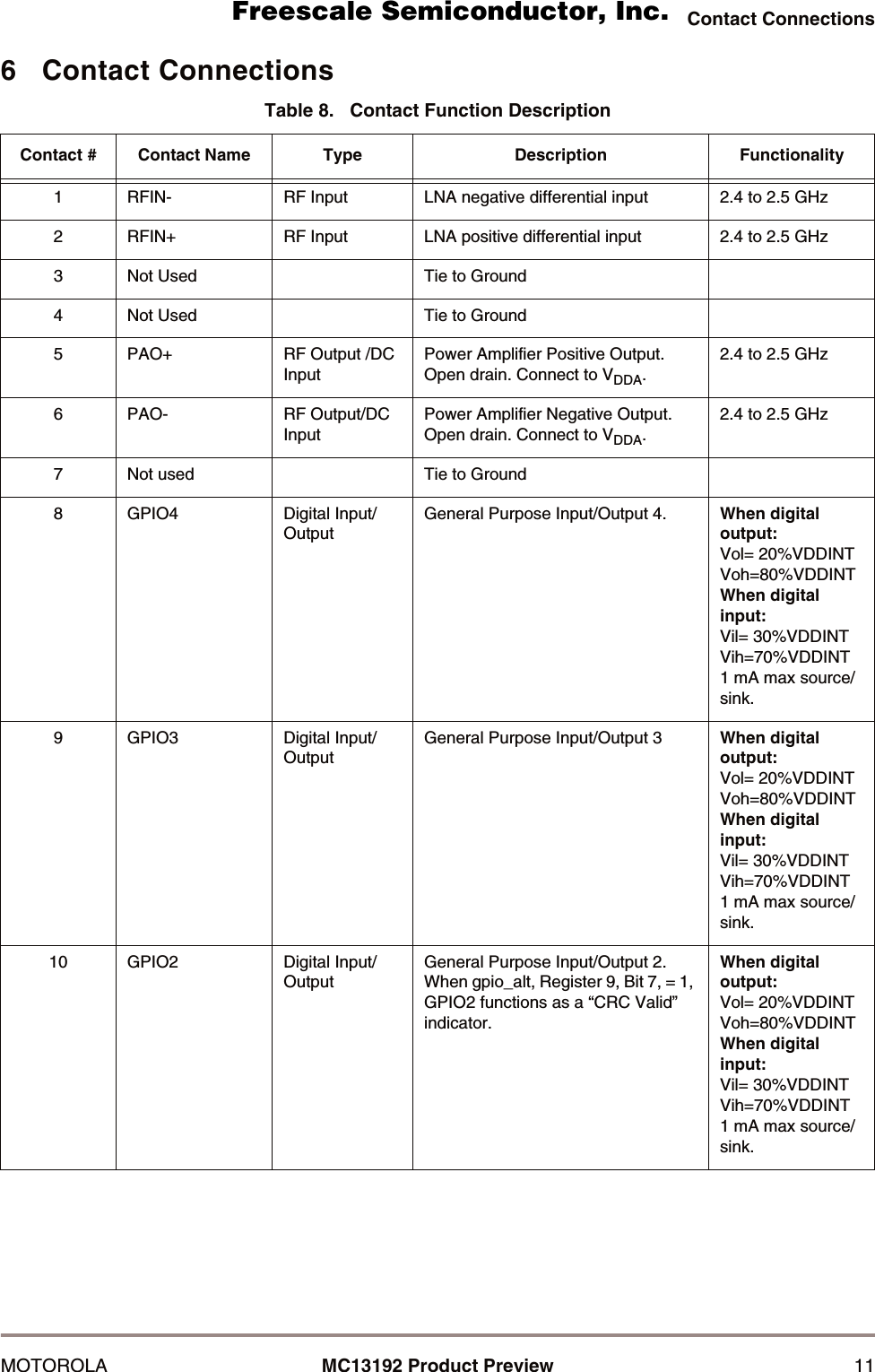
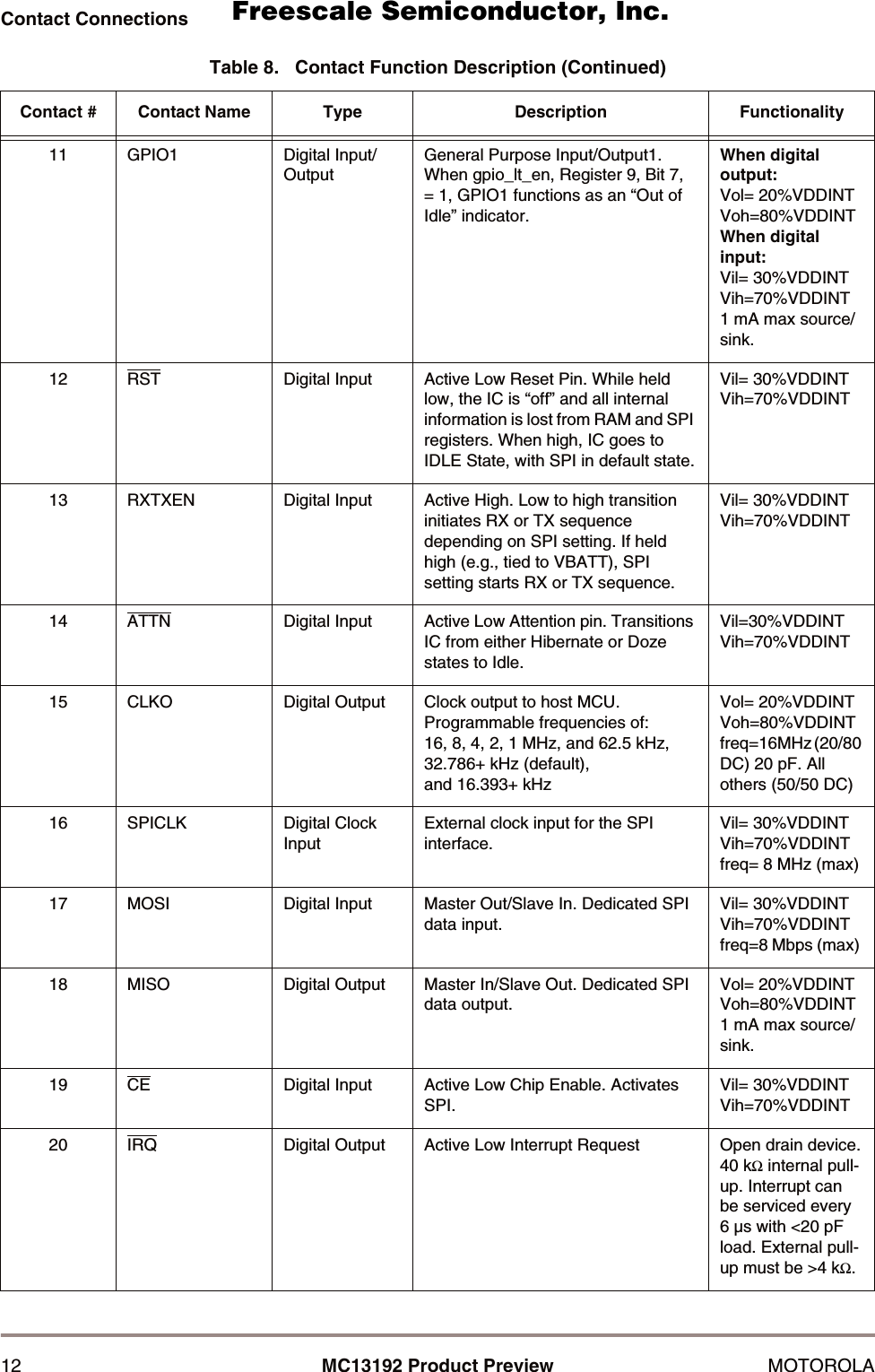
Contact ConnectionsMOTOROLA MC13192 Product Preview 116   Contact ConnectionsTable 8.   Contact Function DescriptionContact # Contact Name Type Description Functionality1RFIN- RF Input LNA negative differential input 2.4 to 2.5 GHz2RFIN+ RF Input LNA positive differential input 2.4 to 2.5 GHz3Not Used Tie to Ground4Not Used Tie to Ground5PAO+ RF Output /DC InputPower Amplifier Positive Output. Open drain. Connect to VDDA.2.4 to 2.5 GHz6PAO- RF Output/DC InputPower Amplifier Negative Output. Open drain. Connect to VDDA.2.4 to 2.5 GHz7Not used Tie to Ground8GPIO4 Digital Input/ OutputGeneral Purpose Input/Output 4. When digital output:Vol= 20%VDDINTVoh=80%VDDINTWhen digital input:Vil= 30%VDDINTVih=70%VDDINT1 mA max source/ sink.9GPIO3 Digital Input/ OutputGeneral Purpose Input/Output 3 When digital output:Vol= 20%VDDINTVoh=80%VDDINTWhen digital input:Vil= 30%VDDINTVih=70%VDDINT1 mA max source/ sink.10 GPIO2 Digital Input/ Output General Purpose Input/Output 2. When gpio_alt, Register 9, Bit 7, = 1, GPIO2 functions as a “CRC Valid” indicator.When digital output:Vol= 20%VDDINTVoh=80%VDDINTWhen digital input:Vil= 30%VDDINTVih=70%VDDINT1 mA max source/sink.      Freescale Semiconductor, I                                               Freescale Semiconductor, Inc.  nc...
12 MC13192 Product Preview MOTOROLAContact Connections11 GPIO1 Digital Input/ Output General Purpose Input/Output1. When gpio_lt_en, Register 9, Bit 7, = 1, GPIO1 functions as an “Out of Idle” indicator.When digital output:Vol= 20%VDDINTVoh=80%VDDINTWhen digital input:Vil= 30%VDDINTVih=70%VDDINT1 mA max source/ sink.12 RST Digital Input Active Low Reset Pin. While held low, the IC is “off” and all internal information is lost from RAM and SPI registers. When high, IC goes to IDLE State, with SPI in default state.Vil= 30%VDDINTVih=70%VDDINT13 RXTXEN Digital Input Active High. Low to high transition initiates RX or TX sequence depending on SPI setting. If held high (e.g., tied to VBATT), SPI setting starts RX or TX sequence.Vil= 30%VDDINTVih=70%VDDINT14 ATTN Digital Input Active Low Attention pin. Transitions IC from either Hibernate or Doze states to Idle. Vil=30%VDDINTVih=70%VDDINT15 CLKO Digital Output Clock output to host MCU. Programmable frequencies of:16, 8, 4, 2, 1 MHz, and 62.5 kHz, 32.786+ kHz (default),and 16.393+ kHz Vol= 20%VDDINTVoh=80%VDDINTfreq=16MHz (20/80 DC) 20 pF. All others (50/50 DC)16 SPICLK Digital Clock InputExternal clock input for the SPI interface. Vil= 30%VDDINTVih=70%VDDINTfreq= 8 MHz (max) 17 MOSI Digital Input Master Out/Slave In. Dedicated SPI data input.Vil= 30%VDDINTVih=70%VDDINTfreq=8 Mbps (max) 18 MISO Digital Output Master In/Slave Out. Dedicated SPI data output.Vol= 20%VDDINTVoh=80%VDDINT1 mA max source/ sink.19 CE Digital Input Active Low Chip Enable. Activates SPI.Vil= 30%VDDINTVih=70%VDDINT20 IRQ Digital Output Active Low Interrupt Request Open drain device.40 kΩ internal pull-up. Interrupt can be serviced every 6 µs with <20 pF load. External pull-up must be >4 kΩ.Table 8.   Contact Function Description (Continued)Contact # Contact Name Type Description Functionality      Freescale Semiconductor, I                                               Freescale Semiconductor, Inc.  nc...
Contact ConnectionsMOTOROLA MC13192 Product Preview 1321 VDDD Bypass Digital supply bypass Decouple 0.1 to 0.47 µF to ground.22 VDDINT Input Digital interface supply & digital regulator input – Connect to Battery2.0 to 3.4 V Decouple 0.47 to 1 µF to ground.23 GPIO5 Digital Input/OutputGeneral Purpose Input/Output 5 When digital output:Vol= 20%VDDINTVoh=80%VDDINTWhen digital input:Vil= 30%VDDINTVih=70%VDDINT1 mA max source/ sink.24 GPIO6 Digital Input/OutputGeneral Purpose Input/Output 6 When digital output:Vol= 20%VDDINTVoh=80%VDDINTWhen digital input:Vil= 30%VDDINTVih=70%VDDINT1 mA max source/ sink.25 GPIO7 Digital Input/OutputGeneral Purpose Input/Output 7 When digital output:Vol= 20%VDDINTVoh=80%VDDINTWhen digital input:Vil= 30%VDDINTVih=70%VDDINT1 mA max source/ sink.26 Crystal1 Input Crystal Reference oscillator input Connect to 16 MHz crystal and load capacitor27 Crystal2 Input/Output Crystal Reference oscillator outputNote: Do not load this pin by using it as a 16 MHz source. Measure 16 MHz output at Contact 15, CLKO, programmed for 16 MHz. See the MC13192 Reference Manual for details.Connect to 16 MHz crystal and load capacitor28 VDDLO2 Input/Bypass LO2 VDD supply - Connect to VDDA externallyDecouple 100 to 1000 pF to groundTable 8.   Contact Function Description (Continued)Contact # Contact Name Type Description Functionality      Freescale Semiconductor, I                                               Freescale Semiconductor, Inc.  nc...
14 MC13192 Product Preview MOTOROLAContact ConnectionsFigure 6.   Contact Connections (Top View)29 VDDLO1 Input/Bypass LO1 VDD supply pad - Connect to VDDA externallyDecouple 100 to 1000 pF to ground30 VDDVCO Bypass VCO regulated supply bypass Decouple 100 to 1000 pF to ground31 VBATT Input Analog voltage regulators Input -Connect to BatteryDecouple 1 µF and 100 pF ground32 VDDA Output Analog regulated supply Output – Connect to VDDLO1 and VDDLO2 externallyDecouple 100 to 1000 pF to groundEP Ground External paddle / flag ground Connect to groundTable 8.   Contact Function Description (Continued)Contact # Contact Name Type Description FunctionalityRFIN-RFIN+PAO+PAO-GPIO4GPIO3GPIO2GPIO1RSTRXTXENATTNCLKOSPICLKMOSIMISOCEIRQVDDDVDDINTGPIO5GPIO6XTAL1XTAL2VDDLO2VDDLO1VDDVCOVBATTVDDAGPIO7MC13192Not UsedNot Used12345678242322212019181791011121314151632 31 30 29 28 27 26 25Not Used GND      Freescale Semiconductor, I                                               Freescale Semiconductor, Inc.  nc...
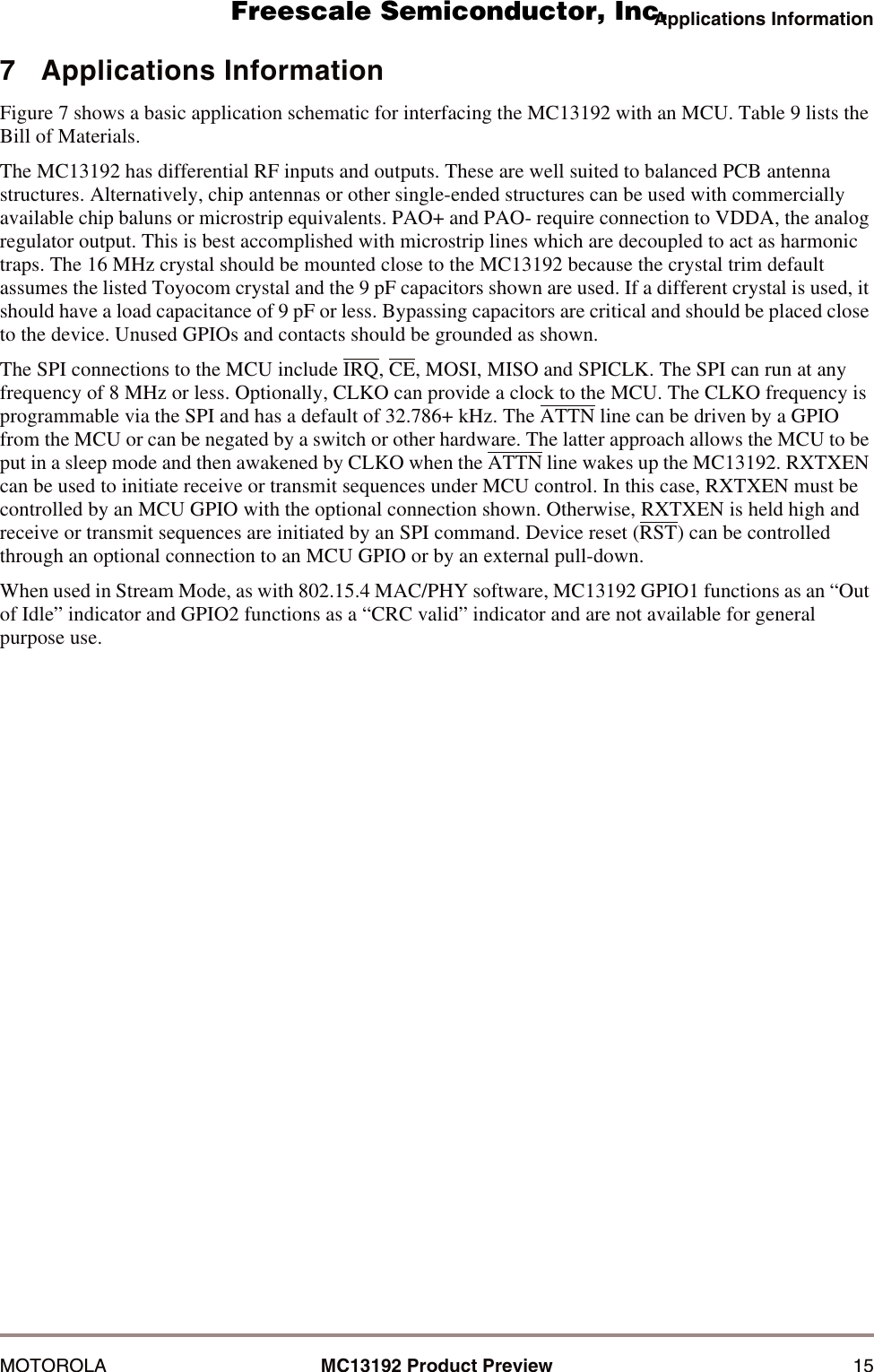
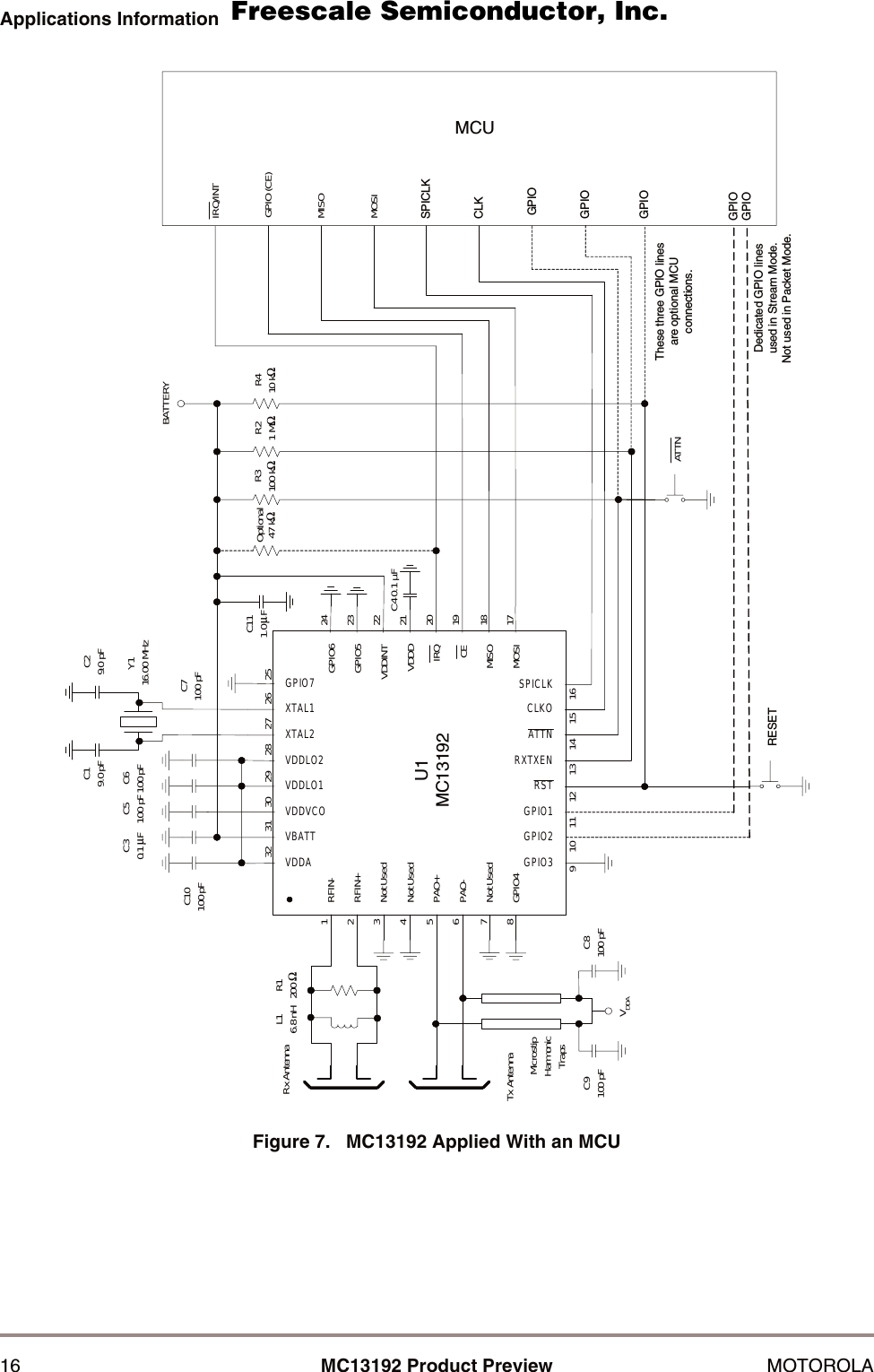
Applications InformationMOTOROLA MC13192 Product Preview 157   Applications InformationFigure 7 shows a basic application schematic for interfacing the MC13192 with an MCU. Table 9 lists the Bill of Materials.The MC13192 has differential RF inputs and outputs. These are well suited to balanced PCB antenna structures. Alternatively, chip antennas or other single-ended structures can be used with commercially available chip baluns or microstrip equivalents. PAO+ and PAO- require connection to VDDA, the analog regulator output. This is best accomplished with microstrip lines which are decoupled to act as harmonic traps. The 16 MHz crystal should be mounted close to the MC13192 because the crystal trim default assumes the listed Toyocom crystal and the 9 pF capacitors shown are used. If a different crystal is used, it should have a load capacitance of 9 pF or less. Bypassing capacitors are critical and should be placed close to the device. Unused GPIOs and contacts should be grounded as shown.The SPI connections to the MCU include IRQ, CE, MOSI, MISO and SPICLK. The SPI can run at any frequency of 8 MHz or less. Optionally, CLKO can provide a clock to the MCU. The CLKO frequency is programmable via the SPI and has a default of 32.786+ kHz. The ATTN line can be driven by a GPIO from the MCU or can be negated by a switch or other hardware. The latter approach allows the MCU to be put in a sleep mode and then awakened by CLKO when the ATTN line wakes up the MC13192. RXTXEN can be used to initiate receive or transmit sequences under MCU control. In this case, RXTXEN must be controlled by an MCU GPIO with the optional connection shown. Otherwise, RXTXEN is held high and receive or transmit sequences are initiated by an SPI command. Device reset (RST) can be controlled through an optional connection to an MCU GPIO or by an external pull-down.When used in Stream Mode, as with 802.15.4 MAC/PHY software, MC13192 GPIO1 functions as an “Out of Idle” indicator and GPIO2 functions as a “CRC valid” indicator and are not available for general purpose use.      Freescale Semiconductor, I                                               Freescale Semiconductor, Inc.  nc...
16 MC13192 Product Preview MOTOROLAApplications InformationFigure 7.   MC13192 Applied With an MCURFIN-RFIN+PAO+PAO-GPIO4GPIO3GPIO2GPIO1RSTRXTXENATTNCLKOSPICLKMOSIMISOCEIRQVDDDVDDINTGPIO5GPIO6XTAL1XTAL2VDDLO2VDDLO1VDDVCOVBATTVDDAGPIO7R1200 ΩC19.0 pF C29.0 pFC30.1 µFC10100 pFC5100 pF C6100 pFC7100 pFC4 0.1 µFIRQ/INTGPIO (CE)MISOMOSISPICLKCLKGPIOGPIORESETU1MC13192MCUTx AntennaRx AntennaVDDANot UsedNot UsedNot Used12345678242322212019181791011121314151632 31 30 29 28 27 26 25C111.0 µFBATTERYY116.00 MHzOptional47 kΩR3100 kΩR21 MΩR410 kΩGPIOL16.8 nHMicrostipHarmonicTrapsC9100 pF C8100 pFATTNThese three GPIO linesare optional MCUconnections.GPIOGPIODedicated GPIO linesused in Stream Mode.Not used in Packet Mode.      Freescale Semiconductor, I                                               Freescale Semiconductor, Inc.  nc...
Applications InformationMOTOROLA MC13192 Product Preview 17Table 9.   MC13192 to MCU Bill of Materials (BOM)Item Number Label/Value Attributes Designation19 pFSMD0201C129 pFSMD0201C23 0.1 uF SMD0201 C34 0.1 uF SMD0201 C45 100 pF SMD0201 C56 100 pF SMD0201 C67 100 pF SMD0201 C78 100 pF SMD0201 C89 100 pF SMD0201 C910 100 pF SMD0201 C1011 1.0 uF SMD0201 C1112 6.8 nH SMD0201 L113 200 ΩSMD0201 R114 1 MΩSMD0201 R215 100 kΩSMD0201 R316 10 kΩSMD0201 R417 MC13192 QFN U118 16.000 MHz TOYOCOMTSX-10A, 9 pF loadY1      Freescale Semiconductor, I                                               Freescale Semiconductor, Inc.  nc...
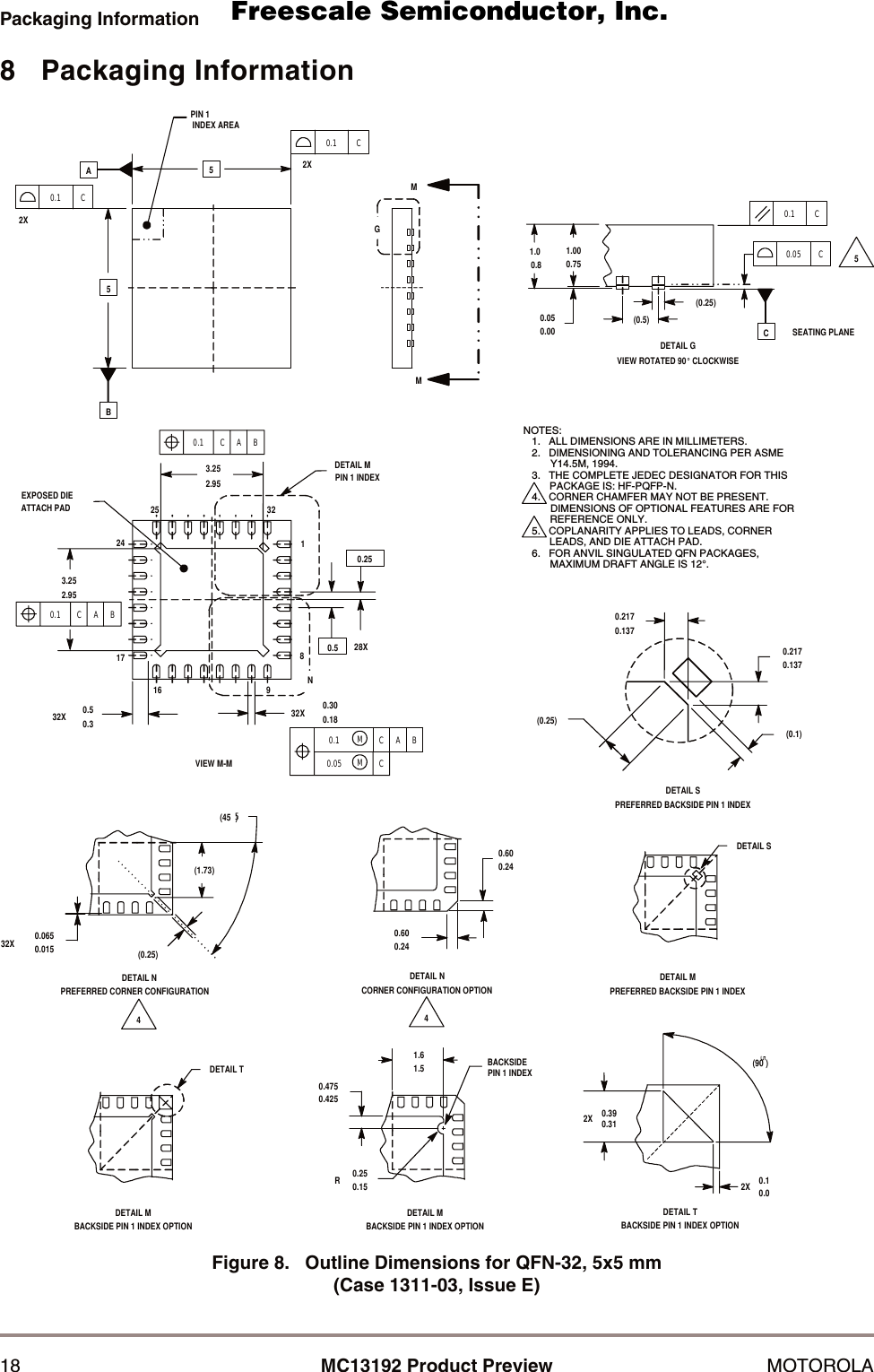
18 MC13192 Product Preview MOTOROLAPackaging Information8   Packaging InformationFigure 8.   Outline Dimensions for QFN-32, 5x5 mm(Case 1311-03, Issue E)NEXPOSED DIEATTACH PAD2.952581323.2532X 0.180.30241716 90.5M0.1 CM0.05 CA B32X 0.50.3C0.1 A BC0.1 A BVIEW M-M0.2528XDETAIL MPIN 1 INDEX2.953.25PIN 1INDEX AREA5BC0.12X2XC0.1A5GMM1.0 1.000.05C0.1C0.05CSEATING PLANE5DETAIL GVIEW ROTATED 90° CLOCKWISE(0.5)(0.25)0.8 0.750.00(1.73)(0.25)0.06532X 0.015(45  )54PREFERRED CORNER CONFIGURATIONDETAIL N0.600.240.600.244DETAIL NCORNER CONFIGURATION OPTIONDETAIL TDETAIL MBACKSIDE PIN 1 INDEX OPTIONDETAIL TBACKSIDE PIN 1 INDEX OPTION(90 )52X2X 0.390.310.10.0DETAIL MBACKSIDE PIN 1 INDEX OPTION1.60.4750.4251.5 BACKSIDEPIN 1 INDEX0.250.15RDETAIL SDETAIL MPREFERRED BACKSIDE PIN 1 INDEX0.2170.137(0.25)0.2170.137(0.1)DETAIL SPREFERRED BACKSIDE PIN 1 INDEXNOTES:   1.   ALL DIMENSIONS ARE IN MILLIMETERS.   2.   DIMENSIONING AND TOLERANCING PER ASMEY14.5M, 1994.   3.   THE COMPLETE JEDEC DESIGNATOR FOR THISPACKAGE IS: HF-PQFP-N.   4.   CORNER CHAMFER MAY NOT BE PRESENT.DIMENSIONS OF OPTIONAL FEATURES ARE FORREFERENCE ONLY.   5.   COPLANARITY APPLIES TO LEADS, CORNERLEADS, AND DIE ATTACH PAD.   6.   FOR ANVIL SINGULATED QFN PACKAGES,MAXIMUM DRAFT ANGLE IS 12°.      Freescale Semiconductor, I                                               Freescale Semiconductor, Inc.  nc...
MOTOROLA MC13192 Product Preview 19NOTES      Freescale Semiconductor, I                                               Freescale Semiconductor, Inc.  nc...
MC13192/DHOW TO REACH US:USA/EUROPE/LOCATIONS NOT LISTED:Motorola Literature Distribution; P.O. Box 5405, Denver, Colorado 80217 1-303-675-2140 or 1-800-441-2447JAPAN:Motorola Japan Ltd.; SPS, Technical Information Center, 3-20-1, Minami-Azabu Minato-ku, Tokyo 106-8573 Japan81-3-3440-3569ASIA/PACIFIC:Motorola Semiconductors H.K. Ltd.; Silicon Harbour Centre, 2 Dai King Street, Tai Po Industrial Estate, Tai Po, N.T., Hong Kong852-26668334TECHNICAL INFORMATION CENTER:1-800-521-6274HOME PAGE: http://www.motorola.com/semiconductorsInformation in this document is provided solely to enable system and software implementers to use Motorola products. There are no express or implied copyright licenses granted hereunder to design or fabricate any integrated circuits or integrated circuits based on the information in this document.Motorola reserves the right to make changes without further notice to any products herein. Motorola makes no warranty, representation or guarantee regarding the suitability of its products for any particular purpose, nor does Motorola assume any liability arising out of the application or use of any product or circuit, and specifically disclaims any and all liability, including without limitation consequential or incidental damages. “Typical” parameters which may be provided in Motorola data sheets and/or specifications can and do vary in different applications and actual performance may vary over time. All operating parameters, including “Typicals” must be validated for each customer application by customer’s technical experts. Motorola does not convey any license under its patent rights nor the rights of others. Motorola products are not designed, intended, or authorized for use as components in systems intended for surgical implant into the body, or other applications intended to support or sustain life, or for any other application in which the failure of the Motorola product could create a situation where personal injury or death may occur. Should Buyer purchase or use Motorola products for any such unintended or unauthorized application, Buyer shall indemnify and hold Motorola and its officers, employees, subsidiaries, affiliates, and distributors harmless against all claims, costs, damages, and expenses, and reasonable attorney fees arising out of, directly or indirectly, any claim of personal injury or death associated with such unintended or unauthorized use, even if such claim alleges that Motorola was negligent regarding the design or manufacture of the part.Motorola and the Stylized M Logo are registered in the U.S. Patent and Trademark Office. All other product or service names are the property of their respective owners. Motorola, Inc. is an Equal Opportunity/Affirmative Action Employer.© Motorola, Inc. 2004      Freescale Semiconductor, I                                               Freescale Semiconductor, Inc.  nc...

Navigation menu