Dongguan Digital AV Technology WUS13 WiFi/BT Combo Module User Manual 10

Dongguan Digital AV Technology Corp., Ltd. WiFi/BT Combo Module 10

10 user manual

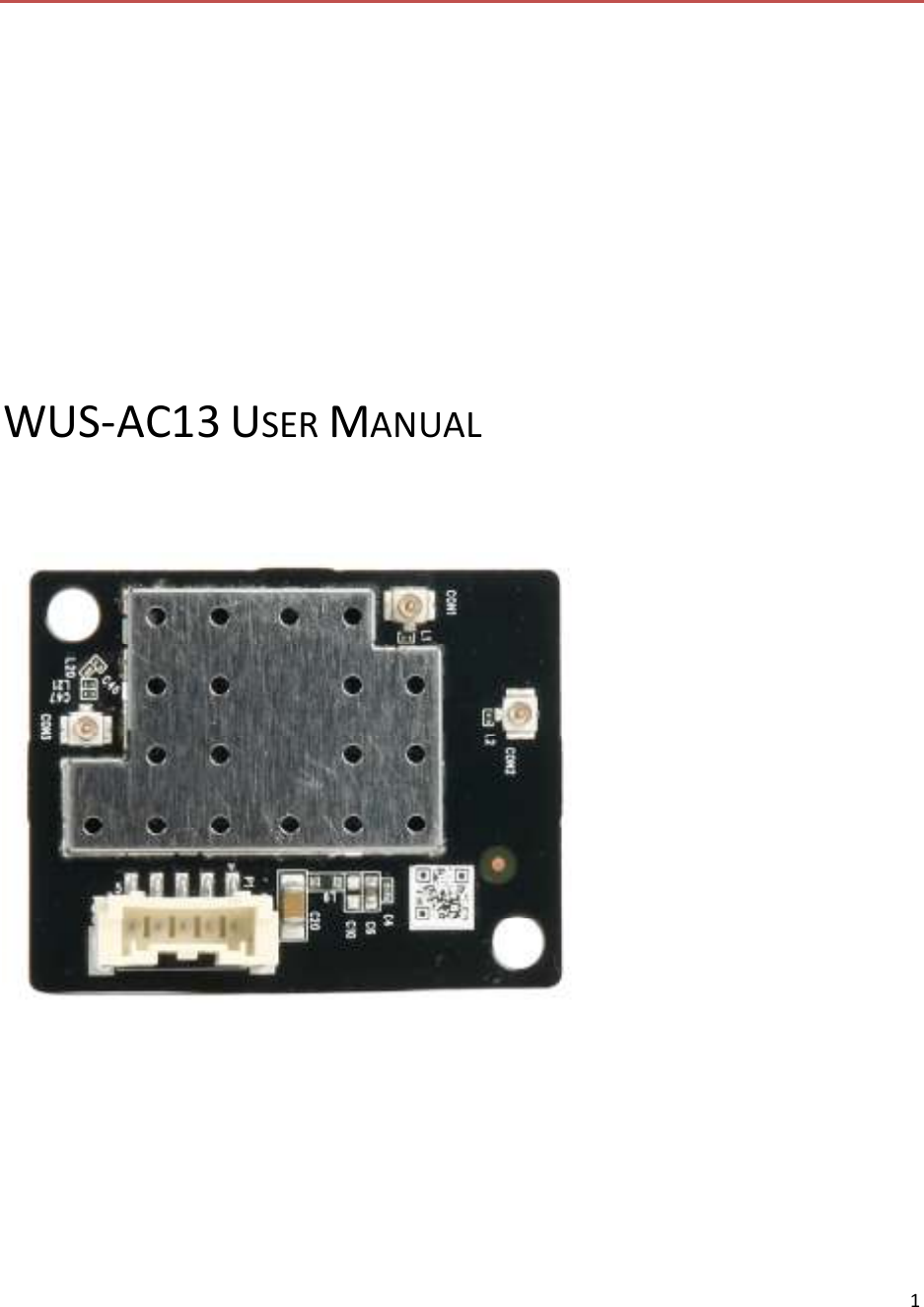
 1    WUS-AC13 USER MANUAL
 2 CONTENTS  Introduction ......................................................................................................................................... 3  Specifications ....................................................................................................................................... 3  Wi-Fi driver installation – Linux OS ...................................................................................................... 4  Regulatory Warning Statements ......................................................................................................... 5  Integrator Instructions ........................................................................................................................ 8
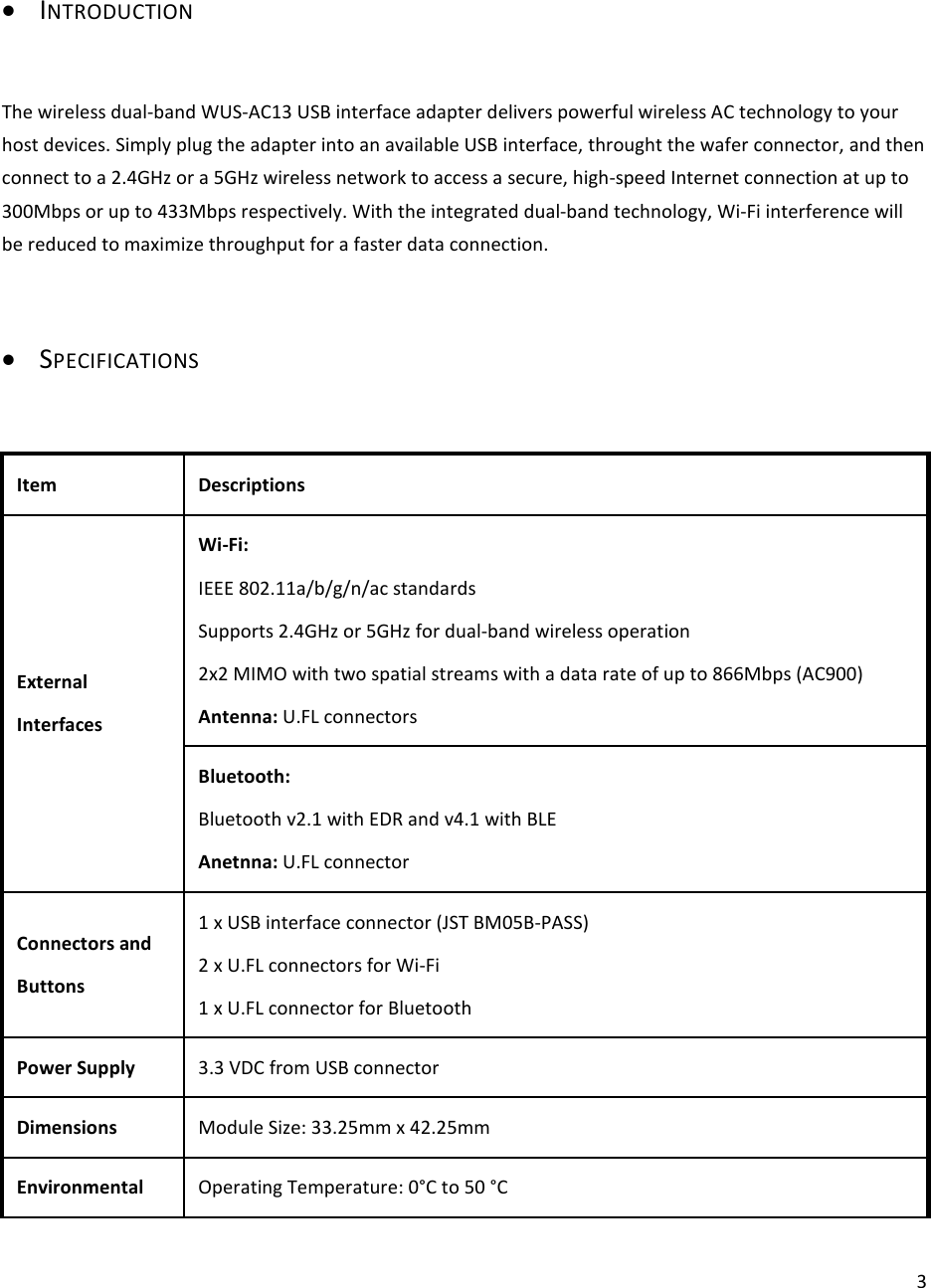
 3• INTRODUCTION  The wireless dual-band WUS-AC13 USB interface adapter delivers powerful wireless AC technology to your host devices. Simply plug the adapter into an available USB interface, throught the wafer connector, and then connect to a 2.4GHz or a 5GHz wireless network to access a secure, high-speed Internet connection at up to 300Mbps or up to 433Mbps respectively. With the integrated dual-band technology, Wi-Fi interference will be reduced to maximize throughput for a faster data connection.  • SPECIFICATIONS  Item Descriptions External Interfaces Wi-Fi: IEEE 802.11a/b/g/n/ac standards Supports 2.4GHz or 5GHz for dual-band wireless operation 2x2 MIMO with two spatial streams with a data rate of up to 866Mbps (AC900) Antenna: U.FL connectors Bluetooth: Bluetooth v2.1 with EDR and v4.1 with BLE Anetnna: U.FL connector Connectors and Buttons 1 x USB interface connector (JST BM05B-PASS) 2 x U.FL connectors for Wi-Fi 1 x U.FL connector for Bluetooth Power Supply  3.3 VDC from USB connector Dimensions  Module Size: 33.25mm x 42.25mm Environmental  Operating Temperature: 0°C to 50 °C
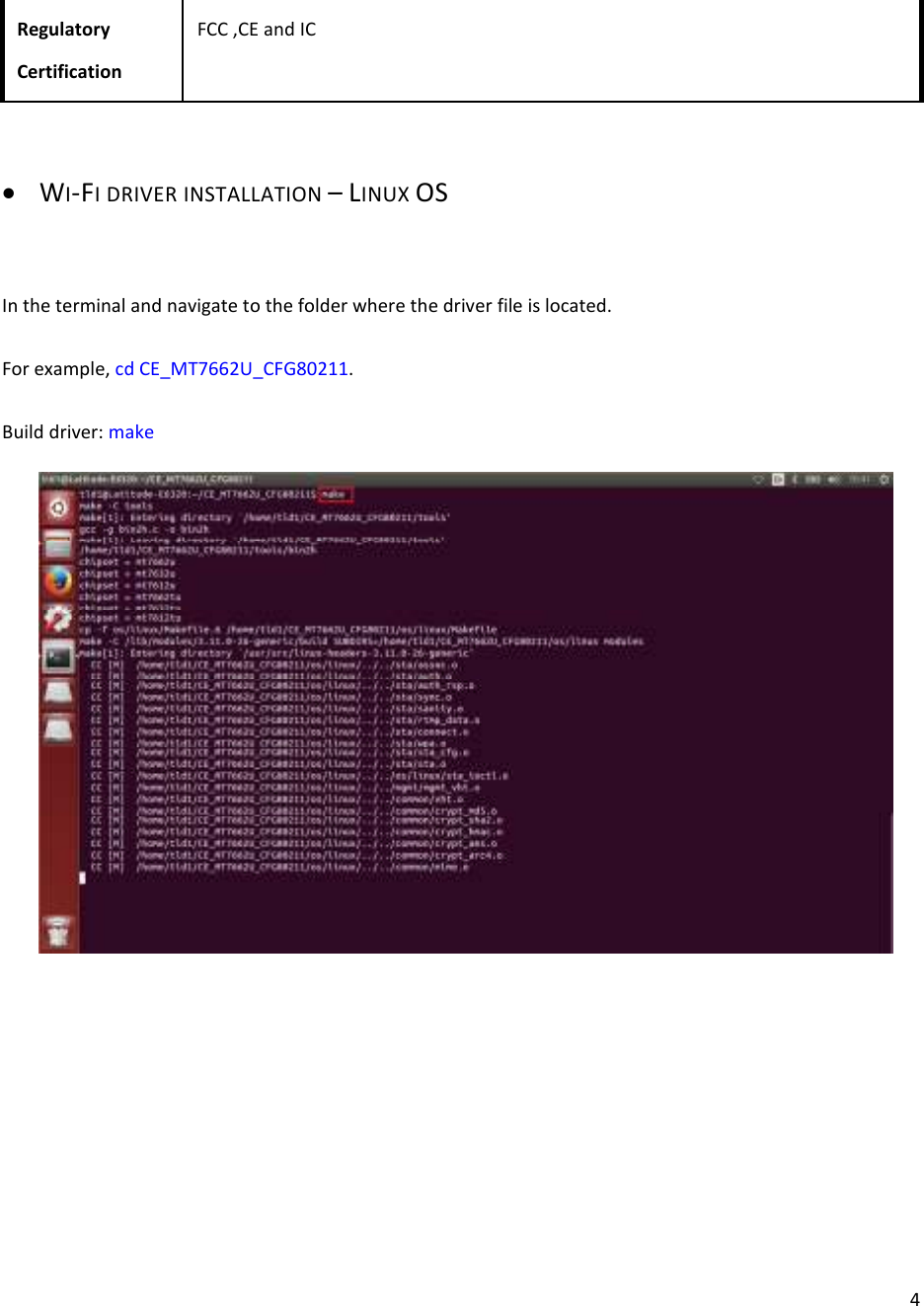
 4Regulatory Certification FCC ,CE and IC  • WI-FI DRIVER INSTALLATION – LINUX OS  In the terminal and navigate to the folder where the driver file is located.   For example, cd CE_MT7662U_CFG80211. Build driver: make
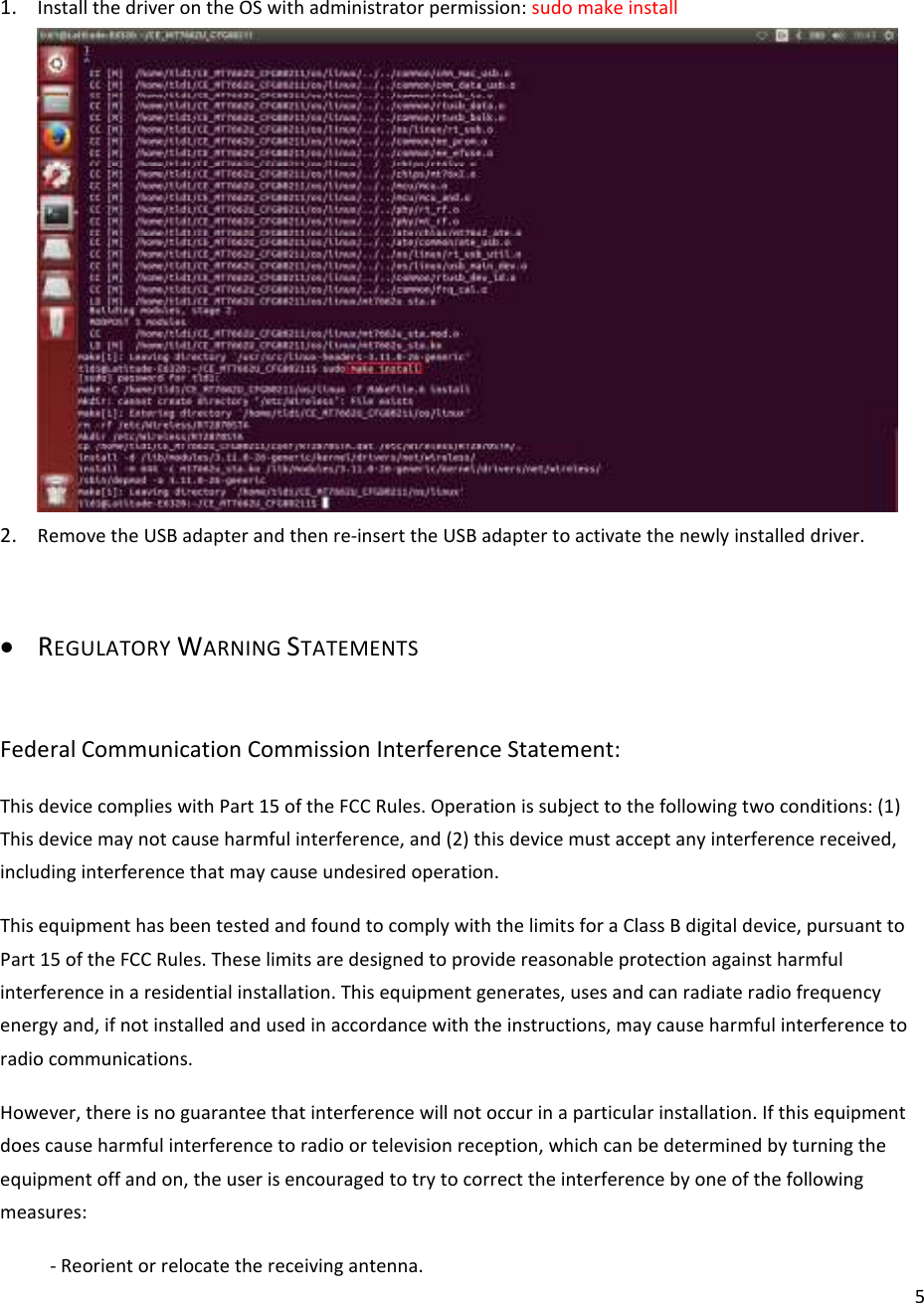
 51. Install the driver on the OS with administrator permission: sudo make install  2. Remove the USB adapter and then re-insert the USB adapter to activate the newly installed driver.  • REGULATORY WARNING STATEMENTS  Federal Communication Commission Interference Statement: This device complies with Part 15 of the FCC Rules. Operation is subject to the following two conditions: (1) This device may not cause harmful interference, and (2) this device must accept any interference received, including interference that may cause undesired operation. This equipment has been tested and found to comply with the limits for a Class B digital device, pursuant to Part 15 of the FCC Rules. These limits are designed to provide reasonable protection against harmful interference in a residential installation. This equipment generates, uses and can radiate radio frequency energy and, if not installed and used in accordance with the instructions, may cause harmful interference to radio communications. However, there is no guarantee that interference will not occur in a particular installation. If this equipment does cause harmful interference to radio or television reception, which can be determined by turning the equipment off and on, the user is encouraged to try to correct the interference by one of the following measures: - Reorient or relocate the receiving antenna.
 6- Increase the separation between the equipment and receiver. - Connect the equipment into an outlet on a circuit different from that to which the receiver is connected. - Consult the dealer or an experienced radio/TV technician for help.  FCC Caution: Any changes or modifications not expressly approved by the party responsible for compliance could void the user’s authority to operate this equipment. This transmitter must not be co-located or operating in conjunction with any other antenna or transmitter. For operation within the 5.15 ~ 5.25GHz and 5.47 ~5.725GHz frequency range, it is restricted to indoor environment. This device meets all the other requirements specified in Part 15E, Section 15.407 of the FCC Rules.  Radiation Exposure Statement: The product comply with the FCC portable RF exposure limit set forth for an uncontrolled environment and are safe for intended operation as described in this manual. The further RF exposure reduction can be achieved if the product can be kept as far as possible from the user body or set the device to lower output power if such function is available.  Industry Canada statement: This device complies with RSS-210 of the Industry Canada Rules. Operation is subject to the following two conditions: (1) This device may not cause harmful interference, and (2) this device must accept any interference received, including interference that may cause undesired operation. Ce dispositif est conforme a la norme CNR-210 d’Industrie Canada applicable aux appareils radio exempts de licence. Son fonctionnement est sujet aux deux conditions suivantes: (1) le dispositif ne doit pas produire de brouillage prejudiciable, et (2) ce dispositif doit accepter tout brouillage recuy compris un brouillage susceptible de provoquer un fonctionnement indesirable.
 7Caution: The device operating in the wireless radio frequency of 5150-5250 MHz is only for indoor use to reduce potential harmful interference to co-channeled mobile satellite systems. The maximum antenna gain permitted for devices in the bands 5250-5350 MHz and 5470-5725 MHz shall comply with the e.i.r.p. limit; and the maximum antenna gain permitted for devices in the band 5725-5825 MHz shall comply with the EIRP limits specified for point-to-point and non point-to-point operation as appropriate. Users should also be advised that high-power radars are allocated as primary users (i.e. priority users) of the bands 5250-5350 MHz and 5650-5850 MHz and that these radars could cause interference and/or damage to LE-LAN devices.  Avertissement: Le guide d’utilisation des dispositifs pour reseaux locaux doit inclure des instructions precises sur les restrictions susmentionnees, notamment : l es dispositifs fonctionnant dans la bande 5150-5250 MHz sont reserves uniquement pour une utilisation a l’interieur afin de reduire les risques de brouillage prejudiciable aux systemes de satellites mobiles utilisant les memes canaux; le gain maximal d’antenne permis pour les dispositifs utilisant les bandes 5 250-5 350 MHz et 5 470-5 725 MHz doit se conformer a la limite de p.i.r.e.; le gain maximal d’antenne permis (pour les dispositifs utilisant la bande 5725-5825 MHz) doit se conformer a la limite de p.i.r.e. specifiee pour l’exploitation point a point et non point a point, selon le cas. De plus, les utilisateurs devraient aussi etre avises que les utilisateurs de radars de haute puissance sont designes utilisateurs principaux (c.-a-d., qu’ils ont la priorite) pour les bandes 5250-5350 MHz et 5650-5850 MHz et que ces radars pourraient causer du brouillage et/ou des dommages aux dispositifs LAN-EL.  Radiation Exposure Statement: The product comply with the Canada portable RF exposure limit set forth for an uncontrolled environment and are safe for intended operation as described in this manual. The further RF exposure reduction can be achieved if the product can be kept as far as possible from the user body or set the device to lower output power if such function is available.  Declaration d’exposition aux radiations:
 8Le produit est conforme aux limites d’exposition pour les appareils portables RF pour les Etats-Unis et le Canada etablies pour un environnement non controle. Le produit est sur pour un fonctionnement tel que decrit dans ce manuel. La reduction aux expositions RF peut etre augmentee si l’appareil peut etre conserve aussi loin que possible du corps de l’utilisateur ou que le dispositif est regle sur la puissance de sortie la plus faible si une telle function est disponible.  • INTEGRATOR INSTRUCTIONS   Part Number: WUS-AC13   FCC ID: 2AGM4-WUS13  IC: 20960-WUS13  1. Additional Regulatory Conformance Testing and/or Submissions Required by the Integrator  The global modular certifications apply to radio conformance for the Module only.  The OEM integrator is responsible for additional system-level EMI/EMC and Product Safety testing and certification that applies in the U.S. and other countries to the host system containing the Module. This includes, but is not limited to, Federal Communications Commission (“FCC”) Part 15 Class B Digital Emissions, and ETSI EN 301 489-17.  These system-level EMC tests are to be done with the Module installed and included in the scope of the submission.  Some of the countries for which modular certifications are provided require additional submissions, authorizations or import permission by the system-vendor or importer. The integrator is responsible for these additional actions.  By way of example, the OEM integrator must take additional action for radio certification in these countries:
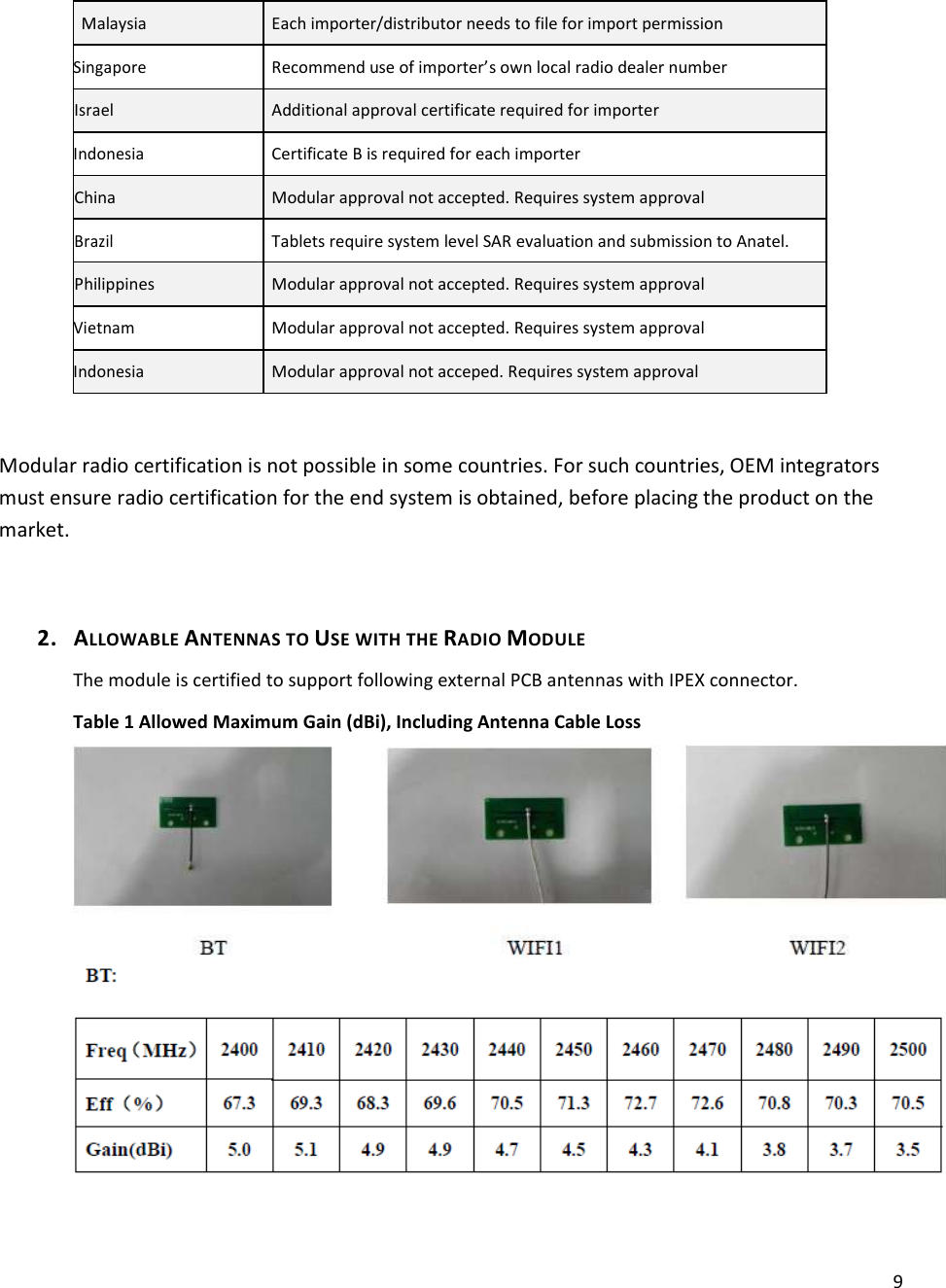
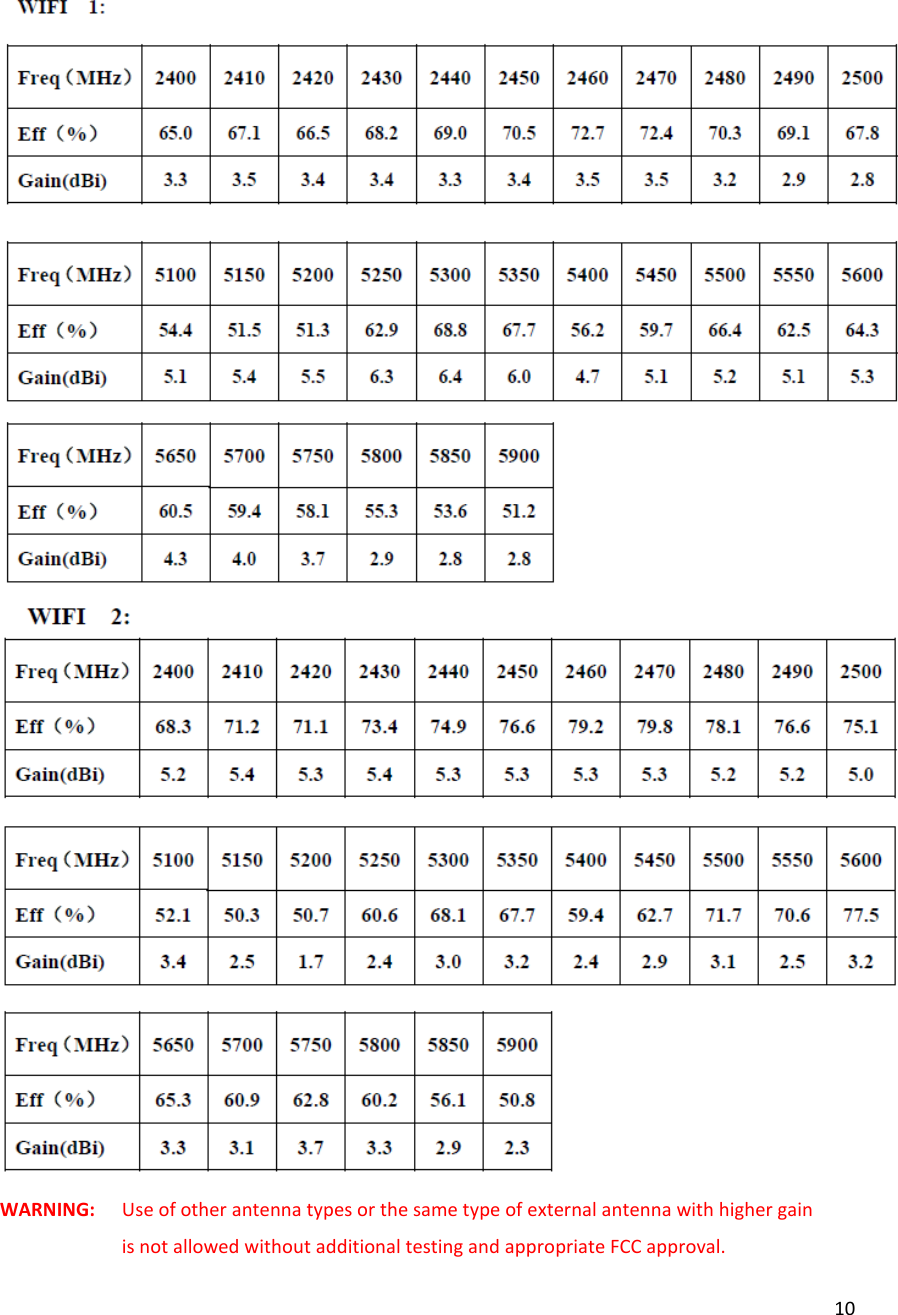
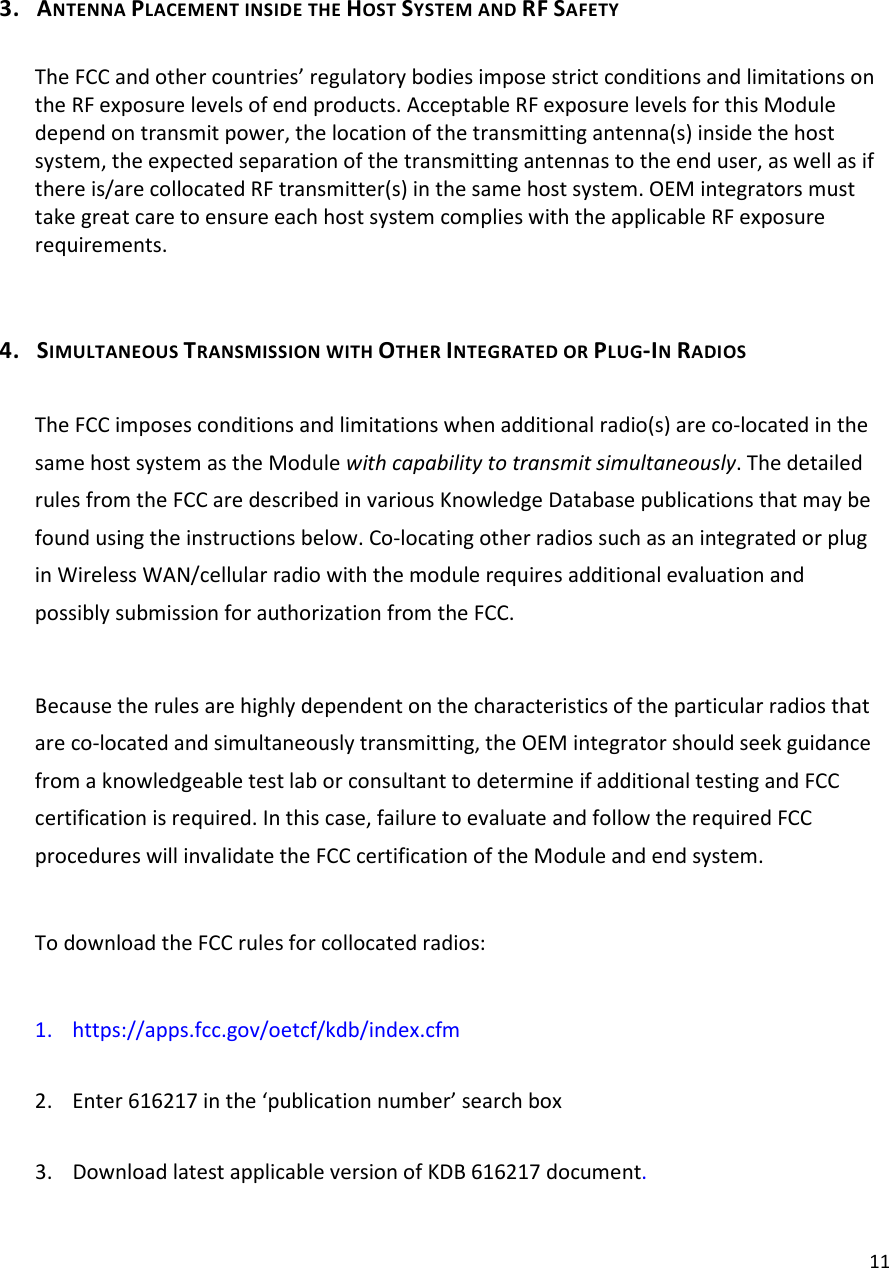
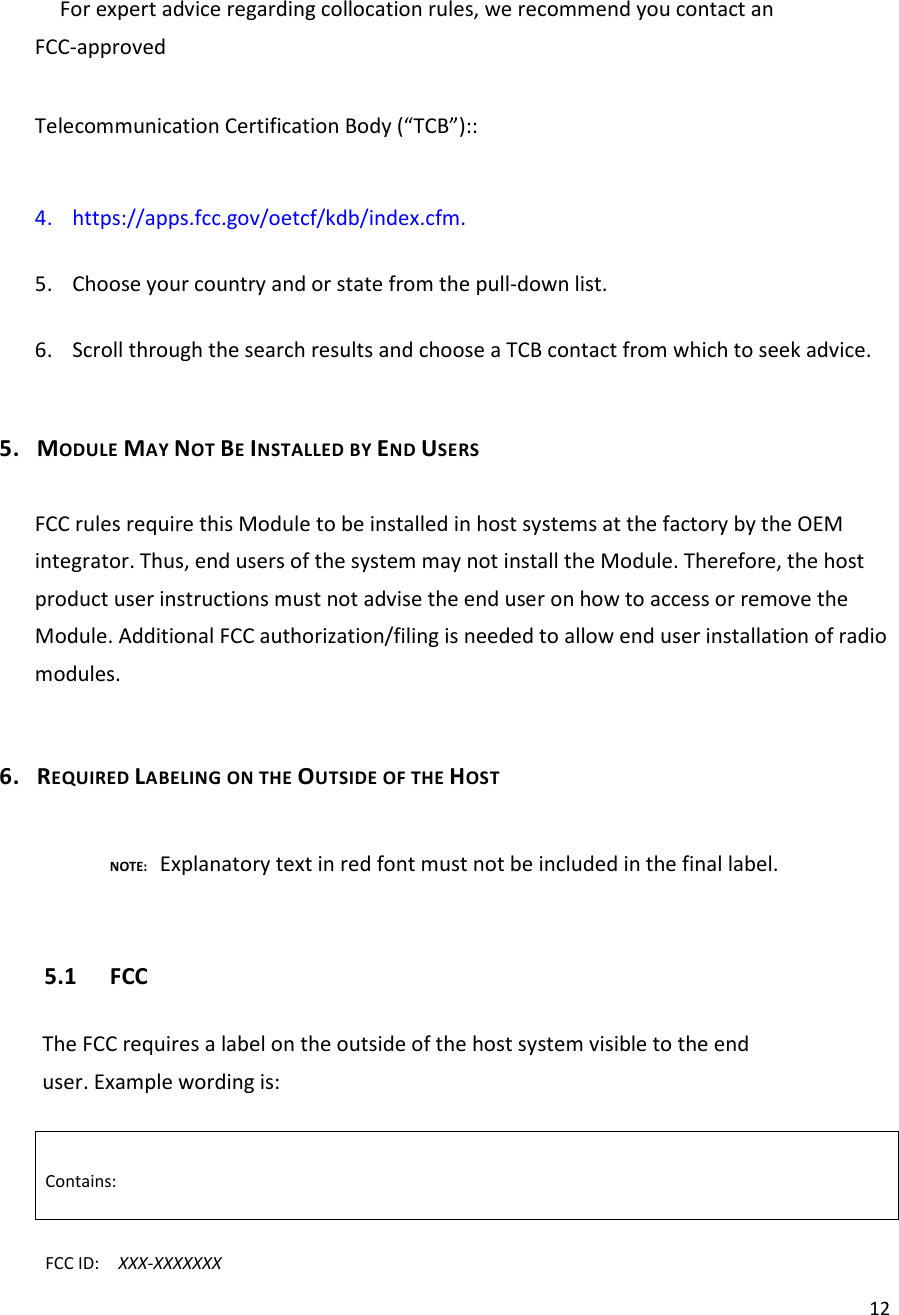
 9Malaysia  Each importer/distributor needs to file for import permission  Singapore  Recommend use of importer’s own local radio dealer number  Israel  Additional approval certificate required for importer  Indonesia  Certificate B is required for each importer  China  Modular approval not accepted. Requires system approval  Brazil  Tablets require system level SAR evaluation and submission to Anatel.  Philippines  Modular approval not accepted. Requires system approval  Vietnam  Modular approval not accepted. Requires system approval  Indonesia  Modular approval not acceped. Requires system approval   Modular radio certification is not possible in some countries. For such countries, OEM integrators must ensure radio certification for the end system is obtained, before placing the product on the market.  2. ALLOWABLE ANTENNAS TO USE WITH THE RADIO MODULE The module is certified to support following external PCB antennas with IPEX connector. Table 1 Allowed Maximum Gain (dBi), Including Antenna Cable Loss
 10  WARNING: Use of other antenna types or the same type of external antenna with higher gain is not allowed without additional testing and appropriate FCC approval.
 11 3. ANTENNA PLACEMENT INSIDE THE HOST SYSTEM AND RF SAFETY  The FCC and other countries’ regulatory bodies impose strict conditions and limitations on the RF exposure levels of end products. Acceptable RF exposure levels for this Module depend on transmit power, the location of the transmitting antenna(s) inside the host system, the expected separation of the transmitting antennas to the end user, as well as if there is/are collocated RF transmitter(s) in the same host system. OEM integrators must take great care to ensure each host system complies with the applicable RF exposure requirements.  4. SIMULTANEOUS TRANSMISSION WITH OTHER INTEGRATED OR PLUG-IN RADIOS  The FCC imposes conditions and limitations when additional radio(s) are co-located in the same host system as the Module with capability to transmit simultaneously. The detailed rules from the FCC are described in various Knowledge Database publications that may be found using the instructions below. Co-locating other radios such as an integrated or plug in Wireless WAN/cellular radio with the module requires additional evaluation and possibly submission for authorization from the FCC.  Because the rules are highly dependent on the characteristics of the particular radios that are co-located and simultaneously transmitting, the OEM integrator should seek guidance from a knowledgeable test lab or consultant to determine if additional testing and FCC certification is required. In this case, failure to evaluate and follow the required FCC procedures will invalidate the FCC certification of the Module and end system.  To download the FCC rules for collocated radios:  1. https://apps.fcc.gov/oetcf/kdb/index.cfm  2. Enter 616217 in the ‘publication number’ search box  3. Download latest applicable version of KDB 616217 document.
 12For expert advice regarding collocation rules, we recommend you contact an FCC-approved  Telecommunication Certification Body (“TCB”)::  4. https://apps.fcc.gov/oetcf/kdb/index.cfm.  5. Choose your country and or state from the pull-down list.  6. Scroll through the search results and choose a TCB contact from which to seek advice.  5. MODULE MAY NOT BE INSTALLED BY END USERS  FCC rules require this Module to be installed in host systems at the factory by the OEM integrator. Thus, end users of the system may not install the Module. Therefore, the host product user instructions must not advise the end user on how to access or remove the Module. Additional FCC authorization/filing is needed to allow end user installation of radio modules.  6. REQUIRED LABELING ON THE OUTSIDE OF THE HOST        NOTE: Explanatory text in red font must not be included in the final label.  5.1 FCC  The FCC requires a label on the outside of the host system visible to the end user. Example wording is:  Contains:  FCC ID:    XXX-XXXXXXX
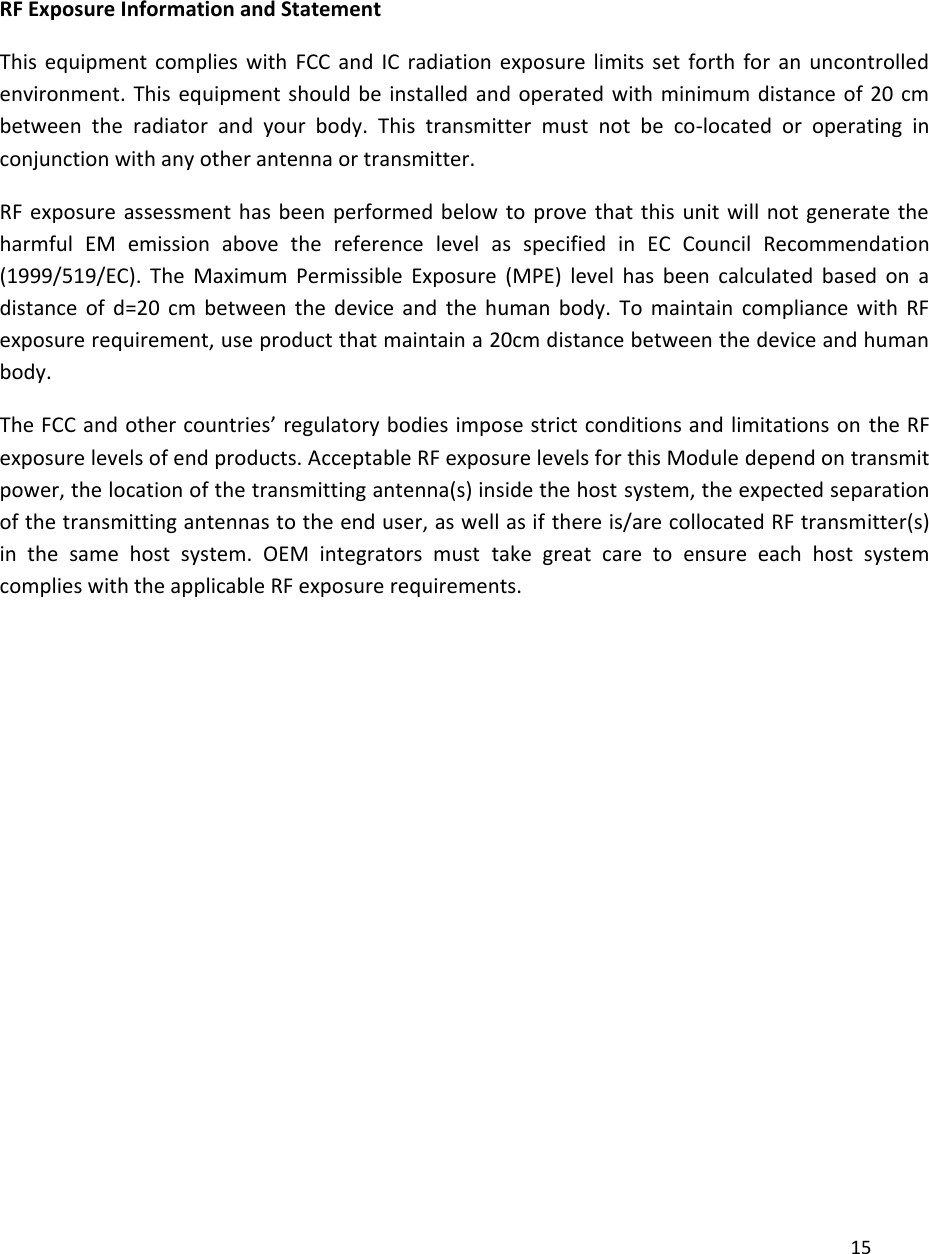
 13IC: XXXXX-XXXXXX (Replace X’s with actual IDs found in section 2).   The FCC requires a logo signifying emissions compliance on the outside of the host system. Additional options are available for placement of the FCC label on the host. Please refer to the FCC Knowledge Database KDB784748 found at https://apps.fcc.gov/oetcf/kdb/index.cfm.  NOTE: The Integrator is responsible to perform FCC Part 15 Class B digital emissions testing on the end system with the radio Module installed. The FCC logo below should not be affixed unless the OEM integrator has obtained the necessary Part 15 approval, e.g., self-declaration of conformity.  If the host system is approved to FCC Class B digital emissions limits under a grant of certification issued by a TCB, the FCC ID number shown on the grant should be used on the label instead of the FCC logo below.    5.2 European Community R&TTE  The European Community R&TTE Directive requires the CE Marking shown below on the outside of the host AND on the outside of the shipping container/packaging:     The European Community R&TTE Directive also requires the following note to consumers on the outside of the shipping container/packaging:
 14Important Notice: This product is a Radio LAN device  operating  in  2.4  &  5  GHz  bands  for Home and Office use in the E.E.A. States with restrictive use are highlighted in grey. Refer to user documentation for details. AT BE CH CY CZ DE DK ES FI FR GB GR EE HU IT IE IS LI LT LU LV MT NL NO PL PT SE SI SK     NOTE: The Integrator is expected to translate the text in this Section into the appropriate local languages for the European countries in which the product will be marketed or sold.   5.3 FCC labeling on the Module  The Integrator must ensure that the FCC ID (as indicated in section 2) is affixed on the Module along with other country certification numbers and logos as described herein.  NOTE: The Module ODM may affix regulatory labeling at time of Module manufacturing. However,  the  OEM  Integrator  must  ensure  the  Module  label  is  complete,  correct  and applicable for all countries to which the host system is to be imported, marketed, or sold.
   RF Exposure Information and Statement  This  equipment  complies  with  FCC  and  IC  radiation  exposure  limits  set  forth  for  an  uncontrolled environment.  This equipment should  be installed and operated  with  minimum  distance of  20 cm between  the  radiator  and  your  body.  This  transmitter  must  not  be  co-located  or  operating  in conjunction with any other antenna or transmitter. RF exposure  assessment  has  been  performed  below  to  prove  that  this  unit  will  not  generate  the harmful  EM  emission  above  the  reference  level  as  specified  in  EC  Council  Recommendation (1999/519/EC).  The  Maximum  Permissible  Exposure  (MPE)  level  has  been  calculated  based  on  a distance  of  d=20  cm  between  the  device  and  the  human  body.  To  maintain  compliance  with  RF exposure requirement, use product that maintain a 20cm distance between the device and human body. The FCC and other countries’ regulatory bodies impose strict conditions and limitations on  the RF exposure levels of end products. Acceptable RF exposure levels for this Module depend on transmit power, the location of the transmitting antenna(s) inside the host system, the expected separation of the transmitting antennas to the end user, as well as if there is/are collocated RF transmitter(s) in  the  same  host  system.  OEM  integrators  must  take  great  care  to  ensure  each  host  system complies with the applicable RF exposure requirements.             15

Navigation menu