ENUSTECH EZBL100 wireless link User Manual

ENUSTECH wireless link

User manual

EZBee series Manual / Ver. 1.0 --------------------------------------------------------------------------------------------------------------------------    EEZZBBeeee  sseerriieess  MMaannuuaall         2008. 11.        AHHA-Tech
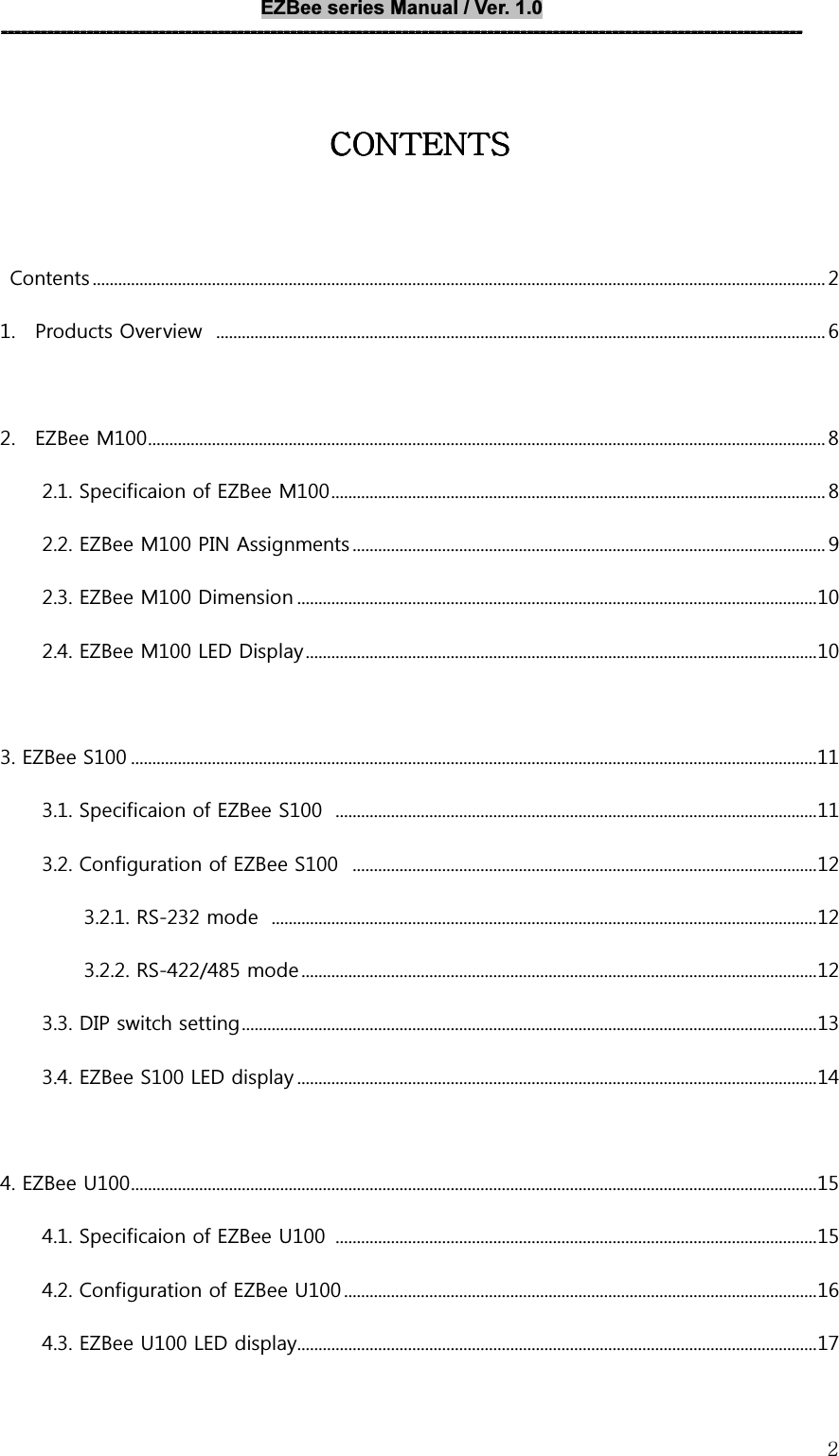
EZBee series Manual / Ver. 1.0 --------------------------------------------------------------------------------------------------------------------------   2CONTENTSCONTENTSCONTENTSCONTENTS          Contents ............................................................................................................................................................................ 2 1.    Products Overview   ............................................................................................................................................... 6  2.    EZBee M100 ............................................................................................................................................................... 8 2.1. Specificaion of EZBee M100 .................................................................................................................... 8 2.2. EZBee M100 PIN Assignments ............................................................................................................... 9 2.3. EZBee M100 Dimension .......................................................................................................................... 10 2.4. EZBee M100 LED Display ........................................................................................................................ 10  3. EZBee S100 ................................................................................................................................................................. 11 3.1. Specificaion of EZBee S100   ................................................................................................................. 11 3.2. Configuration of EZBee S100   ............................................................................................................. 12 3.2.1. RS-232 mode   ................................................................................................................................ 12 3.2.2. RS-422/485 mode ......................................................................................................................... 12 3.3. DIP switch setting ....................................................................................................................................... 13 3.4. EZBee S100 LED display .......................................................................................................................... 14  4. EZBee U100 ................................................................................................................................................................. 15 4.1. Specificaion of EZBee U100  ................................................................................................................. 15 4.2. Configuration of EZBee U100 ............................................................................................................... 16 4.3. EZBee U100 LED display .......................................................................................................................... 17
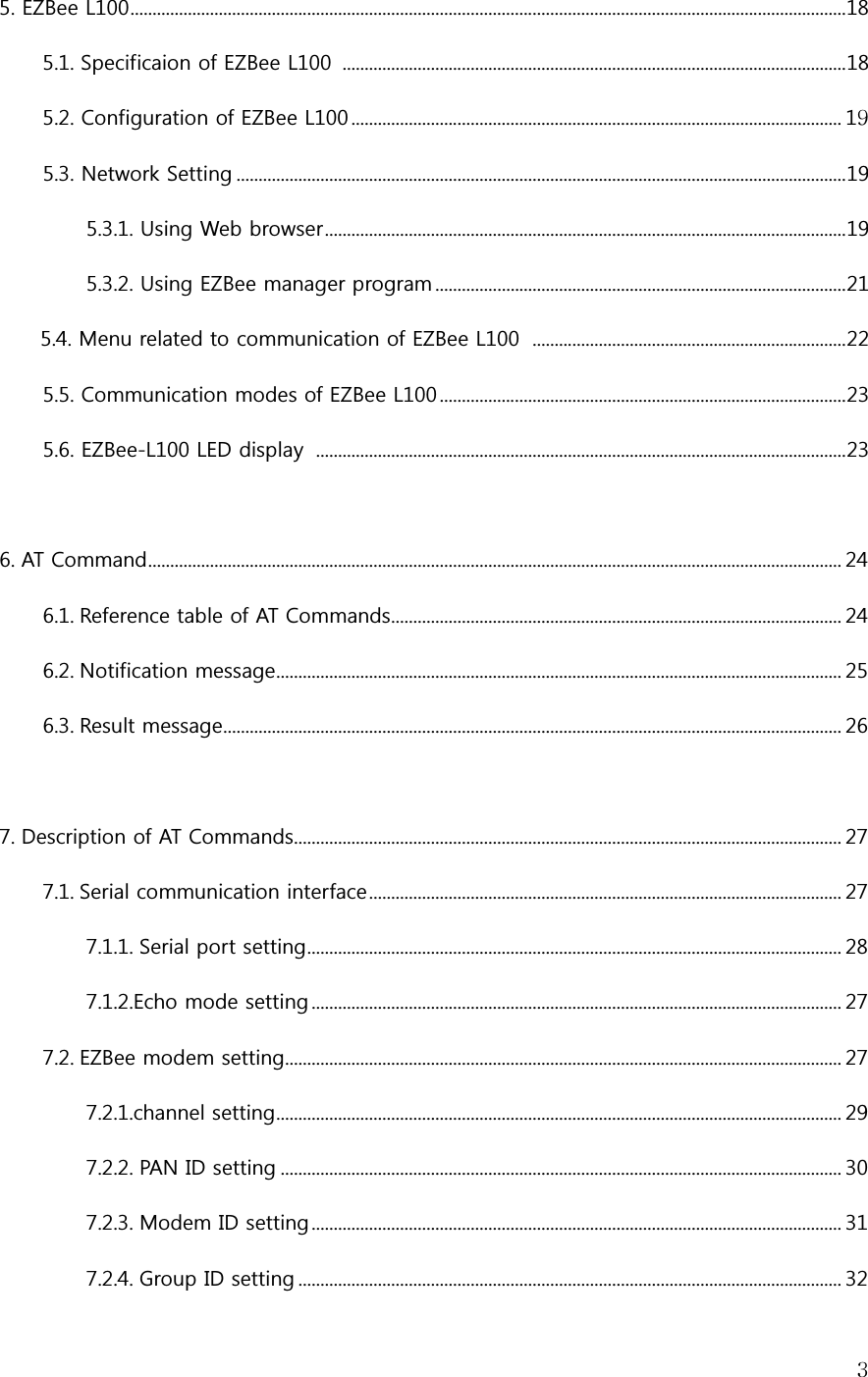
  35. EZBee L100 .................................................................................................................................................................. 18 5.1. Specificaion of EZBee L100   .................................................................................................................. 18 5.2. Configuration of EZBee L100 ............................................................................................................... 19 5.3. Network Setting .......................................................................................................................................... 19 5.3.1. Using Web browser ...................................................................................................................... 19 5.3.2. Using EZBee manager program ............................................................................................. 21 5.4. Menu related to communication of EZBee L100   ....................................................................... 22 5.5. Communication modes of EZBee L100 ............................................................................................ 23 5.6. EZBee-L100 LED display   ........................................................................................................................ 23  6. AT Command ............................................................................................................................................................. 24 6.1. Reference table of AT Commands...................................................................................................... 24 6.2. Notification message ................................................................................................................................ 25 6.3. Result message............................................................................................................................................ 26  7. Description of AT Commands............................................................................................................................ 27 7.1. Serial communication interface ........................................................................................................... 27 7.1.1. Serial port setting ......................................................................................................................... 28 7.1.2.Echo mode setting ........................................................................................................................ 27 7.2. EZBee modem setting.............................................................................................................................. 27 7.2.1.channel setting ................................................................................................................................ 29 7.2.2. PAN ID setting ............................................................................................................................... 30 7.2.3. Modem ID setting ........................................................................................................................ 31 7.2.4. Group ID setting ........................................................................................................................... 32
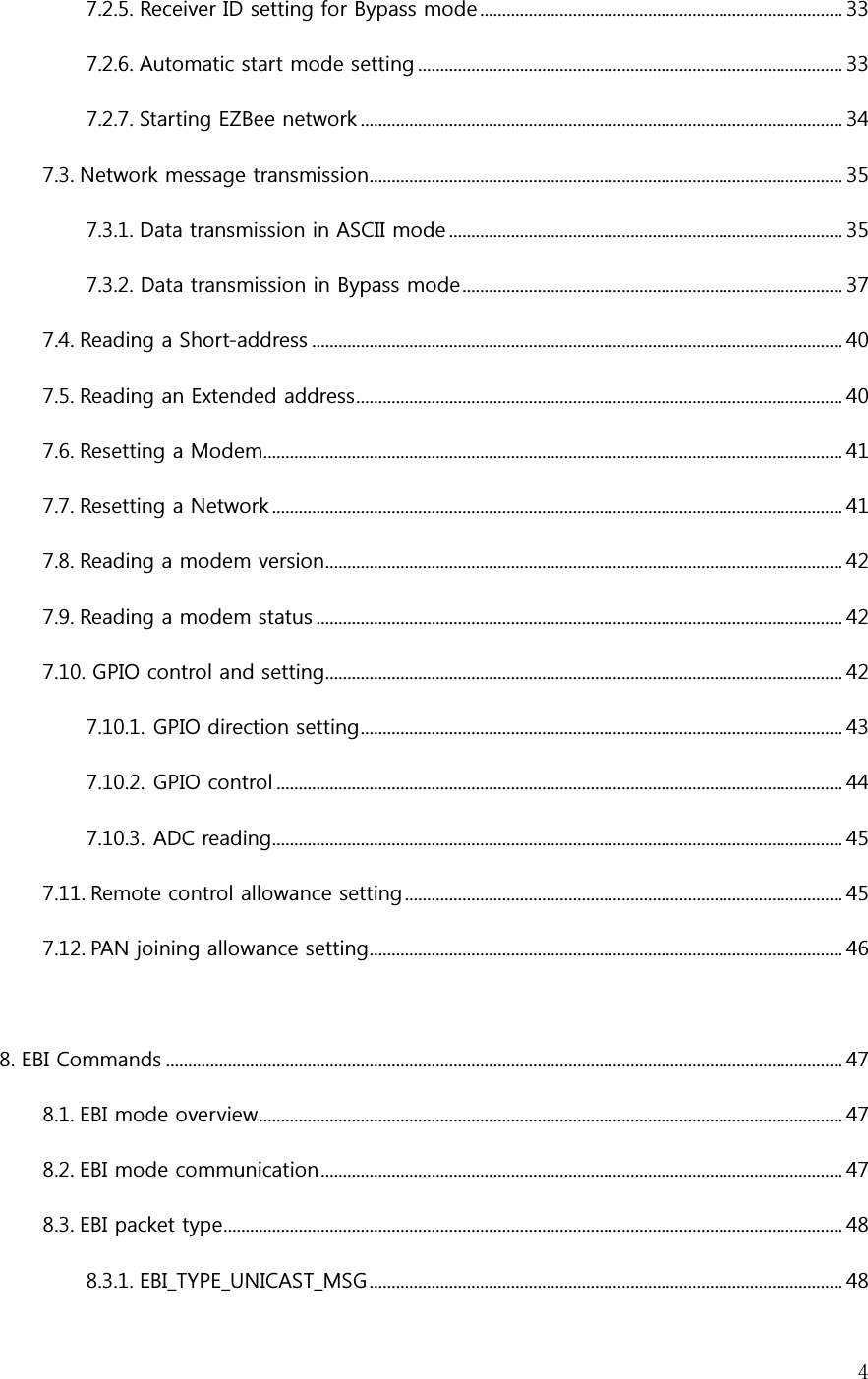
  47.2.5. Receiver ID setting for Bypass mode .................................................................................. 33 7.2.6. Automatic start mode setting ................................................................................................ 33 7.2.7. Starting EZBee network ............................................................................................................. 34 7.3. Network message transmission ........................................................................................................... 35 7.3.1. Data transmission in ASCII mode ......................................................................................... 35 7.3.2. Data transmission in Bypass mode ...................................................................................... 37 7.4. Reading a Short-address ........................................................................................................................ 40 7.5. Reading an Extended address .............................................................................................................. 40 7.6. Resetting a Modem................................................................................................................................... 41 7.7. Resetting a Network ................................................................................................................................. 41 7.8. Reading a modem version ..................................................................................................................... 42 7.9. Reading a modem status ....................................................................................................................... 42 7.10. GPIO control and setting..................................................................................................................... 42 7.10.1. GPIO direction setting ............................................................................................................. 43 7.10.2. GPIO control ................................................................................................................................ 44 7.10.3. ADC reading................................................................................................................................. 45 7.11. Remote control allowance setting ................................................................................................... 45 7.12. PAN joining allowance setting ........................................................................................................... 46  8. EBI Commands ......................................................................................................................................................... 47 8.1. EBI mode overview .................................................................................................................................... 47 8.2. EBI mode communication ...................................................................................................................... 47 8.3. EBI packet type ............................................................................................................................................ 48 8.3.1. EBI_TYPE_UNICAST_MSG ........................................................................................................... 48
  58.3.2. EBI_TYPE_GROUP_MSG .............................................................................................................. 48 8.3.3. EBI_TYPE_BROAD_MSG ............................................................................................................... 49 8.3.4. EBI_TYPE_ACK ................................................................................................................................. 49 8.3.5. EBI_TYPE_IO_REQ .......................................................................................................................... 50 8.3.6. EBI_TYPE_IO_ACK .......................................................................................................................... 50 8.3.7. EBI_TYPE_IOD_REQ ....................................................................................................................... 51 8.3.8. EBI_TYPE_IOD_ACK ....................................................................................................................... 51 8.3.9. EBI_TYPE_ADC_REQ ...................................................................................................................... 52 8.3.10. EBI_TYPE_ADC_ACK ................................................................................................................... 52 8.3.11. EBI_TYPE_ESCAPE ....................................................................................................................... 52  Appendix       How to use EZBee M100                                                                                        53
 EZBee series Manual / Ver. 1.0  61. 1. 1. 1. Products Overview Products Overview Products Overview Products Overview       EZBeeTM formats  include  OEM  modules  (M100),  industrial  serial adapters  (S100),  USB  type  serial  adapters  (U100),  and  internet  access points  (L100)  for  supporting  various  customers  who  need  to  get  wireless solutions in industrial automation, medical automation, building automation, information technology, retail/ POS and so on.    The  EZBeeTM series  is  a  2.4GHz  ISM  band  transceiver,  based  on  the Chipcon  CC2420  chip  for  IEEE  802.15.4.    The  EZBeeTM series  supports various AT- style command line interfaces for allowing customers to quickly build  mesh  networks  requiring  lower  power  consumption  without  skillful wireless  RF  engineering  and  complex  software  engineering.  It  also provides  2  ADC  ports  and  8  I/ O  ports  for  enabling  customers  to conveniently design own embedding systems.    The  EZBeeTM series  implements  three  different  data  transmission modes including ASCII, Bypass and EBI (EZBee Binary Interface) mode. In  ASCII  mode,  all  data  are  transmitted  as  format  of  ASCII  HEX  by utilizing the AT command sets for data transmission. In  Bypass  mode,  all  raw  data  are  transmitted  to  the  pre- assigned EZBee  module  without  utilizing  any  specific  commands  or  building  any communication packet, as if EZBee modules are wired together.   In  EBI  mode,  the  transmitting  data  packets  can  be  configured  by
 EZBee series Manual / Ver. 1.0  7customers for more flexible and effective communication.  A  specified  own  ID  and  an  extended/ short  address  are  assigned  for each modem of EZBee formats.    The specified own ID is used for pointing a data receiving modem in every data transmission modes.    The specifications of EZBeeTM is summarized as follows:  EZBee Specifications Communication range  2500m (LOS) TX power  0 dBm ~ 18 dBm (selectable by software) RF Data Rate  250,000 bps Serial Interface Data Rate  1,200 – 115,200 bps (selectable by software) Receive sensitivity    -100dBm (packet error ratio 1%) Supported Network Topologies  Point-to-point, point-to-multipoint, peer-to-peer Number of Channels  16  direct  sequence  channels  (selectable  by software) Addressing Options  PAN ID, Channel, Addresses     EZBEZBEZBEZB----S100, S100, S100, S100, EZBEZBEZBEZB----U100U100U100U100    andandandand    EZBEZBEZBEZB----L100L100L100L100    complycomplycomplycomply    with part 15 of the FCC Rules. Operation is with part 15 of the FCC Rules. Operation is with part 15 of the FCC Rules. Operation is with part 15 of the FCC Rules. Operation is subject tosubject tosubject tosubject to    the following two conditions: the following two conditions: the following two conditions: the following two conditions:      (1) This device may not cause harmful interference, and (1) This device may not cause harmful interference, and (1) This device may not cause harmful interference, and (1) This device may not cause harmful interference, and      (2)  this  device  must  accept  any  interference  received,  including(2)  this  device  must  accept  any  interference  received,  including(2)  this  device  must  accept  any  interference  received,  including(2)  this  device  must  accept  any  interference  received,  including     interference  that  may interference  that  may interference  that  may interference  that  may cause undesired operation.cause undesired operation.cause undesired operation.cause undesired operation.
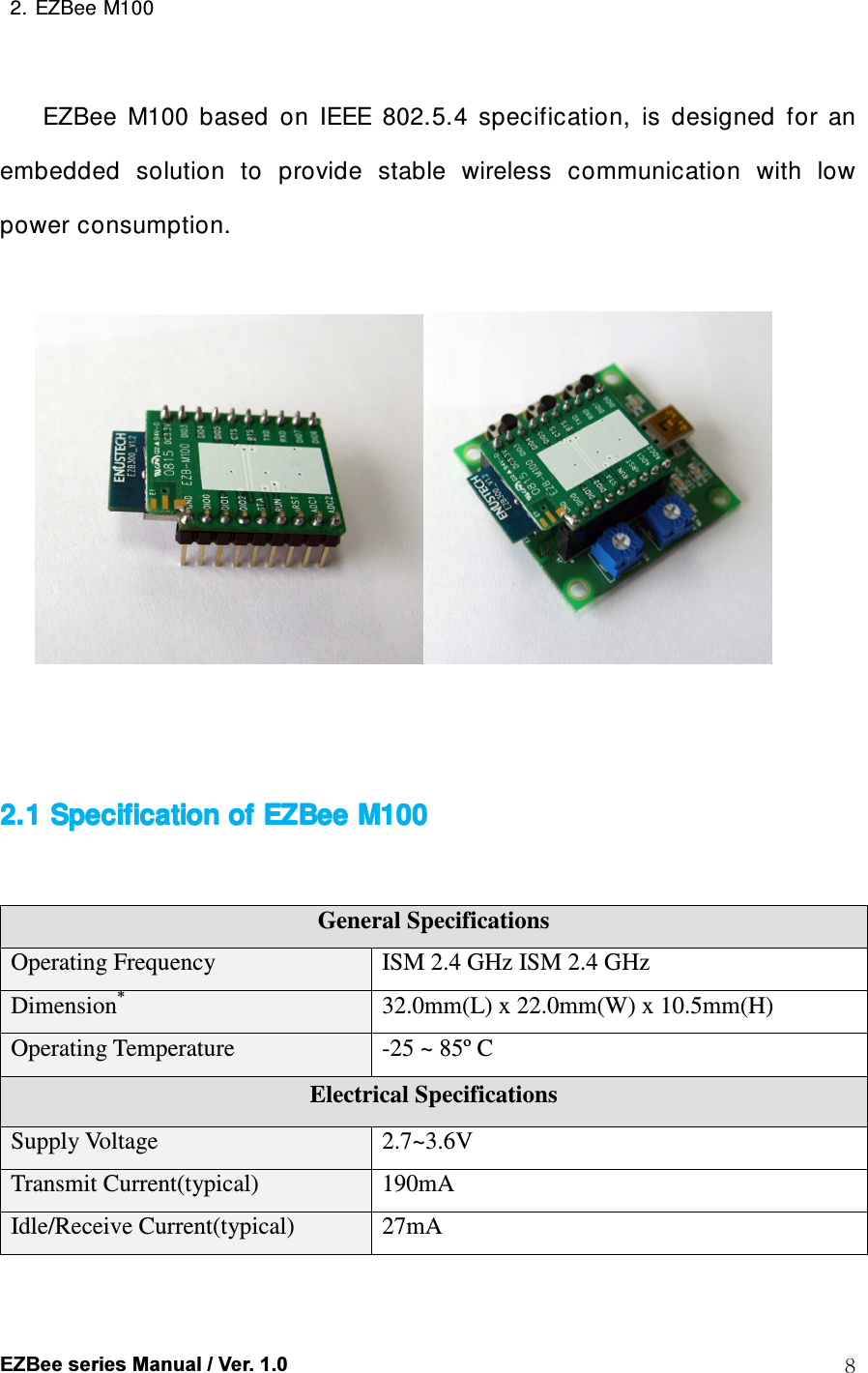
 EZBee series Manual / Ver. 1.0  8  2. EZBee M100     EZBee  M100  based  on  IEEE  802.5.4  specification,  is  designed  for  an embedded  solution  to  provide  stable  wireless  communication  with  low power consumption.         2.1 Specification of 2.1 Specification of 2.1 Specification of 2.1 Specification of EZBeeEZBeeEZBeeEZBee    M100 M100 M100 M100       General Specifications Operating Frequency  ISM 2.4 GHz ISM 2.4 GHz Dimension* 32.0mm(L) x 22.0mm(W) x 10.5mm(H) Operating Temperature  -25 ~ 85º C Electrical Specifications Supply Voltage  2.7~3.6V Transmit Current(typical)  190mA Idle/Receive Current(typical)  27mA
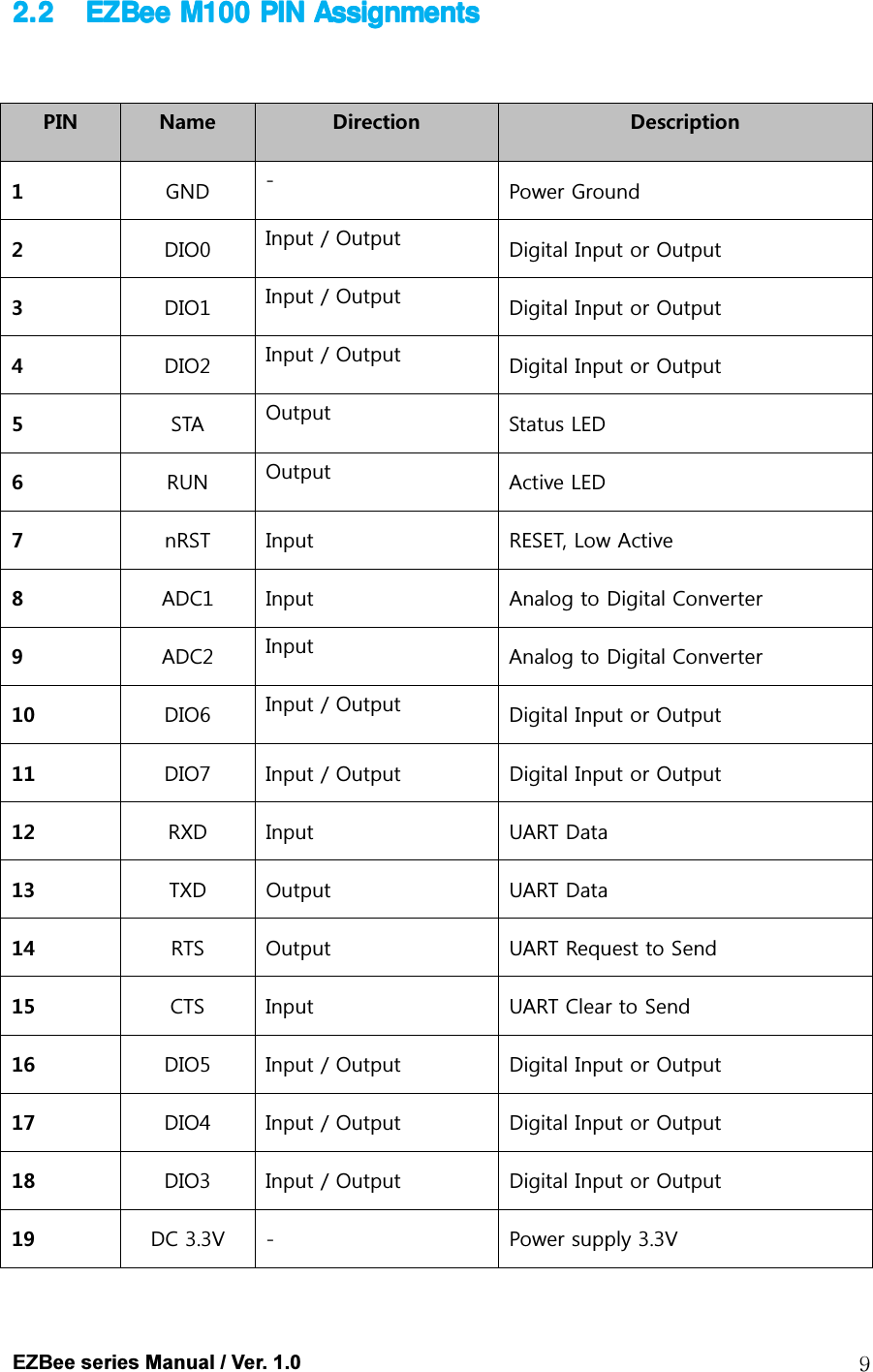
 EZBee series Manual / Ver. 1.0  92.22.22.22.2 EZBeeEZBeeEZBeeEZBee    M100 PIN AssignmentsM100 PIN AssignmentsM100 PIN AssignmentsM100 PIN Assignments     PIN  Name  Direction  Description 1  GND  -  Power Ground 2  DIO0  Input / Output  Digital Input or Output 3  DIO1  Input / Output  Digital Input or Output 4  DIO2  Input / Output  Digital Input or Output 5  STA  Output  Status LED 6  RUN  Output  Active LED 7  nRST  Input  RESET, Low Active 8  ADC1  Input  Analog to Digital Converter 9  ADC2  Input  Analog to Digital Converter 10  DIO6  Input / Output  Digital Input or Output 11  DIO7  Input / Output  Digital Input or Output 12  RXD  Input  UART Data 13  TXD  Output  UART Data 14  RTS  Output  UART Request to Send 15  CTS  Input  UART Clear to Send 16  DIO5  Input / Output  Digital Input or Output 17  DIO4  Input / Output  Digital Input or Output 18  DIO3  Input / Output  Digital Input or Output 19  DC 3.3V  -  Power supply 3.3V
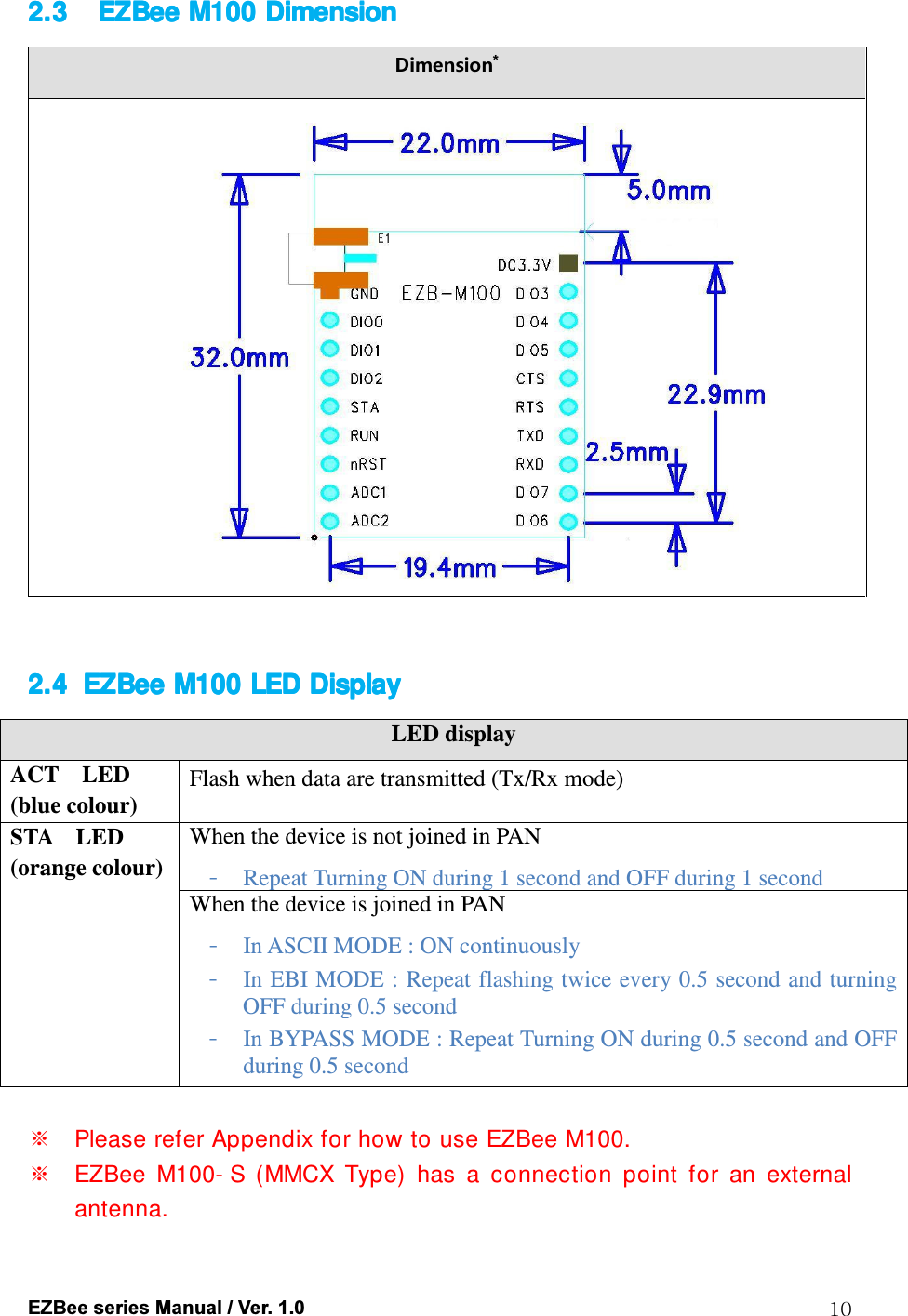
 EZBee series Manual / Ver. 1.0  10 2.32.32.32.3 EZBeeEZBeeEZBeeEZBee    M100 DimensionM100 DimensionM100 DimensionM100 Dimension    Dimension*   2.42.42.42.4 EZBeeEZBeeEZBeeEZBee    M100 LED M100 LED M100 LED M100 LED DisplayDisplayDisplayDisplay    LED display ACT    LED   (blue colour) Flash when data are transmitted (Tx/Rx mode) STA    LED (orange colour) When the device is not joined in PAN - Repeat Turning ON during 1 second and OFF during 1 second When the device is joined in PAN - In ASCII MODE : ON continuously - In EBI MODE : Repeat flashing twice every 0.5 second and turning OFF during 0.5 second - In BYPASS MODE : Repeat Turning ON during 0.5 second and OFF during 0.5 second  ※    Please refer Appendix for how to use EZBee M100. ※    EZBee  M100- S  (MMCX  Type)  has  a  connection  point  for  an  external antenna.
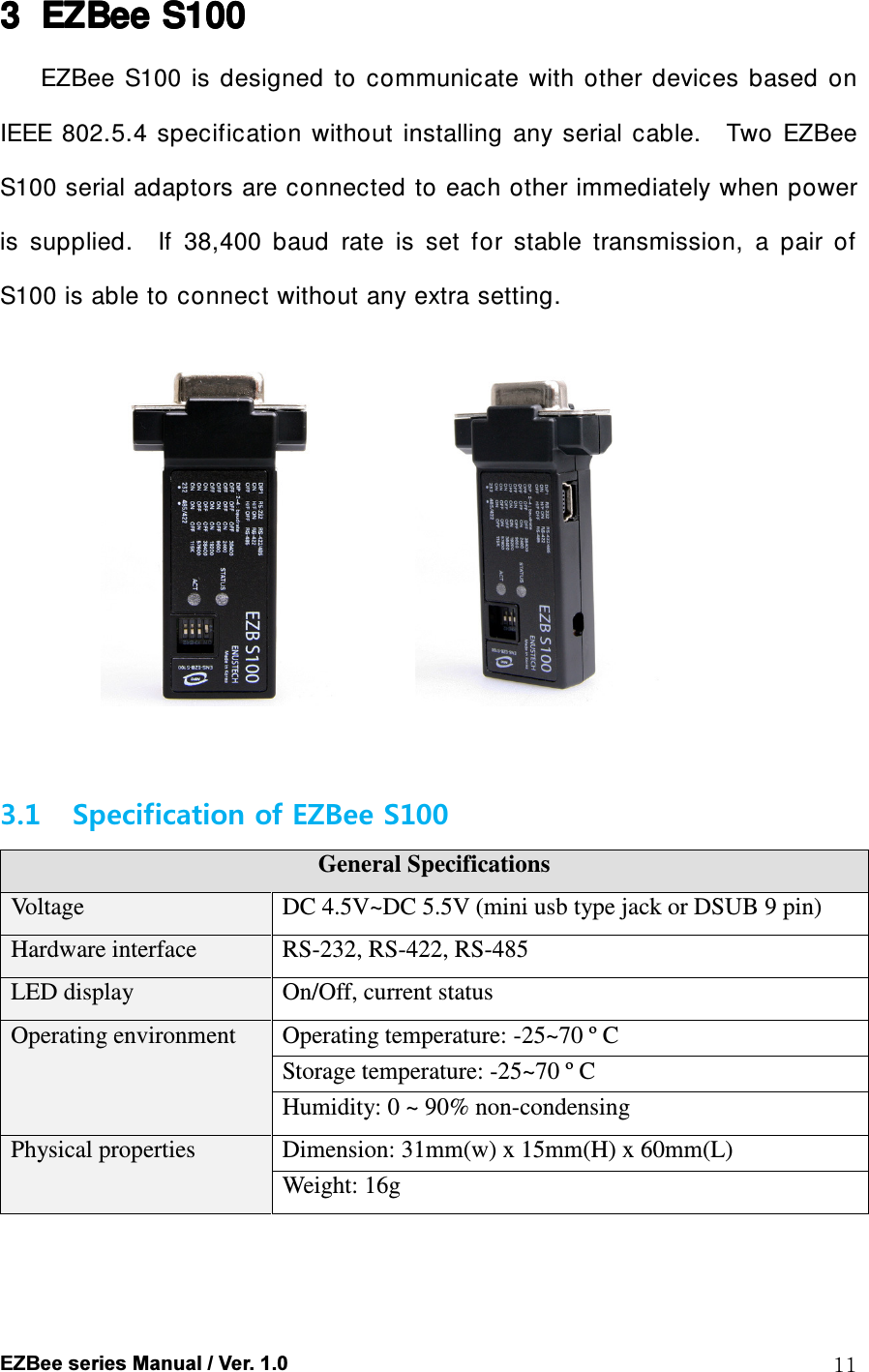
 EZBee series Manual / Ver. 1.0  11 3333 EZBeeEZBeeEZBeeEZBee    S100S100S100S100    EZBee  S100  is  designed  to  communicate  with  other  devices  based  on IEEE 802.5.4  specification  without  installing  any  serial  cable.    Two  EZBee S100 serial adaptors are connected to each other immediately when power is  supplied.    If  38,400  baud  rate  is  set  for  stable  transmission,  a  pair  of S100 is able to connect without any extra setting.                   3.1 Specification of EZBee S100   General Specifications Voltage  DC 4.5V~DC 5.5V (mini usb type jack or DSUB 9 pin) Hardware interface  RS-232, RS-422, RS-485 LED display  On/Off, current status Operating environment  Operating temperature: -25~70 º C Storage temperature: -25~70 º C Humidity: 0 ~ 90% non-condensing Physical properties  Dimension: 31mm(w) x 15mm(H) x 60mm(L) Weight: 16g
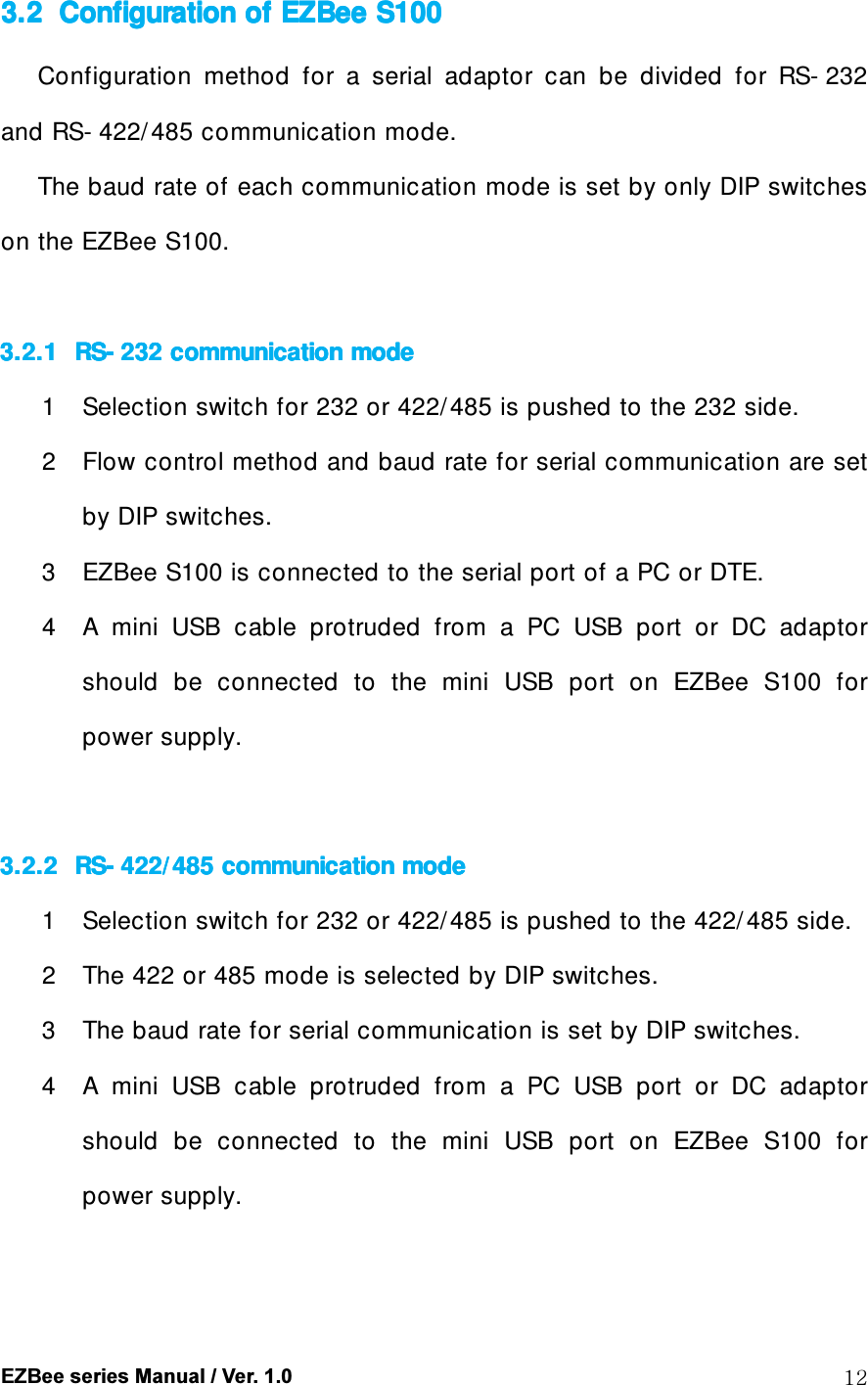
 EZBee series Manual / Ver. 1.0  12 3.23.23.23.2 Configuration of Configuration of Configuration of Configuration of EZBeeEZBeeEZBeeEZBee    S100S100S100S100    Configuration  method  for  a  serial  adaptor  can  be  divided  for  RS- 232 and RS- 422/ 485 communication mode.     The baud rate of each communication mode is set by only DIP switches on the EZBee S100.  3.2.13.2.13.2.13.2.1 RSRSRSRS---- 232232232232    communication modecommunication modecommunication modecommunication mode         1 Selection switch for 232 or 422/ 485 is pushed to the 232 side. 2 Flow control method and baud rate for serial communication are set by DIP switches. 3 EZBee S100 is connected to the serial port of a PC or DTE. 4 A  mini  USB  cable  protruded  from  a  PC  USB  port  or  DC  adaptor should  be  connected  to  the  mini  USB  port  on  EZBee  S100  for power supply.  3.2.23.2.23.2.23.2.2 RSRSRSRS---- 422/ 485 communica422/ 485 communica422/ 485 communica422/ 485 communicatititition modeon modeon modeon mode    1 Selection switch for 232 or 422/ 485 is pushed to the 422/ 485 side. 2 The 422 or 485 mode is selected by DIP switches. 3 The baud rate for serial communication is set by DIP switches. 4 A  mini  USB  cable  protruded  from  a  PC  USB  port  or  DC  adaptor should  be  connected  to  the  mini  USB  port  on  EZBee  S100  for power supply.
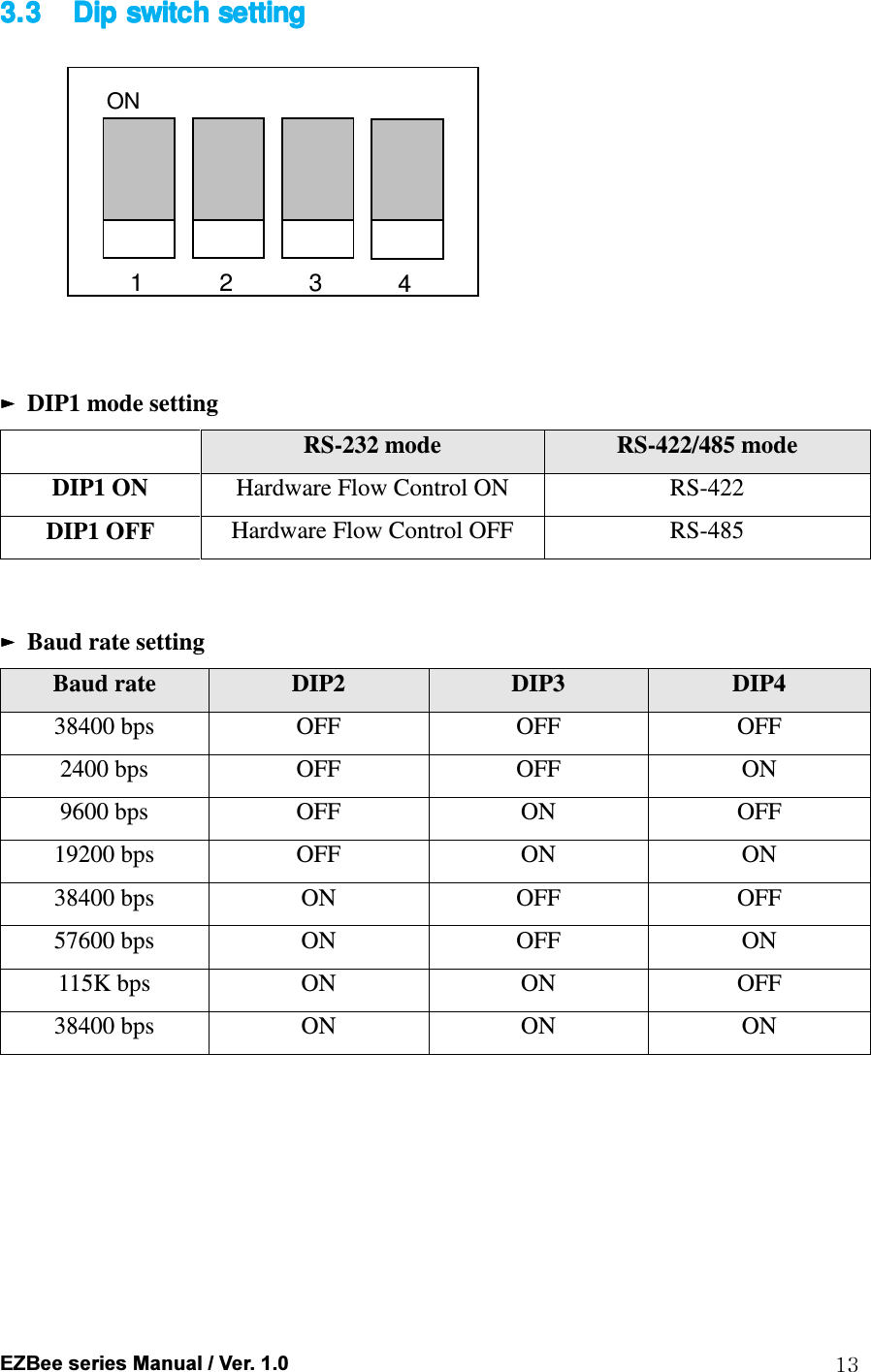
 EZBee series Manual / Ver. 1.0  13 3.33.33.33.3 Dip switch settingDip switch settingDip switch settingDip switch setting                ►►►►  DIP1 mode setting   RS-232 mode  RS-422/485 mode DIP1 ON  Hardware Flow Control ON  RS-422 DIP1 OFF  Hardware Flow Control OFF  RS-485  ►►►► Baud rate setting Baud rate  DIP2  DIP3  DIP4 38400 bps  OFF  OFF  OFF 2400 bps  OFF  OFF  ON 9600 bps  OFF  ON  OFF 19200 bps  OFF  ON  ON 38400 bps  ON  OFF  OFF 57600 bps  ON  OFF  ON 115K bps  ON  ON  OFF 38400 bps  ON  ON  ON    ON 4 2  3 1
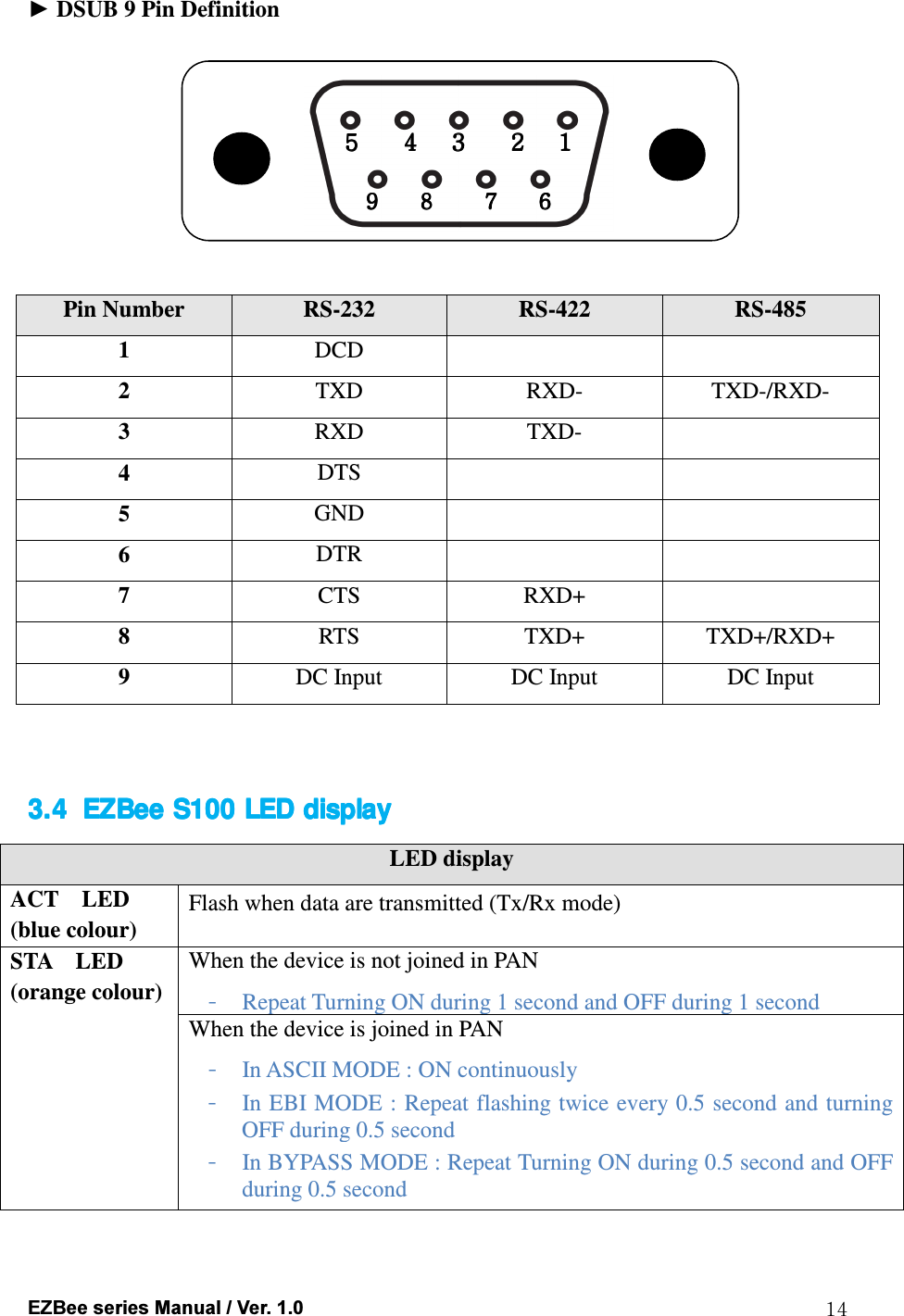
 EZBee series Manual / Ver. 1.0  14 ► DSUB 9 Pin Definition      Pin Number  RS-232  RS-422  RS-485 1  DCD     2  TXD  RXD-  TXD-/RXD- 3  RXD  TXD-   4  DTS     5  GND     6  DTR     7  CTS  RXD+   8  RTS  TXD+  TXD+/RXD+ 9  DC Input  DC Input  DC Input  3.43.43.43.4 EZBeeEZBeeEZBeeEZBee    S100 LED S100 LED S100 LED S100 LED displaydisplaydisplaydisplay    LED display ACT    LED   (blue colour) Flash when data are transmitted (Tx/Rx mode) STA    LED (orange colour) When the device is not joined in PAN - Repeat Turning ON during 1 second and OFF during 1 second When the device is joined in PAN - In ASCII MODE : ON continuously - In EBI MODE : Repeat flashing twice every 0.5 second and turning OFF during 0.5 second - In BYPASS MODE : Repeat Turning ON during 0.5 second and OFF during 0.5 second  5     5     5     5           4   4   4   4         3   3   3   3              2   2   2   2         1111    9    8     7    6   9    8     7    6   9    8     7    6   9    8     7    6
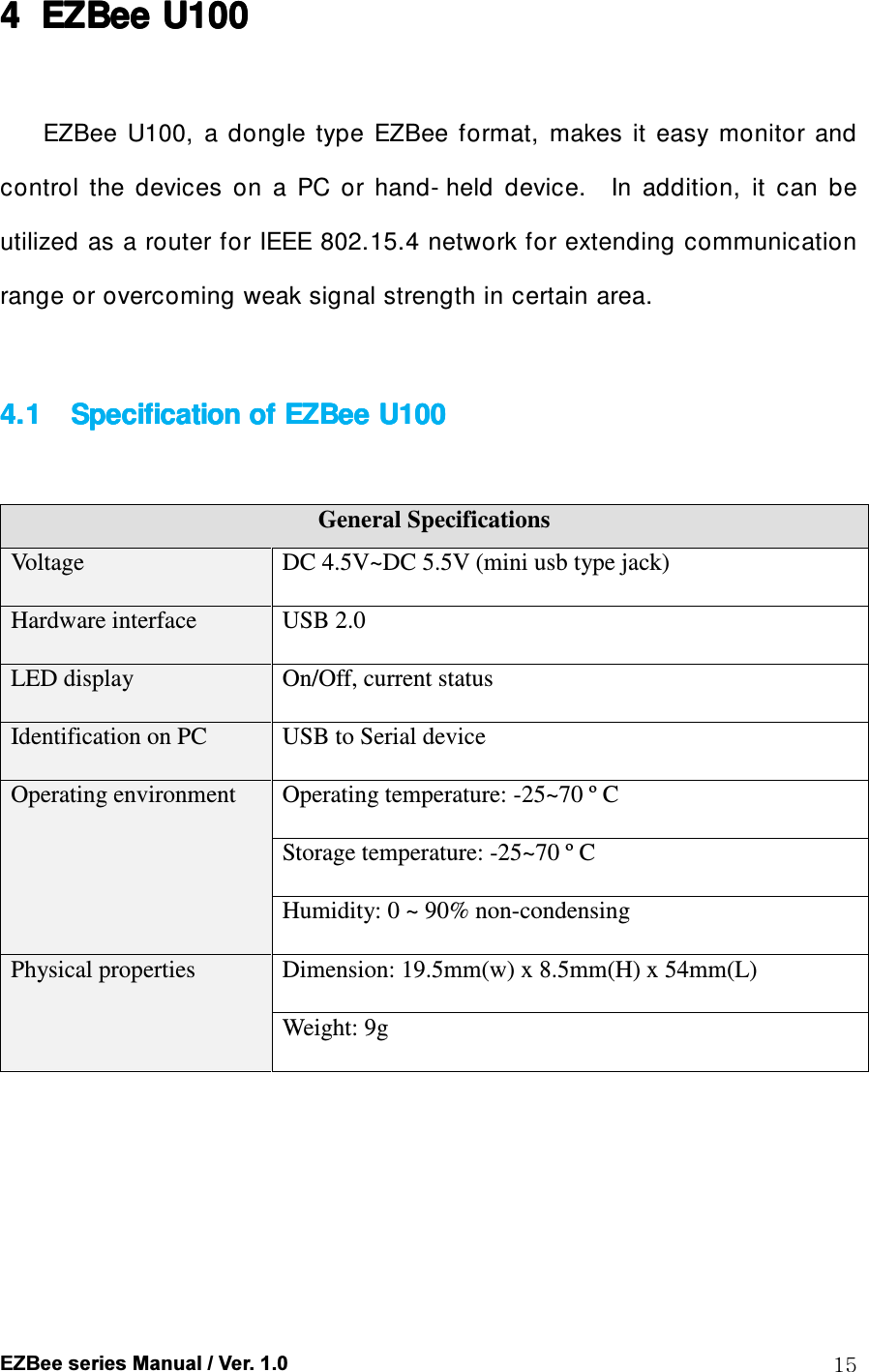
 EZBee series Manual / Ver. 1.0  15 4444 EZBeeEZBeeEZBeeEZBee    U100U100U100U100     EZBee  U100,  a  dongle  type  EZBee  format,  makes  it  easy  monitor  and control  the  devices  on  a  PC  or  hand- held  device.    In  addition,  it  can  be utilized as a router for IEEE 802.15.4 network for extending communication range or overcoming weak signal strength in certain area.  4.14.14.14.1      Specification of Specification of Specification of Specification of EZBeeEZBeeEZBeeEZBee    U100 U100 U100 U100       General Specifications Voltage  DC 4.5V~DC 5.5V (mini usb type jack) Hardware interface  USB 2.0 LED display  On/Off, current status Identification on PC  USB to Serial device Operating environment  Operating temperature: -25~70 º C Storage temperature: -25~70 º C Humidity: 0 ~ 90% non-condensing Physical properties  Dimension: 19.5mm(w) x 8.5mm(H) x 54mm(L) Weight: 9g
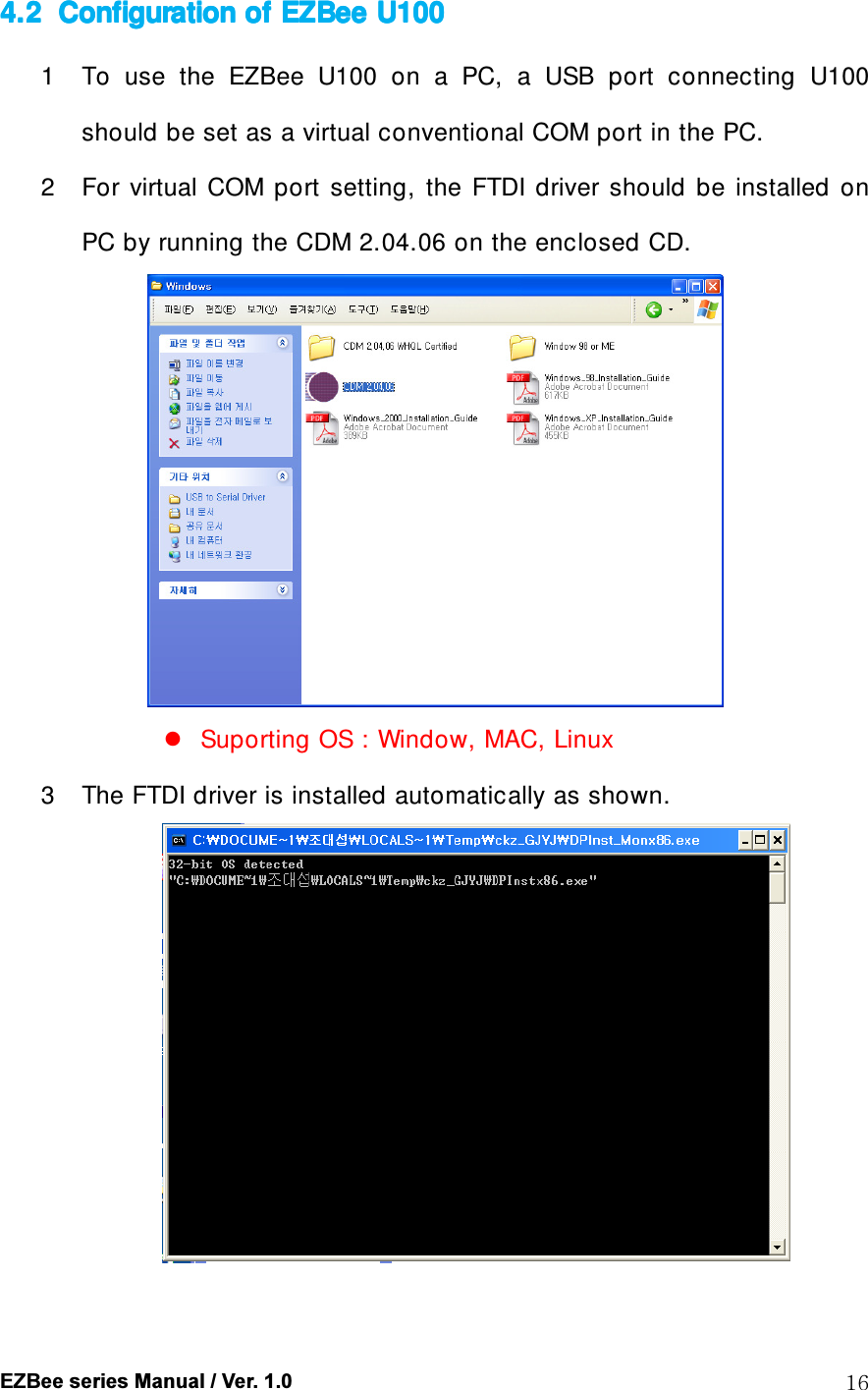
 EZBee series Manual / Ver. 1.0  16 4.24.24.24.2 Configuration of Configuration of Configuration of Configuration of EZBeeEZBeeEZBeeEZBee    U100U100U100U100    1 To  use  the  EZBee  U100  on  a  PC,  a  USB  port  connecting  U100 should be set as a virtual conventional COM port in the PC. 2 For  virtual  COM  port  setting,  the  FTDI  driver  should  be  installed  on PC by running the CDM 2.04.06 on the enclosed CD.   Suporting OS : Window, MAC, Linux 3 The FTDI driver is installed automatically as shown.
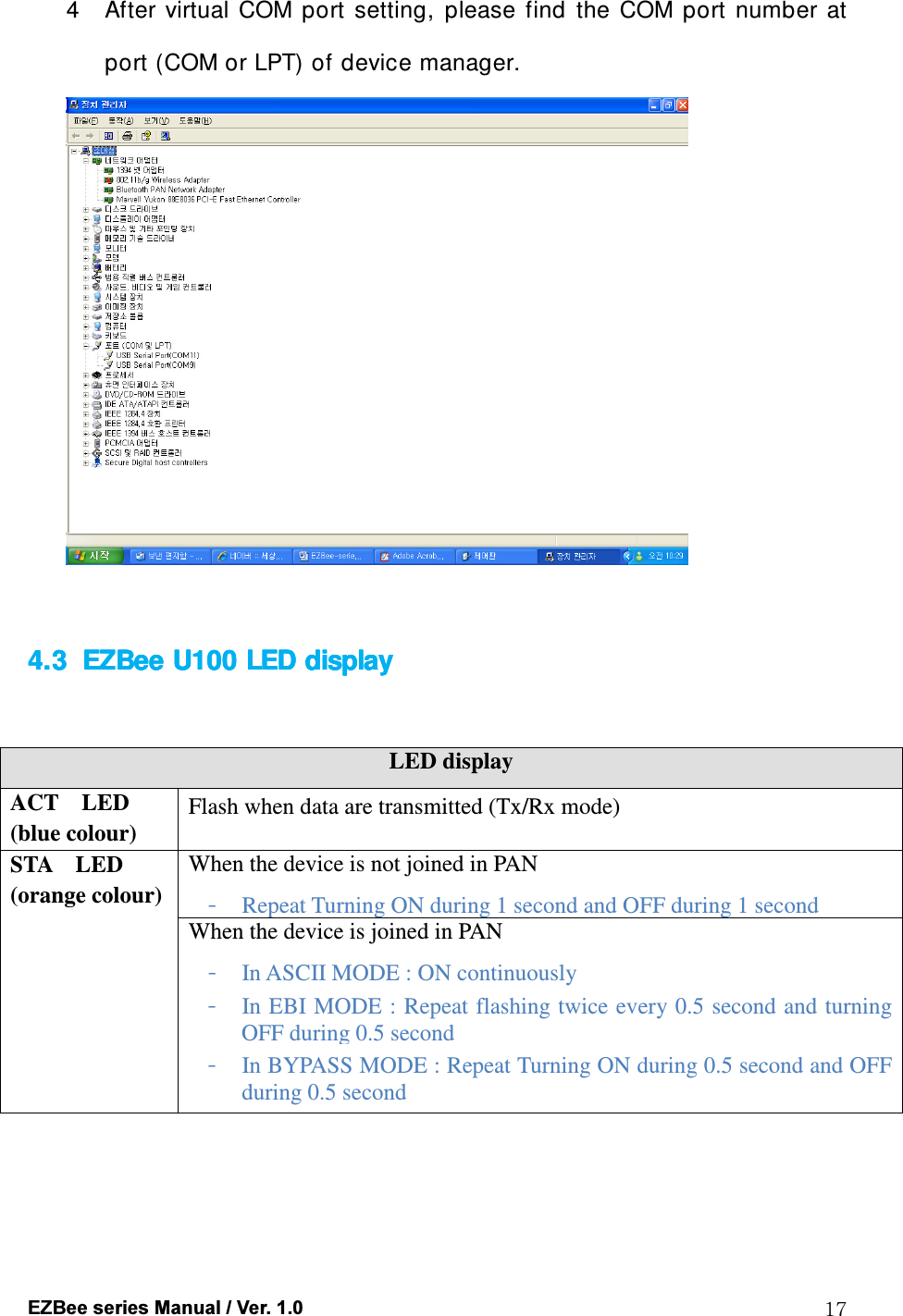
 EZBee series Manual / Ver. 1.0  17 4 After  virtual  COM  port  setting,  please  find  the  COM  port  number  at port (COM or LPT) of device manager.   4.34.34.34.3 EZBeeEZBeeEZBeeEZBee    U100 LED U100 LED U100 LED U100 LED displaydisplaydisplaydisplay     LED display ACT    LED   (blue colour) Flash when data are transmitted (Tx/Rx mode) STA    LED (orange colour) When the device is not joined in PAN - Repeat Turning ON during 1 second and OFF during 1 second When the device is joined in PAN - In ASCII MODE : ON continuously - In EBI MODE : Repeat flashing twice every 0.5 second and turning OFF during 0.5 second - In BYPASS MODE : Repeat Turning ON during 0.5 second and OFF during 0.5 second
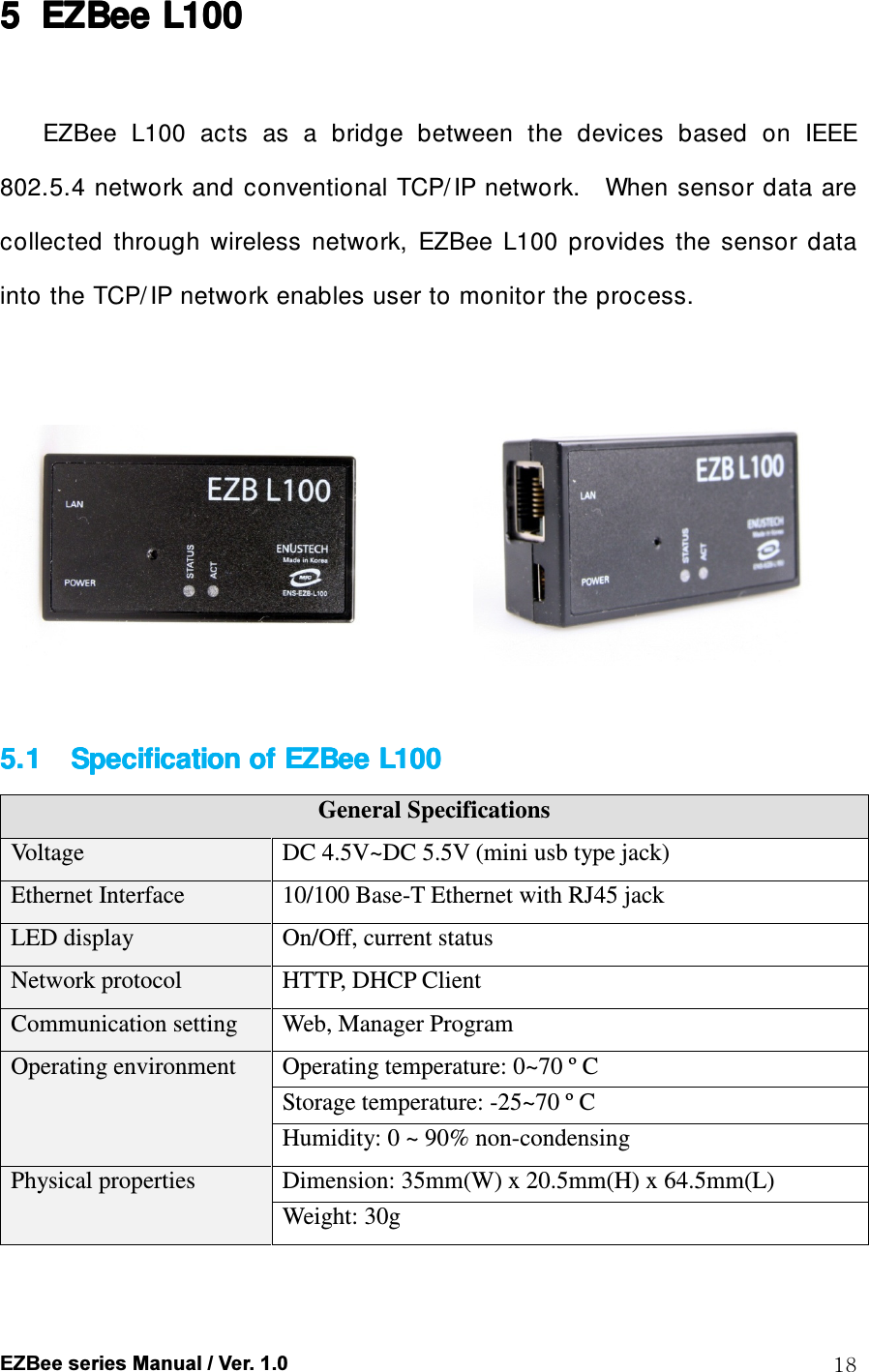
 EZBee series Manual / Ver. 1.0  18 5555 EZBeeEZBeeEZBeeEZBee    L100L100L100L100     EZBee  L100  acts  as  a  bridge  between  the  devices  based  on  IEEE 802.5.4  network and conventional TCP/ IP network.    When sensor data  are collected  through  wireless  network,  EZBee  L100  provides  the  sensor  data into the TCP/ IP network enables user to monitor the process.                      5.15.15.15.1      Specification of Specification of Specification of Specification of EZBeeEZBeeEZBeeEZBee    L100 L100 L100 L100      General Specifications Voltage  DC 4.5V~DC 5.5V (mini usb type jack) Ethernet Interface  10/100 Base-T Ethernet with RJ45 jack LED display  On/Off, current status Network protocol  HTTP, DHCP Client Communication setting  Web, Manager Program Operating environment  Operating temperature: 0~70 º C Storage temperature: -25~70 º C Humidity: 0 ~ 90% non-condensing Physical properties  Dimension: 35mm(W) x 20.5mm(H) x 64.5mm(L) Weight: 30g
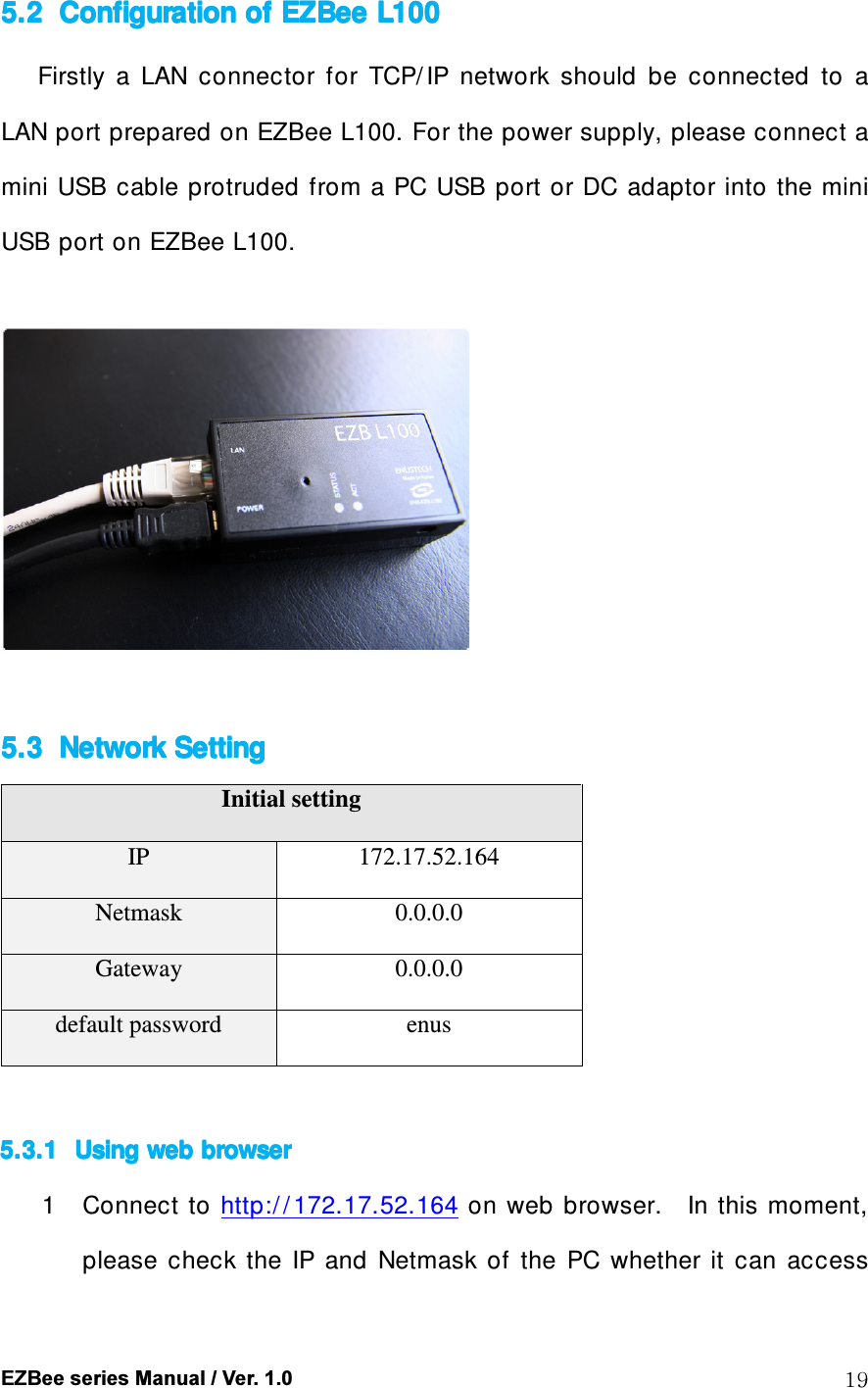
 EZBee series Manual / Ver. 1.0  19 5.25.25.25.2 Configuration of Configuration of Configuration of Configuration of EZBeeEZBeeEZBeeEZBee    L100L100L100L100    Firstly  a  LAN  connector  for  TCP/ IP  network  should  be  connected  to  a LAN port prepared on EZBee L100. For the power supply, please connect a mini USB  cable protruded from  a PC USB port  or DC adaptor into the mini USB port on EZBee L100.    5.35.35.35.3 Network SettingNetwork SettingNetwork SettingNetwork Setting    Initial setting IP  172.17.52.164 Netmask  0.0.0.0 Gateway  0.0.0.0 default password  enus  5.3.15.3.15.3.15.3.1 Using web browserUsing web browserUsing web browserUsing web browser    1 Connect  to http:/ / 172.17.52.164 on  web  browser.    In this moment, please  check  the  IP  and  Netmask  of  the  PC  whether  it  can  access
 EZBee series Manual / Ver. 1.0  20 to default IP. 2 Type enus as the default password  3 After  set  your  network  IP  at  [   TCP/ IP    configuration  ] ,  reboot  the EZBee L100.
 EZBee series Manual / Ver. 1.0  21 5.3.25.3.25.3.25.3.2 Using Using Using Using EZBee EZBee EZBee EZBee manager manager manager manager programprogramprogramprogram    The  EZBee  manager  program  is  an  utility  program  developed  for  easy setting and management of a EZBee L100.  Useful function for setting : <scanning broadcasting device> The  useful  function  of  the  EZBee  manager  program  is  a  scanning broadcasting  device.  It  searches  and  shows  all  list  of  EZBee  L100 connecting to the same network of a user computer. 1 Click the button denoting [start search]. 2 A list of all EZBee L100 connecting to the network is displayed when the automatic scanning is over. 3 When  you  want  to  change  the  setting  of one  U100  among the list, move the mouse point onto that EZBee L100 and just click the right button  of  a  mouse,  then  you  can  change  the  parameter  from  the displaying menu.
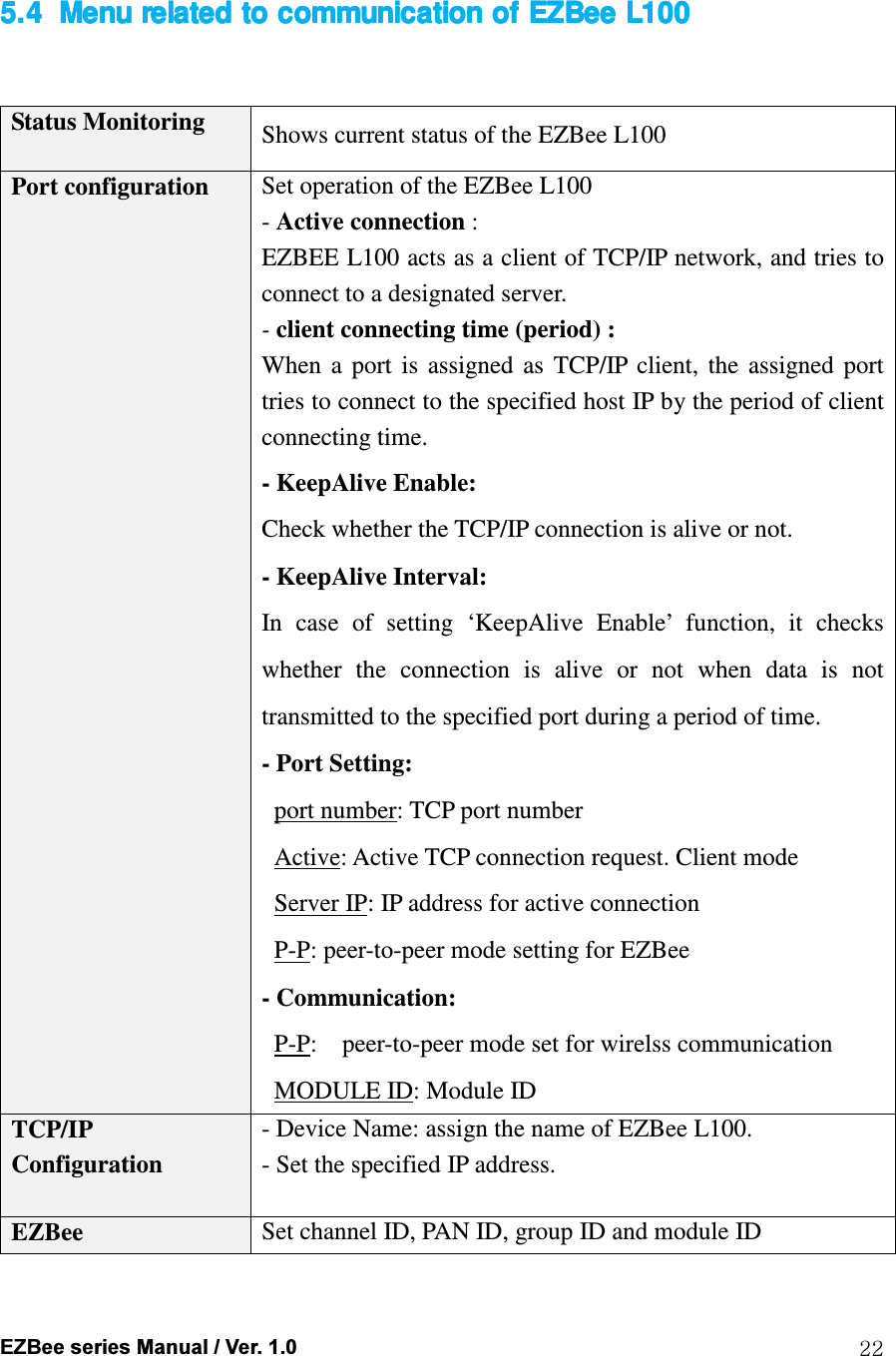
 EZBee series Manual / Ver. 1.0  22  5.45.45.45.4 Menu related to communication of Menu related to communication of Menu related to communication of Menu related to communication of EZBeeEZBeeEZBeeEZBee    L100 L100 L100 L100       Status Monitoring  Shows current status of the EZBee L100 Port configuration  Set operation of the EZBee L100 - Active connection : EZBEE L100 acts as a client of TCP/IP network, and tries to connect to a designated server. - client connecting time (period) :   When  a  port  is  assigned  as  TCP/IP  client,  the  assigned  port tries to connect to the specified host IP by the period of client connecting time. - KeepAlive Enable:   Check whether the TCP/IP connection is alive or not. - KeepAlive Interval:   In  case  of  setting  ‘KeepAlive  Enable’  function,  it  checks whether  the  connection  is  alive  or  not  when  data  is  not transmitted to the specified port during a period of time. - Port Setting:   port number: TCP port number   Active: Active TCP connection request. Client mode   Server IP: IP address for active connection   P-P: peer-to-peer mode setting for EZBee - Communication:   P-P:    peer-to-peer mode set for wirelss communication   MODULE ID: Module ID TCP/IP Configuration - Device Name: assign the name of EZBee L100. - Set the specified IP address.   EZBee  Set channel ID, PAN ID, group ID and module ID
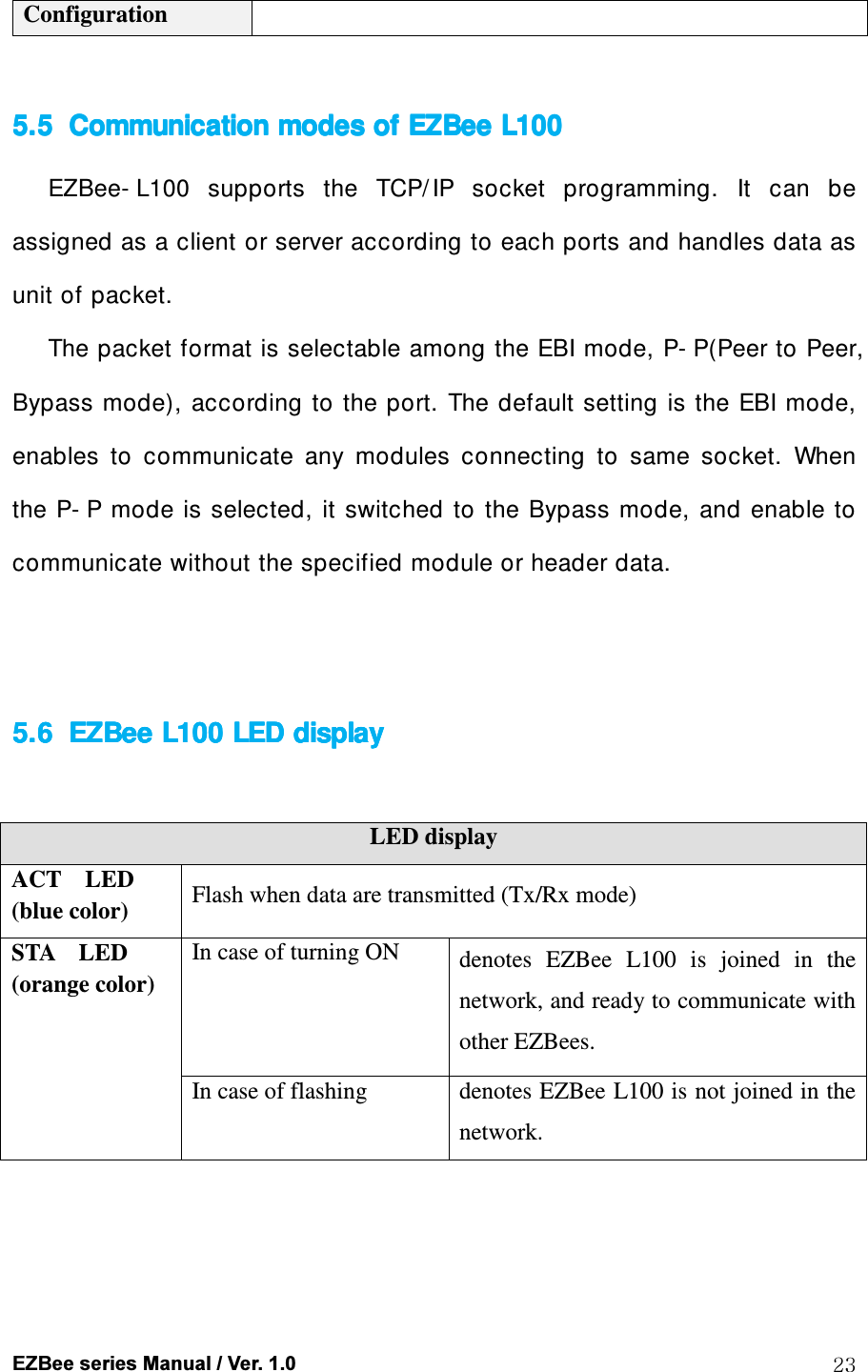
 EZBee series Manual / Ver. 1.0  23 Configuration  5.55.55.55.5 Communication modes of Communication modes of Communication modes of Communication modes of EZBeeEZBeeEZBeeEZBee    L100 L100 L100 L100      EZBee- L100  supports  the  TCP/ IP  socket  programming.  It  can  be assigned as a client or server according to each ports and handles data as unit of packet. The packet format is selectable among the EBI mode, P- P(Peer to Peer, Bypass mode), according to  the port. The default setting  is the EBI mode, enables  to  communicate  any  modules  connecting  to  same  socket.  When the P- P mode is  selected, it switched  to  the  Bypass mode,  and  enable to communicate without the specified module or header data.   5.65.65.65.6 EZBeeEZBeeEZBeeEZBee    L100 LEDL100 LEDL100 LEDL100 LED    displaydisplaydisplaydisplay          LED display ACT    LED   (blue color) Flash when data are transmitted (Tx/Rx mode) STA    LED (orange color) In case of turning ON  denotes  EZBee  L100  is  joined  in  the network, and ready to communicate with other EZBees. In case of flashing  denotes EZBee L100 is not joined in the network.
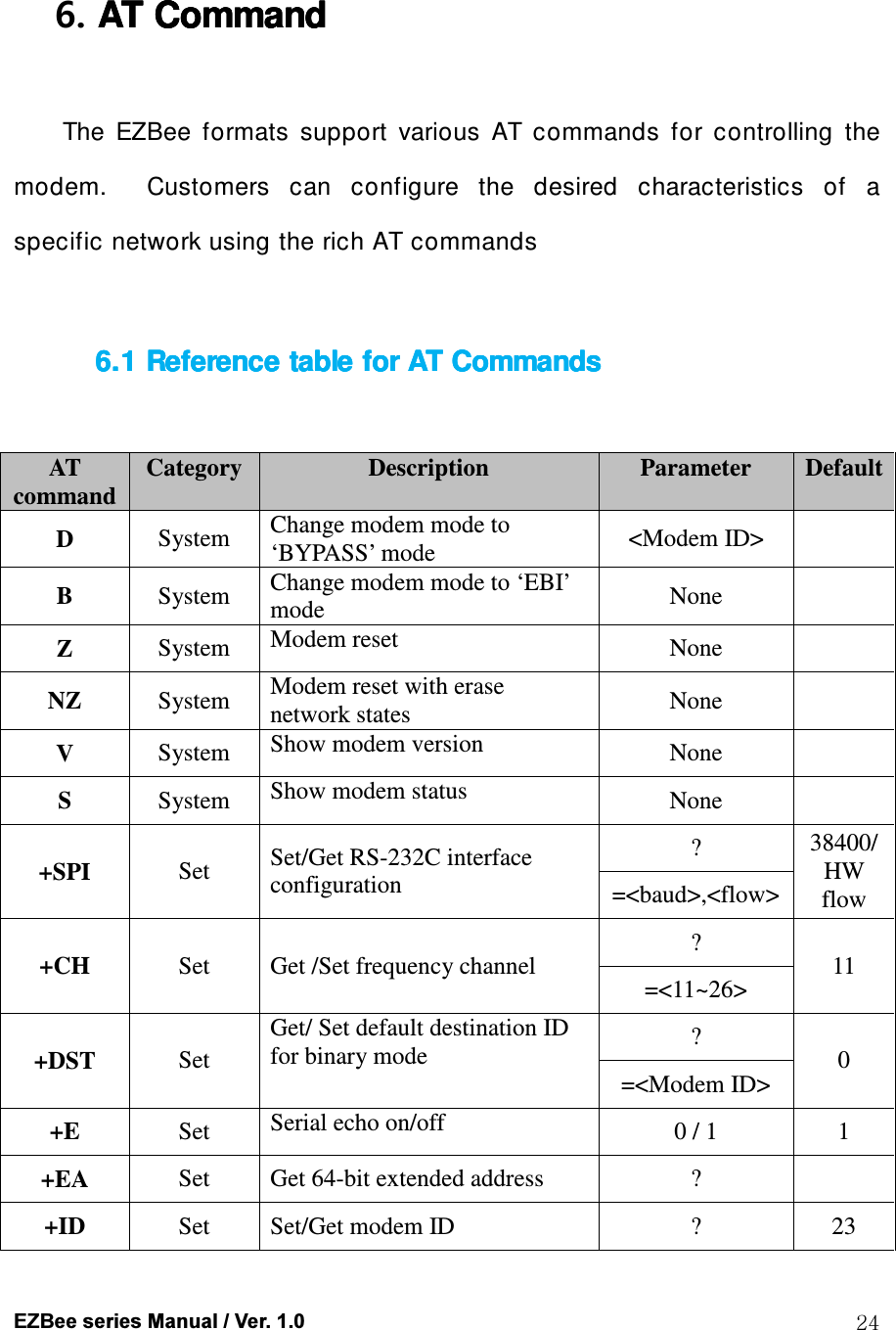
 EZBee series Manual / Ver. 1.0  24  6.    AT AT AT AT CommandCommandCommandCommand  The  EZBee  formats  support  various  AT  commands  for  controlling  the modem.    Customers  can  configure  the  desired  characteristics  of  a specific network using the rich AT commands  6.1 Reference table for 6.1 Reference table for 6.1 Reference table for 6.1 Reference table for AT AT AT AT CommandsCommandsCommandsCommands     AT command Category Description  Parameter  Default D  System  Change modem mode to ‘BYPASS’ mode  <Modem ID>   B  System  Change modem mode to ‘EBI’ mode  None   Z  System  Modem reset  None   NZ  System  Modem reset with erase network states  None   V  System  Show modem version  None   S  System  Show modem status  None   +SPI  Set  Set/Get RS-232C interface configuration ?  38400/ HW flow =<baud>,<flow> +CH  Set  Get /Set frequency channel ? 11 =<11~26> +DST  Set Get/ Set default destination ID for binary mode  ? 0 =<Modem ID> +E  Set  Serial echo on/off  0 / 1  1 +EA  Set  Get 64-bit extended address  ?   +ID  Set  Set/Get modem ID  ?  23
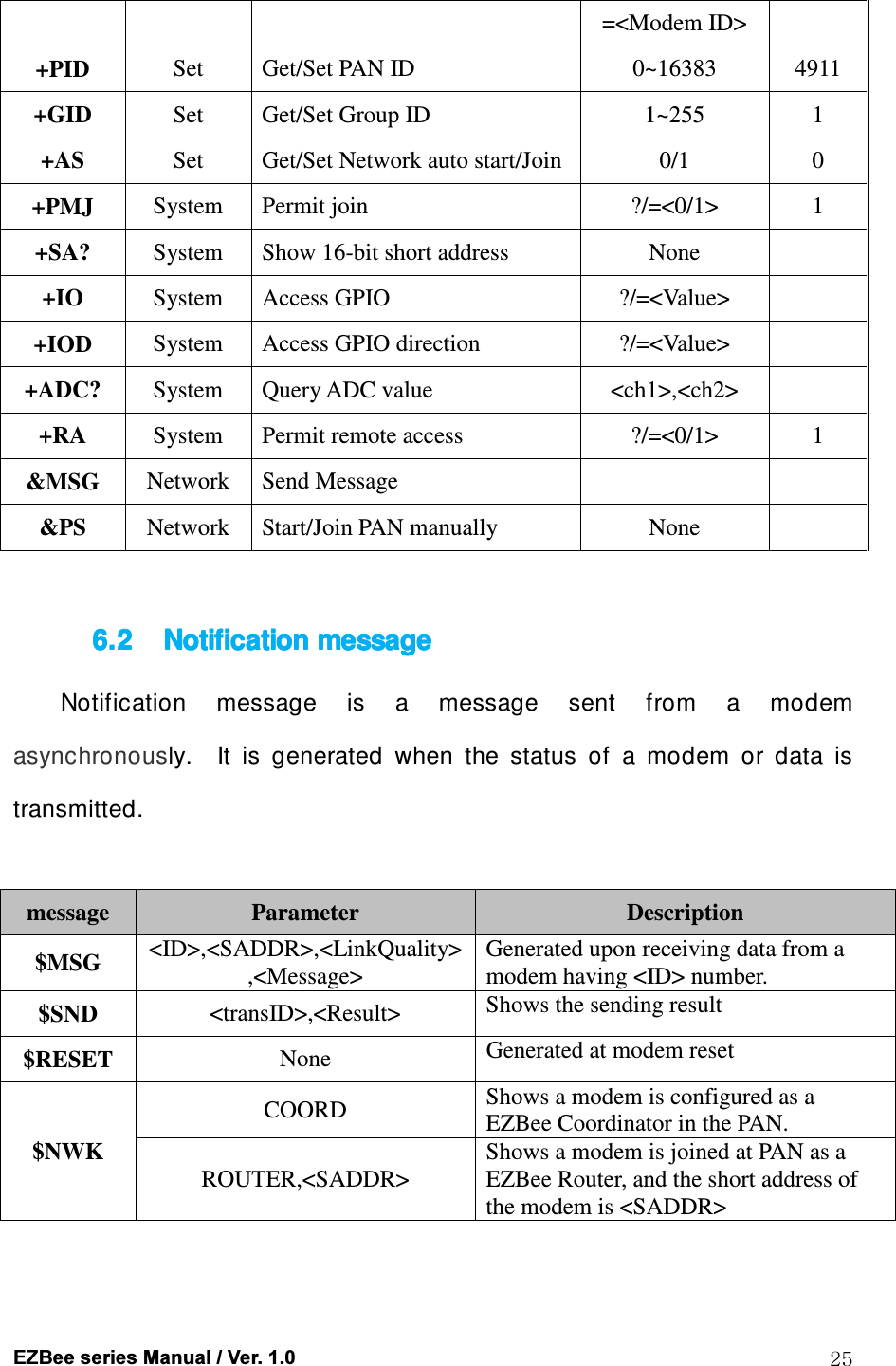
 EZBee series Manual / Ver. 1.0  25 =<Modem ID> +PID  Set  Get/Set PAN ID  0~16383  4911 +GID  Set  Get/Set Group ID  1~255  1 +AS  Set  Get/Set Network auto start/Join  0/1  0 +PMJ  System  Permit join  ?/=<0/1>  1 +SA?  System  Show 16-bit short address  None   +IO  System  Access GPIO  ?/=<Value>   +IOD  System  Access GPIO direction  ?/=<Value>   +ADC?  System  Query ADC value  <ch1>,<ch2>   +RA  System  Permit remote access  ?/=<0/1>  1 &MSG  Network  Send Message     &PS  Network  Start/Join PAN manually  None    6.26.26.26.2 Notification messageNotification messageNotification messageNotification message    Notification  message  is  a  message  sent  from  a  modem asynchronously.    It  is  generated  when  the  status  of  a  modem  or  data  is transmitted.  message  Parameter  Description $MSG  <ID>,<SADDR>,<LinkQuality>,<Message> Generated upon receiving data from a modem having <ID> number. $SND  <transID>,<Result>  Shows the sending result   $RESET  None  Generated at modem reset $NWK COORD  Shows a modem is configured as a EZBee Coordinator in the PAN. ROUTER,<SADDR> Shows a modem is joined at PAN as a EZBee Router, and the short address of the modem is <SADDR>
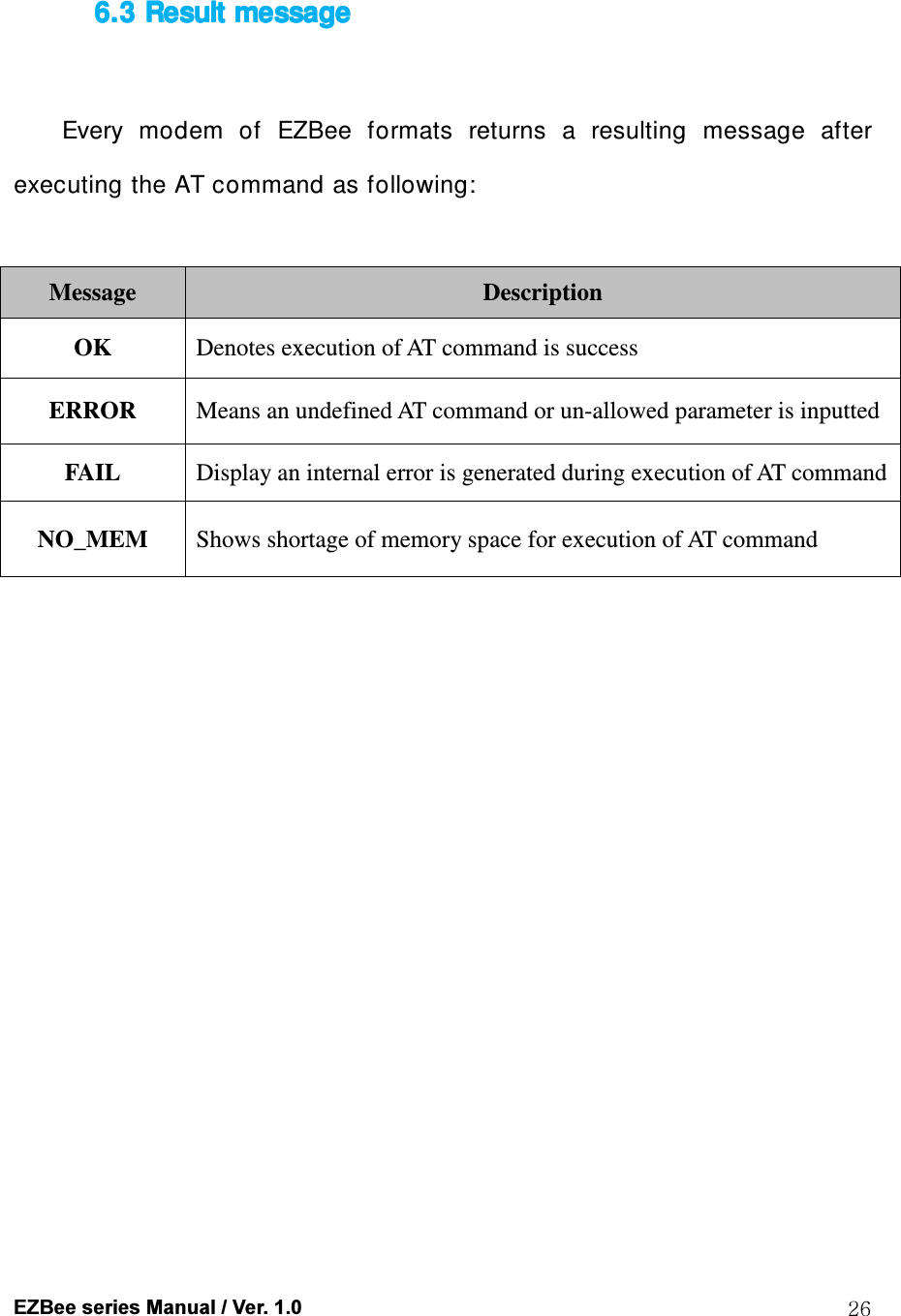
 EZBee series Manual / Ver. 1.0  26  6.3 6.3 6.3 6.3 Result messageResult messageResult messageResult message     Every  modem  of  EZBee  formats  returns  a  resulting  message  after executing the AT command as following:  Message  Description OK  Denotes execution of AT command is success ERROR  Means an undefined AT command or un-allowed parameter is inputted FAIL  Display an internal error is generated during execution of AT command NO_MEM  Shows shortage of memory space for execution of AT command
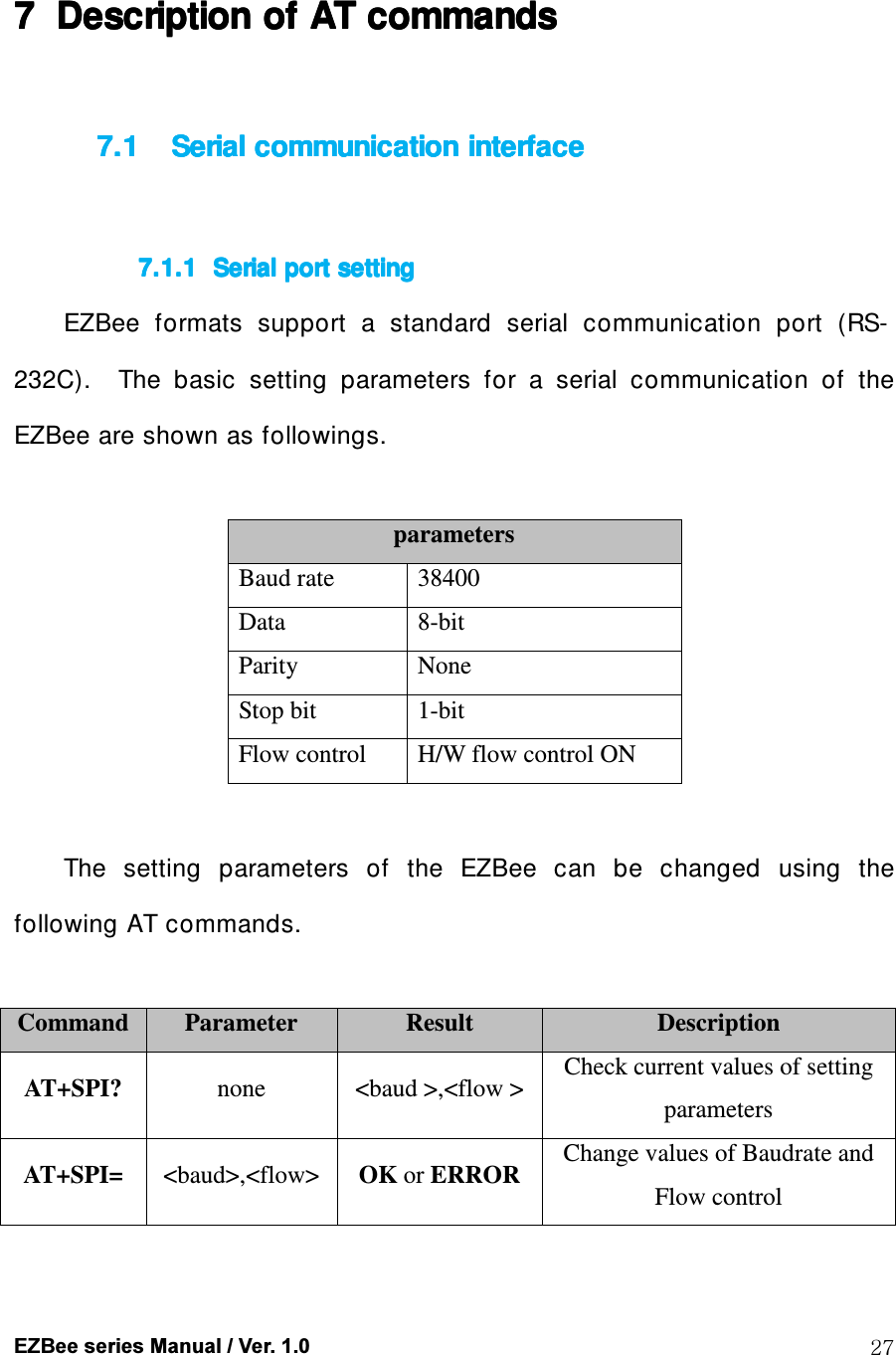
 EZBee series Manual / Ver. 1.0  27  7777 Description of Description of Description of Description of AT AT AT AT commandscommandscommandscommands     7.17.17.17.1 Serial communication interfaceSerial communication interfaceSerial communication interfaceSerial communication interface     7.1.17.1.17.1.17.1.1 Serial port settingSerial port settingSerial port settingSerial port setting    EZBee  formats  support  a  standard  serial  communication  port  (RS-232C).    The  basic  setting  parameters  for  a  serial  communication  of  the EZBee are shown as followings.  parameters Baud rate  38400 Data  8-bit Parity  None Stop bit  1-bit Flow control  H/W flow control ON  The  setting  parameters  of  the  EZBee  can  be  changed  using  the following AT commands.  Command Parameter  Result  Description AT+SPI?  none  <baud >,<flow >  Check current values of setting parameters AT+SPI=  <baud>,<flow> OK or ERROR  Change values of Baudrate and Flow control
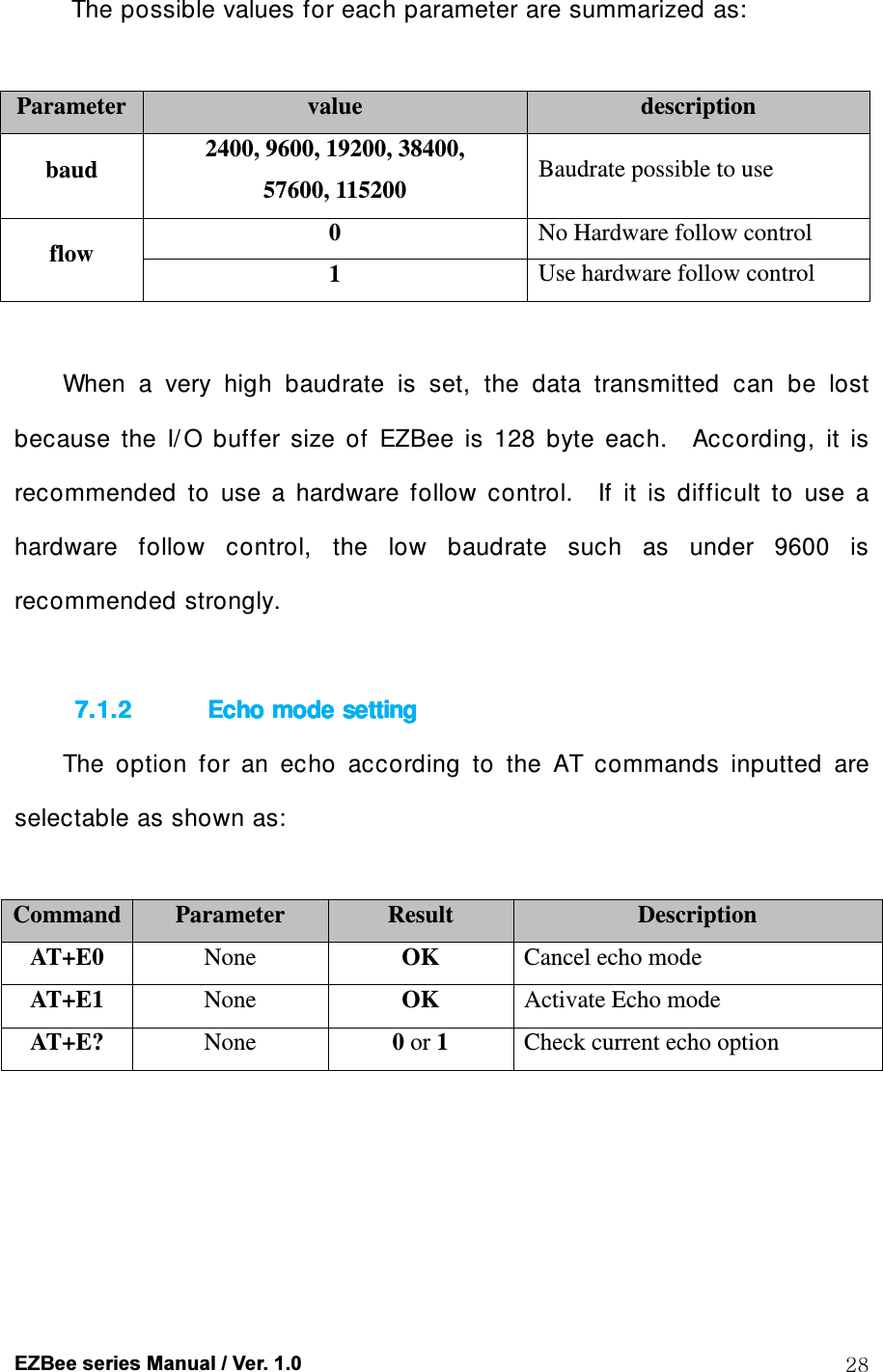
 EZBee series Manual / Ver. 1.0  28 The possible values for each parameter are summarized as:  Parameter value  description baud  2400, 9600, 19200, 38400,   57600, 115200  Baudrate possible to use flow  0  No Hardware follow control 1  Use hardware follow control  When  a  very  high  baudrate  is  set,  the  data  transmitted  can  be  lost because  the  I/ O  buffer  size  of  EZBee  is  128  byte  each.    According,  it  is recommended  to  use  a  hardware  follow  control.    If  it  is  difficult  to  use  a hardware  follow  control,  the  low  baudrate  such  as  under  9600  is recommended strongly.  7.1.27.1.27.1.27.1.2 Echo mode settingEcho mode settingEcho mode settingEcho mode setting    The  option  for  an  echo  according  to  the  AT  commands  inputted  are selectable as shown as:  Command Parameter  Result  Description AT+E0  None  OK  Cancel echo mode AT+E1  None  OK  Activate Echo mode AT+E?  None 0 or 1 Check current echo option
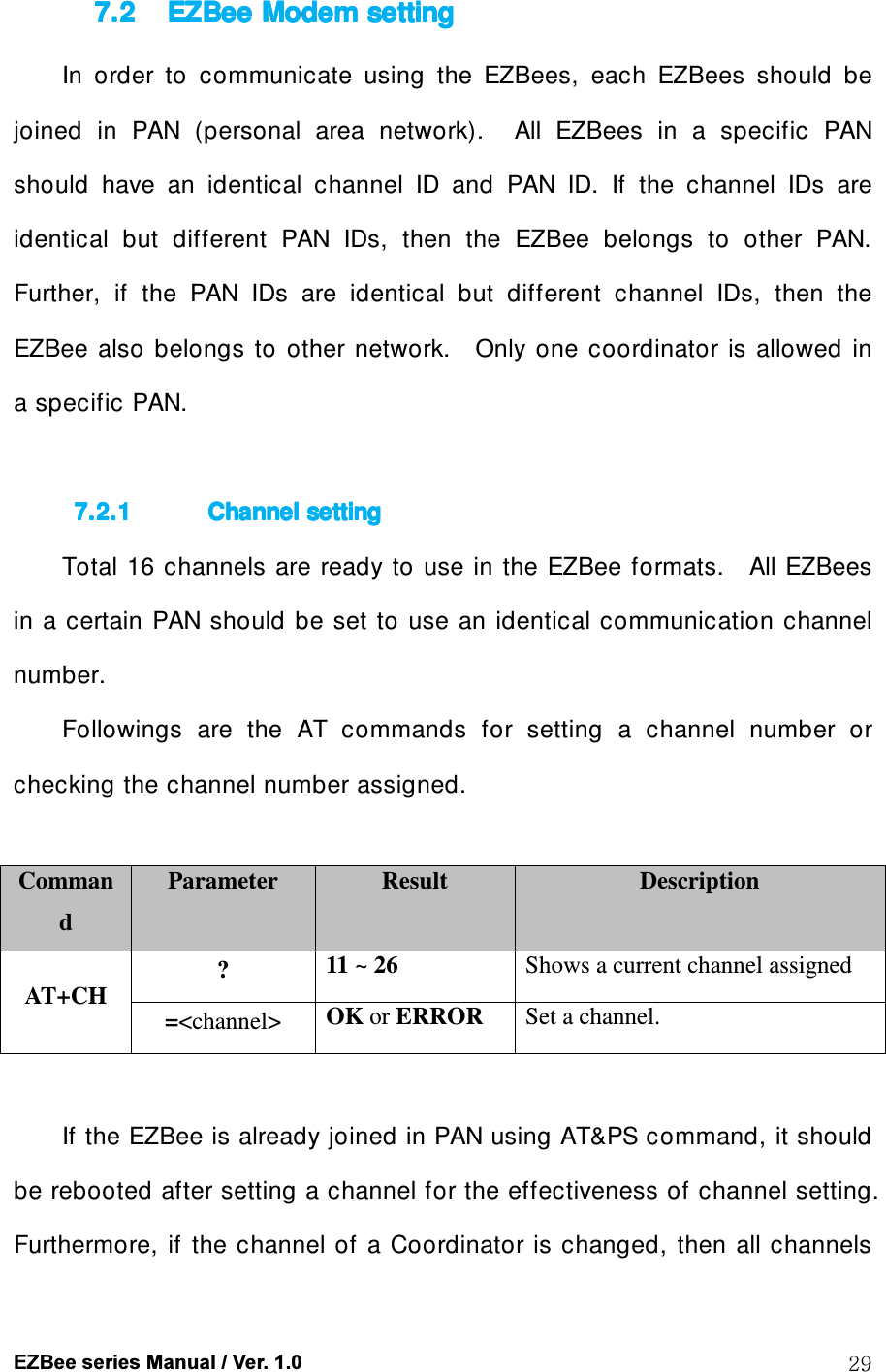
 EZBee series Manual / Ver. 1.0  29 7.27.27.27.2 EZBee EZBee EZBee EZBee Modem settingModem settingModem settingModem setting    In  order  to  communicate  using  the  EZBees,  each  EZBees  should  be joined  in  PAN  (personal  area  network).    All  EZBees  in  a  specific  PAN should  have  an  identical  channel  ID  and  PAN  ID.  If  the  channel  IDs  are identical  but  different  PAN  IDs,  then  the  EZBee  belongs  to  other  PAN.   Further,  if  the  PAN  IDs  are  identical  but  different  channel  IDs,  then  the EZBee  also  belongs  to  other  network.    Only  one  coordinator  is  allowed  in a specific PAN.    7.2.17.2.17.2.17.2.1 Channel settingChannel settingChannel settingChannel setting    Total  16  channels are  ready  to  use in the EZBee  formats.    All EZBees in  a  certain PAN  should be set  to use an  identical communication  channel number. Followings  are  the  AT  commands  for  setting  a  channel  number  or checking the channel number assigned.  Command Parameter  Result  Description AT+CH ? 11 ~ 26 Shows a current channel assigned =<channel> OK or ERROR Set a channel.  If the EZBee is already joined in PAN using AT&PS command, it should be rebooted after setting a channel for the effectiveness of channel setting.   Furthermore, if  the  channel of a  Coordinator is  changed, then  all  channels
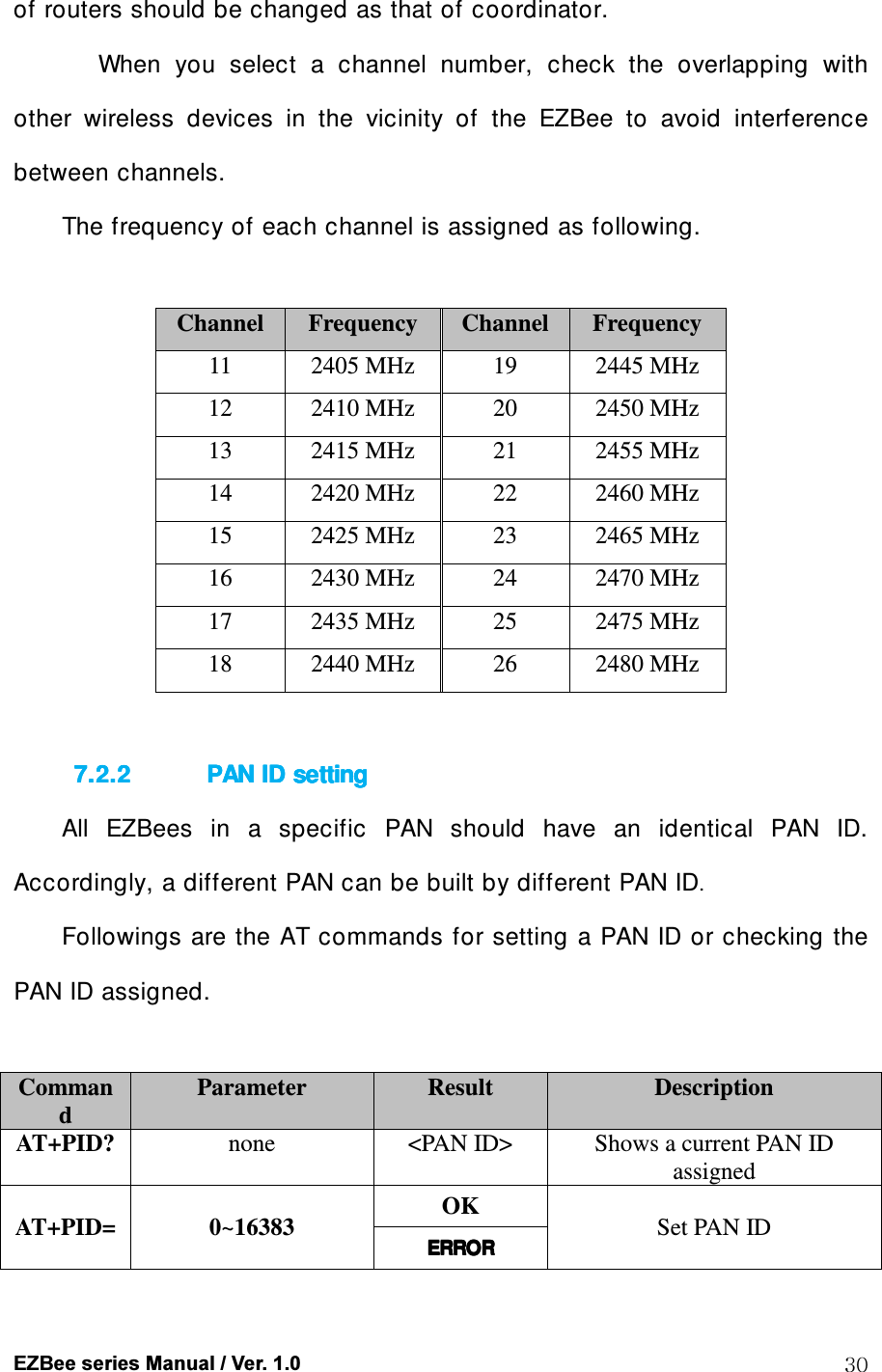
 EZBee series Manual / Ver. 1.0  30 of routers should be changed as that of coordinator.       When  you  select  a  channel  number,  check  the  overlapping  with other  wireless  devices  in  the  vicinity  of  the  EZBee  to  avoid  interference between channels. The frequency of each channel is assigned as following.    Channel  Frequency  Channel  Frequency 11  2405 MHz  19  2445 MHz 12  2410 MHz  20  2450 MHz 13  2415 MHz  21  2455 MHz 14  2420 MHz  22  2460 MHz 15  2425 MHz  23  2465 MHz 16  2430 MHz  24  2470 MHz 17  2435 MHz  25  2475 MHz 18  2440 MHz  26  2480 MHz  7.2.27.2.27.2.27.2.2 PAN ID PAN ID PAN ID PAN ID settingsettingsettingsetting    All  EZBees  in  a  specific  PAN  should  have  an  identical  PAN  ID. Accordingly, a different PAN can be built by different PAN ID.   Followings are the AT commands for setting a PAN ID or checking the PAN ID assigned.  Command Parameter  Result  Description AT+PID? none  <PAN ID>  Shows a current PAN ID assigned   AT+PID= 0~16383  OK  Set PAN ID ERRORERRORERRORERROR
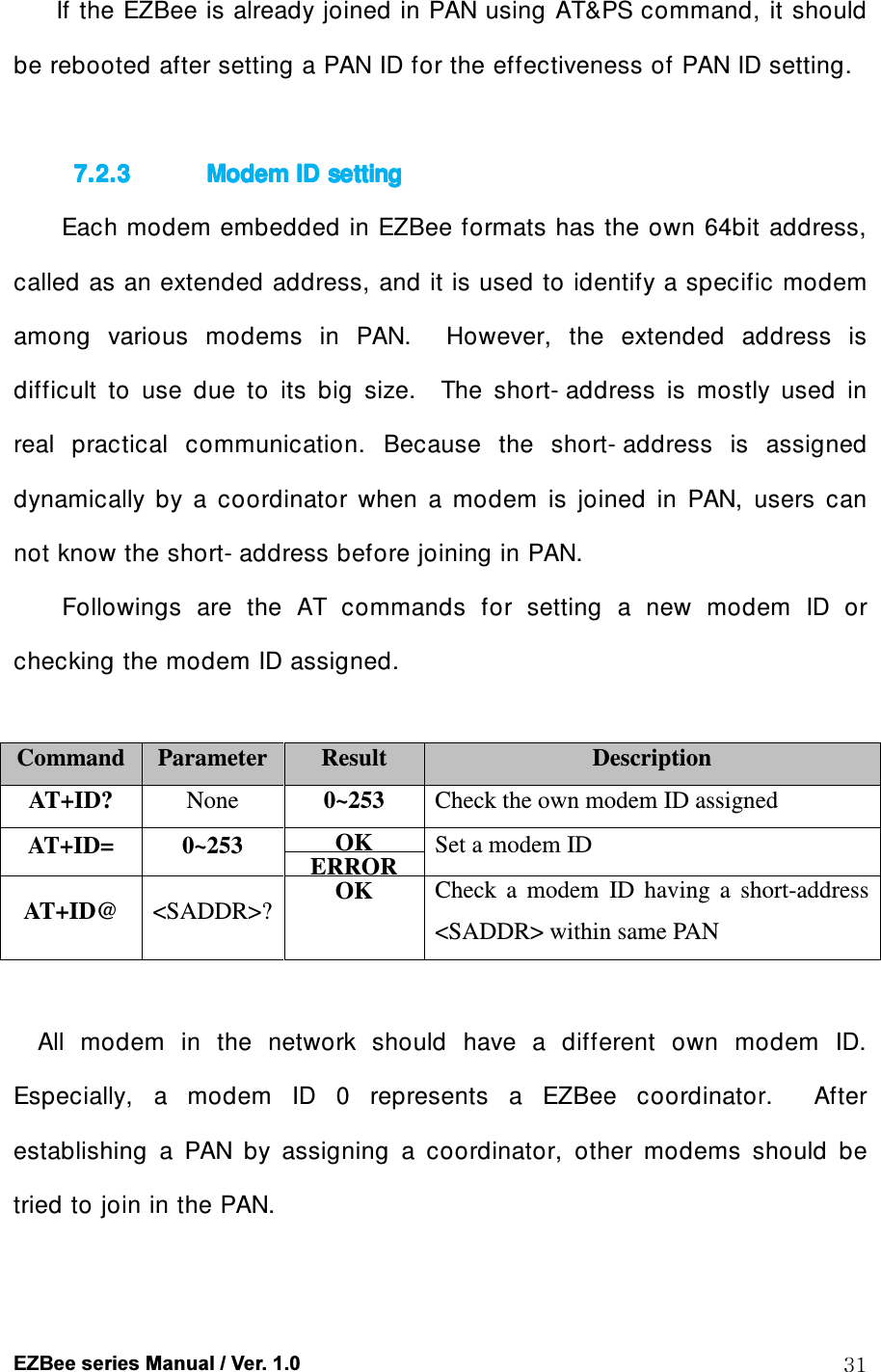
 EZBee series Manual / Ver. 1.0  31 If the EZBee is already joined in PAN using AT&PS command, it should be rebooted after setting a PAN ID for the effectiveness of PAN ID setting.  7.2.37.2.37.2.37.2.3 ModemModemModemModem    ID settingID settingID settingID setting    Each modem embedded in EZBee formats has the own 64bit address, called as an extended address, and it is used to identify a specific modem among  various  modems  in  PAN.    However,  the  extended  address  is difficult  to  use  due  to  its  big  size.    The  short- address  is  mostly  used  in real  practical  communication.  Because  the  short- address  is  assigned dynamically  by  a  coordinator  when  a  modem  is  joined  in  PAN,  users  can not know the short- address before joining in PAN. Followings  are  the  AT  commands  for  setting  a  new  modem  ID  or checking the modem ID assigned.  Command Parameter Result  Description AT+ID?  None  0~253  Check the own modem ID assigned AT+ID=  0~253 OK Set a modem ID ERROR AT+ID@  <SADDR>? OK  Check  a  modem  ID  having  a  short-address   <SADDR> within same PAN  All  modem  in  the  network  should  have  a  different  own  modem  ID. Especially,  a  modem  ID  0  represents  a  EZBee  coordinator.    After establishing  a  PAN  by  assigning  a  coordinator,  other  modems  should  be tried to join in the PAN.
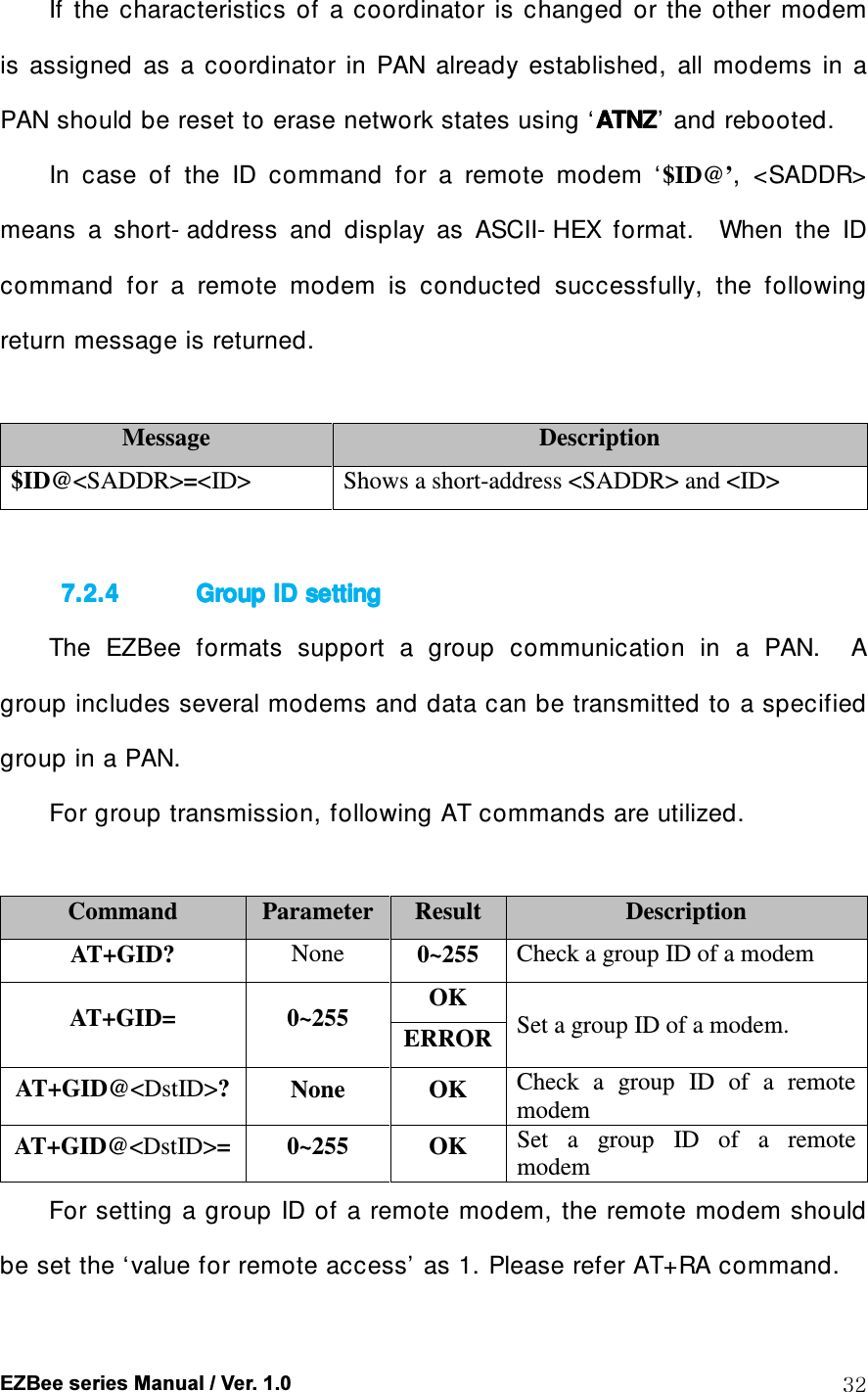
 EZBee series Manual / Ver. 1.0  32 If  the  characteristics  of  a  coordinator  is  changed  or  the  other  modem is  assigned  as  a  coordinator  in  PAN  already  established,  all  modems  in  a PAN should be reset to erase network states using ‘ ATNZATNZATNZATNZ’  and rebooted. In  case  of  the  ID  command  for  a  remote  modem  ‘$ID@’,  <SADDR> means  a  short- address  and  display  as  ASCII- HEX  format.    When  the  ID command  for  a  remote  modem  is  conducted  successfully,  the  following return message is returned.  Message  Description $ID@<SADDR>=<ID>  Shows a short-address <SADDR> and <ID>  7.2.47.2.47.2.47.2.4 GroupGroupGroupGroup    ID ID ID ID settingsettingsettingsetting    The  EZBee  formats  support  a  group  communication  in  a  PAN.    A group includes several modems and data can be transmitted to a specified group in a PAN. For group transmission, following AT commands are utilized.  Command  Parameter Result  Description AT+GID?  None  0~255  Check a group ID of a modem AT+GID=  0~255  OK Set a group ID of a modem. ERROR AT+GID@<DstID>? None  OK  Check  a  group  ID  of  a  remote modem AT+GID@<DstID>= 0~255  OK  Set  a  group  ID  of  a  remote modem For setting a group  ID of a remote modem, the remote modem should be set the ‘value for remote access’ as 1. Please refer AT+RA command.
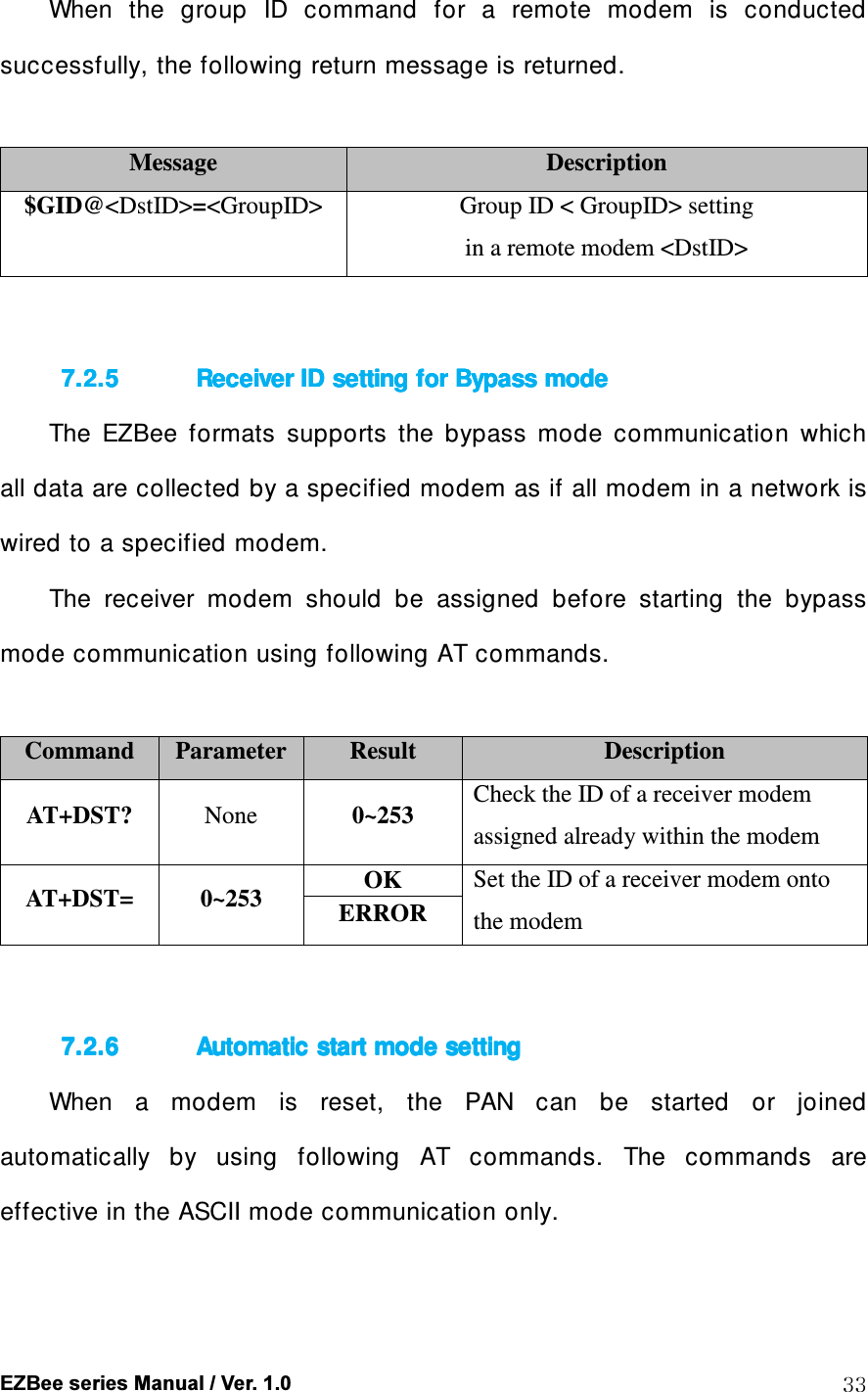
 EZBee series Manual / Ver. 1.0  33 When  the  group  ID  command  for  a  remote  modem  is  conducted successfully, the following return message is returned.  Message  Description $GID@<DstID>=<GroupID>  Group ID < GroupID> setting   in a remote modem <DstID>   7.2.57.2.57.2.57.2.5 Receiver ID setting for Bypass modeReceiver ID setting for Bypass modeReceiver ID setting for Bypass modeReceiver ID setting for Bypass mode    The  EZBee  formats  supports  the  bypass  mode  communication  which all data are collected by a specified modem as if all modem in a network is wired to a specified modem.   The  receiver  modem  should  be  assigned  before  starting  the  bypass mode communication using following AT commands.  Command  Parameter Result  Description AT+DST?  None  0~253  Check the ID of a receiver modem assigned already within the modem AT+DST=  0~253  OK  Set the ID of a receiver modem onto the modem ERROR   7.2.67.2.67.2.67.2.6 Automatic start mode settingAutomatic start mode settingAutomatic start mode settingAutomatic start mode setting    When  a  modem  is  reset,  the  PAN  can  be  started  or  joined automatically  by  using  following  AT  commands.  The  commands  are effective in the ASCII mode communication only.
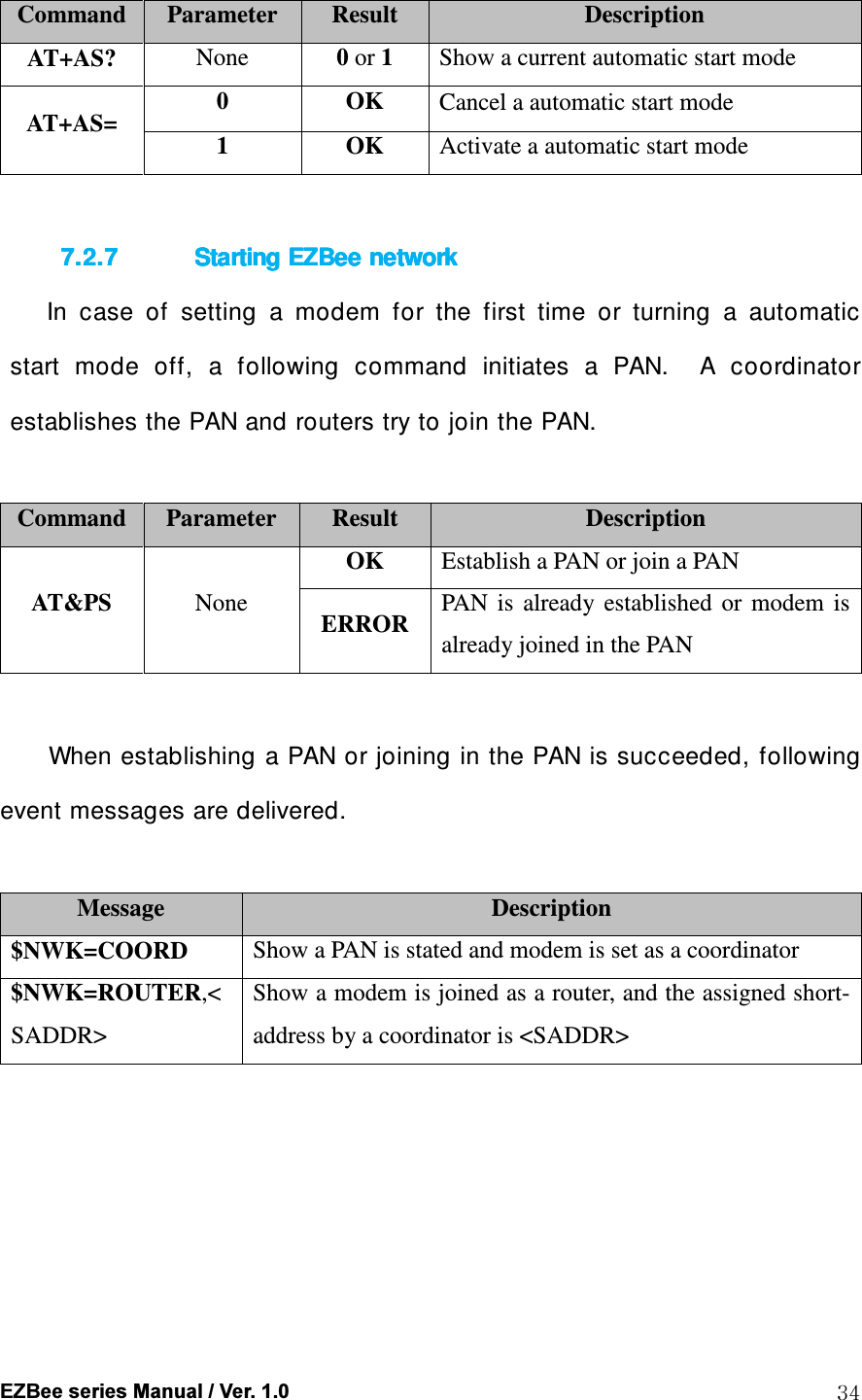
 EZBee series Manual / Ver. 1.0  34 Command Parameter  Result  Description AT+AS?  None 0 or 1 Show a current automatic start mode AT+AS=  0  OK  Cancel a automatic start mode 1  OK  Activate a automatic start mode  7.2.77.2.77.2.77.2.7 Starting Starting Starting Starting EZBee EZBee EZBee EZBee networknetworknetworknetwork    In  case  of  setting  a  modem  for  the  first  time  or  turning  a  automatic start  mode  off,  a  following  command  initiates  a  PAN.    A  coordinator establishes the PAN and routers try to join the PAN.  Command Parameter  Result  Description AT&PS  None OK  Establish a PAN or join a PAN ERROR  PAN  is  already  established  or  modem  is already joined in the PAN  When establishing a PAN or joining in the PAN is succeeded, following event messages are delivered.  Message  Description $NWK=COORD  Show a PAN is stated and modem is set as a coordinator   $NWK=ROUTER,<SADDR> Show a modem is joined as a router, and the assigned short-address by a coordinator is <SADDR>
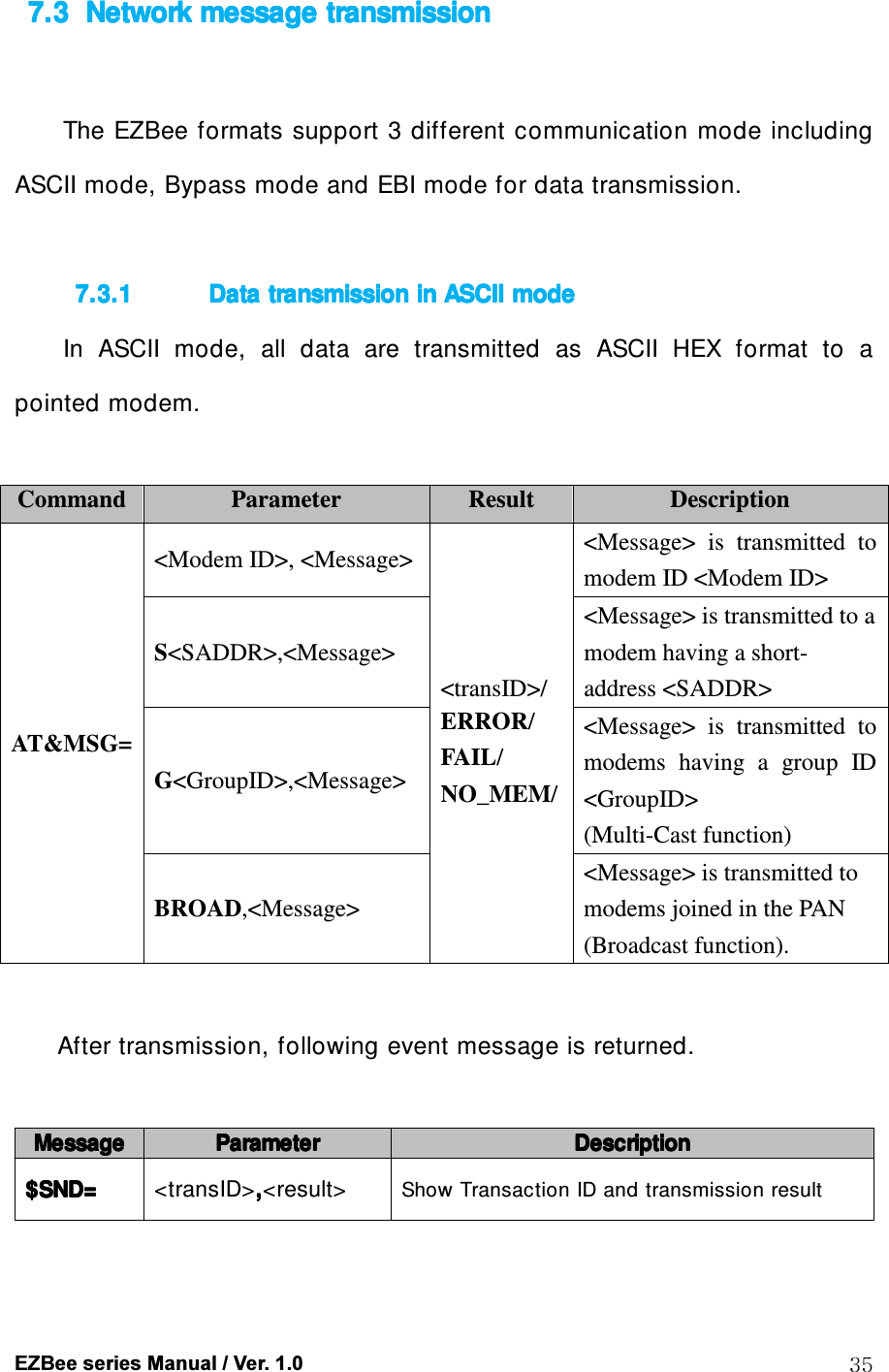
 EZBee series Manual / Ver. 1.0  35 7.37.37.37.3      Network message transmissionNetwork message transmissionNetwork message transmissionNetwork message transmission     The EZBee formats support 3 different communication mode including ASCII mode, Bypass mode and EBI mode for data transmission.  7.3.17.3.17.3.17.3.1 Data transmission in Data transmission in Data transmission in Data transmission in ASCII ASCII ASCII ASCII modemodemodemode    In  ASCII  mode,  all  data  are  transmitted  as  ASCII  HEX  format  to  a pointed modem.  Command Parameter  Result  Description AT&MSG= <Modem ID>, <Message> <transID>/ ERROR/ FAIL/ NO_MEM/ <Message>  is  transmitted  to modem ID <Modem ID> S<SADDR>,<Message> <Message> is transmitted to a modem having a short-address <SADDR> G<GroupID>,<Message> <Message>  is  transmitted  to modems  having  a  group  ID <GroupID>   (Multi-Cast function) BROAD,<Message> <Message> is transmitted to modems joined in the PAN (Broadcast function).  After transmission, following event message is returned.  MessageMessageMessageMessage     ParameterParameterParameterParameter     DescriptionDescriptionDescriptionDescription    $SND=$SND=$SND=$SND=    <transID>,,,,<result> Show Transaction ID and transmission result
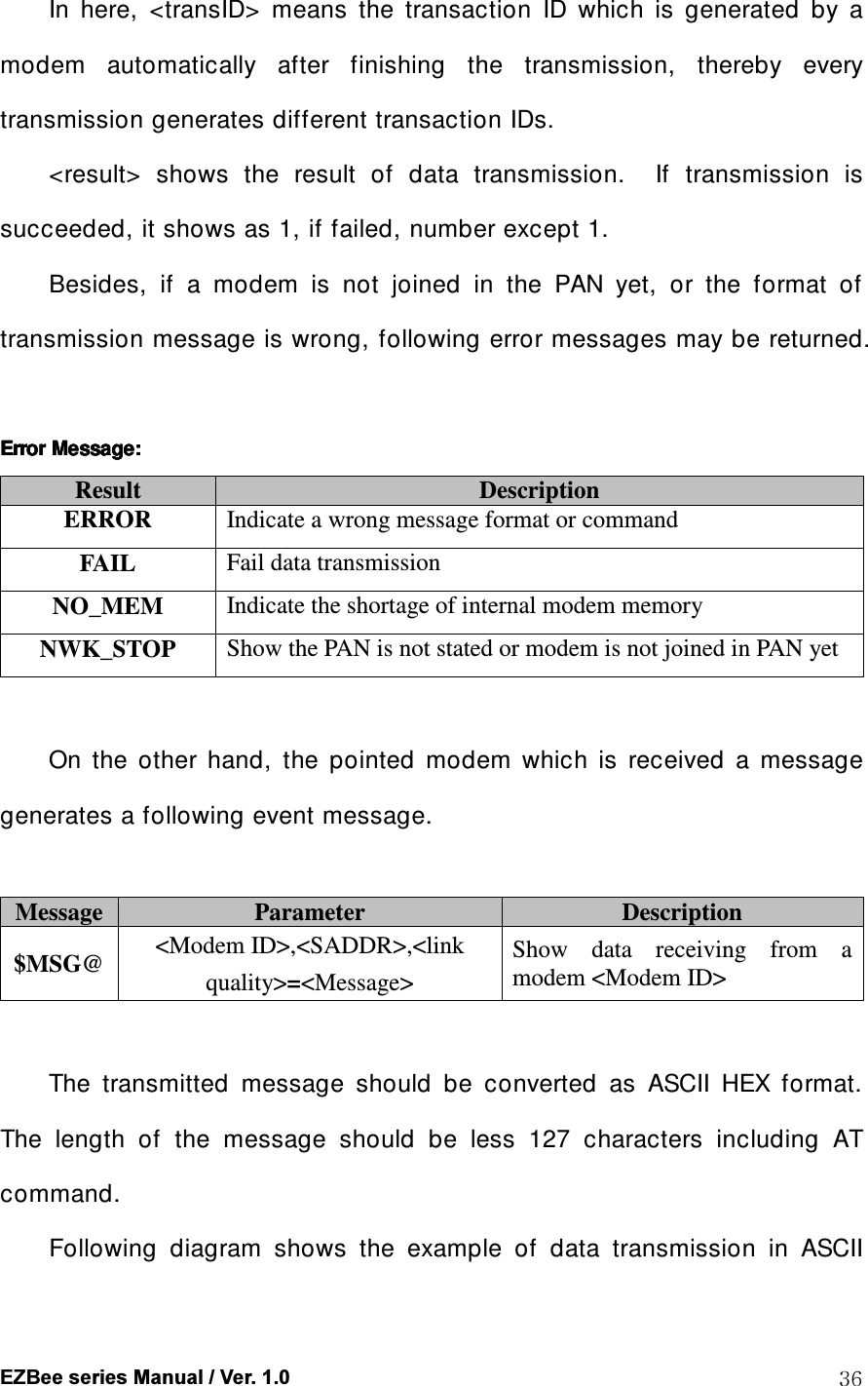
 EZBee series Manual / Ver. 1.0  36 In  here,  <transID>  means  the  transaction  ID  which  is  generated  by  a modem  automatically  after  finishing  the  transmission,  thereby  every transmission generates different transaction IDs. <result>  shows  the  result  of  data  transmission.    If  transmission  is succeeded, it shows as 1, if failed, number except 1.   Besides,  if  a  modem  is  not  joined  in  the  PAN  yet,  or  the  format  of transmission message is wrong, following error messages may be returned.  Error MessageError MessageError MessageError Message::::    Result  Description ERROR  Indicate a wrong message format or command FAIL  Fail data transmission NO_MEM  Indicate the shortage of internal modem memory NWK_STOP  Show the PAN is not stated or modem is not joined in PAN yet  On  the  other  hand,  the  pointed  modem  which  is  received  a  message generates a following event message.  Message Parameter  Description $MSG@ <Modem ID>,<SADDR>,<link quality>=<Message> Show  data  receiving  from  a modem <Modem ID>  The  transmitted  message  should  be  converted  as  ASCII  HEX  format.   The  length  of  the  message  should  be  less  127  characters  including  AT command. Following  diagram  shows  the  example  of  data  transmission  in  ASCII
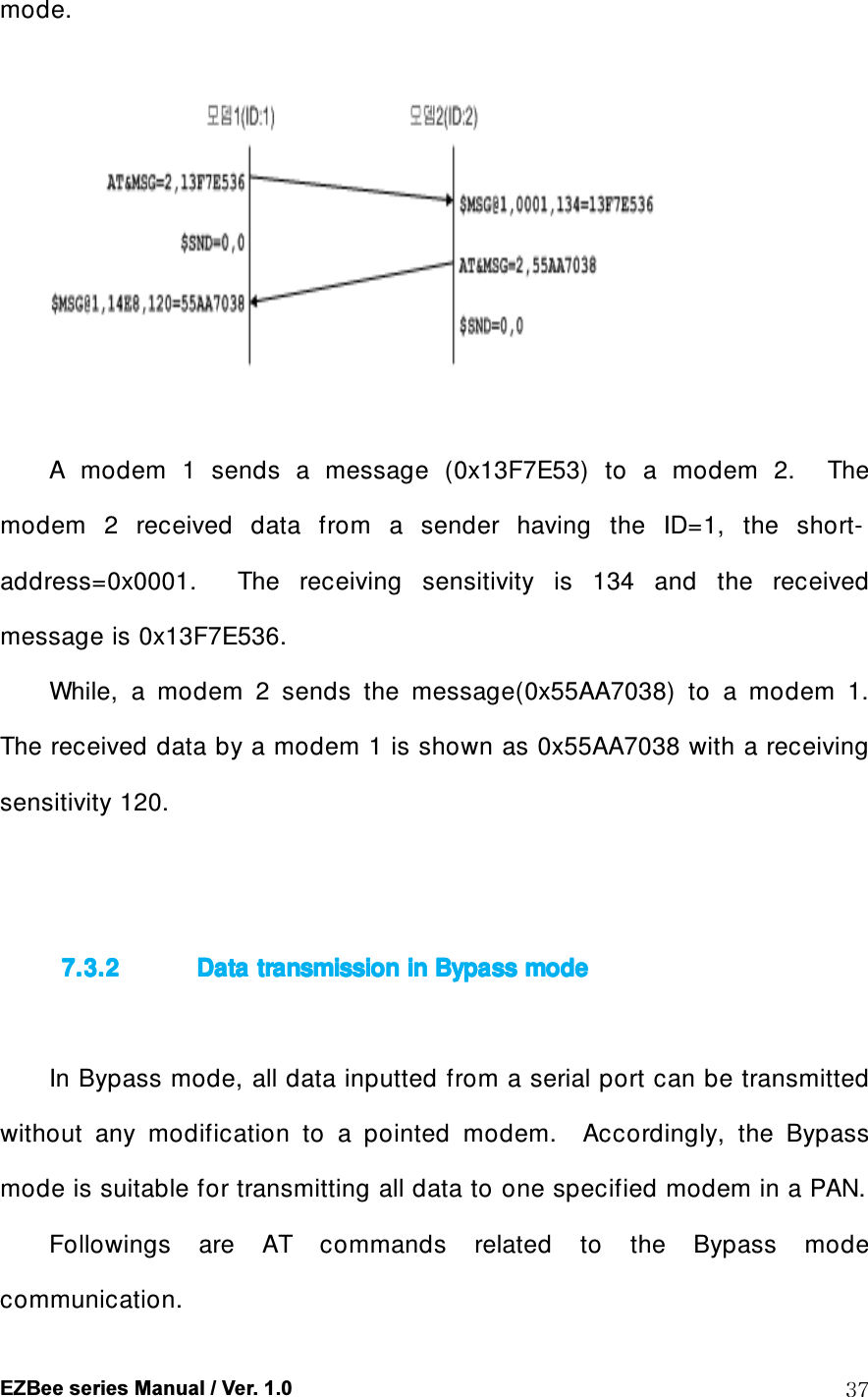
 EZBee series Manual / Ver. 1.0  37 mode.    A  modem  1  sends  a  message  (0x13F7E53)  to  a  modem  2.    The modem  2  received  data  from  a  sender  having  the  ID=1,  the  short-address=0x0001.    The  receiving  sensitivity  is  134  and  the  received message is 0x13F7E536. While,  a  modem  2  sends  the  message(0x55AA7038)  to  a  modem  1.   The received data by a modem 1 is shown as 0x55AA7038 with a receiving sensitivity 120.   7.3.27.3.27.3.27.3.2 Data transmission inData transmission inData transmission inData transmission in    Bypass Bypass Bypass Bypass modemodemodemode     In Bypass mode, all data inputted from a serial port can be transmitted without  any  modification  to  a  pointed  modem.    Accordingly,  the  Bypass mode is suitable for transmitting all data to one specified modem in a PAN.   Followings  are  AT  commands  related  to  the  Bypass  mode communication.
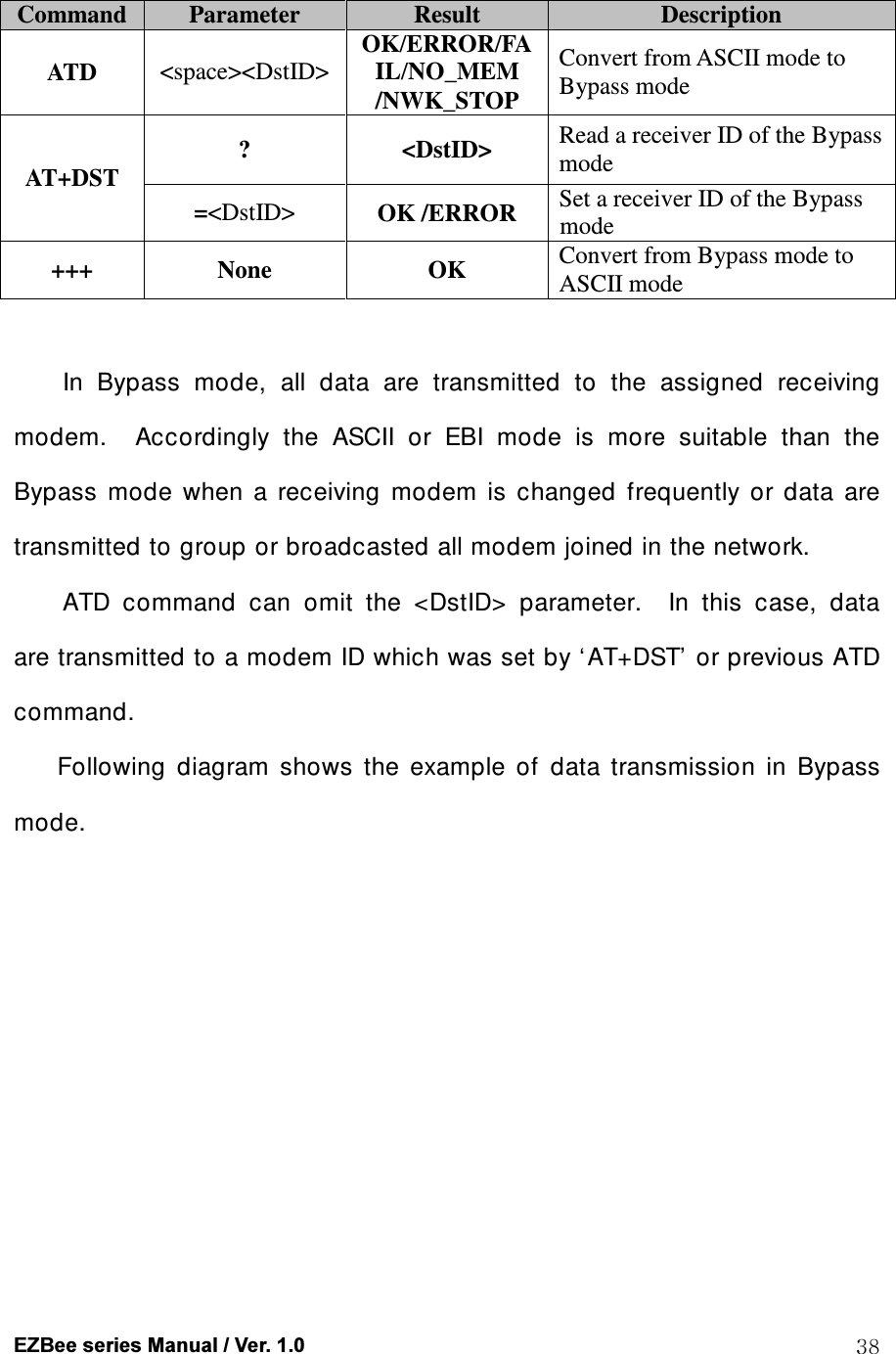
 EZBee series Manual / Ver. 1.0  38  Command Parameter  Result  Description ATD  <space><DstID> OK/ERROR/FAIL/NO_MEM /NWK_STOP Convert from ASCII mode to Bypass mode AT+DST ?  <DstID>  Read a receiver ID of the Bypass mode =<DstID>  OK /ERROR  Set a receiver ID of the Bypass mode +++  None  OK  Convert from Bypass mode to ASCII mode  In  Bypass  mode,  all  data  are  transmitted  to  the  assigned  receiving modem.    Accordingly  the  ASCII  or  EBI  mode  is  more  suitable  than  the Bypass  mode  when  a  receiving  modem  is  changed  frequently  or  data  are transmitted to group or broadcasted all modem joined in the network. ATD  command  can  omit  the  <DstID>  parameter.    In  this  case,  data are transmitted to a modem ID which was set by ‘ AT+DST’ or previous ATD command. Following  diagram  shows  the  example  of  data  transmission  in  Bypass mode.
 EZBee series Manual / Ver. 1.0  39   It  is  not  necessary  the  receiver  and  sender  have  been  set  as  same communication mode.    The communication mode is selected according to the operating environment. If a sender is set as Bypass mode and a receiver as ASCII mode, and the  sender  sends  a  long  message,  the  receiver  can  receive  the  message as  divided  length  of  messages  due  to  the  size  of  internal  buffer  or transmission delay.     For converting  from the Bypass to ASCII mode, a string  “ +++”   should be  typed  at  least  300  [ msec]   later  after  transmitting  the  final  data.    A mode  converting  is  succeeded  if  no  characters  are  inputted  during  300 [ msec]   after  inputting  the  string  “ +++” .    If  any  characters  are  inputted within 300 [ msec] , it is considered as the transmitting data.
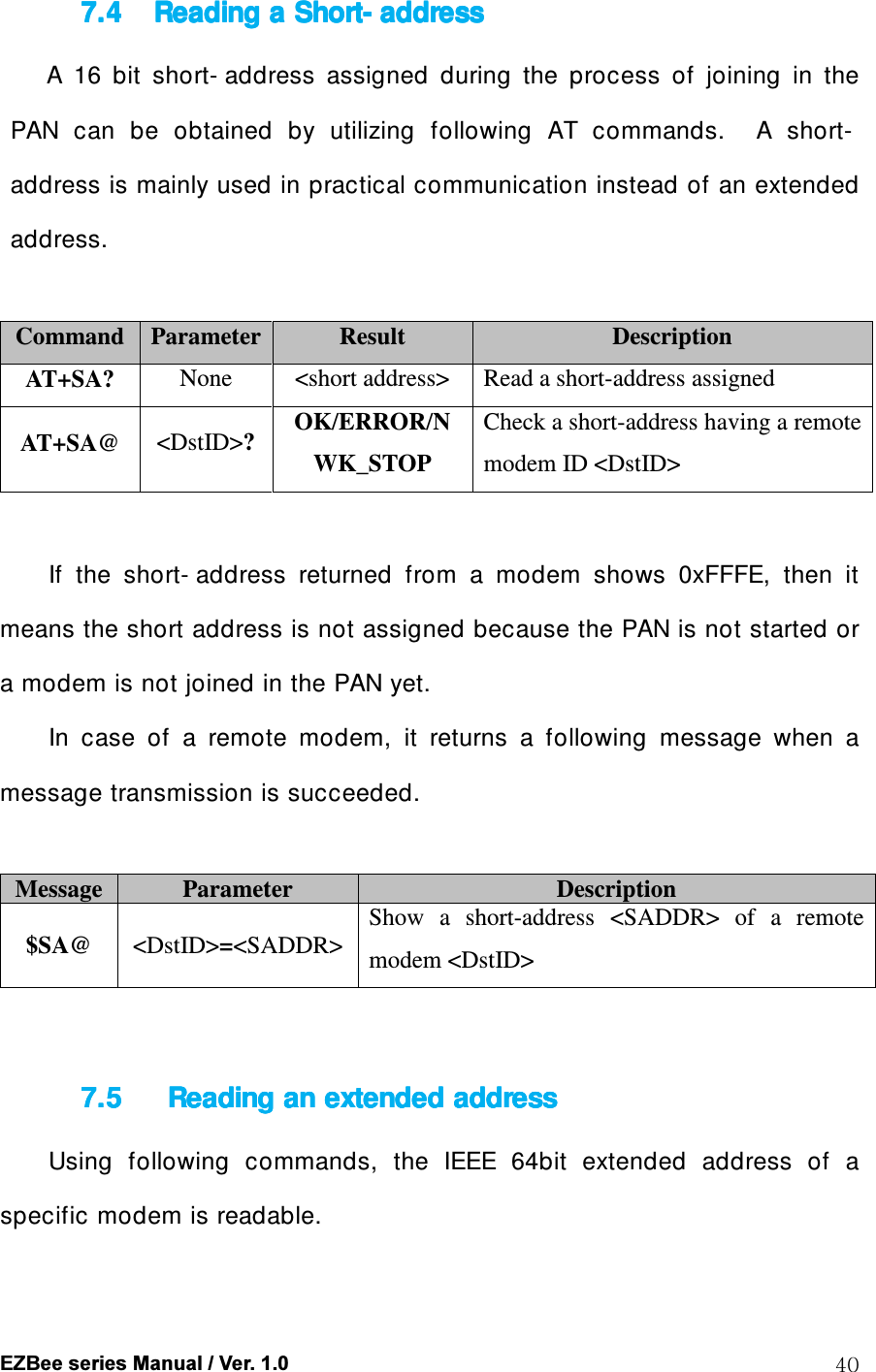
 EZBee series Manual / Ver. 1.0  40 7.47.47.47.4 Reading a Reading a Reading a Reading a ShortShortShortShort---- addressaddressaddressaddress    A  16  bit  short- address  assigned  during  the  process  of  joining  in  the PAN  can  be  obtained  by  utilizing  following  AT  commands.    A  short-address is mainly used in practical communication instead of an extended address.  Command Parameter Result  Description AT+SA?  None  <short address>  Read a short-address assigned   AT+SA@  <DstID>? OK/ERROR/NWK_STOP Check a short-address having a remote modem ID <DstID>  If  the  short- address  returned  from  a  modem  shows  0xFFFE,  then  it means the short address is not assigned because the PAN is not started or a modem is not joined in the PAN yet. In  case  of  a  remote  modem,  it  returns  a  following  message  when  a message transmission is succeeded.  Message Parameter  Description $SA@  <DstID>=<SADDR> Show  a  short-address  <SADDR>  of  a  remote modem <DstID>   7.57.57.57.5     Reading an eReading an eReading an eReading an extended addressxtended addressxtended addressxtended address    Using  following  commands,  the  IEEE  64bit  extended  address  of  a specific modem is readable.
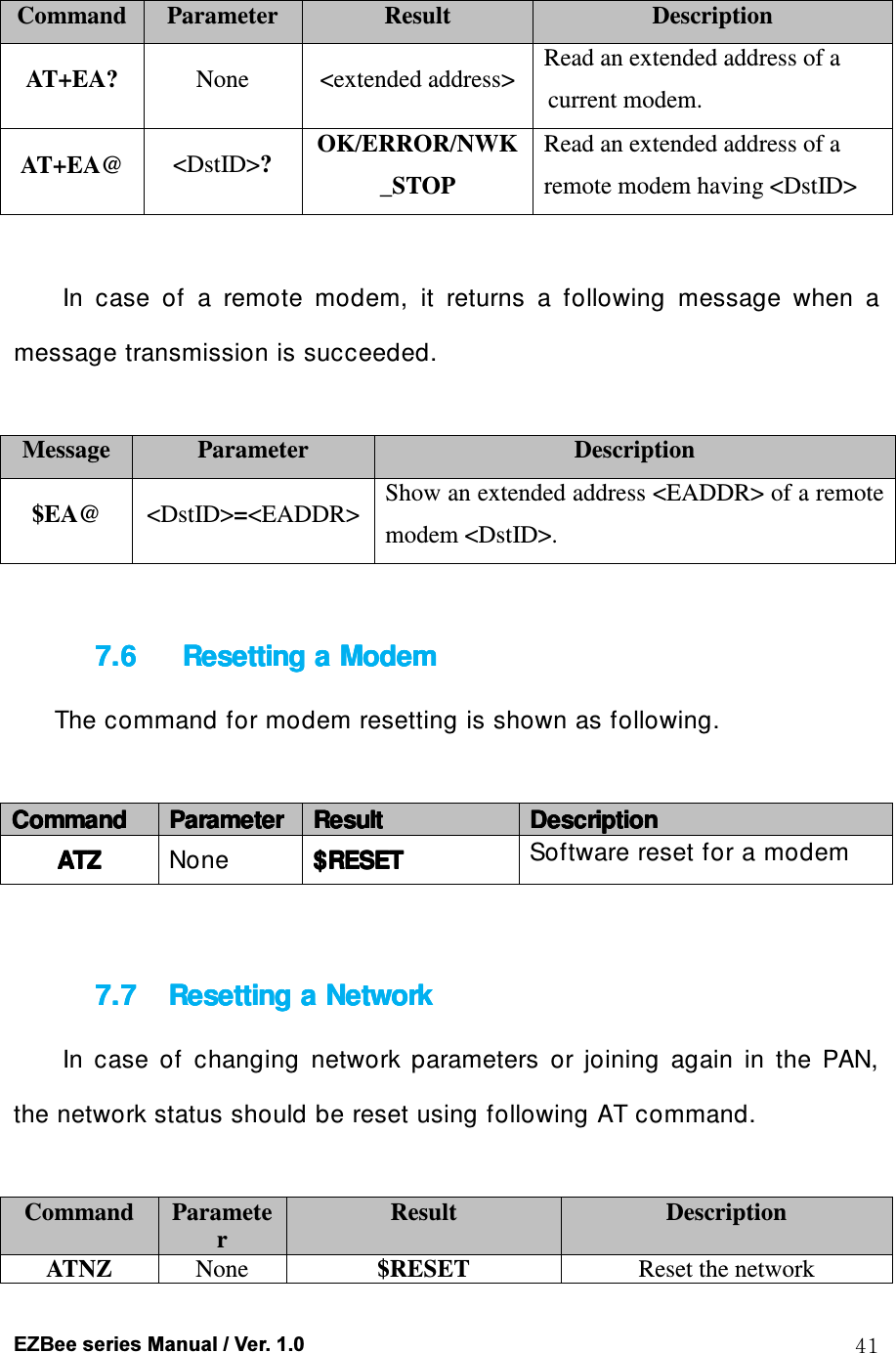
 EZBee series Manual / Ver. 1.0  41  Command Parameter  Result  Description AT+EA?  None  <extended address> Read an extended address of a current modem. AT+EA@  <DstID>? OK/ERROR/NWK_STOP Read an extended address of a remote modem having <DstID>  In  case  of  a  remote  modem,  it  returns  a  following  message  when  a message transmission is succeeded.  Message  Parameter  Description $EA@  <DstID>=<EADDR> Show an extended address <EADDR> of a remote modem <DstID>.  7.67.67.67.6      Resetting a Modem Resetting a Modem Resetting a Modem Resetting a Modem      The command for modem resetting is shown as following.  CommandCommandCommandCommand     ParameterParameterParameterParameter     ResultResultResultResult     DescriptionDescriptionDescriptionDescription    ATZATZATZATZ    None  $RESET$RESET$RESET$RESET    Software reset for a modem     7.77.77.77.7 Resetting a NetworkResetting a NetworkResetting a NetworkResetting a Network    In  case  of  changing  network  parameters  or  joining  again  in  the  PAN, the network status should be reset using following AT command.  Command  Parameter Result  Description ATNZ  None  $RESET  Reset the network
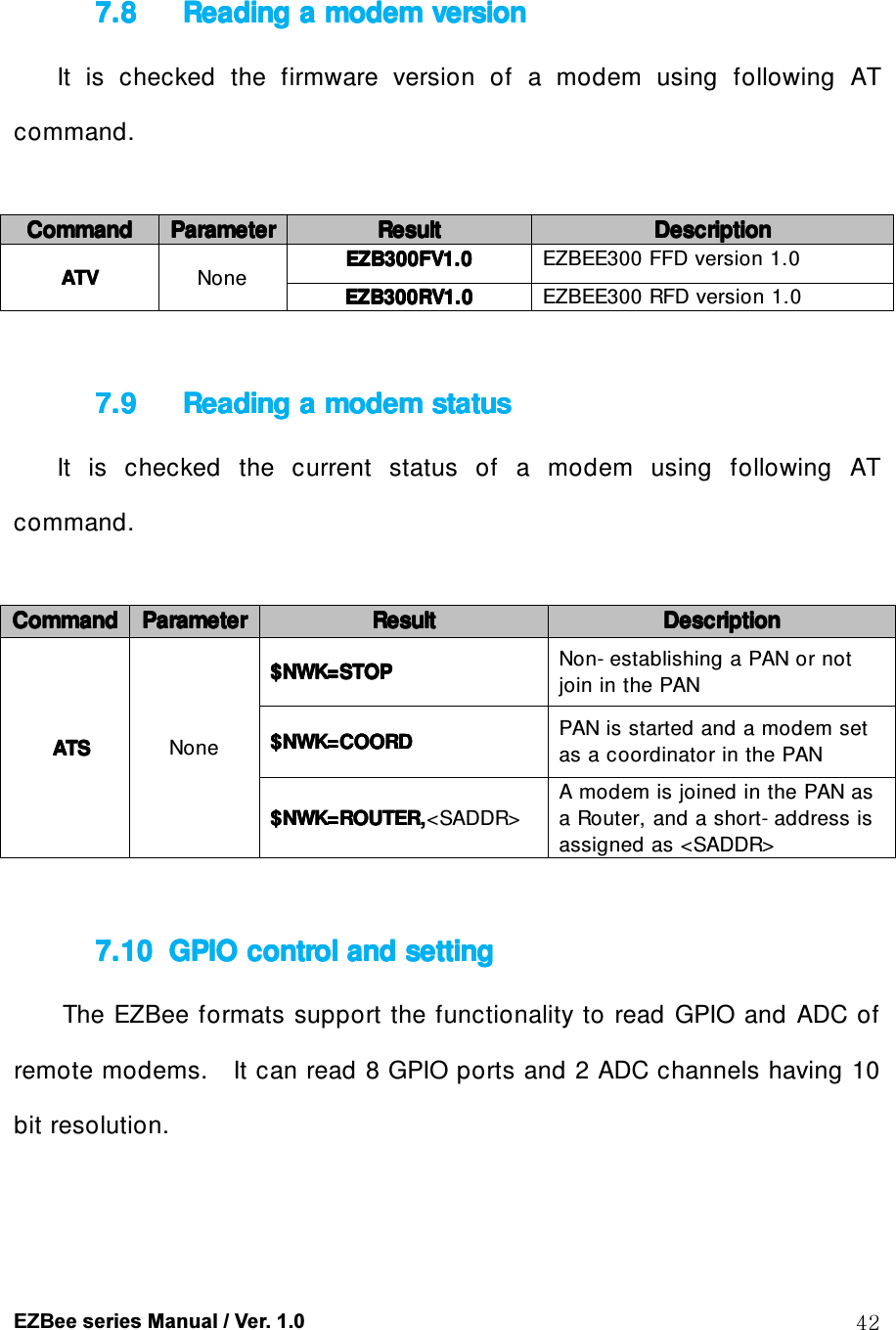
 EZBee series Manual / Ver. 1.0  42  7.87.87.87.8     Reading a modem versionReading a modem versionReading a modem versionReading a modem version    It  is  checked  the  firmware  version  of  a  modem  using  following  AT command.  CommandCommandCommandCommand     ParameterParameterParameterParameter    ResultResultResultResult     DescriptionDescriptionDescriptionDescription    ATVATVATVATV    None  EZB300FV1.0EZB300FV1.0EZB300FV1.0EZB300FV1.0    EZBEE300 FFD version 1.0 EZB300RV1.0EZB300RV1.0EZB300RV1.0EZB300RV1.0    EZBEE300 RFD version 1.0  7.97.97.97.9     Reading a modem statusReading a modem statusReading a modem statusReading a modem status    It  is  checked  the  current  status  of  a  modem  using  following  AT command.  CommandCommandCommandCommand    ParameterParameterParameterParameter    ResultResultResultResult     DescriptionDescriptionDescriptionDescription    ATSATSATSATS    None $NWK=STOP$NWK=STOP$NWK=STOP$NWK=STOP    Non- establishing a PAN or not join in the PAN $NWK=COORD$NWK=COORD$NWK=COORD$NWK=COORD    PAN is started and a modem set as a coordinator in the PAN $NWK=ROUTER$NWK=ROUTER$NWK=ROUTER$NWK=ROUTER,,,,<SADDR> A modem is joined in the PAN as a Router, and a short- address is assigned as <SADDR>  7.107.107.107.10 GPIO GPIO GPIO GPIO control and settingcontrol and settingcontrol and settingcontrol and setting    The EZBee formats support the functionality to read GPIO  and ADC of remote modems.    It can read 8 GPIO ports and 2 ADC channels having 10 bit resolution.
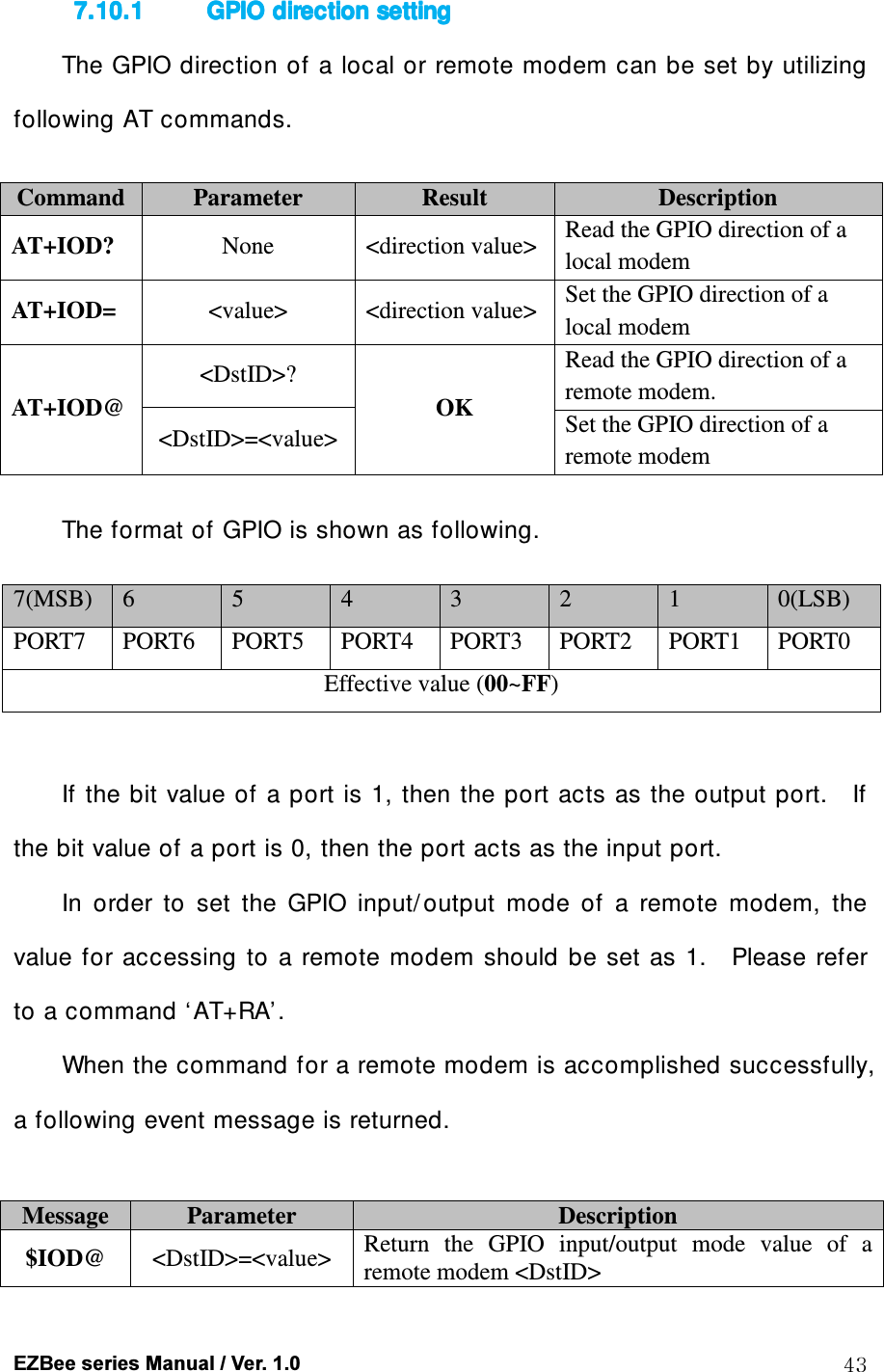
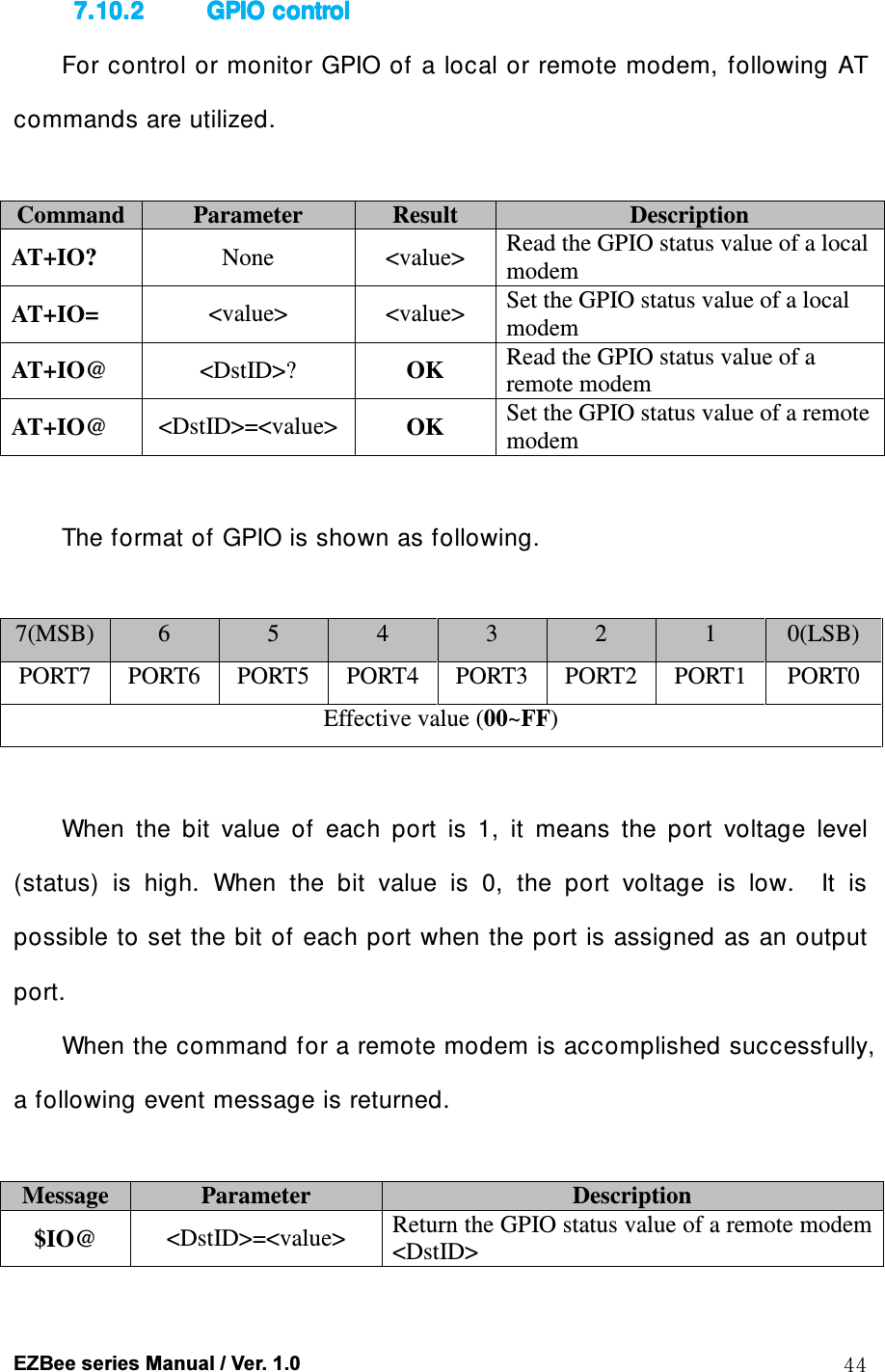
 EZBee series Manual / Ver. 1.0  43 7.10.17.10.17.10.17.10.1 GPIO GPIO GPIO GPIO direction settingdirection settingdirection settingdirection setting    The GPIO direction of a local or remote modem can be set by  utilizing following AT commands.  Command Parameter  Result  Description AT+IOD?  None  <direction value> Read the GPIO direction of a local modem AT+IOD=  <value>  <direction value> Set the GPIO direction of a local modem AT+IOD@ <DstID>? OK Read the GPIO direction of a remote modem. <DstID>=<value> Set the GPIO direction of a remote modem  The format of GPIO is shown as following.  7(MSB)  6  5  4  3  2  1  0(LSB) PORT7  PORT6  PORT5  PORT4  PORT3  PORT2  PORT1  PORT0 Effective value (00~FF)  If the bit value of a port is 1, then  the port acts as the output port.    If the bit value of a port is 0, then the port acts as the input port.   In  order  to  set  the  GPIO  input/ output  mode  of  a  remote  modem,  the value  for  accessing  to  a  remote  modem  should  be  set as  1.    Please refer to a command ‘AT+RA’. When the command for a remote modem is accomplished successfully, a following event message is returned.  Message  Parameter  Description $IOD@  <DstID>=<value>  Return  the  GPIO  input/output  mode  value  of  a remote modem <DstID>
 EZBee series Manual / Ver. 1.0  44 7.10.27.10.27.10.27.10.2 GPIO GPIO GPIO GPIO controlcontrolcontrolcontrol    For control or monitor GPIO of a  local or remote  modem, following AT commands are utilized.  Command Parameter  Result  Description AT+IO?  None  <value>  Read the GPIO status value of a local modem AT+IO=  <value>  <value>  Set the GPIO status value of a local modem AT+IO@  <DstID>?  OK  Read the GPIO status value of a remote modem AT+IO@  <DstID>=<value> OK  Set the GPIO status value of a remote modem  The format of GPIO is shown as following.  7(MSB) 6  5  4  3  2  1  0(LSB) PORT7  PORT6  PORT5  PORT4  PORT3  PORT2  PORT1  PORT0 Effective value (00~FF)  When  the  bit  value  of  each  port  is  1,  it  means  the  port  voltage  level (status)  is  high.  When  the  bit  value  is  0,  the  port  voltage  is  low.    It  is possible to set the bit of each port when the port is assigned as an output port.   When the command for a remote modem is accomplished successfully, a following event message is returned.  Message  Parameter  Description $IO@  <DstID>=<value>  Return the GPIO status value of a remote modem <DstID>
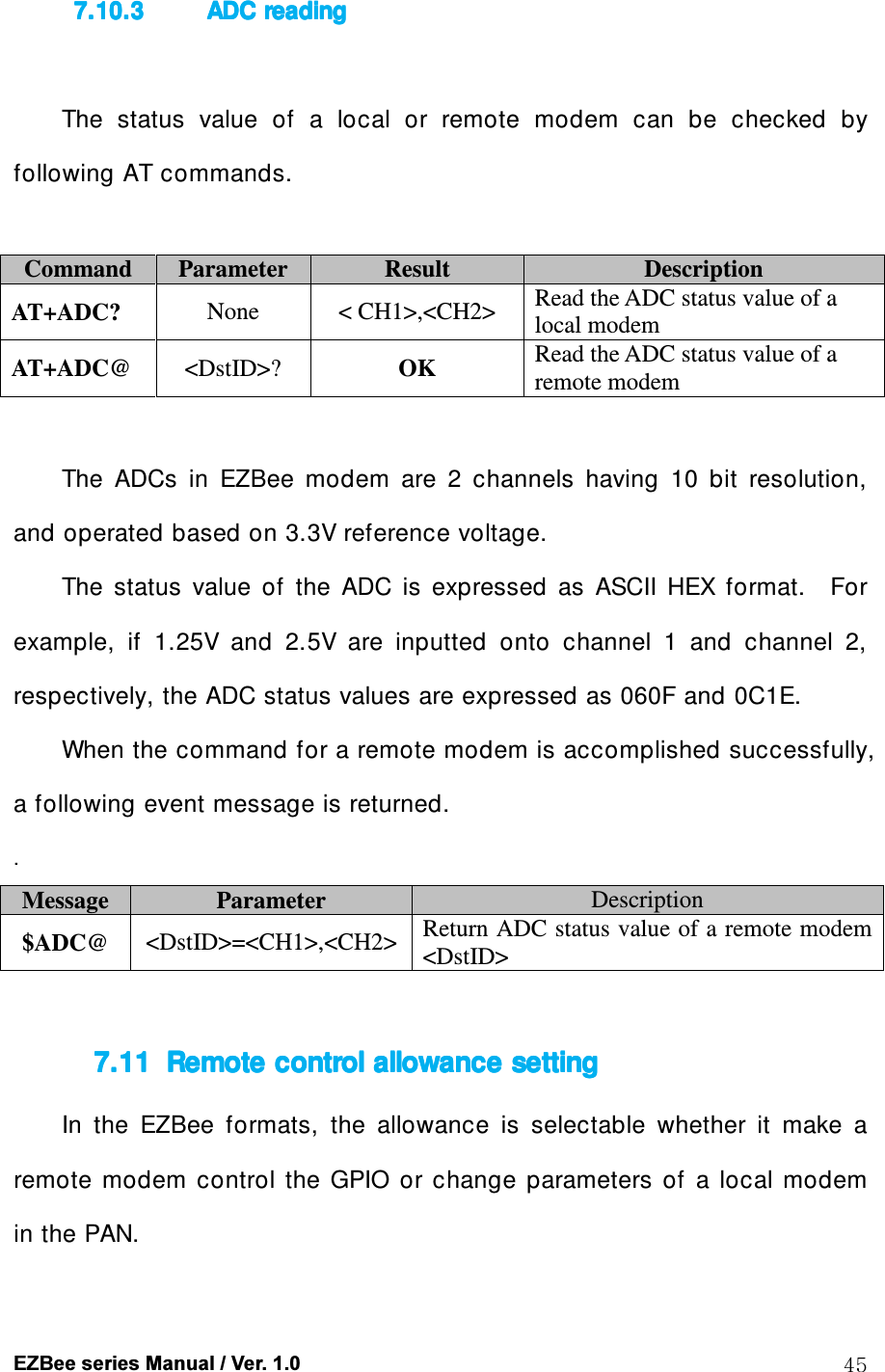
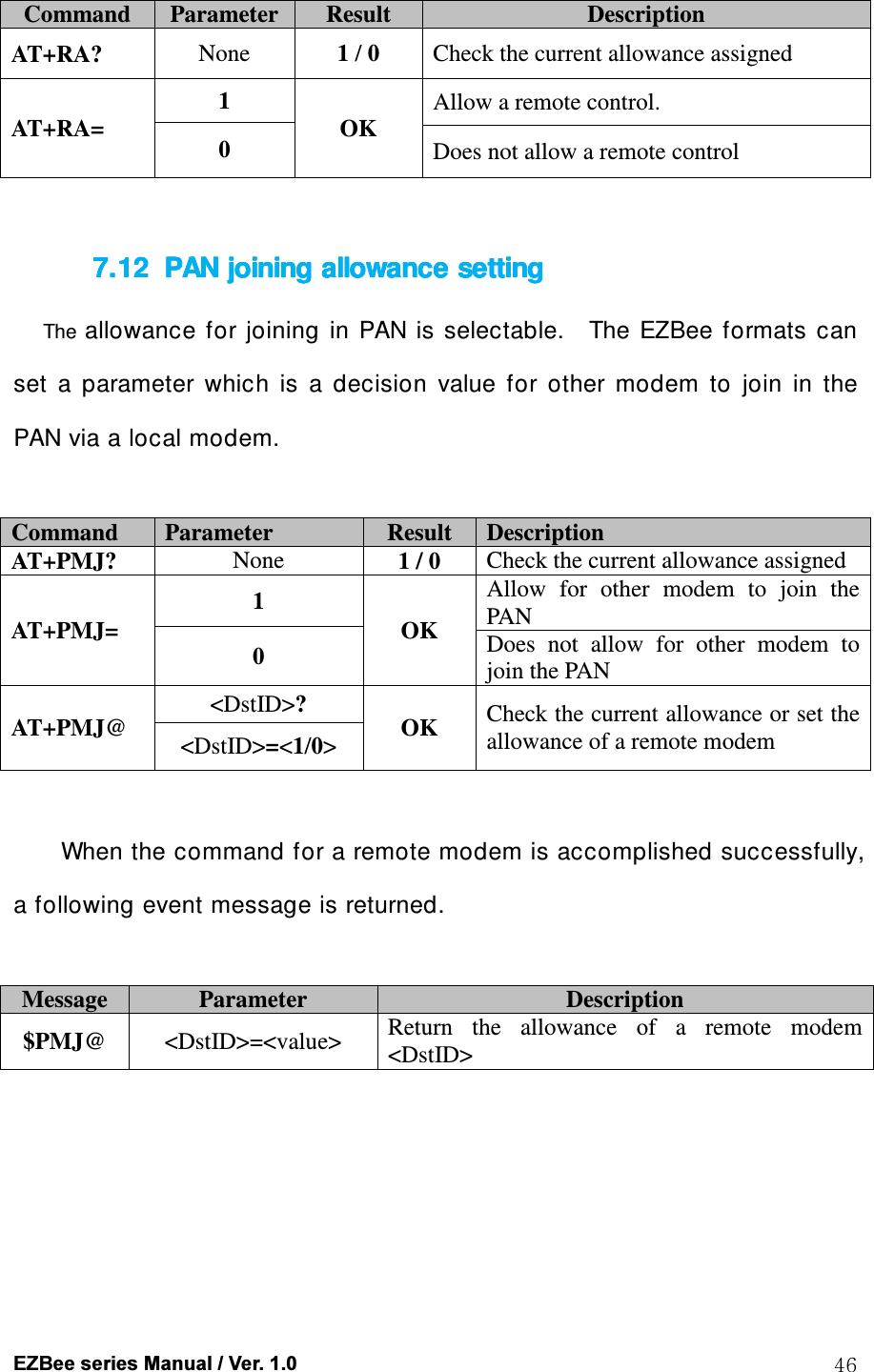
 EZBee series Manual / Ver. 1.0  45 7.10.37.10.37.10.37.10.3 ADC ADC ADC ADC readingreadingreadingreading     The  status  value  of  a  local  or  remote  modem  can  be  checked  by following AT commands.  Command  Parameter  Result  Description AT+ADC?  None  < CH1>,<CH2>  Read the ADC status value of a local modem AT+ADC@  <DstID>?  OK  Read the ADC status value of a remote modem  The  ADCs  in  EZBee  modem  are  2  channels  having  10  bit  resolution, and operated based on 3.3V reference voltage.   The  status  value  of  the  ADC  is  expressed  as  ASCII  HEX  format.    For example,  if  1.25V  and  2.5V  are  inputted  onto  channel  1  and  channel  2, respectively, the ADC status values are expressed as 060F and 0C1E. When the command for a remote modem is accomplished successfully, a following event message is returned.    . Message  Parameter  Description $ADC@  <DstID>=<CH1>,<CH2> Return ADC status value of a remote modem <DstID>  7.117.117.117.11 Remote controlRemote controlRemote controlRemote control    allowance settingallowance settingallowance settingallowance setting    In  the  EZBee  formats,  the  allowance  is  selectable  whether  it  make  a remote  modem  control  the  GPIO  or  change  parameters  of  a  local  modem in the PAN.
 EZBee series Manual / Ver. 1.0  46 Command  Parameter Result  Description AT+RA?  None  1 / 0  Check the current allowance assigned AT+RA= 1 OK Allow a remote control. 0  Does not allow a remote control  7.127.127.127.12 PAN PAN PAN PAN joining allowance settingjoining allowance settingjoining allowance settingjoining allowance setting    The allowance  for  joining  in  PAN  is  selectable.    The  EZBee  formats  can set  a  parameter  which  is  a  decision  value  for  other  modem  to  join  in  the PAN via a local modem.  Command  Parameter  Result  Description AT+PMJ?  None  1 / 0  Check the current allowance assigned AT+PMJ= 1 OK Allow  for  other  modem  to  join  the PAN 0  Does  not  allow  for  other  modem  to join the PAN AT+PMJ@ <DstID>? OK  Check the current allowance or set the allowance of a remote modem <DstID>=<1/0>  When the command for a remote modem is accomplished successfully, a following event message is returned.  Message  Parameter  Description $PMJ@  <DstID>=<value>  Return  the  allowance  of  a  remote  modem <DstID>
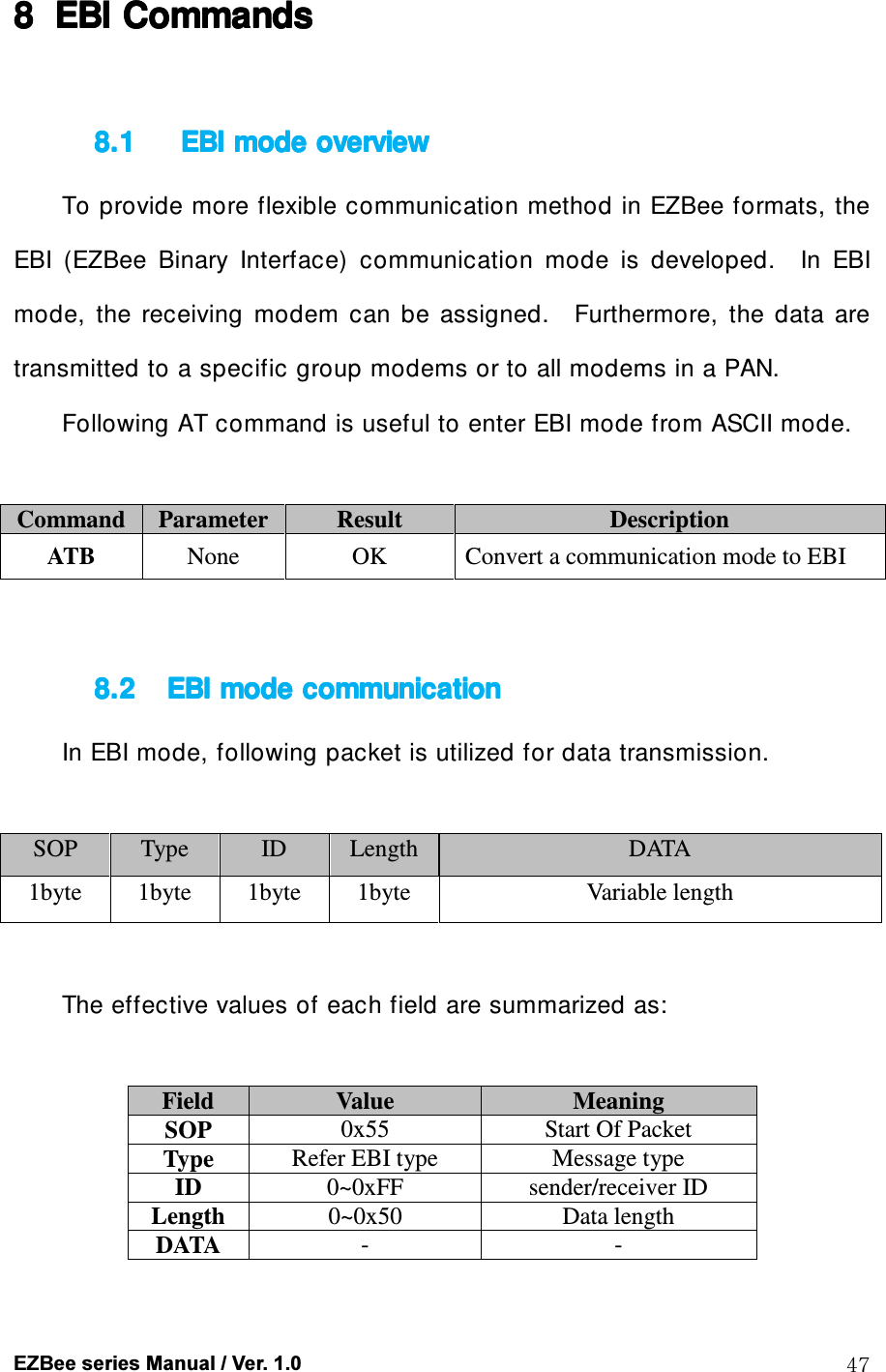
 EZBee series Manual / Ver. 1.0  47 8888 EBI EBI EBI EBI CommandsCommandsCommandsCommands     8.18.18.18.1      EBIEBIEBIEBI    mode overviewmode overviewmode overviewmode overview         To provide more flexible communication method in EZBee formats, the EBI  (EZBee  Binary  Interface)  communication  mode  is  developed.    In  EBI mode,  the  receiving  modem  can  be  assigned.    Furthermore,  the  data  are transmitted to a specific group modems or to all modems in a PAN. Following AT command is useful to enter EBI mode from ASCII mode.  Command Parameter Result  Description ATB  None  OK  Convert a communication mode to EBI     8.28.28.28.2 EBI EBI EBI EBI mode communicationmode communicationmode communicationmode communication    In EBI mode, following packet is utilized for data transmission.    SOP  Type  ID  Length  DATA 1byte  1byte  1byte  1byte  Variable length  The effective values of each field are summarized as:  Field  Value  Meaning SOP  0x55  Start Of Packet Type  Refer EBI type  Message type ID  0~0xFF  sender/receiver ID Length  0~0x50  Data length DATA  -  -
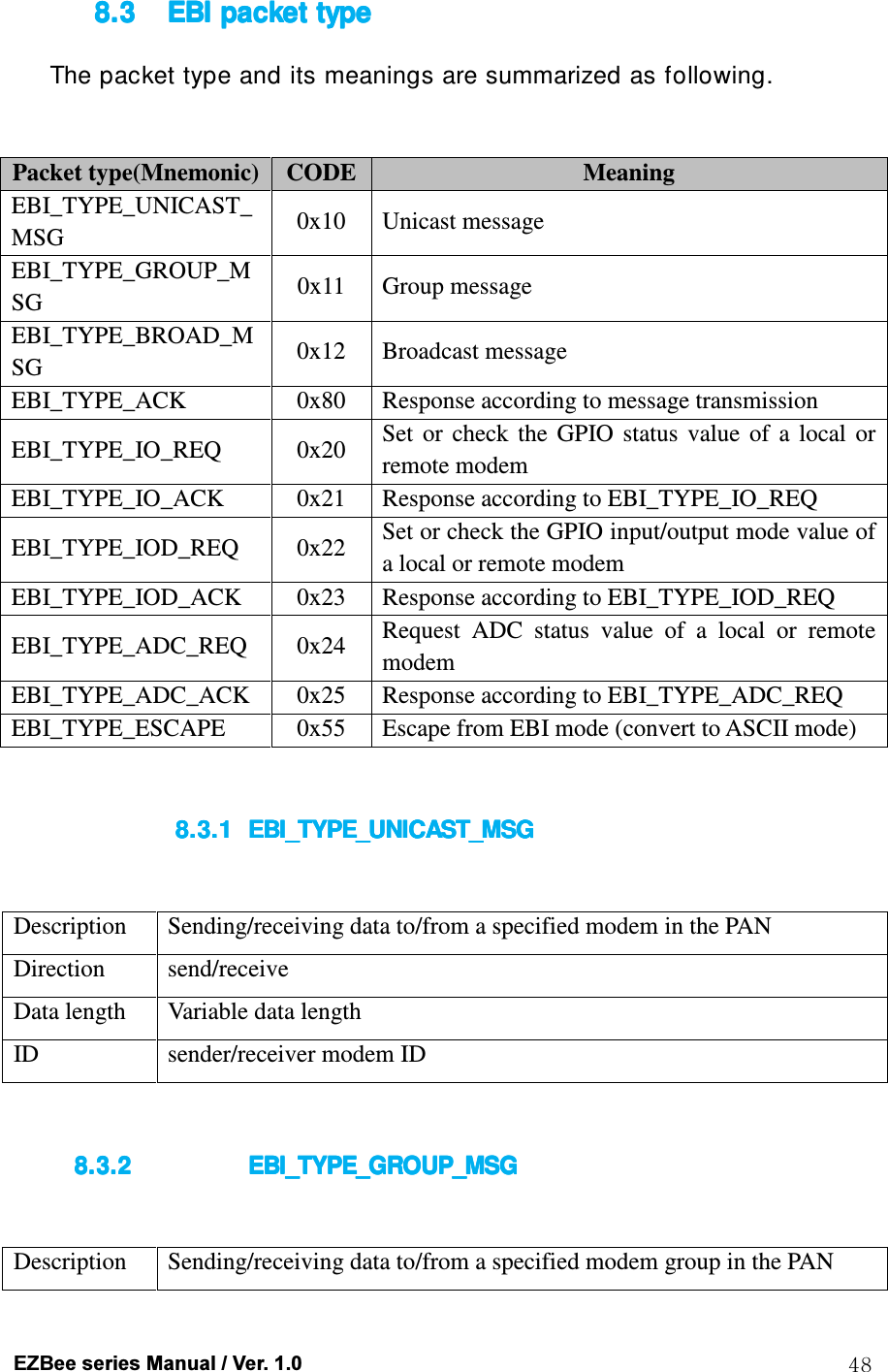
 EZBee series Manual / Ver. 1.0  48 8.38.38.38.3 EBI EBI EBI EBI packet typepacket typepacket typepacket type    The packet type and its meanings are summarized as following.  Packet type(Mnemonic) CODE Meaning EBI_TYPE_UNICAST_MSG  0x10  Unicast message EBI_TYPE_GROUP_MSG  0x11  Group message EBI_TYPE_BROAD_MSG  0x12  Broadcast message EBI_TYPE_ACK  0x80  Response according to message transmission EBI_TYPE_IO_REQ  0x20  Set  or  check  the  GPIO  status  value  of  a  local  or remote modem EBI_TYPE_IO_ACK  0x21  Response according to EBI_TYPE_IO_REQ EBI_TYPE_IOD_REQ  0x22  Set or check the GPIO input/output mode value of a local or remote modem   EBI_TYPE_IOD_ACK  0x23  Response according to EBI_TYPE_IOD_REQ EBI_TYPE_ADC_REQ  0x24  Request  ADC  status  value  of  a  local  or  remote modem EBI_TYPE_ADC_ACK  0x25  Response according to EBI_TYPE_ADC_REQ EBI_TYPE_ESCAPE  0x55  Escape from EBI mode (convert to ASCII mode)  8.3.18.3.18.3.18.3.1 EBI_TYPE_UNICAST_MSGEBI_TYPE_UNICAST_MSGEBI_TYPE_UNICAST_MSGEBI_TYPE_UNICAST_MSG     Description  Sending/receiving data to/from a specified modem in the PAN Direction  send/receive Data length  Variable data length ID  sender/receiver modem ID  8.3.28.3.28.3.28.3.2 EBI_TYPE_GROUP_MSGEBI_TYPE_GROUP_MSGEBI_TYPE_GROUP_MSGEBI_TYPE_GROUP_MSG     Description  Sending/receiving data to/from a specified modem group in the PAN
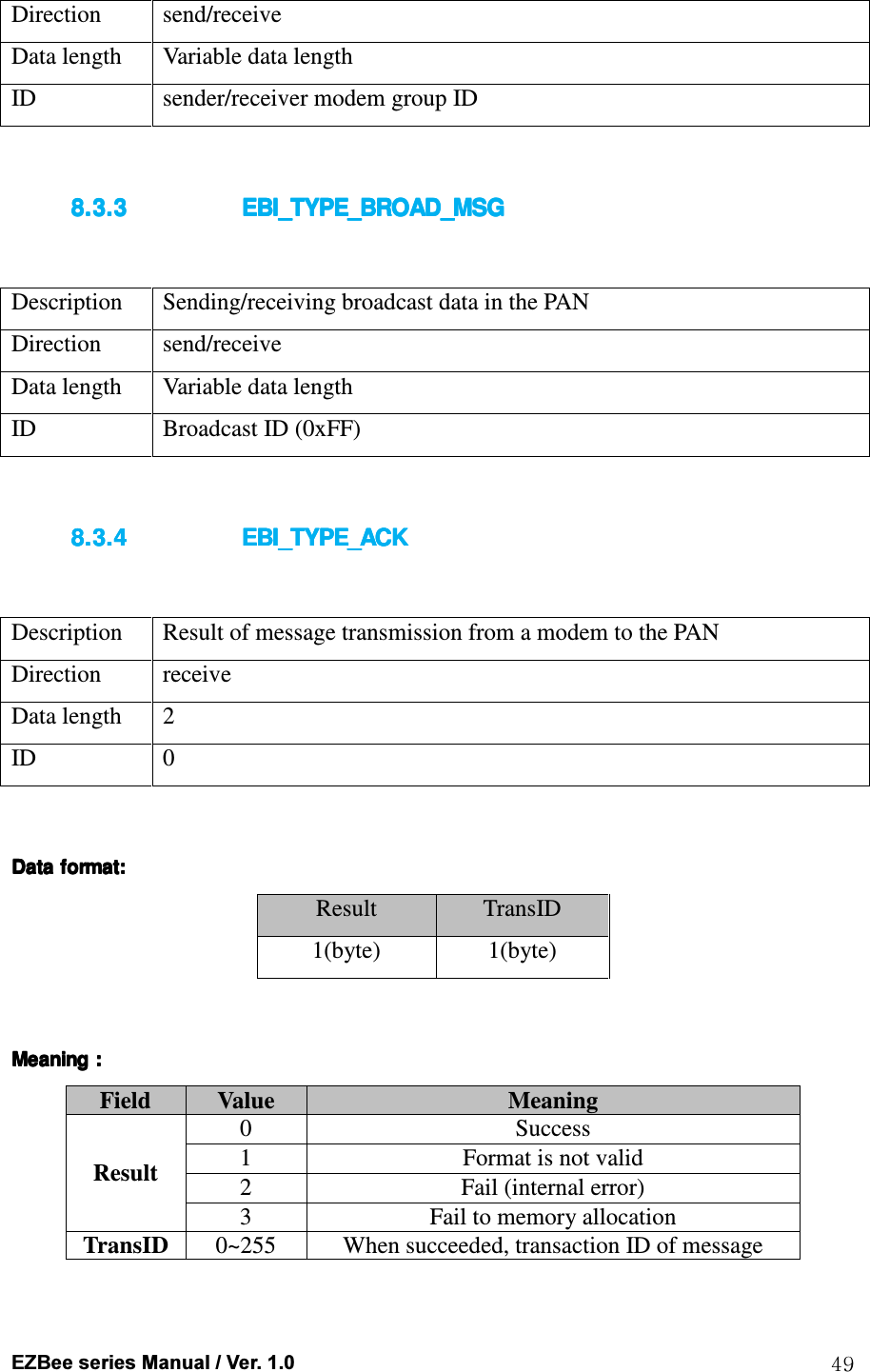
 EZBee series Manual / Ver. 1.0  49 Direction  send/receive Data length  Variable data length ID  sender/receiver modem group ID    8.3.38.3.38.3.38.3.3 EBI_TYPE_BROAD_MSGEBI_TYPE_BROAD_MSGEBI_TYPE_BROAD_MSGEBI_TYPE_BROAD_MSG     Description  Sending/receiving broadcast data in the PAN   Direction  send/receive Data length  Variable data length ID  Broadcast ID (0xFF)  8.3.48.3.48.3.48.3.4 EBI_TYPE_ACKEBI_TYPE_ACKEBI_TYPE_ACKEBI_TYPE_ACK     Description  Result of message transmission from a modem to the PAN Direction  receive Data length  2 ID  0  Data formatData formatData formatData format::::    Result  TransID 1(byte)  1(byte)  Meaning Meaning Meaning Meaning ::::    Field  Value  Meaning Result 0  Success 1  Format is not valid 2  Fail (internal error) 3  Fail to memory allocation TransID 0~255  When succeeded, transaction ID of message
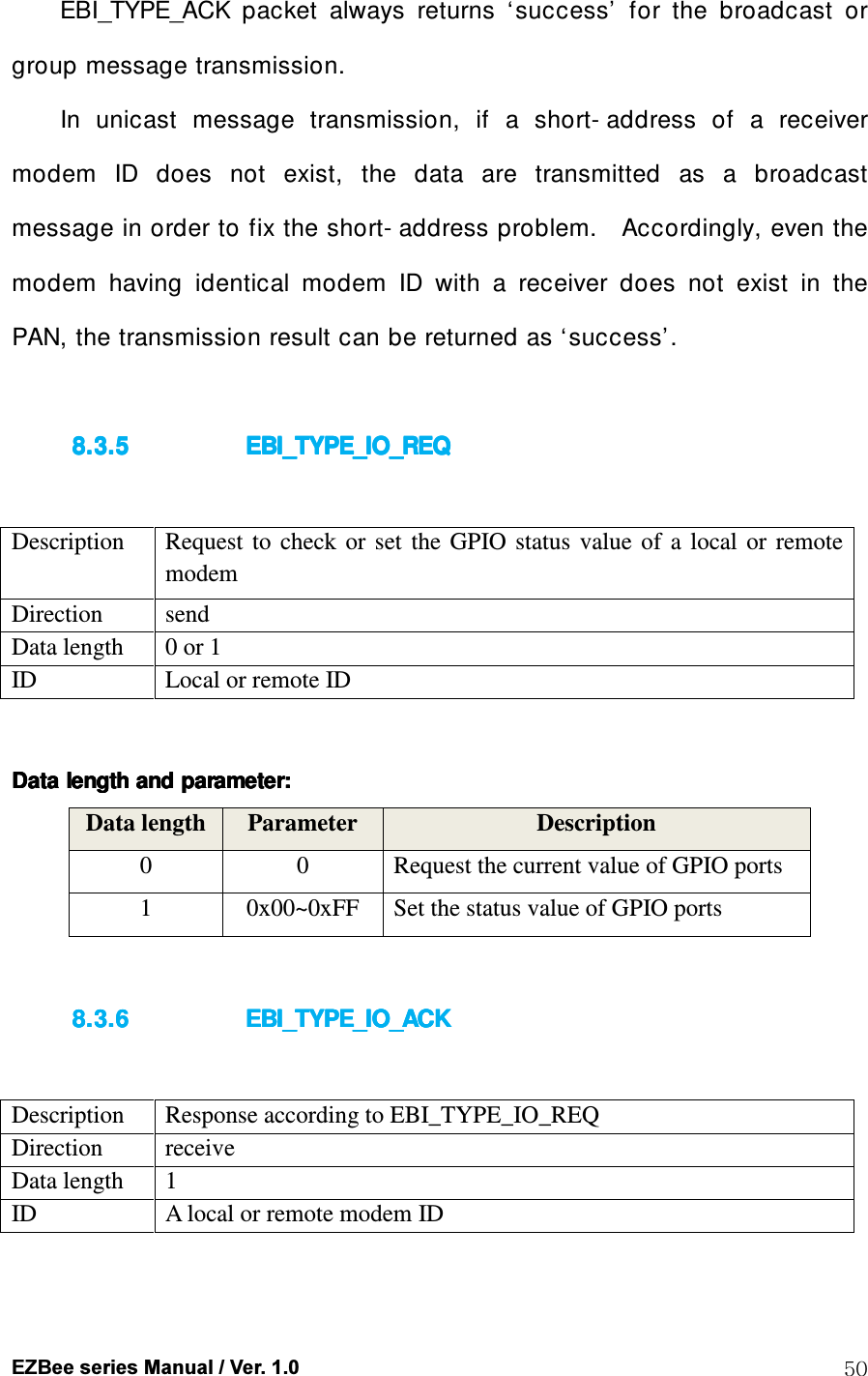
 EZBee series Manual / Ver. 1.0  50 EBI_TYPE_ACK  packet  always  returns  ‘success’  for  the  broadcast  or group message transmission.   In  unicast  message  transmission,  if  a  short- address  of  a  receiver modem  ID  does  not  exist,  the  data  are  transmitted  as  a  broadcast message in order to fix the short- address problem.    Accordingly, even the modem  having  identical  modem  ID  with  a  receiver  does  not  exist  in  the PAN, the transmission result can be returned as ‘success’ .  8.3.58.3.58.3.58.3.5 EBI_TYPE_IO_REQEBI_TYPE_IO_REQEBI_TYPE_IO_REQEBI_TYPE_IO_REQ     Description  Request  to  check  or  set  the  GPIO  status  value  of  a  local  or  remote modem Direction  send Data length  0 or 1 ID  Local or remote ID  Data length and parameterData length and parameterData length and parameterData length and parameter::::    Data length Parameter  Description 0  0  Request the current value of GPIO ports 1  0x00~0xFF  Set the status value of GPIO ports  8.3.68.3.68.3.68.3.6 EBI_TYPE_IO_ACKEBI_TYPE_IO_ACKEBI_TYPE_IO_ACKEBI_TYPE_IO_ACK     Description  Response according to EBI_TYPE_IO_REQ   Direction  receive Data length  1 ID  A local or remote modem ID
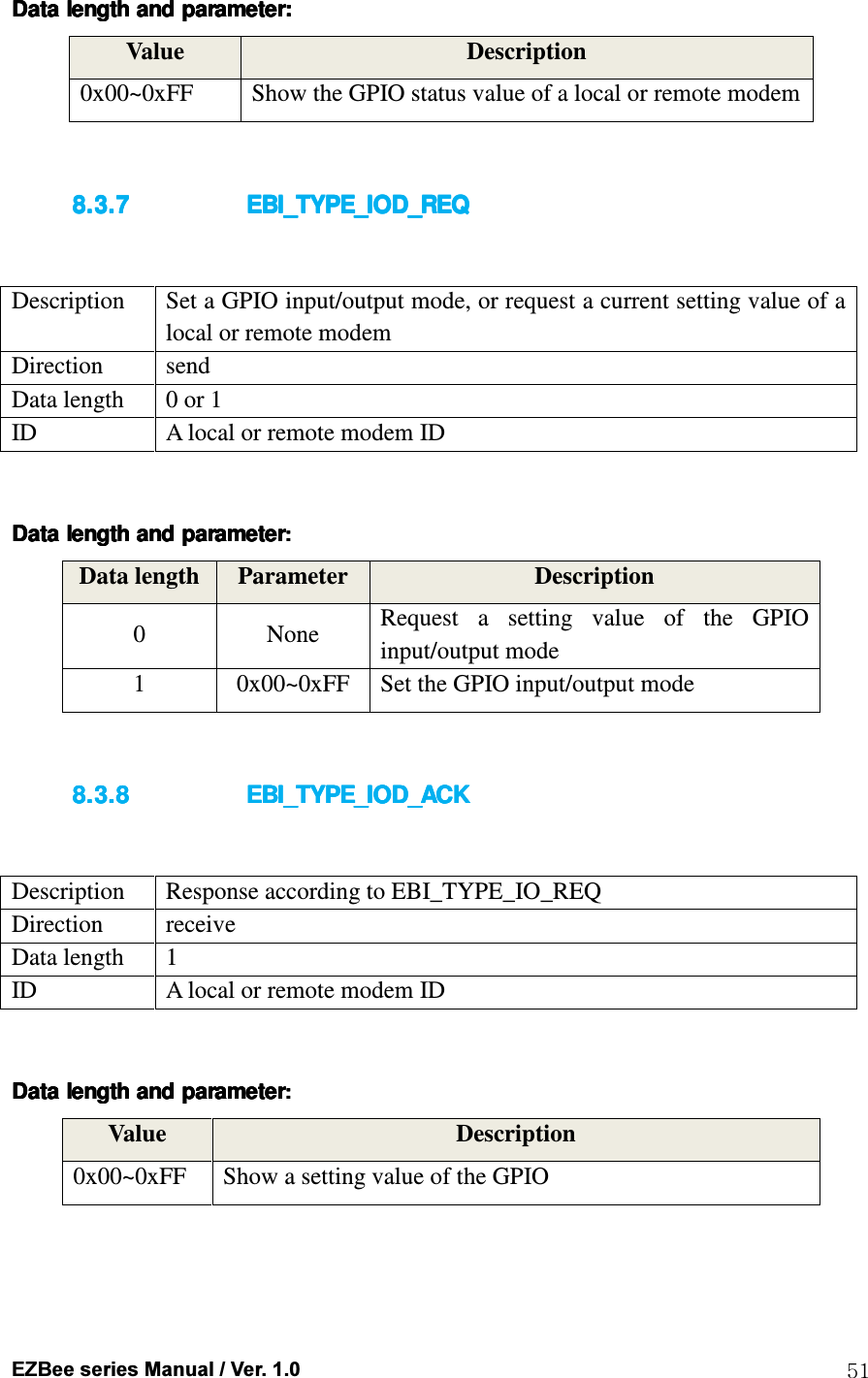
 EZBee series Manual / Ver. 1.0  51 Data length and parameterData length and parameterData length and parameterData length and parameter::::    Value  Description 0x00~0xFF  Show the GPIO status value of a local or remote modem   8.3.78.3.78.3.78.3.7 EBI_TYPE_IOD_REQEBI_TYPE_IOD_REQEBI_TYPE_IOD_REQEBI_TYPE_IOD_REQ     Description  Set a GPIO input/output mode, or request a current setting value of a local or remote modem Direction  send Data length  0 or 1 ID  A local or remote modem ID  Data length and parameterData length and parameterData length and parameterData length and parameter::::    Data length Parameter  Description 0  None  Request  a  setting  value  of  the  GPIO input/output mode 1  0x00~0xFF  Set the GPIO input/output mode  8.3.88.3.88.3.88.3.8 EBI_TYPE_IOD_ACKEBI_TYPE_IOD_ACKEBI_TYPE_IOD_ACKEBI_TYPE_IOD_ACK     Description  Response according to EBI_TYPE_IO_REQ   Direction  receive Data length  1 ID  A local or remote modem ID  Data length and parameterData length and parameterData length and parameterData length and parameter::::    Value  Description 0x00~0xFF  Show a setting value of the GPIO
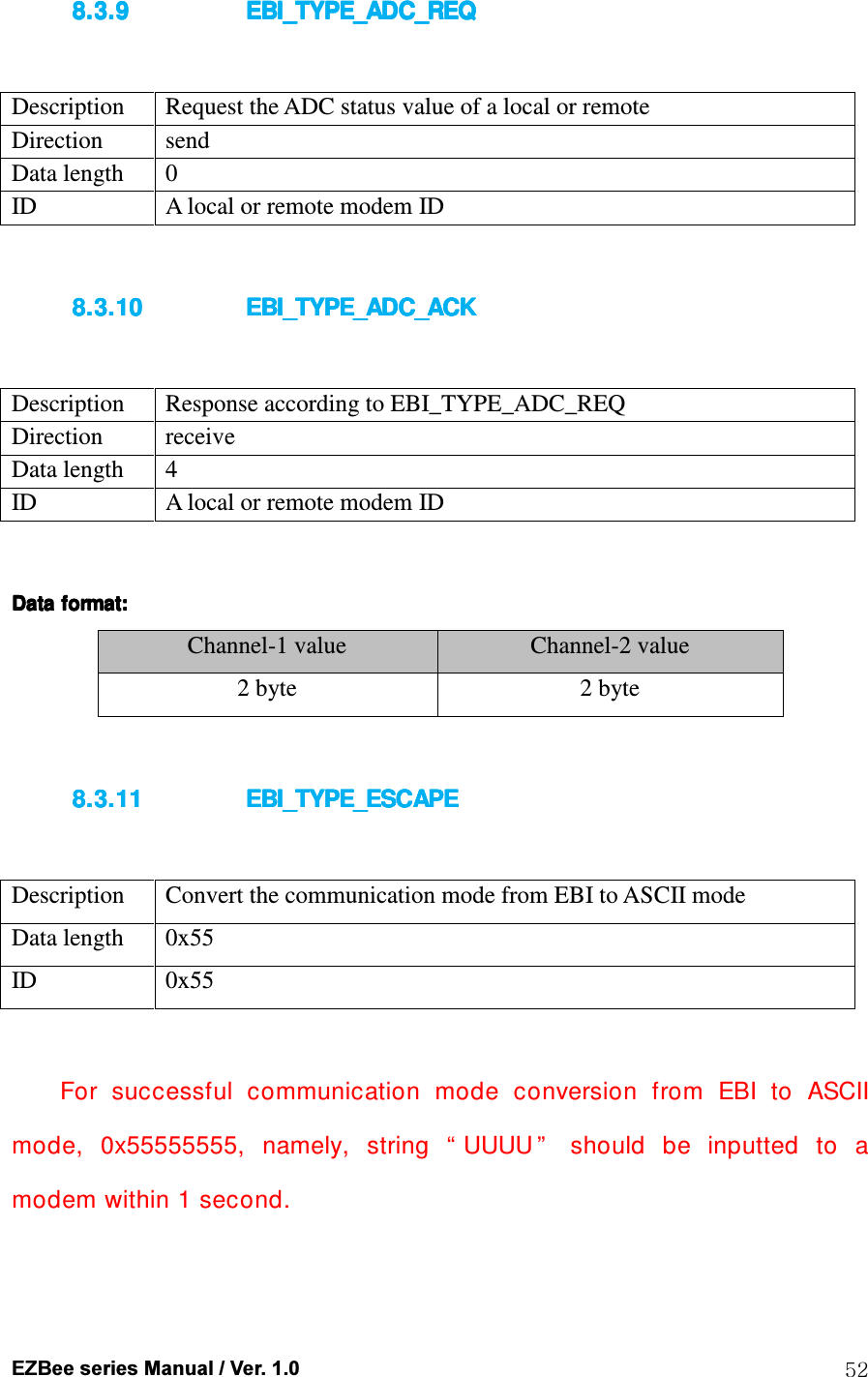
 EZBee series Manual / Ver. 1.0  52 8.3.98.3.98.3.98.3.9 EBI_TYPE_ADC_REQEBI_TYPE_ADC_REQEBI_TYPE_ADC_REQEBI_TYPE_ADC_REQ     Description  Request the ADC status value of a local or remote Direction  send Data length  0 ID  A local or remote modem ID  8.3.108.3.108.3.108.3.10 EBI_TYPE_ADC_ACKEBI_TYPE_ADC_ACKEBI_TYPE_ADC_ACKEBI_TYPE_ADC_ACK     Description  Response according to EBI_TYPE_ADC_REQ Direction  receive Data length  4 ID  A local or remote modem ID  Data formatData formatData formatData format::::    Channel-1 value  Channel-2 value 2 byte  2 byte  8.3.118.3.118.3.118.3.11 EBI_TYPE_ESCAPEEBI_TYPE_ESCAPEEBI_TYPE_ESCAPEEBI_TYPE_ESCAPE     Description  Convert the communication mode from EBI to ASCII mode Data length  0x55 ID  0x55  For  successful  communication  mode  conversion  from  EBI  to  ASCII mode,  0x55555555,  namely,  string  “ UUUU ”   should  be  inputted  to  a modem within 1 second.
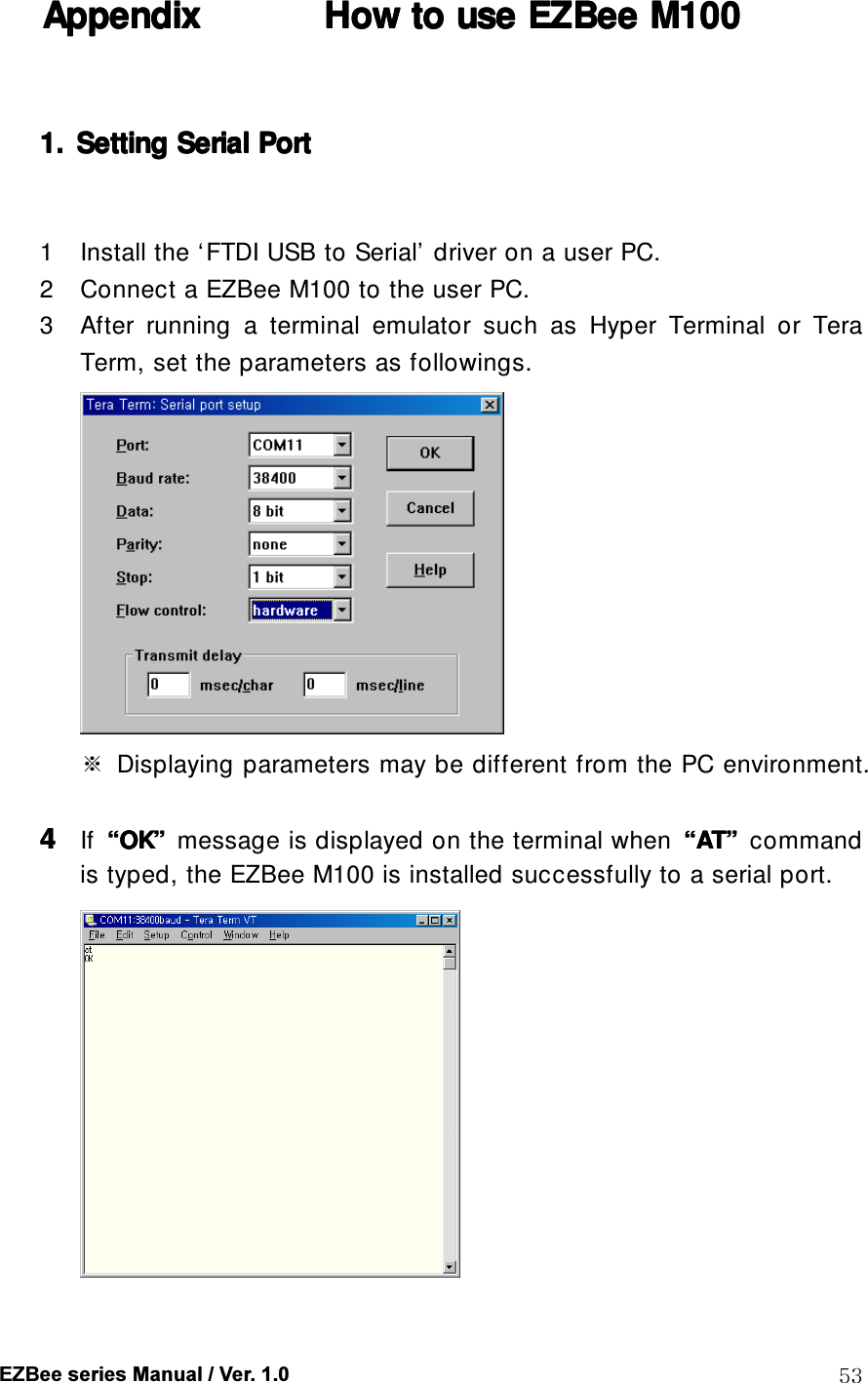
 EZBee series Manual / Ver. 1.0  53 Appendix Appendix Appendix Appendix            How to use How to use How to use How to use EZBeeEZBeeEZBeeEZBee    M100 M100 M100 M100       1.1.1.1. Setting Setting Setting Setting Serial Serial Serial Serial PortPortPortPort        1 Install the ‘FTDI USB to Serial’ driver on a user PC. 2 Connect a EZBee M100 to the user PC. 3 After  running  a  terminal  emulator  such  as  Hyper  Terminal  or  Tera Term, set the parameters as followings.  ※  Displaying parameters may be different from the PC environment.  4444 If  ““““OKOKOKOK””””  message is displayed on the terminal when  ““““ATATATAT””””  command is typed, the EZBee M100 is installed successfully to a serial port.
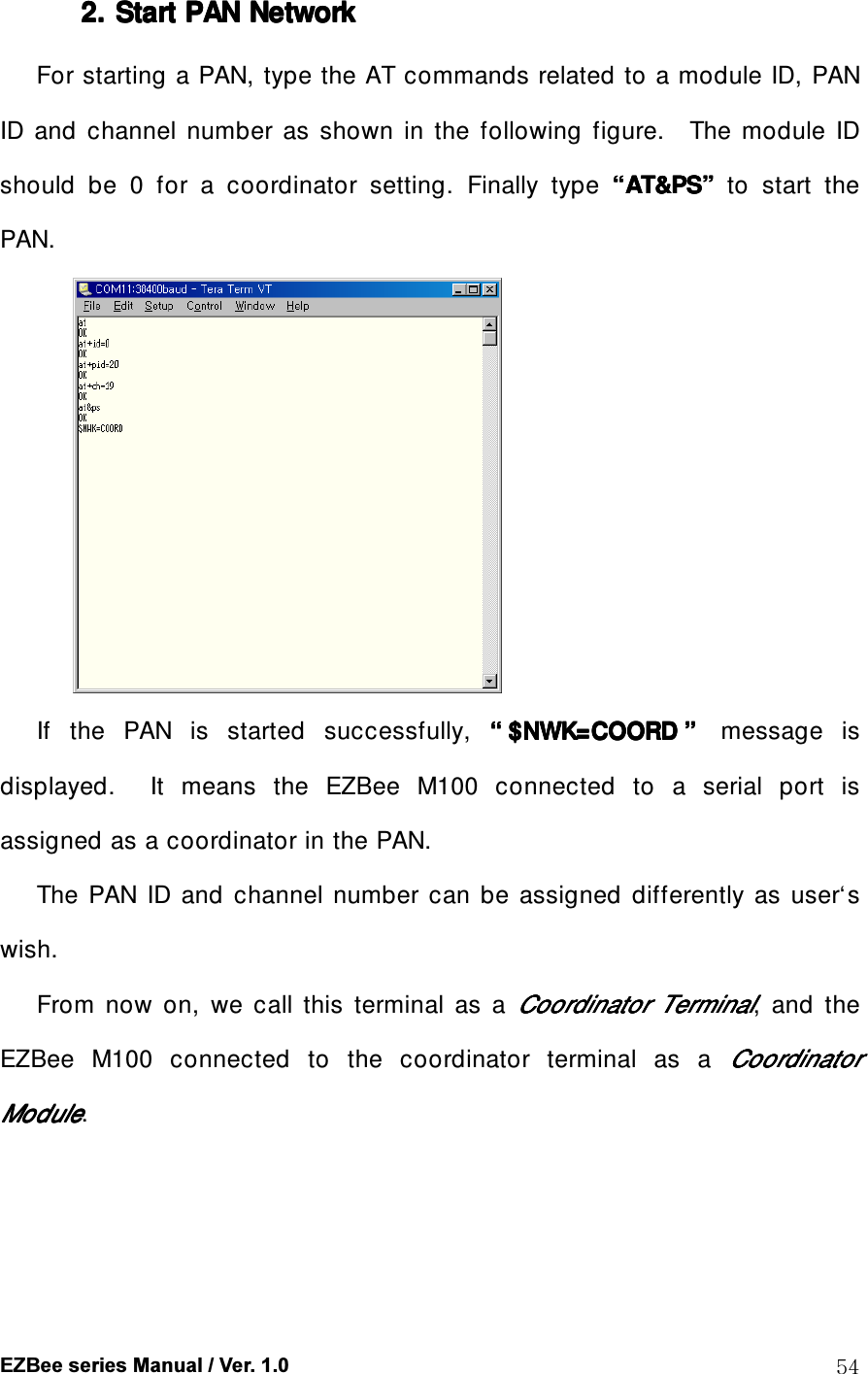
 EZBee series Manual / Ver. 1.0  54 2. 2. 2. 2. Start Start Start Start PAN PAN PAN PAN NetworkNetworkNetworkNetwork    For starting a PAN, type the AT commands related to a module ID, PAN ID  and  channel  number  as  shown  in  the  following  figure.    The  module  ID should  be  0  for  a  coordinator  setting.  Finally  type  ““““AT&PSAT&PSAT&PSAT&PS””””    to  start  the PAN.  If  the  PAN  is  started  successfully,  ““““ $NWK=COORD$NWK=COORD$NWK=COORD$NWK=COORD ””””  message  is displayed.    It  means  the  EZBee  M100  connected  to  a  serial  port  is assigned as a coordinator in the PAN. The  PAN  ID  and  channel  number  can  be  assigned  differently  as  user‘s wish. From  now  on,  we  call  this  terminal  as  a Coordinator Coordinator Coordinator Coordinator  TerminalTerminalTerminalTerminal,  and  the EZBee  M100  connected  to  the  coordinator  terminal  as  a CoordinatorCoordinatorCoordinatorCoordinator    ModuleModuleModuleModule.
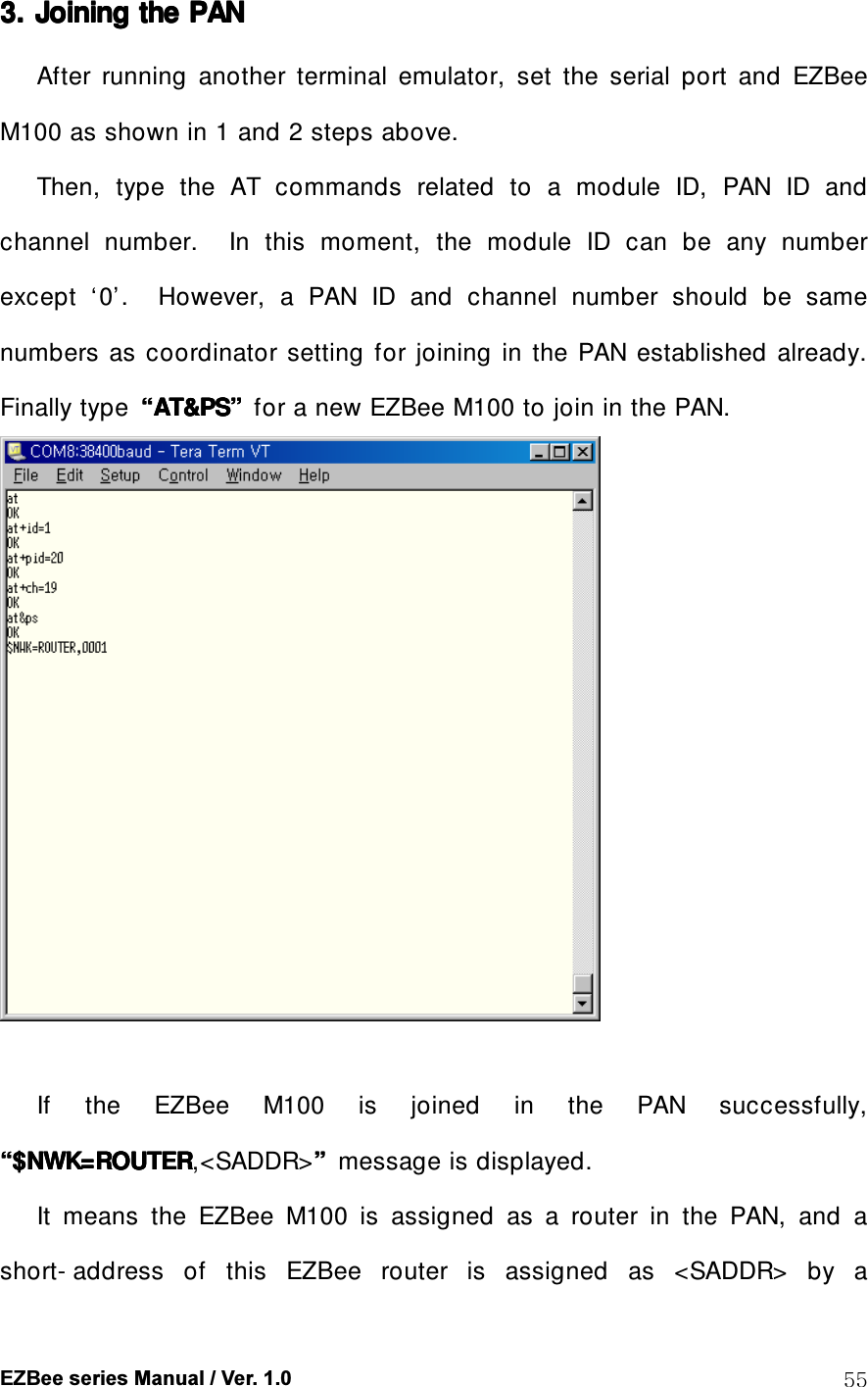
 EZBee series Manual / Ver. 1.0  55 3. 3. 3. 3. Joining the Joining the Joining the Joining the PANPANPANPAN    After  running  another  terminal  emulator,  set  the  serial  port  and  EZBee M100 as shown in 1 and 2 steps above. Then,  type  the  AT  commands  related  to  a  module  ID,  PAN  ID  and channel  number.    In  this  moment,  the  module  ID  can  be  any  number except  ‘0’.    However,  a  PAN  ID  and  channel  number  should  be  same numbers  as  coordinator  setting  for  joining  in  the  PAN  established  already. Finally type  ““““AT&PSAT&PSAT&PSAT&PS””””    for a new EZBee M100 to join in the PAN.   If  the  EZBee  M100  is  joined  in  the  PAN  successfully, ““““$NWK=ROUTER$NWK=ROUTER$NWK=ROUTER$NWK=ROUTER,<SADDR>””””  message is displayed.   It  means  the  EZBee  M100  is  assigned  as  a  router  in  the  PAN,  and  a short- address  of  this  EZBee  router  is  assigned  as  <SADDR>  by  a
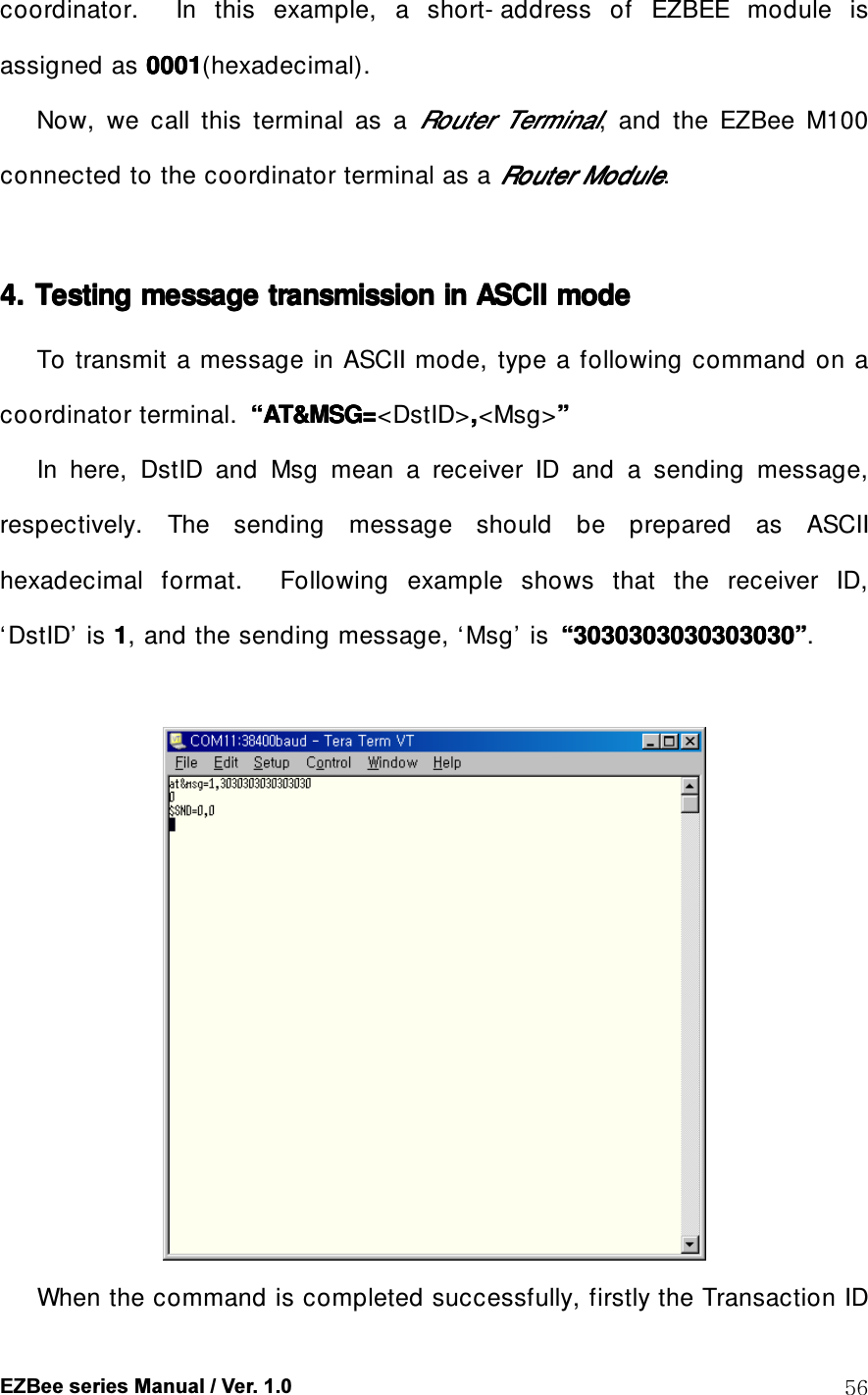
 EZBee series Manual / Ver. 1.0  56 coordinator.    In  this  example,  a  short- address  of  EZBEE  module  is assigned as 0001000100010001(hexadecimal). Now,  we  call  this  terminal  as  a RouterRouterRouterRouter     TerminalTerminalTerminalTerminal,  and  the  EZBee  M100 connected to the coordinator terminal as a RouterRouterRouterRouter    ModuleModuleModuleModule.  4. 4. 4. 4. Testing message transmission in Testing message transmission in Testing message transmission in Testing message transmission in ASCII ASCII ASCII ASCII modemodemodemode          To transmit a message in ASCII mode,  type a  following  command  on  a coordinator terminal.  ““““AT&MSG=AT&MSG=AT&MSG=AT&MSG=<DstID>,,,,<Msg>””””    In  here,  DstID  and  Msg  mean  a  receiver  ID  and  a  sending  message, respectively.  The  sending  message  should  be  prepared  as  ASCII hexadecimal  format.    Following  example  shows  that  the  receiver  ID, ‘DstID’  is 1111, and the sending message, ‘Msg’  is  ““““3030303030303030303030303030303030303030303030303030303030303030””””.   When the command is completed successfully, firstly the Transaction ID
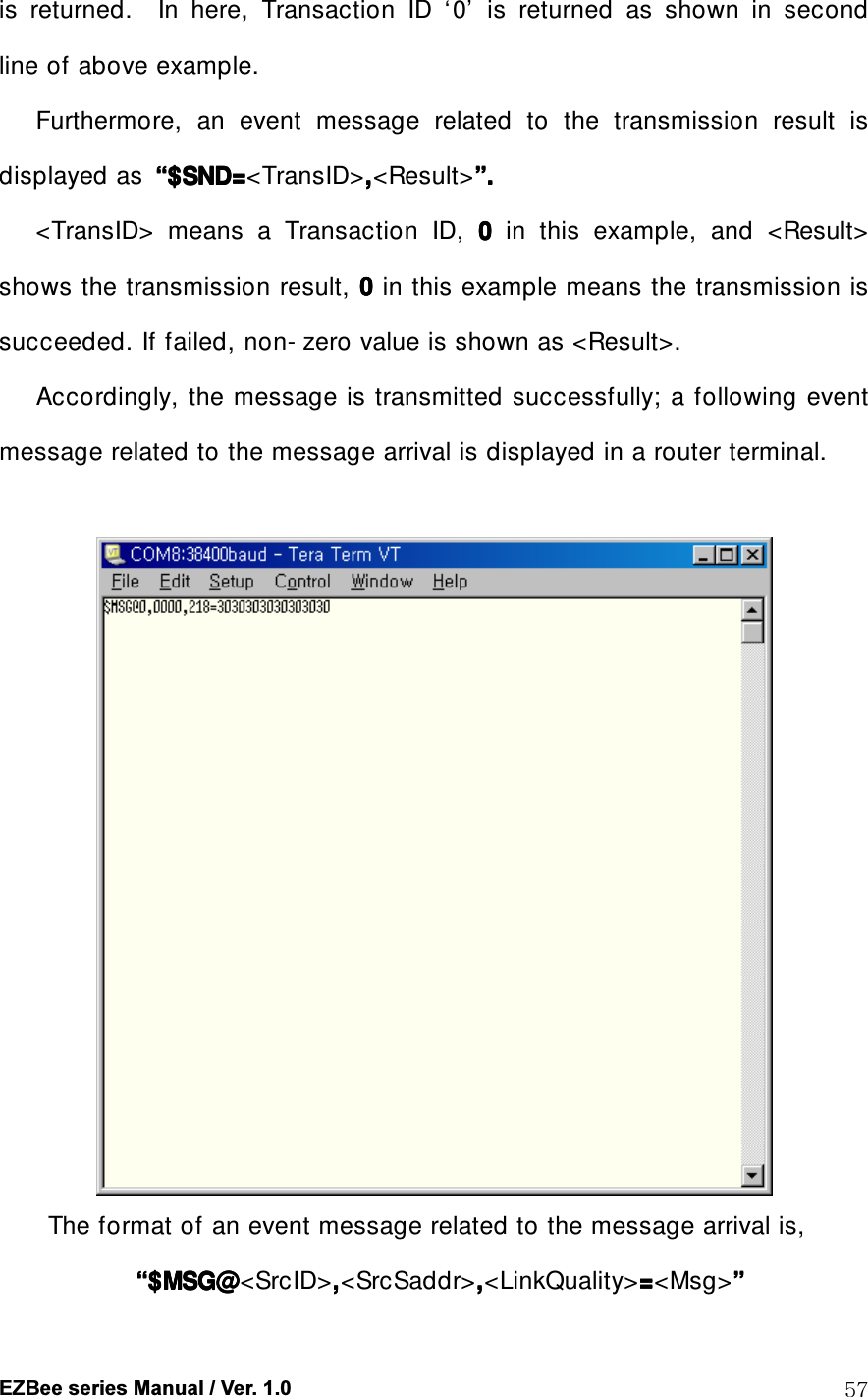
 EZBee series Manual / Ver. 1.0  57 is  returned.    In  here,  Transaction  ID  ‘ 0’   is  returned  as  shown  in  second line of above example.   Furthermore,  an  event  message  related  to  the  transmission  result  is displayed as  ““““$SND=$SND=$SND=$SND=<TransID>,,,,<Result>””””....   <TransID>  means  a  Transaction  ID,  0000  in  this  example,  and  <Result> shows the transmission result, 0000 in this example means the transmission is succeeded. If failed, non- zero value is shown as <Result>. Accordingly, the  message is transmitted successfully; a following event message related to the message arrival is displayed in a router terminal.           The format of an event message related to the message arrival is,      ““““$MSG@$MSG@$MSG@$MSG@<SrcID>,,,,<SrcSaddr>,,,,<LinkQuality>====<Msg>””””
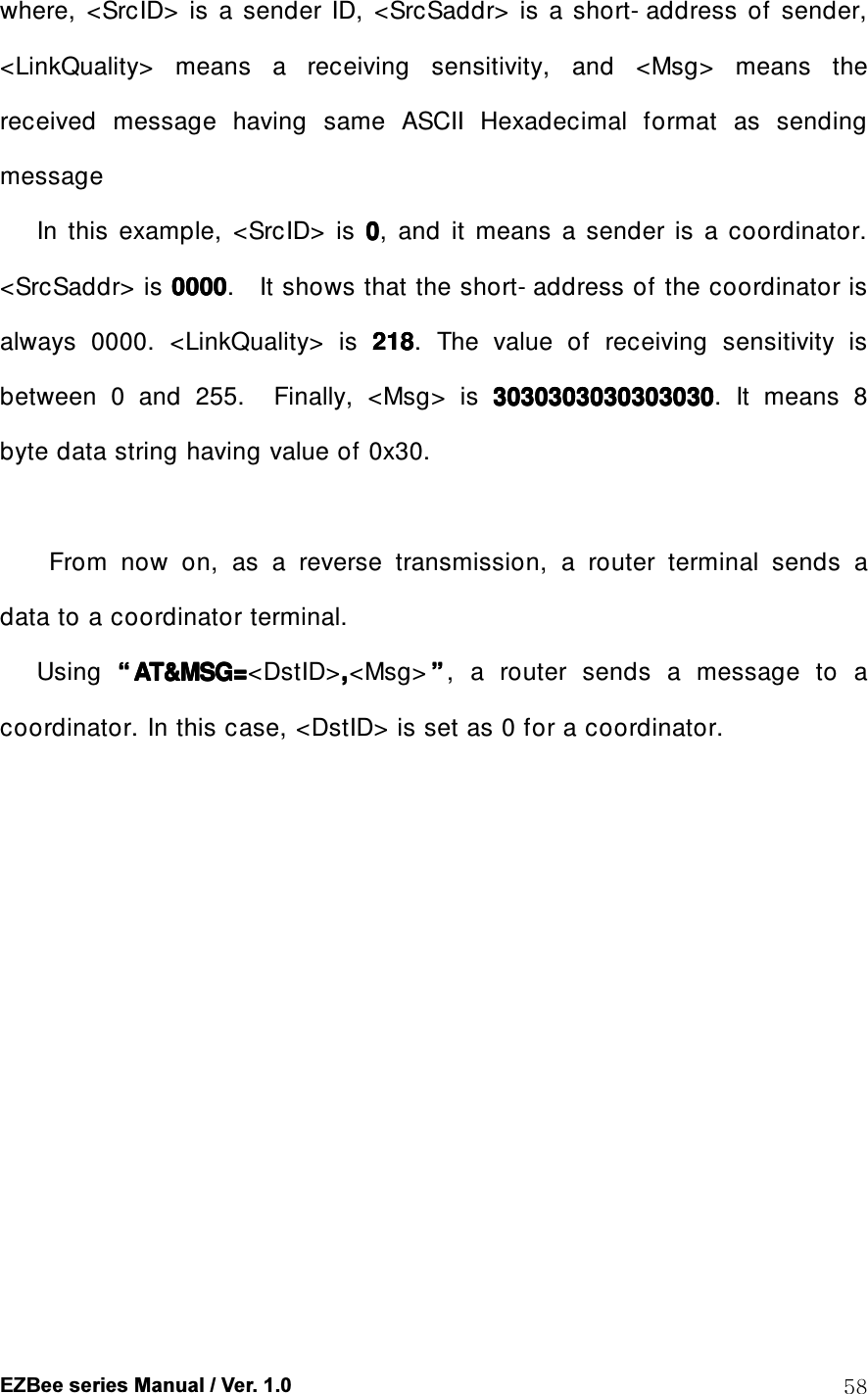
 EZBee series Manual / Ver. 1.0  58 where,  <SrcID>  is  a  sender  ID,  <SrcSaddr>  is  a  short- address  of  sender, <LinkQuality>  means  a  receiving  sensitivity,  and  <Msg>  means  the received  message  having  same  ASCII  Hexadecimal  format  as  sending message       In  this  example,  <SrcID>  is  0000,    and  it  means  a  sender  is  a  coordinator.     <SrcSaddr> is 0000000000000000.    It shows that the short- address of the    coordinator is always  0000.  <LinkQuality>  is  218218218218.  The  value  of  receiving  sensitivity  is between  0  and  255.    Finally,  <Msg>  is  3030303030303030303030303030303030303030303030303030303030303030.    It  means  8 byte data string having value of 0x30.          From  now  on,  as  a  reverse  transmission,  a  router  terminal  sends  a data to a coordinator terminal.       Using  ““““ AT&MSG=AT&MSG=AT&MSG=AT&MSG=<DstID>,,,,<Msg> ””””,  a  router  sends  a  message  to  a coordinator. In this case, <DstID> is set as 0 for a coordinator.
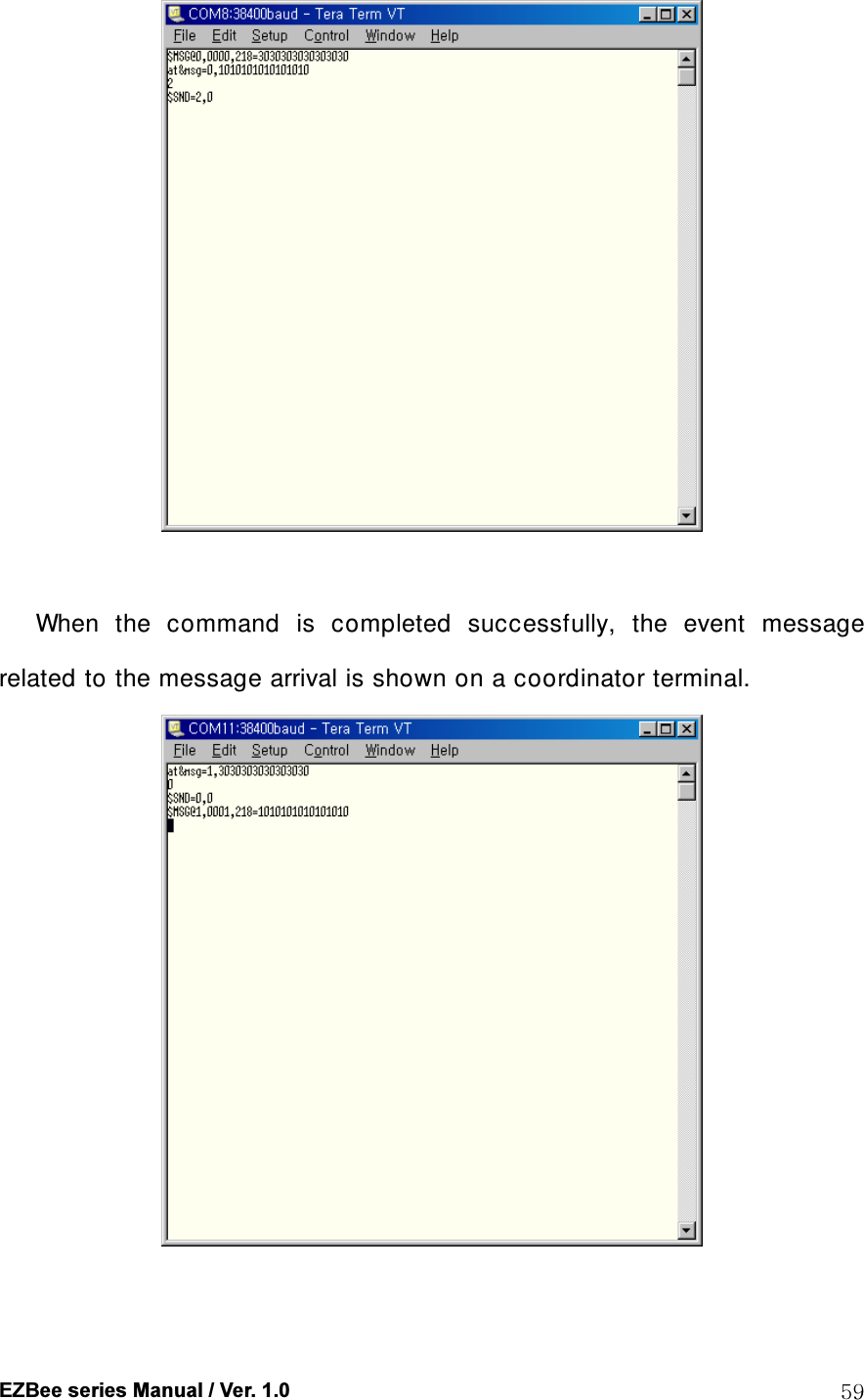
 EZBee series Manual / Ver. 1.0  59   When  the  command  is  completed  successfully,  the  event  message related to the message arrival is shown on a coordinator terminal.
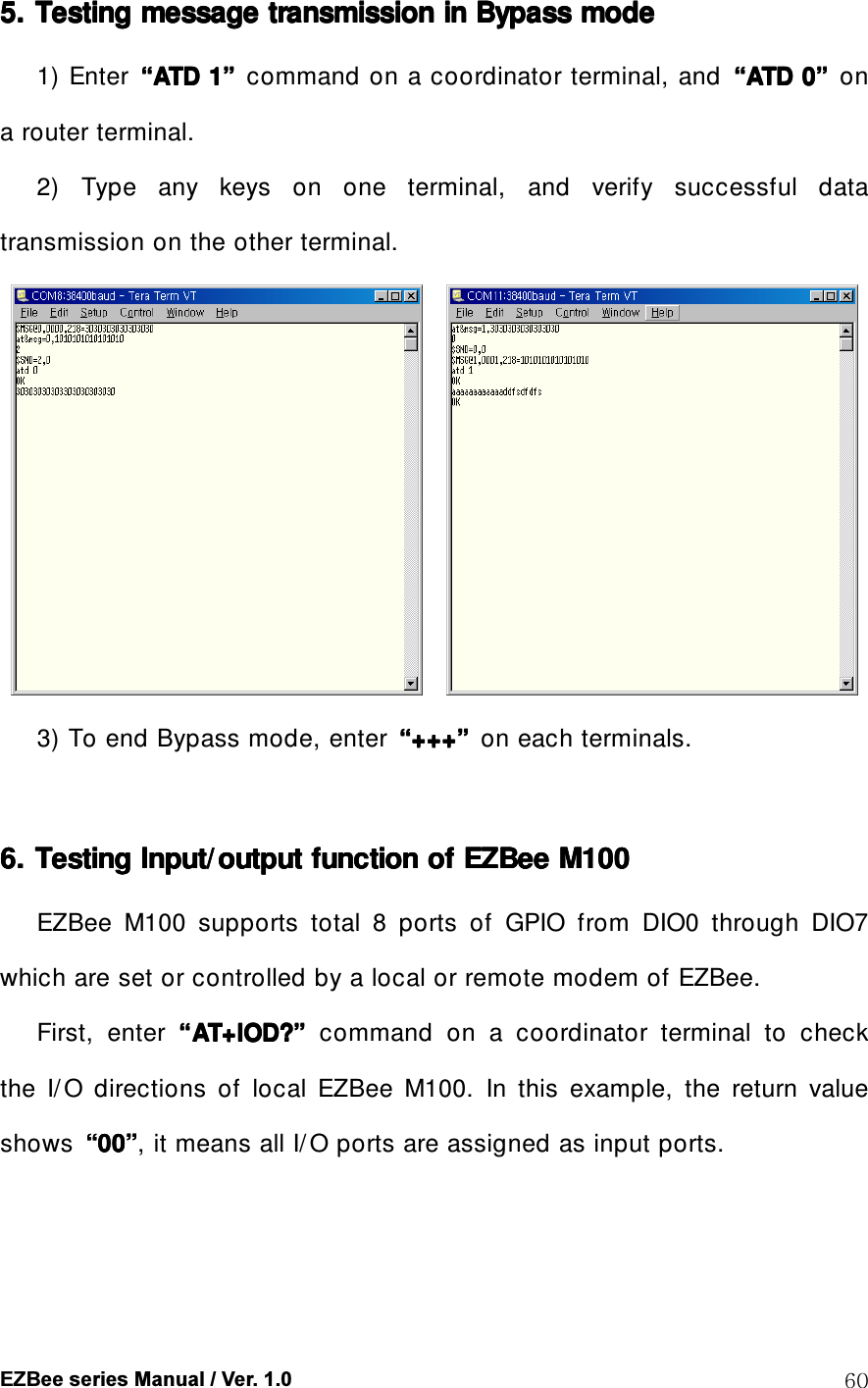
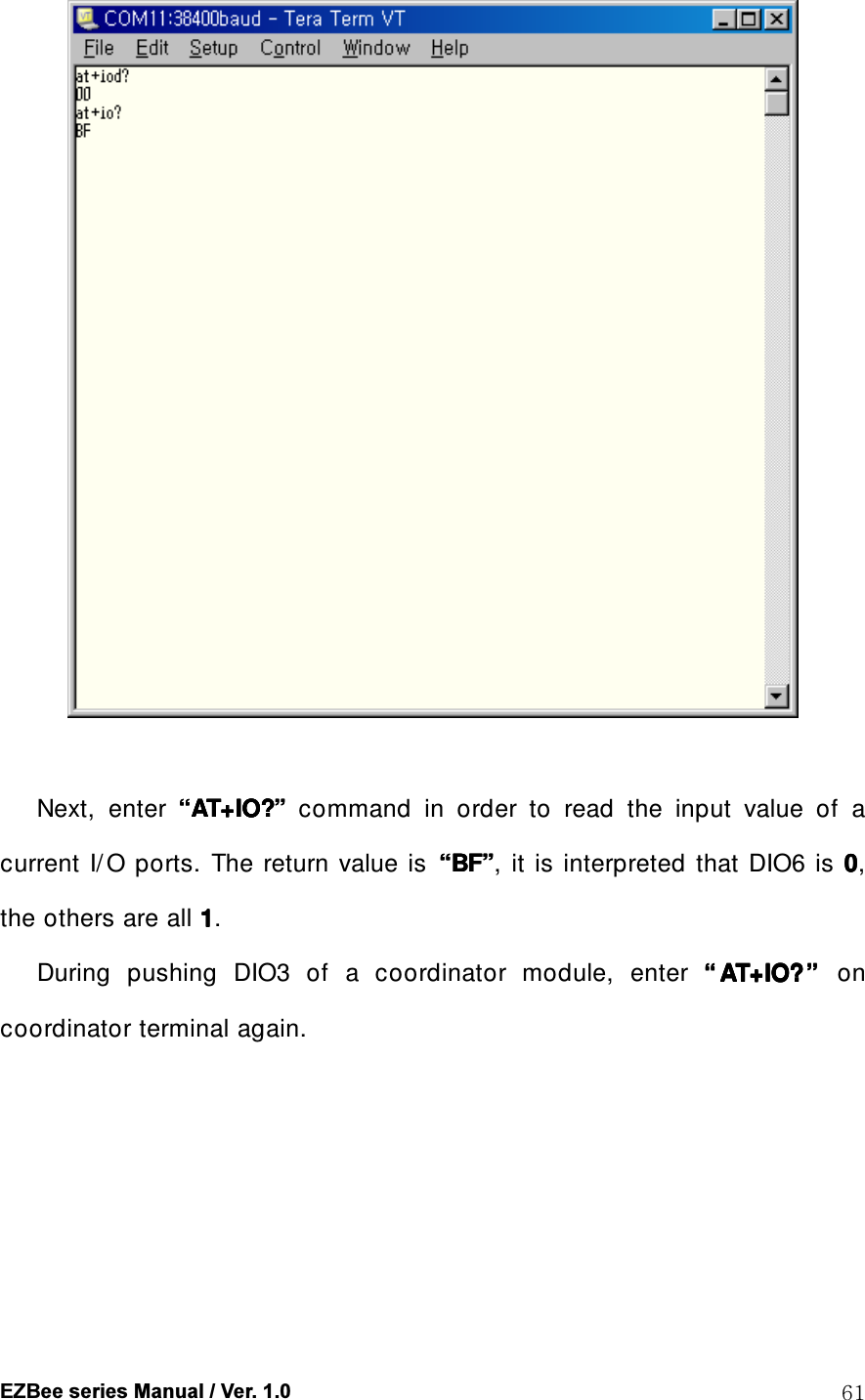
 EZBee series Manual / Ver. 1.0  60 5. 5. 5. 5. Testing message transmission inTesting message transmission inTesting message transmission inTesting message transmission in    Bypass Bypass Bypass Bypass modemodemodemode    1) Enter  ““““ATD 1ATD 1ATD 1ATD 1””””    command on a coordinator terminal, and  ““““ATD 0ATD 0ATD 0ATD 0””””  on a router terminal. 2)  Type  any  keys  on  one  terminal,  and  verify  successful  data transmission on the other terminal.      3) To end Bypass mode, enter  ““““++++++++++++””””    on each terminals.     6. 6. 6. 6. Testing Input/ output function of Testing Input/output function of Testing Input/output function of Testing Input/output function of EZBeeEZBeeEZBeeEZBee    M100M100M100M100    EZBee  M100  supports  total  8  ports  of  GPIO  from  DIO0  through  DIO7 which are set or controlled by a local or remote modem of EZBee. First,  enter  ““““AT+IOD?AT+IOD?AT+IOD?AT+IOD?””””  command  on  a  coordinator  terminal  to  check the  I/ O  directions  of  local  EZBee  M100.  In  this  example,  the  return  value shows  ““““00000000””””, it means all I/ O ports are assigned as input ports.
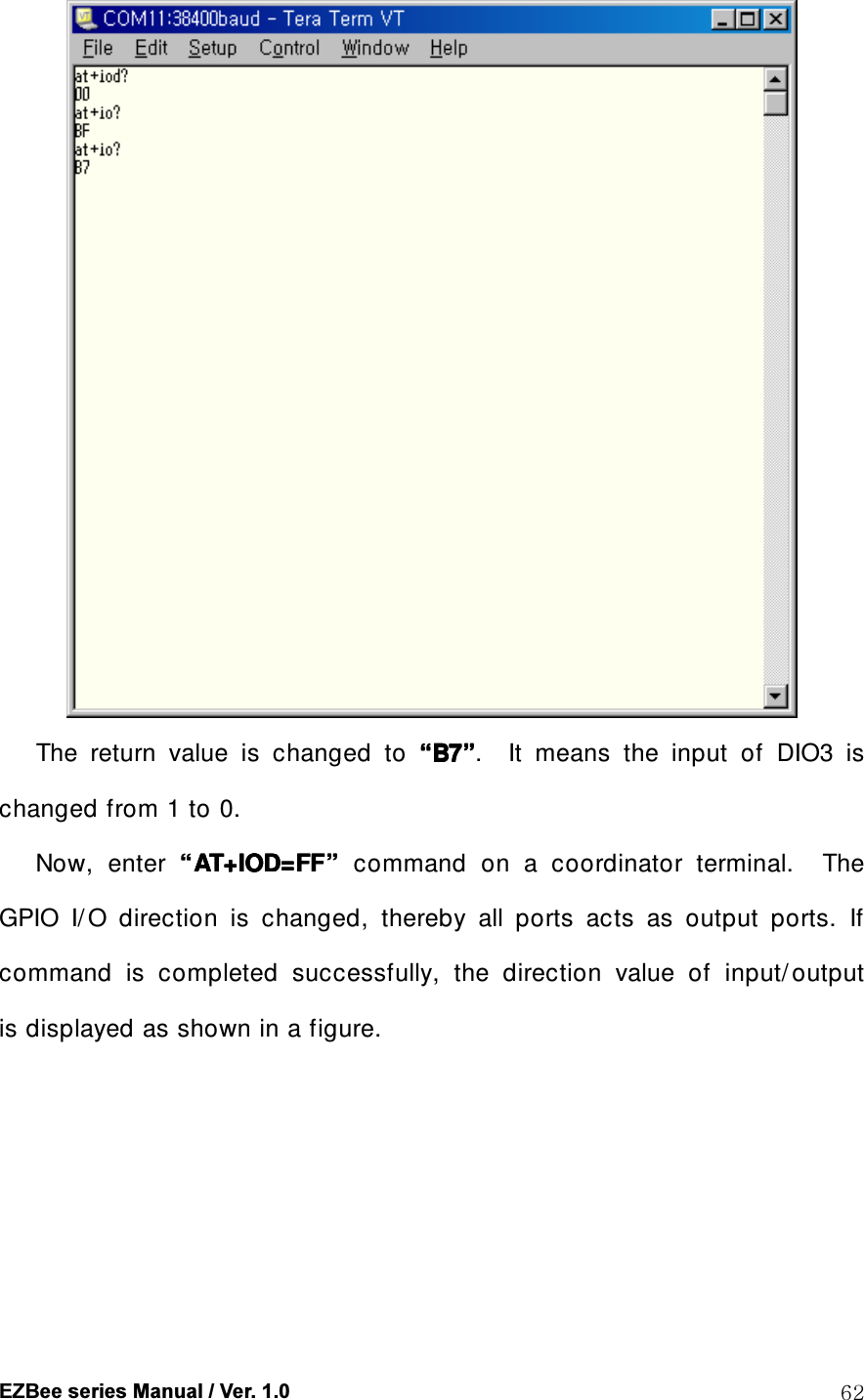
 EZBee series Manual / Ver. 1.0  61   Next,    enter     ““““AT+IO?AT+IO?AT+IO?AT+IO?””””    command  in  order  to  read  the  input  value  of  a current  I/ O  ports.  The  return  value  is  ““““BFBFBFBF””””,  it  is interpreted  that  DIO6  is  0000, the others are all 1111.         During  pushing  DIO3  of  a  coordinator  module,  enter  ““““ AT+IO?AT+IO?AT+IO?AT+IO?””””     on coordinator terminal again.
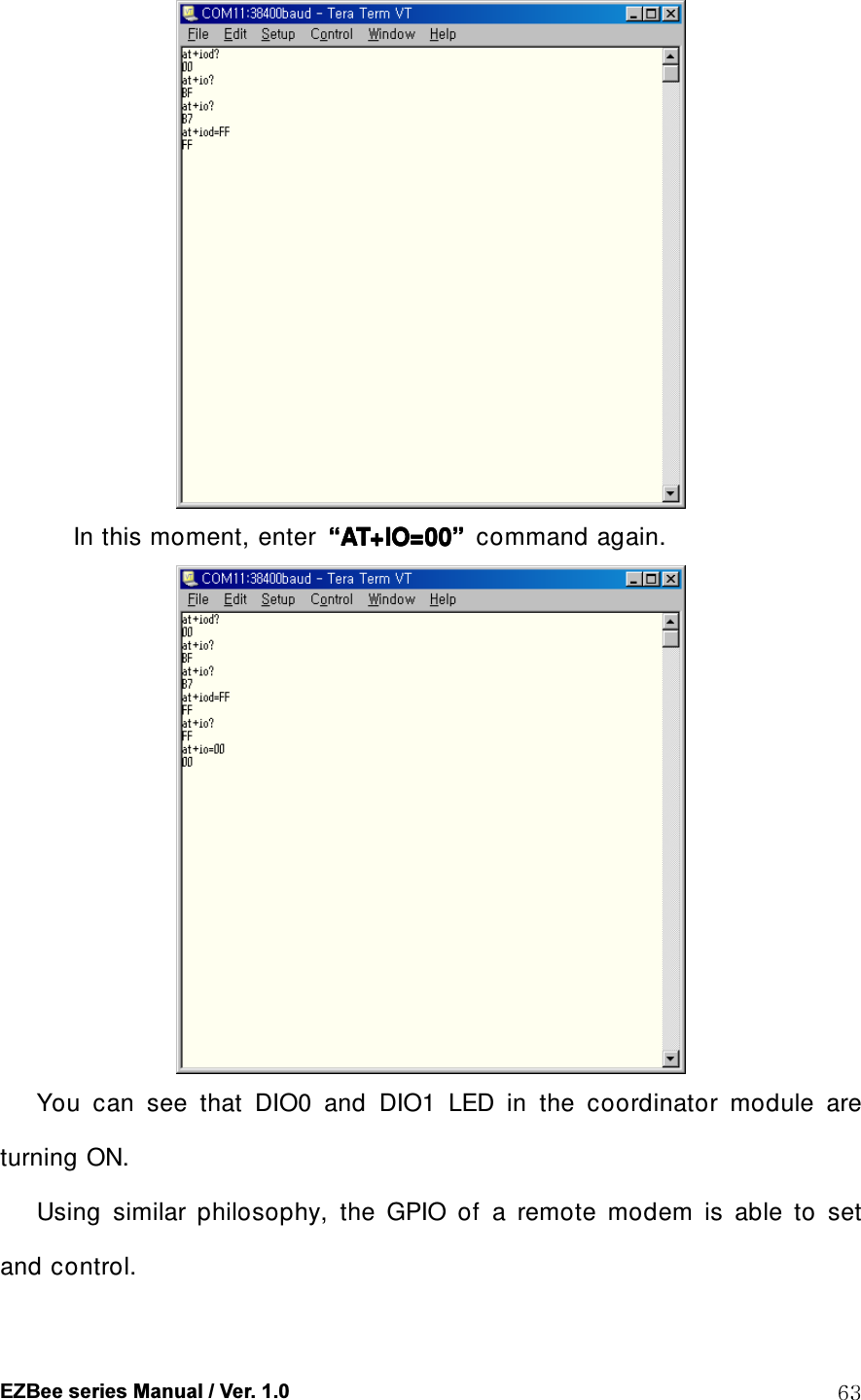
 EZBee series Manual / Ver. 1.0  62        The  return  value  is  changed  to  ““““B7B7B7B7””””.    It  means  the  input  of    DIO3  is changed from 1 to 0. Now,  enter  ““““AT+IOD=FFAT+IOD=FFAT+IOD=FFAT+IOD=FF””””  command  on  a  coordinator  terminal.    The GPIO  I/ O  direction  is  changed,  thereby  all  ports  acts  as  output  ports.  If command  is  completed  successfully,  the  direction  value  of  input/ output   is displayed as shown in a figure.
 EZBee series Manual / Ver. 1.0  63  In this moment, enter  ““““AT+IO=00AT+IO=00AT+IO=00AT+IO=00””””  command again.    You  can  see  that  DIO0  and  DIO1  LED  in  the  coordinator  module  are turning ON.       Using  similar  philosophy,  the  GPIO  of  a  remote  modem  is  able  to  set and control.
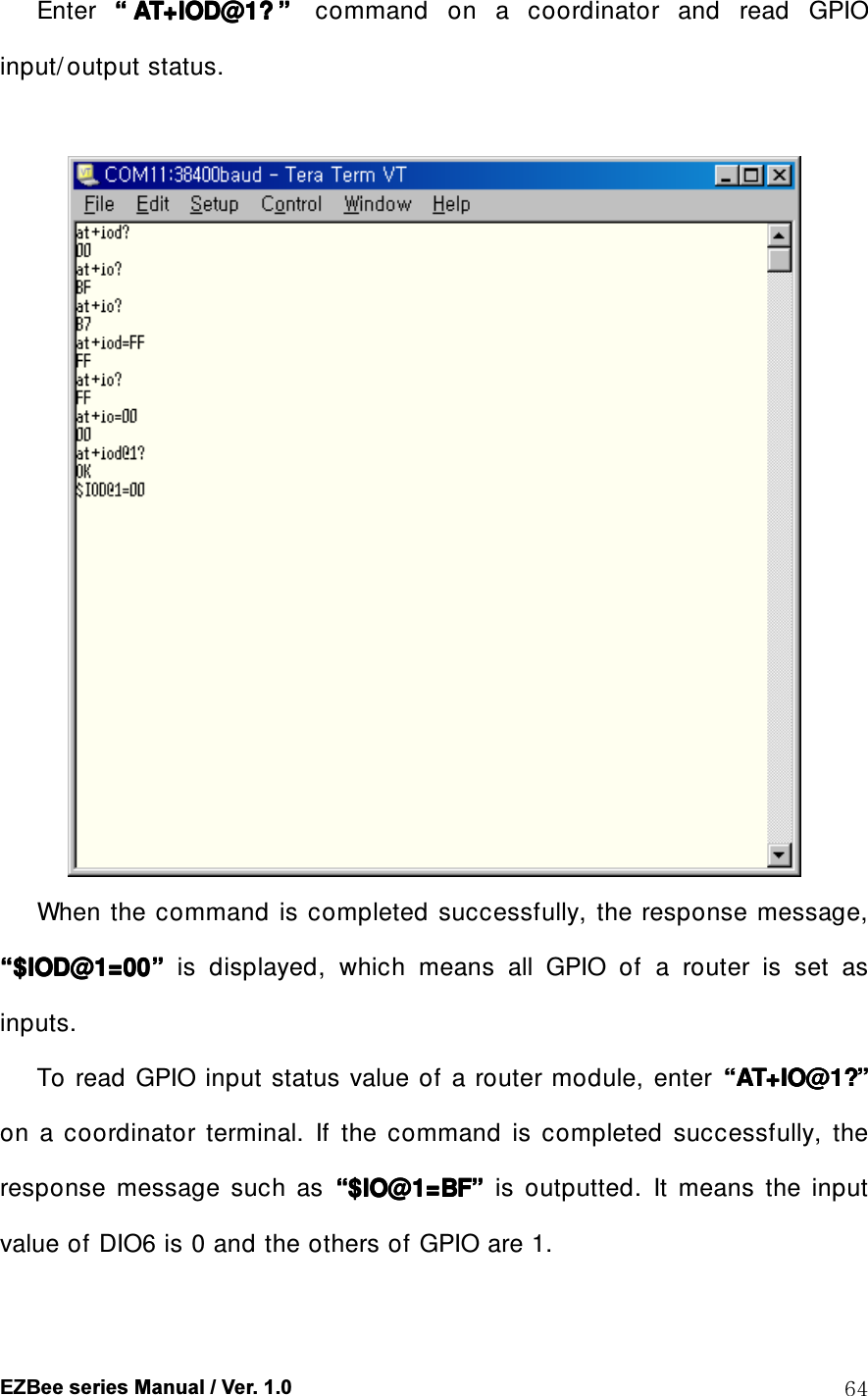
 EZBee series Manual / Ver. 1.0  64 Enter  ““““ AT+IOD@1?AT+IOD@1?AT+IOD@1?AT+IOD@1? ””””  command  on  a  coordinator  and  read  GPIO input/ output status.           When  the command is  completed  successfully,  the  response message, ““““$IOD@1=00$IOD@1=00$IOD@1=00$IOD@1=00””””    is  displayed,  which  means  all  GPIO  of  a  router  is  set  as inputs. To read  GPIO input  status  value of  a  router module,  enter  ““““AT+IO@1?AT+IO@1?AT+IO@1?AT+IO@1?””””    on  a  coordinator  terminal.  If  the  command  is  completed  successfully,  the response  message  such  as  ““““$IO@1=BF$IO@1=BF$IO@1=BF$IO@1=BF””””    is  outputted.  It  means  the  input value of DIO6 is 0 and the others of GPIO are 1.
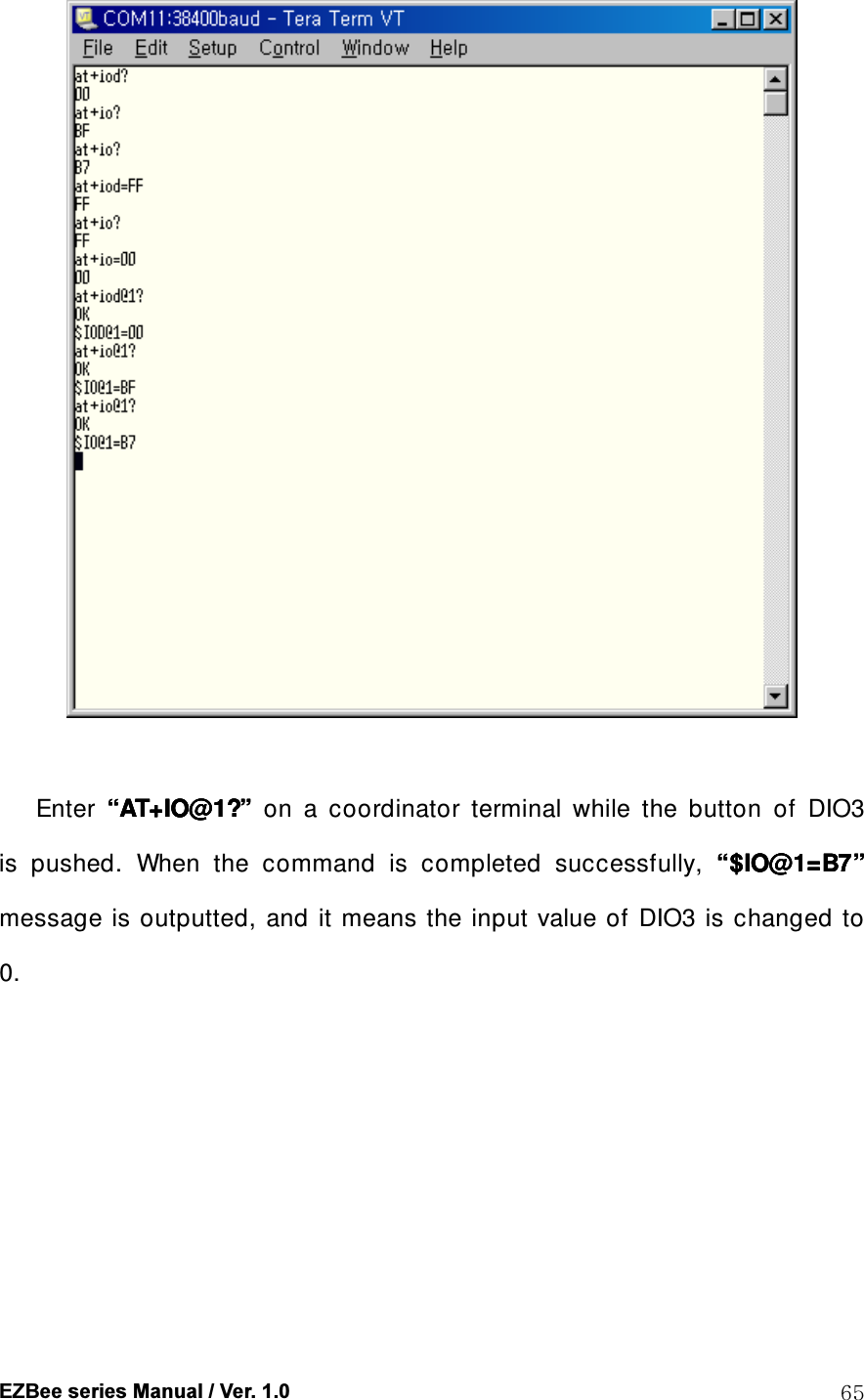
 EZBee series Manual / Ver. 1.0  65   Enter  ““““AT+IO@1?AT+IO@1?AT+IO@1?AT+IO@1?””””    on  a  coordinator  terminal  while  the  button  of  DIO3 is  pushed.  When  the  command  is  completed  successfully,  ““““$IO@1=B7$IO@1=B7$IO@1=B7$IO@1=B7””””    message is outputted, and  it means the input value of DIO3 is  changed to 0.
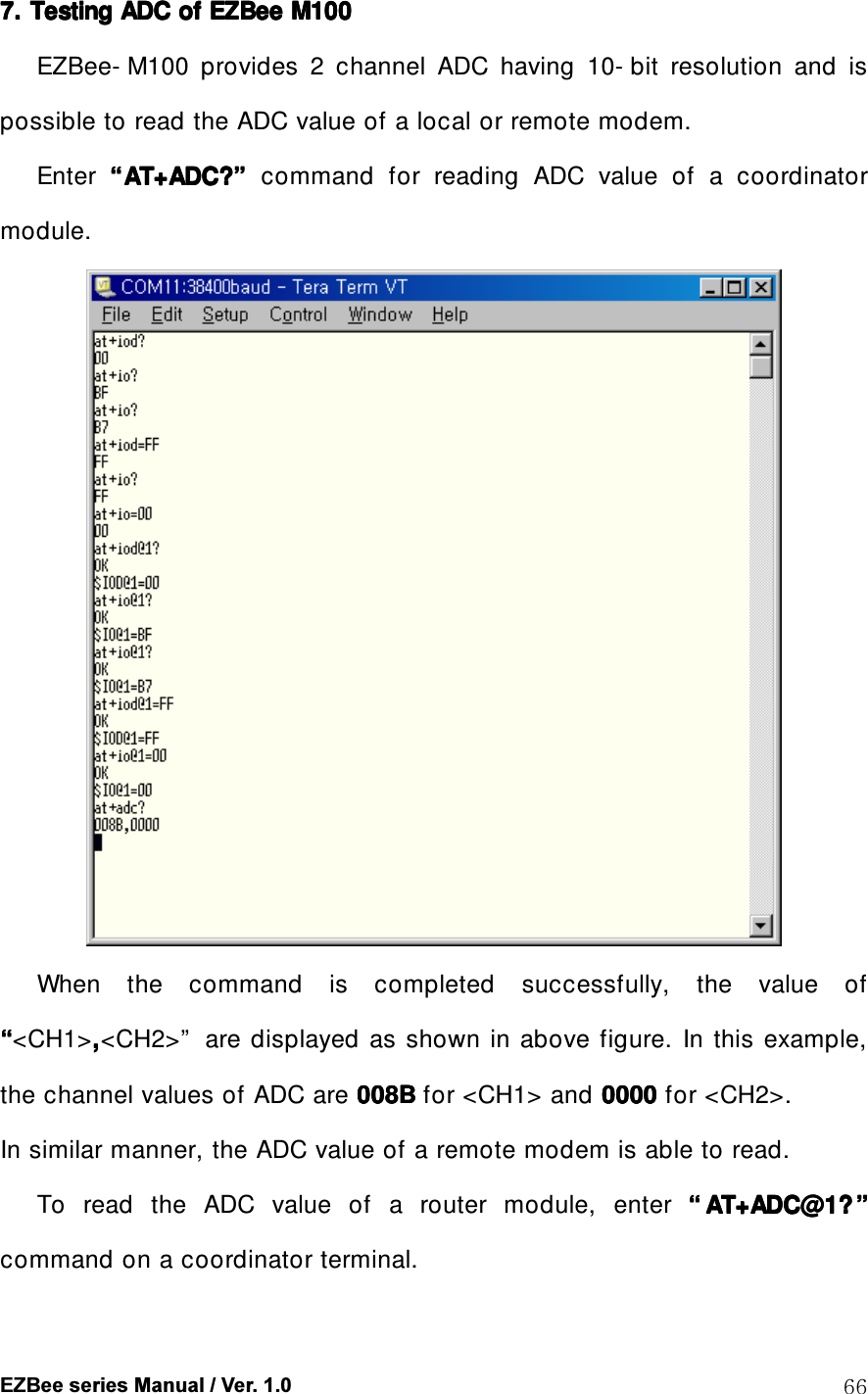
 EZBee series Manual / Ver. 1.0  66 7. 7. 7. 7. Testing ADC of Testing ADC of Testing ADC of Testing ADC of EZBeeEZBeeEZBeeEZBee    M100M100M100M100    EZBee- M100  provides  2  channel  ADC  having  10- bit  resolution  and  is possible to read the ADC value of a local or remote modem. Enter  ““““AT+ADC?AT+ADC?AT+ADC?AT+ADC?””””  command  for  reading  ADC  value  of  a  coordinator module.  When  the  command  is  completed  successfully,  the  value  of ““““<CH1>,,,,<CH2>”   are  displayed  as  shown  in  above figure.  In  this example, the channel values of ADC are 008B008B008B008B for <CH1> and 0000000000000000    for <CH2>. In similar manner, the ADC value of a remote modem is able to read.   To  read  the  ADC  value  of  a  router  module,  enter  ““““ AT+ADC@1?AT+ADC@1?AT+ADC@1?AT+ADC@1? ””””    command on a coordinator terminal.
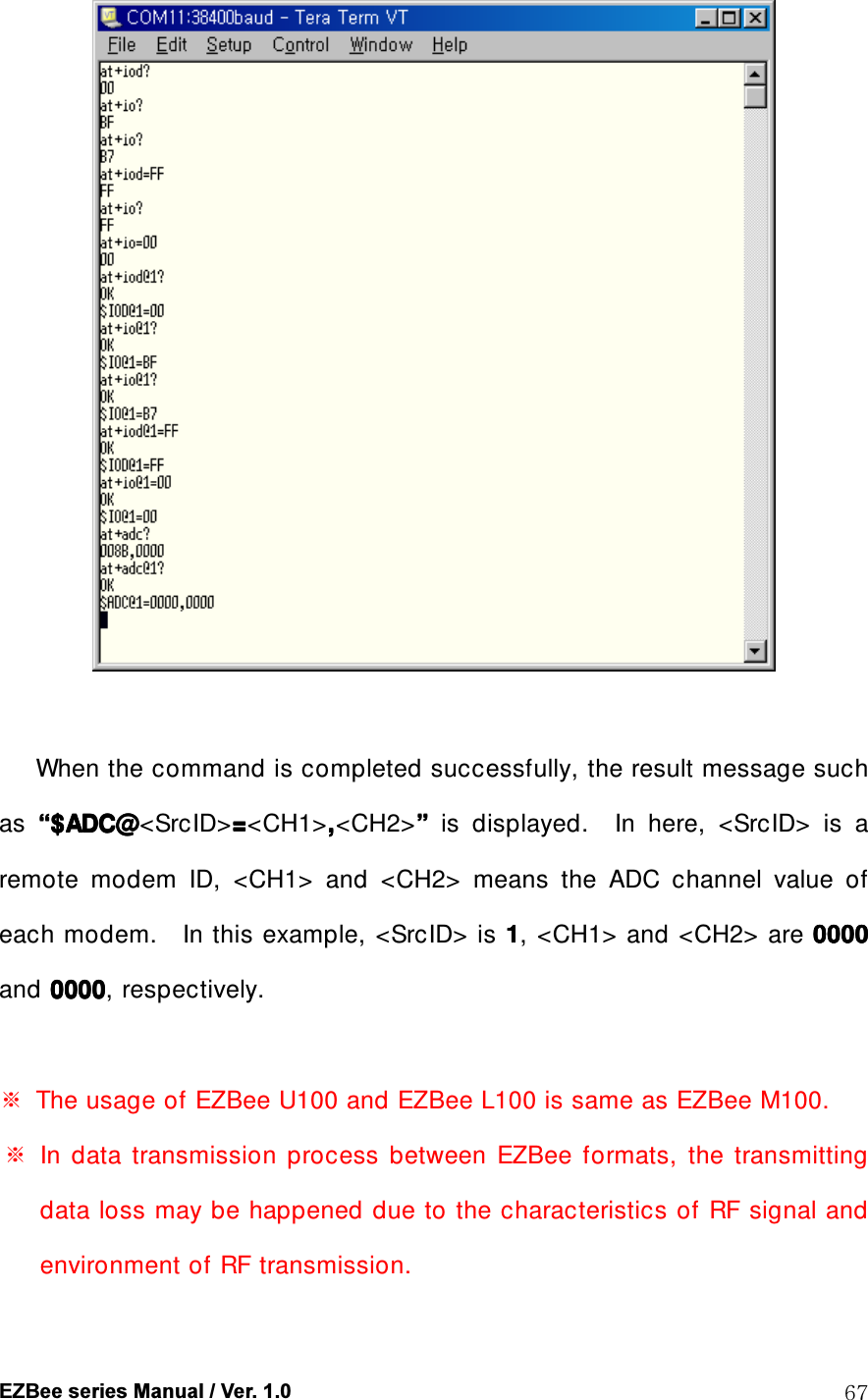
 EZBee series Manual / Ver. 1.0  67   When the command is completed successfully, the result message such as  ““““$ADC@$ADC@$ADC@$ADC@<SrcID>====<CH1>,,,,<CH2>””””    is  displayed.    In  here,    <SrcID>  is  a remote  modem  ID,  <CH1>  and  <CH2>  means  the  ADC  channel  value  of each modem.    In this example, <SrcID> is 1111, <CH1> and <CH2> are 0000000000000000    and 0000000000000000, respectively.  ※  The usage of EZBee U100 and EZBee L100 is same as EZBee M100. ※  In  data  transmission  process  between  EZBee  formats,  the  transmitting data loss may be happened due to the characteristics of RF signal and environment of RF transmission.
FCC Information  This device complies with Part 15 of the FCC Results. Operation is subject to the following two conditions : (1) This Device may not cause harmful interface, and (2) This Device must accept any interference received, including interference that     may cause undesired operation.  WARNING      Changes or modifications not expressly approved by the manufacturer could void the user’s authority to operate the equipment.  CAUTION : Exposure to Radio Frequency Radiation. To comply with FCC’s RF exposure limits for general population / uncontrolled exposure, the antenna(s) used for this transmitter must be installed to provide a separation distance of at least 20cm from all persons and must not be co-located or operating in conjunction with any other antenna or transmitter. Note : This equipment has been tested and found to comply with the limits for CLASS B digital device, pursuant to Part 15 FCC Rules. These limits are designed to provide reasonable protection against harmful interference when the equipment is operated in a commercial environment.    This equipment generates, uses and can radiate radio frequency energy  and,  if  not  installed  and  used  in  accordance with  the  instructions, may cause harmful interference to radio communications.     However, there is no guarantee that interference will not occur in a particular installation.    If  this  equipment does cause harmful interference to radio or television reception, which can be determined by turning the equipment off and on, the user is encouraged to try correct the interference by one or more of the following measures ;   1.1. Reorient or relocate the receiving antenna. 1.2. Increase the separation between the equipment and receiver.     1.3. Connect the equipment into an outlet on a circuit different from that to   which receiver is connected.     1.4. Consult the dealer or experienced radio/TV technician for help.

Navigation menu