EVERBEST MACHINERY INDUSTRY DT3369TBT Clamp Meter User Manual DT 3369T BT manual

SHENZHEN EVERBEST MACHINERY INDUSTRY CO.,LTD. Clamp Meter DT 3369T BT manual

User Manual

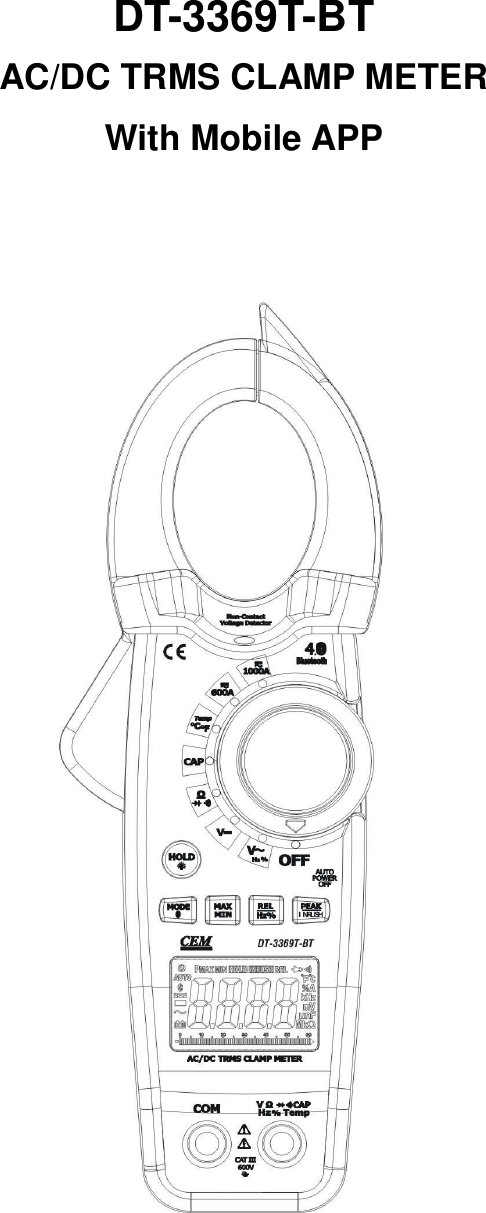
 DT-3369T-BT AC/DC TRMS CLAMP METER With Mobile APP
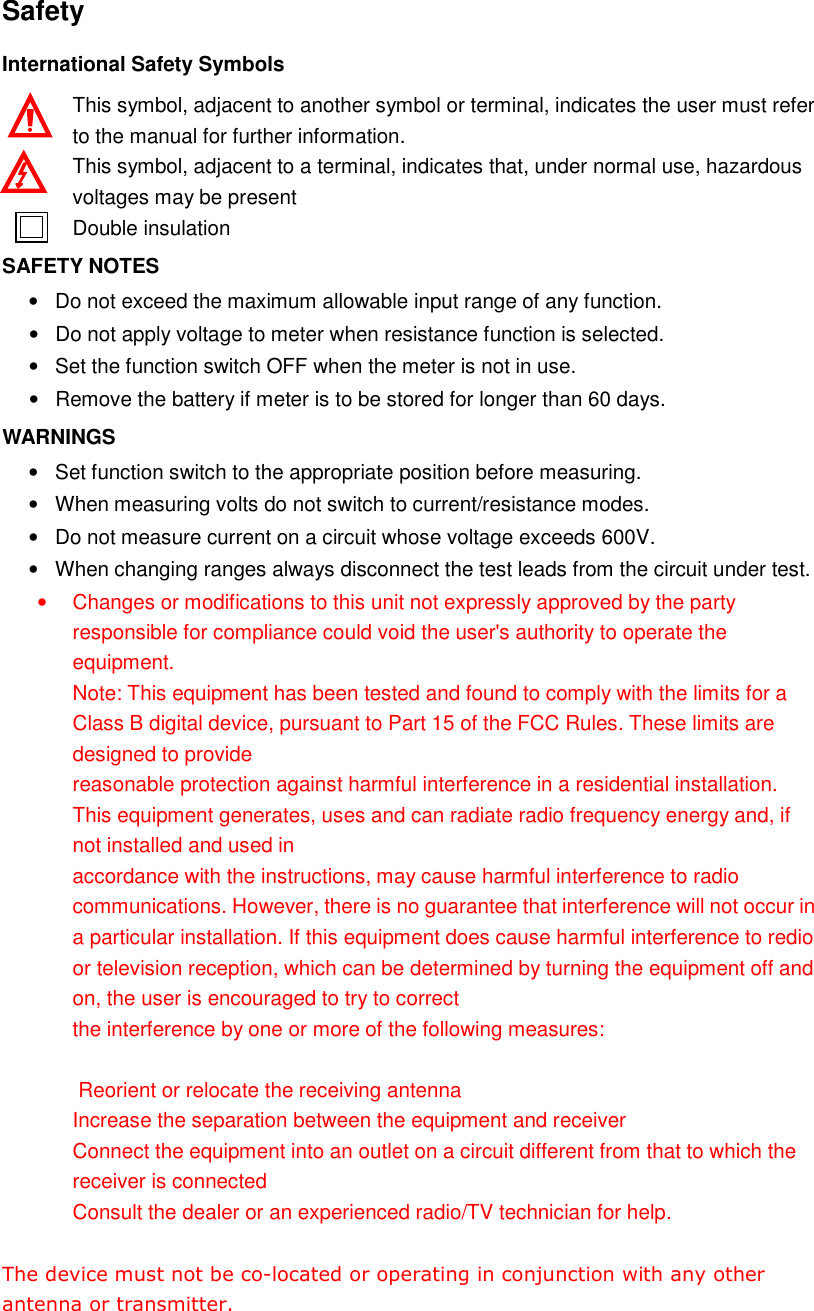
 Safety International Safety Symbols This symbol, adjacent to another symbol or terminal, indicates the user must refer to the manual for further information. This symbol, adjacent to a terminal, indicates that, under normal use, hazardous voltages may be present Double insulation SAFETY NOTES •  Do not exceed the maximum allowable input range of any function. •  Do not apply voltage to meter when resistance function is selected. •  Set the function switch OFF when the meter is not in use. •  Remove the battery if meter is to be stored for longer than 60 days. WARNINGS •  Set function switch to the appropriate position before measuring. •  When measuring volts do not switch to current/resistance modes. •  Do not measure current on a circuit whose voltage exceeds 600V. •  When changing ranges always disconnect the test leads from the circuit under test. •  Changes or modifications to this unit not expressly approved by the party responsible for compliance could void the user's authority to operate the equipment.    Note: This equipment has been tested and found to comply with the limits for a Class B digital device, pursuant to Part 15 of the FCC Rules. These limits are designed to provide   reasonable protection against harmful interference in a residential installation. This equipment generates, uses and can radiate radio frequency energy and, if not installed and used in   accordance with the instructions, may cause harmful interference to radio communications. However, there is no guarantee that interference will not occur in a particular installation. If this equipment does cause harmful interference to redio or television reception, which can be determined by turning the equipment off and on, the user is encouraged to try to correct the interference by one or more of the following measures:   Reorient or relocate the receiving antenna Increase the separation between the equipment and receiver Connect the equipment into an outlet on a circuit different from that to which the receiver is connected Consult the dealer or an experienced radio/TV technician for help.   The device must not be co-located or operating in conjunction with any other antenna or transmitter.
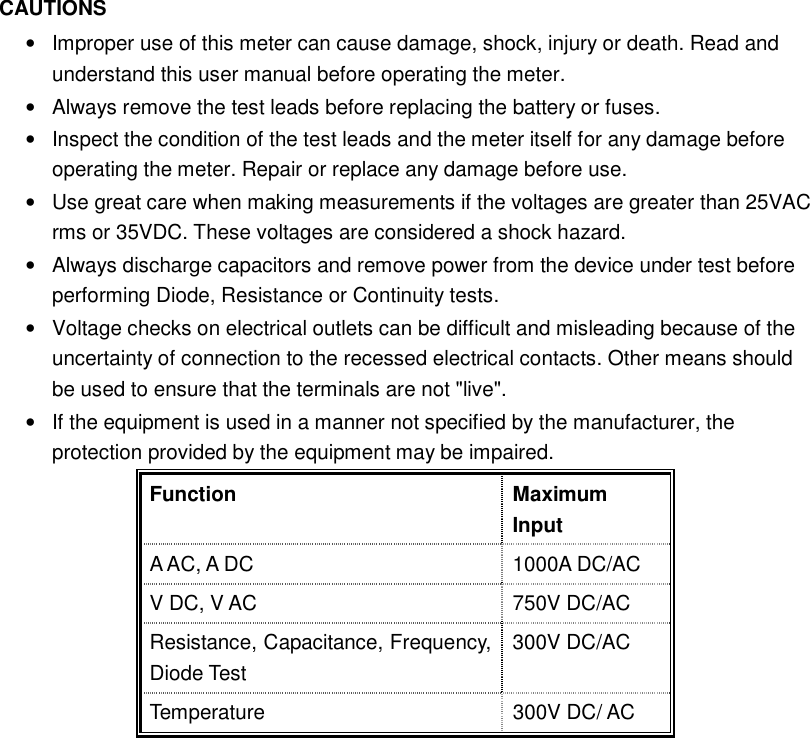
 CAUTIONS •  Improper use of this meter can cause damage, shock, injury or death. Read and understand this user manual before operating the meter. •  Always remove the test leads before replacing the battery or fuses. •  Inspect the condition of the test leads and the meter itself for any damage before operating the meter. Repair or replace any damage before use. •  Use great care when making measurements if the voltages are greater than 25VAC rms or 35VDC. These voltages are considered a shock hazard. •  Always discharge capacitors and remove power from the device under test before performing Diode, Resistance or Continuity tests. •  Voltage checks on electrical outlets can be difficult and misleading because of the uncertainty of connection to the recessed electrical contacts. Other means should be used to ensure that the terminals are not "live". •  If the equipment is used in a manner not specified by the manufacturer, the protection provided by the equipment may be impaired. Function  Maximum Input A AC, A DC    1000A DC/AC V DC, V AC  750V DC/AC Resistance, Capacitance, Frequency, Diode Test 300V DC/AC Temperature    300V DC/ AC
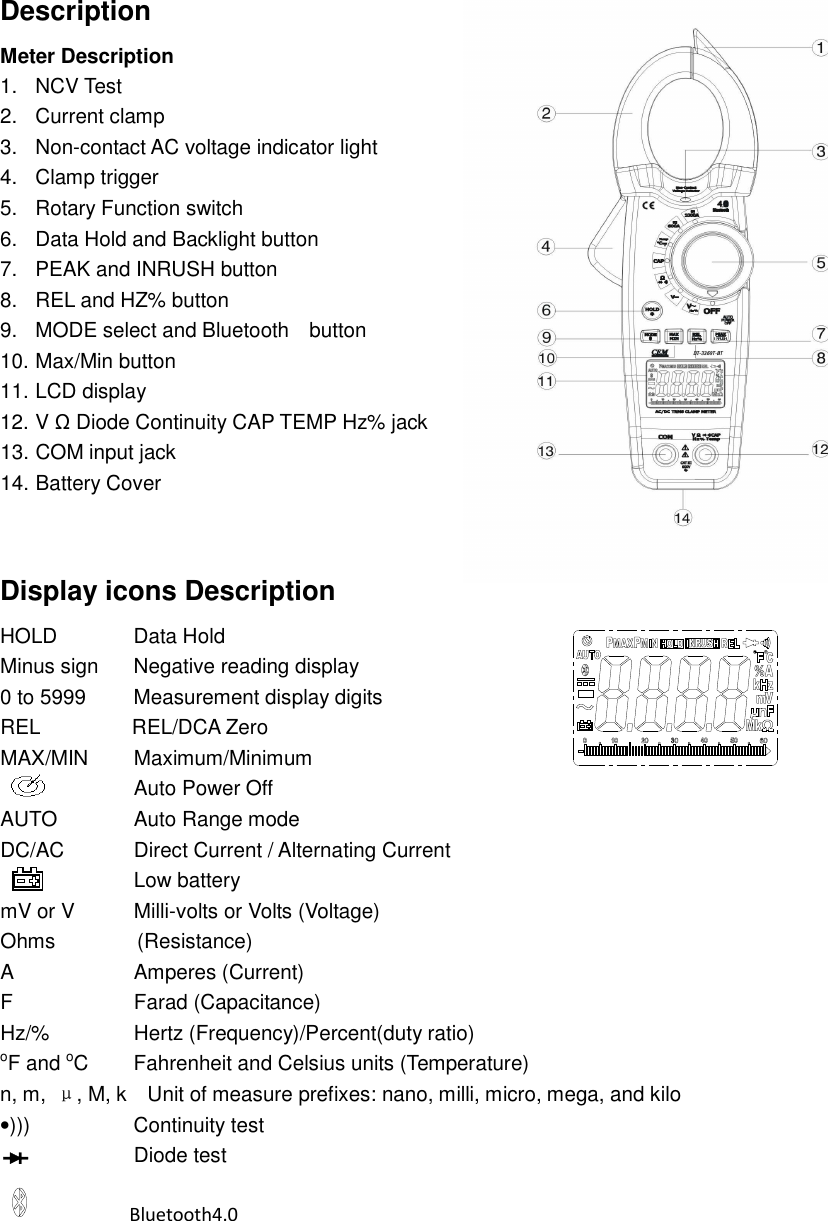
 Description Meter Description   1.  NCV Test 2.  Current clamp 3.  Non-contact AC voltage indicator light 4.  Clamp trigger 5.  Rotary Function switch 6.  Data Hold and Backlight button 7.  PEAK and INRUSH button 8.  REL and HZ% button 9.  MODE select and Bluetooth    button 10. Max/Min button 11. LCD display 12. V Ω Diode Continuity CAP TEMP Hz% jack 13. COM input jack 14. Battery Cover   Display icons Description HOLD            Data Hold Minus sign    Negative reading display 0 to 5999      Measurement display digits  REL                  REL/DCA Zero   MAX/MIN    Maximum/Minimum                           Auto Power Off AUTO            Auto Range mode DC/AC            Direct Current / Alternating Current                     Low battery mV or V           Milli-volts or Volts (Voltage) Ohms                (Resistance) A                    Amperes (Current) F                    Farad (Capacitance) Hz/%            Hertz (Frequency)/Percent(duty ratio) oF and oC    Fahrenheit and Celsius units (Temperature) n, m,  μ, M, k    Unit of measure prefixes: nano, milli, micro, mega, and kilo     •)))                    Continuity test Diode test               Bluetooth4.0
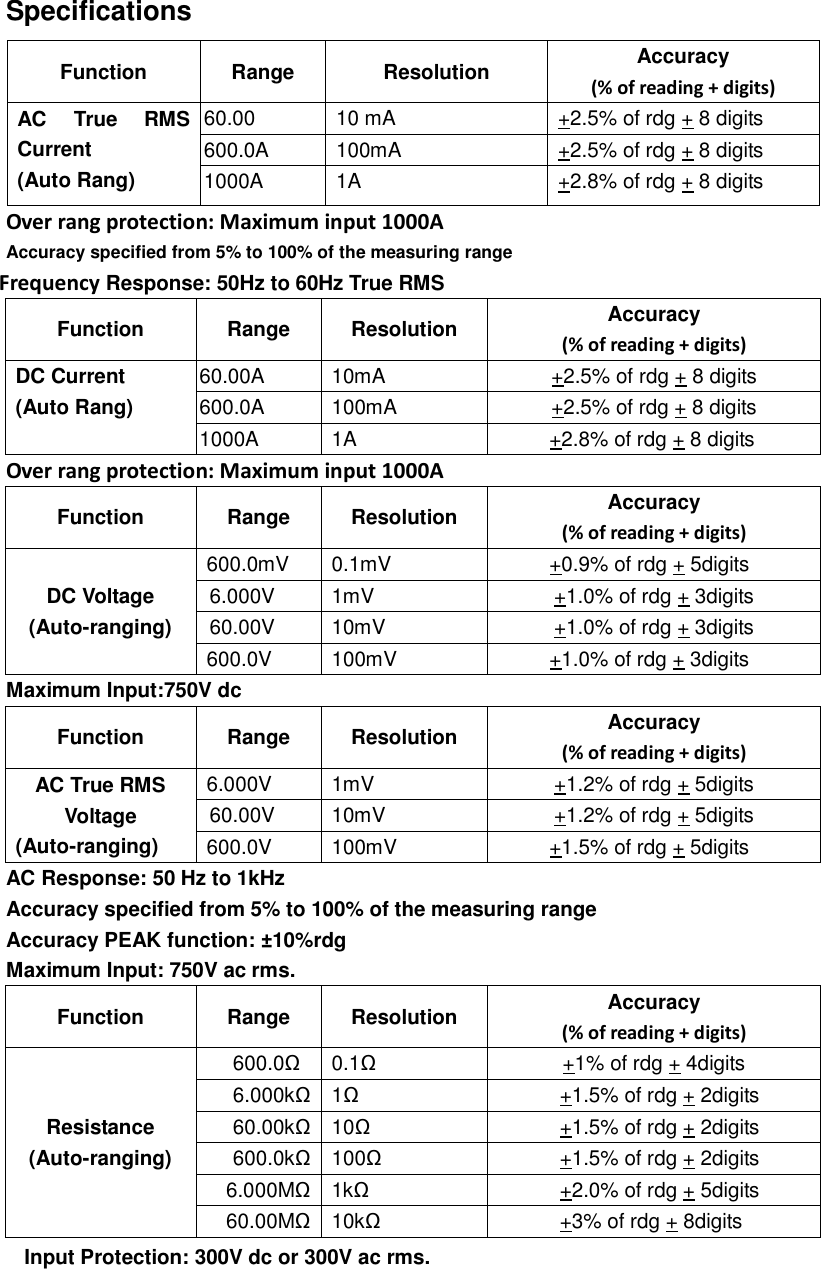
 Specifications Function  Range  Resolution  Accuracy (% of reading + digits) AC  True  RMS Current (Auto Rang) 60.00  10 mA  +2.5% of rdg + 8 digits 600.0A  100mA  +2.5% of rdg + 8 digits 1000A  1A  +2.8% of rdg + 8 digits Over rang protection: Maximum input 1000A   Accuracy specified from 5% to 100% of the measuring range Frequency Response: 50Hz to 60Hz True RMS Function  Range  Resolution  Accuracy (% of reading + digits) DC Current (Auto Rang) 60.00A  10mA  +2.5% of rdg + 8 digits 600.0A  100mA  +2.5% of rdg + 8 digits 1000A  1A  +2.8% of rdg + 8 digits Over rang protection: Maximum input 1000A   Function  Range  Resolution  Accuracy (% of reading + digits) DC Voltage (Auto-ranging) 600.0mV    0.1mV  +0.9% of rdg + 5digits 6.000V  1mV  +1.0% of rdg + 3digits 60.00V  10mV  +1.0% of rdg + 3digits 600.0V  100mV  +1.0% of rdg + 3digits Maximum Input:750V dc   Function  Range  Resolution  Accuracy (% of reading + digits) AC True RMS Voltage (Auto-ranging) 6.000V  1mV  +1.2% of rdg + 5digits 60.00V  10mV  +1.2% of rdg + 5digits 600.0V  100mV  +1.5% of rdg + 5digits AC Response: 50 Hz to 1kHz Accuracy specified from 5% to 100% of the measuring range Accuracy PEAK function: ±10%rdg Maximum Input: 750V ac rms. Function  Range  Resolution  Accuracy (% of reading + digits) Resistance (Auto-ranging) 600.0Ω  0.1Ω  +1% of rdg + 4digits 6.000kΩ 1Ω  +1.5% of rdg + 2digits 60.00kΩ 10Ω  +1.5% of rdg + 2digits 600.0kΩ 100Ω  +1.5% of rdg + 2digits 6.000MΩ 1kΩ  +2.0% of rdg + 5digits 60.00MΩ 10kΩ  +3% of rdg + 8digits Input Protection: 300V dc or 300V ac rms.
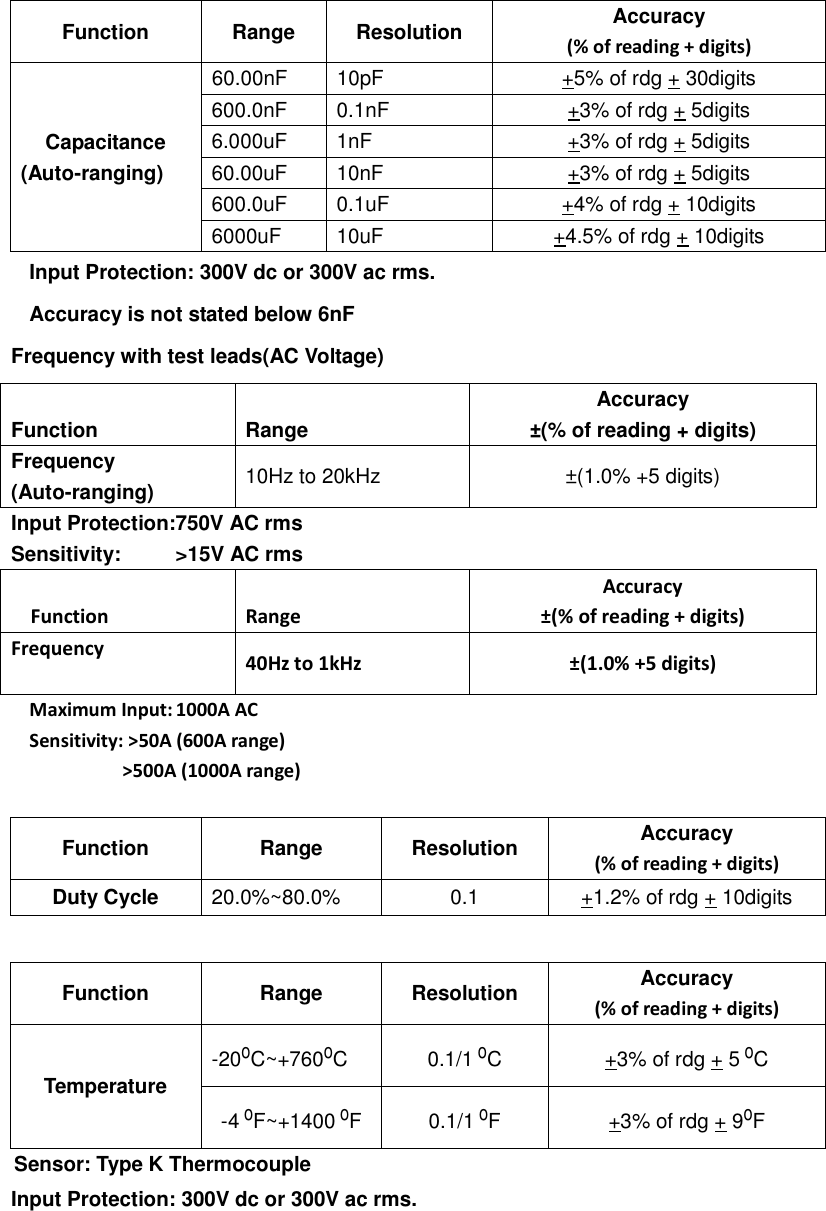
 Function  Range  Resolution  Accuracy (% of reading + digits) Capacitance (Auto-ranging) 60.00nF  10pF  +5% of rdg + 30digits 600.0nF  0.1nF  +3% of rdg + 5digits 6.000uF  1nF  +3% of rdg + 5digits 60.00uF  10nF  +3% of rdg + 5digits 600.0uF  0.1uF  +4% of rdg + 10digits 6000uF  10uF  +4.5% of rdg + 10digits Input Protection: 300V dc or 300V ac rms. Accuracy is not stated below 6nF Frequency with test leads(AC Voltage) Function  Range Accuracy ±(% of reading + digits) Frequency     (Auto-ranging) 10Hz to 20kHz  ±(1.0% +5 digits) Input Protection:750V AC rms   Sensitivity:     >15V AC rms Function  Range Accuracy ±(% of reading + digits) Frequency    40Hz to 1kHz  ±(1.0% +5 digits) Maximum Input: 1000A AC  Sensitivity: >50A (600A range) >500A (1000A range)  Function  Range  Resolution  Accuracy (% of reading + digits) Duty Cycle  20.0%~80.0% 0.1  +1.2% of rdg + 10digits  Function  Range  Resolution  Accuracy (% of reading + digits) Temperature   -20oC~+760oC 0.1/1 oC  +3% of rdg + 5 oC -4 oF~+1400 oF  0.1/1 oF  +3% of rdg + 9oF Sensor: Type K Thermocouple Input Protection: 300V dc or 300V ac rms.
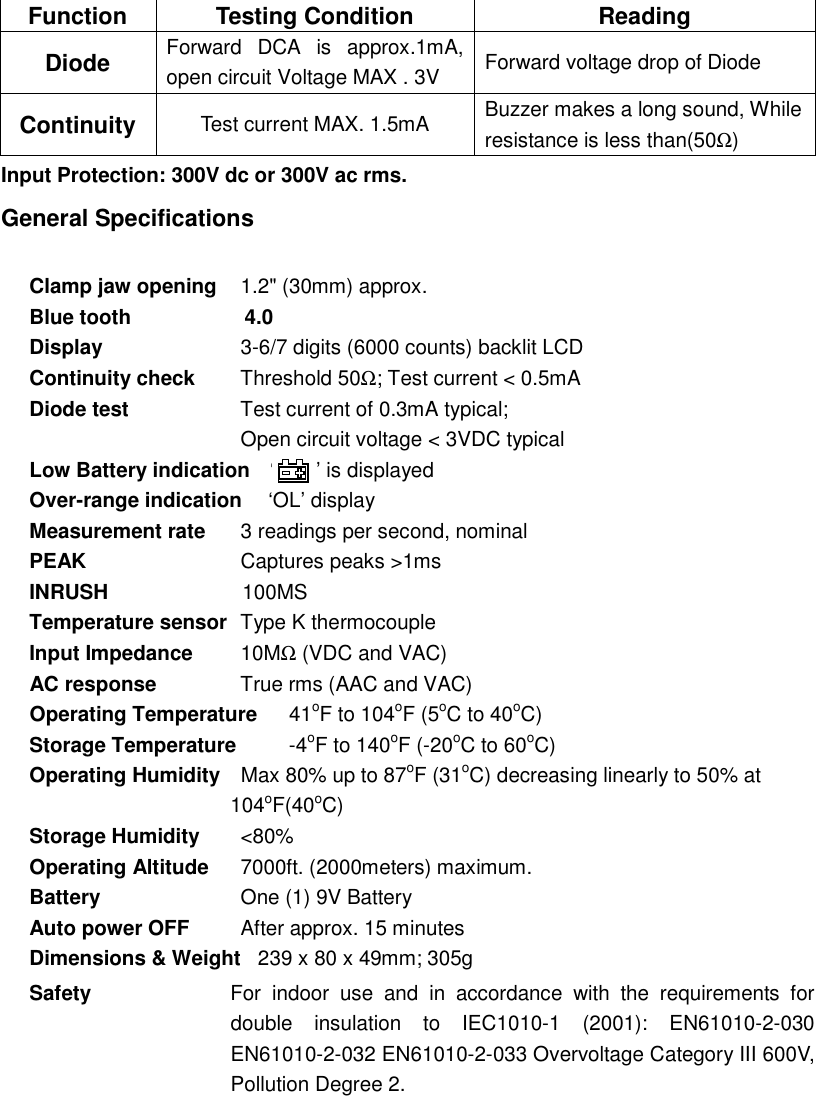
 Input Protection: 300V dc or 300V ac rms. General Specifications  Clamp jaw opening   1.2" (30mm) approx. Blue tooth                      4.0 Display    3-6/7 digits (6000 counts) backlit LCD Continuity check    Threshold 50Ω; Test current < 0.5mA Diode test    Test current of 0.3mA typical;     Open circuit voltage < 3VDC typical Low Battery indication    ‘        ’ is displayed Over-range indication     ‘OL’ display Measurement rate    3 readings per second, nominal PEAK    Captures peaks >1ms   INRUSH                          100MS Temperature sensor   Type K thermocouple Input Impedance    10MΩ (VDC and VAC) AC response    True rms (AAC and VAC) Operating Temperature  41oF to 104oF (5oC to 40oC) Storage Temperature          -4oF to 140oF (-20oC to 60oC) Operating Humidity    Max 80% up to 87oF (31oC) decreasing linearly to 50% at                               104oF(40oC) Storage Humidity    <80%   Operating Altitude    7000ft. (2000meters) maximum. Battery    One (1) 9V Battery Auto power OFF    After approx. 15 minutes Dimensions & Weight   239 x 80 x 49mm; 305g Safety  For  indoor  use  and  in  accordance  with  the  requirements  for double  insulation  to  IEC1010-1  (2001):  EN61010-2-030 EN61010-2-032 EN61010-2-033 Overvoltage Category III 600V, Pollution Degree 2.     Function  Testing Condition  Reading Diode     Forward  DCA  is  approx.1mA, open circuit Voltage MAX . 3V  Forward voltage drop of Diode   Continuity Test current MAX. 1.5mA  Buzzer makes a long sound, While resistance is less than(50Ω)
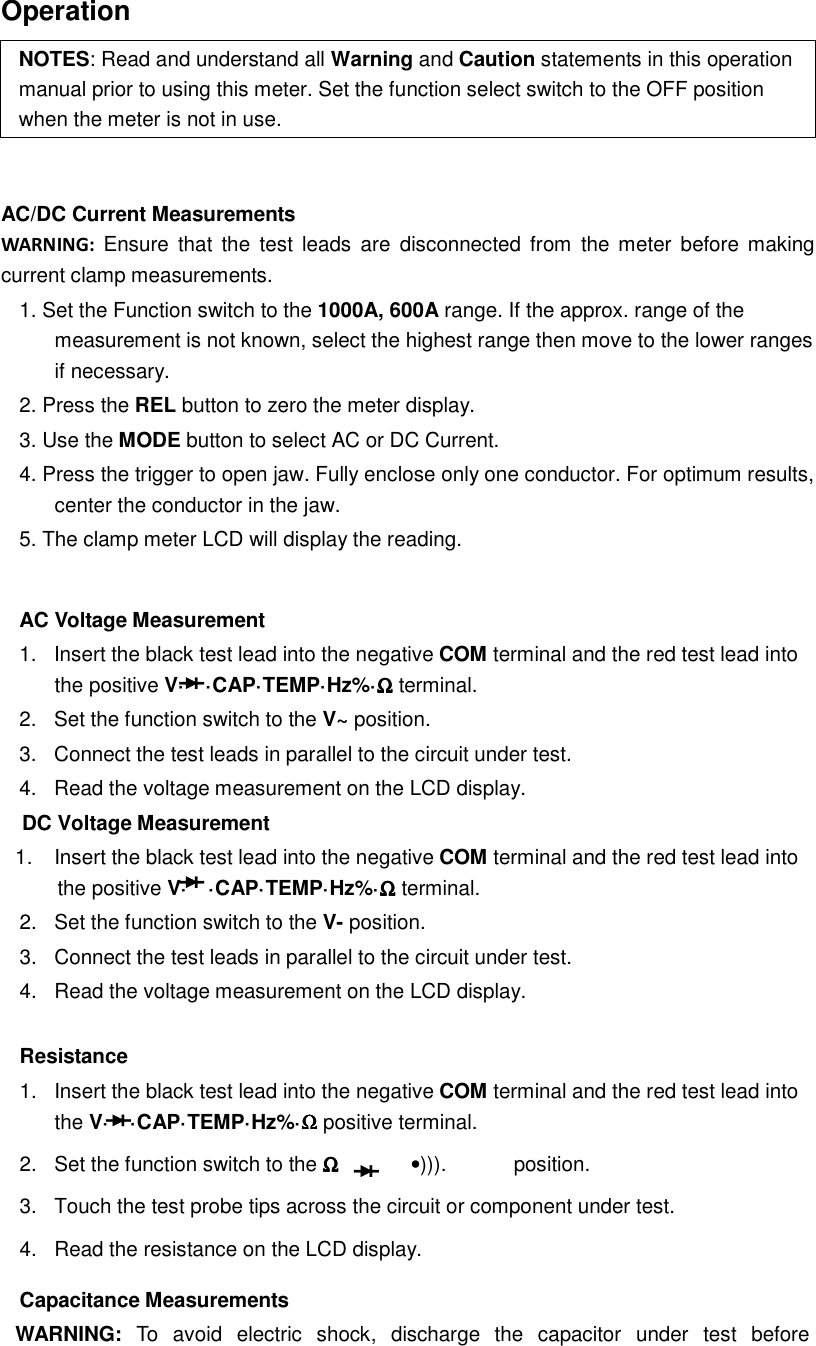
 Operation NOTES: Read and understand all Warning and Caution statements in this operation manual prior to using this meter. Set the function select switch to the OFF position when the meter is not in use.   AC/DC Current Measurements   WARNING:  Ensure  that  the  test  leads  are  disconnected from  the  meter before making current clamp measurements. 1. Set the Function switch to the 1000A, 600A range. If the approx. range of the measurement is not known, select the highest range then move to the lower ranges if necessary. 2. Press the REL button to zero the meter display. 3. Use the MODE button to select AC or DC Current. 4. Press the trigger to open jaw. Fully enclose only one conductor. For optimum results, center the conductor in the jaw. 5. The clamp meter LCD will display the reading.  AC Voltage Measurement   1.  Insert the black test lead into the negative COM terminal and the red test lead into the positive V· ·CAP·TEMP·Hz%·ΩΩΩΩ terminal. 2.  Set the function switch to the V~ position.   3.  Connect the test leads in parallel to the circuit under test. 4.  Read the voltage measurement on the LCD display.     DC Voltage Measurement 1.  Insert the black test lead into the negative COM terminal and the red test lead into the positive V· ·CAP·TEMP·Hz%·ΩΩΩΩ terminal. 2.  Set the function switch to the V- position.   3.  Connect the test leads in parallel to the circuit under test. 4.  Read the voltage measurement on the LCD display.  Resistance 1.  Insert the black test lead into the negative COM terminal and the red test lead into the V· ·CAP·TEMP·Hz%·ΩΩΩΩ positive terminal. 2.  Set the function switch to the ΩΩΩΩ      •))). position. 3.  Touch the test probe tips across the circuit or component under test. 4.  Read the resistance on the LCD display. Capacitance Measurements WARNING:  To  avoid  electric  shock,  discharge  the  capacitor  under  test  before
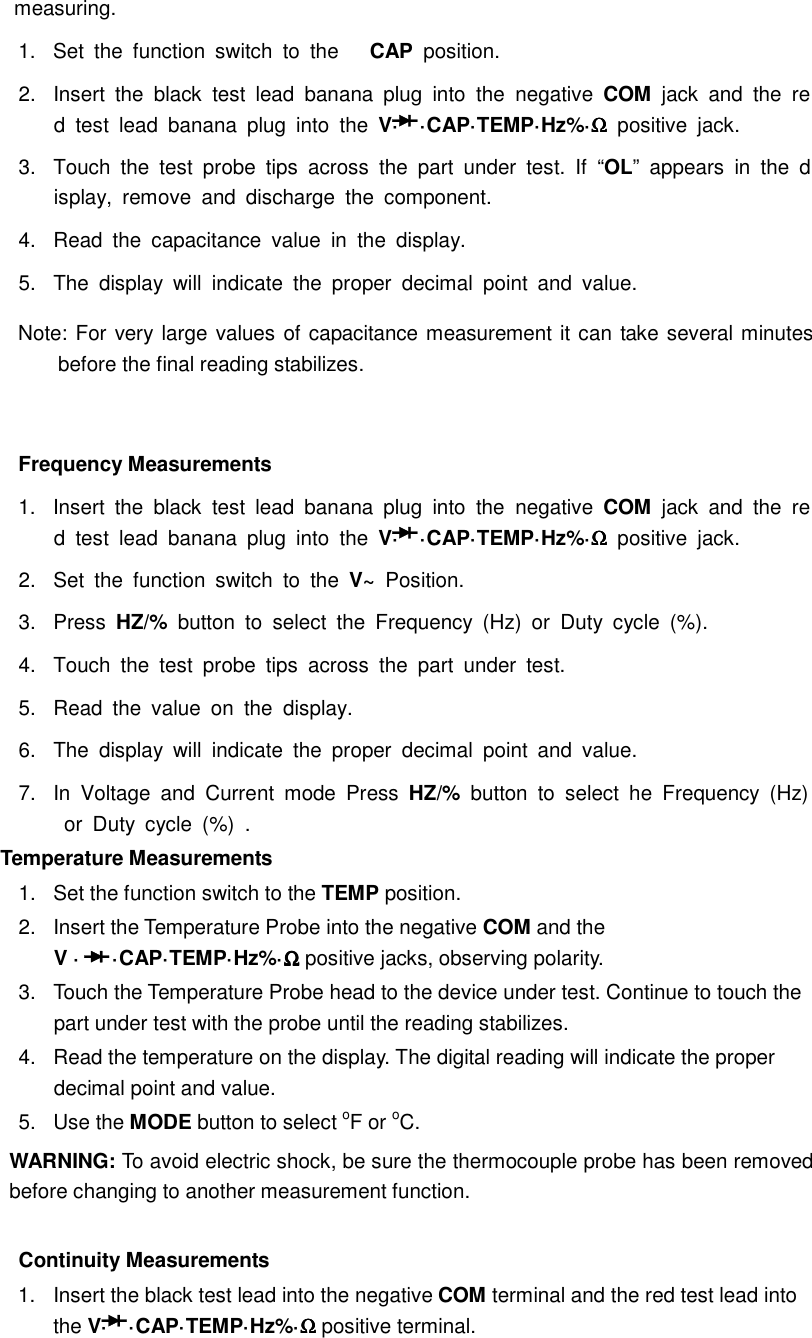
 measuring. 1.  Set  the  function  switch  to  the  CAP  position. 2.  Insert  the  black  test  lead  banana  plug  into  the  negative  COM  jack  and  the  red  test  lead  banana  plug  into  the  V· ·CAP·TEMP·Hz%·ΩΩΩΩ positive  jack. 3.  Touch  the  test  probe  tips  across  the  part  under  test.  If  “OL”  appears  in  the  display,  remove  and  discharge  the  component. 4.  Read  the  capacitance  value  in  the  display. 5.  The  display  will  indicate  the  proper  decimal  point  and  value. Note: For very large values of capacitance measurement it can take several minutes before the final reading stabilizes.  Frequency Measurements 1.  Insert  the  black  test  lead  banana  plug  into  the  negative  COM  jack  and  the  red  test  lead  banana  plug  into  the  V· ·CAP·TEMP·Hz%·ΩΩΩΩ positive  jack. 2.  Set  the  function  switch  to  the  V~  Position. 3.  Press  HZ/%  button  to  select  the  Frequency  (Hz)  or  Duty  cycle  (%). 4.  Touch  the  test  probe  tips  across  the  part  under  test. 5.  Read  the  value  on  the  display. 6.  The  display  will  indicate  the  proper  decimal  point  and  value. 7.  In  Voltage  and  Current  mode  Press  HZ/%  button  to  select  he  Frequency  (Hz)  or  Duty  cycle  (%)  . Temperature Measurements   1.  Set the function switch to the TEMP position. 2.  Insert the Temperature Probe into the negative COM and the V ·  ·CAP·TEMP·Hz%·ΩΩΩΩ positive jacks, observing polarity. 3.  Touch the Temperature Probe head to the device under test. Continue to touch the part under test with the probe until the reading stabilizes. 4.  Read the temperature on the display. The digital reading will indicate the proper decimal point and value. 5.  Use the MODE button to select oF or oC. WARNING: To avoid electric shock, be sure the thermocouple probe has been removed before changing to another measurement function.  Continuity Measurements 1.  Insert the black test lead into the negative COM terminal and the red test lead into the V· ·CAP·TEMP·Hz%·ΩΩΩΩ positive terminal.
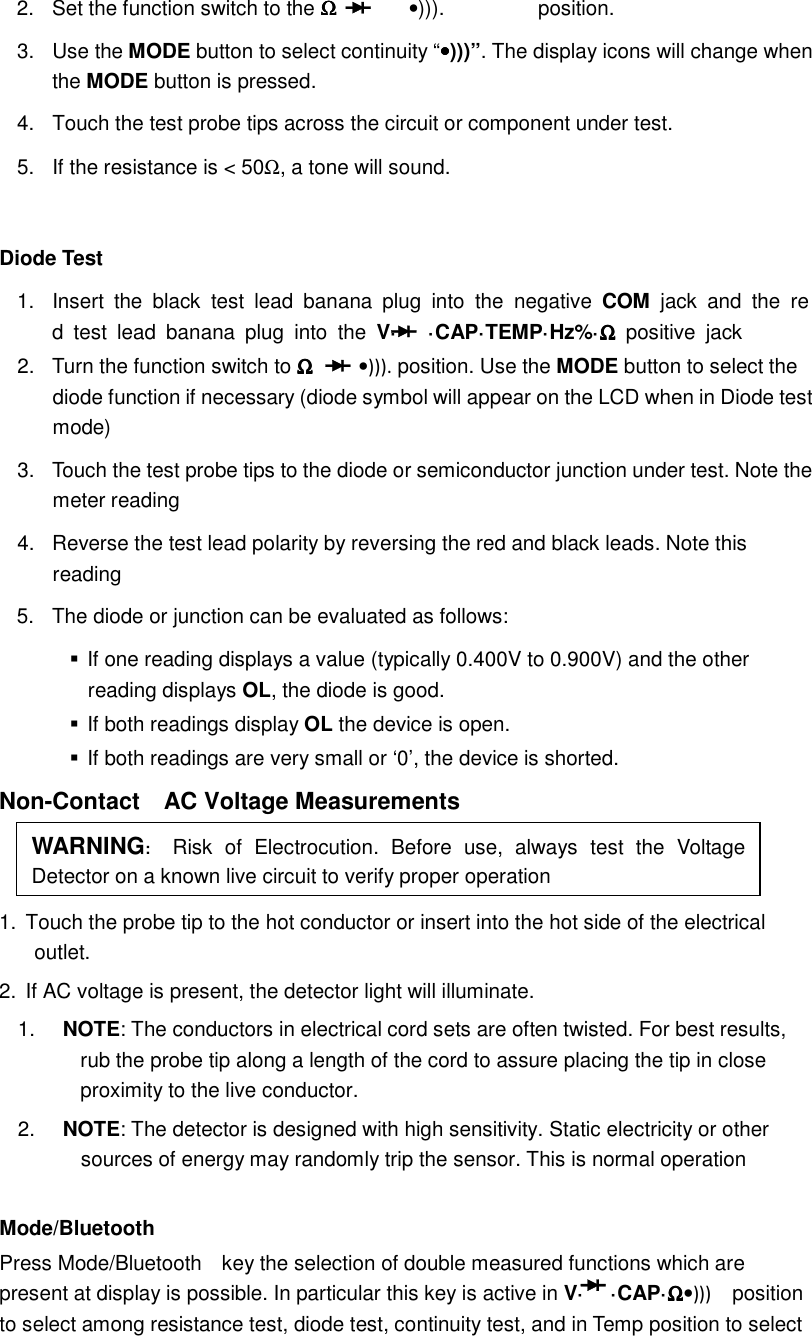
 2.  Set the function switch to the ΩΩΩΩ      •))).  position. 3.  Use the MODE button to select continuity “••••)))”. The display icons will change when the MODE button is pressed. 4.  Touch the test probe tips across the circuit or component under test. 5.  If the resistance is < 50Ω, a tone will sound.  Diode Test 1.  Insert  the  black  test  lead  banana  plug  into  the  negative  COM  jack  and  the  red  test  lead  banana  plug  into  the  V·  ·CAP·TEMP·Hz%·ΩΩΩΩ  positive  jack 2.  Turn the function switch to ΩΩΩΩ •))). position. Use the MODE button to select the diode function if necessary (diode symbol will appear on the LCD when in Diode test mode) 3.  Touch the test probe tips to the diode or semiconductor junction under test. Note the meter reading 4.  Reverse the test lead polarity by reversing the red and black leads. Note this reading 5.  The diode or junction can be evaluated as follows:  If one reading displays a value (typically 0.400V to 0.900V) and the other reading displays OL, the diode is good.  If both readings display OL the device is open.  If both readings are very small or ‘0’, the device is shorted. Non-Contact    AC Voltage Measurements   1.  Touch the probe tip to the hot conductor or insert into the hot side of the electrical outlet. 2.  If AC voltage is present, the detector light will illuminate. 1.  NOTE: The conductors in electrical cord sets are often twisted. For best results, rub the probe tip along a length of the cord to assure placing the tip in close proximity to the live conductor. 2.  NOTE: The detector is designed with high sensitivity. Static electricity or other sources of energy may randomly trip the sensor. This is normal operation  Mode/Bluetooth Press Mode/Bluetooth    key the selection of double measured functions which are present at display is possible. In particular this key is active in V·  ·CAP·ΩΩΩΩ•)))    position to select among resistance test, diode test, continuity test, and in Temp position to select WARNING:   Risk  of  Electrocution.  Before  use,  always  test  the  Voltage Detector on a known live circuit to verify proper operation
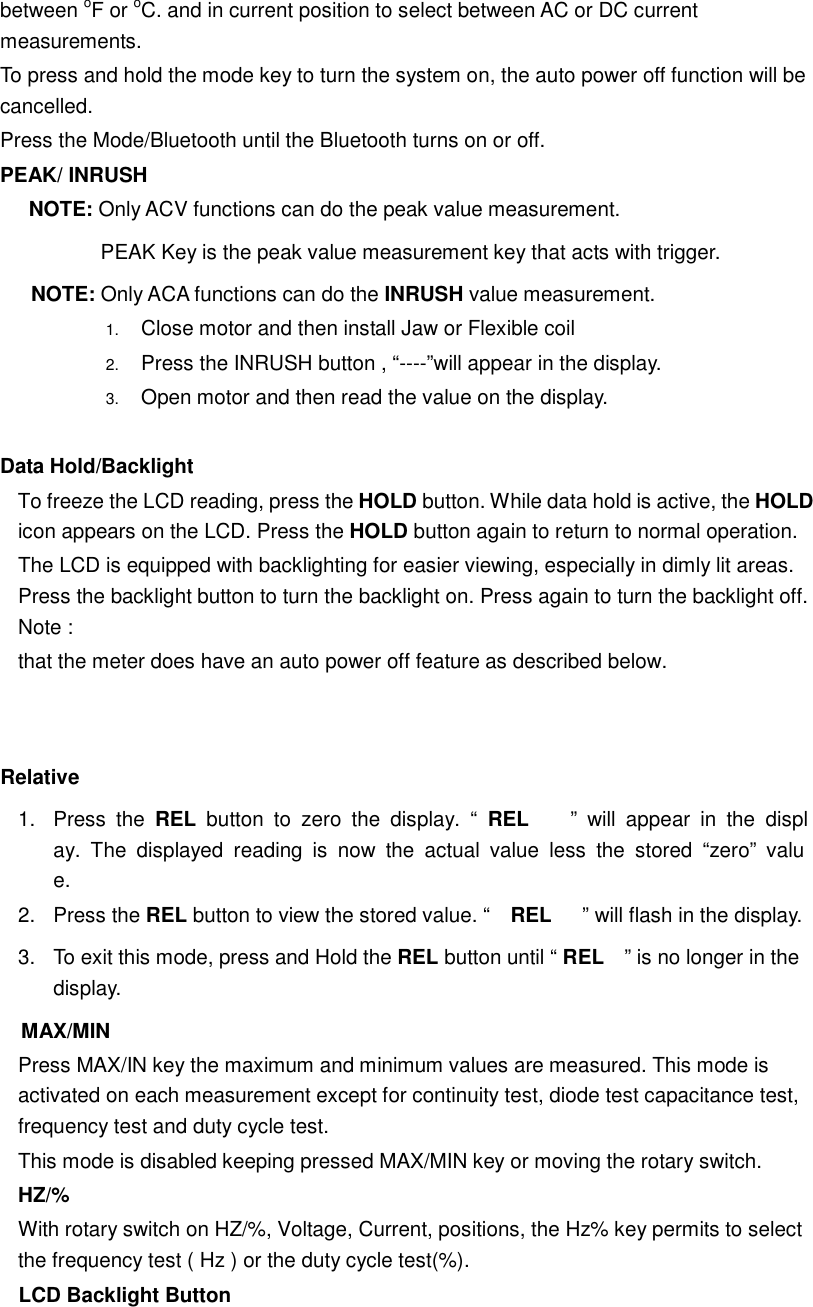
 between oF or oC. and in current position to select between AC or DC current measurements. To press and hold the mode key to turn the system on, the auto power off function will be cancelled. Press the Mode/Bluetooth until the Bluetooth turns on or off.   PEAK/ INRUSH NOTE: Only ACV functions can do the peak value measurement. PEAK Key is the peak value measurement key that acts with trigger. NOTE: Only ACA functions can do the INRUSH value measurement. 1. Close motor and then install Jaw or Flexible coil 2. Press the INRUSH button , “----”will appear in the display. 3. Open motor and then read the value on the display.  Data Hold/Backlight To freeze the LCD reading, press the HOLD button. While data hold is active, the HOLD icon appears on the LCD. Press the HOLD button again to return to normal operation. The LCD is equipped with backlighting for easier viewing, especially in dimly lit areas. Press the backlight button to turn the backlight on. Press again to turn the backlight off. Note : that the meter does have an auto power off feature as described below.     Relative 1.  Press  the  REL  button  to  zero  the  display.  “  REL        ”  will  appear  in  the  display.  The  displayed  reading  is  now  the  actual  value  less  the  stored  “zero”  value. 2.  Press the REL button to view the stored value. “    REL      ” will flash in the display. 3.  To exit this mode, press and Hold the REL button until “ REL    ” is no longer in the display. MAX/MIN   Press MAX/IN key the maximum and minimum values are measured. This mode is activated on each measurement except for continuity test, diode test capacitance test, frequency test and duty cycle test. This mode is disabled keeping pressed MAX/MIN key or moving the rotary switch. HZ/% With rotary switch on HZ/%, Voltage, Current, positions, the Hz% key permits to select the frequency test ( Hz ) or the duty cycle test(%). LCD Backlight Button
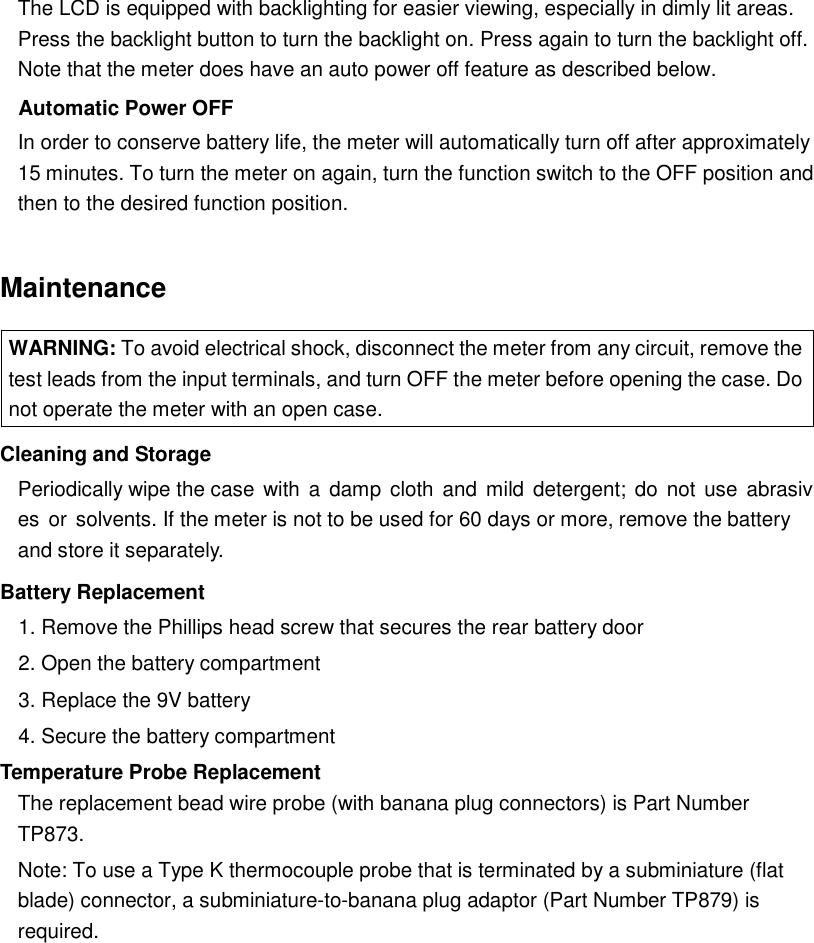
 The LCD is equipped with backlighting for easier viewing, especially in dimly lit areas. Press the backlight button to turn the backlight on. Press again to turn the backlight off. Note that the meter does have an auto power off feature as described below. Automatic Power OFF In order to conserve battery life, the meter will automatically turn off after approximately 15 minutes. To turn the meter on again, turn the function switch to the OFF position and then to the desired function position.  Maintenance WARNING: To avoid electrical shock, disconnect the meter from any circuit, remove the test leads from the input terminals, and turn OFF the meter before opening the case. Do not operate the meter with an open case. Cleaning and Storage Periodically wipe the case  with  a damp  cloth and mild detergent; do  not  use  abrasives  or solvents. If the meter is not to be used for 60 days or more, remove the battery and store it separately. Battery Replacement 1. Remove the Phillips head screw that secures the rear battery door 2. Open the battery compartment 3. Replace the 9V battery 4. Secure the battery compartment Temperature Probe Replacement The replacement bead wire probe (with banana plug connectors) is Part Number TP873.   Note: To use a Type K thermocouple probe that is terminated by a subminiature (flat blade) connector, a subminiature-to-banana plug adaptor (Part Number TP879) is required.

Navigation menu