EVERBEST MACHINERY INDUSTRY DT9969 Digital Multimeter(with bluetooth module) User Manual

SHENZHEN EVERBEST MACHINERY INDUSTRY CO.,LTD. Digital Multimeter(with bluetooth module)

User manual

User'sGuideTrueRMSIndustrialMultimeter
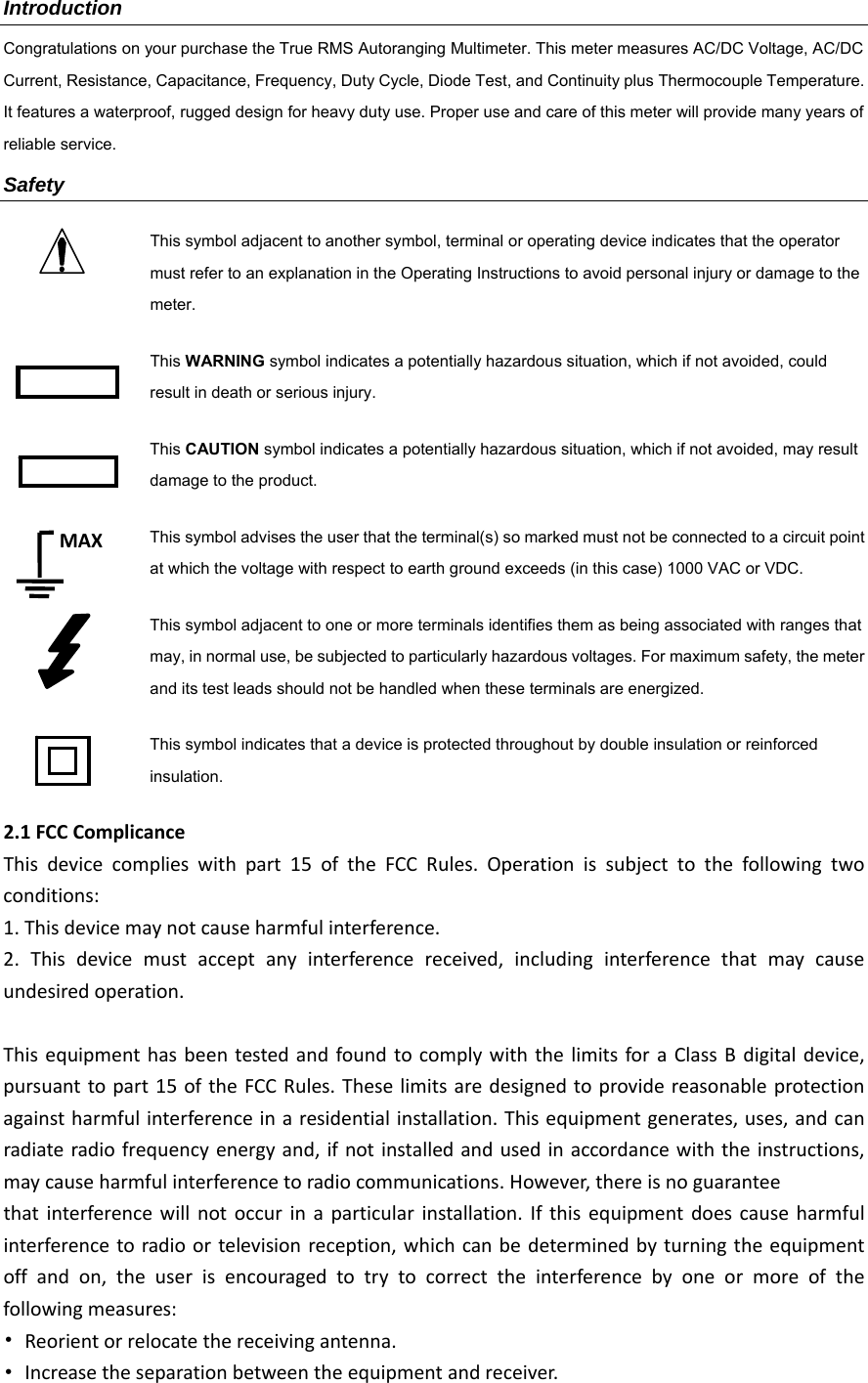
Introduction Congratulations on your purchase the True RMS Autoranging Multimeter. This meter measures AC/DC Voltage, AC/DC Current, Resistance, Capacitance, Frequency, Duty Cycle, Diode Test, and Continuity plus Thermocouple Temperature. It features a waterproof, rugged design for heavy duty use. Proper use and care of this meter will provide many years of reliable service. Safety This symbol adjacent to another symbol, terminal or operating device indicates that the operator must refer to an explanation in the Operating Instructions to avoid personal injury or damage to the meter. This WARNING symbol indicates a potentially hazardous situation, which if not avoided, could result in death or serious injury. This CAUTION symbol indicates a potentially hazardous situation, which if not avoided, may result damage to the product. This symbol advises the user that the terminal(s) so marked must not be connected to a circuit point at which the voltage with respect to earth ground exceeds (in this case) 1000 VAC or VDC. This symbol adjacent to one or more terminals identifies them as being associated with ranges that may, in normal use, be subjected to particularly hazardous voltages. For maximum safety, the meter and its test leads should not be handled when these terminals are energized. This symbol indicates that a device is protected throughout by double insulation or reinforced insulation. 2.1FCCComplicanceThisdevicecomplieswithpart15oftheFCCRules.Operationissubjecttothefollowingtwoconditions:1.Thisdevicemaynotcauseharmfulinterference.2.Thisdevicemustacceptanyinterferencereceived,includinginterferencethatmaycauseundesiredoperation.ThisequipmenthasbeentestedandfoundtocomplywiththelimitsforaClassBdigitaldevice,pursuanttopart15oftheFCCRules.Theselimitsaredesignedtoprovidereasonableprotectionagainstharmfulinterferenceinaresidentialinstallation.Thisequipmentgenerates,uses,andcanradiateradiofrequencyenergyand,ifnotinstalledandusedinaccordancewiththeinstructions,maycauseharmfulinterferencetoradiocommunications.However,thereisnoguaranteethatinterferencewillnotoccurinaparticularinstallation.Ifthisequipmentdoescauseharmfulinterferencetoradioortelevisionreception,whichcanbedeterminedbyturningtheequipmentoffandon,theuserisencouragedtotrytocorrecttheinterferencebyoneormoreofthefollowingmeasures:•Reorientorrelocatethereceivingantenna.•Increasetheseparationbetweentheequipmentandreceiver.MAX
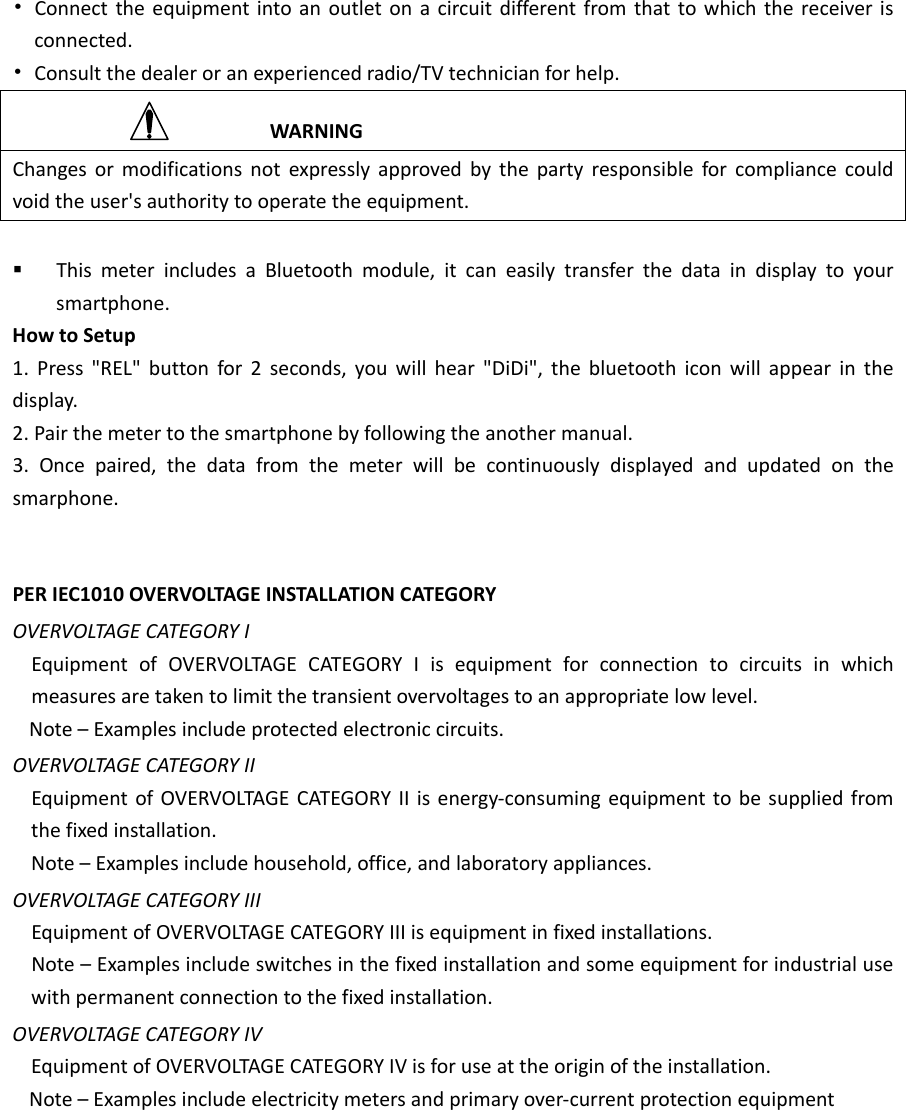
•Connecttheequipmentintoanoutletonacircuitdifferentfromthattowhichthereceiverisconnected.•Consultthedealeroranexperiencedradio/TVtechnicianforhelp.WARNINGChangesormodificationsnotexpresslyapprovedbythepartyresponsibleforcompliancecouldvoidtheuser'sauthoritytooperatetheequipment. ThismeterincludesaBluetoothmodule,itcaneasilytransferthedataindisplaytoyoursmartphone.HowtoSetup1.Press"REL"buttonfor2seconds,youwillhear"DiDi",thebluetoothiconwillappearinthedisplay.2.Pairthemetertothesmartphonebyfollowingtheanothermanual.3.Oncepaired,thedatafromthemeterwillbecontinuouslydisplayedandupdatedonthesmarphone.PERIEC1010OVERVOLTAGEINSTALLATIONCATEGORYOVERVOLTAGECATEGORYIEquipmentofOVERVOLTAGECATEGORYIisequipmentforconnectiontocircuitsinwhichmeasuresaretakentolimitthetransientovervoltagestoanappropriatelowlevel.Note–Examplesincludeprotectedelectroniccircuits.OVERVOLTAGECATEGORYIIEquipmentofOVERVOLTAGECATEGORYIIisenergy‐consumingequipmenttobesuppliedfromthefixedinstallation.Note–Examplesincludehousehold,office,andlaboratoryappliances.OVERVOLTAGECATEGORYIIIEquipmentofOVERVOLTAGECATEGORYIIIisequipmentinfixedinstallations.Note–Examplesincludeswitchesinthefixedinstallationandsomeequipmentforindustrialusewithpermanentconnectiontothefixedinstallation.OVERVOLTAGECATEGORYIVEquipmentofOVERVOLTAGECATEGORYIVisforuseattheoriginoftheinstallation.Note–Examplesincludeelectricitymetersandprimaryover‐currentprotectionequipment
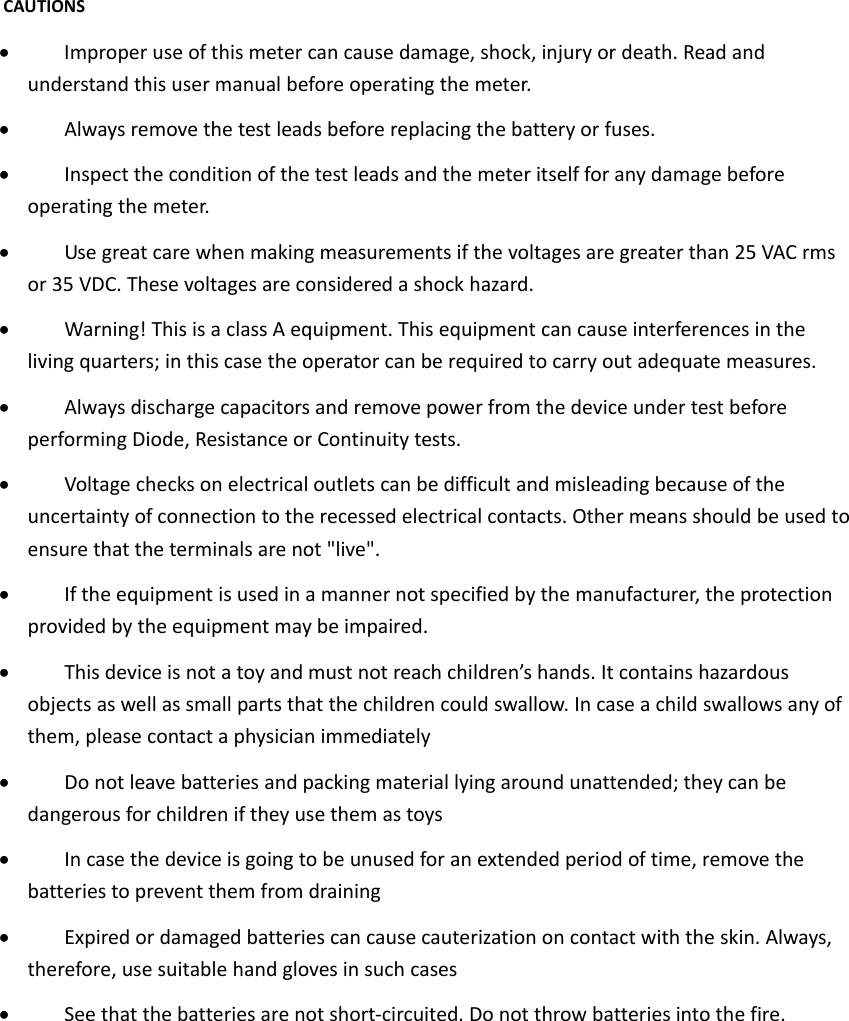
CAUTIONS• Improperuseofthismetercancausedamage,shock,injuryordeath.Readandunderstandthisusermanualbeforeoperatingthemeter.• Alwaysremovethetestleadsbeforereplacingthebatteryorfuses.• Inspecttheconditionofthetestleadsandthemeteritselfforanydamagebeforeoperatingthemeter.• Usegreatcarewhenmakingmeasurementsifthevoltagesaregreaterthan25VACrmsor35VDC.Thesevoltagesareconsideredashockhazard.• Warning!ThisisaclassAequipment.Thisequipmentcancauseinterferencesinthelivingquarters;inthiscasetheoperatorcanberequiredtocarryoutadequatemeasures.• AlwaysdischargecapacitorsandremovepowerfromthedeviceundertestbeforeperformingDiode,ResistanceorContinuitytests.• Voltagechecksonelectricaloutletscanbedifficultandmisleadingbecauseoftheuncertaintyofconnectiontotherecessedelectricalcontacts.Othermeansshouldbeusedtoensurethattheterminalsarenot"live".• Iftheequipmentisusedinamannernotspecifiedbythemanufacturer,theprotectionprovidedbytheequipmentmaybeimpaired.• Thisdeviceisnotatoyandmustnotreachchildren’shands.Itcontainshazardousobjectsaswellassmallpartsthatthechildrencouldswallow.Incaseachildswallowsanyofthem,pleasecontactaphysicianimmediately• Donotleavebatteriesandpackingmateriallyingaroundunattended;theycanbedangerousforchildreniftheyusethemastoys• Incasethedeviceisgoingtobeunusedforanextendedperiodoftime,removethebatteriestopreventthemfromdraining• Expiredordamagedbatteriescancausecauterizationoncontactwiththeskin.Always,therefore,usesuitablehandglovesinsuchcases• Seethatthebatteriesarenotshort‐circuited.Donotthrowbatteriesintothefire.
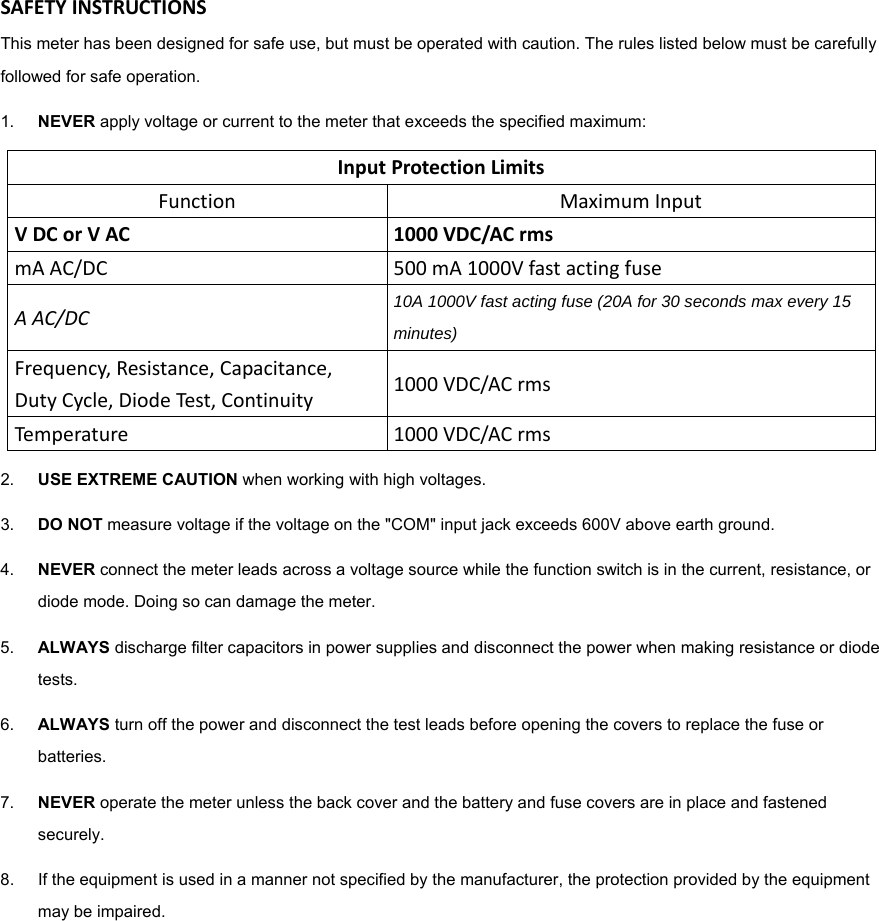
SAFETYINSTRUCTIONSThis meter has been designed for safe use, but must be operated with caution. The rules listed below must be carefully followed for safe operation. 1.  NEVER apply voltage or current to the meter that exceeds the specified maximum: InputProtectionLimitsFunctionMaximumInputVDCorVAC1000VDC/ACrmsmAAC/DC500mA1000VfastactingfuseAAC/DC10A 1000V fast acting fuse (20A for 30 seconds max every 15 minutes) Frequency,Resistance,Capacitance,DutyCycle,DiodeTest,Continuity1000VDC/ACrmsTemperature 1000VDC/ACrms2.  USE EXTREME CAUTION when working with high voltages. 3.  DO NOT measure voltage if the voltage on the "COM" input jack exceeds 600V above earth ground. 4.  NEVER connect the meter leads across a voltage source while the function switch is in the current, resistance, or diode mode. Doing so can damage the meter. 5.  ALWAYS discharge filter capacitors in power supplies and disconnect the power when making resistance or diode tests. 6.  ALWAYS turn off the power and disconnect the test leads before opening the covers to replace the fuse or batteries. 7.  NEVER operate the meter unless the back cover and the battery and fuse covers are in place and fastened securely. 8.  If the equipment is used in a manner not specified by the manufacturer, the protection provided by the equipment may be impaired.  
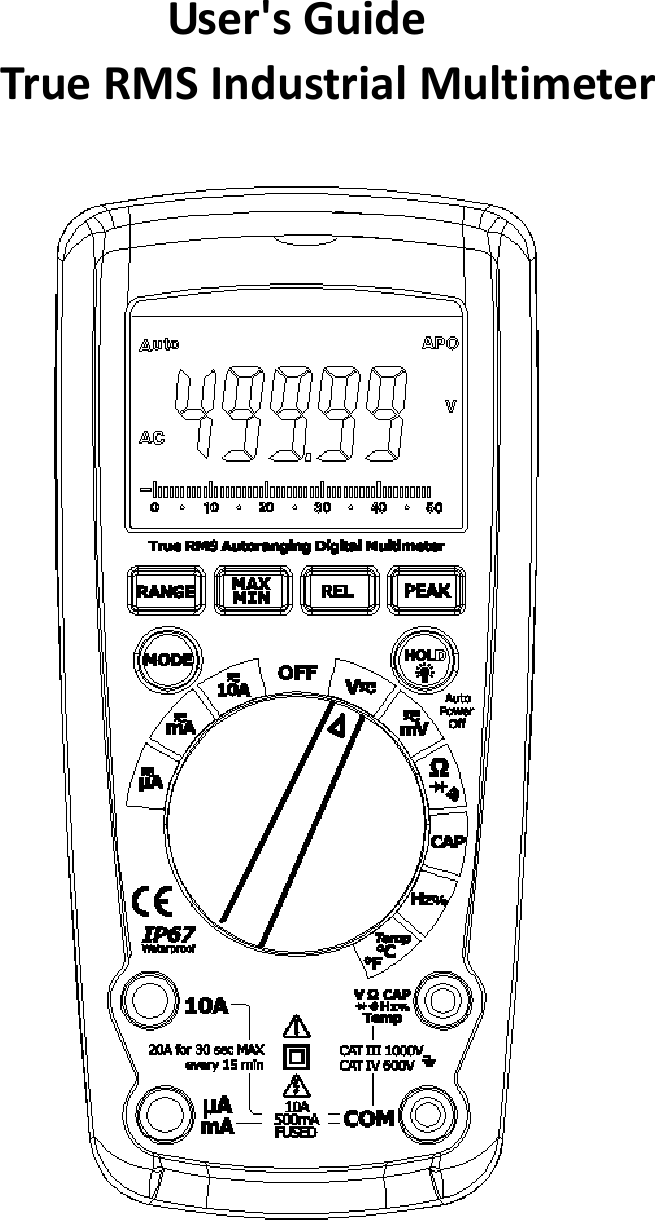
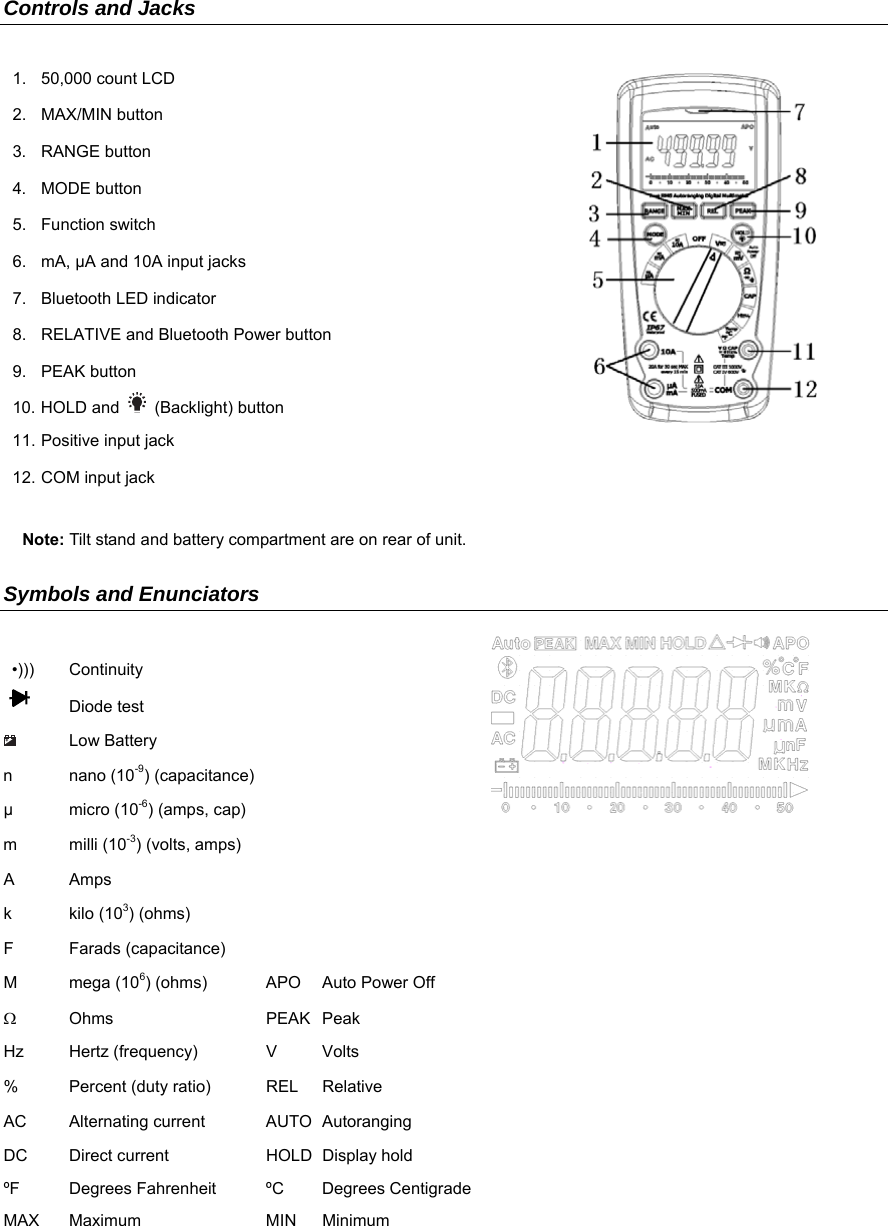
Controls and Jacks   1.  50,000 count LCD   2. MAX/MIN button 3. RANGE button 4. MODE button 5. Function switch 6.  mA, µA and 10A input jacks 7.  Bluetooth LED indicator 8.  RELATIVE and Bluetooth Power button 9. PEAK button  10. HOLD and   (Backlight) button 11. Positive input jack   12. COM input jack    Note: Tilt stand and battery compartment are on rear of unit.  Symbols and Enunciators   •)))  Continuity Diode test + Low Battery n nano (10-9) (capacitance) µ micro (10-6) (amps, cap) m milli (10-3) (volts, amps)   A Amps k kilo (103) (ohms)   F Farads (capacitance) M mega (106) (ohms)  APO  Auto Power Off Ω  Ohms PEAK Peak Hz Hertz (frequency)  V Volts %  Percent (duty ratio)  REL  Relative AC Alternating current  AUTO Autoranging DC  Direct current  HOLD  Display hold ºF  Degrees Fahrenheit  ºC  Degrees Centigrade MAX Maximum  MIN Minimum 
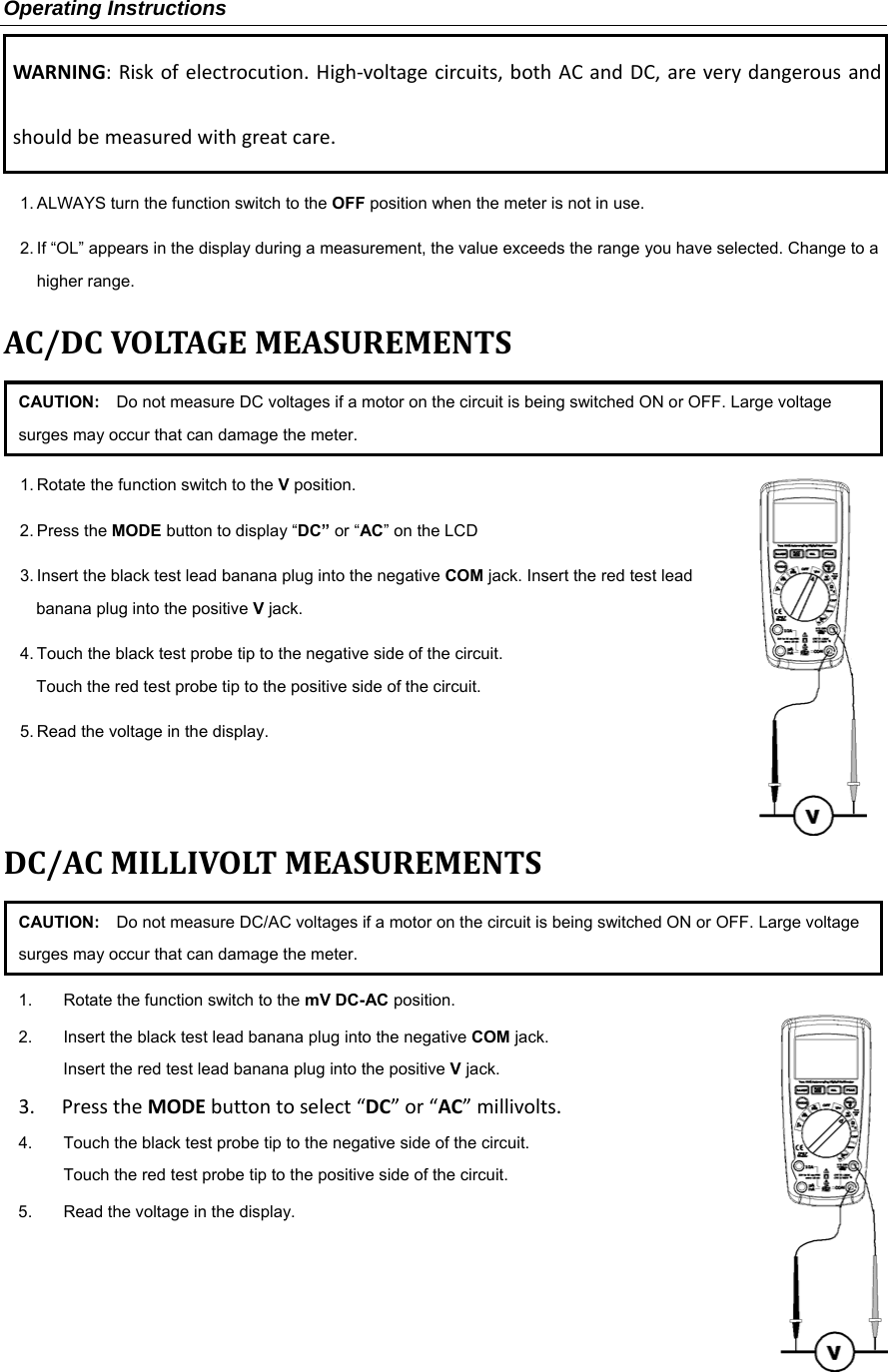
Operating Instructions WARNING:Riskofelectrocution.High‐voltagecircuits,bothACandDC,areverydangerousandshouldbemeasuredwithgreatcare.1. ALWAYS turn the function switch to the OFF position when the meter is not in use. 2. If “OL” appears in the display during a measurement, the value exceeds the range you have selected. Change to a higher range.   AC/DCVOLTAGEMEASUREMENTSCAUTION:    Do not measure DC voltages if a motor on the circuit is being switched ON or OFF. Large voltage surges may occur that can damage the meter. 1. Rotate the function switch to the V position.  2. Press the MODE button to display “DC” or “AC” on the LCD 3. Insert the black test lead banana plug into the negative COM jack. Insert the red test lead banana plug into the positive V jack. 4. Touch the black test probe tip to the negative side of the circuit.   Touch the red test probe tip to the positive side of the circuit. 5. Read the voltage in the display.   DC/ACMILLIVOLTMEASUREMENTSCAUTION:    Do not measure DC/AC voltages if a motor on the circuit is being switched ON or OFF. Large voltage surges may occur that can damage the meter. 1.  Rotate the function switch to the mV DC-AC position.  2.  Insert the black test lead banana plug into the negative COM jack. Insert the red test lead banana plug into the positive V jack. 3. PresstheMODEbuttontoselect“DC”or“AC”millivolts.4.  Touch the black test probe tip to the negative side of the circuit.   Touch the red test probe tip to the positive side of the circuit. 5.  Read the voltage in the display.   
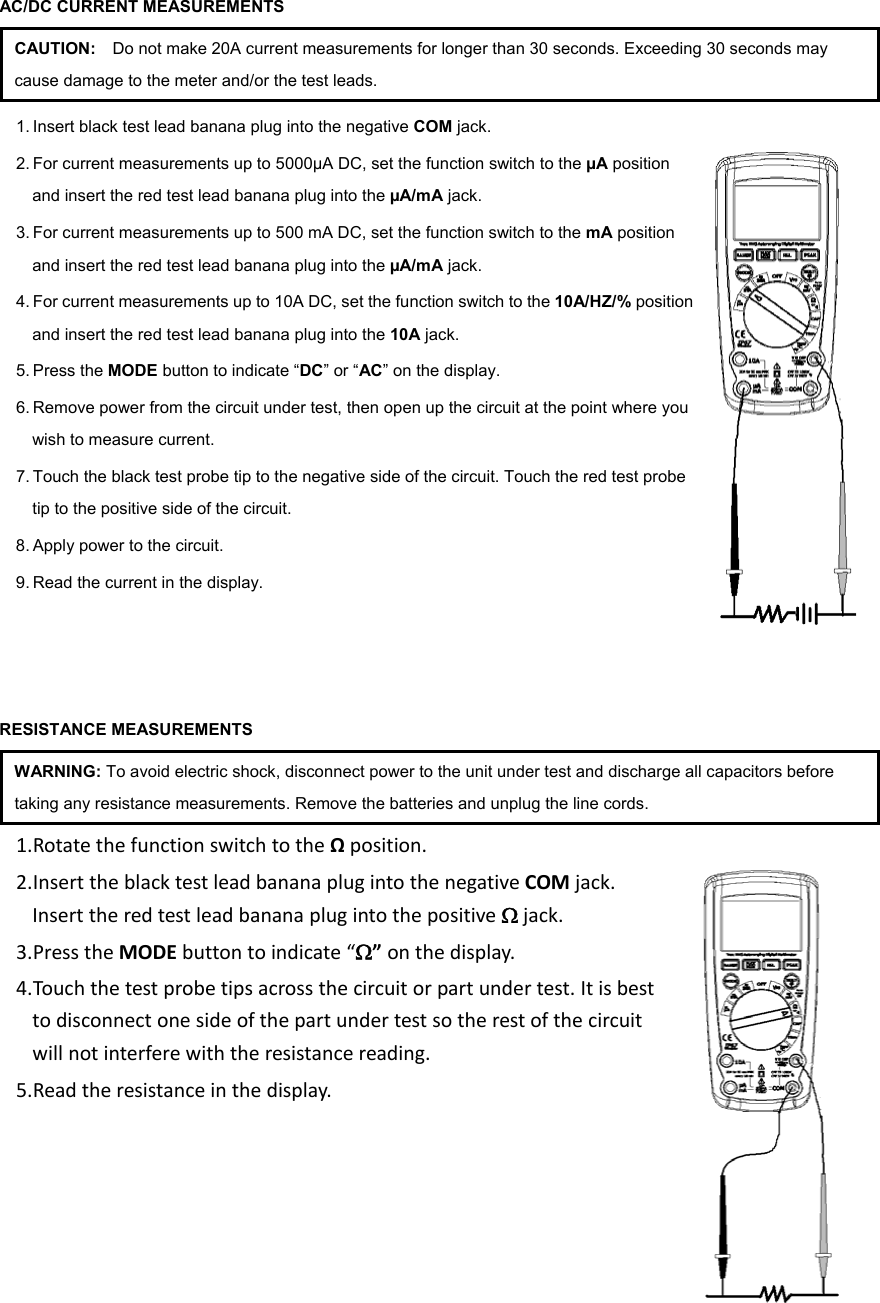
AC/DC CURRENT MEASUREMENTS CAUTION:    Do not make 20A current measurements for longer than 30 seconds. Exceeding 30 seconds may cause damage to the meter and/or the test leads. 1. Insert black test lead banana plug into the negative COM jack.   2. For current measurements up to 5000µA DC, set the function switch to the µA position and insert the red test lead banana plug into the µA/mA jack. 3. For current measurements up to 500 mA DC, set the function switch to the mA position and insert the red test lead banana plug into the µA/mA jack. 4. For current measurements up to 10A DC, set the function switch to the 10A/HZ/% position and insert the red test lead banana plug into the 10A jack. 5. Press the MODE button to indicate “DC” or “AC” on the display. 6. Remove power from the circuit under test, then open up the circuit at the point where you wish to measure current. 7. Touch the black test probe tip to the negative side of the circuit. Touch the red test probe tip to the positive side of the circuit. 8. Apply power to the circuit. 9. Read the current in the display.      RESISTANCE MEASUREMENTS WARNING: To avoid electric shock, disconnect power to the unit under test and discharge all capacitors before taking any resistance measurements. Remove the batteries and unplug the line cords. 1. RotatethefunctionswitchtotheΩposition.2. InserttheblacktestleadbananaplugintothenegativeCOMjack.InserttheredtestleadbananaplugintothepositiveΩjack.3. PresstheMODEbuttontoindicate“Ω” onthedisplay.4. Tou chthetestprobetipsacrossthecircuitorpartundertest.Itisbesttodisconnectonesideofthepartundertestsotherestofthecircuitwillnotinterferewiththeresistancereading.5. Readtheresistanceinthedisplay.
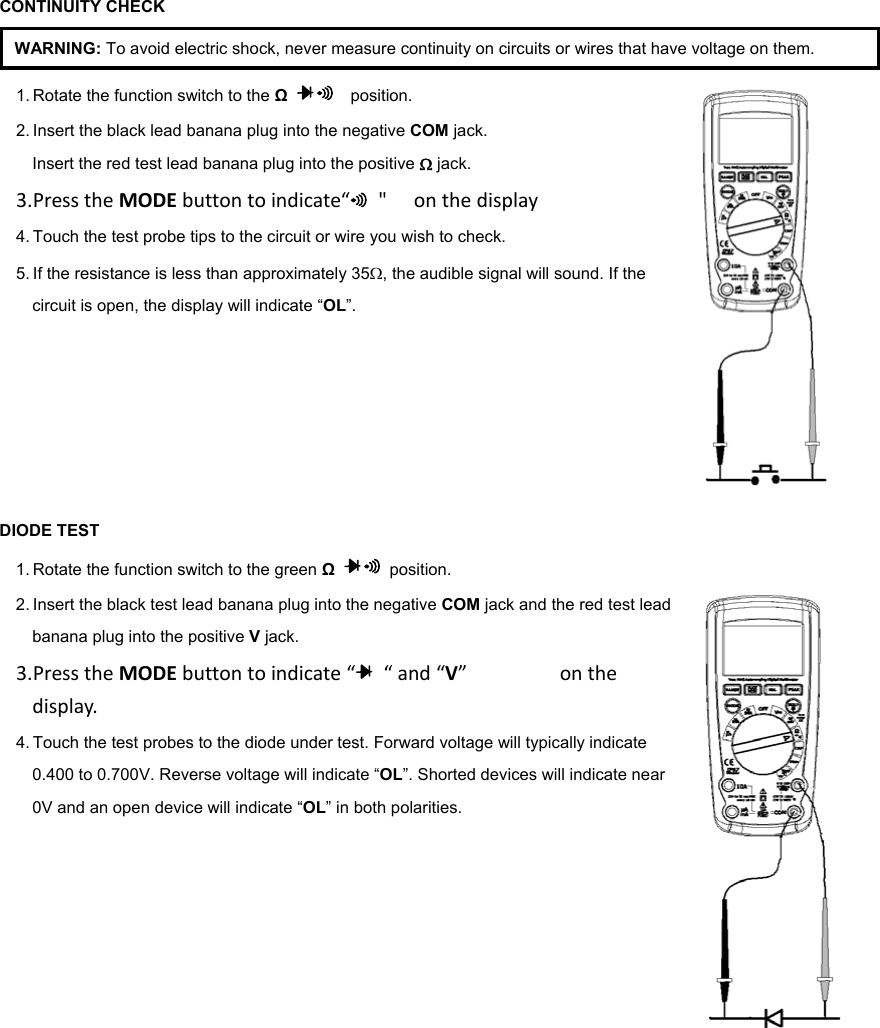
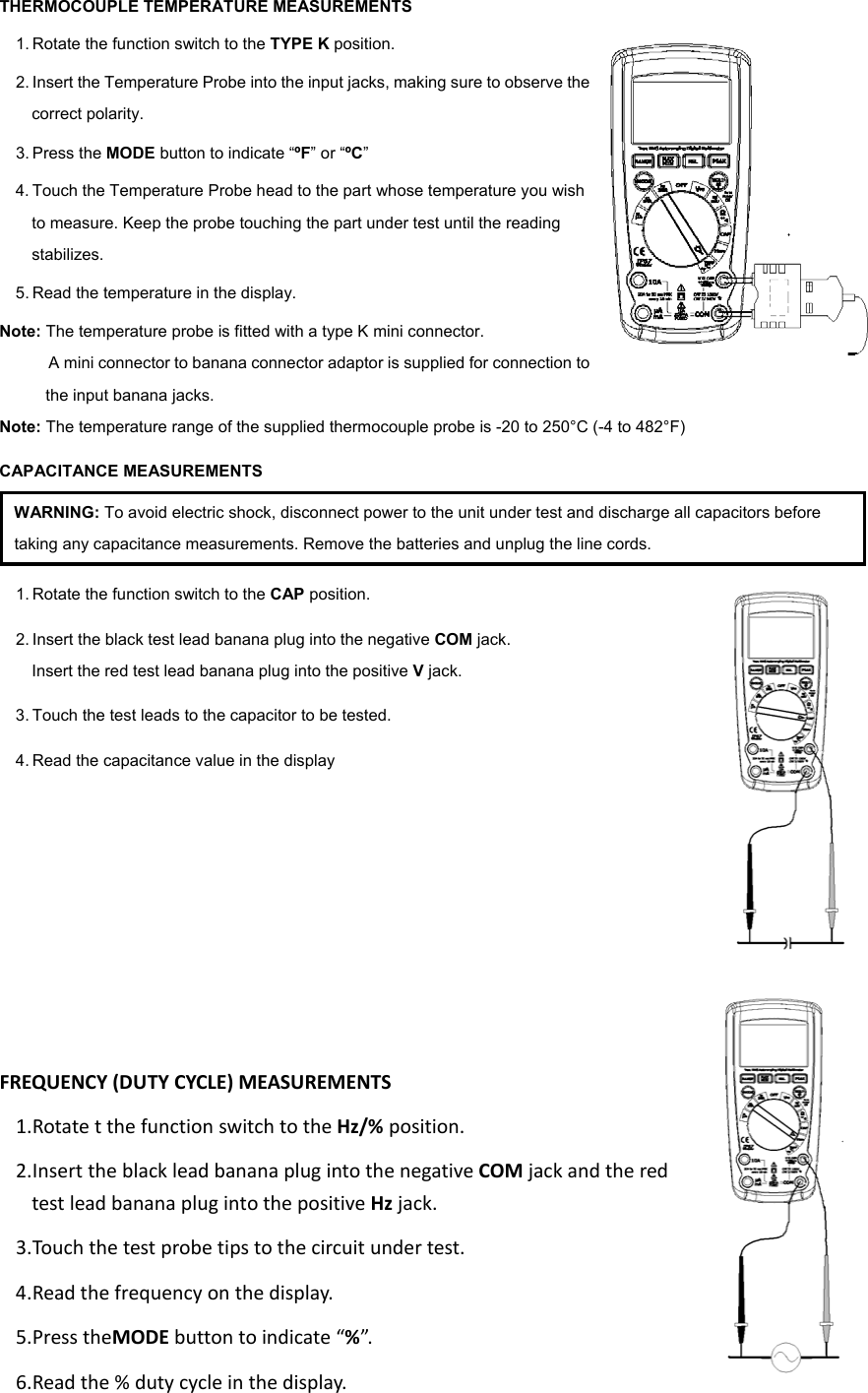
CONTINUITY CHECK WARNING: To avoid electric shock, never measure continuity on circuits or wires that have voltage on them. 1. Rotate the function switch to the Ω    position.  2. Insert the black lead banana plug into the negative COM jack. Insert the red test lead banana plug into the positive Ω jack. 3. PresstheMODEbuttontoindicate“ " onthedisplay4. Touch the test probe tips to the circuit or wire you wish to check.   5. If the resistance is less than approximately 35Ω, the audible signal will sound. If the circuit is open, the display will indicate “OL”.     DIODE TEST 1. Rotate the function switch to the green Ω  position. 2. Insert the black test lead banana plug into the negative COM jack and the red test lead banana plug into the positive V jack. 3. PresstheMODEbuttontoindicate““and“V”    onthedisplay.4. Touch the test probes to the diode under test. Forward voltage will typically indicate 0.400 to 0.700V. Reverse voltage will indicate “OL”. Shorted devices will indicate near 0V and an open device will indicate “OL” in both polarities.
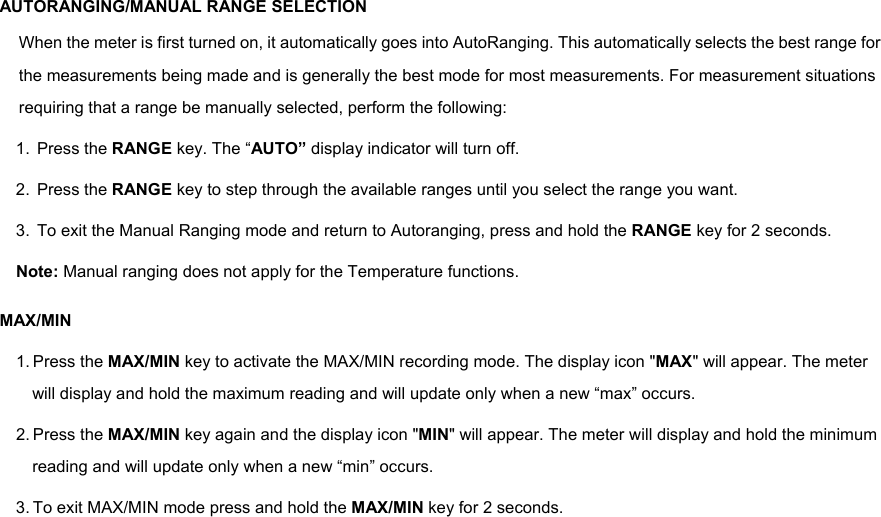
THERMOCOUPLE TEMPERATURE MEASUREMENTS 1. Rotate the function switch to the TYPE K position.   2. Insert the Temperature Probe into the input jacks, making sure to observe the correct polarity. 3. Press the MODE button to indicate “ºF” or “ºC” 4. Touch the Temperature Probe head to the part whose temperature you wish to measure. Keep the probe touching the part under test until the reading stabilizes. 5. Read the temperature in the display. Note: The temperature probe is fitted with a type K mini connector.   A mini connector to banana connector adaptor is supplied for connection to the input banana jacks. Note: The temperature range of the supplied thermocouple probe is -20 to 250°C (-4 to 482°F) CAPACITANCE MEASUREMENTS WARNING: To avoid electric shock, disconnect power to the unit under test and discharge all capacitors before taking any capacitance measurements. Remove the batteries and unplug the line cords. 1. Rotate the function switch to the CAP position. 2. Insert the black test lead banana plug into the negative COM jack. Insert the red test lead banana plug into the positive V jack. 3. Touch the test leads to the capacitor to be tested. 4. Read the capacitance value in the display   FREQUENCY(DUTYCYCLE)MEASUREMENTS1. RotatetthefunctionswitchtotheHz/%position.2. InserttheblackleadbananaplugintothenegativeCOMjackandtheredtestleadbananaplugintothepositiveHzjack.3. Tou chthetestprobetipstothecircuitundertest.4. Readthefrequencyonthedisplay.5. PresstheMODEbuttontoindicate“%”.6. Readthe%dutycycleinthedisplay.
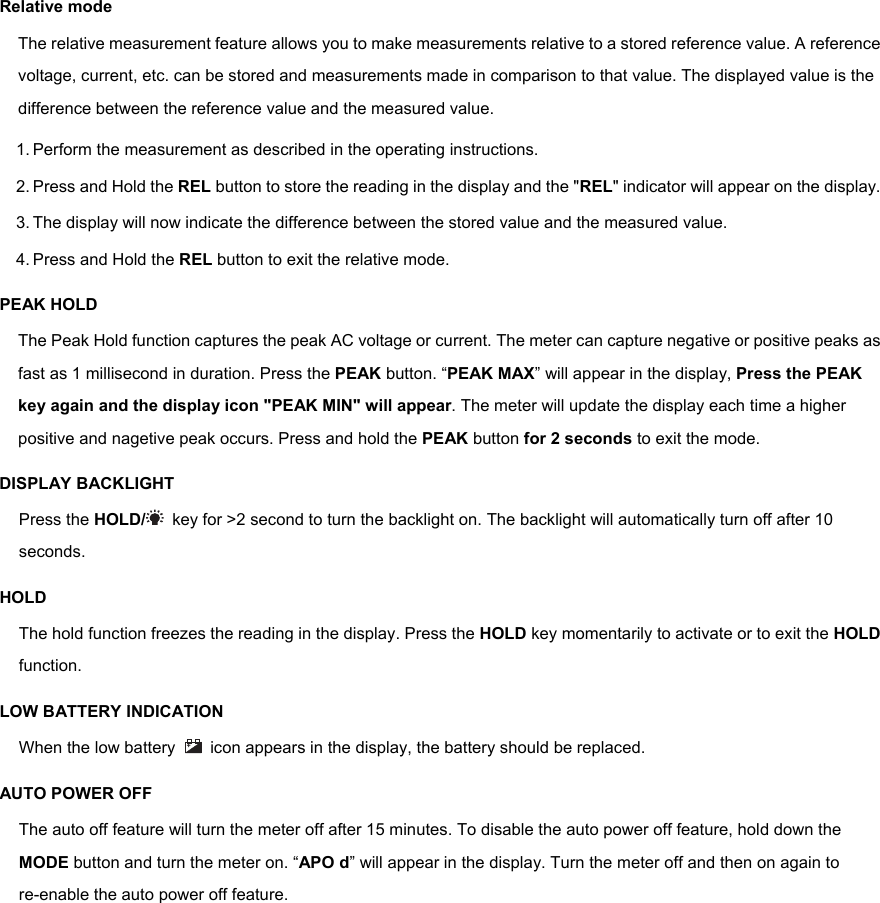
AUTORANGING/MANUAL RANGE SELECTION When the meter is first turned on, it automatically goes into AutoRanging. This automatically selects the best range for the measurements being made and is generally the best mode for most measurements. For measurement situations requiring that a range be manually selected, perform the following: 1. Press the RANGE key. The “AUTO” display indicator will turn off. 2. Press the RANGE key to step through the available ranges until you select the range you want. 3.  To exit the Manual Ranging mode and return to Autoranging, press and hold the RANGE key for 2 seconds. Note: Manual ranging does not apply for the Temperature functions. MAX/MIN 1. Press the MAX/MIN key to activate the MAX/MIN recording mode. The display icon "MAX" will appear. The meter will display and hold the maximum reading and will update only when a new “max” occurs. 2. Press the MAX/MIN key again and the display icon "MIN" will appear. The meter will display and hold the minimum reading and will update only when a new “min” occurs. 3. To exit MAX/MIN mode press and hold the MAX/MIN key for 2 seconds.
Relative mode The relative measurement feature allows you to make measurements relative to a stored reference value. A reference voltage, current, etc. can be stored and measurements made in comparison to that value. The displayed value is the difference between the reference value and the measured value. 1. Perform the measurement as described in the operating instructions. 2. Press and Hold the REL button to store the reading in the display and the "REL" indicator will appear on the display. 3. The display will now indicate the difference between the stored value and the measured value. 4. Press and Hold the REL button to exit the relative mode. PEAK HOLD The Peak Hold function captures the peak AC voltage or current. The meter can capture negative or positive peaks as fast as 1 millisecond in duration. Press the PEAK button. “PEAK MAX” will appear in the display, Press the PEAK key again and the display icon "PEAK MIN" will appear. The meter will update the display each time a higher positive and nagetive peak occurs. Press and hold the PEAK button for 2 seconds to exit the mode. DISPLAY BACKLIGHT Press the HOLD/   key for >2 second to turn the backlight on. The backlight will automatically turn off after 10 seconds. HOLD The hold function freezes the reading in the display. Press the HOLD key momentarily to activate or to exit the HOLD function. LOW BATTERY INDICATION When the low battery +  icon appears in the display, the battery should be replaced. AUTO POWER OFF The auto off feature will turn the meter off after 15 minutes. To disable the auto power off feature, hold down the MODE button and turn the meter on. “APO d” will appear in the display. Turn the meter off and then on again to re-enable the auto power off feature.
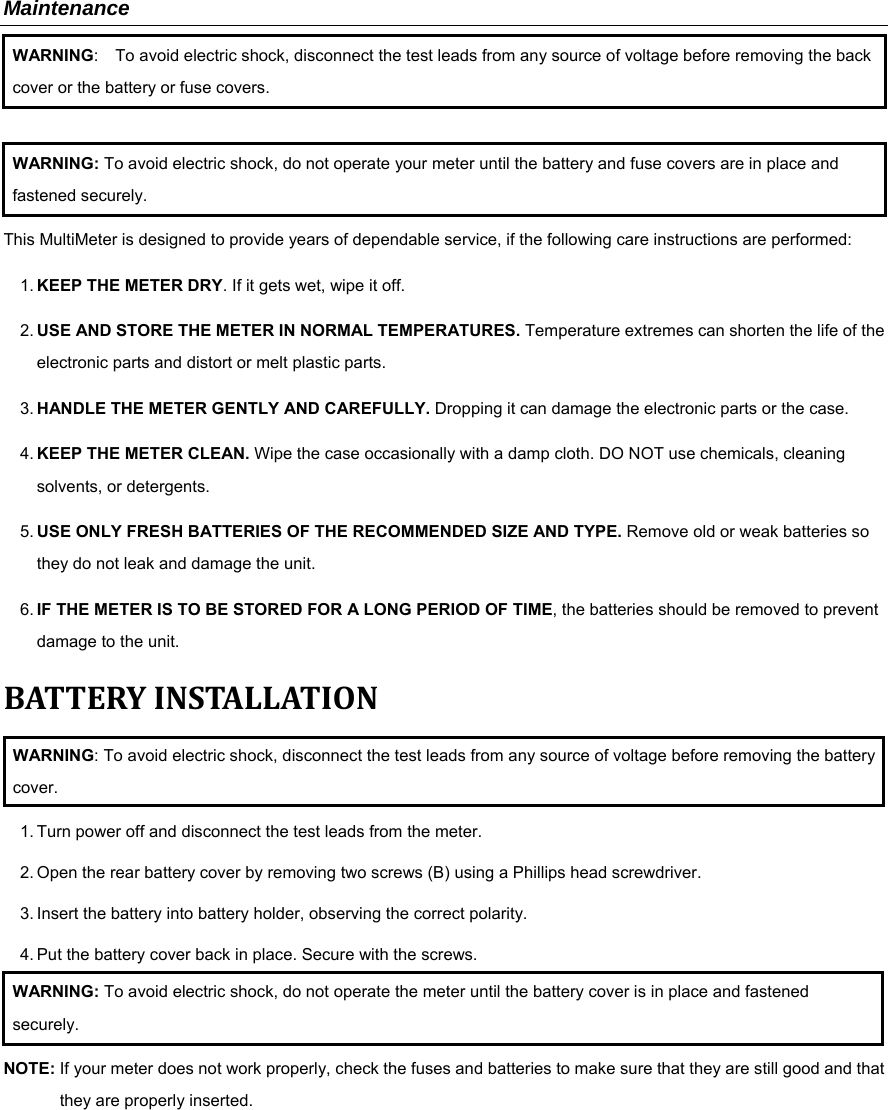
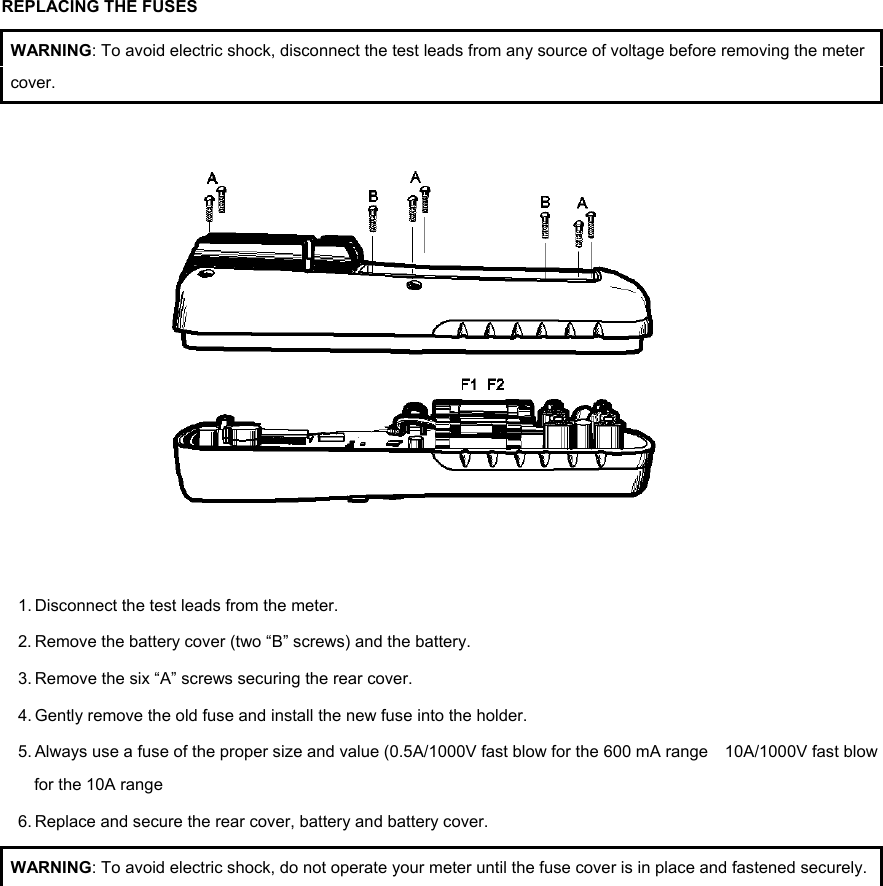
Maintenance WARNING:    To avoid electric shock, disconnect the test leads from any source of voltage before removing the back cover or the battery or fuse covers.  WARNING: To avoid electric shock, do not operate your meter until the battery and fuse covers are in place and fastened securely. This MultiMeter is designed to provide years of dependable service, if the following care instructions are performed: 1. KEEP THE METER DRY. If it gets wet, wipe it off. 2. USE AND STORE THE METER IN NORMAL TEMPERATURES. Temperature extremes can shorten the life of the electronic parts and distort or melt plastic parts. 3. HANDLE THE METER GENTLY AND CAREFULLY. Dropping it can damage the electronic parts or the case. 4. KEEP THE METER CLEAN. Wipe the case occasionally with a damp cloth. DO NOT use chemicals, cleaning solvents, or detergents. 5. USE ONLY FRESH BATTERIES OF THE RECOMMENDED SIZE AND TYPE. Remove old or weak batteries so they do not leak and damage the unit. 6. IF THE METER IS TO BE STORED FOR A LONG PERIOD OF TIME, the batteries should be removed to prevent damage to the unit. BATTERYINSTALLATIONWARNING: To avoid electric shock, disconnect the test leads from any source of voltage before removing the battery cover. 1. Turn power off and disconnect the test leads from the meter. 2. Open the rear battery cover by removing two screws (B) using a Phillips head screwdriver. 3. Insert the battery into battery holder, observing the correct polarity. 4. Put the battery cover back in place. Secure with the screws. WARNING: To avoid electric shock, do not operate the meter until the battery cover is in place and fastened securely. NOTE: If your meter does not work properly, check the fuses and batteries to make sure that they are still good and that they are properly inserted.
REPLACING THE FUSES WARNING: To avoid electric shock, disconnect the test leads from any source of voltage before removing the meter cover.              1. Disconnect the test leads from the meter. 2. Remove the battery cover (two “B” screws) and the battery. 3. Remove the six “A” screws securing the rear cover. 4. Gently remove the old fuse and install the new fuse into the holder. 5. Always use a fuse of the proper size and value (0.5A/1000V fast blow for the 600 mA range    10A/1000V fast blow for the 10A range 6. Replace and secure the rear cover, battery and battery cover. WARNING: To avoid electric shock, do not operate your meter until the fuse cover is in place and fastened securely.
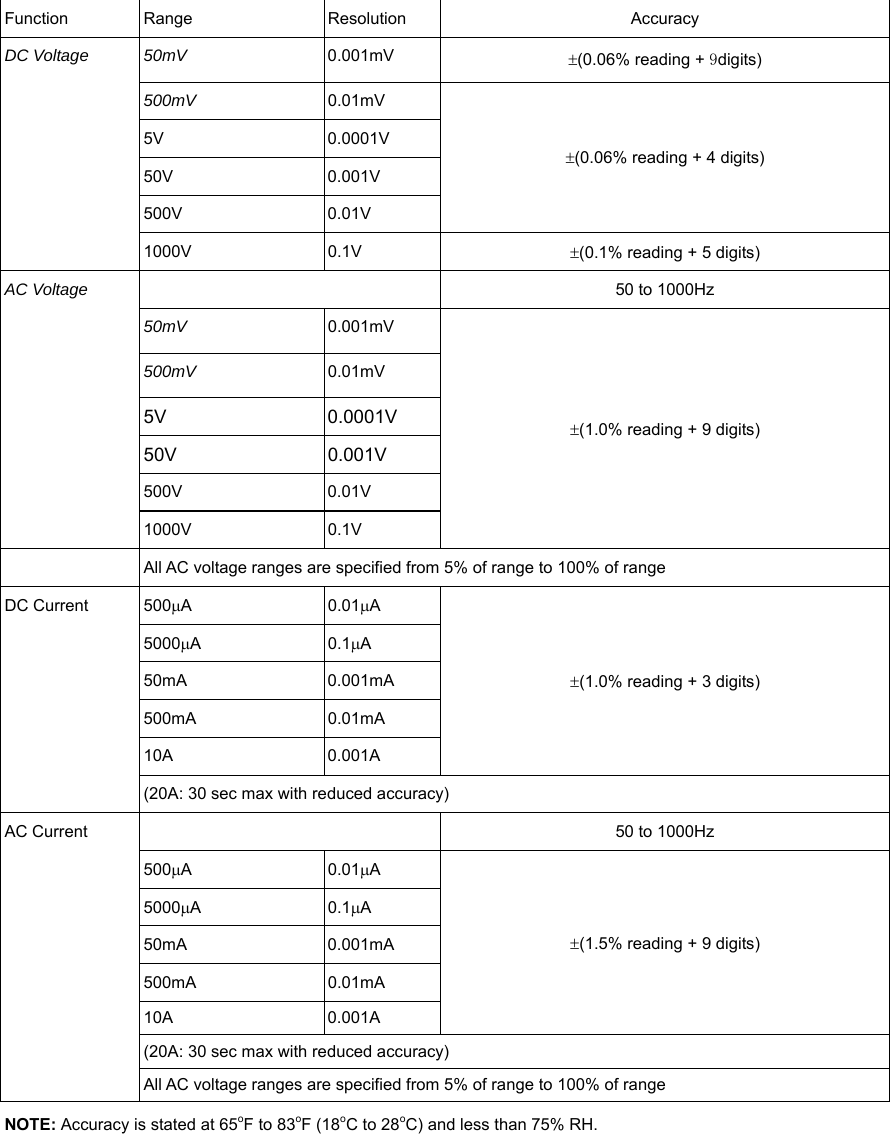
Function Range  Resolution   Accuracy DC Voltage  50mV  0.001mV  ±(0.06% reading + 9digits) 500mV  0.01mV ±(0.06% reading + 4 digits) 5V 0.0001V 50V 0.001V 500V 0.01V 1000V 0.1V  ±(0.1% reading + 5 digits) AC Voltage   50 to 1000Hz 50mV  0.001mV ±(1.0% reading + 9 digits) 500mV  0.01mV 5V 0.0001V 50V 0.001V 500V 0.01V 1000V 0.1V   All AC voltage ranges are specified from 5% of range to 100% of range DC Current  500μA 0.01μA ±(1.0% reading + 3 digits) 5000μA 0.1μA 50mA 0.001mA 500mA 0.01mA 10A 0.001A (20A: 30 sec max with reduced accuracy) AC Current    50 to 1000Hz 500μA 0.01μA ±(1.5% reading + 9 digits) 5000μA 0.1μA 50mA 0.001mA 500mA 0.01mA 10A 0.001A (20A: 30 sec max with reduced accuracy) All AC voltage ranges are specified from 5% of range to 100% of range NOTE: Accuracy is stated at 65oF to 83oF (18oC to 28oC) and less than 75% RH.
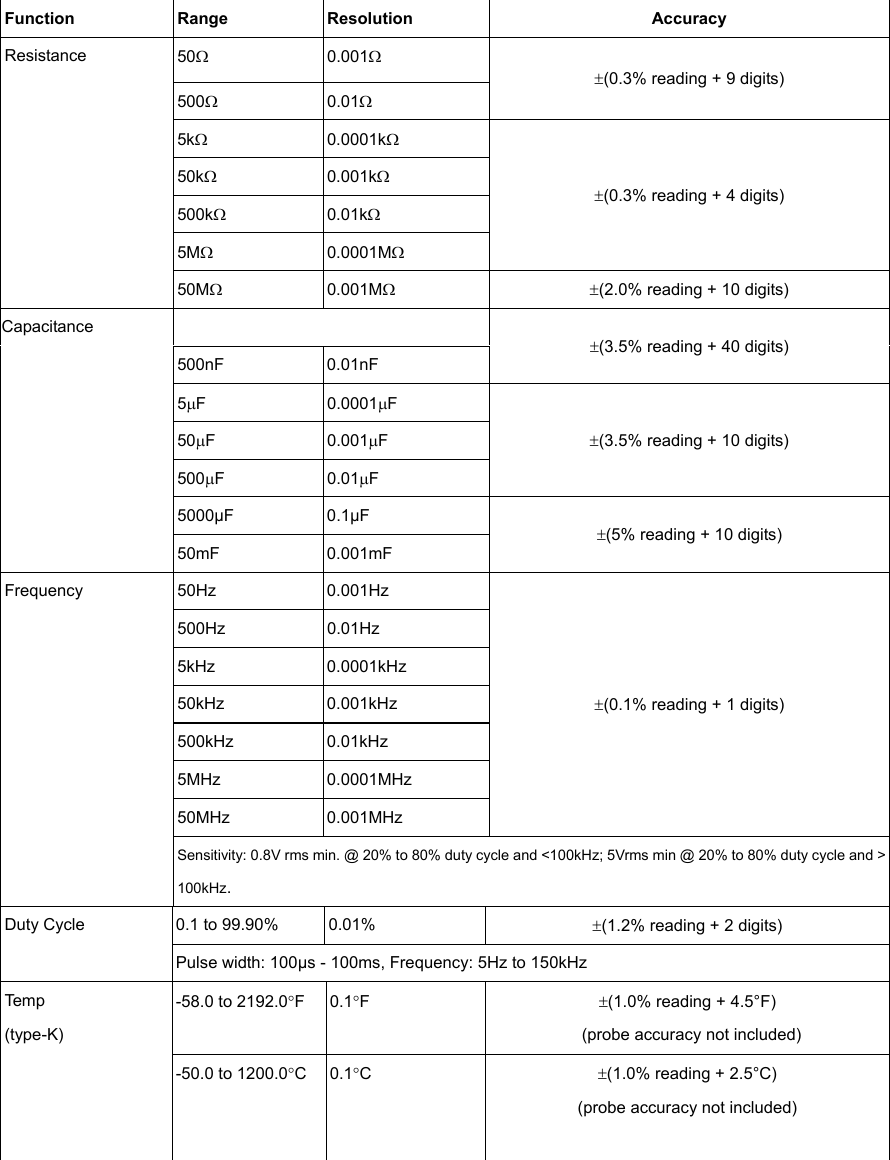
Function Range Resolution   Accuracy Resistance  50Ω 0.001Ω ±(0.3% reading + 9 digits) 500Ω 0.01Ω 5kΩ 0.0001kΩ ±(0.3% reading + 4 digits) 50kΩ 0.001kΩ 500kΩ 0.01kΩ 5MΩ 0.0001MΩ 50MΩ 0.001MΩ ±(2.0% reading + 10 digits) Capacitance  ±(3.5% reading + 40 digits) 500nF 0.01nF 5μF 0.0001μF ±(3.5% reading + 10 digits) 50μF 0.001μF 500μF 0.01μF 5000µF 0.1µF ±(5% reading + 10 digits) 50mF 0.001mF Frequency   50Hz 0.001Hz ±(0.1% reading + 1 digits) 500Hz 0.01Hz 5kHz 0.0001kHz 50kHz 0.001kHz 500kHz 0.01kHz 5MHz 0.0001MHz 50MHz 0.001MHz Sensitivity: 0.8V rms min. @ 20% to 80% duty cycle and <100kHz; 5Vrms min @ 20% to 80% duty cycle and > 100kHz.  Duty Cycle  0.1 to 99.90%  0.01%  ±(1.2% reading + 2 digits) Pulse width: 100µs - 100ms, Frequency: 5Hz to 150kHz Tem p   (type-K) -58.0 to 2192.0°F 0.1°F  ±(1.0% reading + 4.5°F)   (probe accuracy not included) -50.0 to 1200.0°C 0.1°C  ±(1.0% reading + 2.5°C) (probe accuracy not included)
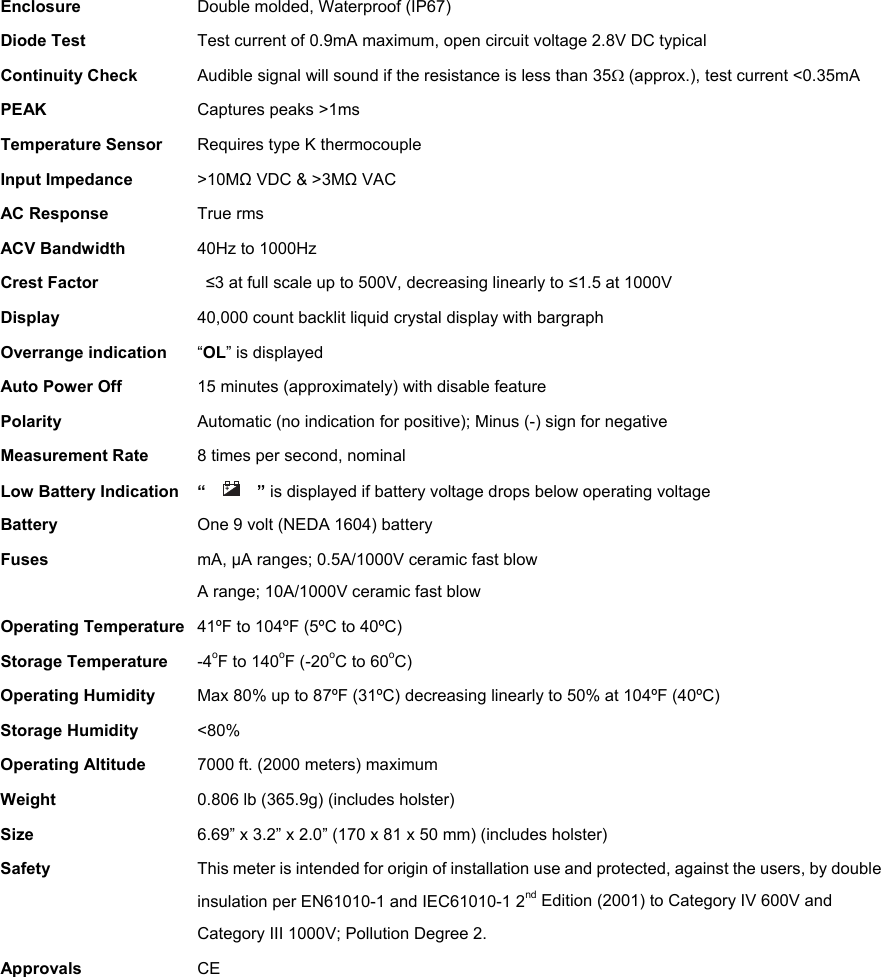
Enclosure  Double molded, Waterproof (IP67) Diode Test  Test current of 0.9mA maximum, open circuit voltage 2.8V DC typical Continuity Check  Audible signal will sound if the resistance is less than 35Ω (approx.), test current <0.35mA PEAK  Captures peaks >1ms Temperature Sensor  Requires type K thermocouple Input Impedance >10MΩ VDC & >3MΩ VAC AC Response  True rms ACV Bandwidth  40Hz to 1000Hz Crest Factor  ≤3 at full scale up to 500V, decreasing linearly to ≤1.5 at 1000V Display  40,000 count backlit liquid crystal display with bargraph Overrange indication “OL” is displayed Auto Power Off  15 minutes (approximately) with disable feature Polarity  Automatic (no indication for positive); Minus (-) sign for negative   Measurement Rate  8 times per second, nominal Low Battery Indication  “   +  ” is displayed if battery voltage drops below operating voltage Battery  One 9 volt (NEDA 1604) battery Fuses    mA, µA ranges; 0.5A/1000V ceramic fast blow A range; 10A/1000V ceramic fast blow Operating Temperature  41ºF to 104ºF (5ºC to 40ºC) Storage Temperature -4oF to 140oF (-20oC to 60oC) Operating Humidity  Max 80% up to 87ºF (31ºC) decreasing linearly to 50% at 104ºF (40ºC) Storage Humidity  <80%  Operating Altitude  7000 ft. (2000 meters) maximum Weight    0.806 lb (365.9g) (includes holster) Size    6.69” x 3.2” x 2.0” (170 x 81 x 50 mm) (includes holster) Safety  This meter is intended for origin of installation use and protected, against the users, by double insulation per EN61010-1 and IEC61010-1 2nd Edition (2001) to Category IV 600V and Category III 1000V; Pollution Degree 2.   Approvals  CE

Navigation menu