Hexagon Mining HUBSMUGA Device that enables communication and location between the mining assets and the UG Dispatch System User Manual Hexagon MIning Technical Publications

Leica Geosystems Device that enables communication and location between the mining assets and the UG Dispatch System Hexagon MIning Technical Publications

User Manual
  HUB SM|UG  Technical Reference Manual Hardware Version: v1.0     Version No.2.0 Issued January 2017 English  MINING OPERATIONS
                 Devex Mining is committed to providing only the highest standards in technical documentation and training.   Through a continual process of review and renewal, based on industry standards, client feedback and best practice, we ensure our products are supported by quality documentation and training.  From product offerings to customer support, Devex Mining is governed by the overarching principal that the customer comes first. We offer comprehensive documentation and training; ensuring client needs are met and exceeded.  Devex Mining is a division of Hexagon Mining Devex Mining delivers leading solutions for fleet management and production optimization, machine maintenance, business intelligence and analytics.  Devex Mining is part of Hexagon Mining, the only global provider of surface and underground smart mining solutions that integrate design, planning, and operations technologies for safer, more productive mines. Learn more at hexagonmining.com.  Devex HUB SM|UG Technical Reference v2.0 This document and any information or descriptive matter contained therein is communicated in confidence and is the copyright property of Devex Mining Neither the whole, nor any extract may be disclosed, loaned, copied, or used in manufacturing or tendering purposes without their written consent.   © Copyright [2011-2016] Devex Mining. All rights reserved. Devex Mining is part of Hexagon. Devex Mining and the Devex Mining logo are the registered trademarks of Devex Mining. All trademarks or service marks used herein are property of their respective owners. Devex Mining makes no representation or warranty regarding the accuracy of the information in this publication. This document gives only a general description of the product(s) or service(s) offered by Devex Mining and, except where expressly provided otherwise, shall not form part of any contract. Such information, the products and conditions of supply is subject to change without notice.  Disclaimer: Illustrations, descriptions, and technical specifications in this document are not binding and are subject to change without notice.   This document is optimized for printing on A4 paper.    Devex Mining is focused on providing you with low maintenance products that have competent back-up support, when you need it, 24/7 every day of the year. For further information contact your local Devex Mining office or go to www.hexagonmining.com
 ii     © Devex Mining Revision History Date Document Version Hardware Version Author Revision 09 AUG 2016  1 1.0 Gustavo Henrique L.Severino Initial Document Release 15 JAN 2017 2 1.0 Gustavo Henrique L.Severino Addition in the description of items 2.2, 5.1.2, and 5.2. Obsolescence of Ethernet Input and Ethernet POE Output ports.
 © Leica Geosystems  Commercial in Confidence     iii Table Of Contents 1 Document Introduction .............................................................................. 1 1.1 Contacting Support ...................................................................................................... 1 1.2 Document Conventions ................................................................................................ 1 2 HUB SM|UG Overview ................................................................................ 2 2.1 System Information ...................................................................................................... 2 2.2 Product Description ...................................................................................................... 2 2.3 LEDs............................................................................................................................. 3 2.4 Labels ........................................................................................................................... 3 2.4.1 HUB SM|UG Serial Number Label. .................................................................... 4 2.4.2 HUB SM|UG Complaince Label ......................................................................... 4 2.4.2.1 FCC Certification Label .............................................................................. 4 2.4.2.2 Anatel Certification Label ........................................................................... 4 2.4.2.3 Certification Label of Internal Transmitter Module ..................................... 4 2.4.3 Labels Location .................................................................................................. 5 2.4.3.1 Serial Number Label Locations .................................................................. 5 2.4.3.2 Certification Label Locations ...................................................................... 5 2.4.3.3 Label Location of Internal Transmitter Module .......................................... 6 3 Commissioning HUB SM|UG ..................................................................... 7 3.1 Commissioning Workflow ............................................................................................. 7 4 Hardware Installation ................................................................................. 8 4.1 Before Installation ........................................................................................................ 8 4.2 HUB SM|UG Installation ............................................................................................... 8 4.2.1 Front View .......................................................................................................... 9 4.2.2 Top View ............................................................................................................ 9 4.3 Power Cable Installation .............................................................................................. 9 4.4 Antenna Installations .................................................................................................. 10 4.4.1 Antenna Application ......................................................................................... 10 4.4.2 VHF Antenna Installation ................................................................................. 10 4.4.3 UHF Antenna Installation ................................................................................. 11 4.5 Communication Cable Installation ............................................................................. 12 4.5.1 Tracker360 ....................................................................................................... 12 4.5.2 Jasset ............................................................................................................... 12 5 Software Configuration ............................................................................ 13 5.1 Installation and Configuration Verification.................................................................. 13 5.1.1 Tag’s Reader ................................................................................................... 13 5.1.2 Integra Radio (VHF) ......................................................................................... 14 5.2 Integra radio Configuration ........................................................................................ 15 6 Technical Data .......................................................................................... 17 6.1 Design ........................................................................................................................ 17 6.1.1 User interface................................................................................................... 17 6.1.2 Dimensions ...................................................................................................... 17 6.1.3 Weight .............................................................................................................. 17 6.1.4 Power ............................................................................................................... 17 6.2 Envionmental Specifications ...................................................................................... 17 6.2.1 Temperature .................................................................................................... 17 6.2.2 Protection Against Water, Dust and Sand ....................................................... 17 6.2.3 Protection Against Vibration ............................................................................ 17 6.2.4 Humidity ........................................................................................................... 17 6.3 Communication Interfaces ......................................................................................... 17 6.4 Wireless Module Technical Data ............................................................................... 18
 iv     © Devex Mining 6.4.1 RFID Tag Reader ............................................................................................ 18 6.4.2 Leaky Feeder Radio ........................................................................................ 18 6.4.3 Antenna Technical Data .................................................................................. 18 6.4.3.1 Antena RFID ............................................................................................ 18 6.4.3.2 Antena Leaky Feeder .............................................................................. 18 6.5 FCC Statement (Applicable for U.S.)......................................................................... 18 6.5.1 Antenna Technical Data .................................................................................. 18 7 Glossary ................................................................................................... 19
 © Leica Geosystems  Commercial in Confidence     1 1  Document Introduction The HUB SM|UG Technical Reference Manual is part of SmartMine|UG Documentation Suite.  This manual is intended to serve as a guide to the hardware and components of the HUB SM|UG module. This manual provides all instructions required in order to operate the HUB SM|UG product to a basic level. This manual provides an overview of the system together with technical data and safety directions. WARNING: Operators must be aware of the physical surroundings of their equipment and drive to conditions and mine requirements at all times.  It is assumed an operator using this manual is familiar with:  Site-specific safety procedures, Safe Work Procedures (SWPs) and Standard Operating Procedures (SOPs).  Note:  The document uses generic images to show general layout and generic information for various procedures. The site-specific screen layout, menu, and procedure information may vary from what is displayed in the manual.  1.1  Contacting Support For all Devex Mining product support: Contact Method Details Web portal http://www.hexagonmining.com/downloads/HxM_Active_Customer_Care_Portal_Manual.V.01.pdf  and Follow the steps of document to support  1.2  Document Conventions This document uses basic conventions to indicate actions: Convention Example Description See xxx Refer to “See” indicates a reference to another section of this document.  “Refer to” indicates reference to another document. WARNING Warnings alert the user to dangerous procedures which could cause injury or death. CAUTION Cautions alert the user to dangerous procedures which could cause damage to equipment. Note Notes supply important information about a procedure which is not covered in the procedure text.
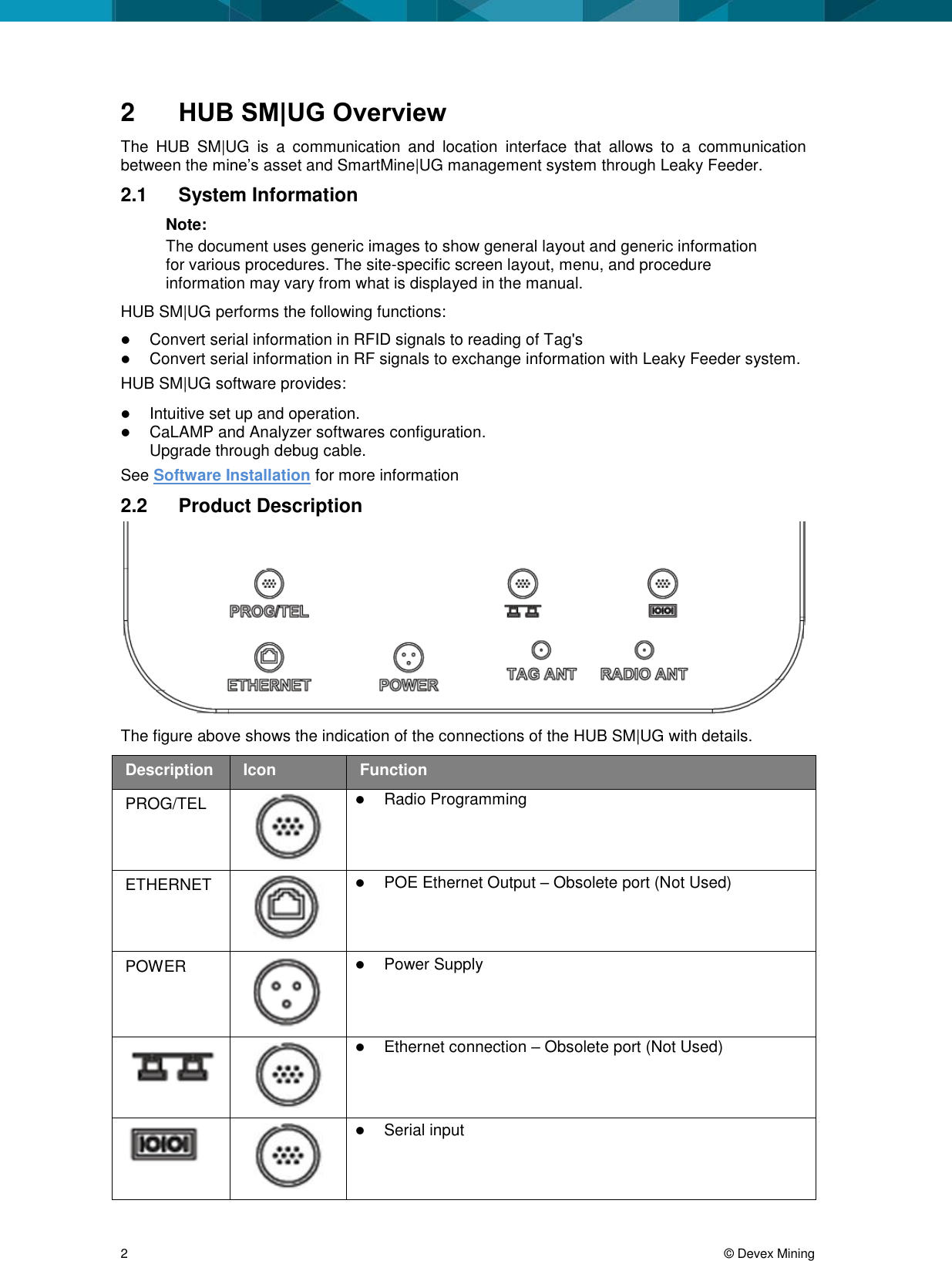
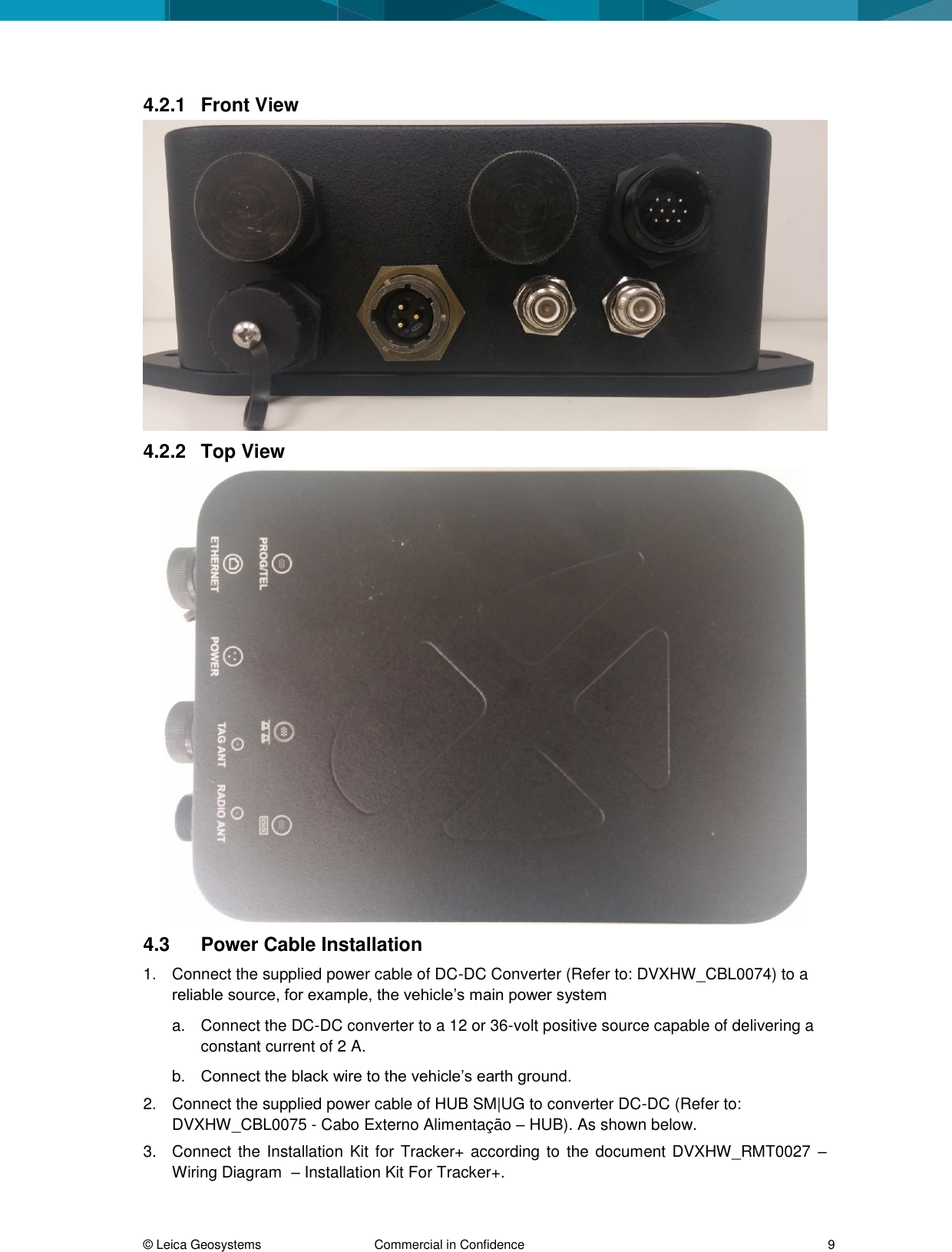
 2     © Devex Mining 2  HUB SM|UG Overview The  HUB  SM|UG  is  a  communication  and  location  interface  that  allows  to  a  communication between the mine’s asset and SmartMine|UG management system through Leaky Feeder. 2.1  System Information Note:  The document uses generic images to show general layout and generic information for various procedures. The site-specific screen layout, menu, and procedure information may vary from what is displayed in the manual.  HUB SM|UG performs the following functions:  Convert serial information in RFID signals to reading of Tag's  Convert serial information in RF signals to exchange information with Leaky Feeder system. HUB SM|UG software provides:  Intuitive set up and operation.  CaLAMP and Analyzer softwares configuration. Upgrade through debug cable. See Software Installation for more information 2.2  Product Description  The figure above shows the indication of the connections of the HUB SM|UG with details. Description Icon Function PROG/TEL   Radio Programming ETHERNET   POE Ethernet Output – Obsolete port (Not Used) POWER   Power Supply    Ethernet connection – Obsolete port (Not Used)    Serial input
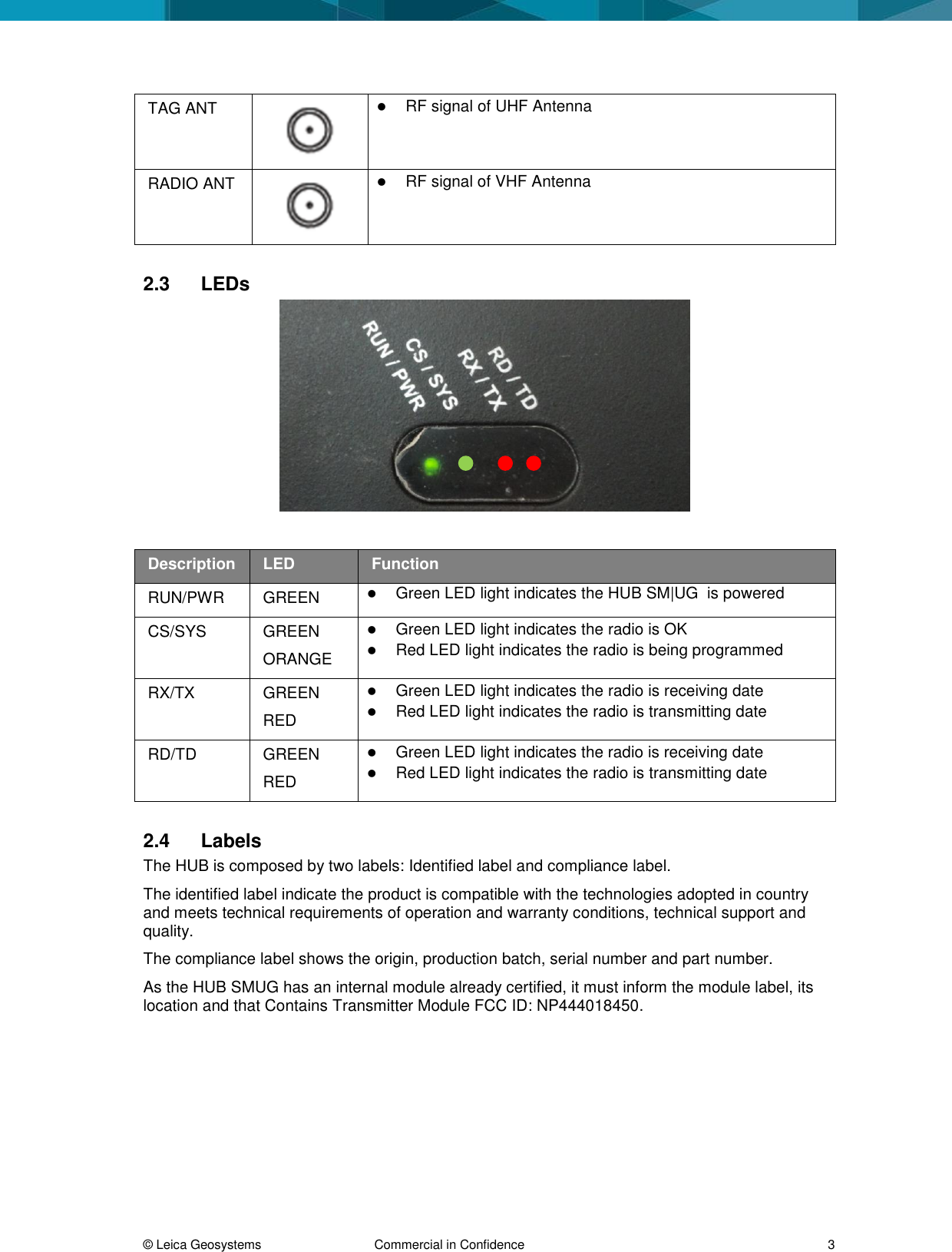
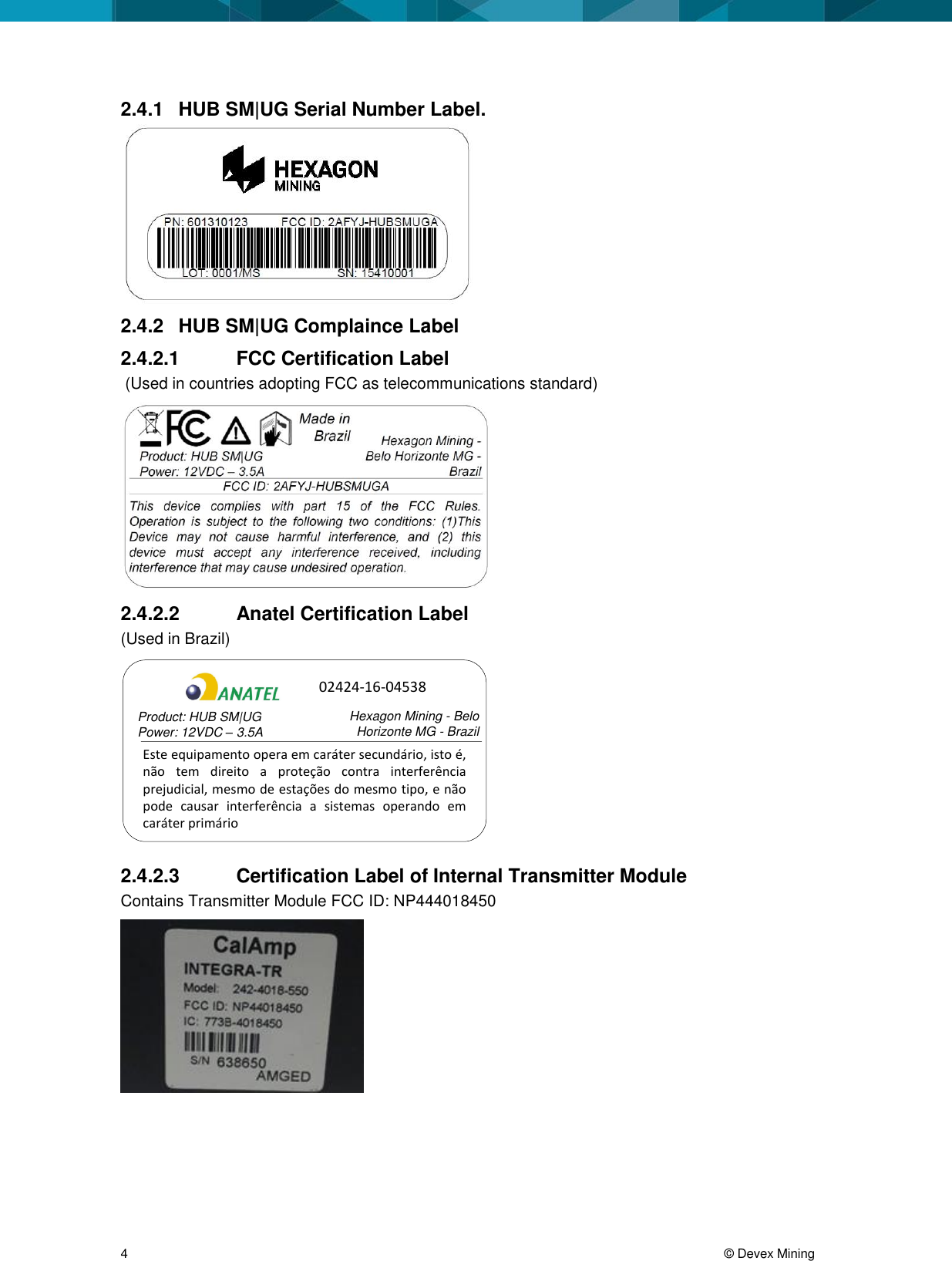
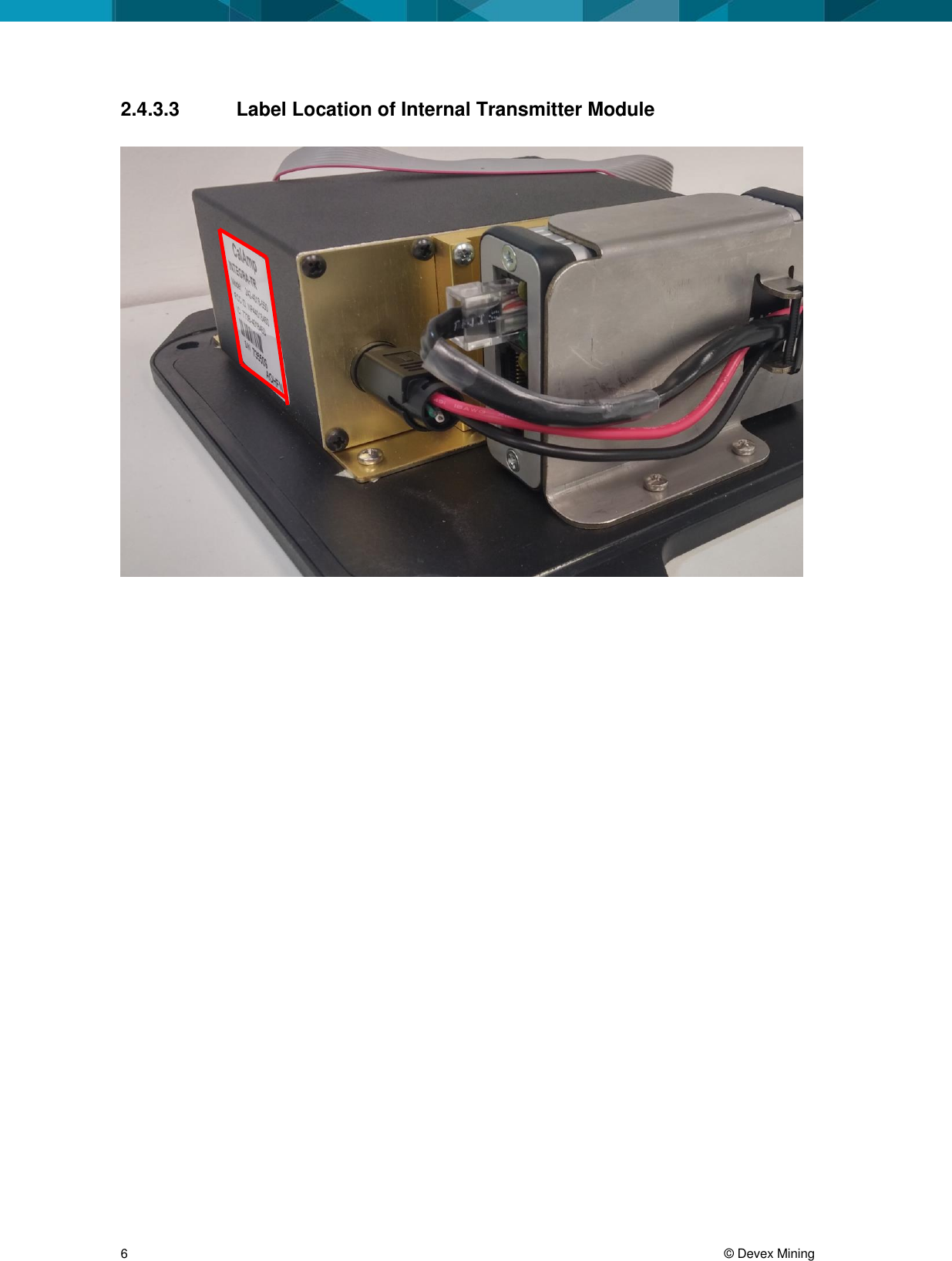
 © Leica Geosystems  Commercial in Confidence     3 TAG ANT   RF signal of UHF Antenna  RADIO ANT   RF signal of VHF Antenna   2.3  LEDs   Description LED Function RUN/PWR GREEN   Green LED light indicates the HUB SM|UG  is powered CS/SYS GREEN ORANGE  Green LED light indicates the radio is OK  Red LED light indicates the radio is being programmed RX/TX GREEN RED  Green LED light indicates the radio is receiving date  Red LED light indicates the radio is transmitting date RD/TD GREEN RED  Green LED light indicates the radio is receiving date  Red LED light indicates the radio is transmitting date  2.4  Labels The HUB is composed by two labels: Identified label and compliance label. The identified label indicate the product is compatible with the technologies adopted in country and meets technical requirements of operation and warranty conditions, technical support and quality.  The compliance label shows the origin, production batch, serial number and part number.  As the HUB SMUG has an internal module already certified, it must inform the module label, its location and that Contains Transmitter Module FCC ID: NP444018450.
 4     © Devex Mining 2.4.1  HUB SM|UG Serial Number Label.  2.4.2  HUB SM|UG Complaince Label 2.4.2.1  FCC Certification Label  (Used in countries adopting FCC as telecommunications standard)  2.4.2.2  Anatel Certification Label  (Used in Brazil) Este equipamento opera em caráter secundário, isto é, não  tem  direito  a  proteção  contra  interferência prejudicial, mesmo de estações do mesmo tipo, e não pode  causar  interferência  a  sistemas  operando  em caráter primárioProduct: HUB SM|UGPower: 12VDC – 3.5A Hexagon Mining - Belo Horizonte MG - Brazil02424-16-04538 2.4.2.3  Certification Label of Internal Transmitter Module Contains Transmitter Module FCC ID: NP444018450
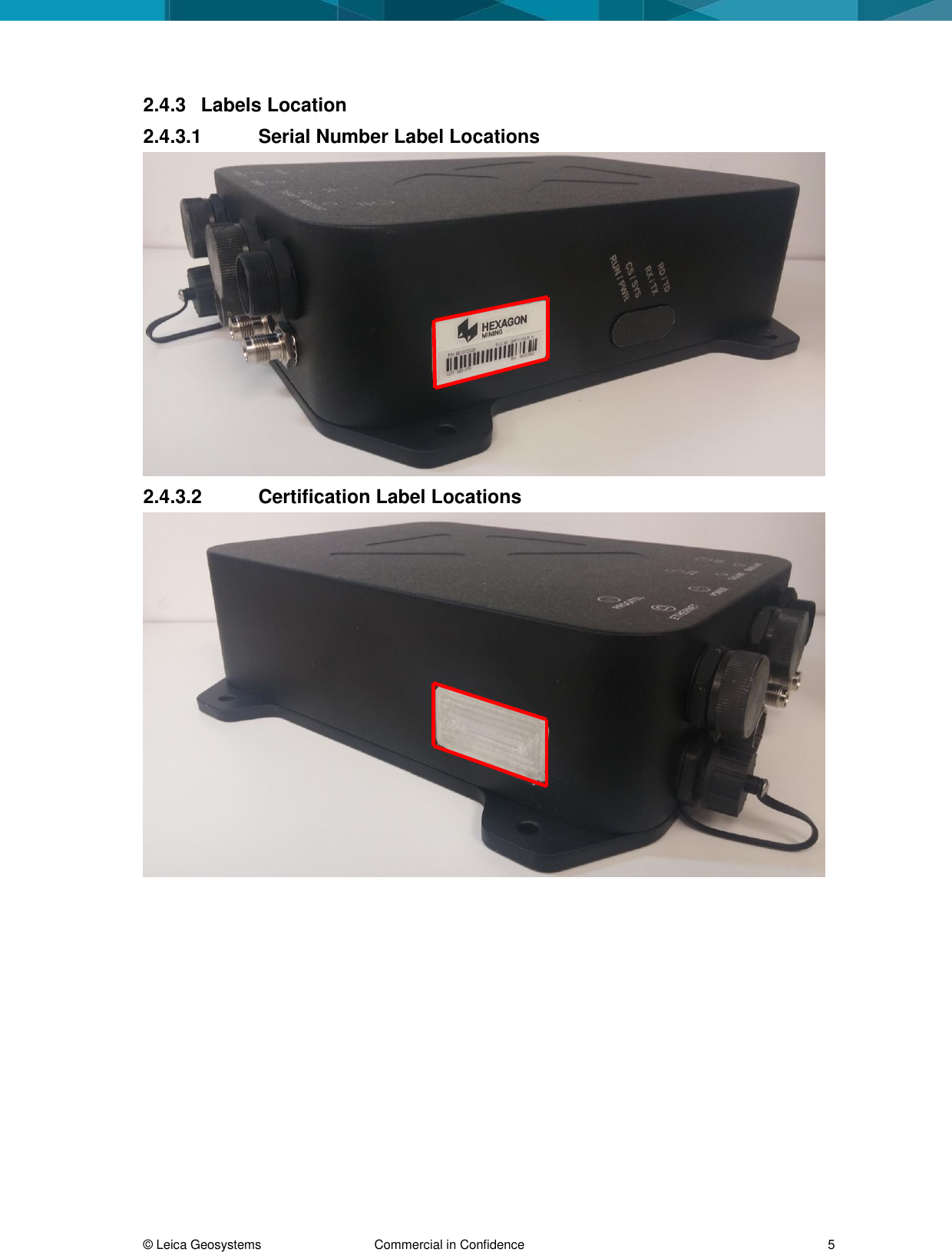
 © Leica Geosystems  Commercial in Confidence     5 2.4.3  Labels Location 2.4.3.1  Serial Number Label Locations  2.4.3.2  Certification Label Locations
 6     © Devex Mining 2.4.3.3  Label Location of Internal Transmitter Module
 © Leica Geosystems  Commercial in Confidence     7 3  Commissioning HUB SM|UG 3.1  Commissioning Workflow 1.  See Chapter 4 Hardware Installation. 2.  See Chapter 5 Software Installation.
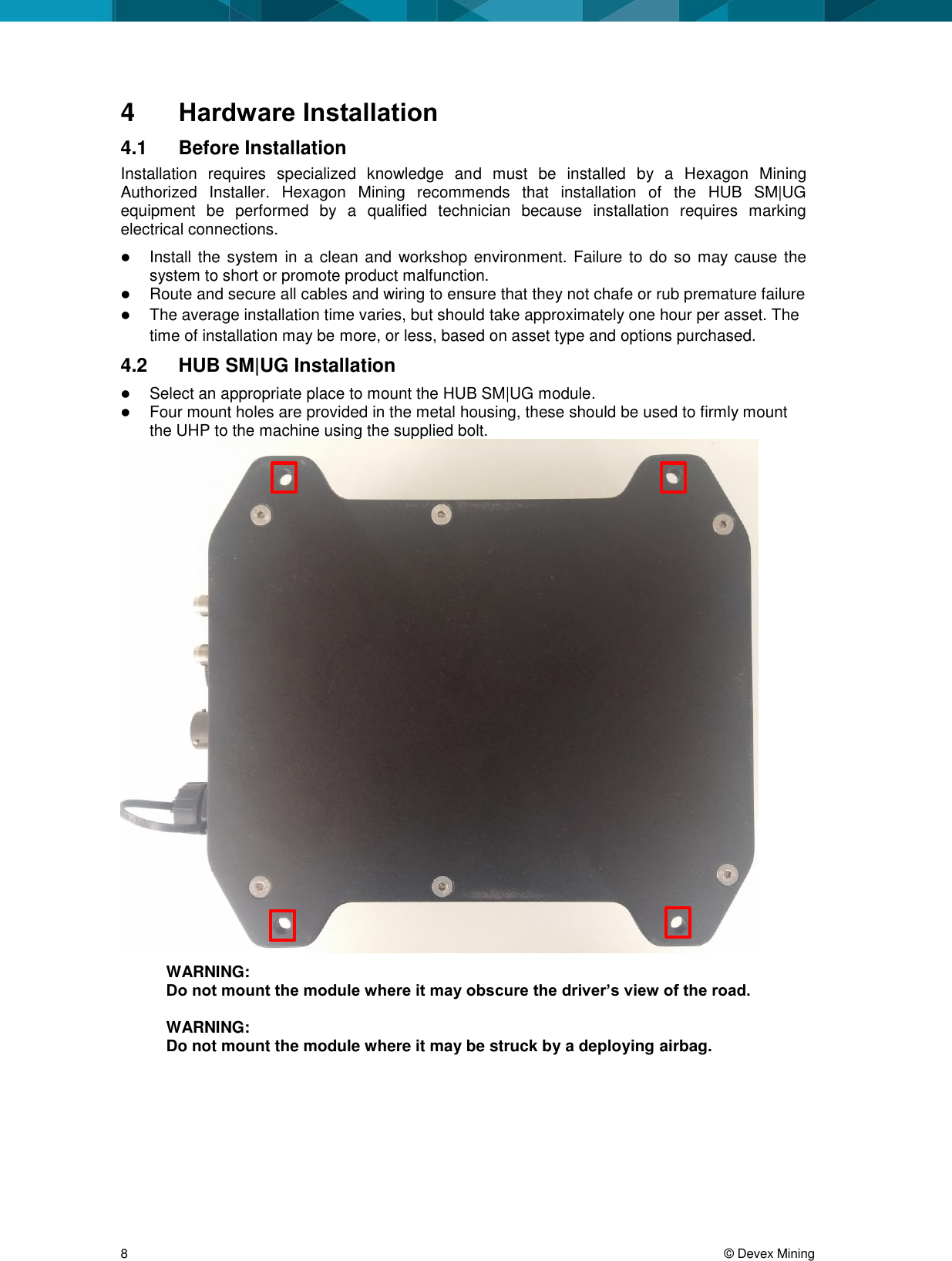
 8     © Devex Mining 4  Hardware Installation 4.1  Before Installation Installation  requires  specialized  knowledge  and  must  be  installed  by  a  Hexagon  Mining Authorized  Installer.  Hexagon  Mining  recommends  that  installation  of  the  HUB  SM|UG equipment  be  performed  by  a  qualified  technician  because  installation  requires  marking electrical connections.  Install the system in a clean and  workshop environment. Failure to do  so  may  cause the system to short or promote product malfunction.  Route and secure all cables and wiring to ensure that they not chafe or rub premature failure  The average installation time varies, but should take approximately one hour per asset. The time of installation may be more, or less, based on asset type and options purchased. 4.2  HUB SM|UG Installation  Select an appropriate place to mount the HUB SM|UG module.  Four mount holes are provided in the metal housing, these should be used to firmly mount the UHP to the machine using the supplied bolt.  WARNING: Do not mount the module where it may obscure the driver’s view of the road.  WARNING: Do not mount the module where it may be struck by a deploying airbag.
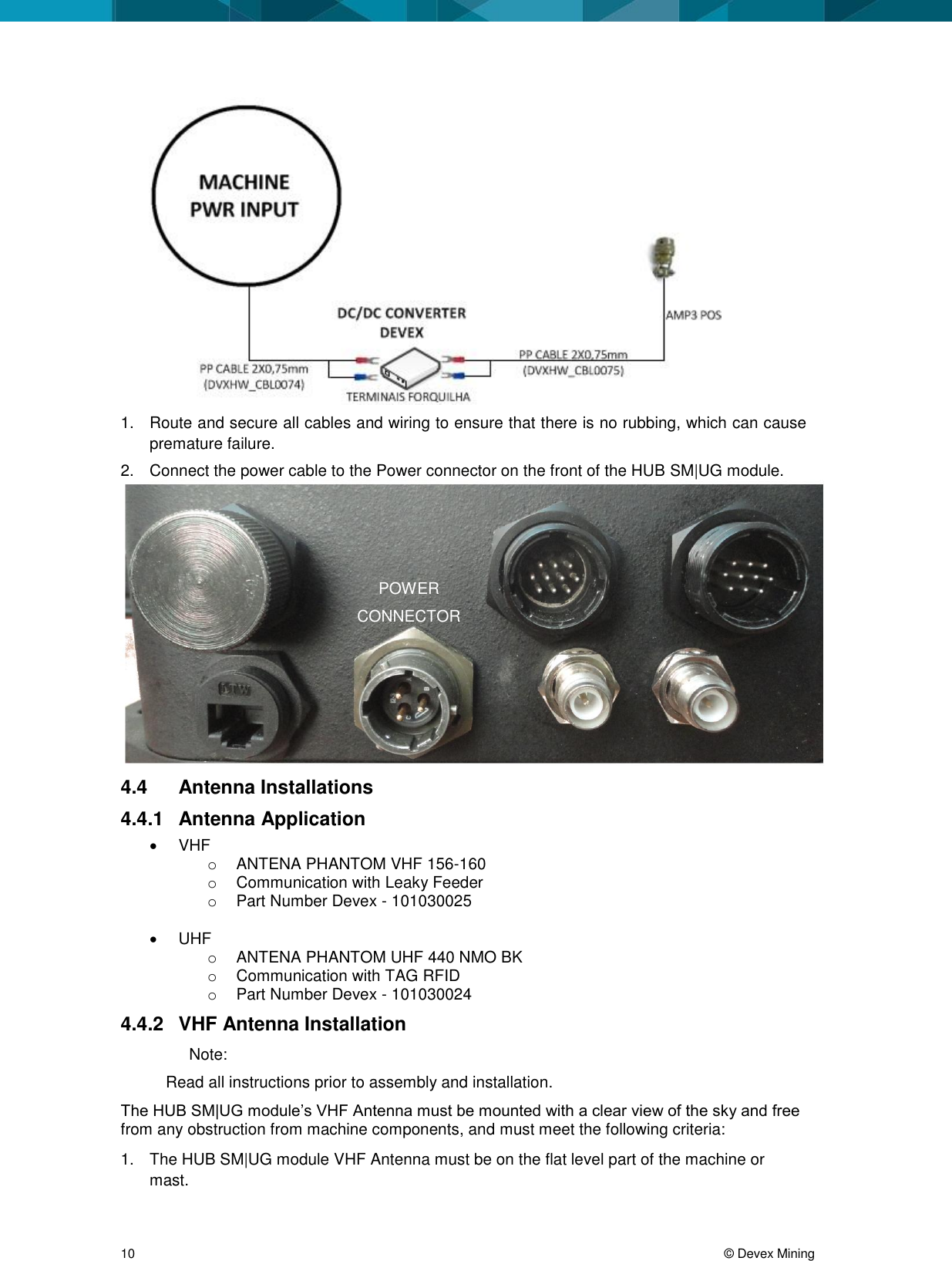
 © Leica Geosystems  Commercial in Confidence     9 4.2.1  Front View  4.2.2  Top View  4.3  Power Cable Installation 1.  Connect the supplied power cable of DC-DC Converter (Refer to: DVXHW_CBL0074) to a reliable source, for example, the vehicle’s main power system a.  Connect the DC-DC converter to a 12 or 36-volt positive source capable of delivering a constant current of 2 A. b. Connect the black wire to the vehicle’s earth ground. 2.  Connect the supplied power cable of HUB SM|UG to converter DC-DC (Refer to: DVXHW_CBL0075 - Cabo Externo Alimentação – HUB). As shown below. 3. Connect the Installation  Kit  for Tracker+ according to  the  document DVXHW_RMT0027  – Wiring Diagram  – Installation Kit For Tracker+.
 10     © Devex Mining  1.  Route and secure all cables and wiring to ensure that there is no rubbing, which can cause premature failure. 2.  Connect the power cable to the Power connector on the front of the HUB SM|UG module.  4.4  Antenna Installations 4.4.1  Antenna Application   VHF o  ANTENA PHANTOM VHF 156-160 o  Communication with Leaky Feeder  o  Part Number Devex - 101030025    UHF  o  ANTENA PHANTOM UHF 440 NMO BK o  Communication with TAG RFID o  Part Number Devex - 101030024 4.4.2  VHF Antenna Installation  Note: Read all instructions prior to assembly and installation. The HUB SM|UG module’s VHF Antenna must be mounted with a clear view of the sky and free from any obstruction from machine components, and must meet the following criteria: 1.  The HUB SM|UG module VHF Antenna must be on the flat level part of the machine or mast. POWER CONNECTOR
 © Leica Geosystems  Commercial in Confidence     11 2.  The HUB SM|UG module VHF Antenna must not be obstructed by exhausts, flashing lights, masts, trays, or any other objects. It must be mounted such that it has an unobstructed view of the sky and is as high on the equipment as possible. 3.  The HUB SM|UG module VHF Antenna must not be mounted within 50 cm of any other antenna. 4.  Route the cables through bulkheads using the existing grommets if possible; if not, modification may be required to route the cables to the required location. If creating a new entry point, use a grommet to protect the cables. 5.  The cables must not be cut, kinked, or bent tightly, as their performance degrades and a system failure may result. 6.  Route the cables back to the HUB SM|UG module. 7.  If cables are not terminated, terminate the cable and check connectivity before connecting to the antenna 8.  A universal mounting magnetic base is provided to secure the VHF antenna. 9.  Mount the VHF antenna with magnetic base cleaning the contact location prior to fixation. 10. Route the cable to the HUB SM|UG module and connect to TNC in the TAG ANT port.  4.4.3  UHF Antenna Installation  Note: Read all instructions prior to assembly and installation. The HUB SM|UG module’s UHF Antenna must be mounted with a clear view of the sky and free from any obstruction from machine components, and must meet the following criteria: 1.  The HUB SM|UG module UHF Antenna must be on the flat level part of the machine or mast. 2.  The HUB SM|UG module UHF Antenna must not be obstructed by exhausts, flashing lights, masts, trays, or any other objects. It must be mounted such that it has an unobstructed view of the sky and is as high on the equipment as possible. 3.  The HUB SM|UG module UHF Antenna must not be mounted within 50 cm of any other antenna. 4.  Route the cables through bulkheads using the existing grommets if possible; if not, modification may be required to route the cables to the required location. If creating a new entry point, use a grommet to protect the cables. 5.  The cables must not be cut, kinked, or bent tightly, as their performance degrades and a system failure may result. 6.  Route the cables back to the HUB SM|UG module. 7.  If cables are not terminated, terminate the cable and check connectivity before connecting to the antenna 8.  A universal mounting magnetic base is provided to secure the UHF antenna. 9.  Mount the UHF antenna with magnetic base cleaning the contact location prior to fixation. 10. Route the cable to the HUB SM|UG module and connect to TNC in the TAG ANT port.
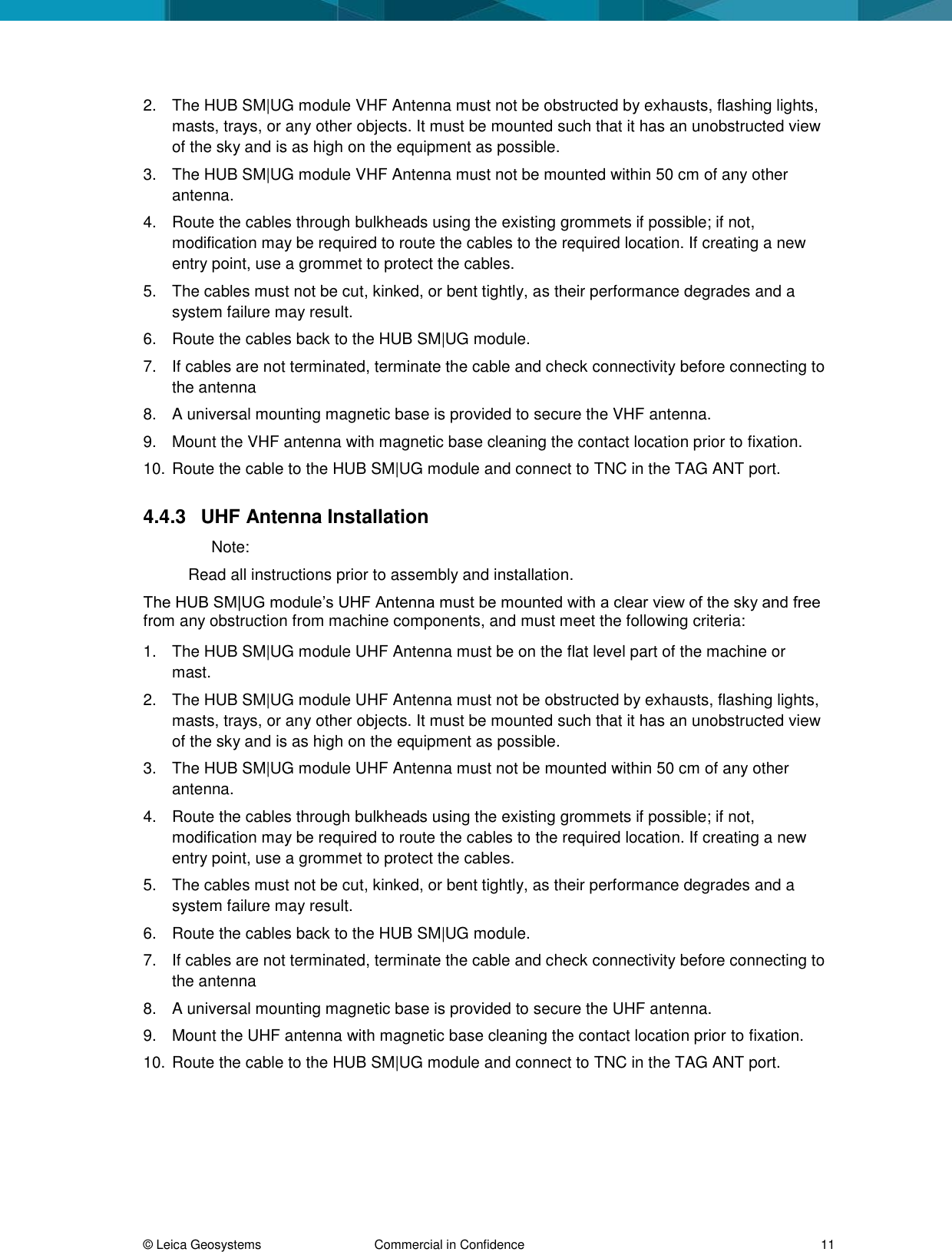
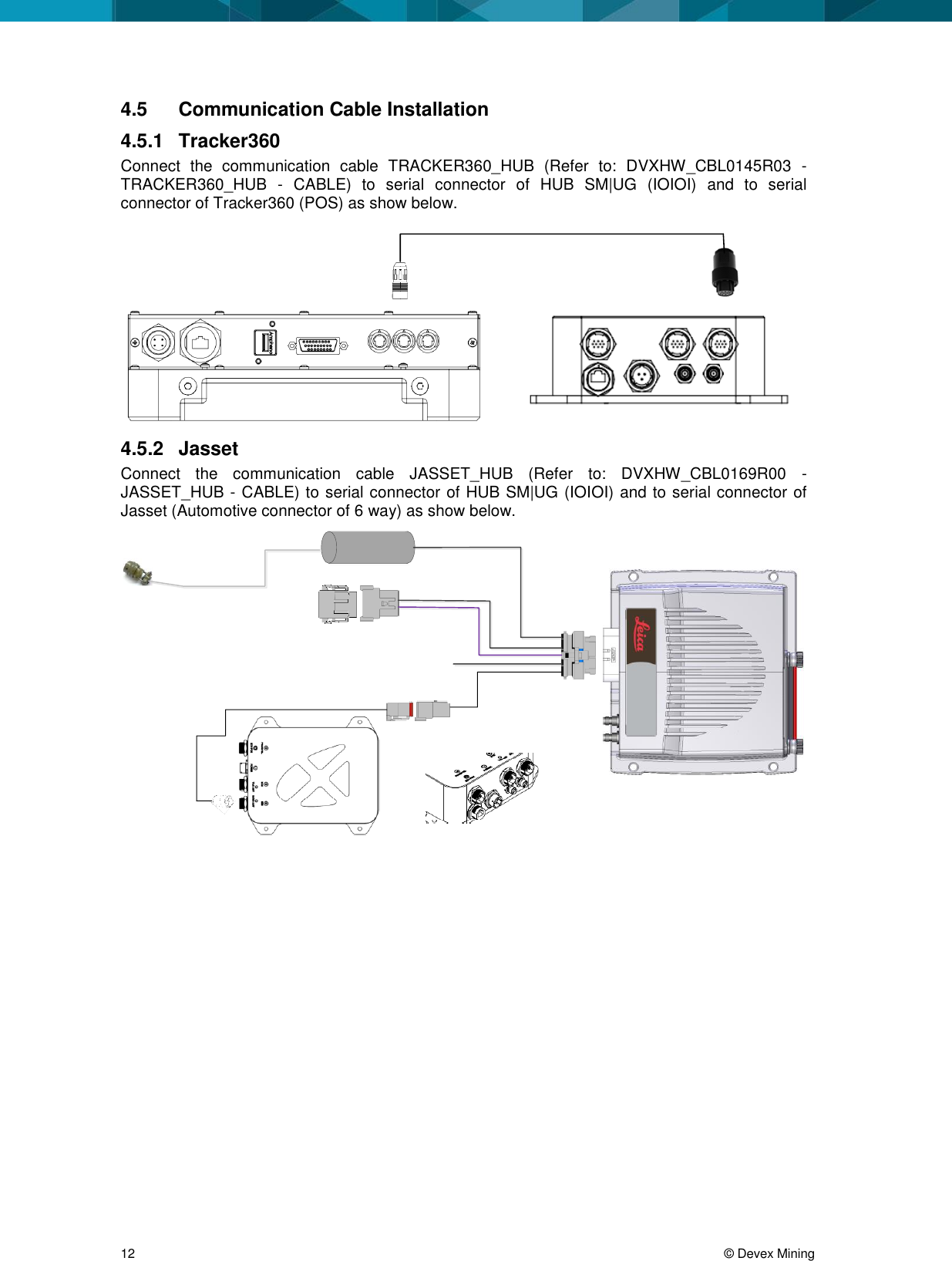
 12     © Devex Mining 4.5  Communication Cable Installation 4.5.1  Tracker360 Connect  the  communication  cable  TRACKER360_HUB  (Refer  to:  DVXHW_CBL0145R03  - TRACKER360_HUB  -  CABLE)  to  serial  connector  of  HUB  SM|UG  (IOIOI)  and  to  serial connector of Tracker360 (POS) as show below.  4.5.2  Jasset Connect  the  communication  cable  JASSET_HUB  (Refer  to:  DVXHW_CBL0169R00  - JASSET_HUB - CABLE) to serial connector of HUB SM|UG (IOIOI) and to serial connector of Jasset (Automotive connector of 6 way) as show below.
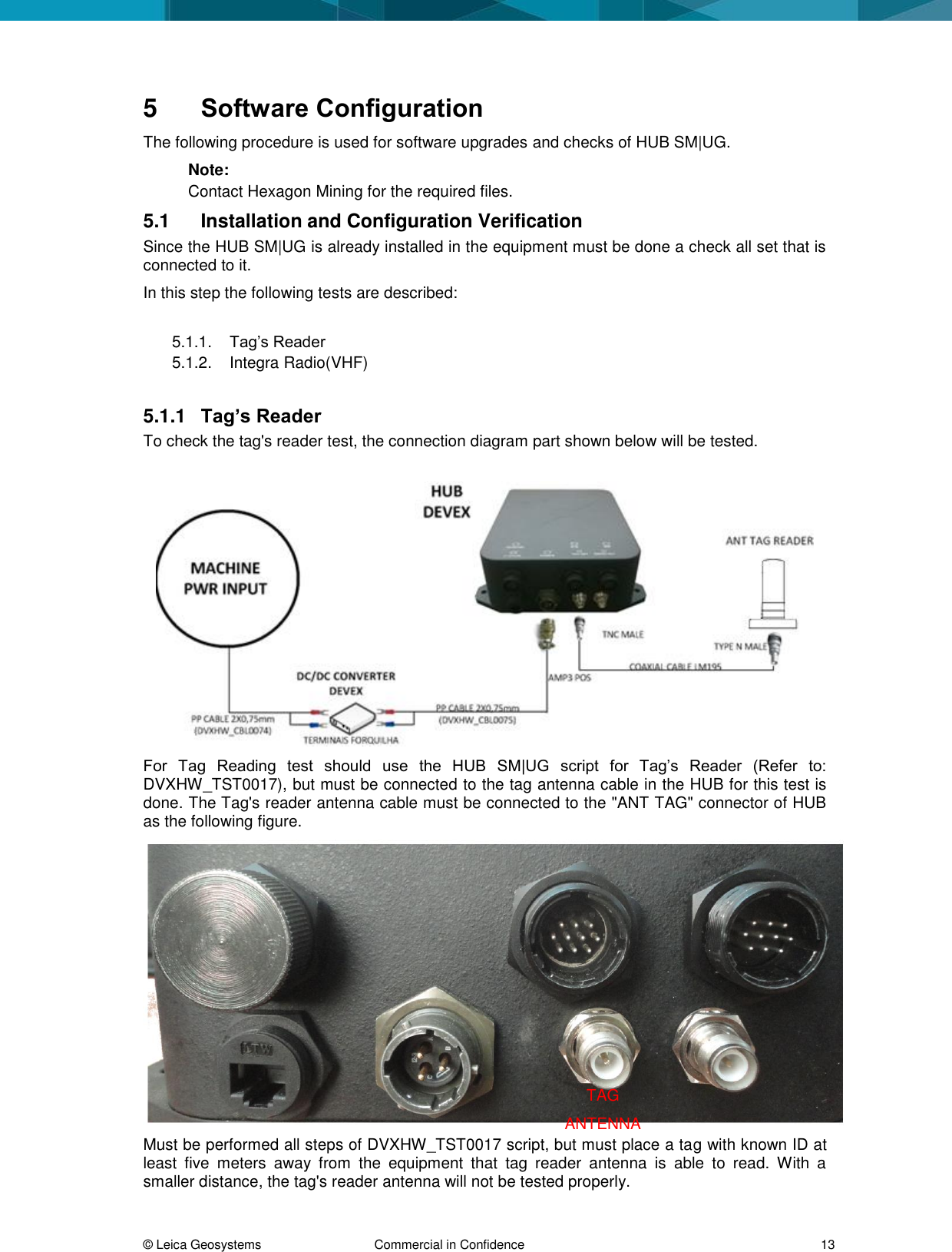
 © Leica Geosystems  Commercial in Confidence     13 5  Software Configuration The following procedure is used for software upgrades and checks of HUB SM|UG.  Note:  Contact Hexagon Mining for the required files.  5.1  Installation and Configuration Verification Since the HUB SM|UG is already installed in the equipment must be done a check all set that is connected to it. In this step the following tests are described:  5.1.1.  Tag’s Reader 5.1.2.  Integra Radio(VHF)  5.1.1  Tag’s Reader To check the tag's reader test, the connection diagram part shown below will be tested.   For  Tag  Reading  test  should  use  the  HUB  SM|UG  script  for  Tag’s  Reader  (Refer  to: DVXHW_TST0017), but must be connected to the tag antenna cable in the HUB for this test is done. The Tag's reader antenna cable must be connected to the "ANT TAG" connector of HUB as the following figure.  Must be performed all steps of DVXHW_TST0017 script, but must place a tag with known ID at least  five  meters  away  from  the  equipment  that  tag  reader  antenna  is  able  to  read.  With  a smaller distance, the tag's reader antenna will not be tested properly.  TAG ANTENNA
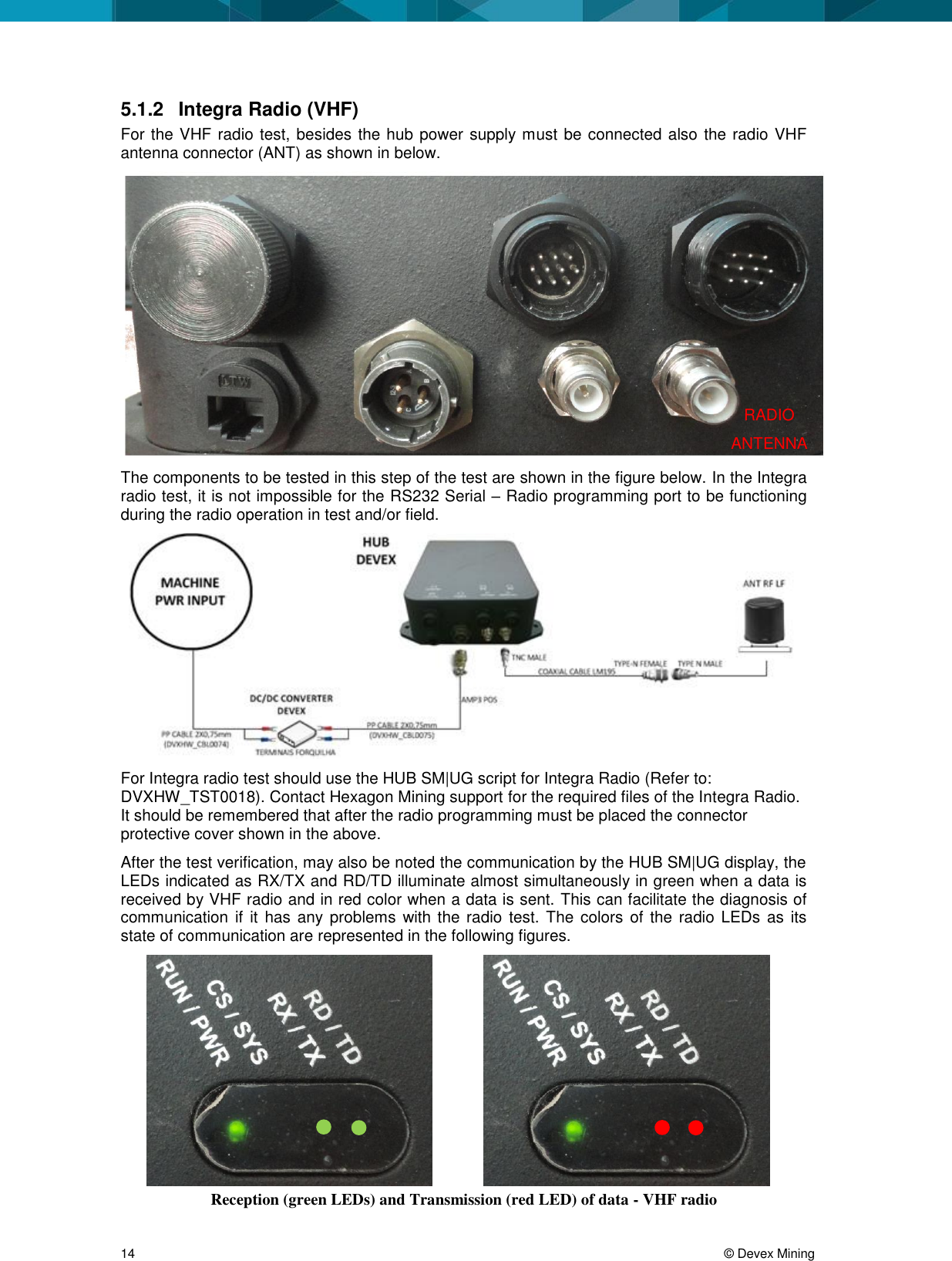
 14     © Devex Mining 5.1.2  Integra Radio (VHF) For the VHF radio test, besides the hub power supply must be connected also the radio VHF antenna connector (ANT) as shown in below.  The components to be tested in this step of the test are shown in the figure below. In the Integra radio test, it is not impossible for the RS232 Serial – Radio programming port to be functioning during the radio operation in test and/or field.  For Integra radio test should use the HUB SM|UG script for Integra Radio (Refer to: DVXHW_TST0018). Contact Hexagon Mining support for the required files of the Integra Radio. It should be remembered that after the radio programming must be placed the connector protective cover shown in the above. After the test verification, may also be noted the communication by the HUB SM|UG display, the LEDs indicated as RX/TX and RD/TD illuminate almost simultaneously in green when a data is received by VHF radio and in red color when a data is sent. This can facilitate the diagnosis of communication  if  it  has any problems with the  radio test.  The colors  of  the  radio  LEDs  as  its state of communication are represented in the following figures.   Reception (green LEDs) and Transmission (red LED) of data - VHF radio RADIO ANTENNA
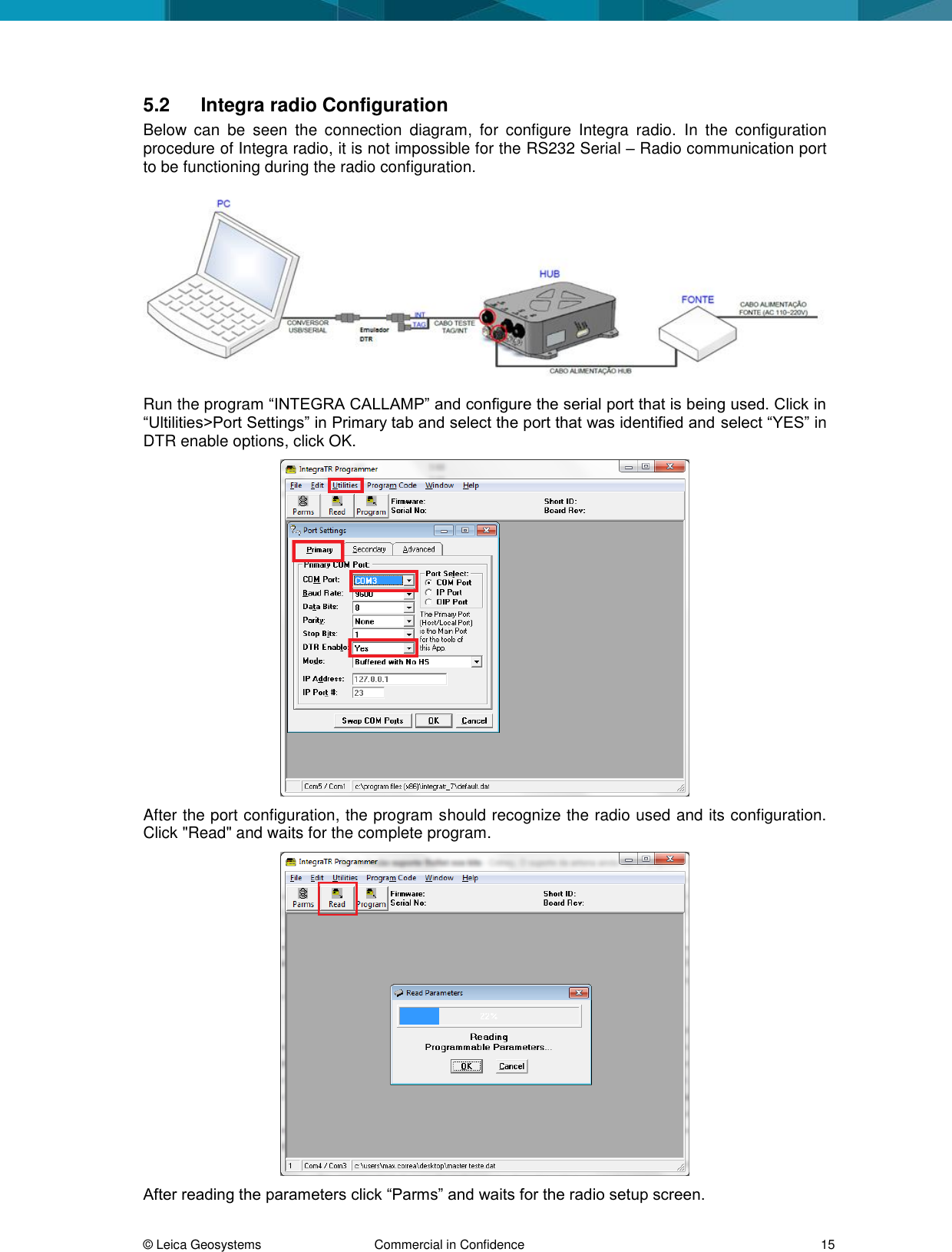
 © Leica Geosystems  Commercial in Confidence     15 5.2  Integra radio Configuration  Below  can  be  seen  the  connection  diagram,  for  configure  Integra  radio.  In  the  configuration procedure of Integra radio, it is not impossible for the RS232 Serial – Radio communication port to be functioning during the radio configuration.   Run the program “INTEGRA CALLAMP” and configure the serial port that is being used. Click in “Ultilities>Port Settings” in Primary tab and select the port that was identified and select “YES” in DTR enable options, click OK.  After the port configuration, the program should recognize the radio used and its configuration. Click "Read" and waits for the complete program.  After reading the parameters click “Parms” and waits for the radio setup screen.
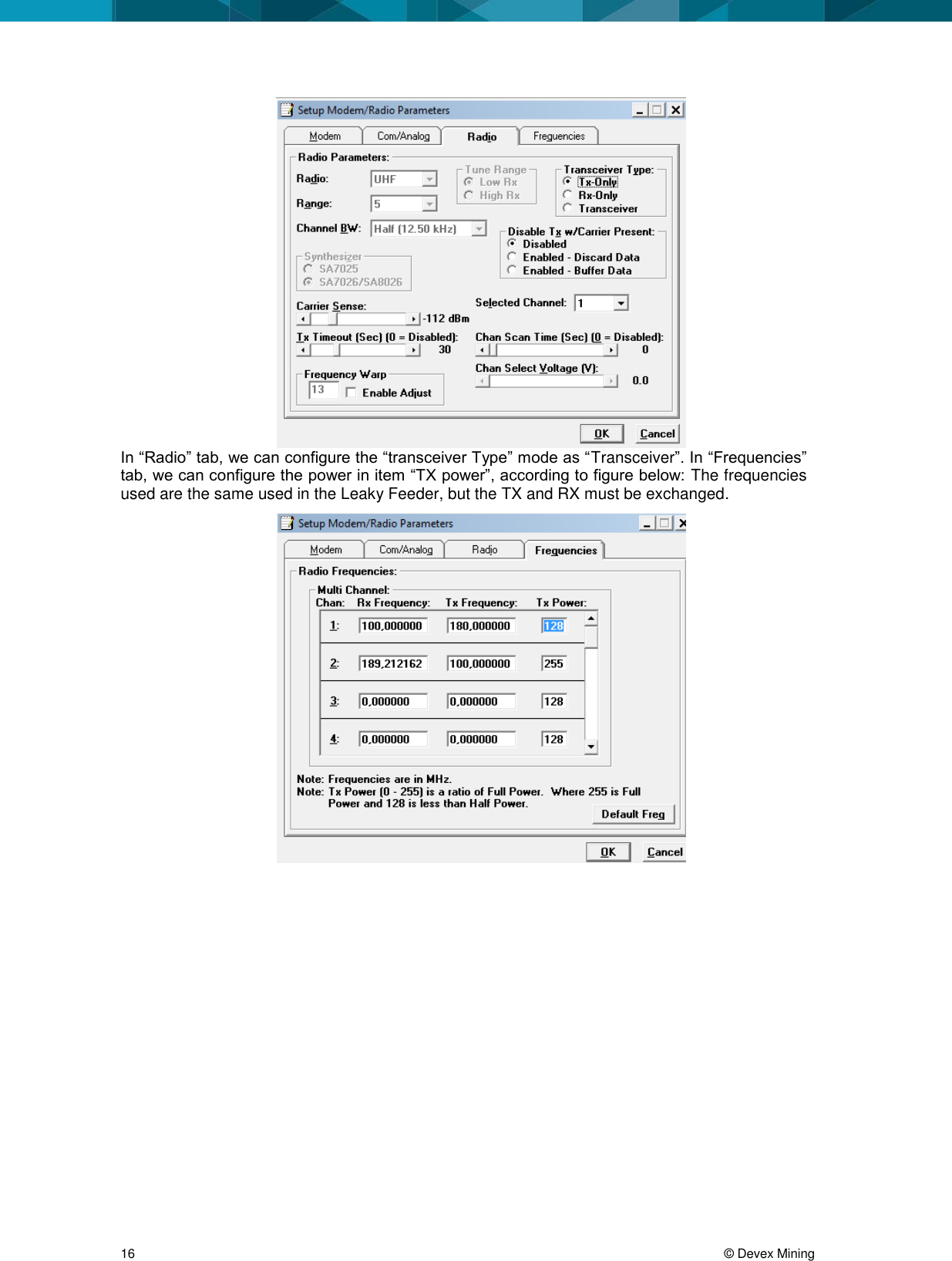
 16     © Devex Mining  In “Radio” tab, we can configure the “transceiver Type” mode as “Transceiver”. In “Frequencies” tab, we can configure the power in item “TX power”, according to figure below: The frequencies used are the same used in the Leaky Feeder, but the TX and RX must be exchanged.
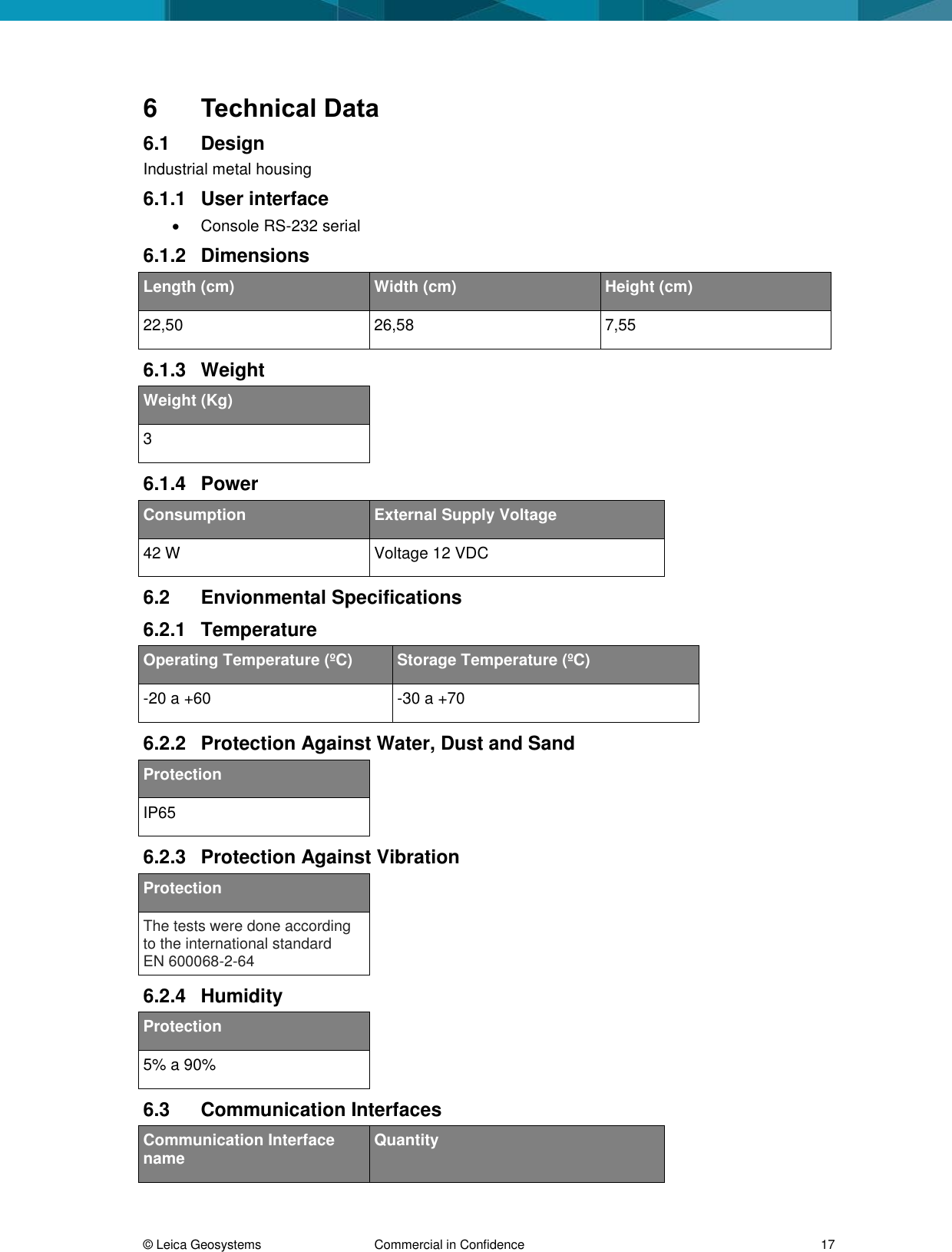
 © Leica Geosystems  Commercial in Confidence     17 6  Technical Data 6.1  Design Industrial metal housing 6.1.1  User interface    Console RS-232 serial 6.1.2  Dimensions Length (cm) Width (cm) Height (cm) 22,50 26,58 7,55 6.1.3  Weight Weight (Kg) 3 6.1.4  Power Consumption External Supply Voltage 42 W  Voltage 12 VDC 6.2  Envionmental Specifications 6.2.1  Temperature  Operating Temperature (ºC) Storage Temperature (ºC) -20 a +60 -30 a +70 6.2.2  Protection Against Water, Dust and Sand Protection IP65 6.2.3  Protection Against Vibration Protection The tests were done according to the international standard  EN 600068-2-64 6.2.4  Humidity Protection 5% a 90% 6.3  Communication Interfaces Communication Interface name Quantity
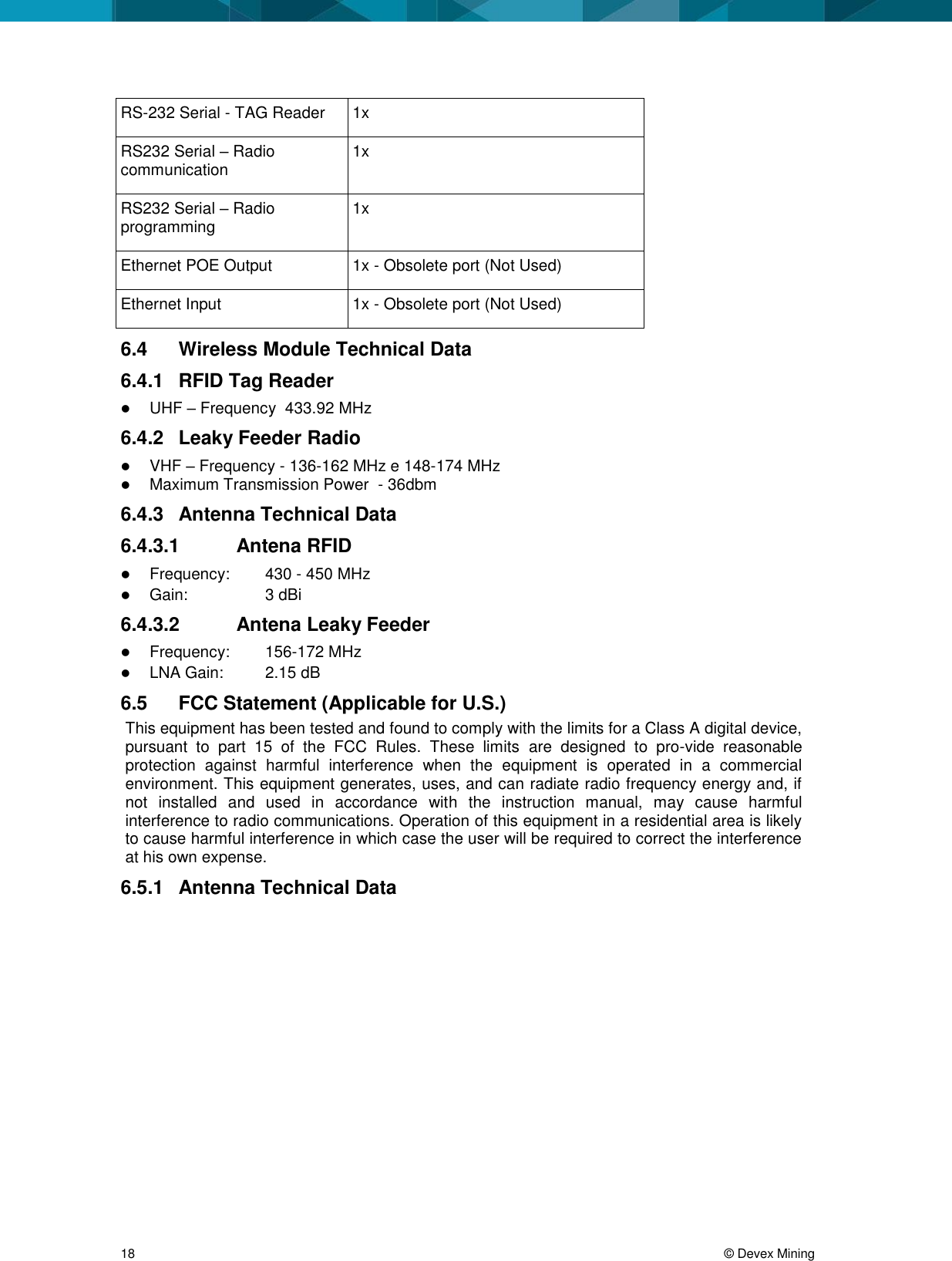
 18     © Devex Mining RS-232 Serial - TAG Reader 1x RS232 Serial – Radio communication 1x RS232 Serial – Radio programming 1x Ethernet POE Output 1x - Obsolete port (Not Used) Ethernet Input 1x - Obsolete port (Not Used) 6.4  Wireless Module Technical Data 6.4.1  RFID Tag Reader  UHF – Frequency  433.92 MHz 6.4.2  Leaky Feeder Radio  VHF – Frequency - 136-162 MHz e 148-174 MHz  Maximum Transmission Power  - 36dbm  6.4.3  Antenna Technical Data 6.4.3.1  Antena RFID  Frequency:  430 - 450 MHz  Gain:  3 dBi 6.4.3.2  Antena Leaky Feeder  Frequency:  156-172 MHz  LNA Gain:  2.15 dB 6.5  FCC Statement (Applicable for U.S.) This equipment has been tested and found to comply with the limits for a Class A digital device, pursuant  to  part  15  of  the  FCC  Rules.  These  limits  are  designed  to  pro-vide  reasonable protection  against  harmful  interference  when  the  equipment  is  operated  in  a  commercial environment. This equipment generates, uses, and can radiate radio frequency energy and, if not  installed  and  used  in  accordance  with  the  instruction  manual,  may  cause  harmful interference to radio communications. Operation of this equipment in a residential area is likely to cause harmful interference in which case the user will be required to correct the interference at his own expense.  6.5.1  Antenna Technical Data
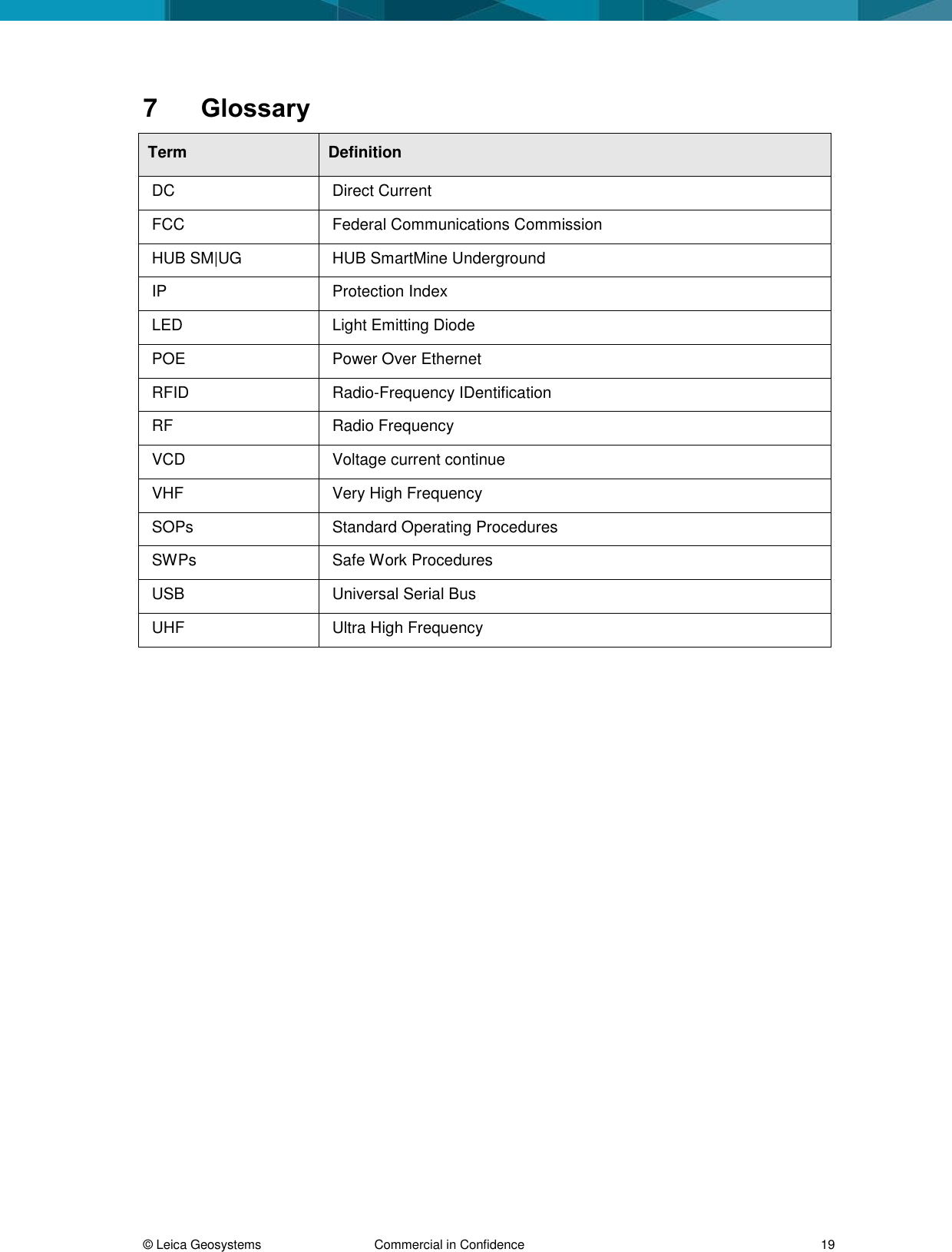
 © Leica Geosystems  Commercial in Confidence     19 7  Glossary Term Definition DC Direct Current  FCC Federal Communications Commission HUB SM|UG HUB SmartMine Underground IP Protection Index LED Light Emitting Diode POE Power Over Ethernet RFID Radio-Frequency IDentification RF Radio Frequency  VCD Voltage current continue VHF Very High Frequency SOPs Standard Operating Procedures SWPs Safe Work Procedures USB Universal Serial Bus UHF Ultra High Frequency
                               Hexagon Mining is the only company to solve surface and underground challenges by integrating design, planning, and operations technologies for safer, more productive mines. Headquartered in Tucson, Arizona, with more than 30 offices across five continents, the company is a dynamic network of talented mining professionals delivering technology, service, and support. Hexagon Mining unites industry leaders MineSight, Devex Mining, Leica Geosystems Mining, and SAFEmine. Together they seamlessly link mine planning, design, fleet and production management, optimization, and collision avoidance software for a comprehensive flow of data across all operations. Learn more at hexagonmining.com. Hexagon Mining is part of Hexagon (Nasdaq Stockholm: HEXA B; www.hexagon.com), a leading global provider of information technologies that drive quality and productivity improvements across geospatial and industrial enterprise applications.  For more information, visit; Website: www.hexagonmining.com Twitter: @HexagonMining

Navigation menu