Jcast Network Korea SC-100 VEHICLE DETECTION SYSTEM (ZIGBEE) User Manual SC100

Jcast Network Korea, Inc. VEHICLE DETECTION SYSTEM (ZIGBEE) SC100

USERS MANUAL

            Jcast Vehicle Detection System    ORSN(On Road Sensor Node) SC-100  User Manual/Operation Guide   P/N SC-100 Rev A March 2011                   Jcast Networks Korea, Inc. Anyang K-center #1004 KwanYang-Dong 1591-9, DongAn-Gu                   Anyang-Si, Gyeonggi-Do, Korea, 431-815 www.jcastnet.com
Jcast Vehicle Detection System SC-100 User Manual     - 2 - Table of Contents Introduction ............................................................................................................................................................. 3 Overview .................................................................................................................................................................... 4 On Road Sensor Node ....................................................................................................................... 4 Specifications .......................................................................................................................................... 6 Jcast Vehicle Detection System .................................................................................................... 7 Installation Procedures ...................................................................................................................................... 8 Required Equipment ........................................................................................................................... 8 Step-by-Step Procedures .............................................................................................................. 10
Jcast Vehicle Detection System SC-100 User Manual     - 3 -   Introduction      This guide provides information and procedures for installing Jcast Vehicle Detection Sensor Node(ORSN) SC-100 in conjunction with the Jcast Vehicle Detection System and ORSN Specifications.
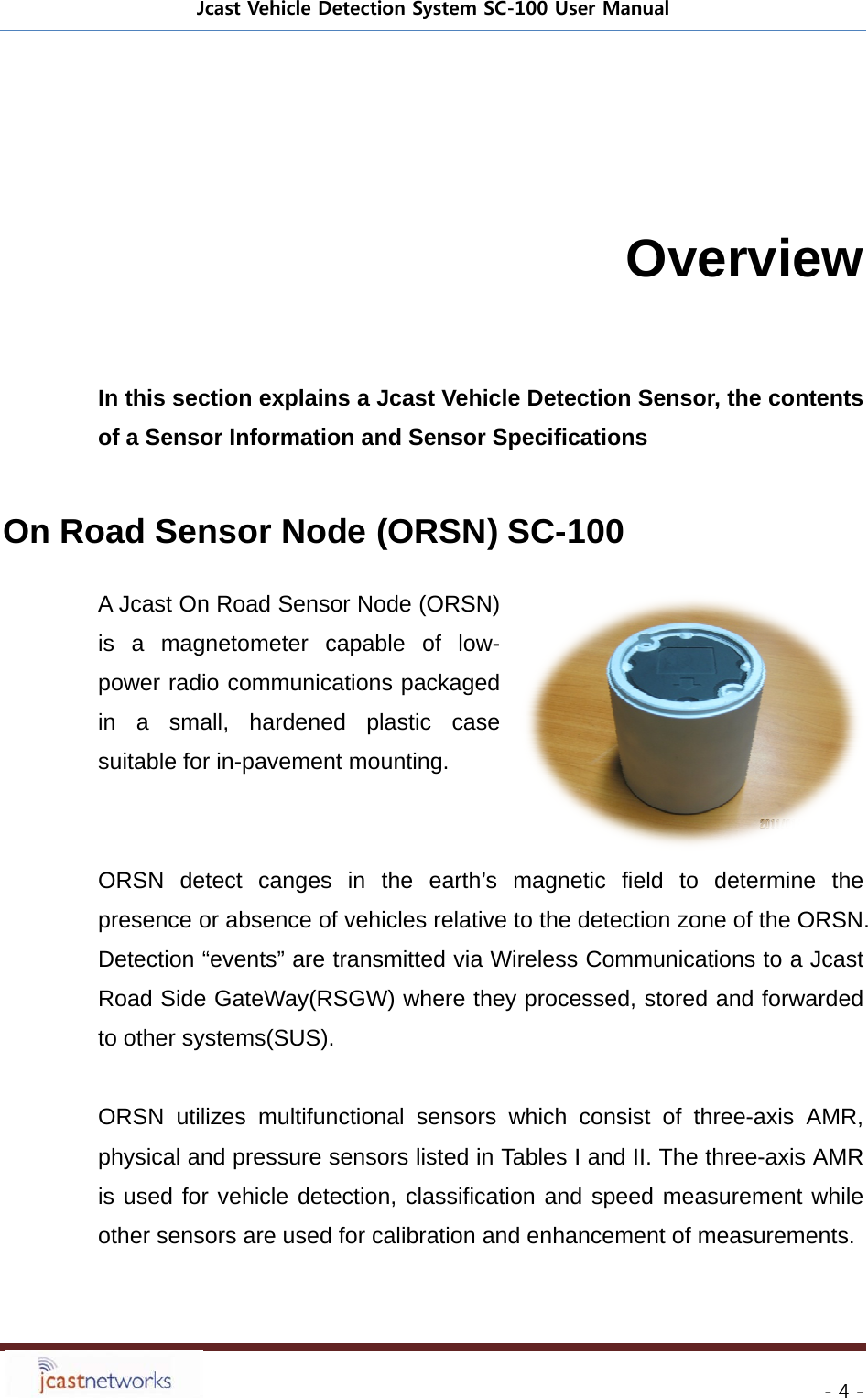
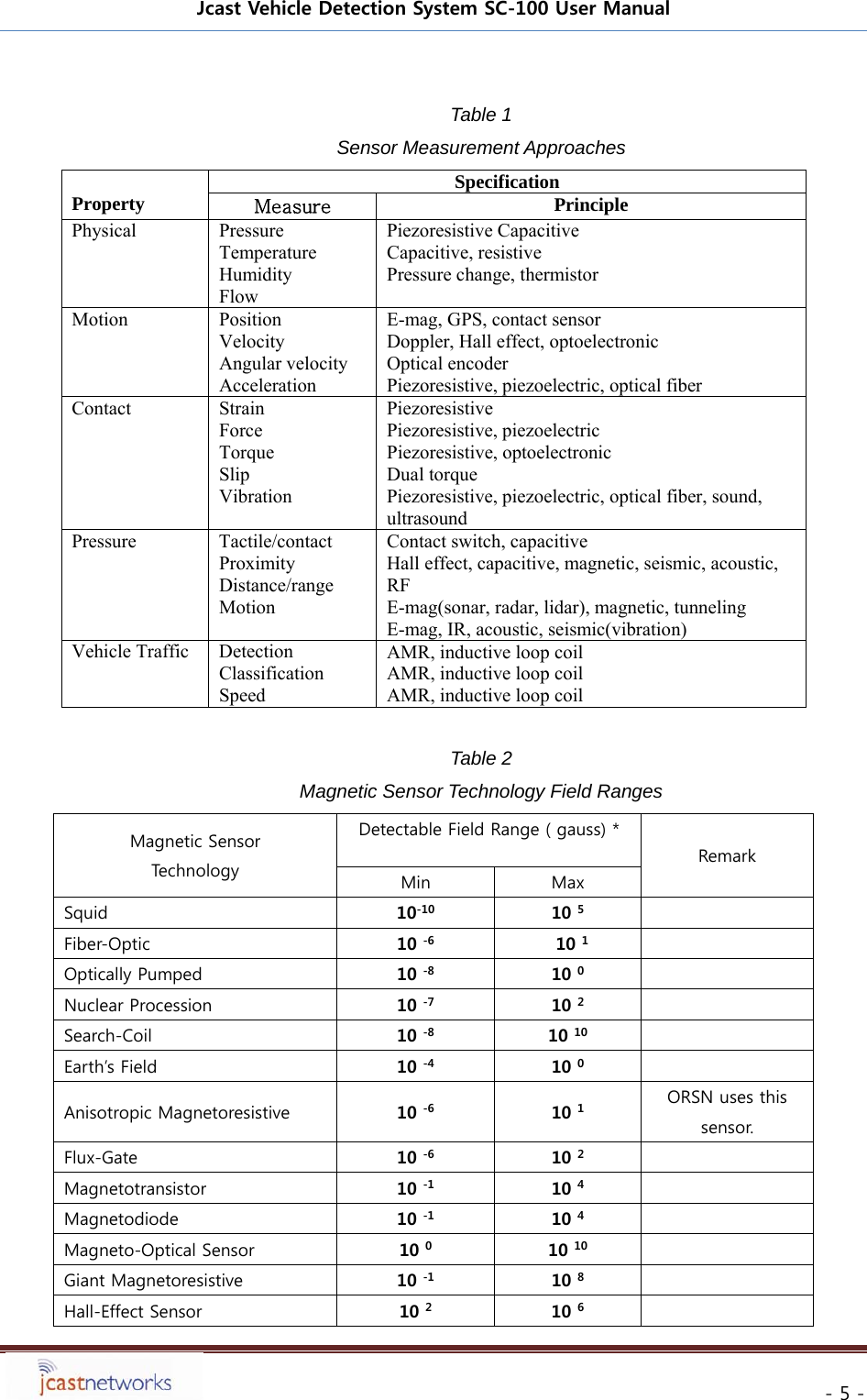
Jcast Vehicle Detection System SC-100 User Manual     - 4 -   Overview   In this section explains a Jcast Vehicle Detection Sensor, the contents of a Sensor Information and Sensor Specifications  On Road Sensor Node (ORSN) SC-100  A Jcast On Road Sensor Node (ORSN) is a magnetometer capable of low-power radio communications packaged in a small, hardened plastic case suitable for in-pavement mounting.   ORSN detect canges in the earth’s magnetic field to determine the presence or absence of vehicles relative to the detection zone of the ORSN. Detection “events” are transmitted via Wireless Communications to a Jcast Road Side GateWay(RSGW) where they processed, stored and forwarded to other systems(SUS).  ORSN utilizes multifunctional sensors which consist of three-axis AMR, physical and pressure sensors listed in Tables I and II. The three-axis AMR is used for vehicle detection, classification and speed measurement while other sensors are used for calibration and enhancement of measurements.
Jcast Vehicle Detection System SC-100 User Manual     - 5 - Table 1 Sensor Measurement Approaches  Property  Specification Measure Principle Physical   Pressure Temperature Humidity Flow Piezoresistive Capacitive Capacitive, resistive Pressure change, thermistor Motion Position Velocity Angular velocity Acceleration E-mag, GPS, contact sensor Doppler, Hall effect, optoelectronic Optical encoder Piezoresistive, piezoelectric, optical fiber Contact Strain Force Torque Slip Vibration  Piezoresistive Piezoresistive, piezoelectric Piezoresistive, optoelectronic Dual torque Piezoresistive, piezoelectric, optical fiber, sound, ultrasound Pressure Tactile/contact Proximity Distance/range Motion Contact switch, capacitive Hall effect, capacitive, magnetic, seismic, acoustic, RF E-mag(sonar, radar, lidar), magnetic, tunneling E-mag, IR, acoustic, seismic(vibration) Vehicle Traffic  Detection Classification Speed AMR, inductive loop coil AMR, inductive loop coil AMR, inductive loop coil  Table 2 Magnetic Sensor Technology Field Ranges Magnetic Sensor Technolo g y  Detectable Field Range ( gauss) * Remark Min  Max Squid  10-10 10 5   Fiber-Optic  10 -6   10 1  Optically Pumped    10 -8 10 0    Nuclear Procession  10 -7  10 2   Search-Coil    10 -8 10 10  Earth’s Field    10 -4 10 0  Anisotropic Magnetoresistive  10 -6 10 1 ORSN uses this sensor. Flux-Gate    10 -6 10 2  Magnetotransistor    10 -1 10 4  Magnetodiode  10 -1 10 4  Magneto-Optical Sensor    10 0 10 10  Giant Magnetoresistive    10 -1 10 8  Hall-Effect Sensor    10 2 10 6
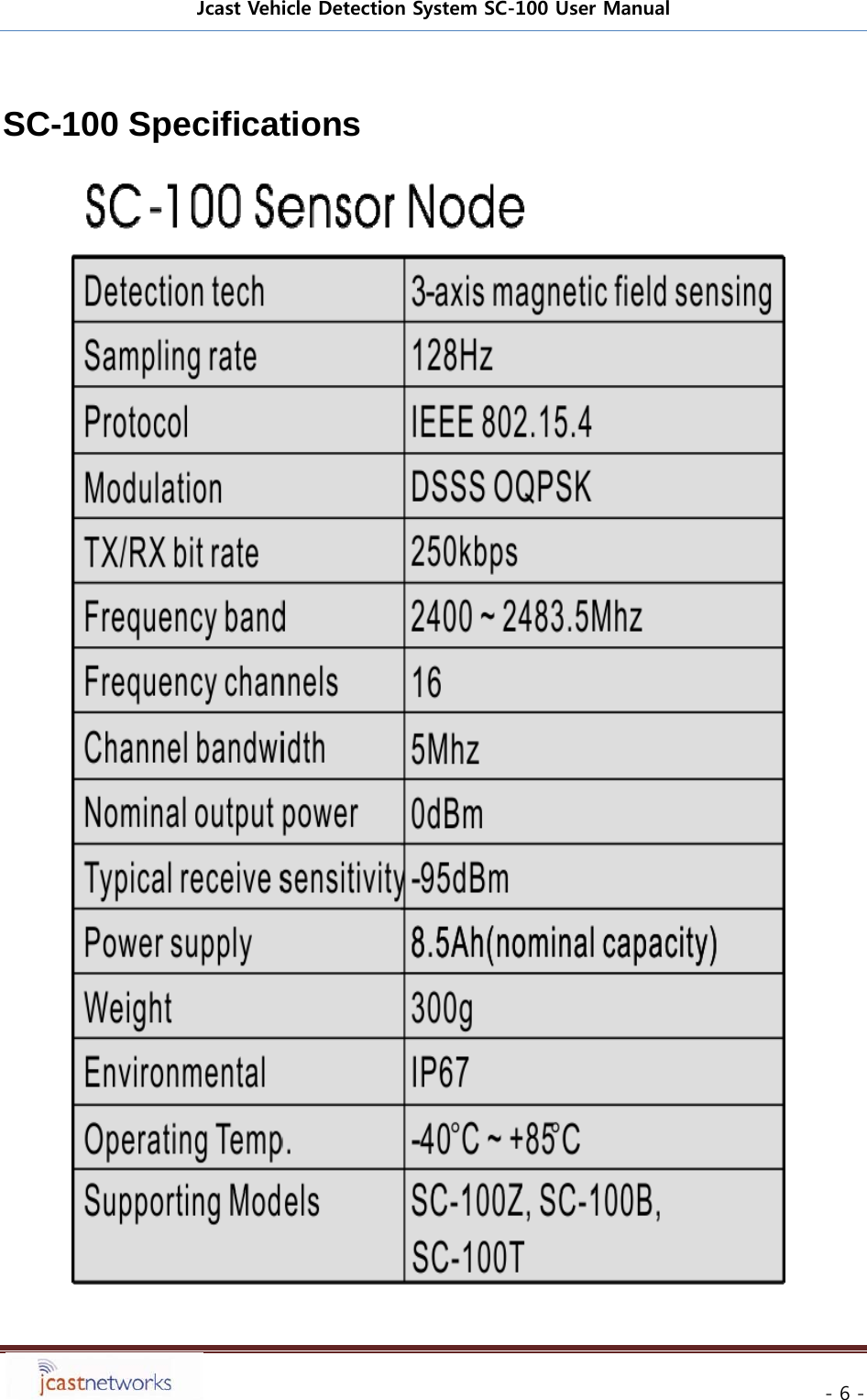
Jcast Vehicle Detection System SC-100 User Manual     - 6 - SC-100 Specifications
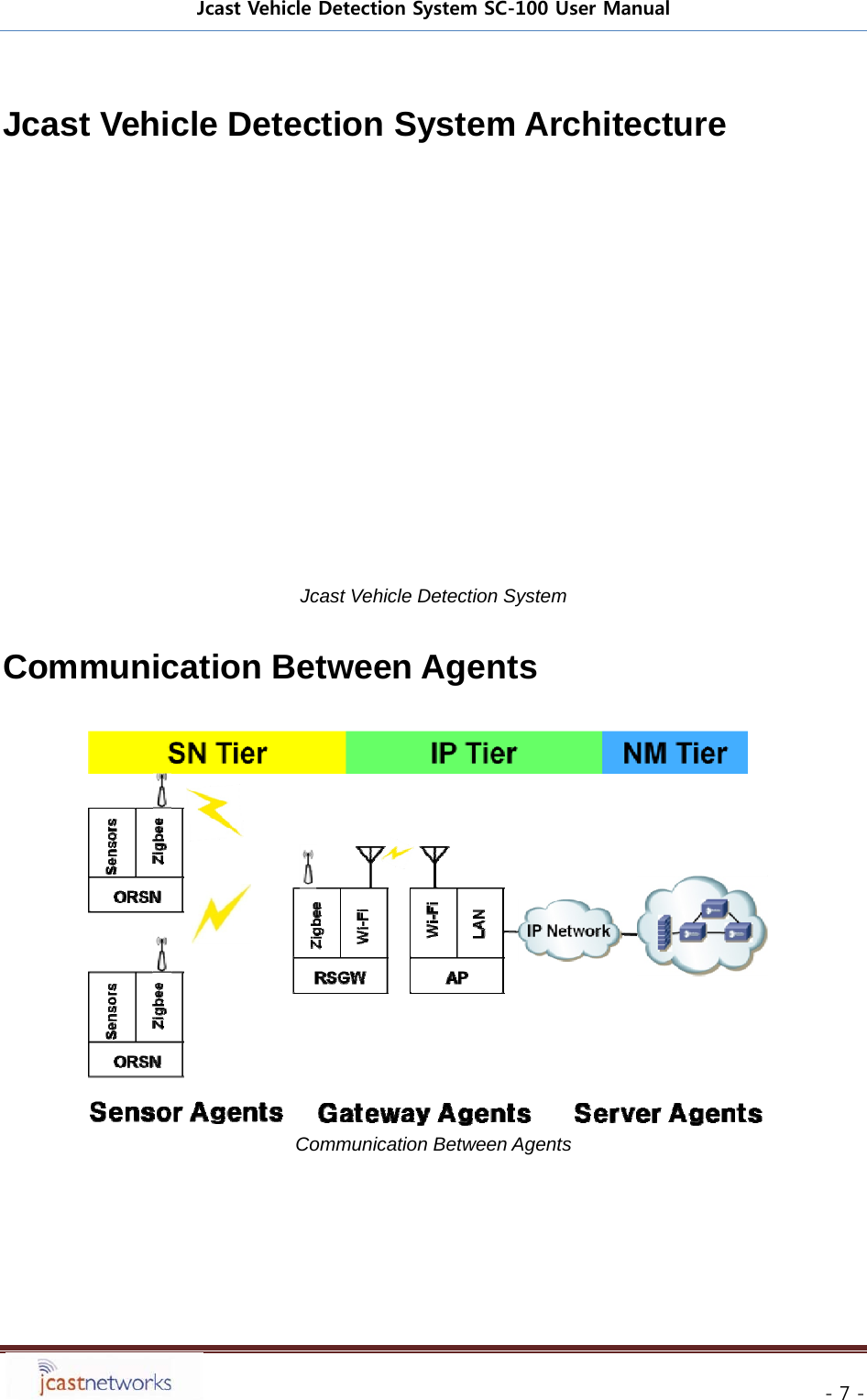
Jcast Vehicle Detection System SC-100 User Manual     - 7 - Jcast Vehicle Detection System Architecture   Jcast Vehicle Detection System  Communication Between Agents   Communication Between Agents
Jcast Vehicle Detection System SC-100 User Manual     - 8 - Installation Procedures   This section discusses installation requirements and provides step-by-step installation procedures.  Required Equipment  Before installing a ORSN, ensure that the following components are available :      Jcast On Road Sensor Node(ORSN)(s)    A minimum of one tube of FJS epoxy for each ORSN  A  2:1  ratio pack of Fablck Joint Seal(FJS), a two-component 100% solid silicone polyurea-based joint sealant is recommende. This self-leveling joint sealant displays fast cure times and excellent adhesion to concrete. In ambient temperatures from 20°F (-6.6°C) to 180°F (82.2°C) the epoxy cures in approximately five minutes.    Coring bit suitable for creating a hole (4” diameter, 2 ¼” depth [10.2 cm, 5.7 cm]) in the target surface   Two types of 4-inch drill bits, each with 1¼” standard machine threaded sleeves, are recommended as shown in the following diagram.
Jcast Vehicle Detection System SC-100 User Manual     - 9 -  Coring bits  For soft road surface, a 4” double cylinder coring bit is recommended. Once a 2” (5cm) deep hole is drilled, chisel any remaining material so that the result is a flat bottomed hole. For harder surfaces, a 4” grinding coring bit is recommended.  Use a shop vacuum or other implement to ensure that the hole is free of all dust, debris and loose impediments.    Coring drill and frame   Cold chisel and club hammer or a power chisel   A shop vacunm, brush of other implement suitable for removing dust and debris from a hole cored in the oave ment   Heat gun propane torch (helpful in environments with significant roadway moisture)
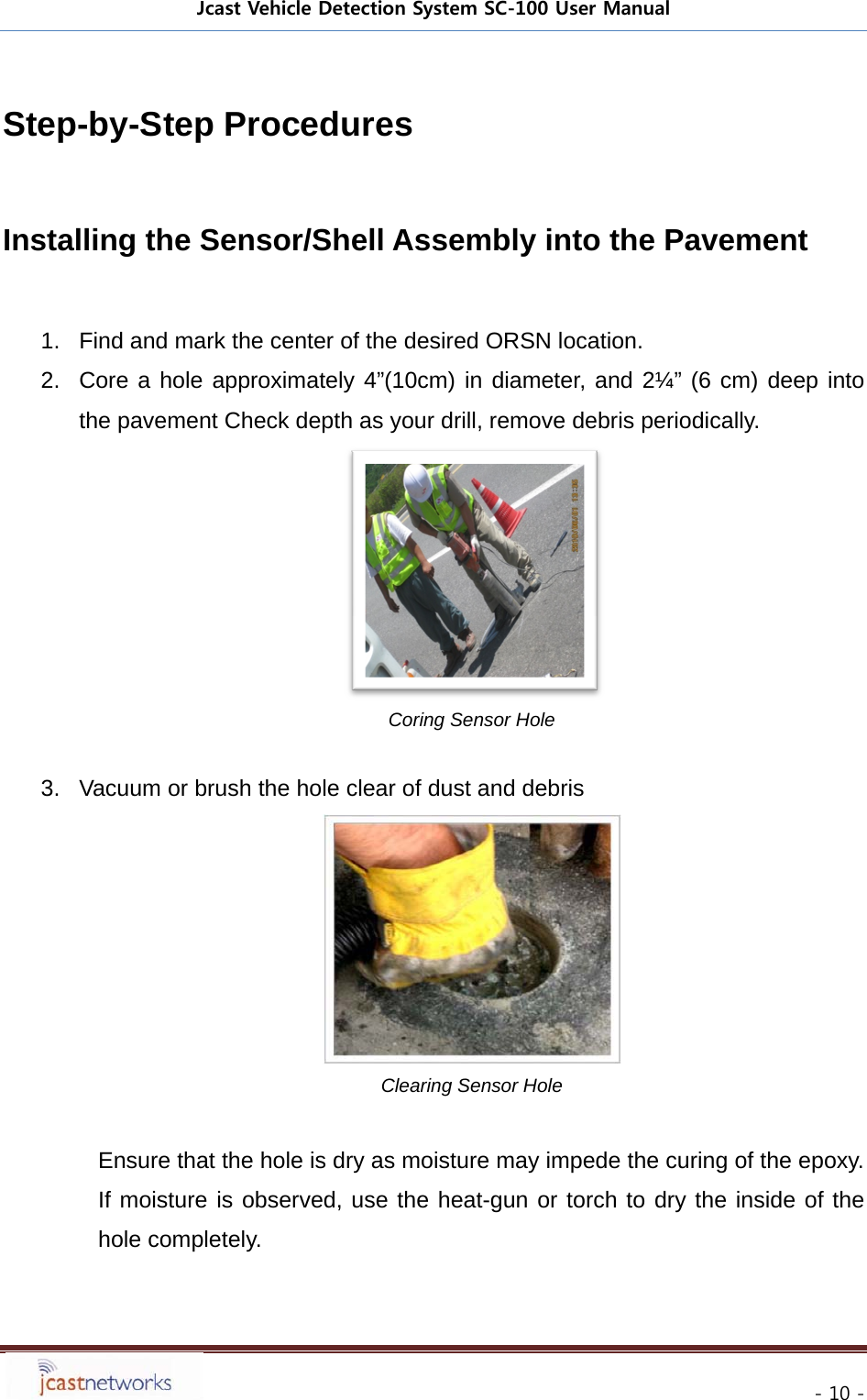
Jcast Vehicle Detection System SC-100 User Manual     - 10 - Step-by-Step Procedures  Installing the Sensor/Shell Assembly into the Pavement  1.  Find and mark the center of the desired ORSN location. 2.  Core a hole approximately 4”(10cm) in diameter, and 2¼” (6 cm) deep into the pavement Check depth as your drill, remove debris periodically.  Coring Sensor Hole  3.  Vacuum or brush the hole clear of dust and debris   Clearing Sensor Hole  Ensure that the hole is dry as moisture may impede the curing of the epoxy. If moisture is observed, use the heat-gun or torch to dry the inside of the hole completely.
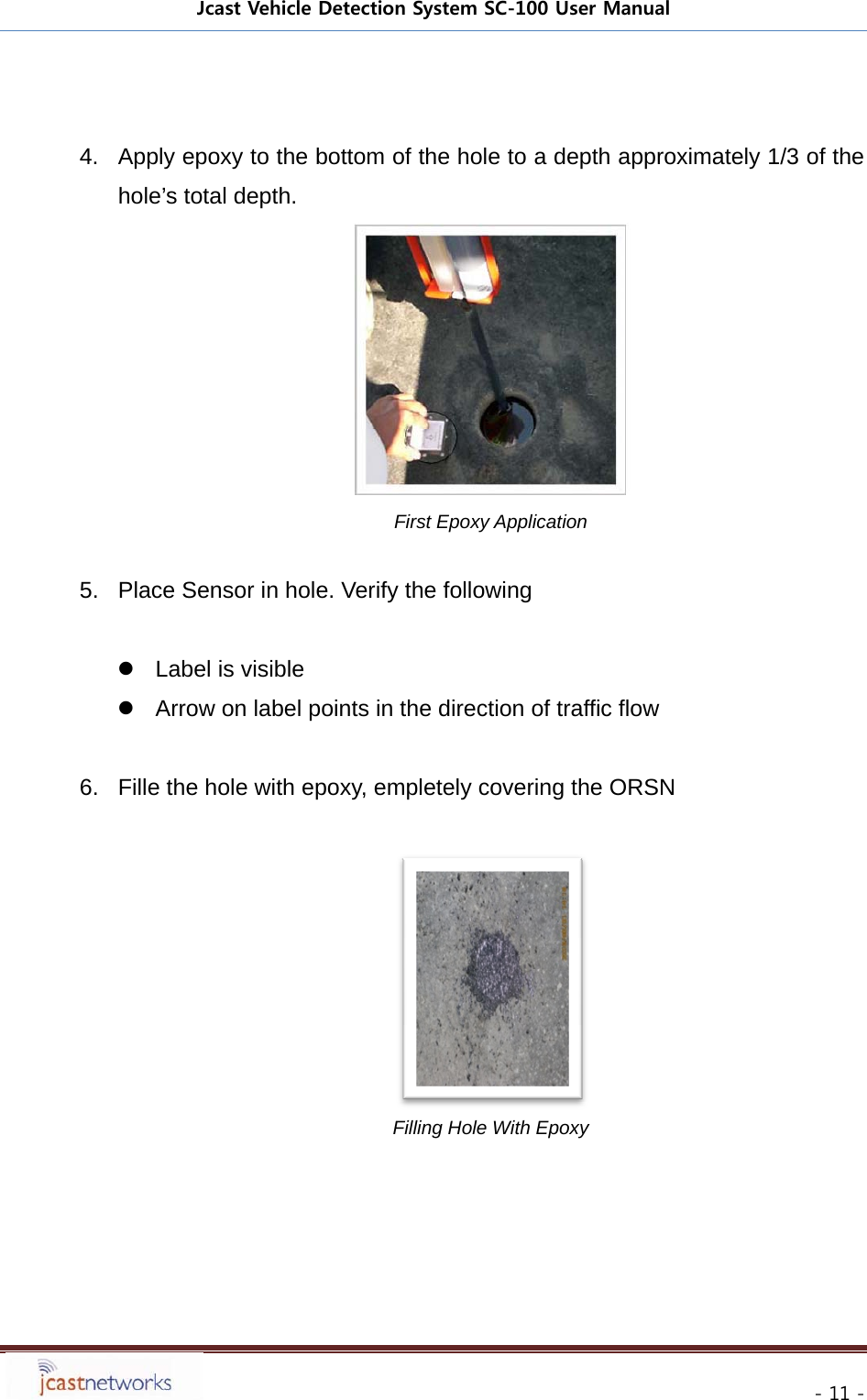
Jcast Vehicle Detection System SC-100 User Manual     - 11 -  4.  Apply epoxy to the bottom of the hole to a depth approximately 1/3 of the hole’s total depth.  First Epoxy Application  5.  Place Sensor in hole. Verify the following    Label is visible   Arrow on label points in the direction of traffic flow  6.  Fille the hole with epoxy, empletely covering the ORSN   Filling Hole With Epoxy
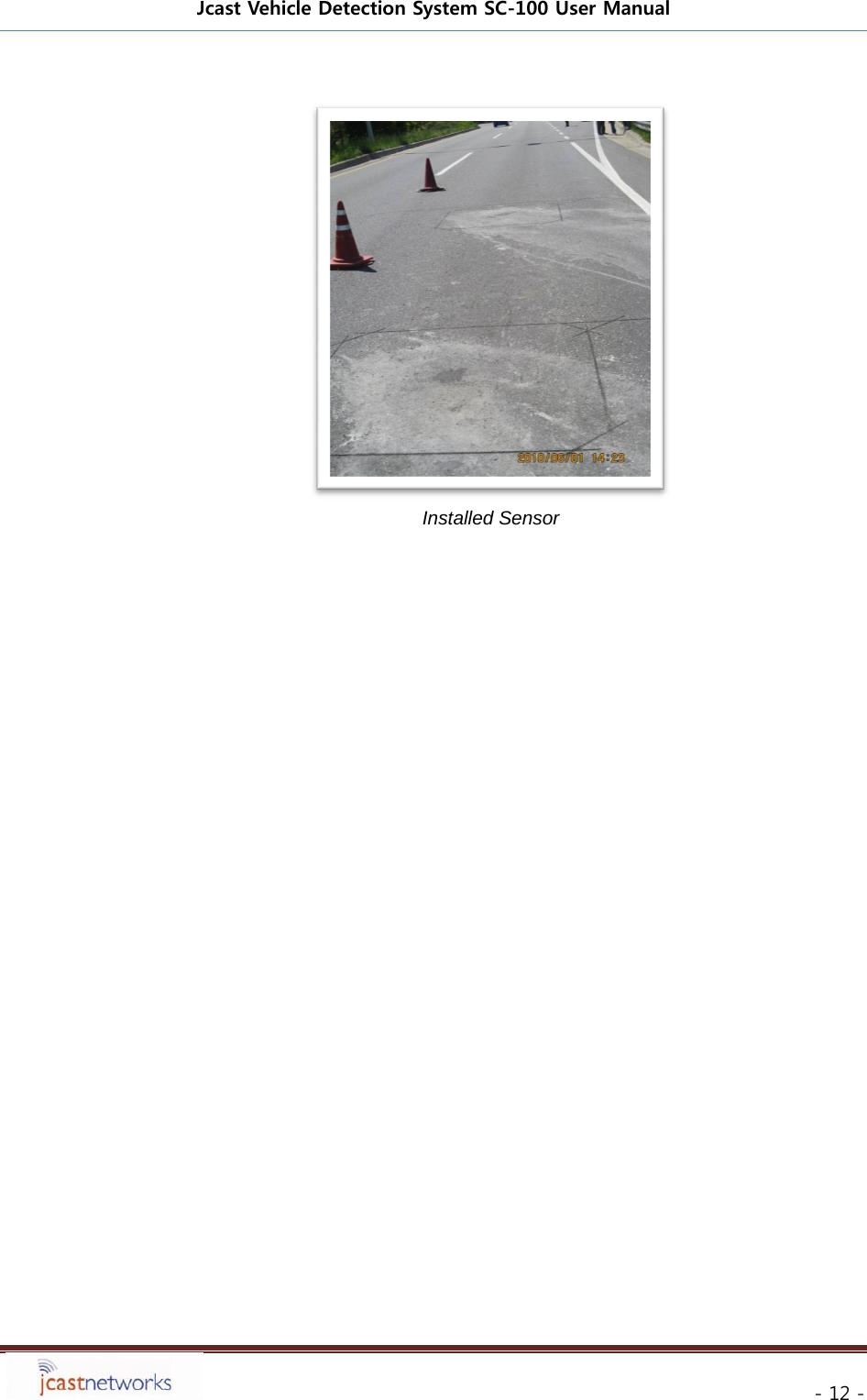
Jcast Vehicle Detection System SC-100 User Manual     - 12 -  Installed Sensor
FCC Statement  This device complies with Part 15 of the FCC Rules. Operation is subject to the f ollowing two conditions: (1) This device may not cause harmful interference. and   (2) This device must accept any interference received, including interference that may cause undesired operation.   Caution   Any changes or m odifications (including the  antenna) made to th is device tha t are no t expressly approved by the m anufacturer may void the user ’s authority to op erate the equipment.

Navigation menu