M2Communication MA903A1 Wireless AP Module_9 series User Manual MA903A1 FCC 20151021

M2Communication Inc. Wireless AP Module_9 series MA903A1 FCC 20151021

OEM Manual

MA903A1 Wireless AP Module_9 series  Copyright © by M2Communcation, Inc. All rights reserved. This document is the sole and exclusive property of M2Communication, Inc. Not to be distributed or divulged without prior written agreement. Feature Highlights Low supply operation: 2.4V –3.6VCompact size: 35.5mm x 37.5mm, ideal for embedded systemintegration such as access pointLow-power consumptionUsing M2C patented Platanus™platform for smart-networkingapplicationARM Cortex-M0 up to 32MHzclock rate, with embedded 128KB flash memory and 1MBSRAMFrequency range: 903~927MHzData bandwidth:  up to 500kbpsHigh receiver sensitivity: -96dBmat 500kbpsIntegrated power amplifier  up to11dBmPre-matched RF front-end,reducing design hasslesSupport UART and GPIOs asinterface with other LAN modulesin the embedded systemSupports 128-node “star” and16000-node “tree” networkinfrastructure.Applications Comply with FCC Part 15CInnovative turn-key solutionfor ultra-low power wirelesslinkRemote control systemsWireless sub-metering (plug)Home automationWireless sensor networkTelemedicine serviceWireless lighting controlSmart rack for logisticssystemDescriptions Overview MA903A1 is an easy-to-integrate Access Point embedded module for hosting ultra-low-power wireless-link application. With state-of-the-art PlatanusTM protocol and networking kit, large network (up to 16000 nodes) can be easily formed. Equipped with ISM-band RF operated at 868MHz/915MHz bands and popular ARM 32-bit MCU along with embedded flash memory and SRAM, MA903A1 is an ideal embedded solution for system integrator to develop wireless applications with no worry about design hassles, both wireless and networking.  Easy to Integrate and Use Designed as the embedded module, MA903A1 has only the board area of 35.5mm x 37.5mm, compact enough for most embedded system design. A pre-matched 50 ohm port is ready to be used with on-board or external antenna. The RF matched network is calibrated to optimize the RF performance when the module is shipped, saving the design hassles for application designers. There are total 50 stamp pads on MA903A1 with multiple digital interfaces: UART, GPIOs, and JTAGS. This brings the design flexibility to end applications that MA903A1 is easy to interface with other LAN modules. Through the robust wireless link, controlled/collected information from End Device (ME10WM010) can be easily sent to the upper application layers and devices.
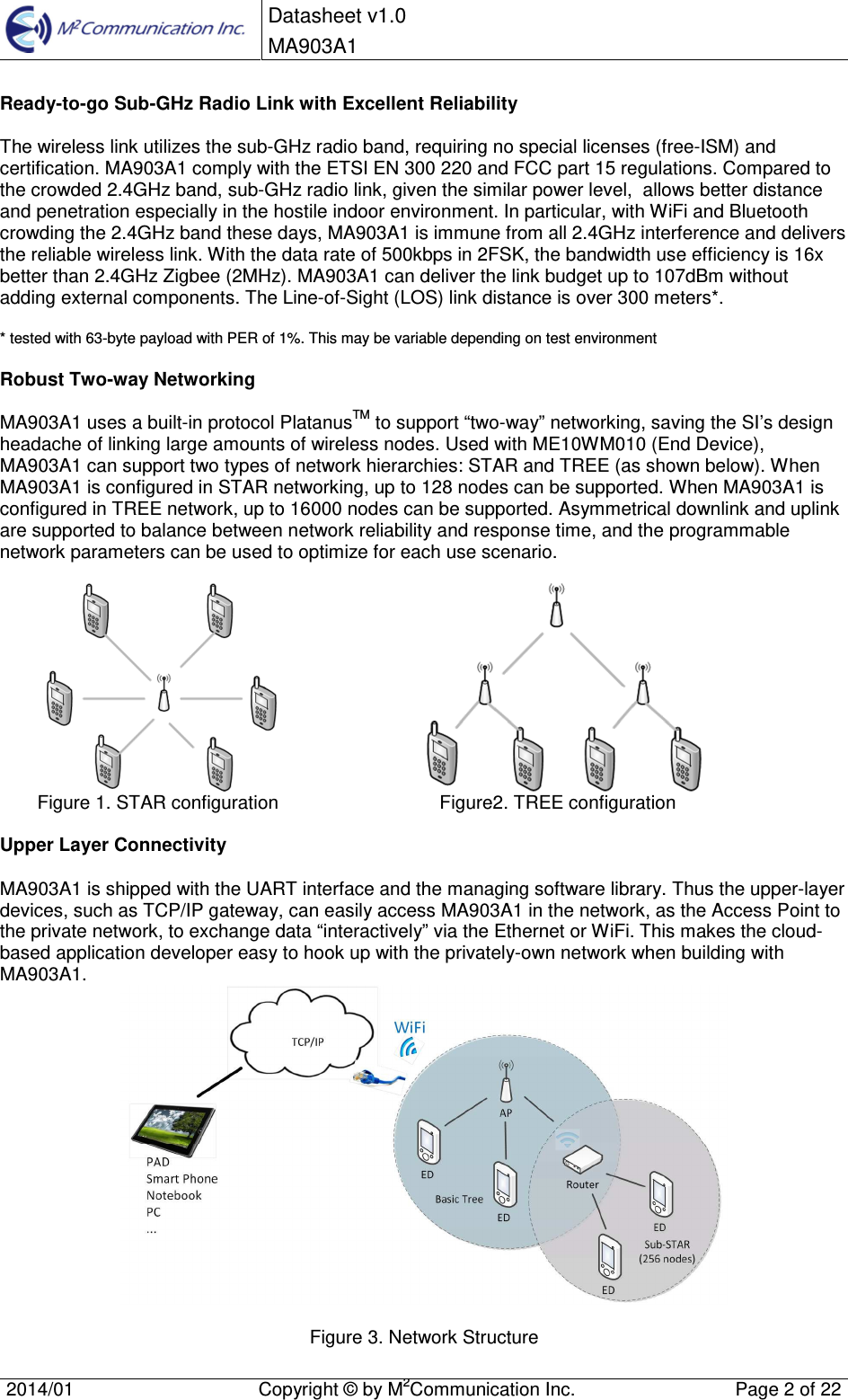
Datasheet v1.0 MA903A1 2014/01  Copyright © by M2Communication Inc.  Page 2 of 22 Ready-to-go Sub-GHz Radio Link with Excellent Reliability The wireless link utilizes the sub-GHz radio band, requiring no special licenses (free-ISM) and certification. MA903A1 comply with the ETSI EN 300 220 and FCC part 15 regulations. Compared to the crowded 2.4GHz band, sub-GHz radio link, given the similar power level,  allows better distance and penetration especially in the hostile indoor environment. In particular, with WiFi and Bluetooth crowding the 2.4GHz band these days, MA903A1 is immune from all 2.4GHz interference and delivers the reliable wireless link. With the data rate of 500kbps in 2FSK, the bandwidth use efficiency is 16x better than 2.4GHz Zigbee (2MHz). MA903A1 can deliver the link budget up to 107dBm without adding external components. The Line-of-Sight (LOS) link distance is over 300 meters*. * tested with 63-byte payload with PER of 1%. This may be variable depending on test environmentRobust Two-way Networking MA903A1 uses a built-in protocol PlatanusTM to support “two-way” networking, saving the SI’s design headache of linking large amounts of wireless nodes. Used with ME10WM010 (End Device), MA903A1 can support two types of network hierarchies: STAR and TREE (as shown below). When MA903A1 is configured in STAR networking, up to 128 nodes can be supported. When MA903A1 is configured in TREE network, up to 16000 nodes can be supported. Asymmetrical downlink and uplink are supported to balance between network reliability and response time, and the programmable network parameters can be used to optimize for each use scenario. Figure 1. STAR configuration   Figure2. TREE configuration Upper Layer Connectivity MA903A1 is shipped with the UART interface and the managing software library. Thus the upper-layer devices, such as TCP/IP gateway, can easily access MA903A1 in the network, as the Access Point to the private network, to exchange data “interactively” via the Ethernet or WiFi. This makes the cloud-based application developer easy to hook up with the privately-own network when building with MA903A1.  Figure 3. Network Structure
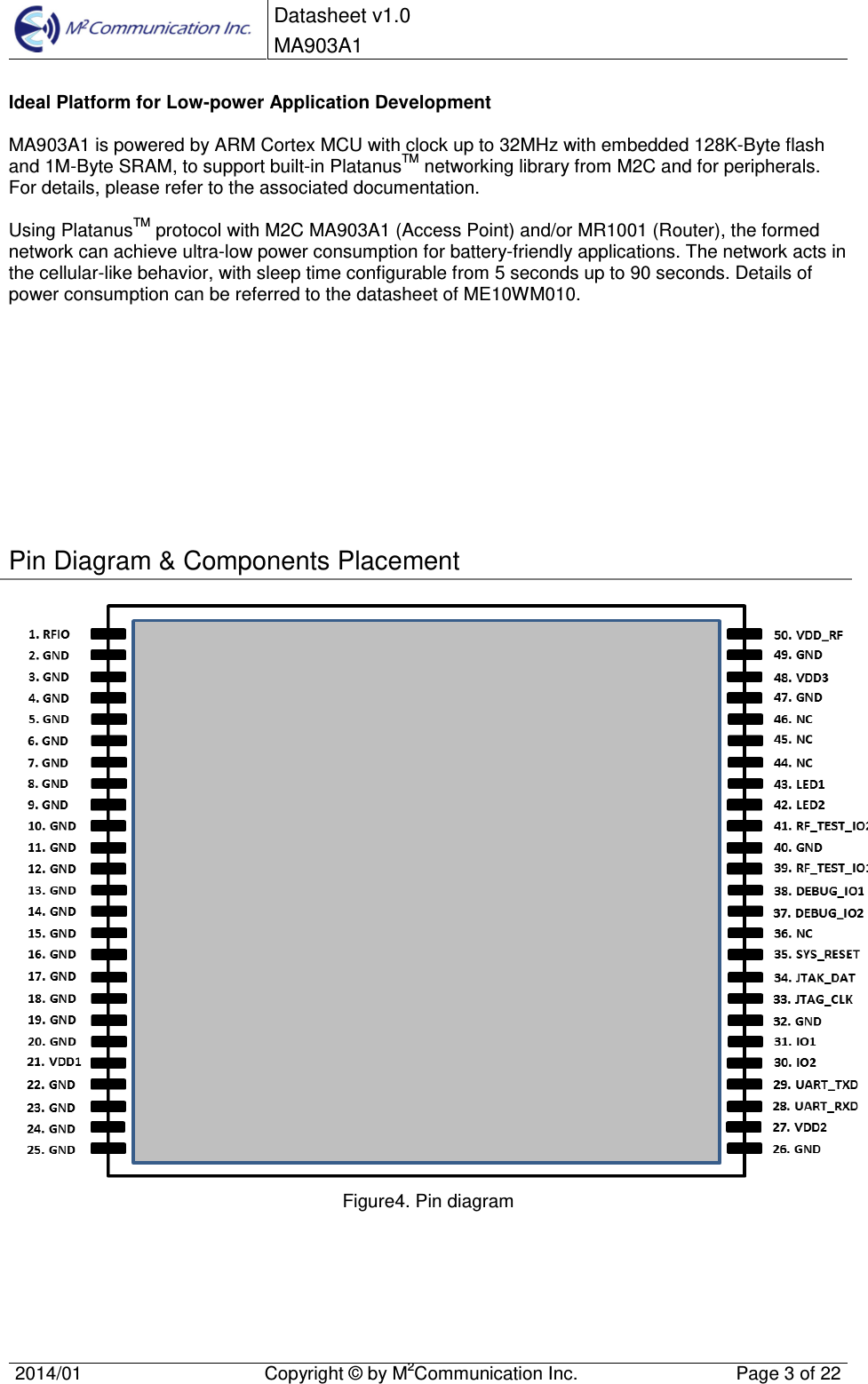
Datasheet v1.0 MA903A1 2014/01  Copyright © by M2Communication Inc.  Page 3 of 22 Ideal Platform for Low-power Application Development MA903A1 is powered by ARM Cortex MCU with clock up to 32MHz with embedded 128K-Byte flash and 1M-Byte SRAM, to support built-in PlatanusTM networking library from M2C and for peripherals. For details, please refer to the associated documentation.  Using PlatanusTM protocol with M2C MA903A1 (Access Point) and/or MR1001 (Router), the formed network can achieve ultra-low power consumption for battery-friendly applications. The network acts in the cellular-like behavior, with sleep time configurable from 5 seconds up to 90 seconds. Details of power consumption can be referred to the datasheet of ME10WM010. Pin Diagram & Components Placement Figure4. Pin diagram
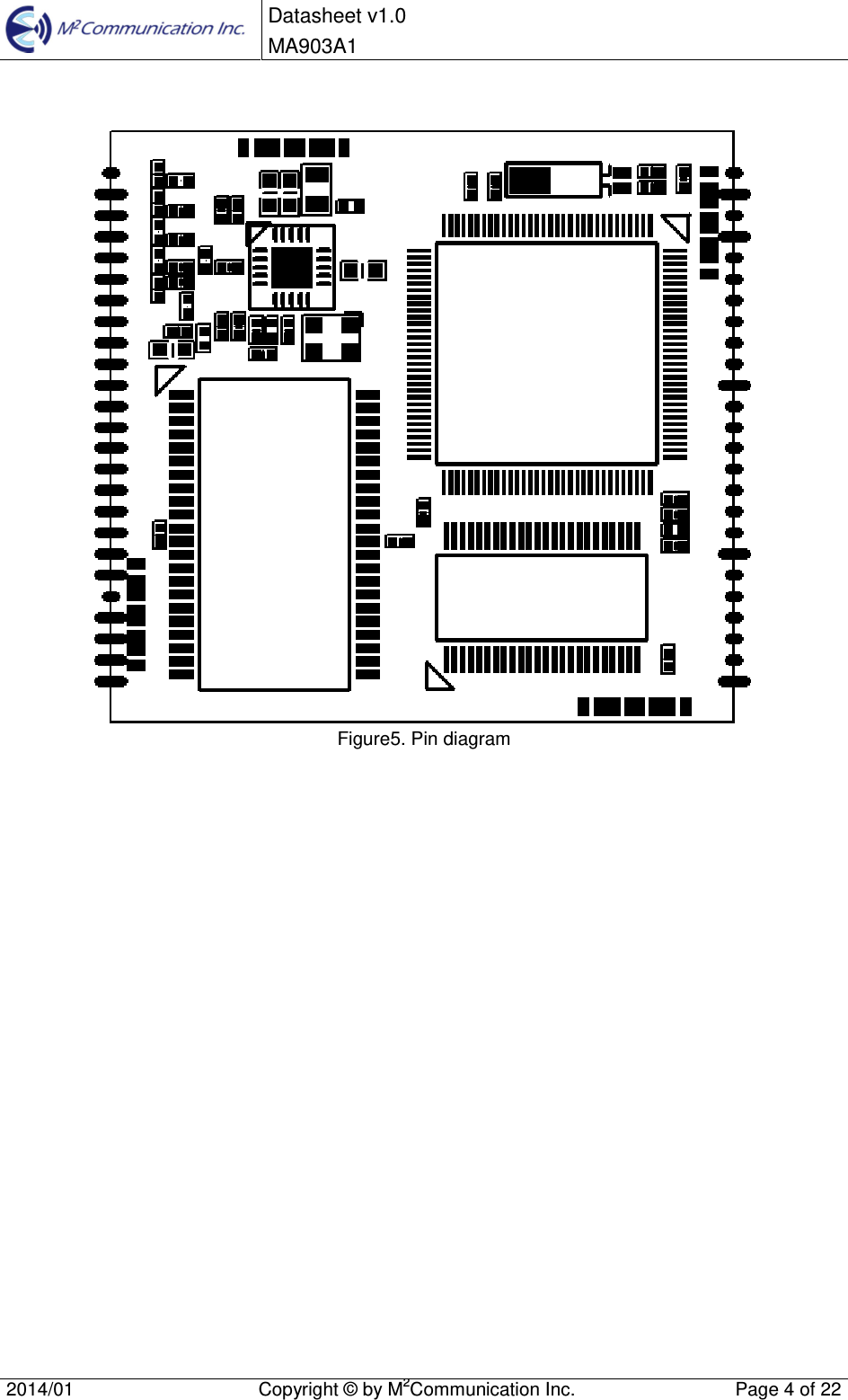
Datasheet v1.0 MA903A1 2014/01  Copyright © by M2Communication Inc.  Page 4 of 22 Figure5. Pin diagram
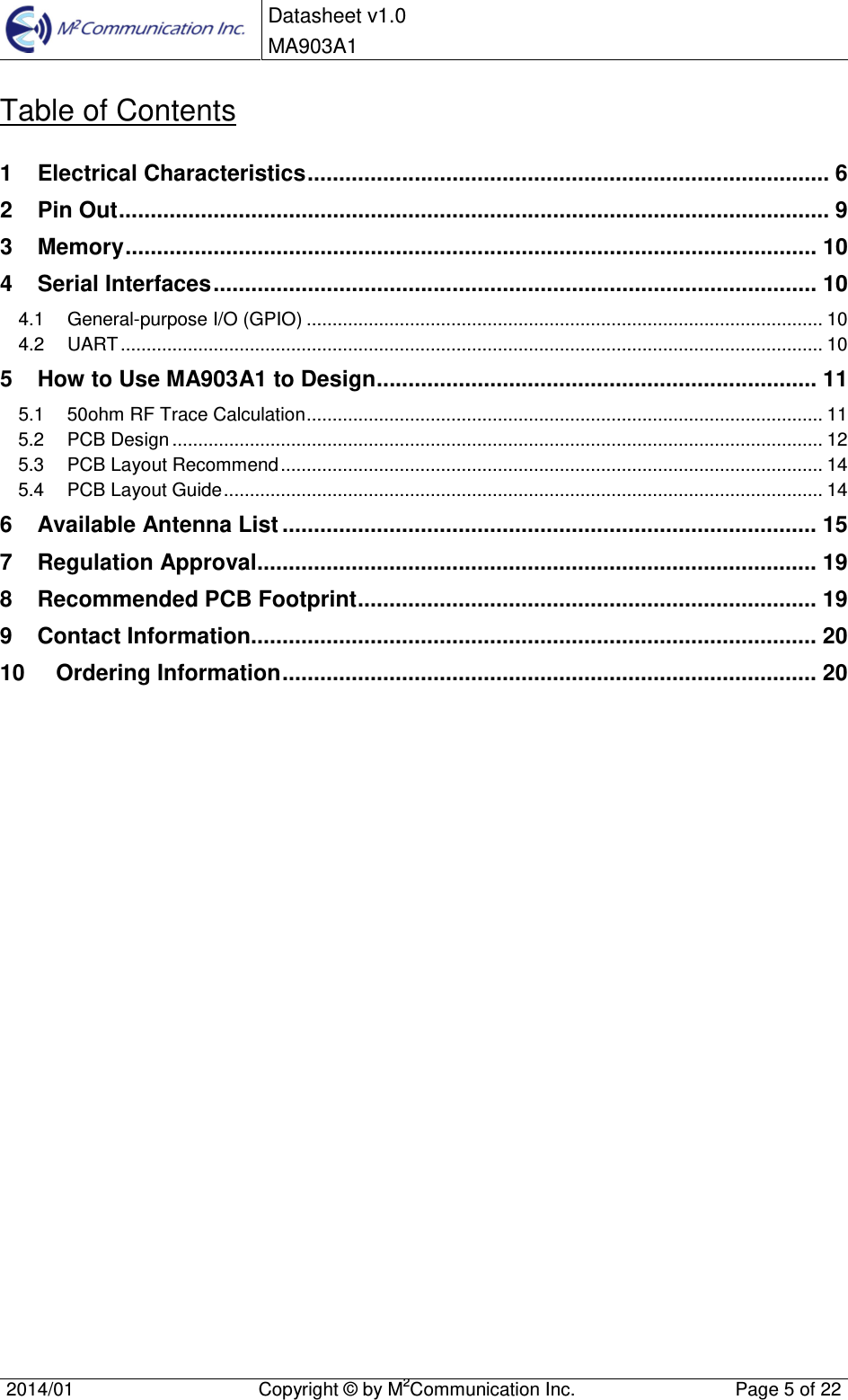
Datasheet v1.0 MA903A1 2014/01  Copyright © by M2Communication Inc.  Page 5 of 22 Table of Contents 1 Electrical Characteristics ................................................................................... 62 Pin Out ................................................................................................................. 93 Memory .............................................................................................................. 104 Serial Interfaces ................................................................................................ 104.1 General-purpose I/O (GPIO) .................................................................................................... 104.2 UART ........................................................................................................................................ 105 How to Use MA903A1 to Design ...................................................................... 115.1 50ohm RF Trace Calculation .................................................................................................... 115.2 PCB Design .............................................................................................................................. 125.3 PCB Layout Recommend ......................................................................................................... 145.4 PCB Layout Guide .................................................................................................................... 146 Available Antenna List ..................................................................................... 157 Regulation Approval......................................................................................... 198 Recommended PCB Footprint ......................................................................... 199 Contact Information.......................................................................................... 2010 Ordering Information ..................................................................................... 20
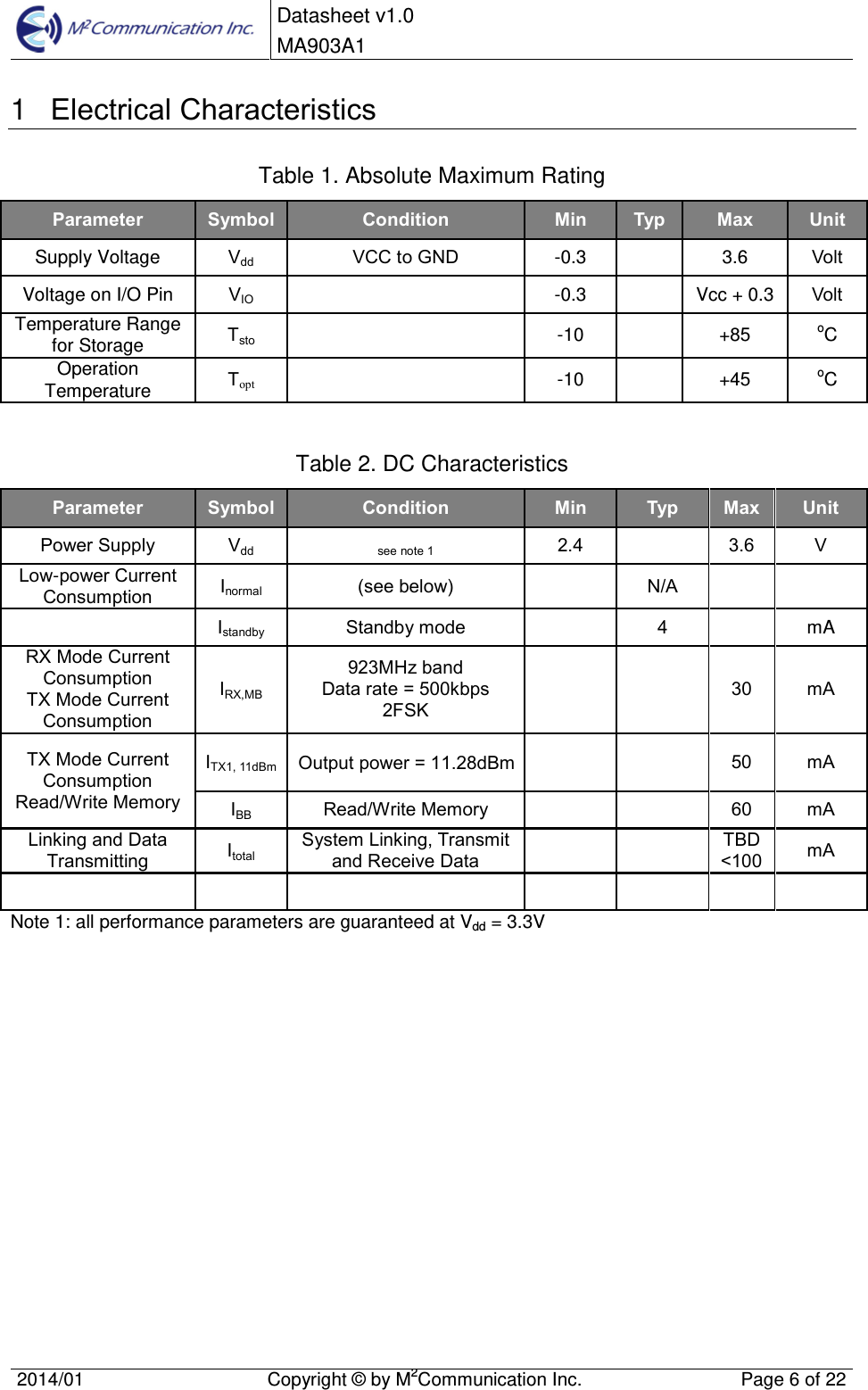
Datasheet v1.0 MA903A1 2014/01  Copyright © by M2Communication Inc.  Page 6 of 22 1  Electrical Characteristics Table 1. Absolute Maximum Rating Parameter Symbol Condition Min Typ Max UnitSupply Voltage  Vdd VCC to GND  -0.3  3.6  Volt Voltage on I/O Pin  VIO  -0.3  Vcc + 0.3 Volt Temperature Range for Storage  Tsto  -10  +85  oC Operation Temperature  Topt -10  +45  oC Table 2. DC Characteristics Parameter Symbol Condition Min Typ Max UnitPower Supply Vdd see note 1 2.4 3.6 V Low-power Current Consumption Inormal (see below) N/A Istandby Standby mode 4  mA RX Mode Current Consumption TX Mode Current Consumption IRX,MB 923MHz band Data rate = 500kbps 2FSK 30 mA TX Mode Current Consumption Read/Write Memory ITX1, 11dBm Output power = 11.28dBm 50 mA IBB Read/Write Memory 60 mA Linking and Data Transmitting Itotal System Linking, Transmit and Receive Data TBD <100 mA Note 1: all performance parameters are guaranteed at Vdd = 3.3V
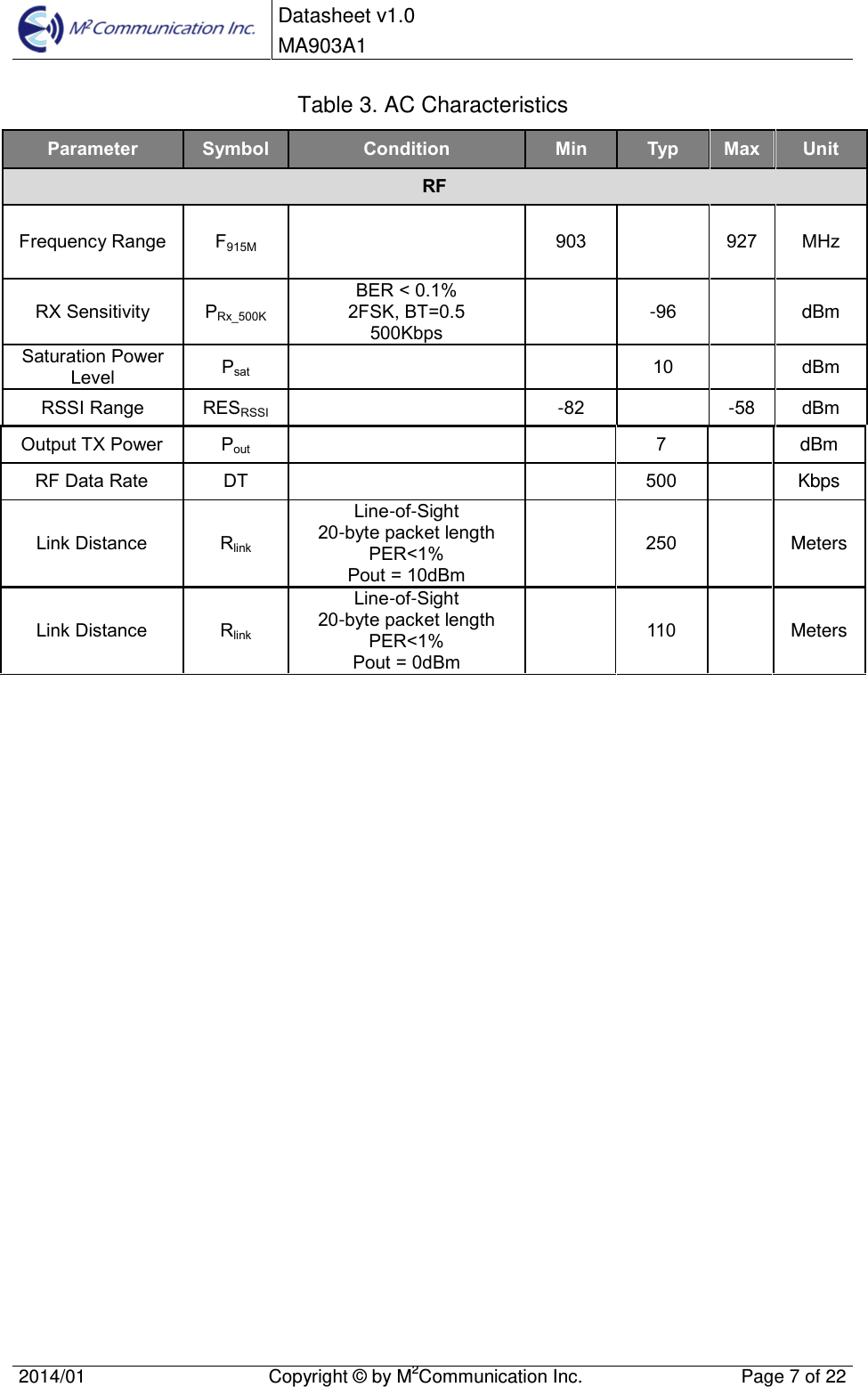
Datasheet v1.0 MA903A1 2014/01  Copyright © by M2Communication Inc.  Page 7 of 22 Table 3. AC Characteristics Parameter Symbol Condition Min Typ Max UnitRFFrequency Range F915M 903 927 MHz RX Sensitivity PRx_500KBER < 0.1% 2FSK, BT=0.5 500Kbps -96  dBm Saturation Power Level Psat 10 dBm RSSI Range RESRSSI  -82  -58 dBm Output TX Power Pout 7  dBm RF Data Rate DT 500  Kbps Link Distance Rlink Line-of-Sight 20-byte packet length PER<1% Pout = 10dBm 250  Meters Link Distance Rlink Line-of-Sight 20-byte packet length PER<1% Pout = 0dBm 110  Meters
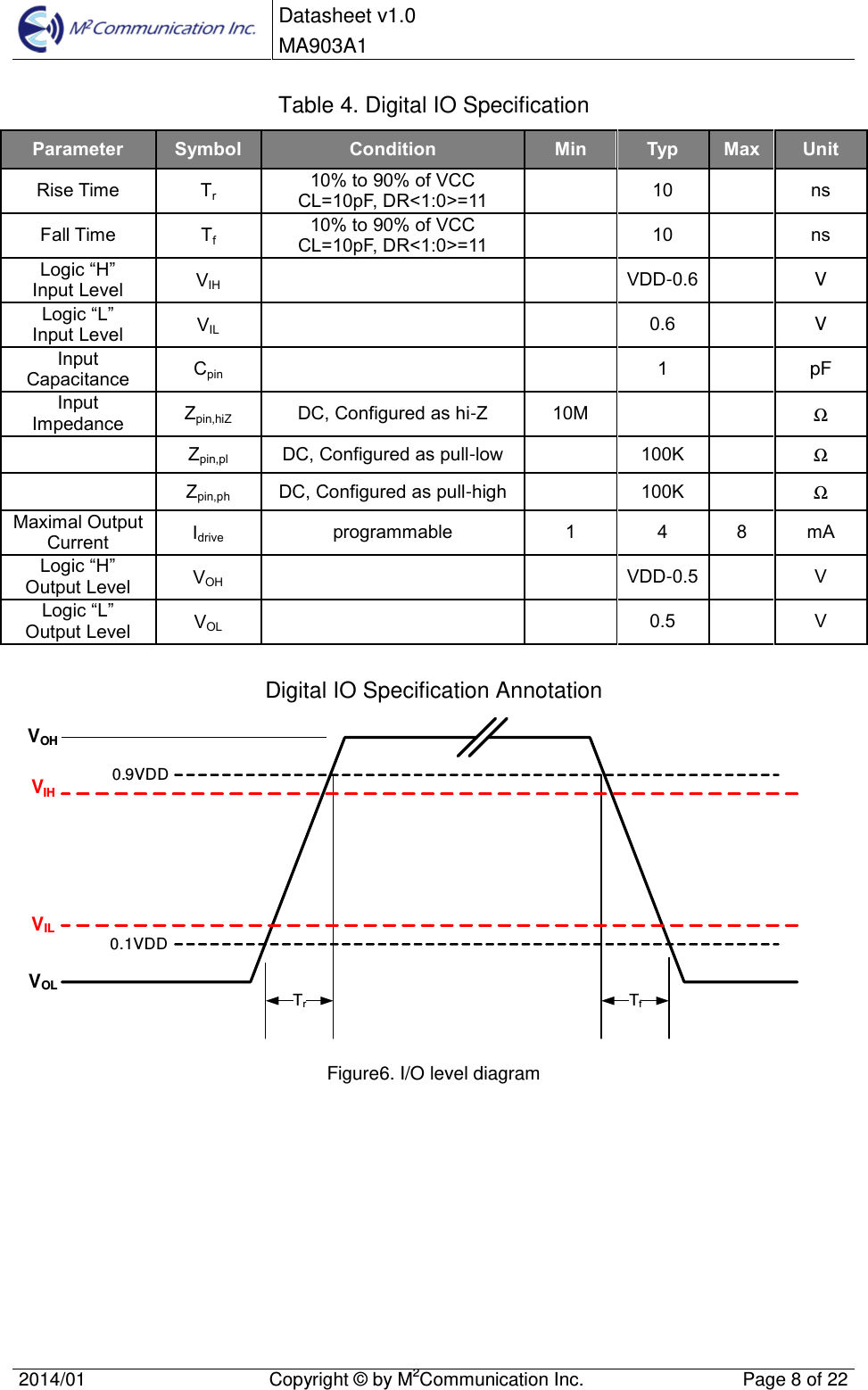
Datasheet v1.0 MA903A1 2014/01  Copyright © by M2Communication Inc.  Page 8 of 22 Table 4. Digital IO Specification Parameter Symbol Condition Min Typ Max UnitRise Time Tr 10% to 90% of VCC CL=10pF, DR<1:0>=11 10 ns Fall Time Tf 10% to 90% of VCC CL=10pF, DR<1:0>=11 10 ns Logic “H” Input Level VIH VDD-0.6 V Logic “L” Input Level VIL 0.6  V Input Capacitance Cpin 1  pF Input Impedance Zpin,hiZ DC, Configured as hi-Z 10M Ω Zpin,pl DC, Configured as pull-low 100K Ω Zpin,ph DC, Configured as pull-high 100K Ω Maximal Output Current Idrive programmable 1 4 8 mA Logic “H” Output Level VOH VDD-0.5 V Logic “L” Output Level VOL 0.5 V Digital IO Specification Annotation 0.9VDD0.1VDDTrTfVIHVILVOHVOLFigure6. I/O level diagram
 Datasheet v1.0 MA903A1    2014/01  Copyright © by M2Communication Inc.  Page 9 of 22   2  Pin Out All VDDs are rated from 2.4V to 3.6V.  Pin #  Pin Name  Description  Type[1] I/O/PWR 1  RFIO  RF Signal 50 ohm  IO  RF 2~20, 22~26, 32, 40, 47, 49 GND  Board ground  G  0 21  VDD1  Module Power Input. 2.4V~3.6V VDD1+VDD2+VDD3+VDD_RF 150mA Requirement P  PWR 27  VDD2  Module Power Input. 2.4V~3.6V VDD1+VDD2+VDD3+VDD_RF 150mA Requirement P  PWR 28  UART_RXD  UART_RXD, Baud Rate = 460.8kbps  D/A  IO 29  UART_TXD  UART_TXD, Baud Rate = 460.8kbps  D/A  IO 30  IO2  GPIO  D  IO 31  IO1  GPIO  D  IO 33  JTAG_CLK  ICE CLK (debugger)  D  I 34  JTAG_DAT  ICE DATA IN (debugger)  D  IO 35  SYS_RESET  External reset input, No need RC Delay [2]  SYS  SYS 36, 44~46  NC  No Connection 37  DEBUG_IO2  Debug UART_TXD, No connection  D  O 38  DEBUG_IO1  Debug UART_RXD, No connection  D  I 39  RF_TEST_IO1  RF Test Pin Data_Out, No connection  D  O 41  RF_TEST_IO2  RF Test Pin CLK_Out, No connection  D  O 42  LED2  LED Index, Driver current 3mA  D  IO 43  LED1  LED Index, Driver current 3mA  D  IO 48  VDD3  Module Power Input. 2.4V~3.6V VDD1+VDD2+VDD3+VDD_RF 150mA Requirement P  PWR 50  VDD_RF  Module Power Input. 2.4V~3.6V VDD1+VDD2+VDD3+VDD_RF 150mA Requirement P  PWR [1] D=digital, A=analog, P=power, G=ground [2] Set this pin low reset chip to initial state, with internal pull-up [3] External interrupt input
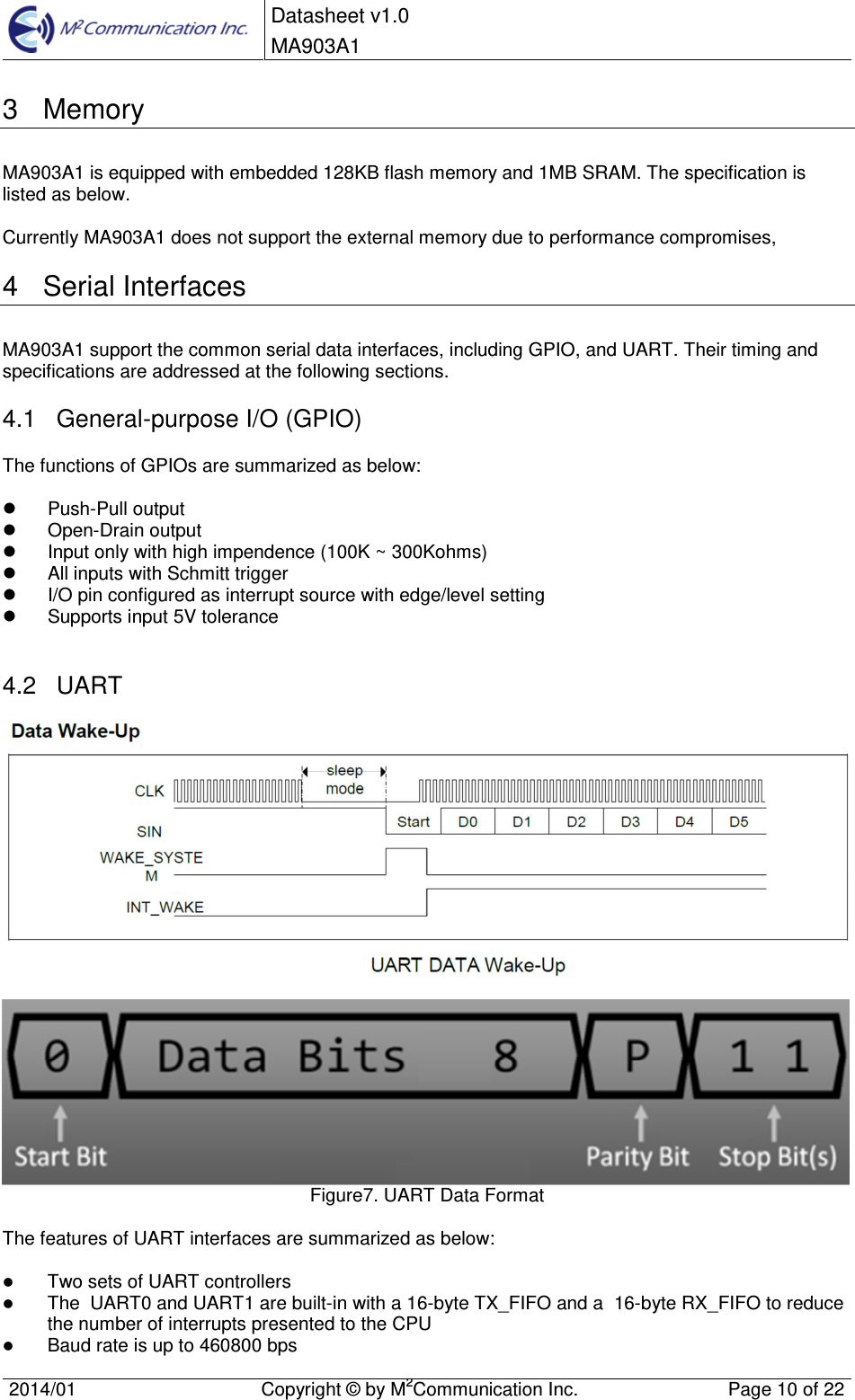
 Datasheet v1.0 MA903A1    2014/01  Copyright © by M2Communication Inc.  Page 10 of 22   3  Memory MA903A1 is equipped with embedded 128KB flash memory and 1MB SRAM. The specification is listed as below.  Currently MA903A1 does not support the external memory due to performance compromises, 4  Serial Interfaces MA903A1 support the common serial data interfaces, including GPIO, and UART. Their timing and specifications are addressed at the following sections. 4.1  General-purpose I/O (GPIO) The functions of GPIOs are summarized as below:    Push-Pull output   Open-Drain output   Input only with high impendence (100K ~ 300Kohms)   All inputs with Schmitt trigger   I/O pin configured as interrupt source with edge/level setting   Supports input 5V tolerance  4.2  UART    Figure7. UART Data Format  The features of UART interfaces are summarized as below:   Two sets of UART controllers  The  UART0 and UART1 are built-in with a 16-byte TX_FIFO and a  16-byte RX_FIFO to reduce  the number of interrupts presented to the CPU  Baud rate is up to 460800 bps
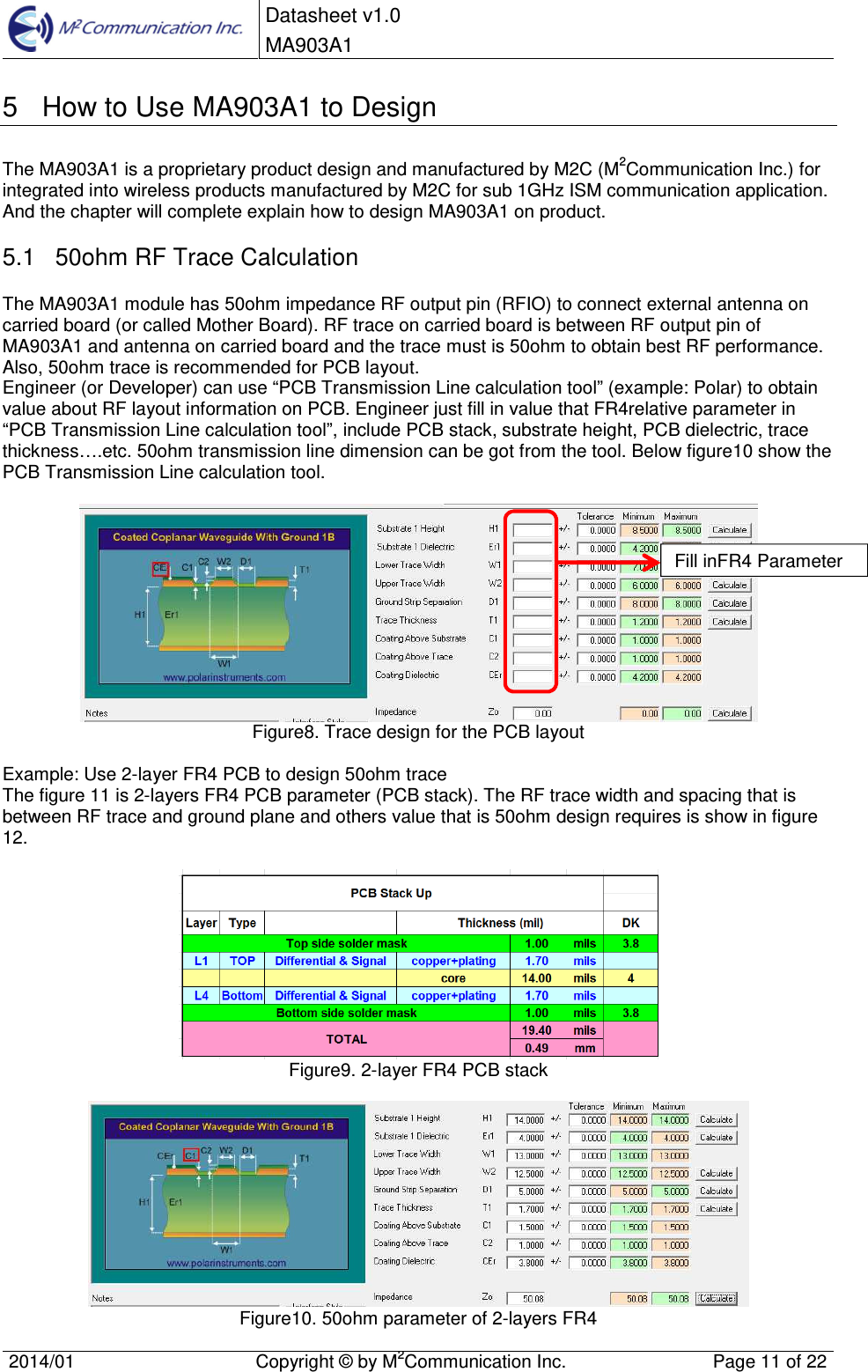
 Datasheet v1.0 MA903A1    2014/01  Copyright © by M2Communication Inc.  Page 11 of 22   5  How to Use MA903A1 to Design The MA903A1 is a proprietary product design and manufactured by M2C (M2Communication Inc.) for integrated into wireless products manufactured by M2C for sub 1GHz ISM communication application. And the chapter will complete explain how to design MA903A1 on product. 5.1  50ohm RF Trace Calculation The MA903A1 module has 50ohm impedance RF output pin (RFIO) to connect external antenna on carried board (or called Mother Board). RF trace on carried board is between RF output pin of MA903A1 and antenna on carried board and the trace must is 50ohm to obtain best RF performance. Also, 50ohm trace is recommended for PCB layout. Engineer (or Developer) can use “PCB Transmission Line calculation tool” (example: Polar) to obtain value about RF layout information on PCB. Engineer just fill in value that FR4relative parameter in “PCB Transmission Line calculation tool”, include PCB stack, substrate height, PCB dielectric, trace thickness….etc. 50ohm transmission line dimension can be got from the tool. Below figure10 show the PCB Transmission Line calculation tool.   Figure8. Trace design for the PCB layout  Example: Use 2-layer FR4 PCB to design 50ohm trace  The figure 11 is 2-layers FR4 PCB parameter (PCB stack). The RF trace width and spacing that is between RF trace and ground plane and others value that is 50ohm design requires is show in figure 12.     Figure9. 2-layer FR4 PCB stack   Figure10. 50ohm parameter of 2-layers FR4  Fill inFR4 Parameter
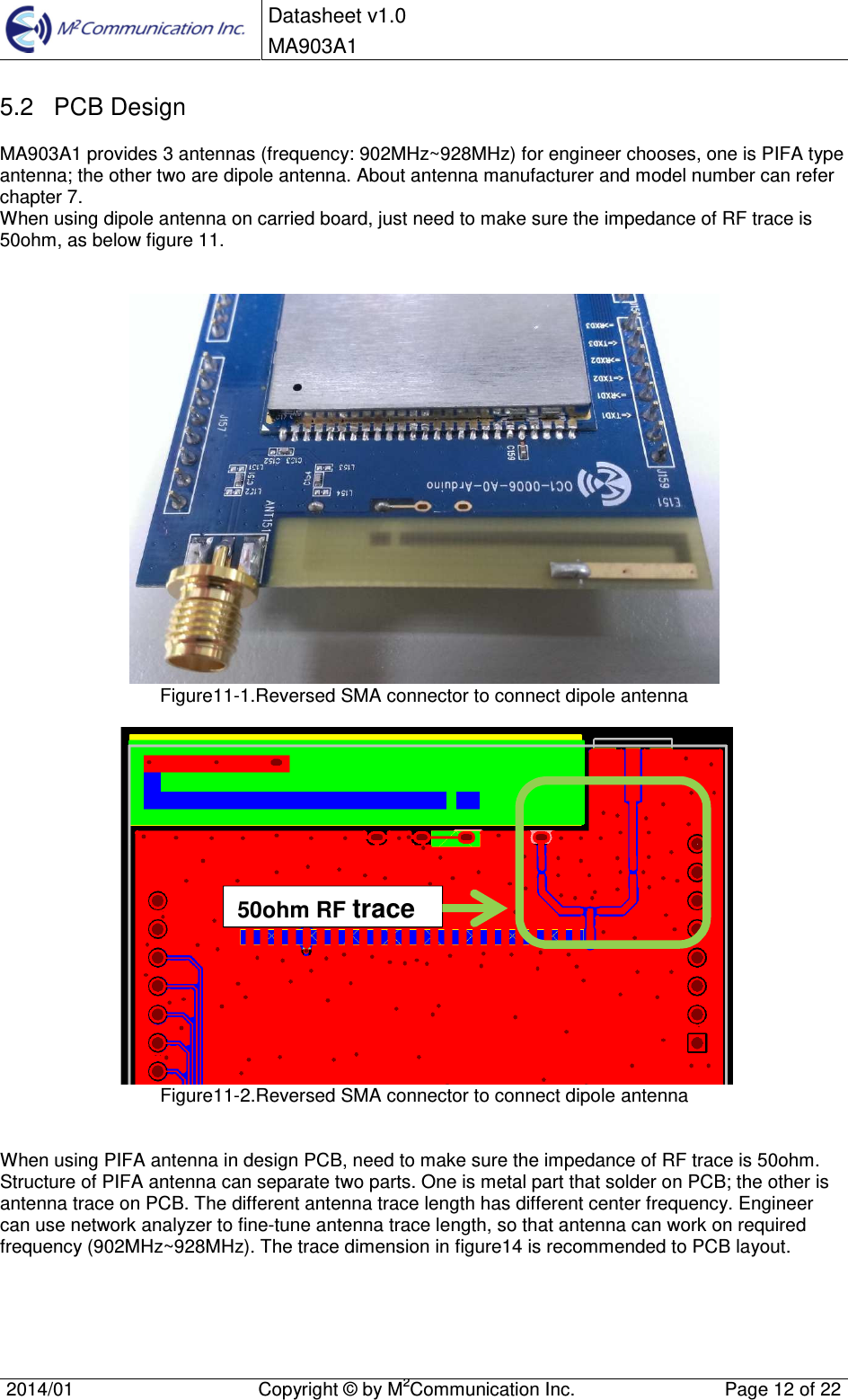
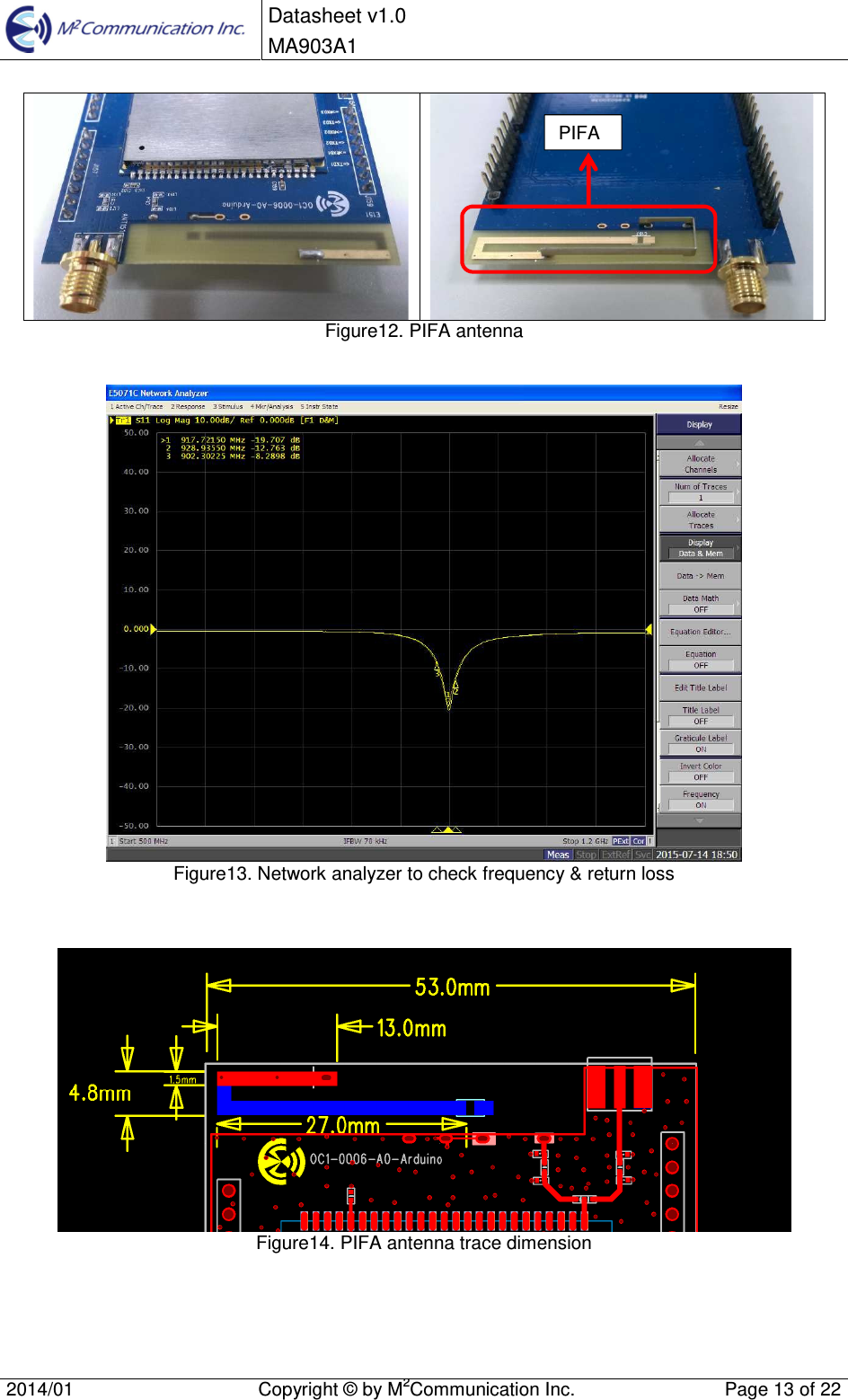
 Datasheet v1.0 MA903A1    2014/01  Copyright © by M2Communication Inc.  Page 12 of 22   5.2  PCB Design MA903A1 provides 3 antennas (frequency: 902MHz~928MHz) for engineer chooses, one is PIFA type antenna; the other two are dipole antenna. About antenna manufacturer and model number can refer chapter 7. When using dipole antenna on carried board, just need to make sure the impedance of RF trace is 50ohm, as below figure 11.    Figure11-1.Reversed SMA connector to connect dipole antenna     Figure11-2.Reversed SMA connector to connect dipole antenna   When using PIFA antenna in design PCB, need to make sure the impedance of RF trace is 50ohm. Structure of PIFA antenna can separate two parts. One is metal part that solder on PCB; the other is antenna trace on PCB. The different antenna trace length has different center frequency. Engineer can use network analyzer to fine-tune antenna trace length, so that antenna can work on required frequency (902MHz~928MHz). The trace dimension in figure14 is recommended to PCB layout.  50ohm RF trace
 Datasheet v1.0 MA903A1    2014/01  Copyright © by M2Communication Inc.  Page 13 of 22     Figure12. PIFA antenna    Figure13. Network analyzer to check frequency & return loss     Figure14. PIFA antenna trace dimension   PIFA
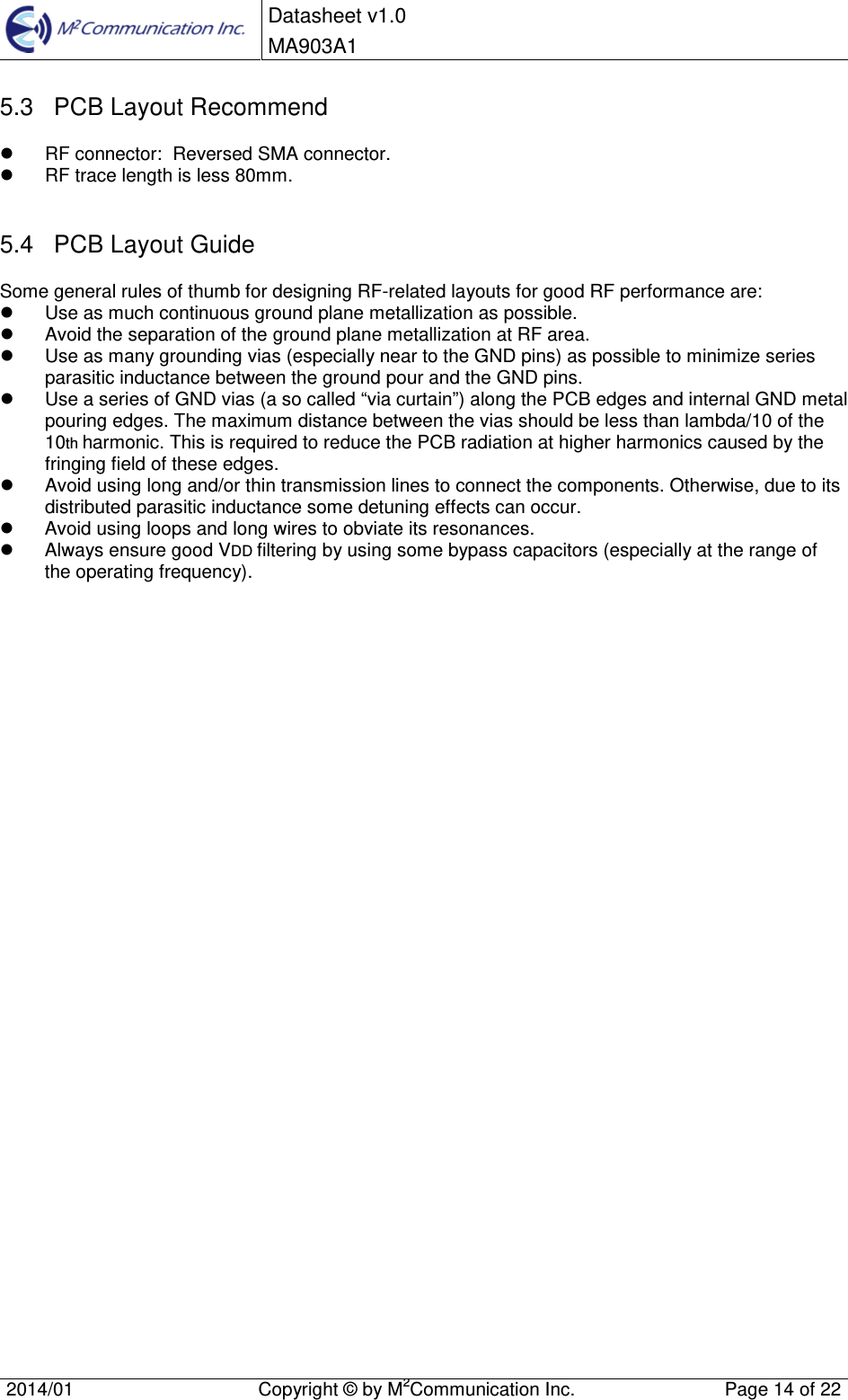
 Datasheet v1.0 MA903A1    2014/01  Copyright © by M2Communication Inc.  Page 14 of 22   5.3  PCB Layout Recommend   RF connector:  Reversed SMA connector.   RF trace length is less 80mm.  5.4  PCB Layout Guide Some general rules of thumb for designing RF-related layouts for good RF performance are:   Use as much continuous ground plane metallization as possible.   Avoid the separation of the ground plane metallization at RF area.   Use as many grounding vias (especially near to the GND pins) as possible to minimize series parasitic inductance between the ground pour and the GND pins.   Use a series of GND vias (a so called “via curtain”) along the PCB edges and internal GND metal pouring edges. The maximum distance between the vias should be less than lambda/10 of the 10th harmonic. This is required to reduce the PCB radiation at higher harmonics caused by the fringing field of these edges.   Avoid using long and/or thin transmission lines to connect the components. Otherwise, due to its distributed parasitic inductance some detuning effects can occur.   Avoid using loops and long wires to obviate its resonances.   Always ensure good VDD filtering by using some bypass capacitors (especially at the range of the operating frequency).
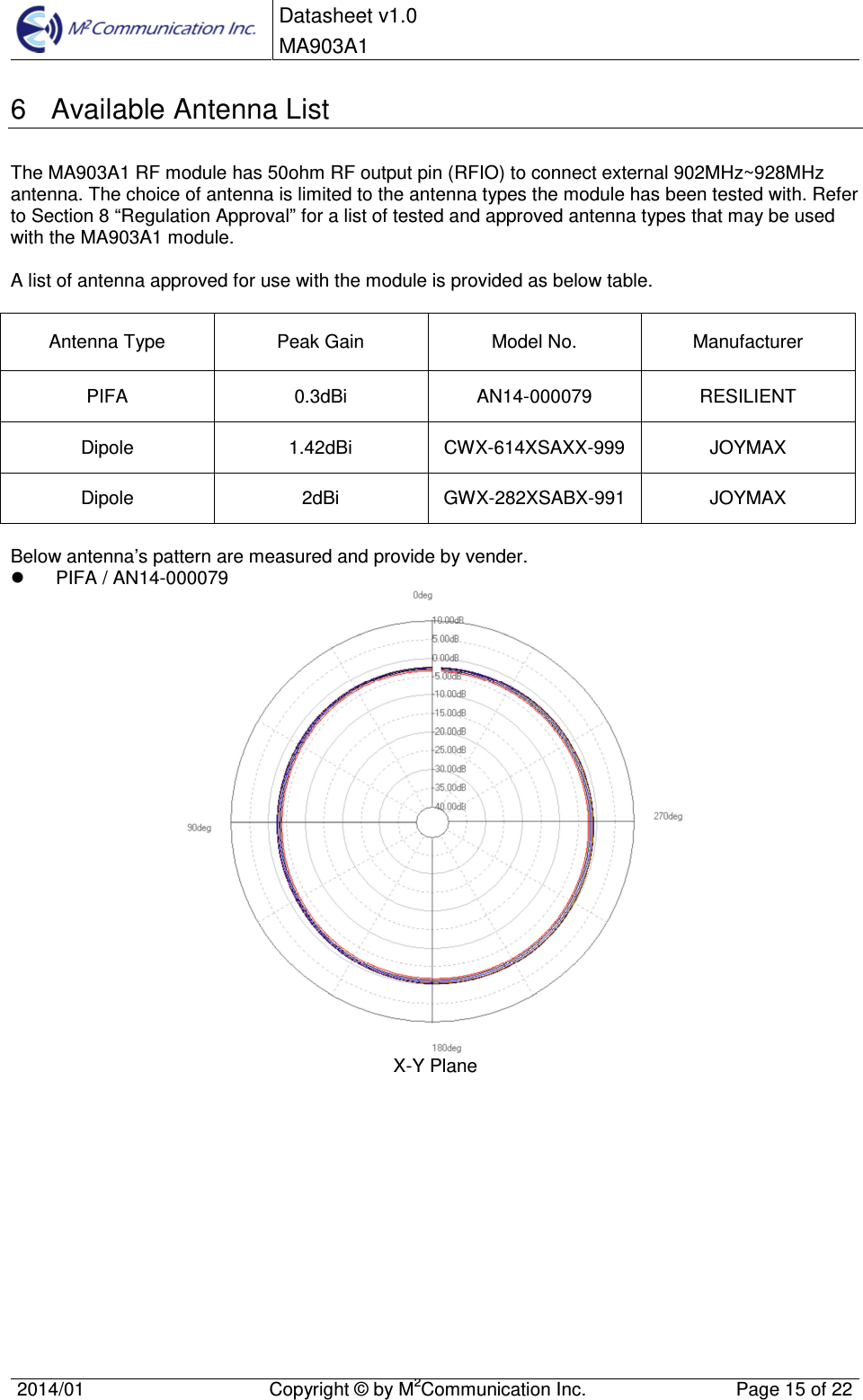
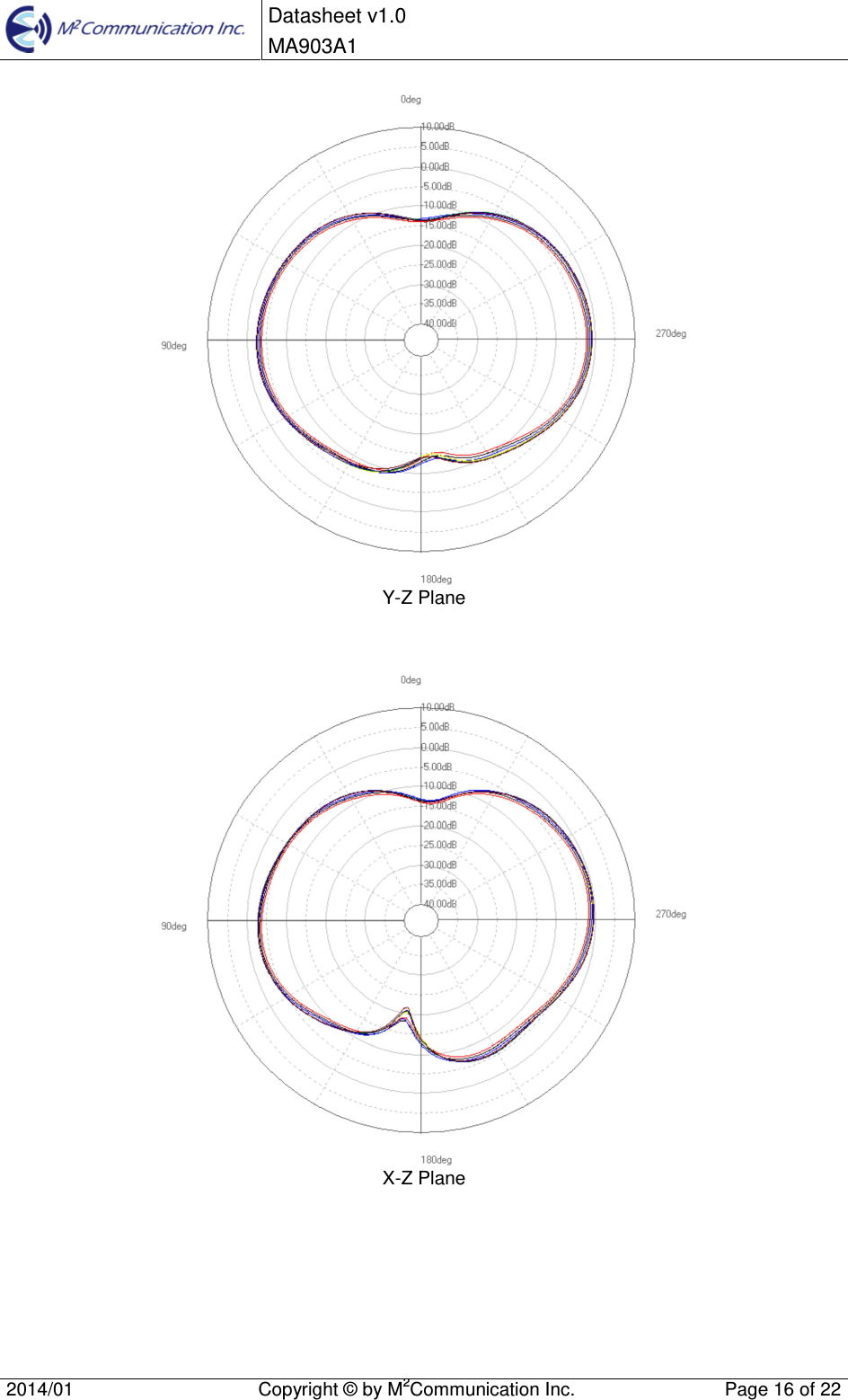
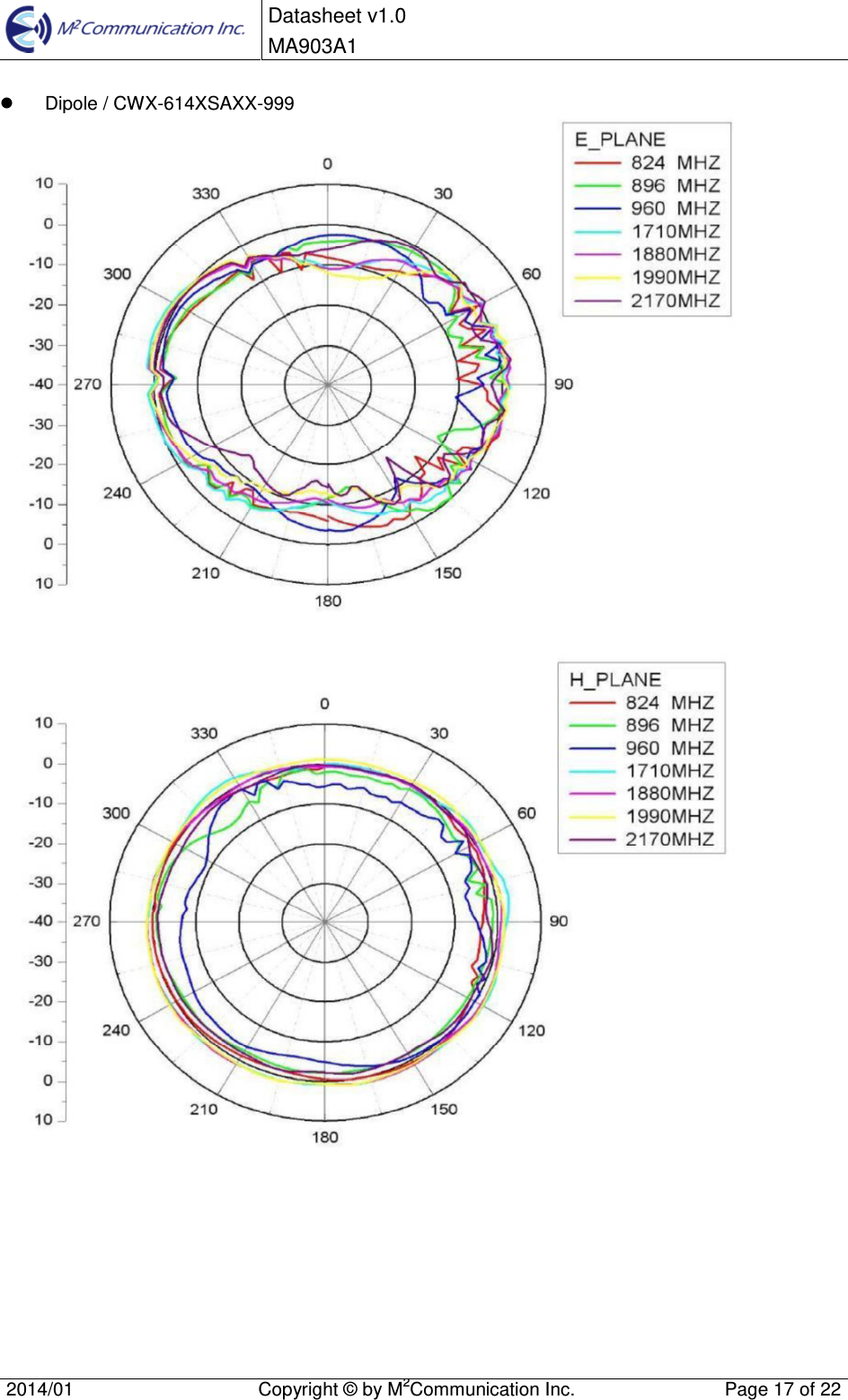
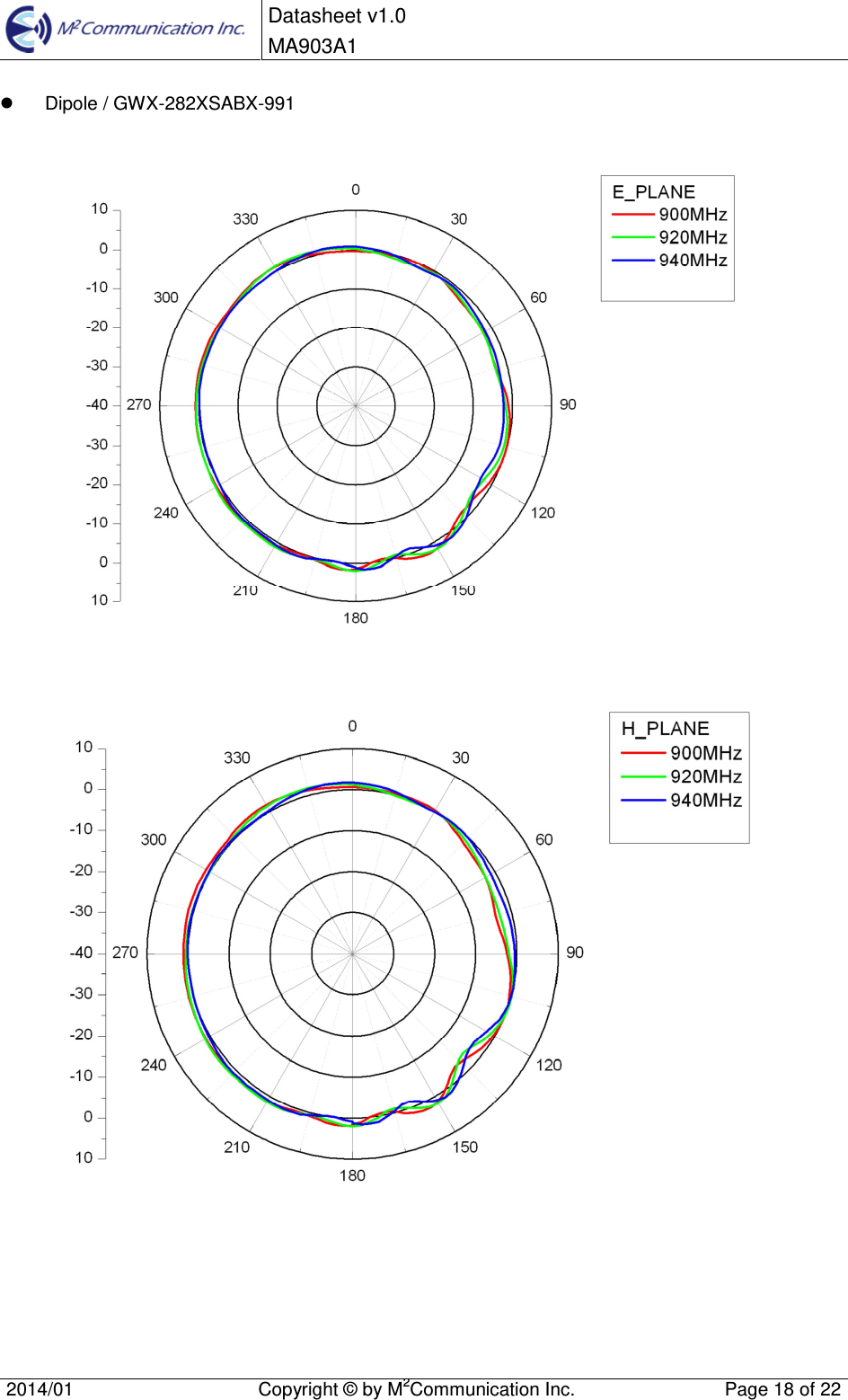
 Datasheet v1.0 MA903A1    2014/01  Copyright © by M2Communication Inc.  Page 15 of 22   6  Available Antenna List The MA903A1 RF module has 50ohm RF output pin (RFIO) to connect external 902MHz~928MHz antenna. The choice of antenna is limited to the antenna types the module has been tested with. Refer to Section 8 “Regulation Approval” for a list of tested and approved antenna types that may be used with the MA903A1 module.  A list of antenna approved for use with the module is provided as below table.  Antenna Type  Peak Gain  Model No.  Manufacturer PIFA  0.3dBi  AN14-000079  RESILIENT Dipole  1.42dBi  CWX-614XSAXX-999 JOYMAX Dipole  2dBi  GWX-282XSABX-991 JOYMAX  Below antenna’s pattern are measured and provide by vender.   PIFA / AN14-000079  X-Y Plane
 Datasheet v1.0 MA903A1    2014/01  Copyright © by M2Communication Inc.  Page 16 of 22    Y-Z Plane     X-Z Plane
 Datasheet v1.0 MA903A1    2014/01  Copyright © by M2Communication Inc.  Page 17 of 22     Dipole / CWX-614XSAXX-999
 Datasheet v1.0 MA903A1    2014/01  Copyright © by M2Communication Inc.  Page 18 of 22     Dipole / GWX-282XSABX-991
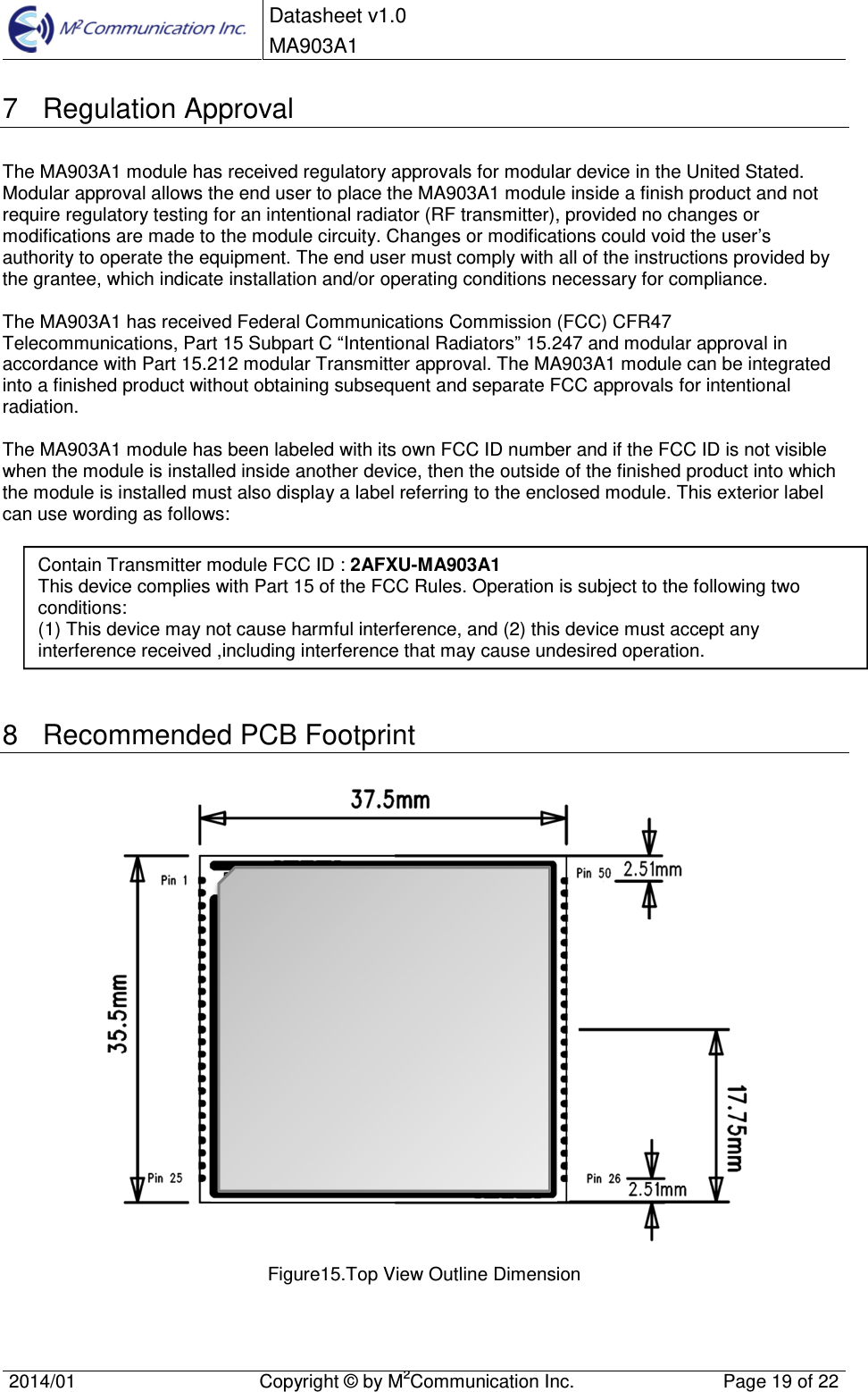
 Datasheet v1.0 MA903A1    2014/01  Copyright © by M2Communication Inc.  Page 19 of 22   7  Regulation Approval The MA903A1 module has received regulatory approvals for modular device in the United Stated. Modular approval allows the end user to place the MA903A1 module inside a finish product and not require regulatory testing for an intentional radiator (RF transmitter), provided no changes or modifications are made to the module circuity. Changes or modifications could void the user’s authority to operate the equipment. The end user must comply with all of the instructions provided by the grantee, which indicate installation and/or operating conditions necessary for compliance.   The MA903A1 has received Federal Communications Commission (FCC) CFR47 Telecommunications, Part 15 Subpart C “Intentional Radiators” 15.247 and modular approval in accordance with Part 15.212 modular Transmitter approval. The MA903A1 module can be integrated into a finished product without obtaining subsequent and separate FCC approvals for intentional radiation.  The MA903A1 module has been labeled with its own FCC ID number and if the FCC ID is not visible when the module is installed inside another device, then the outside of the finished product into which the module is installed must also display a label referring to the enclosed module. This exterior label can use wording as follows:         8  Recommended PCB Footprint  Figure15.Top View Outline Dimension   Contain Transmitter module FCC ID : 2AFXU-MA903A1 This device complies with Part 15 of the FCC Rules. Operation is subject to the following two conditions: (1) This device may not cause harmful interference, and (2) this device must accept any interference received ,including interference that may cause undesired operation.
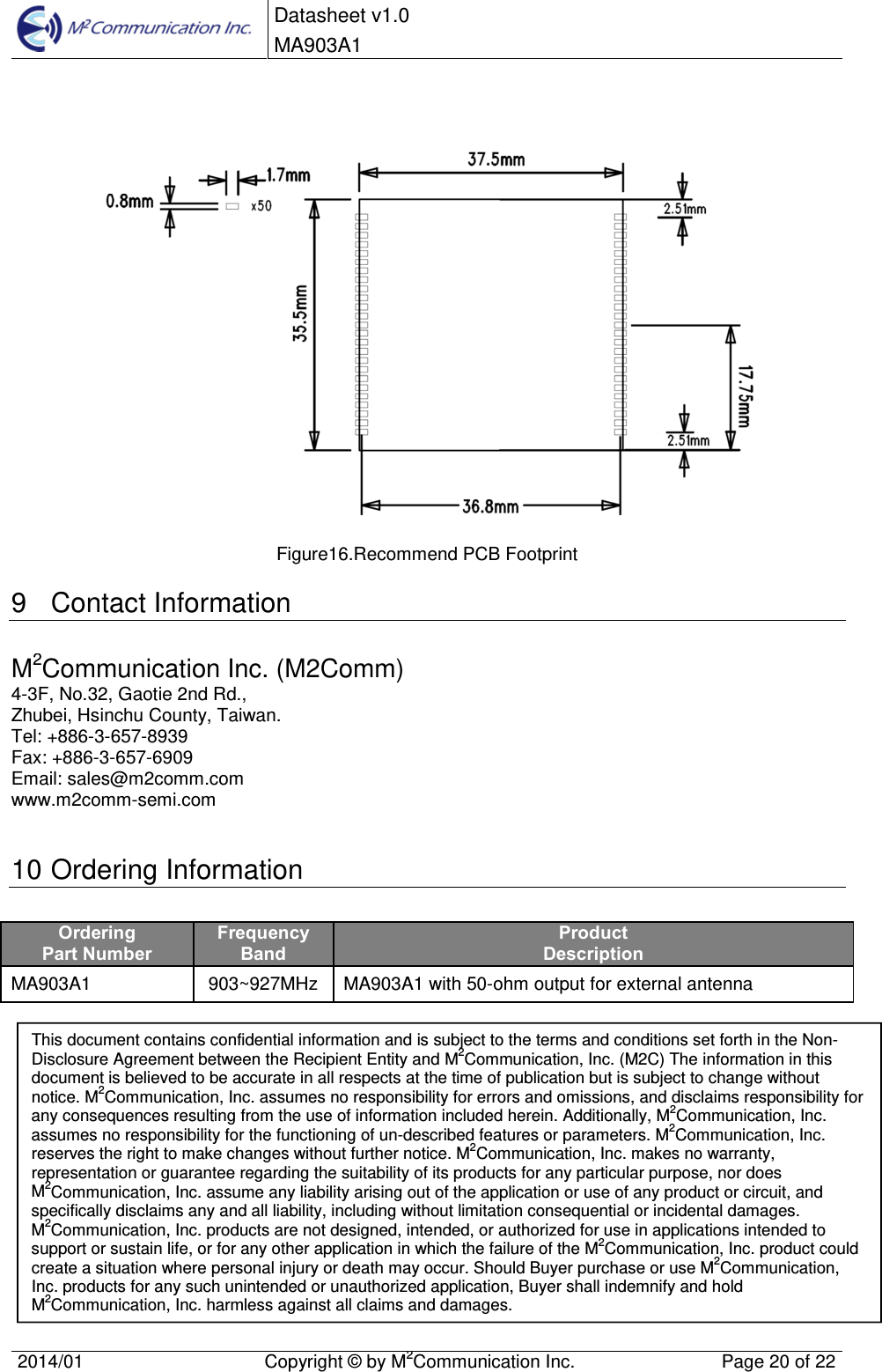
 Datasheet v1.0 MA903A1    2014/01  Copyright © by M2Communication Inc.  Page 20 of 22     Figure16.Recommend PCB Footprint 9  Contact Information M2Communication Inc. (M2Comm) 4-3F, No.32, Gaotie 2nd Rd., Zhubei, Hsinchu County, Taiwan.  Tel: +886-3-657-8939 Fax: +886-3-657-6909 Email: sales@m2comm.com www.m2comm-semi.com  10 Ordering Information Ordering Part Number Frequency Band Product Description MA903A1  903~927MHz MA903A1 with 50-ohm output for external antenna              This document contains confidential information and is subject to the terms and conditions set forth in the Non-Disclosure Agreement between the Recipient Entity and M2Communication, Inc. (M2C) The information in this document is believed to be accurate in all respects at the time of publication but is subject to change without notice. M2Communication, Inc. assumes no responsibility for errors and omissions, and disclaims responsibility for any consequences resulting from the use of information included herein. Additionally, M2Communication, Inc. assumes no responsibility for the functioning of un-described features or parameters. M2Communication, Inc. reserves the right to make changes without further notice. M2Communication, Inc. makes no warranty, representation or guarantee regarding the suitability of its products for any particular purpose, nor does M2Communication, Inc. assume any liability arising out of the application or use of any product or circuit, and specifically disclaims any and all liability, including without limitation consequential or incidental damages. M2Communication, Inc. products are not designed, intended, or authorized for use in applications intended to support or sustain life, or for any other application in which the failure of the M2Communication, Inc. product could create a situation where personal injury or death may occur. Should Buyer purchase or use M2Communication, Inc. products for any such unintended or unauthorized application, Buyer shall indemnify and hold M2Communication, Inc. harmless against all claims and damages.
 Datasheet v1.0 MA903A1    2014/01  Copyright © by M2Communication Inc.  Page 21 of 22   FCC Statement: Federal Communication Commission Interference Statement  This equipment has been tested and found to comply with the limits for a Class B digital device, pursuant to Part 15 of the FCC Rules. These limits are designed to provide reasonable protection against harmful interference in a residential installation. This equipment generates, uses and can radiate radio frequency energy and, if not installed and used in accordance with the instructions, may cause harmful interference to radio communications. However, there is no guarantee that interference will not occur in a particular installation. If this equipment does cause harmful interference to radio or television reception, which can be determined by turning the equipment off and on, the user is encouraged to try to correct the interference by one of the following measures: ●  Reorient or relocate the receiving antenna. ●  Increase the separation between the equipment and receiver. ●  Connect the equipment into an outlet on a circuit different from that to which the receiver is connected. ●  Consult the dealer or an experienced radio/TV technician for help.  FCC Caution: Any changes or modifications not expressly approved by the party responsible  for compliance could void the user’s authority to operate this equipment.   This device complies with Part 15 of the FCC Rules. Operation is subject to the following two conditions: (1) This device may not cause harmful interference, and (2) this device must accept any interference received, including interference that may cause undesired operation.   This device and its antenna(s) must not be co-located with any other transmitters except in accordance with FCC multi-transmitter product procedures. Referring to the multi-transmitter policy, multiple-transmitter(s) and module(s) can be operated simultaneously without C2P.  IMPORTANT NOTE: FCC Radiation Exposure Statement: This equipment complies with FCC radiation exposure limits set forth for an uncontrolled environment. This equipment should be installed and operated with minimum distance 20 cm between the radiator & your body.  IMPORTANT NOTE: This module is intended for OEM integrator. The OEM integrator is responsible for the compliance to all the rules that apply to the product into which this certified RF module is integrated. Additional testing and certification may be necessary when multiple modules are used.  20 cm minimum distance has to be able to be maintained between the antenna and the users for the host this module is integrated into. Under such configuration, the FCC radiation exposure limits set forth for an population/uncontrolled environment can be satisfied.   Any changes or modifications not expressly approved by the manufacturer could void the user's authority to operate this equipment.  USERS MANUAL OF THE END PRODUCT: In the users manual of the end product, the end user has to be informed to keep at least 20 cm separation with the antenna while this end product is installed and operated. The end user has to be informed that the FCC radio-frequency exposure guidelines for an uncontrolled environment can be satisfied. The end user has to also be informed that any changes or modifications not expressly approved by the manufacturer could void the user's authority to operate this equipment. If the size of the end product is smaller than 8x10cm, then additional FCC part 15.19 statement is required to be available in the users manual: This device complies with Part 15 of FCC rules. Operation is subject to
 Datasheet v1.0 MA903A1    2014/01  Copyright © by M2Communication Inc.  Page 22 of 22   the following two conditions: (1) this device may not cause harmful interference and (2) this device must accept any interference received, including interference that may cause undesired operation.  LABEL OF THE END PRODUCT: The final end product must be labeled in a visible area with the following " Contains TX FCC ID: 2AFXU-MA903A1 ". If the size of the end product is larger than 8x10cm, then the following FCC part 15.19 statement has to also be available on the label:  This device complies with Part 15 of FCC rules. Operation is subject to the following two conditions: (1) this device may not cause harmful interference and (2) this device must accept any interference received, including interference that may cause undesired operation.

Navigation menu