Marine Data Systems MIV30 Shipboum Automatic Identification System (AIS) User Manual MIV installation manual rev11g
Marine Data Systems Shipboum Automatic Identification System (AIS) MIV installation manual rev11g

Installation Manual

AIMS MIVAIS 1371-1 TechnologyTECHNICAL USER MANUALRevision 01
IMPORTANT WARNINGSDANGER: HIGH VOLTAGE!RISK OF ELECTRICAL SHOCK!This unit has a high voltage source inside.Disconnect from the power before opening.DO NOT remove the covers while the unit is switched on.5 Volt electrical power on GPS and DBR (when fitted) antenna ports.NOTICECompass safe distance is 1 meter.NOTICENo user serviceable parts inside, servicing only by properlyqualified and certified technical staff.NOTICEThe GPS module uses a back-up battery to ensure quick start-upof the GPS unit. This battery must be replaced every 5 years.NOTICEThis manual is for informational use only, and may be changed without notice.  This manualshould not be construed as a commitment of Marine Data Systems.  Under nocircumstances does Marine Data Systems assume any responsibility or liability for anyerrors or inaccuracies that may appear in this document.  The equipment should only beused for the purposes intended by the manufacturer; any deviation from this will void thewarranty of the product.Document No. 1101-0010-AA-00-TMIssue: 10 Marine Data Systems (Pty.) Ltd.
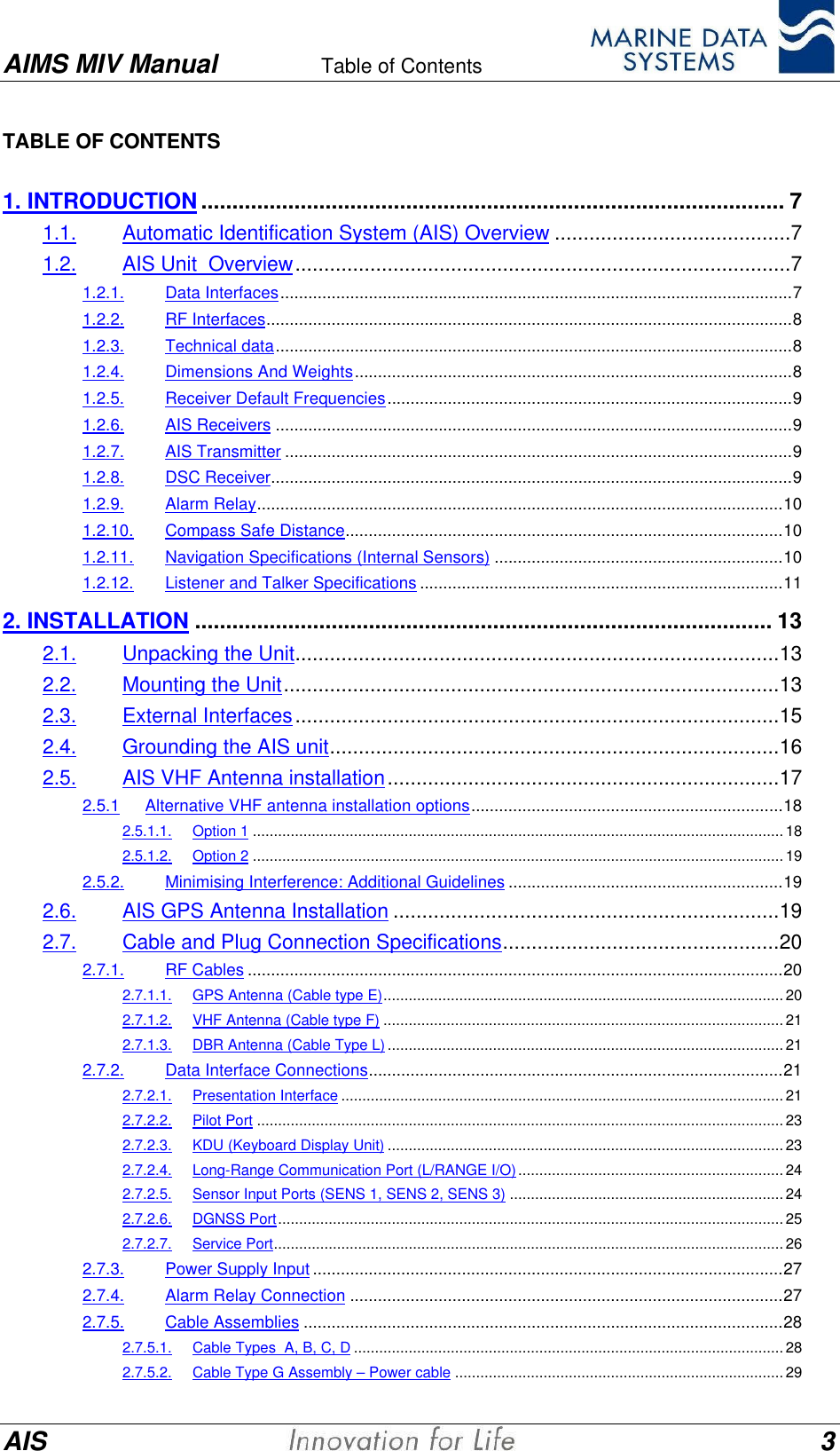
AIMS MIV Manual Table of Contents      AIS 3TABLE OF CONTENTS1. INTRODUCTION.............................................................................................. 71.1. Automatic Identification System (AIS) Overview .........................................71.2. AIS Unit  Overview......................................................................................71.2.1. Data Interfaces..............................................................................................................71.2.2. RF Interfaces.................................................................................................................81.2.3. Technical data...............................................................................................................81.2.4. Dimensions And Weights..............................................................................................81.2.5. Receiver Default Frequencies.......................................................................................91.2.6. AIS Receivers ...............................................................................................................91.2.7. AIS Transmitter .............................................................................................................91.2.8. DSC Receiver................................................................................................................91.2.9. Alarm Relay.................................................................................................................101.2.10. Compass Safe Distance..............................................................................................101.2.11. Navigation Specifications (Internal Sensors) ..............................................................101.2.12. Listener and Talker Specifications ..............................................................................112. INSTALLATION ............................................................................................. 132.1. Unpacking the Unit....................................................................................132.2. Mounting the Unit......................................................................................132.3. External Interfaces....................................................................................152.4. Grounding the AIS unit..............................................................................162.5. AIS VHF Antenna installation....................................................................172.5.1 Alternative VHF antenna installation options...................................................................182.5.1.1. Option 1 ..............................................................................................................................182.5.1.2. Option 2 ..............................................................................................................................192.5.2. Minimising Interference: Additional Guidelines ...........................................................192.6. AIS GPS Antenna Installation ...................................................................192.7. Cable and Plug Connection Specifications................................................202.7.1. RF Cables ...................................................................................................................202.7.1.1. GPS Antenna (Cable type E)...............................................................................................202.7.1.2. VHF Antenna (Cable type F) ...............................................................................................212.7.1.3. DBR Antenna (Cable Type L).............................................................................................. 212.7.2. Data Interface Connections.........................................................................................212.7.2.1. Presentation Interface ......................................................................................................... 212.7.2.2. Pilot Port .............................................................................................................................232.7.2.3. KDU (Keyboard Display Unit) .............................................................................................. 232.7.2.4. Long-Range Communication Port (L/RANGE I/O)...............................................................242.7.2.5. Sensor Input Ports (SENS 1, SENS 2, SENS 3) .................................................................242.7.2.6. DGNSS Port........................................................................................................................ 252.7.2.7. Service Port......................................................................................................................... 262.7.3. Power Supply Input .....................................................................................................272.7.4. Alarm Relay Connection .............................................................................................272.7.5. Cable Assemblies .......................................................................................................282.7.5.1. Cable Types  A, B, C, D ...................................................................................................... 282.7.5.2. Cable Type G Assembly – Power cable ..............................................................................29
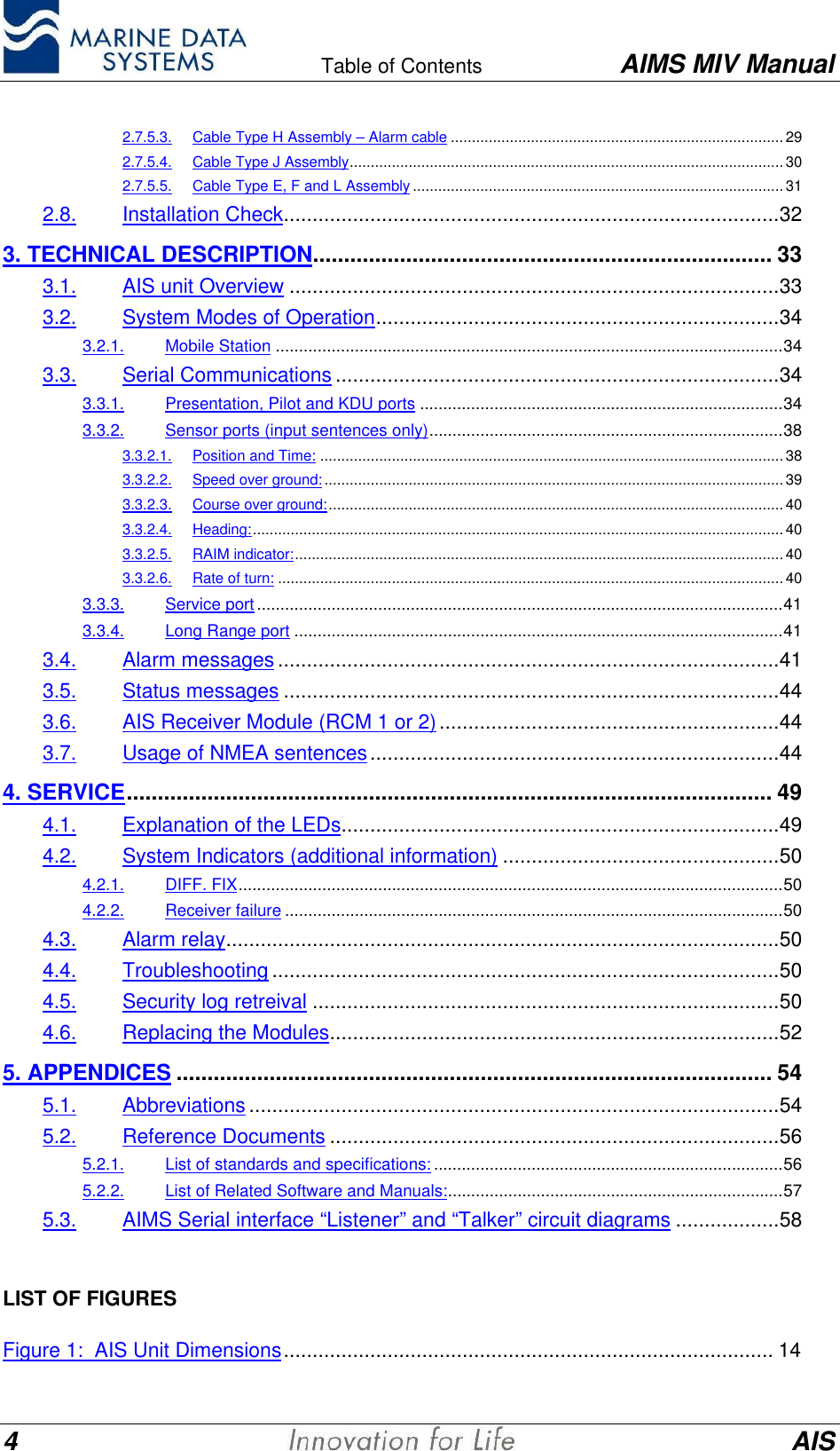
   Table of Contents AIMS MIV Manual4AIS2.7.5.3. Cable Type H Assembly – Alarm cable ...............................................................................292.7.5.4. Cable Type J Assembly....................................................................................................... 302.7.5.5. Cable Type E, F and L Assembly ........................................................................................312.8. Installation Check......................................................................................323. TECHNICAL DESCRIPTION.......................................................................... 333.1. AIS unit Overview .....................................................................................333.2. System Modes of Operation......................................................................343.2.1. Mobile Station .............................................................................................................343.3. Serial Communications .............................................................................343.3.1. Presentation, Pilot and KDU ports ..............................................................................343.3.2. Sensor ports (input sentences only)............................................................................383.3.2.1. Position and Time: ..............................................................................................................383.3.2.2. Speed over ground:............................................................................................................. 393.3.2.3. Course over ground:............................................................................................................ 403.3.2.4. Heading:.............................................................................................................................. 403.3.2.5. RAIM indicator:....................................................................................................................403.3.2.6. Rate of turn: ........................................................................................................................403.3.3. Service port.................................................................................................................413.3.4. Long Range port .........................................................................................................413.4. Alarm messages.......................................................................................413.5. Status messages ......................................................................................443.6. AIS Receiver Module (RCM 1 or 2)...........................................................443.7. Usage of NMEA sentences.......................................................................444. SERVICE........................................................................................................ 494.1. Explanation of the LEDs............................................................................494.2. System Indicators (additional information) ................................................504.2.1. DIFF. FIX.....................................................................................................................504.2.2. Receiver failure ...........................................................................................................504.3. Alarm relay................................................................................................504.4. Troubleshooting ........................................................................................504.5. Security log retreival .................................................................................504.6. Replacing the Modules..............................................................................525. APPENDICES ................................................................................................ 545.1. Abbreviations ............................................................................................545.2. Reference Documents ..............................................................................565.2.1. List of standards and specifications: ...........................................................................565.2.2. List of Related Software and Manuals:........................................................................575.3. AIMS Serial interface “Listener” and “Talker” circuit diagrams ..................58LIST OF FIGURESFigure 1:  AIS Unit Dimensions..................................................................................... 14
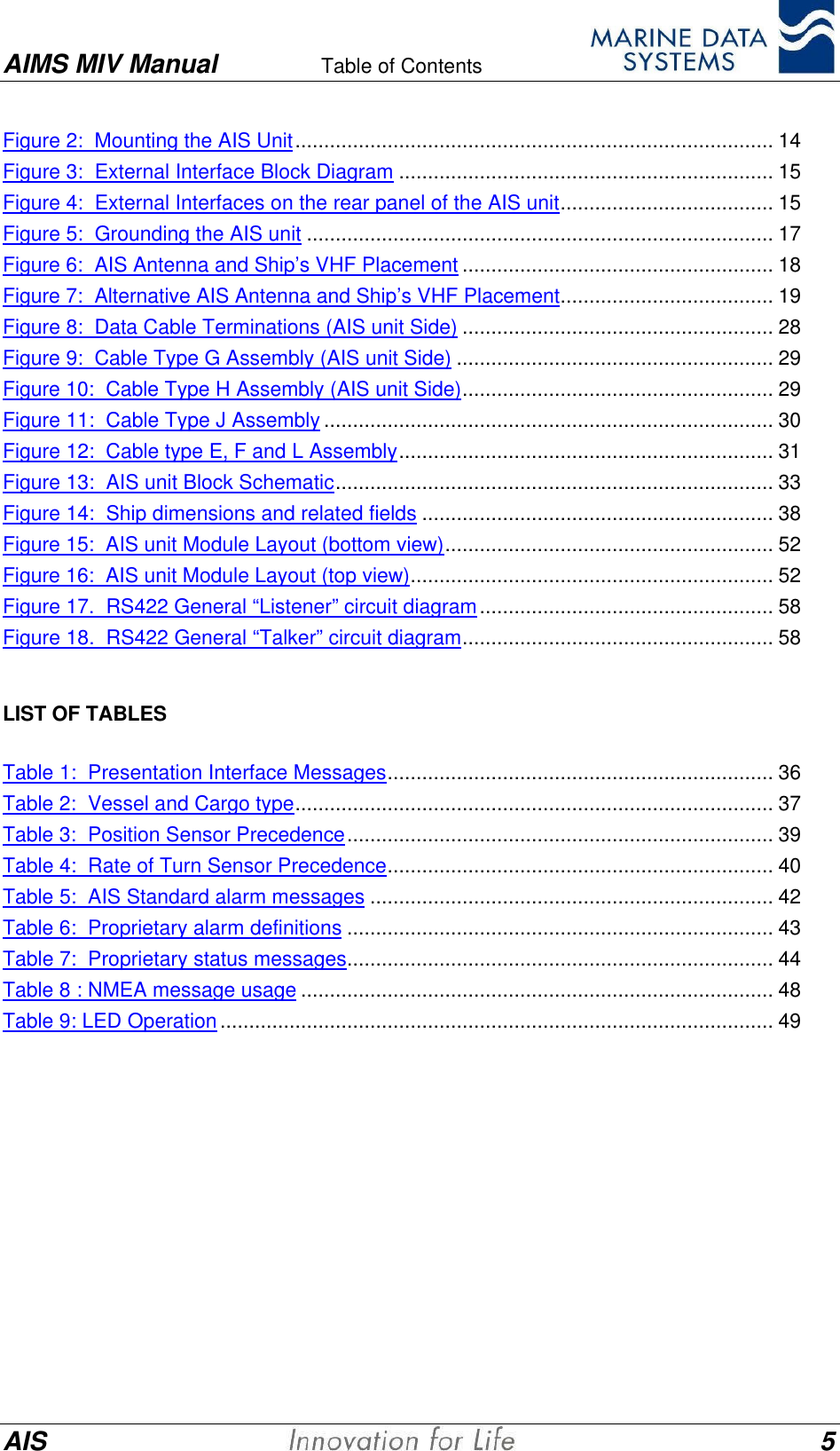
AIMS MIV Manual Table of Contents      AIS 5Figure 2:  Mounting the AIS Unit................................................................................... 14Figure 3:  External Interface Block Diagram ................................................................. 15Figure 4:  External Interfaces on the rear panel of the AIS unit..................................... 15Figure 5:  Grounding the AIS unit ................................................................................. 17Figure 6:  AIS Antenna and Ship’s VHF Placement ...................................................... 18Figure 7:  Alternative AIS Antenna and Ship’s VHF Placement..................................... 19Figure 8:  Data Cable Terminations (AIS unit Side) ...................................................... 28Figure 9:  Cable Type G Assembly (AIS unit Side) ....................................................... 29Figure 10:  Cable Type H Assembly (AIS unit Side)...................................................... 29Figure 11:  Cable Type J Assembly .............................................................................. 30Figure 12:  Cable type E, F and L Assembly................................................................. 31Figure 13:  AIS unit Block Schematic............................................................................ 33Figure 14:  Ship dimensions and related fields ............................................................. 38Figure 15:  AIS unit Module Layout (bottom view)......................................................... 52Figure 16:  AIS unit Module Layout (top view)............................................................... 52Figure 17.  RS422 General “Listener” circuit diagram................................................... 58Figure 18.  RS422 General “Talker” circuit diagram...................................................... 58LIST OF TABLESTable 1:  Presentation Interface Messages................................................................... 36Table 2:  Vessel and Cargo type................................................................................... 37Table 3:  Position Sensor Precedence.......................................................................... 39Table 4:  Rate of Turn Sensor Precedence................................................................... 40Table 5:  AIS Standard alarm messages ...................................................................... 42Table 6:  Proprietary alarm definitions .......................................................................... 43Table 7:  Proprietary status messages.......................................................................... 44Table 8 : NMEA message usage .................................................................................. 48Table 9: LED Operation................................................................................................ 49
   Table of Contents AIMS MIV Manual6AISMarine Data Systems would like to take this opportunity to congratulate you onthe purchase of your AIS unit.  We want to assure you that this product is manufacturedfrom only the highest quality components and thoroughly tested to ensure your completesatisfaction.If you have any questions, or queries related to this product, please do not hesitate tocontact us:Physical Address:580 Kyalami BoulevardKyalami Business ParkKyalamiMidrandSouth AfricaPostal Address:PostNet Suite #4Private Bag X11Halfway House1685South AfricaEmail:  support@marinedata.co.zaWebsite:www.marinedata.co.zaTelephone:+27 11 549 1800Fax: +27 11 549 1867Thanking you,THE MDS TEAM
AIMS MIV Manual Introduction      AIS 71.   INTRODUCTION1.1. Automatic Identification System (AIS) OverviewAIS is a radio data system where two or more stations operate on one or more radiochannels using Time Division Multiple Access (TDMA).  These units can be mobile, base orrepeater stations.  Mobile stations are installed onboard vessels and integrated to thevessel’s sensors and display systems.  Base stations, on the other hand, are installed on theshore side and allow remote monitoring of vessel traffic within the VHF coverage area of thebase station.  Base stations can be interconnected via an AIS Network to cover a largerarea.  Repeater stations can be used to extend the required coverage area, preferablywhere the traffic load is low and there is a lack of suitable communications infrastructure.The main objective of the system is to assist in safer navigation; that is, sharing ship-to-ship,positional information, speed over ground, course over ground, heading, rate of turn, staticand voyage information, as well as safety-related messages.The Automatic Identification System (AIS Class A) is defined by the IMO and has beenmade a carriage requirement by the latest revision of SOLAS Chapter V. This does not onlyrequire the AIS to be installed, but also to provide information used for ship navigation.The AIS has been standardised by the ITU and IEC and is subject to type approval. In orderto fulfil the reliability requirements of information exchange, care must be taken to ensurethe AIS unit is correctly installed.1.2. AIS Unit  Overview  The AIS Unit operates in the VHF Maritime Mobile Band and, according to its programmedmode, operates: • Ship to ship,• Ship to shore,• Shore to ship.  The AIS Unit operates autonomously with minimum user intervention and has a built-indisplay that monitors system health and activity. It is made up of a set of easily removablemodules that can be replaced without any system adjustment or calibration.  It also incorporates those features of Digital Selective Calling (DSC) required by the AISspecifications. This means that the AIS Unit transmits and receives specified AIS relatedDSC messages on the maritime VHF DSC channel 70.1.2.1. Data Interfaces  The AIS Unit is equipped with external interfaces that allow connection to: • Keyboard Display Unit (KDU)• Pilot’s Display Unit (PDU)• 3 Ship’s Sensors Inputs (Typically Gyro, GPS and ROT Sensor)• Ship’s ARPA Radar
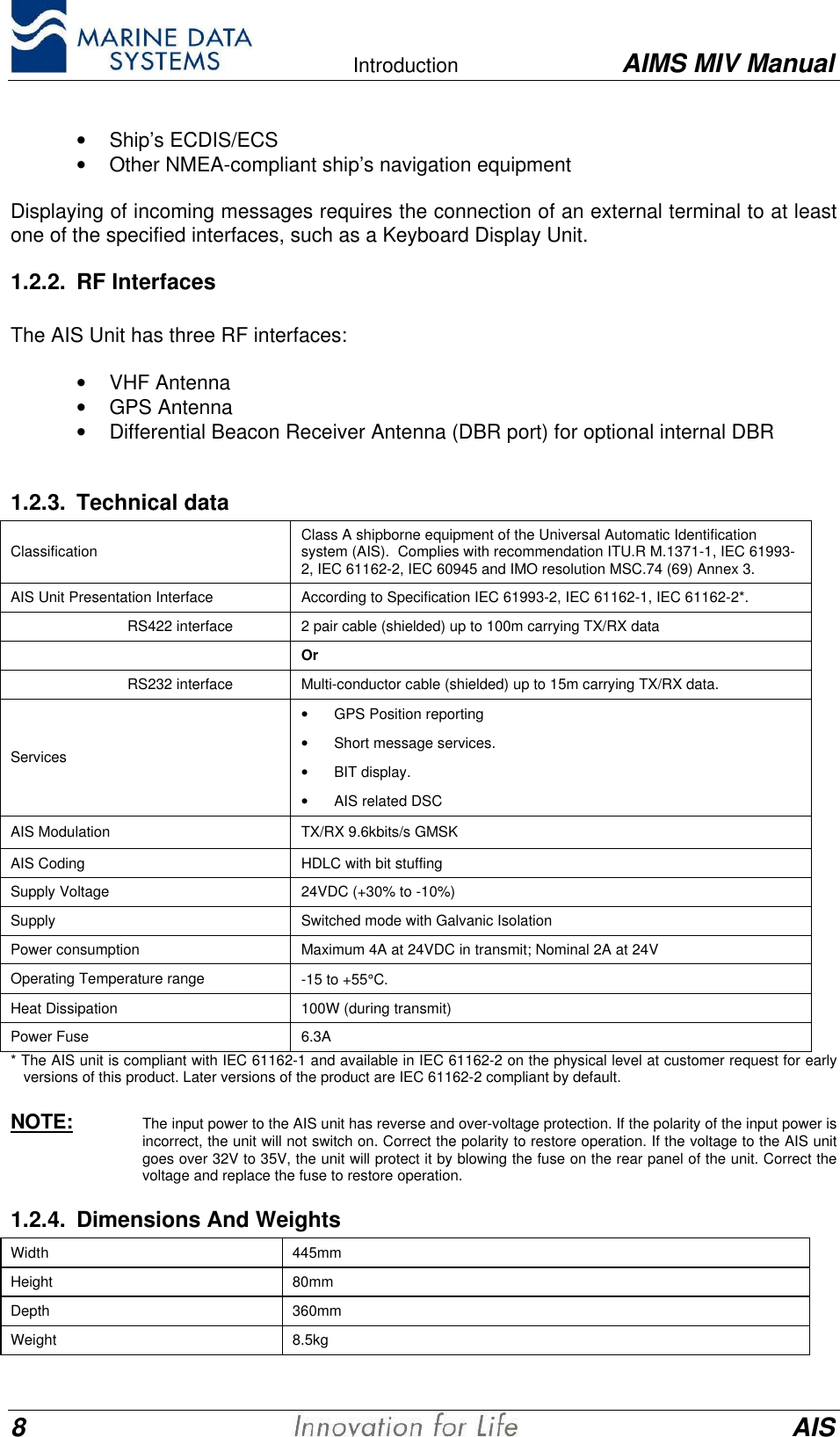
   Introduction AIMS MIV Manual8AIS• Ship’s ECDIS/ECS• Other NMEA-compliant ship’s navigation equipment  Displaying of incoming messages requires the connection of an external terminal to at leastone of the specified interfaces, such as a Keyboard Display Unit.1.2.2. RF Interfaces  The AIS Unit has three RF interfaces: • VHF Antenna• GPS Antenna• Differential Beacon Receiver Antenna (DBR port) for optional internal DBR1.2.3. Technical dataClassification Class A shipborne equipment of the Universal Automatic Identificationsystem (AIS).  Complies with recommendation ITU.R M.1371-1, IEC 61993-2, IEC 61162-2, IEC 60945 and IMO resolution MSC.74 (69) Annex 3.AIS Unit Presentation Interface According to Specification IEC 61993-2, IEC 61162-1, IEC 61162-2*.RS422 interface 2 pair cable (shielded) up to 100m carrying TX/RX dataOrRS232 interface Multi-conductor cable (shielded) up to 15m carrying TX/RX data.Services• GPS Position reporting• Short message services.• BIT display.• AIS related DSCAIS Modulation TX/RX 9.6kbits/s GMSKAIS Coding HDLC with bit stuffingSupply Voltage 24VDC (+30% to -10%)Supply Switched mode with Galvanic IsolationPower consumption Maximum 4A at 24VDC in transmit; Nominal 2A at 24VOperating Temperature range -15 to +55°C.Heat Dissipation 100W (during transmit)Power Fuse 6.3A* The AIS unit is compliant with IEC 61162-1 and available in IEC 61162-2 on the physical level at customer request for earlyversions of this product. Later versions of the product are IEC 61162-2 compliant by default.NOTE: The input power to the AIS unit has reverse and over-voltage protection. If the polarity of the input power isincorrect, the unit will not switch on. Correct the polarity to restore operation. If the voltage to the AIS unitgoes over 32V to 35V, the unit will protect it by blowing the fuse on the rear panel of the unit. Correct thevoltage and replace the fuse to restore operation.1.2.4. Dimensions And WeightsWidth 445mmHeight 80mmDepth 360mmWeight 8.5kg
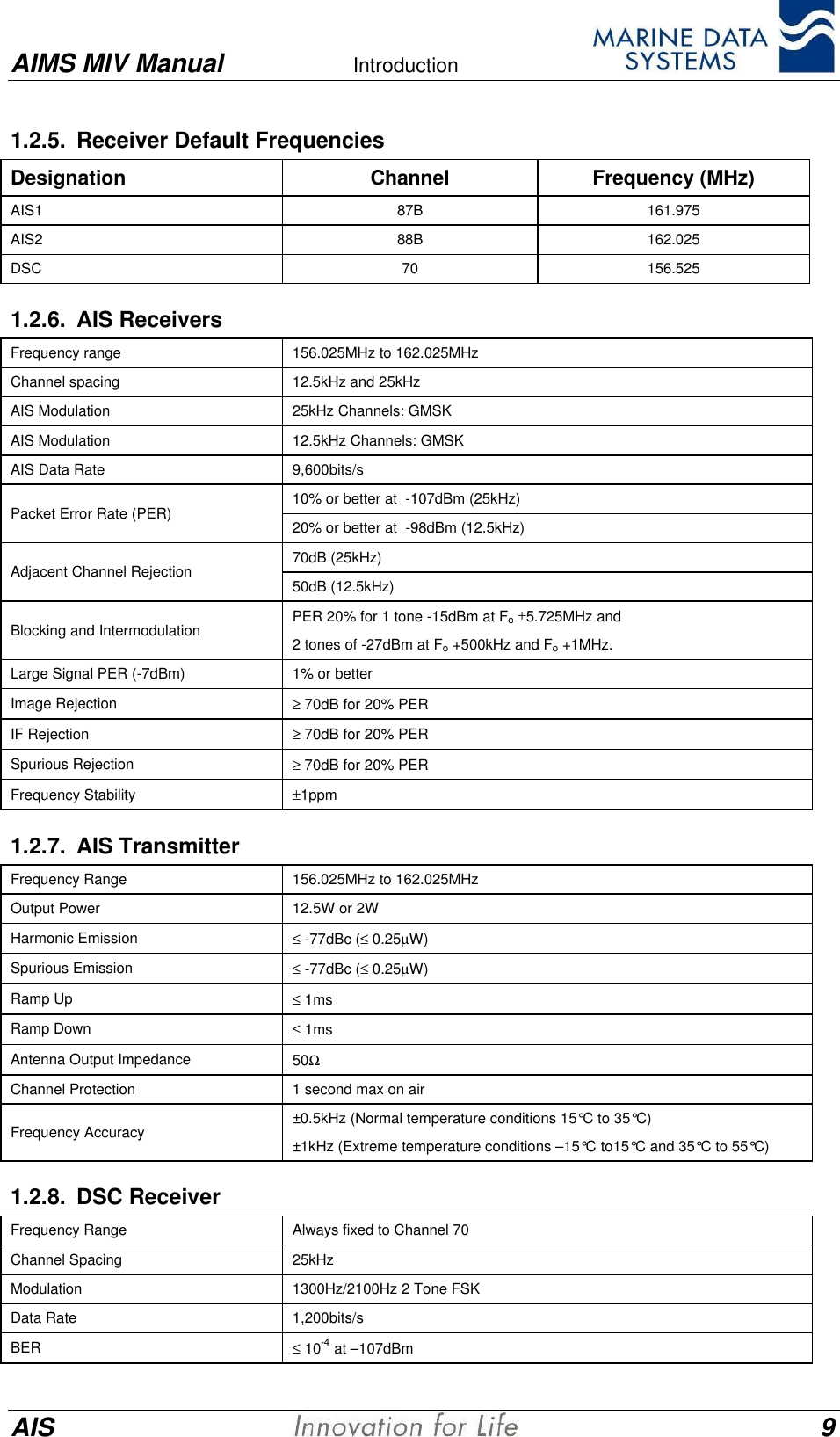
AIMS MIV Manual Introduction      AIS 91.2.5. Receiver Default FrequenciesDesignation Channel Frequency (MHz)AIS1 87B 161.975AIS2 88B 162.025DSC 70 156.5251.2.6. AIS ReceiversFrequency range 156.025MHz to 162.025MHzChannel spacing 12.5kHz and 25kHzAIS Modulation 25kHz Channels: GMSKAIS Modulation 12.5kHz Channels: GMSKAIS Data Rate 9,600bits/s10% or better at  -107dBm (25kHz)Packet Error Rate (PER) 20% or better at  -98dBm (12.5kHz)70dB (25kHz)Adjacent Channel Rejection 50dB (12.5kHz)Blocking and Intermodulation PER 20% for 1 tone -15dBm at Fo ±5.725MHz and2 tones of -27dBm at Fo +500kHz and Fo +1MHz.Large Signal PER (-7dBm) 1% or betterImage Rejection ≥ 70dB for 20% PERIF Rejection ≥ 70dB for 20% PERSpurious Rejection ≥ 70dB for 20% PERFrequency Stability ±1ppm1.2.7. AIS TransmitterFrequency Range 156.025MHz to 162.025MHzOutput Power 12.5W or 2WHarmonic Emission ≤ -77dBc (≤ 0.25µW)Spurious Emission ≤ -77dBc (≤ 0.25µW)Ramp Up ≤ 1msRamp Down ≤ 1msAntenna Output Impedance 50ΩChannel Protection 1 second max on airFrequency Accuracy ±0.5kHz (Normal temperature conditions 15°C to 35°C)±1kHz (Extreme temperature conditions –15°C to15°C and 35°C to 55°C)1.2.8.  DSC ReceiverFrequency Range Always fixed to Channel 70Channel Spacing 25kHzModulation 1300Hz/2100Hz 2 Tone FSKData Rate 1,200bits/sBER ≤ 10-4 at –107dBm
   Introduction AIMS MIV Manual10 AISAdjacent Channel Rejection 70dB (25kHz)Blocking ≥ 84dBImage Rejection ≥ 70dBIF Rejection ≥ 70dBFrequency Stability ±1ppmNOTE: When required, the AIS Unit may be equipped with a 4th receiver. This can be used where it is required toreceive additional data such as radar footprint broadcasts from a shore station without interfering withnormal AIS operation. It is also possible to replace the DSC receiver with another AIS receiver when DSCis not required. Contact your distributor for more details.1.2.9. Alarm RelayThe AIS unit has an alarm relay built-in as a standard feature.  It is accessible using thealarm interface connector, located on the rear panel.Contact ratingVoltage (Average) 24VDCCurrent (Maximum) 1A1.2.10. Compass Safe DistanceCompass Safe measurements, in accordance with IEC 60945, are given below in metres:Distance from Compass(m) Compass Reading (Degrees) Compass Deviation (Reading-Background)(Degrees)Background (No EUTPresent) 270.00 -0.1 276.7 6.70.2 271.1 1.10.3 270.2 0.20.4 270.0 0.00.5 270.0 0.00.6 270.0 0.0It is recommended to mount the AIS unit more than 1m from the compass to prevent anyinterference.1.2.11. Navigation Specifications (Internal Sensors)8/12 Channel Internal Global Positioning System (GPS) [Standard].Internal Differential Beacon Receiver (DBR) [Optional].NOTE:The ship’s GPS/DGPS NMEA sensor will normally be connected to any of the three sensor input ports(Sensor 1, Sensor 2 or Sensor 3). The internal GPS is always present but is only used for acquiringposition data when it is differentially corrected and an external differentially corrected GPS is not available.Refer to Table 3:  Position Sensor Precedence, on page 39, for a full position sensor precedence listing.
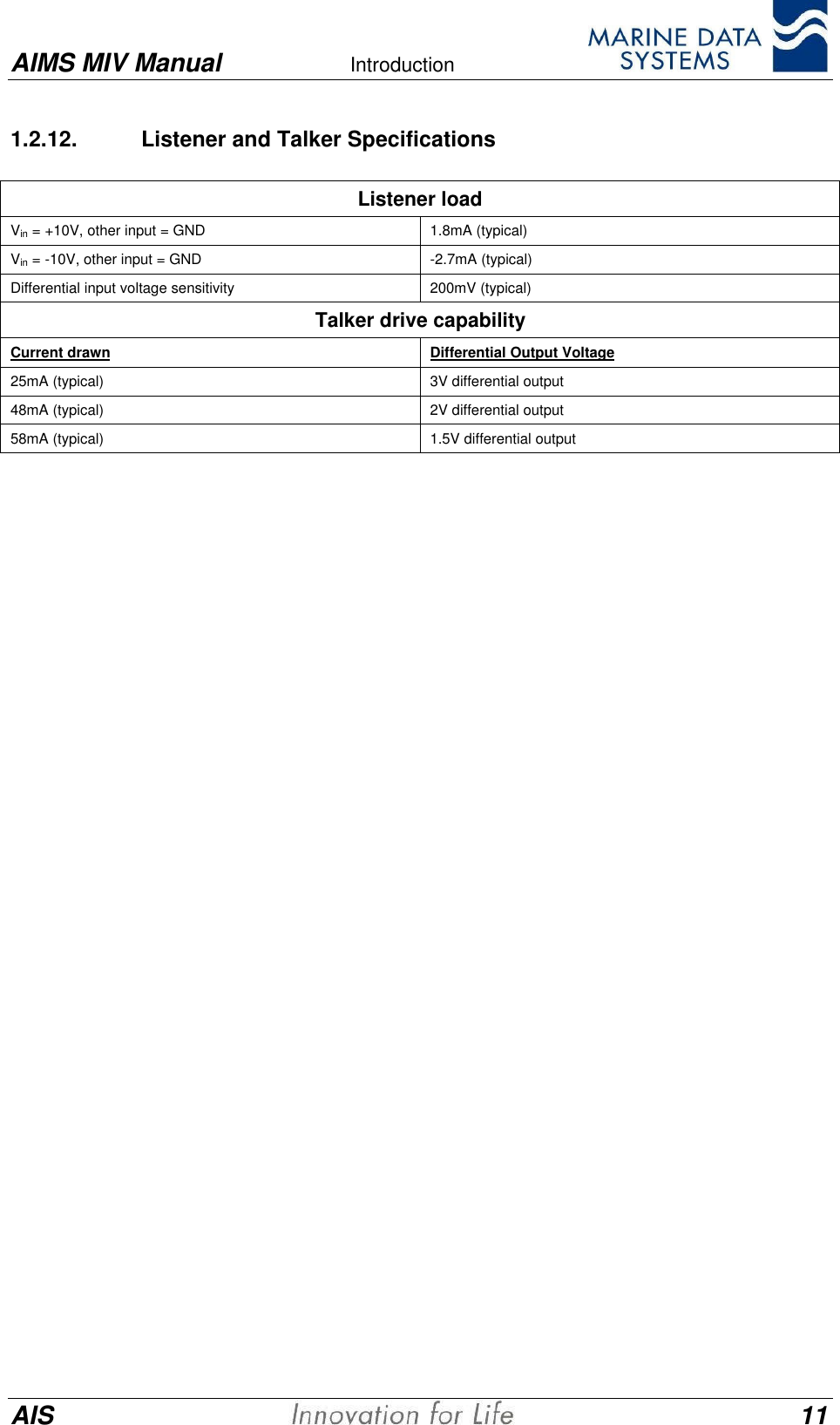
AIMS MIV Manual Introduction      AIS 111.2.12. Listener and Talker SpecificationsListener loadVin = +10V, other input = GND 1.8mA (typical)Vin = -10V, other input = GND -2.7mA (typical)Differential input voltage sensitivity 200mV (typical)Talker drive capabilityCurrent drawn Differential Output Voltage25mA (typical) 3V differential output48mA (typical) 2V differential output58mA (typical) 1.5V differential output
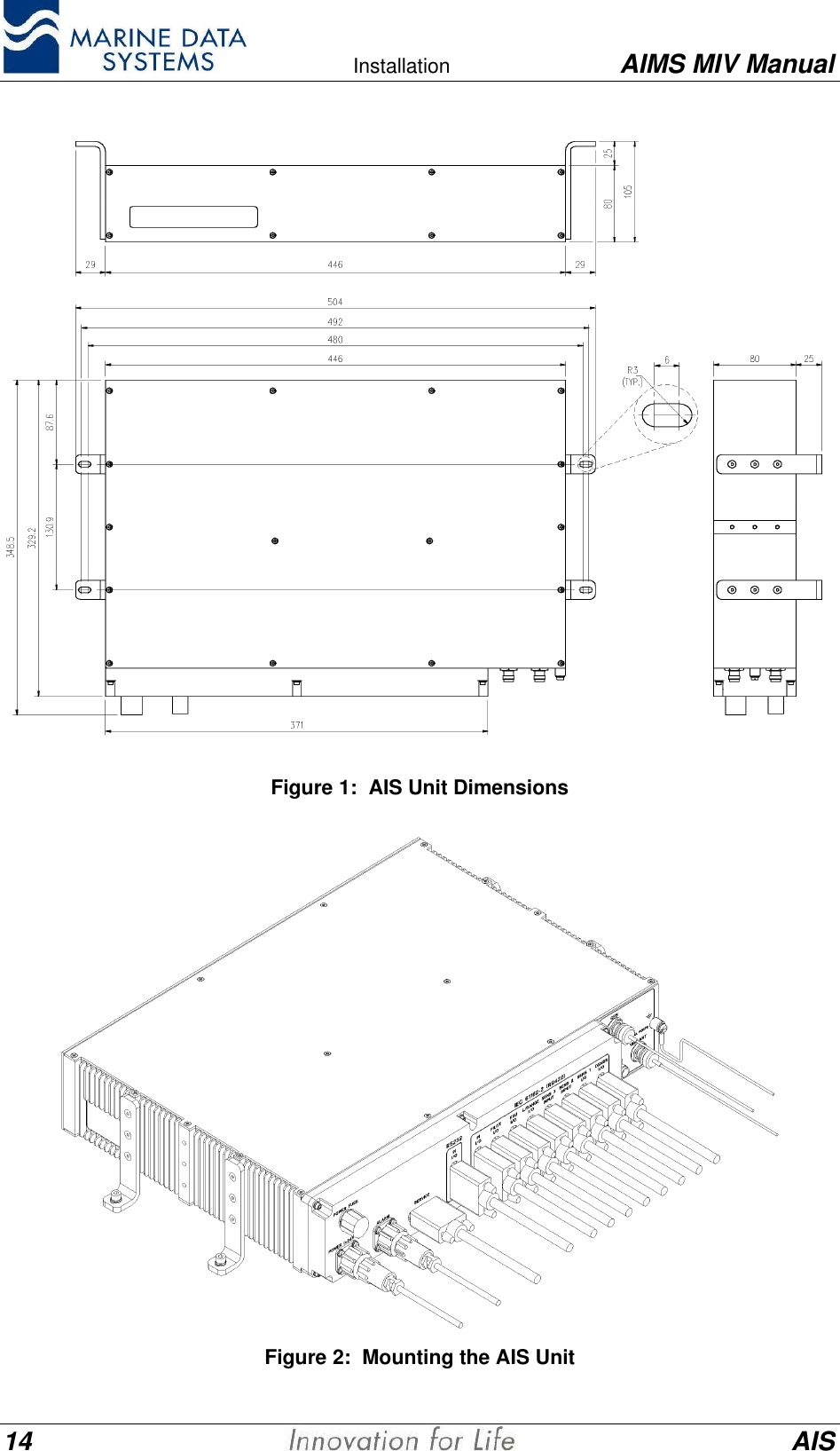
AIMS MIV Manual Installation      AIS 132.   INSTALLATIONSince the installation of an AIS unit is complex, an initial installation configuration report,made during installation, should be kept on board the vessel. This should include at leastthe following:• AIS configuration data (i.e. MMSI, ship name, etc.)• Antenna layout• AIS arrangement drawing• Interconnection diagram2.1. Unpacking the UnitThe AIS Unit package includes the following:• AIS Unit• Power connector• Mounting bracket set with mounting screws• 2 x Spare fuses• This technical manual• Alarm output connector• Declaration of Conformance• Factory test result sheet• CD with AIMS utility and manual (Optional)2.2. Mounting the UnitThe AIS Unit should be mounted to a bulkhead, either on the bridge, in the chart room or theradio room. It may also be mounted to any suitable flat surface, where the unit will not beexposed to the elements and with access to all the relevant sensors and interfaces.  AISequipment is categorised as “Protected Equipment” under IEC 60945 (an environmentalstandard for equipment).To prevent the build-up of heat, the AIS Unit should be mounted in a space with goodventilation.Care must be taken when mounting the AIS Unit to ensure that there is sufficient space forthe cables and connectors. In particular, sharp bending of the RF cables must be avoided.• Attach the bracket assemblies to the unit, using the screws supplied, see Figure2:  Mounting the AIS Unit.• Mount the unit to a suitable surface (as explained above), using the mountingbrackets and some mounting screws.• Ensure that the unit is mounted so that the display can easily be read fordiagnostic and maintenance purposes.
   Installation AIMS MIV Manual14 AISFigure 1:  AIS Unit DimensionsFigure 2:  Mounting the AIS Unit
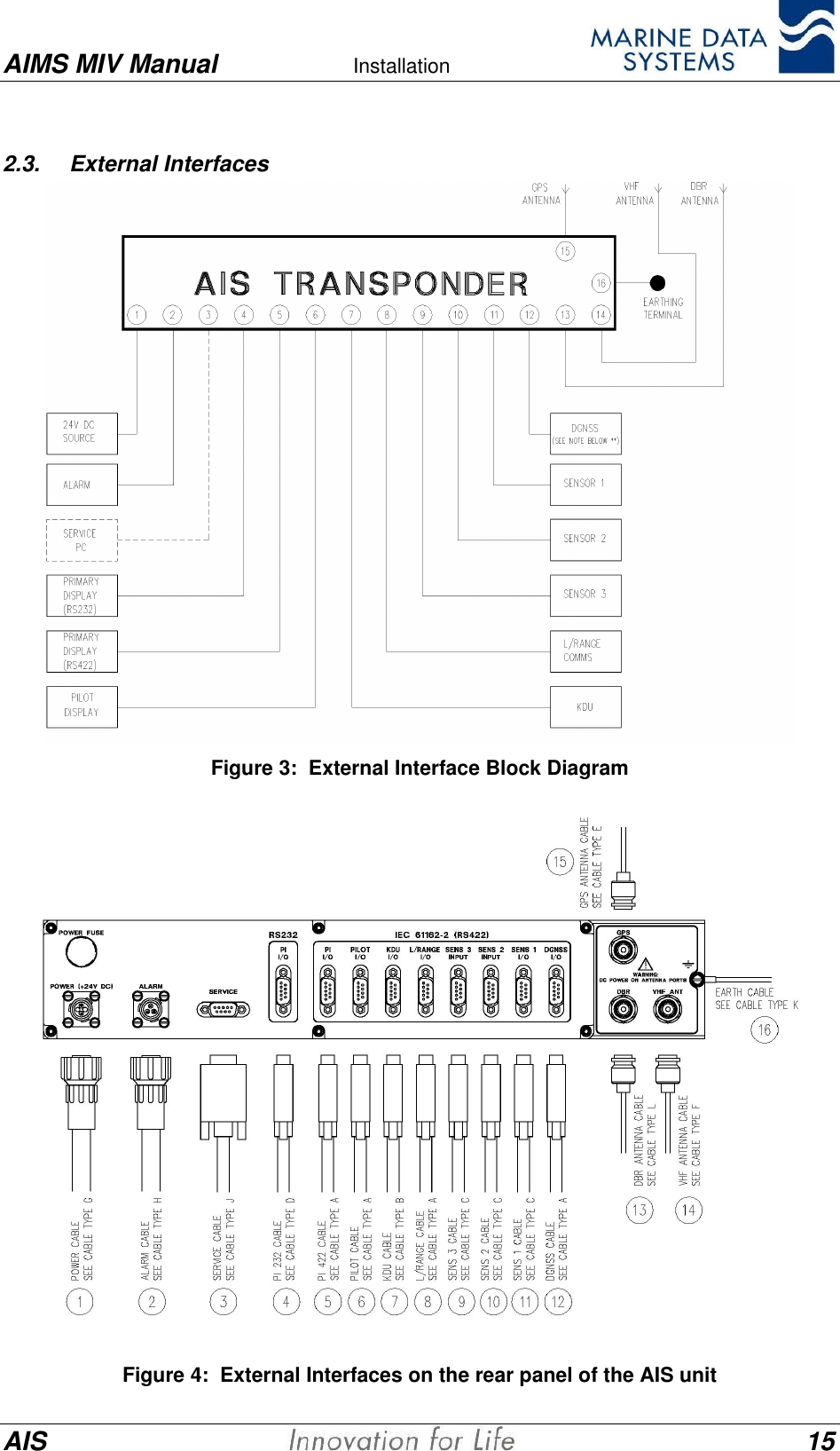
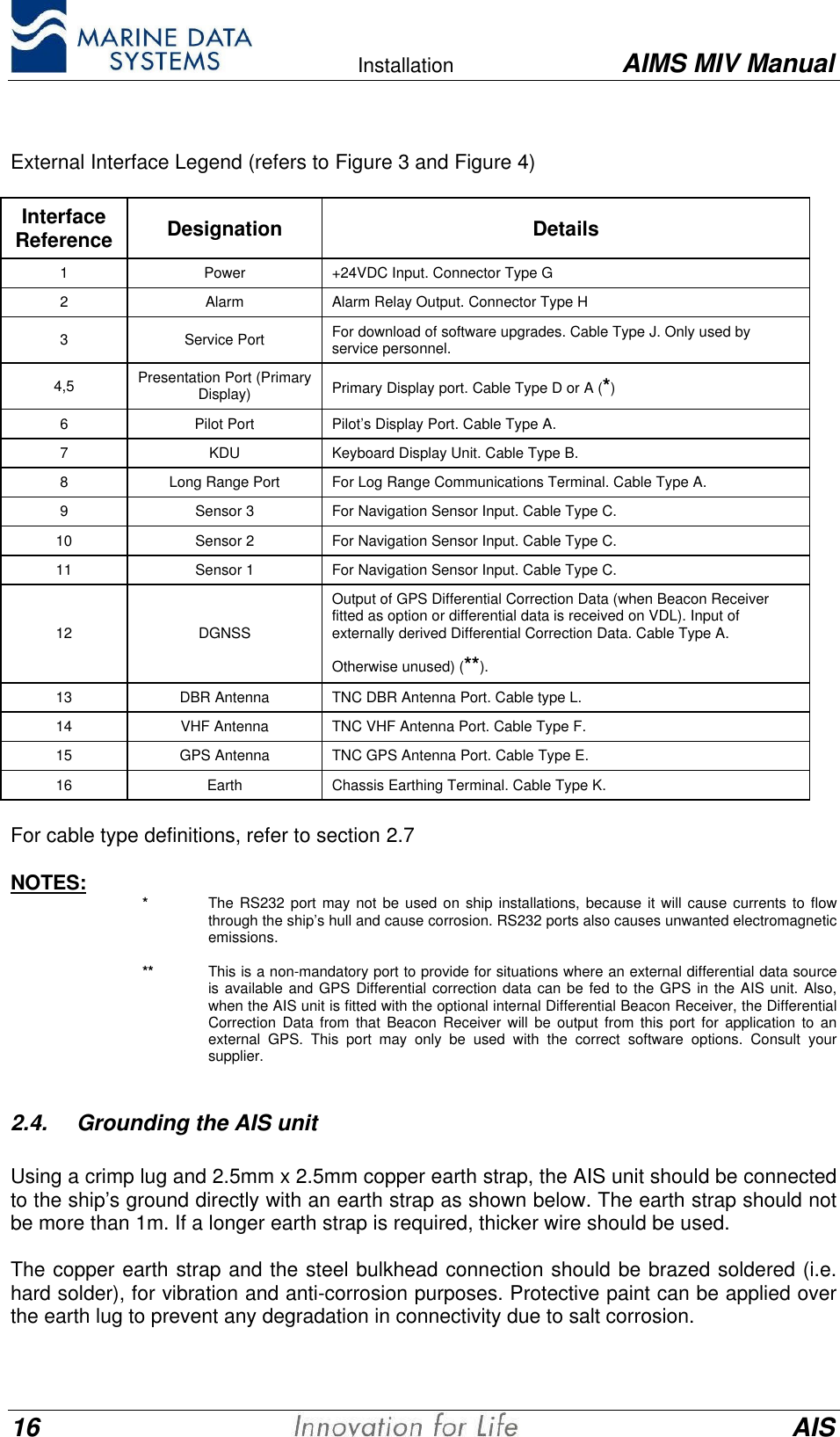
AIMS MIV Manual Installation      AIS 152.3. External InterfacesFigure 3:  External Interface Block DiagramFigure 4:  External Interfaces on the rear panel of the AIS unit
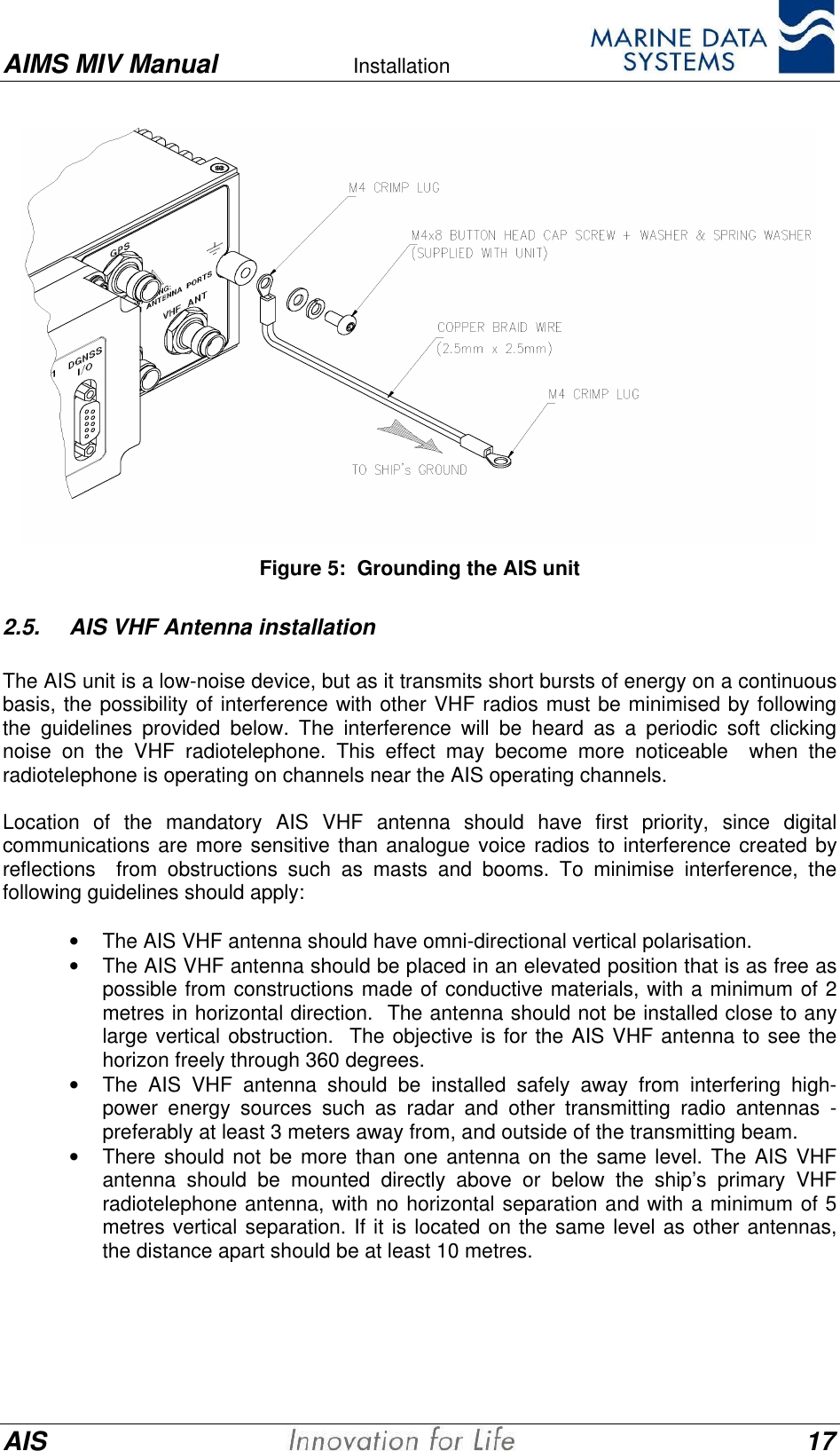
   Installation AIMS MIV Manual16 AISExternal Interface Legend (refers to Figure 3 and Figure 4)InterfaceReference Designation Details1Power +24VDC Input. Connector Type G2Alarm Alarm Relay Output. Connector Type H3Service Port For download of software upgrades. Cable Type J. Only used byservice personnel.4,5 Presentation Port (PrimaryDisplay) Primary Display port. Cable Type D or A (*)6Pilot Port Pilot’s Display Port. Cable Type A.7KDU Keyboard Display Unit. Cable Type B.8Long Range Port For Log Range Communications Terminal. Cable Type A.9Sensor 3 For Navigation Sensor Input. Cable Type C.10 Sensor 2 For Navigation Sensor Input. Cable Type C.11 Sensor 1 For Navigation Sensor Input. Cable Type C.12 DGNSSOutput of GPS Differential Correction Data (when Beacon Receiverfitted as option or differential data is received on VDL). Input ofexternally derived Differential Correction Data. Cable Type A.Otherwise unused) (**).13 DBR Antenna TNC DBR Antenna Port. Cable type L.14 VHF Antenna TNC VHF Antenna Port. Cable Type F.15 GPS Antenna TNC GPS Antenna Port. Cable Type E.16 Earth Chassis Earthing Terminal. Cable Type K.For cable type definitions, refer to section 2.7NOTES: *The RS232 port may not be used on ship installations, because it will cause currents to flowthrough the ship’s hull and cause corrosion. RS232 ports also causes unwanted electromagneticemissions.** This is a non-mandatory port to provide for situations where an external differential data sourceis available and GPS Differential correction data can be fed to the GPS in the AIS unit. Also,when the AIS unit is fitted with the optional internal Differential Beacon Receiver, the DifferentialCorrection Data from that Beacon Receiver will be output from this port for application to anexternal GPS. This port may only be used with the correct software options. Consult yoursupplier.2.4. Grounding the AIS unitUsing a crimp lug and 2.5mm x 2.5mm copper earth strap, the AIS unit should be connectedto the ship’s ground directly with an earth strap as shown below. The earth strap should notbe more than 1m. If a longer earth strap is required, thicker wire should be used.The copper earth strap and the steel bulkhead connection should be brazed soldered (i.e.hard solder), for vibration and anti-corrosion purposes. Protective paint can be applied overthe earth lug to prevent any degradation in connectivity due to salt corrosion.
AIMS MIV Manual Installation      AIS 17Figure 5:  Grounding the AIS unit2.5. AIS VHF Antenna installationThe AIS unit is a low-noise device, but as it transmits short bursts of energy on a continuousbasis, the possibility of interference with other VHF radios must be minimised by followingthe guidelines provided below. The interference will be heard as a periodic soft clickingnoise on the VHF radiotelephone. This effect may become more noticeable  when theradiotelephone is operating on channels near the AIS operating channels.Location of the mandatory AIS VHF antenna should have first priority, since digitalcommunications are more sensitive than analogue voice radios to interference created byreflections  from obstructions such as masts and booms. To minimise interference, thefollowing guidelines should apply:• The AIS VHF antenna should have omni-directional vertical polarisation.• The AIS VHF antenna should be placed in an elevated position that is as free aspossible from constructions made of conductive materials, with a minimum of 2metres in horizontal direction.  The antenna should not be installed close to anylarge vertical obstruction.  The objective is for the AIS VHF antenna to see thehorizon freely through 360 degrees.• The AIS VHF antenna should be installed safely away from interfering high-power energy sources such as radar and other transmitting radio antennas -preferably at least 3 meters away from, and outside of the transmitting beam.• There should not be more than one antenna on the same level. The AIS VHFantenna should be mounted directly above or below the ship’s primary VHFradiotelephone antenna, with no horizontal separation and with a minimum of 5metres vertical separation. If it is located on the same level as other antennas,the distance apart should be at least 10 metres.
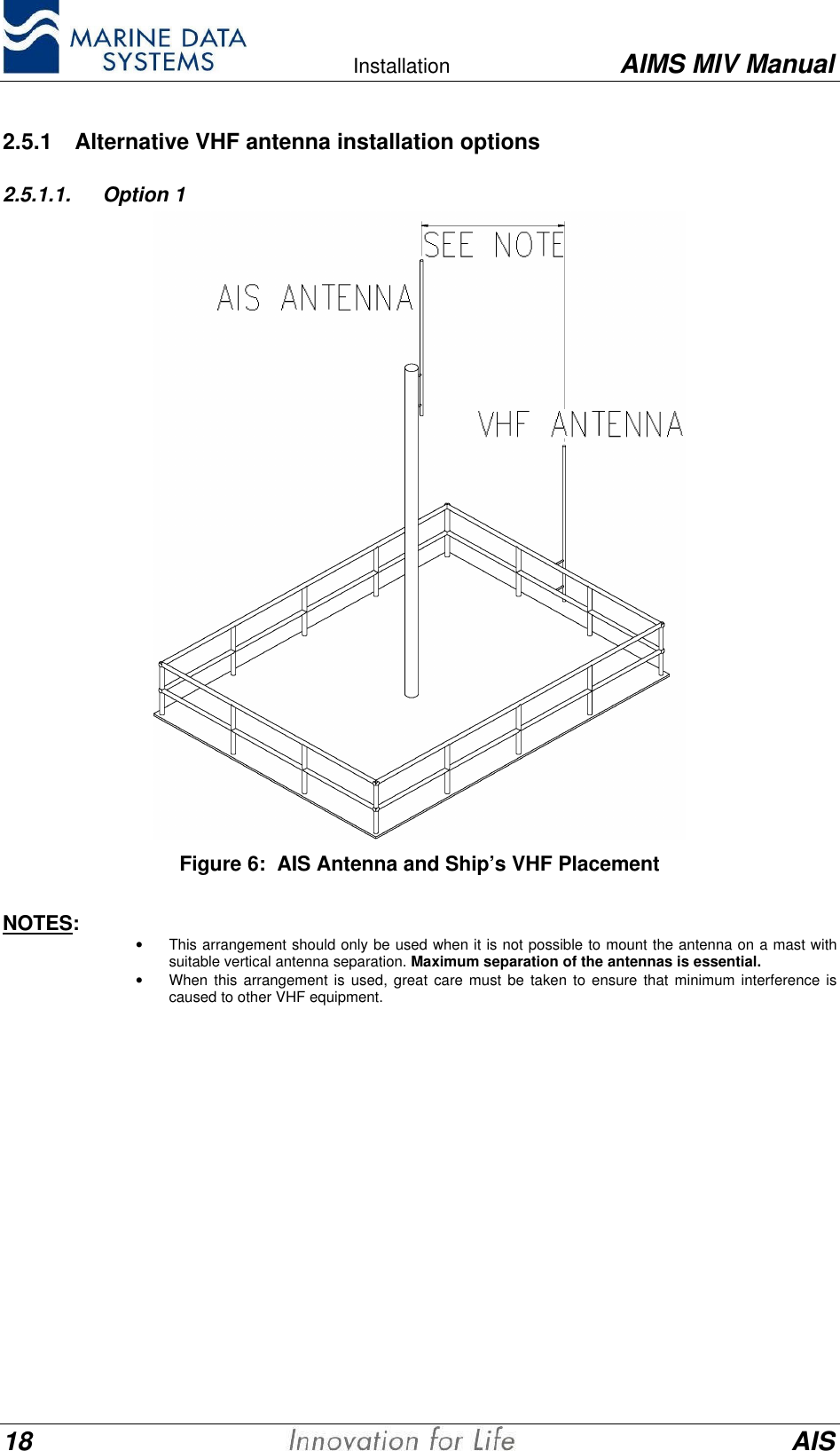
   Installation AIMS MIV Manual18 AIS2.5.1 Alternative VHF antenna installation options2.5.1.1. Option 1Figure 6:  AIS Antenna and Ship’s VHF PlacementNOTES:• This arrangement should only be used when it is not possible to mount the antenna on a mast withsuitable vertical antenna separation. Maximum separation of the antennas is essential.• When this arrangement is used, great care must be taken to ensure that minimum interference iscaused to other VHF equipment.
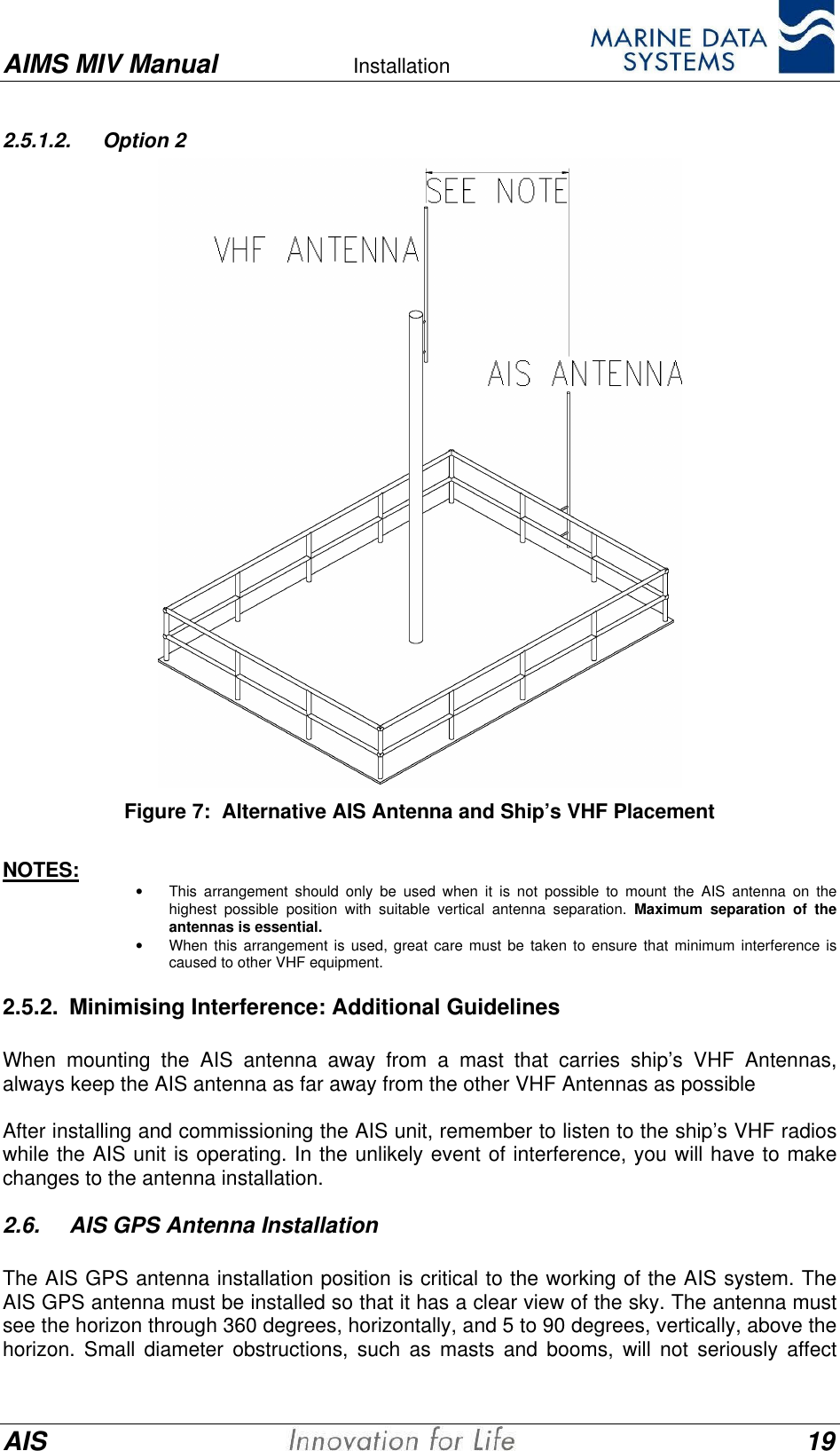
AIMS MIV Manual Installation      AIS 192.5.1.2. Option 2Figure 7:  Alternative AIS Antenna and Ship’s VHF PlacementNOTES: • This arrangement should only be used when it is not possible to mount the AIS antenna on thehighest possible position with suitable vertical antenna separation. Maximum separation of theantennas is essential.• When this arrangement is used, great care must be taken to ensure that minimum interference iscaused to other VHF equipment.2.5.2. Minimising Interference: Additional GuidelinesWhen mounting the AIS antenna away from a mast that carries ship’s VHF Antennas,always keep the AIS antenna as far away from the other VHF Antennas as possibleAfter installing and commissioning the AIS unit, remember to listen to the ship’s VHF radioswhile the AIS unit is operating. In the unlikely event of interference, you will have to makechanges to the antenna installation.2.6. AIS GPS Antenna InstallationThe AIS GPS antenna installation position is critical to the working of the AIS system. TheAIS GPS antenna must be installed so that it has a clear view of the sky. The antenna mustsee the horizon through 360 degrees, horizontally, and 5 to 90 degrees, vertically, above thehorizon. Small diameter obstructions, such as masts and booms, will not seriously affect
   Installation AIMS MIV Manual20 AISGPS working. Such objects should not obstruct more than a few degrees of the sky for anygiven bearing.The AIS GPS antenna should be at least 3 meters away from high power transmitters, andout of their transmitting beam. Such transmitters include the AIS VHF antenna, S-Bandradars and Inmarsat-C.If a DGNSS system is part of the AIS system, the installations shall be in accordance withIEC 61108-4 Ed1, Annex D.To overcome the losses due to antenna cables, the GPS antenna pre-amplifier should be0dB to 10dB more than the antenna cable loss.2.7. Cable and Plug Connection Specifications2.7.1. RF CablesAll outdoor-installed coaxial cable connectors should be fitted with preventative insulationsuch as shrink-stocking with silicone to protect against penetration of water into the antennacable.Coaxial cables should be installed in separate cable channels, at least 100mm away frompower cables. Where cables cross each other, this should be done at right angles (90°). Theinstallation of RF cables should take into account that RF-cables’ impedance may change ifsubjected to sharp turns. As a rule of thumb, coaxial cables should not turn with a radius ofless than 5 times the cable outside diameter.NOTE: • Coaxial antennas and cables should be properly earthed.2.7.1.1. GPS Antenna (Cable type E)The cable between the GNSS antenna and the AIS unit should be routed directly to reduceelectromagnetic interference effects. The RF cable should not be installed close to high-power lines, such as radar or radio-transmitter lines or the AIS VHF antenna cable. Aseparation of one meter or more is recommended to avoid degradation due to RF-coupling.Crossing of antenna cables should be done at 90 degrees to minimise magnetic fieldcoupling.Cable:  RG213 is recommendedMaximum recommended cable length:  20m (with an active GPS antenna)Cable connector:  TNC male connector at AIS unit side.NOTE: • An excessively long cable will degrade AIS unit performance and possibly cause the GPS to not lockonto GPS satellites.• The GPS antenna centre conductor carries a 5VDC output for powering an active GPS antenna. Themaximum current driving capability of this 5V output is 150mA
AIMS MIV Manual Installation      AIS 212.7.1.2. VHF Antenna (Cable type F)  Cable:  RG214 is recommended. Maximum cable length:  The cable should be kept as short as possibleto minimise attenuation of the signals. Anattenuation of 0.8dB per 10 meter is normal forRG214 at 160MHz. Thus, for 50m, theattenuation will be 4dB. Cable connector:  TNC male connector at AIS unit side. NOTE: • An excessively long cable will degrade AIS unit performance and result in reduced range ofoperation.2.7.1.3. DBR Antenna (Cable Type L)  Cable:  RG 213 is recommended Maximum recommended cable length:  75m Cable connector:  TNC male connector at AIS unit side.  NOTE: • An excessively long cable will degrade AIS unit performance and possibly cause the DBR to not lockonto beacon transmitters.• The DBR antenna centre conductor carries a 5VDC output on the centre conductor for powering anactive GPS antenna when a DBR is fitted and a combined GPS/DBR antenna is used. The maximumcurrent driving capability of this 5V output is 150mA2.7.2. Data Interface Connections2.7.2.1. Presentation InterfaceThere are two physical connector ports: RS232 or RS422. The RS232 and RS422 portscannot be used simultaneously. The RS232 port may not be used for ship installations.  Thisport is used to connect the primary AIS display unit.  All received messages (AIS) are sentout via this port; there is also a software user interface on this port.  The data rate for thisport is 38,400 bits/s.  It operates on a protocol compliant with IEC 61162-2.IEC 61162 places certain constraints on the shielding and isolation requirements withregards to the termination of the duplex Presentation Interface, Pilot, KDU and Long Rangeports. The transmit and receive portions of the IEC 61162 ports must have separate shields.For this reason, it is recommended to use two separate shielded cables - one for thetransmit section of the port and one for the receive section. For the transmit portion of theport, the shield of the cable must be connected to the connector shell. The shield for thereceive portion of the port may not be connected at the AIS unit side.The following general configuration must be followed:
   Installation AIMS MIV Manual22 AISConnections to the Presentation InterfaceCable type ACable:   Two Shielded twisted-cable 2 x 2 pair 0.5mm2.Maximum cable length:  100mCable connector:  9 way D-sub male.PIN Description TX Cable pair RX Cable pair123Input Line A (RX A) 14Output Line A (TX A) 15Output ground (TX C) 26Output Line B (TX B) 178Input Ground (RX C) 2 (Can also be the shield of thecable if no Common is available)9Input Line B (RX B) 1Shell Shielding Shield of cable Not connectedCable type D for RS232 connectionCable:  Multi-cable 3 x 0.5mm2 shielded.Maximum cable length:  15mCable connector:  9 way D-sub male.PIN (AIS unit) Description PC (DTE device)1No Connection2Receive Data 23Transmit Data 34No Connection5Signal Ground 56No Connection
AIMS MIV Manual Installation      AIS 23PIN (AIS unit) Description PC (DTE device)7No Connection8No Connection9No ConnectionShell of connector Shield Shell of connectorConnect the shield of the cable to the shell of the connector at both sides.2.7.2.2. Pilot PortThe Pilot Port is electrically identical to the RS 422 Presentation Port. The default data rateis 38,400 bits/s.  It operates on a protocol compliant with IEC 61162-2.Connections to the Pilot PortUse Cable type A as described under the Presentation port.In accordance with the document “Guidelines relating to SOLAS chapter V: Guidelines forinstallation of Shipborne Automatic Identification System (AIS)”, the Pilot port shall beinstalled on the bridge near the pilot’s operating position, so that the Pilot can connect hisPersonal Pilot Unit (PPU) to this point.This Pilot plug must have the following characteristics:• Type of plug: AMP/Receptacle. It can be made up to be mountedpermanently to a position or it can be free-hanging.• The shell size must be 11, 9-pin, Std. Sex 206486-1/2 or equivalent.The cable connection is as follows:Pin (AIS DB 9connector) Connection Pin (AMP Pilotplug)123RX A (Input line A) 54TX A (Output line A) 156TX B (Output line B) 4789RX B (Input line B) 6NC Shield of cable NC2.7.2.3. KDU (Keyboard Display Unit)
   Installation AIMS MIV Manual24 AISThe KDU port is electrically identical to the RS 422 Presentation Port and the Pilot Port asdescribed above. The default data rate is 38,400 bits/s.  It operates on a protocol compliantwith IEC 61162-2.For the layout of the connection at the KDU side, it is advised that the user/installer refer tothe KDU manual (AIMS K1).Connections to the KDU PortUse Cable type A as detailed above under Presentation Interface.  The cable for connectingthe AIMS M4 to the AIMS K1 would be as follows:PIN (AIS DE 9connector) Description TX Cablepair RX Cable pair PIN (AIMS K1 –KDU)123Input Line A (RX A) 1 94Output Line A (TX A) 1 45Output ground (TX C) 2 86Output Line B (TX B) 1 678Input Ground (RX C) 2 59Input Line B (RX B) 1 3Shell of DE9 Shield Shield of cable NCNC Shield Shell of connector2.7.2.4. Long-Range Communication Port (L/RANGE I/O)The port is used for connection to a long-range communications terminal, for exampleInmarsat-C.  The protocol is according to IEC 61162-2. A conversion may be requiredbetween the Inmarsat C terminal and the AIS unit, depending on the interfaces required.The port is configured to work at 38,400 bits/s.Connections to the Long-Range PortUse Cable type A as detailed above under Presentation Interface.2.7.2.5. Sensor Input Ports (SENS 1, SENS 2, SENS 3)The AIS unit is equipped with sensor inputs for position, speed, heading and rate-of-turn.These ports are input ports only. They are RS 422 IEC 61162-2 protocol and operate at adefault data rate of 4,800 bits/s, but will also auto configure to 38,400 bits/s if equipmentthat is connected to these ports has that bit rate. Sensors installed on board the ship forSOLAS Chapter V shall be connected to the AIS unit. The information that the AIS musttransmit should be the information used for the navigation of the ship. When these sensorsdo not have outputs that comply with IEC 61162, the installer will experience interfacingproblems.
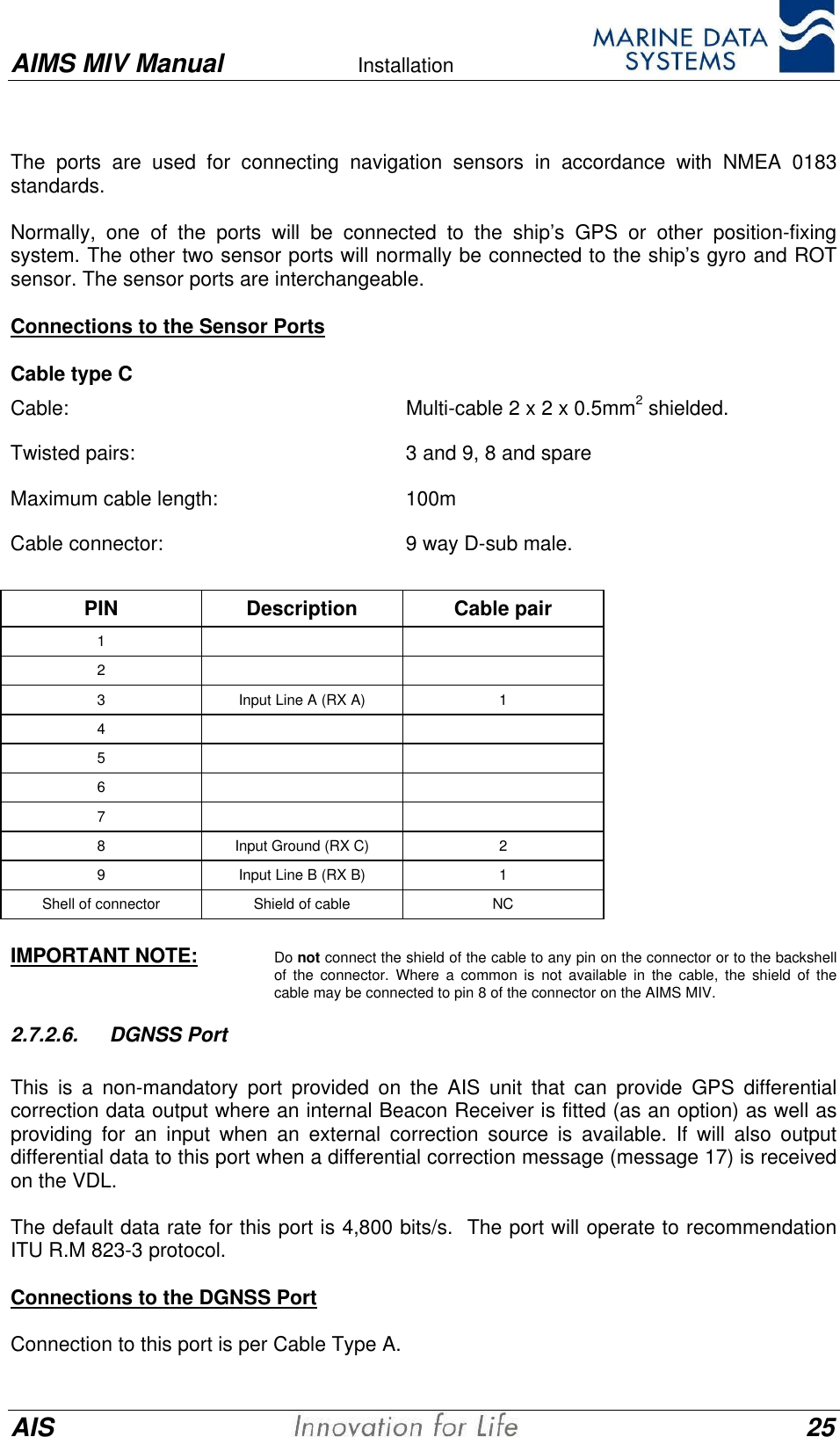
AIMS MIV Manual Installation      AIS 25The ports are used for connecting navigation sensors in accordance with NMEA 0183standards.Normally, one of the ports will be connected to the ship’s GPS or other position-fixingsystem. The other two sensor ports will normally be connected to the ship’s gyro and ROTsensor. The sensor ports are interchangeable.Connections to the Sensor PortsCable type CCable:  Multi-cable 2 x 2 x 0.5mm2 shielded.Twisted pairs:  3 and 9, 8 and spareMaximum cable length:  100mCable connector:  9 way D-sub male.PIN Description Cable pair123Input Line A (RX A) 145678Input Ground (RX C) 29Input Line B (RX B) 1Shell of connector Shield of cable NCIMPORTANT NOTE: Do not connect the shield of the cable to any pin on the connector or to the backshellof the connector. Where a common is not available in the cable, the shield of thecable may be connected to pin 8 of the connector on the AIMS MIV.2.7.2.6. DGNSS PortThis is a non-mandatory port provided on the AIS unit that can provide GPS differentialcorrection data output where an internal Beacon Receiver is fitted (as an option) as well asproviding for an input when an external correction source is available. If will also outputdifferential data to this port when a differential correction message (message 17) is receivedon the VDL.The default data rate for this port is 4,800 bits/s.  The port will operate to recommendationITU R.M 823-3 protocol.Connections to the DGNSS PortConnection to this port is per Cable Type A.
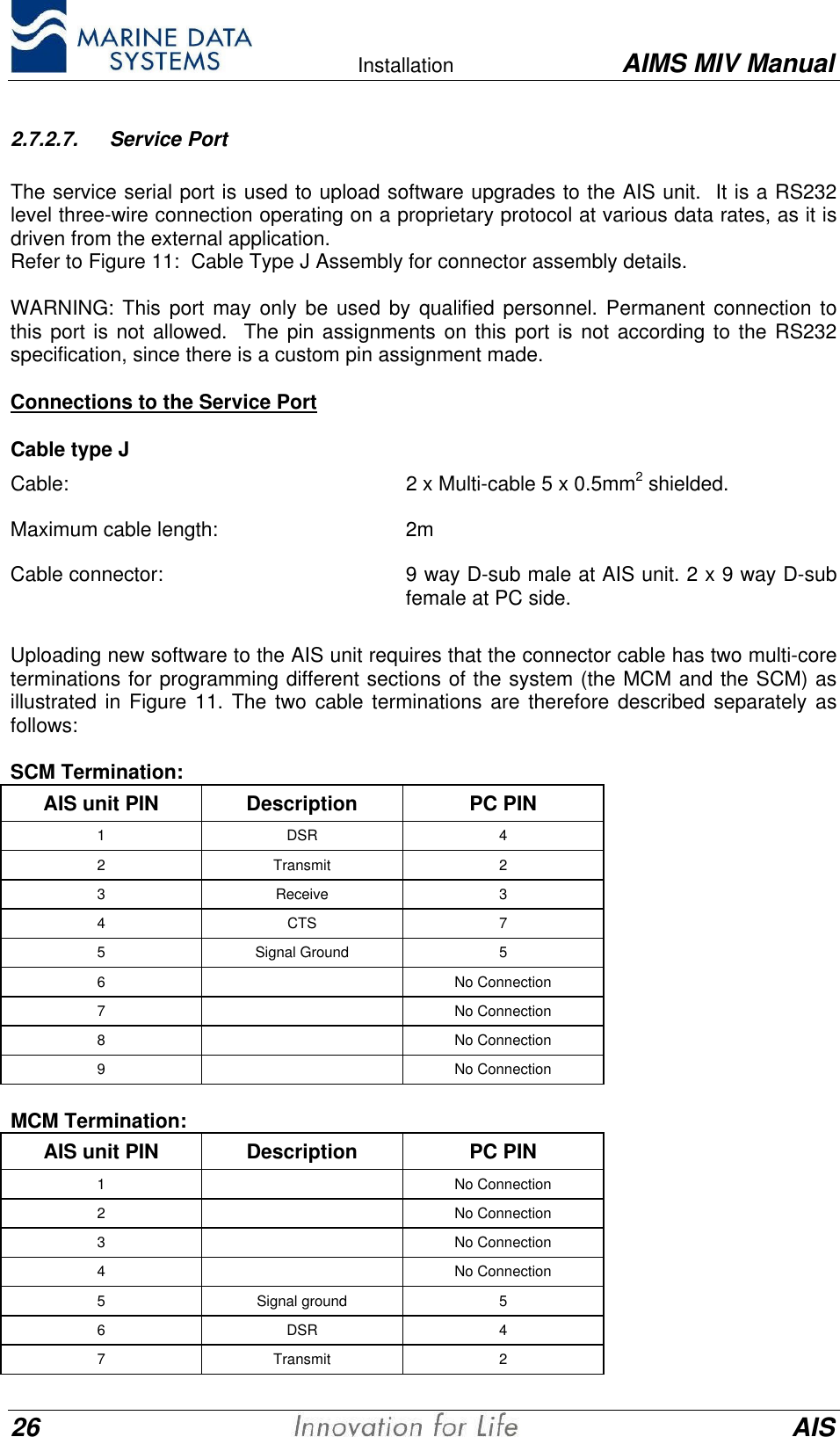
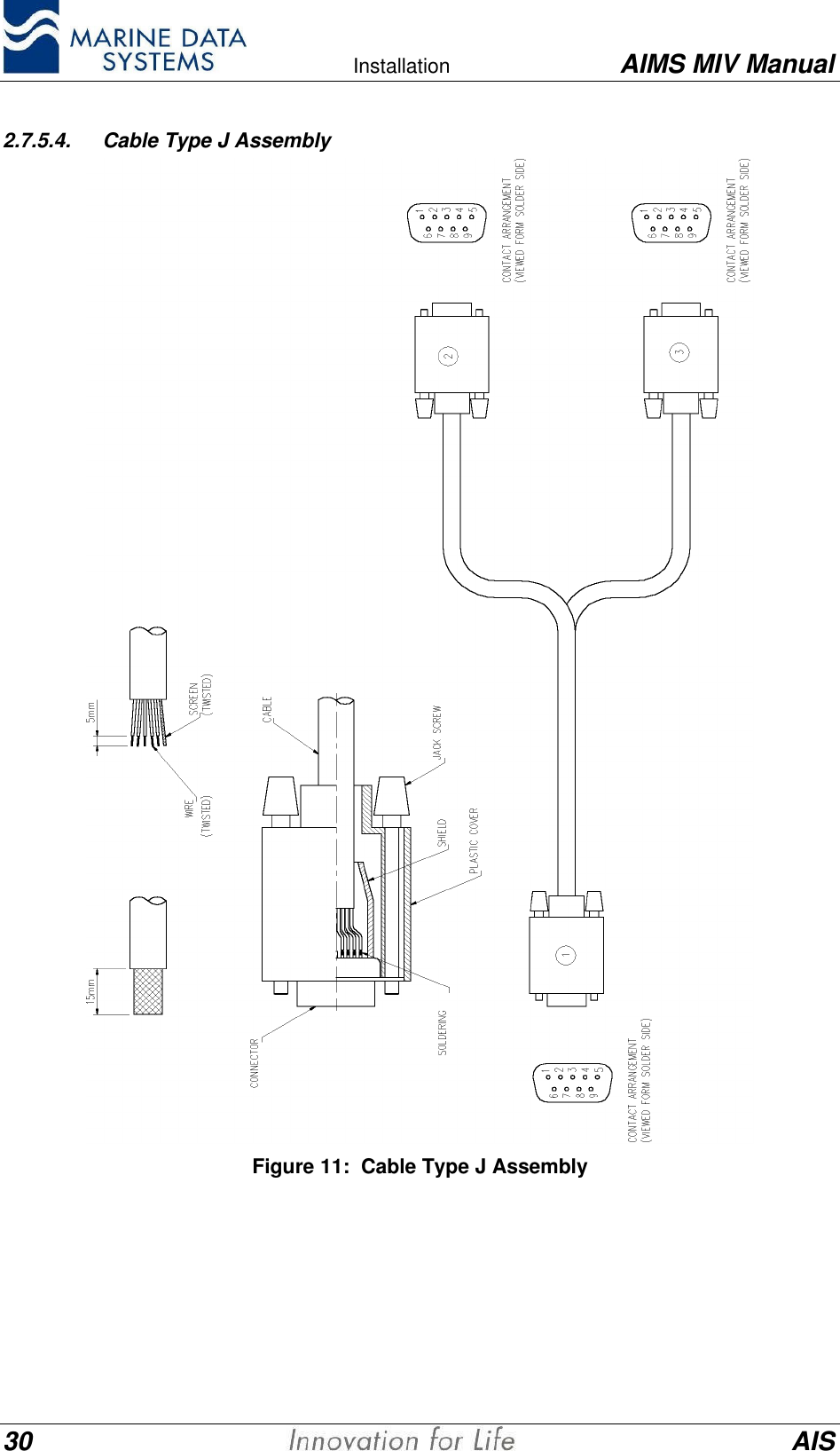
   Installation AIMS MIV Manual26 AIS2.7.2.7. Service PortThe service serial port is used to upload software upgrades to the AIS unit.  It is a RS232level three-wire connection operating on a proprietary protocol at various data rates, as it isdriven from the external application.Refer to Figure 11:  Cable Type J Assembly for connector assembly details.WARNING: This port may only be used by qualified personnel. Permanent connection tothis port is not allowed.  The pin assignments on this port is not according to the RS232specification, since there is a custom pin assignment made.Connections to the Service PortCable type JCable:   2 x Multi-cable 5 x 0.5mm2 shielded.Maximum cable length:  2mCable connector:  9 way D-sub male at AIS unit. 2 x 9 way D-subfemale at PC side.Uploading new software to the AIS unit requires that the connector cable has two multi-coreterminations for programming different sections of the system (the MCM and the SCM) asillustrated in Figure 11. The two cable terminations are therefore described separately asfollows:SCM Termination:AIS unit PIN Description PC PIN1DSR 42Transmit 23Receive 34CTS 75Signal Ground 56No Connection7No Connection8No Connection9No ConnectionMCM Termination:AIS unit PIN Description PC PIN1No Connection2No Connection3No Connection4No Connection5Signal ground 56DSR 47Transmit 2
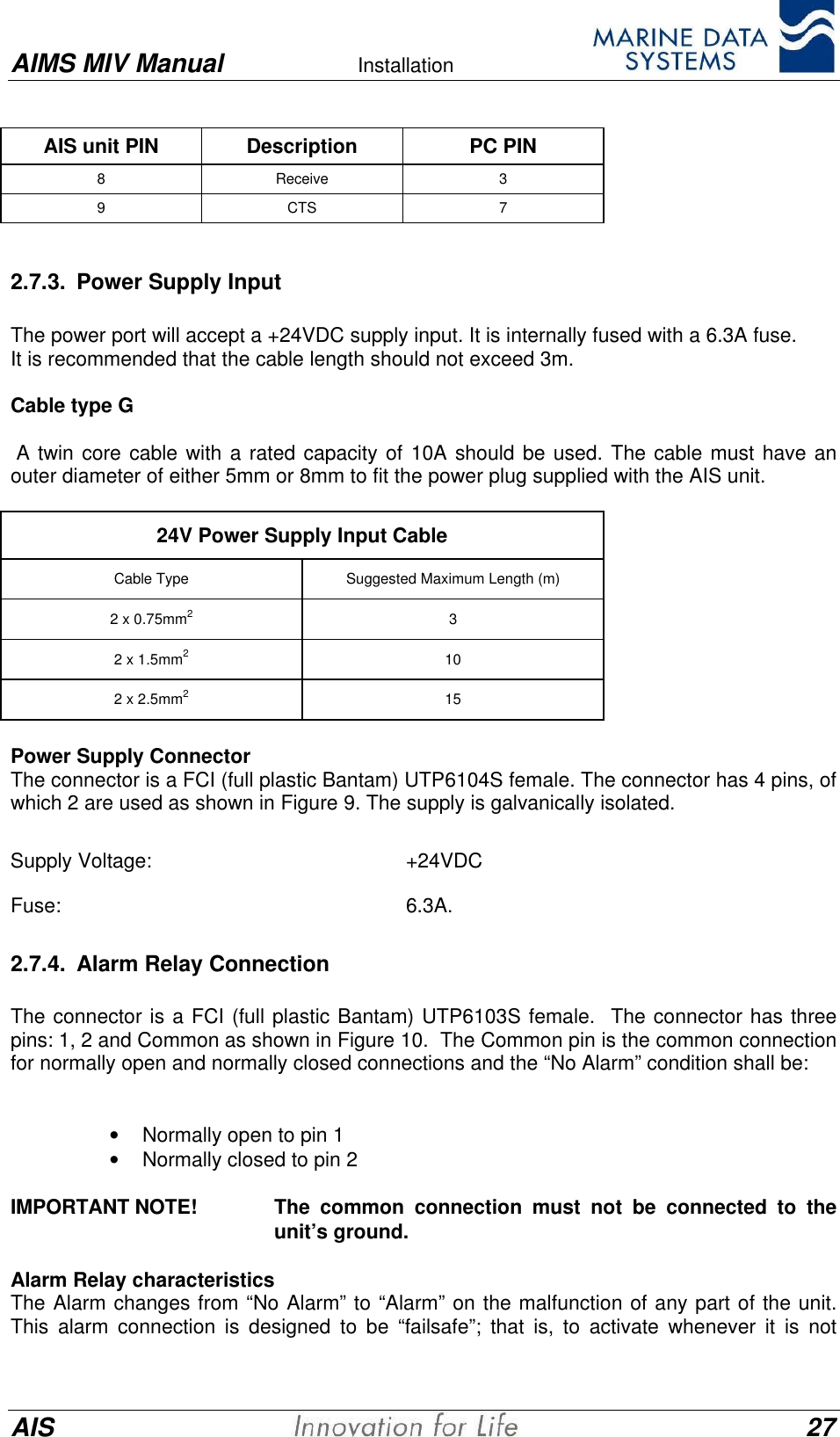
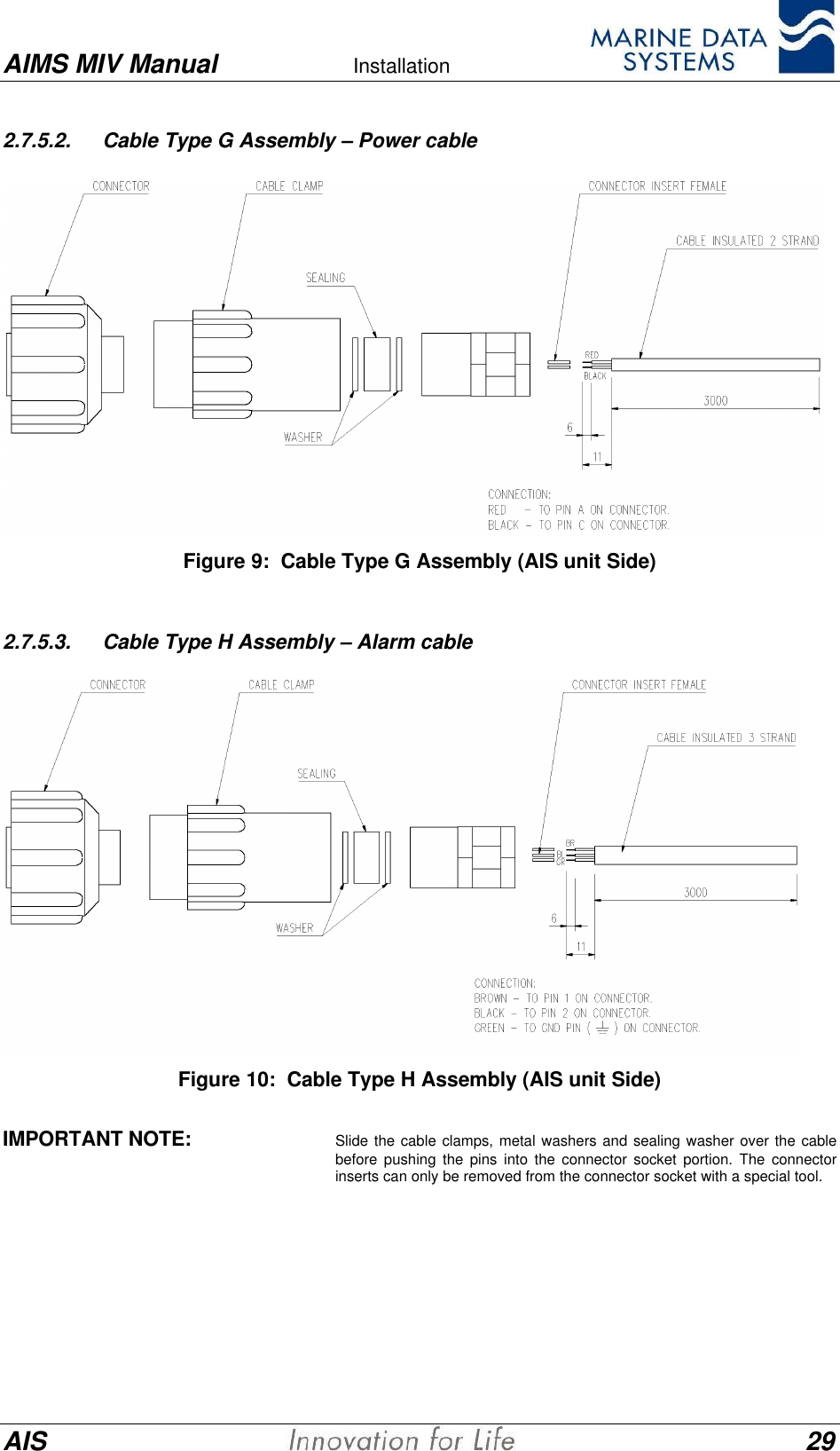
AIMS MIV Manual Installation      AIS 27AIS unit PIN Description PC PIN8Receive 39CTS 72.7.3. Power Supply InputThe power port will accept a +24VDC supply input. It is internally fused with a 6.3A fuse.It is recommended that the cable length should not exceed 3m.Cable type G A twin core cable with a rated capacity of 10A should be used. The cable must have anouter diameter of either 5mm or 8mm to fit the power plug supplied with the AIS unit.24V Power Supply Input CableCable Type Suggested Maximum Length (m)2 x 0.75mm232 x 1.5mm2102 x 2.5mm215Power Supply ConnectorThe connector is a FCI (full plastic Bantam) UTP6104S female. The connector has 4 pins, ofwhich 2 are used as shown in Figure 9. The supply is galvanically isolated.Supply Voltage:  +24VDCFuse:   6.3A.2.7.4. Alarm Relay ConnectionThe connector is a FCI (full plastic Bantam) UTP6103S female.  The connector has threepins: 1, 2 and Common as shown in Figure 10.  The Common pin is the common connectionfor normally open and normally closed connections and the “No Alarm” condition shall be:• Normally open to pin 1• Normally closed to pin 2IMPORTANT NOTE!  The common connection must not be connected to theunit’s ground.Alarm Relay characteristicsThe Alarm changes from “No Alarm” to “Alarm” on the malfunction of any part of the unit.This alarm connection is designed to be “failsafe”; that is, to activate whenever it is not
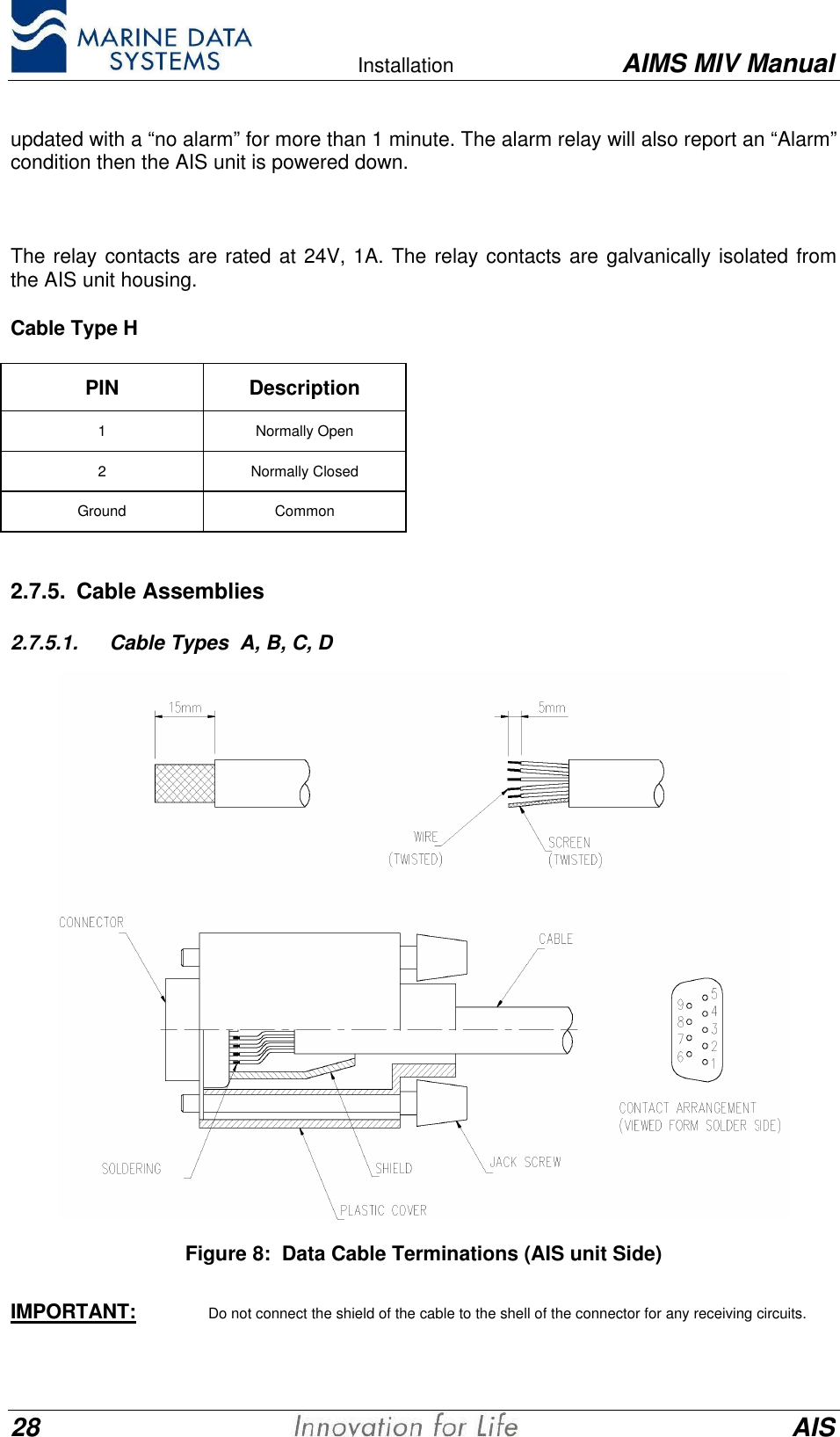
   Installation AIMS MIV Manual28 AISupdated with a “no alarm” for more than 1 minute. The alarm relay will also report an “Alarm”condition then the AIS unit is powered down.The relay contacts are rated at 24V, 1A. The relay contacts are galvanically isolated fromthe AIS unit housing.Cable Type HPIN Description1Normally Open2Normally ClosedGround Common2.7.5. Cable Assemblies2.7.5.1. Cable Types  A, B, C, DFigure 8:  Data Cable Terminations (AIS unit Side)IMPORTANT: Do not connect the shield of the cable to the shell of the connector for any receiving circuits.
AIMS MIV Manual Installation      AIS 292.7.5.2. Cable Type G Assembly – Power cableFigure 9:  Cable Type G Assembly (AIS unit Side)2.7.5.3. Cable Type H Assembly – Alarm cableFigure 10:  Cable Type H Assembly (AIS unit Side)IMPORTANT NOTE: Slide the cable clamps, metal washers and sealing washer over the cablebefore pushing the pins into the connector socket portion. The connectorinserts can only be removed from the connector socket with a special tool.
   Installation AIMS MIV Manual30 AIS2.7.5.4. Cable Type J AssemblyFigure 11:  Cable Type J Assembly
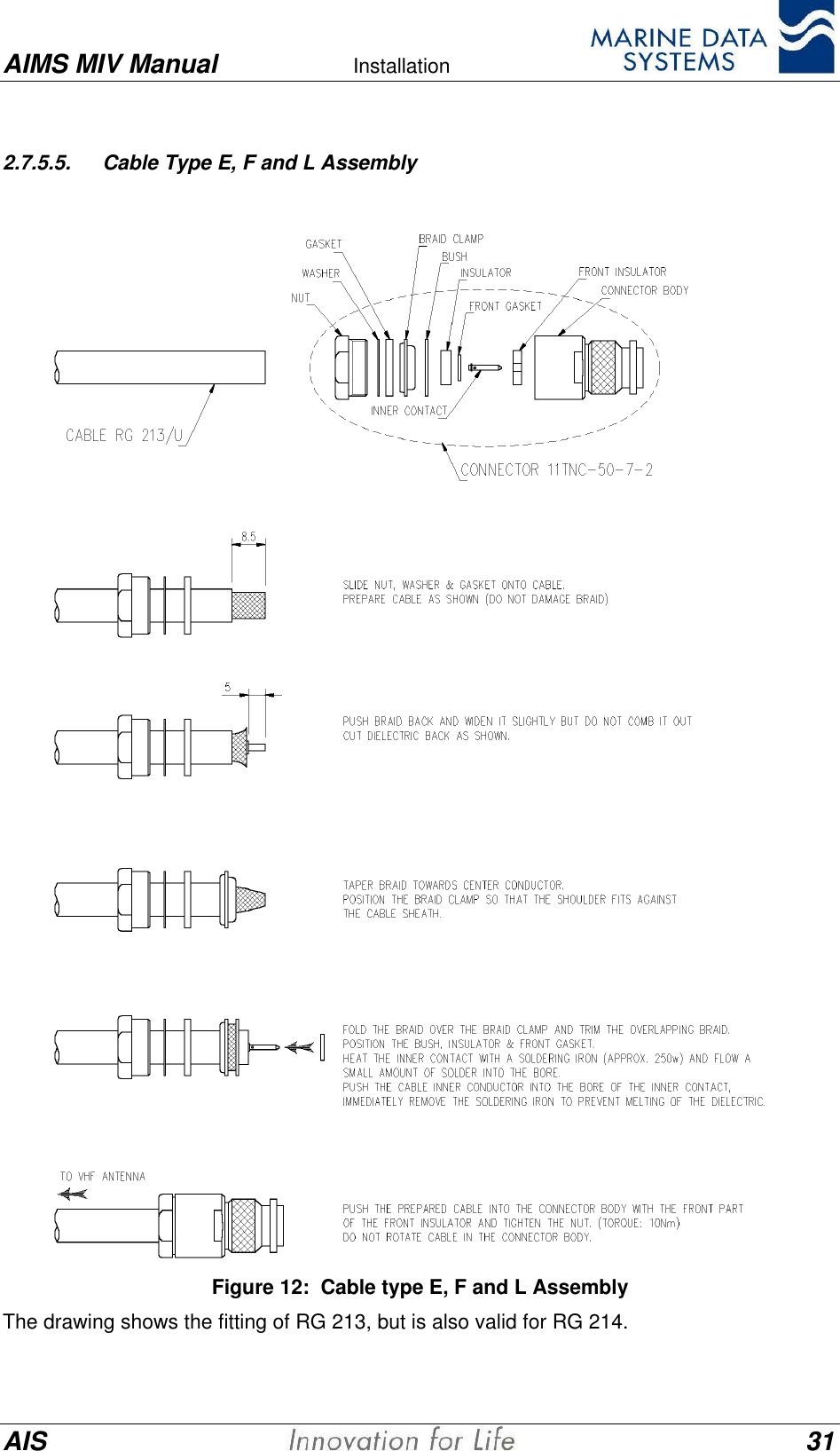
AIMS MIV Manual Installation      AIS 312.7.5.5. Cable Type E, F and L AssemblyFigure 12:  Cable type E, F and L AssemblyThe drawing shows the fitting of RG 213, but is also valid for RG 214.
   Installation AIMS MIV Manual32 AIS2.8. Installation CheckBefore powering on the AIS unit, the alarm relay must indicate an “Alarm” condition.Connect the 24 VDC source to the unit. Power on the unit.The unit will be operational within 2 minutes after switch-on.  Sensors will be allowed theirpermissible start-up time, that is, 30 minutes for GPS when there is no almanac dataavailable; this is usually on first time power-up, or power-up in a different geographicalregion to that from which the system was shipped.On boot-up, the system receivers and transmitter are set up for the default AIS and DSCfrequencies.All LEDs will illuminate when switched on, and the unit will run a self-test.  Faults will bedisplayed on the LEDs. During the self test, all LED’s (except RS4 if not fitted) will illuminatered for 2 seconds, then Green for 2 seconds, then the normal status indication will start.During normal operation, the SCM and MCM  LED’s will blink on and off continuously toindicate normal operation.Check that the LEDs illuminate in green, and that the alarm does not sound (refer to section4.1 on page 49).The alarm relay must have changed to the “No Alarm” condition by now.
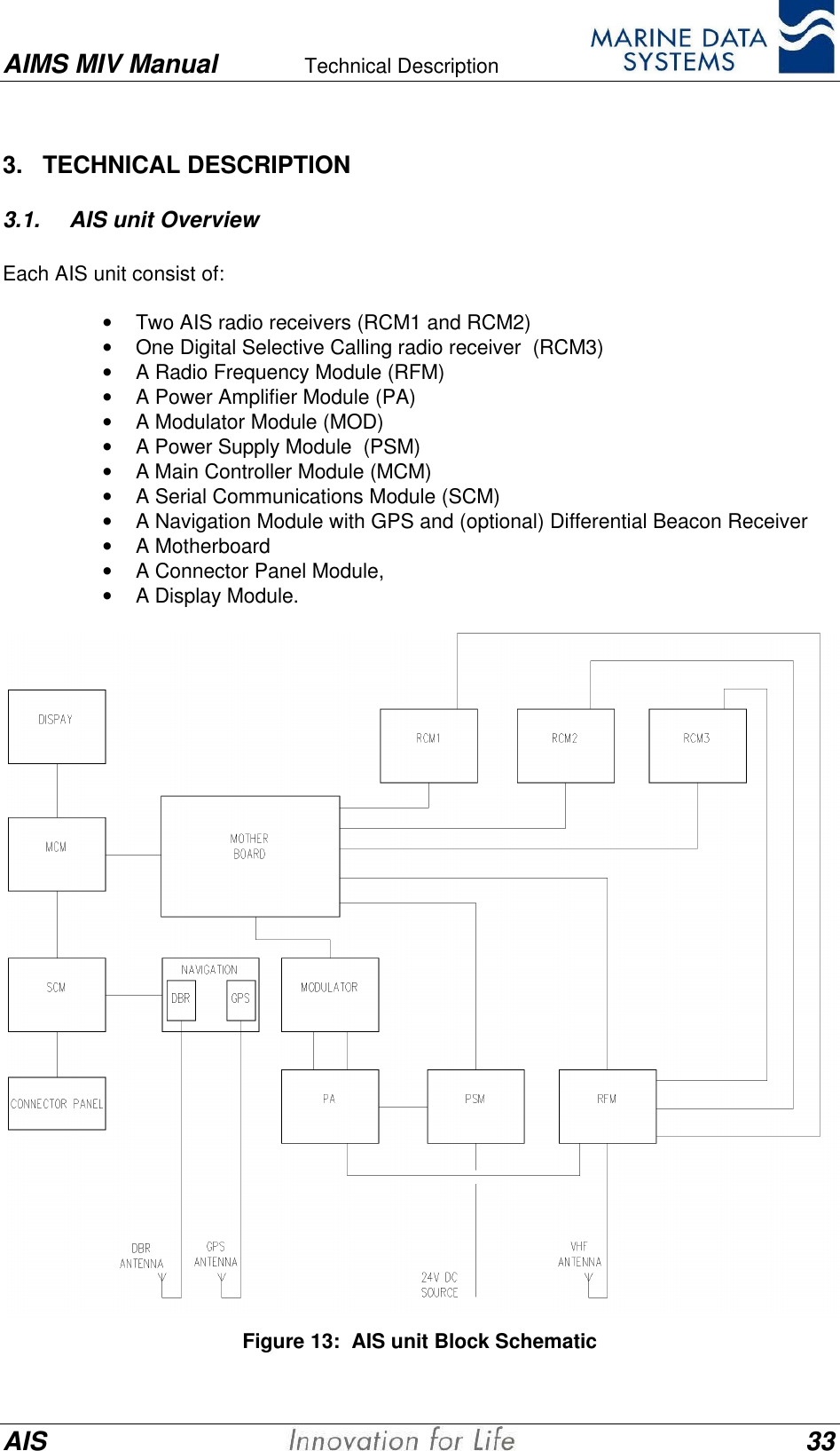
AIMS MIV Manual Technical Description      AIS 333.   TECHNICAL DESCRIPTION3.1. AIS unit OverviewEach AIS unit consist of:• Two AIS radio receivers (RCM1 and RCM2)• One Digital Selective Calling radio receiver  (RCM3)• A Radio Frequency Module (RFM)• A Power Amplifier Module (PA)• A Modulator Module (MOD)• A Power Supply Module  (PSM)• A Main Controller Module (MCM)• A Serial Communications Module (SCM)• A Navigation Module with GPS and (optional) Differential Beacon Receiver• A Motherboard• A Connector Panel Module,• A Display Module.Figure 13:  AIS unit Block Schematic
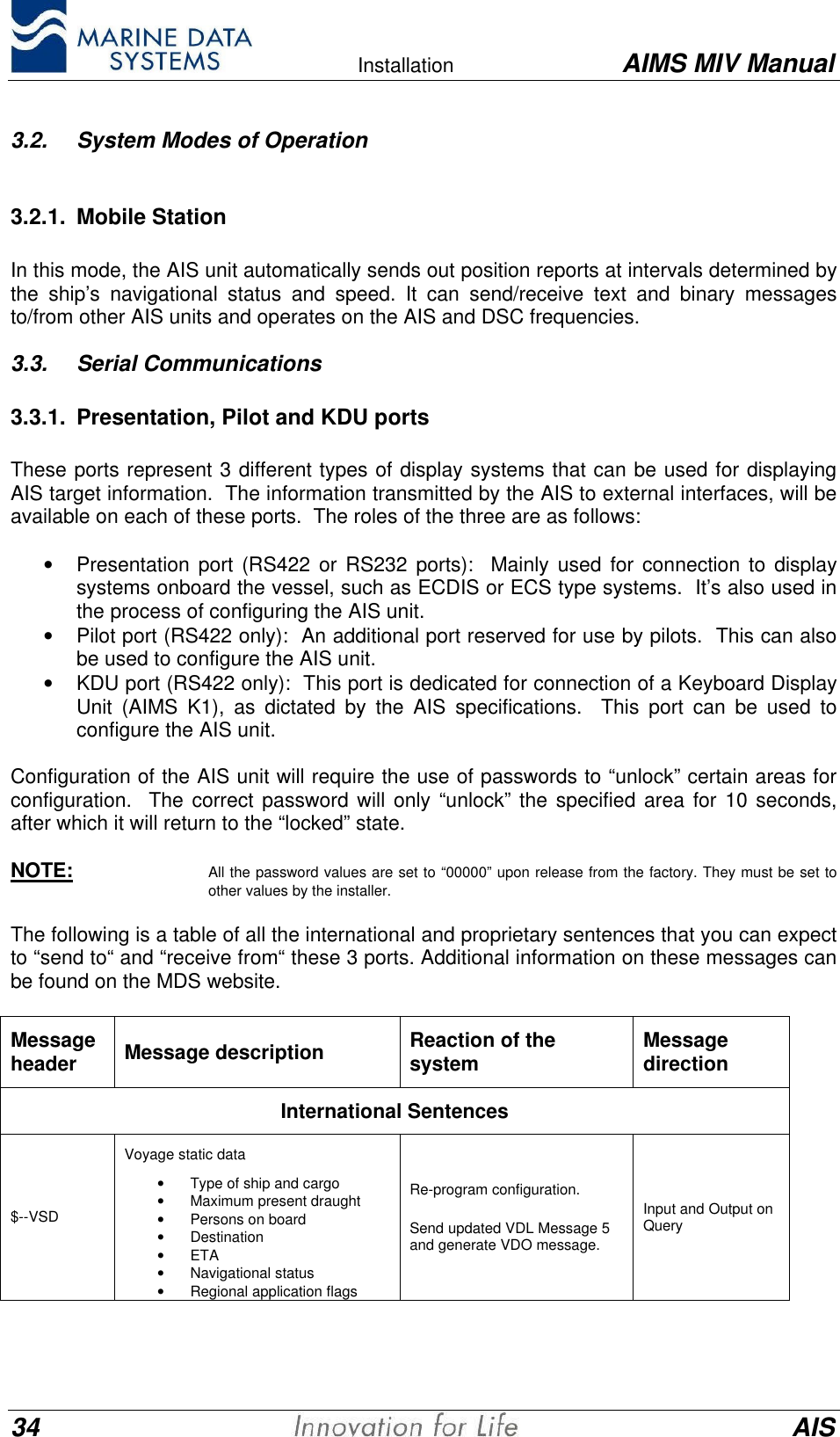
   Installation AIMS MIV Manual34 AIS3.2. System Modes of Operation3.2.1. Mobile StationIn this mode, the AIS unit automatically sends out position reports at intervals determined bythe ship’s navigational status and speed. It can send/receive text and binary messagesto/from other AIS units and operates on the AIS and DSC frequencies.3.3. Serial Communications3.3.1. Presentation, Pilot and KDU portsThese ports represent 3 different types of display systems that can be used for displayingAIS target information.  The information transmitted by the AIS to external interfaces, will beavailable on each of these ports.  The roles of the three are as follows:• Presentation port (RS422 or RS232 ports):  Mainly used for connection to displaysystems onboard the vessel, such as ECDIS or ECS type systems.  It’s also used inthe process of configuring the AIS unit.• Pilot port (RS422 only):  An additional port reserved for use by pilots.  This can alsobe used to configure the AIS unit.• KDU port (RS422 only):  This port is dedicated for connection of a Keyboard DisplayUnit (AIMS K1), as dictated by the AIS specifications.  This port can be used toconfigure the AIS unit.Configuration of the AIS unit will require the use of passwords to “unlock” certain areas forconfiguration.  The correct password will only “unlock” the specified area for 10 seconds,after which it will return to the “locked” state.NOTE: All the password values are set to “00000” upon release from the factory. They must be set toother values by the installer.The following is a table of all the international and proprietary sentences that you can expectto “send to“ and “receive from“ these 3 ports. Additional information on these messages canbe found on the MDS website.Messageheader Message description Reaction of thesystem MessagedirectionInternational Sentences$--VSDVoyage static data• Type of ship and cargo• Maximum present draught• Persons on board• Destination• ETA• Navigational status• Regional application flagsRe-program configuration.Send updated VDL Message 5and generate VDO message.Input and Output onQuery
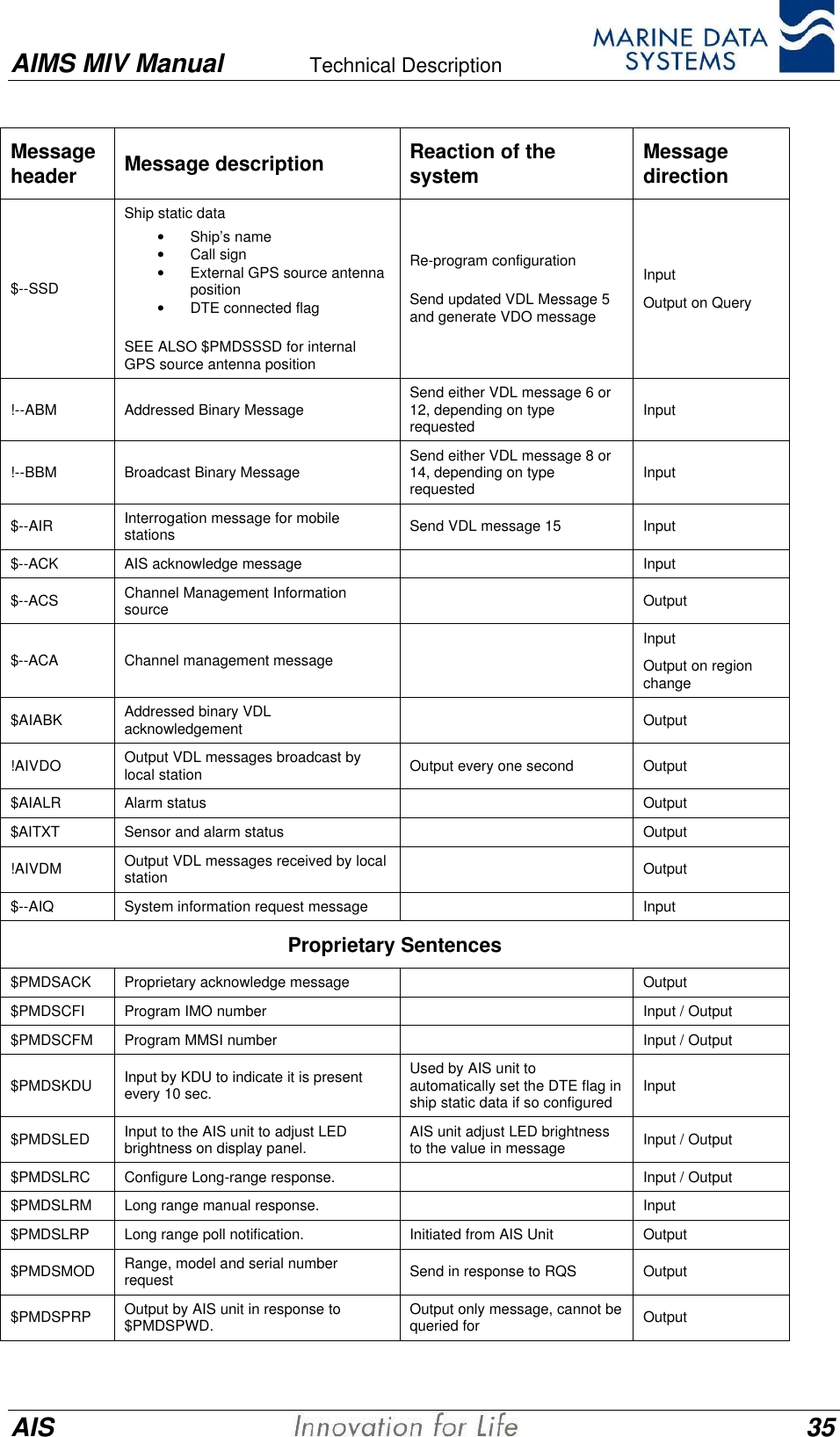
AIMS MIV Manual Technical Description      AIS 35Messageheader Message description Reaction of thesystem Messagedirection$--SSDShip static data• Ship’s name• Call sign• External GPS source antennaposition• DTE connected flagSEE ALSO $PMDSSSD for internalGPS source antenna positionRe-program configurationSend updated VDL Message 5and generate VDO messageInputOutput on Query!--ABM Addressed Binary Message Send either VDL message 6 or12, depending on typerequested Input!--BBM Broadcast Binary Message Send either VDL message 8 or14, depending on typerequested Input$--AIR Interrogation message for mobilestations Send VDL message 15 Input$--ACK AIS acknowledge message Input$--ACS Channel Management Informationsource Output$--ACA Channel management messageInputOutput on regionchange$AIABK Addressed binary VDLacknowledgement Output!AIVDO Output VDL messages broadcast bylocal station Output every one second Output$AIALR Alarm status Output$AITXT Sensor and alarm status Output!AIVDM Output VDL messages received by localstation Output$--AIQ System information request message InputProprietary Sentences$PMDSACK Proprietary acknowledge message Output$PMDSCFI Program IMO number Input / Output$PMDSCFM Program MMSI number Input / Output$PMDSKDU Input by KDU to indicate it is presentevery 10 sec.Used by AIS unit toautomatically set the DTE flag inship static data if so configured Input$PMDSLED Input to the AIS unit to adjust LEDbrightness on display panel. AIS unit adjust LED brightnessto the value in message Input / Output$PMDSLRC Configure Long-range response. Input / Output$PMDSLRM Long range manual response. Input$PMDSLRP Long range poll notification. Initiated from AIS Unit Output$PMDSMOD Range, model and serial numberrequest Send in response to RQS Output$PMDSPRP Output by AIS unit in response to$PMDSPWD. Output only message, cannot bequeried for Output
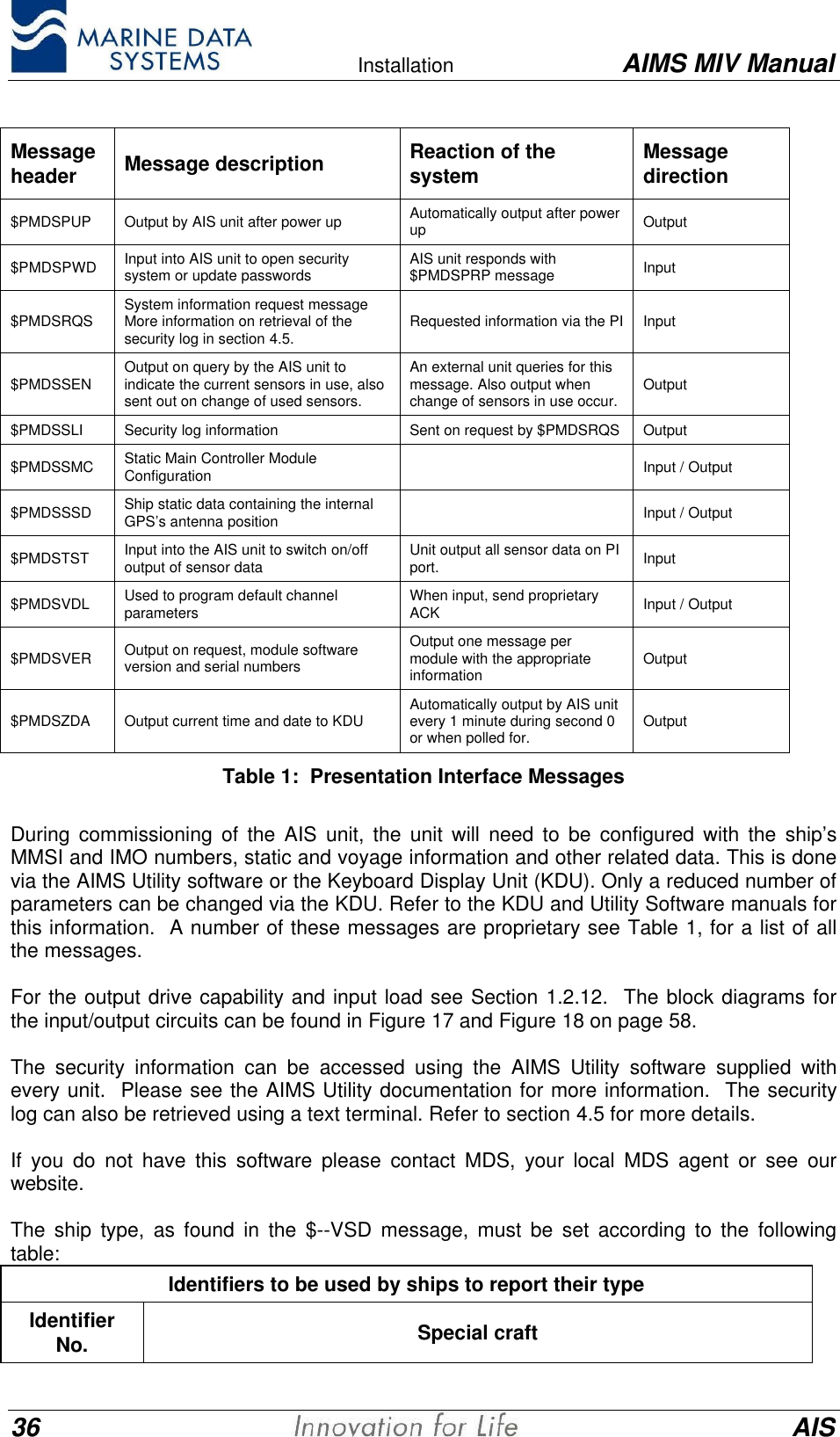
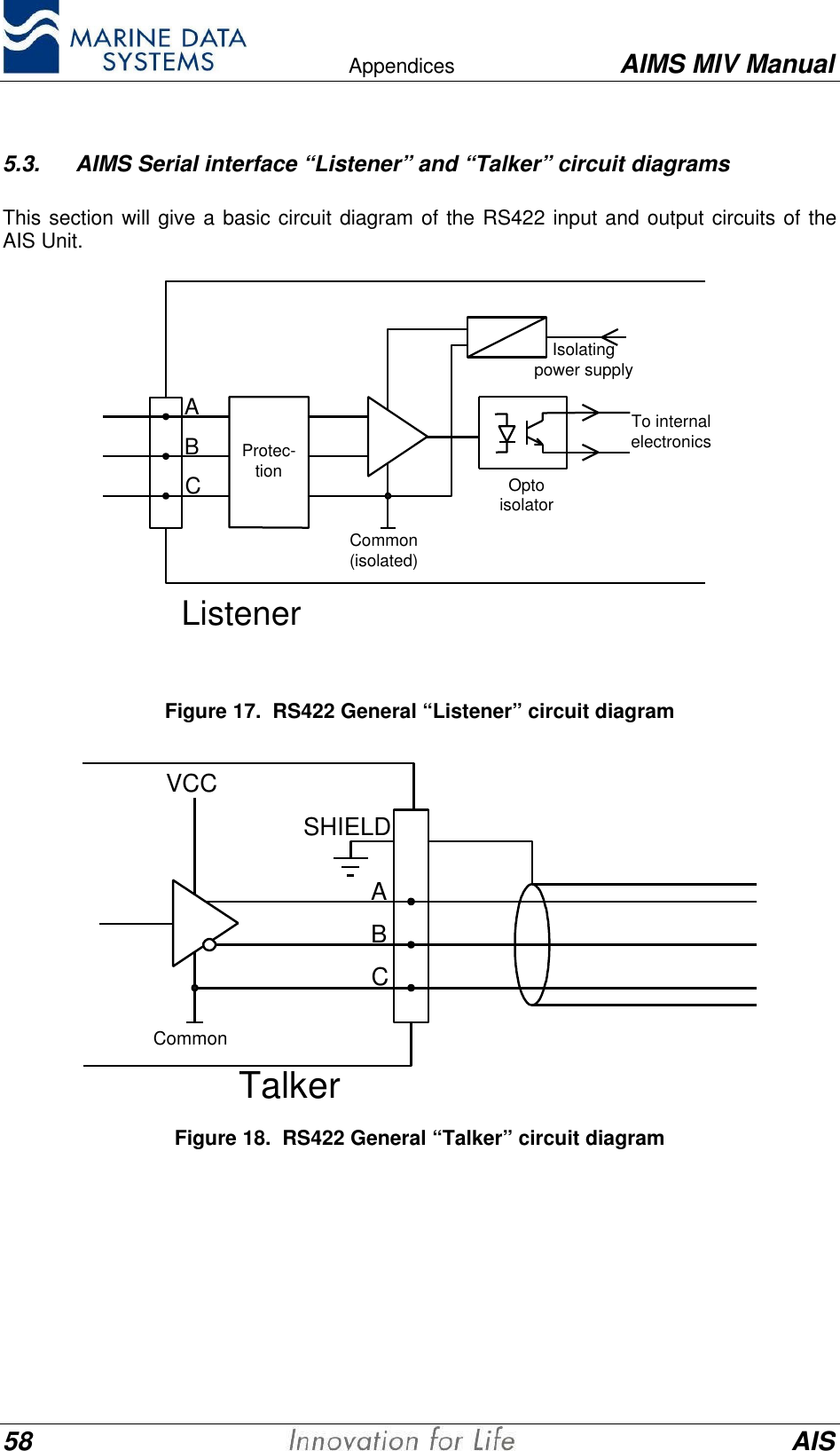
   Installation AIMS MIV Manual36 AISMessageheader Message description Reaction of thesystem Messagedirection$PMDSPUP Output by AIS unit after power up Automatically output after powerup Output$PMDSPWD Input into AIS unit to open securitysystem or update passwords AIS unit responds with$PMDSPRP message Input$PMDSRQS System information request messageMore information on retrieval of thesecurity log in section 4.5.Requested information via the PI Input$PMDSSEN Output on query by the AIS unit toindicate the current sensors in use, alsosent out on change of used sensors.An external unit queries for thismessage. Also output whenchange of sensors in use occur. Output$PMDSSLI Security log information Sent on request by $PMDSRQS Output$PMDSSMC Static Main Controller ModuleConfiguration Input / Output$PMDSSSD Ship static data containing the internalGPS’s antenna position Input / Output$PMDSTST Input into the AIS unit to switch on/offoutput of sensor data Unit output all sensor data on PIport. Input$PMDSVDL Used to program default channelparameters When input, send proprietaryACK Input / Output$PMDSVER Output on request, module softwareversion and serial numbersOutput one message permodule with the appropriateinformation Output$PMDSZDA Output current time and date to KDU Automatically output by AIS unitevery 1 minute during second 0or when polled for. OutputTable 1:  Presentation Interface MessagesDuring commissioning of the AIS unit, the unit will need to be configured with the ship’sMMSI and IMO numbers, static and voyage information and other related data. This is donevia the AIMS Utility software or the Keyboard Display Unit (KDU). Only a reduced number ofparameters can be changed via the KDU. Refer to the KDU and Utility Software manuals forthis information.  A number of these messages are proprietary see Table 1, for a list of allthe messages.For the output drive capability and input load see Section 1.2.12.  The block diagrams forthe input/output circuits can be found in Figure 17 and Figure 18 on page 58.The security information can be accessed using the AIMS Utility software supplied withevery unit.  Please see the AIMS Utility documentation for more information.  The securitylog can also be retrieved using a text terminal. Refer to section 4.5 for more details.If you do not have this software please contact MDS, your local MDS agent or see ourwebsite.The ship type, as found in the $--VSD message, must be set according to the followingtable:Identifiers to be used by ships to report their typeIdentifierNo. Special craft
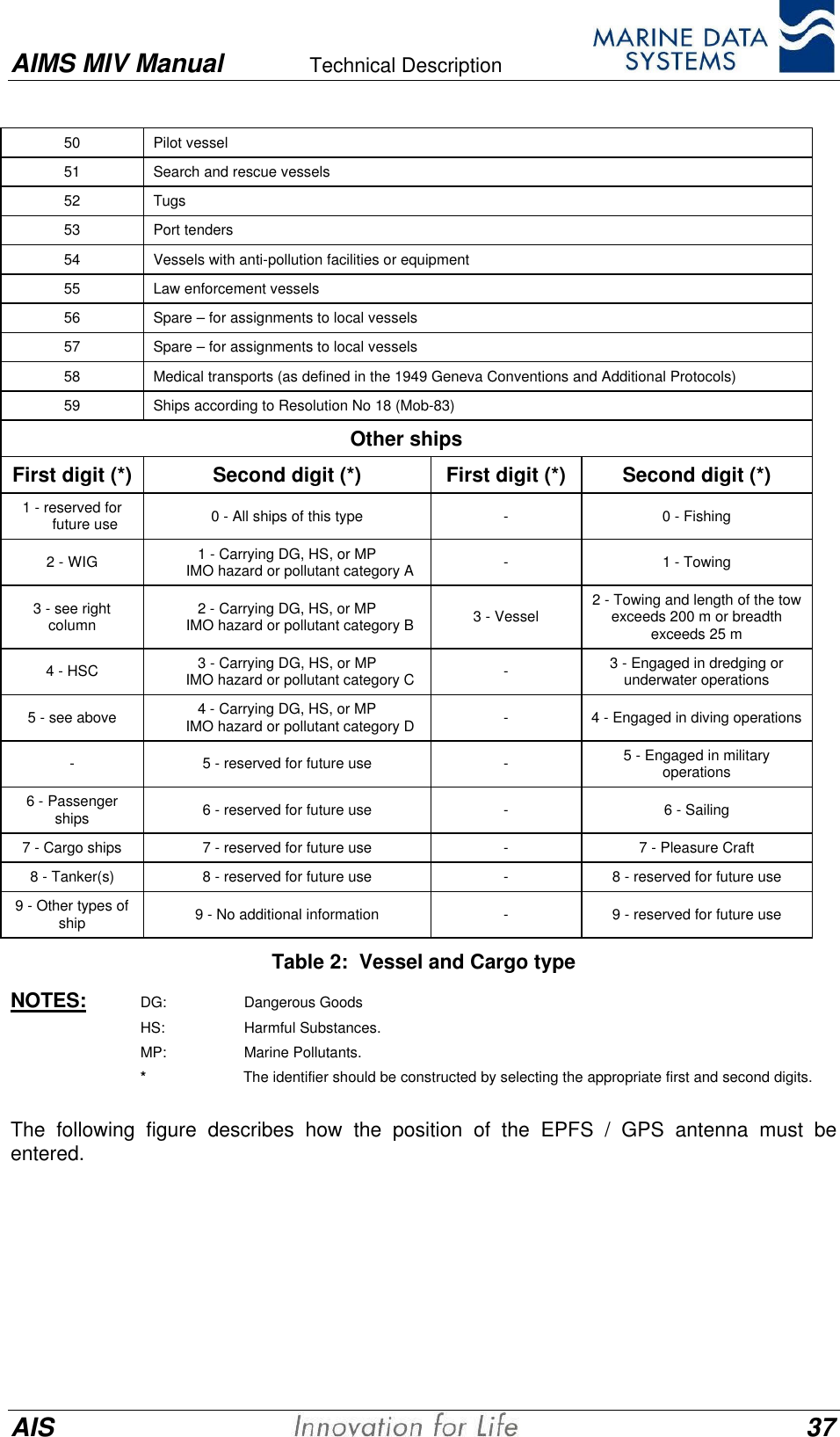
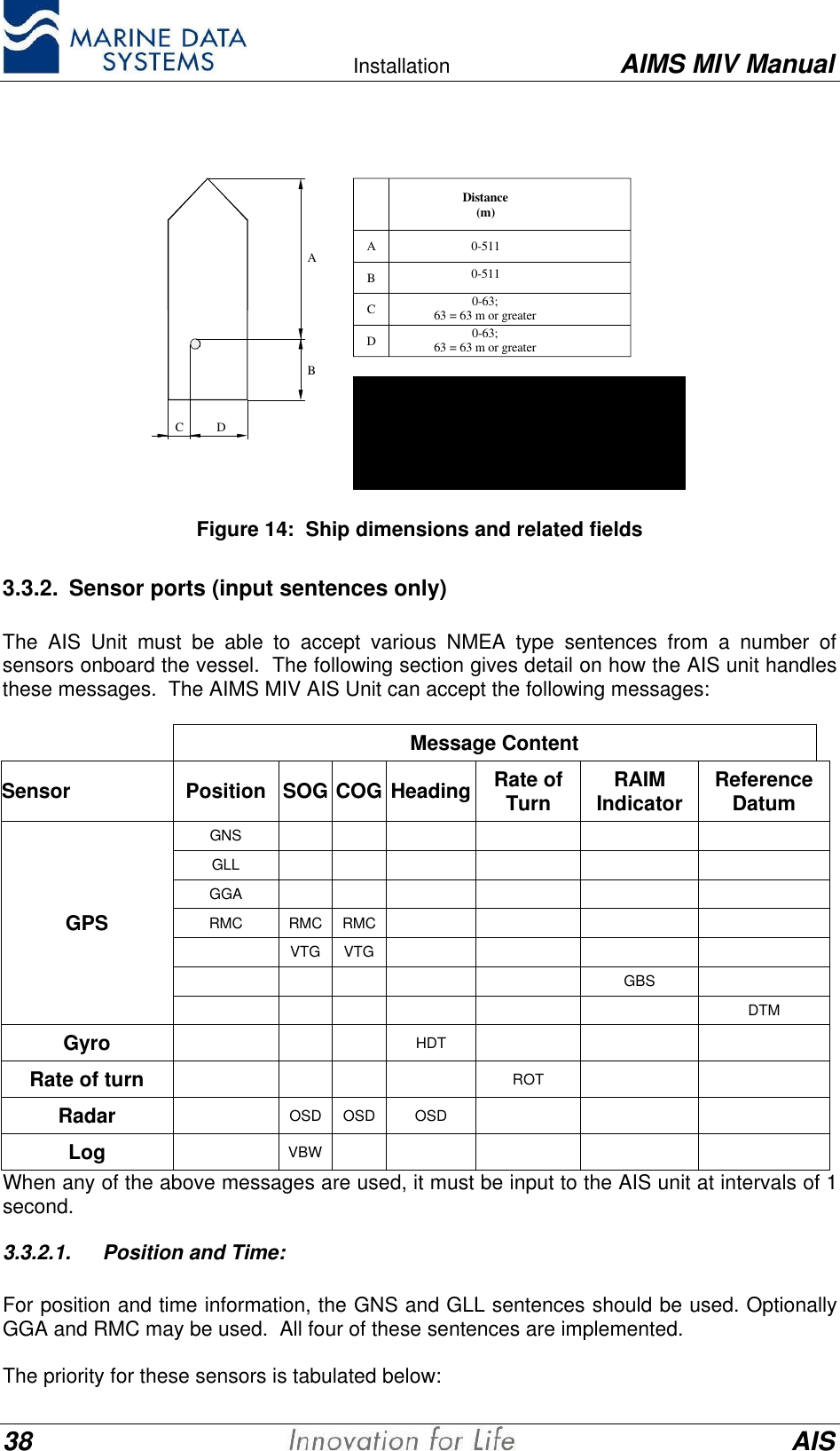
AIMS MIV Manual Technical Description      AIS 3750 Pilot vessel51 Search and rescue vessels52 Tugs53 Port tenders54 Vessels with anti-pollution facilities or equipment55 Law enforcement vessels56 Spare – for assignments to local vessels57 Spare – for assignments to local vessels58 Medical transports (as defined in the 1949 Geneva Conventions and Additional Protocols)59 Ships according to Resolution No 18 (Mob-83)Other shipsFirst digit (*) Second digit (*) First digit (*) Second digit (*)1 - reserved forfuture use 0 - All ships of this type -0 - Fishing2 - WIG 1 - Carrying DG, HS, or MPIMO hazard or pollutant category A -1 - Towing3 - see rightcolumn 2 - Carrying DG, HS, or MPIMO hazard or pollutant category B 3 - Vessel 2 - Towing and length of the towexceeds 200 m or breadthexceeds 25 m4 - HSC 3 - Carrying DG, HS, or MPIMO hazard or pollutant category C -3 - Engaged in dredging orunderwater operations5 - see above 4 - Carrying DG, HS, or MPIMO hazard or pollutant category D -4 - Engaged in diving operations-5 - reserved for future use -5 - Engaged in militaryoperations6 - Passengerships 6 - reserved for future use -6 - Sailing7 - Cargo ships 7 - reserved for future use -7 - Pleasure Craft8 - Tanker(s) 8 - reserved for future use -8 - reserved for future use9 - Other types ofship 9 - No additional information -9 - reserved for future useTable 2:  Vessel and Cargo typeNOTES: DG: Dangerous GoodsHS: Harmful Substances.MP: Marine Pollutants.*The identifier should be constructed by selecting the appropriate first and second digits.The following figure describes how the position of the EPFS / GPS antenna must beentered.
   Installation AIMS MIV Manual38 AISABDCABCDDistance(m)0-5110-5110-63;63 = 63 m or greater0-63;63 = 63 m or greaterReference point of reported position not available, but dimensions of ship are available: A = C = 0 and B ≠ 0 and D ≠ 0.Neither reference point of reported position nor dimensions of ship available; A = B = C = D = 0 (= default)For use in the message table, A = most significant field,D = least significant fieldFigure 14:  Ship dimensions and related fields3.3.2. Sensor ports (input sentences only)The AIS Unit must be able to accept various NMEA type sentences from a number ofsensors onboard the vessel.  The following section gives detail on how the AIS unit handlesthese messages.  The AIMS MIV AIS Unit can accept the following messages:Message ContentSensor Position SOG COG Heading Rate ofTurn RAIMIndicator ReferenceDatumGNSGLLGGARMC RMC RMCVTG VTGGBSGPSDTMGyro HDTRate of turn ROTRadar OSD OSD OSDLog VBWWhen any of the above messages are used, it must be input to the AIS unit at intervals of 1second.3.3.2.1. Position and Time:For position and time information, the GNS and GLL sentences should be used. OptionallyGGA and RMC may be used.  All four of these sentences are implemented.The priority for these sensors is tabulated below:
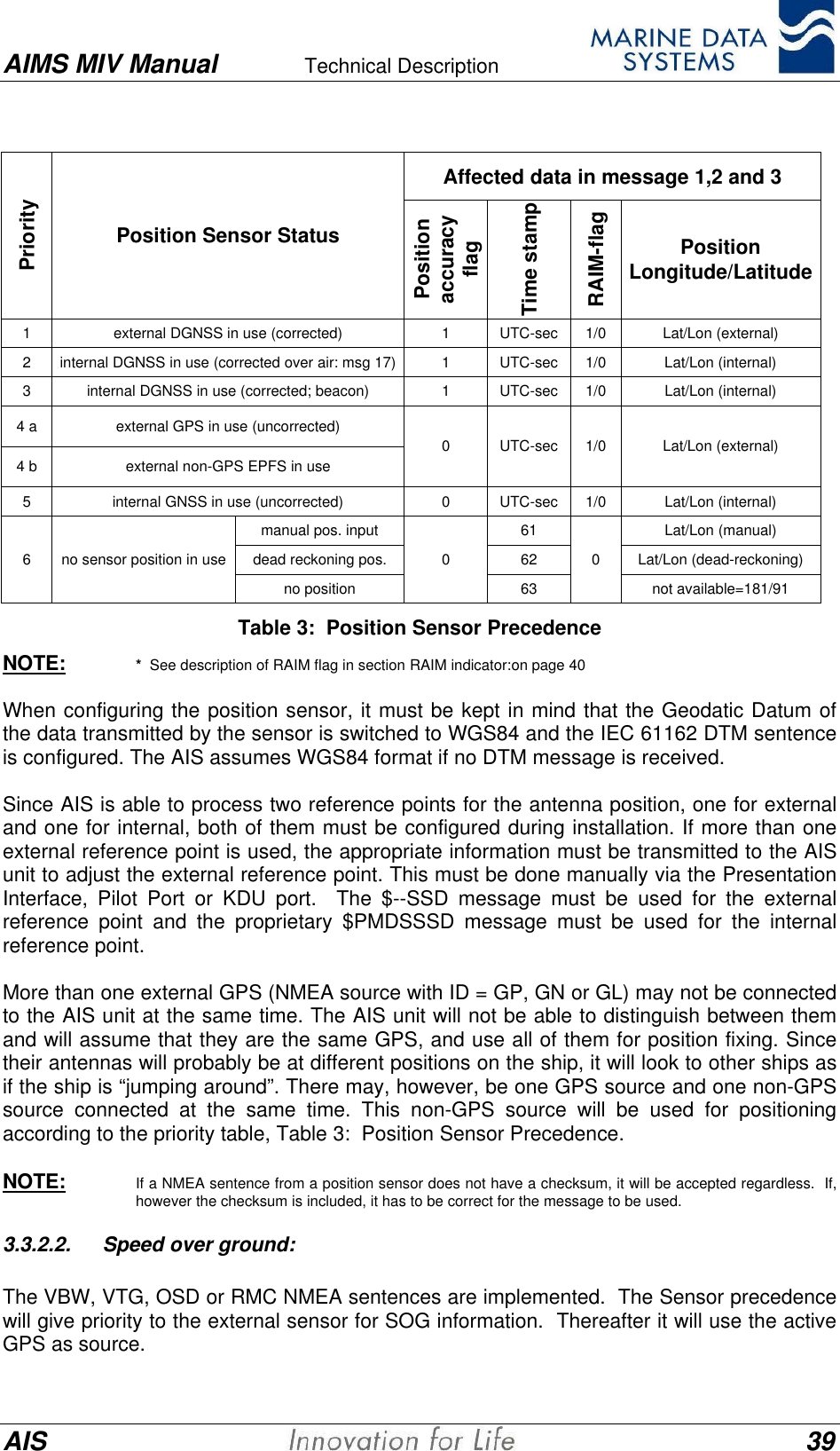
AIMS MIV Manual Technical Description      AIS 39Affected data in message 1,2 and 3PriorityPosition Sensor StatusPositionaccuracyflagTime stampRAIM-flagPositionLongitude/Latitude1external DGNSS in use (corrected) 1UTC-sec 1/0 Lat/Lon (external)2internal DGNSS in use (corrected over air: msg 17) 1UTC-sec 1/0 Lat/Lon (internal)3internal DGNSS in use (corrected; beacon) 1UTC-sec 1/0 Lat/Lon (internal)4 a external GPS in use (uncorrected)4 b external non-GPS EPFS in use0UTC-sec 1/0 Lat/Lon (external)5internal GNSS in use (uncorrected) 0UTC-sec 1/0 Lat/Lon (internal)manual pos. input 61 Lat/Lon (manual)dead reckoning pos. 62 Lat/Lon (dead-reckoning)6no sensor position in useno position0630not available=181/91Table 3:  Position Sensor PrecedenceNOTE: *  See description of RAIM flag in section RAIM indicator:on page 40When configuring the position sensor, it must be kept in mind that the Geodatic Datum ofthe data transmitted by the sensor is switched to WGS84 and the IEC 61162 DTM sentenceis configured. The AIS assumes WGS84 format if no DTM message is received.Since AIS is able to process two reference points for the antenna position, one for externaland one for internal, both of them must be configured during installation. If more than oneexternal reference point is used, the appropriate information must be transmitted to the AISunit to adjust the external reference point. This must be done manually via the PresentationInterface, Pilot Port or KDU port.  The $--SSD message must be used for the externalreference point and the proprietary $PMDSSSD message must be used for the internalreference point.More than one external GPS (NMEA source with ID = GP, GN or GL) may not be connectedto the AIS unit at the same time. The AIS unit will not be able to distinguish between themand will assume that they are the same GPS, and use all of them for position fixing. Sincetheir antennas will probably be at different positions on the ship, it will look to other ships asif the ship is “jumping around”. There may, however, be one GPS source and one non-GPSsource connected at the same time. This non-GPS source will be used for positioningaccording to the priority table, Table 3:  Position Sensor Precedence.NOTE: If a NMEA sentence from a position sensor does not have a checksum, it will be accepted regardless.  If,however the checksum is included, it has to be correct for the message to be used.3.3.2.2. Speed over ground:The VBW, VTG, OSD or RMC NMEA sentences are implemented.  The Sensor precedencewill give priority to the external sensor for SOG information.  Thereafter it will use the activeGPS as source.
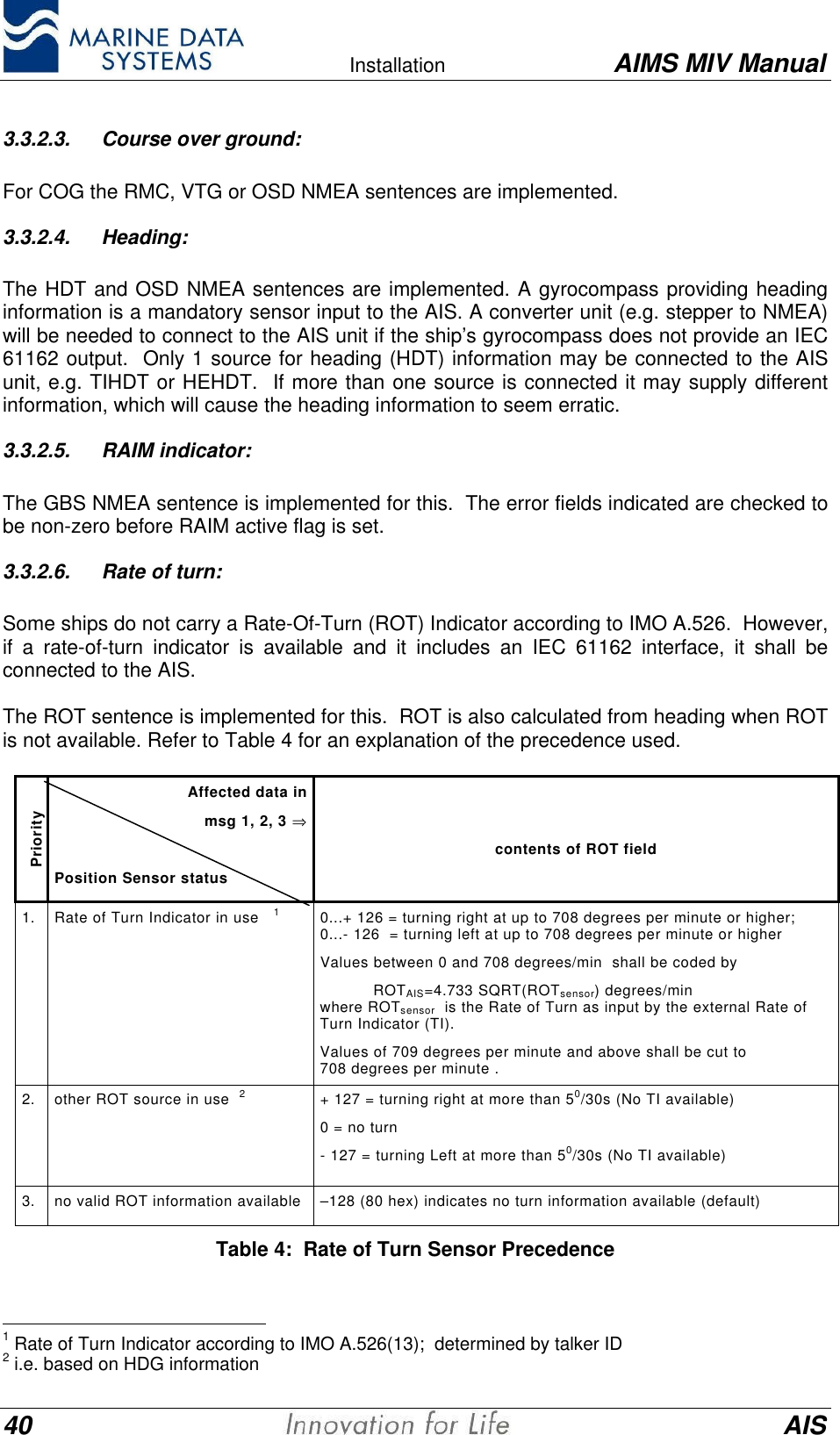
   Installation AIMS MIV Manual40 AIS3.3.2.3. Course over ground:For COG the RMC, VTG or OSD NMEA sentences are implemented.3.3.2.4. Heading:The HDT and OSD NMEA sentences are implemented. A gyrocompass providing headinginformation is a mandatory sensor input to the AIS. A converter unit (e.g. stepper to NMEA)will be needed to connect to the AIS unit if the ship’s gyrocompass does not provide an IEC61162 output.  Only 1 source for heading (HDT) information may be connected to the AISunit, e.g. TIHDT or HEHDT.  If more than one source is connected it may supply differentinformation, which will cause the heading information to seem erratic.3.3.2.5. RAIM indicator:The GBS NMEA sentence is implemented for this.  The error fields indicated are checked tobe non-zero before RAIM active flag is set.3.3.2.6. Rate of turn:Some ships do not carry a Rate-Of-Turn (ROT) Indicator according to IMO A.526.  However,if a rate-of-turn indicator is available and it includes an IEC 61162 interface, it shall beconnected to the AIS.The ROT sentence is implemented for this.  ROT is also calculated from heading when ROTis not available. Refer to Table 4 for an explanation of the precedence used.PriorityAffected data inmsg 1, 2, 3 ⇒Position Sensor statuscontents of ROT field1. Rate of Turn Indicator in use   10...+ 126 = turning right at up to 708 degrees per minute or higher;0...- 126  = turning left at up to 708 degrees per minute or higherValues between 0 and 708 degrees/min  shall be coded by           ROTAIS=4.733 SQRT(ROTsensor) degrees/minwhere ROTsensor  is the Rate of Turn as input by the external Rate ofTurn Indicator (TI).Values of 709 degrees per minute and above shall be cut to708 degrees per minute .2. other ROT source in use  2+ 127 = turning right at more than 50/30s (No TI available)0 = no turn- 127 = turning Left at more than 50/30s (No TI available)3. no valid ROT information available –128 (80 hex) indicates no turn information available (default)Table 4:  Rate of Turn Sensor Precedence                                               1 Rate of Turn Indicator according to IMO A.526(13);  determined by talker ID2 i.e. based on HDG information
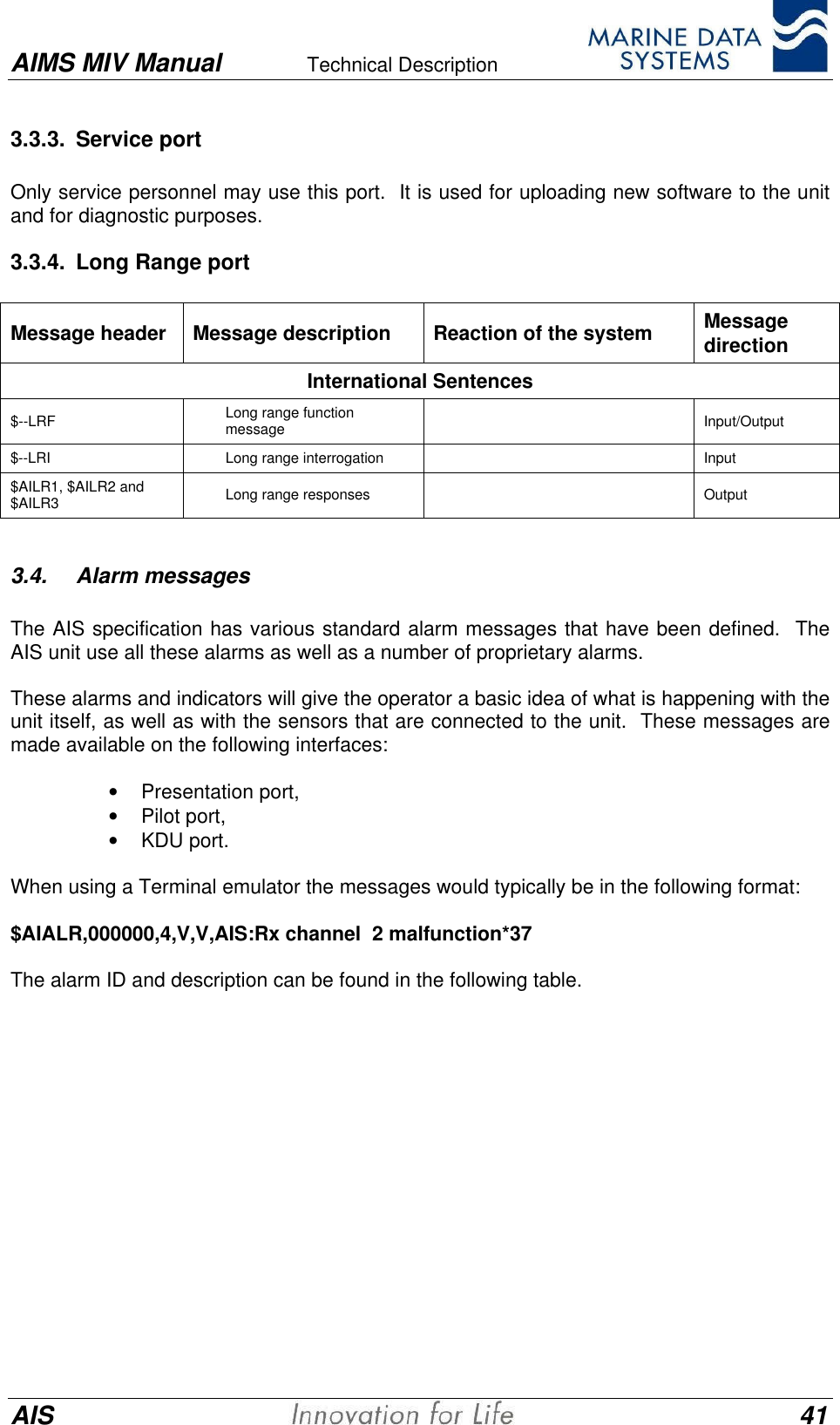
AIMS MIV Manual Technical Description      AIS 413.3.3. Service portOnly service personnel may use this port.  It is used for uploading new software to the unitand for diagnostic purposes.3.3.4. Long Range portMessage header Message description Reaction of the system MessagedirectionInternational Sentences$--LRF Long range functionmessage Input/Output$--LRI Long range interrogation Input$AILR1, $AILR2 and$AILR3 Long range responses Output3.4. Alarm messagesThe AIS specification has various standard alarm messages that have been defined.  TheAIS unit use all these alarms as well as a number of proprietary alarms.These alarms and indicators will give the operator a basic idea of what is happening with theunit itself, as well as with the sensors that are connected to the unit.  These messages aremade available on the following interfaces:• Presentation port,• Pilot port,• KDU port.When using a Terminal emulator the messages would typically be in the following format:$AIALR,000000,4,V,V,AIS:Rx channel  2 malfunction*37The alarm ID and description can be found in the following table.
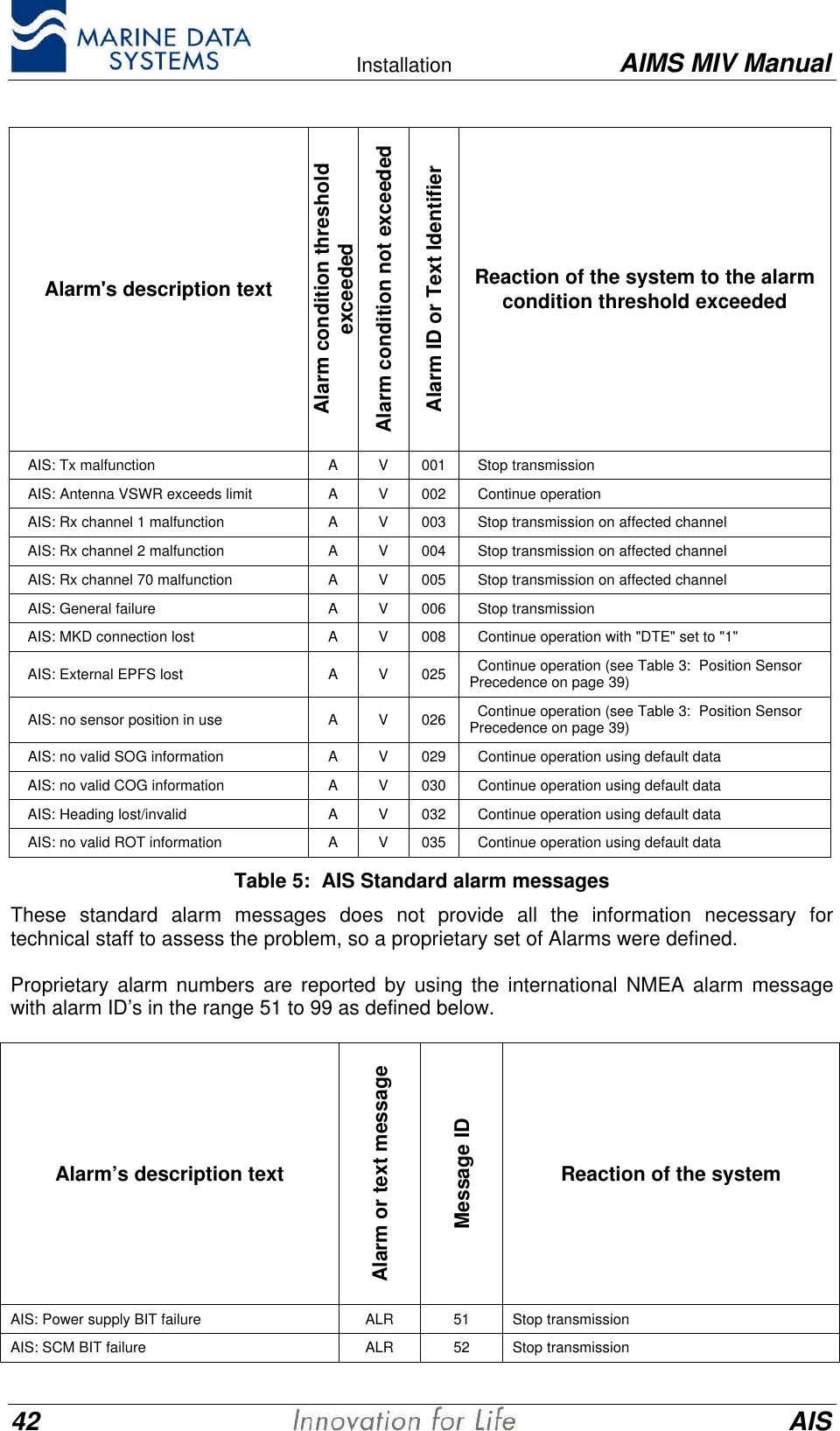
   Installation AIMS MIV Manual42 AISAlarm's description textAlarm condition thresholdexceededAlarm condition not exceededAlarm ID or Text IdentifierReaction of the system to the alarmcondition threshold exceeded  AIS: Tx malfunction A V 001   Stop transmission  AIS: Antenna VSWR exceeds limit A V 002   Continue operation  AIS: Rx channel 1 malfunction A V 003   Stop transmission on affected channel  AIS: Rx channel 2 malfunction A V 004   Stop transmission on affected channel  AIS: Rx channel 70 malfunction A V 005   Stop transmission on affected channel  AIS: General failure A V 006   Stop transmission  AIS: MKD connection lost A V 008   Continue operation with "DTE" set to "1"  AIS: External EPFS lost A V 025   Continue operation (see Table 3:  Position SensorPrecedence on page 39)  AIS: no sensor position in use A V 026   Continue operation (see Table 3:  Position SensorPrecedence on page 39)  AIS: no valid SOG information A V 029   Continue operation using default data  AIS: no valid COG information A V 030   Continue operation using default data  AIS: Heading lost/invalid A V 032   Continue operation using default data  AIS: no valid ROT information A V 035   Continue operation using default dataTable 5:  AIS Standard alarm messagesThese standard alarm messages does not provide all the information necessary fortechnical staff to assess the problem, so a proprietary set of Alarms were defined.Proprietary alarm numbers are reported by using the international NMEA alarm messagewith alarm ID’s in the range 51 to 99 as defined below.Alarm’s description textAlarm or text messageMessage IDReaction of the systemAIS: Power supply BIT failure ALR 51 Stop transmissionAIS: SCM BIT failure ALR 52 Stop transmission
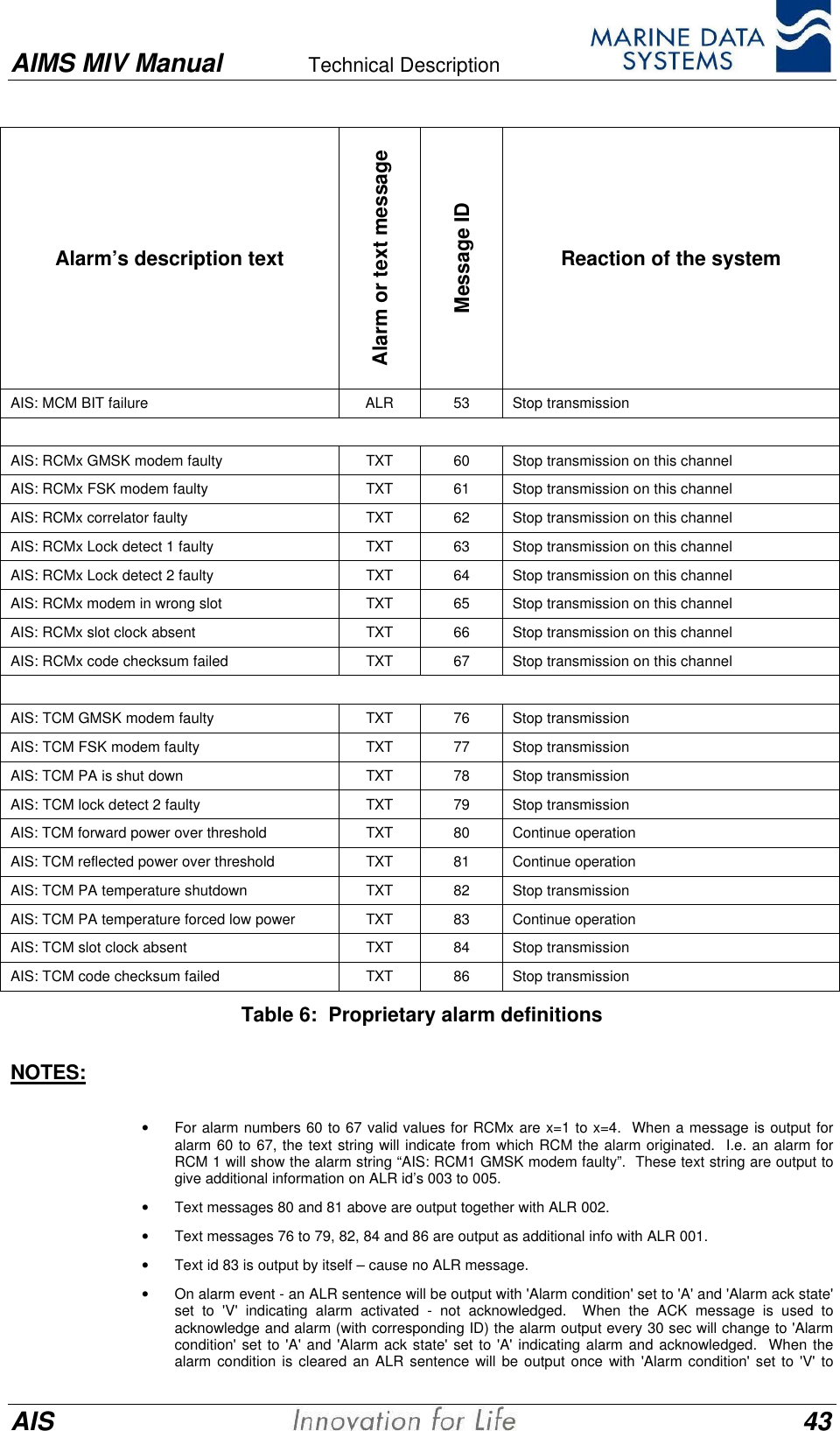
AIMS MIV Manual Technical Description      AIS 43Alarm’s description textAlarm or text messageMessage IDReaction of the systemAIS: MCM BIT failure ALR 53 Stop transmissionAIS: RCMx GMSK modem faulty TXT 60 Stop transmission on this channelAIS: RCMx FSK modem faulty TXT 61 Stop transmission on this channelAIS: RCMx correlator faulty TXT 62 Stop transmission on this channelAIS: RCMx Lock detect 1 faulty TXT 63 Stop transmission on this channelAIS: RCMx Lock detect 2 faulty TXT 64 Stop transmission on this channelAIS: RCMx modem in wrong slot TXT 65 Stop transmission on this channelAIS: RCMx slot clock absent TXT 66 Stop transmission on this channelAIS: RCMx code checksum failed TXT 67 Stop transmission on this channelAIS: TCM GMSK modem faulty TXT 76 Stop transmissionAIS: TCM FSK modem faulty TXT 77 Stop transmissionAIS: TCM PA is shut down TXT 78 Stop transmissionAIS: TCM lock detect 2 faulty TXT 79 Stop transmissionAIS: TCM forward power over threshold TXT 80 Continue operationAIS: TCM reflected power over threshold TXT 81 Continue operationAIS: TCM PA temperature shutdown TXT 82 Stop transmissionAIS: TCM PA temperature forced low power TXT 83 Continue operationAIS: TCM slot clock absent TXT 84 Stop transmissionAIS: TCM code checksum failed TXT 86 Stop transmissionTable 6:  Proprietary alarm definitionsNOTES:• For alarm numbers 60 to 67 valid values for RCMx are x=1 to x=4.  When a message is output foralarm 60 to 67, the text string will indicate from which RCM the alarm originated.  I.e. an alarm forRCM 1 will show the alarm string “AIS: RCM1 GMSK modem faulty”.  These text string are output togive additional information on ALR id’s 003 to 005.• Text messages 80 and 81 above are output together with ALR 002.• Text messages 76 to 79, 82, 84 and 86 are output as additional info with ALR 001.• Text id 83 is output by itself – cause no ALR message.• On alarm event - an ALR sentence will be output with 'Alarm condition' set to 'A' and 'Alarm ack state'set to 'V' indicating alarm activated - not acknowledged.  When the ACK message is used toacknowledge and alarm (with corresponding ID) the alarm output every 30 sec will change to 'Alarmcondition' set to 'A' and 'Alarm ack state' set to 'A' indicating alarm and acknowledged.  When thealarm condition is cleared an ALR sentence will be output once with 'Alarm condition' set to 'V' to
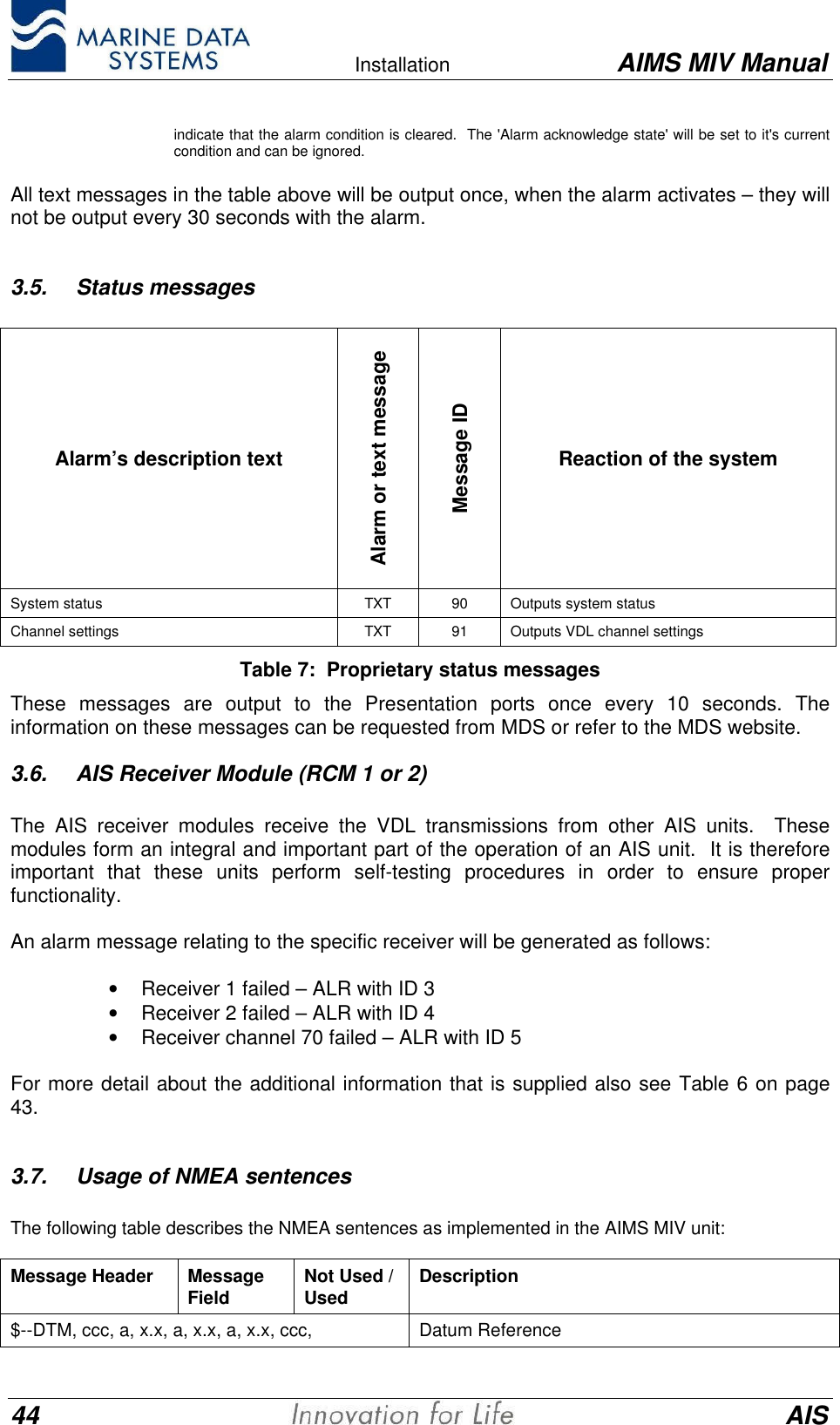
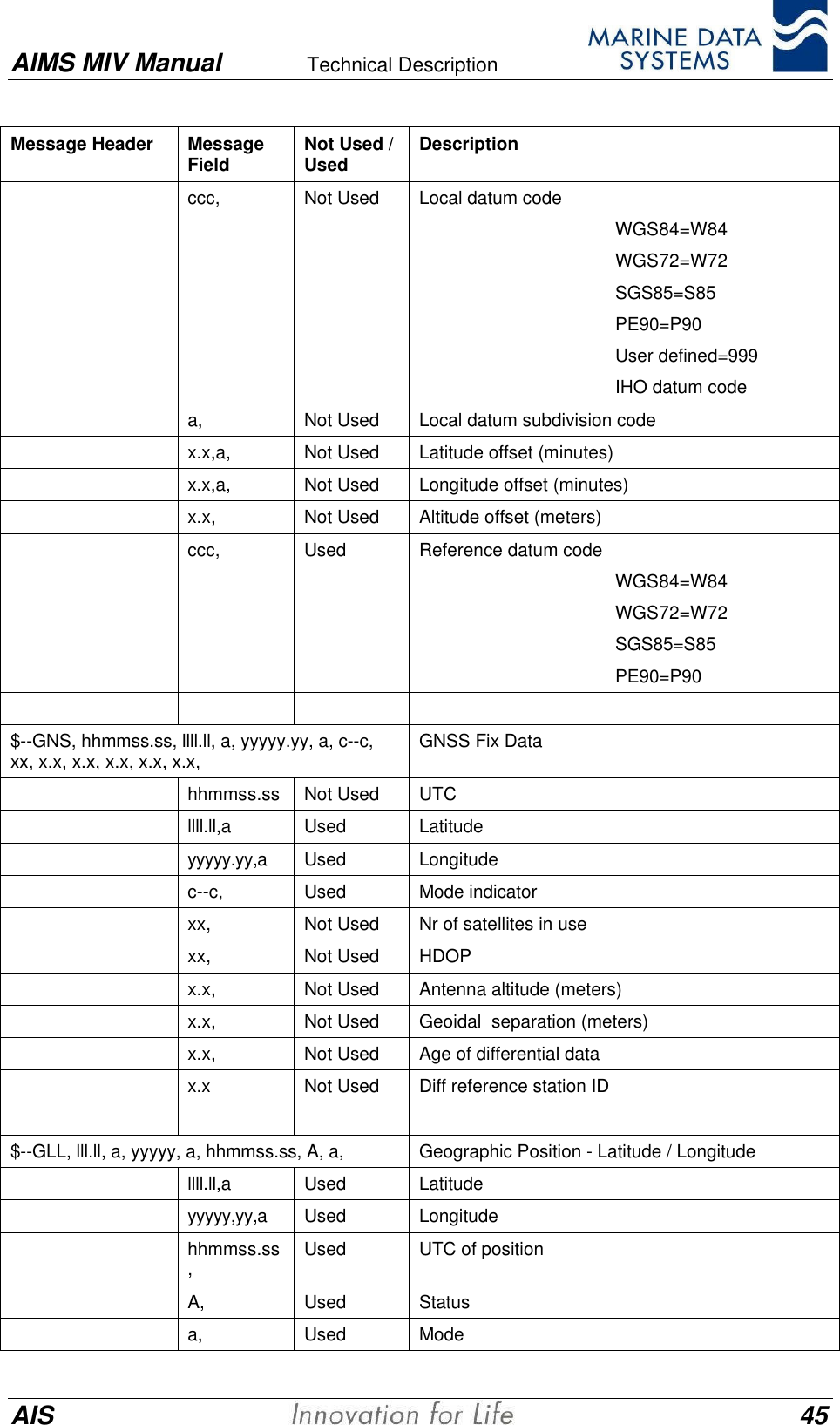
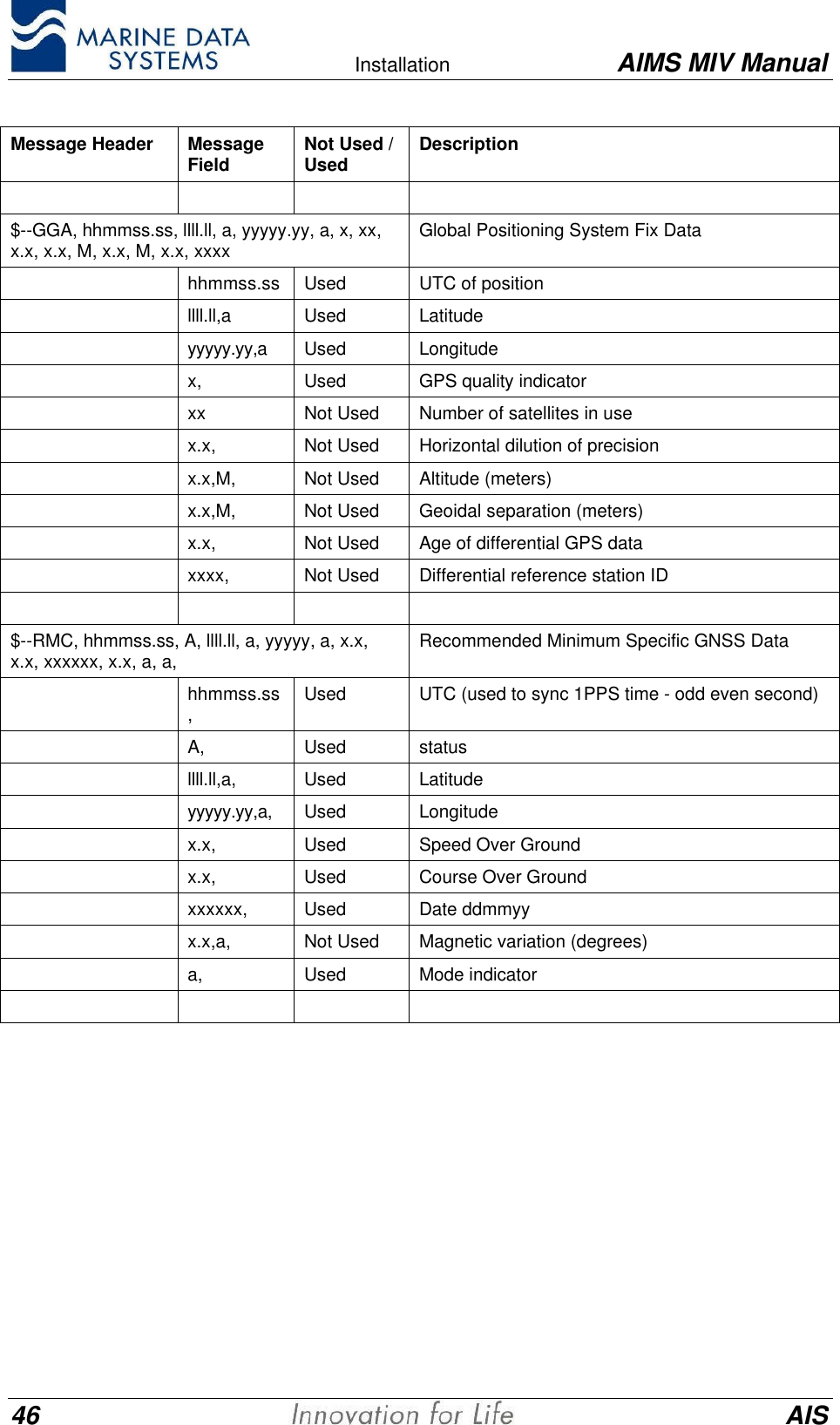
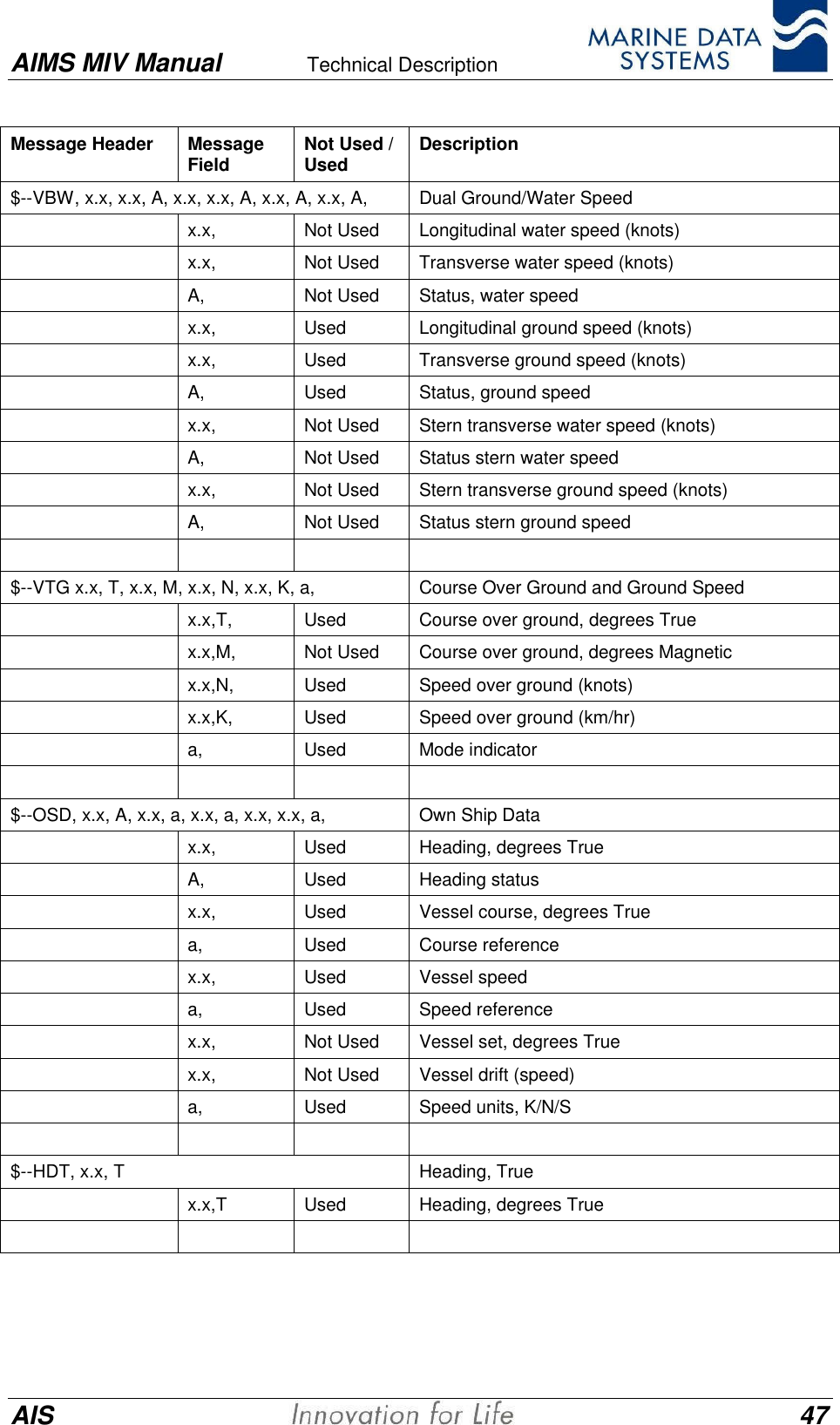
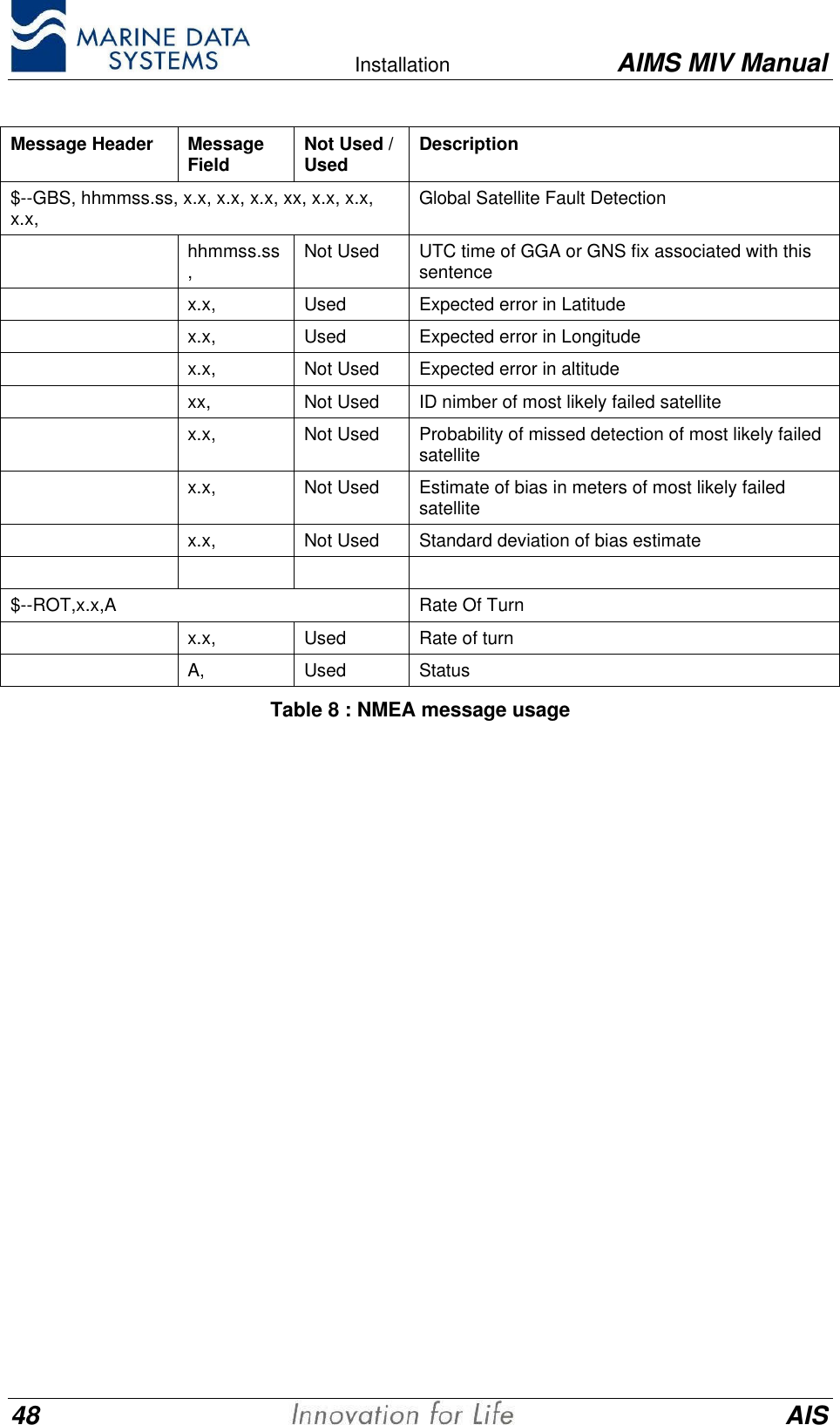
   Installation AIMS MIV Manual44 AISindicate that the alarm condition is cleared.  The 'Alarm acknowledge state' will be set to it's currentcondition and can be ignored.All text messages in the table above will be output once, when the alarm activates – they willnot be output every 30 seconds with the alarm.3.5. Status messagesAlarm’s description textAlarm or text messageMessage IDReaction of the systemSystem status TXT 90 Outputs system statusChannel settings TXT 91 Outputs VDL channel settingsTable 7:  Proprietary status messagesThese messages are output to the Presentation ports once every 10 seconds. Theinformation on these messages can be requested from MDS or refer to the MDS website.3.6. AIS Receiver Module (RCM 1 or 2)The AIS receiver modules receive the VDL transmissions from other AIS units.  Thesemodules form an integral and important part of the operation of an AIS unit.  It is thereforeimportant that these units perform self-testing procedures in order to ensure properfunctionality.An alarm message relating to the specific receiver will be generated as follows:• Receiver 1 failed – ALR with ID 3• Receiver 2 failed – ALR with ID 4• Receiver channel 70 failed – ALR with ID 5For more detail about the additional information that is supplied also see Table 6 on page43.3.7. Usage of NMEA sentencesThe following table describes the NMEA sentences as implemented in the AIMS MIV unit:Message Header MessageField Not Used /Used Description$--DTM, ccc, a, x.x, a, x.x, a, x.x, ccc, Datum Reference
AIMS MIV Manual Technical Description      AIS 45Message Header MessageField Not Used /Used Descriptionccc, Not Used Local datum codeWGS84=W84WGS72=W72SGS85=S85PE90=P90User defined=999IHO datum codea, Not Used Local datum subdivision codex.x,a, Not Used Latitude offset (minutes)x.x,a, Not Used Longitude offset (minutes)x.x, Not Used Altitude offset (meters)ccc, Used Reference datum codeWGS84=W84WGS72=W72SGS85=S85PE90=P90$--GNS, hhmmss.ss, llll.ll, a, yyyyy.yy, a, c--c,xx, x.x, x.x, x.x, x.x, x.x, GNSS Fix Datahhmmss.ss Not Used UTCllll.ll,a Used Latitudeyyyyy.yy,a Used Longitudec--c, Used Mode indicatorxx, Not Used Nr of satellites in usexx, Not Used HDOPx.x, Not Used Antenna altitude (meters)x.x, Not Used Geoidal  separation (meters)x.x, Not Used Age of differential datax.x Not Used Diff reference station ID$--GLL, lll.ll, a, yyyyy, a, hhmmss.ss, A, a, Geographic Position - Latitude / Longitudellll.ll,a Used Latitudeyyyyy,yy,a Used Longitudehhmmss.ss,Used UTC of positionA, Used Statusa, Used Mode
   Installation AIMS MIV Manual46 AISMessage Header MessageField Not Used /Used Description$--GGA, hhmmss.ss, llll.ll, a, yyyyy.yy, a, x, xx,x.x, x.x, M, x.x, M, x.x, xxxx Global Positioning System Fix Datahhmmss.ss Used UTC of positionllll.ll,a Used Latitudeyyyyy.yy,a Used Longitudex, Used GPS quality indicatorxx Not Used Number of satellites in usex.x, Not Used Horizontal dilution of precisionx.x,M, Not Used Altitude (meters)x.x,M, Not Used Geoidal separation (meters)x.x, Not Used Age of differential GPS dataxxxx, Not Used Differential reference station ID$--RMC, hhmmss.ss, A, llll.ll, a, yyyyy, a, x.x,x.x, xxxxxx, x.x, a, a, Recommended Minimum Specific GNSS Datahhmmss.ss,Used UTC (used to sync 1PPS time - odd even second)A, Used statusllll.ll,a, Used Latitudeyyyyy.yy,a, Used Longitudex.x, Used Speed Over Groundx.x, Used Course Over Groundxxxxxx, Used Date ddmmyyx.x,a, Not Used Magnetic variation (degrees)a, Used Mode indicator
AIMS MIV Manual Technical Description      AIS 47Message Header MessageField Not Used /Used Description$--VBW, x.x, x.x, A, x.x, x.x, A, x.x, A, x.x, A, Dual Ground/Water Speedx.x, Not Used Longitudinal water speed (knots)x.x, Not Used Transverse water speed (knots)A, Not Used Status, water speedx.x, Used Longitudinal ground speed (knots)x.x, Used Transverse ground speed (knots)A, Used Status, ground speedx.x, Not Used Stern transverse water speed (knots)A, Not Used Status stern water speedx.x, Not Used Stern transverse ground speed (knots)A, Not Used Status stern ground speed$--VTG x.x, T, x.x, M, x.x, N, x.x, K, a, Course Over Ground and Ground Speedx.x,T, Used Course over ground, degrees Truex.x,M, Not Used Course over ground, degrees Magneticx.x,N, Used Speed over ground (knots)x.x,K, Used Speed over ground (km/hr)a, Used Mode indicator$--OSD, x.x, A, x.x, a, x.x, a, x.x, x.x, a, Own Ship Datax.x, Used Heading, degrees TrueA, Used Heading statusx.x, Used Vessel course, degrees Truea, Used Course referencex.x, Used Vessel speeda, Used Speed referencex.x, Not Used Vessel set, degrees Truex.x, Not Used Vessel drift (speed)a, Used Speed units, K/N/S$--HDT, x.x, T Heading, Truex.x,T Used Heading, degrees True
   Installation AIMS MIV Manual48 AISMessage Header MessageField Not Used /Used Description$--GBS, hhmmss.ss, x.x, x.x, x.x, xx, x.x, x.x,x.x, Global Satellite Fault Detectionhhmmss.ss,Not Used UTC time of GGA or GNS fix associated with thissentencex.x, Used Expected error in Latitudex.x, Used Expected error in Longitudex.x, Not Used Expected error in altitudexx, Not Used ID nimber of most likely failed satellitex.x, Not Used Probability of missed detection of most likely failedsatellitex.x, Not Used Estimate of bias in meters of most likely failedsatellitex.x, Not Used Standard deviation of bias estimate$--ROT,x.x,A Rate Of Turnx.x, Used Rate of turnA, Used StatusTable 8 : NMEA message usage
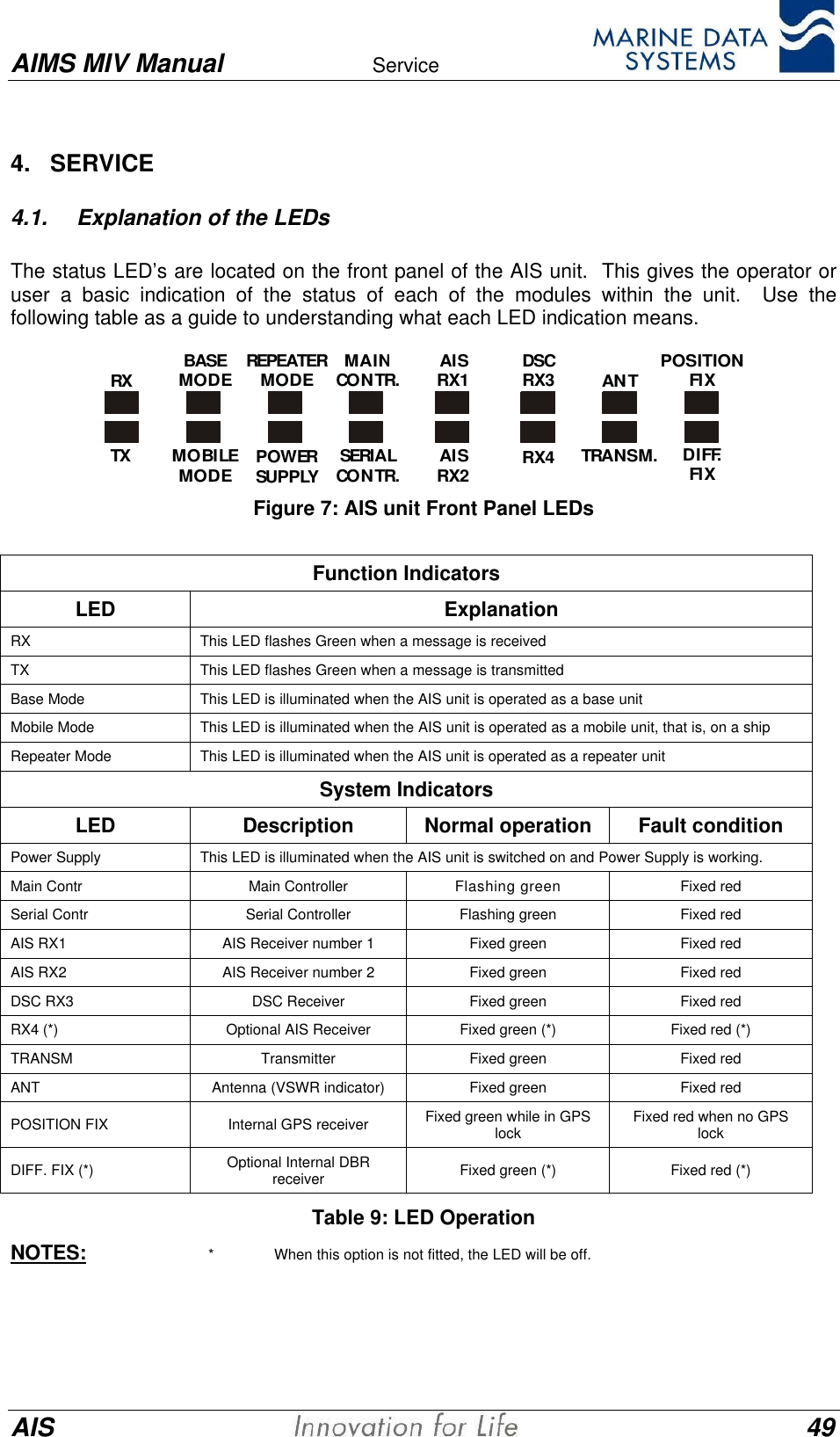
AIMS MIV Manual Service      AIS 494.   SERVICE4.1. Explanation of the LEDsThe status LED’s are located on the front panel of the AIS unit.  This gives the operator oruser a basic indication of the status of each of the modules within the unit.  Use thefollowing table as a guide to understanding what each LED indication means.RXBASEMODEREPEATERMODEMAINCONTR.AISRX1DSCRX3 ANTPOSITIONFIXDIFF.FIXTRANSM.RX4AISRX2SERIALCONTR.POWERSUPPLYMOBILEMODETXFigure 7: AIS unit Front Panel LEDsFunction IndicatorsLED ExplanationRX This LED flashes Green when a message is receivedTX This LED flashes Green when a message is transmittedBase Mode This LED is illuminated when the AIS unit is operated as a base unitMobile Mode This LED is illuminated when the AIS unit is operated as a mobile unit, that is, on a shipRepeater Mode This LED is illuminated when the AIS unit is operated as a repeater unitSystem IndicatorsLED Description Normal operation Fault conditionPower Supply This LED is illuminated when the AIS unit is switched on and Power Supply is working.Main Contr Main Controller Flashing green Fixed redSerial Contr Serial Controller Flashing green Fixed redAIS RX1 AIS Receiver number 1 Fixed green Fixed redAIS RX2 AIS Receiver number 2 Fixed green Fixed redDSC RX3 DSC Receiver Fixed green Fixed redRX4 (*) Optional AIS Receiver Fixed green (*) Fixed red (*)TRANSM Transmitter Fixed green Fixed redANT Antenna (VSWR indicator) Fixed green Fixed redPOSITION FIX Internal GPS receiver Fixed green while in GPSlock Fixed red when no GPSlockDIFF. FIX (*) Optional Internal DBRreceiver Fixed green (*) Fixed red (*)Table 9: LED OperationNOTES: *When this option is not fitted, the LED will be off.
   Service AIMS MIV Manual50 AIS4.2. System Indicators (additional information)4.2.1. DIFF. FIX  If the AIS unit is functioning with differentially corrected data from an internal or externalsourse, this LED will be green, otherwise it will be red.4.2.2. Receiver failureThe AIS unit can detect a receiver failure using the methods described in section 3.6 onpage 44.Once the AIS unit has determined that there has been a receiver failure, it will raise analarm.  The type of alarm will relate to the specific receiver that has failed (please seesection 3.4 on page 41 for more detail of the various alarm messages.4.3. Alarm relay  The alarm output is a double throw relay contact.  This can be used to activate an externalalarm when the unit malfunctions.  The alarm can be de-activated by user intervention onthe Keyboard Display Unit or Primary Display Unit.  The alarm will sound if there is: • no GPS lock,• a faulty module,• a faulty antenna,• a power failure,•  loss of sensor data,• no communication with KDU.See Table 5 in Section 3.4 on page 41 for more detail of the various alarm messages.4.4. TroubleshootingIMPORTANT NOTE: The unit should only be opened by qualified personnel.When a fault occurs, switch off the unit and have the faulty module replaced by a suitablyqualified technician.4.5. Security log retreivalThe AIMS MIV unit keeps track of how often the unit has been switched off for more than10minutes. This log can be retrieved from the AIS unit using a text terminal or the AIMS utilitysoftware.To retrieve the message using a text terminal, a serial cable must be connected to thePresentation , KDU or Pilot Port. The following message is sent into the port to activate theretrieval:$PMDSRQS,5000,MDSSLI
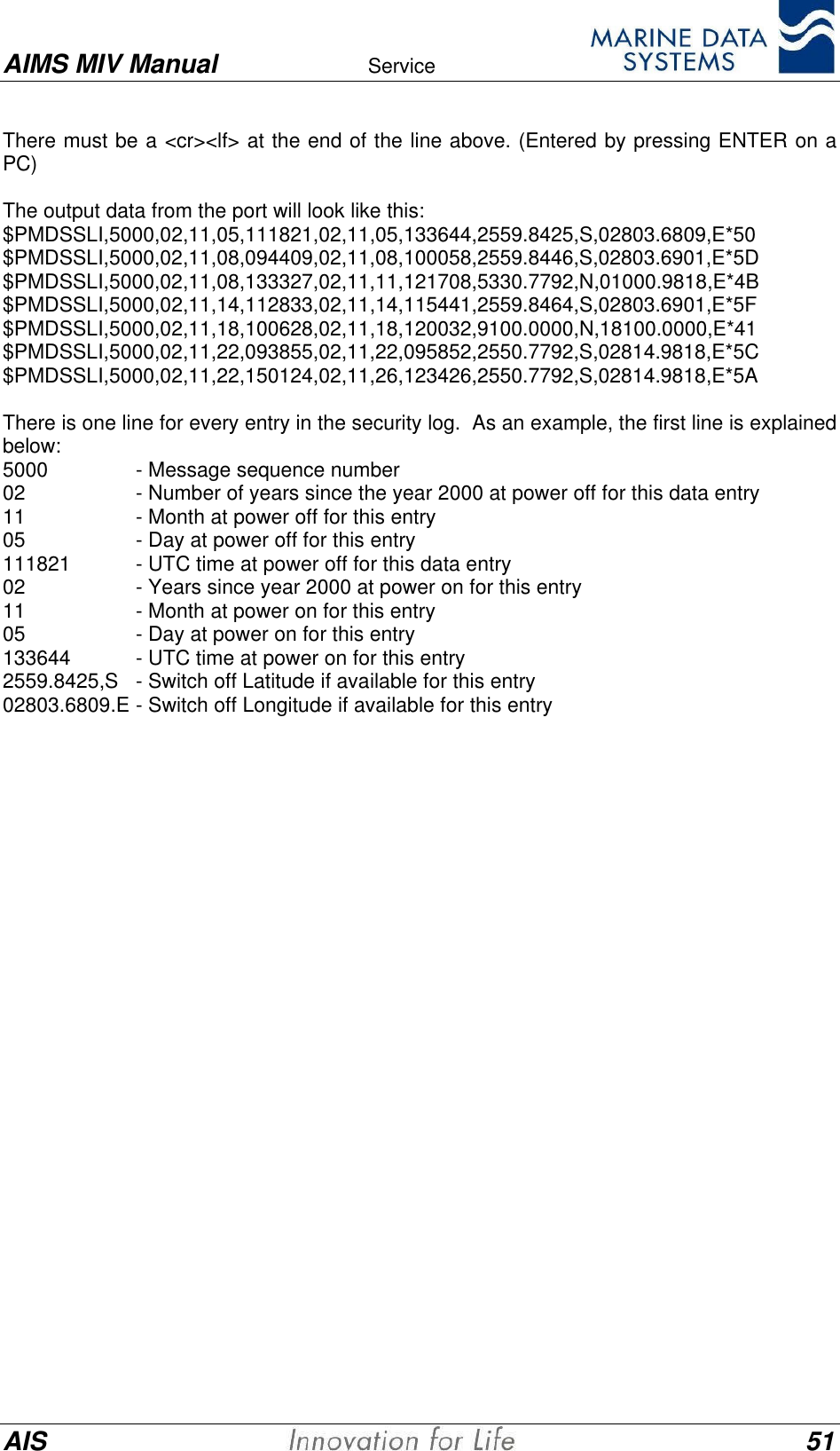
AIMS MIV Manual Service      AIS 51There must be a <cr><lf> at the end of the line above. (Entered by pressing ENTER on aPC)The output data from the port will look like this:$PMDSSLI,5000,02,11,05,111821,02,11,05,133644,2559.8425,S,02803.6809,E*50$PMDSSLI,5000,02,11,08,094409,02,11,08,100058,2559.8446,S,02803.6901,E*5D$PMDSSLI,5000,02,11,08,133327,02,11,11,121708,5330.7792,N,01000.9818,E*4B$PMDSSLI,5000,02,11,14,112833,02,11,14,115441,2559.8464,S,02803.6901,E*5F$PMDSSLI,5000,02,11,18,100628,02,11,18,120032,9100.0000,N,18100.0000,E*41$PMDSSLI,5000,02,11,22,093855,02,11,22,095852,2550.7792,S,02814.9818,E*5C$PMDSSLI,5000,02,11,22,150124,02,11,26,123426,2550.7792,S,02814.9818,E*5AThere is one line for every entry in the security log.  As an example, the first line is explainedbelow:5000 - Message sequence number02 - Number of years since the year 2000 at power off for this data entry11 - Month at power off for this entry05 - Day at power off for this entry111821 - UTC time at power off for this data entry02 - Years since year 2000 at power on for this entry11 - Month at power on for this entry05 - Day at power on for this entry133644 - UTC time at power on for this entry2559.8425,S - Switch off Latitude if available for this entry02803.6809.E - Switch off Longitude if available for this entry
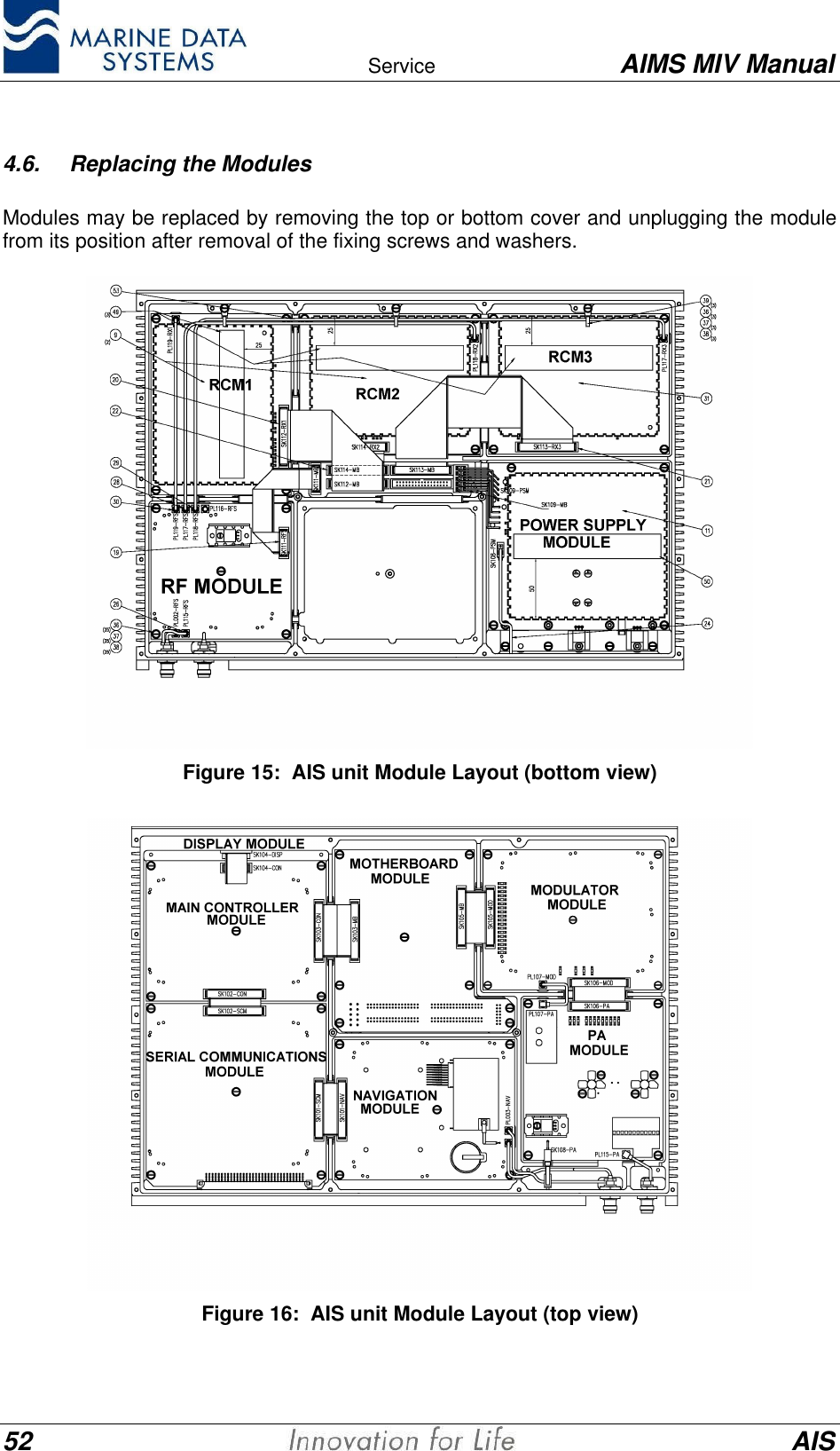
   Service AIMS MIV Manual52 AIS4.6. Replacing the ModulesModules may be replaced by removing the top or bottom cover and unplugging the modulefrom its position after removal of the fixing screws and washers.Figure 15:  AIS unit Module Layout (bottom view)Figure 16:  AIS unit Module Layout (top view)
AIMS MIV Manual Service      AIS 53IMPORTANT NOTICE:If modules have been changed, please observe the following:• If the MCM has to be replaced, the module will need to be reprogrammedwith the ship’s static, voyage and other configuration data.• If the NAV module has to be replaced, there will be a waiting period of up to30 minutes for the GPS to lock onto the satellites.• The SCM and MCM modules can only be replaced if the replacementmodules have software preloaded, otherwise new software must be uploadedvia the Service Port using the ‘AMDT AIS unit Flash Utility’.
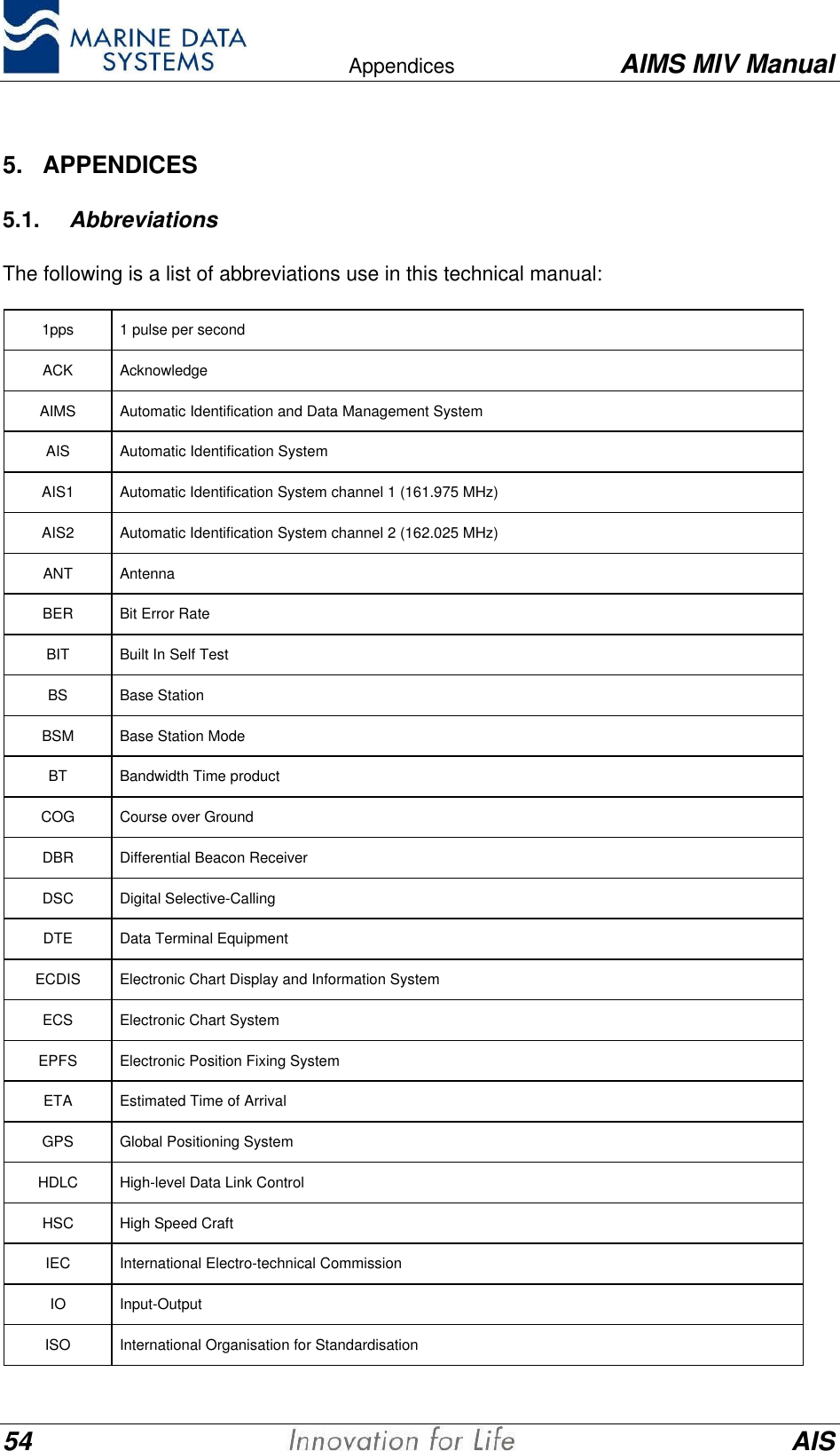
   Appendices AIMS MIV Manual54 AIS5.   APPENDICES5.1. AbbreviationsThe following is a list of abbreviations use in this technical manual:1pps 1 pulse per secondACK AcknowledgeAIMS Automatic Identification and Data Management SystemAIS Automatic Identification SystemAIS1 Automatic Identification System channel 1 (161.975 MHz)AIS2 Automatic Identification System channel 2 (162.025 MHz)ANT AntennaBER Bit Error RateBIT Built In Self TestBS Base StationBSM Base Station ModeBT Bandwidth Time productCOG Course over GroundDBR Differential Beacon ReceiverDSC Digital Selective-CallingDTE Data Terminal EquipmentECDIS Electronic Chart Display and Information SystemECS Electronic Chart SystemEPFS Electronic Position Fixing SystemETA Estimated Time of ArrivalGPS Global Positioning SystemHDLC High-level Data Link ControlHSC High Speed CraftIEC International Electro-technical CommissionIO Input-OutputISO International Organisation for Standardisation
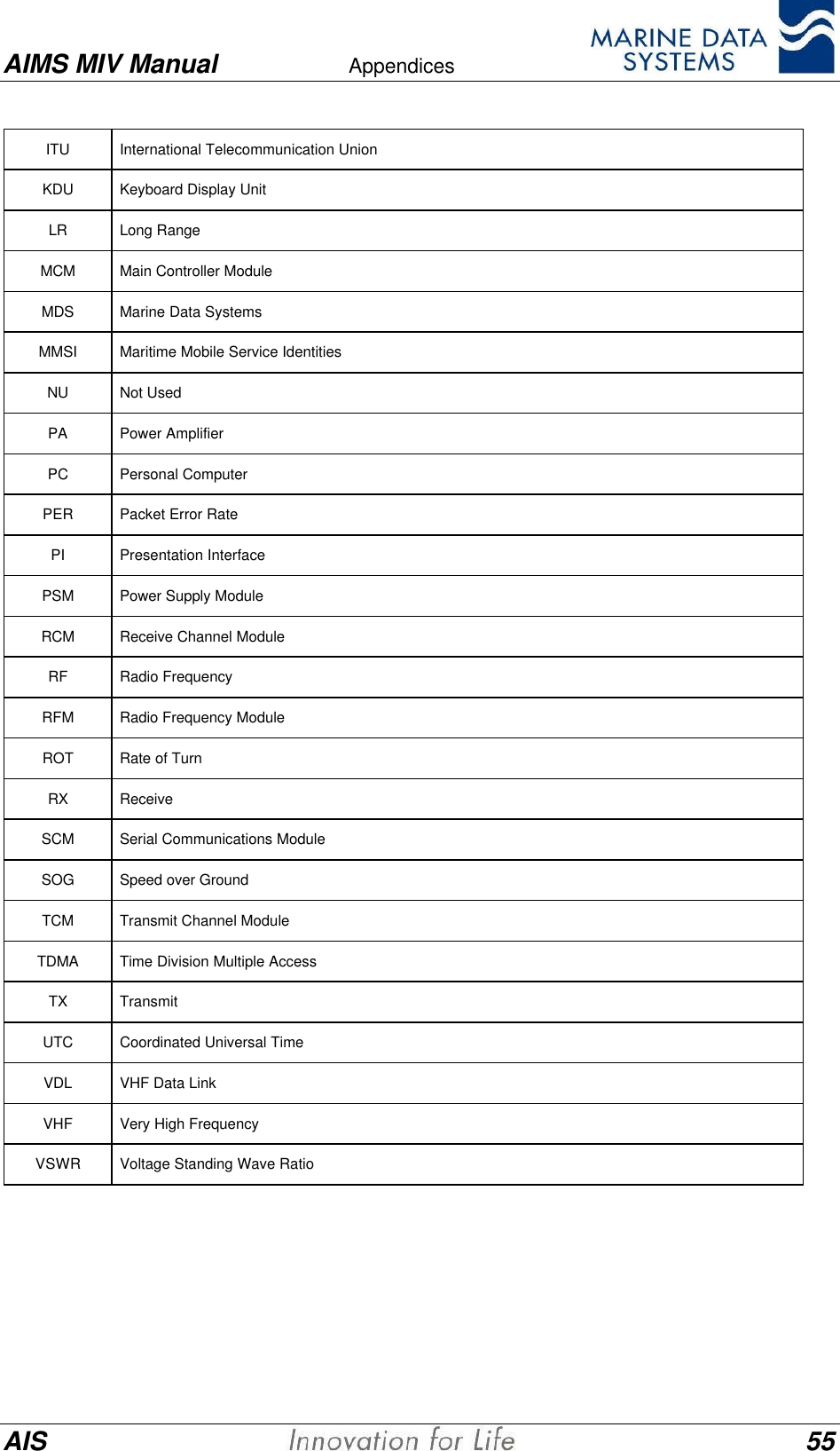
AIMS MIV Manual Appendices      AIS 55ITU International Telecommunication UnionKDU Keyboard Display UnitLR Long RangeMCM Main Controller ModuleMDS Marine Data SystemsMMSI Maritime Mobile Service IdentitiesNU Not UsedPA Power AmplifierPC Personal ComputerPER Packet Error RatePI Presentation InterfacePSM Power Supply ModuleRCM Receive Channel ModuleRF Radio FrequencyRFM Radio Frequency ModuleROT Rate of TurnRX ReceiveSCM Serial Communications ModuleSOG Speed over GroundTCM Transmit Channel ModuleTDMA Time Division Multiple AccessTX TransmitUTC Coordinated Universal TimeVDL VHF Data LinkVHF Very High FrequencyVSWR Voltage Standing Wave Ratio
   Appendices AIMS MIV Manual56 AIS5.2.  Reference Documents5.2.1. List of standards and specifications:Document Number TitleIEC 61162-1 Maritime Navigation and Radio Communication Equipment and Systems - DigitalInterfaces: Part 1 - Single Talker and Multiple Listeners.IEC 61162-2 Maritime Navigation and Radio Communication Equipment and Systems - DigitalInterfaces: Part 2 - Single Talker and Multiple Listeners High Speed Transmission.IEC 61993-2 IS Universal Shipborne Automatic Identification System (AIS).ISO/IEC 3309, 1993 Information Technology telecommunication and informational exchange betweensystems - HDLC procedures - Frame Structure.ITU-R M.1084-2 Interim solutions for improved efficiency in the use of Band 156-174 MH bystations in the Maritime Mobile Service.ITU-R M.1371-1 Technical characteristics for a universal ship-borne automatic identification systemusing time division multiple access in the maritime mobile band.ITU-R M.493 Digital Selective Calling (DSC) system for use in the Maritime Mobile Service.ITU-R M.823-2 Technical characteristics of differential transmissions for global navigation satellitesystems from maritime radio beacons in the frequency band 283.5 - 315 kHz inregion 1 and 285-325 kHz in regions 2 and 3.ITU-R M.825-3 Characteristics of a transponder system using DSC techniques for use with vesseltraffic services and ship-to-ship identification.ITU Manual ITU Manual for use by the Maritime mobile and Maritime Mobile-Satellite Services.IEC 61108-1 Global navigation satellite systems (GNSS) - Part 1: Global positioning system(GPS) - Receiver equipment - Performance standards, methods of testing andrequired test results.ISO 9000-3 Guidelines for the development, supply, installation and maintenance of computersoftware.IEC/EN 60945 Maritime Navigation and Radiocommunication equipment and systems – Generalrequirements-methods of testing and required results
AIMS MIV Manual Appendices      AIS 575.2.2. List of Related Software and Manuals:Module Description Part numberAIMS Utility Software for Windows A Windows based utility for configuring and testing theAIMS range of products.  Various levels of user accessavailable.AIMS Utility Software User Manual User ManualAIMS Utility for PalmOS A PalmOS based utility for configuring the AIMS rangeof productsAIMS Utility for PocketPC 2002 A PocketPC based utility for configuring the AIMS rangeof productsAIMS Utility for PDA User Manual User ManualAIMS K1 User Manual A Keyboard Display Unit that conforms to therequirements as laid out by the IMOAMDT AIS Unit Flash Utility A utility for upgrading the AIMS MIV unit software
   Appendices AIMS MIV Manual58 AIS5.3.  AIMS Serial interface “Listener” and “Talker” circuit diagramsThis section will give a basic circuit diagram of the RS422 input and output circuits of theAIS Unit.Protec-tionCommon(isolated)OptoisolatorIsolatingpower supplyTo internalelectronicsABCListenerFigure 17.  RS422 General “Listener” circuit diagramCommonABCTalkerVCCSHIELDFigure 18.  RS422 General “Talker” circuit diagram
NOTES:      AIS 59
580 Kyalami BoulevardKyalami Business ParkKyalamiMidrandSouth AfricaTel:  +27 11 549 1800www.marinedata.co.zaemail: support@marinedata.co.za

Navigation menu