Marshall Radio Telemetry PLD-010-001 Personal Locating Device User Manual PLD 010

Marshall Radio Telemetry, Inc. Personal Locating Device PLD 010

User Manual

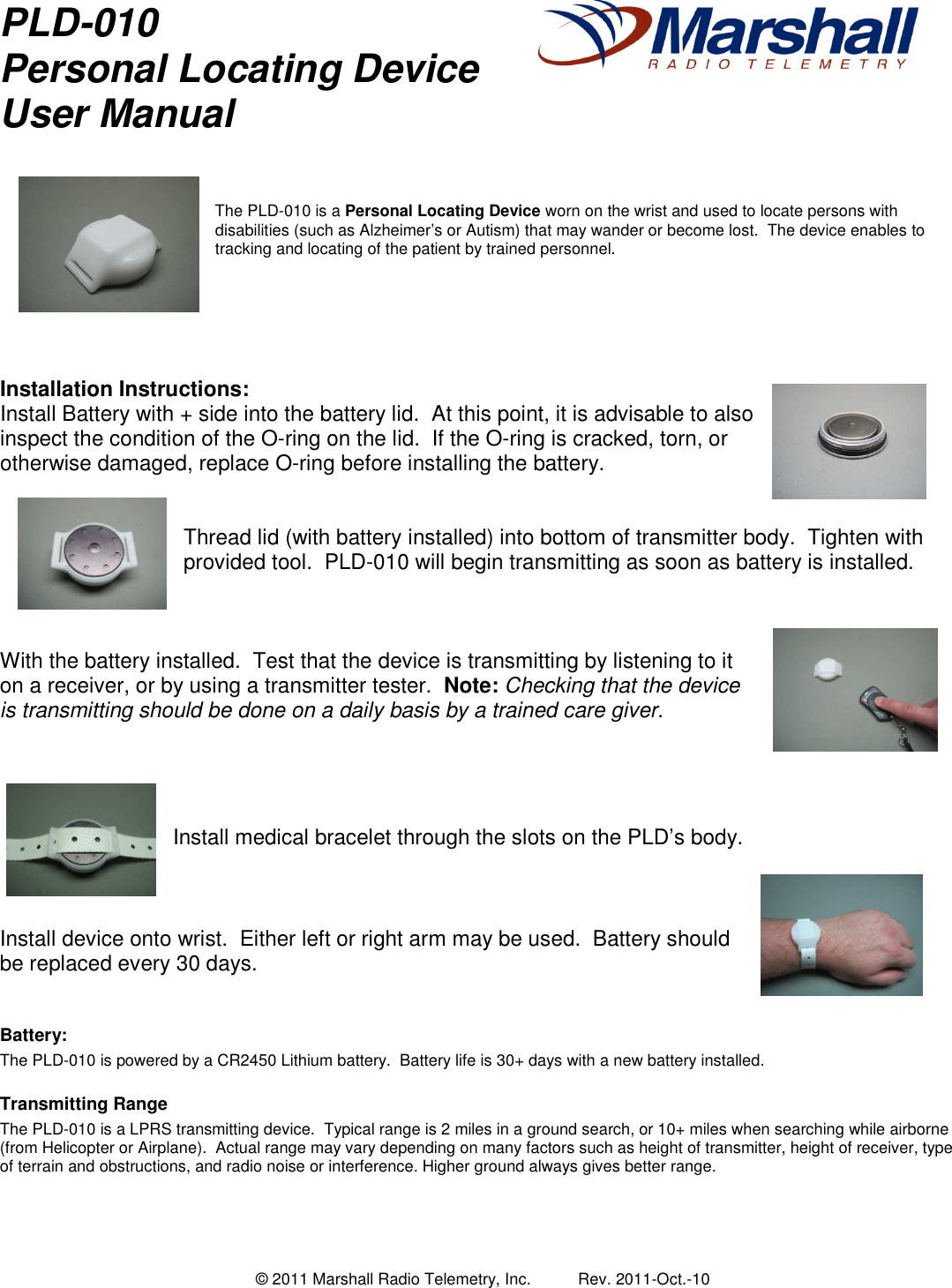
 © 2011 Marshall Radio Telemetry, Inc.  Rev. 2011-Oct.-10 PLD-010 Personal Locating Device User Manual      The PLD-010 is a Personal Locating Device worn on the wrist and used to locate persons with disabilities (such as Alzheimer’s or Autism) that may wander or become lost.  The device enables to tracking and locating of the patient by trained personnel.        Installation Instructions: Install Battery with + side into the battery lid.  At this point, it is advisable to also inspect the condition of the O-ring on the lid.  If the O-ring is cracked, torn, or otherwise damaged, replace O-ring before installing the battery.   Thread lid (with battery installed) into bottom of transmitter body.  Tighten with provided tool.  PLD-010 will begin transmitting as soon as battery is installed.    With the battery installed.  Test that the device is transmitting by listening to it on a receiver, or by using a transmitter tester.  Note: Checking that the device is transmitting should be done on a daily basis by a trained care giver.     Install medical bracelet through the slots on the PLD’s body.    Install device onto wrist.  Either left or right arm may be used.  Battery should be replaced every 30 days.   Battery: The PLD-010 is powered by a CR2450 Lithium battery.  Battery life is 30+ days with a new battery installed.  Transmitting Range The PLD-010 is a LPRS transmitting device.  Typical range is 2 miles in a ground search, or 10+ miles when searching while airborne (from Helicopter or Airplane).  Actual range may vary depending on many factors such as height of transmitter, height of receiver, type of terrain and obstructions, and radio noise or interference. Higher ground always gives better range.
 © 2011 Marshall Radio Telemetry, Inc.  Rev. 2011-Oct.-10   Regulatory Statements For Users in the United States   This Device may not interfere with TV reception or Federal Government radar  This device complies with part 15 of the FCC Rules.  Operation is subject to the following 2 conditions  (1)  This device may not cause harmful interference, and (2) this device must accept any interference received, including interference that may cause undesired operation.     For users in Canada Operation is subject to the following two conditions: (1) this device may not cause interference, and (2) this device must accept any interference, including interference that may cause undesired operation of the device.   The user/purchaser  of this device should take note that as digital  TV broadcasting  stations  are  introduced in the geographical area, the medical telemetry links may have to be shifted to operate in other (unused) TV channels. The user/purchaser should ensure that the radio device can adapt to this mode of operation.  L’utilisateur/consommateur  de  cet  appareil  doit  prendre  note  qu’au  fur  et  à  mesure  que  les  stations  de  radiodiffusion  de  la  télévision numérique  sont  déployées  dans  la  region  géographique,  les  liaisons  de  télémesure  médicale  peuvent  être  appelées  à  se  déplacer  pour fonctionner sur d’autres canaux TV (inutilisés). L’utilisateur/consommateur devrait donc s’assurer que son dispositif radio peut s’adapter à ce mode d’exploitation.  If TV channel 13 is used in the area, the installer shall reduce or adjust the radio frequency radiated power so that nearby TV channel 13 receivers do not receive radio interference from the system installed. Suggestions: A test with a TV receiver equipped with a “rabbit-ear antenna” and tuned to channel 13 should be conducted at the perimeter of the user’s intended coverage area and should not overlap other users’  areas without  the latter’s consent. If this does  not  solve the problem, a channel near  the  217  MHz edge and not near 216 MHz should be tried.  Si le canal TV 13 est utilisé dans ce secteur, l’installateur doit réduire ou régler la puissance d’émission RF de façon que les récepteurs du canal  TV  13  avoisinants  ne subissent  pas  le brouillage  en provenance du système  nouvellement installé. Suggestions  :  Un essai d’un récepteur  TV  muni  d’une  antenne  «  en  oreilles  de  lapin  »  réglée  sur  le  canal  13  devrait  être  conduit  sur  le  périmètre  de  la  zone  de couverture prévue par l’utilisateur et ne devrait pas chevaucher la zone de couverture des autres utilisateurs sans leur accord. Si cela ne règle pas le problème, un canal à proximité de la bordure de bande 217 MHz et donc éloigné de 216 MHz devrait être essayé.
 © 2011 Marshall Radio Telemetry, Inc.  Rev. 2011-Oct.-10              MARSHALL RADIO TELEMETRY 896 West 100 North, North Salt Lake, UT 84054, USA     Toll Free (800) 729-7123   International 1-801-936-9000  www.marshallradio.com

Navigation menu