Mobilicom MCU-100 Ad-Hoc Wireless Mobile Communication Unit enabling broadband connectivity of data, voice and is based on 4G LTE technology - This device can be powered only via battery. User Manual manual

Mobilicom ltd. Ad-Hoc Wireless Mobile Communication Unit enabling broadband connectivity of data, voice and is based on 4G LTE technology - This device can be powered only via battery. manual

manual
       MC-EMA  General Description and  Operational Manual for MCU-100       Mobilicom LTD Hametzoda 31, Azor  -Israel Phone : +972-77-7103060 - Fax : +972-77-7103060 - www.mobilicom.com
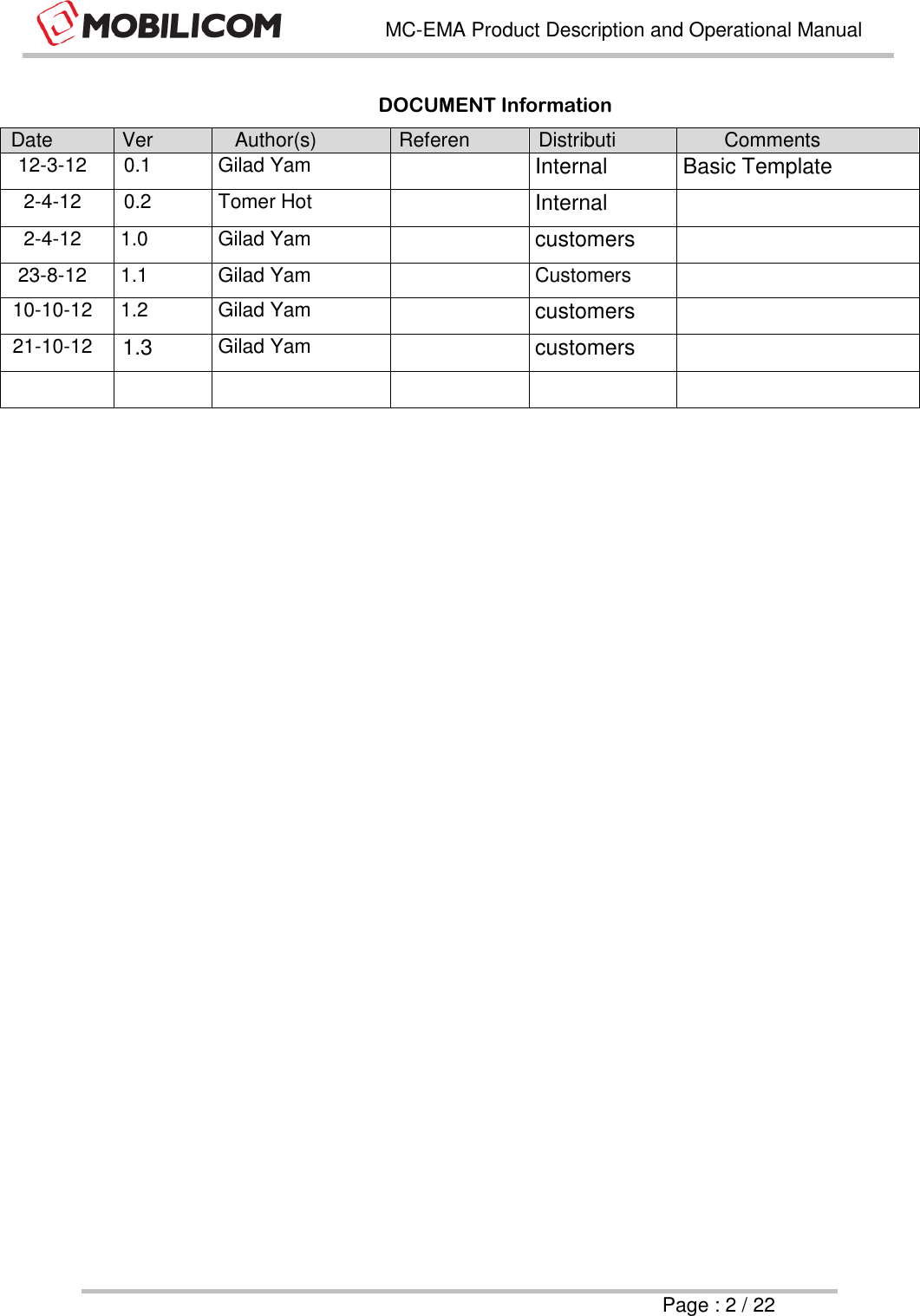
  MC-EMA Product Description and Operational Manual     Page : 2 / 22  DOCUMENT Information Date Version Author(s) Reference Distribution Comments 12-3-12 0.1 Gilad Yam  Internal Basic Template 2-4-12 0.2 Tomer Hot  Internal  2-4-12 1.0 Gilad Yam  customers  23-8-12 1.1 Gilad Yam  Customers  10-10-12 1.2 Gilad Yam  customers  21-10-12 1.3 Gilad Yam  customers
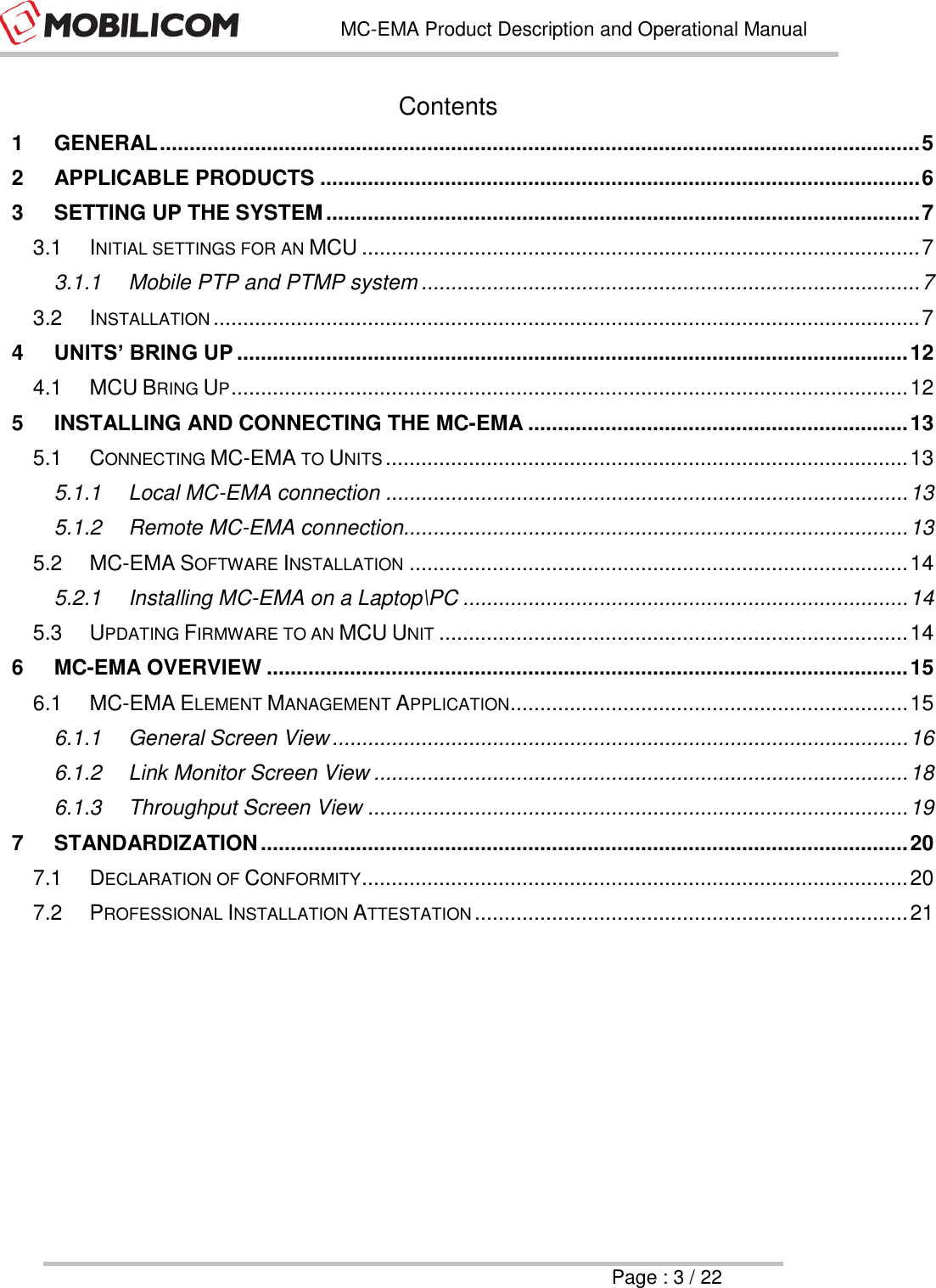
  MC-EMA Product Description and Operational Manual     Page : 3 / 22  Contents 1 GENERAL ................................................................................................................................ 5 2 APPLICABLE PRODUCTS ..................................................................................................... 6 3 SETTING UP THE SYSTEM .................................................................................................... 7 3.1 INITIAL SETTINGS FOR AN MCU .............................................................................................. 7 3.1.1 Mobile PTP and PTMP system .................................................................................... 7 3.2 INSTALLATION ....................................................................................................................... 7 4 UNITS’ BRING UP ................................................................................................................. 12 4.1 MCU BRING UP .................................................................................................................. 12 5 INSTALLING AND CONNECTING THE MC-EMA ................................................................ 13 5.1 CONNECTING MC-EMA TO UNITS ........................................................................................ 13 5.1.1 Local MC-EMA connection ........................................................................................ 13 5.1.2 Remote MC-EMA connection..................................................................................... 13 5.2 MC-EMA SOFTWARE INSTALLATION .................................................................................... 14 5.2.1 Installing MC-EMA on a Laptop\PC ........................................................................... 14 5.3 UPDATING FIRMWARE TO AN MCU UNIT ............................................................................... 14 6 MC-EMA OVERVIEW ............................................................................................................ 15 6.1 MC-EMA ELEMENT MANAGEMENT APPLICATION ................................................................... 15 6.1.1 General Screen View ................................................................................................. 16 6.1.2 Link Monitor Screen View .......................................................................................... 18 6.1.3 Throughput Screen View ........................................................................................... 19 7 STANDARDIZATION ............................................................................................................. 20 7.1 DECLARATION OF CONFORMITY ............................................................................................ 20 7.2 PROFESSIONAL INSTALLATION ATTESTATION ......................................................................... 21
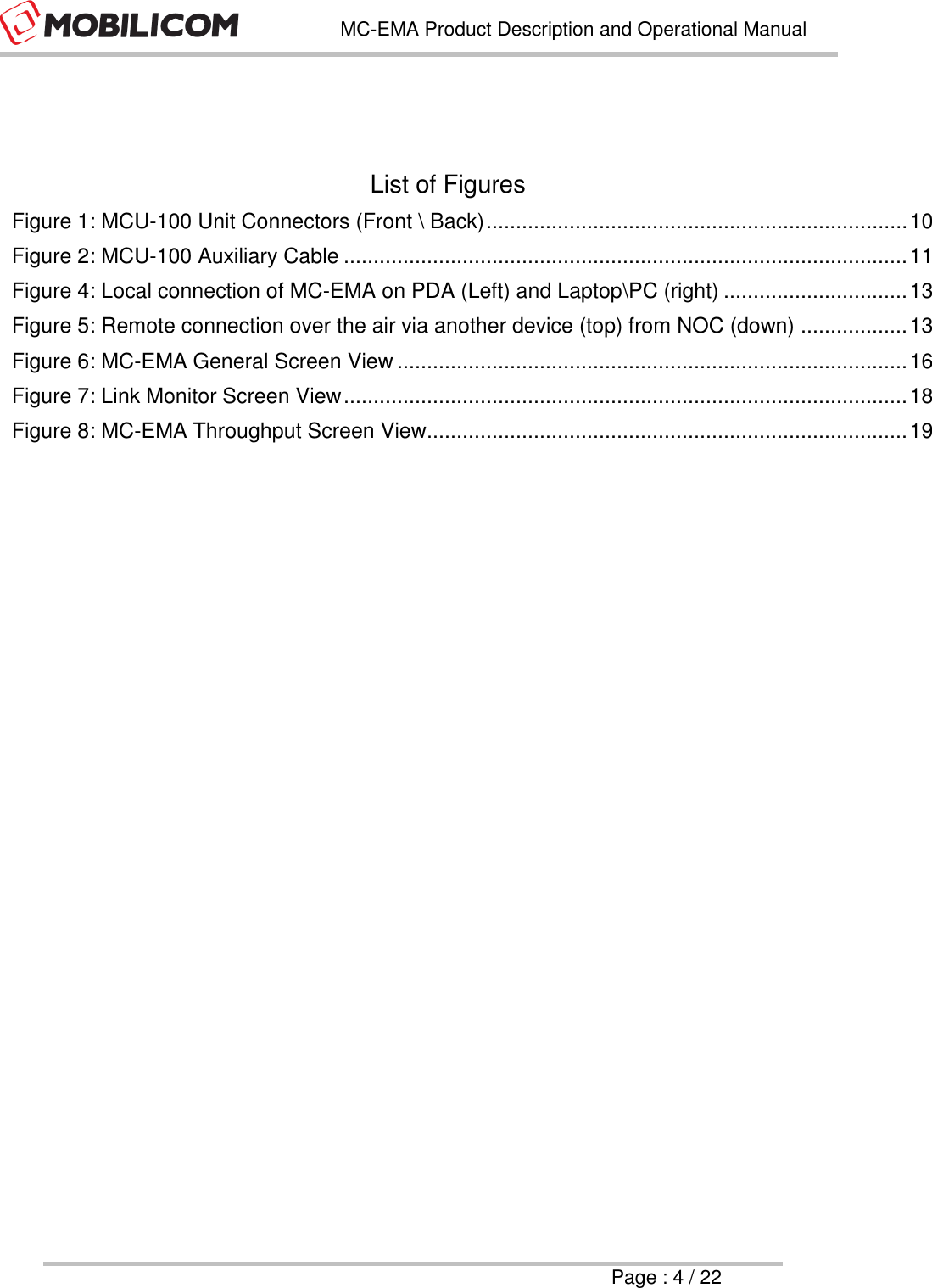
  MC-EMA Product Description and Operational Manual     Page : 4 / 22    List of Figures Figure 1: MCU-100 Unit Connectors (Front \ Back) ....................................................................... 10 Figure 2: MCU-100 Auxiliary Cable ............................................................................................... 11 Figure 4: Local connection of MC-EMA on PDA (Left) and Laptop\PC (right) ............................... 13 Figure 5: Remote connection over the air via another device (top) from NOC (down) .................. 13 Figure 6: MC-EMA General Screen View ...................................................................................... 16 Figure 7: Link Monitor Screen View ............................................................................................... 18 Figure 8: MC-EMA Throughput Screen View................................................................................. 19
  MC-EMA Product Description and Operational Manual     Page : 5 / 22  1  General This document aims to describe how to  operate and monitor Mobilicom’s MCU’s and MC-HPA units by using the MC-EMA including operational procedures and troubleshooting.
  MC-EMA Product Description and Operational Manual     Page : 6 / 22  2  Applicable Products Following are applicable products that are covered in this document, for more information please refer to the specific product general description: o  MCU-100
  MC-EMA Product Description and Operational Manual     Page : 7 / 22  3  Setting up the System 3.1  Initial settings for an MCU 3.1.1 Mobile PTP and PTMP system 1)  A mobile point-to-point or P2MP system should contain at least 2 units.  2)  In a system one MCU will be a master and at least one should be set as slave (P2P), or more (P2MP).  3)  Setting up a Master/Slave is  done  by burning the relevant ZIP file (Mobilicom  will provide both Master and Slave Files) (MC-EMA will support such configuration in the future)   4)  After setting up Master/Slave the unit can be boot up and set up the rest of the parameters via the EMA.   5)  The rest of the parameters are set as a part of the profile customized for a client. 6)  All these stages are typically done in the lab prior to shipment enabling easily plug-and play by  the  customer  (typically  attenuators  are  connected  to  the  RF  ANT  jacks  in  a  basic  unit configuration without antenna). Nevertheless, this procedure can be done after installation as well. 3.2  Installation 1)  The MCU-100 can be installed in two ways: o  Installed using the 4 peripheral mounting holes – mainly used on large surfaces such as walls, car top or ceilings. Schematics can be supplied by Mobilicom o  Installed  using  the  back  mounting  holes  via  mounting  arm  (such  as  MT-120018/A)  – mainly used on poles. Schematics can be supplied by Mobilicom. 2) Antennas installation: The antennas should be as close to the MCU-100 as possible and can be connected to it directly into its ANT powers #1 and #2.  3)  Cables should be  chosen according to their attenuating (best ones should be chosen) and flexibility  (according  to  the  path  they  pass  through).  Each  cable  should  have  TNC-Male connector on one end and connector matching to the antenna on the other (most common are N-Type Male/Female). Recommended cable standards can be supplied by Mobilicom. 7)  Before  powering  up  the  MCU-100  the  antennas  should  be  connected  to  it  (alternatively attenuators can be connected to the RF ANT jacks for basic setups).
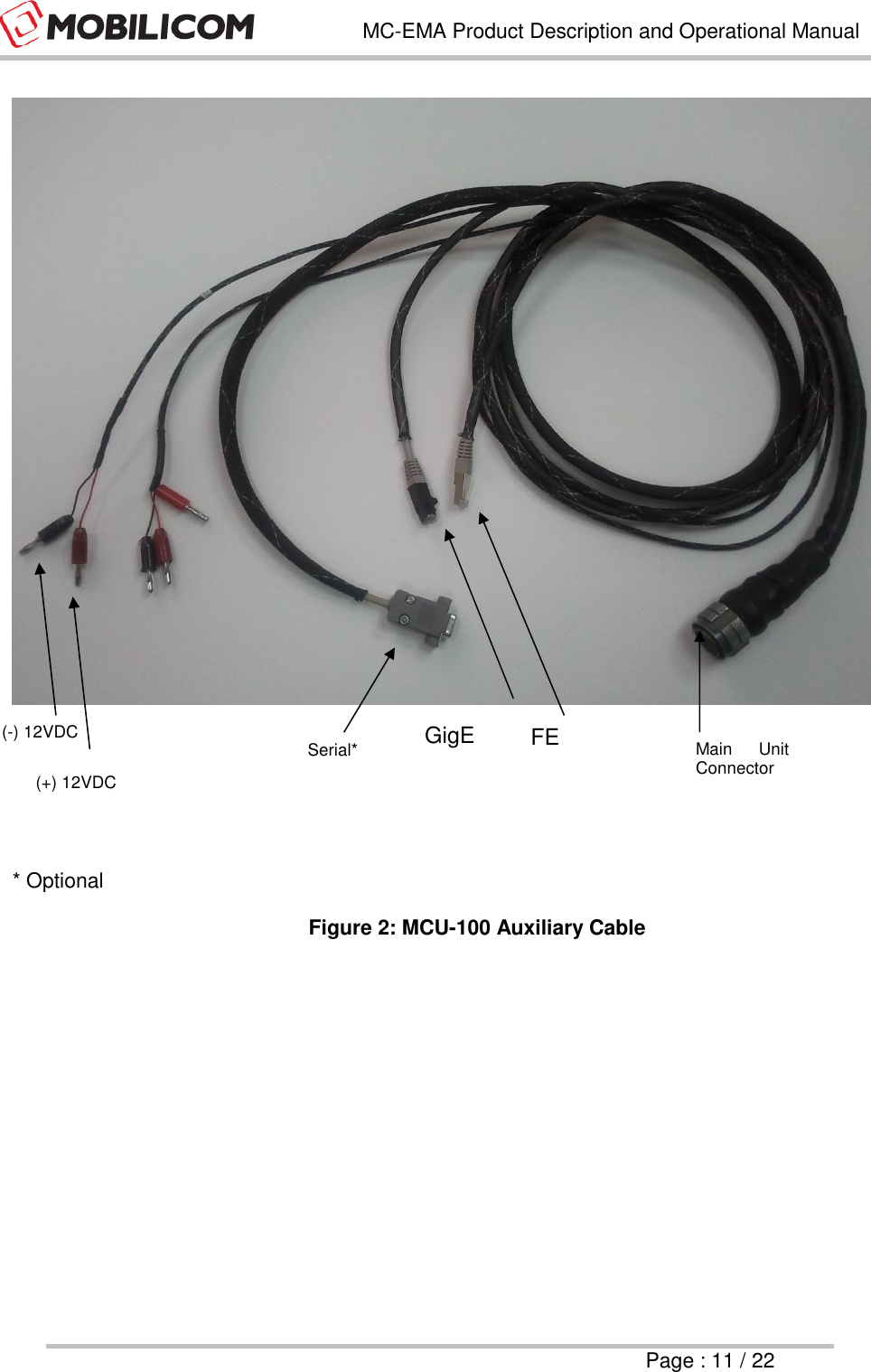
  MC-EMA Product Description and Operational Manual     Page : 8 / 22  8)  In order to verify that the MCU-100 is working (when there is no link) the MCU-100 can be connected to a PC via Ethernet or RS232. When connected to a PC EMA can be run and get some  of  the  indications.  The  rest  of  the  indications  such  as  Link  status,  CINR,  RSSI  and bandwidth are not relevant and will not be displayed. 9)  Power Feed: a.  The device can be powered only via battery and not via AC/DC transformer. b.  The device can be marketed as battery powered only. c.  Communication  and  power  harness  can  be  supplied  by  Mobilicom  as  an  auxiliary cable, but can also be manufactured according to Mobilicom’s spec. The cable should contain at least a 1GE and one power as a minimum, yet it is recommended that the RS232 will be added as well. The Power line must contain a 4A fuse. d.  Voltage Regulation:  33%    =(12-9)/9*100% e.  Battery Types that can be used: Voltage:    12VDC  Max Current:     3A Recommended AH:  24AH (for 8 hours operation) f.  Connecting the Battery: Connect the Black Cable labeled -12VDC to the - of the Battery Connect the Red Cable labeled +12VDC to the + of the Battery g.  Disconnecting the Battery: Disconnect the Red Cable labeled +12VDC to the + of the Battery Disconnect the Black Cable labeled -12VDC to the - of the Battery
  MC-EMA Product Description and Operational Manual     Page : 9 / 22    Output power is conducted.  This device must not be sold to the general public.   This device is not approved for use when being powered by the AC power lines either directly, or indirectly, through another device.   Professional installation of this device is required.   The antenna(s) used for this device must be installed to provide a separation distance of at least 20 cm from all persons, and must not be co-located or operating in conjunction with any other antenna or transmitter except in accordance with FCC multi-transmitter product procedures.       g.
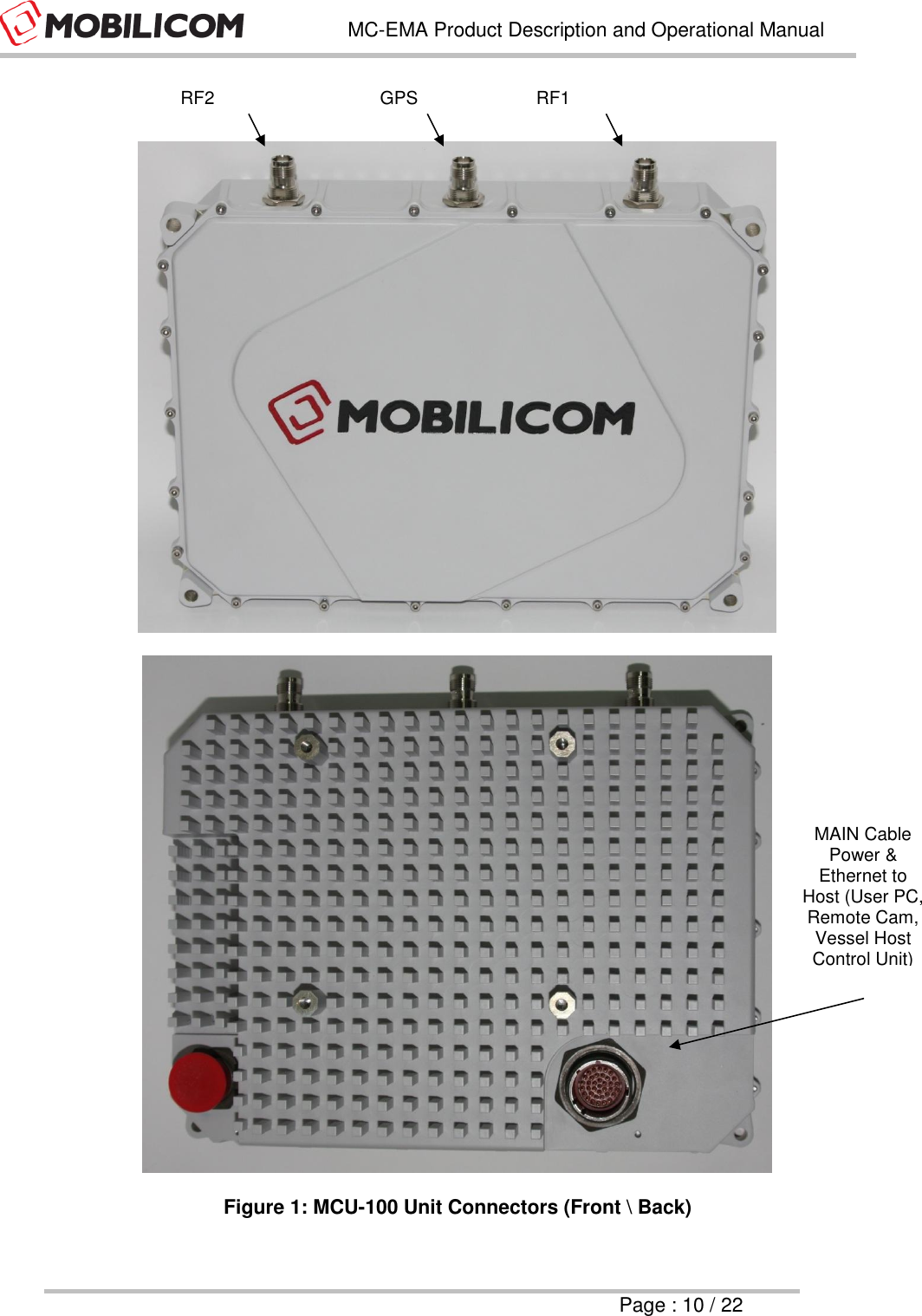
  MC-EMA Product Description and Operational Manual     Page : 10 / 22     Figure 1: MCU-100 Unit Connectors (Front \ Back) RF2 RF1 GPS  MAIN Cable Power & Ethernet to Host (User PC, Remote Cam, Vessel Host Control Unit)
  MC-EMA Product Description and Operational Manual     Page : 11 / 22      * Optional Figure 2: MCU-100 Auxiliary Cable  (-) 12VDC  Serial* (+) 12VDC GigE Main  Unit Connector FE
  MC-EMA Product Description and Operational Manual     Page : 12 / 22    4  Units’ Bring Up  4.1  MCU Bring Up 1)  Once the MCUs are initialized as described in section 3.1, only power feed is needed for the system. When powered up it starts its operation as a simple plug-and-play device 2)  Firmware update is described in the MC-EMA section
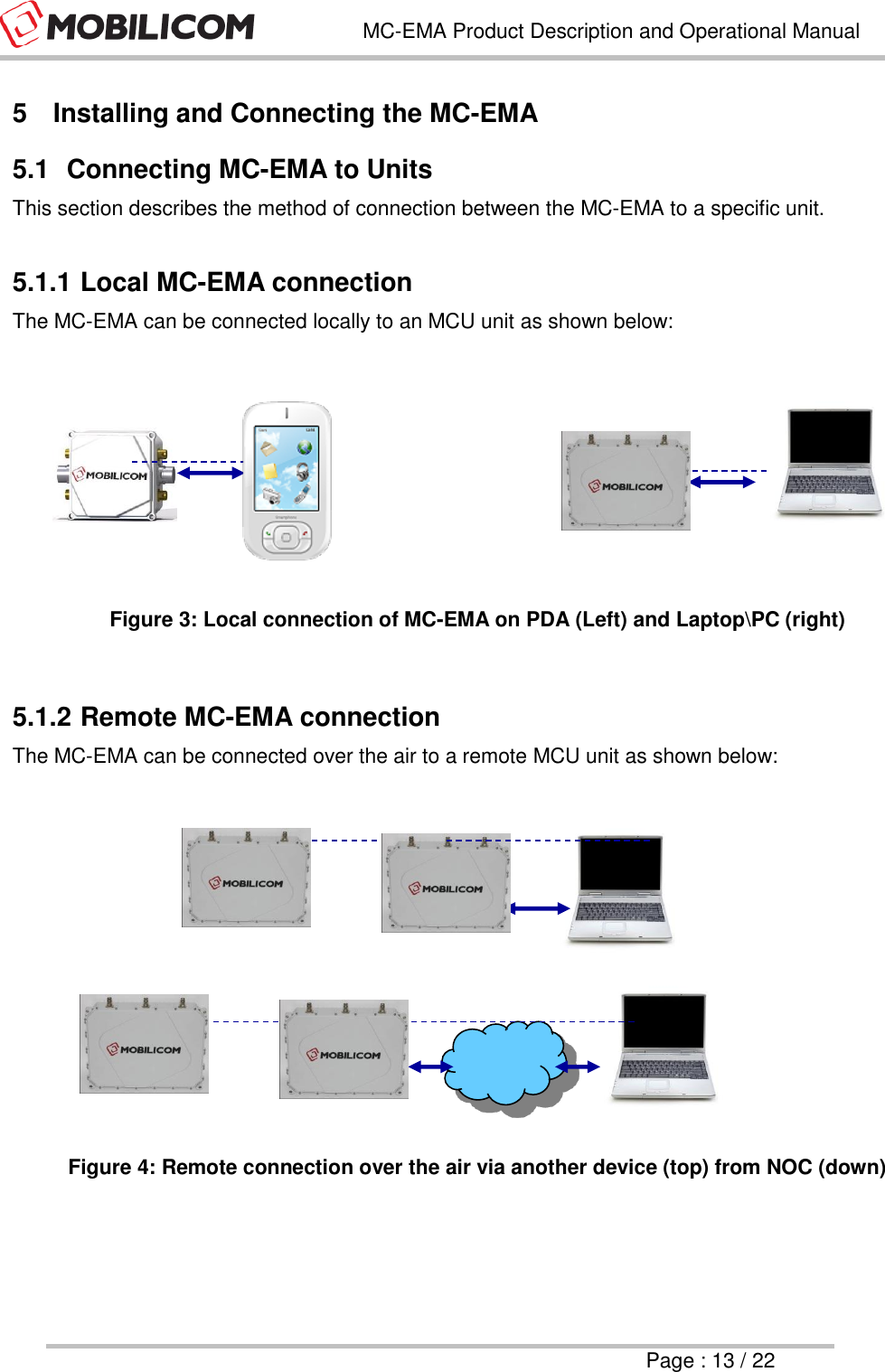
  MC-EMA Product Description and Operational Manual     Page : 13 / 22  5  Installing and Connecting the MC-EMA 5.1  Connecting MC-EMA to Units This section describes the method of connection between the MC-EMA to a specific unit.  5.1.1 Local MC-EMA connection  The MC-EMA can be connected locally to an MCU unit as shown below:   Figure 3: Local connection of MC-EMA on PDA (Left) and Laptop\PC (right)  5.1.2 Remote MC-EMA connection  The MC-EMA can be connected over the air to a remote MCU unit as shown below:         Figure 4: Remote connection over the air via another device (top) from NOC (down)
  MC-EMA Product Description and Operational Manual     Page : 14 / 22  5.2  MC-EMA Software Installation 5.2.1 Installing MC-EMA on a Laptop\PC Following is the procedure to install the MC-EMA application on Laptop\PC: 1)  Java Runtime Environment should be installed on your device. 2)  Unzip the EMA package.  3)  In order to run the EMA run the ema.bat file. 4)  Use your EMA Manual to configure/use it.  5.3  Updating Firmware to an MCU Unit Following are the steps for updating MCU firmware 1)  Make sure that the MC-EMA is set to the box you wish to update. 2)  Load the Zip file of the version you want to upgrade to. 3)  Power down the MCU unit. 4)  Power up the MCU unit. 5)  Confirm the version number on the MC-EMA general screen.
  MC-EMA Product Description and Operational Manual     Page : 15 / 22  6  MC-EMA Overview 6.1  MC-EMA Element Management Application Mobilicom's MC-Element Management Application (MC-EMA) is optional, technical software tool that  runs  on  computer  or  portable  device  (PDA)  and  uses  to  test  specific  MCU  node  in  the network.  It  enables  ease  of  configuration  and  maintenance  and  logs  data  for  analysis, configuration and maintenance purposes. This software can run on a computer or portable device directly  connected  to  a  specific  unit  within  the  communications  network  or  over  the  air-link  to remote devices via their IP address.  The MC-EMA enables:  Fault alarms for critical parameters  Configuration of the unit and its monitoring maintenance for online diagnostics  Performance of  unit throughput and link status   Monitoring with online diagnostics    Logging data for offline analysis   The MCU-100 is a plug-and-play unit for the end-user, where the MC-EMA tool can be used by Field Application Engineers (FAE’s), technical support and R&D Engineering on first installation and maintenance purposes.
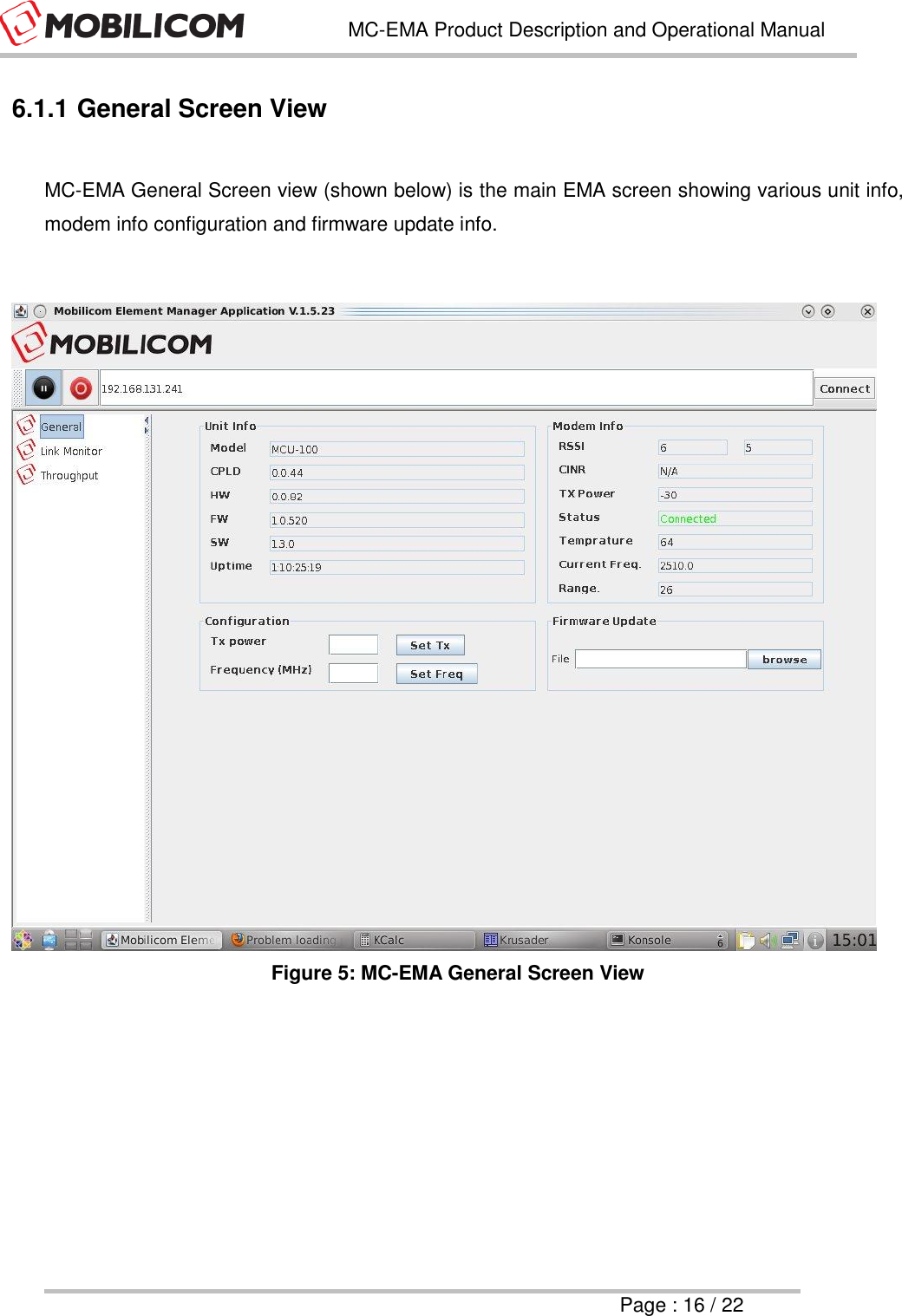
  MC-EMA Product Description and Operational Manual     Page : 16 / 22  6.1.1 General Screen View  MC-EMA General Screen view (shown below) is the main EMA screen showing various unit info, modem info configuration and firmware update info.    Figure 5: MC-EMA General Screen View
  MC-EMA Product Description and Operational Manual     Page : 17 / 22  Following fields and parameters are shown in the general screen:   Unit Info field shows the following parameters:   Unit Model Type – MCU-100   CPLD – CPLD version   HW – Hardware version   FW – Firmware Version   SW – Software Version   Uptime – Amount of time the system is up and running   Modem Info field shows the following parameters: 6)  RSSI – Received Power on each channel in dBm (-105 ÷ -20)   CINR – Signal To Noise Ratio for each channel in dB (0 ÷ 30)   Tx Power – Current Tx Power in dBm (updates each 5 seconds)   Status – Unit Status  (Link Up/ Link Down)   Temperature – Unit temperature   Current Frequency – in MHz (will be updated after reboot if a freq was changed)   Range – in meters between 2 units  Configuration    Tx Power    Frequency in MHz    Firmware Update   Loading a ZIP file burns a new Software (and FPGA/Firmware) – Needs power down in order to take effect
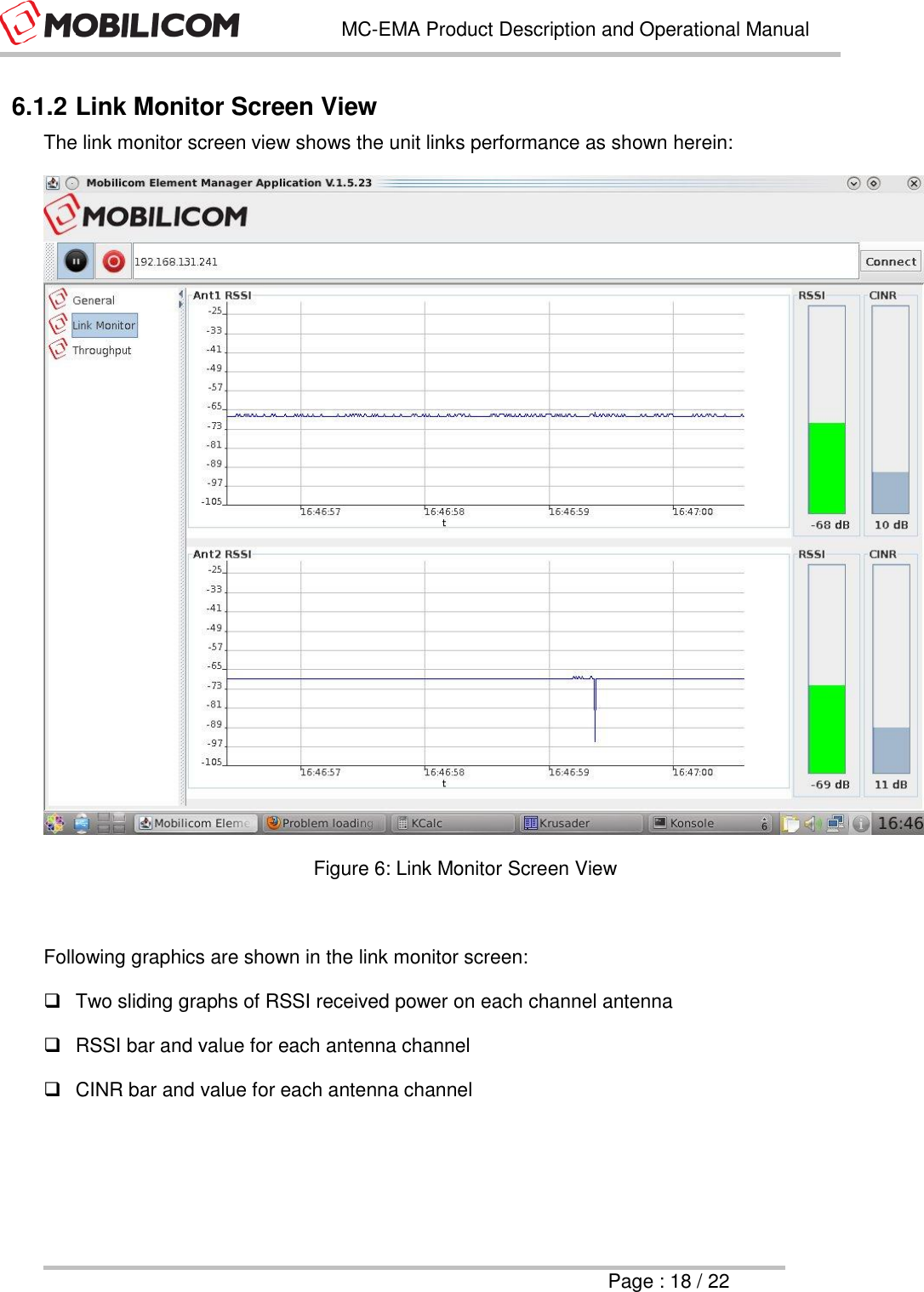
  MC-EMA Product Description and Operational Manual     Page : 18 / 22  6.1.2 Link Monitor Screen View The link monitor screen view shows the unit links performance as shown herein:  Figure 6: Link Monitor Screen View  Following graphics are shown in the link monitor screen:   Two sliding graphs of RSSI received power on each channel antenna   RSSI bar and value for each antenna channel   CINR bar and value for each antenna channel
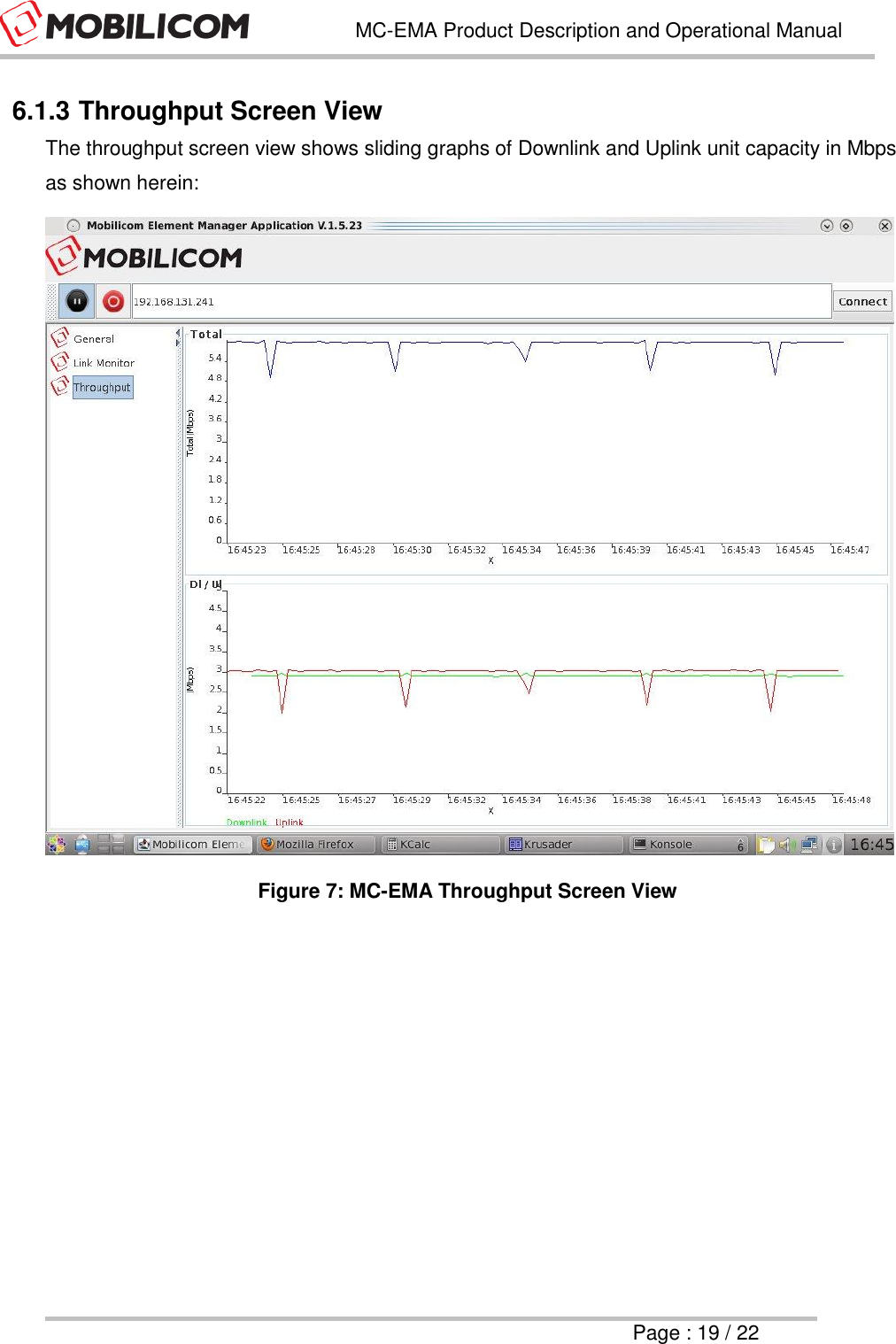
  MC-EMA Product Description and Operational Manual     Page : 19 / 22  6.1.3 Throughput Screen View The throughput screen view shows sliding graphs of Downlink and Uplink unit capacity in Mbps as shown herein:  Figure 7: MC-EMA Throughput Screen View
  MC-EMA Product Description and Operational Manual     Page : 20 / 22  7  Standardization 7.1  Declaration of Conformity Manufacturer’s Name:  MOBILICOM Declares under our sole responsibility that the products: Product Name:   MCU-100 Conform(s) to the following standard(s) or other normative document(s):     FCC Part 15 Class A     FCC Part 15 Subpart C (15.247)      EN 300-328   This device complies with Part 15 of the FCC Rules. Operation is subject to the following two conditions: •   The device may not cause harmful interference. •   This device must accept any interference received, including interference that may cause undesired operation. Le présent appareil est conforme aux CNR d'Industrie Canada applicables aux appareils radio exempts de licence. L'exploitation est autorisée aux deux conditions suivantes :  (1) l'appareil ne doit pas produire de brouillage, et  (2) l'utilisateur de l'appareil doit accepter tout brouillage radioélectrique subi, même si le brouillage est susceptible d'en compromettre le fonctionnement   This equipment has been approved for mobile applications where the equipment should be used at distances greater than 20cm from the human body (with the exception of hands, wrists, feet and ankles). Operation at distances less than 20 cm is strictly prohibited. Changes or modification to device not expressly approved by MOBILICOM LTD is strictly prohibited and could avoid the user's authority to operate the equipment.
  MC-EMA Product Description and Operational Manual     Page : 21 / 22  7.2  Professional Installation Attestation  MOBILICOM  (the  manufacturer)  addresses  the  following  items  to  ensure  that  the  above referenced equipment is professionally installed: 1.  The  MCU-100  will  only  be  sold  by  MOBILICOM  or  one  of  its  authorized  dealers. MOBILICOM and its authorized dealers will be under strict marketing control and will only market and sell the MCU-100 to professionals. 2.  Professional installation is  required for the  MCU-100  and  will be  performed only by someone knowledgeable of its use. 3.  MOBILICOM will ensure that the MCU-100 is only marketed and sold to professionals. 4.  The  MCU-100  is  not  sold  to  the  general  public  and  is  sold  only  for  industrial  or commercial use by professional installers. 5.  List  of  approved  antennas  and  power  settings  used  shown  on  FCC  grant.  Installer shall be responsible for ensuring that the proper antenna is employed so that the limits in FCC Part 15 are not exceeded. 6.  Power Feed: a)  The device can be powered only via battery and not via AC/DC transformer. b)  The device can be marketed as battery powered only. c)  Communication and power harness can be supplied by Mobilicom as an auxiliary cable,  but  can  also  be  manufactured  according  to  Mobilicom’s  spec.  The  cable should  contain  at  least  a  1GE  and  one  power  as  a  minimum,  yet  it  is recommended that the RS232 will be added as well. The Power line must contain a 4A fuse. d)  Voltage Regulation:  33%    =(12-9)/9*100% e)  Battery Types that can be used: Voltage:    12VDC  Max Current:     3A Recommended AH:  24AH (for 8 hours operation)
  MC-EMA Product Description and Operational Manual     Page : 22 / 22  f)  Connecting the Battery: Connect the Black Cable labeled -12VDC to the - of the Battery Connect the Red Cable labeled +12VDC to the + of the Battery g)  Disconnecting the Battery: Disconnect the Red Cable labeled +12VDC to the + of the Battery Disconnect the Black Cable labeled -12VDC to the - of the Battery   Output power is conducted.  This device must not be sold to the general public.   This device is not approved for use when being powered by the AC power lines either directly, or indirectly, through another device.   Professional installation of this device is required.   The antenna(s) used for this device must be installed to provide a separation distance of at least 20 cm from all persons, and must not be co-located or operating in conjunction with any other antenna or transmitter except in accordance with FCC multi-transmitter product procedures.

Navigation menu