Radio Thermostat of America WIFIG0325 USNAP WiFi Module User Manual

Radio Thermostat Company of America, Inc USNAP WiFi Module

User Manual

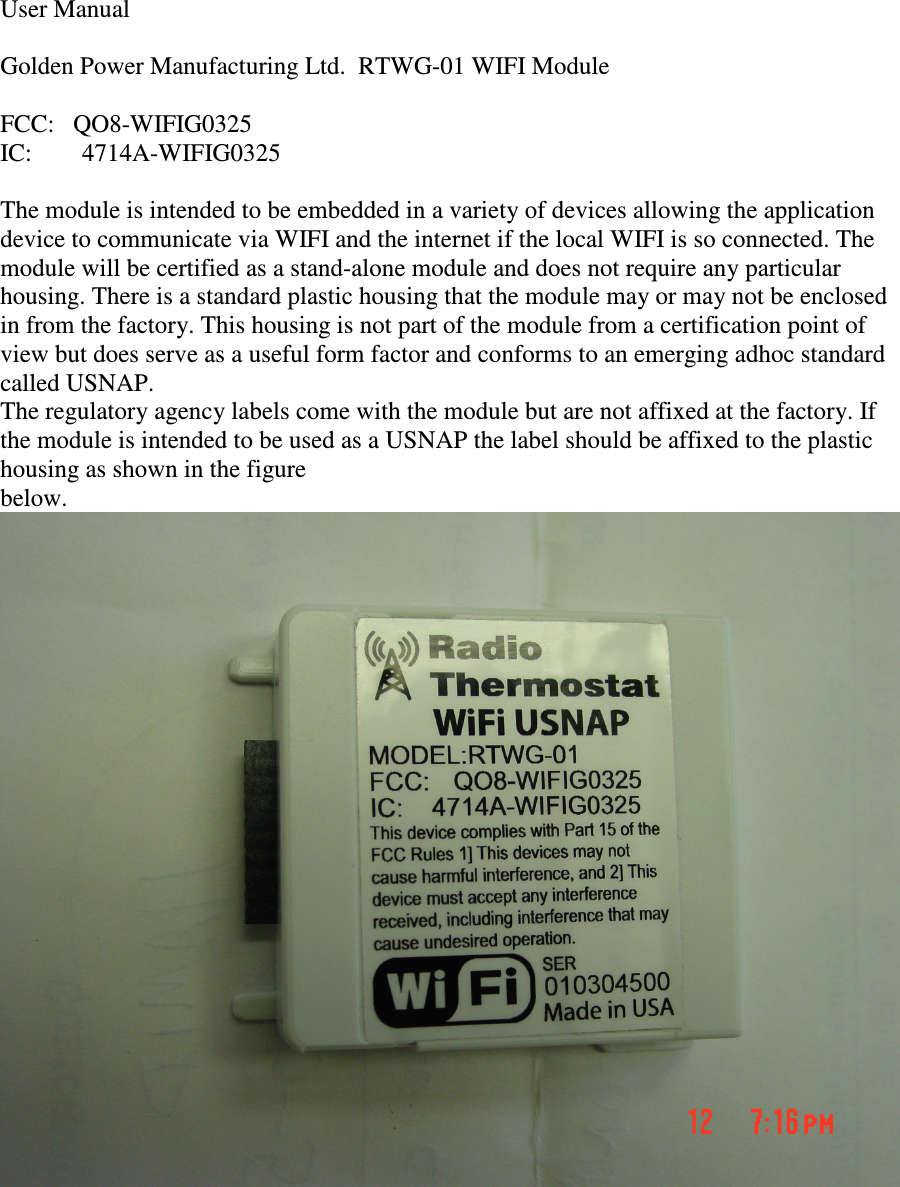
 User Manual  Golden Power Manufacturing Ltd.  RTWG-01 WIFI Module  FCC:   QO8-WIFIG0325 IC:        4714A-WIFIG0325  The module is intended to be embedded in a variety of devices allowing the application device to communicate via WIFI and the internet if the local WIFI is so connected. The module will be certified as a stand-alone module and does not require any particular housing. There is a standard plastic housing that the module may or may not be enclosed in from the factory. This housing is not part of the module from a certification point of view but does serve as a useful form factor and conforms to an emerging adhoc standard called USNAP. The regulatory agency labels come with the module but are not affixed at the factory. If the module is intended to be used as a USNAP the label should be affixed to the plastic housing as shown in the figure below.
  Per FCC Part 15.19:  When the device is so small or for such use that it is not practicable to place the statement specified under paragraph (a) of this section on it, the information required by this paragraph shall be placed in a prominent location in the instruction manual or pamphlet supplied to the user or, alternatively, shall be placed on the container in which the device is marketed. However, the FCC identifier or the unique identifier, as appropriate, must be displayed on the device.   Thus:  This device complies with part 15 of the FCC Rules. Operation is subject to the following two conditions: (1) This device may not cause harmful interference, and (2) this device must accept any interference received, including interference that may cause undesired operation.  Sec. 15.21  Information to user.     The users manual or instruction manual for an intentional or  unintentional radiator shall caution the user that changes or  modifications not expressly approved by the party responsible for  compliance could void the user's authority to operate the equipment. In  cases where the manual is provided only in a form other than paper, such  as on a computer disk or over the Internet, the information required by  this section may be included in the manual in that alternative form,  provided the user can reasonably be expected to have the capability to  access information in that form.   Thus:  The user is cautioned that changes or modifications not expressly approved by the party responsible for compliance could void the user's authority to operate the equipment.
 Note: This equipment has been tested and found to comply with the limits for a Class B digital device, pursuant to part 15 of the FCC    Rules. These limits are designed to provide reasonable protection against harmful interference in a residential installation. This equipment generates, uses and can radiate radio frequency energy and, if not installed and used in accordance with the instructions, may cause harmful interference to radio communications. However, there is no guarantee that interference will not occur in a particular    installation. If this equipment does cause harmful interference to radio or television reception, which can be determined by turning the equipment off and on, the user is encouraged to try to correct the interference by one or more of the following measures:     --Reorient or relocate the receiving antenna.     --Increase the separation between the equipment and receiver.     --Connect the equipment into an outlet on a circuit different from that to which the receiver is connected.     --Consult the dealer or an experienced radio/TV technician for help.  If the module is intended to be embedded in another enclosure the label should be affixed to the non-component side of the module PC board prior to assembly in the final location.  The module is not intended to be used in a device which comes in close proximity (closer than several feet) to a person for any appreciable length of time.  The module should be situated such that the antenna has a clear and unobstructed path to other WIFI devices i.e. APs.  The module may be equipped with a USB connector for provisioning purposes. If so, the user can use a Micro-USB cable between their PC and the module. The module should not be in it’s native application position when this process is under way. During this process the module is powered by the USB cable.  The module can be provisioned using the method outlined above but can also be provisioned using other standard methods i.e. adhoc connection to another WIFI enabled device or by WPS. In these cases the module is installed in the application device and does not use the USB method.
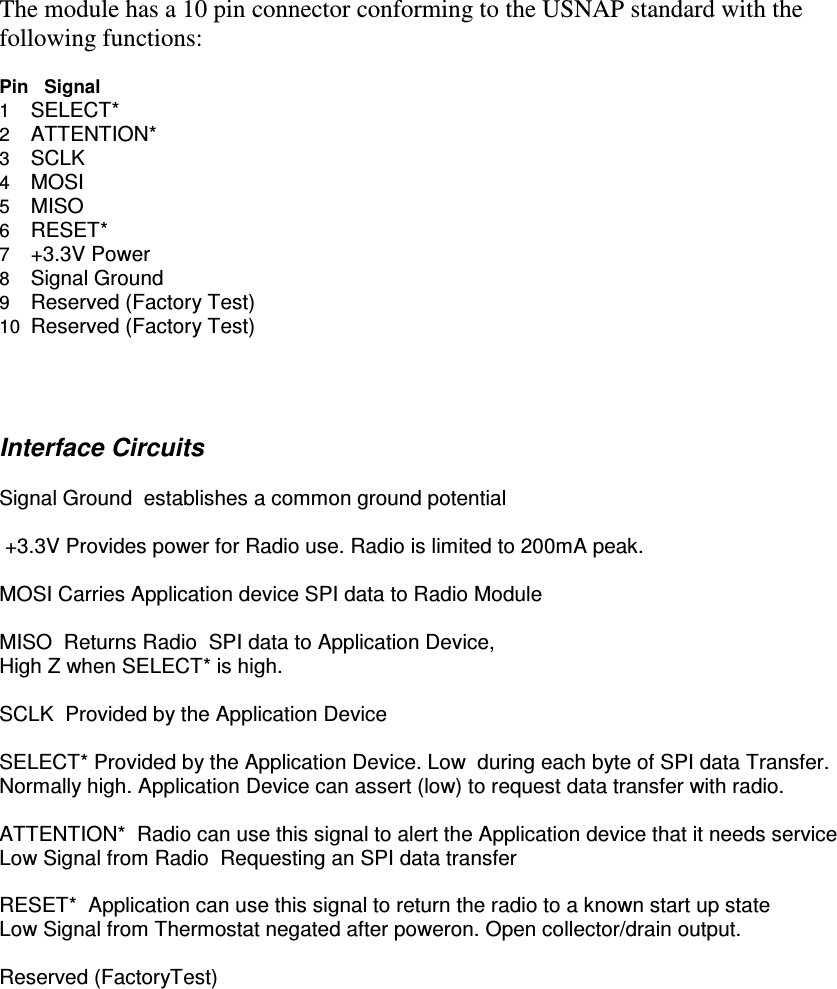
   The module has a 10 pin connector conforming to the USNAP standard with the following functions:   Pin   Signal 1    SELECT* 2    ATTENTION* 3    SCLK 4    MOSI 5    MISO 6    RESET* 7    +3.3V Power 8    Signal Ground 9    Reserved (Factory Test) 10  Reserved (Factory Test)     Interface Circuits  Signal Ground  establishes a common ground potential   +3.3V Provides power for Radio use. Radio is limited to 200mA peak.  MOSI Carries Application device SPI data to Radio Module  MISO  Returns Radio  SPI data to Application Device, High Z when SELECT* is high.  SCLK  Provided by the Application Device  SELECT* Provided by the Application Device. Low  during each byte of SPI data Transfer. Normally high. Application Device can assert (low) to request data transfer with radio.  ATTENTION*  Radio can use this signal to alert the Application device that it needs service Low Signal from Radio  Requesting an SPI data transfer  RESET*  Application can use this signal to return the radio to a known start up state Low Signal from Thermostat negated after poweron. Open collector/drain output.  Reserved (FactoryTest)

Navigation menu