STONEX SRL R35 Total Station User Manual 8

STONEX SRL Total Station 8

User manual

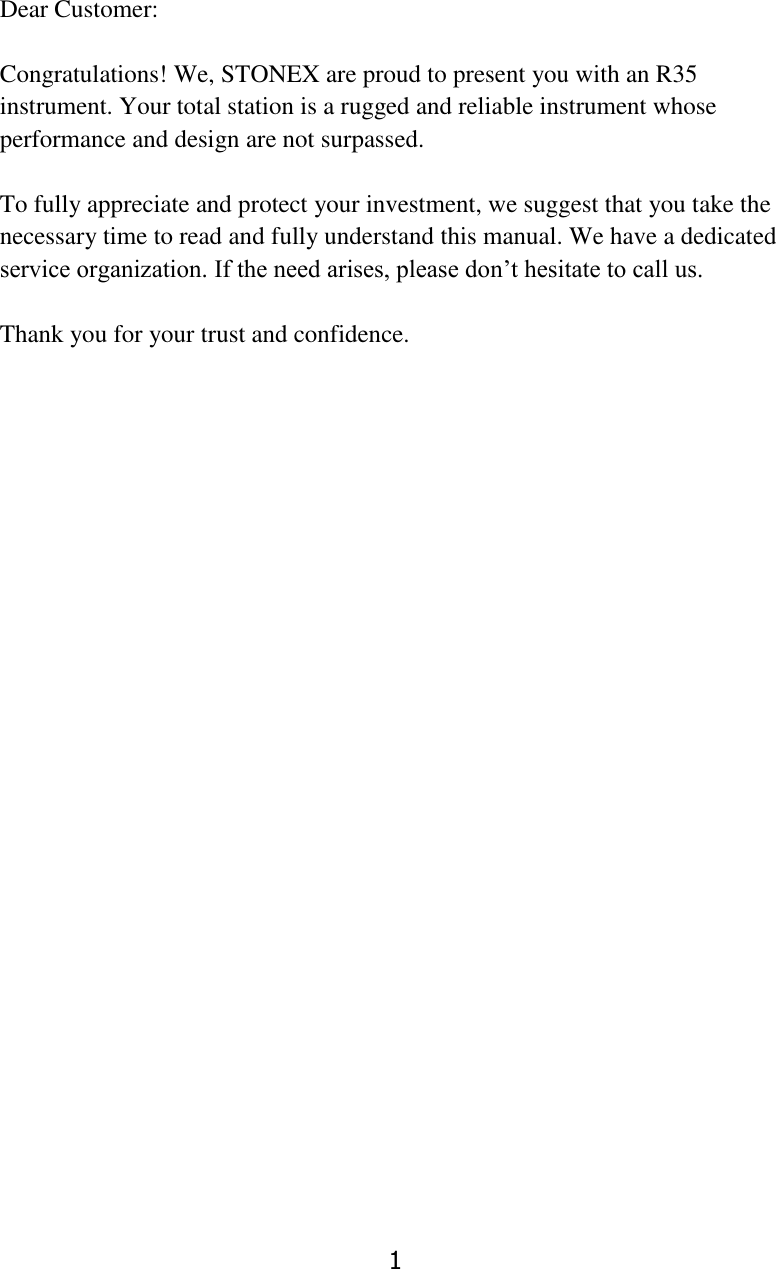
                                                  R35 Total Station Instruction Manual
1 Dear Customer:  Congratulations! We, STONEX are proud to present you with an R35   instrument. Your total station is a rugged and reliable instrument whose performance and design are not surpassed.  To fully appreciate and protect your investment, we suggest that you take the necessary time to read and fully understand this manual. We have a dedicated service organization. If the need arises, please don’t hesitate to call us.  Thank you for your trust and confidence.
2 NOTE:  Don’t collimate the sun directly Avoid insolating the instrument, and don’t collimate the sun directly for protecting eyes and instrument. Set up the instrument on the tripod When using it please insure the connection between tripod and instrument is firm. It is better to work with wooden tripod for the measurement accuracy. Assemble the tribrach on the instrument The  setting  of  tribrach  would  influence  the  accuracy.  The  tribrach  should  be  check frequently, the screw which connects the tribrach and alidade must be locked tightly. And the central fixing screw should be tight. Avoiding the librations on the instrument When transporting, keep the instrument in the case and try your best to lighten librations. Carry the instrument When carrying,the instrument handle must be held tight. High temperature condition If  put  the  instrument  in  high  temperature  condition  for  a  long  time,  it  is  bad  for  the instrument performance. Temperature changing sharply The  sharp  temperature  changing  on  the  instrument  or  prism  will  shorten  the  distance measurement range, for example, after taking the instrument out from a warm car to a cold  condition,  wait  for  some  time,  it  can  be  used  when  it  adapts  to  the  surrounding condition. Check the battery power Before using it, you should check the power whether it is enough. Take out the battery It is not suggested to take out the battery when the instrument is on, otherwise, the stored data may be lost, so it is better to replace the battery after power off the instrument. Stored data responsibility STONEX    should not be held liability for the lost data because of wrong operation. The noise from the instrument When the instrument is working, it is normal if you hear the noise from instrument motor, it will not affect the instrument work.
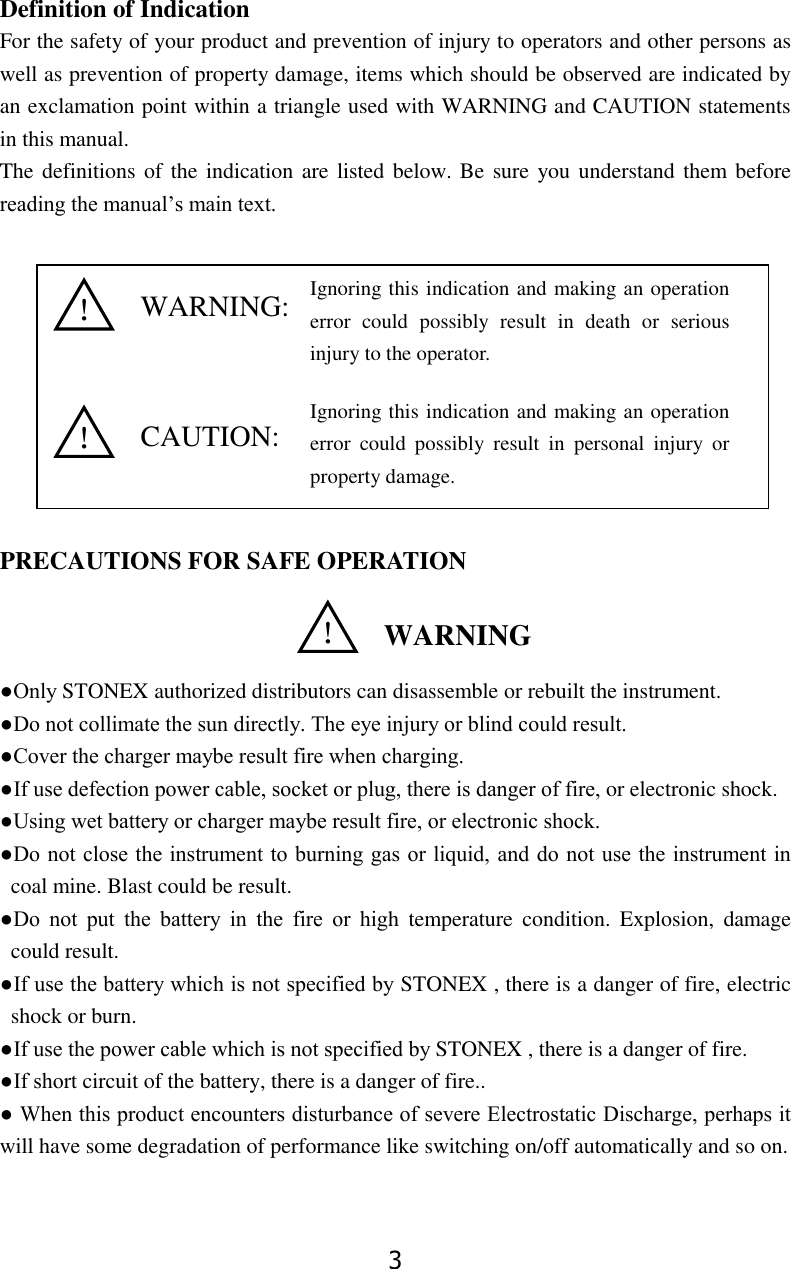
3 Definition of Indication           For the safety of your product and prevention of injury to operators and other persons as well as prevention of property damage, items which should be observed are indicated by an exclamation point within a triangle used with WARNING and CAUTION statements in this manual. The definitions of the indication are listed below. Be sure you understand them before reading the manual’s main text.             PRECAUTIONS FOR SAFE OPERATION    ●Only STONEX authorized distributors can disassemble or rebuilt the instrument. ●Do not collimate the sun directly. The eye injury or blind could result. ●Cover the charger maybe result fire when charging. ●If use defection power cable, socket or plug, there is danger of fire, or electronic shock. ●Using wet battery or charger maybe result fire, or electronic shock. ●Do not close the instrument to burning gas or liquid, and do not use the instrument in coal mine. Blast could be result. ●Do  not  put  the  battery  in  the  fire  or  high  temperature  condition.  Explosion,  damage could result. ●If use the battery which is not specified by STONEX , there is a danger of fire, electric shock or burn. ●If use the power cable which is not specified by STONEX , there is a danger of fire. ●If short circuit of the battery, there is a danger of fire.. ● When this product encounters disturbance of severe Electrostatic Discharge, perhaps it will have some degradation of performance like switching on/off automatically and so on.   WARNING:  CAUTION: !  WARNING ! ! Ignoring this indication and making an operation error  could  possibly  result  in  death  or  serious injury to the operator. Ignoring this indication and making an operation error  could  possibly  result  in  personal  injury  or property damage.
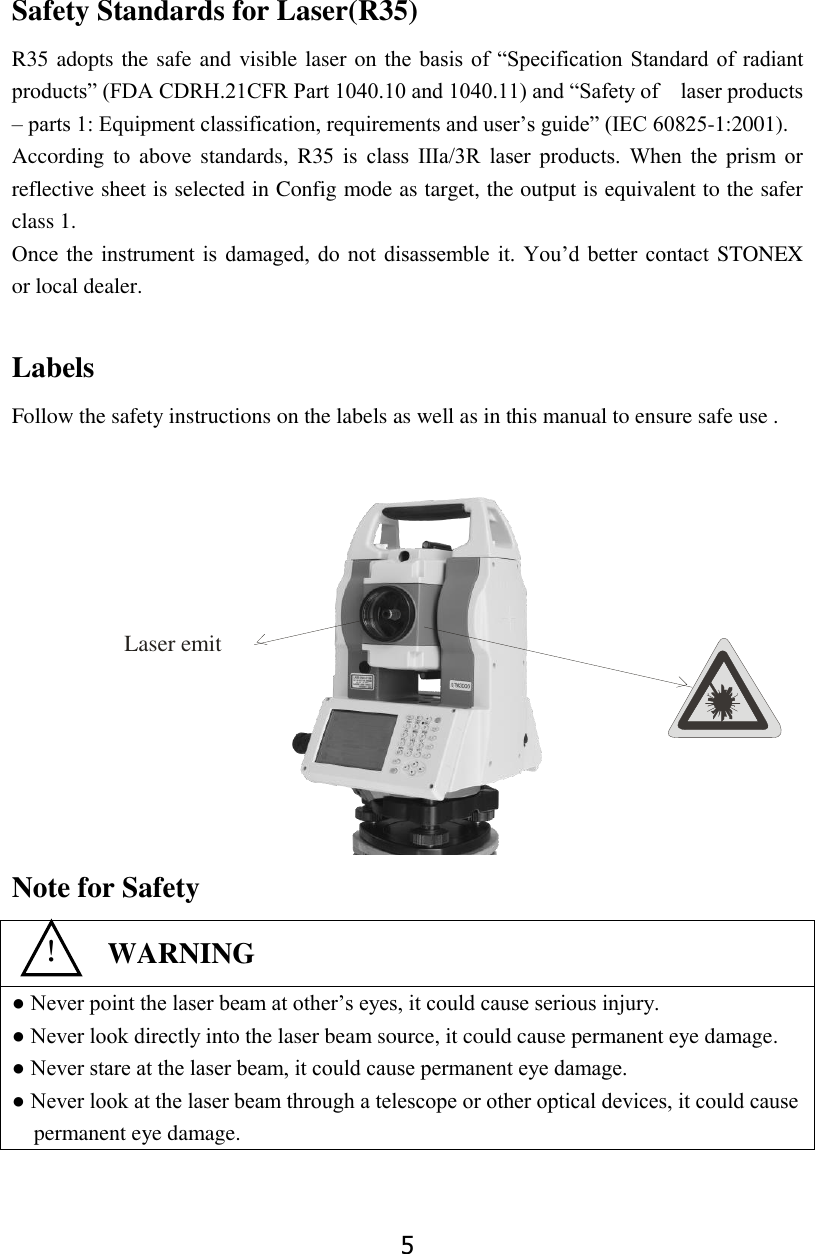
4   ●If touch the instrument with wet hand, there is danger of electric shock. ●Stand  or  seat  on  the  carrying  case,  or  turn  over  the  carrying  case  arbitrarily,  the instrument maybe damaged. ●Be careful of the tripod tiptoe when setup or move it.   ●Drop  the  instrument  or  the  carrying  case,  or  use  defective  belt,  agraffe  or  hinge, instrument damage could result.   ●Do  not  touch  liquid  leaking  from  the  instrument  or  battery.  Harmful  chemicals  could cause burn or blisters.   ●Please assemble the tribrach carefully, if the tribrach is not stable, series damage could result.   ●Drop  the  instrument  or  tripod,  series  damage  could  result.  Before  use  it,  check  the central screw is tight.    User 1) This product is for professional user only! The user is required to be a qualified surveyor or have a good knowledge of surveying, in order to understand the user manual and safety instructions, before operating, inspecting or adjusting. 2) Wear the required protectors (safety shoes, helmet, etc.) when operating.  Exceptions from Responsibility 1)  The  user  of  this  product  is  expected  to  follow  all  operating  instructions  and  make periodic checks of the product’s performance. 2) The manufacturer assumes no responsibility for results of a faulty or intentional usage or misuse including any direct, indirect, consequential damage, and loss of profits. 3)  The  manufacturer  assumes  no  responsibility  for  consequential  damage,  and  loss  of profits by any disaster, (an earthquake, storms, floods etc.). 4) The manufacturer assumes no responsibility for any damage, and loss of profits due to a change of data, loss of data, an interruption of business etc., caused by using the product or an unusable product. 5) The manufacturer assumes no responsibility for any damage, and loss of profits caused by usage except for explained in the user manual. 6) The manufacturer assumes no responsibility for damage caused by wrong transport, or action due to connecting with other products. !  CAUTION
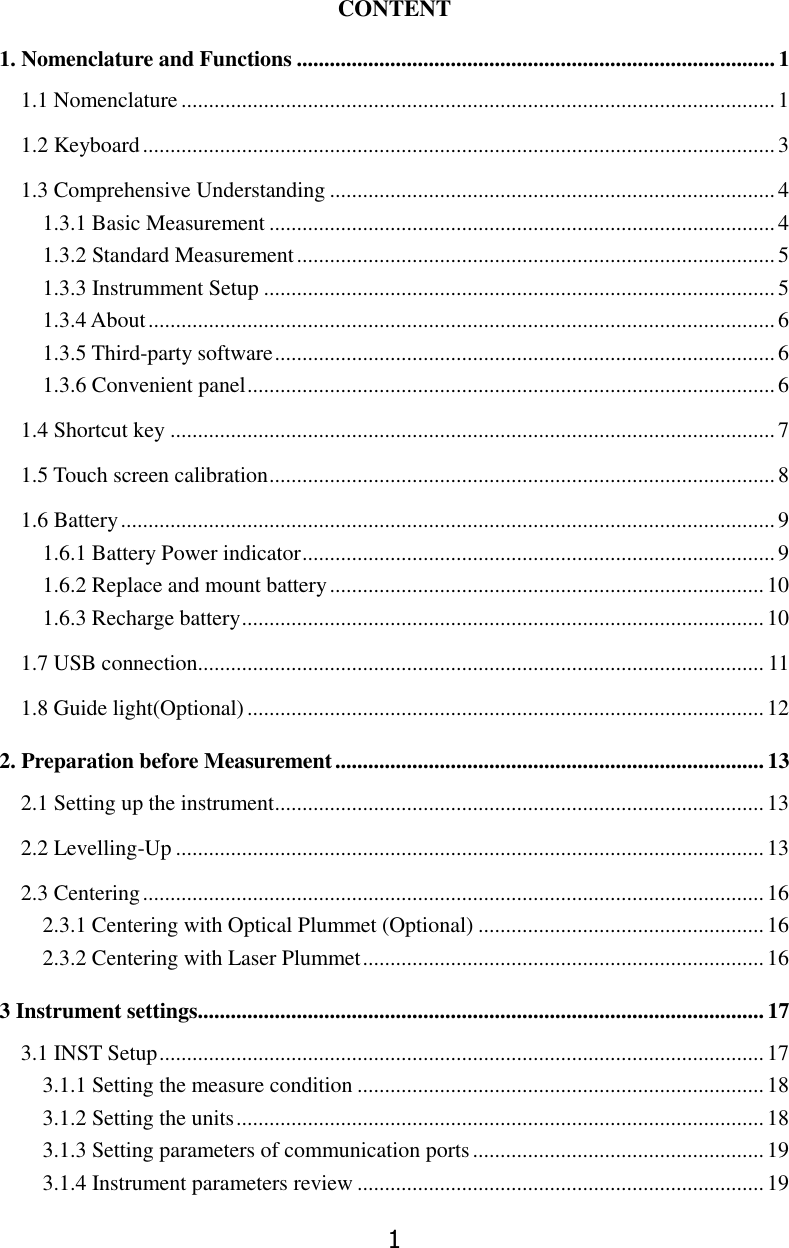
5 Safety Standards for Laser(R35) R35 adopts the safe and visible laser on  the  basis  of  “Specification Standard of  radiant products” (FDA CDRH.21CFR Part 1040.10 and 1040.11) and “Safety of    laser products – parts 1: Equipment classification, requirements and user’s guide” (IEC 60825-1:2001). According to  above standards, R35  is  class  Ⅲa/3R  laser  products.  When  the  prism  or reflective sheet is selected in Config mode as target, the output is equivalent to the safer class 1. Once  the  instrument  is  damaged, do not  disassemble it.  You’d  better  contact  STONEX   or local dealer.  Labels Follow the safety instructions on the labels as well as in this manual to ensure safe use .        Note for Safety  ● Never point the laser beam at other’s eyes, it could cause serious injury. ● Never look directly into the laser beam source, it could cause permanent eye damage. ● Never stare at the laser beam, it could cause permanent eye damage. ● Never look at the laser beam through a telescope or other optical devices, it could cause permanent eye damage.   !  WARNING Laser emit
1 CONTENT 1. Nomenclature and Functions ....................................................................................... 1 1.1 Nomenclature ............................................................................................................ 1 1.2 Keyboard ................................................................................................................... 3 1.3 Comprehensive Understanding ................................................................................. 4 1.3.1 Basic Measurement ............................................................................................ 4 1.3.2 Standard Measurement ....................................................................................... 5 1.3.3 Instrumment Setup ............................................................................................. 5 1.3.4 About .................................................................................................................. 6 1.3.5 Third-party software ........................................................................................... 6 1.3.6 Convenient panel ................................................................................................ 6 1.4 Shortcut key .............................................................................................................. 7 1.5 Touch screen calibration ............................................................................................ 8 1.6 Battery ....................................................................................................................... 9 1.6.1 Battery Power indicator ...................................................................................... 9 1.6.2 Replace and mount battery ............................................................................... 10 1.6.3 Recharge battery ............................................................................................... 10 1.7 USB connection....................................................................................................... 11 1.8 Guide light(Optional) .............................................................................................. 12 2. Preparation before Measurement .............................................................................. 13 2.1 Setting up the instrument ......................................................................................... 13 2.2 Levelling-Up ........................................................................................................... 13 2.3 Centering ................................................................................................................. 16 2.3.1 Centering with Optical Plummet (Optional) .................................................... 16 2.3.2 Centering with Laser Plummet ......................................................................... 16 3 Instrument settings ....................................................................................................... 17 3.1 INST Setup .............................................................................................................. 17 3.1.1 Setting the measure condition .......................................................................... 18 3.1.2 Setting the units ................................................................................................ 18 3.1.3 Setting parameters of communication ports ..................................................... 19 3.1.4 Instrument parameters review .......................................................................... 19
2 3.2 Illumination settings ................................................................................................ 20 4. Basic measurement program ...................................................................................... 21 4.1 Run the program “Basic Measurement” .................................................................. 21 4.2 Basic measurement screen introduction .................................................................. 21 4.3 Angle measurement mode ....................................................................................... 22 4.3.1 Horizontal angle(right angle) and vertical angle measurements ...................... 22 4.3.2 Horizontal angle switch between right and left ................................................ 23 4.3.3 Setting horizontal angle with the “L.Angle” key ............................................. 24 4.3.4 Setting horizontal angle with the “S.Angle” key .............................................. 25 4.3.5 Setting “vertical angle and percent grade” mode with the “V/%” key ............. 26 4.3.6 Carrying out angle retesting with the “Repeat” key ......................................... 26 4.4 Distance measurement mode ................................................................................... 30 4.4.1 Distance measurement and measuring mode setting ........................................ 30 4.4.2 Fine/Tracking distance measurement ............................................................... 32 4.4.3 Accurate Measurement and Track mode .......................................................... 33 4.4.4 Exchange of distance units ............................................................................... 34 4.4.5 Distance stake out measurement ...................................................................... 35 4.4.6 Remote Elevation Measurement(REM) ...................................................... 37 4.4.7 Missing Line Measurement (MLM) ................................................................. 42 4.4.8 Line-height Measurement ................................................................................. 45 4.5 Coordinate Measurement Mode .............................................................................. 50 4.5.1 Setting coordinate of occupied point ................................................................ 50 4.5.2 Setting backsight point ..................................................................................... 51 4.5.3 Setting instrument height and prism height ...................................................... 53 4.5.4 Operation of coordinate measurement .............................................................. 54 4.5.5 Traverse Surveying ........................................................................................... 55 4.5.6 Offset Measurement Mode ............................................................................... 58 4.6 About ....................................................................................................................... 68 5. Check and Adjustment ............................................................................................... 69 5.1 The Instrument Constant ......................................................................................... 69 5.2 Plate Level and Circular Level ................................................................................ 70 5.2.1 Plate Level ........................................................................................................ 70
3 5.2.2 Circular Level ................................................................................................... 70 5.3 The Optical Sight .................................................................................................... 71 5.4 Optical Plummet and Laser Plummet ...................................................................... 71 5.4.1 Optical Plummet(factory optional) ................................................................... 71 5.4.2 Laser Plummet .................................................................................................. 72 5.5 Vertical Cross-hair on Telescope ............................................................................. 73 5.6 Horizontal Collimation Error C ............................................................................... 74 5.7 Vertical Index Error ................................................................................................. 75 5.8 EDM Optical Axis and the Telescope Sighting Axis Error ..................................... 77 6. Specifications ............................................................................................................... 78 8. Standard components.................................................................................................. 81 Appendix I: Atmospheric correction formula and chart(Just for reference) .................. 82 Appendix II: Correction for refraction and earth curvature .......................................... 84 Appendix III: Assembling and disassembling for three-jaw tribrach ............................ 85
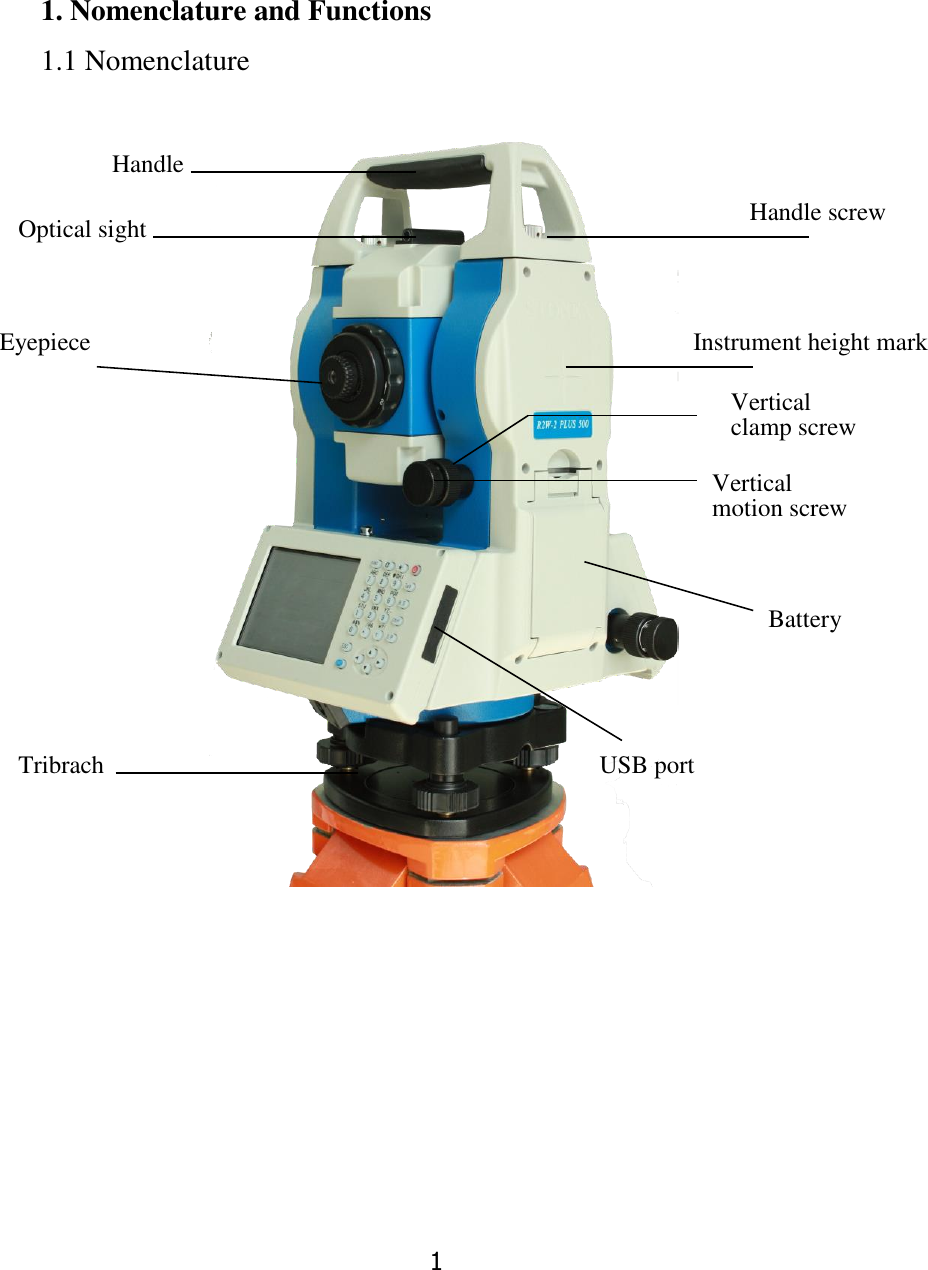
1 1. Nomenclature and Functions 1.1 Nomenclature    Handle Optical sight Tribrach Handle screw Vertical motion screw Vertical clamp screw Battery USB port Instrument height mark Eyepiece
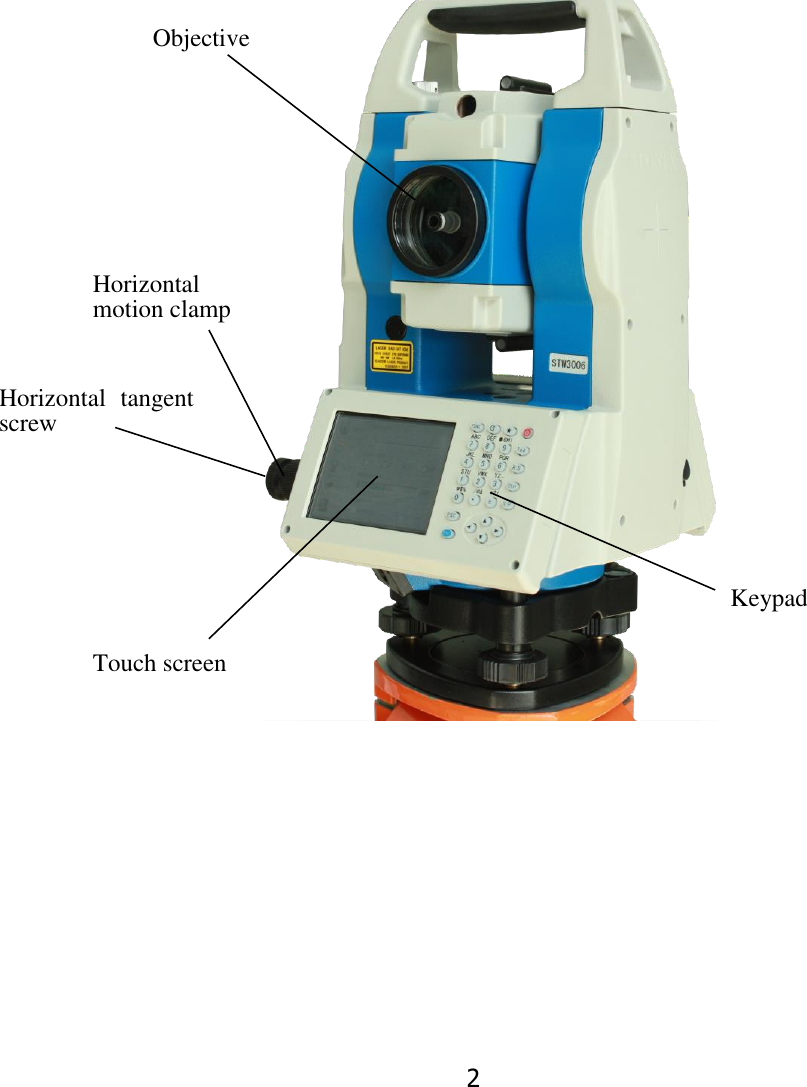
2 Touch screen Keypad Objective  Horizontal motion clamp Horizontal  tangent screw
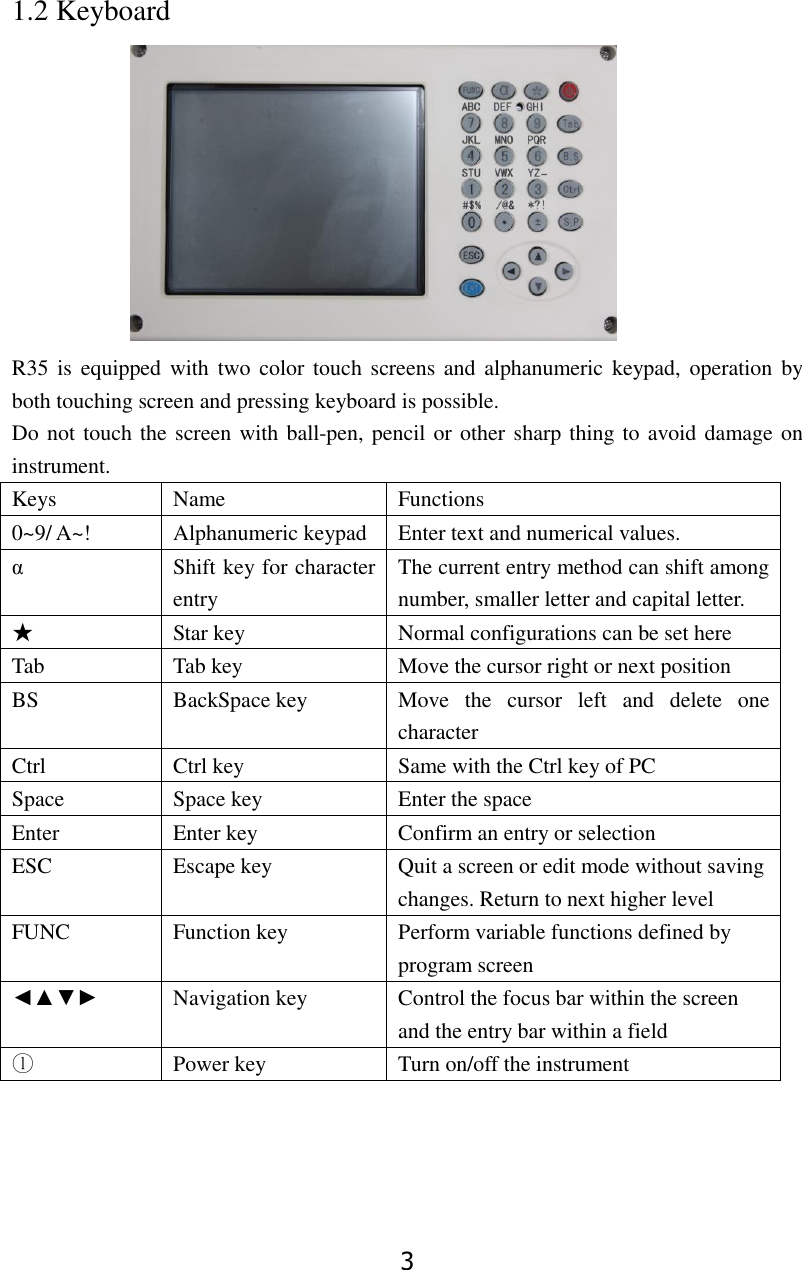
3 1.2 Keyboard           R35  is  equipped with  two  color  touch screens and  alphanumeric  keypad,  operation  by both touching screen and pressing keyboard is possible. Do not touch the screen with ball-pen, pencil or other sharp thing to avoid damage on instrument.     Keys Name Functions 0~9/ A~! Alphanumeric keypad Enter text and numerical values. α Shift key for character entry   The current entry method can shift among number, smaller letter and capital letter.   ★   Star key Normal configurations can be set here Tab Tab key Move the cursor right or next position BS BackSpace key Move  the  cursor  left  and  delete  one character Ctrl Ctrl key Same with the Ctrl key of PC Space Space key Enter the space Enter Enter key Confirm an entry or selection ESC Escape key Quit a screen or edit mode without saving changes. Return to next higher level FUNC Function key Perform variable functions defined by program screen ◄▲▼► Navigation key Control the focus bar within the screen and the entry bar within a field ⓛ Power key Turn on/off the instrument
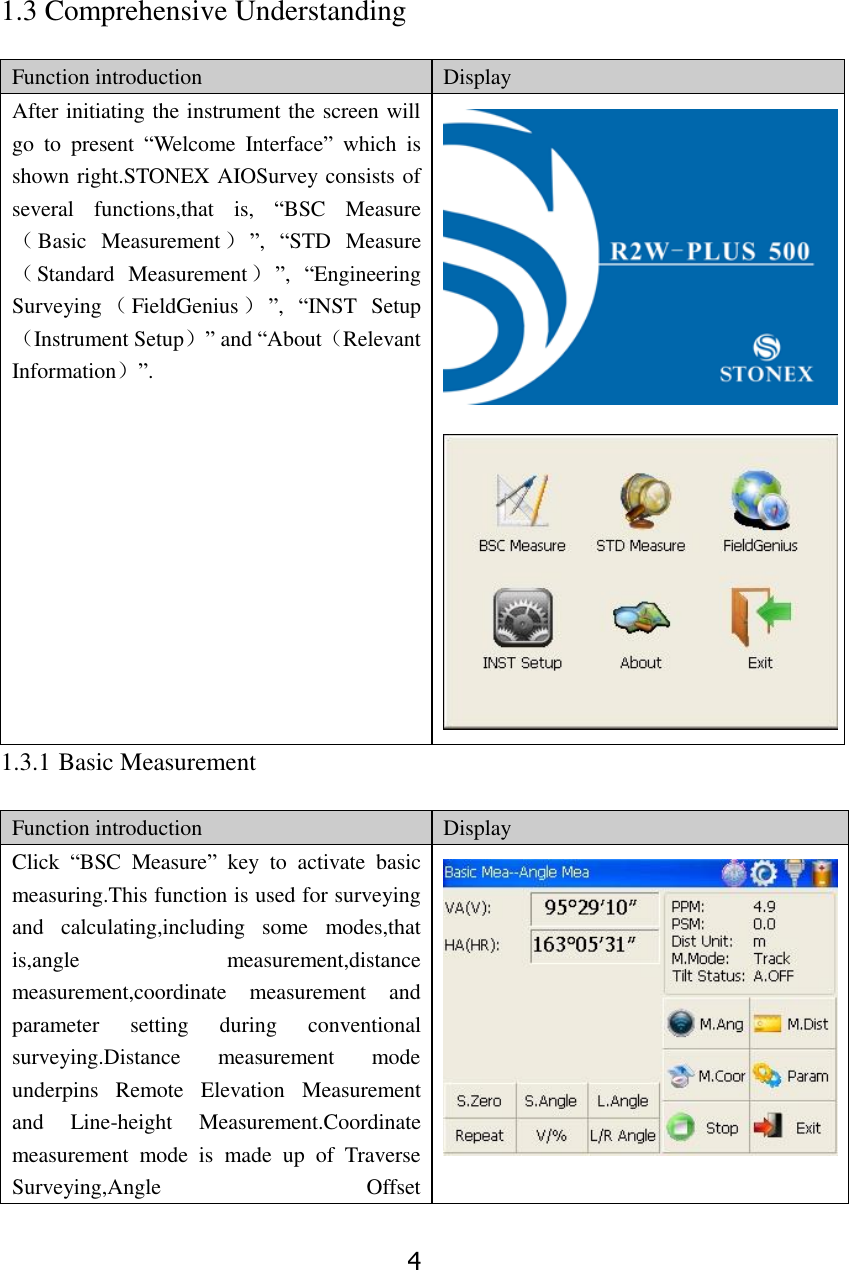
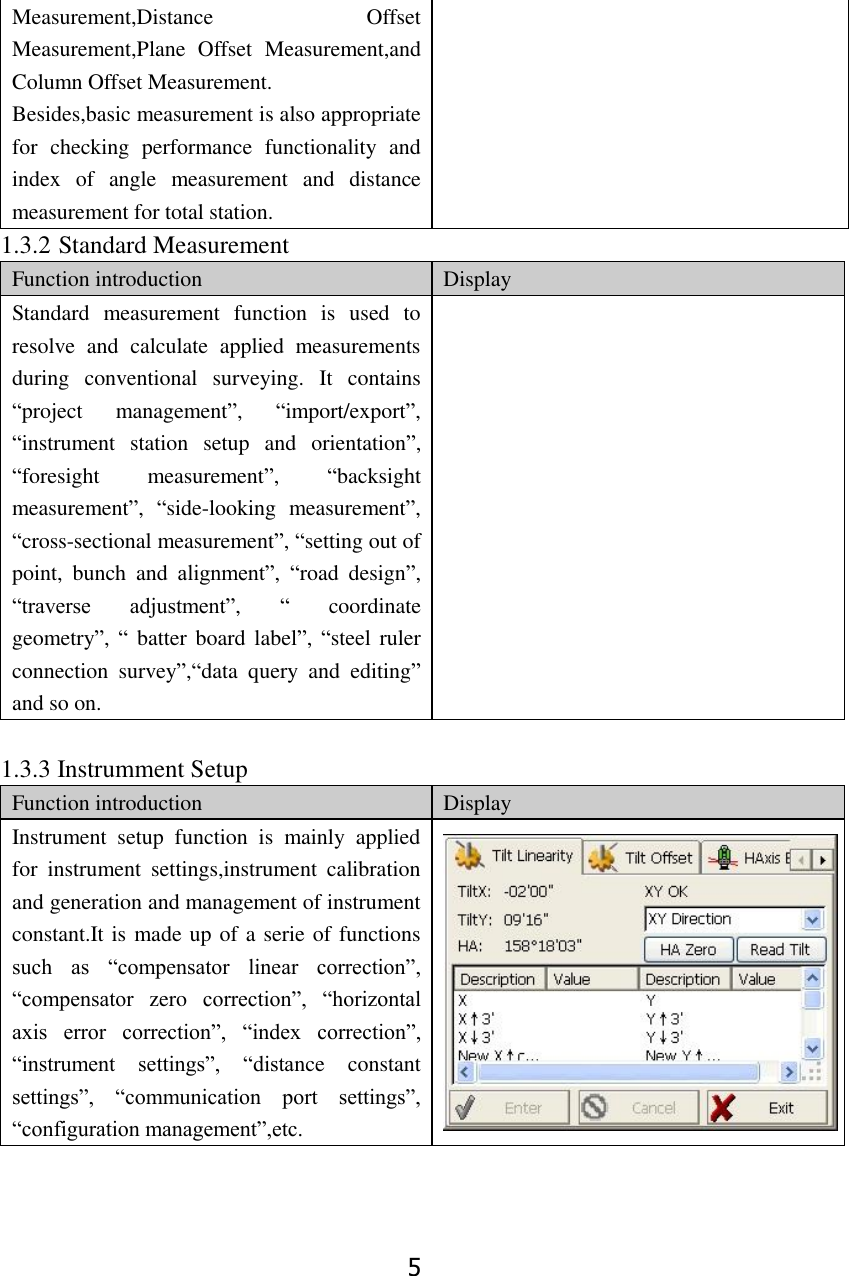
4 1.3 Comprehensive Understanding  Function introduction Display After initiating the instrument the screen will go  to  present  “Welcome  Interface” which  is shown right.STONEX AIOSurvey consists of several  functions,that  is,  “BSC  Measure(Basic  Measurement )”,  “STD  Measure(Standard  Measurement)”,  “Engineering Surveying (FieldGenius )”,  “INST  Setup(Instrument Setup)” and “About(Relevant Information)”.    1.3.1 Basic Measurement  Function introduction Display Click  “BSC  Measure”  key  to  activate  basic measuring.This function is used for surveying and  calculating,including  some  modes,that is,angle  measurement,distance measurement,coordinate  measurement  and parameter  setting  during  conventional surveying.Distance  measurement  mode underpins  Remote  Elevation  Measurement and  Line-height  Measurement.Coordinate measurement  mode  is  made  up  of  Traverse Surveying,Angle  Offset
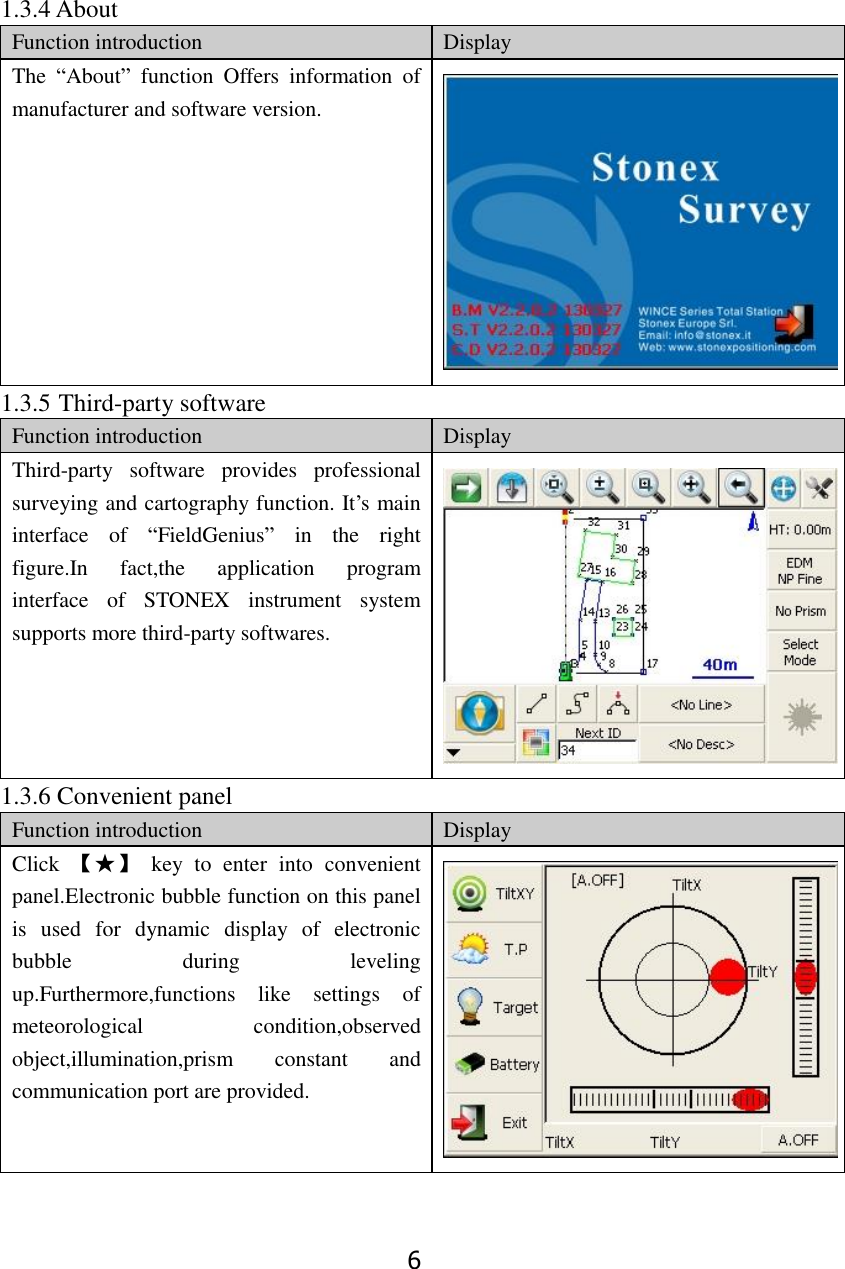
5 Measurement,Distance  Offset Measurement,Plane Offset  Measurement,and Column Offset Measurement. Besides,basic measurement is also appropriate for  checking  performance  functionality  and index  of  angle  measurement  and  distance measurement for total station. 1.3.2 Standard Measurement Function introduction Display Standard  measurement  function  is  used  to resolve  and  calculate  applied  measurements during  conventional  surveying.  It  contains “project  management”,  “import/export”, “instrument  station  setup  and  orientation”, “foresight  measurement”,  “backsight measurement”,  “side-looking  measurement”, “cross-sectional measurement”, “setting out of point,  bunch  and  alignment”,  “road  design”, “traverse  adjustment”,  “  coordinate geometry”, “  batter board  label”, “steel ruler connection  survey”,“data  query  and  editing” and so on.   1.3.3 Instrumment Setup Function introduction Display Instrument  setup  function  is  mainly  applied for  instrument  settings,instrument  calibration and generation and management of instrument constant.It is made up of a serie of functions such  as  “compensator  linear  correction”, “compensator  zero  correction”,  “horizontal axis  error  correction”,  “index  correction”, “instrument  settings”,  “distance  constant settings”,  “communication  port  settings”, “configuration management”,etc.
6 1.3.4 About Function introduction Display The  “About”  function  Offers  information  of manufacturer and software version.  1.3.5 Third-party software Function introduction Display Third-party  software  provides  professional surveying and cartography function. It’s main interface  of  “FieldGenius”  in  the  right figure.In  fact,the  application  program interface  of  STONEX  instrument  system supports more third-party softwares.  1.3.6 Convenient panel Function introduction Display Click  【★】  key  to  enter  into  convenient panel.Electronic bubble function on this panel is  used  for  dynamic  display  of  electronic bubble  during  leveling up.Furthermore,functions  like  settings  of meteorological  condition,observed object,illumination,prism  constant  and communication port are provided.
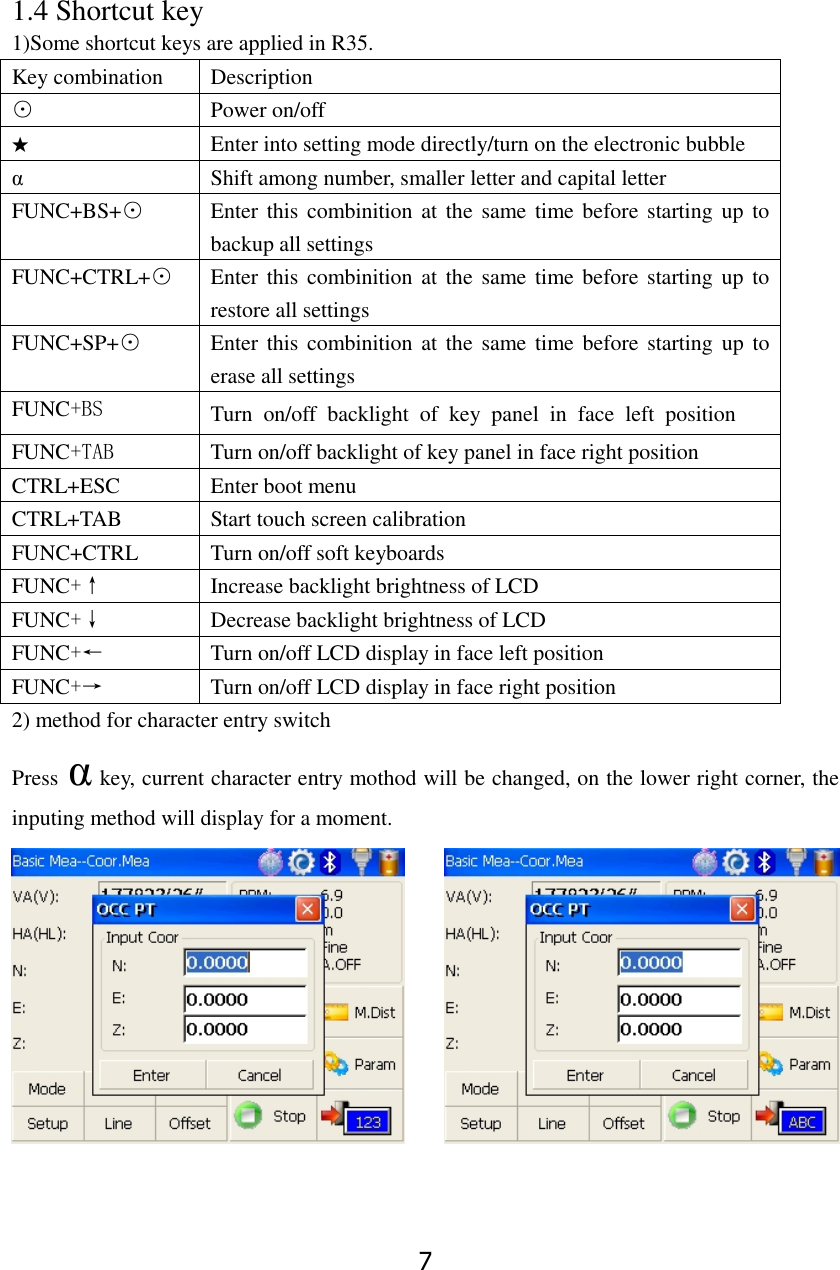
7 1.4 Shortcut key 1)Some shortcut keys are applied in R35. Key combination Description ⊙ Power on/off ★ Enter into setting mode directly/turn on the electronic bubble α Shift among number, smaller letter and capital letter FUNC+BS+⊙ Enter this combinition  at  the same time before  starting  up to backup all settings FUNC+CTRL+⊙ Enter this combinition  at  the same time before  starting  up to restore all settings FUNC+SP+⊙ Enter this combinition  at  the same time before starting up  to erase all settings FUNC+BS Turn  on/off  backlight  of  key  panel  in  face  left  position FUNC+TAB Turn on/off backlight of key panel in face right position CTRL+ESC Enter boot menu CTRL+TAB Start touch screen calibration FUNC+CTRL Turn on/off soft keyboards FUNC+↑ Increase backlight brightness of LCD   FUNC+↓ Decrease backlight brightness of LCD FUNC+← Turn on/off LCD display in face left position   FUNC+→ Turn on/off LCD display in face right position 2) method for character entry switch Press α key, current character entry mothod will be changed, on the lower right corner, the inputing method will display for a moment.
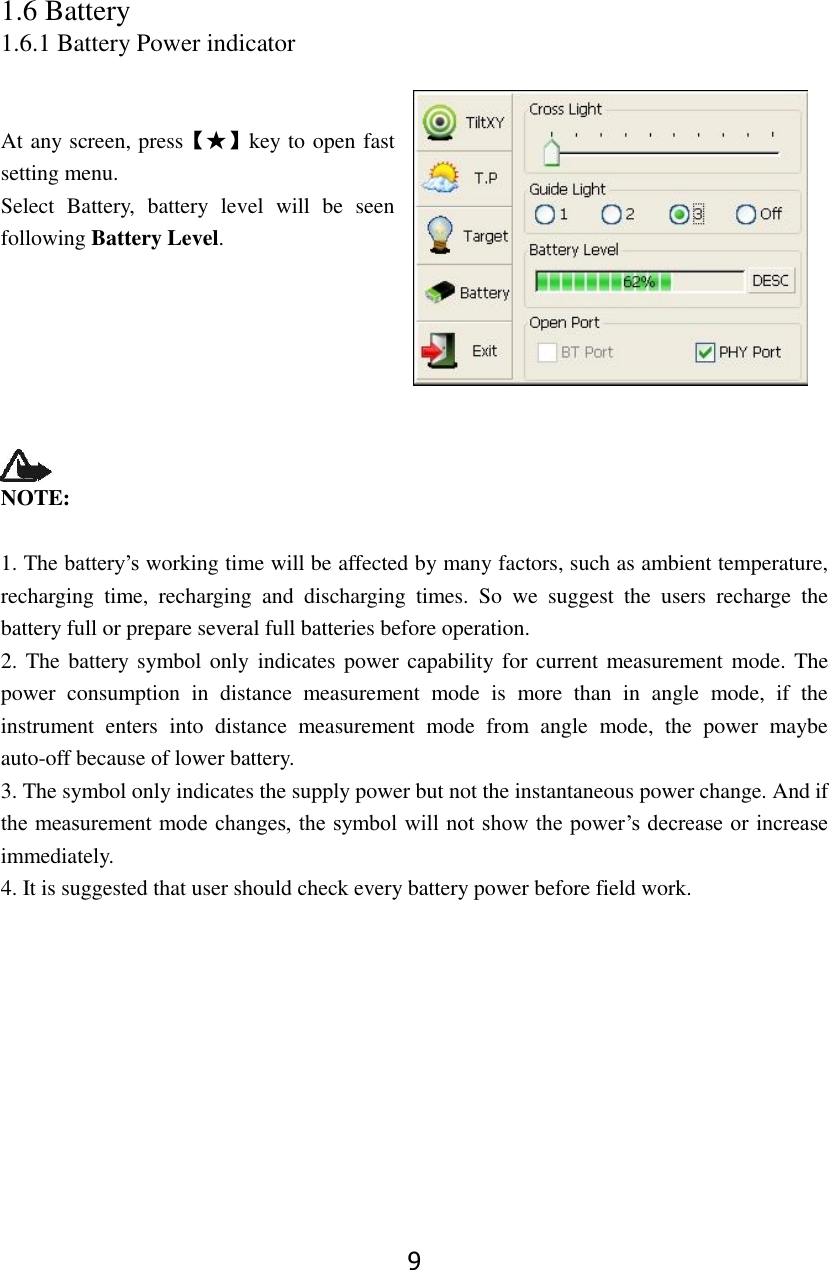
8     1.5 Touch screen calibration When you operate on the screen, if your device isn’t responding to you taps, you may need to recalibrate your screen. In any picture, press the combination key “CTRL+TAB” so as to enter into touch screen calibration. The calibration process is shown in the figure below.   1)  Carefully  press  and  briefly  hold  stylus  on the  center  of  the  target.  Repeat  as  the  target moves around the screen.         2) After all the targets are clicked, the screen will display  as left,  tap the  screen to  register saved  data.  The  screen  goes  back  to  Stylus Properties menu.
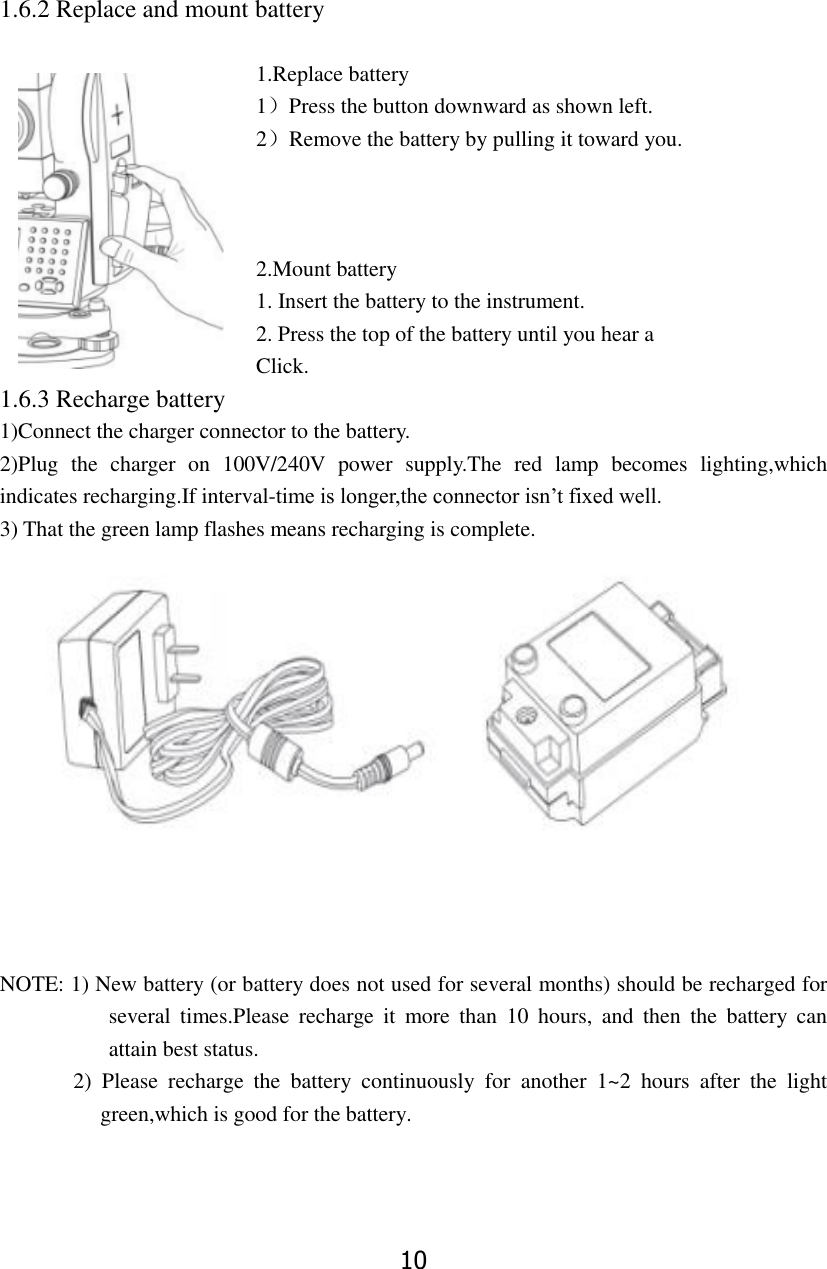
9 1.6 Battery 1.6.1 Battery Power indicator   At any screen, press【★】key to open fast setting menu. Select  Battery,  battery  level  will  be  seen following Battery Level.        NOTE:    1. The battery’s working time will be affected by many factors, such as ambient temperature, recharging  time,  recharging  and  discharging  times.  So  we  suggest  the  users  recharge  the battery full or prepare several full batteries before operation. 2. The battery symbol only  indicates power capability for current measurement mode. The power  consumption  in  distance  measurement  mode  is  more  than  in  angle  mode,  if  the instrument  enters  into  distance  measurement  mode  from  angle  mode,  the  power  maybe auto-off because of lower battery. 3. The symbol only indicates the supply power but not the instantaneous power change. And if the measurement mode changes, the symbol will not show the power’s decrease or increase immediately. 4. It is suggested that user should check every battery power before field work.
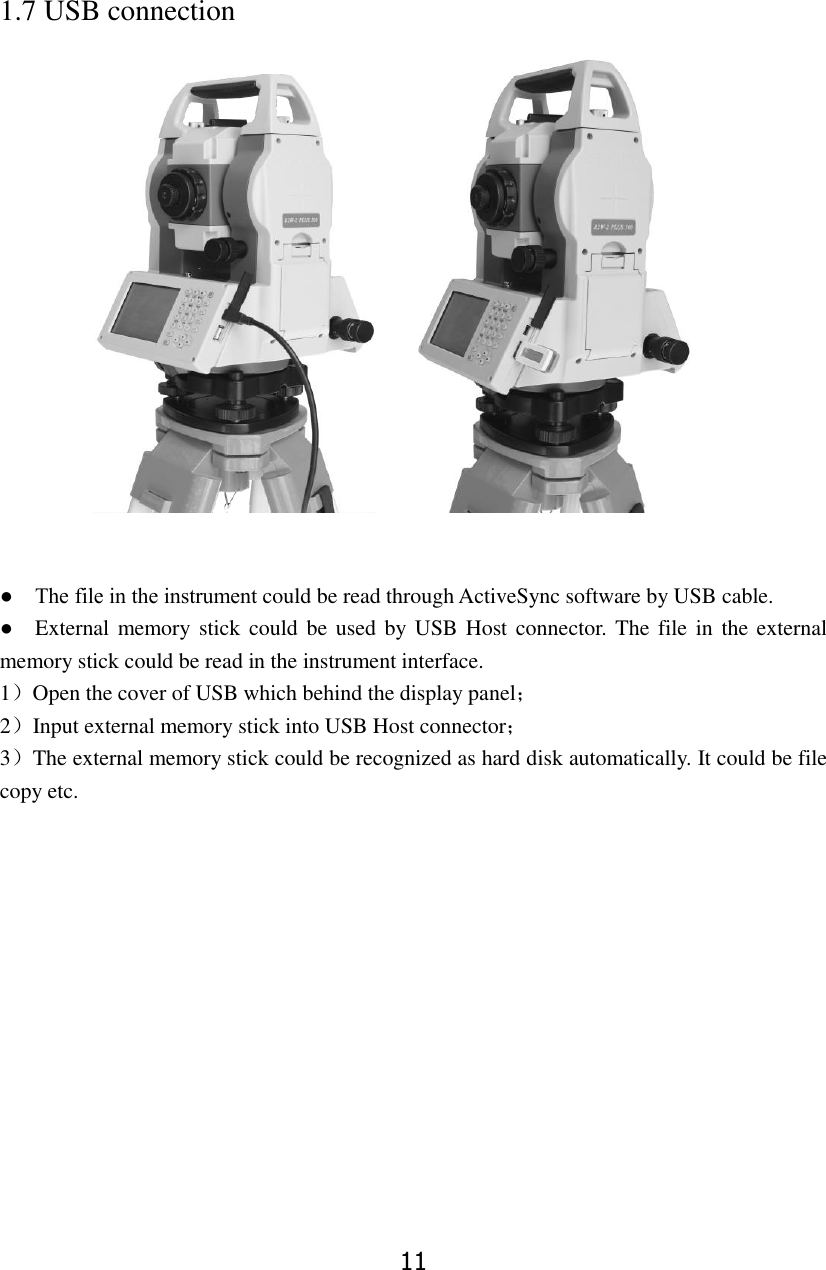
10 1.6.2 Replace and mount battery    1.Replace battery 1)Press the button downward as shown left.   2)Remove the battery by pulling it toward you.    2.Mount battery 1. Insert the battery to the instrument.    2. Press the top of the battery until you hear a               Click. 1.6.3 Recharge battery 1)Connect the charger connector to the battery. 2)Plug  the  charger  on  100V/240V  power  supply.The  red  lamp  becomes  lighting,which indicates recharging.If interval-time is longer,the connector isn’t fixed well. 3) That the green lamp flashes means recharging is complete.     NOTE: 1) New battery (or battery does not used for several months) should be recharged for several  times.Please  recharge  it  more  than  10  hours,  and  then  the  battery  can attain best status.        2)  Please  recharge  the  battery  continuously  for  another  1~2  hours  after  the  light green,which is good for the battery.
11 1.7 USB connection                               ●    The file in the instrument could be read through ActiveSync software by USB cable.   ●    External  memory stick  could  be used  by USB Host connector.  The  file  in  the external memory stick could be read in the instrument interface.   1)Open the cover of USB which behind the display panel; 2)Input external memory stick into USB Host connector; 3)The external memory stick could be recognized as hard disk automatically. It could be file copy etc.
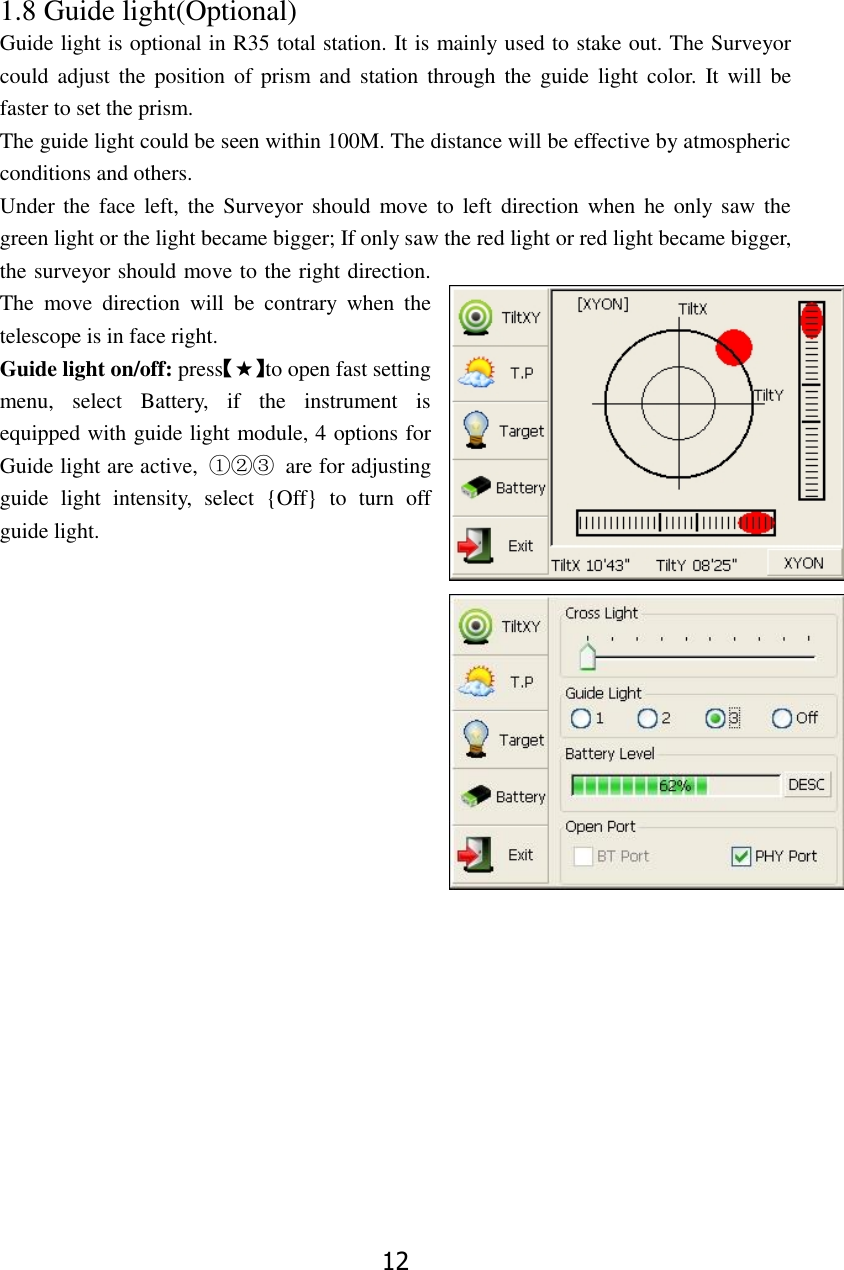
12 1.8 Guide light(Optional)  Guide light is optional in R35 total station. It is mainly used to stake out. The Surveyor could  adjust  the position  of  prism  and station through  the guide  light  color.  It  will  be faster to set the prism.   The guide light could be seen within 100M. The distance will be effective by atmospheric conditions and others. Under the  face left, the  Surveyor  should move to  left  direction when  he  only  saw  the green light or the light became bigger; If only saw the red light or red light became bigger, the surveyor should move to the right direction. The  move  direction  will  be  contrary  when  the telescope is in face right. Guide light on/off: press【★】to open fast setting menu,  select  Battery,  if  the  instrument  is equipped with guide light module, 4 options for Guide light are active,  ①②③  are for adjusting guide  light  intensity,  select  {Off}  to  turn  off guide light.
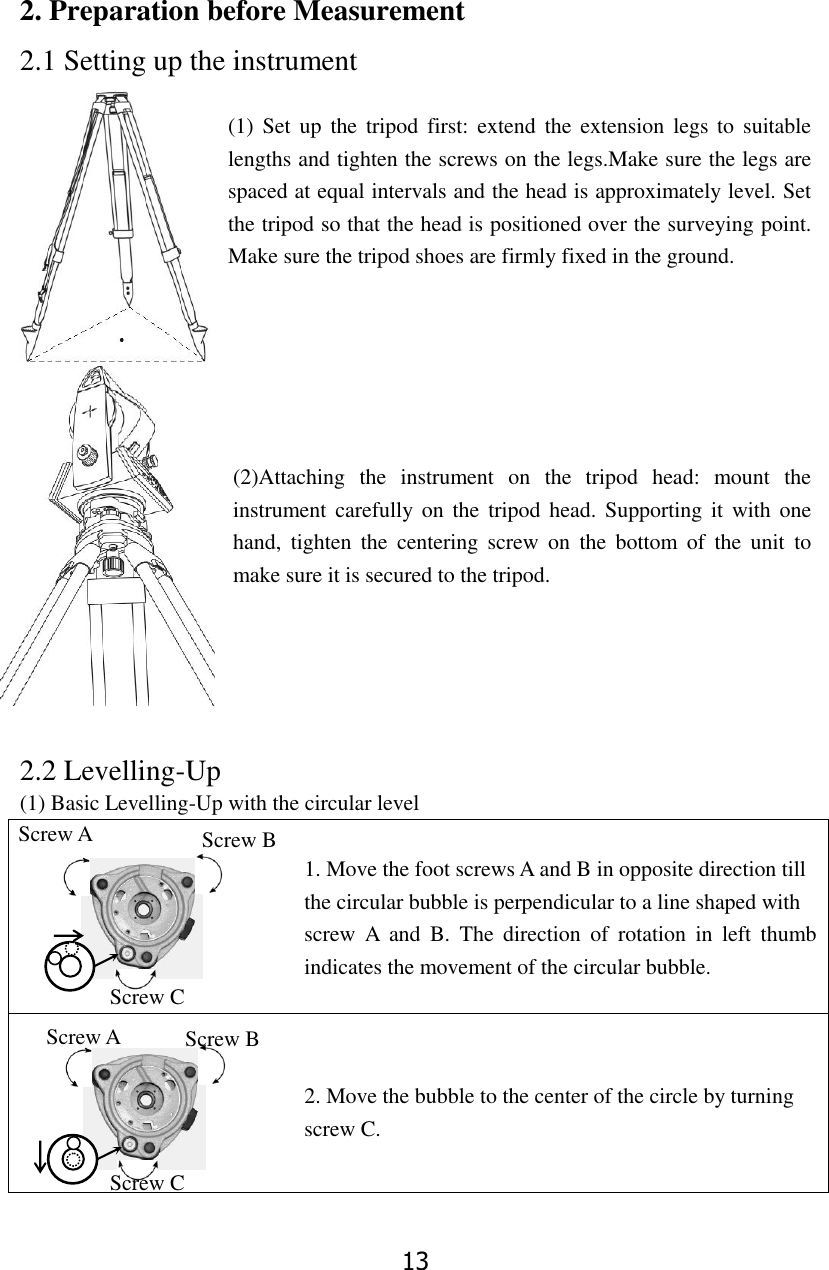
13 2. Preparation before Measurement 2.1 Setting up the instrument  (1)  Set up  the  tripod first: extend  the extension  legs  to suitable lengths and tighten the screws on the legs.Make sure the legs are spaced at equal intervals and the head is approximately level. Set the tripod so that the head is positioned over the surveying point. Make sure the tripod shoes are firmly fixed in the ground.        (2)Attaching  the  instrument  on  the  tripod  head:  mount  the instrument  carefully on  the tripod head.  Supporting it  with  one hand,  tighten  the  centering  screw  on  the  bottom  of  the  unit  to make sure it is secured to the tripod.         2.2 Levelling-Up (1) Basic Levelling-Up with the circular level                                                        1. Move the foot screws A and B in opposite direction till                                                       the circular bubble is perpendicular to a line shaped with                                                     screw  A  and  B.  The  direction  of  rotation  in  left  thumb indicates the movement of the circular bubble.                                                       2. Move the bubble to the center of the circle by turning                                                    screw C.   Screw A Screw B Screw C Screw A Screw C Screw B
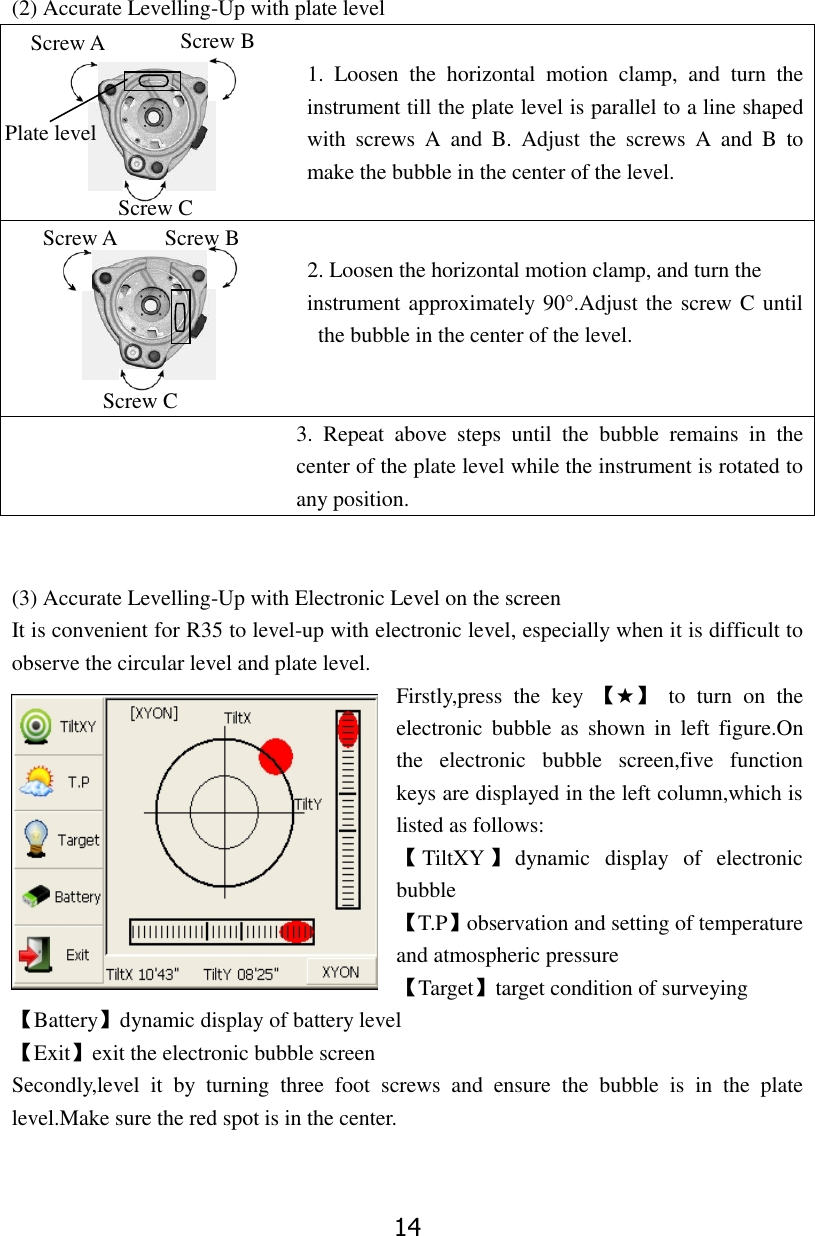
14  (2) Accurate Levelling-Up with plate level                                                          1.  Loosen  the  horizontal  motion  clamp,  and  turn  the instrument till the plate level is parallel to a line shaped with  screws  A  and  B.  Adjust  the  screws  A  and  B  to make the bubble in the center of the level.                                                         2. Loosen the horizontal motion clamp, and turn the instrument approximately 90°.Adjust the screw C until the bubble in the center of the level.   3.  Repeat  above  steps  until  the  bubble  remains  in  the center of the plate level while the instrument is rotated to any position.     (3) Accurate Levelling-Up with Electronic Level on the screen It is convenient for R35 to level-up with electronic level, especially when it is difficult to observe the circular level and plate level.   Firstly,press  the  key  【★】  to  turn  on  the electronic bubble  as  shown  in  left figure.On the  electronic  bubble  screen,five  function keys are displayed in the left column,which is listed as follows:   【TiltXY 】dynamic  display  of  electronic bubble 【T.P】observation and setting of temperature and atmospheric pressure 【Target】target condition of surveying   【Battery】dynamic display of battery level   【Exit】exit the electronic bubble screen Secondly,level  it  by  turning  three  foot  screws  and  ensure  the  bubble  is  in  the  plate level.Make sure the red spot is in the center.   Screw B Screw A Plate level Screw C Screw A Screw B Screw C
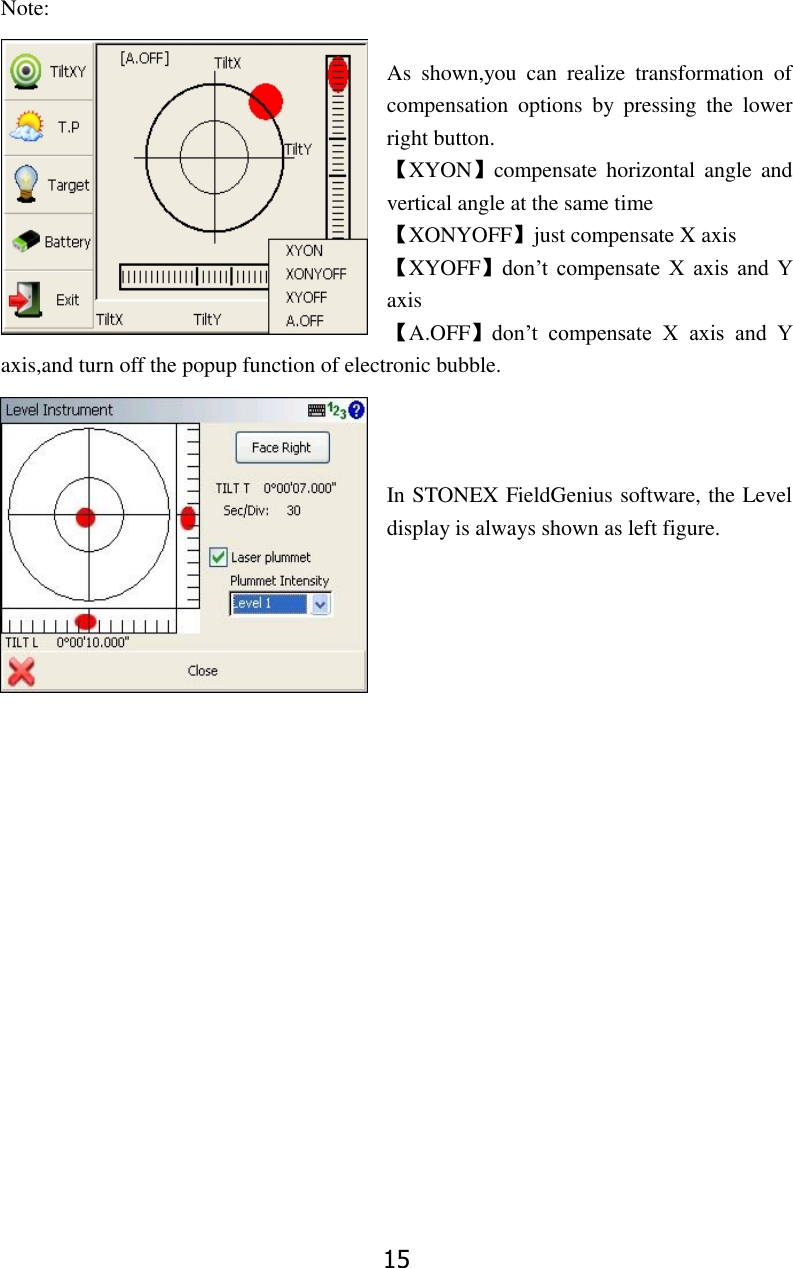
15 Note:  As  shown,you  can  realize  transformation  of compensation  options  by  pressing  the  lower right button. 【XYON】compensate  horizontal  angle  and vertical angle at the same time 【XONYOFF】just compensate X axis 【XYOFF】don’t  compensate  X  axis  and  Y axis 【A.OFF】don’t  compensate  X  axis  and  Y axis,and turn off the popup function of electronic bubble.    In STONEX FieldGenius software, the Level display is always shown as left figure.
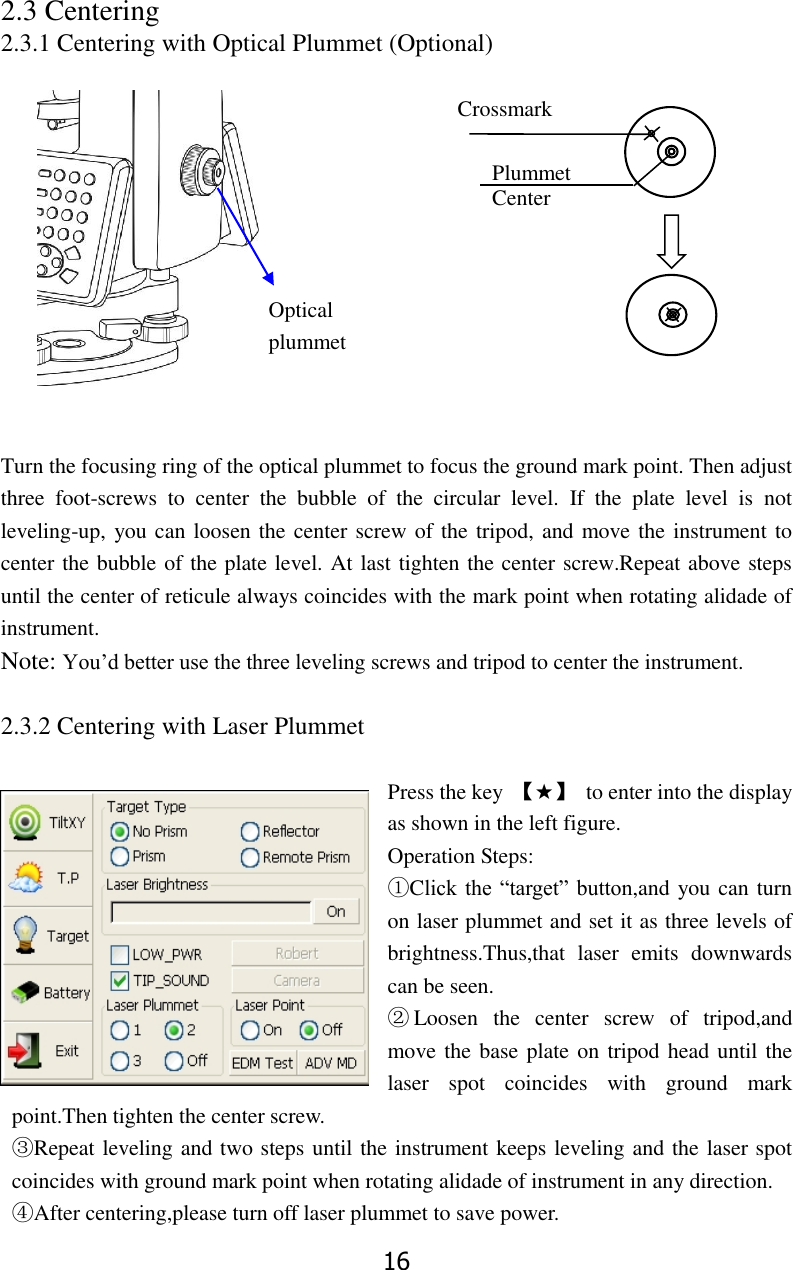
16 2.3 Centering  2.3.1 Centering with Optical Plummet (Optional)             Turn the focusing ring of the optical plummet to focus the ground mark point. Then adjust three  foot-screws  to  center  the  bubble  of  the  circular  level.  If  the  plate  level  is  not leveling-up, you can loosen the center screw of the tripod, and move the instrument to center the bubble of the plate level. At last tighten the center screw.Repeat above steps until the center of reticule always coincides with the mark point when rotating alidade of instrument.  Note: You’d better use the three leveling screws and tripod to center the instrument.  2.3.2 Centering with Laser Plummet  Press the key  【★】  to enter into the display as shown in the left figure. Operation Steps: ①Click the “target” button,and you can turn on laser plummet and set it as three levels of brightness.Thus,that  laser  emits  downwards can be seen. ②Loosen  the  center  screw  of  tripod,and move the base plate on tripod head until the laser  spot  coincides  with  ground  mark point.Then tighten the center screw. ③Repeat leveling and two steps until the instrument keeps leveling and the laser spot coincides with ground mark point when rotating alidade of instrument in any direction. ④After centering,please turn off laser plummet to save power.  Plummet Center Optical   plummet  Crossmark
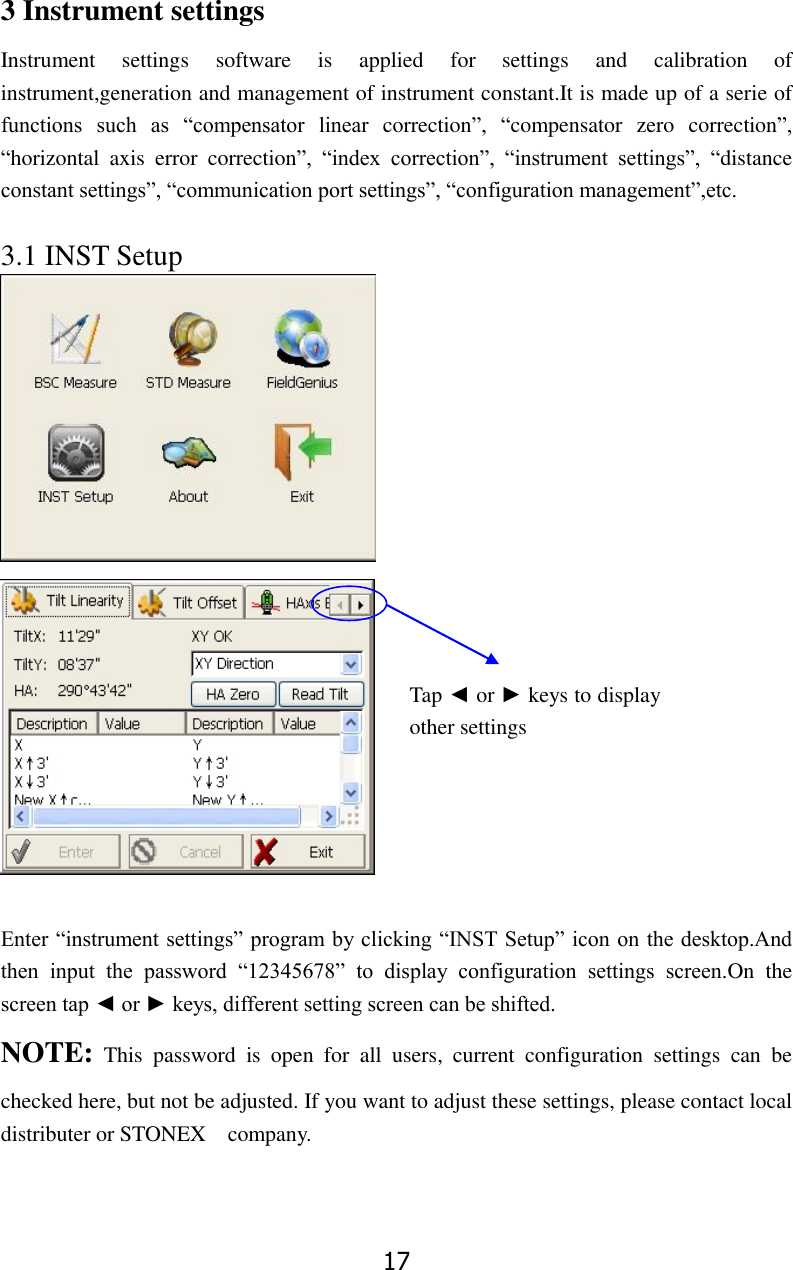
17 3 Instrument settings Instrument  settings  software  is  applied  for  settings  and  calibration  of instrument,generation and management of instrument constant.It is made up of a serie of functions  such  as  “compensator  linear  correction”,  “compensator  zero  correction”, “horizontal  axis  error  correction”,  “index  correction”,  “instrument  settings”,  “distance constant settings”, “communication port settings”, “configuration management”,etc.  3.1 INST Setup      Enter “instrument settings” program by clicking “INST Setup” icon on the desktop.And then  input  the  password  “12345678”  to  display  configuration  settings  screen.On  the screen tap ◄ or ► keys, different setting screen can be shifted.   NOTE:  This  password  is  open  for  all  users,  current  configuration  settings  can  be checked here, but not be adjusted. If you want to adjust these settings, please contact local distributer or STONEX    company. Tap ◄ or ► keys to display other settings
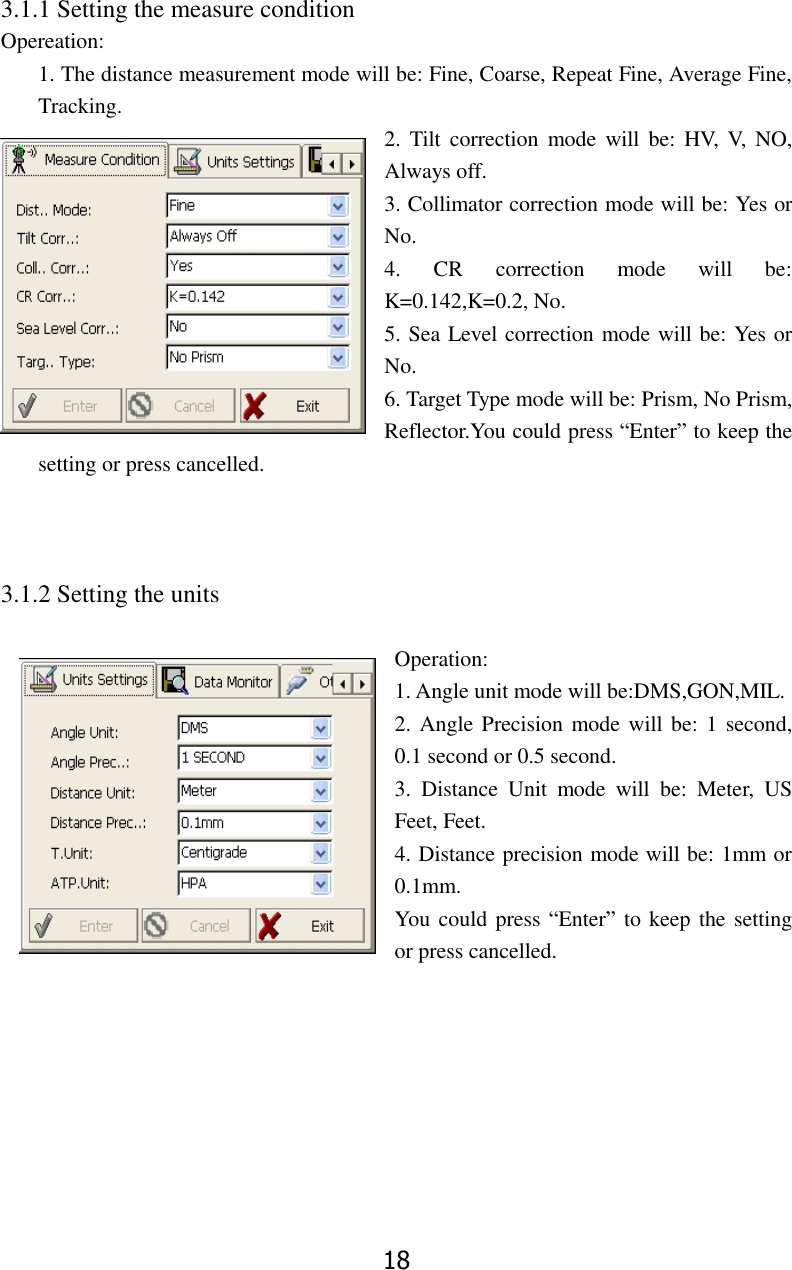
18 3.1.1 Setting the measure condition Opereation: 1. The distance measurement mode will be: Fine, Coarse, Repeat Fine, Average Fine, Tracking.   2.  Tilt  correction mode  will  be:  HV, V,  NO, Always off. 3. Collimator correction mode will be: Yes or No. 4.  CR  correction  mode  will  be: K=0.142,K=0.2, No. 5. Sea Level correction mode will be: Yes or No. 6. Target Type mode will be: Prism, No Prism, Reflector.You could press “Enter” to keep the setting or press cancelled.      3.1.2 Setting the units  Operation:   1. Angle unit mode will be:DMS,GON,MIL. 2. Angle Precision mode will be: 1  second, 0.1 second or 0.5 second. 3.  Distance  Unit  mode  will  be:  Meter,  US Feet, Feet. 4. Distance precision mode will be: 1mm or 0.1mm.     You could press “Enter” to keep the setting or press cancelled.
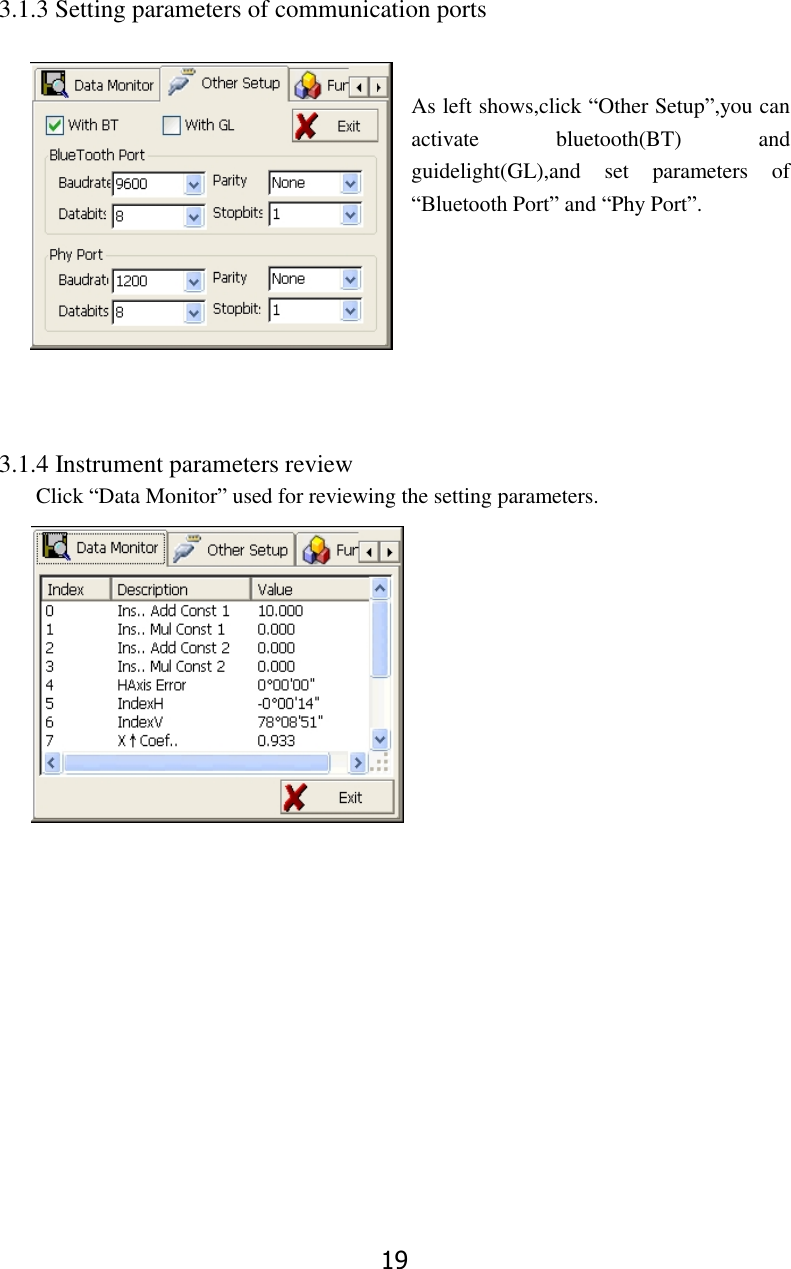
19 3.1.3 Setting parameters of communication ports     As left shows,click “Other Setup”,you can activate  bluetooth(BT)  and guidelight(GL),and  set  parameters  of “Bluetooth Port” and “Phy Port”.        3.1.4 Instrument parameters review Click “Data Monitor” used for reviewing the setting parameters.
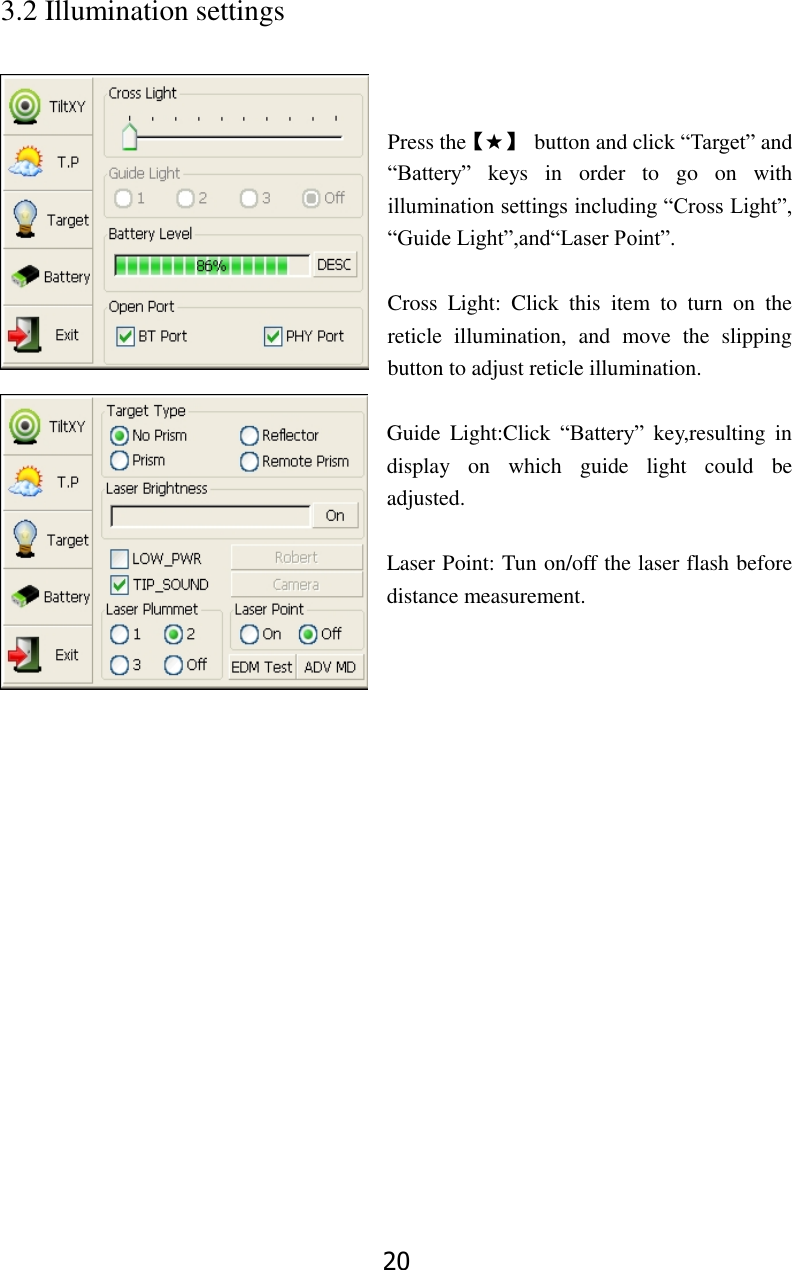
20 3.2 Illumination settings    Press the【★】  button and click “Target” and “Battery”  keys  in  order  to  go  on  with illumination settings including “Cross Light”, “Guide Light”,and“Laser Point”.  Cross  Light:  Click  this  item  to  turn  on  the reticle  illumination,  and  move  the  slipping button to adjust reticle illumination.  Guide  Light:Click  “Battery”  key,resulting  in display  on  which  guide  light  could  be adjusted.      Laser Point: Tun on/off the laser flash before distance measurement.
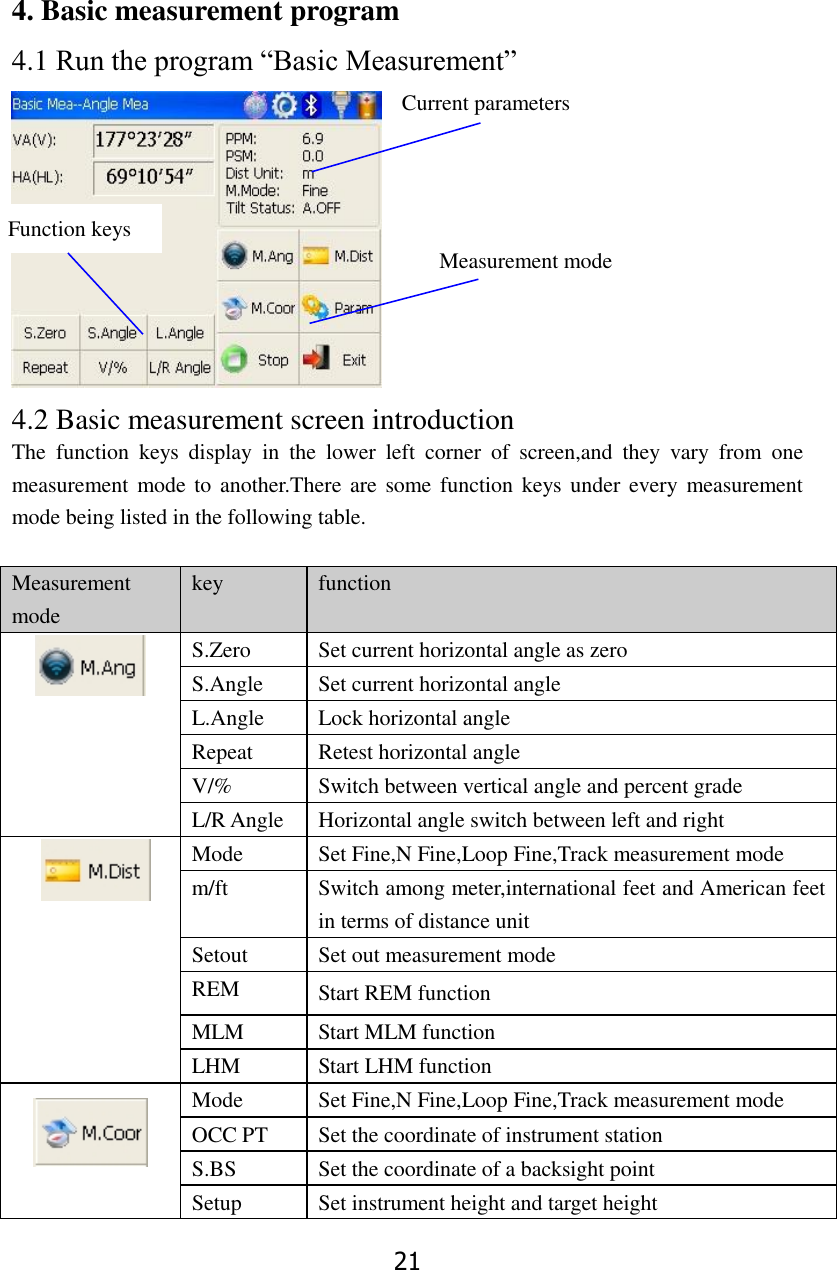
21 4. Basic measurement program 4.1 Run the program “Basic Measurement”  4.2 Basic measurement screen introduction The  function  keys  display  in  the  lower  left  corner  of  screen,and  they  vary  from  one measurement  mode  to  another.There  are some function keys under every  measurement mode being listed in the following table.  Measurement mode key function   S.Zero Set current horizontal angle as zero S.Angle Set current horizontal angle L.Angle Lock horizontal angle Repeat Retest horizontal angle V/% Switch between vertical angle and percent grade L/R Angle Horizontal angle switch between left and right      Mode Set Fine,N Fine,Loop Fine,Track measurement mode m/ft Switch among meter,international feet and American feet in terms of distance unit Setout Set out measurement mode REM Start REM function MLM Start MLM function LHM Start LHM function  Mode Set Fine,N Fine,Loop Fine,Track measurement mode OCC PT Set the coordinate of instrument station S.BS Set the coordinate of a backsight point Setup Set instrument height and target height Function keys Current parameters Measurement mode
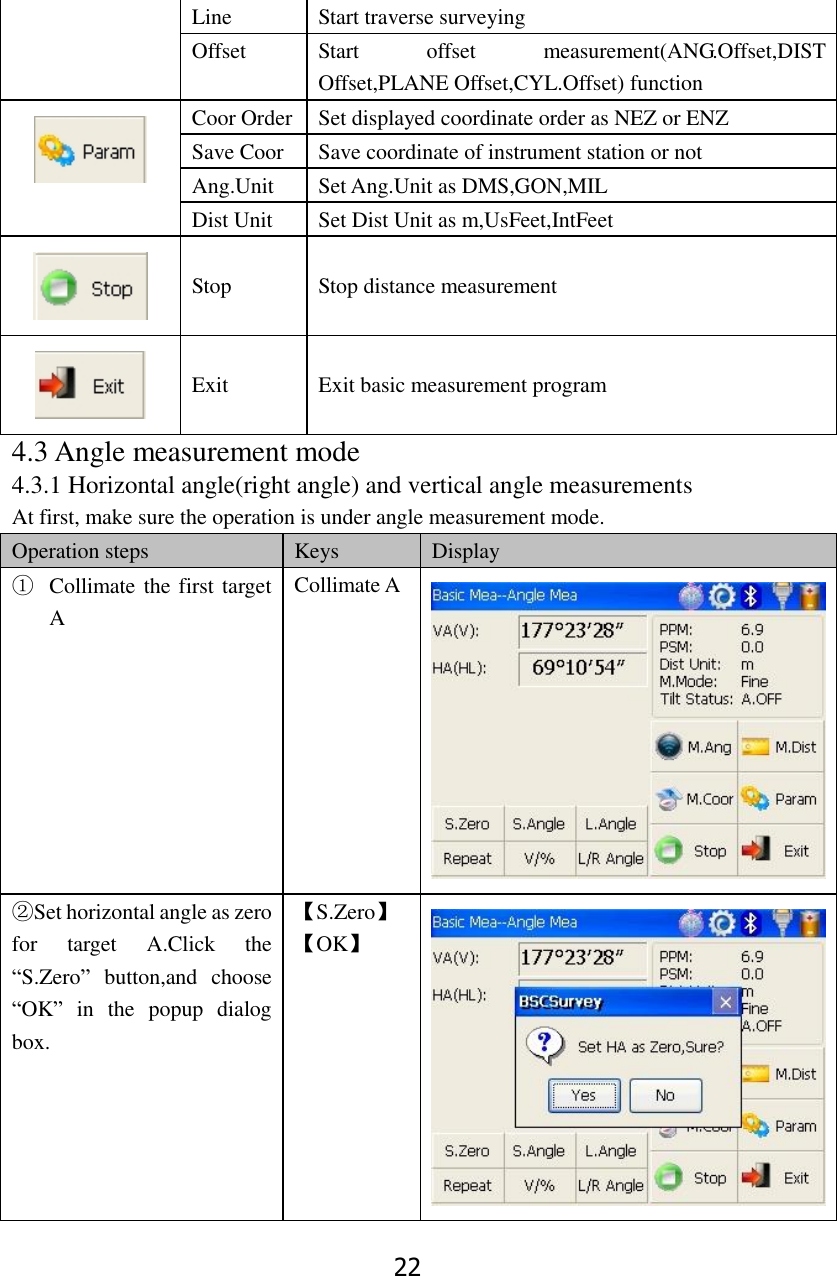
22 Line Start traverse surveying   Offset Start  offset  measurement(ANG.Offset,DIST Offset,PLANE Offset,CYL.Offset) function  Coor Order Set displayed coordinate order as NEZ or ENZ Save Coor   Save coordinate of instrument station or not Ang.Unit Set Ang.Unit as DMS,GON,MIL Dist Unit Set Dist Unit as m,UsFeet,IntFeet   Stop  Stop distance measurement   Exit  Exit basic measurement program 4.3 Angle measurement mode 4.3.1 Horizontal angle(right angle) and vertical angle measurements At first, make sure the operation is under angle measurement mode. Operation steps Keys Display ① Collimate the first target A Collimate A  ②Set horizontal angle as zero for  target  A.Click  the “S.Zero”  button,and  choose “OK”  in  the  popup  dialog box.  【S.Zero】 【OK】
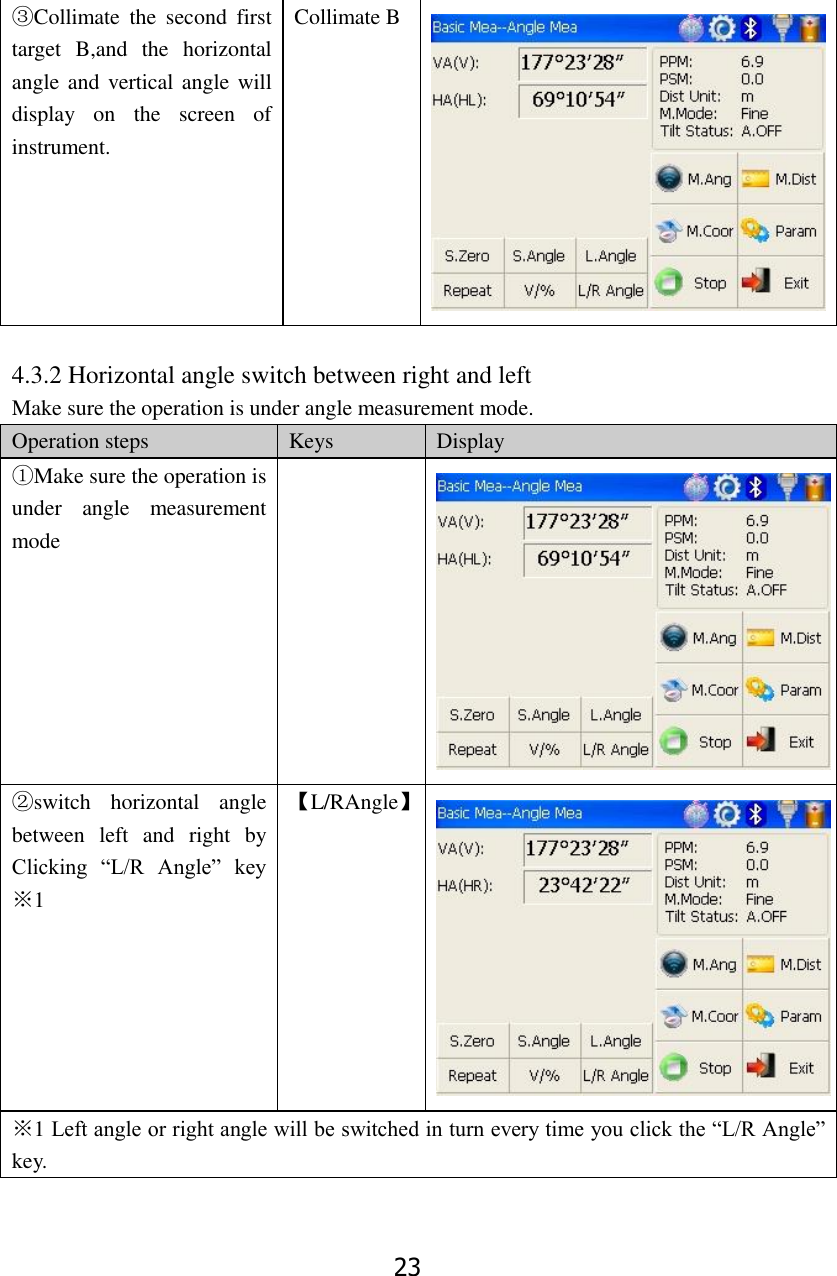
23 ③Collimate  the  second  first target  B,and  the  horizontal angle and vertical angle will display  on  the  screen  of instrument. Collimate B   4.3.2 Horizontal angle switch between right and left   Make sure the operation is under angle measurement mode. Operation steps Keys Display ①Make sure the operation is under  angle  measurement mode   ②switch  horizontal  angle between  left  and  right  by Clicking  “L/R  Angle”  key       ※1 【L/RAngle】  ※1 Left angle or right angle will be switched in turn every time you click the “L/R Angle” key.
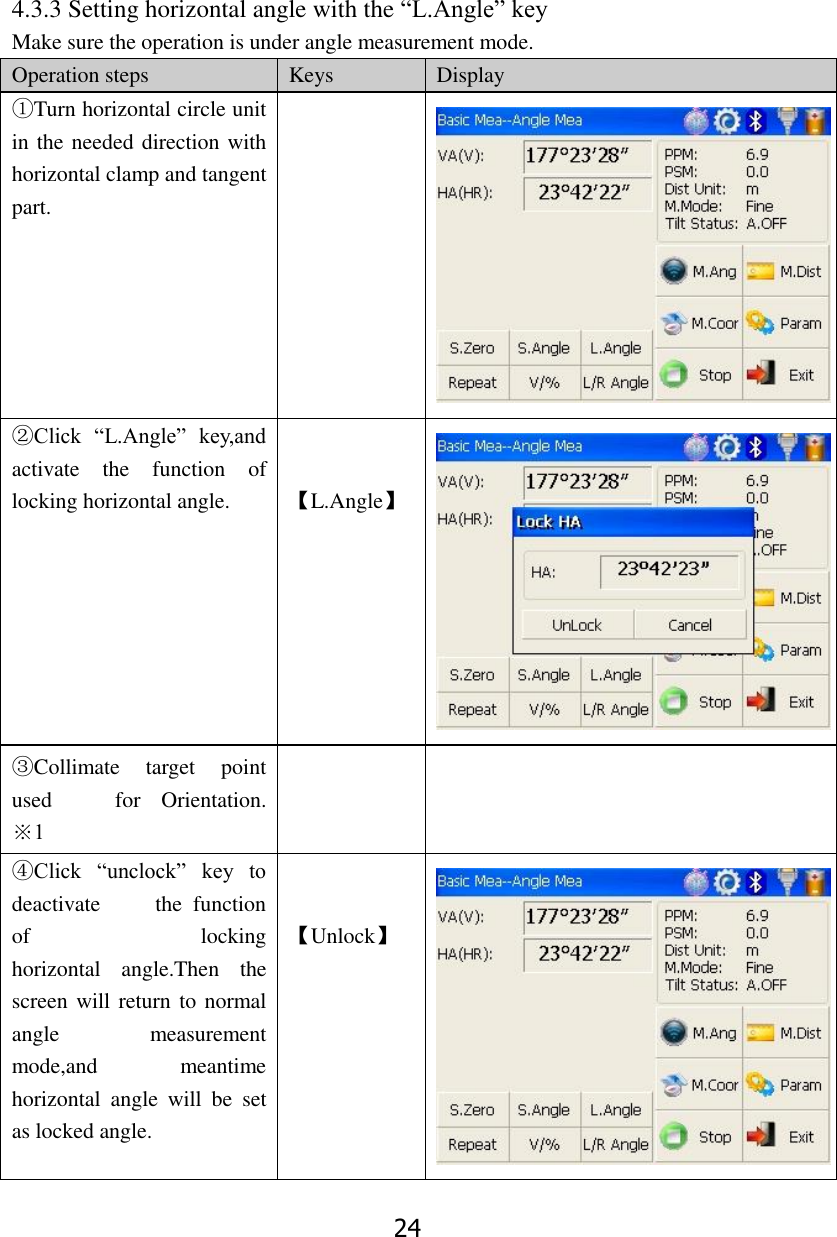
24  4.3.3 Setting horizontal angle with the “L.Angle” key Make sure the operation is under angle measurement mode. Operation steps Keys Display ①Turn horizontal circle unit in the needed direction with horizontal clamp and tangent part.   ②Click  “L.Angle”  key,and activate  the  function  of                 locking horizontal angle.   【L.Angle】  ③Collimate  target  point used    for  Orientation.       ※1   ④Click  “unclock”  key  to deactivate          the  function of                  locking horizontal  angle.Then  the screen will return to normal angle  measurement mode,and  meantime horizontal  angle  will  be  set as locked angle.   【Unlock】
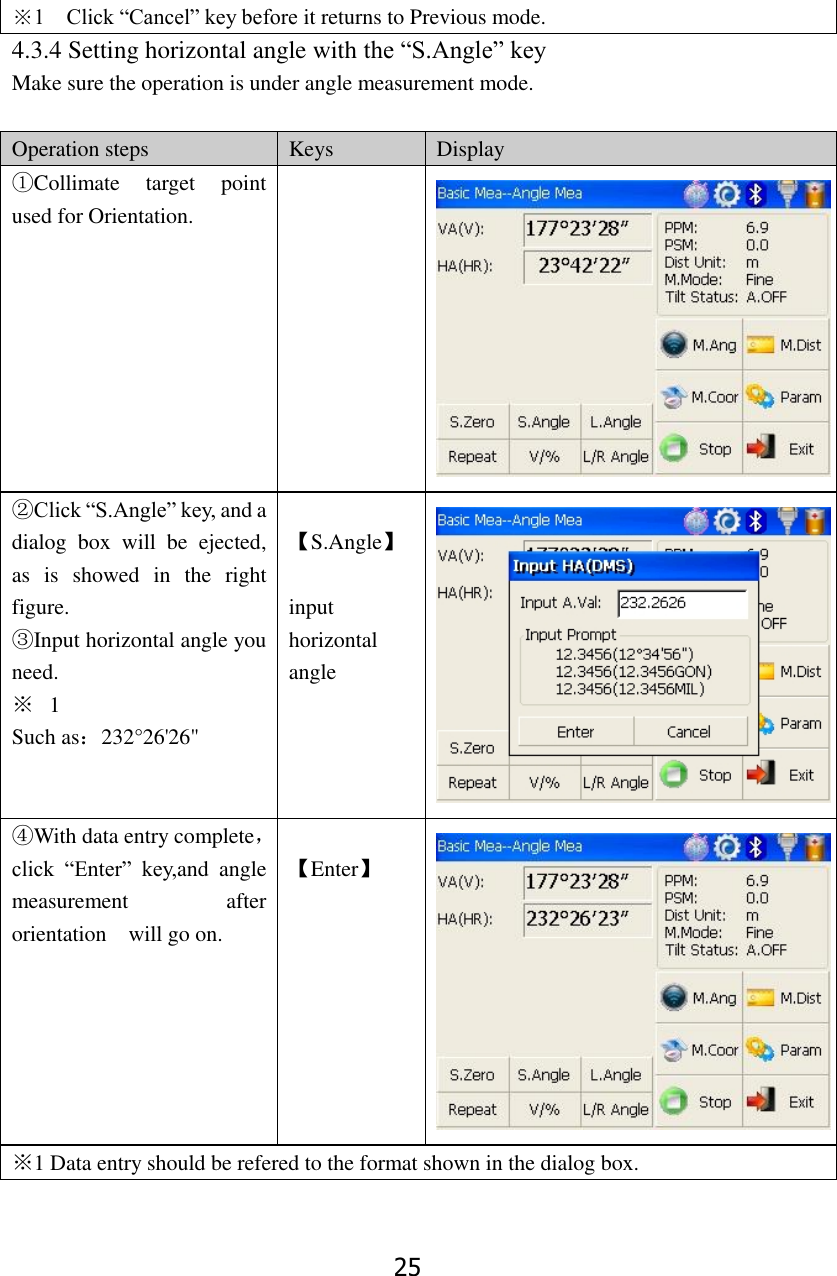
25 ※1  Click “Cancel” key before it returns to Previous mode. 4.3.4 Setting horizontal angle with the “S.Angle” key Make sure the operation is under angle measurement mode.  Operation steps Keys Display ①Collimate  target  point used for Orientation.   ②Click “S.Angle” key, and a dialog  box  will  be  ejected, as  is  showed  in  the  right figure. ③Input horizontal angle you need. ※ 1   Such as:232°26'26"  【S.Angle】  input horizontal angle  ④With data entry complete,click  “Enter”  key,and  angle measurement  after   orientation    will go on.  【Enter】  ※1 Data entry should be refered to the format shown in the dialog box.
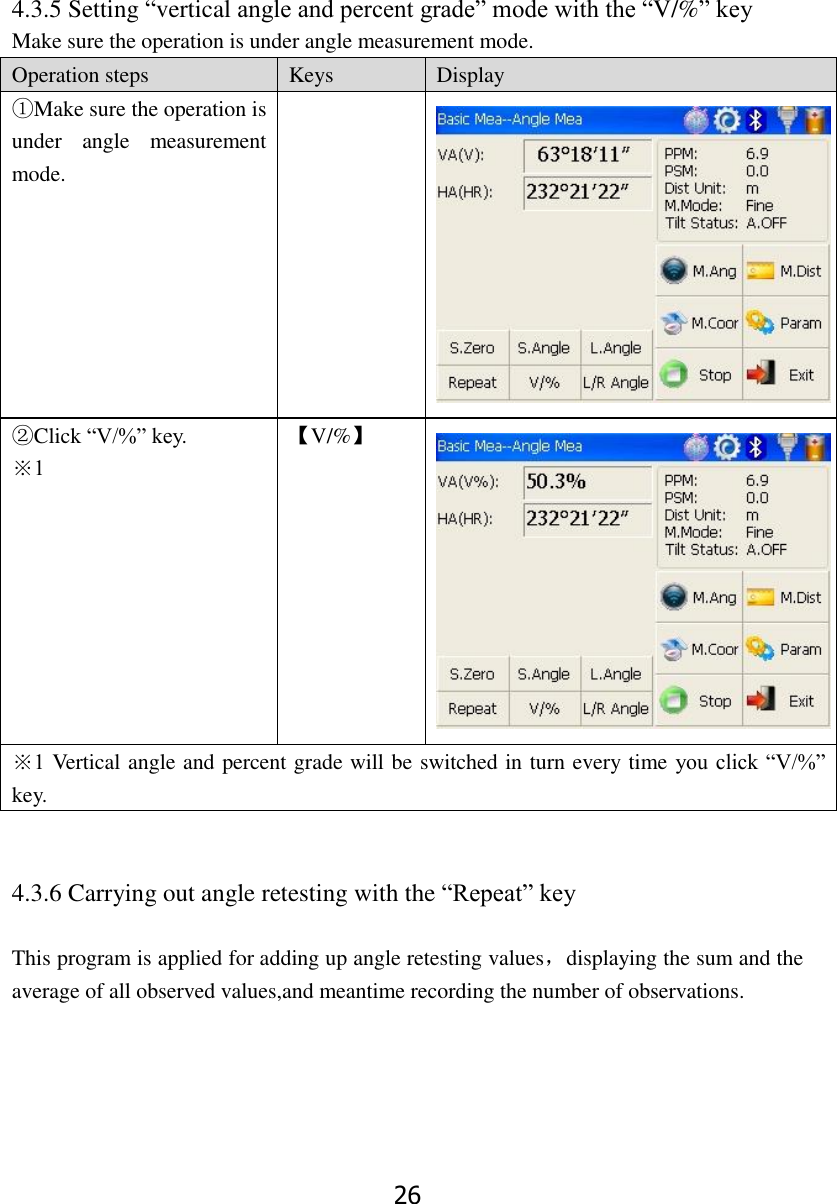
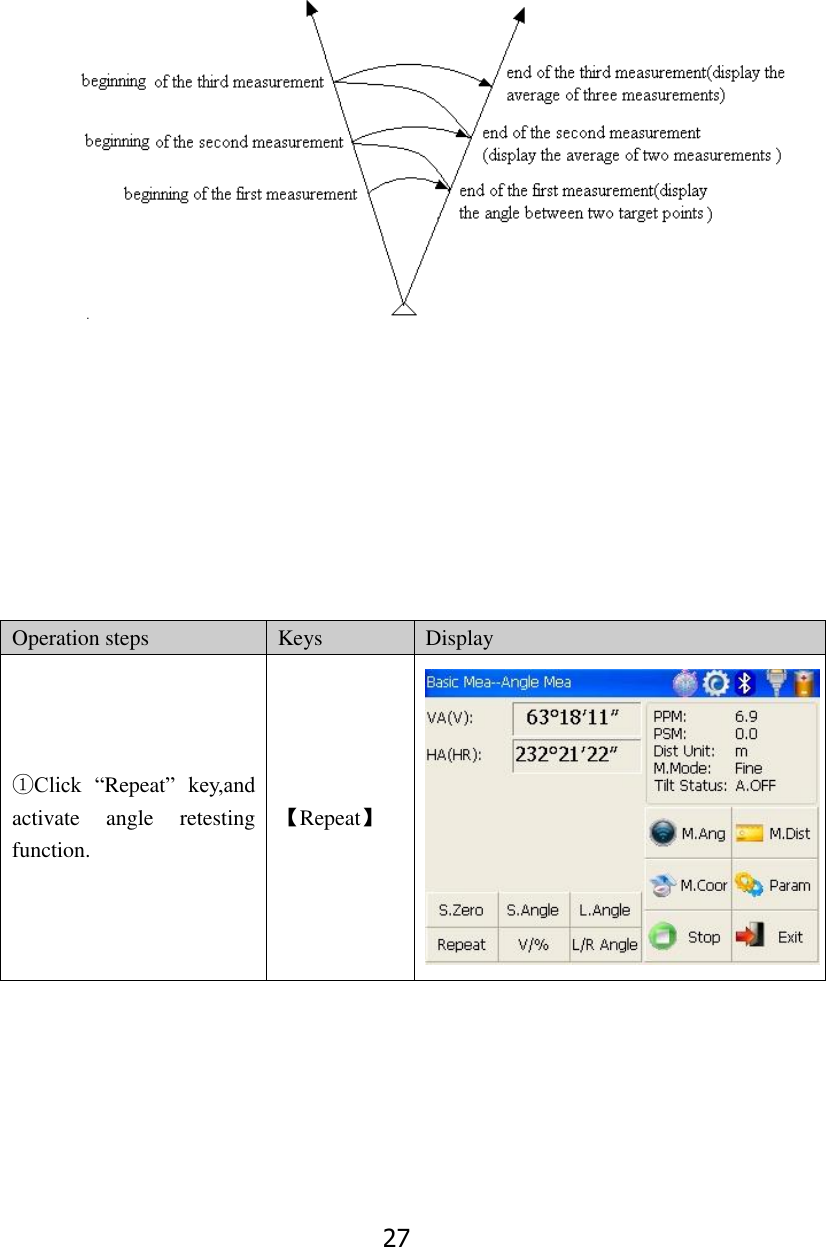
26   4.3.5 Setting “vertical angle and percent grade” mode with the “V/%” key Make sure the operation is under angle measurement mode. Operation steps Keys Display ①Make sure the operation is under  angle  measurement mode.   ②Click “V/%” key.   ※1 【V/%】  ※1 Vertical angle and percent grade will be switched in turn every time you click “V/%” key.   4.3.6 Carrying out angle retesting with the “Repeat” key  This program is applied for adding up angle retesting values,displaying the sum and the average of all observed values,and meantime recording the number of observations.
27           Operation steps Keys Display ①Click  “Repeat”  key,and activate  angle  retesting function. 【Repeat】
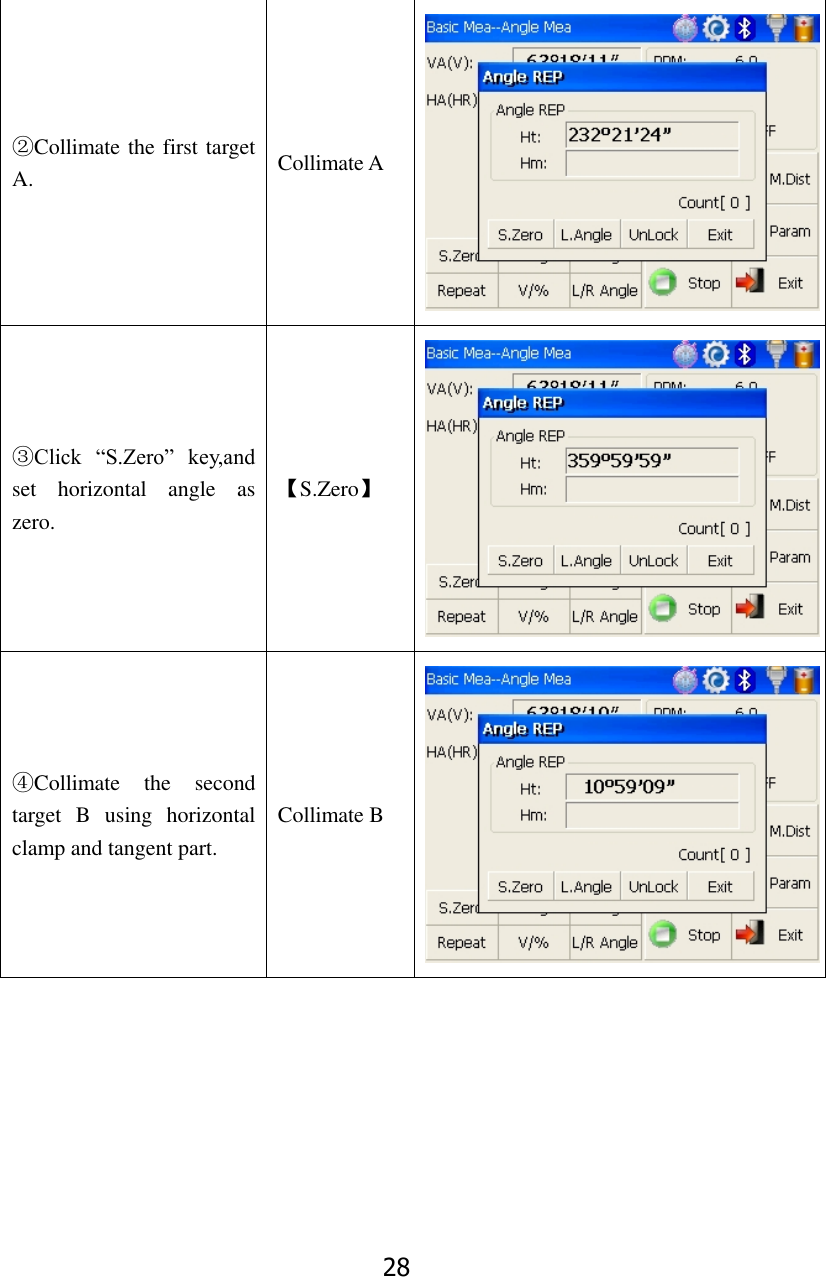
28 ②Collimate the first target A. Collimate A  ③Click  “S.Zero”  key,and set  horizontal  angle  as zero. 【S.Zero】  ④Collimate  the  second target  B  using  horizontal clamp and tangent part. Collimate B
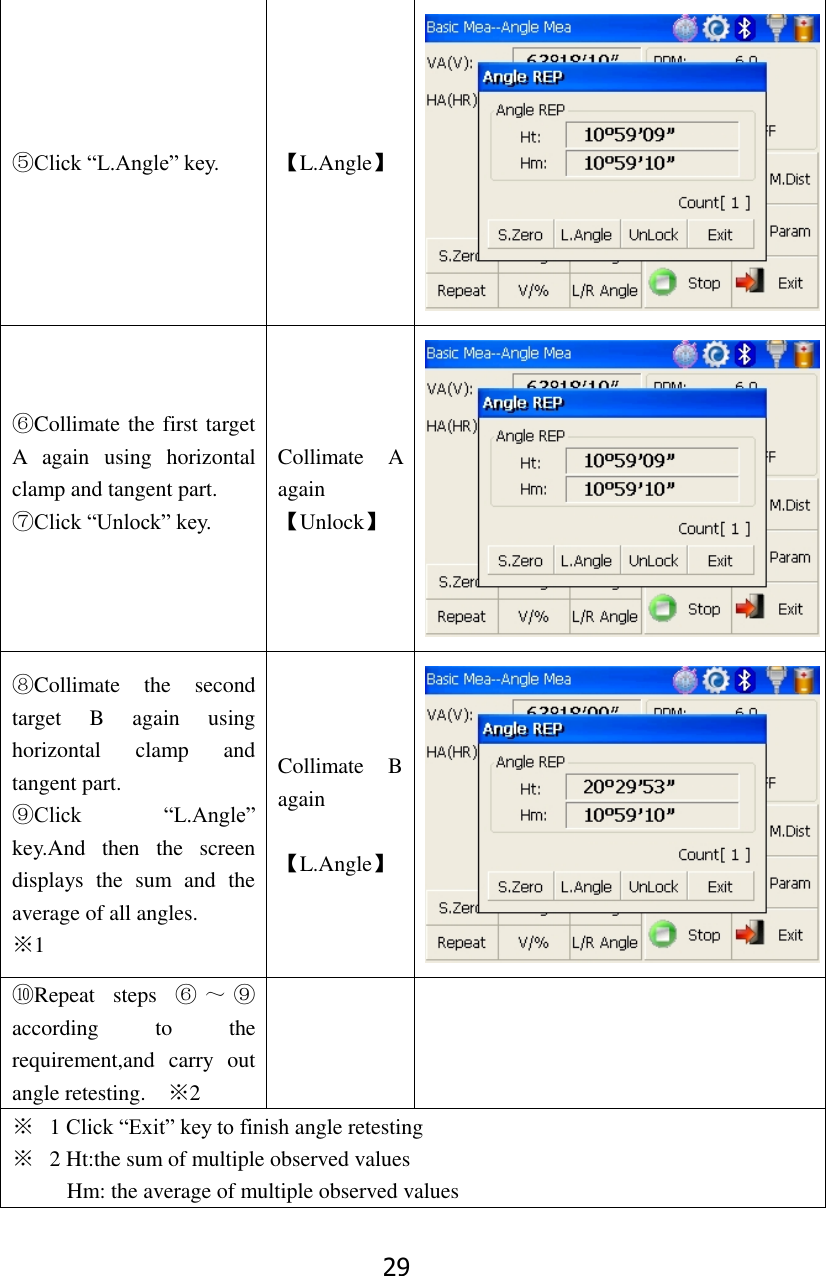
29 ⑤Click “L.Angle” key. 【L.Angle】  ⑥Collimate the first target A  again  using  horizontal clamp and tangent part.   ⑦Click “Unlock” key.  Collimate  A again 【Unlock】  ⑧Collimate  the  second target  B  again  using horizontal  clamp  and tangent part. ⑨Click  “L.Angle” key.And  then  the  screen displays  the  sum  and  the average of all angles. ※1 Collimate  B again  【L.Angle】  ⑩Repeat  steps  ⑥ ~ ⑨ according  to  the requirement,and  carry  out angle retesting.    ※2   ※ 1 Click “Exit” key to finish angle retesting ※ 2 Ht:the sum of multiple observed values   Hm: the average of multiple observed values
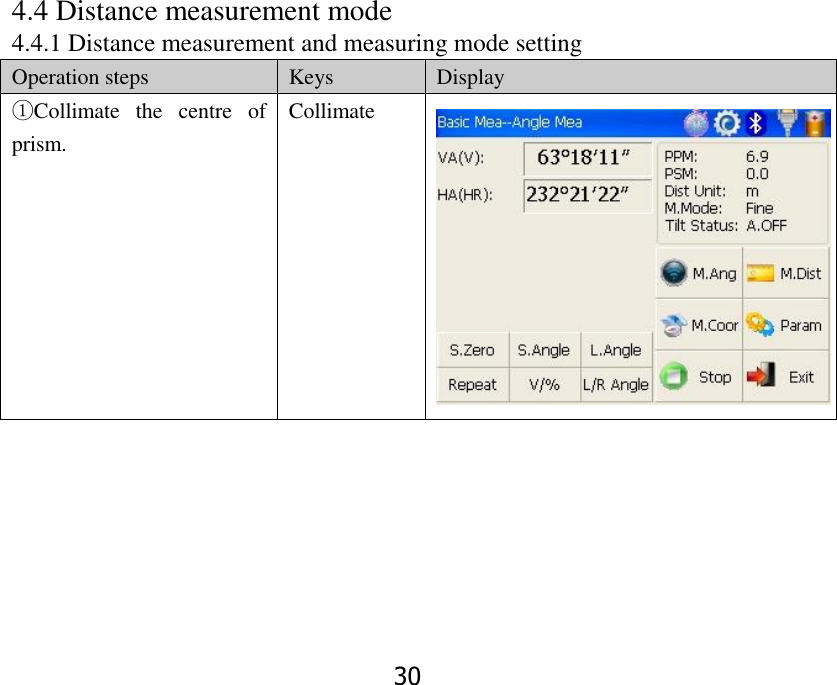
30                   4.4 Distance measurement mode 4.4.1 Distance measurement and measuring mode setting Operation steps Keys Display ①Collimate  the  centre  of prism. Collimate
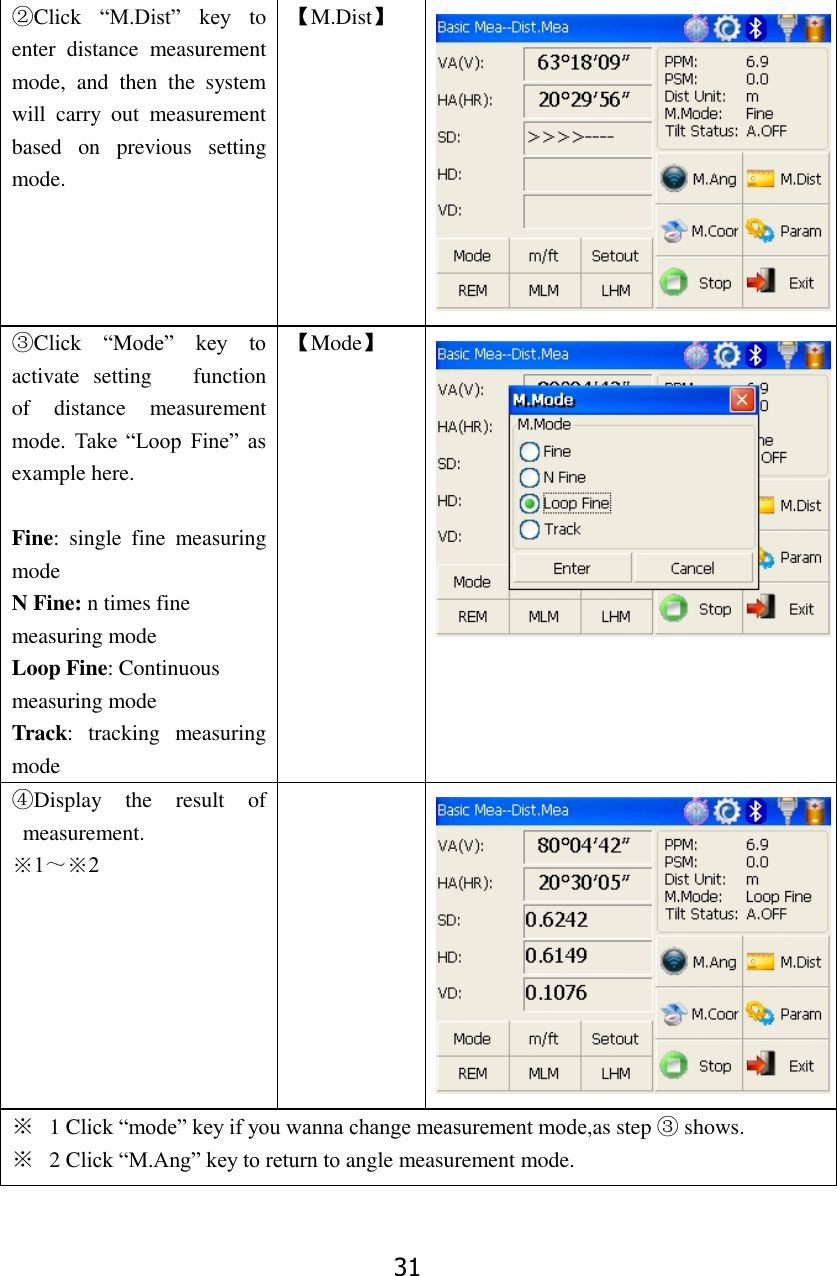
31 ②Click  “M.Dist”  key  to enter  distance  measurement mode,  and  then  the  system will  carry  out  measurement based  on  previous  setting mode.   【M.Dist】  ③Click  “Mode”  key  to     activate  setting      function of  distance  measurement mode.  Take  “Loop  Fine”  as example here.  Fine:  single  fine  measuring mode N Fine: n times fine measuring mode Loop Fine: Continuous measuring mode Track:  tracking  measuring mode 【Mode】  ④Display  the  result  of measurement. ※1~※2   ※ 1 Click “mode” key if you wanna change measurement mode,as step ③ shows. ※ 2 Click “M.Ang” key to return to angle measurement mode.
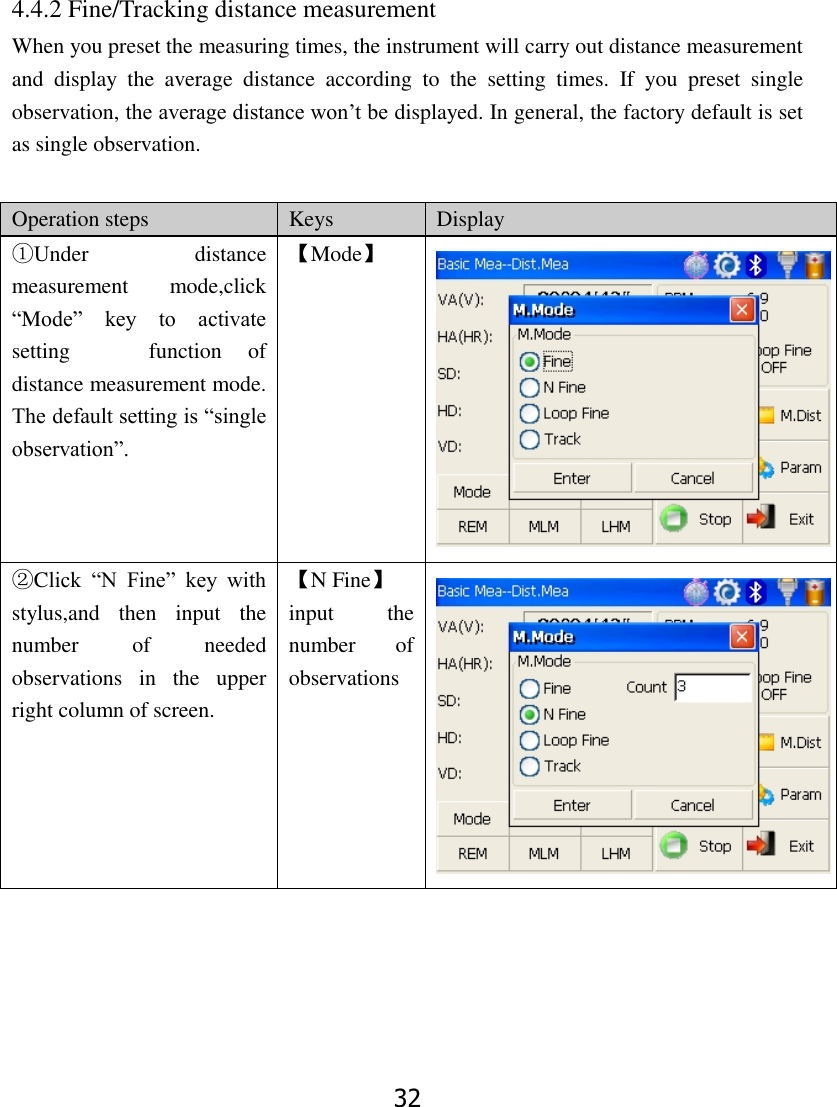
32      4.4.2 Fine/Tracking distance measurement When you preset the measuring times, the instrument will carry out distance measurement and  display  the  average  distance  according  to  the  setting  times.  If  you  preset  single observation, the average distance won’t be displayed. In general, the factory default is set as single observation.       Operation steps Keys Display ①Under  distance measurement  mode,click “Mode”  key  to  activate setting      function  of distance measurement mode. The default setting is “single observation”. 【Mode】  ②Click  “N  Fine”  key  with stylus,and  then  input  the number  of  needed observations  in  the  upper right column of screen. 【N Fine】 input  the number  of   observations
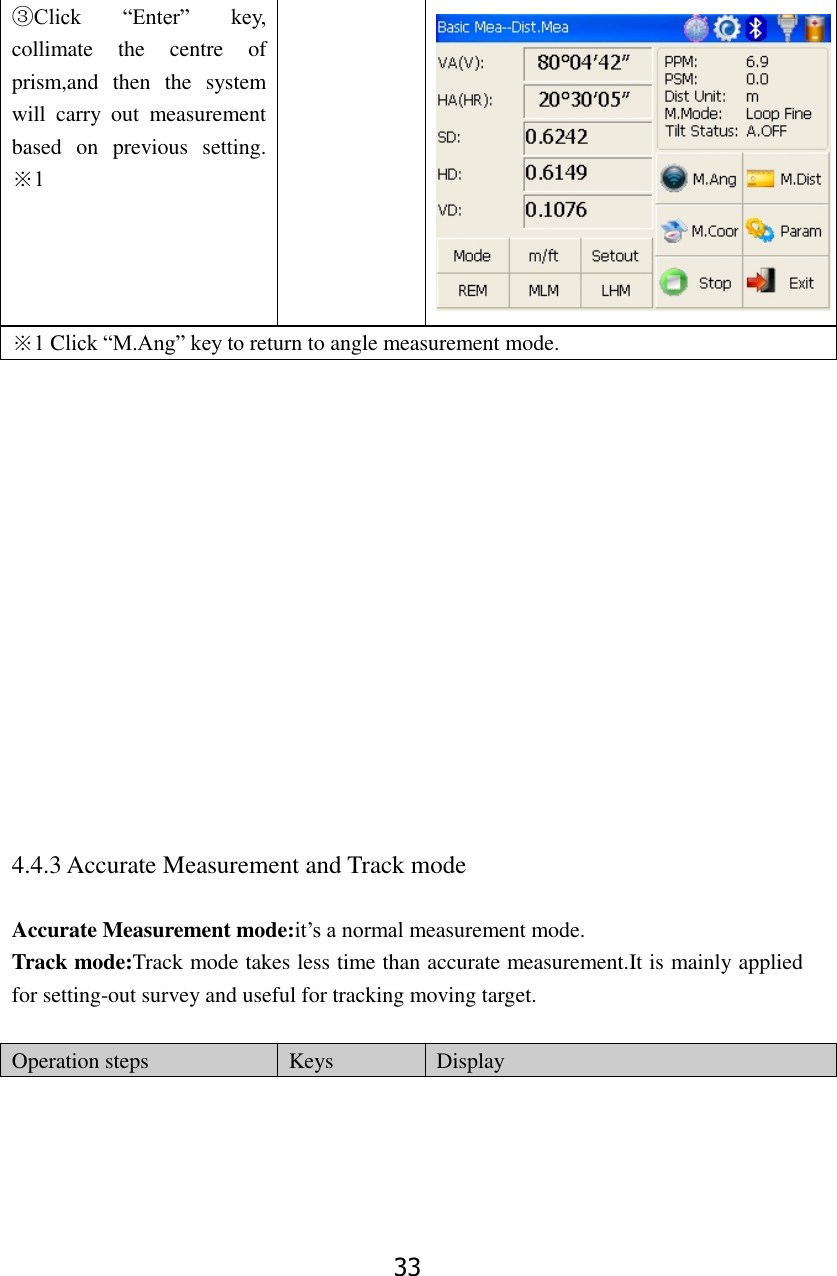
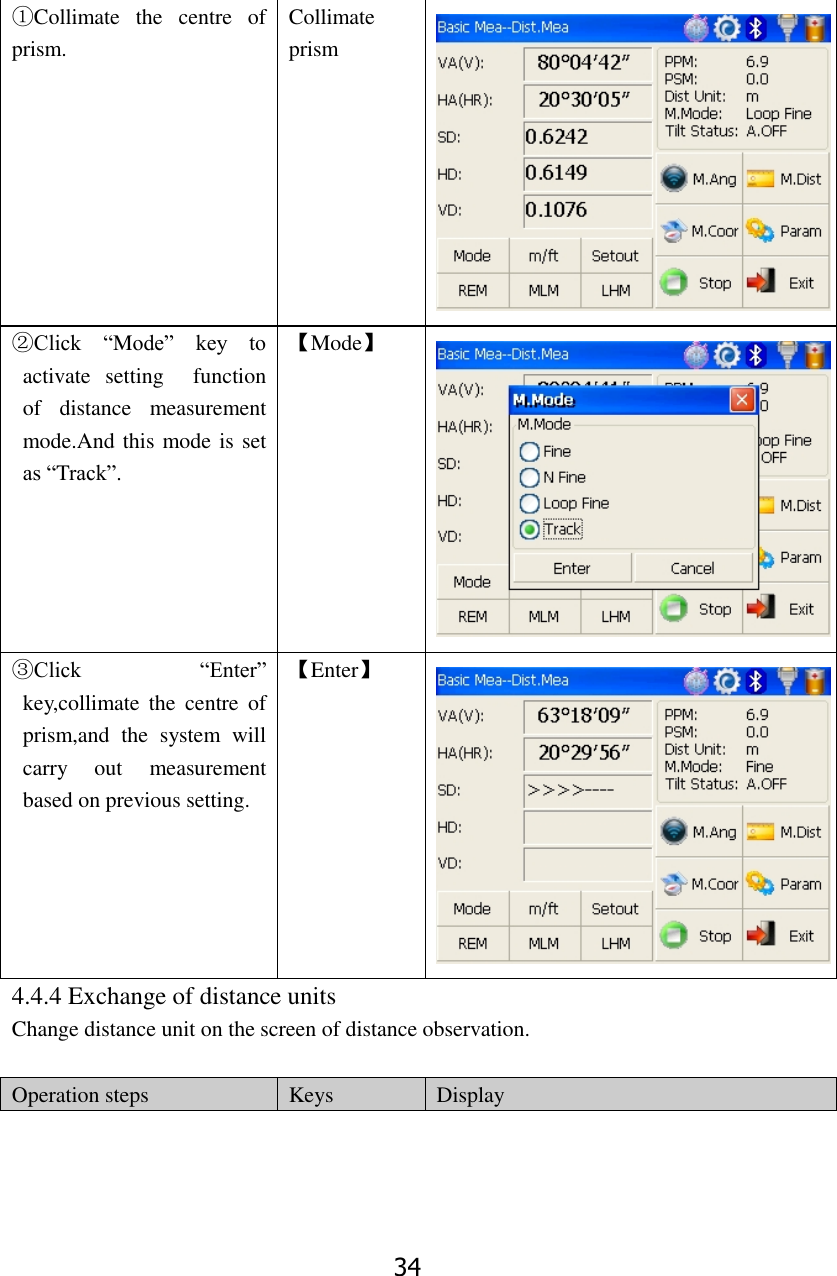
33 ③Click  “Enter”  key, collimate  the  centre  of prism,and  then  the  system will  carry  out  measurement based  on  previous  setting. ※1   ※1 Click “M.Ang” key to return to angle measurement mode.                4.4.3 Accurate Measurement and Track mode  Accurate Measurement mode:it’s a normal measurement mode. Track mode:Track mode takes less time than accurate measurement.It is mainly applied for setting-out survey and useful for tracking moving target.      Operation steps Keys Display
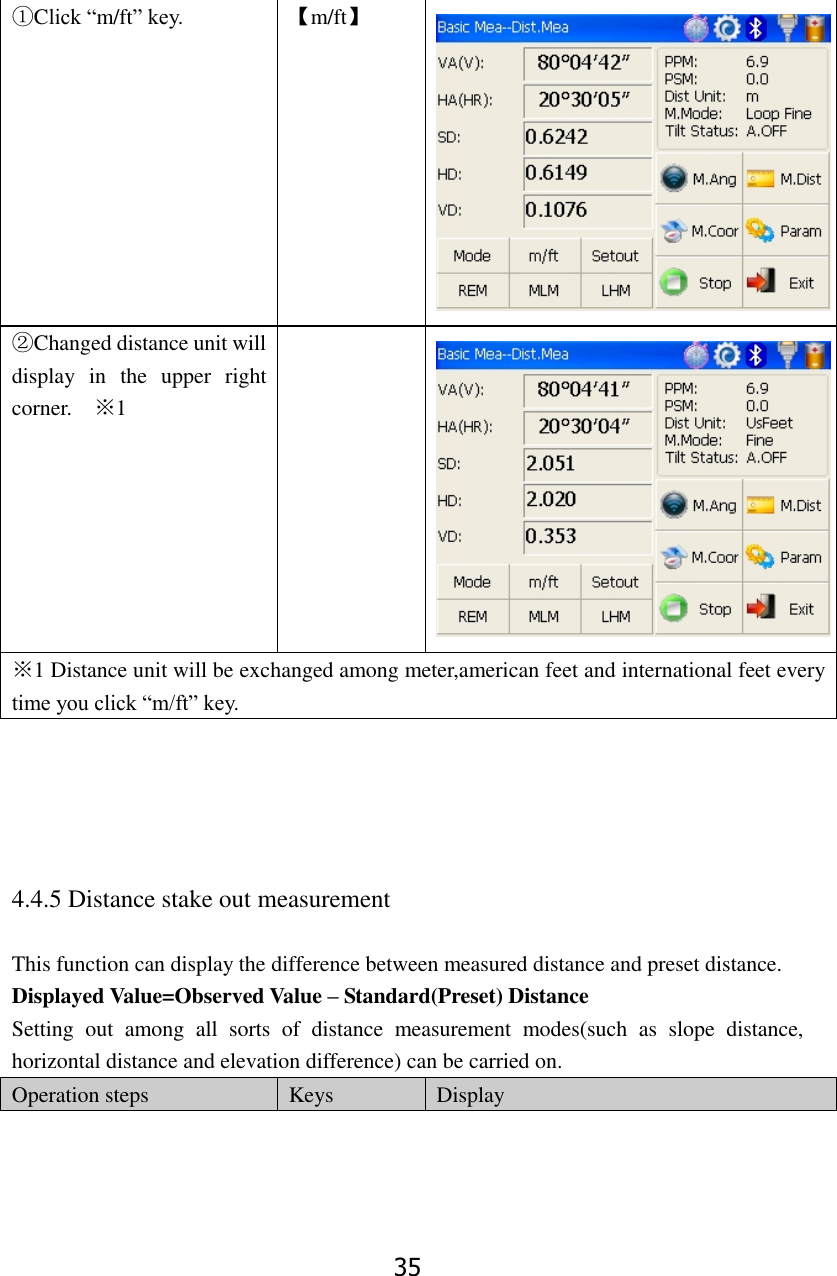
34 ①Collimate  the  centre  of prism. Collimate prism  ②Click  “Mode”  key  to activate  setting    function of  distance  measurement mode.And this mode is set as “Track”.   【Mode】  ③Click  “Enter” key,collimate  the  centre  of prism,and  the  system  will carry  out  measurement based on previous setting.   【Enter】  4.4.4 Exchange of distance units Change distance unit on the screen of distance observation.    Operation steps Keys Display
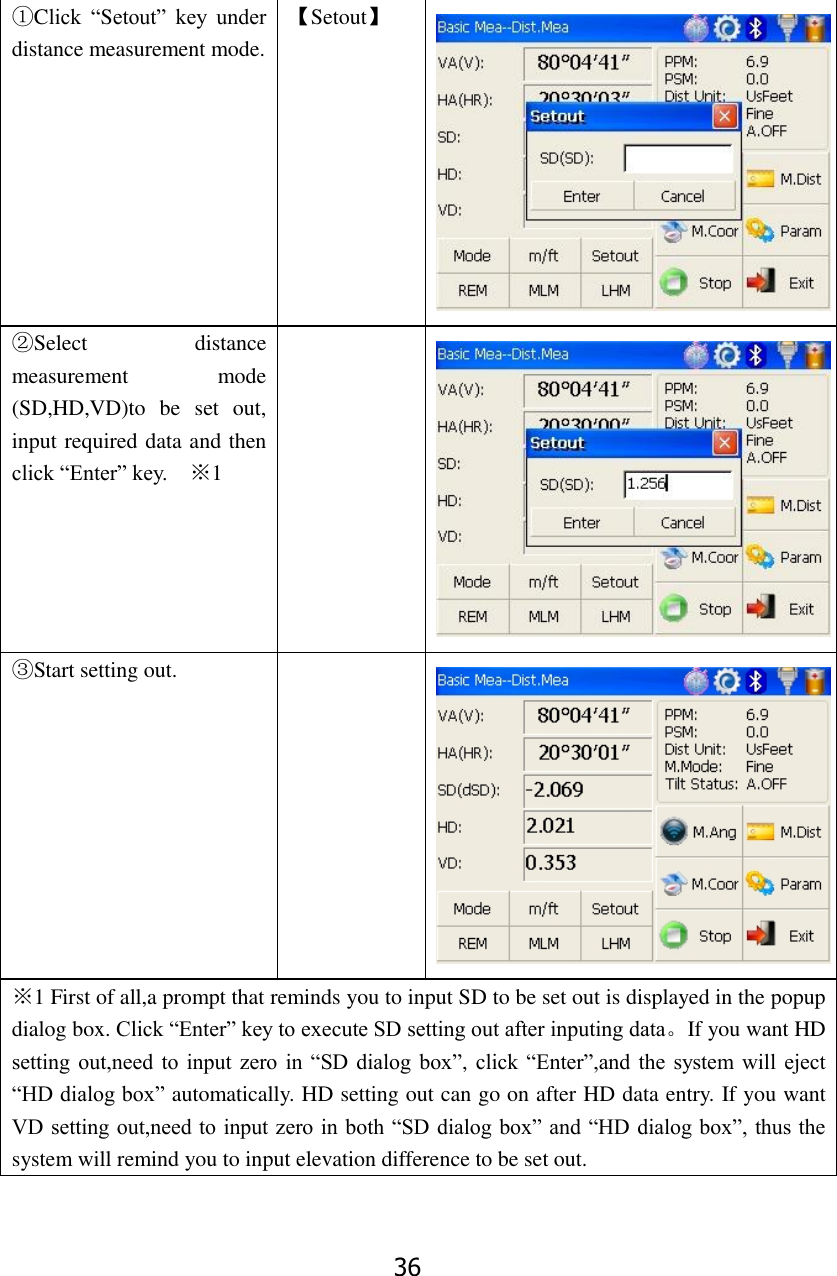
35 ①Click “m/ft” key. 【m/ft】  ②Changed distance unit will display  in  the  upper  right corner.    ※1   ※1 Distance unit will be exchanged among meter,american feet and international feet every time you click “m/ft” key.      4.4.5 Distance stake out measurement  This function can display the difference between measured distance and preset distance. Displayed Value=Observed Value – Standard(Preset) Distance Setting  out  among  all  sorts  of  distance  measurement  modes(such  as  slope  distance, horizontal distance and elevation difference) can be carried on.   Operation steps Keys Display
36 ①Click  “Setout”  key  under distance measurement mode. 【Setout】  ②Select  distance measurement  mode (SD,HD,VD)to  be  set  out, input required data and then click “Enter” key.   ※1   ③Start setting out.   ※1 First of all,a prompt that reminds you to input SD to be set out is displayed in the popup dialog box. Click “Enter” key to execute SD setting out after inputing data。If you want HD setting out,need  to  input  zero in  “SD dialog box”, click “Enter”,and the  system  will  eject “HD dialog box” automatically. HD setting out can go on after HD data entry. If you want VD setting out,need to input zero in both “SD dialog box” and “HD dialog box”, thus the system will remind you to input elevation difference to be set out.
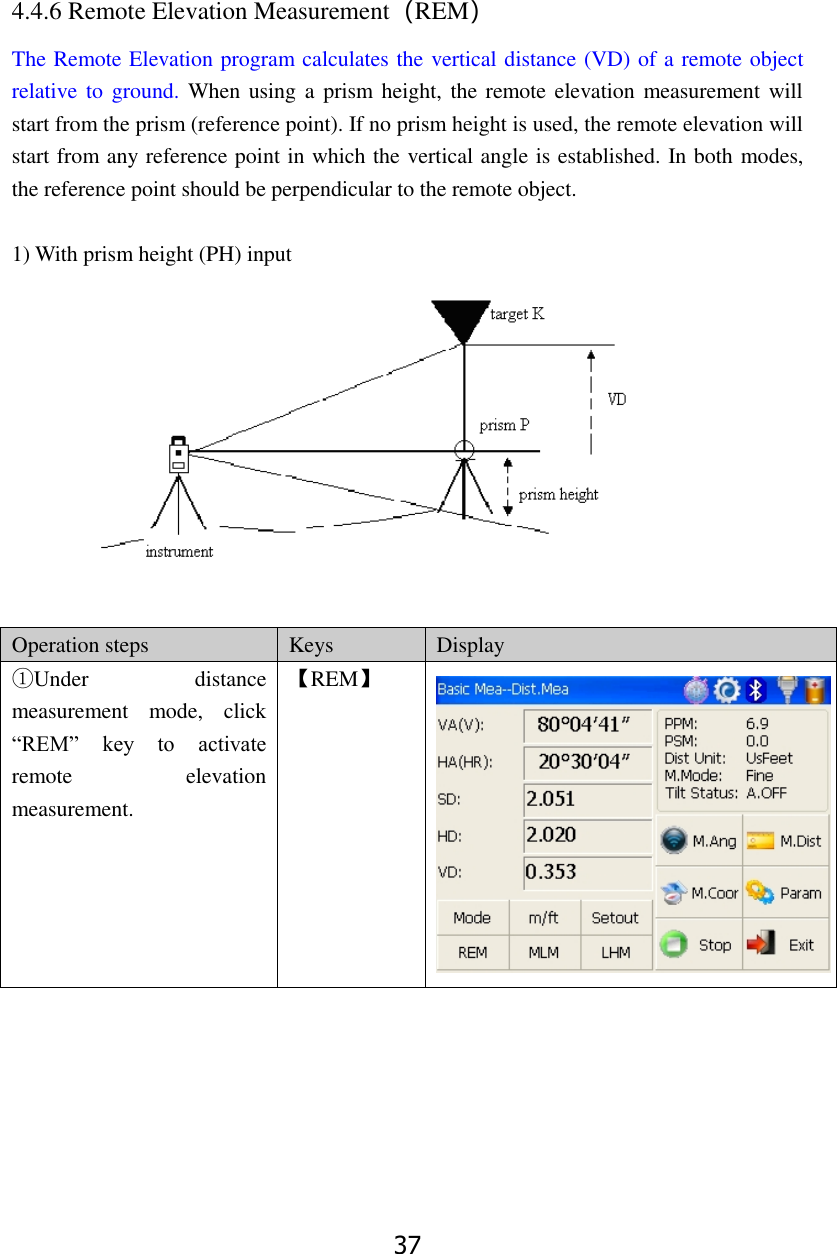
37 4.4.6 Remote Elevation Measurement(REM) The Remote Elevation program calculates the vertical distance (VD) of a remote object relative to  ground.  When using a  prism height, the remote  elevation measurement  will start from the prism (reference point). If no prism height is used, the remote elevation will start from any reference point in which the vertical angle is established. In both modes, the reference point should be perpendicular to the remote object.    1) With prism height (PH) input   Operation steps Keys Display ①Under  distance measurement  mode,  click “REM”  key  to  activate remote  elevation measurement. 【REM】
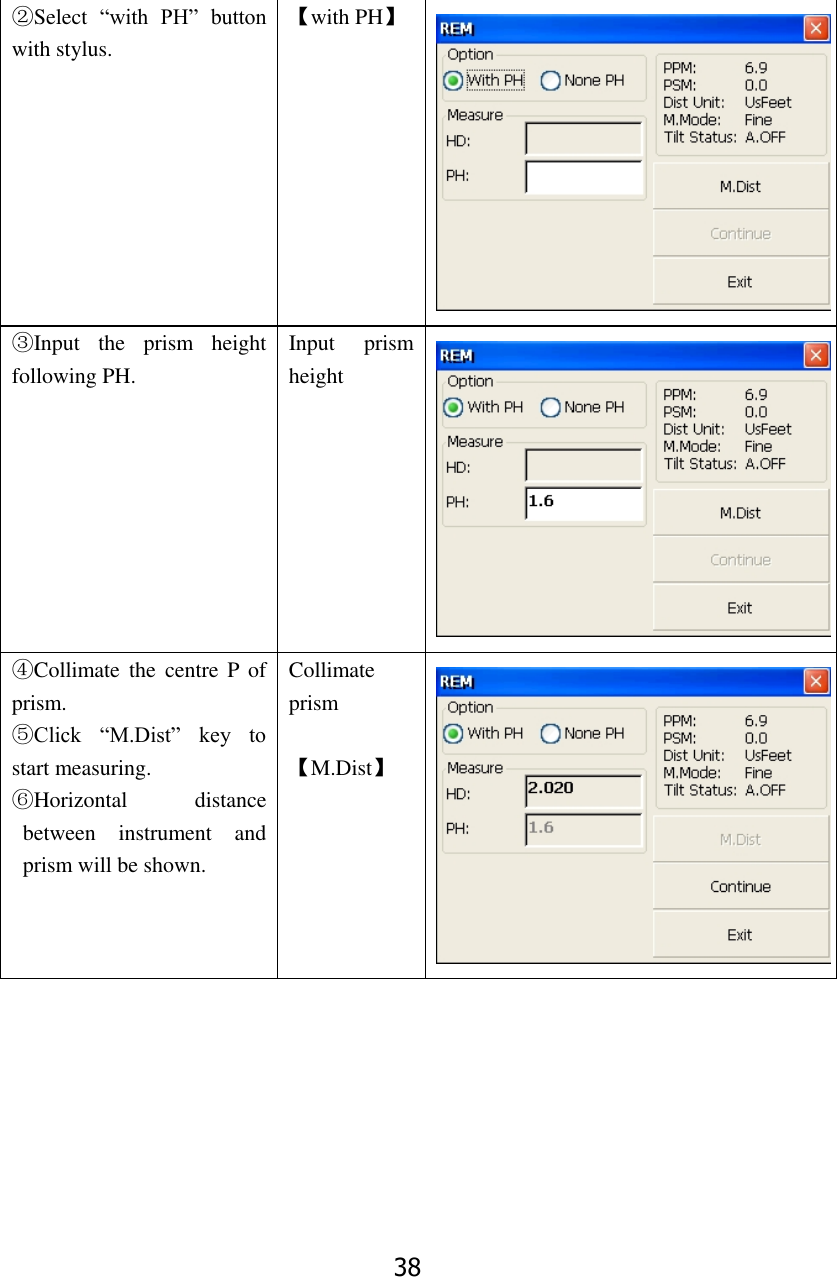
38 ②Select  “with  PH”  button with stylus. 【with PH】  ③Input  the  prism  height following PH. Input  prism height  ④Collimate  the  centre  P  of prism. ⑤Click  “M.Dist”  key  to start measuring. ⑥Horizontal  distance between  instrument  and prism will be shown. Collimate prism  【M.Dist】
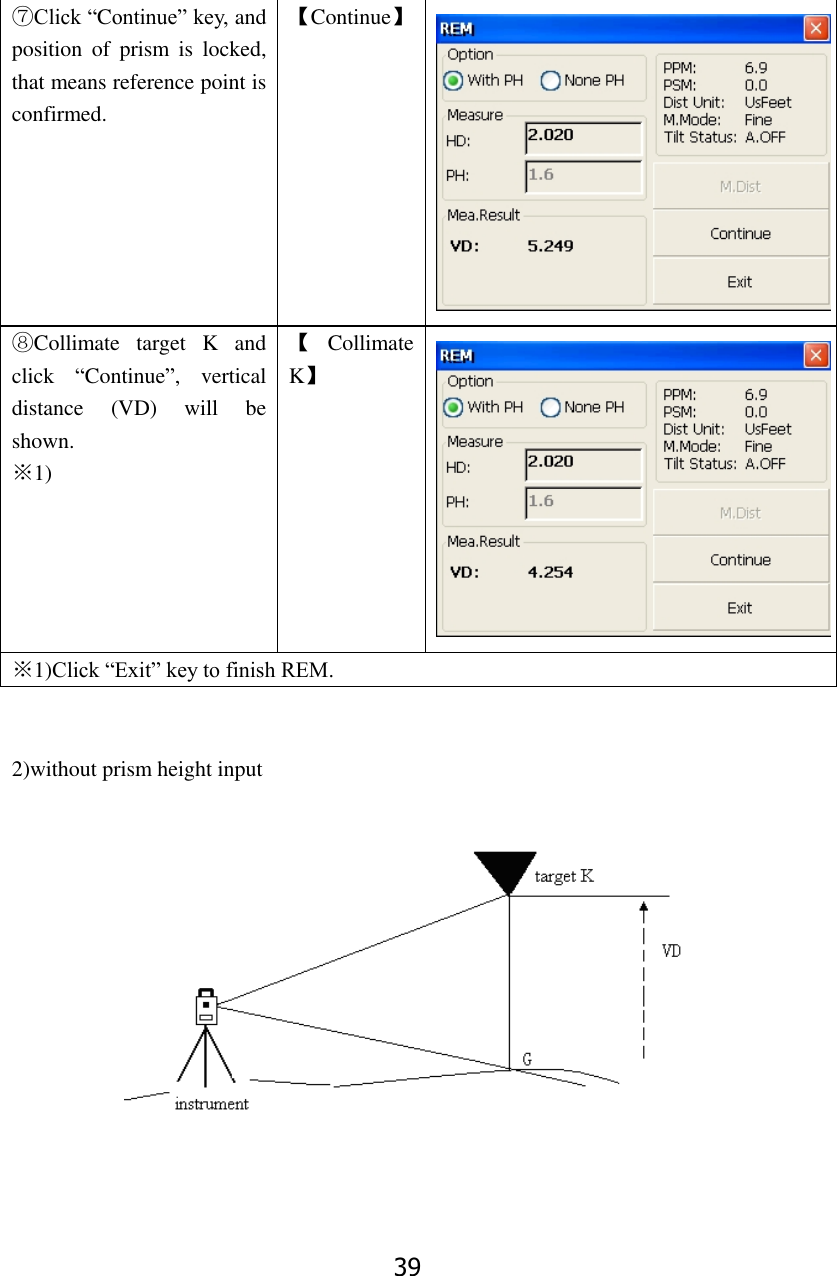
39 ⑦Click “Continue” key, and position  of  prism  is  locked, that means reference point is confirmed. 【Continue】  ⑧Collimate  target  K  and click  “Continue”,  vertical distance  (VD)  will  be shown. ※1) 【Collimate K】  ※1)Click “Exit” key to finish REM.   2)without prism height input
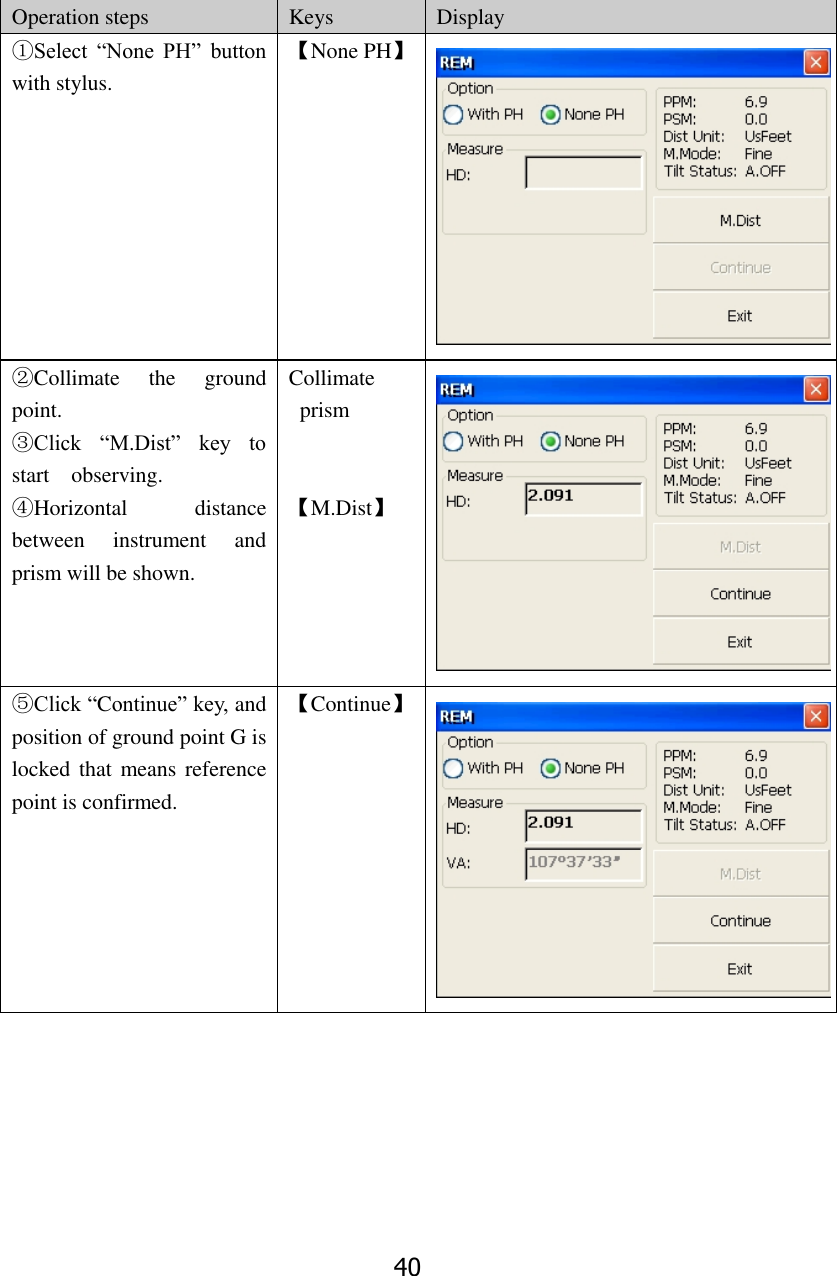
40 Operation steps Keys Display ①Select  “None  PH”  button with stylus. 【None PH】  ②Collimate  the  ground point. ③Click  “M.Dist”  key  to start    observing. ④Horizontal  distance between  instrument  and prism will be shown. Collimate prism   【M.Dist】  ⑤Click “Continue” key, and position of ground point G is locked that means reference point is confirmed.    【Continue】
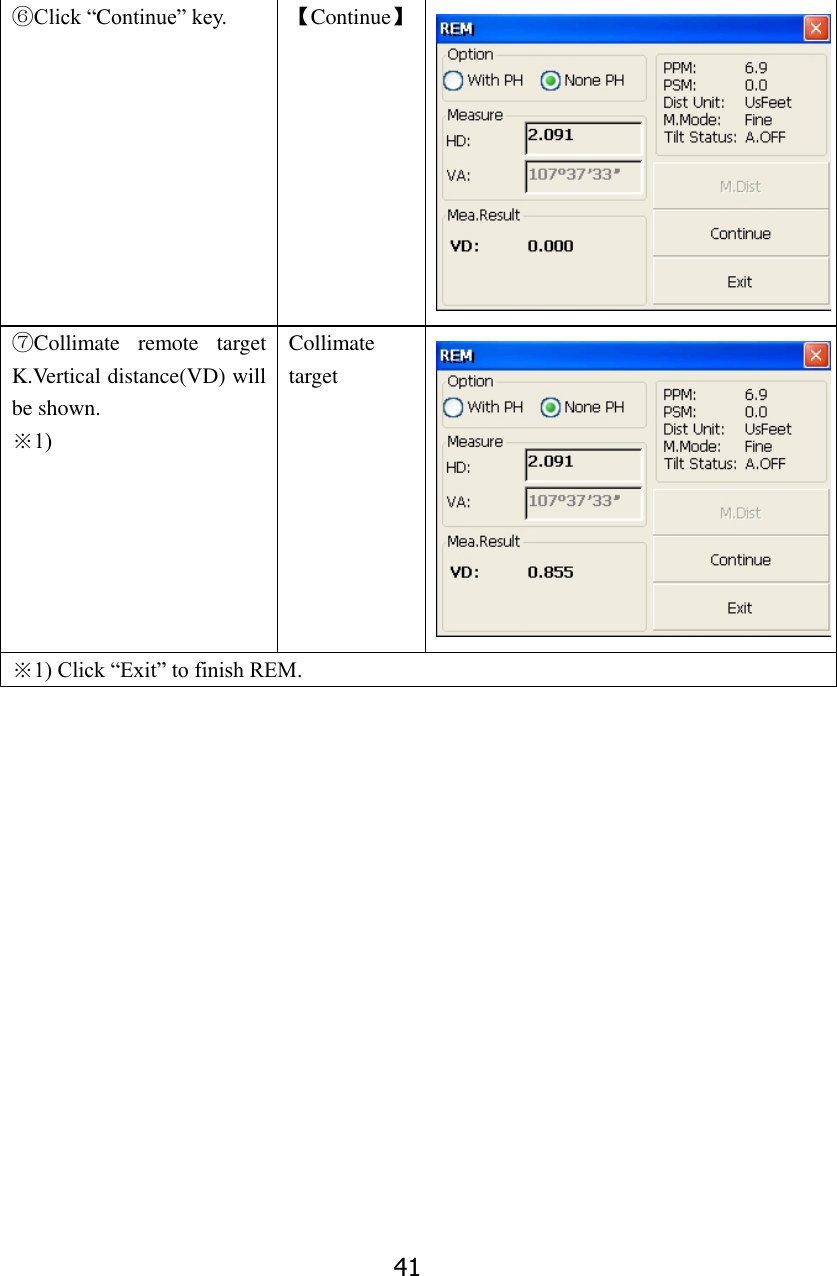
41 ⑥Click “Continue” key. 【Continue】  ⑦Collimate  remote  target K.Vertical distance(VD) will be shown. ※1) Collimate target  ※1) Click “Exit” to finish REM.
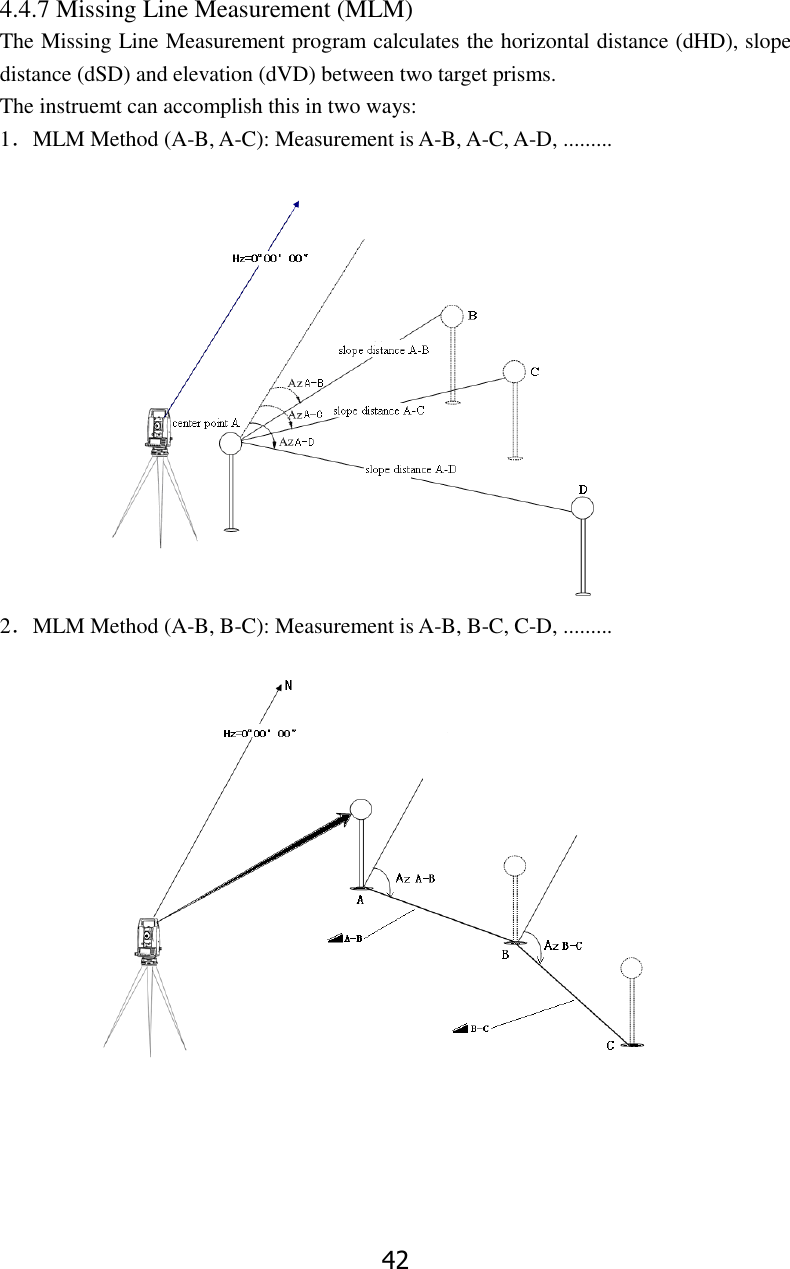
42 4.4.7 Missing Line Measurement (MLM) The Missing Line Measurement program calculates the horizontal distance (dHD), slope distance (dSD) and elevation (dVD) between two target prisms. The instruemt can accomplish this in two ways: 1.MLM Method (A-B, A-C): Measurement is A-B, A-C, A-D, .........   2.MLM Method (A-B, B-C): Measurement is A-B, B-C, C-D, .........
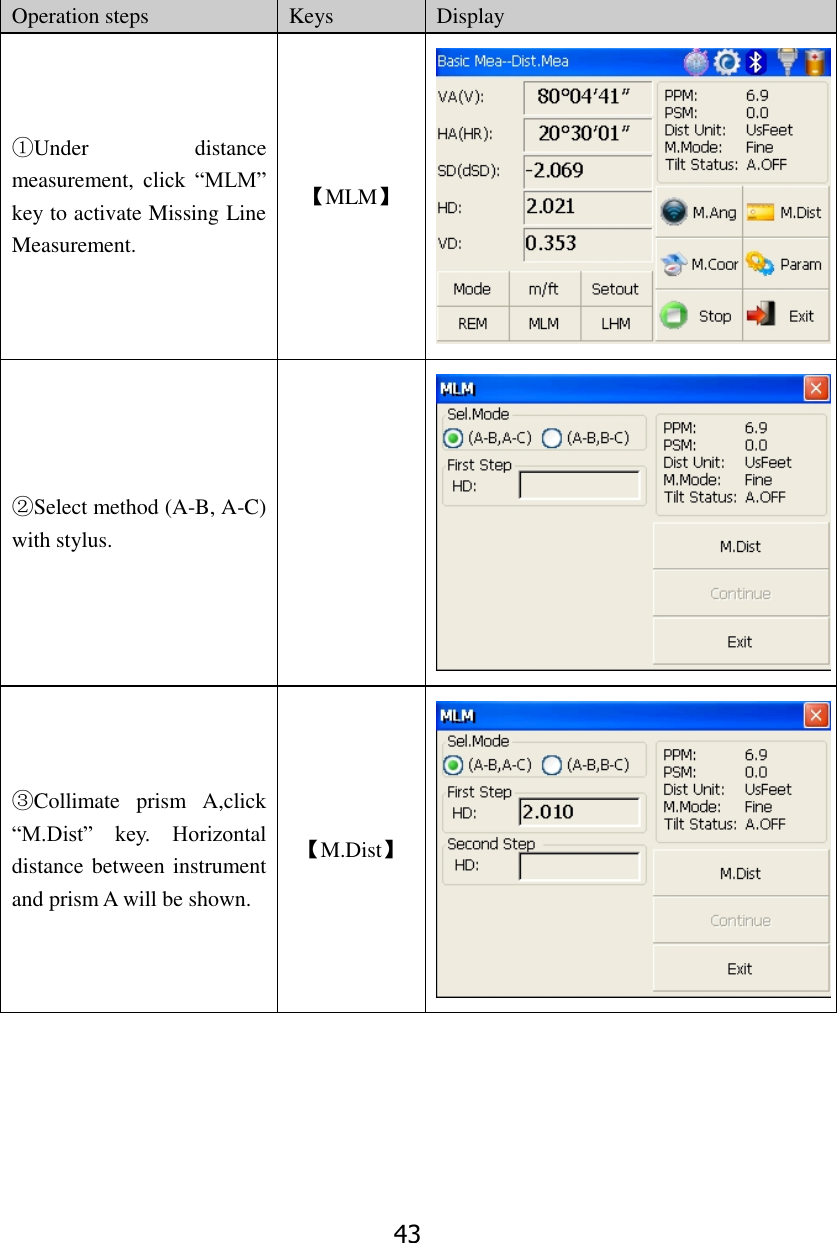
43  Operation steps Keys Display ①Under  distance measurement,  click  “MLM” key to activate Missing Line Measurement. 【MLM】  ②Select method (A-B, A-C) with stylus.   ③Collimate  prism  A,click “M.Dist”  key.  Horizontal distance between instrument and prism A will be shown. 【M.Dist】
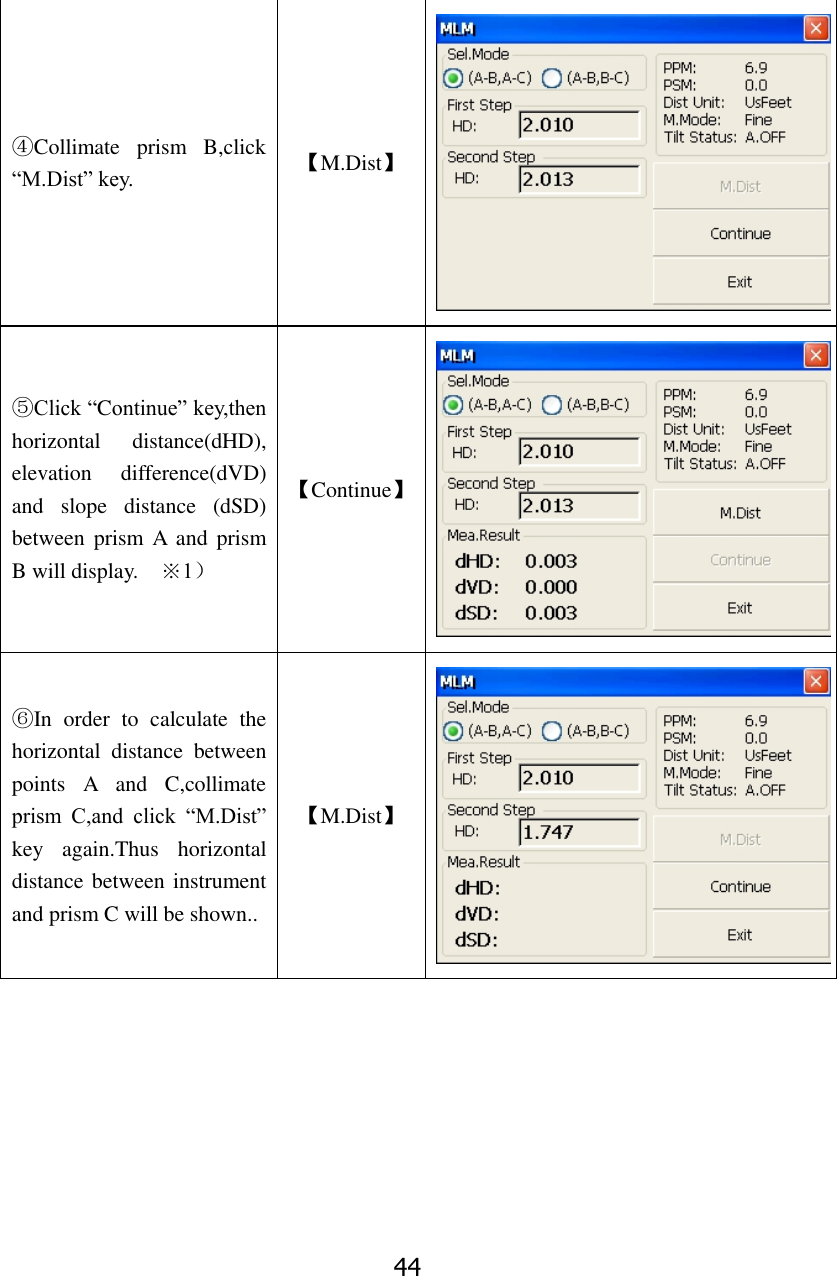
44 ④Collimate  prism  B,click “M.Dist” key. 【M.Dist】  ⑤Click “Continue” key,then   horizontal  distance(dHD), elevation  difference(dVD) and  slope  distance  (dSD) between prism A  and  prism B will display.  ※1) 【Continue】  ⑥In  order  to  calculate  the horizontal  distance  between points  A  and  C,collimate prism  C,and  click  “M.Dist” key  again.Thus  horizontal distance between instrument and prism C will be shown.. 【M.Dist】
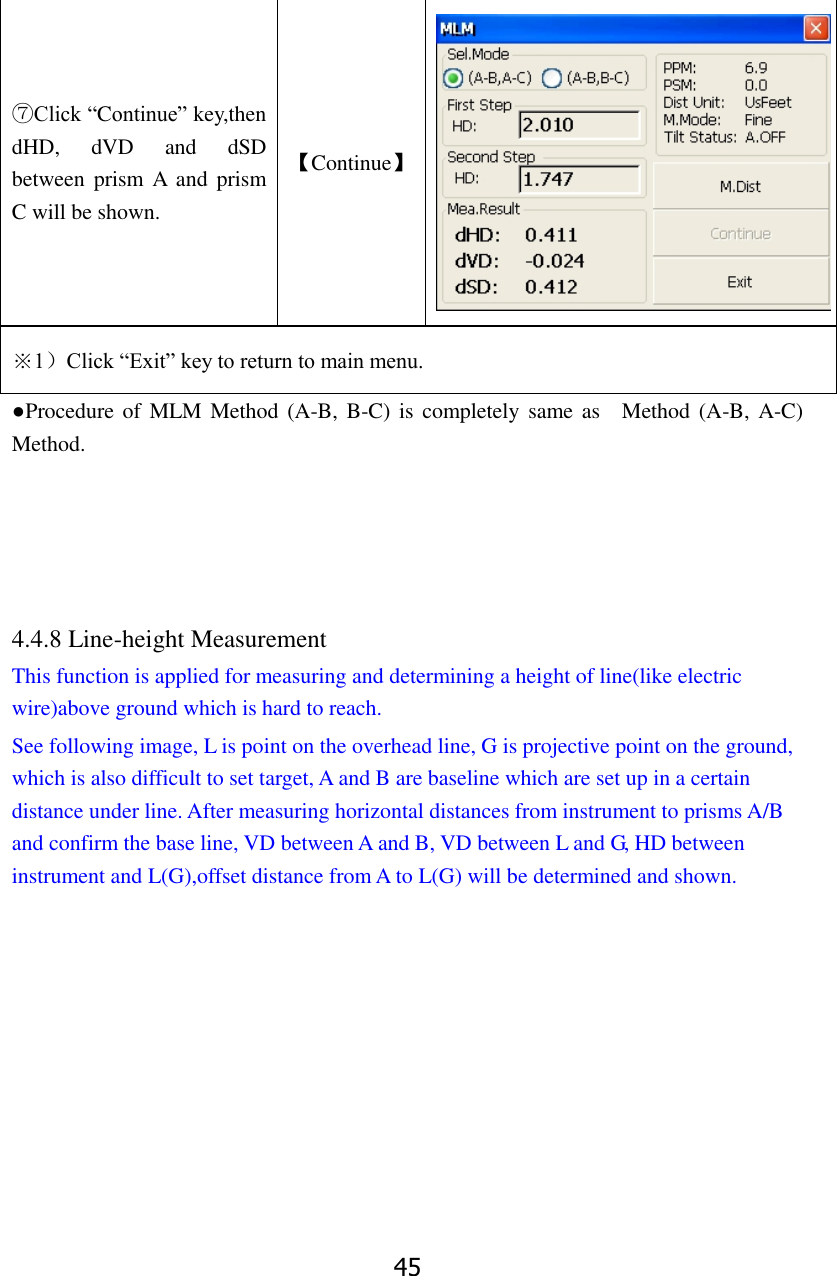
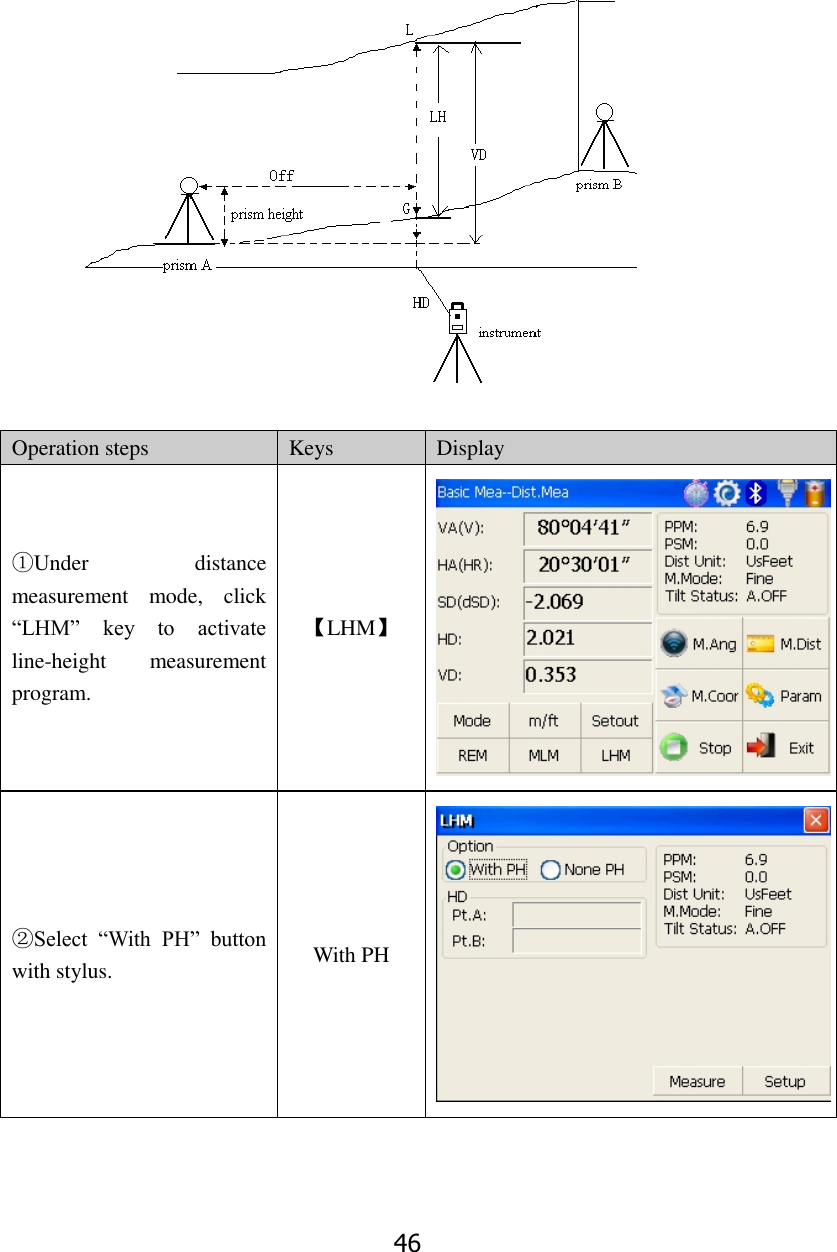
45 ⑦Click “Continue” key,then dHD,  dVD  and  dSD between prism A  and  prism C will be shown. 【Continue】  ※1)Click “Exit” key to return to main menu.   ●Procedure of  MLM  Method (A-B, B-C) is  completely same as    Method (A-B,  A-C) Method.      4.4.8 Line-height Measurement This function is applied for measuring and determining a height of line(like electric wire)above ground which is hard to reach.   See following image, L is point on the overhead line, G is projective point on the ground, which is also difficult to set target, A and B are baseline which are set up in a certain distance under line. After measuring horizontal distances from instrument to prisms A/B and confirm the base line, VD between A and B, VD between L and G, HD between instrument and L(G),offset distance from A to L(G) will be determined and shown.
46      Operation steps Keys Display ①Under  distance measurement  mode,  click “LHM”  key  to  activate line-height  measurement program. 【LHM】  ②Select  “With  PH”  button with stylus.   With PH
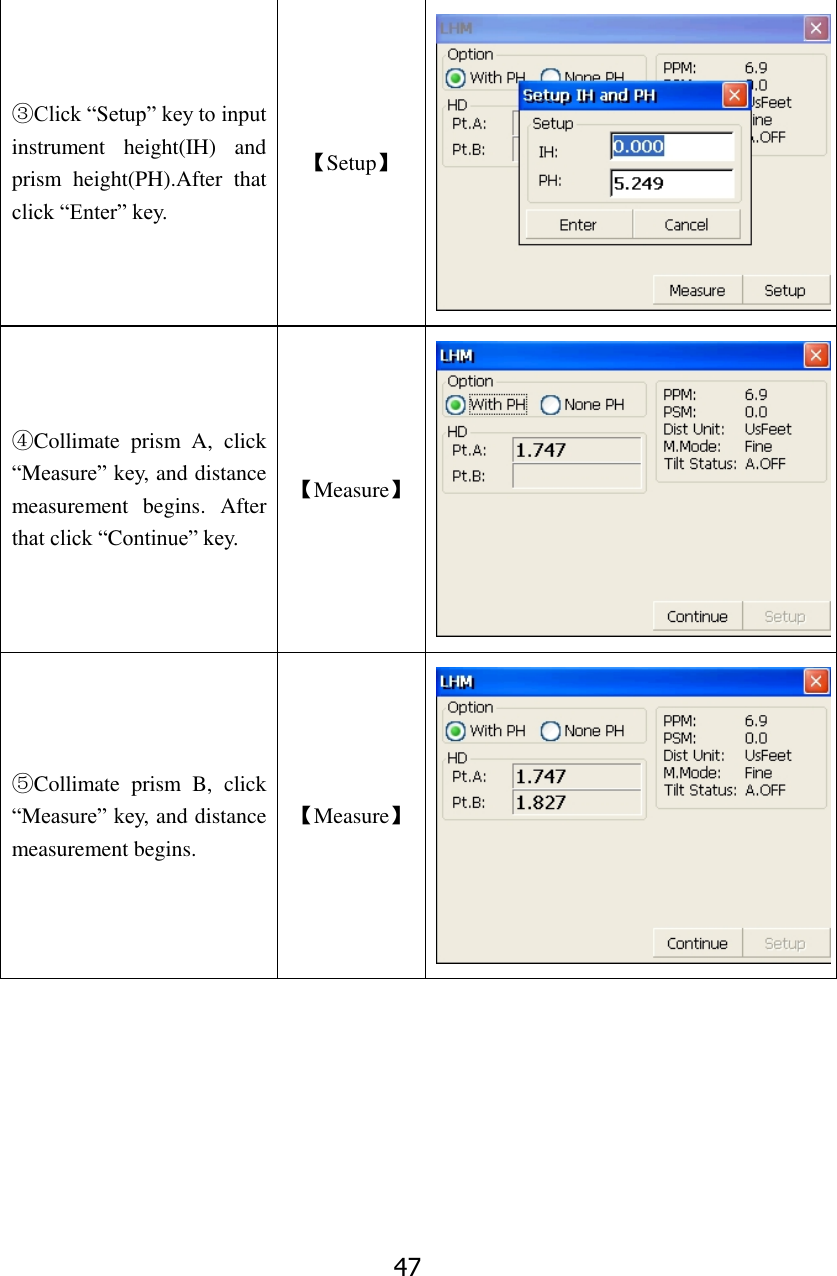
47 ③Click “Setup” key to input instrument  height(IH)  and prism  height(PH).After  that click “Enter” key. 【Setup】  ④Collimate  prism  A,  click “Measure” key, and distance measurement  begins.  After that click “Continue” key. 【Measure】  ⑤Collimate  prism  B,  click “Measure” key, and distance measurement begins. 【Measure】
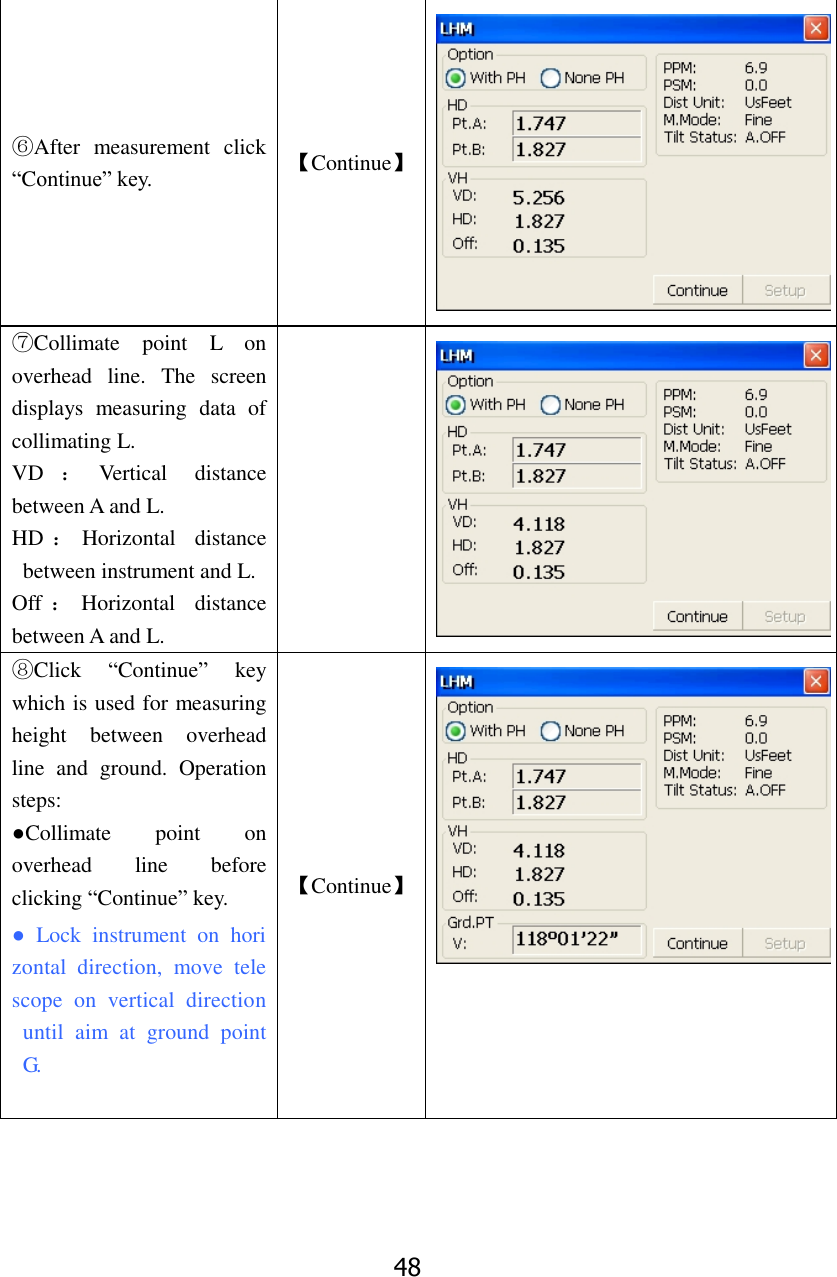
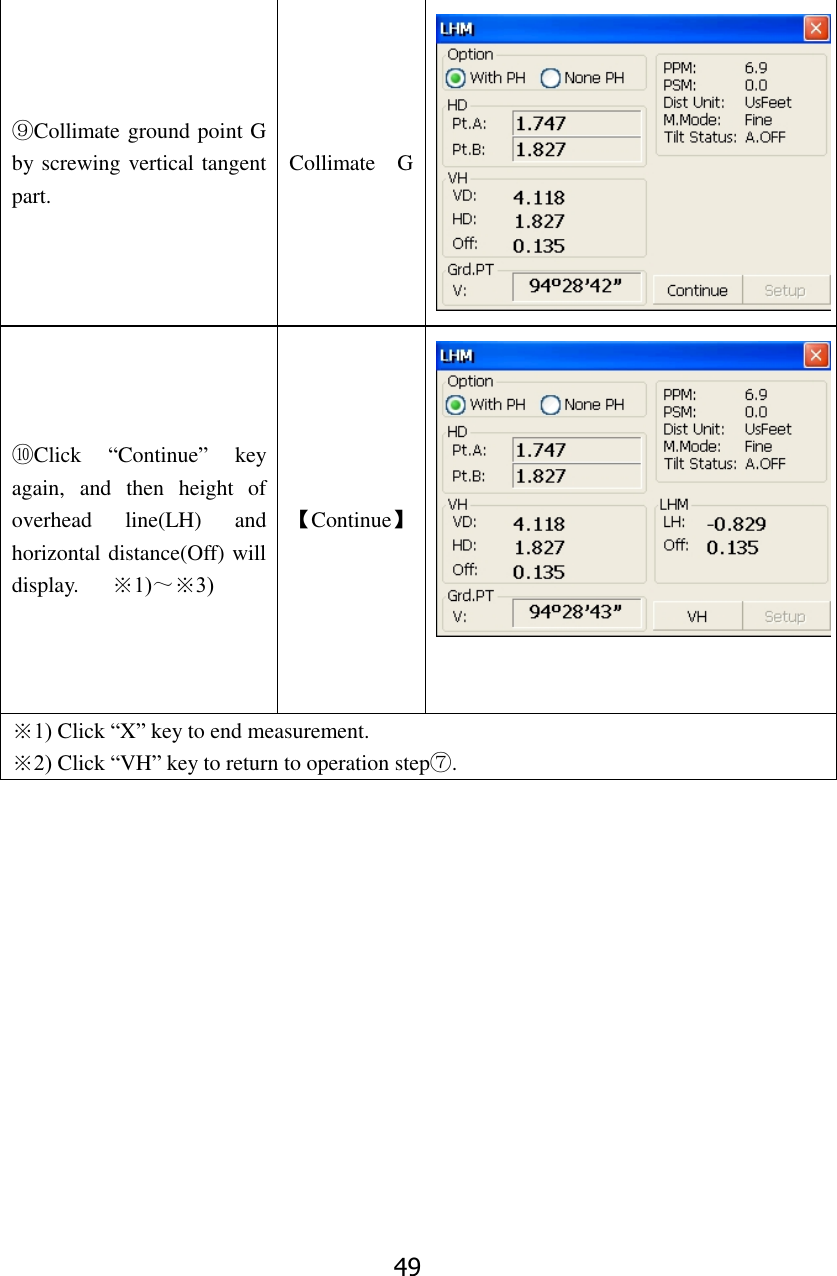
48 ⑥After  measurement  click “Continue” key. 【Continue】  ⑦Collimate  point  L  on overhead  line.  The  screen displays  measuring  data  of collimating L.   VD :Vertical  distance between A and L.   HD :Horizontal  distance between instrument and L. Off :Horizontal  distance between A and L.   ⑧Click  “Continue”  key which is used for measuring height  between  overhead line  and  ground.  Operation steps: ●Collimate  point  on overhead  line  before clicking “Continue” key. ●  Lock  instrument  on  horizontal  direction,  move  telescope  on  vertical  direction  until  aim  at  ground  point G.  【Continue】
49 ⑨Collimate ground point G by screwing vertical tangent part. Collimate    G  ⑩Click  “Continue”  key again,  and  then  height  of   overhead  line(LH)  and horizontal distance(Off) will display.   ※1)~※3) 【Continue】  ※1) Click “X” key to end measurement. ※2) Click “VH” key to return to operation step⑦.
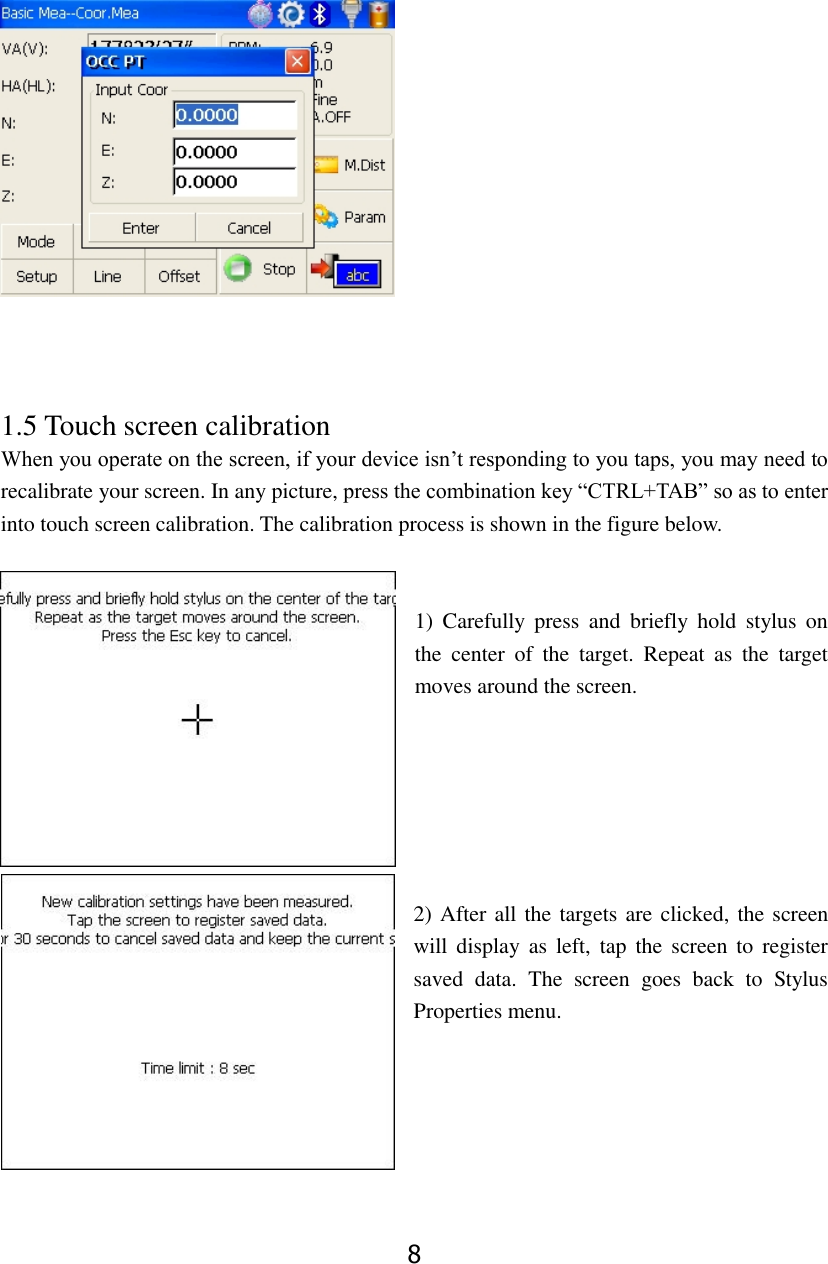
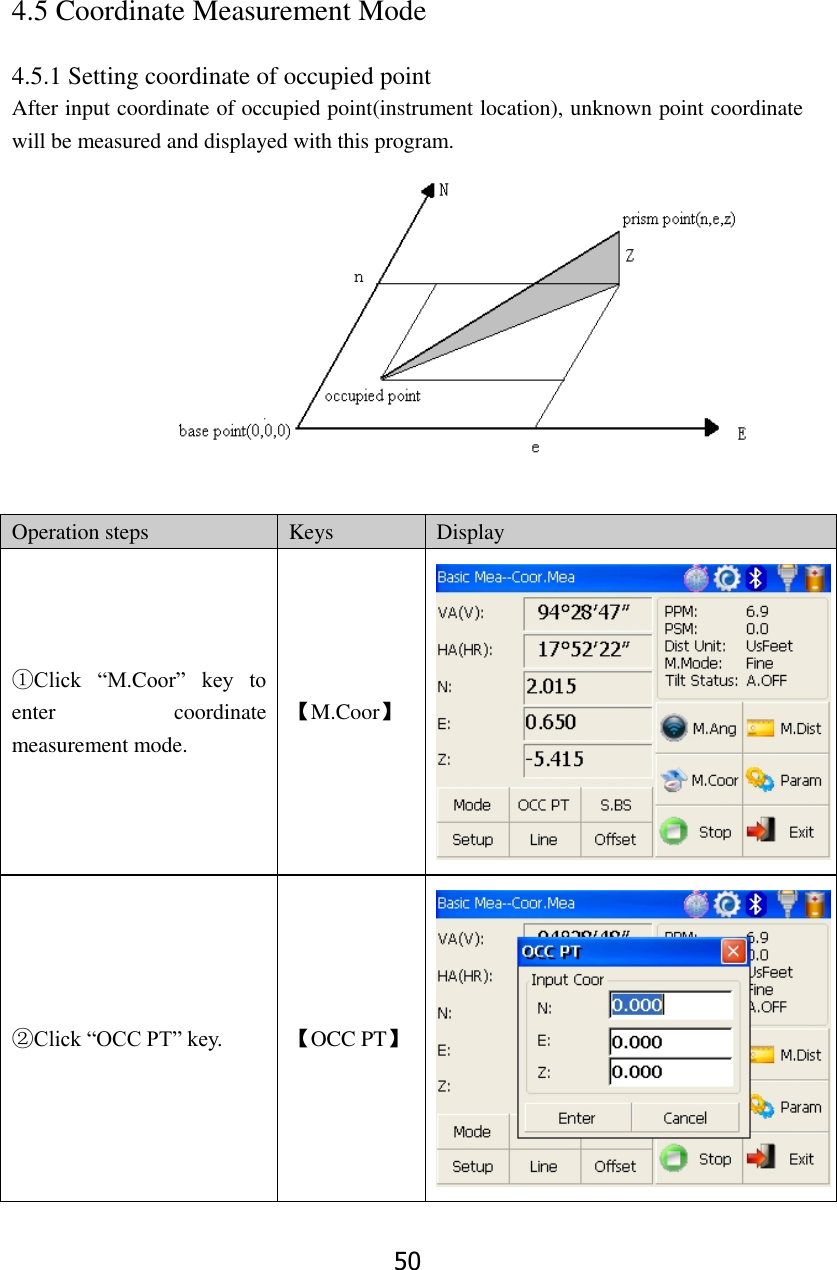
50 4.5 Coordinate Measurement Mode  4.5.1 Setting coordinate of occupied point After input coordinate of occupied point(instrument location), unknown point coordinate will be measured and displayed with this program.                Operation steps Keys Display ①Click  “M.Coor”  key  to enter  coordinate measurement mode. 【M.Coor】  ②Click “OCC PT” key. 【OCC PT】
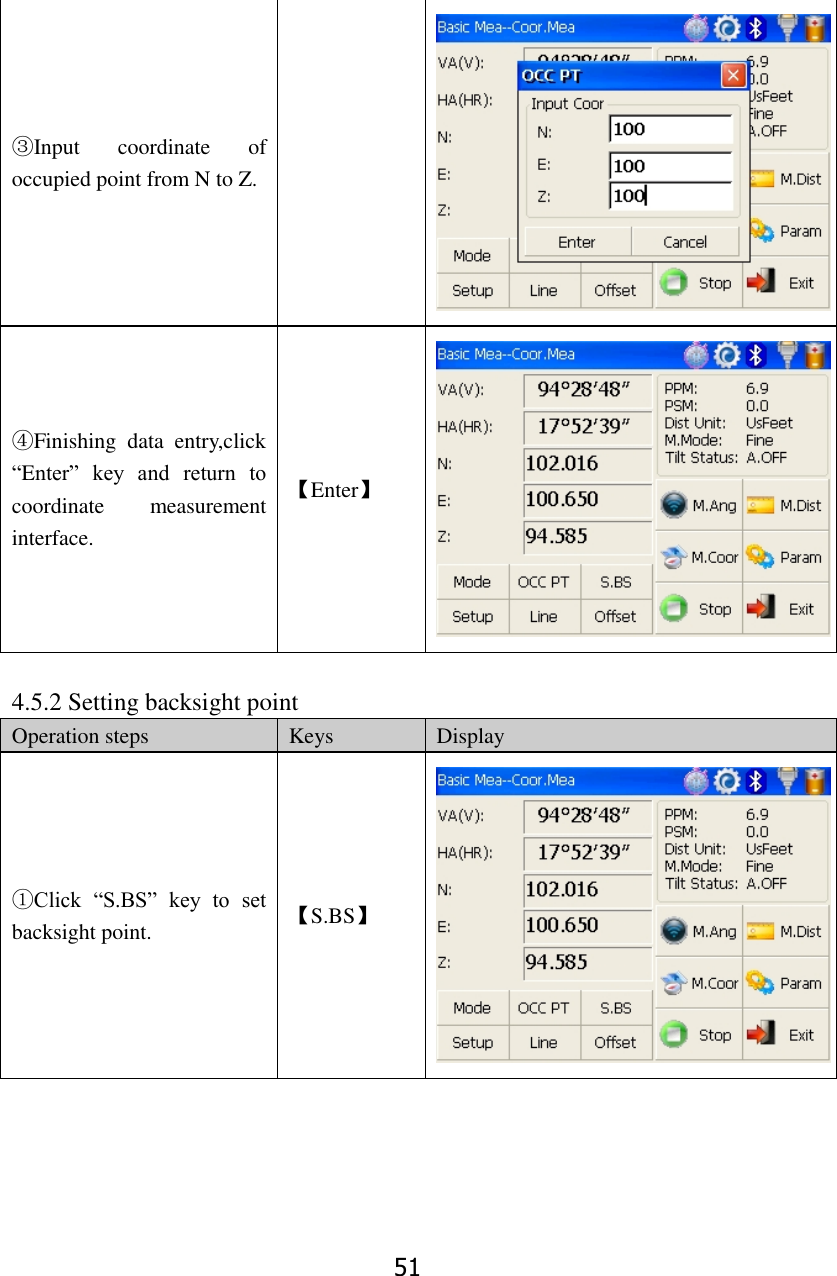
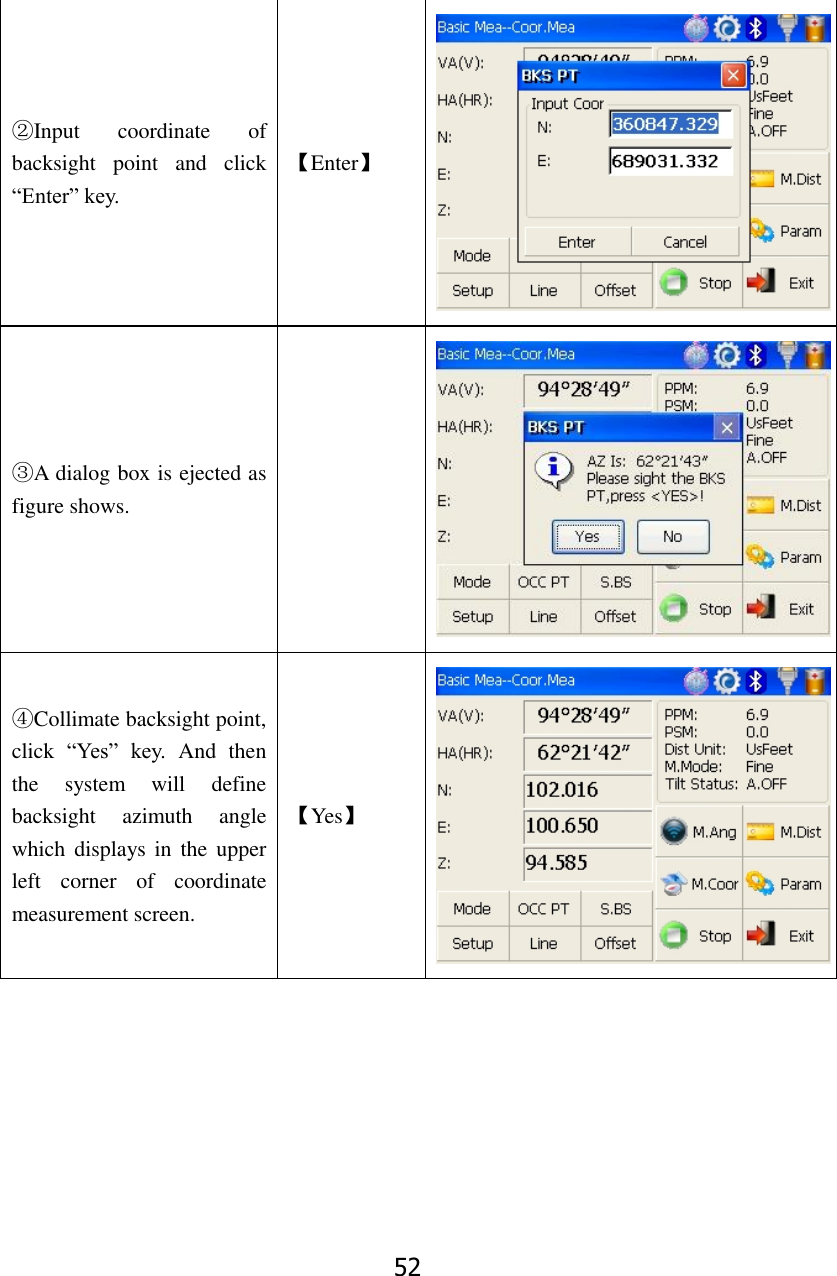
51 ③Input  coordinate  of occupied point from N to Z.   ④Finishing  data  entry,click “Enter”  key  and  return  to coordinate  measurement interface.   【Enter】   4.5.2 Setting backsight point Operation steps Keys Display ①Click  “S.BS”  key  to  set backsight point. 【S.BS】
52 ②Input  coordinate  of backsight  point  and  click “Enter” key. 【Enter】  ③A dialog box is ejected as figure shows.   ④Collimate backsight point, click  “Yes”  key.  And  then the  system  will  define backsight  azimuth  angle which displays in  the upper left  corner  of  coordinate measurement screen. 【Yes】
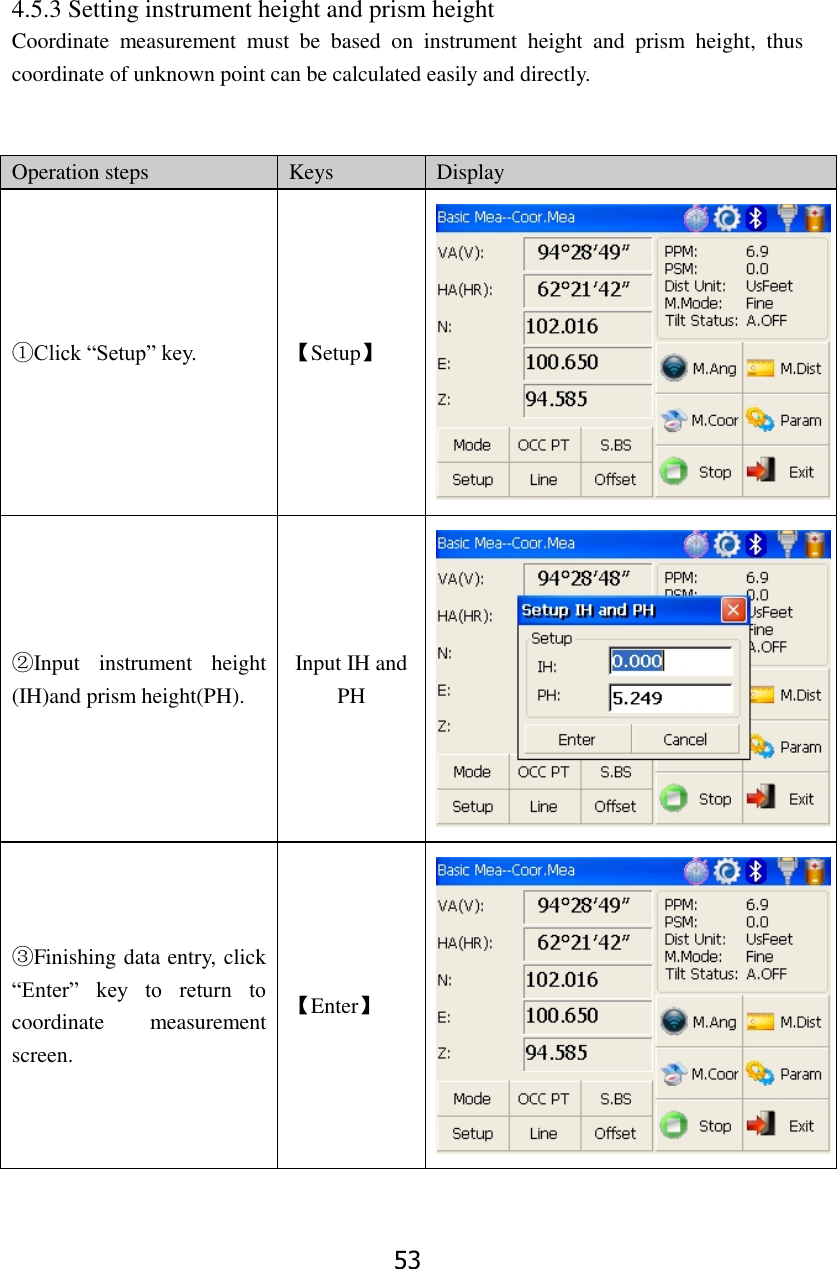
53 4.5.3 Setting instrument height and prism height Coordinate  measurement  must  be  based  on  instrument  height  and  prism  height,  thus coordinate of unknown point can be calculated easily and directly.     Operation steps Keys Display ①Click “Setup” key. 【Setup】  ②Input  instrument  height (IH)and prism height(PH). Input IH and PH  ③Finishing data entry, click “Enter”  key  to  return  to coordinate  measurement screen. 【Enter】
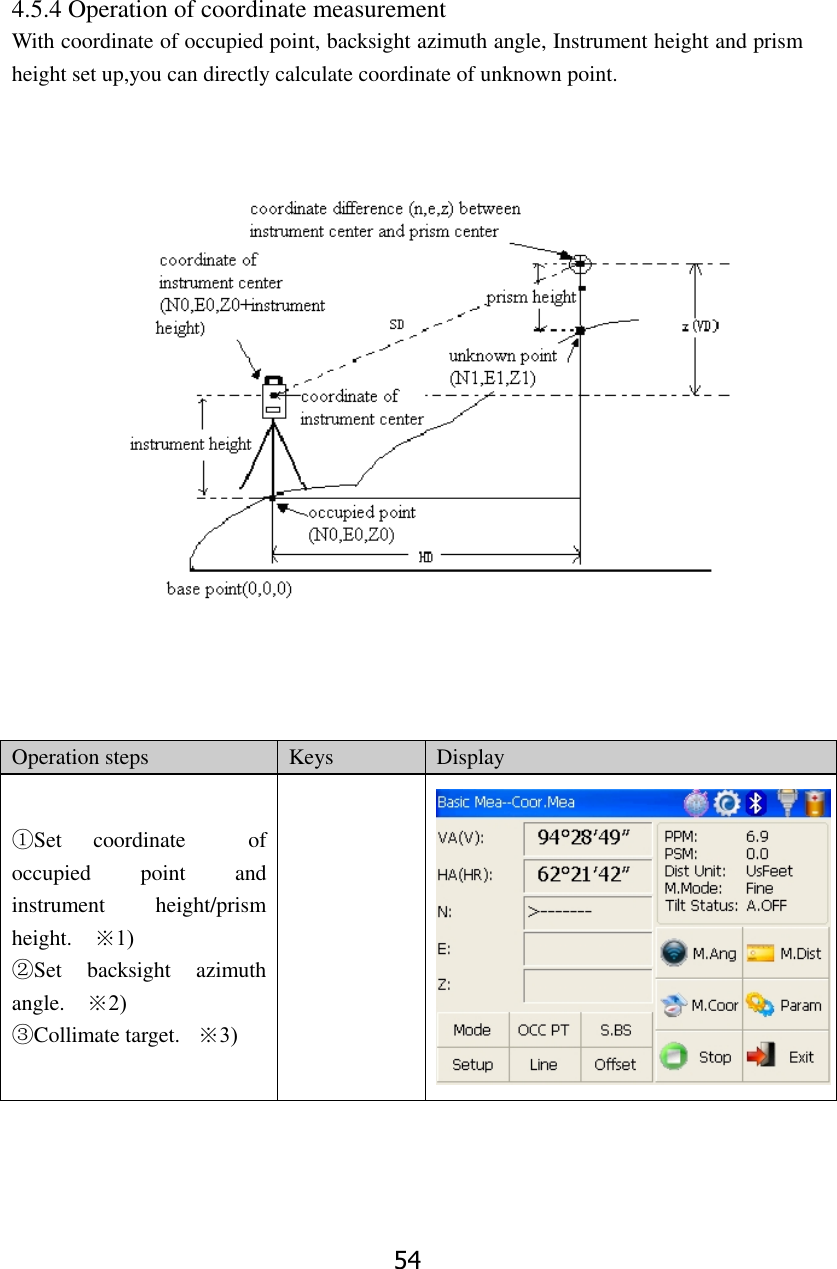
54 4.5.4 Operation of coordinate measurement With coordinate of occupied point, backsight azimuth angle, Instrument height and prism height set up,you can directly calculate coordinate of unknown point.           Operation steps Keys Display ①Set  coordinate    of occupied  point  and instrument  height/prism height.  ※1) ②Set  backsight  azimuth angle.    ※2) ③Collimate target.  ※3)
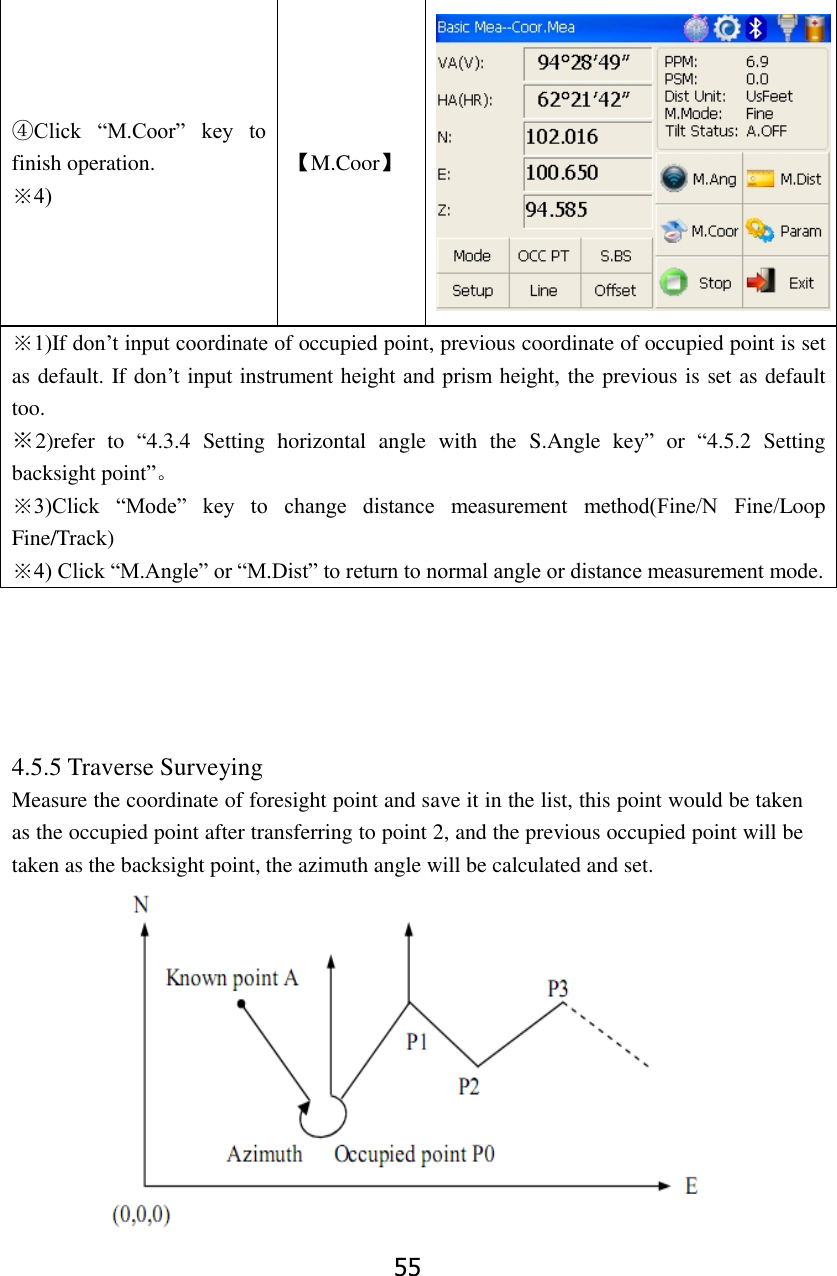
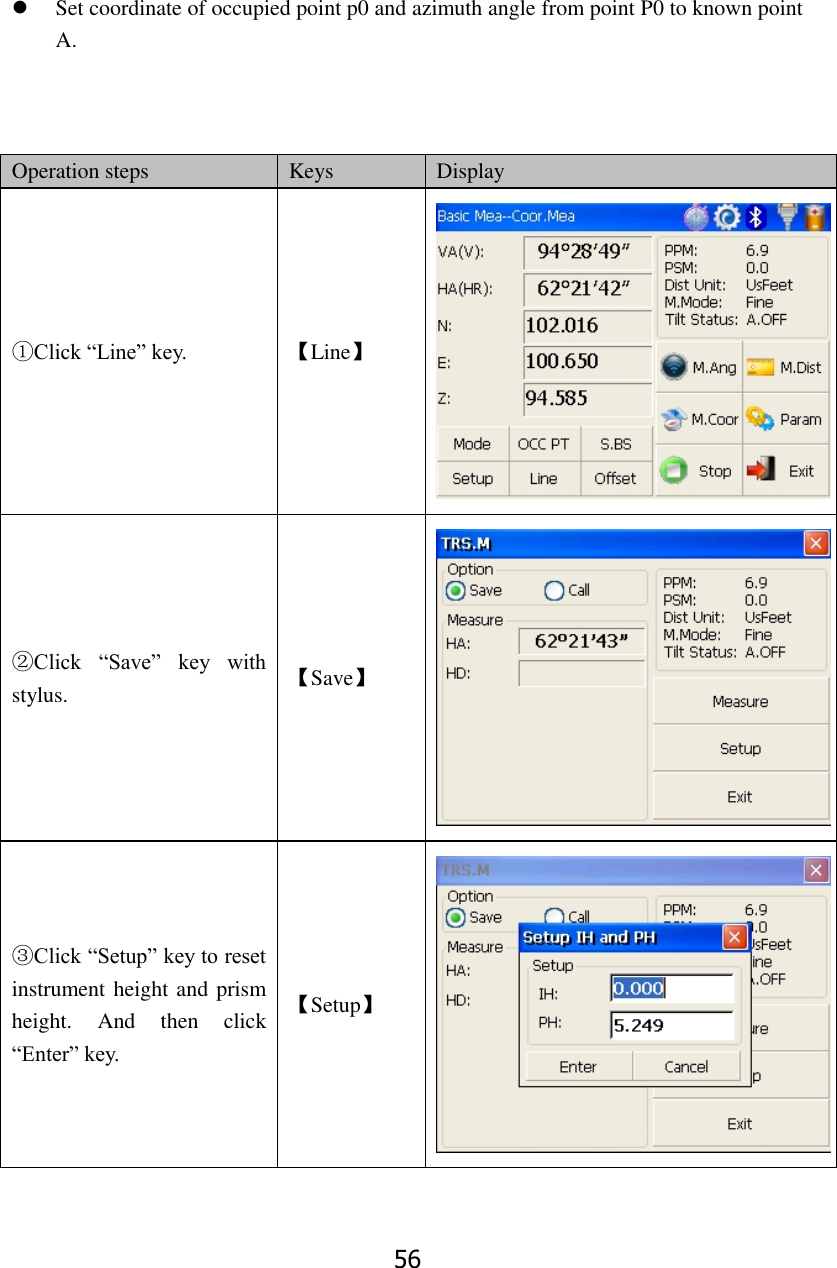
55 ④Click  “M.Coor”  key  to finish operation. ※4) 【M.Coor】  ※1)If don’t input coordinate of occupied point, previous coordinate of occupied point is set as default. If don’t input instrument height and prism height, the previous is set as default too. ※2)refer  to  “4.3.4  Setting  horizontal  angle  with  the  S.Angle  key”  or  “4.5.2  Setting backsight point”。 ※3)Click  “Mode”  key  to  change  distance  measurement  method(Fine/N  Fine/Loop Fine/Track) ※4) Click “M.Angle” or “M.Dist” to return to normal angle or distance measurement mode.      4.5.5 Traverse Surveying Measure the coordinate of foresight point and save it in the list, this point would be taken as the occupied point after transferring to point 2, and the previous occupied point will be taken as the backsight point, the azimuth angle will be calculated and set.
56 ⚫ Set coordinate of occupied point p0 and azimuth angle from point P0 to known point A.        Operation steps Keys Display ①Click “Line” key. 【Line】  ②Click  “Save”  key  with stylus. 【Save】  ③Click “Setup” key to reset instrument height and prism height.  And  then  click “Enter” key.     【Setup】
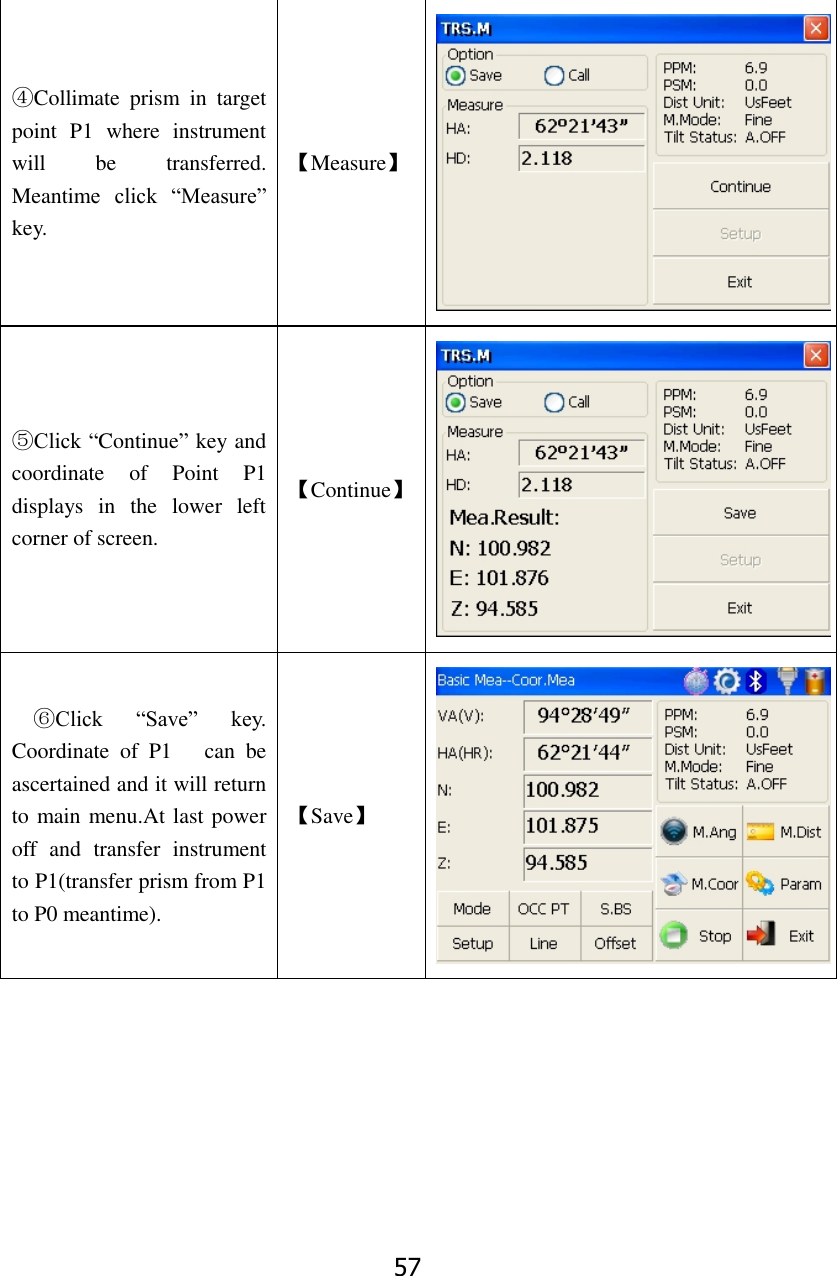
57 ④Collimate  prism  in  target point  P1  where  instrument will  be  transferred. Meantime  click  “Measure” key.     【Measure】  ⑤Click “Continue” key and coordinate  of  Point  P1 displays  in  the  lower  left corner of screen. 【Continue】  ⑥Click  “Save”  key. Coordinate  of  P1      can  be ascertained and it will return to main menu.At last power off  and  transfer  instrument to P1(transfer prism from P1 to P0 meantime). 【Save】
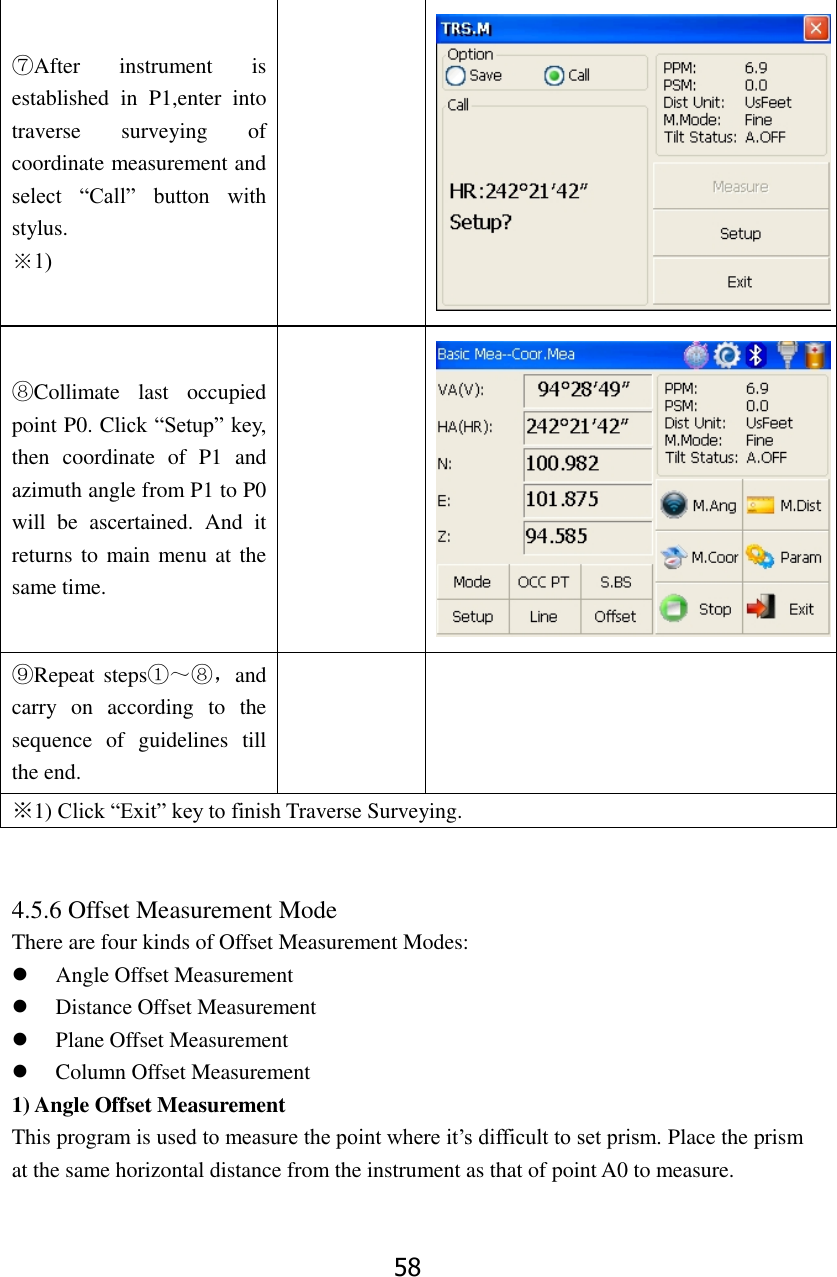
58 ⑦After  instrument  is established  in  P1,enter  into traverse  surveying  of coordinate measurement and select  “Call”  button  with stylus. ※1)   ⑧Collimate  last  occupied point P0. Click “Setup” key, then  coordinate  of  P1  and azimuth angle from P1 to P0 will  be  ascertained.  And  it returns to main menu at the same time.   ⑨Repeat steps①~⑧,and carry  on  according  to  the sequence  of  guidelines  till the end.   ※1) Click “Exit” key to finish Traverse Surveying.   4.5.6 Offset Measurement Mode There are four kinds of Offset Measurement Modes: ⚫ Angle Offset Measurement ⚫ Distance Offset Measurement ⚫ Plane Offset Measurement ⚫ Column Offset Measurement 1) Angle Offset Measurement This program is used to measure the point where it’s difficult to set prism. Place the prism at the same horizontal distance from the instrument as that of point A0 to measure.
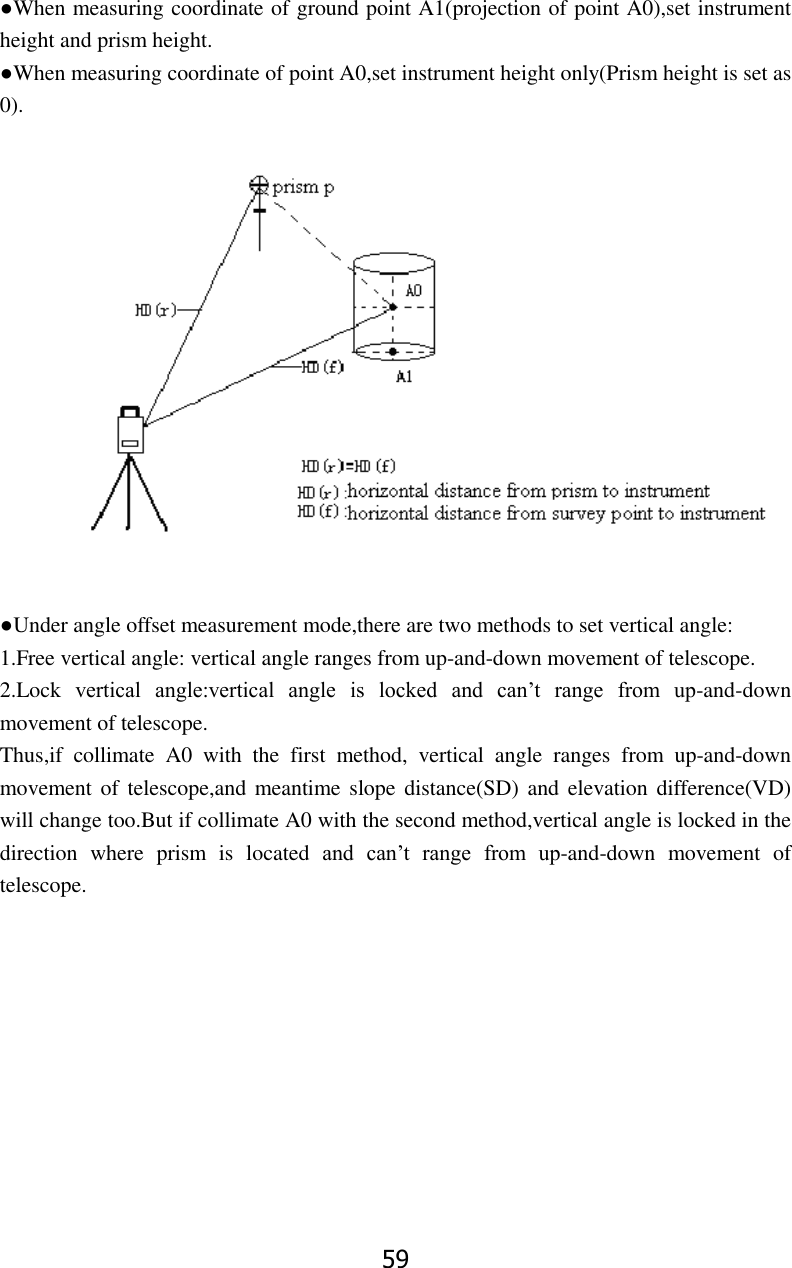
59 ●When measuring coordinate of ground point A1(projection of point A0),set instrument height and prism height. ●When measuring coordinate of point A0,set instrument height only(Prism height is set as 0).     ●Under angle offset measurement mode,there are two methods to set vertical angle: 1.Free vertical angle: vertical angle ranges from up-and-down movement of telescope. 2.Lock  vertical  angle:vertical  angle  is  locked  and  can’t  range  from  up-and-down movement of telescope. Thus,if  collimate  A0  with  the  first  method,  vertical  angle  ranges  from  up-and-down movement of  telescope,and meantime  slope  distance(SD) and  elevation difference(VD) will change too.But if collimate A0 with the second method,vertical angle is locked in the direction  where  prism  is  located  and  can’t  range  from  up-and-down  movement  of telescope.
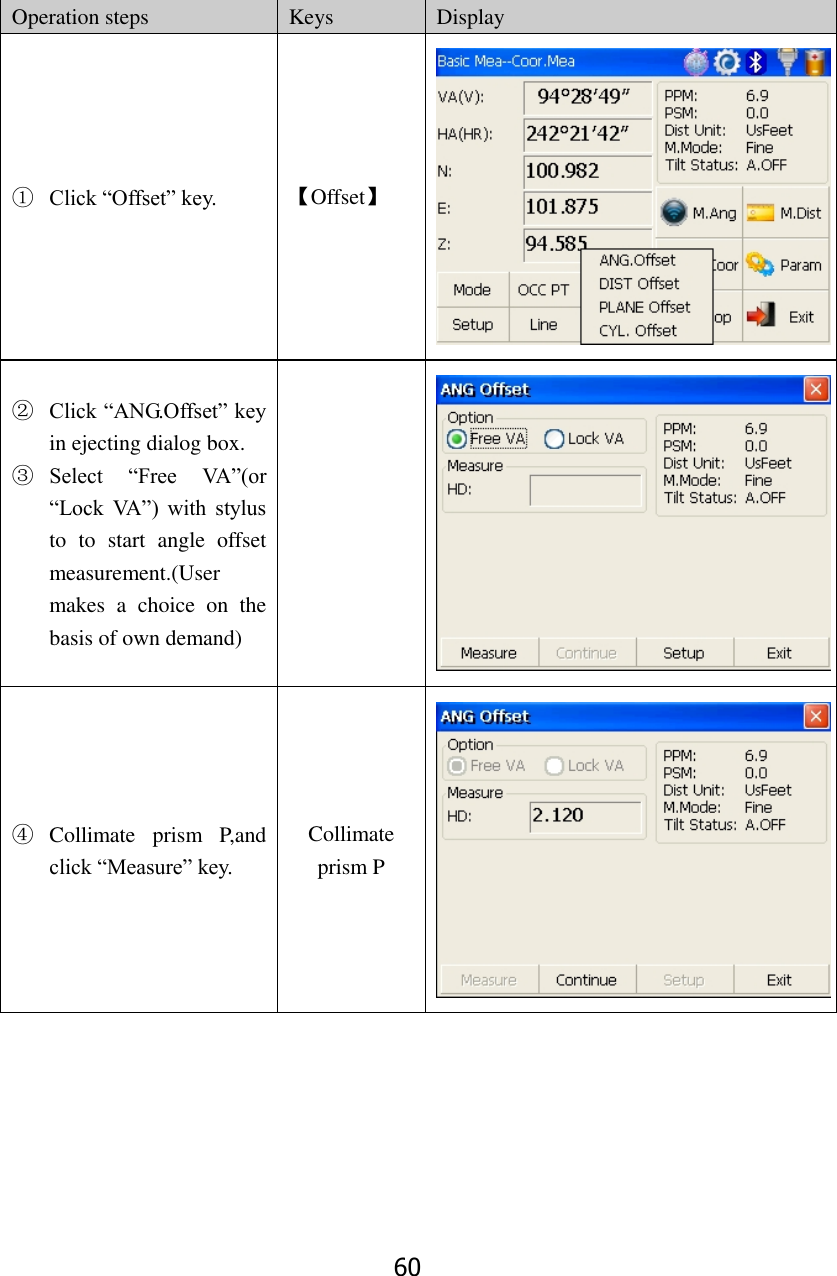
60 Operation steps Keys Display ① Click “Offset” key. 【Offset】  ② Click “ANG.Offset” key in ejecting dialog box. ③ Select  “Free  VA”(or “Lock  VA”)  with  stylus to  to  start  angle  offset measurement.(User makes  a  choice  on  the basis of own demand)   ④ Collimate  prism  P,and click “Measure” key. Collimate prism P
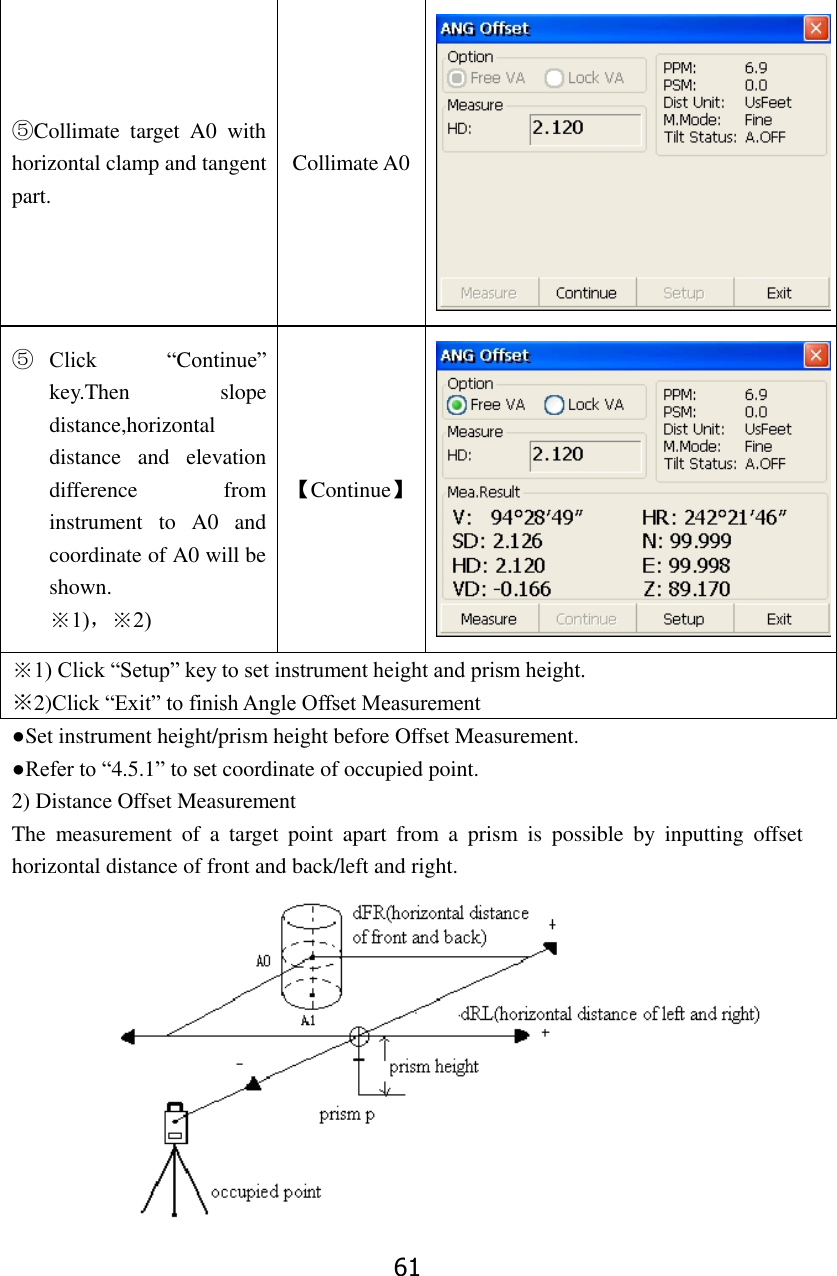
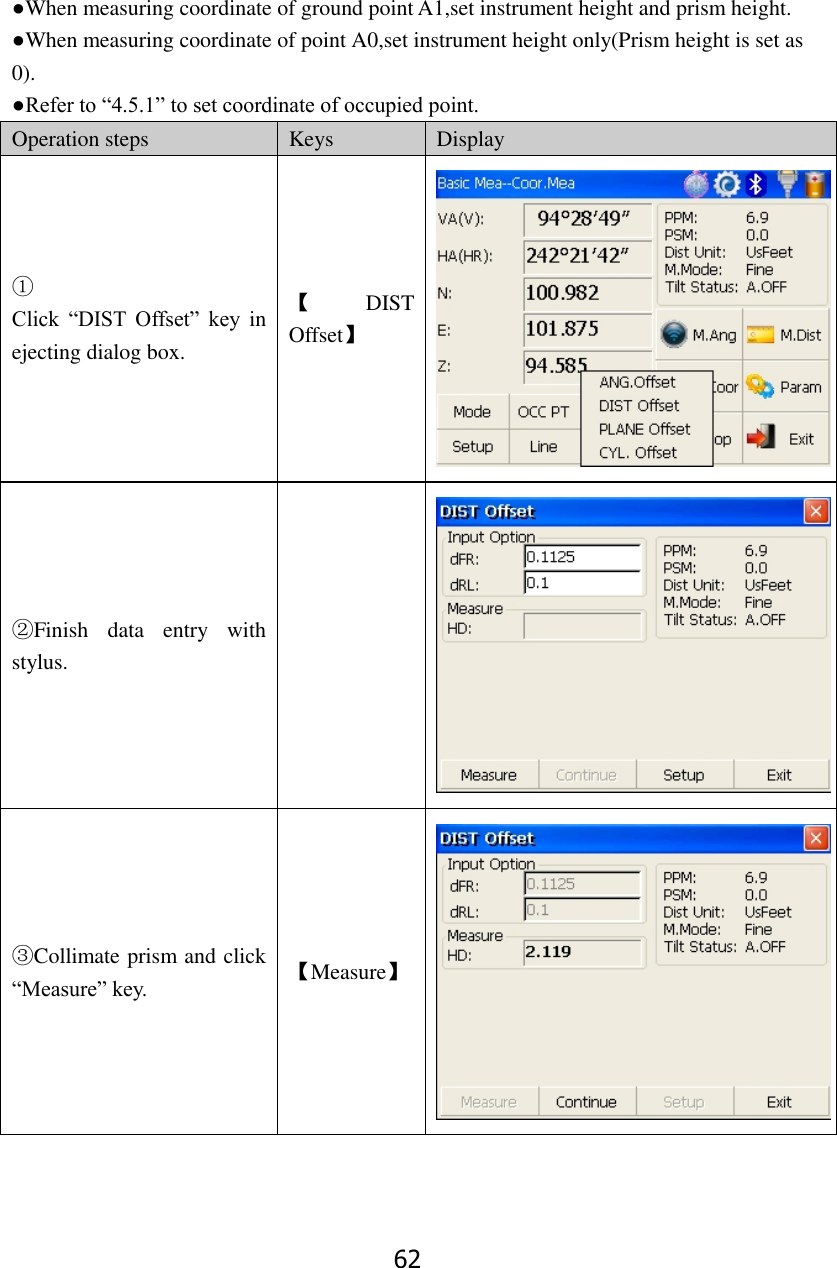
61 ⑤Collimate  target  A0  with horizontal clamp and tangent part. Collimate A0  ⑤ Click  “Continue” key.Then  slope distance,horizontal distance  and  elevation difference  from instrument  to  A0  and coordinate of A0 will be shown. ※1),※2) 【Continue】  ※1) Click “Setup” key to set instrument height and prism height. ※2)Click “Exit” to finish Angle Offset Measurement ●Set instrument height/prism height before Offset Measurement. ●Refer to “4.5.1” to set coordinate of occupied point. 2) Distance Offset Measurement The  measurement  of  a  target  point  apart  from  a  prism  is  possible  by  inputting  offset horizontal distance of front and back/left and right.
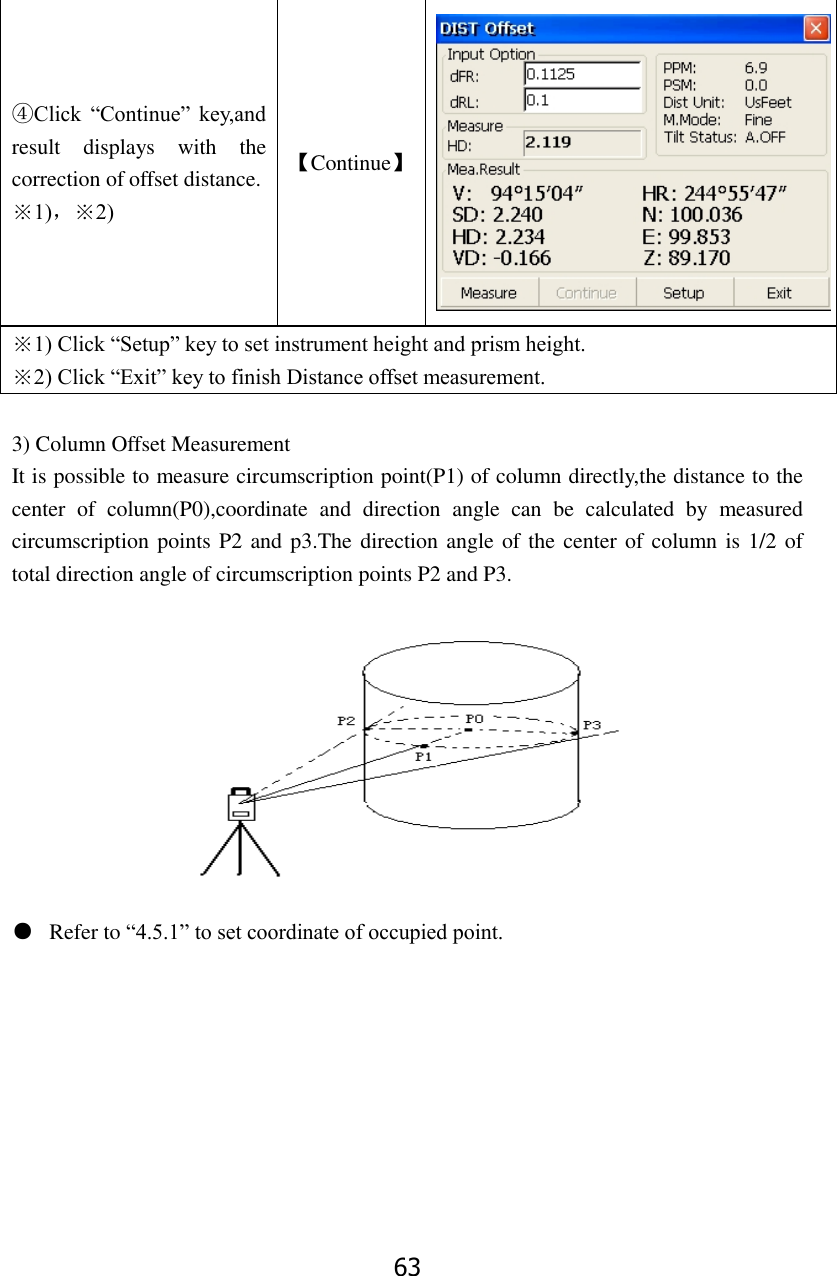
62 ●When measuring coordinate of ground point A1,set instrument height and prism height. ●When measuring coordinate of point A0,set instrument height only(Prism height is set as 0). ●Refer to “4.5.1” to set coordinate of occupied point. Operation steps Keys Display ①  Click  “DIST  Offset”  key  in ejecting dialog box. 【DIST Offset】  ②Finish  data  entry  with stylus.   ③Collimate prism and click “Measure” key. 【Measure】
63 ④Click  “Continue”  key,and result  displays  with  the correction of offset distance. ※1),※2) 【Continue】  ※1) Click “Setup” key to set instrument height and prism height. ※2) Click “Exit” key to finish Distance offset measurement.  3) Column Offset Measurement It is possible to measure circumscription point(P1) of column directly,the distance to the center  of  column(P0),coordinate  and  direction  angle  can  be  calculated  by  measured circumscription points P2 and p3.The direction angle of the center of column is 1/2 of total direction angle of circumscription points P2 and P3.  ● Refer to “4.5.1” to set coordinate of occupied point.
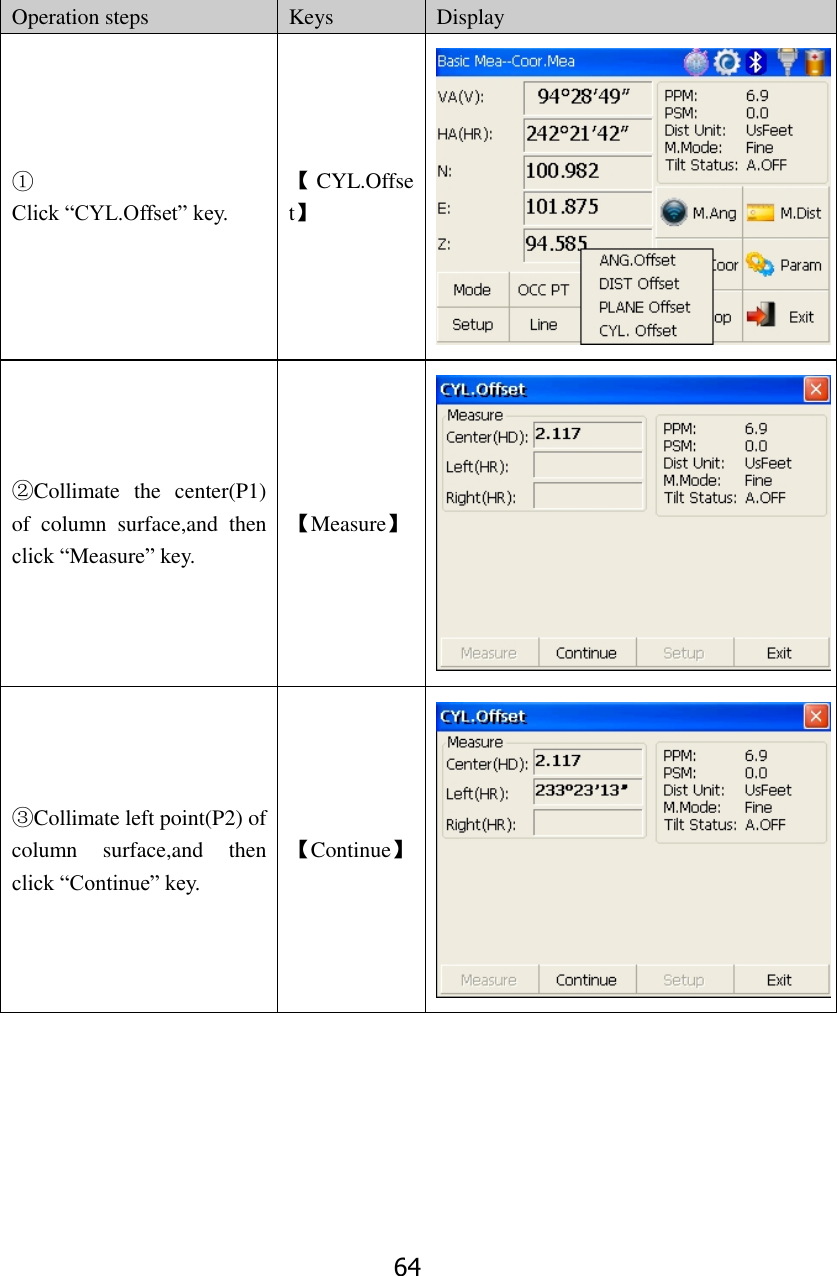
64 Operation steps Keys Display ①  Click “CYL.Offset” key. 【CYL.Offset】  ②Collimate  the  center(P1) of  column  surface,and  then click “Measure” key.   【Measure】  ③Collimate left point(P2) of column  surface,and  then click “Continue” key. 【Continue】
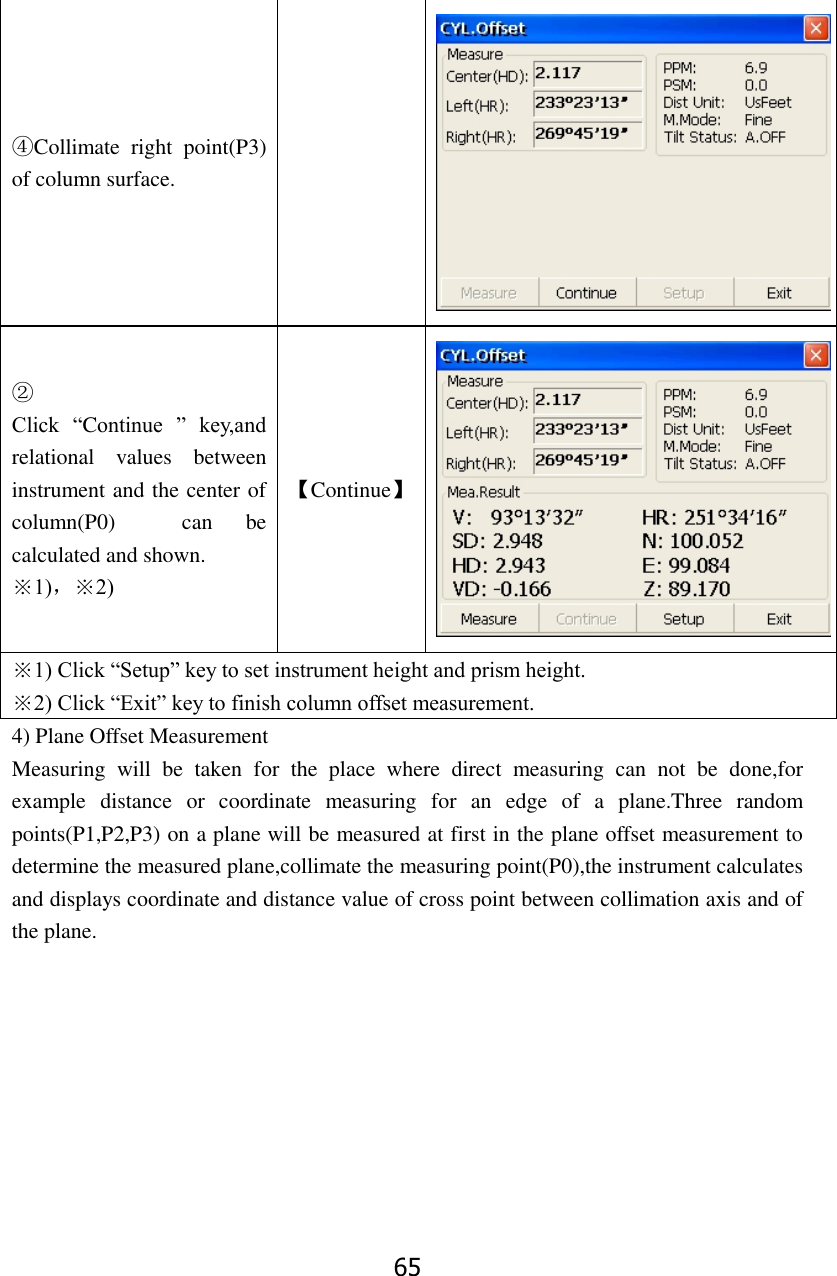
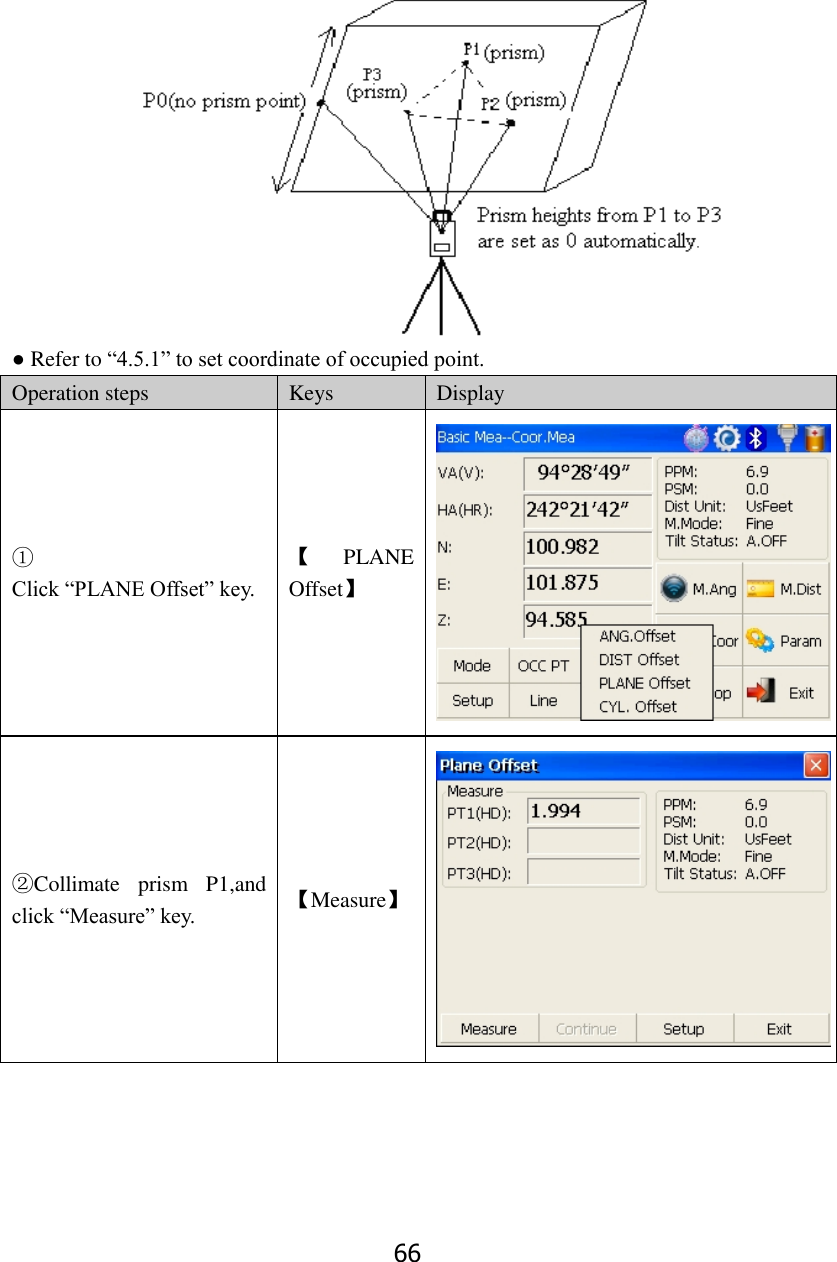
65 ④Collimate  right  point(P3) of column surface.   ②  Click  “Continue  ”  key,and relational  values  between instrument and the center of column(P0)    can  be calculated and shown. ※1),※2) 【Continue】  ※1) Click “Setup” key to set instrument height and prism height. ※2) Click “Exit” key to finish column offset measurement. 4) Plane Offset Measurement Measuring  will  be  taken  for  the  place  where  direct  measuring  can  not  be  done,for example  distance  or  coordinate  measuring  for  an  edge  of  a  plane.Three  random points(P1,P2,P3) on a plane will be measured at first in the plane offset measurement to determine the measured plane,collimate the measuring point(P0),the instrument calculates and displays coordinate and distance value of cross point between collimation axis and of the plane.
66  ● Refer to “4.5.1” to set coordinate of occupied point. Operation steps Keys Display ①  Click “PLANE Offset” key. 【PLANE Offset】  ②Collimate  prism  P1,and click “Measure” key. 【Measure】
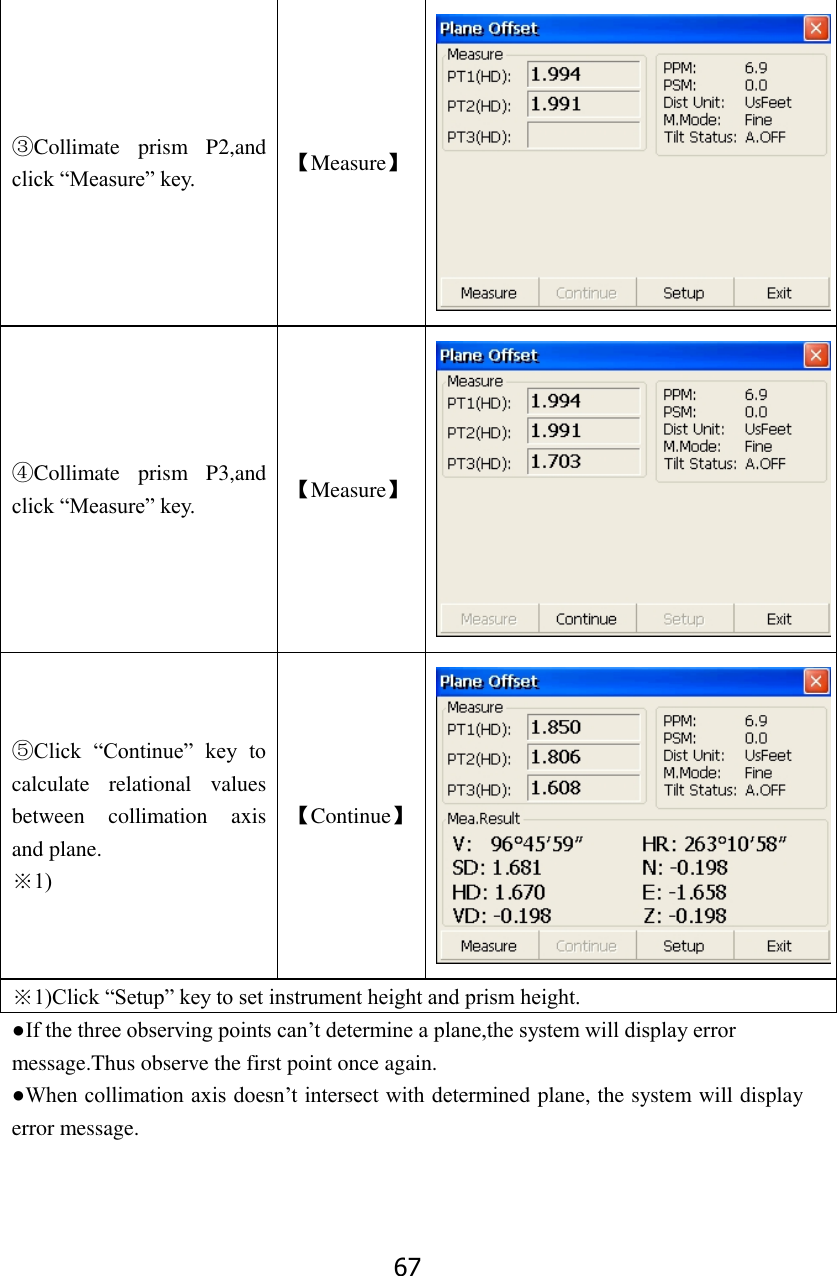
67 ③Collimate  prism  P2,and click “Measure” key. 【Measure】  ④Collimate  prism  P3,and click “Measure” key. 【Measure】  ⑤Click  “Continue”  key  to calculate  relational  values   between  collimation  axis and plane. ※1) 【Continue】  ※1)Click “Setup” key to set instrument height and prism height. ●If the three observing points can’t determine a plane,the system will display error message.Thus observe the first point once again. ●When collimation axis doesn’t intersect with determined plane, the system will display error message.
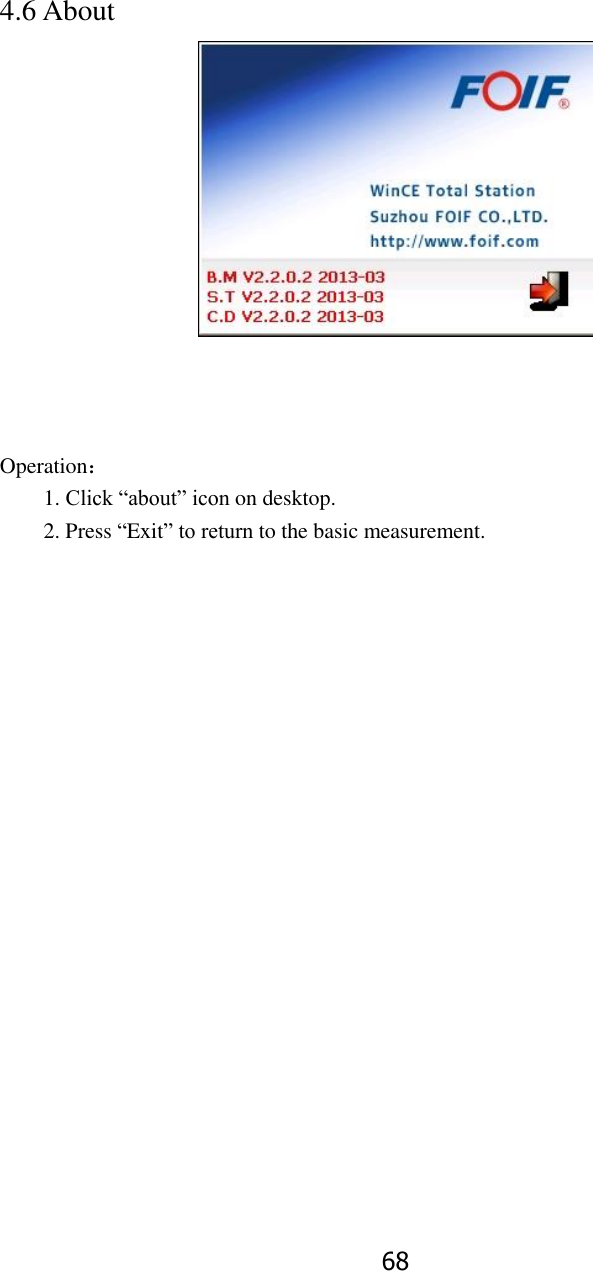
68 4.6 About     Operation: 1. Click “about” icon on desktop. 2. Press “Exit” to return to the basic measurement.
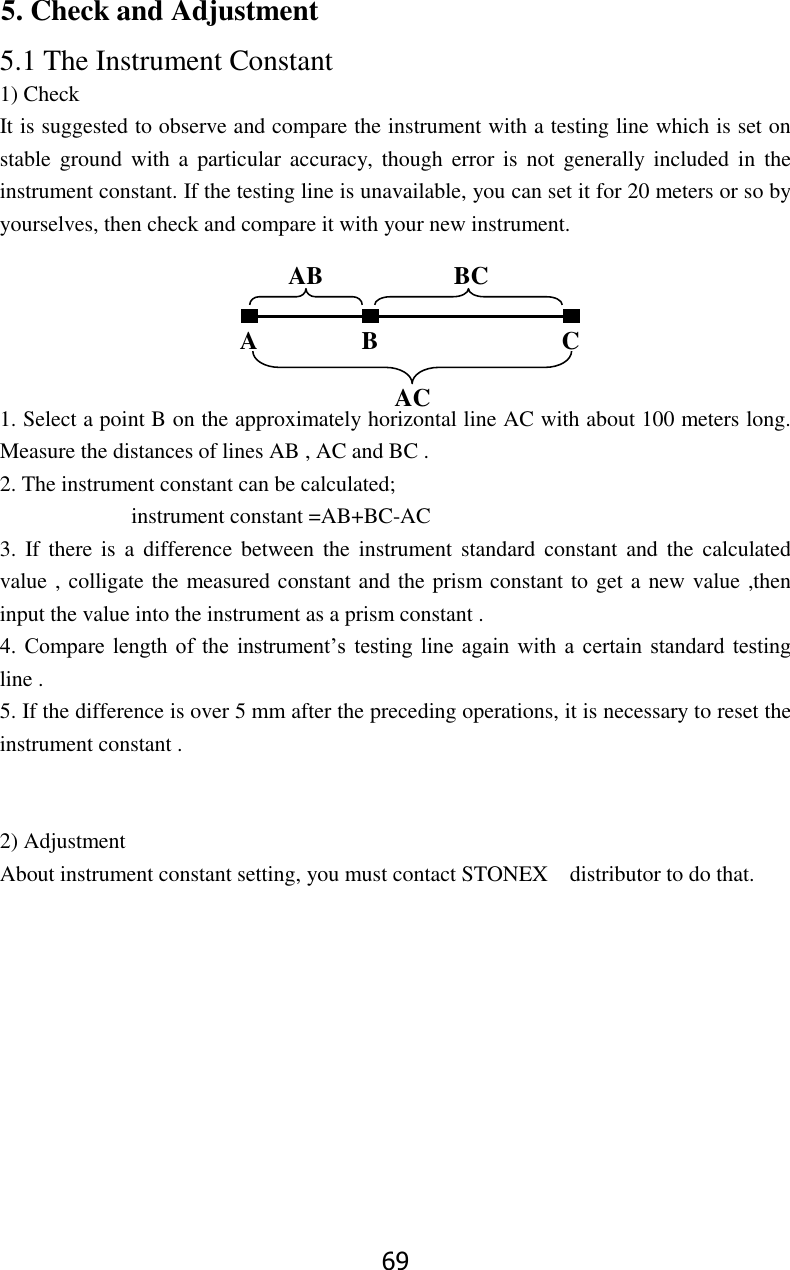
69 5. Check and Adjustment 5.1 The Instrument Constant 1) Check It is suggested to observe and compare the instrument with a testing line which is set on stable ground  with a  particular accuracy, though  error  is not  generally  included in  the instrument constant. If the testing line is unavailable, you can set it for 20 meters or so by yourselves, then check and compare it with your new instrument.        1. Select a point B on the approximately horizontal line AC with about 100 meters long. Measure the distances of lines AB , AC and BC . 2. The instrument constant can be calculated;                         instrument constant =AB+BC-AC 3.  If  there  is a  difference between the  instrument  standard constant  and  the calculated value , colligate the measured constant and the prism constant to get a new value ,then input the value into the instrument as a prism constant . 4.  Compare  length  of  the  instrument’s testing line  again  with  a  certain standard  testing line .   5. If the difference is over 5 mm after the preceding operations, it is necessary to reset the instrument constant .   2) Adjustment About instrument constant setting, you must contact STONEX    distributor to do that.  A B C AB BC AC
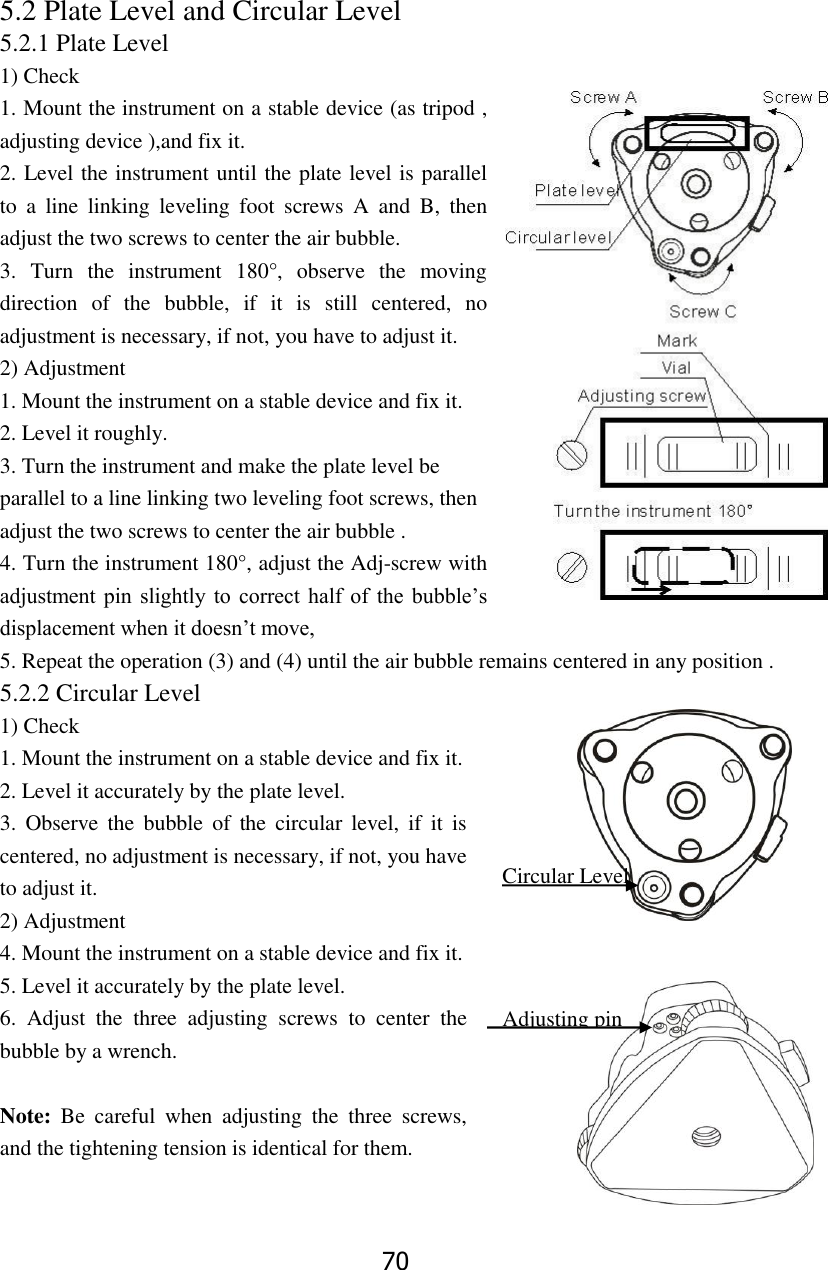
70 5.2 Plate Level and Circular Level 5.2.1 Plate Level 1) Check 1. Mount the instrument on a stable device (as tripod , adjusting device ),and fix it. 2. Level the instrument until the plate level is parallel to  a  line  linking  leveling  foot  screws  A  and  B,  then adjust the two screws to center the air bubble. 3.  Turn  the  instrument  180°,  observe  the  moving direction  of  the  bubble,  if  it  is  still  centered,  no adjustment is necessary, if not, you have to adjust it. 2) Adjustment 1. Mount the instrument on a stable device and fix it. 2. Level it roughly. 3. Turn the instrument and make the plate level be parallel to a line linking two leveling foot screws, then adjust the two screws to center the air bubble . 4. Turn the instrument 180°, adjust the Adj-screw with adjustment  pin  slightly to  correct half  of  the  bubble’s displacement when it doesn’t move,   5. Repeat the operation (3) and (4) until the air bubble remains centered in any position . 5.2.2 Circular Level 1) Check 1. Mount the instrument on a stable device and fix it. 2. Level it accurately by the plate level.   3.  Observe  the  bubble  of  the circular  level,  if  it  is centered, no adjustment is necessary, if not, you have to adjust it. 2) Adjustment 4. Mount the instrument on a stable device and fix it. 5. Level it accurately by the plate level. 6.  Adjust  the  three  adjusting  screws  to  center  the bubble by a wrench.      Note:  Be  careful  when  adjusting  the  three  screws, and the tightening tension is identical for them.  Circular Level level Lever Adjusting pin
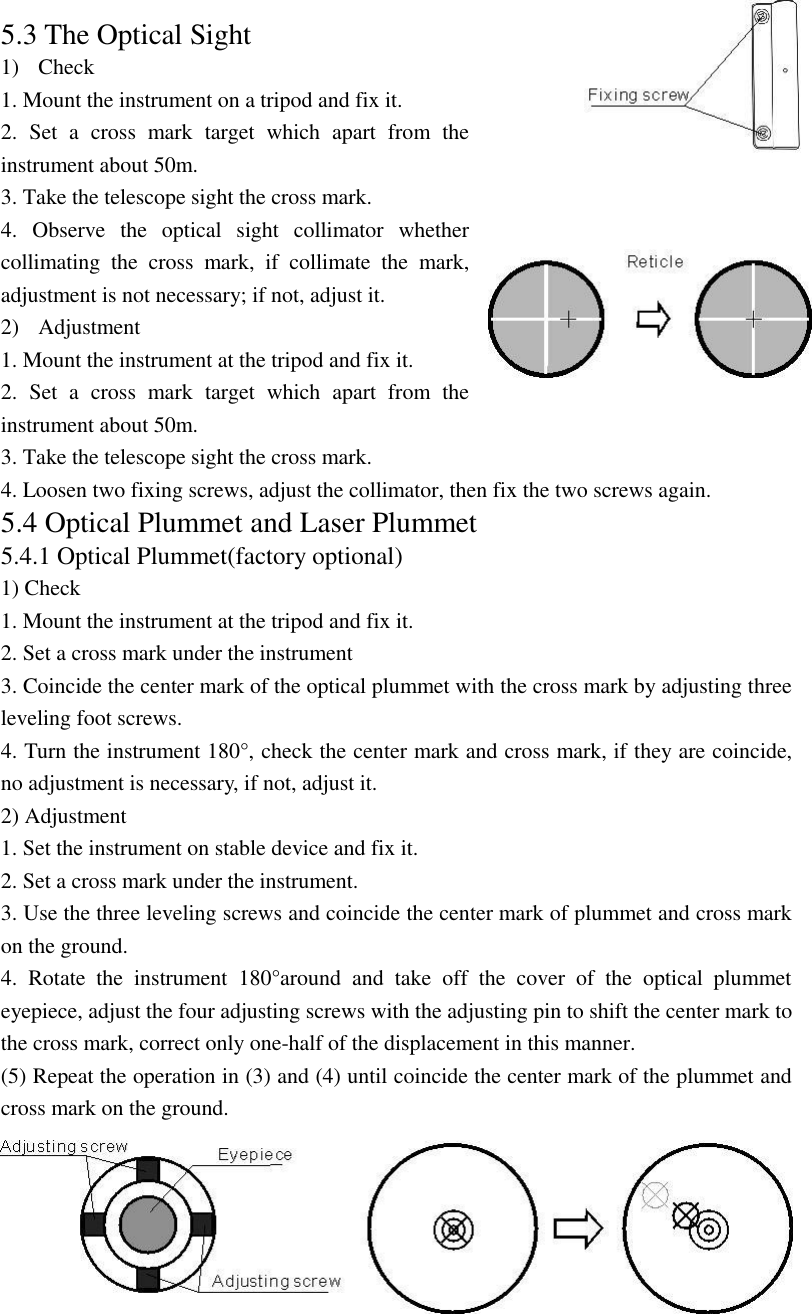
71 5.3 The Optical Sight 1) Check 1. Mount the instrument on a tripod and fix it. 2.  Set  a  cross  mark  target  which  apart  from  the instrument about 50m. 3. Take the telescope sight the cross mark. 4.  Observe  the  optical  sight  collimator  whether collimating  the  cross  mark,  if  collimate  the  mark, adjustment is not necessary; if not, adjust it. 2) Adjustment   1. Mount the instrument at the tripod and fix it. 2.  Set  a  cross  mark  target  which  apart  from  the instrument about 50m. 3. Take the telescope sight the cross mark. 4. Loosen two fixing screws, adjust the collimator, then fix the two screws again. 5.4 Optical Plummet and Laser Plummet 5.4.1 Optical Plummet(factory optional) 1) Check 1. Mount the instrument at the tripod and fix it. 2. Set a cross mark under the instrument 3. Coincide the center mark of the optical plummet with the cross mark by adjusting three leveling foot screws. 4. Turn the instrument 180°, check the center mark and cross mark, if they are coincide, no adjustment is necessary, if not, adjust it.   2) Adjustment   1. Set the instrument on stable device and fix it. 2. Set a cross mark under the instrument. 3. Use the three leveling screws and coincide the center mark of plummet and cross mark on the ground. 4.  Rotate  the  instrument  180°around  and  take  off  the  cover  of  the  optical  plummet eyepiece, adjust the four adjusting screws with the adjusting pin to shift the center mark to the cross mark, correct only one-half of the displacement in this manner. (5) Repeat the operation in (3) and (4) until coincide the center mark of the plummet and cross mark on the ground.
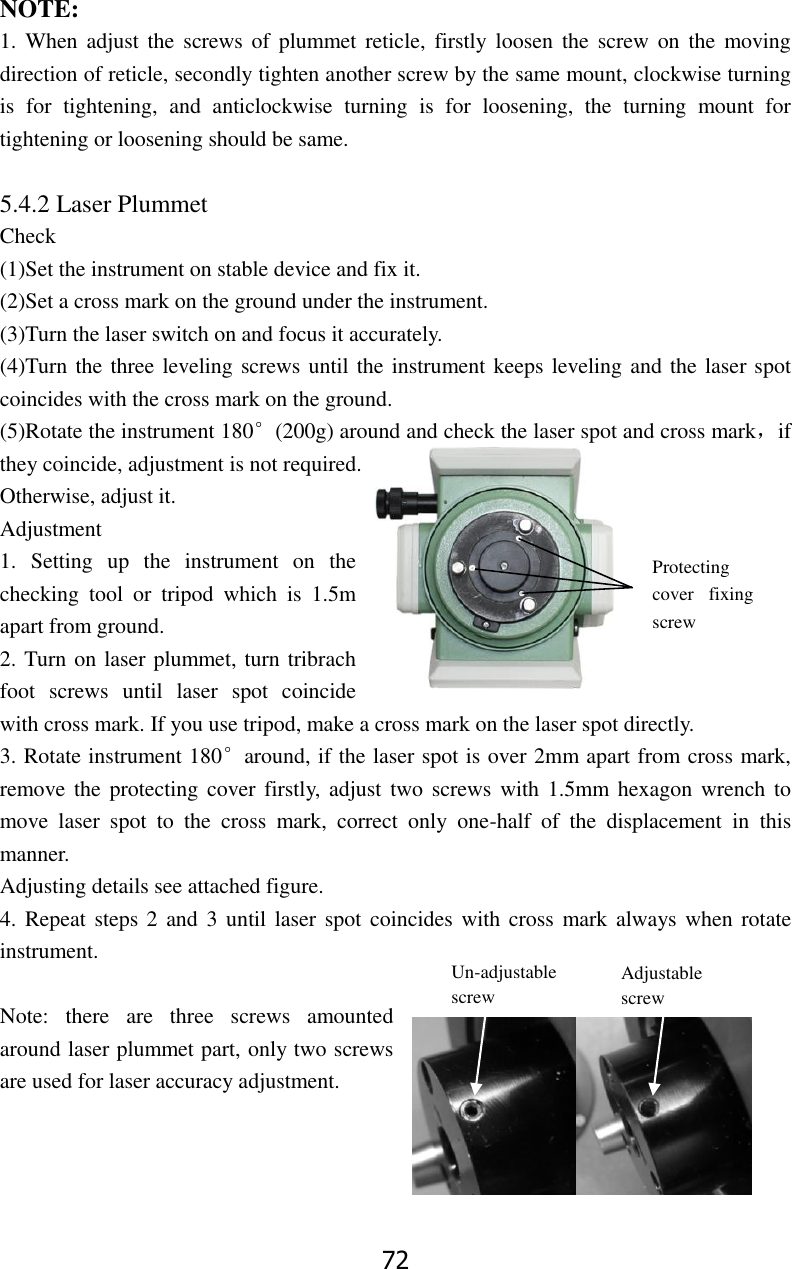
72 NOTE: 1.  When  adjust  the screws of  plummet  reticle,  firstly  loosen the  screw on  the  moving direction of reticle, secondly tighten another screw by the same mount, clockwise turning is  for  tightening,  and  anticlockwise  turning  is  for  loosening,  the  turning  mount  for tightening or loosening should be same.  5.4.2 Laser Plummet  Check   (1)Set the instrument on stable device and fix it. (2)Set a cross mark on the ground under the instrument. (3)Turn the laser switch on and focus it accurately. (4)Turn the three leveling screws until the instrument keeps leveling and the laser spot coincides with the cross mark on the ground. (5)Rotate the instrument 180°(200g) around and check the laser spot and cross mark,if they coincide, adjustment is not required. Otherwise, adjust it. Adjustment 1.  Setting  up  the  instrument  on  the checking  tool  or  tripod  which  is  1.5m apart from ground. 2. Turn on laser plummet, turn tribrach foot  screws  until  laser  spot  coincide with cross mark. If you use tripod, make a cross mark on the laser spot directly. 3. Rotate instrument 180°around, if the laser spot is over 2mm apart from cross mark, remove the  protecting cover firstly,  adjust two screws  with  1.5mm  hexagon wrench to move  laser  spot  to  the  cross  mark,  correct  only  one-half  of  the  displacement  in  this manner. Adjusting details see attached figure. 4. Repeat steps 2  and 3  until laser spot  coincides  with cross mark always when rotate instrument.  Note:  there  are  three  screws  amounted around laser plummet part, only two screws are used for laser accuracy adjustment.    Protecting cover  fixing screw Un-adjustable screw Adjustable screw
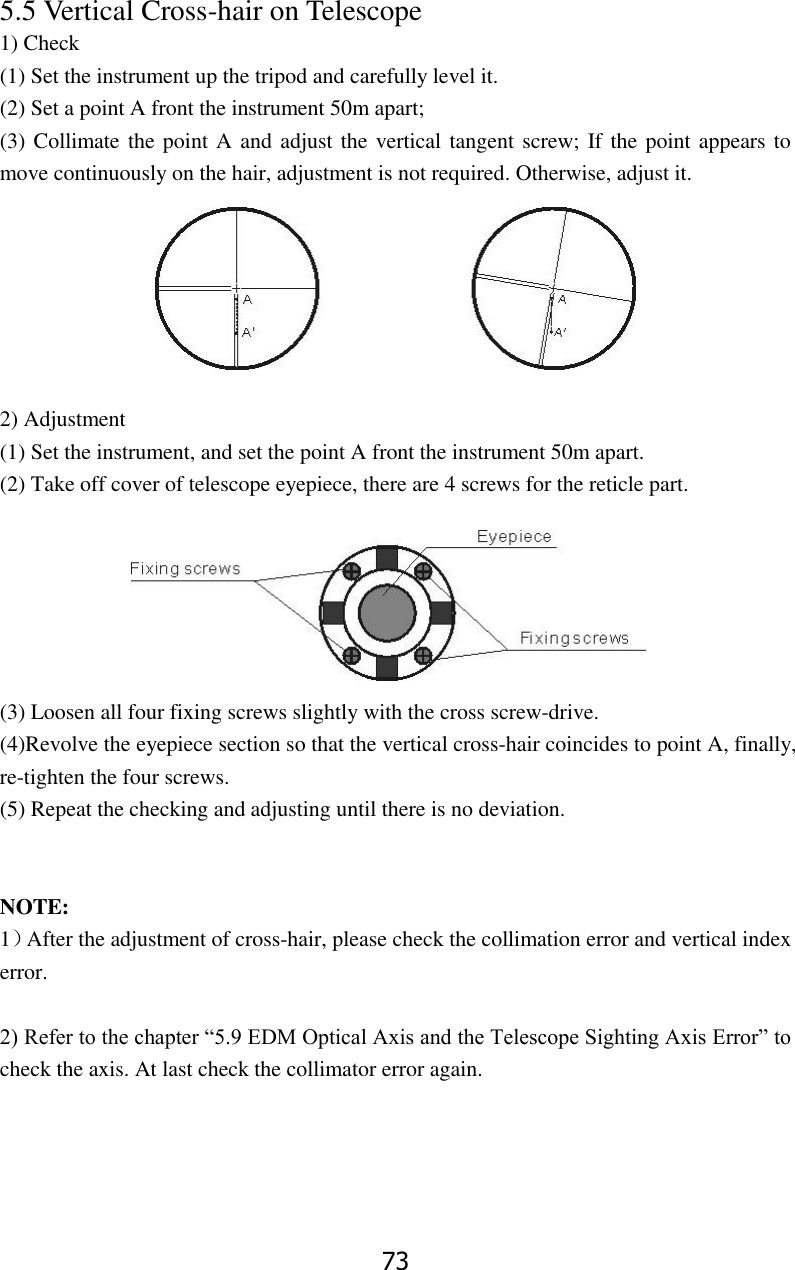
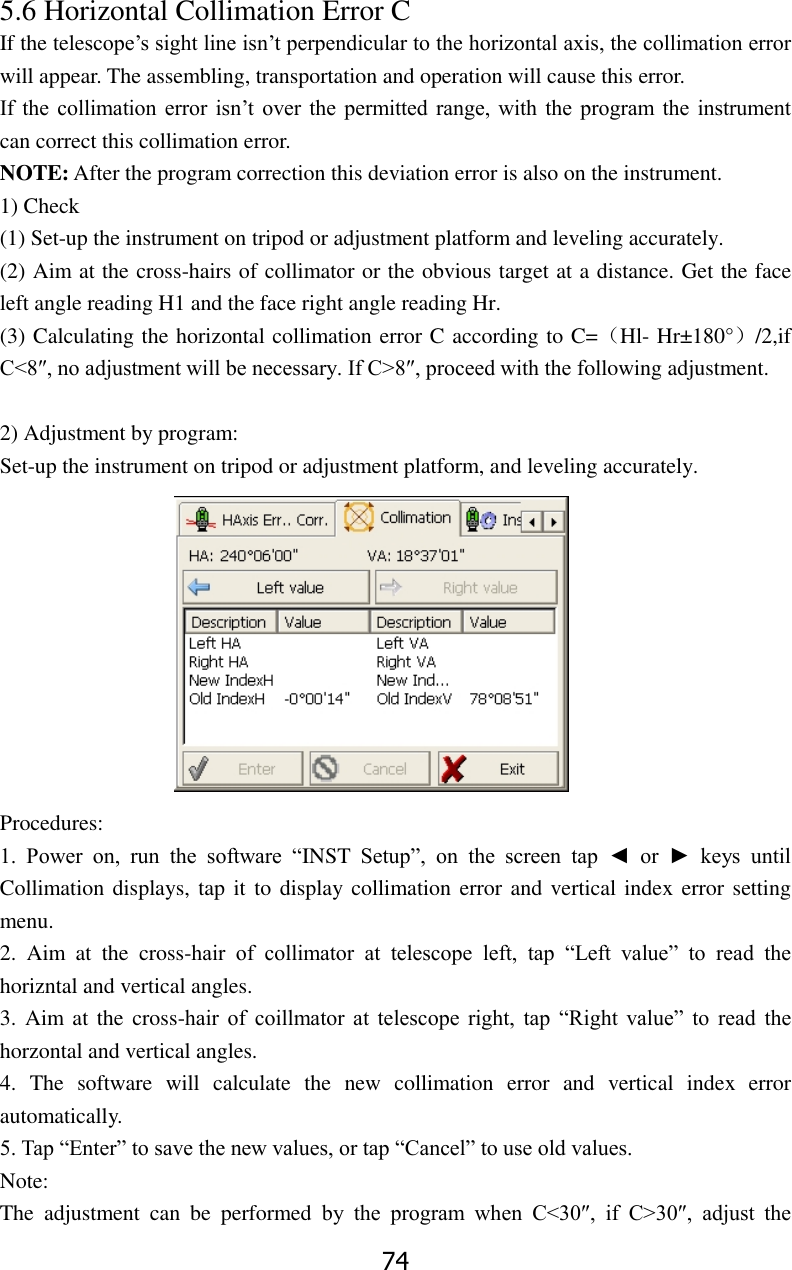
73 5.5 Vertical Cross-hair on Telescope 1) Check   (1) Set the instrument up the tripod and carefully level it. (2) Set a point A front the instrument 50m apart; (3) Collimate the point A and adjust the vertical tangent screw; If the point appears to move continuously on the hair, adjustment is not required. Otherwise, adjust it.  2) Adjustment   (1) Set the instrument, and set the point A front the instrument 50m apart. (2) Take off cover of telescope eyepiece, there are 4 screws for the reticle part.       (3) Loosen all four fixing screws slightly with the cross screw-drive.   (4)Revolve the eyepiece section so that the vertical cross-hair coincides to point A, finally, re-tighten the four screws. (5) Repeat the checking and adjusting until there is no deviation.   NOTE:   1)After the adjustment of cross-hair, please check the collimation error and vertical index error.  2) Refer to the chapter “5.9 EDM Optical Axis and the Telescope Sighting Axis Error” to check the axis. At last check the collimator error again.
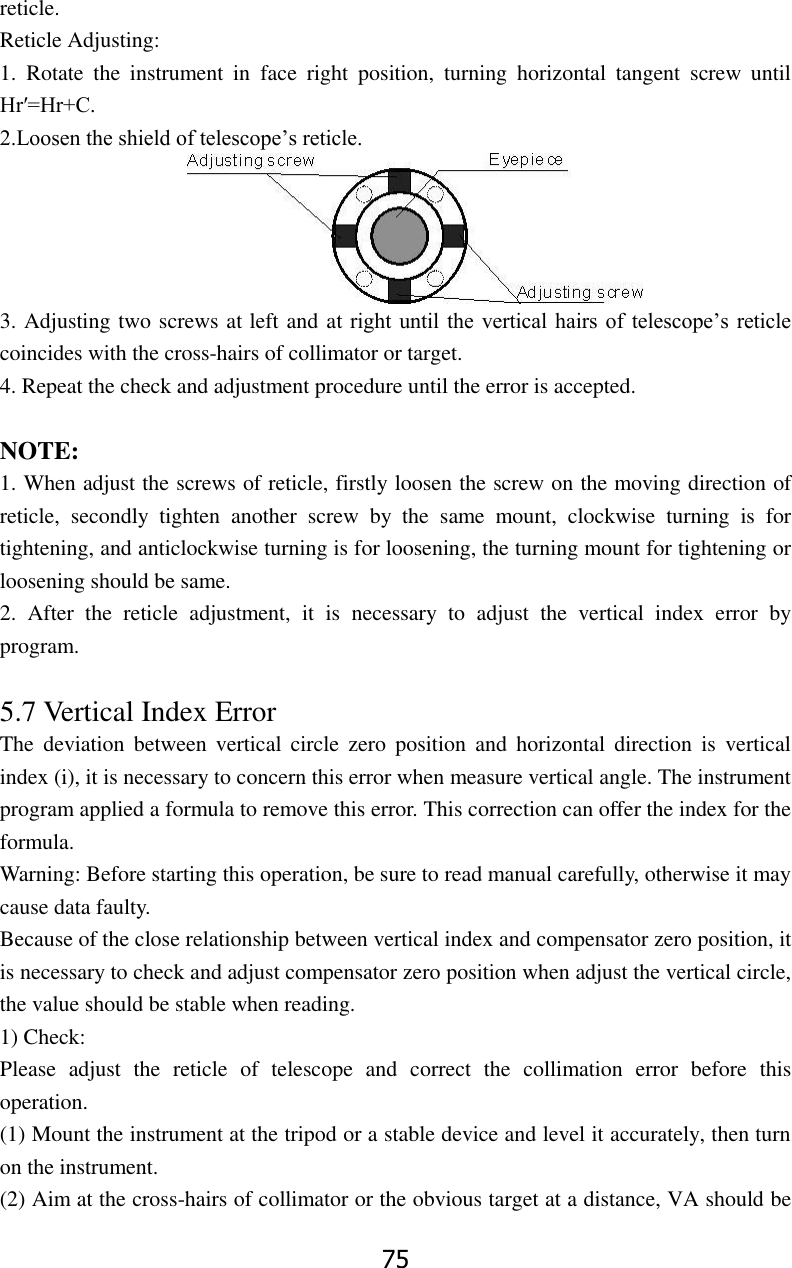
74 5.6 Horizontal Collimation Error C   If the telescope’s sight line isn’t perpendicular to the horizontal axis, the collimation error will appear. The assembling, transportation and operation will cause this error. If the  collimation error  isn’t over  the  permitted  range,  with  the  program  the  instrument can correct this collimation error. NOTE: After the program correction this deviation error is also on the instrument. 1) Check (1) Set-up the instrument on tripod or adjustment platform and leveling accurately. (2) Aim at the cross-hairs of collimator or the obvious target at a distance. Get the face left angle reading H1 and the face right angle reading Hr. (3) Calculating the horizontal collimation error C according to C=(Hl- Hr±180°)/2,if C<8″, no adjustment will be necessary. If C>8″, proceed with the following adjustment.    2) Adjustment by program: Set-up the instrument on tripod or adjustment platform, and leveling accurately.  Procedures: 1.  Power  on,  run  the  software  “INST  Setup”,  on  the  screen  tap  ◄  or  ►  keys  until Collimation displays, tap it to  display collimation error and vertical index error setting menu. 2.  Aim  at  the  cross-hair  of  collimator  at  telescope  left,  tap  “Left  value”  to  read  the horizntal and vertical angles. 3. Aim at  the  cross-hair  of  coillmator  at  telescope  right,  tap  “Right  value”  to  read  the horzontal and vertical angles. 4.  The  software  will  calculate  the  new  collimation  error  and  vertical  index  error automatically. 5. Tap “Enter” to save the new values, or tap “Cancel” to use old values. Note: The  adjustment  can  be  performed  by  the  program  when  C<30″,  if  C>30″,  adjust  the
75 reticle. Reticle Adjusting: 1.  Rotate  the  instrument  in  face  right  position,  turning  horizontal  tangent  screw  until Hr′=Hr+C. 2.Loosen the shield of telescope’s reticle. 3. Adjusting two screws at left and at right until  the  vertical hairs of telescope’s reticle coincides with the cross-hairs of collimator or target. 4. Repeat the check and adjustment procedure until the error is accepted.  NOTE: 1. When adjust the screws of reticle, firstly loosen the screw on the moving direction of reticle,  secondly  tighten  another  screw  by  the  same  mount,  clockwise  turning  is  for tightening, and anticlockwise turning is for loosening, the turning mount for tightening or loosening should be same. 2.  After  the  reticle  adjustment,  it  is  necessary  to  adjust  the  vertical  index  error  by program.  5.7 Vertical Index Error  The  deviation  between  vertical  circle zero  position  and  horizontal  direction is  vertical index (i), it is necessary to concern this error when measure vertical angle. The instrument program applied a formula to remove this error. This correction can offer the index for the formula. Warning: Before starting this operation, be sure to read manual carefully, otherwise it may cause data faulty. Because of the close relationship between vertical index and compensator zero position, it is necessary to check and adjust compensator zero position when adjust the vertical circle, the value should be stable when reading. 1) Check: Please  adjust  the  reticle  of  telescope  and  correct  the  collimation  error  before  this operation. (1) Mount the instrument at the tripod or a stable device and level it accurately, then turn on the instrument.     (2) Aim at the cross-hairs of collimator or the obvious target at a distance, VA should be
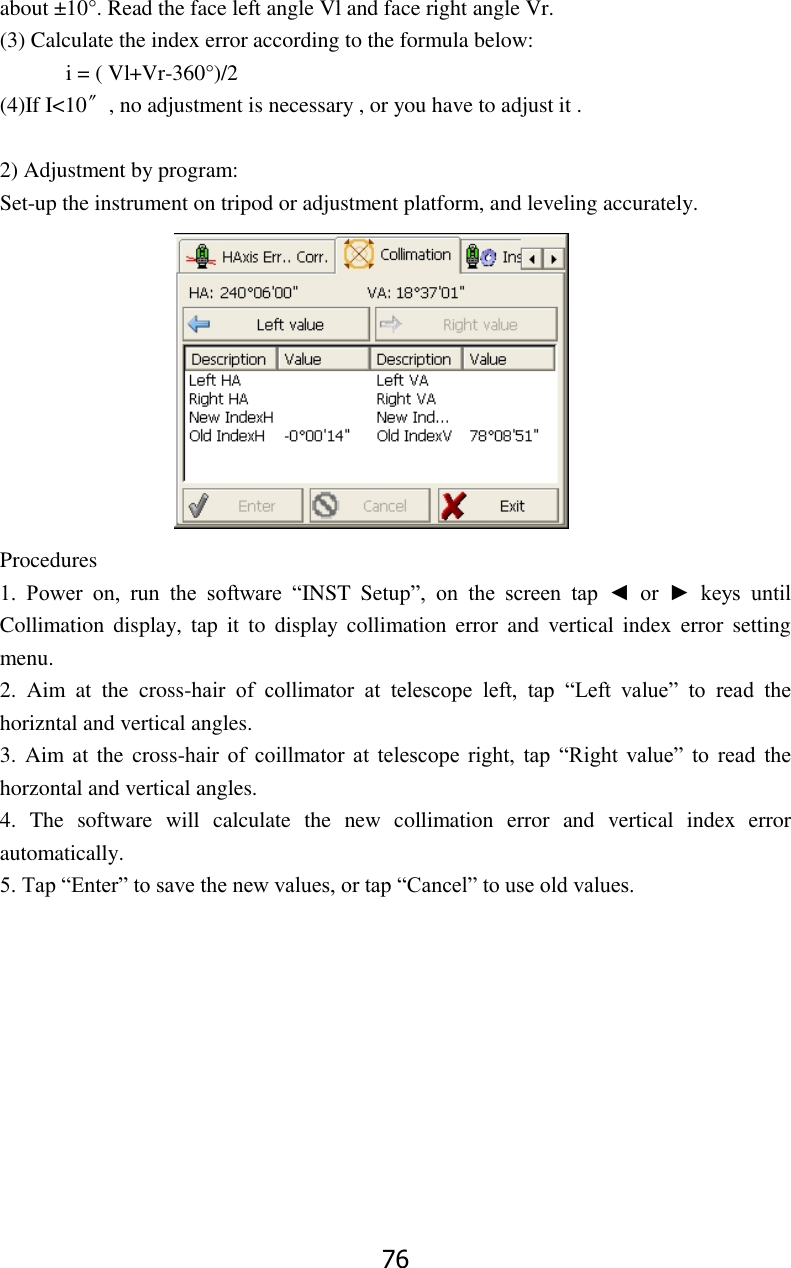
76 about ±10°. Read the face left angle Vl and face right angle Vr. (3) Calculate the index error according to the formula below: i = ( Vl+Vr-360°)/2 (4)If I<10〞, no adjustment is necessary , or you have to adjust it .  2) Adjustment by program: Set-up the instrument on tripod or adjustment platform, and leveling accurately.  Procedures 1.  Power  on,  run  the  software  “INST  Setup”,  on  the  screen  tap  ◄  or  ►  keys  until Collimation  display,  tap  it to  display collimation  error and  vertical index  error  setting menu. 2.  Aim  at  the  cross-hair  of  collimator  at  telescope  left,  tap  “Left  value”  to  read  the horizntal and vertical angles. 3. Aim at  the  cross-hair  of  coillmator  at  telescope  right,  tap  “Right  value”  to  read  the horzontal and vertical angles. 4.  The  software  will  calculate  the  new  collimation  error  and  vertical  index  error automatically. 5. Tap “Enter” to save the new values, or tap “Cancel” to use old values.
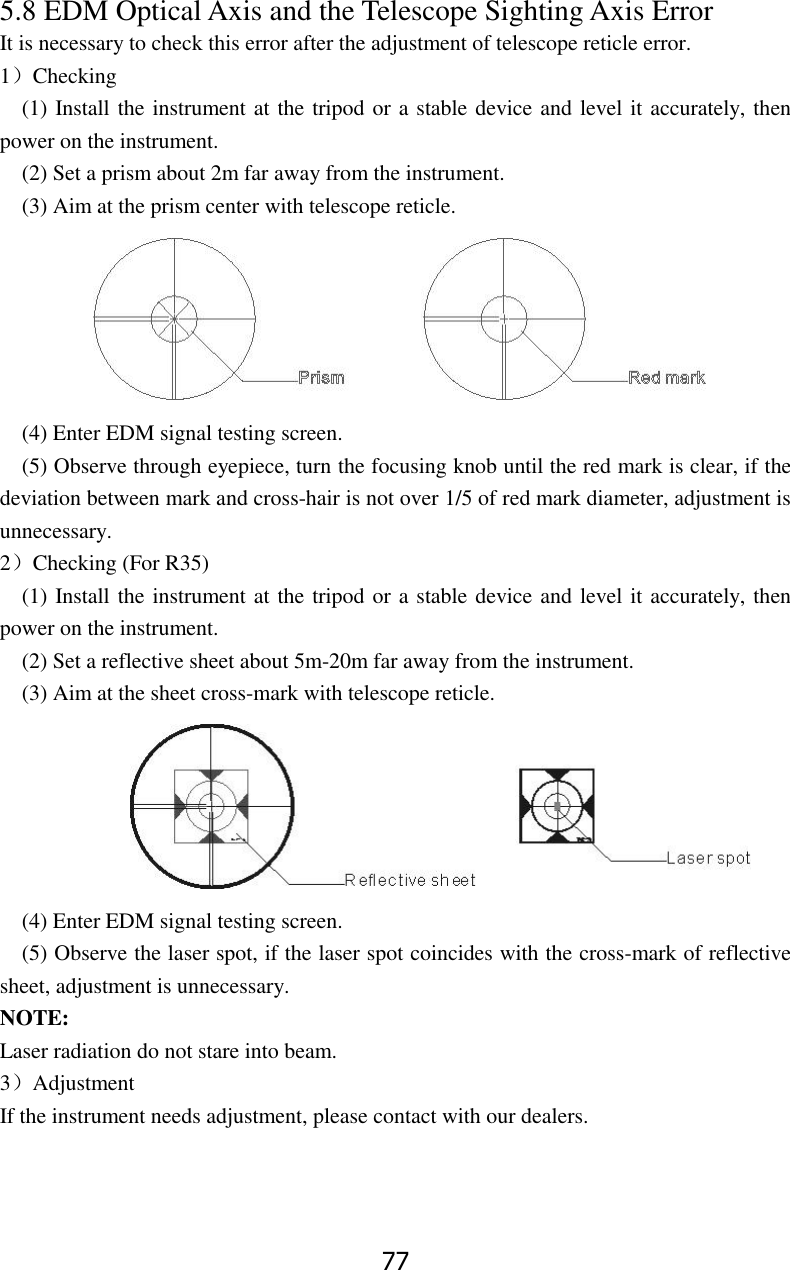
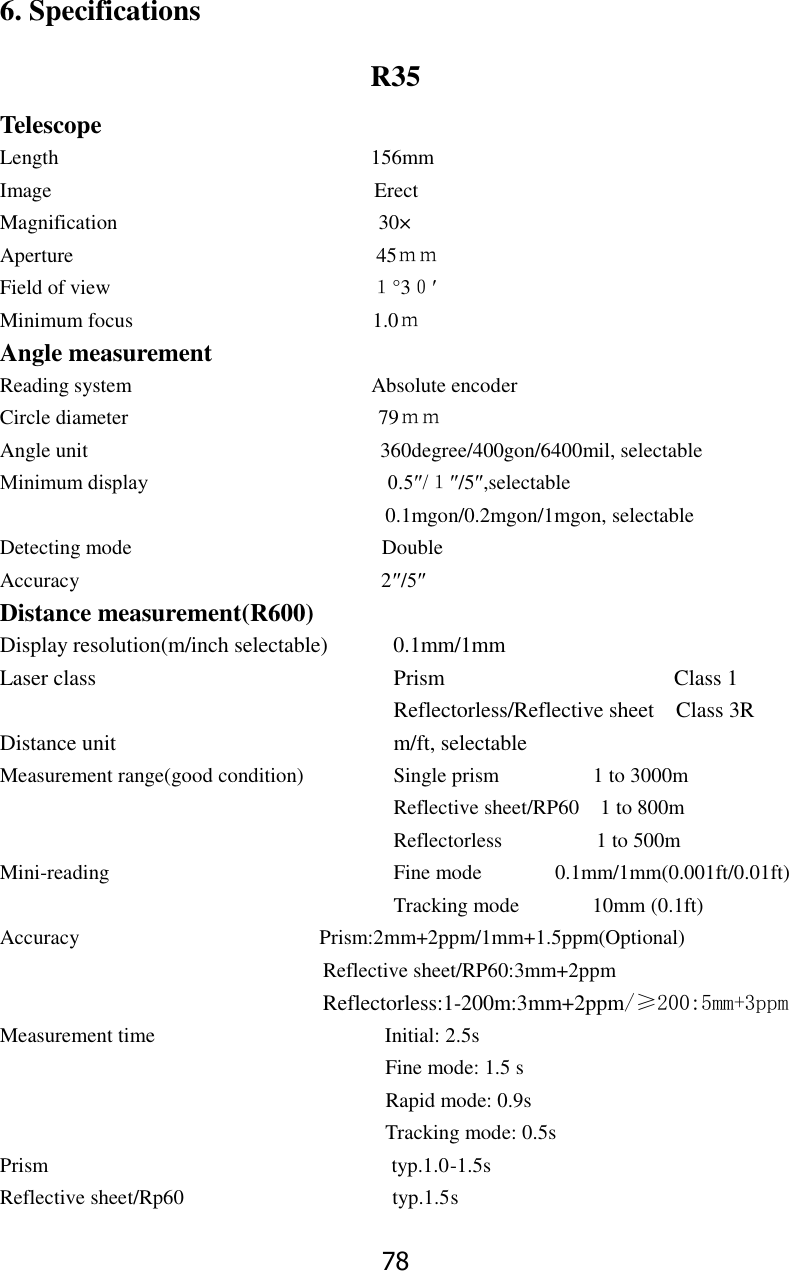
77 5.8 EDM Optical Axis and the Telescope Sighting Axis Error It is necessary to check this error after the adjustment of telescope reticle error. 1)Checking   (1) Install the instrument at the tripod or a stable device and level it accurately, then power on the instrument. (2) Set a prism about 2m far away from the instrument. (3) Aim at the prism center with telescope reticle.       (4) Enter EDM signal testing screen. (5) Observe through eyepiece, turn the focusing knob until the red mark is clear, if the deviation between mark and cross-hair is not over 1/5 of red mark diameter, adjustment is unnecessary. 2)Checking (For R35) (1) Install the instrument at the tripod or a stable device and level it accurately, then power on the instrument. (2) Set a reflective sheet about 5m-20m far away from the instrument. (3) Aim at the sheet cross-mark with telescope reticle.                 (4) Enter EDM signal testing screen. (5) Observe the laser spot, if the laser spot coincides with the cross-mark of reflective sheet, adjustment is unnecessary. NOTE: Laser radiation do not stare into beam. 3)Adjustment If the instrument needs adjustment, please contact with our dealers.
78 6. Specifications   R35 Telescope Length                156mm Image                               Erect Magnification                                                  30× Aperture                             45mm Field of view                                                  1°30′ Minimum focus                                              1.0m Angle measurement   Reading system                                              Absolute encoder Circle diameter                                                79mm Angle unit                                                        360degree/400gon/6400mil, selectable Minimum display                                              0.5″/1″/5″,selectable                                                                           0.1mgon/0.2mgon/1mgon, selectable Detecting mode                                                Double Accuracy                             2″/5″ Distance measurement(R600)   Display resolution(m/inch selectable)            0.1mm/1mm Laser class                           Prism                     Class 1                                                                         Reflectorless/Reflective sheet    Class 3R Distance unit                                                   m/ft, selectable Measurement range(good condition)                 Single prism        1 to 3000m Reflective sheet/RP60    1 to 800m Reflectorless                  1 to 500m Mini-reading                                                       Fine mode              0.1mm/1mm(0.001ft/0.01ft)                   Tracking mode              10mm (0.1ft) Accuracy                                              Prism:2mm+2ppm/1mm+1.5ppm(Optional)                                                               Reflective sheet/RP60:3mm+2ppm                                Reflectorless:1-200m:3mm+2ppm/≥200:5mm+3ppm Measurement time                                            Initial: 2.5s Fine mode: 1.5 s                                                                           Rapid mode: 0.9s                                                                           Tracking mode: 0.5s Prism                                                                  typ.1.0-1.5s Reflective sheet/Rp60                                        typ.1.5s
79 Reflectorless                                                     typ.1.5-5s,max.20s Temperature unit                                                  ℃/℉, selectable Pressure unit                                                         hPa/mmHg/inchHg, selectable Temperature input range                                       -30℃ to +60℃ (1℃ steps) Pressure input range                                             510hPa to 1066hPa(1hPa setps) Prism constant condition                                      -99.9mm to +99.9mm Refraction and earth curvature correction            OFF/0.14/0.2, selectable   Reflecting prism constant correction                   -99.9mm to +99.9mm Distance measurement(R1000)   Laser class                           Prism standard mode/Prism long mode        Class 1/ Class 2 Reflective sheet                                              Class 2    Reflectorless standard mode                          Class 2    Reflectorless long mode                                Class 3R Measurement range(good condition)                 Standard mode/Prism            1 to 3500m Long mode/Prism              1 to 6000m Reflective sheet/RP60                        1 to 1200m Reflectorless                                  1 to 1000m Accuracy/typical measuring time(max.20s)          Prism standard mode:1mm+1.5ppm/1.0s-5.0s     Prism long mode:2mm+2.5ppm/0.7s-6s     Reflective sheet/RP60:2mm+2ppm/1s-5s Reflectorless:1-500m:2mm+2ppm/0.7s-6s>500m:4mm+2ppm/3s-12s Level vial sensitivity   Plate level                                                             30″/2mm Circular level                                                          8′/2mm Compensation                        Dual-axis System                                                                      Liquid type Range                                     ±3′ Resolving power                                                      1″ Data processing system Operating system                                                      Windows CE CPU                                      32 bit  Optical plummet(Factory optional) Accuracy                                                                ±0.8mm/1.5m Image                                   Erect
80 Magnification                                                          3× Focusing range                                                        0.5m~∝ Field of view                                                            4° Laser plummet(Standard) Accuracy                                  ±1.0mm/1.5m Laser class                                                                Class 2/IEC60825-1 Laser spot size/brightness                                        Adjustable Laser wave length                                                      635nm Display LCD                             3.5″ color TFT LCD(320×240dots), touch screen                                       transflective sunlight readable display Internal memory Internal memory                                                        SD Card Power   Battery                                                                      3400 mAh Li-ion Rechargeable battery Voltage                                   7.4V DC Continuous operation time    About 10 hours(single distance measurement every 30 seconds)     Chargers                                 FDJ6-Li(100V to 240V ) Charging time (at +20℃)                                      Approx. 4 hours       Application programs    Data collection/Stake out/Resection/REM/MLM/Point to line   AREA/Z coordinate/OFFset/3D Road/Traverse adjustment Tape measurement/section/axis positioning measurement Others CPU                                    ARM9 Core Memory                                 2G internal memory Guide Light System                                                Factory optional Sensors                                                        Built-in temperature and pressure sensors Keyboard                                                    Alphanumerical illuminated key board,both sides                                                   Operating temperature                                            -20°~+50℃ Storage temperature                                                  -40°~+70℃ Dimension(W×D×H)                                                210×210×360mm Weight(including batteries)                                             5.5kg Dimensions(W×D×H)                       185×220×360mm Interface                                                    USB host/USB slave/RS-232C/Bluetooth(Optional) Water and dust protection                                        IP55 (IEC60529) Data collector                                                          PS236,fully rugged PDA(Optional)
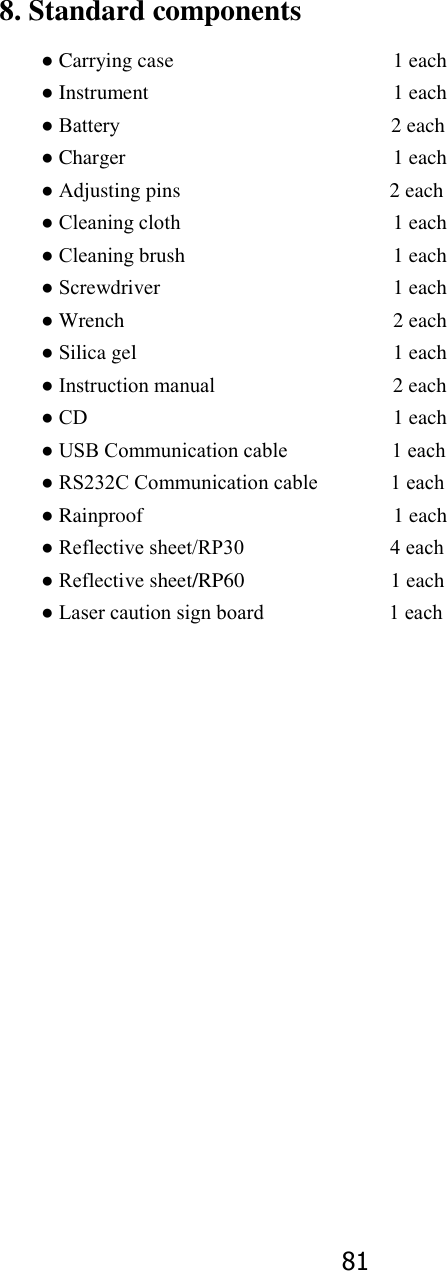
81 8. Standard components ● Carrying case           1 each ● Instrument            1 each ● Battery                           2 each ● Charger             1 each ● Adjusting pins                                        2 each ● Cleaning cloth          1 each ● Cleaning brush          1 each ● Screwdriver            1 each ● Wrench             2 each ● Silica gel            1 each ● Instruction manual                                  2 each ● CD              1 each ● USB Communication cable                    1 each ● RS232C Communication cable              1 each ● Rainproof                                                1 each ● Reflective sheet/RP30                            4 each ● Reflective sheet/RP60                            1 each ● Laser caution sign board                        1 each
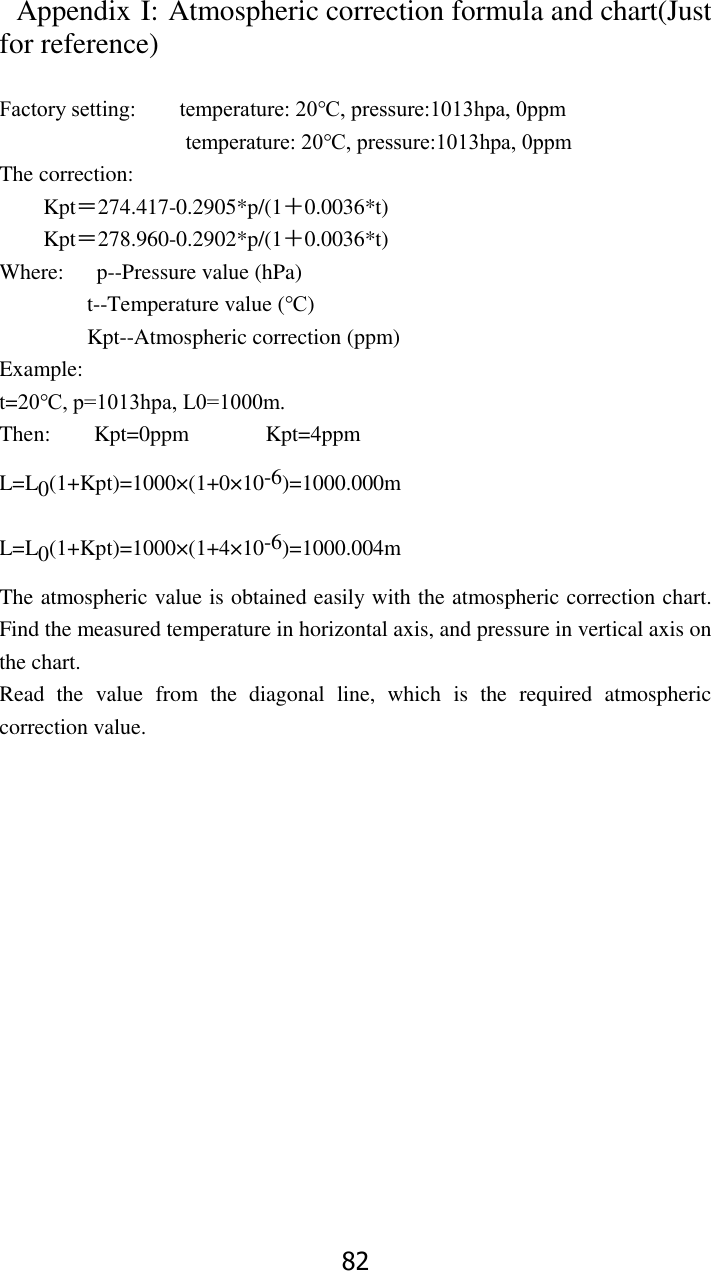
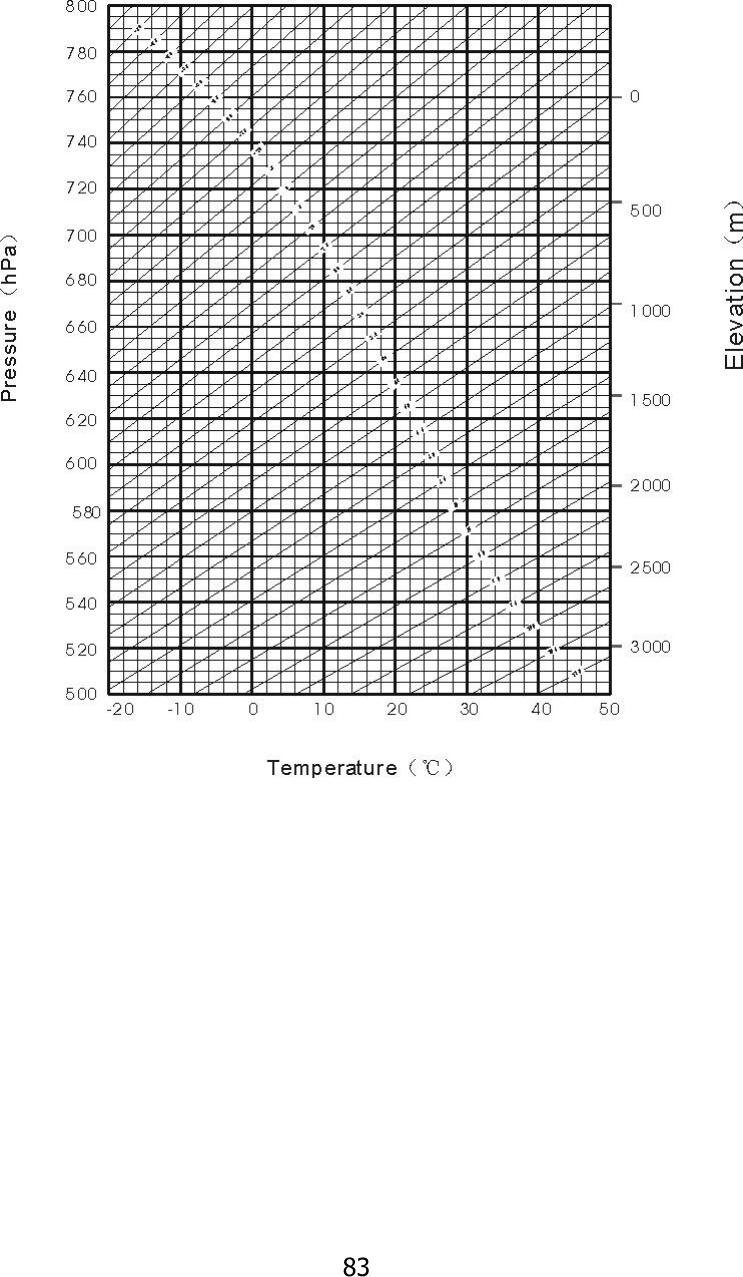
82   Appendix I: Atmospheric correction formula and chart(Just for reference)  Factory setting:        temperature: 20℃, pressure:1013hpa, 0ppm                    temperature: 20℃, pressure:1013hpa, 0ppm   The correction:     Kpt=274.417-0.2905*p/(1+0.0036*t)     Kpt=278.960-0.2902*p/(1+0.0036*t) Where:   p--Pressure value (hPa)         t--Temperature value (℃)         Kpt--Atmospheric correction (ppm) Example:   t=20℃, p=1013hpa, L0=1000m. Then:        Kpt=0ppm              Kpt=4ppm   L=L0(1+Kpt)=1000×(1+0×10-6)=1000.000m   L=L0(1+Kpt)=1000×(1+4×10⁻⁶)=1000.004m     The atmospheric value is obtained easily with the atmospheric correction chart. Find the measured temperature in horizontal axis, and pressure in vertical axis on the chart. Read  the  value  from  the  diagonal  line,  which  is  the  required  atmospheric correction value.
83
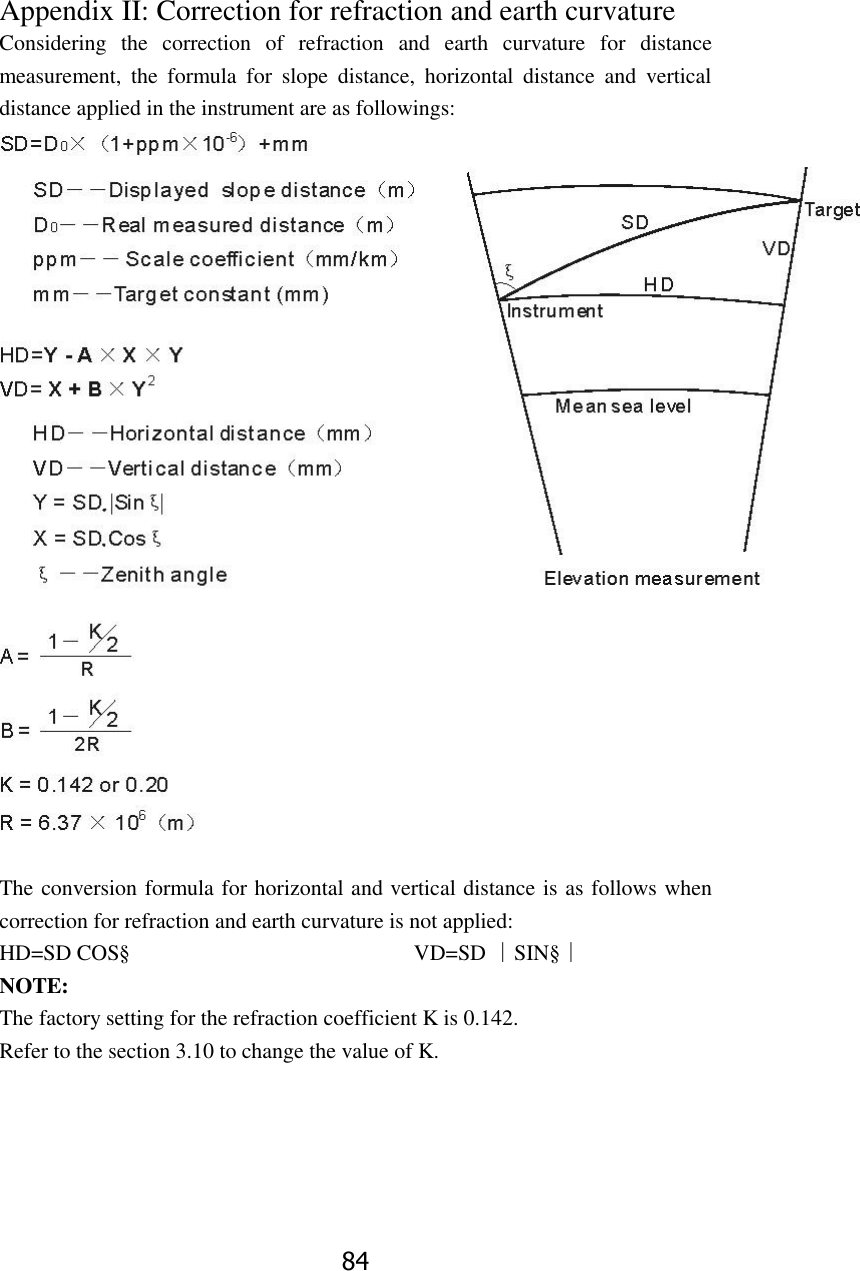
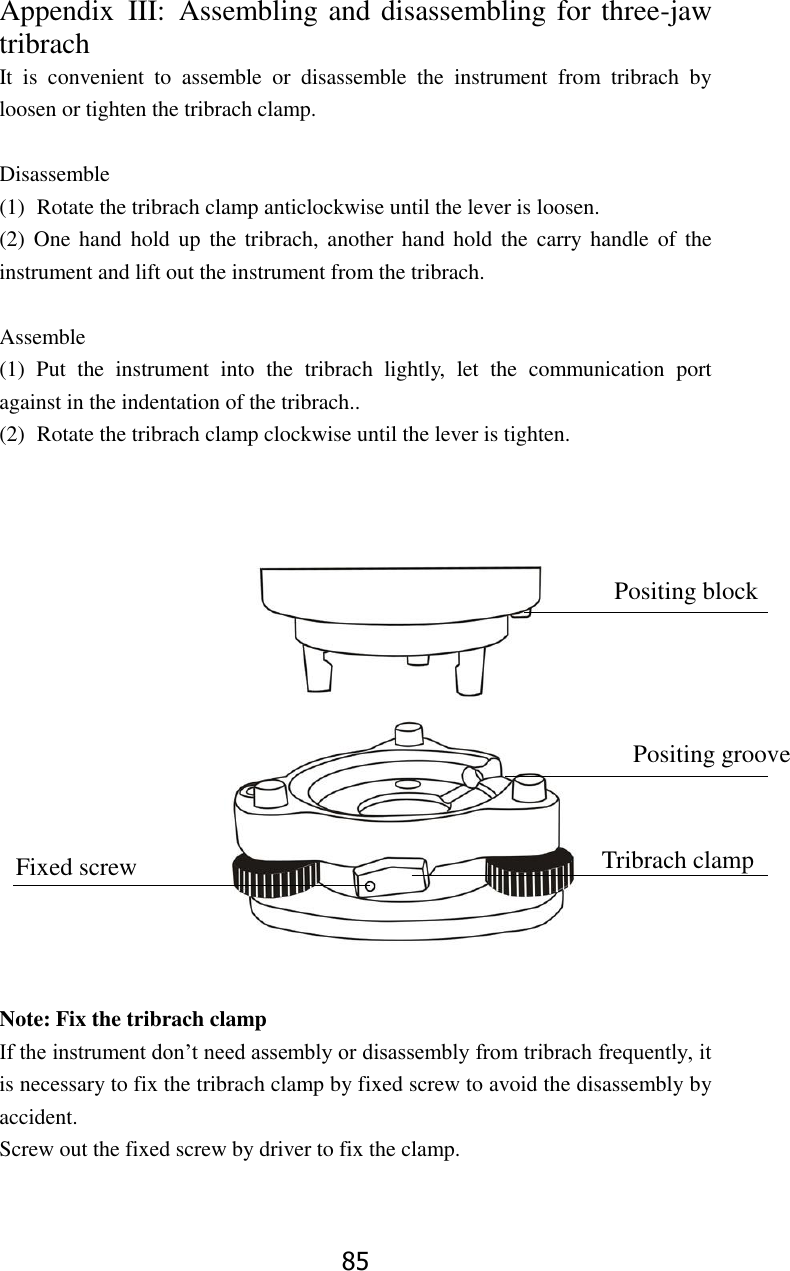
84 Appendix II: Correction for refraction and earth curvature Considering  the  correction  of  refraction  and  earth  curvature  for  distance measurement,  the  formula  for  slope  distance,  horizontal  distance  and  vertical distance applied in the instrument are as followings:     The conversion formula for horizontal and vertical distance is as follows when correction for refraction and earth curvature is not applied: HD=SD COS§                                                    VD=SD ∣SIN§∣ NOTE: The factory setting for the refraction coefficient K is 0.142. Refer to the section 3.10 to change the value of K.
85 Appendix  III:  Assembling and disassembling for three-jaw tribrach It  is  convenient  to  assemble  or  disassemble  the  instrument  from  tribrach  by loosen or tighten the tribrach clamp.    Disassemble (1) Rotate the tribrach clamp anticlockwise until the lever is loosen. (2)  One hand  hold  up the tribrach,  another  hand  hold the carry handle  of the instrument and lift out the instrument from the tribrach.  Assemble (1)  Put  the  instrument  into  the  tribrach  lightly,  let  the  communication  port against in the indentation of the tribrach.. (2) Rotate the tribrach clamp clockwise until the lever is tighten.                  Note: Fix the tribrach clamp If the instrument don’t need assembly or disassembly from tribrach frequently, it is necessary to fix the tribrach clamp by fixed screw to avoid the disassembly by accident.   Screw out the fixed screw by driver to fix the clamp.   Positing block Positing groove Tribrach clamp Fixed screw
86     NOTE:  These designs, figures and specifications are subject to change without notice. We shall not be held liable for damages resulting from errors in this instruction manual.              STONEX    Co.,Ltd. Tel:         Fax:             E-mail: Add:   Web:  http://www.STONEX .com
Warning6tatementThis device complies with part 15 of the FCC Rules. Operation is subject to the following two conditions: (1) This device may not cause harmful interference, and (2) this device must accept any interference received, including interference that may cause undesired operation. Any Changes or modifications not expressly approved by the party responsible for compliance could void the user's authority to operate the equipment. Note: This equipment has been tested and found to comply with the limits for a Class B digital device, pursuant to part 15 of the FCC Rules. These limits are designed to provide reasonable protection against harmful interference in a residential installation. This equipment generates uses and can radiate radio frequency energy and, if not installed and used in accordance with the instructions, may cause harmful interference to radio communications. However, there is no guarantee that interference will not occur in a particular installation. If this equipment does cause harmful interference to radio or television reception, which can be determined by turning the equipment off and on, the user is encouraged to try to correct the interference by one or more of the following measures: -Reorient or relocate the receiving antenna. -Increase the separation between the equipment and receiver. -Connect the equipment into an outlet on a circuit different from that to which the receiver is connected. -Consult the dealer or an experienced radio/TV technician for help. The device has been evaluated to meet general RF exposure requirement. The device can be used in portable exposure condition without restriction.  

Navigation menu