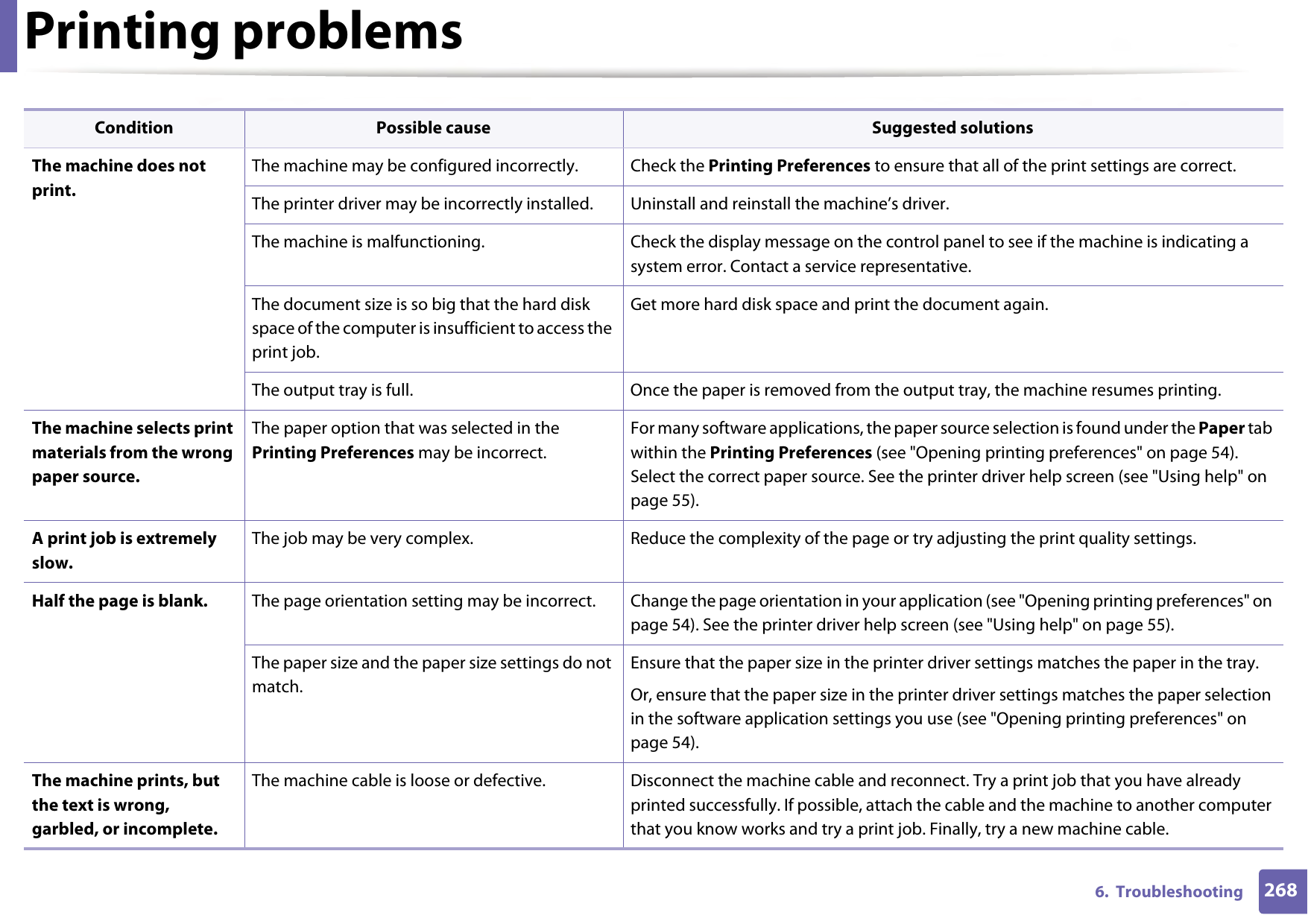
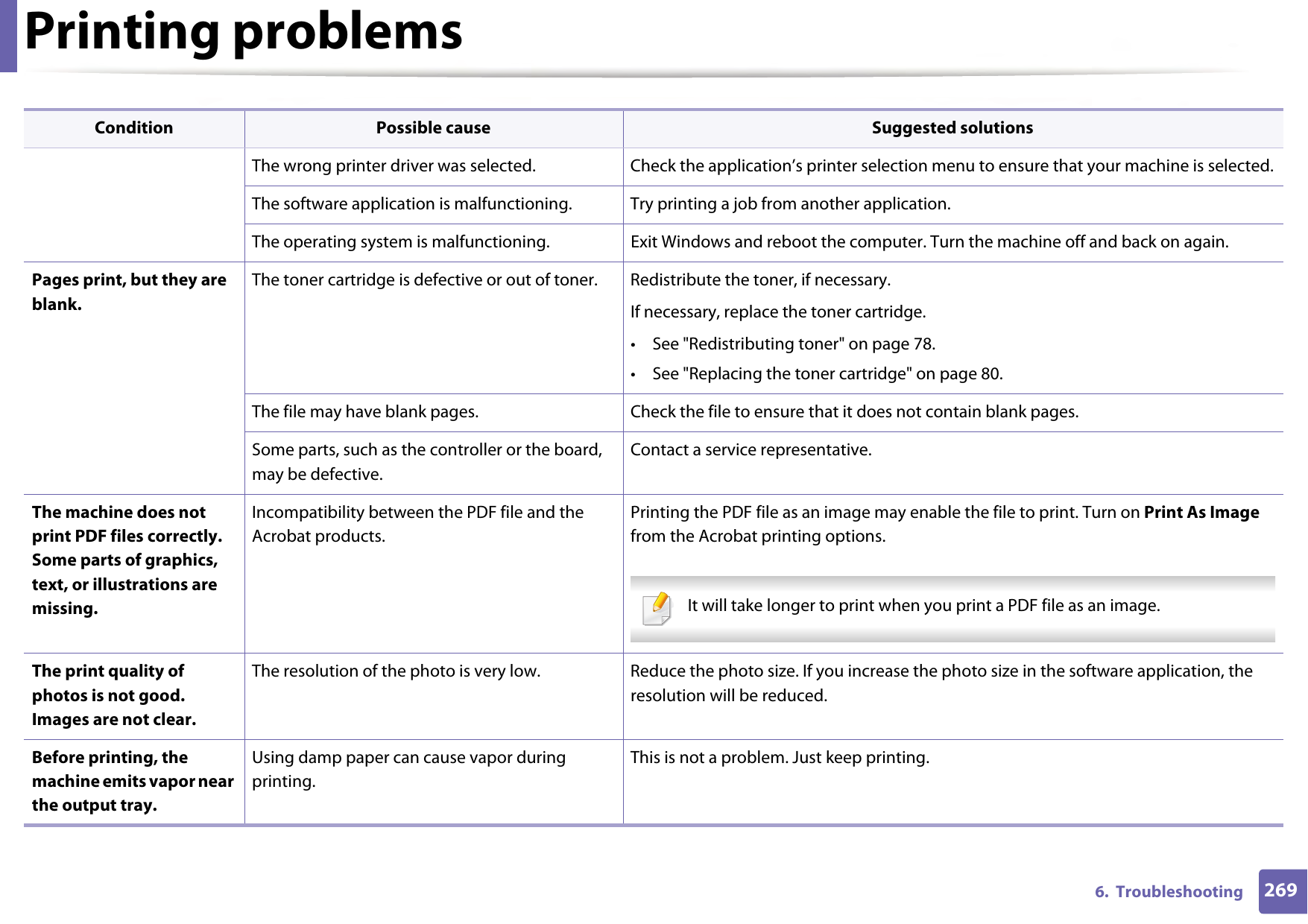
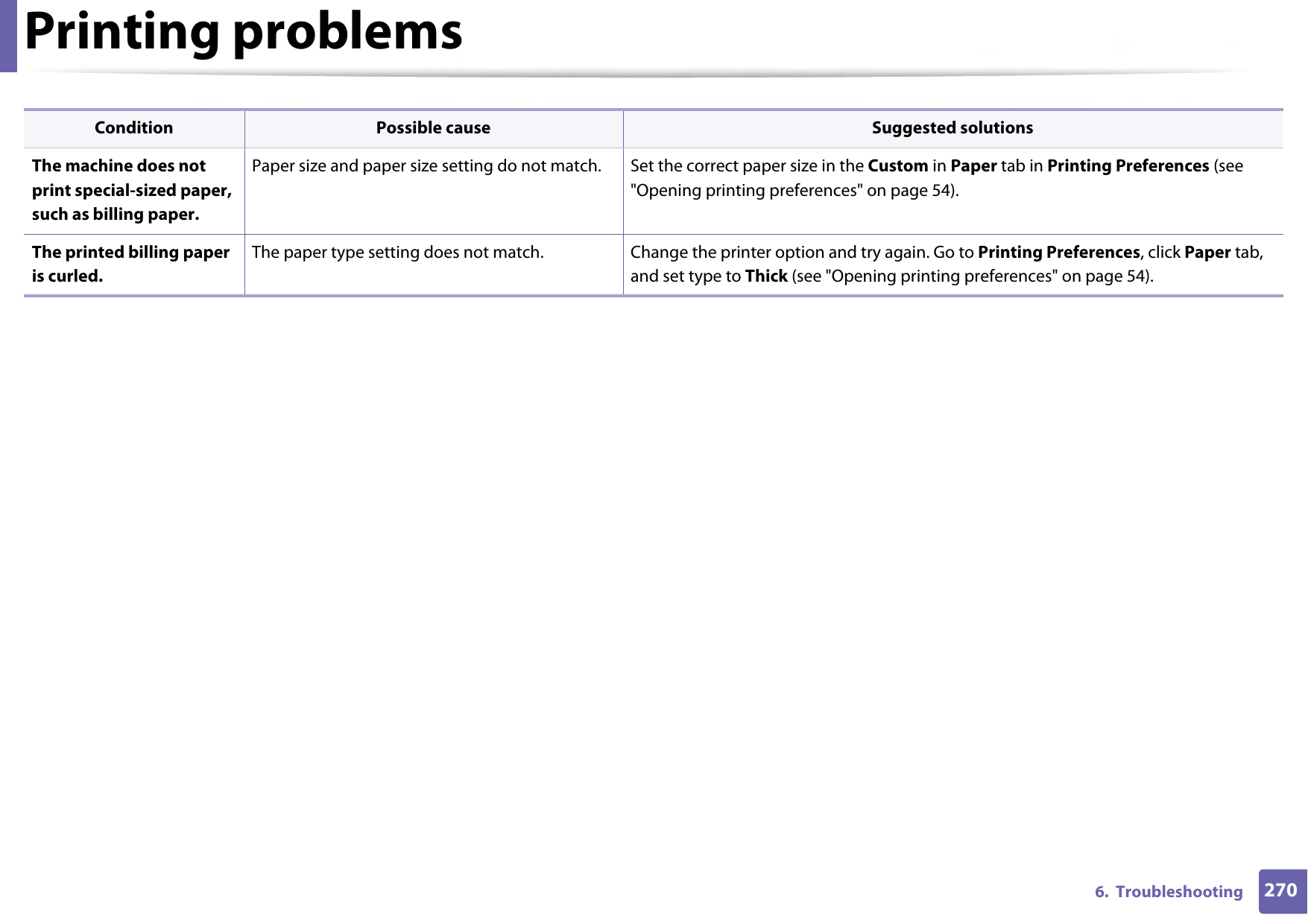
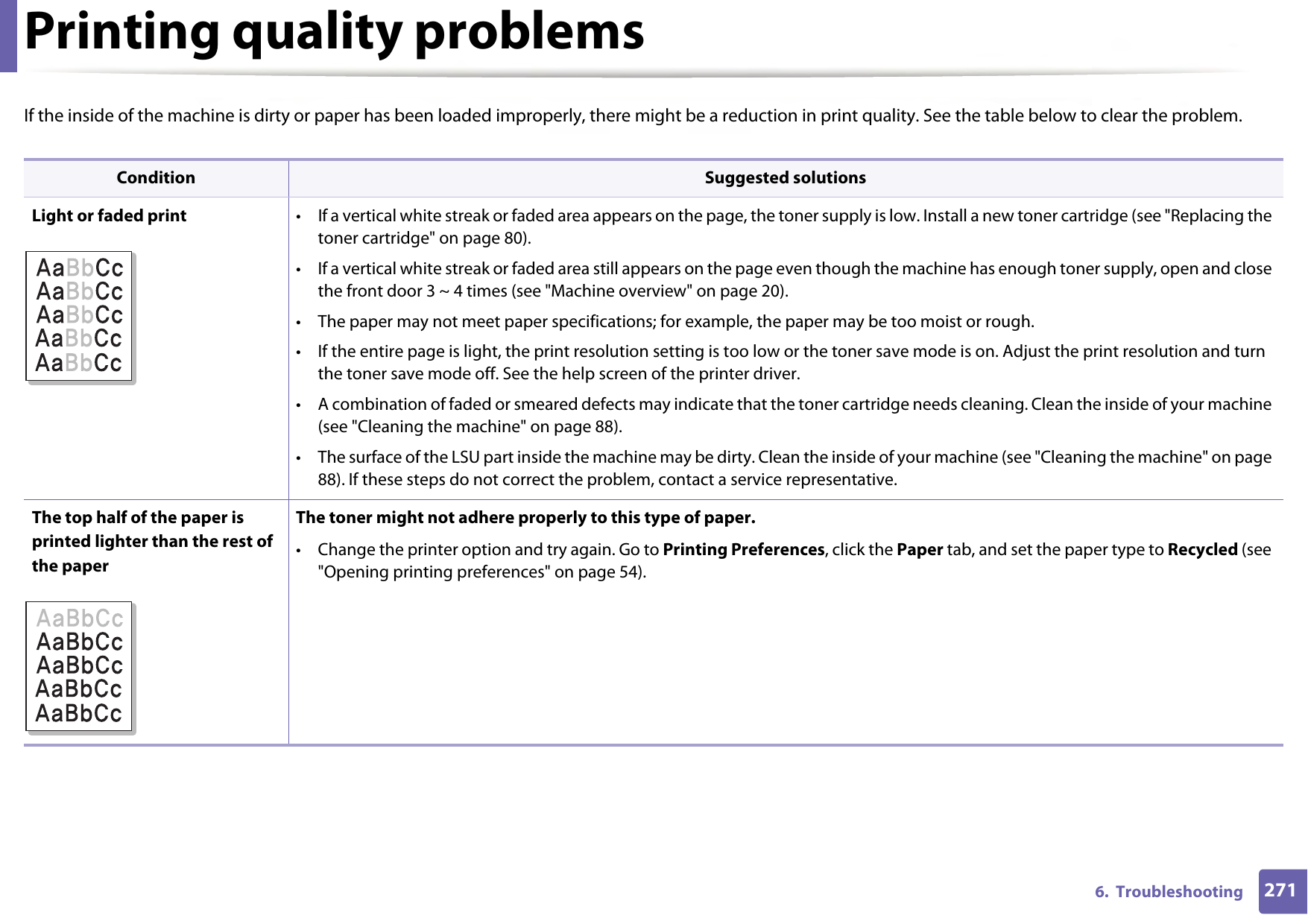
Samsung Electronics Co SLC480FW Printer User Manual 4

Samsung Electronics Co Ltd Printer 4

User Manual 4

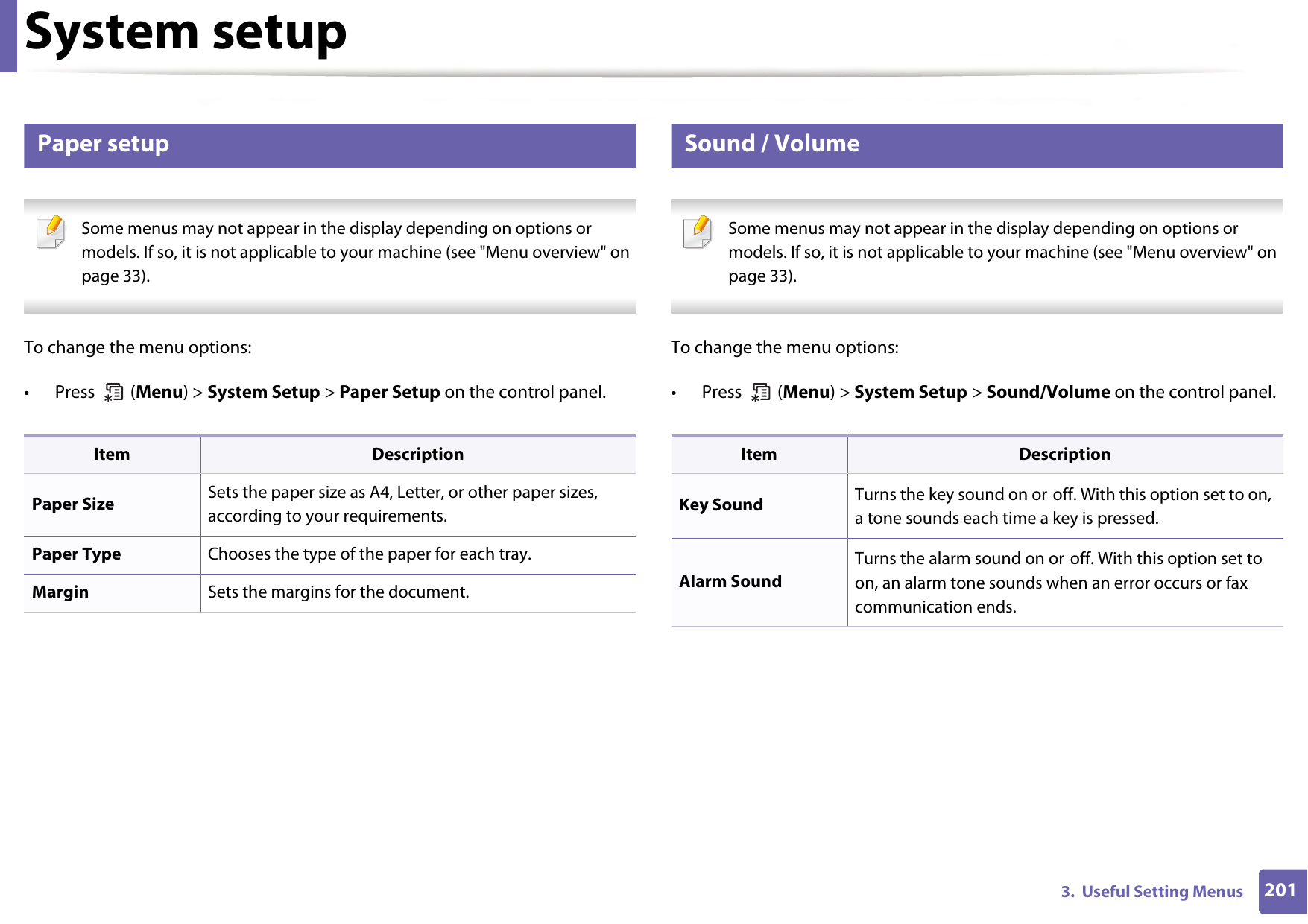
System setup2013.  Useful Setting Menus10 Paper setup Some menus may not appear in the display depending on options or models. If so, it is not applicable to your machine (see "Menu overview" on page 33). To change the menu options:• Press  (Menu) > System Setup > Paper Setup on the control panel.11 Sound / Volume Some menus may not appear in the display depending on options or models. If so, it is not applicable to your machine (see "Menu overview" on page 33). To change the menu options:• Press  (Menu) > System Setup > Sound/Volume on the control panel.Item DescriptionPaper Size Sets the paper size as A4, Letter, or other paper sizes, according to your requirements.Paper Type Chooses the type of the paper for each tray.Margin Sets the margins for the document.Item DescriptionKey Sound Turns the key sound on or off. With this option set to on, a tone sounds each time a key is pressed.Alarm SoundTurns the alarm sound on or off. With this option set to on, an alarm tone sounds when an error occurs or fax communication ends.
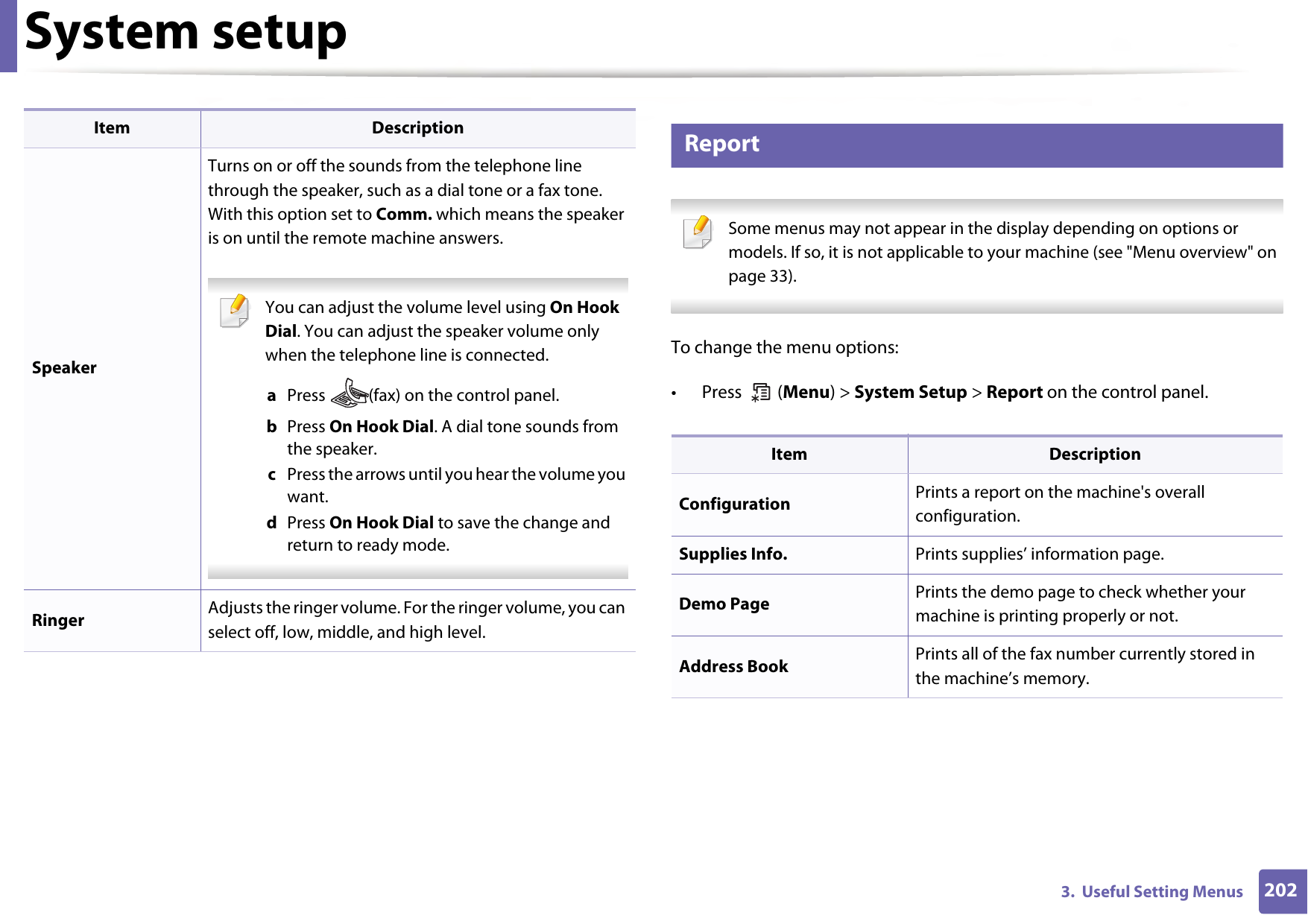
System setup2023.  Useful Setting Menus12 Report Some menus may not appear in the display depending on options or models. If so, it is not applicable to your machine (see "Menu overview" on page 33). To change the menu options:• Press  (Menu) > System Setup > Report on the control panel.SpeakerTurns on or off the sounds from the telephone line through the speaker, such as a dial tone or a fax tone. With this option set to Comm. which means the speaker is on until the remote machine answers. You can adjust the volume level using On Hook Dial. You can adjust the speaker volume only when the telephone line is connected.a  Press  (fax) on the control panel.b  Press On Hook Dial. A dial tone sounds from the speaker.c  Press the arrows until you hear the volume you want.d  Press On Hook Dial to save the change and return to ready mode. Ringer Adjusts the ringer volume. For the ringer volume, you can select off, low, middle, and high level.Item DescriptionItem DescriptionConfiguration Prints a report on the machine's overall configuration.Supplies Info. Prints supplies’ information page. Demo Page Prints the demo page to check whether your machine is printing properly or not.Address Book  Prints all of the fax number currently stored in the machine’s memory.
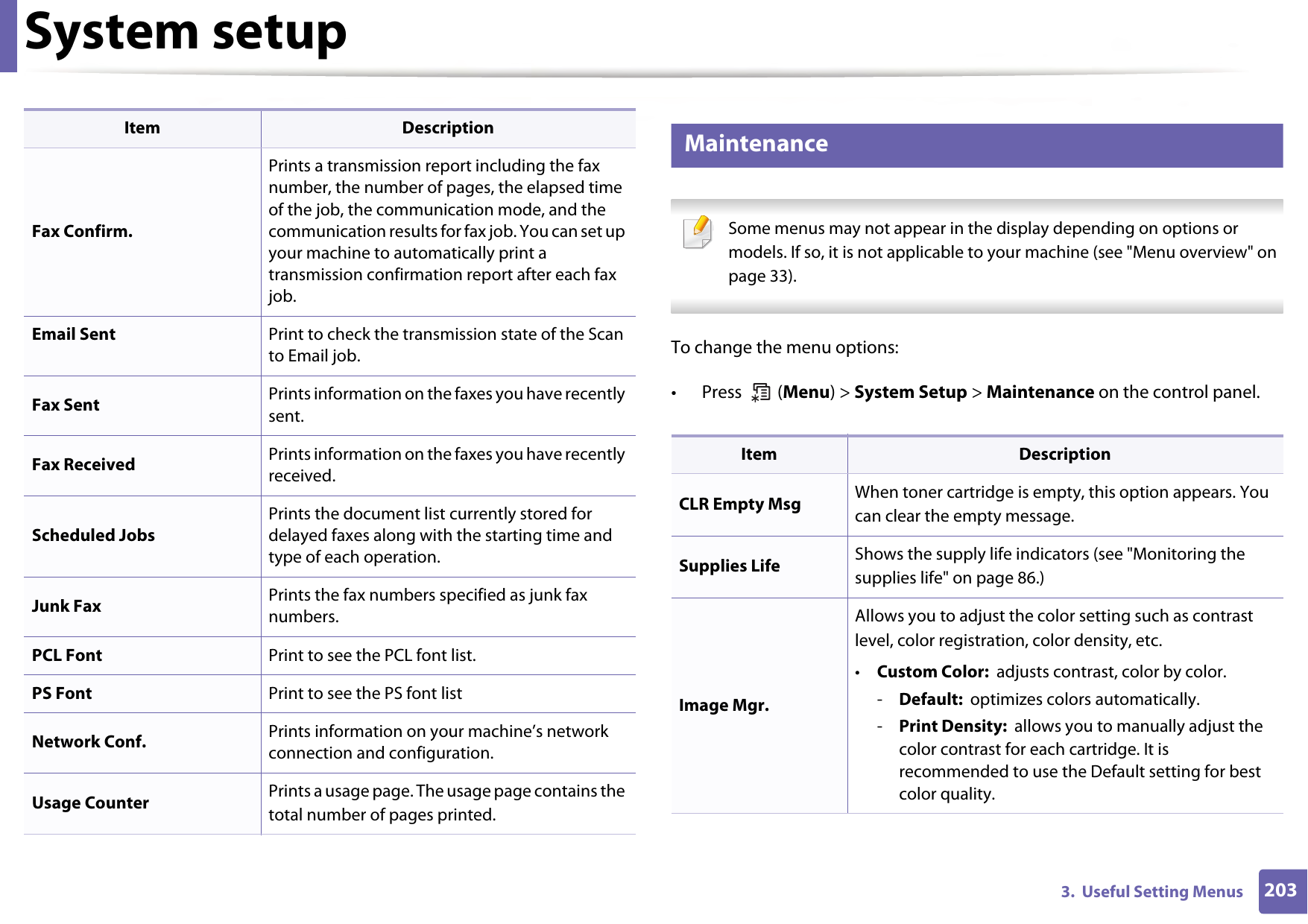
System setup2033.  Useful Setting Menus13 Maintenance Some menus may not appear in the display depending on options or models. If so, it is not applicable to your machine (see "Menu overview" on page 33). To change the menu options:• Press  (Menu) > System Setup > Maintenance on the control panel.Fax Confirm.Prints a transmission report including the fax number, the number of pages, the elapsed time of the job, the communication mode, and the communication results for fax job. You can set up your machine to automatically print a transmission confirmation report after each fax job.Email Sent Print to check the transmission state of the Scan to Email job.Fax Sent Prints information on the faxes you have recently sent.Fax Received Prints information on the faxes you have recently received.Scheduled JobsPrints the document list currently stored for delayed faxes along with the starting time and type of each operation.Junk Fax Prints the fax numbers specified as junk fax numbers.PCL Font Print to see the PCL font list.PS Font Print to see the PS font listNetwork Conf.  Prints information on your machine’s network connection and configuration.Usage Counter Prints a usage page. The usage page contains the total number of pages printed.Item DescriptionItem DescriptionCLR Empty Msg When toner cartridge is empty, this option appears. You can clear the empty message.Supplies Life Shows the supply life indicators (see "Monitoring the supplies life" on page 86.)Image Mgr.Allows you to adjust the color setting such as contrast level, color registration, color density, etc.•Custom Color:  adjusts contrast, color by color.-Default:  optimizes colors automatically.-Print Density:  allows you to manually adjust the color contrast for each cartridge. It is recommended to use the Default setting for best color quality.
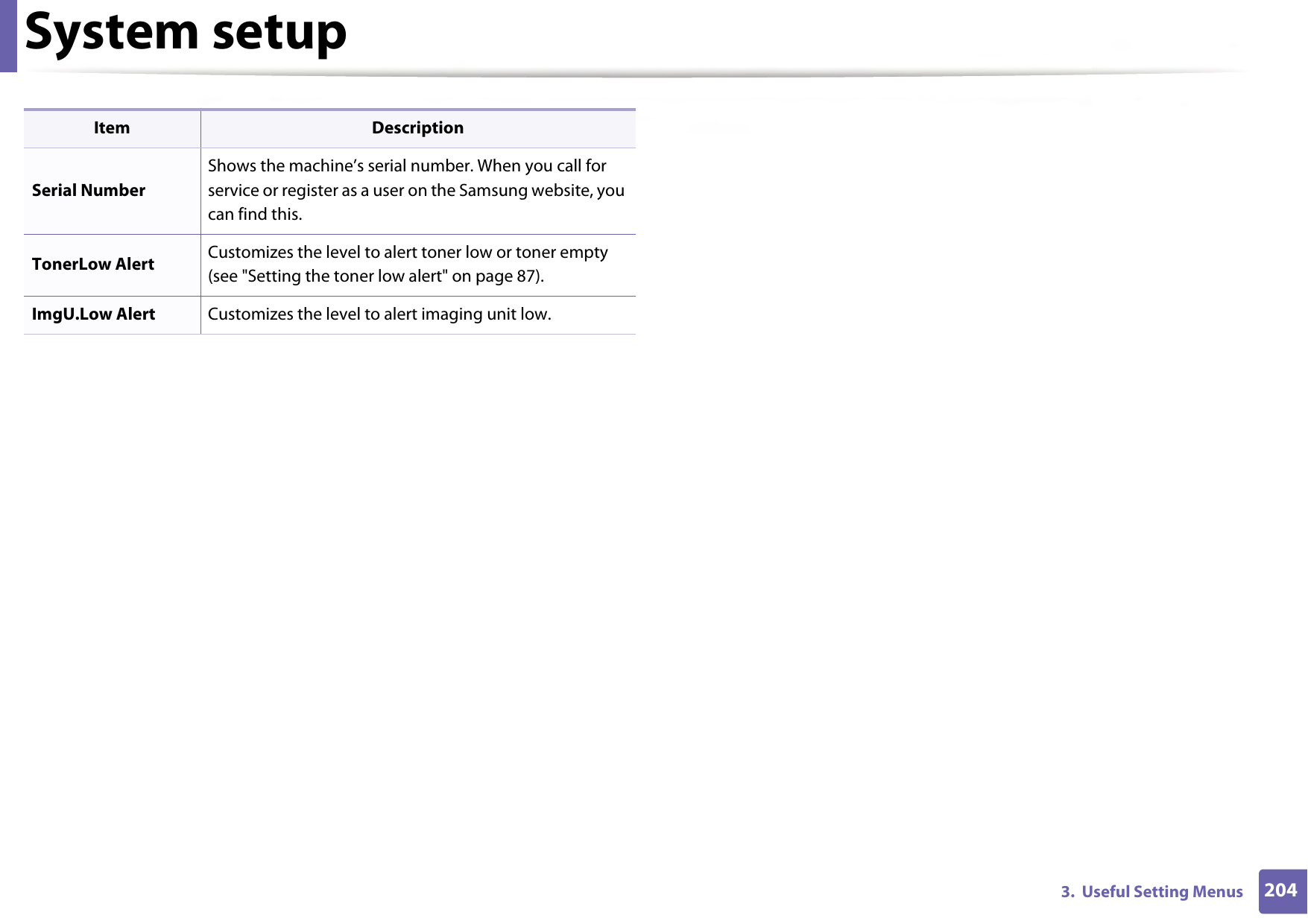
System setup2043.  Useful Setting MenusSerial NumberShows the machine’s serial number. When you call for service or register as a user on the Samsung website, you can find this.TonerLow Alert Customizes the level to alert toner low or toner empty (see "Setting the toner low alert" on page 87).ImgU.Low Alert Customizes the level to alert imaging unit low.Item Description
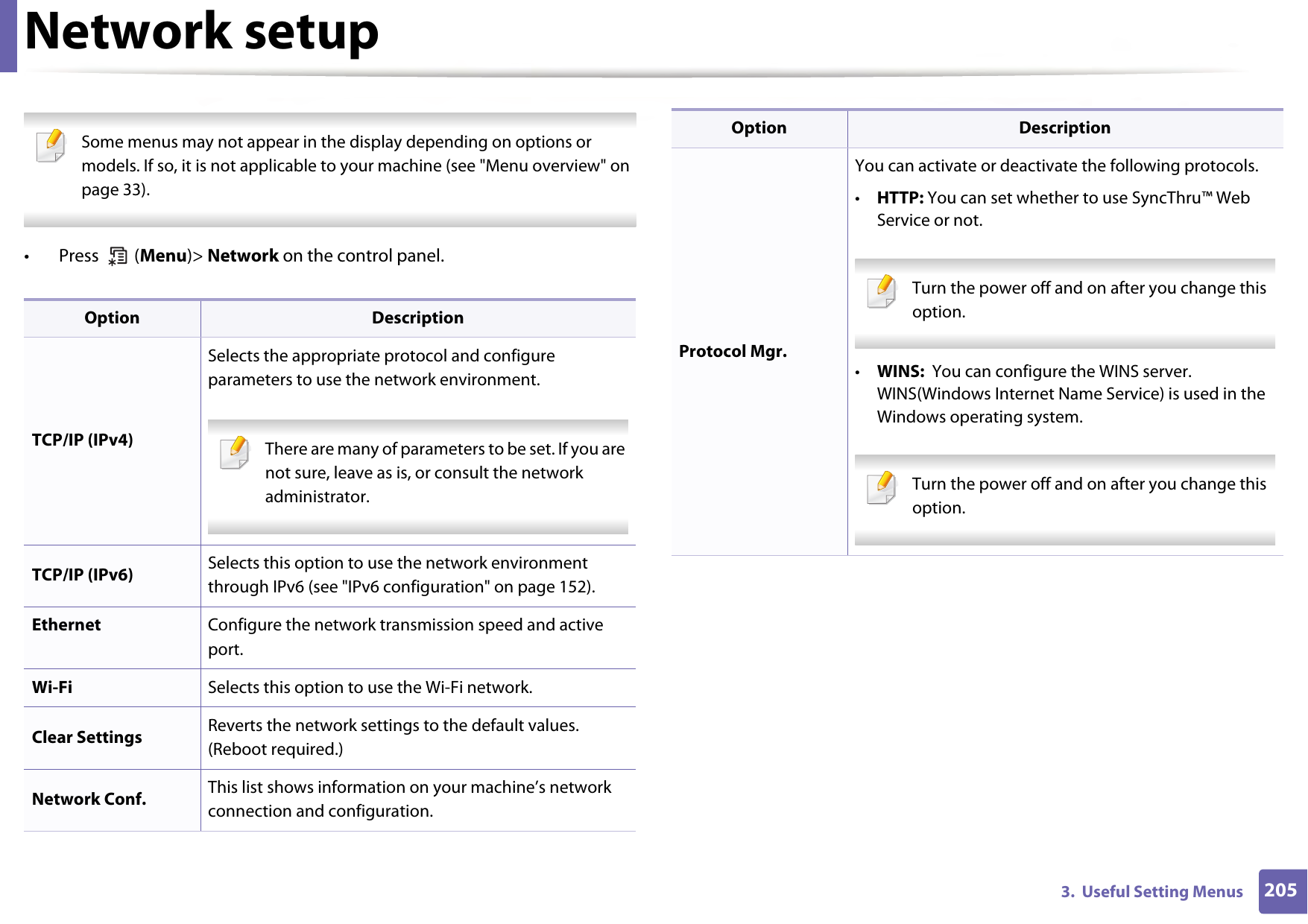
2053.  Useful Setting MenusNetwork setup Some menus may not appear in the display depending on options or models. If so, it is not applicable to your machine (see "Menu overview" on page 33). •  Press   (Menu)> Network on the control panel.Option DescriptionTCP/IP (IPv4)Selects the appropriate protocol and configure parameters to use the network environment. There are many of parameters to be set. If you are not sure, leave as is, or consult the network administrator. TCP/IP (IPv6) Selects this option to use the network environment through IPv6 (see "IPv6 configuration" on page 152).Ethernet Configure the network transmission speed and active port.Wi-Fi Selects this option to use the Wi-Fi network.Clear Settings Reverts the network settings to the default values. (Reboot required.)Network Conf. This list shows information on your machine’s network connection and configuration.Protocol Mgr.You can activate or deactivate the following protocols.•HTTP: You can set whether to use SyncThru™ Web Service or not. Turn the power off and on after you change this option. •WINS:  You can configure the WINS server. WINS(Windows Internet Name Service) is used in the Windows operating system. Turn the power off and on after you change this option. Option Description
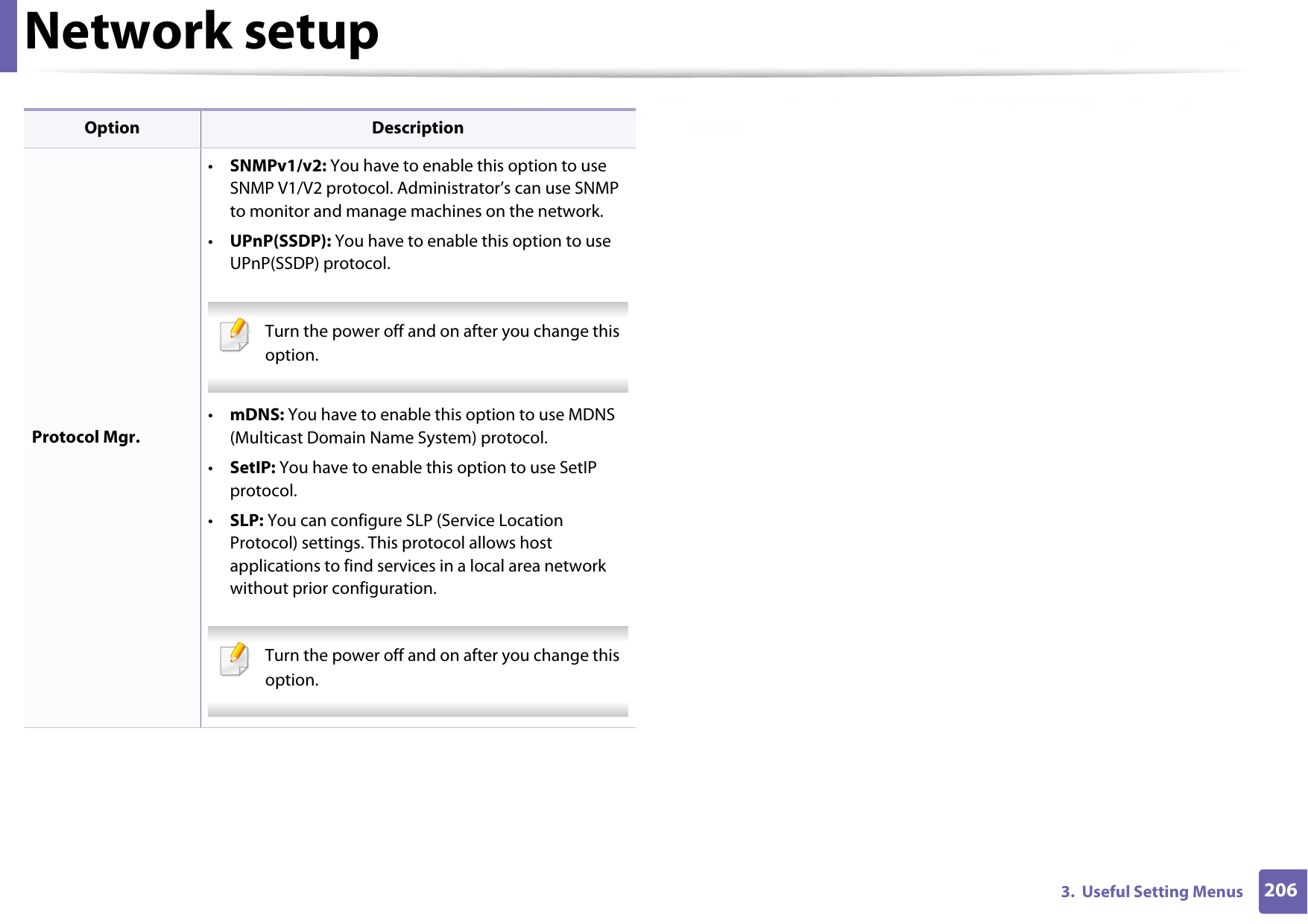
Network setup2063.  Useful Setting MenusProtocol Mgr.•SNMPv1/v2: You have to enable this option to use SNMP V1/V2 protocol. Administrator’s can use SNMP to monitor and manage machines on the network.•UPnP(SSDP): You have to enable this option to use UPnP(SSDP) protocol. Turn the power off and on after you change this option. •mDNS: You have to enable this option to use MDNS (Multicast Domain Name System) protocol.•SetIP: You have to enable this option to use SetIP protocol.•SLP: You can configure SLP (Service Location Protocol) settings. This protocol allows host applications to find services in a local area network without prior configuration. Turn the power off and on after you change this option. Option Description
4. Special FeaturesThis chapter explains special copying, scanning, faxing, and printing features.• Altitude adjustment 208• Entering various characters 209• Setting up the fax address book 210• Printing features 213• Scan features 225• Fax features 232 • The procedures in this chapter are mainly based on Windows 7.• It may be necessary to press OK to navigate to lower-level menus for some models.
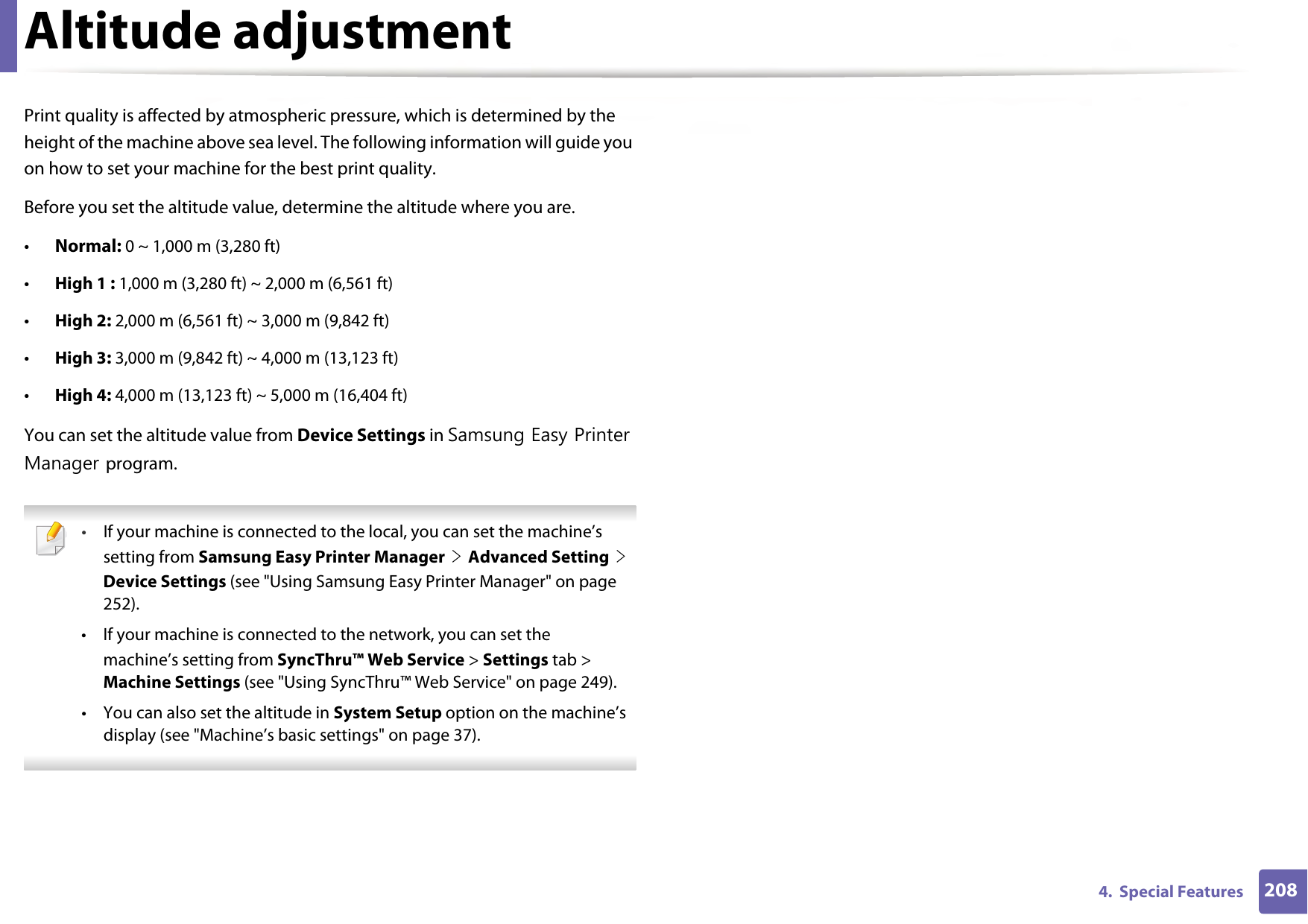
2084.  Special FeaturesAltitude adjustmentPrint quality is affected by atmospheric pressure, which is determined by the height of the machine above sea level. The following information will guide you on how to set your machine for the best print quality.Before you set the altitude value, determine the altitude where you are.•Normal: 0 ~ 1,000 m (3,280 ft)•High 1 : 1,000 m (3,280 ft) ~ 2,000 m (6,561 ft)•High 2: 2,000 m (6,561 ft) ~ 3,000 m (9,842 ft) •High 3: 3,000 m (9,842 ft) ~ 4,000 m (13,123 ft)•High 4: 4,000 m (13,123 ft) ~ 5,000 m (16,404 ft)You can set the altitude value from Device Settings in Samsung Easy Printer Manager program. •If your machine is connected to the local, you can set the machine’s setting from Samsung Easy Printer Manager > Advanced Setting > Device Settings (see "Using Samsung Easy Printer Manager" on page 252).• If your machine is connected to the network, you can set themachine’s setting from SyncThru™ Web Service > Settings tab > Machine Settings (see "Using SyncThru™ Web Service" on page 249).• You can also set the altitude in System Setup option on the machine’s display (see "Machine’s basic settings" on page 37).
2094.  Special FeaturesEntering various characters C48xFN/C48xFW series only (see "Control panel overview" on page 24). As you perform various tasks, you may need to enter names and numbers. For example, when you set up your machine, you enter your name or your company’s name, and the fax number. When you store fax numbers or email addresses in memory, you may also enter the corresponding names.1 Entering alphanumeric charactersPress the button until the correct letter appears on the display. For example, to enter the letter O, press 6, labeled with MNO. Each time you press 6, the display shows a different letter, M, N, O, m, n, o and finally 6. To find the letter that you want to enter, see "Keypad letters and numbers" on page 209. • You can enter a space by pressing 1 twice.• To delete the last digit or character, press the left/right or up/down arrow button. 2 Keypad letters and numbers • Special character sets may differ from your machine depending on its options or the models.• Some of the follow key values may not appear depending on the job you are doing. Key Assigned numbers, letters, or characters1@ / . ’ 12A B C a b c 23D E F d e f 34 G H I g h i 45J K L j k l 56M N O m n o 67P Q R S p q r s 78T U V t u v 89W X Y Z w x y z 90& + - , 0* * % ^ _ ~ ! # $ ( ) [ ](These symbols are available when you type for network authentication.)# # = | ? " : { } < > ;(These symbols are available when you type for network authentication.)
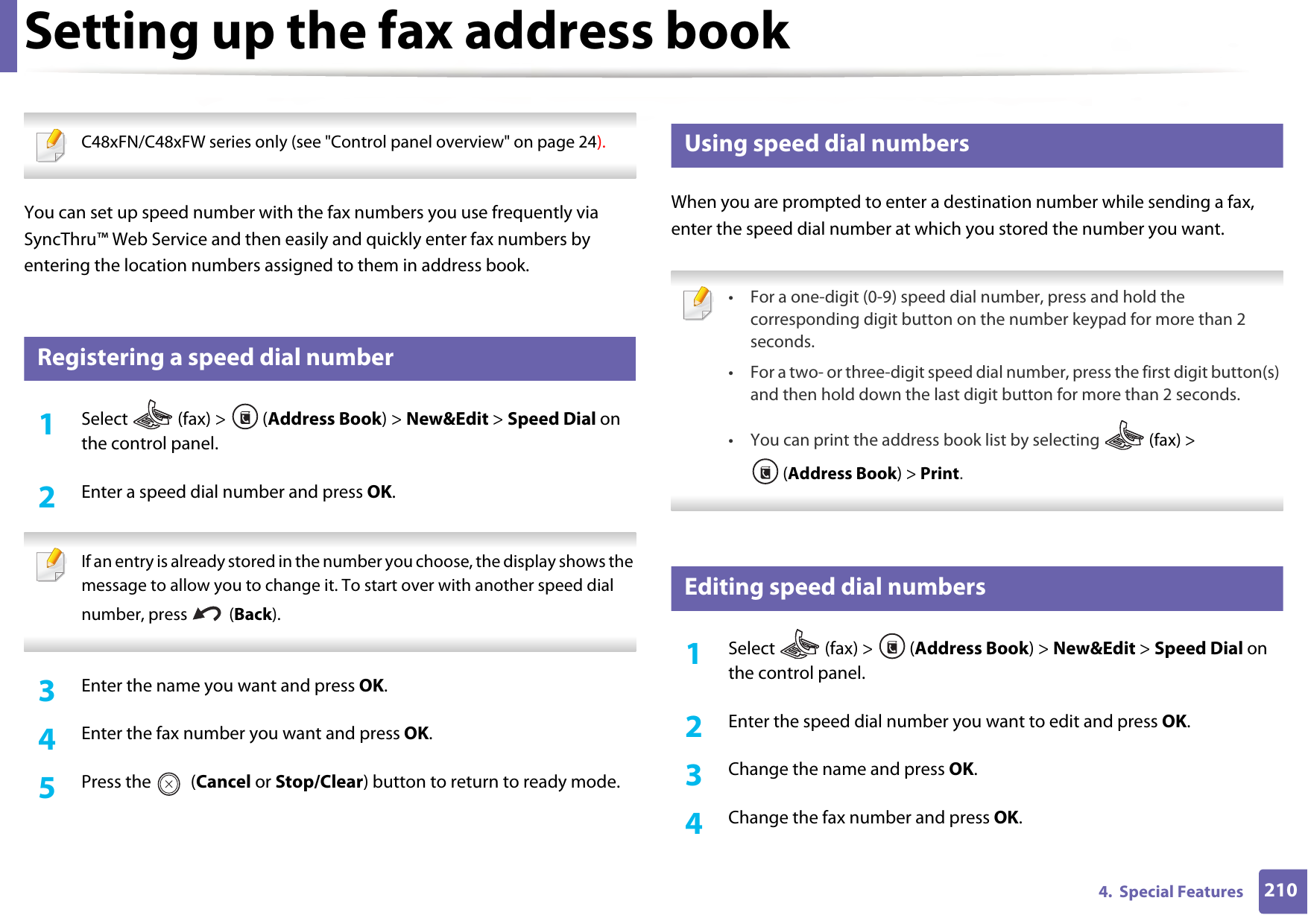
2104.  Special FeaturesSetting up the fax address book C48xFN/C48xFW series only (see "Control panel overview" on page 24). You can set up speed number with the fax numbers you use frequently via SyncThru™ Web Service and then easily and quickly enter fax numbers by entering the location numbers assigned to them in address book.3 Registering a speed dial number1Select   (fax) >  (Address Book) > New&Edit > Speed Dial on the control panel. 2  Enter a speed dial number and press OK. If an entry is already stored in the number you choose, the display shows the message to allow you to change it. To start over with another speed dial number, press   (Back).  3  Enter the name you want and press OK.4  Enter the fax number you want and press OK.5  Press the   (Cancel or Stop/Clear) button to return to ready mode.4 Using speed dial numbersWhen you are prompted to enter a destination number while sending a fax, enter the speed dial number at which you stored the number you want. • For a one-digit (0-9) speed dial number, press and hold the corresponding digit button on the number keypad for more than 2 seconds. • For a two- or three-digit speed dial number, press the first digit button(s) and then hold down the last digit button for more than 2 seconds.• You can print the address book list by selecting   (fax) > (Address Book) > Print.  5 Editing speed dial numbers1Select  (fax) > (Address Book) > New&Edit > Speed Dial on the control panel. 2  Enter the speed dial number you want to edit and press OK.3  Change the name and press OK.4  Change the fax number and press OK.
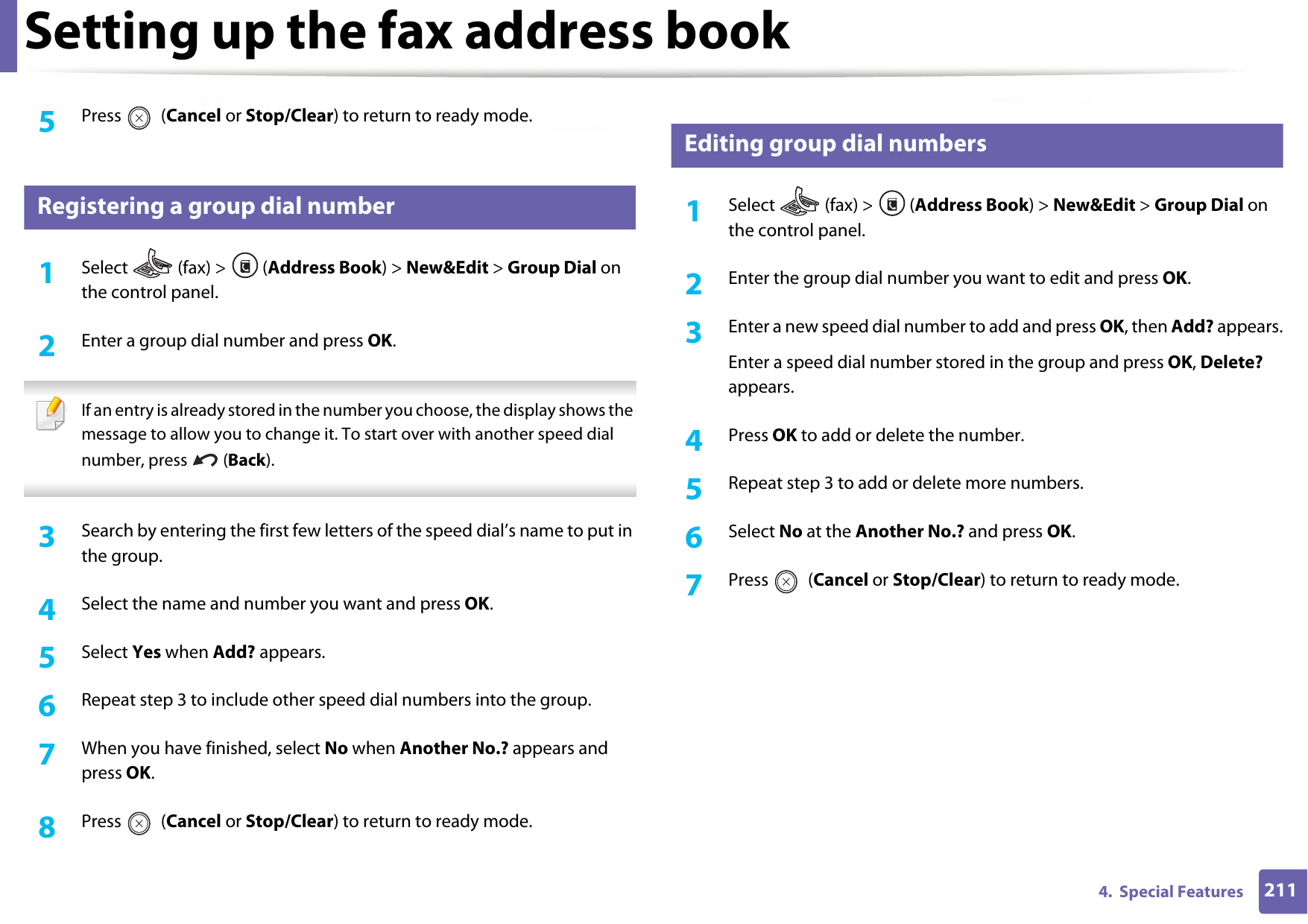
Setting up the fax address book2114.  Special Features5  Press  (Cancel or Stop/Clear) to return to ready mode.6 Registering a group dial number1Select   (fax) >  (Address Book) > New&Edit > Group Dial on the control panel. 2  Enter a group dial number and press OK. If an entry is already stored in the number you choose, the display shows the message to allow you to change it. To start over with another speed dial number, press   (Back).  3  Search by entering the first few letters of the speed dial’s name to put in the group.4  Select the name and number you want and press OK.5  Select Yes when Add? appears.6  Repeat step 3 to include other speed dial numbers into the group.7  When you have finished, select No when Another No.? appears and press OK.8  Press  (Cancel or Stop/Clear) to return to ready mode.7 Editing group dial numbers1Select  (fax) > (Address Book) > New&Edit > Group Dial on the control panel. 2  Enter the group dial number you want to edit and press OK.3  Enter a new speed dial number to add and press OK, then Add? appears.Enter a speed dial number stored in the group and press OK, Delete? appears.4  Press OK to add or delete the number.5  Repeat step 3 to add or delete more numbers.6  Select No at the Another No.? and press OK.7  Press  (Cancel or Stop/Clear) to return to ready mode.
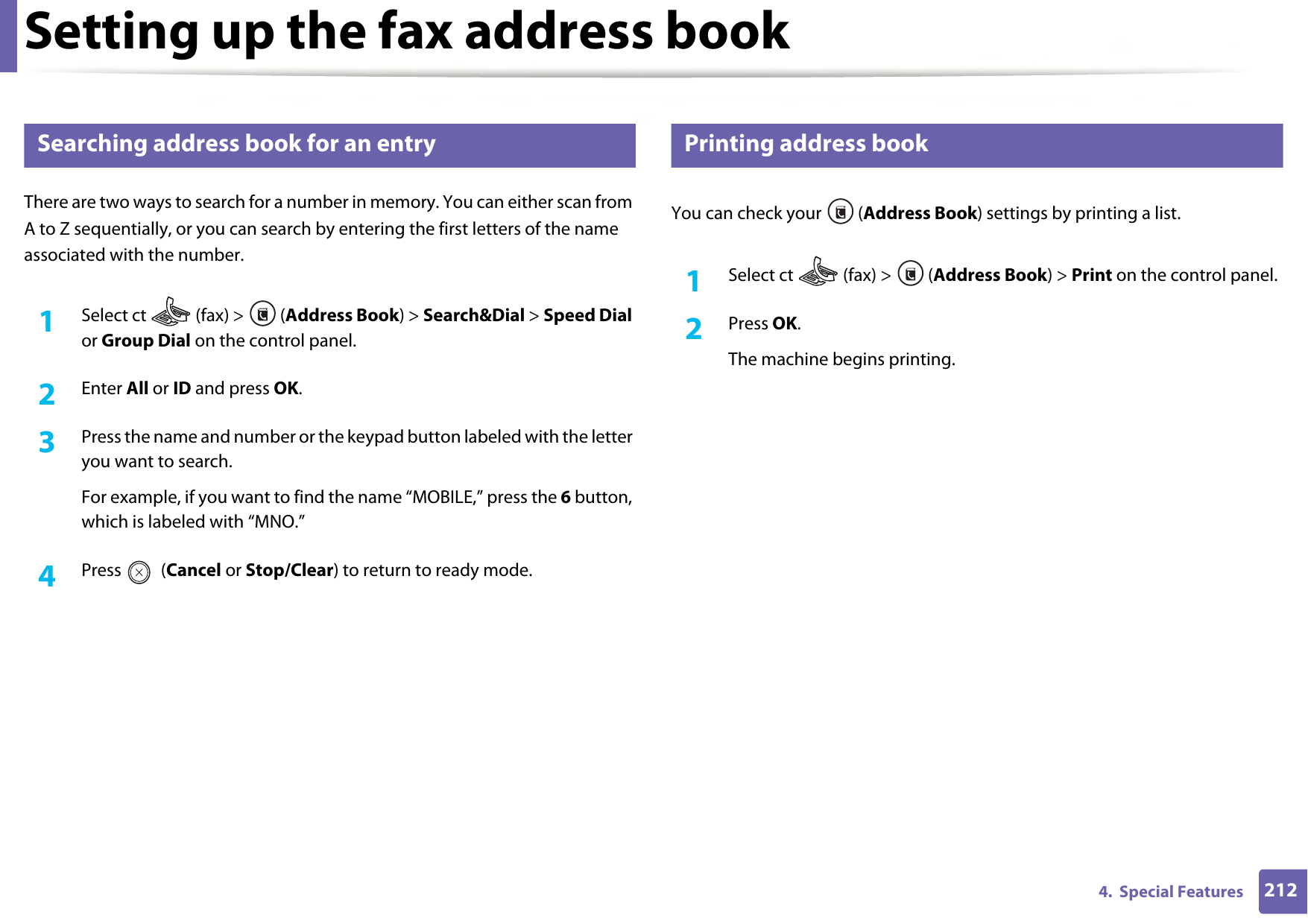
Setting up the fax address book2124.  Special Features8 Searching address book for an entryThere are two ways to search for a number in memory. You can either scan from A to Z sequentially, or you can search by entering the first letters of the name associated with the number.1Select ct   (fax) >  (Address Book) > Search&Dial > Speed Dial or Group Dial on the control panel. 2  Enter All or ID and press OK.3  Press the name and number or the keypad button labeled with the letter you want to search.For example, if you want to find the name “MOBILE,” press the 6 button, which is labeled with “MNO.”4  Press  (Cancel or Stop/Clear) to return to ready mode.9 Printing address bookYou can check your  (Address Book) settings by printing a list.1Select ct   (fax) >  (Address Book) > Print on the control panel. 2  Press OK.The machine begins printing.
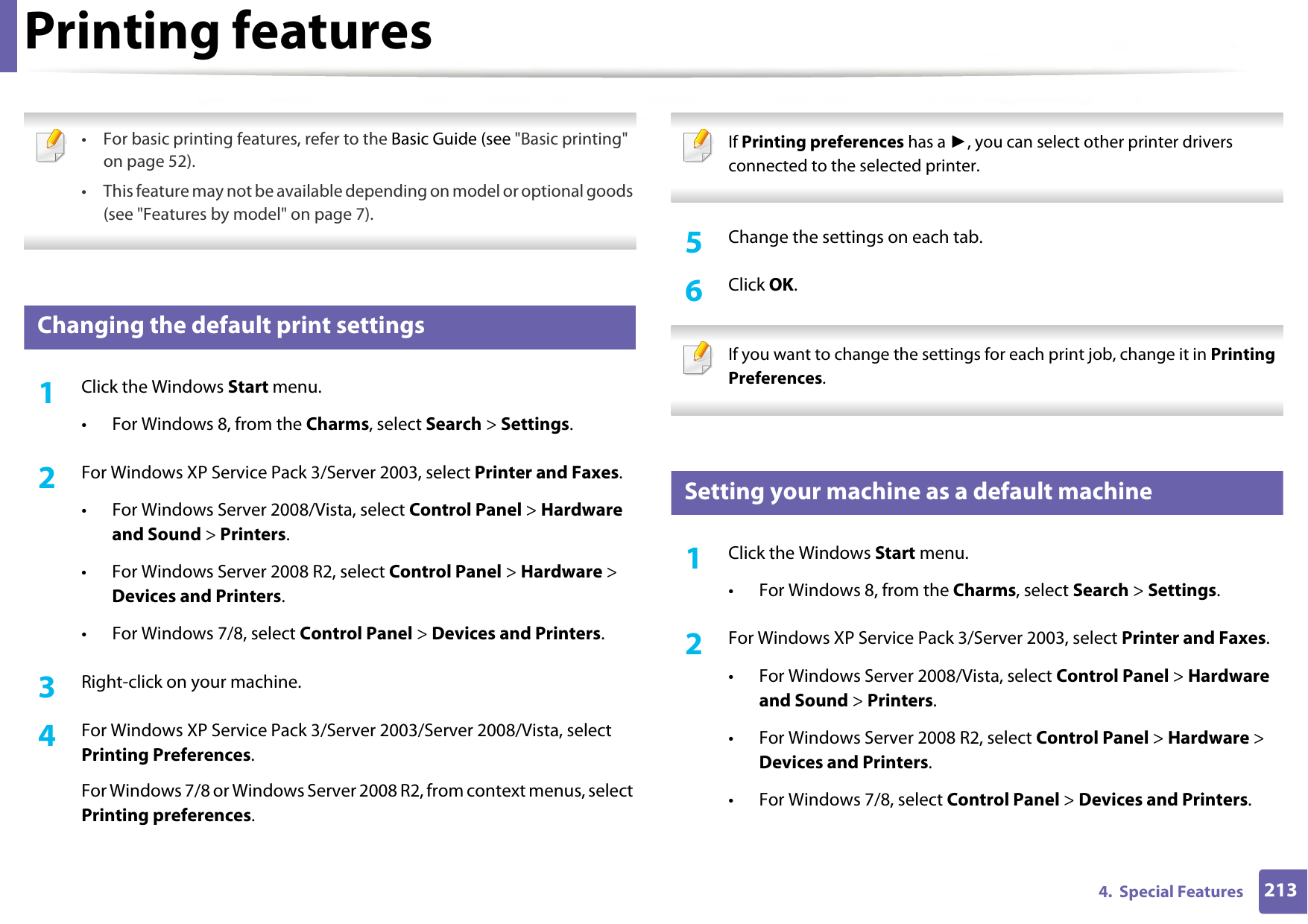
2134.  Special FeaturesPrinting features • For basic printing features, refer to the Basic Guide (see "Basic printing" on page 52).• This feature may not be available depending on model or optional goods (see "Features by model" on page 7). 10 Changing the default print settings1Click the Windows Start menu. • For Windows 8, from the Charms, select Search > Settings.2  For Windows XP Service Pack 3/Server 2003, select Printer and Faxes. • For Windows Server 2008/Vista, select Control Panel > Hardware and Sound > Printers. • For Windows Server 2008 R2, select Control Panel > Hardware > Devices and Printers. • For Windows 7/8, select Control Panel > Devices and Printers. 3  Right-click on your machine.4  For Windows XP Service Pack 3/Server 2003/Server 2008/Vista, select Printing Preferences.For Windows 7/8 or Windows Server 2008 R2, from context menus, select Printing preferences. If Printing preferences has a ►, you can select other printer drivers connected to the selected printer. 5  Change the settings on each tab. 6  Click OK. If you want to change the settings for each print job, change it in Printing Preferences.  11 Setting your machine as a default machine1Click the Windows Start menu.• For Windows 8, from the Charms, select Search > Settings.2  For Windows XP Service Pack 3/Server 2003, select Printer and Faxes. • For Windows Server 2008/Vista, select Control Panel > Hardware and Sound > Printers. • For Windows Server 2008 R2, select Control Panel > Hardware > Devices and Printers. • For Windows 7/8, select Control Panel > Devices and Printers.
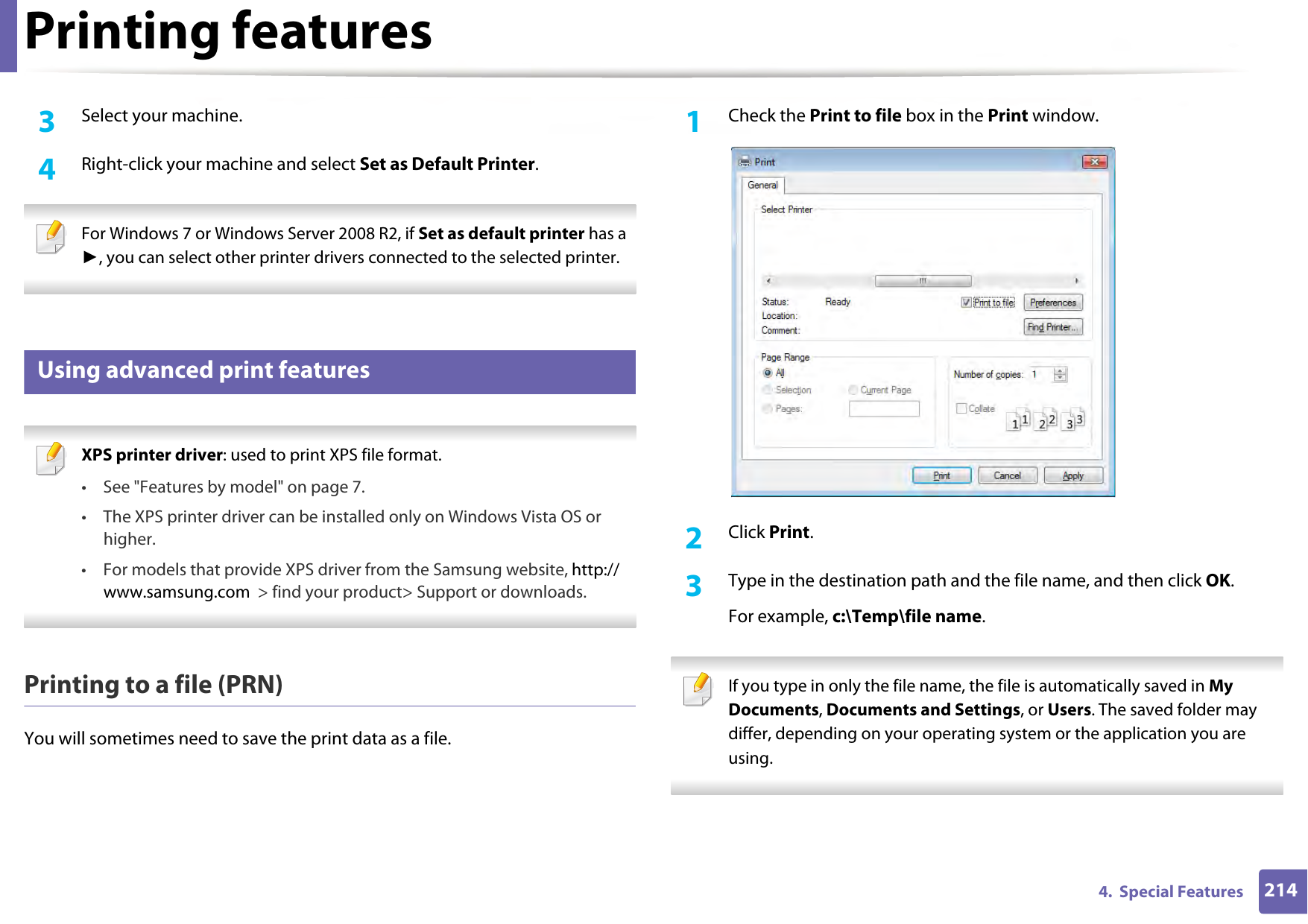
Printing features2144.  Special Features3  Select your machine.4  Right-click your machine and select Set as Default Printer. For Windows 7 or Windows Server 2008 R2, if Set as default printer has a ►, you can select other printer drivers connected to the selected printer. 12 Using advanced print features XPS printer driver: used to print XPS file format. • See "Features by model" on page 7.• The XPS printer driver can be installed only on Windows Vista OS or higher.• For models that provide XPS driver from the Samsung website, http://www.samsung.com  > find your product> Support or downloads. Printing to a file (PRN)You will sometimes need to save the print data as a file. 1Check the Print to file box in the Print window.2  Click Print.3  Type in the destination path and the file name, and then click OK.For example, c:\Temp\file name. If you type in only the file name, the file is automatically saved in My Documents, Documents and Settings, or Users. The saved folder may differ, depending on your operating system or the application you are using.
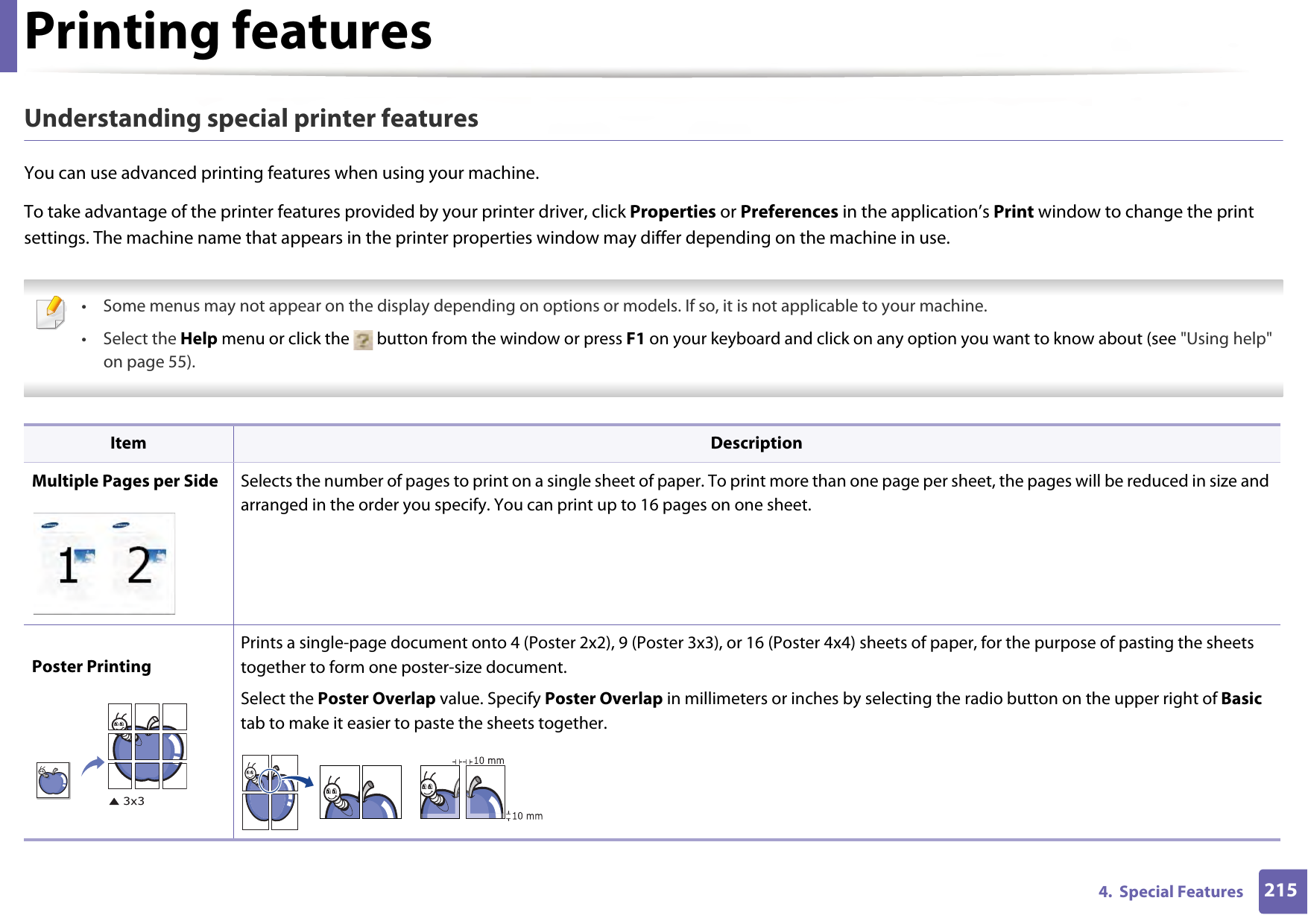
Printing features2154.  Special FeaturesUnderstanding special printer featuresYou can use advanced printing features when using your machine.To take advantage of the printer features provided by your printer driver, click Properties or Preferences in the application’s Print window to change the print settings. The machine name that appears in the printer properties window may differ depending on the machine in use. • Some menus may not appear on the display depending on options or models. If so, it is not applicable to your machine.• Select the Help menu or click the   button from the window or press F1 on your keyboard and click on any option you want to know about (see "Using help" on page 55).  Item DescriptionMultiple Pages per Side Selects the number of pages to print on a single sheet of paper. To print more than one page per sheet, the pages will be reduced in size and arranged in the order you specify. You can print up to 16 pages on one sheet. Poster PrintingPrints a single-page document onto 4 (Poster 2x2), 9 (Poster 3x3), or 16 (Poster 4x4) sheets of paper, for the purpose of pasting the sheets together to form one poster-size document.Select the Poster Overlap value. Specify Poster Overlap in millimeters or inches by selecting the radio button on the upper right of Basic tab to make it easier to paste the sheets together.
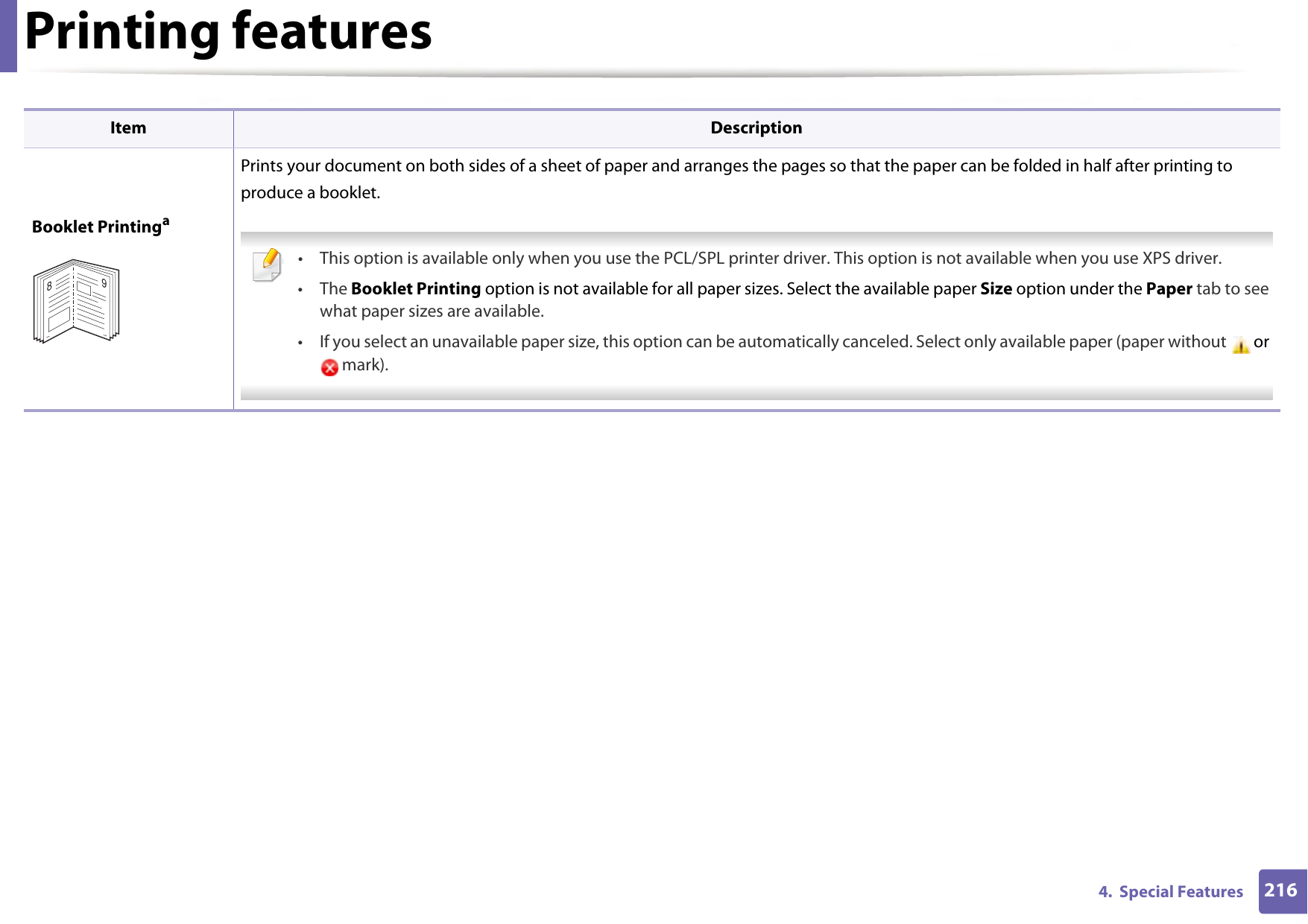
Printing features2164.  Special FeaturesBooklet PrintingaPrints your document on both sides of a sheet of paper and arranges the pages so that the paper can be folded in half after printing to produce a booklet.  • This option is available only when you use the PCL/SPL printer driver. This option is not available when you use XPS driver.• The Booklet Printing option is not available for all paper sizes. Select the available paper Size option under the Paper tab to see what paper sizes are available.• If you select an unavailable paper size, this option can be automatically canceled. Select only available paper (paper without  or  mark). Item Description89
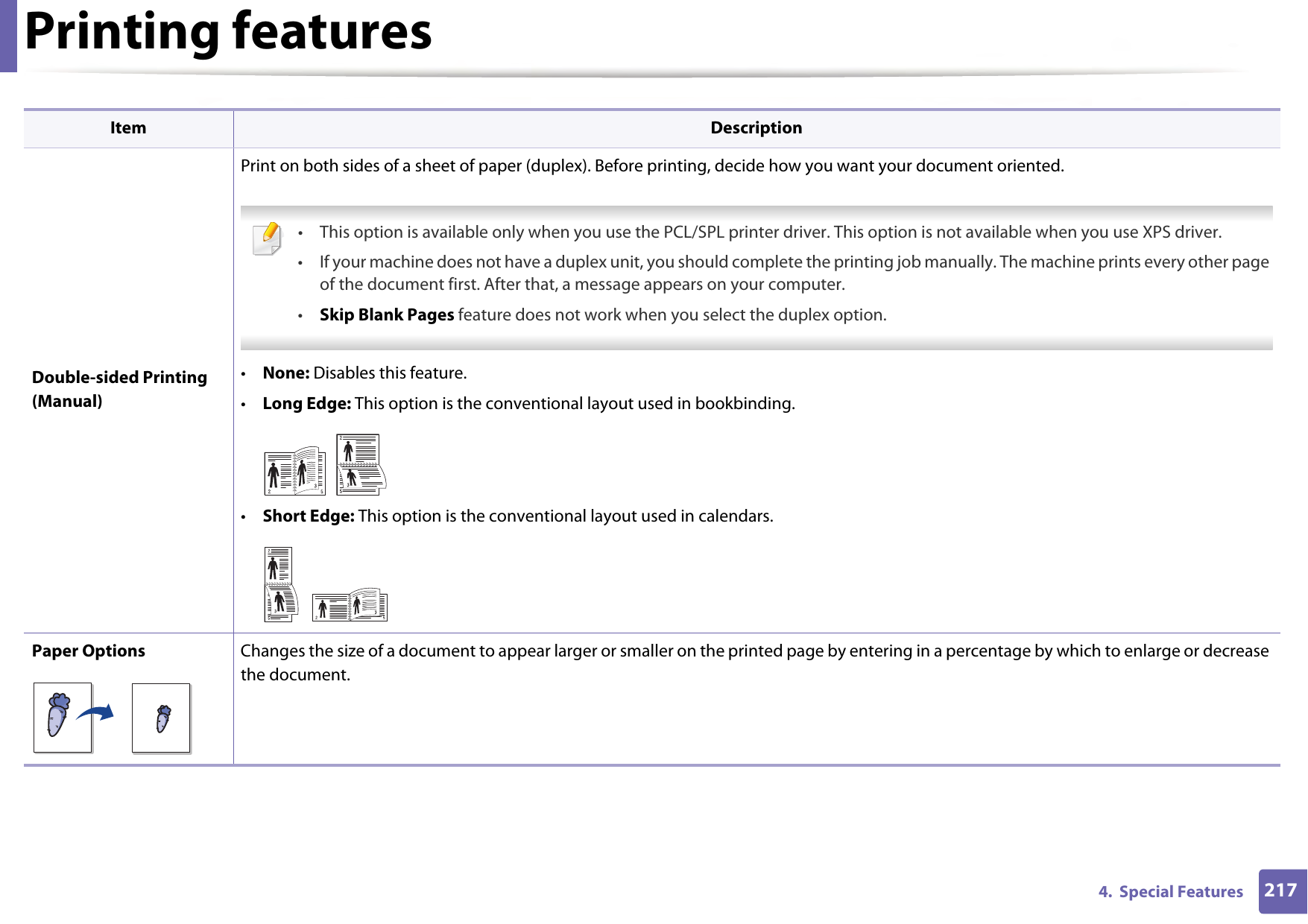
Printing features2174.  Special FeaturesDouble-sided Printing (Manual)Print on both sides of a sheet of paper (duplex). Before printing, decide how you want your document oriented.  • This option is available only when you use the PCL/SPL printer driver. This option is not available when you use XPS driver.• If your machine does not have a duplex unit, you should complete the printing job manually. The machine prints every other page of the document first. After that, a message appears on your computer.•Skip Blank Pages feature does not work when you select the duplex option. •None: Disables this feature.•Long Edge: This option is the conventional layout used in bookbinding.•Short Edge: This option is the conventional layout used in calendars.Paper Options Changes the size of a document to appear larger or smaller on the printed page by entering in a percentage by which to enlarge or decrease the document.Item Description
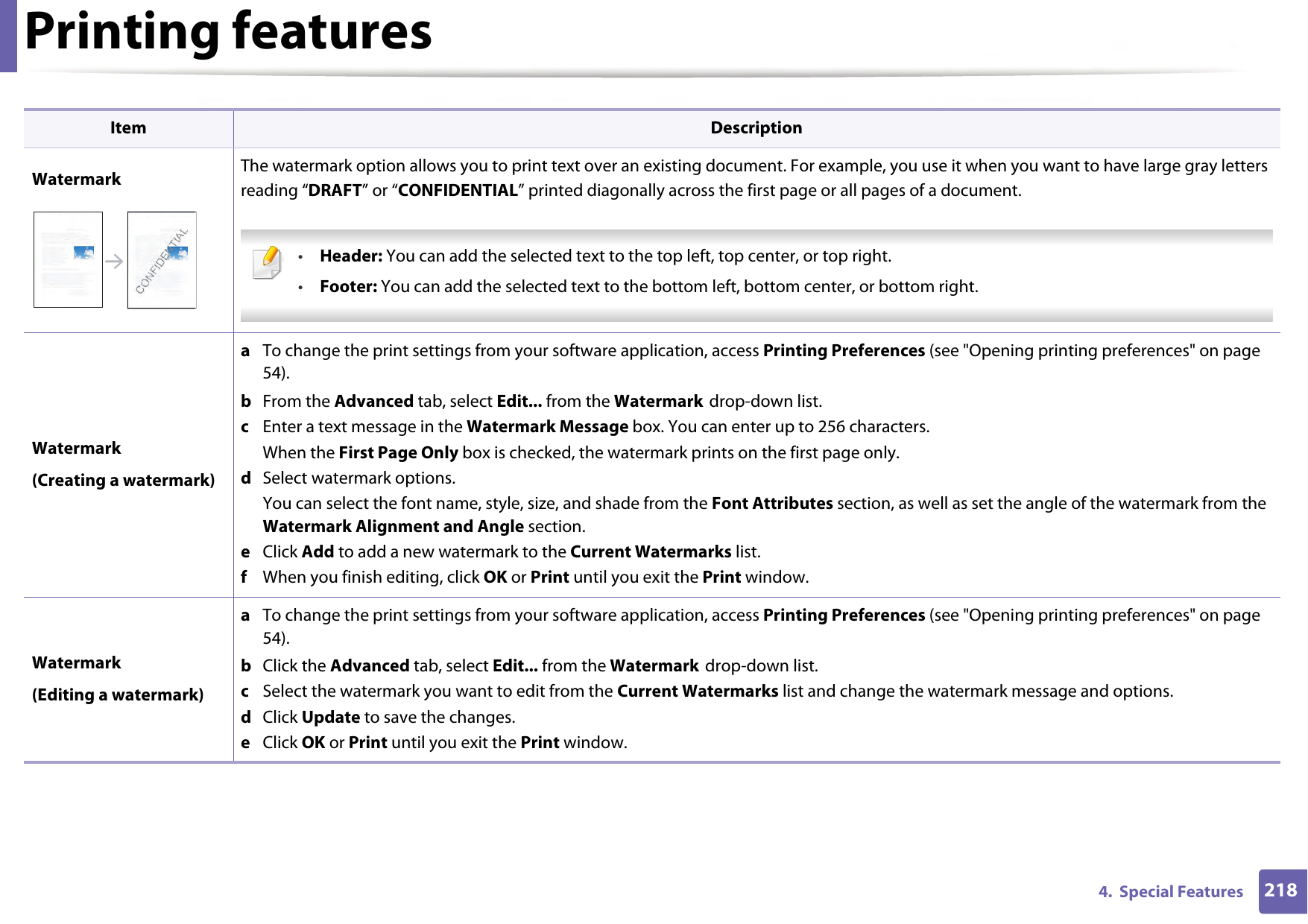
Printing features2184.  Special FeaturesWatermark The watermark option allows you to print text over an existing document. For example, you use it when you want to have large gray letters reading “DRAFT” or “CONFIDENTIAL” printed diagonally across the first page or all pages of a document.  •Header: You can add the selected text to the top left, top center, or top right.•Footer: You can add the selected text to the bottom left, bottom center, or bottom right. Watermark(Creating a watermark)a  To change the print settings from your software application, access Printing Preferences (see "Opening printing preferences" on page 54).b  From the Advanced tab, select Edit... from the Watermark drop-down list. c  Enter a text message in the Watermark Message box. You can enter up to 256 characters. When the First Page Only box is checked, the watermark prints on the first page only.d  Select watermark options. You can select the font name, style, size, and shade from the Font Attributes section, as well as set the angle of the watermark from the Watermark Alignment and Angle section. e  Click Add to add a new watermark to the Current Watermarks list.   f  When you finish editing, click OK or Print until you exit the Print window.Watermark(Editing a watermark)a  To change the print settings from your software application, access Printing Preferences (see "Opening printing preferences" on page 54).b  Click the Advanced tab, select Edit... from the Watermark drop-down list.c  Select the watermark you want to edit from the Current Watermarks list and change the watermark message and options. d  Click Update to save the changes.e  Click OK or Print until you exit the Print window. Item Description
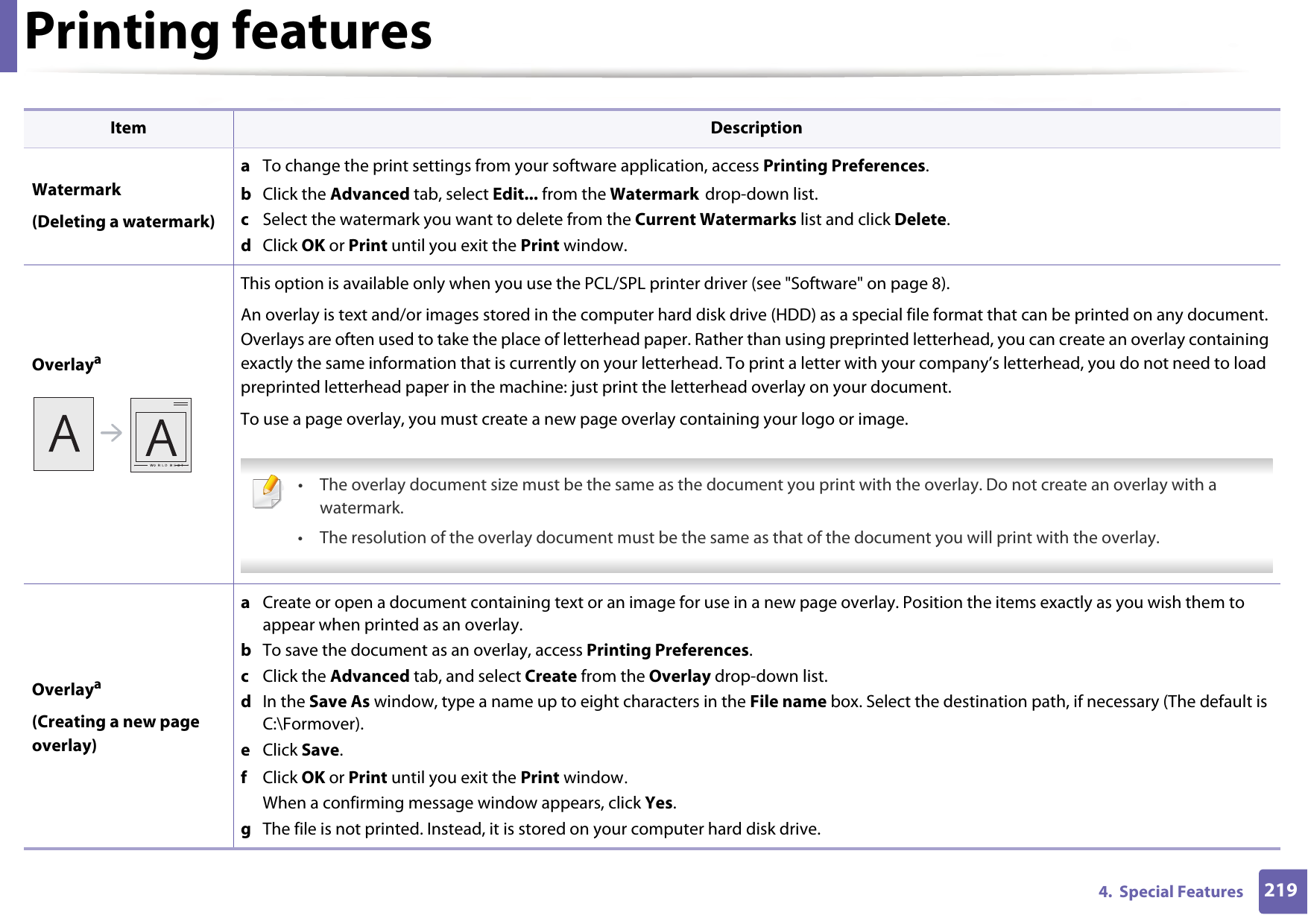
Printing features2194.  Special FeaturesWatermark(Deleting a watermark)a  To change the print settings from your software application, access Printing Preferences.b  Click the Advanced tab, select Edit... from the Watermark drop-down list.c  Select the watermark you want to delete from the Current Watermarks list and click Delete. d  Click OK or Print until you exit the Print window.OverlayaThis option is available only when you use the PCL/SPL printer driver (see "Software" on page 8).An overlay is text and/or images stored in the computer hard disk drive (HDD) as a special file format that can be printed on any document. Overlays are often used to take the place of letterhead paper. Rather than using preprinted letterhead, you can create an overlay containing exactly the same information that is currently on your letterhead. To print a letter with your company’s letterhead, you do not need to load preprinted letterhead paper in the machine: just print the letterhead overlay on your document.To use a page overlay, you must create a new page overlay containing your logo or image. • The overlay document size must be the same as the document you print with the overlay. Do not create an overlay with a watermark.• The resolution of the overlay document must be the same as that of the document you will print with the overlay. Overlaya(Creating a new page overlay)a  Create or open a document containing text or an image for use in a new page overlay. Position the items exactly as you wish them to appear when printed as an overlay.b  To save the document as an overlay, access Printing Preferences.c  Click the Advanced tab, and select Create from the Overlay drop-down list.d  In the Save As window, type a name up to eight characters in the File name box. Select the destination path, if necessary (The default is C:\Formover).e  Click Save.f  Click OK or Print until you exit the Print window.When a confirming message window appears, click Yes.g  The file is not printed. Instead, it is stored on your computer hard disk drive.Item Description
Printing features2204.  Special Features Overlaya(Using a page overlay)a  Create or open the document you want to print.b  To change the print settings from your software application, access Printing Preferences.c  Click the Advanced tab. d  Select the Print Overlay from the Overlay drop-down list. e  If the overlay file you want does not appear in the Overlay File 1 or Overlay File 2 drop-down list, select Load from the Overlay List. Select the overlay file you want to use. If you have stored the overlay file you want to use in an external source, you can also load the file when you access the Load window. After you select the file, click Open. The file appears in the Overlay List box and is available for printing. Select the overlay from the Overlay List box. f  If necessary, check Confirm Page Overlay When Printing box. If this box is checked, a message window appears each time you submit a document for printing, asking you to confirm your wish to print an overlay on your document. If this box is not checked and an overlay has been selected, the overlay automatically prints with your document. g  Click OK or Print until you exit the Print window. The selected overlay prints on your document. Overlaya(Deleting a page overlay)a  In the Printing Preferences window, click the Advanced tab. b  Select Edit in the Text drop down list. c  Select the overlay you want to delete from the Overlay List box. d  Click Delete. e  When a confirming message window appears, click Yes.f  Click OK or Print until you exit the Print window. You can delete page overlays that you no longer use.a. This option is not available when you use XPS driver.Item Description
Printing features2214.  Special Features13 Mac printing Some features may not be available depending on models or options. It means that the features are not supported. Printing a documentWhen you print with a Mac, you need to check the printer driver settings in each application you use. Follow the steps below to print from a Mac:1Open the document to print.2  Open the File menu and click Page Setup (Document Setup in some applications).3  Choose your paper size, orientation, scaling, other options, and make sure that your machine is selected. Click OK.4  Open the File menu and click Print. 5  Choose the number of copies and indicate which pages to print. 6  Click Print.Changing printer settingsYou can use advanced printing features when using your machine.Open an application and select Print from the File menu. The machine name, which appears in the printer properties window, may differ depending on the machine in use. Except for the name, the composition of the printer properties window is similar to the following.Printing multiple pages on one sheet You can print more than one page on a single sheet of paper. This feature provides a cost-effective way to print draft copies.1Open an application, and select Print from the File menu.2  Select Layout from the drop-down list under Orientation. In the Pages per Sheet drop-down list, select the number of pages you want to print on one sheet of paper.3  Select the other options to use.4  Click Print. The machine prints the selected number of pages to print on one sheet of paper.
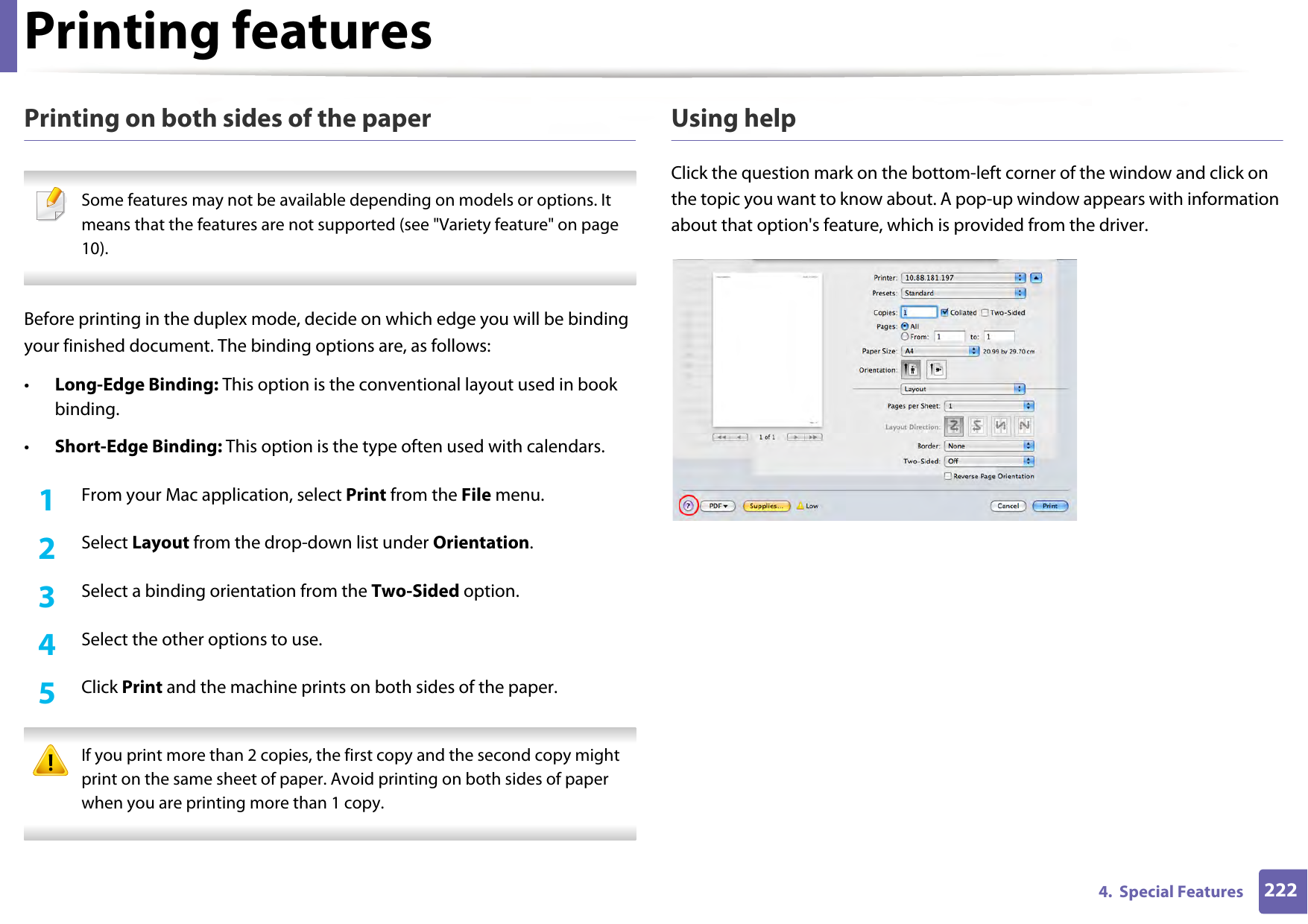
Printing features2224.  Special FeaturesPrinting on both sides of the paper Some features may not be available depending on models or options. It means that the features are not supported (see "Variety feature" on page 10). Before printing in the duplex mode, decide on which edge you will be binding your finished document. The binding options are, as follows:•Long-Edge Binding: This option is the conventional layout used in book binding.•Short-Edge Binding: This option is the type often used with calendars.1From your Mac application, select Print from the File menu.2  Select Layout from the drop-down list under Orientation. 3  Select a binding orientation from the Two-Sided option.4  Select the other options to use.5  Click Print and the machine prints on both sides of the paper. If you print more than 2 copies, the first copy and the second copy might print on the same sheet of paper. Avoid printing on both sides of paper when you are printing more than 1 copy. Using helpClick the question mark on the bottom-left corner of the window and click on the topic you want to know about. A pop-up window appears with information about that option's feature, which is provided from the driver.
Printing features2234.  Special Features14 Linux printing Some features may not be available depending on models or options. It means that the features are not supported. Printing from applicationsThere are a lot of Linux applications that allow you to print using Common UNIX Printing System (CUPS). You can print on your machine from any such application.1Open the document to print.2  Open the File menu and click Page Setup (Print Setup for someapplications).3   Choose your paper size, orientation, and makesure that your machine is selected. Click Apply.4   Open the File menu and click Print.5   Select your machine to print.6  Choose the number of copies and indicate which pages to print.7  Change other printing options in each tab, if necessary.8  Click Print. Automatic/manual duplex printing may not be available depending on models. You can alternatively use the lpr printing system or other applications for odd-even printing (see "Features by model" on page 7). Printing filesYou can print text, image, pdf files on your machine using the standardCUPS directly from the command line interface. The CUPS lp or lpr utility allows you to do that. You can print these files by using below command format."lp -d <printer name> -o <option> <file name>"Please refer to lp or lpr man page on your system for more details.
Printing features2244.  Special FeaturesConfiguring Printer PropertiesYou can change the default printing options or connection type with Printing utility supplied by o/s.1Launch Printing utility(Go to System > Administration > Printing menu or execute "system-config-printer" command in Terminal program).2  Select your printer and double-click it.3  Change default printing options or connection type.4  Click Apply button.
2254.  Special FeaturesScan features • For basic scanning features, refer to the Basic Guide (see "Basic scanning" on page 63).• This feature may not be available depending on model or optional goods (see "Features by model" on page 7).• The maximum resolution that can be achieved depends upon various factors, including computer speed, available disk space, memory, the size of the image being scanned, and bit depth settings. Thus, depending on your system and what you are scanning, you may not be able to scan at certain resolutions, especially using enhanced dpi. 15 Basic scanning method This feature may not be available depending on model or optional goods (see "Variety feature" on page 10). You can scan the originals with your machine via a USB cable or the network. The following methodoloqies can be used for scanning your documents:•Scan to PC: Scan the originals from the control panel. Then, the scanned data will be stored in the connected computers My Documents folder (see "Basic Scanning" on page 63).•Scan to Email: You can send the scanned image as an email attachment (see "Scanning to email" on page 227).•Scan to WSD: Scans the originals and saves the scanned data on a connected computer if the computer supports the WSD (Web Service for Device) feature (see "Scanning to WSD" on page 228).•Samsung Cloud: You can send the scanned image as an Samsung cloud (see "Scanning and sending to Samsung Cloud Print" on page 184).•TWAIN: TWAIN is the one of the preset imaging applications. Scanning an image launches the selected application, enabling you to control the scanning process. This feature can be used via the local connection or the network connection (see "Scanning from image editing program" on page 229).•Samsung Easy Document Creator: You can use this program to scan images or documents (See "Using Samsung Easy Document Creator" on page 254).•WIA: WIA stands for Windows Images Acquisition. To use this feature, your computer must be connected directly with the machine via a USB cable (see "Scanning using the WIA driver" on page 230).•Scan to USB: You can scan a document and save the scanned image onto a USB memory device (see "Scanning to a USB memory device" on page 70).16 Setting the scan settings in the computer This feature may not be available depending on model or optional goods (see "Features by model" on page 7).
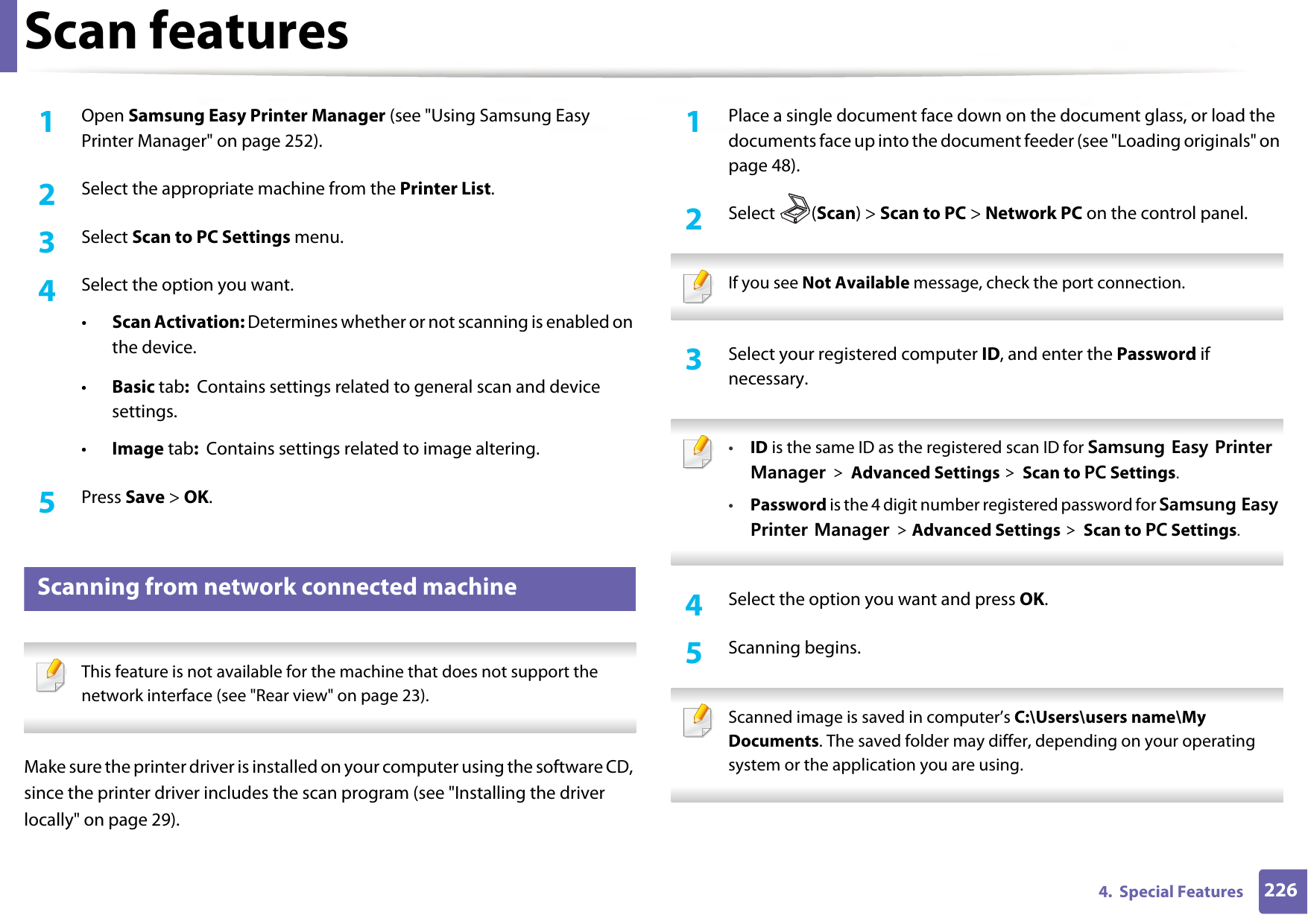
Scan features2264.  Special Features1Open Samsung Easy Printer Manager (see "Using Samsung Easy Printer Manager" on page 252).2  Select the appropriate machine from the Printer List.3  Select Scan to PC Settings menu.4  Select the option you want.•Scan Activation: Determines whether or not scanning is enabled on the device.•Basic tab:  Contains settings related to general scan and device settings.•Image tab:  Contains settings related to image altering.5  Press Save > OK.17 Scanning from network connected machine This feature is not available for the machine that does not support the network interface (see "Rear view" on page 23). Make sure the printer driver is installed on your computer using the software CD, since the printer driver includes the scan program (see "Installing the driver locally" on page 29).1Place a single document face down on the document glass, or load the documents face up into the document feeder (see "Loading originals" on page 48).2  Select (Scan) > Scan to PC > Network PC on the control panel. If you see Not Available message, check the port connection. 3  Select your registered computer ID, and enter the Password if necessary. •ID is the same ID as the registered scan ID for Samsung Easy Printer Manager > Advanced Settings > Scan to PC Settings.•Password is the 4 digit number registered password for Samsung Easy Printer Manager > Advanced Settings > Scan to PC Settings. 4  Select the option you want and press OK.5  Scanning begins. Scanned image is saved in computer’s C:\Users\users name\My Documents. The saved folder may differ, depending on your operating system or the application you are using.
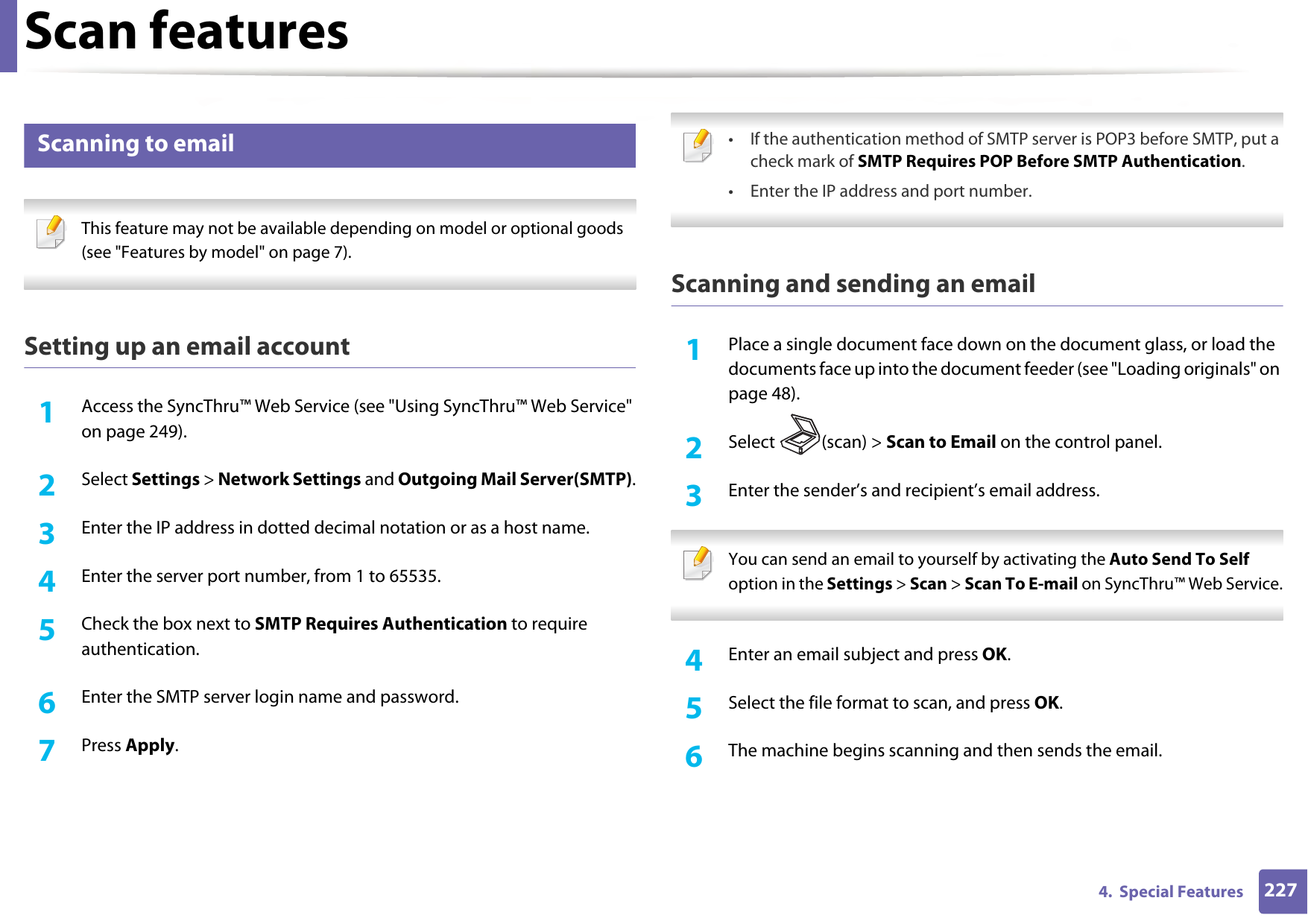
Scan features2274.  Special Features18 Scanning to email This feature may not be available depending on model or optional goods (see "Features by model" on page 7). Setting up an email account1Access the SyncThru™ Web Service (see "Using SyncThru™ Web Service" on page 249).2  Select Settings > Network Settings and Outgoing Mail Server(SMTP).3  Enter the IP address in dotted decimal notation or as a host name.4  Enter the server port number, from 1 to 65535.5  Check the box next to SMTP Requires Authentication to require authentication.6  Enter the SMTP server login name and password.7  Press Apply. • If the authentication method of SMTP server is POP3 before SMTP, put a check mark of SMTP Requires POP Before SMTP Authentication.• Enter the IP address and port number.  Scanning and sending an email1Place a single document face down on the document glass, or load the documents face up into the document feeder (see "Loading originals" on page 48).2  Select (scan) > Scan to Email on the control panel.3  Enter the sender’s and recipient’s email address. You can send an email to yourself by activating the Auto Send To Self option in the Settings > Scan > Scan To E-mail on SyncThru™ Web Service. 4  Enter an email subject and press OK.5  Select the file format to scan, and press OK.6  The machine begins scanning and then sends the email.
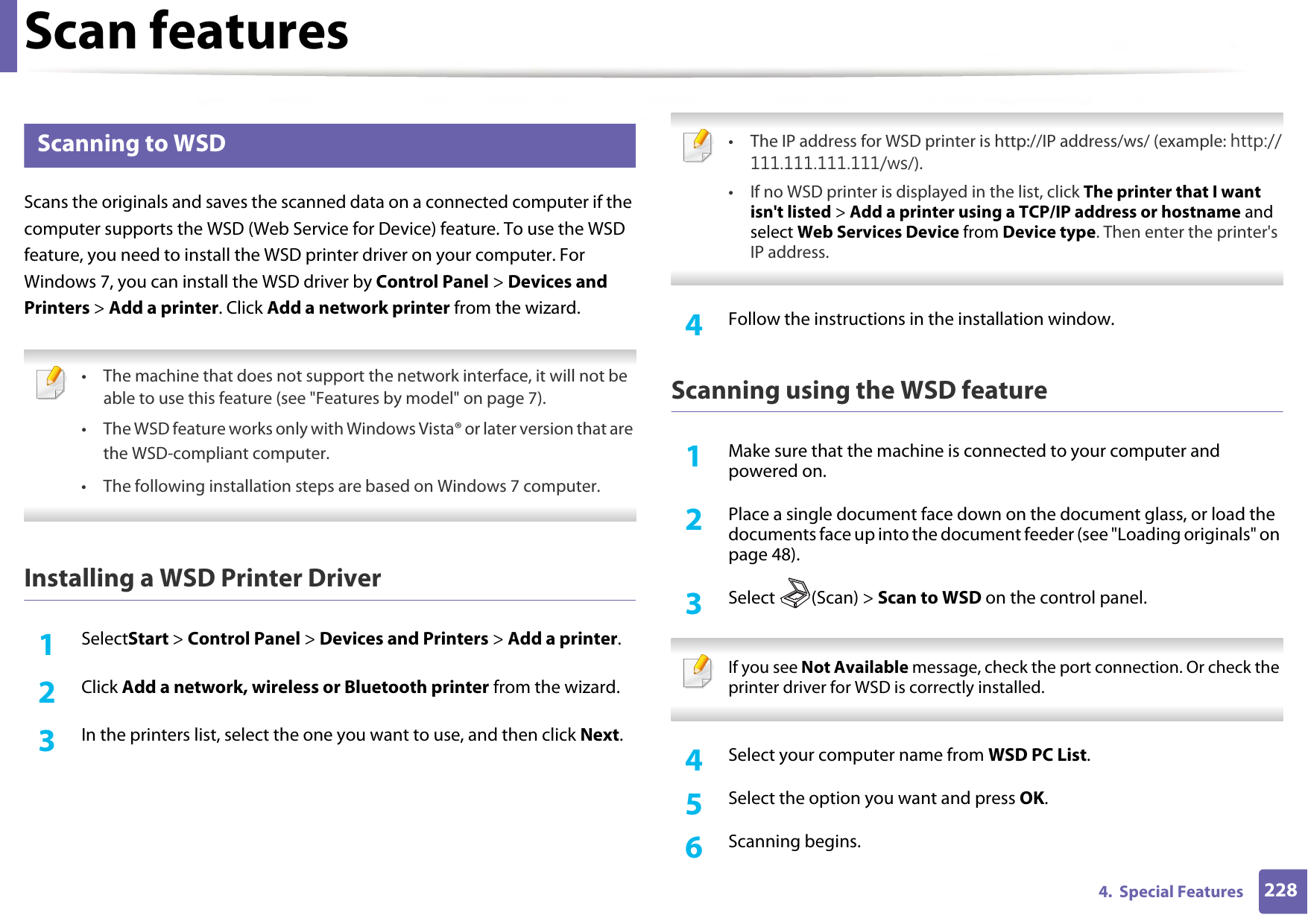
Scan features2284.  Special Features19 Scanning to WSDScans the originals and saves the scanned data on a connected computer if the computer supports the WSD (Web Service for Device) feature. To use the WSD feature, you need to install the WSD printer driver on your computer. For Windows 7, you can install the WSD driver by Control Panel > Devices and Printers > Add a printer. Click Add a network printer from the wizard. • The machine that does not support the network interface, it will not be able to use this feature (see "Features by model" on page 7).• The WSD feature works only with Windows Vista® or later version that are the WSD-compliant computer. • The following installation steps are based on Windows 7 computer.  Installing a WSD Printer Driver 1SelectStart > Control Panel > Devices and Printers > Add a printer.2  Click Add a network, wireless or Bluetooth printer from the wizard.3  In the printers list, select the one you want to use, and then click Next. • The IP address for WSD printer is http://IP address/ws/ (example: http://111.111.111.111/ws/).• If no WSD printer is displayed in the list, click The printer that I want isn't listed > Add a printer using a TCP/IP address or hostname and select Web Services Device from Device type. Then enter the printer's IP address. 4  Follow the instructions in the installation window.Scanning using the WSD feature1Make sure that the machine is connected to your computer and powered on.2  Place a single document face down on the document glass, or load the documents face up into the document feeder (see "Loading originals" on page 48).3  Select (Scan) > Scan to WSD on the control panel. If you see Not Available message, check the port connection. Or check the printer driver for WSD is correctly installed. 4  Select your computer name from WSD PC List.5  Select the option you want and press OK.6  Scanning begins.
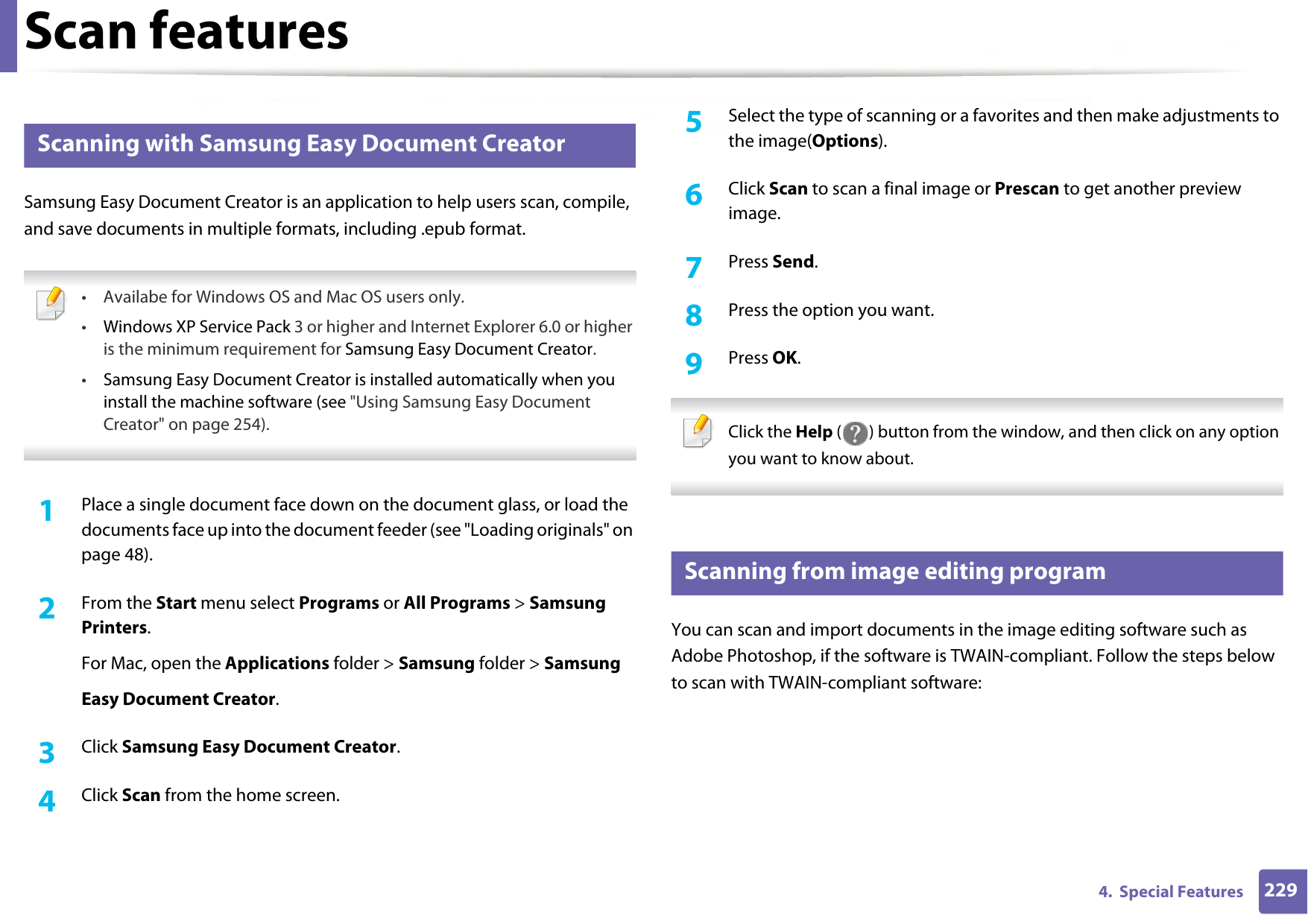
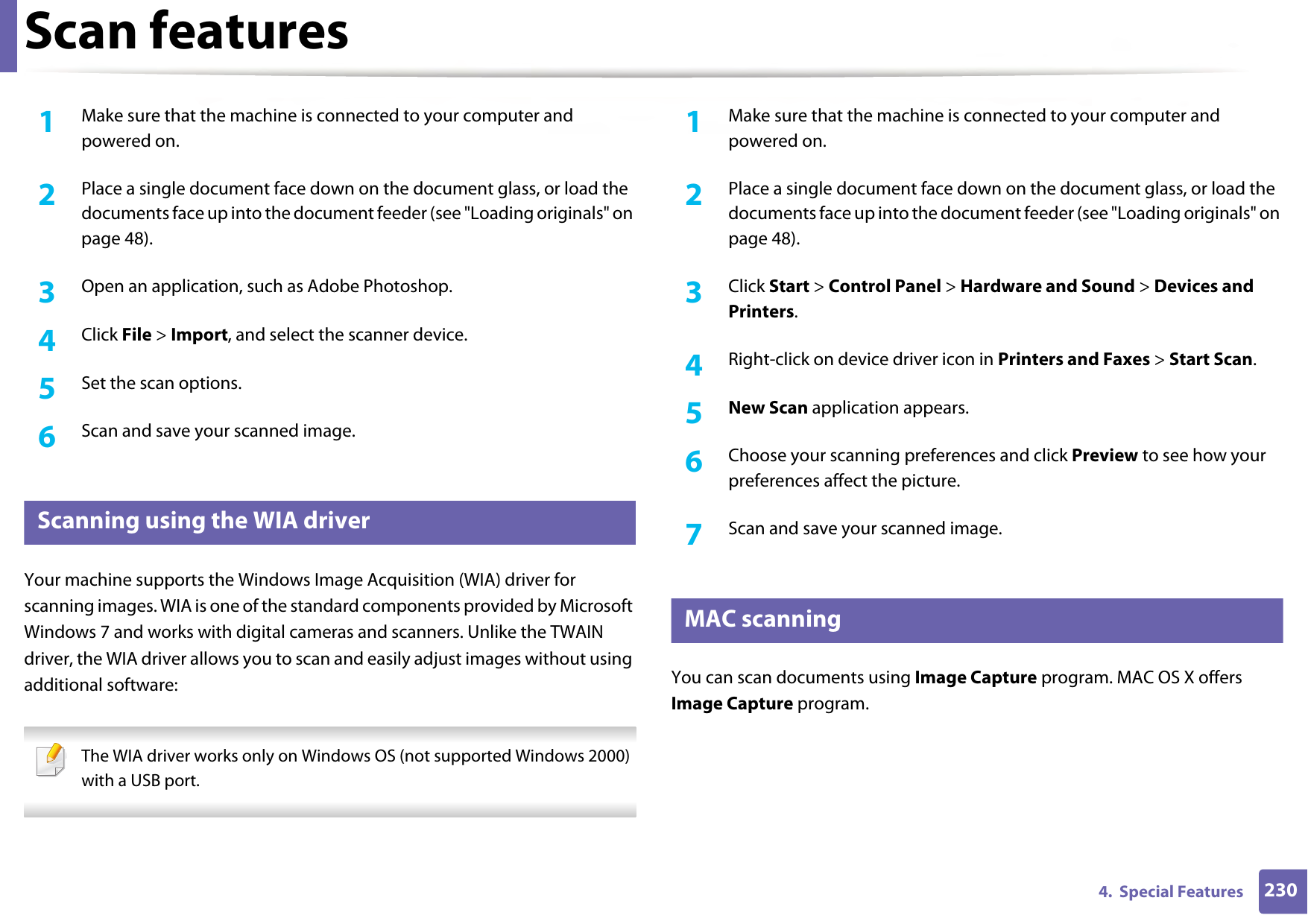
Scan features2294.  Special Features20 Scanning with Samsung Easy Document CreatorSamsung Easy Document Creator is an application to help users scan, compile, and save documents in multiple formats, including .epub format. • Availabe for Windows OS and Mac OS users only.•Windows XP Service Pack 3 or higher and Internet Explorer 6.0 or higher is the minimum requirement for Samsung Easy Document Creator.•Samsung Easy Document Creator is installed automatically when you install the machine software (see "Using Samsung Easy Document Creator" on page 254). 1Place a single document face down on the document glass, or load the documents face up into the document feeder (see "Loading originals" on page 48).2  From the Start menu select Programs or All Programs > Samsung Printers.For Mac, open the Applications folder > Samsung folder > SamsungEasy Document Creator.3  Click Samsung Easy Document Creator.4  Click Scan from the home screen.5  Select the type of scanning or a favorites and then make adjustments to the image(Options).6  Click Scan to scan a final image or Prescan to get another preview image.7  Press Send.8  Press the option you want.9  Press OK. Click the Help ( ) button from the window, and then click on any option you want to know about. 21 Scanning from image editing programYou can scan and import documents in the image editing software such as Adobe Photoshop, if the software is TWAIN-compliant. Follow the steps below to scan with TWAIN-compliant software:
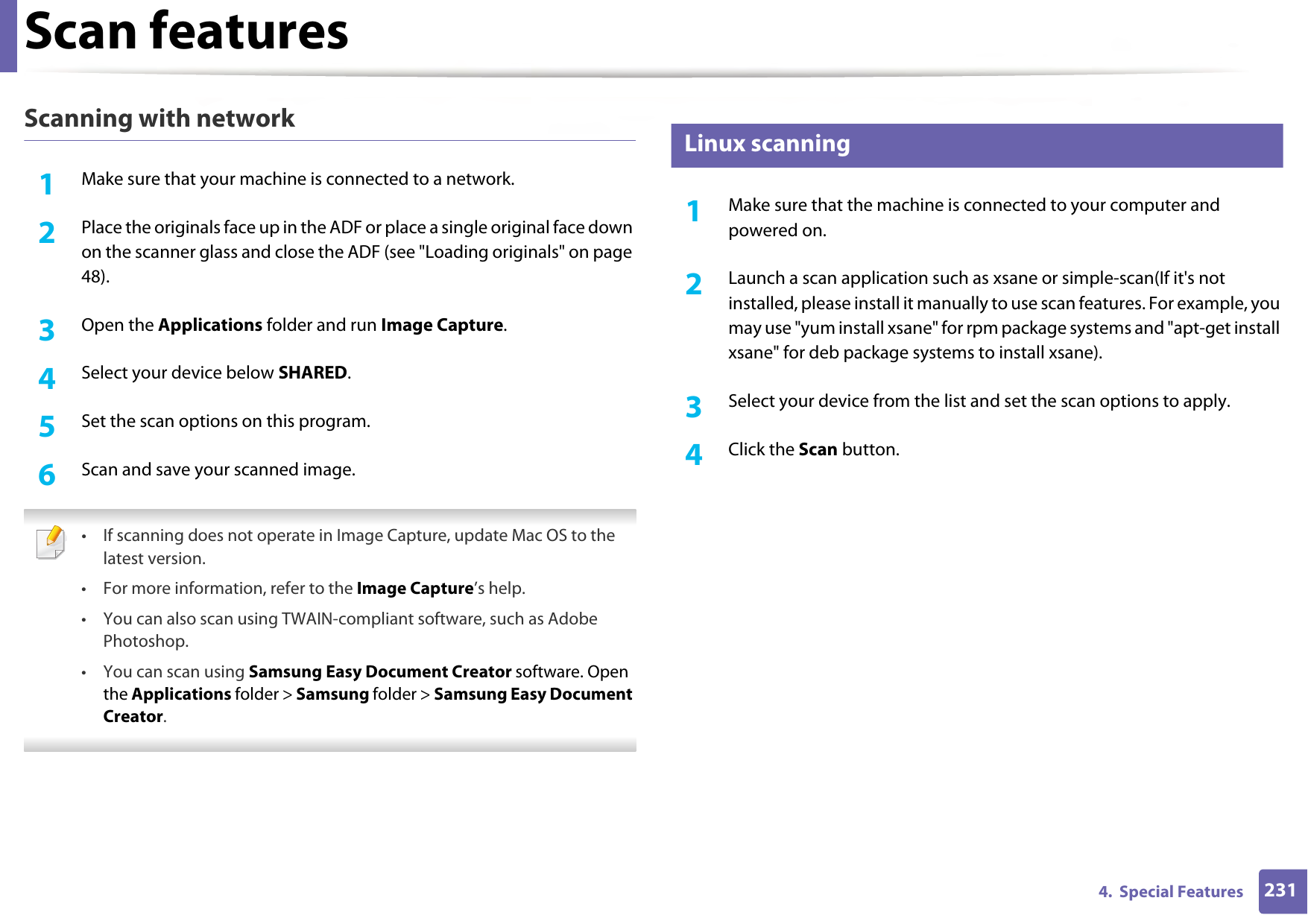
Scan features2304.  Special Features1Make sure that the machine is connected to your computer and powered on.2  Place a single document face down on the document glass, or load the documents face up into the document feeder (see "Loading originals" on page 48).3  Open an application, such as Adobe Photoshop.4  Click File > Import, and select the scanner device.5  Set the scan options.6  Scan and save your scanned image.22 Scanning using the WIA driverYour machine supports the Windows Image Acquisition (WIA) driver for scanning images. WIA is one of the standard components provided by Microsoft Windows 7 and works with digital cameras and scanners. Unlike the TWAIN driver, the WIA driver allows you to scan and easily adjust images without using additional software: The WIA driver works only on Windows OS (not supported Windows 2000) with a USB port. 1Make sure that the machine is connected to your computer and powered on.2  Place a single document face down on the document glass, or load the documents face up into the document feeder (see "Loading originals" on page 48).3  Click Start > Control Panel > Hardware and Sound > Devices and Printers.4  Right-click on device driver icon in Printers and Faxes > Start Scan.5  New Scan application appears.6  Choose your scanning preferences and click Preview to see how your preferences affect the picture.7  Scan and save your scanned image.23 MAC scanningYou can scan documents using Image Capture program. MAC OS X offers Image Capture program.
Scan features2314.  Special FeaturesScanning with network1Make sure that your machine is connected to a network.2  Place the originals face up in the ADF or place a single original face down on the scanner glass and close the ADF (see "Loading originals" on page 48).3  Open the Applications folder and run Image Capture. 4  Select your device below SHARED.5  Set the scan options on this program.6  Scan and save your scanned image. • If scanning does not operate in Image Capture, update Mac OS to the latest version. • For more information, refer to the Image Capture’s help.• You can also scan using TWAIN-compliant software, such as Adobe Photoshop.•You can scan using Samsung Easy Document Creator software. Open the Applications folder > Samsung folder > Samsung Easy Document Creator. 24 Linux scanning1Make sure that the machine is connected to your computer and powered on.2  Launch a scan application such as xsane or simple-scan(If it's not installed, please install it manually to use scan features. For example, you may use "yum install xsane" for rpm package systems and "apt-get install xsane" for deb package systems to install xsane). 3  Select your device from the list and set the scan options to apply. 4  Click the Scan button.
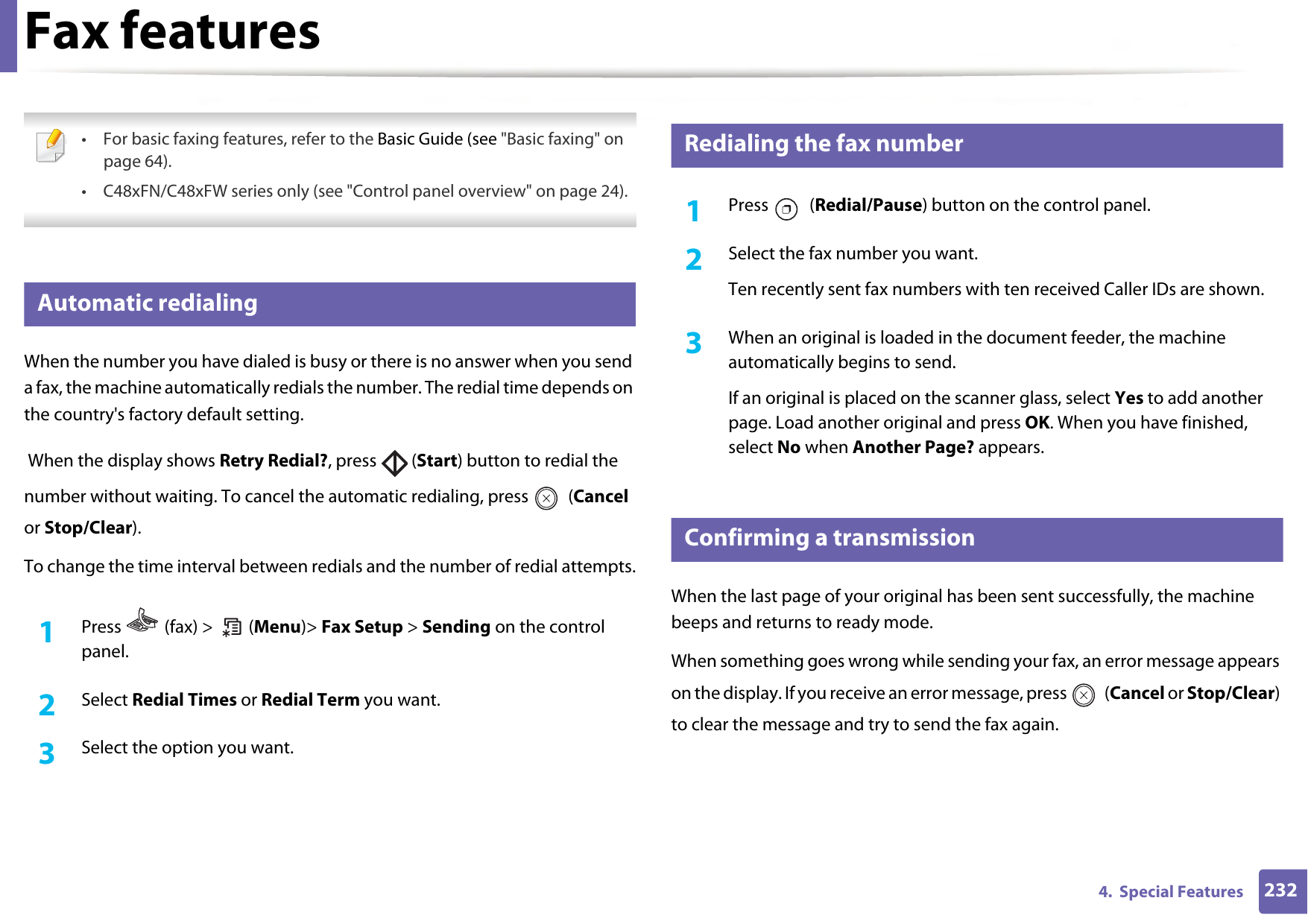
2324.  Special FeaturesFax features • For basic faxing features, refer to the Basic Guide (see "Basic faxing" on page 64).• C48xFN/C48xFW series only (see "Control panel overview" on page 24). 25 Automatic redialingWhen the number you have dialed is busy or there is no answer when you send a fax, the machine automatically redials the number. The redial time depends on the country's factory default setting.  When the display shows Retry Redial?, press   (Start) button to redial the number without waiting. To cancel the automatic redialing, press   (Cancel or Stop/Clear). To change the time interval between redials and the number of redial attempts.1Press   (fax) >   (Menu)> Fax Setup > Sending on the control panel.2  Select Redial Times or Redial Term you want.3  Select the option you want.26 Redialing the fax number1Press  (Redial/Pause) button on the control panel. 2  Select the fax number you want.Ten recently sent fax numbers with ten received Caller IDs are shown.3  When an original is loaded in the document feeder, the machine automatically begins to send.If an original is placed on the scanner glass, select Yes to add another page. Load another original and press OK. When you have finished, select No when Another Page? appears.27 Confirming a transmissionWhen the last page of your original has been sent successfully, the machine beeps and returns to ready mode.When something goes wrong while sending your fax, an error message appears on the display. If you receive an error message, press   (Cancel or Stop/Clear) to clear the message and try to send the fax again.
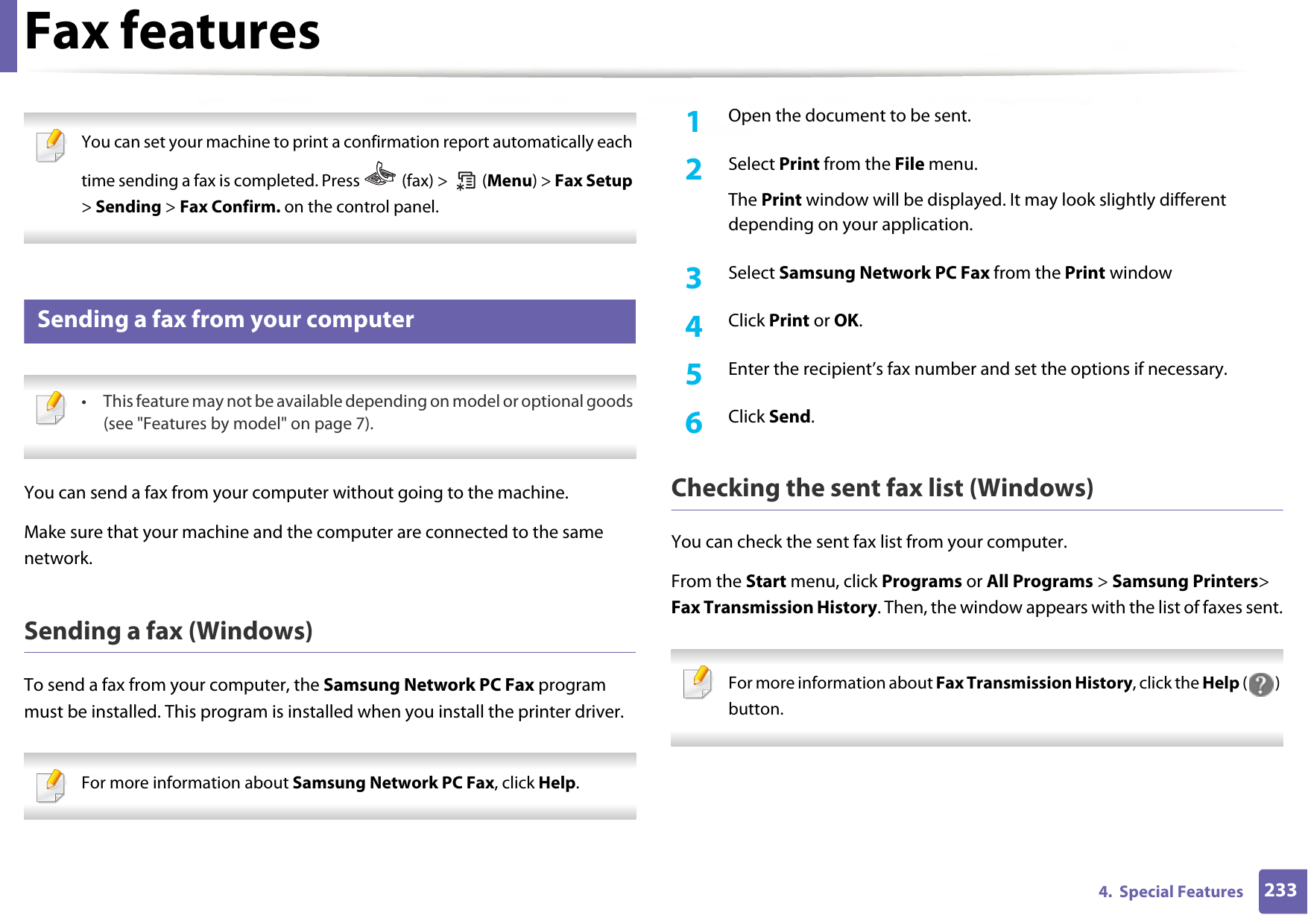
Fax features2334.  Special Features You can set your machine to print a confirmation report automatically each time sending a fax is completed. Press   (fax) >   (Menu) > Fax Setup > Sending > Fax Confirm. on the control panel. 28 Sending a fax from your computer • This feature may not be available depending on model or optional goods (see "Features by model" on page 7). You can send a fax from your computer without going to the machine.Make sure that your machine and the computer are connected to the same network.Sending a fax (Windows)To send a fax from your computer, the Samsung Network PC Fax program must be installed. This program is installed when you install the printer driver.  For more information about Samsung Network PC Fax, click Help.  1Open the document to be sent.2  Select Print from the File menu.The Print window will be displayed. It may look slightly different depending on your application.3  Select Samsung Network PC Fax from the Print window4  Click Print or OK.5  Enter the recipient’s fax number and set the options if necessary.6  Click Send.Checking the sent fax list (Windows) You can check the sent fax list from your computer.From the Start menu, click Programs or All Programs > Samsung Printers> Fax Transmission History. Then, the window appears with the list of faxes sent. For more information about Fax Transmission History, click the Help () button.
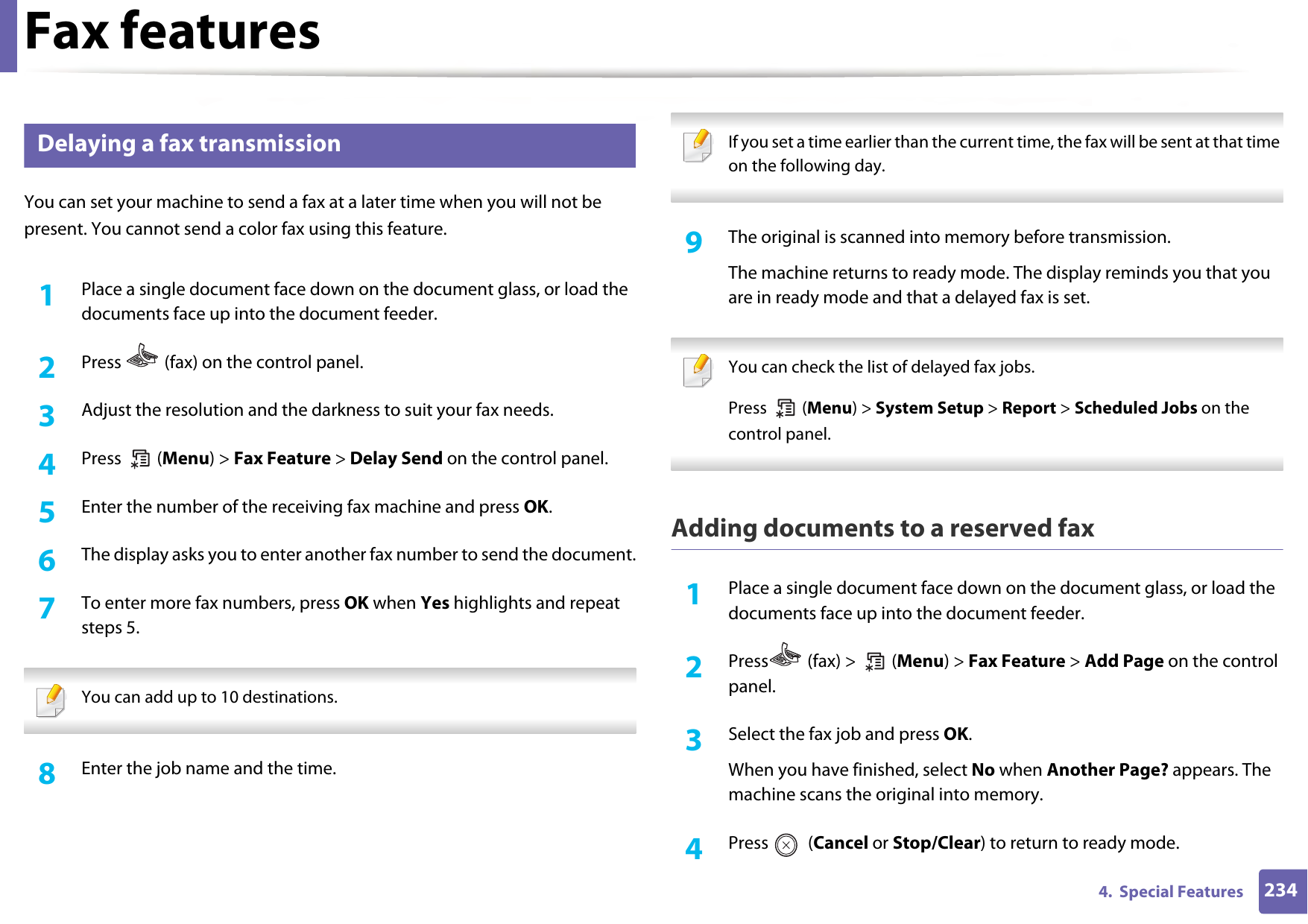
Fax features2344.  Special Features29 Delaying a fax transmissionYou can set your machine to send a fax at a later time when you will not be present. You cannot send a color fax using this feature.1Place a single document face down on the document glass, or load the documents face up into the document feeder.2  Press   (fax) on the control panel.3  Adjust the resolution and the darkness to suit your fax needs.4  Press  (Menu) > Fax Feature > Delay Send on the control panel.5  Enter the number of the receiving fax machine and press OK.6  The display asks you to enter another fax number to send the document.7  To enter more fax numbers, press OK when Yes highlights and repeat steps 5.  You can add up to 10 destinations. 8  Enter the job name and the time. If you set a time earlier than the current time, the fax will be sent at that time on the following day. 9  The original is scanned into memory before transmission.The machine returns to ready mode. The display reminds you that you are in ready mode and that a delayed fax is set. You can check the list of delayed fax jobs.Press  (Menu) > System Setup > Report > Scheduled Jobs on the control panel. Adding documents to a reserved fax1Place a single document face down on the document glass, or load the documents face up into the document feeder.2  Press  (fax) >   (Menu) > Fax Feature > Add Page on the control panel.3  Select the fax job and press OK.When you have finished, select No when Another Page? appears. The machine scans the original into memory.4  Press  (Cancel or Stop/Clear) to return to ready mode.
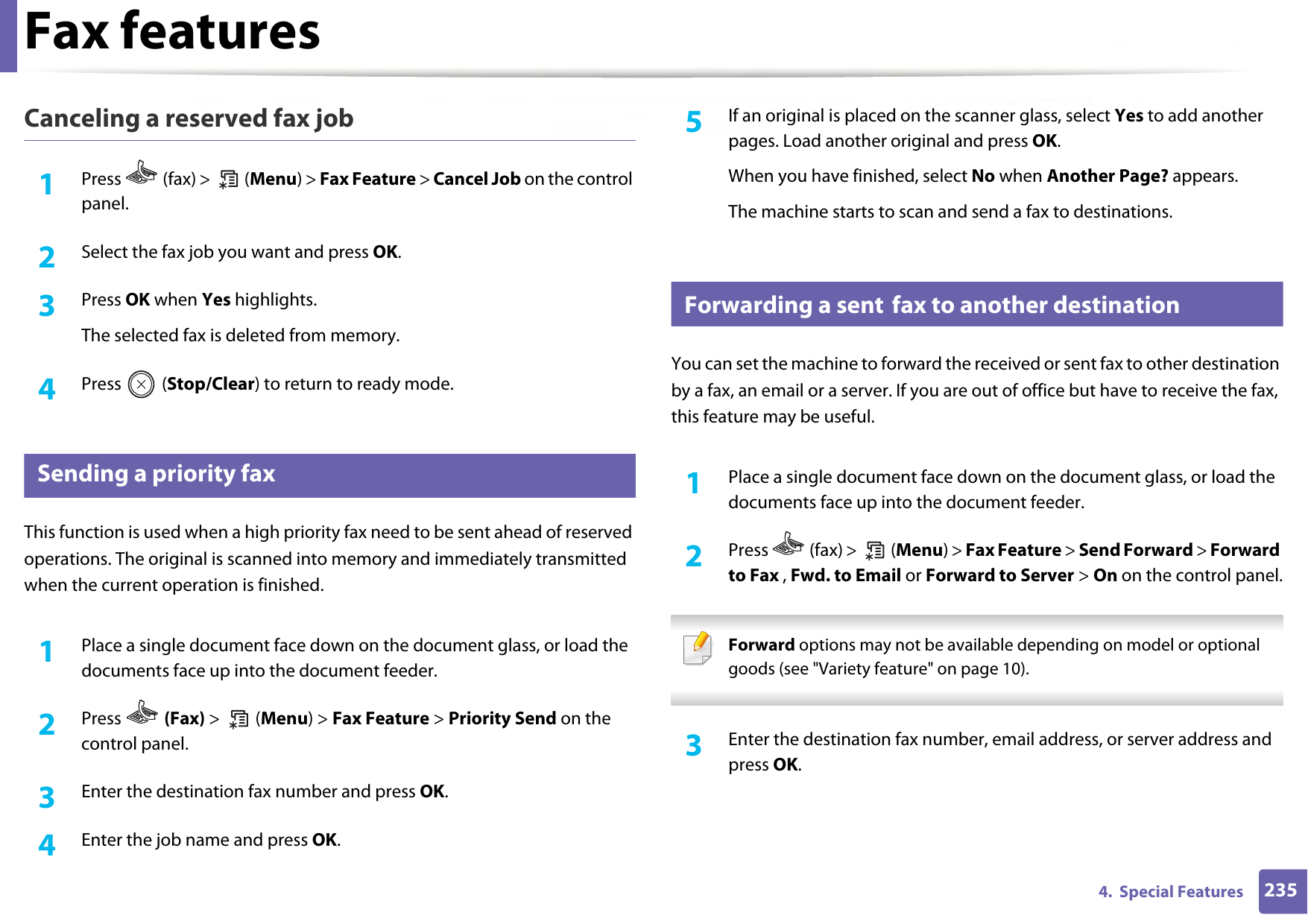
Fax features2354.  Special FeaturesCanceling a reserved fax job1Press   (fax) >   (Menu) > Fax Feature > Cancel Job on the control panel.2  Select the fax job you want and press OK.3  Press OK when Yes highlights.The selected fax is deleted from memory.4  Press  (Stop/Clear) to return to ready mode.30 Sending a priority faxThis function is used when a high priority fax need to be sent ahead of reserved operations. The original is scanned into memory and immediately transmitted when the current operation is finished.1Place a single document face down on the document glass, or load the documents face up into the document feeder.2  Press   (Fax) >  (Menu) > Fax Feature > Priority Send on the control panel.3  Enter the destination fax number and press OK.4  Enter the job name and press OK.5  If an original is placed on the scanner glass, select Yes to add another pages. Load another original and press OK.When you have finished, select No when Another Page? appears.The machine starts to scan and send a fax to destinations.31 Forwarding a sent fax to another destinationYou can set the machine to forward the received or sent fax to other destination by a fax, an email or a server. If you are out of office but have to receive the fax, this feature may be useful.1Place a single document face down on the document glass, or load the documents face up into the document feeder.2  Press   (fax) >   (Menu) > Fax Feature > Send Forward > Forward to Fax , Fwd. to Email or Forward to Server > On on the control panel. Forward options may not be available depending on model or optional goods (see "Variety feature" on page 10). 3  Enter the destination fax number, email address, or server address and press OK.
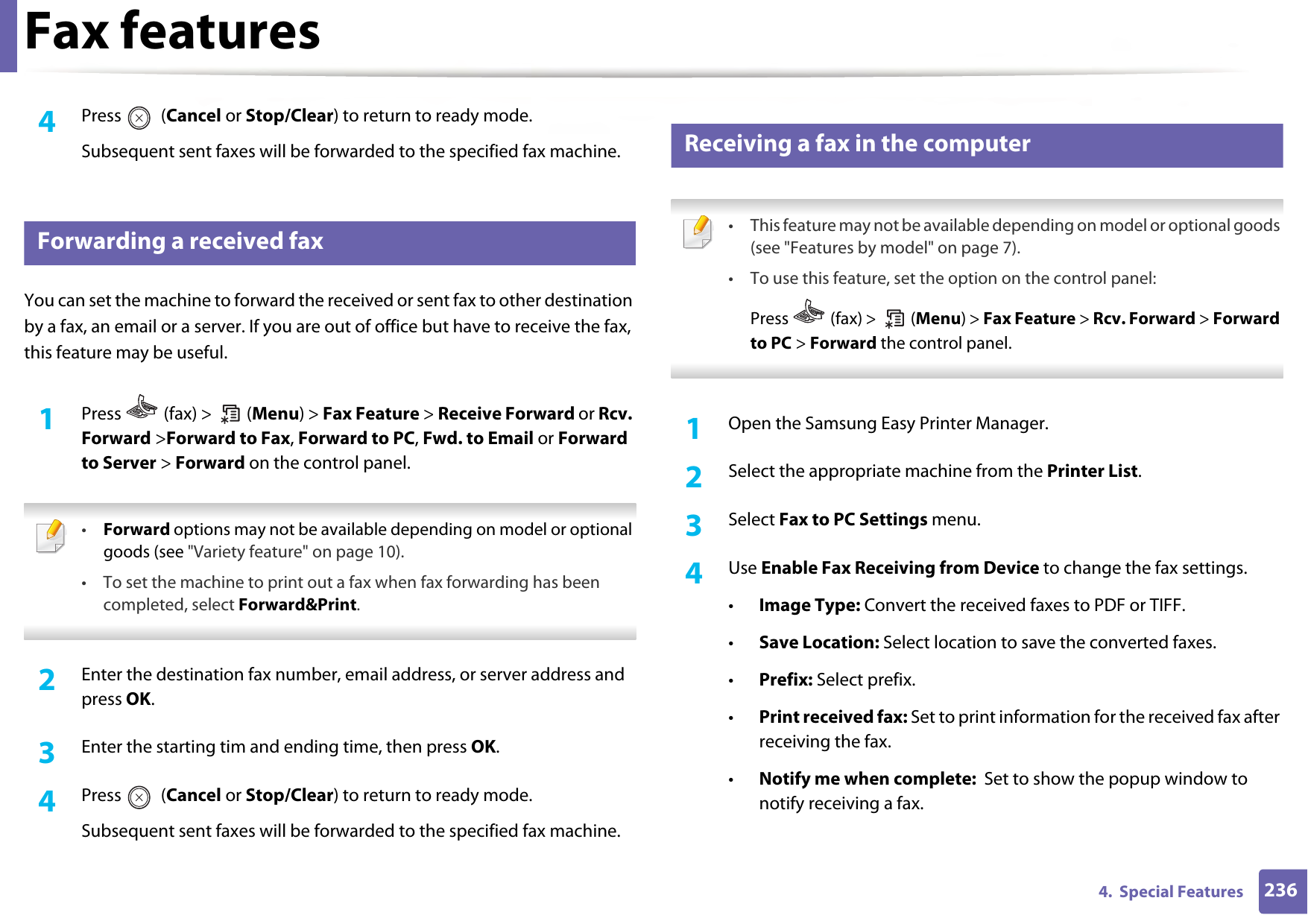
Fax features2364.  Special Features4  Press  (Cancel or Stop/Clear) to return to ready mode.Subsequent sent faxes will be forwarded to the specified fax machine.32 Forwarding a received faxYou can set the machine to forward the received or sent fax to other destination by a fax, an email or a server. If you are out of office but have to receive the fax, this feature may be useful.1Press   (fax) >   (Menu) > Fax Feature > Receive Forward or Rcv. Forward >Forward to Fax, Forward to PC, Fwd. to Email or Forward to Server > Forward on the control panel. •Forward options may not be available depending on model or optional goods (see "Variety feature" on page 10).• To set the machine to print out a fax when fax forwarding has been completed, select Forward&Print.  2  Enter the destination fax number, email address, or server address and press OK.3  Enter the starting tim and ending time, then press OK.4  Press  (Cancel or Stop/Clear) to return to ready mode.Subsequent sent faxes will be forwarded to the specified fax machine.33 Receiving a fax in the computer • This feature may not be available depending on model or optional goods (see "Features by model" on page 7).• To use this feature, set the option on the control panel:Press   (fax) >   (Menu) > Fax Feature > Rcv. Forward > Forward to PC > Forward the control panel. 1Open the Samsung Easy Printer Manager.2  Select the appropriate machine from the Printer List.3  Select Fax to PC Settings menu.4  Use Enable Fax Receiving from Device to change the fax settings.•Image Type: Convert the received faxes to PDF or TIFF.•Save Location: Select location to save the converted faxes.•Prefix: Select prefix. •Print received fax: Set to print information for the received fax after receiving the fax.•Notify me when complete:  Set to show the popup window to notify receiving a fax.
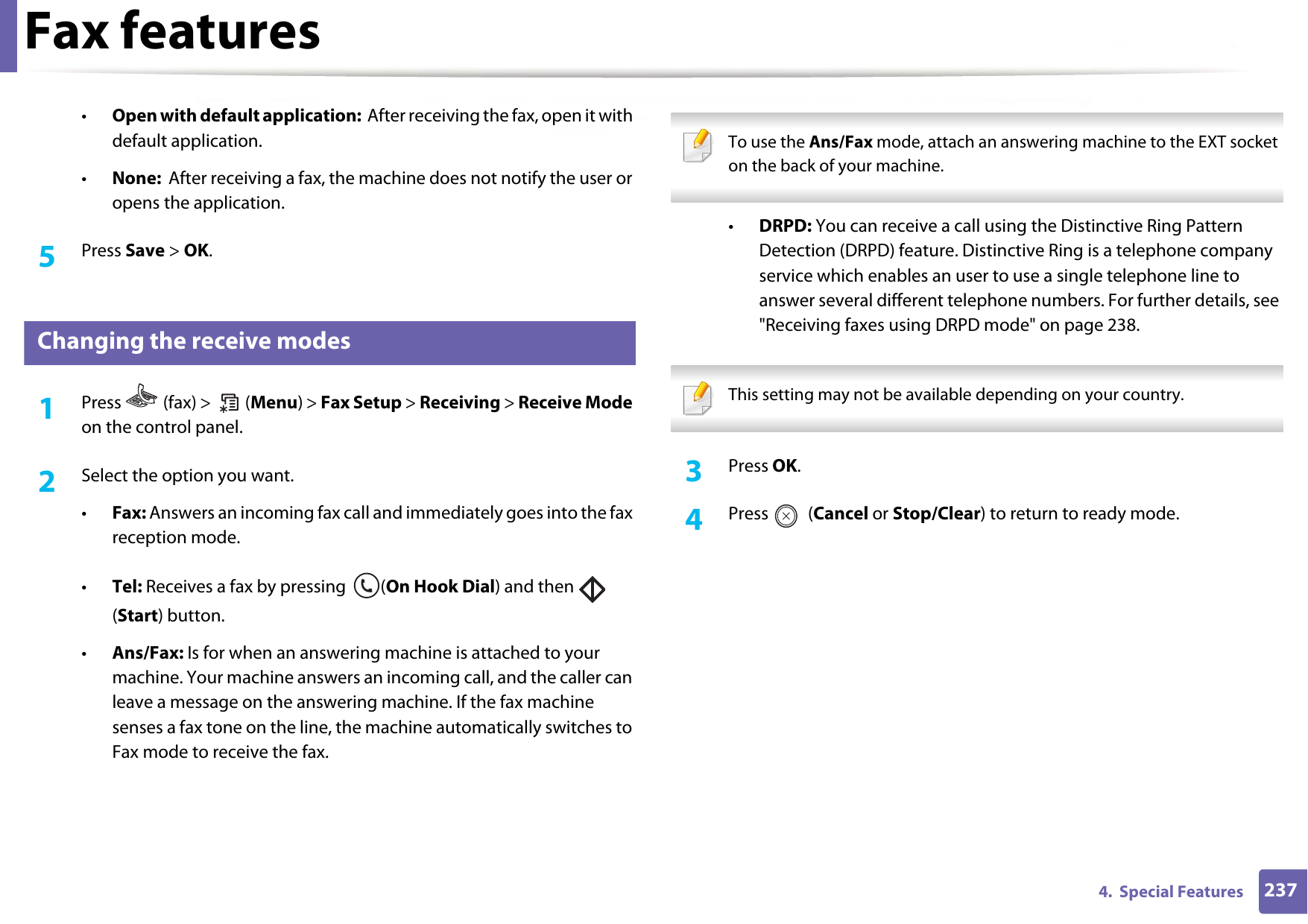
Fax features2374.  Special Features•Open with default application:  After receiving the fax, open it with default application.•None:  After receiving a fax, the machine does not notify the user or opens the application.5  Press Save > OK.34 Changing the receive modes1Press   (fax) >   (Menu) > Fax Setup > Receiving > Receive Mode on the control panel.2  Select the option you want. •Fax: Answers an incoming fax call and immediately goes into the fax reception mode.•Tel: Receives a fax by pressing  (On Hook Dial) and then   (Start) button.•Ans/Fax: Is for when an answering machine is attached to your machine. Your machine answers an incoming call, and the caller can leave a message on the answering machine. If the fax machine senses a fax tone on the line, the machine automatically switches to Fax mode to receive the fax. To use the Ans/Fax mode, attach an answering machine to the EXT socket on the back of your machine.  •DRPD: You can receive a call using the Distinctive Ring Pattern Detection (DRPD) feature. Distinctive Ring is a telephone company service which enables an user to use a single telephone line to answer several different telephone numbers. For further details, see "Receiving faxes using DRPD mode" on page 238. This setting may not be available depending on your country.  3  Press OK.4  Press  (Cancel or Stop/Clear) to return to ready mode.
Fax features2384.  Special Features35 Receiving manually in Tel modeYou can receive a fax call by pressing  (On Hook Dial) button and then pressing  (Start) when you hear a fax tone.36 Receiving in Answering Machine/Fax modeTo use this mode, you must attach an answering machine to the EXT socket on the back of your machine. If the caller leaves a message, the answering machine stores the message. If your machine detects a fax tone on the line, it automatically starts to receive the fax. • If you have set your machine to this mode and your answering machine is switched off, or no answering machine is connected to EXT socket, your machine automatically goes into Fax mode after a predefined number of rings.• If the answering machine has a user-selectable ring counter, set the machine to answer incoming calls within 1 ring.• If the machine is in Tel mode, disconnect or switch off the answering machine with the fax machine. Otherwise, the outgoing message from the answering machine will interrupt your phone conversation. 37 Receiving faxes with an extension telephoneWhen you are using an extension telephone connected to the EXT socket, you can receive a fax from someone you are talking to on the extension telephone, without going to the fax machine.When you receive a call on the extension phone and hear fax tones, press the keys *9* on the extension phone. The machine receives the fax.*9* is the remote receive code preset at the factory. The first and the last asterisks are fixed, but you can change the middle number to whatever you want. While you are talking over the telephone connected to the EXT socket, copy and scan features are not available. 38 Receiving faxes using DRPD modeThis setting may not be available depending on your country. Distinctive Ring is a telephone company service which enables an user to use a single telephone line to answer several different telephone numbers. This feature is often used by answering services who answer telephones for many different clients and need to know which number someone is calling in on to properly answer the phone.
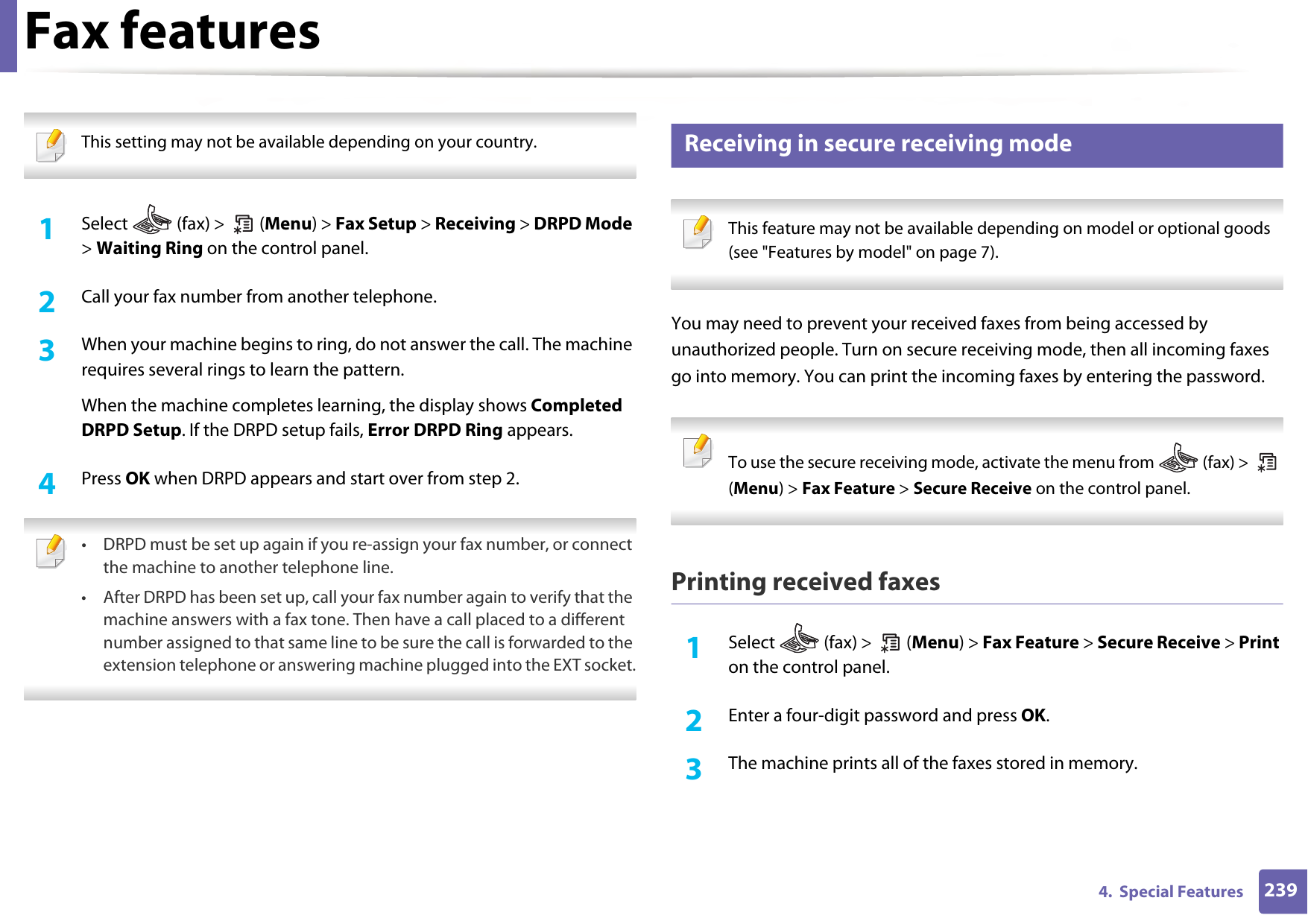
Fax features2394.  Special Features This setting may not be available depending on your country.  1Select   (fax) >   (Menu) > Fax Setup > Receiving > DRPD Mode > Waiting Ring on the control panel. 2  Call your fax number from another telephone. 3  When your machine begins to ring, do not answer the call. The machine requires several rings to learn the pattern.When the machine completes learning, the display shows Completed DRPD Setup. If the DRPD setup fails, Error DRPD Ring appears.4  Press OK when DRPD appears and start over from step 2. • DRPD must be set up again if you re-assign your fax number, or connect the machine to another telephone line.• After DRPD has been set up, call your fax number again to verify that the machine answers with a fax tone. Then have a call placed to a different number assigned to that same line to be sure the call is forwarded to the extension telephone or answering machine plugged into the EXT socket. 39 Receiving in secure receiving mode This feature may not be available depending on model or optional goods (see "Features by model" on page 7). You may need to prevent your received faxes from being accessed by unauthorized people. Turn on secure receiving mode, then all incoming faxes go into memory. You can print the incoming faxes by entering the password.  To use the secure receiving mode, activate the menu from   (fax) >   (Menu) > Fax Feature > Secure Receive on the control panel.  Printing received faxes1Select   (fax) >   (Menu) > Fax Feature > Secure Receive > Print on the control panel. 2  Enter a four-digit password and press OK. 3  The machine prints all of the faxes stored in memory.
Fax features2404.  Special Features40 Receiving faxes in memorySince your machine is a multi-tasking device, it can receive faxes while you are making copies or printing. If you receive a fax while you are copying or printing, your machine stores incoming faxes in its memory. Then, as soon as you finish copying or printing, the machine automatically prints the fax. If fax is received and being printed, other copy and print jobs cannot be processed at the same time.
5. Useful Management ToolsThis chapter introduces management tools provided to help you make full use of your machine. • Accessing management tools 242• Easy Capture Manager 243• Samsung Easy Color Manager 244• Easy Eco Driver 245• Using Samsung Printer Center 246• Using SyncThru™ Web Service 249• Using Samsung Easy Printer Manager 252• Using Samsung Easy Document Creator 254• Using Samsung Printer Status 255• Using Samsung Printer Experience 257
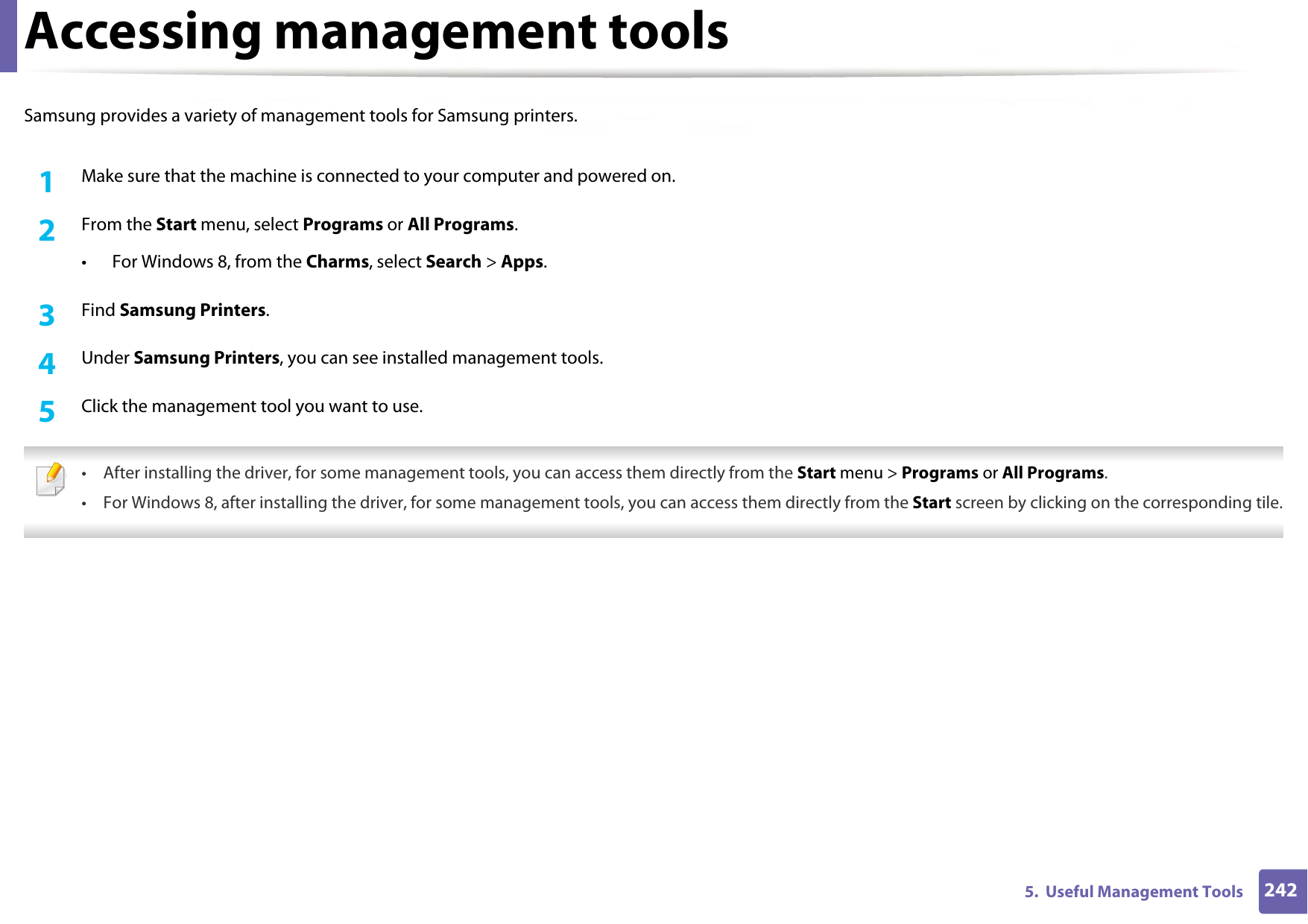
2425.  Useful Management ToolsAccessing management toolsSamsung provides a variety of management tools for Samsung printers. 1Make sure that the machine is connected to your computer and powered on.2  From the Start menu, select Programs or All Programs.• For Windows 8, from the Charms, select Search > Apps.3  Find Samsung Printers.4  Under Samsung Printers, you can see installed management tools.5  Click the management tool you want to use. • After installing the driver, for some management tools, you can access them directly from the Start menu > Programs or All Programs.• For Windows 8, after installing the driver, for some management tools, you can access them directly from the Start screen by clicking on the corresponding tile.
2435.  Useful Management ToolsEasy Capture Manager • This feature may not be available depending on model or optional goods (see "Software" on page 8).• Available for Windows OS users only (see "Software" on page 8). Capture your screen and launch Easy Capture Manager by simply pressing the Print Screen key on the keyboard. Now you can easily print your captured screen as captured or edited.
2445.  Useful Management ToolsSamsung Easy Color ManagerSamsung Easy Color Manager helps users do fine adjustments with 6 color tones and other properties, such as brightness, contrast, and saturation. Color tone changes can be saved as a profile and can be used from the driver or from inside of the machine. • This feature may not be available depending on model or optional goods (see "Software" on page 8).• Available for Windows and Mac OS users only (see "Software" on page 8). Helps Samsung color laser printer users to adjust color as they like.Download the software from the Samsung website then unpack and install it: (http://www.samsung.com > find your product > Support or Downloads).
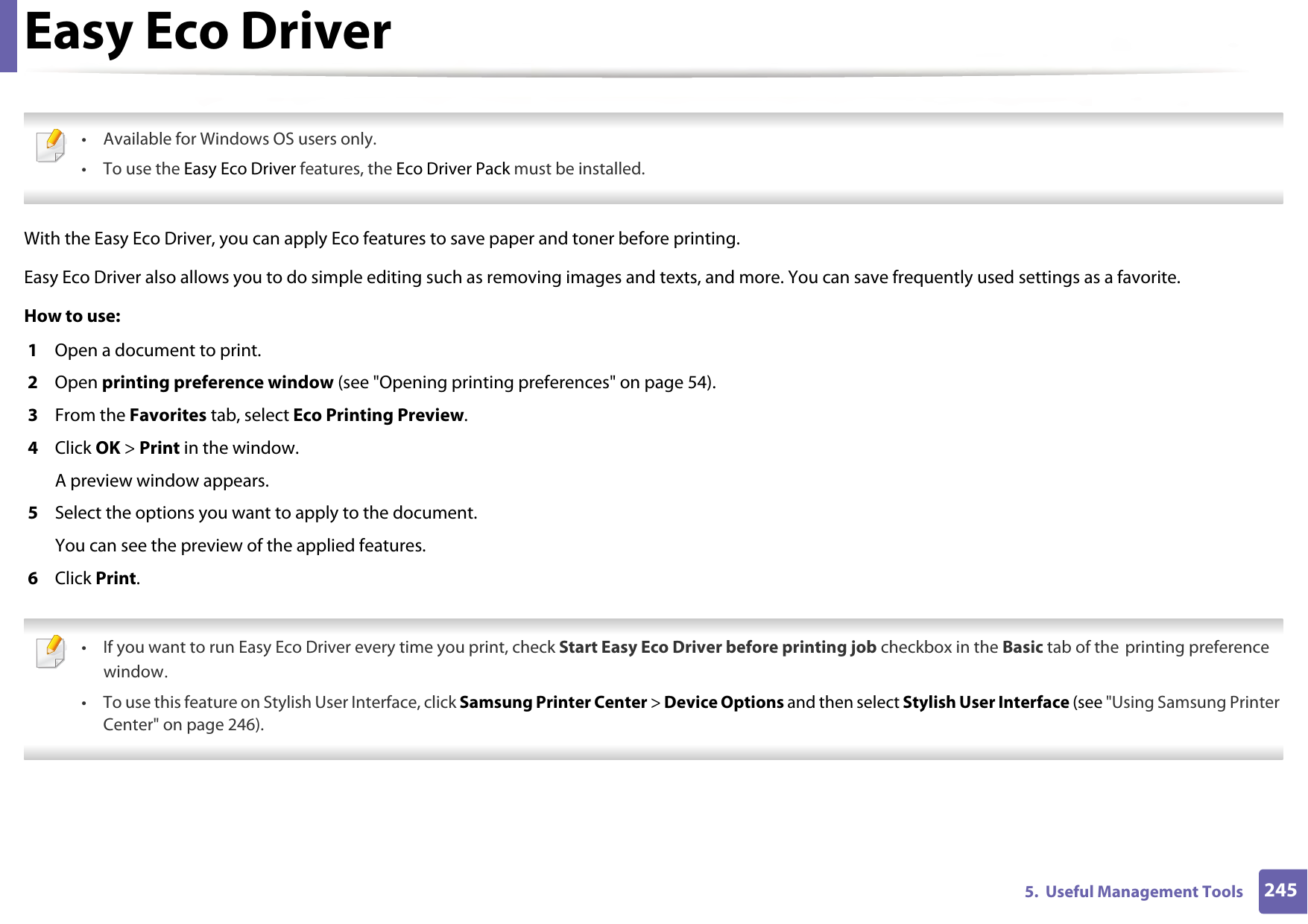
2455.  Useful Management ToolsEasy Eco Driver • Available for Windows OS users only.• To use the Easy Eco Driver features, the Eco Driver Pack must be installed. With the Easy Eco Driver, you can apply Eco features to save paper and toner before printing. Easy Eco Driver also allows you to do simple editing such as removing images and texts, and more. You can save frequently used settings as a favorite.How to use: 1  Open a document to print.2  Open printing preference window (see "Opening printing preferences" on page 54).3  From the Favorites tab, select Eco Printing Preview.4  Click OK > Print in the window.A preview window appears.5  Select the options you want to apply to the document.You can see the preview of the applied features.6  Click Print. • If you want to run Easy Eco Driver every time you print, check Start Easy Eco Driver before printing job checkbox in the Basic tab of the printing preference window.• To use this feature on Stylish User Interface, click Samsung Printer Center > Device Options and then select Stylish User Interface (see "Using Samsung Printer Center" on page 246).
2465.  Useful Management ToolsUsing Samsung Printer Center • Available for Windows users only. The Samsung Printer Center allows you to manage all the printer drivers installed on your computer from a single integrated application. You can use the Samsung Printer Center to add and remove printer drivers, check the status of printers, update printer software, and configure printer driver settings.1 Understanding Samsung Printer CenterTo open the program: For Windows,Select Start > Programs or All Programs > Samsung Printers > Samsung Printer Center.Printers tab The screenshot may differ depending on operating system you are using. 1Printer list Displays the printer drivers installed on your computer. To add a printer driver to the list, click the   button.
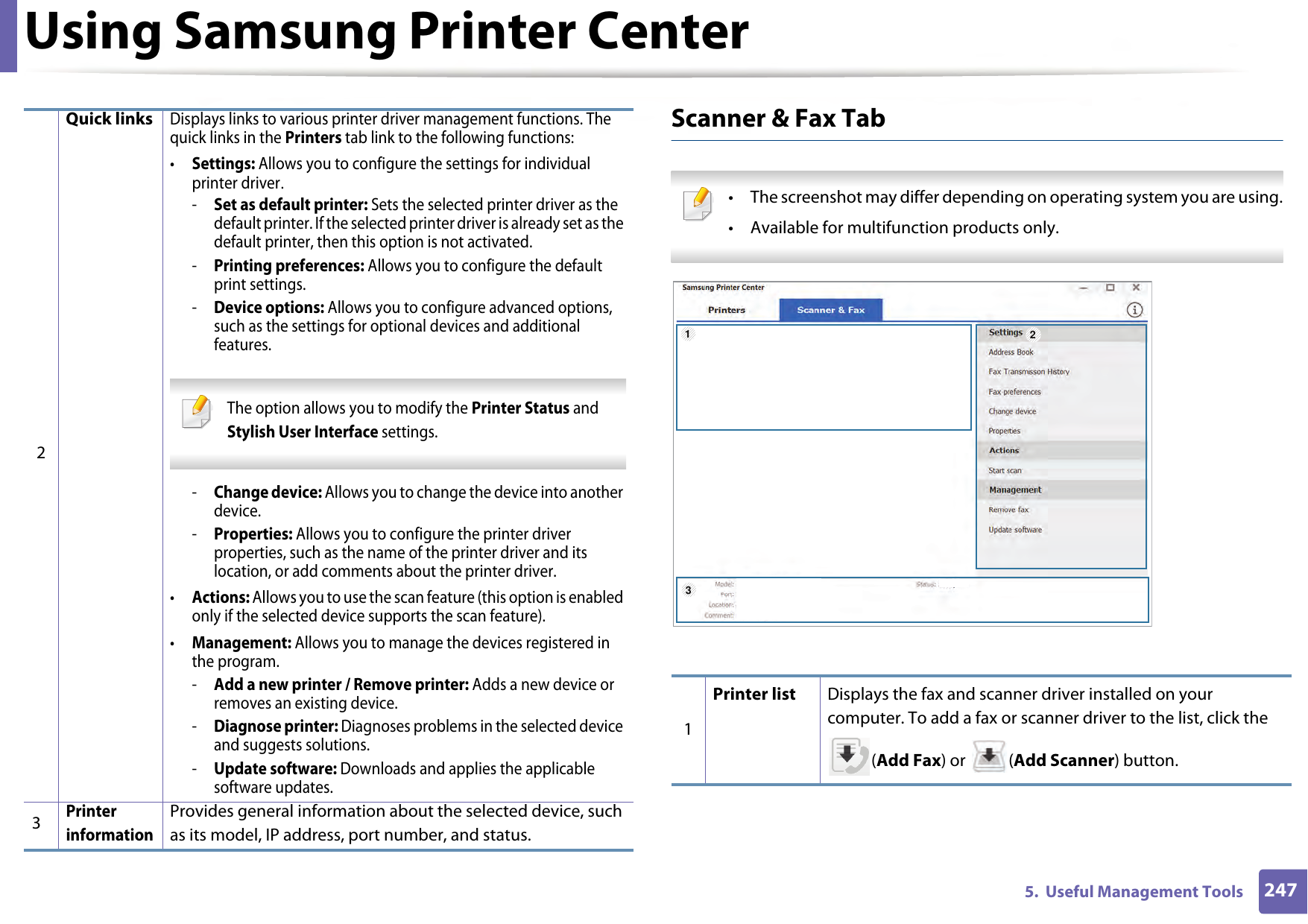
Using Samsung Printer Center2475.  Useful Management ToolsScanner & Fax Tab • The screenshot may differ depending on operating system you are using.• Available for multifunction products only. 2Quick linksDisplays links to various printer driver management functions. The quick links in the Printers tab link to the following functions:•Settings: Allows you to configure the settings for individual printer driver.-Set as default printer: Sets the selected printer driver as the default printer. If the selected printer driver is already set as the default printer, then this option is not activated.-Printing preferences: Allows you to configure the default print settings.-Device options: Allows you to configure advanced options, such as the settings for optional devices and additional features. The option allows you to modify the Printer Status and Stylish User Interface settings. -Change device: Allows you to change the device into another device.-Properties: Allows you to configure the printer driver properties, such as the name of the printer driver and its location, or add comments about the printer driver.•Actions: Allows you to use the scan feature (this option is enabled only if the selected device supports the scan feature).•Management: Allows you to manage the devices registered in the program.-Add a new printer / Remove printer: Adds a new device or removes an existing device.-Diagnose printer: Diagnoses problems in the selected device and suggests solutions.-Update software: Downloads and applies the applicable software updates.3Printer informationProvides general information about the selected device, such as its model, IP address, port number, and status.1Printer list Displays the fax and scanner driver installed on your computer. To add a fax or scanner driver to the list, click the (Add Fax) or  (Add Scanner) button.123
Using Samsung Printer Center2485.  Useful Management Tools2Quick links Displays links to the functions available for managing fax or scanner drivers. The quick links in the Scanner & Fax tab offer the following features: To use this feature, the scanner driver and fax driver must be installed on the computer. •Settings: Allows you to configure the settings for fax or scanner dirvers.-Address Book (fax only): Opens the Address Book.-Fax Transmission History (fax only): Opens the fax transmission history.-Fax preferences (fax only): Allows you to configure the default fax settings.-Change device: Allows you to change the devices into another device.-Properties: Allows you to configure the properties of a device, such as location and add comments about the device.•Actions: Allows you to use the scan feature.•Management: Allows you to manage the devices registered in the program.-Remove fax or Remove scan: Removes the selected fax or scan driver.-Update software: Downloads and applies the applicable software updates.3Printer informationProvides general information about the selected device, such as the model, IP address, port number, and machine status.
2495.  Useful Management ToolsUsing SyncThru™ Web Service • Internet Explorer 6.0 or higher is the minimum requirement for SyncThru™ Web Service.•SyncThru™ Web Service explanation in this user’s guide may differ from your machine depending on its options or models.• Network model only (see "Variety feature" on page 10). 2 Accessing SyncThru™ Web Service1Access a web browser, such as Internet Explorer, from Windows.Enter the machine IP address of your printer (http://xxx.xxx.xxx.xxx) in the address field and press the Enter key or click Go.2  Your machine’s embedded website opens.Logging into SyncThru™ Web ServiceBefore configuring options in SyncThru™ Web Service, you need to log-in as an administrator. You can still use SyncThru™ Web Service without logging in but you won’t have access to Settings tab and Security tab. 1Click Login on the upper right of the SyncThru™ Web Service website.2  If it’s your first time logging into SyncThru™ Web Service you need to log-in as an administrator. Type in the below default ID and Password. We recommend you to change the default password for security reasons.•ID: admin •Password: sec00000
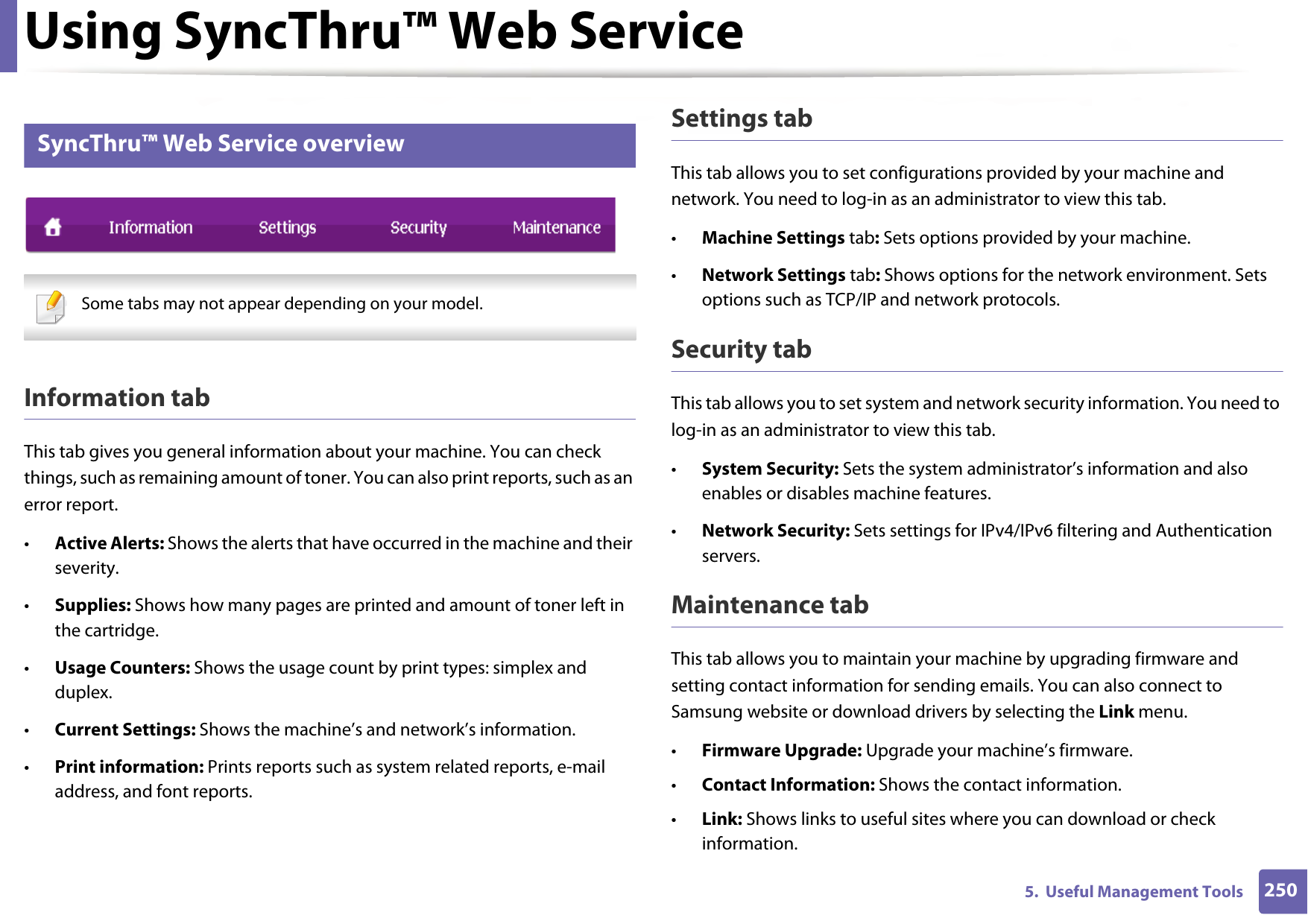
Using SyncThru™ Web Service2505.  Useful Management Tools3 SyncThru™ Web Service overview Some tabs may not appear depending on your model. Information tabThis tab gives you general information about your machine. You can check things, such as remaining amount of toner. You can also print reports, such as an error report.•Active Alerts: Shows the alerts that have occurred in the machine and their severity.•Supplies: Shows how many pages are printed and amount of toner left in the cartridge.•Usage Counters: Shows the usage count by print types: simplex and duplex.•Current Settings: Shows the machine’s and network’s information. •Print information: Prints reports such as system related reports, e-mail address, and font reports.Settings tabThis tab allows you to set configurations provided by your machine and network. You need to log-in as an administrator to view this tab. •Machine Settings tab: Sets options provided by your machine. •Network Settings tab: Shows options for the network environment. Sets options such as TCP/IP and network protocols. Security tabThis tab allows you to set system and network security information. You need to log-in as an administrator to view this tab.•System Security: Sets the system administrator’s information and also enables or disables machine features.•Network Security: Sets settings for IPv4/IPv6 filtering and Authentication servers.Maintenance tabThis tab allows you to maintain your machine by upgrading firmware and setting contact information for sending emails. You can also connect to Samsung website or download drivers by selecting the Link menu.•Firmware Upgrade: Upgrade your machine’s firmware.•Contact Information: Shows the contact information.•Link: Shows links to useful sites where you can download or check information.
Using SyncThru™ Web Service2515.  Useful Management Tools4 Setting the system administrator’s informationThis setting is necessary for using the e-mail notification option. Some menus may not appear in the display depending on options or models. If so, it is not applicable to your machine. 1Start a web browser, such as Internet Explorer, from Windows.Enter the machine IP address (http://xxx.xxx.xxx.xxx) in the address field and press the Enter key or click Go.2  Your machine’s embedded website opens.3  From the Security tab, select System Security > System Administrator4  Enter the name of the administrator, phone number, location, and email address. 5  Click Apply.
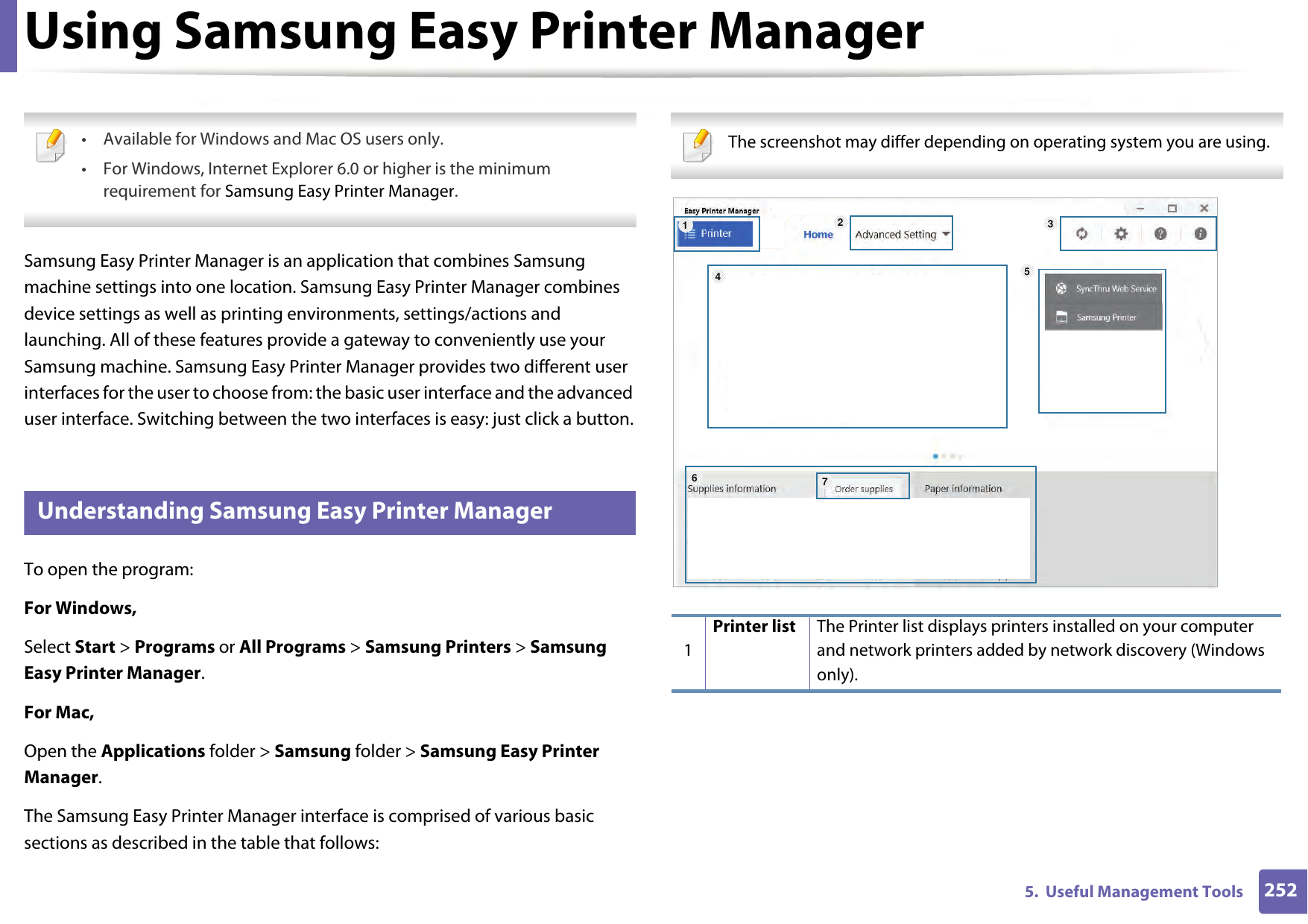
2525.  Useful Management ToolsUsing Samsung Easy Printer Manager  • Available for Windows and Mac OS users only.• For Windows, Internet Explorer 6.0 or higher is the minimum requirement for Samsung Easy Printer Manager. Samsung Easy Printer Manager is an application that combines Samsung machine settings into one location. Samsung Easy Printer Manager combines device settings as well as printing environments, settings/actions and launching. All of these features provide a gateway to conveniently use your Samsung machine. Samsung Easy Printer Manager provides two different user interfaces for the user to choose from: the basic user interface and the advanced user interface. Switching between the two interfaces is easy: just click a button.5 Understanding Samsung Easy Printer ManagerTo open the program: For Windows,Select Start > Programs or All Programs > Samsung Printers > Samsung Easy Printer Manager.For Mac,Open the Applications folder > Samsung folder > Samsung Easy Printer Manager.The Samsung Easy Printer Manager interface is comprised of various basic sections as described in the table that follows: The screenshot may differ depending on operating system you are using. 1Printer list The Printer list displays printers installed on your computer and network printers added by network discovery (Windows only).1564327
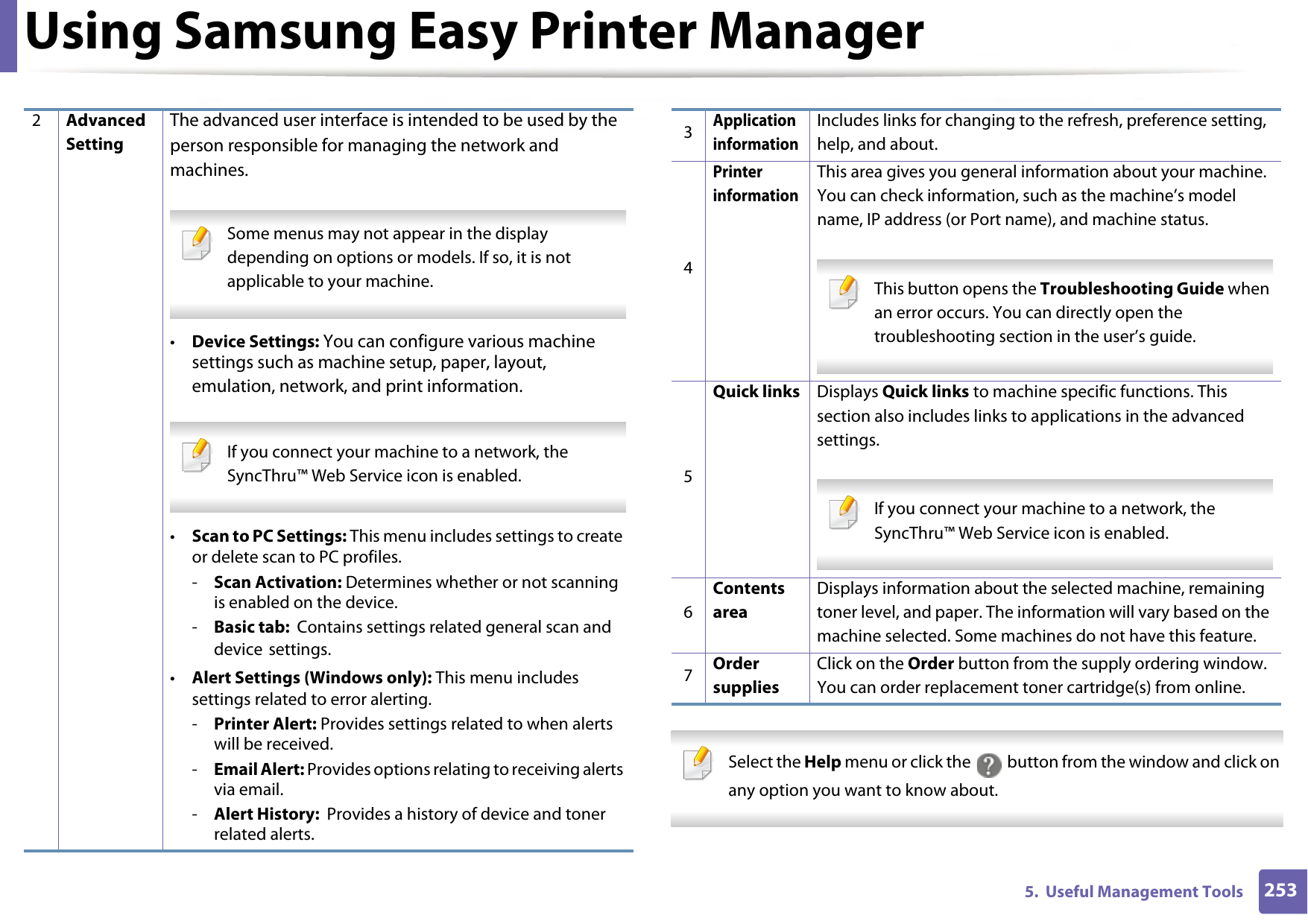
Using Samsung Easy Printer Manager2535.  Useful Management Tools Select the Help menu or click the   button from the window and click on any option you want to know about.  2Advanced SettingThe advanced user interface is intended to be used by the person responsible for managing the network and machines. Some menus may not appear in the display depending on options or models. If so, it is not applicable to your machine. •Device Settings: You can configure various machine settings such as machine setup, paper, layout, emulation, network, and print information.  If you connect your machine to a network, the SyncThru™ Web Service icon is enabled. •Scan to PC Settings: This menu includes settings to create or delete scan to PC profiles. -Scan Activation: Determines whether or not scanning is enabled on the device.-Basic tab:  Contains settings related general scan and device settings.•Alert Settings (Windows only): This menu includes settings related to error alerting. -Printer Alert: Provides settings related to when alerts will be received.-Email Alert: Provides options relating to receiving alerts via email.-Alert History:  Provides a history of device and toner related alerts.3Application informationIncludes links for changing to the refresh, preference setting, help, and about.4Printer informationThis area gives you general information about your machine. You can check information, such as the machine’s model name, IP address (or Port name), and machine status. This button opens the Troubleshooting Guide when an error occurs. You can directly open the troubleshooting section in the user’s guide.  5Quick links Displays Quick links to machine specific functions. This section also includes links to applications in the advanced settings. If you connect your machine to a network, the SyncThru™ Web Service icon is enabled. 6Contents areaDisplays information about the selected machine, remaining toner level, and paper. The information will vary based on the machine selected. Some machines do not have this feature.7Order suppliesClick on the Order button from the supply ordering window. You can order replacement toner cartridge(s) from online.
2545.  Useful Management ToolsUsing Samsung Easy Document Creator • Available for Windows and Mac OS users only.•Windows® XP Service Pack 3 or higher and Internet Explorer 6.0 or higher is the minimum requirement for Samsung Easy Document Creator. Samsung Easy Document Creator is an application to help users scan, compile, and save documents in multiple formats, including .epub format. These documents can be shared via social networking sites or fax. Whether you’re a student needing to organize research from the library or a stay-at-home mom sharing scanned pictures from last year’s birthday party, Samsung Easy Document Creator will provide you with the necessary tools.The Samsung Easy Document Creator provides features mentioned below:•Scan: Use for scanning pictures or documents.•Text Converting Scan(Windows only):  Use for scanning documents that need to be saved in an editable text format.•Document Conversion: Provides the ability to convert existing files into multiple formats.•Fax: Provides the ability to directly fax a document from Easy Document Creator if the Samsung network PC fax driver is installed.
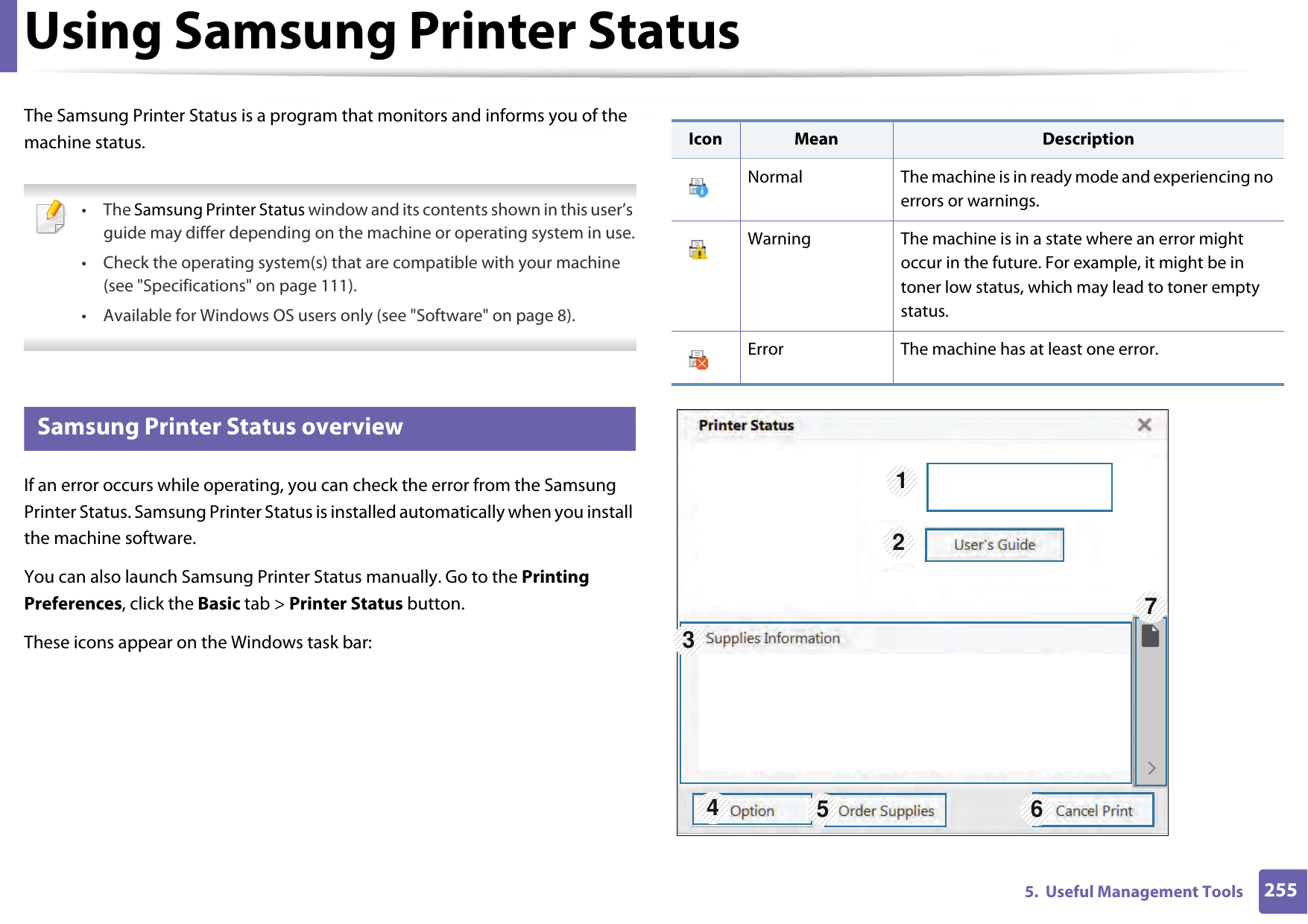
2555.  Useful Management ToolsUsing Samsung Printer StatusThe Samsung Printer Status is a program that monitors and informs you of the machine status.  • The Samsung Printer Status window and its contents shown in this user’s guide may differ depending on the machine or operating system in use.• Check the operating system(s) that are compatible with your machine (see "Specifications" on page 111).• Available for Windows OS users only (see "Software" on page 8). 6 Samsung Printer Status overviewIf an error occurs while operating, you can check the error from the Samsung Printer Status. Samsung Printer Status is installed automatically when you install the machine software. You can also launch Samsung Printer Status manually. Go to the Printing Preferences, click the Basic tab > Printer Status button.These icons appear on the Windows task bar:Icon Mean DescriptionNormal The machine is in ready mode and experiencing no errors or warnings.Warning The machine is in a state where an error might occur in the future. For example, it might be in toner low status, which may lead to toner empty status.Error The machine has at least one error.1327456
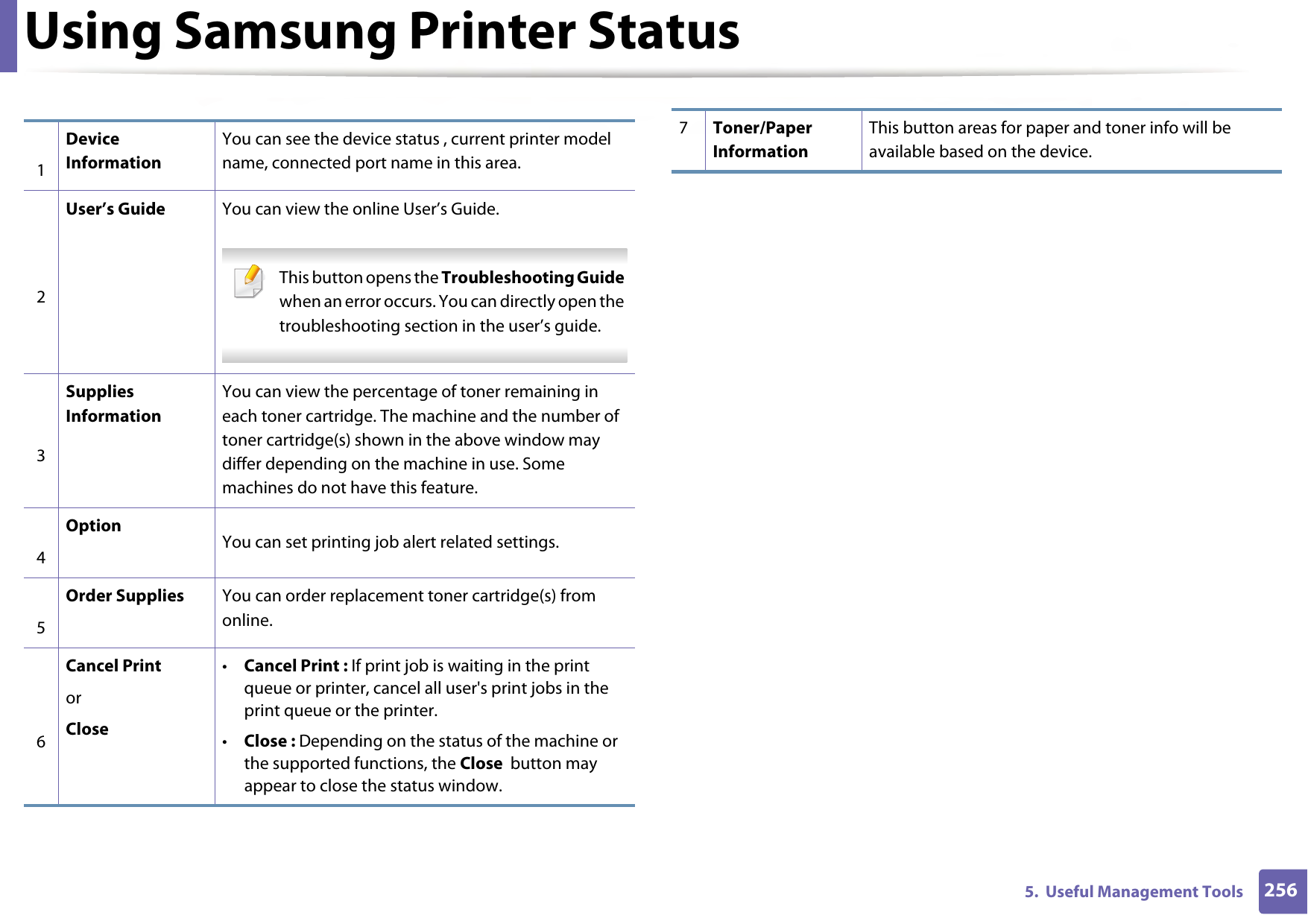
Using Samsung Printer Status2565.  Useful Management Tools1Device InformationYou can see the device status , current printer model name, connected port name in this area.2User’s Guide You can view the online User’s Guide. This button opens the Troubleshooting Guide when an error occurs. You can directly open the troubleshooting section in the user’s guide.  3Supplies InformationYou can view the percentage of toner remaining in each toner cartridge. The machine and the number of toner cartridge(s) shown in the above window may differ depending on the machine in use. Some machines do not have this feature.4Option You can set printing job alert related settings. 5Order Supplies You can order replacement toner cartridge(s) from online.6Cancel Print or Close•Cancel Print : If print job is waiting in the print queue or printer, cancel all user's print jobs in the print queue or the printer.•Close : Depending on the status of the machine or the supported functions, the Close  button may appear to close the status window.7Toner/Paper InformationThis button areas for paper and toner info will be available based on the device.
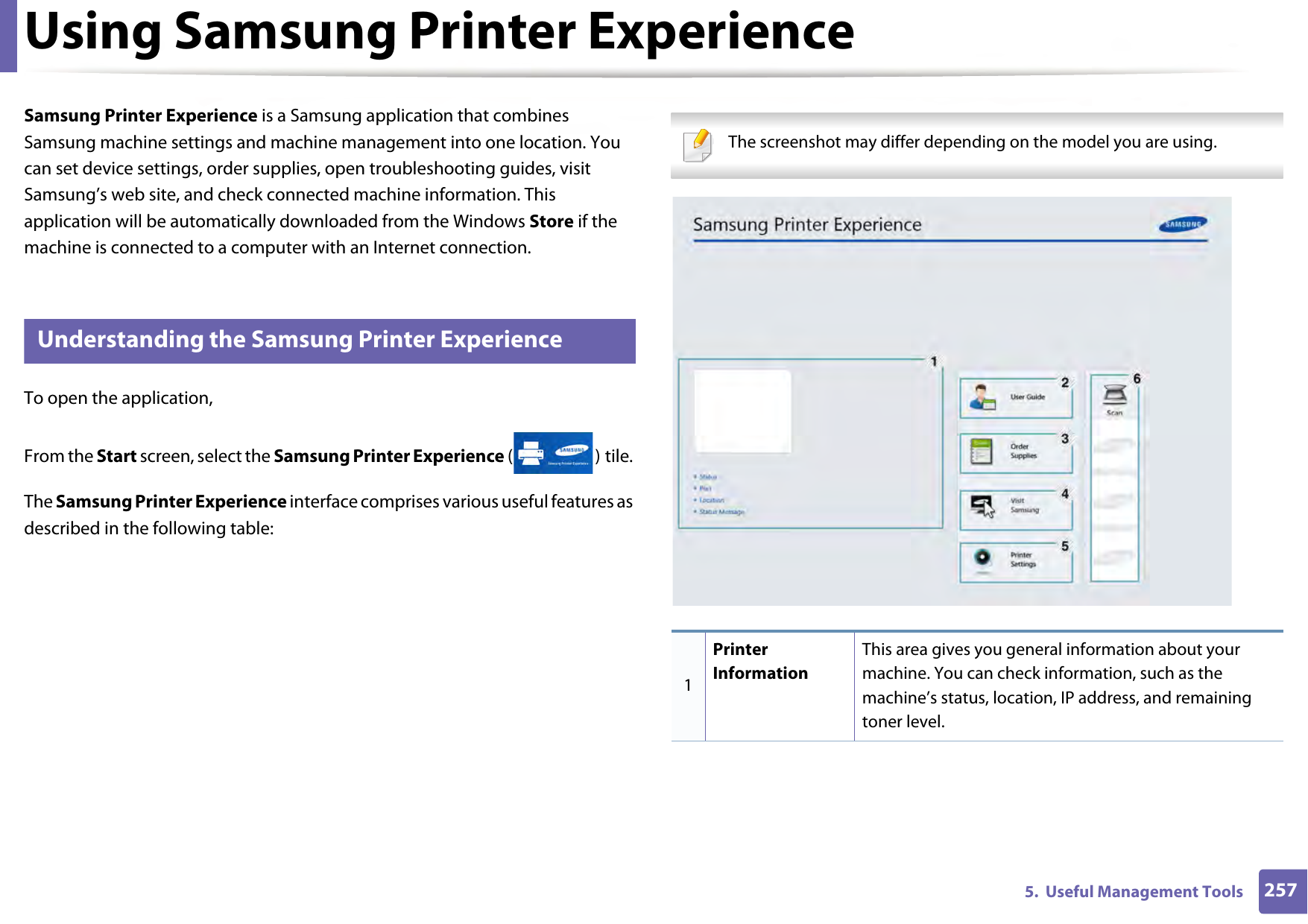
2575.  Useful Management ToolsUsing Samsung Printer Experience Samsung Printer Experience is a Samsung application that combines Samsung machine settings and machine management into one location. You can set device settings, order supplies, open troubleshooting guides, visit Samsung’s web site, and check connected machine information. This application will be automatically downloaded from the Windows Store if the machine is connected to a computer with an Internet connection. 7 Understanding the Samsung Printer ExperienceTo open the application, From the Start screen, select the Samsung Printer Experience () tile. The Samsung Printer Experience interface comprises various useful features as described in the following table: The screenshot may differ depending on the model you are using. 1Printer InformationThis area gives you general information about your machine. You can check information, such as the machine’s status, location, IP address, and remaining toner level.
Using Samsung Printer Experience2585.  Useful Management Tools8 Adding/Deleting PrintersIf you do not have any printer added to the Samsung Printer Experience, or if you want to add/delete a printer, follow the instructions below.  You can only add/delete network connected printers. Adding a printer1From the Charms, select Settings.Or, right-click the Samsung Printer Experience page and select Settings.2  Select  Add Printer3  Select the printer you want to add.You can see the added printer. If you see   mark, you can also click   mark to add printers. 2User Guide You can view the online User’s Guide. You need to be connected to the Internet to use this feature. This button opens the Troubleshooting Guide when an error occurs. You can directly open the troubleshooting section in the user’s guide.  3Order SuppliesClick on this button to order replacement toner cartridges online. You need to be connected to the Internet to use this feature. 4Visit Samsung Links to Samsung printer website. You need to be connected to the Internet to use this feature.5Printer Settings You can configure various machine settings such as machine setup, paper, layout, emulation, networking, and print information through SyncThru™ Web Service. Your machine needs to be connected to a network. This button will be disabled if your machine is connected via USB cable.6Device List & Latest Scanned ImageThe scan list displays devices that supports Samsung Printer Experience. Under the device, you can see the latest scanned images. Your machine needs to be connected to a network to scan from here. This section is for the users with multi-functional printers.
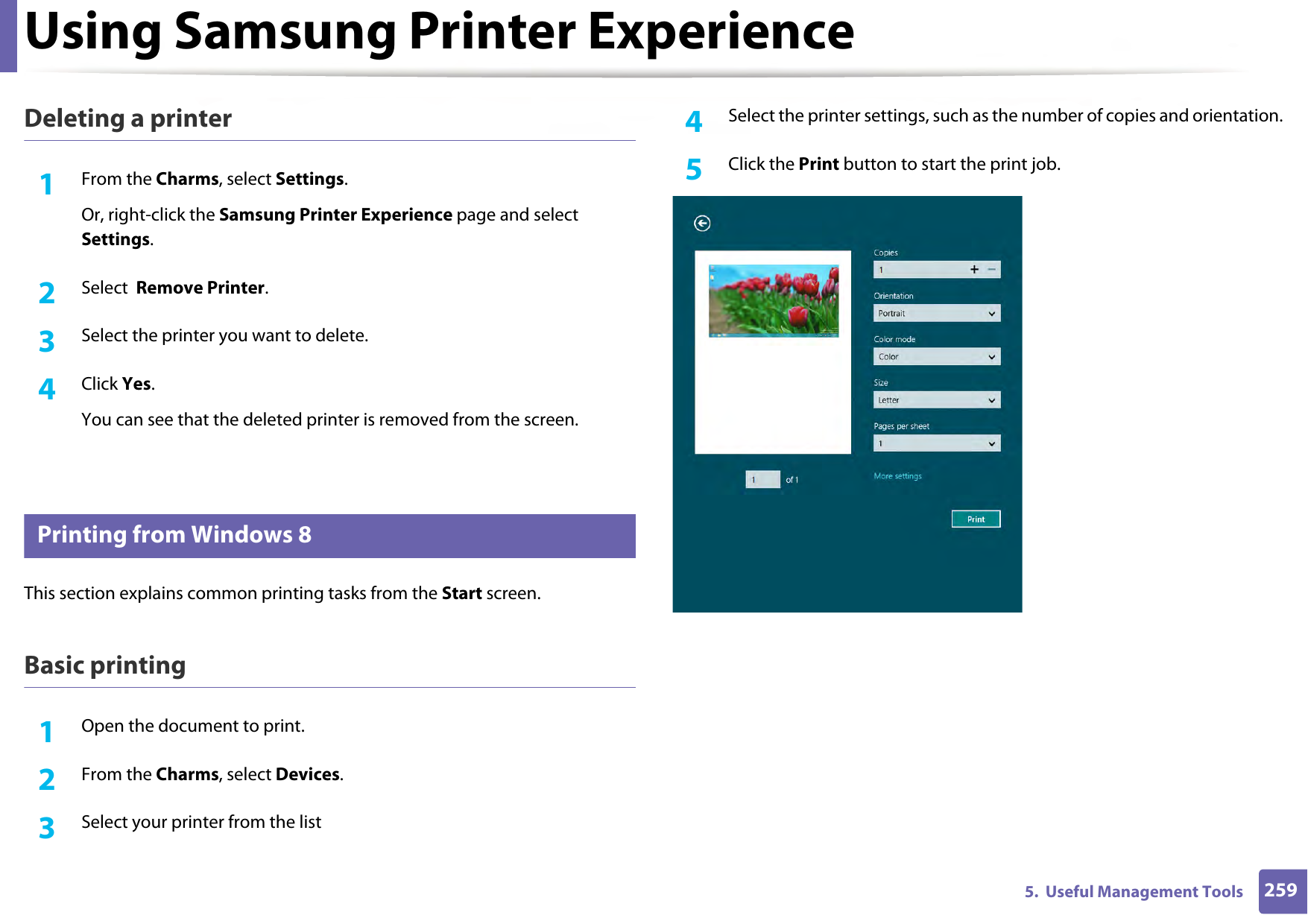
Using Samsung Printer Experience2595.  Useful Management ToolsDeleting a printer1From the Charms, select Settings.Or, right-click the Samsung Printer Experience page and select Settings.2  Select  Remove Printer.3  Select the printer you want to delete.4  Click Yes.You can see that the deleted printer is removed from the screen.9 Printing from Windows 8This section explains common printing tasks from the Start screen.Basic printing1Open the document to print.2  From the Charms, select Devices.3  Select your printer from the list4  Select the printer settings, such as the number of copies and orientation.5  Click the Print button to start the print job.
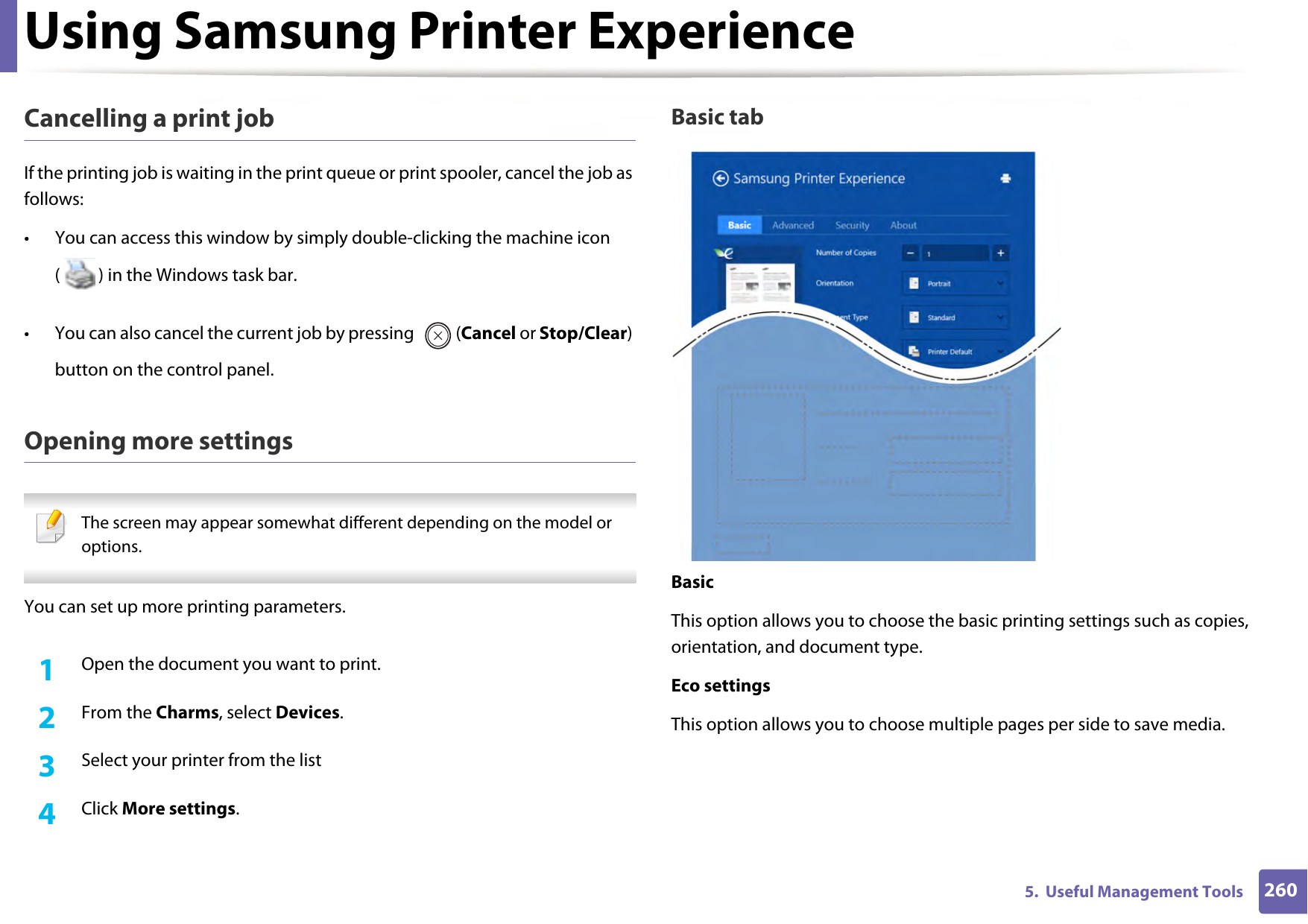
Using Samsung Printer Experience2605.  Useful Management ToolsCancelling a print jobIf the printing job is waiting in the print queue or print spooler, cancel the job as follows:• You can access this window by simply double-clicking the machine icon ( ) in the Windows task bar. • You can also cancel the current job by pressing  (Cancel or Stop/Clear) button on the control panel.Opening more settings The screen may appear somewhat different depending on the model or options. You can set up more printing parameters.1Open the document you want to print.2  From the Charms, select Devices.3  Select your printer from the list4  Click More settings.Basic tabBasicThis option allows you to choose the basic printing settings such as copies, orientation, and document type.Eco settingsThis option allows you to choose multiple pages per side to save media.
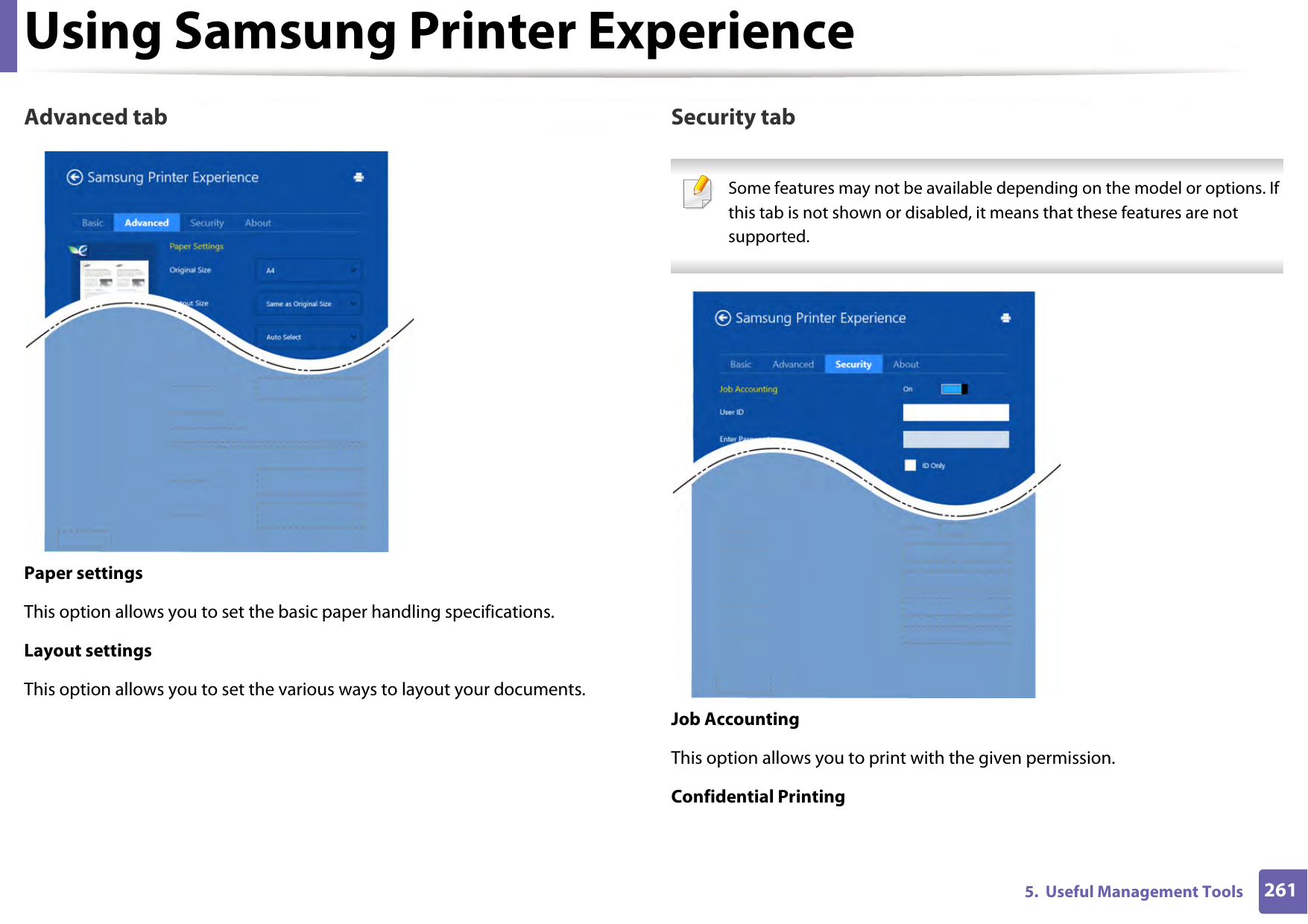
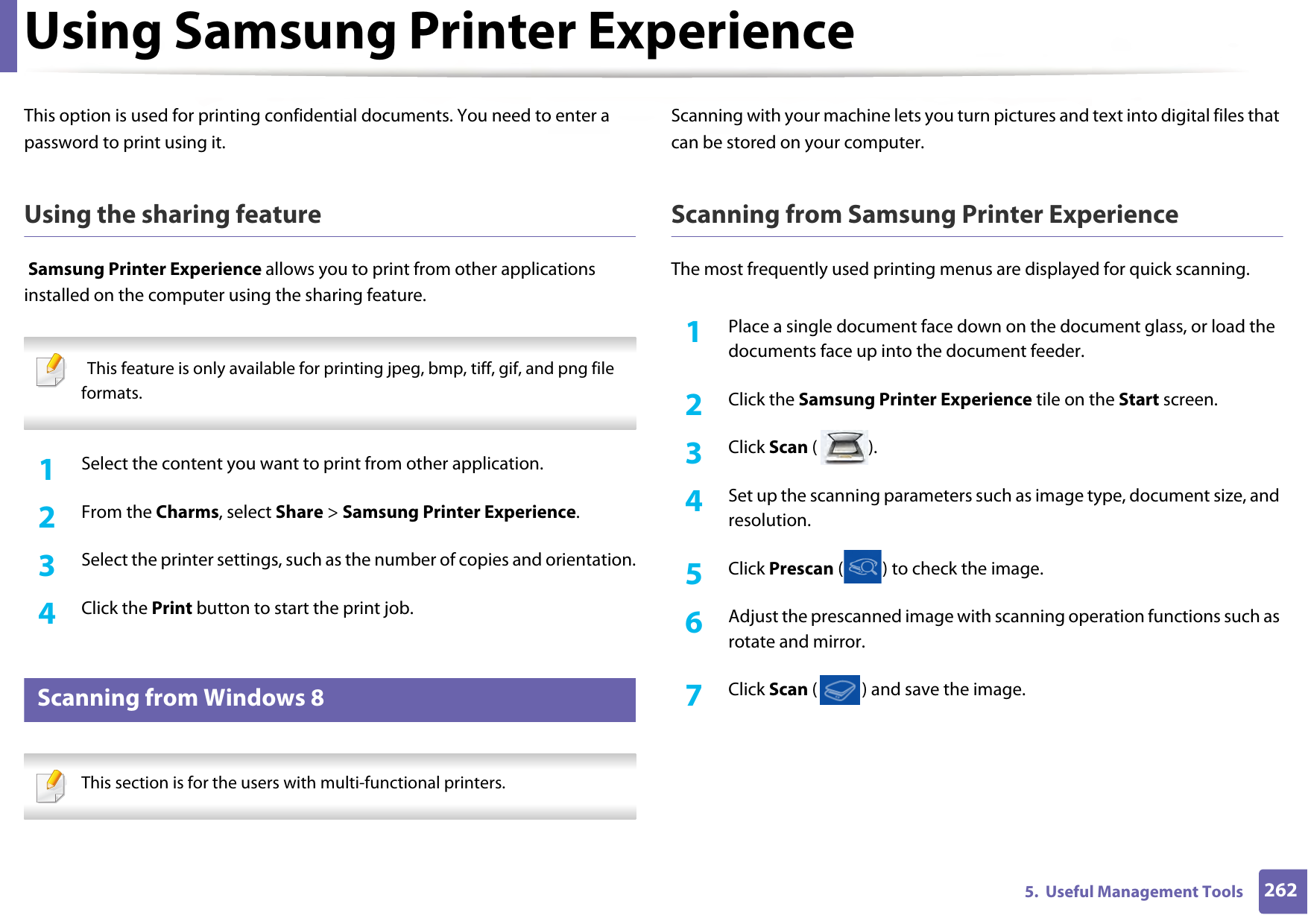
Using Samsung Printer Experience2615.  Useful Management ToolsAdvanced tabPaper settingsThis option allows you to set the basic paper handling specifications.Layout settingsThis option allows you to set the various ways to layout your documents.Security tab Some features may not be available depending on the model or options. If this tab is not shown or disabled, it means that these features are not supported. Job AccountingThis option allows you to print with the given permission.Confidential Printing
Using Samsung Printer Experience2625.  Useful Management ToolsThis option is used for printing confidential documents. You need to enter a password to print using it.Using the sharing feature Samsung Printer Experience allows you to print from other applications installed on the computer using the sharing feature.   This feature is only available for printing jpeg, bmp, tiff, gif, and png file formats. 1Select the content you want to print from other application.2  From the Charms, select Share > Samsung Printer Experience.3  Select the printer settings, such as the number of copies and orientation.4  Click the Print button to start the print job.10 Scanning from Windows 8 This section is for the users with multi-functional printers. Scanning with your machine lets you turn pictures and text into digital files that can be stored on your computer.Scanning from Samsung Printer ExperienceThe most frequently used printing menus are displayed for quick scanning.1Place a single document face down on the document glass, or load the documents face up into the document feeder.2  Click the Samsung Printer Experience tile on the Start screen.3  Click Scan ().4  Set up the scanning parameters such as image type, document size, and resolution.5  Click Prescan ( ) to check the image.6  Adjust the prescanned image with scanning operation functions such as rotate and mirror.7  Click Scan ( ) and save the image.
Using Samsung Printer Experience2635.  Useful Management Tools • When you place the originals in the ADF (or DADF), Prescan ( ) is not available.• You can skip step 5, if the Prescan option is selected.
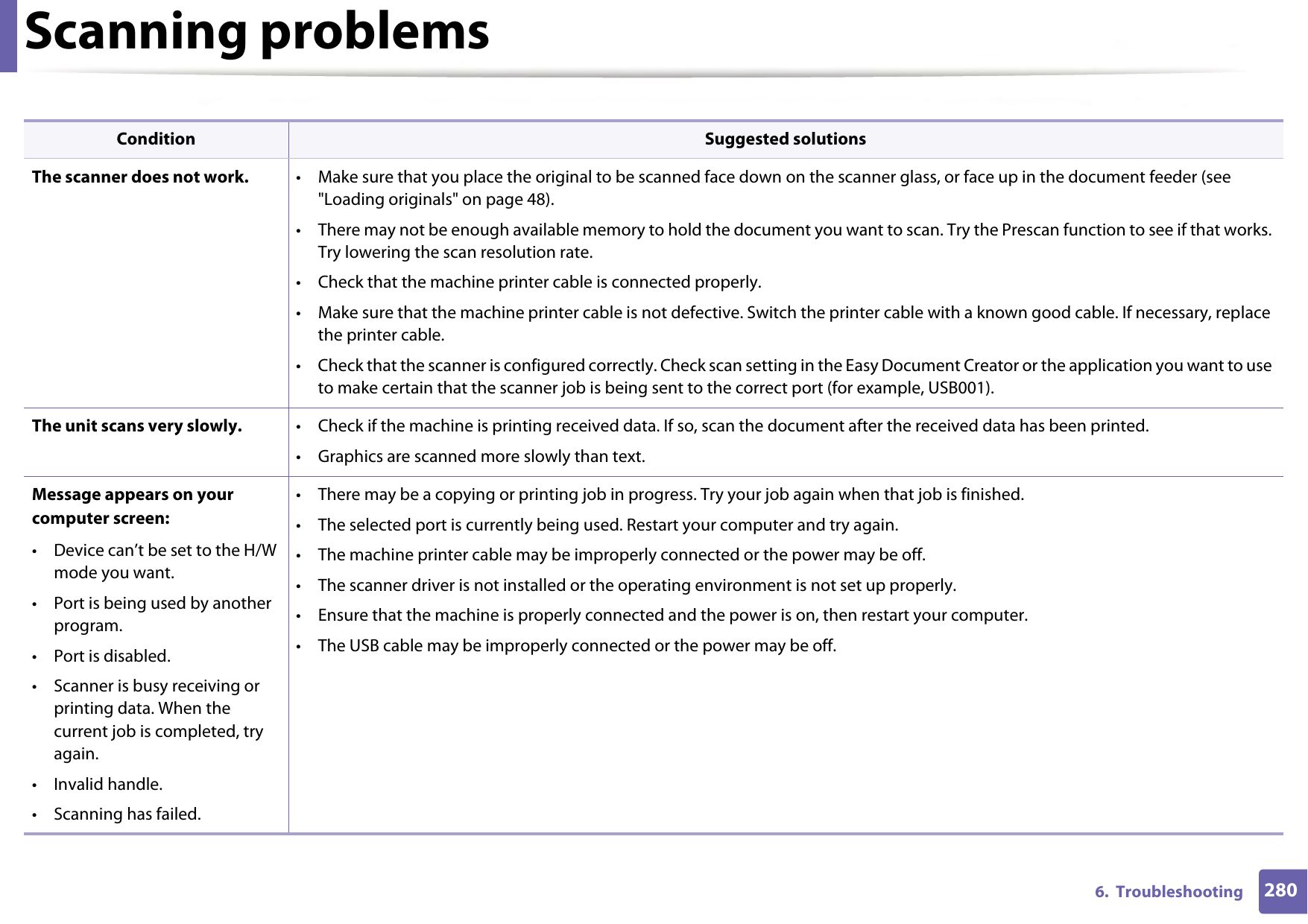
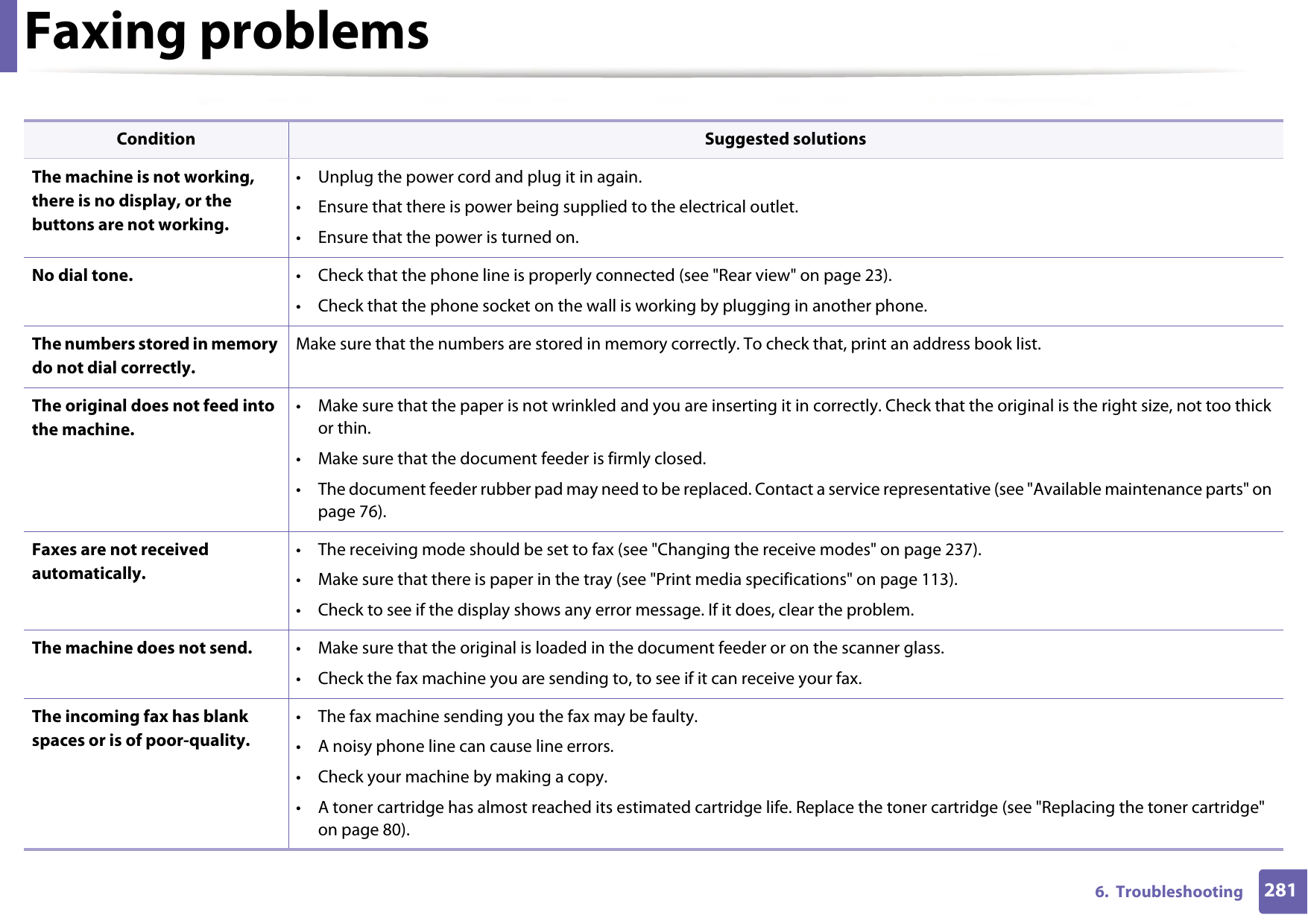
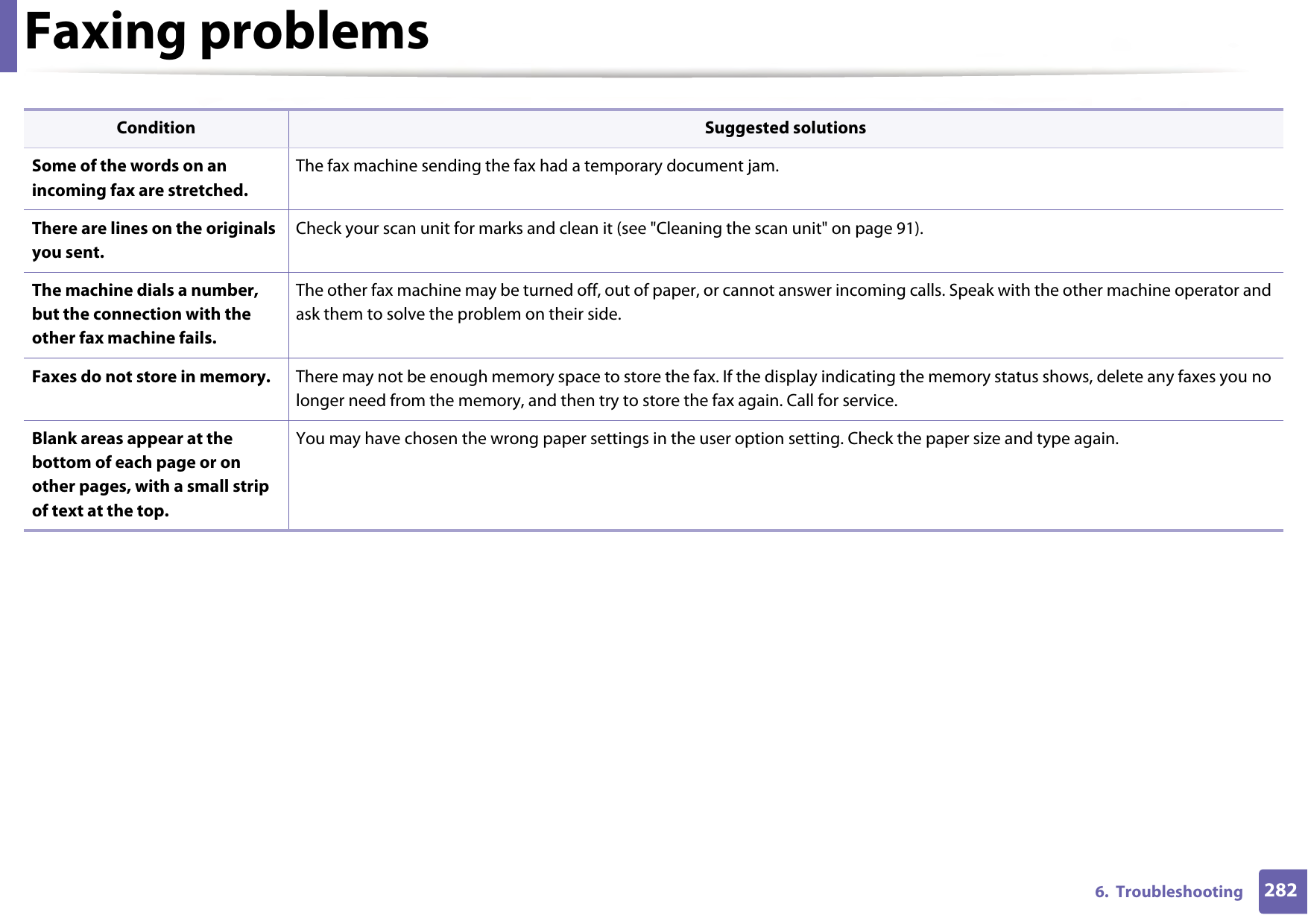
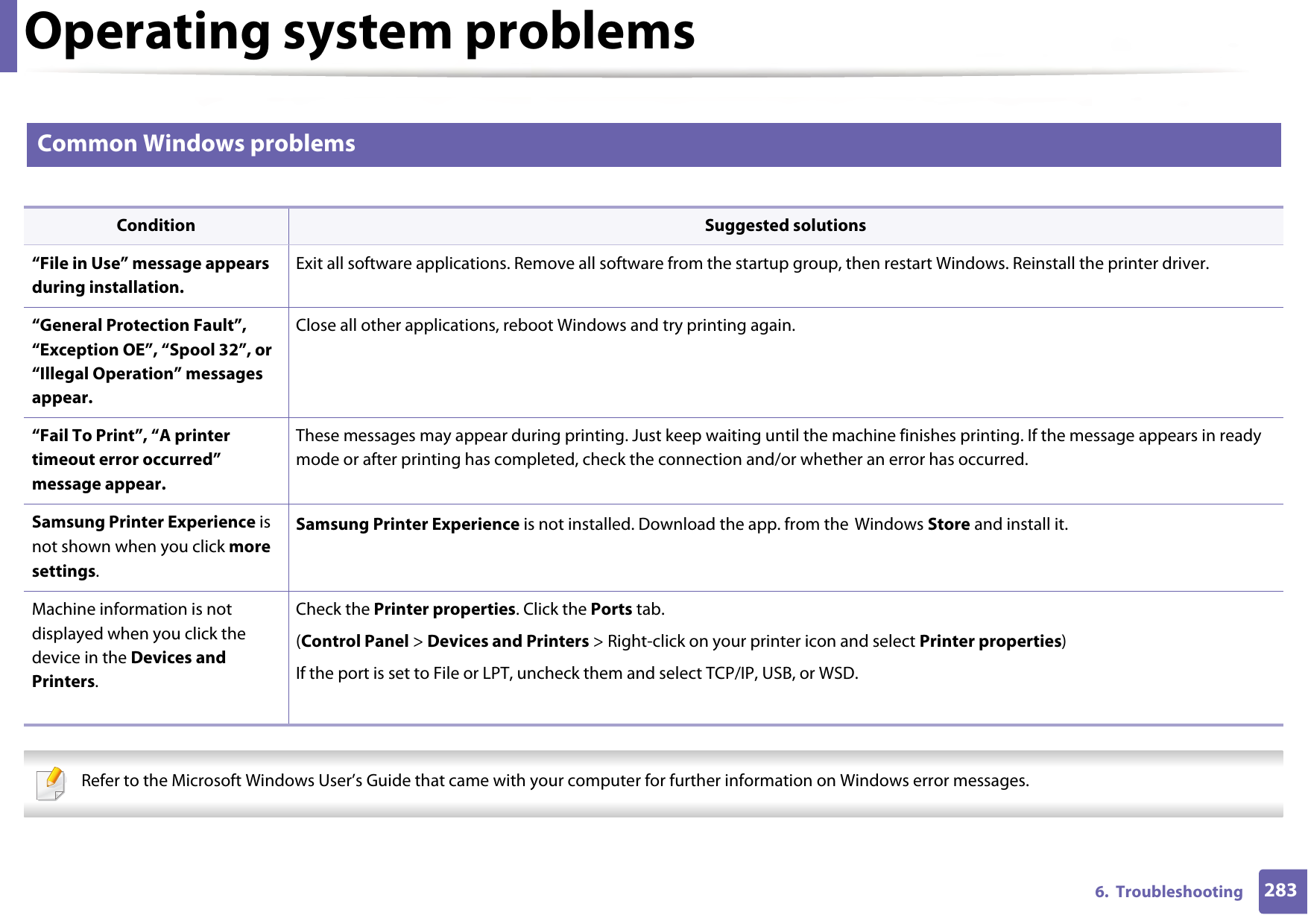
6. TroubleshootingThis chapter gives helpful information for what to do if you encounter an error.• Paper feeding problems 265• Power and cable connecting problems 266• Printing problems 267• Printing quality problems 271• Copying problems 279• Scanning problems 280• Faxing problems 281• Operating system problems 283 For errors that occur during the wireless software installation and settings, refer to the troubleshotting section in the wireless setting chapter (see "Troubleshooting for wireless network" on page 168).
2656.  TroubleshootingPaper feeding problemsCondition Suggested solutionsPaper jams during printing. Clear the paper jam.Paper sticks together. • Check the maximum paper capacity of the tray.• Make sure that you are using the correct type of paper.• Remove paper from the tray and flex or fan the paper.• Humid conditions may cause some paper to stick together.Multiple sheets of paper do not feed. Different types of paper may be stacked in the tray. Load paper of only one type, size, and weight.Paper does not feed into the machine. • Remove any obstructions from inside the machine.• Paper has not been loaded correctly. Remove paper from the tray and reload it correctly.• There is too much paper in the tray. Remove excess paper from the tray.• The paper is too thick. Use only paper that meets the specifications required by the machine.The paper keeps jamming. • There is too much paper in the tray. Remove excess paper from the tray. If you are printing on special materials, use the manual feeding in tray.• An incorrect type of paper is being used. Use only paper that meets the specifications required by the machine.• There may be debris inside the machine. Open the front cover and remove any debris.
2666.  TroubleshootingPower and cable connecting problemsReboot the power. If the problem persists, please call for service.Condition Suggested solutionsThe machine is not receiving power, or the connection cable between the computer and the machine is not connected properly.1  Connect the machine to the electricity supply first. 2  Check the USB cable or network cable in the machine’s rear.3  Disconnect the USB cable or network cable in the machine’s rear and then, reconnect it.21
2676.  TroubleshootingPrinting problemsCondition Possible cause Suggested solutionsThe machine does not print.The machine is not receiving power. Connect the machine to the electricity supply first. If the machine has a   (Power/Wake Up) button on the control, press it. The machine is not selected as the default machine.Select your machine as your default machine in Windows.Check the machine for the following:• The cover is not closed. Close the cover.• Paper is jammed. Clear the paper jam (see "Clearing paper jams" on page 95).• No paper is loaded. Load paper (see "Loading paper in the tray" on page 40).• The toner cartridge is not installed. Install the toner cartridge (see "Replacing the toner cartridge" on page 80).• Make sure the protect cover and sheets are removed from the toner cartridge (see "Replacing the toner cartridge" on page 80).If a system error occurs, contact your service representative.The connection cable between the computer and the machine is not connected properly.Disconnect the machine cable and reconnect it (see "Rear view" on page 23).The connection cable between the computer and the machine is defective.If possible, attach the cable to another computer that is working properly and print a job. You can also try using a different machine cable.The port setting is incorrect. Check the Windows printer settings to make sure that the print job is sent to the correct port. If the computer has more than one port, make sure that the machine is attached to the correct one.
Printing problems2686.  TroubleshootingThe machine does not print.The machine may be configured incorrectly.  Check the Printing Preferences to ensure that all of the print settings are correct.The printer driver may be incorrectly installed. Uninstall and reinstall the machine’s driver.The machine is malfunctioning. Check the display message on the control panel to see if the machine is indicating a system error. Contact a service representative.The document size is so big that the hard disk space of the computer is insufficient to access the print job.Get more hard disk space and print the document again.The output tray is full. Once the paper is removed from the output tray, the machine resumes printing.The machine selects print materials from the wrong paper source.The paper option that was selected in the Printing Preferences may be incorrect.For many software applications, the paper source selection is found under the Paper tab within the Printing Preferences (see "Opening printing preferences" on page 54). Select the correct paper source. See the printer driver help screen (see "Using help" on page 55).A print job is extremely slow.The job may be very complex. Reduce the complexity of the page or try adjusting the print quality settings.Half the page is blank. The page orientation setting may be incorrect. Change the page orientation in your application (see "Opening printing preferences" on page 54). See the printer driver help screen (see "Using help" on page 55).The paper size and the paper size settings do not match.Ensure that the paper size in the printer driver settings matches the paper in the tray.Or, ensure that the paper size in the printer driver settings matches the paper selection in the software application settings you use (see "Opening printing preferences" on page 54).The machine prints, but the text is wrong, garbled, or incomplete.The machine cable is loose or defective. Disconnect the machine cable and reconnect. Try a print job that you have already printed successfully. If possible, attach the cable and the machine to another computer that you know works and try a print job. Finally, try a new machine cable.Condition Possible cause Suggested solutions
Printing problems2696.  TroubleshootingThe wrong printer driver was selected. Check the application’s printer selection menu to ensure that your machine is selected.The software application is malfunctioning. Try printing a job from another application.The operating system is malfunctioning. Exit Windows and reboot the computer. Turn the machine off and back on again.Pages print, but they are blank.The toner cartridge is defective or out of toner. Redistribute the toner, if necessary. If necessary, replace the toner cartridge.• See "Redistributing toner" on page 78.• See "Replacing the toner cartridge" on page 80.The file may have blank pages. Check the file to ensure that it does not contain blank pages.Some parts, such as the controller or the board, may be defective.Contact a service representative.The machine does not print PDF files correctly. Some parts of graphics, text, or illustrations are missing.Incompatibility between the PDF file and the Acrobat products.Printing the PDF file as an image may enable the file to print. Turn on Print As Image from the Acrobat printing options.  It will take longer to print when you print a PDF file as an image. The print quality of photos is not good. Images are not clear.The resolution of the photo is very low.  Reduce the photo size. If you increase the photo size in the software application, the resolution will be reduced. Before printing, the machine emits vapor near the output tray.Using damp paper can cause vapor during printing.This is not a problem. Just keep printing.Condition Possible cause Suggested solutions
Printing problems2706.  TroubleshootingThe machine does not print special-sized paper, such as billing paper.Paper size and paper size setting do not match. Set the correct paper size in the Custom in Paper tab in Printing Preferences (see "Opening printing preferences" on page 54).The printed billing paper is curled.The paper type setting does not match. Change the printer option and try again. Go to Printing Preferences, click Paper tab, and set type to Thick (see "Opening printing preferences" on page 54).Condition Possible cause Suggested solutions
2716.  TroubleshootingPrinting quality problemsIf the inside of the machine is dirty or paper has been loaded improperly, there might be a reduction in print quality. See the table below to clear the problem.  Condition Suggested solutionsLight or faded print • If a vertical white streak or faded area appears on the page, the toner supply is low. Install a new toner cartridge (see "Replacing the toner cartridge" on page 80).• If a vertical white streak or faded area still appears on the page even though the machine has enough toner supply, open and close the front door 3 ~ 4 times (see "Machine overview" on page 20).• The paper may not meet paper specifications; for example, the paper may be too moist or rough.• If the entire page is light, the print resolution setting is too low or the toner save mode is on. Adjust the print resolution and turn the toner save mode off. See the help screen of the printer driver.• A combination of faded or smeared defects may indicate that the toner cartridge needs cleaning. Clean the inside of your machine (see "Cleaning the machine" on page 88).• The surface of the LSU part inside the machine may be dirty. Clean the inside of your machine (see "Cleaning the machine" on page 88). If these steps do not correct the problem, contact a service representative.The top half of the paper is printed lighter than the rest of the paperThe toner might not adhere properly to this type of paper.• Change the printer option and try again. Go to Printing Preferences, click the Paper tab, and set the paper type to Recycled (see "Opening printing preferences" on page 54).
Printing quality problems2726.  TroubleshootingToner specks • The paper may not meet specifications; for example, the paper may be too moist or rough.• The transfer roller may be dirty. Clean the inside of your machine (see "Cleaning the machine" on page 88).• The paper path may need cleaning. Contact a service representative (see "Cleaning the machine" on page 88).Dropouts If faded areas, generally rounded, occur randomly on the page:• A single sheet of paper may be defective. Try reprinting the job.• The moisture content of the paper is uneven or the paper has moist spots on its surface. Try a different brand of paper.• The paper lot is bad. The manufacturing processes can cause some areas to reject toner. Try a different kind or brand of paper.• Change the printer option and try again. Go to Printing Preferences, click the Paper tab, and set type to Thick (see "Opening printing preferences" on page 54).If these steps do not correct the problem, contact a service representative.White Spots  If white spots appear on the page:• The paper is too rough and a lot of dirt from paper falls to the inner components within the machine, so the transfer roller may be dirty. Clean the inside of your machine (see "Cleaning the machine" on page 88).• The paper path may need cleaning. Clean the inside of your machine (see "Cleaning the machine" on page 88).If these steps do not correct the problem, contact a service representative.Condition Suggested solutionsAaBbCcAaBbCcAaBbCcAaBbCcAaBbCcAaBbCAaBbCAaBbCAaBbCAaBbC
Printing quality problems2736.  TroubleshootingVertical lines If black vertical streaks appear on the page:• The surface (drum part) of the imaging unit inside the machine has probably been scratched. Remove the imaging unit and install a new one (see "Replacing the imaging unit" on page 82).If white vertical streaks appear on the page:• The surface of the LSU part inside the machine may be dirty. Clean the inside of your machine (see "Cleaning the machine" on page 88). If these steps do not correct the problem, contact a service representative.Black or color background If the amount of background shading becomes unacceptable:• Change to a lighter weight paper.• Check the environmental conditions: very dry conditions or a high level of humidity (higher than 80% RH) can increase the amount of background shading.• Remove the old imaging unit and install a new one (see "Replacing the imaging unit" on page 82).• Thoroughly redistribute the toner (see "Redistributing toner" on page 78).Toner smear • Clean the inside of the machine (see "Cleaning the machine" on page 88).• Check the paper type and quality.• Remove the imaging unit and install a new one (see "Replacing the imaging unit" on page 82).Condition Suggested solutions
Printing quality problems2746.  TroubleshootingVertical repetitive defects If marks repeatedly appear on the printed side of the page at even intervals:• The imaging unit may be damaged. If you still have the same problem, remove the imaging unit and, install a new one (see "Replacing the imaging unit" on page 82).• Parts of the machine may have toner on them. If the defects occur on the back of the page, the problem will likely correct itself after a few more pages.• The fusing assembly may be damaged. Contact a service representative.Background scatter Background scatter results from bits of toner randomly distributed on the printed page. • The paper may be too damp. Try printing with a different batch of paper. Do not open packages of paper until necessary so that the paper does not absorb too much moisture.• If background scatter covers the entire surface area of a printed page, adjust the print resolution through your software application or in Printing Preferences (see "Opening printing preferences" on page 54). Ensure the correct paper type is selected. For example: If Thicker Paper is selected, but Plain Paper actually used, an overcharging can occur causing this copy quality problem.• If you are using a new toner cartridge, redistribute the toner first (see "Redistributing toner" on page 78).Toner particles are around bold characters or picturesThe toner might not adhere properly to this type of paper.• Change the printer option and try again. Go to Printing Preferences, click the Paper tab, and set the paper type to Recycled (see "Opening printing preferences" on page 54).• Ensure the correct paper type is selected. For example: If Thicker Paper is selected, but Plain Paper actually used, an overcharging can occur causing this copy quality problem.Condition Suggested solutionsA
Printing quality problems2756.  TroubleshootingMisformed characters • If characters are improperly formed and producing hollow images, the paper stock may be too slick. Try different paper.Page skew • Ensure that the paper is loaded properly.• Check the paper type and quality.• Ensure that the guides are not too tight or too loose against the paper stack.Curl or wave • Ensure that the paper is loaded properly.• Check the paper type and quality. Both high temperature and humidity can cause paper curl.• Turn the stack of paper over in the tray. Also try rotating the paper 180° in the tray.Condition Suggested solutionsAaBbCAaBbCAaBbCAaBbCAaBbCc
Printing quality problems2766.  TroubleshootingWrinkles or creases • Ensure that the paper is loaded properly.• Check the paper type and quality.• Turn the stack of paper over in the tray. Also try rotating the paper 180° in the tray.Back of printouts are dirty • Check for leaking toner. Clean the inside of the machine (see "Cleaning the machine" on page 88).Solid color or black pages • The imaging unit may not be installed properly. Remove the imaging unit and reinsert it.• The imaging unit may be defective. Remove the imaging unit and install a new one (see "Replacing the imaging unit" on page 82).• The machine may require repairing. Contact a service representative.Condition Suggested solutionsA
Printing quality problems2776.  TroubleshootingLoose toner • Clean the inside of the machine (see "Cleaning the machine" on page 88).• Check the paper type and quality.• Remove the imaging unit and then, install a new one (see "Replacing the toner cartridge" on page 80).If the problem persists, the machine may require repair. Contact a service representative.Character voids Character voids are white areas within parts of characters that should be solid black:• You may be printing on the wrong surface of the paper. Remove the paper and turn it around. • The paper may not meet paper specifications.Horizontal stripes If horizontally aligned black streaks or smears appear:• The imaging unit may be installed improperly. Remove the imaging unit and reinsert it.• The imaging unit may be defective. Remove the imaging unit and install a new one (see "Replacing the imaging unit" on page 82).If the problem persists, the machine may require repairing. Contact a service representative.Condition Suggested solutionsA
Printing quality problems2786.  Troubleshooting Curl If the printed paper is curled or paper does not feed into the machine:• Turn the stack of paper over in the tray. Also try rotating the paper 180° in the tray. • Change the printer’s paper option and try again. Go to Printing Preferences, click the Paper tab, and set type to Thin (see "Opening printing preferences" on page 54).• An unknown image repetitively appears on a few sheets• Loose toner• Light print or contamination occursYour machine is probably being used at an altitude of 1,000 m (3,281 ft) or above.The high altitude may affect the print quality, such as loose toner or light imaging. Change the altitude setting for your machine (see "Altitude adjustment" on page 208).Condition Suggested solutions
2796.  TroubleshootingCopying problemsCondition Suggested solutionsCopies are too light or too dark. Adjust the darkness in copy feature to lighten or darken the backgrounds of copies (see "Changing the settings for each copy" on page 58).Smears, lines, marks, or spots appear on copies.• If the defects are on the original, adjust darkness in copy feature to lighten the background of your copies.• Adjust background in copy setup removes the background color (see "Adjust Bkgd." on page 191).• If there are no defects on the original, clean the scan unit (see "Cleaning the scan unit" on page 91).Copy image is skewed. • Ensure that the original is aligned with the registration guide.• The transfer roller may be dirty. Clean the inside of your machine (see "Cleaning the machine" on page 88).Blank copies print out. Ensure that the original is face down on the scanner glass or face up in the document feeder.If these steps do not correct the problem, contact a service representative.Image rubs off the copy easily. • Replace the paper in the tray with paper from a new package.• In high humidity areas, do not leave paper in the machine for extended periods of time.Frequent copy paper jams occur.• Fan the paper, then turn it over in the tray. Replace the paper in the tray with a fresh supply. Check/adjust the paper guides, if necessary.• Ensure that the paper is the proper type and weight (see "Print media specifications" on page 113).• Check for copy paper or pieces of copy paper remaining in the machine after a paper jam has been cleared.Toner cartridge produces fewer copies than expected before running out of toner.• Your originals may contain pictures, solids, or heavy lines. For example, your originals may be forms, newsletters, books, or other documents that use more toner.• The scanner lid may be left open while copies are being made.• Turn the machine off and back on.
2806.  TroubleshootingScanning problemsCondition Suggested solutionsThe scanner does not work. • Make sure that you place the original to be scanned face down on the scanner glass, or face up in the document feeder (see "Loading originals" on page 48).• There may not be enough available memory to hold the document you want to scan. Try the Prescan function to see if that works. Try lowering the scan resolution rate.• Check that the machine printer cable is connected properly.• Make sure that the machine printer cable is not defective. Switch the printer cable with a known good cable. If necessary, replace the printer cable.• Check that the scanner is configured correctly. Check scan setting in the Easy Document Creator or the application you want to use to make certain that the scanner job is being sent to the correct port (for example, USB001).The unit scans very slowly. • Check if the machine is printing received data. If so, scan the document after the received data has been printed.• Graphics are scanned more slowly than text.Message appears on your computer screen:• Device can’t be set to the H/W mode you want.• Port is being used by another program.•Port is disabled.• Scanner is busy receiving or printing data. When the current job is completed, try again.• Invalid handle.• Scanning has failed.• There may be a copying or printing job in progress. Try your job again when that job is finished.• The selected port is currently being used. Restart your computer and try again.• The machine printer cable may be improperly connected or the power may be off.• The scanner driver is not installed or the operating environment is not set up properly.• Ensure that the machine is properly connected and the power is on, then restart your computer.• The USB cable may be improperly connected or the power may be off.
2816.  TroubleshootingFaxing problemsCondition Suggested solutionsThe machine is not working, there is no display, or the buttons are not working.• Unplug the power cord and plug it in again.• Ensure that there is power being supplied to the electrical outlet.• Ensure that the power is turned on.No dial tone. • Check that the phone line is properly connected (see "Rear view" on page 23).• Check that the phone socket on the wall is working by plugging in another phone.The numbers stored in memory do not dial correctly.Make sure that the numbers are stored in memory correctly. To check that, print an address book list.The original does not feed into the machine.• Make sure that the paper is not wrinkled and you are inserting it in correctly. Check that the original is the right size, not too thick or thin.• Make sure that the document feeder is firmly closed.• The document feeder rubber pad may need to be replaced. Contact a service representative (see "Available maintenance parts" on page 76).Faxes are not received automatically.• The receiving mode should be set to fax (see "Changing the receive modes" on page 237).• Make sure that there is paper in the tray (see "Print media specifications" on page 113).• Check to see if the display shows any error message. If it does, clear the problem.The machine does not send. • Make sure that the original is loaded in the document feeder or on the scanner glass.• Check the fax machine you are sending to, to see if it can receive your fax.The incoming fax has blank spaces or is of poor-quality.• The fax machine sending you the fax may be faulty.• A noisy phone line can cause line errors.• Check your machine by making a copy.• A toner cartridge has almost reached its estimated cartridge life. Replace the toner cartridge (see "Replacing the toner cartridge" on page 80).
Faxing problems2826.  TroubleshootingSome of the words on an incoming fax are stretched.The fax machine sending the fax had a temporary document jam. There are lines on the originals you sent.Check your scan unit for marks and clean it (see "Cleaning the scan unit" on page 91).The machine dials a number, but the connection with the other fax machine fails.The other fax machine may be turned off, out of paper, or cannot answer incoming calls. Speak with the other machine operator and ask them to solve the problem on their side.Faxes do not store in memory. There may not be enough memory space to store the fax. If the display indicating the memory status shows, delete any faxes you no longer need from the memory, and then try to store the fax again. Call for service.Blank areas appear at the bottom of each page or on other pages, with a small strip of text at the top.You may have chosen the wrong paper settings in the user option setting. Check the paper size and type again.Condition Suggested solutions
2836.  TroubleshootingOperating system problems1 Common Windows problems Refer to the Microsoft Windows User’s Guide that came with your computer for further information on Windows error messages. Condition Suggested solutions“File in Use” message appears during installation.Exit all software applications. Remove all software from the startup group, then restart Windows. Reinstall the printer driver.“General Protection Fault”, “Exception OE”, “Spool 32”, or “Illegal Operation” messages appear.Close all other applications, reboot Windows and try printing again.“Fail To Print”, “A printer timeout error occurred” message appear.These messages may appear during printing. Just keep waiting until the machine finishes printing. If the message appears in ready mode or after printing has completed, check the connection and/or whether an error has occurred.Samsung Printer Experience is not shown when you click more settings.Samsung Printer Experience is not installed. Download the app. from the Windows Store and install it.Machine information is not displayed when you click the device in the Devices and Printers.Check the Printer properties. Click the Ports tab.(Control Panel > Devices and Printers > Right-click on your printer icon and select Printer properties)If the port is set to File or LPT, uncheck them and select TCP/IP, USB, or WSD.
Operating system problems2846.  Troubleshooting2 Common Mac problems   Refer to the Mac User’s Guide that came with your computer for further information on Mac error messages. Condition Suggested solutionsThe machine does not print PDF files correctly. Some parts of graphics, text, or illustrations are missing.Printing the PDF file as an image may enable the file to print. Turn on Print As Image from the Acrobat printing options.  It will take longer to print when you print a PDF file as an image. Some letters are not displayed normally during cover page printing.Mac OS cannot create the font while printing the cover page. The English alphabet and numbers are displayed normally on the cover page.When printing a document in Mac with Acrobat Reader 6.0 or higher, colors print incorrectly.Make sure that the resolution setting in your machine driver matches the one in Acrobat Reader.
Operating system problems2856.  Troubleshooting3 Common Linux problems  Condition Suggested solutionsThere is no xsane nor simple-scan application on my Linux machine.For some Linux distributions, there might be no default scan application. To use scan features, install one of scan applications using download center supplied by the OS(ex. Ubuntu Software Center for Ubuntu, Install/Remove Software for openSUSE, Software for Fedora).Scanner can not be found via network.For some Linux distributions, strong firewall is enabled and it may block our installer from opening the necessary port for searching network devices. In such a case, open the snmp port - 22161 manually or disable the firewall temporarily while using the device.When printing more than one copy, the second copy does not print. The problem occurs on Ubuntu 12.04 due to the problem in standard CUPS filter 'pdftops'. Update 'cups-filters' package to version 1.0.18 to fix the problem ('pdftops' is a part of 'cups-filters' package).Unchecking the collate option in the Print Dialog does not work.For some distributions, GNOME Print Dialog has an issue handling the collate option. As workaround, set the default value of collate option to False using the system's printing utility(execute "system-config-printer" in the Terminal program).Printing always works with duplex.This duplex issue was in Ubuntu 9.10 CUPS package. Update CUPS version to 1.4.1-5ubuntu2.2.Printer is not added through system's printing utility.The problem occurs on Debian 7 due to the defect in 'system-config-printer' package of the Debian 7 (http://bugs.debian.org/cgi-bin/bugreport.cgi?bug=662813 in Debian bug tracking system). Please use another way to add printer (CUPS WebUI for example)Paper size and orientation are disabled in the Print Dialog when opening text files.The problem occurs on Fedora 19 and it's related to 'leafpad' text editor on Fedora 19. Please use other text editors like 'gedit'.Printing produces divided images. This issue exists in openSUSE 13.2 due to wrong ghostscript provided by the system. Update 'cups-filters-ghostscript' package with the command "zypper install --force cups-filters-ghostscript" or with "Install/Remove Software" utility.
Operating system problems2866.  Troubleshooting Refer to the Linux User’s Guide that came with your computer for further information on Linux error messages. 4 Common PostScript problemsThe following situations are PS language specific and may occur when several printer languages are used.  Problem Possible cause SolutionThe PostScript file cannot be printedThe PostScript driver may not be installed correctly.• Install the PostScript driver (see "Software Installation" on page 137).• Print a configuration page and verify that the PS version is available for printing.• If the problem persists, contact a service representative.Limit Check Error report prints The print job was too complex. You might need to reduce the complexity of the page or install more memory.A PostScript error page prints The print job may not be PostScript. Make sure that the print job is a PostScript job. Check to see whether the software application expected a setup or PostScript header file to be sent to the machine.The optional tray is not selected in the driverThe printer driver has not been configured to recognize the optional tray.Open the driver properties, select the Device Options tab, and set the tray option.When printing a document in Mac with Acrobat Reader 6.0 or higher, colors print incorrectlyThe resolution setting in the printer driver may not be matched with the one in Acrobat Reader.Make sure that the resolution setting in your printer driver matches the one in Acrobat Reader.
287 GlossaryGlossary The following glossary helps you get familiar with the product by understanding the terminologies commonly used with printing as well as mentioned in this user’s guide. 802.11802.11 is a set of standards for wireless local area network (WLAN) communication, developed by the IEEE LAN/MAN Standards Committee (IEEE 802). 802.11b/g/n802.11b/g/n can share same hardware and use the 2.4 GHz band. 802.11b supports bandwidth up to 11 Mbps, 802.11n supports bandwidth up to 150 Mbps. 802.11b/g/n devices may occasionally suffer interference from microwave ovens, cordless telephones, and Bluetooth devices.Access pointAccess Point or Wireless Access Point (AP or WAP) is a device that connects wireless communication devices together on wireless local area networks (WLAN), and acts as a central transmitter and receiver of WLAN radio signals. ADFAn Automatic Document Feeder (ADF) is a scanning unit that will automatically feed an original sheet of paper so that the machine can scan some amount of the paper at once. AppleTalkAppleTalk is a proprietary suite of protocols developed by Apple, Inc for computer networking. It was included in the original Mac (1984) and is now deprecated by Apple in favor of TCP/IP networking.BIT DepthA computer graphics term describing the number of bits used to represent the color of a single pixel in a bitmapped image. Higher color depth gives a broader range of distinct colors. As the number of bits increases, the number of possible colors becomes impractically large for a color map. 1-bit color is commonly called as monochrome or black and white.BMPA bitmapped graphics format used internally by the Microsoft Windows graphics subsystem (GDI), and used commonly as a simple graphics file format on that platform.
Glossary288 GlossaryBOOTPBootstrap Protocol. A network protocol used by a network client to obtain its IP address automatically. This is usually done in the bootstrap process of computers or operating systems running on them. The BOOTP servers assign the IP address from a pool of addresses to each client. BOOTP enables 'diskless workstation' computers to obtain an IP address prior to loading any advanced operating system.CCDCharge Coupled Device (CCD) is a hardware which enables the scan job. CCD Locking mechanism is also used to hold the CCD module to prevent any damage when you move the machine.CollationCollation is a process of printing a multiple-copy job in sets. When collation is selected, the device prints an entire set before printing additional copies.Control PanelA control panel is a flat, typically vertical, area where control or monitoring instruments are displayed. They are typically found in front of the machine. CoverageIt is the printing term used for a toner usage measurement on printing. For example, 5% coverage means that an A4 sided paper has about 5% image or text on it. So, if the paper or original has complicated images or lots of text on it, the coverage will be higher and at the same time, a toner usage will be as much as the coverage.CSVComma Separated Values (CSV). A type of file format, CSV is used to exchange data between disparate applications. The file format, as it is used in Microsoft Excel, has become a de facto standard throughout the industry, even among non-Microsoft platforms.DADFA Duplex Automatic Document Feeder (DADF) is a scanning unit that will automatically feed and turn over an original sheet of paper so that the machine can scan on both sides of the paper.DefaultThe value or setting that is in effect when taking a printer out of its box state, reset, or initialized.
Glossary289 GlossaryDHCPA Dynamic Host Configuration Protocol (DHCP) is a client-server networking protocol. A DHCP server provides configuration parameters specific to the DHCP client host requesting, generally, information required by the client host to participate on an IP network. DHCP also provides a mechanism for allocation of IP addresses to client hosts.DIMMDual Inline Memory Module (DIMM), a small circuit board that holds memory. DIMM stores all the data within the machine like printing data, received fax data.DLNAThe Digital Living Network Alliance (DLNA) is a standard that allows devices on a home network to share information with each other across the network.DNSThe Domain Name Server (DNS) is a system that stores information associated with domain names in a distributed database on networks, such as the Internet.Dot Matrix PrinterA dot matrix printer refers to a type of computer printer with a print head that runs back and forth on the page and prints by impact, striking an ink-soaked cloth ribbon against the paper, much like a typewriter.DPIDots Per Inch (DPI) is a measurement of resolution that is used for scanning and printing. Generally, higher DPI results in a higher resolution, more visible detail in the image, and a larger file size.DRPD Distinctive Ring Pattern Detection. Distinctive Ring is a telephone company service which enables a user to use a single telephone line to answer several different telephone numbers.DuplexA mechanism that will automatically turn over a sheet of paper so that the machine can print (or scan) on both sides of the paper. A printer equipped with a Duplex Unit can print on both sides of paper during one print cycle.Duty CycleDuty cycle is the page quantity which does not affect printer performance for a month. Generally the printer has the lifespan limitation such as pages per year. The lifespan means the average capacity of print-outs, usually within the warranty period. For example, if the duty cycle is 48,000 pages per month assuming 20 working days, a printer limits 2,400 pages a day.
Glossary290 GlossaryECMError Correction Mode (ECM) is an optional transmission mode built into Class 1 fax machines or fax modems. It automatically detects and corrects errors in the fax transmission process that are sometimes caused by telephone line noise.EmulationEmulation is a technique of one machine obtaining the same results as another.An emulator duplicates the functions of one system with a different system, so that the second system behaves like the first system. Emulation focuses on exact reproduction of external behavior, which is in contrast to simulation, which concerns an abstract model of the system being simulated, often considering its internal state.EthernetEthernet is a frame-based computer networking technology for local area networks (LANs). It defines wiring and signaling for the physical layer, and frame formats and protocols for the media access control (MAC)/data link layer of the OSI model. Ethernet is mostly standardized as IEEE 802.3. It has become the most widespread LAN technology in use during the 1990s to the present.EtherTalkA suite of protocols developed by Apple Computer for computer networking. It was included in the original Mac (1984) and is now deprecated by Apple in favor of TCP/IP networking. FDIForeign Device Interface (FDI) is a card installed inside the machine to allow a third party device such as a coin operated device or a card reader. Those devices allow the pay-for-print service on your machine.FTPA File Transfer Protocol (FTP) is a commonly used protocol for exchanging files over any network that supports the TCP/IP protocol (such as the Internet or an intranet).Fuser Unit The part of a laser printer that fuses the toner onto the print media. It consists of a heat roller and a pressure roller. After toner is transferred onto the paper, the fuser unit applies heat and pressure to ensure that the toner stays on the paper permanently, which is why paper is warm when it comes out of a laser printer.
Glossary291 GlossaryGatewayA connection between computer networks, or between a computer network and a telephone line. It is very popular, as it is a computer or a network that allows access to another computer or network.GrayscaleA shade of gray that represents light and dark portions of an image when color images are converted to grayscale; colors are represented by various shades of gray.HalftoneAn image type that simulates grayscale by varying the number of dots. Highly colored areas consist of a large number of dots, while lighter areas consist of a smaller number of dots.Mass storage device (HDD)Mass storage device (HDD), commonly referred to as a hard drive or hard disk, is a non-volatile storage device which stores digitally-encoded data on rapidly rotating platters with magnetic surfaces.IEEEThe Institute of Electrical and Electronics Engineers (IEEE) is an international non-profit, professional organization for the advancement of technology related to electricity.IEEE 1284The 1284 parallel port standard was developed by the Institute of Electrical and Electronics Engineers (IEEE). The term "1284-B" refers to a specific connector type on the end of the parallel cable that attaches to the peripheral (for example, a printer). IntranetA private network that uses Internet Protocols, network connectivity, and possibly the public telecommunication system to securely share part of an organization's information or operations with its employees. Sometimes the term refers only to the most visible service, the internal website.IP addressAn Internet Protocol (IP) address is a unique number that devices use in order to identify and communicate with each other on a network utilizing the Internet Protocol standard.
Glossary292 GlossaryIPMThe Images Per Minute (IPM) is a way of measuring the speed of a printer. An IPM rate indicates the number of single-sided sheets a printer can complete within one minute.IPPThe Internet Printing Protocol (IPP) defines a standard protocol for printing as well as managing print jobs, media size, resolution, and so forth. IPP can be used locally or over the Internet to hundreds of printers, and also supports access control, authentication, and encryption, making it a much more capable and secure printing solution than older ones.IPX/SPXIPX/SPX stands for Internet Packet Exchange/Sequenced Packet Exchange. It is a networking protocol used by the Novell NetWare operating systems. IPX and SPX both provide connection services similar to TCP/IP, with the IPX protocol having similarities to IP, and SPX having similarities to TCP. IPX/SPX was primarily designed for local area networks (LANs), and is a very efficient protocol for this purpose (typically its performance exceeds that of TCP/IP on a LAN).ISOThe International Organization for Standardization (ISO) is an international standard-setting body composed of representatives from national standards bodies. It produces world-wide industrial and commercial standards.ITU-TThe International Telecommunication Union is an international organization established to standardize and regulate international radio and telecommunications. Its main tasks include standardization, allocation of the radio spectrum, and organizing interconnection arrangements between different countries to allow international phone calls. A -T out of ITU-T indicates telecommunication.ITU-T No. 1 chartStandardized test chart published by ITU-T for document facsimile transmissions.JBIGJoint Bi-level Image Experts Group (JBIG) is an image compression standard with no loss of accuracy or quality, which was designed for compression of binary images, particularly for faxes, but can also be used on other images.JPEGJoint Photographic Experts Group (JPEG) is a most commonly used standard method of lossy compression for photographic images. It is the format used for storing and transmitting photographs on the World Wide Web.
Glossary293 GlossaryLDAPThe Lightweight Directory Access Protocol (LDAP) is a networking protocol for querying and modifying directory services running over TCP/IP.LEDA Light-Emitting Diode (LED) is a semiconductor device that indicates the status of a machine.MAC addressMedia Access Control (MAC) address is a unique identifier associated with a network adapter. MAC address is a unique 48-bit identifier usually written as 12 hexadecimal characters grouped in pairs (e. g., 00-00-0c-34-11-4e). This address is usually hard-coded into a Network Interface Card (NIC) by its manufacturer, and used as an aid for routers trying to locate machines on large networks.MFPMulti Function Peripheral (MFP) is an office machine that includes the following functionality in one physical body, so as to have a printer, a copier, a fax, a scanner and etc.MHModified Huffman (MH) is a compression method for decreasing the amount of data that needs to be transmitted between the fax machines to transfer the image recommended by ITU-T T.4. MH is a codebook-based run-length encoding scheme optimized to efficiently compress white space. As most faxes consist mostly of white space, this minimizes the transmission time of most faxes. MMRModified Modified READ (MMR) is a compression method recommended by ITU-T T.6.ModemA device that modulates a carrier signal to encode digital information, and also demodulates such a carrier signal to decode transmitted information.MRModified Read (MR) is a compression method recommended by ITU-T T.4. MR encodes the first scanned line using MH. The next line is compared to the first, the differences determined, and then the differences are encoded and transmitted.
Glossary294 GlossaryNetWareA network operating system developed by Novell, Inc. It initially used cooperative multitasking to run various services on a PC, and the network protocols were based on the archetypal Xerox XNS stack. Today NetWare supports TCP/IP as well as IPX/SPX.OPCOrganic Photo Conductor (OPC) is a mechanism that makes a virtual image for print using a laser beam emitted from a laser printer, and it is usually green or rust colored and has a cylinder shape. An imaging unit containing a drum slowly wears the drum surface by its usage in the printer, and it should be replaced appropriately since it gets worn from contact with the cartridge development brush, cleaning mechanism, and paper.OriginalsThe first example of something, such as a document, photograph or text, etc, which is copied, reproduced or translated to produce others, but which is not itself copied or derived from something else.OSIOpen Systems Interconnection (OSI) is a model developed by the International Organization for Standardization (ISO) for communications. OSI offers a standard, modular approach to network design that divides the required set of complex functions into manageable, self-contained, functional layers. The layers are, from top to bottom, Application, Presentation, Session, Transport, Network, Data Link and Physical.PABX A private automatic branch exchange (PABX) is an automatic telephone switching system within a private enterprise.PCLPrinter Command Language (PCL) is a Page Description Language (PDL) developed by HP as a printer protocol and has become an industry standard. Originally developed for early inkjet printers, PCL has been released in varying levels for thermal, dot matrix printer, and laser printers.PDFPortable Document Format (PDF) is a proprietary file format developed by Adobe Systems for representing two dimensional documents in a device independent and resolution independent format.
Glossary295 GlossaryPostScriptPostScript (PS) is a page description language and programming language used primarily in the electronic and desktop publishing areas. - that is run in an interpreter to generate an image.Printer DriverA program used to send commands and transfer data from the computer to the printer.Print MediaThe media like paper, labels, and transparencies which can be used in a printer, a scanner, a fax or, a copier.PPMPages Per Minute (PPM) is a method of measurement for determining how fast a printer works, meaning the number of pages a printer can produce in one minute.PRN fileAn interface for a device driver, this allows software to interact with the device driver using standard input/output system calls, which simplifies many tasks. ProtocolA convention or standard that controls or enables the connection, communication, and data transfer between two computing endpoints.PSSee PostScript.PSTNThe Public-Switched Telephone Network (PSTN) is the network of the world's public circuit-switched telephone networks which, on industrial premises, is usually routed through the switchboard.RADIUSRemote Authentication Dial In User Service (RADIUS) is a protocol for remote user authentication and accounting. RADIUS enables centralized management of authentication data such as usernames and passwords using an AAA (authentication, authorization, and accounting) concept to manage network access.ResolutionThe sharpness of an image, measured in Dots Per Inch (DPI). The higher the dpi, the greater the resolution.
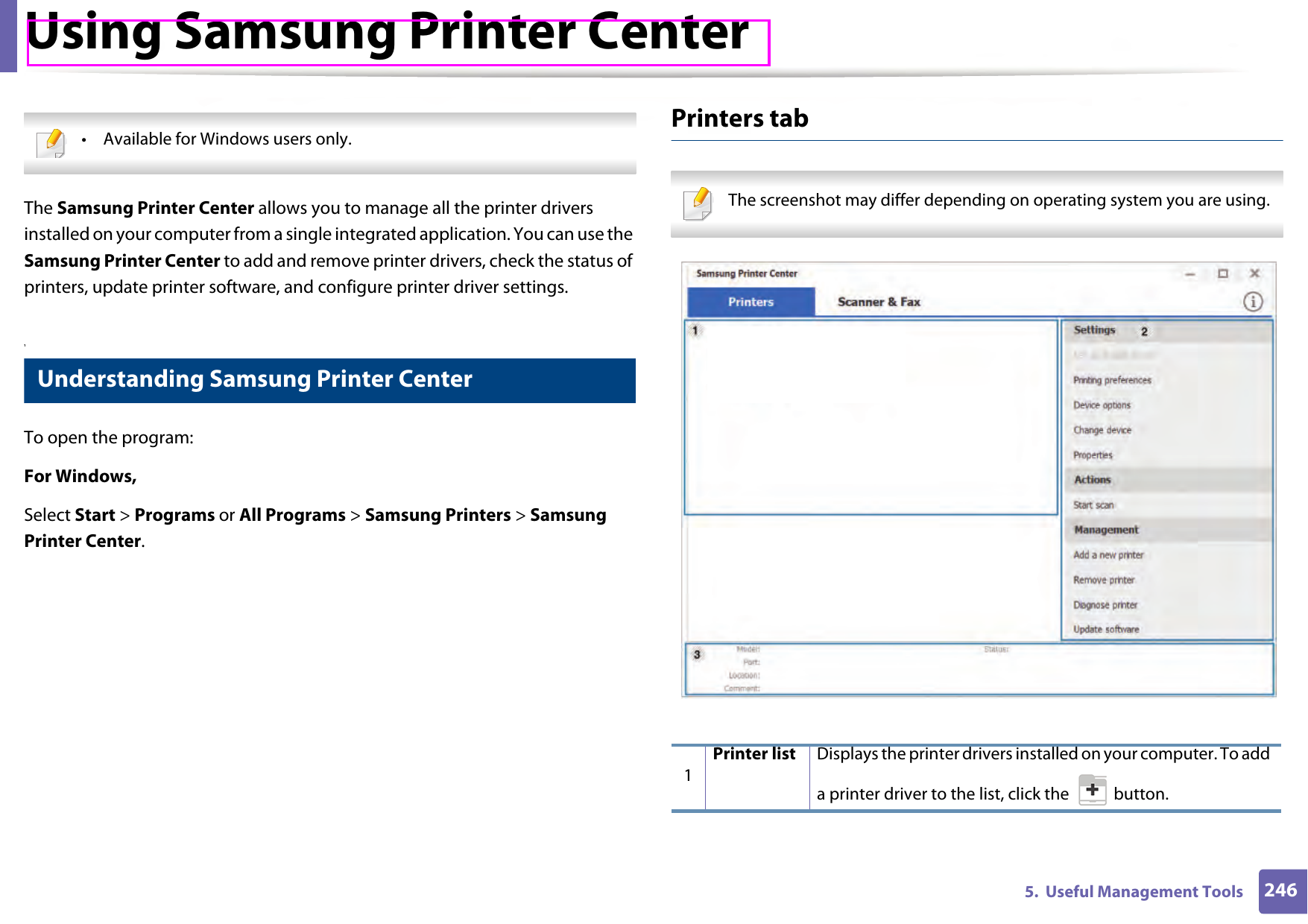
Glossary296 GlossarySMBServer Message Block (SMB) is a network protocol mainly applied to share files, printers, serial ports, and miscellaneous communications between nodes on a network. It also provides an authenticated Inter-process communication mechanism.SMTPSimple Mail Transfer Protocol (SMTP) is the standard for e-mail transmissions across the Internet. SMTP is a relatively simple, text-based protocol, where one or more recipients of a message are specified, and then the message text is transferred. It is a client-server protocol, where the client transmits an email message to the server.SSIDService Set Identifier (SSID) is a name of a wireless local area network (WLAN). All wireless devices in a WLAN use the same SSID in order to communicate with each other. The SSIDs are case-sensitive and have a maximum length of 32 characters.Subnet Mask The subnet mask is used in conjunction with the network address to determine which part of the address is the network address and which part is the host address.TCP/IPThe Transmission Control Protocol (TCP) and the Internet Protocol (IP); the set of communications protocols that implement the protocol stack on which the Internet and most commercial networks run.TCRTransmission Confirmation Report (TCR) provides details of each transmission such as job status, transmission result and number of pages sent. This report can be set to print after each job or only after failed transmissions.TIFFTagged Image File Format (TIFF) is a variable-resolution bitmapped image format. TIFF describes image data that typically come from scanners. TIFF images make use of tags, keywords defining the characteristics of the image that is included in the file. This flexible and platform-independent format can be used for pictures that have been made by various image processing applications.Toner CartridgeA kind of bottle or container used in a machine like a printer which contains toner. Toner is a powder used in laser printers and photocopiers, which forms the text and images on the printed paper. Toner can be fused by a combination of heat/pressure from the fuser, causing it to bind to the fibers in the paper.
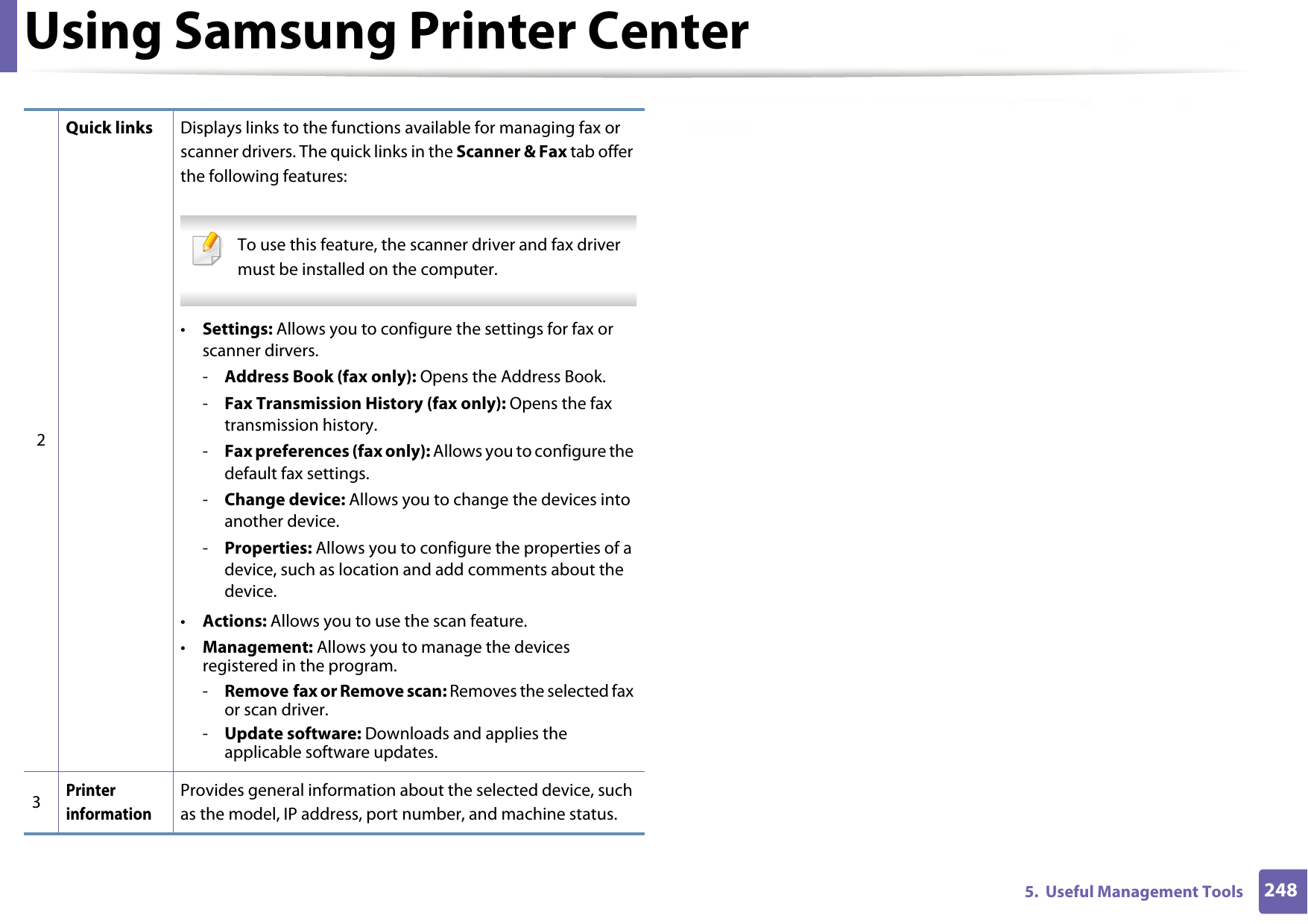
Glossary297 GlossaryTWAINAn industry standard for scanners and software. By using a TWAIN-compliant scanner with a TWAIN-compliant program, a scan can be initiated from within the program. It is an image capture API for Microsoft Windows and Apple Mac operating systems.UNC PathUniform Naming Convention (UNC) is a standard way to access network shares in Window NT and other Microsoft products. The format of a UNC path is: \\<servername>\<sharename>\<Additional directory>URLUniform Resource Locator (URL) is the global address of documents and resources on the Internet. The first part of the address indicates what protocol to use, the second part specifies the IP address or the domain name where the resource is located.USBUniversal Serial Bus (USB) is a standard that was developed by the USB Implementers Forum, Inc., to connect computers and peripherals. Unlike the parallel port, USB is designed to concurrently connect a single computer USB port to multiple peripherals.WatermarkA watermark is a recognizable image or pattern in paper that appears lighter when viewed by transmitted light. Watermarks were first introduced in Bologna, Italy in 1282; they have been used by papermakers to identify their product, and also on postage stamps, currency, and other government documents to discourage counterfeiting.WEPWired Equivalent Privacy (WEP) is a security protocol specified in IEEE 802.11 to provide the same level of security as that of a wired LAN. WEP provides security by encrypting data over radio so that it is protected as it is transmitted from one end point to another.WIAWindows Imaging Architecture (WIA) is an imaging architecture that is originally introduced in Windows Me and Windows XP Service Pack 3. A scan can be initiated from within these operating systems by using a WIA-compliant scanner.WPAWi-Fi Protected Access (WPA) is a class of systems to secure wireless (Wi-Fi) computer networks, which was created to improve upon the security features of WEP.
Glossary298 GlossaryWPA-PSKWPA-PSK (WPA Pre-Shared Key) is special mode of WPA for small business or home users. A shared key, or password, is configured in the wireless access point (WAP) and any wireless laptop or desktop devices. WPA-PSK generates a unique key for each session between a wireless client and the associated WAP for more advanced security.WPSThe Wi-Fi Protected Setup (WPS) is a standard for establishing a wireless home network. If your wireless access point supports WPS, you can configure the wireless network connection easily without a computer.XPSXML Paper Specification (XPS) is a specification for a Page Description Language (PDL) and a new document format, which has benefits for portable document and electronic document, developed by Microsoft. It is an XML-based specification, based on a new print path and a vector-based device-independent document format.
299 Contact SAMSUNG worldwideContact SAMSUNG worldwideIf you have any comments or questions regarding Samsung products, contact the Samsung customer care center.Country/Region Customer Care Center  WebSiteALGERIA 021 36 11 00 www.samsung.com/n_africa/supportARGENTINE 0800-555-SAMSUNG (0800-555-7267) www.samsung.com/ar/supportARMENIA 0-800-05-555 www.samsung.com/supportAUSTRALIA 1300 362 603 www.samsung.com/au/supportAUSTRIA0800-SAMSUNG (0800-7267864)[Only for Premium HA] 0800-366661[Only for Dealers] 0810-112233www.samsung.com/at/supportAZERBAIJAN 0-88-555-55-55 www.samsung.com/supportBAHRAIN8000-GSAM (8000-4726) www.samsung.com/ae/support (English)www.samsung.com/ae_ar/support (Arabic)BELARUS 810-800-500-55-500 www.samsung.com/supportBANGLADESH 09612300300 www.samsung.com/in/supportBELGIUM02-201-24-18 www.samsung.com/be/support (Dutch)www.samsung.com/be_fr/support (French)BOLIVIA 800-10-7260[HHP] 4828210www.samsung.com/cl/supportBOSNIA 055 233 999 www.samsung.com/supportBOTSWANA 8007260000 www.samsung.com/supportBRAZIL0800-124-421 (Demais cidades e regiões)4004-0000 (Capitais e grandes centros)www.samsung.com/br/supportBULGARIA 800 111 31 , Безплатна телефонна линияwww.samsung.com/bg/supportBURUNDI 200 www.samsung.com/supportCAMEROON 7095- 0077 www.samsung.com/africa_fr/supportCountry/Region Customer Care Center  WebSite
Contact SAMSUNG worldwide300 Contact SAMSUNG worldwideCANADA1-800-SAMSUNG (726-7864) www.samsung.com/ca/support(English)www.samsung.com/ca_fr/support (French)CHILE 800-SAMSUNG (726-7864)[HHP] 02-24828200www.samsung.com/cl/supportCHINA 400-810-5858 www.samsung.com/cn/supportCOLOMBIABogotá 600 12 72Gratis desde cualquier parte del país 01 8000 112 112 ó  desde su celular #SAM(726)www.samsung.com/co/supportCOSTA RICA0-800-507-7267 00-800-1-SAMSUNG (726-7864)www.samsung.com/latin/support (Spanish)www.samsung.com/latin_en/support (English)CROATIA 072 726 786 www.samsung.com/hr/supportCote D’ Ivoire 8000 0077 www.samsung.com/africa_fr/supportCountry/Region Customer Care Center  WebSiteCYPRUS 8009 4000 only from landline, toll freewww.samsung.com/gr/supportCZECH 800-SAMSUNG (800-726786) www.samsung.com/cz/supportDENMARK 70 70 19 70 www.samsung.com/dk/supportDOMINICAN REPUBLIC1-800-751-2676 www.samsung.com/latin/support (Spanish)www.samsung.com/latin_en/support (English)DRC 499999 www.samsung.com/supportECUADOR1-800-10-72671-800-SAMSUNG (72-6786)www.samsung.com/latin/support (Spanish)www.samsung.com/latin_en/support(English)EGYPT 08000-726786416580www.samsung.com/eg/supportCountry/Region Customer Care Center  WebSite
Contact SAMSUNG worldwide301 Contact SAMSUNG worldwideEIRE 0818 717100 www.samsung.com/ie/supportEL SALVADOR800-6225800-0726-7864www.samsung.com/latin/support (Spanish)www.samsung.com/latin_en/support (English)ESTONIA 800-7267 www.samsung.com/ee/supportFINLAND 030-6227 515 www.samsung.com/fi/supportFRANCE 01 48 63 00 00 www.samsung.com/fr/supportGERMANY0180 6 SAMSUNG bzw. 0180 6 7267864* [HHP] 0180 6 M SAMSUNG bzw.0180 6 67267864* (*0,20 €/Anruf aus dem dt. Festnetz, aus dem Mobilfunk max. 0,60 €/Anruf)www.samsung.com/de/supportGEORGIA 0-800-555-555 www.samsung.com/supportCountry/Region Customer Care Center  WebSiteGHANA 0800-100770302-200077www.samsung.com/africa_en/supportGREECE80111-SAMSUNG (80111 726 7864) only from land line(+30) 210 6897691 from mobile and land linewww.samsung.com/gr/supportGUATEMALA1-800-299-00131-800-299-0033www.samsung.com/latin/support (Spanish)www.samsung.com/latin_en/support (English)HONDURAS800-2791-9267 800-2791-9111www.samsung.com/latin/support (Spanish)www.samsung.com/latin_en/support (English)HONG KONG(852) 3698 4698 www.samsung.com/hk/support (Chinese)www.samsung.com/hk_en/support (English)Country/Region Customer Care Center  WebSite
Contact SAMSUNG worldwide302 Contact SAMSUNG worldwideHUNGARY 0680SAMSUNG (0680-726-786)0680PREMIUM (0680-773-648)www.samsung.com/hu/supportINDIA 1800 3000 8282 - Toll Free1800 266 8282 - Toll Freewww.samsung.com/in/supportINDONESIA 021-5699777708001128888www.samsung.com/id/supportIRAN 021-8255 [CE]021-42132 [HHP]www.samsung.com/iran/supportITALIA800-SAMSUNG (800.7267864)[HHP] 800.Msamsung (800.67267864)www.samsung.com/it/supportJAMAICA1-800-234-72671-800-SAMSUNG (726-7864)www.samsung.com/latin_en/support (English)JAPAN 0120-363-905 www.samsung.com/jp/supportJORDAN0800-2227306 5777444www.samsung.com/levant/support (English)KAZAKHSTAN 8-10-800-500-55-500 (GSM:7799, VIP care 7700)www.samsung.com/supportCountry/Region Customer Care Center  WebSiteKENYA 0800 545 545 www.samsung.com/supportKUWAIT183-CALL (183-2255) www.samsung.com/ae/support (English)www.samsung.com/ae_ar/support (Arabic)KYRGYZSTAN 00-800-500-55-500 www.samsung.com/kz_ru/supportLATVIA 8000-7267 www.samsung.com/lv/supportLITHUANIA 8-800-77777 www.samsung.com/lt/supportLUXEMBURG 261 03 710 www.samsung.com/supportMACAU 0800 333 www.samsung.com/supportMACEDONIA 023 207 777MALAYSIA1800-88-9999603-77137477 (Overseas contact)www.samsung.com/my/supportMAURITIUS 23052574020 www.samsung.com/supportCountry/Region Customer Care Center  WebSite
Contact SAMSUNG worldwide303 Contact SAMSUNG worldwideMEXICO 01-800-SAMSUNG (726-7864) www.samsung.com/mx/supportMOLDOVA 0-800-614-40 www.samsung.com/supportMONGOLIA +7-495-363-17-00 www.samsung.com/supportMONTENEGRO 020 405 888 www.samsung.com/supportMOROCCO 080 100 2255 www.samsung.com/n_africa/supportMOZAMBIQUE 847267864 / 827267864 www.samsung.com/supportMYANMAR +95-01-2399-888 www.samsung.com/supportNAMIBIA 08 197 267864 www.samsung.com/supportNIGERIA 0800-726-7864 www.samsung.com/africa_en/supportNETHERLANDS 0900-SAMSUNG (0900-7267864) (€ 0,10/Min)www.samsung.com/nl/supportNEW ZEALAND  0800 726 786 www.samsung.com/nz/supportCountry/Region Customer Care Center  WebSiteNICARAGUA001-800-5077267 www.samsung.com/latin/support(Spanish)www.samsung.com/latin_en/support (English)NORWAY 815 56480 www.samsung.com/no/supportOMAN800-SAMSUNG (800 - 726 7864) www.samsung.com/ae/support (English)www.samsung.com/ae_ar/support (Arabic)PAKISTAN 0800-Samsung (72678) www.samsung.com/pk/supportPANAMA800-7267800-0101www.samsung.com/latin/support (Spanish)www.samsung.com/latin_en/support (English)Country/Region Customer Care Center  WebSite
Contact SAMSUNG worldwide304 Contact SAMSUNG worldwidePARAGUAY009-800-542-0001 www.samsung.com/latin/support (Spanish)www.samsung.com/latin_en/support (English)PERU 0800-777-08 www.samsung.com/pe/supportPHILIPPINES1-800-10-7267864 [PLDT]1-800-8-7267864 [Globe landline and Mobile]02-4222111 [Other landline]www.samsung.com/ph/supportPOLAND801-172-678* lub +48 22 607-93-33 *[HHP] 801-672-678* lub +48 22 607-93-33** (koszt połączenia według taryfy operatora)www.samsung.com/pl/supportPORTUGAL 808 20 7267 www.samsung.com/pt/supportCountry/Region Customer Care Center  WebSitePUERTO RICO1-800-682-3180 www.samsung.com/latin/support (Spanish)www.samsung.com/latin_en/support (English)QATAR800-CALL (800-2255) www.samsung.com/ae/support (English)www.samsung.com/ae_ar/support (Arabic)REUNION 262508869 www.samsung.com/supportRWANDA 9999 www.samsung.com/supportROMANIA08008 726 78 64 (08008 SAMSUNG )Apel GRATUITwww.samsung.com/ro/supportRUSSIA 8-800-555-55-55 (VIP care 8-800-555-55-88)www.samsung.com/ru/supportSAUDI ARABIA8002474357 www.samsung.com/sa/supportwww.samsung.com/sa_en/support (English)/Country/Region Customer Care Center  WebSite
Contact SAMSUNG worldwide305 Contact SAMSUNG worldwideSENEGAL 800-00-0077 www.samsung.com/africa_fr/supportSERBIA 011 321 6899 www.samsung.com/rs/supportSINGAPORE 1800-SAMSUNG (726-7864) www.samsung.com/sg/supportSLOVENIA 080 697 267 (brezplačna številka) 090 726 786 (0,39 EUR/min)www.samsung.com/rs/siSLOVAKIA 0800 - SAMSUNG(0800-726 786) www.samsung.com/sk/supportSOUTH AFRICA 0860 SAMSUNG (726 7864) www.samsung.com/supportSPAIN 0034902172678[HHP] 0034902167267www.samsung.com/es/supportSRI LANKA 94117540540 www.samsung.com/supportSUDAN 1969 www.samsung.com/supportSWEDEN 0771 726 7864 (0771-SAMSUNG) www.samsung.com/se/supportCountry/Region Customer Care Center  WebSiteSWITZERLAND0800 726 78 64 (0800-SAMSUNG) www.samsung.com/ch/support (German)www.samsung.com/ch_fr/support (French)SYRIA18252273 www.samsung.com/levant/support (English)TADJIKISTAN 8-10-800-500-55-500 www.samsung.com/supportTAIWAN 0800-329999 www.samsung.com/tw/supportTANZANIA 0800 755 7550685 889 900www.samsung.com/supportTHAILAND 0-2689-3232,1800-29-3232www.samsung.com/th/supportTRINIDAD & TOBAGO1-800-SAMSUNG (726-7864)  www.samsung.com/latin/support (Spanish)www.samsung.com/latin_en/support (English)TURKEY 444 77 11 www.samsung.com/tr/supportCountry/Region Customer Care Center  WebSite
Contact SAMSUNG worldwide306 Contact SAMSUNG worldwideTUNISIA 80-1000-12 www.samsung.com/n_africa/supportU.A.E800-SAMSUNG (800 -726 7864)  www.samsung.com/ae/support (English)www.samsung.com/ae_ar/support (Arabic)UK 0330 SAMSUNG (7267864) www.samsung.com/uk/supportU.S.A-Consummer Electonics1-800-SAMSUNG (726-7864) www.samsung.com/us/supportU.S.A(Mobile Phones)1-800-SAMSUNG (72-6786)[HHP] 1-888-987-HELP(4357)www.samsung.com/us/supportUGANDA 0800 300 300 www.samsung.com/supportUKRAINE0-800-502-000 www.samsung.com/ua/support (Ukrainian)www.samsung.com/ua_ru/support (Russian)Country/Region Customer Care Center  WebSiteURUGUAY000- 405-437-33 www.samsung.com/latin/support(Spanish)www.samsung.com/latin_en/support(English)UZBEKISTAN 8-10-800-500-55-500 (GSM: 7799)www.samsung.com/supportVENEZUELA 0-800-SAMSUNG (726-7864) www.samsung.com/ve/supportVIETNAM 1800 588 889 www.samsung.com/vn/supportZAMBIA 0211 350370 www.samsung.com/supportCountry/Region Customer Care Center  WebSite
307IndexIndexAaddress bookediting 210group editing 211group registering 211registering 210using 210address book setup 210AirPrint 180Bbuttonseco 25, 27id copy 26numeric keypad 27scan to 24wps 24, 26Ccleaninginside 89outside 88scan unit 91cleaning a machine 88control panel 24convention 13copygeneral setup 190copyingbasic copying 58reducing or enlarging copies 59Ddefault settingstray setting 46Eeasy document creator 229, 254e-book conversion 254eco printing 55entering character 209error message 104Ffavorites settings, for printing 55faxadding documents to a reserved fax 234automatic redialing 232canceling a reserved fax job 235changing the receive modes 237delaying a fax transmission 234forwarding a received fax to another destination 236forwarding a sent fax to another destination 235general setup 193receiving a fax in the computer 236receiving faxes in memory 240receiving in Answering Machine mode 238receiving in DRPD mode 238receiving in Fax mode 238receiving in secure mode 239receiving in Tel mode 238receiving with ext. telephone 238redialing the last number 232sending a fax in the computer 233sending a priority fax 235fax feature 232fax sendingmulti sending 65faxingadjusting darkness 67adjusting resolution 66
Index308Indexpreparing to fax 64receiving in Fax mode 66features 5machine features 187print media feature 113front view 21Ggeneral icons 13general settings 199glossary 287google cloud printing 185Iid copy 61Jjamclearing original document 95tips for avoiding paper jams 94LLCD displaybrowsing the machine status 190, 191, 193, 198, 202Linuxcommon Linux problems 285driver installation for network connected 150driver installation for USB cable connected 140driver reinstallation for USB cable connected 141printer properties 224printing 223scanning 231using SetIP 145linux scanning 231loadingpaper in the tray1 40special media 44loading originals 48MMaccommon Mac problems 284driver installation for network connected 150driver installation for USB cable connected 138driver reinstallation for USB cable connected 139printing 221system requirements 117using SetIP 145machine information 190, 191, 193, 198, 202machine setupmachine status 190, 191, 193, 198, 202Macintoshscanning 230maintenance parts 76menu overview 33Mopria 178multi-purpose trayusing special media 44Nnetworkdriver installationLinux 150Mac 150Windows 147general setup 205
Index309Indexinstalling environment 119introducing network programs 143IPv6 configuration 152SetIP program 144, 145, 165wired network setup 144wireless network setup 155n-up printingMac 221Ooutput support 47overlay printingcreate 219delete 220print 220Pplacing a machineadjusting the altitude 208postScript drivertroubleshooting 286preparing originals type 48printgeneral setup 189mobile OS 172mobile print 172print mediacard stock 45labels 45output support 113preprinted paper 46setting the paper size 46setting the paper type 46special media 44print menu 189printer preferencesLinux 224printer statusgeneral information 255printingchanging the default print settings 213Linux 223Mac 221multiple pages on one sheet of paperMac 221printing a documentWindows 52printing on both sides of paperMac 222printing to a file 214setting as a default machine 213special printer features 215USB memory 69printing a documentLinux 223Mac 221printing feature 213problemoperating system problems 283problemscopying problems 279faxing problems 281paper feeding problems 265power problems 266printing problems 267printing quality problems 271scanning problems 280Rrear view 23regulatiory information 120reports
Index310Indexmachine information 190, 193, 194, 195, 199,  200, 202, 203resolutionfaxing 66Ssafetyinformation 14symbols 14samsung cloud printing 182samsung printer experience 257Samsung Printer Status 255scangeneral setup 197scan feature 225ScanningScanning with Samsung Scan Assitant 229scanningbasic information 225Linux scanning 231Macintosh 230Scanning from image editing program 229Scanning from network connected machine 226, 228Scanning to email 227Scanning using the WIA driver 230USB flash memory 70service contact numbers 299SetIP program 144, 165Special features 207specifications 111print media 113status 25, 27suppliesavailable supplies 75estimated toner cartridge life 77monitoring the supplies life 86ordering 75replacing toner cartridge 80SyncThru Web Servicegeneral information 249SyncThru™ Web Service 249Ttoner cartridgeestimated life 77handling instructions 77non-Samsung and refilled 77redistributing toner 78replacing the cartridge 80storing 77trayadjusting the width and length 39changing the tray size 39setting the paper size and type 46Uunderstanding the status LED 102Unixsystem requirements 118USB cabledriver installation 29, 31, 138, 140driver reinstallation 139, 141USB flash memorymanaging 71printing 69scanning 70using help 55, 222Wwatermarkcreate 218
Index311Indexdelete 219edit 218Windowscommon Windows problems 283driver installation for network connected 147driver installation for USB cable connected 29,  31system requirements 116using SetIP 144, 165wirelessUSB cable 161WPSdisconnecting 157PBC mode 157wireless networknetwork cable 164

Navigation menu