Simu U S TRANSHZ003 Windy Hz Accel 2007827C User Manual 5070670A00 WINDY HZ ACCEL EN indd

Simu U.S. Inc. Windy Hz Accel 2007827C 5070670A00 WINDY HZ ACCEL EN indd

User Manual

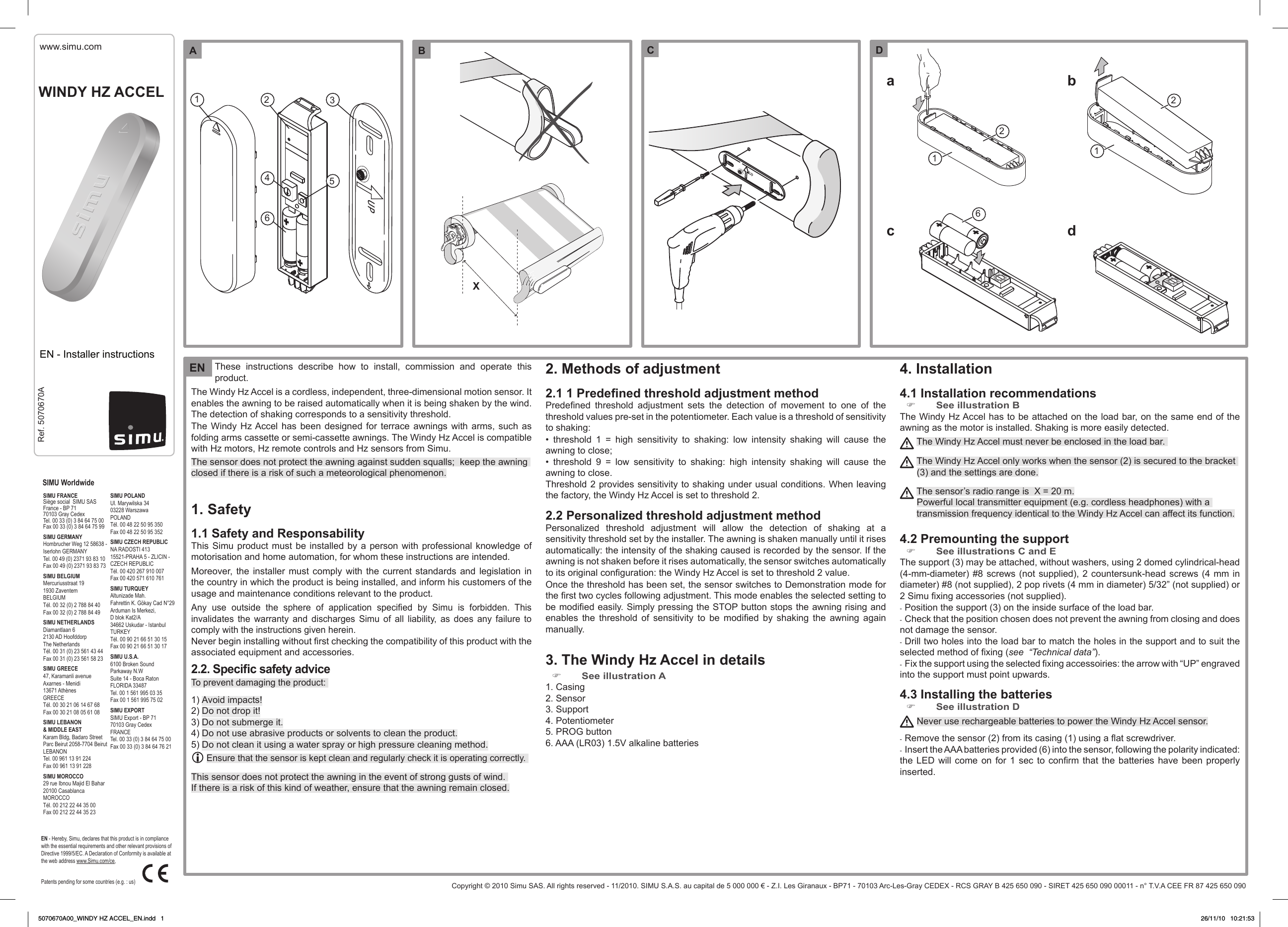
These  instructions  describe  how  to  install,  commission  and  operate  this product.The Windy Hz Accel is a cordless, independent, three-dimensional motion sensor. It enables the awning to be raised automatically when it is being shaken by the wind. The detection of shaking corresponds to a sensitivity threshold.The  Windy  Hz Accel  has  been  designed  for  terrace  awnings  with  arms,  such  as folding arms cassette or semi-cassette awnings. The Windy Hz Accel is compatible with Hz motors, Hz remote controls and Hz sensors from Simu. The sensor does not protect the awning against sudden squalls;  keep the awning closed if there is a risk of such a meteorological phenomenon.1. Safety1.1 Safety and ResponsabilityThis Simu product must be  installed  by a person with professional  knowledge  of motorisation and home automation, for whom these instructions are intended.Moreover, the installer must comply with the current standards and legislation in the country in which the product is being installed, and inform his customers of the usage and maintenance conditions relevant to the product.Any  use  outside  the  sphere  of  application  specied  by  Simu  is  forbidden.  This invalidates  the  warranty  and  discharges  Simu  of  all  liability,  as  does  any  failure  to comply with the instructions given herein.Never begin installing without rst checking the compatibility of this product with the associated equipment and accessories.2.2. Specic safety adviceTo prevent damaging the product: Avoid impacts!1) Do not drop it!2) Do not submerge it.3) Do not use abrasive products or solvents to clean the product.4) Do not clean it using a water spray or high pressure cleaning method.5)  Ensure that the sensor is kept clean and regularly check it is operating correctly. This sensor does not protect the awning in the event of strong gusts of wind.  If there is a risk of this kind of weather, ensure that the awning remain closed.2. Methods of adjustment2.1 1 Predened threshold adjustment methodPredened  threshold  adjustment  sets  the  detection  of  movement  to  one  of  the threshold values pre-set in the potentiometer. Each value is a threshold of sensitivity to shaking:threshold  1  =  high  sensitivity  to  shaking:  low  intensity  shaking  will  cause  the • awning to close; threshold  9  =  low  sensitivity  to  shaking:  high  intensity  shaking  will  cause  the • awning to close.Threshold 2 provides sensitivity to shaking under usual conditions. When leaving the factory, the Windy Hz Accel is set to threshold 2.2.2 Personalized threshold adjustment methodPersonalized  threshold  adjustment  will  allow  the  detection  of  shaking  at  a sensitivity threshold set by the installer. The awning is shaken manually until it rises automatically: the intensity of the shaking caused is recorded by the sensor. If the awning is not shaken before it rises automatically, the sensor switches automatically to its original conguration: the Windy Hz Accel is set to threshold 2 value. Once the threshold has been set, the sensor switches to Demonstration mode for the rst two cycles following adjustment. This mode enables the selected setting to be modied easily. Simply pressing the STOP button stops the awning rising and enables  the  threshold  of  sensitivity  to  be  modied  by  shaking  the  awning  again manually.3. The Windy Hz Accel in detailsSee illustration A )1. Casing2. Sensor3. Support4. Potentiometer5. PROG button 6. AAA (LR03) 1.5V alkaline batteries4. Installation4.1 Installation recommendationsSee illustration B )The Windy Hz Accel has to be attached on the load bar, on the same end of the awning as the motor is installed. Shaking is more easily detected. The Windy Hz Accel must never be enclosed in the load bar.  The Windy Hz Accel only works when the sensor (2) is secured to the bracket (3) and the settings are done. The sensor’s radio range is  X = 20 m. Powerful local transmitter equipment (e.g. cordless headphones) with a transmission frequency identical to the Windy Hz Accel can affect its function.4.2 Premounting the supportSee illustrations C and E )The support (3) may be attached, without washers, using 2 domed cylindrical-head (4-mm-diameter) #8 screws (not supplied), 2 countersunk-head screws (4 mm in diameter) #8 (not supplied), 2 pop rivets (4 mm in diameter) 5/32” (not supplied) or 2 Simu xing accessories (not supplied).Position the support (3) on the inside surface of the load bar. -Check that the position chosen does not prevent the awning from closing and does  -not damage the sensor.Drill two holes into the load bar to match the holes in the support and to suit the  -selected method of xing (see  “Technical data”).Fix the support using the selected xing accessoiries: the arrow with “UP” engraved  -into the support must point upwards.4.3 Installing the batteriesSee illustration D )Never use rechargeable batteries to power the Windy Hz Accel sensor.Remove the sensor (2) from its casing (1) using a at screwdriver. -Insert the AAA batteries provided (6) into the sensor, following the polarity indicated:  -the  LED will come on for 1 sec to conrm that the batteries have been properly inserted.WINDY HZ ACCELEN - Installer instructions www.simu.comENRef. 5070670ACA13246DaBXEN - Hereby, Simu, declares that this product is in compliance with the essential requirements and other relevant provisions of Directive 1999/5/EC. A Declaration of Conformity is available at the web address www.Simu.com/ce,Patents pending for some countries (e.g. : us)SIMU FRANCE  Siège social  SIMU SAS  France - BP 71 70103 Gray Cedex  Tel. 00 33 (0) 3 84 64 75 00  Fax 00 33 (0) 3 84 64 75 99SIMU GERMANY  Hombrucher Weg 12 58638 - Iserlohn GERMANY Tel. 00 49 (0) 2371 93 83 10  Fax 00 49 (0) 2371 93 83 73 SIMU BELGIUM  Mercuriusstraat 19 1930 Zaventem BELGIUM Tél. 00 32 (0) 2 788 84 40 Fax 00 32 (0) 2 788 84 49SIMU NETHERLANDS  Diamantlaan 6 2130 AD Hoofddorp The Netherlands Tél. 00 31 (0) 23 561 43 44 Fax 00 31 (0) 23 561 58 23SIMU GREECE  47, Karamanli avenue Axarnes - Menidi 13671 Athènes GREECE Tél. 00 30 21 06 14 67 68 Fax 00 30 21 08 05 61 08SIMU LEBANON & MIDDLE EAST  Karam Bldg, Badaro Street  Parc Beirut 2058-7704 Beirut  LEBANON  Tel. 00 961 13 91 224  Fax 00 961 13 91 228SIMU MOROCCO  29 rue Ibnou Majid El Bahar 20100 Casablanca MOROCCO Tél. 00 212 22 44 35 00 Fax 00 212 22 44 35 23SIMU POLAND  Ul. Marywilska 34 03228 Warszawa POLAND Tél. 00 48 22 50 95 350 Fax 00 48 22 50 95 352SIMU CZECH REPUBLIC  NA RADOSTI 413 15521-PRAHA 5 - ZLICIN - CZECH REPUBLIC Tél. 00 420 267 910 007 Fax 00 420 571 610 761SIMU TURQUEY  Altunizade Mah. Fahrettin K. Gökay Cad N°29 Arduman Is Merkezi,  D blok Kat2/A 34662 Uskudar - Istanbul TURKEY Tél. 00 90 21 66 51 30 15 Fax 00 90 21 66 51 30 17SIMU U.S.A.  6100 Broken Sound Parkaway N.W  Suite 14 - Boca Raton  FLORIDA 33487 Tel. 00 1 561 995 03 35  Fax 00 1 561 995 75 02  SIMU EXPORT SIMU Export - BP 71  70103 Gray Cedex  FRANCE  Tel. 00 33 (0) 3 84 64 75 00  Fax 00 33 (0) 3 84 64 76 21  5bc d12612Copyright © 2010 Simu SAS. All rights reserved - 11/2010. SIMU S.A.S. au capital de 5 000 000 € - Z.I. Les Giranaux - BP71 - 70103 Arc-Les-Gray CEDEX - RCS GRAY B 425 650 090 - SIRET 425 650 090 00011 - n° T.V.A CEE FR 87 425 650 090SIMU Worldwide5070670A00_WINDY HZ ACCEL_EN.indd   1 26/11/10   10:21:53
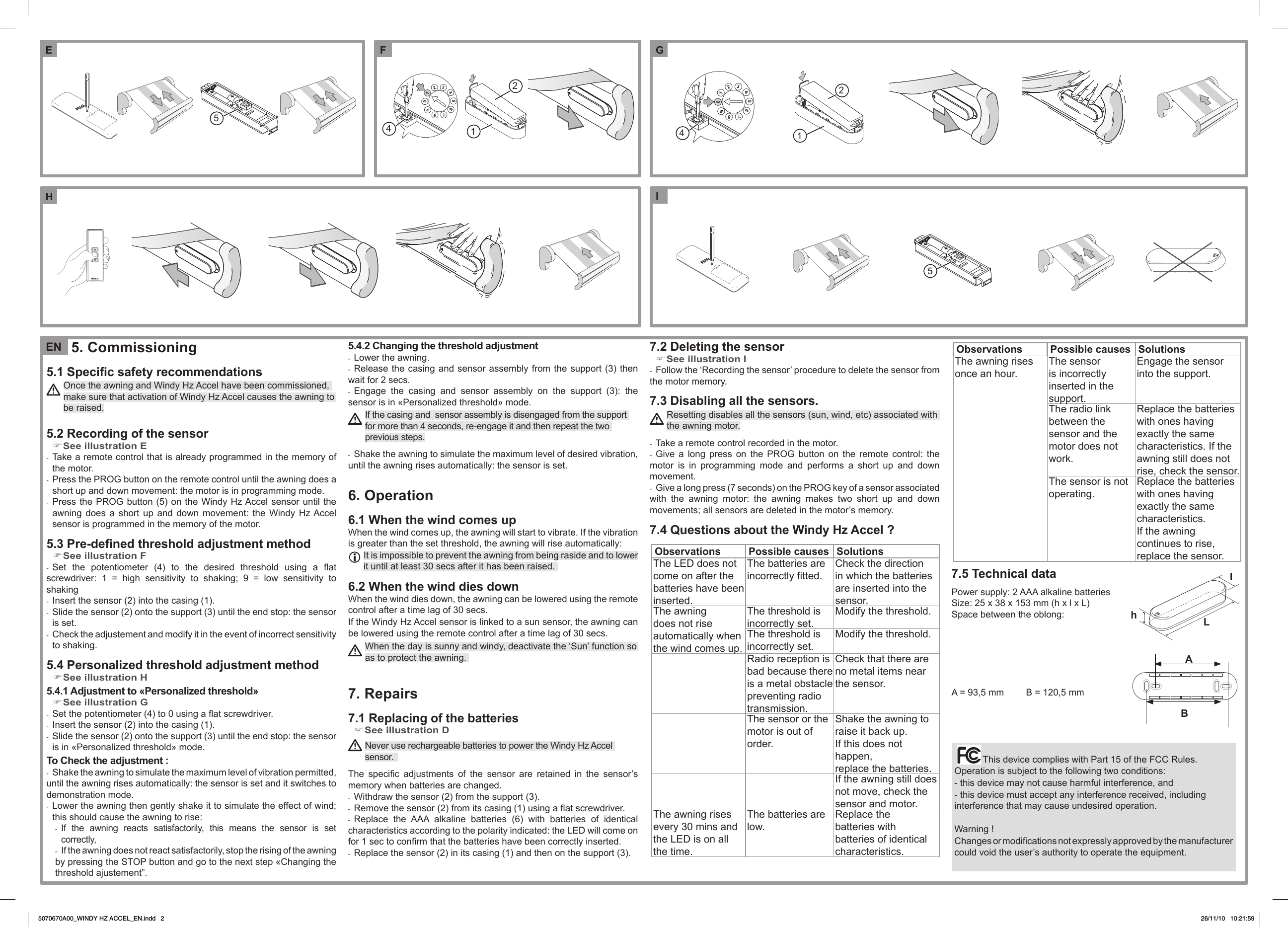
5. Commissioning5.1 Specic safety recommendations Once the awning and Windy Hz Accel have been commissioned, make sure that activation of Windy Hz Accel causes the awning to be raised.5.2 Recording of the sensorSee illustration E ) Take a remote control that is already programmed in the memory of  -the motor. Press the PROG button on the remote control until the awning does a  -short up and down movement: the motor is in programming mode. Press the PROG button (5) on the  Windy Hz Accel  sensor until the  -awning  does  a  short  up  and  down  movement:  the  Windy  Hz Accel sensor is programmed in the memory of the motor.5.3  Pre-dened threshold adjustment methodSee illustration F )Set  the  potentiometer  (4)  to  the  desired  threshold  using  a  at  -screwdriver:  1  =  high  sensitivity  to  shaking;  9  =  low  sensitivity  to shakingInsert the sensor (2) into the casing (1). - Slide the sensor (2) onto the support (3) until the end stop: the sensor  -is set. Check the adjustement and modify it in the event of incorrect sensitivity  -to shaking.5.4  Personalized threshold adjustment methodSee illustration H )5.4.1 Adjustment to «Personalized threshold»See illustration G )Set the potentiometer (4) to 0 using a at screwdriver. -Insert the sensor (2) into the casing (1). - Slide the sensor (2) onto the support (3) until the end stop: the sensor  -is in «Personalized threshold» mode.To Check the adjustment :Shake the awning to simulate the maximum level of vibration permitted,  -until the awning rises automatically: the sensor is set and it switches to demonstration mode. Lower the awning then gently shake it to simulate the effect of wind;  -this should cause the awning to rise:  If  the  awning  reacts  satisfactorily,  this  means  the  sensor  is  set  -correctly,If the awning does not react satisfactorily, stop the rising of the awning  -by pressing the STOP button and go to the next step «Changing the threshold ajustement”.5.4.2 Changing the threshold adjustmentLower the awning. -Release the casing and sensor assembly from the  support (3) then  -wait for 2 secs.Engage  the  casing  and  sensor  assembly  on  the  support  (3):  the  -sensor is in «Personalized threshold» mode. If the casing and  sensor assembly is disengaged from the support for more than 4 seconds, re-engage it and then repeat the two previous steps.Shake the awning to simulate the maximum level of desired vibration,  -until the awning rises automatically: the sensor is set.6. Operation6.1 When the wind comes upWhen the wind comes up, the awning will start to vibrate. If the vibration is greater than the set threshold, the awning will rise automatically: It is impossible to prevent the awning from being raside and to lower it until at least 30 secs after it has been raised. 6.2 When the wind dies downWhen the wind dies down, the awning can be lowered using the remote control after a time lag of 30 secs.If the Windy Hz Accel sensor is linked to a sun sensor, the awning can be lowered using the remote control after a time lag of 30 secs. When the day is sunny and windy, deactivate the ‘Sun’ function so as to protect the awning. 7. Repairs7.1 Replacing of the batteriesSee illustration D ) Never use rechargeable batteries to power the Windy Hz Accel sensor.  The  specic  adjustments  of  the  sensor  are  retained  in  the  sensor’s memory when batteries are changed.Withdraw the sensor (2) from the support (3). -Remove the sensor (2) from its casing (1) using a at screwdriver. -Replace  the  AAA  alkaline  batteries  (6)  with  batteries  of  identical  -characteristics according to the polarity indicated: the LED will come on for 1 sec to conrm that the batteries have been correctly inserted.Replace the sensor (2) in its casing (1) and then on the support (3). -7.2 Deleting the sensor See illustration I )Follow the ‘Recording the sensor’ procedure to delete the sensor from  -the motor memory. 7.3 Disabling all the sensors.Resetting disables all the sensors (sun, wind, etc) associated with the awning motor.Take a remote control recorded in the motor. -Give  a  long  press  on  the  PROG  button  on  the  remote  control:  the  -motor  is  in  programming  mode  and  performs  a  short  up  and  down movement.Give a long press (7 seconds) on the PROG key of a sensor associated  -with  the  awning  motor:  the  awning  makes  two  short  up  and  down movements; all sensors are deleted in the motor’s memory.7.4 Questions about the Windy Hz Accel ?Observations Possible causes SolutionsThe LED does not come on after the batteries have been inserted.The batteries are incorrectly tted.Check the direction in which the batteries are inserted into the sensor.The awning does not rise automatically when the wind comes up.The threshold is incorrectly set.Modify the threshold.The threshold is incorrectly set.Modify the threshold.Radio reception is bad because there is a metal obstacle preventing radio transmission.Check that there are no metal items near the sensor.The sensor or the motor is out of order.Shake the awning to raise it back up. If this does not happen,replace the batteries.If the awning still does not move, check the sensor and motor.The awning rises every 30 mins and the LED is on all the time.The batteries are low.Replace the batteries with batteries of identical characteristics.Observations Possible causes SolutionsThe awning rises once an hour.The sensor is incorrectly inserted in the support.Engage the sensor into the support.The radio link between the sensor and the motor does not work.Replace the batteries with ones having exactly the same characteristics. If the awning still does not rise, check the sensor.The sensor is not operating.Replace the batteries with ones having exactly the same characteristics. If the awning continues to rise, replace the sensor.7.5 Technical dataPower supply: 2 AAA alkaline batteriesSize: 25 x 38 x 153 mm (h x l x L)Space between the oblong:A = 93,5 mm  B = 120,5 mmThis device complies with Part 15 of the FCC Rules. Operation is subject to the following two conditions: - this device may not cause harmful interference, and - this device must accept any interference received, including interference that may cause undesired operation.Warning !Changes or modications not expressly approved by the manufacturer could void the user’s authority to operate the equipment.hLlABEN55421421EIGHF5070670A00_WINDY HZ ACCEL_EN.indd   2 26/11/10   10:21:59

Navigation menu