South Pacific Electronics PCK433 4 Button Keyring Remote Control, PCK43304 User Manual PCK433 Series Manuals

South Pacific Electronics Ltd. 4 Button Keyring Remote Control, PCK43304 PCK433 Series Manuals

Users Manual

ELSEMA 433MHz Keyring Remote  with Frequency Hopping – PCK Series  PCK43302, PCK43304 433MHz Penta series Keyring Remotes with Frequency Hopping  FEATURES  Small Size keyring remote with 2 or 4 buttons  Dual Coding System, dip switch and encrypted code   Transmission on 5 different frequencies  Uses frequency hopping spread spectrum (FHSS)   One of the most secure remote controls on the market   FCC and AS/NZS 4268 pre-certified  APPLICATIONS  Keyless access control for automatic gates and doors  Home automation i.e. garden lights, swimming pool control etc.  Wire security, lighting and automotive controls  ….  and anywhere else you need a wireless signal to transmit a contact closure  DESCRIPTION The PentaCode® dual coding system gives the installer the option to use the classic 12-way dip switch coding or one of over 17 billion encrypted codes.  With the 12-way dip switch, just match the keyring remotes and the receiver's dip switch and it's coded. No need for programmers, memory chips or computer databases to store the code.  With the encrypted code you switch all the 12- way dip switches OFF and the remote and receiver automatically goes into the encrypted coding.  OEM CONFIGURATION Elsema can customise keypad text and back labels to suit customer needs. Contact Elsema for more details.  TECHNICAL DATA  Operating Voltage   12 Volt Battery Standby Current   1.8uA Current Consumption   18mA (typical) at 12 Volts DC supply during transmission Battery life  1.5 years with average use Frequencies   433.100 to 434.700MHz  Operating range  up to 80 metres depending on building structure and receiver antenna Operating Temperature Range  -5 to 50°C  Decoding System   Encrypted 17 billion codes combinations or On board 12-way code switch Weight  30 grams
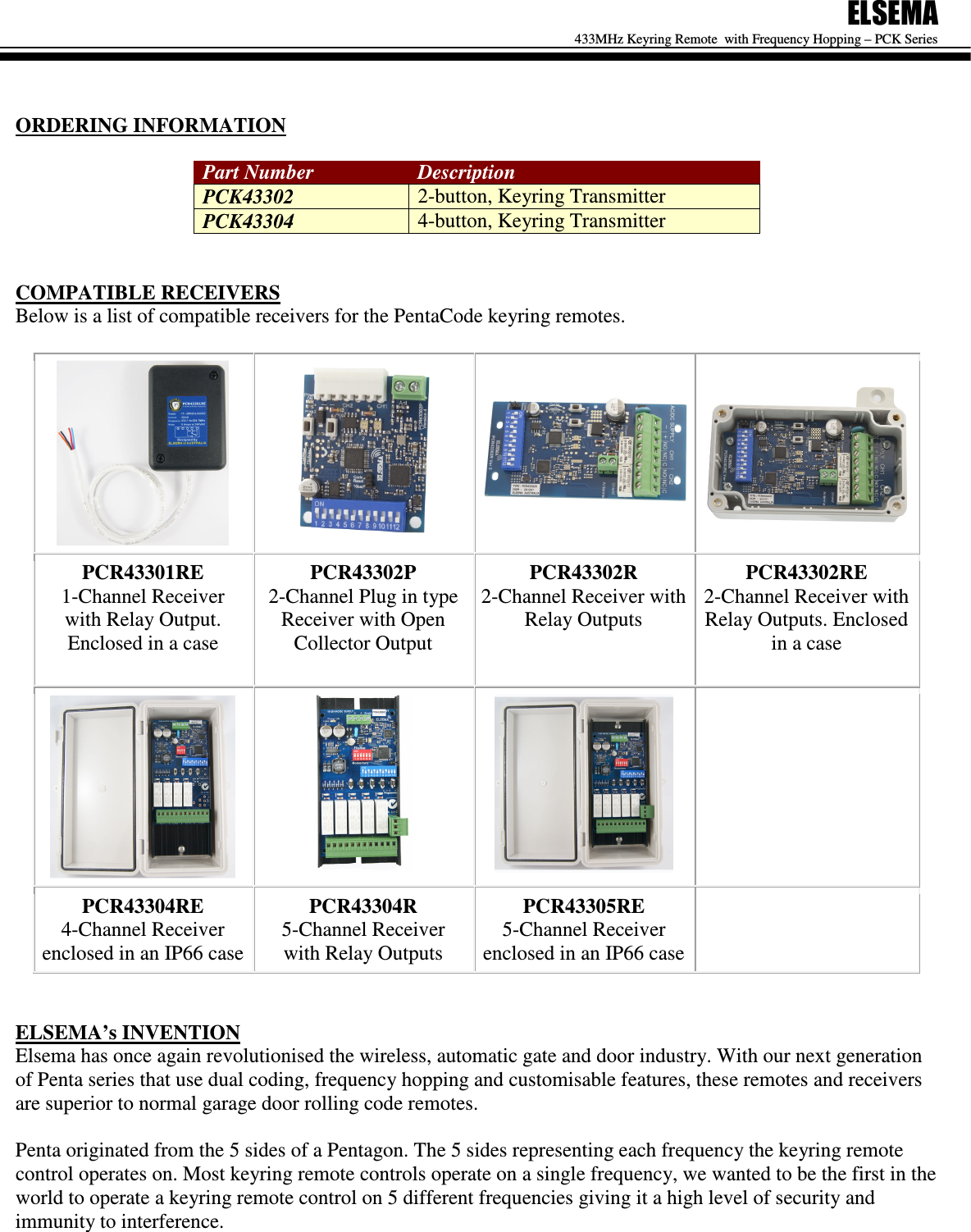
ELSEMA 433MHz Keyring Remote  with Frequency Hopping – PCK Series    ORDERING INFORMATION  Part Number  Description PCK43302  2-button, Keyring Transmitter PCK43304  4-button, Keyring Transmitter   COMPATIBLE RECEIVERS Below is a list of compatible receivers for the PentaCode keyring remotes.      PCR43301RE 1-Channel Receiver with Relay Output. Enclosed in a case   PCR43302P 2-Channel Plug in type Receiver with Open Collector Output PCR43302R 2-Channel Receiver with Relay Outputs PCR43302RE 2-Channel Receiver with Relay Outputs. Enclosed in a case     PCR43304RE 4-Channel Receiver enclosed in an IP66 case PCR43304R 5-Channel Receiver with Relay Outputs PCR43305RE 5-Channel Receiver enclosed in an IP66 case    ELSEMA’s INVENTION Elsema has once again revolutionised the wireless, automatic gate and door industry. With our next generation of Penta series that use dual coding, frequency hopping and customisable features, these remotes and receivers are superior to normal garage door rolling code remotes.  Penta originated from the 5 sides of a Pentagon. The 5 sides representing each frequency the keyring remote control operates on. Most keyring remote controls operate on a single frequency, we wanted to be the first in the world to operate a keyring remote control on 5 different frequencies giving it a high level of security and immunity to interference.
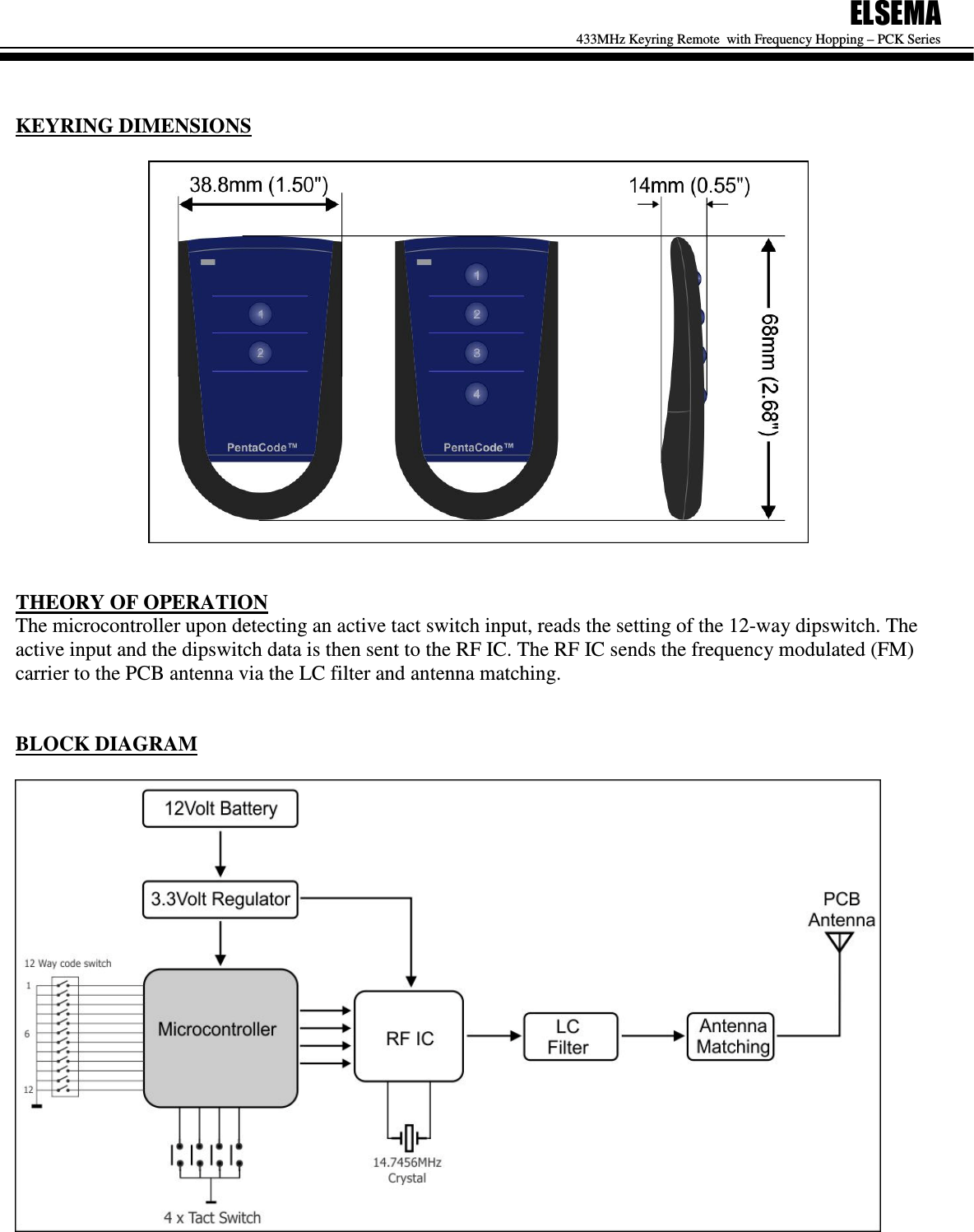
ELSEMA 433MHz Keyring Remote  with Frequency Hopping – PCK Series    KEYRING DIMENSIONS     THEORY OF OPERATION The microcontroller upon detecting an active tact switch input, reads the setting of the 12-way dipswitch. The active input and the dipswitch data is then sent to the RF IC. The RF IC sends the frequency modulated (FM) carrier to the PCB antenna via the LC filter and antenna matching.   BLOCK DIAGRAM
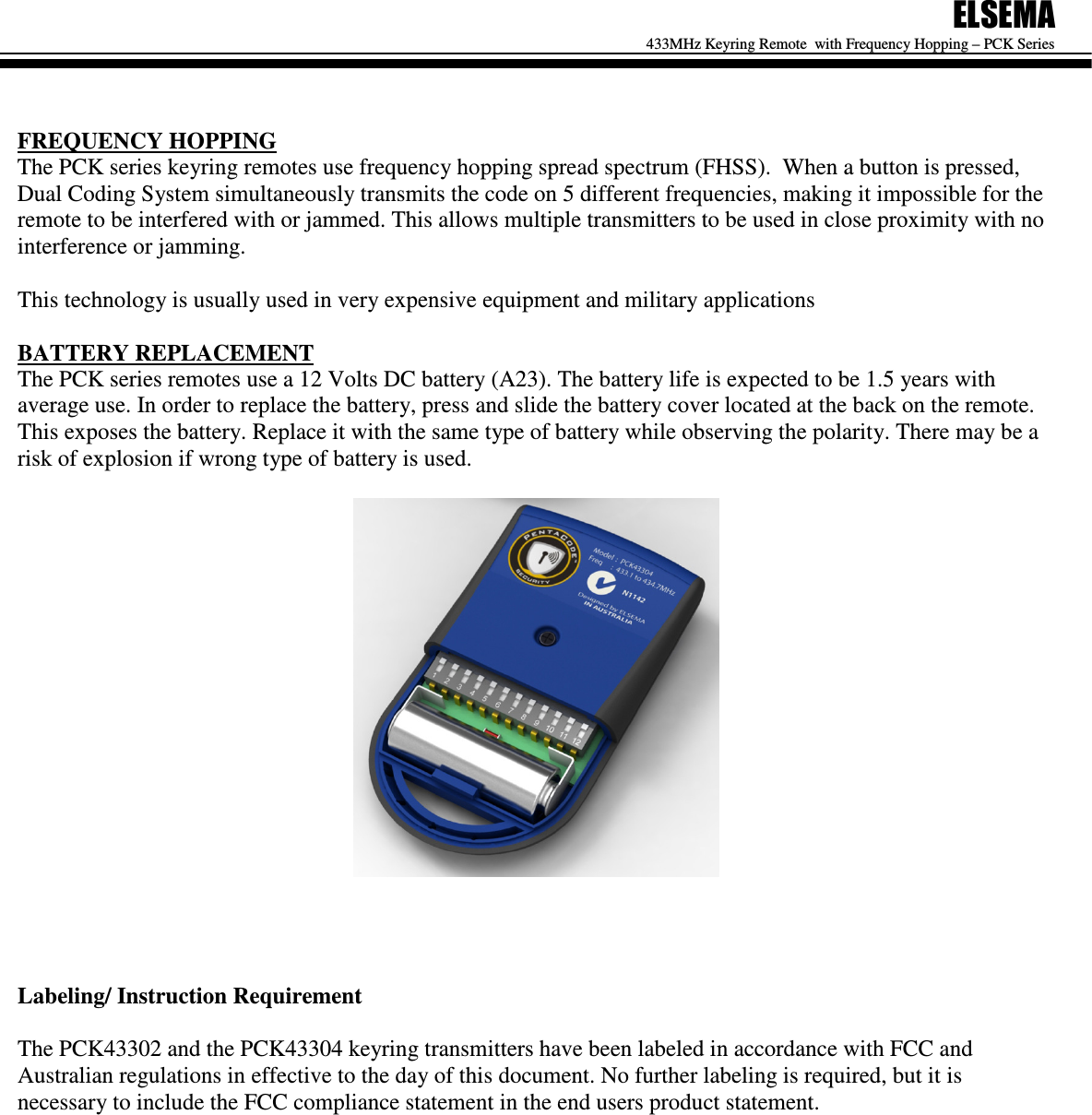
ELSEMA 433MHz Keyring Remote  with Frequency Hopping – PCK Series    FREQUENCY HOPPING The PCK series keyring remotes use frequency hopping spread spectrum (FHSS).  When a button is pressed, Dual Coding System simultaneously transmits the code on 5 different frequencies, making it impossible for the remote to be interfered with or jammed. This allows multiple transmitters to be used in close proximity with no interference or jamming.   This technology is usually used in very expensive equipment and military applications  BATTERY REPLACEMENT The PCK series remotes use a 12 Volts DC battery (A23). The battery life is expected to be 1.5 years with average use. In order to replace the battery, press and slide the battery cover located at the back on the remote. This exposes the battery. Replace it with the same type of battery while observing the polarity. There may be a risk of explosion if wrong type of battery is used.       Labeling/ Instruction Requirement  The PCK43302 and the PCK43304 keyring transmitters have been labeled in accordance with FCC and Australian regulations in effective to the day of this document. No further labeling is required, but it is necessary to include the FCC compliance statement in the end users product statement.
ELSEMA 433MHz Keyring Remote  with Frequency Hopping – PCK Series   REGULATORY COMPLIANCE STATEMENTS American Users  This device complies with Part 15 of the FCC Rules. Operation is subject to the following two conditions:  (1) This device may not cause harmful interference and  (2) This  device  must  accept  any  interference  received,  including  interference  that  may  cause  undesired operation.  FCC Notice This device has been tested and found to comply with the limits for a Class B digital device, pursuant to Part 15 of the FCC Rules. These limits are designed to provide reasonable protection against harmful interference in a residential installation. This device generates, uses, and can radiate radio frequency energy and, if installed and used  in  accordance  with  the  instruction,  may  cause  harmful  interference  to  radio  communications.  However, there  is  no  guarantee  that  interference  will  not  occur  in  a  particular  installation.  If  this  device  does  cause harmful interference to radio or television reception, the user is encouraged to try to correct the interference by one or more of the following measures:  • Reorient or relocate the receiving antenna.  • Increase the separation between the equipment and receiver.  • Connect the equipment into an outlet on a circuit different from that to which the receiver is connected.  • Consult the dealer or an experienced radio/TV technician for help.  Caution:  Any  changes  or  modifications  not  expressly  approved  by  the  grantee  of  this  device  could  void  the user’s authority to operate the equipment.  Australian and New Zealand Users  This device has been tested and found to comply with the limits for a Class [B] digital device, pursuant to the Australian/New Zealand standard AS 4268.2 (2008) set out by the Spectrum Management Agency.

Navigation menu