TandD RTR5X 900 MHz Data Recorder User Manual 2
TandD Corporation 900 MHz Data Recorder Users Manual 2
UserManual.wiki
>
TandD
>
RTR5X User Manual
>
Users Manual 2
Contents
1.
Users Manual 1
2.
Users Manual 2
Users Manual 2
Navigation menu
Upload a User Manual
Namespaces
Wiki Guide
HTML
PDF
Info
Views
User Manual
Discussion / Help
Navigation
![40RTR-57C Upper and Lower LimitsRTR-57C Upper and Lower Limits can be set from your computer.Setting is directly possible in RTR-57C Main Units version 2 or higher.The version can be conrmed in [Help]-[RTR-57C Version Info].See the Help Menu in T&D Recorder for Windows for details.1.In the main window, click the icon RTR-57C.2.Click the [Upper and Lower Limit Settings] tab, and check the <Change> box.3.After entering the upper and lower limit values, check <ON> and by clicking the [Write] button, the information will be transmitted. ON: Judges whether recorded data is within the set range when RTR-57C has downloaded the recorded data. OFF: Judgment isn’t carried out even if upper and lower limits have been set.4.Click [Close] button to complete the setting.■[Read] ButtonIf you wish to view the current settings, click the [Read] button.[Write] buttonEnter upper and lower limit values.Check ON/OFFCheck <Change>[Upper and Lower Limit Settings] tab[Close]button[Read] button](https://usermanual.wiki/TandD/RTR5X.Users-Manual-2/User-Guide-502079-Page-1.png)
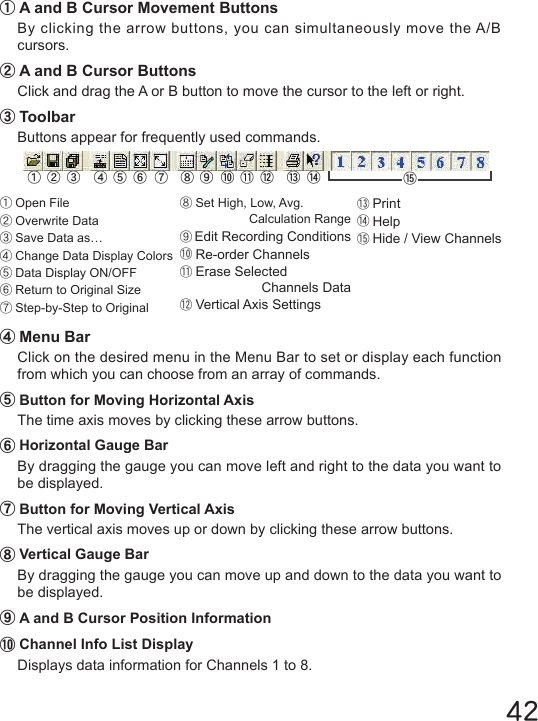
![■Display Names and Functions41ClickTemperature/Humidity Graph■How to OpenOpen the Graph display by clicking the icon [Temp/Humid Graph] in the Main Window.●In the Main Window or in the Settings/Communication Display of RTR-57C, RTR-51/52, or RTR-53, select the [Temp/Humid Graph] from the [Start] menu to open the graph. ●If you have clicked [Display the graph after downloading recorded data], the graph will automatically open.②⑥⑤①③④⑦⑧⑨⑩](https://usermanual.wiki/TandD/RTR5X.Users-Manual-2/User-Guide-502079-Page-2.png)
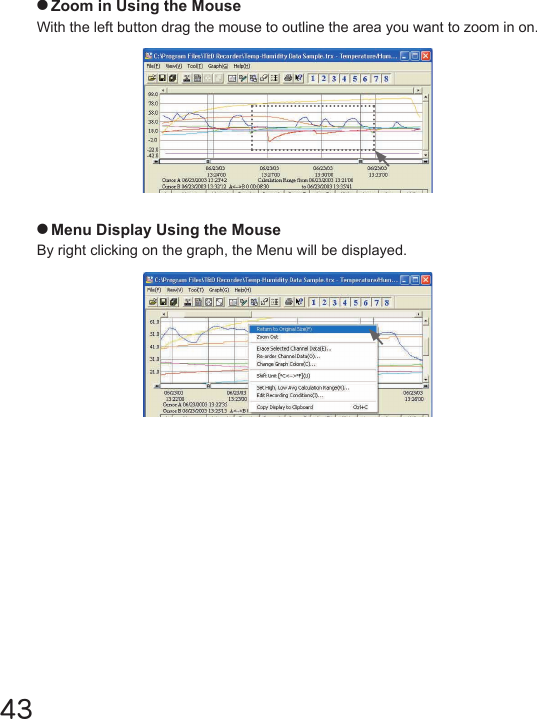
![44■Data List Display●[Date / Time] ButtonBy clicking this button, you can shift the display between the recorded date and amount of elapsed time since recording started.①This is a list of the data that was displayed in graph form. The highest value is in RED, lowest is in BLUE, and the average is in PINK.②Scroll Bar: By dragging it up and down you can move to the data you want.①②Recorded Date Display[Date / Time]ButtonElapsed TimeDisplay●Menu Display Using the MouseBy right clicking on the list, the Menu will be displayed.](https://usermanual.wiki/TandD/RTR5X.Users-Manual-2/User-Guide-502079-Page-5.png)
![45●Selected Channels ON/OFF: From the [View] Menu1.The channel numbers are displayed in the pull down menu of [Selected Channels ON/OFF].2.Check the channel numbers you wish to display.※By clicking a Channel Number in the Toolbar, you can carry out the same operation.Check《Enlarged》Editing the Graph■Changing the Graph Display●Changing graph display colors: From the [View] MenuYou can change the letters used in the data list display for each channel between monochrome and channel color●Set High, Low, Average Calculation Range: From the [Tools] Menu1.Set the calculation range in [Set High, Low, Avg. Calculation Range] box.[OK]button[Entire Graph]buttonEnter thenumerical value.](https://usermanual.wiki/TandD/RTR5X.Users-Manual-2/User-Guide-502079-Page-6.png)
![462.By clicking the [OK] button, the high, low, average calculation range of each channel data will be changed. On the graph display, the calculation range that you have set will be displayed.2.By clicking the [OK] button after changing, the setting will be completed.●If you wish to continue to change other channels, repeat the process as in 1.※The [Restore] button is effective only during the setting, and cannot return to the condition it was after the [OK] button has been clicked.●Name: Up to 32 letters can be entered.●Starting Date/Time: The month, day, year, hour, minute and second can be changed.●[Entire Graph] ButtonTo make the Calculation Range that of the Entire Graph, click the "Entire Graph" button. The dates and times in the [Set High, Low, Avg. Calculation Range] box will be displayed as those of the entire graph.●Set by using the AB CursorsIn the Graph Display, open the [Set High, Low, Average Calculation Range] box adjusting the AB cursors to the desired start and end positions. The dates and times of those cursors will be displayed automatically. ●Edit Recording Conditions: From the [Tools] Menu1.By clicking the [Ch.] button you wish to change, the information for that number will be displayed in the "Edit Items".[Restore]button[OK]buttonThe selectedchannel numberChannel NumberEnter letters andnumerical values](https://usermanual.wiki/TandD/RTR5X.Users-Manual-2/User-Guide-502079-Page-7.png)
![47【Move by selecting the channel number】1.Enter in From: , the Channel number you wish to move from, and enter the Channel number to which you want to move in To: .2.By clicking the [Re-order] button, the movement will be completed.※The [Restore] button is effective only during the setting, and cannot return to the condition it was by clicking the [OK] button.【Move by dragging the channel number】Click on the channel of data you wish to move and drag and drop it to the desired new channel position.●Re-order Channel Data: From the [Tools] MenuThere are two ways for re-ordering.・Move by dragging the channel number・Move by selecting the channel number[OK]button[Re-order]buttonIf you wish to move Ch3. to Ch7. simply set From→Ch3, To→Ch7.Drag and drop the channel number to the desired new position.](https://usermanual.wiki/TandD/RTR5X.Users-Manual-2/User-Guide-502079-Page-8.png)
![48●Erase Selected Channel Data: From the [Tools] Menu1.Put a check on the channel number you wish to erase.2.By clicking on the [OK] button, the deletion will be completed.[OK]buttonPut a check on the check box●Shift Unit (℃/゜F) : From the [Tools] MenuBy clicking on [Shift Unit(℃/゜F)], you can automatically change the temperature unit scale in the graph display and in the channel info list.●Change Graph Colors: From the [Tools] Menu[Channel No.] button[Default]button[OK]button[Line Width...]button1.Click the channel number of which you wish to change the color.2.By clicking each button, color samples will be displayed. Choose the color you want and click the [OK] button.《Color Sample》](https://usermanual.wiki/TandD/RTR5X.Users-Manual-2/User-Guide-502079-Page-9.png)
![493.After conrming the color, by clicking the [OK] button the change will be completed.※By clicking the [Return to Default] button, you will return to the color settings when the software was opened.【Graph Line Width Settings】Change the width of the data lines and the scale lines.●Every time you click on ▲, the numerical value gets larger,●And every time you click on ▼, the numerical value gets smaller.《Enlagargement》●Copy Display to Clipboard: From the [Tools] MenuBy clicking [Copy Display to Clipboard], you can copy the currently displayed window to the clipboard and make use of the graph pasting in other software.](https://usermanual.wiki/TandD/RTR5X.Users-Manual-2/User-Guide-502079-Page-10.png)
![50■Graph From the [Graph] Menu●Return to Original SizeReturn from zooming in on one part of data●Zoom In / Zoom OutZooms in or out one step at a time●Move Cursor Right / LeftSimultaneously move the AB Cursors to the right or left.●Move Graph Right / LeftMove the Graph Display to the right or left.●Move Graph Up / DownMove the Graph Display up or down.●Vertical Axis Settings (AUTO in Default Settings)Set the vertical axis scale (temperature) AUTO: The vertical axis will automatically be changed according to the values of the data. MANUAL: You can set the upper and lower values of the vertical axis scale.Enter the range of the vertical axis scale.[OK]button](https://usermanual.wiki/TandD/RTR5X.Users-Manual-2/User-Guide-502079-Page-11.png)
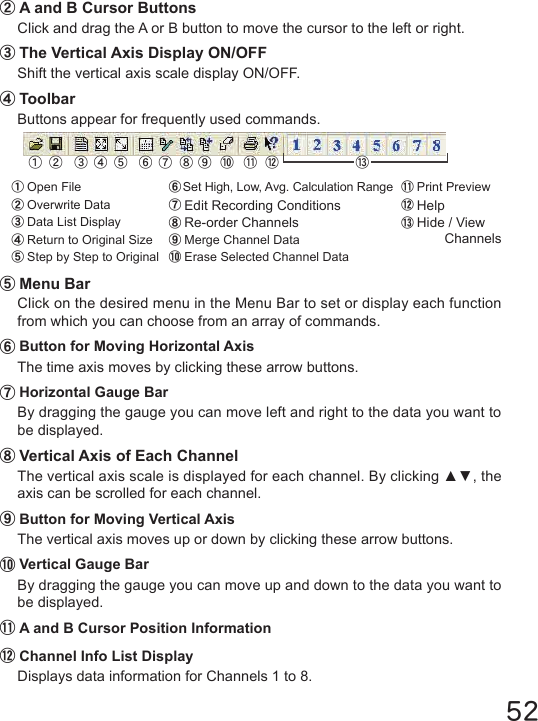
![51①A and B Cursor Movement ButtonsBy clicking the arrow buttons, you can simultaneously move the A/B cursors.Multi-scale Graph■Display Names and Functions■How to OpenOpen the Multi-scale Graph by clicking the [Multi-scale Graph] icon in the Main Window.●In the Main Window or in the Settings/Communication Display of RTR-57C, or RVR-52, select [Multi-scale Graph] from the [Start] menu to open the graph. ●If you have clicked [Display the graph after downloading recorded data], the graph will automatically open.Click⑦⑥ ⑧⑩⑨③④⑤②⑪⑫①](https://usermanual.wiki/TandD/RTR5X.Users-Manual-2/User-Guide-502079-Page-12.png)
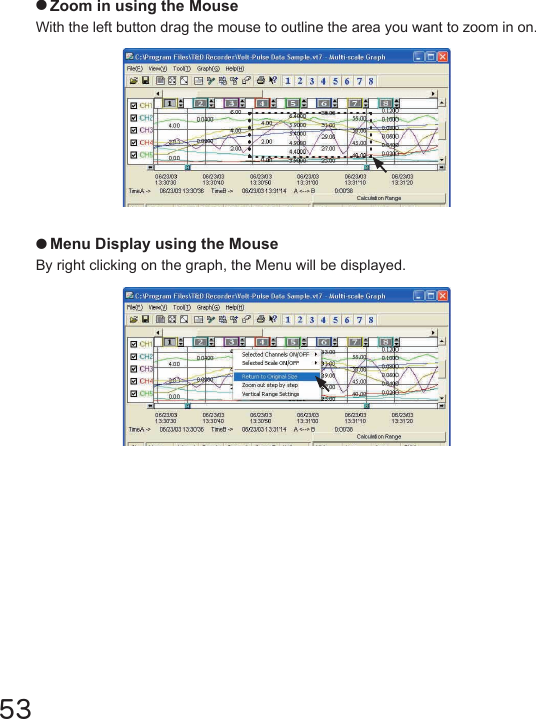
![54■Data List Display●[Date / Time] ButtonBy clicking this button, you can shift the display between the recorded date and amount of elapsed time since recording started.①This is a list of the data that was displayed in graph form. The highest value is in RED, lowest is in BLUE, and the average is in PINK.②Scroll Bar: By dragging it up and down you can move to the data you want.●Menu Display Using the MouseBy right clicking on the list, the Menu will be displayed.[Date / Time]button②Recorded Date Display①Elapsed TimeDisplay](https://usermanual.wiki/TandD/RTR5X.Users-Manual-2/User-Guide-502079-Page-15.png)
![55※You can also hide or view channel scales by checking or mchecking the channel number fo the left of the graph.Editing the Graph■Changing the Graph Display●Selected Channels ON/OFF: From the [View] Menu1.The channel numbers are displayed in the pull down menu of [Selected Channels ON/OFF].2.Check the channel numbers you wish to display.※By clicking a Channel Number in the Toolbar, you can carry out the same operation.Check《Enlarged》●Scale Display ON/OFF: From the [View] Menu1.The channel numbers are displayed in the pull down menu of [Selected Scale ON/OFF].2.Put a check next to the channel number(s) you wish to be displayed.Check《Enlarged》](https://usermanual.wiki/TandD/RTR5X.Users-Manual-2/User-Guide-502079-Page-16.png)
![56●Set High, Low, Average Calculation Range: From the [Tools] Menu1.Set the calculation range in [Set High, Low, Avg. Calculation Range] box.[OK]button[Entire Graph]buttonEnter thenumerical value.2.By clicking the [OK] button, the high, low, average calculation range of each channel data will be changed. On the graph display, the calculation range that you have set will be displayed.●[Entire Graph] ButtonTo make the Calculation Range that of the Entire Graph, click the "Entire Graph" button. The dates and times in the [Set High, Low, Avg. Calculation Range] box will be displayed as those of the entire graph.●Set by using the AB CursorsIn the Graph Display, open the [Set High, Low, Average Calculation Range] box adjusting the AB cursors to the desired start and end positions. The dates and times of those cursors will be displayed automatically.](https://usermanual.wiki/TandD/RTR5X.Users-Manual-2/User-Guide-502079-Page-17.png)
![572.By clicking the [OK] button after changing, the setting will be completed.●If you wish to continue to change other channels, repeat the process as in 1.※The [Restore] button is effective only during the setting, and cannot return to the condition it was after the [OK] button has been clicked.●Name: Up to 32 letters can be entered.●Starting Date/Time: The month, day, year, hour, minute and second can be changed.●Edit Recording Conditions: From the [Tools] Menu1.By clicking the [Ch.] button you wish to change, the information for that number will be displayed in the "Edit Items".●Re-order Channel Data: From the [Tools] MenuThere are two ways for re-ordering.・Move by dragging the channel number・Move by selecting the channel number【Move by dragging the channel number】Click on the channel of data you wish to move and drag and drop it to the desired new channel position.Channel Number [Restore]button[OK]buttonEnter letters andnumerical valuesThe selectedchannel number](https://usermanual.wiki/TandD/RTR5X.Users-Manual-2/User-Guide-502079-Page-18.png)
![58【Move by selecting the channel number】1.Enter in From: , the Channel number you wish to move from, and enter the Channel number to which you want to move in To: .2.By clicking the [Change 1 and 2] button, the movement will be completed.●Merge Channel Data: From the [Tools] MenuYou can merge two different sets of data into one set of data.1.Click the▼button, and select the channels you wish to merge.The following kinds of data cannot be merged:●Recording intervals are different●Measurement times overlap (Merging is possible after adjusting the times in [Editing Recording Conditions])●Data types are different (Merging is possible between same types of data; like temperature/humidity)[OK]button[Merge]buttonExample)If you wish to merge Ch.3 with Ch.7Drag and drop the channel number to the desired new position.[OK]button[Change 1 and 2]buttonIf you wish to move Ch3 to Ch7. simply set From →Ch3, To → Ch7.](https://usermanual.wiki/TandD/RTR5X.Users-Manual-2/User-Guide-502079-Page-19.png)
![59●Erase Selected Channel Data: From the [Tools] Menu1.Put a check next to the channel number you wish to delete.2.By clicking on the [OK] button, the deletion will be completed.2.By clicking the [Merge] button, the merging will be completed.3.Click the [Close] button to nish the merging.※The channel number and other conditions of the merged data will become those conditions set in the channel that you selected in the second box.●Vertical Axis Range Display Settings: From the [Tools] MenuYou can set the upper and the lower limits of the graph's vertical axis scale for each channel.1.Check [Fixed] of the channel you wish to set.[OK]button Check[OK]buttonSelect [Fixed] and enternumerical values.If you wish to make all of the settings the same.](https://usermanual.wiki/TandD/RTR5X.Users-Manual-2/User-Guide-502079-Page-20.png)
![602.Enter upper and lower limit values.●Set the lower limit at more than –40,000 and set the upper limit at less than 40,000.3.By clicking the [OK] button, the setting will be completed.※If you have put a check on [Fixed], the lines in the graph may exceed the boundaries of the graph. 【Making all channel settings the same】Set CH.1 [Fixed] and by putting a check on [Make all Settings the same as Ch. 1]; all channel settings will be the same as CH.1 regardless of other channel settings.●Scale and Unit Conversion: From the [Tools] MenuYou can convert the scale and the unit of downloaded data for each channel.1.Select from [Designate by 2 points] or [Designate by y=ax+b].2.Set conversion formulas and units.3.By clicking the [OK] button, the setting will be completed. 【Conversion Info】Current conversion formulas and units are displayed here.Y indicates the data after conversion, and x indicates the voltage entering from the sensor.[OK]button[Designate by y=ax+b][Designate by 2 points]Conversion Info](https://usermanual.wiki/TandD/RTR5X.Users-Manual-2/User-Guide-502079-Page-21.png)
![61For DisplayFor Print[Save] button [View] button●Change Graph Colors: From the [Tools] Menu1.Click the [Channel Number] button, and click the button of the item that you wish to change.●When changing colors, click on a button to display the color samples. Choose the desired color and click the [OK] button to change the color.●If you wish to change line width, every time you click the ▲ button, the width gets wider, and every time you click the ▼ button, the width becomes more narrow.2.Conrm the width in the image preview and click the [Close] button to complete the change.※By clicking the [Return to Default] button, the color settings will return to the default settings.【Memo】You can save the settings for Display and/or Print respectively.1.Select Display or Print.2.By clicking the [Save] button, the settings will be saved.●By clicking the [View] button, you can see the settings that had been previously saved. 《Color Sample》Memo[Close]button[Default]buttonImagePreview[Channel Number]button](https://usermanual.wiki/TandD/RTR5X.Users-Manual-2/User-Guide-502079-Page-22.png)
![62■Graph From the [Graph] Menu●Return to Original SizeReturn from zooming in on one part of data●Step-by-Step to OriginalReturn step-by-step to display an increasingly wider range of data from zooming in on one part of the data.](https://usermanual.wiki/TandD/RTR5X.Users-Manual-2/User-Guide-502079-Page-23.png)
![Event Viewer63Here you can manage (view data lists, print, and save as text le) recorded event data.■How to Open●By selecting [Event Viewer] from the [Start] Menu in the settings/communication display of the main window or RTR-57C or RVR-52, the Event Viewer will be opened. ●If you have checked [After downloading, automatically show graph], the viewer will automatically be opened.■Display Names and Functions①Menu BarClick on the desired menu in the Menu Bar to set or display each function from which you can choose from an array of commands.②ToolbarButtons appear for frequently used commands.①Open File②Save Data as…③Save as Text File④Shift Display⑤Display in ascending order⑥Display in descending order⑦File Info⑧Print Preview and Print⑨Help②①③④⑨⑧⑦⑥⑤④③②①](https://usermanual.wiki/TandD/RTR5X.Users-Manual-2/User-Guide-502079-Page-24.png)
![64③↑・↓・↑↓↑ denotes rising pulse, ↓ denotes falling pulse, and ↑↓ denotes a simultaneously occurring rising and falling pulse.④Scroll BarYou can move in the graph up and down to the desired position.●Shift Display: From the [View] Menu or ToolbarYou can shift the display between the recorded date and the amount of elapsed time from the last recorded data.Recorded Date DisplayElapsed TimeDisplay●Shift Ascending/Descending: From the [View] Menu or ToolbarYou can shift the display to view the recorded data either from the oldest to the newest or from the newest to the oldest.](https://usermanual.wiki/TandD/RTR5X.Users-Manual-2/User-Guide-502079-Page-25.png)
![65 File Name: File name of data currently in display. Path: Location where le is saved. Date Created: The date and time when the data le was created. CH. Info: Channel Number, Recording Method and Data Count.View le info about data in the currently displayed data list.1.Select [File Info] from the [View] Menu2.Click the [OK] button to return to the previous window.File Info[OK]buttonFile NamePathDate CreatedCH. Info](https://usermanual.wiki/TandD/RTR5X.Users-Manual-2/User-Guide-502079-Page-26.png)
![66[OK]buttonPrint Preview and Print1.In the [File] Menu, select [Print Preview and Print].2.In [Select Channel for Printing] the channel numbers and names will appear. Select the number of the channel(s) you wish to print and click [OK].※It is possible to choose up to 4 channels at one time.3.The [Print Preview] will appear. After conrming it is what you wish to print, click [Print] to start printing.【Button Functions】 [Print] Print box will appear and printing will begin. [Previous] Preview the previous page. [Specify P] Specify the page you wish to preview in the [Specify Page to be Viewed] box and a preview of that page will appear. [Next] Preview the next page. [Reduce] Reduce the size of the displayed page. [Enlarge] Enlarge the size of the displayed page. [Close] Close the Print Preview Window and return to the Main Window.[Print]button](https://usermanual.wiki/TandD/RTR5X.Users-Manual-2/User-Guide-502079-Page-27.png)
![67EX: [Save All Data as...]Specify LocationEnter a File Name [Save]buttonIf you have clicked [Display the graph after downloading recorded data], and you make any changes to the data after displaying, make sure to save those changes if necessary. ■3 Ways to Save Files.●In the [File] Menu, select [Overwrite All Data]Will save any changes to le without changing File Name and Saving Location. The same operation can be carried out from [Save] in the Toolbar.●In the [File] Menu, select [Save All Data as...]Save with a new File Name.●In the [File] Menu, select [Save Displayed Data]Save only that data in the current display. This is handy when you wish to save only the desired data.1.Select [Save All Data as...] in the [File] Menu.2.Specify the [Location] and enter a [File Name].3.Click [Save] to complete the saving process.Saving a File](https://usermanual.wiki/TandD/RTR5X.Users-Manual-2/User-Guide-502079-Page-28.png)
![68【Saving Event Viewer Data】1.Selet [Save Data as...] in the [File] Menu2.Specify the [Location] and enter a [File Name]3.Click [Save] to complete the saving process.Specify LocationEnter a File Name [Save]button](https://usermanual.wiki/TandD/RTR5X.Users-Manual-2/User-Guide-502079-Page-29.png)
![69By saving the recorded data as text le, you can create a le type that can be read by common spreadsheet software. Saving Data in Text File1.Select [Save in Text File] in the [File] Menu.2.Select the [Text File Type] and [Range to be Saved], and click [OK].●Comma, Tab, Space, and Semi-colon are codes used by common spreadsheet software, such as Excel and Lotus, when reading Text File to divide cells.3.Designate the location to which the le should be saved and click [Save] to create and save the data as a Text File document.●The extension for the created le will be [.TXT].※Text File cannot be read into T&D for Windows graphs.Select the Text File TypeSelect the Range to be Saved](https://usermanual.wiki/TandD/RTR5X.Users-Manual-2/User-Guide-502079-Page-30.png)
![70【When saving Event Viewer data as Text File】1.Select [Save Data in Text File] in the [File] Menu.2.Select the [Text File Type] and click [Designate File] and [OK].●Comma, Tab, Space, and Semi-colon are codes used by common spreadsheet software, such as Excel and Lotus, when reading Text File to divide cells.3.Designate the location to which the le should be saved by clicking [Designate File] and click [OK] to create and save the data as a Text File document.●The extension for the created le will be [.TXT].※Text File cannot be read into T&D for Windows graphs.[OK]button[Designate File]buttonSelect the Text File Type](https://usermanual.wiki/TandD/RTR5X.Users-Manual-2/User-Guide-502079-Page-31.png)
![To open a previously saved le, designate the le name to open it.71【Opening a File with the Event Viewer】Opening a File1.Select [Open] in the [File] Menu2.Select the name of the data you wish to open and click [Open] to view the data in graph form.1.Open the Event Viewer from the RTR-57C or RVR-52 [Graph] Menu.2.In the Event Viewer Window under the [File] Menu, click [Open] and a list will appear.[Open]buttonSelected File InfoSelected File NameSelect a le[Open]buttonSelect a leSelected File Name](https://usermanual.wiki/TandD/RTR5X.Users-Manual-2/User-Guide-502079-Page-32.png)
![72Before re-installing the software, make sure to carry out the uninstall program rst. Before you begin the uninstall program, rst make sure to quit all T&D Recorder for Windows programs. Check RemoveClick the[Next] buttonHow to Re-install1.In the Windows Control Panel, click on [Add/Remove Programs].2.From the list of currently installed programs, select [T&D Recorder for Windows] and click the [Add / Remove] button. 3.The [Install Shield Wizard] will appear. Check [Remove], and click [Next].4.Follow the directions to Uninstall.5.To re-install, follow the directions to [Install].●Even after uninstalling, saved data les will still remain in the folders and locations they were saved in. Also, saved Remote Unit registration info may still remain. If you wish to delete all of these data and registration les, make sure to delete all of the relevant folders after uninstalling but before re-installing.](https://usermanual.wiki/TandD/RTR5X.Users-Manual-2/User-Guide-502079-Page-33.png)
![・If the connector on your computer is a D-SUB 9 pin male then there is no need for an adapter.・If the connector on your computer is a D-SUB 25 pin female then use an adapter (D-SUB 25 pin male to a D-SUB 9 pin male).・If the connector on your computer is a Half pitch 14 pin female then use the adapter (Half pitch 14 pin male to a D-SUB 9 pin male) or a combination (Half pitch 14 pin male to D-SUB 25 pin male) and (D-SUB 25 pin female to a D-SUB 9 pin male).73TroubleshootingQ: I can’t get the communication cable connected to the computer. What should I do?A: Please connect the communication cable provided with the Thermo Recorder into the serial port of your computer (D-SUB 9 pin male connector). If for some reason you cannot connect directly, please use an appropriate adapter (gender changer plug) as explained below.Q: I can’t download settings and/or data from the Thermo Recorder to my computer. What should I do?A: Check to make sure that the power of the main unit is ON.A: Check to make sure that the connection is proper. Communication will take place only through the serial port (RS-232C) and will not work through the printer port or any other port.A: Check to make sure that you can control the Thermo Recorder via the software.A: Make sure that the serial port has been selected correctly in the [Communication] pull down menu in the software. Please check which port you are connected to (COM1-COM8) and select appropriately.A: If you have access to another computer, try to see if you can download using it.](https://usermanual.wiki/TandD/RTR5X.Users-Manual-2/User-Guide-502079-Page-34.png)
![〔How to check〕①In Windows 98, Open the [System] le in the [Control Panel] (Figure 1).《Figure 1 Control Panel》74A: If you have a computer with energy saving function settings, make sure that the serial port has not been turned off. Especially on NEC brand PC98 notebook computers the default setting maybe such.A: If your computer is a DOS/V type, check to make sure that the serial port has not been rendered unusable by the BIOS setting.A: If your computer is Windows 98/Me/NT/2000/XP please make sure that the serial port setting has not been made to render it unusable. With many all-in-one computers it serves as the modem jack.②Open the [Device Manager] le in the [System Properties] window and double click on [Port (COM&LPT)] (Figure2) to open. Check to see if [Com Port (COM1)] and/or [Com Port (COM2)] are displayed. If so, they should be usable unless they have a [!] or a [×] (Figure3) mark on them. If such a mark exists, this port is unusable. If you cannot use a communication port please contact your computer’s maker.《Figure 3 [Port (COM&LPT)]enlarged view》《Figure 2 [Device Manager]》](https://usermanual.wiki/TandD/RTR5X.Users-Manual-2/User-Guide-502079-Page-35.png)
![●To nd out more details about the port in question you can double click on [!] to open [Properties] and a window giving details about that port will appear.75Device statusThe drivers for this device are not installed [Code 28.]. To reinstall the drivers for this device, click Reinstall Driver.A: Sometimes communication will not work if an extension cable has been added to the communication cable, or if a switch has been added to the serial port (RS-232C).A: Check to see if some other communication software is in use.A: Most desktop models have two serial ports, try changing the plug to the other port and change the settings.A: If your computer has an internal modem, make sure that thecommunication port is not being used by it. In some cases, even though no settings appear for the communication port, it cannot be used. Check to see which port is being used by the modem. Figure 7 Case where modem is using Port (COM1)](https://usermanual.wiki/TandD/RTR5X.Users-Manual-2/User-Guide-502079-Page-36.png)
![77SpecicationsCompatible DevicesNumber of ChannelsCommunication Functions (RTR-5)Communication Functions (RVR-5)Communication Functions (RTR-57C)[Temp/Humidity Graph] Graph Data Display Others[Multi-scale Graph] Graph Data DisplayRTR-57C・RTR-51・RTR-52・RTR-53・RVR-528 Channel Simultaneous Display and Processing (Up to 4 RTR-53 units /Up to 8 units for RTR-51,52 and RVR-52 /Possible to process mixed data from TR-5 and TR-7 Series units)Recording Start (Immediate Start /Programmed Start)・Recording Stop・Main Unit Settings (Recording Interval・Recording Method・Upper and Lower Limits・Permission to Start Recording by Wireless Communication)・Downloading of Recorded DataRecording Start (Immediate Start /Programmed Start)・Recording Stop・Main Unit Settings (Recording Interval・Recording Method・Upper and Lower Limits・Voltage Measurement Method (Instantaneous Value /Average Value)・Pulse Measurement Method (Rising Lo→Hi, Falling Hi→Lo) ・Permission to Start Recording by Wireless Communication・Downloading of Recorded DataRemote Unit, Group Settings /Contents Display・Communication Frequency Channel Settings・Collect Data Info・Data Info Display・Delete Data・Download Data・Set Clock・Upper and Lower Limit SettingsTemp /Humidity Graphs for Each Channel (Zoom out / in and scroll)・Change Channel Colors・Turn ON and OFF Channel DisplayChannel Name・Recording Interval・Number of Readings・Highest, Lowest and Average Reading・Unit of Measurement・AB Cursor Dates /Times and Data Readings・Calculated Difference between Cursor A and BData List Display・Calculation Range Settings・Data Maintenance・Edit Recording Conditions・Delete Data by Channel・Re-order Data by ChannelGraphs for Each Channel (Zoom in/out and scroll with mouse or keyboard)・Vertically Scroll Graph for Each Channel・Channel Graph Color・Background Color・Customize Graph Scale Lines・Turn ON and OFF Channel Display・Move Vertical Scale to Desired Position in Graph (View /Hide Scale for Each Channel)Channel Name・Recording Interval・Number of Readings・Highest, Lowest and Average Reading・Unit of Measurement・AB Cursor Dates /Times and Data Readings・Calculated Difference between Cursor A and B](https://usermanual.wiki/TandD/RTR5X.Users-Manual-2/User-Guide-502079-Page-38.png)
![78[Multi-scale Graph] Others[Event Viewer] Event List OthersFile OutPutPrintingCompatible OS PC/CPU Memory Hard Disk MonitorData List Display・Change Scales・Calculation Range Settings・Set Display Range for Vertical AxisEdit Recording Conditions・Delete Data by Channel・Re-order Data by Channel・Event List Display showing Time of Event for Each Channel (possible to scroll with mouse or keyboard) ・Rising Signal (Lo→Hi) /Falling Signal (Hi→Lo) /Falling Signal & Rising Signal・Hide or View Other Functions・Ascending -Descending Order Switch.Serial Port Auto Find FunctionT&D Common Data File・Text File (CSV, etc)・(Selected Range or File for Entire Period) Graphs /TablesMicrosoft Windows 98 /Me /NT 4.0 Microsoft Windows 2000 /XpIBM Compatible with higher than Pentium 90MHzSerial Port (RS232-C D-sub 9pin)More than 16 MBMore than 4MB of free space (Data will need more space)VGA (640×480) more than 256 colors](https://usermanual.wiki/TandD/RTR5X.Users-Manual-2/User-Guide-502079-Page-39.png)
![■For product information or questions contact us at:Ofce Hours:Monday to Friday 9:00-12:00/13:00-17:00(GMT +9:00 Tokyo Time)[Home Page / T&D Online]We have opened an English Homepage called "T&D Online" for your convenience. Here you can nd information about our company, news, products, upcoming events, software and User’s Manual downloads, as well as, other support. Please stop by and see what we have to offer.http://www.tandd.com/This is printed on 100% recycled paper.Published by T&D CORPORATION 5652-169 Sasaga Matsumoto, Nagano Japan 399-0033 Tel: +81-263-27-2131 Fax: +81-263-26-4281 E-mail: overseas@tandd.co.jpT&D Recorder for Windows User's Manual](https://usermanual.wiki/TandD/RTR5X.Users-Manual-2/User-Guide-502079-Page-40.png)