Tektron Micro Electronics DST1000 DIGITAL STEREO TRANSMITTER User Manual DST1000 TxManual

Tektron Micro Electronics Inc DIGITAL STEREO TRANSMITTER DST1000 TxManual

USERS MANUAL

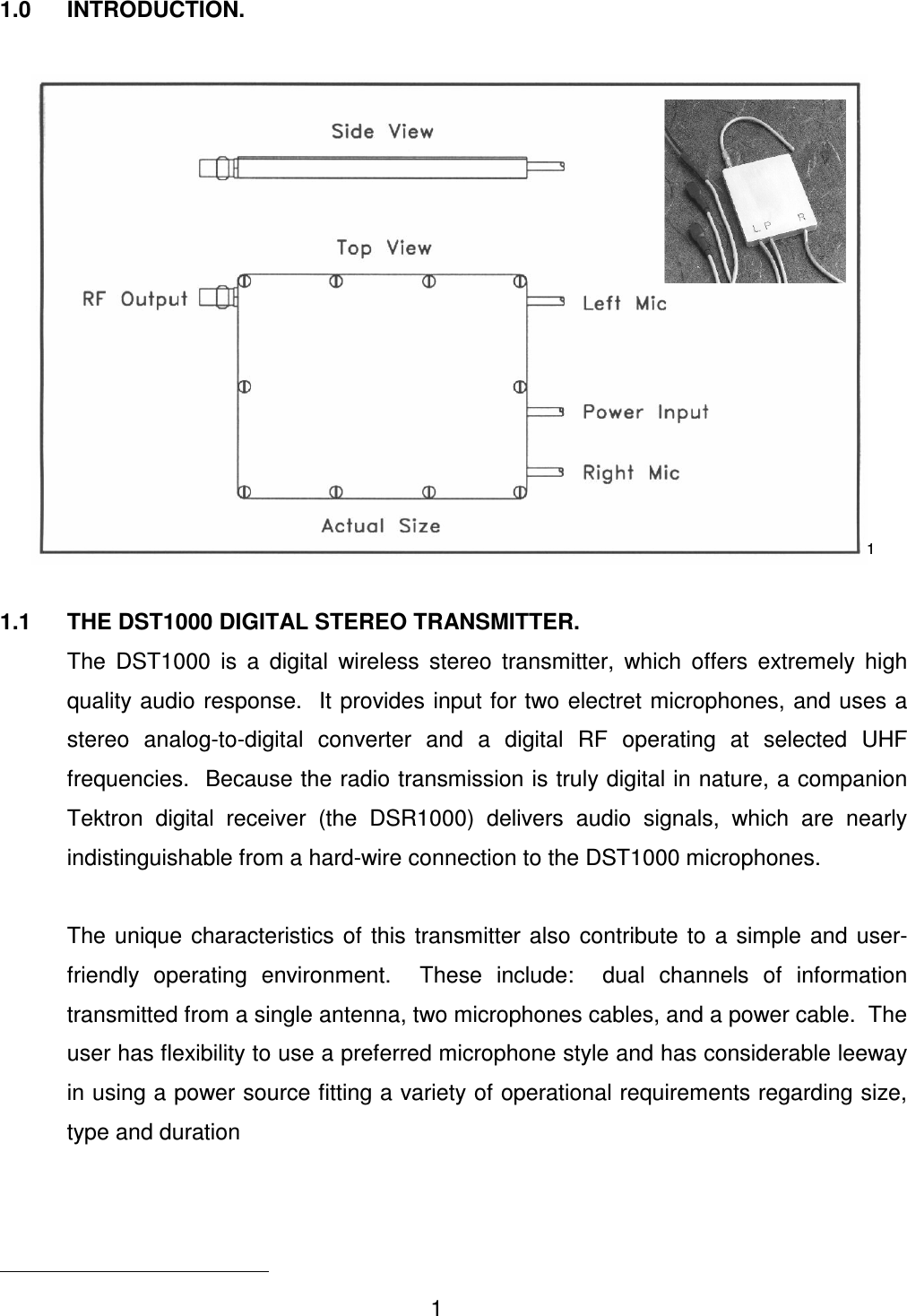
1 1.0  INTRODUCTION.  1  1.1  THE DST1000 DIGITAL STEREO TRANSMITTER.   The  DST1000  is  a  digital  wireless  stereo  transmitter,  which  offers  extremely  high quality audio response.  It provides input for two electret microphones, and uses a stereo  analog-to-digital  converter  and  a  digital  RF  operating  at  selected  UHF frequencies.  Because the radio transmission is truly digital in nature, a companion Tektron  digital  receiver  (the  DSR1000)  delivers  audio  signals,  which  are  nearly indistinguishable from a hard-wire connection to the DST1000 microphones.     The  unique  characteristics of  this transmitter also  contribute  to  a simple  and  user-friendly  operating  environment.    These  include:    dual  channels  of  information transmitted from a single antenna, two microphones cables, and a power cable.  The user has flexibility to use a preferred microphone style and has considerable leeway in using a power source fitting a variety of operational requirements regarding size, type and duration
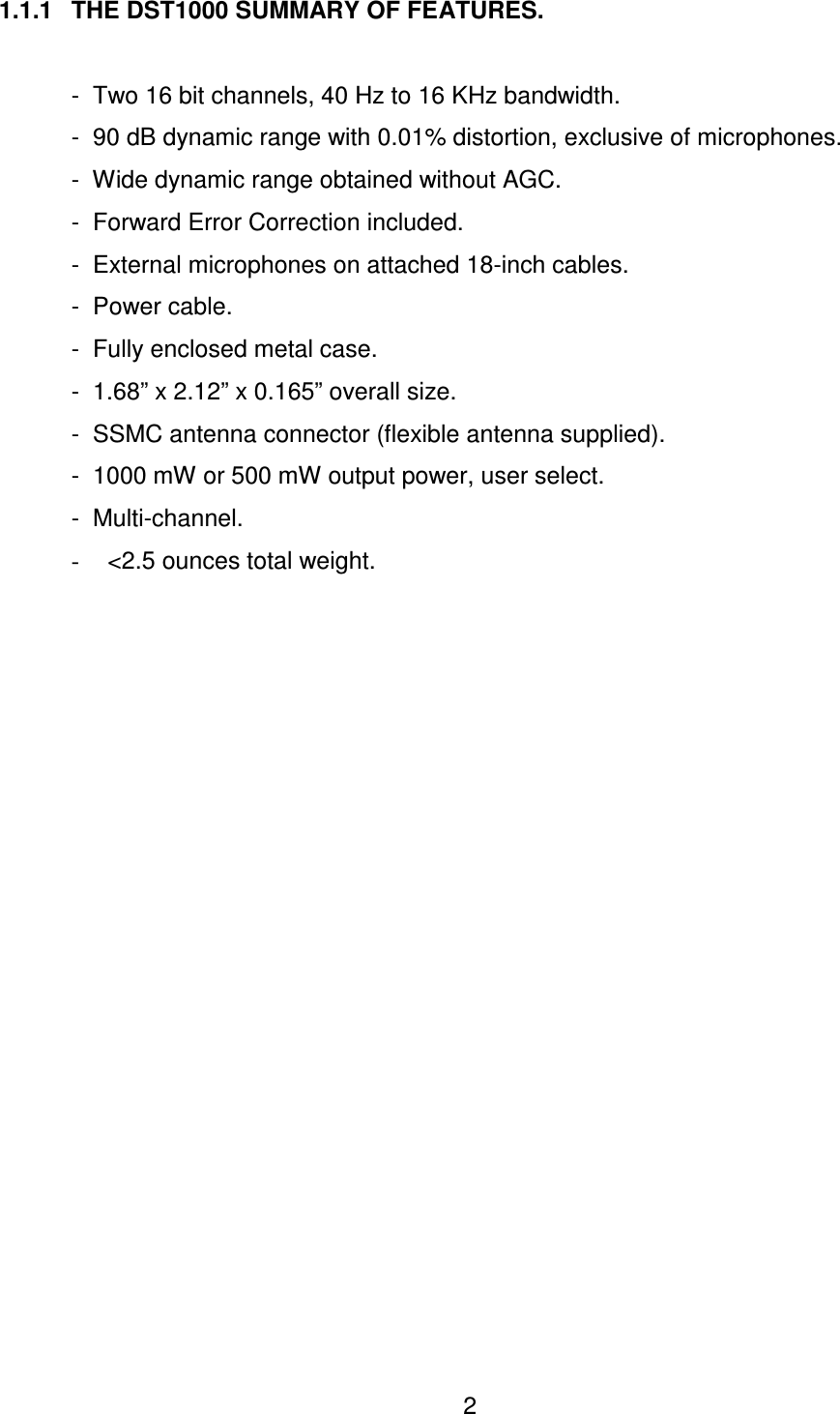
 2 1.1.1  THE DST1000 SUMMARY OF FEATURES.    -  Two 16 bit channels, 40 Hz to 16 KHz bandwidth.   -  90 dB dynamic range with 0.01% distortion, exclusive of microphones.   -  Wide dynamic range obtained without AGC.   -  Forward Error Correction included.   -  External microphones on attached 18-inch cables.   -  Power cable.   -  Fully enclosed metal case.   -  1.68” x 2.12” x 0.165” overall size.   -  SSMC antenna connector (flexible antenna supplied).   -  1000 mW or 500 mW output power, user select. -  Multi-channel. -  <2.5 ounces total weight.
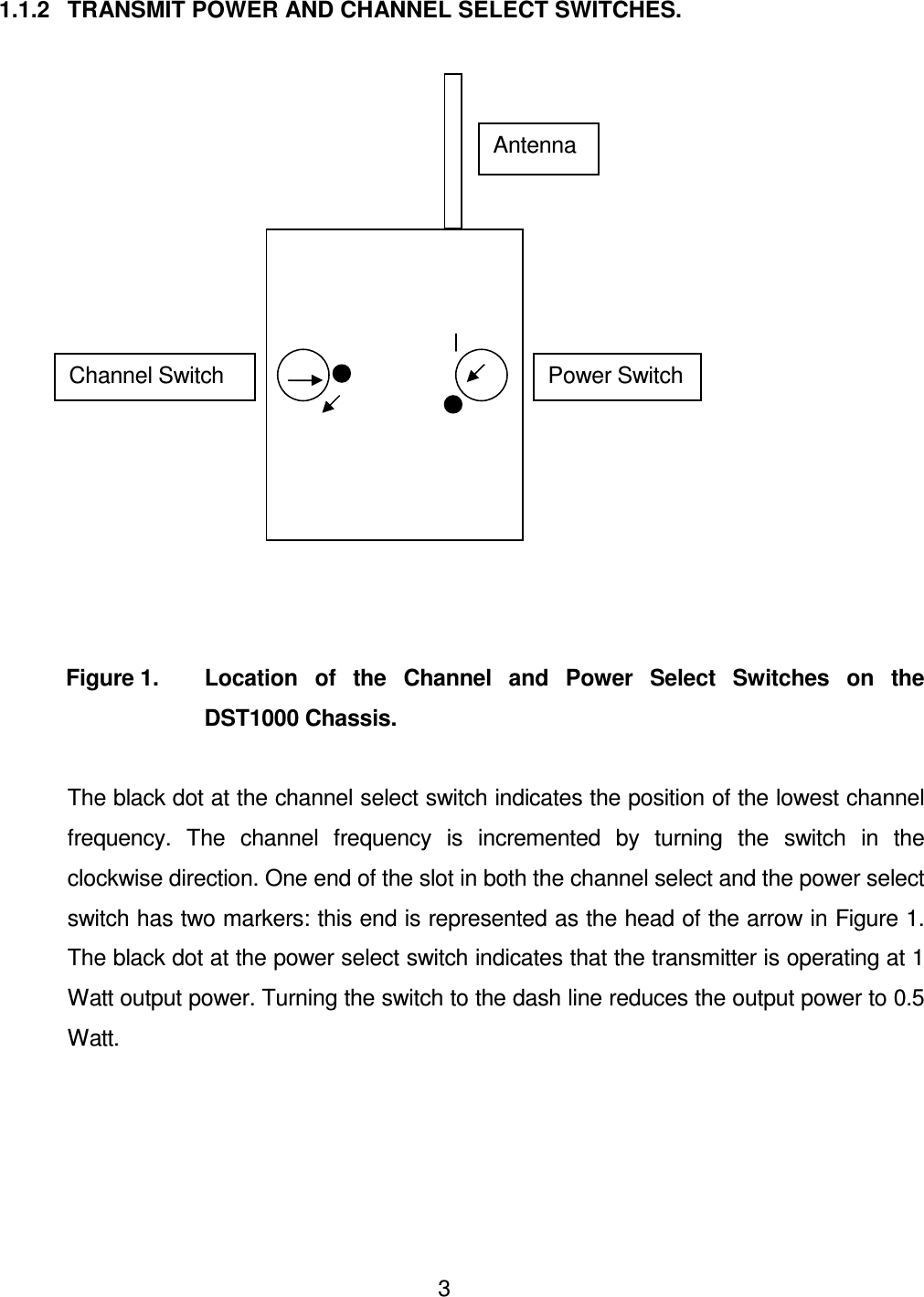
 3  1.1.2  TRANSMIT POWER AND CHANNEL SELECT SWITCHES.                   Figure 1.    Location  of  the  Channel  and  Power  Select  Switches  on  the DST1000 Chassis.  The black dot at the channel select switch indicates the position of the lowest channel frequency.  The  channel  frequency  is  incremented  by  turning  the  switch  in  the clockwise direction. One end of the slot in both the channel select and the power select switch has two markers: this end is represented as the head of the arrow in Figure 1. The black dot at the power select switch indicates that the transmitter is operating at 1 Watt output power. Turning the switch to the dash line reduces the output power to 0.5 Watt.      Antenna Channel Switch  Power Switch
 4 1.2  THE DST1000 CONNECTOR NOMENCLATURE.   An  SSMC  male  connector  is  used  for  the  antenna.    The  AEP  mating  antenna connector is part no. 7002-1541-010.    AEP connectors are available from:          Applied Engineering Products         104 John W. Murphy Drive         New Haven, CT 06513         Telephone: 1-800-444-5366  1.3  DST1000 PACKING LIST.   1 each    DST1000 Digital Stereo Transmitter Serial No.                1 each    DST1000 Antenna.   1 each    DST1000 Operating Manual.
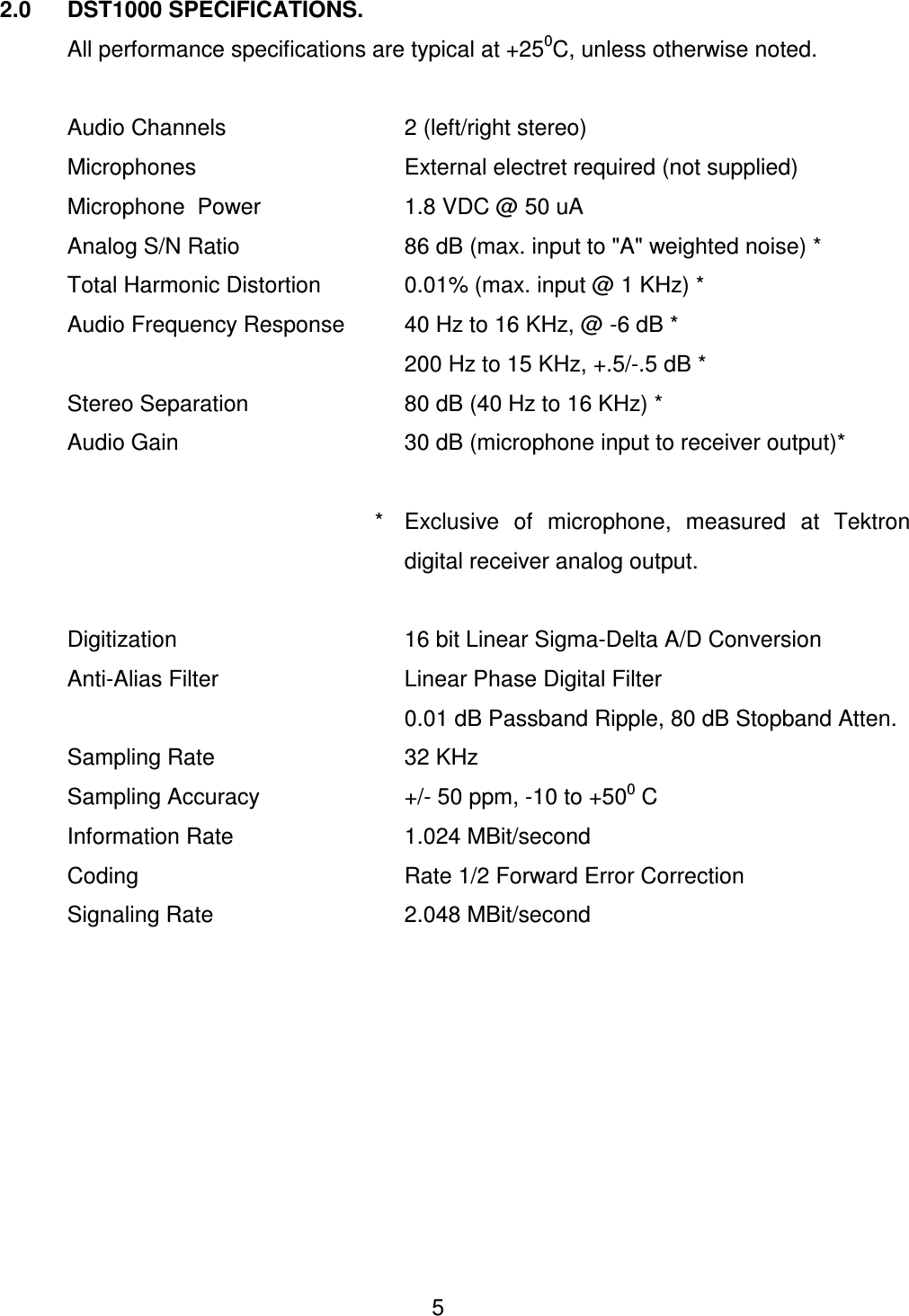
 5 2.0  DST1000 SPECIFICATIONS.   All performance specifications are typical at +250C, unless otherwise noted.    Audio Channels      2 (left/right stereo)   Microphones       External electret required (not supplied)     Microphone  Power     1.8 VDC @ 50 uA   Analog S/N Ratio      86 dB (max. input to "A" weighted noise) *   Total Harmonic Distortion    0.01% (max. input @ 1 KHz) *    Audio Frequency Response  40 Hz to 16 KHz, @ -6 dB *             200 Hz to 15 KHz, +.5/-.5 dB *   Stereo Separation      80 dB (40 Hz to 16 KHz) *   Audio Gain        30 dB (microphone input to receiver output)*                    *  Exclusive  of  microphone,  measured  at  Tektron digital receiver analog output.    Digitization        16 bit Linear Sigma-Delta A/D Conversion    Anti-Alias Filter      Linear Phase Digital Filter             0.01 dB Passband Ripple, 80 dB Stopband Atten.   Sampling Rate      32 KHz   Sampling Accuracy      +/- 50 ppm, -10 to +500 C   Information Rate      1.024 MBit/second   Coding        Rate 1/2 Forward Error Correction   Signaling Rate      2.048 MBit/second
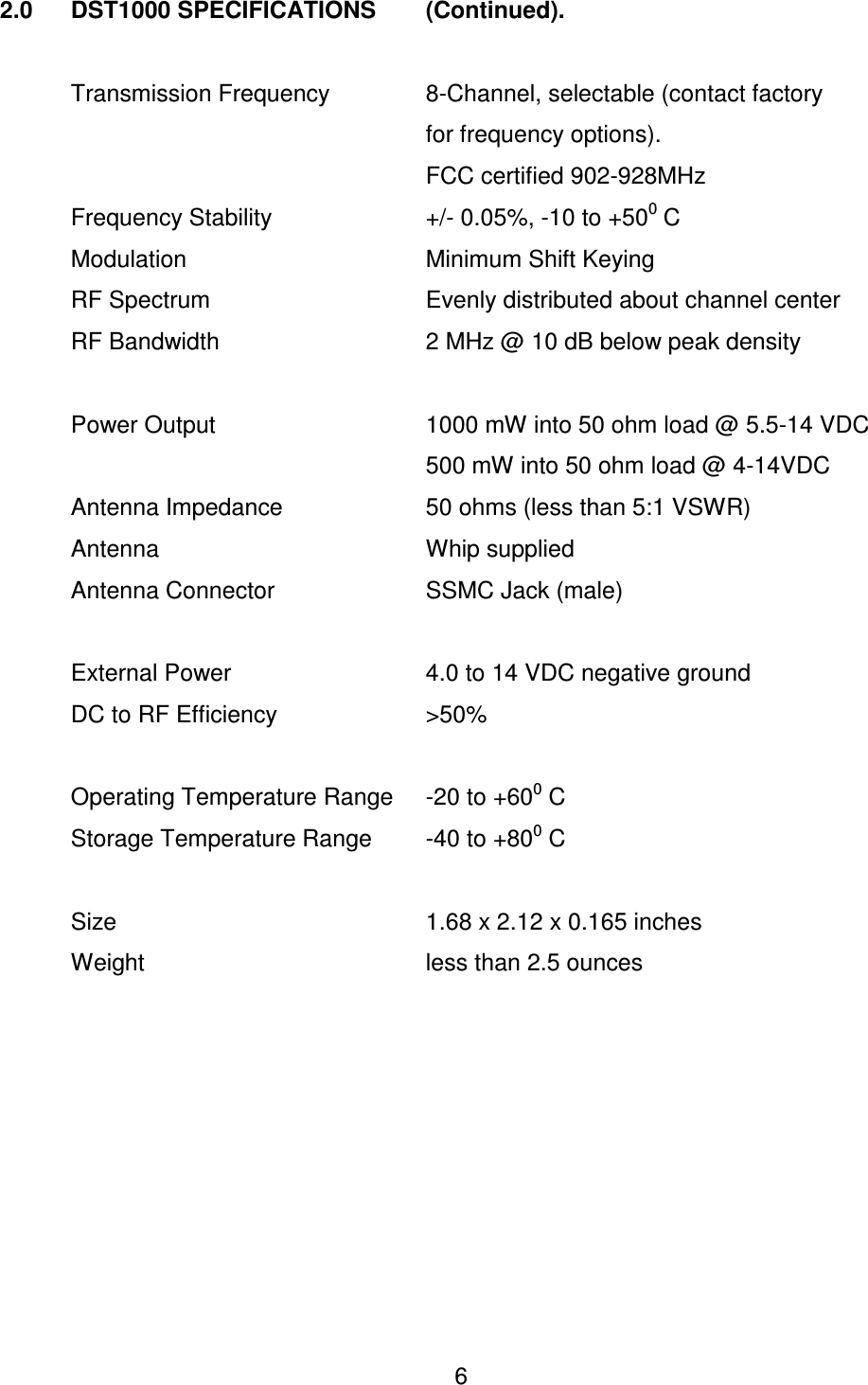
 6 2.0   DST1000 SPECIFICATIONS   (Continued).    Transmission Frequency    8-Channel, selectable (contact factory              for frequency options).             FCC certified 902-928MHz    Frequency Stability      +/- 0.05%, -10 to +500 C    Modulation        Minimum Shift Keying   RF Spectrum       Evenly distributed about channel center   RF Bandwidth      2 MHz @ 10 dB below peak density    Power Output      1000 mW into 50 ohm load @ 5.5-14 VDC             500 mW into 50 ohm load @ 4-14VDC   Antenna Impedance     50 ohms (less than 5:1 VSWR)   Antenna        Whip supplied   Antenna Connector     SSMC Jack (male)    External Power      4.0 to 14 VDC negative ground   DC to RF Efficiency     >50%      Operating Temperature Range  -20 to +600 C   Storage Temperature Range  -40 to +800 C    Size          1.68 x 2.12 x 0.165 inches   Weight        less than 2.5 ounces
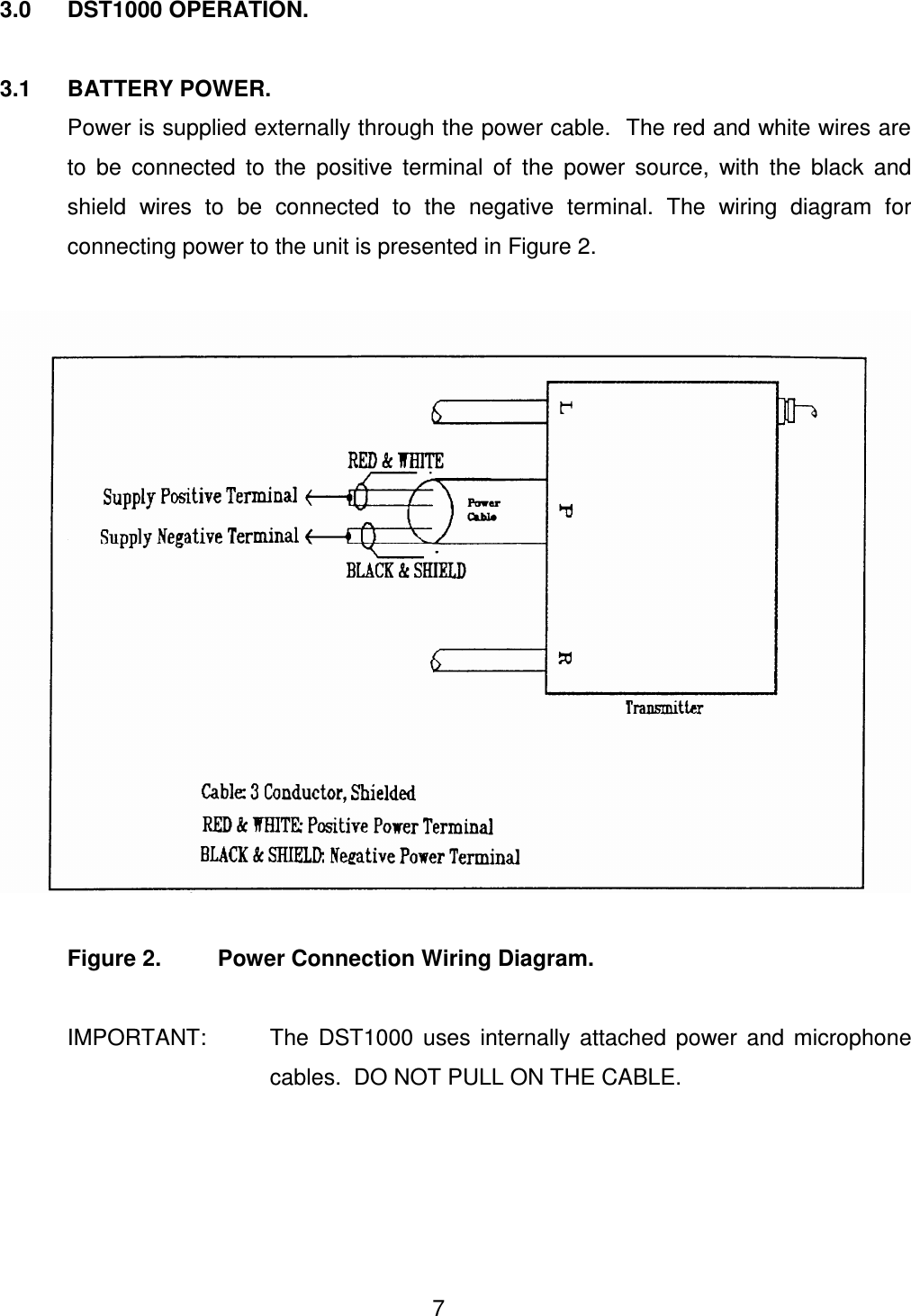
 7 3.0  DST1000 OPERATION.  3.1  BATTERY POWER.   Power is supplied externally through the power cable.  The red and white wires are to  be  connected  to  the  positive  terminal  of  the  power  source,  with  the  black  and shield  wires  to  be  connected  to  the  negative  terminal.  The  wiring  diagram  for connecting power to the unit is presented in Figure 2.      Figure 2.         Power Connection Wiring Diagram.   IMPORTANT:  The  DST1000  uses  internally  attached  power  and  microphone cables.  DO NOT PULL ON THE CABLE.
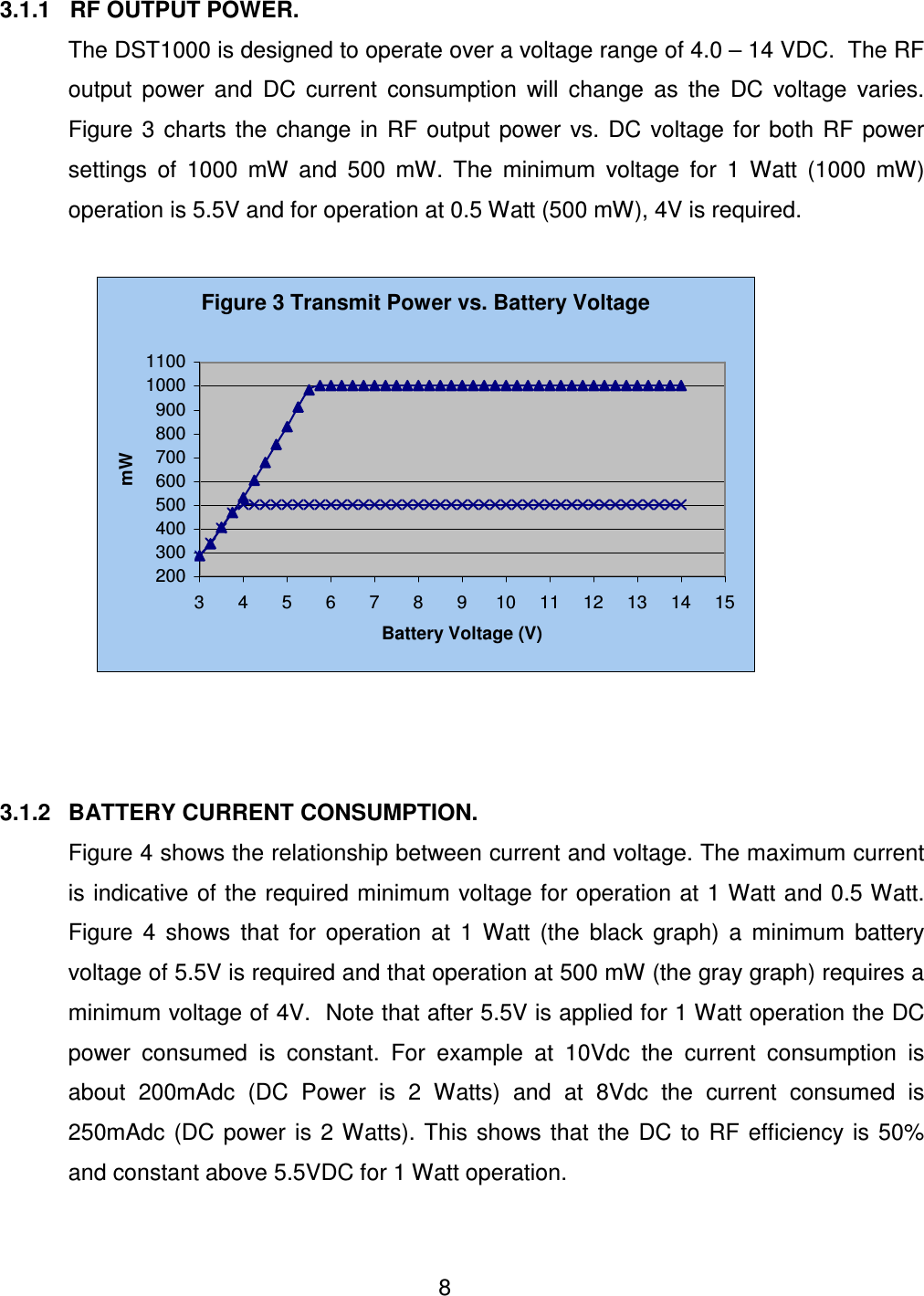
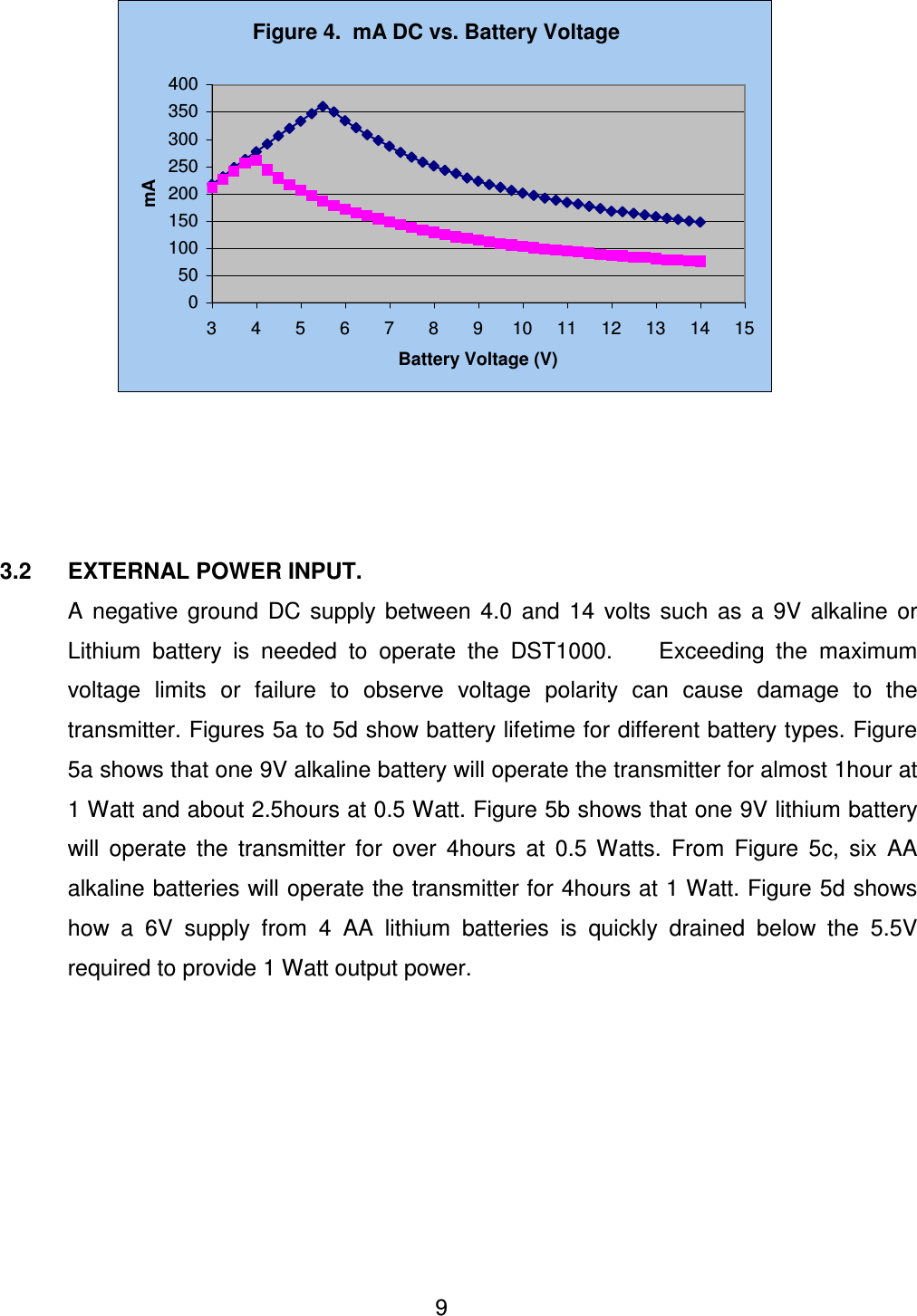
 8  3.1.1   RF OUTPUT POWER.   The DST1000 is designed to operate over a voltage range of 4.0 – 14 VDC.  The RF output  power  and  DC  current  consumption  will  change  as  the  DC  voltage  varies.  Figure 3  charts  the  change  in  RF  output  power vs. DC  voltage  for both  RF power settings  of  1000  mW  and  500  mW.  The  minimum  voltage  for  1  Watt  (1000  mW) operation is 5.5V and for operation at 0.5 Watt (500 mW), 4V is required.         3.1.2  BATTERY CURRENT CONSUMPTION.   Figure 4 shows the relationship between current and voltage. The maximum current is indicative of the required minimum voltage for operation at 1 Watt and 0.5 Watt. Figure  4  shows  that  for  operation  at  1  Watt  (the  black  graph)  a  minimum  battery voltage of 5.5V is required and that operation at 500 mW (the gray graph) requires a minimum voltage of 4V.  Note that after 5.5V is applied for 1 Watt operation the DC power  consumed  is  constant.  For  example  at  10Vdc  the  current  consumption  is about  200mAdc  (DC  Power  is  2  Watts)  and  at  8Vdc  the  current  consumed  is 250mAdc  (DC  power  is  2  Watts).  This  shows  that  the  DC  to  RF  efficiency is  50% and constant above 5.5VDC for 1 Watt operation.  Figure 3 Transmit Power vs. Battery Voltage200300400500600700800900100011003 4 5 6 7 8 9 10 11 12 13 14 15Battery Voltage (V)mW
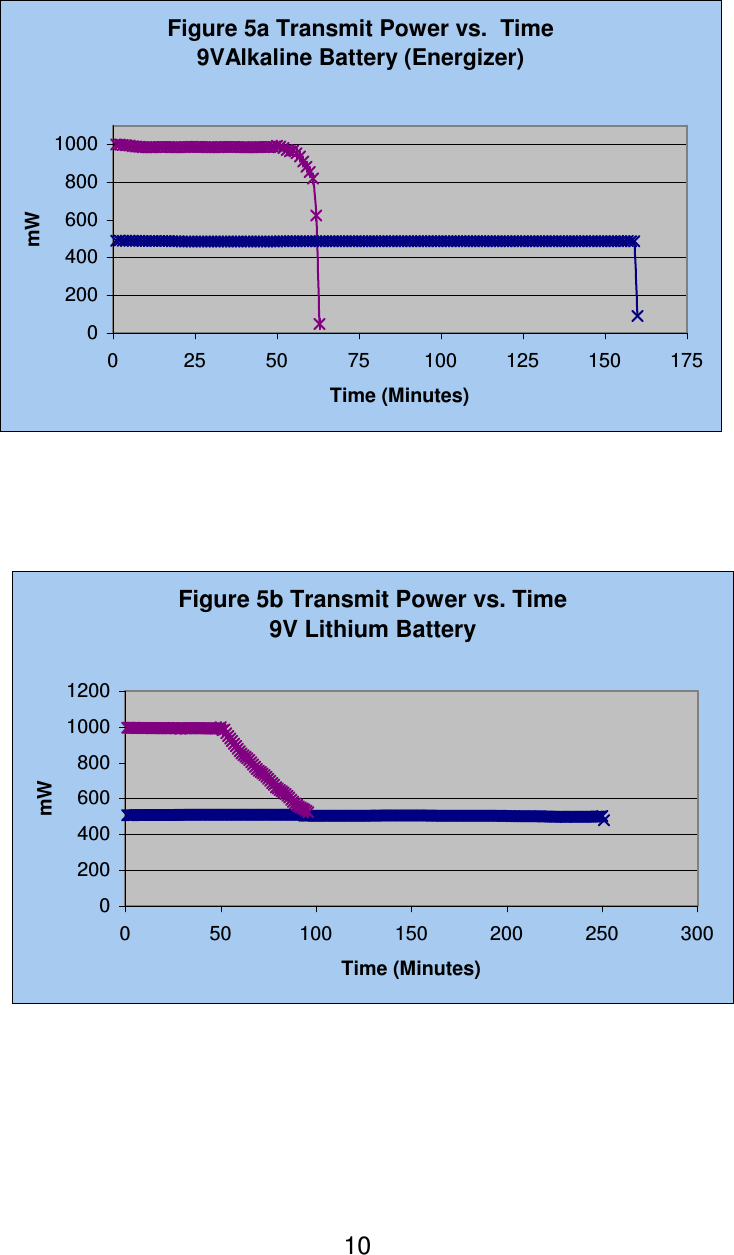
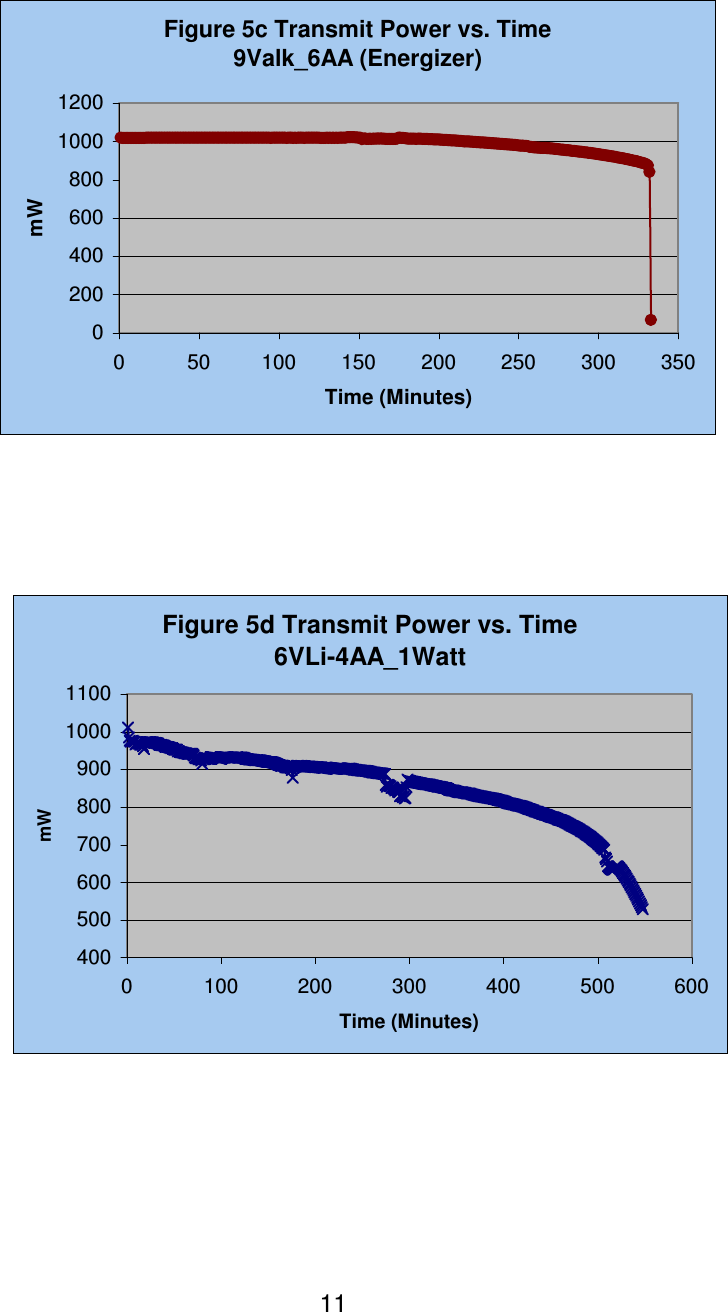
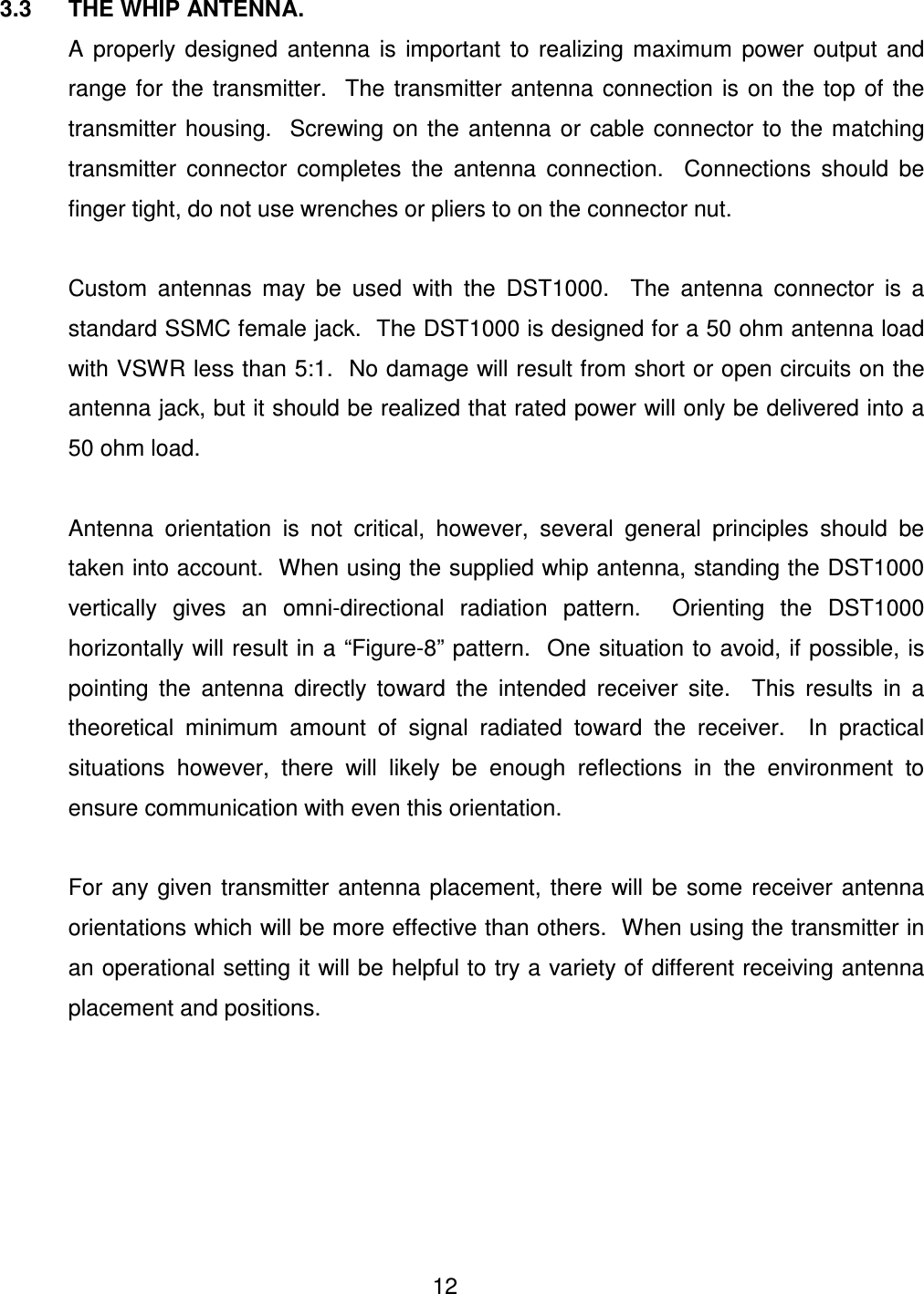
 9     3.2  EXTERNAL POWER INPUT. A  negative  ground  DC  supply  between  4.0  and  14  volts  such  as  a  9V  alkaline  or Lithium  battery  is  needed  to  operate  the  DST1000.        Exceeding  the  maximum voltage  limits  or  failure  to  observe  voltage  polarity  can  cause  damage  to  the transmitter. Figures 5a to 5d show battery lifetime for different battery types. Figure 5a shows that one 9V alkaline battery will operate the transmitter for almost 1hour at 1 Watt and about 2.5hours at 0.5 Watt. Figure 5b shows that one 9V lithium battery will  operate  the  transmitter  for  over  4hours  at  0.5  Watts.  From  Figure  5c,  six  AA alkaline batteries will operate the transmitter for 4hours at 1 Watt. Figure 5d shows how  a  6V  supply  from  4  AA  lithium  batteries  is  quickly  drained  below  the  5.5V required to provide 1 Watt output power.  Figure 4.  mA DC vs. Battery Voltage0501001502002503003504003 4 5 6 7 8 9 10 11 12 13 14 15Battery Voltage (V)mA
 10           Figure 5a Transmit Power vs.  Time9VAlkaline Battery (Energizer)020040060080010000 25 50 75 100 125 150 175Time (Minutes)mWFigure 5b Transmit Power vs. Time9V Lithium Battery0200400600800100012000 50 100 150 200 250 300Time (Minutes)mW
 11             Figure 5c Transmit Power vs. Time9Valk_6AA (Energizer)0200400600800100012000 50 100 150 200 250 300 350Time (Minutes) mWFigure 5d Transmit Power vs. Time6VLi-4AA_1Watt400500600700800900100011000 100 200 300 400 500 600Time (Minutes)mW
 12    3.3  THE WHIP ANTENNA.   A  properly  designed  antenna  is  important  to  realizing  maximum  power  output  and range  for  the  transmitter.    The  transmitter  antenna  connection is  on  the  top  of  the transmitter  housing.    Screwing on  the  antenna  or  cable  connector to  the  matching transmitter  connector  completes  the  antenna  connection.    Connections  should  be finger tight, do not use wrenches or pliers to on the connector nut.    Custom  antennas  may  be  used  with  the  DST1000.    The  antenna  connector  is  a standard SSMC female jack.  The DST1000 is designed for a 50 ohm antenna load with VSWR less than 5:1.  No damage will result from short or open circuits on the antenna jack, but it should be realized that rated power will only be delivered into a 50 ohm load.    Antenna  orientation  is  not  critical,  however,  several  general  principles  should  be taken into account.  When using the supplied whip antenna, standing the DST1000 vertically  gives  an  omni-directional  radiation  pattern.    Orienting  the  DST1000 horizontally will result in a “Figure-8” pattern.  One situation to avoid, if possible, is pointing  the  antenna  directly  toward  the  intended  receiver  site.    This  results  in  a theoretical  minimum  amount  of  signal  radiated  toward  the  receiver.    In  practical situations  however,  there  will  likely  be  enough  reflections  in  the  environment  to ensure communication with even this orientation.    For  any  given  transmitter antenna placement,  there  will be  some  receiver antenna orientations which will be more effective than others.  When using the transmitter in an operational setting it will be helpful to try a variety of different receiving antenna placement and positions.
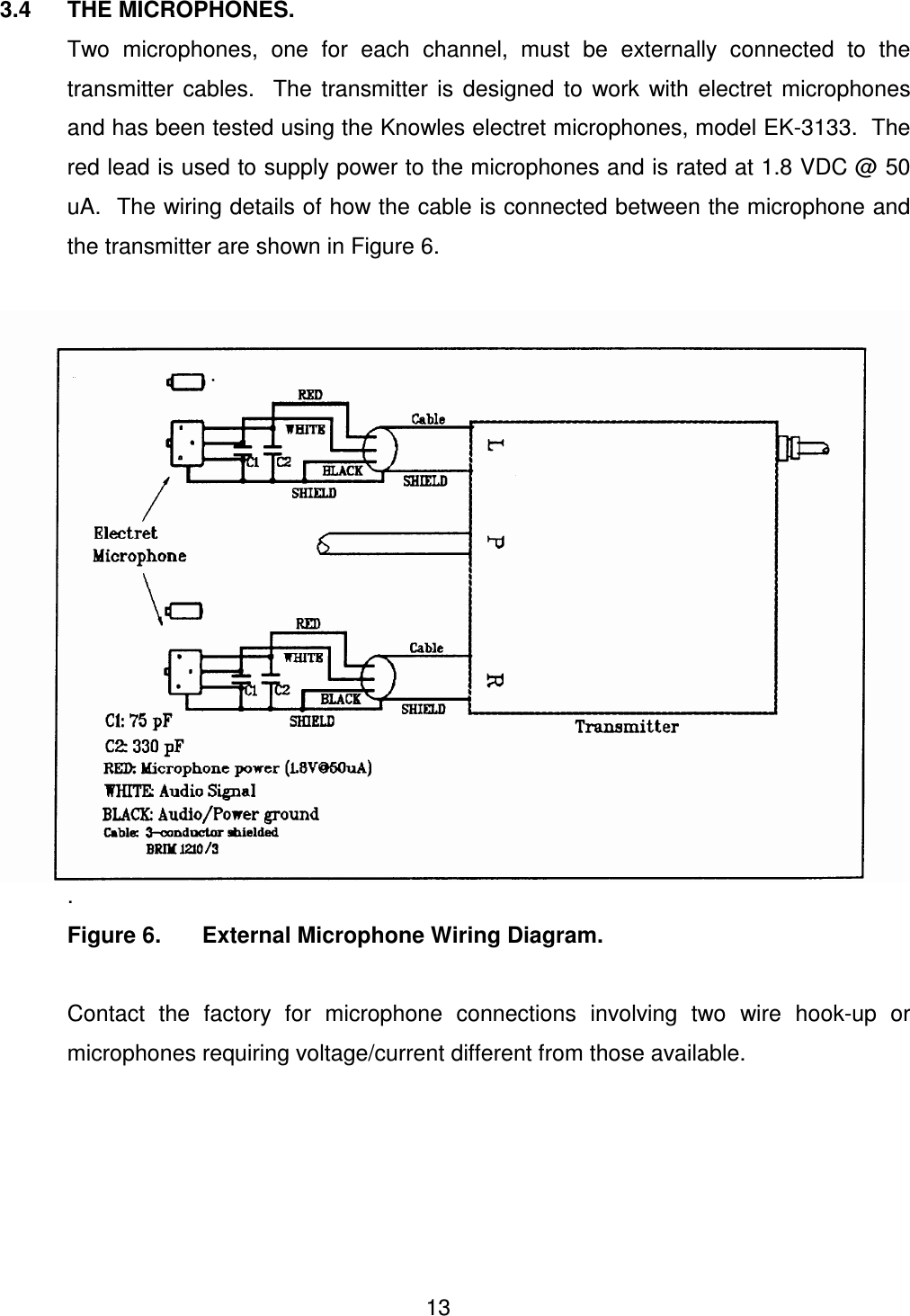
 13 3.4  THE MICROPHONES.     Two  microphones,  one  for  each  channel,  must  be  externally  connected  to  the transmitter  cables.    The  transmitter  is  designed  to  work  with  electret  microphones and has been tested using the Knowles electret microphones, model EK-3133.  The red lead is used to supply power to the microphones and is rated at 1.8 VDC @ 50 uA.  The wiring details of how the cable is connected between the microphone and the transmitter are shown in Figure 6.    .   Figure 6.   External Microphone Wiring Diagram.    Contact  the  factory  for  microphone  connections  involving  two  wire  hook-up  or microphones requiring voltage/current different from those available.
 14 3.5  CHANNEL SELECTION. The  DST1000  can  be  manually set  to  operate  on  one  of  five  channels.    A  slotted switch  is  available  on  the  top  lid  of  the  transmitter  (label  side).    A  small  jeweler’s screwdriver  or  plastic  adjustment  tool  can  be  used  to  select  the  channel.    The transmitter label depicts the proper position of the slot to select the desired channel (see also Section 1.1.2).   NOTE:  The switch may be turned clockwise or counter-clockwise; it is only the final position (vertical or horizontal), which determines the channel.
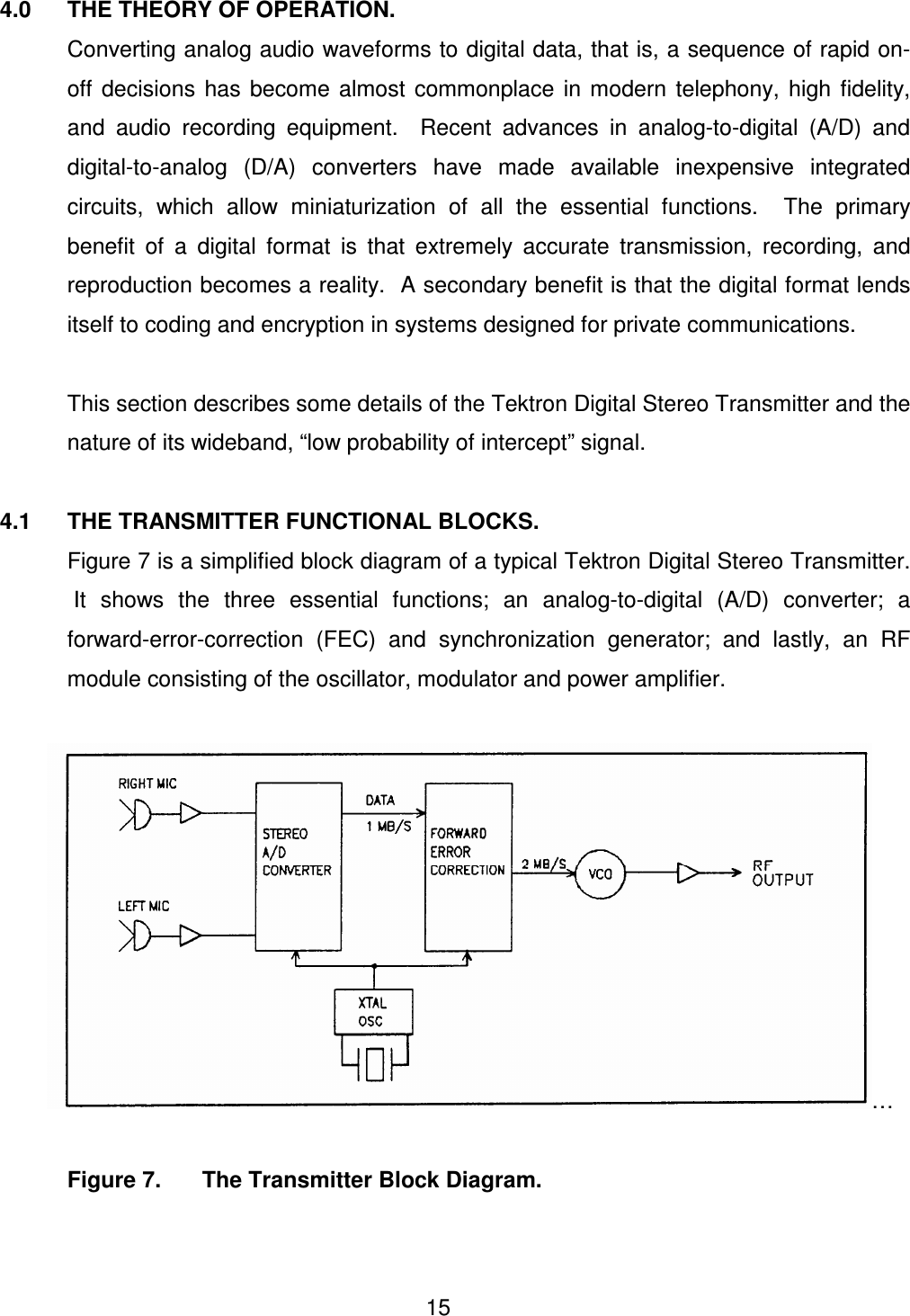
 15 4.0  THE THEORY OF OPERATION.   Converting analog audio waveforms to digital data, that is, a sequence of rapid on-off  decisions  has  become  almost  commonplace  in  modern  telephony,  high  fidelity, and  audio  recording  equipment.    Recent  advances  in  analog-to-digital  (A/D)  and digital-to-analog  (D/A)  converters  have  made  available  inexpensive  integrated circuits,  which  allow  miniaturization  of  all  the  essential  functions.    The  primary benefit  of  a  digital  format  is  that  extremely  accurate  transmission,  recording,  and reproduction becomes a reality.  A secondary benefit is that the digital format lends itself to coding and encryption in systems designed for private communications.    This section describes some details of the Tektron Digital Stereo Transmitter and the nature of its wideband, “low probability of intercept” signal.  4.1  THE TRANSMITTER FUNCTIONAL BLOCKS.   Figure 7 is a simplified block diagram of a typical Tektron Digital Stereo Transmitter.  It  shows  the  three  essential  functions;  an  analog-to-digital  (A/D)  converter;  a forward-error-correction  (FEC)  and  synchronization  generator;  and  lastly,  an  RF module consisting of the oscillator, modulator and power amplifier.         …      Figure 7.   The Transmitter Block Diagram.
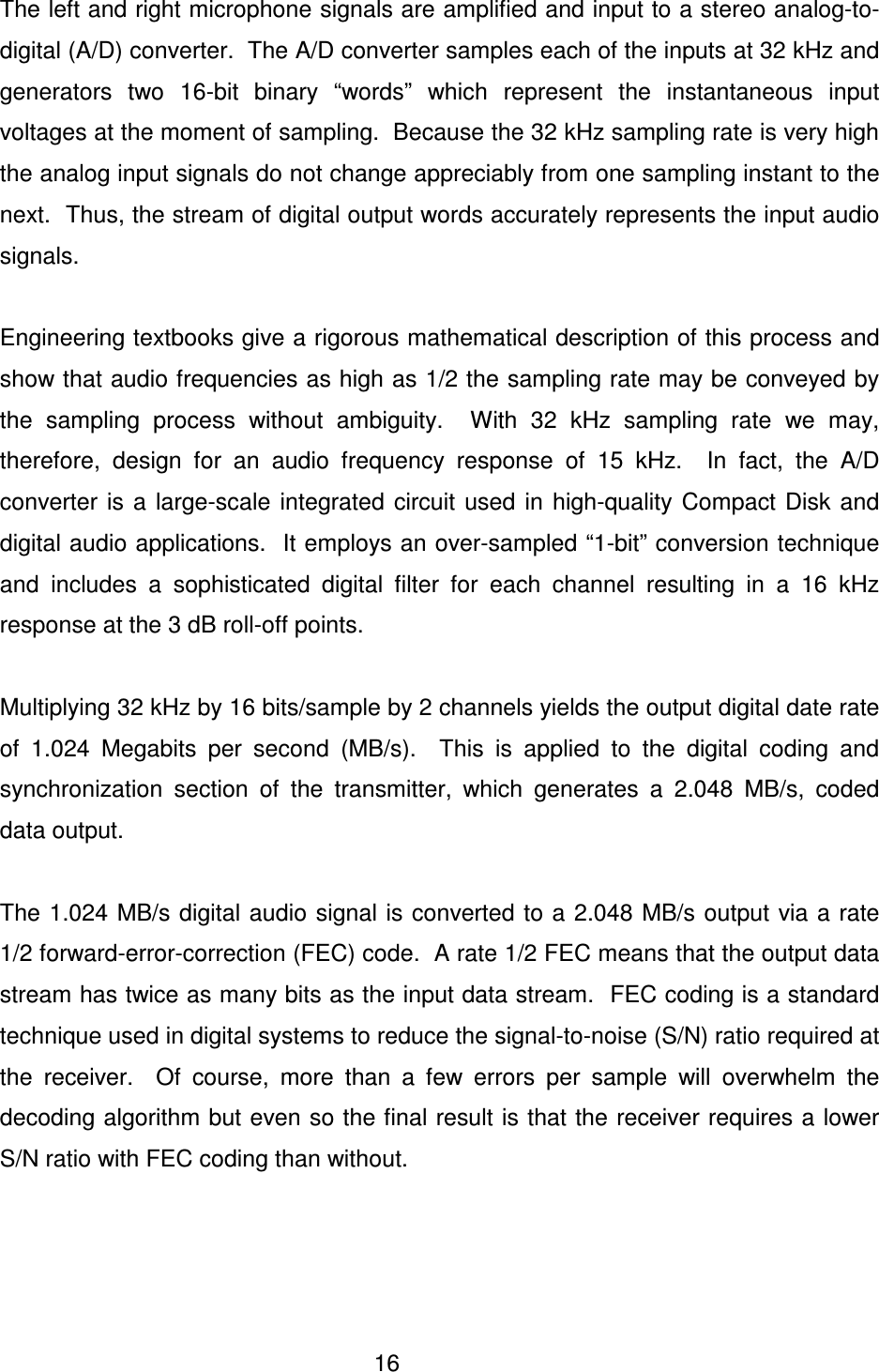
 16   The left and right microphone signals are amplified and input to a stereo analog-to-digital (A/D) converter.  The A/D converter samples each of the inputs at 32 kHz and generators  two  16-bit  binary  “words”  which  represent  the  instantaneous  input voltages at the moment of sampling.  Because the 32 kHz sampling rate is very high the analog input signals do not change appreciably from one sampling instant to the next.  Thus, the stream of digital output words accurately represents the input audio signals.    Engineering textbooks give a rigorous mathematical description of this process and show that audio frequencies as high as 1/2 the sampling rate may be conveyed by the  sampling  process  without  ambiguity.    With  32  kHz  sampling  rate  we  may, therefore,  design  for  an  audio  frequency  response  of  15  kHz.    In  fact,  the  A/D converter  is  a  large-scale  integrated  circuit  used  in  high-quality  Compact  Disk  and digital audio applications.  It employs an over-sampled “1-bit” conversion technique and  includes  a  sophisticated  digital  filter  for  each  channel  resulting  in  a  16  kHz response at the 3 dB roll-off points.    Multiplying 32 kHz by 16 bits/sample by 2 channels yields the output digital date rate of  1.024  Megabits  per  second  (MB/s).    This  is  applied  to  the  digital  coding  and synchronization  section  of  the  transmitter,  which  generates  a  2.048  MB/s,  coded data output.    The 1.024 MB/s digital audio signal is converted to a 2.048 MB/s output via a  rate 1/2 forward-error-correction (FEC) code.  A rate 1/2 FEC means that the output data stream has twice as many bits as the input data stream.  FEC coding is a standard technique used in digital systems to reduce the signal-to-noise (S/N) ratio required at the  receiver.    Of  course,  more  than  a  few  errors  per  sample  will  overwhelm  the decoding algorithm but even so the final result is that the receiver requires a lower S/N ratio with FEC coding than without.
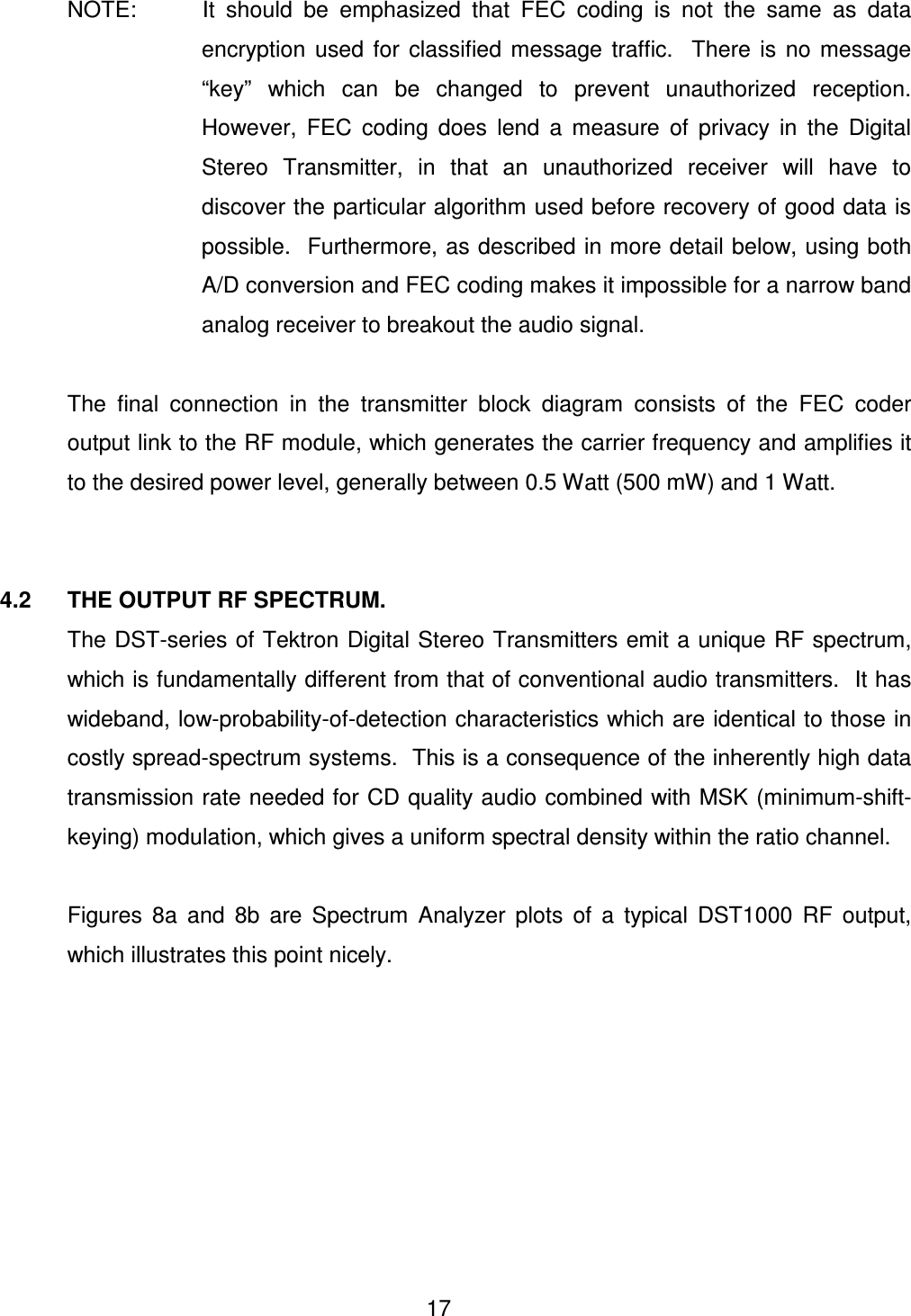
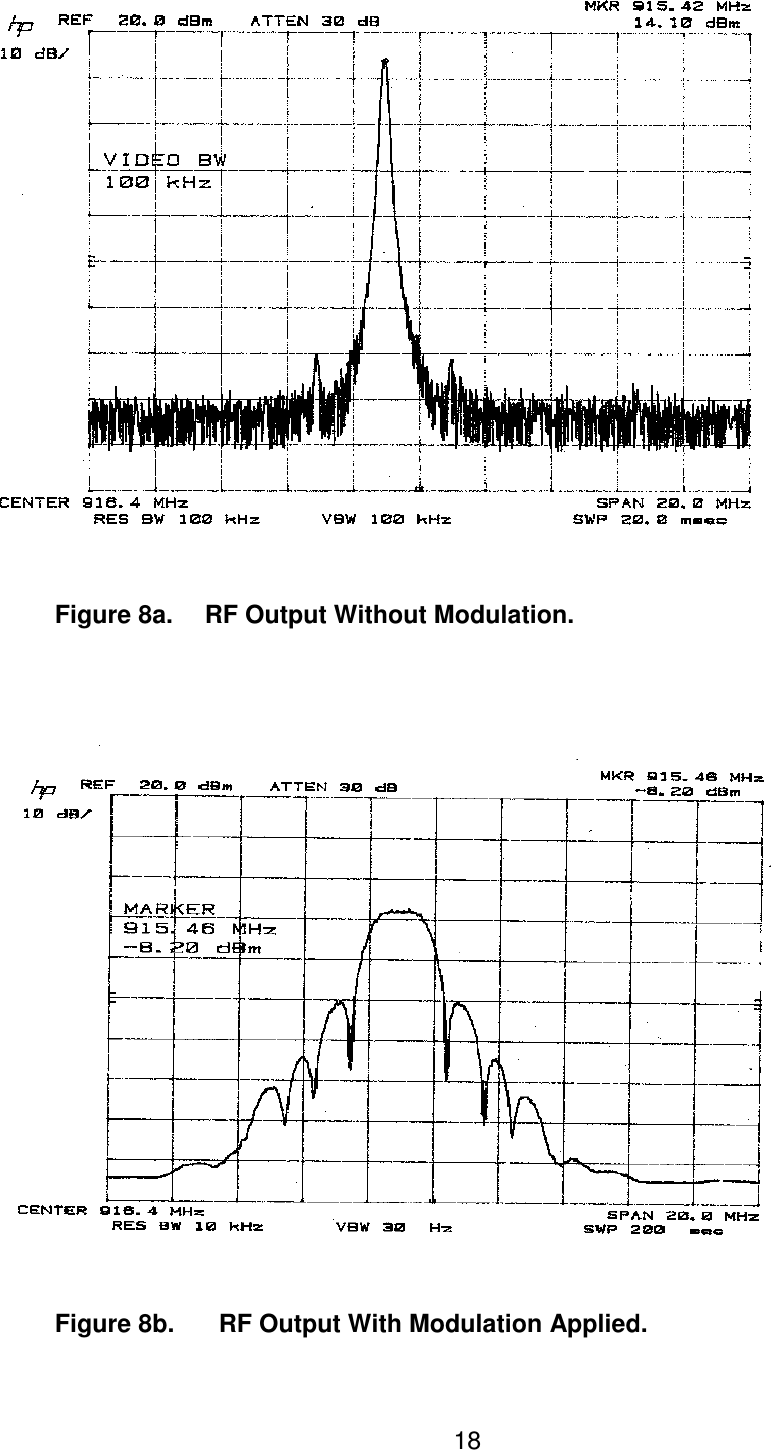
 17      NOTE:    It  should  be  emphasized  that  FEC  coding  is  not  the  same  as  data encryption  used  for  classified  message  traffic.    There  is  no  message “key”  which  can  be  changed  to  prevent  unauthorized  reception.  However,  FEC  coding  does  lend  a  measure  of  privacy  in  the  Digital Stereo  Transmitter,  in  that  an  unauthorized  receiver  will  have  to discover the particular algorithm used before recovery of good data is possible.  Furthermore, as described in more detail below, using both A/D conversion and FEC coding makes it impossible for a narrow band analog receiver to breakout the audio signal.    The  final  connection  in  the  transmitter  block  diagram  consists  of  the  FEC  coder output link to the RF module, which generates the carrier frequency and amplifies it to the desired power level, generally between 0.5 Watt (500 mW) and 1 Watt.   4.2    THE OUTPUT RF SPECTRUM.   The DST-series of Tektron Digital Stereo Transmitters emit a unique RF spectrum, which is fundamentally different from that of conventional audio transmitters.  It has wideband, low-probability-of-detection characteristics which are identical to those in costly spread-spectrum systems.  This is a consequence of the inherently high data transmission rate needed for CD quality audio combined with MSK (minimum-shift-keying) modulation, which gives a uniform spectral density within the ratio channel.    Figures  8a  and  8b  are  Spectrum  Analyzer  plots  of  a  typical  DST1000  RF  output, which illustrates this point nicely.
 18      Figure 8a.   RF Output Without Modulation.         Figure 8b.    RF Output With Modulation Applied.
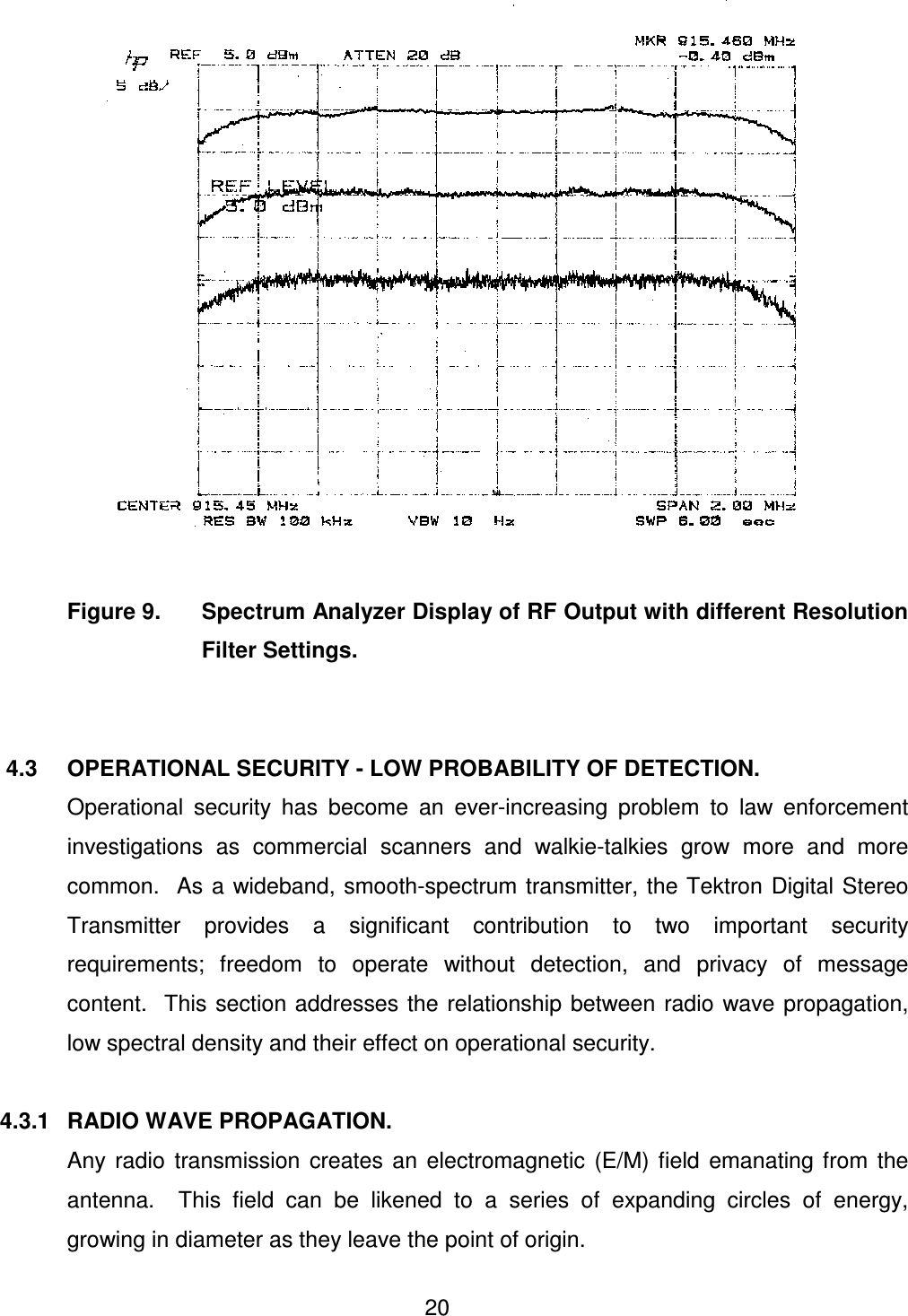
 19   Figure  8a  shows  the  transmitter  signal  without  modulation.  Accounting  for  a  16dB attenuator  being  placed  between  the  transmitter  and  the  spectrum  analyzer  to prevent overdriving the analyzer, it is a steady carrier at 30.0dBm (1000 mW).  Note that  the  analyzer  shows  a  random  noise  baseline  at  -74  dBm  when  tuned  off  the emitted  frequency.    Figure  8b  shows  the  transmitted  signal  with  digital  modulation and with the analyzer set for 10 kHz resolution bandwidth.  (This bandwidth is typical of commercial audio receivers and scanners, which are intended for narrowband AM and FM reception.)  Two characteristics of the DST1000 spectrum are immediately evident.    First,  it  is  a  wideband  signal  spread  out  over  2.24  MHz.    Second,  the spectral density is about 5 mW in a 10 kHz bandwidth.    This occurs even though the total transmitted power has not changed! It is still 1000 mW.  But now, due to the wideband modulation, the total power is spread over 200 “channels” of 10 kHz bandwidth each.  A division by 200 is represented by a 23dB reduction in power (10log10(200) = 23dB). The significance of this latter point is that a 23dB reduction in the power measured at a scanner’s detector has been achieved, and  the  likelihood  of  detection  is  correspondingly  reduced.    (30dBm  –  23dBm  = 7dBm  or  5  mW).    As  compared  with  a  conventional  analog  audio  transmitter,  the DST1000 appears to be a weak, noisy signal - albeit one occupying 200 adjacent 10 kHz channels!    There is yet a third remarkable feature of the Digital Stereo Transmitter’s RF output spectrum.  It is that the transmitted energy is quite evenly distributed throughout the RF channel, and that the statistics of that even-ness are unaffected by the strength or nature of the audio signal transmitted.  There are no spectral lines which wobble and  shift to reveal  the underlying audio  signal.    Figure 9 demonstrates this fact  by expanding the  spectrum analyzer display and  making plots at 100 kHz (top  trace), 10 kHz (middle trace), and 1 kHz (lower trace) resolution bandwidth.  Note that the measured spectral density tracks the analyzer bandwidth changes exactly, and that there are no line spectra evident.  This means there is an extremely low probability of “breaking-out” the transmitted audio with narrowband receiving equipment.
 20         Figure 9.  Spectrum Analyzer Display of RF Output with different Resolution Filter Settings.      4.3  OPERATIONAL SECURITY - LOW PROBABILITY OF DETECTION.   Operational  security  has  become  an  ever-increasing  problem  to  law  enforcement investigations  as  commercial  scanners  and  walkie-talkies  grow  more  and  more common.   As  a  wideband, smooth-spectrum transmitter, the Tektron  Digital Stereo Transmitter  provides  a  significant  contribution  to  two  important  security requirements;  freedom  to  operate  without  detection,  and  privacy  of  message content.  This section addresses the relationship  between  radio wave propagation, low spectral density and their effect on operational security.  4.3.1   RADIO WAVE PROPAGATION.   Any  radio  transmission  creates  an  electromagnetic  (E/M)  field  emanating  from  the antenna.    This  field  can  be  likened  to  a  series  of  expanding  circles  of  energy, growing in diameter as they leave the point of origin.
 21    As  the  distance  between  a  radio  transmitter  and  receiver  increases,  the  received field strength decreases  geometrically in proportion to the distance covered.  In free space the field diminishes as the square of the distance.  Thus, when the distance between  transmitter  and  receiver  is  doubled  the  field  strength  will  reduce  to  ¼  (2 squared) of its previous value.    Signal propagation over ground is even more severely attenuated.  At the VHF and UHF frequencies (30 - 1500 MHz), a common estimate is that attenuation varies as the fourth power of distance.  In that case, doubling the distance between transmitter and receiver will reduce the signal to 1/16 (2 x 2 x 2 x 2) of what it had been. The significance  of  these  calculations  is  that  there  is  a  very  large  difference  in  field strength  between  the  near  vicinity  of  the  transmitter  and  a  point  at  the  farthest distance at which a signal can be received.  Low probability of detection comes into play,  for  any  transmitter,  when  the  detection  device  is  a  sufficient  distance  away from the transmitter to be affected by this drastic drop in signal strength.  It is also true that it is very difficult to make a signal “absolutely undetectable” when close to a transmitter.  In fact, if a sensitive laboratory grade spectrum analyzer is used, ANY practical signal can be detected within 50 feet of the transmitter.   4.3.2   LOW SPECTRAL DENSITY EMISSION - HIDING A SIGNAL IN NOISE.   When any  radio  receiver  attempts  to  pick  up  signals,  it  must  do  so  in  competition with the random background  noise,  which is present  in its environment, as well as the random noise generated within the receiving apparatus itself.  Since the 1940s it has  been  recognized  that  spreading  a  signal’s  bandwidth  beyond  the  required minimum  will  reduce  its  probability  of  detection  by  unauthorized  receivers.    The reason lies in the property of random noise energy being smoothly distributed across the spectrum.  The amount of noise power a receiver picks up is directly proportional to the bandwidth employed.  If the desired signal is made noise-like and spread to the  point  where  its  spectral  density  -  its  received Watts  per  Hertz  of  bandwidth-  is below the random noise background, it literally will be undetectable!  Of course, all
 22 this  assumes  the  intended  receiver  can  “de-spread”  the  signal  and  restore  the proper signal/noise ratio before demodulating it in the normal fashion.  Contemporary spread-spectrum transmitters generally achieve a 10 to 20 spreading factor (called “processing gain” in the engineering literature), which means that the signal received in a scanner, or narrow-band receiver is reduced by the same factor.  For example, a spread-spectrum signal will register only 1/10 or 1/20 the energy of a  comparable  AM  or  narrowband  FM  transmission.    This  is  an  important improvement  but  must  be  evaluated  in  light  of  the  10  billion  to  one  ratio  of  signal strengths  experienced  between  the  immediate  vicinity  of  the  transmitter  and  the furthest practical receiving range.    A scanner will typically stop on a signal if there is enough energy centered around the frequency it is inspecting.  If the signal is spread out across a wide range in the spectrum, the detection device will ‘see’ less energy than it needs to cross its alarm threshold and it will not register the presence of an RF transmitter.    An important fact when considering bandwidth is that it is the size of the band that is critical, not how the band was created.  A transmitter of any design that produces a wideband signal was created.  A transmitter of any design that produces a wideband signal will effectively hide from a scanner or narrow band receiver.  Thus, a spread spectrum  transmitter with a  bandwidth of 1.5 MHz  is no  more  effective  at  avoiding detection than any other design (of equal power) with a 1.5 MHz bandwidth.  Thus, if two transmitters of the same radio frequency output power are located the same  distance  from  a  scanner  or  narrow  band  receiver,  the  transmitter  with  the widest  bandwidth  will  be  the  least  likely  to  be  detected,  whether  it  is  a  “spread spectrum” transmitter or not.  4.3.3  MESSAGE SECURITY.   Tektron’s  digital modulation also preserves message  security since  the  transmitted signal is a binary code representation of the audio received at the microphone.  The
 23 Tektron  system  also  adds  parity  bits  to  the  binary  code  according  to  an  error correction algorithm.  This  combination eliminates transmission intelligibility for any receiver not designed to match the Tektron transmission parameters.    The  combination  of  these  characteristics  mean  there  is  no  observable  correlation between  audio  events,  such  as  sudden  loud  noise  or  loud  single  frequency  tones when a spectrum analyzer is used as a detection device.  Neither is there any form of  recognizable  audio  available  to  a  detection  receiver  employed  as  an  intercept devise.
 24 5.0  MAINTENANCE.    The  DST1000  is  designed  to  afford  maximum  user  adaptation  to  operational requirements.    User  maintenance  is  limited  to  proper  installation  of  power  and attachment of the microphones.   Because of special tools and processes required, there are no user repairable items inside the transmitter.       The  DST1000  does,  however,  employ  modular  design  and  construction  and  it  is possible that a damaged unit may be repaired economically at the factory. If a unit is damaged, it may be sent for an estimate of repair costs to:           Tektron Micro Electronics, Inc.         7483A Candlewood Road         Hanover, MD  USA  21076-3102         Telephone:   410-850-4200         FAX:   410-850-4209    Please  call  for  an  RMA  (Returned  Merchandise  Authorization)  before  sending. Tektron will provide specific shipping instructions at the time an RMA is issued.
 25 6.0  WARRANTY INFORMATION  6.1  WARRANTY   Tektron  Micro  Electronics  ("the  Manufacturer")  warrants  to  the  first  purchaser  that this equipment will be free of defects in materials and workmanship for a period of one (1) year from the date of shipment to a purchaser.  6.2  LIMITATION OF WARRANTY   This warranty does not cover repairs or replacements required as a result of misuse, mishandling,  improper  storage,  extreme  weather  or  other  Acts  of  God,  failure  to perform maintenance, alterations or repairs made other than in accordance with the Manufacturer's  directions  or  other  use  inconsistent  with  the  Manufacturer's instructions.    Use  in  accordance  with  the  Manufacturer's  instructions  is  the responsibility of the user.  This warranty is available only to the first purchaser of the equipment,  but  the  exclusions  and  limitations  herein  apply  to  all  persons  and entities.    This warranty does not apply to consumable items included in the equipment, such as batteries.  6.3  EXCLUSIONS FROM WARRANTY   Manufacturer  MAKES  NO  OTHER  WARRANTY,  EXPRESS  OR  IMPLIED,  AND SPECIFICALLY  MAKES  NO  WARRANTY  OF  MERCHANTABILITY  OR  FITNESS FOR A PARTICULAR USE.
 26 6.4  EXCLUSIVE REMEDY   The  Manufacturer  will,  at  its  option,  repair  or  replace  any  equipment  or  parts  not conforming to this warranty at its facility or other location approved by it at no charge to  the  user.    The  Manufacturer  will  not  charge  the  customer  for  any  parts  or equipment furnished or services provided by or at the direction of the Manufacturer, except  that  customers  will  be  responsible  for  all  costs  of  shipping  to  the Manufacturer any item required to be returned to the Manufacturer.  The equipment or  part  repaired  or  replaced  by  the  Manufacturer's  agent  will  be  returned  at  the Manufacturer's cost.    To  obtain  warranty  service,  contact  the  Manufacturer  at  the  address  or  phone number listed below to determine if return of any item is required.            Tektron Micro Electronics, Inc.           7483A Candlewood Road           Hanover, MD  21076  USA            (410) 850-4200   FAX (410) 850-4209    At  the  time  authorization  is  requested,  the  Purchaser  will  be  asked  to  identify  the product  serial  number,  a  description  of  the  problem(s)  and  associated  symptoms, their  designated  point  of  contact  and  telephone  number,  and  the  shipping  address for  return  of  the  repaired  product.    To  minimize  delays,  please  be  sure  to  provide adequate information.    Do  not  return  the  defective  parts  or  equipment  to  the  Manufacturer  without  prior authorization from the Manufacturer.
 27 6.5  LIMITATION OF LIABILITY   Except  for  the  remedy  above  described,  the  Manufacturer  will  have  no  (a)  other obligation  with  regard  to  any  breach of  warranty or  other  claim  with  respect  to  the equipment;  (b)  liability  for  any  direct,  indirect,  consequential  or  incidental  loss  or damage caused by or occurring in connection with any of the equipment; (c) liability for any injury, loss of life or property caused by or occurring in connection with the use of any of the equipment.    Any warranty or other claim with respect to the equipment must be made in writing delivered to the Manufacturer within one year and 30 days after date of receipt of the equipment  by  the  first  purchaser  and  include  evidence  of  the  date  of  receipt  and source of purchase.  Any claim not  received by the Manufacturer within such shall be deemed waived.     NOTE:   THE MANUFACTURER IS NOT RESPONSIBLE FOR ANY RADIO OR TV         INTERFERENCE  CAUSED  BY  UNAUTHORIZED  MODIFICATIONS  TO  THIS EQUIPMENT.SUCH MODIFICATIONS COULD VOID THE USER’S AUTHORITY TO OPERATE THE EQUIPMENT
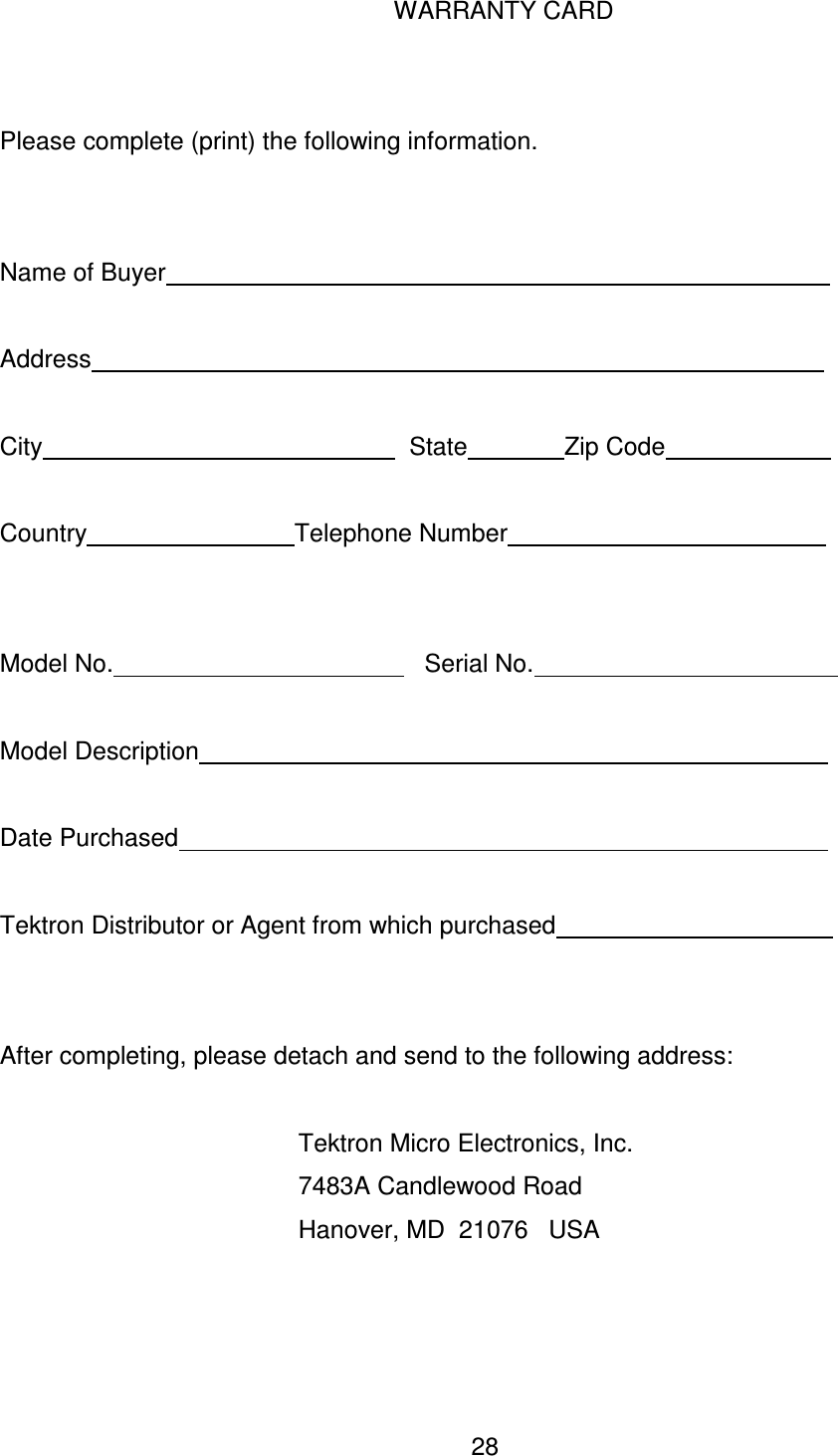
 28 WARRANTY CARD   Please complete (print) the following information.   Name of Buyer                                                                                                  Address                                                                                                            City                                                     State              Zip Code                            Country                              Telephone Number                                                     Model No.                                             Serial No.                                              Model Description                                                                                              Date Purchased                                                                                                 Tektron Distributor or Agent from which purchased                                                 After completing, please detach and send to the following address:          Tektron Micro Electronics, Inc.         7483A Candlewood Road         Hanover, MD  21076   USA

Navigation menu