Telonics SST901 Spread Spectrum Radio Modem User Manual SST 901 Manual Rev A

Telonics Inc Spread Spectrum Radio Modem SST 901 Manual Rev A

User Manual

     Model SST-901 Spread Spectrum Radio Modem User’s Guide  PB008915  Rev A    2011.10.27   TELEMETRY-ELECTRONICS CONSULTANTS 932 E. IMPALA AVENUE  MESA, ARIZONA 85204-6699 U.S.A. TEL (480) 892-4444  FAX (480) 892-9139 E-MAIL  info@telonics.com www.telonics.com  Copyright Notice Copyright  2011 Telonics, Inc. All Rights Reserved. No part of this publication may be copied without the express written permission of Telonics, Inc., 932 E. Impala Ave., Mesa, AZ 85204.
PB008915  Rev A    Page 2 of 8 TABLE OF CONTENTS  Model SST-901 .............................................................................................................................................1 Spread Spectrum Radio Modem ...................................................................................................................1 User’s Guide..................................................................................................................................................1 1. Notice to United States Users ...................................................................................................................3 2. Notice to Canadian Users .........................................................................................................................3 3. Product Overview ......................................................................................................................................4 4. Hardware Connections..............................................................................................................................4 4.1 RF Connection.....................................................................................................................................4 4.2 Power and Interface Connection .........................................................................................................4 4.2.1  Electrical characteristics for host interface signals ......................................................................6 4.2.2  Electrical characteristics for power supply inputs ........................................................................6 4.2.3  Timing Characteristics for host interface signals .........................................................................6 5. Physical Specifications..............................................................................................................................7 5.1 Module Dimensions .............................................................................................................................7 6. SST-901 SPECIFICATIONS .....................................................................................................................8
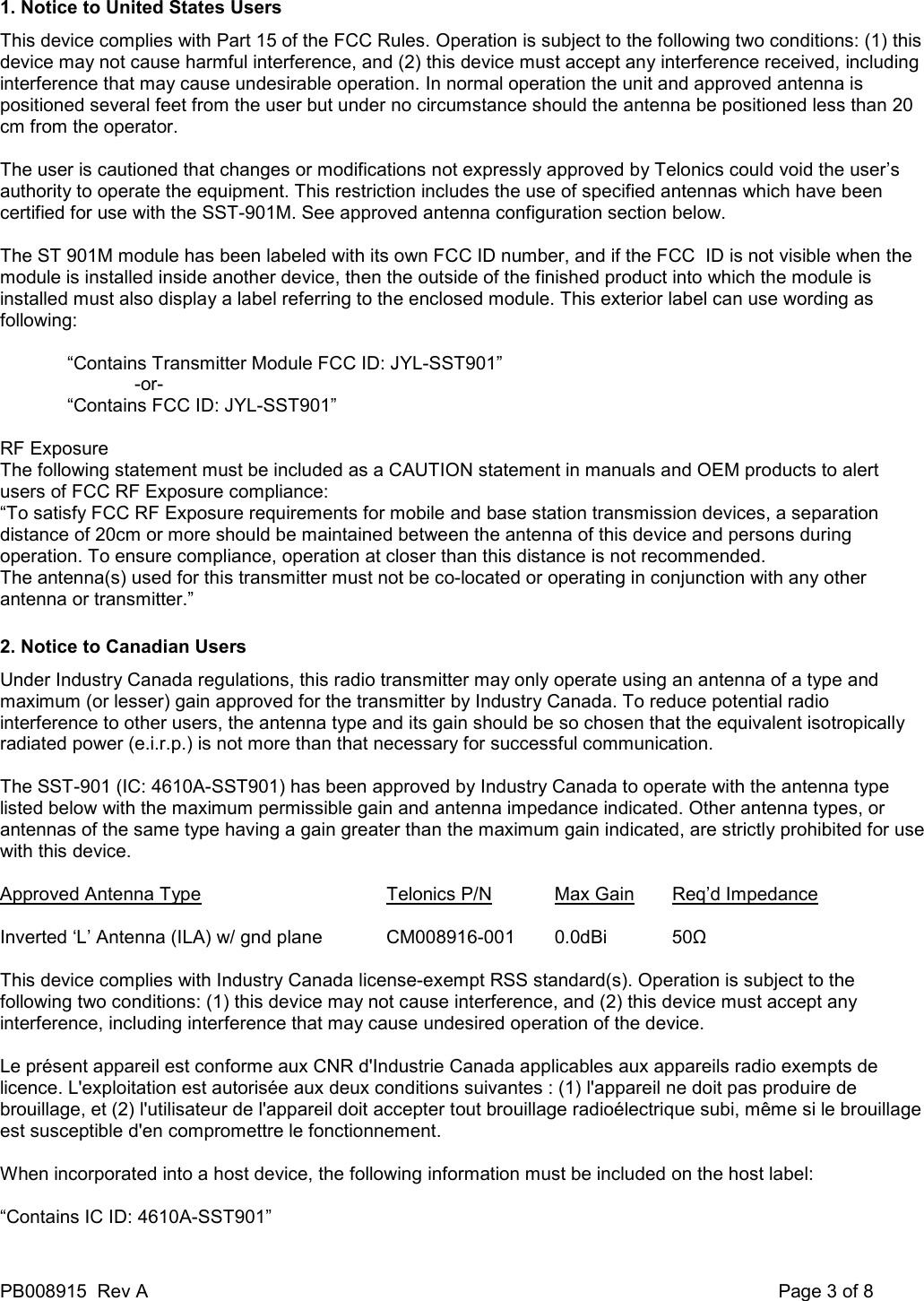
PB008915  Rev A    Page 3 of 8 1. Notice to United States Users This device complies with Part 15 of the FCC Rules. Operation is subject to the following two conditions: (1) this device may not cause harmful interference, and (2) this device must accept any interference received, including interference that may cause undesirable operation. In normal operation the unit and approved antenna is positioned several feet from the user but under no circumstance should the antenna be positioned less than 20 cm from the operator.  The user is cautioned that changes or modifications not expressly approved by Telonics could void the user’s authority to operate the equipment. This restriction includes the use of specified antennas which have been certified for use with the SST-901M. See approved antenna configuration section below.  The ST 901M module has been labeled with its own FCC ID number, and if the FCC  ID is not visible when the module is installed inside another device, then the outside of the finished product into which the module is installed must also display a label referring to the enclosed module. This exterior label can use wording as following:  “Contains Transmitter Module FCC ID: JYL-SST901” -or- “Contains FCC ID: JYL-SST901”  RF Exposure The following statement must be included as a CAUTION statement in manuals and OEM products to alert users of FCC RF Exposure compliance: “To satisfy FCC RF Exposure requirements for mobile and base station transmission devices, a separation distance of 20cm or more should be maintained between the antenna of this device and persons during operation. To ensure compliance, operation at closer than this distance is not recommended. The antenna(s) used for this transmitter must not be co-located or operating in conjunction with any other antenna or transmitter.” 2. Notice to Canadian Users Under Industry Canada regulations, this radio transmitter may only operate using an antenna of a type and maximum (or lesser) gain approved for the transmitter by Industry Canada. To reduce potential radio interference to other users, the antenna type and its gain should be so chosen that the equivalent isotropically radiated power (e.i.r.p.) is not more than that necessary for successful communication.  The SST-901 (IC: 4610A-SST901) has been approved by Industry Canada to operate with the antenna type listed below with the maximum permissible gain and antenna impedance indicated. Other antenna types, or antennas of the same type having a gain greater than the maximum gain indicated, are strictly prohibited for use with this device.  Approved Antenna Type    Telonics P/N  Max Gain  Req’d Impedance  Inverted ‘L’ Antenna (ILA) w/ gnd plane  CM008916-001  0.0dBi  50Ω  This device complies with Industry Canada license-exempt RSS standard(s). Operation is subject to the following two conditions: (1) this device may not cause interference, and (2) this device must accept any interference, including interference that may cause undesired operation of the device.  Le présent appareil est conforme aux CNR d'Industrie Canada applicables aux appareils radio exempts de licence. L'exploitation est autorisée aux deux conditions suivantes : (1) l'appareil ne doit pas produire de brouillage, et (2) l'utilisateur de l'appareil doit accepter tout brouillage radioélectrique subi, même si le brouillage est susceptible d'en compromettre le fonctionnement.  When incorporated into a host device, the following information must be included on the host label:  “Contains IC ID: 4610A-SST901”
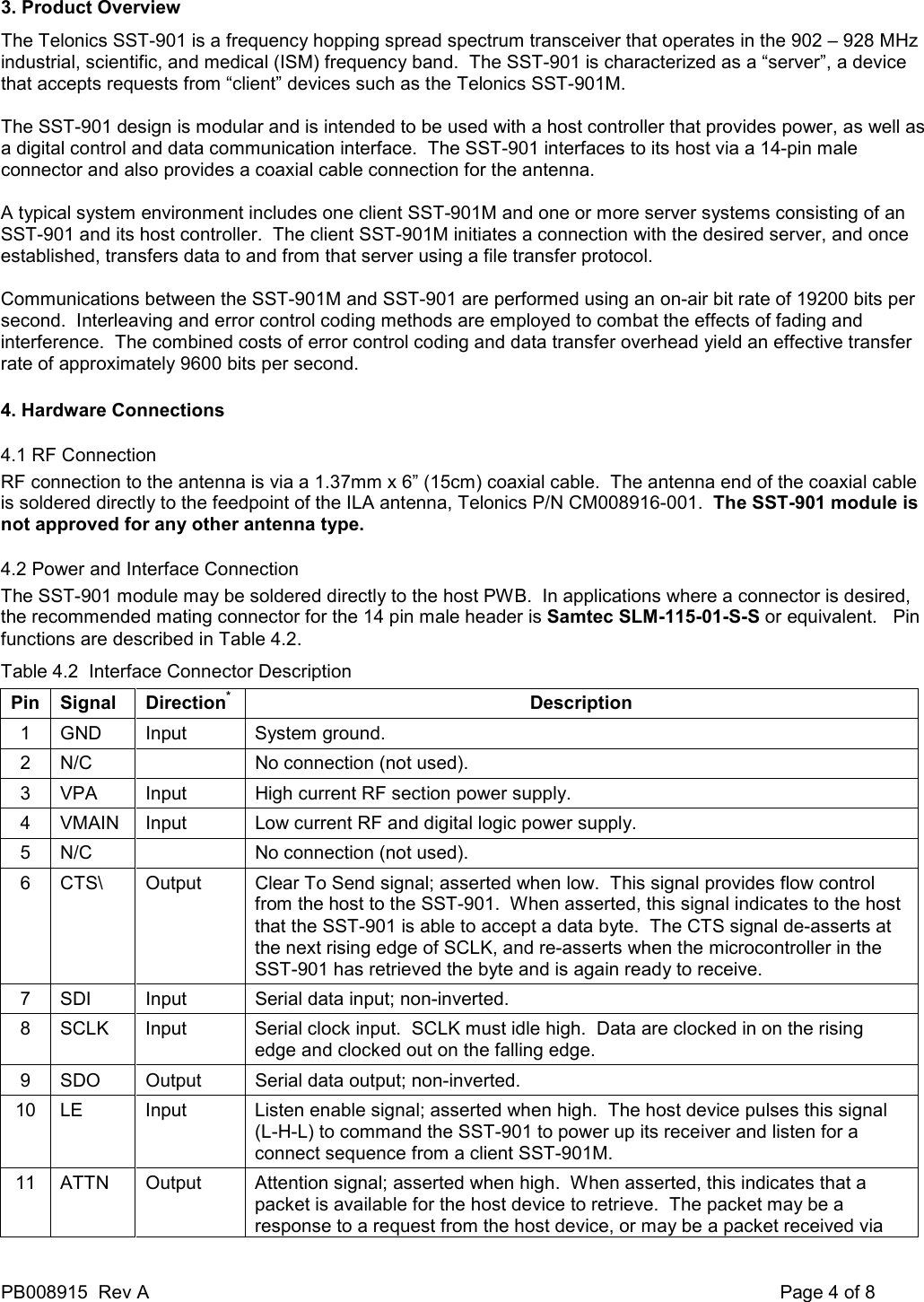
PB008915  Rev A    Page 4 of 8 3. Product Overview The Telonics SST-901 is a frequency hopping spread spectrum transceiver that operates in the 902 – 928 MHz industrial, scientific, and medical (ISM) frequency band.  The SST-901 is characterized as a “server”, a device that accepts requests from “client” devices such as the Telonics SST-901M.  The SST-901 design is modular and is intended to be used with a host controller that provides power, as well as a digital control and data communication interface.  The SST-901 interfaces to its host via a 14-pin male connector and also provides a coaxial cable connection for the antenna.  A typical system environment includes one client SST-901M and one or more server systems consisting of an SST-901 and its host controller.  The client SST-901M initiates a connection with the desired server, and once established, transfers data to and from that server using a file transfer protocol.  Communications between the SST-901M and SST-901 are performed using an on-air bit rate of 19200 bits per second.  Interleaving and error control coding methods are employed to combat the effects of fading and interference.  The combined costs of error control coding and data transfer overhead yield an effective transfer rate of approximately 9600 bits per second. 4. Hardware Connections 4.1 RF Connection RF connection to the antenna is via a 1.37mm x 6” (15cm) coaxial cable.  The antenna end of the coaxial cable is soldered directly to the feedpoint of the ILA antenna, Telonics P/N CM008916-001.  The SST-901 module is not approved for any other antenna type. 4.2 Power and Interface Connection The SST-901 module may be soldered directly to the host PWB.  In applications where a connector is desired, the recommended mating connector for the 14 pin male header is Samtec SLM-115-01-S-S or equivalent.   Pin functions are described in Table 4.2. Table 4.2  Interface Connector Description Pin Signal  Direction*  Description 1  GND  Input  System ground. 2  N/C    No connection (not used). 3  VPA  Input  High current RF section power supply.  4  VMAIN  Input  Low current RF and digital logic power supply. 5  N/C    No connection (not used). 6  CTS\  Output  Clear To Send signal; asserted when low.  This signal provides flow control from the host to the SST-901.  When asserted, this signal indicates to the host that the SST-901 is able to accept a data byte.  The CTS signal de-asserts at the next rising edge of SCLK, and re-asserts when the microcontroller in the SST-901 has retrieved the byte and is again ready to receive. 7  SDI  Input  Serial data input; non-inverted. 8  SCLK  Input  Serial clock input.  SCLK must idle high.  Data are clocked in on the rising edge and clocked out on the falling edge. 9  SDO  Output  Serial data output; non-inverted. 10  LE  Input  Listen enable signal; asserted when high.  The host device pulses this signal (L-H-L) to command the SST-901 to power up its receiver and listen for a connect sequence from a client SST-901M. 11  ATTN  Output  Attention signal; asserted when high.  When asserted, this indicates that a packet is available for the host device to retrieve.  The packet may be a response to a request from the host device, or may be a packet received via
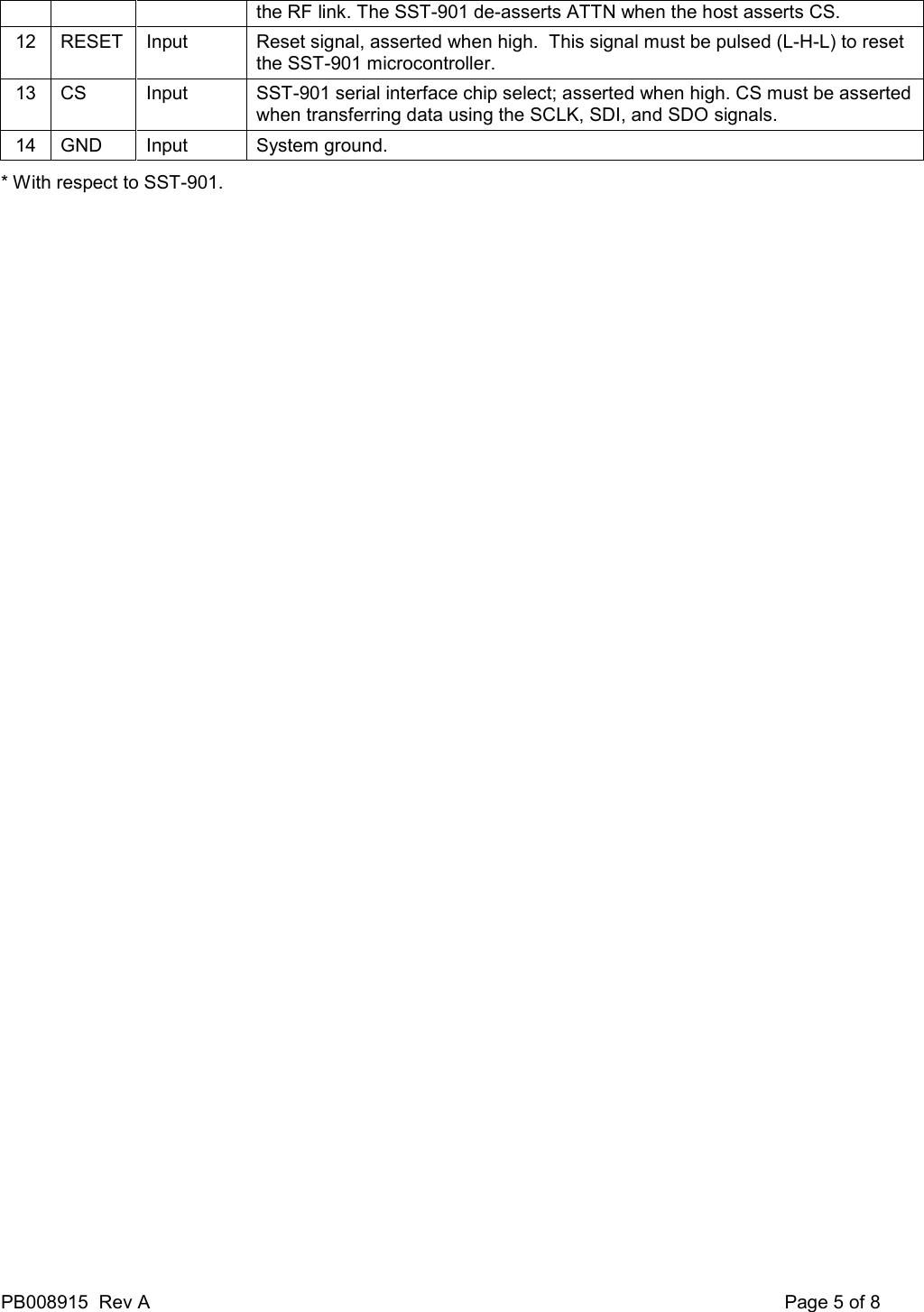
PB008915  Rev A    Page 5 of 8 the RF link. The SST-901 de-asserts ATTN when the host asserts CS. 12  RESET  Input  Reset signal, asserted when high.  This signal must be pulsed (L-H-L) to reset the SST-901 microcontroller. 13  CS  Input  SST-901 serial interface chip select; asserted when high. CS must be asserted when transferring data using the SCLK, SDI, and SDO signals. 14  GND  Input  System ground. * With respect to SST-901.
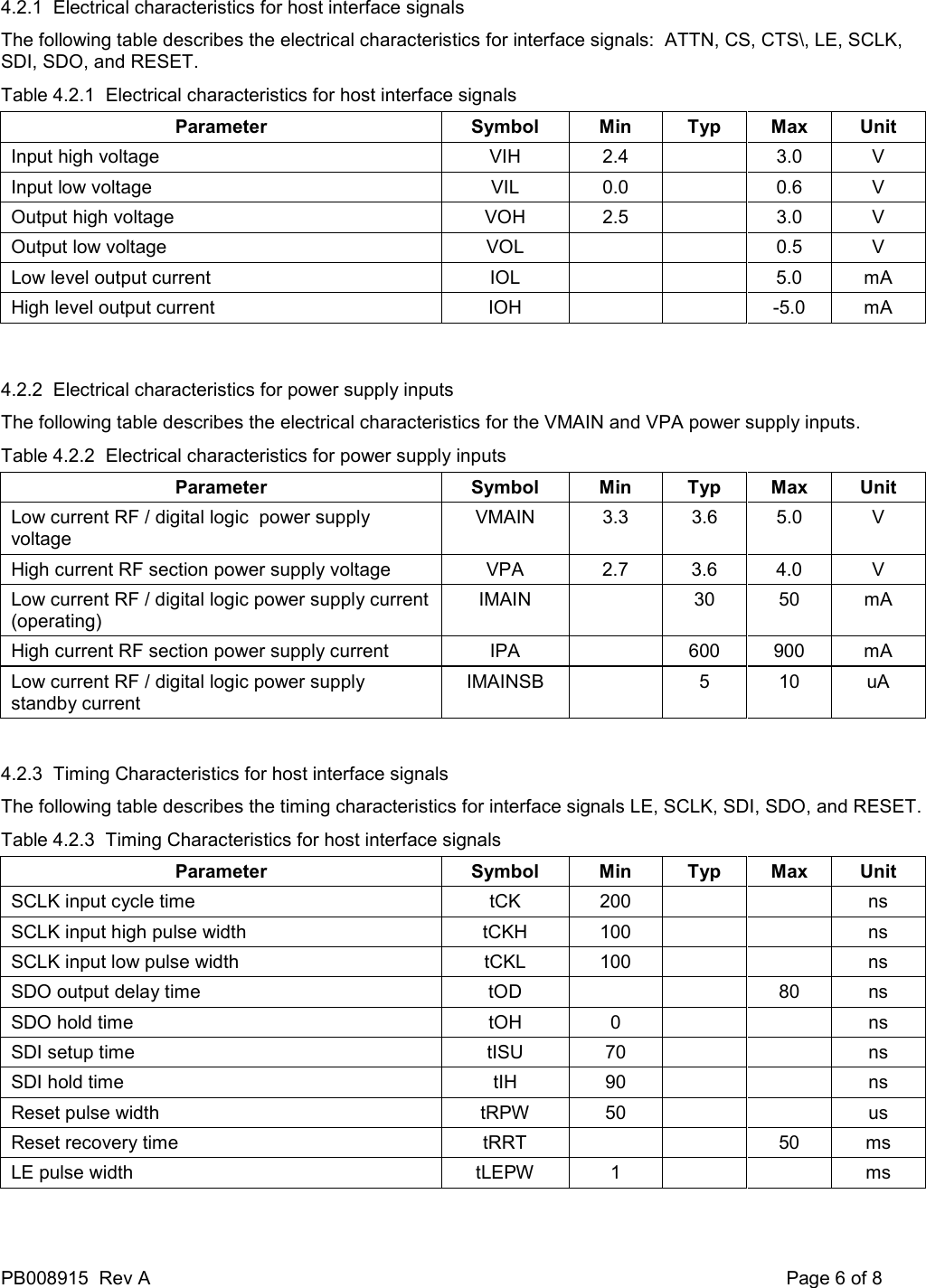
PB008915  Rev A    Page 6 of 8 4.2.1  Electrical characteristics for host interface signals The following table describes the electrical characteristics for interface signals:  ATTN, CS, CTS\, LE, SCLK, SDI, SDO, and RESET. Table 4.2.1  Electrical characteristics for host interface signals Parameter  Symbol  Min  Typ  Max  Unit Input high voltage  VIH  2.4    3.0  V Input low voltage  VIL  0.0    0.6  V Output high voltage  VOH  2.5    3.0  V Output low voltage  VOL      0.5  V Low level output current  IOL      5.0  mA High level output current  IOH      -5.0  mA  4.2.2  Electrical characteristics for power supply inputs The following table describes the electrical characteristics for the VMAIN and VPA power supply inputs. Table 4.2.2  Electrical characteristics for power supply inputs Parameter  Symbol  Min  Typ  Max  Unit Low current RF / digital logic  power supply voltage VMAIN  3.3  3.6  5.0  V High current RF section power supply voltage  VPA  2.7  3.6  4.0  V Low current RF / digital logic power supply current (operating) IMAIN    30  50  mA High current RF section power supply current  IPA    600  900  mA Low current RF / digital logic power supply standby current IMAINSB    5  10  uA  4.2.3  Timing Characteristics for host interface signals The following table describes the timing characteristics for interface signals LE, SCLK, SDI, SDO, and RESET. Table 4.2.3  Timing Characteristics for host interface signals Parameter  Symbol  Min  Typ  Max  Unit SCLK input cycle time  tCK  200      ns SCLK input high pulse width  tCKH  100      ns SCLK input low pulse width  tCKL  100      ns SDO output delay time  tOD      80  ns SDO hold time  tOH  0      ns SDI setup time  tISU  70      ns SDI hold time  tIH  90      ns Reset pulse width  tRPW  50      us Reset recovery time  tRRT      50  ms LE pulse width  tLEPW  1      ms
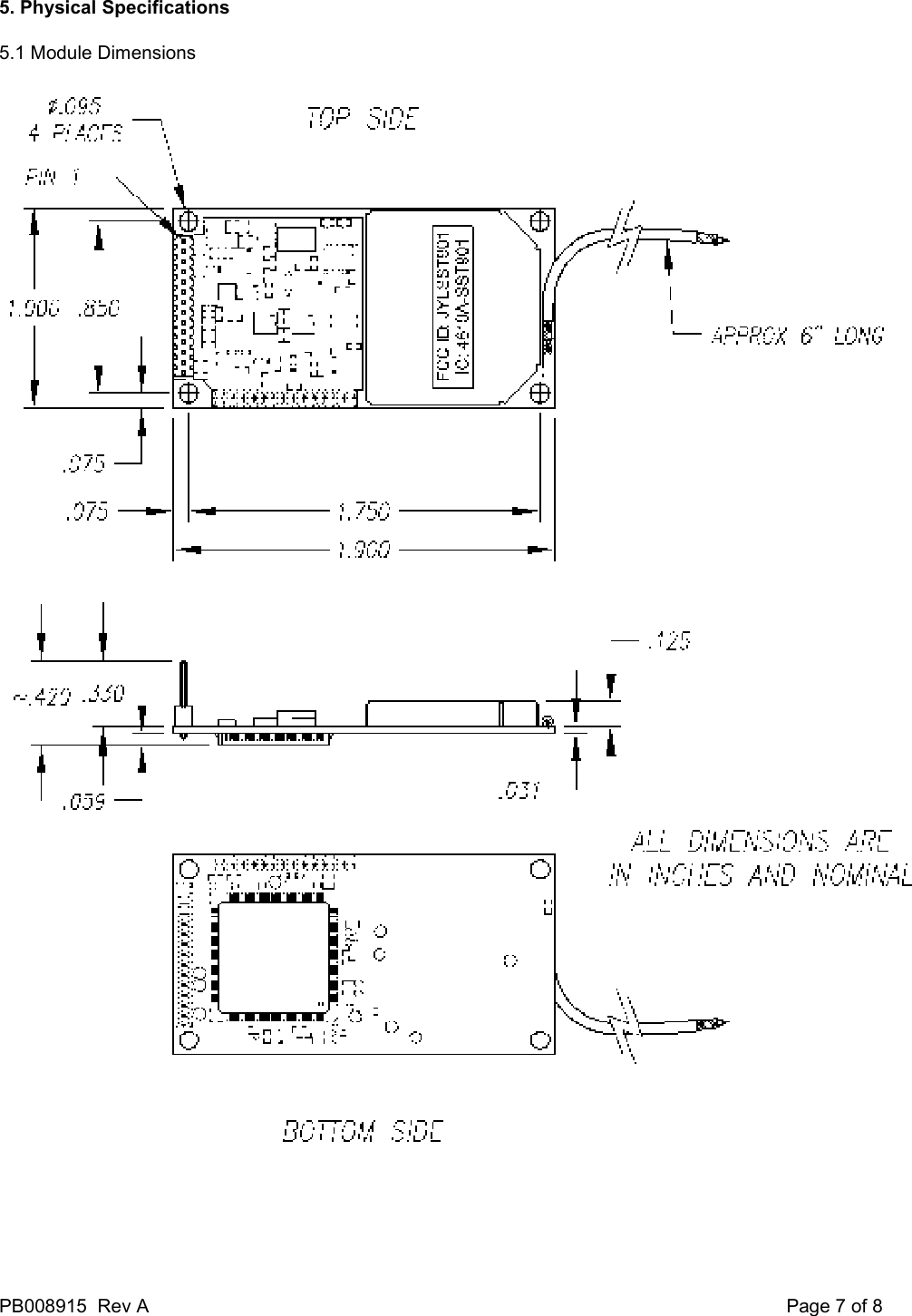
PB008915  Rev A    Page 7 of 8 5. Physical Specifications 5.1 Module Dimensions
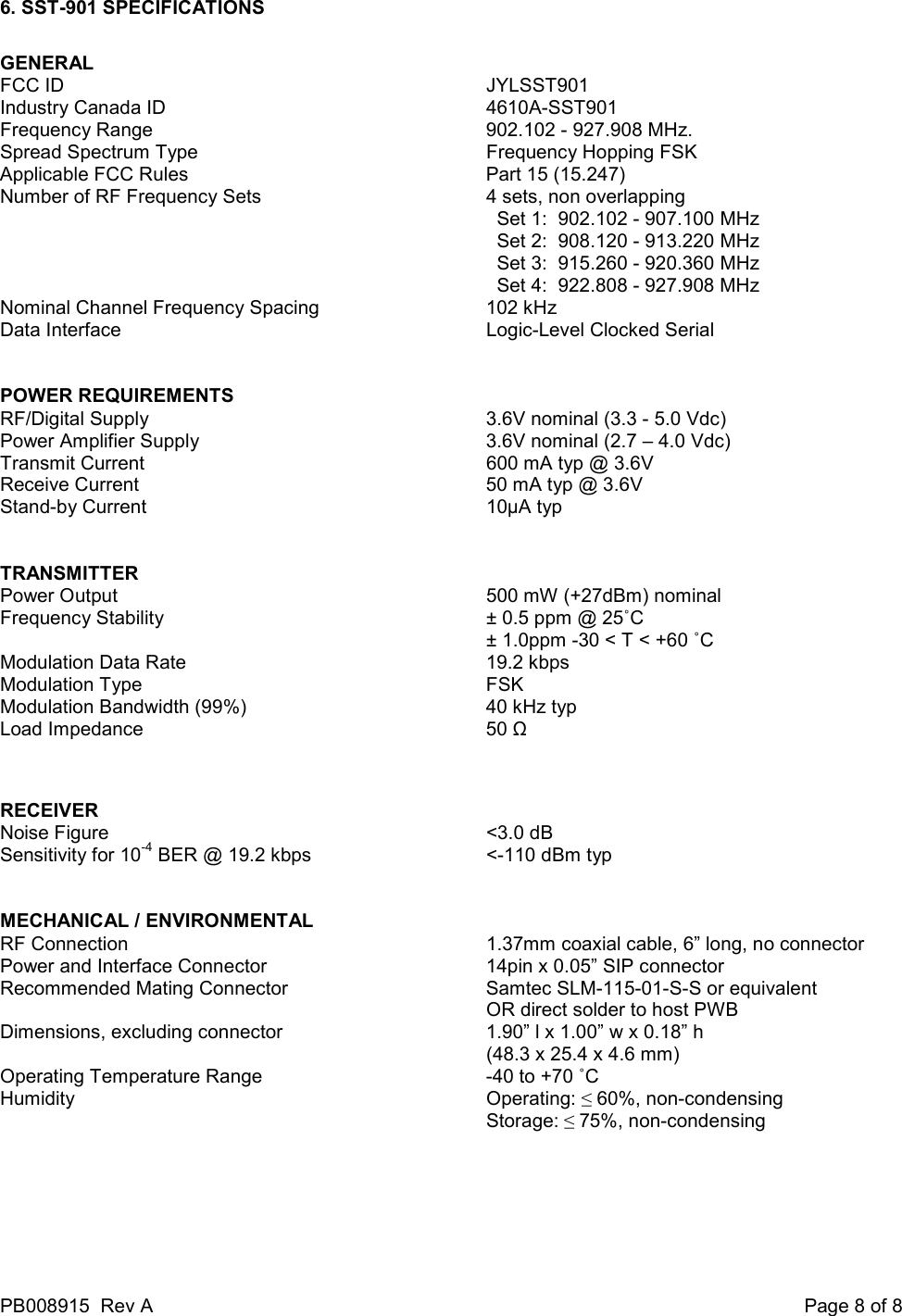
PB008915  Rev A    Page 8 of 8 6. SST-901 SPECIFICATIONS  GENERAL FCC ID              JYLSST901 Industry Canada ID          4610A-SST901 Frequency Range          902.102 - 927.908 MHz. Spread Spectrum Type          Frequency Hopping FSK Applicable FCC Rules          Part 15 (15.247) Number of RF Frequency Sets        4 sets, non overlapping    Set 1:  902.102 - 907.100 MHz   Set 2:  908.120 - 913.220 MHz   Set 3:  915.260 - 920.360 MHz   Set 4:  922.808 - 927.908 MHz  Nominal Channel Frequency Spacing      102 kHz Data Interface            Logic-Level Clocked Serial   POWER REQUIREMENTS RF/Digital Supply          3.6V nominal (3.3 - 5.0 Vdc) Power Amplifier Supply          3.6V nominal (2.7 – 4.0 Vdc) Transmit Current          600 mA typ @ 3.6V  Receive Current          50 mA typ @ 3.6V Stand-by Current          10µA typ   TRANSMITTER Power Output             500 mW (+27dBm) nominal Frequency Stability          ± 0.5 ppm @ 25˚C  ± 1.0ppm -30 < T < +60 ˚C Modulation Data Rate          19.2 kbps   Modulation Type          FSK Modulation Bandwidth (99%)        40 kHz typ Load Impedance          50 Ω   RECEIVER  Noise Figure            <3.0 dB Sensitivity for 10-4 BER @ 19.2 kbps      <-110 dBm typ   MECHANICAL / ENVIRONMENTAL RF Connection            1.37mm coaxial cable, 6” long, no connector Power and Interface Connector        14pin x 0.05” SIP connector Recommended Mating Connector      Samtec SLM-115-01-S-S or equivalent OR direct solder to host PWB Dimensions, excluding connector      1.90” l x 1.00” w x 0.18” h               (48.3 x 25.4 x 4.6 mm) Operating Temperature Range        -40 to +70 ˚C   Humidity            Operating: ≤ 60%, non-condensing               Storage: ≤ 75%, non-condensing

Navigation menu