Vios Medical CS2050 Vios Monitoring System (VMS) User Manual

Vios Medical Inc Vios Monitoring System (VMS)

User manual

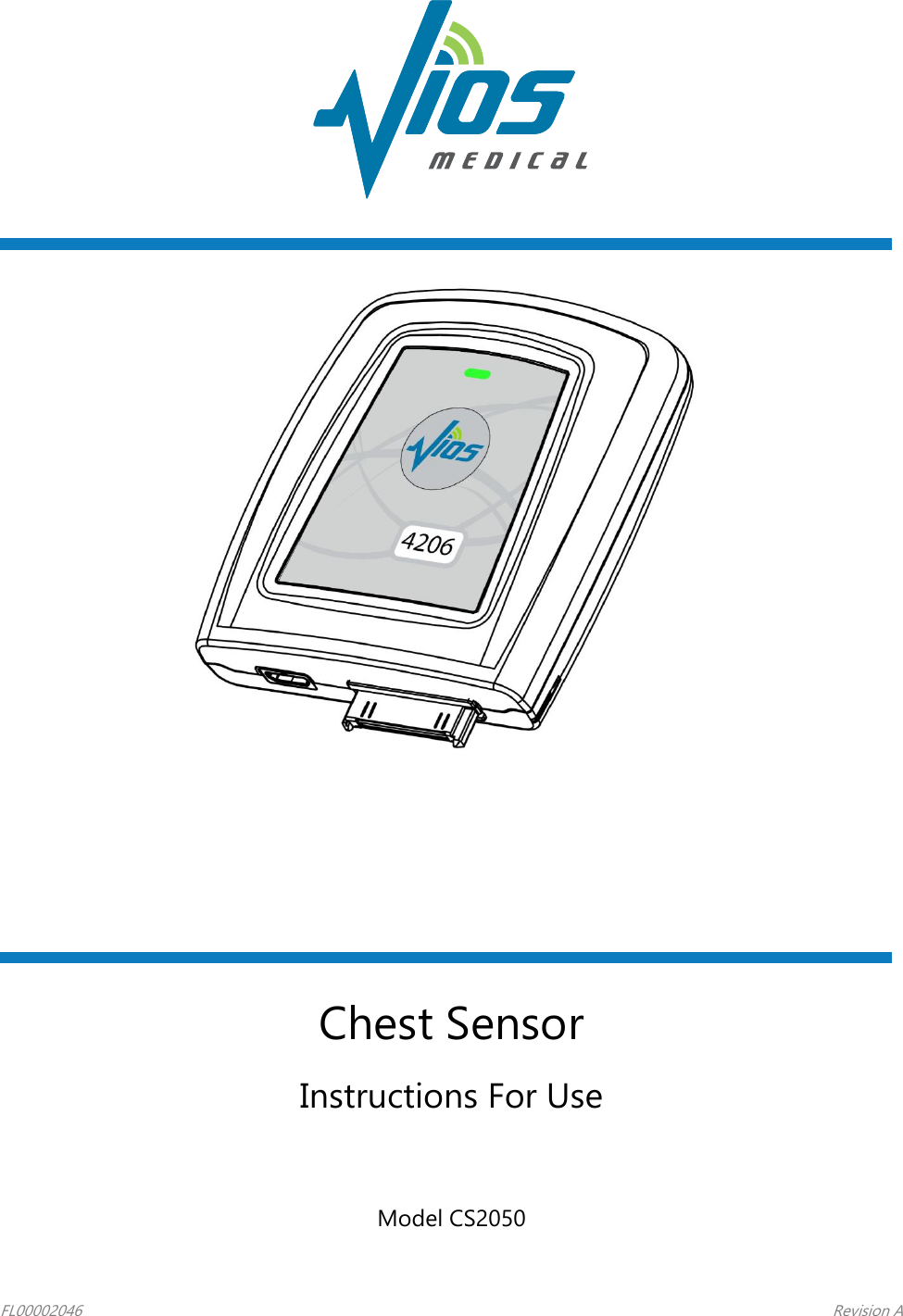
FL00002046     Revision A          Chest Sensor Instructions For Use  Model CS2050
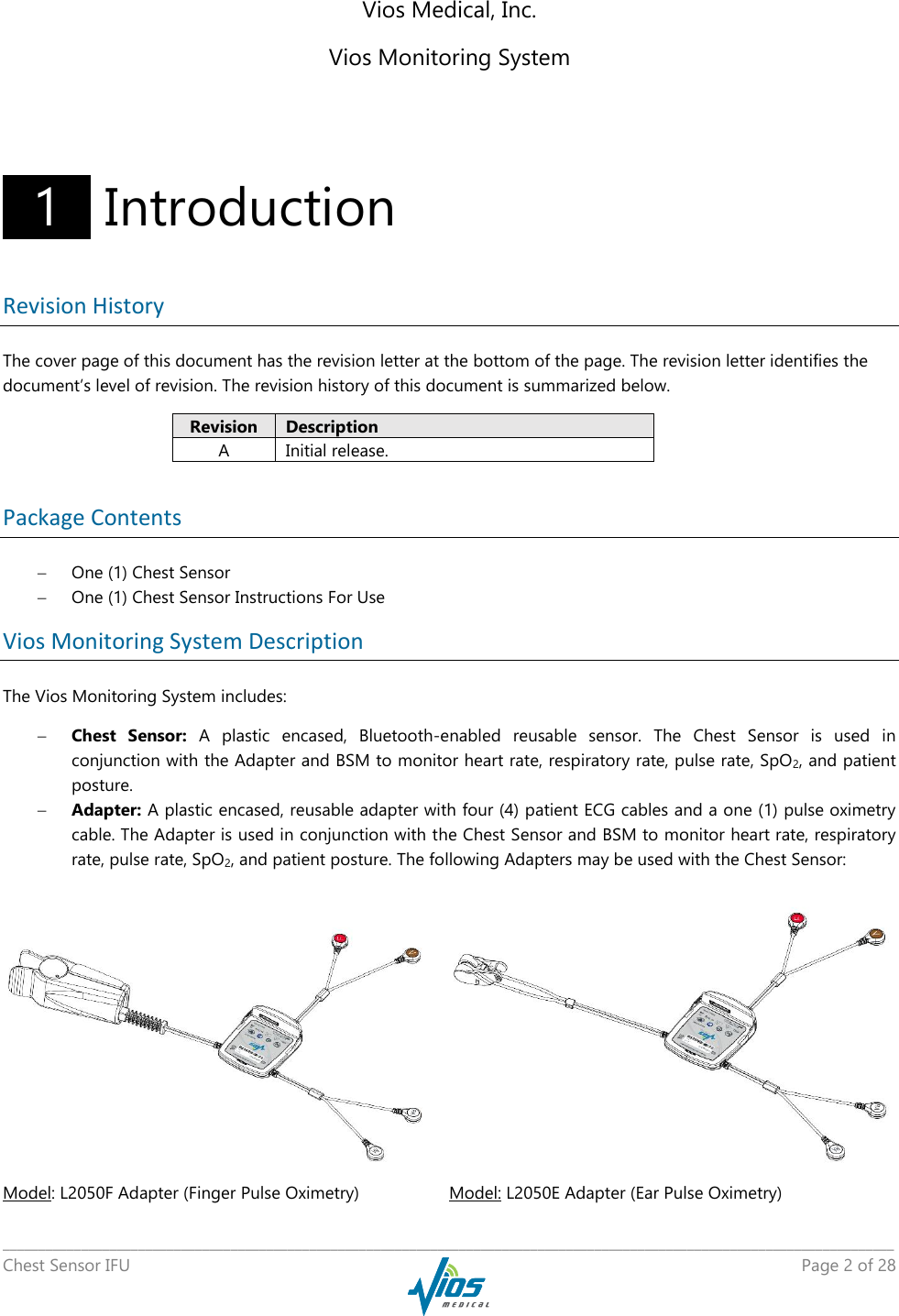
  _____________________________________________________________________________________________________________________________ Chest Sensor IFU    Page 2 of 28  Vios Medical, Inc. Vios Monitoring System    1   Introduction Revision History The cover page of this document has the revision letter at the bottom of the page. The revision letter identifies the document’s level of revision. The revision history of this document is summarized below. Revision Description A Initial release.  Package Contents  One (1) Chest Sensor  One (1) Chest Sensor Instructions For Use Vios Monitoring System Description The Vios Monitoring System includes:  Chest  Sensor:  A  plastic  encased,  Bluetooth-enabled  reusable  sensor.  The  Chest  Sensor  is  used  in conjunction with the Adapter and BSM to monitor heart rate, respiratory rate, pulse rate, SpO2, and patient posture.  Adapter: A plastic encased, reusable adapter with four (4) patient ECG cables and a one (1) pulse oximetry cable. The Adapter is used in conjunction with the Chest Sensor and BSM to monitor heart rate, respiratory rate, pulse rate, SpO2, and patient posture. The following Adapters may be used with the Chest Sensor:   Model: L2050F Adapter (Finger Pulse Oximetry) Model: L2050E Adapter (Ear Pulse Oximetry)
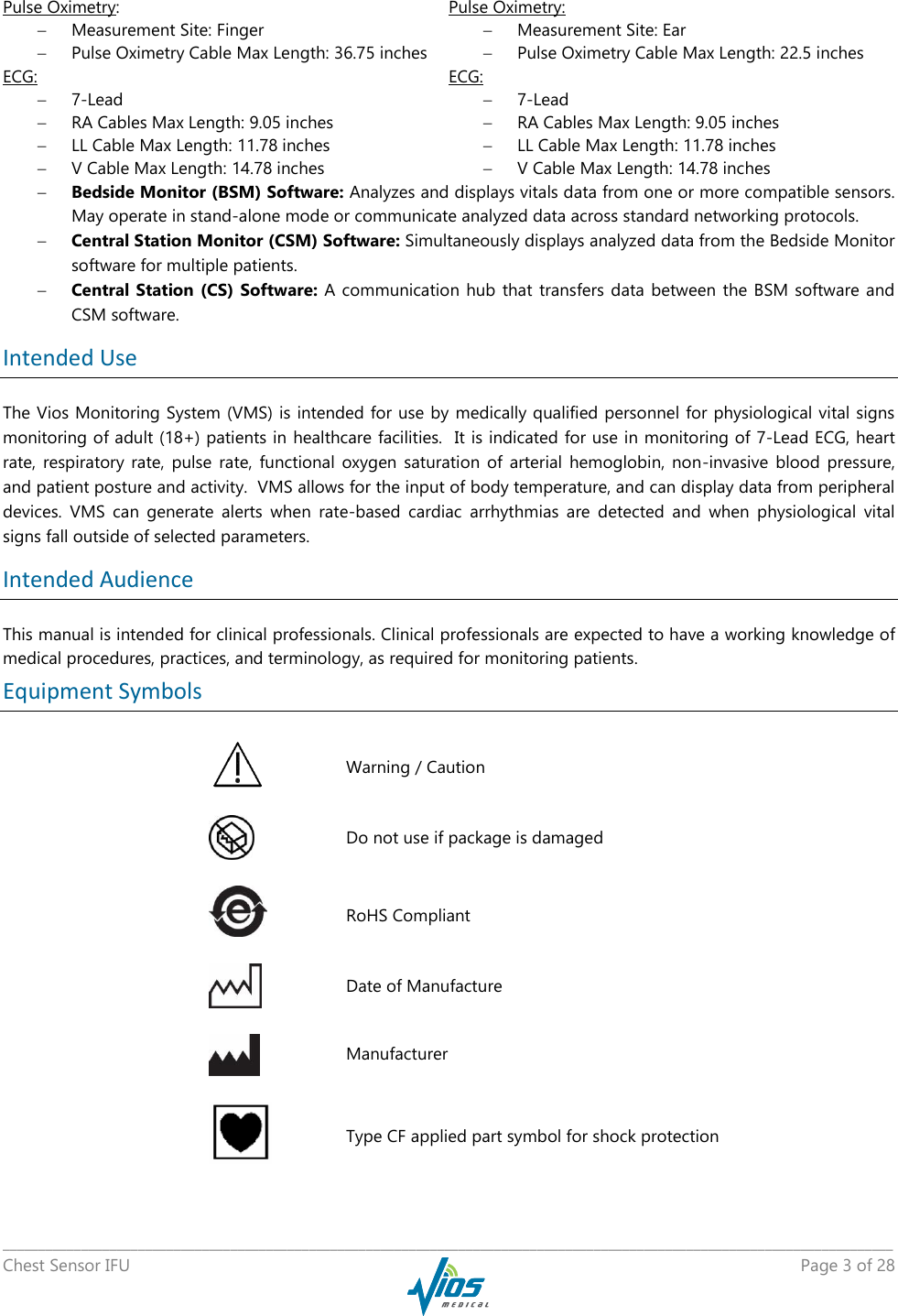
  _____________________________________________________________________________________________________________________________ Chest Sensor IFU    Page 3 of 28  Pulse Oximetry:  Measurement Site: Finger   Pulse Oximetry Cable Max Length: 36.75 inches Pulse Oximetry:  Measurement Site: Ear   Pulse Oximetry Cable Max Length: 22.5 inches ECG:   7-Lead  RA Cables Max Length: 9.05 inches  LL Cable Max Length: 11.78 inches  V Cable Max Length: 14.78 inches ECG:   7-Lead  RA Cables Max Length: 9.05 inches  LL Cable Max Length: 11.78 inches  V Cable Max Length: 14.78 inches  Bedside Monitor (BSM) Software: Analyzes and displays vitals data from one or more compatible sensors. May operate in stand-alone mode or communicate analyzed data across standard networking protocols.  Central Station Monitor (CSM) Software: Simultaneously displays analyzed data from the Bedside Monitor software for multiple patients.   Central Station (CS) Software: A communication hub that  transfers data  between the BSM software and CSM software. Intended Use The Vios Monitoring System (VMS) is intended for use by medically qualified personnel for physiological vital signs monitoring of adult (18+) patients in healthcare facilities.  It is indicated for use in monitoring of 7-Lead ECG, heart rate,  respiratory  rate,  pulse  rate,  functional  oxygen  saturation  of  arterial  hemoglobin,  non-invasive  blood  pressure, and patient posture and activity.  VMS allows for the input of body temperature, and can display data from peripheral devices.  VMS  can  generate  alerts  when  rate-based  cardiac  arrhythmias  are  detected  and  when  physiological  vital signs fall outside of selected parameters. Intended Audience This manual is intended for clinical professionals. Clinical professionals are expected to have a working knowledge of medical procedures, practices, and terminology, as required for monitoring patients. Equipment Symbols     Warning / Caution     Do not use if package is damaged     RoHS Compliant     Date of Manufacture     Manufacturer    Type CF applied part symbol for shock protection
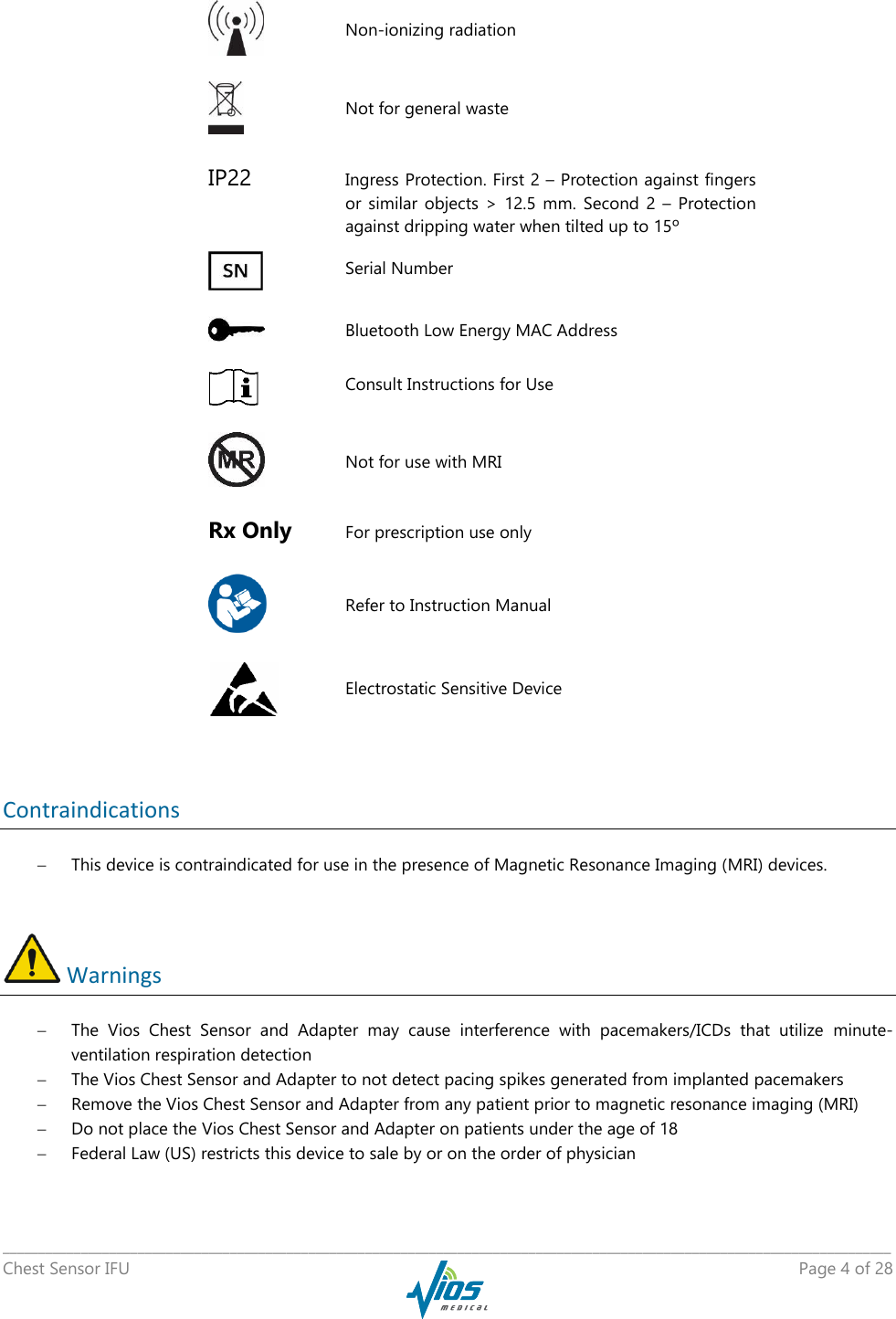
  _____________________________________________________________________________________________________________________________ Chest Sensor IFU    Page 4 of 28      Non-ionizing radiation     Not for general waste IP22  Ingress Protection. First 2 – Protection against fingers or  similar  objects  >  12.5  mm.  Second  2  –  Protection against dripping water when tilted up to 15º     Serial Number     Bluetooth Low Energy MAC Address      Consult Instructions for Use     Not for use with MRI Rx Only For prescription use only     Refer to Instruction Manual  Electrostatic Sensitive Device  Contraindications  This device is contraindicated for use in the presence of Magnetic Resonance Imaging (MRI) devices.   Warnings  The  Vios  Chest  Sensor  and  Adapter  may  cause  interference  with  pacemakers/ICDs  that  utilize  minute-ventilation respiration detection  The Vios Chest Sensor and Adapter to not detect pacing spikes generated from implanted pacemakers  Remove the Vios Chest Sensor and Adapter from any patient prior to magnetic resonance imaging (MRI)  Do not place the Vios Chest Sensor and Adapter on patients under the age of 18  Federal Law (US) restricts this device to sale by or on the order of physician
  _____________________________________________________________________________________________________________________________ Chest Sensor IFU    Page 5 of 28   Do not apply the Vios Chest Sensor, Adapter, or electrodes on breached or compromised skin surfaces or on mucosal membranes  Vios Medical recommends using Medico Electrodes MSGST-06 to adhere the Adapter and Chest Sensor to the patient  No modification of this equipment internal or external is allowed  Do not destroy this equipment without authorization of the manufacturer.  Hazards can result from unauthorized modification of the equipment.  If this  equipment is  modified,  appropriate inspection  and testing must  be conducted  to  ensure continued safe use of the equipment.  Pins  of  connectors  identified  with  the  ESD  warning  symbol  should  not  be  should  and  that  connections should not be made to these connectors unless ESD precautionary procedures are used.  This equipment is intended for use by healthcare professionals only. This equipment/system may cause radio interference  or  may  disrupt  the  operation  of  nearby  equipment.  It  may  be  necessary  to  take  mitigation measures, such as re-orientating or relocating the ME equipment or shielding the location.  Use of adaptor, cables other than those specified, may result in increased emissions or decreased immunity.  The CS2050 should not be worn and used adjacent to another wireless device such as mobile phone.  Cautions  The Vios Chest Sensor is a Bluetooth® low energy (BLE) device and should not be used in BLE sensitive areas  The Vios Chest Sensor is a radio frequency (RF) emission device. Remove all components of the Vios Bedside Monitoring System in radio frequency sensitive areas.  The  VMS  should  not  be  used  near  direct  X-ray  exposure.  The  Vios  Chest  Sensor  and  Adapter  must  be removed from a patient prior to an upper torso X-ray  The VMS should not be used near X-ray computed tomography (CT) equipment. The Vios Chest Sensor and Adapter must be removed from patient prior to a CT scan  Never autoclave, sterilize, or immerse the Chest Sensor in liquid of any kind  The following may degrade pulse oximeter performance: o Excessive ambient light o Excessive motion o Improperly applied sensor o Residue (e.g. dirt, dried blood) in the optical path o Blood pressure cuffs o Fingernail polish Notes: The following notice safety messages apply to this monitoring system.  If VMS components have been transported or stored outside operating temperature, allow them to stabilize back to the operating temperature range before use.  Portable and mobile RF communications equipment can affect the Chest Sensor and its communication with the VMS.  Service and repairs are allowed for authorized Vios personnel only.  The Chest Sensor is Internally Powered ME Equipment per IEC 60601-1 
  _____________________________________________________________________________________________________________________________ Chest Sensor IFU    Page 6 of 28   FCC Compliance  FCC compliance statements,   This Device complies with part 15 of the FCC Rules. Operation is subject to the following two conditions:  (1) This device may not cause harmful interference, and  (2) This device must accept any interference received, this including interference that may cause undesired operation. FCC Caution!!! • Any changes or modifications not expressly approved by the party Responsible for compliance could void the user's authority to operate this Equipment Part 15B compliance statements for digital devices: NOTE: This equipment has been tested and found to comply with the limits for a  Class  B digital  device, pursuant  to part  15  of  the  FCC  Rules. These limits  are  designed  to  provide  reasonable protection against harmful interference in a residential installation. This equipment generates, uses and can radiate radio frequency energy And, if not installed and used in accordance with the instructions, may Cause harmful interference to radio communications. However, there is no Guarantee that interference will not occur in a particular installation. If this equipment does cause harmful interference to radio or television Reception, which can be determined by turning the equipment off and on, The user is encouraged to try to correct the interference by one or more of The following measures: —Reorient or relocate the receiving antenna. —Increase the separation between the equipment and receiver. —Connect the equipment into an outlet on a circuit different from that to Which the receiver is connected —Consult the dealer or an experienced radio/TV technician for help
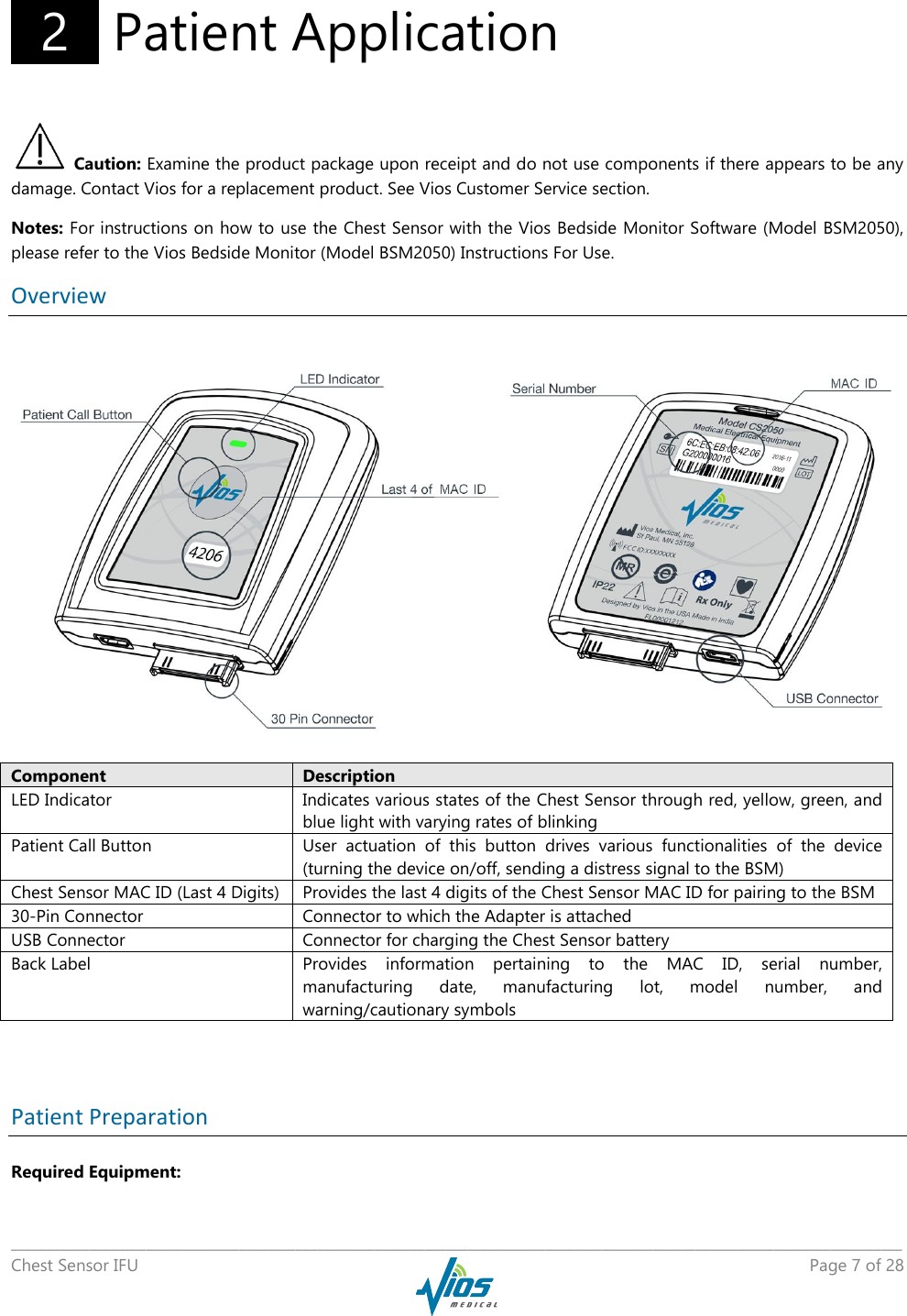
  _____________________________________________________________________________________________________________________________ Chest Sensor IFU    Page 7 of 28    2   Patient Application  Caution: Examine the product package upon receipt and do not use components if there appears to be any damage. Contact Vios for a replacement product. See Vios Customer Service section. Notes: For instructions on how to use the Chest Sensor with the Vios Bedside Monitor Software (Model BSM2050), please refer to the Vios Bedside Monitor (Model BSM2050) Instructions For Use. Overview  Component Description LED Indicator Indicates various states of the Chest Sensor through red, yellow, green, and blue light with varying rates of blinking Patient Call Button User  actuation  of  this  button  drives  various  functionalities  of  the  device (turning the device on/off, sending a distress signal to the BSM) Chest Sensor MAC ID (Last 4 Digits) Provides the last 4 digits of the Chest Sensor MAC ID for pairing to the BSM 30-Pin Connector Connector to which the Adapter is attached USB Connector Connector for charging the Chest Sensor battery Back Label Provides  information  pertaining  to  the  MAC  ID,  serial  number, manufacturing  date,  manufacturing  lot,  model  number,  and warning/cautionary symbols   Patient Preparation Required Equipment:
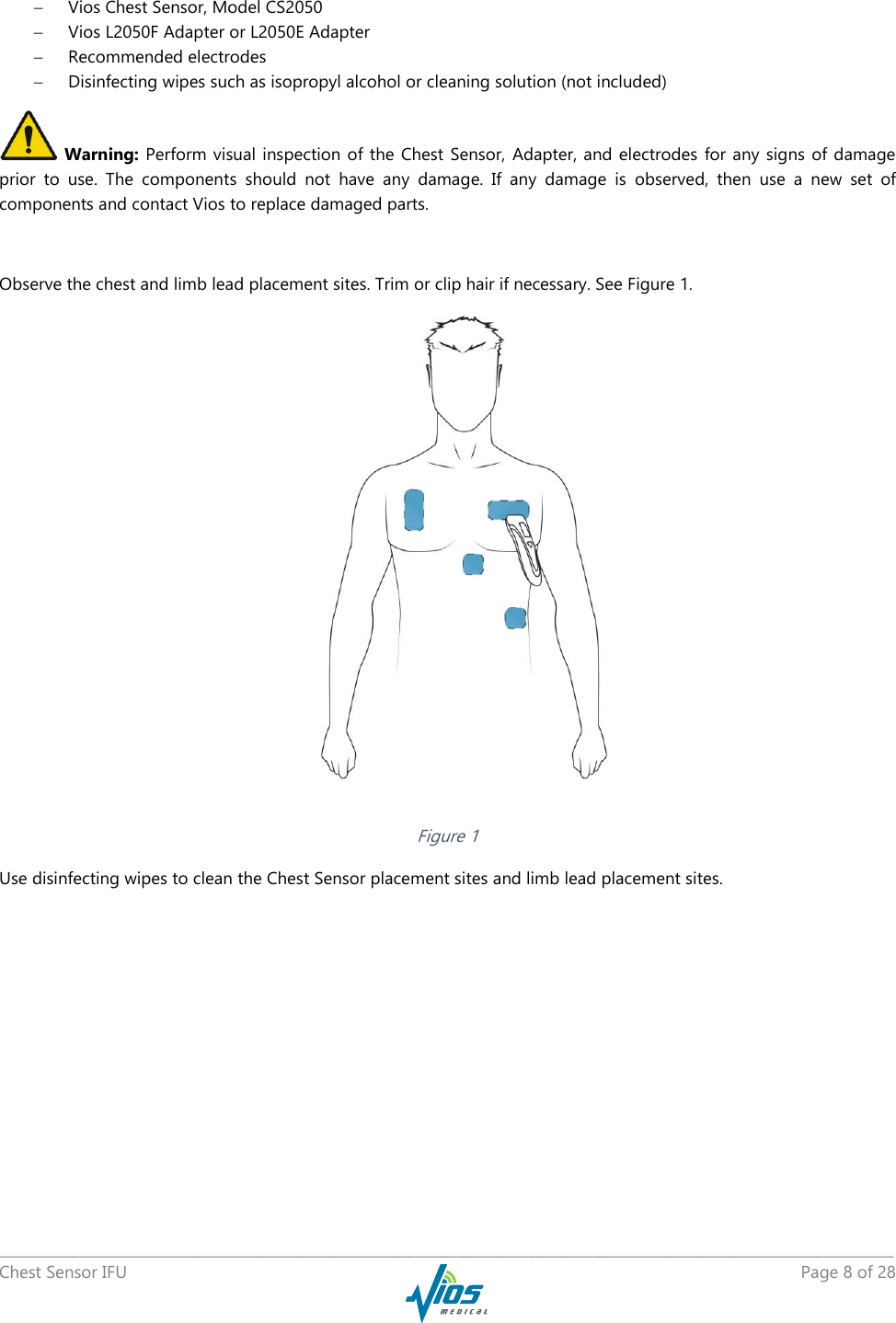
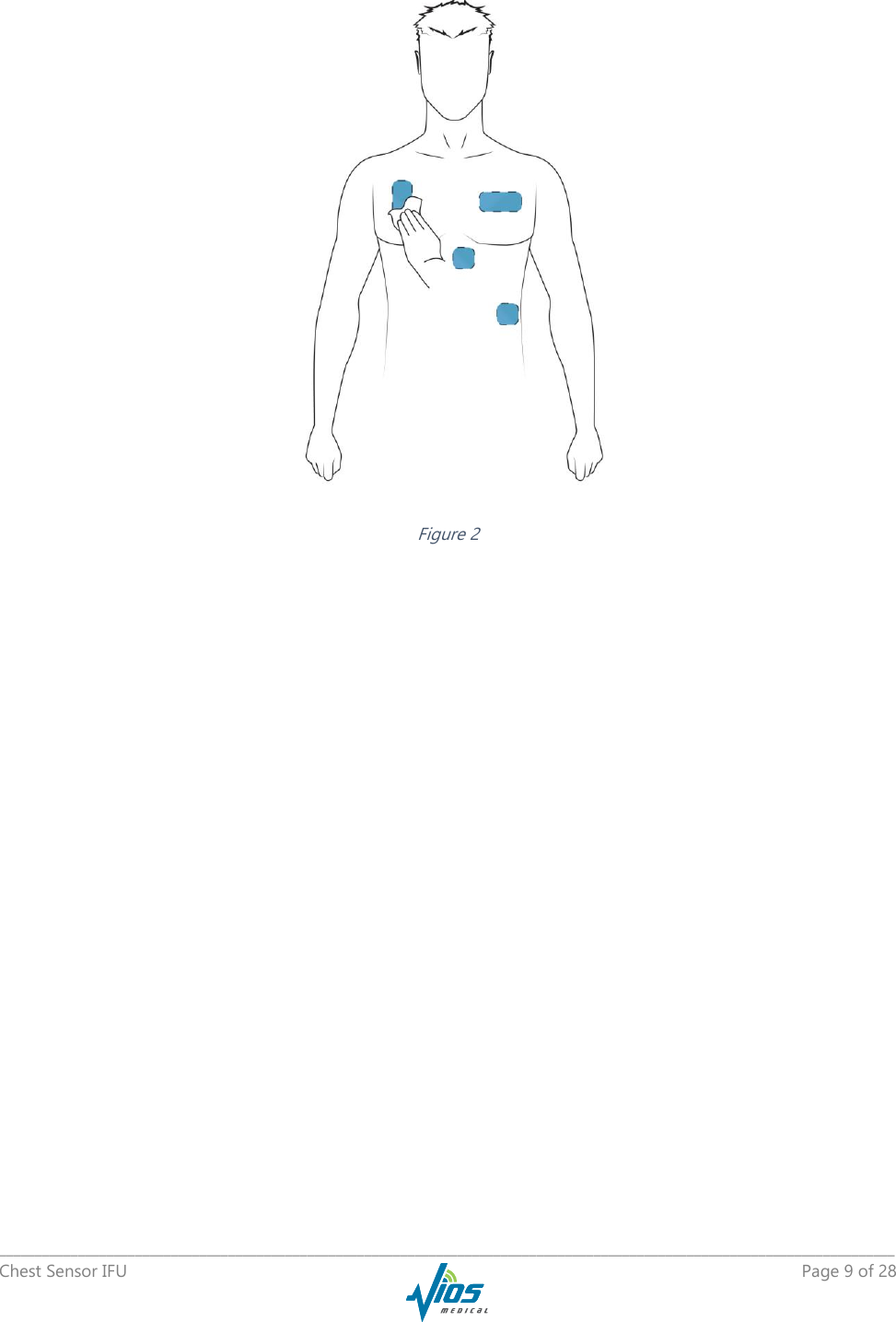
  _____________________________________________________________________________________________________________________________ Chest Sensor IFU    Page 8 of 28   Vios Chest Sensor, Model CS2050  Vios L2050F Adapter or L2050E Adapter  Recommended electrodes  Disinfecting wipes such as isopropyl alcohol or cleaning solution (not included)  Warning: Perform  visual inspection of the  Chest Sensor,  Adapter, and electrodes  for any  signs of damage prior  to  use.  The  components  should  not  have  any  damage.  If  any  damage  is  observed,  then  use  a  new  set  of components and contact Vios to replace damaged parts.  Observe the chest and limb lead placement sites. Trim or clip hair if necessary. See Figure 1.  Figure 1 Use disinfecting wipes to clean the Chest Sensor placement sites and limb lead placement sites.
  _____________________________________________________________________________________________________________________________ Chest Sensor IFU    Page 9 of 28   Figure 2
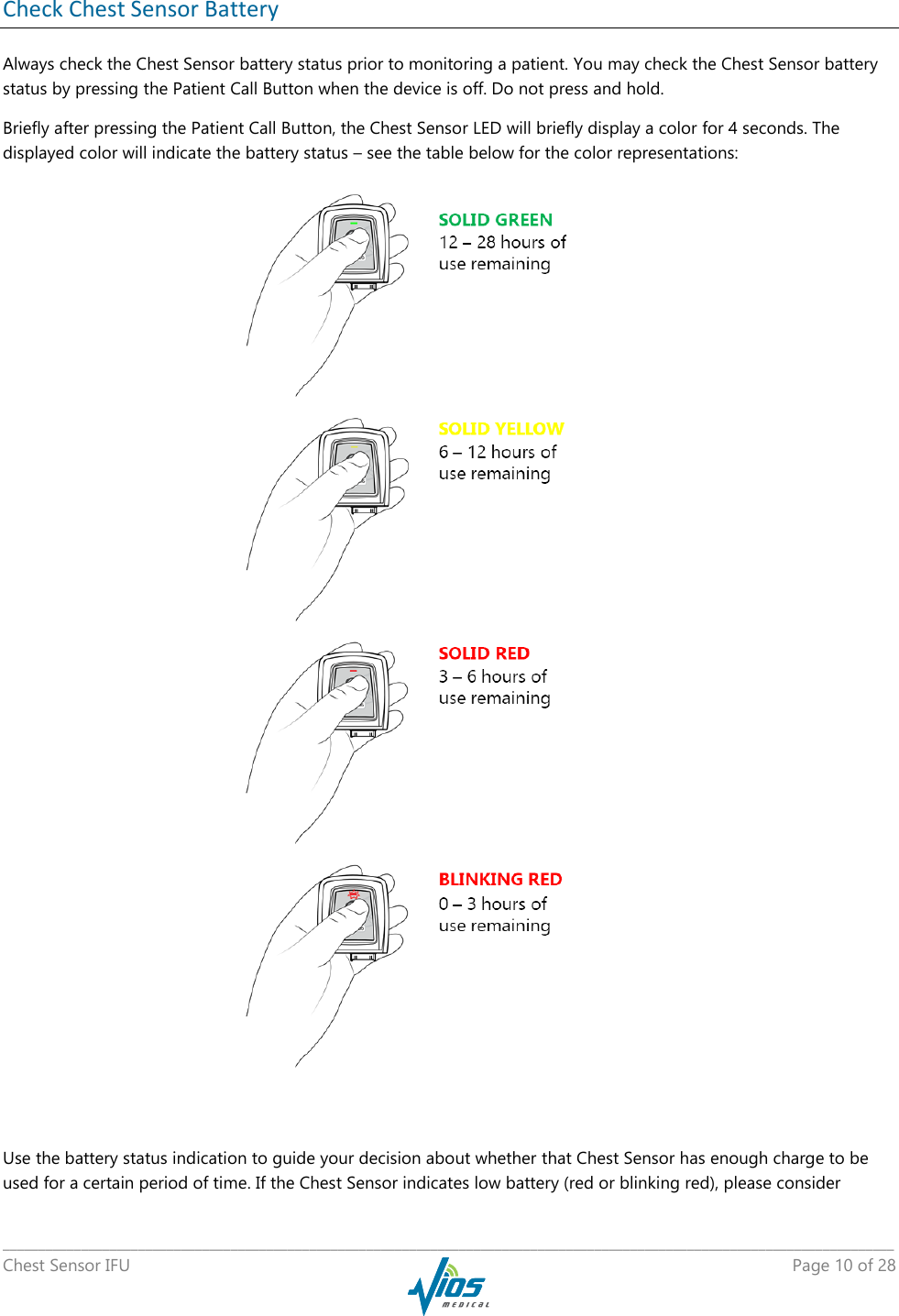
  _____________________________________________________________________________________________________________________________ Chest Sensor IFU    Page 10 of 28  Check Chest Sensor Battery  Always check the Chest Sensor battery status prior to monitoring a patient. You may check the Chest Sensor battery status by pressing the Patient Call Button when the device is off. Do not press and hold. Briefly after pressing the Patient Call Button, the Chest Sensor LED will briefly display a color for 4 seconds. The displayed color will indicate the battery status – see the table below for the color representations:  Use the battery status indication to guide your decision about whether that Chest Sensor has enough charge to be used for a certain period of time. If the Chest Sensor indicates low battery (red or blinking red), please consider
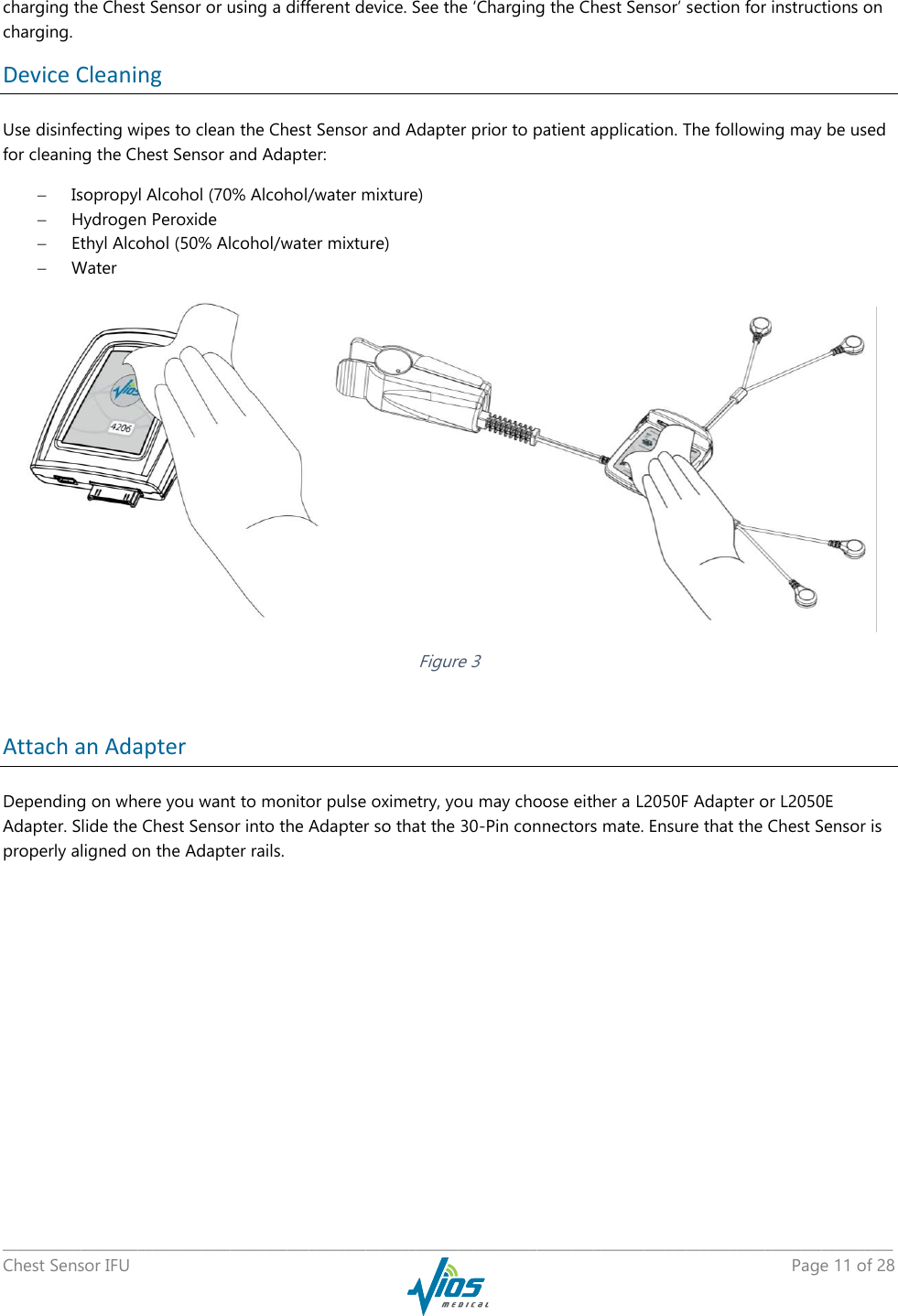
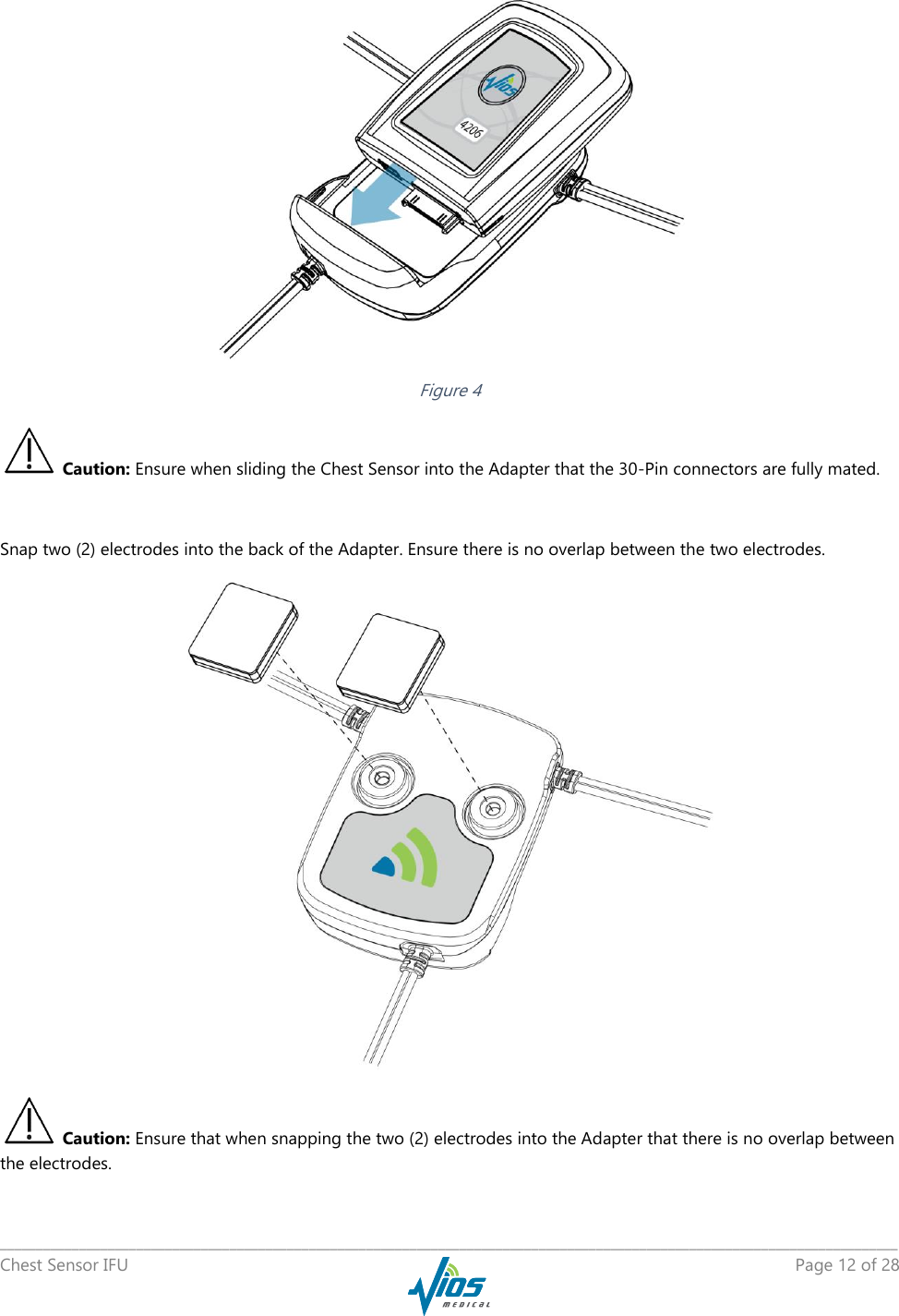
  _____________________________________________________________________________________________________________________________ Chest Sensor IFU    Page 11 of 28  charging the Chest Sensor or using a different device. See the ‘Charging the Chest Sensor’ section for instructions on charging. Device Cleaning Use disinfecting wipes to clean the Chest Sensor and Adapter prior to patient application. The following may be used for cleaning the Chest Sensor and Adapter:  Isopropyl Alcohol (70% Alcohol/water mixture)  Hydrogen Peroxide  Ethyl Alcohol (50% Alcohol/water mixture)  Water    Figure 3  Attach an Adapter Depending on where you want to monitor pulse oximetry, you may choose either a L2050F Adapter or L2050E Adapter. Slide the Chest Sensor into the Adapter so that the 30-Pin connectors mate. Ensure that the Chest Sensor is properly aligned on the Adapter rails.
  _____________________________________________________________________________________________________________________________ Chest Sensor IFU    Page 12 of 28   Figure 4  Caution: Ensure when sliding the Chest Sensor into the Adapter that the 30-Pin connectors are fully mated.  Snap two (2) electrodes into the back of the Adapter. Ensure there is no overlap between the two electrodes.    Caution: Ensure that when snapping the two (2) electrodes into the Adapter that there is no overlap between the electrodes.
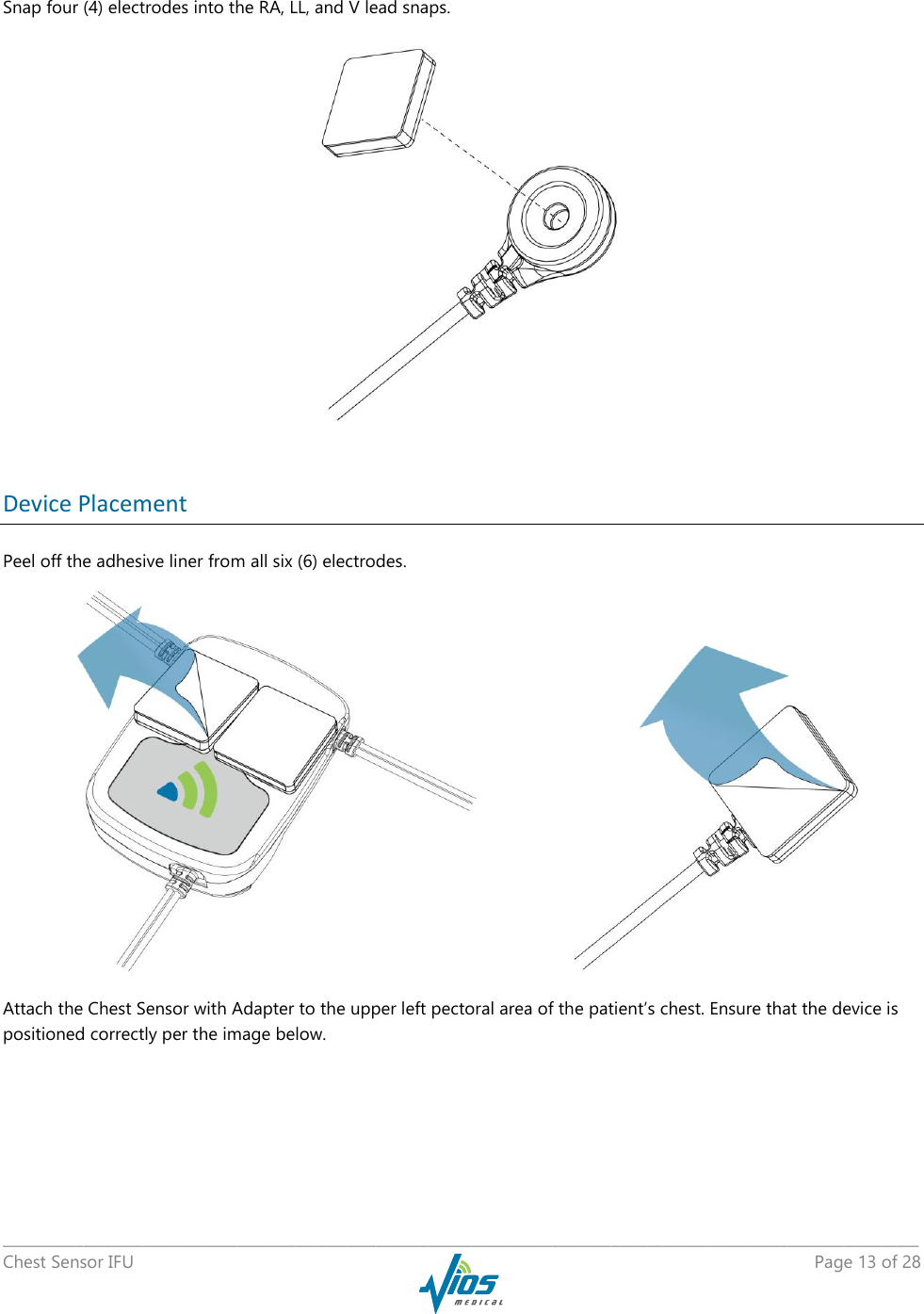
  _____________________________________________________________________________________________________________________________ Chest Sensor IFU    Page 13 of 28   Snap four (4) electrodes into the RA, LL, and V lead snaps.   Device Placement Peel off the adhesive liner from all six (6) electrodes.     Attach the Chest Sensor with Adapter to the upper left pectoral area of the patient’s chest. Ensure that the device is positioned correctly per the image below.
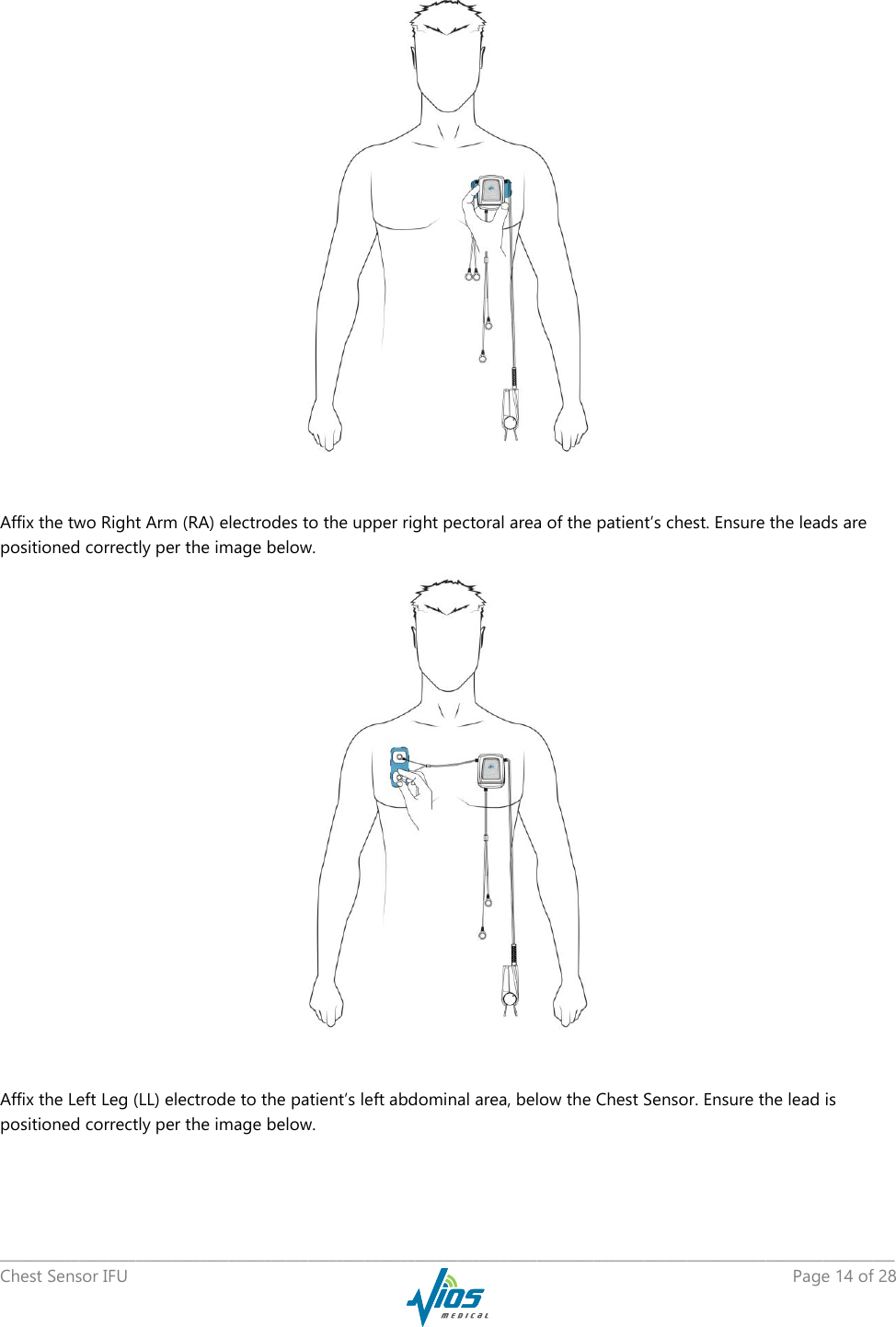
  _____________________________________________________________________________________________________________________________ Chest Sensor IFU    Page 14 of 28    Affix the two Right Arm (RA) electrodes to the upper right pectoral area of the patient’s chest. Ensure the leads are positioned correctly per the image below.   Affix the Left Leg (LL) electrode to the patient’s left abdominal area, below the Chest Sensor. Ensure the lead is positioned correctly per the image below.
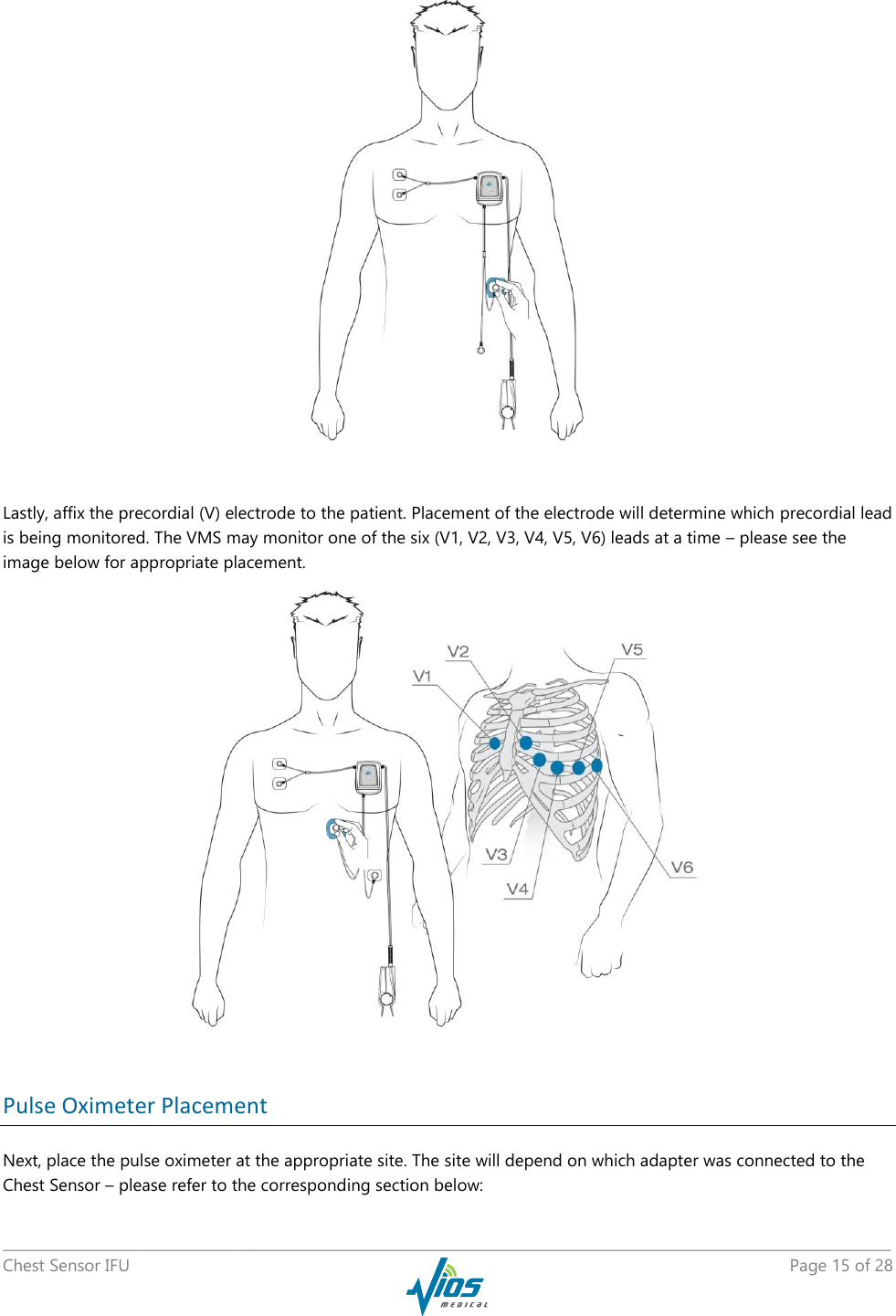
  _____________________________________________________________________________________________________________________________ Chest Sensor IFU    Page 15 of 28    Lastly, affix the precordial (V) electrode to the patient. Placement of the electrode will determine which precordial lead is being monitored. The VMS may monitor one of the six (V1, V2, V3, V4, V5, V6) leads at a time – please see the image below for appropriate placement.   Pulse Oximeter Placement Next, place the pulse oximeter at the appropriate site. The site will depend on which adapter was connected to the Chest Sensor – please refer to the corresponding section below:
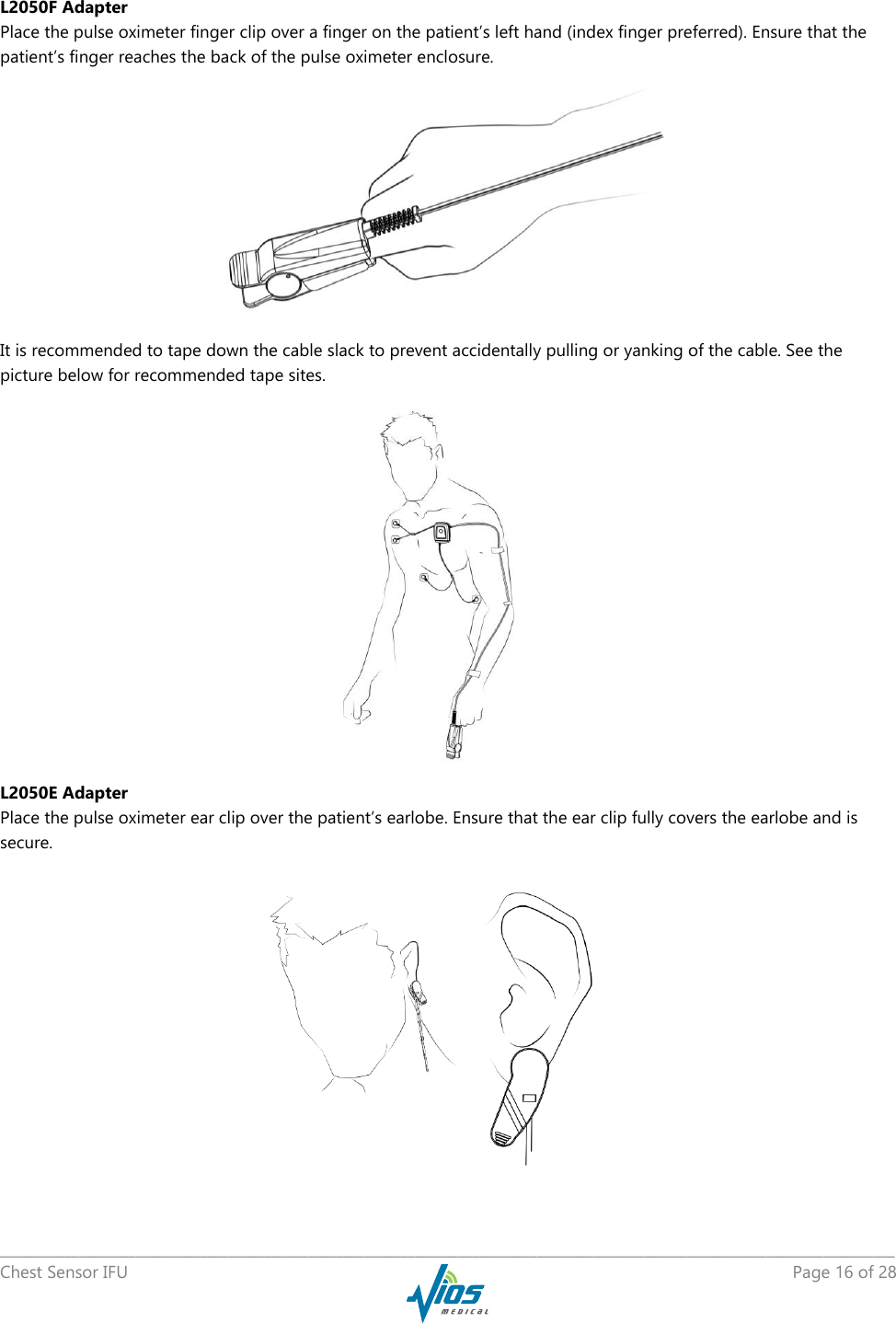
  _____________________________________________________________________________________________________________________________ Chest Sensor IFU    Page 16 of 28  L2050F Adapter Place the pulse oximeter finger clip over a finger on the patient’s left hand (index finger preferred). Ensure that the patient’s finger reaches the back of the pulse oximeter enclosure.  It is recommended to tape down the cable slack to prevent accidentally pulling or yanking of the cable. See the picture below for recommended tape sites.  L2050E Adapter Place the pulse oximeter ear clip over the patient’s earlobe. Ensure that the ear clip fully covers the earlobe and is secure.
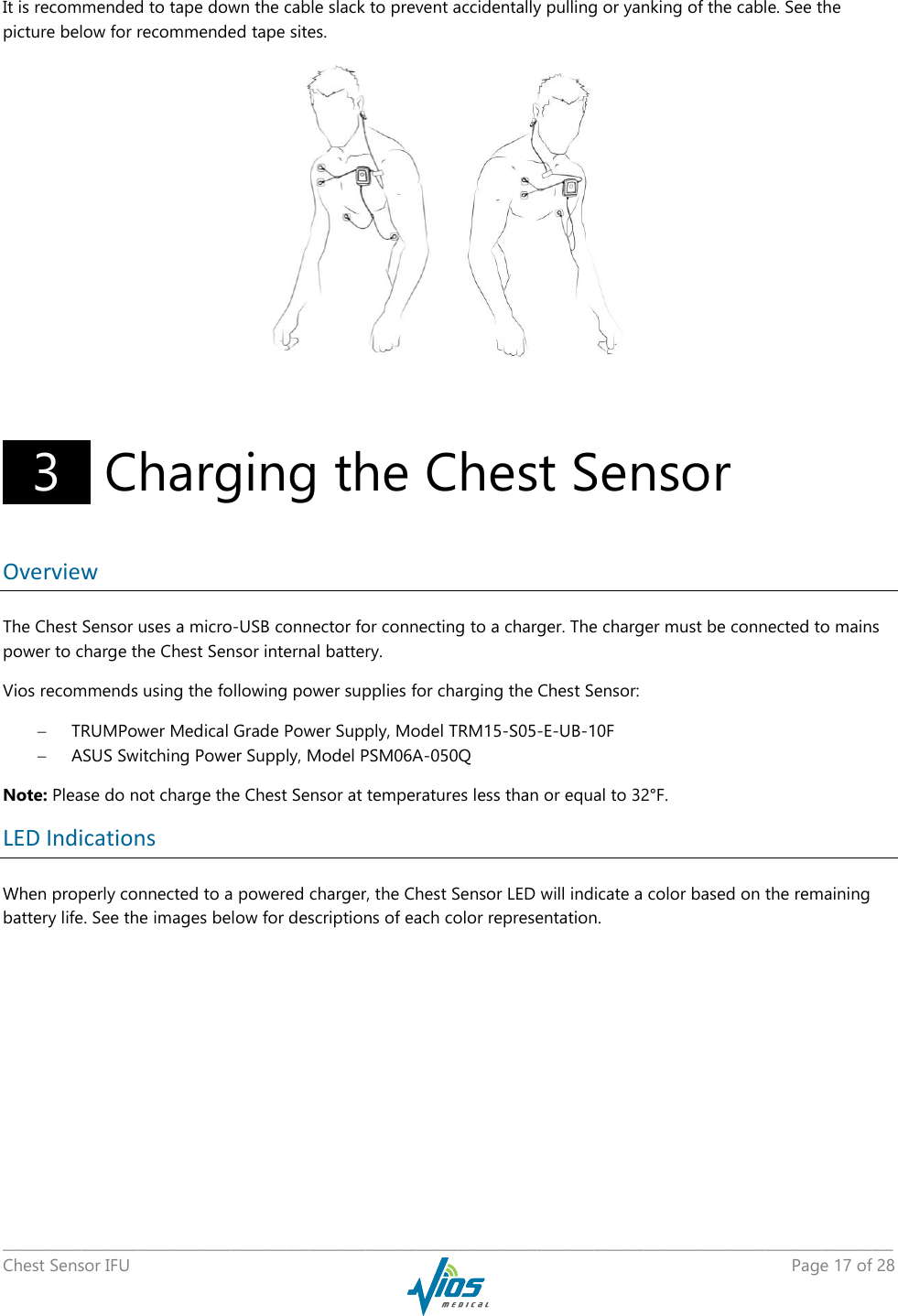
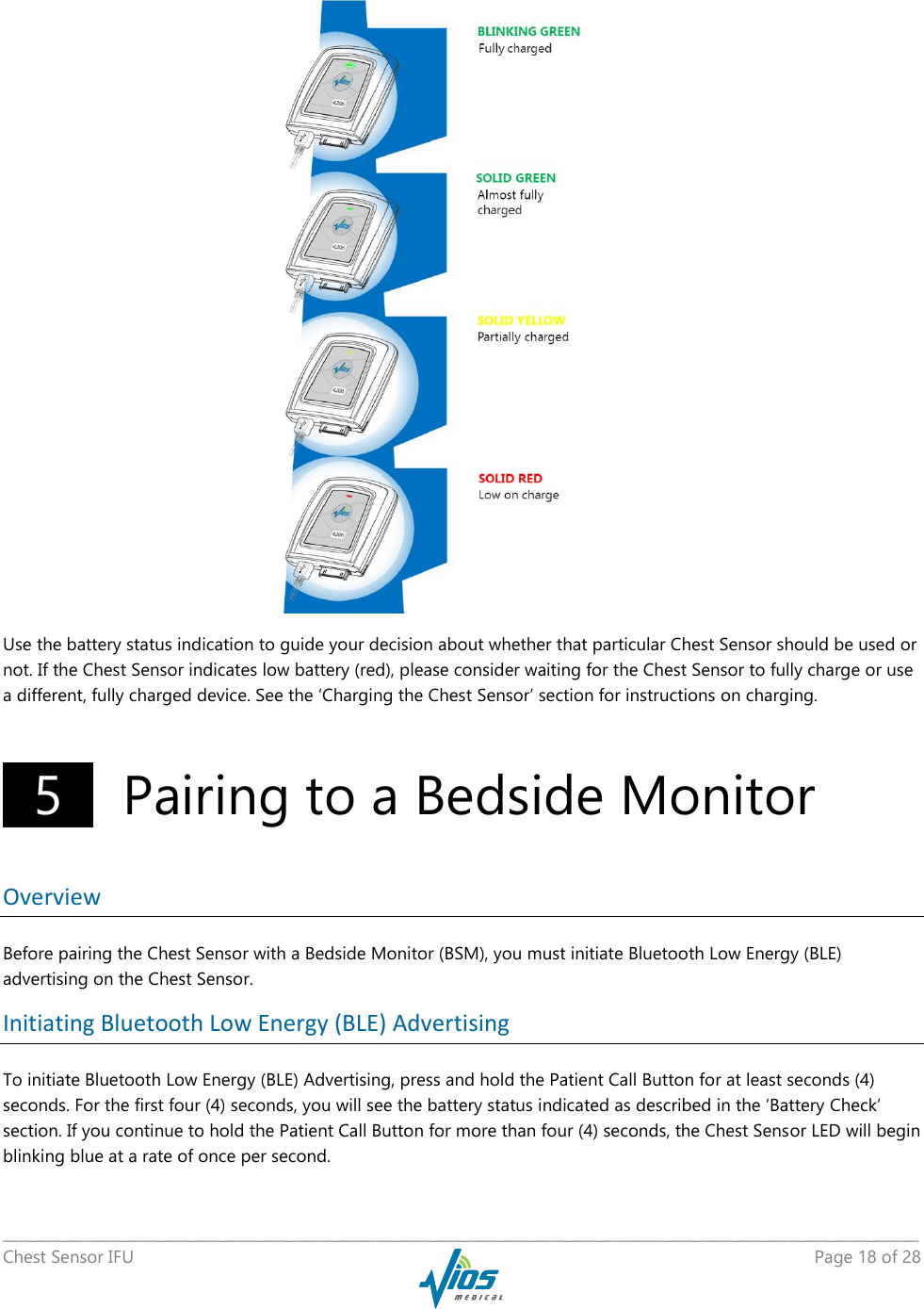
  _____________________________________________________________________________________________________________________________ Chest Sensor IFU    Page 17 of 28  It is recommended to tape down the cable slack to prevent accidentally pulling or yanking of the cable. See the picture below for recommended tape sites.           3   Charging the Chest Sensor Overview The Chest Sensor uses a micro-USB connector for connecting to a charger. The charger must be connected to mains power to charge the Chest Sensor internal battery.  Vios recommends using the following power supplies for charging the Chest Sensor:  TRUMPower Medical Grade Power Supply, Model TRM15-S05-E-UB-10F  ASUS Switching Power Supply, Model PSM06A-050Q Note: Please do not charge the Chest Sensor at temperatures less than or equal to 32°F. LED Indications When properly connected to a powered charger, the Chest Sensor LED will indicate a color based on the remaining battery life. See the images below for descriptions of each color representation.
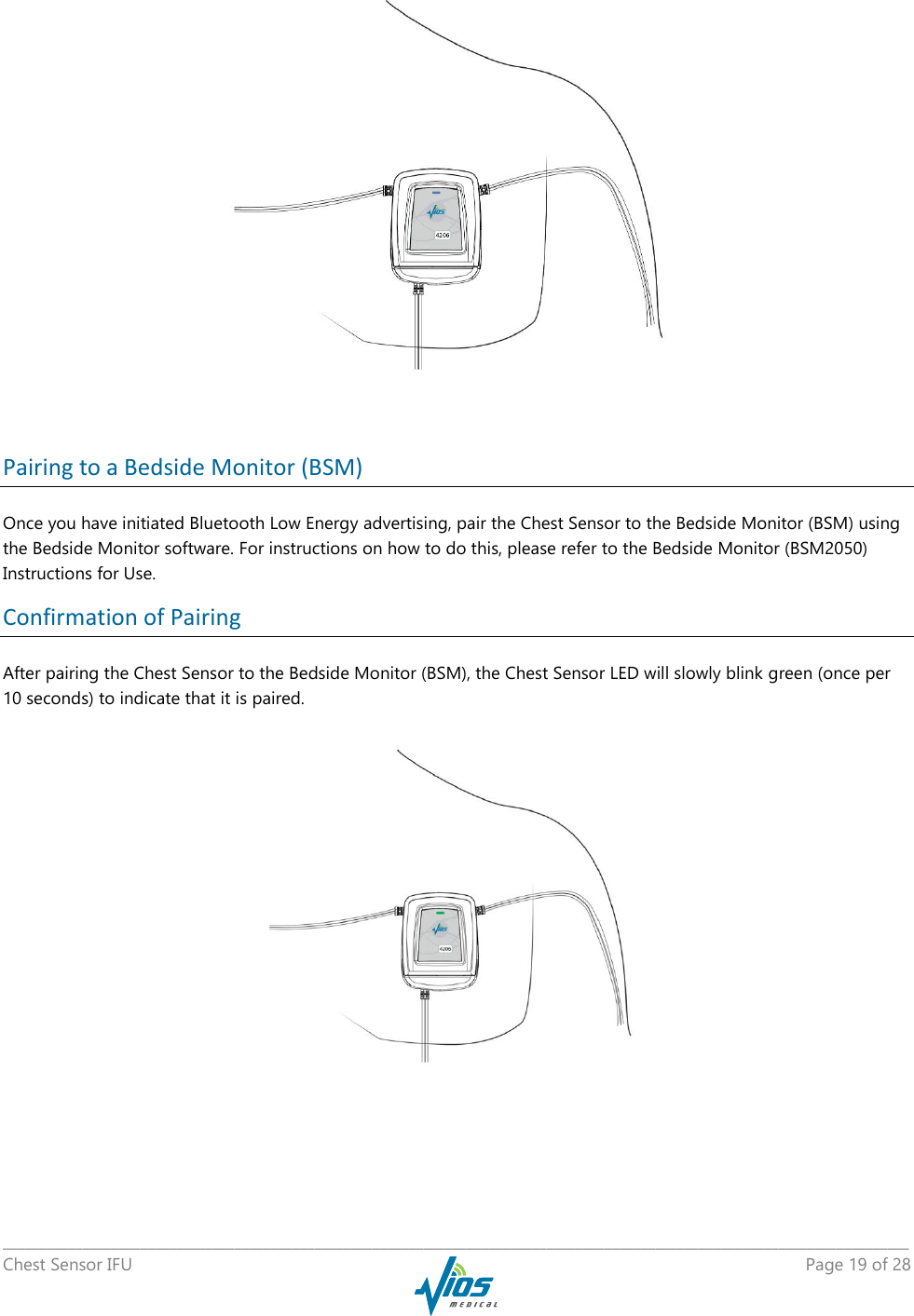
  _____________________________________________________________________________________________________________________________ Chest Sensor IFU    Page 18 of 28     Use the battery status indication to guide your decision about whether that particular Chest Sensor should be used or not. If the Chest Sensor indicates low battery (red), please consider waiting for the Chest Sensor to fully charge or use a different, fully charged device. See the ‘Charging the Chest Sensor’ section for instructions on charging.   5    Pairing to a Bedside Monitor  Overview Before pairing the Chest Sensor with a Bedside Monitor (BSM), you must initiate Bluetooth Low Energy (BLE) advertising on the Chest Sensor. Initiating Bluetooth Low Energy (BLE) Advertising To initiate Bluetooth Low Energy (BLE) Advertising, press and hold the Patient Call Button for at least seconds (4) seconds. For the first four (4) seconds, you will see the battery status indicated as described in the ‘Battery Check’ section. If you continue to hold the Patient Call Button for more than four (4) seconds, the Chest Sensor LED will begin blinking blue at a rate of once per second.
  _____________________________________________________________________________________________________________________________ Chest Sensor IFU    Page 19 of 28    Pairing to a Bedside Monitor (BSM) Once you have initiated Bluetooth Low Energy advertising, pair the Chest Sensor to the Bedside Monitor (BSM) using the Bedside Monitor software. For instructions on how to do this, please refer to the Bedside Monitor (BSM2050) Instructions for Use. Confirmation of Pairing After pairing the Chest Sensor to the Bedside Monitor (BSM), the Chest Sensor LED will slowly blink green (once per 10 seconds) to indicate that it is paired.
  _____________________________________________________________________________________________________________________________ Chest Sensor IFU    Page 20 of 28    4   Troubleshooting Overview The troubleshooting section consists of several parts which should help you resolve the most common problems with the Chest Sensor. The ‘Common Issues’ section lists out the most likely issues you may encounter and the steps that should be taken to resolve them. Common Issues The Chest Sensor won’t fit into the Adapter. Ensure that the 30-Pin male connector on the Chest Sensor is properly aligned with the 30-Pin female connector on the Adapter. Ensure that the slots on the Chest Sensor are properly aligned with the rails on the Adapter. The Chest Sensor / Adapter does not adhere to the patient. Ensure that the steps in the ‘Patient Preparation’ section have been followed. Ensure that the Chest Sensor / Adapter have been placed per the ‘Device Placement’ section. The Chest Sensor will not turn on. Ensure that the steps in the ‘Check Chest Sensor Battery’ section have been followed. If the device is still not turning on, the battery may be depleted – try plugging it into a Vios recommended charger. Service & Maintenance If the device is damaged, please contact Vios for a replacement. Do not attempt to repair or service the device. See Customer Service information below. If you are suspicious of damage to the device, please inspect the following:  Ensure there are no breaks or tears in any of the cables  Ensure the snaps (both on the leads and on the back of the adapter) are not loose  Ensure the 30-Pin connector is not loose To clean the Chest Sensor:  Disconnect the Adapter from the Chest Sensor  Dampen a clean cloth or gauze pad with appropriate cleaning solution and wipe all exposed surfaces including patient ECG cables and pulse oximetry cable/enclosure  Dry all exposed surfaces with a clean, dry cloth or gauze pad For proper disposal, please return the device to Vios at the end of its service life. See Customer Service information below.
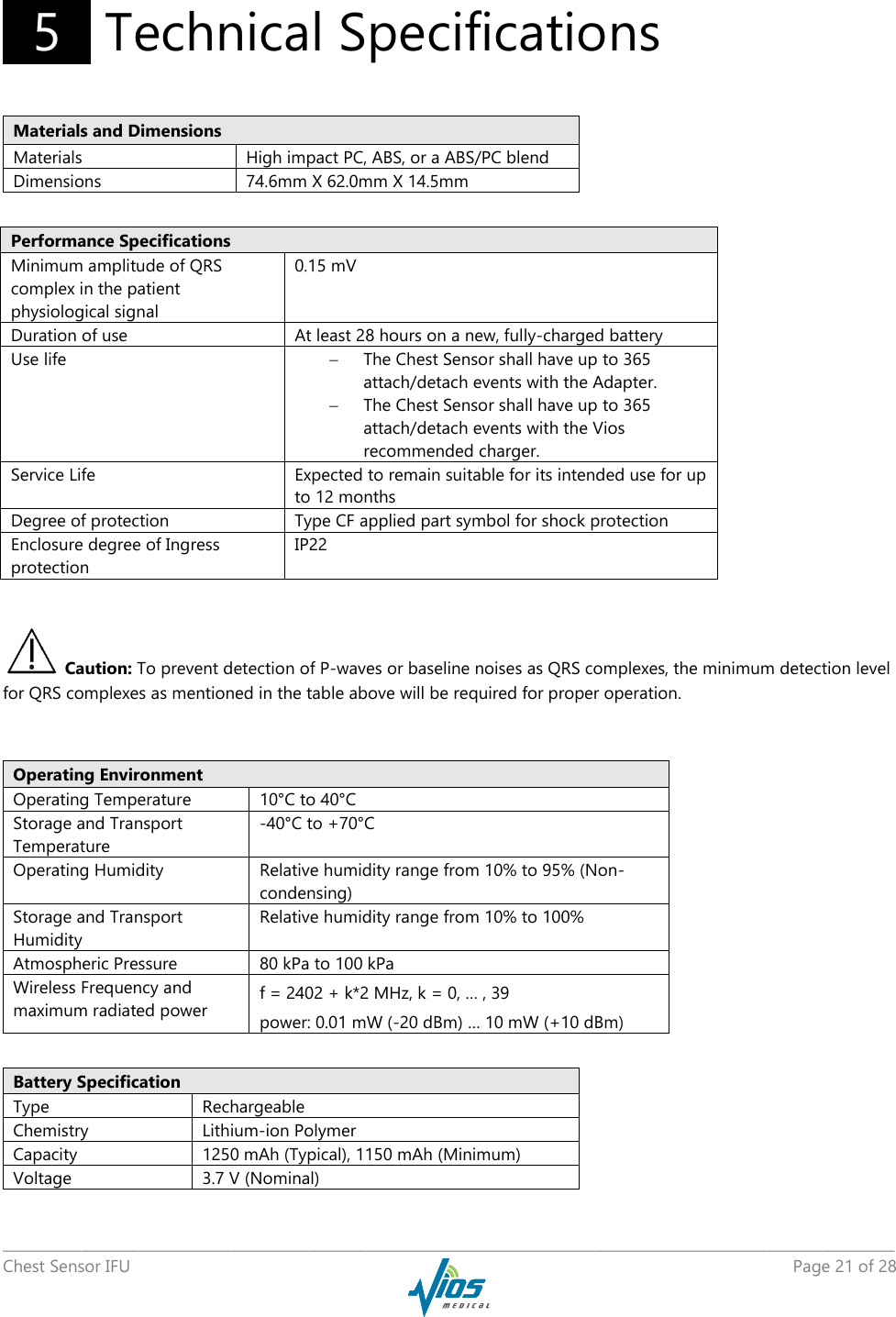
  _____________________________________________________________________________________________________________________________ Chest Sensor IFU    Page 21 of 28    5   Technical Specifications Materials and Dimensions Materials High impact PC, ABS, or a ABS/PC blend Dimensions 74.6mm X 62.0mm X 14.5mm              Caution: To prevent detection of P-waves or baseline noises as QRS complexes, the minimum detection level for QRS complexes as mentioned in the table above will be required for proper operation.  Operating Environment Operating Temperature 10°C to 40°C Storage and Transport Temperature -40°C to +70°C Operating Humidity Relative humidity range from 10% to 95% (Non-condensing) Storage and Transport Humidity Relative humidity range from 10% to 100%  Atmospheric Pressure  80 kPa to 100 kPa Wireless Frequency and maximum radiated power f = 2402 + k*2 MHz, k = 0, … , 39 power: 0.01 mW (-20 dBm) … 10 mW (+10 dBm)  Performance Specifications Minimum amplitude of QRS complex in the patient physiological signal 0.15 mV Duration of use At least 28 hours on a new, fully-charged battery Use life  The Chest Sensor shall have up to 365 attach/detach events with the Adapter.  The Chest Sensor shall have up to 365 attach/detach events with the Vios recommended charger.  Service Life Expected to remain suitable for its intended use for up to 12 months Degree of protection Type CF applied part symbol for shock protection Enclosure degree of Ingress protection IP22 Battery Specification Type Rechargeable Chemistry Lithium-ion Polymer Capacity 1250 mAh (Typical), 1150 mAh (Minimum) Voltage 3.7 V (Nominal)
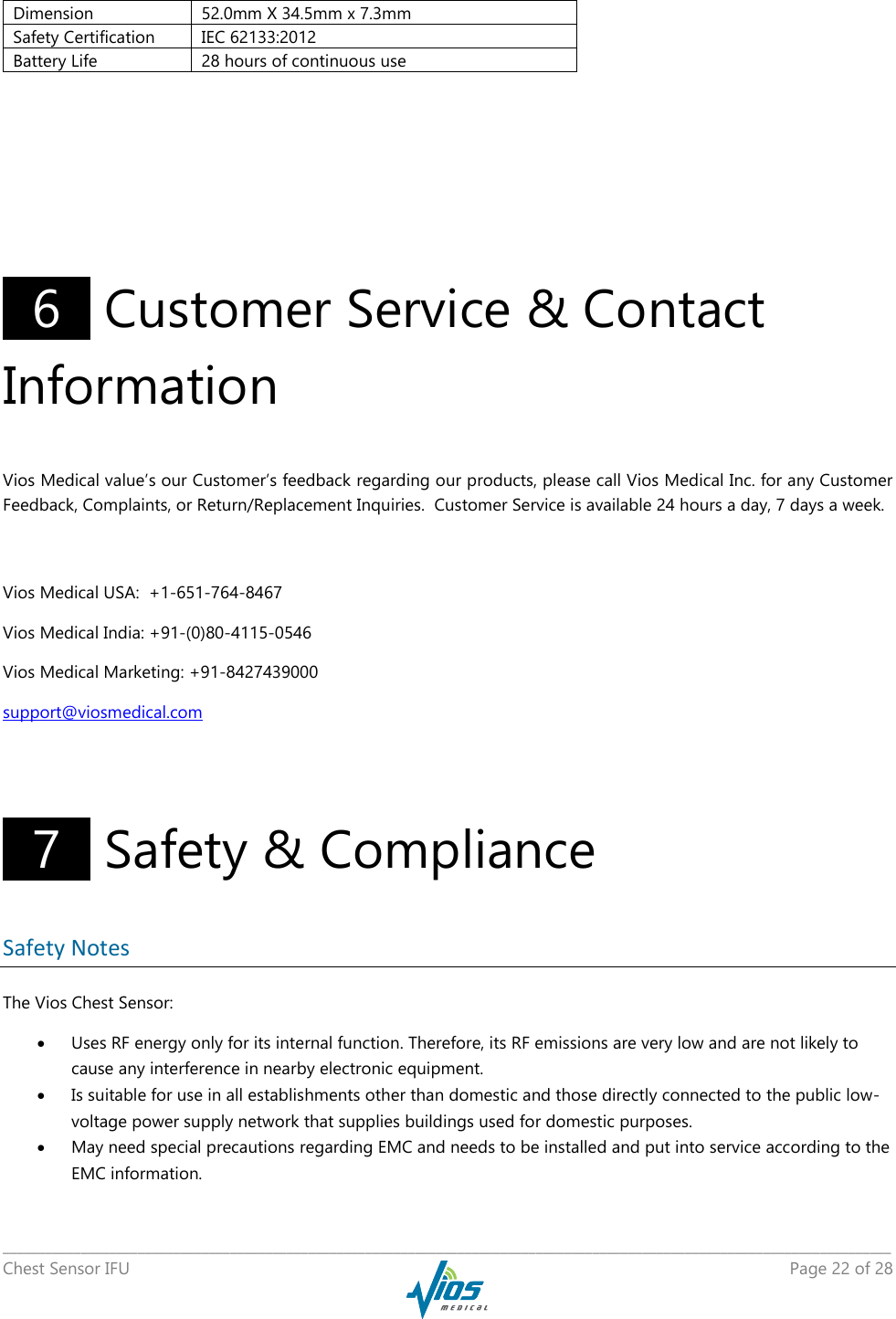
  _____________________________________________________________________________________________________________________________ Chest Sensor IFU    Page 22 of 28          6   Customer Service & Contact Information Vios Medical value’s our Customer’s feedback regarding our products, please call Vios Medical Inc. for any Customer Feedback, Complaints, or Return/Replacement Inquiries.  Customer Service is available 24 hours a day, 7 days a week.  Vios Medical USA:  +1-651-764-8467 Vios Medical India: +91-(0)80-4115-0546 Vios Medical Marketing: +91-8427439000 support@viosmedical.com    7   Safety & Compliance Safety Notes The Vios Chest Sensor:  Uses RF energy only for its internal function. Therefore, its RF emissions are very low and are not likely to cause any interference in nearby electronic equipment.  Is suitable for use in all establishments other than domestic and those directly connected to the public low-voltage power supply network that supplies buildings used for domestic purposes.  May need special precautions regarding EMC and needs to be installed and put into service according to the EMC information. Dimension 52.0mm X 34.5mm x 7.3mm Safety Certification IEC 62133:2012 Battery Life 28 hours of continuous use
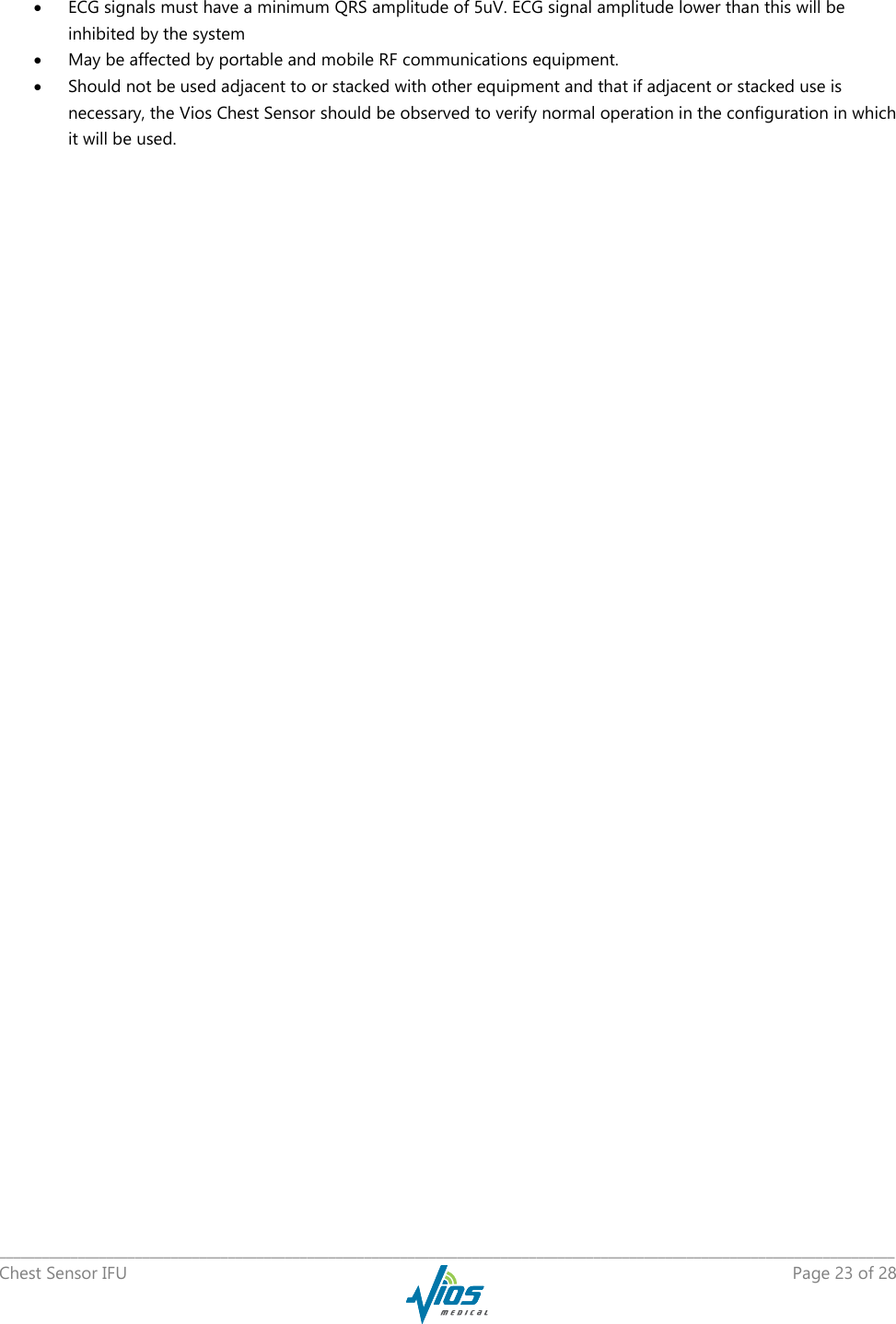
  _____________________________________________________________________________________________________________________________ Chest Sensor IFU    Page 23 of 28   ECG signals must have a minimum QRS amplitude of 5uV. ECG signal amplitude lower than this will be inhibited by the system  May be affected by portable and mobile RF communications equipment.  Should not be used adjacent to or stacked with other equipment and that if adjacent or stacked use is necessary, the Vios Chest Sensor should be observed to verify normal operation in the configuration in which it will be used.
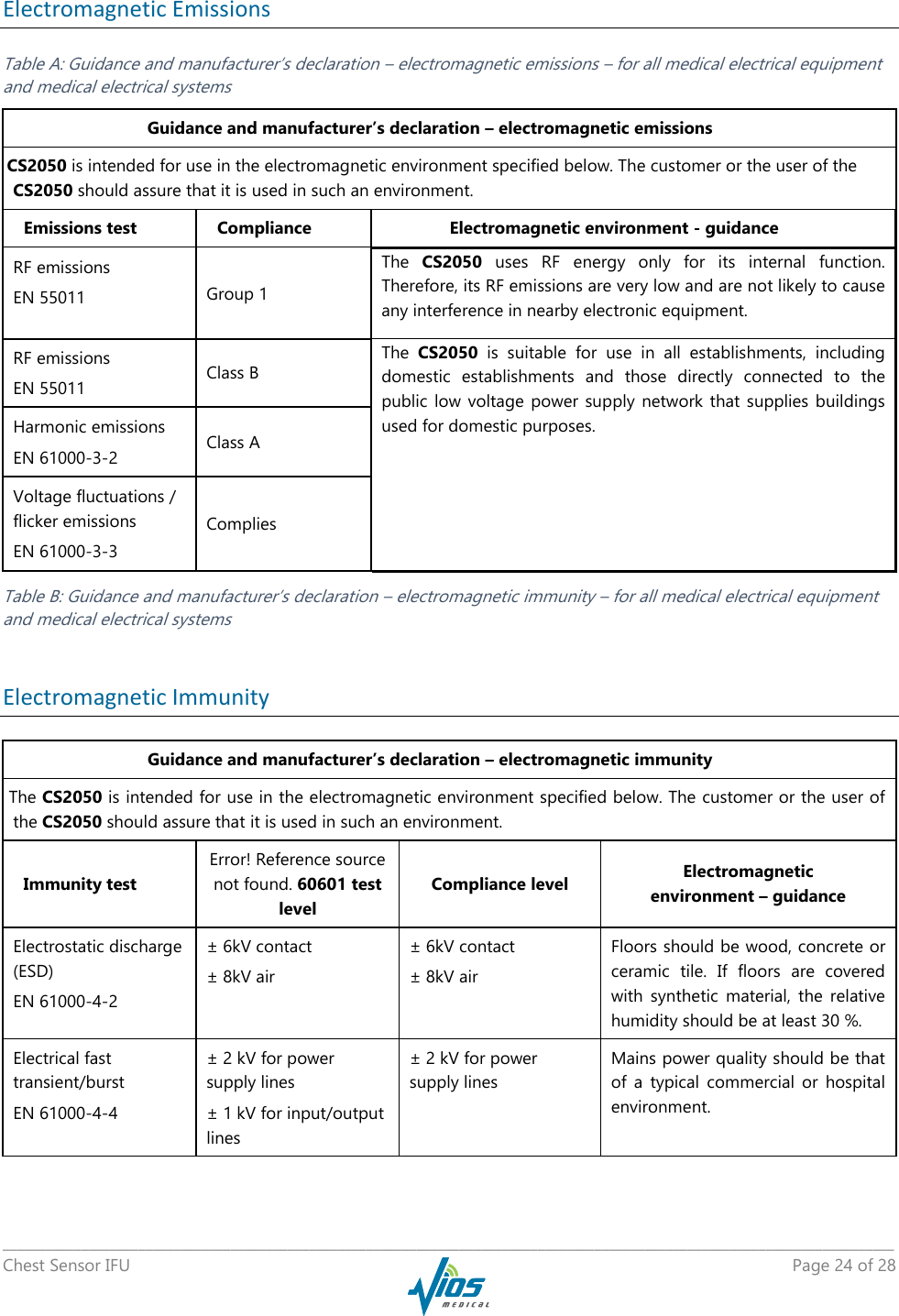
  _____________________________________________________________________________________________________________________________ Chest Sensor IFU    Page 24 of 28  Electromagnetic Emissions Table A: Guidance and manufacturer’s declaration – electromagnetic emissions – for all medical electrical equipment and medical electrical systems Guidance and manufacturer’s declaration – electromagnetic emissions The CS2050 is intended for use in the electromagnetic environment specified below. The customer or the user of the CS2050 should assure that it is used in such an environment. Emissions test Compliance Electromagnetic environment - guidance RF emissions EN 55011 Group 1 The  CS2050  uses  RF  energy  only  for  its  internal  function. Therefore, its RF emissions are very low and are not likely to cause any interference in nearby electronic equipment. RF emissions EN 55011 Class B The  CS2050  is  suitable  for  use  in  all  establishments,  including domestic  establishments  and  those  directly  connected  to  the public low  voltage  power supply  network that supplies  buildings used for domestic purposes. Harmonic emissions EN 61000-3-2 Class A Voltage fluctuations / flicker emissions EN 61000-3-3 Complies Table B: Guidance and manufacturer’s declaration – electromagnetic immunity – for all medical electrical equipment and medical electrical systems  Electromagnetic Immunity Guidance and manufacturer’s declaration – electromagnetic immunity The CS2050 is intended for use in the electromagnetic environment specified below. The customer or the user of the CS2050 should assure that it is used in such an environment. Immunity test Error! Reference source not found. 60601 test level Compliance level Electromagnetic  environment – guidance Electrostatic discharge (ESD) EN 61000-4-2 ± 6kV contact ± 8kV air ± 6kV contact  ± 8kV air Floors should be wood, concrete or ceramic  tile.  If  floors  are  covered with  synthetic  material,  the  relative humidity should be at least 30 %. Electrical fast transient/burst EN 61000-4-4 ± 2 kV for power supply lines ± 1 kV for input/output lines ± 2 kV for power supply lines  Mains power quality should be that of  a  typical  commercial  or  hospital environment.
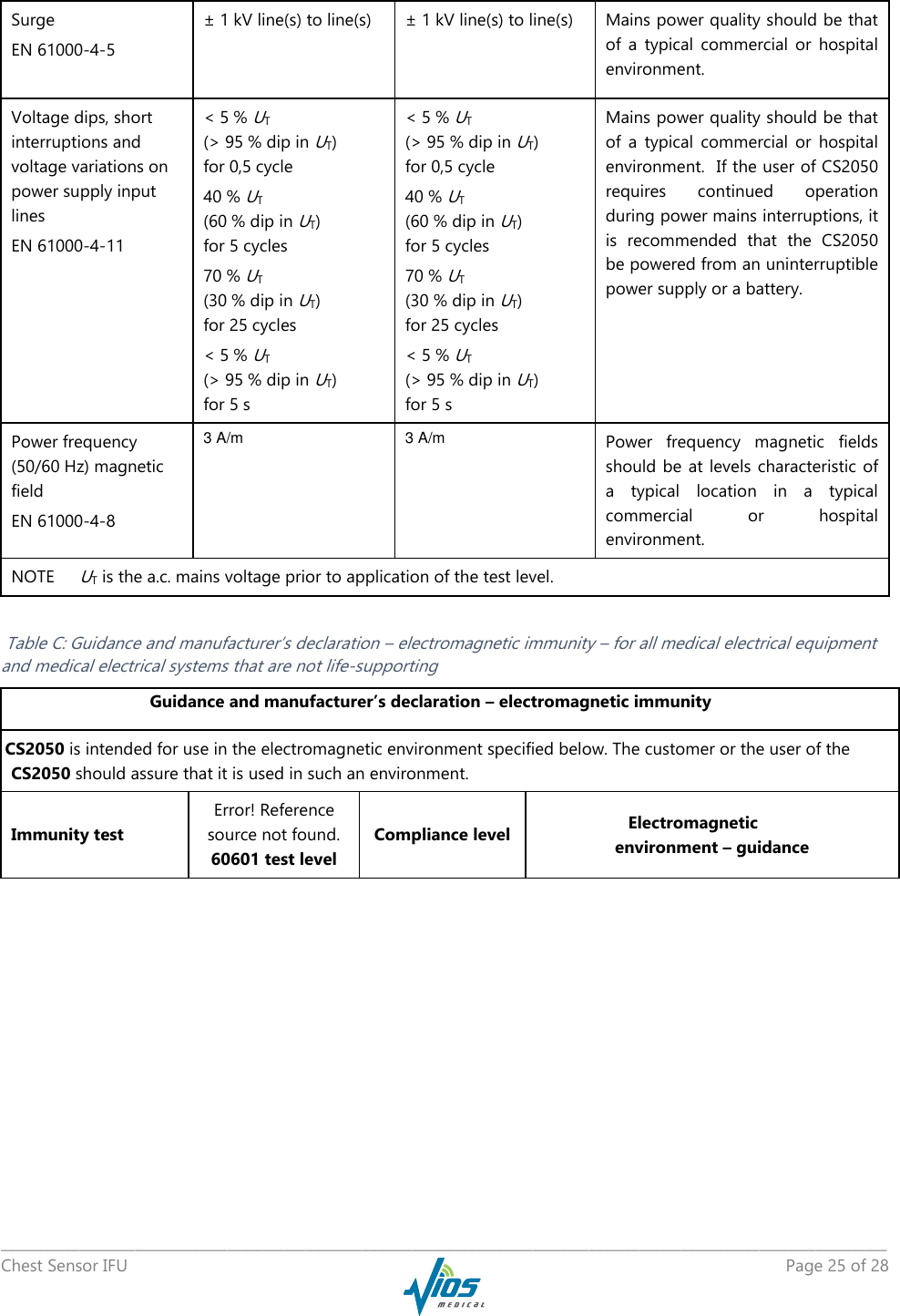
  _____________________________________________________________________________________________________________________________ Chest Sensor IFU    Page 25 of 28  Surge EN 61000-4-5 ± 1 kV line(s) to line(s)  ± 1 kV line(s) to line(s)   Mains power quality should be that of  a  typical  commercial  or  hospital environment. Voltage dips, short interruptions and voltage variations on power supply input lines EN 61000-4-11 < 5 % UT (> 95 % dip in UT) for 0,5 cycle 40 % UT (60 % dip in UT) for 5 cycles 70 % UT (30 % dip in UT) for 25 cycles < 5 % UT (> 95 % dip in UT) for 5 s < 5 % UT (> 95 % dip in UT) for 0,5 cycle 40 % UT (60 % dip in UT) for 5 cycles 70 % UT (30 % dip in UT) for 25 cycles < 5 % UT (> 95 % dip in UT) for 5 s Mains power quality should be that of  a  typical  commercial  or  hospital environment.  If the user of CS2050 requires  continued  operation during power mains interruptions, it is  recommended  that  the  CS2050 be powered from an uninterruptible power supply or a battery.  Power frequency (50/60 Hz) magnetic field EN 61000-4-8 3 A/m 3 A/m Power  frequency  magnetic  fields should be  at levels characteristic of a  typical  location  in  a  typical commercial  or  hospital environment. NOTE UT is the a.c. mains voltage prior to application of the test level.   Table C: Guidance and manufacturer’s declaration – electromagnetic immunity – for all medical electrical equipment and medical electrical systems that are not life-supporting Guidance and manufacturer’s declaration – electromagnetic immunity The CS2050 is intended for use in the electromagnetic environment specified below. The customer or the user of the CS2050 should assure that it is used in such an environment. Immunity test Error! Reference source not found. 60601 test level Compliance level Electromagnetic  environment – guidance
  _____________________________________________________________________________________________________________________________ Chest Sensor IFU    Page 26 of 28        Conducted RF EN 61000-4-6   Radiated RF EN 61000-4-3       3 Vrms 150 kHz to 80 MHz   3 V/m 80 MHz to 2,5 GHz        3 Vrms    3 V/m    Portable  and  mobile  RF  communications equipment  should  be  used  no  closer  to  any part of the CS2050, including cables, than the recommended  separation  distance  calculated from the equation applicable to the frequency of the transmitter. Recommended separation distance PVd ]1/5,3[ PEd ]1/5,3[  80 MHz to 800 MHz PEd ]1/7[  800 MHz to 2,5 GHz where P is the maximum output power rating of  the  transmitter  in  watts  (W)  according  to the  transmitter  manufacturer  and d is  the recommended  separation  distance  in  meters (m).  Field  strengths  from  fixed  RF  transmitters,  as determined by an electromagnetic site survey,a should  be  less  than  the  compliance  level  in each frequency range.b Interference  may  occur  in  the  vicinity  of equipment marked with the following symbol:  NOTE 1  At 80 MHz and 800 MHz, the higher frequency range applies. NOTE 2  These guidelines may not apply in all situations. Electromagnetic propagation is affected by absorption and reflection from structures, objects and people. a Field  strengths  from  fixed  transmitters,  such  as  base  stations  for  radio  (cellular/cordless)  telephones  and  land mobile radios, amateur radio, AM and FM radio broadcast and TV broadcast cannot be predicted theoretically with accuracy. To assess the electromagnetic environment due to fixed RF transmitters, an electromagnetic site survey should  be  considered.  If  the  measured  field  strength  in  the  location  in  which  the  CS2050  is  used  exceeds  the applicable  RF  compliance  level  above,  the  CS2050  should  be  observed  to  verify  normal  operation.  If  abnormal performance is observed, additional measures may be necessary, such as reorienting or relocating the CS2050. b Over the frequency range 150 kHz to 80 MHz, field strengths should be less than 3 V/m.   Table D: Recommended separation distances between portable and mobile RF communications equipment and the medical electrical equipment and medical electrical systems – for medical electrical equipment and medical electrical systems that are not life-supporting Recommended separation distances between portable and mobile RF communications equipment and the CS2050
  _____________________________________________________________________________________________________________________________ Chest Sensor IFU    Page 27 of 28  The  CS2050  is  intended  for  use  in  an  electromagnetic  environment  in  which  radiated  RF  disturbances  are controlled. The customer or the user of the CS2050 can help prevent electromagnetic interference by maintaining a minimum distance between portable and mobile RF communications equipment (transmitters) and the  CS2050 as recommended below, according to the maximum output power of the communications equipment. Rated maximum output power of transmitter W  Separation distance according to frequency of transmitter m 150 kHz to 80 MHz PVd ]1/5,3[ 80 MHz to 800 MHz PEd ]1/5,3[ 800 MHz to 2,5 GHz PEd ]1/7[ 0,01 0,12 0,12 0,23 0,1 0,38 0,38 0,73 1 1,2 1,2 2,3 10 3,8 3,8 7,3 100 12 12 23 For transmitters rated at a maximum output power not listed above, the recommended separation distance d in meters  (m)  can  be  estimated  using  the  equation  applicable  to  the  frequency  of  the  transmitter,  where P is  the maximum output power rating of the transmitter in watts (W) according to the transmitter manufacturer. NOTE 1  At 80 MHz and 800 MHz, the separation distance for the higher frequency range applies. NOTE 2  These  guidelines may  not apply  in all  situations. Electromagnetic propagation  is affected  by absorption and reflection from structures, objects and people.  The Vios Monitoring System (VMS) has been designed in compliance with applicable Safety Standards given below.             Vios™ is a trademark of Vios Medical Incorporated. Safety Standards  60601-1: Safety Requirements for Medical Electrical Systems   60601-1-2: General Requirements for Safety – Electromagnetic Compatibility  60601-2-27: Particular requirements for the basic safety and essential performance of electrocardiographic monitoring equipment  60601-2-49:  Particular  requirements  for  the  safety  of  Multifunction  Patient Monitoring Equipment  ISO 80601-2-61: Particular requirements for basic safety and essential performance of pulse oximeter equipment  ISO 10993-1: Biological Evaluation of medical devices   EN 300 328 v1.8.1, Electromagnetic compatibility and Radio spectrum Matters (ERM); Wideband  transmission  systems;  Data  transmission  equipment  operating  in  the  2,4 GHz ISM band and using wide band modulation techniques  ASTM  D4169-14:  Standard  Practice  for  Performance  Testing  of  Shipping  Containers and Systems  IEC 60529 standard  Ingress Protection Marking – IP22  EC53 ECG Trunk Cables and Patient Leadwires
  _____________________________________________________________________________________________________________________________ Chest Sensor IFU    Page 28 of 28  Bluetooth® is a registered trademark of Bluetooth SIG, Incorporated. Medico™ is a trademark of Medico Electrodes International Ltd.      Manufactured by Vios Medical, Inc. 7300 Hudson BLVD N 140 St Paul MN 55128 +1 651-764-8467

Navigation menu