Vitelcom Mobile Technology USA TSM501 Single Band CDMA Cellular Phone User Manual

Vitelcom Mobile Technology USA, Inc. Single Band CDMA Cellular Phone

Contents

Service manual

9LWHOFRP0RELOH7HFKQRORJ\6$  3URSULHWDU\DQG&RQILGHQWLDO   - 1 -        VVIITTEELLCCOOMM  MMOOBBIILLEE  TTEECCHHNNOOLLOOGGYY  SS..AA..           TSM501/ VTL501 Service Manual       Prepared by:  Kenn Lee  Edited by  K.H.Kim Approved by: Sam Her Version:  1.0 Date:  10/12/04
9LWHOFRP0RELOH7HFKQRORJ\6$  3URSULHWDU\DQG&RQILGHQWLDO   - 2 -        VVIITTEELLCCOOMM  MMOOBBIILLEE  TTEECCHHNNOOLLOOGGYY  SS..AA..  Document Status History  Version  Date  Pages  Changes  Signatures 1.0  08/12/04  72  First Version
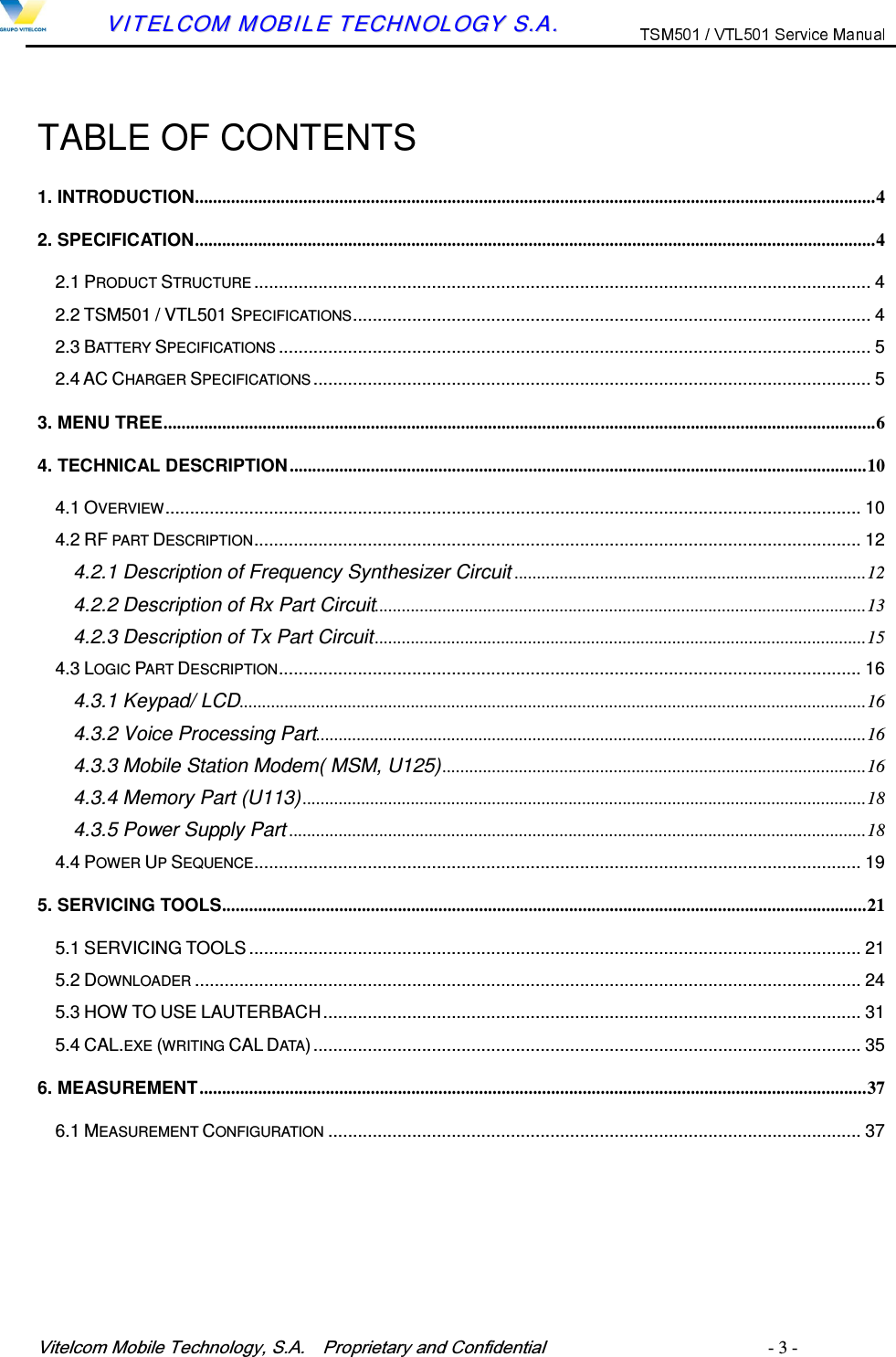
9LWHOFRP0RELOH7HFKQRORJ\6$  3URSULHWDU\DQG&RQILGHQWLDO   - 3 -        VVIITTEELLCCOOMM  MMOOBBIILLEE  TTEECCHHNNOOLLOOGGYY  SS..AA..   TABLE OF CONTENTS 1. INTRODUCTION.......................................................................................................................................................42. SPECIFICATION.......................................................................................................................................................42.1 PRODUCT STRUCTURE ............................................................................................................................. 42.2 TSM501 / VTL501 SPECIFICATIONS......................................................................................................... 42.3 BATTERY SPECIFICATIONS ........................................................................................................................ 52.4 AC CHARGER SPECIFICATIONS ................................................................................................................. 53. MENU TREE..............................................................................................................................................................64. TECHNICAL DESCRIPTION ................................................................................................................................104.1 OVERVIEW............................................................................................................................................. 104.2 RF PART DESCRIPTION........................................................................................................................... 124.2.1 Description of Frequency Synthesizer Circuit ..............................................................................124.2.2 Description of Rx Part Circuit.............................................................................................................134.2.3 Description of Tx Part Circuit.............................................................................................................154.3 LOGIC PART DESCRIPTION...................................................................................................................... 164.3.1 Keypad/ LCD...........................................................................................................................................164.3.2 Voice Processing Part..........................................................................................................................164.3.3 Mobile Station Modem( MSM, U125)..............................................................................................164.3.4 Memory Part (U113).............................................................................................................................184.3.5 Power Supply Part ................................................................................................................................184.4 POWER UP SEQUENCE........................................................................................................................... 195. SERVICING TOOLS...............................................................................................................................................215.1 SERVICING TOOLS............................................................................................................................ 215.2 DOWNLOADER ....................................................................................................................................... 245.3 HOW TO USE LAUTERBACH............................................................................................................. 315.4 CAL.EXE (WRITING CAL DATA)............................................................................................................... 356. MEASUREMENT....................................................................................................................................................376.1 MEASUREMENT CONFIGURATION ............................................................................................................ 37
9LWHOFRP0RELOH7HFKQRORJ\6$  3URSULHWDU\DQG&RQILGHQWLDO   - 4 -        VVIITTEELLCCOOMM  MMOOBBIILLEE  TTEECCHHNNOOLLOOGGYY  SS..AA..   1. Introduction  This manual provides the technical information to support the service activities of TSM501 / VTL501 model, which operates on Single mode Digital CDMA Telephone.  This manual is supplied in the electronic format for easy distribution and reference.  Also refer to the following documents: -. Service Drawings of TSM501 / VTL501 model phone (Schematic diagrams and Parts layout) -. Service Part List of TSM501 / VTL501 model phone -. Owner’s Operating Manuals of TSM501 / VTL501 model phone  2. Specification  This chapter provides the product configuration and product specifications of TSM501 / VTL501 model, which operates on Single mode Digital CDMA Telephone and accessories  2.1 Product Structure [Table 2.1] Standard Package   ITEM  TYPES 1  Handheld Portable Telephone  TSM501 / VTL501 2  Lithium Ion Battery(850mAh)  TSM501 / VTL501     3  AC Charger  TSM501 / VTL501 T.C 4  Earphone-Mic  Earphone-Mic is offered by VITELCOM 5  Handstrap  Handstrap is offered by VITELCOM 6  Owner’s Operating Manual  TSM501 / VTL501 Manuals  2.2 TSM501 / VTL501 Specifications   ITEM  800MHz Band 1  Radio Frequency  TX: 824 to 849MHz RX:869 to 894MHz 2  Number of Channels  832 3  Duplex Spacing  45MHz 4  Digital Mode   4.1  Channel Spacing  1.23MHz 4.2  Frequency Stability  +/-300Hz 4.3  RF Output Power  24dBm
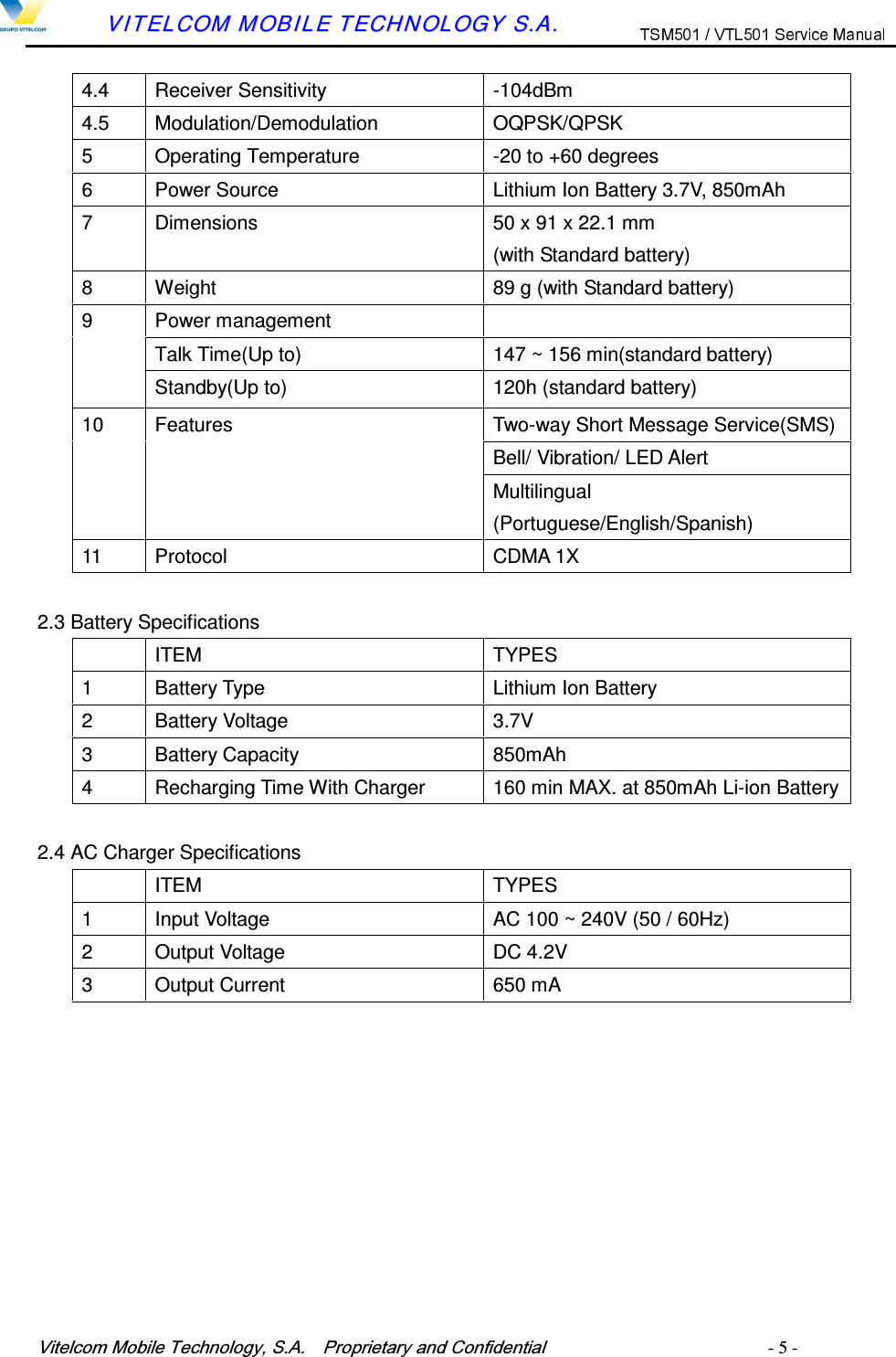
9LWHOFRP0RELOH7HFKQRORJ\6$  3URSULHWDU\DQG&RQILGHQWLDO   - 5 -        VVIITTEELLCCOOMM  MMOOBBIILLEE  TTEECCHHNNOOLLOOGGYY  SS..AA..  4.4  Receiver Sensitivity  -104dBm 4.5  Modulation/Demodulation  OQPSK/QPSK 5  Operating Temperature  -20 to +60 degrees 6  Power Source  Lithium Ion Battery 3.7V, 850mAh 7  Dimensions  50 x 91 x 22.1 mm   (with Standard battery) 8  Weight  89 g (with Standard battery) Power management   Talk Time(Up to)  147 ~ 156 min(standard battery) 9 Standby(Up to)  120h (standard battery) Two-way Short Message Service(SMS) Bell/ Vibration/ LED Alert 10  Features Multilingual (Portuguese/English/Spanish) 11  Protocol  CDMA 1X  2.3 Battery Specifications   ITEM  TYPES 1  Battery Type  Lithium Ion Battery 2  Battery Voltage  3.7V 3  Battery Capacity  850mAh 4  Recharging Time With Charger  160 min MAX. at 850mAh Li-ion Battery  2.4 AC Charger Specifications   ITEM  TYPES 1  Input Voltage  AC 100 ~ 240V (50 / 60Hz) 2  Output Voltage  DC 4.2V 3  Output Current  650 mA
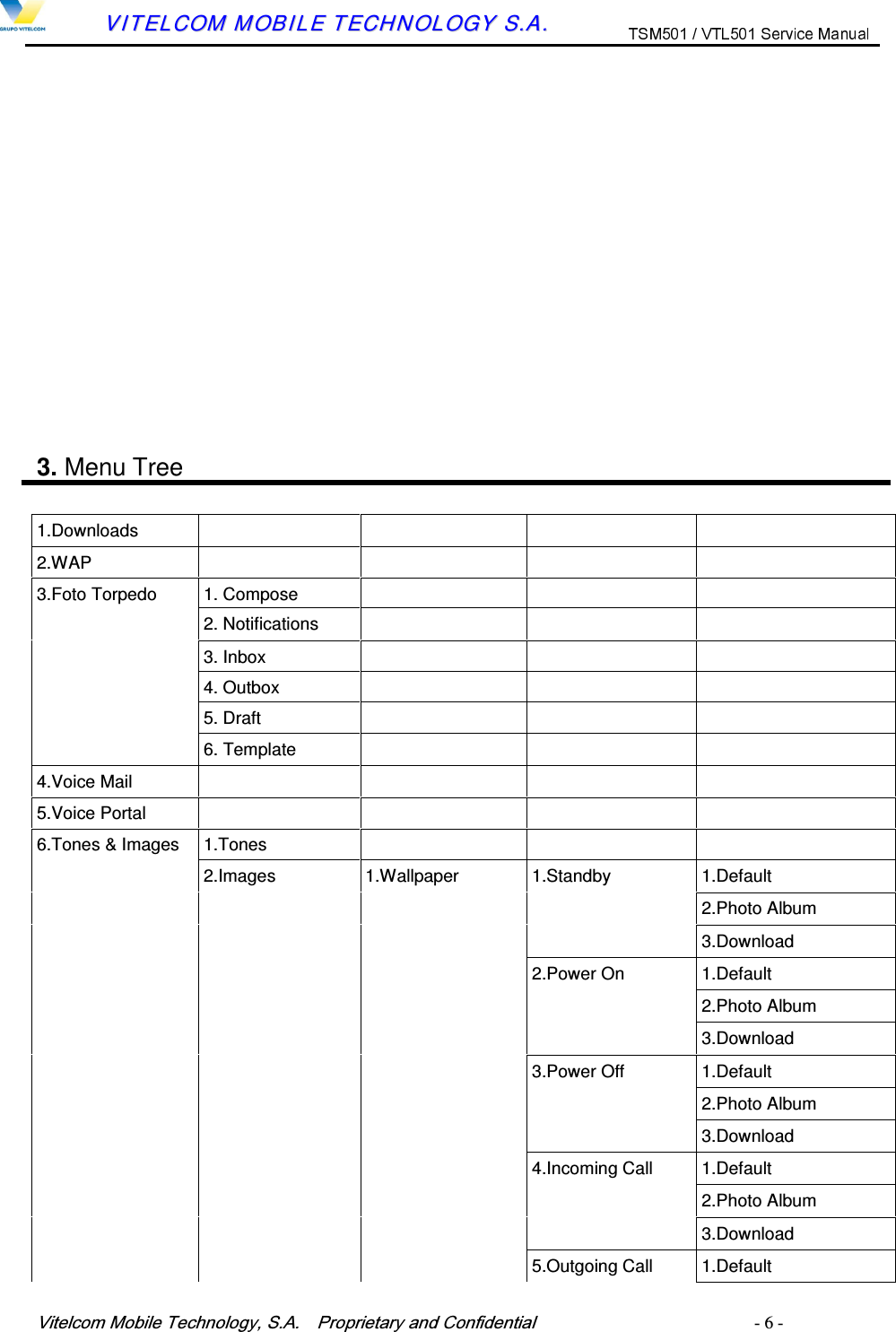
9LWHOFRP0RELOH7HFKQRORJ\6$  3URSULHWDU\DQG&RQILGHQWLDO   - 6 -        VVIITTEELLCCOOMM  MMOOBBIILLEE  TTEECCHHNNOOLLOOGGYY  SS..AA..              3. Menu Tree 1.Downloads         2.WAP         3.Foto Torpedo  1. Compose         2. Notifications         3. Inbox         4. Outbox         5. Draft         6. Template       4.Voice Mail         5.Voice Portal         6.Tones & Images  1.Tones         2.Images  1.Wallpaper  1.Standby  1.Default         2.Photo Album         3.Download       2.Power On  1.Default         2.Photo Album         3.Download       3.Power Off  1.Default         2.Photo Album         3.Download       4.Incoming Call  1.Default         2.Photo Album         3.Download       5.Outgoing Call  1.Default
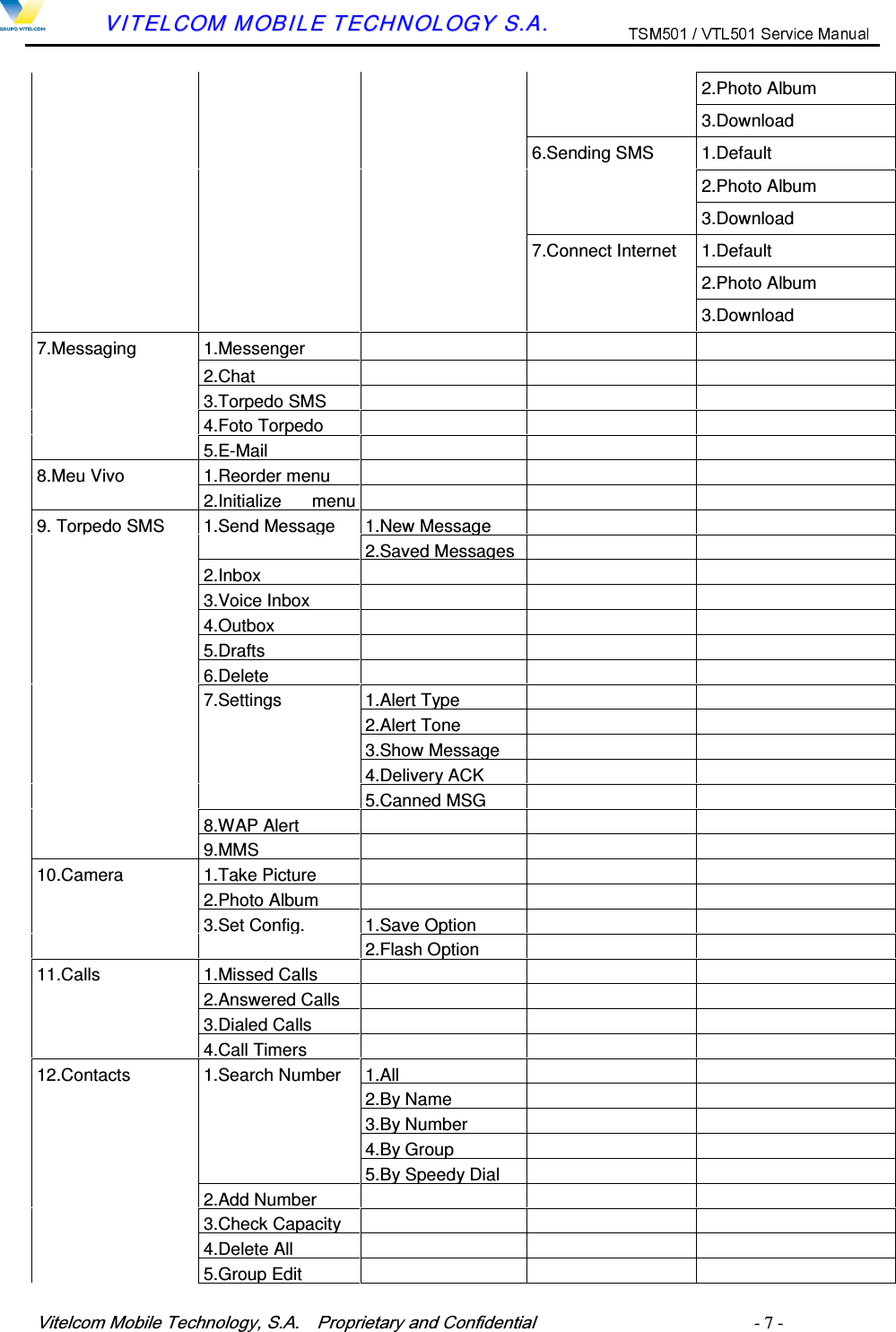
9LWHOFRP0RELOH7HFKQRORJ\6$  3URSULHWDU\DQG&RQILGHQWLDO   - 7 -        VVIITTEELLCCOOMM  MMOOBBIILLEE  TTEECCHHNNOOLLOOGGYY  SS..AA..          2.Photo Album         3.Download       6.Sending SMS  1.Default         2.Photo Album         3.Download       7.Connect Internet  1.Default         2.Photo Album         3.Download 7.Messaging  1.Messenger        2.Chat     3.Torpedo SMS     4.Foto Torpedo     5.E-Mail    8.Meu Vivo 1.Reorder menu     2.Initialize  menu    9. Torpedo SMS 1.Send Message 1.New Message     2.Saved Messages    2.Inbox     3.Voice Inbox     4.Outbox     5.Drafts      6.Delete     7.Settings 1.Alert Type     2.Alert Tone     3.Show Message     4.Delivery ACK     5.Canned MSG    8.WAP Alert     9.MMS    10.Camera 1.Take Picture     2.Photo Album     3.Set Config. 1.Save Option     2.Flash Option   11.Calls 1.Missed Calls     2.Answered Calls     3.Dialed Calls     4.Call Timers    12.Contacts 1.Search Number 1.All     2.By Name     3.By Number     4.By Group     5.By Speedy Dial    2.Add Number     3.Check Capacity     4.Delete All     5.Group Edit
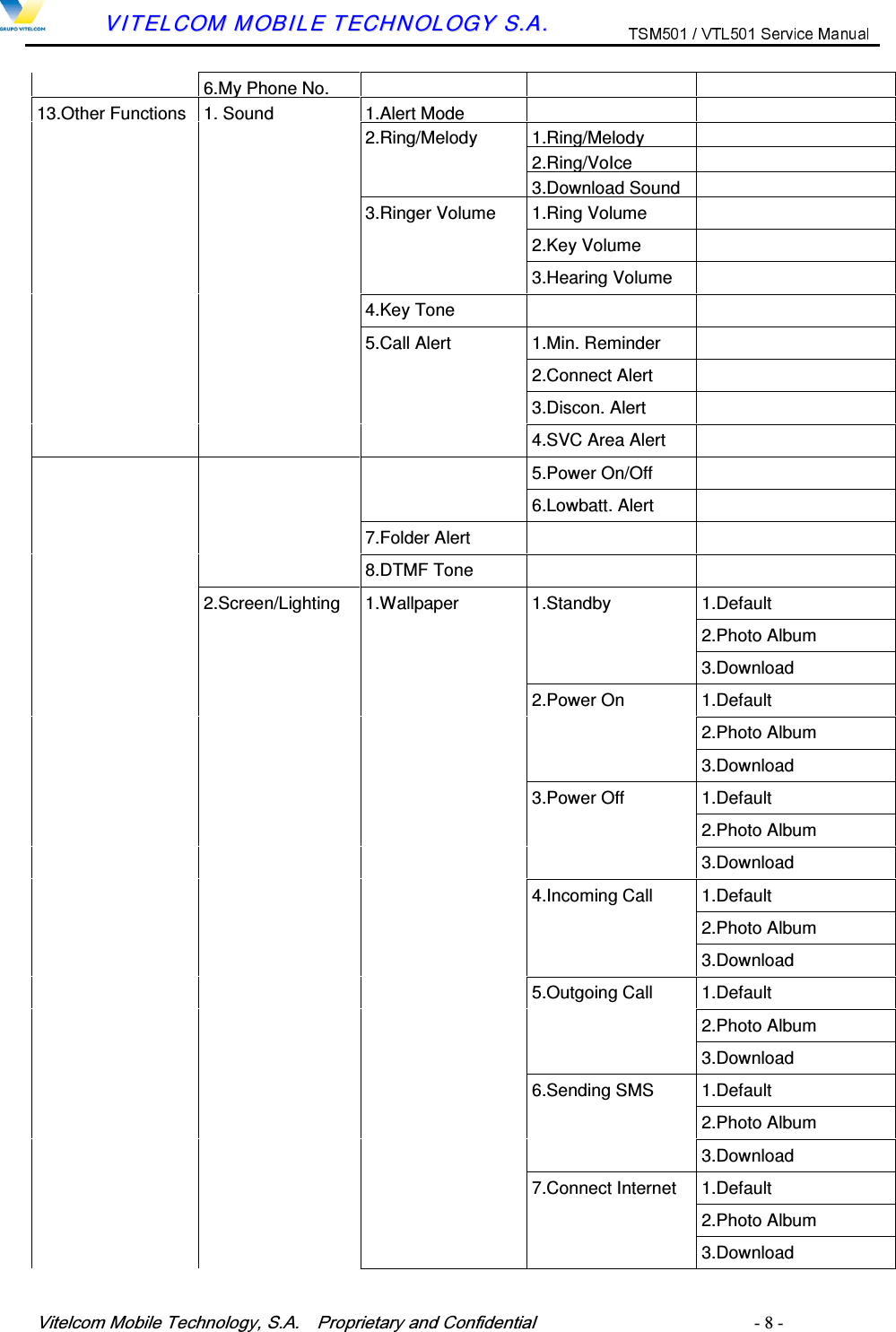
9LWHOFRP0RELOH7HFKQRORJ\6$  3URSULHWDU\DQG&RQILGHQWLDO   - 8 -        VVIITTEELLCCOOMM  MMOOBBIILLEE  TTEECCHHNNOOLLOOGGYY  SS..AA..   6.My Phone No.    13.Other Functions 1. Sound 1.Alert Mode     2.Ring/Melody 1.Ring/Melody     2.Ring/VoIce     3.Download Sound      3.Ringer Volume  1.Ring Volume         2.Key Volume         3.Hearing Volume       4.Key Tone         5.Call Alert  1.Min. Reminder         2.Connect Alert         3.Discon. Alert         4.SVC Area Alert         5.Power On/Off         6.Lowbatt. Alert       7.Folder Alert         8.DTMF Tone       2.Screen/Lighting  1.Wallpaper  1.Standby  1.Default         2.Photo Album         3.Download       2.Power On  1.Default         2.Photo Album         3.Download       3.Power Off  1.Default         2.Photo Album         3.Download       4.Incoming Call  1.Default         2.Photo Album         3.Download       5.Outgoing Call  1.Default         2.Photo Album         3.Download       6.Sending SMS  1.Default         2.Photo Album         3.Download       7.Connect Internet  1.Default         2.Photo Album         3.Download
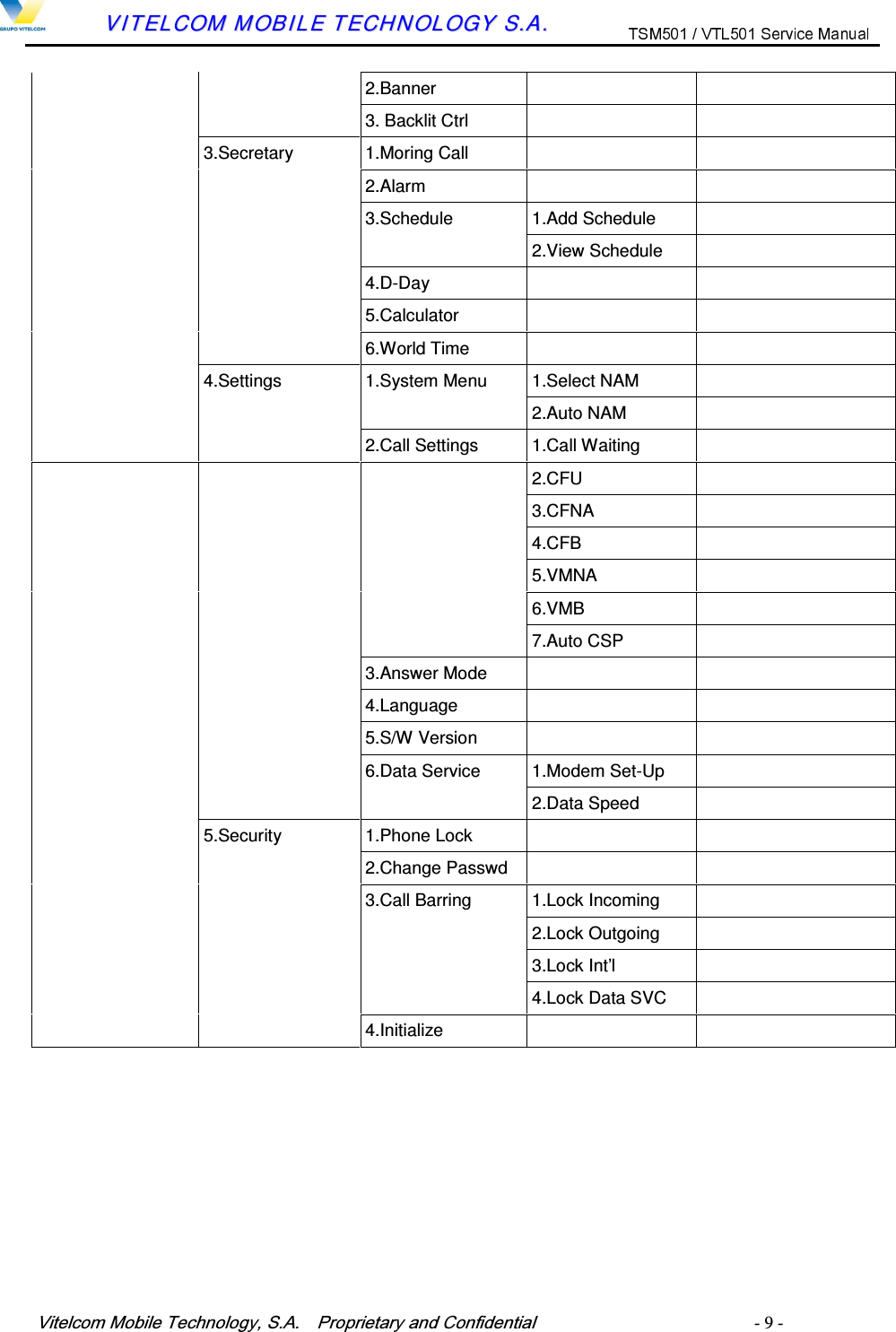
9LWHOFRP0RELOH7HFKQRORJ\6$  3URSULHWDU\DQG&RQILGHQWLDO   - 9 -        VVIITTEELLCCOOMM  MMOOBBIILLEE  TTEECCHHNNOOLLOOGGYY  SS..AA..      2.Banner         3. Backlit Ctrl       3.Secretary  1.Moring Call         2.Alarm         3.Schedule  1.Add Schedule         2.View Schedule       4.D-Day        5.Calculator         6.World Time       4.Settings  1.System Menu  1.Select NAM         2.Auto NAM       2.Call Settings  1.Call Waiting         2.CFU         3.CFNA         4.CFB         5.VMNA         6.VMB         7.Auto CSP       3.Answer Mode         4.Language         5.S/W Version         6.Data Service  1.Modem Set-Up         2.Data Speed     5.Security  1.Phone Lock         2.Change Passwd         3.Call Barring  1.Lock Incoming         2.Lock Outgoing         3.Lock Int’l         4.Lock Data SVC       4.Initialize
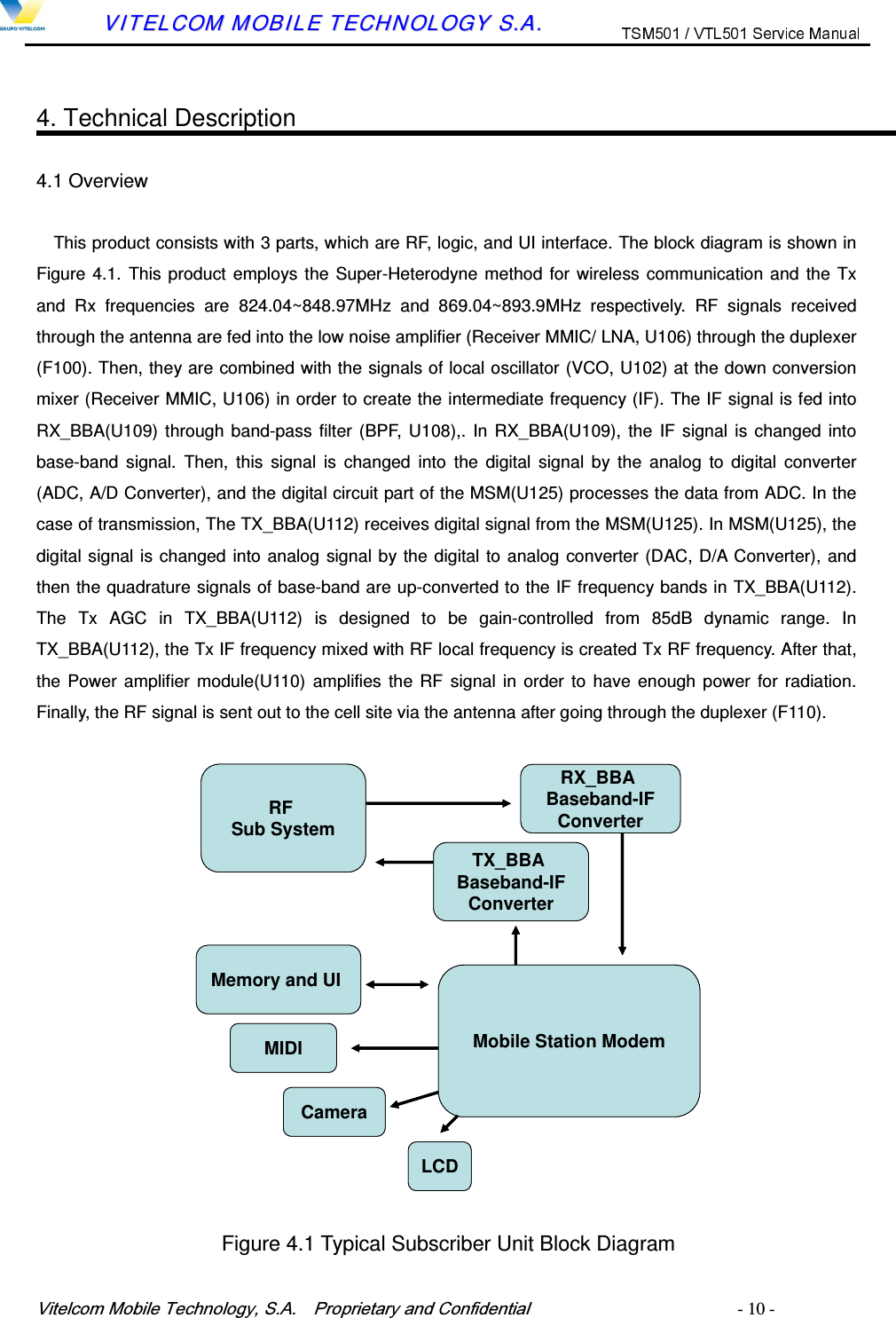
9LWHOFRP0RELOH7HFKQRORJ\6$  3URSULHWDU\DQG&RQILGHQWLDO   - 10 -        VVIITTEELLCCOOMM  MMOOBBIILLEE  TTEECCHHNNOOLLOOGGYY  SS..AA..   4. Technical Description  4.1 Overview This product consists with 3 parts, which are RF, logic, and UI interface. The block diagram is shown in Figure 4.1. This product employs the Super-Heterodyne method for wireless communication and the Tx and  Rx  frequencies  are  824.04~848.97MHz  and  869.04~893.9MHz  respectively.  RF  signals  received through the antenna are fed into the low noise amplifier (Receiver MMIC/ LNA, U106) through the duplexer (F100). Then, they are combined with the signals of local oscillator (VCO, U102) at the down conversion mixer (Receiver MMIC, U106) in order to create the intermediate frequency (IF). The IF signal is fed into RX_BBA(U109) through band-pass filter (BPF, U108),.  In RX_BBA(U109), the  IF signal is changed into base-band  signal.  Then,  this  signal  is  changed  into  the  digital  signal  by  the  analog  to digital  converter (ADC, A/D Converter), and the digital circuit part of the MSM(U125) processes the data from ADC. In the case of transmission, The TX_BBA(U112) receives digital signal from the MSM(U125). In MSM(U125), the digital signal is changed into analog signal by the digital to analog converter (DAC, D/A Converter), and then the quadrature signals of base-band are up-converted to the IF frequency bands in TX_BBA(U112). The  Tx  AGC  in  TX_BBA(U112)  is  designed  to  be  gain-controlled  from  85dB  dynamic  range.  In TX_BBA(U112), the Tx IF frequency mixed with RF local frequency is created Tx RF frequency. After that, the Power amplifier module(U110) amplifies the RF signal in order  to have enough power for radiation. Finally, the RF signal is sent out to the cell site via the antenna after going through the duplexer (F110).  RF Sub SystemRX_BBA Baseband-IFConverterMemory and UI Mobile Station ModemCameraTX_BBA Baseband-IFConverterLCDMIDIRF Sub SystemRX_BBA Baseband-IFConverterMemory and UI Mobile Station ModemCameraTX_BBA Baseband-IFConverterLCDMIDI  Figure 4.1 Typical Subscriber Unit Block Diagram
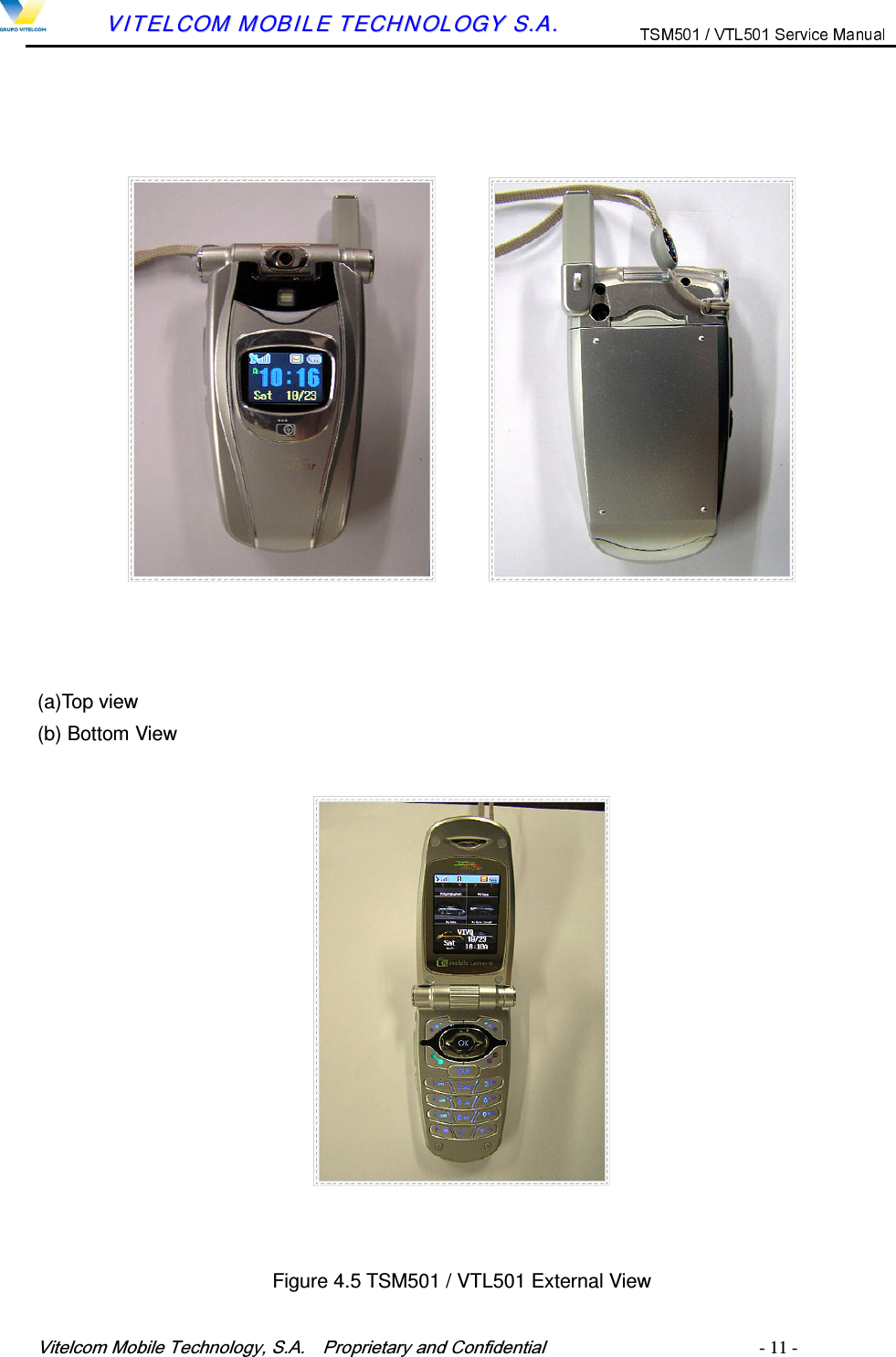
9LWHOFRP0RELOH7HFKQRORJ\6$  3URSULHWDU\DQG&RQILGHQWLDO   - 11 -        VVIITTEELLCCOOMM  MMOOBBIILLEE  TTEECCHHNNOOLLOOGGYY  SS..AA..                                                     (a)Top view (b) Bottom View     Figure 4.5 TSM501 / VTL501 External View
9LWHOFRP0RELOH7HFKQRORJ\6$  3URSULHWDU\DQG&RQILGHQWLDO   - 12 -        VVIITTEELLCCOOMM  MMOOBBIILLEE  TTEECCHHNNOOLLOOGGYY  SS..AA..    4.2 RF part Description The RF part consists of power part, synthesizing part, transmission and reception part.  4.2.1 Description of Frequency Synthesizer Circuit The UHF band frequency synthesizer is composed of an indirect frequency synthesizer, Phase Locked Loop (PLL IC, U2), VCO(U102) with the center frequency of 966.88MHz for CDMA mode and Loop Filter. PLL  IC(U2)’s  phase  detector  compares  the  reference  clock  frequency  (19.68MHz,  TCXO(U104)  clock) divided down to 30kHz by the reference divider with a signal divided by the PLL IC(U2) main divider from the VCO(U102), and generates a local oscillation signals with zero phase difference. These local oscillation signals are used for Tx and Rx. The other PLL synthesizer controls Tx IF frequency and is implemented on the TX_BBA(U112). The Tx phase detector receives Tx IF local oscillation signal(260.76MHz) within the TX_BBA(U112).  In  Rx  IF  synthesizer,  UHF  PLL  synthesizer  support  dual  frequencies.  Thus RX_BBA(U109) use UHF PLL to generate the Rx IF frequency(170.76MHz).      Voltage Control Temperature Compensation Crystal Oscillator (VCTCXO, U104) The  temperature  variation  of  reference  frequency  in  a  mobile  phone  can  be  compensated  by VCTCXO(U104). The reference frequency of a mobile phone is operated stably from –30 to +60 °C. The VCTCXO(U104)  receives  frequency  tuning  signals  called  TRK_LO_ADJ  from  MSM(U125)  through  low-pass filter in order to generate the reference frequency of 19.68MHz and is used for system main clock. Frequency stability depending on temperature is within ±1.5 ppm.    RF Frequency Synthesizer The RF PLL is consisted of the dual mode PLL IC(U2), loop filter, VCO(U102) and VCTCXO(U104). It generates the RF local frequency of 954.38 ~ 979.38 MHz.    RX IF Frequency Synthesizer The Rx IF PLL is consisted of the dual mode PLL IC(U2), Rx IF VCO included in the RX_BBA(U109), loop  filter  and  VCTCXO(U104).  The  Rx  IF  VCO  included  in  the  RX_BBA(U109)  oscillates  twice  Rx  IF frequency    as  170.76MHz and  then  generates the  RX IF  frequency of 85.38MHz by dividing  the Rx IF VCO output frequency by two.    TX IF Frequency Synthesizer The Tx IF PLL Loop is consisted of the Tx IF PLL synthesizer, VCO(U108) that are internally installed in the  TX_BBA(U112),  loop  filter  and  VCTCXO(U104).  The  Tx  IF  VCO  included  the  TX_BBA(U112) generates Tx IF local frequency of 260.76MHz and then generates the Tx IF frequency of 130.38MH by
9LWHOFRP0RELOH7HFKQRORJ\6$  3URSULHWDU\DQG&RQILGHQWLDO   - 13 -        VVIITTEELLCCOOMM  MMOOBBIILLEE  TTEECCHHNNOOLLOOGGYY  SS..AA..  dividing the Tx IF VCO output frequency by two. 4.2.2 Description of Rx Part Circuit Cellular Receiver covers the RF frequency band of 869 ~ 894 MHz and the IF frequency of 85.38MHz. The  RF  signal  received  is  sent  out  to  the  Receiver  MMIC/  LNA(U106)  via  a  duplexer(F100)  for amplification  and  then,  is  sent  out  to  the  Receiver  MMIC/  Down  mixer(U106)  through  Rx  RF  SAW filter(U107).  Here,  the  RF  signal  is  mixed  with  the  VCO(U102)  signal  of  954.38  MHz ~979.38 MHz.  IF signal converted by the Receiver MMIC/ Down mixer(U106) are sent out to IF  SAW Filter(U108), which have a role to filter a wanted frequency. The signal that has passed the IF SAW filter(U108) is fed into AGC AMP that is controlled by the power density modulation (PDM) signal of the MSM(U125) based on the strength of received signal. This AGC AMP is tuned into the level corresponding to the input window of the base band analog processor (RX_BBA, U109).  The AGC AMP controls Rx power level within 85dB dynamic range. The signal entered to RX_BBA(U109) is converted again to 1.2288 MHz base band signal. To do second frequency conversion, the frequency synthesizer in RX_BBA (U109) generates frequency of 170.76MHz and these signals are divided by two in order to use the Rx IF LO signal. These signals are used to convert RX IF signals to I/Q base band signal. I and Q base-band signals are respectively sent out to the analog digital converter via a low pass filter.    Duplexer (F100) The duplexer(F100) consists of the Rx bandpass filter (BPF) and the Tx BPF which have the function of separating Tx and Rx signals in the full duplex system for using the common antenna. The Tx BPF is used to suppress noises and spurious out of the Tx frequency band. The Rx BPF is used to receive only Rx signal coming from the antenna, which is usually called preselector. Its main function limits the bandwidth of spectrum reaching the  Receiver  MMIC/ LNA(U106) and attenuates receiver  spurious response.  As a result, the frequency sensitivity and selectivity of mobile phone increase.    Receiver MMIC/ LNA (U106)/ Down Mixer (U106) -  LNA : The characteristics of Low Noise Amplifier (LNA, U106) are low noise figure, high gain, high intercept point and high reverse isolation. The frequency selectivity characteristic of mobile phone is mostly determined by LNA(U106). -      The  Down  Mixer(U106)  performs  frequency  translation  by  multiplying  two  signals.  The downconversion mixer employed in the Rx path has two distinctly different inputs, which are RF and Local Oscillator (LO) signal. The RF signal is downconverted to IF signal by the local oscillator.    Rx RF SAW Filter (U107) The main function of Rx RF SAW filter(U107) is to attenuate mobile phone spurious frequency, attenuate direct  IF  frequency  pick  up,  attenuate  noise  at  the  image  frequency  originating  in  or  amplified  by  the LNA(U106) and suppress second harmonic originated in the LNA(U106). The Rx RF SAW filter(U107) is usually called image filter.
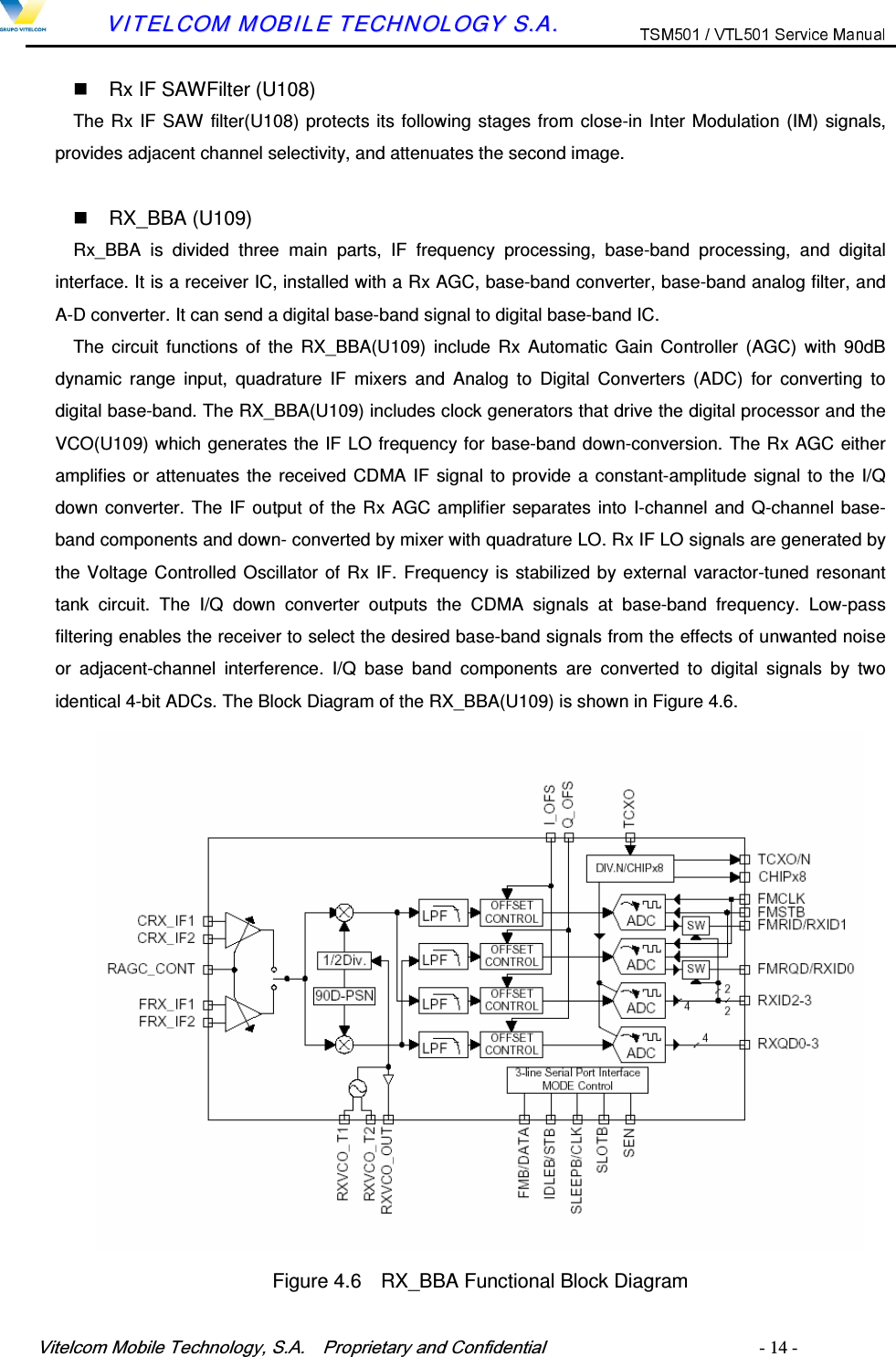
9LWHOFRP0RELOH7HFKQRORJ\6$  3URSULHWDU\DQG&RQILGHQWLDO   - 14 -        VVIITTEELLCCOOMM  MMOOBBIILLEE  TTEECCHHNNOOLLOOGGYY  SS..AA..    Rx IF SAWFilter (U108) The Rx IF SAW filter(U108) protects its following stages from close-in Inter Modulation (IM) signals, provides adjacent channel selectivity, and attenuates the second image.    RX_BBA (U109) Rx_BBA  is  divided  three  main  parts,  IF  frequency  processing,  base-band  processing,  and  digital interface. It is a receiver IC, installed with a Rx AGC, base-band converter, base-band analog filter, and A-D converter. It can send a digital base-band signal to digital base-band IC.   The circuit  functions  of  the RX_BBA(U109)  include  Rx  Automatic  Gain  Controller  (AGC)  with  90dB dynamic  range  input,  quadrature  IF  mixers  and  Analog  to  Digital  Converters  (ADC)  for  converting  to digital base-band. The RX_BBA(U109) includes clock generators that drive the digital processor and the VCO(U109) which generates the IF LO frequency for base-band down-conversion. The Rx AGC either amplifies or attenuates the received CDMA IF signal to provide a constant-amplitude signal to the I/Q down converter. The IF output of the Rx AGC amplifier separates into I-channel and Q-channel base-band components and down- converted by mixer with quadrature LO. Rx IF LO signals are generated by the Voltage Controlled Oscillator of Rx IF. Frequency is stabilized by external varactor-tuned resonant tank  circuit.  The  I/Q  down  converter  outputs  the  CDMA  signals  at  base-band  frequency.  Low-pass filtering enables the receiver to select the desired base-band signals from the effects of unwanted noise or  adjacent-channel  interference.  I/Q  base  band  components  are  converted  to  digital  signals  by  two identical 4-bit ADCs. The Block Diagram of the RX_BBA(U109) is shown in Figure 4.6.  Figure 4.6    RX_BBA Functional Block Diagram
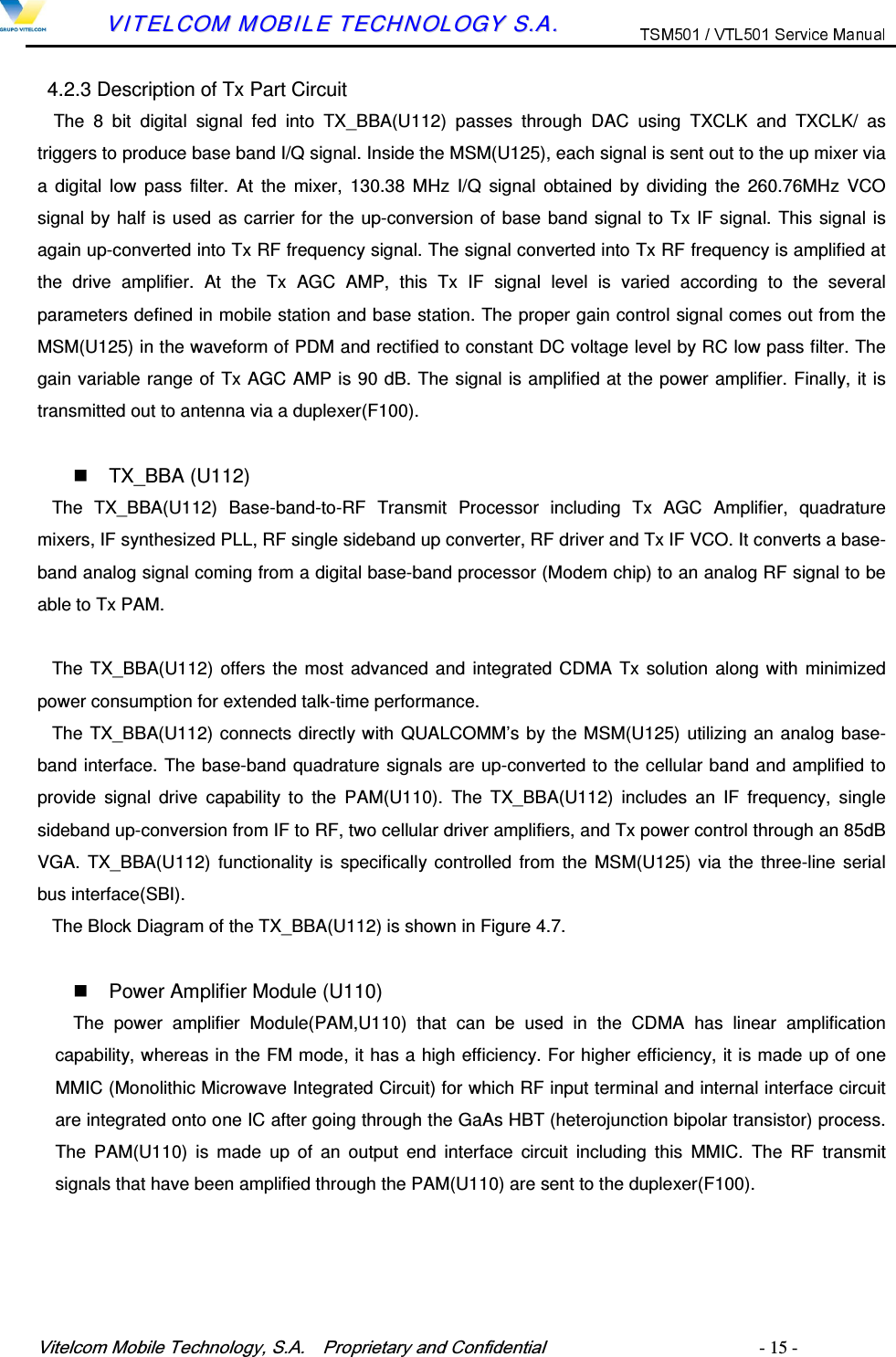
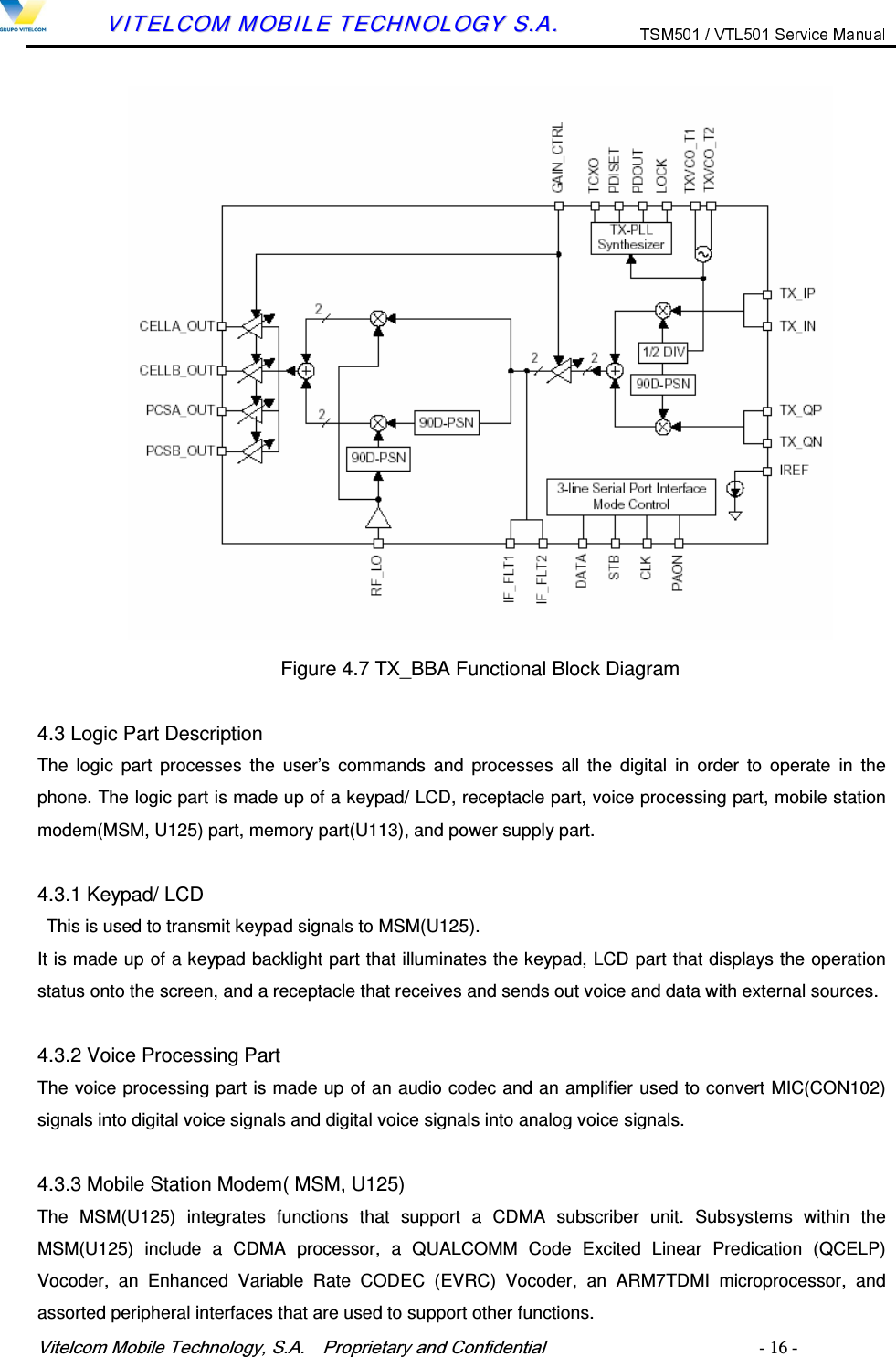
9LWHOFRP0RELOH7HFKQRORJ\6$  3URSULHWDU\DQG&RQILGHQWLDO   - 15 -        VVIITTEELLCCOOMM  MMOOBBIILLEE  TTEECCHHNNOOLLOOGGYY  SS..AA..  4.2.3 Description of Tx Part Circuit The  8  bit  digital  signal  fed  into  TX_BBA(U112)  passes  through  DAC  using  TXCLK  and  TXCLK/  as triggers to produce base band I/Q signal. Inside the MSM(U125), each signal is sent out to the up mixer via a digital  low  pass  filter.  At  the mixer,  130.38  MHz  I/Q  signal  obtained  by  dividing  the  260.76MHz  VCO signal by half is used as carrier for the up-conversion of base band signal to Tx IF signal. This signal is again up-converted into Tx RF frequency signal. The signal converted into Tx RF frequency is amplified at the  drive  amplifier.  At  the  Tx  AGC  AMP,  this  Tx  IF  signal  level  is  varied  according  to  the  several parameters defined in mobile station and base station. The proper gain control signal comes out from the MSM(U125) in the waveform of PDM and rectified to constant DC voltage level by RC low pass filter. The gain variable range of Tx AGC AMP is 90 dB. The signal is amplified at the power amplifier. Finally, it is transmitted out to antenna via a duplexer(F100).    TX_BBA (U112) The  TX_BBA(U112)  Base-band-to-RF  Transmit  Processor  including  Tx  AGC  Amplifier,  quadrature mixers, IF synthesized PLL, RF single sideband up converter, RF driver and Tx IF VCO. It converts a base-band analog signal coming from a digital base-band processor (Modem chip) to an analog RF signal to be able to Tx PAM.  The TX_BBA(U112) offers the most advanced and integrated CDMA Tx solution along with minimized power consumption for extended talk-time performance.   The TX_BBA(U112) connects directly with QUALCOMM’s by the MSM(U125) utilizing an analog base-band interface. The base-band quadrature signals are up-converted to the cellular band and amplified to provide  signal  drive  capability  to  the  PAM(U110).  The  TX_BBA(U112)  includes  an  IF  frequency,  single sideband up-conversion from IF to RF, two cellular driver amplifiers, and Tx power control through an 85dB VGA. TX_BBA(U112) functionality is specifically controlled from the MSM(U125) via the  three-line serial bus interface(SBI).   The Block Diagram of the TX_BBA(U112) is shown in Figure 4.7.    Power Amplifier Module (U110) The  power  amplifier  Module(PAM,U110)  that  can  be  used  in  the  CDMA  has  linear  amplification capability, whereas in the FM mode, it has a high efficiency. For higher efficiency, it is made up of one MMIC (Monolithic Microwave Integrated Circuit) for which RF input terminal and internal interface circuit are integrated onto one IC after going through the GaAs HBT (heterojunction bipolar transistor) process. The  PAM(U110)  is  made  up  of  an  output  end  interface  circuit  including  this  MMIC.  The  RF  transmit signals that have been amplified through the PAM(U110) are sent to the duplexer(F100).
9LWHOFRP0RELOH7HFKQRORJ\6$  3URSULHWDU\DQG&RQILGHQWLDO   - 16 -        VVIITTEELLCCOOMM  MMOOBBIILLEE  TTEECCHHNNOOLLOOGGYY  SS..AA..   Figure 4.7 TX_BBA Functional Block Diagram  4.3 Logic Part Description The  logic  part  processes  the  user’s  commands  and  processes  all  the  digital  in  order  to  operate  in  the phone. The logic part is made up of a keypad/ LCD, receptacle part, voice processing part, mobile station modem(MSM, U125) part, memory part(U113), and power supply part.  4.3.1 Keypad/ LCD   This is used to transmit keypad signals to MSM(U125).   It is made up of a keypad backlight part that illuminates the keypad, LCD part that displays the operation status onto the screen, and a receptacle that receives and sends out voice and data with external sources.  4.3.2 Voice Processing Part The voice processing part is made up of an audio codec and an amplifier used to convert MIC(CON102) signals into digital voice signals and digital voice signals into analog voice signals.    4.3.3 Mobile Station Modem( MSM, U125) The  MSM(U125)  integrates  functions  that  support  a  CDMA  subscriber  unit.  Subsystems  within  the MSM(U125)  include  a  CDMA  processor,  a  QUALCOMM  Code  Excited  Linear  Predication  (QCELP) Vocoder,  an  Enhanced  Variable  Rate  CODEC  (EVRC)  Vocoder,  an  ARM7TDMI  microprocessor,  and assorted peripheral interfaces that are used to support other functions.
9LWHOFRP0RELOH7HFKQRORJ\6$  3URSULHWDU\DQG&RQILGHQWLDO   - 17 -        VVIITTEELLCCOOMM  MMOOBBIILLEE  TTEECCHHNNOOLLOOGGYY  SS..AA..    MSM(U125) Internal Block  1) ARM Microprocessor Subsystem The  MSM(U125)  uses  an  embedded  ARM7TDMI  microprocessor.  The  ARM7TDMI  microprocessor, through the system software, controls most of the functionality for the Mobile Station, including control of the external peripherals such as the keypad, LCD display, RAM and ROM/FLASH(U113) devices.  2) RF Interface This block communicates with the MSM(U125) RF, IF and Analog Base-band circuitry.  3) CDMA Subsystem: Digital IS-2000 Signal Processing. Searcher engine Demodulating fingers Combining block Frame de-interleaver Viterbi decoder Reverse link subsystem  4) UART (Universal Asynchronous Receiver Transmitter) Two identical UARTs, UART1 has dedicated pins while UART2 share multiplexed pins with the Auxiliary PCM CODEC interface.  5) Vocoder Subsystem The MSM(U125)’s QDSP2000 supports EVRC and QCELP13K vocoders. In addition, the QDSP2000 has modules  to  support  the  following  audio  functions;  DTMF  tone  generation,  DTMF  tone  detection,  Tx/Rx volume controls, Tx/Rx automatic gain control(AGC), Rx Automatic Volume Control(AVC), Ear Seal Echo Canceller(ESEC),  Acoustic  Echo  Canceller(AEC),  Noise  Suppression(NS),  and  programmable,  13-tap, Type-I,  FIR,  Tx/Rx compensation filters.  The  MSM(U125)’s  integrated  ARM7TDMI  processor  downloads the firmware into the QDSP2000 and configures QDSP2000 to support the desired functionality.  6) General Purpose Interface Bus The MSM(U125) has 48 general-purpose bi-directional input/output pins (GPIO_INT[47:0]) that double as general-purpose interrupt inputs. Some of the GPIO_INT pins have alternate functions supported on them. The alternate functions include, USB interface, additional RAM, ROM/Flash(U113), general-purpose chip selects,  parallel  LCD  interface,  and a  UART interface.  The  function  of these  pins  is  documented  in  the various software releases.  7) Serial Bus Interface
9LWHOFRP0RELOH7HFKQRORJ\6$  3URSULHWDU\DQG&RQILGHQWLDO   - 18 -        VVIITTEELLCCOOMM  MMOOBBIILLEE  TTEECCHHNNOOLLOOGGYY  SS..AA..  This  interface  is  specifically  designed  to  be  a  quick,  low  pin  count  control  protocol  for Qualcomm’s TX_BBA(U112) can be configured for different operating modes and configured for minimum power consumption, extending battery life in standby mode.  8) User Interface MSM(U125) user interface comprises digital connections to the subscriber unit ringer transducer, keypad and LCD display.  9) Mode Select and JTAG Interfaces The Mode select  inputs to  the MSM(U125)  determine  overall  mode of the ASIC.  The options  under  the control of the Mode select inputs are Native Mode which is the normal subscriber unit operation and ICE Mode in which the on-chip ARM microprocessor is disabled, allowing off-chip emulation by the ICE unit.  4.3.4 Memory Part (U113) Components: Combination Memory [Flash Memory (128Mbit) + SRAM (32Mbit)]  1) Flash Memory (128Mbit) Stores telephone’s main and sub programs.   Memory for source code : 12Mbyte .   Memory  for  NV  parameter  value  ,  SMS,  Phone  Book,  Download  data,  PIMS  data,  camera  data..  etc  : 4Mbyte. - Code Flash memory: 8MB (4Mbit x 16), Random Access Time is 70ns - Data Flash memory: 8MB (4Mbit x 16), Random Access Time is 70ns  2) SRAM (32Mbit) Stores changes in other person’s system parameter and Data Task data Buffer and stack of each task. - SRAM: 4MB (2Mbit x 16), Max. Access Time is 70ns  4.3.5 Power Supply Part Power is supplied by battery or external source of which range is 3.2~4.2V voltage. It is sent to LDO (Low dropout regulator), which supply 2.8V for Logic power.
9LWHOFRP0RELOH7HFKQRORJ\6$  3URSULHWDU\DQG&RQILGHQWLDO   - 19 -        VVIITTEELLCCOOMM  MMOOBBIILLEE  TTEECCHHNNOOLLOOGGYY  SS..AA..   Figure 4.8 VTL501 Logic Part Block Diagram    4.4 Power Up Sequence This section describes the steps how the TSM501 / VTL501 phone wakes up.    Place a Battery Pack The battery pack, which the protection circuit is implemented, is placed into the phone.    Press and Hold [END] Key The Power on circuit (SW124) generates the control voltage to be used for U6.    Regulators Activated U6 feeds 2.8V to MSM (U125), LCD U6 feeds 2.8V to Flash ROM / SRAM (U113) and others. U6 feeds 2.8V to VCTCXO(U104) and others.
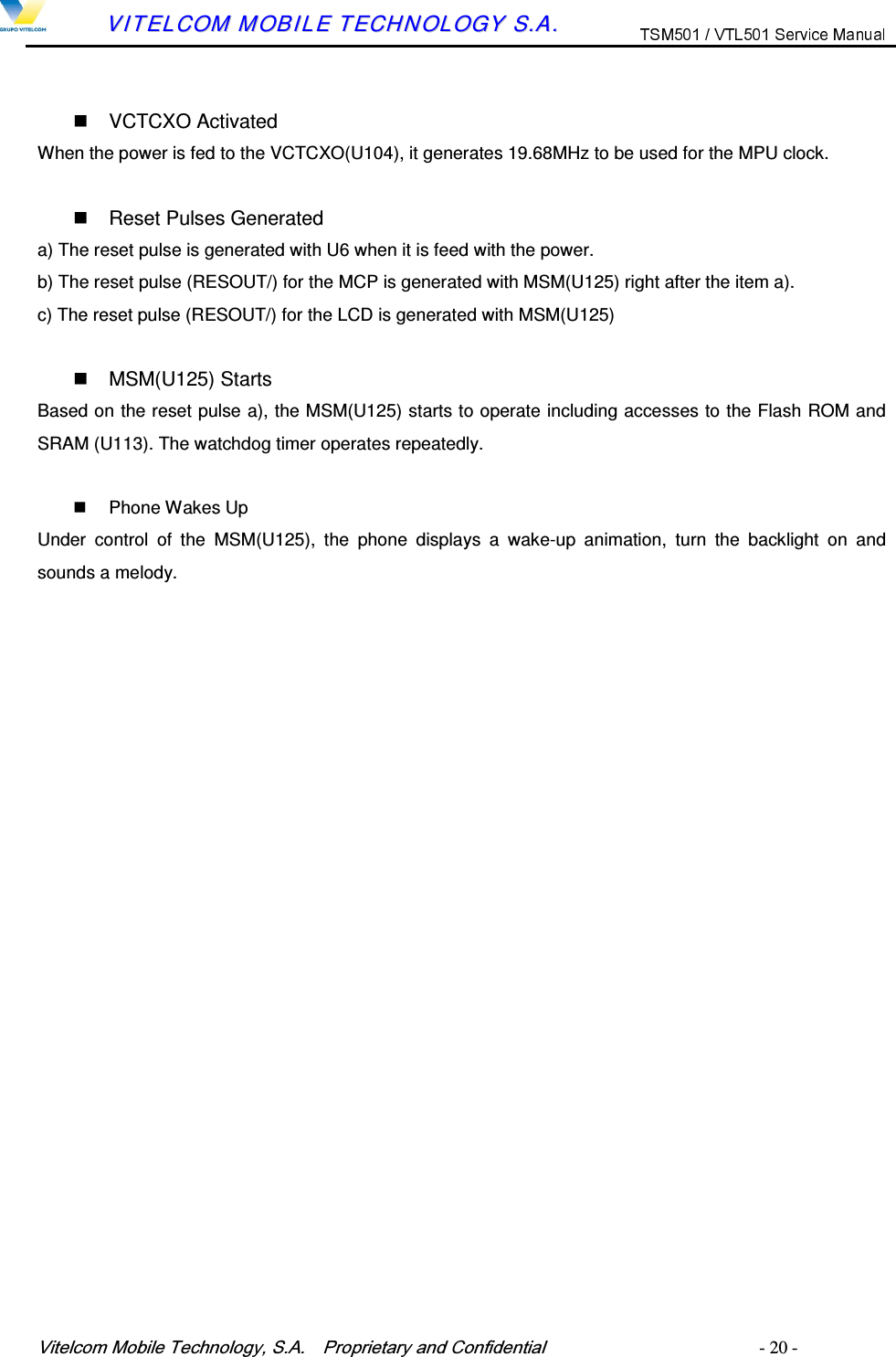
9LWHOFRP0RELOH7HFKQRORJ\6$  3URSULHWDU\DQG&RQILGHQWLDO   - 20 -        VVIITTEELLCCOOMM  MMOOBBIILLEE  TTEECCHHNNOOLLOOGGYY  SS..AA..     VCTCXO Activated When the power is fed to the VCTCXO(U104), it generates 19.68MHz to be used for the MPU clock.    Reset Pulses Generated a) The reset pulse is generated with U6 when it is feed with the power. b) The reset pulse (RESOUT/) for the MCP is generated with MSM(U125) right after the item a). c) The reset pulse (RESOUT/) for the LCD is generated with MSM(U125)      MSM(U125) Starts Based on the reset pulse a), the MSM(U125) starts to operate including accesses to the Flash ROM and SRAM (U113). The watchdog timer operates repeatedly.    Phone Wakes Up Under  control  of  the  MSM(U125),  the  phone  displays  a  wake-up  animation,  turn  the  backlight  on  and sounds a melody.
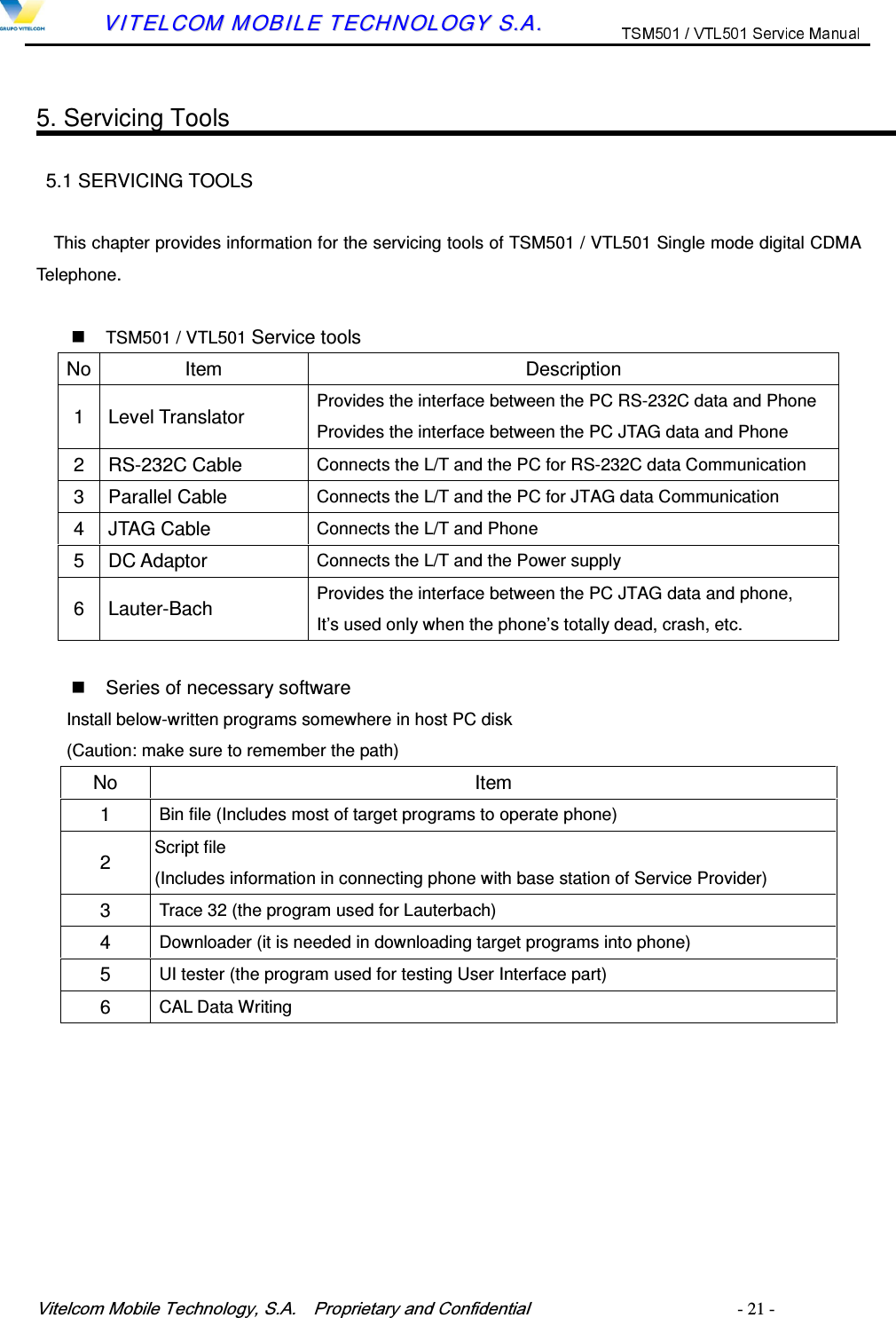
9LWHOFRP0RELOH7HFKQRORJ\6$  3URSULHWDU\DQG&RQILGHQWLDO   - 21 -        VVIITTEELLCCOOMM  MMOOBBIILLEE  TTEECCHHNNOOLLOOGGYY  SS..AA..  5. Servicing Tools   5.1 SERVICING TOOLS This chapter provides information for the servicing tools of TSM501 / VTL501 Single mode digital CDMA Telephone.   TSM501 / VTL501 Service tools No Item  Description 1  Level Translator  Provides the interface between the PC RS-232C data and Phone Provides the interface between the PC JTAG data and Phone 2  RS-232C Cable  Connects the L/T and the PC for RS-232C data Communication 3  Parallel Cable  Connects the L/T and the PC for JTAG data Communication 4  JTAG Cable  Connects the L/T and Phone 5  DC Adaptor  Connects the L/T and the Power supply 6  Lauter-Bach  Provides the interface between the PC JTAG data and phone,   It’s used only when the phone’s totally dead, crash, etc.    Series of necessary software Install below-written programs somewhere in host PC disk   (Caution: make sure to remember the path) No  Item 1  Bin file (Includes most of target programs to operate phone) 2  Script file   (Includes information in connecting phone with base station of Service Provider) 3  Trace 32 (the program used for Lauterbach) 4  Downloader (it is needed in downloading target programs into phone) 5  UI tester (the program used for testing User Interface part)   6  CAL Data Writing
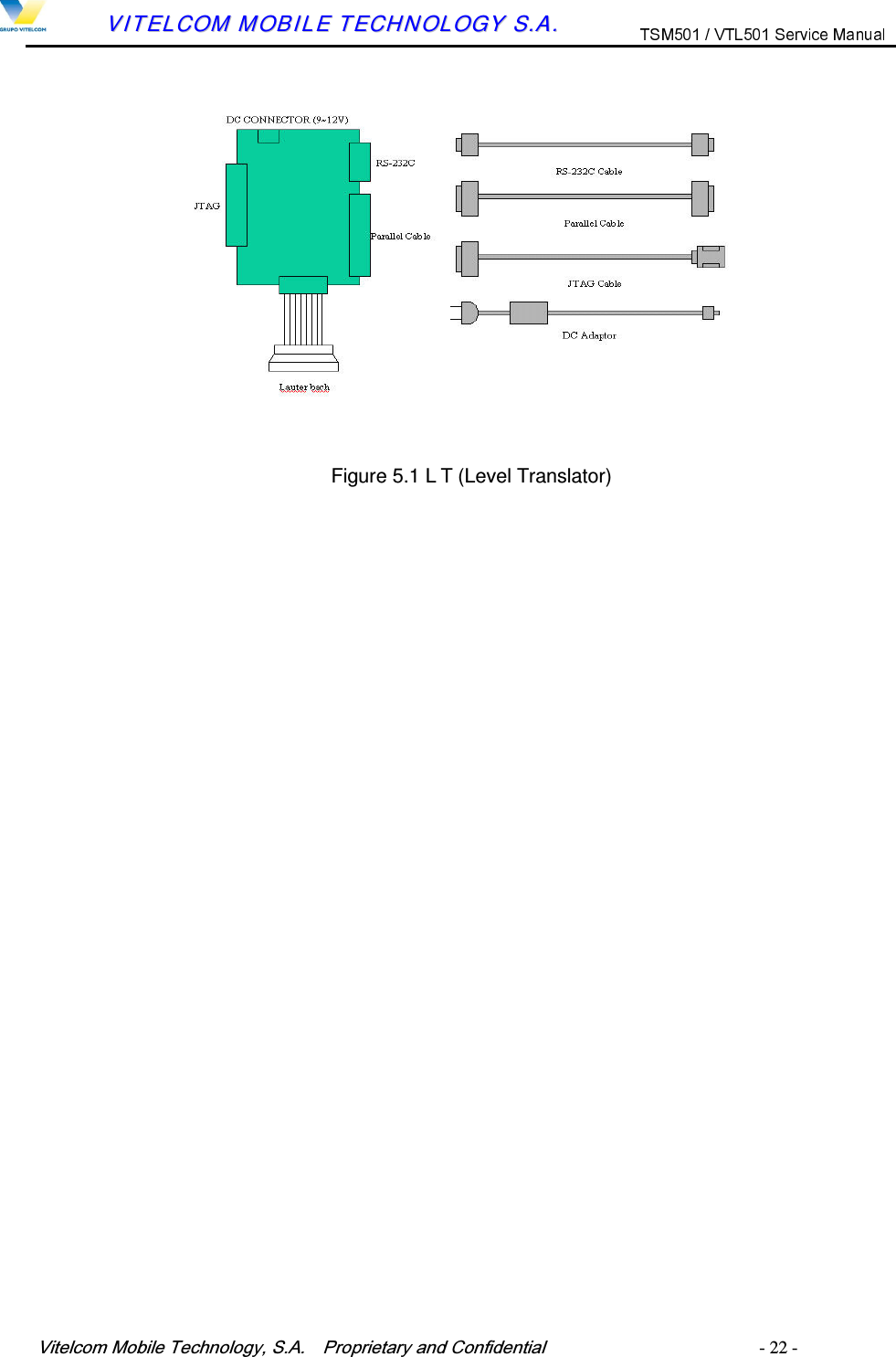
9LWHOFRP0RELOH7HFKQRORJ\6$  3URSULHWDU\DQG&RQILGHQWLDO   - 22 -        VVIITTEELLCCOOMM  MMOOBBIILLEE  TTEECCHHNNOOLLOOGGYY  SS..AA..   Figure 5.1 L T (Level Translator)
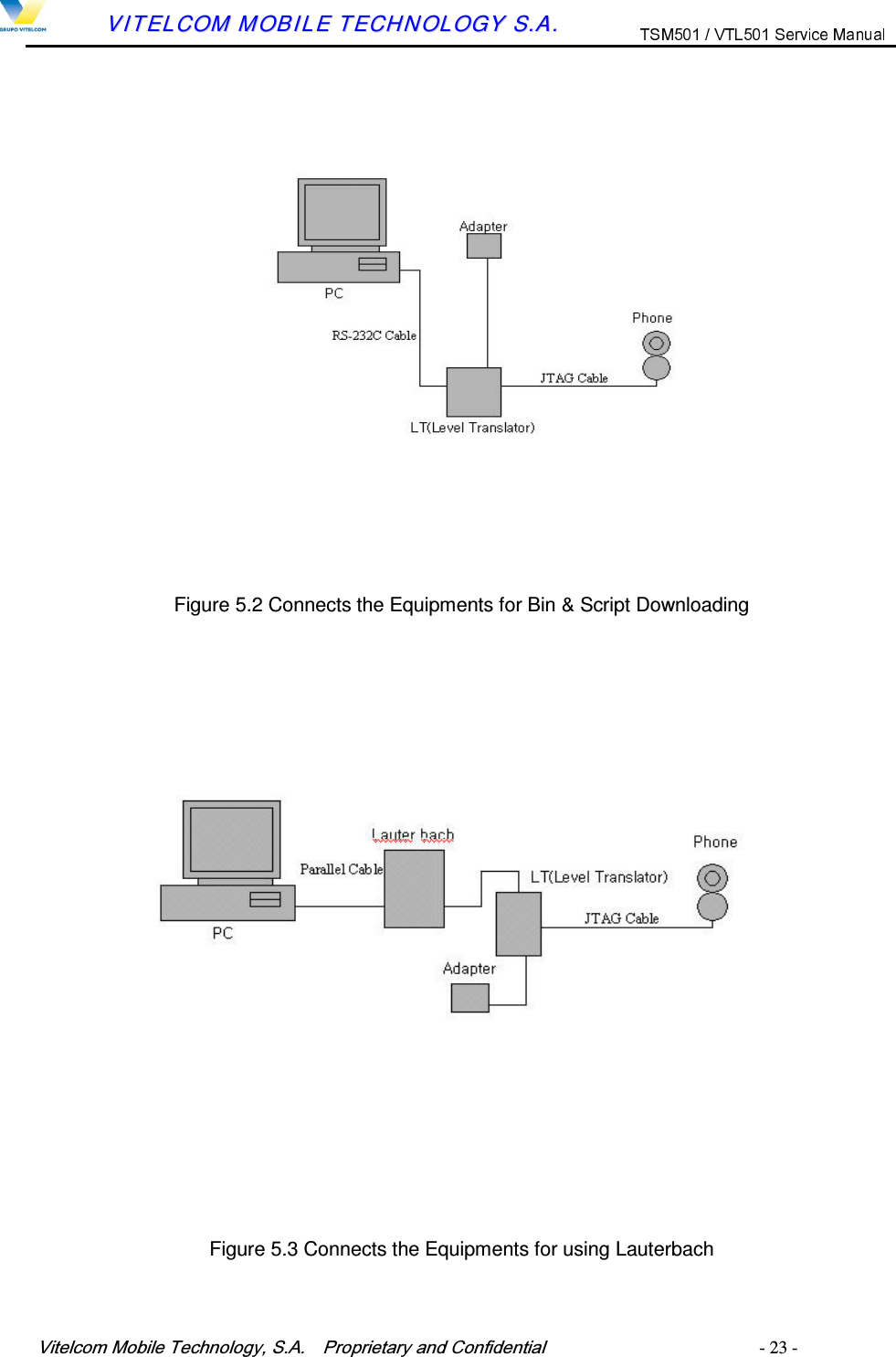
9LWHOFRP0RELOH7HFKQRORJ\6$  3URSULHWDU\DQG&RQILGHQWLDO   - 23 -        VVIITTEELLCCOOMM  MMOOBBIILLEE  TTEECCHHNNOOLLOOGGYY  SS..AA..   Figure 5.2 Connects the Equipments for Bin & Script Downloading  Figure 5.3 Connects the Equipments for using Lauterbach
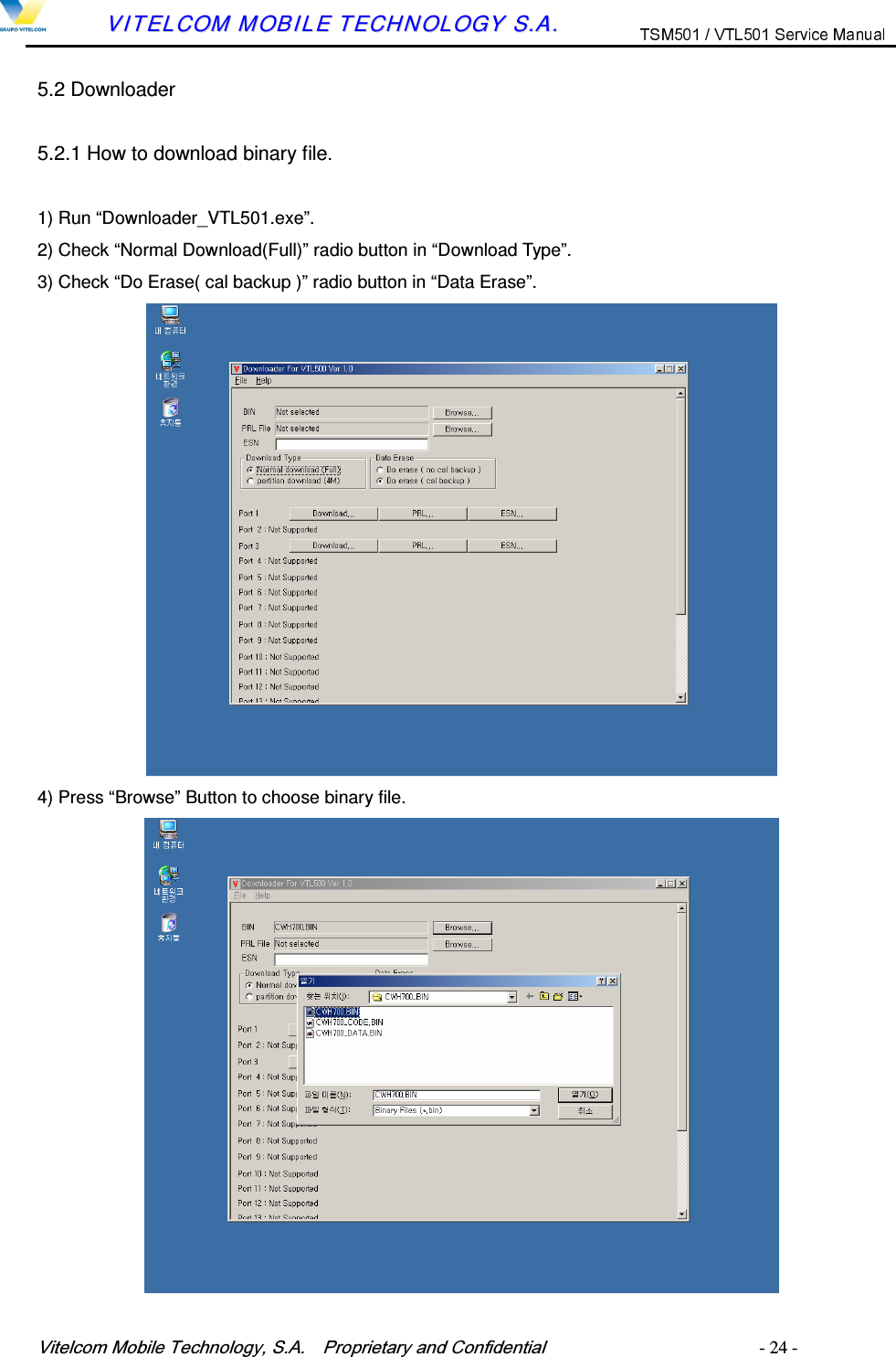
9LWHOFRP0RELOH7HFKQRORJ\6$  3URSULHWDU\DQG&RQILGHQWLDO   - 24 -        VVIITTEELLCCOOMM  MMOOBBIILLEE  TTEECCHHNNOOLLOOGGYY  SS..AA..  5.2 Downloader 5.2.1 How to download binary file.  1) Run “Downloader_VTL501.exe”. 2) Check “Normal Download(Full)” radio button in “Download Type”. 3) Check “Do Erase( cal backup )” radio button in “Data Erase”. 4) Press “Browse” Button to choose binary file. 
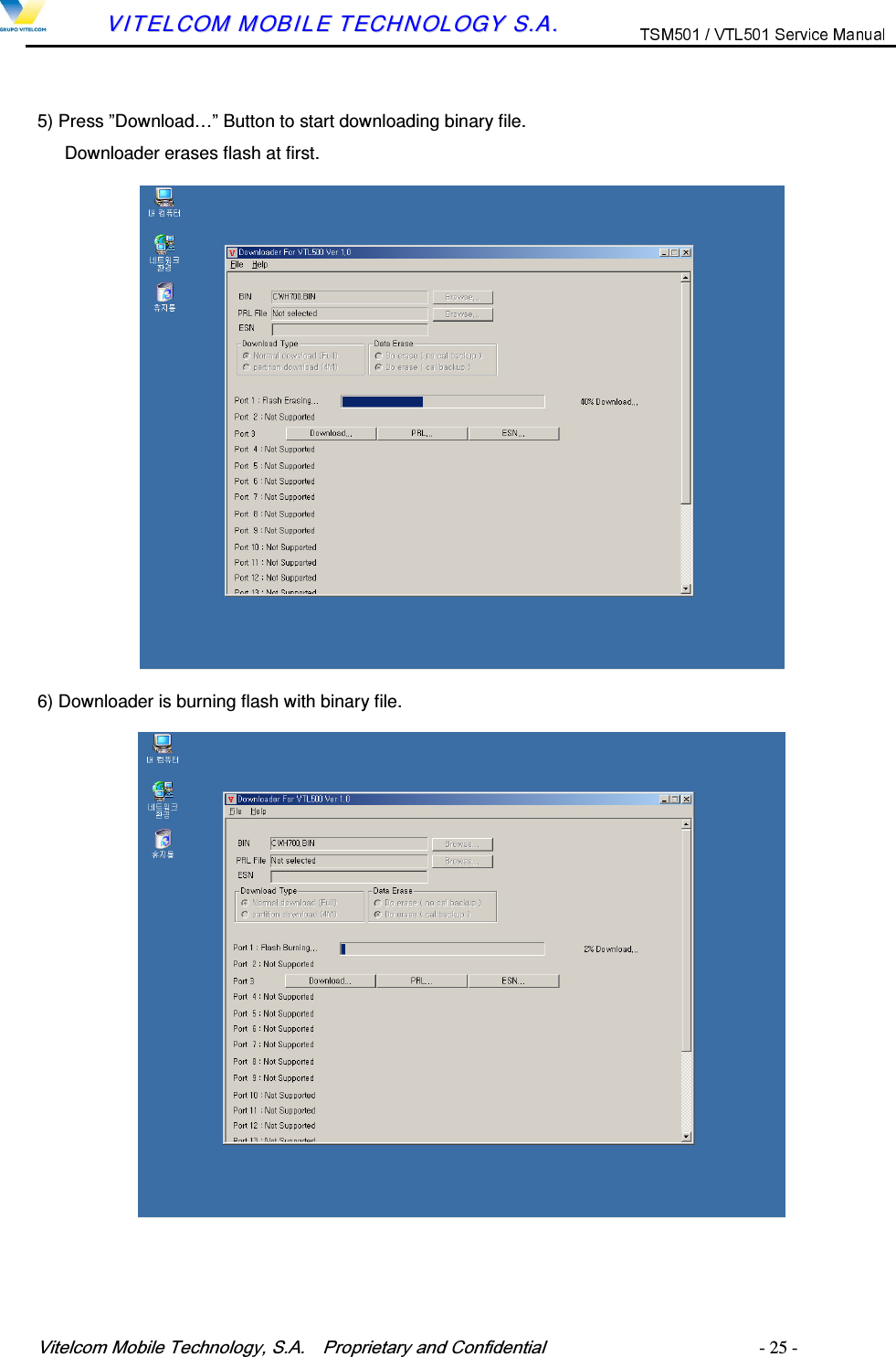
9LWHOFRP0RELOH7HFKQRORJ\6$  3URSULHWDU\DQG&RQILGHQWLDO   - 25 -        VVIITTEELLCCOOMM  MMOOBBIILLEE  TTEECCHHNNOOLLOOGGYY  SS..AA..  5) Press ”Download…” Button to start downloading binary file.       Downloader erases flash at first. 6) Downloader is burning flash with binary file.  
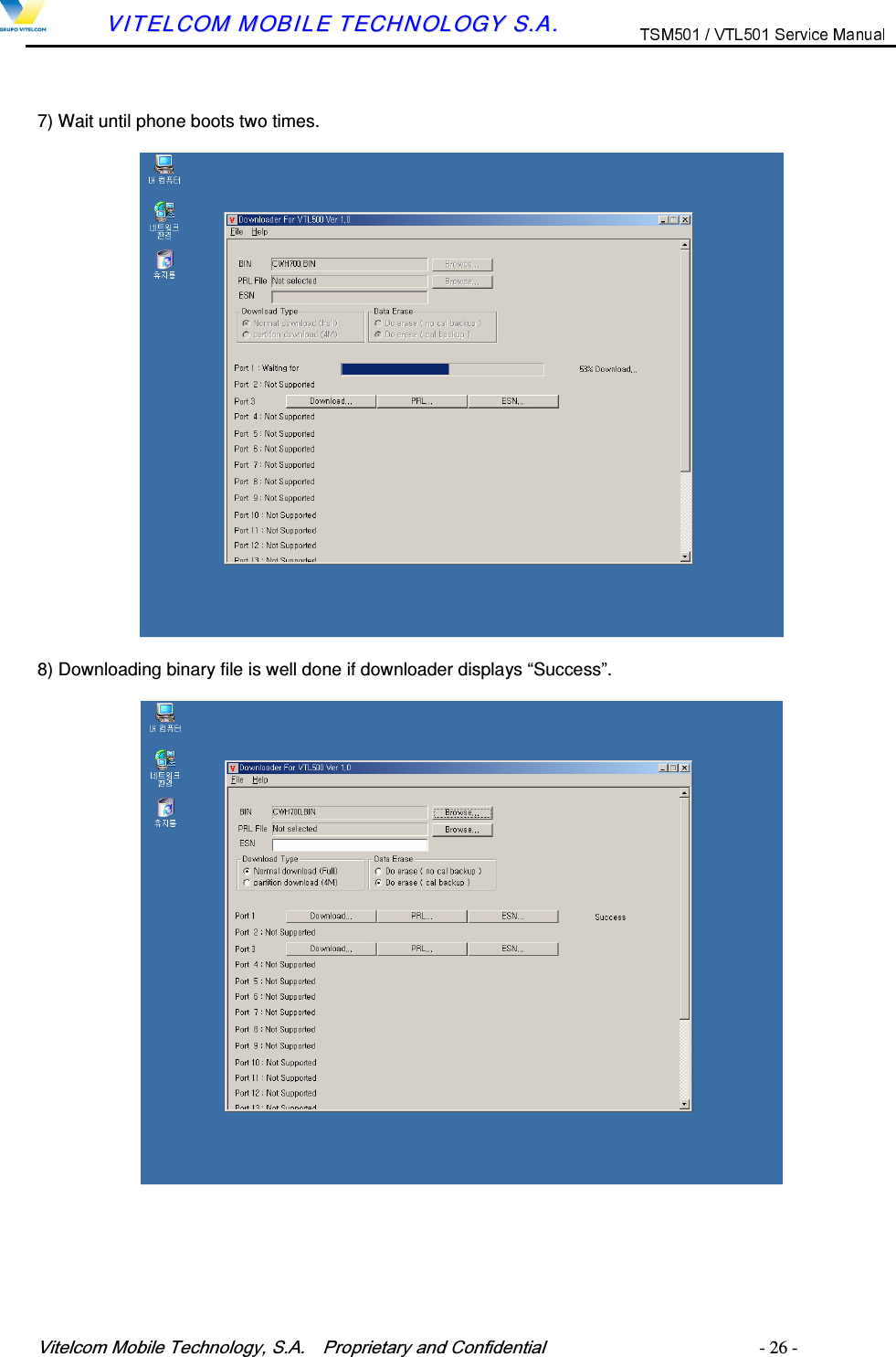
9LWHOFRP0RELOH7HFKQRORJ\6$  3URSULHWDU\DQG&RQILGHQWLDO   - 26 -        VVIITTEELLCCOOMM  MMOOBBIILLEE  TTEECCHHNNOOLLOOGGYY  SS..AA..  7) Wait until phone boots two times. 8) Downloading binary file is well done if downloader displays “Success”
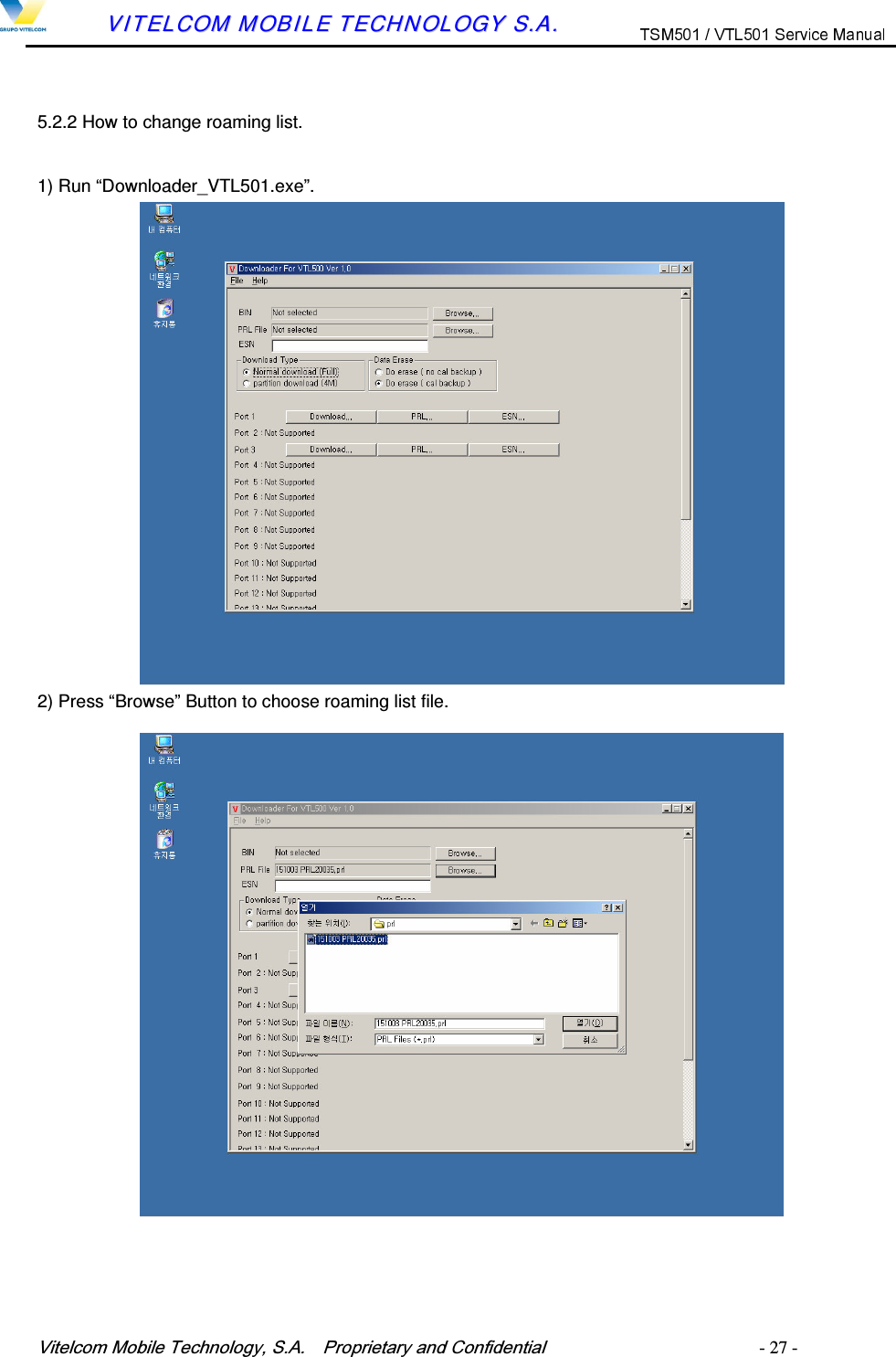
9LWHOFRP0RELOH7HFKQRORJ\6$  3URSULHWDU\DQG&RQILGHQWLDO   - 27 -        VVIITTEELLCCOOMM  MMOOBBIILLEE  TTEECCHHNNOOLLOOGGYY  SS..AA..  5.2.2 How to change roaming list1) Run “Downloader_VTL501.exe”. 2) Press “Browse” Button to choose roaming list file. 
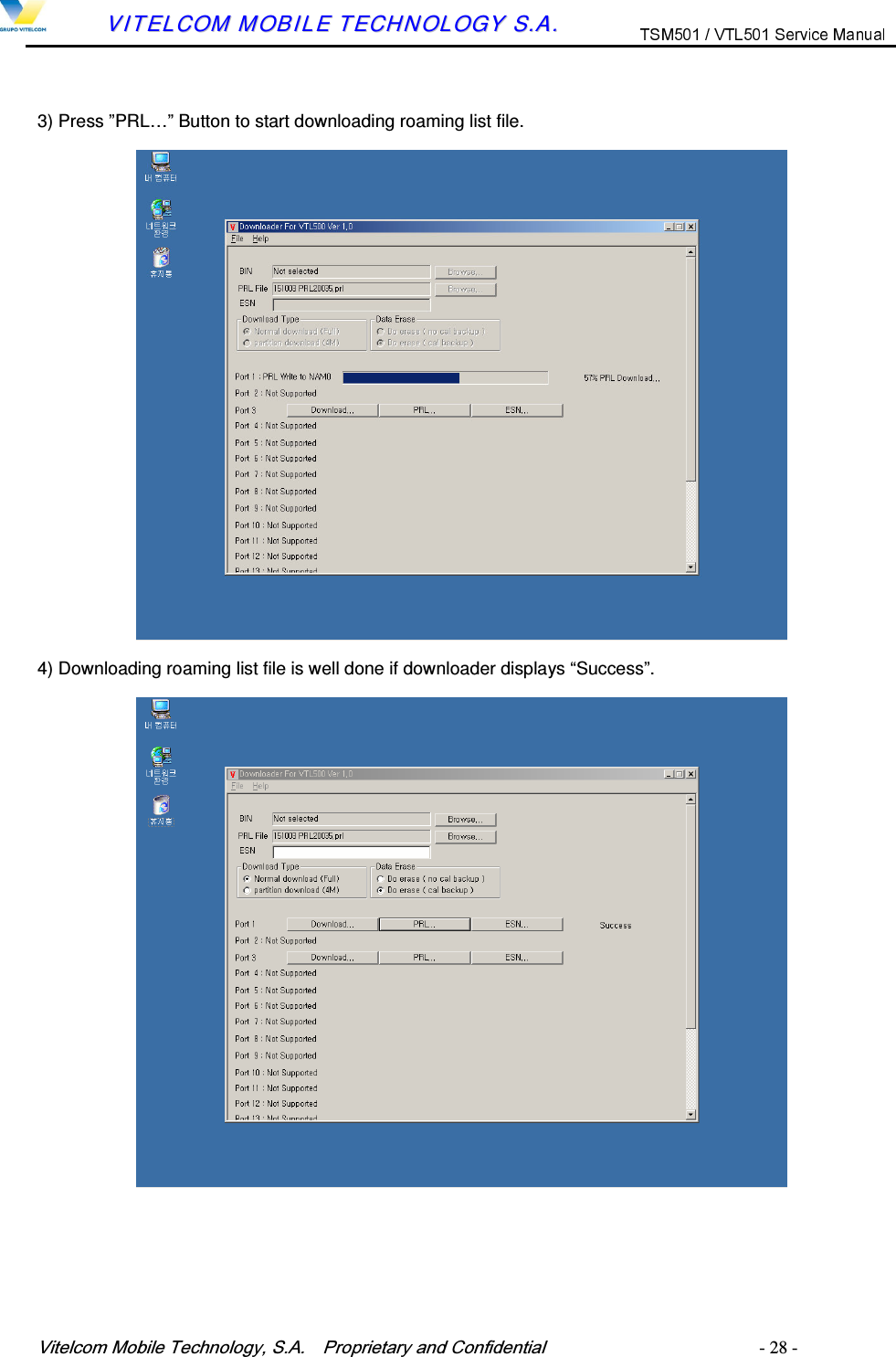
9LWHOFRP0RELOH7HFKQRORJ\6$  3URSULHWDU\DQG&RQILGHQWLDO   - 28 -        VVIITTEELLCCOOMM  MMOOBBIILLEE  TTEECCHHNNOOLLOOGGYY  SS..AA..  3) Press ”PRL…” Button to start downloading roaming list file. 4) Downloading roaming list file is well done if downloader displays “Success”. 
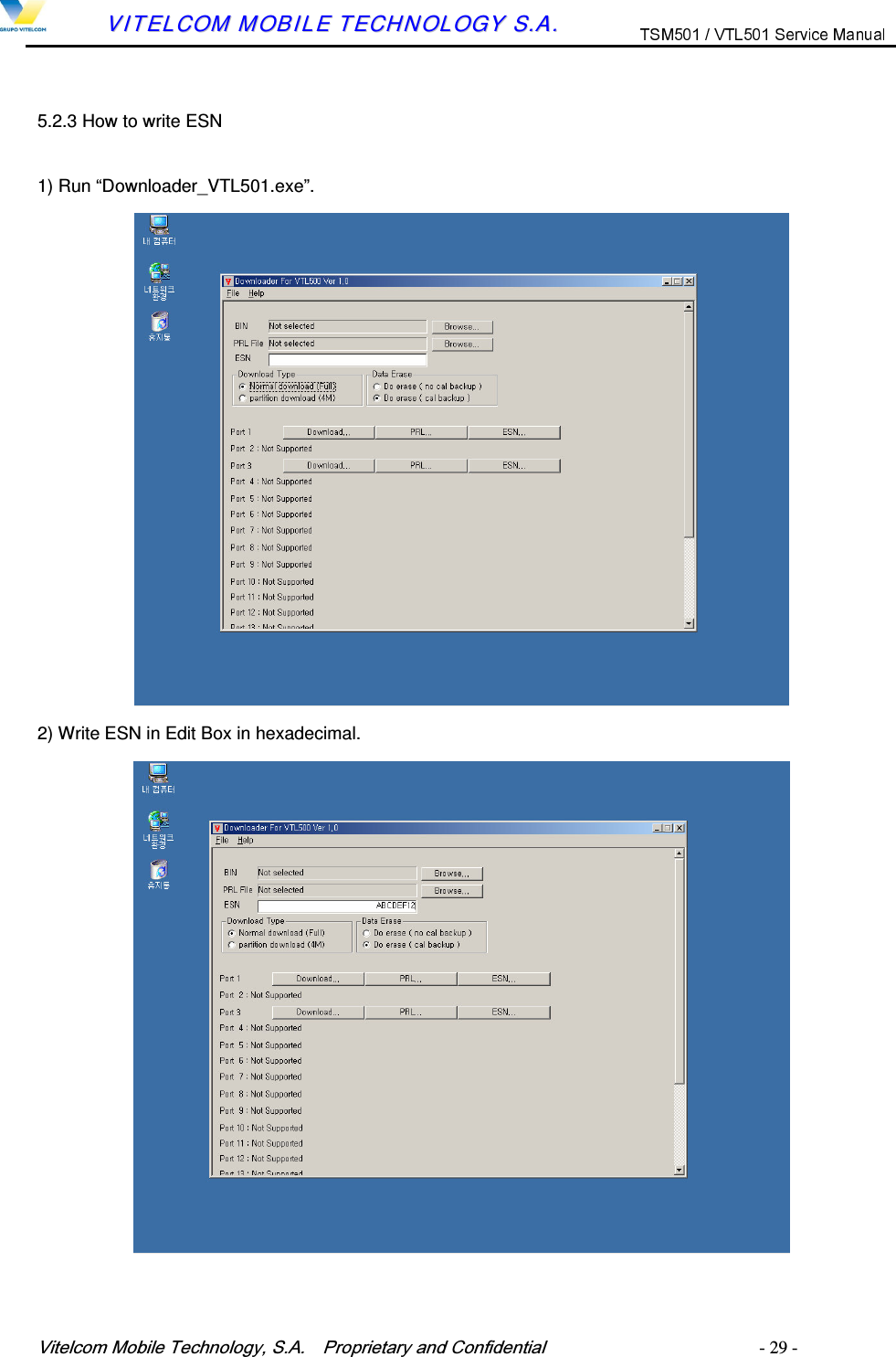
9LWHOFRP0RELOH7HFKQRORJ\6$  3URSULHWDU\DQG&RQILGHQWLDO   - 29 -        VVIITTEELLCCOOMM  MMOOBBIILLEE  TTEECCHHNNOOLLOOGGYY  SS..AA..  5.2.3 How to write ESN  1) Run “Downloader_VTL501.exe”.2) Write ESN in Edit Box in hexadecimal. 
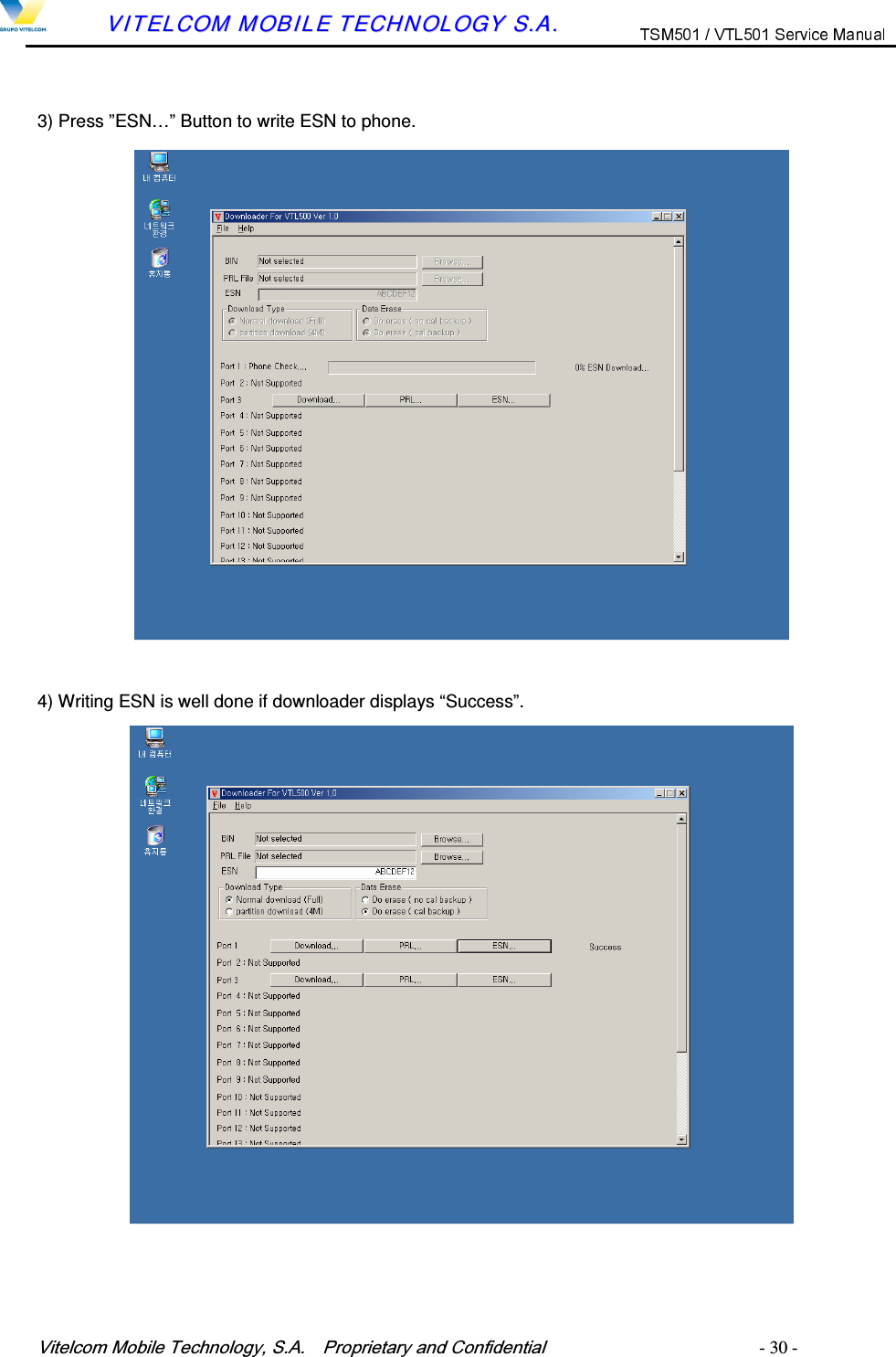
9LWHOFRP0RELOH7HFKQRORJ\6$  3URSULHWDU\DQG&RQILGHQWLDO   - 30 -        VVIITTEELLCCOOMM  MMOOBBIILLEE  TTEECCHHNNOOLLOOGGYY  SS..AA..  3) Press ”ESN…” Button to write ESN to phone. 4) Writing ESN is well done if downloader displays “Success”. 
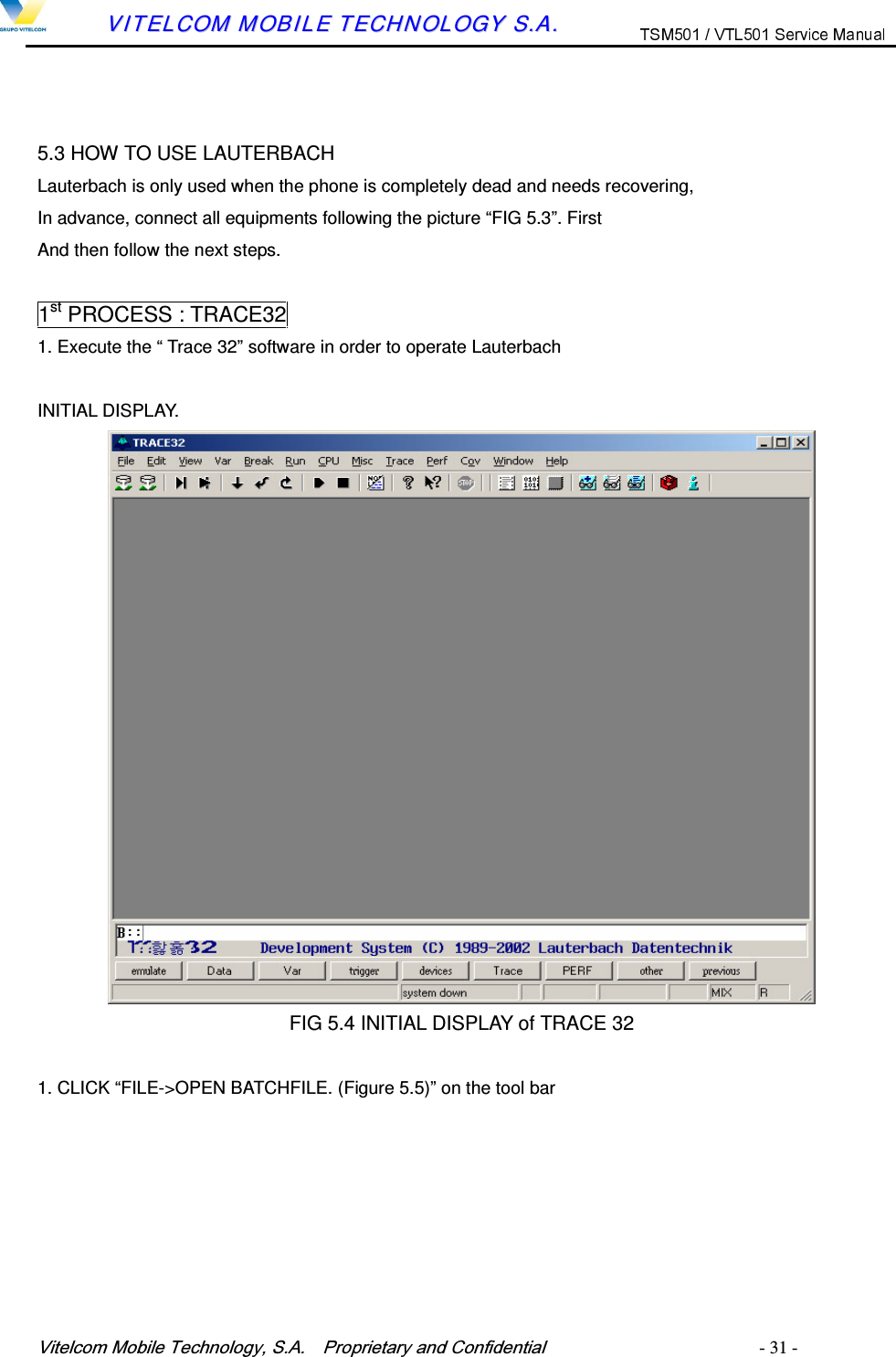
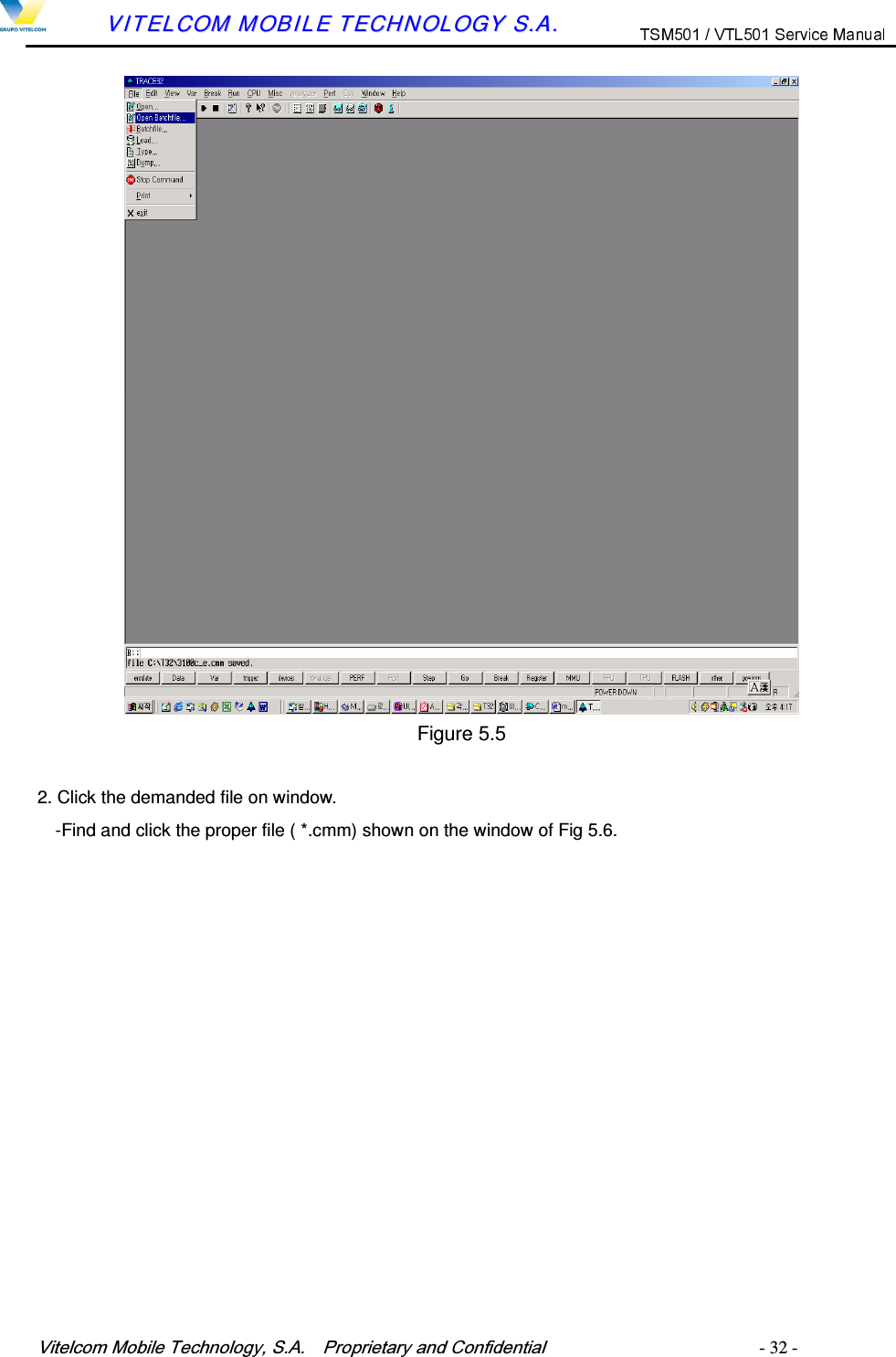
9LWHOFRP0RELOH7HFKQRORJ\6$  3URSULHWDU\DQG&RQILGHQWLDO   - 31 -        VVIITTEELLCCOOMM  MMOOBBIILLEE  TTEECCHHNNOOLLOOGGYY  SS..AA..    5.3 HOW TO USE LAUTERBACH Lauterbach is only used when the phone is completely dead and needs recovering, In advance, connect all equipments following the picture “FIG 5.3”. First And then follow the next steps.  1st PROCESS : TRACE32 1. Execute the “ Trace 32” software in order to operate Lauterbach  INITIAL DISPLAY.  FIG 5.4 INITIAL DISPLAY of TRACE 32  1. CLICK “FILE->OPEN BATCHFILE. (Figure 5.5)” on the tool bar
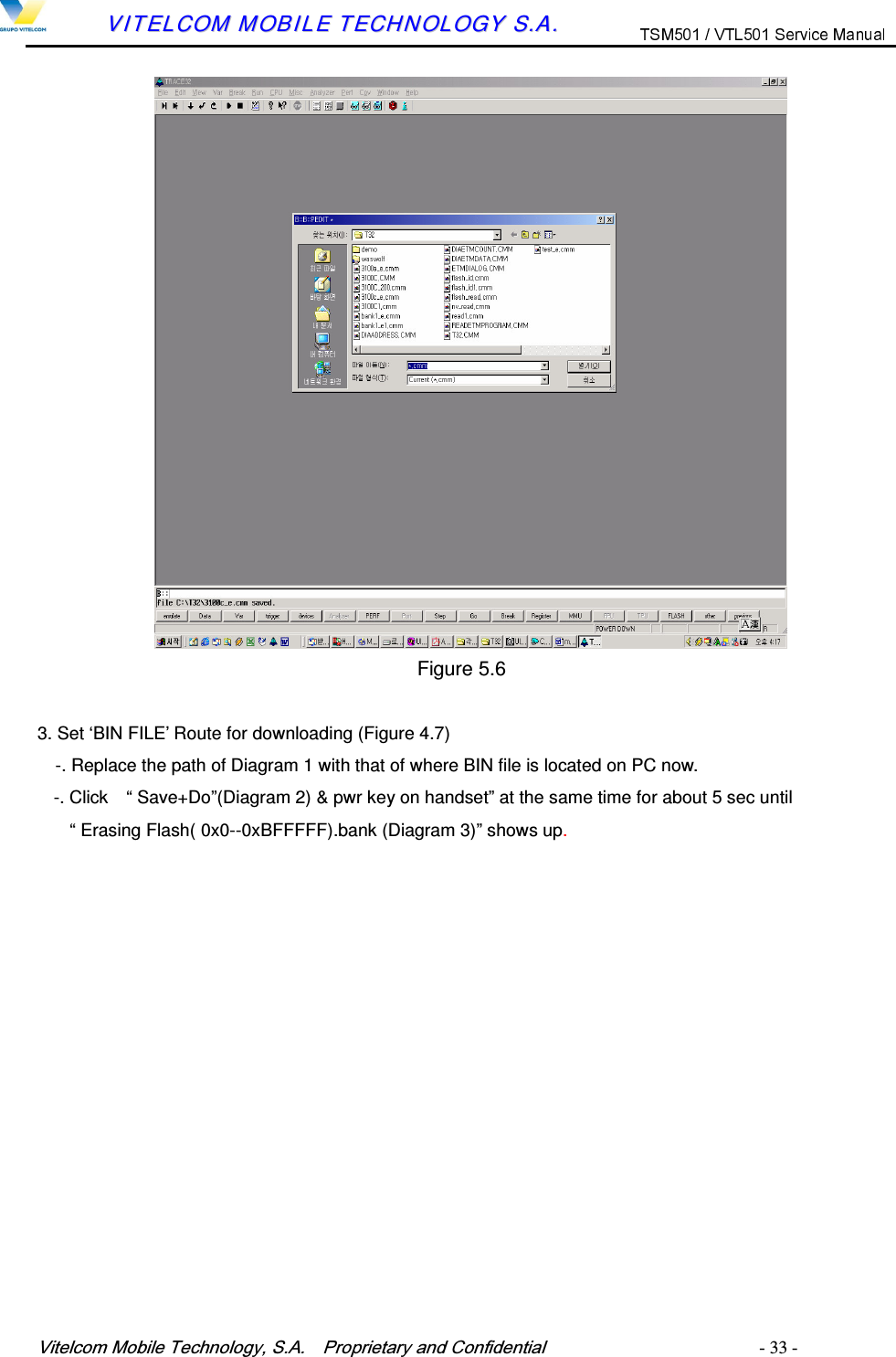
9LWHOFRP0RELOH7HFKQRORJ\6$  3URSULHWDU\DQG&RQILGHQWLDO   - 32 -        VVIITTEELLCCOOMM  MMOOBBIILLEE  TTEECCHHNNOOLLOOGGYY  SS..AA..   Figure 5.5  2. Click the demanded file on window. -Find and click the proper file ( *.cmm) shown on the window of Fig 5.6.
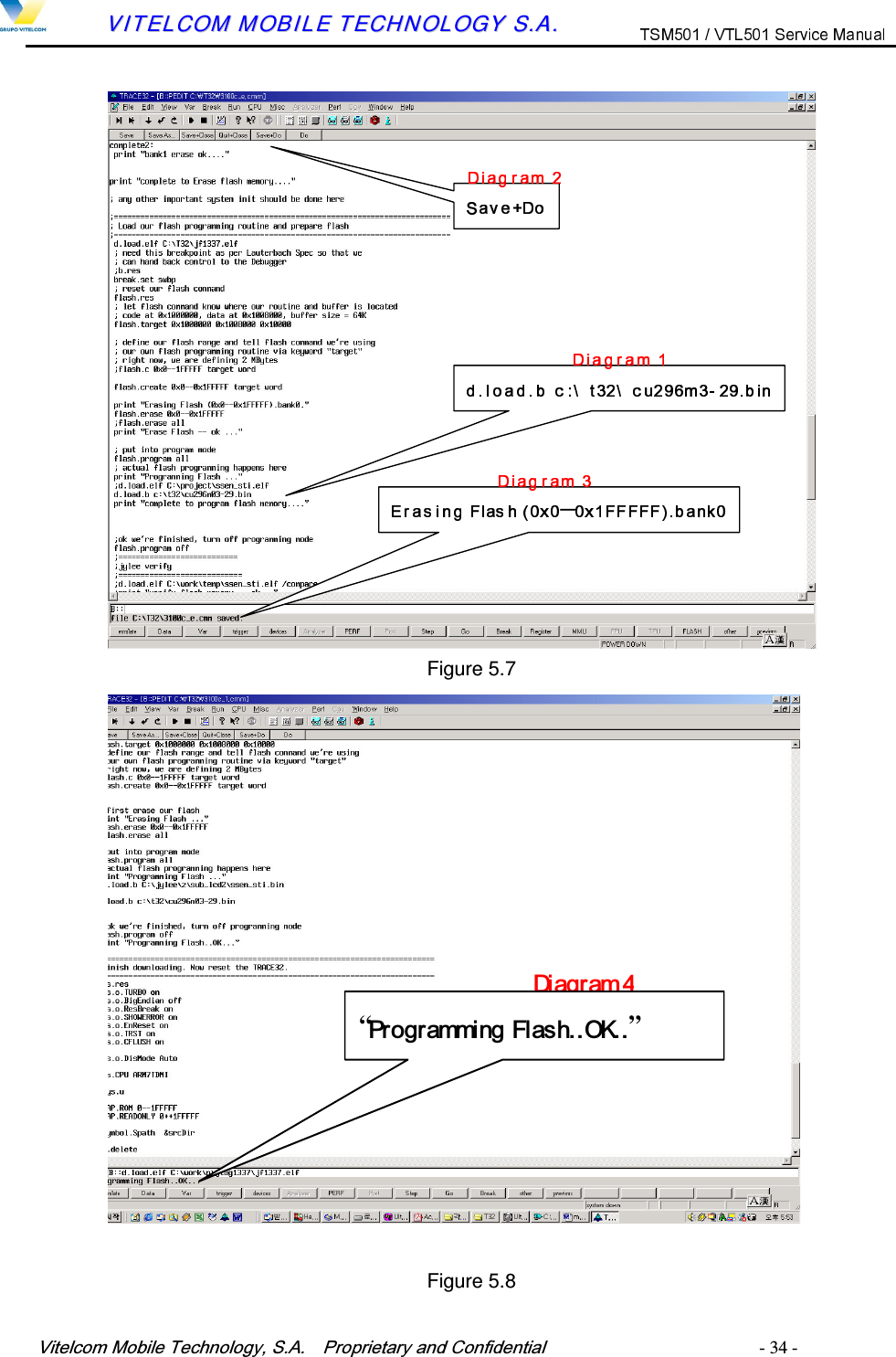
9LWHOFRP0RELOH7HFKQRORJ\6$  3URSULHWDU\DQG&RQILGHQWLDO   - 33 -        VVIITTEELLCCOOMM  MMOOBBIILLEE  TTEECCHHNNOOLLOOGGYY  SS..AA..   Figure 5.6  3. Set ‘BIN FILE’ Route for downloading (Figure 4.7) -. Replace the path of Diagram 1 with that of where BIN file is located on PC now. -. Click    “ Save+Do”(Diagram 2) & pwr key on handset” at the same time for about 5 sec until   “ Erasing Flash( 0x0--0xBFFFFF).bank (Diagram 3)” shows up.
9LWHOFRP0RELOH7HFKQRORJ\6$  3URSULHWDU\DQG&RQILGHQWLDO   - 34 -        VVIITTEELLCCOOMM  MMOOBBIILLEE  TTEECCHHNNOOLLOOGGYY  SS..AA..  — Figure 5.7 'LDJUDP“3URJUDPPLQJ)ODVK2.”  Figure 5.8
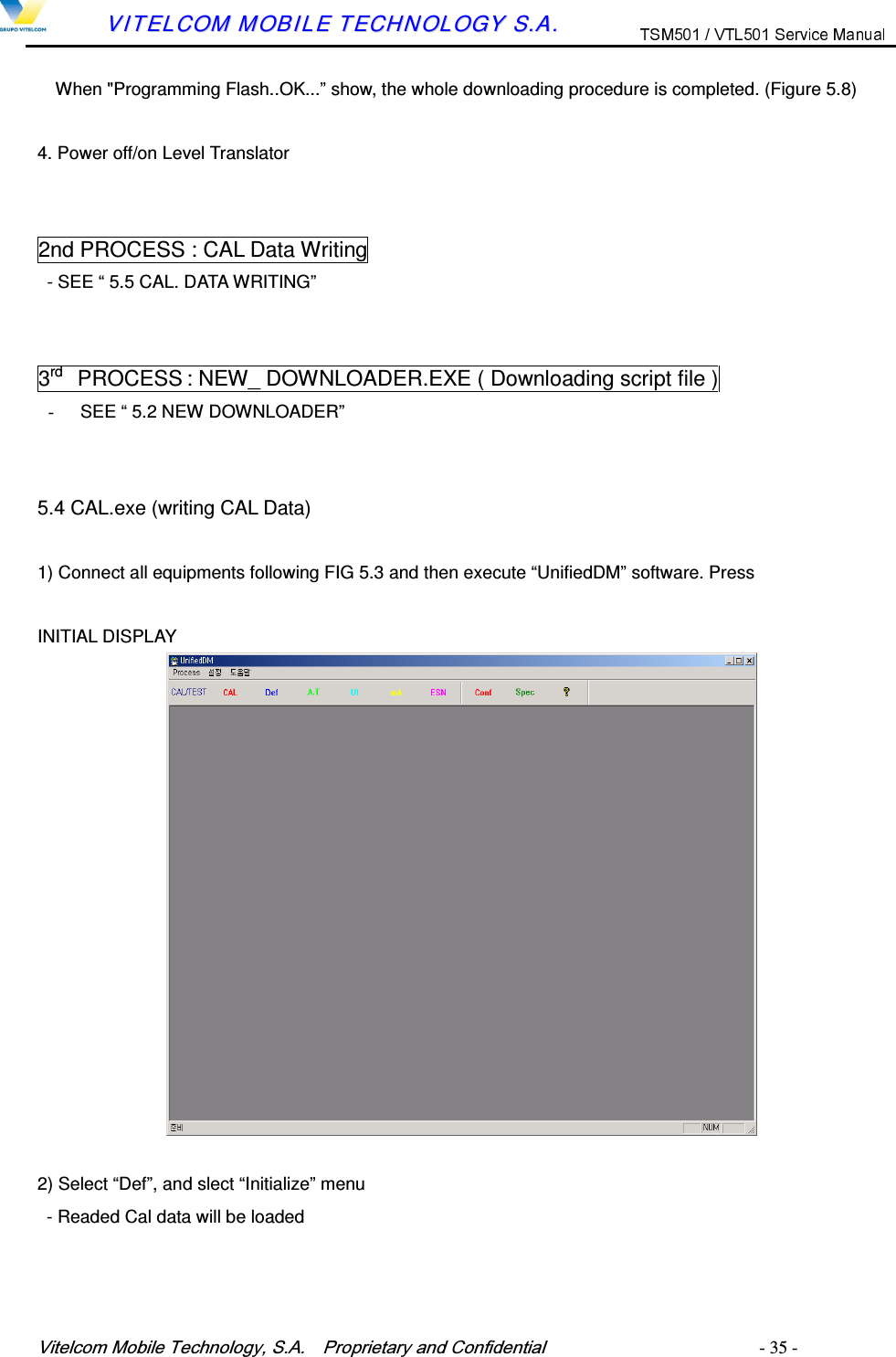
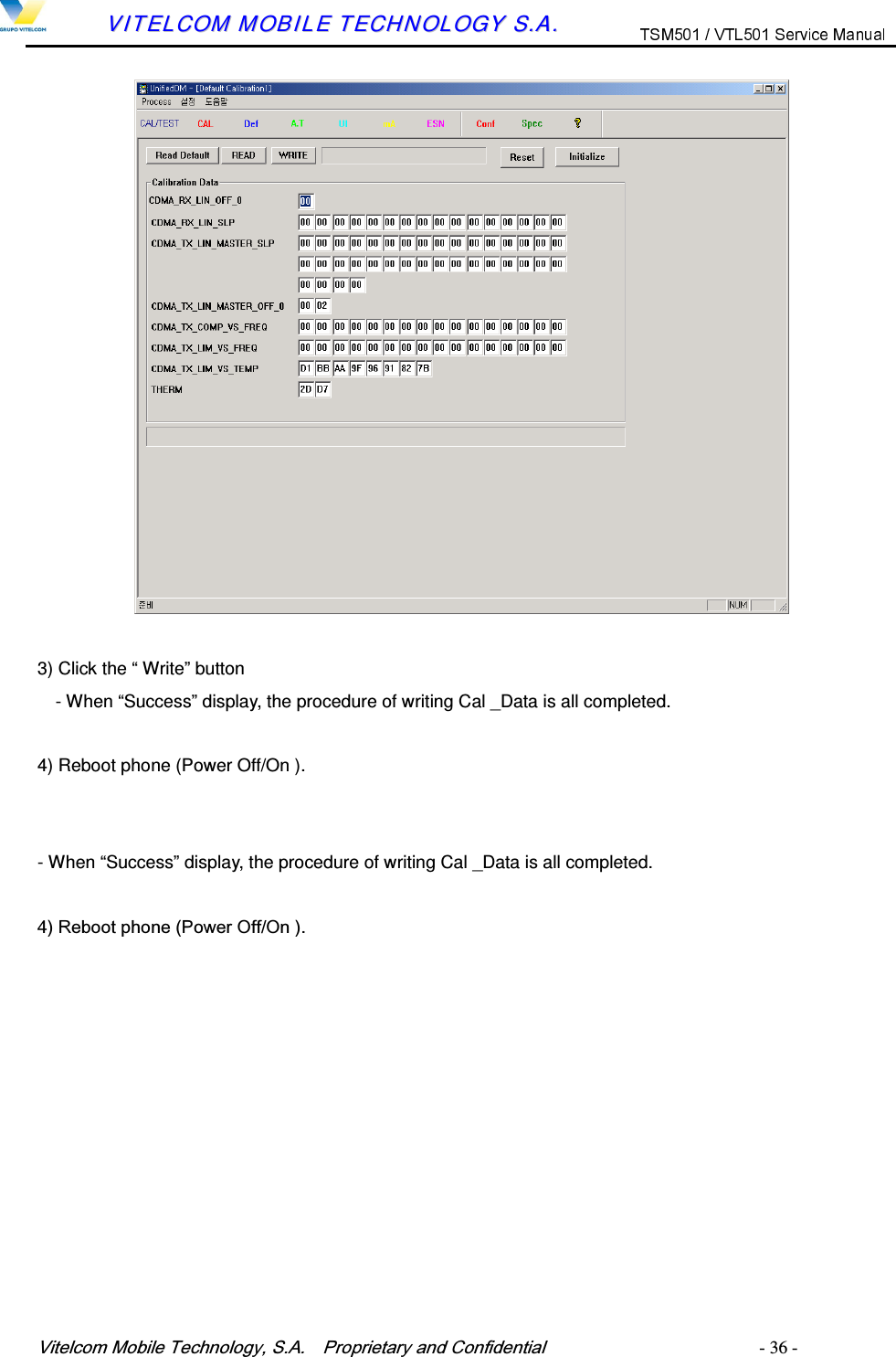
9LWHOFRP0RELOH7HFKQRORJ\6$  3URSULHWDU\DQG&RQILGHQWLDO   - 35 -        VVIITTEELLCCOOMM  MMOOBBIILLEE  TTEECCHHNNOOLLOOGGYY  SS..AA..  When "Programming Flash..OK...” show, the whole downloading procedure is completed. (Figure 5.8)  4. Power off/on Level Translator   2nd PROCESS : CAL Data Writing - SEE “ 5.5 CAL. DATA WRITING”   3rd    PROCESS : NEW_ DOWNLOADER.EXE ( Downloading script file )   -  SEE “ 5.2 NEW DOWNLOADER”   5.4 CAL.exe (writing CAL Data)  1) Connect all equipments following FIG 5.3 and then execute “UnifiedDM” software. Press    INITIAL DISPLAY             2) Select “Def”, and slect “Initialize” menu   - Readed Cal data will be loaded
9LWHOFRP0RELOH7HFKQRORJ\6$  3URSULHWDU\DQG&RQILGHQWLDO   - 36 -        VVIITTEELLCCOOMM  MMOOBBIILLEE  TTEECCHHNNOOLLOOGGYY  SS..AA..    3) Click the “ Write” button     - When “Success” display, the procedure of writing Cal _Data is all completed.  4) Reboot phone (Power Off/On ).   - When “Success” display, the procedure of writing Cal _Data is all completed.  5HERRWSKRQH3RZHU2II2Q
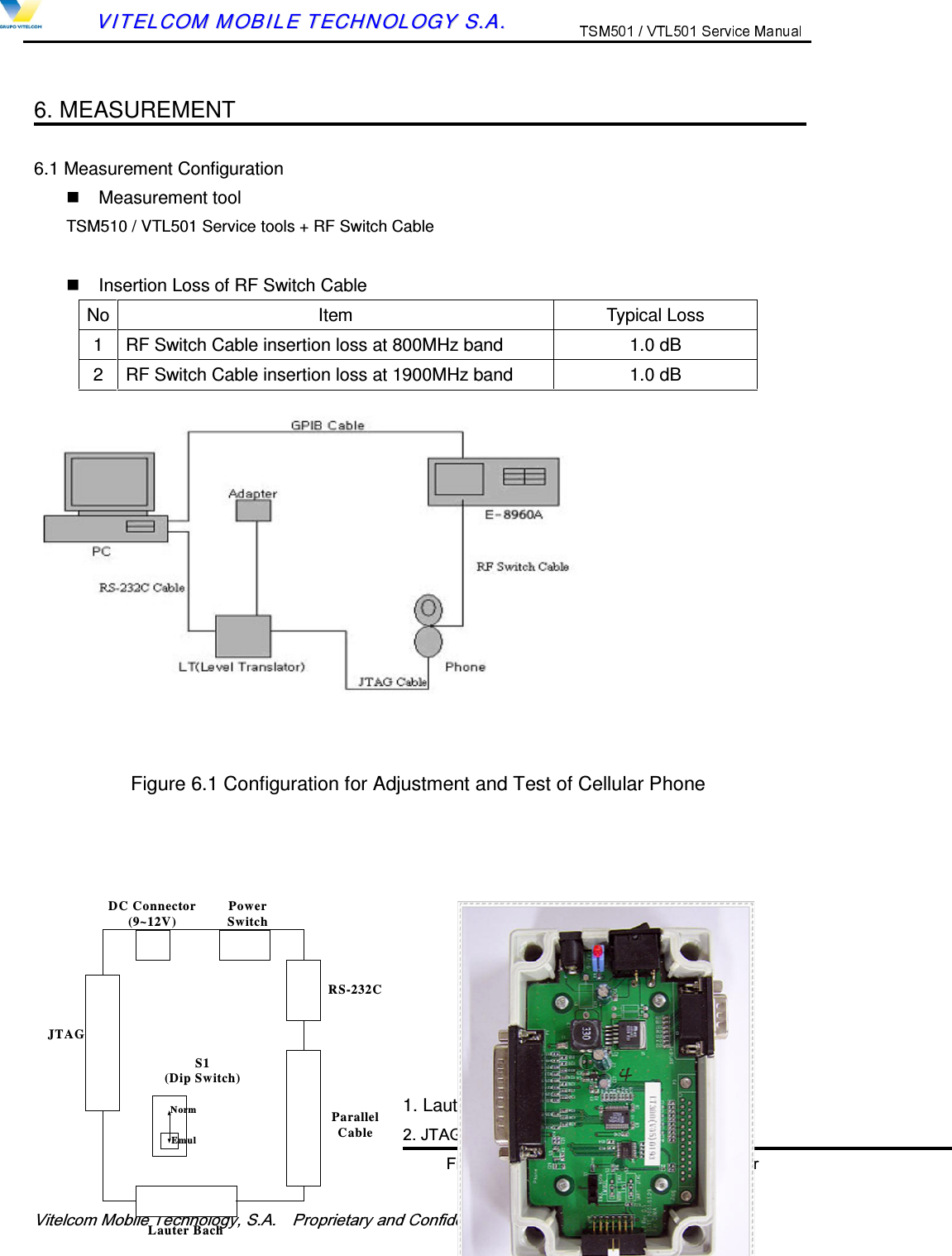
9LWHOFRP0RELOH7HFKQRORJ\6$  3URSULHWDU\DQG&RQILGHQWLDO   - 37 -        VVIITTEELLCCOOMM  MMOOBBIILLEE  TTEECCHHNNOOLLOOGGYY  SS..AA..   6. MEASUREMENT 6.1 Measurement Configuration   Measurement tool TSM510 / VTL501 Service tools + RF Switch Cable    Insertion Loss of RF Switch Cable No Item  Typical Loss 1  RF Switch Cable insertion loss at 800MHz band  1.0 dB 2  RF Switch Cable insertion loss at 1900MHz band  1.0 dB   Figure 6.1 Configuration for Adjustment and Test of Cellular Phone           1. Lauter bach Mode : select Emul in S1 -7$*0RGHVHOHFW1RUPLQ6)LJXUH&RQILJXUDWLRQRI/HYHO7UDQVODWRU JTAGLauter BachDC Connector(9~12V)RS-232CParallelCableS1(Dip Switch)NormEm ulPowerSwitch

Navigation menu