Wisair DV9100A UWB Transeiver Development Kit User Manual UWB MB OFDM DVModule DV9100

Wisair Inc. UWB Transeiver Development Kit UWB MB OFDM DVModule DV9100

DV9100 Users manual

 Wisair’s                            UWB MB-OFDM                      Development Kit                DV9100   User’s Guide Rev1.21       Wisair Confidential and Proprietary Information
 UWB MB-OFDM DVModule DV9100 User Manual  Wisair Ltd.  ii Table of Contents Chapter 1 OVERVIEW.......................................................................1-1 Chapter 2 GETTING STARTED ..........................................................2-1 PACKAGE CONTENTS............................................................................... 2-1 INTRODUCING THE DV9100..................................................................... 2-2 PERFORMING THE INITIAL DVMODULE SETUP................................................. 2-2 CONNECTING TO THE WISMAN™ WISAIR HOST APPLICATION (OPTIONAL)............. 2-4 Chapter 3 OPERATING THE DVMODULE ...........................................3-1 SETTING UP A UWB LINK ......................................................................... 3-1 CONFIGURING DVMODULE MANUALLY ........................................................ 3-2 External MAC Interface / Internal MAC .......................................... 3-4 Master / Slave............................................................................... 3-4 No-ACK / Imm-ACK ..................................................................... 3-4 Duty Cycle and Super-frame Duration Configuration ..................... 3-4 EMUL Mode (Test Mode for Compliance Testing) ........................... 3-6  Appendix A  SPECIFICATIONS..............................................................A-1
 Chapter 0  Error! No text of specified style in document. Wisair Ltd. iii Rights Rights to use this documentation are set forth in the License Agreement accompanying the UWB MB-OFDM DVModule. © Wisair 2005.  All rights reserved.  All right, title and interest, copyrights, patents, know-how, trade secrets and other intellectual property relating to this publication and to the DVModule product are proprietary products of Wisair Ltd. (“Wisair”). Any and all other trademarks, product names and other intellectual property rights are the sole property of their respective owners.  The information presented in this publication does not form part of any quotation or contract, is believed to be accurate and reliable and may change. No part of this publication may be reproduced in any form whatsoever without prior written approval by Wisair.  All products are sold subject to Wisair’s terms and conditions of sale supplied at the time of order. Wisair™ is a registered trademark of Wisair. No right, license, or interest to such trademark is granted hereunder. Regulatory Notice U.S. Operation: This device complies with FCC Code of Federal Regulations (CFR) 47, Part 15 Subpart F: Ultra-Wideband Operation. Operation is subject to the following two conditions: (1) this device may not cause harmful interference, and (2) this device must accept any interference received, including interference that may cause undesired operation. This device may only be operated indoors. Operation outdoors is in violation of 47 U.S.C. 301 and could subject the operator to serious legal penalties. Please consult with Wisair Ltd. if you have any questions, prior to use. Non-U.S. Operation: Wisair chipset technology has not been authorized for use or commercial exploitation under the regulations of any non-U.S. government agency. Please confer with your government’s regulatory agency to obtain proper authorizations. Disclaimer Wisair reserves the right to make any corrections, modifications, enhancements, improvements and other changes to the DVModule and its services at any time and to discontinue any product or service without notice.  As far as possible, major changes of the DVModule specifications and functionality will be stated in product specific Errata Notes.  Wisair warrants the performance of its products to the specifications applicable at the time of sale in accordance with Wisair’s standard warranty.  Wisair shall be released from all obligations under its warranty in the event that the equipment has been subjected to misuse, neglect, accident or improper installation, or if repairs or modifications were made by persons other than Wisair’s own authorized service personnel, unless such repairs by others were made with the written consent of Wisair. You will be liable for any damages caused by the above mentioned to yourself, Wisair or any third party. There are no warranties which extend beyond the face of Wisair’s standard warranty, including, but not limited to, warranties of title, non-infringement, merchantability or fitness for a particular purpose, and in no event shall Wisair be liable for consequential damages.
 iv  Wisair Ltd.UWB MB-OFDM DVModule DV9100 User Manual You are responsible for your products and applications using Wisair products. Wisair assumes no liability for applications assistance or customer product design.  Wisair shall not be liable to any person for any special or indirect damages, including, but not limited to, lost profits from any cause whatsoever arising from or in any way connected with the manufacture, sale, handling, repair, maintenance or use of the DVModule. Software components in the DVModule are provided "as is" and without warranty of any kind. Notwithstanding the foregoing, Wisair shall do its best to provide error-free software products and shall offer free software updates during the warranty period. Wisair’s cumulative liability to you or any other party for any loss or damages resulting from any claims, demands, or actions arising out of or relating to this publication and the DVModule shall not exceed the sum paid to Wisair for the purchase of the DVModule.  You may not, directly or indirectly, develop, market, distribute, license, or sell any product that supports substantially similar functionality as the DVModule, based on or derived in any way from the DVModule.  Life Support Policy Wisair assumes no liability for the use of the DVModule. The DVModule is not designed for use in life support appliances, devices or other systems where malfunction can reasonably be expected to result in significant personal injury to the user or as a critical component in any life support device or system whose failure to perform can be reasonably expected to cause the failure of the life support device or system or to affect its safety or effectiveness. If you use or sell the product for us in such applications you do that at your own risk and agree to fully indemnify Wisair for any damages resulting form any of the abovementioned. About Wisair Wisair (www.wisair.com ) develops and markets MBOA based standard, high performance wireless communication chipset solutions, founded on UWB technology. The company is an active Promoter Member of the Multi-Band OFDM Alliance Special Interest Group (MBOA-SIG), an active participant in the IEEE standardization process and a member of the Wireless USB Promoter Group and Wimedia Alliance. Wisair, a privately held company, located in Israel is part of the RAD Group. Wisair’s international offices, in USA, Japan, Korea and Taiwan, support business development, marketing and customer activities.   For further information contact Wisair local offices and representatives at http://www.wisair.com/contact.html
 UWB MB-OFDM DVModule DV9100 User Manual    Wisair Confidential and Proprietary Information  1-1  1 Overview  The DV9100 is one of the Wisair Development modules (DVModule) in Wisair Development Kit (DVK). Wisair DVK is targeted to support the development of reference designs based on Wisair chipset. In addition the development kit enables application evaluation, demonstration and supports regulation and standardization efforts. The DVK is modular and includes a main module supporting the chipset and main interfaces and additional add on modules to enable additional MAC features and data interfaces development. The DV9100 is a small form-factor board and a complete UWB Multi-Band OFDM transceiver with several data and host interfaces. It is based on the Wisair 501 SiGe-based RF Transceiver and the 530 CMOS-based Baseband chips. The DV9100 also includes a patented Wisair UWB antenna, based on a PCB-based design, along with the WisMan™ configuration and control host utility.  The UWB MB-OFDM DVModule consists of the following main components, all developed by Wisair:  UWB Omni Antenna  RF transceiver Wisair 501 chip  Baseband Wisair 530 chip  Internal MAC FPGA chip  External Data and Control Interfaces  The UWB MB-OFDM DVModule provides the following:  Based on Wisair MBOA-compliant UWB Baseband and RF transceiver chips.   Small form-factor:  6 x 2.4” (153 x 64mm).  High performance, robust wireless UWB link (Bit Error Rate better than 10-9).
 1-2  Wisair Confidential and Proprietary Information    UWB MB-OFDM DVModule DV9100 User Manual  Supports high quality and QoS for Wireless Data and Wireless Video applications.  Provides MBOA MAC-PHY standard interface.  Offers multiple data interfaces and protocols: Ethernet/IP and optional MPEG, Transport Stream and High Speed parallel data.  USB Host interface for external applications.   Supports multiple operation and communication profiles for the different applications.  WisMan™ Windows-based software utility based on the Wisair API for managing and configuring Wisair development kit modules.
 UWB MB-OFDM DVModule DV9100 User Manual    Wisair Confidential and Proprietary Information  2-1  2 Getting Started   This chapter provides you with the basic information you need to use the UWB MB-OFDM DVModule for the first time. Package Contents Wisair’s DVModule type DV9100 package contains the following items: Table 2-1: Package Content  s# Description  Qty Remarks 1  DV9100 module assembly  2  Assembled with transparent plastics on each side of module 1.1  DV9100 Serial # XXXXXXX -- Master mode 1.2  DV9100 Serial # YYYYYYY -- Slave mode 2  UWB Antenna   2  3-5 GHz type with SMA RF attachment 3  Universal AC to DC power supply  2  100-240VAC to 3.3VDC. (AC power cable not included) 4  USB Cable  2  USB type A to mini USB type B (used for WisMan™ host utility) 5 CD-ROM  1 Electronic format 5.1  This DV9100 User Manual  --  PDF copy 5.2 WisMan™ User Guide  --  PDF copy (entry level) 5.3 WisMan™ Host Application Utility (including USB drivers) -- Entry level 6  DV9100 Manual Configuration   1  One page quick guide
 2-2  Wisair Confidential and Proprietary Information    UWB MB-OFDM DVModule DV9100 User Manual Introducing the DV9100 Wisair’s type DV9100 DVModule has various external connectors, switches, and LEDs, which are listed below:  Power supply inlet  SMA female for UWB antenna   Ethernet RJ-45 connector  For service, debug, or configuration:  Mini USB type B female host connector  DIP switches for manual configuration  Reset button  LEDs:  Power  Signal Strength Indication (RSSI)  Line  Active  Link (UWB) Performing the Initial DVModule Setup After opening the UWB MB-OFDM DVModule package, you must perform the following initial setup in order to begin using the module.  Important Note:  If the DVModule is being used for the first time, the DVModule is set to internal MAC mode (DIP switch #1 on both DVModules is in IMC (“On” position)). Test the UWB link by using an application that uses the external Ethernet connectors. After this procedure is performed successfully, External MAC users should set DIP switch #1 on both DVModules to EMC (“Off” position). To perform initial setup on the DVModule 1. Verify that the antenna is connected to the semi rigid cable included in the package. 2. Connect the other side of the semi rigid cable to the antenna connector on the DVModule.
 Chapter 2  Getting Started    Wisair Confidential and Proprietary Information  2-3 3. Verify that the SMA cable-connector is firmly tightened over the connections.  Caution: Do NOT close the connector too tight. Seven to ten inch-pounds torque using a connector wrench is recommended. The center pin on the SMA connector is fragile and may break.  Caution: Do not use any other antenna other than the one provided in the kit. The use of another antenna element other than the one provided in the kit is a violation of FCC rules governing the transmission of UWB signals. 4. Verify that the configuration of one of the DVModules is Master and the other DVModule is Slave (refer to Configuring the DVModule Manually in Chapter 3, Operating the DVModule ).  Note:   Cables and accessories are packed inside the carton section of the box. 5. Connect the external DC power supply cable to the power inlet of each of the DVModules. 6. Place the DVModules two meters apart with their antennas facing each other. 7. Plug the AC power cable into the external power supply to apply power to the DVModules. Note:  The unit supports an international power supply (100-240V, 47 to 63Hz). 8. Verify that the power LED on the DVModule is ON. 9. Verify that the RSSI LEDs are ON (at least one RSSI LED should light on both DVModules in order to start transmission). Note:   If at least one RSSI LED is not lit as expected, reset each of the DVModules using the reset button. 10. Connect a regular PC to an Ethernet wall outlet (LAN side) to surf the Internet. If this connection is working correctly, use this setup for the following steps. 11. Connect a regular Ethernet cable between one DVModule and an Ethernet wall outlet (LAN side).  12. Verify that the Line LED is ON.
 2-4  Wisair Confidential and Proprietary Information    UWB MB-OFDM DVModule DV9100 User Manual Note:  The Active LED may blink if the module detects any activity on the network side. 13. Connect a crossed Ethernet cable between the other DVModule and a PC Ethernet port (that previously was configured to work with the LAN network).  14. Verify that the Line LED is ON. 15. Use the PC to surf the Internet over the wireless UWB connection. 16. Verify that the Active LED blinks on both DVModules. Note:   If a link is not established as expected, reset each of the DVModules using the reset button.  Connecting to the WisMan™ Wisair Host Application (Optional)  Working with the DVModule does not require any software application support. To configure a pre-selected basic mode of operation, you can use the on-board pre-configured DIP switches.  For additional modes of operation, an optional WisMan host application is required. For more information about the WisMan host application, refer to the WisMan User Guide. Note:   The minimum requirement for the host PC is Windows XP® or Windows 2000® operating system with a USB1.1 interface PC required to run the WisMan host application. To install the WisMan host application 1. Install the USB drivers (refer to the WisMan Use  Guide). r2. Connect the DVModule to the PC USB interface (if you are using multiple modules, they should be attached to another PC USB port or a USB hub). 3. Install the Wisman application (refer to the WisMan User Guide).
 UWB MB-OFDM DVModule DV9100 User Manual    Wisair Confidential and Proprietary Information  3-1  3 Operating the DVModule  This chapter discusses how to manually set the DV9100 configuration using DIP switch (S1) for proper operation.  Important Note:   The instructions in this chapter apply only to Ethernet users of the DVModule using Wisair’s internal MAC. If you are using an External MAC, the Wisair MAC-PHY interface DIP switch#1 must be set to EMC (“Off” position) for External MAC. The DIP switch #1 setting defines internal MAC /external MAC. Setting Up a UWB Link The following is a simple procedure for setting up a UWB link between two DVModule’s and testing that it is functioning correctly  Note:   Refer to Chapter 2, Getting Started the first time you use the DVModule to surf the Internet using a wireless link based on the UWB link.  To set up a UWB link between two DVModules 1. Connect an antenna to each of the DVModules. 2. Connect a power cable to each of the DVModules. 3. Place the DVModules two meters apart with the antennas facing each other. 4. Power on the DVModules. 5. Verify that both Power LEDs are ON. 6. Verify that on both modules, at least one RSSI LED is ON. 7. Connect Ethernet cables to the DVModules and attach them to the application PCs. 8. Verify that the Line LED is ON  9. Verify that the Active LED blinks (on both DVModules).
 3-2  Wisair Confidential and Proprietary Information    UWB MB-OFDM DVModule DV9100 User Manual Configuring DVModule Manually The DVModule internal MAC emulator supports the following features:  Point-to-point configuration.    Ethernet MAC interface (using the RMII interface).   Support 100 Mbps full duplex.  Configuration of both RMII MAC and PHY is done using the on-board manual dipswitch configuration or the optional Wisair Host Application using the USB1.1 interface.   The following configurations are supported: MAC/PHY interface or Internal MAC, Super frame length, [Tx:Rx] duty cycle ratio, Master/Slave, ACK policy.  Status registers from the MAC can be read through the USB1.1 interface using the optional WisMan, Wisair’s Host Application. The DVModule modes of operation can be set manually by the on-board DIP switch (two positions, six micro-switches) on the component side of the DVModule.  Note:  To configure the DVModule using the WisMan host application, refer to the WisMan Use  Guide. r12 3 45 6ONA0B0C0ACKMSTIMCA1B1C1NAKSLVEMCFigure 3-1: DVModule Manual DIP Switch Configuration (Example: Slave Mode)
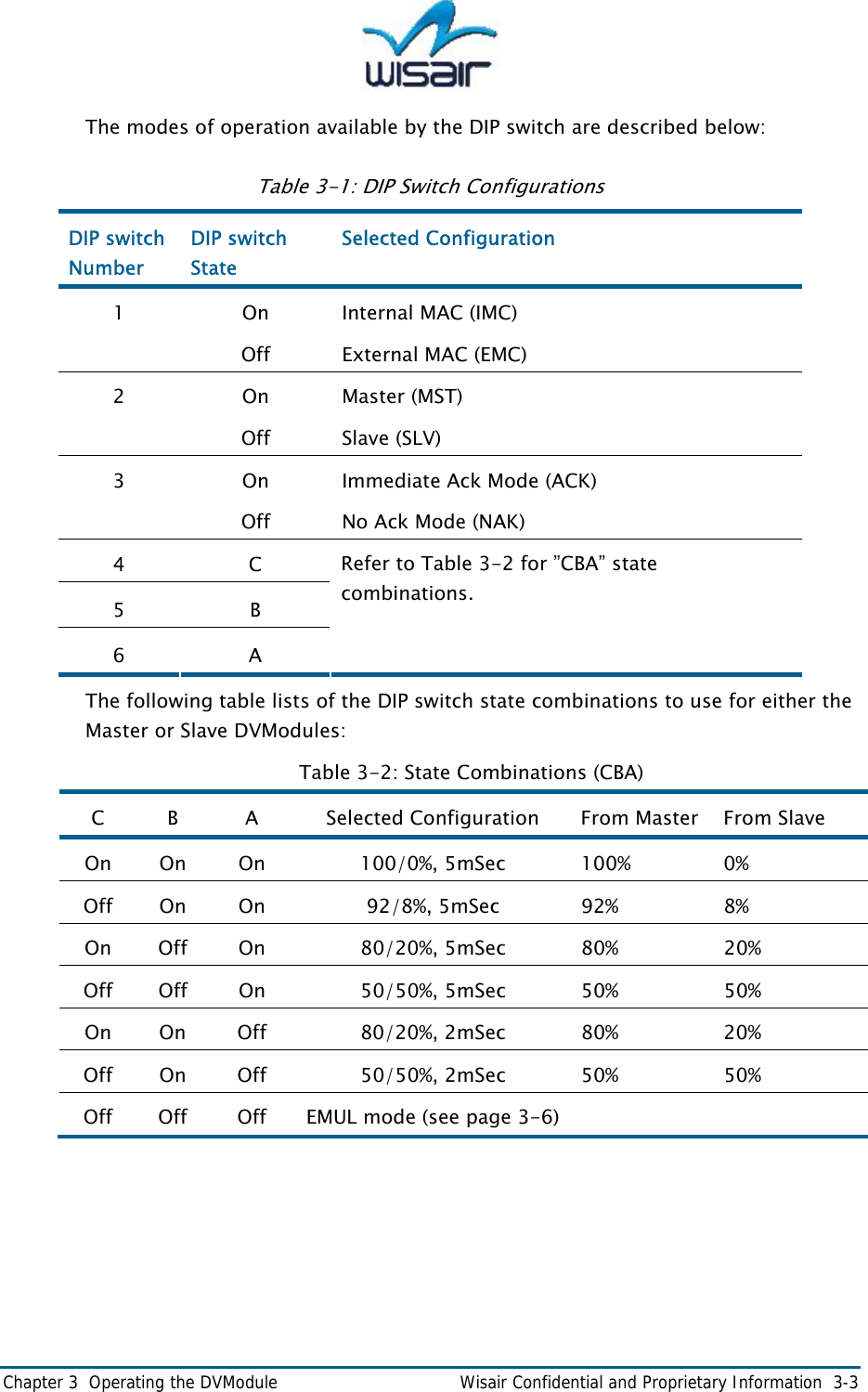
 Chapter 3  Operating the DVModule    Wisair Confidential and Proprietary Information  3-3 The modes of operation available by the DIP switch are described below: Table 3-1: DIP Switch Configurations DIP switch Number DIP switch State Selected Configuration 1 On Off Internal MAC (IMC) External MAC (EMC) 2 On Off Master (MST) Slave (SLV) 3 On Off Immediate Ack Mode (ACK) No Ack Mode (NAK) 4 C 5 B 6 A Refer to Table 3-2 for ”CBA” state combinations.  The following table lists of the DIP switch state combinations to use for either the Master or Slave DVModules:  Table 3-2: State Combinations (CBA) C B  A  Selected Configuration  From Master  From Slave On  On  On  100/0%, 5mSec  100%   0%  Off  On  On  92/8%, 5mSec  92%   8%  On  Off  On  80/20%, 5mSec  80%   20%  Off Off  On  50/50%, 5mSec  50%  50% On  On  Off  80/20%, 2mSec  80%   20%  Off On  Off  50/50%, 2mSec  50%  50% Off  Off  Off  EMUL mode (see page 3-6)
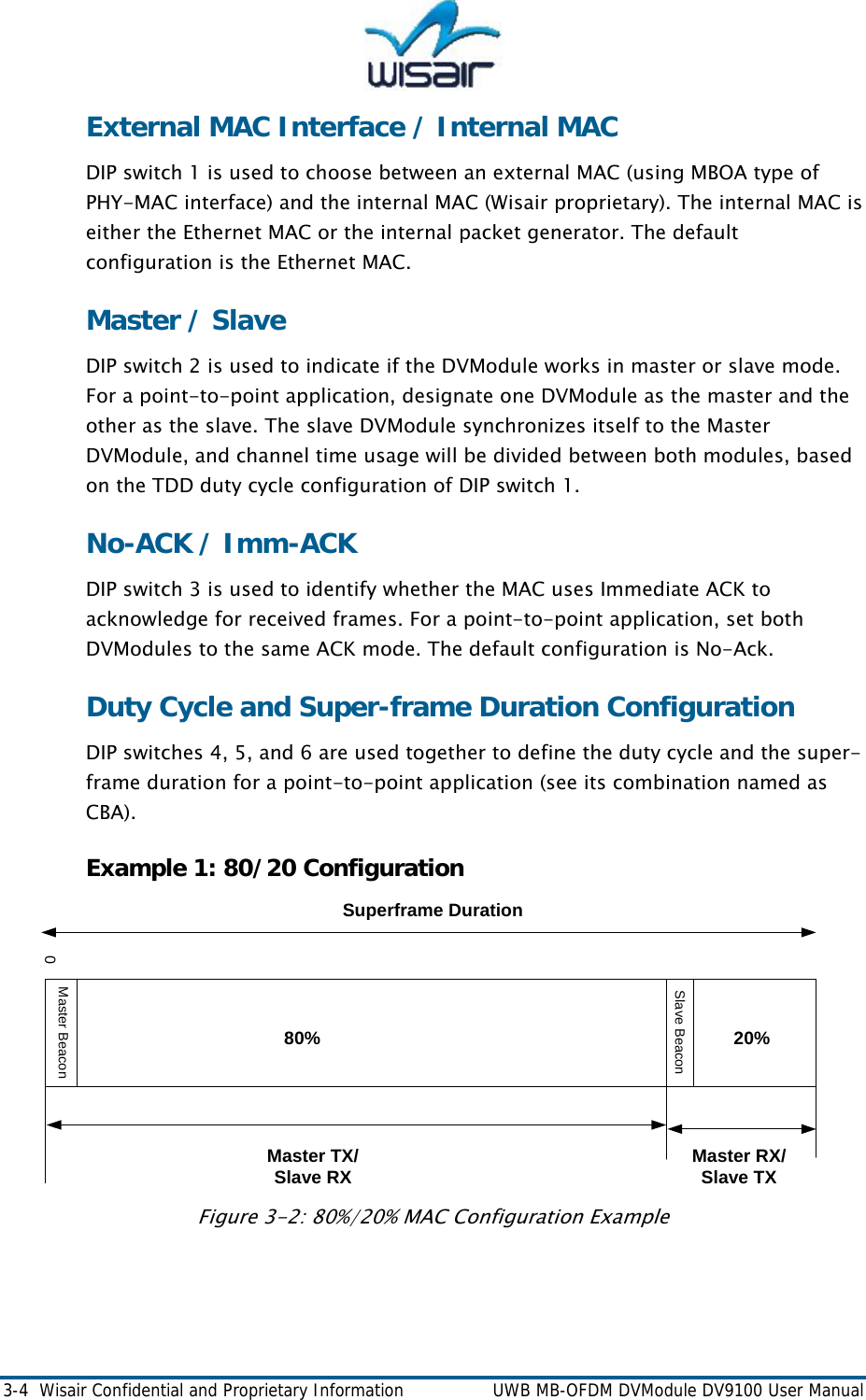
 3-4  Wisair Confidential and Proprietary Information    UWB MB-OFDM DVModule DV9100 User Manual External MAC Interface / Internal MAC  DIP switch 1 is used to choose between an external MAC (using MBOA type of PHY-MAC interface) and the internal MAC (Wisair proprietary). The internal MAC is either the Ethernet MAC or the internal packet generator. The default configuration is the Ethernet MAC.  Master / Slave DIP switch 2 is used to indicate if the DVModule works in master or slave mode. For a point-to-point application, designate one DVModule as the master and the other as the slave. The slave DVModule synchronizes itself to the Master DVModule, and channel time usage will be divided between both modules, based on the TDD duty cycle configuration of DIP switch 1.  No-ACK / Imm-ACK DIP switch 3 is used to identify whether the MAC uses Immediate ACK to acknowledge for received frames. For a point-to-point application, set both DVModules to the same ACK mode. The default configuration is No-Ack. Duty Cycle and Super-frame Duration Configuration DIP switches 4, 5, and 6 are used together to define the duty cycle and the super-frame duration for a point-to-point application (see its combination named as CBA).  Example 1: 80/20 Configuration 0Master RX/Slave TXMaster TX/Slave RXSuperframe Duration80% 20%Master BeaconSlave Beacon Figure 3-2: 80%/20% MAC Configuration Example
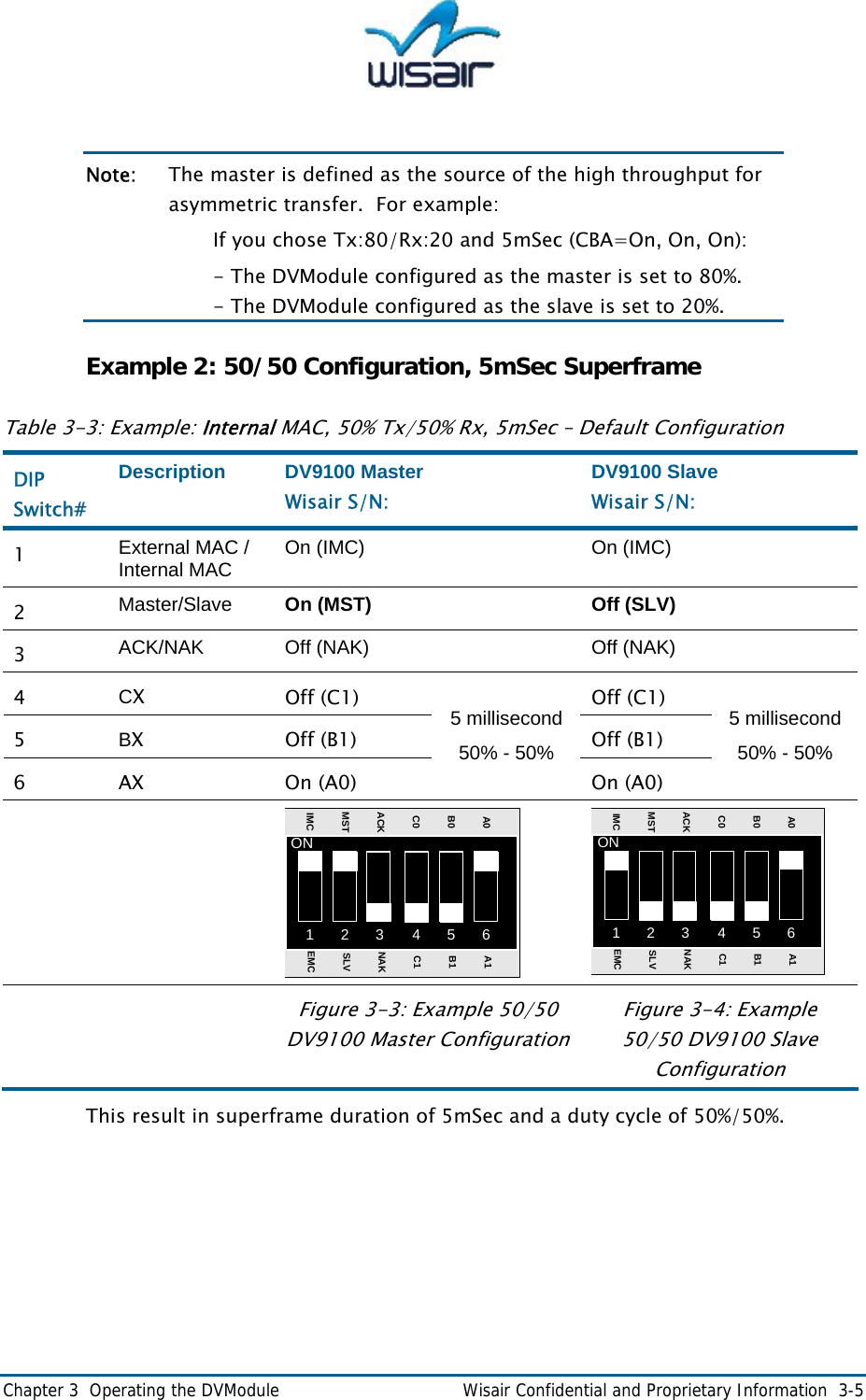
 Chapter 3  Operating the DVModule    Wisair Confidential and Proprietary Information  3-5  Note:  The master is defined as the source of the high throughput for asymmetric transfer.  For example:      If you chose Tx:80/Rx:20 and 5mSec (CBA=On, On, On):      - The DVModule configured as the master is set to 80%.     - The DVModule configured as the slave is set to 20%.  Example 2: 50/50 Configuration, 5mSec Superframe Table 3-3: Example: Internal MAC, 50% Tx/50% Rx, 5mSec – Default Configuration DIP Switch# Description DV9100 Master Wisair S/N: DV9100 Slave Wisair S/N: 1  External MAC / Internal MAC On (IMC) On (IMC) 2  Master/Slave On (MST)  Off (SLV) 3  ACK/NAK Off (NAK) Off (NAK) 4  CX  Off (C1)  Off (C1) 5  BX  Off (B1)  Off (B1) 6 AX  On (A0) 5 millisecond 50% - 50% On (A0) 5 millisecond 50% - 50%   12 3 45 6ONA0B0C0ACKMSTIMCA1B1C1NAKSLVEMC 1 2 3 4 5 6ONA0B0C0ACKMSTIMCA1B1C1NAKSLVEMC   Figure 3-3: Example 50/50 DV9100 Master ConfigurationFigure 3-4: Example 50/50 DV9100 Slave Configuration This result in superframe duration of 5mSec and a duty cycle of 50%/50%.
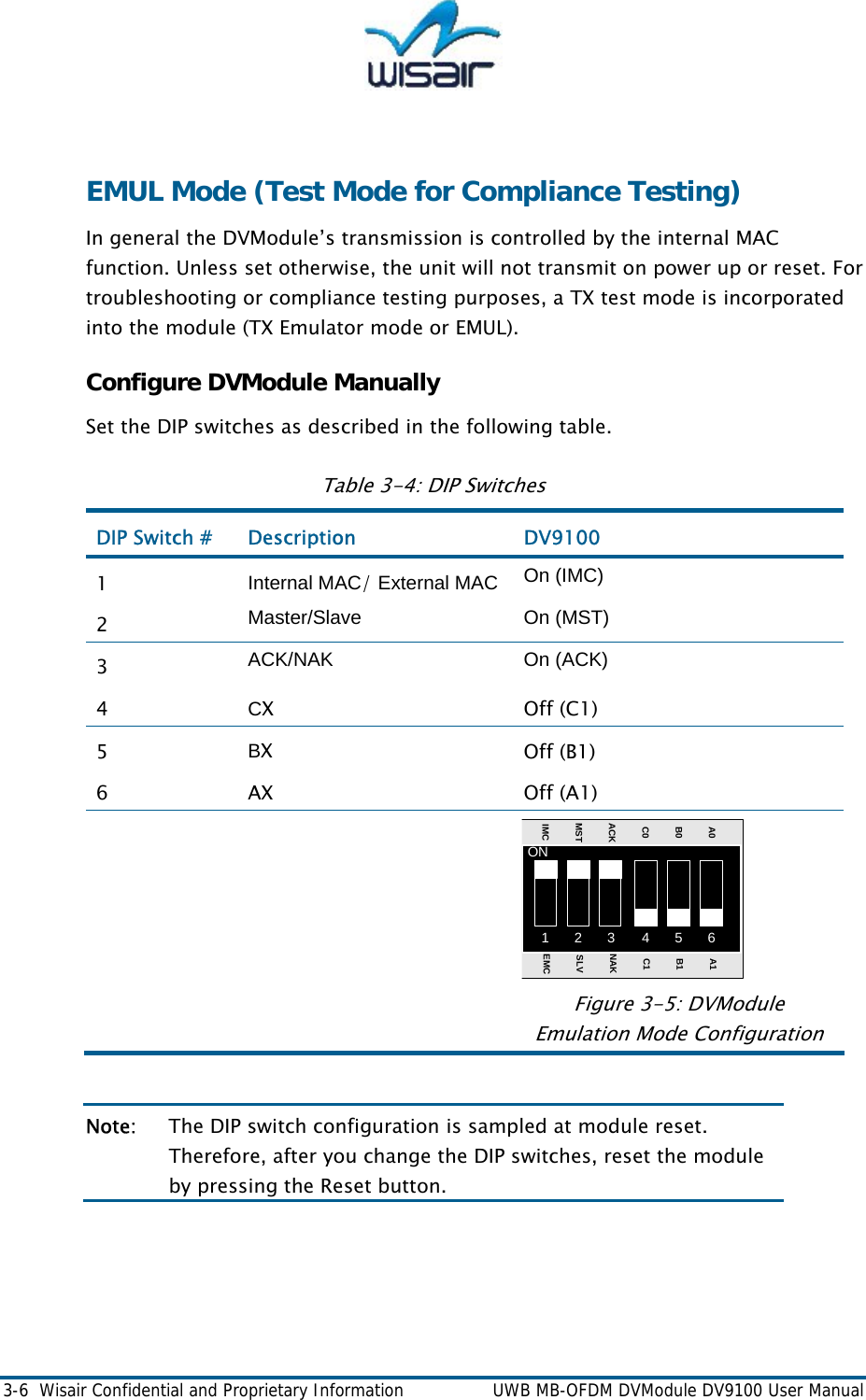
 3-6  Wisair Confidential and Proprietary Information    UWB MB-OFDM DVModule DV9100 User Manual  EMUL Mode (Test Mode for Compliance Testing) In general the DVModule’s transmission is controlled by the internal MAC function. Unless set otherwise, the unit will not transmit on power up or reset. For troubleshooting or compliance testing purposes, a TX test mode is incorporated into the module (TX Emulator mode or EMUL).  Configure DVModule Manually Set the DIP switches as described in the following table. Table 3-4: DIP Switches 1 2 3 4 5 6ONA0B0C0ACKMSTIMCA1B1C1NAKSLVEMCDIP Switch #  Description  DV9100  1  Internal MAC/ External MAC  On (IMC) 2  Master/Slave On (MST) 3  ACK/NAK On (ACK) 4  CX  Off (C1) 5  BX  Off (B1) 6 AX  Off (A1)       Figure 3-5: DVModule Emulation Mode Configuration  Note:  The DIP switch configuration is sampled at module reset. Therefore, after you change the DIP switches, reset the module by pressing the Reset button.
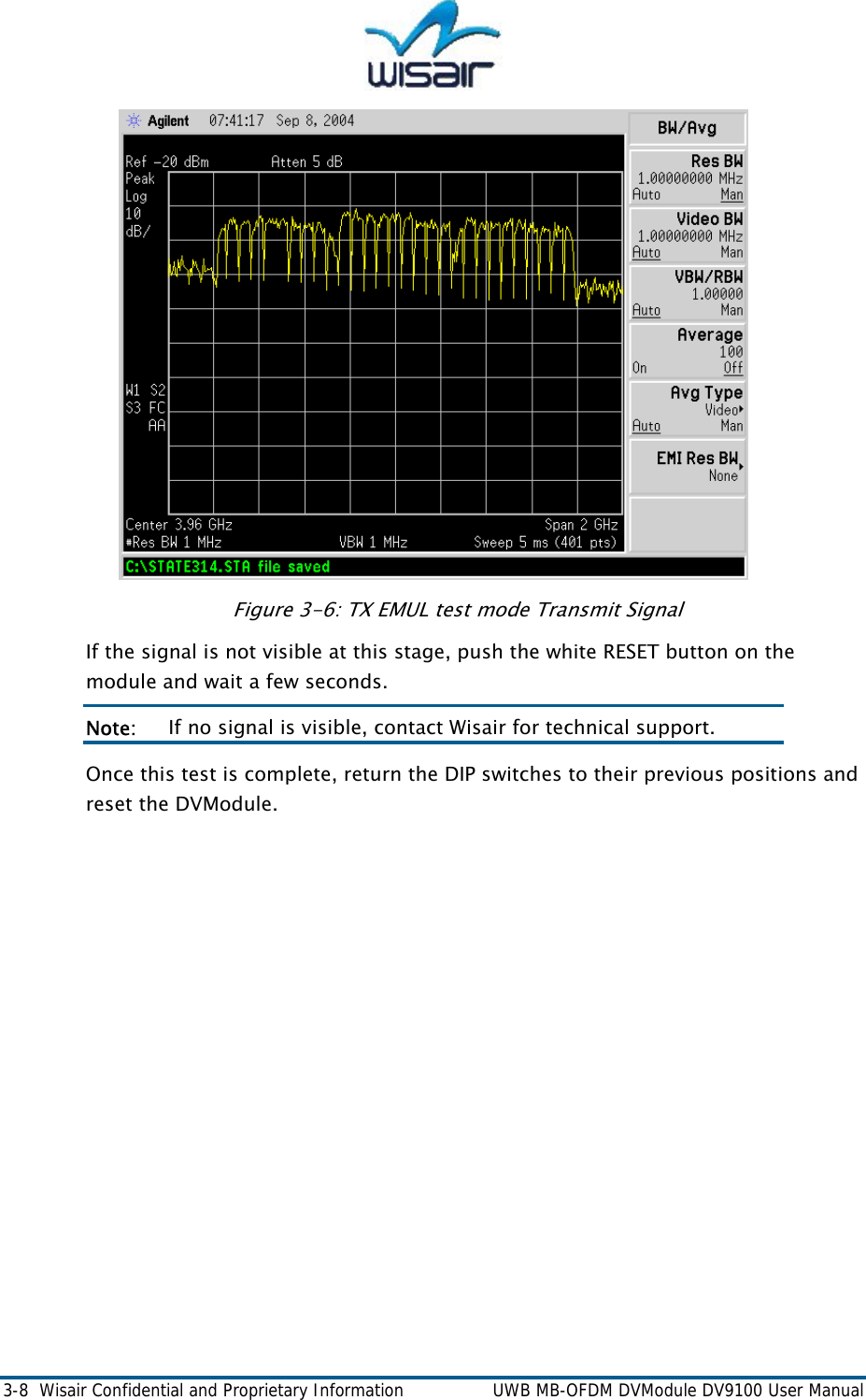
 Chapter 3  Operating the DVModule    Wisair Confidential and Proprietary Information  3-7  Generated Signal The EMUL transmit only mode is used only for test purposes and intended to be used for FCC tests. The data sent in the test mode is a pseudo-random data sequence of 64Bytes. The DV9100 under normal operating condition works with a receiver. If there is no receiver located, the transmitter stops transmitting in less than 10 seconds.  Important Note:   EMUL test mode is the worst case conditions (in terms of energy transmitted). When EMUL test mode is selected it overrides the TDD duty cycle selection configured by the module’s dipswitches.   The following are the spectrum analyzer settings and view for this signal. A signal in three bands over the 3-5GHz frequency band should be present and can be viewed with a spectrum analyzer, such as Agilent™ 8563E, E4407B or a similar model covering this frequency range.  Set the following parameters on the Spectrum Analyzer:  Center Frequency: 3.960GHz  Span: 2GHz  RBW: 1MHz    (RBW : Reference Band Width)  VBW: 1MHz    (VBW : Video Band Width)  Reference level: -20dBm  Scale: 10dB/div
 3-8  Wisair Confidential and Proprietary Information    UWB MB-OFDM DVModule DV9100 User Manual           Figure 3-6: TX EMUL test mode Transmit Signal If the signal is not visible at this stage, push the white RESET button on the module and wait a few seconds.  Note:  If no signal is visible, contact Wisair for technical support. Once this test is complete, return the DIP switches to their previous positions and reset the DVModule.
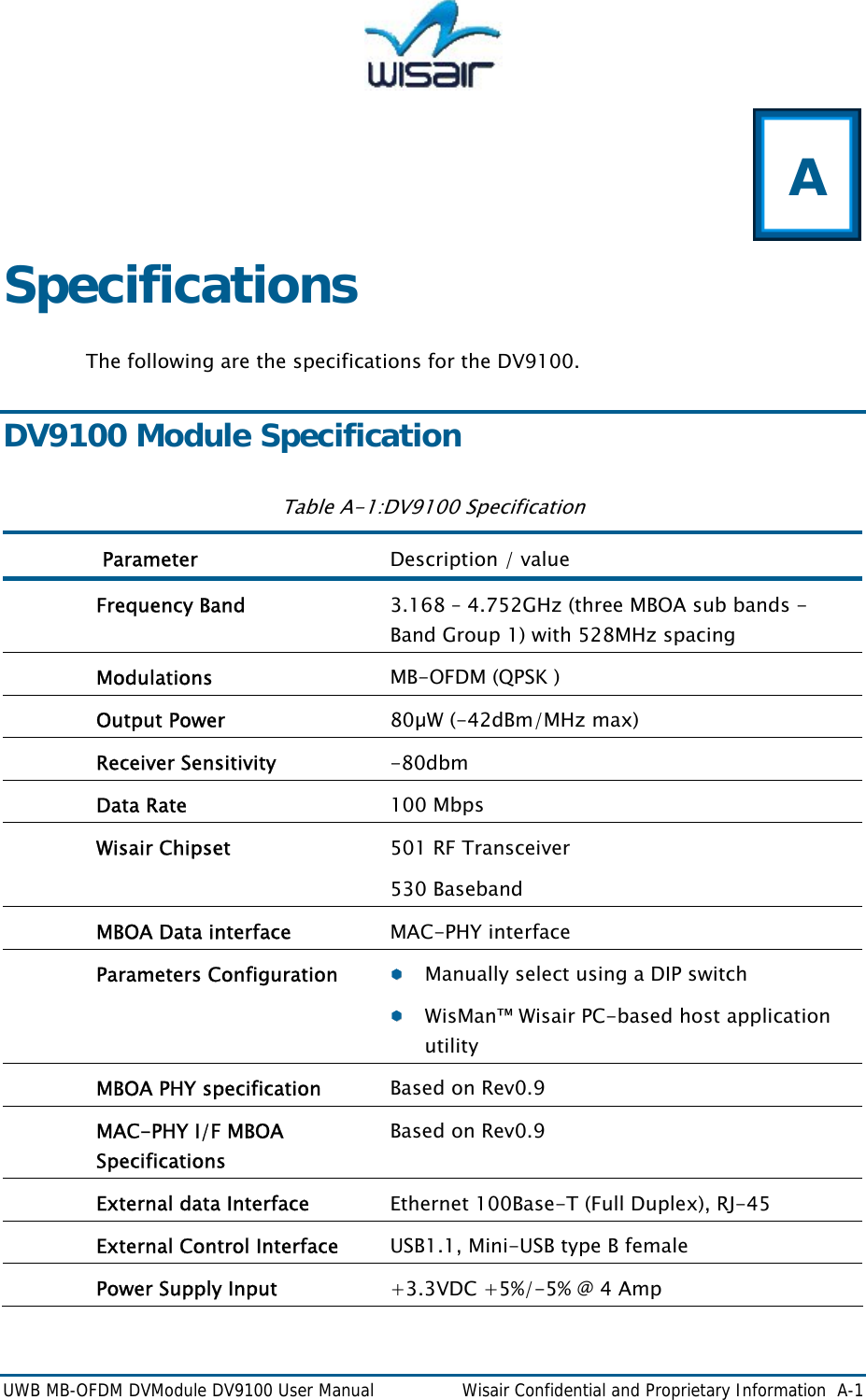
 UWB MB-OFDM DVModule DV9100 User Manual    Wisair Confidential and Proprietary Information  A-1  A Specifications The following are the specifications for the DV9100.  DV9100 Module Specification Table A-1:DV9100 Specification  Parameter  Description / value Frequency Band  3.168 – 4.752GHz (three MBOA sub bands -Band Group 1) with 528MHz spacing Modulations  MB-OFDM (QPSK ) Output Power  80µW (-42dBm/MHz max) Receiver Sensitivity  -80dbm Data Rate  100 Mbps  Wisair Chipset  501 RF Transceiver 530 Baseband  MBOA Data interface  MAC-PHY interface Parameters Configuration  ¥¥  Manually select using a DIP switch ¥¥  WisMan™ Wisair PC-based host application utility MBOA PHY specification  Based on Rev0.9 MAC-PHY I/F MBOA Specifications  Based on Rev0.9 External data Interface  Ethernet 100Base-T (Full Duplex), RJ-45 External Control Interface  USB1.1, Mini-USB type B female  Power Supply Input  +3.3VDC +5%/-5% @ 4 Amp
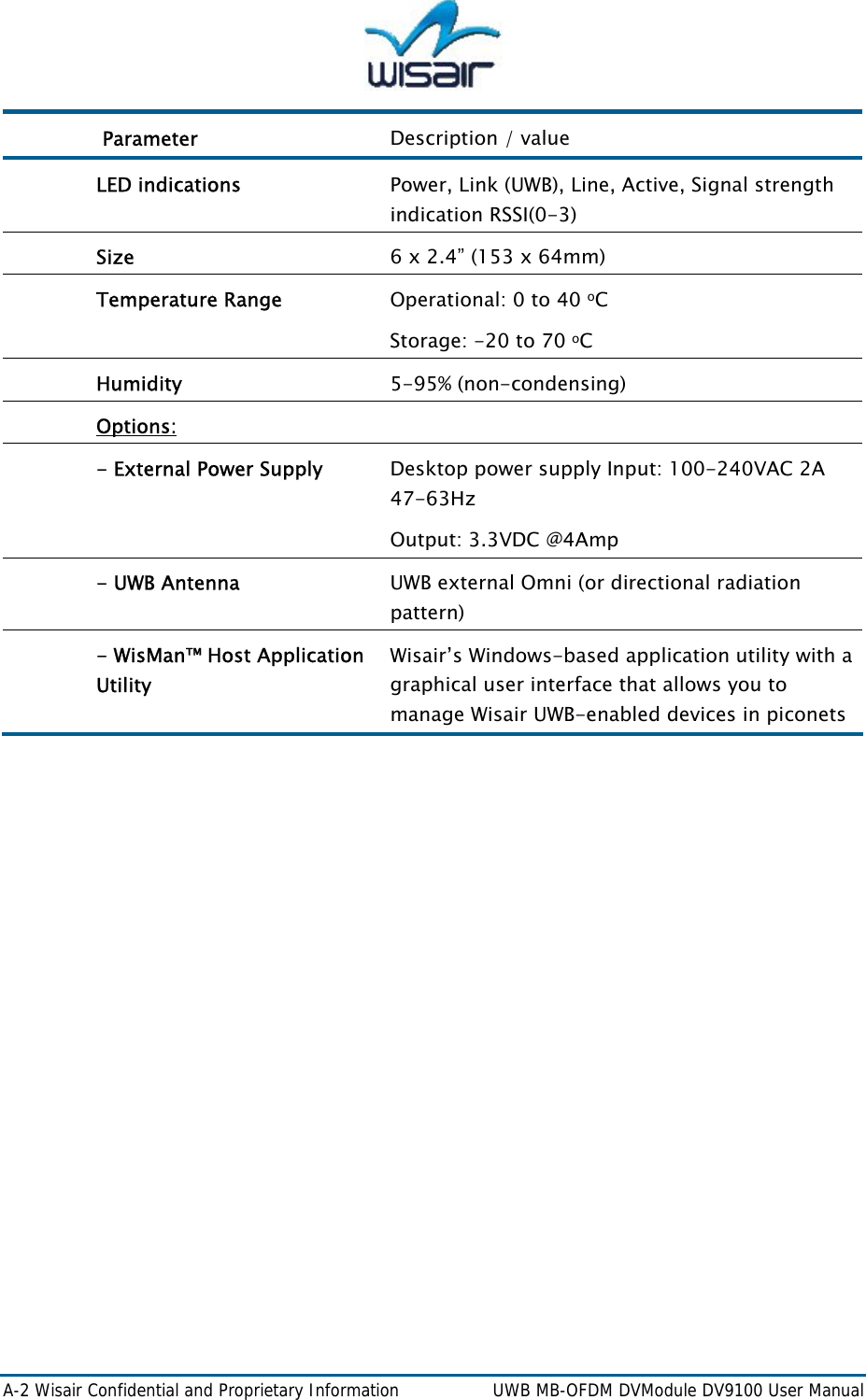
 A-2 Wisair Confidential and Proprietary Information      UWB MB-OFDM DVModule DV9100 User Manual  Parameter  Description / value LED indications  Power, Link (UWB), Line, Active, Signal strength indication RSSI(0-3) Size  6 x 2.4” (153 x 64mm) Temperature Range  Operational: 0 to 40 oC Storage: -20 to 70 oC  Humidity  5-95% (non-condensing) Options:  - External Power Supply   Desktop power supply Input: 100-240VAC 2A 47-63Hz Output: 3.3VDC @4Amp - UWB Antenna  UWB external Omni (or directional radiation pattern) - WisMan™ Host Application Utility  Wisair’s Windows-based application utility with a graphical user interface that allows you to manage Wisair UWB-enabled devices in piconets

Navigation menu