Xircom EAG2919 Eagle II 900/1900 MHz GSM Radio Module User Manual

Xircom Eagle II 900/1900 MHz GSM Radio Module Users Manual

Users Manual

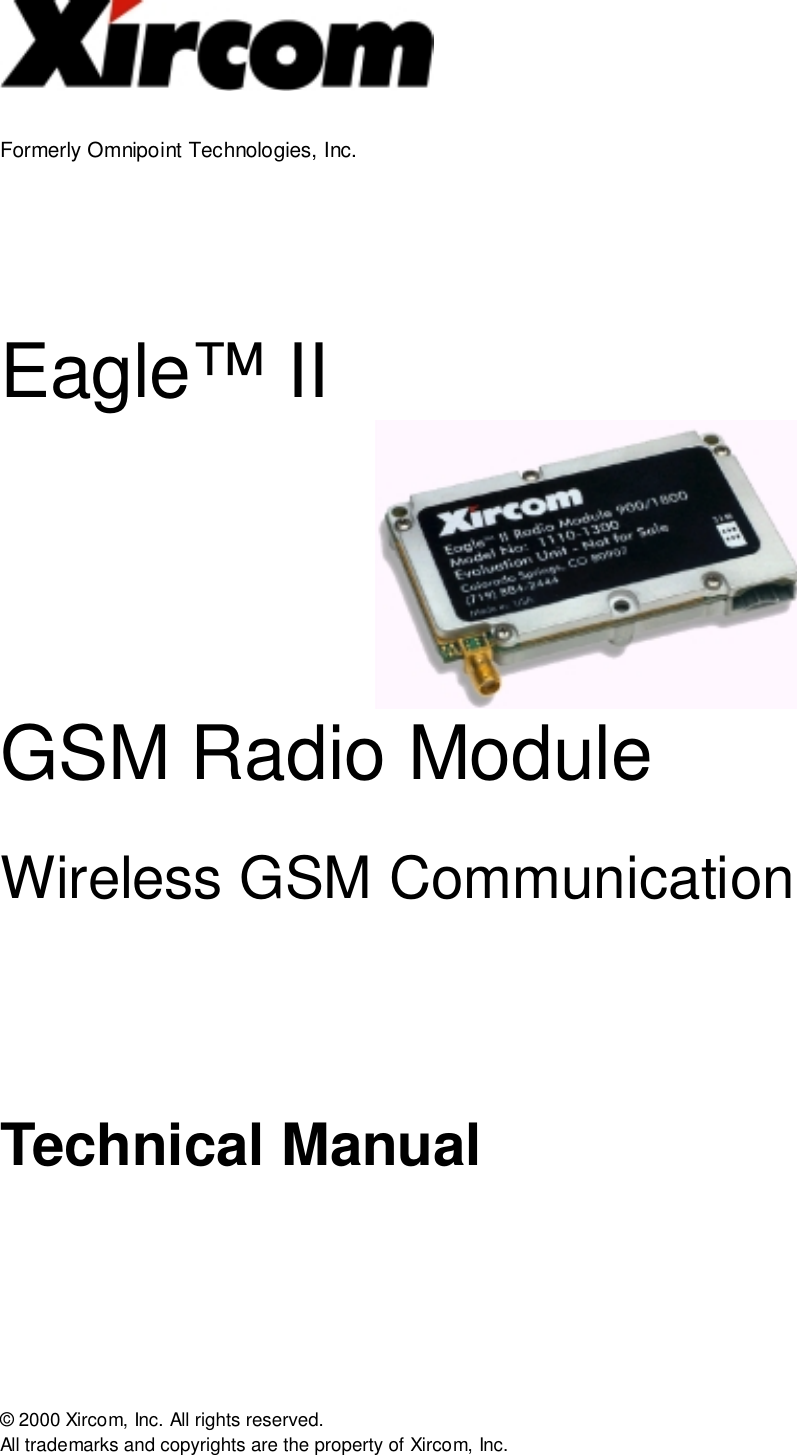
© 2000 Xircom, Inc. All rights reserved.All trademarks and copyrights are the property of Xircom, Inc.Formerly Omnipoint Technologies, Inc.Eagle™ IIGSM Radio ModuleWireless GSM CommunicationTechnical Manual
Eagle II GSM Radio Module Technical Manual Preliminary Draft: 08/31/00 2Part Number: 07100017 version 00.04© 2000 Xircom, Inc. All rights reserved.All trademarks and copyrights are the property of Xircom, Inc.SAFETY PRECAUTIONSImportant Safety InformationThe following information applies to the devices described in this manual. Alwaysobserve all standard and accepted safety precautions and guidelines when handling anyelectrical device.! Save this manual: it contains important safety information and operating instructions.! Do not expose the Eagle™ II product to open flames.! Ensure that liquids do not spill into the devices.! Do not attempt to disassemble the product: Doing so will void the warranty. With theexception of the Subscriber Identification Module (SIM), this product does not containconsumer-serviceable components.Guidelines for Limiting RF ExposureThe Eagle II products are GSM radio transceivers, which operate under the authority of47 CFR Part 24, Subpart E of the FCC Rules and Regulations. When installed andoperated in accordance with the instructions provided in this manual, these devicescomply with current FCC regulations regarding human exposure to radio frequencyradiation.The following installation and operation restrictions apply to all Eagle II products:! This device may only be used in fixed and mobile applications.! Portable applications, as defined by the FCC, are prohibited.! The use of this device for desktop and other applications where the antenna caneasily be relocated are considered by the FCC to be mobile applications.! A separation distance of at least 20 cm (7.87 inches) between the antenna and thebody of the user and other persons must be maintained at all times! In FIXED applications, antenna gain is limited to a maximum of 7 dBi, with acorresponding Equivalent Isotropic Radiated Power (EIRP) of 37 dBm / 5 W.! In MOBILE applications, antenna gain is limited to a maximum of 3 dBi, with acorresponding EIRP of 33 dBm / 2 W.! End products must provide instructions to ensure compliance with radio frequencyradiation exposure requirements.! A warning label visible to all persons exposed to the antenna and identical to thatdescribed in this manual must be displayed on or next to the antenna.! Separate FCC approval for RF exposure compliance is required for end products thatdo not meet these conditions.Antenna gain is defined as gain in dBi (dB referenced to an isotropic radiator) minuscabling loss.
Eagle II GSM Radio Module Technical Manual Preliminary Draft: 08/31/00 3Part Number: 07100017 version 00.04© 2000 Xircom, Inc. All rights reserved.All trademarks and copyrights are the property of Xircom, Inc.Note: Additional care must be taken by the installer and/or user of the Eagle IIproducts to ensure proper antenna selection and installation. Adherence to theabove conditions is necessary to comply with FCC requirements for safe operationregarding exposure to RF radiation.Human Exposure Compliance StatementXircom, Inc. Wireless Technology Group certifies that the Eagle ™II 900/1900 MHz GSMRadio Module (FCC ID: J3OEAG2919) complies with the RF hazard requirementsapplicable to broadband PCS equipment operating under the authority of 47 CFR Part24, Subpart E of the FCC Rules and Regulations.  This certification is contingent uponinstallation, operation and use of the Eagle ™ II and its host product in accordance withall instructions provided to both the OEM and end used.  When installed and operated ina manner consistent with the instructions provided, the Eagle ™ II meets the maximumpermissible exposure (MPE) limits for general population / uncontrolled exposure atdefined in Section 1.1310 of the FCC Rules and Regulations.DisclaimerThe information and instructions contained within this publication comply with all FCC,NRTL, IMEI and other applicable codes that are in effect at the time of publication.Xircom, Inc. disclaims all responsibility for any act or omissions, or for breach of law,code or regulation, including local or state codes, performed by a third party.Xircom strongly recommends that all installations, hookups, transmissions, etc., beperformed by persons who are experienced in the fields of radio frequency technologies.Xircom acknowledges that the installation, setup and transmission guidelines containedwithin this publication are guidelines, and that each installation may have variablesoutside of the guidelines contained herein. Said variables must be taken intoconsideration when installing or using the product, and Xircom, Inc. shall not beresponsible for installations or transmissions that fall outside of the parameters set forthin this publication.Xircom shall not be liable for consequential or incidental damages, injury to any person orproperty, anticipated or lost profits, loss of time, or other losses incurred by Customer orany third party in connection with the installation of the Products or Customer's failure tocomply with the information and instructions contained herein.
Eagle II GSM Radio Module Technical Manual Preliminary Draft: 08/31/00 4Part Number: 07100017 version 00.04© 2000 Xircom, Inc. All rights reserved.All trademarks and copyrights are the property of Xircom, Inc.CONTENTSSAFETY PRECAUTIONS............................................................................................2Important Safety Information.................................................................................................2Guidelines for Limiting RF Exposure.....................................................................................2Human Exposure Compliance Statement.............................................................................3Disclaimer ..............................................................................................................................3PRODUCT OVERVIEW...............................................................................................7Bringing the Features of GSM Communications to an Application..................................7Providing Multi-Band Operation........................................................................................7Incorporating GSM Communications into the Design...........................................................8Summary of the Features for the Eagle II Radio Module......................................................9TECHNICAL SPECIFICATIONS................................................................................10Physical Dimensions and Weight ...................................................................................10Climatic: Operational.......................................................................................................10Climatic: Storage and Transportation.............................................................................10Mechanical: Operational .................................................................................................10Mechanical: Storage and Transportation........................................................................11Mechanical: Proposed Standards...................................................................................11Electromagnetic Emissions............................................................................................. 11Electromagnetic Immunity (per ETSI ETS 300 342-1)...................................................11Operating Power .............................................................................................................12Transmit Power...............................................................................................................12Receiver Sensitivity.........................................................................................................12Physical Layout for the Eagle II Module .........................................................................13PHYSICAL INTERFACES OF THE EAGLE II MODULE ............................................14Antenna Interface ................................................................................................................14Input/Output (I/O) Signal Connector....................................................................................14Mating Connector on the Carrier Board of the Application ............................................15I/O Signal Connector on the Eagle II Module.................................................................15I/O Connector Pin Assignments, Sorted by Functionality ..............................................15Subscriber Identification Module (SIM) Carrier...................................................................18Using a Remote SIM with the Eagle II Module...............................................................18Status Indicator....................................................................................................................19MODES OF OPERATION..........................................................................................20Enabling the Transmission Modes for the GSM Services..............................................20
Eagle II GSM Radio Module Technical Manual Preliminary Draft: 08/31/00 5Part Number: 07100017 version 00.04© 2000 Xircom, Inc. All rights reserved.All trademarks and copyrights are the property of Xircom, Inc.Voice Communication..........................................................................................................20Circuit-Switched Data..........................................................................................................20SMS: Short Message Services............................................................................................ 21SMS Features Supported by the Eagle II Module..........................................................21General Packet Radio Service (GPRS) ..............................................................................21PROVISIONING THE SIM .........................................................................................22GSM Services Supported by the Eagle II Module..........................................................22Selecting the Modes of Operation..................................................................................22SOFTWARE INTERFACE OF THE EAGLE II MODULE............................................23Format for the AT Commands............................................................................................. 23AT Command Set ................................................................................................................23Call Control Commands.................................................................................................. 24GSM Network Commands..............................................................................................24GSM Terminal Commands .............................................................................................24AT Commands for SMS..................................................................................................26S Registers......................................................................................................................26Result Codes...................................................................................................................27INITIALIZATION AND SETUP EXAMPLES...............................................................28Initial Response to the AT Command .................................................................................28Sending an Initialization String to the Eagle II Module .......................................................29Setting Up the Communication Mode for the Eagle II Module............................................29Querying the Status of the Eagle II Module ........................................................................ 29Initialize the EAGLE II Module to Send SMS Text..............................................................30Requesting to Receive the SMS Text .................................................................................32Initiating a Data Call.............................................................................................................33Initiating a Voice Call...........................................................................................................34Mobile-Originated Call .................................................................................................... 34Mobile-Terminated Call...................................................................................................34INTEGRATION AND TEST........................................................................................35Using the Eagle II Developer's Kit to Reduce Development Time and Effort................35Integrating the Eagle II Module.......................................................................................35REPAIR AND RETURN POLICY...............................................................................37Reporting and Troubleshooting Problems with the Eagle II Module.............................. 37REGULATIONS AND COMPLIANCE........................................................................38
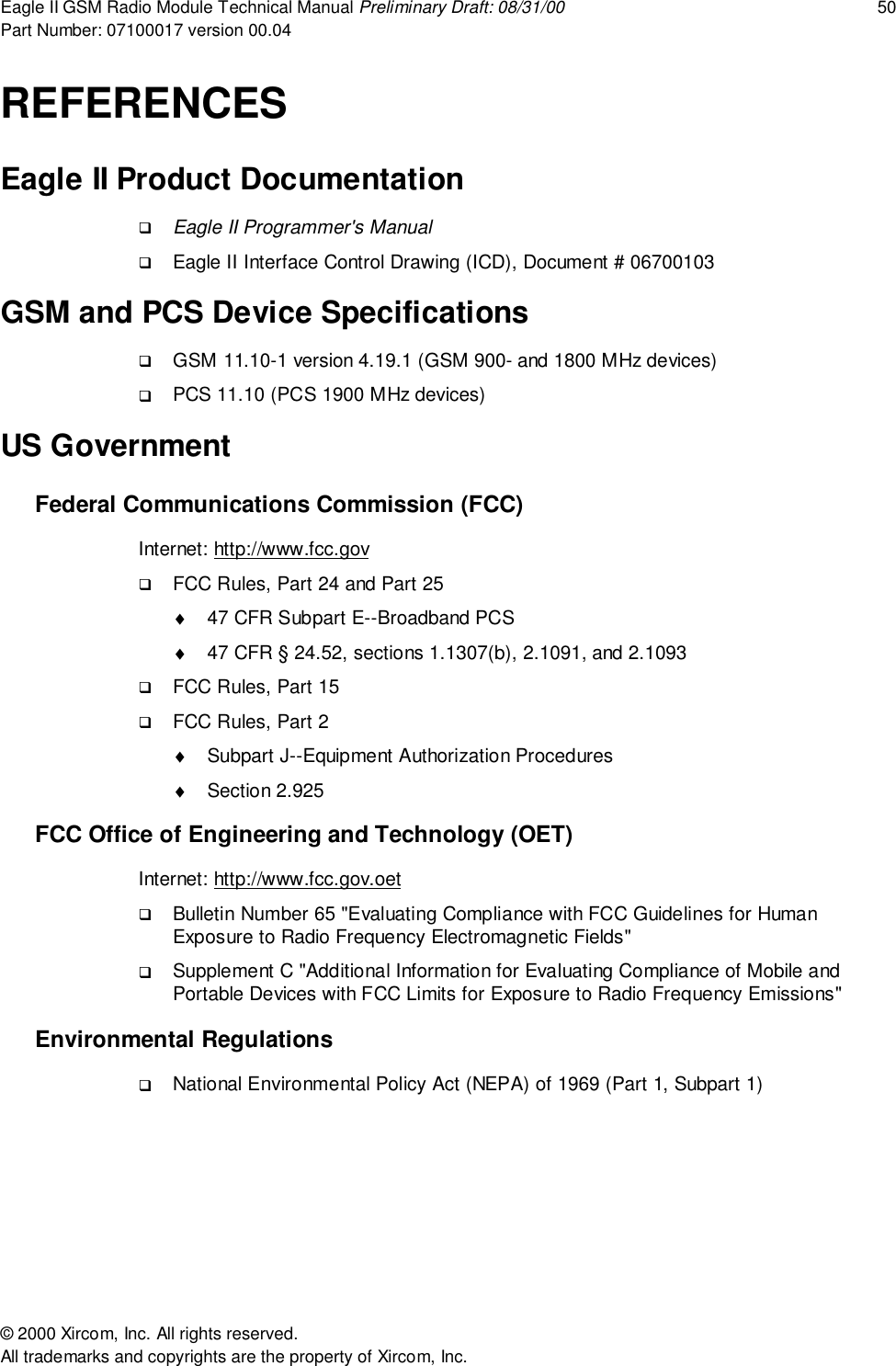
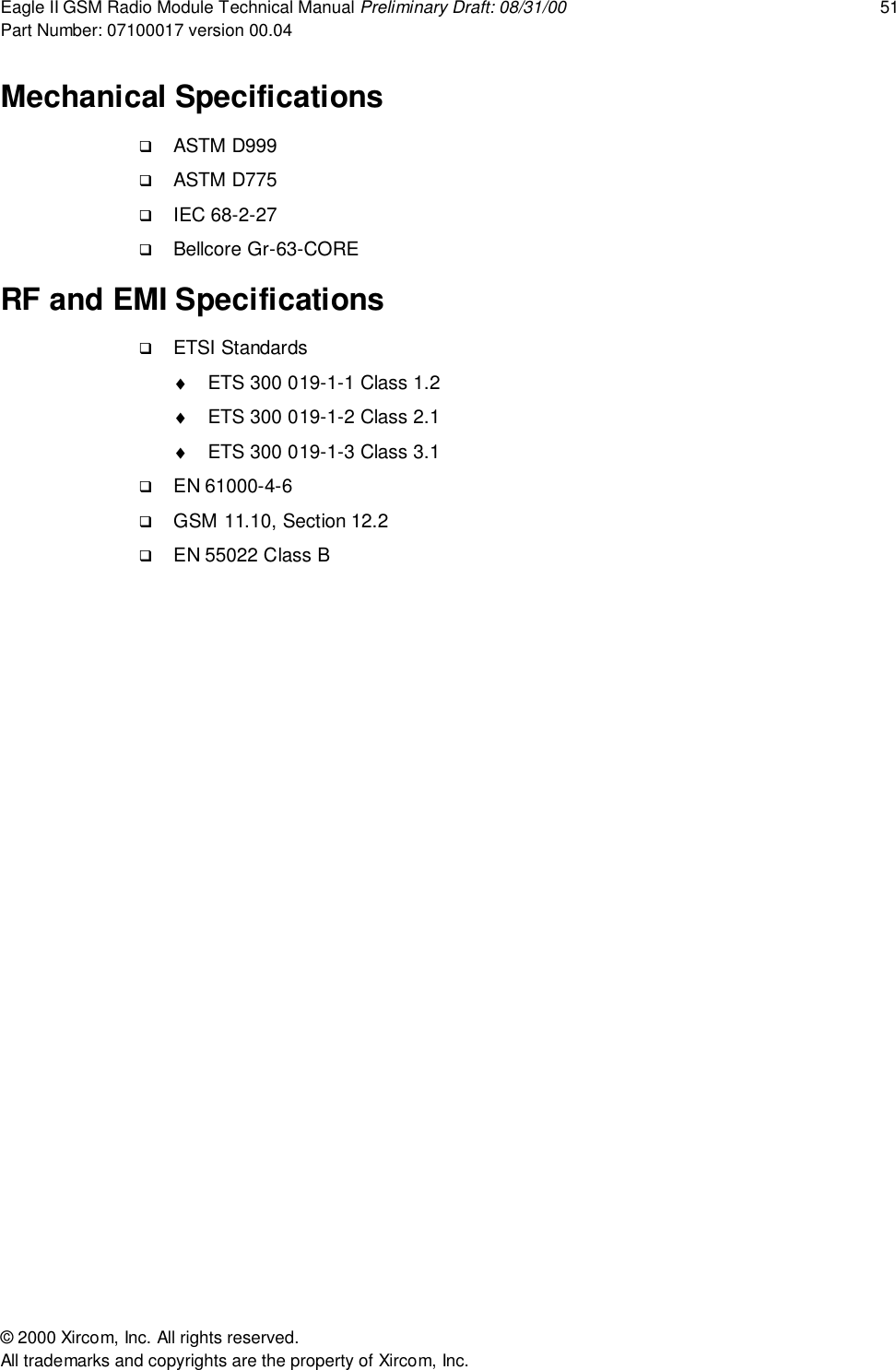
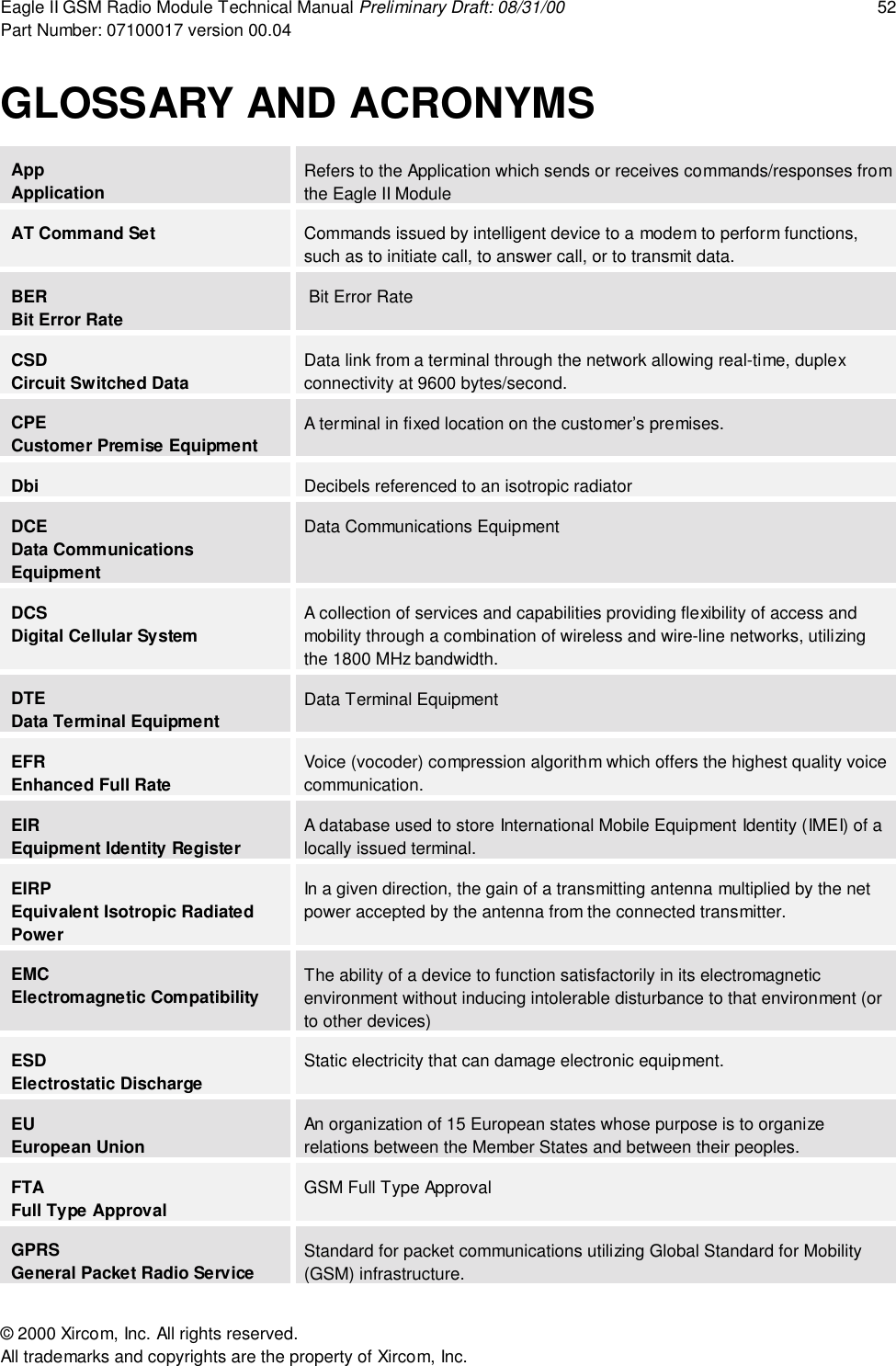
Eagle II GSM Radio Module Technical Manual Preliminary Draft: 08/31/00 6Part Number: 07100017 version 00.04© 2000 Xircom, Inc. All rights reserved.All trademarks and copyrights are the property of Xircom, Inc.GSM Full Type Approval (FTA)...........................................................................................38Electromagnetic Compatibility (EMC) and Safety Requirements.......................................38EMC/Safety Requirements for the USA ......................................................................... 38Human Exposure Compliance Statement ......................................................................39Compliance with FCC Regulations.................................................................................39Nationally Recognized Testing Laboratory (NRTL) Approval............................................. 44EMC/Safety Requirements for the Countries of the European Union (EU)........................45EMC/Safety Requirements for Other Countries..................................................................45PIN ASSIGNMENTS OF THE I/O CONNECTOR........................................................46Signals of the I/O Connector, Sorted by Pin Number .........................................................46REFERENCES..........................................................................................................50Eagle II Product Documentation..........................................................................................50GSM and PCS Device Specifications .................................................................................50US Government...................................................................................................................50Federal Communications Commission (FCC)................................................................50FCC Office of Engineering and Technology (OET)........................................................50Environmental Regulations.............................................................................................50Mechanical Specifications...................................................................................................51RF and EMI Specifications.................................................................................................. 51GLOSSARY AND ACRONYMS.................................................................................52CONTACTING XIRCOM............................................................................................55
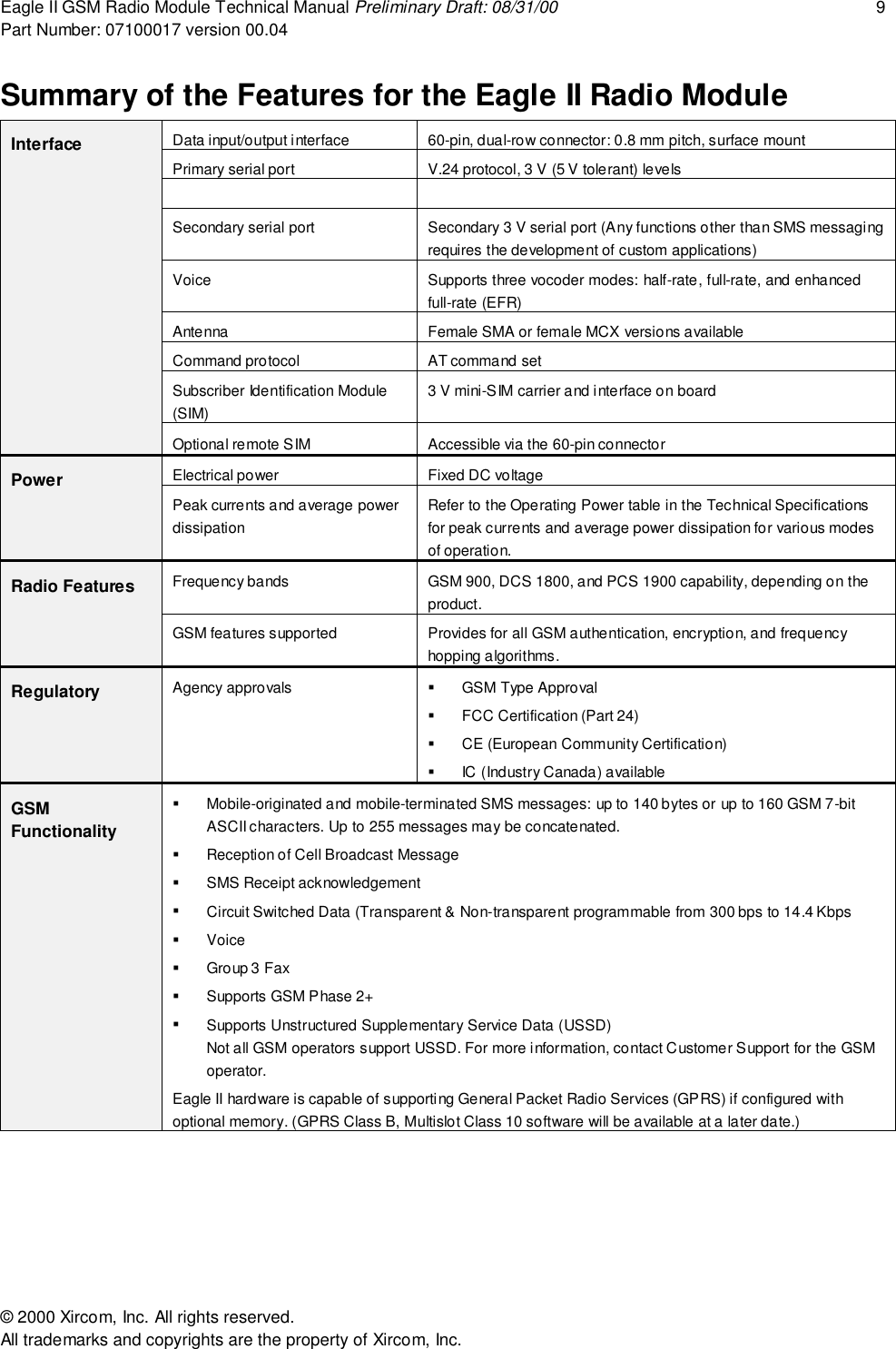
Eagle II GSM Radio Module Technical Manual Preliminary Draft: 08/31/00 7Part Number: 07100017 version 00.04© 2000 Xircom, Inc. All rights reserved.All trademarks and copyrights are the property of Xircom, Inc.PRODUCT OVERVIEWThe Eagle II radio module is a compact, wireless OEM module that utilizes the GlobalSystem for Mobile Communications (GSM) international communications standard toprovide two-way wireless capabilities via GSM services. The Eagle II module is a fullyType-approved GSM device, enabling application-specific, two-way communication andcontrol.The small size of the Eagle II module allows it to be integrated easily into the applicationand packaging.Bringing the Features of GSM Communications to an ApplicationThe Eagle II module takes full advantage of GSM capabilities, such as:! Subscriber Identification Modules (SIMs) provide numerous advantages, such asnumber portability, remote wireless updates, memory updates, and remoteprovisioning.! Wireless communication lets the Eagle II module accomplish tasks that previouslyrequired on-site visits. This capability offers innovative new services for anapplication.! Terminal authentication and data encryption ensure confidential communicationbetween the terminal user and the data recipient.A variety of applications can use the Eagle II module for transmitting and receiving dataand voice, such as:! Automated meter reading! Credit card verification! E-mail and Internet access! Fleet management systems! Telematics! Telemetry! Wireless alarmsProviding Multi-Band OperationThe Eagle II module provides multi-band operation, with the operating frequencyselectable by AT Command:! The 900/1900 MHz Eagle II module is available for integration and deployment foruse worldwide, with 1900 MHz support primarily in North America and regions wherethe 1900 MHz Personal Communication Services (PCS) band is allocated and900 MHz support for networks in the rest of the world.! The 900/1800 MHz Eagle II modules are available for deployment in Europe and therest of the world, with the exception of North and South America.
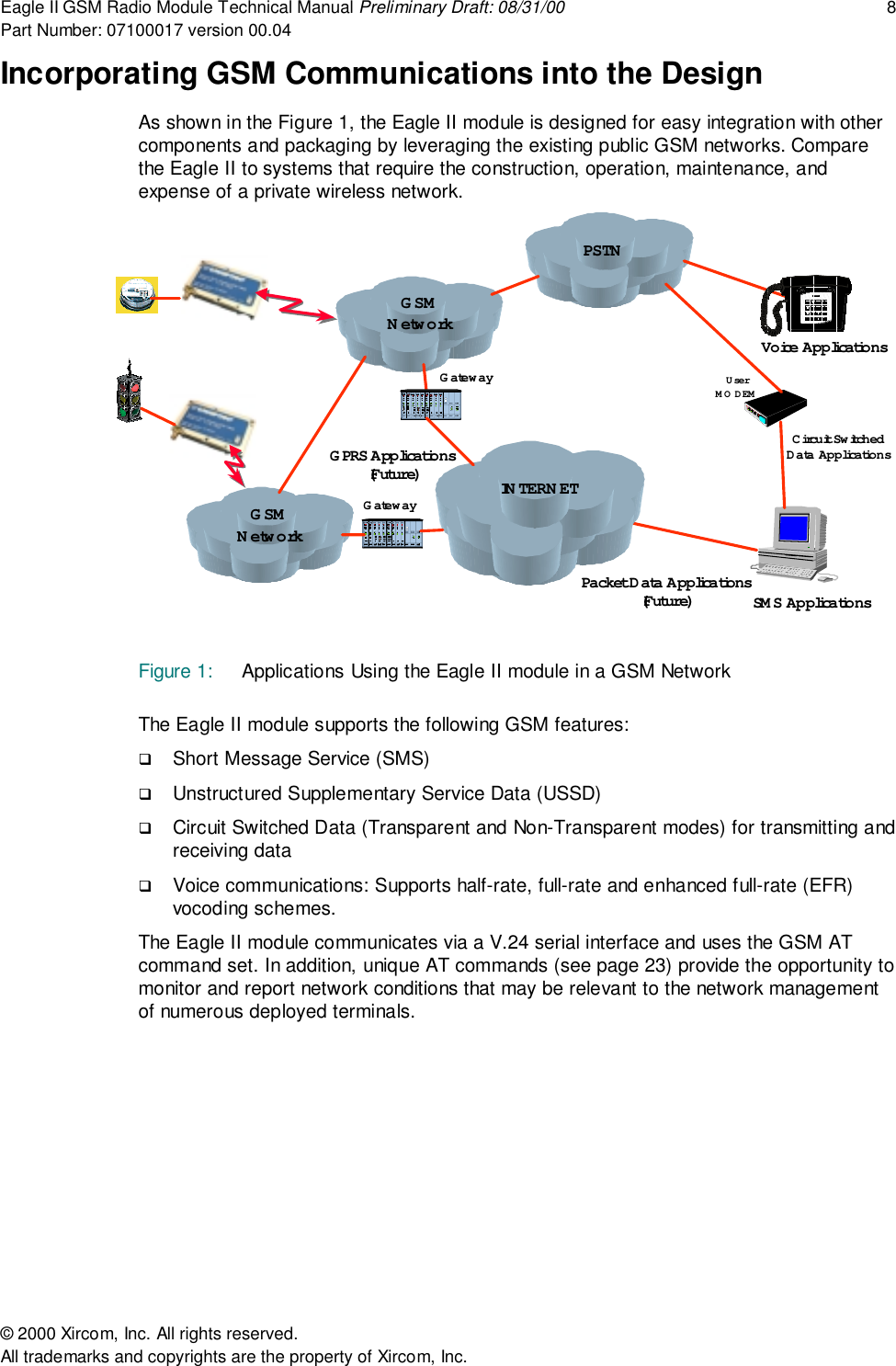
Eagle II GSM Radio Module Technical Manual Preliminary Draft: 08/31/00 8Part Number: 07100017 version 00.04© 2000 Xircom, Inc. All rights reserved.All trademarks and copyrights are the property of Xircom, Inc.Incorporating GSM Communications into the DesignAs shown in the Figure 1, the Eagle II module is designed for easy integration with othercomponents and packaging by leveraging the existing public GSM networks. Comparethe Eagle II to systems that require the construction, operation, maintenance, andexpense of a private wireless network.Figure 1:  Applications Using the Eagle II module in a GSM NetworkThe Eagle II module supports the following GSM features:! Short Message Service (SMS)! Unstructured Supplementary Service Data (USSD)! Circuit Switched Data (Transparent and Non-Transparent modes) for transmitting andreceiving data! Voice communications: Supports half-rate, full-rate and enhanced full-rate (EFR)vocoding schemes.The Eagle II module communicates via a V.24 serial interface and uses the GSM ATcommand set. In addition, unique AT commands (see page 23) provide the opportunity tomonitor and report network conditions that may be relevant to the network managementof numerous deployed terminals.GSMNetworkPSTNUserMO DEMCircuit Sw itchedData Applica tionsVoice ApplicationsGSMNetworkPacket Data Applica tions(Future)IN TERN ETGatew ayGatew aySM S Applica tionsGPRS Applications(Future)
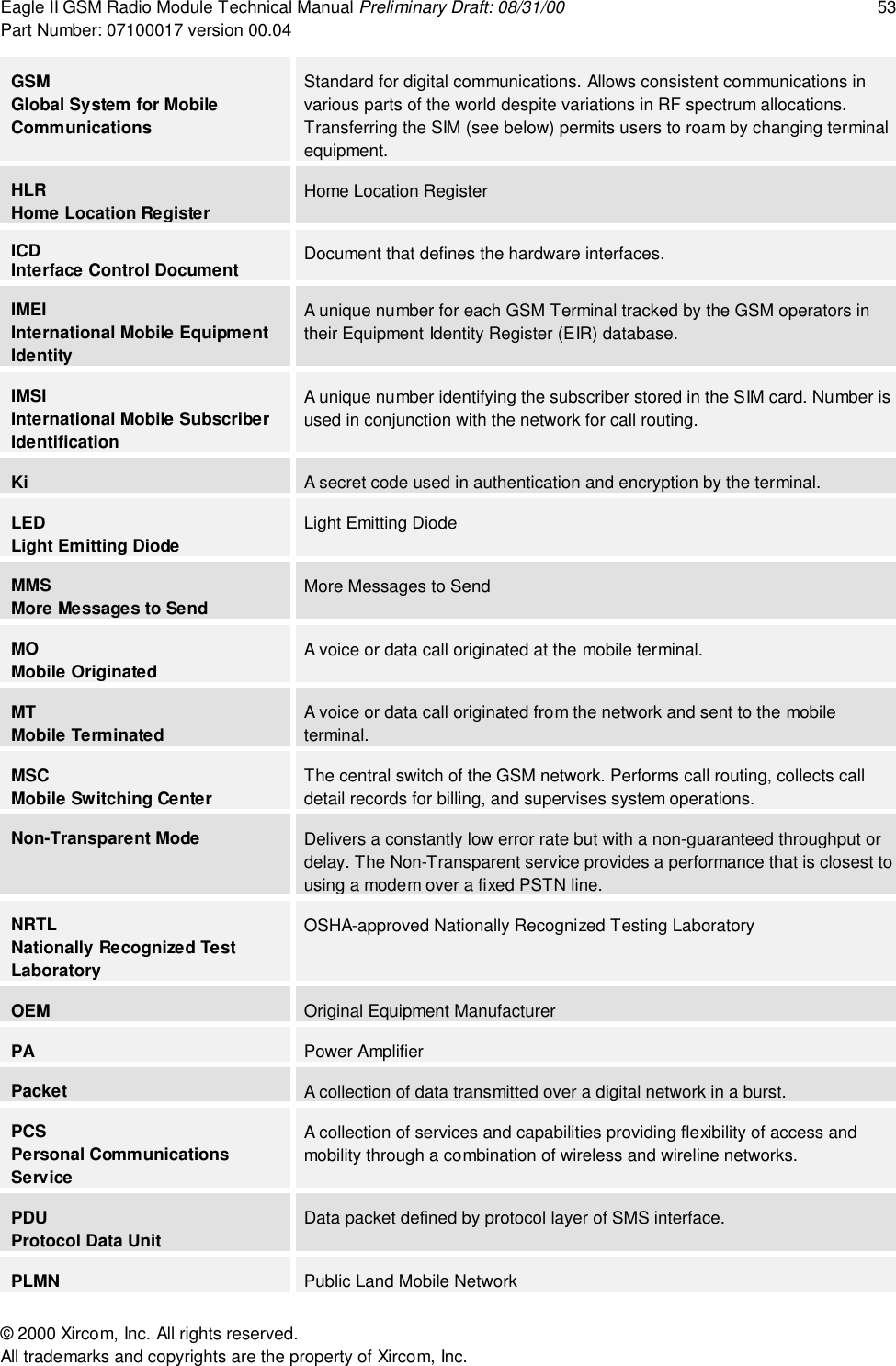
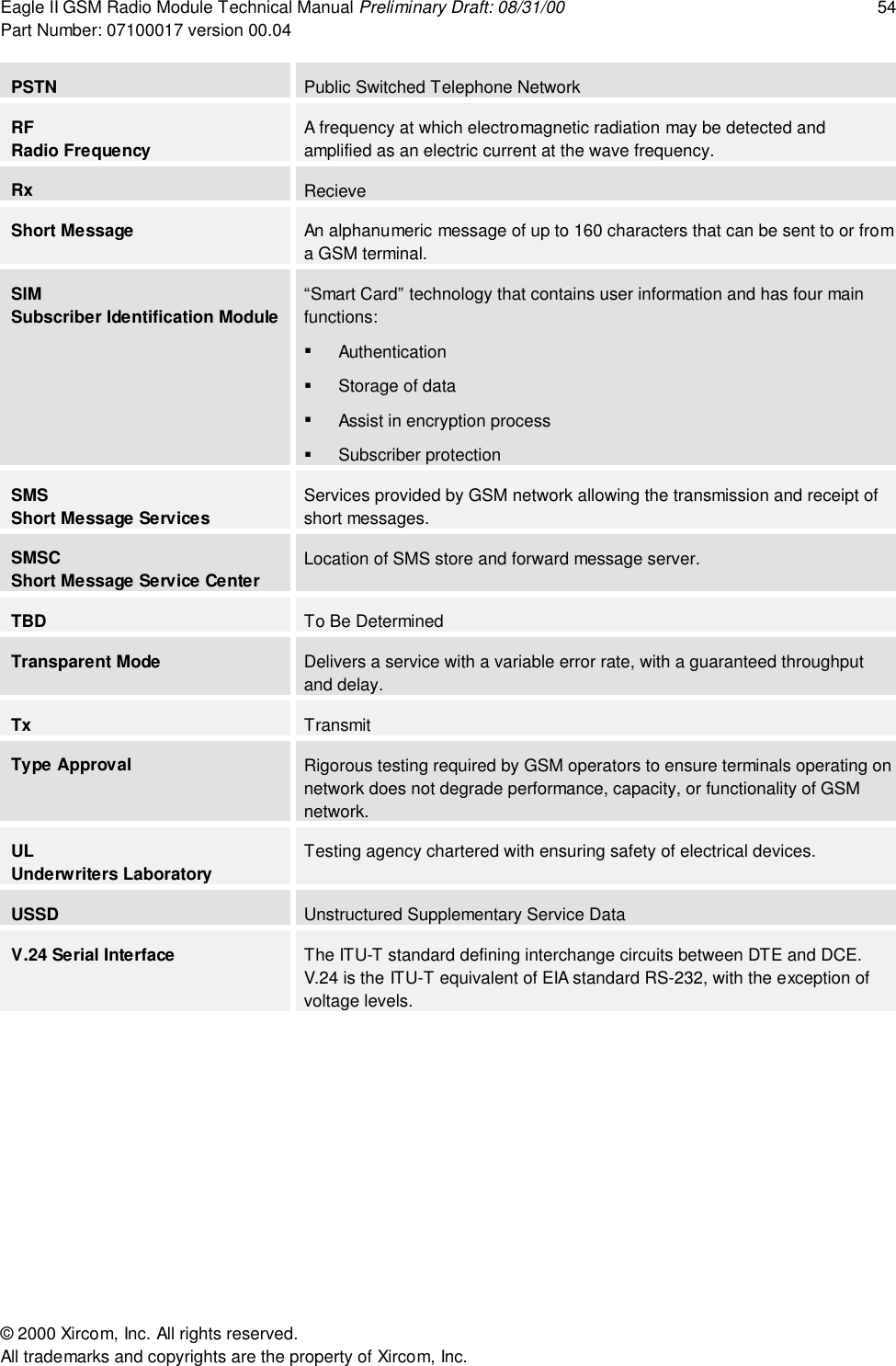
Eagle II GSM Radio Module Technical Manual Preliminary Draft: 08/31/00 9Part Number: 07100017 version 00.04© 2000 Xircom, Inc. All rights reserved.All trademarks and copyrights are the property of Xircom, Inc.Summary of the Features for the Eagle II Radio ModuleData input/output interface 60-pin, dual-row connector: 0.8 mm pitch, surface mountPrimary serial port V.24 protocol, 3 V (5 V tolerant) levelsSecondary serial port Secondary 3 V serial port (Any functions other than SMS messagingrequires the development of custom applications)Voice Supports three vocoder modes: half-rate, full-rate, and enhancedfull-rate (EFR)Antenna Female SMA or female MCX versions availableCommand protocol AT command setSubscriber Identification Module(SIM)3 V mini-SIM carrier and interface on boardInterfaceOptional remote SIM Accessible via the 60-pin connectorElectrical power Fixed DC voltagePowerPeak currents and average powerdissipationRefer to the Operating Power table in the Technical Specificationsfor peak currents and average power dissipation for various modesof operation.Frequency bands GSM 900, DCS 1800, and PCS 1900 capability, depending on theproduct.Radio FeaturesGSM features supported Provides for all GSM authentication, encryption, and frequencyhopping algorithms.Regulatory Agency approvals " GSM Type Approval"  FCC Certification (Part 24)"  CE (European Community Certification)"  IC (Industry Canada) availableGSMFunctionality"  Mobile-originated and mobile-terminated SMS messages: up to 140 bytes or up to 160 GSM 7-bitASCII characters. Up to 255 messages may be concatenated."  Reception of Cell Broadcast Message"  SMS Receipt acknowledgement"  Circuit Switched Data (Transparent & Non-transparent programmable from 300 bps to 14.4 Kbps" Voice" Group 3 Fax"  Supports GSM Phase 2+"  Supports Unstructured Supplementary Service Data (USSD)Not all GSM operators support USSD. For more information, contact Customer Support for the GSMoperator.Eagle II hardware is capable of supporting General Packet Radio Services (GPRS) if configured withoptional memory. (GPRS Class B, Multislot Class 10 software will be available at a later date.)
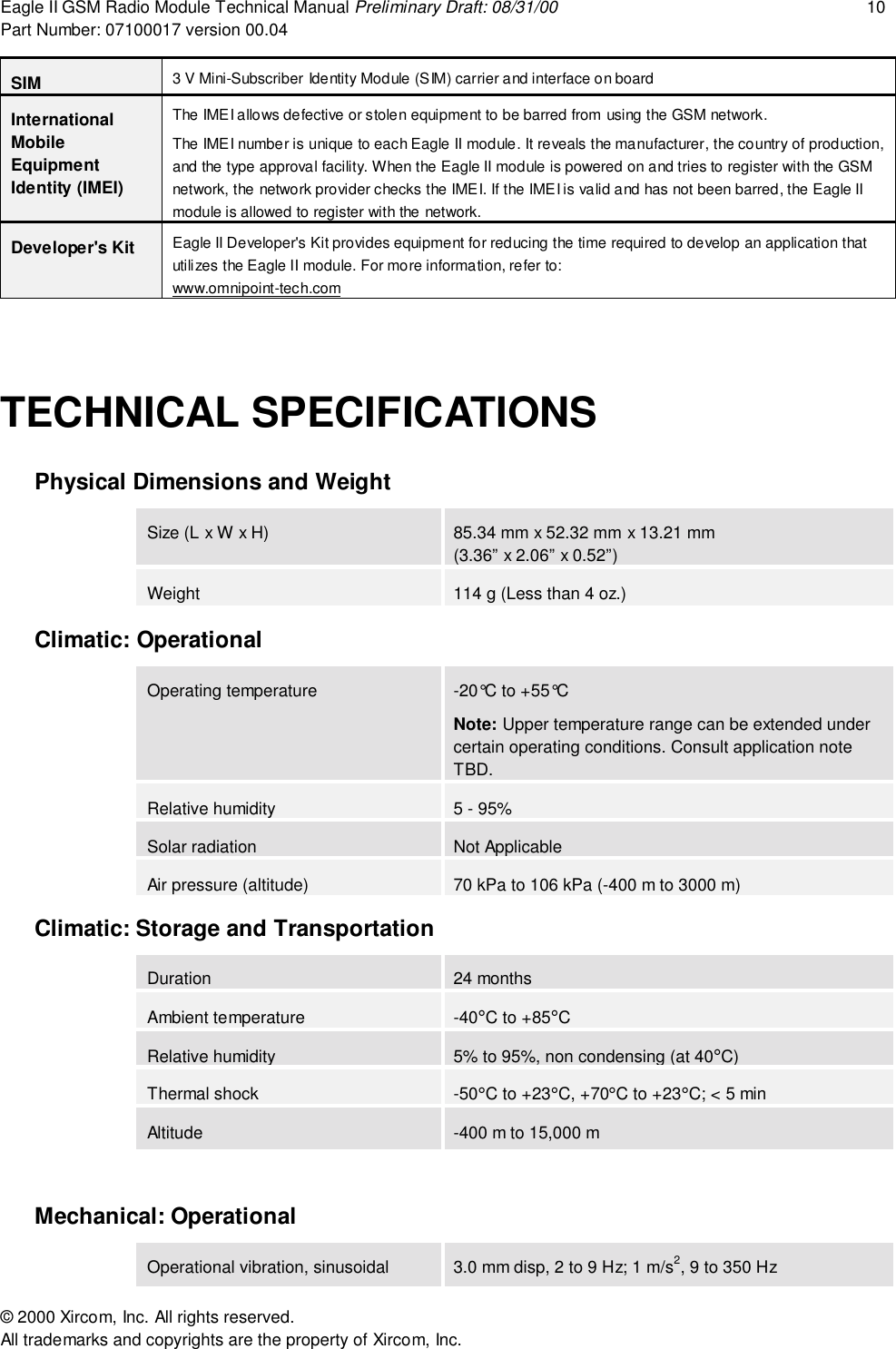
Eagle II GSM Radio Module Technical Manual Preliminary Draft: 08/31/00 10Part Number: 07100017 version 00.04© 2000 Xircom, Inc. All rights reserved.All trademarks and copyrights are the property of Xircom, Inc.SIM 3 V Mini-Subscriber Identity Module (SIM) carrier and interface on boardInternationalMobileEquipmentIdentity (IMEI)The IMEI allows defective or stolen equipment to be barred from using the GSM network.The IMEI number is unique to each Eagle II module. It reveals the manufacturer, the country of production,and the type approval facility. When the Eagle II module is powered on and tries to register with the GSMnetwork, the network provider checks the IMEI. If the IMEI is valid and has not been barred, the Eagle IImodule is allowed to register with the network.Developer's Kit Eagle II Developer's Kit provides equipment for reducing the time required to develop an application thatutilizes the Eagle II module. For more information, refer to:www.omnipoint-tech.comTECHNICAL SPECIFICATIONSPhysical Dimensions and WeightSize (L x W x H) 85.34 mm x 52.32 mm x 13.21 mm(3.36” x 2.06” x 0.52”)Weight 114 g (Less than 4 oz.)Climatic: OperationalOperating temperature -20°C to +55°CNote: Upper temperature range can be extended undercertain operating conditions. Consult application noteTBD.Relative humidity 5 - 95%Solar radiation Not ApplicableAir pressure (altitude) 70 kPa to 106 kPa (-400 m to 3000 m)Climatic: Storage and TransportationDuration 24 monthsAmbient temperature -40°C to +85°CRelative humidity 5% to 95%, non condensing (at 40°C)Thermal shock -50°C to +23°C, +70°C to +23°C; < 5 minAltitude -400 m to 15,000 mMechanical: OperationalOperational vibration, sinusoidal 3.0 mm disp, 2 to 9 Hz; 1 m/s2, 9 to 350 Hz
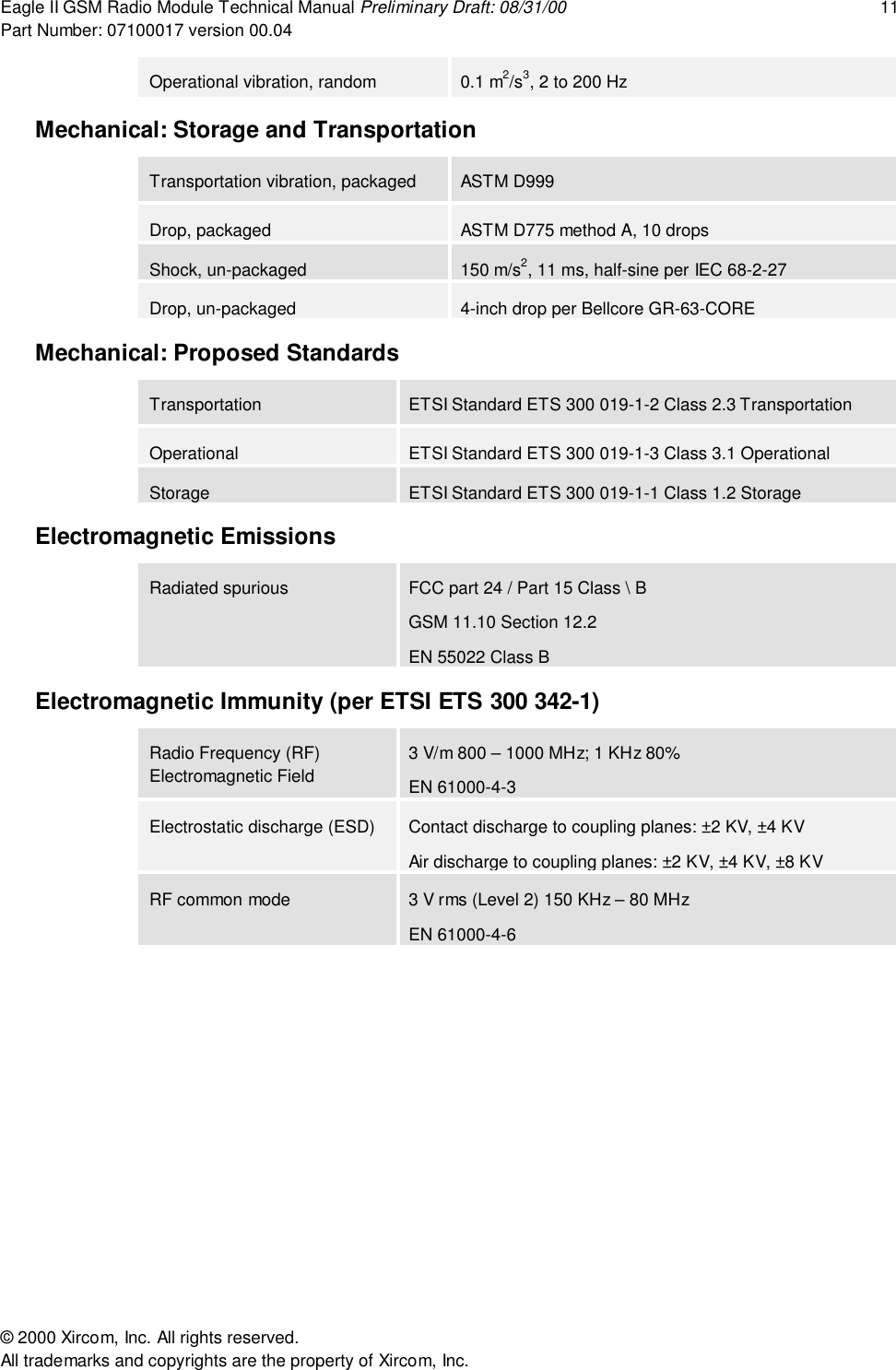
Eagle II GSM Radio Module Technical Manual Preliminary Draft: 08/31/00 11Part Number: 07100017 version 00.04© 2000 Xircom, Inc. All rights reserved.All trademarks and copyrights are the property of Xircom, Inc.Operational vibration, random 0.1 m2/s3, 2 to 200 HzMechanical: Storage and TransportationTransportation vibration, packaged ASTM D999Drop, packaged ASTM D775 method A, 10 dropsShock, un-packaged 150 m/s2, 11 ms, half-sine per IEC 68-2-27Drop, un-packaged 4-inch drop per Bellcore GR-63-COREMechanical: Proposed StandardsTransportation ETSI Standard ETS 300 019-1-2 Class 2.3 TransportationOperational ETSI Standard ETS 300 019-1-3 Class 3.1 OperationalStorage ETSI Standard ETS 300 019-1-1 Class 1.2 StorageElectromagnetic EmissionsRadiated spurious FCC part 24 / Part 15 Class \ BGSM 11.10 Section 12.2EN 55022 Class BElectromagnetic Immunity (per ETSI ETS 300 342-1)Radio Frequency (RF)Electromagnetic Field3 V/m 800 – 1000 MHz; 1 KHz 80%EN 61000-4-3Electrostatic discharge (ESD) Contact discharge to coupling planes: ±2 KV, ±4 KVAir discharge to coupling planes: ±2 KV, ±4 KV, ±8 KVRF common mode 3 V rms (Level 2) 150 KHz – 80 MHzEN 61000-4-6
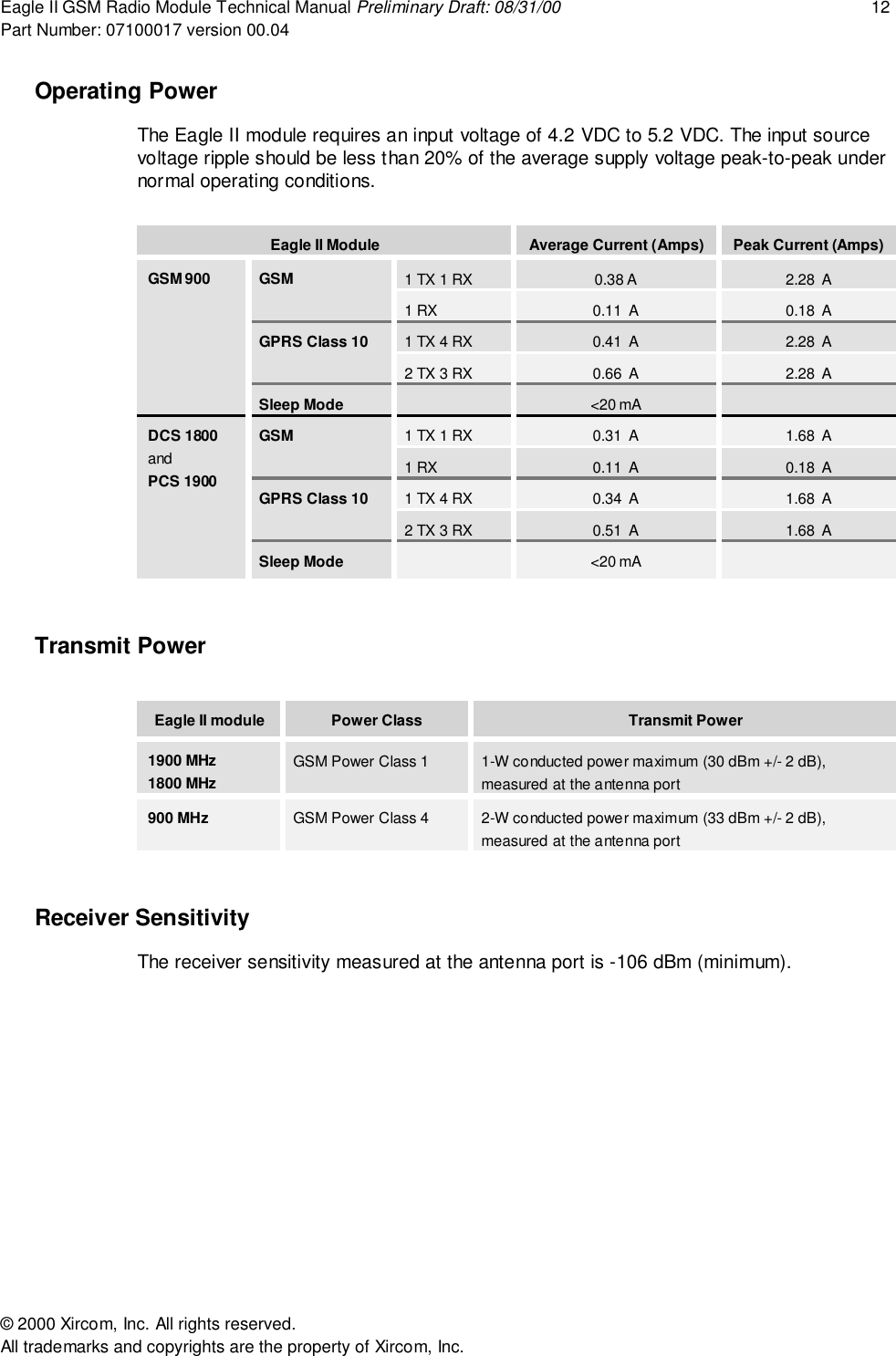
Eagle II GSM Radio Module Technical Manual Preliminary Draft: 08/31/00 12Part Number: 07100017 version 00.04© 2000 Xircom, Inc. All rights reserved.All trademarks and copyrights are the property of Xircom, Inc.Operating PowerThe Eagle II module requires an input voltage of 4.2 VDC to 5.2 VDC. The input sourcevoltage ripple should be less than 20% of the average supply voltage peak-to-peak undernormal operating conditions.Eagle II Module Average Current (Amps) Peak Current (Amps)1 TX 1 RX 0.38 A 2.28  AGSM1 RX 0.11  A 0.18  A1 TX 4 RX 0.41  A 2.28  AGPRS Class 102 TX 3 RX 0.66  A 2.28  AGSM 900Sleep Mode <20 mA1 TX 1 RX 0.31  A 1.68  AGSM1 RX 0.11  A 0.18  A1 TX 4 RX 0.34  A 1.68  AGPRS Class 102 TX 3 RX 0.51  A 1.68  ADCS 1800andPCS 1900Sleep Mode <20 mATransmit PowerEagle II module Power Class Transmit Power1900 MHz1800 MHzGSM Power Class 1 1-W conducted power maximum (30 dBm +/- 2 dB),measured at the antenna port900 MHz GSM Power Class 4 2-W conducted power maximum (33 dBm +/- 2 dB),measured at the antenna portReceiver SensitivityThe receiver sensitivity measured at the antenna port is -106 dBm (minimum).
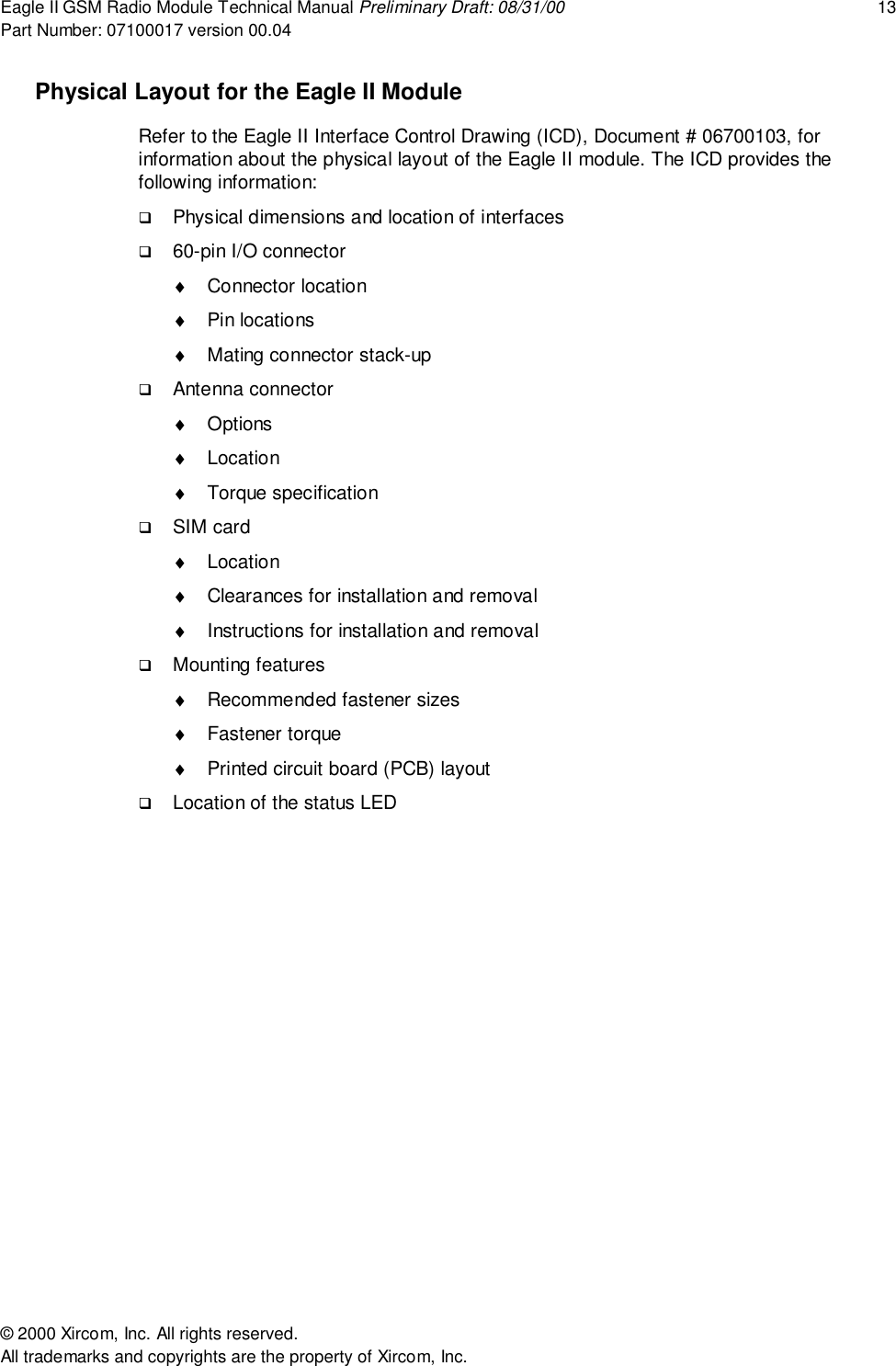
Eagle II GSM Radio Module Technical Manual Preliminary Draft: 08/31/00 13Part Number: 07100017 version 00.04© 2000 Xircom, Inc. All rights reserved.All trademarks and copyrights are the property of Xircom, Inc.Physical Layout for the Eagle II ModuleRefer to the Eagle II Interface Control Drawing (ICD), Document # 06700103, forinformation about the physical layout of the Eagle II module. The ICD provides thefollowing information:! Physical dimensions and location of interfaces! 60-pin I/O connector♦ Connector location♦ Pin locations♦  Mating connector stack-up! Antenna connector♦ Options♦ Location♦ Torque specification! SIM card♦ Location♦  Clearances for installation and removal♦  Instructions for installation and removal! Mounting features♦  Recommended fastener sizes♦ Fastener torque♦  Printed circuit board (PCB) layout! Location of the status LED
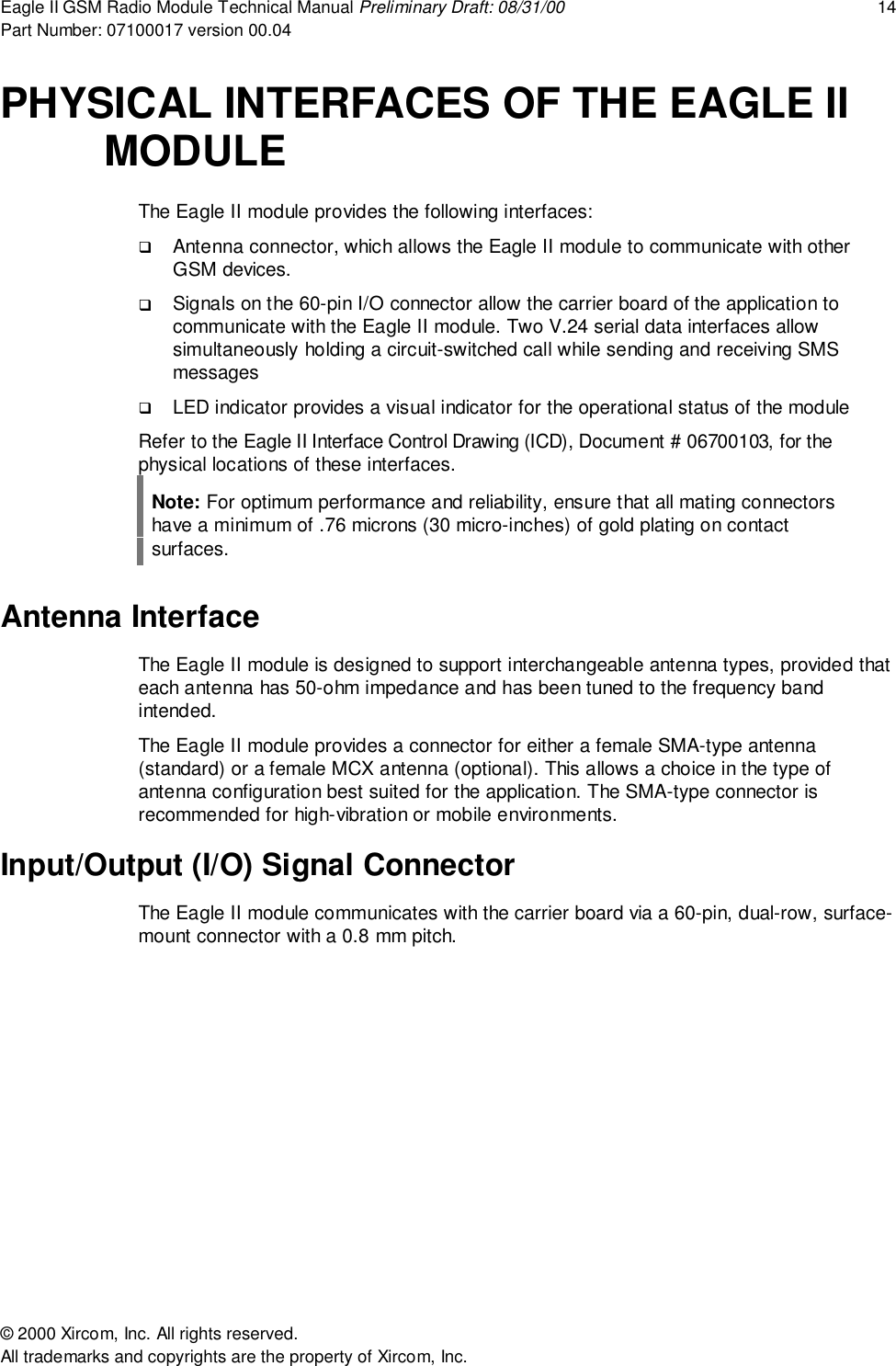
Eagle II GSM Radio Module Technical Manual Preliminary Draft: 08/31/00 14Part Number: 07100017 version 00.04© 2000 Xircom, Inc. All rights reserved.All trademarks and copyrights are the property of Xircom, Inc.PHYSICAL INTERFACES OF THE EAGLE IIMODULEThe Eagle II module provides the following interfaces:! Antenna connector, which allows the Eagle II module to communicate with otherGSM devices.! Signals on the 60-pin I/O connector allow the carrier board of the application tocommunicate with the Eagle II module. Two V.24 serial data interfaces allowsimultaneously holding a circuit-switched call while sending and receiving SMSmessages! LED indicator provides a visual indicator for the operational status of the moduleRefer to the Eagle II Interface Control Drawing (ICD), Document # 06700103, for thephysical locations of these interfaces.Note: For optimum performance and reliability, ensure that all mating connectorshave a minimum of .76 microns (30 micro-inches) of gold plating on contactsurfaces.Antenna InterfaceThe Eagle II module is designed to support interchangeable antenna types, provided thateach antenna has 50-ohm impedance and has been tuned to the frequency bandintended.The Eagle II module provides a connector for either a female SMA-type antenna(standard) or a female MCX antenna (optional). This allows a choice in the type ofantenna configuration best suited for the application. The SMA-type connector isrecommended for high-vibration or mobile environments.Input/Output (I/O) Signal ConnectorThe Eagle II module communicates with the carrier board via a 60-pin, dual-row, surface-mount connector with a 0.8 mm pitch.
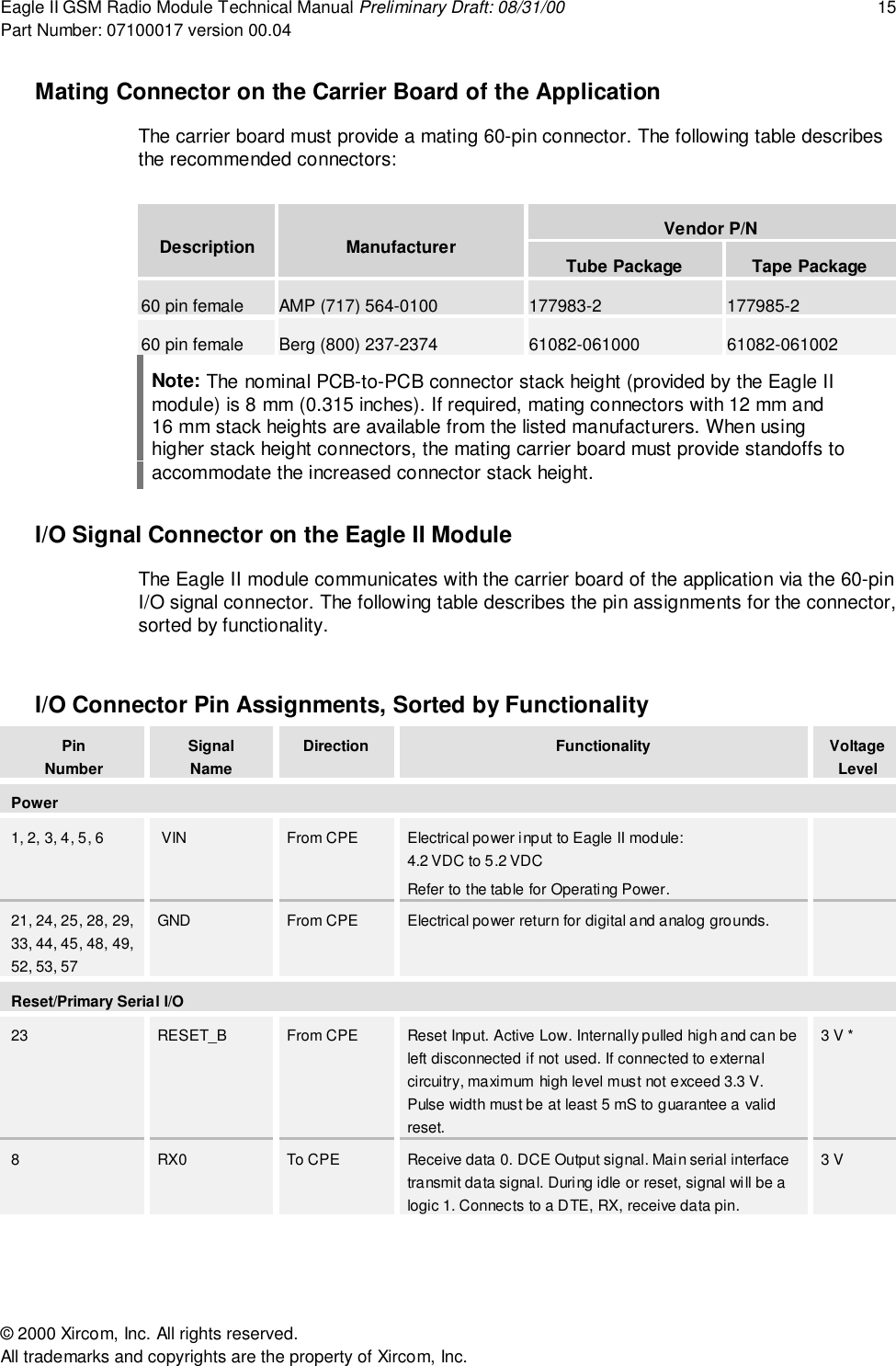
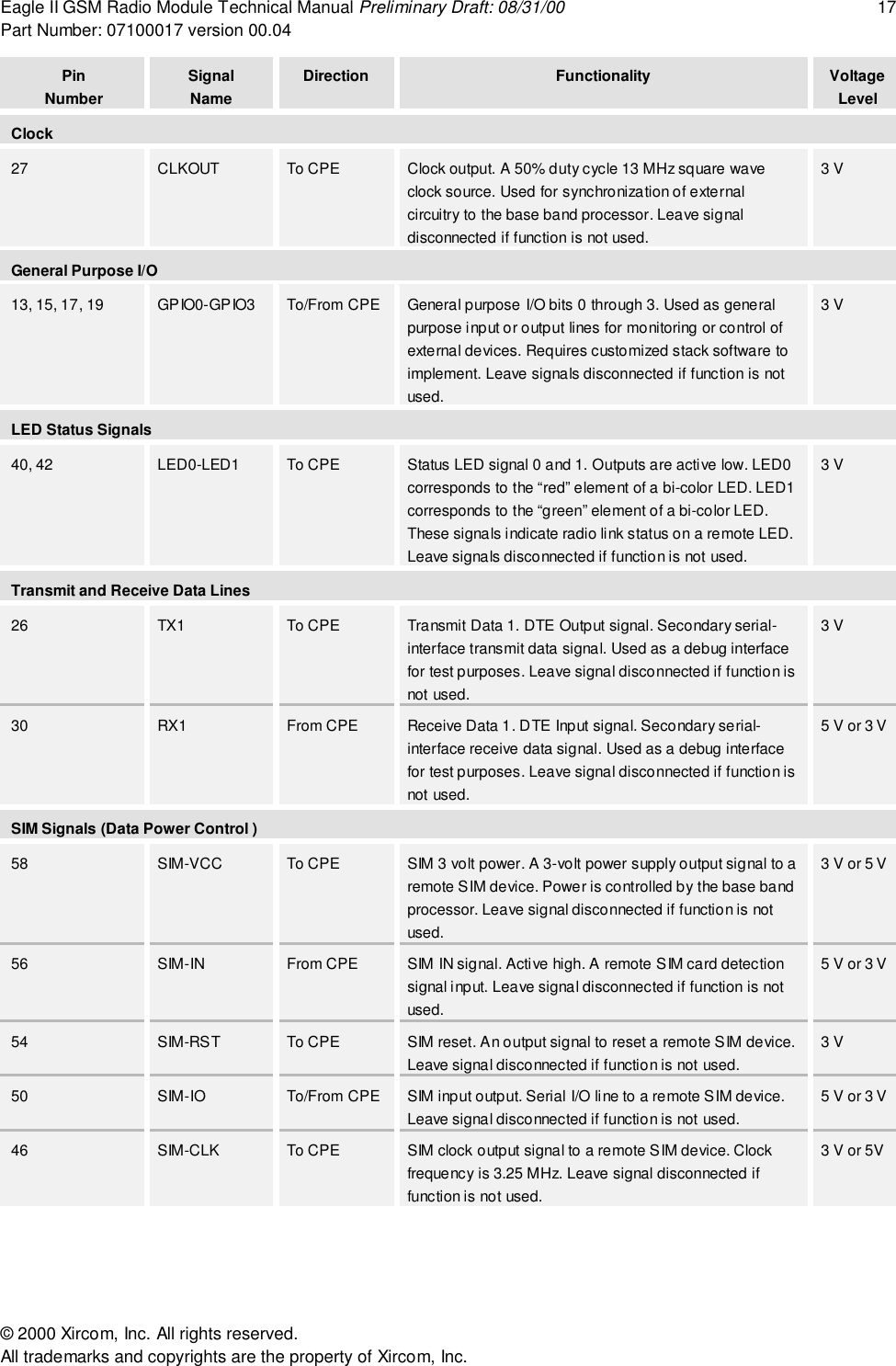
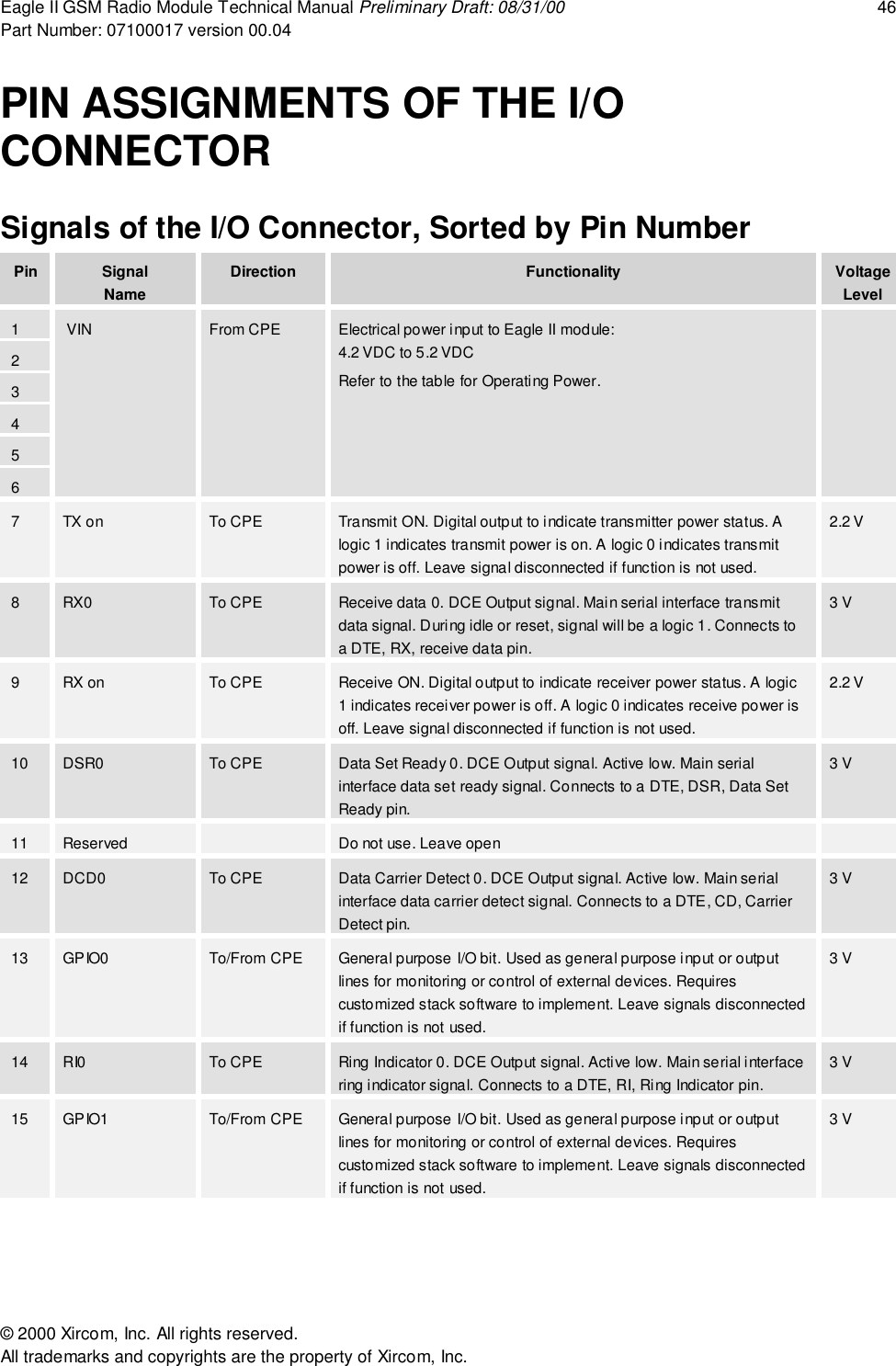
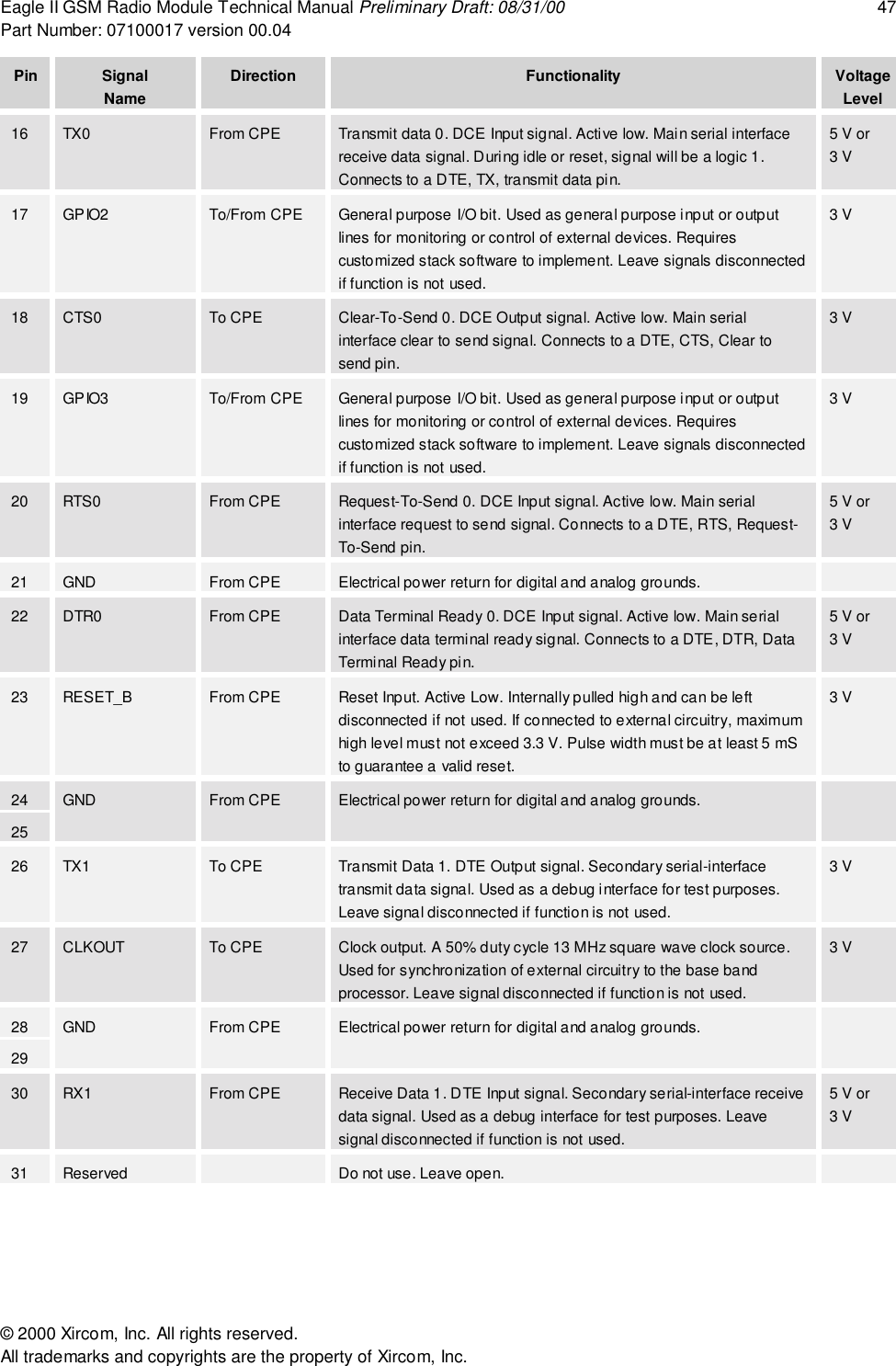
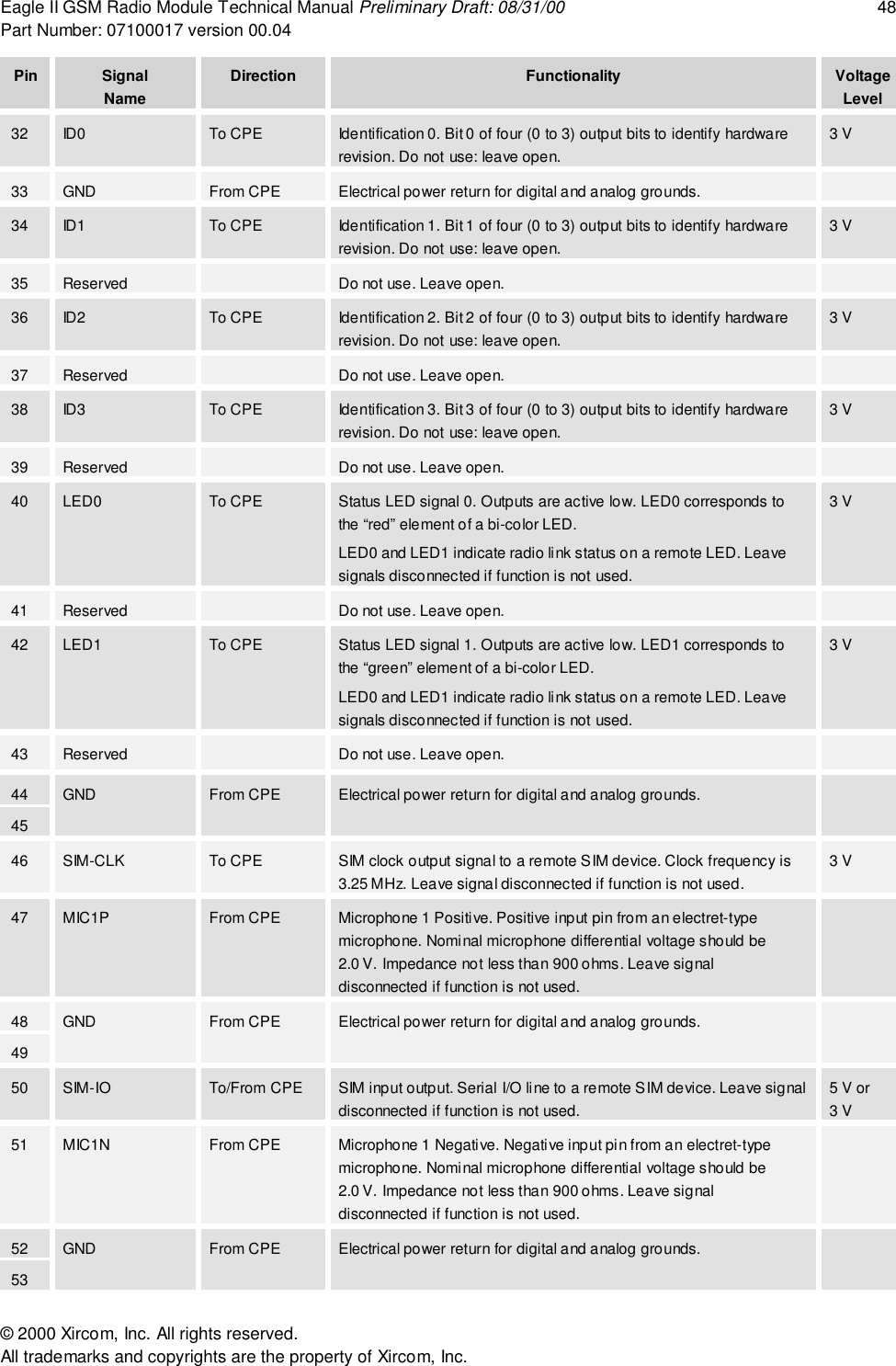
Eagle II GSM Radio Module Technical Manual Preliminary Draft: 08/31/00 15Part Number: 07100017 version 00.04© 2000 Xircom, Inc. All rights reserved.All trademarks and copyrights are the property of Xircom, Inc.Mating Connector on the Carrier Board of the ApplicationThe carrier board must provide a mating 60-pin connector. The following table describesthe recommended connectors:Vendor P/NDescription Manufacturer Tube Package Tape Package60 pin female AMP (717) 564-0100 177983-2 177985-260 pin female Berg (800) 237-2374 61082-061000 61082-061002Note: The nominal PCB-to-PCB connector stack height (provided by the Eagle IImodule) is 8 mm (0.315 inches). If required, mating connectors with 12 mm and16 mm stack heights are available from the listed manufacturers. When usinghigher stack height connectors, the mating carrier board must provide standoffs toaccommodate the increased connector stack height.I/O Signal Connector on the Eagle II ModuleThe Eagle II module communicates with the carrier board of the application via the 60-pinI/O signal connector. The following table describes the pin assignments for the connector,sorted by functionality.I/O Connector Pin Assignments, Sorted by FunctionalityPinNumberSignalNameDirection Functionality VoltageLevelPower1, 2, 3, 4, 5, 6  VIN From CPE Electrical power input to Eagle II module:4.2 VDC to 5.2 VDCRefer to the table for Operating Power.21, 24, 25, 28, 29,33, 44, 45, 48, 49,52, 53, 57GND From CPE Electrical power return for digital and analog grounds.Reset/Primary Serial I/O23 RESET_B From CPE Reset Input. Active Low. Internally pulled high and can beleft disconnected if not used. If connected to externalcircuitry, maximum high level must not exceed 3.3 V.Pulse width must be at least 5 mS to guarantee a validreset.3 V *8RX0 To CPE Receive data 0. DCE Output signal. Main serial interfacetransmit data signal. During idle or reset, signal will be alogic 1. Connects to a DTE, RX, receive data pin.3 V
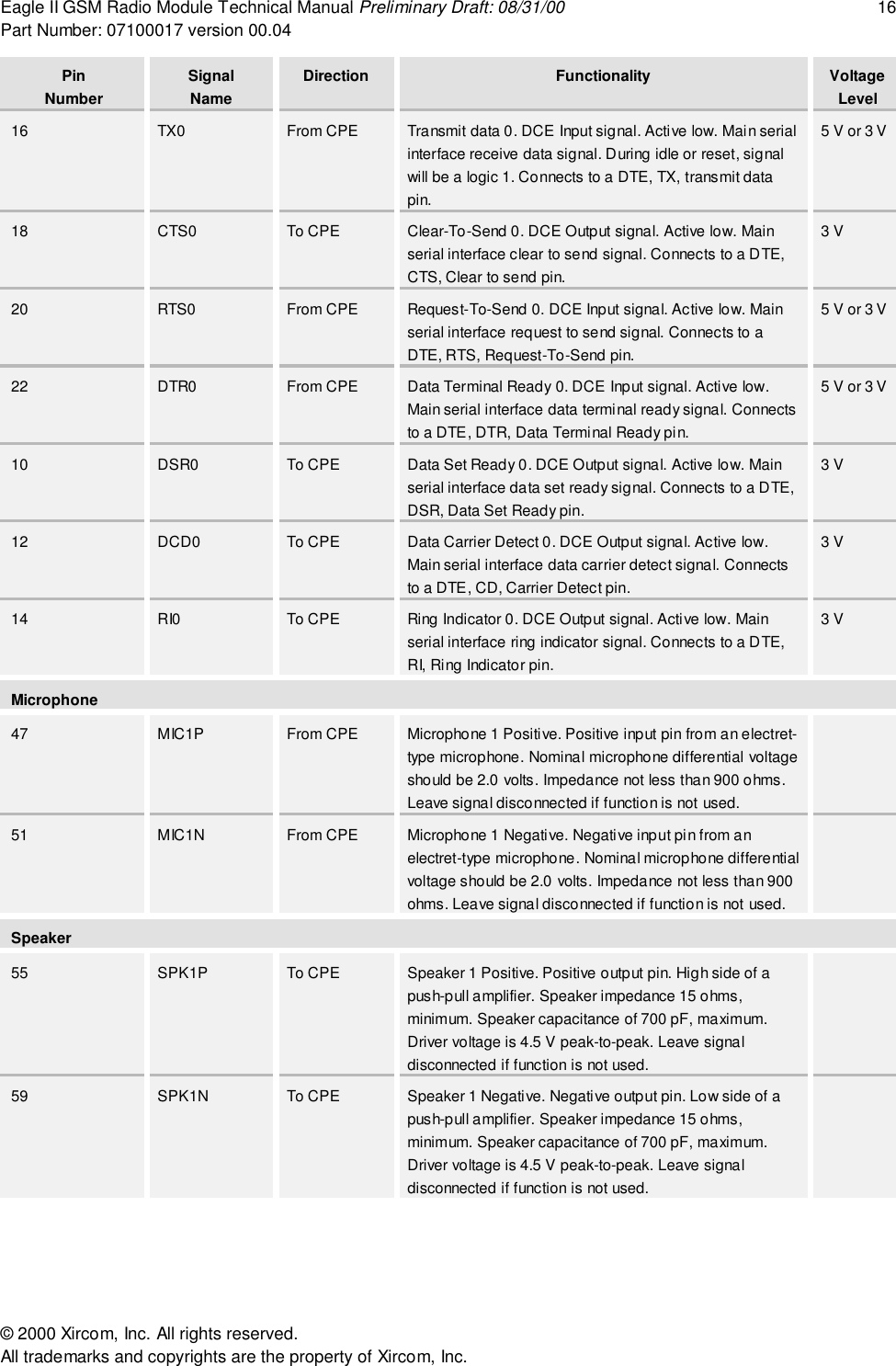
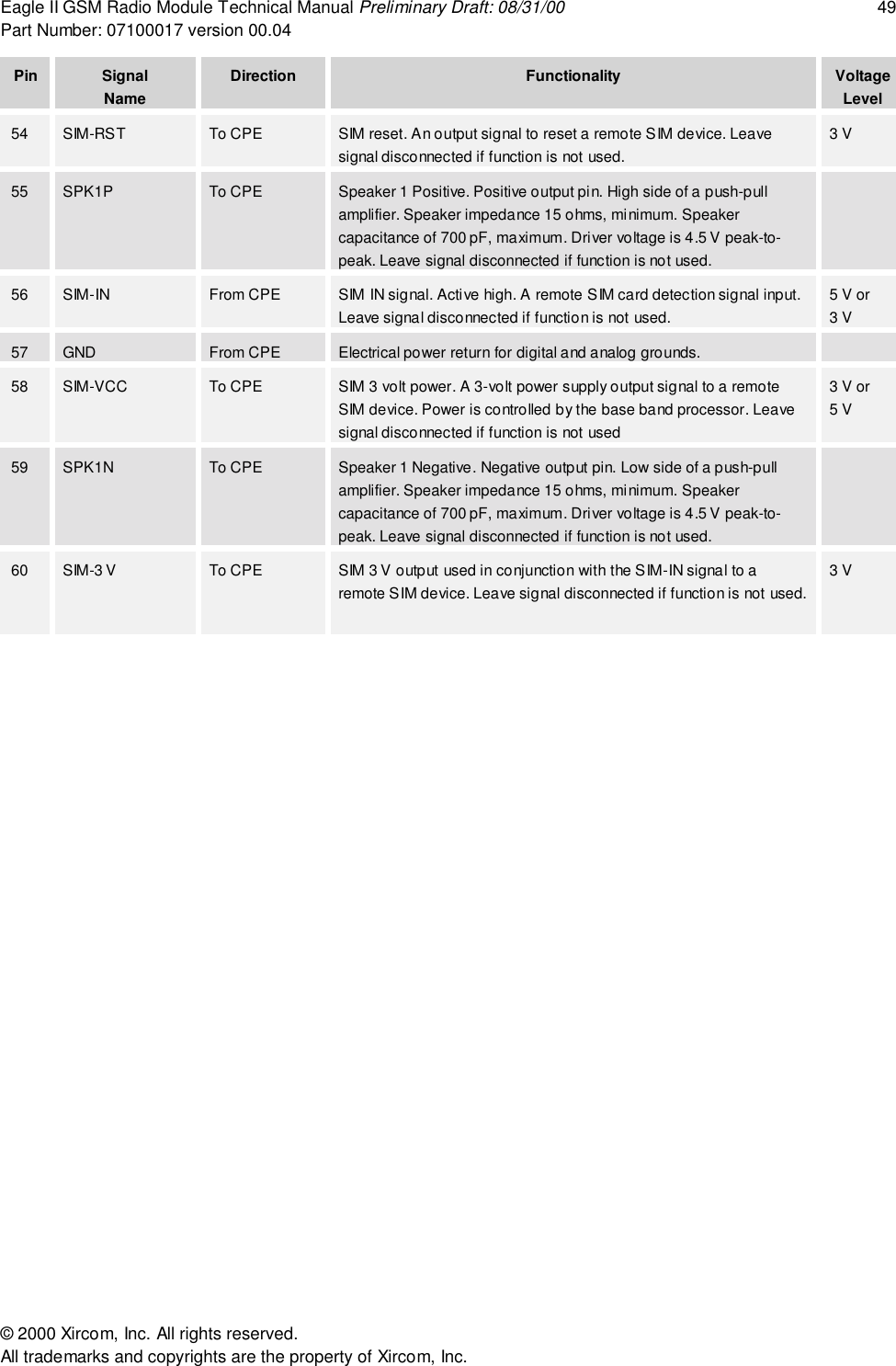
Eagle II GSM Radio Module Technical Manual Preliminary Draft: 08/31/00 16Part Number: 07100017 version 00.04© 2000 Xircom, Inc. All rights reserved.All trademarks and copyrights are the property of Xircom, Inc.PinNumberSignalNameDirection Functionality VoltageLevel16 TX0 From CPE Transmit data 0. DCE Input signal. Active low. Main serialinterface receive data signal. During idle or reset, signalwill be a logic 1. Connects to a DTE, TX, transmit datapin.5 V or 3 V18 CTS0 To CPE Clear-To-Send 0. DCE Output signal. Active low. Mainserial interface clear to send signal. Connects to a DTE,CTS, Clear to send pin.3 V20 RTS0 From CPE Request-To-Send 0. DCE Input signal. Active low. Mainserial interface request to send signal. Connects to aDTE, RTS, Request-To-Send pin.5 V or 3 V22 DTR0 From CPE Data Terminal Ready 0. DCE Input signal. Active low.Main serial interface data terminal ready signal. Connectsto a DTE, DTR, Data Terminal Ready pin.5 V or 3 V10 DSR0 To CPE Data Set Ready 0. DCE Output signal. Active low. Mainserial interface data set ready signal. Connects to a DTE,DSR, Data Set Ready pin.3 V12 DCD0 To CPE Data Carrier Detect 0. DCE Output signal. Active low.Main serial interface data carrier detect signal. Connectsto a DTE, CD, Carrier Detect pin.3 V14 RI0 To CPE Ring Indicator 0. DCE Output signal. Active low. Mainserial interface ring indicator signal. Connects to a DTE,RI, Ring Indicator pin.3 VMicrophone47 MIC1P From CPE Microphone 1 Positive. Positive input pin from an electret-type microphone. Nominal microphone differential voltageshould be 2.0 volts. Impedance not less than 900 ohms.Leave signal disconnected if function is not used.51 MIC1N From CPE Microphone 1 Negative. Negative input pin from anelectret-type microphone. Nominal microphone differentialvoltage should be 2.0 volts. Impedance not less than 900ohms. Leave signal disconnected if function is not used.Speaker55 SPK1P To CPE Speaker 1 Positive. Positive output pin. High side of apush-pull amplifier. Speaker impedance 15 ohms,minimum. Speaker capacitance of 700 pF, maximum.Driver voltage is 4.5 V peak-to-peak. Leave signaldisconnected if function is not used.59 SPK1N To CPE Speaker 1 Negative. Negative output pin. Low side of apush-pull amplifier. Speaker impedance 15 ohms,minimum. Speaker capacitance of 700 pF, maximum.Driver voltage is 4.5 V peak-to-peak. Leave signaldisconnected if function is not used.
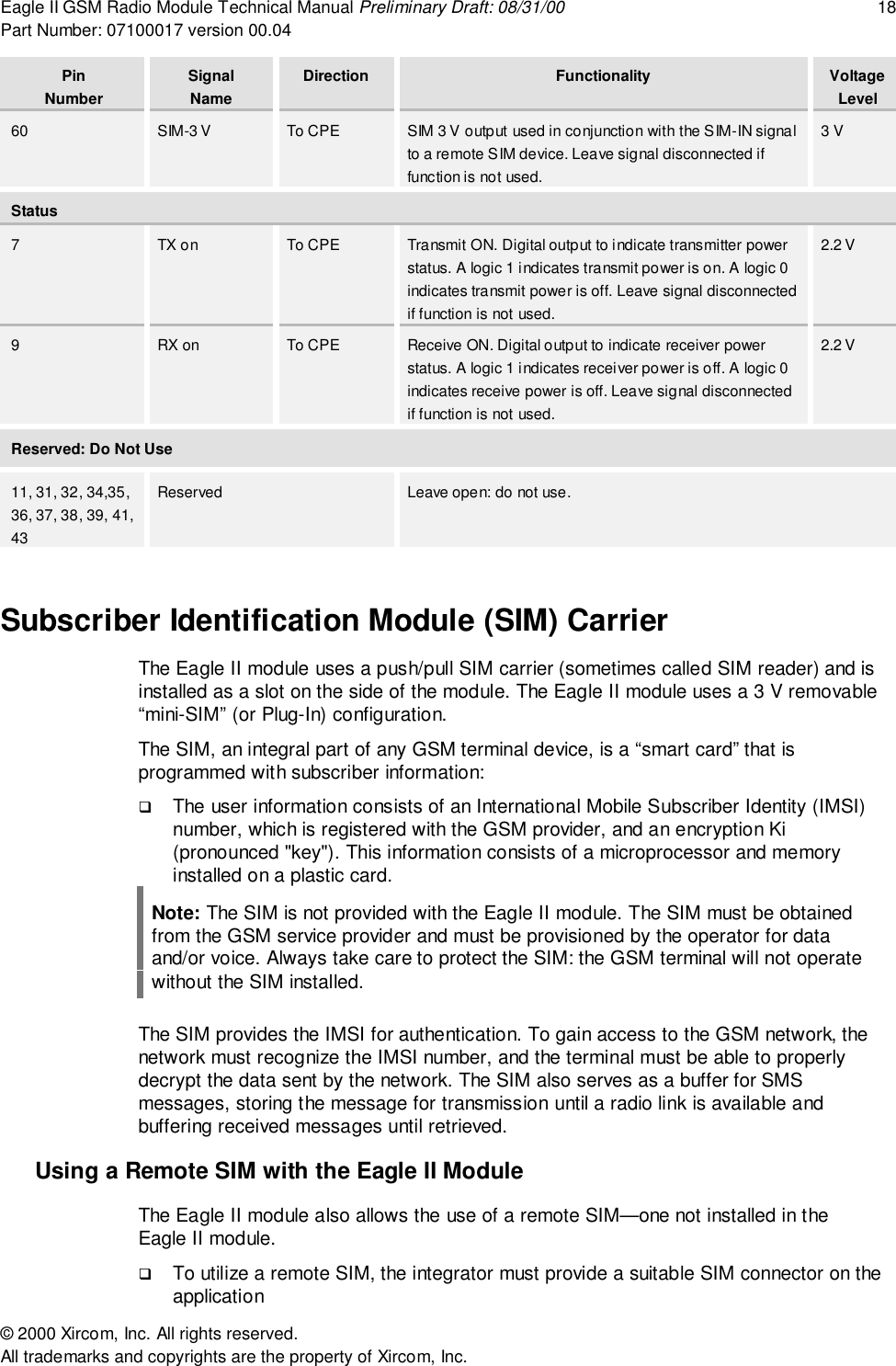
Eagle II GSM Radio Module Technical Manual Preliminary Draft: 08/31/00 17Part Number: 07100017 version 00.04© 2000 Xircom, Inc. All rights reserved.All trademarks and copyrights are the property of Xircom, Inc.PinNumberSignalNameDirection Functionality VoltageLevelClock27 CLKOUT To CPE Clock output. A 50% duty cycle 13 MHz square waveclock source. Used for synchronization of externalcircuitry to the base band processor. Leave signaldisconnected if function is not used.3 VGeneral Purpose I/O13, 15, 17, 19 GPIO0-GPIO3 To/From CPE General purpose I/O bits 0 through 3. Used as generalpurpose input or output lines for monitoring or control ofexternal devices. Requires customized stack software toimplement. Leave signals disconnected if function is notused.3 VLED Status Signals40, 42 LED0-LED1 To CPE Status LED signal 0 and 1. Outputs are active low. LED0corresponds to the “red” element of a bi-color LED. LED1corresponds to the “green” element of a bi-color LED.These signals indicate radio link status on a remote LED.Leave signals disconnected if function is not used.3 VTransmit and Receive Data Lines26 TX1 To CPE Transmit Data 1. DTE Output signal. Secondary serial-interface transmit data signal. Used as a debug interfacefor test purposes. Leave signal disconnected if function isnot used.3 V30 RX1 From CPE Receive Data 1. DTE Input signal. Secondary serial-interface receive data signal. Used as a debug interfacefor test purposes. Leave signal disconnected if function isnot used.5 V or 3 VSIM Signals (Data Power Control )58 SIM-VCC To CPE SIM 3 volt power. A 3-volt power supply output signal to aremote SIM device. Power is controlled by the base bandprocessor. Leave signal disconnected if function is notused.3 V or 5 V56 SIM-IN From CPE SIM IN signal. Active high. A remote SIM card detectionsignal input. Leave signal disconnected if function is notused.5 V or 3 V54 SIM-RST To CPE SIM reset. An output signal to reset a remote SIM device.Leave signal disconnected if function is not used.3 V50 SIM-IO To/From CPE SIM input output. Serial I/O line to a remote SIM device.Leave signal disconnected if function is not used.5 V or 3 V46 SIM-CLK To CPE SIM clock output signal to a remote SIM device. Clockfrequency is 3.25 MHz. Leave signal disconnected iffunction is not used.3 V or 5V
Eagle II GSM Radio Module Technical Manual Preliminary Draft: 08/31/00 18Part Number: 07100017 version 00.04© 2000 Xircom, Inc. All rights reserved.All trademarks and copyrights are the property of Xircom, Inc.PinNumberSignalNameDirection Functionality VoltageLevel60 SIM-3 V To CPE SIM 3 V output used in conjunction with the SIM-IN signalto a remote SIM device. Leave signal disconnected iffunction is not used.3 VStatus7TX on To CPE Transmit ON. Digital output to indicate transmitter powerstatus. A logic 1 indicates transmit power is on. A logic 0indicates transmit power is off. Leave signal disconnectedif function is not used.2.2 V9RX on To CPE Receive ON. Digital output to indicate receiver powerstatus. A logic 1 indicates receiver power is off. A logic 0indicates receive power is off. Leave signal disconnectedif function is not used.2.2 VReserved: Do Not Use11, 31, 32, 34,35,36, 37, 38, 39, 41,43Reserved Leave open: do not use.Subscriber Identification Module (SIM) CarrierThe Eagle II module uses a push/pull SIM carrier (sometimes called SIM reader) and isinstalled as a slot on the side of the module. The Eagle II module uses a 3 V removable“mini-SIM” (or Plug-In) configuration.The SIM, an integral part of any GSM terminal device, is a “smart card” that isprogrammed with subscriber information:! The user information consists of an International Mobile Subscriber Identity (IMSI)number, which is registered with the GSM provider, and an encryption Ki(pronounced "key"). This information consists of a microprocessor and memoryinstalled on a plastic card.Note: The SIM is not provided with the Eagle II module. The SIM must be obtainedfrom the GSM service provider and must be provisioned by the operator for dataand/or voice. Always take care to protect the SIM: the GSM terminal will not operatewithout the SIM installed.The SIM provides the IMSI for authentication. To gain access to the GSM network, thenetwork must recognize the IMSI number, and the terminal must be able to properlydecrypt the data sent by the network. The SIM also serves as a buffer for SMSmessages, storing the message for transmission until a radio link is available andbuffering received messages until retrieved.Using a Remote SIM with the Eagle II ModuleThe Eagle II module also allows the use of a remote SIM—one not installed in theEagle II module.! To utilize a remote SIM, the integrator must provide a suitable SIM connector on theapplication
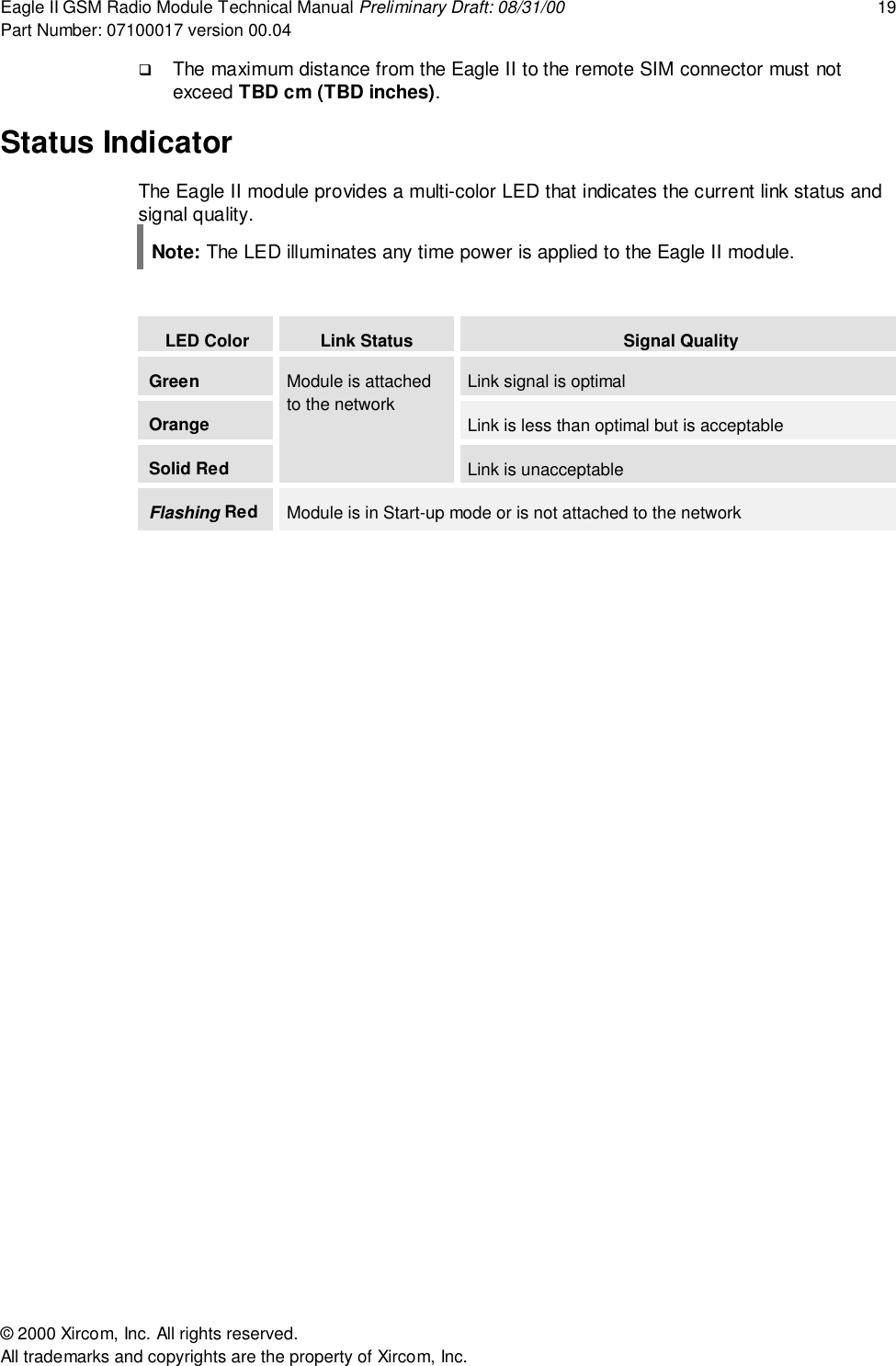
Eagle II GSM Radio Module Technical Manual Preliminary Draft: 08/31/00 19Part Number: 07100017 version 00.04© 2000 Xircom, Inc. All rights reserved.All trademarks and copyrights are the property of Xircom, Inc.! The maximum distance from the Eagle II to the remote SIM connector must notexceed TBD cm (TBD inches).Status IndicatorThe Eagle II module provides a multi-color LED that indicates the current link status andsignal quality.Note: The LED illuminates any time power is applied to the Eagle II module.LED Color Link Status Signal QualityGreen Link signal is optimalOrange Link is less than optimal but is acceptableSolid RedModule is attachedto the networkLink is unacceptableFlashing Red Module is in Start-up mode or is not attached to the network
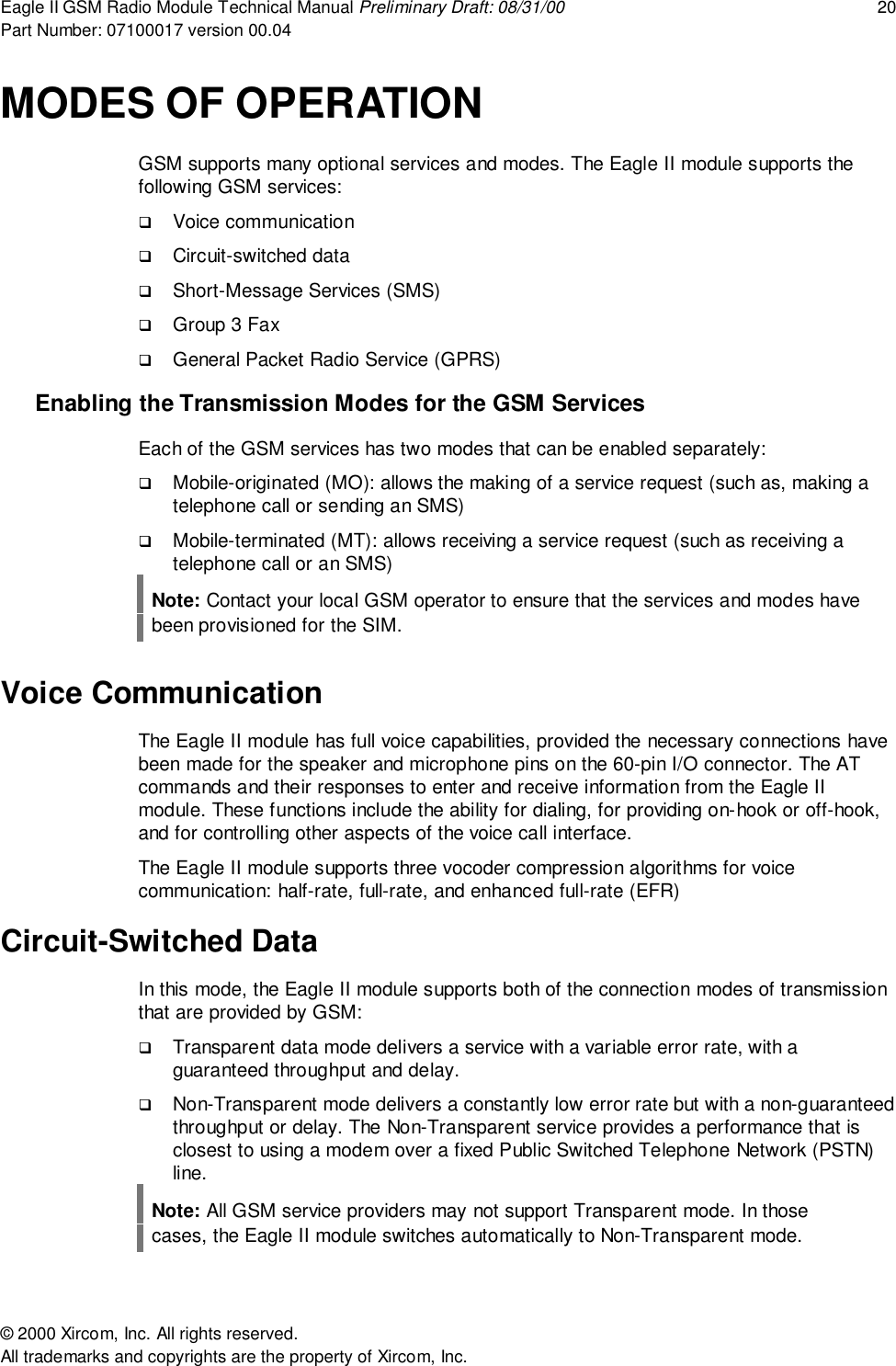
Eagle II GSM Radio Module Technical Manual Preliminary Draft: 08/31/00 20Part Number: 07100017 version 00.04© 2000 Xircom, Inc. All rights reserved.All trademarks and copyrights are the property of Xircom, Inc.MODES OF OPERATIONGSM supports many optional services and modes. The Eagle II module supports thefollowing GSM services:! Voice communication! Circuit-switched data! Short-Message Services (SMS)! Group 3 Fax! General Packet Radio Service (GPRS)Enabling the Transmission Modes for the GSM ServicesEach of the GSM services has two modes that can be enabled separately:! Mobile-originated (MO): allows the making of a service request (such as, making atelephone call or sending an SMS)! Mobile-terminated (MT): allows receiving a service request (such as receiving atelephone call or an SMS)Note: Contact your local GSM operator to ensure that the services and modes havebeen provisioned for the SIM.Voice CommunicationThe Eagle II module has full voice capabilities, provided the necessary connections havebeen made for the speaker and microphone pins on the 60-pin I/O connector. The ATcommands and their responses to enter and receive information from the Eagle IImodule. These functions include the ability for dialing, for providing on-hook or off-hook,and for controlling other aspects of the voice call interface.The Eagle II module supports three vocoder compression algorithms for voicecommunication: half-rate, full-rate, and enhanced full-rate (EFR)Circuit-Switched DataIn this mode, the Eagle II module supports both of the connection modes of transmissionthat are provided by GSM:! Transparent data mode delivers a service with a variable error rate, with aguaranteed throughput and delay.! Non-Transparent mode delivers a constantly low error rate but with a non-guaranteedthroughput or delay. The Non-Transparent service provides a performance that isclosest to using a modem over a fixed Public Switched Telephone Network (PSTN)line.Note: All GSM service providers may not support Transparent mode. In thosecases, the Eagle II module switches automatically to Non-Transparent mode.
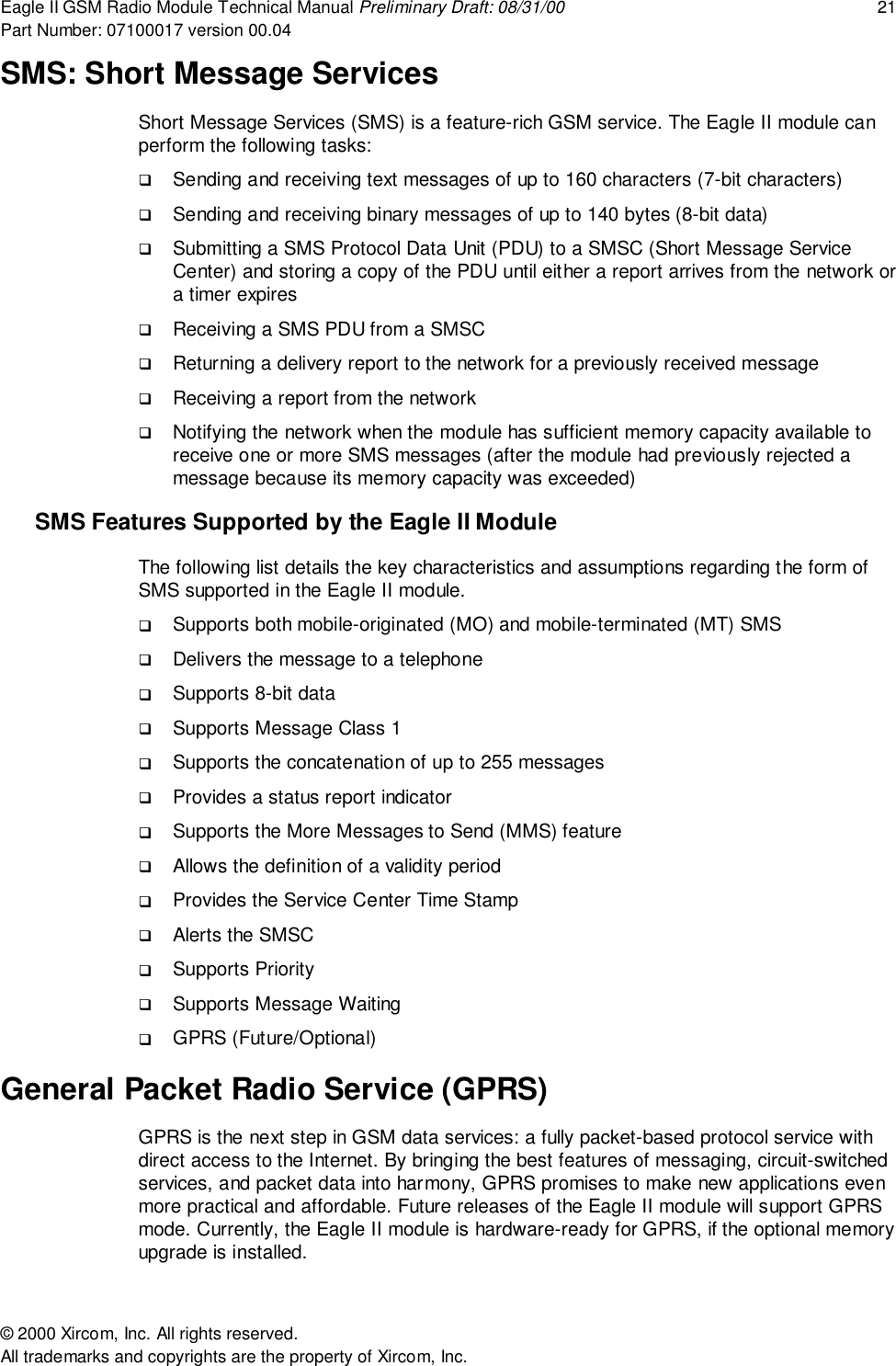
Eagle II GSM Radio Module Technical Manual Preliminary Draft: 08/31/00 21Part Number: 07100017 version 00.04© 2000 Xircom, Inc. All rights reserved.All trademarks and copyrights are the property of Xircom, Inc.SMS: Short Message ServicesShort Message Services (SMS) is a feature-rich GSM service. The Eagle II module canperform the following tasks:! Sending and receiving text messages of up to 160 characters (7-bit characters)! Sending and receiving binary messages of up to 140 bytes (8-bit data)! Submitting a SMS Protocol Data Unit (PDU) to a SMSC (Short Message ServiceCenter) and storing a copy of the PDU until either a report arrives from the network ora timer expires! Receiving a SMS PDU from a SMSC! Returning a delivery report to the network for a previously received message! Receiving a report from the network! Notifying the network when the module has sufficient memory capacity available toreceive one or more SMS messages (after the module had previously rejected amessage because its memory capacity was exceeded)SMS Features Supported by the Eagle II ModuleThe following list details the key characteristics and assumptions regarding the form ofSMS supported in the Eagle II module.! Supports both mobile-originated (MO) and mobile-terminated (MT) SMS! Delivers the message to a telephone! Supports 8-bit data! Supports Message Class 1! Supports the concatenation of up to 255 messages! Provides a status report indicator! Supports the More Messages to Send (MMS) feature! Allows the definition of a validity period! Provides the Service Center Time Stamp! Alerts the SMSC! Supports Priority! Supports Message Waiting! GPRS (Future/Optional)General Packet Radio Service (GPRS)GPRS is the next step in GSM data services: a fully packet-based protocol service withdirect access to the Internet. By bringing the best features of messaging, circuit-switchedservices, and packet data into harmony, GPRS promises to make new applications evenmore practical and affordable. Future releases of the Eagle II module will support GPRSmode. Currently, the Eagle II module is hardware-ready for GPRS, if the optional memoryupgrade is installed.
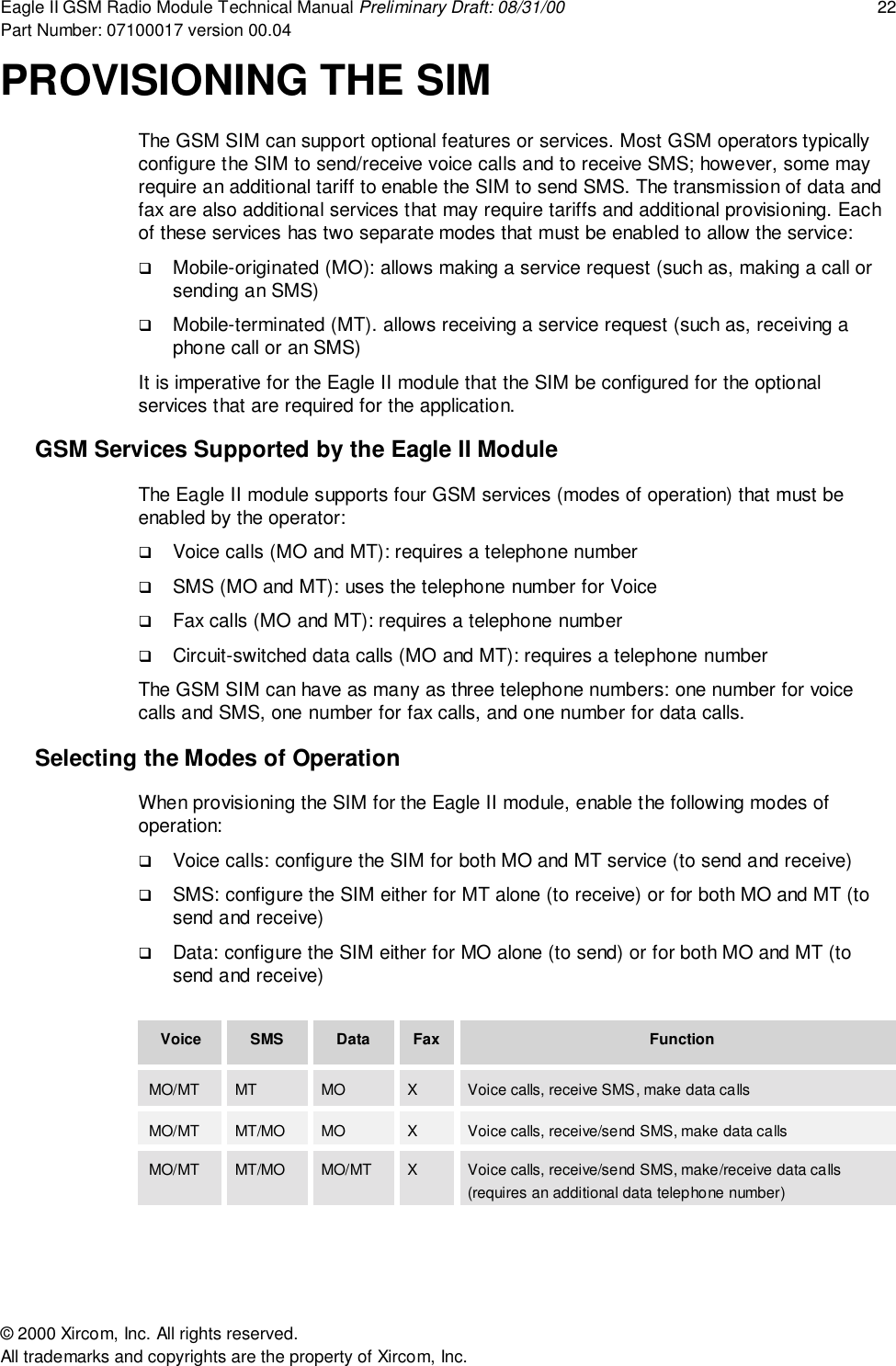
Eagle II GSM Radio Module Technical Manual Preliminary Draft: 08/31/00 22Part Number: 07100017 version 00.04© 2000 Xircom, Inc. All rights reserved.All trademarks and copyrights are the property of Xircom, Inc.PROVISIONING THE SIMThe GSM SIM can support optional features or services. Most GSM operators typicallyconfigure the SIM to send/receive voice calls and to receive SMS; however, some mayrequire an additional tariff to enable the SIM to send SMS. The transmission of data andfax are also additional services that may require tariffs and additional provisioning. Eachof these services has two separate modes that must be enabled to allow the service:! Mobile-originated (MO): allows making a service request (such as, making a call orsending an SMS)! Mobile-terminated (MT). allows receiving a service request (such as, receiving aphone call or an SMS)It is imperative for the Eagle II module that the SIM be configured for the optionalservices that are required for the application.GSM Services Supported by the Eagle II ModuleThe Eagle II module supports four GSM services (modes of operation) that must beenabled by the operator:! Voice calls (MO and MT): requires a telephone number! SMS (MO and MT): uses the telephone number for Voice! Fax calls (MO and MT): requires a telephone number! Circuit-switched data calls (MO and MT): requires a telephone numberThe GSM SIM can have as many as three telephone numbers: one number for voicecalls and SMS, one number for fax calls, and one number for data calls.Selecting the Modes of OperationWhen provisioning the SIM for the Eagle II module, enable the following modes ofoperation:! Voice calls: configure the SIM for both MO and MT service (to send and receive)! SMS: configure the SIM either for MT alone (to receive) or for both MO and MT (tosend and receive)! Data: configure the SIM either for MO alone (to send) or for both MO and MT (tosend and receive)Voice SMS Data Fax FunctionMO/MT MT MO XVoice calls, receive SMS, make data callsMO/MT MT/MO MO XVoice calls, receive/send SMS, make data callsMO/MT MT/MO MO/MT XVoice calls, receive/send SMS, make/receive data calls(requires an additional data telephone number)
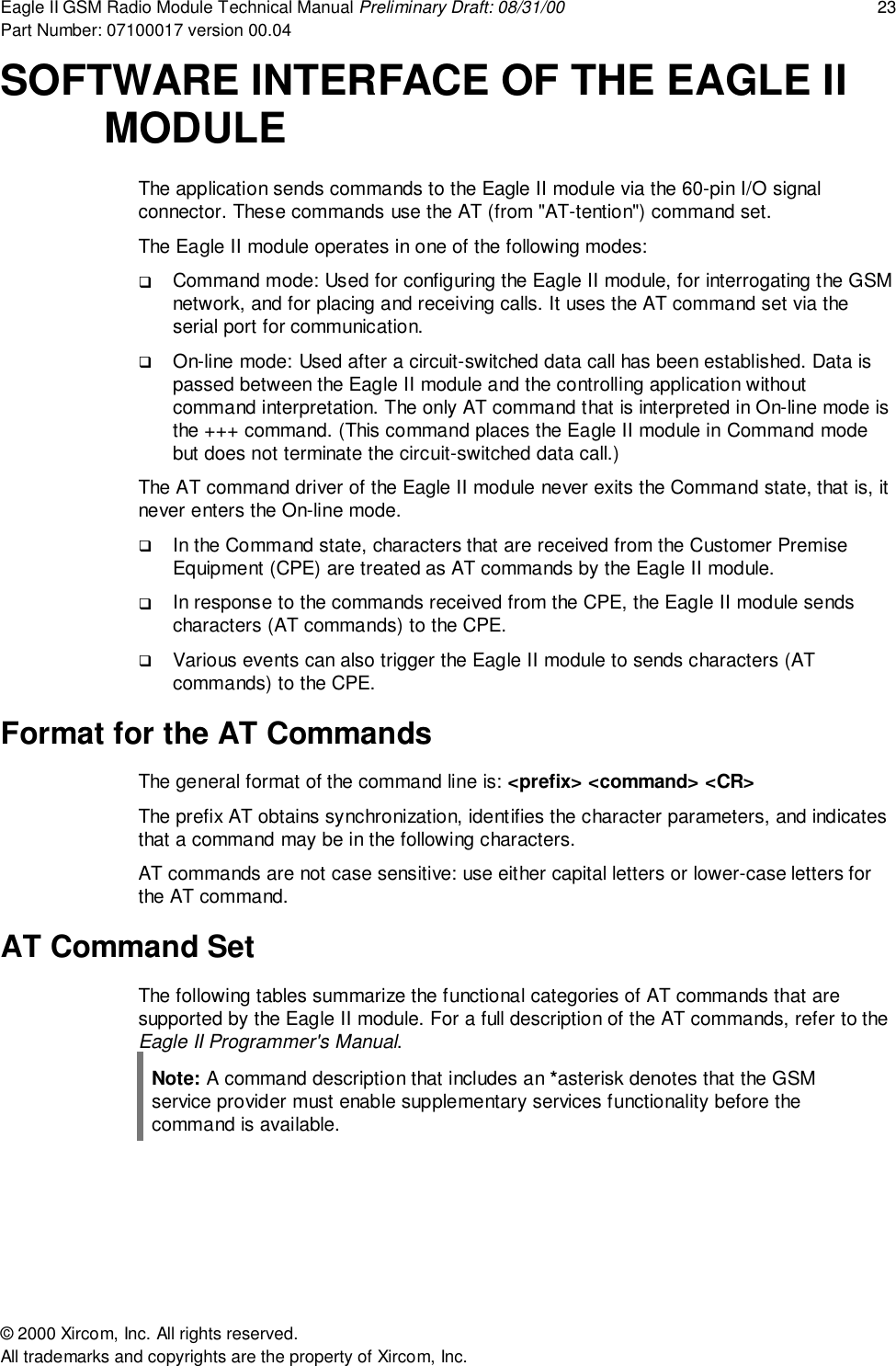
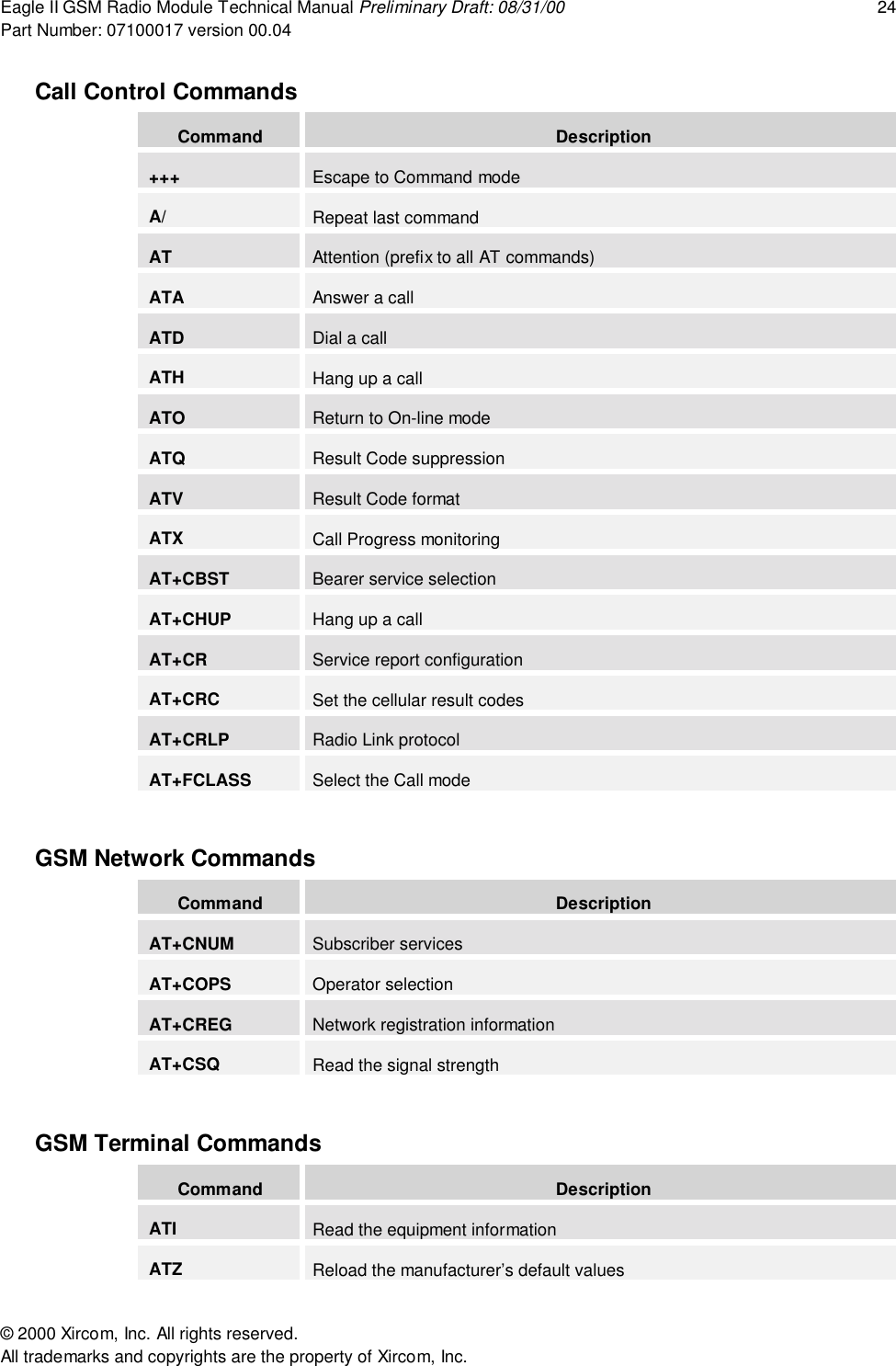
Eagle II GSM Radio Module Technical Manual Preliminary Draft: 08/31/00 23Part Number: 07100017 version 00.04© 2000 Xircom, Inc. All rights reserved.All trademarks and copyrights are the property of Xircom, Inc.SOFTWARE INTERFACE OF THE EAGLE IIMODULEThe application sends commands to the Eagle II module via the 60-pin I/O signalconnector. These commands use the AT (from "AT-tention") command set.The Eagle II module operates in one of the following modes:! Command mode: Used for configuring the Eagle II module, for interrogating the GSMnetwork, and for placing and receiving calls. It uses the AT command set via theserial port for communication.! On-line mode: Used after a circuit-switched data call has been established. Data ispassed between the Eagle II module and the controlling application withoutcommand interpretation. The only AT command that is interpreted in On-line mode isthe +++ command. (This command places the Eagle II module in Command modebut does not terminate the circuit-switched data call.)The AT command driver of the Eagle II module never exits the Command state, that is, itnever enters the On-line mode.! In the Command state, characters that are received from the Customer PremiseEquipment (CPE) are treated as AT commands by the Eagle II module.! In response to the commands received from the CPE, the Eagle II module sendscharacters (AT commands) to the CPE.! Various events can also trigger the Eagle II module to sends characters (ATcommands) to the CPE.Format for the AT CommandsThe general format of the command line is: <prefix> <command> <CR>The prefix AT obtains synchronization, identifies the character parameters, and indicatesthat a command may be in the following characters.AT commands are not case sensitive: use either capital letters or lower-case letters forthe AT command.AT Command SetThe following tables summarize the functional categories of AT commands that aresupported by the Eagle II module. For a full description of the AT commands, refer to theEagle II Programmer's Manual.Note: A command description that includes an *asterisk denotes that the GSMservice provider must enable supplementary services functionality before thecommand is available.
Eagle II GSM Radio Module Technical Manual Preliminary Draft: 08/31/00 24Part Number: 07100017 version 00.04© 2000 Xircom, Inc. All rights reserved.All trademarks and copyrights are the property of Xircom, Inc.Call Control CommandsCommand Description+++ Escape to Command modeA/ Repeat last commandAT Attention (prefix to all AT commands)ATA Answer a callATD Dial a callATH Hang up a callATO Return to On-line modeATQ Result Code suppressionATV Result Code formatATX Call Progress monitoringAT+CBST Bearer service selectionAT+CHUP Hang up a callAT+CR Service report configurationAT+CRC Set the cellular result codesAT+CRLP Radio Link protocolAT+FCLASS Select the Call modeGSM Network CommandsCommand DescriptionAT+CNUM Subscriber servicesAT+COPS Operator selectionAT+CREG Network registration informationAT+CSQ Read the signal strengthGSM Terminal CommandsCommand DescriptionATI Read the equipment informationATZ Reload the manufacturer’s default values
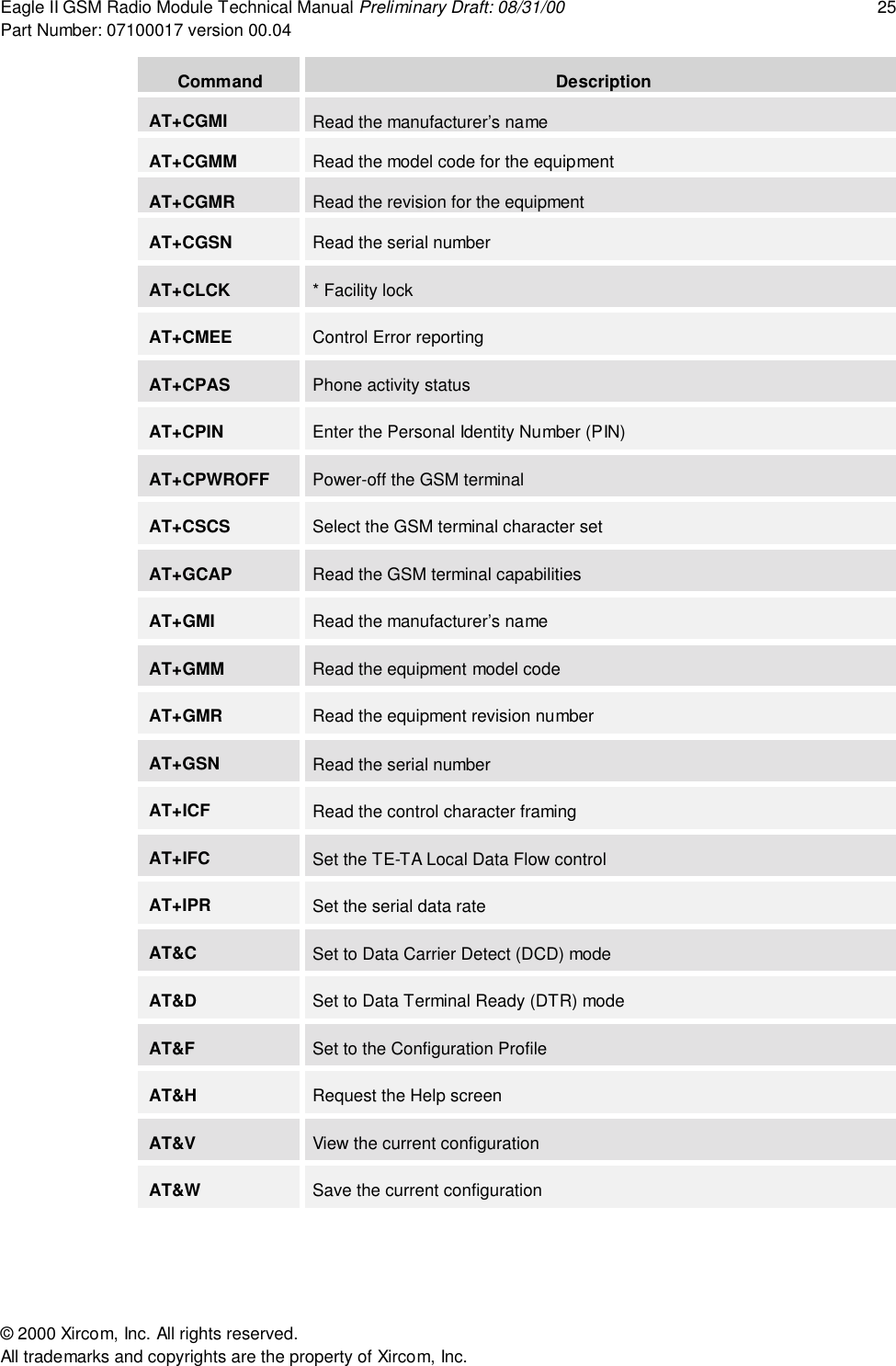
Eagle II GSM Radio Module Technical Manual Preliminary Draft: 08/31/00 25Part Number: 07100017 version 00.04© 2000 Xircom, Inc. All rights reserved.All trademarks and copyrights are the property of Xircom, Inc.Command DescriptionAT+CGMI Read the manufacturer’s nameAT+CGMM Read the model code for the equipmentAT+CGMR Read the revision for the equipmentAT+CGSN Read the serial numberAT+CLCK * Facility lockAT+CMEE Control Error reportingAT+CPAS Phone activity statusAT+CPIN Enter the Personal Identity Number (PIN)AT+CPWROFF Power-off the GSM terminalAT+CSCS Select the GSM terminal character setAT+GCAP Read the GSM terminal capabilitiesAT+GMI Read the manufacturer’s nameAT+GMM Read the equipment model codeAT+GMR Read the equipment revision numberAT+GSN Read the serial numberAT+ICF Read the control character framingAT+IFC Set the TE-TA Local Data Flow controlAT+IPR Set the serial data rateAT&C Set to Data Carrier Detect (DCD) modeAT&D Set to Data Terminal Ready (DTR) modeAT&F Set to the Configuration ProfileAT&H Request the Help screenAT&V View the current configurationAT&W Save the current configuration
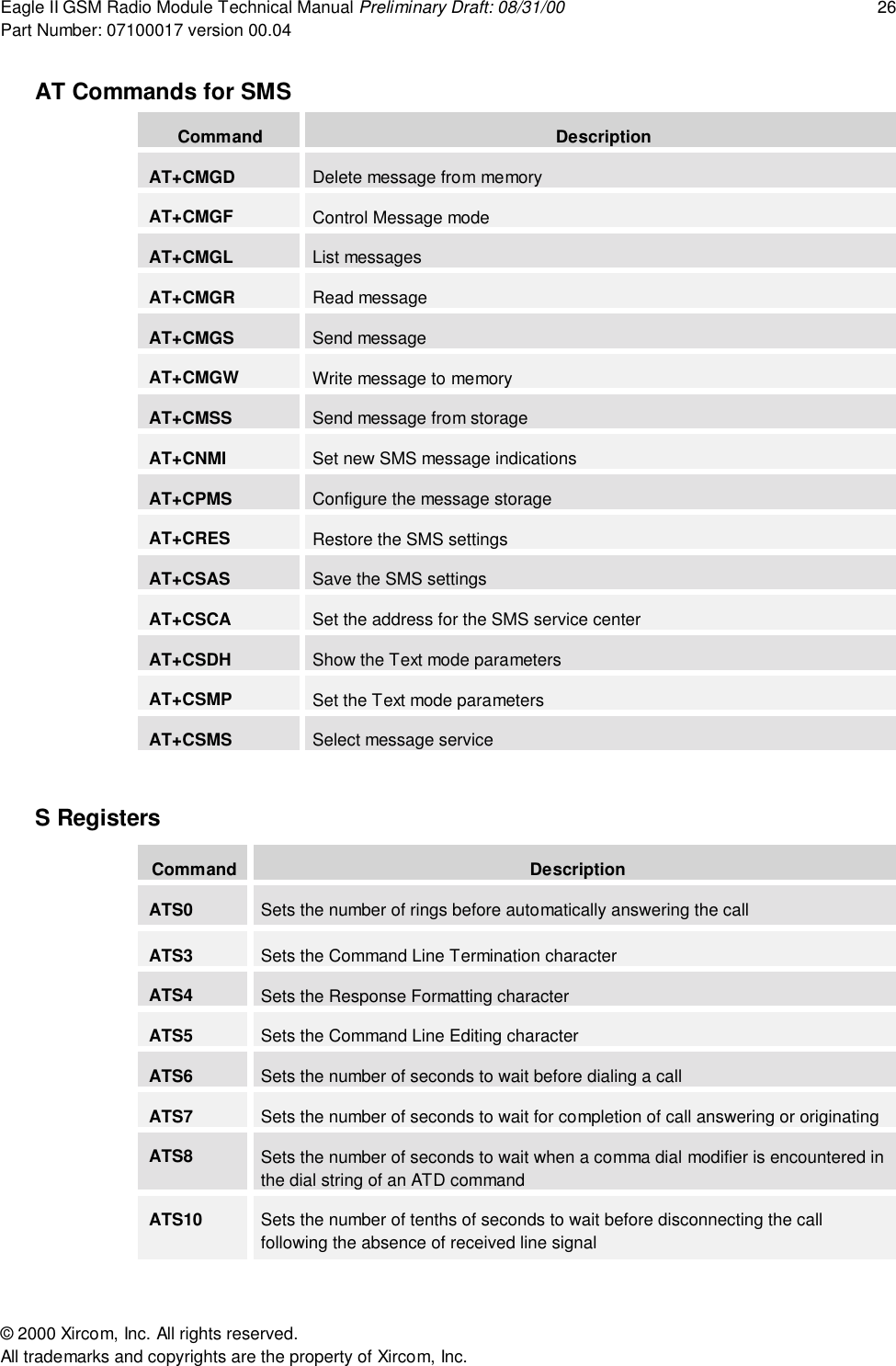
Eagle II GSM Radio Module Technical Manual Preliminary Draft: 08/31/00 26Part Number: 07100017 version 00.04© 2000 Xircom, Inc. All rights reserved.All trademarks and copyrights are the property of Xircom, Inc.AT Commands for SMSCommand DescriptionAT+CMGD Delete message from memoryAT+CMGF Control Message modeAT+CMGL List messagesAT+CMGR Read messageAT+CMGS Send messageAT+CMGW Write message to memoryAT+CMSS Send message from storageAT+CNMI Set new SMS message indicationsAT+CPMS Configure the message storageAT+CRES Restore the SMS settingsAT+CSAS Save the SMS settingsAT+CSCA Set the address for the SMS service centerAT+CSDH Show the Text mode parametersAT+CSMP Set the Text mode parametersAT+CSMS Select message serviceS RegistersCommand DescriptionATS0 Sets the number of rings before automatically answering the callATS3 Sets the Command Line Termination characterATS4 Sets the Response Formatting characterATS5 Sets the Command Line Editing characterATS6 Sets the number of seconds to wait before dialing a callATS7 Sets the number of seconds to wait for completion of call answering or originatingATS8 Sets the number of seconds to wait when a comma dial modifier is encountered inthe dial string of an ATD commandATS10 Sets the number of tenths of seconds to wait before disconnecting the callfollowing the absence of received line signal
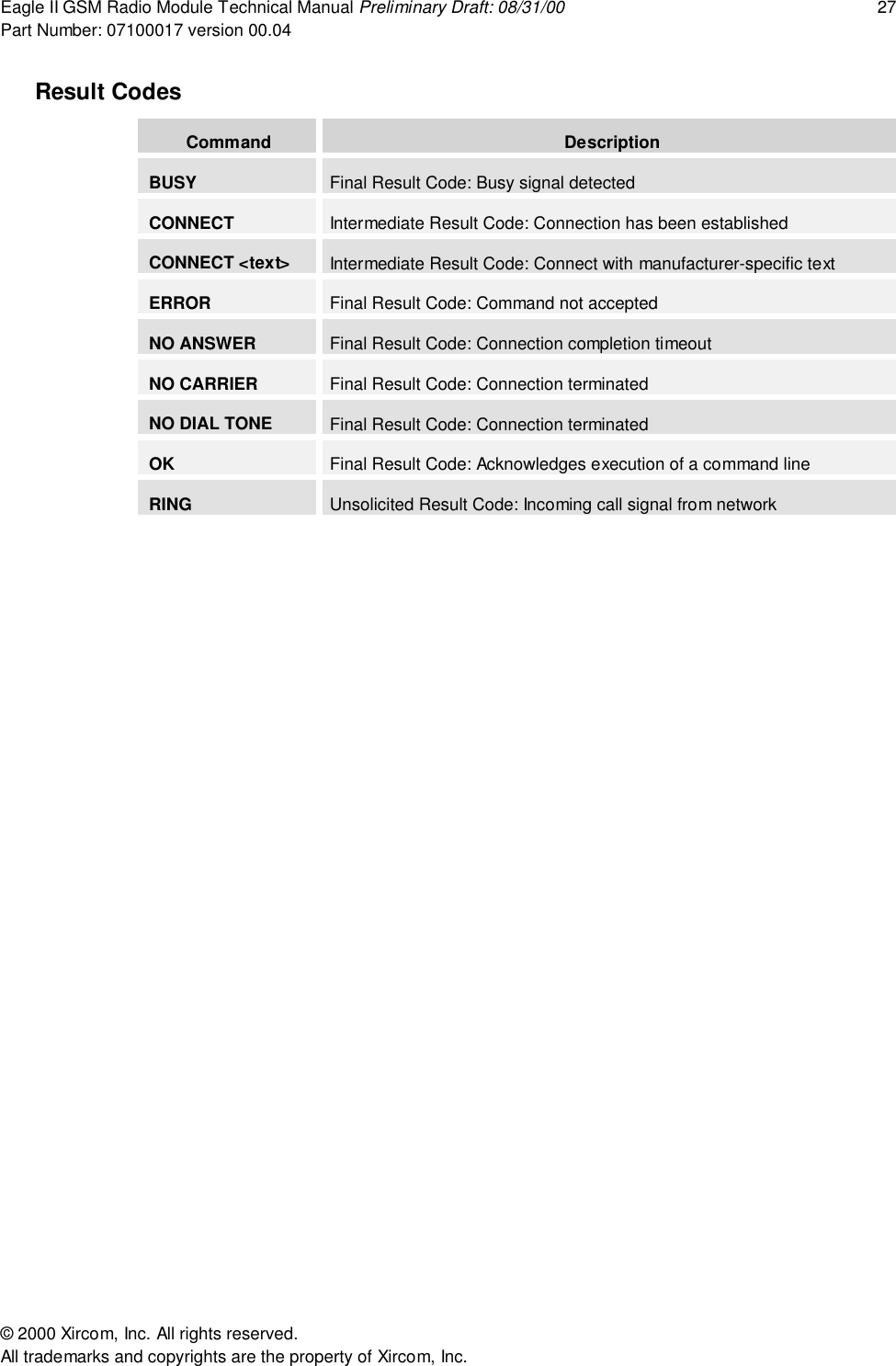
Eagle II GSM Radio Module Technical Manual Preliminary Draft: 08/31/00 27Part Number: 07100017 version 00.04© 2000 Xircom, Inc. All rights reserved.All trademarks and copyrights are the property of Xircom, Inc.Result CodesCommand DescriptionBUSY Final Result Code: Busy signal detectedCONNECT Intermediate Result Code: Connection has been establishedCONNECT <text> Intermediate Result Code: Connect with manufacturer-specific textERROR Final Result Code: Command not acceptedNO ANSWER Final Result Code: Connection completion timeoutNO CARRIER Final Result Code: Connection terminatedNO DIAL TONE Final Result Code: Connection terminatedOK Final Result Code: Acknowledges execution of a command lineRING Unsolicited Result Code: Incoming call signal from network
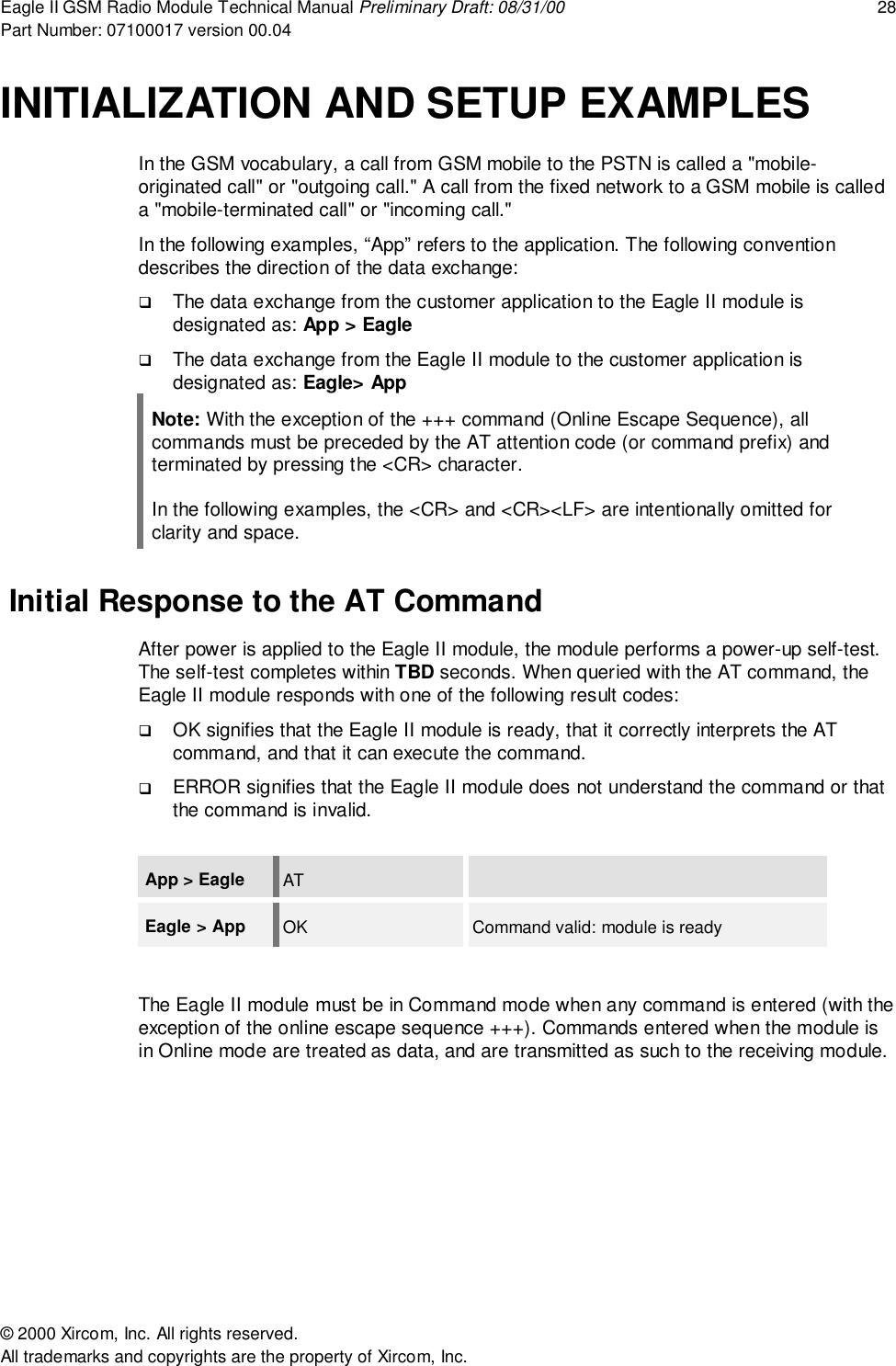
Eagle II GSM Radio Module Technical Manual Preliminary Draft: 08/31/00 28Part Number: 07100017 version 00.04© 2000 Xircom, Inc. All rights reserved.All trademarks and copyrights are the property of Xircom, Inc.INITIALIZATION AND SETUP EXAMPLESIn the GSM vocabulary, a call from GSM mobile to the PSTN is called a "mobile-originated call" or "outgoing call." A call from the fixed network to a GSM mobile is calleda "mobile-terminated call" or "incoming call."In the following examples, “App” refers to the application. The following conventiondescribes the direction of the data exchange:! The data exchange from the customer application to the Eagle II module isdesignated as: App > Eagle! The data exchange from the Eagle II module to the customer application isdesignated as: Eagle> AppNote: With the exception of the +++ command (Online Escape Sequence), allcommands must be preceded by the AT attention code (or command prefix) andterminated by pressing the <CR> character.In the following examples, the <CR> and <CR><LF> are intentionally omitted forclarity and space. Initial Response to the AT CommandAfter power is applied to the Eagle II module, the module performs a power-up self-test.The self-test completes within TBD seconds. When queried with the AT command, theEagle II module responds with one of the following result codes:! OK signifies that the Eagle II module is ready, that it correctly interprets the ATcommand, and that it can execute the command.! ERROR signifies that the Eagle II module does not understand the command or thatthe command is invalid.App > Eagle ATEagle > App OK Command valid: module is readyThe Eagle II module must be in Command mode when any command is entered (with theexception of the online escape sequence +++). Commands entered when the module isin Online mode are treated as data, and are transmitted as such to the receiving module.
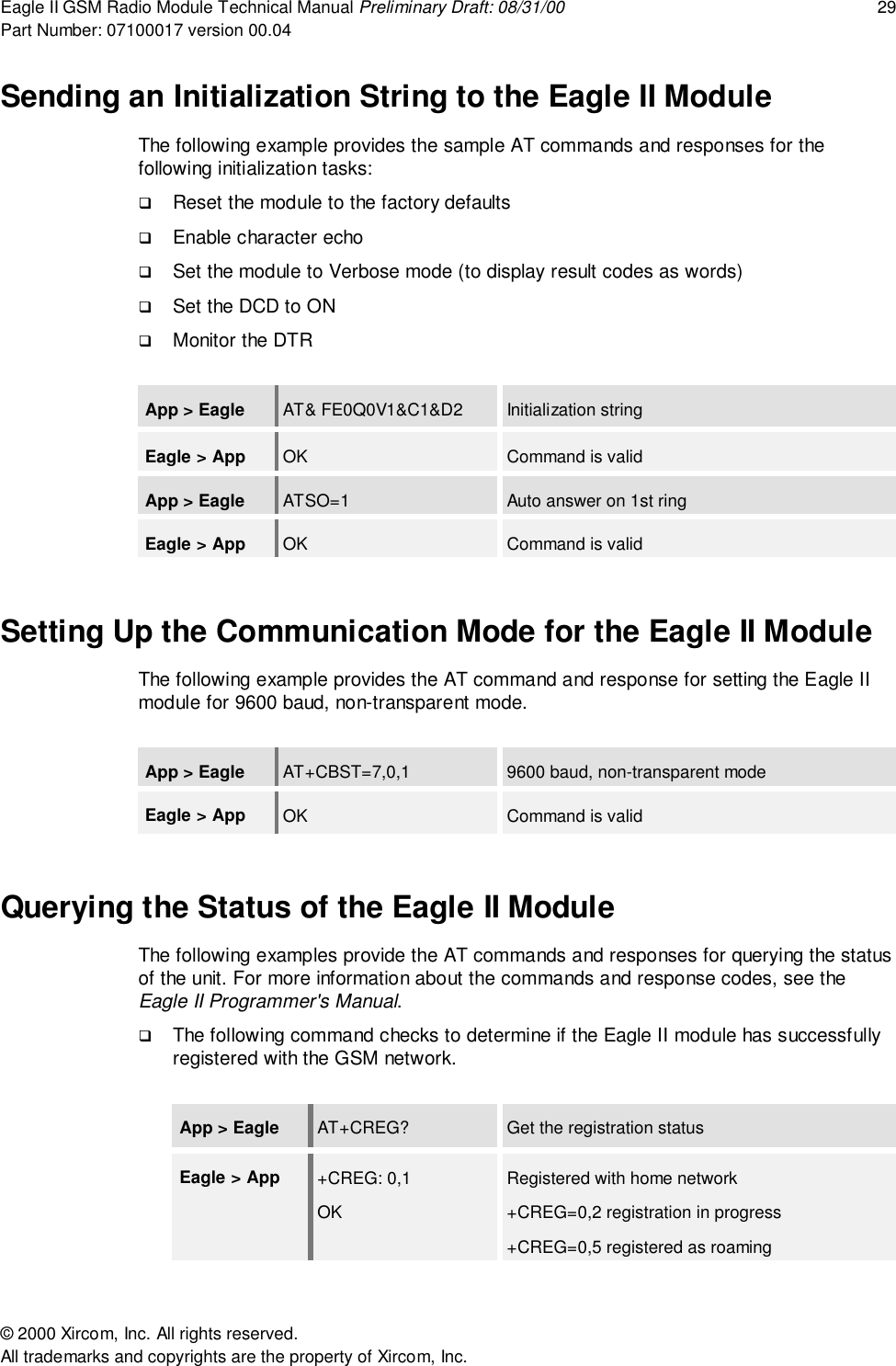
Eagle II GSM Radio Module Technical Manual Preliminary Draft: 08/31/00 29Part Number: 07100017 version 00.04© 2000 Xircom, Inc. All rights reserved.All trademarks and copyrights are the property of Xircom, Inc.Sending an Initialization String to the Eagle II ModuleThe following example provides the sample AT commands and responses for thefollowing initialization tasks:! Reset the module to the factory defaults! Enable character echo! Set the module to Verbose mode (to display result codes as words)! Set the DCD to ON! Monitor the DTRApp > Eagle AT& FE0Q0V1&C1&D2 Initialization stringEagle > App OK Command is validApp > Eagle ATSO=1 Auto answer on 1st ringEagle > App OK Command is validSetting Up the Communication Mode for the Eagle II ModuleThe following example provides the AT command and response for setting the Eagle IImodule for 9600 baud, non-transparent mode.App > Eagle AT+CBST=7,0,1 9600 baud, non-transparent modeEagle > App OK Command is validQuerying the Status of the Eagle II ModuleThe following examples provide the AT commands and responses for querying the statusof the unit. For more information about the commands and response codes, see theEagle II Programmer's Manual.! The following command checks to determine if the Eagle II module has successfullyregistered with the GSM network.App > Eagle AT+CREG? Get the registration statusEagle > App +CREG: 0,1OKRegistered with home network+CREG=0,2 registration in progress+CREG=0,5 registered as roaming
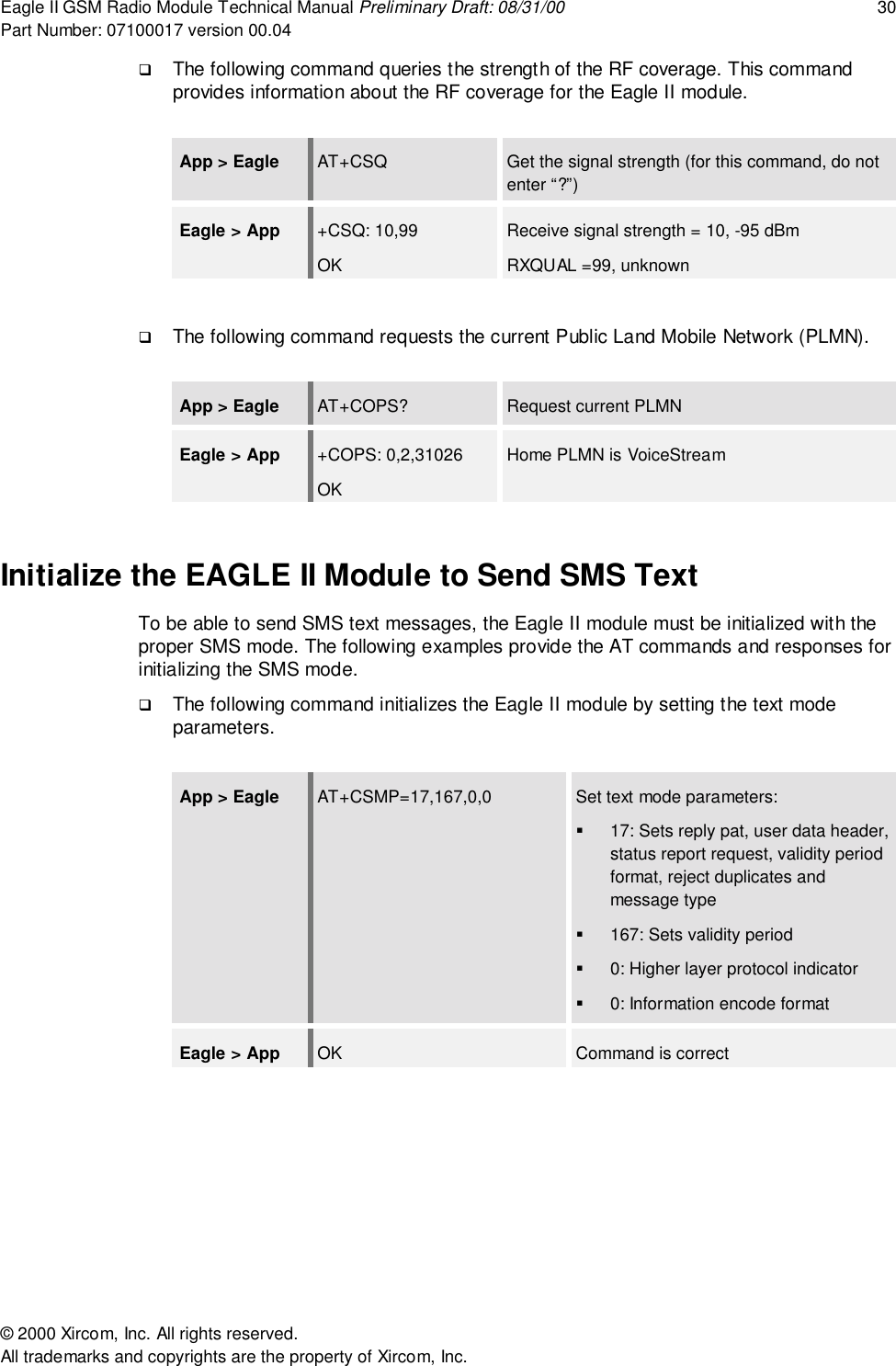
Eagle II GSM Radio Module Technical Manual Preliminary Draft: 08/31/00 30Part Number: 07100017 version 00.04© 2000 Xircom, Inc. All rights reserved.All trademarks and copyrights are the property of Xircom, Inc.! The following command queries the strength of the RF coverage. This commandprovides information about the RF coverage for the Eagle II module.App > Eagle AT+CSQ Get the signal strength (for this command, do notenter “?”)Eagle > App +CSQ: 10,99OKReceive signal strength = 10, -95 dBmRXQUAL =99, unknown! The following command requests the current Public Land Mobile Network (PLMN).App > Eagle AT+COPS? Request current PLMNEagle > App +COPS: 0,2,31026OKHome PLMN is VoiceStreamInitialize the EAGLE II Module to Send SMS TextTo be able to send SMS text messages, the Eagle II module must be initialized with theproper SMS mode. The following examples provide the AT commands and responses forinitializing the SMS mode.! The following command initializes the Eagle II module by setting the text modeparameters.App > Eagle AT+CSMP=17,167,0,0 Set text mode parameters:"  17: Sets reply pat, user data header,status report request, validity periodformat, reject duplicates andmessage type"  167: Sets validity period"  0: Higher layer protocol indicator"  0: Information encode formatEagle > App OK Command is correct
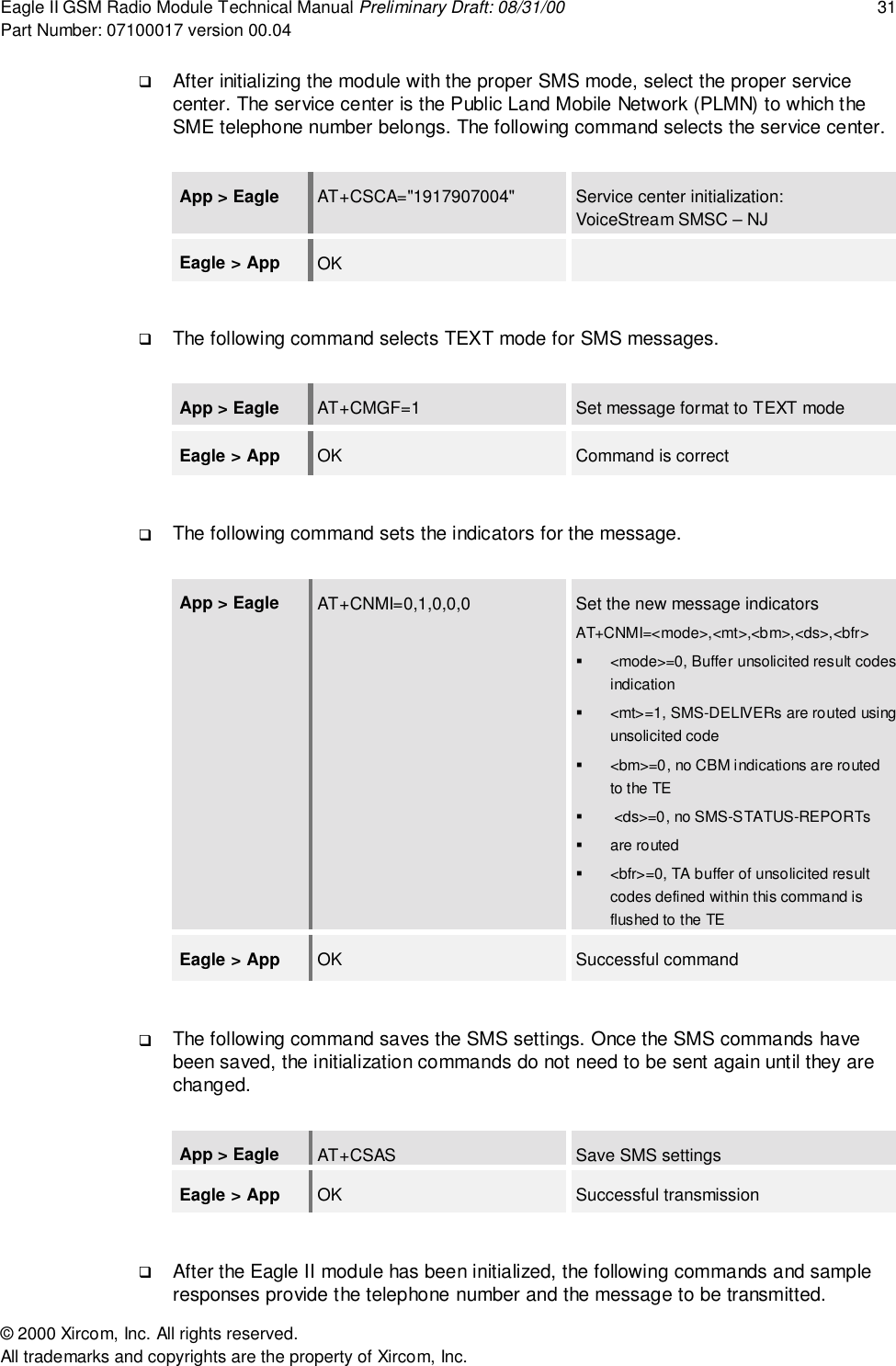
Eagle II GSM Radio Module Technical Manual Preliminary Draft: 08/31/00 31Part Number: 07100017 version 00.04© 2000 Xircom, Inc. All rights reserved.All trademarks and copyrights are the property of Xircom, Inc.! After initializing the module with the proper SMS mode, select the proper servicecenter. The service center is the Public Land Mobile Network (PLMN) to which theSME telephone number belongs. The following command selects the service center.App > Eagle AT+CSCA="1917907004" Service center initialization:VoiceStream SMSC – NJEagle > App OK! The following command selects TEXT mode for SMS messages.App > Eagle AT+CMGF=1 Set message format to TEXT modeEagle > App OK Command is correct! The following command sets the indicators for the message.App > Eagle AT+CNMI=0,1,0,0,0 Set the new message indicatorsAT+CNMI=<mode>,<mt>,<bm>,<ds>,<bfr>"  <mode>=0, Buffer unsolicited result codesindication"  <mt>=1, SMS-DELIVERs are routed usingunsolicited code"  <bm>=0, no CBM indications are routedto the TE"   <ds>=0, no SMS-STATUS-REPORTs" are routed"  <bfr>=0, TA buffer of unsolicited resultcodes defined within this command isflushed to the TEEagle > App OK Successful command! The following command saves the SMS settings. Once the SMS commands havebeen saved, the initialization commands do not need to be sent again until they arechanged.App > Eagle AT+CSAS Save SMS settingsEagle > App OK Successful transmission! After the Eagle II module has been initialized, the following commands and sampleresponses provide the telephone number and the message to be transmitted.
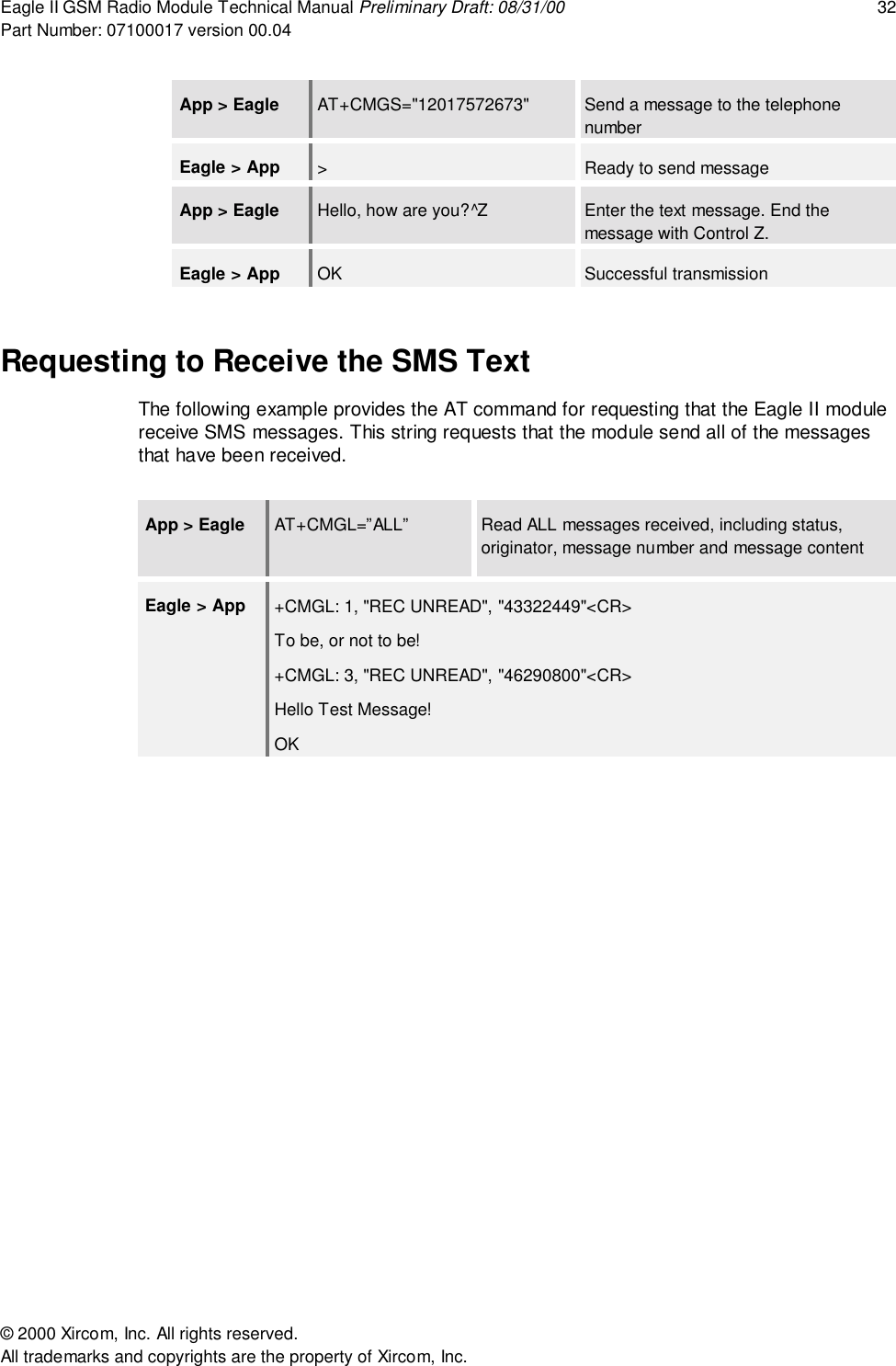
Eagle II GSM Radio Module Technical Manual Preliminary Draft: 08/31/00 32Part Number: 07100017 version 00.04© 2000 Xircom, Inc. All rights reserved.All trademarks and copyrights are the property of Xircom, Inc.App > Eagle AT+CMGS="12017572673" Send a message to the telephonenumberEagle > App >Ready to send messageApp > Eagle Hello, how are you?^Z Enter the text message. End themessage with Control Z.Eagle > App OK Successful transmissionRequesting to Receive the SMS TextThe following example provides the AT command for requesting that the Eagle II modulereceive SMS messages. This string requests that the module send all of the messagesthat have been received.App > Eagle AT+CMGL=”ALL” Read ALL messages received, including status,originator, message number and message contentEagle > App +CMGL: 1, "REC UNREAD", "43322449"<CR>To be, or not to be!+CMGL: 3, "REC UNREAD", "46290800"<CR>Hello Test Message!OK
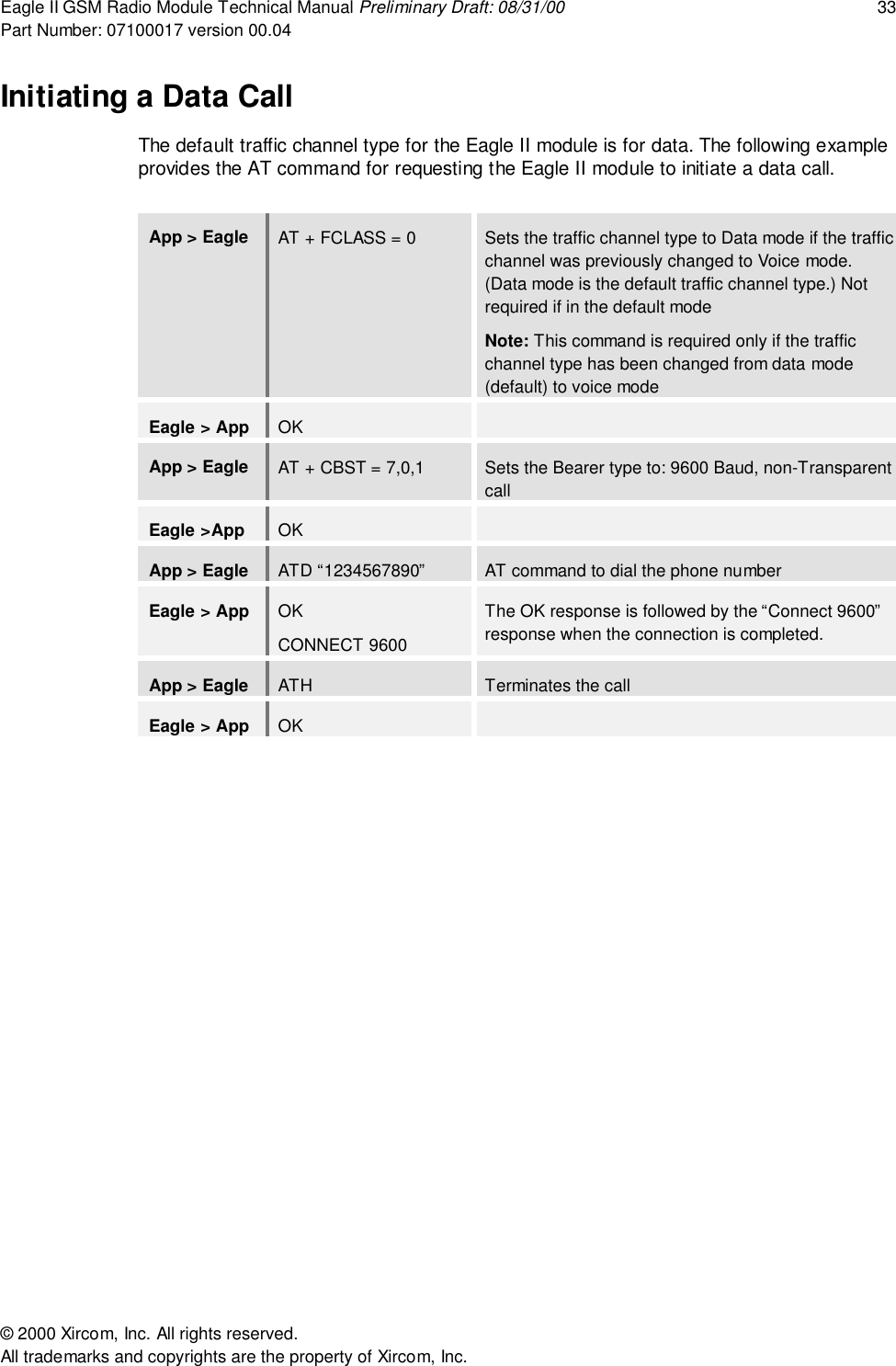
Eagle II GSM Radio Module Technical Manual Preliminary Draft: 08/31/00 33Part Number: 07100017 version 00.04© 2000 Xircom, Inc. All rights reserved.All trademarks and copyrights are the property of Xircom, Inc.Initiating a Data CallThe default traffic channel type for the Eagle II module is for data. The following exampleprovides the AT command for requesting the Eagle II module to initiate a data call.App > Eagle AT + FCLASS = 0 Sets the traffic channel type to Data mode if the trafficchannel was previously changed to Voice mode.(Data mode is the default traffic channel type.) Notrequired if in the default modeNote: This command is required only if the trafficchannel type has been changed from data mode(default) to voice modeEagle > App OKApp > Eagle AT + CBST = 7,0,1 Sets the Bearer type to: 9600 Baud, non-TransparentcallEagle >App OKApp > Eagle ATD “1234567890” AT command to dial the phone numberEagle > App OKCONNECT 9600The OK response is followed by the “Connect 9600”response when the connection is completed.App > Eagle ATH Terminates the callEagle > App OK
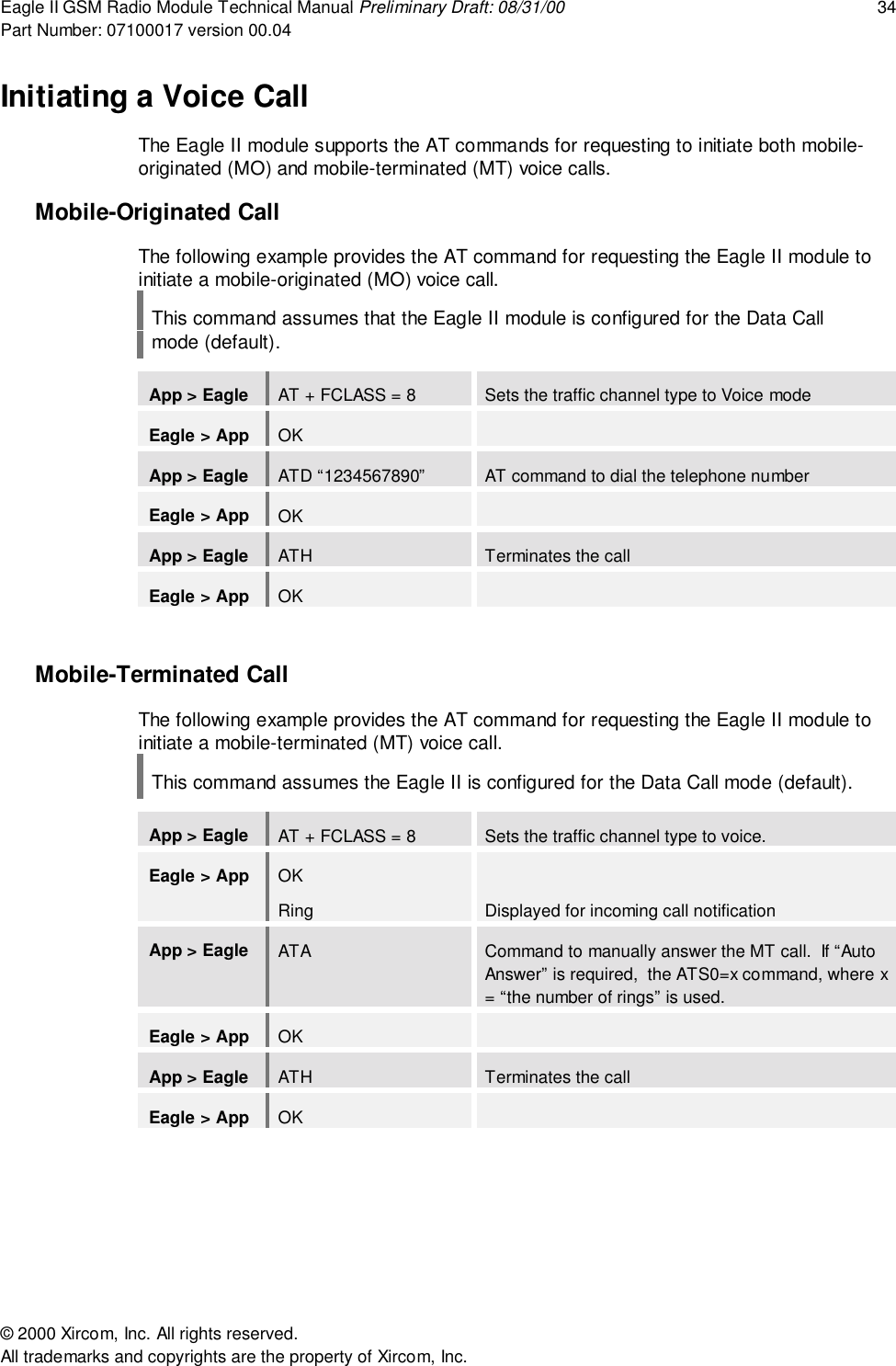
Eagle II GSM Radio Module Technical Manual Preliminary Draft: 08/31/00 34Part Number: 07100017 version 00.04© 2000 Xircom, Inc. All rights reserved.All trademarks and copyrights are the property of Xircom, Inc.Initiating a Voice CallThe Eagle II module supports the AT commands for requesting to initiate both mobile-originated (MO) and mobile-terminated (MT) voice calls.Mobile-Originated CallThe following example provides the AT command for requesting the Eagle II module toinitiate a mobile-originated (MO) voice call.This command assumes that the Eagle II module is configured for the Data Callmode (default).App > Eagle AT + FCLASS = 8 Sets the traffic channel type to Voice modeEagle > App OKApp > Eagle ATD “1234567890” AT command to dial the telephone numberEagle > App OKApp > Eagle ATH Terminates the callEagle > App OKMobile-Terminated CallThe following example provides the AT command for requesting the Eagle II module toinitiate a mobile-terminated (MT) voice call.This command assumes the Eagle II is configured for the Data Call mode (default).App > Eagle AT + FCLASS = 8 Sets the traffic channel type to voice.Eagle > App OKRing Displayed for incoming call notificationApp > Eagle ATA Command to manually answer the MT call.  If “AutoAnswer” is required,  the ATS0=x command, where x= “the number of rings” is used.Eagle > App OKApp > Eagle ATH Terminates the callEagle > App OK
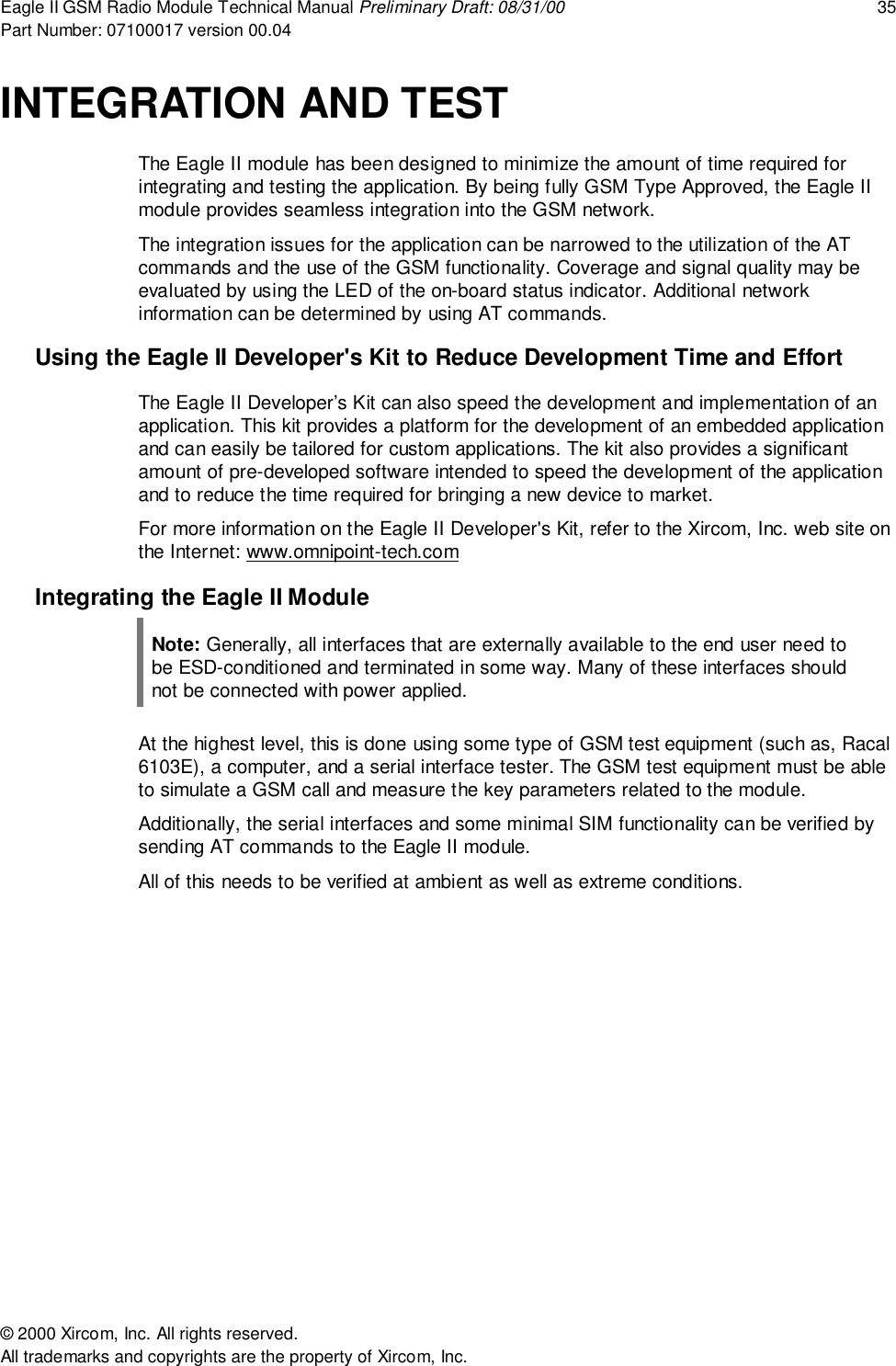
Eagle II GSM Radio Module Technical Manual Preliminary Draft: 08/31/00 35Part Number: 07100017 version 00.04© 2000 Xircom, Inc. All rights reserved.All trademarks and copyrights are the property of Xircom, Inc.INTEGRATION AND TESTThe Eagle II module has been designed to minimize the amount of time required forintegrating and testing the application. By being fully GSM Type Approved, the Eagle IImodule provides seamless integration into the GSM network.The integration issues for the application can be narrowed to the utilization of the ATcommands and the use of the GSM functionality. Coverage and signal quality may beevaluated by using the LED of the on-board status indicator. Additional networkinformation can be determined by using AT commands.Using the Eagle II Developer's Kit to Reduce Development Time and EffortThe Eagle II Developer’s Kit can also speed the development and implementation of anapplication. This kit provides a platform for the development of an embedded applicationand can easily be tailored for custom applications. The kit also provides a significantamount of pre-developed software intended to speed the development of the applicationand to reduce the time required for bringing a new device to market.For more information on the Eagle II Developer's Kit, refer to the Xircom, Inc. web site onthe Internet: www.omnipoint-tech.comIntegrating the Eagle II ModuleNote: Generally, all interfaces that are externally available to the end user need tobe ESD-conditioned and terminated in some way. Many of these interfaces shouldnot be connected with power applied.At the highest level, this is done using some type of GSM test equipment (such as, Racal6103E), a computer, and a serial interface tester. The GSM test equipment must be ableto simulate a GSM call and measure the key parameters related to the module.Additionally, the serial interfaces and some minimal SIM functionality can be verified bysending AT commands to the Eagle II module.All of this needs to be verified at ambient as well as extreme conditions.
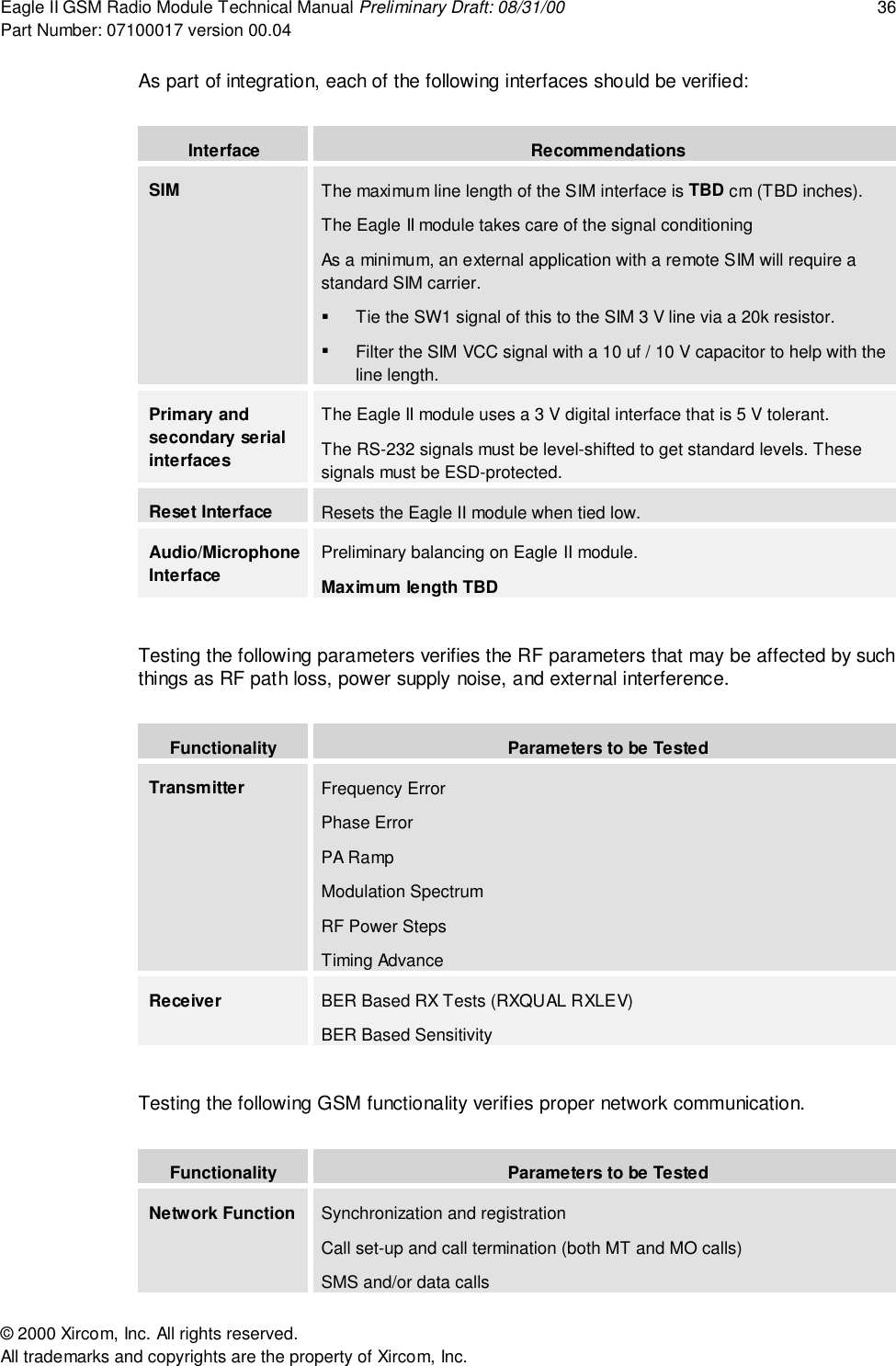
Eagle II GSM Radio Module Technical Manual Preliminary Draft: 08/31/00 36Part Number: 07100017 version 00.04© 2000 Xircom, Inc. All rights reserved.All trademarks and copyrights are the property of Xircom, Inc.As part of integration, each of the following interfaces should be verified:Interface RecommendationsSIM The maximum line length of the SIM interface is TBD cm (TBD inches).The Eagle II module takes care of the signal conditioningAs a minimum, an external application with a remote SIM will require astandard SIM carrier."  Tie the SW1 signal of this to the SIM 3 V line via a 20k resistor."  Filter the SIM VCC signal with a 10 uf / 10 V capacitor to help with theline length.Primary andsecondary serialinterfacesThe Eagle II module uses a 3 V digital interface that is 5 V tolerant.The RS-232 signals must be level-shifted to get standard levels. Thesesignals must be ESD-protected.Reset Interface Resets the Eagle II module when tied low.Audio/MicrophoneInterfacePreliminary balancing on Eagle II module.Maximum length TBDTesting the following parameters verifies the RF parameters that may be affected by suchthings as RF path loss, power supply noise, and external interference.Functionality Parameters to be TestedTransmitter Frequency ErrorPhase ErrorPA RampModulation SpectrumRF Power StepsTiming AdvanceReceiver BER Based RX Tests (RXQUAL RXLEV)BER Based SensitivityTesting the following GSM functionality verifies proper network communication.Functionality Parameters to be TestedNetwork Function Synchronization and registrationCall set-up and call termination (both MT and MO calls)SMS and/or data calls
Eagle II GSM Radio Module Technical Manual Preliminary Draft: 08/31/00 37Part Number: 07100017 version 00.04© 2000 Xircom, Inc. All rights reserved.All trademarks and copyrights are the property of Xircom, Inc.REPAIR AND RETURN POLICYNote: The standard warranty for the Eagle II module is 90 days.To report a problem, call the Xircom Customer Service department:•  United States of America (toll-free): 1.888.684.5355• International: +1.719.884.2444Reporting and Troubleshooting Problems with the Eagle II ModuleProblems can be reported by calling Customer Service. The Customer Servicerepresentative and/or service technician will attempt to resolve the problem over thetelephone. It is important to note the exact environment that the problem occurs and whatis the integration platform. For example, does the problem occur only in the Eagle testfixture or in the target platform?If the problem cannot be resolved over the telephone and the module needs to bereturned, the customer service representative provides an RMA number for shipping themodule. The return address will be given at this time.Upon receipt of the module, it will be thoroughly tested in an Xircom test fixture. If theproblem is found, a replacement module will be shipped back to the customer.Note: The warranty period for replaced or repaired equipment is 30 days from timeof shipment.
Eagle II GSM Radio Module Technical Manual Preliminary Draft: 08/31/00 38Part Number: 07100017 version 00.04© 2000 Xircom, Inc. All rights reserved.All trademarks and copyrights are the property of Xircom, Inc.REGULATIONS AND COMPLIANCEThis section summarizes the responsibilities and actions required of manufacturers andintegrators who incorporate OEM versions of the Eagle II module into their products. Incertain situations and applications these products will require additional FCC, CE, GSMFTA or other regulatory approvals prior to sale or operation. Appropriate instructions,documentation and labels are required for all products. For more information concerningregulatory requirements, please contact Xircom, Inc.GSM Full Type Approval (FTA)The Eagle II module is type approved in accordance with the requirements of andthrough the procedures set forth by the GSM industry association. The relevantconformance specification is GSM 11.10-1 version 4.19.1 for GSM 900- and 1800 MHzdevices. For PCS 1900 MHz devices, the relevant standard is PCS 11.10, a version ofGSM 11.10-1 that has been modified as appropriate for the North American GSM market.For applications that use an unmodified version of the Eagle II module, further testing inthis area may not be required. Any OEM changes in the SIM interface, antenna port,software or the physical makeup of the unit may require an incremental FTA to ensurecontinued compliance with the above-mentioned standards. For more informationconcerning type approval, please contact Xircom, Inc.Electromagnetic Compatibility (EMC) and SafetyRequirementsThe Eagle II module has been tested and approved for application in the United States ofAmerica (US) and the European Union (EU). The compliance details for each of thesemarkets follow. For other markets, additional or alternative regulatory approvals may berequired. Always ensure that all rules and regulations are complied with in every countrythat the OEM application is to be operated. Regardless of the country or market, theOEM must comply with all applicable regulatory requirements.EMC/Safety Requirements for the USACompliance to the US rules and regulations falls under two categories:! Radio approvals: Federal Communications Commission (FCC)♦  Transmitter: FCC Rules, Part 24♦  Unintentional emission: FCC Rules, Part 15! Product safety approvals: NRTL by an OSHA-approved Nationally RecognizedTesting Laboratory (NRTL)Although the Eagle II module has been authorized by the FCC and listed as a componentby an NRTL, products and applications that incorporate the Eagle II module will requirefinal verification of EM emission and product safety approval.Note: Particular attention should be made to the following statements regarding RFExposure:
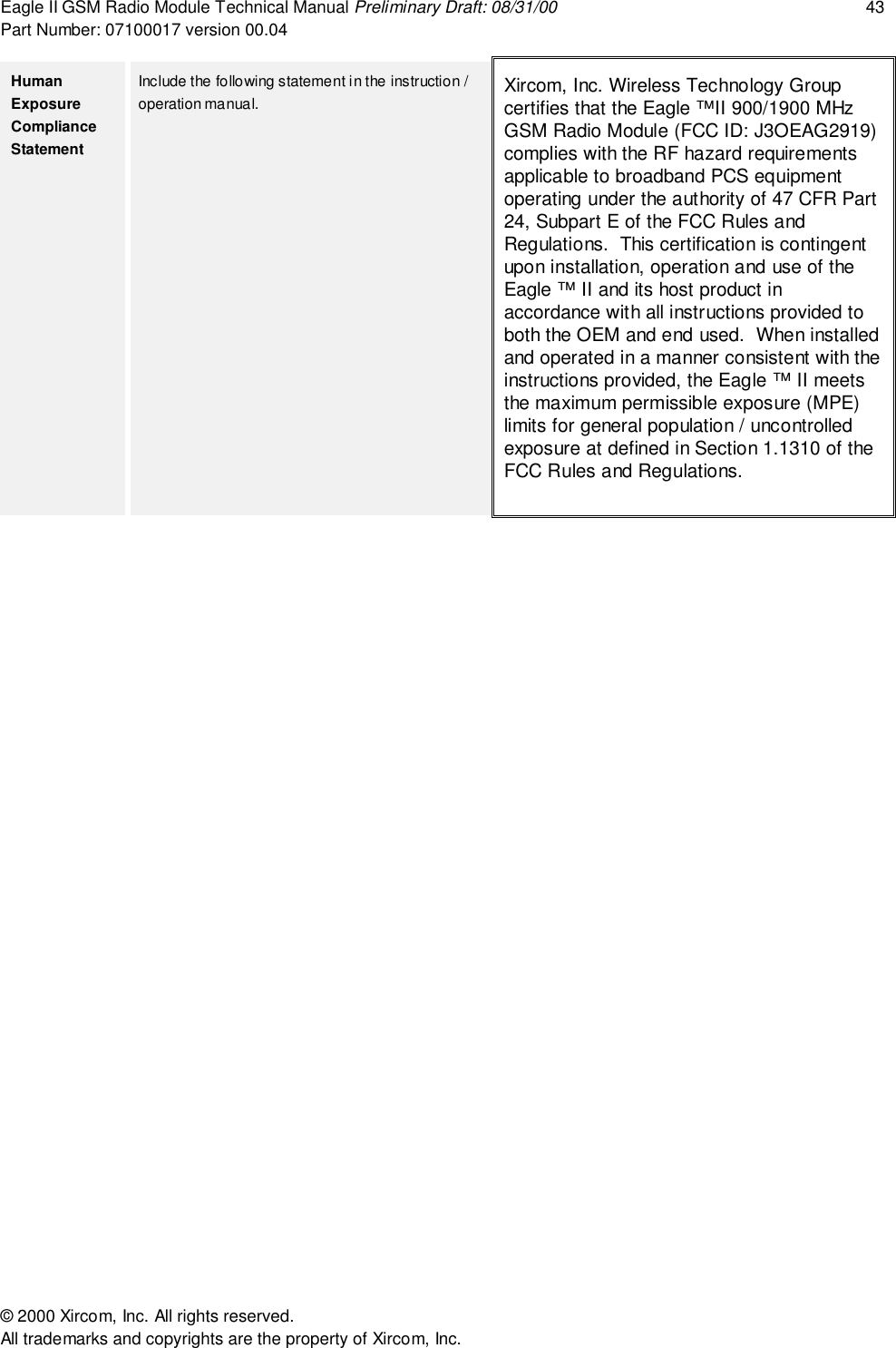
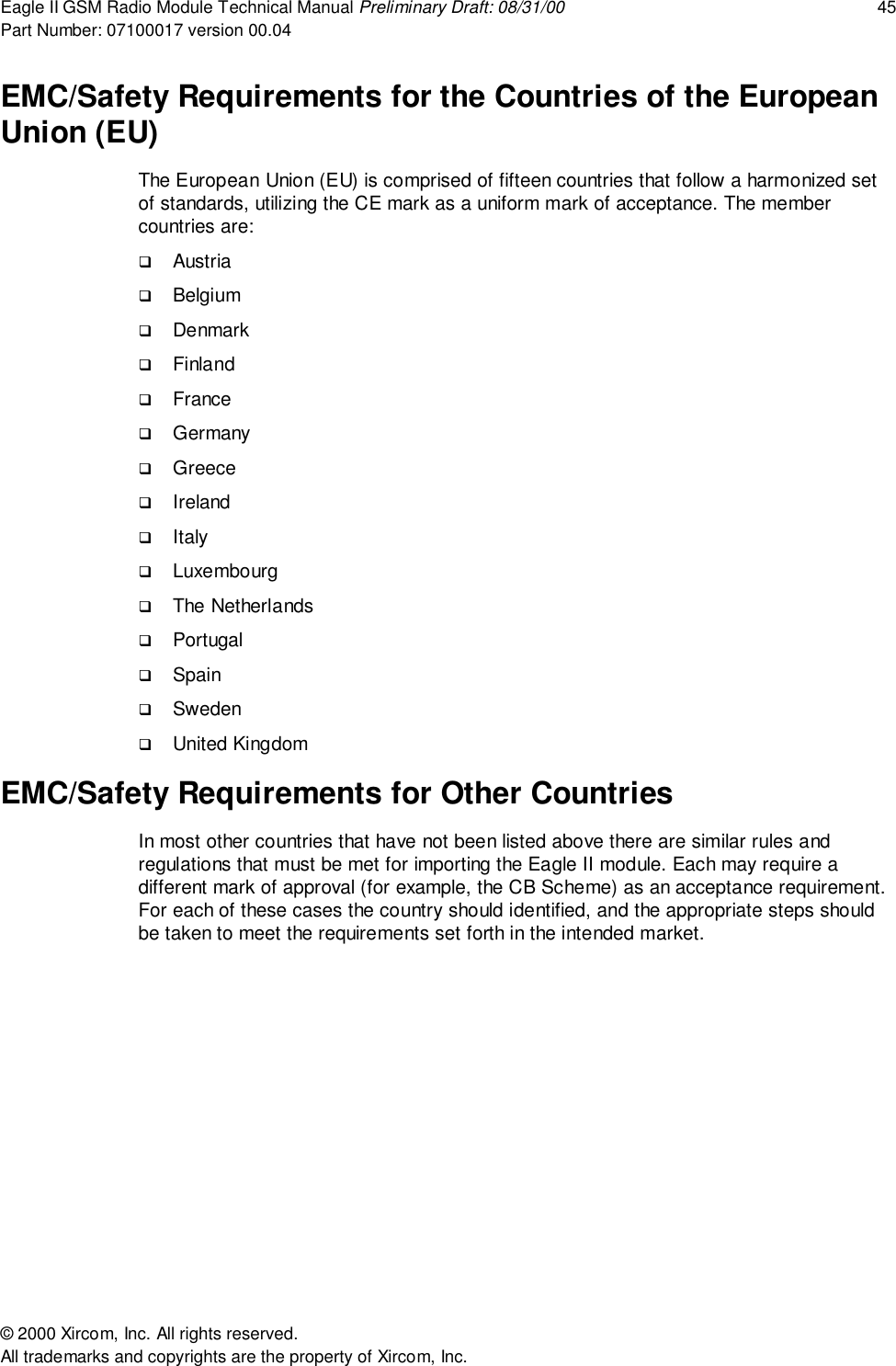
Eagle II GSM Radio Module Technical Manual Preliminary Draft: 08/31/00 39Part Number: 07100017 version 00.04© 2000 Xircom, Inc. All rights reserved.All trademarks and copyrights are the property of Xircom, Inc.Human Exposure Compliance StatementXircom, Inc. Wireless Technology Group certifies that the Eagle ™II 900/1900 MHz GSMRadio Module (FCC ID: J3OEAG2919) complies with the RF hazard requirementsapplicable to broadband PCS equipment operating under the authority of 47 CFR Part24, Subpart E of the FCC Rules and Regulations.  This certification is contingent uponinstallation, operation and use of the Eagle ™ II and its host product in accordance withall instructions provided to both the OEM and end used.  When installed and operated ina manner consistent with the instructions provided, the Eagle ™ II meets the maximumpermissible exposure (MPE) limits for general population / uncontrolled wxposure atdefined in Section 1.1310 of the FCC Rules and Regulations.Note: Installation and operation of this equipment must comply with all applicableFCC Rules and Regulations, including those that implement the NationalEnvironmental Policy Act of 1969 (Part 1, Subpart I), with specific regard to antennasiting and human exposure to radio frequency radiation. For further guidance,consult the FCC Rules, your service provider, or Xircom Inc.Compliance with FCC RegulationsThe Federal Communications Commission (FCC) is the agency of the FederalGovernment that oversees all non-governmental radio frequency transmitters thatoperate within the United States. Unintentional emissions from digital devices areregulated by Part 15 of the FCC Rules and Regulations, which distinguishes between theenvironments in which these devices may operate. Intentional radiators operating as aPCS-1900 radio transmitter are regulated under Part 24, Subpart E—Broadband PCS ofthe FCC Rules and Regulations.
Eagle II GSM Radio Module Technical Manual Preliminary Draft: 08/31/00 40Part Number: 07100017 version 00.04© 2000 Xircom, Inc. All rights reserved.All trademarks and copyrights are the property of Xircom, Inc.Unintentional Radiators, Part 15Equipment designated as Class A is intended for use in a commercial, industrial orbusiness environment. The Eagle II module has been tested and found to comply withthe limits for a Class A digital device and can be integrated into equipment or applicationsintended for use in commercial, industrial or business environments.The following statement must be included in the user manual for such products:This equipment has been tested and found to comply with the limits for a Class Adigital device, pursuant to part 15 of the FCC rules. These limits are designed toprovide reasonable protection against harmful interference when the equipment isoperated in a commercial environment. This equipment generates, uses, and canradiate radio frequency energy and, if not installed and used in accordance with theinstruction manual, may cause harmful interference to radio communications.Operation of this equipment in a residential area is likely to cause harmfulinterference in which case the user will be required to correct the interference at hisown expense.Equipment intended for use in a residential environment (not-withstanding use incommercial, industrial or business environments) is designated as Class B. The Eagle IImodule has been tested and found to comply with the limits for a Class B digital deviceand can be integrated into equipment or applications intended for use in residentialenvironments.The following statement must be included in the user manual for such products:This equipment has been tested and found to comply with the limits for a Class Bdigital device, pursuant to part 15 of the FCC rules. These limits are designed toprovide reasonable protection against harmful interference in a residentialinstallation. This equipment generates, uses, and can radiate radio frequency energyand, if not installed and used in accordance with the instructions, may cause harmfulinterference to radio communications. However, there is no guarantee thatinterference will not occur in a particular installation. If this equipment does causeharmful interference to radio or television reception, which can be determined byturning the equipment off and on the user is encouraged to try to correct theinterference by one or more of the following measures:♦  Reorient or relocate the receiving antenna.♦  Increase the separation between the equipment and receiver.♦  Connect the equipment into an outlet on a circuit different from that to which thereceiver is connected.♦  Consult the dealer or an experienced radio/TV technician for help.Intentional Radiators, Part 24Products incorporating the Eagle II transceiver operate as Personal CommunicationsServices (PCS) devices under the authority of Part 24, Subpart E—Broadband PCS, ofthe FCC Rules and Regulations. All such transmitters must be authorized by the FCCthrough its Certification process, as detailed in Part 2, Subpart J - EquipmentAuthorization Procedures. Through the Certification process, the FCC verifies that theproduct complies with all applicable regulatory and technical requirements, includingthose that address human exposure to radio frequency radiation. In general, radiofrequency transmitters cannot be sold or operated in the US prior to FCC approval.
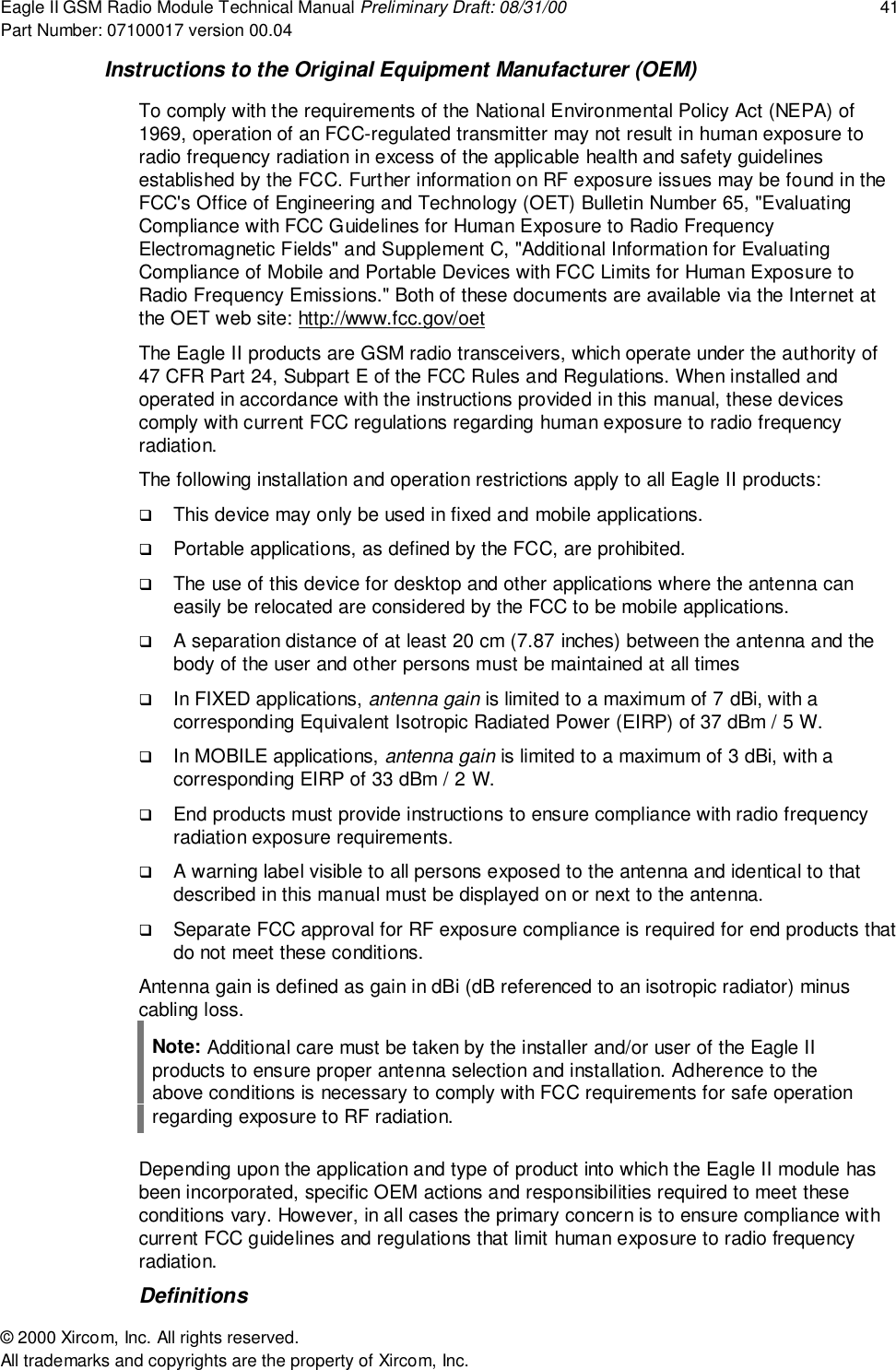
Eagle II GSM Radio Module Technical Manual Preliminary Draft: 08/31/00 41Part Number: 07100017 version 00.04© 2000 Xircom, Inc. All rights reserved.All trademarks and copyrights are the property of Xircom, Inc.Instructions to the Original Equipment Manufacturer (OEM)To comply with the requirements of the National Environmental Policy Act (NEPA) of1969, operation of an FCC-regulated transmitter may not result in human exposure toradio frequency radiation in excess of the applicable health and safety guidelinesestablished by the FCC. Further information on RF exposure issues may be found in theFCC's Office of Engineering and Technology (OET) Bulletin Number 65, "EvaluatingCompliance with FCC Guidelines for Human Exposure to Radio FrequencyElectromagnetic Fields" and Supplement C, "Additional Information for EvaluatingCompliance of Mobile and Portable Devices with FCC Limits for Human Exposure toRadio Frequency Emissions." Both of these documents are available via the Internet atthe OET web site: http://www.fcc.gov/oetThe Eagle II products are GSM radio transceivers, which operate under the authority of47 CFR Part 24, Subpart E of the FCC Rules and Regulations. When installed andoperated in accordance with the instructions provided in this manual, these devicescomply with current FCC regulations regarding human exposure to radio frequencyradiation.The following installation and operation restrictions apply to all Eagle II products:! This device may only be used in fixed and mobile applications.! Portable applications, as defined by the FCC, are prohibited.! The use of this device for desktop and other applications where the antenna caneasily be relocated are considered by the FCC to be mobile applications.! A separation distance of at least 20 cm (7.87 inches) between the antenna and thebody of the user and other persons must be maintained at all times! In FIXED applications, antenna gain is limited to a maximum of 7 dBi, with acorresponding Equivalent Isotropic Radiated Power (EIRP) of 37 dBm / 5 W.! In MOBILE applications, antenna gain is limited to a maximum of 3 dBi, with acorresponding EIRP of 33 dBm / 2 W.! End products must provide instructions to ensure compliance with radio frequencyradiation exposure requirements.! A warning label visible to all persons exposed to the antenna and identical to thatdescribed in this manual must be displayed on or next to the antenna.! Separate FCC approval for RF exposure compliance is required for end products thatdo not meet these conditions.Antenna gain is defined as gain in dBi (dB referenced to an isotropic radiator) minuscabling loss.Note: Additional care must be taken by the installer and/or user of the Eagle IIproducts to ensure proper antenna selection and installation. Adherence to theabove conditions is necessary to comply with FCC requirements for safe operationregarding exposure to RF radiation.Depending upon the application and type of product into which the Eagle II module hasbeen incorporated, specific OEM actions and responsibilities required to meet theseconditions vary. However, in all cases the primary concern is to ensure compliance withcurrent FCC guidelines and regulations that limit human exposure to radio frequencyradiation.Definitions
Eagle II GSM Radio Module Technical Manual Preliminary Draft: 08/31/00 42Part Number: 07100017 version 00.04© 2000 Xircom, Inc. All rights reserved.All trademarks and copyrights are the property of Xircom, Inc.For the purpose of determining compliance with current FCC rules addressing humanexposure to radio frequency radiation, the FCC has established the following threecategories of transmitting devices:! Portable Devices – devices where the antenna is located within 20 cm (7.87 inches)of any person, including the user, if applicable. Portable devices operating under theauthority of Part 24 (broadband PCS) are limited to a maximum of 2 W EIRP.! Mobile Devices – devices designed to be used in other than fixed locations andgenerally such that the antenna is located at a minimum of 20 cm (7.87 inches) fromany person, including the user, if applicable. Mobile devices operating under theauthority of Part 24 (broadband PCS) are limited to a maximum of 2 W EIRP.! Fixed devices – devices in which the antenna, either integral to the product orremotely located, is physically secured at one location and is not able to be easilymoved to another location.OEM Responsibilities for All Products Containing the RM1900-1In addition to any other regulatory requirements, OEMs and integrators must include orprovide the following information, instructions, warnings and labels with any device orproduct into which the Eagle II PCS-1900 GSM transceiver has been incorporated:Information DescriptionDetailedOperatingInstructionsfor ensuringcompliancewith currentFCC guidelineswhich limithumanexposure toradio frequencyradiationThe OEM must provide an operating/installation manual with the final product which clearly indicates that theseoperating conditions and restrictions must be observed at all times to ensure compliance with current FCCguidelines which limit human exposure to radio frequency radiation."  20 cm (7.87 inch) separation distance between the antenna and all persons must be maintained at alltimes for all fixed and mobile products and applications"  Portable devices and applications are prohibited unless such devices and products are specificallyauthorized by the FCC"  Maximum antenna gain is limited to 3 dBi* in mobile products and applications"  Maximum antenna gain is limited to 7 dBi* in fixed products and applications."  Modifications and/or additions to the Eagle PCS-1900 GSM transceiver, including use of antennas withhigher gain than those authorized by the FCC, are prohibited*dBi = antenna gain in dB relative to an isotropic radiatorAttach the following warning label directly to ordisplayed next to the antenna. Furthermore, thislabel must be visible to and easily readable by allpersons in the immediate vicinity of the antennaWARNINGTo comply with FCC RF exposure requirements, aseparation distance of 20 cm (7.87") or more mustbe maintained between this antenna and allpersons.AntennaAvoidanceLabel
Eagle II GSM Radio Module Technical Manual Preliminary Draft: 08/31/00 43Part Number: 07100017 version 00.04© 2000 Xircom, Inc. All rights reserved.All trademarks and copyrights are the property of Xircom, Inc.HumanExposureComplianceStatementInclude the following statement in the instruction /operation manual. Xircom, Inc. Wireless Technology Groupcertifies that the Eagle ™II 900/1900 MHzGSM Radio Module (FCC ID: J3OEAG2919)complies with the RF hazard requirementsapplicable to broadband PCS equipmentoperating under the authority of 47 CFR Part24, Subpart E of the FCC Rules andRegulations.  This certification is contingentupon installation, operation and use of theEagle ™ II and its host product inaccordance with all instructions provided toboth the OEM and end used.  When installedand operated in a manner consistent with theinstructions provided, the Eagle ™ II meetsthe maximum permissible exposure (MPE)limits for general population / uncontrolledexposure at defined in Section 1.1310 of theFCC Rules and Regulations.
Eagle II GSM Radio Module Technical Manual Preliminary Draft: 08/31/00 44Part Number: 07100017 version 00.04© 2000 Xircom, Inc. All rights reserved.All trademarks and copyrights are the property of Xircom, Inc.Specific OEM Responsibilities for Portable Products and ApplicationsEach device or product, into which the Eagle II PCS-1900 GSM transceiver has beenincorporated, and which is intended to be used in an application that meets the definitionof "portable" MUST be separately authorized by the FCC for the purposes of determiningcompliance with current FCC guidelines limiting human exposure to radio frequencyradiation.Portable devices must be evaluated for RF exposure based on Specific Absorption Rate(SAR) limits; further information on such evaluations are available from the FCC via theInternet.Specific OEM Responsibilities for Mobile Products and ApplicationsSeparate or additional FCC approvals are NOT required for devices or products, intowhich the Eagle II PCS-1900 GSM transceiver has been incorporated, that are used inapplications that meet the definition of "mobile."For all end products, the OEM or integrator must provide instructions, warnings andlabels to ensure that the product complies with current FCC guidelines limiting humanexposure to radio frequency radiation.Current FCC regulations limit the EIRP of mobile devices to 2 W. Because the nominalRF output power of the Eagle II PCS-1900 GSM transceiver is 1.0 W (30 dBm), antennagain for mobile products and applications cannot exceed 3 dBi.Specific OEM Responsibilities for Fixed Products and ApplicationsSeparate or additional FCC approvals are not required for devices or products, into whichthe Eagle II GSM transceiver has been incorporated, that are used in applications whichmeet the definition of "fixed.”For all end products, the OEM or integrator must provide the instructions, warnings andlabels to ensure that the product complies with current FCC guidelines limiting humanexposure to radio frequency radiation.Separate or additional FCC approvals are required for devices or end products used infixed applications where antenna gain in excess of 7dBi is desired.Nationally Recognized Testing Laboratory (NRTL) ApprovalThe Eagle II module has been tested by an NRTL and approved as a component forincorporation into OEM products. The final product and application that incorporates theEagle II module will require separate  verification of product safety approval.
Eagle II GSM Radio Module Technical Manual Preliminary Draft: 08/31/00 45Part Number: 07100017 version 00.04© 2000 Xircom, Inc. All rights reserved.All trademarks and copyrights are the property of Xircom, Inc.EMC/Safety Requirements for the Countries of the EuropeanUnion (EU)The European Union (EU) is comprised of fifteen countries that follow a harmonized setof standards, utilizing the CE mark as a uniform mark of acceptance. The membercountries are:! Austria! Belgium! Denmark! Finland! France! Germany! Greece! Ireland! Italy! Luxembourg! The Netherlands! Portugal! Spain! Sweden! United KingdomEMC/Safety Requirements for Other CountriesIn most other countries that have not been listed above there are similar rules andregulations that must be met for importing the Eagle II module. Each may require adifferent mark of approval (for example, the CB Scheme) as an acceptance requirement.For each of these cases the country should identified, and the appropriate steps shouldbe taken to meet the requirements set forth in the intended market.
Eagle II GSM Radio Module Technical Manual Preliminary Draft: 08/31/00 46Part Number: 07100017 version 00.04© 2000 Xircom, Inc. All rights reserved.All trademarks and copyrights are the property of Xircom, Inc.PIN ASSIGNMENTS OF THE I/OCONNECTORSignals of the I/O Connector, Sorted by Pin NumberPin SignalNameDirection Functionality VoltageLevel123456 VIN From CPE Electrical power input to Eagle II module:4.2 VDC to 5.2 VDCRefer to the table for Operating Power.7TX on To CPE Transmit ON. Digital output to indicate transmitter power status. Alogic 1 indicates transmit power is on. A logic 0 indicates transmitpower is off. Leave signal disconnected if function is not used.2.2 V8RX0 To CPE Receive data 0. DCE Output signal. Main serial interface transmitdata signal. During idle or reset, signal will be a logic 1. Connects toa DTE, RX, receive data pin.3 V9RX on To CPE Receive ON. Digital output to indicate receiver power status. A logic1 indicates receiver power is off. A logic 0 indicates receive power isoff. Leave signal disconnected if function is not used.2.2 V10 DSR0 To CPE Data Set Ready 0. DCE Output signal. Active low. Main serialinterface data set ready signal. Connects to a DTE, DSR, Data SetReady pin.3 V11 Reserved Do not use. Leave open12 DCD0 To CPE Data Carrier Detect 0. DCE Output signal. Active low. Main serialinterface data carrier detect signal. Connects to a DTE, CD, CarrierDetect pin.3 V13 GPIO0 To/From CPE General purpose I/O bit. Used as general purpose input or outputlines for monitoring or control of external devices. Requirescustomized stack software to implement. Leave signals disconnectedif function is not used.3 V14 RI0 To CPE Ring Indicator 0. DCE Output signal. Active low. Main serial interfacering indicator signal. Connects to a DTE, RI, Ring Indicator pin.3 V15 GPIO1 To/From CPE General purpose I/O bit. Used as general purpose input or outputlines for monitoring or control of external devices. Requirescustomized stack software to implement. Leave signals disconnectedif function is not used.3 V
Eagle II GSM Radio Module Technical Manual Preliminary Draft: 08/31/00 47Part Number: 07100017 version 00.04© 2000 Xircom, Inc. All rights reserved.All trademarks and copyrights are the property of Xircom, Inc.Pin SignalNameDirection Functionality VoltageLevel16 TX0 From CPE Transmit data 0. DCE Input signal. Active low. Main serial interfacereceive data signal. During idle or reset, signal will be a logic 1.Connects to a DTE, TX, transmit data pin.5 V or3 V17 GPIO2 To/From CPE General purpose I/O bit. Used as general purpose input or outputlines for monitoring or control of external devices. Requirescustomized stack software to implement. Leave signals disconnectedif function is not used.3 V18 CTS0 To CPE Clear-To-Send 0. DCE Output signal. Active low. Main serialinterface clear to send signal. Connects to a DTE, CTS, Clear tosend pin.3 V19 GPIO3 To/From CPE General purpose I/O bit. Used as general purpose input or outputlines for monitoring or control of external devices. Requirescustomized stack software to implement. Leave signals disconnectedif function is not used.3 V20 RTS0 From CPE Request-To-Send 0. DCE Input signal. Active low. Main serialinterface request to send signal. Connects to a DTE, RTS, Request-To-Send pin.5 V or3 V21 GND From CPE Electrical power return for digital and analog grounds.22 DTR0 From CPE Data Terminal Ready 0. DCE Input signal. Active low. Main serialinterface data terminal ready signal. Connects to a DTE, DTR, DataTerminal Ready pin.5 V or3 V23 RESET_B From CPE Reset Input. Active Low. Internally pulled high and can be leftdisconnected if not used. If connected to external circuitry, maximumhigh level must not exceed 3.3 V. Pulse width must be at least 5 mSto guarantee a valid reset.3 V2425GND From CPE Electrical power return for digital and analog grounds.26 TX1 To CPE Transmit Data 1. DTE Output signal. Secondary serial-interfacetransmit data signal. Used as a debug interface for test purposes.Leave signal disconnected if function is not used.3 V27 CLKOUT To CPE Clock output. A 50% duty cycle 13 MHz square wave clock source.Used for synchronization of external circuitry to the base bandprocessor. Leave signal disconnected if function is not used.3 V2829GND From CPE Electrical power return for digital and analog grounds.30 RX1 From CPE Receive Data 1. DTE Input signal. Secondary serial-interface receivedata signal. Used as a debug interface for test purposes. Leavesignal disconnected if function is not used.5 V or3 V31 Reserved Do not use. Leave open.
Eagle II GSM Radio Module Technical Manual Preliminary Draft: 08/31/00 48Part Number: 07100017 version 00.04© 2000 Xircom, Inc. All rights reserved.All trademarks and copyrights are the property of Xircom, Inc.Pin SignalNameDirection Functionality VoltageLevel32 ID0 To CPE Identification 0. Bit 0 of four (0 to 3) output bits to identify hardwarerevision. Do not use: leave open.3 V33 GND From CPE Electrical power return for digital and analog grounds.34 ID1 To CPE Identification 1. Bit 1 of four (0 to 3) output bits to identify hardwarerevision. Do not use: leave open.3 V35 Reserved Do not use. Leave open.36 ID2 To CPE Identification 2. Bit 2 of four (0 to 3) output bits to identify hardwarerevision. Do not use: leave open.3 V37 Reserved Do not use. Leave open.38 ID3 To CPE Identification 3. Bit 3 of four (0 to 3) output bits to identify hardwarerevision. Do not use: leave open.3 V39 Reserved Do not use. Leave open.40 LED0 To CPE Status LED signal 0. Outputs are active low. LED0 corresponds tothe “red” element of a bi-color LED.LED0 and LED1 indicate radio link status on a remote LED. Leavesignals disconnected if function is not used.3 V41 Reserved Do not use. Leave open.42 LED1 To CPE Status LED signal 1. Outputs are active low. LED1 corresponds tothe “green” element of a bi-color LED.LED0 and LED1 indicate radio link status on a remote LED. Leavesignals disconnected if function is not used.3 V43 Reserved Do not use. Leave open.4445GND From CPE Electrical power return for digital and analog grounds.46 SIM-CLK To CPE SIM clock output signal to a remote SIM device. Clock frequency is3.25 MHz. Leave signal disconnected if function is not used.3 V47 MIC1P From CPE Microphone 1 Positive. Positive input pin from an electret-typemicrophone. Nominal microphone differential voltage should be2.0 V. Impedance not less than 900 ohms. Leave signaldisconnected if function is not used.4849GND From CPE Electrical power return for digital and analog grounds.50 SIM-IO To/From CPE SIM input output. Serial I/O line to a remote SIM device. Leave signaldisconnected if function is not used.5 V or3 V51 MIC1N From CPE Microphone 1 Negative. Negative input pin from an electret-typemicrophone. Nominal microphone differential voltage should be2.0 V. Impedance not less than 900 ohms. Leave signaldisconnected if function is not used.5253GND From CPE Electrical power return for digital and analog grounds.
Eagle II GSM Radio Module Technical Manual Preliminary Draft: 08/31/00 49Part Number: 07100017 version 00.04© 2000 Xircom, Inc. All rights reserved.All trademarks and copyrights are the property of Xircom, Inc.Pin SignalNameDirection Functionality VoltageLevel54 SIM-RST To CPE SIM reset. An output signal to reset a remote SIM device. Leavesignal disconnected if function is not used.3 V55 SPK1P To CPE Speaker 1 Positive. Positive output pin. High side of a push-pullamplifier. Speaker impedance 15 ohms, minimum. Speakercapacitance of 700 pF, maximum. Driver voltage is 4.5 V peak-to-peak. Leave signal disconnected if function is not used.56 SIM-IN From CPE SIM IN signal. Active high. A remote SIM card detection signal input.Leave signal disconnected if function is not used.5 V or3 V57 GND From CPE Electrical power return for digital and analog grounds.58 SIM-VCC To CPE SIM 3 volt power. A 3-volt power supply output signal to a remoteSIM device. Power is controlled by the base band processor. Leavesignal disconnected if function is not used3 V or5 V59 SPK1N To CPE Speaker 1 Negative. Negative output pin. Low side of a push-pullamplifier. Speaker impedance 15 ohms, minimum. Speakercapacitance of 700 pF, maximum. Driver voltage is 4.5 V peak-to-peak. Leave signal disconnected if function is not used.60 SIM-3 V To CPE SIM 3 V output used in conjunction with the SIM-IN signal to aremote SIM device. Leave signal disconnected if function is not used.3 V
Eagle II GSM Radio Module Technical Manual Preliminary Draft: 08/31/00 50Part Number: 07100017 version 00.04© 2000 Xircom, Inc. All rights reserved.All trademarks and copyrights are the property of Xircom, Inc.REFERENCESEagle II Product Documentation! Eagle II Programmer's Manual! Eagle II Interface Control Drawing (ICD), Document # 06700103GSM and PCS Device Specifications! GSM 11.10-1 version 4.19.1 (GSM 900- and 1800 MHz devices)! PCS 11.10 (PCS 1900 MHz devices)US GovernmentFederal Communications Commission (FCC)Internet: http://www.fcc.gov! FCC Rules, Part 24 and Part 25♦  47 CFR Subpart E--Broadband PCS♦  47 CFR § 24.52, sections 1.1307(b), 2.1091, and 2.1093! FCC Rules, Part 15! FCC Rules, Part 2♦  Subpart J--Equipment Authorization Procedures♦ Section 2.925FCC Office of Engineering and Technology (OET)Internet: http://www.fcc.gov.oet! Bulletin Number 65 "Evaluating Compliance with FCC Guidelines for HumanExposure to Radio Frequency Electromagnetic Fields"! Supplement C "Additional Information for Evaluating Compliance of Mobile andPortable Devices with FCC Limits for Exposure to Radio Frequency Emissions"Environmental Regulations! National Environmental Policy Act (NEPA) of 1969 (Part 1, Subpart 1)
Eagle II GSM Radio Module Technical Manual Preliminary Draft: 08/31/00 51Part Number: 07100017 version 00.04© 2000 Xircom, Inc. All rights reserved.All trademarks and copyrights are the property of Xircom, Inc.Mechanical Specifications! ASTM D999! ASTM D775! IEC 68-2-27! Bellcore Gr-63-CORERF and EMI Specifications! ETSI Standards♦  ETS 300 019-1-1 Class 1.2♦  ETS 300 019-1-2 Class 2.1♦  ETS 300 019-1-3 Class 3.1! EN 61000-4-6! GSM 11.10, Section 12.2! EN 55022 Class B
Eagle II GSM Radio Module Technical Manual Preliminary Draft: 08/31/00 52Part Number: 07100017 version 00.04© 2000 Xircom, Inc. All rights reserved.All trademarks and copyrights are the property of Xircom, Inc.GLOSSARY AND ACRONYMSAppApplicationRefers to the Application which sends or receives commands/responses fromthe Eagle II ModuleAT Command Set Commands issued by intelligent device to a modem to perform functions,such as to initiate call, to answer call, or to transmit data.BERBit Error Rate Bit Error RateCSDCircuit Switched DataData link from a terminal through the network allowing real-time, duplexconnectivity at 9600 bytes/second.CPECustomer Premise EquipmentA terminal in fixed location on the customer’s premises.Dbi Decibels referenced to an isotropic radiatorDCEData CommunicationsEquipmentData Communications EquipmentDCSDigital Cellular SystemA collection of services and capabilities providing flexibility of access andmobility through a combination of wireless and wire-line networks, utilizingthe 1800 MHz bandwidth.DTEData Terminal EquipmentData Terminal EquipmentEFREnhanced Full RateVoice (vocoder) compression algorithm which offers the highest quality voicecommunication.EIREquipment Identity RegisterA database used to store International Mobile Equipment Identity (IMEI) of alocally issued terminal.EIRPEquivalent Isotropic RadiatedPowerIn a given direction, the gain of a transmitting antenna multiplied by the netpower accepted by the antenna from the connected transmitter.EMCElectromagnetic CompatibilityThe ability of a device to function satisfactorily in its electromagneticenvironment without inducing intolerable disturbance to that environment (orto other devices)ESDElectrostatic DischargeStatic electricity that can damage electronic equipment.EUEuropean UnionAn organization of 15 European states whose purpose is to organizerelations between the Member States and between their peoples.FTAFull Type ApprovalGSM Full Type ApprovalGPRSGeneral Packet Radio ServiceStandard for packet communications utilizing Global Standard for Mobility(GSM) infrastructure.
Eagle II GSM Radio Module Technical Manual Preliminary Draft: 08/31/00 53Part Number: 07100017 version 00.04© 2000 Xircom, Inc. All rights reserved.All trademarks and copyrights are the property of Xircom, Inc.GSMGlobal System for MobileCommunicationsStandard for digital communications. Allows consistent communications invarious parts of the world despite variations in RF spectrum allocations.Transferring the SIM (see below) permits users to roam by changing terminalequipment.HLRHome Location RegisterHome Location RegisterICDInterface Control Document Document that defines the hardware interfaces.IMEIInternational Mobile EquipmentIdentityA unique number for each GSM Terminal tracked by the GSM operators intheir Equipment Identity Register (EIR) database.IMSIInternational Mobile SubscriberIdentificationA unique number identifying the subscriber stored in the SIM card. Number isused in conjunction with the network for call routing.Ki A secret code used in authentication and encryption by the terminal.LEDLight Emitting DiodeLight Emitting DiodeMMSMore Messages to SendMore Messages to SendMOMobile OriginatedA voice or data call originated at the mobile terminal.MTMobile TerminatedA voice or data call originated from the network and sent to the mobileterminal.MSCMobile Switching CenterThe central switch of the GSM network. Performs call routing, collects calldetail records for billing, and supervises system operations.Non-Transparent Mode Delivers a constantly low error rate but with a non-guaranteed throughput ordelay. The Non-Transparent service provides a performance that is closest tousing a modem over a fixed PSTN line.NRTLNationally Recognized TestLaboratoryOSHA-approved Nationally Recognized Testing LaboratoryOEM Original Equipment ManufacturerPA Power AmplifierPacket A collection of data transmitted over a digital network in a burst.PCSPersonal CommunicationsServiceA collection of services and capabilities providing flexibility of access andmobility through a combination of wireless and wireline networks.PDUProtocol Data UnitData packet defined by protocol layer of SMS interface.PLMN Public Land Mobile Network
Eagle II GSM Radio Module Technical Manual Preliminary Draft: 08/31/00 54Part Number: 07100017 version 00.04© 2000 Xircom, Inc. All rights reserved.All trademarks and copyrights are the property of Xircom, Inc.PSTN Public Switched Telephone NetworkRFRadio FrequencyA frequency at which electromagnetic radiation may be detected andamplified as an electric current at the wave frequency.Rx RecieveShort Message An alphanumeric message of up to 160 characters that can be sent to or froma GSM terminal.SIMSubscriber Identification Module“Smart Card” technology that contains user information and has four mainfunctions:" Authentication"  Storage of data"  Assist in encryption process" Subscriber protectionSMSShort Message ServicesServices provided by GSM network allowing the transmission and receipt ofshort messages.SMSCShort Message Service CenterLocation of SMS store and forward message server.TBD To Be DeterminedTransparent Mode Delivers a service with a variable error rate, with a guaranteed throughputand delay.Tx TransmitType Approval Rigorous testing required by GSM operators to ensure terminals operating onnetwork does not degrade performance, capacity, or functionality of GSMnetwork.ULUnderwriters LaboratoryTesting agency chartered with ensuring safety of electrical devices.USSD Unstructured Supplementary Service DataV.24 Serial Interface The ITU-T standard defining interchange circuits between DTE and DCE.V.24 is the ITU-T equivalent of EIA standard RS-232, with the exception ofvoltage levels.
Eagle II GSM Radio Module Technical Manual Preliminary Draft: 08/31/00 55Part Number: 07100017 version 00.04© 2000 Xircom, Inc. All rights reserved.All trademarks and copyrights are the property of Xircom, Inc.CONTACTING XIRCOMCustomer Support 888.684.5355 (toll free in the USA)719.884.2444Internet www.omnipoint-tech.comNorth America Xircom, Inc.1365 Garden of the Gods RoadColorado Springs, CO 80907Telephone:"  888.684.5355 (toll-free in the USA)" 719.884.2444Europe 2 Cameron CloseLong Melford, SuffolkC010 9TS EnglandTelephone:" 44.1787.378010

Navigation menu