Z Com 0XG880M Wireless CF Module User Manual Client EvalTool

Z Com Inc Wireless CF Module Client EvalTool

Contents

Users Manual

Manufacturing Test SuiteLibertas™ 802.11g Client CardEvaluation Tool User GuideDoc. No. MV-S101517-00, Rev. –August 5, 2003Model No.: XG-880M
Proprietary InformationThis document provides preliminary information about the products described, and such information should not be used for purpose of final design. Visit the Marvell® web site at www.marvell.com or call 1-866-674-7253 for the latest information on Marvell products.DisclaimerNo part of this document may be reproduced or transmitted in any form or by any means, electronic or mechanical, including photocopying and recording, for any purpose, without the express written permission of Marvell. Marvell retains the right to make changes to this document at any time, without notice. Marvell makes no warranty of any kind, expressed or implied, with regard to any information contained in this document, including, but not limited to, the implied warranties of merchantability or fitness for any particular purpose. Further, Marvell does not warrant the accuracy or completeness of the information, text, graphics, or other items contained within this document. Marvell makes no commitment either to update or to keep current the information contained in this document. Marvell products are not designed for use in life-support equipment or applications that would cause a life-threatening situation if any such products failed. Do not use Marvell products in these types of equipment or applications. The user should contact Marvell to obtain the latest specifications before finalizing a product design. Marvell assumes no responsibility, either for use of these products or for any infringements of patents and trademarks, or other rights of third parties resulting from its use. No license is granted under any patents, patent rights, or trademarks of Marvell.These products may include one or more optional functions. The user has the choice of implementing any particular optional function. Should the user choose to implement any of these optional functions, it is possible that the use could be subject to third party intellectual property rights. Marvell recommends that the user investigate whether third party intellectual property rights are relevant to the intended use of these products and obtain licenses as appropriate under relevant intellectual property rights. Marvell comprises Marvell Technology Group Ltd. (MTGL) and its subsidiaries, Marvell International Ltd. (MIL), Marvell Semiconductor, Inc. (MSI), Marvell Asia Pte Ltd. (MAPL), Marvell Japan K.K. (MJKK), Marvell Semiconductor Israel Ltd. (MSIL), SysKonnect GmbH, and Radlan Computer Communications, Ltd.Export Controls.  With respect to any of Marvell’s Information, the user or recipient, in the absence of appropriate U.S. government authorization, agrees: 1) not to re-export or release any such information consisting of technology, software or source code controlled for national security reasons by the U.S. Export Control Regulations ("EAR"), to a national of EAR Country Groups D:1 or E:2; 2) not to export the direct product of such technology or such software, to EAR Country Groups D:1 or E:2, if such technol-ogy or software and direct products thereof are controlled for national security reasons by the EAR; and, 3) in the case of technology controlled for national security reasons under the EAR where the direct product of the technology is a complete plant or component of a plant, not to export to EAR Country Groups D:1 or E:2 the direct product of the plant or major component thereof, if such direct product is controlled for national security reasons by the EAR, or is subject to controls under the U.S. Munitions List  ("USML").  At all times hereunder, the recipient of any such information agrees that they shall be deemed to have manually signed this document in connection with their receipt of any such information. Copyright © 2003.  Marvell.  All rights reserved.  Marvell, the Marvell logo, Moving Forward Faster, Alaska, and GalNet are registered trademarks of Marvell.  Discovery, Fastwriter, GalTis, Horizon, Libertas, Link Street, NetGX, PHY Advantage, Prestera, Raising The Technology Bar, UniMAC, Virtual Cable Tester, and Yukon are trademarks of Marvell.  All other trademarks are the property of their respective owners.Marvell700 First AvenueSunnyvale, CA 94089Phone: (408) 222 2500Sales Fax: (408) 752 9029Email: commsales@marvell.com802.11g Client Card Evaluation Tool User GuideDocument StatusAdvanced            InformationThis document contains design specifications for initial product development. Specifications may change without notice. Contact Marvell Field Application Engineers for more information.Preliminary InformationThis document contains preliminary data, and a revision of this document will be published at a later date.  Specifications may change without notice. Contact Marvell Field Application Engineers for more information.Final                      InformationThis document contains specifications on a product that is in final release.  Specifications may change without notice. Contact Marvell Field Application Engineers for more information. Revision Code:                                                                                                                                   Proprietary  Technical Publication:  Doc. No. MV-S101517-00 Rev. –  CONFIDENTIAL  Copyright © 2003 MarvellPage 2  Document Classification: Proprietary Information August 5, 2003, Proprietary
Table of ContentsCopyright © 2003 Marvell CONFIDENTIAL Doc. No. MV-S101517-00 Rev. –August 5, 2003, Preliminary  Document Classification: Preliminary Information  Page 3Table of ContentsSection 1. Getting Started .................................................................................................... 51.1 Overview ................................................................................................................................... 51.2 Equipment ................................................................................................................................. 51.2.1 Test Setup...................................................................................................................................51.2.2 Calibration ...................................................................................................................................61.3 System Requirements...............................................................................................................6Section 2. Software Requirements ....................................................................................... 72.1 Manufacturing Test Software Suite Contents............................................................................ 72.2 Software Installation..................................................................................................................72.3 Windows Driver Installation.......................................................................................................82.3.1 Driver Installation Procedure .......................................................................................................82.3.2 Programming Configuration Information .....................................................................................9Section 3. Command Line Interface ................................................................................... 113.1 Using the Manual Test Module ...............................................................................................113.1.1 DUT Interface ............................................................................................................................113.1.2 Golden Unit Interface ................................................................................................................123.1.3 Additional Menu Interface..........................................................................................................133.1.4 Before Getting Started...............................................................................................................153.2 Receiver Sensitivity Test.........................................................................................................163.2.1 Overview ...................................................................................................................................163.2.2 Test Procedure..........................................................................................................................163.3 Transmitter Tests .................................................................................................................... 173.4 Command Descriptions...........................................................................................................183.4.1 RF Commands ..........................................................................................................................183.4.2 FER Commands........................................................................................................................223.4.3 Configuration Information Access Commands ..........................................................................243.4.4 SPI/Flash Access Commands...................................................................................................253.4.5 Device Specific Commands ......................................................................................................273.4.6 Exit Test Command...................................................................................................................28Appendix A.Sample CalDataFile.txt...................................................................................... 29Section 4. Index.................................................................................................................. 33Section 5. Revision History................................................................................................. 35
802.11g Client Card Evaluation Tool User GuideDoc. No. MV-S101517-00 Rev. –  CONFIDENTIAL  Copyright © 2003 MarvellPage 4  Document Classification: Preliminary Information August 5, 2003, PreliminaryThis page is intentionally left blank.
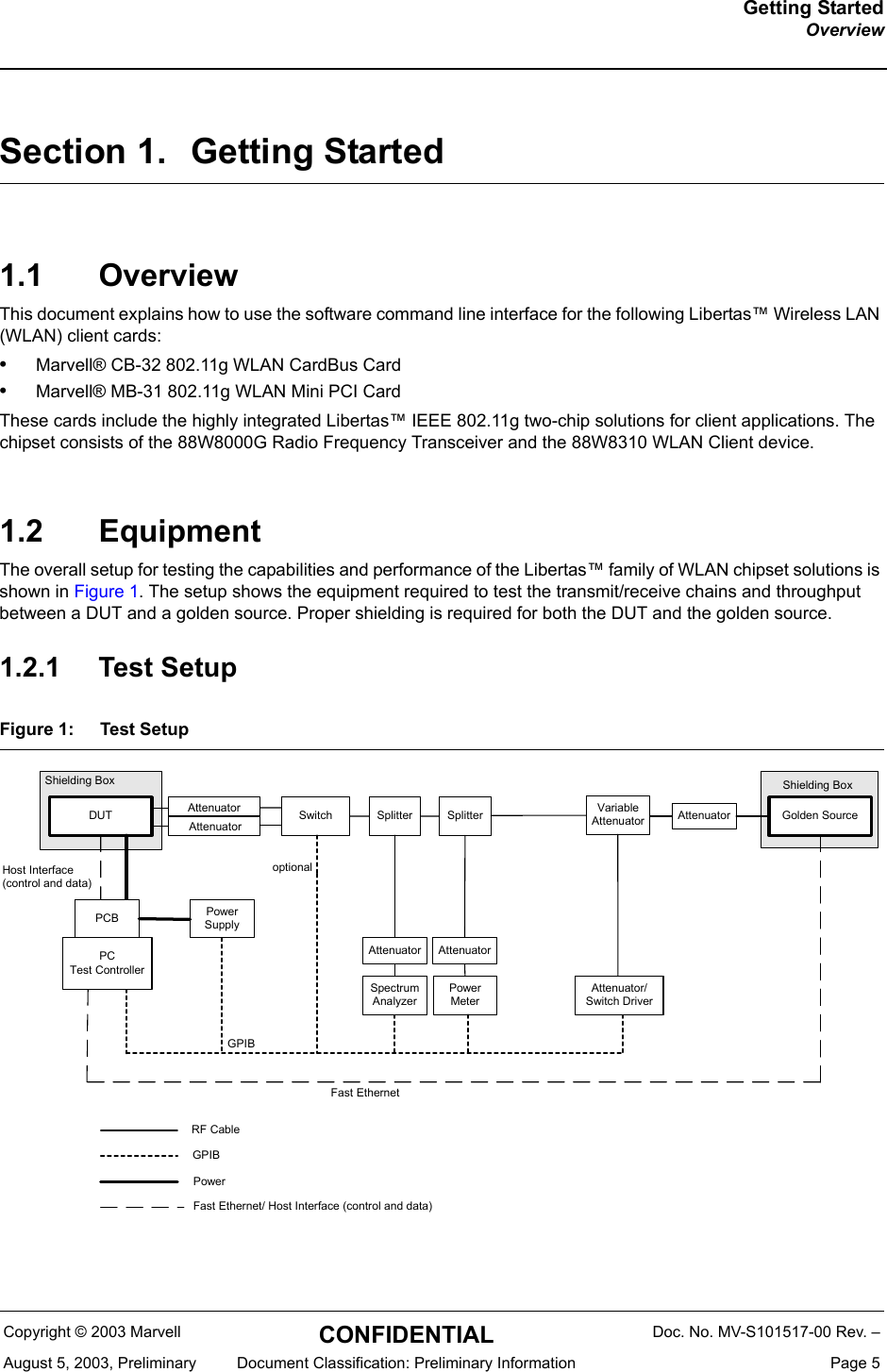
Getting StartedOverviewCopyright © 2003 Marvell CONFIDENTIAL Doc. No. MV-S101517-00 Rev. –August 5, 2003, Preliminary  Document Classification: Preliminary Information  Page 5Section 1. Getting Started1.1 OverviewThis document explains how to use the software command line interface for the following Libertas™ Wireless LAN (WLAN) client cards:•Marvell® CB-32 802.11g WLAN CardBus Card•Marvell® MB-31 802.11g WLAN Mini PCI CardThese cards include the highly integrated Libertas™ IEEE 802.11g two-chip solutions for client applications. The chipset consists of the 88W8000G Radio Frequency Transceiver and the 88W8310 WLAN Client device. 1.2 EquipmentThe overall setup for testing the capabilities and performance of the Libertas™ family of WLAN chipset solutions is shown in Figure 1. The setup shows the equipment required to test the transmit/receive chains and throughput between a DUT and a golden source. Proper shielding is required for both the DUT and the golden source.1.2.1 Test SetupFigure 1: Test SetupShielding BoxDUT SwitchPowerSupplyPowerMeterHost Interface(control and data)GPIBRF CableGPIBPowerFast Ethernet/ Host Interface (control and data)PCBPCTest ControllerAttenuatorAttenuatorFast EthernetoptionalSplitterSpectrumAnalyzerSplitterAttenuator/Switch DriverVariableAttenuator AttenuatorShielding BoxGolden SourceAttenuator Attenuator
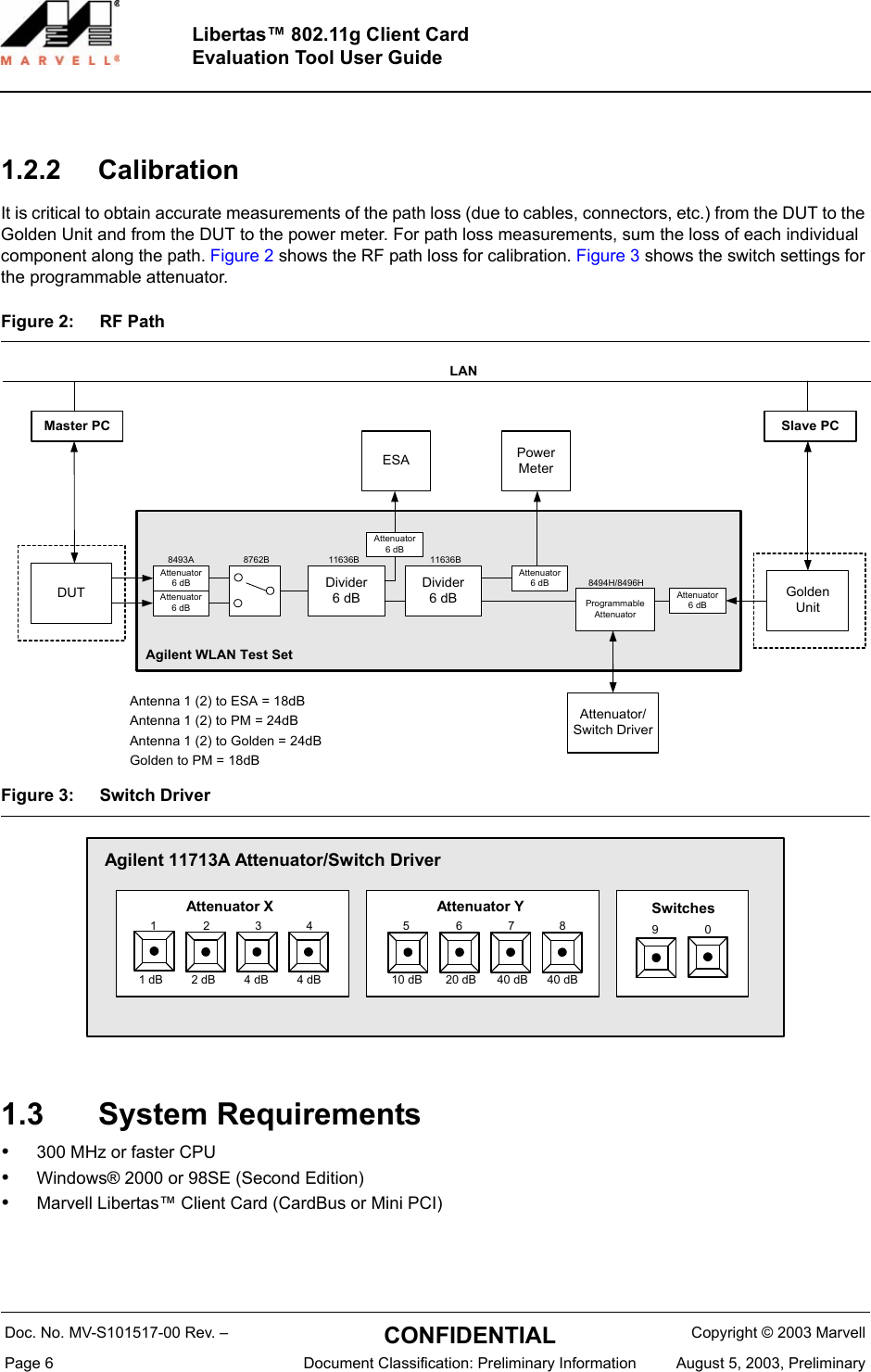
Doc. No. MV-S101517-00 Rev. –  CONFIDENTIAL  Copyright © 2003 MarvellPage 6  Document Classification: Preliminary Information August 5, 2003, PreliminaryLibertas™ 802.11g Client CardEvaluation Tool User Guide1.2.2 CalibrationIt is critical to obtain accurate measurements of the path loss (due to cables, connectors, etc.) from the DUT to the Golden Unit and from the DUT to the power meter. For path loss measurements, sum the loss of each individual component along the path. Figure 2 shows the RF path loss for calibration. Figure 3 shows the switch settings for the programmable attenuator. Figure 2: RF Path Figure 3: Switch Driver 1.3 System Requirements•300 MHz or faster CPU•Windows® 2000 or 98SE (Second Edition)•Marvell Libertas™ Client Card (CardBus or Mini PCI)Divider6 dBAgilent WLAN Test SetAttenuator6 dBAttenuator6 dBLANDUTMaster PCDivider6 dBAttenuator6 dBESAAttenuator/Switch DriverProgrammableAttenuatorAttenuator6 dBGoldenUnitSlave PC8762B8494H/8496HAttenuator6 dBPowerMeter8493A 11636B11636BAntenna 1 (2) to ESA = 18dBAntenna 1 (2) to PM = 24dBAntenna 1 (2) to Golden = 24dBGolden to PM = 18dBAttenuator X1 dB 2 dB 4 dB 4 dB1234Attenuator Y SwitchesAgilent 11713A Attenuator/Switch Driver510 dB 20 dB 40 dB 40 dB678 90
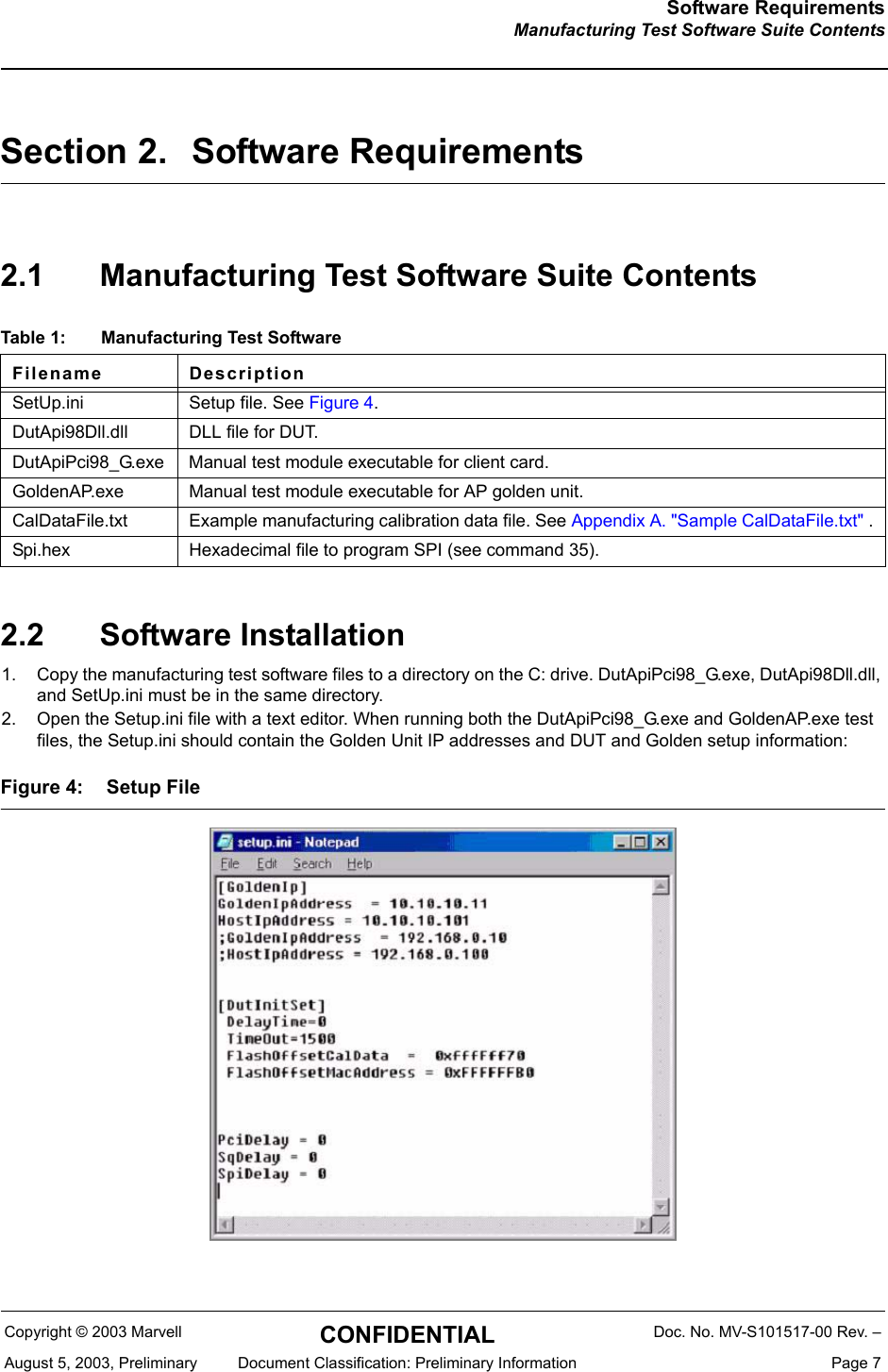
Software RequirementsManufacturing Test Software Suite ContentsCopyright © 2003 Marvell CONFIDENTIAL Doc. No. MV-S101517-00 Rev. –August 5, 2003, Preliminary  Document Classification: Preliminary Information  Page 7Section 2. Software Requirements2.1 Manufacturing Test Software Suite Contents2.2 Software Installation1. Copy the manufacturing test software files to a directory on the C: drive. DutApiPci98_G.exe, DutApi98Dll.dll, and SetUp.ini must be in the same directory.2. Open the Setup.ini file with a text editor. When running both the DutApiPci98_G.exe and GoldenAP.exe test files, the Setup.ini should contain the Golden Unit IP addresses and DUT and Golden setup information: Figure 4: Setup FileTable 1: Manufacturing Test SoftwareFilename DescriptionSetUp.ini Setup file. See Figure 4.DutApi98Dll.dll DLL file for DUT.DutApiPci98_G.exe Manual test module executable for client card.GoldenAP.exe Manual test module executable for AP golden unit.CalDataFile.txt Example manufacturing calibration data file. See Appendix A. "Sample CalDataFile.txt" .Spi.hex Hexadecimal file to program SPI (see command 35).
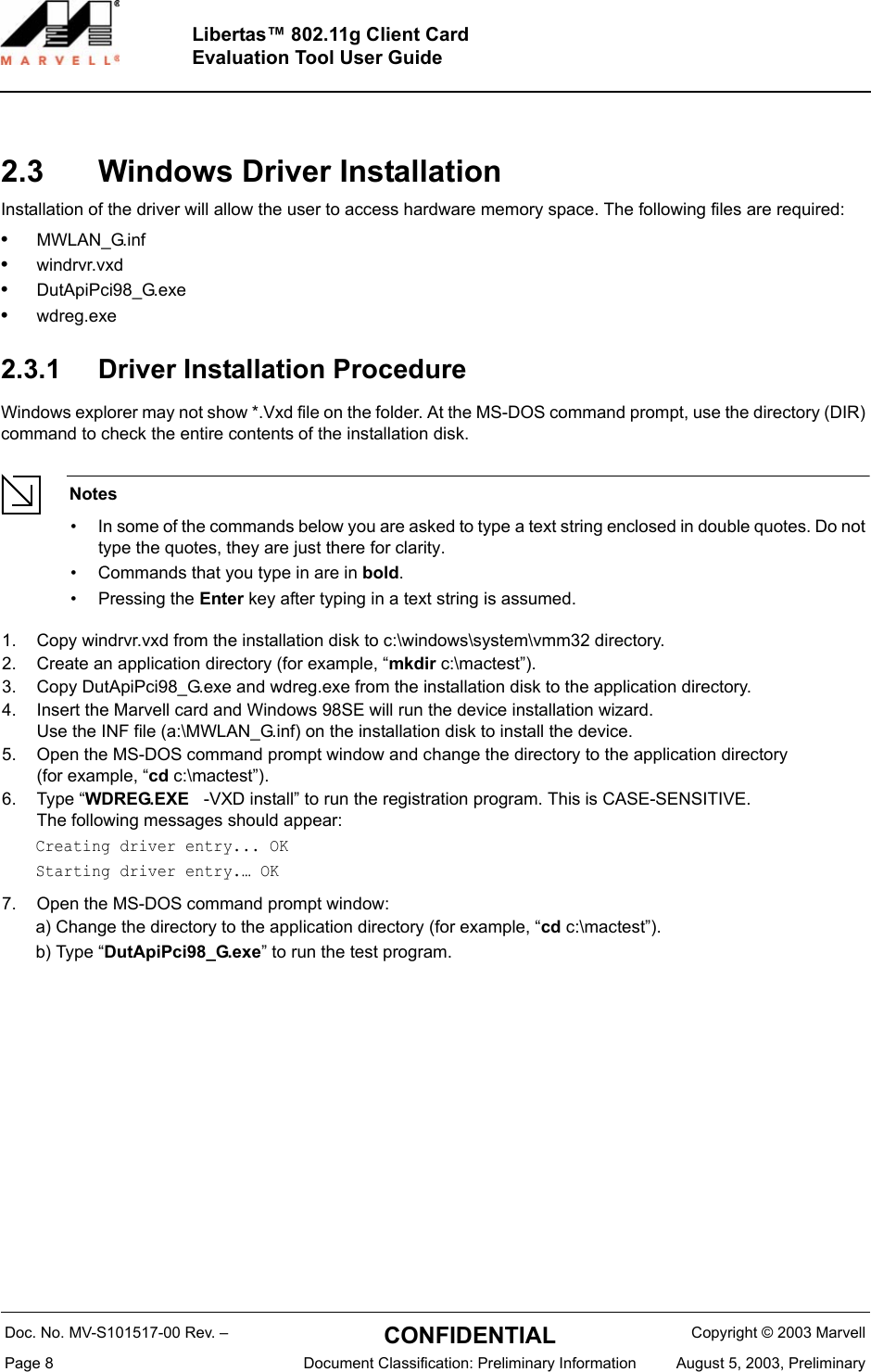
Doc. No. MV-S101517-00 Rev. –  CONFIDENTIAL  Copyright © 2003 MarvellPage 8  Document Classification: Preliminary Information August 5, 2003, PreliminaryLibertas™ 802.11g Client CardEvaluation Tool User Guide2.3 Windows Driver InstallationInstallation of the driver will allow the user to access hardware memory space. The following files are required:•MWLAN_G.inf•windrvr.vxd•DutApiPci98_G.exe•wdreg.exe2.3.1 Driver Installation ProcedureWindows explorer may not show *.Vxd file on the folder. At the MS-DOS command prompt, use the directory (DIR) command to check the entire contents of the installation disk.Notes• In some of the commands below you are asked to type a text string enclosed in double quotes. Do not type the quotes, they are just there for clarity.• Commands that you type in are in bold.• Pressing the Enter key after typing in a text string is assumed.1. Copy windrvr.vxd from the installation disk to c:\windows\system\vmm32 directory.2. Create an application directory (for example, “mkdir c:\mactest”).3. Copy DutApiPci98_G.exe and wdreg.exe from the installation disk to the application directory.4. Insert the Marvell card and Windows 98SE will run the device installation wizard. Use the INF file (a:\MWLAN_G.inf) on the installation disk to install the device.5. Open the MS-DOS command prompt window and change the directory to the application directory (for example, “cd c:\mactest”).6. Type “WDREG.EXE   -VXD install” to run the registration program. This is CASE-SENSITIVE. The following messages should appear:Creating driver entry... OKStarting driver entry.… OK7. Open the MS-DOS command prompt window:a) Change the directory to the application directory (for example, “cd c:\mactest”).b) Type “DutApiPci98_G.exe” to run the test program.
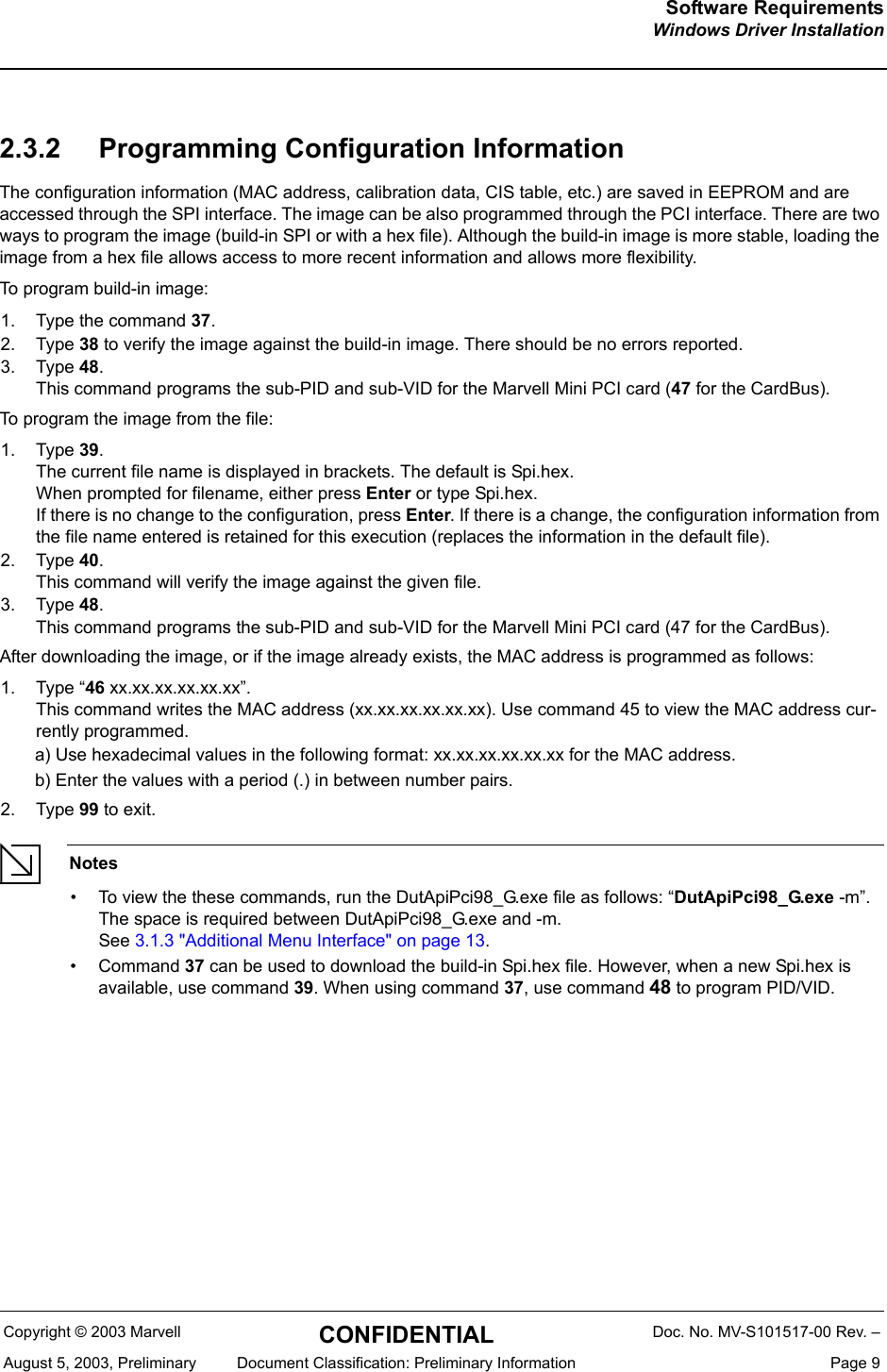
Software RequirementsWindows Driver InstallationCopyright © 2003 Marvell CONFIDENTIAL Doc. No. MV-S101517-00 Rev. –August 5, 2003, Preliminary  Document Classification: Preliminary Information  Page 92.3.2 Programming Configuration InformationThe configuration information (MAC address, calibration data, CIS table, etc.) are saved in EEPROM and are accessed through the SPI interface. The image can be also programmed through the PCI interface. There are two ways to program the image (build-in SPI or with a hex file). Although the build-in image is more stable, loading the image from a hex file allows access to more recent information and allows more flexibility.To program build-in image:1. Type the command 37.2. Type 38 to verify the image against the build-in image. There should be no errors reported.3. Type 48. This command programs the sub-PID and sub-VID for the Marvell Mini PCI card (47 for the CardBus).To program the image from the file:1. Type 39. The current file name is displayed in brackets. The default is Spi.hex.When prompted for filename, either press Enter or type Spi.hex.If there is no change to the configuration, press Enter. If there is a change, the configuration information from the file name entered is retained for this execution (replaces the information in the default file).2. Type 40. This command will verify the image against the given file.3. Type 48. This command programs the sub-PID and sub-VID for the Marvell Mini PCI card (47 for the CardBus).After downloading the image, or if the image already exists, the MAC address is programmed as follows:1. Type “46 xx.xx.xx.xx.xx.xx”.This command writes the MAC address (xx.xx.xx.xx.xx.xx). Use command 45 to view the MAC address cur-rently programmed.a) Use hexadecimal values in the following format: xx.xx.xx.xx.xx.xx for the MAC address.b) Enter the values with a period (.) in between number pairs.2. Type 99 to exit.Notes• To view the these commands, run the DutApiPci98_G.exe file as follows: “DutApiPci98_G.exe -m”.The space is required between DutApiPci98_G.exe and -m. See 3.1.3 "Additional Menu Interface" on page 13.• Command 37 can be used to download the build-in Spi.hex file. However, when a new Spi.hex is available, use command 39. When using command 37, use command 48 to program PID/VID.
Doc. No. MV-S101517-00 Rev. –  CONFIDENTIAL  Copyright © 2003 MarvellPage 10  Document Classification: Preliminary Information August 5, 2003, PreliminaryThis page is intentionally left blank.Libertas™ 802.11g Client CardEvaluation Tool User Guide
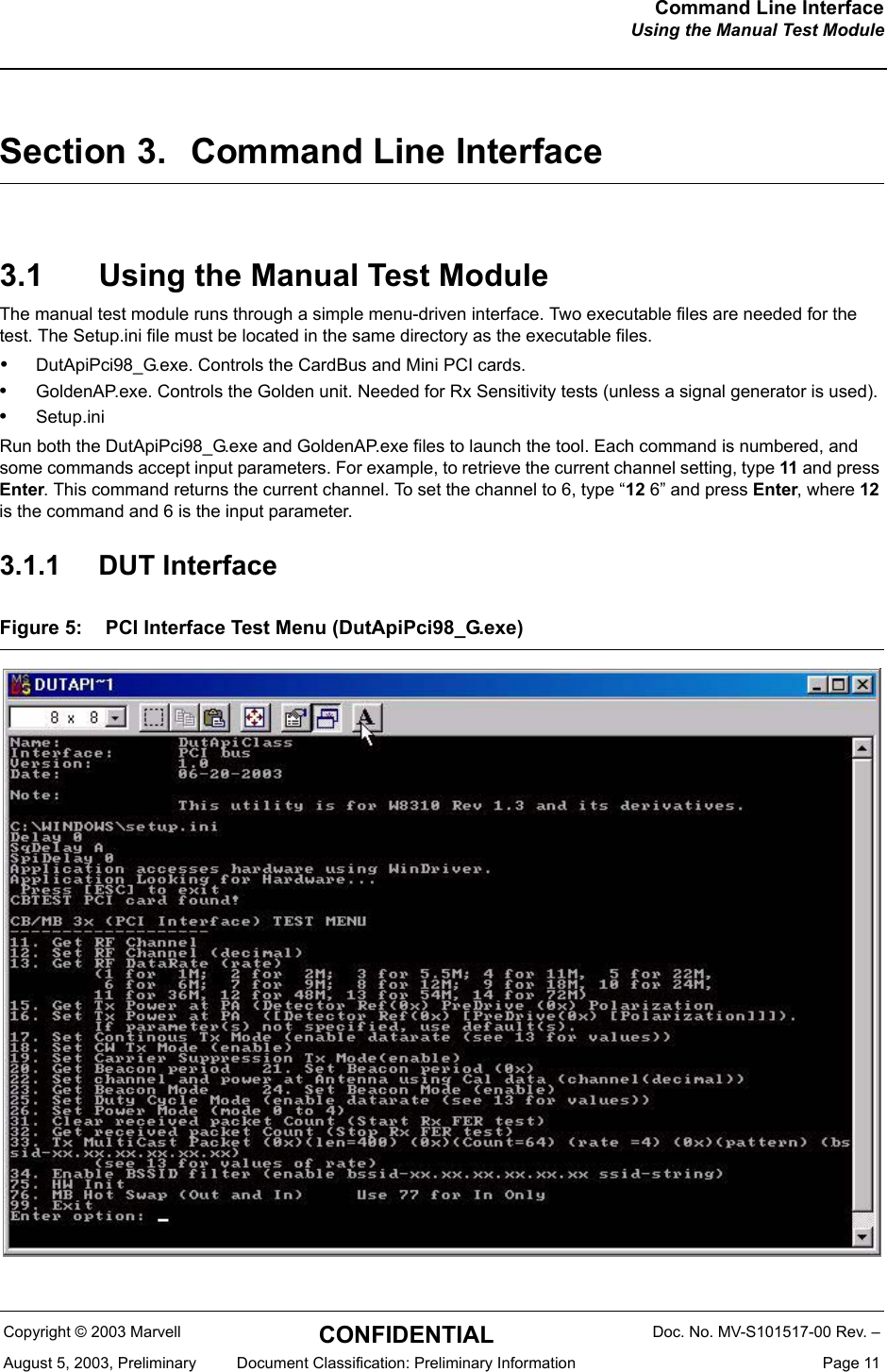
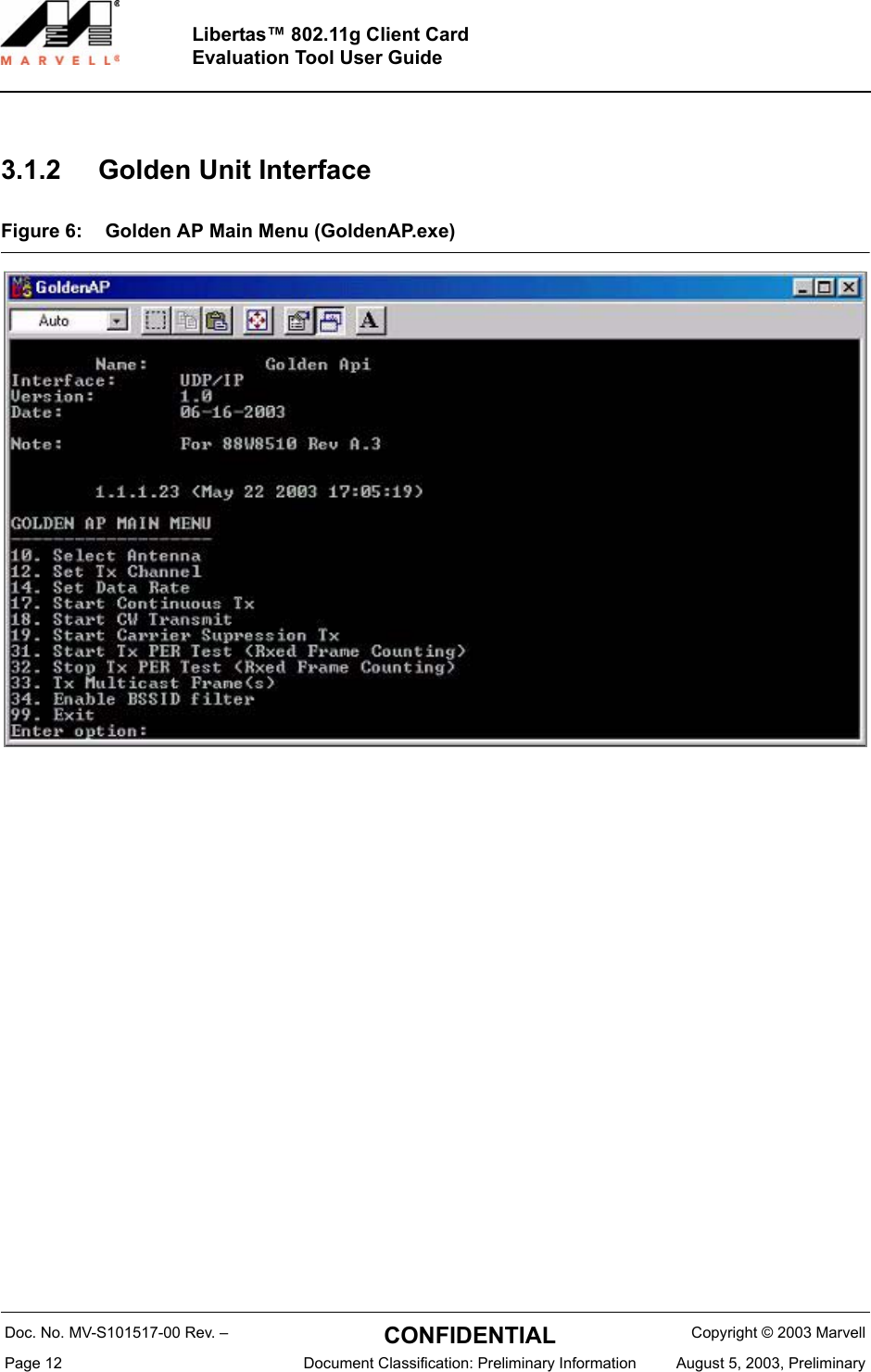
Command Line InterfaceUsing the Manual Test ModuleCopyright © 2003 Marvell CONFIDENTIAL Doc. No. MV-S101517-00 Rev. –August 5, 2003, Preliminary  Document Classification: Preliminary Information  Page 11Section 3. Command Line Interface3.1 Using the Manual Test ModuleThe manual test module runs through a simple menu-driven interface. Two executable files are needed for the test. The Setup.ini file must be located in the same directory as the executable files.•DutApiPci98_G.exe. Controls the CardBus and Mini PCI cards.•GoldenAP.exe. Controls the Golden unit. Needed for Rx Sensitivity tests (unless a signal generator is used).•Setup.iniRun both the DutApiPci98_G.exe and GoldenAP.exe files to launch the tool. Each command is numbered, and some commands accept input parameters. For example, to retrieve the current channel setting, type 11 and press Enter. This command returns the current channel. To set the channel to 6, type “12 6” and press Enter, where 12 is the command and 6 is the input parameter.3.1.1 DUT InterfaceFigure 5: PCI Interface Test Menu (DutApiPci98_G.exe)
Doc. No. MV-S101517-00 Rev. –  CONFIDENTIAL  Copyright © 2003 MarvellPage 12  Document Classification: Preliminary Information August 5, 2003, PreliminaryLibertas™ 802.11g Client CardEvaluation Tool User Guide3.1.2 Golden Unit InterfaceFigure 6: Golden AP Main Menu (GoldenAP.exe)
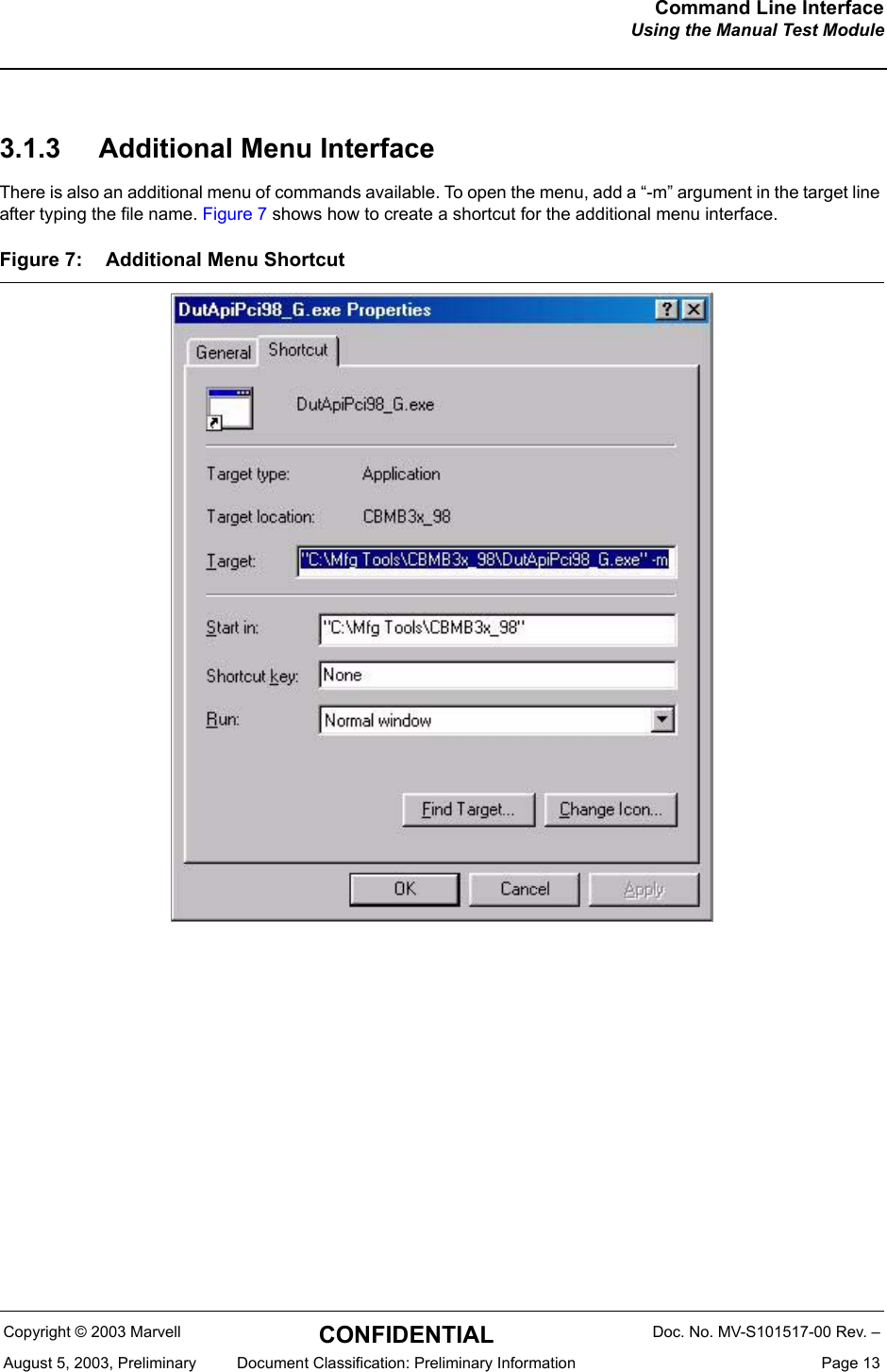
Command Line InterfaceUsing the Manual Test ModuleCopyright © 2003 Marvell CONFIDENTIAL Doc. No. MV-S101517-00 Rev. –August 5, 2003, Preliminary  Document Classification: Preliminary Information  Page 133.1.3 Additional Menu InterfaceThere is also an additional menu of commands available. To open the menu, add a “-m” argument in the target line after typing the file name. Figure 7 shows how to create a shortcut for the additional menu interface.Figure 7: Additional Menu Shortcut
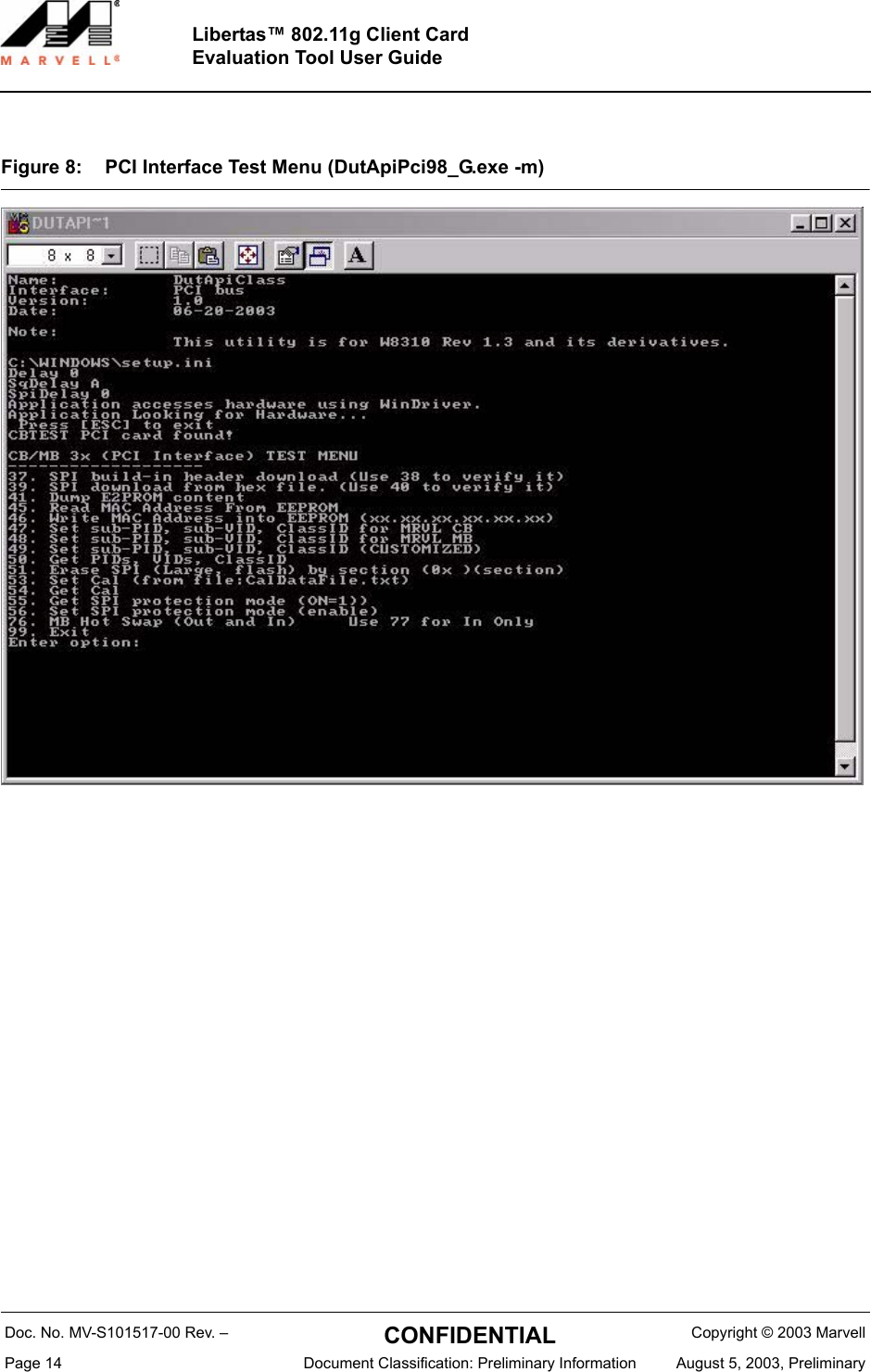
Doc. No. MV-S101517-00 Rev. –  CONFIDENTIAL  Copyright © 2003 MarvellPage 14  Document Classification: Preliminary Information August 5, 2003, PreliminaryLibertas™ 802.11g Client CardEvaluation Tool User GuideFigure 8: PCI Interface Test Menu (DutApiPci98_G.exe -m)
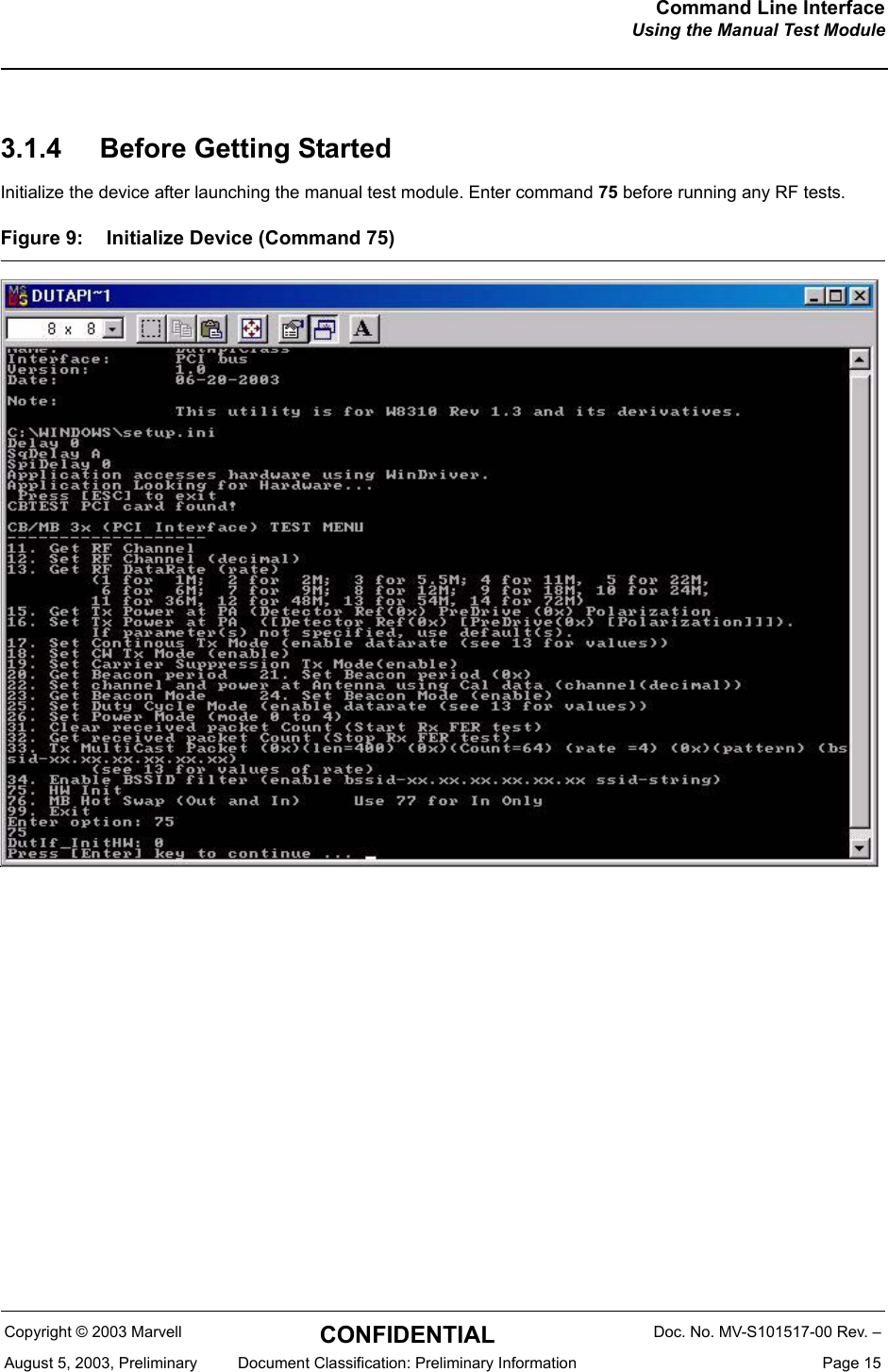
Command Line InterfaceUsing the Manual Test ModuleCopyright © 2003 Marvell CONFIDENTIAL Doc. No. MV-S101517-00 Rev. –August 5, 2003, Preliminary  Document Classification: Preliminary Information  Page 153.1.4 Before Getting StartedInitialize the device after launching the manual test module. Enter command 75 before running any RF tests.Figure 9: Initialize Device (Command 75)
Doc. No. MV-S101517-00 Rev. –  CONFIDENTIAL  Copyright © 2003 MarvellPage 16  Document Classification: Preliminary Information August 5, 2003, PreliminaryLibertas™ 802.11g Client CardEvaluation Tool User Guide3.2 Receiver Sensitivity Test3.2.1 OverviewThe receiver sensitivity test is based on frame error rate (FER). The test will send a known number of frames, count the number of frames received on the DUT, and calculate the frame error rate. According to the IEEE spec-ification, sensitivity is the lowest input power level needed to achieve a FER less than 8% for 802.11b data rates, and 10% for 802.11g data rates.For the manufacturing test, the Golden Unit is used to transmit packets.3.2.2 Test Procedure1. Launch the GoldenAP.exe and DutApiPci98_G.exe files.2. Type 75 to initialize the DUT (in the DutApiPci98_G.exe menu).3. Type “12 x” (where “x” is the channel number) to set the desired channel on the DUT.4. Type 31 to clear the received packet counter.5. OPTIONAL: Type “34 1 11.22.33.44.55.66” to filter on BSSID. In this example, only frames with BSSID = 11.22.33.44.55.66 will be counted.6. Set the channel for the Golden Unit (in the GoldenAP.exe menu).Type 33. The user is prompted to enter the length, count, data rate, pattern, and BSSID as parameters.7. Type 32 to read the received packet counter. The DUT will report the number of frames received correctly (for example, no CRC error), the number of multicast frames received correctly, and the number of frames received with CRC errors. Calculate the FER based on the number of frames sent by the Golden Unit.8. If necessary, adjust the settings on the programmable attenuators to achieve the desired FER.NoteTo verify the DUT is properly shielded, clear the received packet counter, wait a few seconds, and read the packet counter. The packet counter should read 0.
Command Line InterfaceTransmitter TestsCopyright © 2003 Marvell CONFIDENTIAL Doc. No. MV-S101517-00 Rev. –August 5, 2003, Preliminary  Document Classification: Preliminary Information  Page 173.3 Transmitter TestsAs an example, this section describes how to use the manual test module to set the DUT to Tx mode.1. Connect antenna port 1 to the spectrum analyzer and power meter.2. Start the manual test module.3. Type 75 to initialize the DUT.4. Type “12 x” (where “x” is the channel number) to set the desired channel on the DUT.5. Type “17 1 13” to enable continuous transmission at the 54 Mbps data rate. The device will output a continu-ous modulated signal.6. Type “17 0” to disable continuous transmission.7. Type “18 1” to enable carrier wave continuous transmission.8. Type “18 0” to disable carrier wave continuous transmission.9. Type “33 400 64 13 AAAAAAAA xx.xx.xx.xx.xx.xx” (where AA’s are the frame pattern and xx’s are the BSSID) to transmit 100 1 KB data packets at a 54 Mbps data rate.Notes• The default register values provided by Marvell are the settings used to achieve the highest output power while still meeting the IEEE specification requirements.• If the measured EVM is higher than specified in the IEEE specification, please contact your Marvell Field Applications Engineer.
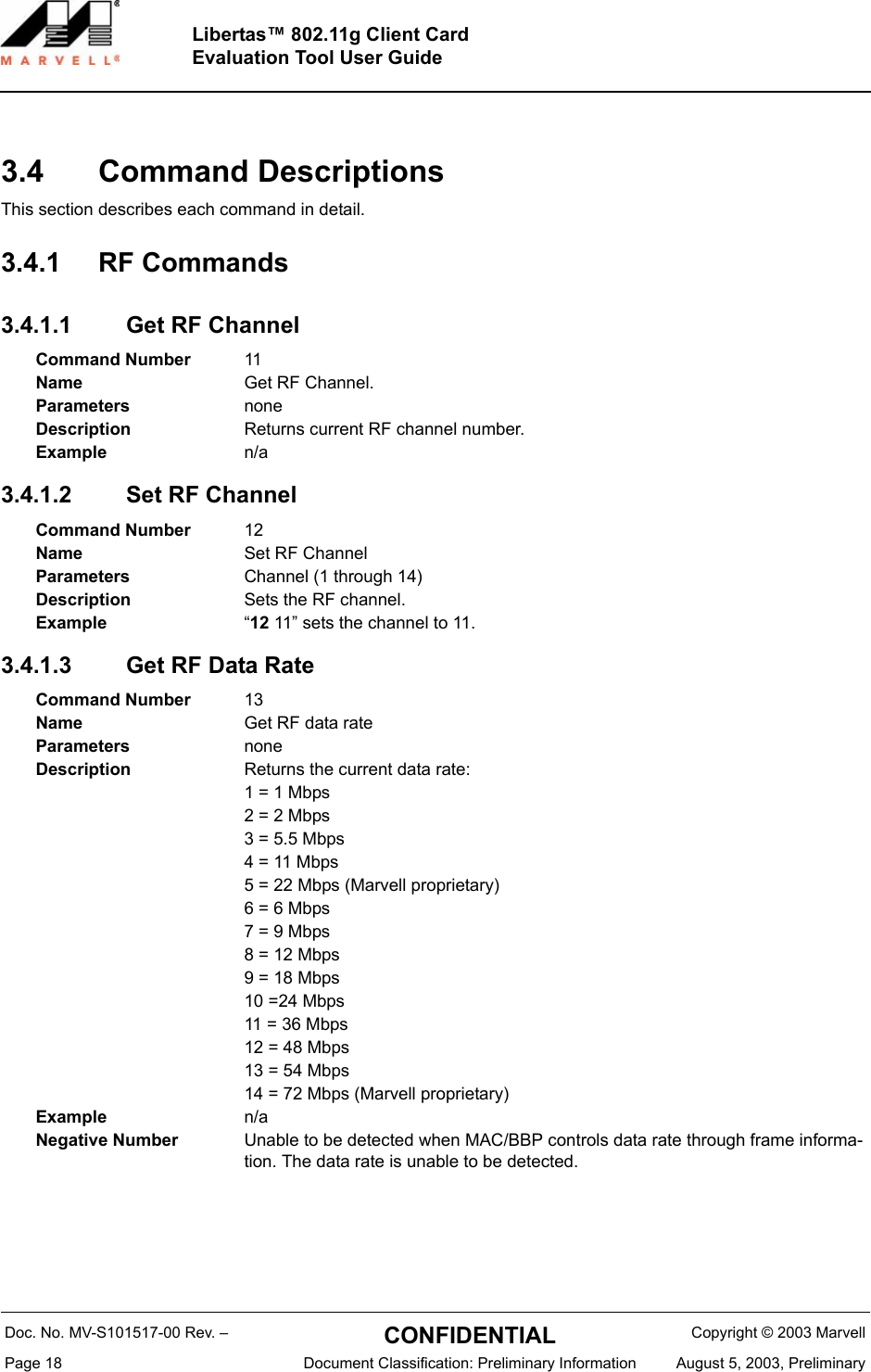
Doc. No. MV-S101517-00 Rev. –  CONFIDENTIAL  Copyright © 2003 MarvellPage 18  Document Classification: Preliminary Information August 5, 2003, PreliminaryLibertas™ 802.11g Client CardEvaluation Tool User Guide3.4 Command DescriptionsThis section describes each command in detail.3.4.1 RF Commands3.4.1.1 Get RF Channel3.4.1.2 Set RF Channel 3.4.1.3 Get RF Data RateCommand Number 11Name Get RF Channel.Parameters noneDescription Returns current RF channel number.Example n/aCommand Number 12Name Set RF ChannelParameters Channel (1 through 14)Description Sets the RF channel.Example “12 11” sets the channel to 11.Command Number 13Name Get RF data rateParameters noneDescription Returns the current data rate:1 = 1 Mbps2 = 2 Mbps3 = 5.5 Mbps4 = 11 Mbps5 = 22 Mbps (Marvell proprietary)6 = 6 Mbps7 = 9 Mbps8 = 12 Mbps9 = 18 Mbps10 =24 Mbps11 = 36 Mbps12 = 48 Mbps13 = 54 Mbps14 = 72 Mbps (Marvell proprietary)Example n/aNegative Number Unable to be detected when MAC/BBP controls data rate through frame informa-tion. The data rate is unable to be detected.
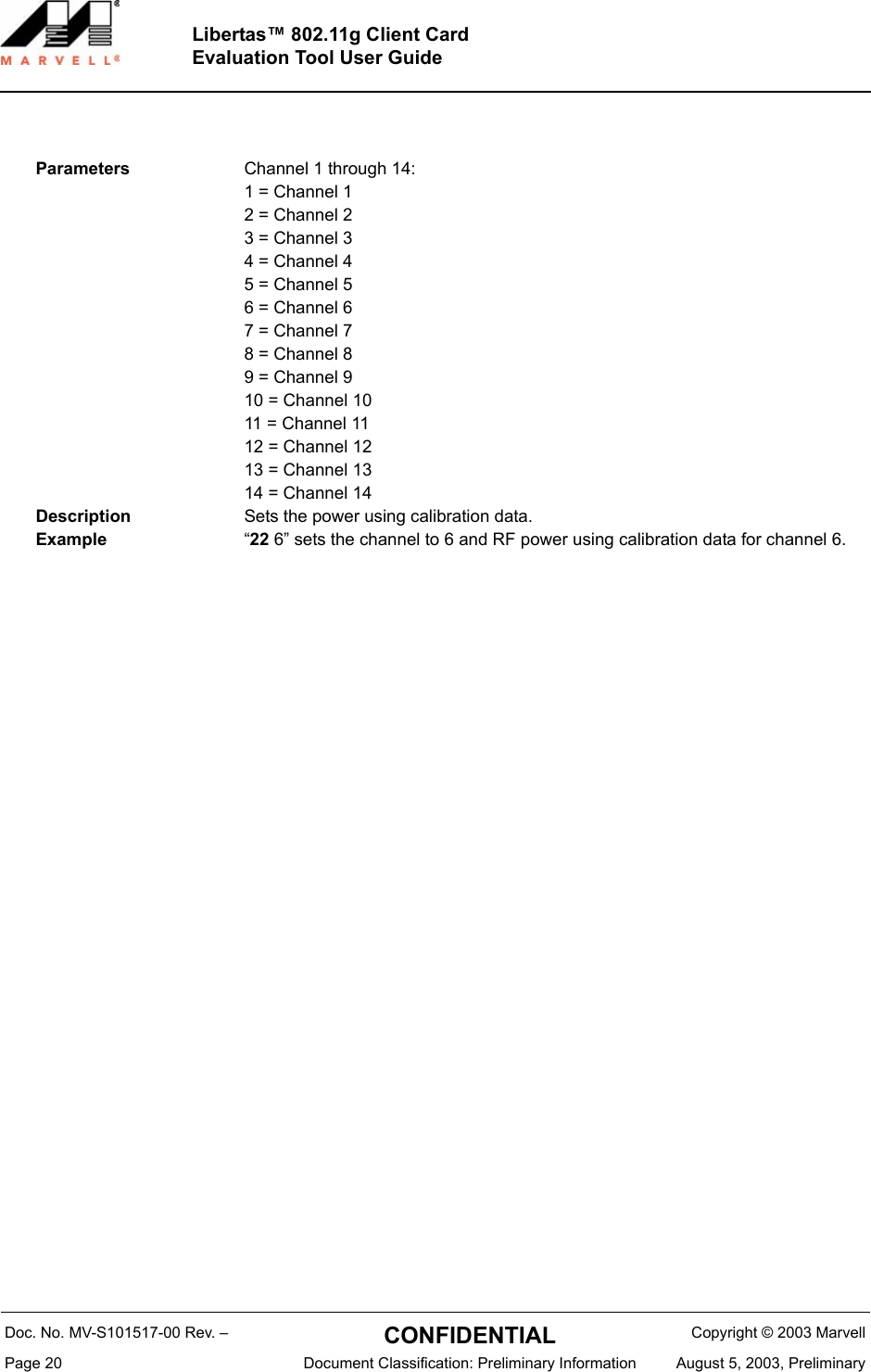
Command Line InterfaceCommand DescriptionsCopyright © 2003 Marvell CONFIDENTIAL Doc. No. MV-S101517-00 Rev. –August 5, 2003, Preliminary  Document Classification: Preliminary Information  Page 193.4.1.4 Get Tx Power at PA3.4.1.5 Set Tx Power at PA3.4.1.6 Set Continuous Modulated Waveform Mode3.4.1.7 Set Continuous Waveform Transmission Mode3.4.1.8 Set Carrier Suppression Mode3.4.1.9 Set Channel and Power at Antenna with Calibration DataCommand Number 15Name Get Tx Power at PAParameters NoneDescription Returns the RF power settings.(RF power detector reference; predrive and polarization values).Example n/aCommand Number 16Name Set Tx Power at PA16 [RefDac [predriver [externalPApolarization]]Parameters Detector ReferencePredrivePolarizationDescription Sets the RF power.Example “16 [DetRef] [Predrive] [Polarization]”Command Number 17 [enable_dataRate]Name Set Continuous Modulated Waveform ModeParameters Enable (1 = enable, 0 = disable) data rateDescription Sets the device for continuous transmission of a modulated waveform.Example “17 1 13” sets the device for continuous transmission at the 54 Mbps data rate.“17 0” disables continuous transmission.Command Number 18Name Set Continuous Waveform Transmission ModeParameters Enable (1 = enable, 0 = disable)Description Sets the device to continuously transmit a carrier waveform.Example “18 1” sets the device to continuously transmit a carrier waveform.“18 0” disables this mode.Command Number 19Name Set Carrier Suppression Transmission ModeParameters Enable (1 = enable, 0 = disable)Description Sets the device for Carrier Suppression Transmission Mode.Example “19 1” sets the device for Carrier Suppression Transmission Mode.Command Number 22Name Set channel and RF power at antenna with calibration data for the channel
Doc. No. MV-S101517-00 Rev. –  CONFIDENTIAL  Copyright © 2003 MarvellPage 20  Document Classification: Preliminary Information August 5, 2003, PreliminaryLibertas™ 802.11g Client CardEvaluation Tool User GuideParameters Channel 1 through 14:1 = Channel 12 = Channel 23 = Channel 34 = Channel 45 = Channel 56 = Channel 67 = Channel 78 = Channel 89 = Channel 910 = Channel 1011 = Channel 1112 = Channel 1213 = Channel 1314 = Channel 14Description Sets the power using calibration data.Example “22 6” sets the channel to 6 and RF power using calibration data for channel 6.
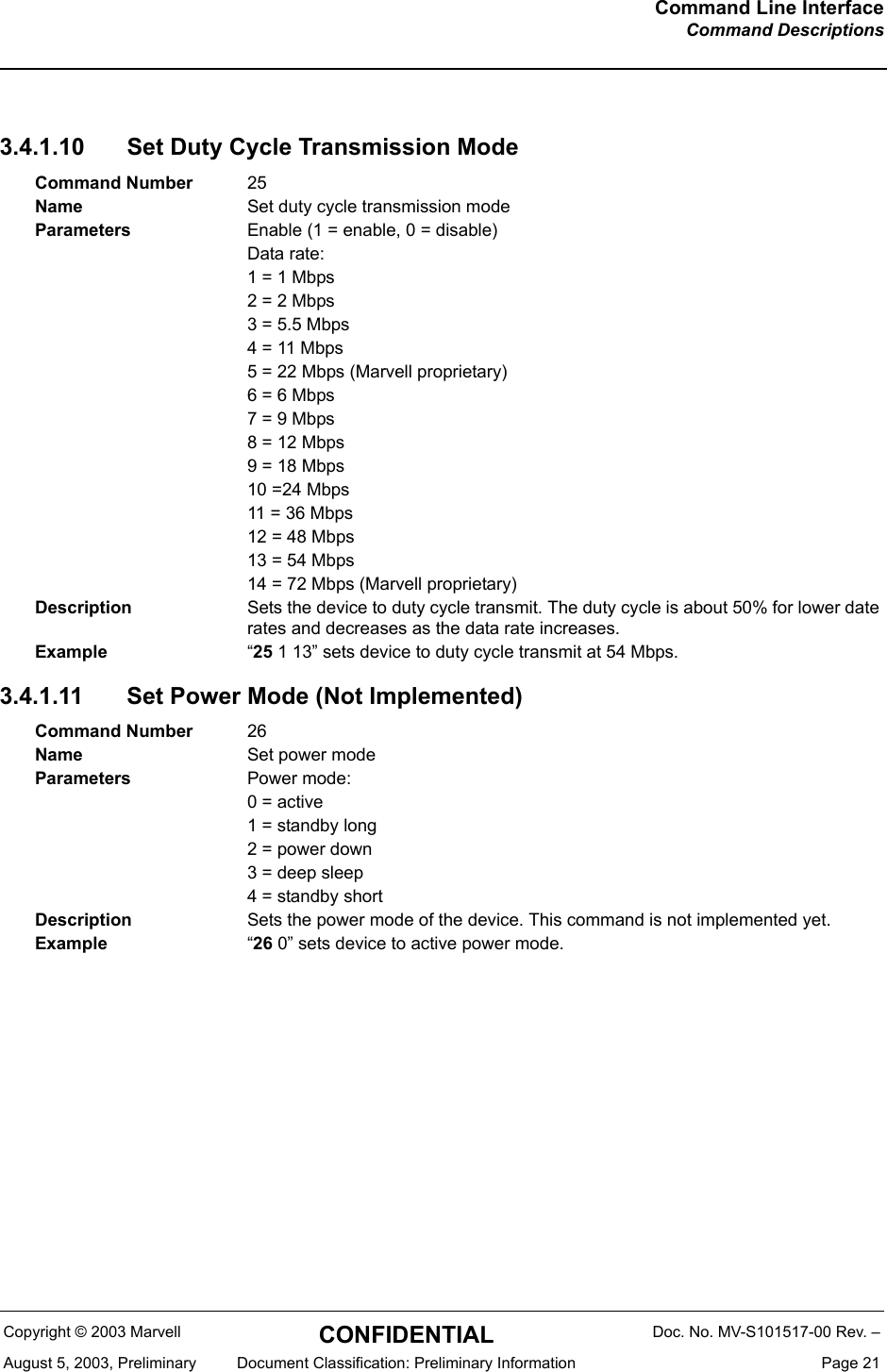
Command Line InterfaceCommand DescriptionsCopyright © 2003 Marvell CONFIDENTIAL Doc. No. MV-S101517-00 Rev. –August 5, 2003, Preliminary  Document Classification: Preliminary Information  Page 213.4.1.10 Set Duty Cycle Transmission Mode3.4.1.11 Set Power Mode (Not Implemented)Command Number 25Name Set duty cycle transmission modeParameters Enable (1 = enable, 0 = disable)Data rate:1 = 1 Mbps2 = 2 Mbps3 = 5.5 Mbps4 = 11 Mbps5 = 22 Mbps (Marvell proprietary)6 = 6 Mbps7 = 9 Mbps8 = 12 Mbps9 = 18 Mbps10 =24 Mbps11 = 36 Mbps12 = 48 Mbps13 = 54 Mbps14 = 72 Mbps (Marvell proprietary)Description Sets the device to duty cycle transmit. The duty cycle is about 50% for lower date rates and decreases as the data rate increases.Example “25 1 13” sets device to duty cycle transmit at 54 Mbps.Command Number 26Name Set power modeParameters Power mode:0 = active1 = standby long2 = power down3 = deep sleep4 = standby shortDescription Sets the power mode of the device. This command is not implemented yet.Example “26 0” sets device to active power mode.
Doc. No. MV-S101517-00 Rev. –  CONFIDENTIAL  Copyright © 2003 MarvellPage 22  Document Classification: Preliminary Information August 5, 2003, PreliminaryLibertas™ 802.11g Client CardEvaluation Tool User Guide3.4.2 FER Commands3.4.2.1 Clear Received Packet Counter3.4.2.2 Get Received Packet CounterNoteBecause of the timing difference in Reading the counters, if you are in an environment that has continuous traffic, MultiCPckt count could be larger than RxPckt count.Command Number 31Name Clear Received packet counterParameters noneDescription Clears the received packet counter.Example n/aCommand Number 32Name Get received packet counterParameters noneDescription Returns the following values:GetRxPckt: Number of correctly received packets (no CRC error), including unicast and multicast.GetRxMultiCPkt: Number of correctly received multicast packets (a subset of the first number).GetRxErrPckt: Number of received packets with CRC errors. Frame error rate based on detected packets [GetRxErrPckt/(GetRxPckt + GetRxErrPckt)].Example n/a
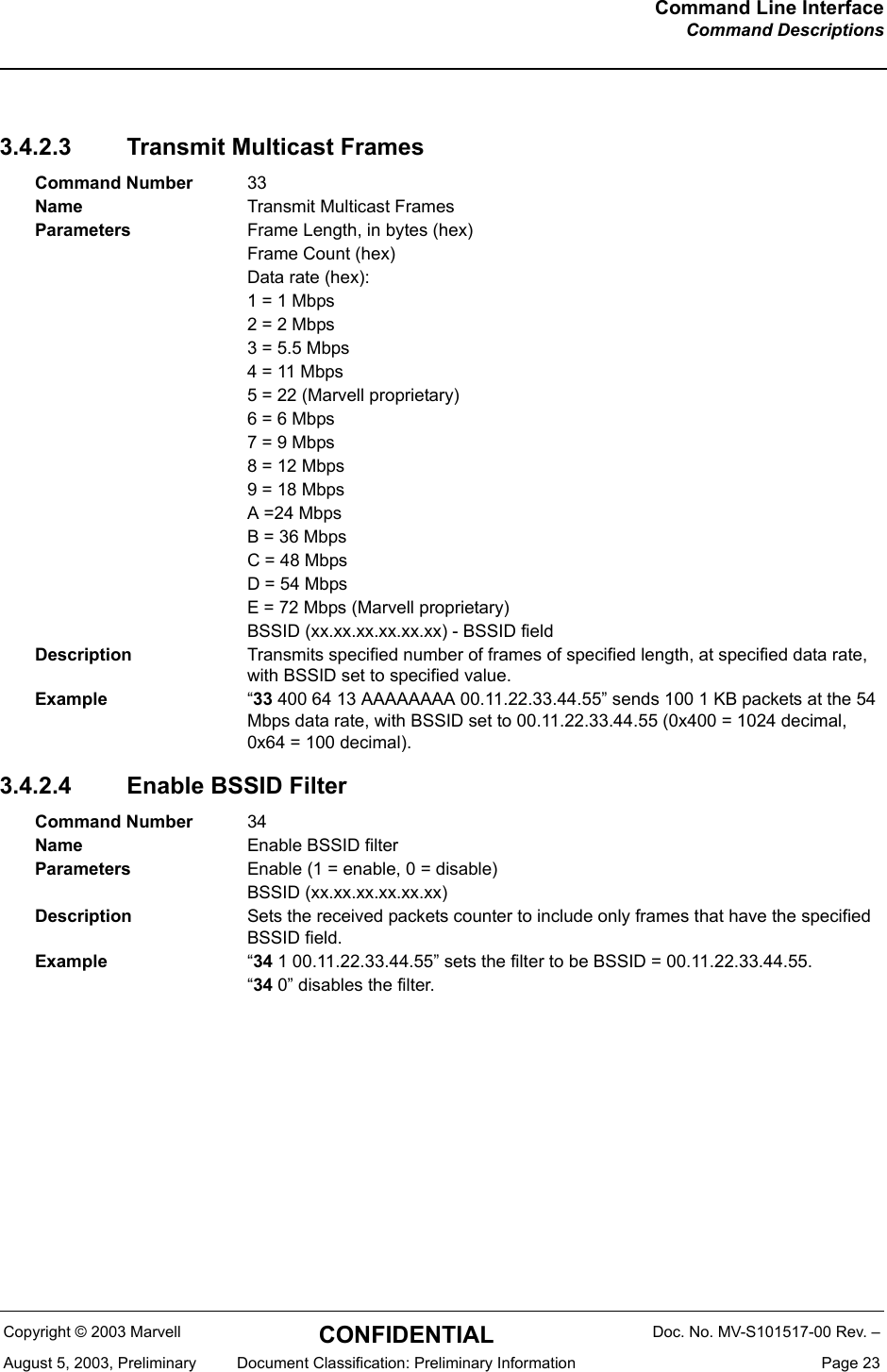
Command Line InterfaceCommand DescriptionsCopyright © 2003 Marvell CONFIDENTIAL Doc. No. MV-S101517-00 Rev. –August 5, 2003, Preliminary  Document Classification: Preliminary Information  Page 233.4.2.3 Transmit Multicast Frames3.4.2.4 Enable BSSID FilterCommand Number 33Name Transmit Multicast FramesParameters Frame Length, in bytes (hex)Frame Count (hex)Data rate (hex):1 = 1 Mbps2 = 2 Mbps3 = 5.5 Mbps4 = 11 Mbps5 = 22 (Marvell proprietary)6 = 6 Mbps7 = 9 Mbps8 = 12 Mbps9 = 18 MbpsA =24 MbpsB = 36 MbpsC = 48 MbpsD = 54 MbpsE = 72 Mbps (Marvell proprietary)BSSID (xx.xx.xx.xx.xx.xx) - BSSID fieldDescription Transmits specified number of frames of specified length, at specified data rate, with BSSID set to specified value.Example “33 400 64 13 AAAAAAAA 00.11.22.33.44.55” sends 100 1 KB packets at the 54 Mbps data rate, with BSSID set to 00.11.22.33.44.55 (0x400 = 1024 decimal, 0x64 = 100 decimal).Command Number 34Name Enable BSSID filterParameters Enable (1 = enable, 0 = disable)BSSID (xx.xx.xx.xx.xx.xx)Description Sets the received packets counter to include only frames that have the specified BSSID field.Example “34 1 00.11.22.33.44.55” sets the filter to be BSSID = 00.11.22.33.44.55.“34 0” disables the filter.
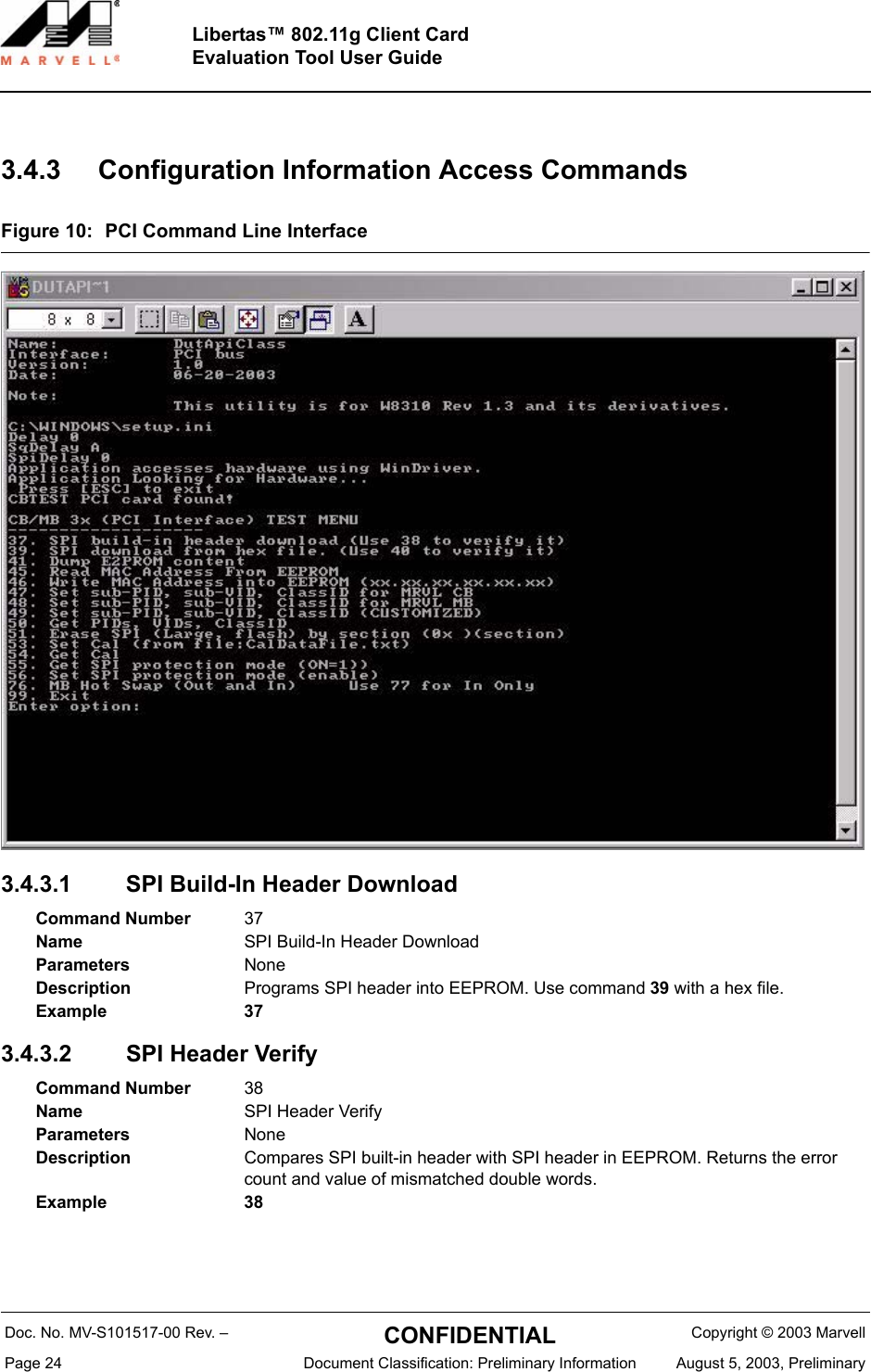
Doc. No. MV-S101517-00 Rev. –  CONFIDENTIAL  Copyright © 2003 MarvellPage 24  Document Classification: Preliminary Information August 5, 2003, PreliminaryLibertas™ 802.11g Client CardEvaluation Tool User Guide3.4.3 Configuration Information Access CommandsFigure 10: PCI Command Line Interface3.4.3.1 SPI Build-In Header Download 3.4.3.2 SPI Header Verify Command Number 37Name SPI Build-In Header DownloadParameters NoneDescription Programs SPI header into EEPROM. Use command 39 with a hex file.Example 37Command Number 38Name SPI Header VerifyParameters NoneDescription Compares SPI built-in header with SPI header in EEPROM. Returns the error count and value of mismatched double words.Example 38
Command Line InterfaceCommand DescriptionsCopyright © 2003 Marvell CONFIDENTIAL Doc. No. MV-S101517-00 Rev. –August 5, 2003, Preliminary  Document Classification: Preliminary Information  Page 253.4.3.3 SPI Download3.4.3.4 SPI Verify3.4.3.5 Display SPI EEPROM Content3.4.4 SPI/Flash Access Commands3.4.4.1 Read MAC AddressCommand Number 39Name SPI Download from Hexadecimal FileParameters NoneDescription Programs the SPI header using a hex file. The command will prompt the user for the filename (Spi.hex is default).Example 39Command Number 40Name SPI Verify from Hexadecimal FileParameters NoneDescription Compares SPI built-in header with hex file. Returns the error count and value of mismatched double words.Example 40Command Number 41Name Display SPI EEPROM ContentParameters (0x)(0x)(startAddress)(Length)Description Displays the SPI EEPROM.Example “41 0 20” will display 32 DWORDS starting from offset 0.Command Number 45Name Read MAC AddressParameters NoneDescription Returns the MAC address programmed in the EEPROM.Example 45
Doc. No. MV-S101517-00 Rev. –  CONFIDENTIAL  Copyright © 2003 MarvellPage 26  Document Classification: Preliminary Information August 5, 2003, PreliminaryLibertas™ 802.11g Client CardEvaluation Tool User Guide3.4.4.2 Write MAC Address3.4.4.3 Set sub-PID sub-VID Class ID for Marvell CardBus Card3.4.4.4 Set sub-PID sub-VID Class ID for Marvell Mini PCI Card3.4.4.5 Set sub-PID sub-VID Class ID (Customized) 3.4.4.6 Get PID VID Class IDCommand Number 46Name Write MAC Address into EEPROM/FlashParameters xx.xx.xx.xx.xx.xxDescription Writes the MAC address.Example “46 10.22.33.44.55.66”Command Number 47Name Set sub-PID sub-VID Class ID for Marvell CardBus CardParameters NoneDescription Writes the Product ID and Vendor ID for CardBus.Example 47Command Number 48Name Set sub-PID sub-VID Class ID for Marvell Mini PCI CardParameters NoneDescription Writes the Product ID and Vendor ID for Mini PCI.Example 48Command Number 49Name Set sub-PID sub-VID Class ID (Customized)Parameters Will read back current IDs then prompt for new IDs.Description Programs a customized ID.Example 49Command Number 50Name Get PID VID Class IDParameters NoneDescription Returns the PID and VID.Example 50
Command Line InterfaceCommand DescriptionsCopyright © 2003 Marvell CONFIDENTIAL Doc. No. MV-S101517-00 Rev. –August 5, 2003, Preliminary  Document Classification: Preliminary Information  Page 273.4.4.7 Erase Flash3.4.4.8 Write Calibration Table3.4.4.9 Read Calibration Table3.4.4.10 Get SPI Protection3.4.4.11 Set SPI Protection3.4.5 Device Specific Commands3.4.5.1 Client Hardware Initialization Command Number 51Name Erase FlashParameters (0x)(section)Description Erases Flash memory. This command is only supported for large EEPROM sizes (1 Mbit) and will not erase small EEPROM.Example n/aCommand Number 53Name Write Calibration TableParameters noneDescription Writes calibration table data from the file CalDataFile.txt.Example 53 <<Given sample file here>>Command Number 54Name Read Calibration TableParameters NoneDescription Returns the calibration table data.Example 54Command Number 55Name Get SPI ProtectionParameters NoneDescription Retrieves setting of SPI protection status bit.Example 55Command Number 56Name Set SPI ProtectionParameters 1 = enables protection0 = disables protectionDescription Sets SPI protection.Example “56 1” enables protection.“56 0” disables protection.Note: Each write action from this program will set SPI protection mode to enable to prvent accidental crash-ing of the image.Command Number 75Name HW Init
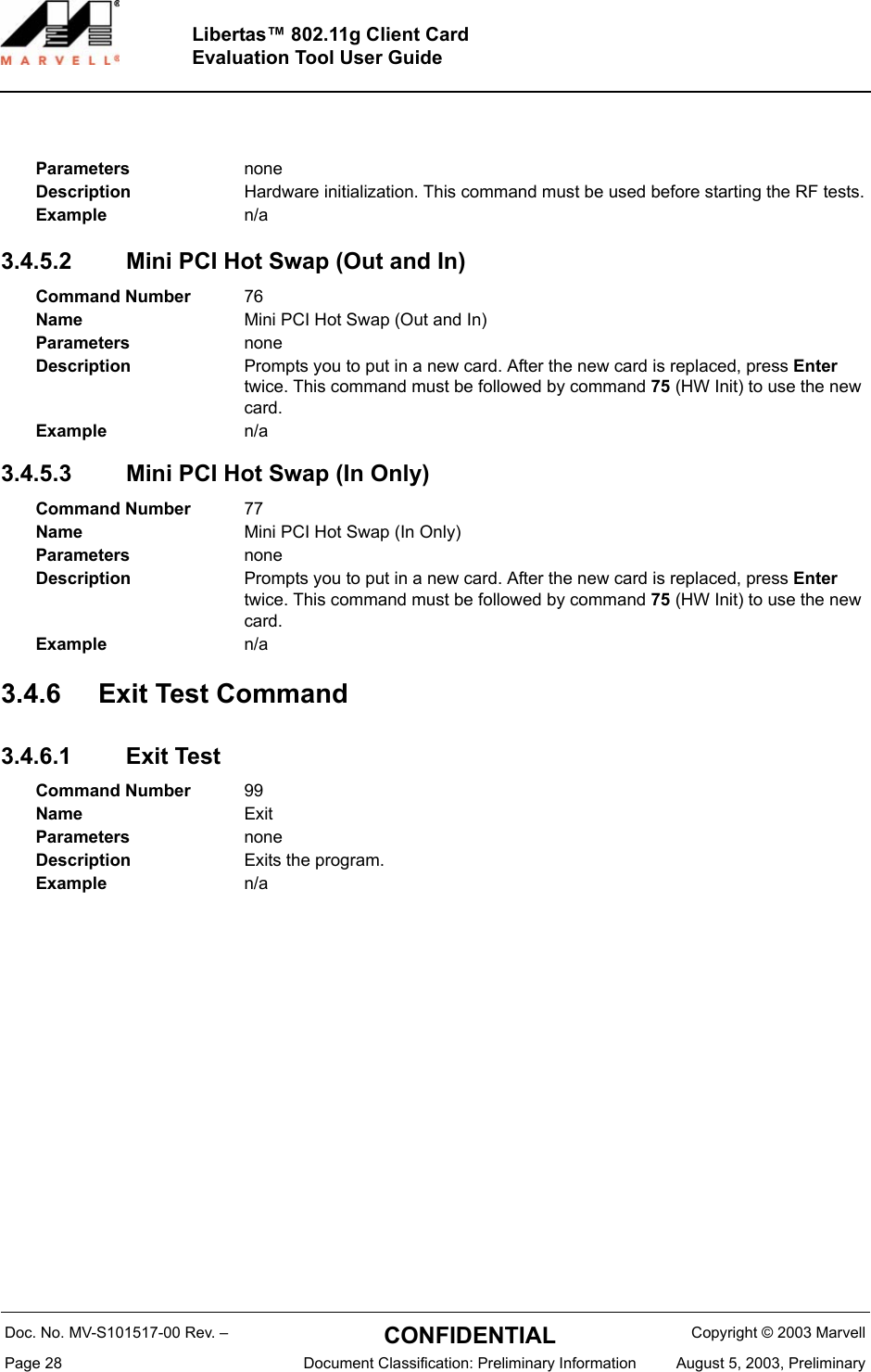
Doc. No. MV-S101517-00 Rev. –  CONFIDENTIAL  Copyright © 2003 MarvellPage 28  Document Classification: Preliminary Information August 5, 2003, PreliminaryLibertas™ 802.11g Client CardEvaluation Tool User Guide3.4.5.2 Mini PCI Hot Swap (Out and In)3.4.5.3 Mini PCI Hot Swap (In Only)3.4.6 Exit Test Command3.4.6.1 Exit TestParameters noneDescription Hardware initialization. This command must be used before starting the RF tests.Example n/aCommand Number 76Name Mini PCI Hot Swap (Out and In)Parameters noneDescription Prompts you to put in a new card. After the new card is replaced, press Enter twice. This command must be followed by command 75 (HW Init) to use the new card.Example n/aCommand Number 77Name Mini PCI Hot Swap (In Only)Parameters noneDescription Prompts you to put in a new card. After the new card is replaced, press Enter twice. This command must be followed by command 75 (HW Init) to use the new card.Example n/aCommand Number 99Name ExitParameters noneDescription Exits the program.Example n/a
Sample CalDataFile.txtCopyright © 2003 Marvell CONFIDENTIAL Doc. No. MV-S101517-00 Rev. –August 5, 2003, Preliminary  Document Classification: Preliminary Information  Page 29Appendix A. Sample CalDataFile.txt[Configuration]Board = MB31-001StructRev = 1Pa_External = 3AntHw =0x0a[LED]Led0 = 0xFFLed1 = 0xFFLed2 = 0xFFLed3 = 0xFF[CC]CC_primary = 0x10CC_secondary = 0xFF[CCA1]CCA_0 = 0xffCCA_1 = 0xffCCA_2 = 0xffCCA_3 = 0xff[CCA2]CCA_0 = 0xffCCA_1 = 0xffCCA_2 = 0xffCCA_3 = 0xff[Cus]Cus_0 = 0xffCus_1 = 0xff
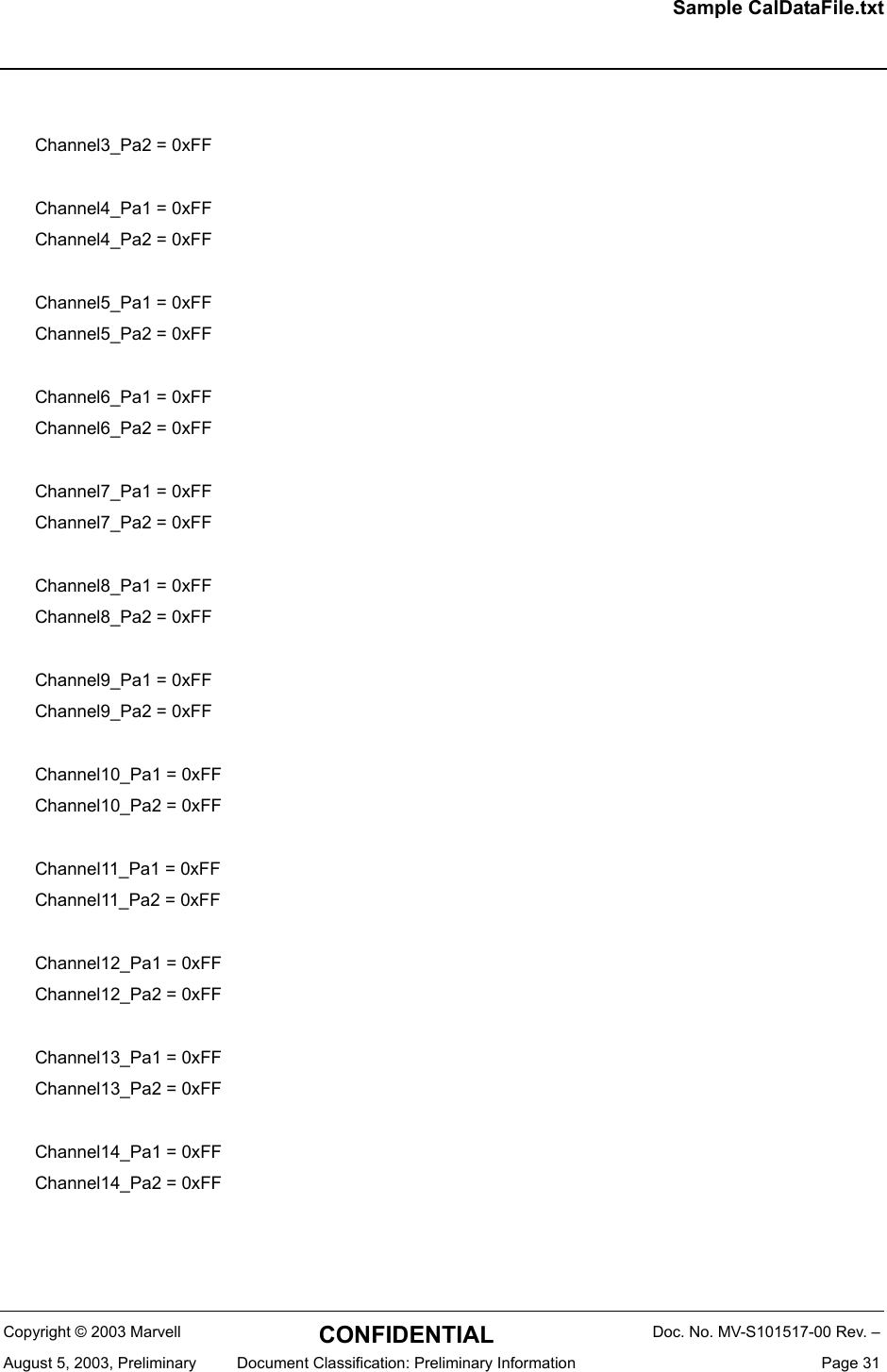
Doc. No. MV-S101517-00 Rev. –  CONFIDENTIAL  Copyright © 2003 MarvellPage 30  Document Classification: Preliminary Information August 5, 2003, PreliminaryLibertas™ 802.11g Client CardEvaluation Tool User Guide[CalData]CalTableOption =1ant2NotCaled = 1ExtPaPolar_neg = 0 ExterPA_PartId = 0x3ExterPA_PreDriv = 0x4Xosc =1635;Channel1_Ant2Adjust =0;Channel1_Loss = 4;Channel1_Tune = 4Channel1_PDref = 0x60Channel2_PDref = 0x5eChannel3_PDref = 0x5cChannel4_PDref = 0x58Channel5_PDref = 0x58Channel6_PDref = 0x56Channel7_PDref = 0x54Channel8_PDref = 0x53Channel9_PDref = 0x53Channel10_PDref = 0x54Channel11_PDref = 0x56Channel12_PDref = 0x56Channel13_PDref = 0x56Channel14_PDref = 0x56Channel1_Pa1 = 0xFFChannel1_Pa2 = 0xFFChannel2_Pa1 = 0xFFChannel2_Pa2 = 0xFFChannel3_Pa1 = 0xFF
Sample CalDataFile.txtCopyright © 2003 Marvell CONFIDENTIAL Doc. No. MV-S101517-00 Rev. –August 5, 2003, Preliminary  Document Classification: Preliminary Information  Page 31Channel3_Pa2 = 0xFFChannel4_Pa1 = 0xFFChannel4_Pa2 = 0xFFChannel5_Pa1 = 0xFFChannel5_Pa2 = 0xFFChannel6_Pa1 = 0xFFChannel6_Pa2 = 0xFFChannel7_Pa1 = 0xFFChannel7_Pa2 = 0xFFChannel8_Pa1 = 0xFFChannel8_Pa2 = 0xFFChannel9_Pa1 = 0xFFChannel9_Pa2 = 0xFFChannel10_Pa1 = 0xFFChannel10_Pa2 = 0xFFChannel11_Pa1 = 0xFFChannel11_Pa2 = 0xFFChannel12_Pa1 = 0xFFChannel12_Pa2 = 0xFFChannel13_Pa1 = 0xFFChannel13_Pa2 = 0xFFChannel14_Pa1 = 0xFFChannel14_Pa2 = 0xFF
Doc. No. MV-S101517-00 Rev. –  CONFIDENTIAL  Copyright © 2003 MarvellPage 32  Document Classification: Preliminary Information August 5, 2003, PreliminaryThis page is intentionally left blank.Libertas™ 802.11g Client CardEvaluation Tool User Guide
IndexCopyright © 2003 Marvell CONFIDENTIAL Doc. No. MV-S101516-00 Rev. –August 5, 2003, Preliminary  Document Classification: Preliminary Information  Page 33Not Approved by Document Control Section 4. IndexAAdditional Menu Interface 13Additional Menu Shortcut 13BBefore Getting Started 15CCalDataFile.txt 7Calibration 6Clear Received Packet Counter 22Client Hardware Initialization 27Command 75 15Command Descriptions 18Command Line Interface 11Configuration Information Access Commands 24DDevice Specific Commands 27Display SPI EEPROM Content 25Driver Installation Procedure 8DUT Interface 11DutApi98Dll.dll 7DutApiPci98_G.exe 7, 8, 11, 14EEnable BSSID Filter 23Equipment 5Erase Flash 27Exit Test 28Exit Test Command 28FFER Commands 22GGet PID VID Class ID 26Get Received Packet Counter 22Get RF Channel 18Get RF Data Rate 18Get SPI Protection 27Get Tx Power at PA 19Getting Started 5Golden AP Main Menu 12Golden Unit Interface 12GoldenAP.exe 7, 12IInitialize Device 15MManufacturing Test Software 7Manufacturing Test Software Suite Contents 7Mini PCI Hot Swap 28MWLAN_G.inf 8PPCI Command Line Interface 24PCI Interface Test Menu 11, 14Programming Configuration Information 9RRead Calibration Table 27Read MAC Address 25Receiver Sensitivity Test 16RF Commands 18RF Path 6SSet Carrier Suppression Mode 19Set Channel and Power at Antenna with Calibration Data 19Set Continuous Modulated Waveform Mode 19Set Continuous Waveform Transmission Mode 19Set Duty Cycle Transmission Mode 21Set Power Mode 21Set RF Channel 18Set SPI Protection 27Set sub-PID sub-VID Class ID 26Set sub-PID sub-VID Class ID for Marvell CardBus Card 26Set sub-PID sub-VID Class ID for Marvell Mini PCI Card
Doc. No. MV-S101516-00 Rev. –  CONFIDENTIAL  Copyright © 2003 MarvellPage 34  Document Classification: Preliminary Information August 5, 2003, PreliminaryNot Approved by Document Control Libertas™ 802.11g Client CardEvaluation Tool User Guide26Set Tx Power at PA 19Setup File 7SetUp.ini 7Software Installation 7Software Requirements 7SPI Build-In Header Download 24SPI Download 25SPI Header Verify 24SPI Verify 25Spi.hex 7SPI/Flash Access Commands 25Switch Driver 6System Requirements 6TTest Setup 5Transmit Multicast Frames 23Transmitter Tests 17UUsing the Manual Test Module 11Wwdreg.exe 8Windows Driver Installation 8windrvr.vxd 8Write Calibration Table 27Write MAC Address 26
Revision HistoryCopyright © 2003 Marvell CONFIDENTIAL Doc. No. MV-S101517-00 Rev. –August 5, 2003, Preliminary  Document Classification: Preliminary Information  Page 35Section 5. Revision HistoryTable 2: Revision HistoryDocument Revision Document ChangeRev. - First release.
US and Worldwide OfficesMarvell Semiconductor, Inc. 700 First Avenue Sunnyvale, CA 94089Tel: 1.408.222.2500Fax: 1.408.752.9028Marvell Asia Pte, Ltd.151 Lorong Chuan, #02-05New Tech ParkSingapore 556741Tel: 65.6756.1600Fax: 65.6756.7600Marvell Japan K.K.Shinjuku Center Bldg. 50F1-25-1, Nishi-Shinjuku, Shinjuku-kuTokyo 163-0650Tel: 81.(0).3.5324.0355Fax: 81.(0).3.5324.0354Marvell Semiconductor Israel, Ltd.Moshav ManofD.N. Misgav 20184IsraelTel: 972.4.995.1000Fax: 972.4.995.1001Worldwide Sales OfficesWestern US Sales OfficeMarvell 700 First AvenueSunnyvale, CA 94089Tel: 1.408.222.2500Fax: 1.408.752.9028Sales Fax: 1.408.752.9029Central US Sales Office Marvell 11709 Boulder Lane, Ste. #220 Austin, TX 78726 Tel: 1.512.336.1551 Fax: 1.512.336.1552 Eastern US/Canada Sales Office Marvell Knox Trail Office Bldg. 2352 Main Street Concord, MA 01742 Tel: 1.978.461.0563Tel: 1.978.461.1406 Fax: 1.978.461.1405 Europe Sales Office Marvell 3 Clifton Court Corner Hall Hemel Hempstead Hertfordshire, HP3 9XY United Kingdom Tel: 44.(0).1442.211668 Fax: 44.(0).1442.211543 MarvellFagerstagatan 4163 08 SpangaStockholm, SwedenTel: 46.16.146348Fax: 46.16.482425Marvell5 Rue Poincare56400 Le BonoFranceTel: 33.297.579697Fax: 33.297.578933Israel Sales Office Marvell Ofek Center Bldg. 2, Floor 2 Northern Industrial ZoneLOD 71293 Israel Tel: 972.8.914.1300 Fax: 972.8.914.1301 China Sales Office Marvell 5J, 1800 Zhong Shan West RoadShanghai, China 200233 Tel: 86.21.6440.1350 Fax: 86.21.6440.0799 Japan Sales Office Marvell Helios Kannai Bldg. 12F 3-21-2 Motohama-cho, Naka-kuYokohama, Kanagawa Japan 231-0004 Tel: 81.45.222.8811 Fax: 81.45.222.8812 Taiwan Sales Office Marvell 2Fl., No. 1, Alley 20, Lane 407Ti-Ding Blvd., Nei Fu DistrictTaipei, Taiwan 114, R. O. CTel: (886-2).7720.5700FAX: (886-2).7720.5707Copyright ©  2003 Marvell. All rights reserved.  Marvell, the Marvell logo, Moving Forward Faster, Alaska, and GalNet are registered trademarks of Marvell.Discovery, Fastwriter, GalTis, Horizon, Libertas, Link Street, NetGX, PHY Advantage, Prestera, Raise The Technology Bar, UniMAC, Virtual Cable Tester,and Yukon are trademarks of Marvell.  All other trademarks are the property of their respective owners.Marvell Semiconductor, Inc.700 First AvenueSunnyvale, CA 94089Phone 408.222.2500Fax 408.752.9028www.marvell.comFor more information, visit our website at: www.marvell.com
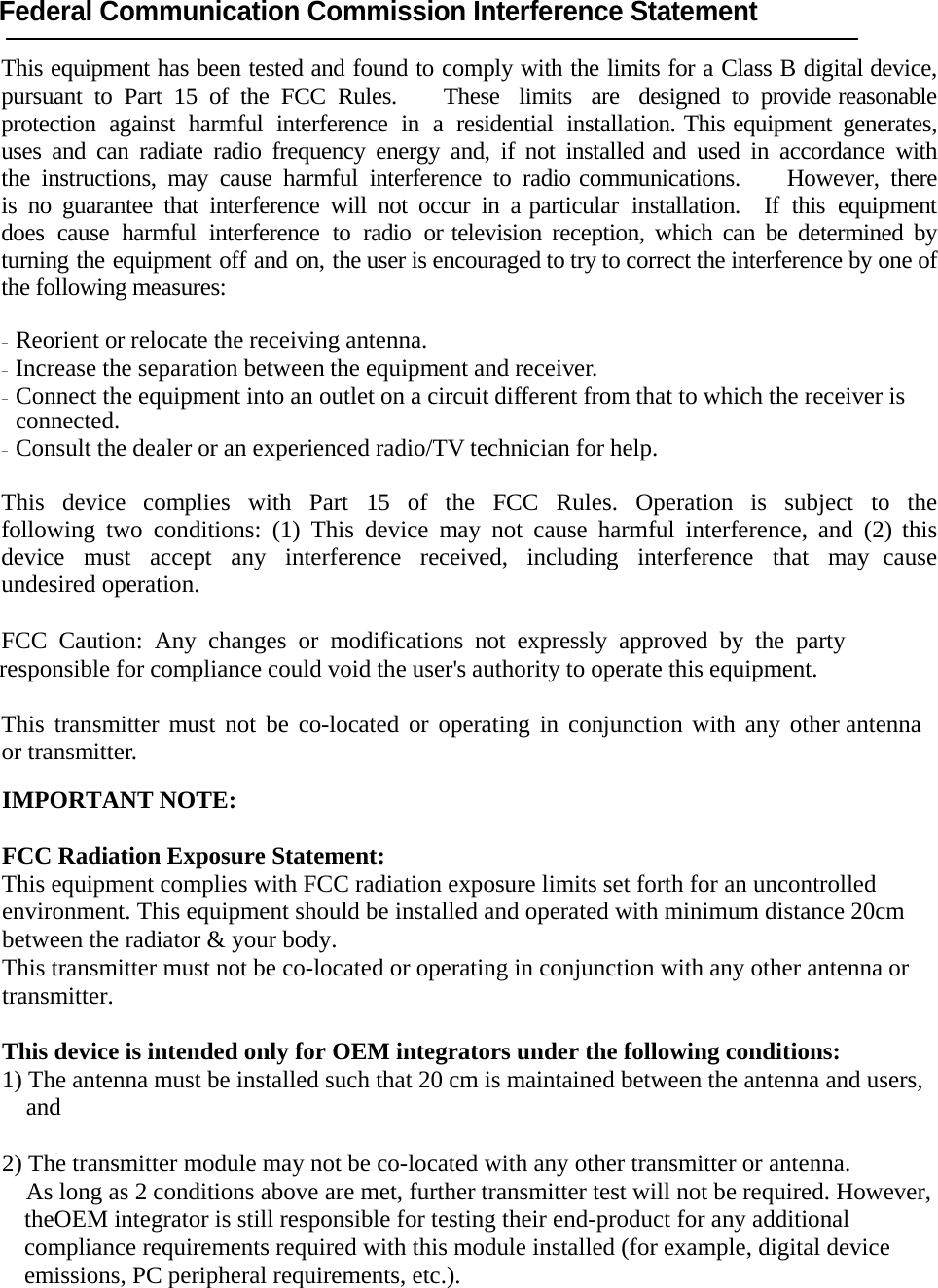
Federal Communication Commission Interference Statement  This equipment has been tested and found to comply with the limits for a Class B digital device, pursuant to Part 15 of the FCC Rules.    These  limits   are   designed  to  provide reasonable protection against harmful interference in a residential installation. This equipment generates, uses and can radiate radio frequency energy and, if not installed and used in accordance with the instructions, may cause harmful interference to radio communications.    However, there is no guarantee that interference will not occur in a particular installation.  If this equipment  does cause harmful interference to radio or television reception, which can be determined by turning the equipment off and on, the user is encouraged to try to correct the interference by one of the following measures:  - Reorient or relocate the receiving antenna. - Increase the separation between the equipment and receiver. - Connect the equipment into an outlet on a circuit different from that to which the receiver is connected. - Consult the dealer or an experienced radio/TV technician for help.  This device complies with Part 15 of the FCC Rules. Operation is subject to the following two conditions: (1) This device may not cause harmful interference, and (2) this device must accept any interference received, including interference that may cause undesired operation.  FCC Caution: Any changes or modifications not expressly approved by the party responsible for compliance could void the user's authority to operate this equipment.    This transmitter must not be co-located or operating in conjunction with any other antenna or transmitter.  IMPORTANT NOTE:  FCC Radiation Exposure Statement: This equipment complies with FCC radiation exposure limits set forth for an uncontrolled environment. This equipment should be installed and operated with minimum distance 20cm between the radiator & your body. This transmitter must not be co-located or operating in conjunction with any other antenna or transmitter.  This device is intended only for OEM integrators under the following conditions: 1) The antenna must be installed such that 20 cm is maintained between the antenna and users, and  2) The transmitter module may not be co-located with any other transmitter or antenna. As long as 2 conditions above are met, further transmitter test will not be required. However, theOEM integrator is still responsible for testing their end-product for any additional compliance requirements required with this module installed (for example, digital device emissions, PC peripheral requirements, etc.).
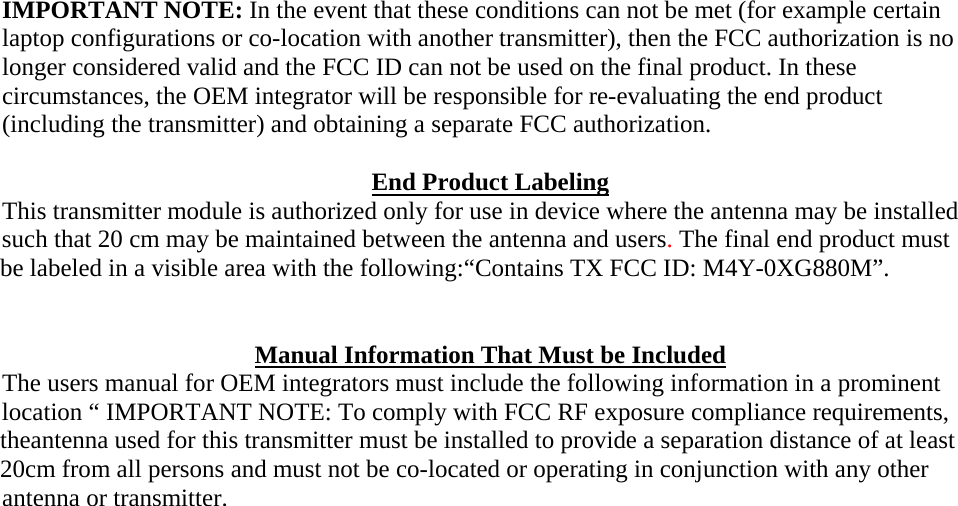
IMPORTANT NOTE: In the event that these conditions can not be met (for example certain laptop configurations or co-location with another transmitter), then the FCC authorization is no longer considered valid and the FCC ID can not be used on the final product. In these circumstances, the OEM integrator will be responsible for re-evaluating the end product (including the transmitter) and obtaining a separate FCC authorization.  End Product Labeling This transmitter module is authorized only for use in device where the antenna may be installed such that 20 cm may be maintained between the antenna and users. The final end product must be labeled in a visible area with the following:“Contains TX FCC ID: M4Y-0XG880M”.   Manual Information That Must be Included The users manual for OEM integrators must include the following information in a prominent location “ IMPORTANT NOTE: To comply with FCC RF exposure compliance requirements, theantenna used for this transmitter must be installed to provide a separation distance of at least 20cm from all persons and must not be co-located or operating in conjunction with any other antenna or transmitter.

Navigation menu