Zida Technologies MB-A815EP-11 Mainboard User Manual Manual A815E1 indd

Zida Technologies Ltd. Mainboard Manual A815E1 indd

users manual 6

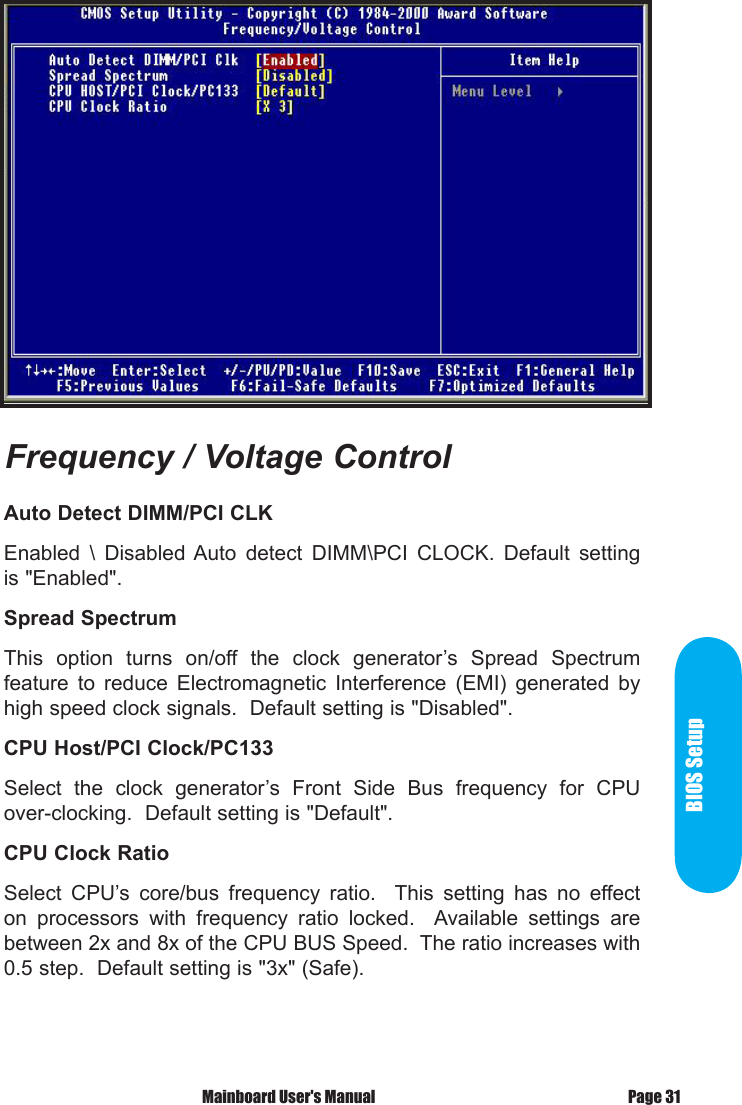
BIOS SetupPage 31 Mainboard User's ManualAuto Detect DIMM/PCI CLK Enabled  \  Disabled Auto  detect  DIMM\PCI  CLOCK.  Default  setting is "Enabled". Spread SpectrumThis  option  turns  on/off  the  clock  generator’s  Spread  Spectrum feature  to  reduce  Electromagnetic  Interference  (EMI)  generated  by high speed clock signals.  Default setting is "Disabled".CPU Host/PCI Clock/PC133Select  the  clock  generator’s  Front  Side  Bus  frequency  for  CPU over-clocking.  Default setting is "Default".CPU Clock RatioSelect  CPU’s  core/bus  frequency  ratio.    This  setting  has  no  effect on  processors  with  frequency  ratio  locked.    Available  settings  are between 2x and 8x of the CPU BUS Speed.  The ratio increases with 0.5 step.  Default setting is "3x" (Safe).Frequency / Voltage Control
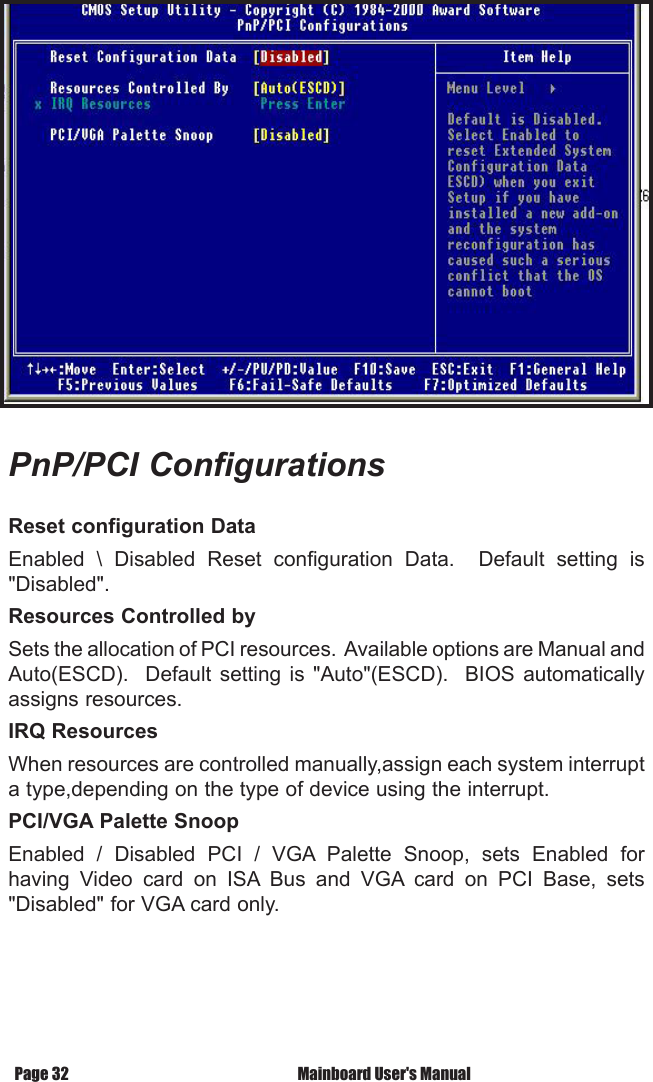
PnP/PCI ConfigurationsReset configuration DataEnabled  \  Disabled  Reset  configuration  Data.    Default  setting  is "Disabled".Resources Controlled bySets the allocation of PCI resources.  Available options are Manual and Auto(ESCD).    Default  setting  is  "Auto"(ESCD).    BIOS  automatically assigns resources.IRQ ResourcesWhen resources are controlled manually,assign each system interrupt a type,depending on the type of device using the interrupt.PCI/VGA Palette SnoopEnabled  /  Disabled  PCI  /  VGA  Palette  Snoop,  sets  Enabled  for having  Video  card  on  ISA  Bus  and  VGA  card  on  PCI  Base,  sets "Disabled" for VGA card only. Mainboard User's ManualPage 32
BIOS SetupPage 33 Mainboard User's ManualCPU Warning TemperatureSpecifies  CPU  warning  temperature  value.    Available  options are  50℃/122℉,  53℃/127℉,56℃/133℉,  60℃/140℉,  63℃/145℉, 66℃/151℉, 70℃/158℉ and Disabled.  Default setting is "Disabled".Current System TemperatureCurrent CPU TemperatureDetect System and CPU temperature automatically.System Fan SpeedCPU Fan SpeedChassis Fan speedDetect Fan Speed Status automatically.Vcore/Vft/VCC3-3/+5V/+12V/-12VDetect System's Voltage status automatically.Shutdown TemperatureThis  function  will  be  effective  only  for  the  operating  systems that  support  ACPI  Function.  Specifies  Shutdown  Temperature Value.   Available option are  60℃/140℉,  65S℃/149℉,  70℃/158℉, 75℃/167℉ and Disabled.   Default setting is "Default".PC Health Status
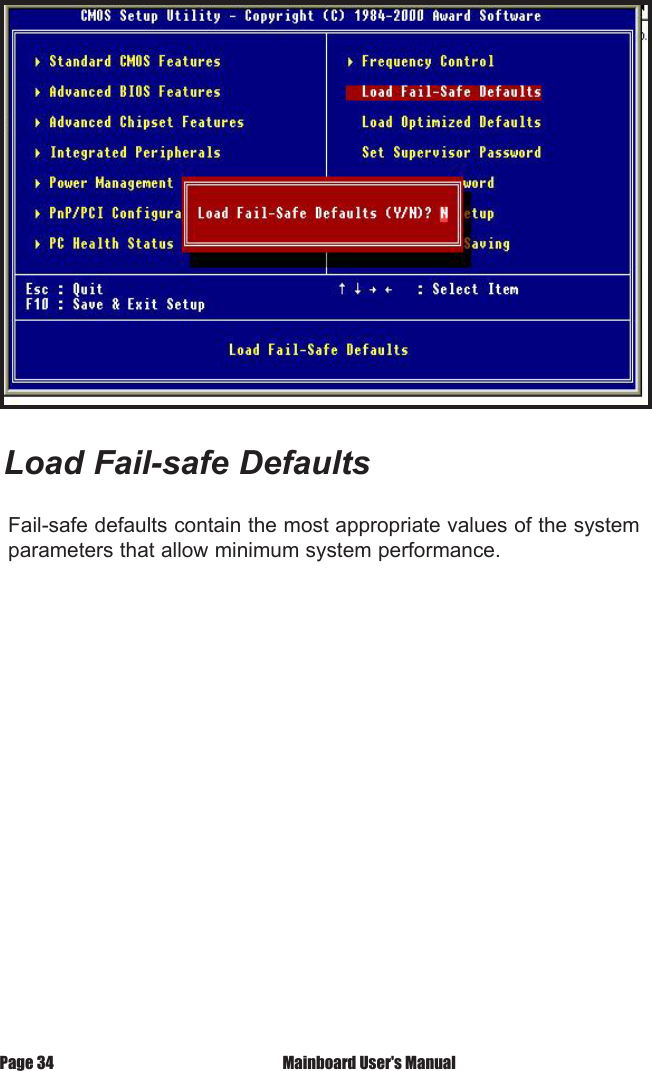
Fail-safe defaults contain the most appropriate values of the system parameters that allow minimum system performance.Load Fail-safe Defaults Mainboard User's ManualPage 34
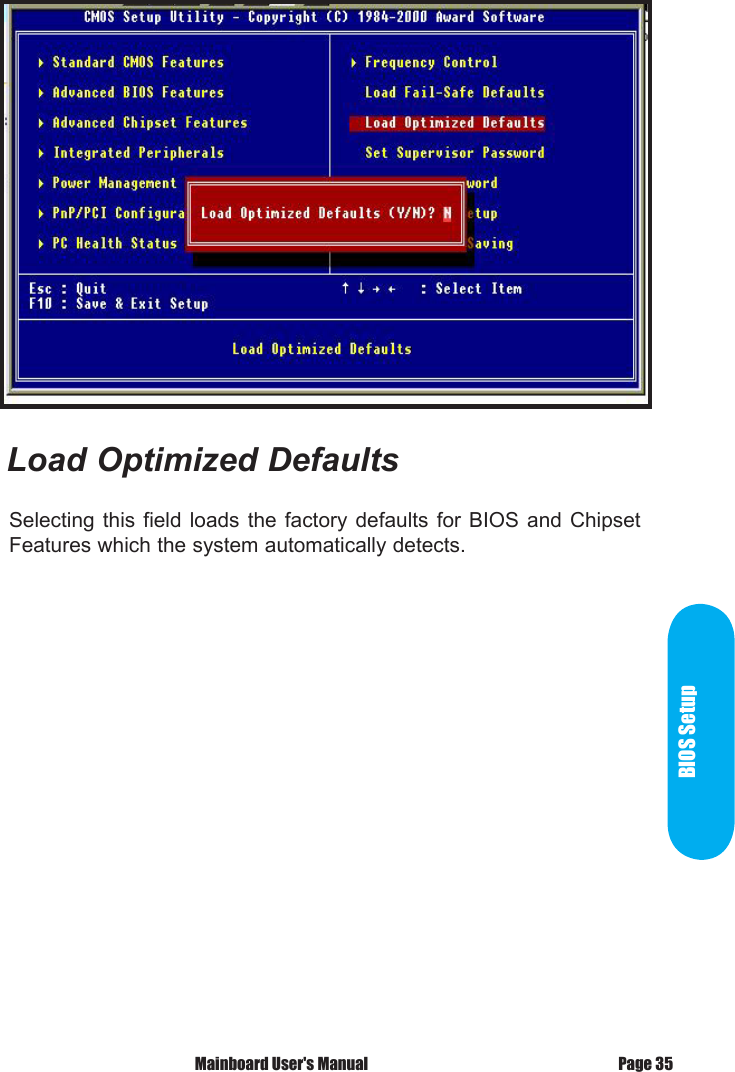
Load Optimized DefaultsSelecting this  field  loads  the  factory  defaults for BIOS  and  Chipset Features which the system automatically detects.BIOS SetupPage 35 Mainboard User's Manual
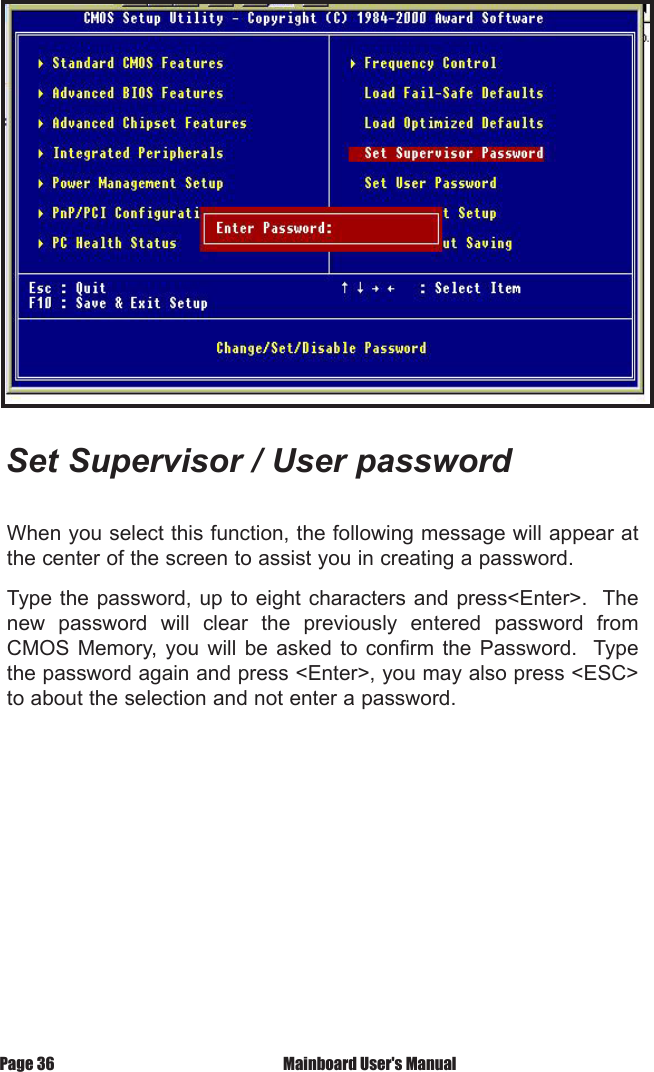
Set Supervisor / User passwordWhen you select this function, the following message will appear at the center of the screen to assist you in creating a password.Type the password, up  to eight characters and press<Enter>.  The new  password  will  clear  the  previously  entered  password  from CMOS  Memory,  you  will  be  asked  to  confirm  the  Password.    Type the password again and press <Enter>, you may also press <ESC> to about the selection and not enter a password. Mainboard User's ManualPage 36
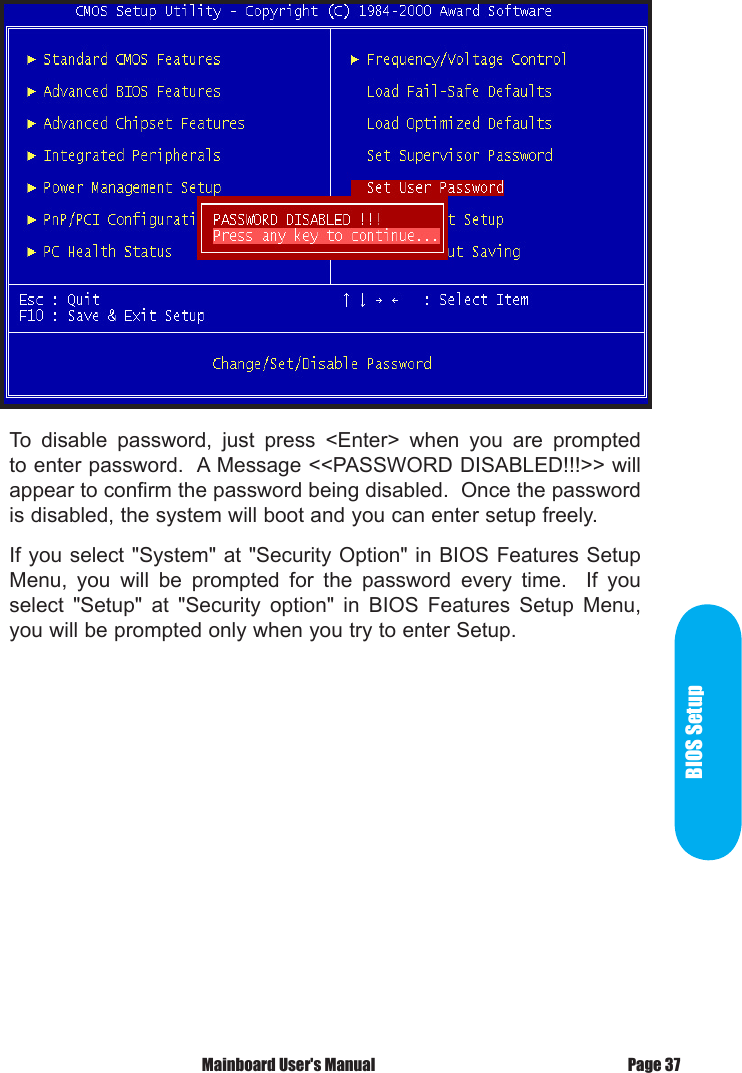
To  disable  password,  just  press  <Enter>  when  you  are  prompted to enter password.  A Message <<PASSWORD DISABLED!!!>> will appear to confirm the password being disabled.  Once the password is disabled, the system will boot and you can enter setup freely.If you select "System" at "Security Option" in BIOS Features Setup Menu,  you  will  be  prompted  for  the  password  every  time.    If  you select  "Setup"  at  "Security  option"  in  BIOS  Features  Setup  Menu, you will be prompted only when you try to enter Setup.BIOS SetupPage 37 Mainboard User's Manual
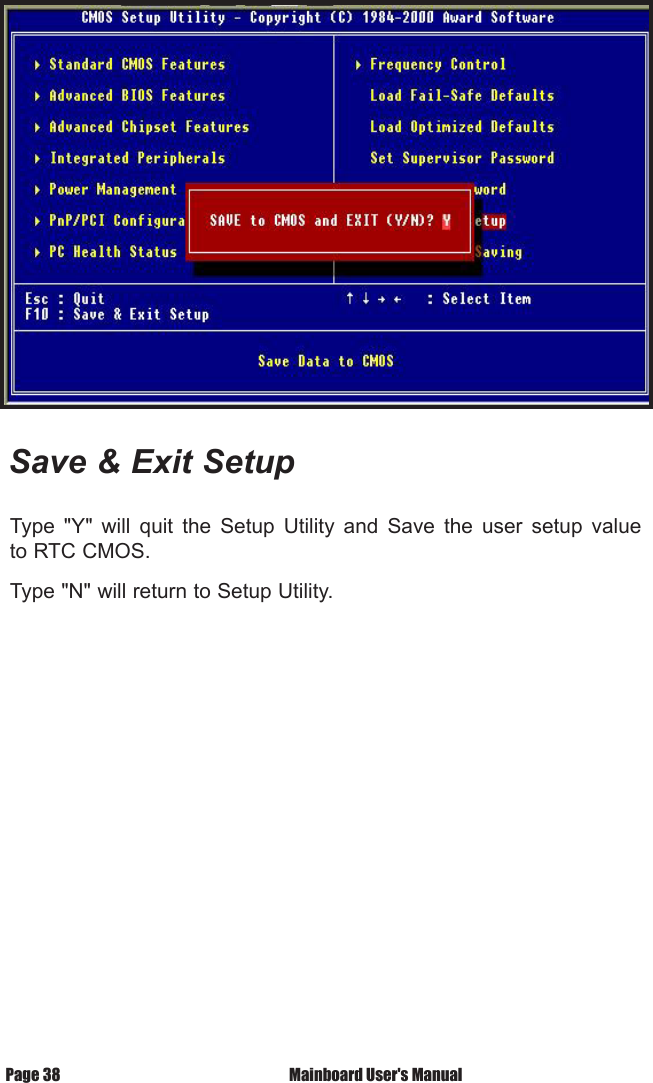
Type  "Y"  will  quit  the  Setup  Utility  and  Save  the  user  setup  value to RTC CMOS.Type "N" will return to Setup Utility.Save & Exit Setup Mainboard User's ManualPage 38
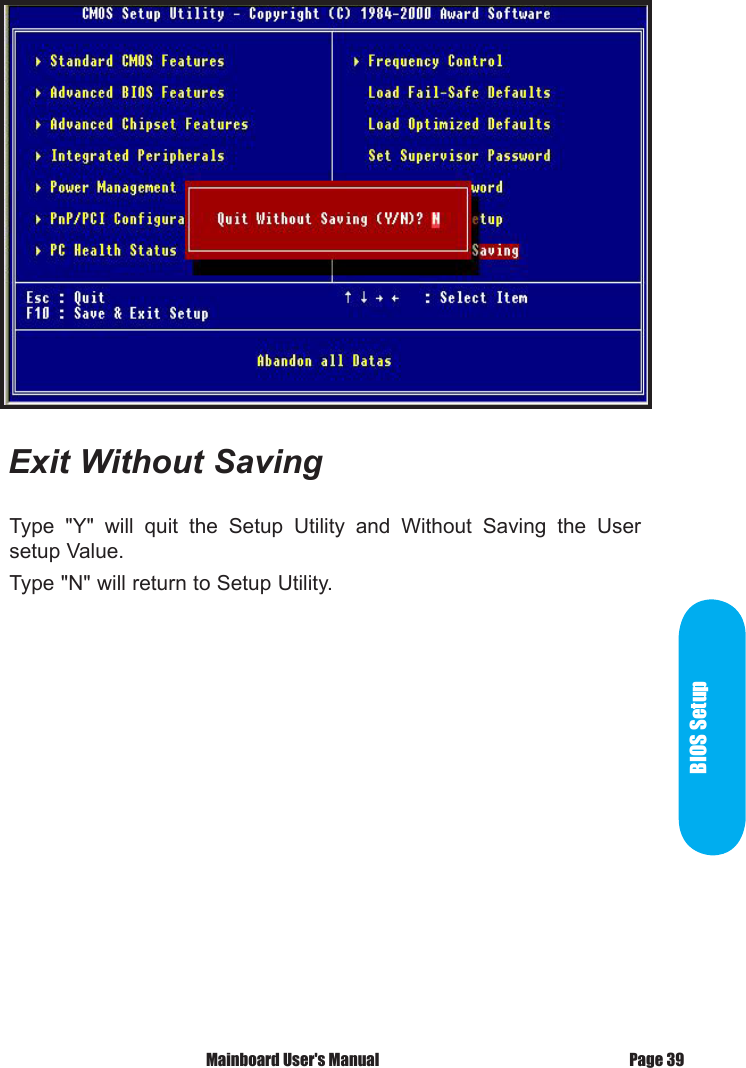
Type  "Y"  will  quit  the  Setup  Utility  and  Without  Saving  the  User setup Value.Type "N" will return to Setup Utility.Exit Without SavingBIOS SetupPage 39 Mainboard User's Manual
Glossary
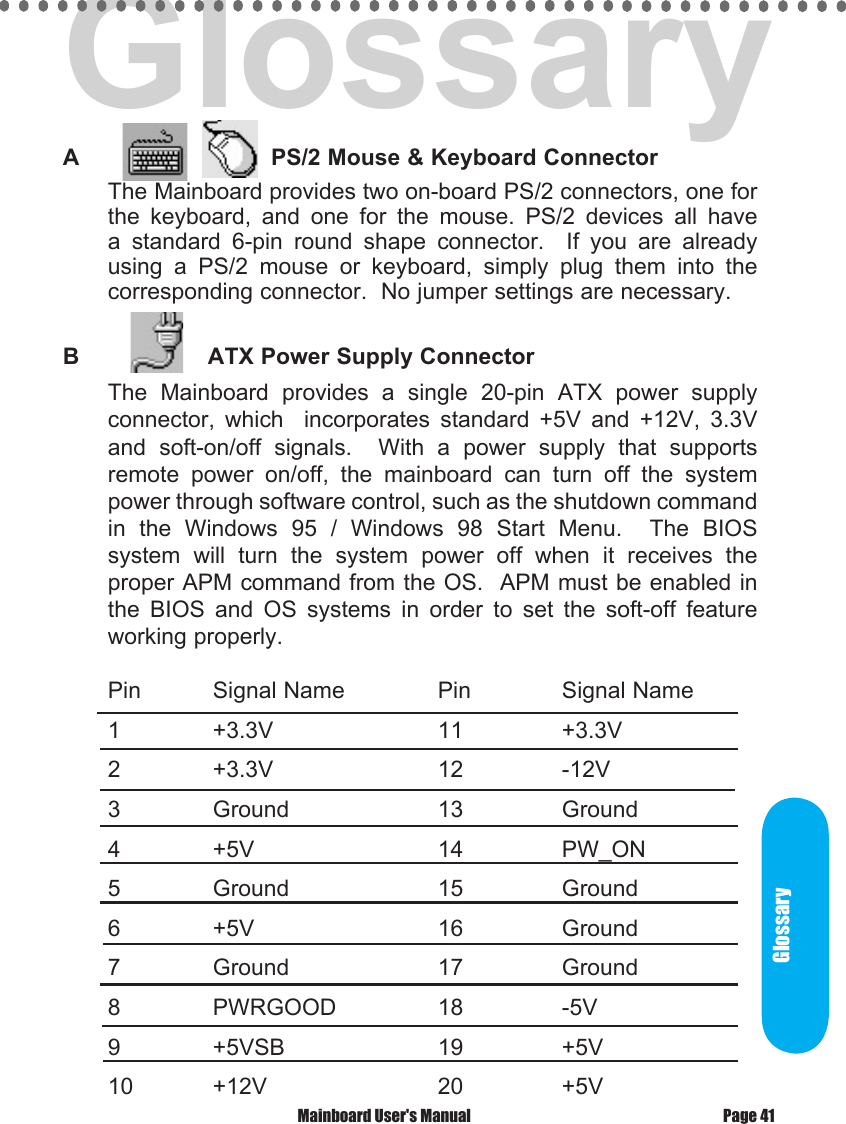
A                     PS/2 Mouse & Keyboard ConnectorThe Mainboard provides two on-board PS/2 connectors, one for the  keyboard,  and  one  for  the  mouse.  PS/2  devices  all  have a  standard  6-pin  round  shape  connector.    If  you  are  already using  a  PS/2  mouse  or  keyboard,  simply  plug  them  into  the corresponding connector.  No jumper settings are necessary.B             ATX Power Supply ConnectorThe  Mainboard  provides  a  single  20-pin  ATX  power  supply connector,  which    incorporates  standard  +5V  and  +12V,  3.3V and  soft-on/off  signals.    With  a  power  supply  that  supports remote  power  on/off,  the  mainboard  can  turn  off  the  system power through software control, such as the shutdown command in  the  Windows  95  /  Windows  98  Start  Menu.    The  BIOS system  will  turn  the  system  power  off  when  it  receives  the proper APM command from the OS.  APM must be enabled in the  BIOS  and  OS  systems  in  order  to  set  the  soft-off  feature working properly.Pin  Signal Name    Pin         Signal Name1    +3.3V      11         +3.3V2    +3.3V      12         -12V3    Ground    13         Ground4    +5V      14         PW_ON5    Ground    15         Ground6    +5V      16         Ground7    Ground    17         Ground8    PWRGOOD    18         -5V9    +5VSB     19         +5V10   +12V      20         +5VGlossaryPage 41 Mainboard User's ManualGlossary
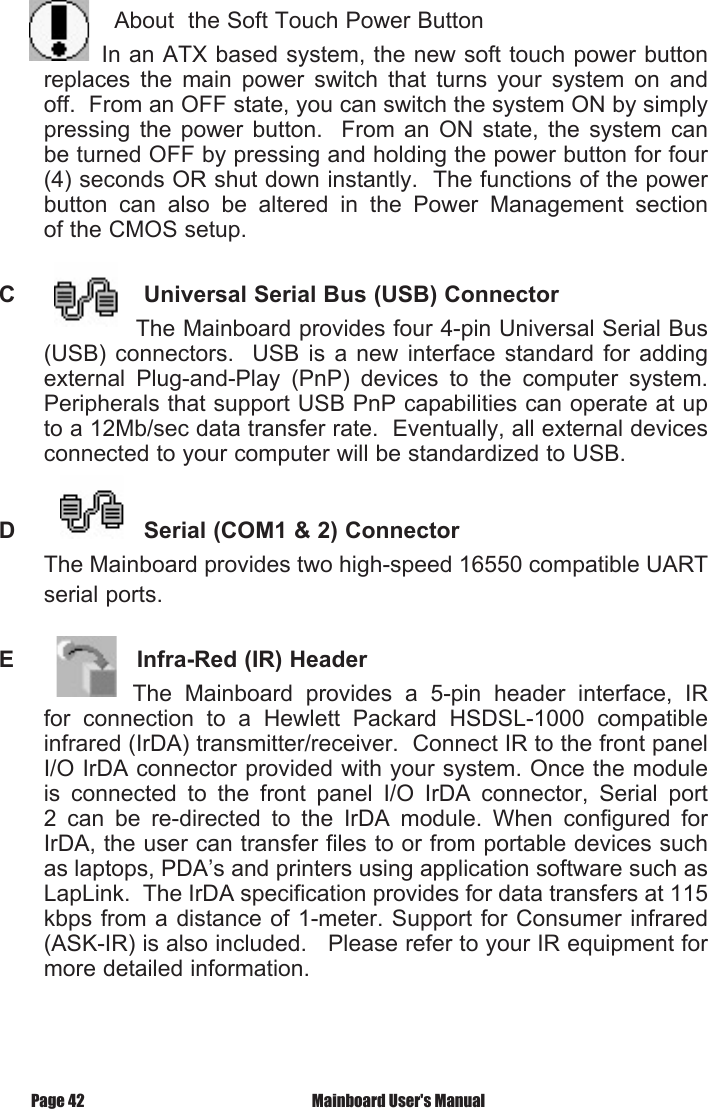
 Mainboard User's ManualPage 42                          About  the Soft Touch Power Button       In an ATX based system, the new soft touch power button replaces  the  main  power  switch  that  turns  your  system  on  and off.  From an OFF state, you can switch the system ON by simply pressing  the  power  button.    From  an  ON  state,  the  system  can be turned OFF by pressing and holding the power button for four (4) seconds OR shut down instantly.  The functions of the power button  can  also  be  altered  in  the  Power  Management  section of the CMOS setup.C            Universal Serial Bus (USB) Connector            The Mainboard provides four 4-pin Universal Serial Bus (USB)  connectors.    USB  is  a  new  interface  standard  for  adding external  Plug-and-Play  (PnP)  devices  to  the  computer  system.  Peripherals that support USB PnP capabilities can operate at up to a 12Mb/sec data transfer rate.  Eventually, all external devices connected to your computer will be standardized to USB.D            Serial (COM1 & 2) ConnectorThe Mainboard provides two high-speed 16550 compatible UART serial ports.E           Infra-Red (IR) Header              The  Mainboard  provides  a  5-pin  header  interface,  IR for  connection  to  a  Hewlett  Packard  HSDSL-1000  compatible infrared (IrDA) transmitter/receiver.  Connect IR to the front panel I/O IrDA connector provided with your system. Once the module is  connected  to  the  front  panel  I/O  IrDA  connector,  Serial  port 2  can  be  re-directed  to  the  IrDA  module.  When  configured  for IrDA, the user can transfer files to or from portable devices such as laptops, PDA’s and printers using application software such as LapLink.  The IrDA specification provides for data transfers at 115 kbps from a distance of 1-meter. Support  for Consumer infrared (ASK-IR) is also included.   Please refer to your IR equipment for more detailed information.
GlossaryThe  header pin-out is as follows:Pin  . . . . . . . . . . . . . Signal Name1 . . . . . . . . . . . . . . . VCC, power source2 . . . . . . . . . . . . . . . No Connection3 . . . . . . . . . . . . . . . IRRX, infra-red receive4 . . . . . . . . . . . . . . . Ground5 . . . . . . . . . . . . . . . IRTX, infra-red transmitF          Memory Module Sockets The  Mainboard  provides  168  pin  standard  DIMM  sockets  for installation of 3.3V unbuffered Single or Double Bank SDRAM modules.G            Parallel Port ConnectorThe ATX Mainboard provides a parallel port connector.  Based on  the  ATX  standard,  a  25-pin  parallel  port  is  now  built  on the mainboard back panel.  This design makes the mainboard installation  easier.    The  parallel  port  can  be  BIOS  configured into standard (SPP) mode, Enhanced Parallel Port (EPP) mode, and a high speed Extended Capabilities Port (ECP) mode.  EPP Mode requires a driver provided by the peripheral manufacturer in order to operate properly. H        Accelerated Graphics Port [AGP] ConnectorThe  Mainboard  provides  an  AGP  slot  compatible  with  the Accelerated Graphics Port specification.  AGP compliant video cards offer a much higher throughput than equivalent PCI bus video cards.  PCI currently only supports a 33MHz bandwidth, and  can  transport  at  peak  rates  up  to  133MB/s  over  its  32 bit  data  bus.    AGP  operates  at  a  66MHz  bandwidth  which enables  a  peak  rate  of  266MB/s  in  what  is  known  as  'X1' mode.    Using  'X2'  mode,  the  peak  transport  rate  can  go  as high as 532MB/s.Page 43 Mainboard User's Manual
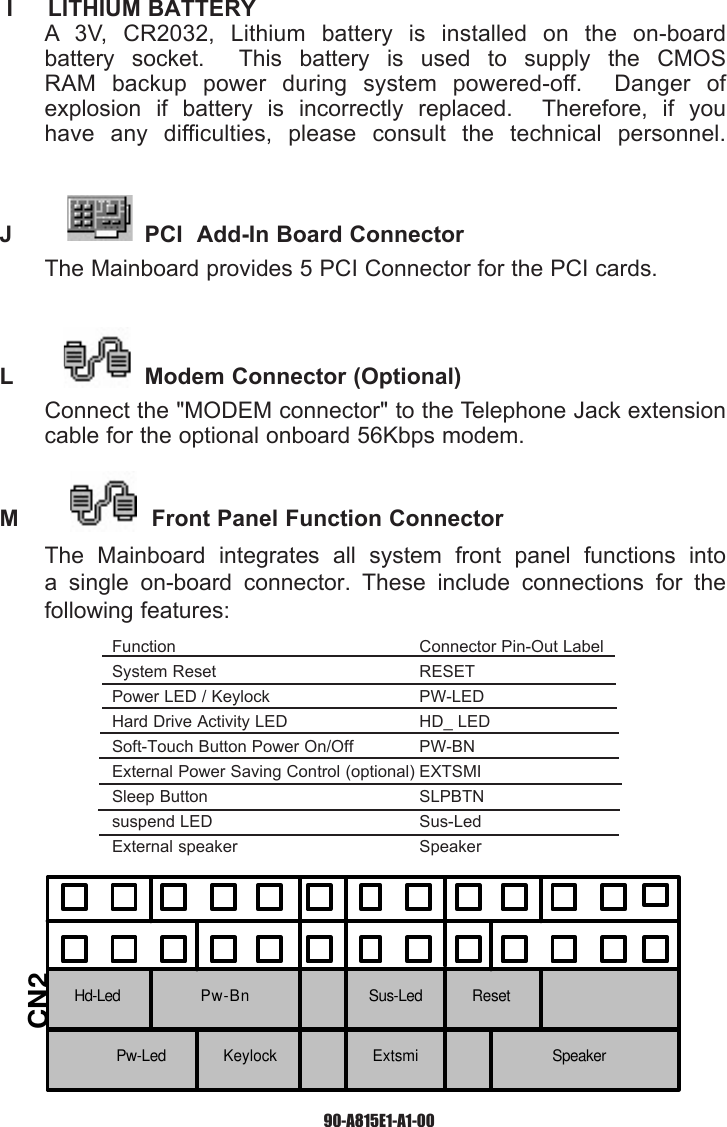
90-A815E1-A1-00 I     LITHIUM BATTERY A  3V,  CR2032,  Lithium  battery  is  installed  on  the  on-board battery  socket.    This  battery  is  used  to  supply  the  CMOS RAM  backup  power  during  system  powered-off.    Danger  of explosion  if  battery  is  incorrectly  replaced.    Therefore,  if  you have  any  difficulties,  please  consult  the  technical  personnel.J            PCI  Add-In Board ConnectorThe Mainboard provides 5 PCI Connector for the PCI cards.L            Modem Connector (Optional)Connect the "MODEM connector" to the Telephone Jack extension cable for the optional onboard 56Kbps modem.M             Front Panel Function ConnectorThe  Mainboard  integrates  all  system  front  panel  functions  into a  single  on-board  connector.  These  include  connections  for  the following features:Function                                                     Connector Pin-Out LabelSystem Reset                                            RESETPower LED / Keylock                                 PW-LEDHard Drive Activity LED                             HD_ LEDSoft-Touch Button Power On/Off               PW-BNExternal Power Saving Control (optional) EXTSMI       Sleep Button                                              SLPBTNsuspend LED                                             Sus-LedExternal speaker                                        SpeakerPw-BnPw-Led ExtsmiHd-LedKeylockSus-LedSpeakerResetCN2
GlossaryN            Flash BIOSThe Mainboard  flash  BIOS provides  users with  more  flexibility in upgrading  their  mainboards.    The flash  BIOS  can  be  easily reprogrammed via software.O          Floppy Drive HeaderThe  Mainboard  provides  a  34-pin  connector  that  supports the  included  floppy  drive  ribbon  cable.    After  connecting  the single  end  to  the  on-board  “FLOPPY”  connector,  connect the  remaining  plugs  on  the  other  end  of  the  cable  to  the corresponding floppy drives.NOTE:    Pin  5  is  removed  to  prevent  inserting  the  connector in the wrong orientation.P                     IDE Device HeaderThe  Mainboard  provides  (2)  independent  bus-mastering  PCI IDE  interfaces  capable  of  supporting  up  to  Mode  4  and  Ultra DMA-33/66/100 devices.  The system BIOS supports automatic detection  of  the  IDE  device  data  transfer  rate  and  translation between different kinds of device modes such as Logical Block Addressing  (LBA),  Extended  Cylinder  Sector  Head  (ECSH) translation modes and ATAPI (e.g., CD-ROM) devices on both IDE interfaces.The two on-board IDE headers support the provided 80-pin IDE hard  disk  ribbon  cables.    If  you  install  two  hard  disks  and/or CD-Rom  drives,  you  must  configure  the  two  drives  by  setting their IDE master/slave jumpers according to the documentation for those devices.Also,  you  may  connect  the  two  hard  disk  drives  so  that  both become  Masters,  using  one  ribbon  cable  on  the  primary  IDE header and one on the secondary IDE header.Page 45 Mainboard User's Manual
Q        WAKEUP-LINK HeaderThe  Mainboard  provides  on  WAKEUP-LINK  header  (WOL) used  to  connect  an  add-in  Network  Interface  Card  which  has Wakeup capability.R                  Universal Serial Bus HeaderConnect  this  header  to  the  optional  USB  extension  cable  for two USB ports.r              "CNR" Add-in Board ConnectorCommunication  &  Networking  Riser(CNR)  is  a  new  interface standard for Networking or modem add-in card.S      CPU SocketThe  Mainboard  provides  a  370-pin  CPU  Socket  for  Intel Celeron, PIII or Cyrix III processor.  The CPU should have a fan attached to it to prevent overheat. If a fan is not present, a fan should be installed prior to turning the system on. Mainboard User's ManualPage 46
GlossaryT            CPU / System & Auxiliary Fan ConnectorThe  recommended  heatsink  for  the  processor  are  those             with 12 Volt three-conductor fan that can be  connected to the fan connector  on the  mainboard.   It provides  +12 Volts  DC  to the CPU cooling fan as follows:PIN       SIGNAL NAME       1        Ground2        +12V3        FAN Speed DetectCAUTION!  Be sure that sufficient air circulation is available across the processor’s  heatsink  by  regularly  checking  that  your  CPU  fan  is working.  Without sufficient circulation, the processor could  overheat and  damage both the processor and the mainboard.  You may install an  auxiliary fan if necessary.The  SYSTEM  and  AUXILIARY  fan  connectors  are  provided  for optional cooling fans.U           Audio & Joystick Connectors       The Mainboard provides Audio headers.        Audio & Joystick Connectors                         Line Output                         Line  Input                        Microphone Input                         Game PortPage 47 Mainboard User's Manual
V    VGA Connector (Optional)Connect this connector to the VGA extension cable for integrated VGA interface (815E only).W    Temperature Sensor HeaderThe  mainboard  provides  one  header  for  an  optional  thermal sensor to monitor system temperature.   X            CD Audio Connector         CD Audio input ( Right, Ground, Ground, Left )Y          Auxiliary Audio Connector         Auxiliary input ( Right, Ground, Ground, Left )z         Case Detect         If case is opened,this switch should be closed. Mainboard User's ManualPage 48
 Mainboard User's Manual Page 49CD Driver & Software Installation Guide Steps :   1.  Boot up the Operating System ( Windows 95/98/NT/2000 )  2.  Put the CD Disc into the CD-ROM Drive and wait for Autorun  3.  Select A815E / A815EP and click your Operating System Type  4.  Follow the instructions and install suitable driversCD Driver & Software Installation Guide

Navigation menu